EP3465913B1 - Adaptively controlling drive strength of multiplexed power from supply power rails in a power multiplexing system to a powered circuit - Google Patents
Adaptively controlling drive strength of multiplexed power from supply power rails in a power multiplexing system to a powered circuit Download PDFInfo
- Publication number
- EP3465913B1 EP3465913B1 EP17725833.2A EP17725833A EP3465913B1 EP 3465913 B1 EP3465913 B1 EP 3465913B1 EP 17725833 A EP17725833 A EP 17725833A EP 3465913 B1 EP3465913 B1 EP 3465913B1
- Authority
- EP
- European Patent Office
- Prior art keywords
- power rail
- voltage
- supply
- output
- drive strength
- Prior art date
- Legal status (The legal status is an assumption and is not a legal conclusion. Google has not performed a legal analysis and makes no representation as to the accuracy of the status listed.)
- Active
Links
Images






Classifications
-
- G—PHYSICS
- G06—COMPUTING OR CALCULATING; COUNTING
- G06F—ELECTRIC DIGITAL DATA PROCESSING
- G06F1/00—Details not covered by groups G06F3/00 - G06F13/00 and G06F21/00
- G06F1/26—Power supply means, e.g. regulation thereof
- G06F1/32—Means for saving power
- G06F1/3203—Power management, i.e. event-based initiation of a power-saving mode
- G06F1/3234—Power saving characterised by the action undertaken
- G06F1/3296—Power saving characterised by the action undertaken by lowering the supply or operating voltage
-
- G—PHYSICS
- G01—MEASURING; TESTING
- G01R—MEASURING ELECTRIC VARIABLES; MEASURING MAGNETIC VARIABLES
- G01R19/00—Arrangements for measuring currents or voltages or for indicating presence or sign thereof
- G01R19/0084—Measuring voltage only
-
- G—PHYSICS
- G11—INFORMATION STORAGE
- G11C—STATIC STORES
- G11C5/00—Details of stores covered by group G11C11/00
- G11C5/14—Power supply arrangements, e.g. power down, chip selection or deselection, layout of wirings or power grids, or multiple supply levels
- G11C5/147—Voltage reference generators, voltage or current regulators; Internally lowered supply levels; Compensation for voltage drops
-
- H—ELECTRICITY
- H02—GENERATION; CONVERSION OR DISTRIBUTION OF ELECTRIC POWER
- H02J—ELECTRIC POWER NETWORKS; CIRCUIT ARRANGEMENTS OR SYSTEMS FOR SUPPLYING OR DISTRIBUTING ELECTRIC POWER; SYSTEMS FOR STORING ELECTRIC ENERGY
- H02J4/00—Circuit arrangements for mains or distribution networks not specified as AC or DC; Circuit arrangements for mains or distribution networks combining AC and DC sections or sub-networks
-
- H—ELECTRICITY
- H02—GENERATION; CONVERSION OR DISTRIBUTION OF ELECTRIC POWER
- H02J—ELECTRIC POWER NETWORKS; CIRCUIT ARRANGEMENTS OR SYSTEMS FOR SUPPLYING OR DISTRIBUTING ELECTRIC POWER; SYSTEMS FOR STORING ELECTRIC ENERGY
- H02J1/00—Circuit arrangements for DC mains or DC distribution networks
- H02J1/08—Three-wire DC power distribution systems; Systems having more than three wires
- H02J1/082—DC supplies with two or more different DC voltage levels
-
- H—ELECTRICITY
- H03—ELECTRONIC CIRCUITRY
- H03K—PULSE TECHNIQUE
- H03K19/00—Logic circuits, i.e. having at least two inputs acting on one output; Inverting circuits
- H03K19/0008—Arrangements for reducing power consumption
- H03K19/0016—Arrangements for reducing power consumption by using a control or a clock signal, e.g. in order to apply power supply
-
- H—ELECTRICITY
- H03—ELECTRONIC CIRCUITRY
- H03K—PULSE TECHNIQUE
- H03K19/00—Logic circuits, i.e. having at least two inputs acting on one output; Inverting circuits
- H03K19/003—Modifications for increasing the reliability for protection
- H03K19/00369—Modifications for compensating variations of temperature, supply voltage or other physical parameters
- H03K19/00384—Modifications for compensating variations of temperature, supply voltage or other physical parameters in field effect transistor circuits
Definitions
- the technology of the disclosure relates generally to power multiplexing systems configured to selectively supply power from multiple power rails to operational circuits.
- Circuits are increasingly being designed with power conservation in mind. This is particularly the case for portable electronic devices that are battery-powered. Common examples include mobile phones and laptop computers, among others. Increased power consumption undesirably results in faster battery drainage and shorter battery life.
- Another method of conserving power is to lower the operating voltage, since generally, active power reduces quadratically for a given reduction in operating voltage. However, lowering the operating voltage in a circuit lowers speed performance, which may also be undesirable. Further, certain cells or components of a circuit may have a minimum operating voltage below which they will not operate to read and write data, as well as retain data.
- circuit domains are increasingly being provided in circuits.
- Circuit paths are provided that pass through multiple voltage domains to provide different operating voltages to different components of a circuit.
- Providing multiple voltage domains allows a lower voltage domain to provide power to components that do not require minimum voltage levels to conserve power. Components that either have a minimum operating voltage for memory operation functionality or provide critical paths where performance cannot be sacrificed may be powered by the higher voltage domain.
- Providing multiple voltage domains also allows the lower voltage domain to be scaled-down to conserve power during a power conservation mode, or scaled-up to provide for increased performance (i.e., hyper-performance), without affecting the operation of the components in the higher voltage domain.
- a power multiplexing system can be employed to selectively couple a power rail among multiple power rails each having different voltage domains (i.e., voltage levels) to supply power to a circuit.
- Figure 1 is a block diagram of such an exemplary power multiplexing system 100.
- a first supply power rail 102(1) and a second supply power rail 102(2) are provided.
- the first supply power rail 102(1) is configured to provide a first voltage source 104(1) at a first voltage V DD(1) .
- the second supply power rail 102(2) is configured to provide a second voltage source 104(2) at a second voltage V DD(2) .
- the first and second voltage sources 104(1), 104(2) may be provided by the same or different power supplies (not shown).
- the first voltage V DD(1) may be 1 Volt (V) and the second voltage V DD(2) may be 0.6 V.
- the power multiplexing system 100 may be configured to selectively couple the first supply power rail 102(1) or the second supply power rail 102(2) to an output power rail 104 coupled to a powered circuit 106 based on an operational mode of the powered circuit 106.
- the power multiplexing system 100 may be configured to couple the first supply power rail 102(1) to the output power rail 104 during active memory operations, and couple the second supply power rail 102(2) to the output power rail 104 during an idle mode.
- the second voltage V DD(2) may be sufficient for memory retention in the powered circuit 106.
- the power multiplexing system 100 includes a first head switch circuit 108(1) in the form of a P-type metal oxide semiconductor (MOS) (PMOS) transistor 110(1).
- the PMOS transistor 110(1) is coupled between the first supply power rail 102(1) and the output power rail 104.
- the PMOS transistor 110(1) is configured to be activated and deactivated in response to a state of a first power rail enable signal 112(1) to couple and decouple, respectively, the first supply power rail 102(1) to the output power rail 104.
- the power multiplexing system 100 also includes a second head switch circuit 108(2), also in the form of a PMOS transistor 110(2) that is coupled between the second supply power rail 102(2) and the output power rail 104.
- the second head switch circuit 108(2) is configured to selectively couple and decouple the second supply power rail 102(2) to and from the output power rail 104 in response to a second power rail enable signal 112(2).
- the first and second PMOS transistors 110(1), 110(2) in the first and second head switch circuits 108(1), 108(2) are sized to provide the desired drive strength to supply power from the first and second power rails 102(1), 102(2) to the output power rail 104.
- process voltage temperature (PVT) variations can vary the drive strength of the first and second PMOS transistors 110(1), 110(2) from their expected drive strength.
- the first and second PMOS transistors 110(1), 110(2) can be oversized and/or additional transistors can be provided in the respective first and second head switch circuits 108(1), 108(2) to increase drive strength to provide a drive strength margin in the voltage V DD(1) , V DD(N) provided by the first and second voltage sources 104(1), 104(2) on the output power rail 104 when the respective first and second power rails 102(1), 102(2) are coupled to the output power rail 104.
- increasing drive strength through providing oversized and/or additional transistors in the power multiplexing system 100 increases leakage power.
- Document US2008/284407 A1 discloses an electronic circuit power supply device configured to selectively apply at least one first voltage or one second voltage to a power supply terminal of the electronic circuit.
- the circuit is arranged for applying to the power supply terminal a voltage variable from a value equal to the first voltage to a value equal to the second voltage and elements designed for selecting application of the second voltage to the power supply terminal when the variable voltage reaches the second voltage.
- a power multiplexing circuit is provided in the power multiplexing system.
- the power multiplexing circuit includes a plurality of supply selection circuits each coupled between a respective supply power rail among a plurality of supply power rails and an output power rail, which is coupled to a powered circuit.
- the power multiplexing circuit is configured to activate a selected supply selection circuit among the plurality of supply selection circuits to switch the coupling of an associated supply power rail to the output power rail to power the powered circuit.
- exemplary aspects disclosed herein also provide for each supply selection circuit in the power multiplexing circuit to be configured to selectively drive a voltage from an associated supply power rail to the output power rail at a controlled drive strength based on a drive strength indicator.
- the drive strength of the activated supply selection circuit can be adaptively controlled and adjusted to compensate for process voltage temperature (PVT) variations to reduce drive strength margin, and thus leakage power as a result.
- PVT process voltage temperature
- a power multiplexing system configured to adaptively control the drive strength of multiplexed power from a logic supply power rail and a memory supply power rail in multiple voltage domains to a memory array as a powered circuit. Power from the memory supply power rail is multiplexed to the memory array for data retention when the voltage of the logic supply power rail may not be sufficient to power the memory array for data retention.
- the power multiplexing circuit includes a logic supply selection circuit configured to selectively couple the logic supply power rail to an output power rail, which is coupled to the memory array.
- the power multiplexing circuit also includes a memory supply selection circuit configured to selectively couple the memory supply power rail to the output power rail.
- the logic and memory supply selection circuits each include a respective plurality of logic and memory power switch circuits (e.g., head switches) coupled between the respective logic and memory supply power rails and the output power rail.
- Each of the logic and memory power switch circuits has an associated drive strength.
- the logic and memory power switch circuits are each configured to be individually activated to couple the logic or memory supply power rails to the output power rail, to contribute to driving the voltage of the activated logic or memory supply power rail to the output power rail.
- a control circuit is configured to control the drive strength of the activated logic or memory supply selection circuit.
- the logic supply selection circuit can be configured to couple the output power rail to the logic supply power rail for supplying power to the memory array when the logic supply power rail can satisfy a minimum operating voltage of the memory domain.
- additional intrinsic decoupling capacitance of the memory array is coupled to the logic supply power rail during higher power modes of the logic circuitry when the logic supply power rail can satisfy the minimum operating voltage of the memory array.
- Logic circuits in a logic domain can still be separately powered from the memory array if the power rail selection circuit couples a memory supply power rail to the output power rail.
- the memory supply selection circuit can couple the memory supply rail to the output power rail to power the memory array from the memory power supply.
- a power multiplexing system comprises a power multiplexing circuit.
- the power multiplexing circuit comprises a first supply selection circuit coupled between a first supply power rail having a first voltage and an output power rail coupled to at least one powered circuit.
- the first supply selection circuit is configured to selectively drive the first voltage at the first supply power rail to the output power rail at a first drive strength based on a first drive strength indicator in response to a first supply power rail selection indicator indicating a first supply power rail selection enable state.
- the power multiplexing circuit also comprises a second supply selection circuit coupled between a second supply power rail having a second voltage and the output power rail.
- the second supply selection circuit is configured to selectively drive the second voltage at the second supply power rail to the output power rail at a second drive strength based on a second drive strength indicator in response to a second supply power rail selection indicator indicating a second supply power rail selection enable state.
- the power multiplexing system also comprises at least one control circuit.
- the at least one control circuit is configured to monitor an output voltage of the output power rail.
- the at least one control circuit is configured to compare a voltage level of the output voltage at the output power rail to a first reference voltage level associated with the first supply selection circuit, and selectively generate the first drive strength indicator based on the comparison of the voltage level of the output voltage at the output power rail to the first reference voltage level.
- the at least one control circuit is configured to compare the voltage level of the output voltage at the output power rail to a second reference voltage level associated with the second supply selection circuit, and selectively generate the second drive strength indicator based on the comparison of the voltage level of the output voltage at the output power rail to the second reference voltage level.
- a power multiplexing system comprises a first supply means for selectively driving a first voltage at a first supply power rail to an output power rail at a first drive strength based on a first drive strength indicator in response to a first supply power rail selection indicator indicating a first supply power rail selection enable state.
- the power multiplexing system also comprises a second supply means for selectively driving a second voltage at a second supply power rail to the output power rail at a second drive strength based on a second drive strength indicator in response to a second supply power rail selection indicator indicating a second supply power rail selection enable state.
- the power multiplexing system also comprises a means for monitoring an output voltage of the output power rail.
- the power multiplexing system also comprises a means for comparing a voltage level of the output voltage at the output power rail to a first reference voltage level associated with a first supply selection circuit, in response to the first supply power rail selection indicator indicating the first supply power rail selection enable state.
- the power multiplexing system also comprises a means for selectively generating the first drive strength indicator based on the means for comparing the voltage level of the output voltage at the output power rail to the first reference voltage level, in response to the first supply power rail selection indicator indicating the first supply power rail selection enable state.
- the power multiplexing system also comprises a means for comparing the voltage level of the output voltage at the output power rail to a second reference voltage level associated with a second supply selection circuit in response to the second supply power rail selection indicator indicating the second supply power rail selection enable state.
- the power multiplexing system also comprises a means for selectively generating the second drive strength indicator based on the means for comparing the voltage level of the output voltage at the output power rail to the second reference voltage level in response to the second supply power rail selection indicator indicating the second supply power rail selection enable state.
- a method of adaptively controlling drive strength of multiplexed power from supply power rails in a power multiplexing circuit to a powered circuit comprises monitoring an output voltage of an output power rail.
- the method also comprises comparing a voltage level of the output voltage at the output power rail to a first reference voltage level associated with a first supply selection circuit, selectively generating a first drive strength indicator based on the comparison of the voltage level of the output voltage at the output power rail to the first reference voltage level, and selectively driving a first voltage at a first supply power rail to the output power rail at a first drive strength based on the first drive strength indicator.
- the method comprises comparing the voltage level of the output voltage at the output power rail to a second reference voltage level associated with a second supply selection circuit, selectively generating a second drive strength indicator based on the comparison of the voltage level of the output voltage at the output power rail to the second reference voltage level, and selectively driving a second voltage at a second supply power rail to the output power rail at a second drive strength based on the second drive strength indicator.
- FIG. 2 is a block diagram of an exemplary power multiplexing system 200 that is configured to adaptively control drive strength of multiplexed power from supply power rails to a powered circuit.
- the power multiplexing system 200 may be provided in a system-on-a-chip (SoC) 201.
- SoC system-on-a-chip
- the power multiplexing system 200 includes a power multiplexing circuit 202.
- the power multiplexing circuit 202 is configured to select one of a plurality of supply power rails 204(1)-204(N) to be coupled to an output power rail 206 to provide power to a powered circuit 208 coupled to the output power rail 206.
- the supply power rails 204(1)-204(N) are coupled to a respective power source 210(1)-210(N).
- the power sources 210(1)-210(N) are configured to supply a respective voltage V DD(1) - V DD(N) to their respective supply power rail 204(1)-204(N).
- the power multiplexing circuit 202 is configured to couple one voltage V DD(1) - V DD(N) from a respective supply power rail 204(1)-204(N) to the output power rail 206 to provide the voltage V DD(1) - V DD(N) to the powered circuit 208 for operation.
- the first power source 210(1) may be configured to supply a first voltage V DD(1) (e.g., 1 Volt (V)) that is a higher voltage than a second voltage V DD(N) (e.g., 0.6 V) supplied by the power source 210(N).
- V DD(1) e.g. 1 Volt (V)
- V DD(N) e.g., 0.6 V
- This supply rail configuration may be provided in the power multiplexing system 200, because it may be desired to couple the powered circuit 208 to a supply power rail that has a higher voltage during a higher operation performance mode, and couple the powered circuit 208 to another supply power rail that has a lower voltage during a lower performance mode to conserve power consumption as an example.
- the powered circuit 208 may be a memory circuit or array that requires a minimum retention voltage to retain data.
- the first supply power rail 204(1) may be configured to supply the first voltage V DD(1) capable of exceeding the minimum retention voltage for the powered circuit 208.
- the second supply power rail 204(N) may be coupled to logic circuits in a logic domain.
- the power multiplexing system 200 can switch the coupling of second voltage V DD(N) to the output power rail 206 to multiplex the second voltage V DD(N) to the powered circuit 208 for operation. This may have the benefit of avoiding or reducing the need to provide intentional decoupling capacitance in the logic domain.
- the power multiplexing system 200 can switch the coupling of the first voltage V DD(1) to the output power rail 206 to provide the first voltage V DD(1) to the powered circuit 208 for operation.
- the power multiplexing circuit 202 includes a plurality of supply selection circuits 212(1)-212(N).
- the supply selection circuits 212(1)-212(N) are coupled between a respective supply power rail 204(1)-204(N) and the output power rail 206.
- the power multiplexing system 200 is configured to activate a selected supply selection circuit 212(1)-212(N) to couple a respective supply power rail 204(1)-204(N) to the output power rail 206 to power the powered circuit 208 at the respective voltage V DD(1) - V DD(N) .
- the supply selection circuits 212(1)-212(N) in this example include respective power switch circuits 214(1)-214(N).
- the drive strength of an activated power switch circuit 214(1)-214(N) affects its capacity to drive the voltage V DD(1) - V DD(N) onto the output power rail 206.
- the drive strength of a power switch circuit 214(1)-214(N) adjusts its output impedance, which controls the switching current-resistance (IR) drop, resulting in the desired output voltage.
- the power multiplexing system 200 provides for the ability to selectively control the drive strength of the supply selection circuits 212(1)-212(N), which can be used to compensate for PVT variations. Drive strength margin may be reduced as a result, thus reducing leakage power while still attaining the desired drive strength on the output power rail 206.
- each of the power switch circuits 214(1)-214(N) includes four (4) parallel-connected P-type metal oxide semiconductor (MOS) (PMOS) transistors 216(1)(1)-216(1)(4) and 216(N)(1)-216(N)(4) (N-type MOS (NMOS) transistors could also be employed) coupled between a respective supply power rail 204(1)-204(N) and the output power rail 206.
- MOS metal oxide semiconductor
- Each of the parallel-connected PMOS transistors 216(1)(1)-216(1)(4) and 216(N)(1)-216(N)(4) has an associated drive strength to drive the respective voltage V DD(1) - V DD(N) onto the output power rail 206.
- the respective parallel-connected PMOS transistors 216(1)(1)-216(1)(4) and 216(N)(1)-216(N)(4) are individually controlled to be activated or deactivated to contribute towards driving the respective voltage V DD(1) - V DD(N) onto the output power rail 206.
- each of the PMOS transistors 216(1)(1)-216(1)(4) and 216(N)(1)-216(N)(4) is configured to receive an associated drive strength indicator 218(1)-218(N) in the form of respective power switch selection signals 220(1)(1)-220(1)(4) - 220(N)(1)-220(N)(4).
- the drive strength indicators 218(1)-218(N) can be thought of in one example as code words each with individual signals or bits indicating an enable state of the respective individual power switch selection signals 220(1)(1)-220(1)(4) - 220(N)(1)-220(N)(4) forming the code words to control the respective number of parallel-connected PMOS transistors 216(1)(1)-216(1)(4) and 216(N)(1)-216(N)(4) that are activated.
- the power switch selection signals 220(1)(1)-220(1)(4) - 220(N)(1)-220(N)(4) are coupled to gates G of the respective PMOS transistors 216(1)(1)-216(1)(4) and 216(N)(1)-216(N)(4).
- the state of the power switch selection signals 220(1)(1)-220(1)(4) - 220(N)(1)-220(N)(4) controls whether their respective PMOS transistors 216(1)(1)-216(1)(4) and 216(N)(1)-216(N)(4) are selectively activated, and thus contribute to driving the respective voltage V DD(1) - V DD(N) onto the output power rail 206.
- the state of the power switch selection signals 220(1)(1)-220(1)(4) - 220(N)(1)-220(N)(4) is a power switch selection enable state, which in this example is a logic low level ('0') to activate (i.e., turn-on) the PMOS transistors 216(1)(1)-216(1)(4) and 216(N)(1)-216(N)(4), the respective PMOS transistors 216(1)(1)-216(1)(4) and 216(N)(1)-216(N)(4) will be activated to provide a current flow path between the respective supply power rail 204(1)-204(N) and the output power rail 206.
- a power switch selection enable state which in this example is a logic low level ('0') to activate (i.e., turn-on) the PMOS transistors 216(1)(1)-216(1)(4) and 216(N)(1)-216(N)(4)
- the state of the power switch selection signals 220(1)(1)-220(1)(4) - 220(N)(1)-220(N)(4) is a power switch selection disable state
- the respective PMOS transistors 216(1)(1)-216(1)(4) and 216(N)(1)-216(N)(4) will be deactivated to not provide a current flow path between the respective supply power rail 204(1)-204(N) and the output power rail 206.
- a control circuit 222 is provided in the power multiplexing system 200.
- the control circuit 222 is configured to generate the drive strength indicators 218(1)-218(N), which in this example are the individual, respective power switch selection signals 220(1)(1)-220(1)(4) - 220(N)(1)-220(N)(4).
- the PMOS transistors 216(1)(1)-216(1)(4) and 216(N)(1)-216(N)(4) also act as power head switches, so the control circuit 222 controls the power switch selection enable and disable states of each of the drive strength indicators 218(1)-218(N) to control which supply selection circuit 212(1)-212(N) is coupled to the output power rail 206, as well as which individual PMOS transistors 216(1)(1)-216(1)(4) and 216(N)(1)-216(N)(4) are activated and deactivated with activated supply selection circuits 212(1)-212(N) to control drive strength.
- the individual PMOS transistors 216(1)(1)-216(1)(4) and 216(N)(1)-216(N)(4) in the respective power switch circuits 214(1)-214(N) receive respective power switch selection signals 220(1)(1)-220(1)(4) - 220(N)(1)-220(N)(4) to indicate the drive strength of the activated supply selection circuit 212(1)-212(N).
- the activated PMOS transistors 216(1)(1)-216(1)(4) and 216(N)(1)-216(N)(4) contribute towards driving the voltage V DD(1) - V DD(N) onto the output power rail 206.
- the control circuit 222 is configured to adaptively control the drive strength of the activated supply selection circuit 212(1)-212(N) based on the performance of the power multiplexing system 200. In this manner, the drive strength of the activated supply selection circuit 212(1)-212(N) can be adjusted during operation to account for operational and/or PVT variations. Thus, instead of providing a fixed drive strength that may waste drive strength margin required to achieve the desired performance of the power multiplexing system 200, the ability to adaptively adjust the drive strength margin of the activated supply selection circuits 212(1)-212(N) allows drive strength margin to be reduced while achieving the desired performance.
- the control circuit 222 is configured to monitor an output voltage 224 of the output power rail 206.
- the control circuit 222 compares a voltage level of the output voltage 224 on the output power rail 206 to a first predefined output voltage level associated with the supply selection circuit 212(1)-212(N) indicated as activated based on the supply power rail selection indicator 226(1)-226(N).
- the control circuit 222 is configured to selectively generate the drive strength indicators 218(1)-218(N) based on the comparison of the voltage level of the output voltage 224 on the output power rail 206 to the predefined output voltage level associated with the activated supply selection circuit 212(1)-212(N).
- the control circuit 222 can be configured to continually monitor the output voltage 224 on the output power rail 206 to adjust the drive strength of the activated supply selection circuit 212(1)-212(N) based on performance variations of the power multiplexing system 200 observed based on the output voltage 224.
- FIG 3 is a flowchart illustrating an exemplary process 300 of the control circuit 222 in Figure 2 adaptively controlling the drive strength of an active supply selection circuit 212(1)-212(N) in the power multiplexing circuit 202, based on an output voltage 224 on the output power rail 206 to account for performance variations.
- the process 300 in Figure 3 will be described in regard to the power multiplexing circuit 202 including two (2) supply selection circuits 212(1), 212(N). However, it should be understood that the process 300 in Figure 3 is also applicable for the power multiplexing circuit 202 including more than two (2) supply selection circuits 212(1), 212(N).
- the control circuit 222 monitors the output voltage 224 of the output power rail 206 (block 302). In response to the first supply power rail selection indicator 226(1) indicating a first supply power rail selection enable state (block 304), the control circuit 222 compares a voltage level of the output voltage 224 on the output power rail 206 to a first predefined output voltage level associated with the first supply selection circuit 212(1) (block 306). The control circuit 222 then selectively generates the first drive strength indicator 218(1) based on the comparison of the voltage level of the output voltage 224 on the output power rail 206 to the first predefined output voltage level (block 308).
- the power multiplexing circuit 202 selectively drives the first voltage V DD(1) at the first supply power rail 204(1) to the output power rail 206 at a first drive strength based on the first drive strength indicator 218(1) (block 310).
- the control circuit 222 compares the voltage level of the output voltage 224 on the output power rail 206 to a second predefined output voltage level associated with the second supply selection circuit 212(N) (block 314).
- the control circuit 222 selectively generates the second drive strength indicator 218(N) based on the comparison of the voltage level of the output voltage 224 on the output power rail 206 to the second predefined output voltage level (block 316).
- the power multiplexing circuit 202 selectively drives the second voltage V DD(N) at the second supply power rail 204(N) to the output power rail 206 at a second drive strength based on the second drive strength indicator 218(N) (block 318).
- FIG. 4A is a block diagram of an exemplary control circuit 222(1) that can be provided as the control circuit 222 in the power multiplexing system 200 in Figure 2 , for example, to adaptively control the drive strength of an active supply selection circuit 212(1)-212(N) based on the output voltage 224 on the output power rail 206 to account for performance variations.
- the control circuit 222(1) in Figure 4A is shown as only controlling one (1) supply selection circuit 212(1)-212(N), and thus multiple control circuits 222(1) would be provided to control the drive strength of each supply selection circuit 212(1)-212(N). However, note that the control circuit 222(1) could be adapted to control the drive strength of each of the supply selection circuits 212(1)-212(N).
- the control circuit 222(1) illustrated in Figure 4 is for controlling one (1) supply selection circuit 212(1) in the power multiplexing circuit 202.
- the output voltage 224 is coupled to a comparator circuit 400 provided in the form of an analog comparator 401 in this example.
- the comparator circuit 400 also receives, as input, a reference output voltage Vref A 402 for the supply selection circuit 212(1).
- the reference output voltage 402 may have been stored as a digital reference output voltage Vref D and converted to an analog signal as the reference output voltage Vref A by a digital-to-analog converter (DAC) circuit 404.
- the comparator circuit 400 is configured to generate a comparison output signal 406 indicating a greater than or less than comparison in voltage level between the output voltage 224 and the reference output voltage 402 to determine the performance of the power multiplexing circuit 202.
- the comparison output signal 406 is provided to a counter circuit 407 that includes a counter 408 configured to increment or decrement a count value when the output voltage 224 drops below or above the reference output voltage 402, respectively (or vice versa).
- the counter 408 may be clocked by a clock signal 410 that is divided by a clock divider 412 from a main clock signal 414 such that the counter 408 is activated for each clock cycle of the clock signal 410.
- An overflow logic circuit 418 is provided to handle overflow conditions of the counter 408.
- the counter 408 outputs the count value in the form of the drive strength indicator 218(1) to be provided to the power multiplexing circuit 202 (and the activated supply selection circuit 212(1)) to control the drive strength of the supply selection circuit 212(1).
- the control circuits 222(1) in Figure 4A can ensure that the voltage at the output power rail 206 does not drop below a designed minimum threshold voltage.
- the counter 408 can count up or down to account for changes in environmental conditions, such as temperature drifts, work load changes, etc.
- a shared control circuit 222M could be provided that is multiplexed to be able to control any of the supply selection circuits 212(1)-212(N).
- This control circuit 222M is configured to output any power switch selection signals 220(1)(1)-220(1)(4) - 220(N)(1)-220(N)(4) for a selected supply selection circuit 212(1)-212(N).
- the control circuit 222M in Figure 4B has common components with the control circuit 222(1) in Figure 4A , which are shown with common element numbers.
- the comparator circuit 400 receives, as input, the reference output voltage Vref A 402 for a selected supply selection circuit 212(1)-212(N).
- a selection signal 416 input into a multiplexing circuit 418 controls which digital reference output voltage Vref D (1)- Vref D (N) for a selected supply selection circuit 212(1)-212(N) is passed to the DAC circuit 404 as the reference output voltage Vref A 402.
- a demultiplexing circuit 420 is provided to control to which supply selection circuit 212(1)-212(N) in the power multiplexing circuit 202, the drive strength indicator 218 is provided to control the drive strength of the selected supply selection circuit 212(1)-212(N).
- FIG. 5 is a block diagram of another exemplary power multiplexing system 500 that is configured to adaptively control the drive strength of multiplexed power from a plurality of supply power rails to an output power rail to power a powered circuit based on an output voltage at the output power rail that can account for performance variations.
- a control circuit 522 is provided to adaptively control the drive strength of a multiplexed voltage driven by a power multiplexing circuit 502 as an output voltage 524 on an output power rail 506 to power a powered circuit, which is shown as a memory array 508 in this example.
- the control circuit 522 in this example includes a voltage monitoring circuit 528 configured to monitor the output voltage 524 to adjust the drive strength of the output voltage 524 multiplexed on the output power rail 506 to account for monitored performance variations.
- the control circuit 522 also includes an optional slow ramp circuit 530 that is configured to gradually ramp up the memory and logic drive strength indicators 518M, 518L in a controlled manner, which in turn gradually ramps up multiplexed power switch circuits to ramp up the voltage multiplexed on the output power rail 506. This may reduce or avoid in-rush current related supply noise in the power multiplexing system 500, thus avoiding or mitigating performance loss of the memory array 508 due to switching of power rails.
- an optional slow ramp circuit 530 is configured to gradually ramp up the memory and logic drive strength indicators 518M, 518L in a controlled manner, which in turn gradually ramps up multiplexed power switch circuits to ramp up the voltage multiplexed on the output power rail 506. This may reduce or avoid in-rush current related supply noise in the power multiplexing system 500, thus avoiding or mitigating performance loss of the memory array 508 due to switching of power rails.
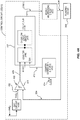
- FIG. 6 is a block diagram of the exemplary power multiplexing circuit 502 in the power multiplexing system 500 of Figure 5 .
- the power multiplexing circuit 502 is configured to multiplex coupling of one of a logic supply power rail 504L and a memory supply power rail 504M to the output power rail 506 to provide power to the memory array 508 coupled to the output power rail 506.
- the logic supply power rail 504L and the memory supply power rail 504M are coupled to respective power sources supplying a memory voltage V DD(M) or in a memory domain and a logic voltage V DD(L) in a logic domain.
- the power multiplexing circuit 502 includes memory and logic supply selection circuits 512M, 512L.
- the memory and logic supply selection circuits 512M, 512L are coupled between the respective memory supply power rail 504M and logic supply power rail 504L.
- the power multiplexing system 500 is configured to activate one of the memory and logic supply selection circuits 512M, 512L to couple a respective memory supply power rail 504M and logic supply power rail 504L to the output power rail 506 to power the memory array 508 at the respective memory voltage V DD(M) and logic voltage V DD(L) .
- the memory and logic supply selection circuits 512M, 512L in this example each include respective memory and logic power switch circuits 514M, 514L.
- the drive strength of an activated memory or logic power switch circuit 514M, 514L affects its capacity to drive the respective memory or logic voltage V DD(M) , V DD(L) onto the output power rail 506.
- the drive strength of an activated memory or logic power switch circuit 514M, 514L adjusts its output impedance, which controls switching a current-resistance (IR) drop across the memory or logic power switch circuit 514M, 514L, resulting in the desired output voltage.
- IR current-resistance
- the power multiplexing system 500 provides for the ability to selectively control the drive strength of the memory and logic supply selection circuits 512M, 512L which can be used to compensate for PVT variations that may reduce drive strength. Drive strength margin may be reduced as a result, thus reducing leakage power while still attaining the desired drive strength on the output power rail 506.
- each of the memory and logic power switch circuits 514M, 514L includes a plurality of parallel-connected PMOS transistors 516M(1)-516M(T) and 516L(1)-516L(T), where 'T' represents the desired number of PMOS transistors 516 to include.
- NMOS transistors could also be employed.
- the PMOS transistors 516M(1)-516M(T) and 516L(1)-516L(T) are coupled between a respective memory and logic supply power rail 504M, 504L and the output power rail 506.
- Each of the parallel-connected PMOS transistors 516M(1)-516M(T) and 516L(1)-516L(T) has an associated drive strength to drive the respective memory or logic voltage V DD(M) , V DD(L) onto the output power rail 506.
- the respective parallel-connected PMOS transistors 516M(1)-516M(T) and 516L(1)-516L(T) can be individually controlled to be activated or deactivated to contribute towards driving the respective memory or logic voltage V DD(M) , V DD(L) onto the output power rail 506.
- each of the PMOS transistors 516M(1)-516M(T) and 516L(1)-516L(T) is configured to receive an associated memory or logic drive strength indicator 518M, 518L in the form of respective memory and logic power switch selection signals 520M(1)-520M(T), 520L(1)-520L(T).
- the memory and logic drive strength indicators 518M, 518L can be thought of in one example as code words each with individual signals or bits indicating an enable state of the respective individual memory and logic power switch selection signals 520M(1)-520M(T), 520L(1)-520L(T) forming the code words to control the respective number of parallel-connected PMOS transistors 516M(1)-516(1)(T) and 516L(1)-516L(T) that are activated.
- the memory and logic power switch selection signals 520M(1)-520M(T), 520L(1)-520L(T) are coupled to gates G of the respective PMOS transistors 516M(1)-516M(T) and 516L(1)-516L(T).
- the state of the memory and logic power switch selection signals 520M(1)-520M(T), 520L(1)-520L(T) controls whether their respective PMOS transistors 516M(1)-516M(T) and 516L(1)-516L(T) are selectively activated, and thus contribute to driving the respective memory and logic voltages V DD(M) , V DD(L) onto the output power rail 506.
- the state of the memory or logic power switch selection signals 520M(1)-520M(T), 520L(1)-520L(T) is a power switch selection enable state, which in this example is a logic low level ('0')
- the respective PMOS transistors 516M(1)-516M(T) and 516L(1)-516L(T) will be activated to provide a current flow path between the respective memory or logic supply power rail 504M, 504L and the output power rail 506.
- the state of the memory or logic power switch selection signals 520M(1)-520M(T), 520L(1)-520L(T) is a power switch selection disable state, the respective PMOS transistors 516M(1)-516M(T) and 516L(1)-516L(T) will be deactivated to not provide a current flow path between the respective memory and logic supply power rail 504M, 504L and the output power rail 506.
- the power multiplexing circuit 502 also includes a diode drop control circuit 600.
- the diode drop control circuit 600 is provided in the form of a PMOS transistor 602 in this example.
- the diode drop control circuit 600 is configured to be activated to create a diode drop connection between a respective memory supply power rail 504M and the output power rail 506 for a diode drop operation mode in response to switching of the coupling of the memory supply power rail 504M to the logic supply power rail 504L, to the output power rail 206.
- the diode drop control circuit 600 is configured to receive a supply power rail switch signal 603 indicating a supply power rail switch state to the logic supply power rail 504L.
- the diode drop control circuit 600 In response to the supply power rail switch signal 603 indicating a supply power rail switch enable state to the logic supply power rail 504L, the diode drop control circuit 600 establishes a diode drop connection between the memory supply power rail 504M and the output power rail 506 in a diode drop operation mode.
- the diode drop control circuit 600 includes a diode drop input 604 coupled to a first power rail selection input 606 of a first power switch circuit 608.
- the diode drop control circuit 600 also includes a diode drop control input 610 coupled to gate G of the PMOS transistor 602 configured to receive the supply power rail switch signal 603 from a power rail selection circuit 612.
- the diode drop control circuit 600 also includes a diode drop output 614 coupled to drain D of the PMOS transistor 602 and coupled to a first power output 616 of the power switch circuit 608.
- the diode drop control circuit 600 is configured to establish a diode drop connection in a diode drop operation mode between the power rail selection input 606 and the power output 616, in response to the supply power rail switch signal 603 indicating the supply power rail switch enable state from the memory supply power rail 504M to the logic supply power rail 504L.
- a retention output signal 620 controls the passing of the supply power rail switch signal 603 to the diode drop input 604.
- the power rail selection circuit 612 is deactivated to present a high impedance to the power rail selection input 606.
- the gate G and the drain D of a head switch PMOS transistor 608 is coupled together to put the first head switch PMOS transistor 618 in a diode drop configuration.
- the diode drop control circuit 600 is configured to regulate the voltage on the output power rail 506 in a forward bias configuration in this example. For example, with the memory voltage V DD(M) on the memory supply power rail 504M being higher than the logic voltage V DD(L) on the logic supply power rail 504L, the diode drop control circuit 600 will be in a forward bias configuration.
- the diode drop control circuit 600 is configured to allow current to flow from the memory supply power rail 504M to the output power rail 506 to maintain an output voltage V DD(A) on the output power rail 506. In one example, the diode drop control circuit 600 is configured to regulate the output voltage V DD(A) on the output power rail 506 to a threshold voltage of the diode drop control circuit 600 less than the memory voltage V DD(M) .
- the diode drop control circuit 600 will allow current to flow to maintain the voltage (e.g., 0.8 V) to a threshold voltage (e.g., 0.2 V) of the diode drop control circuit 600 less than the memory voltage V DD(M) (e.g., 1 V).
- the output voltage V DD(A) is continuously provided to the memory array 508 during the diode drop operation mode even when switching the coupling of the memory supply power rail 504M to the logic supply power rail 504L, to the output power rail 506, but without creating a current cross-conduction path between the memory supply power rail 504M to the logic supply power rail 504L.
- the memory array 508 may be configured to be in a retention or reduced power consumption state where only leakage currents are drawn from the output power rail 506 in a non-limiting example.
- the diode drop operation mode can be discontinued.
- the supply power rail switch signal 603 is controlled to indicate a supply power rail switch disable state.
- the diode drop control circuit 600 disconnects the diode drop connection between the memory supply power rail 504M and the output power rail 506.
- a current cross-conduction path is not created when the diode drop operation mode is discontinued, because only either the memory drive strength indicator 518M or the logic drive strength indicator 518L is controlled to be in a power rail selection enable state to select only the memory power switch circuit 514M or the logic power switch circuit 514L to couple either the memory or logic supply power rail 504M, 504L to the output power rail 506 at any given time outside of the diode drop operation mode.
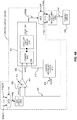
- FIG 7 is a block diagram of the control circuit 522 that can be included in the power multiplexing system 500 of Figure 5 to adaptively control the drive strength of an active memory or logic supply selection circuit 512M, 512L and the diode drop control circuit 600 in the power multiplexing circuit 502 in Figure 6 .
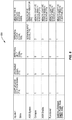
- the control circuit 522 is configured to provide the operational modes illustrated in a logic table 800 in Figure 8 . Both will be discussed in conjunction with each other below.
- the memory drive strength indicator 518M is provided as an output 700 of a multiplexer circuit 702.
- the multiplexer circuit 702 includes a first input 704 configured to receive a first bypass drive strength indicator 706, and a second input 708 configured to receive a memory adaptive drive strength indicator 710.
- the multiplexer circuit 702 is controlled to pass the bypass drive strength indicator 706 to the memory drive strength indicator 518M if it is desired to bypass the adaptive drive strength operation of the power multiplexing circuit 502 when coupling the memory supply power rail 504M to the output power rail 506 in Figure 6 .
- the bypass drive strength indicator 706 may be a fixed setting for each of the memory power switch selection signals 520M(1)-520M(T) such as all activated (e.g., all logical '0') for example or any other fixed setting. In this manner, the drive strength of the memory voltage V DD(M) is not varied.
- the multiplexer circuit 702 is also configured to be controlled to pass the memory adaptive drive strength indicator 710 to the memory drive strength indicator 518M if it is desired to adaptively control the drive strength operation of the power multiplexing circuit 502 when coupling the memory supply power rail 504M to the output power rail 506 in Figure 6 .
- the memory adaptive drive strength indicator 710 may be the counter output of the memory drive strength indicator 218(1) in the control circuit 222(1) in Figure 4A as one example.
- the memory adaptive drive strength indicator 710 will control the memory power switch selection signals 520M(1)-520M(T) to control which PMOS transistors 516M(1)-516M(T) in Figure 5 are activated.
- the multiplexer circuit 702 also includes a selection input 712 configured to receive an adaptive mode selection signal 714 to control whether the bypass drive strength indicator 706 from the first input 704 or the memory adaptive drive strength indicator 710 from the second input 708 is passed to the output 700 as the memory drive strength indicator 518M.
- the multiplexer circuit 702 passes the bypass drive strength indicator 706 from the first input 704 to the output 700. If the adaptive mode selection signal 714 is in an adaptive mode enable state, the multiplexer circuit 702 passes the memory adaptive drive strength indicator 710 from the second input 708 to the output 700.
- the adaptive mode selection signal 714 is logical low (i.e., logical '0'), this causes the multiplexer circuit 702 to output the bypass drive strength indicator 706 from the first input 704 to the output 700 as the memory drive strength indicator 518M. If the adaptive mode selection signal 714 is logical high (i.e., logical '1') in this example, the adaptive mode selection signal 714 is in an adaptive mode enable state in this example to provide adaptive control of drive strength.
- control circuit 522 in Figure 7 is also configured to control generating the retention output signal 620.
- the retention output signal 620 is configured to control whether the supply power rail switch signal 603 is passed.
- a retention input signal 716 and adaptive power multiplexing (APM) enable signal 718 are in don't care states (x), because an AND-based gate 720 in Figure 7 will pass the retention input signal 716 to an output 722 for the retention output signal 620.
- ASR Bypass the adaptive mode selection signal 714 is logical '0'.
- the adaptive mode selection signal 714 is set to a logical "1" to be in the adaptive mode enable state with the APM enable signal 718 and the retention input signal 716 set to logical '0'.
- This causes multiplexer circuit 702 to provide the bypass drive strength indicator 706 from the first input 704 to the output 700 as the memory drive strength indicator 518M.
- An OR-based gate 724 will generate a logical '0' on its output 726 to an AND-based gate 720 to generate a logical '0' for the retention output signal 620 to deactivate the diode drop operation of the diode drop control circuit 600.
- an "ASR Enable” state provides for the adaptive mode selection signal 714 to be set to a logical "1" to be in the adaptive mode enable state.
- This causes the multiplexer circuit 702 to provide the bypass drive strength indicator 706 from the first input 704 to the output 700 as the memory drive strength indicator 518M.
- the APM enable signal 718 is set to a logical '0' and the retention input signal 716 is set to a logical '1'.
- the multiplexer circuit 702 This causes the multiplexer circuit 702 to provide the bypass drive strength indicator 706 from the first input 704 to the output 700 as the memory drive strength indicator 518M.
- the APM enable signal 718 is set to a logical '1' and the retention input signal 716 is set to a logical '0'.
- the adaptive mode selection signal 714 is set to a logical "1" to be in the adaptive mode enable state for adaptively controlling the drive strength of the memory voltage V DD(M) from the memory supply power rail 504M coupled to the output power rail 506.
- This causes the multiplexer circuit 702 to provide the bypass drive strength indicator 706 from the first input 704 to the output 700 as the memory drive strength indicator 518M.
- the APM enable signal 718 is set to a logical '1' and the retention input signal 716 is set to a logical '1'. This causes the AND-based gate 720 to output a logical '1' as the retention output signal 620 to enable the diode drop mode operation of the diode drop control circuit 600.
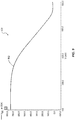
- Figure 9 is a graph illustrating an exemplary plot 900 of supply voltage at a supply power rail transferred to the output power rail 506 in the power multiplexing system 500 in Figure 5 as a function of drive strength control of the power multiplexing circuit 502.
- voltage curve 902 indicates an example output voltage multiplexed on the output power rail 506 as a function of switching activation of a memory or logic supply selection circuit 512(1)-512(N).
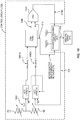
- FIG. 10 is a block diagram of an exemplary control circuit 1022 configured to adaptively control drive strength of an active memory or logic supply selection circuit 512M, 512L ( Figure 5 ) in the power multiplexing circuit 502 in Figure 5 to adjust the output voltage 524 level and switch-on speed on the output power rail 506.
- control circuit 1022 in Figure 10 is shown as only controlling the memory supply selection circuit 512M in the power multiplexing circuit 502 ( Figure 5 ), and thus multiple control circuits 1022 would be provided to control the drive strength of each supply selection circuit 512(1)-512(N).
- the output voltage 524 in Figure 10 is coupled to a first voltage controlled oscillator (VCO) 1000(1).
- VCO voltage controlled oscillator
- Vref predefined reference output voltage
- the VCOs 1000(1), 1000(2) generate respective frequency signals 1004(1), 1004(2) indicative of the amplitude of the output voltage 524 and the reference output voltage 1002.
- the frequency signals 1004(1), 1004(2) are received by a finite state machine (FSM) 1006 that compares the frequencies of the frequency signals 1004(1), 1004(2) to determine if the reference output voltage 1002 is greater than the output voltage 524.
- FSM finite state machine
- the FSM 1006 Based on this comparison, the FSM 1006 generates an output signal 1008 to a DAC 1010 to control the memory drive strength indicator 518M to control the bias of the supply selection circuit 512(1) in Figure 5 .
- the FSM 1006 also generates the drive strength indicator 518(1) to control the memory drive strength indicator 518M to control the drive strength of the memory supply selection circuit 512M in the power multiplexing circuit 502.
- the DAC 1010 may be initially set to a control code of '0' (block 1002).
- the FSM 1006 determines if the frequency signal 1004(1) has a higher frequency than frequency signal 1004(2) (block 1104). If not, the process 1100 stops without a change in the memory drive strength indicator 518M (block 1106). If so, the memory drive strength indicator 518M is incremented (e.g., by one (1) least significant bit (LSB)) (block 1008).
- LSB least significant bit
- FIG 12 is a block diagram of an exemplary control circuit 1222 configured to adaptively control drive strength of an active memory or logic supply selection circuit 512M, 512L ( Figure 5 ) in the power multiplexing circuit 502 in Figure 5 to adjust the output voltage 524 level and switch-on speed on the output power rail 506.
- the control circuit 1222 in Figure 12 is shown as only controlling the memory supply selection circuit 512M, and thus multiple control circuits 1222 would be provided to control the drive strength of each supply selection circuit 512(1)-512(N).
- the output voltage 524 in Figure 12 is coupled to a first VCO 1000(1).
- a predefined reference output voltage (Vref) 1002 for the memory supply selection circuit 512M ( Figure 6 ) is provided to a second VCO 1000(2).
- the VCOs 1000(1), 1000(2) generate respective frequency signals 1004(1), 1004(2) indicative of the amplitude of the output voltage 524 and the reference output voltage 1002.
- the frequency signals 1004(1), 1004(2) are received by a phase frequency detector (PFD) 1206 that compares the frequencies of the frequency signals 1004(1), 1004(2) to determine if the reference output voltage 1002 is greater than the output voltage 524. Based on this comparison, the PFD 1206 generates output signals 1208(1), 1208(2) to a charge pump (CP) 1210 to control the memory drive strength indicator 518M to control the drive strength of the memory supply selection circuit 512M in Figure 6 .
- CP charge pump
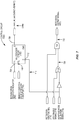
- Figure 13 illustrates an example of the slow ramp circuit 530 in Figure 5 that can be used to gradually provide the memory power switch selection signal 520M to the power multiplexing circuit 502 therein.
- Figure 13 shows only ramping a single memory power switch selection signal 520 of the memory drive strength indicator 518M ( Figure 5 ), but it should be noted that multiple slow ramp circuits 530 like shown in Figure 13 can be provided for each memory power switch selection signal 520M(1)-520M(T).
- an output voltage V is provided, wherein the output voltage V is ramped up to the memory voltage V DD(M).
- a head switch circuit 1306 is provided that is configured to provide the output voltage V to the power multiplexing circuit 502.
- the head switch circuit 1306 includes a voltage input 1308 that is coupled to a voltage input 1310 and configured to receive the memory voltage V DD(M) .
- the head switch circuit 1306 also includes a voltage output 1312 that is coupled to a voltage output 1314 and configured to provide the memory power switch selection signal 520 of the output voltage V to the power multiplexing circuit 502.
- the head switch circuit 1306 is configured to provide the memory power switch selection signal 520 of the output voltage V to the power multiplexing circuit 502 in response to a control signal 1316 received on a control input 1318.
- the control signal 1316 is generated by a head switch control circuit 1320 in response to the memory power switch selection signal 520M.
- a current sink circuit 1324 is configured to control a ramping rate of the output voltage V of the memory power switch selection signal 520 generated by the head switch circuit 1306, thus allowing the head switch circuit 1306 to provide the full memory voltage V DD(M) to the power multiplexing circuit 502 in a controlled manner to reduce or avoid in-rush current related supply noise in the power multiplexing circuit 502. Controlling the ramping rate corresponds to gradually activating (i.e., gradually turning-on) the head switch circuit 1306 over time, wherein the amount of memory voltage V DD(M) allowed across the head switch circuit 1306 is limited by its level of activation.
- the head switch circuit 1306 can be controlled by the current sink circuit 1324 when the head switch control circuit 1320 generates the control signal 1316 in response to the memory power switch selection signals 520M received on an enable input 1326.
- the control signal 1316 indicates that the memory voltage V DD(M) is to be transferred to the power multiplexing circuit 502.
- Components within the slow ramp circuit 530 may employ various circuit elements to achieve the functionality described above.
- the head switch circuit 1306 employs a PMOS transistor 1328 that includes a source S coupled to the voltage input 1308, a gate G coupled to the control input 1318, and a drain D coupled to the voltage output 1312.
- the current sink circuit 1324 includes an NMOS transistor 1330 that includes a source S coupled to a ground source 1332, a drain D coupled to the gate G of the PMOS transistor 1328 of the head switch circuit 1306 (i.e., the control input 1318), and a gate G.
- the gate G of the NMOS transistor 1330 in this aspect is driven by a constant voltage source 1334.
- the head switch control circuit 1320 in this example employs a PMOS transistor 1336 that includes a source S coupled to the memory voltage V DD(M) , a gate G configured to receive the memory power switch selection signal 520M, and a drain D coupled to the gate G of the PMOS transistor 1328 of the head switch circuit 1306 and the drain D of the NMOS transistor 1330 of the current sink circuit 1324.
- the PMOS transistor 1336 is activated (i.e., turned-on) while the memory power switch selection signal 520M has a logic low '0' value. Further, the memory voltage V DD(M) is provided to the gate G of the PMOS transistor 1328 of the head switch circuit 1306 while the PMOS transistor 1336 is activated. Providing the memory voltage V DD(M) to the gate G of the PMOS transistor 1328 deactivates (i.e., turns-off) the PMOS transistor 1328 and prevents the memory voltage V DD(M) from being provided to the power multiplexing circuit 502.
- the PMOS transistor 1336 of the head switch control circuit 1320 is deactivated, which prevents the memory voltage V DD(M) from being provided to the gate G of the PMOS transistor 1328 of the head switch circuit 1306.
- the gate G of the PMOS transistor 1328 is no longer receiving the memory voltage V DD(M)
- the memory voltage V DD(M) remains on the gate G of the PMOS transistor 1328, as a gate capacitance associated with the gate G of the PMOS transistor 1328 is charged with the memory voltage V DD(M) while the memory power switch selection signal 520M has a logic low value '0'.
- the PMOS transistor 1328 may be activated so as to provide the output voltage V to the power multiplexing circuit 502.
- the current sink circuit 1324 is configured to gradually activate the PMOS transistor 1328 over time such that the output voltage V of the memory power switch selection signal 520 provided by the head switch circuit 1306 ramps up over time.
- the gate G of the NMOS transistor 1330 of the current sink circuit 1324 is driven by the constant voltage source 1334 in this example so as to activate the NMOS transistor 1330 to a level that causes the voltage on the gate G of the PMOS transistor 1328 of the head switch circuit 1306 to gradually discharge through the NMOS transistor 1330 to the ground source 1332.
- the PMOS transistor 1328 gradually activates.
- the level of the output voltage V of the memory power switch selection signal 520 to the power multiplexing circuit 502 by the head switch circuit 1306 corresponds to the level at which the PMOS transistor 1328 is activated.
- the current sink circuit 1324 discharges the voltage on the gate G of the PMOS transistor 1328, the voltage on the gate G of the PMOS transistor 1328 crosses a threshold voltage of the PMOS transistor 1328.
- the PMOS transistor 1328 turns-on and provides a progressively higher output voltage V of the memory power switch selection signal 520 to the power multiplexing circuit 502. In this manner, the output voltage V of the memory power switch selection signal 520 provided to the power multiplexing circuit 502 gradually ramps up to the full memory voltage V DD(M) as the voltage on the gate G of the PMOS transistor 1328 crosses the threshold voltage.
- Power multiplexing systems that are configured to adaptively control drive strength of multiplexed power from supply power rails in a power multiplexing system to a powered circuit, in accordance with the aspects in this disclosure, may also include a first supply means for selectively driving a first voltage at a first supply power rail to an output power rail at a first drive strength based on a first drive strength indicator in response to a first supply power rail selection indicator indicating a first supply power rail selection enable state.
- Such power multiplexing systems may also include a second supply means for selectively driving a second voltage at a second supply power rail to the output power rail at a second drive strength based on a second drive strength indicator in response to a second supply power rail selection indicator indicating a second supply power rail selection enable state.
- Such power multiplexing systems may also include a means for monitoring an output voltage of the output power rail. Such power multiplexing systems may also include a means for comparing a voltage level of the output voltage at the output power rail to a first reference voltage level associated with a first supply selection circuit, in response to the first supply power rail selection indicator indicating the first supply power rail selection enable state. Such power multiplexing systems may also include a means for selectively generating the first drive strength indicator based on the means for comparing the voltage level of the output voltage at the output power rail to the first reference voltage level, in response to the first supply power rail selection indicator indicating the first supply power rail selection enable state.
- Such power multiplexing systems may also include a means for comparing the voltage level of the output voltage at the output power rail to a second reference voltage level associated with a second supply selection circuit in response to the second supply power rail selection indicator indicating the second supply power rail selection enable state.
- Such power multiplexing systems may also include a means for selectively generating the second drive strength indicator based on the means for comparing the voltage level of the output voltage at the output power rail to the second reference voltage level in response to the second supply power rail selection indicator indicating the second supply power rail selection enable state.
- Power multiplexing systems that are configured to adaptively control drive strength of multiplexed power from supply power rails in a power multiplexing system to a powered circuit, in accordance with the aspects in this disclosure, may be provided in or integrated into in any processor-based device.
- Examples include a set top box, an entertainment unit, a navigation device, a communications device, a fixed location data unit, a mobile location data unit, a global positioning system (GPS) device, a mobile phone, a cellular phone, a smart phone, a session initiation protocol (SIP) phone, a tablet, a phablet, a server, a computer, a portable computer, a mobile computing device, a wearable computing device (e.g., a smart watch, a health or fitness tracker, eyewear, etc.), a desktop computer, a personal digital assistant (PDA), a monitor, a computer monitor, a television, a tuner, a radio, a satellite radio, a music player, a digital music player,
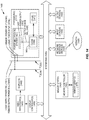
- Figure 14 illustrates an example of a processor-based system 1400 that includes a power multiplexing system 1401 configured to control the selective coupling of one of memory and logic supply power rails 1404M, 1404L to a memory domain 1405, such as to reduce intentional decoupling capacitance in a logic domain according to any of the particular aspects discussed above.
- the power multiplexing system 1401 includes a power multiplexing circuit 1402 that includes adaptive drive strength control.
- the power multiplexing circuit 1402 may be any of the power multiplexing circuits 202, 502 in Figures 2 and 5 , respectively, as examples.
- the memory domain 1405 includes a cache memory 1408 that is included in a processor 1410 and coupled to one or more central processing units (CPUs) 1412 for rapid access to temporarily stored data.
- the power multiplexing system 1401 has a memory power input 1416M coupled to the memory supply power rail 1404M and a logic power input 1416L coupled to the logic supply power rail 1404L.
- the power multiplexing system 1401 has a power output 1418 coupled to an output power rail 1406 configured to provide power to the memory domain 1405.
- the power multiplexing system 1401 is configured to multiplex logic voltage V DD(L) on the logic supply power rail 1404L to the output power rail 1406 when the logic voltage V DD(L) is at or above the minimum operating voltage of the memory domain 1405.
- the power multiplexing system 1401 is configured to multiplex the memory voltage V DD(M) from the memory supply power rail 1404M on the output power rail 1406 when the logic voltage V DD(L) is below the minimum operating voltage of the memory domain 1405. Any of the features and examples described above with regard to the power multiplexing circuits 202, 502 can be provided in the power multiplexing system 1401.
- the processor-based system 1400 also includes one or more processors 1410, each including one or more CPUs 1412.
- the processors 1410 include the cache memory 1408 coupled to the CPU(s) 1412 for rapid access to temporarily stored data.
- the processors 1410 are coupled to a system bus 1422 and can intercouple master and slave devices included in the processor-based system 1400.
- the processors 1410 communicate with these other devices by exchanging address, control, and data information over the system bus 1422.
- the processors 1410 can communicate bus transaction requests to a memory controller 1424 in a memory system 1426 as an example of a slave device.
- multiple system buses 1422 could be provided, wherein each system bus 1422 constitutes a different fabric.
- the memory controller 1424 is configured to provide memory access requests to one or more memory arrays 1428 in the memory system 1426.
- Other devices can be connected to the system bus 1422. As illustrated in Figure 14 , these devices can include one or more input devices 1430, one or more output devices 1432, one or more network interface devices 1434, and one or more display controllers 1436, as examples.
- the input device(s) 1430 can include any type of input device, including but not limited to input keys, switches, voice processors, etc.
- the output device(s) 1432 can include any type of output device, including but not limited to audio, video, other visual indicators, etc.
- the network interface device(s) 1434 can be any devices configured to allow exchange of data to and from a network 1438.
- the network 1438 can be any type of network, including but not limited to a wired or wireless network, a private or public network, a local area network (LAN), a wireless local area network (WLAN), a wide area network (WAN), a BLUETOOTHTM network, and the Internet.
- the network interface device(s) 1434 can be configured to support any type of communications protocol desired.
- the processors 1410 may also be configured to access the display controller(s) 1436 over the system bus 1422 to control information sent to one or more displays 1440.
- the display controller(s) 1436 sends information to the display(s) 1440 to be displayed via one or more video processors 1442, which process the information to be displayed into a format suitable for the display(s) 1440.
- the display(s) 1440 can include any type of display, including but not limited to a cathode ray tube (CRT), a liquid crystal display (LCD), a plasma display, etc.
- DSP Digital Signal Processor
- ASIC Application Specific Integrated Circuit
- FPGA Field Programmable Gate Array
- a processor may be a microprocessor, but in the alternative, the processor may be any conventional processor, controller, microcontroller, or state machine.
- a processor may also be implemented as a combination of computing devices, e.g., a combination of a DSP and a microprocessor, a plurality of microprocessors, one or more microprocessors in conjunction with a DSP core, or any other such configuration.
- RAM Random Access Memory
- ROM Read Only Memory
- EPROM Electrically Programmable ROM
- EEPROM Electrically Erasable Programmable ROM
- registers a hard disk, a removable disk, a CD-ROM, or any other form of computer readable medium known in the art.
- An exemplary storage medium is coupled to the processor such that the processor can read information from, and write information to, the storage medium.
- the storage medium may be integral to the processor.
- the processor and the storage medium may reside in an ASIC.
- the ASIC may reside in a remote station.
- the processor and the storage medium may reside as discrete components in a remote station, base station, or server.
Landscapes
- Engineering & Computer Science (AREA)
- Physics & Mathematics (AREA)
- General Engineering & Computer Science (AREA)
- Computer Hardware Design (AREA)
- Computing Systems (AREA)
- Mathematical Physics (AREA)
- Power Engineering (AREA)
- General Physics & Mathematics (AREA)
- Theoretical Computer Science (AREA)
- Direct Current Feeding And Distribution (AREA)
- Power Sources (AREA)
- Static Random-Access Memory (AREA)
- Dc-Dc Converters (AREA)
- Electronic Switches (AREA)
- Control Of Voltage And Current In General (AREA)
Applications Claiming Priority (4)
| Application Number | Priority Date | Filing Date | Title |
|---|---|---|---|
| US201662342560P | 2016-05-27 | 2016-05-27 | |
| US201762459187P | 2017-02-15 | 2017-02-15 | |
| US15/593,809 US10684671B2 (en) | 2016-05-27 | 2017-05-12 | Adaptively controlling drive strength of multiplexed power from supply power rails in a power multiplexing system to a powered circuit |
| PCT/US2017/032632 WO2017205096A1 (en) | 2016-05-27 | 2017-05-15 | Adaptively controlling drive strength of multiplexed power from supply power rails in a power multiplexing system to a powered circuit |
Publications (2)
| Publication Number | Publication Date |
|---|---|
| EP3465913A1 EP3465913A1 (en) | 2019-04-10 |
| EP3465913B1 true EP3465913B1 (en) | 2021-03-17 |
Family
ID=58772660
Family Applications (1)
| Application Number | Title | Priority Date | Filing Date |
|---|---|---|---|
| EP17725833.2A Active EP3465913B1 (en) | 2016-05-27 | 2017-05-15 | Adaptively controlling drive strength of multiplexed power from supply power rails in a power multiplexing system to a powered circuit |
Country Status (10)
| Country | Link |
|---|---|
| US (1) | US10684671B2 (enExample) |
| EP (1) | EP3465913B1 (enExample) |
| JP (1) | JP6956743B2 (enExample) |
| KR (1) | KR102194128B1 (enExample) |
| CN (1) | CN109075789B (enExample) |
| BR (1) | BR112018074342B1 (enExample) |
| CA (1) | CA3020739C (enExample) |
| ES (1) | ES2868626T3 (enExample) |
| TW (1) | TWI709298B (enExample) |
| WO (1) | WO2017205096A1 (enExample) |
Cited By (2)
| Publication number | Priority date | Publication date | Assignee | Title |
|---|---|---|---|---|
| US12301223B2 (en) | 2021-08-06 | 2025-05-13 | Samsung Electro-Mechanics Co., Ltd. | Power supply switch circuit and operating method thereof |
| US12506444B2 (en) | 2021-08-05 | 2025-12-23 | Samsung Electro-Mechanics Co., Ltd. | Power supply switch circuit and operating method thereof |
Families Citing this family (28)
| Publication number | Priority date | Publication date | Assignee | Title |
|---|---|---|---|---|
| US9596031B2 (en) * | 2005-03-01 | 2017-03-14 | Alexander Ivan Soto | System and method for a subscriber-powered network element |
| US10050448B2 (en) | 2015-04-15 | 2018-08-14 | Qualcomm Incorporated | Providing current cross-conduction protection in a power rail control system |
| US9977480B2 (en) | 2015-04-15 | 2018-05-22 | Qualcomm Incorporated | Selective coupling of power rails to a memory domain(s) in a processor-based system |
| US10614766B2 (en) * | 2016-05-19 | 2020-04-07 | Novatek Microelectronics Corp. | Voltage regulator and method applied thereto |
| US10439602B2 (en) * | 2016-07-07 | 2019-10-08 | ProGrAnalog Corporation | Electronic power switch |
| CN108073211B (zh) * | 2016-11-11 | 2020-07-10 | 中芯国际集成电路制造(上海)有限公司 | 一种保持电压的产生电路及电子设备 |
| US10529407B2 (en) | 2017-07-20 | 2020-01-07 | Samsung Electronics Co., Ltd. | Memory device including a plurality of power rails and method of operating the same |
| KR102499510B1 (ko) * | 2017-09-01 | 2023-02-14 | 삼성전자주식회사 | 전원 공급 회로 및 이를 포함하는 반도체 패키지 |
| CN110244590B (zh) * | 2018-03-09 | 2021-09-03 | 华大半导体有限公司 | 多功能定时器 |
| US11019747B2 (en) * | 2018-05-10 | 2021-05-25 | Microsoft Technology Licensing, Llc | DC bus architecture for datacenters |
| US10956352B2 (en) | 2018-05-29 | 2021-03-23 | Continental Automotive Systems, Inc. | Automatic location based addressing method for network participants in a serial bus system |
| US20200019229A1 (en) * | 2018-07-11 | 2020-01-16 | Qualcomm Incorporated | Power sequencing based on active rail |
| FR3086457A1 (fr) * | 2018-09-25 | 2020-03-27 | Dolphin Design | Puce de circuit integre |
| KR102760142B1 (ko) * | 2019-01-03 | 2025-01-31 | 삼성전자주식회사 | 전력을 제어하기 위한 전자 회로 |
| US10714152B1 (en) * | 2019-05-29 | 2020-07-14 | Advanced Micro Devices, Inc. | Voltage regulation system for memory bit cells |
| CN111130322B (zh) * | 2019-12-31 | 2021-09-17 | 上海联影医疗科技股份有限公司 | 开关管驱动电路的驱动方法 |
| CN113972708A (zh) * | 2020-07-23 | 2022-01-25 | 名硕电脑(苏州)有限公司 | 电子装置 |
| US11640834B2 (en) * | 2020-10-24 | 2023-05-02 | Mediatek Singapore Pte. Ltd. | Voltage droop reduction with a secondary power supply |
| JP2022147358A (ja) * | 2021-03-23 | 2022-10-06 | 株式会社東芝 | 磁気ディスク装置 |
| KR102868147B1 (ko) * | 2021-06-21 | 2025-10-14 | 에스케이하이닉스 주식회사 | 파워스위칭동작을 수행하는 전자장치 |
| US12081124B2 (en) | 2022-04-29 | 2024-09-03 | Apple Inc. | Regulator switch array |
| US12228952B2 (en) * | 2022-05-02 | 2025-02-18 | Apple Inc. | Electronic devices having complementary current mirror circuitry |
| US11687106B1 (en) * | 2022-05-09 | 2023-06-27 | Qualcomm Incorporated | Systems and methods for adaptive power multiplexing with a first type of power multiplexer and a second type of power multiplexer |
| US12510945B2 (en) | 2023-03-15 | 2025-12-30 | Qualcomm Incorporated | Recovery circuit for power failure on automotive power management integrated circuit (PMIC) devices |
| US20250110538A1 (en) * | 2023-09-28 | 2025-04-03 | Advanced Micro Devices, Inc. | Granular power gating override |
| WO2025122573A1 (en) * | 2023-12-04 | 2025-06-12 | Encharge Ai, Inc. | Systems and methods for supply noise immune high- speed, high resolution analog voltage generation |
| TW202541019A (zh) * | 2023-12-04 | 2025-10-16 | 美商恩查吉Ai股份有限公司 | 用於向記憶體內運算陣列遞送高解析度、高速類比電壓之系統及方法 |
| US20260086614A1 (en) * | 2024-09-20 | 2026-03-26 | Qualcomm Incorporated | Peak current detection for selecting between memory power supply rails |
Family Cites Families (64)
| Publication number | Priority date | Publication date | Assignee | Title |
|---|---|---|---|---|
| JP2833293B2 (ja) | 1991-09-20 | 1998-12-09 | 日本電気株式会社 | 直流電源切替装置 |
| US6281724B1 (en) | 1998-11-17 | 2001-08-28 | Analog Devices, Inc. | Circuit for partial power-down on dual voltage supply integrated circuits |
| KR100582380B1 (ko) | 1999-06-30 | 2006-05-23 | 주식회사 하이닉스반도체 | 동작모드에 따라 선별적으로 파워를 공급하는 파워공급장치 |
| JP2001268814A (ja) | 2000-03-17 | 2001-09-28 | Internatl Business Mach Corp <Ibm> | 電源供給装置、電気機器および電力供給方法 |
| DE10120790A1 (de) | 2001-04-27 | 2002-11-21 | Infineon Technologies Ag | Schaltungsanordnung zur Verringerung der Versorgungsspannung eines Schaltungsteils sowie Verfahren zum Aktivieren eines Schaltungsteils |
| US20040217653A1 (en) * | 2003-04-29 | 2004-11-04 | Neidorff Robert Alan | Supply selection circuit with programmable hysteresis |
| US7498836B1 (en) | 2003-09-19 | 2009-03-03 | Xilinx, Inc. | Programmable low power modes for embedded memory blocks |
| US7061215B2 (en) * | 2003-10-02 | 2006-06-13 | Intersil Americas Inc. | Cascadable current-mode regulator |
| WO2005119532A2 (en) | 2004-06-04 | 2005-12-15 | The Regents Of The University Of California | Low-power fpga circuits and methods |
| US8120410B2 (en) * | 2004-06-15 | 2012-02-21 | St-Ericsson Sa | Adaptive control of power supply for integrated circuits |
| US7370214B2 (en) * | 2005-03-24 | 2008-05-06 | Silicon Laboratories Inc. | Automatically switching power supply sources for a clock circuit |
| US7589584B1 (en) | 2005-04-01 | 2009-09-15 | Altera Corporation | Programmable voltage regulator with dynamic recovery circuits |
| KR20080042770A (ko) | 2005-05-19 | 2008-05-15 | 엔엑스피 비 브이 | 개선된 전압 제한 회로를 포함하는 트랜스폰더 및 그 작동방법과 프로그램 요소 |
| US7298181B2 (en) * | 2005-12-06 | 2007-11-20 | Pulsecore Semiconductor Corp. | Highest supply selection circuit |
| JP2007201853A (ja) * | 2006-01-27 | 2007-08-09 | Renesas Technology Corp | 半導体集積回路 |
| US20070210750A1 (en) | 2006-03-08 | 2007-09-13 | Samsung Electronics Co., Ltd. | Power supply device and power supplying method for power supply device |
| US7688102B2 (en) * | 2006-06-29 | 2010-03-30 | Samsung Electronics Co., Ltd. | Majority voter circuits and semiconductor devices including the same |
| US7630270B2 (en) | 2006-08-21 | 2009-12-08 | Texas Instruments Incorporated | Dual mode SRAM architecture for voltage scaling and power management |
| TWI322346B (en) * | 2006-10-18 | 2010-03-21 | Asustek Comp Inc | Power supply system |
| US7673160B2 (en) | 2006-10-19 | 2010-03-02 | International Business Machines Corporation | System and method of power management for computer processor systems |
| US7737720B2 (en) | 2007-05-03 | 2010-06-15 | Arm Limited | Virtual power rail modulation within an integrated circuit |
| FR2916288B1 (fr) * | 2007-05-18 | 2009-08-21 | Commissariat Energie Atomique | Dispositif d'alimentation d'un circuit electronique et circuit electronique |
| TWI349842B (en) | 2007-12-12 | 2011-10-01 | Univ Nat Chiao Tung | Self-aware adaptive power control system |
| US8183713B2 (en) * | 2007-12-21 | 2012-05-22 | Qualcomm Incorporated | System and method of providing power using switching circuits |
| JP2009296392A (ja) * | 2008-06-06 | 2009-12-17 | Panasonic Corp | 電源選択装置 |
| CN101557122B (zh) * | 2009-02-24 | 2010-12-01 | 深圳市民展科技开发有限公司 | 双电源选择电路 |
| US8139436B2 (en) | 2009-03-17 | 2012-03-20 | Taiwan Semiconductor Manufacturing Company, Ltd. | Integrated circuits, systems, and methods for reducing leakage currents in a retention mode |
| US8406075B2 (en) | 2009-04-03 | 2013-03-26 | Taiwan Semiconductor Manufacturing Company, Ltd. | Ultra-low leakage memory architecture |
| TWI405408B (zh) * | 2009-04-14 | 2013-08-11 | Novatek Microelectronics Corp | 可連續提供電源之切換控制方法及其相關裝置與電源供應系統 |
| KR101737020B1 (ko) | 2009-09-09 | 2017-05-29 | 마벨 월드 트레이드 리미티드 | 다중 파워서플라이들 및/또는 다중 저전력 모드들을 갖는 메모리 |
| US8423946B1 (en) | 2010-05-25 | 2013-04-16 | Marvell International Ltd. | Circuitry having programmable power rails, architectures, apparatuses, and systems including the same, and methods and algorithms for programming and/or configuring power rails in an integrated circuit |
| FR2967796A1 (fr) | 2010-11-18 | 2012-05-25 | St Microelectronics Sa | Procede et systeme de gestion de l'alimentation d'un composant, par exemple un processeur et d'une memoire, par exemple une memoire cache dudit processeur |
| JP5260706B2 (ja) * | 2011-06-24 | 2013-08-14 | レノボ・シンガポール・プライベート・リミテッド | 計時回路を備える携帯式電子機器の電力システム |
| US9337660B1 (en) | 2011-12-13 | 2016-05-10 | Marvell Israel (M.I.S.L) Ltd. | Switching arrangement for power supply from multiple power sources |
| JP5497115B2 (ja) | 2012-01-27 | 2014-05-21 | 三菱電機株式会社 | 電源切替装置及び配電盤 |
| CN103377692B (zh) | 2012-04-25 | 2016-01-20 | 联发科技股份有限公司 | 用于双功率存储器的预解码器及双功率存储器 |
| US9223384B2 (en) * | 2012-07-31 | 2015-12-29 | Qualcomm Incorporated | Synthesizing intermediate performance levels in integrated circuits, and related processor systems, methods, and computer-readable media |
| KR102038041B1 (ko) | 2012-08-31 | 2019-11-26 | 에스케이하이닉스 주식회사 | 전원 선택 회로 |
| JP5939101B2 (ja) * | 2012-09-12 | 2016-06-22 | 富士通株式会社 | 半導体装置 |
| JP2014067191A (ja) * | 2012-09-25 | 2014-04-17 | Fujitsu Ltd | 演算処理回路及び電源制御方法 |
| US9299394B2 (en) | 2012-10-04 | 2016-03-29 | Broadcom Corporation | Method and circuit for reducing current surge |
| JP5886732B2 (ja) | 2012-12-04 | 2016-03-16 | 東芝三菱電機産業システム株式会社 | 電源切換装置 |
| US9484917B2 (en) | 2012-12-18 | 2016-11-01 | Intel Corporation | Digital clamp for state retention |
| JP5787868B2 (ja) * | 2012-12-26 | 2015-09-30 | 京セラドキュメントソリューションズ株式会社 | 電源装置及びこれを備えた画像形成装置 |
| TWI459189B (zh) | 2012-12-27 | 2014-11-01 | Giga Byte Tech Co Ltd | 主機板及其電源管理方法 |
| JP6079790B2 (ja) | 2013-01-15 | 2017-02-15 | 日本電気株式会社 | 電力ネットワークシステムの運用方法 |
| US9766678B2 (en) * | 2013-02-04 | 2017-09-19 | Intel Corporation | Multiple voltage identification (VID) power architecture, a digital synthesizable low dropout regulator, and apparatus for improving reliability of power gates |
| KR102088808B1 (ko) | 2013-04-19 | 2020-03-13 | 삼성전자주식회사 | 듀얼 파워 레일을 포함하는 시스템 온 칩 및 그것의 전압 공급 방법 |
| US9059696B1 (en) | 2013-08-01 | 2015-06-16 | Altera Corporation | Interposer with programmable power gating granularity |
| US9647453B2 (en) * | 2013-08-02 | 2017-05-09 | Samsung Electronics Co., Ltd. | Dual supply memory |
| US9768160B2 (en) | 2013-08-09 | 2017-09-19 | Infineon Technologies Austria Ag | Semiconductor device, electronic circuit and method for switching high voltages |
| US20150067290A1 (en) | 2013-09-04 | 2015-03-05 | Qualcomm Incorporated | Memory access time tracking in dual-rail systems |
| US9423865B2 (en) | 2013-09-13 | 2016-08-23 | Globalfoundries Inc. | Accelerating microprocessor core wake up via charge from capacitance tank without introducing noise on power grid of running microprocessor cores |
| US9563263B2 (en) * | 2013-12-19 | 2017-02-07 | Intel Corporation | Graphics processor sub-domain voltage regulation |
| US10396553B2 (en) * | 2014-08-29 | 2019-08-27 | Telefonaktiebolaget Lm Ericsson (Publ) | System and method for control of multiple voltage regulators |
| KR102275497B1 (ko) * | 2014-10-20 | 2021-07-09 | 삼성전자주식회사 | 전원 경로 제어기를 포함하는 시스템 온 칩 및 전자 기기 |
| US9570941B2 (en) * | 2014-10-31 | 2017-02-14 | Nxp B.V. | Autonomous power supply |
| CN204190484U (zh) | 2014-11-03 | 2015-03-04 | 合肥宝龙达信息技术有限公司 | 一种供电切换电路 |
| US9977480B2 (en) | 2015-04-15 | 2018-05-22 | Qualcomm Incorporated | Selective coupling of power rails to a memory domain(s) in a processor-based system |
| US10050448B2 (en) | 2015-04-15 | 2018-08-14 | Qualcomm Incorporated | Providing current cross-conduction protection in a power rail control system |
| US10108212B2 (en) * | 2015-09-22 | 2018-10-23 | Intel Corporation | Digital low drop-out voltage controller including embedded dual-loop feedback for minimum energy point operation |
| JP6623696B2 (ja) * | 2015-11-09 | 2019-12-25 | 株式会社ソシオネクスト | 電源装置及び半導体装置 |
| US20170308153A1 (en) * | 2016-04-25 | 2017-10-26 | Mediatek Inc. | Power delivery system for multicore processor chip |
| KR102032327B1 (ko) * | 2016-11-22 | 2019-10-15 | 에스케이하이닉스 주식회사 | 디지털 ldo 레귤레이터 및 이를 사용하는 저항 변화 메모리 장치 |
-
2017
- 2017-05-12 US US15/593,809 patent/US10684671B2/en active Active
- 2017-05-15 KR KR1020187034069A patent/KR102194128B1/ko active Active
- 2017-05-15 CA CA3020739A patent/CA3020739C/en active Active
- 2017-05-15 BR BR112018074342-9A patent/BR112018074342B1/pt active IP Right Grant
- 2017-05-15 EP EP17725833.2A patent/EP3465913B1/en active Active
- 2017-05-15 WO PCT/US2017/032632 patent/WO2017205096A1/en not_active Ceased
- 2017-05-15 ES ES17725833T patent/ES2868626T3/es active Active
- 2017-05-15 JP JP2018560982A patent/JP6956743B2/ja not_active Expired - Fee Related
- 2017-05-15 CN CN201780029554.6A patent/CN109075789B/zh active Active
- 2017-05-17 TW TW106116295A patent/TWI709298B/zh active
Non-Patent Citations (1)
| Title |
|---|
| None * |
Cited By (2)
| Publication number | Priority date | Publication date | Assignee | Title |
|---|---|---|---|---|
| US12506444B2 (en) | 2021-08-05 | 2025-12-23 | Samsung Electro-Mechanics Co., Ltd. | Power supply switch circuit and operating method thereof |
| US12301223B2 (en) | 2021-08-06 | 2025-05-13 | Samsung Electro-Mechanics Co., Ltd. | Power supply switch circuit and operating method thereof |
Also Published As
| Publication number | Publication date |
|---|---|
| TW201813310A (zh) | 2018-04-01 |
| WO2017205096A1 (en) | 2017-11-30 |
| JP6956743B2 (ja) | 2021-11-02 |
| US20170346299A1 (en) | 2017-11-30 |
| BR112018074342A2 (pt) | 2019-03-06 |
| CN109075789B (zh) | 2022-06-17 |
| BR112018074342B1 (pt) | 2024-01-09 |
| CA3020739C (en) | 2022-06-21 |
| TWI709298B (zh) | 2020-11-01 |
| EP3465913A1 (en) | 2019-04-10 |
| ES2868626T3 (es) | 2021-10-21 |
| JP2019517705A (ja) | 2019-06-24 |
| CA3020739A1 (en) | 2017-11-30 |
| KR102194128B1 (ko) | 2020-12-22 |
| US10684671B2 (en) | 2020-06-16 |
| KR20190010569A (ko) | 2019-01-30 |
| CN109075789A (zh) | 2018-12-21 |
Similar Documents
| Publication | Publication Date | Title |
|---|---|---|
| CA3020739C (en) | Adaptively controlling drive strength of multiplexed power from supply power rails in a power multiplexing system to a powered circuit | |
| EP3283937B1 (en) | Providing current cross-conduction protection in a power rail control system | |
| US10050448B2 (en) | Providing current cross-conduction protection in a power rail control system | |
| KR101459533B1 (ko) | 적응적 클록 생성기들, 시스템들 및 방법들 | |
| EP2380174B1 (en) | Self-tuning of signal path delay in circuit employing multiple voltage domains | |
| EP3335093B1 (en) | Switched power control circuits for controlling the rate of providing voltages to powered circuits, and related systems and methods | |
| WO2017030828A1 (en) | Dynamic voltage level shifters employing pulse generation circuits, and related systems and methods | |
| US10432197B2 (en) | Electronic devices employing adiabatic logic circuits with wireless charging | |
| KR101632037B1 (ko) | 고속 전류 모드 로직 제어 장치 및 방법 | |
| JPWO1999012263A1 (ja) | 半導体集積回路装置 |
Legal Events
| Date | Code | Title | Description |
|---|---|---|---|
| STAA | Information on the status of an ep patent application or granted ep patent |
Free format text: STATUS: UNKNOWN |
|
| STAA | Information on the status of an ep patent application or granted ep patent |
Free format text: STATUS: THE INTERNATIONAL PUBLICATION HAS BEEN MADE |
|
| PUAI | Public reference made under article 153(3) epc to a published international application that has entered the european phase |
Free format text: ORIGINAL CODE: 0009012 |
|
| STAA | Information on the status of an ep patent application or granted ep patent |
Free format text: STATUS: REQUEST FOR EXAMINATION WAS MADE |
|
| 17P | Request for examination filed |
Effective date: 20181017 |
|
| AK | Designated contracting states |
Kind code of ref document: A1 Designated state(s): AL AT BE BG CH CY CZ DE DK EE ES FI FR GB GR HR HU IE IS IT LI LT LU LV MC MK MT NL NO PL PT RO RS SE SI SK SM TR |
|
| AX | Request for extension of the european patent |
Extension state: BA ME |
|
| DAV | Request for validation of the european patent (deleted) | ||
| DAX | Request for extension of the european patent (deleted) | ||
| GRAP | Despatch of communication of intention to grant a patent |
Free format text: ORIGINAL CODE: EPIDOSNIGR1 |
|
| STAA | Information on the status of an ep patent application or granted ep patent |
Free format text: STATUS: GRANT OF PATENT IS INTENDED |
|
| INTG | Intention to grant announced |
Effective date: 20201008 |
|
| GRAS | Grant fee paid |
Free format text: ORIGINAL CODE: EPIDOSNIGR3 |
|
| GRAA | (expected) grant |
Free format text: ORIGINAL CODE: 0009210 |
|
| STAA | Information on the status of an ep patent application or granted ep patent |
Free format text: STATUS: THE PATENT HAS BEEN GRANTED |
|
| AK | Designated contracting states |
Kind code of ref document: B1 Designated state(s): AL AT BE BG CH CY CZ DE DK EE ES FI FR GB GR HR HU IE IS IT LI LT LU LV MC MK MT NL NO PL PT RO RS SE SI SK SM TR |
|
| REG | Reference to a national code |
Ref country code: GB Ref legal event code: FG4D |
|
| REG | Reference to a national code |
Ref country code: CH Ref legal event code: EP |
|
| REG | Reference to a national code |
Ref country code: DE Ref legal event code: R096 Ref document number: 602017034746 Country of ref document: DE |
|
| REG | Reference to a national code |
Ref country code: IE Ref legal event code: FG4D |
|
| REG | Reference to a national code |
Ref country code: CH Ref legal event code: NV Representative=s name: VALIPAT S.A. C/O BOVARD SA NEUCHATEL, CH Ref country code: AT Ref legal event code: REF Ref document number: 1373209 Country of ref document: AT Kind code of ref document: T Effective date: 20210415 |
|
| REG | Reference to a national code |
Ref country code: NL Ref legal event code: FP |
|
| REG | Reference to a national code |
Ref country code: SE Ref legal event code: TRGR |
|
| REG | Reference to a national code |
Ref country code: NO Ref legal event code: T2 Effective date: 20210317 |
|
| REG | Reference to a national code |
Ref country code: LT Ref legal event code: MG9D |
|
| PG25 | Lapsed in a contracting state [announced via postgrant information from national office to epo] |
Ref country code: BG Free format text: LAPSE BECAUSE OF FAILURE TO SUBMIT A TRANSLATION OF THE DESCRIPTION OR TO PAY THE FEE WITHIN THE PRESCRIBED TIME-LIMIT Effective date: 20210617 Ref country code: FI Free format text: LAPSE BECAUSE OF FAILURE TO SUBMIT A TRANSLATION OF THE DESCRIPTION OR TO PAY THE FEE WITHIN THE PRESCRIBED TIME-LIMIT Effective date: 20210317 Ref country code: HR Free format text: LAPSE BECAUSE OF FAILURE TO SUBMIT A TRANSLATION OF THE DESCRIPTION OR TO PAY THE FEE WITHIN THE PRESCRIBED TIME-LIMIT Effective date: 20210317 Ref country code: GR Free format text: LAPSE BECAUSE OF FAILURE TO SUBMIT A TRANSLATION OF THE DESCRIPTION OR TO PAY THE FEE WITHIN THE PRESCRIBED TIME-LIMIT Effective date: 20210618 |
|
| REG | Reference to a national code |
Ref country code: AT Ref legal event code: MK05 Ref document number: 1373209 Country of ref document: AT Kind code of ref document: T Effective date: 20210317 |
|
| PG25 | Lapsed in a contracting state [announced via postgrant information from national office to epo] |
Ref country code: LV Free format text: LAPSE BECAUSE OF FAILURE TO SUBMIT A TRANSLATION OF THE DESCRIPTION OR TO PAY THE FEE WITHIN THE PRESCRIBED TIME-LIMIT Effective date: 20210317 Ref country code: RS Free format text: LAPSE BECAUSE OF FAILURE TO SUBMIT A TRANSLATION OF THE DESCRIPTION OR TO PAY THE FEE WITHIN THE PRESCRIBED TIME-LIMIT Effective date: 20210317 |
|
| REG | Reference to a national code |
Ref country code: ES Ref legal event code: FG2A Ref document number: 2868626 Country of ref document: ES Kind code of ref document: T3 Effective date: 20211021 |
|
| PG25 | Lapsed in a contracting state [announced via postgrant information from national office to epo] |
Ref country code: EE Free format text: LAPSE BECAUSE OF FAILURE TO SUBMIT A TRANSLATION OF THE DESCRIPTION OR TO PAY THE FEE WITHIN THE PRESCRIBED TIME-LIMIT Effective date: 20210317 Ref country code: CZ Free format text: LAPSE BECAUSE OF FAILURE TO SUBMIT A TRANSLATION OF THE DESCRIPTION OR TO PAY THE FEE WITHIN THE PRESCRIBED TIME-LIMIT Effective date: 20210317 Ref country code: LT Free format text: LAPSE BECAUSE OF FAILURE TO SUBMIT A TRANSLATION OF THE DESCRIPTION OR TO PAY THE FEE WITHIN THE PRESCRIBED TIME-LIMIT Effective date: 20210317 Ref country code: SM Free format text: LAPSE BECAUSE OF FAILURE TO SUBMIT A TRANSLATION OF THE DESCRIPTION OR TO PAY THE FEE WITHIN THE PRESCRIBED TIME-LIMIT Effective date: 20210317 Ref country code: AT Free format text: LAPSE BECAUSE OF FAILURE TO SUBMIT A TRANSLATION OF THE DESCRIPTION OR TO PAY THE FEE WITHIN THE PRESCRIBED TIME-LIMIT Effective date: 20210317 |
|
| PG25 | Lapsed in a contracting state [announced via postgrant information from national office to epo] |
Ref country code: IS Free format text: LAPSE BECAUSE OF FAILURE TO SUBMIT A TRANSLATION OF THE DESCRIPTION OR TO PAY THE FEE WITHIN THE PRESCRIBED TIME-LIMIT Effective date: 20210717 Ref country code: PL Free format text: LAPSE BECAUSE OF FAILURE TO SUBMIT A TRANSLATION OF THE DESCRIPTION OR TO PAY THE FEE WITHIN THE PRESCRIBED TIME-LIMIT Effective date: 20210317 Ref country code: PT Free format text: LAPSE BECAUSE OF FAILURE TO SUBMIT A TRANSLATION OF THE DESCRIPTION OR TO PAY THE FEE WITHIN THE PRESCRIBED TIME-LIMIT Effective date: 20210719 Ref country code: RO Free format text: LAPSE BECAUSE OF FAILURE TO SUBMIT A TRANSLATION OF THE DESCRIPTION OR TO PAY THE FEE WITHIN THE PRESCRIBED TIME-LIMIT Effective date: 20210317 Ref country code: SK Free format text: LAPSE BECAUSE OF FAILURE TO SUBMIT A TRANSLATION OF THE DESCRIPTION OR TO PAY THE FEE WITHIN THE PRESCRIBED TIME-LIMIT Effective date: 20210317 |
|
| REG | Reference to a national code |
Ref country code: DE Ref legal event code: R097 Ref document number: 602017034746 Country of ref document: DE |
|
| PLBE | No opposition filed within time limit |
Free format text: ORIGINAL CODE: 0009261 |
|
| STAA | Information on the status of an ep patent application or granted ep patent |
Free format text: STATUS: NO OPPOSITION FILED WITHIN TIME LIMIT |
|
| PG25 | Lapsed in a contracting state [announced via postgrant information from national office to epo] |
Ref country code: AL Free format text: LAPSE BECAUSE OF FAILURE TO SUBMIT A TRANSLATION OF THE DESCRIPTION OR TO PAY THE FEE WITHIN THE PRESCRIBED TIME-LIMIT Effective date: 20210317 Ref country code: DK Free format text: LAPSE BECAUSE OF FAILURE TO SUBMIT A TRANSLATION OF THE DESCRIPTION OR TO PAY THE FEE WITHIN THE PRESCRIBED TIME-LIMIT Effective date: 20210317 Ref country code: LU Free format text: LAPSE BECAUSE OF NON-PAYMENT OF DUE FEES Effective date: 20210515 Ref country code: MC Free format text: LAPSE BECAUSE OF FAILURE TO SUBMIT A TRANSLATION OF THE DESCRIPTION OR TO PAY THE FEE WITHIN THE PRESCRIBED TIME-LIMIT Effective date: 20210317 |
|
| REG | Reference to a national code |
Ref country code: BE Ref legal event code: MM Effective date: 20210531 |
|
| 26N | No opposition filed |
Effective date: 20211220 |
|
| PG25 | Lapsed in a contracting state [announced via postgrant information from national office to epo] |
Ref country code: SI Free format text: LAPSE BECAUSE OF FAILURE TO SUBMIT A TRANSLATION OF THE DESCRIPTION OR TO PAY THE FEE WITHIN THE PRESCRIBED TIME-LIMIT Effective date: 20210317 |
|
| PG25 | Lapsed in a contracting state [announced via postgrant information from national office to epo] |
Ref country code: IT Free format text: LAPSE BECAUSE OF FAILURE TO SUBMIT A TRANSLATION OF THE DESCRIPTION OR TO PAY THE FEE WITHIN THE PRESCRIBED TIME-LIMIT Effective date: 20210317 Ref country code: IE Free format text: LAPSE BECAUSE OF NON-PAYMENT OF DUE FEES Effective date: 20210515 |
|
| PG25 | Lapsed in a contracting state [announced via postgrant information from national office to epo] |
Ref country code: IS Free format text: LAPSE BECAUSE OF FAILURE TO SUBMIT A TRANSLATION OF THE DESCRIPTION OR TO PAY THE FEE WITHIN THE PRESCRIBED TIME-LIMIT Effective date: 20210717 |
|
| PG25 | Lapsed in a contracting state [announced via postgrant information from national office to epo] |
Ref country code: BE Free format text: LAPSE BECAUSE OF NON-PAYMENT OF DUE FEES Effective date: 20210531 |
|
| PG25 | Lapsed in a contracting state [announced via postgrant information from national office to epo] |
Ref country code: CY Free format text: LAPSE BECAUSE OF FAILURE TO SUBMIT A TRANSLATION OF THE DESCRIPTION OR TO PAY THE FEE WITHIN THE PRESCRIBED TIME-LIMIT Effective date: 20210317 |
|
| PG25 | Lapsed in a contracting state [announced via postgrant information from national office to epo] |
Ref country code: HU Free format text: LAPSE BECAUSE OF FAILURE TO SUBMIT A TRANSLATION OF THE DESCRIPTION OR TO PAY THE FEE WITHIN THE PRESCRIBED TIME-LIMIT; INVALID AB INITIO Effective date: 20170515 |
|
| PG25 | Lapsed in a contracting state [announced via postgrant information from national office to epo] |
Ref country code: MK Free format text: LAPSE BECAUSE OF FAILURE TO SUBMIT A TRANSLATION OF THE DESCRIPTION OR TO PAY THE FEE WITHIN THE PRESCRIBED TIME-LIMIT Effective date: 20210317 |
|
| PG25 | Lapsed in a contracting state [announced via postgrant information from national office to epo] |
Ref country code: MT Free format text: LAPSE BECAUSE OF FAILURE TO SUBMIT A TRANSLATION OF THE DESCRIPTION OR TO PAY THE FEE WITHIN THE PRESCRIBED TIME-LIMIT Effective date: 20210317 |
|
| PGFP | Annual fee paid to national office [announced via postgrant information from national office to epo] |
Ref country code: SE Payment date: 20250311 Year of fee payment: 9 |
|
| PGFP | Annual fee paid to national office [announced via postgrant information from national office to epo] |
Ref country code: NL Payment date: 20250421 Year of fee payment: 9 |
|
| PGFP | Annual fee paid to national office [announced via postgrant information from national office to epo] |
Ref country code: FR Payment date: 20250409 Year of fee payment: 9 |
|
| PG25 | Lapsed in a contracting state [announced via postgrant information from national office to epo] |
Ref country code: TR Free format text: LAPSE BECAUSE OF FAILURE TO SUBMIT A TRANSLATION OF THE DESCRIPTION OR TO PAY THE FEE WITHIN THE PRESCRIBED TIME-LIMIT Effective date: 20210317 |
|
| PGFP | Annual fee paid to national office [announced via postgrant information from national office to epo] |
Ref country code: GB Payment date: 20260320 Year of fee payment: 10 |
|
| REG | Reference to a national code |
Ref country code: CH Ref legal event code: U11 Free format text: ST27 STATUS EVENT CODE: U-0-0-U10-U11 (AS PROVIDED BY THE NATIONAL OFFICE) Effective date: 20260601 |
|
| PGFP | Annual fee paid to national office [announced via postgrant information from national office to epo] |
Ref country code: ES Payment date: 20260602 Year of fee payment: 10 |
|
| PGFP | Annual fee paid to national office [announced via postgrant information from national office to epo] |
Ref country code: DE Payment date: 20260414 Year of fee payment: 10 |
|
| PGFP | Annual fee paid to national office [announced via postgrant information from national office to epo] |
Ref country code: NO Payment date: 20260427 Year of fee payment: 10 |
|
| PGFP | Annual fee paid to national office [announced via postgrant information from national office to epo] |
Ref country code: CH Payment date: 20260601 Year of fee payment: 10 |