EP3440690B1 - Energiefilterelement für ionenimplantationsanlagen für den einsatz in der produktion von wafern - Google Patents
Energiefilterelement für ionenimplantationsanlagen für den einsatz in der produktion von wafern Download PDFInfo
- Publication number
- EP3440690B1 EP3440690B1 EP17717106.3A EP17717106A EP3440690B1 EP 3440690 B1 EP3440690 B1 EP 3440690B1 EP 17717106 A EP17717106 A EP 17717106A EP 3440690 B1 EP3440690 B1 EP 3440690B1
- Authority
- EP
- European Patent Office
- Prior art keywords
- filter
- implantation
- energy
- substrate
- ion
- Prior art date
- Legal status (The legal status is an assumption and is not a legal conclusion. Google has not performed a legal analysis and makes no representation as to the accuracy of the status listed.)
- Active
Links
Images













Classifications
-
- H—ELECTRICITY
- H01—ELECTRIC ELEMENTS
- H01J—ELECTRIC DISCHARGE TUBES OR DISCHARGE LAMPS
- H01J37/00—Discharge tubes with provision for introducing objects or material to be exposed to the discharge, e.g. for the purpose of examination or processing thereof
- H01J37/02—Details
- H01J37/04—Arrangements of electrodes and associated parts for generating or controlling the discharge, e.g. electron-optical arrangement or ion-optical arrangement
- H01J37/05—Electron or ion-optical arrangements for separating electrons or ions according to their energy or mass
-
- H—ELECTRICITY
- H01—ELECTRIC ELEMENTS
- H01J—ELECTRIC DISCHARGE TUBES OR DISCHARGE LAMPS
- H01J37/00—Discharge tubes with provision for introducing objects or material to be exposed to the discharge, e.g. for the purpose of examination or processing thereof
- H01J37/30—Electron-beam or ion-beam tubes for localised treatment of objects
- H01J37/317—Electron-beam or ion-beam tubes for localised treatment of objects for changing properties of the objects or for applying thin layers thereon, e.g. for ion implantation
- H01J37/3171—Electron-beam or ion-beam tubes for localised treatment of objects for changing properties of the objects or for applying thin layers thereon, e.g. for ion implantation for ion implantation
-
- G—PHYSICS
- G21—NUCLEAR PHYSICS; NUCLEAR ENGINEERING
- G21K—HANDLING OF PARTICLES OR IONISING RADIATION NOT OTHERWISE PROVIDED FOR; IRRADIATION DEVICES; GAMMA RAY OR X-RAY MICROSCOPES
- G21K1/00—Arrangements for handling particles or ionising radiation, e.g. focusing or moderating
- G21K1/02—Arrangements for handling particles or ionising radiation, e.g. focusing or moderating using diaphragms, collimators
- G21K1/025—Arrangements for handling particles or ionising radiation, e.g. focusing or moderating using diaphragms, collimators using multiple collimators, e.g. Bucky screens; other devices for eliminating undesired or dispersed radiation
-
- G—PHYSICS
- G21—NUCLEAR PHYSICS; NUCLEAR ENGINEERING
- G21K—HANDLING OF PARTICLES OR IONISING RADIATION NOT OTHERWISE PROVIDED FOR; IRRADIATION DEVICES; GAMMA RAY OR X-RAY MICROSCOPES
- G21K1/00—Arrangements for handling particles or ionising radiation, e.g. focusing or moderating
- G21K1/10—Scattering devices; Absorbing devices; Ionising radiation filters
-
- H—ELECTRICITY
- H01—ELECTRIC ELEMENTS
- H01J—ELECTRIC DISCHARGE TUBES OR DISCHARGE LAMPS
- H01J37/00—Discharge tubes with provision for introducing objects or material to be exposed to the discharge, e.g. for the purpose of examination or processing thereof
- H01J37/02—Details
- H01J37/04—Arrangements of electrodes and associated parts for generating or controlling the discharge, e.g. electron-optical arrangement or ion-optical arrangement
- H01J37/147—Arrangements for directing or deflecting the discharge along a desired path
- H01J37/1472—Deflecting along given lines
-
- H—ELECTRICITY
- H01—ELECTRIC ELEMENTS
- H01J—ELECTRIC DISCHARGE TUBES OR DISCHARGE LAMPS
- H01J37/00—Discharge tubes with provision for introducing objects or material to be exposed to the discharge, e.g. for the purpose of examination or processing thereof
- H01J37/30—Electron-beam or ion-beam tubes for localised treatment of objects
- H01J37/3002—Details
-
- H—ELECTRICITY
- H01—ELECTRIC ELEMENTS
- H01J—ELECTRIC DISCHARGE TUBES OR DISCHARGE LAMPS
- H01J37/00—Discharge tubes with provision for introducing objects or material to be exposed to the discharge, e.g. for the purpose of examination or processing thereof
- H01J37/30—Electron-beam or ion-beam tubes for localised treatment of objects
- H01J37/317—Electron-beam or ion-beam tubes for localised treatment of objects for changing properties of the objects or for applying thin layers thereon, e.g. for ion implantation
-
- H—ELECTRICITY
- H01—ELECTRIC ELEMENTS
- H01J—ELECTRIC DISCHARGE TUBES OR DISCHARGE LAMPS
- H01J37/00—Discharge tubes with provision for introducing objects or material to be exposed to the discharge, e.g. for the purpose of examination or processing thereof
- H01J37/30—Electron-beam or ion-beam tubes for localised treatment of objects
- H01J37/317—Electron-beam or ion-beam tubes for localised treatment of objects for changing properties of the objects or for applying thin layers thereon, e.g. for ion implantation
- H01J37/3171—Electron-beam or ion-beam tubes for localised treatment of objects for changing properties of the objects or for applying thin layers thereon, e.g. for ion implantation for ion implantation
- H01J37/3172—Maskless patterned ion implantation
-
- H—ELECTRICITY
- H01—ELECTRIC ELEMENTS
- H01J—ELECTRIC DISCHARGE TUBES OR DISCHARGE LAMPS
- H01J2237/00—Discharge tubes exposing object to beam, e.g. for analysis treatment, etching, imaging
- H01J2237/002—Cooling arrangements
-
- H—ELECTRICITY
- H01—ELECTRIC ELEMENTS
- H01J—ELECTRIC DISCHARGE TUBES OR DISCHARGE LAMPS
- H01J2237/00—Discharge tubes exposing object to beam, e.g. for analysis treatment, etching, imaging
- H01J2237/04—Means for controlling the discharge
- H01J2237/047—Changing particle velocity
-
- H—ELECTRICITY
- H01—ELECTRIC ELEMENTS
- H01J—ELECTRIC DISCHARGE TUBES OR DISCHARGE LAMPS
- H01J2237/00—Discharge tubes exposing object to beam, e.g. for analysis treatment, etching, imaging
- H01J2237/04—Means for controlling the discharge
- H01J2237/047—Changing particle velocity
- H01J2237/0475—Changing particle velocity decelerating
-
- H—ELECTRICITY
- H01—ELECTRIC ELEMENTS
- H01J—ELECTRIC DISCHARGE TUBES OR DISCHARGE LAMPS
- H01J2237/00—Discharge tubes exposing object to beam, e.g. for analysis treatment, etching, imaging
- H01J2237/05—Arrangements for energy or mass analysis
- H01J2237/057—Energy or mass filtering
-
- H—ELECTRICITY
- H01—ELECTRIC ELEMENTS
- H01J—ELECTRIC DISCHARGE TUBES OR DISCHARGE LAMPS
- H01J2237/00—Discharge tubes exposing object to beam, e.g. for analysis treatment, etching, imaging
- H01J2237/30—Electron or ion beam tubes for processing objects
- H01J2237/317—Processing objects on a microscale
- H01J2237/31701—Ion implantation
- H01J2237/31705—Impurity or contaminant control
-
- H—ELECTRICITY
- H01—ELECTRIC ELEMENTS
- H01J—ELECTRIC DISCHARGE TUBES OR DISCHARGE LAMPS
- H01J2237/00—Discharge tubes exposing object to beam, e.g. for analysis treatment, etching, imaging
- H01J2237/30—Electron or ion beam tubes for processing objects
- H01J2237/317—Processing objects on a microscale
- H01J2237/31701—Ion implantation
- H01J2237/31706—Ion implantation characterised by the area treated
- H01J2237/3171—Ion implantation characterised by the area treated patterned
-
- H—ELECTRICITY
- H01—ELECTRIC ELEMENTS
- H01J—ELECTRIC DISCHARGE TUBES OR DISCHARGE LAMPS
- H01J2237/00—Discharge tubes exposing object to beam, e.g. for analysis treatment, etching, imaging
- H01J2237/30—Electron or ion beam tubes for processing objects
- H01J2237/317—Processing objects on a microscale
- H01J2237/31701—Ion implantation
- H01J2237/31706—Ion implantation characterised by the area treated
- H01J2237/3171—Ion implantation characterised by the area treated patterned
- H01J2237/31711—Ion implantation characterised by the area treated patterned using mask
Definitions
- the invention relates to an implantation arrangement with an energy filter (implantation filter) for ion implantation and its use and an implantation method.
- Ion implantation can be used to dop or generate defect profiles in any materials, such as semiconductors (silicon, silicon carbide, gallium nitride) or optical materials (LiNbO3), with predefined depth profiles in the depth range from a few nanometers to a few 100 micrometers. It is particularly desirable to generate depth profiles that are characterized by a greater depth distribution than the width of a doping concentration peak or defect concentration peak that can be generated by monoenergetic ion radiation, or to generate doping or defect depth profiles that cannot be generated by one or a few simple monoenergetic implantations .
- semiconductors silicon, silicon carbide, gallium nitride
- optical materials LiNbO3
- Proposal for an implementation with the following process sequence 1) Doping the lower layer (implant B). 2) top layer growth. 3) doping the top layer.
- the options for designing the high-energy tail of implant A are limited, but the low-energy tail of implant B can be influenced in particular by introducing a sacrificial layer, as described in "15: Modifying the doping profile in the substrate by means of a sacrificial layer".
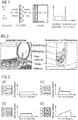
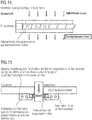
- FIG Figure 1 shows a method known from [7] for generating a depth profile.
- an ion beam is implanted into a substrate through a structured energy filter in a system for ion implantation for the purpose of wafer processing.
- the implantation method and the dopant distribution or defect distribution resulting from the implantation in the wafer after processing are shown. It is shown in particular how a monoenergetic ion beam is modified in its energy as it passes through a microstructured energy filter component, depending on the entry point.
- the resulting energy distribution of the ions leads to a modification of the depth profile of the implanted substance in the substrate matrix. This depth profile, which is rectangular in the example shown, is shown in FIG Figure 1 also shown.
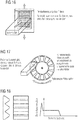
- Figure 2 shows a system for ion implantation.
- This system comprises an implantation chamber (implantation chamber) in which several wafers can be arranged on a wafer wheel.
- the wafer wheel rotates during implantation so that the individual wafers repeatedly pass through a beam opening in which the energy filter is arranged and through which the ion beam enters the implantation chamber and thus into the wafer.
- Links in Figure 2 shows the wafer wheel on which the substrates to be implanted are fixed.
- the wheel is tilted by 90 ° and set in rotation.
- the wheel is "written" with ions in concentric circles by the ion beam indicated in green.
- the wheel is moved vertically during processing.
- an energy filter is shown mounted in the beam opening.
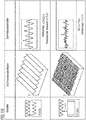
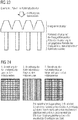
- Figure 3 shows exemplary layouts or three-dimensional structures of filters in order to illustrate in principle how a large number of different dopant depth profiles can be generated by a suitable choice of the filter.
- the individual, in Figure 3 The filter profiles shown can be combined with one another in order to obtain additional filter profiles and thus doping depth profiles. Shown are cross-sections of the energy filter (on the far left in the figures), top views of the energy filters and curves of the doping concentration achieved over the depth (as a function of the depth) of the wafer.
- the "depth" of the wafer is a direction perpendicular to the surface of the wafer in which to implant.
- (a) triangular prismatic structures cause a rectangular doping profile
- (b) smaller triangular prismatic structures a less deep-reaching rectangular doping profile compared to case (a) (the depth of the profile can therefore be adjusted via the size of the structures)
- (c) trapezoidal prismatic structures a rectangular doping profile with a peak at the start of the profile
- (d) pyramid-shaped structures a triangular doping profile increasing into the depth of the substrate.
- Previously known energy filters (implantation filters) or energy filter elements are not suitable for various reasons in order to achieve high throughputs, i.e. many wafers per hour. In particular, it is desirable to have high wafer throughputs per hour, easy handling, simple production and the realization of any profile shapes.
- Static or movably mounted filters are known from the literature, which are monolithic, ie made from a block of material and individually mounted to the ion beam [2], [3], [4], [5], [6], [7], [8], [9], [10].
- doped areas in SiC wafers can i.a. their shape cannot be changed by outdiffusion of doping profiles [2], [4], [5], [6].
- Doping depth profiles in semiconductor wafers can be produced by in-situ doping during the epitaxial deposition or by (masked) monoenergetic ion implantation.
- in-situ doping high inaccuracies can occur.
- homogeneous doping profiles are process-related on the wafer, ie from center to edge Deviations from the target allocation are to be expected.
- this inaccuracy also extends to the vertical direction of the doping area, since the local dopant concentration now depends on a large number of process parameters such as temperature, local doping gas concentration, topology, width of the Prandtl boundary layer, growth rate, etc.
- the use of monoenergetic ion beams means that many individual implantations have to be carried out in order to obtain doping profiles with acceptable vertical undulations. This approach is only scalable to a limited extent and quickly becomes economically unprofitable.
- Examples of the invention relate to the design of an energy filter element for ion implantation systems, so that this corresponds to the requirements resulting from the use of the energy filter element in the industrial production of semiconductor components, in particular for components based on SiC semiconductor material.
- production conditions are defined, for example, by the following aspects:
- the energy filter is a highly fragile, microstructured membrane that is difficult to handle without destroying it.
- Production conditions mean, for example, that ion implanters (typical terminal voltage at tandem accelerators> 1MV to 6MV) per hour should produce more than typically 20-30 wafers with a diameter of 6 "and area doses per wafer of approx
- ion currents of more than 1p ⁇ A up to a few 10p ⁇ A must be used, or outputs of more than a few watts, e.g. 6W / cm-2, are deposited on the filter (typical area 1-2cm 2 ). This leads to the heating of the filter and the task is to cool the filter by means of suitable measures.
- Filter structures can be produced by means of anisotropic wet chemical etching.
- the filter structures consist of suitably dimensioned triangular long lamellae (e.g. 6 ⁇ m high, 8.4 ⁇ m spacing, length a few millimeters), which are periodically arranged on a membrane that is as thin as possible.
- triangular lamellae e.g. 6 ⁇ m high, 8.4 ⁇ m spacing, length a few millimeters
- pointed triangular lamellae is cost-intensive, since the wet-chemical anisotropic etching must be precisely set.
- Pointed, i.e. non-trapezoidal lamellae are complex, as the etching rates and times must be precisely matched to one another for pointed lamellae.
- the energy filters for ion implantation described in the mentioned publications [2], [3], [4], [5], [6], [7], [8], [9], [10] have an internal 3-dimensional Structure that leads to differences in the path length of the ions when transmitted through the filter. These path length differences produce, depending on the braking capacity of the filter material, a modification of the kinetic energy of the transmitted ions. A monoenergetic ion beam is thus converted into a beam of ions with different kinetic energies. The energy distribution is determined by the geometry and the materials of the filter, ie the filter structure is transferred into the substrate by means of ion lithography.
- the total number of wafers processed with a specific filter should be monitored.
- the angular spectrum of the transmitted ions must be limited in order to avoid "under-implantation" of the masking layer.
- Electrons of the primary beam can be emitted or absorbed in the solid, ie the transmitted ions depend on the properties of the filter material and the primary energy after passing through the filter a higher or lower state of charge on average [26]. This can lead to positive or negative charging of the filter.
- the ion bombardment can generate secondary electrons with high kinetic energy both on the front and on the back of the filter.
- the energy filter will heat up, see Fig. 6.5.24. Due to thermionic electron emission (Richardson-Dushman law), thermal electrons are generated depending on the temperature and the work function of the filter material.
- the distance (in a high vacuum) of the ion accelerator between the filter and the substrate is typically only a few centimeters or less. This means that the diffusion of thermal electrons (from thermionic emission) and the action of fast electrons (from ion bombardment) falsify the measurement of the ion current on the substrate, for example by a Faraday cup attached there.
- microtechnical processes are proposed for the production of the energy filter.
- lithography processes in combination with wet-chemical or dry-chemical etching processes are used to produce the filters.
- the anisotropic wet chemical etching process using alkaline etching media (e.g. KOH or TMAH) in silicon is preferred for filter production.
- the functional filter layer is manufactured from monocrystalline silicon.
- An irradiation arrangement is to be used which allows a static substrate to be irradiated over the entire substrate surface in an energy-filtered manner with high lateral homogeneity.
- Partially mechanical scanners are also used, ie the beam is expanded in the x direction and the wafer is mechanically (slowly) moved in the y direction.
- An irradiation arrangement must be used which allows a static or movable substrate to be irradiated with energy filtering with a high degree of lateral homogeneity over the entire substrate area and thereby using a large filter area. This can reduce thermal effects and degradation effects in the filter.
- the energy filter is a tool for manipulating the doping profile in the substrate.
- a manipulation of the doping profile that can be generated in the substrate AFTER the energy filter is desirable.
- Such a doping profile manipulation after the energy filter can take place by implantation in a sacrificial layer on the substrate.
- a laterally variable doping profile in the substrate is desirable for certain applications.
- changing the implantation depth of a homogeneous doping profile for edge terminations in semiconductor components could be used advantageously.
- Such a lateral setting of the doping profile can take place on the substrate by means of a sacrificial layer that is laterally variable in its thickness.
- a multifilter is attached to the movable part of a movable substrate chamber, which moves in front of the beam with a linear pendulum movement (e.g. in the case of a rotating wafer disk with a vertical scanning device), a movement of the multifilter relative to the beam can easily be achieved through the Movement of the substrate chamber can be achieved.
- a magnetic or static scanning device in front of the filter in one direction, a very large multifilter surface can then be used, which results, for example, as the product of the vertical pendulum distance and the horizontal scanning distance.
- the movement of wafer and filter are coupled in this arrangement, which can lead to problems with regard to the lateral doping homogeneity. As the wafer wheel rotates, the ion beam "writes" lines on the wafers.
- the position of a horizontal irradiated line, for example, on the wafer is coupled to a specific vertical position on the multifilter.
- a gap between individual filter elements would, for example, result in an inhomogeneously doped line on the wafer.
- An arrangement of the filter components in the multifilter must therefore be selected so that the lateral homogeneity is guaranteed despite the coupling of the linear movements of the filter and the substrate.
- the filter chip which allows easy handling of the filter chip. to be built in.
- This framework can, as in the Figures 4 to 6 is shown, be designed in such a way that it can be used on the ion implantation system in a suitable frame holder preinstalled there.
- the frame protects the energy filter, allows easy handling and provides electrical and thermal dissipation or electrical insulation (see Figure 36 ).
- the frame can be supplied by the manufacturer of the filter elements with the filter chip assembled in a dust-free environment and delivered to the ion implantation system in dust-free packaging.
- the filter held therein can have any surface structure that is selected in accordance with the desired doping profile to be achieved with it.
- the filter holder and / or the filter frame can be provided with a coating that prevents material from being removed from the filter frame and filter holder.
- the filter frame and filter holder can be made of metals, preferably stainless steel, or the like.
- metals preferably stainless steel, or the like.
- sputtering effects in the local area of the energy filter must be expected, i.e. the frame and filter holder material must be expected to be removed from the surface.
- Metal contamination on the substrate wafer could be the undesirable consequence.
- the coating prevents such contamination, the coating being made of a non-contaminating material. Which substances are non-contaminating depends on the properties of the target substrate used. Examples of suitable materials include silicon or silicon carbide.
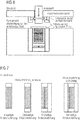
- FIG. 4 shows a cross section of a filter frame for receiving an energy filter chip.
- the energy filter chip that is in Figure 4 is also shown, can be fastened in various ways in the frame, such as by gluing by means of a vacuum-tight, temperature-stable and highly thermally conductive adhesive or by a mechanical spring.
- FIG. 5 shows a plan view of a filter frame for receiving an energy filter element which is shown in FIG Figure 5 is also shown.
- the filter frame has a closure element by means of which the frame can be opened and closed to change the energy filter.
- Figure 6 illustrates an example of an installation of a frame for receiving an energy filter element in the beam path of an ion implanter. Is shown in the upper part of Figure 6 a cross section through the chamber wall and the filter holder arranged on it.
- the filter holder is arranged on the inside of the chamber wall, that is to say the side that faces the wafer (not shown) during implantation.
- the ion beam passing through the opening in the chamber wall and the filter arranged in front of the opening during implantation is in Figure 6 also shown schematically.
- the frame with the filter chip inserted into the filter holder covers the opening in the chamber wall, through which the ion beam passes during implantation. This is in the lower part of the Figure 6 which shows a top view of the chamber wall with the filter holder attached.
- the frame can be made of the same material as the filter.
- the frame can be made monolithic with the filter and can be called a monolithic frame.
- the frame can also consist of a different material than the filter, such as a metal.
- the filter can be inserted into the frame.
- the frame comprises a monolithic frame and at least one further frame made of a different material than the filter, which is attached to the monolithic frame.
- This further frame is, for example, a metal frame.
- the frame can completely surround the filter, as explained and shown above and as shown on the right in FIG Figure 7 is shown. According to further examples, the frame does not adjoin all (four) sides (edges) of the filter, but only adjoins three, two (opposite) or only one of the edges of the filter.
- a frame is understood to mean a full frame that completely surrounds the filter on the sides (edges), but also a sub-frame that only partially surrounds the filter on the sides. Examples of such sub-frames are in Figure 7 also shown. Figure 7 shows different sub-frames (left in the figure) and a full frame (far right in the figure). These frames can each consist of the same (eg monolithic) and / or a different material than the energy filter.
- the energy filter or any other scattering element can be fastened in various ways in the beam path of the implanter by means of its frame, which can be implemented according to one of the examples explained above.
- the above-mentioned pushing the frame into a filter holder is only one of several possibilities. Further possibilities are explained below.
- the frame can be attached to the chamber wall by at least one web.
- the at least one web serves as a filter holder.
- fastenings with only one bar, with two bars and with three bars. Of course, more than three webs can also be provided.
- the frame can also be attached to the chamber wall by suspensions or suspension elements.
- suspensions or suspension elements are, for example, flexible and can be stretched between the frame and the chamber wall in such a way that the frame is held firmly.
- the suspension elements act as a filter holder in this example.
- Figure 9 Examples of fixings with only one suspension, with two suspensions and with three suspensions. Of course, more than three suspensions can be provided.
- the frame with the filter is held floating (contactless) by magnets.
- magnets are attached to a front and a rear side of the frame and the chamber wall in such a way that a magnet on the chamber wall or a holder attached to the chamber wall is opposite a magnet on the frame, with opposite poles of the opposite magnets facing each other. Due to the magnetic forces, the frame is held in a floating manner between the magnets attached to the chamber wall or the holder.
- the magnets on the frame of the filter can be realized, for example, by thermal vapor deposition or any other layer-applying method.
- any desired doping profile in a semiconductor material can be achieved through the geometric configuration of an energy filter for ion implantation systems.
- any profiles can be generated with simple triangular structures (multifilter). If necessary, non-triangular structures (eg pyramids) can also be used as basic elements for approximation.
- multifilter simple triangular structures
- non-triangular structures eg pyramids
- the decomposition of a doping depth profile is not limited to the triangular structures shown here, but other structures, which in the most general case contain inclines or also convex or concave rising flanks.
- the flanks do not necessarily have to rise monotonically, but can also contain valleys and depressions. Binary structures with flank angles of 90 ° are also conceivable.
- the filter elements are cut out "at an angle" and placed directly next to one another.
- the angled cutting has the advantage that no adhesive bond is required between the filters to block ions at the edge of the filter.
- the irradiated area can be used optimally in this way. With the same overall filter dimensions and given ion current, this increases the wafer throughput.
- FIG. 11 illustrates an example of a simple implementation of a multifilter.
- three differently shaped filter elements are combined in a frame of the filter holder to form a whole energy filter.
- Top left is in Figure 11 a cross section through the filter holder with the three filter elements is shown and at the bottom left in FIG Figure 11 a top view of the filter holder with the three filter elements is shown.
- On the right in FIG. 11 there is shown a filter profile that can be achieved with the combined filter.
- the ion beam evenly sweeps over all the individual filter elements, so that the right in Figure 11 shown dopant depth profile is achieved.
- This profile contains three sub-profiles numbered 1, 2 and 3. Each of these sub-profiles results from one of the three sub-filters shown on the left, namely from the sub-filter provided with the corresponding number.
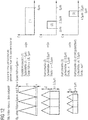
- Figure 12 illustrates an example of the functionality of three different filter elements that can be combined to form a multifilter.
- Figure illustrates a cross section through the individual filter elements, exemplary dimensions of these filter elements and dopant profiles, as achieved by the individual filter elements can be.
- a fourth filter element not shown, in Figure 12 only exemplary dimensions given.
- the weighting ie the resulting concentration or the doping profile, can be adjusted by dimensioning the surfaces of the individual filter elements.
- the filter and the substrate have the same energy-dependent braking capacity, but this does not have to be the case.
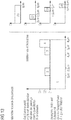
- FIG. 10 shows an example of a doping profile that can be obtained when the four are based on FIG Figure 12 explained filter elements can be combined into a multifilter and used for implantation.
- Figure 14 shows a cross section through a multifilter which has several adjoining filter elements F1, F2, F3 and which is inserted into a filter frame.
- the individual filter elements F1, F2, F3 are sawed at an angle in the example and arranged directly adjacent to one another.
- Such cooling can be achieved, for example, by one or more of the following under a. to c. explained measures take place:
- FIG 15 shows an example of such a cooled filter holder.
- a cross section is shown a filter holder that is attached to a chamber wall of an implanter.
- cooling lines are integrated in the filter holder, which receives the filter frame, and are supplied with cooling liquid by an external cooling device (not shown).
- the cooling lines can also be arranged on the surface of the filter holder (not shown).
- the filter or the holder of the filter When using a rotating wafer wheel loaded, for example, with 10-15 wafers, it is proposed to design the filter or the holder of the filter in such a way that it rotates or oscillates with a linear movement.
- the ion beam can be moved electrostatically over the filter when the filter is stationary.
- the filter is only partially irradiated by the ion beam per unit of time. This means that the part of the filter that is currently not being irradiated can be cooled by radiation. In this way, averaged higher current densities can be achieved with a given filter in continuous use. Examples of how this can be achieved are in the Figures 16 and 17 shown.
- Figure 17 illustrates an energy filter with a relatively large area, which is only partially irradiated per unit of time. In this way, the non-irradiated areas can cool down using radiation cooling.
- This embodiment can also be designed as a multifilter, as described above. That is, as a filter that has several different filter elements.
- the frame with the filter oscillates in a direction perpendicular to the beam direction of the ion beam, which is shown schematically.
- the area of the filter covered by the ion beam is less than the total area of the filter, so that only part of the filter is irradiated per unit of time. This part changes constantly due to the pendulum movement.
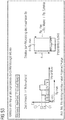
- Figure 11 shows an example of a filter assembly with multiple filter elements held by a rotating filter holder.
- the individual filter elements can each have the same structure, but can also be structured differently in order to obtain a multifilter.
- Figure 18 when the holder rotates, the individual filter elements move on a circular path around the axis of rotation (central axis) of the holder.
- FIG. 18 An example of such a filter is in Figure 18 shown.
- a cross section (left in the figure), a top view (in the middle) and an example of a doping profile that can be achieved by the filter shown are shown.
- a rectangular profile can be generated in the substrate by implanting ions into the energy filter with the aid of a trapezoidal prismatic structure.
- the initial peak is implanted in the energy filter, ie there is no doping profile peak within the substrate.
- the implantation profile has the advantageous property that it begins directly at the substrate surface, which can be of decisive importance for the application of the energy filter.
- this filter structure has plateaus instead of spikes, the individual structural elements are therefore trapezoidal in cross-section. This considerably simplifies the process-related implementation of the filter. It is known to produce triangular structures in silicon, for example by wet chemical etching using KOH or TMAH. For this, the lithographic covering of the triangle tips is necessary. If perfect tips are to be produced, this leads to the problem of undercutting of the lacquer or hard mask structure. Without the idea proposed here, this problem can only be solved by perfect (and thus complex, cost-intensive) processing. The idea proposed here thus simplifies the production of the Filter structures are very important. This also applies analogously to modern plasma-assisted etching processes such as RIBE or CAIBE.
- the aspect of lateral homogeneity can be essential in static implantation situations.
- the homogeneity is determined by the rotational and translational movement of the wafer disk relative to the ion beam.
- Filter-substrate distance The angular distribution of the transmitted ions depends on the energy. If the filter and the energy of the ions are matched to one another in such a way that, among other things, very low-energy ions (nuclear braking regime) leave the filter, the width of the angular distribution is large, since large-angle scattering events often occur. If the filter and the energy of the ions are matched to one another in such a way that only high-energy ions (only in the electronic regime, dE / dx electron > dE / dx nuclear ) leave the filter, the angular distribution is very narrow.
- a minimum distance is characterized by the fact that the structure of the filter is not transferred into the substrate, i.e., for example, that with a given scattering angle distribution of the transmitted ions, they cover at least a lateral distance comparable to the period of the lattice constant of the ion filter.
- a maximum distance is determined by the loss that is still to be tolerated by the application (semiconductor component) for a given scattering angle distribution due to scattered ions, in particular at the edge of the semiconductor wafer.
- Figure 19 This shows the result of an experiment in which ions were implanted through an energy filter during static implantation into a PMMA (polymethyl acrylate) substrate.
- the ions destroy the molecular structure of the PMMA, so that a subsequent development process reveals the energy distribution of the ions in such a way that areas of high energy deposition are dissolved. Areas with little or no energy deposition by ions are not dissolved in the developer solution.
- the idea proposed here is to generate a high lateral doping homogeneity for both dynamic and static implantation arrangements with the correct choice of the filter-substrate distance.
- the filter is changed in its chemical composition, its density and its geometry in such a way that the effects on the target profile to be realized can no longer be neglected.
- a specification can therefore be defined which includes a maximum temperature during implantation and a maximum permitted accumulated ion dose.
- the use of the energy filter is monitored in such a way that it cannot be used outside of the specification, even without monitoring by an engineer.
- each filter be recorded with an electronically readable signature as soon as the filter is inserted into the filter holder on the implanter and that this signature be read out, for example by a control computer.
- the signature is stored, for example, in an electronically readable memory arranged on the filter.
- the signatures of the filters that can be used on a certain implanter and their properties are stored, such as for which process (ion type, energy) the filter is suitable and which accumulated dose and which maximum temperature may be reached.
- the control computer can thus determine whether the filter is suitable for a planned implantation process.
- Figure 20 illustrates a control system for identifying the filter and for monitoring compliance with the filter specification (maximum temperature, maximum accumulated ion dose). If the filter is identified by the built-in sensors (charge integrator and temperature sensor), for example, the accumulated ion dose and the temperature of the filter are continuously measured. The implantation process is ended when one of the specified parameters is reached or exceeded, for example when the filter becomes too hot or the maximum permitted dose has been implanted through the filter. In other words, if the specification is violated, a signal is sent to the control computer, which ends the implantation process.
- the filter specification maximum temperature, maximum accumulated ion dose
- a mask can be applied to the target substrate.
- collimate the ion beam transmitted through the filter In order to avoid a lateral "softening" of the structures due to a filter-induced excessively wide ion distribution, it is proposed to collimate the ion beam transmitted through the filter.
- the collimation can take place by means of stripes, tubes, grids or hexagonal structures with high aspect ratios, which are placed in the transmitted beam after the energy filter.
- the aspect ratio of these structures defines the maximum permitted angle.
- Figure 21 shows a cross section of an implanter chamber wall in the area of the jet opening, a filter holder attached to the chamber wall with an inserted filter and a collimator, which in the example is attached to a side of the filter holder facing away from the chamber wall.
- An aspect ratio of the collimator which is determined by the length and the width of the collimator, determines the maximum angle ⁇ relative to the longitudinal direction of the collimator at which the ion beam can be radiated into the collimator in order to pass the collimator. Portions of the ion beam that are radiated at larger angles end on the wall of the collimator, i.e. do not pass through it.
- the collimator can also consist of several collimator units with a smaller opening arranged next to one another. These can, for example, be arranged in a honeycomb shape.
- the collimator structure can also be arranged directly on the filter element.
- Such an element can be produced monolithically or by microbonding processes.
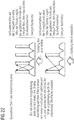
- Two examples of such a collimator structure arranged directly on the filter are shown in FIG Figure 22 shown.
- Such a collimator structure arranged directly on the filter can mechanically stabilize the filter and also have a cooling effect, since the collimator structure can act as a heat sink with a larger surface compared to the filter.
- the maximum angle ⁇ is also defined here by the aspect ratio of the individual collimator structures arranged on the filter, each of which has a length and a width.
- the collimator structure can be attached to the filter, for example by gluing, bonding, or the like.
- the collimator structure is arranged on the structured side of the filter, that is, where the filter has elevations and depressions.
- the structures are trapezoidal.
- FIG. 13 shows a modification of the arrangement of FIG Figure 22 .
- the collimator structure is arranged on the unstructured side of the filter. In both cases, the collimator structure is in the beam direction of the ion beam (the one in the Figures 21 and 22nd is symbolized by the arrow) after the filter, so that the ion beam passes the collimator structure after passing through the filter.
- Figure 24 shows top views of collimator structures according to various examples.
- this collimator structure is arranged on a filter which, in plan view, has a lamellar structure.
- the individual "filter lamellas" can, for example, be triangular or trapezoidal in cross section, as explained above.
- a lamellar structure of the filter is only one example. Any other filter structures as explained above can also be used.
- In the left part and in the middle shows Figure 24 one example each in which the collimator structure is strip-shaped, that is to say has a plurality of parallel strips which each extend over the entire width of the filter.
- a collimator is formed by two adjacent strips, the width of this collimator being determined by the distance between the adjacent strips.
- the length of the collimator is determined by the height of the individual strips.
- the "height" of the strips is their dimension in a direction perpendicular to the plane of the drawing.
- the strips of the collimator structure can run perpendicular to the lamellae of the filter, as shown on the left in FIG Figure 24 is shown, or can run parallel to the slats, as shown in the middle.
- Right is in Figure 24 an example is shown in which the collimator structure in plan view is lattice-shaped, whereby a plurality of collimators are formed, whose geometry is determined by the geometry of the grid.
- the individual collimators are rectangular in plan view, in particular square, so that the collimators are rectangular tubes.
- the grid can also be implemented in such a way that the individual collimators are circular, elliptical or hexagonal (honeycomb-shaped) or have any other polygonal geometry when viewed from above.
- a masking acting as a collimator structure can be applied to the target wafer.
- One condition for this masking can be that the braking capacity of the masking must at least correspond to the mean range of the transmitted ion beam in the target substrate material.
- the aspect ratio of the masking can be adapted accordingly.
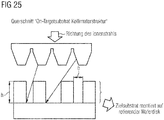
- Figure 25 Figure 3 shows an example of such a collimator structure placed directly on the target substrate.
- This collimator structure can have any of the geometries explained above, that is to say, for example, lamellar, strip-shaped, tubular or honeycomb-shaped - depending on the layout of the substrate structure and the required maximum angular distribution.
- the aspect ratio of this collimator structure is the ratio of height (h in Figure 25 ) to width (b in Figure 25 ) the recesses of the mask forming the collimator structure on the substrate.
- the collimator structure not only influences the scattering in the lateral direction, but also the depth profile.
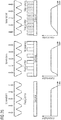
- Figure 26 shows the doping profiles for three different implantation procedures, each performed with the same filter but different collimator structures.
- the filter has a lamellar structure with a trapezoidal cross section. But this is just an example.
- an implantation method is illustrated in which implantation is carried out without a collimator structure. The implantation profile thus obtained begins on the surface of the substrate.
- the doping profiles obtained by this implantation method do not start at the surface of the substrate but rather spaced apart from it, the doping profiles being spaced further apart from the surface and increasing the flatter the greater the aspect ratio. This can be explained by the fact that the dopant profile in the area of the substrate close to the surface is caused by ions that are more strongly decelerated in the filter and therefore have a lower energy.
- Such ions with low energy are more strongly scattered by the filter than ions with higher energy, so that these ions with lower energy have a larger angular distribution than ions with higher energy.
- more ions with lower energy than ions with higher energy no longer pass through the collimator structure, this effect being more pronounced the greater the aspect ratio of the collimator structure, i.e. the smaller the maximum angle at which the ions can still pass the collimator structure be able.
- the filter can be designed in such a way that ions with low energy are "preferred", that is, more ions with lower energy than ions with higher energy pass the filter.
- An example of such a filter is in Figure 27 shown.
- the filter has different filter areas, each of which has a maximum and a minimum thickness. The maximum thickness is the same in all three areas, but the minimum thickness is different. This is achieved in the example in that the filter in each of the individual areas has a trapezoidal structure arranged on a base area, the height of the base being of different thicknesses or the trapezoidal structures being of different heights.
- the thickness of the base is smallest and the trapezoidal structure is highest, as a result of which a distance CD1 between adjacent structures is greatest in this section.
- the thickness of the base is greatest and the trapezoidal structure is the smallest, as a result of which a distance CD3 between adjacent structures in this section is the smallest.
- the thickness of the base is between the thickness in the first section and the thickness in the third section, correspondingly a height of the trapezoidal structure in this section is between the height in the first section and in the third section and a distance CD2 between adjacent structures in this section between the distance CD1 in the first section and the distance CD3 in the third section.
- the individual sections can be the same size in relation to their area but also be of different sizes. In addition, more than three sections with different minimum filter thicknesses can of course also be provided.
- Figure 27 shows, in the left part, an implantation profile that is obtained with implantation with the filter described, when implantation is carried out without a collimator structure.
- This implantation profile begins on the surface, but the doping concentration decreases in steps with increasing depth.
- CD1 denotes a region of the doping profile produced by the first section of the filter
- CD2 denotes a region of the doping profile produced by the second section of the filter
- CD3 denotes a region of the doping profile produced by the third section of the filter.
- the doping profile shows that the ions passing through the respective filter area penetrate less deeply into the substrate, that is to say that their energy is lower, the greater the minimum thickness of the base of the respective section.
- the doping profile shows that more ions with low energy pass through this filter than ions with high energy.
- the ions with lower energy are more strongly scattered than the ions with higher energy, and thus fewer ions with lower energy than ions with higher pass a collimator structure, when using such a filter in conjunction with a collimator structure an approximately homogeneous doping profile beginning at the surface can be achieved.
- FIG. 27 shows that an implantation method using the explained filter and a collimator structure is shown.
- the collimator structure is located on the substrate, but can also be arranged on the filter.
- Implantation arrangement of the filter to the substrate, one point towards the substrate, once point away from the substrate ⁇ sputtering, scattering on impact.
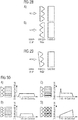
- the filter can be used in such a way that the microstructures of the filter face the substrate, that is, point away from the ion beam, as in FIG Figure 28 (a) is shown.
- the filter can also be rotated so that the microstructures of the filter are facing away from the substrate, i.e. point towards the ion beam, as in FIG Figure 28 (b) is shown.
- the latter can have advantageous effects on sputtering effects in the filter.
- the filter and / or substrate are made of crystalline material, undesirable channeling effects can occur. This means that ions can achieve an increased range along certain crystal directions.
- the size of the effect and the acceptance angle are temperature and energy dependent.
- the implantation angle and the crystallographic surface orientation of the raw material used for the filter and substrate play a decisive role. In general, the channeling effect cannot be reliably reproduced over a wafer, since the above parameters can differ from wafer to wafer and from implantation system to implantation system.
- Channeling should therefore be avoided. Tilting the filter and substrate can prevent channeling. Channeling in the filter or in the substrate can have very different effects on the depth profile of the implanted dopant, especially if the filter and substrate are made of different materials.
- Figure 29 shows schematically a filter which is tilted relative to the substrate during the implantation process in such a way that a base area of the filter encloses an angle with a surface of the substrate which is greater than zero. This angle is, for example, greater than 3 °, greater than 5 ° or greater than 10 ° and smaller than 30 °.
- a channeling effect can be prevented or reduced as a result.
- Figure 30 shows a schematic representation of various doping profiles (doping concentration as a function of the depth in the substrate) for differently shaped energy filters, each of which is shown in a side view and a top view.
- triangular prismatic structures produce a rectangular doping profile
- smaller triangular prismatic structures produce a less depth-distributed doping profile than the larger triangular prismatic ones shown in (a) Structures
- trapezoidal prismatic structures produce a rectangular doping profile with a peak at the start of the profile
- pyramidal structures produce a triangular doping profile that rises into the depth of the substrate.
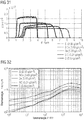
- Figure 32 illustrates the course of the braking capacity as a function of the energy [4] (SRIM simulation) for the various substrate materials that are shown in the illustration in Figure 31 underlie.
- Figure 33 Fig. 10 illustrates a multilayer starting material for a multilayer filter.
- this starting material comprises four different layers, which are labeled 1 to 4.
- the use of four layers is just one example. Less than or more than four different layers can also be used.
- the individual layers can differ not only in terms of the material used but also in terms of their thickness. It is also possible for two layers to have the same material and to be separated by two or more layers of different materials.
- the individual layers can be deposited or produced sequentially on top of one another by suitable deposition processes.
- FIG. 13 shows a cross section of a filter based on the in FIG Figure 33 produced starting material was realized and which in the example shown has a base and triangular structures arranged on the base. These triangular structures can be strip-shaped, that is to say elongated in a direction perpendicular to the plane of the drawing, or they can also be part of pyramidal structures.
- the filter can also be implemented in such a way that several structures are arranged next to one another in the lateral direction (y-direction), which have different geometries and / or different layer stacks, ie layer stacks with different structures with regard to the sequence of individual layers and / or the material of the individual layers.
- y-direction lateral direction
- the filter shown six different materials are used in the filter shown, which are labeled 1-6.
- Suitable materials for the individual layers are, for example, without being restricted to such materials, silicon, silicon compounds or metals.
- Silicon compounds are, for example, silicon carbide (SiC), silicon oxide (SiO 2 ) or silicon nitride (SiN).
- Suitable metals are, for example, copper, gold, platinum, nickel or aluminum.
- at least one layer made of a silicon compound is grown on a silicon layer and on the at least one layer made of a silicon compound a metal layer is vapor-deposited.
- a metal layer can also be vapor-deposited directly onto a silicon layer. It is also possible to produce different metal layers on top of one another by vapor deposition in order to obtain different layers of the filter.
- Figure 36 illustrates the equilibrium charge states of an ion (black line: Thomas-Fermi estimate, blue line: Monte Carlo simulations, red line: experimental results) as a function of the kinetic energy of the ion when irradiating a thin membrane.
- Ion sulfur
- membrane carbon.
- the ion bombardment can generate secondary electrons with high kinetic energy both on the front and on the back of the filter.
- the energy filter will heat up. Due to thermionic electron emission (Richardson-Dushman law), thermal electrons are generated depending on the temperature and the work function of the filter material.
- Figure 37 shows the heating of an energy filter by ion bombardment. The curve shown is based on an experiment in which a filter was irradiated with carbon (C) ions with an energy of 6 MeV. The filter in this case was a non-transparent energy filter [2].
- the distance (in a high vacuum) of the ion accelerator between the filter and the substrate is typically only a few centimeters or less. This means that the diffusion of thermal electrons (from thermionic emission) and the action of fast electrons (from ion bombardment) falsify the measurement of the ion current on the substrate, for example by a Faraday cup attached there.
- the filter As described, from the perspective of the filter there are processes that deliver electrons (stripping of the primary ions) and there are processes that emit electrons. So the potential is one
- the electrically insulated filter is not well defined, but will vary depending on the ion current, vacuum conditions, temperature, etc. during the implantation process. A net negative charge will encourage the emission of electrons, a net positive charge will tend to suppress the emission of electrons. Various ways of preventing such charging are explained below.
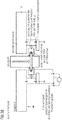
- Figure shows a cross section of a filter arrangement in which this is ensured.
- the filter in the filter frame is held at a defined (positive) potential with respect to the filter holder for the purpose of suppressing secondary electrons.
- the filter frame is connected to a voltage source and is electrically isolated from the filter holder and the chamber wall of the implanter.
- the electrical potential of the filter holder can be regulated. For example, in such a way that, regardless of the charge balance resulting from the implantation process, a constant potential is set during the implantation with respect to the potential of the substrates to be implanted or the earth potential. For this purpose, a regulated supply of positive or negative charge can take place from a power source.
- the potential to be set can in particular be selected so that, for example, the emission of electrons from the filter is completely suppressed and thus only the (positive) charge of the transmitted ion current is measured in the Faraday cup next to or on the substrate.
- Typical values for such a (positive) potential are between a few 10V and a few 1000V.
- the energy filter has a very high resistance due to its material nature
- the stopping power of this layer must be included in the overall balance of the stopping power when designing the filter. Care must be taken that the applied layer (even when applied on the side facing away from the substrate) does not in principle cause any harmful effects Contamination caused in the substrate material to be implanted.
- the layer can consist of carbon, for example.
- the stopping power of this layer should be included in the overall balance of the stopping power when designing the filter. It must be ensured that the applied layer (even when applied on the side facing away from the substrate) does not in principle cause any harmful contamination in the substrate material to be implanted.
- Ad 12 Alternative manufacturing methods using injection molding, casting or sintering processes
- Another advantage is that the use of the above-mentioned molding processes can greatly reduce the costs of producing a large number of filter elements compared to microtechnical production.
- Figure 40 shows an arrangement for implantation in a substrate through an energy filter. This arrangement comprises a deflection device for the ion beam, which is arranged in front of the filter.
- the deflection of the ion beam which can be achieved by this deflection device, is matched to the distance between filter and substrate (typically in the range from a few cm to a few m) that the substrate is irradiated completely, ie over its entire surface, for the purpose of implantation can be.
- Ad 14 Arrangement for utilizing a large filter area
- Figure 41 illustrates an arrangement for an energy filter implantation (i.e. an implantation by means of an energy filter) in which the beam area has been enlarged by suitable measures and the irradiated filter area is larger than the substrate area, whereby a complete irradiation of the substrate can be achieved and a large filter area can be used can.
- the irradiated filter area diameter is larger than the substrate diameter.
- a minimum distance between the substrate and the filter should be maintained, which ensures that there is sufficient lateral homogenization of the implanted ions due to scattering effects.
- the same arrangement as described in FIG. 14 a) is initially used:
- the arrangement of an energy filter implantation in which the beam area has been enlarged by suitable measures and the irradiated filter area is larger than the substrate area.
- the filter consists of an arrangement of a number of, for example, strip-shaped filter elements. These filter elements can, for example, be produced monolithically from a substrate by suitable production processes.
- Figure 42 Fig. 10 illustrates a partially active filter with mechanical unidirectional scanning.
- Ad 15 Modification of the doping profile in the substrate by means of a sacrificial layer
- a sacrificial layer can be applied to the substrate, the thickness and stopping power of which is selected in a suitable manner, so that the depth of the implantation profile in the substrate is shifted in the desired manner.
- a sacrificial layer can be used for masked ion implantation (cf. Figure 43 ) or for unmasked ion implantation.
- this method allows an undesired beginning of a doping profile to be "pushed out" of the substrate into the sacrificial layer by implanting the beginning of the profile into the sacrificial layer.
- Figure 43 illustrates a modification of the doping profile in the substrate by means of a sacrificial layer in the case of a masked, energy-filtered implantation.
- the beginning of the implantation profile is pushed into the sacrificial layer.
- This principle can be used in an analogous manner for an unmasked, energy-filtered ion implantation, i.e. an implantation in which different than in Figure 43 shown there is no mask layer.
- Ad 16 Lateral modification of the doping profile in the substrate by means of a sacrificial layer
- a sacrificial layer is applied to the substrate, the stopping power and course of the thickness over the wafer surface being selected in a suitable manner so that the depth of the implantation profile in the substrate is shifted in the desired manner depending on the lateral position on the wafer.
- a sacrificial layer can be used for masked ion implantation or also for unmasked ion implantation (cf. Figure 44 ) be used.
- changing the implantation depth of a homogeneous doping profile for edge terminations in semiconductor components can be used advantageously.
- Figure 44 illustrates a lateral modification of the doping profile in the substrate by means of a sacrificial layer in the case of an unmasked, energy-filtered ion implantation.
- a lateral modification of the implantation depth comes about here due to a different thickness of the sacrificial layer in the lateral direction.
- the principle can be used analogously for masked, energy-filtered implantations.
- Ad 17 Adaptation of a profile transition of several implantation profiles
- Two or more doping profiles can be skilfully overlapped, so that a desired overall doping profile is created, in particular in the area of the overlap.
- This technique is particularly advantageous when growing and doping several layers.
- a representative example is the growth of several SiC epi layers and the respective energy-filtered doping. Good contact between the layers should be ensured here.
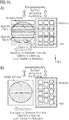
- Ad 18 Special arrangement of the multifilter concept with coupled pendulum movement
- a clever arrangement can be used so that, despite the coupled pendulum movement of filter and substrate, that is, no relative vertical movement between filter and substrate, a lateral homogeneity of the distribution of the ions is achieved.
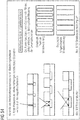
- Such an arrangement is in Figure 45 shown.
- the wafers are guided along behind the substrate by the rotation of the wafer wheel in the x-direction.
- the ion beam (not shown) is expanded in the x direction, for example, and is scanned over the entire multifilter surface by the vertical pendulum movement of the implantation chamber.
- the surface consists of active filter areas and inactive support areas.
- Arrangement A) is an unfavorable arrangement.
- Arrangement A is a rather unfavorable arrangement. If one considers the irradiated filter area for y1 and y2, then at y1 3 filters are irradiated while at y2 no filter at all is irradiated. The result is a laterally inhomogeneous stripe pattern on the wafer.
- Arrangement B shows a possible example of a better arrangement. Two filters are irradiated for both y1 and y2. This is true for all y. This results in a laterally homogeneous doping over the wafer surface.
- Another aspect is to solve the task of monitoring important parameters of the ion implantation modified by an energy filter.
- Such parameters are, for example, the minimum or maximum projected range, the depth concentration distribution set by the filter geometry and the (energy-dependent) angle distribution.
- Monitoring other parameters such as implanted ion species, etc., could also be useful.
- Monitoring should be possible in particular on the wafers to be implanted or on structures (several in parallel) that are arranged in the vicinity of the wafers. According to one aspect, the monitoring should be carried out without further processing of the monitoring structures or the wafers.
- Monitoring can be carried out by measuring optical parameters such as spectral absorption, spectral transmission, spectral reflection, changes in the refractive index, global absorption (wavelength range depending on the measuring device) and global transmission, as well as reflection (wavelength range depending on the measuring device).
- optical parameters such as spectral absorption, spectral transmission, spectral reflection, changes in the refractive index, global absorption (wavelength range depending on the measuring device) and global transmission, as well as reflection (wavelength range depending on the measuring device).
- masks and substrate materials for monitoring the mentioned implantation parameters which (1) are arranged at a suitable place on the surface to be implanted, eg wafer wheel, and (2) their eg optical properties "as implanted" by ion implantation ", ie change it without further post-processing in such a way that, for example, the change is proportional to the implanted ion dose for a given type of ion.
- Such materials mentioned under (2) are, for example, PMMA (Plexiglas), PMMA, SiC, LiNbO3, KTiOPO4 or the like.
- the target substrate e.g. a SiC wafer
- the target substrate can be used directly for optical monitoring.
- Such changes can be, for example, mechanical properties of the monitor material, electrical properties of the monitor material or also the nuclear physical activation of the monitor material by high-energy ion radiation.
- the detection should take place via the change in optical properties.
- Such an implementation will be described below.
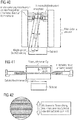
- a monitoring structure consists of the arrangement of a suitable substrate material with one or more mask structures. Examples are in the Figures 47 and 48 shown.
- the monitoring structure or structures are, as in Figure 46 shown at a suitable location, for example on the wafer wheel, arranged.
- the monitoring chips are read out after implantation, for example without further post-processing. Possibly. the mask for the readout measurement must be separated from the monitoring substrate. In one aspect, the mask is reusable.
- Mask material and substrate material of the monitoring chip can be made of different materials.
- the criteria for selecting the mask material are, for example, compatibility with the material of the target substrates (in order to exclude contamination by sputtering effects) and a braking capacity for high-energy ions such that mask structures with high aspect ratios can be produced.
- the mask material and the substrate material of the monitoring chip can be made from the same material.
- the mask and substrate can also be produced monolithically. In this case, it is usually not possible to reuse the mask or the substrate.
- the lateral dimensions of the individual structures can be, depending on the requirements of the readout apparatus, from square micrometers, through square millimeters to square centimeters.
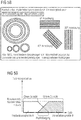
- Figure 53 a structure is shown which is suitable for monitoring the maximum projected range.
- Analog structures using evaluation procedures as described under A., can also be used to measure or monitor the minimum projected range.
- the ion implantation energy filter is known to produce an energy dependent spectrum of ion angles after passing through the filter.
- the resulting angular distribution is therefore a function of the filter geometry, the change in the geometry during the service life of the filter, the occurrence of channeling effects, the type of ion used, the primary energy, the resulting maximum and minimum energy of the transmitted ions and the geometric arrangement in the implantation chamber. All of these parameters can be monitored by monitoring the angular distribution.
- the opening sizes of the mask structures for thin masks that are only slightly thicker than the maximum projected range in the mask material can therefore be in the micrometer or submicrometer range.
- Such monitoring structures are preferably arranged as arrays which consist of many individual structures in order to be able to carry out a global (ie on an area of several mm 2 or cm 2) optical evaluation.
- the opening sizes can be in the millimeter or centimeter range. In these cases, the evaluation of individual structures that are not arranged in an array is also possible without excessive technical effort.
- Circular arrangements are also conceivable.
- the core of the aspects explained last is to use the (essentially) dose-dependent modification of the (preferably) optical parameters of a material for the "as implanted" monitoring of the energy filter implantation process.
- the most important parameters of the resulting implantation result can be monitored as completely as possible by means of an (for example) optical measurement, without the need for complex post-processing (e.g. annealing and application of metallic contacts).
- Figure 59 illustrates an adaptation of a profile transition of two implantation profiles A and B in a skilful manner, so that the resulting overall concentration profile can, for example, generate a desired homogeneous profile.
- This can (but does not have to) be advantageous, especially in the case of layer systems consisting of 2 layers, as in the picture shown here.
- the options for designing the high-energy tail of implant A are limited, but the low-energy tail of implant B can be influenced in particular by introducing a sacrificial layer, as described in "15: Modifying the doping profile in the substrate using a sacrificial layer".
- Proposal for an implementation with the following process sequence 1) Growing up sacrificial layer. 2) doping the lower Layer (Implant B). 3) Remove the sacrificial layer. 4) Grow the top layer. 5) doping the top layer.
- the concepts explained above enable production-compatible implantation processes for the semiconductor industry, i.e. an economical application of implantation processes in an industrial production process.
- the concepts explained enable, in particular, a very flexible (multifilter concept) implementation of complex vertical doping concentration profiles with a low angular distribution of the implanted ions.
- all types of doping concentration profiles can be approximated by using triangular filter structures in conjunction with collimator structures.
- Another important aspect concerns the suppression of artifacts which falsify the ion current measurement on the substrate.
- Ad 1. to Ad 19. can each be used on their own, but also in any combination with one another.
- the explained “end-of-life” detection can be applied to a filter held by a frame, but can also be applied to a filter held otherwise.
- the wafer explained above can be a semiconductor wafer, but can also consist of another material to be implanted, such as PMMA, for example.
Landscapes
- Chemical & Material Sciences (AREA)
- Analytical Chemistry (AREA)
- Physics & Mathematics (AREA)
- Spectroscopy & Molecular Physics (AREA)
- Engineering & Computer Science (AREA)
- General Engineering & Computer Science (AREA)
- High Energy & Nuclear Physics (AREA)
- Physical Vapour Deposition (AREA)
- Element Separation (AREA)
- Mechanical Treatment Of Semiconductor (AREA)
Priority Applications (3)
| Application Number | Priority Date | Filing Date | Title |
|---|---|---|---|
| EP25163764.1A EP4546375A3 (de) | 2016-04-04 | 2017-04-04 | Energiefilterelement für ionenimplantationsanlagen für den einsatz in der produktion von wafern |
| EP21183792.7A EP3926658B1 (de) | 2016-04-04 | 2017-04-04 | Energiefilterelement für ionenimplantationsanlagen für den einsatz in der produktion von wafern |
| EP25167441.2A EP4553855A3 (de) | 2016-04-04 | 2017-04-04 | Energiefilterelement für ionenimplantationsanlagen für den einsatz in der produktion von wafern |
Applications Claiming Priority (2)
| Application Number | Priority Date | Filing Date | Title |
|---|---|---|---|
| DE102016106119.0A DE102016106119B4 (de) | 2016-04-04 | 2016-04-04 | Energiefilterelement für Ionenimplantationsanlagen für den Einsatz in der Produktion von Wafern |
| PCT/EP2017/058018 WO2017174597A1 (de) | 2016-04-04 | 2017-04-04 | Energiefilterelement für ionenimplantationsanlagen für den einsatz in der produktion von wafern |
Related Child Applications (4)
| Application Number | Title | Priority Date | Filing Date |
|---|---|---|---|
| EP25167441.2A Division EP4553855A3 (de) | 2016-04-04 | 2017-04-04 | Energiefilterelement für ionenimplantationsanlagen für den einsatz in der produktion von wafern |
| EP21183792.7A Division EP3926658B1 (de) | 2016-04-04 | 2017-04-04 | Energiefilterelement für ionenimplantationsanlagen für den einsatz in der produktion von wafern |
| EP21183792.7A Division-Into EP3926658B1 (de) | 2016-04-04 | 2017-04-04 | Energiefilterelement für ionenimplantationsanlagen für den einsatz in der produktion von wafern |
| EP25163764.1A Division EP4546375A3 (de) | 2016-04-04 | 2017-04-04 | Energiefilterelement für ionenimplantationsanlagen für den einsatz in der produktion von wafern |
Publications (2)
| Publication Number | Publication Date |
|---|---|
| EP3440690A1 EP3440690A1 (de) | 2019-02-13 |
| EP3440690B1 true EP3440690B1 (de) | 2021-08-11 |
Family
ID=58544919
Family Applications (4)
| Application Number | Title | Priority Date | Filing Date |
|---|---|---|---|
| EP17717106.3A Active EP3440690B1 (de) | 2016-04-04 | 2017-04-04 | Energiefilterelement für ionenimplantationsanlagen für den einsatz in der produktion von wafern |
| EP25167441.2A Pending EP4553855A3 (de) | 2016-04-04 | 2017-04-04 | Energiefilterelement für ionenimplantationsanlagen für den einsatz in der produktion von wafern |
| EP25163764.1A Pending EP4546375A3 (de) | 2016-04-04 | 2017-04-04 | Energiefilterelement für ionenimplantationsanlagen für den einsatz in der produktion von wafern |
| EP21183792.7A Active EP3926658B1 (de) | 2016-04-04 | 2017-04-04 | Energiefilterelement für ionenimplantationsanlagen für den einsatz in der produktion von wafern |
Family Applications After (3)
| Application Number | Title | Priority Date | Filing Date |
|---|---|---|---|
| EP25167441.2A Pending EP4553855A3 (de) | 2016-04-04 | 2017-04-04 | Energiefilterelement für ionenimplantationsanlagen für den einsatz in der produktion von wafern |
| EP25163764.1A Pending EP4546375A3 (de) | 2016-04-04 | 2017-04-04 | Energiefilterelement für ionenimplantationsanlagen für den einsatz in der produktion von wafern |
| EP21183792.7A Active EP3926658B1 (de) | 2016-04-04 | 2017-04-04 | Energiefilterelement für ionenimplantationsanlagen für den einsatz in der produktion von wafern |
Country Status (6)
| Country | Link |
|---|---|
| US (5) | US10847338B2 (enExample) |
| EP (4) | EP3440690B1 (enExample) |
| JP (6) | JP6831133B2 (enExample) |
| CN (2) | CN113035676B (enExample) |
| DE (1) | DE102016106119B4 (enExample) |
| WO (1) | WO2017174597A1 (enExample) |
Families Citing this family (19)
| Publication number | Priority date | Publication date | Assignee | Title |
|---|---|---|---|---|
| DE102016106119B4 (de) | 2016-04-04 | 2019-03-07 | mi2-factory GmbH | Energiefilterelement für Ionenimplantationsanlagen für den Einsatz in der Produktion von Wafern |
| DE102016122791B3 (de) * | 2016-11-25 | 2018-05-30 | mi2-factory GmbH | Ionenimplantationsanlage, Filterkammer und Implantationsverfahren unter Einsatz eines Energiefilterelements |
| WO2018173812A1 (ja) * | 2017-03-22 | 2018-09-27 | 国立研究開発法人日本原子力研究開発機構 | イオンビーム機能性透過膜、イオンビーム機能性透過膜を用いたビームライン機器、イオンビーム機能性透過膜を用いたフィルター機器、フィルター機器の調整方法 |
| US10217654B1 (en) * | 2018-02-12 | 2019-02-26 | Varian Semiconductor Equipment Associates, Inc. | Embedded features for interlocks using additive manufacturing |
| DE102018114667B3 (de) | 2018-06-19 | 2019-09-19 | Infineon Technologies Ag | Ionenstrahl-moderatorvorrichtung, ionenstrahl-implantationsgerät und ionen-implantationsverfahren |
| DE102019112773B4 (de) * | 2019-05-15 | 2023-11-30 | mi2-factory GmbH | Vorrichtung und Verfahren zur Implantation von Teilchen in ein Substrat |
| DE102019120623B4 (de) | 2019-07-31 | 2024-01-25 | mi2-factory GmbH | Energiefilter zur Verwendung bei der Implantation von Ionen in ein Substrat |
| LU101807B1 (en) * | 2020-05-15 | 2021-11-15 | Mi2 Factory Gmbh | Ion implantation device with energy filter having additional thermal energy dissipation surface area |
| LU101808B1 (en) | 2020-05-15 | 2021-11-15 | Mi2 Factory Gmbh | An ion implantation device comprising energy filter and additional heating element |
| CN111634899B (zh) * | 2020-06-14 | 2022-11-18 | 南开大学 | 一种基于金属-有机框架衍生合成碳包覆磷酸钛钾纳米花的制备方法 |
| US20240038491A1 (en) | 2020-12-17 | 2024-02-01 | mi2-factory GmbH | Ion implantation device with an energy filter and a support element for overlapping at least part of the energy filter |
| EP4238121A1 (en) * | 2020-12-17 | 2023-09-06 | MI2-Factory GmbH | Energy filter assembly for ion implantation system with at least one coupling element |
| DE102020134222A1 (de) * | 2020-12-18 | 2022-06-23 | mi2-factory GmbH | Verfahren zur Herstellung eines vorbehandelten Verbundsubstrats und vorbehandeltes Verbundsubstrat |
| EP4281990A1 (en) | 2021-02-24 | 2023-11-29 | MI2-Factory GmbH | A computer-implemented method for the simulation of an energy-filtered ion implantation (efii) |
| WO2022180037A1 (en) | 2021-02-24 | 2022-09-01 | mi2-factory GmbH | A computer-implemented method for the simulation of an energy-filtered ion implantation (efii) using an ion tunnel |
| US11569063B2 (en) | 2021-04-02 | 2023-01-31 | Applied Materials, Inc. | Apparatus, system and method for energy spread ion beam |
| CN114758730B (zh) * | 2022-01-05 | 2024-08-16 | 西安理工大学 | 等离子体活性粒子与绝缘材料表面作用的仿真方法 |
| WO2023140953A1 (en) * | 2022-01-21 | 2023-07-27 | Axcelis Technologies, Inc. | High incidence angle graphite for particle control with dedicated low sputter yield ion beam |
| DE102023103315B4 (de) | 2023-02-10 | 2024-11-28 | Ernst-Abbe-Hochschule Jena, Körperschaft des öffentlichen Rechts | Messvorrichtung, Ionenimplantationsvorrichtung und Verfahren zur ladungsunabhängigen In-Situ-Dosismessung |
Family Cites Families (40)
| Publication number | Priority date | Publication date | Assignee | Title |
|---|---|---|---|---|
| US4158141A (en) * | 1978-06-21 | 1979-06-12 | Hughes Aircraft Company | Process for channeling ion beams |
| US4278475A (en) * | 1979-01-04 | 1981-07-14 | Westinghouse Electric Corp. | Forming of contoured irradiated regions in materials such as semiconductor bodies by nuclear radiation |
| GB2078441A (en) * | 1980-06-17 | 1982-01-06 | Westinghouse Electric Corp | Forming impurity regions in semiconductor bodies by high energy ion irradiation |
| GB2089499A (en) * | 1980-12-15 | 1982-06-23 | Ramsey Eng Co | X-ray Radiation Analyser |
| DE3121666A1 (de) * | 1981-05-30 | 1982-12-16 | Ibm Deutschland Gmbh, 7000 Stuttgart | Verfahren und einrichtung zur gegenseitigen ausrichtung von objekten bei roentgenstrahl- und korpuskularstrahl-belichtungsvorgaengen |
| JPH0216726A (ja) * | 1988-05-03 | 1990-01-19 | Varian Assoc Inc | イオン注入量の測定のための方法及び装置 |
| JPH0718584Y2 (ja) | 1988-07-18 | 1995-05-01 | 本州製紙株式会社 | 商品底押出し包装体 |
| JP3187043B2 (ja) * | 1990-11-09 | 2001-07-11 | 株式会社フジクラ | 物理蒸着法による酸化物超電導導体の製造方法 |
| US5604394A (en) | 1992-11-06 | 1997-02-18 | Mitsubishi Denki Kabushiki Kaisha | Image display apparatus |
| JP2616423B2 (ja) * | 1993-12-14 | 1997-06-04 | 日本電気株式会社 | イオン注入装置 |
| JPH08220298A (ja) * | 1995-02-11 | 1996-08-30 | Nissin High Voltage Co Ltd | イオンビーム停止部材 |
| DE19652463C2 (de) | 1996-12-17 | 1999-02-25 | Univ Schiller Jena | Verfahren und Vorrichtung zur Herstellung dreidimensionaler Mikrostrukturen beliebiger Form |
| US5972728A (en) * | 1997-12-05 | 1999-10-26 | Advanced Micro Devices, Inc. | Ion implantation feedback monitor using reverse process simulation tool |
| US6335534B1 (en) | 1998-04-17 | 2002-01-01 | Kabushiki Kaisha Toshiba | Ion implantation apparatus, ion generating apparatus and semiconductor manufacturing method with ion implantation processes |
| US6294862B1 (en) * | 1998-05-19 | 2001-09-25 | Eaton Corporation | Multi-cusp ion source |
| US6136164A (en) * | 1998-07-15 | 2000-10-24 | United Microelectronics Corp. | Apparatus for detecting position of collimator in sputtering processing chamber |
| JP2000306541A (ja) * | 1999-04-16 | 2000-11-02 | Nippon Steel Corp | イオン注入装置におけるウェーハ温度検出装置 |
| US6639227B1 (en) * | 2000-10-18 | 2003-10-28 | Applied Materials, Inc. | Apparatus and method for charged particle filtering and ion implantation |
| DE10201868C1 (de) * | 2002-01-18 | 2003-07-17 | Siemens Ag | Röntgeneinrichtung |
| JP4072359B2 (ja) * | 2002-02-28 | 2008-04-09 | 株式会社日立製作所 | 荷電粒子ビーム照射装置 |
| DE10239312B4 (de) | 2002-08-27 | 2006-08-17 | Infineon Technologies Ag | Verfahren zur Herstellung eines Halbleiterbauelements mit einer Driftzone und einer Feldstoppzone und Halbleiterbauelement mit einer Driftzone und einer Feldstoppzone |
| DE602004007500D1 (de) | 2003-04-24 | 2007-08-23 | Haute Ecole Arc Ne Be Ju | Mikrostrukturierungsverfahren |
| US20060043316A1 (en) * | 2003-06-10 | 2006-03-02 | Varian Semiconductor Equipment Associates, Inc. | Ion implanter having enhanced low energy ion beam transport |
| JP2005061663A (ja) * | 2003-08-08 | 2005-03-10 | Takata Corp | イニシエータ、イニシエータ用着火薬、イニシエータの起動方法及びガス発生器 |
| JP2007523440A (ja) * | 2004-02-18 | 2007-08-16 | 学校法人早稲田大学 | イオン注入方法及び装置 |
| DE102005061663B4 (de) * | 2005-12-22 | 2008-07-17 | RUHR-UNIVERSITäT BOCHUM | Ionenimplantationsvorrichtung |
| US7619229B2 (en) * | 2006-10-16 | 2009-11-17 | Varian Semiconductor Equipment Associates, Inc. | Technique for matching performance of ion implantation devices using an in-situ mask |
| US7960708B2 (en) * | 2007-03-13 | 2011-06-14 | University Of Houston | Device and method for manufacturing a particulate filter with regularly spaced micropores |
| US8531814B2 (en) * | 2009-04-16 | 2013-09-10 | Varian Semiconductor Equipment Associates, Inc. | Removal of charge between a substrate and an electrostatic clamp |
| US8461556B2 (en) * | 2010-09-08 | 2013-06-11 | Varian Semiconductor Equipment Associates, Inc. | Using beam blockers to perform a patterned implant of a workpiece |
| JP5909654B2 (ja) * | 2010-09-24 | 2016-04-27 | パナソニックIpマネジメント株式会社 | フィルターデバイス |
| US8440578B2 (en) * | 2011-03-28 | 2013-05-14 | Tel Epion Inc. | GCIB process for reducing interfacial roughness following pre-amorphization |
| DE102011075350A1 (de) | 2011-05-05 | 2012-11-08 | Fachhochschule Jena | Energiefilteranordnung für Ionenimplantationsanlagen |
| CN103777227B (zh) * | 2012-10-18 | 2016-06-08 | 上海原子科兴药业有限公司 | 一种回旋加速器束流测量装置 |
| JP6253362B2 (ja) * | 2013-11-21 | 2017-12-27 | 住友重機械イオンテクノロジー株式会社 | 高エネルギーイオン注入装置、ビーム電流調整装置、及びビーム電流調整方法 |
| JP6207418B2 (ja) * | 2014-02-10 | 2017-10-04 | 住友重機械イオンテクノロジー株式会社 | 高エネルギーイオン注入装置、ビーム平行化器、及びビーム平行化方法 |
| US9685298B1 (en) * | 2016-02-01 | 2017-06-20 | Varian Semiconductor Equipment Associates, Inc. | Apparatus and method for contamination control in ion beam apparatus |
| DE102016106119B4 (de) * | 2016-04-04 | 2019-03-07 | mi2-factory GmbH | Energiefilterelement für Ionenimplantationsanlagen für den Einsatz in der Produktion von Wafern |
| DE102016110429A1 (de) * | 2016-06-06 | 2017-12-07 | Infineon Technologies Ag | Energiefilter zum Verarbeiten einer Leistungshalbleitervorrichtung |
| US20240038491A1 (en) * | 2020-12-17 | 2024-02-01 | mi2-factory GmbH | Ion implantation device with an energy filter and a support element for overlapping at least part of the energy filter |
-
2016
- 2016-04-04 DE DE102016106119.0A patent/DE102016106119B4/de active Active
-
2017
- 2017-04-04 JP JP2019502159A patent/JP6831133B2/ja active Active
- 2017-04-04 EP EP17717106.3A patent/EP3440690B1/de active Active
- 2017-04-04 EP EP25167441.2A patent/EP4553855A3/de active Pending
- 2017-04-04 CN CN202110225252.4A patent/CN113035676B/zh active Active
- 2017-04-04 EP EP25163764.1A patent/EP4546375A3/de active Pending
- 2017-04-04 EP EP21183792.7A patent/EP3926658B1/de active Active
- 2017-04-04 WO PCT/EP2017/058018 patent/WO2017174597A1/de not_active Ceased
- 2017-04-04 CN CN201780029666.1A patent/CN109155228B/zh active Active
- 2017-04-04 US US16/090,521 patent/US10847338B2/en active Active
-
2020
- 2020-09-29 US US17/036,966 patent/US11183358B2/en active Active
-
2021
- 2021-01-14 JP JP2021003936A patent/JP7134508B2/ja active Active
- 2021-10-01 US US17/491,963 patent/US11837430B2/en active Active
-
2022
- 2022-08-24 JP JP2022132936A patent/JP7384480B2/ja active Active
-
2023
- 2023-10-10 US US18/378,421 patent/US12080510B2/en active Active
- 2023-11-01 JP JP2023187393A patent/JP7572751B2/ja active Active
-
2024
- 2024-07-25 US US18/783,964 patent/US20250014854A1/en active Pending
- 2024-10-04 JP JP2024174677A patent/JP7809377B2/ja active Active
-
2026
- 2026-01-14 JP JP2026004510A patent/JP2026065111A/ja active Pending
Non-Patent Citations (1)
| Title |
|---|
| CSATO CONSTANTIN ET AL: "Energy filter for tailoring depth profiles in semiconductor doping application", NUCLEAR INSTRUMENTS & METHODS IN PHYSICS RESEARCH. SECTION B: BEAM INTERACTIONS WITH MATERIALS AND ATOMS, vol. 365, 31 July 2011 (2011-07-31), pages 182 - 186, XP029313812, ISSN: 0168-583X, DOI: 10.1016/J.NIMB.2015.07.102 * |
Also Published As
Similar Documents
| Publication | Publication Date | Title |
|---|---|---|
| EP3440690B1 (de) | Energiefilterelement für ionenimplantationsanlagen für den einsatz in der produktion von wafern | |
| EP0876677B1 (de) | Ionenquelle für eine ionenstrahlanlage | |
| DE102017119571B4 (de) | Ionenimplantationsverfahren und ionenimplantationsvorrichtung | |
| DE102016122791B3 (de) | Ionenimplantationsanlage, Filterkammer und Implantationsverfahren unter Einsatz eines Energiefilterelements | |
| DE102021210096B3 (de) | Verfahren zur Herstellung von Farbzentren in Diamant und damit hergestelltes Substrat | |
| DE102016015823B3 (de) | Verfahren zur Ionenimplantation | |
| DE102016015819B3 (de) | Verfahren zur Ionenimplantation | |
| DE102016015822B3 (de) | Verfahren zur Ionenimplantation | |
| DE102016015820B3 (de) | Implantationsanlage | |
| DE102016015821B3 (de) | Verfahren zur Ionenimplantation | |
| Naik et al. | A real-time S-parameter imaging system | |
| Olivieri | Atom probe tomography study of wide bandgap semiconductor materials |
Legal Events
| Date | Code | Title | Description |
|---|---|---|---|
| STAA | Information on the status of an ep patent application or granted ep patent |
Free format text: STATUS: UNKNOWN |
|
| STAA | Information on the status of an ep patent application or granted ep patent |
Free format text: STATUS: THE INTERNATIONAL PUBLICATION HAS BEEN MADE |
|
| PUAI | Public reference made under article 153(3) epc to a published international application that has entered the european phase |
Free format text: ORIGINAL CODE: 0009012 |
|
| STAA | Information on the status of an ep patent application or granted ep patent |
Free format text: STATUS: REQUEST FOR EXAMINATION WAS MADE |
|
| 17P | Request for examination filed |
Effective date: 20181030 |
|
| AK | Designated contracting states |
Kind code of ref document: A1 Designated state(s): AL AT BE BG CH CY CZ DE DK EE ES FI FR GB GR HR HU IE IS IT LI LT LU LV MC MK MT NL NO PL PT RO RS SE SI SK SM TR |
|
| AX | Request for extension of the european patent |
Extension state: BA ME |
|
| DAV | Request for validation of the european patent (deleted) | ||
| DAX | Request for extension of the european patent (deleted) | ||
| GRAP | Despatch of communication of intention to grant a patent |
Free format text: ORIGINAL CODE: EPIDOSNIGR1 |
|
| STAA | Information on the status of an ep patent application or granted ep patent |
Free format text: STATUS: GRANT OF PATENT IS INTENDED |
|
| INTG | Intention to grant announced |
Effective date: 20210222 |
|
| GRAS | Grant fee paid |
Free format text: ORIGINAL CODE: EPIDOSNIGR3 |
|
| GRAA | (expected) grant |
Free format text: ORIGINAL CODE: 0009210 |
|
| STAA | Information on the status of an ep patent application or granted ep patent |
Free format text: STATUS: THE PATENT HAS BEEN GRANTED |
|
| AK | Designated contracting states |
Kind code of ref document: B1 Designated state(s): AL AT BE BG CH CY CZ DE DK EE ES FI FR GB GR HR HU IE IS IT LI LT LU LV MC MK MT NL NO PL PT RO RS SE SI SK SM TR |
|
| REG | Reference to a national code |
Ref country code: CH Ref legal event code: EP |
|
| REG | Reference to a national code |
Ref country code: DE Ref legal event code: R096 Ref document number: 502017011168 Country of ref document: DE |
|
| REG | Reference to a national code |
Ref country code: IE Ref legal event code: FG4D Free format text: LANGUAGE OF EP DOCUMENT: GERMAN Ref country code: AT Ref legal event code: REF Ref document number: 1420253 Country of ref document: AT Kind code of ref document: T Effective date: 20210915 |
|
| REG | Reference to a national code |
Ref country code: LT Ref legal event code: MG9D |
|
| REG | Reference to a national code |
Ref country code: NL Ref legal event code: MP Effective date: 20210811 |
|
| PG25 | Lapsed in a contracting state [announced via postgrant information from national office to epo] |
Ref country code: RS Free format text: LAPSE BECAUSE OF FAILURE TO SUBMIT A TRANSLATION OF THE DESCRIPTION OR TO PAY THE FEE WITHIN THE PRESCRIBED TIME-LIMIT Effective date: 20210811 Ref country code: SE Free format text: LAPSE BECAUSE OF FAILURE TO SUBMIT A TRANSLATION OF THE DESCRIPTION OR TO PAY THE FEE WITHIN THE PRESCRIBED TIME-LIMIT Effective date: 20210811 Ref country code: HR Free format text: LAPSE BECAUSE OF FAILURE TO SUBMIT A TRANSLATION OF THE DESCRIPTION OR TO PAY THE FEE WITHIN THE PRESCRIBED TIME-LIMIT Effective date: 20210811 Ref country code: PT Free format text: LAPSE BECAUSE OF FAILURE TO SUBMIT A TRANSLATION OF THE DESCRIPTION OR TO PAY THE FEE WITHIN THE PRESCRIBED TIME-LIMIT Effective date: 20211213 Ref country code: NO Free format text: LAPSE BECAUSE OF FAILURE TO SUBMIT A TRANSLATION OF THE DESCRIPTION OR TO PAY THE FEE WITHIN THE PRESCRIBED TIME-LIMIT Effective date: 20211111 Ref country code: ES Free format text: LAPSE BECAUSE OF FAILURE TO SUBMIT A TRANSLATION OF THE DESCRIPTION OR TO PAY THE FEE WITHIN THE PRESCRIBED TIME-LIMIT Effective date: 20210811 Ref country code: FI Free format text: LAPSE BECAUSE OF FAILURE TO SUBMIT A TRANSLATION OF THE DESCRIPTION OR TO PAY THE FEE WITHIN THE PRESCRIBED TIME-LIMIT Effective date: 20210811 Ref country code: LT Free format text: LAPSE BECAUSE OF FAILURE TO SUBMIT A TRANSLATION OF THE DESCRIPTION OR TO PAY THE FEE WITHIN THE PRESCRIBED TIME-LIMIT Effective date: 20210811 Ref country code: BG Free format text: LAPSE BECAUSE OF FAILURE TO SUBMIT A TRANSLATION OF THE DESCRIPTION OR TO PAY THE FEE WITHIN THE PRESCRIBED TIME-LIMIT Effective date: 20211111 |
|
| PG25 | Lapsed in a contracting state [announced via postgrant information from national office to epo] |
Ref country code: PL Free format text: LAPSE BECAUSE OF FAILURE TO SUBMIT A TRANSLATION OF THE DESCRIPTION OR TO PAY THE FEE WITHIN THE PRESCRIBED TIME-LIMIT Effective date: 20210811 Ref country code: LV Free format text: LAPSE BECAUSE OF FAILURE TO SUBMIT A TRANSLATION OF THE DESCRIPTION OR TO PAY THE FEE WITHIN THE PRESCRIBED TIME-LIMIT Effective date: 20210811 Ref country code: GR Free format text: LAPSE BECAUSE OF FAILURE TO SUBMIT A TRANSLATION OF THE DESCRIPTION OR TO PAY THE FEE WITHIN THE PRESCRIBED TIME-LIMIT Effective date: 20211112 |
|
| PG25 | Lapsed in a contracting state [announced via postgrant information from national office to epo] |
Ref country code: NL Free format text: LAPSE BECAUSE OF FAILURE TO SUBMIT A TRANSLATION OF THE DESCRIPTION OR TO PAY THE FEE WITHIN THE PRESCRIBED TIME-LIMIT Effective date: 20210811 |
|
| PG25 | Lapsed in a contracting state [announced via postgrant information from national office to epo] |
Ref country code: DK Free format text: LAPSE BECAUSE OF FAILURE TO SUBMIT A TRANSLATION OF THE DESCRIPTION OR TO PAY THE FEE WITHIN THE PRESCRIBED TIME-LIMIT Effective date: 20210811 |
|
| REG | Reference to a national code |
Ref country code: DE Ref legal event code: R097 Ref document number: 502017011168 Country of ref document: DE |
|
| PG25 | Lapsed in a contracting state [announced via postgrant information from national office to epo] |
Ref country code: SM Free format text: LAPSE BECAUSE OF FAILURE TO SUBMIT A TRANSLATION OF THE DESCRIPTION OR TO PAY THE FEE WITHIN THE PRESCRIBED TIME-LIMIT Effective date: 20210811 Ref country code: SK Free format text: LAPSE BECAUSE OF FAILURE TO SUBMIT A TRANSLATION OF THE DESCRIPTION OR TO PAY THE FEE WITHIN THE PRESCRIBED TIME-LIMIT Effective date: 20210811 Ref country code: RO Free format text: LAPSE BECAUSE OF FAILURE TO SUBMIT A TRANSLATION OF THE DESCRIPTION OR TO PAY THE FEE WITHIN THE PRESCRIBED TIME-LIMIT Effective date: 20210811 Ref country code: EE Free format text: LAPSE BECAUSE OF FAILURE TO SUBMIT A TRANSLATION OF THE DESCRIPTION OR TO PAY THE FEE WITHIN THE PRESCRIBED TIME-LIMIT Effective date: 20210811 Ref country code: CZ Free format text: LAPSE BECAUSE OF FAILURE TO SUBMIT A TRANSLATION OF THE DESCRIPTION OR TO PAY THE FEE WITHIN THE PRESCRIBED TIME-LIMIT Effective date: 20210811 Ref country code: AL Free format text: LAPSE BECAUSE OF FAILURE TO SUBMIT A TRANSLATION OF THE DESCRIPTION OR TO PAY THE FEE WITHIN THE PRESCRIBED TIME-LIMIT Effective date: 20210811 |
|
| PLBE | No opposition filed within time limit |
Free format text: ORIGINAL CODE: 0009261 |
|
| STAA | Information on the status of an ep patent application or granted ep patent |
Free format text: STATUS: NO OPPOSITION FILED WITHIN TIME LIMIT |
|
| 26N | No opposition filed |
Effective date: 20220512 |
|
| PG25 | Lapsed in a contracting state [announced via postgrant information from national office to epo] |
Ref country code: IT Free format text: LAPSE BECAUSE OF FAILURE TO SUBMIT A TRANSLATION OF THE DESCRIPTION OR TO PAY THE FEE WITHIN THE PRESCRIBED TIME-LIMIT Effective date: 20210811 |
|
| PG25 | Lapsed in a contracting state [announced via postgrant information from national office to epo] |
Ref country code: SI Free format text: LAPSE BECAUSE OF FAILURE TO SUBMIT A TRANSLATION OF THE DESCRIPTION OR TO PAY THE FEE WITHIN THE PRESCRIBED TIME-LIMIT Effective date: 20210811 |
|
| REG | Reference to a national code |
Ref country code: BE Ref legal event code: MM Effective date: 20220430 |
|
| PG25 | Lapsed in a contracting state [announced via postgrant information from national office to epo] |
Ref country code: MC Free format text: LAPSE BECAUSE OF FAILURE TO SUBMIT A TRANSLATION OF THE DESCRIPTION OR TO PAY THE FEE WITHIN THE PRESCRIBED TIME-LIMIT Effective date: 20210811 Ref country code: LU Free format text: LAPSE BECAUSE OF NON-PAYMENT OF DUE FEES Effective date: 20220404 |
|
| PG25 | Lapsed in a contracting state [announced via postgrant information from national office to epo] |
Ref country code: BE Free format text: LAPSE BECAUSE OF NON-PAYMENT OF DUE FEES Effective date: 20220430 |
|
| PG25 | Lapsed in a contracting state [announced via postgrant information from national office to epo] |
Ref country code: IE Free format text: LAPSE BECAUSE OF NON-PAYMENT OF DUE FEES Effective date: 20220404 |
|
| PG25 | Lapsed in a contracting state [announced via postgrant information from national office to epo] |
Ref country code: HU Free format text: LAPSE BECAUSE OF FAILURE TO SUBMIT A TRANSLATION OF THE DESCRIPTION OR TO PAY THE FEE WITHIN THE PRESCRIBED TIME-LIMIT; INVALID AB INITIO Effective date: 20170404 |
|
| PG25 | Lapsed in a contracting state [announced via postgrant information from national office to epo] |
Ref country code: MK Free format text: LAPSE BECAUSE OF FAILURE TO SUBMIT A TRANSLATION OF THE DESCRIPTION OR TO PAY THE FEE WITHIN THE PRESCRIBED TIME-LIMIT Effective date: 20210811 Ref country code: CY Free format text: LAPSE BECAUSE OF FAILURE TO SUBMIT A TRANSLATION OF THE DESCRIPTION OR TO PAY THE FEE WITHIN THE PRESCRIBED TIME-LIMIT Effective date: 20210811 |
|
| PG25 | Lapsed in a contracting state [announced via postgrant information from national office to epo] |
Ref country code: TR Free format text: LAPSE BECAUSE OF FAILURE TO SUBMIT A TRANSLATION OF THE DESCRIPTION OR TO PAY THE FEE WITHIN THE PRESCRIBED TIME-LIMIT Effective date: 20210811 |
|
| PG25 | Lapsed in a contracting state [announced via postgrant information from national office to epo] |
Ref country code: MT Free format text: LAPSE BECAUSE OF FAILURE TO SUBMIT A TRANSLATION OF THE DESCRIPTION OR TO PAY THE FEE WITHIN THE PRESCRIBED TIME-LIMIT Effective date: 20210811 |
|
| PGFP | Annual fee paid to national office [announced via postgrant information from national office to epo] |
Ref country code: DE Payment date: 20250428 Year of fee payment: 9 |
|
| PGFP | Annual fee paid to national office [announced via postgrant information from national office to epo] |
Ref country code: FR Payment date: 20250426 Year of fee payment: 9 |
|
| PGFP | Annual fee paid to national office [announced via postgrant information from national office to epo] |
Ref country code: CH Payment date: 20250501 Year of fee payment: 9 |
|
| PGFP | Annual fee paid to national office [announced via postgrant information from national office to epo] |
Ref country code: AT Payment date: 20250424 Year of fee payment: 9 |
|
| PGFP | Annual fee paid to national office [announced via postgrant information from national office to epo] |
Ref country code: GB Payment date: 20260309 Year of fee payment: 10 |