EP3388096B1 - A positive displacement pump - Google Patents
A positive displacement pump Download PDFInfo
- Publication number
- EP3388096B1 EP3388096B1 EP18171458.5A EP18171458A EP3388096B1 EP 3388096 B1 EP3388096 B1 EP 3388096B1 EP 18171458 A EP18171458 A EP 18171458A EP 3388096 B1 EP3388096 B1 EP 3388096B1
- Authority
- EP
- European Patent Office
- Prior art keywords
- reservoir
- dispensing unit
- plunger
- unit
- skin
- Prior art date
- Legal status (The legal status is an assumption and is not a legal conclusion. Google has not performed a legal analysis and makes no representation as to the accuracy of the status listed.)
- Active
Links
Images















Classifications
-
- A—HUMAN NECESSITIES
- A61—MEDICAL OR VETERINARY SCIENCE; HYGIENE
- A61M—DEVICES FOR INTRODUCING MEDIA INTO, OR ONTO, THE BODY; DEVICES FOR TRANSDUCING BODY MEDIA OR FOR TAKING MEDIA FROM THE BODY; DEVICES FOR PRODUCING OR ENDING SLEEP OR STUPOR
- A61M5/00—Devices for bringing media into the body in a subcutaneous, intra-vascular or intramuscular way; Accessories therefor, e.g. filling or cleaning devices, arm-rests
- A61M5/14—Infusion devices, e.g. infusing by gravity; Blood infusion; Accessories therefor
- A61M5/142—Pressure infusion, e.g. using pumps
- A61M5/14244—Pressure infusion, e.g. using pumps adapted to be carried by the patient, e.g. portable on the body
- A61M5/14248—Pressure infusion, e.g. using pumps adapted to be carried by the patient, e.g. portable on the body of the skin patch type
-
- A—HUMAN NECESSITIES
- A61—MEDICAL OR VETERINARY SCIENCE; HYGIENE
- A61M—DEVICES FOR INTRODUCING MEDIA INTO, OR ONTO, THE BODY; DEVICES FOR TRANSDUCING BODY MEDIA OR FOR TAKING MEDIA FROM THE BODY; DEVICES FOR PRODUCING OR ENDING SLEEP OR STUPOR
- A61M5/00—Devices for bringing media into the body in a subcutaneous, intra-vascular or intramuscular way; Accessories therefor, e.g. filling or cleaning devices, arm-rests
- A61M5/14—Infusion devices, e.g. infusing by gravity; Blood infusion; Accessories therefor
- A61M5/142—Pressure infusion, e.g. using pumps
- A61M5/145—Pressure infusion, e.g. using pumps using pressurised reservoirs, e.g. pressurised by means of pistons
- A61M5/1452—Pressure infusion, e.g. using pumps using pressurised reservoirs, e.g. pressurised by means of pistons pressurised by means of pistons
-
- A—HUMAN NECESSITIES
- A61—MEDICAL OR VETERINARY SCIENCE; HYGIENE
- A61M—DEVICES FOR INTRODUCING MEDIA INTO, OR ONTO, THE BODY; DEVICES FOR TRANSDUCING BODY MEDIA OR FOR TAKING MEDIA FROM THE BODY; DEVICES FOR PRODUCING OR ENDING SLEEP OR STUPOR
- A61M5/00—Devices for bringing media into the body in a subcutaneous, intra-vascular or intramuscular way; Accessories therefor, e.g. filling or cleaning devices, arm-rests
- A61M5/14—Infusion devices, e.g. infusing by gravity; Blood infusion; Accessories therefor
- A61M5/168—Means for controlling media flow to the body or for metering media to the body, e.g. drip meters, counters ; Monitoring media flow to the body
- A61M5/172—Means for controlling media flow to the body or for metering media to the body, e.g. drip meters, counters ; Monitoring media flow to the body electrical or electronic
-
- F—MECHANICAL ENGINEERING; LIGHTING; HEATING; WEAPONS; BLASTING
- F04—POSITIVE - DISPLACEMENT MACHINES FOR LIQUIDS; PUMPS FOR LIQUIDS OR ELASTIC FLUIDS
- F04B—POSITIVE-DISPLACEMENT MACHINES FOR LIQUIDS; PUMPS
- F04B43/00—Machines, pumps, or pumping installations having flexible working members
- F04B43/12—Machines, pumps, or pumping installations having flexible working members having peristaltic action
- F04B43/1253—Machines, pumps, or pumping installations having flexible working members having peristaltic action by using two or more rollers as squeezing elements, the rollers moving on an arc of a circle during squeezing
- F04B43/1269—Machines, pumps, or pumping installations having flexible working members having peristaltic action by using two or more rollers as squeezing elements, the rollers moving on an arc of a circle during squeezing the rotary axes of the rollers lying in a plane perpendicular to the rotary axis of the driving motor
-
- A—HUMAN NECESSITIES
- A61—MEDICAL OR VETERINARY SCIENCE; HYGIENE
- A61M—DEVICES FOR INTRODUCING MEDIA INTO, OR ONTO, THE BODY; DEVICES FOR TRANSDUCING BODY MEDIA OR FOR TAKING MEDIA FROM THE BODY; DEVICES FOR PRODUCING OR ENDING SLEEP OR STUPOR
- A61M5/00—Devices for bringing media into the body in a subcutaneous, intra-vascular or intramuscular way; Accessories therefor, e.g. filling or cleaning devices, arm-rests
- A61M5/14—Infusion devices, e.g. infusing by gravity; Blood infusion; Accessories therefor
- A61M5/142—Pressure infusion, e.g. using pumps
- A61M2005/14208—Pressure infusion, e.g. using pumps with a programmable infusion control system, characterised by the infusion program
-
- A—HUMAN NECESSITIES
- A61—MEDICAL OR VETERINARY SCIENCE; HYGIENE
- A61M—DEVICES FOR INTRODUCING MEDIA INTO, OR ONTO, THE BODY; DEVICES FOR TRANSDUCING BODY MEDIA OR FOR TAKING MEDIA FROM THE BODY; DEVICES FOR PRODUCING OR ENDING SLEEP OR STUPOR
- A61M5/00—Devices for bringing media into the body in a subcutaneous, intra-vascular or intramuscular way; Accessories therefor, e.g. filling or cleaning devices, arm-rests
- A61M5/14—Infusion devices, e.g. infusing by gravity; Blood infusion; Accessories therefor
- A61M5/142—Pressure infusion, e.g. using pumps
- A61M5/14244—Pressure infusion, e.g. using pumps adapted to be carried by the patient, e.g. portable on the body
- A61M5/14248—Pressure infusion, e.g. using pumps adapted to be carried by the patient, e.g. portable on the body of the skin patch type
- A61M2005/14252—Pressure infusion, e.g. using pumps adapted to be carried by the patient, e.g. portable on the body of the skin patch type with needle insertion means
-
- A—HUMAN NECESSITIES
- A61—MEDICAL OR VETERINARY SCIENCE; HYGIENE
- A61M—DEVICES FOR INTRODUCING MEDIA INTO, OR ONTO, THE BODY; DEVICES FOR TRANSDUCING BODY MEDIA OR FOR TAKING MEDIA FROM THE BODY; DEVICES FOR PRODUCING OR ENDING SLEEP OR STUPOR
- A61M5/00—Devices for bringing media into the body in a subcutaneous, intra-vascular or intramuscular way; Accessories therefor, e.g. filling or cleaning devices, arm-rests
- A61M5/14—Infusion devices, e.g. infusing by gravity; Blood infusion; Accessories therefor
- A61M5/142—Pressure infusion, e.g. using pumps
- A61M5/14244—Pressure infusion, e.g. using pumps adapted to be carried by the patient, e.g. portable on the body
- A61M2005/14268—Pressure infusion, e.g. using pumps adapted to be carried by the patient, e.g. portable on the body with a reusable and a disposable component
-
- A—HUMAN NECESSITIES
- A61—MEDICAL OR VETERINARY SCIENCE; HYGIENE
- A61M—DEVICES FOR INTRODUCING MEDIA INTO, OR ONTO, THE BODY; DEVICES FOR TRANSDUCING BODY MEDIA OR FOR TAKING MEDIA FROM THE BODY; DEVICES FOR PRODUCING OR ENDING SLEEP OR STUPOR
- A61M2202/00—Special media to be introduced, removed or treated
- A61M2202/0007—Special media to be introduced, removed or treated introduced into the body
-
- A—HUMAN NECESSITIES
- A61—MEDICAL OR VETERINARY SCIENCE; HYGIENE
- A61M—DEVICES FOR INTRODUCING MEDIA INTO, OR ONTO, THE BODY; DEVICES FOR TRANSDUCING BODY MEDIA OR FOR TAKING MEDIA FROM THE BODY; DEVICES FOR PRODUCING OR ENDING SLEEP OR STUPOR
- A61M2205/00—General characteristics of the apparatus
- A61M2205/35—Communication
- A61M2205/3546—Range
- A61M2205/3569—Range sublocal, e.g. between console and disposable
-
- A—HUMAN NECESSITIES
- A61—MEDICAL OR VETERINARY SCIENCE; HYGIENE
- A61M—DEVICES FOR INTRODUCING MEDIA INTO, OR ONTO, THE BODY; DEVICES FOR TRANSDUCING BODY MEDIA OR FOR TAKING MEDIA FROM THE BODY; DEVICES FOR PRODUCING OR ENDING SLEEP OR STUPOR
- A61M2205/00—General characteristics of the apparatus
- A61M2205/35—Communication
- A61M2205/3576—Communication with non implanted data transmission devices, e.g. using external transmitter or receiver
- A61M2205/3592—Communication with non implanted data transmission devices, e.g. using external transmitter or receiver using telemetric means, e.g. radio or optical transmission
-
- A—HUMAN NECESSITIES
- A61—MEDICAL OR VETERINARY SCIENCE; HYGIENE
- A61M—DEVICES FOR INTRODUCING MEDIA INTO, OR ONTO, THE BODY; DEVICES FOR TRANSDUCING BODY MEDIA OR FOR TAKING MEDIA FROM THE BODY; DEVICES FOR PRODUCING OR ENDING SLEEP OR STUPOR
- A61M2210/00—Anatomical parts of the body
- A61M2210/04—Skin
-
- A—HUMAN NECESSITIES
- A61—MEDICAL OR VETERINARY SCIENCE; HYGIENE
- A61M—DEVICES FOR INTRODUCING MEDIA INTO, OR ONTO, THE BODY; DEVICES FOR TRANSDUCING BODY MEDIA OR FOR TAKING MEDIA FROM THE BODY; DEVICES FOR PRODUCING OR ENDING SLEEP OR STUPOR
- A61M5/00—Devices for bringing media into the body in a subcutaneous, intra-vascular or intramuscular way; Accessories therefor, e.g. filling or cleaning devices, arm-rests
- A61M5/14—Infusion devices, e.g. infusing by gravity; Blood infusion; Accessories therefor
- A61M5/142—Pressure infusion, e.g. using pumps
- A61M5/14212—Pumping with an aspiration and an expulsion action
- A61M5/14232—Roller pumps
-
- A—HUMAN NECESSITIES
- A61—MEDICAL OR VETERINARY SCIENCE; HYGIENE
- A61M—DEVICES FOR INTRODUCING MEDIA INTO, OR ONTO, THE BODY; DEVICES FOR TRANSDUCING BODY MEDIA OR FOR TAKING MEDIA FROM THE BODY; DEVICES FOR PRODUCING OR ENDING SLEEP OR STUPOR
- A61M5/00—Devices for bringing media into the body in a subcutaneous, intra-vascular or intramuscular way; Accessories therefor, e.g. filling or cleaning devices, arm-rests
- A61M5/14—Infusion devices, e.g. infusing by gravity; Blood infusion; Accessories therefor
- A61M5/142—Pressure infusion, e.g. using pumps
- A61M5/145—Pressure infusion, e.g. using pumps using pressurised reservoirs, e.g. pressurised by means of pistons
- A61M5/148—Pressure infusion, e.g. using pumps using pressurised reservoirs, e.g. pressurised by means of pistons flexible, e.g. independent bags
Definitions
- the present invention generally relates to devices for sustained medical infusion of fluids.
- the present invention relates to a miniature portable infusion device that can be connected and disconnected to and from the body of a patient and that can accurately dispense fluids.
- the present invention relates to an infusion pump that has two parts: a disposable part and a reusable part.
- the disposable part contains a thin reservoir.
- ambulatory insulin infusion devices are currently available on the market. Usually, these devices have two portions: a reusable portion that contains a dispenser, a controller and electronics, and a disposable portion that contains a syringe-type reservoir, a needle assembly with a cannula and a penetrating member, and fluid delivery tube.
- the patient fills the reservoir with insulin, attaches the needle and the delivery tube to the exit port of the reservoir, and then inserts the reservoir into the pump housing. After purging air out of the reservoir, tube and needle, the patient inserts the needle assembly, penetrating member and cannula, at a selected location on the body, and withdraws the penetrating member.
- first generation disposable syringe-type reservoir and tubes were disclosed in U.S. Patent No. 3,631,847 to Hobbs , U.S. Patent No. 3,771,694 to Kaminski , U.S. Patent No. 4,657,486 to Stempfle , and U.S. Patent No. 4,544,369 to Skakoon .
- the driving mechanism of these devices is a screw thread driven plunger controlling the programmed movement of a syringe piston.
- the delivery tube excludes some optional remote insertion sites, like buttocks, arms and legs.
- This concept includes a remote controlled skin adherable device with a housing having a bottom surface adapted to contact patient's skin, a reservoir disposed within the housing, and an injection needle adapted to communicate with the reservoir.
- These skin adherable devices should be disposed every 2-3 days similarly to available pump infusion sets. These devices were disclosed at least in U.S. Patent No. 5,957,895 to Sage , U.S. Patent No. 6,589,229 to Connelly , and U.S. Patent No. 6,740,059 to Flaherty . Additional configurations of skin adherable pumps were disclosed in U.S. Patent No. 6,723,072 to Flaherty and U.S.
- Patent No. 6,485,461 to Mason These devices also have several limitations: they are bulky and expensive, their high selling price is due to the high production and accessory costs, and the user must discard the entire device every 2-3 days, including relatively expensive components, such as driving mechanism and other electronics.
- a pumping mechanism e.g., There are various types of conventional pumping mechanisms that are employed in infusion devices.
- An example of a pumping mechanism is a syringe type in which a motor driven plunger displaces the fluid out of a round barrel-shaped reservoir.
- a processor-controlled motor allows pre programming and on demand fluid dispensing.
- WO 2008/122983 (and related European application EP2134390 which falls within the terms of Article 54(3) EPC) relates to apparatus including a pump mechanism for pumping therapeutic fluid and having a reusable part and a disposable part.
- US 2006/0122577 relates to a modular drug delivery system.
- US 2006/0264835 relates to a medical skin mountable device, and discloses apparatus according to the pre-amble of appended claim 1.
- US 2007/0106218 relates to systems and methods for sustained medical infusion and devices related thereto, including a first separate reusable unit, a second separate depletable unit and a third separate disposable unit having a cannula.
- WO 2009/125398 which forms part of the state of the art under Article 54(3) EPC only, relates to systems, devices and methods for fluid delivery, and discloses a fluid dispensing device comprising a reusable part and a disposable part.
- the disposable part includes a housing and a reservoir with an oval or elliptical cross section. At least a portion of the reservoir is an integral part of the structure of the housing.
- the device dispensing device has a thin profile having a thickness of less than 12mm.
- an apparatus as defined in appended independent claim 1.
- Embodiments of the present invention are defined in appended claims dependent on independent claim 1.
- the present invention overcomes the deficiencies of the above conventional devices by providing, in some embodiments, a miniature portable programmable fluid dispensing device (hereafter a "dispensing patch” or “dispensing unit”, whereby the terms “unit” and “patch” are used interchangeably in the following description) that does not have long external tubing and can be attached (and detached) to the patient at any desired location on the body.
- the present invention is a simple and inexpensive dispensing patch that has two parts: a disposable part and a reusable part.
- the present invention relates to a dispensing patch that can be connected to (or reconnected to) and disconnected from the body of the patient in a safe, reliable, and-user friendly manner. Connections (or reconnections or disconnections) neither affect the components of the dispensing patch nor harm the surrounding body tissues.
- the present disclosure relates to a dispensing patch that delivers fluid to the body of the patient via a soft cannula, wherein insertion of the cannula can be done either manually or automatically using a dedicated inserter.
- the fluid can be delivered using a soft cannula and the cannula can be inserted at any desired angle. Further, the length of the cannula can be tailored to the needs of the patient.
- the present relates to a dispensing patch for delivering fluid to the body of the patient, wherein the patch has two parts: a disposable part having few parts that are easy to manufacture and assemble as well as cheap and a reusable part .
- the disposable part includes a syringe-type reservoir, which is configured as a flat container maintaining thin profile.
- the syringe-type reservoir can draw fluid from a glass bottle. Further, the sealing between the disposable and reusable parts subsequent to their connection does not affect the functionalities of the device.
- the present disclosure relates to a device that can deliver therapeutic fluid into the body.
- the fluid delivery device of the disclosure comprises 3 units: a dispensing unit, a skin adherable needle unit, and a remote control unit.
- the dispensing unit can be connected to and disconnected from the skin adherable needle unit, and the remote control unit communicates with the dispensing unit allowing programming, user inputs and data acquisition.
- the dispensing unit includes a driving mechanism and a pumping mechanism, a reservoir and an outlet port.
- the outlet port allows connection of the dispensing unit to and disconnection from the needle unit.
- the outlet port is provided with a connecting element (e.g., a connecting lumen) that can pierce a self-sealable rubber septum that seals the outlet port.
- the connecting lumen allows fluid communication between the dispensing unit and the needle unit.
- the dispensing unit can be configured as a single part.
- the dispensing unit includes at least one reservoir, tubes, batteries, driving and pumping mechanisms, electronics and other auxiliary components, e.g., an occlusion sensor.
- the dispensing unit can be also configured as a two-part unit having a reusable part and a disposable part, where
- the Needle unit includes the following:
- the remote control unit includes means for programming fluid flow, controlling the dispensing unit, and data acquisition and indications (e.g., display).
- the present invention's dispensing unit can also be provided with appropriate input means, e.g., buttons enabling issuing of flow instructions.
- the dispensing unit includes two parts, reusable and disposable.
- the disposable part contains reservoir, batteries and outlet port, and the reusable part contains electronics, driving and pumping mechanism.
- the reservoir has a substantially flat profile cross-section. Such cross-section can be for example oval, elliptical or rectangular. By virtue of this provision, the entire disposable part is very thin (for example, less than 15 mm).
- the reservoir is a part of a syringe fitted with a displaceable piston plunger.
- the outlet port of the reservoir is connected by a tubular connection, e.g., connecting lumen to the outlet port of the dispensing unit.
- the outlet port of the reservoir is configured and dimensioned to precisely fit to a standard drug glass bottle cork. Reservoir filling is carried out by engagement of the outlet port with the bottle's rubber cork.
- the connecting lumen pierces the rubber cork enabling drug drawing from the bottle upon backward plunger movement while the bottle is positioned upside down.
- the electronics in the reusable part receive power supply from the batteries (as can be understood by one skilled in the art, there can be a single battery) provided in the disposable part.
- the driving mechanism is enabled and can push the piston plunger based on preprogrammed and/or on-demand fluid delivery commands. Disconnection and reconnection of the dispensing unit from and to the needle unit can be carried out upon patient discretion.
- the skin adherable unit includes a subcutaneous cannula and a well that allows fluid communication between the dispensing unit and the subcutaneous compartment in the patient's body.
- a dispensing unit that can be configured as a single part unit, or as a two-part unit having a reusable part and disposable part.
- the reusable part contains electronics, driving mechanism and pumping mechanism and other relatively expensive components e.g., a sensor for detection of occlusion, and the disposable part contains reservoir, and outlet port. Batteries can reside in the disposable part and/or in the reusable part.
- an infusion device that contains three units -- a remote control unit, a dispensing unit and a needle unit. Wherein the dispensing unit or so-called patch can be connected/disconnected to/from the needle unit and wherein the needle unit is adherable to the skin.
- Infusion programming can be carried out by the remote control unit or by at least one control button located on the patch.
- an infusion device that contains a dispensing unit that can be connected to and disconnected from a needle unit.
- the needle unit includes a skin compliant cradle that is fitted with a cannula and a well.
- a needle unit that contains cannula and well can be inserted through the cradle into the skin.
- an infusion device that contains a dispensing unit that is composed of at least one part and another unit (needle unit) has a cradle, a well, and a cannula.
- the cradle has an adhesive layer on its bottom side allowing adherence to the skin, and attachment means is provided on its upper side allowing connection of the dispensing unit to the cradle.
- the well is connected at its lower side to the cannula and has a rubber septum (i.e., silicone, chlorobutyl) at its upper side.
- the outlet port of the dispensing unit is provided with a short connecting element having a sharp hollow tip for fluid communication between the dispensing unit and the well.
- This connecting element which will be referred-to also as a "connecting lumen" allows multiple piercing of the rubber septum and fluid communication between the reservoir and cannula.
- the cannula can be inserted in the patients body either manually or by a dedicated spring loaded inserter.
- This concept allows versatile operational modes including manual and automatic cannula insertion, allows use of cannulae with various lengths and allows their insertion at various insertion angles.
- the present invention overcomes all deficiencies of the conventional systems and is discussed with regard to FIGS. 1-30b below.
- FIGS. 1-5b show an exemplary fluid dispensing device (1) and various options for attaching it to the body of a patient.
- FIG. 1 shows the device (1) for medical infusion of therapeutic fluids into the body of the patient.
- the device (1) includes a dispensing unit (10) and a remote control unit (40).
- the dispensing unit (10) communicates with the remote control unit (40) that can forward commands, receive and process instructions from the dispensing unit (10), etc.
- the remote control unit (40) can include a display and a plurality of buttons to control operation of the units (10) and (40).
- the units (10) and (40) can communicate with a wireless, wired, wire line, RF or any other type communication.
- the unit (40) can be a personal computer, a laptop, an iPod, a PDA, a cellular telephone, a remote control, or any other suitable device.
- FIGS. 2a-b show additional details of the dispensing unit (10).
- the dispensing unit can have a single part (as shown in FIG. 2a ) or two parts (as shown in FIG. 2b ).
- the two-part dispensing unit (10) includes a reusable part (100) and a disposable part (200), where the disposable part (200) includes an outlet port (210).
- the single-part unit (10) can also include an outlet port (210).
- the dispensing unit (10) includes the outlet port (210) on its lower surface.
- the outlet port (210) is in fluid communication with a reservoir (not shown) disposed in the unit (10) and allows fluid dripping during priming and delivery of therapeutic fluid to the body of the patient.
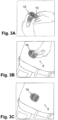
- FIGS. 3a-c show an exemplary adherence of the dispensing unit (10) to the skin (5) of the patient.
- FIG. 3a shows removal of the adhesive protection layer (13).
- the adhesive protection layer (13) can be disposed on the bottom portion of the unit (10) and once the layer (13) is removed, the unit (10) can be adhered directly to the patient's skin (5).
- FIG. 3b shows adhering the dispensing unit (10) to the skin (5).
- FIG. 3c shows dispensing unit (10) being adhered to the skin (5).
- the unit (10) can be adhered directly to the skin (5) or via an intermediary layer/device.
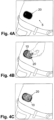
- a needle unit (20) can be initially adhered to the skin (5). Then, the dispensing unit (10) can be connected to (and later disconnected from) the needle unit (20) upon patient's discretion.
- FIG. 4a shows the needle unit (20) adhered to the body of the patient.
- FIG. 4b shows connection of the dispensing unit (10) to the needle unit (20).
- FIG. 4c shows the dispensing unit (10) after it has been connected to the needle unit (20) and being ready for operation.
- FIG. 5a-b show various operation modes of the dispensing unit (10), according to some arrangements of the present disclosure.
- the patient can operate the dispensing unit (10) either by using the remote control unit (40) (as shown in FIG. 5a ) or by using one or more buttons (15) located on the dispensing unit (10), as shown in FIG 5b .
- the unit (10) can perform various functions, such as, dispensing of fluid to the body of the patient, generate feedback on the amount of fluid delivered, generate various alerts, etc.
- FIGS. 6a-b show an exemplary skin adherable dispensing unit or a "patch unit” (10) employing a syringe pump for dispensing fluid to the body of the patient.
- FIG. 6a shows a single-part dispensing unit (10).
- the unit (10) includes a housing that contains a reservoir (220), a fluid delivery tube (230), an outlet port (210), an energy supply (e.g., one or more batteries) (240), an electronics component (130), a driving mechanism (120), and manual buttons (15).
- the reservoir (220) is in fluid communication with the outlet port (210) via the delivery tube (230) and allows delivery of therapeutic fluid (e.g., insulin) to the body of the patient via the outlet port (210).
- therapeutic fluid e.g., insulin
- a plunger (110) is fitted within the reservoir (220) and can push the fluid toward the fluid delivery tube (230).
- the plunger (110) is coupled to the driving mechanism (120) that drives the movement of the plunger (110) inside the reservoir (220).
- the driving mechanism (120) includes a motor (e.g., a stepper motor, a DC motor, a SMA actuator or the like) and a driving gear for driving the plunger (110).
- the driving mechanism is controlled by electronics (130), which can include a controller, a processor, a transceiver and other electronic components.
- the energy supply (240) provides power to the electronics (130) and the driving mechanism (120) for receiving/transmitting commands and for driving the plunger (110) in the reservoir (220).
- the unit (10) can be programmed using the remote controller (40) (not shown) and/or using one or more buttons (15) provided on the dispensing unit (10).
- the buttons (15) can turn on/off the unit (10), provide infusion/dispensing instructions, cause transmission/receipt of commands, etc.
- FIG. 6b shows an exemplary two-part dispensing unit (10) having a reusable part (100) and a disposable part (200), according to some embodiments of the present invention.
- the unit (10) uses a pumping mechanism such as a positive displacement pump.
- the unit (10) shown in FIG. 6b includes similar components as the unit (10) shown in FIG. 6a . However, some of the components are located in the reusable part (100) and other components are located in the disposable part (200).
- the reusable part (100) includes the driving mechanism (120) (e.g., motor, gear(s), etc.), electronics (130), at least one button (15), and various electrical connectors.
- the disposable part (200) includes the reservoir (220) provided with the plunger (110), the energy supply means (240), the fluid delivery tube (230), and the outlet port (210).
- the plunger (110) may be located in the reusable part (100) or be shared by the reusable and disposable parts.
- Infusion programming can be carried out using the remote controller (40) (not shown) and/or using one or more buttons (15) provided on the reusable part (100). Fluid dispensing is possible upon connection (as indicated by an arrow) of the reusable part (100) to the disposable part (200).
- FIGS. 7a-13c illustrated exemplary ways of establishing fluid communication between the fluid reservoir (220) and the body of the patient using the dispensing unit (10).
- FIGS. 7a-c shows an exemplary infusion set (50) for delivering therapeutic fluid (e.g., insulin) to the body of the patient.
- the infusion set (50) is located outside the housing of the dispensing unit (10).
- the infusion set (50) includes a connecting tube (52), a hub (54), a cannula (330) and a penetrating member (320).
- the connecting tube (52) is coupled to the hub (54) and is in fluid communication with the cannula (330).
- the hub (54) accommodates insertion of the penetrating member (320) into the cannula (330).
- the penetrating member (320) Upon insertion of the penetrating member (320) through the cannula (330), the penetrating member (320) can pierce the skin (5) (not shown in FIG. 7a ) of the patient and allow insertion of the cannula (330) into a subcutaneous compartment (i.e., located under the skin of the patient).
- the hub (54) can also include an adhesive layer (57) that can be adhered to the skin (5) in order to secure hub (54) to the skin during fluid delivery.
- the connecting tube (52) is connected (or inserted into) to the outlet port (210).
- the outlet port (210) may be provided with a connector e.g., Luer lock connector, for establishing a reliable and/or sealed connection between the infusion set (50) and dispensing unit (10).
- a connector e.g., Luer lock connector
- the reservoir (220) and the cannula (330) are in fluid communication with each other and therapeutic fluid can be delivered from the reservoir (220) into the body of the patient via the cannula (330).
- FIG. 7b shows the dispensing unit (10) directly adhered to the skin (5) and connected to the infusion set (50), as discussed above.
- the penetrating member (320) has been inserted into the hub (54) and the cannula (330) and has pierced the skin (5) of the patient allowing the cannula (330) and the penetrating member (320) to protrude into the subcutaneous compartment.
- the penetrating member (330) may include a piercing portion (e.g., a dagger, etc.) that can pierce the skin of the patient and thereby allow insertion of the cannula (330). While the penetrating member (320) is disposed inside the hub (54) and the cannula (330), the fluid is not being delivered to the patient.
- FIG. 7c illustrates the unit (10) being connected to the infusion set (50) subsequent to the withdrawal of the penetrating member (320). Once, the penetrating member is withdrawn, the fluid communication is established between cannula (330) and reservoir (220) of the dispensing unit (10) and the fluid can be delivered to the patient.
- FIGS. 8a-10d illustrate arrangements of the dispensing unit (10) that uses a well (60) along with a penetrating cartridge (62) connecting the reservoir (220) with the cannula (330), according to some arrangements of the present disclosure.
- An exemplary arrangement of this system is disclosed in co-pending/co-owned U.S. Provisional Patent Application Serial Nos. 60/833,110 and 60/837,877 , and International Patent Application PCT/IL07/000932 ( WO2008/012817 ).
- FIG. 8a shows an exemplary two-part dispensing unit (10).
- the dispensing unit (10) includes the reusable part (100) and the disposable part (200) for connecting with the reusable part (100).
- the reusable part (100) includes the plunger (110), the driving mechanism (120) (e.g., the motor, gear, and other components), the electronics (130), buttons (15), and connecting leads coupling various electronics (130) components and the battery (240).
- the disposable part (200) includes the battery (240), the reservoir (220), the fluid delivery tube (230), and the outlet port (210). As above, the reservoir (220) is in fluid communication with the outlet port (210) via the fluid delivery tube (230).
- the outlet port (210) further includes the well (60) that is in fluid communication with the reservoir (220) via the fluid delivery tube/tubular connector (230).
- the well (60) is provided with an opening (64) through which the penetrating cartridge (320) and the cannula (330) can be inserted (not shown in FIG. 8a ).
- the reusable part (100) and the disposable part (200) can be coupled to each using latches, a snap-fit arrangement, or any other suitable arrangement.
- a hermetic seal (97) can be placed between parts (100) and (200) to prevent entry of contaminants or other outside elements.
- the plunger portion (that pushes the fluid toward the outlet port (210)) of the plunger (110) is contained within the reservoir (220) and a shaft portion of the plunger (110) is disposed partially in the reusable part (100) and the disposable part (200).
- the shaft portion of the plunger (110) is coupled to the driving mechanism (120), which pushes the shaft portion, and is configured to move between the parts (100) and (200).
- the shaft portion of the plunger (110) is moved backward away from the reservoir (220); and during dispensing procedures, the shaft portion of the plunger (110) is moved toward the reservoir (220) thereby pushing the fluid into the fluid delivery tube (230) and the outlet port (210).
- FIG. 8b is a cross-sectional view of the well (60) located in the disposable part (200) taken along direction A-A' of FIG 8a .
- the well (60) is in fluid communication with the fluid delivery tube (230).
- the fluid delivery tube (230) can be coupled to a connector tube (231).
- the connector tube (231) is in fluid communication with the opening (64). Once the penetrating cartridge (320) is removed from the opening (64), the fluid can pass from the fluid delivery tube (230) via connector tube (231) and into the opening (64) toward the outlet port (210) for delivery to the patient.
- connection between the connector tube (231) and the fluid delivery tube (230) is sealed connection that prevents slippage of the fluid delivery tube (230) from the connector (231) as well as any leakage of fluid or entry of contaminants into the opening (64).
- the opening (64) can also include a septum component that seals the opening (64) upon removal of the penetrating member (320). The septum also prevents entry of contaminants into the well (60) and leakage of fluid.
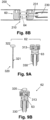
- the septum (313) seals the passageway (which includes cannula (330)) within the body portion (63) of the penetrating cartridge (62). Once the penetrating member (320) is removed from the passageway within the body portion (63), the septum (313) seals the passageway.
- FIG. 9a illustrates the septum (313) sealing such passageway.
- FIG. 9b shows the penetrating member (320) being placed inside the penetrating cartridge (62).
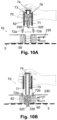
- FIGS. 10a-d show exemplary insertion and subcutaneous placement of the cannula (330) using a dedicated inserter (70), according to some arrangements of the present disclosure.
- An exemplary arrangement of the inserter (70) has been already disclosed in copending/co-owned U.S. Provisional Patent Application Serial No. 60/861,345 .
- FIG. 10a is a cross-sectional view of the well (60) and an inserter (70), where the inserter (70) is loaded with the penetrating cartridge (62).
- the inserter (70) includes a housing (71), a spring-firing mechanism (73), a release button (74), a penetrating member holding platform (76), and projections (72a) and (72b).
- the release button (74) is coupled to the spring-firing mechanism (73) and allows release of the spring-firing mechanism (73) for the purposes of inserting the penetrating cartridge (62) into the well (60) (and penetrating the skin (5) with the penetrating member (320).
- the projections (72) are coupled to the housing (71) and are configured to mate with corresponding recesses (66a) and (66b) of the well (60).
- the projections (72) and recesses (66) provide requisite stability to the housing (71) during insertion of the penetrating cartridge (62) into the well (60).
- the housing (71) is loaded with the penetrating cartridge (62) (along with the penetrating member (320) and cannula (330)) and the spring-firing mechanism (73) is in a compressed state (e.g., the spring is compressed).
- the holding platform (76) secures the penetrating cartridge (62) prior to being inserted into the well (62).
- the user/patient aligns the projections (72) with the recesses (66) and secures the housing (71) opposite the well (60). Then, the user/patient depresses the button (74) and the spring-firing mechanism (73) is released. Once the spring-firing mechanism is released, the penetrating cartridge (62) is inserted into the well (60) and the penetrating member (320) punctures the skin of the patient. Along with the puncturing of the skin (5), the cannula (330) loaded into the penetrating cartridge (62) is inserted into the subcutaneous compartment of the patient.
- the inserter (70) is removed, as illustrated in FIG. 10d .
- a fluid communication is established with the fluid delivery tube (230) and the cannula (330) via the penetrating cartridge (62).
- the self-sealing septum (313) provides the requisite sealing of the penetrating cartridge (62) in order to prevent leakage of fluid and entry of contaminants.
- FIGS. 11a-13c illustrate exemplary dispensing unit (10) being coupled to the skin (5) using a needle unit (20), according to some embodiments of the present invention.
- An exemplary embodiment of the needle unit (20) is disclosed in detail in co-pending/co-owned U.S. Patent Application Serial No. 60/876,679 .
- the needle unit (20) (also referred to as a cradle unit) includes two parts:
- FIG. 11a is a side-view of an exemplary cradle part (21), according to some embodiments of the present invention.
- the cradle part (21) includes a cradle base (300), connecting latches (306a-d), an opening (307), and anchoring latches (302a-d).
- the anchoring latches (302) are disposed around a perimeter of the cradle base (300) and secure the dispensing unit (10) to the cradle part (21).
- the connecting latches (306) are disposed around the opening (307) and secure the penetrating cartridge part (22) (shown in FIG. 11D ) to the cradle base (300).
- the latches (302) and (306) create a snap-fit locking arrangement between the latches and the dispensing unit (10) and the penetrating cartridge part (22), respectively.
- FIGS. 11b-c are a top view and an perspective view of the cradle part (21) shown in FIG. 11a .
- the cradle base (300) can include a raised border that allows further stability to the inserted dispensing unit (10).
- FIG. 11d shows the penetrating cartridge part (22), which is similar to the penetrating cartridge (62) discussed above and includes some of the similar components.
- the part (22) includes a well (310), lateral recesses (316a-d), a septum (313), the cannula (330) and the penetrating member (320).
- the recesses (316) correspond to the latches (306) and are configured to mate with the latches (306) when the penetrating cartridge part (22) is connected to the cradle part (21), thereby anchoring of the penetrating cartridge part (22) to the cradle part (21).
- the penetrating member (320) is inserted through the well (310) of the part (22) and the cannula (330).
- the septum (313) seals the well (310) to prevent fluid leakage and/or entry of contaminants.
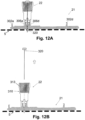
- FIGS. 12a-b show exemplary connection of the cradle part (21) and the penetrating cartridge part (22), according to some embodiments of the present invention.
- the parts (21) and (22) are connected subsequent to the cradle part (21) being adhered to the skin (5) of the patient, as illustrated in FIG. 12a .
- the attachment to the skin (5) can be carried out using adhesives or any other means.
- an adhesive layer on the cradle part (21) faces the skin (5) immediately prior to being attached to the skin (5).
- a connection of the penetrating cartridge part (22) to the cradle part (21) can be carried out using a combination of the latches (306) and the recesses (316).
- the penetrating member (322) pierces the skin (5) and allows insertion of the cannula (330) into the subcutaneous compartment.
- FIG. 12b shows removal of the penetrating member (320) from the penetrating cartridge part (22).
- the cradle part (21) remains adhered to the skin (5) and the cannula (330) remains inserted into the body.
- the self-sealable septum (313) seals off the well (310) and allows a connecting lumen (not shown in FIG. 12b ) of the dispensing unit (10) to repetitively pierce the septum (313) for establishing fluid communication with the cannula (330) and the fluid delivery tube (230) (not shown).
- the dispensing unit (10) can be connected to and disconnected from the needle unit (20) as many times as desired.
- the self-sealable septum (313) prevents leaking of the dispensed fluid and entry of contaminants.
- FIG. 13a shows exemplary connection of the dispensing unit (10) to the needle unit (20), according to some embodiments of the present invention.
- the dispensing unit In order to connect with the needle unit (20), the dispensing unit also includes a connecting lumen (250).
- the connecting lumen (250) is in fluid communication with reservoir (220).
- the connecting lumen (250) is further disposed near the outlet port (210).
- the outlet port (210) is configured as a recess in the housing of the dispensing unit (10) in order to accommodate receiving the penetrating cartridge part (22) which is placed into the opening (307) of the cradle base (300) (see, FIGS. 9a-12d).
- the connecting lumen (250) pierces the well's self-sealed rubber septum (313) and establishes a sealed fluid communication between the lumen (250) and the cannula (330), thereby allowing fluid communication between the cannula (330) and the reservoir (220).
- the dispensing unit (10) includes notches (12a-d) that are configured to mate with the anchoring latches (302a-d) of the needle unit (20).
- FIG. 13b shows the dispensing unit (10) attached to the needle unit (20) (and the dispensing unit being in an operating mode).
- connection of dispensing unit (10) to the needle unit (20) can be established using any other means.
- FIG. 13c shows disconnection of the dispensing unit (10) by pulling the elastically deformable latches (302) backwards. Then, the dispensing unit (10) is pulled away from the needle unit (20), as indicated by the arrow in FIG. 13c . Subsequent to removal of the dispensing unit, the needle unit (20) continues to remain adhered to the skin (5) and the cannula (330) continue to remain in the subcutaneous compartment.
- the self-sealable septum (313) maintains a tight seal of the well (310) subsequent to removal of the dispensing unit (10), thereby preventing leakage of fluid and/or entry of contaminants.
- FIGS. 14a-16b illustrate exemplary reservoirs (220).
- FIGS. 14a-b illustrate an exemplary reservoir (220) having a circular cross-section.
- FIG. 15a-b illustrate an exemplary reservoir (220) having an oval cross-section.
- FIG. 16a-b illustrate an exemplary reservoir (220) having a cross-section as defined by several curves (e.g., 4-curves, 8-curves).
- FIG. 14a shows a cylindrical reservoir (220) having a plunger (110).
- the reservoir (220) includes a hollow housing encompassed by reservoir walls. One end of the reservoir (220) is open and the other one is closed to prevent fluid leakage. The open end of the reservoir is enclosed by the plunger (110) thereby preventing leakage of fluid from the open end. As stated above, the plunger (110) is configured to slide back and forth inside the reservoir (220) to force the fluid from the outlet port (210) located on the housing of the reservoir (220).
- the reservoir (220) contains, for example, maximum 2 cubic centimeters ("cc") of fluid.
- FIG. 14b is a cross-sectional view of the reservoir (220). The cross-section is taken along the direction B-B' shown in FIG. 14a .
- FIG. 16a shows a reservoir (220) having elliptical cross-section.
- the reservoir (220) is provided with the plunger (110).
- FIG. 16b shows a cross-sectional view of the reservoir (220). The cross section is taken along the direction E-E' designated in FIG. 16a .
- the plunger (110) has a matching cross-section as the interior portion of the reservoir (220).
- FIGS. 15a-16b cause the reservoir (220) to have thin profile having a thickness of about 10 mm.
- the lengths of such reservoirs can be on the order of about 20 mm and reservoirs' capacities can be a maximum of 2cc of fluid.
- the dispensing unit (10) fitted with such oval or elliptical reservoir will also have thin profile, thereby providing the patient with a comfortable and discreet pump unit.
- FIGS. 17a-b illustrate a multi-curve reservoir (220), according to some embodiments of the present invention.
- FIG. 17a is a perspective view of the multi-curve reservoir (220) and
- FIG. 17b is a cross-sectional view of the reservoir shown in FIG. 17a taken at line F-F'.
- the reservoir (220) is also fitted with the plunger (110).
- the cross-section of the reservoir (220) is defined by four curvatures. Two of the curvatures (top curvature 2001 and bottom curvature 2003) have a radius R1 and two other curvatures (side curvatures 2002 and 2004) have a radius R2. A connection between each two adjacent curves is smooth.
- Such multi-curvature reservoir (220) provides additional rigidity to the reservoir (220) and at the same time allows maintaining of a thin profile of the reservoir (220).
- the reservoir (220) can have more than four curvatures defining its shape and that each curvature may have a different radius, length and width.
- the dispensing unit (10) can have multiple reservoirs (220), where each reservoir can have different shapes, designs, and dimensions, such the ones shown in FIGS. 14a-17b .
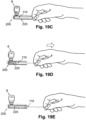
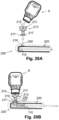
- FIGS. 18a-19f illustrate filling and priming procedures of the reservoir (220), according to some embodiments of the present invention. Specifically, FIGS. 18a-19e illustrate the disposable part (200) during the filling procedure and FIG. 19f illustrate the disposable part 200 during priming procedure.
- the disposable part (200) includes the reservoir (220) having the plunger (110), the fluid delivery tube/tubular connection (230), the battery (240) and the outlet port (210). The disposition and connection of these components has been described above. As further illustrated in FIG. 18a , the disposable part (200) (and hence, the dispensing unit (10)) can have an oval or an elliptical profile.
- FIG. 18b is a transverse cross-sectional view of the disposable part (200) shown in FIG. 18a .
- the outlet port (210) of the disposable part (200) includes the connecting lumen (250). The connecting lumen (250) is in fluid communication with the reservoir (220) via the fluid delivery tube (230).
- the connecting lumen (250) allows fluid communication between the reservoir (220) and components connected to the lumen (250).
- the lumen (250) is used for delivery of the fluid from a filling container to the reservoir (220).
- the plunger (110) Prior to filling the reservoir (220), the plunger (110) is pushed all the into the reservoir (220) so that the plunger's shaft is substantially inside the reservoir, as illustrated in FIGS. 18a-b .
- a therapeutic fluid container (6) (e.g., containing insulin) is connected to the disposable part (200) at the outlet port (210), as illustrated in FIGS. 19a-b .
- the connecting lumen (250) pierces the container's septum (7) thereby allowing fluid transfer from the container (6) to the reservoir (220).
- the fluid is drawn from the container (6) by pulling on the shaft of the plunger (110) and, thus, creating a suction effect thereby drawing the fluid from the container (6), as illustrated in FIGS. 19c-e .
- the amount of fluid (i.e., insulin) filled into the reservoir (220) can be tailored to patient's need, i.e., a child can fill only a portion of the reservoir (220) because the total daily dose is relatively small; while an adult can use the entire volume of reservoir (220).
- a child can fill only a portion of the reservoir (220) because the total daily dose is relatively small; while an adult can use the entire volume of reservoir (220).
- the patient/user may observe the fluid being filled into the reservoir (220) during the filling procedure.
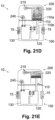
- FIGS. 21a-e and 22a-c illustrate exemplary disposable part (200) and reusable part (100) having a rod (110b) of the plunger (110) disposed in both parts, according to some embodiments of the present invention.
- the plunger (110) includes a plunger head (110a) and the plunger rod (110b).
- the plunger head (110a) is coupled to the plunger rod (110b).
- the plunger rod (110b) is coupled to the driving mechanism (120) that allows movement of the plunger (110) between the reusable part (100) and the disposable part (200).
- the movement of the plunger rod (110b) causes movement of the plunger head (110a) inside the reservoir (220).
- the plunger rod (110b) can be coupled to a driving gear (not shown) disposed inside the driving mechanism (120). Further, the movement of the plunger (110) can be controlled by the PCB (130) sending appropriate commands to the driving mechanism (120). The movement of the plunger (110) can be based on a particular fluid delivery schedule/rate (e.g., basal vs. bolus doses).
- the dispensing unit (10) can also include an auxiliary rod (110c), which can be used for filling the reservoir (220), as shown in FIG. 21a .
- an auxiliary rod (110c) can be used for filling the reservoir (220), as shown in FIG. 21a .
- the plunger rod (110b) can be disconnected from the plunger head (110a) either automatically or manually and the auxiliary rod (110c) can be coupled to the plunger head (110a).
- the auxiliary rod (110c) can be connected to the plunger head (110a) either via a snap-fit arrangement, by screwing the rod (110c) to the plunger head (110a), or using any other suitable means.
- FIG. 21b shows disposable part (200) being disconnected from the reusable part (100) and the auxiliary rod (110c) being coupled to the plunger head (110a) while the reservoir (220) is being filled with therapeutic fluid.
- the user/patient follows a similar procedure described above with regard to FIGS. 18a-19e above.
- the user pulls on the auxiliary rod (110c) away from the reservoir (220) as indicated by the arrow in FIG. 21b .
- the fluid is being drawn from the container (6) (not shown in FIG. 21b ).
- the auxiliary rod (110c) is detached from the plunger head (110a) and removed from the disposable part (200), as shown in FIG. 21c . Further, upon filling the reservoir (220), the plunger head (110a) can approach a connection border between the reusable and disposable parts.
- FIG. 21d shows the reusable and disposable parts.
- the distal end (the end away from the driving mechanism and proximal to the plunger head (110a)) of the plunger rod (110b) is affixed to the plunger head (110a); whereas the proximal end (the end coupled to the driving mechanism (120)) is engaged with the driving mechanism (120).
- the driving mechanism (120) causes positive displacement of the plunger rod (110b) inside the reservoir (220) subsequent to receiving appropriate commands from the PCB (130) and being powered by the batteries (240).
- FIG. 21e shows the dispensing unit (10) in operation.
- the plunger (110) Upon application of the driving mechanism (120), the plunger (110) is displaced within the reservoir (220) and pushes the fluid toward the outlet port (210), thereby causing delivery of the fluid to the patient.
- delivery can be in various doses (e.g., bolus, basal, etc.) and can be preprogrammed into the PCB (130) by the user/patient, a computer, a remote control (40) (not shown), and/or any other device.
- FIGS. 22a-c shows another exemplary dispensing unit (10) having two parts, according to some embodiments of the present invention.
- the plunger (110) is located within the disposable part (200) and can be detached from the driving mechanism (120) disposed in the reusable part (100).
- FIG. 22a shows the dispensing unit (10) prior to connection of the parts (100) and (200).
- the plunger (110) shown in FIGS. 22a-c includes same components as the plunger (110) shown in FIGS. 21a-e . Referring to FIG.
- the plunger head (110a) and plunger rod (110b) are coupled to each other and are both located in the disposable part (200), where the plunger head (110a) is disposed inside the reservoir (220) and the plunger rod (110b) is disposed outside the reservoir (220).
- the reservoir (220) can be filled using procedures that are similar to those described in connection with FIGS. 18a-19e . In this case the user/patient can pull on the plunger rod (110b) to fill the reservoir (220) rather than attaching the auxiliary rod (110c).
- the plunger rod (110b) can be engaged with the driving mechanism (120). Such engagement can be done via a snap-fit arrangement, screwing, ball-and-socket arrangement, or using any other suitable ways.
- the driving mechanism (120) can apply force to the plunger rod (110b), which in turn, applies force on the plunger head (110a), thereby pushing the fluid out of the reservoir (220) and toward the outlet port (210), as illustrated in FIG. 22b .
- FIG. 22c shows further operation of dispensing unit (10).
- the plunger (110) moves in a forward positive direction
- the fluid in the reservoir (220) flows via the fluid delivery tube (230) toward the outlet port (210), thereby delivering fluid to the patient.
- the filling and emptying of the reservoir can be continuously repeated (or repeated based on a specific number of times).
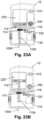
- FIGS. 23a-26c show exemplary alternatives for plunger (110) displacement using the driving mechanism (120), according to some embodiments of the present invention.
- FIG. 23a is a top cross-sectional view of the dispensing unit (10) having the reusable part (100) and disposable part (200) connected together.
- the unit (10) includes the plunger (110) provided having a threaded rod (110b) and a screw-nut (114) coupled to the threaded rod (110b).
- the screw-nut (114) is disposed within the reusable part (100) and is fixed, i.e., it does not move along axis (1000).
- the threaded rod (110b) and the screw-nut (114) are aligned along axis (1000), as shown in FIG. 23a .
- the threaded rod (110b) is capable of moving in a rotational motion inside the screw-nut (114).
- the screw-nut (114) is further coupled to a gear (116), where the gear (116) is being part of the driving mechanism (120).
- the gear (116) is further fitted with at least one cogwheel.
- the gear (116) is driven by a motor (118) (e.g., a DC motor, a stepper motor, etc.), which is also part of the driving mechanism (120).
- the gear (116) is connected to the motor (118) via a shaft or any other means allowing the motor (118) to rotate gear (116).
- FIG. 23b shows the plunger (110) being displaced along axis (1000).
- the motor (118) rotates the gear (116). Rotational motion of the gear (116) is translated to the cogwheel coupled to the screw-nut (114) causing the screw-nut (114) to rotate. Since the threaded rod (110b) is inserted into the screw-nut (114), rotation of the screw-nut (114) rotates the threaded rod (110b) as well translates the rod (110b), and thereby the plunger (110), along the axis (1000). Such translational movement of the plunger (110) displaces the fluid inside the reservoir (220) towards the outlet port (210).
- the screw-nut (114) may serve as a cogwheel, thereby reducing the number of components in gear (116).
- the motor (118) can rotate in any direction, thus, causing the screw-nut (114) to rotate in various directions (according to the direction of rotation of the motor (118)).
- the threaded rod (110b) can rotate in corresponding directions as well as translate back and forth along axis (1000), causing the plunger (110) to move in and out of the reservoir (220).
- such movement is controlled by the PCB (130) (not shown) powered by the battery (240) and can be automatic based on a pre-programmed schedule or manual (e.g., upon pressing buttons (15)).
- FIG. 24b shows the dispensing unit (10) during fluid dispensing procedure.
- the motor (118) rotates gear(s) (116), which cause rotation of the screw-nut (114). Rotation of the screw-nut (114) causes rotation of the threaded rod (110b) and as such its translation along the axis (1000). As the threaded rod (110b) translates forward, the driving springs (113), (113') expand and apply additional force on the plunger head (110a). Application of additional force reduces torque that should be produced by the motor (118) in order to translate the plunger (110) inside the reservoir (220).
- the nuts (114a) and (114b) are also joined to the bars (119), thereby forming hinged pivots for the bars (119).
- the bars (119) have four hinged pivots that allow vertical and horizontal movement of the bars (119) during translational movement of the nuts (114a) and (114b).
- the screw-nut (114) rotates the threaded rod (110d), such that the screw-nut (114a) is linearly displaced along the threaded rod (110d).
- the screw-nut (114b) also translates along the threaded rod (110d), as shown in FIG. 25b .
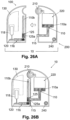
- FIGS. 26a-c show another exemplary embodiment of the dispensing unit (10) having the disposable part (200) and reusable part (100), where the reusable part (110) includes a threaded rod (110b) and a driving screw-nut (125) coupled to the threaded rod (110b).
- the disposable part (200) includes a plunger (110) an L-shaped rod with connecting end (115).
- the L-shaped rod (110) includes one longer section perpendicular to another shorter section.
- the threaded rod (125) includes a lateral recess (125a) configured to receive the connecting end (115) of the L-shaped rod, as illustrated in FIGS. 26a-b .
- the driving screw-nut (125) includes threads that are configured to mate with the threads disposed on the rod (110b). Thus, during rotation of the threaded rod (110b) (caused by the motor (118) and (116) of the driving mechanism (120)), the driving screw-nut (125) translates along the threaded rod (110b).
- linear translation of the driving screw-nut (125) along the threaded rod (110b) causes simultaneous displacement of the plunger head (110a), thus urging fluid in the reservoir (220) towards the outlet port (210), as shown in FIG. 26c .
- the L-shaped rod allows more compact arrangement of the spatial components, which reduces dispensing unit's dimensions.
- FIGS. 27a-28b show two embodiments of a sealing arrangement between the disposable part (200) and the reusable part (100) of the dispensing unit (10).
- sealing is achieved only after connection of reusable (100) and disposable (200) parts, while each part when it "stands alone” is not confined in a waterproof housing.
- each part has its own sealed housing.
- FIG. 27a is a cross-sectional view of the reusable part (100) and the disposable part (200) prior to connection.
- the disposable part (200) includes at least one gasket (205) (e.g., a rubber O-ring) being attached to the housing of the disposable part (200).
- the gasket(s) (205) can be attached to the reusable part (100) or can be attached to both parts. Once the reusable part (100) and the disposable part (200) are connected together, the gasket(s) (205) seal the parts together, thereby preventing damage to internal components, entry of moisture, contaminants, or other unwanted particles, as shown in FIG. 27b .
- FIG. 28a shows the two "stand alone” parts each being sealed in a dedicated housing.
- the disposable part (200) contains two sharp battery connections (242) and (242') emerging outwardly including sharp ends.
- the reusable part (100) contains two self-sealed septa (142) and (142') for sealing the battery connections and folding accordion (117) for receiving the plunger rod (110b) and sealing thereof.
- FIG. 28b shows the connected two parts.
- the battery connections (242) and (242') pierce the corresponding septa (142) and (142'), thereby establishing an electrical connection between the battery (240) (located in disposable part (200)), PCB (130) and electronic components (located in reusable part (100)).
- the plunger rod (110b) is sealingly covered by the accordion (117) and displaces the plunger head (110a).
- FIGS. 29a-30b show other exemplary embodiments of the dispensing unit (10) having the disposable part (200) and the reusable part (100).
- FIG. 29a shows a reservoir (220) configured as half a torus.
- a cross section of the shown reservoir (220) can be elliptical, oval, multi-curved or any other desired cross-section. Reservoir's shape and cross section dictates the configuration of other components e.g., plunger, housing etc.
- FIGS. 29b-d show the implementation of the reservoir (220) shown in FIG. 29a .
- FIG. 29b show the two parts each configured as half of a torus.
- the disposable part (200) has a half-torus reservoir (220), battery (240) and outlet port (210).
- the reusable part (100) includes driving mechanism (120) (e.g., motor and gear), plunger (110), PCB (130) and other relatively expensive components, e.g., occlusion sensor (not shown).
- driving mechanism (120) e.g., motor and gear
- plunger 110
- PCB 130
- other relatively expensive components e.g., occlusion sensor (not shown).
- An exemplary embodiment of the occlusion sensor is disclosed in the co-owned/co-pending U.S. Patent Application Serial Nos. 11/706,606, filed February 14, 2007 , and 11/963,481, filed December 21, 2007 .
- the driving mechanism (120) further includes a motor (118), a worm (134), a secondary gear (135), and a circular gear (137).
- the circular gear (137) is pivotally coupled to the housing of the reusable part (100).
- the motor (118) rotates the worm (134), which in turn rotates the secondary gear (135).
- the gear (135) rotates, its ratchet teeth interact with the teeth of the circular gear (137), thereby forcing rotation of the gear (137) about its pivotal connection to the reusable part (100).
- the plunger (110) is coupled to the gear (137)
- circular movement of the gear (137) causes the plunger (110) to be displaced inside the reservoir (220). Since the gear (137) is circular and the reservoir (220) is also circular, the gear (137) is displaced along the curvature of the reservoir (220), thereby displacing fluid toward the outlet port (210), as shown in FIGS. 29c-d .
- Reverse motion of the gear (135) allows reverse movement of the gear (137) along with the plunger (110) away from the reservoir (220).
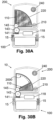
- FIGS. 30a-b shows another exemplary embodiment of the dispensing unit (10), where the disposable part (200) includes the reservoir (220) configured as a sector (e.g., quarter of a circle), the plunger (110) configured in a similar way as a windshield wiper, the battery (240) and the outlet port (210).
- the reusable part (100) includes the driving mechanism (120), the electronics (130), the buttons (15) and other additional components e.g., occlusion sensor (not shown).
- the driving mechanism includes the motor (118), a worm (141), a first gear (143), and a secondary gear (145).
- the motor (118) rotates the worm (141), which causes rotation of the first gear (143) through interaction of the worm (141) with the ratchet teeth of the first gear (143).
- the first gear (143) causes rotation of the second gear (145) via interaction of the gears' teeth.
- the plunger (110) is coupled to the second gear (145) and rotates with the rotation of the gear (145). Since the plunger (110) is configured as a rod, it pushes the liquid disposed inside the reservoir (220) toward the outlet port (210).
- FIG. 30b shows the dispensing unit (10) in operation mode while the plunger (110) moves along the direction (2000) urging fluid from the reservoir (220) towards the outlet port (210).
Landscapes
- Health & Medical Sciences (AREA)
- Engineering & Computer Science (AREA)
- Life Sciences & Earth Sciences (AREA)
- Animal Behavior & Ethology (AREA)
- Anesthesiology (AREA)
- Biomedical Technology (AREA)
- Heart & Thoracic Surgery (AREA)
- Hematology (AREA)
- Veterinary Medicine (AREA)
- Vascular Medicine (AREA)
- General Health & Medical Sciences (AREA)
- Public Health (AREA)
- Dermatology (AREA)
- Mechanical Engineering (AREA)
- General Engineering & Computer Science (AREA)
- Infusion, Injection, And Reservoir Apparatuses (AREA)
Applications Claiming Priority (5)
| Application Number | Priority Date | Filing Date | Title |
|---|---|---|---|
| US92875007P | 2007-05-11 | 2007-05-11 | |
| US92881507P | 2007-05-11 | 2007-05-11 | |
| US92875107P | 2007-05-11 | 2007-05-11 | |
| EP20080738342 EP2155289A2 (en) | 2007-05-11 | 2008-05-11 | A positive displacement pump |
| PCT/IL2008/000641 WO2008139458A2 (en) | 2007-05-11 | 2008-05-11 | A positive displacement pump |
Related Parent Applications (1)
| Application Number | Title | Priority Date | Filing Date |
|---|---|---|---|
| EP20080738342 Division EP2155289A2 (en) | 2007-05-11 | 2008-05-11 | A positive displacement pump |
Publications (3)
| Publication Number | Publication Date |
|---|---|
| EP3388096A1 EP3388096A1 (en) | 2018-10-17 |
| EP3388096C0 EP3388096C0 (en) | 2025-06-25 |
| EP3388096B1 true EP3388096B1 (en) | 2025-06-25 |
Family
ID=39761562
Family Applications (3)
| Application Number | Title | Priority Date | Filing Date |
|---|---|---|---|
| EP18171458.5A Active EP3388096B1 (en) | 2007-05-11 | 2008-05-11 | A positive displacement pump |
| EP20080738344 Withdrawn EP2155295A2 (en) | 2007-05-11 | 2008-05-11 | A modular skin-patch type medical fluid delivery device |
| EP20080738342 Withdrawn EP2155289A2 (en) | 2007-05-11 | 2008-05-11 | A positive displacement pump |
Family Applications After (2)
| Application Number | Title | Priority Date | Filing Date |
|---|---|---|---|
| EP20080738344 Withdrawn EP2155295A2 (en) | 2007-05-11 | 2008-05-11 | A modular skin-patch type medical fluid delivery device |
| EP20080738342 Withdrawn EP2155289A2 (en) | 2007-05-11 | 2008-05-11 | A positive displacement pump |
Country Status (8)
| Country | Link |
|---|---|
| US (4) | US20100137802A1 (https=) |
| EP (3) | EP3388096B1 (https=) |
| JP (1) | JP5536641B2 (https=) |
| CN (2) | CN101687075B (https=) |
| AU (1) | AU2008249567A1 (https=) |
| ES (1) | ES3038412T3 (https=) |
| HU (1) | HUE072428T2 (https=) |
| WO (3) | WO2008139459A1 (https=) |
Families Citing this family (163)
| Publication number | Priority date | Publication date | Assignee | Title |
|---|---|---|---|---|
| US6850788B2 (en) | 2002-03-25 | 2005-02-01 | Masimo Corporation | Physiological measurement communications adapter |
| EP1617888B1 (en) | 2003-04-23 | 2019-06-12 | Valeritas, Inc. | Hydraulically actuated pump for long duration medicament administration |
| WO2006014425A1 (en) | 2004-07-02 | 2006-02-09 | Biovalve Technologies, Inc. | Methods and devices for delivering glp-1 and uses thereof |
| US9687186B2 (en) | 2005-07-21 | 2017-06-27 | Steadymed Ltd. | Drug delivery device |
| IL175460A (en) | 2006-05-07 | 2011-05-31 | Doron Aurbach | Drug delivery device |
| NZ567390A (en) * | 2005-11-18 | 2010-01-29 | Automatic Tech Au Pty Ltd | Device for monitoring motion of a movable closure |
| EP2319558B1 (en) | 2006-03-14 | 2014-05-21 | University Of Southern California | Mems device for delivery of therapeutic agents |
| AU2007230945B2 (en) | 2006-03-23 | 2013-05-02 | The Penn State Research Foundation | Heart assist device with expandable impeller pump |
| KR101361376B1 (ko) | 2006-03-30 | 2014-02-10 | 발레리타스 인코포레이티드 | 복합-카트리지 유체 전달 장치 |
| CN102921062B (zh) * | 2006-07-24 | 2015-04-01 | F·霍夫曼-拉罗氏股份公司 | 用于流体/药物输送的装置 |
| US20100137802A1 (en) | 2007-05-11 | 2010-06-03 | Ofer Yodfat | Methods and appratus for monitoring rotation of an infusion pump driving mechanism |
| WO2009001337A2 (en) * | 2007-06-22 | 2008-12-31 | Medingo Ltd. | Communications for medicinal fluid delivery system |
| WO2009013733A2 (en) | 2007-07-20 | 2009-01-29 | Medingo Ltd. | Collapsible reservoir for use with a delivery device |
| CN101801438B (zh) | 2007-07-20 | 2013-08-07 | 梅丁格有限公司 | 可手动操作的便携式输注设备 |
| WO2009016636A2 (en) * | 2007-08-01 | 2009-02-05 | Medingo Ltd. | Portable infusion device provided with means for monitoring and controlling fluid delivery |
| WO2009016635A2 (en) | 2007-08-01 | 2009-02-05 | Medingo Ltd. | Detachable portable infusion device |
| US9173997B2 (en) | 2007-10-02 | 2015-11-03 | Medimop Medical Projects Ltd. | External drug pump |
| EP2227134A2 (en) | 2007-11-21 | 2010-09-15 | Medingo Ltd. | Hypodermic optical monitoring of bodily analyte |
| JP5542691B2 (ja) | 2007-12-20 | 2014-07-09 | ユニバーシティ オブ サザン カリフォルニア | 治療薬を送達するための装置および方法 |
| US8500692B2 (en) | 2007-12-21 | 2013-08-06 | Medingo Ltd. | Devices and methods for powering a medical device |
| DK2271384T3 (en) * | 2008-03-10 | 2018-05-22 | Hoffmann La Roche | PORTABLE INFUSION AND DETECTION DEVICE WITH BATTERY CHARGING AND DATA TRANSMISSION MECHANISMS |
| WO2009113075A1 (en) | 2008-03-12 | 2009-09-17 | Medingo Ltd. | Devices and methods for improving accuracy of fluid delivery |
| EP3260145B1 (en) | 2008-04-09 | 2019-12-11 | Roche Diabetes Care GmbH | Fluid level sensor for a modular skin-adherable system for medical fluid delivery |
| EP2320989B1 (en) | 2008-05-08 | 2015-03-11 | MiniPumps, LLC | Implantable pumps and cannulas therefor |
| US9333297B2 (en) | 2008-05-08 | 2016-05-10 | Minipumps, Llc | Drug-delivery pump with intelligent control |
| US8231608B2 (en) | 2008-05-08 | 2012-07-31 | Minipumps, Llc | Drug-delivery pumps and methods of manufacture |
| US8052645B2 (en) | 2008-07-23 | 2011-11-08 | Avant Medical Corp. | System and method for an injection using a syringe needle |
| US8177749B2 (en) | 2008-05-20 | 2012-05-15 | Avant Medical Corp. | Cassette for a hidden injection needle |
| US9974904B2 (en) | 2008-05-20 | 2018-05-22 | Avant Medical Corp. | Autoinjector system |
| IT1391274B1 (it) * | 2008-08-08 | 2011-12-01 | Medica S R L Ab | Sistema di irrigazione ed aspirazione, in particolare per chirurgia laparoscopica |
| JP5298699B2 (ja) | 2008-08-20 | 2013-09-25 | セイコーエプソン株式会社 | 制御ユニット、チューブユニット、マイクロポンプ |
| JP5282508B2 (ja) | 2008-09-29 | 2013-09-04 | セイコーエプソン株式会社 | 制御ユニット、チューブユニット、マイクロポンプ |
| US9566383B2 (en) | 2008-10-16 | 2017-02-14 | Roche Diabetes Care, Inc. | Method and system for adaptive communication transmission |
| US8728034B2 (en) | 2008-11-11 | 2014-05-20 | Roche Diagnostics Operations Inc. | Modular fluid delivery device with quick-release / connect mechanism for drive screw |
| JP5195368B2 (ja) * | 2008-12-05 | 2013-05-08 | セイコーエプソン株式会社 | チューブユニット、制御ユニット、マイクロポンプ |
| EP2391408B1 (en) * | 2008-12-31 | 2018-01-17 | Roche Diabetes Care GmbH | Portable medical fluid delivery device with drive screw articulated with reservoir plunger |
| US8202260B2 (en) * | 2009-02-21 | 2012-06-19 | Incumed, Llc | Partially implantable medical devices with cartridge movement sensor and associated methods |
| US9125981B2 (en) * | 2009-02-21 | 2015-09-08 | Incumed, Llc | Fluid cartridges including a power source and partially implantable medical devices for use with same |
| US9370619B2 (en) * | 2009-02-21 | 2016-06-21 | Incumed, Llc | Partially implantable medical devices and delivery/manifold tube for use with same |
| US8292604B2 (en) * | 2009-05-01 | 2012-10-23 | Xerox Corporation | Peristaltic pump |
| US8970384B2 (en) | 2009-06-14 | 2015-03-03 | Roche Diagnostics Operations, Inc. | Devices and methods for malfunctions recognition in a therapeutic dispensing device |
| DK2453972T3 (da) | 2009-07-16 | 2014-02-03 | Medingo Ltd | Anordning til præcis infusion af fluider |
| JP5758388B2 (ja) | 2009-08-18 | 2015-08-05 | ミニパンプス, エルエルシー | 適応制御を有する電解質薬物送達ポンプ |
| US9180275B2 (en) * | 2011-01-31 | 2015-11-10 | Robert E. Helm | Catheter-dressing systems with integrated flushing mechanisms |
| DK2512559T3 (en) | 2009-12-16 | 2019-03-25 | Becton Dickinson Co | SELF-INJECTIVE DEVICE |
| JP5650242B2 (ja) * | 2009-12-16 | 2015-01-07 | ベクトン・ディキンソン・アンド・カンパニーBecton, Dickinson And Company | 自己注射器具 |
| US9744300B2 (en) | 2011-12-21 | 2017-08-29 | Deka Products Limited Partnership | Syringe pump and related method |
| US9295778B2 (en) | 2011-12-21 | 2016-03-29 | Deka Products Limited Partnership | Syringe pump |
| US9789247B2 (en) | 2011-12-21 | 2017-10-17 | Deka Products Limited Partnership | Syringe pump, and related method and system |
| US8674288B2 (en) | 2010-03-24 | 2014-03-18 | Medtronic Minimed, Inc. | Motor assembly sensor capture systems and methods |
| US8915879B2 (en) | 2010-09-24 | 2014-12-23 | Perqflo, Llc | Infusion pumps |
| US9320849B2 (en) | 2010-09-24 | 2016-04-26 | Perqflo, Llc | Infusion pumps |
| US9498573B2 (en) | 2010-09-24 | 2016-11-22 | Perqflo, Llc | Infusion pumps |
| US9216249B2 (en) | 2010-09-24 | 2015-12-22 | Perqflo, Llc | Infusion pumps |
| WO2012042517A1 (en) * | 2010-09-27 | 2012-04-05 | Steadymed, Ltd. | Size-efficient drug-delivery device |
| EP2438938A1 (en) | 2010-10-11 | 2012-04-11 | PharmaSens AG | Syringe type pump |
| US8905972B2 (en) | 2010-11-20 | 2014-12-09 | Perqflo, Llc | Infusion pumps |
| WO2012094641A2 (en) | 2011-01-06 | 2012-07-12 | Thoratec Corporation | Percutaneous heart pump |
| WO2012109678A2 (en) * | 2011-02-13 | 2012-08-16 | The Regents Of The University Of California | Fluid delivery system |
| HUE042822T2 (hu) | 2011-04-20 | 2019-07-29 | Amgen Inc | Automata befecskendezõ szerkezet |
| CA2845379C (en) | 2011-09-02 | 2019-08-06 | Unitract Syringe Pty Ltd | Insertion mechanism for a drug delivery pump |
| US9683643B2 (en) | 2011-11-21 | 2017-06-20 | Kongsberg Automotive Ab | Linear actuator assembly having a magnetic sensor |
| US10722645B2 (en) | 2011-12-21 | 2020-07-28 | Deka Products Limited Partnership | Syringe pump, and related method and system |
| US11217340B2 (en) | 2011-12-21 | 2022-01-04 | Deka Products Limited Partnership | Syringe pump having a pressure sensor assembly |
| ES2672239T3 (es) | 2012-03-15 | 2018-06-13 | Steadymed Ltd. | Reducción mejorada del dolor en el lugar de infusión para dispositivos de administración de fármacos |
| EP2827923B1 (en) | 2012-03-19 | 2018-12-26 | Steadymed Ltd. | Fluid-connection mechanism for patch-pumps |
| US8523803B1 (en) | 2012-03-20 | 2013-09-03 | Medtronic Minimed, Inc. | Motor health monitoring and medical device incorporating same |
| US8603027B2 (en) * | 2012-03-20 | 2013-12-10 | Medtronic Minimed, Inc. | Occlusion detection using pulse-width modulation and medical device incorporating same |
| US8603026B2 (en) * | 2012-03-20 | 2013-12-10 | Medtronic Minimed, Inc. | Dynamic pulse-width modulation motor control and medical device incorporating same |
| USD898908S1 (en) | 2012-04-20 | 2020-10-13 | Amgen Inc. | Pharmaceutical product cassette for an injection device |
| USD808010S1 (en) | 2012-04-20 | 2018-01-16 | Amgen Inc. | Injection device |
| US9872947B2 (en) | 2012-05-14 | 2018-01-23 | Tc1 Llc | Sheath system for catheter pump |
| GB2504177B (en) | 2012-05-14 | 2014-12-10 | Thoratec Corp | Sheath system for catheter pump |
| GB2504176A (en) | 2012-05-14 | 2014-01-22 | Thoratec Corp | Collapsible impeller for catheter pump |
| US8721517B2 (en) | 2012-05-14 | 2014-05-13 | Thoratec Corporation | Impeller for catheter pump |
| US9446179B2 (en) | 2012-05-14 | 2016-09-20 | Thoratec Corporation | Distal bearing support |
| EP2674177B1 (en) * | 2012-06-14 | 2021-06-30 | Stevanato Group S.P.A. | Medicament infusion device |
| US9358329B2 (en) | 2012-07-03 | 2016-06-07 | Thoratec Corporation | Catheter pump |
| JP6355169B2 (ja) * | 2012-08-29 | 2018-07-11 | ユーエヌエル ホールディングス エルエルシーUNL Holdings LLC | 薬剤送達ポンプ用制御送達駆動機構 |
| CA2891227C (en) * | 2012-11-26 | 2021-01-19 | Kci Licensing, Inc. | Combined solution pump and storage system for use with a reduced-pressure treatment system |
| US20140228757A1 (en) * | 2013-02-11 | 2014-08-14 | Medrad, Inc. | Bent syringes and devices including same |
| WO2014164136A1 (en) | 2013-03-13 | 2014-10-09 | Thoratec Corporation | Fluid handling system |
| US11033728B2 (en) | 2013-03-13 | 2021-06-15 | Tc1 Llc | Fluid handling system |
| USD746975S1 (en) | 2013-03-14 | 2016-01-05 | Thoratec Corporation | Catheter pump console |
| USD696769S1 (en) | 2013-03-14 | 2013-12-31 | Thoratec Corporation | Catheter pump console interface |
| EP2968742B1 (en) | 2013-03-15 | 2020-12-02 | Tc1 Llc | Catheter pump assembly including a stator |
| TWI614041B (zh) | 2013-03-15 | 2018-02-11 | 安美基公司 | 用於注射器之匣盒 |
| US9308302B2 (en) | 2013-03-15 | 2016-04-12 | Thoratec Corporation | Catheter pump assembly including a stator |
| JP6336564B2 (ja) | 2013-03-15 | 2018-06-06 | アムゲン・インコーポレーテッド | 薬物カセット、自動注入器、および自動注入器システム |
| CN105492037A (zh) * | 2013-05-30 | 2016-04-13 | 韦贝尔Cds公司 | 给送流体至患者的装置 |
| EP4144390A3 (en) | 2013-06-18 | 2023-07-12 | Enable Injections, Inc. | Vial transfer and injection apparatus and method |
| US20140378903A1 (en) * | 2013-06-21 | 2014-12-25 | Animas Corporation | Manually actuated infusion device and dose counter |
| WO2015098229A1 (ja) * | 2013-12-26 | 2015-07-02 | オリンパス株式会社 | 気腹装置 |
| US10556059B2 (en) * | 2013-12-31 | 2020-02-11 | Biogen Ma Inc. | Infusion pump drive with compression spring |
| AU2015218864B2 (en) | 2014-02-21 | 2019-10-03 | Deka Products Limited Partnership | Syringe pump having a pressure sensor assembly |
| WO2015160943A1 (en) | 2014-04-15 | 2015-10-22 | Thoratec Corporation | Sensors for catheter pumps |
| US10583232B2 (en) | 2014-04-15 | 2020-03-10 | Tc1 Llc | Catheter pump with off-set motor position |
| US10363349B2 (en) | 2014-04-15 | 2019-07-30 | Tc1 Llp | Heart pump providing adjustable outflow |
| WO2015177652A1 (en) | 2014-05-20 | 2015-11-26 | Cequr Sa | Medicine delivery device with restricted access filling port |
| WO2016028644A1 (en) | 2014-08-18 | 2016-02-25 | Thoratec Corporation | Guide features for percutaneous catheter pump |
| WO2016048878A1 (en) | 2014-09-22 | 2016-03-31 | Becton, Dickinson And Company | Plate with integral fluid path channels |
| JP6713467B2 (ja) | 2014-09-29 | 2020-06-24 | ユーエヌエル ホールディングス エルエルシーUNL Holdings LLC | 薬剤送達ポンプの為の剛性針挿入機構 |
| US10159786B2 (en) | 2014-09-30 | 2018-12-25 | Perqflo, Llc | Hybrid ambulatory infusion pumps |
| US12178992B2 (en) | 2014-09-30 | 2024-12-31 | Medtronic Minimed, Inc. | Different disposable assemblies for the same reusable assembly |
| US10864317B2 (en) | 2014-10-28 | 2020-12-15 | Ferrosan Medical Devices A/S | Time controlled periodic infusion |
| WO2016118777A1 (en) | 2015-01-22 | 2016-07-28 | Thoratec Corporation | Reduced rotational mass motor assembly for catheter pump |
| AU2016211330A1 (en) * | 2015-01-28 | 2017-08-03 | Chrono Therapeutics Inc. | Drug delivery methods and systems |
| EP3258989B1 (en) | 2015-02-18 | 2020-01-01 | Medtronic Minimed, Inc. | Ambulatory infusion pump with static and dynamic seals |
| EP3260148B1 (en) | 2015-02-20 | 2022-03-02 | Terumo Kabushiki Kaisha | Liquid drug administration device |
| US10463847B2 (en) | 2015-06-11 | 2019-11-05 | Steadymed Ltd. | Infusion set |
| CN209137590U (zh) | 2015-09-21 | 2019-07-23 | 贝克顿·迪金森公司 | 在药物递送装置中的填充构件及药物递送装置 |
| US10576207B2 (en) | 2015-10-09 | 2020-03-03 | West Pharma. Services IL, Ltd. | Angled syringe patch injector |
| JP7044708B2 (ja) | 2015-10-09 | 2022-03-30 | ウェスト ファーマ サービシーズ イスラエル リミテッド | カスタマイズシリンジの充填方法 |
| WO2017127215A1 (en) | 2016-01-21 | 2017-07-27 | Medimop Medical Projects Ltd. | Needle insertion and retraction mechanism |
| CN113041432B (zh) | 2016-01-21 | 2023-04-07 | 西医药服务以色列有限公司 | 包括视觉指示物的药剂输送装置 |
| CN109219456B (zh) | 2016-01-21 | 2020-05-15 | 西医药服务以色列有限公司 | 自动注射器中的力牵制 |
| CN105597185A (zh) * | 2016-01-26 | 2016-05-25 | 北京英诺达医疗科技有限公司 | 注射泵的防过量装置及方法 |
| EP4623953A3 (en) * | 2016-02-12 | 2025-11-26 | Medtronic MiniMed, Inc. | Ambulatory infusion pumps and assemblies for use with same |
| US11389597B2 (en) | 2016-03-16 | 2022-07-19 | West Pharma. Services IL, Ltd. | Staged telescopic screw assembly having different visual indicators |
| US11389588B2 (en) | 2016-05-02 | 2022-07-19 | Amgen Inc. | Syringe adapter and guide for filling an on-body injector |
| TWI746569B (zh) | 2016-06-08 | 2021-11-21 | 瑞士商瑞健醫療股份有限公司 | 計量器具、注射裝置、及其應用 |
| CN109475684B (zh) * | 2016-07-14 | 2022-02-01 | 赛诺菲 | 药剂输送系统 |
| EP3808403A1 (en) | 2016-07-21 | 2021-04-21 | Tc1 Llc | Fluid seals for catheter pump motor assembly |
| EP3808401A1 (en) | 2016-07-21 | 2021-04-21 | Tc1 Llc | Gas-filled chamber for catheter pump motor assembly |
| US11338090B2 (en) | 2016-08-01 | 2022-05-24 | West Pharma. Services IL, Ltd. | Anti-rotation cartridge pin |
| US11730892B2 (en) | 2016-08-01 | 2023-08-22 | West Pharma. Services IL, Ltd. | Partial door closure prevention spring |
| CN109045427B (zh) * | 2016-10-03 | 2021-06-25 | 捷普科技(上海)有限公司 | 药剂分配器 |
| JP2018071495A (ja) * | 2016-11-02 | 2018-05-10 | サントリーホールディングス株式会社 | ポンプ機構及び飲料ディスペンサ |
| JP7053614B2 (ja) | 2016-11-28 | 2022-04-12 | エスエイチエル・メディカル・アーゲー | 物質を投与する装置 |
| CA3049529A1 (en) | 2017-01-06 | 2018-07-12 | Chrono Therapeutics Inc. | Transdermal drug delivery devices and methods |
| FI4039292T3 (fi) * | 2017-01-31 | 2025-10-15 | Roche Diabetes Care Gmbh | Menetelmä ja apulaite kaasun ja/tai kaasukuplien poistamiseksi säiliössä säilytetystä nestemäisestä lääkkeestä |
| USD853583S1 (en) | 2017-03-29 | 2019-07-09 | Becton, Dickinson And Company | Hand-held device housing |
| EP3630226B1 (en) | 2017-05-30 | 2025-10-22 | West Pharma. Services Il, Ltd. | Modular drive train for wearable injector |
| US20180355859A1 (en) * | 2017-06-08 | 2018-12-13 | Taiko Investment Co.,Ltd. | Meter-type magnetic pump and a light interrupting module thereof |
| CN119868710A (zh) * | 2017-06-15 | 2025-04-25 | 以色列三级跳远有限责任公司 | 用于管理糖尿病的贴片泵系统和装置及其方法 |
| US20230123806A1 (en) | 2017-07-07 | 2023-04-20 | Neuroderm, Ltd. | Device for subcutaneous delivery of fluid medicament |
| ES3050085T3 (en) | 2017-07-07 | 2025-12-19 | Neuroderm Ltd | Device for subcutaneous delivery of fluid medicament |
| GB201712184D0 (en) * | 2017-07-28 | 2017-09-13 | Owen Mumford Ltd | Medicament delivery device |
| IT201700108005A1 (it) | 2017-09-27 | 2019-03-27 | Medirio Sa | Dispositivo medicale di infusione |
| CN108194333B (zh) * | 2017-12-08 | 2019-12-24 | 江苏南京白马现代农业高新技术产业园有限公司 | 一种利用凸起消除脉动的蠕动泵 |
| EP3793639B1 (en) * | 2018-05-15 | 2025-05-07 | Sanofi | Drive unit for a liquid handling device and liquid handling device |
| US11596779B2 (en) | 2018-05-29 | 2023-03-07 | Morningside Venture Investments Limited | Drug delivery methods and systems |
| US12397141B2 (en) | 2018-11-16 | 2025-08-26 | Morningside Venture Investments Limited | Thermally regulated transdermal drug delivery system |
| AU2019404039B2 (en) * | 2018-12-19 | 2022-07-07 | Boston Scientific Scimed, Inc. | Dampening element for fluid management system |
| CN113614375B (zh) * | 2019-03-22 | 2023-08-22 | 泽维克斯公司 | 用于在肠内或其他输液装置中输送剩余液体的方法 |
| US11844925B2 (en) | 2019-06-06 | 2023-12-19 | Medtronic Minimed, Inc. | Fluid infusion systems |
| CN111053956A (zh) * | 2019-12-24 | 2020-04-24 | 微泰医疗器械(杭州)有限公司 | 一种给药器及给药泵系统 |
| US11166601B1 (en) * | 2020-08-20 | 2021-11-09 | Faner Aroma Product Co., Ltd. | Cleaning agent supply device |
| WO2022104362A1 (en) * | 2020-11-11 | 2022-05-19 | Medtronic Minimed, Inc. | Remotely activated cannula insertion |
| US11426523B1 (en) | 2021-02-19 | 2022-08-30 | Fresenius Kabi Deutschland Gmbh | Drug delivery assembly including a removable cartridge |
| US11406755B1 (en) | 2021-02-19 | 2022-08-09 | Fresenius Kabi Deutschland Gmbh | Sensing fluid flow irregularities in an on-body injector |
| US11607505B1 (en) | 2021-02-19 | 2023-03-21 | Fresenius Kabi Deutschland Gmbh | Wearable injector with sterility sensors |
| US11633537B1 (en) | 2021-02-19 | 2023-04-25 | Fresenius Kabi Deutschland Gmbh | Drug delivery assembly including a pre-filled cartridge |
| US11497847B1 (en) | 2021-02-19 | 2022-11-15 | Fresenius Kabi Deutschland Gmbh | Wearable injector with adhesive substrate |
| US11504470B1 (en) * | 2021-04-30 | 2022-11-22 | Fresenius Kabi Deutschland Gmbh | Deformable drug reservoir for wearable drug delivery device |
| US11419976B1 (en) | 2021-04-30 | 2022-08-23 | Fresenius Kabi Deutschland Gmbh | Wearable drug delivery device with pressurized fluid dispensing |
| US11484646B1 (en) | 2021-05-04 | 2022-11-01 | Fresenius Kabi Deutschland Gmbh | Sealing systems for a reservoir of an on-body injector |
| CA3221692A1 (en) * | 2021-06-10 | 2022-12-15 | Eric Sun | Medication delivery system, patch pump and medicament delivery device |
| US20230414864A1 (en) * | 2022-06-28 | 2023-12-28 | Insulet Corporation | Methods and systems for optical-based fluid control in a fluid delivery system |
| EP4655023A1 (en) * | 2023-01-24 | 2025-12-03 | Willow Laboratories, Inc. | Medication bladder for medication storage |
| US12504300B2 (en) * | 2023-06-30 | 2025-12-23 | Azena Medical, LLC | Devices with hall effect user interface control |
| KR102860604B1 (ko) * | 2025-01-02 | 2025-09-17 | (주)에버에이드 | 약물주입펌프 및 이의 작동방법 |
| US12465693B1 (en) * | 2025-01-07 | 2025-11-11 | Resurge Therapeutics, Inc. | Dosing delivery devices, systems, and methods |
Citations (1)
| Publication number | Priority date | Publication date | Assignee | Title |
|---|---|---|---|---|
| WO2009125398A2 (en) * | 2008-04-09 | 2009-10-15 | Medingo Ltd. | Systems, devices and methods for fluid delivery |
Family Cites Families (76)
| Publication number | Priority date | Publication date | Assignee | Title |
|---|---|---|---|---|
| US2168080A (en) * | 1939-01-19 | 1939-08-01 | William C Allen | Collapsible tube dispenser |
| US3017883A (en) * | 1957-08-12 | 1962-01-23 | Becton Dickinson Co | Venoclysis assembly |
| US3151616A (en) * | 1962-07-25 | 1964-10-06 | Paul M Selfon | Automatic transfusion apparatus |
| US3631847A (en) * | 1966-03-04 | 1972-01-04 | James C Hobbs | Method and apparatus for injecting fluid into the vascular system |
| US3771694A (en) * | 1972-07-07 | 1973-11-13 | A Kaminski | Infusion pump |
| US3858581A (en) | 1973-07-02 | 1975-01-07 | Dean Kamen | Medication injection device |
| US3884228A (en) * | 1974-02-26 | 1975-05-20 | Lynkeus Corp | Intravenous feeding system |
| AT336372B (de) * | 1974-12-20 | 1977-05-10 | Evg Entwicklung Verwert Ges | Vorschubeinrichtung fur stab- oder bandformiges material |
| US4234104A (en) * | 1978-06-02 | 1980-11-18 | Apuzzo Jr Louis J | Toothpaste dispenser having a slip clutch drive mechanism |
| GB2034183B (en) * | 1978-09-15 | 1983-05-05 | Thompson J | Parenteral fluid administration |
| JPS56113084A (en) * | 1980-02-12 | 1981-09-05 | Terumo Corp | Pulsation preventing method and device for peristaltic finger pump |
| US4396385A (en) * | 1980-12-05 | 1983-08-02 | Baxter Travenol Laboratories, Inc. | Flow metering apparatus for a fluid infusion system |
| US4525164A (en) * | 1981-04-24 | 1985-06-25 | Biotek, Inc. | Wearable medication infusion system with arcuated reservoir |
| US4435173A (en) | 1982-03-05 | 1984-03-06 | Delta Medical Industries | Variable rate syringe pump for insulin delivery |
| US4498843A (en) | 1982-08-02 | 1985-02-12 | Schneider Philip H | Insulin infusion pump |
| US4552561A (en) * | 1982-12-23 | 1985-11-12 | Alza Corporation | Body mounted pump housing and pump assembly employing the same |
| GB8312069D0 (en) * | 1983-05-03 | 1983-06-08 | Peritronic Medical Ind Plc | Peristaltic pumps |
| EP0149613A4 (en) * | 1983-07-18 | 1987-02-12 | Baxter Travenol Lab | SOLUTION TANK WITH INTEGRAL POWER SUPPLY. |
| US4544369A (en) | 1983-11-22 | 1985-10-01 | C. R. Bard, Inc. | Battery operated miniature syringe infusion pump |
| US4657486A (en) | 1984-01-13 | 1987-04-14 | Stempfle Julius E | Portable infusion device |
| DE3420865C1 (de) | 1984-06-05 | 1985-08-29 | B. Braun Melsungen Ag, 3508 Melsungen | Infusionsspritzenpumpe |
| US4715786A (en) * | 1984-12-14 | 1987-12-29 | Cole-Parmer Instrument Company | Control method and apparatus for peristaltic fluid pump |
| US4652260A (en) | 1985-03-11 | 1987-03-24 | Strato Medical Corporation | Infusion device |
| US5000739A (en) * | 1988-07-12 | 1991-03-19 | Pinewood Medical, Inc. | Programmable infusion pump |
| GB2238479B (en) | 1989-12-20 | 1994-04-06 | Chen A Tien | Drip infusion set |
| US5048725A (en) * | 1990-12-03 | 1991-09-17 | Peterson Mildred I | Wall mountable toothpaste dispenser with magnetic tube-winder holding means |
| US5322511A (en) * | 1992-04-21 | 1994-06-21 | Sterling Winthrop Inc. | Portable hand-held power injector |
| US5562615A (en) * | 1994-02-28 | 1996-10-08 | Corpak, Inc. | Free flow detector for an enternal feeding pump |
| CA2212414A1 (en) * | 1995-02-07 | 1996-08-22 | Gensia, Inc. | Feedback controlled drug delivery system |
| US5775540A (en) * | 1995-03-01 | 1998-07-07 | Greenberg; Robert M. | Collapsible tube dispenser aid |
| US5692645A (en) * | 1995-06-22 | 1997-12-02 | Choon Woo Ryu | Flexible tube dispensing apparatus |
| GB2304584A (en) | 1995-08-23 | 1997-03-26 | Graham Cameron Grant | Infusion device comprising a collapsible bag and a movable wall |
| US5976109A (en) * | 1996-04-30 | 1999-11-02 | Medtronic, Inc. | Apparatus for drug infusion implanted within a living body |
| GB2319079B (en) * | 1996-10-29 | 2000-07-12 | Baxter Int | Infusion pump monitoring encoder/decoder |
| US5957895A (en) | 1998-02-20 | 1999-09-28 | Becton Dickinson And Company | Low-profile automatic injection device with self-emptying reservoir |
| US5954697A (en) | 1998-03-02 | 1999-09-21 | Srisathapat; Chad | Threaded nut syringe plunger for use with a medication infusion pump |
| US7621893B2 (en) * | 1998-10-29 | 2009-11-24 | Medtronic Minimed, Inc. | Methods and apparatuses for detecting occlusions in an ambulatory infusion pump |
| US6375638B2 (en) * | 1999-02-12 | 2002-04-23 | Medtronic Minimed, Inc. | Incremental motion pump mechanisms powered by shape memory alloy wire or the like |
| US6659978B1 (en) * | 1999-10-04 | 2003-12-09 | Seiko Instruments Inc. | Portable dosing apparatus |
| US6726655B1 (en) * | 1999-11-05 | 2004-04-27 | Tandem Medical | Medication delivery system |
| US6485471B1 (en) * | 2000-03-03 | 2002-11-26 | Roche Diagnostics Corporation | Bellowed fluid delivery apparatus |
| US6485461B1 (en) | 2000-04-04 | 2002-11-26 | Insulet, Inc. | Disposable infusion device |
| US6589229B1 (en) * | 2000-07-31 | 2003-07-08 | Becton, Dickinson And Company | Wearable, self-contained drug infusion device |
| US6740059B2 (en) * | 2000-09-08 | 2004-05-25 | Insulet Corporation | Devices, systems and methods for patient infusion |
| US6749587B2 (en) * | 2001-02-22 | 2004-06-15 | Insulet Corporation | Modular infusion device and method |
| JP3688592B2 (ja) * | 2001-03-08 | 2005-08-31 | Smc株式会社 | ロック解除状態保持機構 |
| US8934968B2 (en) * | 2001-08-03 | 2015-01-13 | Cardiac Pacemakers, Inc. | Neurostimulation and coronary artery disease treatment |
| US20060122577A1 (en) * | 2001-09-26 | 2006-06-08 | Poulsen Jens U | Modular drug delivery system |
| CA2472196C (en) * | 2001-12-31 | 2013-10-29 | B. Braun Medical, Inc. | Pharmaceutical compounding information management system |
| US7041082B2 (en) * | 2002-02-28 | 2006-05-09 | Smiths Medical Md, Inc. | Syringe pump control systems and methods |
| US7052251B2 (en) * | 2002-04-22 | 2006-05-30 | Medtronic Minimed, Inc. | Shape memory alloy wire driven positive displacement micropump with pulsatile output |
| US6656159B2 (en) | 2002-04-23 | 2003-12-02 | Insulet Corporation | Dispenser for patient infusion device |
| US6723072B2 (en) * | 2002-06-06 | 2004-04-20 | Insulet Corporation | Plunger assembly for patient infusion device |
| US7144384B2 (en) * | 2002-09-30 | 2006-12-05 | Insulet Corporation | Dispenser components and methods for patient infusion device |
| ATE498421T1 (de) | 2002-12-23 | 2011-03-15 | Asante Solutions Inc | Biegsame kolbenstange |
| EP1613390A2 (en) * | 2003-04-08 | 2006-01-11 | Medrad, Inc. | Fluid delivery systems, devices and methods for delivery of hazardous fluids |
| DE10327254B4 (de) * | 2003-06-17 | 2010-01-28 | Disetronic Licensing Ag | Modulare Infusionspumpe |
| KR20060099520A (ko) * | 2003-10-21 | 2006-09-19 | 노보 노르디스크 에이/에스 | 의료용 피부 장착 장치 |
| US7309326B2 (en) * | 2003-11-18 | 2007-12-18 | Icu Medical, Inc. | Infusion set |
| JP4663656B2 (ja) | 2003-12-30 | 2011-04-06 | ディセトロニック・ライセンシング・アクチェンゲゼルシャフト | 注入セット用の挿入装置 |
| WO2005072794A2 (en) | 2004-01-29 | 2005-08-11 | M 2 Medical A/S | Disposable medicine dispensing device |
| EP1877116A1 (en) | 2005-04-13 | 2008-01-16 | Novo Nordisk A/S | Medical skin mountable device and system |
| US7905868B2 (en) * | 2006-08-23 | 2011-03-15 | Medtronic Minimed, Inc. | Infusion medium delivery device and method with drive device for driving plunger in reservoir |
| US8840586B2 (en) * | 2006-08-23 | 2014-09-23 | Medtronic Minimed, Inc. | Systems and methods allowing for reservoir filling and infusion medium delivery |
| US8137314B2 (en) * | 2006-08-23 | 2012-03-20 | Medtronic Minimed, Inc. | Infusion medium delivery device and method with compressible or curved reservoir or conduit |
| US8277415B2 (en) * | 2006-08-23 | 2012-10-02 | Medtronic Minimed, Inc. | Infusion medium delivery device and method with drive device for driving plunger in reservoir |
| US20080097291A1 (en) * | 2006-08-23 | 2008-04-24 | Hanson Ian B | Infusion pumps and methods and delivery devices and methods with same |
| US9233203B2 (en) * | 2005-05-06 | 2016-01-12 | Medtronic Minimed, Inc. | Medical needles for damping motion |
| US7935104B2 (en) * | 2005-11-07 | 2011-05-03 | Medingo, Ltd. | Systems and methods for sustained medical infusion and devices related thereto |
| CN102921062B (zh) | 2006-07-24 | 2015-04-01 | F·霍夫曼-拉罗氏股份公司 | 用于流体/药物输送的装置 |
| US7794434B2 (en) * | 2006-08-23 | 2010-09-14 | Medtronic Minimed, Inc. | Systems and methods allowing for reservoir filling and infusion medium delivery |
| JP4899784B2 (ja) * | 2006-10-25 | 2012-03-21 | セイコーエプソン株式会社 | 流体輸送装置 |
| DK2099384T3 (en) | 2006-11-28 | 2018-10-08 | Hoffmann La Roche | IMPLEMENTATION DEVICE AND PROCEDURE FOR INTRODUCING A SUBCUTANT IMPORTANT ELEMENT IN A BODY |
| CN105327418B (zh) | 2006-12-22 | 2022-04-26 | F·霍夫曼-拉罗氏股份公司 | 用于维持输送治疗流体的系统和装置 |
| PL3375470T3 (pl) * | 2007-04-10 | 2024-05-13 | F. Hoffmann-La Roche Ag | Aparat i sposób pompowania płynu |
| US20100137802A1 (en) | 2007-05-11 | 2010-06-03 | Ofer Yodfat | Methods and appratus for monitoring rotation of an infusion pump driving mechanism |
-
2008
- 2008-05-11 US US12/451,430 patent/US20100137802A1/en not_active Abandoned
- 2008-05-11 EP EP18171458.5A patent/EP3388096B1/en active Active
- 2008-05-11 US US12/451,435 patent/US9138534B2/en not_active Expired - Fee Related
- 2008-05-11 EP EP20080738344 patent/EP2155295A2/en not_active Withdrawn
- 2008-05-11 JP JP2010508027A patent/JP5536641B2/ja active Active
- 2008-05-11 ES ES18171458T patent/ES3038412T3/es active Active
- 2008-05-11 WO PCT/IL2008/000642 patent/WO2008139459A1/en not_active Ceased
- 2008-05-11 HU HUE18171458A patent/HUE072428T2/hu unknown
- 2008-05-11 US US12/451,427 patent/US9173993B2/en not_active Expired - Fee Related
- 2008-05-11 AU AU2008249567A patent/AU2008249567A1/en not_active Abandoned
- 2008-05-11 WO PCT/IL2008/000643 patent/WO2008139460A2/en not_active Ceased
- 2008-05-11 WO PCT/IL2008/000641 patent/WO2008139458A2/en not_active Ceased
- 2008-05-11 CN CN2008800155005A patent/CN101687075B/zh active Active
- 2008-05-11 EP EP20080738342 patent/EP2155289A2/en not_active Withdrawn
- 2008-05-11 CN CN201310136984.1A patent/CN103230632B/zh active Active
-
2015
- 2015-08-14 US US14/826,804 patent/US10398831B2/en active Active
Patent Citations (1)
| Publication number | Priority date | Publication date | Assignee | Title |
|---|---|---|---|---|
| WO2009125398A2 (en) * | 2008-04-09 | 2009-10-15 | Medingo Ltd. | Systems, devices and methods for fluid delivery |
Also Published As
| Publication number | Publication date |
|---|---|
| EP2155289A2 (en) | 2010-02-24 |
| WO2008139460A3 (en) | 2009-03-12 |
| US9173993B2 (en) | 2015-11-03 |
| EP3388096C0 (en) | 2025-06-25 |
| US20100130932A1 (en) | 2010-05-27 |
| US9138534B2 (en) | 2015-09-22 |
| ES3038412T3 (en) | 2025-10-13 |
| WO2008139460A2 (en) | 2008-11-20 |
| US20100130931A1 (en) | 2010-05-27 |
| WO2008139458A3 (en) | 2009-03-05 |
| WO2008139459A1 (en) | 2008-11-20 |
| EP3388096A1 (en) | 2018-10-17 |
| US10398831B2 (en) | 2019-09-03 |
| JP2010526633A (ja) | 2010-08-05 |
| CN101687075B (zh) | 2013-04-10 |
| CN103230632B (zh) | 2016-08-03 |
| HUE072428T2 (hu) | 2025-11-28 |
| AU2008249567A1 (en) | 2008-11-20 |
| JP5536641B2 (ja) | 2014-07-02 |
| EP2155295A2 (en) | 2010-02-24 |
| CN103230632A (zh) | 2013-08-07 |
| US20100137802A1 (en) | 2010-06-03 |
| CN101687075A (zh) | 2010-03-31 |
| US20150352276A1 (en) | 2015-12-10 |
| WO2008139458A2 (en) | 2008-11-20 |
Similar Documents
| Publication | Publication Date | Title |
|---|---|---|
| EP3388096B1 (en) | A positive displacement pump | |
| EP3375470B1 (en) | Apparatus and method for pumping fluid | |
| US8728034B2 (en) | Modular fluid delivery device with quick-release / connect mechanism for drive screw | |
| US9486574B2 (en) | Modular skin-adherable system for medical fluid delivery | |
| EP1893255B1 (en) | Infusion device and method with disposable portion | |
| CN102698337B (zh) | 模块化便携式输注泵 | |
| US20080097327A1 (en) | Systems and methods allowing for reservoir filling and infusion medium delivery | |
| CN101573151A (zh) | 用于维持输送治疗流体的系统和装置 | |
| CN219251204U (zh) | 药瓶适配器 | |
| HK40074095B (zh) | 用於维持输送治疗流体的系统和装置 |
Legal Events
| Date | Code | Title | Description |
|---|---|---|---|
| PUAI | Public reference made under article 153(3) epc to a published international application that has entered the european phase |
Free format text: ORIGINAL CODE: 0009012 |
|
| STAA | Information on the status of an ep patent application or granted ep patent |
Free format text: STATUS: THE APPLICATION HAS BEEN PUBLISHED |
|
| AC | Divisional application: reference to earlier application |
Ref document number: 2155289 Country of ref document: EP Kind code of ref document: P |
|
| AK | Designated contracting states |
Kind code of ref document: A1 Designated state(s): AT BE BG CH CY CZ DE DK EE ES FI FR GB GR HR HU IE IS IT LI LT LU LV MC MT NL NO PL PT RO SE SI SK TR |
|
| RIN1 | Information on inventor provided before grant (corrected) |
Inventor name: SHALEV, YOSSI Inventor name: NETA, AVRAHAM Inventor name: YODFAT, OFER |
|
| STAA | Information on the status of an ep patent application or granted ep patent |
Free format text: STATUS: REQUEST FOR EXAMINATION WAS MADE |
|
| 17P | Request for examination filed |
Effective date: 20190326 |
|
| RBV | Designated contracting states (corrected) |
Designated state(s): AT BE BG CH CY CZ DE DK EE ES FI FR GB GR HR HU IE IS IT LI LT LU LV MC MT NL NO PL PT RO SE SI SK TR |
|
| STAA | Information on the status of an ep patent application or granted ep patent |
Free format text: STATUS: EXAMINATION IS IN PROGRESS |
|
| 17Q | First examination report despatched |
Effective date: 20190812 |
|
| GRAP | Despatch of communication of intention to grant a patent |
Free format text: ORIGINAL CODE: EPIDOSNIGR1 |
|
| STAA | Information on the status of an ep patent application or granted ep patent |
Free format text: STATUS: GRANT OF PATENT IS INTENDED |
|
| INTG | Intention to grant announced |
Effective date: 20241220 |
|
| GRAS | Grant fee paid |
Free format text: ORIGINAL CODE: EPIDOSNIGR3 |
|
| RAP3 | Party data changed (applicant data changed or rights of an application transferred) |
Owner name: F. HOFFMANN-LA ROCHE AG Owner name: ROCHE DIABETES CARE GMBH |
|
| GRAA | (expected) grant |
Free format text: ORIGINAL CODE: 0009210 |
|
| STAA | Information on the status of an ep patent application or granted ep patent |
Free format text: STATUS: THE PATENT HAS BEEN GRANTED |
|
| AC | Divisional application: reference to earlier application |
Ref document number: 2155289 Country of ref document: EP Kind code of ref document: P |
|
| AK | Designated contracting states |
Kind code of ref document: B1 Designated state(s): AT BE BG CH CY CZ DE DK EE ES FI FR GB GR HR HU IE IS IT LI LT LU LV MC MT NL NO PL PT RO SE SI SK TR |
|
| REG | Reference to a national code |
Ref country code: GB Ref legal event code: FG4D |
|
| REG | Reference to a national code |
Ref country code: CH Ref legal event code: EP |
|
| REG | Reference to a national code |
Ref country code: DE Ref legal event code: R096 Ref document number: 602008065217 Country of ref document: DE |
|
| REG | Reference to a national code |
Ref country code: CH Ref legal event code: EP |
|
| REG | Reference to a national code |
Ref country code: IE Ref legal event code: FG4D |
|
| U01 | Request for unitary effect filed |
Effective date: 20250708 |
|
| U07 | Unitary effect registered |
Designated state(s): AT BE BG DE DK EE FI FR IT LT LU LV MT NL PT RO SE SI Effective date: 20250714 |
|
| PG25 | Lapsed in a contracting state [announced via postgrant information from national office to epo] |
Ref country code: GR Free format text: LAPSE BECAUSE OF FAILURE TO SUBMIT A TRANSLATION OF THE DESCRIPTION OR TO PAY THE FEE WITHIN THE PRESCRIBED TIME-LIMIT Effective date: 20250926 Ref country code: NO Free format text: LAPSE BECAUSE OF FAILURE TO SUBMIT A TRANSLATION OF THE DESCRIPTION OR TO PAY THE FEE WITHIN THE PRESCRIBED TIME-LIMIT Effective date: 20250925 |
|
| REG | Reference to a national code |
Ref country code: ES Ref legal event code: FG2A Ref document number: 3038412 Country of ref document: ES Kind code of ref document: T3 Effective date: 20251013 |
|
| PG25 | Lapsed in a contracting state [announced via postgrant information from national office to epo] |
Ref country code: HR Free format text: LAPSE BECAUSE OF FAILURE TO SUBMIT A TRANSLATION OF THE DESCRIPTION OR TO PAY THE FEE WITHIN THE PRESCRIBED TIME-LIMIT Effective date: 20250625 |
|
| REG | Reference to a national code |
Ref country code: HU Ref legal event code: AG4A Ref document number: E072428 Country of ref document: HU |
|
| PG25 | Lapsed in a contracting state [announced via postgrant information from national office to epo] |
Ref country code: IS Free format text: LAPSE BECAUSE OF FAILURE TO SUBMIT A TRANSLATION OF THE DESCRIPTION OR TO PAY THE FEE WITHIN THE PRESCRIBED TIME-LIMIT Effective date: 20251025 |
|
| PG25 | Lapsed in a contracting state [announced via postgrant information from national office to epo] |
Ref country code: PL Free format text: LAPSE BECAUSE OF FAILURE TO SUBMIT A TRANSLATION OF THE DESCRIPTION OR TO PAY THE FEE WITHIN THE PRESCRIBED TIME-LIMIT Effective date: 20250625 |
|
| PG25 | Lapsed in a contracting state [announced via postgrant information from national office to epo] |
Ref country code: SK Free format text: LAPSE BECAUSE OF FAILURE TO SUBMIT A TRANSLATION OF THE DESCRIPTION OR TO PAY THE FEE WITHIN THE PRESCRIBED TIME-LIMIT Effective date: 20250625 |
|
| PGFP | Annual fee paid to national office [announced via postgrant information from national office to epo] |
Ref country code: GB Payment date: 20260317 Year of fee payment: 19 |
|
| PLBE | No opposition filed within time limit |
Free format text: ORIGINAL CODE: 0009261 |
|
| STAA | Information on the status of an ep patent application or granted ep patent |
Free format text: STATUS: NO OPPOSITION FILED WITHIN TIME LIMIT |