EP3348581B1 - Modifizierte cellulosefasern - Google Patents
Modifizierte cellulosefasern Download PDFInfo
- Publication number
- EP3348581B1 EP3348581B1 EP16844315.8A EP16844315A EP3348581B1 EP 3348581 B1 EP3348581 B1 EP 3348581B1 EP 16844315 A EP16844315 A EP 16844315A EP 3348581 B1 EP3348581 B1 EP 3348581B1
- Authority
- EP
- European Patent Office
- Prior art keywords
- less
- cellulose fibers
- modified cellulose
- general formula
- carbon atoms
- Prior art date
- Legal status (The legal status is an assumption and is not a legal conclusion. Google has not performed a legal analysis and makes no representation as to the accuracy of the status listed.)
- Active
Links
Classifications
-
- C—CHEMISTRY; METALLURGY
- C08—ORGANIC MACROMOLECULAR COMPOUNDS; THEIR PREPARATION OR CHEMICAL WORKING-UP; COMPOSITIONS BASED THEREON
- C08B—POLYSACCHARIDES; DERIVATIVES THEREOF
- C08B11/00—Preparation of cellulose ethers
- C08B11/193—Mixed ethers, i.e. ethers with two or more different etherifying groups
-
- C—CHEMISTRY; METALLURGY
- C08—ORGANIC MACROMOLECULAR COMPOUNDS; THEIR PREPARATION OR CHEMICAL WORKING-UP; COMPOSITIONS BASED THEREON
- C08L—COMPOSITIONS OF MACROMOLECULAR COMPOUNDS
- C08L1/00—Compositions of cellulose, modified cellulose or cellulose derivatives
- C08L1/08—Cellulose derivatives
- C08L1/26—Cellulose ethers
- C08L1/28—Alkyl ethers
- C08L1/284—Alkyl ethers with hydroxylated hydrocarbon radicals
-
- C—CHEMISTRY; METALLURGY
- C08—ORGANIC MACROMOLECULAR COMPOUNDS; THEIR PREPARATION OR CHEMICAL WORKING-UP; COMPOSITIONS BASED THEREON
- C08L—COMPOSITIONS OF MACROMOLECULAR COMPOUNDS
- C08L23/00—Compositions of homopolymers or copolymers of unsaturated aliphatic hydrocarbons having only one carbon-to-carbon double bond; Compositions of derivatives of such polymers
- C08L23/02—Compositions of homopolymers or copolymers of unsaturated aliphatic hydrocarbons having only one carbon-to-carbon double bond; Compositions of derivatives of such polymers not modified by chemical after-treatment
- C08L23/04—Homopolymers or copolymers of ethene
- C08L23/06—Polyethylene
-
- C—CHEMISTRY; METALLURGY
- C08—ORGANIC MACROMOLECULAR COMPOUNDS; THEIR PREPARATION OR CHEMICAL WORKING-UP; COMPOSITIONS BASED THEREON
- C08L—COMPOSITIONS OF MACROMOLECULAR COMPOUNDS
- C08L25/00—Compositions of, homopolymers or copolymers of compounds having one or more unsaturated aliphatic radicals, each having only one carbon-to-carbon double bond, and at least one being terminated by an aromatic carbocyclic ring; Compositions of derivatives of such polymers
- C08L25/02—Homopolymers or copolymers of hydrocarbons
- C08L25/04—Homopolymers or copolymers of styrene
- C08L25/06—Polystyrene
-
- C—CHEMISTRY; METALLURGY
- C08—ORGANIC MACROMOLECULAR COMPOUNDS; THEIR PREPARATION OR CHEMICAL WORKING-UP; COMPOSITIONS BASED THEREON
- C08L—COMPOSITIONS OF MACROMOLECULAR COMPOUNDS
- C08L63/00—Compositions of epoxy resins; Compositions of derivatives of epoxy resins
-
- C—CHEMISTRY; METALLURGY
- C08—ORGANIC MACROMOLECULAR COMPOUNDS; THEIR PREPARATION OR CHEMICAL WORKING-UP; COMPOSITIONS BASED THEREON
- C08L—COMPOSITIONS OF MACROMOLECULAR COMPOUNDS
- C08L7/00—Compositions of natural rubber
-
- C—CHEMISTRY; METALLURGY
- C08—ORGANIC MACROMOLECULAR COMPOUNDS; THEIR PREPARATION OR CHEMICAL WORKING-UP; COMPOSITIONS BASED THEREON
- C08L—COMPOSITIONS OF MACROMOLECULAR COMPOUNDS
- C08L75/00—Compositions of polyureas or polyurethanes; Compositions of derivatives of such polymers
- C08L75/04—Polyurethanes
- C08L75/14—Polyurethanes having carbon-to-carbon unsaturated bonds
-
- C—CHEMISTRY; METALLURGY
- C08—ORGANIC MACROMOLECULAR COMPOUNDS; THEIR PREPARATION OR CHEMICAL WORKING-UP; COMPOSITIONS BASED THEREON
- C08L—COMPOSITIONS OF MACROMOLECULAR COMPOUNDS
- C08L75/00—Compositions of polyureas or polyurethanes; Compositions of derivatives of such polymers
- C08L75/04—Polyurethanes
- C08L75/14—Polyurethanes having carbon-to-carbon unsaturated bonds
- C08L75/16—Polyurethanes having carbon-to-carbon unsaturated bonds having terminal carbon-to-carbon unsaturated bonds
-
- C—CHEMISTRY; METALLURGY
- C08—ORGANIC MACROMOLECULAR COMPOUNDS; THEIR PREPARATION OR CHEMICAL WORKING-UP; COMPOSITIONS BASED THEREON
- C08L—COMPOSITIONS OF MACROMOLECULAR COMPOUNDS
- C08L9/00—Compositions of homopolymers or copolymers of conjugated diene hydrocarbons
- C08L9/02—Copolymers with acrylonitrile
-
- C—CHEMISTRY; METALLURGY
- C08—ORGANIC MACROMOLECULAR COMPOUNDS; THEIR PREPARATION OR CHEMICAL WORKING-UP; COMPOSITIONS BASED THEREON
- C08L—COMPOSITIONS OF MACROMOLECULAR COMPOUNDS
- C08L9/00—Compositions of homopolymers or copolymers of conjugated diene hydrocarbons
- C08L9/06—Copolymers with styrene
-
- C—CHEMISTRY; METALLURGY
- C08—ORGANIC MACROMOLECULAR COMPOUNDS; THEIR PREPARATION OR CHEMICAL WORKING-UP; COMPOSITIONS BASED THEREON
- C08L—COMPOSITIONS OF MACROMOLECULAR COMPOUNDS
- C08L2205/00—Polymer mixtures characterised by other features
- C08L2205/08—Polymer mixtures characterised by other features containing additives to improve the compatibility between two polymers
-
- C—CHEMISTRY; METALLURGY
- C08—ORGANIC MACROMOLECULAR COMPOUNDS; THEIR PREPARATION OR CHEMICAL WORKING-UP; COMPOSITIONS BASED THEREON
- C08L—COMPOSITIONS OF MACROMOLECULAR COMPOUNDS
- C08L2205/00—Polymer mixtures characterised by other features
- C08L2205/14—Polymer mixtures characterised by other features containing polymeric additives characterised by shape
- C08L2205/16—Fibres; Fibrils
Definitions
- the present invention relates to modified cellulose fibers. More specifically, the present invention relates to modified cellulose fibers which can be suitably blended as fillers in daily sundries, household electric appliance parts, and automobile parts, a method for producing the modified cellulose fibers, and a resin composition containing the modified cellulose fibers.
- plastic materials derived from limited resource petroleum have been widely used; however, in the recent years, techniques with less burdens on the environment have been spotlighted.
- materials using cellulose fibers, which are biomass existing in large amounts in nature have been remarked.
- Patent Publication 1 discloses cellulose nanofibers characterized in that the cellulose nanofibers have an average degree of polymerization of 600 or more and 30,000 or less, an aspect ratio of from 20 to 10,000, an average diameter of from 1 to 800 nm, and have crystal peaks ascribed to I ⁇ form in X-ray diffraction patterns, as cellulose nanofibers having excellent reinforcing effect.
- the resin composition containing the nanofibers shows excellent moldability and coefficient of thermal linear expansion.
- Patent Publication 2 discloses cellulose microfibrils having a modified surface, characterized in that a hydroxyl functional group existing on a surface of the microfibrils is etherified with at least one of an organic compound capable of reacting with the hydroxyl functional group, wherein the degree of substitution of surface (DSS) during etherification is at least 0.05.
- DSS degree of substitution of surface
- Patent Publication 3 discloses a composite material containing cellulose microfibers of which surface is replaced with an ether group having a degree of substitution of surface (DSS) of at least 0.05.
- Patent Publication 4 discloses that pulps containing a lignin are subjected to a mechanical defibriation treatment to provide microfibrillated vegetable fibers with a structure coated with hemicellulose and lignin in that order, thereby making them easier to handle in an aqueous system, and that the fiber-reinforced resin blended with the vegetable fibers has a decomposition temperature higher than a conventional microfibrillated cellulose, so that they are excellent in thermal stability.
- Patent Publication 5 discloses a method for obtaining a modified cellulose fiber dispersion including modifying cellulose before defibriation obtained from wood with an aromatic ring-containing substituent, and then subjecting the cellulose to defibriation to an average fiber size of 100 nm or less, as a cellulose composite material having excellent transparency, non-coloration, low-linear coefficient of expansion, and high Young's modulus, which is suitably used in the preparation of a cellulose fiber sheet.
- Patent Publication 6 discloses a fine cellulose composite in which a surfactant is adsorbed to fine cellulose fibers having a carboxyl group content of from 0.1 to 3 mmol/g as fine cellulose fibers having excellent dispersion stability in an organic solvent.
- Patent Publication 7 discloses a method for finely fibrillating cellulose, characterized by adding a polysaccharide to a dispersion medium containing an organic solvent and a modifier unreactive with the organic solvent to finely fibrillate cellulose.
- the modifier includes acid anhydrides, acid halides, isocyanates, and silane coupling agents.
- Patent Publication 8 discloses that nanofibers of cellulose can be produced simply and efficiently and with further reduced damages by swelling and/or partially dissolving a cellulose-based material such as woody pulp with a solvent containing a specified ionic liquid and an organic solvent, thereafter subjecting the liquid mixture to chemical modification or hydrolysis, and subsequently washing the reaction mixture with water or an organic solvent.
- Patent Publication 9 describes a cellulose derivative is represented by the formula A-(OCH 2 -CH(OH)-R) n wherein A is a residue of a cellulose derivative, such as ethyl cellulose, methyl cellulose, hydroxyethyl cellulose or hydroxypropyl cellulose, having n hydroxyl groups removed therefrom; R is an aliphatic chain with the total number of carbon atoms of 6 to 30; and n is at least 1 for one glycol unit of cellulose.
- A is a residue of a cellulose derivative, such as ethyl cellulose, methyl cellulose, hydroxyethyl cellulose or hydroxypropyl cellulose, having n hydroxyl groups removed therefrom
- R is an aliphatic chain with the total number of carbon atoms of 6 to 30
- n is at least 1 for one glycol unit of cellulose.
- Patent Publication 10 describes a ceramic extrusion molding binder that comprises a non-crosslinked, nonionic, water-soluble cellulose ether having a syneresis value of ⁇ 25 mass% in which the hydrogen atom of a hydroxyl group in the molecule is substituted by a C6-C26 alkyl halide, monoepoxide or monoisocyanate.
- Patent Publication 11 describes a water-soluble cellulose ether having C1-C3 alkyl and/or C2-C4 hydroxyalkyl group(s) that is reacted with a glycidyl ether having C12-C26 alkyl group to substitute 0.001-0.1 mol per mol of the constituent glucose ring of said glycidyl ether for the OH group in the cellulose ether, thus obtaining a cellulose derivatvie having a weight-average molecular weight of 10,000 to 3,000,000.
- Patent Publication 12 describes a water-soluble cellulose ether dispersed in an organic solvent that is reacted with an epoxyalkane and/or an alkyl glycidyl ether each having an C8-C24 alkyl in the presence of an alkali to replace the hydrogen atoms of part of the hydroxyl groups of the ether by the alkyl group, thereby giving a modified cellulose ether.
- Patent Publication 13 describes cellulose ethers which have nonionic substitution to render them water soluble and which are further modified with a C10 to C24 long chain alkyl group in an amount between about 0.2% by weight and the amount which makes them less than 1% soluble in water.
- Patent Publication 14 describes a cellulose fiber that has a number-average fiber diameter of 1 ⁇ m or less, wherein the cellulose constituting the cellulose fiber has a cationic group, an acyl group which may have a substituent and/or an alkyl group which may have a substituent.
- the present invention relates to the following [1] to [3]:
- compositions using conventional cellulose composite materials it is desired to have improvements in heat resistance and strength in the applications to various uses.
- the present invention relates to modified cellulose fibers being stably dispersible and capable of exhibiting an excellent thickening effect, when blended with various organic solvents, or being capable of improving mechanical strength, heat resistance, and dimensional stability of the resin composition obtained when blended with various resins, a method for efficiently producing the modified cellulose fibers, and a resin composition containing the modified cellulose fibers.
- the present invention relates to modified cellulose fibers being capable of improving mechanical strength, reduced energy loss, and dimensional stability of the rubber composition obtained when blended with a rubber-based resin, a method for efficiently producing the modified cellulose fibers, and a rubber composition containing the modified cellulose fibers.
- the modified cellulose fibers of the present invention show excellent stable dispersion and thickening actions when blended with an organic solvent, and further exhibit some excellent effects that mechanical strength, heat resistance, and dimensional stability of the resin composition obtainable by forming the modified cellulose fibers and a resin into a composite are improved.
- the modified cellulose fibers exhibit excellent effects that mechanical strength, reduced energy loss, and dimensional stability of the rubber composition obtained are improved in a case where the resin is a rubber-based resin.
- the modified cellulose fibers of the present invention are characterized in that a specified substituent is bonded to a cellulose fiber surface via an ether bond.
- bonded via an ether bond means a state in which a hydroxyl group of the cellulose fiber surface is reacted with a modifying group to form an ether bond.
- modified cellulose fibers of the present invention have excellent dispersibility in an organic solvent are assumed to be as follows.
- Celluloses in general, are aggregated by hydrogen bonding by the surface hydroxyl groups to form bundles of microfibrils, meanwhile in the modified cellulose fibers of the present invention, the modifying groups are directly ether bonded to the cellulose chain of the cellulose fiber backbone by carrying out a reaction of introducing at least two kinds of specified modifying groups to surface hydroxyl groups, thereby forming hydrophobic cellulose fibers in which a crystal structure of the cellulose is maintained.
- the modified cellulose fibers of the present invention are evenly dispersed in an organic solvent, and their crystal structures are stably maintained, so that the mechanical strength of the resin composition obtained by forming the modified cellulose fibers and the resin into a composite is improved, and also heat resistance and dimensional stability become excellent.
- these assumptions are by no means limiting the present invention.
- the modifying group in the modified cellulose fibers of the present invention is (A) one or more substituents selected from a substituent represented by the following general formula (1) and a substituent represented by the following general formula (2): -CH 2 -CH(OH)-R 1 (1) -CH 2 -CH(OH)-CH 2 -(OA) n -O-R 1 (2) wherein each Ri in the general formula (1) and the general formula (2) is independently a linear or branched alkyl group having 3 or more carbon atoms and 30 or less carbon atoms; n in the general formula (2) is a number of 0 or more and 50 or less; and A is a linear or branched, divalent saturated hydrocarbon group having 1 or more carbon atoms and 6 or less carbon atoms, and
- Ri in the general formula (1) is a linear or branched alkyl group having 3 or more carbon atoms and 30 or less carbon atoms.
- the number of carbon atoms of the alkyl group is 3 or more and 30 or less, and the number of carbon atoms is preferably 4 or more, more preferably 6 or more, and even more preferably 8 or more, from the viewpoint of mechanical strength, heat resistance, and dimensional stability of the resin composition obtained, and the number of carbon atoms is preferably 25 or less, more preferably 20 or less, even more preferably 18 or less, and still even more preferably 16 or less, from the viewpoint of availability and improvement in reactivity.
- Specific examples include a propyl group, a butyl group, a pentyl group, a hexyl group, a heptyl group, an octyl group, a nonyl group, a decyl group, an undecyl group, a dodecyl group, a hexadecyl group, an octadecyl group, an icosyl group, and a triacontyl group.
- Ri in the general formula (1) which may depend upon the kind of the organic solvent which is a dispersing agent, has the following preferred ranges, from the viewpoint of thickening action:
- the organic solvent having an SP value of 11 or more and 13 or less includes dimethylformamide, ethanol, acetonitrile, and isopropyl alcohol; the organic solvent having an SP value of 9.2 or more and less than 11 includes methyl ethyl ketone, acetone, and chloroform, dioxane; and the organic solvent having an SP value of less than 9.2 includes toluene, xylene, and ethyl acetate.
- the SP value refers to a solubility parameter (unit: (cal/cm 3 ) 1/2 ), calculated by Fedors method, which is described, for example, in Referential Publication " SP Chi Kiso-Ouyo to Keisan Hoho (SP Values Basics and Applications and Method of Calculation)" (JOHOKIKO CO., LTD., 2005 ); or Polymer Handbook Third Edition (A Wiley-Interscience Publication, 1989 ).
- Ri in the general formula (2) is a linear or branched alkyl group having 3 or more carbon atoms and 30 or less carbon atoms.
- the number of carbon atoms of the alkyl group is 3 or more and 30 or less, and the number of carbon atoms is preferably 4 or more, more preferably 6 or more, and even more preferably 8 or more, from the viewpoint of mechanical strength, heat resistance, and dimensional stability of the resin composition obtained, and the number of carbon atoms is preferably 27 or less, more preferably 22 or less, even more preferably 20 or less, and even more preferably 18 or less, from the viewpoint of availability and improvement in reactivity.
- Specific examples include the same ones as those of Ri in the general formula (1) mentioned above.
- Ri in the general formula (2) which may depend upon the kind of the organic solvent which is a dispersion medium, has the following preferred ranges, from the viewpoint of thickening action:
- a in the general formula (2) is a linear or branched, divalent saturated hydrocarbon group having 1 or more carbon atoms and 6 or less carbon atoms, which forms an oxyalkylene group with an adjoining oxygen atom.
- the number of carbon atoms of A is 1 or more and 6 or less, and the number of carbon atoms is preferably 2 or more, from the viewpoint of availability and costs, and the number of carbon atoms is preferably 4 or less, and more preferably 3 or less, from the same viewpoint.
- Specific examples include a methylene group, an ethylene group, a propylene group, a butylene group, a pentylene group, and a hexylene group, among which an ethylene group and a propylene group are preferred, and an ethylene group is more preferred.
- n in the general formula (2) shows the number of moles of alkylene oxides added.
- n is a number of 0 or more and 50 or less, and n is preferably 3 or more, more preferably 5 or more, and even more preferably 10 or more, from the viewpoint of availability and costs, and n is preferably 40 or less, more preferably 30 or less, even more preferably 20 or less, and even more preferably 15 or less, from the same viewpoint and from the viewpoint of mechanical strength, heat resistance, and dimensional stability of the resin composition obtained.
- the combination of A and n in the general formula (2) is preferably a combination in which A is a linear or branched, divalent saturated hydrocarbon group having 2 or more carbon atoms and 3 or less carbon atoms and n is a number of 0 or more and 20 or less, and more preferably a combination in which A is a linear or branched, divalent saturated hydrocarbon group having 2 or more carbon atoms and 3 or less carbon atoms and n is a number of 5 or more and 15 or less, from the viewpoint of reactivity and thickening effects due to exhibition of steric repulsion.
- R 2 in the general formula (3) is an alkyl group having 1 or more carbon atoms and 2 or less carbon atoms, and specific examples include a methyl group and an ethyl group.
- substituent represented by the general formula (1) include, for example, a propylhydroxyethyl group, a butylhydroxyethyl group, a pentylhydroxyethyl group, a hexylhydroxyethyl group, a heptylhydroxyethyl group, an octylhydroxyethyl group, a nonylhydroxyethyl group, a decylhydroxyethyl group, an undecylhydroxyethyl group, a dodecylhydroxyethyl group, a hexadecylhydroxyethyl group, an octadecylhydroxyethyl group, an icosylhydroxyethyl group, and a triacontylhydroxyethyl group.
- substituent represented by the general formula (2) include, for example, a 3-hexoxyethylene oxide-2-hydroxy-propyl group, a 3-hexoxy-2-hydroxy-propyl group, a 3-octoxyethylene oxide-2-hydroxy-propyl group, a 3-octoxy-2-hydroxy-propyl group, a 6-ethyl-3-hexoxy-2-hydroxy-propyl group, a 6-ethyl-3-hexoxyethylene oxide-2-hydroxy-propyl group, a 3-decoxyethylene oxide-2-hydroxy-propyl group, a 3-decoxy-2-hydroxy-propyl group, a 3-dodecoxyethylene oxide-2-hydroxy-propyl group, a 3-dodecoxy-2-hydroxy-propyl group, a 3-hexadecoxyethylene oxide-2-hydroxy-propyl group, a 3-hexadecoxy-2-hydroxy-propyl group, a 3-hexadecoxy-2-hydroxy-propyl group, a 3-octa
- the number of moles of the alkylene oxides added may be 0 or more and 50 or less.
- the number of moles added in substituents having an oxyalkylene group such as ethylene oxide mentioned above includes substituents of 10, 12, 13, and 20 mol.
- substituent represented by the general formula (3) include, for example, a 2-hydroxy-propyl group and a 2-hydroxy-butyl group.
- the introduction ratio of the substituent or substituents selected from substituents represented by the above general formula (1) and substituents represented by the above general formula (2), per mol of the anhydrous glucose unit of the cellulose is preferably 0.001 mol or more, more preferably 0.005 mol or more, even more preferably 0.01 mol or more, even more preferably 0.05 mol or more, even more preferably 0.1 mol or more, even more preferably 0.2 mol or more, and even more preferably 0.3 mol or more, from the viewpoint of affinity to the solvent.
- the introduction ratio is preferably 1.5 mol or less, more preferably 1.3 mol or less, even more preferably 1.0 mol or less, even more preferably 0.8 mol or less, even more preferably 0.6 mol or less, and even more preferably 0.5 mol or less, from the viewpoint of having cellulose I crystal structure and exhibiting strength.
- the introduction ratio refers to a total introduction molar ratio.
- the introduction ratio of the substituent represented by the above general formula (3), per mol of the anhydrous glucose unit of the cellulose is preferably 1.5 mol or less, more preferably 1.0 mol or less, and even more preferably 0.8 mol or less, and preferably 0.01 mol or more, more preferably 0.02 mol or more, and even more preferably 0.04 mol or more, from the viewpoint of having cellulose I crystal structure and exhibiting strength.
- the introduction ratio as used herein can be measured in accordance with the method described in Examples set forth below, which may be also described as an introduction molar ratio or modification ratio.
- the modified cellulose fibers of the present invention are not particularly limited in the average fiber size regardless of the kinds of the substituents.
- Embodiments include, for example, an embodiment where the average fiber size is in micro-order (an embodiment 1) and an embodiment where the average fiber size is in nano-order (an embodiment 2).
- the modified cellulose fibers of the embodiment 1 have an average fiber size of preferably 5 ⁇ m or more, more preferably 7 ⁇ m or more, and even more preferably 10 ⁇ m or more, from the viewpoint of handling property, availability and costs.
- the upper limit is, but not particularly set, preferably 100 ⁇ m or less, more preferably 70 ⁇ m or less, even more preferably 50 ⁇ m or less, even more preferably 40 ⁇ m or less, and even more preferably 30 ⁇ m or less, from the viewpoint of handling property.
- the average fiber size of the modified cellulose fibers in the micro-order as used herein can be measured in accordance with the following method.
- Specific examples include, for example, a method including stirring cellulose fibers which were absolutely dried with a household mixer in ion-exchanged water to defibrillate, and further adding ion-exchange water thereto while stirring to make an even aqueous dispersion, and analyzing a part of the aqueous dispersion obtained by "Kajaani Fiber Lab” manufactured by Metso Automation.
- the average fiber size can be measured as the fiber sizes in the micro-order.
- the detailed measurement method is as described in Examples.
- the modified cellulose fibers of the embodiment 2 have an average fiber size of preferably 1 nm or more, more preferably 3 nm or more, even more preferably 10 nm or more, and even more preferably 20 nm or more, from the viewpoint of improved heat resistance, handling property, availability, and costs, and preferably 500 nm or less, more preferably 300 nm or less, even more preferably 200 nm or less, even more preferably 150 nm or less, and still even more preferably 120 nm or less, from the viewpoint of handling property, dimensional stability, dispersibility in a solvent, and exhibition of thickening property.
- the average fiber size of the modified cellulose fibers in the nano-order as used herein can be measured in accordance with the following method.
- a fiber size in a nano-order can be measured by observing a dispersion obtained by a finely fibrillating treatment with an optical microscope manufactured by KEYENCE, "Digital Microscope VHX-1000" at a magnification of from 300 to 1,000 folds, and calculating an average of 30 or more of fiber strands.
- an optical microscope manufactured by KEYENCE, "Digital Microscope VHX-1000” at a magnification of from 300 to 1,000 folds, and calculating an average of 30 or more of fiber strands.
- a dispersion prepared by further adding a solvent to the above dispersion is dropped on mica and dried to provide an observation sample, and a measurement can be taken with an interatomic force microscope (AFM), Nanoscope III Tapping mode AFM, manufactured by Digital Instrument, using probe Point Probe (NCH) manufactured by NANOSENSORS.
- AFM interatomic force microscope
- NCH probe Point Probe
- a minimum unit of cellulose nanofibers prepared from higher plants is packed in nearly square form having sizes of 6 ⁇ 6 molecular chains, so that the height analyzed in the image according to the AFM can be assumed to be a width of the fibers.
- the detailed method for measurement is as described in Examples.
- the crystallinity of the modified cellulose fibers is preferably 10% or more, more preferably 15% or more, and even more preferably 20% or more, from the viewpoint of exhibiting strength. Also, the crystallinity is preferably 90% or less, more preferably 85% or less, even more preferably 80% or less, and even more preferably 75% or less, from the viewpoint of availability of the raw materials.
- the crystallinity of the cellulose as used herein refers to a cellulose I crystallinity which is calculated from diffraction intensity values according to X-ray diffraction method, which can be measured by the method described in Examples set forth below.
- the cellulose I refers to a crystal form of natural cellulose
- the cellulose I crystallinity means a proportion of the amount of crystalline region that occupies the entire cellulose.
- the modified cellulose fibers have excellent dispersibility in an organic solvent by introducing substituents as defined above, while having a fine fiber size mentioned above, in the modified cellulose fibers of the embodiment 2 out of the modified cellulose fibers of the present invention, the thickening property inherently owned by the cellulose fibers can be more effectively exhibited.
- a viscosity of a dispersion at a concentration of 0.2% by mass prepared by subjecting the dispersion to a finely dispersing treatment 10 times at a pressure of 100 MPa with a high-pressure homogenizer such as a high-pressure, wet type media-less finely fibrillating apparatus, for example, NanoVater L-ES manufactured by YOSHIDA KIKAI CO., LTD. in any one of the organic solvents selected from dimethylformamide, methyl ethyl ketone, and toluene is used.
- a high-pressure homogenizer such as a high-pressure, wet type media-less finely fibrillating apparatus
- the viscosity a value measured with an E-type viscometer, cone rotor: 1°34' ⁇ R24, under conditions of 25°C and 1 rpm.
- the viscosity of the modified cellulose fibers of the present invention measured under the above conditions in any one of the solvents mentioned above is preferably 15 mPa•s or more, more preferably 20 mPa•s or more, even more preferably 30 mPa•s or more, even more preferably 50 mPa•s or more, still even more preferably 100 mPa•s or more, and still even more preferably 150 mPa•s or more in any one of the above organic solvents, from the viewpoint of exhibition of strength, and the viscosity is preferably 10,000 mPa•s or less, more preferably 8,000 mPa•s or less, and even more preferably 5,000 mPa•s or less, from the viewpoint of availability of raw materials.
- a viscosity in at least one of the above organic solvents is 15 mPa•s or more.
- the modified cellulose fibers can be evaluated as having thickening property in the present invention so long as the viscosity in another organic solvent is 15 mPa•s or more. Accordingly, the modified cellulose fibers of which viscosities in all the above organic solvents are less than 15 mPa•s cannot be evaluated as having thickening property in the present invention.
- the above substituents are bonded to the surface of the cellulose fibers via an ether bond as mentioned above, and the introduction of the substituents can be carried out in accordance with a known method without particular limitations.
- Specific examples include a method including introducing (b) a nonionic alkylene oxide compound having a total number of carbon atoms of 3 or more and 4 or less per molecule, and (a) one or more compounds selected from nonionic alkylene oxide compounds having a total number of carbon atoms of 5 or more and 32 or less per molecule and nonionic glycidyl ether compounds having a total number of carbon atoms of 5 or more and 100 or less per molecule to a cellulose-based raw material via an ether bond, in the presence of a base, concurrently or separately.
- the introduction of a compound (a) and a compound (b) is carried out "concurrently or separately” refers to that the order of introduction of a compound (a) and a compound (b) in the present invention is not particularly limited, meaning that a compound (a) and a compound (b) may be concurrently introduced, or a compound (a) may be introduced first, and a compound (b) is then introduced, or a compound (b) may be introduced first, and a compound (a) is then introduced.
- an embodiment where a compound (a) is introduced first, and a compound (b) is then introduced is referred to as an embodiment I; an embodiment where a compound (b) is introduced first, and a compound (a) is then introduced is referred to as an embodiment II; and an embodiment where a compound (a) and a compound (b) are concurrently introduced is referred to as an embodiment III.
- the embodiment II and the embodiment III are preferred, and the embodiment II is more preferred, from the viewpoint of dispersibility and thickening ability, and from the viewpoint of heat resistance and dimensional stability. Explanations will be given hereinbelow by taking an embodiment II as an example.
- the method of the embodiment II includes specifically the method including the following steps I-1 and II-2:
- the cellulose-based raw material may be subjected to an ether reaction with a compound having a substituent represented by the general formula (3) defined above in the presence of a base as a compound (b).
- the cellulose-based raw material usable in the present invention includes, but not particularly limited to, woody raw materials (needle-leaf trees and broad-leaf trees); grassy raw materials (plant raw materials of Gramineae, Malvaceae, and Fabaceae, non-woody raw materials of plants of Palmae); pulps (cotton linter pulps obtained from fibers surrounding the cottonseeds, etc.); and papers (newspapers, corrugated cardboards, magazines, high-quality paper, etc.). Among them, woody and grassy raw materials are preferred, from the viewpoint of availability and costs.
- the shape of the cellulose-based raw material is, but not particularly limited to, preferably fibrous, powdery, spherical, chip-like, or flaky, from the viewpoint of handling property. Also, it may be a mixture of these shapes.
- the cellulose-based raw material can be previously subjected to at least one pretreatment selected from biochemical treatment, chemical treatment, and mechanical treatment, from the viewpoint of handing property.
- the chemical used is not particularly limited, and the biochemical treatment includes, for example, a treatment using an enzyme such as endoglucanase, exoglucanase, or beta-glucosidase.
- the chemical treatment includes, for example, an acid treatment with hydrochloric acid or sulfuric acid, and an oxidation treatment with hydrogen peroxide or ozone.
- the machines used and the treatment conditions are not particularly limited, and examples include roll mills such as high-pressure compression roll mills and roll-rotating mills, vertical roller mills such as ring roller mills, roller race mills or ball race mills, vessel driving medium mills such as tumbling ball mills, vibrating ball mills, vibrating rod mills, vibrating tube mills, planetary ball mills, or centrifugal fluidized bed mills, media agitating mills such as tower pulverizers, agitation tank-containing mills, flow tank-containing mills or annular mills, compact shearing mills such as high-speed centrifugal roller mills or angmills, mortar, millstone, Masscolloider, fret mills, edge-runner mills, knife mills, pin mills, and cutter mills.
- roll mills such as high-pressure compression roll mills and roll-rotating mills
- vertical roller mills such as ring roller mills, roller race mills or ball race mills
- vessel driving medium mills such as t
- the shape transformation by mechanical treatment can also be accelerated by adding an aid such as a solvent such as water, ethanol, isopropyl alcohol, t-butyl alcohol, toluene, or xylene, a plasticizer such as a phthalic acid compound, an adipic acid compound, or a trimellitic acid compound, a hydrogen bonding-inhibitor such as urea, an alkali (alkaline earth) metal hydroxide, or an amine-based compound.
- an aid such as a solvent such as water, ethanol, isopropyl alcohol, t-butyl alcohol, toluene, or xylene
- a plasticizer such as a phthalic acid compound, an adipic acid compound, or a trimellitic acid compound
- a hydrogen bonding-inhibitor such as urea, an alkali (alkaline earth) metal hydroxide, or an amine-based compound.
- the amount of the additive aid used varies depending upon the additive aid used, or a means of the mechanical treatment used, and the amount used, based on 100 parts by mass of the raw material is usually 5 parts by mass or more, preferably 10 parts by mass or more, and more preferably 20 parts by mass or more, from the viewpoint of exhibiting the effects of accelerating the shape transformation, and the amount used is usually 10,000 parts by mass or less, preferably 5,000 parts by mass or less, and more preferably 3,000 parts by mass or less, from the viewpoint of exhibiting the effects of accelerating the shape transformation and from the viewpoint of economic advantages.
- the average fiber size of the cellulose-based raw material is, but not particularly limited to, preferably 5 ⁇ m or more, more preferably 7 ⁇ m or more, even more preferably 10 ⁇ m or more, and even more preferably 15 ⁇ m or more, from the viewpoint of handling property and costs.
- the upper limit is, but not particularly set, preferably 10,000 ⁇ m or less, more preferably 5,000 ⁇ m or less, even more preferably 1,000 ⁇ m or less, even more preferably 500 ⁇ m or less, and still even more preferably 100 ⁇ m or less, from the viewpoint of handling property.
- the cellulose-based raw material which is previously finely fibrillated may be used, from the viewpoint of reduction in production steps, and the average fiber size in that case is preferably 1 nm or more, more preferably 2 nm or more, even more preferably 3 nm or more, and even more preferably 10 nm or more, from the viewpoint of improved heat resistance.
- the upper limit is, but not particularly set to, preferably 500 nm or less, more preferably 300 nm or less, even more preferably 200 nm or less, even more preferably 100 nm or less, and still even more preferably 80 nm or less, from the viewpoint of handling property.
- the average fiber size of the cellulose-based raw material can be measured in the same manner as in the modified cellulose fibers mentioned above.
- the detailed measurement method is as described in Examples.
- the composition of the cellulose-based raw material is not particularly limited. It is preferable that the cellulose content in the cellulose-based raw material is preferably 30% by mass or more, more preferably 50% by mass or more, and even more preferably 70% by mass or more, from the viewpoint of obtaining cellulose fibers, and the cellulose content is preferably 99% by mass or less, more preferably 98% by mass or less, even more preferably 95% by mass or less, and even more preferably 90% by mass or less, from the viewpoint of availability.
- the cellulose content in the cellulose-based raw material refers to a cellulose content in the remainder component after removing water in the cellulose-based raw material.
- the water content in the cellulose-based raw material is, but not particularly limited to, preferably 0.01% by mass or more, more preferably 0.1% by mass or more, even more preferably 0.5% by mass or more, even more preferably 1.0% by mass or more, even more preferably 1.5% by mass or more, and even more preferably 2.0% by mass or more, from the viewpoint of availability and costs, and the water content is preferably 50% by mass or less, more preferably 40% by mass or less, even more preferably 30% by mass or less, and even more preferably 20% by mass or less, from the viewpoint of handling property.
- the above cellulose-based raw material is mixed with a base.
- the base usable in the step II-1 is, but not particularly limited to, preferably one or more members selected from the group consisting of alkali metal hydroxides, alkaline earth metal hydroxides, primary to tertiary amines, quaternary ammonium salts, imidazoles and derivatives thereof, pyridine and derivatives thereof, and alkoxides, from the viewpoint of progressing etherification reaction.
- the alkali metal hydroxide and the alkaline earth metal hydroxide include sodium hydroxide, potassium hydroxide, lithium hydroxide, calcium hydroxide, and barium hydroxide.
- the primary to tertiary amines refer to primary amines, secondary amines, and tertiary amines, and specific examples include ethylenediamine, diethylamine, proline, N,N,N',N'-tetramethylethylenediamine, N,N,N' ,N' -tetramethyl-1,3 -propanediamine, N,N,N',N'-tetramethyl-1,6-hexanediamine, tris(3-dimethylaminopropyl)amine, and N,N-dimethylcyclohexylamine, triethylamine.
- the quaternary ammonium salt includes tetrabutylammonium hydroxide, tetrabutylammonium chloride, tetrabutylammonium fluoride, tetrabutylammonium bromide, tetraethylammonium hydroxide, tetraethylammonium chloride, tetraethylammonium fluoride, tetraethylammonium bromide, tetramethylammonium hydroxide, tetramethylammonium chloride, tetramethylammonium fluoride, and tetramethylammonium bromide.
- the imidazole and derivatives thereof include 1-methylimidazole, 3-aminopropylimidazole, and carbonyldiimidazole.
- the pyridine and derivatives thereof include N,N-dimethyl-4-aminopyridine and picoline.
- the alkoxide includes sodium methoxide, sodium ethoxide, and potassium t-butoxide.
- the amount of the base is preferably 0.01 equivalents or more, more preferably 0.05 equivalents or more, even more preferably 0.1 equivalents or more, and even more preferably 0.2 equivalents or more, from the viewpoint of progressing the etherification reaction, and the amount of the base is preferably 10 equivalents or less, more preferably 8 equivalents or less, even more preferably 5 equivalents or less, and even more preferably 3 equivalents or less, from the viewpoint of production costs.
- the mixing of the above cellulose-based raw material and the base may be carried out in the presence of a solvent.
- the solvent includes, but not particularly limited to, for example, water, isopropanol, t-butanol, dimethylformamide, toluene, methyl isobutyl ketone, acetonitrile, dimethyl sulfoxide, dimethylacetamide, 1,3-dimethyl-2-imidazolidinone, hexane, 1,4-dioxane, and mixtures thereof.
- the mixing of the cellulose-based raw material and the base is not limited in the temperature and time, so long as the components can be homogeneously mixed.
- a mixture of the cellulose-based raw material and the base obtained above is reacted with a compound having a substituent represented by the general formula (3) defined above.
- the compound is not particularly limited, so long as the compound is capable of bonding the above substituent during the reaction with the cellulose-based raw material, and in the present invention, it is preferable to use a compound having a cyclic structure group having reactivity, from the viewpoint of reactivity and a non-halogen-containing compound, and a compound having an epoxy group is preferably used.
- a nonionic alkylene oxide compound represented by the following general formula (3A) is preferred.
- the compound may be one prepared by a known technique, or a commercially available product may be used.
- a total number of carbon atoms of the compound is 3 or more and 4 or less, from the viewpoint of mechanical strength, dimensional stability and heat resistance.
- R 2 in the general formula (3A) is an alkyl group having 1 or more carbon atoms and 2 or less carbon atoms, which is a methyl group or an ethyl group.
- Specific examples of the compound represented by the general formula (3A) include 1,2-epoxypropane and 1,2-epoxybutane.
- the amount of the above compound can be determined by a desired introduction ratio of the substituent represented by the general formula (3) defined above in the cellulose fibers obtained, and the amount of the compound, based on the anhydrous glucose unit of the cellulose-based raw material, may be preferably 5.0 equivalents or less, and the lower limit is 0.02 equivalents or so, from the viewpoint of mechanical strength and exhibition of thickening property of the resin composition obtained.
- the ether reaction of the above compound and the cellulose-based raw material can be carried out by mixing both the components in the presence of a solvent.
- the solvent is not particularly limited, and solvents which are exemplified as being usable in the presence of the above base can be used.
- the amount of the solvent used is not unconditionally determined because the amount depends upon the kinds of the cellulose-based raw material and the above compound having substituents, and the amount used, based on 100 parts by mass of the cellulose-based raw material, is preferably 30 parts by mass or more, more preferably 50 parts by mass or more, even more preferably 75 parts by mass or more, even more preferably 100 parts by mass or more, and even more preferably 200 parts by mass or more, from the viewpoint of reactivity, and the amount used is preferably 10,000 parts by mass or less, more preferably 5,000 parts by mass or less, even more preferably 2,500 parts by mass or less, even more preferably 1,000 parts by mass or less, and even more preferably 500 parts by mass or less, from the viewpoint of productivity.
- the mixing conditions are not particularly limited so long as the cellulose-based raw material and the above compound having substituents are homogeneously mixed, so that the reaction can be sufficiently progressed, and continuous mixing treatment may or may not be carried out.
- stirring may be appropriately carried out from the viewpoint of controlling the reaction temperature.
- the reaction temperature is not unconditionally determined because the reaction temperature depends upon the kinds of the cellulose-based raw material and the above compound having substituents and an intended introduction ratio, and the reaction temperature is preferably 30°C or higher, more preferably 35°C or higher, and even more preferably 40°C or higher, from the viewpoint of improving reactivity, and the reaction temperature is preferably 120°C or lower, more preferably 110°C or lower, even more preferably 100°C or lower, even more preferably 90°C or lower, even more preferably 80°C or lower, and even more preferably 70°C or lower, from the viewpoint of inhibiting pyrolysis.
- the reaction time is not unconditionally determined because the reaction time depends upon the kinds of the cellulose-based raw material and the above compound having a substituent and an intended introduction ratio, and the reaction time is preferably 3 hours or more, more preferably 6 hours or more, and even more preferably 10 hours or more, from the viewpoint of reactivity, and the reaction time is preferably 60 hours or less, more preferably 48 hours or less, and even more preferably 36 hours or less, from the viewpoint of productivity.
- a post-treatment can be appropriately carried out in order to remove an unreacted compound or an unreacted base.
- an unreacted base can be neutralized with an acid (an organic acid, an inorganic acid, etc.), and thereafter washed with a solvent that dissolves the unreacted compound or base.
- drying vacuum drying etc. may be further carried out.
- the cellulose fibers obtained in the step II-1 may be subjected to an ether reaction with one or more members selected from compounds having a substituent represented by the above general formula (1) and compounds having a substituent represented by the above general formula (2) as the compound (a) in the presence of a base.
- the cellulose fibers obtained in the step II-1 are mixed with a base.
- the base usable in the step II-2 the kinds and amounts thereof can be similarly set as in the step II-1.
- the mixing of those components is not particularly limited in temperature or time, so long as the components can be homogeneously mixed.
- a mixture of the cellulose fibers and the base obtained above is reacted with one or more compounds selected from a compound having a substituent represented by the general formula (1) and a compound having a substituent represented by the general formula (2) defined above as a compound having a substituent.
- the compound is not particularly limited, so long as the compound is capable of bonding the above substituent during the reaction with the cellulose fibers obtained in the step 1, and in the present invention, it is preferable to use a compound having a cyclic structure group having reactivity, from the viewpoint of reactivity and a non-halogen-containing compound, and a compound having an epoxy group is preferably used.
- a compound having an epoxy group is preferably used.
- the compound may be one prepared by a known technique, or a commercially available product may be used.
- a total number of carbon atoms of the compound is 5 or more, preferably 6 or more, and more preferably 8 or more, from the viewpoint of mechanical strength, heat resistance, and dimensional stability of the resin composition obtained, and a total number of carbon atoms is 32 or less, preferably 22 or less, more preferably 18 or less, even more preferably 14 or less, and even more preferably 12 or less, from the viewpoint of mechanical strength, heat resistance, and dimensional stability of the resin composition obtained.
- Ri in the general formula (1A) is a linear or branched alkyl group having 3 or more carbon atoms and 30 or less carbon atoms.
- the number of carbon atoms of the alkyl group is 3 or more and 30 or less, and the number of carbon atoms is preferably 4 or more, and more preferably 6 or more, from the viewpoint of mechanical strength, heat resistance, and dimensional stability of the resin composition obtained, and the number of carbon atoms is preferably 20 or less, more preferably 16 or less, even more preferably 12 or less, and even more preferably 10 or less, from the viewpoint of mechanical strength, heat resistance, and dimensional stability of the resin composition obtained.
- Specific examples include those listed in the section of Ri in the substituent represented by the general formula (1).
- Specific examples of the compound represented by the general formula (1A) include 1,2-epoxyhexane, 1,2-epoxydecane, and 1,2-epoxyoctadecane.
- the compound having a substituent represented by the general formula (2) is, for example, preferably a nonionic glycidyl ether compound represented by the following general formula (2A): wherein R 1 is a linear or branched alkyl group having 3 or more carbon atoms and 30 or less carbon atoms; A is a linear or branched, divalent saturated hydrocarbon group having 1 or more carbon atoms and 6 or less carbon atoms; and n is a number of 0 or more and 50 or less.
- the compound may be one prepared by a known technique, or a commercially available product may be used.
- a total number of carbon atoms of the compound is 5 or more, preferably 6 or more, more preferably 10 or more, and even more preferably 20 or more, from the viewpoint of mechanical strength, heat resistance, and dimensional stability of the resin composition obtained, and a total number of carbon atoms is 100 or less, preferably 75 or less, more preferably 50 or less, and even more preferably 25 or less, from the viewpoint of mechanical strength, heat resistance, and dimensional stability of the resin composition obtained.
- Ri in the general formula (2A) is a linear or branched alkyl group having 3 or more carbon atoms and 30 or less carbon atoms.
- the number of carbon atoms of the alkyl group is 3 or more and 30 or less, and the number of carbon atoms is preferably 4 or more, and more preferably 6 or more, from the viewpoint of mechanical strength, heat resistance, and dimensional stability of the resin composition obtained, and the number of carbon atoms is preferably 20 or less, more preferably 16 or less, and even more preferably 12 or less, from the viewpoint of mechanical strength, heat resistance, and dimensional stability of the resin composition obtained.
- Specific examples include those listed in the section of Ri in the substituent represented by the general formula (2).
- a in the general formula (2A) is a linear or branched, divalent saturated hydrocarbon group having 1 or more carbon atoms and 6 or less carbon atoms, which forms an oxyalkylene group with an adjoining oxygen atom.
- the number of carbon atoms of A is 1 or more and 6 or less, and the number of carbon atoms is preferably 2 or more, from the viewpoint of availability and costs, and the number of carbon atoms is preferably 4 or less, and more preferably 3 or less, from the same viewpoint.
- Specific examples include those listed in the section of A in the substituent represented by the general formula (2), among which an ethylene group and a propylene group are preferred, and an ethylene group is more preferred.
- n in the general formula (2A) is the number of moles of alkylene oxides added.
- n is a number of 0 or more and 50 or less, and n is preferably 3 or more, more preferably 5 or more, and even more preferably 10 or more, from the viewpoint of availability and costs, and n is preferably 40 or less, more preferably 30 or less, even more preferably 20 or less, and even more preferably 15 or less, from the same viewpoint and from the viewpoint of affinity with a low-polarity solvent.
- Specific examples of the compound represented by the general formula (2A) include butyl glycidyl ether, 2-ethylhexyl glycidyl ether, dodecyl glycidyl ether, stearyl glycidyl ether, and polyoxyalkylene alkyl ethers.
- the amount of the above compound can be determined by a desired introduction ratio of the substituent represented by the general formula (1) and/or the substituent represented by the general formula (2) in the modified cellulose fibers obtained, and the amount of the compound, based on the anhydrous glucose unit of the cellulose-based raw material, is preferably 0.01 equivalents or more, more preferably 0.1 equivalents or more, even more preferably 0.3 equivalents or more, even more preferably 0.5 equivalents or more, and still even more preferably 1.0 equivalent or more, from the viewpoint of reactivity, and the amount is preferably 10 equivalents or less, more preferably 8 equivalents or less, even more preferably 6.5 equivalents or less, and even more preferably 5 equivalents or less, from the viewpoint of production costs.
- the ether reaction of the above compound and the cellulose fibers obtained in the step II-1 can be carried out by mixing both the components in the presence of a solvent in the same manner as in the step II-1.
- a solvent in the same manner as in the step II-1.
- the reference can be made to the step 1.
- the reaction temperature is not unconditionally determined because the reaction temperature depends upon the kinds of the cellulose fibers obtained in the step II-1 and the above compound having a substituent and an intended introduction ratio, and the reaction temperature is preferably 40°C or higher, more preferably 50°C or higher, and even more preferably 60°C or higher, from the viewpoint of improving reactivity, and the reaction temperature is preferably 120°C or lower, more preferably 110°C or lower, and even more preferably 100°C or lower, from the viewpoint of inhibiting pyrolysis.
- the reaction time is not unconditionally determined because the reaction time depends upon the kinds of the cellulose fibers obtained in the step II-1 and the above compound having a substituent and an intended introduction ratio, and the reaction time is preferably 3 hours or more, more preferably 6 hours or more, and even more preferably 10 hours or more, from the viewpoint of reactivity, and the reaction time is preferably 60 hours or less, more preferably 48 hours or less, and even more preferably 36 hours or less, from the viewpoint of productivity.
- the compound (b) can be first introduced, and the compound (a) can then be introduced.
- the compound (a) is first introduced, and the compound (b) is then introduced, and specifically the order of the step II-1 and the step II-2 in the embodiment II may be carried out in reversal.
- step I-1 a compound having a substituent represented by the general formula (1) and/or a compound having a substituent represented by the general formula (2) defined above, a compound (a), is first reacted with a cellulose-based raw material referring to the step II-2, and subsequently in the step I-2, a compound having a substituent represented by the general formula (3) defined above, a compound (b), is reacted with the cellulose fibers obtained referring to the step II-1.
- the compound (a) and the compound (b) are introduced, and a compound having a substituent represented by the general formula (1) and/or a compound having a substituent represented by the general formula (2) defined above, and a compound having a substituent represented by the general formula (3) defined above may be reacted with a cellulose-based raw material in the same reaction system.
- the modified cellulose fibers of the present invention may be subjected to the same treatment as the pretreatment which is carried out to the cellulose-based raw material for the reaction mixture to form into chips, flaky, and powdery shapes.
- the shape transformation by the treatment when the modified cellulose fibers of the present invention obtained are added to the resin composition, the physical properties such as Young's modulus of the resin composition can be improved.
- the modified cellulose fibers of the present invention may be subjected to a known finely fibrillating treatment after the above reaction, to be finely fibrillated.
- the modified cellulose fibers can be finely fibrillated by carrying out a treatment with a high-pressure homogenizer in an organic solvent.
- the fine modified cellulose fibers can be obtained by carrying out an introduction reaction of the above substituent with a cellulose-based raw material which is previously subjected to a finely fibrillating treatment, and it is preferable that fine fibrillation is carried out by a known finely fibrillating treatment after the reaction of introduction of the above substituent, from the viewpoint of mechanical strength, heat resistance, and dimensional stability.
- a mechanical treatment can be carried out with a vessel driving medium mill, a media agitating mill.
- a treatment with a high-pressure homogenizer in an organic solvent can be carried out.
- a post-treatment can be appropriately carried out in order to remove an unreacted compound or an unreacted base.
- an unreacted base can be neutralized with an acid (an organic acid, an inorganic acid, etc.), and thereafter washed with a solvent that dissolves the unreacted compound or base.
- drying vacuum drying etc. may be further carried out.
- modified cellulose fibers obtained are in a state that the substituent represented by the general formula (1) and/or the substituent represented by the general formula (2), and the substituent represented by the general formula (3) are ether-bonded on the cellulose fiber surface.
- modified cellulose fibers represented by the following general formula (4) wherein R, which may be identical or different, is hydrogen, or (A) a substituent selected from substituents represented by the general formula (1) defined above and substituents represented by the general formula (2) defined above, or (b) a substituent represented by the general formula (3) defined above; and m is an integer of 20 or more and 3,000 or less, with proviso that a case where all R's are simultaneously hydrogens, a case where all are simultaneously substituents (A), and a case where all are simultaneously substituents (B) are excluded.
- R which may be identical or different, is hydrogen, or (A) a substituent selected from substituents represented by the general formula (1) defined above and substituents represented by the general formula (2) defined above, or (B) a substituent represented by the general formula (3) defined above, which has a repeating structure of cellulose unit into which the above substituent is introduced.
- m in the general formula (4) may be an integer of 20 or more and 3,000 or less, and m is preferably 100 or more and 2,000 or less, from the viewpoint of mechanical strength, heat resistance, and dimensional stability.
- the modified cellulose fibers of the present invention have excellent dispersibility in an organic solvent, the modified cellulose fibers can be mixed with a known resin to provide a resin composition. Therefore, the present invention also provide a resin composition containing a thermoplastic resin or curable resin and the modified cellulose fibers of the present invention.
- the resin composition obtained can be worked in accordance with the properties of the resins to be mixed, and it is assumed that by blending the modified cellulose fibers of the present invention, one of the introduced modifying group has an alkyl group terminal of a specified length, a repulsion due to steric hindrance is obtained, and at the same time the other introduced modifying group has a shorter alkyl group terminal than the above modifying group, so that the aggregation due to hydrogen bonding between the cellulose microfibrils is eliminated, thereby making dispersibility in a resin excellent. Also, the modified cellulose fibers still maintain their crystal structures, so that the mechanical strength is excellent, and also heat resistance and dimensional stability can be improved. Explanations will be given hereinbelow in sections of the kinds of the resins to be mixed.
- thermoplastic resin or a curable resin can be used as the resin in the resin composition of the embodiment A.
- the thermoplastic resin includes saturated polyester-based resins such as polylactic acid resins; olefinic resins such as polyethylene-based resins, polypropylene-based resins, and ABS resins; cellulose-based resins such as triacetylated cellulose and diacetylated cellulose; nylon resins; vinyl chloride resins; styrene resins; vinyl ether resins; polyvinyl alcohol resins; polyamide-based resins; polycarbonate-based resins; and polysulfonate-based resins.
- the curable resin is preferably a photo-curable resin and/or a thermosetting resin.
- epoxy resins examples include epoxy resins, (meth)acrylic resins, phenolic resins, unsaturated polyester resins, polyurethane resins, or polyimide resins. These resins may be used alone or as a mixed resin of two or more kinds.
- (meth)acrylic resin as used herein means to embrace methacrylic resins and acrylic resins.
- the resin can be subjected to photo-cure treatment and/or heat-cure treatment, depending upon the kinds of the resins.
- the polymerization reaction is allowed to progress using a photopolymerization initiator which generates a radical or a cation by active energy ray irradiation of ultraviolet rays or electron beams.
- the above photopolymerization initiator includes, for example, acetophenones, benzophenones, ketals, anthraquinones, thioxanthones, azo compounds, peroxides, 2,3-dialkylthione compounds, disulfide compounds, thiuram compounds, and fluoroamine compounds.
- More specific examples include 1-hydroxy-cyclohexyl-phenyl-ketone, 2-methyl-1[4-(methylthio)phenyl]-2-morpholinopropan-1-one, benzyl methyl ketone, 1-(4-dodecylphenyl)-2-hydroxy-2-methylpropan-1-one, 1-(4-isopropylphenyl)-2-hydroxy-2-hydroxy-2-methylpropan-1-one, and benzophenone.
- photopolymerization initiator for example, a monomer (monofunctional monomer and/or polyfunctional monomer), or an oligomer or resin, having a reactive unsaturated group can be polymerized.
- a curing agent When an epoxy resin is used in the above resin component, it is preferable to use a curing agent. By blending a curing agent, molding materials obtained from the resin composition can be firmly molded, whereby the mechanical strength can be improved.
- the content of the curing agent may be appropriately set depending upon the kinds of the curing agents used.
- one or more resins selected from the group consisting of thermoplastic resins, and curable resins selected from epoxy resins, (meth)acrylic resins, phenolic resins, unsaturated polyester resins, polyurethane resins, or polyimide resins are preferably used.
- each component in the resin composition of the embodiment A which may depend on the kinds of the resins, are as follows.
- the content of the resin in the resin composition of the embodiment A is preferably 50% by mass or more, more preferably 60% by mass or more, even more preferably 70% by mass or more, even more preferably 80% by mass or more, and even more preferably 85% by mass or more, from the viewpoint of producing a molded article, and the content is preferably 99.5% by mass or less, more preferably 99% by mass or less, even more preferably 98% by mass or less, and even more preferably 95% by mass or less, from the viewpoint of containing modified cellulose fibers.
- the content of the modified cellulose fibers in the resin composition of the embodiment A is preferably 0.5% by mass or more, more preferably 1% by mass or more, even more preferably 2% by mass or more, and even more preferably 5% by mass or more, from the viewpoint of mechanical strength, dimensional stability, and heat resistance of the resin composition obtained, and the content is preferably 50% by mass or less, more preferably 40% by mass or less, even more preferably 30% by mass or less, even more preferably 20% by mass or less, and even more preferably 15% by mass or less, from the viewpoint of moldability and costs of the resin composition obtained.
- the amount of the modified cellulose fibers in the resin composition of the embodiment A, based on 100 parts by mass of the resin, is preferably 0.5 parts by mass or more, more preferably 1 part by mass or more, even more preferably 2 parts by mass or more, and still even more preferably 5 parts by mass or more, from the viewpoint of mechanical strength, dimensional stability, and heat resistance of the resin composition obtained, and the amount is preferably 100 parts by mass or less, more preferably 70 parts by mass or less, even more preferably 45 parts by mass or less, even more preferably 25 parts by mass or less, and even more preferably 20 parts by mass or less, from the viewpoint of moldability and costs of the resin composition obtained.
- the resin composition of the embodiment A can contain other components besides those mentioned above a compatibilizing agent; a plasticizer; a crystal nucleating agent; a filler including an inorganic filler and an organic filler; a hydrolysis inhibitor; a flame retardant; an antioxidant; a lubricant such as a hydrocarbon-based wax or an anionic surfactant; an ultraviolet absorbent; an antistatic agent; an anti-clouding agent; a photostabilizer; a pigment; a mildewproof agent; a bactericidal agent; a blowing agent; a surfactant; a polysaccharide such as starch or alginic acid; a natural protein such as gelatin, glue, or casein; an inorganic compound such as tannin, zeolite, ceramics, or metal powder; a perfume; a flowability modulator; a leveling agent; an electroconductive agent; a ultraviolet dispersant; or a deodorant; within the range that would not impair the effects of the present invention.
- the compatibilizing agent includes a compound composed of a polar group having a high affinity with the cellulose and a hydrophobic group having a high affinity with the resin.
- examples of the polar group include, for example, maleic anhydride, maleic acid, and glycidyl methacrylate
- examples of the hydrophobic group include, for example, polypropylene and polyethylene.
- other polymer materials and other resin compositions can be added within the range that would not impair the effects of the present invention.
- the optional additive may be properly contained within the range that would not impair the effects of the present invention.
- the content proportion in the resin composition is preferably 20% by mass or less, more preferably 10% by mass or so or less, and even more preferably 5% by mass or so or less.
- the resin composition of the embodiment A can be prepared without particular limitations, so long as the resin composition contains the above resin and the modified cellulose fibers.
- the resin composition can be prepared by stirring raw materials containing the above resin and the modified cellulose fibers, and further optionally various additives with a Henschel mixer, melt-kneading with a known kneader such as a tightly closed kneader, a single-screw or twin-screw extruder, an open roller-type kneader, or subjecting to a solvent casting method.
- the method for producing a resin composition of the embodiment A is not particularly limited, so long as the method includes the step of mixing the above resin and the modified cellulose fibers of the present invention.
- examples of preferred method for production include a method including the following steps:
- the modified cellulose fibers of the present invention are prepared.
- the section of the method for producing modified cellulose fibers of the present invention can be referred.
- the modified cellulose fibers obtained can be also subjected to a subsequent step after subjecting them to a known finely fibrillating treatment.
- the modified cellulose fibers obtained in the step (A-2) is mixed with the above resin.
- a mixture can be prepared by subjecting raw materials containing the above resins and the modified cellulose fibers, and further optionally various additives to melt-kneading with a known kneader or a solvent casting method.
- the conditions for melt-kneading and solution mixing, i.e. temperature, time, can be appropriately set in accordance with known techniques depending upon the kinds of the resins used.
- the resin composition of the embodiment A thus obtained has favorable workability and excellent heat resistance, so that the resin composition can be suitably used in various applications such as daily sundries, household electric appliance parts, packaging materials for household electric appliance parts, and automobile parts.
- a rubber-based resin can be used as a resin composition of an embodiment B.
- a rubber-based resin a product blended with a carbon black as a reinforcing material is widely used in order to increase its strength, but its reinforcing effects are considered to be limited.
- the dispersibility in the resin is excellent by blending the modified cellulose fibers of the present invention with the rubber-based resin, it is considered to be made possible to provide a resin composition having excellent mechanical strength, reduced energy loss, and dimensional stability.
- the rubber used in the present invention is, but not particularly limited to, preferably a diene-based rubber, from the viewpoint of reinforcing ability.
- a non-diene-based rubber such as a urethane rubber, a silicone rubber, or a polysulfide rubber can also be used.
- the diene-based rubber includes natural rubber (NR), polyisoprene rubber (IR), polybutadiene rubber (BR), styrene-butadiene copolymer rubber (SBR), butyl rubber (IIR), butadiene-acrylonitrile copolymer rubber (NBR), chloroprene rubber (CR) and modified rubbers.
- the modified rubber includes epoxidized natural rubber, hydrogenated natural rubber, and hydrogenated butadiene-acrylonitrile copolymer rubber (HNBR).
- HNBR hydrogenated butadiene-acrylonitrile copolymer rubber
- one or more members selected from natural rubber (NR), polyisoprene rubber (IR), polybutadiene rubber (BR), styrene-butadiene copolymer rubber (SBR), a chloroprene rubber (CR), and modified rubbers are preferred, and one or more members selected from natural rubber (NR), styrene-butadiene copolymer rubber (SBR), chloroprene rubber (CR), and modified rubbers are more preferred, from the viewpoint of satisfying both of excellent processability and high impact resilience of the rubber composition.
- the diene-based rubbers can be used alone or in a combination of two or more kinds.
- the contents of each of the components when the resin composition of the embodiment B is a rubber composition are as follows.
- the content of the rubber in the rubber composition of the embodiment B is preferably 30% by mass or more, more preferably 45% by mass or more, and even more preferably 55% by mass or more, from the viewpoint of mold processability of the composition, and the content is preferably 95% by mass or less, more preferably 90% by mass or less, even more preferably 80% by mass or less, and still even more preferably 70% by mass or less, from the viewpoint of containing modified cellulose fibers.
- the content of the modified cellulose fibers in the rubber composition of the embodiment B is preferably 1% by mass or more, more preferably 2% by mass or more, even more preferably 5% by mass or more, and still even more preferably 10% by mass or more, from the viewpoint of mechanical strength, reduced energy loss, and dimensional stability of the composition obtained, and the content is preferably 30% by mass or less, more preferably 20% by mass or less, and even more 15% by mass or less, from the viewpoint of operability during the production.
- the amount of the modified cellulose fibers in the rubber composition of the embodiment B, based on 100 parts by mass of the rubber, is preferably 1 part by mass or more, more preferably 5 parts by mass or more, even more preferably 10 parts by mass or more, and still even more preferably 15 parts by mass or more, from the viewpoint of mechanical strength, reduced energy loss, and dimensional stability obtained, and the content is preferably 30 parts by mass or less, more preferably 25 parts by mass or less, and even more preferably 20 parts by mass or less, from the viewpoint of operability during the production.
- the rubber composition of the embodiment B can be blended with a conventionally general amount of various additives which are blended in tires and other general rubbers, such as reinforcing fillers, vulcanization agents, vulcanization accelerators, vulcanization retarders, age resistors, process oils, vegetable fats and oils, scorching inhibitors, zinc flower, stearic acid, magnesium oxide, waxes, and phenolic resins, as desired, which are ordinarily used in the rubber industrial fields, within the range that would not impair the object of the present invention.
- various additives which are blended in tires and other general rubbers, such as reinforcing fillers, vulcanization agents, vulcanization accelerators, vulcanization retarders, age resistors, process oils, vegetable fats and oils, scorching inhibitors, zinc flower, stearic acid, magnesium oxide, waxes, and phenolic resins, as desired, which are ordinarily used in the rubber industrial fields, within the range that would not impair the object of the present invention.
- a carbon black or silica is suitably used, and the carbon black includes, for example, channel black; furnace black such as SAF, ISAF, N-339, HAF, N-351, MAF, FEF, SRF, GPF, ECF, and N-234; thermal black such as FT and MT; and acetylene black.
- the carbon black may be constituted by a single species, or carbon blacks may be constituted by plural species.
- the vulcanization agent includes, for example, sulfur, sulfur compounds, oximes, nitroso compounds, polyamines, and organic peroxides.
- the vulcanization agent may be used alone in a single species or in a combination of plural species.
- the vulcanization accelerator includes, for example, guanidines, aldehyde-amines, aldehyde-ammonia, thiazoles, sulfenamides, thioureas, thiurams, dithiocarbamates, and xanthates.
- the vulcanization accelerator may be used alone in a single species or in a combination of plural species.
- the vulcanization retarder includes, for example, aromatic organic acids such as salicylic acid, phthalic anhydride, and benzoic acid, and nitroso compounds such as N-nitrosodiphenylamine, N-nitroso-2,2,4-trimethyl-1,2-dihydroquinone, and N-nitrophenyl- ⁇ -naphthylamine.
- aromatic organic acids such as salicylic acid, phthalic anhydride, and benzoic acid
- nitroso compounds such as N-nitrosodiphenylamine, N-nitroso-2,2,4-trimethyl-1,2-dihydroquinone, and N-nitrophenyl- ⁇ -naphthylamine.
- the vulcanization retarder may be used alone in a single species or in a combination of plural species.
- the age resistor includes, for example, amines, quinolines, hydroquinone derivatives, monophenols, polyphenols, thiobisphenols, hindered phenols, and phosphite esters.
- the age resistor may be used alone in a single species or in a combination of plural species.
- the process oil includes paraffin-based process oils, naphthenic process oils, and aromatic process oils.
- the process oil may be used alone in a single species or in a combination of plural species.
- the vegetable fats and oils include castor oil, cottonseed oil, linseed oil, rapeseed oil, soybean oil, palm oil, coconut oil, peanut oil, vegetable wax, rosins, and pine oil.
- the vegetable fats and oils may be used alone in a single species or in a combination of plural species.
- the rubber composition of the embodiment B can be prepared without particular limitations, so long as the rubber composition contains the rubber and the above modified cellulose fibers.
- the rubber composition can be prepared by mixing raw materials containing the rubber and the modified cellulose fibers, and further optionally various additives with, for example, an open-type kneader such as a roller, or a tightly closed kneader such as a Banbury mixer.
- the temperature during mixing in a molten state is usually from 10° to 200°C, and preferably from 20° to 180°C.
- a rubber composition may be prepared by preparing a solution in which a rubber and modified cellulose fibers are dissolved with an organic solvent, and thereafter removing the organic solvent component.
- the method for producing a rubber composition of the embodiment B is not particularly limited, so long as the method includes the step of mixing the rubber and the modified cellulose fibers of the present invention.
- examples of preferred method for production include a method including the following steps:
- the modified cellulose fibers of the present invention are prepared.
- the section of the method for producing modified cellulose fibers of the present invention can be referred.
- the modified cellulose fibers obtained can also be subjected to a subsequent step after subjecting them to a known finely fibrillating treatment.
- the modified cellulose fibers obtained in the step (B-2) and the rubber are mixed.
- the subjects to be mixed may be only the rubber and the modified cellulose fibers, or various additives can be optionally further used.
- the number of mixing may be in a single batch or divided several times and mixed, and the raw materials can also be additionally supplied for each mixing step. For example, a step of mixing raw materials other than a vulcanization agent (a kneading step A) and a step of mixing the mixture obtained with a vulcanization agent (a kneading step B) may be carried out.
- a kneading step C may be carried out between the kneading step A and the kneading step B, under the same conditions as in the kneading step A in a state that a vulcanization agent is not mixed, for the purpose of lowering the viscosity of the mixture obtained in the kneading step A or improving dispersibility of various additives.
- the mixing can be carried out by a known method using, for example, an open-type kneader such as a roller, or a tightly closed kneader such as a Banbury mixer.
- a rubber composition can be obtained by dissolving a rubber with an organic solvent such as toluene, mixing a rubber solution obtained with modified cellulose fibers, and thereafter removing an organic solvent component by a drying step.
- the rubber composition of the embodiment B can be applied to various rubber manufactured articles applications by using a rubber composition prepared by a method mentioned above, optionally subjecting the composition to appropriate mold processing, and thereafter vulcanizing or crosslinking a molded product.
- the rubber composition of the embodiment B has favorable processability and excellent reduced energy loss while showing favorable mechanical strength, so that the rubber composition can be suitably used in various applications such as daily sundries, household electric appliance parts, and automobile parts, and especially automobile applications.
- the rubber parts for industrial use include belts and hoses, and these rubber parts can be produced by subjecting a rubber composition of the present invention optionally blended with various additives to extrusion processing in line with the shape of various parts at the unvulcanized stage to mold, thereby forming unvulcanized rubber parts, and heating the unvulcanized rubber parts with pressure in a vulcanization machine, to provide various rubber parts for industrial use.
- the improvement in mechanical strength can realize improvements in fundamental performance or miniaturization and thinning of parts, losses in internal heat generation owing to reduced energy loss can realize improvement in durability, and dimensional stability can realize improvement in processing or engagement accuracy.
- the tire in a case where a tire is produced, as the rubber manufactured article using the rubber composition of the embodiment B, the tire can be produced by subjecting a rubber composition of the present invention optionally blended with various additives to extrusion processing in line with the shape of each part of the tire such as treads at an unvulcanized stage, molding the extruded parts on a tire molding machine by an ordinary method, pasting together with other tire members to form an unvulcanized tire, and heating the unvulcanized tire with pressure in a vulcanization machine.
- the improvement in mechanical strength can realize miniaturization and thinning of various parts, the reduced energy loss can realize rolling resistance and improvement in conservation of energy, and dimensional stability can realize improvement in parts assembling accuracy.
- the present invention further discloses the following modified cellulose fibers and methods for producing the modified cellulose fibers, and resin compositions containing the modified cellulose fibers.
- the mixture was aged at 50°C for additional 4 hours, and thereafter washed with 13 kg of water repeatedly 8 times, to remove salts and alkali. Thereafter, the internal reactor temperature was raised to 90°C, hexane was distilled off from an upper layer, and the mixture was further purged with steam under a reduced pressure of 6.6 kPa to remove low-boiling point compounds. After dehydration, the mixture was subjected to a reduced-pressure distillation at an internal reactor temperature of 250°C and an internal reactor pressure of 1.3 kPa, to provide 8.6 kg of white stearyl glycidyl ether.
- a 1,000-L reactor was charged with 250 kg of a polyoxyethylene(13)-n-alkyl(C12) ether, EMULGEN 120 manufactured by Kao Corporation, alkyl chain length; n-C12, molar average degree of polymerization of oxyethylene groups: 13, in a molten state, and further 3.8 kg of tetrabutylammonium bromide and 81 kg of epichlorohydrin, and 83 kg of toluene were supplied into the reactor, and the contents were mixed while stirring. While maintaining the internal reactor temperature at 50°C, 130 kg of a 48% by mass aqueous sodium hydroxide solution manufactured by Nankai Chemical Co., Ltd. was added dropwise for 1 hour with stirring.
- the mixture was aged for 6 hours with stirring, while maintaining the internal reactor temperature at 50°C.
- the reaction mixture was washed with 250 kg of water 6 times to remove salts and alkali, and thereafter an organic layer was heated to 90°C under a reduced pressure of 6.6 kPa, to distill off the residual epichlorohydrin, solvents, and water.
- the mixture was further purged with 250 kg of steam under a reduced pressure, to remove low-boiling point compounds, to provide 240 kg of an n-alkyl(C12) polyoxyethylene(13) glycidyl ether having a structure of the following formula (5):
- the mixture was filtered and washed with ion-exchanged water, and vacuum-dried for one day and night at 70°C, to provide alkali-treated bagasse in a fibrous form, having an average fiber size of 24 ⁇ m, a cellulose content of 70% by mass, and a water content of 3% by mass.
- NBKP needle-leaf bleached kraft pulp
- NBKP needle-leaf bleached kraft pulp
- CSF 650 ml in a fibrous form, having an average fiber size of 24 ⁇ m, a cellulose content of 90% by mass, and a water content of 5% by mass, were weighed out on dry basis, supplied into a batch-type vibrating mill manufactured by CHUO KAKOHK1 CO., LTD "MB-1,” vessel entire volume: 3.5 L, 13 rods made of SUS304 being used, each rod having a diameter ⁇ of 30 mm, a length of 218 mm, and cross-sectional shape of circular, rod filling ratio of 57%, and subjected to a pulverization treatment for 20 minutes, to provide a powdery cellulose having an average fiber size of 25 ⁇ m, and a crystallinity of 35%.
- the needle-leaf bleached kraft pulp (NBKP) was used as a cellulose-based raw material.
- NNKP needle-leaf bleached kraft pulp
- To 1.5 g of absolutely dried NBKP were added 3.0 g of a 6.4% by mass aqueous sodium hydroxide solution, prepared from sodium hydroxide granules manufactured by Wako Pure Chemical Industries, Ltd. and ion-exchanged water (0.26 equivalents per equivalent of anhydrous glucose unit (AGU: calculated by assuming that the cellulose-based raw material is entirely constituted by anhydrous glucose units, hereinafter referred to the same) and 4.0 g of methyl isobutyl ketone manufactured by Wako Pure Chemical Industries, Ltd., and the mixture was homogeneously mixed.
- AGU anhydrous glucose unit
- the reaction mixture was neutralized with acetic acid, and sufficiently washed with dimethylformamide (DMF) and a mixed solvent of water/isopropanol to remove impurities. Further, the mixture was vacuum-dried overnight at 50°C, to provide modified cellulose fibers having two kinds of substituents.
- DMF dimethylformamide
- the amount 0.1 g of the modified cellulose fibers having two kinds of substituents obtained were supplied into 49.9 g of a solvent listed in Table 1, and the mixture was stirred with a homogenizer T.K. ROBOMICS manufactured by PRIMIX Corporation at 3,000 rpm for 30 minutes, and thereafter subjected to a 10-pass treatment with a high-pressure homogenizer "NanoVater L-ES" manufactured by YOSHIDA KIKAI CO., LTD. at 100 MPa, to provide a fine modified cellulose dispersion in which finely fibrillated modified cellulose fibers were dispersed, a solid content concentration of which was 0.2% by mass.
- a solvent manufactured by Wako Pure Chemical Industries, Ltd. was used as a dispersion solvent.
- the amount 0.25 g of the modified cellulose fibers having two kinds of substituents obtained were supplied into 49.75 g of a solvent listed in Table 1, and the same treatments were carried out to provide a fine modified cellulose dispersion in which finely fibrillated modified cellulose fibers were dispersed, a solid content concentration of which was 0.5% by mass.
- the compound having substituents was introduced in accordance with the same procedures as in Example 1 except that the each amount of the compound having substituents used was changed to the amount listed in Table 1, to provide modified cellulose fibers.
- the same procedures as in Example 1 were carried out, to provide a fine modified cellulose dispersion.
- Example 2 The same procedures as in Example 2 were employed except that the introduction conditions of compound (a) were changed to as follows, to provide modified cellulose fibers having two kinds of substituents.
- the same dispersion treatments as in Example 1 were carried out in a solvent listed in Table 2, to provide a fine modified cellulose dispersion.
- Example 2 The same procedures as in Example 2 were employed except that the conditions of introducing a compound (b) were changed to as follows, to provide modified cellulose fibers having two kinds of substituents. In addition, using modified cellulose fibers obtained, the same dispersion treatments as in Example 1 were carried out in a solvent listed in Table 2, to provide a fine modified cellulose dispersion.
- Example 2 The same procedures as in Example 2 were employed except that a cellulose-based raw material was changed to that listed in Table 3 to provide modified cellulose fibers having two kinds of substituents.
- a cellulose-based raw material was changed to that listed in Table 3 to provide modified cellulose fibers having two kinds of substituents.
- the same dispersion treatments as in Example 1 were carried out in a solvent listed in Table 3 to provide a fine modified cellulose dispersion.
- the details for cellulose-based raw materials are as set forth below.
- the modified cellulose fibers obtained were evaluated for substituent introduction ratio, average fiber size (including also average fiber size of cellulose-based raw material), average fiber size after fine fibrillation, and confirmation of the crystal structure (crystallinity) in accordance with the methods of the following Test Examples 1 to 4.
- the properties of the dispersion were evaluated in accordance with the following Test Examples 5 to 7. The results are shown in Tables 1 to 3.
- the % content (% by mass) of the hydrophobic ether group contained in the modified cellulose fibers obtained was calculated in accordance with Zeisel method, which has been known as a method of analyzing an average number of moles added of alkoxy groups of the cellulose ethers described in Analytical Chemistry, 51(13), 2172 (1979 ), or " Fifteenth Revised Japan Pharmacopeia (Section of Method of Analyzing Hydroxypropyl Cellulose )". The procedures are shown hereinbelow.
- the content of the ether groups in the modified cellulose fibers was calculated from a detected amount of the etherification reagent used.
- MS W1/Mw / 100 ⁇ W1 / 162 .14
- Test Example 2 Average Fiber Sizes of Modified Cellulose Fibers and Cellulose-Based Raw Material
- the fiber sizes of the modified cellulose fibers and the cellulose-based raw material were obtained by the following method. About 0.3 g of an absolutely dried sample was accurately weighed, and stirred in 1.0 L of ion-exchanged water with a household mixer for one minute, to defibriate the fibers in water. Thereafter, 4.0 L of ion-exchanged water was further added, and the mixture was stirred to make it homogeneous. From the aqueous dispersion obtained, about 50 g was collected and accurately weighed as the measurement liquid. The measurement liquid obtained was analyzed by "Kajaani Fiber Lab" manufactured by Metso Automation, to provide an average fiber size.
- the dispersion obtained was observed with an optical microscope "Digital Microscope VHX-1000" manufactured by KEYENCE at a magnification of from 300 to 1,000, and calculating an average of 30 or more of fiber strands (calculated by rounding off to a first decimal as a significant digit).
- a solvent was further added to the cellulose fiber dispersion to provide a 0.0001% by mass dispersion, and the dispersion was dropped on mica and dried to provide an observation sample, and a fiber height of the cellulose fibers in the observation sample was measured with an interatomic force microscope (AFM), Nanoscope III Tapping mode AFM, manufactured by Digital Instrument, the probe Point Probe (NCH) manufactured by NANOSENSORS being used.
- the crystal structure of the modified cellulose fibers was confirmed by measuring with "Rigaku RINT 2500VC X-RAY diffractometer" manufactured by Rigaku Corporation.
- a sample for the measurement was prepared by compressing pellets to a size having an area of 320 mm 2 and a thickness of 1 mm.
- a calculated value based on the following formula (B) can be used as a crystallinity:
- Cellulose I Crystallinity % Ac/ Ac + Aa ⁇ 100
- a cellulose fiber dispersion obtained having a solid content concentration of 0.2% by mass was allowed to stand at room temperature for one week, and the presence or absence of the precipitations was visually confirmed, and evaluated in accordance with the following ranking criteria:
- the viscosity of a cellulose fiber dispersion obtained having a solid content concentration of 0.2% by mass was measured with an E-type viscometer "VISCOMETER TVE-35H” manufactured by TOK1 SANGYO CO., LTD., using cone rotor: 1°34' ⁇ R24, and a temperature-controller "VISCOMATE VM-150III” manufactured by TOK1 SANGYO CO., LTD., under the conditions of 25°C, 1 rpm, and one minute.
- the measured viscosity is 15 mPa•s or more, excellent thickening effects are shown, and it is shown that the higher the values, the more excellent the thickening properties.
- N. D when the viscosity was below the lower limit of measurements to make the analysis impossible
- the light transmittance of a cellulose fiber dispersion obtained having a solid content of 0.5% by mass at a wavelength of 660 nm was measured with a double beam spectrophotometer "U-2910" manufactured by Hitachi High-Tech Science Corporation and a quartz cell having an optical path length of 10 mm at 25°C for 1 minute. It is shown that the higher the transmittance measured, the more excellently the cellulose fibers disperse.
- Example 2 The amount 0.25 g of modified cellulose fibers having two kinds of substituents obtained in Example 1 were supplied to 49.75 g of toluene, and the mixture was subjected to the same dispersion treatments as in Example 1, to provide a fine modified cellulose dispersion in which finely fibrillated modified cellulose fibers having two kinds of substituents were dispersed in toluene, a solid content concentration of which was 0.5% by mass. Twenty grams of the dispersion and 2.0 g of an urethane acrylate resin UV-33 10B manufactured by The Nippon Synthetic Chemical Industry Co., Ltd.
- the coating was dried at 80°C for 120 minutes, to remove the solvent, and irradiated with a UV irradiation apparatus Light Hammer10, manufactured by Fusion Systems Japan, at 200 mJ/cm 2 to photo-cure, to produce a sheet-like composite material molded article having a thickness of about 0.1 mm, containing 5% by mass of fine modified cellulose fibers, based on the acrylic resin.
- Example 23 The same treatments as in Example 23 were carried out except that the modified cellulose fibers used were changed to the modified cellulose fibers listed in Tables 4 to 6, to produce a sheet-like composite material molded article having a thickness of about 0.1 mm, containing 5% by mass of fine modified cellulose fibers, based on the acrylic resin.
- Example 23 The same treatments as in Example 23 were carried out except that 10 mL of toluene was used in place of the modified cellulose fiber dispersion, and that a coating thickness was changed to 0.5 mm, to produce a sheet-like acrylic resin molded article having a thickness of about 0.1 mm.
- Example 2 The amount 0.25 g of modified cellulose fibers having two kinds of substituents obtained in Example 2 were supplied to 49.75 g of MEK, and the mixture was subjected to the same dispersion treatments as in Example 1, to provide a fine modified cellulose dispersion in which finely fibrillated modified cellulose fibers were dispersed in MEK, a solid content concentration of which was 0.5% by mass. Twenty five grams of the dispersion and 2.5 g of an epoxy resin jER828 manufactured by Mitsubishi Chemical Co., Ltd. were mixed, and the mixture was subjected to a finely fibrillating treatment with a high-pressure homogenizer by carrying out a 1-pass treatment at 60 MPa, and a 1-pass treatment at 100 MPa.
- Example 44 The same treatments as in Example 44 were carried out except that 10 mL of MEK was used in place of the modified cellulose fiber dispersion, and that a coating thickness was changed to 0.5 mm, to produce a sheet-like epoxy resin molded article having a thickness of about 0.2 mm.
- modified cellulose fibers having two kinds of substituents obtained in Example 2 were supplied to 49.50 g of MEK, and the mixture was stirred with a homogenizer at 3,000 rpm for 30 minutes, and thereafter subjected to a 10-pass treatment with a high-pressure homogenizer at 100 MPa, to provide a fine modified cellulose dispersion in which finely fibrillated modified cellulose fibers were dispersed in MEK, a solid content concentration of which was 1.0% by mass.
- the amount 7.5 g of the dispersion, 1.5 g of a polystyrene resin manufactured by Sigma-Aldrich, number-average molecular weight: 170,000, Product Number: 441147-1KG, and 30 g of MEK were mixed, and stirred with a magnetic stirrer at room temperature and 1,500 rpm for 12 hours. Thereafter, the mixture was subjected to a finely fibrillating treatment with a high-pressure homogenizer by carrying out a 1-pass treatment at 60 MPa and a 1-pass treatment at 100 MPa. Thereafter, the mixture was agitated for 7 minutes with a planetary centrifugal agitator Awatori Rentaro.
- the varnish obtained was supplied to a glass petri dish having a diameter of 9 cm, and dried at 100°C for 12 hours to remove the solvent, to produce a sheet-like composite material molded article having a thickness of about 0.2 mm, containing 5% by mass of fine modified cellulose fibers, based on the polystyrene resin.
- Example 45 The same treatments as in Example 45 were carried out except that 15 g of MEK was used in place of the modified cellulose fiber dispersion, to produce a sheet-like polystyrene resin molded article having a thickness of about 0.2 mm.
- the homogeneous mixture was sequentially pressed with a pressing machine "Labo-press" manufactured by TOYO SEIKI SEISAKU-SHO under conditions of 240°C, 0.4 MPa for 1 minute, 20 MPa for 1 minutes, and then at 80°C, 0.4 MPa for 1 minute, to produce a sheet-like composite material molded article having a thickness of about 0.4 mm, containing 10% by mass of modified cellulose fibers, based on the polyethylene resin.
- Example 46 The same treatments as in Example 46 were carried out except that the modified cellulose fibers were not used, to produce a sheet-like polyethylene resin molded article having a thickness of about 0.4 mm.
- the amount 0.50 g of modified cellulose fibers having two kinds of substituents obtained in Example 2 were supplied to 49.50 g of toluene, and the mixture was stirred with a homogenizer T.K. ROBOMICS manufactured by PRIMIX Corporation at 3,000 rpm for 30 minutes, and thereafter subjected to a 10-pass treatment with a high-pressure homogenizer "NanoVater L-ES" manufactured by YOSHIDA KIKAI CO., LTD. at 100 MPa, to provide a fine modified cellulose dispersion in which finely fibrillated modified cellulose fibers were dispersed in toluene, a solid content concentration of which was 1.0% by mass.
- the solution obtained was subjected to a finely fibrillating treatment of a 1-pass treatment at 60 MPa and a 1-pass treatment at 100 MPa with a high-pressure homogenizer.
- the dispersion obtained was poured to a glass petri dish having a diameter of 9 cm and kept at room temperature and an ambient pressure for 2 days, to remove toluene. Thereafter, the dispersion was dried at room temperature for 12 hours with a vacuum drier, and the dried product was subjected to vulcanization at 150°C for 1 hour, to provide a vulcanized rubber sheet having a thickness of about 0.2 mm.
- Example 47 The same treatments as in Example 47 were carried out except that the modified cellulose fibers used and a blending component were changed to those listed in Table 10, to provide a vulcanized rubber sheet having a thickness of about 0.2 mm, containing from 1 to 10% by mass of fine modified cellulose fibers, based on the rubber-based resin.
- Example 47 The same treatments as in Example 47 were carried out except that the modified cellulose fibers were not used, to provide a vulcanized rubber sheet having a thickness of about 0.2 mm.
- a rubber composition was produced.
- a styrene-butadiene copolymer SBR was used as a rubber.
- Components excluding a vulcanization accelerator and sulfur in a blending component listed in Table 11 were kneaded for 6 minutes with a 50-milliliter tightly closed-type mixer, and the vessel was opened when the temperature reached 150°C, to provide a rubber composition (the kneading step A).
- vulcanization accelerators TBBS, MBTS, DPG, and zinc oxide
- sulfur sulfur
- the contents were kneaded for 3 minutes with a 50-milliliter tightly closed-type mixer, and the vessel was opened when the temperature reached 100°C, to provide an unvulcanized rubber composition (the kneading step B).
- the rubber composition obtained was subjected to vulcanization treatment in a die having dimensions of 15 ⁇ 15 ⁇ 0.2 cm at 145°C for 20 minutes, to provide a vulcanized rubber sheet having a thickness of about 0.2 mm.
- Example 52 The same treatments as in Example 52 were carried out except that the modified cellulose fibers used and various blending components were changed to those listed in Tables 11 to 14, to provide a vulcanized rubber sheet having a thickness of about 0.2 mm, containing from 1 to 10% by mass of fine modified cellulose fibers, based on the rubber-based resin.
- Example 73 The same treatments as in Example 73 were carried out except that the modified cellulose fibers used were changed with a product of the modified cellulose fibers prepared in Example 3 pulverized with a batch-type vibrating mill "MB-1" manufactured by CHUO KAKOHK1 CO., LTD, having a reactor entire volume of 3.5 L, using 13 rods made of SUS304 having a diameter ⁇ of 30 mm, a length of 218 mm, a cross-sectional shape of circular, a rod filling ratio of 57%, treatment time of 20 minutes, and an initial sample charging of 100 g, to provide a vulcanized rubber sheet having a thickness of about 0.2 mm.
- MB-1 batch-type vibrating mill
- Example 73 The same treatments as in Example 73 were carried out except that the modified cellulose fibers used were changed to a product pulverized with a batch-type vibrating mill of the modified cellulose fibers prepared in Example 3 (prepared in the same manner as Example 74), and that a step of further kneading the rubber composition obtained in the kneading step A for 6 minutes with a tightly closed type mixer between the kneading step A and the kneading step B, and opening the vessel when the temperature reached 150°C to provide a rubber composition (the kneading step C) was added, to provide a vulcanized rubber sheet having a thickness of about 0.2 mm.
- Example 73 The same treatments as in Example 73 were carried out except that the modified cellulose fibers used were changed to a product pulverized with a batch-type vibrating mill of the modified cellulose fibers prepared in Example 3 (in the same manner as Example 74 except that 50 g of initial sample charging and 25 g of ion-exchanged water as a pulverization aid were further added to carry out the treatments), to provide a vulcanized rubber sheet having a thickness of about 0.2 mm.
- Example 73 The same treatments as in Example 73 were carried out except that the modified cellulose fibers used were changed to a product pulverized with a batch-type vibrating mill of the modified cellulose fibers prepared in Example 3 (prepared in the same manner as Example 76), and a step of further kneading the rubber composition obtained in the kneading step A for 6 minutes with a tightly closed type mixer between the kneading step A and the kneading step B, and opening the vessel when the temperature reached 150°C to provide a rubber composition (kneading step C) was added, to provide a vulcanized rubber sheet having a thickness of about 0.2 mm.
- Example 73 The same treatments as in Example 73 were carried out except that as a compatibilizing agent 2 parts by mass of OREVAC OE808 manufactured by ARKEMA were further added based on 100 parts by mass of SBR during the kneading step A, to provide a vulcanized rubber sheet having a thickness of about 0.2 mm.
- a compatibilizing agent 2 parts by mass of OREVAC OE808 manufactured by ARKEMA were further added based on 100 parts by mass of SBR during the kneading step A, to provide a vulcanized rubber sheet having a thickness of about 0.2 mm.
- Example 73 The same treatments as in Example 73 were carried out except that as a silane coupling agent 2 parts by mass of Si69 manufactured by Evonik Industries were further added based on 100 parts by mass of SBR during the kneading step A, to provide a vulcanized rubber sheet having a thickness of about 0.2 mm.
- silane coupling agent 2 parts by mass of Si69 manufactured by Evonik Industries were further added based on 100 parts by mass of SBR during the kneading step A, to provide a vulcanized rubber sheet having a thickness of about 0.2 mm.
- Example 73 The same treatments as in Example 73 were carried out except that the rubber used was changed to natural rubber, No.: RSS3 (NR), to provide a vulcanized rubber sheet having a thickness of about 0.2 mm.
- RSS3 natural rubber
- Example 80 The same treatments as in Example 80 were carried out except that the amount of carbon black blended was changed to a component listed in Table 15, to provide a vulcanized rubber sheet having a thickness of about 0.2 mm.
- Example 81 The same treatments as in Example 81 were carried out except that the modified cellulose fibers used were changed to a product pulverized with a batch-type vibrating mill of the modified cellulose fibers prepared in Example 3 (the same treatments as in Example 74), to provide a vulcanized rubber sheet having a thickness of about 0.2 mm.
- Example 81 The same treatments as in Example 81 were carried out except that the modified cellulose fibers used were changed to a product pulverized with a batch-type vibrating mill of the modified cellulose fibers prepared in Example 3 (the same treatments as in Example 76), to provide a vulcanized rubber sheet having a thickness of about 0.2 mm.
- Example 81 The same treatments as in Example 81 were carried out except that the modified cellulose fibers used were changed to a product pulverized with a batch-type vibrating mill of the modified cellulose fibers prepared in Example 3 (the same treatments as in Example 76), and that a step of kneading for 6 minutes with a tightly closed type mixer between the kneading step A and the kneading step B, and opening the vessel when the temperature reached 150°C to provide a rubber composition (the kneading step C) was added, to provide a vulcanized rubber sheet having a thickness of about 0.2 mm.
- Example 52 The same treatments as in Example 52 were carried out except that the modified cellulose fibers were not used, to provide a vulcanized rubber sheet having a thickness of about 0.2 mm.
- Example 72 The same treatments as in Example 72 were carried out except that the modified cellulose fibers were not used, to provide a vulcanized rubber sheet having a thickness of about 0.2 mm.
- Example 80 The same treatments as in Example 80 were carried out except that the modified cellulose fibers were not used, to provide a vulcanized rubber sheet having a thickness of about 0.2 mm.
- Example 81 The same treatments as in Example 81 were carried out except that the modified cellulose fibers were not used, to provide a vulcanized rubber sheet having a thickness of about 0.2 mm.
- the storage modulus of a rectangular sample cut out to have a width of 5 mm and a length of 20 mm from the molded article obtained was measured in tensile mode while raising the temperature from -50°C to 200°C in a rate of 2°C per minute under a nitrogen atmosphere at a frequency of 1 Hz.
- the storage modulus listed in the tables is a value at a temperature shown in parenthesis, and the higher the storage moduli (MPa), the more excellent the strength, so that it is shown that the higher the strength at high temperatures, the more excellent the heat resistance.
- a tensile modulus of a molded article was measured in accordance with a tensile test with a tensile compression tester "Autograph AGS-X" manufactured by SHIMADZU Corporation, as prescribed in JIS K7113. Samples punched through with No. 2 dumbbell were set apart with a span of 80 mm at a crosshead speed of 10 mm/min. It is shown that the higher the tensile moduli, the more excellent the mechanical strength.
- the modified cellulose fibers of the present invention are excellent in dispersion stability in a low polarity organic solvent, and thickening action.
- Tables 4 to 15 it can be seen from Tables 4 to 15 that the formation of the modified cellulose and resins into a composite can exhibit high strength and dimensional stability in a wide range of applications regardless the kinds of resins or a method of forming a composite.
- the resin composition obtained via melt-kneading under high temperatures exhibits high strength (Example 46), it is suggested that the modified cellulose fibers of the present invention have high thermal stability.
- the modified cellulose fibers of the present invention have high dispersibility to organic solvents or resins, and can exhibit thickening effects and strength reinforcing effects, so that the modified cellulose fibers are suitable as various thickeners and fillers.
- the resin composition blended with the modified cellulose fibers can be suitably used in variously industrial applications such as daily sundries, household electric appliance parts, wrapping materials for household electric appliance parts and automobile parts.
Landscapes
- Chemical & Material Sciences (AREA)
- Health & Medical Sciences (AREA)
- Chemical Kinetics & Catalysis (AREA)
- Medicinal Chemistry (AREA)
- Polymers & Plastics (AREA)
- Organic Chemistry (AREA)
- Life Sciences & Earth Sciences (AREA)
- Engineering & Computer Science (AREA)
- Biochemistry (AREA)
- Materials Engineering (AREA)
- Compositions Of Macromolecular Compounds (AREA)
- Polysaccharides And Polysaccharide Derivatives (AREA)
- Artificial Filaments (AREA)
Claims (15)
- Modifizierte Cellulosefasern, wobei jeder von(A) einem oder mehreren Substituenten, ausgewählt aus Substituenten, die durch die folgende allgemeine Formel (1) dargestellt werden, und Substituenten, die durch die folgende allgemeine Formel (2) dargestellt werden:
-CH2-CH(OH)-R1 (1)
-CH2-CH(OH)-CH2-(OA)n-O-R1 (2)
worin jedes R1 in der allgemeinen Formel (1) und der allgemeinen Formel (2) unabhängig eine lineare oder verzweigte Alkylgruppe mit 3 oder mehr Kohlenstoffatomen und 30 oder weniger Kohlenstoffatomen ist; n in der allgemeinen Formel (2) eine Zahl von 0 oder mehr und 50 oder weniger ist; und A eine lineare oder verzweigte, zweiwertige gesättigte Kohlenwasserstoffgruppe mit 1 oder mehr Kohlenstoffatomen und 6 oder weniger Kohlenstoffatomen ist, und(B) einem Substituenten der durch die folgende allgemeine Formel (3) dargestellt wird:unabhängig voneinander an Cellulosefasern über eine Etherbindung gebunden ist, wobei die modifizierte Cellulosefasern eine Cellulose-1-Kristallstruktur aufweisen.
-CH2-CH(OH)-R2 (3)
worin R2 in der allgemeinen Formel (3) eine Alkylgruppe mit 1 oder mehr Kohlenstoffatomen und 2 oder weniger Kohlenstoffatomen ist, - Modifizierte Cellulosefasern gemäß Anspruch 1, die modifizierte Cellulosefasern sind, die durch die folgende allgemeine Formel (4) dargestellt werden:
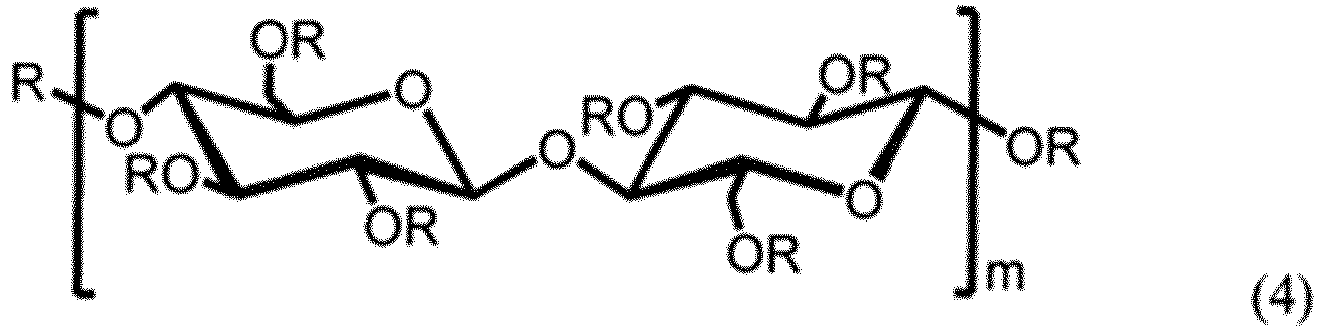
- Modifizierte Cellulosefasern gemäß Anspruch 1 oder 2, wobei das Einführungsverhältnis des Substituenten oder der Substituenten, ausgewählt aus den durch die allgemeine Formel (1) dargestellten Substituenten und den durch die allgemeine Formel (2) dargestellten Substituenten, 0,001 Mol oder mehr und 1,5 Mol oder weniger beträgt, pro Mol der wasserfreien Glukoseeinheit.
- Modifizierte Cellulosefasern gemäß mindestens einem der Ansprüche 1 bis 3, wobei n eine Zahl von 0 oder mehr und 20 oder weniger ist, und A ist eine lineare oder verzweigte, zweiwertige gesättigte Kohlenwasserstoffgruppe mit 2 oder mehr Kohlenstoffatomen und 3 oder weniger Kohlenstoffatomen, in dem durch die allgemeine Formel (2) dargestellten Substituenten.
- Modifizierte Cellulosefasern gemäß mindestens einem der Ansprüche 1 bis 4, wobei die durchschnittliche Fasergröße 5 µm oder mehr beträgt.
- Modifizierte Cellulosefasern gemäß mindestens einem der Ansprüche 1 bis 5, wobei die durchschnittliche Fasergröße 5 µm oder mehr und 100 µm oder weniger beträgt.
- Modifizierte Cellulosefasern gemäß mindestens einem der Ansprüche 1 bis 4, wobei die durchschnittliche Fasergröße 1 nm oder mehr und 500 nm oder weniger beträgt.
- Modifizierte Cellulosefasern gemäß mindestens einem der Ansprüche 1 bis 7, wobei die Kristallinität 10% oder mehr beträgt.
- Modifizierte Cellulosefasern gemäß mindestens einem der Ansprüche 1 bis 8, wobei die Kristallinität 20% oder mehr beträgt.
- Verfahren zur Herstellung von modifizierten Cellulosefasern, umfassend das Einbringen (b) einer nichtionischen Alkylenoxidverbindung mit einer Gesamtzahl an Kohlenstoffatomen von 3 oder mehr und 4 oder weniger pro Molekül, und (a) eine oder mehrere Verbindungen, ausgewählt aus nichtionischen Alkylenoxidverbindungen mit einer Gesamtzahl an Kohlenstoffatomen von 5 oder mehr und 32 oder weniger pro Molekül und nichtionischen Glycidyletherverbindungen mit einer Gesamtzahl an Kohlenstoffatomen von 5 oder mehr und 100 oder weniger pro Molekül in ein Rohmaterial auf Cellulosebasis über eine Etherbindung, in Gegenwart einer Base, gleichzeitig oder getrennt.
- Verfahren gemäß Anspruch 10, wobei das Verfahren umfasst die folgenden Schritte II-1 und 11-2:Schritt II-1) Einbringen (b) einer nichtionischen Alkylenoxidverbindung mit einer Gesamtzahl von Kohlenstoffatomen von 3 oder mehr und 4 oder weniger pro Molekül in ein Rohmaterial auf Cellulosebasis über eine Etherbindung, in Gegenwart einer Base, undSchritt II-2) Einführen (a) einer oder mehrerer Verbindungen, ausgewählt aus nichtionischen Alkylenoxidverbindungen mit einer Gesamtzahl von Kohlenstoffatomen von 5 oder mehr und 32 oder weniger pro Molekül und nichtionischen Glycidyletherverbindungen mit einer Gesamtzahl von Kohlenstoffatomen von 5 oder mehr und 100 oder weniger pro Molekül, in Cellulosefasern, die in Schritt 11-1 erhalten wurden, über eine Etherbindung, in Gegenwart der Base.
- Verfahren gemäß Anspruch 10 oder 11, wobei die Base eine oder mehrere ist, ausgewählt aus Alkalimetallhydroxiden, Erdalkalimetallhydroxiden, primären bis tertiären Aminen, quartären Ammoniumsalzen, Imidazolen und Derivate davon, Pyridin und Derivate davon, und Alkoxiden.
- Verfahren gemäß mindestens einem der Ansprüche 10 bis 12, wobei die Menge der Base 0,01 Äquivalente oder mehr und 10 Äquivalente oder weniger beträgt, bezogen auf die wasserfreie Glukoseeinheit in dem Rohmaterial auf Cellulosebasis.
- Harzzusammensetzung, umfassend ein thermoplastisches Harz oder härtbares Harz und modifizierte Cellulosefasern wie in mindestens einem der Ansprüche 1 bis 9 definiert.
- Harzzusammensetzung gemäß Anspruch 14, wobei das thermoplastische Harz oder das härtbare Harz ein oder mehrere Harze sind, ausgewählt aus der Gruppe, bestehend aus einem thermoplastischen Harz, und einem härtbaren Harz, ausgewählt aus einem Epoxidharz, einem (Meth)acrylharz, einem Phenolharz, einem ungesättigten Polyesterharz, einem Polyurethanharz oder einem Polyimidharz.
Applications Claiming Priority (5)
| Application Number | Priority Date | Filing Date | Title |
|---|---|---|---|
| JP2015176046 | 2015-09-07 | ||
| JP2015176048 | 2015-09-07 | ||
| JP2015176045 | 2015-09-07 | ||
| JP2015176047 | 2015-09-07 | ||
| PCT/JP2016/076057 WO2017043454A1 (ja) | 2015-09-07 | 2016-09-05 | 改質セルロース繊維 |
Publications (3)
| Publication Number | Publication Date |
|---|---|
| EP3348581A1 EP3348581A1 (de) | 2018-07-18 |
| EP3348581A4 EP3348581A4 (de) | 2019-05-01 |
| EP3348581B1 true EP3348581B1 (de) | 2024-10-23 |
Family
ID=58240648
Family Applications (1)
| Application Number | Title | Priority Date | Filing Date |
|---|---|---|---|
| EP16844315.8A Active EP3348581B1 (de) | 2015-09-07 | 2016-09-05 | Modifizierte cellulosefasern |
Country Status (5)
| Country | Link |
|---|---|
| US (1) | US10906993B2 (de) |
| EP (1) | EP3348581B1 (de) |
| JP (1) | JP6894681B2 (de) |
| CN (1) | CN107949577B (de) |
| WO (1) | WO2017043454A1 (de) |
Families Citing this family (18)
| Publication number | Priority date | Publication date | Assignee | Title |
|---|---|---|---|---|
| WO2017043451A1 (ja) * | 2015-09-07 | 2017-03-16 | 花王株式会社 | 改質セルロース繊維 |
| WO2017043453A1 (ja) | 2015-09-07 | 2017-03-16 | 花王株式会社 | ゴム組成物 |
| JP6845641B2 (ja) | 2015-09-07 | 2021-03-24 | 花王株式会社 | 樹脂組成物 |
| JP6404382B2 (ja) * | 2017-02-28 | 2018-10-10 | 大王製紙株式会社 | セルロース微細繊維及びその製造方法 |
| JP6857562B2 (ja) * | 2017-06-28 | 2021-04-14 | 第一工業製薬株式会社 | 化学修飾セルロース繊維 |
| JP7025852B2 (ja) * | 2017-07-04 | 2022-02-25 | 第一工業製薬株式会社 | 電極塗工液用分散剤、該電極塗工液用分散剤を含む電極塗工液組成物、該電極塗工液組成物を用いて作製された蓄電デバイス用電極、および該電極を備える蓄電デバイス |
| JP6971085B2 (ja) * | 2017-08-17 | 2021-11-24 | 日本曹達株式会社 | グリシジルエーテル変性ポリブタジエンまたはグリシジルエーテル変性水素添加ポリブタジエンの製造方法 |
| JP7075823B2 (ja) * | 2018-06-05 | 2022-05-26 | 花王株式会社 | アスファルト組成物 |
| US20210230795A1 (en) * | 2018-06-12 | 2021-07-29 | Kao Corporation | Method for producing modified cellulose fiber, and modified cellulose fiber |
| WO2020038670A1 (en) * | 2018-07-19 | 2020-02-27 | Kemira Oyj | Granular cellulose product |
| KR102120710B1 (ko) * | 2019-03-22 | 2020-06-10 | 재단법인대구경북과학기술원 | 혼성 셀룰로스 에테르의 제조방법 |
| JP7250602B2 (ja) * | 2019-04-18 | 2023-04-03 | 花王株式会社 | 樹脂組成物の製造方法 |
| CN113939542A (zh) * | 2019-05-29 | 2022-01-14 | 花王株式会社 | 改性纤维素的制造方法 |
| JP2021006628A (ja) * | 2019-06-27 | 2021-01-21 | 花王株式会社 | 改質セルロースの製造方法 |
| JP7636195B2 (ja) * | 2020-02-14 | 2025-02-26 | レンゴー株式会社 | ジチオエステル化セルロースナノファイバー |
| TW202146556A (zh) * | 2020-05-28 | 2021-12-16 | 日商三菱瓦斯化學股份有限公司 | 纖維素纖維、纖維強化樹脂組成物、纖維素纖維之製造方法、以及纖維強化樹脂組成物之製造方法 |
| JP7209889B1 (ja) | 2022-09-12 | 2023-01-20 | 第一工業製薬株式会社 | 二液硬化型ポリウレタン樹脂組成物 |
| CN117626717B (zh) * | 2023-11-09 | 2025-08-12 | 华南理工大学 | 一种完全可生物降解高阻隔包装材料及其制备方法与应用 |
Citations (1)
| Publication number | Priority date | Publication date | Assignee | Title |
|---|---|---|---|---|
| JP2014218598A (ja) * | 2013-05-09 | 2014-11-20 | 株式会社ブリヂストン | セルロース繊維、ゴム組成物、加硫ゴム組成物およびタイヤ |
Family Cites Families (50)
| Publication number | Priority date | Publication date | Assignee | Title |
|---|---|---|---|---|
| US4228277A (en) | 1979-02-12 | 1980-10-14 | Hercules Incorporated | Modified nonionic cellulose ethers |
| JPH02142814A (ja) | 1988-11-24 | 1990-05-31 | Hitachi Chem Co Ltd | 強化樹脂組成物 |
| DE69010350T2 (de) | 1989-01-31 | 1994-11-17 | Union Carbide Chem Plastic | Polysaccharide mit Alkaryl- oder Aralkyl- Hydrophoben und Latexzusammensetzungen, die die Polysaccharide enthalten. |
| JPH0312401A (ja) * | 1989-06-09 | 1991-01-21 | Shin Etsu Chem Co Ltd | 変性水溶性セルロースエーテルの製造方法 |
| JP3056884B2 (ja) | 1992-06-25 | 2000-06-26 | 信越化学工業株式会社 | 変性セルロースエーテルの製造方法 |
| US5488104A (en) * | 1994-06-30 | 1996-01-30 | The Dow Chemical Company | Process for comminuting cellulose ethers |
| US5504123A (en) | 1994-12-20 | 1996-04-02 | Union Carbide Chemicals & Plastics Technology Corporation | Dual functional cellulosic additives for latex compositions |
| JPH08169901A (ja) | 1994-12-21 | 1996-07-02 | Shiseido Co Ltd | 新規セルロース誘導体 |
| EP0765911A3 (de) * | 1995-09-26 | 1998-05-20 | Bayer Ag | Mit Verstärkungsstoffen gefüllte biologisch abbaubare Kunststoffe |
| JPH09169901A (ja) * | 1995-12-19 | 1997-06-30 | Teijin Ltd | ポリカーボネート系樹脂溶液組成物およびフィルムの製造方法 |
| DE19548323A1 (de) | 1995-12-22 | 1997-06-26 | Bayer Ag | Thermoplastische verarbeitbare, biologisch abbaubare Formmassen |
| DE19730090A1 (de) * | 1997-07-14 | 1999-01-21 | Wolff Walsrode Ag | Neuartige Celluloseether und Verfahren zu deren Herstellung |
| US6248880B1 (en) | 1998-08-06 | 2001-06-19 | Akzo Nobel Nv | Nonionic cellulose ether with improve thickening properties |
| SE514347C2 (sv) | 1998-08-06 | 2001-02-12 | Akzo Nobel Nv | Nonjonisk cellulosaeter och dess användning som förtjockningsmedel i färgkompositioner |
| FR2784107B1 (fr) * | 1998-09-15 | 2005-12-09 | Rhodia Chimie Sa | Microfibrilles de cellulose a surface modifiee, leur procede de preparation, et leur utilisation |
| US6669863B1 (en) * | 1998-12-11 | 2003-12-30 | Akzo Nobel N.V. | Anionic cellulose ethers having temperature-dependent associative properties |
| DE69937841T2 (de) | 1999-01-13 | 2008-12-11 | The Procter & Gamble Company, Cincinnati | Cellulosepolymer enthaltendes waschmittel |
| FR2800378A1 (fr) | 1999-11-03 | 2001-05-04 | Saint Louis Sucre Sa | Microfibrilles de cellulose i comportant des groupements ethers substitues en surface a des groupements hydroxyles, leur procede de preparation et leur utilisation |
| MXPA04012441A (es) * | 2002-06-12 | 2005-04-19 | Dow Global Technologies Inc | Composicion cementosa. |
| SE526356C2 (sv) | 2003-12-15 | 2005-08-30 | Akzo Nobel Nv | Associativa vattenlösliga cellulosaetrar |
| US7985855B2 (en) * | 2004-06-30 | 2011-07-26 | Shin-Etsu Chemical Co., Ltd. | Method for modifying fibers |
| US7932309B2 (en) * | 2005-11-04 | 2011-04-26 | Hercules Incorporated | Ether derivatives of raw cotton linters for water-borne coatings |
| WO2007123974A2 (en) * | 2006-04-21 | 2007-11-01 | Hercules Incorporated | Decolorized raw cotton linters and preparation of ether derivatives therefrom |
| JP5398180B2 (ja) | 2007-06-11 | 2014-01-29 | 国立大学法人京都大学 | リグニン含有ミクロフィブリル化植物繊維及びその製造方法 |
| EP2098539B1 (de) * | 2008-03-03 | 2017-05-10 | SE Tylose GmbH & Co.KG | Homogene Synthese von Celluloseethern in ionischen Flüssigkeiten |
| JP2009261993A (ja) | 2008-04-22 | 2009-11-12 | Fujifilm Corp | 多糖類の微細化方法、多糖類の修飾方法、多糖類、樹脂強化剤および樹脂組成物 |
| JP5350953B2 (ja) | 2008-09-30 | 2013-11-27 | 株式会社ダイセル | 疎水化されたセルロース系繊維を含む樹脂組成物及びその製造方法 |
| JP5676860B2 (ja) | 2008-10-02 | 2015-02-25 | 株式会社Kri | 多糖類ナノファイバーとその製造方法、多糖類ナノファイバー含むイオン液体溶液と複合材料 |
| JP5510092B2 (ja) | 2009-06-12 | 2014-06-04 | 国立大学法人京都大学 | 修飾セルロース繊維分散液の製造方法及びセルロース複合材料の製造方法 |
| JP5470032B2 (ja) * | 2009-08-12 | 2014-04-16 | 富士フイルム株式会社 | セルロース誘導体、熱成形材料、成形体及びその製造方法並びに電気電子機器用筐体 |
| CN102639567B (zh) * | 2009-10-05 | 2015-05-06 | 日本电气株式会社 | 纤维素树脂及其制造方法 |
| JP5944098B2 (ja) | 2009-12-11 | 2016-07-05 | 花王株式会社 | 微細セルロース繊維複合体、微細セルロース繊維分散液及び複合材料 |
| US9243128B2 (en) | 2009-12-11 | 2016-01-26 | Kao Corporation | Composite material |
| US20110177018A1 (en) * | 2010-01-15 | 2011-07-21 | Paul Martin Lipic | Personal Care Compositions Comprising A Hydrophobically Modified Cationic Polysaccharide |
| JP5677754B2 (ja) | 2010-03-05 | 2015-02-25 | オリンパス株式会社 | セルロースナノファイバーとその製造方法、複合樹脂組成物、成形体 |
| JP5031054B2 (ja) | 2010-03-18 | 2012-09-19 | 信越化学工業株式会社 | 低置換度ヒドロキシプロピルセルロース及びこれを含む固形製剤 |
| CN102834448B (zh) * | 2010-04-01 | 2015-04-22 | 三菱化学株式会社 | 微细纤维素纤维分散液的制造方法 |
| MX2011013822A (es) | 2010-12-27 | 2012-06-26 | Shinetsu Chemical Co | Composicion de moldeo por extrusion de ceramica y aglutinante. |
| JP5887196B2 (ja) * | 2011-05-02 | 2016-03-16 | 花王株式会社 | アルカリセルロースの製造方法 |
| WO2013048778A1 (en) * | 2011-09-29 | 2013-04-04 | Rohm And Haas Chemicals Llc | Personal care composition and methods containing hydrophobically-modified hydroxyethylcellulose |
| WO2013049094A1 (en) * | 2011-09-29 | 2013-04-04 | Dow Global Technologies Llc | Cementing composition comprising anionically - and hydrophobically-modified cellulose ethers and its use |
| KR20150090888A (ko) * | 2012-12-03 | 2015-08-06 | 카오카부시키가이샤 | 카티온성기 함유 셀룰로오스 에테르 |
| JP2015052104A (ja) | 2013-08-08 | 2015-03-19 | 花王株式会社 | カチオン化セルロース誘導体の製造方法 |
| US10155897B2 (en) * | 2013-08-16 | 2018-12-18 | Hilliburton Energy Services, Inc. | Hydrophobically and hydrophilically modified polysaccharides and methods of using the same for treatment of a subterranean formation |
| EP3041870A4 (de) | 2013-09-06 | 2017-04-26 | Teknologian tutkimuskeskus VTT Oy | Oberflächenmodifizierte cellulosenanofasern, bioverbundharzzusammensetzung und verfahren zur herstellung davon |
| RU2688667C2 (ru) * | 2013-10-07 | 2019-05-22 | Геркулес Ллк | Дигидроксиалкилзамещенный полигалактоманнан и способы его получения и применения |
| CN108026183B (zh) | 2015-09-07 | 2021-05-07 | 花王株式会社 | 改性纤维素纤维 |
| WO2017043453A1 (ja) * | 2015-09-07 | 2017-03-16 | 花王株式会社 | ゴム組成物 |
| WO2017043451A1 (ja) * | 2015-09-07 | 2017-03-16 | 花王株式会社 | 改質セルロース繊維 |
| JP6845641B2 (ja) | 2015-09-07 | 2021-03-24 | 花王株式会社 | 樹脂組成物 |
-
2016
- 2016-09-05 EP EP16844315.8A patent/EP3348581B1/de active Active
- 2016-09-05 JP JP2016173172A patent/JP6894681B2/ja active Active
- 2016-09-05 US US15/757,700 patent/US10906993B2/en active Active
- 2016-09-05 WO PCT/JP2016/076057 patent/WO2017043454A1/ja not_active Ceased
- 2016-09-05 CN CN201680051555.6A patent/CN107949577B/zh active Active
Patent Citations (1)
| Publication number | Priority date | Publication date | Assignee | Title |
|---|---|---|---|---|
| JP2014218598A (ja) * | 2013-05-09 | 2014-11-20 | 株式会社ブリヂストン | セルロース繊維、ゴム組成物、加硫ゴム組成物およびタイヤ |
Also Published As
| Publication number | Publication date |
|---|---|
| JP2017053077A (ja) | 2017-03-16 |
| US10906993B2 (en) | 2021-02-02 |
| EP3348581A1 (de) | 2018-07-18 |
| CN107949577B (zh) | 2021-04-06 |
| US20190169314A1 (en) | 2019-06-06 |
| JP6894681B2 (ja) | 2021-06-30 |
| WO2017043454A1 (ja) | 2017-03-16 |
| EP3348581A4 (de) | 2019-05-01 |
| CN107949577A (zh) | 2018-04-20 |
Similar Documents
| Publication | Publication Date | Title |
|---|---|---|
| EP3348581B1 (de) | Modifizierte cellulosefasern | |
| US10738169B2 (en) | Resin composition | |
| US11136416B2 (en) | Rubber composition | |
| JP6532561B2 (ja) | 改質セルロース繊維の製造方法 | |
| EP3564321B1 (de) | Harzzusammensetzung | |
| EP3348579A1 (de) | Modifizierte cellulosefaser | |
| JP6779158B2 (ja) | 改質セルロース繊維の製造方法 | |
| EP3348580A1 (de) | Modifizierte cellulosefasern |
Legal Events
| Date | Code | Title | Description |
|---|---|---|---|
| STAA | Information on the status of an ep patent application or granted ep patent |
Free format text: STATUS: THE INTERNATIONAL PUBLICATION HAS BEEN MADE |
|
| PUAI | Public reference made under article 153(3) epc to a published international application that has entered the european phase |
Free format text: ORIGINAL CODE: 0009012 |
|
| STAA | Information on the status of an ep patent application or granted ep patent |
Free format text: STATUS: REQUEST FOR EXAMINATION WAS MADE |
|
| 17P | Request for examination filed |
Effective date: 20180309 |
|
| AK | Designated contracting states |
Kind code of ref document: A1 Designated state(s): AL AT BE BG CH CY CZ DE DK EE ES FI FR GB GR HR HU IE IS IT LI LT LU LV MC MK MT NL NO PL PT RO RS SE SI SK SM TR |
|
| AX | Request for extension of the european patent |
Extension state: BA ME |
|
| DAV | Request for validation of the european patent (deleted) | ||
| DAX | Request for extension of the european patent (deleted) | ||
| A4 | Supplementary search report drawn up and despatched |
Effective date: 20190329 |
|
| RIC1 | Information provided on ipc code assigned before grant |
Ipc: C08L 9/06 20060101ALI20190325BHEP Ipc: C08L 25/06 20060101ALI20190325BHEP Ipc: C08L 75/14 20060101ALI20190325BHEP Ipc: C08L 1/28 20060101ALI20190325BHEP Ipc: C08L 23/06 20060101ALI20190325BHEP Ipc: C08L 9/02 20060101ALI20190325BHEP Ipc: C08B 11/193 20060101AFI20190325BHEP |
|
| STAA | Information on the status of an ep patent application or granted ep patent |
Free format text: STATUS: EXAMINATION IS IN PROGRESS |
|
| 17Q | First examination report despatched |
Effective date: 20220601 |
|
| GRAP | Despatch of communication of intention to grant a patent |
Free format text: ORIGINAL CODE: EPIDOSNIGR1 |
|
| STAA | Information on the status of an ep patent application or granted ep patent |
Free format text: STATUS: GRANT OF PATENT IS INTENDED |
|
| INTG | Intention to grant announced |
Effective date: 20240610 |
|
| GRAS | Grant fee paid |
Free format text: ORIGINAL CODE: EPIDOSNIGR3 |
|
| GRAA | (expected) grant |
Free format text: ORIGINAL CODE: 0009210 |
|
| STAA | Information on the status of an ep patent application or granted ep patent |
Free format text: STATUS: THE PATENT HAS BEEN GRANTED |
|
| AK | Designated contracting states |
Kind code of ref document: B1 Designated state(s): AL AT BE BG CH CY CZ DE DK EE ES FI FR GB GR HR HU IE IS IT LI LT LU LV MC MK MT NL NO PL PT RO RS SE SI SK SM TR |
|
| REG | Reference to a national code |
Ref country code: GB Ref legal event code: FG4D |
|
| REG | Reference to a national code |
Ref country code: CH Ref legal event code: EP |
|
| REG | Reference to a national code |
Ref country code: DE Ref legal event code: R096 Ref document number: 602016089970 Country of ref document: DE |
|
| REG | Reference to a national code |
Ref country code: IE Ref legal event code: FG4D |
|
| REG | Reference to a national code |
Ref country code: LT Ref legal event code: MG9D |
|
| REG | Reference to a national code |
Ref country code: NL Ref legal event code: MP Effective date: 20241023 |
|
| REG | Reference to a national code |
Ref country code: AT Ref legal event code: MK05 Ref document number: 1734780 Country of ref document: AT Kind code of ref document: T Effective date: 20241023 |
|
| PG25 | Lapsed in a contracting state [announced via postgrant information from national office to epo] |
Ref country code: NL Free format text: LAPSE BECAUSE OF FAILURE TO SUBMIT A TRANSLATION OF THE DESCRIPTION OR TO PAY THE FEE WITHIN THE PRESCRIBED TIME-LIMIT Effective date: 20241023 |
|
| PG25 | Lapsed in a contracting state [announced via postgrant information from national office to epo] |
Ref country code: NL Free format text: LAPSE BECAUSE OF FAILURE TO SUBMIT A TRANSLATION OF THE DESCRIPTION OR TO PAY THE FEE WITHIN THE PRESCRIBED TIME-LIMIT Effective date: 20241023 |
|
| PG25 | Lapsed in a contracting state [announced via postgrant information from national office to epo] |
Ref country code: IS Free format text: LAPSE BECAUSE OF FAILURE TO SUBMIT A TRANSLATION OF THE DESCRIPTION OR TO PAY THE FEE WITHIN THE PRESCRIBED TIME-LIMIT Effective date: 20250223 Ref country code: PT Free format text: LAPSE BECAUSE OF FAILURE TO SUBMIT A TRANSLATION OF THE DESCRIPTION OR TO PAY THE FEE WITHIN THE PRESCRIBED TIME-LIMIT Effective date: 20250224 Ref country code: HR Free format text: LAPSE BECAUSE OF FAILURE TO SUBMIT A TRANSLATION OF THE DESCRIPTION OR TO PAY THE FEE WITHIN THE PRESCRIBED TIME-LIMIT Effective date: 20241023 |
|
| PG25 | Lapsed in a contracting state [announced via postgrant information from national office to epo] |
Ref country code: FI Free format text: LAPSE BECAUSE OF FAILURE TO SUBMIT A TRANSLATION OF THE DESCRIPTION OR TO PAY THE FEE WITHIN THE PRESCRIBED TIME-LIMIT Effective date: 20241023 |
|
| PG25 | Lapsed in a contracting state [announced via postgrant information from national office to epo] |
Ref country code: BG Free format text: LAPSE BECAUSE OF FAILURE TO SUBMIT A TRANSLATION OF THE DESCRIPTION OR TO PAY THE FEE WITHIN THE PRESCRIBED TIME-LIMIT Effective date: 20241023 |
|
| PG25 | Lapsed in a contracting state [announced via postgrant information from national office to epo] |
Ref country code: ES Free format text: LAPSE BECAUSE OF FAILURE TO SUBMIT A TRANSLATION OF THE DESCRIPTION OR TO PAY THE FEE WITHIN THE PRESCRIBED TIME-LIMIT Effective date: 20241023 |
|
| PG25 | Lapsed in a contracting state [announced via postgrant information from national office to epo] |
Ref country code: NO Free format text: LAPSE BECAUSE OF FAILURE TO SUBMIT A TRANSLATION OF THE DESCRIPTION OR TO PAY THE FEE WITHIN THE PRESCRIBED TIME-LIMIT Effective date: 20250123 |
|
| PG25 | Lapsed in a contracting state [announced via postgrant information from national office to epo] |
Ref country code: AT Free format text: LAPSE BECAUSE OF FAILURE TO SUBMIT A TRANSLATION OF THE DESCRIPTION OR TO PAY THE FEE WITHIN THE PRESCRIBED TIME-LIMIT Effective date: 20241023 Ref country code: LV Free format text: LAPSE BECAUSE OF FAILURE TO SUBMIT A TRANSLATION OF THE DESCRIPTION OR TO PAY THE FEE WITHIN THE PRESCRIBED TIME-LIMIT Effective date: 20241023 Ref country code: GR Free format text: LAPSE BECAUSE OF FAILURE TO SUBMIT A TRANSLATION OF THE DESCRIPTION OR TO PAY THE FEE WITHIN THE PRESCRIBED TIME-LIMIT Effective date: 20250124 |
|
| PG25 | Lapsed in a contracting state [announced via postgrant information from national office to epo] |
Ref country code: PL Free format text: LAPSE BECAUSE OF FAILURE TO SUBMIT A TRANSLATION OF THE DESCRIPTION OR TO PAY THE FEE WITHIN THE PRESCRIBED TIME-LIMIT Effective date: 20241023 |
|
| PG25 | Lapsed in a contracting state [announced via postgrant information from national office to epo] |
Ref country code: RS Free format text: LAPSE BECAUSE OF FAILURE TO SUBMIT A TRANSLATION OF THE DESCRIPTION OR TO PAY THE FEE WITHIN THE PRESCRIBED TIME-LIMIT Effective date: 20250123 |
|
| PG25 | Lapsed in a contracting state [announced via postgrant information from national office to epo] |
Ref country code: SM Free format text: LAPSE BECAUSE OF FAILURE TO SUBMIT A TRANSLATION OF THE DESCRIPTION OR TO PAY THE FEE WITHIN THE PRESCRIBED TIME-LIMIT Effective date: 20241023 |
|
| PG25 | Lapsed in a contracting state [announced via postgrant information from national office to epo] |
Ref country code: DK Free format text: LAPSE BECAUSE OF FAILURE TO SUBMIT A TRANSLATION OF THE DESCRIPTION OR TO PAY THE FEE WITHIN THE PRESCRIBED TIME-LIMIT Effective date: 20241023 |
|
| PG25 | Lapsed in a contracting state [announced via postgrant information from national office to epo] |
Ref country code: EE Free format text: LAPSE BECAUSE OF FAILURE TO SUBMIT A TRANSLATION OF THE DESCRIPTION OR TO PAY THE FEE WITHIN THE PRESCRIBED TIME-LIMIT Effective date: 20241023 |
|
| PG25 | Lapsed in a contracting state [announced via postgrant information from national office to epo] |
Ref country code: RO Free format text: LAPSE BECAUSE OF FAILURE TO SUBMIT A TRANSLATION OF THE DESCRIPTION OR TO PAY THE FEE WITHIN THE PRESCRIBED TIME-LIMIT Effective date: 20241023 |
|
| REG | Reference to a national code |
Ref country code: DE Ref legal event code: R097 Ref document number: 602016089970 Country of ref document: DE |
|
| PG25 | Lapsed in a contracting state [announced via postgrant information from national office to epo] |
Ref country code: SK Free format text: LAPSE BECAUSE OF FAILURE TO SUBMIT A TRANSLATION OF THE DESCRIPTION OR TO PAY THE FEE WITHIN THE PRESCRIBED TIME-LIMIT Effective date: 20241023 |
|
| PG25 | Lapsed in a contracting state [announced via postgrant information from national office to epo] |
Ref country code: CZ Free format text: LAPSE BECAUSE OF FAILURE TO SUBMIT A TRANSLATION OF THE DESCRIPTION OR TO PAY THE FEE WITHIN THE PRESCRIBED TIME-LIMIT Effective date: 20241023 |
|
| PG25 | Lapsed in a contracting state [announced via postgrant information from national office to epo] |
Ref country code: IT Free format text: LAPSE BECAUSE OF FAILURE TO SUBMIT A TRANSLATION OF THE DESCRIPTION OR TO PAY THE FEE WITHIN THE PRESCRIBED TIME-LIMIT Effective date: 20241023 |
|
| PLBE | No opposition filed within time limit |
Free format text: ORIGINAL CODE: 0009261 |
|
| STAA | Information on the status of an ep patent application or granted ep patent |
Free format text: STATUS: NO OPPOSITION FILED WITHIN TIME LIMIT |
|
| PG25 | Lapsed in a contracting state [announced via postgrant information from national office to epo] |
Ref country code: SE Free format text: LAPSE BECAUSE OF FAILURE TO SUBMIT A TRANSLATION OF THE DESCRIPTION OR TO PAY THE FEE WITHIN THE PRESCRIBED TIME-LIMIT Effective date: 20241023 |
|
| 26N | No opposition filed |
Effective date: 20250724 |
|
| PGFP | Annual fee paid to national office [announced via postgrant information from national office to epo] |
Ref country code: DE Payment date: 20250730 Year of fee payment: 10 |