EP3277480B1 - Vorrichtung zur herstellung eines elastischen vliesstoffes - Google Patents
Vorrichtung zur herstellung eines elastischen vliesstoffes Download PDFInfo
- Publication number
- EP3277480B1 EP3277480B1 EP16773958.0A EP16773958A EP3277480B1 EP 3277480 B1 EP3277480 B1 EP 3277480B1 EP 16773958 A EP16773958 A EP 16773958A EP 3277480 B1 EP3277480 B1 EP 3277480B1
- Authority
- EP
- European Patent Office
- Prior art keywords
- anvil
- horn
- module
- ridges
- face
- Prior art date
- Legal status (The legal status is an assumption and is not a legal conclusion. Google has not performed a legal analysis and makes no representation as to the accuracy of the status listed.)
- Active
Links
Images





Classifications
-
- B—PERFORMING OPERATIONS; TRANSPORTING
- B29—WORKING OF PLASTICS; WORKING OF SUBSTANCES IN A PLASTIC STATE IN GENERAL
- B29C—SHAPING OR JOINING OF PLASTICS; SHAPING OF MATERIAL IN A PLASTIC STATE, NOT OTHERWISE PROVIDED FOR; AFTER-TREATMENT OF THE SHAPED PRODUCTS, e.g. REPAIRING
- B29C65/00—Joining or sealing of preformed parts, e.g. welding of plastics materials; Apparatus therefor
- B29C65/02—Joining or sealing of preformed parts, e.g. welding of plastics materials; Apparatus therefor by heating, with or without pressure
- B29C65/08—Joining or sealing of preformed parts, e.g. welding of plastics materials; Apparatus therefor by heating, with or without pressure using ultrasonic vibrations
- B29C65/083—Joining or sealing of preformed parts, e.g. welding of plastics materials; Apparatus therefor by heating, with or without pressure using ultrasonic vibrations using a rotary sonotrode or a rotary anvil
- B29C65/086—Joining or sealing of preformed parts, e.g. welding of plastics materials; Apparatus therefor by heating, with or without pressure using ultrasonic vibrations using a rotary sonotrode or a rotary anvil using a rotary anvil
-
- B—PERFORMING OPERATIONS; TRANSPORTING
- B29—WORKING OF PLASTICS; WORKING OF SUBSTANCES IN A PLASTIC STATE IN GENERAL
- B29C—SHAPING OR JOINING OF PLASTICS; SHAPING OF MATERIAL IN A PLASTIC STATE, NOT OTHERWISE PROVIDED FOR; AFTER-TREATMENT OF THE SHAPED PRODUCTS, e.g. REPAIRING
- B29C65/00—Joining or sealing of preformed parts, e.g. welding of plastics materials; Apparatus therefor
- B29C65/02—Joining or sealing of preformed parts, e.g. welding of plastics materials; Apparatus therefor by heating, with or without pressure
- B29C65/08—Joining or sealing of preformed parts, e.g. welding of plastics materials; Apparatus therefor by heating, with or without pressure using ultrasonic vibrations
-
- A—HUMAN NECESSITIES
- A61—MEDICAL OR VETERINARY SCIENCE; HYGIENE
- A61F—FILTERS IMPLANTABLE INTO BLOOD VESSELS; PROSTHESES; DEVICES PROVIDING PATENCY TO, OR PREVENTING COLLAPSING OF, TUBULAR STRUCTURES OF THE BODY, e.g. STENTS; ORTHOPAEDIC, NURSING OR CONTRACEPTIVE DEVICES; FOMENTATION; TREATMENT OR PROTECTION OF EYES OR EARS; BANDAGES, DRESSINGS OR ABSORBENT PADS; FIRST-AID KITS
- A61F13/00—Bandages or dressings; Absorbent pads
- A61F13/15—Absorbent pads, e.g. sanitary towels, swabs or tampons for external or internal application to the body; Supporting or fastening means therefor; Tampon applicators
- A61F13/15577—Apparatus or processes for manufacturing
- A61F13/15707—Mechanical treatment, e.g. notching, twisting, compressing, shaping
- A61F13/15739—Sealing, e.g. involving cutting
-
- B—PERFORMING OPERATIONS; TRANSPORTING
- B29—WORKING OF PLASTICS; WORKING OF SUBSTANCES IN A PLASTIC STATE IN GENERAL
- B29C—SHAPING OR JOINING OF PLASTICS; SHAPING OF MATERIAL IN A PLASTIC STATE, NOT OTHERWISE PROVIDED FOR; AFTER-TREATMENT OF THE SHAPED PRODUCTS, e.g. REPAIRING
- B29C65/00—Joining or sealing of preformed parts, e.g. welding of plastics materials; Apparatus therefor
- B29C65/02—Joining or sealing of preformed parts, e.g. welding of plastics materials; Apparatus therefor by heating, with or without pressure
- B29C65/08—Joining or sealing of preformed parts, e.g. welding of plastics materials; Apparatus therefor by heating, with or without pressure using ultrasonic vibrations
- B29C65/083—Joining or sealing of preformed parts, e.g. welding of plastics materials; Apparatus therefor by heating, with or without pressure using ultrasonic vibrations using a rotary sonotrode or a rotary anvil
- B29C65/087—Joining or sealing of preformed parts, e.g. welding of plastics materials; Apparatus therefor by heating, with or without pressure using ultrasonic vibrations using a rotary sonotrode or a rotary anvil using both a rotary sonotrode and a rotary anvil
-
- B—PERFORMING OPERATIONS; TRANSPORTING
- B29—WORKING OF PLASTICS; WORKING OF SUBSTANCES IN A PLASTIC STATE IN GENERAL
- B29C—SHAPING OR JOINING OF PLASTICS; SHAPING OF MATERIAL IN A PLASTIC STATE, NOT OTHERWISE PROVIDED FOR; AFTER-TREATMENT OF THE SHAPED PRODUCTS, e.g. REPAIRING
- B29C65/00—Joining or sealing of preformed parts, e.g. welding of plastics materials; Apparatus therefor
- B29C65/78—Means for handling the parts to be joined, e.g. for making containers or hollow articles, e.g. means for handling sheets, plates, web-like materials, tubular articles, hollow articles or elements to be joined therewith; Means for discharging the joined articles from the joining apparatus
-
- B—PERFORMING OPERATIONS; TRANSPORTING
- B29—WORKING OF PLASTICS; WORKING OF SUBSTANCES IN A PLASTIC STATE IN GENERAL
- B29C—SHAPING OR JOINING OF PLASTICS; SHAPING OF MATERIAL IN A PLASTIC STATE, NOT OTHERWISE PROVIDED FOR; AFTER-TREATMENT OF THE SHAPED PRODUCTS, e.g. REPAIRING
- B29C66/00—General aspects of processes or apparatus for joining preformed parts
- B29C66/01—General aspects dealing with the joint area or with the area to be joined
- B29C66/05—Particular design of joint configurations
- B29C66/10—Particular design of joint configurations particular design of the joint cross-sections
- B29C66/11—Joint cross-sections comprising a single joint-segment, i.e. one of the parts to be joined comprising a single joint-segment in the joint cross-section
- B29C66/112—Single lapped joints
- B29C66/1122—Single lap to lap joints, i.e. overlap joints
-
- B—PERFORMING OPERATIONS; TRANSPORTING
- B29—WORKING OF PLASTICS; WORKING OF SUBSTANCES IN A PLASTIC STATE IN GENERAL
- B29C—SHAPING OR JOINING OF PLASTICS; SHAPING OF MATERIAL IN A PLASTIC STATE, NOT OTHERWISE PROVIDED FOR; AFTER-TREATMENT OF THE SHAPED PRODUCTS, e.g. REPAIRING
- B29C66/00—General aspects of processes or apparatus for joining preformed parts
- B29C66/40—General aspects of joining substantially flat articles, e.g. plates, sheets or web-like materials; Making flat seams in tubular or hollow articles; Joining single elements to substantially flat surfaces
- B29C66/41—Joining substantially flat articles ; Making flat seams in tubular or hollow articles
- B29C66/43—Joining a relatively small portion of the surface of said articles
- B29C66/433—Casing-in, i.e. enclosing an element between two sheets by an outlined seam
-
- B—PERFORMING OPERATIONS; TRANSPORTING
- B29—WORKING OF PLASTICS; WORKING OF SUBSTANCES IN A PLASTIC STATE IN GENERAL
- B29C—SHAPING OR JOINING OF PLASTICS; SHAPING OF MATERIAL IN A PLASTIC STATE, NOT OTHERWISE PROVIDED FOR; AFTER-TREATMENT OF THE SHAPED PRODUCTS, e.g. REPAIRING
- B29C66/00—General aspects of processes or apparatus for joining preformed parts
- B29C66/69—General aspects of joining filaments
-
- B—PERFORMING OPERATIONS; TRANSPORTING
- B29—WORKING OF PLASTICS; WORKING OF SUBSTANCES IN A PLASTIC STATE IN GENERAL
- B29C—SHAPING OR JOINING OF PLASTICS; SHAPING OF MATERIAL IN A PLASTIC STATE, NOT OTHERWISE PROVIDED FOR; AFTER-TREATMENT OF THE SHAPED PRODUCTS, e.g. REPAIRING
- B29C66/00—General aspects of processes or apparatus for joining preformed parts
- B29C66/70—General aspects of processes or apparatus for joining preformed parts characterised by the composition, physical properties or the structure of the material of the parts to be joined; Joining with non-plastics material
- B29C66/72—General aspects of processes or apparatus for joining preformed parts characterised by the composition, physical properties or the structure of the material of the parts to be joined; Joining with non-plastics material characterised by the structure of the material of the parts to be joined
- B29C66/729—Textile or other fibrous material made from plastics
- B29C66/7294—Non woven mats, e.g. felt
-
- B—PERFORMING OPERATIONS; TRANSPORTING
- B29—WORKING OF PLASTICS; WORKING OF SUBSTANCES IN A PLASTIC STATE IN GENERAL
- B29C—SHAPING OR JOINING OF PLASTICS; SHAPING OF MATERIAL IN A PLASTIC STATE, NOT OTHERWISE PROVIDED FOR; AFTER-TREATMENT OF THE SHAPED PRODUCTS, e.g. REPAIRING
- B29C66/00—General aspects of processes or apparatus for joining preformed parts
- B29C66/70—General aspects of processes or apparatus for joining preformed parts characterised by the composition, physical properties or the structure of the material of the parts to be joined; Joining with non-plastics material
- B29C66/73—General aspects of processes or apparatus for joining preformed parts characterised by the composition, physical properties or the structure of the material of the parts to be joined; Joining with non-plastics material characterised by the intensive physical properties of the material of the parts to be joined, by the optical properties of the material of the parts to be joined, by the extensive physical properties of the parts to be joined, by the state of the material of the parts to be joined or by the material of the parts to be joined being a thermoplastic or a thermoset
- B29C66/731—General aspects of processes or apparatus for joining preformed parts characterised by the composition, physical properties or the structure of the material of the parts to be joined; Joining with non-plastics material characterised by the intensive physical properties of the material of the parts to be joined, by the optical properties of the material of the parts to be joined, by the extensive physical properties of the parts to be joined, by the state of the material of the parts to be joined or by the material of the parts to be joined being a thermoplastic or a thermoset characterised by the intensive physical properties of the material of the parts to be joined
- B29C66/7315—Mechanical properties
-
- B—PERFORMING OPERATIONS; TRANSPORTING
- B29—WORKING OF PLASTICS; WORKING OF SUBSTANCES IN A PLASTIC STATE IN GENERAL
- B29C—SHAPING OR JOINING OF PLASTICS; SHAPING OF MATERIAL IN A PLASTIC STATE, NOT OTHERWISE PROVIDED FOR; AFTER-TREATMENT OF THE SHAPED PRODUCTS, e.g. REPAIRING
- B29C66/00—General aspects of processes or apparatus for joining preformed parts
- B29C66/70—General aspects of processes or apparatus for joining preformed parts characterised by the composition, physical properties or the structure of the material of the parts to be joined; Joining with non-plastics material
- B29C66/73—General aspects of processes or apparatus for joining preformed parts characterised by the composition, physical properties or the structure of the material of the parts to be joined; Joining with non-plastics material characterised by the intensive physical properties of the material of the parts to be joined, by the optical properties of the material of the parts to be joined, by the extensive physical properties of the parts to be joined, by the state of the material of the parts to be joined or by the material of the parts to be joined being a thermoplastic or a thermoset
- B29C66/739—General aspects of processes or apparatus for joining preformed parts characterised by the composition, physical properties or the structure of the material of the parts to be joined; Joining with non-plastics material characterised by the intensive physical properties of the material of the parts to be joined, by the optical properties of the material of the parts to be joined, by the extensive physical properties of the parts to be joined, by the state of the material of the parts to be joined or by the material of the parts to be joined being a thermoplastic or a thermoset characterised by the material of the parts to be joined being a thermoplastic or a thermoset
- B29C66/7392—General aspects of processes or apparatus for joining preformed parts characterised by the composition, physical properties or the structure of the material of the parts to be joined; Joining with non-plastics material characterised by the intensive physical properties of the material of the parts to be joined, by the optical properties of the material of the parts to be joined, by the extensive physical properties of the parts to be joined, by the state of the material of the parts to be joined or by the material of the parts to be joined being a thermoplastic or a thermoset characterised by the material of the parts to be joined being a thermoplastic or a thermoset characterised by the material of at least one of the parts being a thermoplastic
- B29C66/73921—General aspects of processes or apparatus for joining preformed parts characterised by the composition, physical properties or the structure of the material of the parts to be joined; Joining with non-plastics material characterised by the intensive physical properties of the material of the parts to be joined, by the optical properties of the material of the parts to be joined, by the extensive physical properties of the parts to be joined, by the state of the material of the parts to be joined or by the material of the parts to be joined being a thermoplastic or a thermoset characterised by the material of the parts to be joined being a thermoplastic or a thermoset characterised by the material of at least one of the parts being a thermoplastic characterised by the materials of both parts being thermoplastics
-
- B—PERFORMING OPERATIONS; TRANSPORTING
- B29—WORKING OF PLASTICS; WORKING OF SUBSTANCES IN A PLASTIC STATE IN GENERAL
- B29C—SHAPING OR JOINING OF PLASTICS; SHAPING OF MATERIAL IN A PLASTIC STATE, NOT OTHERWISE PROVIDED FOR; AFTER-TREATMENT OF THE SHAPED PRODUCTS, e.g. REPAIRING
- B29C66/00—General aspects of processes or apparatus for joining preformed parts
- B29C66/80—General aspects of machine operations or constructions and parts thereof
- B29C66/81—General aspects of the pressing elements, i.e. the elements applying pressure on the parts to be joined in the area to be joined, e.g. the welding jaws or clamps
- B29C66/814—General aspects of the pressing elements, i.e. the elements applying pressure on the parts to be joined in the area to be joined, e.g. the welding jaws or clamps characterised by the design of the pressing elements, e.g. of the welding jaws or clamps
- B29C66/8141—General aspects of the pressing elements, i.e. the elements applying pressure on the parts to be joined in the area to be joined, e.g. the welding jaws or clamps characterised by the design of the pressing elements, e.g. of the welding jaws or clamps characterised by the surface geometry of the part of the pressing elements, e.g. welding jaws or clamps, coming into contact with the parts to be joined
- B29C66/81427—General aspects of the pressing elements, i.e. the elements applying pressure on the parts to be joined in the area to be joined, e.g. the welding jaws or clamps characterised by the design of the pressing elements, e.g. of the welding jaws or clamps characterised by the surface geometry of the part of the pressing elements, e.g. welding jaws or clamps, coming into contact with the parts to be joined comprising a single ridge, e.g. for making a weakening line; comprising a single tooth
-
- B—PERFORMING OPERATIONS; TRANSPORTING
- B29—WORKING OF PLASTICS; WORKING OF SUBSTANCES IN A PLASTIC STATE IN GENERAL
- B29C—SHAPING OR JOINING OF PLASTICS; SHAPING OF MATERIAL IN A PLASTIC STATE, NOT OTHERWISE PROVIDED FOR; AFTER-TREATMENT OF THE SHAPED PRODUCTS, e.g. REPAIRING
- B29C66/00—General aspects of processes or apparatus for joining preformed parts
- B29C66/80—General aspects of machine operations or constructions and parts thereof
- B29C66/81—General aspects of the pressing elements, i.e. the elements applying pressure on the parts to be joined in the area to be joined, e.g. the welding jaws or clamps
- B29C66/814—General aspects of the pressing elements, i.e. the elements applying pressure on the parts to be joined in the area to be joined, e.g. the welding jaws or clamps characterised by the design of the pressing elements, e.g. of the welding jaws or clamps
- B29C66/8141—General aspects of the pressing elements, i.e. the elements applying pressure on the parts to be joined in the area to be joined, e.g. the welding jaws or clamps characterised by the design of the pressing elements, e.g. of the welding jaws or clamps characterised by the surface geometry of the part of the pressing elements, e.g. welding jaws or clamps, coming into contact with the parts to be joined
- B29C66/81433—General aspects of the pressing elements, i.e. the elements applying pressure on the parts to be joined in the area to be joined, e.g. the welding jaws or clamps characterised by the design of the pressing elements, e.g. of the welding jaws or clamps characterised by the surface geometry of the part of the pressing elements, e.g. welding jaws or clamps, coming into contact with the parts to be joined being toothed, i.e. comprising several teeth or pins, or being patterned
- B29C66/81435—General aspects of the pressing elements, i.e. the elements applying pressure on the parts to be joined in the area to be joined, e.g. the welding jaws or clamps characterised by the design of the pressing elements, e.g. of the welding jaws or clamps characterised by the surface geometry of the part of the pressing elements, e.g. welding jaws or clamps, coming into contact with the parts to be joined being toothed, i.e. comprising several teeth or pins, or being patterned comprising several parallel ridges, e.g. for crimping
-
- B—PERFORMING OPERATIONS; TRANSPORTING
- B29—WORKING OF PLASTICS; WORKING OF SUBSTANCES IN A PLASTIC STATE IN GENERAL
- B29C—SHAPING OR JOINING OF PLASTICS; SHAPING OF MATERIAL IN A PLASTIC STATE, NOT OTHERWISE PROVIDED FOR; AFTER-TREATMENT OF THE SHAPED PRODUCTS, e.g. REPAIRING
- B29C66/00—General aspects of processes or apparatus for joining preformed parts
- B29C66/80—General aspects of machine operations or constructions and parts thereof
- B29C66/81—General aspects of the pressing elements, i.e. the elements applying pressure on the parts to be joined in the area to be joined, e.g. the welding jaws or clamps
- B29C66/814—General aspects of the pressing elements, i.e. the elements applying pressure on the parts to be joined in the area to be joined, e.g. the welding jaws or clamps characterised by the design of the pressing elements, e.g. of the welding jaws or clamps
- B29C66/8145—General aspects of the pressing elements, i.e. the elements applying pressure on the parts to be joined in the area to be joined, e.g. the welding jaws or clamps characterised by the design of the pressing elements, e.g. of the welding jaws or clamps characterised by the constructional aspects of the pressing elements, e.g. of the welding jaws or clamps
- B29C66/81463—General aspects of the pressing elements, i.e. the elements applying pressure on the parts to be joined in the area to be joined, e.g. the welding jaws or clamps characterised by the design of the pressing elements, e.g. of the welding jaws or clamps characterised by the constructional aspects of the pressing elements, e.g. of the welding jaws or clamps comprising a plurality of single pressing elements, e.g. a plurality of sonotrodes, or comprising a plurality of single counter-pressing elements, e.g. a plurality of anvils, said plurality of said single elements being suitable for making a single joint
- B29C66/81469—General aspects of the pressing elements, i.e. the elements applying pressure on the parts to be joined in the area to be joined, e.g. the welding jaws or clamps characterised by the design of the pressing elements, e.g. of the welding jaws or clamps characterised by the constructional aspects of the pressing elements, e.g. of the welding jaws or clamps comprising a plurality of single pressing elements, e.g. a plurality of sonotrodes, or comprising a plurality of single counter-pressing elements, e.g. a plurality of anvils, said plurality of said single elements being suitable for making a single joint one placed next to the other in a single line transverse to the feed direction, e.g. shoulder to shoulder sonotrodes
-
- B—PERFORMING OPERATIONS; TRANSPORTING
- B29—WORKING OF PLASTICS; WORKING OF SUBSTANCES IN A PLASTIC STATE IN GENERAL
- B29C—SHAPING OR JOINING OF PLASTICS; SHAPING OF MATERIAL IN A PLASTIC STATE, NOT OTHERWISE PROVIDED FOR; AFTER-TREATMENT OF THE SHAPED PRODUCTS, e.g. REPAIRING
- B29C66/00—General aspects of processes or apparatus for joining preformed parts
- B29C66/80—General aspects of machine operations or constructions and parts thereof
- B29C66/81—General aspects of the pressing elements, i.e. the elements applying pressure on the parts to be joined in the area to be joined, e.g. the welding jaws or clamps
- B29C66/816—General aspects of the pressing elements, i.e. the elements applying pressure on the parts to be joined in the area to be joined, e.g. the welding jaws or clamps characterised by the mounting of the pressing elements, e.g. of the welding jaws or clamps
- B29C66/8161—General aspects of the pressing elements, i.e. the elements applying pressure on the parts to be joined in the area to be joined, e.g. the welding jaws or clamps characterised by the mounting of the pressing elements, e.g. of the welding jaws or clamps said pressing elements being supported or backed-up by springs or by resilient material
-
- B—PERFORMING OPERATIONS; TRANSPORTING
- B29—WORKING OF PLASTICS; WORKING OF SUBSTANCES IN A PLASTIC STATE IN GENERAL
- B29C—SHAPING OR JOINING OF PLASTICS; SHAPING OF MATERIAL IN A PLASTIC STATE, NOT OTHERWISE PROVIDED FOR; AFTER-TREATMENT OF THE SHAPED PRODUCTS, e.g. REPAIRING
- B29C66/00—General aspects of processes or apparatus for joining preformed parts
- B29C66/80—General aspects of machine operations or constructions and parts thereof
- B29C66/82—Pressure application arrangements, e.g. transmission or actuating mechanisms for joining tools or clamps
- B29C66/822—Transmission mechanisms
- B29C66/8226—Cam mechanisms; Wedges; Eccentric mechanisms
-
- B—PERFORMING OPERATIONS; TRANSPORTING
- B29—WORKING OF PLASTICS; WORKING OF SUBSTANCES IN A PLASTIC STATE IN GENERAL
- B29C—SHAPING OR JOINING OF PLASTICS; SHAPING OF MATERIAL IN A PLASTIC STATE, NOT OTHERWISE PROVIDED FOR; AFTER-TREATMENT OF THE SHAPED PRODUCTS, e.g. REPAIRING
- B29C66/00—General aspects of processes or apparatus for joining preformed parts
- B29C66/80—General aspects of machine operations or constructions and parts thereof
- B29C66/82—Pressure application arrangements, e.g. transmission or actuating mechanisms for joining tools or clamps
- B29C66/824—Actuating mechanisms
- B29C66/8242—Pneumatic or hydraulic drives
-
- B—PERFORMING OPERATIONS; TRANSPORTING
- B29—WORKING OF PLASTICS; WORKING OF SUBSTANCES IN A PLASTIC STATE IN GENERAL
- B29C—SHAPING OR JOINING OF PLASTICS; SHAPING OF MATERIAL IN A PLASTIC STATE, NOT OTHERWISE PROVIDED FOR; AFTER-TREATMENT OF THE SHAPED PRODUCTS, e.g. REPAIRING
- B29C66/00—General aspects of processes or apparatus for joining preformed parts
- B29C66/80—General aspects of machine operations or constructions and parts thereof
- B29C66/82—Pressure application arrangements, e.g. transmission or actuating mechanisms for joining tools or clamps
- B29C66/824—Actuating mechanisms
- B29C66/8246—Servomechanisms, e.g. servomotors
-
- B—PERFORMING OPERATIONS; TRANSPORTING
- B29—WORKING OF PLASTICS; WORKING OF SUBSTANCES IN A PLASTIC STATE IN GENERAL
- B29C—SHAPING OR JOINING OF PLASTICS; SHAPING OF MATERIAL IN A PLASTIC STATE, NOT OTHERWISE PROVIDED FOR; AFTER-TREATMENT OF THE SHAPED PRODUCTS, e.g. REPAIRING
- B29C66/00—General aspects of processes or apparatus for joining preformed parts
- B29C66/80—General aspects of machine operations or constructions and parts thereof
- B29C66/83—General aspects of machine operations or constructions and parts thereof characterised by the movement of the joining or pressing tools
- B29C66/834—General aspects of machine operations or constructions and parts thereof characterised by the movement of the joining or pressing tools moving with the parts to be joined
- B29C66/8341—Roller, cylinder or drum types; Band or belt types; Ball types
- B29C66/83411—Roller, cylinder or drum types
- B29C66/83413—Roller, cylinder or drum types cooperating rollers, cylinders or drums
-
- B—PERFORMING OPERATIONS; TRANSPORTING
- B29—WORKING OF PLASTICS; WORKING OF SUBSTANCES IN A PLASTIC STATE IN GENERAL
- B29C—SHAPING OR JOINING OF PLASTICS; SHAPING OF MATERIAL IN A PLASTIC STATE, NOT OTHERWISE PROVIDED FOR; AFTER-TREATMENT OF THE SHAPED PRODUCTS, e.g. REPAIRING
- B29C66/00—General aspects of processes or apparatus for joining preformed parts
- B29C66/80—General aspects of machine operations or constructions and parts thereof
- B29C66/84—Specific machine types or machines suitable for specific applications
- B29C66/843—Machines for making separate joints at the same time in different planes; Machines for making separate joints at the same time mounted in parallel or in series
- B29C66/8432—Machines for making separate joints at the same time mounted in parallel or in series
-
- B—PERFORMING OPERATIONS; TRANSPORTING
- B29—WORKING OF PLASTICS; WORKING OF SUBSTANCES IN A PLASTIC STATE IN GENERAL
- B29C—SHAPING OR JOINING OF PLASTICS; SHAPING OF MATERIAL IN A PLASTIC STATE, NOT OTHERWISE PROVIDED FOR; AFTER-TREATMENT OF THE SHAPED PRODUCTS, e.g. REPAIRING
- B29C66/00—General aspects of processes or apparatus for joining preformed parts
- B29C66/80—General aspects of machine operations or constructions and parts thereof
- B29C66/87—Auxiliary operations or devices
-
- B—PERFORMING OPERATIONS; TRANSPORTING
- B29—WORKING OF PLASTICS; WORKING OF SUBSTANCES IN A PLASTIC STATE IN GENERAL
- B29C—SHAPING OR JOINING OF PLASTICS; SHAPING OF MATERIAL IN A PLASTIC STATE, NOT OTHERWISE PROVIDED FOR; AFTER-TREATMENT OF THE SHAPED PRODUCTS, e.g. REPAIRING
- B29C66/00—General aspects of processes or apparatus for joining preformed parts
- B29C66/80—General aspects of machine operations or constructions and parts thereof
- B29C66/87—Auxiliary operations or devices
- B29C66/876—Maintenance or cleaning
-
- B—PERFORMING OPERATIONS; TRANSPORTING
- B29—WORKING OF PLASTICS; WORKING OF SUBSTANCES IN A PLASTIC STATE IN GENERAL
- B29C—SHAPING OR JOINING OF PLASTICS; SHAPING OF MATERIAL IN A PLASTIC STATE, NOT OTHERWISE PROVIDED FOR; AFTER-TREATMENT OF THE SHAPED PRODUCTS, e.g. REPAIRING
- B29C66/00—General aspects of processes or apparatus for joining preformed parts
- B29C66/80—General aspects of machine operations or constructions and parts thereof
- B29C66/81—General aspects of the pressing elements, i.e. the elements applying pressure on the parts to be joined in the area to be joined, e.g. the welding jaws or clamps
- B29C66/814—General aspects of the pressing elements, i.e. the elements applying pressure on the parts to be joined in the area to be joined, e.g. the welding jaws or clamps characterised by the design of the pressing elements, e.g. of the welding jaws or clamps
- B29C66/8145—General aspects of the pressing elements, i.e. the elements applying pressure on the parts to be joined in the area to be joined, e.g. the welding jaws or clamps characterised by the design of the pressing elements, e.g. of the welding jaws or clamps characterised by the constructional aspects of the pressing elements, e.g. of the welding jaws or clamps
- B29C66/81463—General aspects of the pressing elements, i.e. the elements applying pressure on the parts to be joined in the area to be joined, e.g. the welding jaws or clamps characterised by the design of the pressing elements, e.g. of the welding jaws or clamps characterised by the constructional aspects of the pressing elements, e.g. of the welding jaws or clamps comprising a plurality of single pressing elements, e.g. a plurality of sonotrodes, or comprising a plurality of single counter-pressing elements, e.g. a plurality of anvils, said plurality of said single elements being suitable for making a single joint
- B29C66/81465—General aspects of the pressing elements, i.e. the elements applying pressure on the parts to be joined in the area to be joined, e.g. the welding jaws or clamps characterised by the design of the pressing elements, e.g. of the welding jaws or clamps characterised by the constructional aspects of the pressing elements, e.g. of the welding jaws or clamps comprising a plurality of single pressing elements, e.g. a plurality of sonotrodes, or comprising a plurality of single counter-pressing elements, e.g. a plurality of anvils, said plurality of said single elements being suitable for making a single joint one placed behind the other in a single row in the feed direction
-
- B—PERFORMING OPERATIONS; TRANSPORTING
- B29—WORKING OF PLASTICS; WORKING OF SUBSTANCES IN A PLASTIC STATE IN GENERAL
- B29K—INDEXING SCHEME ASSOCIATED WITH SUBCLASSES B29B, B29C OR B29D, RELATING TO MOULDING MATERIALS OR TO MATERIALS FOR MOULDS, REINFORCEMENTS, FILLERS OR PREFORMED PARTS, e.g. INSERTS
- B29K2995/00—Properties of moulding materials, reinforcements, fillers, preformed parts or moulds
- B29K2995/0037—Other properties
- B29K2995/0046—Elastic
-
- B—PERFORMING OPERATIONS; TRANSPORTING
- B29—WORKING OF PLASTICS; WORKING OF SUBSTANCES IN A PLASTIC STATE IN GENERAL
- B29L—INDEXING SCHEME ASSOCIATED WITH SUBCLASS B29C, RELATING TO PARTICULAR ARTICLES
- B29L2031/00—Other particular articles
- B29L2031/48—Wearing apparel
- B29L2031/4871—Underwear
- B29L2031/4878—Diapers, napkins
Definitions
- the present invention relates to an apparatus for fabricating an elastic nonwoven material.
- Elastic nonwoven materials are utilized in a variety of articles including personal care articles (e.g., adult briefs, baby diapers, child/adult pull-on pants, contour fit hygiene products, etc.) and medical garments (e.g., masks, caps, gowns, footwear, etc.).
- personal care articles e.g., adult briefs, baby diapers, child/adult pull-on pants, contour fit hygiene products, etc.
- medical garments e.g., masks, caps, gowns, footwear, etc.
- At least some conventional methods for fabricating elastic nonwoven materials include adhesively bonding elastic strands between layers of nonwoven fabric when the elastic strands are in tension. Once the elastic strands are permitted to contract, the elastic strands gather areas of the nonwoven fabric such that the nonwoven fabric functions with an elastic property.
- the durability of elastic nonwoven materials made by these conventional methods is less than desirable because the adhesive bonds are prone to creep, which can result in a loss of elasticity over time.
- it can be overly expensive to fabricate elastic nonwoven materials using these conventional methods. It would be useful, therefore, to provide a system for fabricating a more durable elastic nonwoven material in a more cost effective manner.
- JP 2010 220782 A discloses a known prior art.
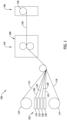
- a system for fabricating an elastic nonwoven material is indicated generally by 100.
- the illustrated system 100 includes a supply station indicated generally by 102, a processing station indicated generally by 104, and a collection station indicated generally by 106. Other suitable stations are also contemplated.
- the supply station 102 includes a plurality of supply rolls each containing a nonwoven fabric, namely a first supply roll 110 containing a first nonwoven fabric 112 and a second supply roll 114 containing a second nonwoven fabric 116.
- the supply station 102 also includes a plurality of supply spools each containing an elastic strand, namely a first supply spool 118 containing a first elastic strand 120, a second supply spool 122 containing a second elastic strand 124, a third supply spool 126 containing a third elastic strand 128, and a fourth supply spool 130 containing a fourth elastic strand 132.
- the elastic strands 120, 124, 128, 132 may have any suitable cross-sectional shape that facilitates enabling the elastic strands 120, 124, 128, 132 to function as described herein (e.g., a cross-sectional shape that is round, rectangular (e.g., relatively flat), square, etc.).
- the illustrated processing station 104 includes a rotary ultrasonic bonding apparatus (indicated generally by 200) for bonding the elastic strands 120, 124, 128, 132 between the nonwoven fabrics 112, 116 to make an elastic nonwoven material 134, as set forth in more detail below.
- the collection station 106 may include any suitable device(s) for collecting the elastic nonwoven material 134 (e.g., a puller roll 136).
- the supply station 102 may have any suitable quantity of supply rolls and supply spools having any suitable configuration that facilitates enabling the apparatus 200 to function as described herein.
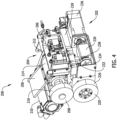
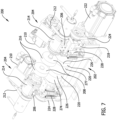
- Figures 2-7 are various examples of the rotary ultrasonic bonding apparatus 200 according to the claimed invention.
- the apparatus 200 has an anvil module 202 and a horn module 204 that cooperate to perform a bonding operation of the elastic strands 120, 124, 128, 132 between the nonwoven fabrics 112, 116 as set forth in more detail below.
- the horn module 204 includes a frame 206 on which are mounted a disc-like rotary horn 208, a motor 210 for driving rotation of the horn 208 via a suitable drive train 212, and a housing 214 which contains at least part of a vibration control unit (not shown) that causes the horn 208 to vibrate.
- the horn 208 has a face 216 with a substantially continuous contour (i.e., the horn face 216 has a contour that is substantially smooth (or uninterrupted) across its entire surface area). In other embodiments, the horn face 216 may have any suitable contour that facilitates enabling the horn 208 to function as described herein.
- the vibration control unit can include at least one booster (e.g., a drive booster and an integral booster) mechanically connected to a converter, which is electrically connectable to a generator.
- the converter is capable of converting high frequency electrical energy supplied by the generator into mechanical energy (or vibration) that is selectively transmitted to the horn 208 across the booster(s).
- the booster(s) are capable of modifying (i.e., increasing or decreasing) the vibration transmitted to the horn 208 from the converter, such that the horn 208 (particularly, the face 216 of the horn 208) vibrates while it rotates during a bonding operation, as set forth in more detail below.
- the horn module 204 may have any suitable operational components arranged in any suitable manner that facilitates enabling the horn 208 to function as described herein.
- the anvil module 202 includes a frame 218 on which are mounted a disc-like rotary anvil 220 and a motor 222 for driving rotation of the anvil 220 via a suitable drive train 224.
- the anvil 220 has an annular face 226, the contour of which is not continuous (i.e., is interrupted) as set forth in more detail below.
- the anvil module 202 is positioned relative to the horn module 204 such that the anvil face 226 is rotatable in close proximity to the horn face 216, and vice versa, to facilitate ultrasonically bonding the elastic strands 120, 124, 128, 132 between the nonwoven fabrics 112, 116 when the elastic strands 120, 124, 128, 132 are held in tension across apparatus 200, as set forth in more detail below.
- close proximity refers to when the anvil face 226 is either in contact with, or is minimally spaced apart from, the horn face 216 when the horn 208 is not ultrasonically vibrating.
- the apparatus 200 may be configured such that at least one of the anvil module 202 and the horn module 204 is displaceable relative to the other via a suitable displacement mechanism operable either: (A) when the system 100 is offline and the horn 208 is at rest (i.e., when the horn 208 is not rotating or vibrating); or (B) when the system 100 is online and the horn 208 is active (i.e., when the horn 208 is rotating and vibrating).
- the apparatus 200 may be configured as a continuous-nip apparatus in which the horn module 204 is to be: (A) fixed in position relative to the anvil module 202 when the system 100 is online and the horn 208 is active; and (B) displaceable relative to the anvil module 202 when the system 100 is offline and the horn 208 is at rest.
- Such displacement is facilitated by a selectively actuatable pneumatic cylinder 228 (or other suitable linear actuator) that connects the frames 206, 218 to one another.
- a selectively actuatable pneumatic cylinder 228 or other suitable linear actuator
- the apparatus 200 may also be configured as an intermittent-nip apparatus in which the horn module 204 is displaceable relative to the anvil module 202 via a rotary camming device 230 when the system 100 is online and the horn 208 is active.
- the rotary camming device 230 has a follower 232 mounted to the horn module frame 206, and a cam wheel 234 mounted to the anvil module frame 218 and rotatable via a servomotor 236.
- the cam wheel 234 has an irregular camming surface 238 such that, when the cam wheel 234 is rotated via the servomotor 236, the follower 232 rides along the irregular camming surface 238 to cyclically displace the horn module frame 206 relative to the anvil module frame 218 at a predetermined frequency. In this manner, the spacing between the horn face 216 and the anvil face 226, and/or the frequency at which the horn face 216 contacts the anvil face 226, are selectively adjustable. Other displaceable arrangements of the horn module 204 and the anvil module 202 are also contemplated without departing from the scope of this invention.
- the apparatus 200 of the claimed invention may also include a pinching device 260.
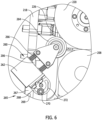
- the pinching device 260 includes a base 262 and a roller 264 floatingly mounted to the base 262 via at least one biasing element 266.
- the pinching device 260 also includes a bracket assembly 265 by which the base 262 and the roller 264 are mounted to at least one of the frame 206 and the frame 218, such that the base 262 and the roller 264 are adjustable in at least two degrees of freedom (as set forth in more detail below) in relation to the anvil 220 to facilitate use of the pinching device 260 in conjunction with anvils of different sizes.
- the illustrated bracket assembly 265 includes a first bracket 267 and a second bracket 268.
- the first bracket 267 has at least one linear slot 269 through which a bolt 271 (which is fixed to either the frame 206 of the horn module 204 or the frame 218 of the anvil module 202) extends, and along which the bolt 271 is slidable, thereby rendering the first bracket 267 translatable relative to the frame 206 and/or 218.
- the second bracket 268 has at least one substantially arcuate slot 272 through which a bolt 270 (which is fixed to the first bracket 267) extends, and along which the bolt 270 is slidable, thereby rendering the second bracket 268 rotatable relative to the first bracket 267.
- the base 262 is mounted to the second bracket 268 such that the base 262 (and, therefore, the roller 264) are rotatably adjustable in a first degree of freedom via rotation of the second bracket 268, and are translatably adjustable in a second degree of freedom via translation of the first bracket 267.
- the position of the base 262 and, therefore, the roller 264 are fixable via the bolt 270 and the bolt 271 to achieve a desired pinching contact between the roller 264 and the anvil face 226.
- the base 262 and the roller 264 are oriented such that the biasing element 266 applies a biasing force oriented substantially perpendicular to a rotation axis of the anvil 220 when viewed as in Figure 6 .
- the pinching device 260 may have any suitable components arranged and movable (e.g., translatable and/or rotatable) in any suitable manner that facilitates enabling the pinching device 260 to perform the pinching action described herein (e.g., on any suitable bracket assembly that facilitates enabling the base 262 and the roller 264 to be adjustable in at least two degrees of freedom such as, for example, two translating degrees of freedom, or one translating degree of freedom and one rotating degree of freedom).
- the pinching device 260 limits the snap-back potential of elastic strands 120, 124, 128, 132 that become severed between horn 208 and anvil 220 during a bonding operation. More specifically, the pinching device 260 effectively catches broken elastic strand(s) 120, 124, 128, 132 between the roller 264 and the anvil 220 to prevent the broken elastic strands 120, 124, 128, 132 from snapping back to their respective supply spool(s) 118, 122, 126, 130.
- any broken elastic strands 120, 124, 128, 132 are caught at the interface of roller 264 and anvil 220 and are automatically fed back into the interface between horn 208 and anvil 220.
- the pinching device 260 serves as a self-threading device for broken elastic strands 120, 124, 128, 132.
- the apparatus 200 may have any suitable quantity of anvil modules 202 and/or horn modules 204 that cooperate with one another to facilitate enabling the apparatus 200 to function as described herein.
- the apparatus 200 may be configured with an anvil drum 274 in which a pair of anvils 220 are positioned such that the drum 274 has a pair of predefined, annular faces 226 that are spaced apart from one another.
- the horn 208 of a separate horn module 204 is dedicated to each such anvil face 226, thereby facilitating a bonding operation on confined regions of larger nonwoven fabrics on which only partial elasticity is desired (e.g., segments of these larger nonwoven fabrics on which elasticity is not desired may move along non-contact regions 277 of the drum 274 to avoid interaction with the associated horn(s) 208).
- At least the following operational parameters contribute to minimizing the occurrence of elastic strands 120, 124, 128, 132 being cut during a bonding operation: (A) the specific energy source (e.g., the amplitude of vibration of the horn 208 and its pressure when contacting the anvil 220); (B) the energy director (e.g., the geometry of the anvil face 226); and (C) the material system (e.g., the decitex and tension of the elastic strands 120, 124, 128, 132, and the basis weight of the nonwoven fabrics 112, 116).
- the specific energy source e.g., the amplitude of vibration of the horn 208 and its pressure when contacting the anvil 220
- the energy director e.g., the geometry of the anvil face 226
- the material system e.g., the decitex and tension of the elastic strands 120, 124, 128, 132, and the basis weight of the nonwoven fabrics 112, 116.
- Figure 8 is a laid-flat illustration of an anvil face 226 of the apparatus 200.
- the anvil face 226 has a circumferential centerline axis 276 and a width dimension 278 oriented perpendicular to the axis 276.
- the contour of the anvil face 226 is irregular (i.e., not continuous) along the axis 276, in that the anvil face 226 defines a plurality of circumferentially spaced ridges 280.
- each adjacent pair of ridges 280 may have a spacing (or pitch) measured along the axis 276 of between about 2,54 mm (0,1 inch) and about 2,54 cm (1 inch) (e.g., between about 5,08 mm and about 12,7 mm). While all adjacent pairs of ridges 280 on the anvil face 226 are substantially equally spaced apart from one another, it is contemplated that the spacing between adjacent pairs of ridges 280 may vary along the axis 276.
- Each ridge 280 extends substantially linearly across the circumferential axis 276 so as to span substantially the entire width 278 of the anvil face 226.
- Each ridge 280 has an extension axis 282 oriented oblique to the circumferential axis 276.
- each ridge 280 includes a plurality of lands 284 spaced along its extension axis 282 such that each adjacent pair of lands 284 is spaced apart by (or flank) a notch 286.
- ridges 280 of anvil face 226 likewise have a set of lands 284 and notches 286 along their respective extension axes 282.
- adjacent ones of the lands 284 of each ridge 280 are shaped such that the corresponding notch 286 defined therebetween is oriented substantially parallel to the circumferential axis 276 (i.e., the ridges 284 and the notches 286 each have a lengthwise dimension 298 that is oriented substantially parallel to the circumferential axis 276) .
- each of the ridges 280 has at least one notch 286 that is aligned in the width dimension 278 with a corresponding notch 286 of each other ridge 280, and the lands 284 that flank each aligned notch 286 are spaced to create widthwise adjacent bonds in the nonwoven fabrics 112, 116 that are close enough together in the width dimension 278 to permanently hold the associated elastic strand 120, 124, 128, 132 in tension therebetween.
- the bonding operation is complete and the nonwoven fabrics 112, 116 are removed from the system 100, at least one of the elastic strands 120, 124, 128, 132 is subsequently permitted to contract between circumferentially adjacent rows of bonds, but not between the widthwise adjacent bonds through which the elastic strand(s) 120, 124, 128, 132 extend.
- the entrapment bonding operation is therefore said to be continuous in the sense that at least one of the elastic strands 120, 124, 128, 132 is caused to be permanently held in tension between each widthwise adjacent pair of bonds through which it extends.
- the lands 284 and the notches 286 of each ridge 280 have sizes (and, therefore, spacings) relative to one another that are substantially the same as those of all other ridges 280 on the anvil face 226.
- the notches 286 are generally U-shaped or generally V-shaped, such that the sidewalls of the lands 284 that flank each notch 286 may, when viewed from a cross-sectional profile of the notch 286 as shown in Figure 9 , form a wedge angle therebetween of about 0° (i.e., the sidewalls may be about parallel to one another) and about 140° (e.g., between about 60° and about 100°). Notches 286 of other shapes are also contemplated.
- the lands 284 may have lengths at their peaks of between about 0,254 mm and about 6,35 mm (0,01 inch, 0,25 inch) (e.g., between about 0,762 mm and about 1,524 mm (0,03 and 0,06 inch)), and widths at their peaks of between about 0,203 mm and 1,27 mm (0,008 and 0,05 inch) (e.g., between about 0,254 mm and about 0,762 mm (0,01 and 0,03 inch).
- the notches 286 may have: depths measured from the peaks of their flanking lands 284 of between about 0,127 mm and about 0,508 mm (0,005 and 0,02 inch) (e.g., between about 0,178 mm and about 0,254 mm (0,007 and 0,01 inch)); widths measured at the peaks of their flanking lands 284 of between about 0,152 mm and about 0,406 mm (0,006 and 0,016 inch) (e.g., between about 0,203 mm and about 0,305 mm (0,008 and 0,012 inch)); and widths measured at their bases of between about 0,064 mm and about 0,254 mm (0,0025 and 0,01 inch) (e.g., between about 0,076 mm and about 0,127 mm (0,003 and 0,005 inch)).
- the anvil face 226 facilitates improved gripping of the elastic strands 120, 124, 128, 132 in the notches 286 and, therefore, facilitates preventing the elastic strands 120, 124, 128, 132 from withdrawing out of the notches 286 to reduce the occurrence of severed elastic strands 120, 124, 128, 132.
- Other suitable sizes for the lands 284 and the notches 286 are also contemplated.
- the anvil face 226 may be configured for an intermittent entrapment bonding operation, such that the lands 284 that flank at least one of the notches 286 are spaced to create widthwise adjacent bonds in the nonwoven fabrics 112, 116 that are not close enough together in the width dimension 278 to permanently hold the associated elastic strand 120, 124, 128, 132 in tension therebetween.
- the corresponding elastic strand 120, 124, 128, 132 is subsequently permitted to contract between the widthwise adjacent bonds through which it extends such that its tension between those widthwise adjacent bonds is substantially relieved.
- the entrapment bonding operation is therefore said to be intermittent in the sense that at least one of the elastic strands 120, 124, 128, 132 is not permanently held in tension between all pairs of widthwise adjacent bonds through which it extends.
- the anvil face 226 may be provided with a plurality of distinct circumferential regions 288 such that a dimension of a notch 286 (and, therefore, the lands 284 that flank it) on a ridge 280 in at least one circumferential region 288 is different than a dimension of a widthwise aligned notch 286 (and, therefore, the lands 284 that flank it) on a ridge 280 in at least one other circumferential region 288.
- each ridge 280 in a plurality of first circumferential regions 290, 296 may have at least one notch 286 that is sized differently as compared to at least one notch 286 that is widthwise aligned therewith on ridges 280 in a plurality of second circumferential regions 292, 294 interspaced between the first circumferential regions 290, 296.
- the notches 286 may be sized with larger widths (like in Figure 9 ) such that the elastic strands 120, 124, 128, 132 do not later become entrapped across (i.e., are later permitted to slip between) the widthwise adjacent bonds created at widthwise adjacent lands 284 on ridges 280 in these first circumferential regions 290, 296.
- the notches 286 may be sized with smaller widths (like in Figure 10 ) such that the elastic strands 120, 124, 128, 132 later become entrapped across (i.e., are not later permitted to slip between) the widthwise adjacent bonds created at widthwise adjacent lands 284 on ridges 280 in the second circumferential regions 292, 294.
- At least one ridge 280 in each second circumferential region 292, 294 may have its notches 286 sized in the manner set forth above for the continuous entrapment example, while at least one ridge 280 in each first circumferential region 290, 296 may have its notches 286 sized with a width (as measured at the peaks of its flanking lands 284) of between about 0,254 mm and about 6,35 mm (0,01 and 0,25 inch) (e.g., between about 0,762 mm and about 1,52 mm (0,03 and 0,06 inch) in some embodiments; or about 0.035 inches in one particular embodiment).
- the anvil face 226 may have a plurality of distinct widthwise segments 281, wherein each widthwise segment 281 has lands 284 and/or notches 286 of comparatively different sizes.
- the anvil face 226 may have a first widthwise segment 283 with lands 284 that define notches 286 of a first width to suit elastic strands 120, 124, 128, 132 of a first decitex, and a second widthwise segment 285 with lands 284 that define notches 286 of a second width that is less than the first width to suit elastic strands 120, 124, 128, 132 of a second decitex that is less than the first decitex.
- each widthwise segment 281 no matter whether it is configured for continuous or intermittent entrapment, may be sized to accommodate elastic strands 120, 124, 128, 132 of different sizes.
- the anvil face 226 may have ridges 280 that extend non-linearly across the circumferential axis 276.
- the anvil face 226 may define a plurality of ridges 280 each with a curvilinear axis (e.g., a substantially arcuate axis 287).
- these non-linear ridges 280 may have the same dimensions for the lands 284 and the notches 286 as for the substantially linearly extending ridges 280 set forth above, including the same dimensional variations amongst circumferential and widthwise regions 288, 281 as is set forth above with respect to the substantially linearly extending ridges 280.
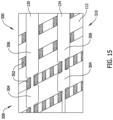
- Figure 15 illustrates an elastic nonwoven material 300 fabricated using the system 100.
- An intermittent entrapment bonding process was performed on the nonwoven fabrics 112, 116 (with elastic strands 120, 124 sandwiched therebetween) using one of the examples of the apparatus 200 set forth above.
- the anvil 220 utilized to fabricate the material 300 has an anvil face 226 with notches 286 that vary in size across circumferential regions 288 as set forth above. In this manner, with the nonwoven fabrics 112, 116 and the elastic strands 120, 124 held in tension across the apparatus 200, the horn face 216 and the anvil face 226 created bonds 302 at locations corresponding to the lands 284 of the anvil face 226.
- each elastic strand 120, 124 was partly relieved such that segments of each elastic strand 120, 124 were permitted to contract to create material 300. More specifically, a first segment 304 of each elastic strand 120, 124 became entrapped between adjacent rows of bonds 302 that corresponded to the ridges 280 which defined notches 286 of smaller widths. Whereas, a second segment 306 of each elastic strand 120, 124 was permitted to slip across widthwise adjacent bonds 302 in rows that corresponded to the ridges 280 which defined notches 286 of larger widths.
- the nonwoven fabrics 112, 116 were caused to gather in areas 308 of the material 300 that have widthwise adjacent bonds 302 of closer spacing (but not in areas 310 that have widthwise adjacent bonds 302 of greater spacing) to effectively provide the material 300 with an elastic property.
- the material 300 would not have second segments 306 that are permitted to slip, but would instead only have first segments 304 such that the nonwoven fabrics 112, 116 would gather along the entire material 300.
- the rotary ultrasonic bonding systems and methods set forth herein are utilized to directly entrap tensioned elastic within a nonwoven fabric without the use of adhesives, thereby providing various functional and commercial advantages.
- the systems and methods eliminate the complex adhesive delivery systems and costly adhesive materials associated with adhesive bonding processes, and the systems and methods provide a simpler, cleaner, and safer (e.g., cooler in temperature) production environment, with lower power consumption and lower material costs.
- various functional deficiencies of adhesively bonded materials are eliminated, including adhesive bleed-through, stiffening, and creep that are common in conventional adhesively bonded materials.
- lower-cost nonwoven/film substrates and elastic materials can be utilized.
- the systems and methods set forth herein facilitate a more continuous production sequence (i.e., increased process uptime) due, at least in part, to the lack of: adhesive-related cleaning operations; adhesive system delivery/reliability issues; heated equipment cooldown periods in advance of maintenance events; cold-start periods; and re-heat or purge-calibrate events. Additionally, a more continuous production sequence is further facilitated by the automatic threading (or self-threading) of severed elastic strands when the system is online, as well as the use of continuously-running, over-the-end elastic spools.
- systems and methods set forth herein are usable to attach (e.g., entrapment) elastic strands while also performing other elastic processing steps such as cutting/chopping processes, seaming processes, edge trimming processes, etc.
- the systems and methods are further adaptable to existing capital asset bases to provide retrofit capability (with customizable configurations if desired), as well as quicker grade-change capability as the attachment zone length changes via a software interface.
- the systems and methods also facilitate maximizing elastic performance.
- the systems and methods facilitate lowering tension at elongation as compared to other attachment methods (e.g., the systems and methods can provide a nearly pure elastic response for stress vs. strain when at least some substrates are utilized).
- the systems and methods also facilitate minimizing creep (or loss of performance) (e.g., the systems and methods produce elastic materials that are more robust in the face of temperature, time, and end-user solvents (e.g., emollients)) due, at least in part, to the fact that the elastic strands can be entrapped in a thermoplastic substrate, as opposed to being attached to a substrate with a susceptible intermediate binder material.
- gathers are produced by a bonding pattern and/or strand-feed positioning such that size, shape, and frequency are selectable.
- zoned tension is enabled, in that tension can be controlled by an elastic segment depending upon the desired fabric configuration (e.g., depending upon the desired cross-direction orientation within fabric (among lanes) and/or longitudinal orientation within fabric (within lanes)). Curved attachment is also facilitated if desired.
- controlled slip/creep for adjustable fit is facilitated, with intermittent or continuous attachment of elastic to the substrate being selectable to enable placement/zoning of live elastic and non-elasticized segments.
- non-rotary systems of attachment e.g., stationary (or blade) ultrasonic horns, heat, pressure, etc.
- adhesive systems may be usable.
- latent elastics may be usable instead of tensioned elastics in some embodiments. Then too, the systems and methods facilitate curving (or shifting) elastic strands with less occurrence of breakage, and the systems and methods further facilitate generating a matrix of tensions (e.g., a checkerboard effect), differential ruffling, dead zones, and/or simultaneous incorporation of elastic strands of different decitex.
- the systems and methods described herein facilitate fabricating a variety of elastic nonwoven materials usable in a variety of articles such as personal care articles (e.g., adult briefs, baby diapers, child/adult pull-on pants, contour fit hygiene products, etc.) or medical garments (e.g., masks, caps, gowns, footwear, etc.).
- personal care articles e.g., adult briefs, baby diapers, child/adult pull-on pants, contour fit hygiene products, etc.
- medical garments e.g., masks, caps, gowns, footwear, etc.
- individual components e.g., scrim/netting, diaper ears, discreet panels, etc.
- Other contemplated products in which the nonwoven materials can be utilized include thermal insulation or filters (e.g., associated ruffling or blousing), as well as elastic-topped garbage bags, non-adhesive bandages, hair nets, house wrap, etc.
Landscapes
- Engineering & Computer Science (AREA)
- Mechanical Engineering (AREA)
- Textile Engineering (AREA)
- Physics & Mathematics (AREA)
- Fluid Mechanics (AREA)
- Health & Medical Sciences (AREA)
- Vascular Medicine (AREA)
- General Health & Medical Sciences (AREA)
- Biomedical Technology (AREA)
- Heart & Thoracic Surgery (AREA)
- Manufacturing & Machinery (AREA)
- Life Sciences & Earth Sciences (AREA)
- Animal Behavior & Ethology (AREA)
- Epidemiology (AREA)
- Public Health (AREA)
- Veterinary Medicine (AREA)
- Absorbent Articles And Supports Therefor (AREA)
- Lining Or Joining Of Plastics Or The Like (AREA)
- Treatment Of Fiber Materials (AREA)
- Nonwoven Fabrics (AREA)
- Perforating, Stamping-Out Or Severing By Means Other Than Cutting (AREA)
Claims (14)
- Vorrichtung (200) zur Herstellung eines elastischen Vliesstoffs, wobei die genannte Vorrichtung umfasst:eine rotierende Ultraschall-Sonotrode (208); undeinen rotierenden Amboss (220), der in nächster Nähe zu der rotierenden Ultraschall-Sonotrode positionierbar ist, wobei der rotierende Amboss eine Seitenfläche (226) mit einer Breite und einer Umfangsachse (276) aufweist, wobei die Seitenfläche eine Vielzahl von Rippen (280) aufweist, von denen jede eine Vielzahl von voneinander beabstandeten Erhöhungen (284) und Aussparungen (268) definiert, wobei sich die Rippen schräg über die Umfangsachse erstrecken und die Aussparungen im Wesentlichen parallel zu der Umfangsachse ausgerichtet sind.
- Vorrichtung nach Anspruch 1, wobei sich die Rippen über im Wesentlichen die gesamte Breite der Seitenfläche erstrecken.
- Vorrichtung nach Anspruch 1, wobei alle Paare benachbarter Rippen auf der Seitenfläche entlang der Umfangsachse im Wesentlichen gleich voneinander beabstandet sind.
- Vorrichtung nach Anspruch 1, wobei ein Paar benachbarter Rippen eine entlang der Umfangsachse gemessene Beabstandung zwischen etwa 2,54 mm (0,1 Zoll) und etwa 2,54 cm (1 Zoll) aufweist.
- Vorrichtung nach Anspruch 1, wobei die Seitenfläche eine erste Umfangsregion mit Rippen, die Aussparungen einer ersten Größe definieren, und eine zweite Umfangsregion mit Rippen, die Aussparungen einer von der ersten Größe verschiedenen, zweiten Größe definieren, aufweist.
- Vorrichtung nach Anspruch 1, wobei die Seitenfläche eine erste Region in Breitenrichtung, in der die Rippen Aussparungen einer ersten Größe definieren, und eine zweite Region in Breitenrichtung, in der die Rippen Aussparungen einer von der ersten Größe verschiedenen, zweiten Größe definieren, aufweist.
- Vorrichtung nach Anspruch 1, wobei sich die Rippen nichtlinear über die Umfangsachse erstrecken.
- Vorrichtung nach Anspruch 1, die ferner umfasst:ein Sonotrodenmodul (204) mit der rotierenden Ultraschall-Sonotrode (208), das an einem Rahmen (206) montiert ist,ein Ambossmodul (202) mit dem rotierenden Amboss (220), das an einem Rahmen montiert ist und in nächster Nähe zu der Ultraschall-Sonotrode positionierbar ist, undeine Kurvengetriebevorrichtung (230), die das Sonotrodenmodul und das Ambossmodul verlagerbar verbindet, um das Sonotrodenmodul während eines Bindevorgangs der Vorrichtung relativ zu dem Ambossmodul zyklisch zu verlagern.
- Vorrichtung nach Anspruch 8, wobei die Kurvengetriebevorrichtung eine am Rahmen des Ambossmoduls montierte rotierende Kurvenscheibe aufweist.
- Vorrichtung nach Anspruch 9, die ferner einen ersten Motor, mit dem die Ultraschall-Sonotrode drehbar verbunden ist, einen zweiten Motor, mit dem der Amboss drehbar verbunden ist, und einen Servomotor, mit dem die Kurvenscheibe drehbar verbunden ist, umfasst.
- Vorrichtung nach Anspruch 1, die ferner umfasst:ein Sonotrodenmodul (204) mit der rotierenden Ultraschall-Sonotrode (208), das an einem Rahmen (206) montiert ist,ein Ambossmodul (202) mit dem rotierenden Amboss (220), das an einem Rahmen (206) montiert und in nächster Nähe zu der Ultraschall-Sonotrode positionierbar ist, undeine Andruckvorrichtung (260), die an einem von dem Rahmen des Sonotrodenmoduls und dem Rahmen des Ambossmoduls montiert ist, so dass die Andruckvorrichtung positionierbar ist, um mit dem Amboss schwimmend in Kontakt zu sein.
- Vorrichtung nach Anspruch 11, wobei die Andruckvorrichtung eine Rolle (264) beinhaltet, die mit dem Amboss schwimmend in Kontakt ist.
- Vorrichtung nach Anspruch 12, wobei die Andruckvorrichtung eine Basis und ein Vorspannelement, durch das die Rolle an der Basis schwimmend montiert ist, beinhaltet.
- Vorrichtung nach Anspruch 11, wobei die Andruckvorrichtung in mindestens zwei Freiheitsgraden verstellbar ist.
Priority Applications (1)
| Application Number | Priority Date | Filing Date | Title |
|---|---|---|---|
| EP24207580.2A EP4520508A1 (de) | 2015-04-01 | 2016-03-29 | Vorrichtung zur herstellung eines elastischen vliesstoffes |
Applications Claiming Priority (5)
| Application Number | Priority Date | Filing Date | Title |
|---|---|---|---|
| US201562141496P | 2015-04-01 | 2015-04-01 | |
| US201562235880P | 2015-10-01 | 2015-10-01 | |
| US201562247056P | 2015-10-27 | 2015-10-27 | |
| US14/951,884 US10259165B2 (en) | 2015-04-01 | 2015-11-25 | Apparatus for fabricating an elastic nonwoven material |
| PCT/US2016/024617 WO2016160752A1 (en) | 2015-04-01 | 2016-03-29 | Apparatus for fabricating an elastic nonwoven material |
Related Child Applications (1)
| Application Number | Title | Priority Date | Filing Date |
|---|---|---|---|
| EP24207580.2A Division EP4520508A1 (de) | 2015-04-01 | 2016-03-29 | Vorrichtung zur herstellung eines elastischen vliesstoffes |
Publications (3)
| Publication Number | Publication Date |
|---|---|
| EP3277480A1 EP3277480A1 (de) | 2018-02-07 |
| EP3277480A4 EP3277480A4 (de) | 2019-03-13 |
| EP3277480B1 true EP3277480B1 (de) | 2024-10-23 |
Family
ID=57006255
Family Applications (2)
| Application Number | Title | Priority Date | Filing Date |
|---|---|---|---|
| EP16773958.0A Active EP3277480B1 (de) | 2015-04-01 | 2016-03-29 | Vorrichtung zur herstellung eines elastischen vliesstoffes |
| EP24207580.2A Pending EP4520508A1 (de) | 2015-04-01 | 2016-03-29 | Vorrichtung zur herstellung eines elastischen vliesstoffes |
Family Applications After (1)
| Application Number | Title | Priority Date | Filing Date |
|---|---|---|---|
| EP24207580.2A Pending EP4520508A1 (de) | 2015-04-01 | 2016-03-29 | Vorrichtung zur herstellung eines elastischen vliesstoffes |
Country Status (10)
| Country | Link |
|---|---|
| US (5) | US10259165B2 (de) |
| EP (2) | EP3277480B1 (de) |
| JP (2) | JP6748702B2 (de) |
| KR (1) | KR102440822B1 (de) |
| CN (2) | CN112157914B (de) |
| BR (1) | BR112017020571B1 (de) |
| ES (1) | ES2999142T3 (de) |
| MX (2) | MX2017012569A (de) |
| PL (1) | PL3277480T3 (de) |
| WO (1) | WO2016160752A1 (de) |
Families Citing this family (33)
| Publication number | Priority date | Publication date | Assignee | Title |
|---|---|---|---|---|
| DK2678149T3 (en) | 2011-02-24 | 2018-09-03 | Cmd Corp | METHOD AND APPARATUS FOR PREPARING BAGS USING ULTRA SOUND SEALS |
| US10792194B2 (en) | 2014-08-26 | 2020-10-06 | Curt G. Joa, Inc. | Apparatus and methods for securing elastic to a carrier web |
| KR20170099935A (ko) * | 2014-12-29 | 2017-09-01 | 인비스타 텍스타일스 (유.케이.) 리미티드 | 탄성 섬유의 초음파 본딩 |
| US10259165B2 (en) * | 2015-04-01 | 2019-04-16 | Aurizon Ultrasonics, LLC | Apparatus for fabricating an elastic nonwoven material |
| US10537479B2 (en) | 2016-09-15 | 2020-01-21 | Curt G. Joa, Inc. | Dual bonder |
| MX387594B (es) * | 2016-09-30 | 2025-03-18 | Dukane Ias Llc | Aparato para fabricar un material elastico no tejido |
| US10973699B2 (en) | 2016-12-20 | 2021-04-13 | The Procter & Gamble Company | Methods and apparatuses for making elastomeric laminates with elastic strands unwound from beams |
| EP4382296A3 (de) | 2017-02-28 | 2024-08-28 | Kimberly-Clark Worldwide, Inc. | Elastifizierte materialien mit gerichteten dehnungseigenschaften |
| CN110536793B (zh) | 2017-04-28 | 2021-02-05 | 金伯利-克拉克环球有限公司 | 具有非连续通道的弹性化材料 |
| EP3675785B1 (de) | 2017-09-01 | 2021-11-10 | The Procter & Gamble Company | Verfahren und vorrichtung zur herstellung elastomerer laminate |
| WO2019060206A1 (en) | 2017-09-20 | 2019-03-28 | Triangle Package Machinery Co. | VERTICAL MACHINE FOR FORMING, FILLING AND SEALING WITH ULTRASONIC VERTICAL SEALING AND REFERMABLE ATTACHMENT ATTACHMENT |
| JP6503432B1 (ja) | 2017-10-04 | 2019-04-17 | ユニ・チャーム株式会社 | 伸縮性シート及び吸収性物品 |
| US11684522B2 (en) | 2017-10-31 | 2023-06-27 | Kimberly-Clark Worldwide, Inc. | Elastic laminates with curved elastics and methods for manufacturing |
| RU2734204C1 (ru) | 2017-10-31 | 2020-10-13 | Кимберли-Кларк Ворлдвайд, Инк. | Эластичные слоистые материалы с изогнутыми резинками и способы изготовления |
| RU2735227C1 (ru) | 2017-12-19 | 2020-10-29 | Кимберли-Кларк Ворлдвайд, Инк. | Впитывающие изделия с визуально разными основой и поясными лентами |
| EP3746021B1 (de) | 2018-01-29 | 2024-01-31 | Curt G. Joa, Inc. | Vorrichtung und verfahren zur herstellung einer elastischen verbundstruktur für ein absorbierendes hygieneprodukt |
| US12616617B2 (en) | 2018-12-31 | 2026-05-05 | Curt G. Joa, Inc. | Apparatus and method of manufacturing an elastic composite structure for an absorbent sanitary product |
| US11925538B2 (en) | 2019-01-07 | 2024-03-12 | Curt G. Joa, Inc. | Apparatus and method of manufacturing an elastic composite structure for an absorbent sanitary product |
| US11254066B2 (en) | 2019-03-22 | 2022-02-22 | Dukane Ias, Llc | Apparatus for fabricating an elastic nonwoven material |
| US12433797B2 (en) | 2019-09-04 | 2025-10-07 | Curt G. Joa, Inc. | Elastic entrapment with waist cap bonding |
| US11173072B2 (en) | 2019-09-05 | 2021-11-16 | Curt G. Joa, Inc. | Curved elastic with entrapment |
| DE102019124006A1 (de) | 2019-09-06 | 2021-03-11 | Herrmann Ultraschalltechnik Gmbh & Co. Kg | Vorrichtung und Verfahren zur Herstellung eines gerafften oder raffbaren Materials |
| MX2022010076A (es) | 2020-02-17 | 2022-09-02 | Joa Curt G Inc | Estructura compuesta elastica para un producto sanitario absorbente, y aparato y metodo para fabricar la estructura compuesta elastica. |
| US11090758B1 (en) | 2020-04-30 | 2021-08-17 | Dukane Ias, Llc | Systems and methods using multiple synchronized ultrasonic transducers to finish a part |
| US20220024142A1 (en) * | 2020-07-21 | 2022-01-27 | Gvn Group Corp. | Machine and system configured to manufacture a mask |
| JP7488158B2 (ja) * | 2020-09-11 | 2024-05-21 | 花王株式会社 | 伸縮性シートの製造方法、該伸縮性シート、及び該伸縮性シートの製造装置 |
| JP7481211B2 (ja) * | 2020-09-11 | 2024-05-10 | 花王株式会社 | 伸縮性シートの製造方法、該伸縮性シート、及び該伸縮性シートの製造装置 |
| US11407182B1 (en) * | 2021-08-11 | 2022-08-09 | Dukane Ias, Llc | Depth control of seal line penetration for rotary ultrasonic horn/anvil welding without mechanical stop |
| CN117794722A (zh) | 2021-08-16 | 2024-03-29 | 杜肯Ias有限责任公司 | 使用超声换能器和刮擦焊头运动来密封零件的系统和方法 |
| EP4652030A1 (de) | 2023-10-11 | 2025-11-26 | Dukane IAS, LLC | Vorrichtung und verfahren zum einschliessen eines elastomeren materials mit formschlüssigen elastomeren bereichen |
| WO2025199056A2 (en) | 2024-03-18 | 2025-09-25 | Dukane Ias, Llc | An apparatus and a method for bonding webs of non-woven plastic material |
| WO2025237663A1 (en) | 2024-05-15 | 2025-11-20 | Ilapak International S.A. | Method and equipment for ultrasonic sealing of a continuous sheet |
| WO2025260101A1 (en) * | 2024-06-14 | 2025-12-18 | Dukane Ias, Llc | Apparatus and methods for non-continuous (intermittent) elastic entrapment |
Family Cites Families (123)
| Publication number | Priority date | Publication date | Assignee | Title |
|---|---|---|---|---|
| US1588018A (en) | 1925-05-27 | 1926-06-08 | American Clay Products Company | Clay-cutting apparatus |
| FR2285975A1 (fr) | 1974-09-26 | 1976-04-23 | Mortreux Bernard | Appareil pour le soudage aux ultrasons de plusieurs feuilles et le complexe ainsi obtenu |
| US3993532A (en) * | 1974-11-11 | 1976-11-23 | Consolidated Engravers Corporation | Ultrasonic sealing pattern roll |
| US4146416A (en) | 1977-11-14 | 1979-03-27 | Crompton & Knowles Corporation | Apparatus for vibration welding of material |
| US4333978A (en) | 1979-03-29 | 1982-06-08 | Walter Kocher | Method and apparatus for producing a composite material having ultrasonically welded seams which confine strands |
| US4305988A (en) | 1979-03-29 | 1981-12-15 | Koecher Walter | Composite material comprising ultrasonically welded seams which combine strands, method for its manufacture, and apparatus for the carrying out of the method |
| DE2928941A1 (de) | 1979-07-18 | 1981-02-05 | Walter Dr Koecher | Verbundstoff, verfahren zu dessen herstellung und vorrichtung zur durchfuehrung des verfahrens |
| US4400227A (en) * | 1982-01-26 | 1983-08-23 | The Procter & Gamble Company | Dynamic ultrasonic laminating apparatus having post-bonding pressure roll, and concomitant method |
| US4430148A (en) | 1982-04-27 | 1984-02-07 | The Procter & Gamble Company | Ultrasonic bonding apparatus |
| CA1211745A (en) | 1984-11-15 | 1986-09-23 | Carlo Bianco | Method and apparatus for forming tensioned elastic elements |
| US4650530A (en) | 1986-03-10 | 1987-03-17 | Kimberly-Clark Corporation | Apparatus and method for folding, bonding and severing a web |
| JPS62225323A (ja) | 1986-03-27 | 1987-10-03 | Yuuwa Sangyo Kk | 超音波接着装置 |
| US4767492A (en) * | 1986-04-18 | 1988-08-30 | Pola Chemical Industries, Inc. | Ultrasonic fuse-bonding sealing apparatus with improved contact surfaces |
| JPS62246717A (ja) * | 1986-04-18 | 1987-10-27 | Pola Chem Ind Inc | チユ−ブ容器の底部シ−ル用超音波シ−ル装置 |
| US4713132A (en) | 1986-05-08 | 1987-12-15 | Kimberly-Clark Corporation | Apparatus and method for ultrasonic bonding of a moving web |
| US4758293A (en) | 1986-06-25 | 1988-07-19 | Kimberly-Clark Corporation | Ultrasonic bonding apparatus and method |
| US5000806A (en) | 1988-04-19 | 1991-03-19 | Paper Converting Machine Company | Method and apparatus for applying an elastic strand to a disposable diaper |
| US6340782B1 (en) | 1989-10-04 | 2002-01-22 | Sca Hygiene Products Aktiebolag | Method of securing an elastic band and an article that includes such an elastic band |
| SE500791C2 (sv) | 1989-10-04 | 1994-09-05 | Moelnlycke Ab | Sätt att förankra ett elastiskt band mellan två materialskikt, förankrat elastiskt band samt blöja innehållande bandet |
| US6309487B1 (en) | 1989-11-28 | 2001-10-30 | Robert M. Herrin | Disposable garments and method and apparatus for making |
| JPH04126593A (ja) | 1990-09-17 | 1992-04-27 | Shikoku Chem Corp | 廃水処理装置における糸状細菌性バルキングを解消する方法 |
| JP3112710B2 (ja) | 1991-07-15 | 2000-11-27 | ユニ・チャーム株式会社 | パンツ型着用物品の接合方法およびその装置 |
| CA2097630A1 (en) * | 1992-12-29 | 1994-06-30 | Ann Louise Mccormack | Stretch-pillowed, bulked laminate |
| US5325555A (en) | 1993-04-09 | 1994-07-05 | Perfect Fit Industries, Inc. | Inelastic mattress covering with an elastic underskirt |
| US5421924A (en) | 1993-12-02 | 1995-06-06 | Paper Converting Machine Company | Apparatus and method for ultrasonic sealing disposable diapers |
| CA2130426A1 (en) | 1994-03-14 | 1995-09-15 | David Peter Kielpikowski | Containment flap construction |
| EP0685586A3 (de) | 1994-05-26 | 1996-02-28 | Int Paper Co | Einweg-dehnbare elastomerer dreischichtiger Verbundstoff und Verfahren zur dessen Herstellung. |
| US5525175A (en) | 1994-05-27 | 1996-06-11 | Kimberly-Clark Corporation | Apparatus and method for applying a curved elastic to a moving web |
| US5681302A (en) | 1994-06-14 | 1997-10-28 | Minnesota Mining And Manufacturing Company | Elastic sheet-like composite |
| US5660657A (en) | 1995-01-31 | 1997-08-26 | Kimberly-Clark Worldwide, Inc. | Composite method for fabricating garments |
| US5660679A (en) | 1995-01-31 | 1997-08-26 | Kimberly-Clark Worldwide, Inc. | Rotary sealing system |
| US5733411A (en) * | 1995-12-21 | 1998-03-31 | Kimberly-Clark Corporation | Ultrasonic system |
| FR2745987B1 (fr) | 1996-03-15 | 1998-06-12 | Coulisse de froncage et son procede de fabrication | |
| JP3119443B2 (ja) * | 1996-10-08 | 2000-12-18 | 花王株式会社 | 使い捨ておむつ |
| EP1346818B1 (de) | 1996-12-20 | 2011-07-20 | Kimberly-Clark Worldwide, Inc. | Verfahren zum Ultraschallschweissen über die volle Breite |
| JP3204196B2 (ja) | 1997-03-31 | 2001-09-04 | ブラザー工業株式会社 | 超音波溶着溶断装置 |
| EP0943305B1 (de) | 1998-03-19 | 2003-09-10 | Fameccanica. Data S.p.A. | Vorrichtung zum Schneiden bestimmter Längen von blattförmigen Elementen, insbesondere zum Herstellen von Sanitärprodukten |
| JPH11291376A (ja) | 1998-04-06 | 1999-10-26 | Mitsui Chem Inc | 透湿性シートの製造方法 |
| US6123792A (en) | 1998-08-14 | 2000-09-26 | Kimberly-Clark Worldwide, Inc. | Methods and apparatus for intermittent rotary ultrasonic bonding system |
| JP2000080552A (ja) | 1998-08-31 | 2000-03-21 | Unitika Ltd | 伸縮性長繊維不織布及びその製造方法 |
| EP0997123A1 (de) | 1998-10-30 | 2000-05-03 | Fameccanica. Data S.p.A. | Verfahren und Vorrichtung zum Anbringen von laminierten Elementen auf eine Unterlage |
| EP0999139A3 (de) | 1998-11-03 | 2001-07-18 | Klockner Bartelt, Inc. | Siegelvorrichtung für Verpackungsmaschine |
| IT1308626B1 (it) | 1999-02-23 | 2002-01-09 | Albina Magni | Procedimento per la realizzazione di un pannolone per disabili oincontinenti e pannolone ottenuto con tale procedimento. |
| US6165298A (en) * | 1999-04-30 | 2000-12-26 | Kimberly-Clark Worldwide, Inc. | Patterned anvil-roll |
| EP1054092A1 (de) | 1999-05-17 | 2000-11-22 | Nippon Petrochemicals Company, Limited | Elastische Verbundfolie, elastisches Verbundband aus thermoplastischem Elastomer, Verfahren und Vorrichtung |
| GB2378920B (en) | 2000-05-15 | 2004-12-01 | Kimberly Clark Co | Targeted elastic laminate |
| US6368437B1 (en) | 2000-06-16 | 2002-04-09 | Paper Converting Machine Company | Rotary bonding apparatus and method |
| CA2439810C (en) | 2001-03-28 | 2006-10-31 | Akihide Ninomiya | Sealing apparatus and manufacturing process of soft article having sealed portion |
| US6574944B2 (en) | 2001-06-19 | 2003-06-10 | Mars Incorporated | Method and system for ultrasonic sealing of food product packaging |
| US20030089447A1 (en) | 2001-11-06 | 2003-05-15 | Kenneth Molee | Soft absorbent garment made with discretely coated elastic elements, and system and method for making a soft absorbent garment |
| US6620270B2 (en) | 2001-12-18 | 2003-09-16 | Kimberly-Clark Worldwide, Inc. | Control of processing force and process gap in rigid rotary ultrasonic systems |
| ATE442242T1 (de) | 2001-12-28 | 2009-09-15 | Sca Hygiene Prod Ab | Elastische bahn und verfahren und vorrichtung für ihre herstellung sowie saugfähiger wegwerfartikel mit einer elastischen bahn |
| MXPA05000105A (es) | 2002-07-02 | 2005-04-08 | Kimberly Clark Co | Laminados compuestos elastomericos reforzados con hilo, prendas que incluyen los laminados y metodos para hacer los laminados. |
| JP4297715B2 (ja) * | 2003-03-31 | 2009-07-15 | ユニ・チャーム株式会社 | シール装置および前記シール装置を用いたシール方法 |
| DE10319754A1 (de) | 2003-04-30 | 2004-12-02 | Carl Freudenberg Kg | Elastischer Verbundstoff, Verfahren zu dessen Herstellung und dessen Verwendung |
| TWI320769B (en) | 2003-07-21 | 2010-02-21 | Ima Spa | A device for sealing lengths of filter paper |
| JP3883530B2 (ja) | 2003-09-08 | 2007-02-21 | 花王株式会社 | 複合伸縮部材及びその製造方法 |
| JP4535771B2 (ja) | 2004-05-14 | 2010-09-01 | 花王株式会社 | 複合伸縮部材及びその製造方法 |
| EP1666178B1 (de) | 2003-09-08 | 2017-05-24 | Kao Corporation | Dehnbares verbundglied und herstellungsverfahren dafür |
| JP4322140B2 (ja) | 2004-01-30 | 2009-08-26 | 花王株式会社 | 複合伸縮部材及びその製造方法 |
| ATE473718T1 (de) | 2003-10-02 | 2010-07-15 | Procter & Gamble | Absorbierender artikel mit elastomerischem material |
| US7222654B2 (en) | 2004-04-30 | 2007-05-29 | The Procter & Gamble Company | Apparatus for producing elastomeric nonwoven laminates |
| FR2874188B1 (fr) * | 2004-08-10 | 2007-12-28 | Texti Sonics Soc Par Actions S | Procede et dispositif pour travailler une bande de matiere par ultrasons |
| US20060069373A1 (en) | 2004-09-30 | 2006-03-30 | Kimberly-Clark Worldwide, Inc. | Ultrasonic attachment of an elastic strand |
| KR101197995B1 (ko) * | 2005-01-03 | 2012-11-05 | 쓰리엠 이노베이티브 프로퍼티즈 컴파니 | 초음파 용접 시스템의 혼과 앤빌 사이의 갭을 제어하기위한 방법 및 장치 |
| JP4845383B2 (ja) | 2005-01-19 | 2011-12-28 | ユニ・チャーム株式会社 | 使い捨て着用物品 |
| US20060228969A1 (en) | 2005-04-07 | 2006-10-12 | Erdman Edward P | Elastic laminate |
| EP1876275B1 (de) | 2005-04-25 | 2011-10-12 | Kao Corporation | Flächengebilde mit stretcheigenschaften sowie herstellungsverfahren dafür |
| US7497065B2 (en) | 2005-12-13 | 2009-03-03 | Delta Industrial Services, Inc. | Reciprocating sealer for web converters |
| JP5124187B2 (ja) | 2006-09-29 | 2013-01-23 | 大王製紙株式会社 | 吸収性物品における伸縮部形成方法及びその形成装置 |
| US7938921B2 (en) * | 2006-11-22 | 2011-05-10 | Kimberly-Clark Worldwide, Inc. | Strand composite having latent elasticity |
| JP4818083B2 (ja) | 2006-12-01 | 2011-11-16 | 花王株式会社 | ヒートシール装置及びシール加工物品の製造方法 |
| JP4776513B2 (ja) | 2006-12-01 | 2011-09-21 | 花王株式会社 | パンツ型の着用物品 |
| CN101568314A (zh) * | 2006-12-22 | 2009-10-28 | Sca卫生用品公司 | 裤型吸收物品以及制造裤型吸收物品的方法 |
| US20090047855A1 (en) | 2007-08-16 | 2009-02-19 | 3M Innovative Properties Company | Stretchable elastic nonwoven laminates |
| JP5085239B2 (ja) * | 2007-08-31 | 2012-11-28 | 大王製紙株式会社 | 吸収性物品における伸縮部形成方法及び使い捨ておむつ |
| JP5270126B2 (ja) | 2007-09-05 | 2013-08-21 | ユニ・チャーム株式会社 | 使い捨ておむつの製造方法 |
| WO2009067055A1 (en) | 2007-11-19 | 2009-05-28 | Sca Hygiene Products Ab | Absorbent article comprising one or several patterns |
| DE102007063209A1 (de) * | 2007-12-20 | 2009-06-25 | Paul Hartmann Aktiengesellschaft | Verfahren zum Herstellen von Inkontinenzartikeln in Höschenform |
| AU2008359630A1 (en) | 2008-07-25 | 2010-01-28 | Sca Hygiene Products Ab | Method and device for producing a multi-ply fibrous product and multi-ply fibrous product |
| JP4522469B2 (ja) | 2008-11-14 | 2010-08-11 | 花王株式会社 | パンツ型吸収性物品 |
| US20100193138A1 (en) | 2009-01-30 | 2010-08-05 | Joseph Allen Eckstein | System for High-Speed Continuous Application of a Strip Material to a Moving Sheet-Like Substrate Material at Laterally Shifting Locations |
| US8171972B2 (en) * | 2009-01-30 | 2012-05-08 | The Procter & Gamble Company | Strip guide for high-speed continuous application of a strip material to a moving sheet-like substrate material at laterally shifting locations |
| JP5508061B2 (ja) * | 2009-03-02 | 2014-05-28 | ユニ・チャーム株式会社 | 接合装置及び吸収性物品の製造方法 |
| JP5448513B2 (ja) | 2009-03-23 | 2014-03-19 | 花王株式会社 | パンツ型吸収性物品 |
| JP5238567B2 (ja) | 2009-03-23 | 2013-07-17 | 花王株式会社 | パンツ型吸収性物品 |
| JP5238568B2 (ja) | 2009-03-23 | 2013-07-17 | 花王株式会社 | パンツ型吸収性物品 |
| MY152455A (en) * | 2009-03-23 | 2014-09-25 | Kao Corp | Pull-on absorbent article |
| WO2010126415A1 (en) | 2009-04-30 | 2010-11-04 | Sca Hygiene Products Ab | Method for providing an elasticated web |
| JP5475355B2 (ja) * | 2009-07-31 | 2014-04-16 | ユニ・チャーム株式会社 | 超音波接合装置及び吸収性物品の製造装置 |
| NL1037184C2 (en) | 2009-08-07 | 2011-02-08 | Beiler Beheer Bv | Method for interconnecting overlapping webs by means of ultrasonic welding. |
| US8852714B2 (en) | 2009-08-11 | 2014-10-07 | Honeywell International Inc. | Multidirectional fiber-reinforced tape/film articles and the method of making the same |
| JP5623228B2 (ja) | 2010-09-30 | 2014-11-12 | ユニ・チャーム株式会社 | 超音波処理装置 |
| JP5591051B2 (ja) * | 2010-09-30 | 2014-09-17 | ユニ・チャーム株式会社 | ウエブに超音波処理を施すための装置および方法 |
| JP5728214B2 (ja) * | 2010-12-10 | 2015-06-03 | 花王株式会社 | 超音波接合装置、それを用いたウエブの接合方法及びそれを用いたパンツ型着用物品の製造方法 |
| BR112013023662B1 (pt) * | 2011-03-15 | 2020-09-29 | Essity Hygiene And Health Aktiebolag | Método e equipamento para aparar um material de uma banda |
| JP5666493B2 (ja) | 2012-02-29 | 2015-02-12 | ユニ・チャーム株式会社 | 吸収性物品の製造装置 |
| ITTO20120209A1 (it) | 2012-03-09 | 2012-06-08 | Fameccanica Data Spa | Metodo ed apparato per il taglio di articoli assorbenti igienico-sanitari monouso indossabili a guisa di mutandina, del tipo prechiuso |
| JP5085801B1 (ja) * | 2012-04-10 | 2012-11-28 | 新興機械株式会社 | 超音波接合装置 |
| JP5783951B2 (ja) * | 2012-04-27 | 2015-09-24 | ユニ・チャーム株式会社 | 複合シートおよび複合シートの製造方法 |
| IN2014DN09010A (de) | 2012-05-15 | 2015-05-22 | Procter & Gamble | |
| US9226858B2 (en) | 2012-06-29 | 2016-01-05 | The Procter & Gamble Company | Apparatus and method for making a layered elastic substrate |
| JP6212490B2 (ja) | 2012-07-13 | 2017-10-11 | 株式会社瑞光 | 吸収性物品の製造装置 |
| MX2015001212A (es) | 2012-08-01 | 2015-04-10 | Procter & Gamble | Estructura de pañal con atributos de suavidad tactil mejorados. |
| WO2014145668A1 (en) | 2013-03-15 | 2014-09-18 | Dsg Technology Holdings Ltd | Absorbent article with elastic core |
| EP2979670B1 (de) | 2013-03-29 | 2018-12-12 | Daio Paper Corporation | Elastische struktur für saugfähigen artikel und verfahren zur herstellung einer elastischen struktur für einen saugfähigen artikel |
| MY175976A (en) | 2013-06-14 | 2020-07-19 | Zuiko Corp | Ultrasonic welding device and method of producing disposable diaper using same |
| WO2014200102A1 (ja) | 2013-06-14 | 2014-12-18 | 株式会社瑞光 | 超音波ホーン、これを備えた溶着機、及び超音波ホーンを用いた使い捨ておむつの製造方法 |
| WO2014204744A1 (en) | 2013-06-19 | 2014-12-24 | The Procter & Gamble Company | Bonding apparatus and method |
| ITTO20131031A1 (it) | 2013-12-17 | 2014-03-18 | Fameccanica Data Spa | Procedimento ed apparato per la saldatura trasversale di strutture elastiche sovrapposte |
| KR20170099935A (ko) | 2014-12-29 | 2017-09-01 | 인비스타 텍스타일스 (유.케이.) 리미티드 | 탄성 섬유의 초음파 본딩 |
| BR112017013144B1 (pt) | 2014-12-31 | 2021-11-09 | Kimberly-Clark Worldwide, Inc | Artigo absorvente tendo painéis esticáveis e método de produzir o mesmo |
| ITUB20150478A1 (it) | 2015-02-11 | 2015-05-11 | Fameccanica Data Spa | Struttura elastica per prodotti sanitari assorbenti, procedimento e apparecchiatura per la sua produzione |
| US10259165B2 (en) * | 2015-04-01 | 2019-04-16 | Aurizon Ultrasonics, LLC | Apparatus for fabricating an elastic nonwoven material |
| ITUB20150513A1 (it) | 2015-05-12 | 2015-08-12 | Fameccanica Data Spa | Procedimento ed apparecchiatura per la produzione di prodotti sanitari assorbenti e prodotto sanitario assorbente |
| ITUB20150807A1 (it) | 2015-05-15 | 2016-11-15 | Fameccanica Data Spa | Dispositivo e metodo per realizzare saldature con ultrasuoni su materiali in nastro in movimento continuo |
| MY188839A (en) | 2015-11-24 | 2022-01-07 | Dsg Technology Holdings Ltd | Elastic core composite or assembly, and a system and method for making the elastic composite assembly |
| JP2018535787A (ja) | 2015-12-15 | 2018-12-06 | ザ プロクター アンド ギャンブル カンパニー | 粘着付与剤を含まない接着剤を有するベルト付き構造体 |
| US11813145B2 (en) | 2016-03-18 | 2023-11-14 | Drylock Technologies Nv | Elastomeric absorbent articles |
| MX387594B (es) * | 2016-09-30 | 2025-03-18 | Dukane Ias Llc | Aparato para fabricar un material elastico no tejido |
| US10973699B2 (en) | 2016-12-20 | 2021-04-13 | The Procter & Gamble Company | Methods and apparatuses for making elastomeric laminates with elastic strands unwound from beams |
| AU2018225179B2 (en) | 2017-02-22 | 2022-02-03 | Dsg Technology Holdings Ltd. | Article with chassis having an elastic distribution, absorbent core and system and method for making same |
| CN207804491U (zh) | 2017-09-12 | 2018-09-04 | 黄山富田精工制造有限公司 | 一种吸收性物品 |
-
2015
- 2015-11-25 US US14/951,884 patent/US10259165B2/en active Active
-
2016
- 2016-03-29 EP EP16773958.0A patent/EP3277480B1/de active Active
- 2016-03-29 PL PL16773958.0T patent/PL3277480T3/pl unknown
- 2016-03-29 EP EP24207580.2A patent/EP4520508A1/de active Pending
- 2016-03-29 MX MX2017012569A patent/MX2017012569A/es unknown
- 2016-03-29 ES ES16773958T patent/ES2999142T3/es active Active
- 2016-03-29 WO PCT/US2016/024617 patent/WO2016160752A1/en not_active Ceased
- 2016-03-29 JP JP2018502606A patent/JP6748702B2/ja active Active
- 2016-03-29 CN CN202010999832.4A patent/CN112157914B/zh active Active
- 2016-03-29 KR KR1020177030917A patent/KR102440822B1/ko active Active
- 2016-03-29 BR BR112017020571-8A patent/BR112017020571B1/pt active IP Right Grant
- 2016-03-29 CN CN201680027507.3A patent/CN107614250B/zh active Active
-
2017
- 2017-09-29 MX MX2023000383A patent/MX2023000383A/es unknown
-
2019
- 2019-02-27 US US16/287,443 patent/US10479025B2/en active Active
- 2019-10-11 US US16/600,045 patent/US11254062B2/en active Active
-
2020
- 2020-08-07 JP JP2020135150A patent/JP6877617B2/ja active Active
-
2021
- 2021-05-05 US US17/308,650 patent/US11433620B2/en active Active
-
2022
- 2022-07-27 US US17/874,920 patent/US11691347B2/en active Active
Also Published As
| Publication number | Publication date |
|---|---|
| BR112017020571B1 (pt) | 2022-09-20 |
| EP3277480A1 (de) | 2018-02-07 |
| US11691347B2 (en) | 2023-07-04 |
| PL3277480T3 (pl) | 2025-03-03 |
| US20200039152A1 (en) | 2020-02-06 |
| US20220355551A1 (en) | 2022-11-10 |
| JP6877617B2 (ja) | 2021-05-26 |
| JP6748702B2 (ja) | 2020-09-02 |
| MX2017012569A (es) | 2018-06-08 |
| US10259165B2 (en) | 2019-04-16 |
| JP2018516189A (ja) | 2018-06-21 |
| EP4520508A1 (de) | 2025-03-12 |
| EP3277480A4 (de) | 2019-03-13 |
| WO2016160752A1 (en) | 2016-10-06 |
| KR20170132247A (ko) | 2017-12-01 |
| US11433620B2 (en) | 2022-09-06 |
| US20160288407A1 (en) | 2016-10-06 |
| CN112157914B (zh) | 2023-07-28 |
| US11254062B2 (en) | 2022-02-22 |
| BR112017020571A2 (en) | 2018-07-03 |
| MX2023000383A (es) | 2023-02-13 |
| CN112157914A (zh) | 2021-01-01 |
| JP2020190068A (ja) | 2020-11-26 |
| US10479025B2 (en) | 2019-11-19 |
| ES2999142T3 (en) | 2025-02-24 |
| KR102440822B1 (ko) | 2022-09-05 |
| US20210252796A1 (en) | 2021-08-19 |
| CN107614250A (zh) | 2018-01-19 |
| US20190217547A1 (en) | 2019-07-18 |
| CN107614250B (zh) | 2020-10-30 |
Similar Documents
| Publication | Publication Date | Title |
|---|---|---|
| US11691347B2 (en) | Elastic nonwoven material | |
| EP3904057B1 (de) | Vorrichtung und verfahren zur herstellung eines elastischen vliesstoffes | |
| US11254066B2 (en) | Apparatus for fabricating an elastic nonwoven material |
Legal Events
| Date | Code | Title | Description |
|---|---|---|---|
| STAA | Information on the status of an ep patent application or granted ep patent |
Free format text: STATUS: THE INTERNATIONAL PUBLICATION HAS BEEN MADE |
|
| PUAI | Public reference made under article 153(3) epc to a published international application that has entered the european phase |
Free format text: ORIGINAL CODE: 0009012 |
|
| STAA | Information on the status of an ep patent application or granted ep patent |
Free format text: STATUS: REQUEST FOR EXAMINATION WAS MADE |
|
| 17P | Request for examination filed |
Effective date: 20170915 |
|
| AK | Designated contracting states |
Kind code of ref document: A1 Designated state(s): AL AT BE BG CH CY CZ DE DK EE ES FI FR GB GR HR HU IE IS IT LI LT LU LV MC MK MT NL NO PL PT RO RS SE SI SK SM TR |
|
| AX | Request for extension of the european patent |
Extension state: BA ME |
|
| DAV | Request for validation of the european patent (deleted) | ||
| DAX | Request for extension of the european patent (deleted) | ||
| RIC1 | Information provided on ipc code assigned before grant |
Ipc: B06B 3/04 20060101ALI20181030BHEP Ipc: B29C 65/08 20060101AFI20181030BHEP Ipc: B29L 31/48 20060101ALN20181030BHEP Ipc: A61F 13/15 20060101ALN20181030BHEP |
|
| A4 | Supplementary search report drawn up and despatched |
Effective date: 20190207 |
|
| RIC1 | Information provided on ipc code assigned before grant |
Ipc: A61F 13/15 20060101ALN20190201BHEP Ipc: B29L 31/48 20060101ALN20190201BHEP Ipc: B29C 65/08 20060101AFI20190201BHEP Ipc: B06B 3/04 20060101ALI20190201BHEP |
|
| TPAC | Observations filed by third parties |
Free format text: ORIGINAL CODE: EPIDOSNTIPA |
|
| STAA | Information on the status of an ep patent application or granted ep patent |
Free format text: STATUS: EXAMINATION IS IN PROGRESS |
|
| 17Q | First examination report despatched |
Effective date: 20201124 |
|
| RAP1 | Party data changed (applicant data changed or rights of an application transferred) |
Owner name: AURIZON, LLC |
|
| RAP1 | Party data changed (applicant data changed or rights of an application transferred) |
Owner name: DUKANE IAS, LLC |
|
| TPAC | Observations filed by third parties |
Free format text: ORIGINAL CODE: EPIDOSNTIPA |
|
| P01 | Opt-out of the competence of the unified patent court (upc) registered |
Effective date: 20230510 |
|
| GRAP | Despatch of communication of intention to grant a patent |
Free format text: ORIGINAL CODE: EPIDOSNIGR1 |
|
| STAA | Information on the status of an ep patent application or granted ep patent |
Free format text: STATUS: GRANT OF PATENT IS INTENDED |
|
| INTG | Intention to grant announced |
Effective date: 20240513 |
|
| GRAS | Grant fee paid |
Free format text: ORIGINAL CODE: EPIDOSNIGR3 |
|
| GRAA | (expected) grant |
Free format text: ORIGINAL CODE: 0009210 |
|
| STAA | Information on the status of an ep patent application or granted ep patent |
Free format text: STATUS: THE PATENT HAS BEEN GRANTED |
|
| AK | Designated contracting states |
Kind code of ref document: B1 Designated state(s): AL AT BE BG CH CY CZ DE DK EE ES FI FR GB GR HR HU IE IS IT LI LT LU LV MC MK MT NL NO PL PT RO RS SE SI SK SM TR |
|
| REG | Reference to a national code |
Ref country code: GB Ref legal event code: FG4D |
|
| REG | Reference to a national code |
Ref country code: CH Ref legal event code: EP |
|
| REG | Reference to a national code |
Ref country code: DE Ref legal event code: R096 Ref document number: 602016089952 Country of ref document: DE |
|
| REG | Reference to a national code |
Ref country code: IE Ref legal event code: FG4D |
|
| REG | Reference to a national code |
Ref country code: NL Ref legal event code: FP |
|
| REG | Reference to a national code |
Ref country code: SE Ref legal event code: TRGR |
|
| REG | Reference to a national code |
Ref country code: ES Ref legal event code: FG2A Ref document number: 2999142 Country of ref document: ES Kind code of ref document: T3 Effective date: 20250224 |
|
| REG | Reference to a national code |
Ref country code: LT Ref legal event code: MG9D |
|
| PG25 | Lapsed in a contracting state [announced via postgrant information from national office to epo] |
Ref country code: HR Free format text: LAPSE BECAUSE OF FAILURE TO SUBMIT A TRANSLATION OF THE DESCRIPTION OR TO PAY THE FEE WITHIN THE PRESCRIBED TIME-LIMIT Effective date: 20241023 Ref country code: IS Free format text: LAPSE BECAUSE OF FAILURE TO SUBMIT A TRANSLATION OF THE DESCRIPTION OR TO PAY THE FEE WITHIN THE PRESCRIBED TIME-LIMIT Effective date: 20250223 Ref country code: PT Free format text: LAPSE BECAUSE OF FAILURE TO SUBMIT A TRANSLATION OF THE DESCRIPTION OR TO PAY THE FEE WITHIN THE PRESCRIBED TIME-LIMIT Effective date: 20250224 |
|
| PG25 | Lapsed in a contracting state [announced via postgrant information from national office to epo] |
Ref country code: FI Free format text: LAPSE BECAUSE OF FAILURE TO SUBMIT A TRANSLATION OF THE DESCRIPTION OR TO PAY THE FEE WITHIN THE PRESCRIBED TIME-LIMIT Effective date: 20241023 |
|
| PG25 | Lapsed in a contracting state [announced via postgrant information from national office to epo] |
Ref country code: BG Free format text: LAPSE BECAUSE OF FAILURE TO SUBMIT A TRANSLATION OF THE DESCRIPTION OR TO PAY THE FEE WITHIN THE PRESCRIBED TIME-LIMIT Effective date: 20241023 |
|
| PG25 | Lapsed in a contracting state [announced via postgrant information from national office to epo] |
Ref country code: NO Free format text: LAPSE BECAUSE OF FAILURE TO SUBMIT A TRANSLATION OF THE DESCRIPTION OR TO PAY THE FEE WITHIN THE PRESCRIBED TIME-LIMIT Effective date: 20250123 |
|
| PG25 | Lapsed in a contracting state [announced via postgrant information from national office to epo] |
Ref country code: LV Free format text: LAPSE BECAUSE OF FAILURE TO SUBMIT A TRANSLATION OF THE DESCRIPTION OR TO PAY THE FEE WITHIN THE PRESCRIBED TIME-LIMIT Effective date: 20241023 Ref country code: GR Free format text: LAPSE BECAUSE OF FAILURE TO SUBMIT A TRANSLATION OF THE DESCRIPTION OR TO PAY THE FEE WITHIN THE PRESCRIBED TIME-LIMIT Effective date: 20250124 |
|
| PG25 | Lapsed in a contracting state [announced via postgrant information from national office to epo] |
Ref country code: RS Free format text: LAPSE BECAUSE OF FAILURE TO SUBMIT A TRANSLATION OF THE DESCRIPTION OR TO PAY THE FEE WITHIN THE PRESCRIBED TIME-LIMIT Effective date: 20250123 |
|
| PG25 | Lapsed in a contracting state [announced via postgrant information from national office to epo] |
Ref country code: SM Free format text: LAPSE BECAUSE OF FAILURE TO SUBMIT A TRANSLATION OF THE DESCRIPTION OR TO PAY THE FEE WITHIN THE PRESCRIBED TIME-LIMIT Effective date: 20241023 |
|
| PG25 | Lapsed in a contracting state [announced via postgrant information from national office to epo] |
Ref country code: DK Free format text: LAPSE BECAUSE OF FAILURE TO SUBMIT A TRANSLATION OF THE DESCRIPTION OR TO PAY THE FEE WITHIN THE PRESCRIBED TIME-LIMIT Effective date: 20241023 |
|
| PGFP | Annual fee paid to national office [announced via postgrant information from national office to epo] |
Ref country code: ES Payment date: 20250429 Year of fee payment: 10 |
|
| PG25 | Lapsed in a contracting state [announced via postgrant information from national office to epo] |
Ref country code: EE Free format text: LAPSE BECAUSE OF FAILURE TO SUBMIT A TRANSLATION OF THE DESCRIPTION OR TO PAY THE FEE WITHIN THE PRESCRIBED TIME-LIMIT Effective date: 20241023 |
|
| PGFP | Annual fee paid to national office [announced via postgrant information from national office to epo] |
Ref country code: CH Payment date: 20250401 Year of fee payment: 10 |
|
| PG25 | Lapsed in a contracting state [announced via postgrant information from national office to epo] |
Ref country code: RO Free format text: LAPSE BECAUSE OF FAILURE TO SUBMIT A TRANSLATION OF THE DESCRIPTION OR TO PAY THE FEE WITHIN THE PRESCRIBED TIME-LIMIT Effective date: 20241023 |
|
| REG | Reference to a national code |
Ref country code: DE Ref legal event code: R097 Ref document number: 602016089952 Country of ref document: DE |
|
| PG25 | Lapsed in a contracting state [announced via postgrant information from national office to epo] |
Ref country code: SK Free format text: LAPSE BECAUSE OF FAILURE TO SUBMIT A TRANSLATION OF THE DESCRIPTION OR TO PAY THE FEE WITHIN THE PRESCRIBED TIME-LIMIT Effective date: 20241023 |
|
| PLBE | No opposition filed within time limit |
Free format text: ORIGINAL CODE: 0009261 |
|
| STAA | Information on the status of an ep patent application or granted ep patent |
Free format text: STATUS: NO OPPOSITION FILED WITHIN TIME LIMIT |
|
| 26N | No opposition filed |
Effective date: 20250724 |
|
| PG25 | Lapsed in a contracting state [announced via postgrant information from national office to epo] |
Ref country code: MC Free format text: LAPSE BECAUSE OF FAILURE TO SUBMIT A TRANSLATION OF THE DESCRIPTION OR TO PAY THE FEE WITHIN THE PRESCRIBED TIME-LIMIT Effective date: 20241023 |
|
| PG25 | Lapsed in a contracting state [announced via postgrant information from national office to epo] |
Ref country code: LU Free format text: LAPSE BECAUSE OF NON-PAYMENT OF DUE FEES Effective date: 20250329 |
|
| PG25 | Lapsed in a contracting state [announced via postgrant information from national office to epo] |
Ref country code: IE Free format text: LAPSE BECAUSE OF NON-PAYMENT OF DUE FEES Effective date: 20250329 |
|
| REG | Reference to a national code |
Ref country code: AT Ref legal event code: UEP Ref document number: 1734510 Country of ref document: AT Kind code of ref document: T Effective date: 20241023 |
|
| REG | Reference to a national code |
Ref country code: CH Ref legal event code: U11 Free format text: ST27 STATUS EVENT CODE: U-0-0-U10-U11 (AS PROVIDED BY THE NATIONAL OFFICE) Effective date: 20260401 |
|
| PGFP | Annual fee paid to national office [announced via postgrant information from national office to epo] |
Ref country code: SE Payment date: 20260319 Year of fee payment: 11 |
|
| PGFP | Annual fee paid to national office [announced via postgrant information from national office to epo] |
Ref country code: GB Payment date: 20260324 Year of fee payment: 11 |
|
| PGFP | Annual fee paid to national office [announced via postgrant information from national office to epo] |
Ref country code: DE Payment date: 20260319 Year of fee payment: 11 |
|
| PGFP | Annual fee paid to national office [announced via postgrant information from national office to epo] |
Ref country code: AT Payment date: 20260320 Year of fee payment: 11 |
|
| PGFP | Annual fee paid to national office [announced via postgrant information from national office to epo] |
Ref country code: BE Payment date: 20260319 Year of fee payment: 11 Ref country code: IT Payment date: 20260324 Year of fee payment: 11 |
|
| PGFP | Annual fee paid to national office [announced via postgrant information from national office to epo] |
Ref country code: NL Payment date: 20260319 Year of fee payment: 11 |
|
| PGFP | Annual fee paid to national office [announced via postgrant information from national office to epo] |
Ref country code: FR Payment date: 20260320 Year of fee payment: 11 |
|
| PGFP | Annual fee paid to national office [announced via postgrant information from national office to epo] |
Ref country code: CZ Payment date: 20260324 Year of fee payment: 11 |
|
| PGFP | Annual fee paid to national office [announced via postgrant information from national office to epo] |
Ref country code: PL Payment date: 20260224 Year of fee payment: 11 |