EP3231837B1 - Microporous polyolefin film, separator for battery, and production processes therefor - Google Patents
Microporous polyolefin film, separator for battery, and production processes therefor Download PDFInfo
- Publication number
- EP3231837B1 EP3231837B1 EP15866428.4A EP15866428A EP3231837B1 EP 3231837 B1 EP3231837 B1 EP 3231837B1 EP 15866428 A EP15866428 A EP 15866428A EP 3231837 B1 EP3231837 B1 EP 3231837B1
- Authority
- EP
- European Patent Office
- Prior art keywords
- microporous membrane
- roll
- stretching
- polyolefin microporous
- sheet
- Prior art date
- Legal status (The legal status is an assumption and is not a legal conclusion. Google has not performed a legal analysis and makes no representation as to the accuracy of the status listed.)
- Active
Links
Images


Classifications
-
- C—CHEMISTRY; METALLURGY
- C08—ORGANIC MACROMOLECULAR COMPOUNDS; THEIR PREPARATION OR CHEMICAL WORKING-UP; COMPOSITIONS BASED THEREON
- C08J—WORKING-UP; GENERAL PROCESSES OF COMPOUNDING; AFTER-TREATMENT NOT COVERED BY SUBCLASSES C08B, C08C, C08F, C08G or C08H
- C08J9/00—Working-up of macromolecular substances to porous or cellular articles or materials; After-treatment thereof
- C08J9/28—Working-up of macromolecular substances to porous or cellular articles or materials; After-treatment thereof by elimination of a liquid phase from a macromolecular composition or article, e.g. drying of coagulum
-
- H—ELECTRICITY
- H01—ELECTRIC ELEMENTS
- H01M—PROCESSES OR MEANS, e.g. BATTERIES, FOR THE DIRECT CONVERSION OF CHEMICAL ENERGY INTO ELECTRICAL ENERGY
- H01M10/00—Secondary cells; Manufacture thereof
- H01M10/05—Accumulators with non-aqueous electrolyte
- H01M10/052—Li-accumulators
- H01M10/0525—Rocking-chair batteries, i.e. batteries with lithium insertion or intercalation in both electrodes; Lithium-ion batteries
-
- B—PERFORMING OPERATIONS; TRANSPORTING
- B29—WORKING OF PLASTICS; WORKING OF SUBSTANCES IN A PLASTIC STATE IN GENERAL
- B29C—SHAPING OR JOINING OF PLASTICS; SHAPING OF MATERIAL IN A PLASTIC STATE, NOT OTHERWISE PROVIDED FOR; AFTER-TREATMENT OF THE SHAPED PRODUCTS, e.g. REPAIRING
- B29C48/00—Extrusion moulding, i.e. expressing the moulding material through a die or nozzle which imparts the desired form; Apparatus therefor
- B29C48/03—Extrusion moulding, i.e. expressing the moulding material through a die or nozzle which imparts the desired form; Apparatus therefor characterised by the shape of the extruded material at extrusion
- B29C48/07—Flat, e.g. panels
- B29C48/08—Flat, e.g. panels flexible, e.g. films
-
- B—PERFORMING OPERATIONS; TRANSPORTING
- B29—WORKING OF PLASTICS; WORKING OF SUBSTANCES IN A PLASTIC STATE IN GENERAL
- B29C—SHAPING OR JOINING OF PLASTICS; SHAPING OF MATERIAL IN A PLASTIC STATE, NOT OTHERWISE PROVIDED FOR; AFTER-TREATMENT OF THE SHAPED PRODUCTS, e.g. REPAIRING
- B29C55/00—Shaping by stretching, e.g. drawing through a die; Apparatus therefor
- B29C55/02—Shaping by stretching, e.g. drawing through a die; Apparatus therefor of plates or sheets
- B29C55/10—Shaping by stretching, e.g. drawing through a die; Apparatus therefor of plates or sheets multiaxial
- B29C55/12—Shaping by stretching, e.g. drawing through a die; Apparatus therefor of plates or sheets multiaxial biaxial
-
- B—PERFORMING OPERATIONS; TRANSPORTING
- B32—LAYERED PRODUCTS
- B32B—LAYERED PRODUCTS, i.e. PRODUCTS BUILT-UP OF STRATA OF FLAT OR NON-FLAT, e.g. CELLULAR OR HONEYCOMB, FORM
- B32B27/00—Layered products comprising a layer of synthetic resin
- B32B27/32—Layered products comprising a layer of synthetic resin comprising polyolefins
-
- B—PERFORMING OPERATIONS; TRANSPORTING
- B32—LAYERED PRODUCTS
- B32B—LAYERED PRODUCTS, i.e. PRODUCTS BUILT-UP OF STRATA OF FLAT OR NON-FLAT, e.g. CELLULAR OR HONEYCOMB, FORM
- B32B5/00—Layered products characterised by the non- homogeneity or physical structure, i.e. comprising a fibrous, filamentary, particulate or foam layer; Layered products characterised by having a layer differing constitutionally or physically in different parts
- B32B5/22—Layered products characterised by the non- homogeneity or physical structure, i.e. comprising a fibrous, filamentary, particulate or foam layer; Layered products characterised by having a layer differing constitutionally or physically in different parts characterised by the presence of two or more layers which are next to each other and are fibrous, filamentary, formed of particles or foamed
- B32B5/32—Layered products characterised by the non- homogeneity or physical structure, i.e. comprising a fibrous, filamentary, particulate or foam layer; Layered products characterised by having a layer differing constitutionally or physically in different parts characterised by the presence of two or more layers which are next to each other and are fibrous, filamentary, formed of particles or foamed at least two layers being foamed and next to each other
-
- B—PERFORMING OPERATIONS; TRANSPORTING
- B41—PRINTING; LINING MACHINES; TYPEWRITERS; STAMPS
- B41F—PRINTING MACHINES OR PRESSES
- B41F13/00—Common details of rotary presses or machines
- B41F13/08—Cylinders
- B41F13/10—Forme cylinders
- B41F13/11—Gravure cylinders
-
- C—CHEMISTRY; METALLURGY
- C08—ORGANIC MACROMOLECULAR COMPOUNDS; THEIR PREPARATION OR CHEMICAL WORKING-UP; COMPOSITIONS BASED THEREON
- C08J—WORKING-UP; GENERAL PROCESSES OF COMPOUNDING; AFTER-TREATMENT NOT COVERED BY SUBCLASSES C08B, C08C, C08F, C08G or C08H
- C08J5/00—Manufacture of articles or shaped materials containing macromolecular substances
- C08J5/20—Manufacture of shaped structures of ion-exchange resins
- C08J5/22—Films, membranes or diaphragms
- C08J5/2206—Films, membranes or diaphragms based on organic and/or inorganic macromolecular compounds
- C08J5/2218—Synthetic macromolecular compounds
- C08J5/2231—Synthetic macromolecular compounds based on macromolecular compounds obtained by reactions involving unsaturated carbon-to-carbon bonds
-
- H—ELECTRICITY
- H01—ELECTRIC ELEMENTS
- H01M—PROCESSES OR MEANS, e.g. BATTERIES, FOR THE DIRECT CONVERSION OF CHEMICAL ENERGY INTO ELECTRICAL ENERGY
- H01M10/00—Secondary cells; Manufacture thereof
- H01M10/05—Accumulators with non-aqueous electrolyte
- H01M10/058—Construction or manufacture
- H01M10/0587—Construction or manufacture of accumulators having only wound construction elements, i.e. wound positive electrodes, wound negative electrodes and wound separators
-
- H—ELECTRICITY
- H01—ELECTRIC ELEMENTS
- H01M—PROCESSES OR MEANS, e.g. BATTERIES, FOR THE DIRECT CONVERSION OF CHEMICAL ENERGY INTO ELECTRICAL ENERGY
- H01M50/00—Constructional details or processes of manufacture of the non-active parts of electrochemical cells other than fuel cells, e.g. hybrid cells
- H01M50/40—Separators; Membranes; Diaphragms; Spacing elements inside cells
- H01M50/403—Manufacturing processes of separators, membranes or diaphragms
- H01M50/406—Moulding; Embossing; Cutting
-
- H—ELECTRICITY
- H01—ELECTRIC ELEMENTS
- H01M—PROCESSES OR MEANS, e.g. BATTERIES, FOR THE DIRECT CONVERSION OF CHEMICAL ENERGY INTO ELECTRICAL ENERGY
- H01M50/00—Constructional details or processes of manufacture of the non-active parts of electrochemical cells other than fuel cells, e.g. hybrid cells
- H01M50/40—Separators; Membranes; Diaphragms; Spacing elements inside cells
- H01M50/409—Separators, membranes or diaphragms characterised by the material
- H01M50/411—Organic material
- H01M50/414—Synthetic resins, e.g. thermoplastics or thermosetting resins
- H01M50/417—Polyolefins
-
- H—ELECTRICITY
- H01—ELECTRIC ELEMENTS
- H01M—PROCESSES OR MEANS, e.g. BATTERIES, FOR THE DIRECT CONVERSION OF CHEMICAL ENERGY INTO ELECTRICAL ENERGY
- H01M50/00—Constructional details or processes of manufacture of the non-active parts of electrochemical cells other than fuel cells, e.g. hybrid cells
- H01M50/40—Separators; Membranes; Diaphragms; Spacing elements inside cells
- H01M50/409—Separators, membranes or diaphragms characterised by the material
- H01M50/449—Separators, membranes or diaphragms characterised by the material having a layered structure
-
- H—ELECTRICITY
- H01—ELECTRIC ELEMENTS
- H01M—PROCESSES OR MEANS, e.g. BATTERIES, FOR THE DIRECT CONVERSION OF CHEMICAL ENERGY INTO ELECTRICAL ENERGY
- H01M50/00—Constructional details or processes of manufacture of the non-active parts of electrochemical cells other than fuel cells, e.g. hybrid cells
- H01M50/40—Separators; Membranes; Diaphragms; Spacing elements inside cells
- H01M50/463—Separators, membranes or diaphragms characterised by their shape
- H01M50/469—Separators, membranes or diaphragms characterised by their shape tubular or cylindrical
-
- B—PERFORMING OPERATIONS; TRANSPORTING
- B29—WORKING OF PLASTICS; WORKING OF SUBSTANCES IN A PLASTIC STATE IN GENERAL
- B29K—INDEXING SCHEME ASSOCIATED WITH SUBCLASSES B29B, B29C OR B29D, RELATING TO MOULDING MATERIALS OR TO MATERIALS FOR MOULDS, REINFORCEMENTS, FILLERS OR PREFORMED PARTS, e.g. INSERTS
- B29K2105/00—Condition, form or state of moulded material or of the material to be shaped
- B29K2105/04—Condition, form or state of moulded material or of the material to be shaped cellular or porous
- B29K2105/041—Microporous
-
- H—ELECTRICITY
- H01—ELECTRIC ELEMENTS
- H01M—PROCESSES OR MEANS, e.g. BATTERIES, FOR THE DIRECT CONVERSION OF CHEMICAL ENERGY INTO ELECTRICAL ENERGY
- H01M50/00—Constructional details or processes of manufacture of the non-active parts of electrochemical cells other than fuel cells, e.g. hybrid cells
- H01M50/40—Separators; Membranes; Diaphragms; Spacing elements inside cells
- H01M50/489—Separators, membranes, diaphragms or spacing elements inside the cells, characterised by their physical properties, e.g. swelling degree, hydrophilicity or shut down properties
- H01M50/491—Porosity
-
- Y—GENERAL TAGGING OF NEW TECHNOLOGICAL DEVELOPMENTS; GENERAL TAGGING OF CROSS-SECTIONAL TECHNOLOGIES SPANNING OVER SEVERAL SECTIONS OF THE IPC; TECHNICAL SUBJECTS COVERED BY FORMER USPC CROSS-REFERENCE ART COLLECTIONS [XRACs] AND DIGESTS
- Y02—TECHNOLOGIES OR APPLICATIONS FOR MITIGATION OR ADAPTATION AGAINST CLIMATE CHANGE
- Y02E—REDUCTION OF GREENHOUSE GAS [GHG] EMISSIONS, RELATED TO ENERGY GENERATION, TRANSMISSION OR DISTRIBUTION
- Y02E60/00—Enabling technologies; Technologies with a potential or indirect contribution to GHG emissions mitigation
- Y02E60/10—Energy storage using batteries
-
- Y—GENERAL TAGGING OF NEW TECHNOLOGICAL DEVELOPMENTS; GENERAL TAGGING OF CROSS-SECTIONAL TECHNOLOGIES SPANNING OVER SEVERAL SECTIONS OF THE IPC; TECHNICAL SUBJECTS COVERED BY FORMER USPC CROSS-REFERENCE ART COLLECTIONS [XRACs] AND DIGESTS
- Y02—TECHNOLOGIES OR APPLICATIONS FOR MITIGATION OR ADAPTATION AGAINST CLIMATE CHANGE
- Y02P—CLIMATE CHANGE MITIGATION TECHNOLOGIES IN THE PRODUCTION OR PROCESSING OF GOODS
- Y02P70/00—Climate change mitigation technologies in the production process for final industrial or consumer products
- Y02P70/50—Manufacturing or production processes characterised by the final manufactured product
Definitions
- porous layer refers to a layer obtained by a wet coating method.
- Example 6 in Patent Document 4 discloses a technique in which a polyethylene microporous membrane obtained by a stepwise biaxial stretching method is passed between Meyer bars on the surface(s) of which an adequate amount a coating liquid containing a meta-type wholly aromatic polyamide, alumina particles, dimethylacetamide (DMAc) and tripropylene glycol (TPG) is applied, and the resultant is then subjected to solidification, water-washing and drying steps, thereby obtaining a nonaqueous secondary battery separator including a heat resistant porous layer formed on the microporous membrane.
- a coating liquid containing a meta-type wholly aromatic polyamide, alumina particles, dimethylacetamide (DMAc) and tripropylene glycol (TPG) is applied, and the resultant is then subjected to solidification, water-washing and drying steps, thereby obtaining a nonaqueous secondary battery separator including a heat resistant porous layer formed on the microporous membrane.
- the present inventors have not only made intensive studies on coating techniques, but also investigated a coating method suitable for a polyolefin microporous membrane, thereby completing the present invention.
- a polyolefin microporous membrane which is suitable for providing thereon a porous layer having a uniform thickness, and which has a length of 1,000 m or more.
- a battery separator which includes: the polyolefin microporous membrane; and a porous layer formed on the polyolefin microporous membrane and having a uniform thickness; and which is suitable for increasing the capacity of a battery.
- the polyolefin microporous membrane according to the present invention has a length of 1,000 m or more, and has a fluctuation range of F25 value in the length direction of 1 MPa or less (wherein the F25 value refers to a value obtained by: measuring a load value applied to a test specimen when the test specimen is stretched by 25% using a tensile tester; and dividing the load value by the value of the cross-sectional area of the test specimen).
- the polyethylene preferably has a molecular weight distribution (weight-average molecular weight (Mw)/ number average molecular weight (Mn)) within the range of from 5 to 200, in terms of mechanical strength.
- Mw weight-average molecular weight
- Mn number average molecular weight
- Examples of the production method using a wet process include a method in which: a polyethylene and a membrane-forming solvent are subjected to heating and melt blending; the resulting resin solution is extruded through a die, followed by cooling, to form an unstretched gel-like sheet; and the resulting unstretched gel-like sheet is subjected to stretching at least in uniaxial direction, followed by removing the membrane-forming solvent and drying, thereby obtaining a microporous membrane.
- the simultaneous biaxial stretching method as described above is not preferred, because the distance between the clips is increased with an increase in the stretching magnification, and this leads to variations in the quality of the sheet in the length direction, resulting in an increase in the fluctuation range of the F25 value in the length direction.
- a membrane-forming solvent is added to a polyethylene resin, and then the resultant is subjected to melt blending, to prepare a polyolefin resin solution.
- melt blending method include methods using a twin screw extruder, which are disclosed in JP 06-104736 B and JP 3347835 B . The description regarding the melt blending method is omitted, since it is a well-known method.
- the membrane-forming solvent is not particularly limited, as long as it is capable of sufficiently melting polyethylene.
- examples thereof include aliphatic and cyclic hydrocarbons such as nonane, decane, undecane, dodecane and liquid paraffin; mineral oil distillates having a boiling point comparable to the boiling points of these hydrocarbons.
- a non-volatile solvent such as liquid paraffin is preferred.
- the concentration of the polyethylene resin in the polyethylene resin solution is preferably from 25 to 40 parts by weight, with respect to 100 parts by weight of the total amount of the polyethylene resin and the membrane-forming solvent.
- concentration of the polyethylene resin is within the preferred range described above, it is possible to prevent an occurrence of swelling or neck-in at the exit of a die when the polyethylene resin solution is extruded therefrom, and to maintain the formability and self-supportability of the gel-like sheet.
- the unstretched gel-like sheet is stretched in the length direction, by setting the tip speeds of the respective stretching rolls at progressively higher rates. Further, it is preferred that the tip speed ratios between respective two adjacent stretching rolls be also set at progressively higher rates. In other words, the tip speed ratio between a first stretching roll and a second stretching roll is set to be small, and the tip speed ratio between the second stretching roll and a third stretching roll, and the tip speed ratio between the third stretching roll and a fourth stretching roll are set at progressively higher rates in this order.
- This arrangement allows for controlling the fluctuation range of the F25 in the length direction and improving the productivity, at the same time. The reason for the above is as follows.
- the temperature of the sheet in the longitudinal stretching step is preferably equal to or lower than the melting point of the polyolefin resin + 10°C. Further, the sheet is preferably stretched to an areal magnification of 9-fold or more, and more preferably from 16-fold to 400-fold, in terms of the elasticity and the strength of the resulting polyolefin microporous membrane.
- the surface temperatures of the longitudinal stretching rolls are controlled such that the fluctuation range of the surface temperature of each stretching roll in its effective width (the width within which the sheet being stretched passes through) is within ⁇ 2°C.
- the surface temperature of each longitudinal stretching roll can be measured, for example, by an infrared thermometer.
- nip rolls it is important that 3 or more nip rolls be used, and that the nip pressure of each nip roll against each longitudinal stretching roll to be paired with the nip roll is reduced to a relatively small level.
- a plurality of nip rolls may be used for one longitudinal stretching roll.
- Each nip roll is preferably a roll obtained by coating a heat resistant rubber to a coating thickness of from 3 to 20 mm, on a metal roll having a diameter of from 100 mm to 300 mm. It is not preferable to use a so-called rubber roll, in which the volume of the portion made of a heat resistant rubber accounts for 80% or more of the volume of the roll, because the roll is susceptible to deflection, and it is difficult to apply a uniform pressure in the width direction.
- a method is preferred, in which a doctor blade is disposed on a longitudinal stretching roll such that the blade is in parallel with the width direction of the longitudinal stretching roll, and the membrane-forming solvent is scraped off by the blade from the surface of the stretching roll, to the extent that the residual solvent cannot be visually observed on the roll surface from the point immediately after passing the doctor blade until the point the gel-like sheet being stretched comes into contact therewith.
- a doctor blade or a plurality of doctor blades may be used.
- the scraping means may be provided on either a longitudinal stretching roll or a nip roll, or alternatively, on both.
- the area within the tenter be divided in 10 to 30 zones, and the temperature of each zone be controlled independently, so that the impact due to sudden temperature changes can be reduced.
- the temperatures in the respective zones be adjusted to progressively higher temperatures in the sheet travelling direction, with hot blast, toward the zone in which the temperature is controlled to the highest temperature in the heat treatment step, so that sudden temperature changes between the respective zones in the heat treatment step can be prevented.
- the polyolefin microporous membrane preferably has an air resistance of from 50 sec/100 cc Air to 300 sec/100 cc Air.
- the inorganic particles preferably have an average particle size of 1.5 times or more and 50 times or less, and more preferably 2 times or more and 20 times or less the average pore diameter of the polyolefin microporous membrane.
- the average particle size of the inorganic particles is within the above preferred range, it is possible to prevent the clogging of the micropores in the polyolefin microporous membrane, when the heat resistant resin and the particles are in a mixed state. As a result, the air resistance can be maintained. Further, it serves to prevent the falling out of the particles in a battery assembly step, and thereby preventing the occurrence of serious defects in the resulting battery.
- the expression that the porous layer has a uniform thickness in the length direction of the separator means that the thickness fluctuation range (R) of the porous layer is 1.0 ⁇ m or less, with respect to 1,000 m or more of the length of the separator.
- the thickness fluctuation range (R) is preferably 0.8 ⁇ m or less, and more preferably 0.5 ⁇ m or less.
- the solids concentration of the coating liquid is not particularly limited, as long as the coating liquid can be coated uniformly.
- the solids concentration is preferably 20% by weight or more and 80% by weight or less, and more preferably 50% by weight or more and 70% by weight or less.
- a porous layer having a uniform coating thickness is more likely to be obtained, and the resulting porous layer can be prevented from being fragile.
- the width of the battery separator is not particularly limited. However, the lower limit of the width is preferably 30 mm, more preferably 60 mm, and still more preferably 100 mm; and the upper limit of the width is preferably 2,000 mm, more preferably 1000 mm, and still more preferably 800 mm. When the thickness of the battery separator is within the above range, the battery separator is suitably used in the production of a battery having a high capacity, and is less susceptible to deflection due to self-weight.
- Polyvinyl alcohol (average degree of polymerization: 1,700; degree of saponification: 99% or more), alumina particles having an average particle size of 0.5 ⁇ m, and ion exchanged water were mixed at a weight ratio of 6:54:40, respectively, and the resultant was stirred sufficiently to obtain a uniform dispersion.
- the resultant was then filtered using a filter having a filtration limit of 5 ⁇ m, to obtain a coating liquid (a).
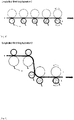
- the longitudinal stretching apparatus A was used as the longitudinal stretching apparatus, and the tip speeds of the respective stretching rolls were set at progressively higher rates toward downstream in the traveling direction. Specifically, the tip speed ratio between the first stretching roll and the second stretching roll was set to 1.3; the tip speed ratio between the second stretching roll and the third stretching roll was set to 1.5; the tip speed ratio between the third stretching roll and the fourth stretching roll was set to 1.8; and the tip speed ratio between the fourth stretching roll and the fifth stretching roll was set to 2.1. Further, the interval between two adjacent stretching rolls was adjusted such that the distance from the point at which the gel-like formed sheet being stretched comes out of contact with one stretching roll, to the point at which the sheet comes into contact with the next stretching roll, was 200 mm.
- Example 1 The same procedure as in Example 1 was repeated, except: that longitudinal stretching apparatus D shown in FIG. 4 was used instead of the longitudinal stretching apparatus A, as the longitudinal stretching apparatus; and that, in the longitudinal stretching apparatus D, the tip speed ratio between the first stretching roll and the second stretching roll was set to 1.5; the tip speed ratio between the second stretching roll and the third stretching roll was set to 2.0; and the tip speed ratio between the third stretching roll and the fourth stretching roll was set to 2.5; to obtain a polyolefin microporous membrane D.
- longitudinal stretching apparatus D shown in FIG. 4 was used instead of the longitudinal stretching apparatus A, as the longitudinal stretching apparatus; and that, in the longitudinal stretching apparatus D, the tip speed ratio between the first stretching roll and the second stretching roll was set to 1.5; the tip speed ratio between the second stretching roll and the third stretching roll was set to 2.0; and the tip speed ratio between the third stretching roll and the fourth stretching roll was set to 2.5; to obtain a polyolefin microporous membrane D.
- Example 2 The same procedure as in Example 1 was repeated, except that ceramic-coated metal rolls having a surface roughness of 5.0 S were used as 5 longitudinal stretching rolls in the longitudinal stretching apparatus A, to obtain a polyolefin microporous membrane H.
- Example 2 The same procedure as in Example 1 was repeated, except that, in the longitudinal stretching apparatus A, the tip speed ratio between the first stretching roll and the second stretching roll was set to 1.2; the tip speed ratio between the second stretching roll and the third stretching roll was set to 1.5; the tip speed ratio between the third stretching roll and the fourth stretching roll was set to 1.8; and the tip speed ratio between the fourth stretching roll and the fifth stretching roll was set to 2.3; to obtain a polyolefin microporous membrane I.
- Example 2 The same procedure as in Example 1 was repeated, except that, in the longitudinal stretching apparatus A, the tip speed ratio between the first stretching roll and the second stretching roll was set to 1.3; the tip speed ratio between the second stretching roll and the third stretching roll was set to 1.7; the tip speed ratio between the third stretching roll and the fourth stretching roll was set to 1.8; and the tip speed ratio between the fourth stretching roll and the fifth stretching roll was set to 1.9; to obtain a polyolefin microporous membrane J.
- the resulting simultaneously biaxially stretched gel-like sheet was cooled to 30°C, and washed in a washing bath of methylene chloride controlled at a temperature of 25°C to remove liquid paraffin.
- the resulting sheet was dried in a drying furnace adjusted to 60°C, to obtain a polyolefin microporous membrane.
- the resulting microporous membrane was wound at a transport speed of 50 m/min, to obtain a wound roll of the polyolefin microporous membrane, having a width of 4,000 mm and a winding length of 5,050 m.
- the polyolefin microporous membrane was drawn from the resulting wound roll, and subjected to slitting to be processed into a width of 950 mm, to obtain a polyolefin microporous membrane K to be used as a substrate for coating.
- Example 2 The same procedure as in Example 1 was repeated, except that the longitudinal stretching apparatus B was used as the longitudinal stretching apparatus, and that no nip roll was used for all 5 stretching rolls, to obtain a polyolefin microporous membrane M.
- Example 2 The same procedure as in Example 1 was repeated, except that hard chromium plated metal rolls having a surface roughness of 0.1 S were used as the longitudinal stretching rolls in the longitudinal stretching apparatus A, to obtain polyolefin microporous membrane O.
- Example 2 The same procedure as in Example 1 was repeated, except that, in the longitudinal stretching apparatus A, the tip speed ratio between the first stretching roll and the second stretching roll was set to 1.6; the tip speed ratio between the second stretching roll and the third stretching roll was set to 1.6; the tip speed ratio between the third stretching roll and the fourth stretching roll was set to 1.7; and the tip speed ratio between the fourth stretching roll and the fifth stretching roll was set to 1.7; to obtain a polyolefin microporous membrane P.
- the coating liquid (a) was coated, using a coating apparatus (gravure coating method) shown in FIG. 5 at a transport speed of 50 m/min. The resultant was then allowed to pass through a hot air drying furnace controlled at 50°C for 10 seconds to carry out drying, thereby obtaining a battery separator. At this time, the positions of the coating roll and the back rolls in the coating apparatus were adjusted such that the thickness of the coating tangential line was within the range of from 3 to 5 mm. Further, as the coating roll, a gravure roll having a diameter of 100 mm and a deflection accuracy of 8 ⁇ m / ⁇ 100 mm was used. The resultant was then subjected to slitting, to obtain a battery separator having a battery separator thickness of 19 ⁇ m, a width of 900 mm, and a winding length of 5,000 m.
- a coating apparatus gravure coating method shown in FIG. 5 at a transport speed of 50 m/min.
- the resultant was then allowed to pass through a
- Example 11 The same procedure as in Example 11 was repeated, except that the cell capacity of the gravure roll in the coating apparatus was changed so that the porous layer thickness of 5 ⁇ m to be formed, thereby obtaining a battery separator.
- Example 11 The same procedure as in Example 11 was repeated, except that the polyolefin microporous membranes K to S obtained in Comparative Examples 1 to 7 and 9 were used, to obtain battery separators.
- Example 11 The same procedure as in Example 11 was repeated, except that the positions of the gravure roll and the back rolls in the coating apparatus were adjusted such that the thickness of the coating tangential line was within the range of from 11 to 13 mm, to obtain a battery separator.
- Table 1 shows the production conditions and the properties of the polyethylene microporous membrane obtained in Examples 1 to 10 and Comparative Examples 1 to 9.
- Table 2 shows the production conditions and the properties of the battery separators obtained in Examples 11 to 27 and Comparative Examples 10 to 16 and 18 to 21, and the properties of the wound rolls thereof.
Landscapes
- Chemical & Material Sciences (AREA)
- Chemical Kinetics & Catalysis (AREA)
- Engineering & Computer Science (AREA)
- Electrochemistry (AREA)
- General Chemical & Material Sciences (AREA)
- Manufacturing & Machinery (AREA)
- Materials Engineering (AREA)
- Health & Medical Sciences (AREA)
- Medicinal Chemistry (AREA)
- Polymers & Plastics (AREA)
- Organic Chemistry (AREA)
- Mechanical Engineering (AREA)
- Inorganic Chemistry (AREA)
- Cell Separators (AREA)
- Laminated Bodies (AREA)
- Manufacture Of Porous Articles, And Recovery And Treatment Of Waste Products (AREA)
- Compositions Of Macromolecular Compounds (AREA)
- Electric Double-Layer Capacitors Or The Like (AREA)
Applications Claiming Priority (2)
| Application Number | Priority Date | Filing Date | Title |
|---|---|---|---|
| JP2014250824 | 2014-12-11 | ||
| PCT/JP2015/081198 WO2016092993A1 (ja) | 2014-12-11 | 2015-11-05 | ポリオレフィン微多孔膜、電池用セパレータおよびそれらの製造方法 |
Publications (3)
| Publication Number | Publication Date |
|---|---|
| EP3231837A1 EP3231837A1 (en) | 2017-10-18 |
| EP3231837A4 EP3231837A4 (en) | 2018-07-11 |
| EP3231837B1 true EP3231837B1 (en) | 2022-08-24 |
Family
ID=56107188
Family Applications (1)
| Application Number | Title | Priority Date | Filing Date |
|---|---|---|---|
| EP15866428.4A Active EP3231837B1 (en) | 2014-12-11 | 2015-11-05 | Microporous polyolefin film, separator for battery, and production processes therefor |
Country Status (9)
| Country | Link |
|---|---|
| US (2) | US10784482B2 (pl) |
| EP (1) | EP3231837B1 (pl) |
| JP (1) | JP5914790B1 (pl) |
| KR (1) | KR102166652B1 (pl) |
| CN (1) | CN107207761B (pl) |
| HU (1) | HUE060294T2 (pl) |
| MY (1) | MY176100A (pl) |
| PL (1) | PL3231837T3 (pl) |
| WO (1) | WO2016092993A1 (pl) |
Families Citing this family (11)
| Publication number | Priority date | Publication date | Assignee | Title |
|---|---|---|---|---|
| PL3181622T3 (pl) * | 2014-08-12 | 2021-06-14 | Toray Industries, Inc. | Mikroporowata membrana poliolefinowa i sposób jej wytwarzania, separator do baterii wtórnej z niewodnym elektrolitem i bateria wtórna z niewodnym elektrolitem |
| US10486112B2 (en) * | 2014-11-18 | 2019-11-26 | Toray Industries, Inc. | Microporous polyolefin film, separator for battery, and production processes therefor |
| KR102190593B1 (ko) * | 2015-07-29 | 2020-12-14 | 도레이 카부시키가이샤 | 전지용 세퍼레이터 및 그 제조 방법 |
| KR102157492B1 (ko) * | 2015-10-09 | 2020-09-18 | 도레이 카부시키가이샤 | 적층 폴리올레핀 미세 다공막, 전지용 세퍼레이터 및 그것들의 제조 방법 |
| US10770707B2 (en) | 2015-12-04 | 2020-09-08 | Toray Industries, Inc. | Battery separator and method of manufacturing same |
| KR102177921B1 (ko) * | 2015-12-24 | 2020-11-12 | 도레이 카부시키가이샤 | 폴리올레핀 미다공막, 전지용 세퍼레이터 및 그것들의 제조 방법 |
| TWI770003B (zh) * | 2016-04-27 | 2022-07-11 | 日商東麗股份有限公司 | 聚烯烴微多孔膜及其製造方法以及電池用隔膜及其製造方法 |
| CN109422890A (zh) * | 2017-08-25 | 2019-03-05 | 北京师范大学 | 一种复合聚丙烯微孔膜及其制备方法和用途 |
| CN107812788A (zh) * | 2017-12-01 | 2018-03-20 | 中航锂电技术研究院有限公司 | 一种金属箔轧制系统 |
| KR102593771B1 (ko) * | 2021-09-06 | 2023-10-24 | 주식회사 한화 | 이차전지용 프라이머 코팅장치와 프라이머 코팅용 챔버 |
| CN116315422A (zh) * | 2023-03-21 | 2023-06-23 | 康辉南通新材料科技有限公司 | 一种超薄锂电池隔膜工艺生产方法 |
Citations (2)
| Publication number | Priority date | Publication date | Assignee | Title |
|---|---|---|---|---|
| JP2009076410A (ja) * | 2007-09-25 | 2009-04-09 | Hitachi Maxell Ltd | 多層多孔質膜の製造方法、電気化学素子用セパレータおよび電気化学素子 |
| KR20140086843A (ko) * | 2012-12-28 | 2014-07-08 | 제일모직주식회사 | 분리막의 제조 방법과 그 분리막, 및 이를 이용한 전지 |
Family Cites Families (17)
| Publication number | Priority date | Publication date | Assignee | Title |
|---|---|---|---|---|
| JP5196780B2 (ja) | 2005-12-22 | 2013-05-15 | 旭化成イーマテリアルズ株式会社 | 多層多孔膜およびその製造方法 |
| JP2008149895A (ja) | 2006-12-18 | 2008-07-03 | Press Kogyo Co Ltd | フレーム構造体 |
| JP2008186721A (ja) | 2007-01-30 | 2008-08-14 | Asahi Kasei Chemicals Corp | 高耐熱性と高透過性を兼ね備えた多孔膜およびその製法 |
| JP4931083B2 (ja) | 2007-01-30 | 2012-05-16 | 旭化成イーマテリアルズ株式会社 | 多層多孔膜及びその製造方法 |
| US7892672B2 (en) | 2007-06-06 | 2011-02-22 | Teijin Limited | Polyolefin microporous membrane base for nonaqueous secondary battery separator, method for producing the same, nonaqueous secondary battery separator and nonaqueous secondary battery |
| JP5214999B2 (ja) | 2008-02-28 | 2013-06-19 | 帝人株式会社 | 非水電解質電池セパレータ及びその製造方法並びにそれを用いた非水電解質二次電池 |
| JP5366426B2 (ja) * | 2008-04-04 | 2013-12-11 | 東芝機械株式会社 | 多孔性フィルムの製膜方法及び多孔性フィルム製膜用の逐次二軸延伸装置 |
| JP5639578B2 (ja) * | 2008-08-15 | 2014-12-10 | 東レバッテリーセパレータフィルム株式会社 | 微多孔膜の製造方法および微多孔膜の製造装置 |
| KR101716907B1 (ko) | 2008-08-19 | 2017-03-15 | 데이진 가부시키가이샤 | 비수계 2 차 전지용 세퍼레이터 |
| KR101336593B1 (ko) * | 2010-04-20 | 2013-12-05 | 에스케이이노베이션 주식회사 | 생산성이 우수하며 물성조절이 용이한 폴리올레핀계 미세다공막 제조방법 |
| JP5419817B2 (ja) | 2010-07-13 | 2014-02-19 | 三菱樹脂株式会社 | 積層多孔フィルム、非水電解液二次電池用セパレータ、および非水電解液二次電池 |
| KR101307384B1 (ko) | 2011-04-26 | 2013-09-11 | 주식회사 엘지화학 | 다이 코팅 방식의 분리막의 제조방법 |
| JP5832907B2 (ja) * | 2012-01-10 | 2015-12-16 | 鉄郎 野方 | ポリオレフィン微多孔膜の製造方法 |
| JP5495457B1 (ja) * | 2013-08-30 | 2014-05-21 | 東レバッテリーセパレータフィルム株式会社 | 電池用セパレータ及びその電池用セパレータの製造方法 |
| EP3124526A4 (en) * | 2014-03-24 | 2017-11-22 | Toray Industries, Inc. | Method for manufacturing microporous plastic film |
| KR20170018329A (ko) * | 2014-06-13 | 2017-02-17 | 도레이 배터리 세퍼레이터 필름 주식회사 | 폴리올레핀 미세 다공 필름, 이의 제조 방법 및 전지용 세퍼레이터 |
| US10486112B2 (en) * | 2014-11-18 | 2019-11-26 | Toray Industries, Inc. | Microporous polyolefin film, separator for battery, and production processes therefor |
-
2015
- 2015-11-05 PL PL15866428.4T patent/PL3231837T3/pl unknown
- 2015-11-05 KR KR1020177011993A patent/KR102166652B1/ko active Active
- 2015-11-05 MY MYPI2017702078A patent/MY176100A/en unknown
- 2015-11-05 JP JP2016506401A patent/JP5914790B1/ja active Active
- 2015-11-05 CN CN201580067468.5A patent/CN107207761B/zh active Active
- 2015-11-05 WO PCT/JP2015/081198 patent/WO2016092993A1/ja not_active Ceased
- 2015-11-05 HU HUE15866428A patent/HUE060294T2/hu unknown
- 2015-11-05 EP EP15866428.4A patent/EP3231837B1/en active Active
- 2015-11-05 US US15/531,807 patent/US10784482B2/en active Active
-
2020
- 2020-06-02 US US16/890,185 patent/US20200303705A1/en not_active Abandoned
Patent Citations (2)
| Publication number | Priority date | Publication date | Assignee | Title |
|---|---|---|---|---|
| JP2009076410A (ja) * | 2007-09-25 | 2009-04-09 | Hitachi Maxell Ltd | 多層多孔質膜の製造方法、電気化学素子用セパレータおよび電気化学素子 |
| KR20140086843A (ko) * | 2012-12-28 | 2014-07-08 | 제일모직주식회사 | 분리막의 제조 방법과 그 분리막, 및 이를 이용한 전지 |
Also Published As
| Publication number | Publication date |
|---|---|
| EP3231837A4 (en) | 2018-07-11 |
| CN107207761B (zh) | 2021-01-08 |
| MY176100A (en) | 2020-07-24 |
| US10784482B2 (en) | 2020-09-22 |
| US20200303705A1 (en) | 2020-09-24 |
| KR102166652B1 (ko) | 2020-10-16 |
| KR20170093789A (ko) | 2017-08-16 |
| JP5914790B1 (ja) | 2016-05-11 |
| US20170317328A1 (en) | 2017-11-02 |
| HUE060294T2 (hu) | 2023-02-28 |
| PL3231837T3 (pl) | 2022-12-19 |
| CN107207761A (zh) | 2017-09-26 |
| WO2016092993A1 (ja) | 2016-06-16 |
| JPWO2016092993A1 (ja) | 2017-04-27 |
| EP3231837A1 (en) | 2017-10-18 |
Similar Documents
| Publication | Publication Date | Title |
|---|---|---|
| US20200303705A1 (en) | Microporous polyolefin film, separator for battery, and production processes therefor | |
| KR102157492B1 (ko) | 적층 폴리올레핀 미세 다공막, 전지용 세퍼레이터 및 그것들의 제조 방법 | |
| EP3222656B1 (en) | Microporous polyolefin film, separator for battery, and production processes therefor | |
| KR102190593B1 (ko) | 전지용 세퍼레이터 및 그 제조 방법 | |
| CN108370014B (zh) | 聚烯烃微多孔膜、电池用隔膜以及它们的制造方法 | |
| US10790492B2 (en) | Microporous polyolefin membrane, separator for battery, and production processes therefor | |
| CN108431108B (zh) | 聚烯烃微多孔膜、电池用隔膜以及它们的制造方法 | |
| KR102193965B1 (ko) | 전지용 세퍼레이터 및 그 제조 방법 | |
| TW201819198A (zh) | 積層聚烯烴微多孔膜、電池用隔膜及其製造方法以及積層聚烯烴微多孔膜捲繞體之製造方法 |
Legal Events
| Date | Code | Title | Description |
|---|---|---|---|
| STAA | Information on the status of an ep patent application or granted ep patent |
Free format text: STATUS: THE INTERNATIONAL PUBLICATION HAS BEEN MADE |
|
| PUAI | Public reference made under article 153(3) epc to a published international application that has entered the european phase |
Free format text: ORIGINAL CODE: 0009012 |
|
| STAA | Information on the status of an ep patent application or granted ep patent |
Free format text: STATUS: REQUEST FOR EXAMINATION WAS MADE |
|
| 17P | Request for examination filed |
Effective date: 20170607 |
|
| AK | Designated contracting states |
Kind code of ref document: A1 Designated state(s): AL AT BE BG CH CY CZ DE DK EE ES FI FR GB GR HR HU IE IS IT LI LT LU LV MC MK MT NL NO PL PT RO RS SE SI SK SM TR |
|
| AX | Request for extension of the european patent |
Extension state: BA ME |
|
| DAV | Request for validation of the european patent (deleted) | ||
| DAX | Request for extension of the european patent (deleted) | ||
| A4 | Supplementary search report drawn up and despatched |
Effective date: 20180612 |
|
| RIC1 | Information provided on ipc code assigned before grant |
Ipc: H01M 2/16 20060101ALI20180606BHEP Ipc: B32B 5/32 20060101ALI20180606BHEP Ipc: H01M 2/14 20060101ALI20180606BHEP Ipc: C08J 9/28 20060101AFI20180606BHEP Ipc: H01M 10/0525 20100101ALI20180606BHEP Ipc: B32B 27/32 20060101ALI20180606BHEP Ipc: H01M 10/0587 20100101ALI20180606BHEP |
|
| TPAC | Observations filed by third parties |
Free format text: ORIGINAL CODE: EPIDOSNTIPA |
|
| STAA | Information on the status of an ep patent application or granted ep patent |
Free format text: STATUS: EXAMINATION IS IN PROGRESS |
|
| 17Q | First examination report despatched |
Effective date: 20191106 |
|
| REG | Reference to a national code |
Ref country code: DE Ref legal event code: R079 Ref document number: 602015080512 Country of ref document: DE Free format text: PREVIOUS MAIN CLASS: C08J0009280000 Ipc: H01M0050449000 |
|
| GRAP | Despatch of communication of intention to grant a patent |
Free format text: ORIGINAL CODE: EPIDOSNIGR1 |
|
| STAA | Information on the status of an ep patent application or granted ep patent |
Free format text: STATUS: GRANT OF PATENT IS INTENDED |
|
| RIC1 | Information provided on ipc code assigned before grant |
Ipc: H01M 50/411 20210101ALI20220214BHEP Ipc: H01M 50/403 20210101ALI20220214BHEP Ipc: H01M 10/0587 20100101ALI20220214BHEP Ipc: H01M 10/0525 20100101ALI20220214BHEP Ipc: B32B 27/32 20060101ALI20220214BHEP Ipc: B32B 5/32 20060101ALI20220214BHEP Ipc: C08J 9/28 20060101ALI20220214BHEP Ipc: H01M 50/449 20210101AFI20220214BHEP |
|
| INTG | Intention to grant announced |
Effective date: 20220317 |
|
| GRAS | Grant fee paid |
Free format text: ORIGINAL CODE: EPIDOSNIGR3 |
|
| GRAA | (expected) grant |
Free format text: ORIGINAL CODE: 0009210 |
|
| STAA | Information on the status of an ep patent application or granted ep patent |
Free format text: STATUS: THE PATENT HAS BEEN GRANTED |
|
| AK | Designated contracting states |
Kind code of ref document: B1 Designated state(s): AL AT BE BG CH CY CZ DE DK EE ES FI FR GB GR HR HU IE IS IT LI LT LU LV MC MK MT NL NO PL PT RO RS SE SI SK SM TR |
|
| REG | Reference to a national code |
Ref country code: CH Ref legal event code: EP |
|
| REG | Reference to a national code |
Ref country code: IE Ref legal event code: FG4D |
|
| REG | Reference to a national code |
Ref country code: AT Ref legal event code: REF Ref document number: 1514293 Country of ref document: AT Kind code of ref document: T Effective date: 20220915 Ref country code: DE Ref legal event code: R096 Ref document number: 602015080512 Country of ref document: DE |
|
| REG | Reference to a national code |
Ref country code: LT Ref legal event code: MG9D |
|
| REG | Reference to a national code |
Ref country code: NL Ref legal event code: MP Effective date: 20220824 |
|
| PG25 | Lapsed in a contracting state [announced via postgrant information from national office to epo] |
Ref country code: SE Free format text: LAPSE BECAUSE OF FAILURE TO SUBMIT A TRANSLATION OF THE DESCRIPTION OR TO PAY THE FEE WITHIN THE PRESCRIBED TIME-LIMIT Effective date: 20220824 Ref country code: RS Free format text: LAPSE BECAUSE OF FAILURE TO SUBMIT A TRANSLATION OF THE DESCRIPTION OR TO PAY THE FEE WITHIN THE PRESCRIBED TIME-LIMIT Effective date: 20220824 Ref country code: PT Free format text: LAPSE BECAUSE OF FAILURE TO SUBMIT A TRANSLATION OF THE DESCRIPTION OR TO PAY THE FEE WITHIN THE PRESCRIBED TIME-LIMIT Effective date: 20221226 Ref country code: NO Free format text: LAPSE BECAUSE OF FAILURE TO SUBMIT A TRANSLATION OF THE DESCRIPTION OR TO PAY THE FEE WITHIN THE PRESCRIBED TIME-LIMIT Effective date: 20221124 Ref country code: NL Free format text: LAPSE BECAUSE OF FAILURE TO SUBMIT A TRANSLATION OF THE DESCRIPTION OR TO PAY THE FEE WITHIN THE PRESCRIBED TIME-LIMIT Effective date: 20220824 Ref country code: LV Free format text: LAPSE BECAUSE OF FAILURE TO SUBMIT A TRANSLATION OF THE DESCRIPTION OR TO PAY THE FEE WITHIN THE PRESCRIBED TIME-LIMIT Effective date: 20220824 Ref country code: LT Free format text: LAPSE BECAUSE OF FAILURE TO SUBMIT A TRANSLATION OF THE DESCRIPTION OR TO PAY THE FEE WITHIN THE PRESCRIBED TIME-LIMIT Effective date: 20220824 Ref country code: FI Free format text: LAPSE BECAUSE OF FAILURE TO SUBMIT A TRANSLATION OF THE DESCRIPTION OR TO PAY THE FEE WITHIN THE PRESCRIBED TIME-LIMIT Effective date: 20220824 Ref country code: ES Free format text: LAPSE BECAUSE OF FAILURE TO SUBMIT A TRANSLATION OF THE DESCRIPTION OR TO PAY THE FEE WITHIN THE PRESCRIBED TIME-LIMIT Effective date: 20220824 |
|
| REG | Reference to a national code |
Ref country code: AT Ref legal event code: MK05 Ref document number: 1514293 Country of ref document: AT Kind code of ref document: T Effective date: 20220824 |
|
| PG25 | Lapsed in a contracting state [announced via postgrant information from national office to epo] |
Ref country code: IS Free format text: LAPSE BECAUSE OF FAILURE TO SUBMIT A TRANSLATION OF THE DESCRIPTION OR TO PAY THE FEE WITHIN THE PRESCRIBED TIME-LIMIT Effective date: 20221224 Ref country code: HR Free format text: LAPSE BECAUSE OF FAILURE TO SUBMIT A TRANSLATION OF THE DESCRIPTION OR TO PAY THE FEE WITHIN THE PRESCRIBED TIME-LIMIT Effective date: 20220824 Ref country code: GR Free format text: LAPSE BECAUSE OF FAILURE TO SUBMIT A TRANSLATION OF THE DESCRIPTION OR TO PAY THE FEE WITHIN THE PRESCRIBED TIME-LIMIT Effective date: 20221125 |
|
| REG | Reference to a national code |
Ref country code: HU Ref legal event code: AG4A Ref document number: E060294 Country of ref document: HU |
|
| PG25 | Lapsed in a contracting state [announced via postgrant information from national office to epo] |
Ref country code: SM Free format text: LAPSE BECAUSE OF FAILURE TO SUBMIT A TRANSLATION OF THE DESCRIPTION OR TO PAY THE FEE WITHIN THE PRESCRIBED TIME-LIMIT Effective date: 20220824 Ref country code: RO Free format text: LAPSE BECAUSE OF FAILURE TO SUBMIT A TRANSLATION OF THE DESCRIPTION OR TO PAY THE FEE WITHIN THE PRESCRIBED TIME-LIMIT Effective date: 20220824 Ref country code: DK Free format text: LAPSE BECAUSE OF FAILURE TO SUBMIT A TRANSLATION OF THE DESCRIPTION OR TO PAY THE FEE WITHIN THE PRESCRIBED TIME-LIMIT Effective date: 20220824 Ref country code: CZ Free format text: LAPSE BECAUSE OF FAILURE TO SUBMIT A TRANSLATION OF THE DESCRIPTION OR TO PAY THE FEE WITHIN THE PRESCRIBED TIME-LIMIT Effective date: 20220824 Ref country code: AT Free format text: LAPSE BECAUSE OF FAILURE TO SUBMIT A TRANSLATION OF THE DESCRIPTION OR TO PAY THE FEE WITHIN THE PRESCRIBED TIME-LIMIT Effective date: 20220824 |
|
| REG | Reference to a national code |
Ref country code: DE Ref legal event code: R097 Ref document number: 602015080512 Country of ref document: DE |
|
| PG25 | Lapsed in a contracting state [announced via postgrant information from national office to epo] |
Ref country code: SK Free format text: LAPSE BECAUSE OF FAILURE TO SUBMIT A TRANSLATION OF THE DESCRIPTION OR TO PAY THE FEE WITHIN THE PRESCRIBED TIME-LIMIT Effective date: 20220824 Ref country code: EE Free format text: LAPSE BECAUSE OF FAILURE TO SUBMIT A TRANSLATION OF THE DESCRIPTION OR TO PAY THE FEE WITHIN THE PRESCRIBED TIME-LIMIT Effective date: 20220824 |
|
| P01 | Opt-out of the competence of the unified patent court (upc) registered |
Effective date: 20230515 |
|
| PG25 | Lapsed in a contracting state [announced via postgrant information from national office to epo] |
Ref country code: MC Free format text: LAPSE BECAUSE OF FAILURE TO SUBMIT A TRANSLATION OF THE DESCRIPTION OR TO PAY THE FEE WITHIN THE PRESCRIBED TIME-LIMIT Effective date: 20220824 Ref country code: AL Free format text: LAPSE BECAUSE OF FAILURE TO SUBMIT A TRANSLATION OF THE DESCRIPTION OR TO PAY THE FEE WITHIN THE PRESCRIBED TIME-LIMIT Effective date: 20220824 |
|
| PLBE | No opposition filed within time limit |
Free format text: ORIGINAL CODE: 0009261 |
|
| REG | Reference to a national code |
Ref country code: CH Ref legal event code: PL |
|
| STAA | Information on the status of an ep patent application or granted ep patent |
Free format text: STATUS: NO OPPOSITION FILED WITHIN TIME LIMIT |
|
| GBPC | Gb: european patent ceased through non-payment of renewal fee |
Effective date: 20221124 |
|
| REG | Reference to a national code |
Ref country code: BE Ref legal event code: MM Effective date: 20221130 |
|
| PG25 | Lapsed in a contracting state [announced via postgrant information from national office to epo] |
Ref country code: LI Free format text: LAPSE BECAUSE OF NON-PAYMENT OF DUE FEES Effective date: 20221130 Ref country code: CH Free format text: LAPSE BECAUSE OF NON-PAYMENT OF DUE FEES Effective date: 20221130 |
|
| 26N | No opposition filed |
Effective date: 20230525 |
|
| PG25 | Lapsed in a contracting state [announced via postgrant information from national office to epo] |
Ref country code: SI Free format text: LAPSE BECAUSE OF FAILURE TO SUBMIT A TRANSLATION OF THE DESCRIPTION OR TO PAY THE FEE WITHIN THE PRESCRIBED TIME-LIMIT Effective date: 20220824 Ref country code: LU Free format text: LAPSE BECAUSE OF NON-PAYMENT OF DUE FEES Effective date: 20221105 |
|
| PG25 | Lapsed in a contracting state [announced via postgrant information from national office to epo] |
Ref country code: IE Free format text: LAPSE BECAUSE OF NON-PAYMENT OF DUE FEES Effective date: 20221105 Ref country code: GB Free format text: LAPSE BECAUSE OF NON-PAYMENT OF DUE FEES Effective date: 20221124 |
|
| PG25 | Lapsed in a contracting state [announced via postgrant information from national office to epo] |
Ref country code: FR Free format text: LAPSE BECAUSE OF NON-PAYMENT OF DUE FEES Effective date: 20221130 Ref country code: BE Free format text: LAPSE BECAUSE OF NON-PAYMENT OF DUE FEES Effective date: 20221130 |
|
| PG25 | Lapsed in a contracting state [announced via postgrant information from national office to epo] |
Ref country code: CY Free format text: LAPSE BECAUSE OF FAILURE TO SUBMIT A TRANSLATION OF THE DESCRIPTION OR TO PAY THE FEE WITHIN THE PRESCRIBED TIME-LIMIT Effective date: 20220824 |
|
| PG25 | Lapsed in a contracting state [announced via postgrant information from national office to epo] |
Ref country code: MK Free format text: LAPSE BECAUSE OF FAILURE TO SUBMIT A TRANSLATION OF THE DESCRIPTION OR TO PAY THE FEE WITHIN THE PRESCRIBED TIME-LIMIT Effective date: 20220824 Ref country code: IT Free format text: LAPSE BECAUSE OF FAILURE TO SUBMIT A TRANSLATION OF THE DESCRIPTION OR TO PAY THE FEE WITHIN THE PRESCRIBED TIME-LIMIT Effective date: 20220824 |
|
| PG25 | Lapsed in a contracting state [announced via postgrant information from national office to epo] |
Ref country code: TR Free format text: LAPSE BECAUSE OF FAILURE TO SUBMIT A TRANSLATION OF THE DESCRIPTION OR TO PAY THE FEE WITHIN THE PRESCRIBED TIME-LIMIT Effective date: 20220824 |
|
| PG25 | Lapsed in a contracting state [announced via postgrant information from national office to epo] |
Ref country code: BG Free format text: LAPSE BECAUSE OF FAILURE TO SUBMIT A TRANSLATION OF THE DESCRIPTION OR TO PAY THE FEE WITHIN THE PRESCRIBED TIME-LIMIT Effective date: 20220824 |
|
| PG25 | Lapsed in a contracting state [announced via postgrant information from national office to epo] |
Ref country code: MT Free format text: LAPSE BECAUSE OF FAILURE TO SUBMIT A TRANSLATION OF THE DESCRIPTION OR TO PAY THE FEE WITHIN THE PRESCRIBED TIME-LIMIT Effective date: 20220824 |
|
| PGFP | Annual fee paid to national office [announced via postgrant information from national office to epo] |
Ref country code: HU Payment date: 20251105 Year of fee payment: 11 |
|
| PGFP | Annual fee paid to national office [announced via postgrant information from national office to epo] |
Ref country code: DE Payment date: 20250930 Year of fee payment: 11 |
|
| PGFP | Annual fee paid to national office [announced via postgrant information from national office to epo] |
Ref country code: PL Payment date: 20251014 Year of fee payment: 11 |