EP3202829A1 - Harzschaumfolie und verfahren zur herstellung eines harzschaumformkörpers - Google Patents
Harzschaumfolie und verfahren zur herstellung eines harzschaumformkörpers Download PDFInfo
- Publication number
- EP3202829A1 EP3202829A1 EP15847785.1A EP15847785A EP3202829A1 EP 3202829 A1 EP3202829 A1 EP 3202829A1 EP 15847785 A EP15847785 A EP 15847785A EP 3202829 A1 EP3202829 A1 EP 3202829A1
- Authority
- EP
- European Patent Office
- Prior art keywords
- resin expanded
- resin
- molded article
- sheet
- expanded
- Prior art date
- Legal status (The legal status is an assumption and is not a legal conclusion. Google has not performed a legal analysis and makes no representation as to the accuracy of the status listed.)
- Granted
Links
Images



Classifications
-
- C—CHEMISTRY; METALLURGY
- C08—ORGANIC MACROMOLECULAR COMPOUNDS; THEIR PREPARATION OR CHEMICAL WORKING-UP; COMPOSITIONS BASED THEREON
- C08J—WORKING-UP; GENERAL PROCESSES OF COMPOUNDING; AFTER-TREATMENT NOT COVERED BY SUBCLASSES C08B, C08C, C08F, C08G or C08H
- C08J9/00—Working-up of macromolecular substances to porous or cellular articles or materials; After-treatment thereof
- C08J9/04—Working-up of macromolecular substances to porous or cellular articles or materials; After-treatment thereof using blowing gases generated by a previously added blowing agent
-
- B—PERFORMING OPERATIONS; TRANSPORTING
- B29—WORKING OF PLASTICS; WORKING OF SUBSTANCES IN A PLASTIC STATE IN GENERAL
- B29C—SHAPING OR JOINING OF PLASTICS; SHAPING OF MATERIAL IN A PLASTIC STATE, NOT OTHERWISE PROVIDED FOR; AFTER-TREATMENT OF THE SHAPED PRODUCTS, e.g. REPAIRING
- B29C44/00—Shaping by internal pressure generated in the material, e.g. swelling or foaming ; Producing porous or cellular expanded plastics articles
- B29C44/34—Auxiliary operations
- B29C44/36—Feeding the material to be shaped
- B29C44/46—Feeding the material to be shaped into an open space or onto moving surfaces, i.e. to make articles of indefinite length
- B29C44/50—Feeding the material to be shaped into an open space or onto moving surfaces, i.e. to make articles of indefinite length using pressure difference, e.g. by extrusion or by spraying
- B29C44/507—Feeding the material to be shaped into an open space or onto moving surfaces, i.e. to make articles of indefinite length using pressure difference, e.g. by extrusion or by spraying extruding the compound through an annular die
-
- B—PERFORMING OPERATIONS; TRANSPORTING
- B29—WORKING OF PLASTICS; WORKING OF SUBSTANCES IN A PLASTIC STATE IN GENERAL
- B29C—SHAPING OR JOINING OF PLASTICS; SHAPING OF MATERIAL IN A PLASTIC STATE, NOT OTHERWISE PROVIDED FOR; AFTER-TREATMENT OF THE SHAPED PRODUCTS, e.g. REPAIRING
- B29C44/00—Shaping by internal pressure generated in the material, e.g. swelling or foaming ; Producing porous or cellular expanded plastics articles
- B29C44/02—Shaping by internal pressure generated in the material, e.g. swelling or foaming ; Producing porous or cellular expanded plastics articles for articles of definite length, i.e. discrete articles
- B29C44/04—Shaping by internal pressure generated in the material, e.g. swelling or foaming ; Producing porous or cellular expanded plastics articles for articles of definite length, i.e. discrete articles consisting of at least two parts of chemically or physically different materials, e.g. having different densities
-
- B—PERFORMING OPERATIONS; TRANSPORTING
- B29—WORKING OF PLASTICS; WORKING OF SUBSTANCES IN A PLASTIC STATE IN GENERAL
- B29C—SHAPING OR JOINING OF PLASTICS; SHAPING OF MATERIAL IN A PLASTIC STATE, NOT OTHERWISE PROVIDED FOR; AFTER-TREATMENT OF THE SHAPED PRODUCTS, e.g. REPAIRING
- B29C44/00—Shaping by internal pressure generated in the material, e.g. swelling or foaming ; Producing porous or cellular expanded plastics articles
- B29C44/34—Auxiliary operations
- B29C44/56—After-treatment of articles, e.g. for altering the shape
- B29C44/5627—After-treatment of articles, e.g. for altering the shape by mechanical deformation, e.g. crushing, embossing, stretching
- B29C44/5636—After-treatment of articles, e.g. for altering the shape by mechanical deformation, e.g. crushing, embossing, stretching with the addition of heat
-
- B—PERFORMING OPERATIONS; TRANSPORTING
- B29—WORKING OF PLASTICS; WORKING OF SUBSTANCES IN A PLASTIC STATE IN GENERAL
- B29C—SHAPING OR JOINING OF PLASTICS; SHAPING OF MATERIAL IN A PLASTIC STATE, NOT OTHERWISE PROVIDED FOR; AFTER-TREATMENT OF THE SHAPED PRODUCTS, e.g. REPAIRING
- B29C48/00—Extrusion moulding, i.e. expressing the moulding material through a die or nozzle which imparts the desired form; Apparatus therefor
- B29C48/16—Articles comprising two or more components, e.g. co-extruded layers
-
- B—PERFORMING OPERATIONS; TRANSPORTING
- B29—WORKING OF PLASTICS; WORKING OF SUBSTANCES IN A PLASTIC STATE IN GENERAL
- B29C—SHAPING OR JOINING OF PLASTICS; SHAPING OF MATERIAL IN A PLASTIC STATE, NOT OTHERWISE PROVIDED FOR; AFTER-TREATMENT OF THE SHAPED PRODUCTS, e.g. REPAIRING
- B29C49/00—Blow-moulding, i.e. blowing a preform or parison to a desired shape within a mould; Apparatus therefor
- B29C49/22—Blow-moulding, i.e. blowing a preform or parison to a desired shape within a mould; Apparatus therefor using multilayered preforms or parisons
-
- B—PERFORMING OPERATIONS; TRANSPORTING
- B29—WORKING OF PLASTICS; WORKING OF SUBSTANCES IN A PLASTIC STATE IN GENERAL
- B29C—SHAPING OR JOINING OF PLASTICS; SHAPING OF MATERIAL IN A PLASTIC STATE, NOT OTHERWISE PROVIDED FOR; AFTER-TREATMENT OF THE SHAPED PRODUCTS, e.g. REPAIRING
- B29C49/00—Blow-moulding, i.e. blowing a preform or parison to a desired shape within a mould; Apparatus therefor
- B29C49/42—Component parts, details or accessories; Auxiliary operations
- B29C49/48—Moulds
- B29C49/48185—Moulds with more than one separate mould cavity
-
- B—PERFORMING OPERATIONS; TRANSPORTING
- B29—WORKING OF PLASTICS; WORKING OF SUBSTANCES IN A PLASTIC STATE IN GENERAL
- B29C—SHAPING OR JOINING OF PLASTICS; SHAPING OF MATERIAL IN A PLASTIC STATE, NOT OTHERWISE PROVIDED FOR; AFTER-TREATMENT OF THE SHAPED PRODUCTS, e.g. REPAIRING
- B29C51/00—Shaping by thermoforming, i.e. shaping sheets or sheet like preforms after heating, e.g. shaping sheets in matched moulds or by deep-drawing; Apparatus therefor
- B29C51/02—Combined thermoforming and manufacture of the preform
-
- B—PERFORMING OPERATIONS; TRANSPORTING
- B32—LAYERED PRODUCTS
- B32B—LAYERED PRODUCTS, i.e. PRODUCTS BUILT-UP OF STRATA OF FLAT OR NON-FLAT, e.g. CELLULAR OR HONEYCOMB, FORM
- B32B1/00—Layered products having a non-planar shape
-
- B—PERFORMING OPERATIONS; TRANSPORTING
- B32—LAYERED PRODUCTS
- B32B—LAYERED PRODUCTS, i.e. PRODUCTS BUILT-UP OF STRATA OF FLAT OR NON-FLAT, e.g. CELLULAR OR HONEYCOMB, FORM
- B32B27/00—Layered products comprising a layer of synthetic resin
-
- B—PERFORMING OPERATIONS; TRANSPORTING
- B32—LAYERED PRODUCTS
- B32B—LAYERED PRODUCTS, i.e. PRODUCTS BUILT-UP OF STRATA OF FLAT OR NON-FLAT, e.g. CELLULAR OR HONEYCOMB, FORM
- B32B27/00—Layered products comprising a layer of synthetic resin
- B32B27/06—Layered products comprising a layer of synthetic resin as the main or only constituent of a layer, which is next to another layer of the same or of a different material
- B32B27/065—Layered products comprising a layer of synthetic resin as the main or only constituent of a layer, which is next to another layer of the same or of a different material of foam
-
- B—PERFORMING OPERATIONS; TRANSPORTING
- B32—LAYERED PRODUCTS
- B32B—LAYERED PRODUCTS, i.e. PRODUCTS BUILT-UP OF STRATA OF FLAT OR NON-FLAT, e.g. CELLULAR OR HONEYCOMB, FORM
- B32B5/00—Layered products characterised by the non- homogeneity or physical structure, i.e. comprising a fibrous, filamentary, particulate or foam layer; Layered products characterised by having a layer differing constitutionally or physically in different parts
- B32B5/18—Layered products characterised by the non- homogeneity or physical structure, i.e. comprising a fibrous, filamentary, particulate or foam layer; Layered products characterised by having a layer differing constitutionally or physically in different parts characterised by features of a layer of foamed material
-
- B—PERFORMING OPERATIONS; TRANSPORTING
- B32—LAYERED PRODUCTS
- B32B—LAYERED PRODUCTS, i.e. PRODUCTS BUILT-UP OF STRATA OF FLAT OR NON-FLAT, e.g. CELLULAR OR HONEYCOMB, FORM
- B32B5/00—Layered products characterised by the non- homogeneity or physical structure, i.e. comprising a fibrous, filamentary, particulate or foam layer; Layered products characterised by having a layer differing constitutionally or physically in different parts
- B32B5/22—Layered products characterised by the non- homogeneity or physical structure, i.e. comprising a fibrous, filamentary, particulate or foam layer; Layered products characterised by having a layer differing constitutionally or physically in different parts characterised by the presence of two or more layers which are next to each other and are fibrous, filamentary, formed of particles or foamed
- B32B5/32—Layered products characterised by the non- homogeneity or physical structure, i.e. comprising a fibrous, filamentary, particulate or foam layer; Layered products characterised by having a layer differing constitutionally or physically in different parts characterised by the presence of two or more layers which are next to each other and are fibrous, filamentary, formed of particles or foamed at least two layers being foamed and next to each other
-
- C—CHEMISTRY; METALLURGY
- C08—ORGANIC MACROMOLECULAR COMPOUNDS; THEIR PREPARATION OR CHEMICAL WORKING-UP; COMPOSITIONS BASED THEREON
- C08J—WORKING-UP; GENERAL PROCESSES OF COMPOUNDING; AFTER-TREATMENT NOT COVERED BY SUBCLASSES C08B, C08C, C08F, C08G or C08H
- C08J9/00—Working-up of macromolecular substances to porous or cellular articles or materials; After-treatment thereof
- C08J9/0061—Working-up of macromolecular substances to porous or cellular articles or materials; After-treatment thereof characterized by the use of several polymeric components
-
- C—CHEMISTRY; METALLURGY
- C08—ORGANIC MACROMOLECULAR COMPOUNDS; THEIR PREPARATION OR CHEMICAL WORKING-UP; COMPOSITIONS BASED THEREON
- C08J—WORKING-UP; GENERAL PROCESSES OF COMPOUNDING; AFTER-TREATMENT NOT COVERED BY SUBCLASSES C08B, C08C, C08F, C08G or C08H
- C08J9/00—Working-up of macromolecular substances to porous or cellular articles or materials; After-treatment thereof
- C08J9/0066—Use of inorganic compounding ingredients
-
- C—CHEMISTRY; METALLURGY
- C08—ORGANIC MACROMOLECULAR COMPOUNDS; THEIR PREPARATION OR CHEMICAL WORKING-UP; COMPOSITIONS BASED THEREON
- C08J—WORKING-UP; GENERAL PROCESSES OF COMPOUNDING; AFTER-TREATMENT NOT COVERED BY SUBCLASSES C08B, C08C, C08F, C08G or C08H
- C08J9/00—Working-up of macromolecular substances to porous or cellular articles or materials; After-treatment thereof
- C08J9/04—Working-up of macromolecular substances to porous or cellular articles or materials; After-treatment thereof using blowing gases generated by a previously added blowing agent
- C08J9/12—Working-up of macromolecular substances to porous or cellular articles or materials; After-treatment thereof using blowing gases generated by a previously added blowing agent by a physical blowing agent
- C08J9/14—Working-up of macromolecular substances to porous or cellular articles or materials; After-treatment thereof using blowing gases generated by a previously added blowing agent by a physical blowing agent organic
- C08J9/141—Hydrocarbons
-
- C—CHEMISTRY; METALLURGY
- C08—ORGANIC MACROMOLECULAR COMPOUNDS; THEIR PREPARATION OR CHEMICAL WORKING-UP; COMPOSITIONS BASED THEREON
- C08J—WORKING-UP; GENERAL PROCESSES OF COMPOUNDING; AFTER-TREATMENT NOT COVERED BY SUBCLASSES C08B, C08C, C08F, C08G or C08H
- C08J9/00—Working-up of macromolecular substances to porous or cellular articles or materials; After-treatment thereof
- C08J9/22—After-treatment of expandable particles; Forming foamed products
-
- C—CHEMISTRY; METALLURGY
- C08—ORGANIC MACROMOLECULAR COMPOUNDS; THEIR PREPARATION OR CHEMICAL WORKING-UP; COMPOSITIONS BASED THEREON
- C08J—WORKING-UP; GENERAL PROCESSES OF COMPOUNDING; AFTER-TREATMENT NOT COVERED BY SUBCLASSES C08B, C08C, C08F, C08G or C08H
- C08J9/00—Working-up of macromolecular substances to porous or cellular articles or materials; After-treatment thereof
- C08J9/36—After-treatment
-
- B—PERFORMING OPERATIONS; TRANSPORTING
- B29—WORKING OF PLASTICS; WORKING OF SUBSTANCES IN A PLASTIC STATE IN GENERAL
- B29C—SHAPING OR JOINING OF PLASTICS; SHAPING OF MATERIAL IN A PLASTIC STATE, NOT OTHERWISE PROVIDED FOR; AFTER-TREATMENT OF THE SHAPED PRODUCTS, e.g. REPAIRING
- B29C48/00—Extrusion moulding, i.e. expressing the moulding material through a die or nozzle which imparts the desired form; Apparatus therefor
- B29C48/001—Combinations of extrusion moulding with other shaping operations
- B29C48/0012—Combinations of extrusion moulding with other shaping operations combined with shaping by internal pressure generated in the material, e.g. foaming
-
- B—PERFORMING OPERATIONS; TRANSPORTING
- B29—WORKING OF PLASTICS; WORKING OF SUBSTANCES IN A PLASTIC STATE IN GENERAL
- B29C—SHAPING OR JOINING OF PLASTICS; SHAPING OF MATERIAL IN A PLASTIC STATE, NOT OTHERWISE PROVIDED FOR; AFTER-TREATMENT OF THE SHAPED PRODUCTS, e.g. REPAIRING
- B29C48/00—Extrusion moulding, i.e. expressing the moulding material through a die or nozzle which imparts the desired form; Apparatus therefor
- B29C48/001—Combinations of extrusion moulding with other shaping operations
- B29C48/0022—Combinations of extrusion moulding with other shaping operations combined with cutting
-
- B—PERFORMING OPERATIONS; TRANSPORTING
- B29—WORKING OF PLASTICS; WORKING OF SUBSTANCES IN A PLASTIC STATE IN GENERAL
- B29C—SHAPING OR JOINING OF PLASTICS; SHAPING OF MATERIAL IN A PLASTIC STATE, NOT OTHERWISE PROVIDED FOR; AFTER-TREATMENT OF THE SHAPED PRODUCTS, e.g. REPAIRING
- B29C48/00—Extrusion moulding, i.e. expressing the moulding material through a die or nozzle which imparts the desired form; Apparatus therefor
- B29C48/03—Extrusion moulding, i.e. expressing the moulding material through a die or nozzle which imparts the desired form; Apparatus therefor characterised by the shape of the extruded material at extrusion
- B29C48/07—Flat, e.g. panels
- B29C48/08—Flat, e.g. panels flexible, e.g. films
-
- B—PERFORMING OPERATIONS; TRANSPORTING
- B29—WORKING OF PLASTICS; WORKING OF SUBSTANCES IN A PLASTIC STATE IN GENERAL
- B29C—SHAPING OR JOINING OF PLASTICS; SHAPING OF MATERIAL IN A PLASTIC STATE, NOT OTHERWISE PROVIDED FOR; AFTER-TREATMENT OF THE SHAPED PRODUCTS, e.g. REPAIRING
- B29C48/00—Extrusion moulding, i.e. expressing the moulding material through a die or nozzle which imparts the desired form; Apparatus therefor
- B29C48/03—Extrusion moulding, i.e. expressing the moulding material through a die or nozzle which imparts the desired form; Apparatus therefor characterised by the shape of the extruded material at extrusion
- B29C48/09—Articles with cross-sections having partially or fully enclosed cavities, e.g. pipes or channels
- B29C48/10—Articles with cross-sections having partially or fully enclosed cavities, e.g. pipes or channels flexible, e.g. blown foils
-
- B—PERFORMING OPERATIONS; TRANSPORTING
- B29—WORKING OF PLASTICS; WORKING OF SUBSTANCES IN A PLASTIC STATE IN GENERAL
- B29C—SHAPING OR JOINING OF PLASTICS; SHAPING OF MATERIAL IN A PLASTIC STATE, NOT OTHERWISE PROVIDED FOR; AFTER-TREATMENT OF THE SHAPED PRODUCTS, e.g. REPAIRING
- B29C48/00—Extrusion moulding, i.e. expressing the moulding material through a die or nozzle which imparts the desired form; Apparatus therefor
- B29C48/03—Extrusion moulding, i.e. expressing the moulding material through a die or nozzle which imparts the desired form; Apparatus therefor characterised by the shape of the extruded material at extrusion
- B29C48/09—Articles with cross-sections having partially or fully enclosed cavities, e.g. pipes or channels
- B29C48/11—Articles with cross-sections having partially or fully enclosed cavities, e.g. pipes or channels comprising two or more partially or fully enclosed cavities, e.g. honeycomb-shaped
-
- B—PERFORMING OPERATIONS; TRANSPORTING
- B29—WORKING OF PLASTICS; WORKING OF SUBSTANCES IN A PLASTIC STATE IN GENERAL
- B29C—SHAPING OR JOINING OF PLASTICS; SHAPING OF MATERIAL IN A PLASTIC STATE, NOT OTHERWISE PROVIDED FOR; AFTER-TREATMENT OF THE SHAPED PRODUCTS, e.g. REPAIRING
- B29C48/00—Extrusion moulding, i.e. expressing the moulding material through a die or nozzle which imparts the desired form; Apparatus therefor
- B29C48/25—Component parts, details or accessories; Auxiliary operations
- B29C48/30—Extrusion nozzles or dies
- B29C48/32—Extrusion nozzles or dies with annular openings, e.g. for forming tubular articles
-
- B—PERFORMING OPERATIONS; TRANSPORTING
- B29—WORKING OF PLASTICS; WORKING OF SUBSTANCES IN A PLASTIC STATE IN GENERAL
- B29C—SHAPING OR JOINING OF PLASTICS; SHAPING OF MATERIAL IN A PLASTIC STATE, NOT OTHERWISE PROVIDED FOR; AFTER-TREATMENT OF THE SHAPED PRODUCTS, e.g. REPAIRING
- B29C48/00—Extrusion moulding, i.e. expressing the moulding material through a die or nozzle which imparts the desired form; Apparatus therefor
- B29C48/25—Component parts, details or accessories; Auxiliary operations
- B29C48/78—Thermal treatment of the extrusion moulding material or of preformed parts or layers, e.g. by heating or cooling
- B29C48/86—Thermal treatment of the extrusion moulding material or of preformed parts or layers, e.g. by heating or cooling at the nozzle zone
- B29C48/865—Heating
-
- B—PERFORMING OPERATIONS; TRANSPORTING
- B29—WORKING OF PLASTICS; WORKING OF SUBSTANCES IN A PLASTIC STATE IN GENERAL
- B29C—SHAPING OR JOINING OF PLASTICS; SHAPING OF MATERIAL IN A PLASTIC STATE, NOT OTHERWISE PROVIDED FOR; AFTER-TREATMENT OF THE SHAPED PRODUCTS, e.g. REPAIRING
- B29C48/00—Extrusion moulding, i.e. expressing the moulding material through a die or nozzle which imparts the desired form; Apparatus therefor
- B29C48/25—Component parts, details or accessories; Auxiliary operations
- B29C48/92—Measuring, controlling or regulating
-
- B—PERFORMING OPERATIONS; TRANSPORTING
- B29—WORKING OF PLASTICS; WORKING OF SUBSTANCES IN A PLASTIC STATE IN GENERAL
- B29K—INDEXING SCHEME ASSOCIATED WITH SUBCLASSES B29B, B29C OR B29D, RELATING TO MOULDING MATERIALS OR TO MATERIALS FOR MOULDS, REINFORCEMENTS, FILLERS OR PREFORMED PARTS, e.g. INSERTS
- B29K2077/00—Use of PA, i.e. polyamides, e.g. polyesteramides or derivatives thereof, as moulding material
-
- B—PERFORMING OPERATIONS; TRANSPORTING
- B29—WORKING OF PLASTICS; WORKING OF SUBSTANCES IN A PLASTIC STATE IN GENERAL
- B29K—INDEXING SCHEME ASSOCIATED WITH SUBCLASSES B29B, B29C OR B29D, RELATING TO MOULDING MATERIALS OR TO MATERIALS FOR MOULDS, REINFORCEMENTS, FILLERS OR PREFORMED PARTS, e.g. INSERTS
- B29K2105/00—Condition, form or state of moulded material or of the material to be shaped
- B29K2105/04—Condition, form or state of moulded material or of the material to be shaped cellular or porous
-
- B—PERFORMING OPERATIONS; TRANSPORTING
- B29—WORKING OF PLASTICS; WORKING OF SUBSTANCES IN A PLASTIC STATE IN GENERAL
- B29K—INDEXING SCHEME ASSOCIATED WITH SUBCLASSES B29B, B29C OR B29D, RELATING TO MOULDING MATERIALS OR TO MATERIALS FOR MOULDS, REINFORCEMENTS, FILLERS OR PREFORMED PARTS, e.g. INSERTS
- B29K2105/00—Condition, form or state of moulded material or of the material to be shaped
- B29K2105/04—Condition, form or state of moulded material or of the material to be shaped cellular or porous
- B29K2105/045—Condition, form or state of moulded material or of the material to be shaped cellular or porous with open cells
-
- B—PERFORMING OPERATIONS; TRANSPORTING
- B29—WORKING OF PLASTICS; WORKING OF SUBSTANCES IN A PLASTIC STATE IN GENERAL
- B29K—INDEXING SCHEME ASSOCIATED WITH SUBCLASSES B29B, B29C OR B29D, RELATING TO MOULDING MATERIALS OR TO MATERIALS FOR MOULDS, REINFORCEMENTS, FILLERS OR PREFORMED PARTS, e.g. INSERTS
- B29K2995/00—Properties of moulding materials, reinforcements, fillers, preformed parts or moulds
- B29K2995/0037—Other properties
- B29K2995/0063—Density
-
- B—PERFORMING OPERATIONS; TRANSPORTING
- B29—WORKING OF PLASTICS; WORKING OF SUBSTANCES IN A PLASTIC STATE IN GENERAL
- B29L—INDEXING SCHEME ASSOCIATED WITH SUBCLASS B29C, RELATING TO PARTICULAR ARTICLES
- B29L2031/00—Other particular articles
- B29L2031/30—Vehicles, e.g. ships or aircraft, or body parts thereof
- B29L2031/3005—Body finishings
-
- B—PERFORMING OPERATIONS; TRANSPORTING
- B29—WORKING OF PLASTICS; WORKING OF SUBSTANCES IN A PLASTIC STATE IN GENERAL
- B29L—INDEXING SCHEME ASSOCIATED WITH SUBCLASS B29C, RELATING TO PARTICULAR ARTICLES
- B29L2031/00—Other particular articles
- B29L2031/712—Containers; Packaging elements or accessories, Packages
-
- B—PERFORMING OPERATIONS; TRANSPORTING
- B32—LAYERED PRODUCTS
- B32B—LAYERED PRODUCTS, i.e. PRODUCTS BUILT-UP OF STRATA OF FLAT OR NON-FLAT, e.g. CELLULAR OR HONEYCOMB, FORM
- B32B2250/00—Layers arrangement
- B32B2250/02—2 layers
-
- B—PERFORMING OPERATIONS; TRANSPORTING
- B32—LAYERED PRODUCTS
- B32B—LAYERED PRODUCTS, i.e. PRODUCTS BUILT-UP OF STRATA OF FLAT OR NON-FLAT, e.g. CELLULAR OR HONEYCOMB, FORM
- B32B2250/00—Layers arrangement
- B32B2250/22—All layers being foamed
-
- B—PERFORMING OPERATIONS; TRANSPORTING
- B32—LAYERED PRODUCTS
- B32B—LAYERED PRODUCTS, i.e. PRODUCTS BUILT-UP OF STRATA OF FLAT OR NON-FLAT, e.g. CELLULAR OR HONEYCOMB, FORM
- B32B2266/00—Composition of foam
- B32B2266/02—Organic
- B32B2266/0214—Materials belonging to B32B27/00
- B32B2266/0257—Polyamide
-
- B—PERFORMING OPERATIONS; TRANSPORTING
- B32—LAYERED PRODUCTS
- B32B—LAYERED PRODUCTS, i.e. PRODUCTS BUILT-UP OF STRATA OF FLAT OR NON-FLAT, e.g. CELLULAR OR HONEYCOMB, FORM
- B32B2266/00—Composition of foam
- B32B2266/06—Open cell foam
-
- B—PERFORMING OPERATIONS; TRANSPORTING
- B32—LAYERED PRODUCTS
- B32B—LAYERED PRODUCTS, i.e. PRODUCTS BUILT-UP OF STRATA OF FLAT OR NON-FLAT, e.g. CELLULAR OR HONEYCOMB, FORM
- B32B2307/00—Properties of the layers or laminate
- B32B2307/30—Properties of the layers or laminate having particular thermal properties
-
- B—PERFORMING OPERATIONS; TRANSPORTING
- B32—LAYERED PRODUCTS
- B32B—LAYERED PRODUCTS, i.e. PRODUCTS BUILT-UP OF STRATA OF FLAT OR NON-FLAT, e.g. CELLULAR OR HONEYCOMB, FORM
- B32B2307/00—Properties of the layers or laminate
- B32B2307/70—Other properties
- B32B2307/718—Weight, e.g. weight per square meter
-
- B—PERFORMING OPERATIONS; TRANSPORTING
- B32—LAYERED PRODUCTS
- B32B—LAYERED PRODUCTS, i.e. PRODUCTS BUILT-UP OF STRATA OF FLAT OR NON-FLAT, e.g. CELLULAR OR HONEYCOMB, FORM
- B32B2307/00—Properties of the layers or laminate
- B32B2307/70—Other properties
- B32B2307/72—Density
-
- B—PERFORMING OPERATIONS; TRANSPORTING
- B32—LAYERED PRODUCTS
- B32B—LAYERED PRODUCTS, i.e. PRODUCTS BUILT-UP OF STRATA OF FLAT OR NON-FLAT, e.g. CELLULAR OR HONEYCOMB, FORM
- B32B2307/00—Properties of the layers or laminate
- B32B2307/70—Other properties
- B32B2307/732—Dimensional properties
- B32B2307/734—Dimensional stability
-
- B—PERFORMING OPERATIONS; TRANSPORTING
- B32—LAYERED PRODUCTS
- B32B—LAYERED PRODUCTS, i.e. PRODUCTS BUILT-UP OF STRATA OF FLAT OR NON-FLAT, e.g. CELLULAR OR HONEYCOMB, FORM
- B32B2439/00—Containers; Receptacles
- B32B2439/02—Open containers
-
- B—PERFORMING OPERATIONS; TRANSPORTING
- B32—LAYERED PRODUCTS
- B32B—LAYERED PRODUCTS, i.e. PRODUCTS BUILT-UP OF STRATA OF FLAT OR NON-FLAT, e.g. CELLULAR OR HONEYCOMB, FORM
- B32B2439/00—Containers; Receptacles
- B32B2439/40—Closed containers
-
- B—PERFORMING OPERATIONS; TRANSPORTING
- B32—LAYERED PRODUCTS
- B32B—LAYERED PRODUCTS, i.e. PRODUCTS BUILT-UP OF STRATA OF FLAT OR NON-FLAT, e.g. CELLULAR OR HONEYCOMB, FORM
- B32B2439/00—Containers; Receptacles
- B32B2439/70—Food packaging
-
- B—PERFORMING OPERATIONS; TRANSPORTING
- B32—LAYERED PRODUCTS
- B32B—LAYERED PRODUCTS, i.e. PRODUCTS BUILT-UP OF STRATA OF FLAT OR NON-FLAT, e.g. CELLULAR OR HONEYCOMB, FORM
- B32B2605/00—Vehicles
- B32B2605/003—Interior finishings
-
- B—PERFORMING OPERATIONS; TRANSPORTING
- B32—LAYERED PRODUCTS
- B32B—LAYERED PRODUCTS, i.e. PRODUCTS BUILT-UP OF STRATA OF FLAT OR NON-FLAT, e.g. CELLULAR OR HONEYCOMB, FORM
- B32B2605/00—Vehicles
- B32B2605/08—Cars
-
- C—CHEMISTRY; METALLURGY
- C08—ORGANIC MACROMOLECULAR COMPOUNDS; THEIR PREPARATION OR CHEMICAL WORKING-UP; COMPOSITIONS BASED THEREON
- C08J—WORKING-UP; GENERAL PROCESSES OF COMPOUNDING; AFTER-TREATMENT NOT COVERED BY SUBCLASSES C08B, C08C, C08F, C08G or C08H
- C08J2201/00—Foams characterised by the foaming process
- C08J2201/02—Foams characterised by the foaming process characterised by mechanical pre- or post-treatments
- C08J2201/03—Extrusion of the foamable blend
-
- C—CHEMISTRY; METALLURGY
- C08—ORGANIC MACROMOLECULAR COMPOUNDS; THEIR PREPARATION OR CHEMICAL WORKING-UP; COMPOSITIONS BASED THEREON
- C08J—WORKING-UP; GENERAL PROCESSES OF COMPOUNDING; AFTER-TREATMENT NOT COVERED BY SUBCLASSES C08B, C08C, C08F, C08G or C08H
- C08J2203/00—Foams characterized by the expanding agent
- C08J2203/14—Saturated hydrocarbons, e.g. butane; Unspecified hydrocarbons
-
- C—CHEMISTRY; METALLURGY
- C08—ORGANIC MACROMOLECULAR COMPOUNDS; THEIR PREPARATION OR CHEMICAL WORKING-UP; COMPOSITIONS BASED THEREON
- C08J—WORKING-UP; GENERAL PROCESSES OF COMPOUNDING; AFTER-TREATMENT NOT COVERED BY SUBCLASSES C08B, C08C, C08F, C08G or C08H
- C08J2205/00—Foams characterised by their properties
- C08J2205/04—Foams characterised by their properties characterised by the foam pores
- C08J2205/052—Closed cells, i.e. more than 50% of the pores are closed
-
- C—CHEMISTRY; METALLURGY
- C08—ORGANIC MACROMOLECULAR COMPOUNDS; THEIR PREPARATION OR CHEMICAL WORKING-UP; COMPOSITIONS BASED THEREON
- C08J—WORKING-UP; GENERAL PROCESSES OF COMPOUNDING; AFTER-TREATMENT NOT COVERED BY SUBCLASSES C08B, C08C, C08F, C08G or C08H
- C08J2377/00—Characterised by the use of polyamides obtained by reactions forming a carboxylic amide link in the main chain; Derivatives of such polymers
- C08J2377/02—Polyamides derived from omega-amino carboxylic acids or from lactams thereof
-
- C—CHEMISTRY; METALLURGY
- C08—ORGANIC MACROMOLECULAR COMPOUNDS; THEIR PREPARATION OR CHEMICAL WORKING-UP; COMPOSITIONS BASED THEREON
- C08J—WORKING-UP; GENERAL PROCESSES OF COMPOUNDING; AFTER-TREATMENT NOT COVERED BY SUBCLASSES C08B, C08C, C08F, C08G or C08H
- C08J2377/00—Characterised by the use of polyamides obtained by reactions forming a carboxylic amide link in the main chain; Derivatives of such polymers
- C08J2377/06—Polyamides derived from polyamines and polycarboxylic acids
-
- C—CHEMISTRY; METALLURGY
- C08—ORGANIC MACROMOLECULAR COMPOUNDS; THEIR PREPARATION OR CHEMICAL WORKING-UP; COMPOSITIONS BASED THEREON
- C08J—WORKING-UP; GENERAL PROCESSES OF COMPOUNDING; AFTER-TREATMENT NOT COVERED BY SUBCLASSES C08B, C08C, C08F, C08G or C08H
- C08J2425/00—Characterised by the use of homopolymers or copolymers of compounds having one or more unsaturated aliphatic radicals, each having only one carbon-to-carbon double bond, and at least one being terminated by an aromatic carbocyclic ring; Derivatives of such polymers
- C08J2425/02—Homopolymers or copolymers of hydrocarbons
- C08J2425/04—Homopolymers or copolymers of styrene
- C08J2425/08—Copolymers of styrene
-
- C—CHEMISTRY; METALLURGY
- C08—ORGANIC MACROMOLECULAR COMPOUNDS; THEIR PREPARATION OR CHEMICAL WORKING-UP; COMPOSITIONS BASED THEREON
- C08J—WORKING-UP; GENERAL PROCESSES OF COMPOUNDING; AFTER-TREATMENT NOT COVERED BY SUBCLASSES C08B, C08C, C08F, C08G or C08H
- C08J2467/00—Characterised by the use of polyesters obtained by reactions forming a carboxylic ester link in the main chain; Derivatives of such polymers
- C08J2467/02—Polyesters derived from dicarboxylic acids and dihydroxy compounds
Definitions
- the present invention relates to a resin expanded sheet and a method for producing a resin expanded molded article, and more particularly, it relates to a resin expanded sheet having a resin expanded layer, which is formed of a polyamide-based resin composition, and a method for producing a resin expanded molded article, in which such a resin expanded sheet is subjected to outer shape processing to produce a resin expanded molded article.
- a resin expanded sheet obtained by extrusion-expanding a resin composition including mainly a general-purpose polystyrene resin (GPPS), was also called a polystyrene paper (PSP) or the like, and has been used in various intended uses.
- GPPS general-purpose polystyrene resin
- PSP polystyrene paper
- the polystyrene paper is subjected to outer shape processing so as to have a predetermined contour shape, and is utilized as a flat-shaped resin expanded molded article, and additionally, is widely used as a raw material of a resin expanded molded article having a three-dimensional shape, such as a food tray.
- a long belt-shaped resin expanded sheet which has been wound roll-like, called a web roll is used as a raw material.
- the resin expanded molded article is prepared by a method of simply punching a resin expanded sheet which has been wound off from the web roll, or imparting a three-dimensional shape to the sheet by thermal molding, and thereafter, punching the shaped sheet.
- the resin expanded molded article is prepared by a method of performing, in order, a pre-heating step of heating to soften a resin expanded sheet with a radiation heater or the like; a molding step of deforming the resin expanded sheet which has been softened in the pre-heating step so as to follow a surface shape of molding cavities to form a product shape in the resin expanded sheet; and a cutting step of cutting the resin expanded sheet along a product's contour shape to excise a resin expanded molded article from the resin expanded sheet.
- the resin expanded sheet not only a sheet of a resin expanded layer alone, such as PSP, but also a type obtained by integrally laminating a resin expanded layer and a resin film layer are known.
- this kind of the resin expanded sheet not only a sheet obtained by forming a resin expanded layer of a polystyrene-based resin composition including mainly GPPS, but also a sheet having a resin expanded layer which is formed of a polyamide-based resin composition, as shown in the following Patent Document 1, are known.
- Patent Document 1 Japanese Unexamined Patent Application, First Publication No. 2013-185074
- a resin expanded molded article which is produced by the above-mentioned method is usually required to have little unevenness in a shape or the like.
- the conventional resin expanded molded article has a problem that it is difficult to satisfy the above-mentioned demand.
- an object of the present invention is to solve such a problem.
- the present inventors intensively studied to solve the above-mentioned problems, and found out that the above-mentioned problem is such that since the resin expanded sheet is usually in the dried state when subjected to outer shape processing, a water absorption rate is easily increased after outer shape processing, to generate change in an outer shape in the resin expanded molded article, and in a resin expanded sheet in which a resin expanded layer is formed of a polyamide-based resin composition having a high water absorption rate as compared with general resins, change in an outer shape is easily manifested, resulting in completion of the present invention.
- the resin expanded sheet of the present invention for solving the above-mentioned problem is a resin expanded sheet for use in formation of a resin expanded molded article, the resin expanded sheet comprising a resin expanded layer, in which the resin expanded layer includes a polyamide-based resin composition, and contains moisture at 30% or more with respect to an equilibrium water absorption rate at a temperature of 23°C and a relative humidity of 60%.
- the method for producing a resin expanded molded article of the present invention for solving the above-mentioned problem is a method for producing a resin expanded molded article, the method comprising subjecting a resin expanded sheet including a resin expanded layer to outer shape processing to produce a resin expanded molded article, in which a resin expanded sheet is used in which the resin expanded layer is formed of a polyamide-based resin composition, and the outer shape processing is carried out while the resin expanded layer contains moisture at 30% or more with respect to an equilibrium water absorption rate of the resin expanded layer at a temperature of 23°C and a relative humidity of 60%.
- the resin expanded layer formed of a polyamide-based resin composition contains moisture in the state near an equilibrium water absorption rate at the so-called standard state.
- change in a water absorption rate of the resin expanded layer before and after outer shape processing is little, and change in an outer shape of the resin expanded molded article associated with change in the water absorption rate can be suppressed.
- the resin expanded sheet of the present invention is useful for a resin expanded molded article having a flat shape, such as a flat sheet and a flat board.
- the resin expanded sheet of the present invention is also useful for forming a resin expanded molded article having a three-dimensional shape, such as a tray obtained by thermally molding a flat sheet and a box obtained by assembling using a flat board.
- the resin expanded sheet of the present invention is a resin expanded sheet for use in formation of a resin expanded molded article, the resin expanded sheet comprising a resin expanded layer, in which the resin expanded layer includes a polyamide-based resin composition, and contains moisture at 30% or more with respect to an equilibrium water absorption rate at a temperature of 23°C and a relative humidity of 60%.
- the resin expanded sheet of the present invention has at least one resin expanded layer, and the resin expanded layer is formed of a polyamide-based resin composition.
- the resin expanded sheet of the present invention is such that 30% or more of moisture is contained in the resin expanded layer, letting an equilibrium water absorption rate of the resin expanded layer at a temperature of 23°C and a relative humidity of 60% to be 100%.
- the resin expanded sheet is used in thermal molding from a view point that the effect of the present invention is more easily exerted
- the resin expanded sheet and the method for producing the resin expanded molded article will be explained below.
- a resin expanded sheet 100 in the present embodiment is formed into a long belt shape, as shown in Fig. 1 .
- the resin expanded sheet 100 in the present embodiment (hereinafter, also simply referred to as “expanded sheet”) is such that the resin expanded layer is formed of a polyamide-based resin composition.
- the polyamide-based resin composition in the present embodiment includes mainly a polyamide-based resin (A), and further contains a component (B) for expansion and various additives (C).
- a polyamide-based resin used in forming the expanded sheet may be either a homopolycondensation type or a copolycondensation type.
- the polyamide-based resin can be, in the case of the homopolycondensation type, for example, a polyamide 6 which is obtained by ring-opening polymerization of ⁇ -caprolactam, a polyamide 11 which is obtained by ring-opening polymerization of undecanelactam, a polyamide 12 which is obtained by ring-opening polymerization of lauryllactam, and the like.
- the polyamide-based resin can be, in the case of the copolycondensation type, a polyamide 4,6 which is obtained by polycondensation of tetramethylenediamine and adipic acid, a polyamide 6,6 which is obtained by polycondensation of hexamethylenediamine and adipic acid, a polyamide 6,10 which is obtained by polycondensation of hexamethylenediamine and sebacic acid, a polyamide 6T which is obtained by polycondensation of hexamethylenediamine and terephthalic acid, a polyamide 61 which is obtained by polycondensation of hexamethylenediamine and isophthalic acid, a polyamide 9T which is obtained by polycondensation of nonanediamine and terephthalic acid, a polyamide 5MT, which is obtained by polycondensation of methylpentadiamine and terephthalic acid, a polyamide 6,12 which is obtained by polycondensation of
- the polyamide-based resin may be a so-called aromatic polyamide, as far as it is the copolycondensation type, and can be poly-p-phenyleneterephthalamide which is obtained by polycondensation of p-phenylenediamine and terephthalic acid, poly-m-phenyleneisophthalamide which is obtained by polycondensation of m-phenylenediamine and isophthalic acid, and the like.
- One kind alone of these polyamide-based resins may be contained in the polyamide-based resin composition, or two or more of them may be contained in the polyamide-based resin composition.
- the content of the polyamide-based resin in the polyamide-based resin composition is usually 50% by mass or more.
- the content of the polyamide-based resin in the polyamide-based resin composition is preferably 75% by mass or more, and particularly preferably 90% by mass or more.
- a resin other than the polyamide-based resin may be contained in the polyamide-based resin composition.
- Examples of the resin other than the polyamide-based resin which can be contained in the polyamide-based resin composition include a polystyrene resin, a polyethylene resin, a polypropylene resin, a polyethylene terephthalate resin, a polybutylene terephthalate resin, a polyethylene naphthalate resin, a polycarbonate resin, and the like.
- the ratio of other resin occupied in all resin components in the polyamide-based resin composition is usually more than 0% by mass and 50% by mass or less.
- the ratio of other resin is preferably 10% by mass or less, and more preferably 5% by mass or less.
- Examples of a component for expanding the resin include a blowing agent (B1), a cell nucleating agent (B2), and the like.
- blowing agent the same blowing agents as those used in general extrusion expansion of resins can be adopted.
- blowing agent examples include hydrocarbons such as propane, normal butane, isobutane, normal pentane, isopentane, and hexane; ketones such as acetone, methyl ethyl ketone, and acetylacetone; ethers such as dimethyl ether; halogenated hydrocarbons such as methyl chloride and ethyl chloride; inorganic gases such as carbon dioxide, nitrogen, and the air; and the like.
- hydrocarbons such as propane, normal butane, isobutane, normal pentane, isopentane, and hexane
- ketones such as acetone, methyl ethyl ketone, and acetylacetone
- ethers such as dimethyl ether
- halogenated hydrocarbons such as methyl chloride and ethyl chloride
- inorganic gases such as carbon dioxide, nitrogen, and the air; and the like.
- the blowing agent is preferably any of normal butane, isobutane, dimethyl ether, and carbon dioxide.
- the content of the blowing agent in the polyamide-based resin composition is preferably 0.5 parts by mass or more and 10 parts by mass or less, based on 100 parts by mass of the all resin components contained in the polyamide-based resin composition.
- cell nucleating agent cell nucleating agents which are generally widely used can be adopted.
- the cell nucleating agent examples include inorganic compounds such as talc, mica, silica, diatomaceous earth, alumina, titanium oxide, zinc oxide, magnesium oxide, magnesium hydroxide, aluminum hydroxide, calcium hydroxide, potassium carbonate, calcium carbonate, magnesium carbonate, potassium sulfate, barium sulfate, sodium bicarbonate, and glass beads; organic compounds such as polytetrafluoroethylene, azocarbonamide, and a mixture of sodium bicarbonate and citric acid; inert gases such as nitrogen; and the like.
- inorganic compounds such as talc, mica, silica, diatomaceous earth, alumina, titanium oxide, zinc oxide, magnesium oxide, magnesium hydroxide, aluminum hydroxide, calcium hydroxide, potassium carbonate, calcium carbonate, magnesium carbonate, potassium sulfate, barium sulfate, sodium bicarbonate, and glass beads
- organic compounds such as polytetrafluoroethylene, azocarbonamide, and a mixture of sodium bicarbonate
- the cell nucleating agent is talc.
- cell nucleating agents may be used alone, or two or more may be used concurrently by mixing them.
- the content of the cell nucleating agent in the polyamide-based resin composition is preferably 0.01 parts by mass or more and 10 parts by mass or less, based on 100 parts by mass of the all resin components contained in the polyamide-based resin composition.
- additives which have previously been used in processing thermoplastic resins may be contained appropriately, depending on necessity.
- the additive examples include a weather-resistant agent, a light stabilizer, an ultraviolet absorbing agent, an antioxidant, a pigment, a dye, a flame retardant, a crystal nucleating agent, a crystallization retarding agent, a plasticizer, a lubricant, a surfactant, a dispersant, a filler, a reinforcing agent, an antistatic agent, and the like.
- the expanded sheet of the present embodiment can be prepared by extrusion-expanding the polyamide-based resin composition containing the materials as described above into a sheet from an extruder or the like.
- the expanded sheet can be obtained by supplying a blend obtained by dry blending all materials except for the blowing agent at the predetermined ratio, or a blend which has been fully compounded, to an extruder equipped with a circular die, a flat die or the like, melt-kneading the blend in the extruder, and at the same time, pressing the blowing agent therein at a midpoint of the extruder, adding the blowing agent to the melt-kneaded blend, further performing melting and kneading, and extrusion-expanding the resulting melt-kneaded product into a sheet shape from a die slit of a circular die or a flat die.
- Such an expanded sheet is usually produced with an extruder continuously, and is produced as a long belt shaped product.
- the long belt shaped expanded sheet which has been extrusion-expanded from the die slit is wound into a roll shape to obtain a web roll for thermal molding.
- the web roll is such that a film is laminated on one side or both sides of the expanded sheet, or is supplied as it is to thermal molding, and is used in preparing a resin expanded molded article.
- the thermal molding is usually carried out by any method among vacuum molding, pressure molding, vacuum/pressure molding, press molding, matched mold molding, and the like.
- an expanded sheet to which a product shape has been imparted is subjected to punching using a Thomson blade type or a punching press, and the expanded sheet is separated into a product (resin expanded molded article) and a punching scrap.
- impartation of a three-dimensional shape by thermal molding, and impartation of a contour shape by punching are performed as outer shape processing for the expanded sheet of the present embodiment.
- a surface of the expanded sheet becomes to have a highest temperature, and becomes in the most softened state.
- the expanded sheet in such state is brought into pressure contact with molding cavities.
- the expanded sheet on which the foreign matter is simply placed thereon becomes in the state where the foreign matter is intruded into the expanded sheet after thermal molding, and it becomes impossible to remove the foreign matter.
- the expanded sheet is wound into a roll shape subsequent to extrusion expanding from a die slit as described above, the expanded sheet is rapidly covered with a polyethylene bag for being shielded from dust.
- the expanded sheet made of a polyamide-based resin is hardly secondarily-expanded as compared with the expanded sheet made of a polystyrene resin.
- the expanded sheet made of a polyamide-based resin is stored in the state where airtightness is kept.
- the polyamide-based resin upon extrusion expansion, the polyamide-based resin is used after sufficient drying, in order to prevent thermal degradation, further, since a resin in the melt state at a high temperature is discharged from a die, and at the same time, moisture contained in the resin is volatilized and made scattered and lost, the expanded sheet immediately after extrusion expansion usually contains little moisture.
- the expanded sheet which has been stored in the state where airtightness is kept is also maintained in the low moisture state, at thermal molding.
- the resin expanded molded article after thermal molding absorbs water until an equilibrium water absorption rate is reached, by being placed under the environment at an ambient temperature and an ambient humidity, and the water absorption causes change in an outer shape.
- a water absorbing step for adjusting an amount of moisture in the expanded sheet is performed between a step of preparing a sheet by the extrusion expansion and a molding step by the thermal molding.
- the water absorption step brings the expanded sheet into the state where the sheet contains moisture at 30% or more with respect to an equilibrium water absorption rate at a temperature of 23°C and a relative humidity of 60%.
- a sheet preparing step of preparing an expanded sheet having the content of moisture of less than 30% with respect to an equilibrium water absorption rate of the expanded sheet at a temperature of 23°C and a relative humidity of 60%, and a water absorbing step of allowing the expanded sheet obtained in the sheet preparing step to absorb water, to make the content of moisture 30% or more of an equilibrium water absorption rate are performed, and outer shape processing is performed on the expanded sheet after the water absorbing step.
- the resin expanded molded article after thermal molding can be suppressed from absorbing water.
- the content of moisture in the expanded sheet to be subjected to outer shape processing is preferably 40% or more, more preferably 60% or more, and particularly preferably 75% or more, with respect to the equilibrium water absorption rate.
- the water absorbing step for example, a method of simply storing a web roll under the predetermined humidity environment for a certain period of time may be adopted.
- the water absorbing step may be performed so that the web roll is stored under the heating and humidification environment (for example, 30°C to 50°C, relative humidity 50% to 95%), and water absorption by the expanded sheet is promoted.
- the heating and humidification environment for example, 30°C to 50°C, relative humidity 50% to 95%)
- an intermediate part between an inner circumferential part and an outer circumferential part of the web roll easily becomes to have the low moisture content as compared with the inner circumferential part and the outer circumferential part.
- the water absorbing step includes a re-winding step of re-winding the web roll or a step of relaxing the web roll to provide spaces between the expanded sheets.
- an amount of moisture in the expanded sheet can be confirmed by the following method.
- the sample is set in a Carl Fischer moisture measuring device CA-200 and a moisture vaporizing device VA-236S manufactured by Mitsubishi Chemical Analytech Co., Ltd., and a moisture amount is measured.
- AQUAMICRON AX and AQUAMICRON CXU manufactured by API CORPORATION are used, respectively.
- a measuring temperature is set at 230°C.
- a carrier gas nitrogen is used, and a flow rate thereof is set at 250 mL/min.
- the moisture amount of each sample is calculated.
- a water absorption rate of the expanded sheet can be confirmed by the following method.
- the moisture ratio (% by mass) is obtained.
- the moisture ratio is obtained concerning each of three samples, and an arithmetic average is adopted as a water absorption rate (% by mass) of the expanded sheet.
- An equilibrium water absorption rate of the expanded sheet at a temperature of 23°C and a relative humidity of 60% can be obtained by measuring a mass of the expanded sheet every 24 hours while allowing the expanded sheet to stand at a temperature of 23°C and a relative humidity of 60%, and measuring the moisture amount as described above, at the time point at which change in a mass becomes within ⁇ 0.1%.
- an equilibrium water absorption rate of the polyamide-based resin at a temperature of 23°C and a relative humidity of 60% is known, and for example, the rate is 3.5% by mass in a polyamide 6, the rate is 2.5% by mass in a polyamide 6,6, and the rate is around 1.5% by mass in a polyamide 6,10.
- the thickness of the expanded sheet is usually 0.5 mm or more and 3.0 mm or less.
- the basis weight of the expanded sheet is usually 100 g/m 2 or more and 1,000 g/m 2 or less.
- the expanded sheet has the open cell ratio to a certain degree or more.
- the expanded sheet has the low open cell ratio.
- the open cell ratio of the expanded sheet is preferably 5% or more and 60% or less, more preferably 10% or more and 40% or less, and particularly preferably 15% or more and 30% or less.
- the open cell ratio can be measured as follows.
- a plurality of test pieces of length 25 mm x width 25 mm are excised from the expanded sheet.
- the excised test pieces are overlapped so that no space is formed, to prepare five test specimens having the thickness of about 25 mm.
- the volume (cm 3 ) of the test specimens is obtained by the 1-1/2-1 atm method.
- the open cell ratio (%) is calculated by the following equation, an arithmetic average of the open cell ratio of the five test specimens is obtained, and the average is adopted as the open cell ratio of the expanded sheet.
- test specimens are stored for 16 hours under the environment of JIS K7100-1999 Symbol 23/50, 2-Class.
- the expanded sheet having the small number of cells becomes to have a thick cell membrane as compared with the expanded sheet having a large number of cells, heat insulating property and cushioning property become inferior.
- the expanded sheet becomes inferior in mechanical strength.
- the average cell diameter of the expanded sheet is preferably 100 ⁇ m or more and 1,000 ⁇ m or less, more preferably 100 ⁇ m or more and 800 ⁇ m or less, and further preferably 100 ⁇ m or more and 600 ⁇ m or less.
- the average cell diameter of the expanded sheet can be measured by the following testing method.
- the expanded sheet FS is cut at a central part in a width direction, along a plane (plane ⁇ of Fig. 5 ) vertical to a sheet plane and parallel with an extrusion direction (MD: Machine Direction), and a plane (plane ⁇ of Fig. 5 ) vertical to a sheet plane and parallel with a width direction (TD: Transverse Direction) orthogonal with an extrusion direction, and a cross section is photographed at magnification of 18 to 20 (in some cases, 200 magnification) with a scanning electron microscope S-3000N manufactured by Hitachi, Inc. or S-3400N manufactured by Hitachi High-Technologies Corporation. At that time, the taken photograph is printed on a size which is 1/4 of an A4 paper, and a magnification ratio with the electron microscope is adjusted so that the number of cells existing on a 60 mm straight line drawn on the printed photograph becomes around 10 to 20.
- MD Machine Direction
- TD Transverse Direction
- the photograph of a cross section parallel with MD is 4-images printed on an A4 paper.
- the photograph of a cross section parallel with TD is 4 images printed on an A4 paper, and on this printed photograph, an arbitrary straight line is drawn in a direction parallel with TD and a sheet thickness direction (VD) vertical to the direction parallel with TD.
- VD sheet thickness direction
- the length of all straight lines is made to be 60 mm in principle, and the average chordal length (t) of cells in each direction (MD, TD, VD) is calculated from the number of cells existing on these straight lines using the following equation (1).
- Average chordal length t mm 60 / number of cells ⁇ magnification of photograph
- the number of cells corresponding to 30 mm or 20 mm is counted, and is converted into the number of cells corresponding to 60 mm.
- An arbitrary straight line is made such that cells are not contacted only at points of contact as less as possible.
- this cell is also included in the number of cells. Counting is performed for 3 places each, a total of 6 places, using two photographs per one direction.
- Average cell diameter mm DMD ⁇ DTD ⁇ DVD 1 / 3
- the polyamide-based resin contained in the expanded sheet is a resin having crystallinity.
- a crystallization degree of the polyamide-based resin contained in the expanded sheet is 10% or more.
- a crystallization degree of the polyamide-based resin in the expanded sheet can also be confirmed using a differential scanning calorimetric device.
- a crystallization degree of the polyamide-based resin can be measured by the method described in JIS K7122:2012 "Testing Methods for Heat of Transitions of Plastics".
- a sampling method and the temperature condition are as follows.
- a temperature is lowered from 30°C to -40°C under a nitrogen gas flow rate of 20 mL/min., a temperature is retained for 10 minutes, and a DSC curve when a temperature is raised from -40°C to 290°C (1st Heating), a temperature is retained for 10 minutes, a temperature is lowered from 290°C to -40°C (Cooling), a temperature is retained for 10 minutes, and a temperature is raised from -40°C to 290°C (2nd Heating) is obtained.
- all temperature rising/temperature lowering are performed at a rate of 10°C/min., and as a standard substance, alumina is used.
- a crystallization degree calculated from crystallization heat quantity is the ratio obtained by dividing crystallization heat quantity Q (J/g) obtained from an area of a crystallization peak seen in a Cooling process by theoretically melting heat quantity ⁇ Hf (J/g) of a complete crystal of the polyamide-based resin. Crystallization heat quantity is calculated from an area of a part surrounded with a straight line connecting a point at which a DSC curve is separated from the baseline on a high temperature side and a point at which the DSC curve is returned to the baseline on a low temperature side again, and the DSC curve, with use of analysis soft annexed to the device.
- Crystallization degree % ( Q J / g / ⁇ Hf J / g ⁇ 100
- theoretical melting heat quantity ( ⁇ Hf) of a perfect crystal of the polyamide-based resin is different depending on a kind of a resin, but a value thereof is approximately 200 to 300 J/g (reference values of ⁇ Hf, PA6: 230 J/g, PA11: 244 J/g, PA12: 245 J/g, PA66: 226 J/g, PA69: 257 J/g, PA610: 254 J/g, PA612: 258 J/g, ).
- the expanded sheet when the above measurement is performed, exhibits crystallization heat quantity of 20 J/g or more, not depending on a kind of the polyamide-based resin to be used, and it is more preferable that the sheet exhibits crystallization heat quantity of 30 J/g or more.
- the resin expanded molded article formed of the expanded sheet is not particularly limited, but a variety of resin expanded molded articles can be considered.
- the resin expanded molded article of the present embodiment has excellent heat resistance and mechanical strength due to the polyamide-based resin.
- examples of the resin expanded molded article which is preferably prepared by the method of the present embodiment include interior materials for automobiles which are used in a dashboard, a door panel, a ceiling material, a seat sheet, and the like.
- examples of the resin expanded molded article which is preferably prepared by the method of the present embodiment include a part for automobiles which is mounted in an engine room of automobiles or the like.
- the food storage container is also exemplified as the resin expanded molded article which is preferably prepared by the method of the present embodiment.
- examples of the resin expanded molded article which is preferably prepared by the method of the present embodiment include a tray and the like.
- Examples of products which are housed in the tray include a motor, a rotor for a motor, and the like.
- a container for housing the motor or the rotor easily undergoes a locally strong force, by collision of a rotation axis or the like when the motor or the rotor is conveyed.
- the resin expanded molded articles prepared by the method of the present embodiment are excellent in strength as compared with general-purpose expanded molded articles such as polystyrene resin expanded molded articles, they are preferably used in the aforementioned intended use.
- a rate of dimensional change of resin expanded molded articles used in the above intended use is preferably 1% or less at an ambient temperature, and is preferably 3% or less at 150°C or lower.
- the container becomes to be more preferably prepared by the method of the present embodiment.
- a lid body is fitted to a container body, such as a container with a lid in which a lid body is internally fitted to a container body, a container with a lid in which a lid body is externally fitted to a container body, or a container with a lid in which a lid body is internally and externally fitted to a container body
- a container with a lid in which a lid body is internally and externally fitted to a container body there is a possibility that when change in an external shape is generated in the container body or the lid body, the lid body becomes to be unable to be fitted to the container body, the lid body fitted to the container body becomes excessively difficult to uncouple, or the lid body fitted to the container body becomes excessively easy to uncouple.
- the resin expanded molded article made of the expanded sheet is preferably a container with a lid, provided with a container body and a lid body which is fitted to the container body, and particularly preferably a container body of the container with a lid.
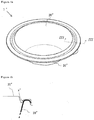
- Fig. 2a shows a resin expanded molded article used as a microwavable container and the like.
- Fig. 2b shows the fitting circumstances between a container body 10 and a lid body 20 in a container with a lid 1 shown in Fig. 2a , and is a view showing appearance of a I-I line arrow cross section in Fig. 2a .
- first container with a lid 1 in which a lid body 20 is internally fitted to a container body 10 (hereinafter, also referred to as "first container with a lid 1 ") is shown.
- Fig. 3a shows a container with a lid 1' in which a lid body 20' is externally fitted to a container body 10' (hereinafter, also referred to as "second container with a lid 1' "), and Fig. 3b is a view showing a II-II line arrow cross section in Fig. 3a .
- Fig. 4a shows a container with a lid 1" in which a lid body 20" is internally and externally fitted to a container body 10" (hereinafter, also referred to as “third container with a lid 1" "), and Fig. 4b is a view showing a III-III line arrow cross section in Fig. 4a .
- the lid body 20 of the first container with a lid 1 is usually prepared so that the size of a part stricking in an opening of the container body 10 is slightly larger than an opening of the container body 10.
- the first container with a lid 1 can act a strong pressure on an abutting part between the container body 10 and the lid body 20, shown in Fig. 2a with a symbol x.
- a strong pressure can be acted on an abutting part x" between the container body 10" and the lid body 20" like the first container with a lid 1.
- the container with a lid in which the lid body is internally fitted such as the first container with a lid 1 and the third container with a lid 1"
- the container with a lid in which the lid body is internally fitted is widely used for the purpose of storing food product containing much liquid such as a stew.
- the resin expanded molded article of the present embodiment exerts the excellent effect, by adopting the container body of the above-exemplified container with a lid as a specific aspect thereof.
- the second container with a lid 1' is inferior in sealability as compared with the first container with a lid 1 or the like, but it has an advantage that attachment and detachment of the lid body 20' to the container body 10' are easy.
- the second container with a lid 1' has a possibility that, when the container body is deformed, the lid body 20' is easily uncoupled from the container body 10' more than necessary.
- the secondary effect which is exerted due to excellent dimensional stability of the container body is also exerted in the case where the resin expanded molded article is the second container with a lid 1'.
- an extrusion-expanded sheet is exemplified as the resin expanded sheet for thermal molding, but a sheet-like bead expanded molded body having the suitable thickness for thermal molding can also be utilized in thermal molding, like the extrusion-expanded sheet of the present embodiment.
- a sheet-like foam which was excised from a thick bead expanded molded body or a board expanded molded body by slicing can also be utilized in thermal molding, like the extrusion-expanded sheet of the present embodiment.
- the resin expanded sheet for thermal molding is composed of a single resin expanded layer is illustrated as an example, but one having a plurality of resin expanded layers, and a type that one or more resin film layers are laminated on one or more resin expanded layers are also within the range intended as the resin expanded sheet of the present invention.
- the resin expanded sheet of the present embodiment is a type provided with two or more layers of the resin expanded layer including a polyamide-based resin composition
- a resin expanded sheet for thermal molding is exemplified as the resin expanded sheet, but the resin expanded sheet of the present invention can also be utilized for forming a resin expanded molded article such as a flat sheet or board.
- a method for producing a resin expanded molded article such as a flat sheet and board is also within the range intended as the method for producing a resin expanded molded article of the present invention.
- a polyamide-based resin As a polyamide-based resin, a polyamide 6 (manufactured by UNITIKA LTD., product name "A1030BRT”; density 1.13 g/cm 3 ) was provided.
- the polyamide 6 was used by performing dehumidification at 120°C for 4 hours in advance.
- Cooling was circulated in the mandrel for cooling, at the same time, the extruder was set at a predetermined temperature, and the blend was supplied to a hopper of the extruder, and melt-kneaded in the extruder.
- butane was injected under pressure at a middle of an extruder barrel, and added to the melt-kneading product, and melt kneading was further carried out.
- a resin temperature at extrusion was set at 230°C, and a polyamide-based resin composition in the melt state was extrusion-expanded from a die slit of the circular die, at a discharge amount of 40 kg/h, to form a cylindrical foam.
- This cylindrical foam was extended with the mandrel for cooling, and the foam was drawn with a drawing machine disposed on a further downstream side from the mandrel cooling.
- An external circumferential surface of the mandrel for cooling was sliding-contacted with an internal circumferential surface of the foam to cool the foam, and at the same time, the cylindrical foam was cut along an extrusion direction, on a downstream side of the mandrel for cooling.
- the cylindrical foam was adjusted into a flat belt shape, which was wound into a roll with the drawing machine.
- the density of the resulting expanded sheet was 0.24 g/cm 3 , the basis weight was 200 g/m 2 , and the open cell ratio was 20.0%.
- the resulting expanded sheet was cut into 330 mm x 330 mm, and was allowed to stand for 168 hours under the condition of 23°C and relative humidity of 60%.
- a moisture amount of the expanded sheet was 3.8% by mass. (100% of moisture was contained with respect to an equilibrium water adsorption rate at a temperature of 23°C and a relative humidity of 60%.)
- This expanded sheet was heated again to perform thermal molding, to prepare a resin expanded molded article.
- This resin expanded molded article was allowed to stand for 168 hours under 23°C and a relative humidity of 60%.
- thermal molding was performed as follows.
- the expanded sheet was heated in this heating furnace for 7 seconds, then, this expanded sheet was introduced into a press molding machine to perform molding.
- the expanded sheet was molded in the molding cavities, to prepare a rectangular box shaped resin expanded molded article having the size of an opening and a bottom portion of 50 (length) x 50 (width) mm and the depth of 30 mm.
- a dimensional change rate of the resin expanded molded article was calculated as follows.
- the resin expanded molded article is allowed to stand for 168 hours under 23°C and a relative humidity of 60%, and sizes of the length (bottom portion), the width (bottom portion), and the height (L3, L4, L5) after allowing to stand are measured.
- Absolute values (A, B, C) of respective dimensional change rates are obtained by the following equations, and an average thereof is adopted as a dimensional change rate of the resin expanded molded article.
- Absolute value A of change rate of length bottom portion % 100 ⁇ L 3 ⁇ L 1 / L 1
- Absolute value B of change rate of width bottom portion % 100 ⁇ L 4 ⁇ L 2 / L 2
- Absolute value C of change rate of depth % 100 ⁇ L 5 ⁇ L 3 / L 3
- Dimensional change rate of molded article % A + B + C / 3
- Example 2 According to the same manner as in Example 1 except that the expanded sheet, the moisture content of which had been regulated at 2.5% by mass (65.8% with respect to equilibrium water absorption rate at a temperature of 23°C and a relative humidity of 60%) was used, thermal molding was performed to prepare a rectangular box shaped resin expanded molded article, and a dimensional change rate was obtained.
- the time for retaining the excised sheet under the environment of 23°C and relative humidity of 60% was regulated to adjust a moisture amount thereof at 2.5% by mass.
- a rectangular box shaped resin expanded molded article obtained by thermally molding this expanded sheet had a dimensional change rate with respect to immediately after molding, of 0.61%.
- Example 2 According to the same manner as in Example 1 except that the expanded sheet, the moisture content of which had been regulated at 1.7% by mass (44.7% with respect to equilibrium water absorption rate at a temperature of 23°C and a relative humidity of 60%) was used, thermal molding was performed to prepare a rectangular box shaped resin expanded molded article, and a dimensional change rate was obtained.
- the time for retaining the excised sheet under the environment of 23°C and relative humidity of 60% was regulated to adjust a moisture amount thereof at 1.7% by mass.
- the rectangular box shaped resin expanded molded article obtained by thermally molding this expanded sheet had a dimensional change rate with respect to immediately after molding, of 0.75%.
- Example 2 According to the same manner as in Example 1 except that the expanded sheet, the moisture content of which had been regulated at 1.2% by mass (31.6% with respect to equilibrium water absorption rate at a temperature of 23°C and a relative humidity of 60%) was used, thermal molding was performed to prepare a rectangular box shaped resin expanded molded article, and a dimensional change rate was obtained.
- the time for retaining the excised sheet under the environment of 23°C and relative humidity of 60% was regulated to adjust a moisture amount thereof at 1.2% by mass.
- the rectangular box shaped resin expanded molded article obtained by thermally molding this expanded sheet had a dimensional change rate with respect to immediately after molding, of 0.85%.
- Example 2 According to the same manner as in Example 1 except that, as the polyamide-based resin, a polyamide 6,6 (manufactured by UNITIKA LTD., product name "E2046"; density 1.14 g/cm 3 ) was used, 1.2 parts by mass as a use amount of a styrene-maleic acid copolymer (SMA1000P) based on 100 parts by mass of this resin (polyamide 6,6) was used in place of 0.3 parts by mass, as well as 280°C as a resin temperature at extrusion was used in place of 230°C, an expanded sheet was prepared.
- SMA1000P styrene-maleic acid copolymer
- This resin expanded molded article was allowed to stand for 168 hours under 23°C and a relative humidity of 60%.
- the expanded sheet prepared in Example 5 was regulated so that the moisture content became 2.0% by mass (66.7% with respect to equilibrium water absorption rate at a temperature of 23°C and a relative humidity of 60%).
- the rectangular box shaped resin expanded molded article obtained by thermally molding this expanded sheet had a dimensional change rate with respect to immediately after molding, of 0.33%.
- the expanded sheet prepared in Example 5 was regulated so that the moisture content became 1.1% by mass (36.7% with respect to equilibrium water absorption rate at a temperature of 23°C and a relative humidity of 60%).
- the rectangular box shaped resin expanded molded article obtained by thermally molding this expanded sheet had a dimensional change rate with respect to immediately after molding, of 0.68%.
- Example 2 According to the same manner as in Example 1 except that, as the polyamide-based resin, an amorphous polyamide (manufactured by UNITIKA LTD., product name "CX-2600"; density 1.11 g/cm 3 ) was used, 0.8 parts by mass as a use amount of a styrene-maleic anhydride copolymer (SMA1000P) based on 100 parts by mass of this resin (amorphous polyamide) was used in place of 0.3 parts by mass, as well as 220°C as a resin temperature at extrusion was used in place of 230°C, an expanded sheet was prepared.
- SMA1000P styrene-maleic anhydride copolymer
- This resin expanded molded article was allowed to stand for 168 hours under 23°C and a relative humidity of 60%.
- Example 2 According to the same manner as in Example 1 except that, as the polyamide-based resin, a blend of a polyamide 6 (manufactured by UNITIKA LTD., product name "A1030BRT”) and an amorphous polyamide (manufactured by UNITIKA LTD., product name "CX-2600”) at the mass ratio of 5:5 (“A1030BRT”: “CX-2600”) was used, and 0.8 parts by mass as a use amount of a styrene-maleic anhydride copolymer (SMA1000P) based on 100 parts by mass of this resin was used in place of 0.3 parts by mass, an expanded sheet was prepared.
- SMA1000P styrene-maleic anhydride copolymer
- This resin expanded molded article was allowed to stand for 168 hours under 23°C and a relative humidity of 60%.
- Example 2 According to the same manner as in Example 1 except that an expanded sheet maintaining the state where the moisture content remained 0.24% by mass (6.3% with respect to equilibrium water absorption rate at a temperature of 23°C and a relative humidity of 60%) from immediately after production was used, thermal molding was performed to prepare a rectangular box shaped resin expanded molded article, and a dimensional change rate was obtained.
- the rectangular box shaped resin expanded molded article obtained by thermally molding this expanded sheet had a dimensional change rate with respect to immediately after molding, of 1.90%.
- Example 5 According to the same manner as in Example 5 except that the expanded sheet in the state where the moisture content was 0.48% by mass (16.0% with respect to equilibrium water absorption rate at a temperature of 23°C and a relative humidity of 60%) was used, thermal molding was performed to prepare a rectangular box shaped resin expanded molded article, and a dimensional change rate was obtained.
- the rectangular box shaped resin expanded molded article obtained by thermally molding this expanded sheet had a dimensional change rate with respect to immediately after molding, of 1.18%.
- Example 1 Example 5
- Example 8 Example 9 Apparent density (g/cm 3 ) 0.24 0.27 0.15 0.20 Basis weight (g/m 2 ) 200 200 220 200 Open cell ratio (%) 20.0 17.0 25.0 23.8 Average cell diameter (mm) 0.28 0.35 0.15 0.18 Crystallization heat quantity (J/g) 55.2 50.4 *1 30.8 Crystallization degree (%) 24.0 22.3 0 13.4 * 1 An exothermic peak associated with crystallization was not observed.
- a heater temperature is a set value
- a sheet surface temperature is a value measured with "THERMO LABEL 5E-125" (product name), and "THERMO LABEL 5E-170" (product name) manufactured by NiGK Corporation.
- Example 1 Example 5
- Example 8 Example 9 Heater temperature (°C) 330 330 330 330 Heating time (sec) 7 13 7 7 Sheet surface temperature (°C) 140 200 140 140 140
Landscapes
- Chemical & Material Sciences (AREA)
- Engineering & Computer Science (AREA)
- Mechanical Engineering (AREA)
- Materials Engineering (AREA)
- Chemical Kinetics & Catalysis (AREA)
- Health & Medical Sciences (AREA)
- Medicinal Chemistry (AREA)
- Polymers & Plastics (AREA)
- Organic Chemistry (AREA)
- Manufacturing & Machinery (AREA)
- Inorganic Chemistry (AREA)
- Manufacture Of Porous Articles, And Recovery And Treatment Of Waste Products (AREA)
- Laminated Bodies (AREA)
- Compositions Of Macromolecular Compounds (AREA)
Applications Claiming Priority (2)
| Application Number | Priority Date | Filing Date | Title |
|---|---|---|---|
| JP2014200882 | 2014-09-30 | ||
| PCT/JP2015/077805 WO2016052647A1 (ja) | 2014-09-30 | 2015-09-30 | 樹脂発泡シート及び樹脂発泡成形品の製造方法 |
Publications (3)
| Publication Number | Publication Date |
|---|---|
| EP3202829A1 true EP3202829A1 (de) | 2017-08-09 |
| EP3202829A4 EP3202829A4 (de) | 2018-06-13 |
| EP3202829B1 EP3202829B1 (de) | 2020-01-29 |
Family
ID=55630671
Family Applications (1)
| Application Number | Title | Priority Date | Filing Date |
|---|---|---|---|
| EP15847785.1A Active EP3202829B1 (de) | 2014-09-30 | 2015-09-30 | Verwendung einer harzschaumfolie, und verfahren zur herstellung eines harzschaumformkörpers |
Country Status (7)
| Country | Link |
|---|---|
| US (2) | US20170157814A1 (de) |
| EP (1) | EP3202829B1 (de) |
| JP (1) | JP6248210B2 (de) |
| KR (1) | KR101917615B1 (de) |
| CN (1) | CN106604955B (de) |
| TW (1) | TWI643755B (de) |
| WO (1) | WO2016052647A1 (de) |
Cited By (1)
| Publication number | Priority date | Publication date | Assignee | Title |
|---|---|---|---|---|
| EP3632970A1 (de) * | 2018-10-04 | 2020-04-08 | Basf Se | Verfahren zur kontinuierlichen herstellung eines teilkristallinen thermoplastischen polymerschaums |
Families Citing this family (3)
| Publication number | Priority date | Publication date | Assignee | Title |
|---|---|---|---|---|
| JP6715149B2 (ja) * | 2016-09-28 | 2020-07-01 | 積水化成品工業株式会社 | 樹脂発泡シート及び樹脂発泡成形品の製造方法 |
| JP6619716B2 (ja) * | 2016-09-28 | 2019-12-11 | 積水化成品工業株式会社 | 樹脂発泡シート、樹脂複合体、樹脂複合体の製造方法 |
| JPWO2023054542A1 (de) * | 2021-09-30 | 2023-04-06 |
Family Cites Families (17)
| Publication number | Priority date | Publication date | Assignee | Title |
|---|---|---|---|---|
| US3152054A (en) * | 1962-07-16 | 1964-10-06 | Du Pont | Process for treatment of polycaprolactam articles |
| US3451974A (en) * | 1965-12-01 | 1969-06-24 | Du Pont | Process for moisture conditioning of nylon |
| JPH05261806A (ja) * | 1992-03-18 | 1993-10-12 | Unitika Ltd | ポリアミド二軸延伸フィルムの製造方法 |
| JP2596588Y2 (ja) * | 1992-11-05 | 1999-06-14 | 積水化成品工業株式会社 | 食品容器 |
| JP3862292B2 (ja) * | 1994-08-08 | 2006-12-27 | 旭化成ケミカルズ株式会社 | 耐熱性ロール状フィルム及びその製造法 |
| DE69723280T2 (de) * | 1996-04-05 | 2004-04-22 | Kaneka Corp. | Wässrige polyolefinzusammensetzung, daraus hergestellte vorexpandierte teilchen, verfahren zu ihrer herstellung und expandierte formteile |
| JP3524006B2 (ja) * | 1998-09-14 | 2004-04-26 | 積水化成品工業株式会社 | ポリアミド系樹脂発泡体の製造方法 |
| CN1668349A (zh) * | 2002-07-12 | 2005-09-14 | 可乐丽股份有限公司 | 多孔膜 |
| JP4352706B2 (ja) * | 2003-01-14 | 2009-10-28 | 日本精工株式会社 | 動力伝達に適した樹脂歯車 |
| GB0500985D0 (en) * | 2005-01-18 | 2005-02-23 | Zotefoams Plc | Polyamide foams, process to make them and applications thereof |
| JP2007069103A (ja) * | 2005-09-06 | 2007-03-22 | Nagoya Oil Chem Co Ltd | マスキング材 |
| JP2008200206A (ja) * | 2007-02-19 | 2008-09-04 | Seiko Instruments Inc | 生体情報測定システム、生体情報測定用送信機及び生体情報測定用受信機 |
| FR2960545B1 (fr) * | 2010-05-28 | 2014-11-28 | Rhodia Operations | Polyamide modifie sulfonate aux proprietes barrieres ameliorees |
| EP2626377B1 (de) * | 2010-10-08 | 2018-10-24 | Mitsubishi Gas Chemical Company, Inc. | Polyamidharzform und verfahren |
| JP5801072B2 (ja) * | 2011-03-16 | 2015-10-28 | バンドー化学株式会社 | 発泡歯車 |
| JP5703249B2 (ja) | 2012-03-08 | 2015-04-15 | 積水化成品工業株式会社 | ポリアミド系樹脂発泡シート及びその製造方法 |
| JP2014114405A (ja) * | 2012-12-12 | 2014-06-26 | Toray Ind Inc | 芳香族ポリアミド多孔質フィルムの製造方法および芳香族ポリアミド多孔質フィルム |
-
2015
- 2015-09-30 US US15/323,774 patent/US20170157814A1/en not_active Abandoned
- 2015-09-30 JP JP2016552134A patent/JP6248210B2/ja active Active
- 2015-09-30 WO PCT/JP2015/077805 patent/WO2016052647A1/ja not_active Ceased
- 2015-09-30 CN CN201580045800.8A patent/CN106604955B/zh active Active
- 2015-09-30 EP EP15847785.1A patent/EP3202829B1/de active Active
- 2015-09-30 KR KR1020177005120A patent/KR101917615B1/ko not_active Expired - Fee Related
- 2015-09-30 TW TW104132060A patent/TWI643755B/zh active
-
2019
- 2019-12-05 US US16/704,170 patent/US20200108531A1/en not_active Abandoned
Cited By (1)
| Publication number | Priority date | Publication date | Assignee | Title |
|---|---|---|---|---|
| EP3632970A1 (de) * | 2018-10-04 | 2020-04-08 | Basf Se | Verfahren zur kontinuierlichen herstellung eines teilkristallinen thermoplastischen polymerschaums |
Also Published As
| Publication number | Publication date |
|---|---|
| US20170157814A1 (en) | 2017-06-08 |
| US20200108531A1 (en) | 2020-04-09 |
| TWI643755B (zh) | 2018-12-11 |
| WO2016052647A1 (ja) | 2016-04-07 |
| EP3202829A4 (de) | 2018-06-13 |
| KR101917615B1 (ko) | 2018-11-12 |
| CN106604955B (zh) | 2019-06-18 |
| TW201617215A (zh) | 2016-05-16 |
| JP6248210B2 (ja) | 2017-12-13 |
| JPWO2016052647A1 (ja) | 2017-04-27 |
| EP3202829B1 (de) | 2020-01-29 |
| KR20170032458A (ko) | 2017-03-22 |
| CN106604955A (zh) | 2017-04-26 |
Similar Documents
| Publication | Publication Date | Title |
|---|---|---|
| US20200108531A1 (en) | Resin expanded sheet and method for producing resin expanded molded article | |
| CN106795313B (zh) | 珠粒发泡成型体及其制造方法、树脂发泡颗粒及其制造方法、发泡性树脂颗粒 | |
| JP7049973B2 (ja) | マイクロセルフォームシートおよび作製プロセスおよび使用 | |
| JP5898552B2 (ja) | ポリスチレン系樹脂発泡シート及びポリスチレン系樹脂製の成形容器 | |
| TWI691534B (zh) | 熱塑性樹脂發泡粒子 | |
| EP2940070B1 (de) | Formkörper aus polymilchsäurebasierten, harzexpandierten perlen | |
| WO2018012089A1 (ja) | エステル系エラストマー発泡成形体、その用途及びエステル系エラストマー発泡粒子 | |
| US20150051302A1 (en) | Polymeric material for an insulated container | |
| WO2016053987A2 (en) | Multi-layer thermoformed polymeric foam articles and methods | |
| JP6715149B2 (ja) | 樹脂発泡シート及び樹脂発泡成形品の製造方法 | |
| KR20240012495A (ko) | 공압출 시트 | |
| JP6466248B2 (ja) | 熱成形用ポリスチレン系樹脂発泡シート | |
| CN112166143B (zh) | 包含无机粒子的发泡片及其制造方法 | |
| JP7637578B2 (ja) | 発泡シート、発泡シート成形体およびその製造方法 | |
| JP7496678B2 (ja) | ポリスチレン系樹脂発泡シート及び容器 | |
| JP2002309027A (ja) | 熱可塑性樹脂発泡シート及び発泡成形体 | |
| CA3071565C (en) | Method for production of low density polyester foam and articles made thereof utilizing low i.v. polyester feedstock | |
| JP2025151858A (ja) | ポリエチレン系樹脂発泡シート | |
| EP3950299A1 (de) | Laminierte schaumstoffplatte | |
| JPH11140214A (ja) | セルロースアセテート生分解性発泡体及びその製造方法 | |
| TWI445612B (zh) | 具環保及耐熱之容器的製法 | |
| JP2003072863A (ja) | 断熱箱体 | |
| JP2024144871A (ja) | 再生ポリプロピレン系樹脂発泡シート、及びその製造方法 | |
| JP2001322164A (ja) | ポリプロピレン系樹脂発泡シートの成形方法及び発泡容器 |
Legal Events
| Date | Code | Title | Description |
|---|---|---|---|
| STAA | Information on the status of an ep patent application or granted ep patent |
Free format text: STATUS: THE INTERNATIONAL PUBLICATION HAS BEEN MADE |
|
| PUAI | Public reference made under article 153(3) epc to a published international application that has entered the european phase |
Free format text: ORIGINAL CODE: 0009012 |
|
| STAA | Information on the status of an ep patent application or granted ep patent |
Free format text: STATUS: REQUEST FOR EXAMINATION WAS MADE |
|
| 17P | Request for examination filed |
Effective date: 20170126 |
|
| AK | Designated contracting states |
Kind code of ref document: A1 Designated state(s): AL AT BE BG CH CY CZ DE DK EE ES FI FR GB GR HR HU IE IS IT LI LT LU LV MC MK MT NL NO PL PT RO RS SE SI SK SM TR |
|
| AX | Request for extension of the european patent |
Extension state: BA ME |
|
| DAV | Request for validation of the european patent (deleted) | ||
| DAX | Request for extension of the european patent (deleted) | ||
| A4 | Supplementary search report drawn up and despatched |
Effective date: 20180511 |
|
| RIC1 | Information provided on ipc code assigned before grant |
Ipc: C08J 9/36 20060101ALI20180504BHEP Ipc: B29C 51/02 20060101AFI20180504BHEP Ipc: B29K 77/00 20060101ALN20180504BHEP Ipc: B29K 105/04 20060101ALN20180504BHEP |
|
| STAA | Information on the status of an ep patent application or granted ep patent |
Free format text: STATUS: EXAMINATION IS IN PROGRESS |
|
| 17Q | First examination report despatched |
Effective date: 20190517 |
|
| REG | Reference to a national code |
Ref country code: DE Ref legal event code: R079 Ref document number: 602015046239 Country of ref document: DE Free format text: PREVIOUS MAIN CLASS: C08J0009040000 Ipc: B29C0051020000 |
|
| RIC1 | Information provided on ipc code assigned before grant |
Ipc: B29C 48/86 20190101ALN20190807BHEP Ipc: B29C 51/02 20060101AFI20190807BHEP Ipc: C08J 9/36 20060101ALI20190807BHEP Ipc: B29C 48/08 20190101ALN20190807BHEP Ipc: B29C 49/22 20060101ALI20190807BHEP Ipc: B29C 48/16 20190101ALI20190807BHEP Ipc: C08J 9/14 20060101ALI20190807BHEP Ipc: B32B 27/06 20060101ALI20190807BHEP Ipc: B29K 77/00 20060101ALN20190807BHEP Ipc: B29C 48/09 20190101ALN20190807BHEP Ipc: B29K 105/04 20060101ALN20190807BHEP Ipc: B29C 48/00 20190101ALN20190807BHEP Ipc: B29C 44/56 20060101ALI20190807BHEP Ipc: B32B 5/32 20060101ALI20190807BHEP Ipc: B29C 48/92 20190101ALN20190807BHEP Ipc: B29C 49/48 20060101ALI20190807BHEP Ipc: C08J 9/00 20060101ALI20190807BHEP Ipc: B32B 5/18 20060101ALI20190807BHEP Ipc: B29C 44/50 20060101ALI20190807BHEP Ipc: B32B 1/02 20060101ALI20190807BHEP Ipc: B29C 48/32 20190101ALN20190807BHEP |
|
| GRAP | Despatch of communication of intention to grant a patent |
Free format text: ORIGINAL CODE: EPIDOSNIGR1 |
|
| STAA | Information on the status of an ep patent application or granted ep patent |
Free format text: STATUS: GRANT OF PATENT IS INTENDED |
|
| INTG | Intention to grant announced |
Effective date: 20190918 |
|
| GRAS | Grant fee paid |
Free format text: ORIGINAL CODE: EPIDOSNIGR3 |
|
| GRAA | (expected) grant |
Free format text: ORIGINAL CODE: 0009210 |
|
| STAA | Information on the status of an ep patent application or granted ep patent |
Free format text: STATUS: THE PATENT HAS BEEN GRANTED |
|
| AK | Designated contracting states |
Kind code of ref document: B1 Designated state(s): AL AT BE BG CH CY CZ DE DK EE ES FI FR GB GR HR HU IE IS IT LI LT LU LV MC MK MT NL NO PL PT RO RS SE SI SK SM TR |
|
| REG | Reference to a national code |
Ref country code: GB Ref legal event code: FG4D |
|
| REG | Reference to a national code |
Ref country code: CH Ref legal event code: EP |
|
| REG | Reference to a national code |
Ref country code: AT Ref legal event code: REF Ref document number: 1228165 Country of ref document: AT Kind code of ref document: T Effective date: 20200215 |
|
| REG | Reference to a national code |
Ref country code: IE Ref legal event code: FG4D |
|
| REG | Reference to a national code |
Ref country code: DE Ref legal event code: R096 Ref document number: 602015046239 Country of ref document: DE |
|
| REG | Reference to a national code |
Ref country code: NL Ref legal event code: MP Effective date: 20200129 |
|
| PG25 | Lapsed in a contracting state [announced via postgrant information from national office to epo] |
Ref country code: NO Free format text: LAPSE BECAUSE OF FAILURE TO SUBMIT A TRANSLATION OF THE DESCRIPTION OR TO PAY THE FEE WITHIN THE PRESCRIBED TIME-LIMIT Effective date: 20200429 Ref country code: FI Free format text: LAPSE BECAUSE OF FAILURE TO SUBMIT A TRANSLATION OF THE DESCRIPTION OR TO PAY THE FEE WITHIN THE PRESCRIBED TIME-LIMIT Effective date: 20200129 Ref country code: RS Free format text: LAPSE BECAUSE OF FAILURE TO SUBMIT A TRANSLATION OF THE DESCRIPTION OR TO PAY THE FEE WITHIN THE PRESCRIBED TIME-LIMIT Effective date: 20200129 Ref country code: PT Free format text: LAPSE BECAUSE OF FAILURE TO SUBMIT A TRANSLATION OF THE DESCRIPTION OR TO PAY THE FEE WITHIN THE PRESCRIBED TIME-LIMIT Effective date: 20200621 |
|
| REG | Reference to a national code |
Ref country code: LT Ref legal event code: MG4D |
|
| PG25 | Lapsed in a contracting state [announced via postgrant information from national office to epo] |
Ref country code: BG Free format text: LAPSE BECAUSE OF FAILURE TO SUBMIT A TRANSLATION OF THE DESCRIPTION OR TO PAY THE FEE WITHIN THE PRESCRIBED TIME-LIMIT Effective date: 20200429 Ref country code: GR Free format text: LAPSE BECAUSE OF FAILURE TO SUBMIT A TRANSLATION OF THE DESCRIPTION OR TO PAY THE FEE WITHIN THE PRESCRIBED TIME-LIMIT Effective date: 20200430 Ref country code: LV Free format text: LAPSE BECAUSE OF FAILURE TO SUBMIT A TRANSLATION OF THE DESCRIPTION OR TO PAY THE FEE WITHIN THE PRESCRIBED TIME-LIMIT Effective date: 20200129 Ref country code: SE Free format text: LAPSE BECAUSE OF FAILURE TO SUBMIT A TRANSLATION OF THE DESCRIPTION OR TO PAY THE FEE WITHIN THE PRESCRIBED TIME-LIMIT Effective date: 20200129 Ref country code: IS Free format text: LAPSE BECAUSE OF FAILURE TO SUBMIT A TRANSLATION OF THE DESCRIPTION OR TO PAY THE FEE WITHIN THE PRESCRIBED TIME-LIMIT Effective date: 20200529 Ref country code: HR Free format text: LAPSE BECAUSE OF FAILURE TO SUBMIT A TRANSLATION OF THE DESCRIPTION OR TO PAY THE FEE WITHIN THE PRESCRIBED TIME-LIMIT Effective date: 20200129 |
|
| PG25 | Lapsed in a contracting state [announced via postgrant information from national office to epo] |
Ref country code: NL Free format text: LAPSE BECAUSE OF FAILURE TO SUBMIT A TRANSLATION OF THE DESCRIPTION OR TO PAY THE FEE WITHIN THE PRESCRIBED TIME-LIMIT Effective date: 20200129 |
|
| PG25 | Lapsed in a contracting state [announced via postgrant information from national office to epo] |
Ref country code: SK Free format text: LAPSE BECAUSE OF FAILURE TO SUBMIT A TRANSLATION OF THE DESCRIPTION OR TO PAY THE FEE WITHIN THE PRESCRIBED TIME-LIMIT Effective date: 20200129 Ref country code: DK Free format text: LAPSE BECAUSE OF FAILURE TO SUBMIT A TRANSLATION OF THE DESCRIPTION OR TO PAY THE FEE WITHIN THE PRESCRIBED TIME-LIMIT Effective date: 20200129 Ref country code: LT Free format text: LAPSE BECAUSE OF FAILURE TO SUBMIT A TRANSLATION OF THE DESCRIPTION OR TO PAY THE FEE WITHIN THE PRESCRIBED TIME-LIMIT Effective date: 20200129 Ref country code: EE Free format text: LAPSE BECAUSE OF FAILURE TO SUBMIT A TRANSLATION OF THE DESCRIPTION OR TO PAY THE FEE WITHIN THE PRESCRIBED TIME-LIMIT Effective date: 20200129 Ref country code: SM Free format text: LAPSE BECAUSE OF FAILURE TO SUBMIT A TRANSLATION OF THE DESCRIPTION OR TO PAY THE FEE WITHIN THE PRESCRIBED TIME-LIMIT Effective date: 20200129 Ref country code: RO Free format text: LAPSE BECAUSE OF FAILURE TO SUBMIT A TRANSLATION OF THE DESCRIPTION OR TO PAY THE FEE WITHIN THE PRESCRIBED TIME-LIMIT Effective date: 20200129 Ref country code: CZ Free format text: LAPSE BECAUSE OF FAILURE TO SUBMIT A TRANSLATION OF THE DESCRIPTION OR TO PAY THE FEE WITHIN THE PRESCRIBED TIME-LIMIT Effective date: 20200129 Ref country code: ES Free format text: LAPSE BECAUSE OF FAILURE TO SUBMIT A TRANSLATION OF THE DESCRIPTION OR TO PAY THE FEE WITHIN THE PRESCRIBED TIME-LIMIT Effective date: 20200129 |
|
| REG | Reference to a national code |
Ref country code: DE Ref legal event code: R097 Ref document number: 602015046239 Country of ref document: DE |
|
| REG | Reference to a national code |
Ref country code: AT Ref legal event code: MK05 Ref document number: 1228165 Country of ref document: AT Kind code of ref document: T Effective date: 20200129 |
|
| PLBE | No opposition filed within time limit |
Free format text: ORIGINAL CODE: 0009261 |
|
| STAA | Information on the status of an ep patent application or granted ep patent |
Free format text: STATUS: NO OPPOSITION FILED WITHIN TIME LIMIT |
|
| 26N | No opposition filed |
Effective date: 20201030 |
|
| PG25 | Lapsed in a contracting state [announced via postgrant information from national office to epo] |
Ref country code: IT Free format text: LAPSE BECAUSE OF FAILURE TO SUBMIT A TRANSLATION OF THE DESCRIPTION OR TO PAY THE FEE WITHIN THE PRESCRIBED TIME-LIMIT Effective date: 20200129 Ref country code: AT Free format text: LAPSE BECAUSE OF FAILURE TO SUBMIT A TRANSLATION OF THE DESCRIPTION OR TO PAY THE FEE WITHIN THE PRESCRIBED TIME-LIMIT Effective date: 20200129 |
|
| PG25 | Lapsed in a contracting state [announced via postgrant information from national office to epo] |
Ref country code: PL Free format text: LAPSE BECAUSE OF FAILURE TO SUBMIT A TRANSLATION OF THE DESCRIPTION OR TO PAY THE FEE WITHIN THE PRESCRIBED TIME-LIMIT Effective date: 20200129 Ref country code: SI Free format text: LAPSE BECAUSE OF FAILURE TO SUBMIT A TRANSLATION OF THE DESCRIPTION OR TO PAY THE FEE WITHIN THE PRESCRIBED TIME-LIMIT Effective date: 20200129 |
|
| REG | Reference to a national code |
Ref country code: CH Ref legal event code: PL |
|
| GBPC | Gb: european patent ceased through non-payment of renewal fee |
Effective date: 20200930 |
|
| REG | Reference to a national code |
Ref country code: BE Ref legal event code: MM Effective date: 20200930 |
|
| PG25 | Lapsed in a contracting state [announced via postgrant information from national office to epo] |
Ref country code: LU Free format text: LAPSE BECAUSE OF NON-PAYMENT OF DUE FEES Effective date: 20200930 |
|
| PG25 | Lapsed in a contracting state [announced via postgrant information from national office to epo] |
Ref country code: FR Free format text: LAPSE BECAUSE OF NON-PAYMENT OF DUE FEES Effective date: 20200930 |
|
| PG25 | Lapsed in a contracting state [announced via postgrant information from national office to epo] |
Ref country code: CH Free format text: LAPSE BECAUSE OF NON-PAYMENT OF DUE FEES Effective date: 20200930 Ref country code: BE Free format text: LAPSE BECAUSE OF NON-PAYMENT OF DUE FEES Effective date: 20200930 Ref country code: GB Free format text: LAPSE BECAUSE OF NON-PAYMENT OF DUE FEES Effective date: 20200930 Ref country code: IE Free format text: LAPSE BECAUSE OF NON-PAYMENT OF DUE FEES Effective date: 20200930 Ref country code: LI Free format text: LAPSE BECAUSE OF NON-PAYMENT OF DUE FEES Effective date: 20200930 |
|
| PG25 | Lapsed in a contracting state [announced via postgrant information from national office to epo] |
Ref country code: TR Free format text: LAPSE BECAUSE OF FAILURE TO SUBMIT A TRANSLATION OF THE DESCRIPTION OR TO PAY THE FEE WITHIN THE PRESCRIBED TIME-LIMIT Effective date: 20200129 Ref country code: MT Free format text: LAPSE BECAUSE OF FAILURE TO SUBMIT A TRANSLATION OF THE DESCRIPTION OR TO PAY THE FEE WITHIN THE PRESCRIBED TIME-LIMIT Effective date: 20200129 Ref country code: CY Free format text: LAPSE BECAUSE OF FAILURE TO SUBMIT A TRANSLATION OF THE DESCRIPTION OR TO PAY THE FEE WITHIN THE PRESCRIBED TIME-LIMIT Effective date: 20200129 |
|
| PG25 | Lapsed in a contracting state [announced via postgrant information from national office to epo] |
Ref country code: MK Free format text: LAPSE BECAUSE OF FAILURE TO SUBMIT A TRANSLATION OF THE DESCRIPTION OR TO PAY THE FEE WITHIN THE PRESCRIBED TIME-LIMIT Effective date: 20200129 Ref country code: MC Free format text: LAPSE BECAUSE OF FAILURE TO SUBMIT A TRANSLATION OF THE DESCRIPTION OR TO PAY THE FEE WITHIN THE PRESCRIBED TIME-LIMIT Effective date: 20200129 Ref country code: AL Free format text: LAPSE BECAUSE OF FAILURE TO SUBMIT A TRANSLATION OF THE DESCRIPTION OR TO PAY THE FEE WITHIN THE PRESCRIBED TIME-LIMIT Effective date: 20200129 |
|
| P01 | Opt-out of the competence of the unified patent court (upc) registered |
Effective date: 20230517 |
|
| PGFP | Annual fee paid to national office [announced via postgrant information from national office to epo] |
Ref country code: DE Payment date: 20250805 Year of fee payment: 11 |