EP3081568B1 - Compositions and methods for treating alzheimer's disease - Google Patents
Compositions and methods for treating alzheimer's disease Download PDFInfo
- Publication number
- EP3081568B1 EP3081568B1 EP16169411.2A EP16169411A EP3081568B1 EP 3081568 B1 EP3081568 B1 EP 3081568B1 EP 16169411 A EP16169411 A EP 16169411A EP 3081568 B1 EP3081568 B1 EP 3081568B1
- Authority
- EP
- European Patent Office
- Prior art keywords
- pharmaceutical composition
- inhibitor
- patient
- disease
- compound
- Prior art date
- Legal status (The legal status is an assumption and is not a legal conclusion. Google has not performed a legal analysis and makes no representation as to the accuracy of the status listed.)
- Active
Links
- IADKHNLYTDEPGD-UHFFFAOYSA-N CS(c(cc1)ccc1-c1cc(-c2ccncc2)c(-c(cc2)ccc2F)[nH]1)=O Chemical compound CS(c(cc1)ccc1-c1cc(-c2ccncc2)c(-c(cc2)ccc2F)[nH]1)=O IADKHNLYTDEPGD-UHFFFAOYSA-N 0.000 description 1
- ZXONHXQWZPBOLO-GOSISDBHSA-N C[C@H](c1ccccc1)Nc1nccc(-c2cc(C3CCNCC3)nnc2-c2cccc(C(F)(F)F)c2)n1 Chemical compound C[C@H](c1ccccc1)Nc1nccc(-c2cc(C3CCNCC3)nnc2-c2cccc(C(F)(F)F)c2)n1 ZXONHXQWZPBOLO-GOSISDBHSA-N 0.000 description 1
- KCAJXIDMCNPGHZ-UHFFFAOYSA-N Cc(ccc(C(NC)=O)c1)c1N(C(C)=CC(OCc(ccc(F)c1)c1F)=C1Br)C1=O Chemical compound Cc(ccc(C(NC)=O)c1)c1N(C(C)=CC(OCc(ccc(F)c1)c1F)=C1Br)C1=O KCAJXIDMCNPGHZ-UHFFFAOYSA-N 0.000 description 1
- VEPKQEUBKLEPRA-UHFFFAOYSA-N O=C(C(c(c(Cl)ccc1)c1Cl)=C1C=C2)N=CN1N=C2Sc(ccc(F)c1)c1F Chemical compound O=C(C(c(c(Cl)ccc1)c1Cl)=C1C=C2)N=CN1N=C2Sc(ccc(F)c1)c1F VEPKQEUBKLEPRA-UHFFFAOYSA-N 0.000 description 1
Images

Classifications
-
- A—HUMAN NECESSITIES
- A61—MEDICAL OR VETERINARY SCIENCE; HYGIENE
- A61K—PREPARATIONS FOR MEDICAL, DENTAL OR TOILETRY PURPOSES
- A61K31/00—Medicinal preparations containing organic active ingredients
- A61K31/33—Heterocyclic compounds
- A61K31/395—Heterocyclic compounds having nitrogen as a ring hetero atom, e.g. guanethidine or rifamycins
- A61K31/495—Heterocyclic compounds having nitrogen as a ring hetero atom, e.g. guanethidine or rifamycins having six-membered rings with two or more nitrogen atoms as the only ring heteroatoms, e.g. piperazine or tetrazines
- A61K31/505—Pyrimidines; Hydrogenated pyrimidines, e.g. trimethoprim
- A61K31/519—Pyrimidines; Hydrogenated pyrimidines, e.g. trimethoprim ortho- or peri-condensed with heterocyclic rings
-
- A—HUMAN NECESSITIES
- A61—MEDICAL OR VETERINARY SCIENCE; HYGIENE
- A61K—PREPARATIONS FOR MEDICAL, DENTAL OR TOILETRY PURPOSES
- A61K31/00—Medicinal preparations containing organic active ingredients
- A61K31/33—Heterocyclic compounds
- A61K31/395—Heterocyclic compounds having nitrogen as a ring hetero atom, e.g. guanethidine or rifamycins
- A61K31/435—Heterocyclic compounds having nitrogen as a ring hetero atom, e.g. guanethidine or rifamycins having six-membered rings with one nitrogen as the only ring hetero atom
- A61K31/44—Non condensed pyridines; Hydrogenated derivatives thereof
- A61K31/4418—Non condensed pyridines; Hydrogenated derivatives thereof having a carbocyclic group directly attached to the heterocyclic ring, e.g. cyproheptadine
-
- A—HUMAN NECESSITIES
- A61—MEDICAL OR VETERINARY SCIENCE; HYGIENE
- A61K—PREPARATIONS FOR MEDICAL, DENTAL OR TOILETRY PURPOSES
- A61K31/00—Medicinal preparations containing organic active ingredients
- A61K31/33—Heterocyclic compounds
- A61K31/395—Heterocyclic compounds having nitrogen as a ring hetero atom, e.g. guanethidine or rifamycins
- A61K31/435—Heterocyclic compounds having nitrogen as a ring hetero atom, e.g. guanethidine or rifamycins having six-membered rings with one nitrogen as the only ring hetero atom
- A61K31/4353—Heterocyclic compounds having nitrogen as a ring hetero atom, e.g. guanethidine or rifamycins having six-membered rings with one nitrogen as the only ring hetero atom ortho- or peri-condensed with heterocyclic ring systems
- A61K31/437—Heterocyclic compounds having nitrogen as a ring hetero atom, e.g. guanethidine or rifamycins having six-membered rings with one nitrogen as the only ring hetero atom ortho- or peri-condensed with heterocyclic ring systems the heterocyclic ring system containing a five-membered ring having nitrogen as a ring hetero atom, e.g. indolizine, beta-carboline
-
- A—HUMAN NECESSITIES
- A61—MEDICAL OR VETERINARY SCIENCE; HYGIENE
- A61K—PREPARATIONS FOR MEDICAL, DENTAL OR TOILETRY PURPOSES
- A61K31/00—Medicinal preparations containing organic active ingredients
- A61K31/33—Heterocyclic compounds
- A61K31/395—Heterocyclic compounds having nitrogen as a ring hetero atom, e.g. guanethidine or rifamycins
- A61K31/435—Heterocyclic compounds having nitrogen as a ring hetero atom, e.g. guanethidine or rifamycins having six-membered rings with one nitrogen as the only ring hetero atom
- A61K31/44—Non condensed pyridines; Hydrogenated derivatives thereof
- A61K31/4427—Non condensed pyridines; Hydrogenated derivatives thereof containing further heterocyclic ring systems
- A61K31/4439—Non condensed pyridines; Hydrogenated derivatives thereof containing further heterocyclic ring systems containing a five-membered ring with nitrogen as a ring hetero atom, e.g. omeprazole
-
- A—HUMAN NECESSITIES
- A61—MEDICAL OR VETERINARY SCIENCE; HYGIENE
- A61K—PREPARATIONS FOR MEDICAL, DENTAL OR TOILETRY PURPOSES
- A61K31/00—Medicinal preparations containing organic active ingredients
- A61K31/33—Heterocyclic compounds
- A61K31/395—Heterocyclic compounds having nitrogen as a ring hetero atom, e.g. guanethidine or rifamycins
- A61K31/495—Heterocyclic compounds having nitrogen as a ring hetero atom, e.g. guanethidine or rifamycins having six-membered rings with two or more nitrogen atoms as the only ring heteroatoms, e.g. piperazine or tetrazines
- A61K31/496—Non-condensed piperazines containing further heterocyclic rings, e.g. rifampin, thiothixene or sparfloxacin
-
- A—HUMAN NECESSITIES
- A61—MEDICAL OR VETERINARY SCIENCE; HYGIENE
- A61K—PREPARATIONS FOR MEDICAL, DENTAL OR TOILETRY PURPOSES
- A61K31/00—Medicinal preparations containing organic active ingredients
- A61K31/33—Heterocyclic compounds
- A61K31/395—Heterocyclic compounds having nitrogen as a ring hetero atom, e.g. guanethidine or rifamycins
- A61K31/495—Heterocyclic compounds having nitrogen as a ring hetero atom, e.g. guanethidine or rifamycins having six-membered rings with two or more nitrogen atoms as the only ring heteroatoms, e.g. piperazine or tetrazines
- A61K31/50—Pyridazines; Hydrogenated pyridazines
- A61K31/5025—Pyridazines; Hydrogenated pyridazines ortho- or peri-condensed with heterocyclic ring systems
-
- A—HUMAN NECESSITIES
- A61—MEDICAL OR VETERINARY SCIENCE; HYGIENE
- A61K—PREPARATIONS FOR MEDICAL, DENTAL OR TOILETRY PURPOSES
- A61K31/00—Medicinal preparations containing organic active ingredients
- A61K31/33—Heterocyclic compounds
- A61K31/395—Heterocyclic compounds having nitrogen as a ring hetero atom, e.g. guanethidine or rifamycins
- A61K31/495—Heterocyclic compounds having nitrogen as a ring hetero atom, e.g. guanethidine or rifamycins having six-membered rings with two or more nitrogen atoms as the only ring heteroatoms, e.g. piperazine or tetrazines
- A61K31/505—Pyrimidines; Hydrogenated pyrimidines, e.g. trimethoprim
- A61K31/506—Pyrimidines; Hydrogenated pyrimidines, e.g. trimethoprim not condensed and containing further heterocyclic rings
-
- A—HUMAN NECESSITIES
- A61—MEDICAL OR VETERINARY SCIENCE; HYGIENE
- A61K—PREPARATIONS FOR MEDICAL, DENTAL OR TOILETRY PURPOSES
- A61K31/00—Medicinal preparations containing organic active ingredients
- A61K31/33—Heterocyclic compounds
- A61K31/395—Heterocyclic compounds having nitrogen as a ring hetero atom, e.g. guanethidine or rifamycins
- A61K31/535—Heterocyclic compounds having nitrogen as a ring hetero atom, e.g. guanethidine or rifamycins having six-membered rings with at least one nitrogen and one oxygen as the ring hetero atoms, e.g. 1,2-oxazines
- A61K31/5375—1,4-Oxazines, e.g. morpholine
- A61K31/5377—1,4-Oxazines, e.g. morpholine not condensed and containing further heterocyclic rings, e.g. timolol
-
- A—HUMAN NECESSITIES
- A61—MEDICAL OR VETERINARY SCIENCE; HYGIENE
- A61K—PREPARATIONS FOR MEDICAL, DENTAL OR TOILETRY PURPOSES
- A61K31/00—Medicinal preparations containing organic active ingredients
- A61K31/33—Heterocyclic compounds
- A61K31/395—Heterocyclic compounds having nitrogen as a ring hetero atom, e.g. guanethidine or rifamycins
- A61K31/55—Heterocyclic compounds having nitrogen as a ring hetero atom, e.g. guanethidine or rifamycins having seven-membered rings, e.g. azelastine, pentylenetetrazole
- A61K31/551—Heterocyclic compounds having nitrogen as a ring hetero atom, e.g. guanethidine or rifamycins having seven-membered rings, e.g. azelastine, pentylenetetrazole having two nitrogen atoms, e.g. dilazep
- A61K31/5513—1,4-Benzodiazepines, e.g. diazepam or clozapine
-
- A—HUMAN NECESSITIES
- A61—MEDICAL OR VETERINARY SCIENCE; HYGIENE
- A61P—SPECIFIC THERAPEUTIC ACTIVITY OF CHEMICAL COMPOUNDS OR MEDICINAL PREPARATIONS
- A61P25/00—Drugs for disorders of the nervous system
- A61P25/28—Drugs for disorders of the nervous system for treating neurodegenerative disorders of the central nervous system, e.g. nootropic agents, cognition enhancers, drugs for treating Alzheimer's disease or other forms of dementia
-
- A—HUMAN NECESSITIES
- A61—MEDICAL OR VETERINARY SCIENCE; HYGIENE
- A61P—SPECIFIC THERAPEUTIC ACTIVITY OF CHEMICAL COMPOUNDS OR MEDICINAL PREPARATIONS
- A61P43/00—Drugs for specific purposes, not provided for in groups A61P1/00-A61P41/00
-
- C—CHEMISTRY; METALLURGY
- C07—ORGANIC CHEMISTRY
- C07D—HETEROCYCLIC COMPOUNDS
- C07D211/00—Heterocyclic compounds containing hydrogenated pyridine rings, not condensed with other rings
- C07D211/04—Heterocyclic compounds containing hydrogenated pyridine rings, not condensed with other rings with only hydrogen or carbon atoms directly attached to the ring nitrogen atom
- C07D211/06—Heterocyclic compounds containing hydrogenated pyridine rings, not condensed with other rings with only hydrogen or carbon atoms directly attached to the ring nitrogen atom having no double bonds between ring members or between ring members and non-ring members
- C07D211/08—Heterocyclic compounds containing hydrogenated pyridine rings, not condensed with other rings with only hydrogen or carbon atoms directly attached to the ring nitrogen atom having no double bonds between ring members or between ring members and non-ring members with hydrocarbon or substituted hydrocarbon radicals directly attached to ring carbon atoms
- C07D211/10—Heterocyclic compounds containing hydrogenated pyridine rings, not condensed with other rings with only hydrogen or carbon atoms directly attached to the ring nitrogen atom having no double bonds between ring members or between ring members and non-ring members with hydrocarbon or substituted hydrocarbon radicals directly attached to ring carbon atoms with radicals containing only carbon and hydrogen atoms attached to ring carbon atoms
- C07D211/16—Heterocyclic compounds containing hydrogenated pyridine rings, not condensed with other rings with only hydrogen or carbon atoms directly attached to the ring nitrogen atom having no double bonds between ring members or between ring members and non-ring members with hydrocarbon or substituted hydrocarbon radicals directly attached to ring carbon atoms with radicals containing only carbon and hydrogen atoms attached to ring carbon atoms with acylated ring nitrogen atom
-
- C—CHEMISTRY; METALLURGY
- C07—ORGANIC CHEMISTRY
- C07D—HETEROCYCLIC COMPOUNDS
- C07D213/00—Heterocyclic compounds containing six-membered rings, not condensed with other rings, with one nitrogen atom as the only ring hetero atom and three or more double bonds between ring members or between ring members and non-ring members
- C07D213/02—Heterocyclic compounds containing six-membered rings, not condensed with other rings, with one nitrogen atom as the only ring hetero atom and three or more double bonds between ring members or between ring members and non-ring members having three double bonds between ring members or between ring members and non-ring members
- C07D213/04—Heterocyclic compounds containing six-membered rings, not condensed with other rings, with one nitrogen atom as the only ring hetero atom and three or more double bonds between ring members or between ring members and non-ring members having three double bonds between ring members or between ring members and non-ring members having no bond between the ring nitrogen atom and a non-ring member or having only hydrogen or carbon atoms directly attached to the ring nitrogen atom
- C07D213/60—Heterocyclic compounds containing six-membered rings, not condensed with other rings, with one nitrogen atom as the only ring hetero atom and three or more double bonds between ring members or between ring members and non-ring members having three double bonds between ring members or between ring members and non-ring members having no bond between the ring nitrogen atom and a non-ring member or having only hydrogen or carbon atoms directly attached to the ring nitrogen atom with hetero atoms or with carbon atoms having three bonds to hetero atoms with at the most one bond to halogen, e.g. ester or nitrile radicals, directly attached to ring carbon atoms
- C07D213/78—Carbon atoms having three bonds to hetero atoms, with at the most one bond to halogen, e.g. ester or nitrile radicals
- C07D213/81—Amides; Imides
- C07D213/82—Amides; Imides in position 3
-
- C—CHEMISTRY; METALLURGY
- C07—ORGANIC CHEMISTRY
- C07D—HETEROCYCLIC COMPOUNDS
- C07D231/00—Heterocyclic compounds containing 1,2-diazole or hydrogenated 1,2-diazole rings
- C07D231/02—Heterocyclic compounds containing 1,2-diazole or hydrogenated 1,2-diazole rings not condensed with other rings
- C07D231/10—Heterocyclic compounds containing 1,2-diazole or hydrogenated 1,2-diazole rings not condensed with other rings having two or three double bonds between ring members or between ring members and non-ring members
- C07D231/14—Heterocyclic compounds containing 1,2-diazole or hydrogenated 1,2-diazole rings not condensed with other rings having two or three double bonds between ring members or between ring members and non-ring members with hetero atoms or with carbon atoms having three bonds to hetero atoms with at the most one bond to halogen, e.g. ester or nitrile radicals, directly attached to ring carbon atoms
- C07D231/38—Nitrogen atoms
- C07D231/40—Acylated on said nitrogen atom
-
- C—CHEMISTRY; METALLURGY
- C07—ORGANIC CHEMISTRY
- C07D—HETEROCYCLIC COMPOUNDS
- C07D401/00—Heterocyclic compounds containing two or more hetero rings, having nitrogen atoms as the only ring hetero atoms, at least one ring being a six-membered ring with only one nitrogen atom
- C07D401/02—Heterocyclic compounds containing two or more hetero rings, having nitrogen atoms as the only ring hetero atoms, at least one ring being a six-membered ring with only one nitrogen atom containing two hetero rings
- C07D401/04—Heterocyclic compounds containing two or more hetero rings, having nitrogen atoms as the only ring hetero atoms, at least one ring being a six-membered ring with only one nitrogen atom containing two hetero rings directly linked by a ring-member-to-ring-member bond
-
- C—CHEMISTRY; METALLURGY
- C07—ORGANIC CHEMISTRY
- C07D—HETEROCYCLIC COMPOUNDS
- C07D401/00—Heterocyclic compounds containing two or more hetero rings, having nitrogen atoms as the only ring hetero atoms, at least one ring being a six-membered ring with only one nitrogen atom
- C07D401/02—Heterocyclic compounds containing two or more hetero rings, having nitrogen atoms as the only ring hetero atoms, at least one ring being a six-membered ring with only one nitrogen atom containing two hetero rings
- C07D401/12—Heterocyclic compounds containing two or more hetero rings, having nitrogen atoms as the only ring hetero atoms, at least one ring being a six-membered ring with only one nitrogen atom containing two hetero rings linked by a chain containing hetero atoms as chain links
-
- C—CHEMISTRY; METALLURGY
- C07—ORGANIC CHEMISTRY
- C07D—HETEROCYCLIC COMPOUNDS
- C07D401/00—Heterocyclic compounds containing two or more hetero rings, having nitrogen atoms as the only ring hetero atoms, at least one ring being a six-membered ring with only one nitrogen atom
- C07D401/14—Heterocyclic compounds containing two or more hetero rings, having nitrogen atoms as the only ring hetero atoms, at least one ring being a six-membered ring with only one nitrogen atom containing three or more hetero rings
-
- C—CHEMISTRY; METALLURGY
- C07—ORGANIC CHEMISTRY
- C07D—HETEROCYCLIC COMPOUNDS
- C07D403/00—Heterocyclic compounds containing two or more hetero rings, having nitrogen atoms as the only ring hetero atoms, not provided for by group C07D401/00
- C07D403/02—Heterocyclic compounds containing two or more hetero rings, having nitrogen atoms as the only ring hetero atoms, not provided for by group C07D401/00 containing two hetero rings
- C07D403/04—Heterocyclic compounds containing two or more hetero rings, having nitrogen atoms as the only ring hetero atoms, not provided for by group C07D401/00 containing two hetero rings directly linked by a ring-member-to-ring-member bond
-
- C—CHEMISTRY; METALLURGY
- C07—ORGANIC CHEMISTRY
- C07D—HETEROCYCLIC COMPOUNDS
- C07D403/00—Heterocyclic compounds containing two or more hetero rings, having nitrogen atoms as the only ring hetero atoms, not provided for by group C07D401/00
- C07D403/02—Heterocyclic compounds containing two or more hetero rings, having nitrogen atoms as the only ring hetero atoms, not provided for by group C07D401/00 containing two hetero rings
- C07D403/12—Heterocyclic compounds containing two or more hetero rings, having nitrogen atoms as the only ring hetero atoms, not provided for by group C07D401/00 containing two hetero rings linked by a chain containing hetero atoms as chain links
-
- C—CHEMISTRY; METALLURGY
- C07—ORGANIC CHEMISTRY
- C07D—HETEROCYCLIC COMPOUNDS
- C07D405/00—Heterocyclic compounds containing both one or more hetero rings having oxygen atoms as the only ring hetero atoms, and one or more rings having nitrogen as the only ring hetero atom
- C07D405/14—Heterocyclic compounds containing both one or more hetero rings having oxygen atoms as the only ring hetero atoms, and one or more rings having nitrogen as the only ring hetero atom containing three or more hetero rings
-
- C—CHEMISTRY; METALLURGY
- C07—ORGANIC CHEMISTRY
- C07D—HETEROCYCLIC COMPOUNDS
- C07D413/00—Heterocyclic compounds containing two or more hetero rings, at least one ring having nitrogen and oxygen atoms as the only ring hetero atoms
- C07D413/02—Heterocyclic compounds containing two or more hetero rings, at least one ring having nitrogen and oxygen atoms as the only ring hetero atoms containing two hetero rings
- C07D413/04—Heterocyclic compounds containing two or more hetero rings, at least one ring having nitrogen and oxygen atoms as the only ring hetero atoms containing two hetero rings directly linked by a ring-member-to-ring-member bond
-
- C—CHEMISTRY; METALLURGY
- C07—ORGANIC CHEMISTRY
- C07D—HETEROCYCLIC COMPOUNDS
- C07D417/00—Heterocyclic compounds containing two or more hetero rings, at least one ring having nitrogen and sulfur atoms as the only ring hetero atoms, not provided for by group C07D415/00
- C07D417/02—Heterocyclic compounds containing two or more hetero rings, at least one ring having nitrogen and sulfur atoms as the only ring hetero atoms, not provided for by group C07D415/00 containing two hetero rings
- C07D417/04—Heterocyclic compounds containing two or more hetero rings, at least one ring having nitrogen and sulfur atoms as the only ring hetero atoms, not provided for by group C07D415/00 containing two hetero rings directly linked by a ring-member-to-ring-member bond
-
- C—CHEMISTRY; METALLURGY
- C07—ORGANIC CHEMISTRY
- C07D—HETEROCYCLIC COMPOUNDS
- C07D471/00—Heterocyclic compounds containing nitrogen atoms as the only ring hetero atoms in the condensed system, at least one ring being a six-membered ring with one nitrogen atom, not provided for by groups C07D451/00 - C07D463/00
- C07D471/02—Heterocyclic compounds containing nitrogen atoms as the only ring hetero atoms in the condensed system, at least one ring being a six-membered ring with one nitrogen atom, not provided for by groups C07D451/00 - C07D463/00 in which the condensed system contains two hetero rings
- C07D471/04—Ortho-condensed systems
-
- C—CHEMISTRY; METALLURGY
- C07—ORGANIC CHEMISTRY
- C07D—HETEROCYCLIC COMPOUNDS
- C07D487/00—Heterocyclic compounds containing nitrogen atoms as the only ring hetero atoms in the condensed system, not provided for by groups C07D451/00 - C07D477/00
- C07D487/02—Heterocyclic compounds containing nitrogen atoms as the only ring hetero atoms in the condensed system, not provided for by groups C07D451/00 - C07D477/00 in which the condensed system contains two hetero rings
- C07D487/04—Ortho-condensed systems
-
- C—CHEMISTRY; METALLURGY
- C07—ORGANIC CHEMISTRY
- C07D—HETEROCYCLIC COMPOUNDS
- C07D513/00—Heterocyclic compounds containing in the condensed system at least one hetero ring having nitrogen and sulfur atoms as the only ring hetero atoms, not provided for in groups C07D463/00, C07D477/00 or C07D499/00 - C07D507/00
- C07D513/02—Heterocyclic compounds containing in the condensed system at least one hetero ring having nitrogen and sulfur atoms as the only ring hetero atoms, not provided for in groups C07D463/00, C07D477/00 or C07D499/00 - C07D507/00 in which the condensed system contains two hetero rings
- C07D513/04—Ortho-condensed systems
Definitions
- Alzheimer's disease is the most common cause of dementia, and is characterized by the loss of intellectual and social abilities severe enough to interfere with daily functioning. In Alzheimer's disease, healthy brain tissue degenerates, causing a steady decline in memory and mental abilities. Alzheimer's disease is not a part of normal aging, but the risk of the disorder increases with age. About 5 percent of people between the ages of 65 and 74 have Alzheimer's disease, while nearly half the people over the age of 85 have Alzheimer's.
- a ⁇ beta-amyloid
- Alzheimer's disease pathology is characterized by the deposition of extracellular amyloid plaques in the brain parenchyma and neurofibrillary tangles within neurons.
- a ⁇ beta-amyloid protein
- APP amyloid precursor protein
- a ⁇ 40 and A ⁇ 42 The most common isoforms of A ⁇ are A ⁇ 40 and A ⁇ 42 ; the shorter form is typically produced by cleavage that occurs in the endoplasmic reticulum, while the longer form is produced by cleavage in the trans-Golgi network.
- the A ⁇ 40 form is the more common of the two, but A ⁇ 42 is the more fibrillogenic and is thus associated with disease states. Mutations in APP associated with early-onset Alzheimer's have been noted to increase the relative production of A ⁇ 42 , and thus one suggested avenue of Alzheimer's therapy involves modulating the activity of ⁇ - and ⁇ -secretases to produce mainly A ⁇ 40 .
- neurofibrillary tangles are intracellular aggregates of microtubule-associated protein tau (MAPT).
- MTT microtubule-associated protein tau
- Tau proteins abundant in neurons in the central nervous system but less common elsewhere, stabilize microtubules.
- Hyperphosphorylated tau (hTau) associates with other threads of tau, eventually forming neurofibrillary tangles inside nerve cell bodies. When this occurs, the microtubules disintegrate, collapsing the neuron's transport system, resulting in malfunctions in biochemical communication between neurons and, eventually, cell death.
- Microglia the resident inflammatory cells of the brain, are found in a highly activated state in the Alzheimer's disease brain, including morphological alterations, proliferation, increased expression of cell surface receptors, and secretion of inflammatory cytokines and chemokines. Microglia fulfill numerous different tasks within the central nervous system (CNS) related to both immune response and the maintenance of homeostasis.
- CNS central nervous system
- microglia The main role of microglia is phagocytosis, or the engulfing of various materials. Engulfed materials include damaged neurons, plaques, cellular debris and infectious agents such as viruses and bacteria. Microglia accumulate at the site of newly formed A ⁇ deposits in the Alzheimer's disease brain and may help restrict plaque growth by degrading A ⁇ .
- CX3CL1 fractalkine
- CX3CR1 cognate receptor
- CX3CR1 Deficiency Alters Microglial Activation and Reduces Beat-Amyloid Deposition in Two Alzheimer's Disease Mouse Models
- the American Journal of Pathology, 177(5): 2549-2562 (2010 ) CX3CR1-deficient mice exhibited a dose-dependent reduction in A ⁇ deposition in the APPPS1 mouse model of Alzheimer's disease, suggesting that CX3CR1 deficiency harnesses the beneficial effects of microglial activation in response to A ⁇ .
- the number of plaque-associated microglia were decreased in the knockout mice as compared to control.
- Microglial neuroinflammation also promotes MAPT phosphorylation and aggregation through the overexpression of IL-1.
- CX3CR1 deficiency has been shown to result in both enhanced microglial activation and MAPT phosphorylation/aggregation in humanized tau mice.
- transgenic humanized tau mice first develop hyperphosphorylated MAPT at 3 months of age, MAPT aggregates at 9 months of age, and neuronal loss by 15 months of age.
- significantly, by 12 months of age, humanized tau mice exhibited microglia in the hippocampus with shorter processes and rounder cell bodies consistent with microglial activation.
- microglia in response to such inflammatory signals, particularly neuroinflammatory processes, delays the accumulation of beta amyloid plaques associates with Alzheimer's disease.
- inhibition or suppression of inflammatory cascades is likely to prevent microglial activation, leading to an increase in accumulation of beta amyloid plaques and the progression of Alzheimer's disease.
- MAPK mitogen-activated protein kinase
- p38/RK mitogen-activated protein kinase
- MAPKs are proline-targeted serine-threonine kinases that transduce environmental stimuli to the nucleus. Once activated, MAPKs activate other kinases or nuclear proteins through phosphorylation, including potential transcription factors and substrates.
- the novel mammalian reactivating protein kinase (p38/RK) MAPKs are stress-activated protein kinases that mediate responses to cellular stresses and inflammatory signals.
- p38 MAPK activation occurs in the very early stages of Alzheimer's disease and is an important contributor to the inflammation of the brain. See, e.g., Bhasker et al., "Regulation of Tau Pathology by the Microglial Fractalkine Receptor," Neuron 68:19-31 (2010 ). In fact, beta-amyloid fibrils in microglia stimulate rapid, transient activation of p38 MAPK resulting in inflammatory gene expression and upregulation of proinflammatory cytokines. Thus, activation of the p38 MAPK pathway attenuates plaque accumulation and stimulates microglial plaque degradation.
- cytokine-suppressive anti-inflammatory drugs responsible for in vitro and in vivo inhibition of lipopolysaccharide-induced tumor necrosis factor-a (TNF- ⁇ ) expression.
- TNF- ⁇ lipopolysaccharide-induced tumor necrosis factor-a
- p38 MAPK inhibitors have long peaked the interest of Alzheimer's disease researchers, the complexity of the disease has limited the use of such agents. More particularly, while p38 inhibitors block tau phosphorylation, the resulting decrease in the inflammatory cascades are expected to increase A ⁇ plaque accumulation due to the lack of microglial activation.
- the present invention encompasses the recognition that p38 MAPK inhibitors are effective for reducing amyloid plaque burden associated with Alzheimer's disease.
- the present invention provides a compound or pharmaceutical composition for use in reducing amyloid plaque burden within the central nervous system (CNS).
- the present invention provides a compound or pharmaceutical composition for use in reducing amyloid plaque burden associated with Alzheimer's disease comprising administering to a patient in need thereof a p38 MAPK inhibitor.
- Exemplary p38 MAPK inhibitors can be found, for example, in Mayer et al., "p38 MAP kinase inhibitors: A future therapy for inflammatory diseases," Drug Discovery Today: Therapeutic Strategies 3(1): 49-54 (2006 ); and Regan et al., "Pyrazole Urea-Based Inhibitors of p38 MAP Kinase: from Lead Compound to Clinical Candidate," J. Med. Chem. 2002, 45, 2994-3008 . Table 1 lists representative p38 MAPK inhibitors. Table 1.
- VX-745 is a selective small-molecule inhibitor of p38 MAPK developed by Vertex Pharmaceuticals for the treatment of rheumatoid arthritis (RA).
- the inhibition of MAPK by VX-745 blocks the downstream synthesis of inflammatory cytokines TNF- ⁇ , IL-1 ⁇ and IL-6.
- Vertex initiated a clinical trial in human rheumatoid arthritis (RA).
- RA human rheumatoid arthritis
- patients treated with 250 mg VX-745 b.i.d. experienced adverse events, including gastrointestinal effects such as diarrhea and abdominal pain, and elevations in liver transaminases.
- VX-745 is known to penetrate the blood brain barrier (BBB) in animals.
- BBB blood brain barrier
- VX-745 In fact, animals subjected to high doses of VX-745 experienced adverse neurological effects, although these adverse events were not observed in humans. Despite validating the proof-of-concept for the inhibition of p38 MAPK as a treatment for RA, VX-745 was discontinued due to the potential for serious adverse events.
- VX-745 as a reference compound in an arthritis model demonstrated that a 10 mg/kg dose of VX-745 was not as effective at inhibiting paw swelling as other compounds assayed. See Chopra et al., "Pharmacological profile of AW-814141, a novel, potent, selective and orally active inhibitor of p38 MAP kinase," International Immunopharmacology, 10: 467-473 (2010 ).
- VX-745 showed statistically significant inhibition of knee degeneration compared to control animals when administered to rats at 50 mg/kg. VX-745 was also assayed in a hyperalgesia model and showed significant inhibition of hyperalgesic response when administered to rats at doses of 30 mg/kg, 10 mg/kg and 3 mg/kg. The researchers discovered that the mice exhibited hyperalgesia at the 3 mg/kg, 10 mg/kg and 30 mg/kg doses. However, the researchers observed minimal effect at the 3 mg/kg dose. See Brown et al., "p38 MAP kinase inhibitors as potential therapeutics for the treatment of joint degeneration and pain associated with osteoarthritis," J. Inflamm., 5:22 (2008 ).
- the present invention provides a compound or pharmaceutical composition for use in reducing amyloid plaque burden within the CNS.
- the use of a compound or pharmaceutical composition in reducing amyloid plaque burden comprises administering to a patient in need thereof a p38 MAPK inhibitor.
- the use of a compound or pharmaceutical composition in reducing amyloid plaque burden comprises administering to a patient in need thereof a selective p38 MAPK inhibitor.
- the present invention provides a compound or pharmaceutical composition for use in reducing amyloid plaque burden by administering to a patient in need thereof a low dose of a p38 MAPK inhibitor.
- the use of a compound or pharmaceutical composition in reducing amyloid plaque burden comprises administering to a patient in need thereof VX-745.
- the use of a compound or pharmaceutical composition in reducing amyloid plaque burden comprises administering to a patient in need thereof a low dose of VX-745.
- An agent's therapeutic efficacy is affected by the degree to which it binds blood plasma proteins. Only the fraction of unbound agent exhibits any pharmacological effect because protein-bound agents cannot traverse cell membranes or diffuse throughout the body. Thus, the more highly bound a therapeutic agent is, the lower the concentration of the agent available to elicit the desired pharmacological response. However, because there is less protein in the brain, a therapeutic agent which is capable of crossing the blood-brain barrier will have a higher concentration of free agent available to elicit the desired pharmacological response. Indeed, although it is known that VX-745 is a highly protein-bound agent, its brain levels in dogs is twice that of systemic levels.
- the present invention provides a compound or pharmaceutical composition for use in reducing amyloid plaque burden associated with Alzheimer's disease comprising administering to a patient in need thereof a low dose of a p38 MAPK inhibitor. In some embodiments, the present invention provides a compound or pharmaceutical composition for use in reducing amyloid plaque burden associated with Alzheimer's disease comprising administering to a patient in need thereof VX-745. In some embodiments, the present invention provides a compound or pharmaceutical composition for use in reducing amyloid plaque burden associated with Alzheimer's disease comprising administering to a patient in need thereof a low dose of VX-745.
- the present invention provides a compound or pharmaceutical composition for use in (i) reducing plaque burden and (ii) inhibiting MAPT phosphorylation.
- the use of a compound or pharmaceutical composition in (i) reducing plaque burden and (ii) inhibiting MAPT phosphorylation comprises administering to a patient in need thereof a p38 MAPK inhibitor.
- the use of a compound or pharmaceutical composition in (i) reducing plaque burden and (ii) inhibiting MAPT phosphorylation comprises administering to a patient in need thereof a low dose of a p38 MAPK inhibitor.
- the use of a compound or pharmaceutical composition in (i) reducing plaque burden and (ii) inhibiting MAPT phosphorylation comprises administering to a patient in need thereof VX-745. In certain embodiments, the use of a compound or pharmaceutical composition in (i) reducing plaque burden and (ii) inhibiting MAPT phosphorylation comprises administering to a patient in need thereof a low dose of VX-745.
- the present invention provides a compound or pharmaceutical composition for use in reducing plaque burden without inducing neuroinflammation.
- the use of a compound or pharmaceutical composition in reducing plaque burden without inducing neuroinflammation comprises administering to a patient in need thereof a p38 MAPK inhibitor.
- the use of a compound or pharmaceutical composition in reducing plaque burden without inducing neuroinflammation comprises administering to a patient in need thereof a low dose of a p38 MAPK inhibitor.
- the use of a compound or pharmaceutical composition in reducing plaque burden without inducing neuroinflammation comprises administering to a patient in need thereof VX-745. In some embodiments, the use of a compound or pharmaceutical composition in reducing plaque burden without inducing neuroinflammation comprises administering to a patient in need thereof a low dose of VX-745.
- the present invention provides a compound or pharmaceutical composition for use in reducing plaque burden without increasing expression and/or levels of inflammatory cytokines.
- the use of a compound or pharmaceutical composition in reducing plaque burden without increasing expression and/or levels of inflammatory cytokines comprises administering to a patient in need thereof a p38 MAPK inhibitor.
- the use of a compound or pharmaceutical composition in reducing plaque burden without increasing expression and/or levels of inflammatory cytokines comprises administering to a patient in need thereof a low dose of a p38 MAPK inhibitor.
- the use of a compound or pharmaceutical composition in reducing plaque burden without increasing expression and/or levels of inflammatory cytokines comprises administering to a patient in need thereof VX-745. In some embodiments, the use of a compound or pharmaceutical composition in reducing plaque burden without increasing expression and/or levels of inflammatory cytokines comprises administering to a patient in need thereof a low dose of VX-745.
- the present invention provides a compound or pharmaceutical composition for use in reducing plaque burden without increasing IL-1 ⁇ expression and/or levels.
- the use of a compound or pharmaceutical composition in reducing plaque burden without increasing IL-1 ⁇ expression and/or levels comprises administering to a patient in need thereof a p38 MAPK inhibitor.
- the present invention provides a compound or pharmaceutical composition for use in reducing plaque burden without increasing IL-1 ⁇ expression and/or levels by administering to a patient in need thereof a low dose of a p38 MAPK inhibitor.
- the use of a compound or pharmaceutical composition in reducing plaque burden without increasing IL-1 ⁇ expression and/or levels comprises administering to a patient in need thereof VX-745.
- the present invention provides a compound or pharmaceutical composition for use in reducing plaque burden without increasing IL-1 ⁇ expression and/or levels by administering to a patient in need thereof a low dose of VX-745.
- the present invention provides for the administration of a p38 inhibitor, for example VX-745, once a day, twice a day, once a week, twice a week or once a month.
- the present invention provides for the administration of a p38 inhibitor at more frequent intervals, such as one, two, three or four times per day, for up to one, two or three or more weeks, followed by a tapered dosing schedule to maintain the desired level of the p38 inhibitor.
- the present invention provides for the administration of a p38 inhibitor at intervals of one, two, three or four times per day, for up to one, two or three or more months, followed by a tapered dosing schedule to maintain the desired level of the p38 inhibitor. More particularly, in some embodiments, the present invention provides a dosing schedule for the administration of a p38 inhibitor at intervals sufficient to achieve therapeutic levels in the brain, followed by a tapering of the dosage.
- the present invention provides a compound or pharmaceutical composition for use in reducing the number and/or volume of amyloid plaques in a patient suffering from Alzheimer's disease comprising administering to the patient a p38 inhibitor. In some embodiments, the present invention provides a compound or pharmaceutical composition for use in reducing the number and/or volume of amyloid plaques in a patient suffering from Alzheimer's disease comprising administering to the patient a low dose of a p38 inhibitor. In some embodiments, the present invention provides a compound or pharmaceutical composition for use in reducing the number and/or volume of amyloid plaques in a patient suffering from Alzheimer's disease comprising administering to the patient a therapeutically effective dose of VX-745. In some embodiments, the present invention provides a compound or pharmaceutical composition for use in reducing the number and/or volume of amyloid plaques in a patient suffering from Alzheimer's disease comprising administering to the patient a low dose of VX-745.
- the present invention provides a compound or pharmaceutical composition for use in reducing the number and/or volume of amyloid plaque A ⁇ 42 in a patient suffering from Alzheimer's disease comprising administering to the patient a p38 inhibitor. In some embodiments, the present invention provides a compound or pharmaceutical composition for use in reducing the number and/or volume of amyloid plaque A ⁇ 42 in a patient suffering from Alzheimer's disease comprising administering to the patient a low dose of a p38 inhibitor. In some embodiments, the present invention provides a compound or pharmaceutical composition for use in reducing the number and/or volume of amyloid plaque A ⁇ 42 in a patient suffering from Alzheimer's disease comprising administering to the patient VX-745. In some embodiments, the present invention provides a compound or pharmaceutical composition for use in reducing the number and/or volume of amyloid plaque A ⁇ 42 in a patient suffering from Alzheimer's disease comprising administering to the patient a low dose of VX-745.
- the present invention provides a compound or pharmaceutical composition for use in reducing the number and/or volume of a beta amyloid plaque in a patient suffering from Alzheimer's disease comprising administering to the patient a therapeutically effective dose of a p38 inhibitor. In some embodiments, the present invention provides a compound or pharmaceutical composition for use in reducing the number and/or volume of a beta amyloid plaque in a patient suffering from Alzheimer's disease comprising administering to the patient a therapeutically effective dose of VX-745. In some embodiments, the present invention provides a compound or pharmaceutical composition for use in reducing the number and/or volume of amyloid plaque A ⁇ 42 in a patient suffering from Alzheimer's disease comprising administering to the patient a low dose of a p38 inhibitor. In some embodiments, the present invention provides a compound or pharmaceutical composition for use in reducing the number and/or volume of amyloid plaque A ⁇ 42 in a patient suffering from Alzheimer's disease comprising administering to the patient a low dose of VX-745.
- the present invention provides a compound or pharmaceutical composition for use in preventing the accumulation of amyloid plaques comprising the administration to a patient in need thereof a therapeutically effective amount of a p38 inhibitor. In some embodiments, the present invention provides a compound or pharmaceutical composition for use in preventing the accumulation of amyloid plaques comprising the administration to a patient in need thereof a therapeutically effective amount of a low dose of a p38 inhibitor. In some embodiments, the present invention provides a compound or pharmaceutical composition for use in preventing the accumulation of amyloid plaques comprising the administration to a patient in need thereof a therapeutically effective amount of VX-745. In some embodiments, the present invention provides a compound or pharmaceutical composition for use in preventing the accumulation of amyloid plaques comprising the administration to a patient in need thereof a therapeutically effective amount of a low dose of VX-745.
- the present invention provides a compound or pharmaceutical composition for use in reducing the number and/or volume of amyloid plaques in a patient suffering from Alzheimer's disease comprising administering to the patient a therapeutically effective dose of a p38 inhibitor, wherein the therapeutically effective dose is between about 1 mg to about 50 mg. In some embodiments, the present invention provides a compound or pharmaceutical composition for use in reducing the number and/or volume of amyloid plaques in a patient suffering from Alzheimer's disease comprising administering to the patient a therapeutically effective dose of a p38 inhibitor, wherein the therapeutically effective dose is between about 1 mg to about 20 mg.
- the present invention provides a compound or pharmaceutical composition for use in reducing the number and/or volume of amyloid plaques in a patient suffering from Alzheimer's disease comprising administering to the patient a therapeutically effective dose of a p38 inhibitor, wherein the therapeutically effective dose is between about 1 mg to about 10 mg. In some embodiments, the present invention provides a compound or pharmaceutical composition for use in reducing the number and/or volume of amyloid plaques in a patient suffering from Alzheimer's disease comprising administering to the patient a therapeutically effective dose of a p38 inhibitor, wherein the therapeutically effective dose is between about 1 mg to about 5 mg.
- the present invention provides a compound or pharmaceutical composition for use in reducing the number and/or volume of amyloid plaques in a patient suffering from Alzheimer's disease comprising administering to the patient a therapeutically effective dose of a p38 inhibitor, wherein the therapeutically effective dose is between about 5 mg to about 10 mg. In some embodiments, the present invention provides a compound or pharmaceutical composition for use in reducing the number and/or volume of amyloid plaques in a patient suffering from Alzheimer's disease comprising administering to the patient a therapeutically effective dose of a p38 inhibitor, wherein the therapeutically effective dose is between about 10 mg to about 20 mg.
- the present invention provides a compound or pharmaceutical composition for use in reducing the number and/or volume of amyloid plaques in a patient suffering from Alzheimer's disease comprising administering to the patient a therapeutically effective dose of a p38 inhibitor, wherein the therapeutically effective dose is between about 20 mg to about 30 mg. In some embodiments, the present invention provides a compound or pharmaceutical composition for use in reducing the number and/or volume of amyloid plaques in a patient suffering from Alzheimer's disease comprising administering to the patient a therapeutically effective dose of a p38 inhibitor, wherein the therapeutically effective dose is between about 30 mg to about 40 mg.
- the present invention provides a compound or pharmaceutical composition for use in of reducing the number and/or volume of amyloid plaques in a patient suffering from Alzheimer's disease comprising administering to the patient a therapeutically effective dose of a p38 inhibitor, wherein the therapeutically effective dose is between about 40 mg to about 50 mg.
- the present invention provides an amyloid plaque clearance mechanism comprising administering to a subject in need thereof a p38 MAPK inhibitor.
- the present invention provides a compound or pharmaceutical composition for use in reducing plaque burden in a patient in need thereof, said use comprising administering to said patient a p38 MAPK inhibitor for a period of less than about 6 months. In some embodiments, the present invention provides a compound or pharmaceutical composition for use in reducing plaque burden in a patient in need thereof, said use comprising administering to said patient a p38 MAPK inhibitor for a period of less than about 4 months. In some embodiments, the present invention provides a compound or pharmaceutical composition for use in reducing plaque burden in a patient in need thereof, said use comprising administering to said patient a p38 MAPK inhibitor for a period of less than about 2 months.
- the present invention provides a compound or pharmaceutical composition for use in reducing plaque burden in a patient in need thereof, said use comprising administering to said patient a p38 MAPK inhibitor for a period of less than about 1 month. In some embodiments, the present invention provides a compound or pharmaceutical composition for use in reducing plaque burden in a patient in need thereof, said use comprising administering to said patient a p38 MAPK inhibitor for a period of less than about 2 weeks.
- the present invention provides a compound or pharmaceutical composition for use in reducing amyloid plaque burden, said use comprising:
- the present invention provides a compound or pharmaceutical composition for use in reducing amyloid plaque burden, said use comprising:
- the reference image is an image of a control subject. In some embodiments, the reference image is an image of a subject having normal cognitive function. In some embodiments, the reference image is a baseline image of the subject's brain. In some such embodiments, the reference image is a prior scan of the subject's brain. In some embodiments, the subject is at risk for developing Alzheimer's disease.
- steps of (i) imaging, (ii) comparing amyloid plaques to a reference image and/or determining the number and/or area of amyloid plaques and (iii) administering a p38 inhibitor are repeated at one or more predetermined intervals.
- a predetermined interval is one month, two months, three months, four months, five months, six months, seven months, eight months, nine months, ten months, eleven months, twelve months.
- a predetermined interval is one year, two years, three years, four years or five years.
- the predetermined interval is six (6) months.
- the subject is a patient at risk of developing or suffering from Alzheimer's disease.
- the brain of a subject is imaged using one or more neuroimaging techniques.
- the neuroimaging technique is selected from the group consisting of computerized axial tomography (CAT or CT), single photon emission computed tomography (SPECT), positron emission tomography (PET), magnetic resonance imaging (MRI) or functional magnetic resonance imaging (fMRI).
- the neuroimaging technique is computerized axial tomography (CAT or CT).
- the neuroimaging technique is positron emission tomography (PET).
- the imaging agent used in the PET scan is selected from amyvid or Pittsburgh compound B.
- the neuroimaging technique is magnetic resonance imaging (MRI).
- the neuroimaging technique is functional magnetic resonance imaging (fMRI).
- a person of ordinary skill understands how to determine or measure the number and/or area of the amyloid plaques in a neuroimage. For example, see Zeman et al., “Diagnosis of Dementia Using Nuclear Medicine Imaging Modalities," Chapter 8, 12 Chapters on Nuclear Medicine, Gholamrezanezhad, Ed., 199-229 (December 22, 2011 ) and Hsiao et al., “Correlation of early-phase 18F-florbetapir (AV-45/Amyvid) PET images to FDG images: preliminary studies," European Journal of Nuclear Medicine and Molecular Imaging, 39(4), 613-620 (2012 ).
- a p38 inhibitor is administered for a period of less than six (6) months. In some embodiments, a p38 inhibitor is administered for a period of less than four (4) months. In some embodiments, a p38 inhibitor is administered for a period of less than two (2) months. In some embodiments, a p38 inhibitor is administered for a period of less than one (1) month. In some embodiments, a p38 inhibitor is administered for a period of less than three (3) weeks. In some embodiments, a p38 inhibitor is administered for a period of less than two (2) weeks. In some embodiments, a p38 inhibitor is administered for a period of less than one (1) week.
- a predetermined threshold is a baseline for a particular subject.
- the brain of a subject at risk for developing Alzheimer's disease is imaged and the number and/or area of amyloid plaques is determined and/or measured. The number and/or area of the plaques is that subject's baseline or predetermined threshold against which all later brain images are compared.
- a predetermined threshold is based on the number and/or area of amyloid plaques typically found in an Alzheimer's diseased brain. In some such embodiments, a predetermined threshold is an average of the number and/or area of amyloid plaques typically found in an Alzheimer's diseased brain.
- the present invention provides a compound or pharmaceutical composition for use in reducing amyloid plaque burden in a subject suffering from or at risk for developing Alzheimer's disease, said use comprising:
- the present invention provides a compound or pharmaceutical composition for use in treating a subject suffering from amyloid plaques, wherein the number and/or area of the amyloid plaques exceeds a predetermined threshold, said use comprising administering to the subject a therapeutically effective amount of a p38 inhibitor.
- the present invention provides a compound or pharmaceutical composition for use in treating a subject suffering from amyloid plaques, wherein the number and/or area of the amyloid plaques exceeds a predetermined threshold, said use comprising:
- the subject is administered a p38 inhibitor for a period of less than four (4) months, less than two (2) months, less than one (1) month, or less than two (2) weeks.
- the present invention provides a compound or pharmaceutical composition for use in treating a subject suffering from amyloid plaques, wherein the number and/or area of the amyloid plaques exceeds a predetermined threshold as measured by one or more neuroimaging techniques, said use comprising administering a therapeutically effective amount of a p38 inhibitor for a period of less than six (6) months.
- the neuroimaging technique is a PET scan.
- the use further comprises (i) imaging the brain of the subject at regular intervals; and (ii) administering a therapeutically effective amount of a p38 inhibitor if the number and/or area of the amyloid plaques exceeds the previously measured amyloid plaque level.
- the present invention provides a compound or pharmaceutical composition for use in treating Alzheimer's disease comprising administering to a subject a therapeutically effective amount of a p38 inhibitor together with one or more additional therapeutic agents.
- the present invention provides a compound or pharmaceutical composition for use in treating Alzheimer's disease comprising administering to a subject a therapeutically effective amount of a p38 inhibitor together with one or more additional therapeutic agents selected from cholinesterase inhibitors, N-methyl-D-aspartate antagonists, vitamin E, antidepressants, anxiolytics, antipsychotics, mood stabilizers and sleep aids.
- cholinesterase inhibitors include, without limitation, donepezil (Aricept®), rivastigmine (Exelon®), galantamine (Razadyne®) and tacrine (Cognex®).
- antidepressants include, without limitation, bupropion (Wellbutrin®), citalopram (Celexa®), fluoxetine (Prozac®), mirtazapine (Remeron®), paroxetine (Paxil®), sertraline (Zoloft®), trazodone (Desyrel®), venlafaxine (Effexor®), nortriptyline (Pamelor®) and desipramine (Norpramine®).
- anxiolytics include, without limitation, lorazepam (Ativan®) and oxazepam (Serax®).
- antipsychotics include, without limitation, aripiprazole (Abilify®), clozapine (Clozaril®), haloperidol (Haldol®), olanzapine (Zyprexa®), quetiapine (Seroquel®), risperidone (Risperdal®) and ziprasidone (Geodon®).
- mood stabilizers include, without limitation, carbamazepine (Tegretol®) and divalproex (Depakota®).
- Representative sleep aids include, without limitation, zolpidem, zaleplon and chloral hydrate.
- N-methyl-D-aspartate antagonists include, without limitation, memantine (Namenda®).
- the present invention provides a compound or pharmaceutical composition for use in treating Alzheimer's disease comprising administering to a subject a therapeutically effective amount of a p38 inhibitor together with one or more additional therapeutic agents selected from the group consisting of exenatide (Byetta®), varenicline, PF-04360365, rivastigmine, LY450139, ST101, bryostatin, EVP-6124, atomoxetine, HF0220, resveratrol, galantamine, PF-01913539, semagacestat, 3APS, immunoglobulin, dimebon, alpha-tocopherol, BAY85-8101, estrogen, progesterone, ACC-001, ginko biloba, nicergoline, piracetam, NIC5-15, xaliproden (SR57746A), indomethacin, DMXB-A, LY2062430, 11-C PIB, bapineuzumab, etanercept
- the present invention provides a pharmaceutical composition comprising a p38 MAPK inhibitor together with one or more therapeutic agents and a pharmaceutically acceptable carrier, adjuvant, or vehicle. In some embodiments, the present invention provides a pharmaceutical composition comprising a low dose of a p38 MAPK inhibitor together with one or more therapeutic agents and a pharmaceutically acceptable carrier, adjuvant, or vehicle. In some embodiments, the present invention provides a pharmaceutical composition for treating Alzheimer's disease comprising a p38 inhibitor and one or more pharmaceutically acceptable excipients.
- the present invention provides a pharmaceutical composition for treating Alzheimer's disease comprising a p38 inhibitor selected from VX-702, VX-745, BIRB 796, TAK-715, SCIO 469, RWJ 67657, SB 681323, SB 242235, SB 203580, L-167307, RPR-203494, RPR-200765A, PD 169316, SB 200025, JX 401, CMPD1, SKF 86002, SX 011, SD 282, EO 1428, SD 169, SB 220025, SB 202190, SB 239063, Org 48762-0, LY2228820, vinorelbine, PH-797804 and asiatic acid, and one or more pharmaceutically acceptable excipients.
- a p38 inhibitor selected from VX-702, VX-745, BIRB 796, TAK-715, SCIO 469, RWJ 67657, SB 681323, SB 242235, SB 203580, L-167307, RPR-2034
- a pharmaceutical composition for treating Alzheimer's disease comprises a low dose p38 inhibitor.
- the present invention provides a pharmaceutical composition for treating Alzheimer's disease comprising VX-745.
- a pharmaceutical composition comprises a low dose of VX-745.
- the present invention provides a pharmaceutical composition comprising VX-745 together with one or more therapeutic agents and a pharmaceutically acceptable carrier, adjuvant, or vehicle. In some embodiments, the present invention provides a pharmaceutical composition comprising a low dose of VX-745, one or more therapeutic agents and a pharmaceutically acceptable carrier, adjuvant, or vehicle.
- the present invention provides a pharmaceutical composition
- a pharmaceutical composition comprising a low dose of VX-745, one or more therapeutic agents selected from donepezil (Aricept®), rivastigmine (Exelon®), galantamine (Razadyne®), tacrine (Cognex®), bupropion (Wellbutrin®), citalopram (Celexa®), fluoxetine (Prozac®), mirtazapine (Remeron®), paroxetine (Paxil®), sertraline (Zoloft®), trazodone (Desyrel®), venlafaxine (Effexor®), nortriptyline (Pamelor®), desipramine (Norpramine®), lorazepam (Ativan®), oxazepam (Serax®), aripiprazole (Abilify®), clozapine (Clozaril®), haloperidol (Haldol®), olanzapin
- compositions of this invention are formulated for oral administration.
- Pharmaceutically acceptable compositions of this invention may be orally administered in any orally acceptable dosage form including, but not limited to, capsules, caplets, tablets, aqueous suspensions or solutions.
- carriers commonly used include lactose and corn starch.
- Lubricating agents, such as magnesium stearate, are also typically added.
- useful diluents include lactose and dried cornstarch.
- aqueous suspensions are required for oral use, the active ingredient is combined with emulsifying and suspending agents. If desired, certain sweetening, flavoring or coloring agents may also be added.
- compositions should be formulated so that a dosage of between 1-50 mg/day of the p38 inhibitor (i.e., VX-745 or other p38 inhibitor) can be administered to a patient receiving these compositions.
- p38 inhibitor i.e., VX-745 or other p38 inhibitor
- examples of compositions include compositions formulated to administer dosages of between 1-10 mg, 10-25 mg or 25-50 mg per day of the p38 inhibitor to the patient receiving these compositions.
- compositions include compositions formulated to administer dosages of between 3-5 mg, 5-10 mg, 10-20 mg, 20-30 mg, 30-40 mg or 40-50 mg, per day of the inhibitor to the patient receiving these compositions.
- the composition is formulated into doses containing 1 mg, 3 mg, 5 mg, 10 mg, 20 mg, 25 mg, 30 mg or 50 mg of the active composition.
- Dosing regimens for these formulations may include but are not limited to single administration dosing, once, twice, or three times daily dosing, weekly dosing, and monthly dosing.
- loading dose larger doses of the compounds of the present invention
- maintenance dose lower doses of active composition
- maintenance period a longer period of time
- a patient may have cycles of daily doses of inhibitor for a month followed by a one month holiday.
- a patient might have daily dosing of an inhibitor for six months, followed by a one month holiday.
- a patient might have daily doses of an inhibitor for three weeks followed by a one week holiday.
- a patient might have daily doses of a drug for one week, followed by a three week holiday.
- a patient might have cycles of weekly doses of a drug for 6 weeks, followed by a three week holiday.
- a specific dosage and treatment regimen for any particular patient will depend upon a variety of factors, including the activity of the specific compound employed, the age, body weight, general health, sex, diet, time of administration, rate of excretion, drug combination, and the judgment of the treating physician and the severity of the particular disease being treated.
- the amount of a compound of the present invention in the composition will also depend upon the particular compound in the composition.
- the purpose of the study was to evaluate the effect of 2 week twice a day oral VX-745 treatment on beta amyloid (A ⁇ ) accumulation and plaque load and inflammation in Alzheimer's disease (AD) transgenic Tg2576 mouse model.
- mice Transgenic mice were treated either with vehicle or VX-745 for 2 weeks starting at 26 months of age. After 2 weeks of treatment the animals were terminated, and the brains were used for biochemical and immunohistological analyses for insoluble amyloid beta levels and plaque load by A ⁇ 1-42 ELISA and A ⁇ immunohistochemistry. Inflammation was analyzed by ventral cortex IL-1 ⁇ and TNF- ⁇ ELISA and microgliosis by CD11b immunohistochemistry. Plasma was collected at end-point and sent to client for PK analysis.
- mice 12
- Animals were housed at a standard temperature (22 ⁇ 1°C) and in a light-controlled environment (lights on from 7 am to 8 pm) with ad libitum access to food and water.
- the Tg2576 transgenic line was developed through insertion of the hAPP695 construct with the 'Swedish' double mutation and hamster prion protein cosmid vector into a C57B6/J ⁇ SJL host; the prion promoter limits overexpression of mutant APP to neurons in the brain. Consequently, the Tg2576 mouse develops elevated brain levels of soluble A ⁇ 1-40 and A ⁇ 1-42 by 6-8 months of age and A ⁇ -containing neuritic plaques in the neocortex and hippocampus by 10-16 months. The mice were divided into treatment groups as follows:
- VX-745 was delivered to Cerebricon as dry compound by the sponsor.
- the vehicle to be utilized was 1% Pluronic F108.
- the storage and dissolving instructions were provided by the sponsor.
- Material safety data sheet or similar document of the compound was provided by the sponsor.
- the solutions were stored according to instructions provided by the sponsor (storage conditions and expiration day of solution). Vehicle was provided by the sponsor/Cerebricon.
- VX-745 or vehicle by oral gavage (10 ml/kg) was done BID starting at the age of 26 months and continuing for 14 days. On the day of termination, treatment was given 2 hours prior to termination.
- mice Two hours after the last dosing the mice were deeply anesthetized with sodium pentobarbital (60 mg/kg Mebunat, Orion Pharma, Finland). The mice were subjected to cardiac puncture and blood samples were collected into pre-cooled (ice bath) EDTA tubes. The tubes were kept on ice and plasma was separated by centrifugation at 2000 g (+4°C) as soon as possible. 150-200 ⁇ l of plasma from each mouse was transferred into pre-cooled polypropylene tubes and kept frozen at -80°C until sent to the sponsor for PK analysis.
- the brains were perfused with non-heparinized saline.
- Right hemisphere was post-fixed by immersion in 4 % PFA in 0.1 M PB. After a brief wash with phosphate buffer, it was cryoprotected in 30 % sucrose in PB for 2-3 days, after which it was frozen on liquid nitrogen and stored at -80°C for further analysis (immunohistochemistry).
- Left hemisphere (dissected on ice to hippocampus, ventral and dorsal cortex and the rest fractions) was fresh-frozen on dry ice and stored at -80°C for biochemical analysis (ELISA). Cerebellum was fresh-frozen and stored at -80°C for optional future PK/other analysis.
- a ⁇ and CD11b immunohistochemistry Briefly, tissue sections used in immunohistochemistry were thawed and air dried. After blocking the internal peroxidase activity and unspecific binding, and washes, sections were reacted overnight at RT with:
- Image Analysis Equally spaced coronal tissue sections along the antero-posterior axis of the hippocampus (3-4 tissue sections from each animal) were analyzed for immunostaining intensity by ImagePro Plus software. Images of immunoreactive staining were captured at defined light and filter settings in a brightfield microscope equipped with a color CCD-camera. The captured images of A ⁇ -immunoreactive plaque deposits and intraneuronal A ⁇ aggregates as well as CD11b immunoreactive images were converted to grayscale images, processed with a delineation function to sharpen edges to allow an accurate segmentation. The images were segmented with an auto-threshold command (ImageProPlus, MediaCybernetics).
- results were expressed as area fraction (stained area tot /measured area tot , expressed in %) and presented as mean ⁇ SEM among the tissue sections analyzed from each individual transgenic mouse.
- Ventral cortex and dorsal hippocampus were analyzed from the coronal sections (at the AP level of dorsal hippocampus).
- Amyloid Beta 1-42 ELISA Insoluble and Soluble Amyloid Beta 1-42 ELISA. Amyloid beta 1-42 ELISA analyses were applied to detect insoluble and soluble form of A ⁇ 1-42 in ventral cortex.
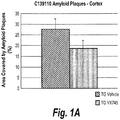
- FIG. 1A and 1B depict the area percentage of A ⁇ 1-42 amyloid plaques of transgenic mice following a two-week administration of VX-745 3 mg/kg BID.
- the present study was conducted on older mice (26 months of age). Other studies attempt to prevent amyloid plaque accumulation and are thus conducted on mice of about 4 and/or 8 months of age (see, for example, Zhu et al., J.
- VX-745 amyloid plaque clearing ability of a p38 inhibitor (i.e., VX-745).
- VX-745 showed a 32.5% decrease of amyloid plaque area in the cortex as compared with vehicle (mean 27.7% amyloid plaque area in control vs. mean 18.7% amyloid plaque area in VX-745-treated animals).
- VX-745 showed a 61.8% decrease of amyloid plaque area in the hippocampus as compared with vehicle (mean 13.6% amyloid plaque area in control vs. mean 5.2% amyloid plaque area in VX-745-treated animals).
- IL-1 ⁇ and TNF- ⁇ ELISA were analyzed from the soluble dorsal cortex brain tissue fraction with mouse IL-1 ⁇ and TNF- ⁇ ELISA Kits (Quantikine M Cytokine mouse IL-1 ⁇ and TNF- ⁇ ELISA kits, RND-Systems, MLB00 and MTA00, R&D Systems, MN, USA) according to instructions of the manufacturer.
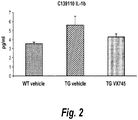
- Figure 2 depicts the IL-1 ⁇ levels in transgenic mice following a two-week administration of VX-745 3 mg/kg BID. Increases in inflammation, particularly neuroinflammation, are known to trigger MAPT phosphorylation and aggregation through overexpression of IL-1.
- Figure 2 depicts the IL-1 ⁇ levels in treated mice vs. control and wild type mice. Notably, the VX-745-treated mice showed no increases in IL-1 ⁇ levels when compared to the wild-type or control animals.
Landscapes
- Chemical & Material Sciences (AREA)
- Organic Chemistry (AREA)
- Health & Medical Sciences (AREA)
- General Health & Medical Sciences (AREA)
- Veterinary Medicine (AREA)
- Public Health (AREA)
- Medicinal Chemistry (AREA)
- Animal Behavior & Ethology (AREA)
- Life Sciences & Earth Sciences (AREA)
- Pharmacology & Pharmacy (AREA)
- Epidemiology (AREA)
- Engineering & Computer Science (AREA)
- Bioinformatics & Cheminformatics (AREA)
- Nuclear Medicine, Radiotherapy & Molecular Imaging (AREA)
- General Chemical & Material Sciences (AREA)
- Chemical Kinetics & Catalysis (AREA)
- Biomedical Technology (AREA)
- Neurology (AREA)
- Neurosurgery (AREA)
- Hospice & Palliative Care (AREA)
- Psychiatry (AREA)
- Pharmaceuticals Containing Other Organic And Inorganic Compounds (AREA)
- Medicines That Contain Protein Lipid Enzymes And Other Medicines (AREA)
- Acyclic And Carbocyclic Compounds In Medicinal Compositions (AREA)
- Medicines Containing Antibodies Or Antigens For Use As Internal Diagnostic Agents (AREA)
Applications Claiming Priority (3)
| Application Number | Priority Date | Filing Date | Title |
|---|---|---|---|
| US201161483919P | 2011-05-09 | 2011-05-09 | |
| EP12782660.0A EP2707369B1 (en) | 2011-05-09 | 2012-05-09 | Compositions and methods for treating alzheimer's disease |
| PCT/US2012/037064 WO2012154814A1 (en) | 2011-05-09 | 2012-05-09 | Compositions and methods for treating alzheimer's disease |
Related Parent Applications (2)
| Application Number | Title | Priority Date | Filing Date |
|---|---|---|---|
| EP12782660.0A Division-Into EP2707369B1 (en) | 2011-05-09 | 2012-05-09 | Compositions and methods for treating alzheimer's disease |
| EP12782660.0A Division EP2707369B1 (en) | 2011-05-09 | 2012-05-09 | Compositions and methods for treating alzheimer's disease |
Publications (2)
| Publication Number | Publication Date |
|---|---|
| EP3081568A1 EP3081568A1 (en) | 2016-10-19 |
| EP3081568B1 true EP3081568B1 (en) | 2019-11-13 |
Family
ID=47139618
Family Applications (2)
| Application Number | Title | Priority Date | Filing Date |
|---|---|---|---|
| EP16169411.2A Active EP3081568B1 (en) | 2011-05-09 | 2012-05-09 | Compositions and methods for treating alzheimer's disease |
| EP12782660.0A Not-in-force EP2707369B1 (en) | 2011-05-09 | 2012-05-09 | Compositions and methods for treating alzheimer's disease |
Family Applications After (1)
| Application Number | Title | Priority Date | Filing Date |
|---|---|---|---|
| EP12782660.0A Not-in-force EP2707369B1 (en) | 2011-05-09 | 2012-05-09 | Compositions and methods for treating alzheimer's disease |
Country Status (9)
| Country | Link |
|---|---|
| US (3) | US8697627B2 (enExample) |
| EP (2) | EP3081568B1 (enExample) |
| JP (3) | JP5851022B2 (enExample) |
| CN (1) | CN103842362B (enExample) |
| AU (1) | AU2012253615B2 (enExample) |
| CA (1) | CA2835707C (enExample) |
| DK (1) | DK3081568T3 (enExample) |
| ES (1) | ES2773480T3 (enExample) |
| WO (1) | WO2012154814A1 (enExample) |
Families Citing this family (29)
| Publication number | Priority date | Publication date | Assignee | Title |
|---|---|---|---|---|
| EP2651405A2 (en) | 2010-12-14 | 2013-10-23 | Electrophoretics Limited | Casein kinase 1 (ck1 ) inhibitors |
| CA2835707C (en) | 2011-05-09 | 2019-02-26 | Eip Pharma, Llc | Compositions and methods for treating alzheimer's disease |
| US20150104870A1 (en) * | 2012-04-27 | 2015-04-16 | Keio University | Neuronal differentiation promoter |
| EP2968322B1 (en) | 2013-03-15 | 2018-12-26 | The Trustees of Columbia University in the City of New York | Map kinase modulators and uses thereof |
| GB201319620D0 (en) * | 2013-11-06 | 2013-12-18 | Norwegian University Of Science And Technology | Immunosuppressive agents and their use in therapy |
| JP6163084B2 (ja) * | 2013-11-11 | 2017-07-12 | キリン株式会社 | 認知症の予防、治療及び/又は認知機能を改善する組成物、及びこれを用いた医薬、食品 |
| US9579322B2 (en) * | 2014-07-09 | 2017-02-28 | Eip Pharma, Llc | Methods for treating neurologic disorders |
| EP3172211B1 (en) | 2014-07-22 | 2019-07-03 | GlaxoSmithKline Intellectual Property Development Limited | Tricyclic imidazo-pyrimidinone derivatives for the treatment of diseases mediated by lp-pla2 |
| JP2016193870A (ja) * | 2015-04-01 | 2016-11-17 | 国立大学法人広島大学 | 慢性骨髄性白血病治療剤 |
| EP3325992B1 (en) | 2015-07-24 | 2026-01-28 | Northeastern University | Quantitative magnetic resonance imaging of the vasculature |
| WO2017185073A1 (en) * | 2016-04-21 | 2017-10-26 | Eip Pharma, Llc | Compositions and methods for treating dementia |
| MX375277B (es) * | 2016-06-03 | 2025-03-06 | Univ Columbia | Métodos para tratar el síndrome de prader-willi |
| GB201611712D0 (en) | 2016-07-02 | 2016-08-17 | Hvivo Services Ltd | Methods and compounds for the treatment or prevention of severe or persistent influenza |
| US11466008B2 (en) | 2017-09-18 | 2022-10-11 | Eip Pharma, Llc | Co-crystals of neflamapimod (VX-745) |
| MX2020004005A (es) | 2017-10-03 | 2020-10-05 | Prevail Therapeutics Inc | Terapias genicas para los trastornos lisosomales. |
| EP3692158A4 (en) | 2017-10-03 | 2021-08-04 | Prevail Therapeutics, Inc. | GENE THERAPIES FOR LYSOSOMAL DISEASES |
| ES2927715T3 (es) | 2017-10-05 | 2022-11-10 | Fulcrum Therapeutics Inc | Inhibidores de la quinasa p38 reducen la expresión de dux4 y de los genes que le siguen para el tratamiento de la FSHD |
| GB201721793D0 (en) | 2017-12-22 | 2018-02-07 | Hvivo Services Ltd | Methods and compunds for the treatment or prevention of hypercytokinemia and severe influenza |
| CA3125548A1 (en) | 2019-01-03 | 2020-07-09 | Northeastern University | Quantitative measurement of disruptions in the blood brain barrier |
| US12642433B2 (en) | 2019-01-25 | 2026-06-02 | Northeastern University | Quantitative measurement of the perivascular space for CNS and brain disorders |
| CN111789949A (zh) * | 2019-04-08 | 2020-10-20 | 北京昱嘉科技集团有限公司 | 基于特异性趋化因子受体的阿尔兹海默病治疗靶点 |
| JP7664848B2 (ja) | 2019-04-10 | 2025-04-18 | プリベイル セラピューティクス,インコーポレーテッド | リソソーム障害のための遺伝子療法 |
| WO2021216754A1 (en) * | 2020-04-21 | 2021-10-28 | Spring Discovery, Inc. | Use of p38 mapk inhibitors for prevention and treatment of aging and aging-related disorders and for boosting an immune system |
| US20230010690A1 (en) * | 2021-07-08 | 2023-01-12 | Morehouse School Of Medicine | Method and system of diagnosing and treating neurodegenerative disease and seizures |
| WO2023282900A1 (en) * | 2021-07-08 | 2023-01-12 | Morehouse School Of Medicine | Method and system of diagnosing and treating neurodegenerative disease and seizures |
| WO2023004054A1 (en) * | 2021-07-23 | 2023-01-26 | Memorial Sloan-Kettering Cancer Center | Methods and compositions for the treatment of alzheimer's disease |
| EP4252748A1 (en) * | 2022-03-31 | 2023-10-04 | Otto-von-Guericke-University Magdeburg | A sphingosine-1-phosphate receptor (s1pr) modulator for use in treating a patient suffering from alzheimer's dementia |
| EP4342394A1 (de) | 2022-09-23 | 2024-03-27 | MTS Medical UG | Vorrichtung und system zur behandlung von alzheimererkrankungen |
| CN115887641B (zh) * | 2022-11-23 | 2024-06-21 | 四川大学华西医院 | 他米巴罗汀在制备免疫佐剂中的应用 |
Family Cites Families (5)
| Publication number | Priority date | Publication date | Assignee | Title |
|---|---|---|---|---|
| US6147080A (en) * | 1996-12-18 | 2000-11-14 | Vertex Pharmaceuticals Incorporated | Inhibitors of p38 |
| US20050203111A1 (en) * | 2004-03-12 | 2005-09-15 | Vvii Newco 2003, Inc. | Compositions and methods for preventing and treating skin and hair conditions |
| US20080044439A1 (en) | 2004-03-11 | 2008-02-21 | David Nathaniel E | Compositions and Methods for Preventing and Treating Skin and Hair Conditions |
| WO2008002465A2 (en) * | 2006-06-23 | 2008-01-03 | The Feinstein Institute For Medical Research | INHIBITORS OF Aβ AND SYNUCLEIN AGGREGATION |
| CA2835707C (en) | 2011-05-09 | 2019-02-26 | Eip Pharma, Llc | Compositions and methods for treating alzheimer's disease |
-
2012
- 2012-05-09 CA CA2835707A patent/CA2835707C/en active Active
- 2012-05-09 US US13/467,519 patent/US8697627B2/en active Active
- 2012-05-09 EP EP16169411.2A patent/EP3081568B1/en active Active
- 2012-05-09 WO PCT/US2012/037064 patent/WO2012154814A1/en not_active Ceased
- 2012-05-09 JP JP2014510427A patent/JP5851022B2/ja not_active Expired - Fee Related
- 2012-05-09 ES ES16169411T patent/ES2773480T3/es active Active
- 2012-05-09 CN CN201280034096.2A patent/CN103842362B/zh active Active
- 2012-05-09 EP EP12782660.0A patent/EP2707369B1/en not_active Not-in-force
- 2012-05-09 AU AU2012253615A patent/AU2012253615B2/en active Active
- 2012-05-09 DK DK16169411.2T patent/DK3081568T3/da active
-
2014
- 2014-02-27 US US14/191,984 patent/US20140357638A1/en not_active Abandoned
-
2015
- 2015-09-15 US US14/855,338 patent/US9427438B2/en active Active
- 2015-09-22 JP JP2015186148A patent/JP6114355B2/ja active Active
-
2017
- 2017-02-06 JP JP2017019250A patent/JP2017075191A/ja not_active Withdrawn
Non-Patent Citations (1)
| Title |
|---|
| None * |
Also Published As
| Publication number | Publication date |
|---|---|
| CN103842362A (zh) | 2014-06-04 |
| EP2707369A4 (en) | 2014-12-10 |
| CA2835707A1 (en) | 2012-11-15 |
| WO2012154814A1 (en) | 2012-11-15 |
| AU2012253615A1 (en) | 2013-12-12 |
| EP2707369A1 (en) | 2014-03-19 |
| US20160030431A1 (en) | 2016-02-04 |
| ES2773480T3 (es) | 2020-07-13 |
| JP2014513694A (ja) | 2014-06-05 |
| EP2707369B1 (en) | 2016-07-27 |
| EP3081568A1 (en) | 2016-10-19 |
| CN103842362B (zh) | 2017-05-24 |
| US20120289511A1 (en) | 2012-11-15 |
| US20140357638A1 (en) | 2014-12-04 |
| JP5851022B2 (ja) | 2016-02-03 |
| JP6114355B2 (ja) | 2017-04-12 |
| DK3081568T3 (da) | 2020-02-24 |
| CA2835707C (en) | 2019-02-26 |
| JP2017075191A (ja) | 2017-04-20 |
| JP2015232042A (ja) | 2015-12-24 |
| AU2012253615B2 (en) | 2017-03-02 |
| US8697627B2 (en) | 2014-04-15 |
| US9427438B2 (en) | 2016-08-30 |
Similar Documents
| Publication | Publication Date | Title |
|---|---|---|
| EP2707369B1 (en) | Compositions and methods for treating alzheimer's disease | |
| Resnick et al. | Targeting JNK3 for the treatment of neurodegenerative disorders | |
| TWI268929B (en) | Neurotrophin production/secretion promoting, thiazole and oxazole derivatives | |
| JP6660369B2 (ja) | 神経障害を治療する方法 | |
| US20110294794A1 (en) | Treatment of proteinopathies using a farnesyl transferase inhibitor | |
| JP2013528600A (ja) | 男性用避妊組成物および使用方法 | |
| JP2005516948A (ja) | 新規な使用 | |
| US20170197958A1 (en) | Agonists of the apelin receptor and methods of use thereof | |
| EP3981394A1 (en) | A sortilin antagonist for use in the prevention or treatment of hearing loss. | |
| WO2022090746A1 (en) | Nmt inhibitors for treating senescence-associated diseases or disorders | |
| JP4393197B2 (ja) | 痴呆関連疾患、アルツハイマー病およびグリコーゲンシンターゼキナーゼ−3関連症状の治療におけるオキシインドール誘導体の使用 | |
| WO2016022538A1 (en) | Compositions and methods for identifying and treating conditions involving hsf1 activity | |
| KR20150036068A (ko) | 미네랄로코르티코이드 수용체 길항제 | |
| US20160326179A1 (en) | Organic compounds | |
| BR112021004893A2 (pt) | composições compreendendo um inibidor de crac e um corticosteroide e métodos de uso dos mesmos | |
| KR102356644B1 (ko) | 신규한 옥소피리다지닐-페닐-카르보노하이드라조노일 디시아나이드 화합물 및 이의 용도 | |
| HK1230184A1 (en) | Compositions and methods for treating alzheimer's disease | |
| HK1230184B (en) | Compositions and methods for treating alzheimer's disease | |
| CN100377709C (zh) | 受体酪氨酸激酶抑制剂的制药用途及相关检测方法 | |
| WO2021125313A1 (ja) | 縮合ピリミジン化合物を有効成分とする治療剤 | |
| Samir et al. | Benzimidazole-Aminopyrimidine Hybrids as Potent and Selective p38α/β MAPK Inhibitors: Design, Synthesis, Molecular Modelling Study, in vitro Enzyme Inhibition Assays, and in vivo Efficacy in Alzheimer's Model | |
| HK1244434B (en) | Prevention or treatment of uric acid or gout disease | |
| BR112015016433B1 (pt) | Uso de um composto de formula (i) para tratar um disturbio associado com a tensão do dobramento incorreto da proteína |
Legal Events
| Date | Code | Title | Description |
|---|---|---|---|
| PUAI | Public reference made under article 153(3) epc to a published international application that has entered the european phase |
Free format text: ORIGINAL CODE: 0009012 |
|
| AC | Divisional application: reference to earlier application |
Ref document number: 2707369 Country of ref document: EP Kind code of ref document: P |
|
| AK | Designated contracting states |
Kind code of ref document: A1 Designated state(s): AL AT BE BG CH CY CZ DE DK EE ES FI FR GB GR HR HU IE IS IT LI LT LU LV MC MK MT NL NO PL PT RO RS SE SI SK SM TR |
|
| STAA | Information on the status of an ep patent application or granted ep patent |
Free format text: STATUS: REQUEST FOR EXAMINATION WAS MADE |
|
| 17P | Request for examination filed |
Effective date: 20170127 |
|
| RBV | Designated contracting states (corrected) |
Designated state(s): AL AT BE BG CH CY CZ DE DK EE ES FI FR GB GR HR HU IE IS IT LI LT LU LV MC MK MT NL NO PL PT RO RS SE SI SK SM TR |
|
| REG | Reference to a national code |
Ref country code: HK Ref legal event code: DE Ref document number: 1230184 Country of ref document: HK |
|
| STAA | Information on the status of an ep patent application or granted ep patent |
Free format text: STATUS: EXAMINATION IS IN PROGRESS |
|
| 17Q | First examination report despatched |
Effective date: 20180410 |
|
| REG | Reference to a national code |
Ref country code: DE Ref legal event code: R079 Ref document number: 602012065747 Country of ref document: DE Free format text: PREVIOUS MAIN CLASS: C07D0487020000 Ipc: A61K0031519000 |
|
| GRAP | Despatch of communication of intention to grant a patent |
Free format text: ORIGINAL CODE: EPIDOSNIGR1 |
|
| STAA | Information on the status of an ep patent application or granted ep patent |
Free format text: STATUS: GRANT OF PATENT IS INTENDED |
|
| RIC1 | Information provided on ipc code assigned before grant |
Ipc: A61P 25/28 20060101ALI20190425BHEP Ipc: A61K 31/519 20060101AFI20190425BHEP |
|
| INTG | Intention to grant announced |
Effective date: 20190529 |
|
| GRAS | Grant fee paid |
Free format text: ORIGINAL CODE: EPIDOSNIGR3 |
|
| GRAA | (expected) grant |
Free format text: ORIGINAL CODE: 0009210 |
|
| STAA | Information on the status of an ep patent application or granted ep patent |
Free format text: STATUS: THE PATENT HAS BEEN GRANTED |
|
| AC | Divisional application: reference to earlier application |
Ref document number: 2707369 Country of ref document: EP Kind code of ref document: P |
|
| AK | Designated contracting states |
Kind code of ref document: B1 Designated state(s): AL AT BE BG CH CY CZ DE DK EE ES FI FR GB GR HR HU IE IS IT LI LT LU LV MC MK MT NL NO PL PT RO RS SE SI SK SM TR |
|
| REG | Reference to a national code |
Ref country code: CH Ref legal event code: EP Ref country code: AT Ref legal event code: REF Ref document number: 1200965 Country of ref document: AT Kind code of ref document: T Effective date: 20191115 |
|
| REG | Reference to a national code |
Ref country code: DE Ref legal event code: R096 Ref document number: 602012065747 Country of ref document: DE |
|
| REG | Reference to a national code |
Ref country code: IE Ref legal event code: FG4D |
|
| REG | Reference to a national code |
Ref country code: DK Ref legal event code: T3 Effective date: 20200217 |
|
| REG | Reference to a national code |
Ref country code: NL Ref legal event code: FP |
|
| REG | Reference to a national code |
Ref country code: LT Ref legal event code: MG4D |
|
| PG25 | Lapsed in a contracting state [announced via postgrant information from national office to epo] |
Ref country code: PT Free format text: LAPSE BECAUSE OF FAILURE TO SUBMIT A TRANSLATION OF THE DESCRIPTION OR TO PAY THE FEE WITHIN THE PRESCRIBED TIME-LIMIT Effective date: 20200313 Ref country code: FI Free format text: LAPSE BECAUSE OF FAILURE TO SUBMIT A TRANSLATION OF THE DESCRIPTION OR TO PAY THE FEE WITHIN THE PRESCRIBED TIME-LIMIT Effective date: 20191113 Ref country code: NO Free format text: LAPSE BECAUSE OF FAILURE TO SUBMIT A TRANSLATION OF THE DESCRIPTION OR TO PAY THE FEE WITHIN THE PRESCRIBED TIME-LIMIT Effective date: 20200213 Ref country code: LT Free format text: LAPSE BECAUSE OF FAILURE TO SUBMIT A TRANSLATION OF THE DESCRIPTION OR TO PAY THE FEE WITHIN THE PRESCRIBED TIME-LIMIT Effective date: 20191113 Ref country code: BG Free format text: LAPSE BECAUSE OF FAILURE TO SUBMIT A TRANSLATION OF THE DESCRIPTION OR TO PAY THE FEE WITHIN THE PRESCRIBED TIME-LIMIT Effective date: 20200213 Ref country code: SE Free format text: LAPSE BECAUSE OF FAILURE TO SUBMIT A TRANSLATION OF THE DESCRIPTION OR TO PAY THE FEE WITHIN THE PRESCRIBED TIME-LIMIT Effective date: 20191113 Ref country code: LV Free format text: LAPSE BECAUSE OF FAILURE TO SUBMIT A TRANSLATION OF THE DESCRIPTION OR TO PAY THE FEE WITHIN THE PRESCRIBED TIME-LIMIT Effective date: 20191113 Ref country code: PL Free format text: LAPSE BECAUSE OF FAILURE TO SUBMIT A TRANSLATION OF THE DESCRIPTION OR TO PAY THE FEE WITHIN THE PRESCRIBED TIME-LIMIT Effective date: 20191113 Ref country code: GR Free format text: LAPSE BECAUSE OF FAILURE TO SUBMIT A TRANSLATION OF THE DESCRIPTION OR TO PAY THE FEE WITHIN THE PRESCRIBED TIME-LIMIT Effective date: 20200214 |
|
| PG25 | Lapsed in a contracting state [announced via postgrant information from national office to epo] |
Ref country code: HR Free format text: LAPSE BECAUSE OF FAILURE TO SUBMIT A TRANSLATION OF THE DESCRIPTION OR TO PAY THE FEE WITHIN THE PRESCRIBED TIME-LIMIT Effective date: 20191113 Ref country code: IS Free format text: LAPSE BECAUSE OF FAILURE TO SUBMIT A TRANSLATION OF THE DESCRIPTION OR TO PAY THE FEE WITHIN THE PRESCRIBED TIME-LIMIT Effective date: 20200313 Ref country code: RS Free format text: LAPSE BECAUSE OF FAILURE TO SUBMIT A TRANSLATION OF THE DESCRIPTION OR TO PAY THE FEE WITHIN THE PRESCRIBED TIME-LIMIT Effective date: 20191113 |
|
| PG25 | Lapsed in a contracting state [announced via postgrant information from national office to epo] |
Ref country code: AL Free format text: LAPSE BECAUSE OF FAILURE TO SUBMIT A TRANSLATION OF THE DESCRIPTION OR TO PAY THE FEE WITHIN THE PRESCRIBED TIME-LIMIT Effective date: 20191113 |
|
| REG | Reference to a national code |
Ref country code: ES Ref legal event code: FG2A Ref document number: 2773480 Country of ref document: ES Kind code of ref document: T3 Effective date: 20200713 |
|
| PG25 | Lapsed in a contracting state [announced via postgrant information from national office to epo] |
Ref country code: EE Free format text: LAPSE BECAUSE OF FAILURE TO SUBMIT A TRANSLATION OF THE DESCRIPTION OR TO PAY THE FEE WITHIN THE PRESCRIBED TIME-LIMIT Effective date: 20191113 Ref country code: CZ Free format text: LAPSE BECAUSE OF FAILURE TO SUBMIT A TRANSLATION OF THE DESCRIPTION OR TO PAY THE FEE WITHIN THE PRESCRIBED TIME-LIMIT Effective date: 20191113 Ref country code: RO Free format text: LAPSE BECAUSE OF FAILURE TO SUBMIT A TRANSLATION OF THE DESCRIPTION OR TO PAY THE FEE WITHIN THE PRESCRIBED TIME-LIMIT Effective date: 20191113 |
|
| REG | Reference to a national code |
Ref country code: DE Ref legal event code: R097 Ref document number: 602012065747 Country of ref document: DE |
|
| REG | Reference to a national code |
Ref country code: AT Ref legal event code: MK05 Ref document number: 1200965 Country of ref document: AT Kind code of ref document: T Effective date: 20191113 |
|
| PG25 | Lapsed in a contracting state [announced via postgrant information from national office to epo] |
Ref country code: SM Free format text: LAPSE BECAUSE OF FAILURE TO SUBMIT A TRANSLATION OF THE DESCRIPTION OR TO PAY THE FEE WITHIN THE PRESCRIBED TIME-LIMIT Effective date: 20191113 Ref country code: SK Free format text: LAPSE BECAUSE OF FAILURE TO SUBMIT A TRANSLATION OF THE DESCRIPTION OR TO PAY THE FEE WITHIN THE PRESCRIBED TIME-LIMIT Effective date: 20191113 |
|
| PLBE | No opposition filed within time limit |
Free format text: ORIGINAL CODE: 0009261 |
|
| STAA | Information on the status of an ep patent application or granted ep patent |
Free format text: STATUS: NO OPPOSITION FILED WITHIN TIME LIMIT |
|
| 26N | No opposition filed |
Effective date: 20200814 |
|
| PG25 | Lapsed in a contracting state [announced via postgrant information from national office to epo] |
Ref country code: SI Free format text: LAPSE BECAUSE OF FAILURE TO SUBMIT A TRANSLATION OF THE DESCRIPTION OR TO PAY THE FEE WITHIN THE PRESCRIBED TIME-LIMIT Effective date: 20191113 Ref country code: AT Free format text: LAPSE BECAUSE OF FAILURE TO SUBMIT A TRANSLATION OF THE DESCRIPTION OR TO PAY THE FEE WITHIN THE PRESCRIBED TIME-LIMIT Effective date: 20191113 |
|
| PG25 | Lapsed in a contracting state [announced via postgrant information from national office to epo] |
Ref country code: MC Free format text: LAPSE BECAUSE OF FAILURE TO SUBMIT A TRANSLATION OF THE DESCRIPTION OR TO PAY THE FEE WITHIN THE PRESCRIBED TIME-LIMIT Effective date: 20191113 |
|
| PG25 | Lapsed in a contracting state [announced via postgrant information from national office to epo] |
Ref country code: IE Free format text: LAPSE BECAUSE OF NON-PAYMENT OF DUE FEES Effective date: 20200509 |
|
| PG25 | Lapsed in a contracting state [announced via postgrant information from national office to epo] |
Ref country code: TR Free format text: LAPSE BECAUSE OF FAILURE TO SUBMIT A TRANSLATION OF THE DESCRIPTION OR TO PAY THE FEE WITHIN THE PRESCRIBED TIME-LIMIT Effective date: 20191113 Ref country code: MT Free format text: LAPSE BECAUSE OF FAILURE TO SUBMIT A TRANSLATION OF THE DESCRIPTION OR TO PAY THE FEE WITHIN THE PRESCRIBED TIME-LIMIT Effective date: 20191113 Ref country code: CY Free format text: LAPSE BECAUSE OF FAILURE TO SUBMIT A TRANSLATION OF THE DESCRIPTION OR TO PAY THE FEE WITHIN THE PRESCRIBED TIME-LIMIT Effective date: 20191113 |
|
| PG25 | Lapsed in a contracting state [announced via postgrant information from national office to epo] |
Ref country code: MK Free format text: LAPSE BECAUSE OF FAILURE TO SUBMIT A TRANSLATION OF THE DESCRIPTION OR TO PAY THE FEE WITHIN THE PRESCRIBED TIME-LIMIT Effective date: 20191113 |
|
| P01 | Opt-out of the competence of the unified patent court (upc) registered |
Effective date: 20230513 |
|
| REG | Reference to a national code |
Ref country code: CH Ref legal event code: U11 Free format text: ST27 STATUS EVENT CODE: U-0-0-U10-U11 (AS PROVIDED BY THE NATIONAL OFFICE) Effective date: 20260601 |
|
| PGFP | Annual fee paid to national office [announced via postgrant information from national office to epo] |
Ref country code: NL Payment date: 20260526 Year of fee payment: 15 Ref country code: LU Payment date: 20260527 Year of fee payment: 15 |
|
| PGFP | Annual fee paid to national office [announced via postgrant information from national office to epo] |
Ref country code: ES Payment date: 20260601 Year of fee payment: 15 |
|
| PGFP | Annual fee paid to national office [announced via postgrant information from national office to epo] |
Ref country code: GB Payment date: 20260527 Year of fee payment: 15 Ref country code: DK Payment date: 20260525 Year of fee payment: 15 |
|
| PGFP | Annual fee paid to national office [announced via postgrant information from national office to epo] |
Ref country code: IT Payment date: 20260520 Year of fee payment: 15 |
|
| PGFP | Annual fee paid to national office [announced via postgrant information from national office to epo] |
Ref country code: DE Payment date: 20260528 Year of fee payment: 15 |
|
| PGFP | Annual fee paid to national office [announced via postgrant information from national office to epo] |
Ref country code: CH Payment date: 20260601 Year of fee payment: 15 Ref country code: BE Payment date: 20260527 Year of fee payment: 15 |
|
| PGFP | Annual fee paid to national office [announced via postgrant information from national office to epo] |
Ref country code: FR Payment date: 20260525 Year of fee payment: 15 |