EP3067668B1 - Optical encoder unit and optical encoder - Google Patents
Optical encoder unit and optical encoder Download PDFInfo
- Publication number
- EP3067668B1 EP3067668B1 EP14860233.7A EP14860233A EP3067668B1 EP 3067668 B1 EP3067668 B1 EP 3067668B1 EP 14860233 A EP14860233 A EP 14860233A EP 3067668 B1 EP3067668 B1 EP 3067668B1
- Authority
- EP
- European Patent Office
- Prior art keywords
- photoreceiver
- sensor unit
- optical sensor
- optical
- light
- Prior art date
- Legal status (The legal status is an assumption and is not a legal conclusion. Google has not performed a legal analysis and makes no representation as to the accuracy of the status listed.)
- Not-in-force
Links
- 230000003287 optical effect Effects 0.000 title claims description 351
- 230000010287 polarization Effects 0.000 claims description 65
- 230000001419 dependent effect Effects 0.000 claims description 4
- 230000004913 activation Effects 0.000 claims description 2
- 238000010586 diagram Methods 0.000 description 55
- 239000010410 layer Substances 0.000 description 49
- 239000000758 substrate Substances 0.000 description 43
- 230000000149 penetrating effect Effects 0.000 description 33
- 230000004048 modification Effects 0.000 description 32
- 238000012986 modification Methods 0.000 description 32
- 101710170231 Antimicrobial peptide 2 Proteins 0.000 description 28
- 101710170230 Antimicrobial peptide 1 Proteins 0.000 description 15
- 230000006870 function Effects 0.000 description 13
- 238000005259 measurement Methods 0.000 description 12
- 239000002184 metal Substances 0.000 description 11
- 229910001111 Fine metal Inorganic materials 0.000 description 10
- 238000000034 method Methods 0.000 description 10
- XUIMIQQOPSSXEZ-UHFFFAOYSA-N Silicon Chemical compound [Si] XUIMIQQOPSSXEZ-UHFFFAOYSA-N 0.000 description 9
- 239000012790 adhesive layer Substances 0.000 description 9
- 229910052710 silicon Inorganic materials 0.000 description 9
- 239000010703 silicon Substances 0.000 description 9
- 230000008569 process Effects 0.000 description 8
- 239000004065 semiconductor Substances 0.000 description 8
- 239000008186 active pharmaceutical agent Substances 0.000 description 7
- 238000001514 detection method Methods 0.000 description 7
- HODRFAVLXIFVTR-RKDXNWHRSA-N tevenel Chemical compound NS(=O)(=O)C1=CC=C([C@@H](O)[C@@H](CO)NC(=O)C(Cl)Cl)C=C1 HODRFAVLXIFVTR-RKDXNWHRSA-N 0.000 description 7
- 229910000679 solder Inorganic materials 0.000 description 6
- 230000008859 change Effects 0.000 description 4
- 239000000126 substance Substances 0.000 description 3
- 239000011347 resin Substances 0.000 description 2
- 229920005989 resin Polymers 0.000 description 2
- 101100129500 Caenorhabditis elegans max-2 gene Proteins 0.000 description 1
- 239000004020 conductor Substances 0.000 description 1
- 230000000694 effects Effects 0.000 description 1
- 239000011521 glass Substances 0.000 description 1
- 238000002844 melting Methods 0.000 description 1
- 230000008018 melting Effects 0.000 description 1
- 239000002861 polymer material Substances 0.000 description 1
- 238000007789 sealing Methods 0.000 description 1
Images







Classifications
-
- G—PHYSICS
- G01—MEASURING; TESTING
- G01D—MEASURING NOT SPECIALLY ADAPTED FOR A SPECIFIC VARIABLE; ARRANGEMENTS FOR MEASURING TWO OR MORE VARIABLES NOT COVERED IN A SINGLE OTHER SUBCLASS; TARIFF METERING APPARATUS; MEASURING OR TESTING NOT OTHERWISE PROVIDED FOR
- G01D5/00—Mechanical means for transferring the output of a sensing member; Means for converting the output of a sensing member to another variable where the form or nature of the sensing member does not constrain the means for converting; Transducers not specially adapted for a specific variable
- G01D5/26—Mechanical means for transferring the output of a sensing member; Means for converting the output of a sensing member to another variable where the form or nature of the sensing member does not constrain the means for converting; Transducers not specially adapted for a specific variable characterised by optical transfer means, i.e. using infrared, visible, or ultraviolet light
- G01D5/32—Mechanical means for transferring the output of a sensing member; Means for converting the output of a sensing member to another variable where the form or nature of the sensing member does not constrain the means for converting; Transducers not specially adapted for a specific variable characterised by optical transfer means, i.e. using infrared, visible, or ultraviolet light with attenuation or whole or partial obturation of beams of light
- G01D5/34—Mechanical means for transferring the output of a sensing member; Means for converting the output of a sensing member to another variable where the form or nature of the sensing member does not constrain the means for converting; Transducers not specially adapted for a specific variable characterised by optical transfer means, i.e. using infrared, visible, or ultraviolet light with attenuation or whole or partial obturation of beams of light the beams of light being detected by photocells
- G01D5/347—Mechanical means for transferring the output of a sensing member; Means for converting the output of a sensing member to another variable where the form or nature of the sensing member does not constrain the means for converting; Transducers not specially adapted for a specific variable characterised by optical transfer means, i.e. using infrared, visible, or ultraviolet light with attenuation or whole or partial obturation of beams of light the beams of light being detected by photocells using displacement encoding scales
- G01D5/3473—Circular or rotary encoders
-
- G—PHYSICS
- G01—MEASURING; TESTING
- G01D—MEASURING NOT SPECIALLY ADAPTED FOR A SPECIFIC VARIABLE; ARRANGEMENTS FOR MEASURING TWO OR MORE VARIABLES NOT COVERED IN A SINGLE OTHER SUBCLASS; TARIFF METERING APPARATUS; MEASURING OR TESTING NOT OTHERWISE PROVIDED FOR
- G01D5/00—Mechanical means for transferring the output of a sensing member; Means for converting the output of a sensing member to another variable where the form or nature of the sensing member does not constrain the means for converting; Transducers not specially adapted for a specific variable
- G01D5/26—Mechanical means for transferring the output of a sensing member; Means for converting the output of a sensing member to another variable where the form or nature of the sensing member does not constrain the means for converting; Transducers not specially adapted for a specific variable characterised by optical transfer means, i.e. using infrared, visible, or ultraviolet light
- G01D5/32—Mechanical means for transferring the output of a sensing member; Means for converting the output of a sensing member to another variable where the form or nature of the sensing member does not constrain the means for converting; Transducers not specially adapted for a specific variable characterised by optical transfer means, i.e. using infrared, visible, or ultraviolet light with attenuation or whole or partial obturation of beams of light
- G01D5/34—Mechanical means for transferring the output of a sensing member; Means for converting the output of a sensing member to another variable where the form or nature of the sensing member does not constrain the means for converting; Transducers not specially adapted for a specific variable characterised by optical transfer means, i.e. using infrared, visible, or ultraviolet light with attenuation or whole or partial obturation of beams of light the beams of light being detected by photocells
- G01D5/344—Mechanical means for transferring the output of a sensing member; Means for converting the output of a sensing member to another variable where the form or nature of the sensing member does not constrain the means for converting; Transducers not specially adapted for a specific variable characterised by optical transfer means, i.e. using infrared, visible, or ultraviolet light with attenuation or whole or partial obturation of beams of light the beams of light being detected by photocells using polarisation
-
- G—PHYSICS
- G01—MEASURING; TESTING
- G01D—MEASURING NOT SPECIALLY ADAPTED FOR A SPECIFIC VARIABLE; ARRANGEMENTS FOR MEASURING TWO OR MORE VARIABLES NOT COVERED IN A SINGLE OTHER SUBCLASS; TARIFF METERING APPARATUS; MEASURING OR TESTING NOT OTHERWISE PROVIDED FOR
- G01D5/00—Mechanical means for transferring the output of a sensing member; Means for converting the output of a sensing member to another variable where the form or nature of the sensing member does not constrain the means for converting; Transducers not specially adapted for a specific variable
- G01D5/26—Mechanical means for transferring the output of a sensing member; Means for converting the output of a sensing member to another variable where the form or nature of the sensing member does not constrain the means for converting; Transducers not specially adapted for a specific variable characterised by optical transfer means, i.e. using infrared, visible, or ultraviolet light
- G01D5/32—Mechanical means for transferring the output of a sensing member; Means for converting the output of a sensing member to another variable where the form or nature of the sensing member does not constrain the means for converting; Transducers not specially adapted for a specific variable characterised by optical transfer means, i.e. using infrared, visible, or ultraviolet light with attenuation or whole or partial obturation of beams of light
- G01D5/34—Mechanical means for transferring the output of a sensing member; Means for converting the output of a sensing member to another variable where the form or nature of the sensing member does not constrain the means for converting; Transducers not specially adapted for a specific variable characterised by optical transfer means, i.e. using infrared, visible, or ultraviolet light with attenuation or whole or partial obturation of beams of light the beams of light being detected by photocells
- G01D5/344—Mechanical means for transferring the output of a sensing member; Means for converting the output of a sensing member to another variable where the form or nature of the sensing member does not constrain the means for converting; Transducers not specially adapted for a specific variable characterised by optical transfer means, i.e. using infrared, visible, or ultraviolet light with attenuation or whole or partial obturation of beams of light the beams of light being detected by photocells using polarisation
- G01D5/345—Polarising encoders
-
- G—PHYSICS
- G01—MEASURING; TESTING
- G01D—MEASURING NOT SPECIALLY ADAPTED FOR A SPECIFIC VARIABLE; ARRANGEMENTS FOR MEASURING TWO OR MORE VARIABLES NOT COVERED IN A SINGLE OTHER SUBCLASS; TARIFF METERING APPARATUS; MEASURING OR TESTING NOT OTHERWISE PROVIDED FOR
- G01D5/00—Mechanical means for transferring the output of a sensing member; Means for converting the output of a sensing member to another variable where the form or nature of the sensing member does not constrain the means for converting; Transducers not specially adapted for a specific variable
- G01D5/26—Mechanical means for transferring the output of a sensing member; Means for converting the output of a sensing member to another variable where the form or nature of the sensing member does not constrain the means for converting; Transducers not specially adapted for a specific variable characterised by optical transfer means, i.e. using infrared, visible, or ultraviolet light
- G01D5/32—Mechanical means for transferring the output of a sensing member; Means for converting the output of a sensing member to another variable where the form or nature of the sensing member does not constrain the means for converting; Transducers not specially adapted for a specific variable characterised by optical transfer means, i.e. using infrared, visible, or ultraviolet light with attenuation or whole or partial obturation of beams of light
- G01D5/34—Mechanical means for transferring the output of a sensing member; Means for converting the output of a sensing member to another variable where the form or nature of the sensing member does not constrain the means for converting; Transducers not specially adapted for a specific variable characterised by optical transfer means, i.e. using infrared, visible, or ultraviolet light with attenuation or whole or partial obturation of beams of light the beams of light being detected by photocells
- G01D5/347—Mechanical means for transferring the output of a sensing member; Means for converting the output of a sensing member to another variable where the form or nature of the sensing member does not constrain the means for converting; Transducers not specially adapted for a specific variable characterised by optical transfer means, i.e. using infrared, visible, or ultraviolet light with attenuation or whole or partial obturation of beams of light the beams of light being detected by photocells using displacement encoding scales
- G01D5/34707—Scales; Discs, e.g. fixation, fabrication, compensation
-
- G—PHYSICS
- G01—MEASURING; TESTING
- G01D—MEASURING NOT SPECIALLY ADAPTED FOR A SPECIFIC VARIABLE; ARRANGEMENTS FOR MEASURING TWO OR MORE VARIABLES NOT COVERED IN A SINGLE OTHER SUBCLASS; TARIFF METERING APPARATUS; MEASURING OR TESTING NOT OTHERWISE PROVIDED FOR
- G01D5/00—Mechanical means for transferring the output of a sensing member; Means for converting the output of a sensing member to another variable where the form or nature of the sensing member does not constrain the means for converting; Transducers not specially adapted for a specific variable
- G01D5/26—Mechanical means for transferring the output of a sensing member; Means for converting the output of a sensing member to another variable where the form or nature of the sensing member does not constrain the means for converting; Transducers not specially adapted for a specific variable characterised by optical transfer means, i.e. using infrared, visible, or ultraviolet light
- G01D5/32—Mechanical means for transferring the output of a sensing member; Means for converting the output of a sensing member to another variable where the form or nature of the sensing member does not constrain the means for converting; Transducers not specially adapted for a specific variable characterised by optical transfer means, i.e. using infrared, visible, or ultraviolet light with attenuation or whole or partial obturation of beams of light
- G01D5/34—Mechanical means for transferring the output of a sensing member; Means for converting the output of a sensing member to another variable where the form or nature of the sensing member does not constrain the means for converting; Transducers not specially adapted for a specific variable characterised by optical transfer means, i.e. using infrared, visible, or ultraviolet light with attenuation or whole or partial obturation of beams of light the beams of light being detected by photocells
- G01D5/347—Mechanical means for transferring the output of a sensing member; Means for converting the output of a sensing member to another variable where the form or nature of the sensing member does not constrain the means for converting; Transducers not specially adapted for a specific variable characterised by optical transfer means, i.e. using infrared, visible, or ultraviolet light with attenuation or whole or partial obturation of beams of light the beams of light being detected by photocells using displacement encoding scales
- G01D5/34707—Scales; Discs, e.g. fixation, fabrication, compensation
- G01D5/34715—Scale reading or illumination devices
Definitions
- the present invention relates to an optical encoder unit and an optical encoder for detecting an absolute angle by using an optical scale.
- Encoders are used in various mechanical devices to detect the position or the angle of a movable component. Generally, there are encoders that detect a relative position or angle, and encoders that detect an absolute position or angle. There are optical encoders and magnetic encoders, and the optical encoders are more affected by foreign substances and the like, and by fluctuations in the amount of detected light.
- Patent Literature 1 discloses a technique for reducing the influence of fluctuations in the amount of detected light, and for improving the resolution.
- Patent Literature 1 WO 2013/065737 A
- optical encoder units are known from US 2008/0186491 A1 and EP 2657652 A1 .
- Patent Literature 1 the influence of fluctuations in the amount of detected light is reduced, but it is premised that the optical axis is accurately adjusted.
- the present invention has been made in view of the above, and is directed to providing an optical encoder unit and an optical encoder which are capable of reducing the influence of fluctuations in the amount of detected light and of easing accurate adjustment of the optical axis.
- an optical encoder unit including: a light source having a predetermined light distribution; an optical scale having a polarizer whose polarization direction on a plane is along a predetermined direction, and whose polarization direction is changed according to rotation; and an optical sensor unit including a first photoreceiver, a second photoreceiver, a third photoreceiver, and a fourth photoreceiver for receiving incident light that is light source light from the light source made incident on the respective photoreceivers by passing through or by being reflected by the optical scale, wherein an emitting surface of the light source and the optical sensor unit are arranged at positions so as to receive a light intensity that is predetermined times greater or more than that corresponding to dark current of the optical sensor.
- Such a structure enables the optical encoder unit to increase the SN ratio and enhance the measurement accuracy. Further, the positional relationship between the light source and the optical sensor unit eases the accurate adjustment of the optical axis to be required. Accordingly, the optical encoder unit can be miniaturized.
- the emitting surface of the light source and the optical sensor unit are arranged at positions so as to receive a light intensity that is 100 times greater or more than that corresponding to the dark current of the optical sensor unit.
- the optical encoder unit can improve the SN ratio and enhance the measurement accuracy.
- the emitting surface of the light source and the optical sensor unit are arranged at positions so as to receive a light intensity that is 1000 times greater or more than that corresponding to the dark current of the optical sensor unit.
- the optical encoder unit can improve the SN ratio and enhance the measurement accuracy.
- the first photoreceiver, the second photoreceiver, the third photoreceiver, and the fourth photoreceiver are respectively arranged at an equal distance from an arrangement center, and the first photoreceiver, the second photoreceiver, the third photoreceiver, and the fourth photoreceiver are arranged within a range in which the light distribution of the light source is uniform and receive light.
- the optical sensor unit can be arranged at a position within a range such that the optical sensor unit can receive light with the influence of light scattered by the light source being reduced.
- the optical encoder unit can suppress the influence by the light intensity of the light source, and reduce the influence on the output of the optical encoder unit by the distance between the optical sensor unit and the optical scale, the fluctuation in the light intensity of the light source, and the like.
- the first photoreceiver, the second photoreceiver, the third photoreceiver, and the fourth photoreceiver receive light by polarizing layers that split the incident light in different polarization directions.
- the polarization angle may be easily calculated.
- the optical encoder unit further includes: a cylindrical cover; and a shaft that is capable of freely rotating by being supported by a bearing attached inside the cover, and the cover encloses the optical scale attached to the shaft, the light source, and the optical sensor unit.
- a cylindrical cover that is capable of freely rotating by being supported by a bearing attached inside the cover, and the cover encloses the optical scale attached to the shaft, the light source, and the optical sensor unit.
- the optical encoder unit further includes: a first bare chip including the first photoreceiver, the second photoreceiver, the third photoreceiver, and the fourth photoreceiver; and an amplifier circuit for amplifying signals of the first photoreceiver, the second photoreceiver, the third photoreceiver, and the fourth photoreceiver, and the first bare chip and the amplifier circuit are fixed at positions so as to overlap each other in a plan view and are electrically connected to each other.
- the optical encoder unit can be miniaturized, and signal noise can be reduced.
- the amplifier circuit is a second bare chip
- the optical encoder unit can be further miniaturized, and signal noise can be reduced.
- the optical encoder unit further includes a bare chip that includes the first photoreceiver, the second photoreceiver, the third photoreceiver, and the fourth photoreceiver, and on which an amplifier circuit for amplifying signals of the first photoreceiver, the second photoreceiver, the third photoreceiver, and the fourth photoreceiver are integrated.
- the optical encoder unit can be miniaturized, and signal noise can be reduced.
- an optical encoder including: the optical encoder unit; and computing means for calculating an amount of relative movement between the optical scale and the optical sensor unit from light intensities detected by the first photoreceiver, the second photoreceiver, the third photoreceiver, and the fourth photoreceiver.
- the computing means calculates an amount of absolute movement between the optical scale and the optical sensor unit by storing in a storage device, and reading from the storage device at a time of activation, whether a rotation position of the optical scale is in a range equal to or more than zero degrees and less than 180 degrees, or in a range equal to or more than 180 degrees and less the 360 degrees.
- the encoder may function as an absolute encoder that is capable of calculating the absolute position of a rotor.
- the present invention can provide an optical encoder unit and an optical encoder that can reduce the influence of fluctuations in the amount of detected light and ease accurate adjustment of the optical axis.
- FIG. 1 is a structure diagram of an optical encoder unit according to the first embodiment.
- FIG. 2 is a perspective view of an appearance of the optical encoder unit according to the first embodiment.
- FIG. 1 is a schematic cross-sectional view of FIG. 2 .
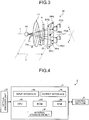
- FIG. 3 is an explanatory diagram illustrating an arrangement example of an optical scale and an optical sensor unit.
- FIG. 4 is a block diagram of an optical encoder according to the first embodiment.
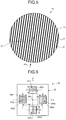
- FIG. 5 is an explanatory diagram illustrating an example of an optical scale pattern according to the first embodiment.
- An optical encoder unit 31 includes a rotor 10 having a shaft 12 coupled with a rotary machine such as a motor, a stator 20, and an optical sensor unit 35 which is capable of reading a signal pattern.
- the rotor 10 includes an optical scale 11 which is a circular member as illustrated in FIG. 5 , or a polygonal member.
- the optical scale 11 is made of silicon, glass, or a polymer material, for example.
- the optical scale 11 may be annular or hollow.
- the optical scale 11 illustrated in FIG. 5 has signal tracks T1 on one surface. Further, in the rotor 10, the shaft 12 is attached to a surface opposite to the surface on which the signal tracks T1 are provided. Even if the optical scale 11 is inclined, when the inclination angle is small, the polarization/splitting function is not affected. That is, the optical scale 11 functions as a polarization/splitting element even if it is inclined with respect to a plane orthogonal to a rotation center Zr.
- the stator 20 includes a cylindrical cover 21, and a substrate 23.
- the cylindrical cover 21 is fixed independently of the rotor 10 to a surface of the substrate 23, and the rotor 10 is capable of relatively rotating with respect to the stator 20.
- the cover 21 is made of a light-shielding member enclosing a bearing 26, the shaft 12, the optical scale 11 attached at an end of the shaft 12, and the optical sensor unit 35. Accordingly, external optical noise can be suppressed inside the cover 21.
- the cover 21 supports the shaft 12 in a rotatable manner via the bearing 26.
- the inner circumference of the cover 21 is fixed to the outer ring of the bearing 26, and the outer circumference of the shaft 12 is fixed to the inner ring of the bearing 26.
- the optical scale 11 rotates around the rotation center Zr as the axial center, in association with the shaft 12.
- the optical sensor unit 35 is fixed to the substrate 23.
- the signal tracks T1 of the optical scale 11 move relatively to the optical sensor unit 35.
- the optical encoder unit 31 includes a connector CNT that is an input/output terminal and a preamplifier AMP that is an amplifier, both elements being fixed on the substrate 23.
- a light source 41 is fixed to a surface of a light source substrate 42.
- a conductive line 25 provided on a surface of or the inside of the substrate 23 and a line 24 provided along the inside of the cover 21 connect the connector CNT, the preamplifier AMP, the optical sensor unit 35, and the light source 41 with one another as appropriate.
- the optical scale 11 moves in an R direction relatively to the optical sensor unit 35, for example.
- the optical scale 11 is configured such that a polarization direction Pm of a polarizer on the plane is along a predetermined direction, and the polarization direction Pm is changed according to rotation.
- the optical sensor unit 35 can receive incident light (transmissive light) 73, which is light source light 71 of the light source 41 transmitted and entering through the optical scale 11, and read the signal tracks T1 of the optical scale 11 illustrated in FIG. 5 .
- the optical encoder unit 31 is not limited to the above-described structure where the transmissive optical scale and optical sensor are arranged, but may be configured such that a reflective optical scale and optical sensor unit are arranged as will be described in a following embodiment.
- the light source 41 is a light-emitting diode or a semiconductor laser light source, for example, and details thereof will be described below.
- An optical encoder 2 includes the optical encoder unit 31 described above, and a calculation processing device 3. As illustrated in FIG. 4 , the optical encoder unit 31 and the calculation processing device 3 are connected with each other.
- the calculation processing device 3 is connected to a control unit 5 of a rotary machine such as a motor, for example.
- the optical encoder 2 detects, by the optical sensor unit 35, the incident light 73, which is the light source light 71 made incident on the optical sensor unit 35 by passing through or being reflected by the optical scale 11.
- the calculation processing device 3 calculates, from a detection signal of the optical sensor unit 35, the relative positions of the rotor 10 and the optical sensor unit 35 of the optical encoder unit 31, and outputs, as a control signal, information about the relative positions to the control unit 5 of a rotary machine such as a motor.
- the calculation processing device 3 is a computer such as a personal computer (PC), and includes an input interface 4a, an output interface 4b, a CPU(Central Processing Unit) 4c, a ROM (Read Only Memory) 4d, a RAM (Random Access Memory) 4e, and an internal storage device 4f.
- the input interface 4a, the output interface 4b, the CPU 4c, the ROM 4d, the RAM 4e, and the internal storage device 4f are connected with one another by an internal bus.
- the calculation processing device 3 may be configured as a dedicated processing circuit.
- the input interface 4a receives an input signal from the optical sensor unit 35 of the optical encoder unit 31, and outputs the signal to the CPU 4c.
- the output interface 4b receives a control signal from the CPU 4c, and outputs the signal to the control unit 5.
- the ROM 4d stores programs such as BIOS (Basic Input Output System) and the like.
- the internal storage device 4f is an HDD (Hard Disk Drive) or a flash memory, for example, and stores an operating system program and application programs.
- the CPU 4c realizes various functions by executing the programs stored in the ROM 4d or the internal storage device 4f while using the RAM 4e as a work area.
- the internal storage device 4f serving as storage means stores a database in which a polarization axis, described below, of the optical scale 11 and an output terminal of a sensor of the optical sensor unit 35 are associated with each other.
- the internal storage device 4f stores a database in which values of a parameter azimuth ⁇ and an inclination angle (zenith angle) ⁇ , described below, and positional information of the optical scale 11 are associated with each other.
- the internal storage device 4f stores a database in which the value of a distance D, described below, and positional information of the optical scale 11 are associated with each other.
- the signal tracks T1 illustrated in FIG. 5 are formed such that fine metal wires (wires) g are arranged on the optical scale 11 illustrated in FIG. 1 , which is referred to as a wire grid pattern. Adjacent fine metal wires g are linearly arranged in parallel to each other on the optical scale 11, as the signal tracks T1. Accordingly, the polarization axis of the optical scale 11 is the same regardless of a position at which the optical scale 11 is irradiated with the light source light 71, and the polarization direction of the polarizer on the plane is along one direction.
- the optical scale 11 having the fine metal wires g called a wire grid pattern can have a higher heat resistance than a photo-induced polarization plate. Moreover, the optical scale 11 has a line pattern with no intersection even locally, and thus a highly accurate optical scale with less error can be achieved. Moreover, the optical scale 11 can be stably manufactured through a bulk-exposure or nanoimprinting, and highly accurate optical scales with less error may be achieved. Further, the optical scale 11 may be a photo-induced polarization plate.
- a plurality of fine metal wires g are arranged without intersecting with one another.
- a transmissive area w allowing all or a part of the light source light 71 to pass through is provided between the adjacent fine metal wires g.
- the optical scale 11 can polarize and split the incident light 73 of the light source light 71. Accordingly, the optical scale 11 has a polarizer whose polarization axis Pm on the plane is uniform.
- the optical scale 11 is configured such that the polarization axis of the incident light that is incident on the optical sensor unit 35 changes in the rotating circumferential direction, according to the rotation of the optical scale 11.
- the change in the polarization axis is such that an increase and a decrease are repeated twice for one rotation of the optical scale 11.
- the optical scale 11 does not need to have fine segments with different polarization directions.
- the optical scale 11 has a uniform polarization axis Pm, and thus there is no border between areas with different polarization axes Pm, and disturbance of the polarization state of the incident light 73 by such a border may be suppressed.
- the optical encoder 2 of the first embodiment is capable of reducing a possibility of erroneous detection or occurrence of noise.
- FIG. 6 is an explanatory diagram illustrating an example of an optical sensor unit according to the first embodiment.
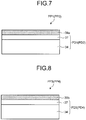
- FIG. 7 is an explanatory diagram illustrating an example of a first photoreceiver of an optical sensor according to the first embodiment.
- FIG. 8 is an explanatory diagram illustrating an example of a third photoreceiver of the optical sensor according to the first embodiment. As illustrated in FIGS.
- the optical sensor unit 35 includes, on a surface 30b of a unit base member 30, a first photoreceiver PD1 having a polarizing layer PP1, a second photoreceiver PD2 having a polarizing layer PP2, a third photoreceiver PD3 having a polarizing layer PP3, and a fourth photoreceiver PD4 having a polarizing layer PP4.
- the first photoreceiver PD1, the second photoreceiver PD2, the third photoreceiver PD3, and the fourth photoreceiver PD4 are arranged at an equal distance from an arrangement center S0 on the surface 30b of the unit base member 30.
- the light source light 71 radiated from the light source 41 passes through the optical scale 11 described above, and passes through the polarizing layer PP1, the polarizing layer PP2, the polarizing layer PP3, and the polarizing layer PP4 as the incident light 73, and becomes incident on the first photoreceiver PD1, the second photoreceiver PD2, the third photoreceiver PD3, and the fourth photoreceiver PD4.
- the distance is preferably equal between the arrangement center S0 and each of the first photoreceiver PD1, the second photoreceiver PD2, the third photoreceiver PD3, and the fourth photoreceiver PD4.
- This structure can reduce the calculation load of the CPU 4c serving as computing means.
- the first photoreceiver PD1 is arranged at a position that is point-symmetrical to the third photoreceiver PD3 about the arrangement center S0
- the second photoreceiver PD2 is arranged at a position that is point-symmetrical to the fourth photoreceiver PD4 about the arrangement center S0
- the first photoreceiver PD1 is arranged away from the third photoreceiver PD3 by a distance W across the arrangement center S0
- the second photoreceiver PD2 is arranged away from the fourth photoreceiver PD4 by the distance W across the arrangement center S0.
- the first photoreceiver PD1, the third photoreceiver PD3, the second photoreceiver PD2, and the fourth photoreceiver PD4 have a width w, and there is a limitation that the distance W is not smaller than a width 2w.
- a virtual axis, on the surface 30b of the unit base member 30, passing through the first photoreceiver PD1, the arrangement center S0, and the third photoreceiver PD3 is given as an x-axis
- a virtual axis, on the surface 30b of the unit base member 30, passing through the second photoreceiver PD2, the arrangement center S0, and the fourth photoreceiver PD4 is given as a y-axis.
- the x-axis is orthogonal to the y-axis on the surface of the unit base member 30. As illustrated in FIG. 3 , the distance between an emitting surface of the light source 41 and the arrangement center S0 is given as D. An xy plane formed by the x-axis and the y-axis is orthogonal to a z-axis connecting the emitting surface of the light source 41 and the arrangement center S0.
- the first photoreceiver PD1, the second photoreceiver PD2, the third photoreceiver PD3, and the fourth photoreceiver PD4 are arranged around the light source 41.
- the distance is preferably equal between the arrangement center S0 and each of the first photoreceiver PD1, the second photoreceiver PD2, the third photoreceiver PD3, and the fourth photoreceiver PD4. This structure reduces the calculation load of the CPU 4c serving as computing means.
- the first photoreceiver PD1 includes a silicon substrate 34, a photoreceiver 37, and a first polarizing layer 39a.
- the third photoreceiver PD3 includes a silicon substrate 34, a photoreceiver 37, and a second polarizing layer 39b.
- the silicon substrate 34 is an n-type semiconductor
- the photoreceiver 37 is a p-type semiconductor
- a photodiode may be formed by the silicon substrate 34 and the photoreceiver 37 by a PN junction.
- the first polarizing layer 39a and the second polarizing layer 39b may be formed by a photo-induced polarizing layer, a wire grid pattern having fine metal wires that are arranged in parallel to one another, or the like.
- the first polarizing layer 39a splits the incident light 73 entering the optical scale 11, illustrated in FIG. 3 , from the light source light 71 in a first polarization direction, and the second polarizing layer 39b splits the incident light in a second polarization direction.
- the polarization axis of first split light and the polarization axis of second split light are preferably different from each other by 90 degrees. According to this structure, the CPU 4c of the calculation processing device 3 can easily calculate the polarization angle.
- the second photoreceiver PD2 includes a silicon substrate 34, a photoreceiver 37, and a first polarizing layer 39a.
- the fourth photoreceiver PD4 includes a silicon substrate 34, a photoreceiver 37, and a second polarizing layer 39b.
- the silicon substrate 34 is an n-type semiconductor
- the photoreceiver 37 is a p-type semiconductor
- a photodiode may be formed by the silicon substrate 34 and the photoreceiver 37 by a PN junction.
- the first polarizing layer 39a and the second polarizing layer 39b may be formed by a photo-induced polarizing layer, a wire grid pattern having fine metal wires that are arranged in parallel to one another, or the like.
- the first polarizing layer 39a splits the incident light 73 entering the optical scale 11, illustrated in FIG. 3 , from the light source light 71 in a first polarization direction, and the second polarizing layer 39b splits the incident light in a second polarization direction.
- the polarization axis of first split light and the polarization axis of second split light are preferably different from each other by 90 degrees. According to this structure, the CPU 4c of the calculation processing device 3 can easily calculate the polarization angle.
- the first photoreceiver PD1, the second photoreceiver PD2, the third photoreceiver PD3, and the fourth photoreceiver PD4 receive light via the polarizing layers PP1, PP2, PP3, and PP4 which split the incident light 73 in different polarization directions.
- the polarization axis in the case of splitting by the polarizing layer PP1 and the polarization axis in the case of splitting by the polarizing layer PP2 are preferably different from each other by 45 degrees.
- the polarization axis in the case of splitting by the polarizing layer PP2 and the polarization axis in the case of splitting by the polarizing layer PP3 are preferably different from each other by 45 degrees.
- the polarization axis in the case of splitting by the polarizing layer PP3 and the polarization axis in the case of splitting by the polarizing layer PP4 are preferably different from each other by 45 degrees.
- the polarization axis in the case of splitting by the polarizing layer PP4 and the polarization axis in the case of splitting by the polarizing layer PP1 are preferably different from each other by 45 degrees. According to this structure, the CPU 4c of the calculation processing device 3 can easily calculate the polarization angle.
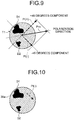
- FIGS. 9, 10 , and 11 are explanatory diagrams for illustrating splitting of polarized components by an angle sensor according to the first embodiment.
- light polarized in the polarization direction Pm by the signal tracks T1 of the optical scale 11 is made incident on the optical sensor unit 35.
- a foreign substance D1 and a foreign substance D2 exist in a sensing area.
- the polarization direction Pm of the incident light may be expressed by using a light intensity PI(-) of a component in the first polarization direction and a light intensity PI(+) of a component in the second polarization direction.
- the first polarization direction and the second polarization direction are preferably different from each other by 90 degrees, which is exemplified as a +45 degrees component and a -45 degrees component with respect to a reference direction.
- the axial direction of the wire grid is illustrated to be in parallel to the surface of the respective papers in which FIGS. 9 to 11 are drawn.
- the optical scale 11 functions as a polarization/splitting element even when inclined with respect to the rotation axis.
- the first photoreceiver PD1 detects a light intensity PI(-) of a component in the first polarization direction.
- the third photoreceiver PD3 detects a light intensity PI(+) of a component in the second polarization direction.
- the second photoreceiver PD2 detects a light intensity PI(-) of a component in the first polarization direction.
- the fourth photoreceiver PD4 detects a light intensity PI(+) of a component in the second polarization direction.
- FIG. 12 is a functional block diagram of the optical encoder according to the first embodiment.
- FIG. 13 is an explanatory diagram illustrating a rotation angle of the optical scale and a change in the light intensity of the polarized component of each photoreceiver according to the first embodiment.
- the light source 41 emits light based on a reference signal, and irradiates the optical scale 11 with the light source light 71.
- the incident light 73 which is transmissive light (this may also be incident light 72, described below, which is reflected light) is received by the optical sensor unit 35, which is a photoreceiver.
- a differential operational circuit DS performs a differential operational process according to a received light signal amplified by the preamplifier AMP.
- the differential operational circuit DS acquires the light intensity PI(-) of a component in the first polarization direction (first split light) and the light intensity PI(+) of a component in the second polarization direction (second split light), which are detection signals of the optical sensor unit 35.
- the respective outputs of the first photoreceiver PD1, the second photoreceiver PD2, the third photoreceiver PD3, and the fourth photoreceiver PD4 corresponding to the light intensity PI(-) or the light intensity PI(+) are light intensities I1, I2, I3, and I4 whose phases are shifted according to rotation of the optical scale 11, as illustrated in FIG. 13 , for example.
- the differential operational circuit DS calculates differential signals Vc and Vs that are dependent on the rotation of optical scale 11, from the light intensity PI(-) of the component in the first polarization direction and the light intensity PI(+) of the component in the second polarization direction and according to Equations (1) and (2).
- Vc I 1 ⁇ I 3 / I 1 + I 3
- Vs I 2 ⁇ I 4 / I 2 + I 4
- the differential operational circuit DS calculates a sum of light intensities [I1 + I3] and a difference between the light intensities [I1 - I3] based on the light intensity I1 and the light intensity 13, and calculates a differential signal Vc by dividing the difference between the light intensities [I1 - I3] by the sum of the light intensities [I1 + 13].
- the differential operational circuit DS calculates a sum of light intensities [I2 + I4] and a difference between the light intensities [I2 - I4] based on the light intensity I2 and the light intensity I4, and calculates a differential signal Vs by dividing the difference between the light intensities [I2 - I4] by the sum of the light intensities [I2 + I4].
- the differential signals Vc and Vs calculated by Equations (1) and (2) do not include parameters that are affected by the light intensity of the light source light 71, and thus the influence on the output of the optical encoder unit 31 by the distance between the optical sensor unit 35 and the optical scale 11 and fluctuation in the light intensity of the light source 41, and the like can be reduced.
- the differential signal Vc is a function for a rotation angle ⁇ of the polarization axis (hereinafter referred to as a polarization angle) of the optical scale 11, which is the rotation angle of the optical scale 11.
- a polarization angle a rotation angle of the polarization axis
- the division mentioned above is not necessary in the case where an auto power control (APC) for controlling the light amount of the light source to be constant is provided.
- the differential signals Vc and Vs are input to a filter circuit NR, and noise is removed.
- a Lissajous pattern illustrated in FIG. 14 is calculated by a multiplication circuit AP from the differential signals Vc and Vs, and an absolute angle of the rotation angle of the rotor 10 rotated from the initial position can be identified.
- the differential signals Vc and Vs are differential signals whose phases are shifted by ⁇ /4, and a Lissajous angle is determined by calculating a Lissajous pattern that takes a cosine curve of the differential signal Vc as the horizontal axis and a sine curve of the differential signal Vs as the vertical axis, and according to the rotation angle.
- the Lissajous pattern illustrated in FIG. 14 is cycled twice as the rotor 10 is rotated once.
- the calculation processing device 3 has a function of storing whether the rotation position of the optical scale 11 is in a range of equal to or more than zero degrees and less than 180 degrees, or in a range of equal to or more than 180 degrees and less than 360 degrees.
- the optical encoder 2 may function as an absolute encoder that is capable of calculating the absolute position of the rotor 10.
- the optical encoder unit 31 may be configured so as to further include the optical sensor unit 35 and the preamplifier AMP.
- FIG. 15 is an explanatory diagram illustrating a position at which a light intensity that is predetermined times greater or more than that corresponding to dark current of the optical sensor according to the first embodiment can be received.
- the vertical axis in FIG. 15 indicates the distance from the light source on the z-axis, and the light intensity is given as I on the horizontal axis in FIG. 15.
- FIG. 16 is a plan view illustrating the light source according to the first embodiment.
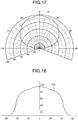
- FIG. 17 is an explanatory diagram illustrating an example of measurement of a light distribution of the light source according to the first embodiment in the form of a circular graph.
- FIG. 18 is an explanatory diagram illustrating an example of the light distribution of the light source obtained by converting the circular graph in FIG. 17 into rectangular coordinates of an angle and a light intensity.
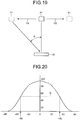
- FIG. 19 is an explanatory diagram illustrating influence of a shift in the positions of the light source and the optical sensor unit on the light distribution of the light source.
- the light source 41 can radiate parallel light source light, and the optical axis can be easily adjusted.
- the SN ratio tends to be low because it uses scattered light. It has been found by the inventor(s) of the present application that the SN ratio is dependent on the dark current of the optical encoder unit 31 that is not receiving light and the light distribution of the light source 41. Accordingly, as illustrated in FIG.
- the SN ratio is deteriorated when the distance D between the light source 41 and the optical sensor unit 35 is greater than a distance Dzmax and the optical sensor unit 35 does not receive a light intensity Idc100 which is 100 times greater or more than a light intensity corresponding to the dark current of the optical encoder unit 31. Accordingly, in the case where the light source 41 and the optical sensor unit 35 are arranged at positions with the distance D therebetween that is equal to or less than the distance Dzmax, the light source 41 and the optical sensor unit 35 are close to each other, and the SN ratio is improved.
- the optical encoder unit 31 is allowed to function, within a detectable range Adet in FIG. 15 , even with the light source 41 as illustrated in FIG. 16 .
- the required accurate adjustment of the optical axis may be eased by the positional relationship between the light source 41 and the optical sensor unit 35.
- the light source 41 and the optical sensor unit 35 are arranged at positions with the distance D therebetween such that the optical encoder 31 can receive light of a light intensity that is 1000 times or more than the light intensity corresponding to the dark current of the optical encoder unit 31 that is not receiving light.
- the detectable range Adet is narrowed, but the SN ratio of the output of the optical sensor unit 35 is improved.
- a light emitting device 41U such as a light-emitting diode, a laser light source such as a vertical-cavity surface-emitting laser, or a filament.
- a surface-emitting light source is used in the light emitting device 41U.
- the light source 41 includes a base substrate 41F, penetrating conductive layers 41H embedded in through holes SH, external electrodes 41P that are electrically connected to the penetrating conductive layers 41H, the light emitting device 41U mounted on the base substrate 41F, bonding wires 41W connecting the light emitting device 41U and the penetrating conductive layers 41H in a conducted manner, a sealing resin 41M protecting the light emitting device 41U, and a light-shielding film 41R.
- the light-shielding film 41R of the light source 41 functions as a diaphragm to narrow the light source light 71 radiated by the light emitting device 41U into a range of an emitting surface 41T.
- the emitting surface 41T has no lens surface and is a flat surface.
- a bare chip of a light-emitting diode (LED) may be used for such a light source 41.
- the light distribution which is the distribution of light intensities in respective directions in which the light source 41 radiates light
- a light distribution measurement device such as a goniophotometer.
- the light distribution measurement device measures the intensity of light by a photoreceiver rotating on the circumference or the spherical surface around the light source 41 with its light receiving surface facing the center where the light source 41 is positioned.
- the light distribution measurement device can store a circular graph which indicates information of a light intensity dli for each angle in the circumferential direction around the light source 41, as illustrated in FIG. 17 .
- the circular graph illustrated in FIG. 17 When expanded into a rectangular coordinate system in which the horizontal axis represents the angle in the circumferential direction of the circular graph and the vertical axis represents the light intensity of the circular graph (length of the radius), the circular graph illustrated in FIG. 17 becomes a bell-shaped light distribution Rdli illustrated in FIG. 18 .
- the circular graph illustrated in FIG. 17 indicates a ratio of light intensities at each angle in the circumferential direction, assuming a light intensity (length of the radius) at an angle where the intensity of light is the greatest is 100.
- the positional relationship between the light source 41 and the optical sensor unit 35 is preferably such that the optical axis is adjusted to coincide with the z-axis, which is parallel to the rotation center Zr.
- the positions of the light source 41 and the optical sensor unit 35 may be shifted on the xz plane or on the yz plane at the time of assembly.
- FIG. 19 if, when seen on the xz plane, the positional relationship between the light source 41 and the optical sensor unit 35 is such that the optical axis is shifted by a positional shift component FA of ⁇ with respect to the z-axis, the light intensity of the light distribution Rdli illustrated in FIG.
- FIG. 20 is an explanatory diagram illustrating an example of a light distribution obtained by correcting the light distribution in FIG. 18 by the shift in the positions of the light source and the optical sensor unit.
- the light distribution in FIG. 20 is obtained by re-drawing the light distribution in FIG. 18 which has been corrected by the amount of the shift in the positions illustrated in FIG. 19 as a rectangular coordinate system, in which the horizontal axis represents the angle in the circumferential direction of the circular graph and the vertical axis represents the light intensity of the circular graph (length of the radius).
- the horizontal axis represents the angle in the circumferential direction of the circular graph
- the vertical axis represents the light intensity of the circular graph (length of the radius).
- an angle + ⁇ 0 and an angle - ⁇ 0 are angles in the circumferential direction indicating a predetermined light intensity Is (for example, 50%).
- the predetermined light intensity Is is not limited to 50%, and may take other values.
- a characteristic of a sensor (photodetector) of the optical sensor unit 35 is drastically changed at a certain light intensity, influence on the measurement accuracy may be suppressed by selecting a value which is a change point as the predetermined light intensity Is.
- a predetermined angle 2 ⁇ 0 is assumed to be in a range from the angle - ⁇ 0 to the angle + ⁇ 0 .
- the angles in the circumferential direction indicating the predetermined light intensity Is may be given as an angle + ⁇ 1 and an angle - ⁇ 2
- the predetermined angle 2 ⁇ 0 may be given in a range from the angle - ⁇ 2 to the angle + ⁇ 1 (the angle + ⁇ 1 and the angle - ⁇ 2 are not illustrated).
- the light distribution of the light source light 71 indicates a light distribution at the predetermined angle 2 ⁇ 0 with respect to a cross section of the emitting surface 41T.
- FIG. 21 is an explanatory diagram illustrating a position of a photoreceiver within a range in which the light distribution of the light source of the optical sensor according to the first embodiment is uniform.
- the angles ⁇ 0 described above are projected on the xz plane, and a value of the distance D and the distance W are determined, as will be described below. Further, the angle ⁇ 0 of the light distribution is dependent on the light source 41, but is at least 45 degrees.
- Equation (3) ⁇ 1 tan ⁇ o x
- the first photoreceiver PD1 is arranged away from the third photoreceiver PD3 by the distance W across the arrangement center S0
- the second photoreceiver PD2 is arranged away from the fourth photoreceiver PD4 by the distance W across the arrangement center S0
- the first photoreceiver PD1, the third photoreceiver PD3, the second photoreceiver PD2, and the fourth photoreceiver PD4 have a width w, and there is a limitation that the width W is not smaller than a width 2w.
- the distance W from the arrangement center S0 to each of the first photoreceiver PD1, the second photoreceiver PD2, the third photoreceiver PD3, and the fourth photoreceiver PD4 is within a range in which the light distribution of the light source 41 is uniform, i.e., between the parameter lines IDC.
- a maximum value Dzmax and a minimum value Dzmin of the distance D between the emitting surface of the light source 41 and the arrangement center S0 (the optical sensor unit 35) satisfy the relationship of the following Equation (4) with respect to the distance W.
- the optical encoder unit 31 may use a light source 41 without a lens.
- the distance D between the emitting surface of the light source 41 and the arrangement center S0 (the optical sensor unit 35) By causing the distance D between the emitting surface of the light source 41 and the arrangement center S0 (the optical sensor unit 35) to be short, the SN ratio can be improved.
- the distance W from the arrangement center S0 to each of the first photoreceiver PD1, the second photoreceiver PD2, the third photoreceiver PD3, and the fourth photoreceiver PD4 may be within a range in which light can be received with less influence of light scattered by the light source 41. Accordingly, the optical encoder unit 31 and the optical encoder 2 may increase the measurement accuracy.
- FIG. 22 is a structure diagram of an optical encoder unit according to a second embodiment.
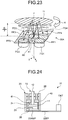
- FIG. 23 is an explanatory diagram illustrating an arrangement example of an optical scale and an optical sensor unit according to the second embodiment. Further, components that are the same as those described above are assigned with the same reference signs, and redundant description thereof is omitted.
- the optical encoder unit 31 the light source light 71 of the light source 41 is reflected by the optical scale 11, and the reflected light is detected, as the incident light 72, by an optical sensor unit 35A including the first photoreceiver PD1, the third photoreceiver PD3, the second photoreceiver PD2, and the fourth photoreceiver PD4.
- the distance D between the emitting surface of the light source 41 and the arrangement center S0 (the optical sensor unit 35) is half of that of the first embodiment, because specular reflection is adopted.
- the optical encoder unit 31 according to the second embodiment includes an annular light-shielding plate 17. Accordingly, unnecessary reflection may be suppressed by the light-shielding plate 17, thereby increasing the measurement accuracy.
- FIG. 24 is a structure diagram of an optical encoder unit according to a third embodiment. Components that are the same as those described above are assigned with the same reference signs, and redundant description thereof is omitted.
- the optical encoder unit 31 according to the third embodiment is the same as that of the first embodiment in that a transmissive optical scale and optical sensor are arranged, but is different in that the substrate 23 is a flexible substrate 23FP.
- the preamplifier AMP has the optical sensor unit 35 directly stacked on a packaged amplifier. Since the preamplifier AMP is arranged inside the cover 21, the durability can be increased.
- the preamplifier AMP may have a photodetector and an amplifier circuit mounted on a bare chip. Further, the preamplifier AMP may have the photodetector and the amplifier circuit integrally formed in a semiconductor process.
- FIG. 25 is a structure diagram of an optical encoder unit according to a fourth embodiment. Components that are the same as those described above are assigned with the same reference signs, and redundant description thereof is omitted.
- the optical encoder unit 31 according to the fourth embodiment is the same as that of the second embodiment in that a reflective optical scale and optical sensor are arranged, but is different in that the substrate 23 is a flexible substrate 23FP.
- the preamplifier AMP has the optical sensor unit 35A directly stacked on a packaged amplifier. Since the preamplifier AMP is arranged inside the cover 21, the durability can be increased.
- the preamplifier AMP may have a photodetector and an amplifier circuit mounted on a bare chip. Further, the preamplifier AMP may have the photodetector and the amplifier circuit integrally formed in a semiconductor process.
- FIG. 26 is a structure diagram of an optical encoder unit according to a fifth embodiment. Members that are the same as those described above are assigned with the same reference signs, and redundant description thereof is omitted.
- the optical encoder unit 31 according to the fifth embodiment is the same as that of the first embodiment in that a transmissive optical scale and optical sensor are arranged, but different in that the preamplifier AMP has an optical sensor unit 35B directly stacked on a packaged amplifier in which an integrated circuit of an amplifier circuit is packaged.
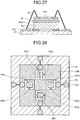
- FIG. 27 is a structure diagram of an optical sensor unit according to a fifth embodiment.
- FIG. 28 is a plan view of the optical sensor unit illustrated in FIG. 27 .
- the optical sensor unit 35B is a bare chip of a photodetector including the first photoreceiver PD1 having the polarizing layer PP1, the second photoreceiver PD2 having the polarizing layer PP2, the third photoreceiver PD3 having the polarizing layer PP3, and the fourth photoreceiver PD4 having the polarizing layer PP4.
- the optical sensor unit 35B is a bare chip, and is not packaged.
- the optical sensor unit 35B is fixed above the preamplifier AMP by an adhesive layer 51.
- the preamplifier AMP is mounted on the surface of the substrate 23, and the substrate 23 electrically connects the preamplifier AMP to lands of bonding members 52 made of a conductive molten metal such as solder or a conductive resin and connected to a line 24 of the substrate 23 illustrated in FIG. 26 . Accordingly, by melting a conductive molten metal in the form of a ball or paste interposed between the preamplifier AMP and the substrate 23 by a reflow device or the like, the preamplifier AMP is easily fixed and electrically connected to the substrate 23.
- a bonding device connects a terminal 23T that is connected to the line 24 of the substrate 23 mentioned above to each terminal of the optical sensor unit 35B by a conductive metal wire 53 made of Au or the like. Therefore, even if the optical sensor unit 35B is integrated on the preamplifier AMP, and the outer shape of the cover 21 is small, the preamplifier AMP and the optical sensor unit 35B are provided inside the cover 21 (see FIG. 26 ). As a result, the optical encoder unit 31 according to the fifth embodiment is made small. Moreover, with the optical encoder unit 31 according to the fifth embodiment, the process may be at least partly automated by the reflow device, the bonding device, or the like, and the cost can be reduced. Since the connection distance of the signal line between the preamplifier AMP and the optical sensor unit 35B becomes short, the signal noise can be reduced and the accuracy can be further increased for the optical sensor unit 35B according to the fifth embodiment.
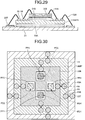
- FIG. 29 is a structure diagram of an optical sensor unit according to a first modification of the fifth embodiment.
- FIG. 30 is a plan view of the optical sensor unit in FIG. 29 .
- a preamplifier AMP1 is not packaged but is a bare chip, and the optical sensor unit 35B is fixed above the preamplifier AMP1 by an adhesive layer 51B.
- the bonding device connects the terminal 23T connected to the line 24 of the substrate 23 mentioned above to each terminal 55 of the preamplifier AMP1 by a conductive metal wire 53B made of Au or the like.
- An adhesive layer 51A is interposed between the substrate 23 and the preamplifier AMP1, and an adhesive layer 51B is interposed between the preamplifier AMP1 and the optical sensor unit 35B.
- the positions of the substrate 23, the preamplifier AMP1, and the optical sensor unit 35B are fixed.
- the bonding device connects each terminal 54 of the preamplifier AMP1 to each terminal of the optical sensor unit 35B by a conductive metal wire 53A made of Au or the like.
- the terminals 54 of the preamplifier AMP1 and the terminals of the optical sensor unit 35B have to be connected such that the terminals 54 of the preamplifier AMP1 at the lower side are exposed when the preamplifier AMP1 and the optical sensor unit 35B are stacked together. Therefore, the bare chip of the preamplifier AMP1 has a chip size that is greater than that of the bare chip of the optical sensor unit 35B.
- the preamplifier AMP1 and the optical sensor unit 35B are provided inside the cover 21. Since both the preamplifier AMP1 and the optical sensor unit 35B are bare chips and thus are thin, the optical encoder unit 31 according to the first modification of the fifth embodiment is made small. Moreover, with the optical encoder unit 31 according to the first modification of the fifth embodiment, the process may be at least partly automated by the bonding device or the like, and the cost can be reduced. Since the connection distance of the signal line between the preamplifier AMP1 and the optical sensor unit 35B is short, the signal noise can be reduced and the accuracy can be further increased for the optical sensor unit 35B according to the first modification of the fifth embodiment.
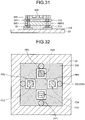
- FIG. 31 is a structure diagram of an optical sensor unit according to a second modification of the fifth embodiment.
- FIG. 32 is a plan view of the optical sensor unit illustrated in FIG. 31 .
- a preamplifier AMP2 is not packaged but is a bare chip, and the optical sensor unit 35B is fixed above the preamplifier AMP2 by an adhesive layer 51A.
- the bare chip of the optical sensor unit 35B includes conductive penetrating lines 53C penetrating the upper surface and the lower surface.
- the bare chip of the preamplifier AMP2 also includes conductive penetrating lines 53D penetrating the upper surface and the lower surface.
- the penetrating lines 53C and the penetrating lines 53D are arranged at respective bare chips in such a way that, when the optical sensor unit 35B and the preamplifier AMP2 are stacked together, the penetrating lines 53C and the penetrating lines 53D are overlapped with each other in plan view.
- the reflow device connects the terminals 23T connected to the line 24 of the substrate 23 mentioned above to the penetrating lines 53D of the preamplifier AMP2 by bonding members 52 made of a conductive metal, such as solder.
- the reflow device connects the penetrating lines 53D of the preamplifier AMP2 to the penetrating lines 53C of the optical sensor unit 35B by bonding members 52A made of a conductive metal, such as solder.
- the adhesive layer 51A is interposed between the substrate 23 and the preamplifier AMP2, and the adhesive layer 51B is interposed between the preamplifier AMP2 and the optical sensor unit 35B. As a result, the positions of the substrate 23, the preamplifier AMP2, and the optical sensor unit 35B are fixed.
- the outer shape of the preamplifier AMP2 does not have to be exposed when the penetrating lines 53D of the preamplifier AMP2 and the penetrating lines 53C of the optical sensor unit 35B are stacked together. Accordingly, the bare chip of the preamplifier AMP2 only needs to have a chip size that is equal to or smaller than that of the bare chip of the optical sensor unit 35B. Therefore, even if the optical sensor unit 35B is integrated on the preamplifier AMP2, and the outer shape of the cover 21 is small, the preamplifier AMP2 and the optical sensor unit 35B are provided inside the cover 21.
- the optical encoder unit 31 according to the second modification of the fifth embodiment is further miniaturized. Moreover, with the optical encoder unit 31 according to the second modification of the fifth embodiment, the process may be at least partly automated by the reflow device or the like, and the cost can be reduced. Since the connection distance of the signal line between the preamplifier AMP2 and the optical sensor unit 35B is made short, the signal noise can be reduced and the accuracy can be further increased for the optical sensor unit 35B according to the second modification of the fifth embodiment.
- FIG. 33 is a structure diagram of an optical sensor unit according to a third modification of the fifth embodiment.
- FIG. 34 is a plan view of the optical sensor unit illustrated in FIG. 33 .
- an optical sensor unit 35C according to the third modification of the fifth embodiment is integrated with a preamplifier AMP3 and is fixed, as a bare chip, above the substrate 23 by an adhesive layer 51A.
- the optical sensor unit 35C is a bare chip in which a photodetector and amplifiers AMP3 are formed as a semiconductor integrated circuit.
- the photodetector includes the first photoreceiver PD1 having the polarizing layer PP1, the second photoreceiver PD2 having the polarizing layer PP2, the third photoreceiver PD3 having the polarizing layer PP3, and the fourth photoreceiver PD4 having the polarizing layer PP4.
- the optical sensor unit 35C is a bare chip and is not packaged. Each of the photoreceivers PD1 to PD4 of the optical sensor unit 35C is connected to the preamplifier AMP3 in the integrated circuit (in the bare chip).
- the optical sensor unit 35C is mounted on the surface of the substrate 23, and the substrate 23 electrically connects the terminal 23T connected to the line 24 of the substrate 23 mentioned above to each preamplifier AMP3 of the optical sensor unit 35C by a conductive metal wire 53 made of Au or the like.
- the optical sensor unit 35C and the preamplifiers AMP3 are integrated together. Therefore, even if the outer shape of the cover 21 is small, the optical sensor unit 35C and the preamplifiers AMP3 are provided inside the cover 21.
- the optical sensor unit 35C is one bare chip, and thus is thin and small.
- the optical encoder unit 31 according to the third modification of the fifth embodiment can be made small.
- the process may be at least partly automated by the bonding device or the like, and the cost can be reduced. Since the connection distance of the signal line between the preamplifier AMP3 and the optical sensor unit 35B is short, the signal noise can be reduced and the accuracy can be further increased for the optical sensor unit 35B according to the third modification of the fifth embodiment.
- FIG. 35 is a structure diagram of an optical sensor unit according to a fourth modification of the fifth embodiment.
- FIG. 36 is a plan view of the optical sensor unit in FIG. 35 .
- the preamplifier AMP2 is not packaged but is a bare chip, and the optical sensor unit 35B is fixed above the preamplifier AMP2 by bonding members 52A.
- an operational circuit ACB is not packaged but is a bare chip, and the preamplifier AMP2 is fixed above the operational circuit ACB by bonding members 52B.
- the bonding members 52A and the bonding members 52B are made of the same conductive material as that of the bonding members 52 described above.
- the operational circuit ACB described here is an integrated circuit having the function of the differential operational circuit DS described in the first embodiment.
- the operational circuit ACB may be an integrated circuit having the functions of the filter circuit NR and the multiplication circuit AP, in addition to that of the differential operational circuit DS described in the first embodiment.
- the bare chip of the optical sensor unit 35B includes the conductive penetrating lines 53C penetrating the upper surface and the lower surface.
- the bare chip of the preamplifier AMP2 also includes the conductive penetrating lines 53D penetrating the upper surface and the lower surface.
- the bare chip of the operational circuit ACB also includes conductive penetrating lines 53E penetrating the upper surface and the lower surface.
- the penetrating lines 53C, the penetrating lines 53D, and the penetrating lines 53E are arranged in respective bare chips such that, when the optical sensor unit 35B, the preamplifier AMP2, and the operational circuit ACB are stacked together, the penetrating lines 53C, the penetrating lines 53D, and the penetrating lines 53E are overlapped with one another in plan view.
- the reflow device connects the terminals 23T connected to the line 24 of the substrate 23 mentioned above to the penetrating lines 53E of the operational circuit ACB by the bonding members 52 made of a conductive metal, such as solder.
- the reflow device connects the penetrating lines 53E of the operational circuit ACB to the penetrating lines 53D of the preamplifier AMP2 by bonding members 52B made of a conductive metal, such as solder. Further, the reflow device connects the penetrating lines 53D of the preamplifier AMP2 to the penetrating lines 53C of the optical sensor unit 35B by the bonding members 52A made of a conductive metal, such as solder.
- the adhesive layer 51A is interposed between the substrate 23 and the operational circuit ACB, and the positions of the substrate 23 and the operational circuit ACB are fixed.
- the bare chips of the operational circuit ACB and the preamplifier AMP2 only need to have a chip size that is equal to or smaller than that of the bare chip of the optical sensor unit 35B. Therefore, even if the optical sensor unit 35B is integrated on the operational circuit ACB and the preamplifier AMP2 and the outer shape of the cover 21 is small, the operational circuit ACB, the preamplifier AMP2, and the optical sensor unit 35B are provided inside the cover 21. All of the operational circuit ACB, the preamplifier AMP2, and the optical sensor unit 35B are bare chips and are made thin and small.. As a result, the optical encoder unit 31 according to the fourth modification of the fifth embodiment can be made small.
- the process may be at least partly automated by the reflow device or the like, and the cost can be reduced. Since the connection distance of the signal line between the preamplifier AMP2 and the optical sensor unit 35B is short, the signal noise can be reduced and the accuracy can be further increased for the optical sensor unit 35B according to the fourth modification of the fifth embodiment.
- optical sensor units 35B according to each of the fifth embodiment and the modifications thereof may be combined as appropriate with other structural elements described above.
- the substrate 23 may be provided as the flexible substrate 23FP described in the second embodiment.
Landscapes
- Physics & Mathematics (AREA)
- General Physics & Mathematics (AREA)
- Optical Transform (AREA)
Applications Claiming Priority (2)
| Application Number | Priority Date | Filing Date | Title |
|---|---|---|---|
| JP2013229565 | 2013-11-05 | ||
| PCT/JP2014/079131 WO2015068662A1 (ja) | 2013-11-05 | 2014-10-31 | 光学式エンコーダユニット及び光学式エンコーダ |
Publications (3)
| Publication Number | Publication Date |
|---|---|
| EP3067668A1 EP3067668A1 (en) | 2016-09-14 |
| EP3067668A4 EP3067668A4 (en) | 2017-10-04 |
| EP3067668B1 true EP3067668B1 (en) | 2019-01-30 |
Family
ID=53041439
Family Applications (1)
| Application Number | Title | Priority Date | Filing Date |
|---|---|---|---|
| EP14860233.7A Not-in-force EP3067668B1 (en) | 2013-11-05 | 2014-10-31 | Optical encoder unit and optical encoder |
Country Status (5)
| Country | Link |
|---|---|
| US (1) | US10156459B2 (enExample) |
| EP (1) | EP3067668B1 (enExample) |
| JP (2) | JP6369042B2 (enExample) |
| CN (1) | CN105683718B (enExample) |
| WO (1) | WO2015068662A1 (enExample) |
Families Citing this family (7)
| Publication number | Priority date | Publication date | Assignee | Title |
|---|---|---|---|---|
| CN107095644B (zh) * | 2016-02-19 | 2020-05-19 | 光宝光电(常州)有限公司 | 光感测器模组及具有该光感测器模组的穿戴装置 |
| WO2017145345A1 (ja) * | 2016-02-25 | 2017-08-31 | 日本精工株式会社 | センサ |
| JP2018100837A (ja) * | 2016-12-19 | 2018-06-28 | セイコーエプソン株式会社 | エンコーダー、ロボットおよびプリンター |
| JP7080129B2 (ja) * | 2018-08-01 | 2022-06-03 | 株式会社トプコン | 角度検出システムおよび角度検出方法 |
| CN111024225B (zh) * | 2019-12-02 | 2021-12-31 | 西北核技术研究院 | 一种激光远场桶中功率分布曲线的绝对测量方法 |
| EP4394332B1 (de) * | 2023-01-01 | 2026-03-04 | POLDI microelectronics GmbH | Verfahren zur iterativen erzeugung einer matrix aus grundelementen |
| EP4394461B1 (de) * | 2023-01-01 | 2025-07-16 | POLDI microelectronics GmbH | Integrierte schaltung zur messung der polarisation von licht |
Citations (1)
| Publication number | Priority date | Publication date | Assignee | Title |
|---|---|---|---|---|
| US20100243871A1 (en) * | 2009-03-26 | 2010-09-30 | Olympus Corporation | Optical encoder for detecting the relative displacement between an encoder scale and an encoder head |
Family Cites Families (25)
| Publication number | Priority date | Publication date | Assignee | Title |
|---|---|---|---|---|
| JPS61225626A (ja) * | 1985-03-29 | 1986-10-07 | Mitsubishi Electric Corp | 光計測装置 |
| JPH01216213A (ja) * | 1988-02-25 | 1989-08-30 | Mitsutoyo Corp | 光学式変位検出器 |
| US4922095A (en) | 1989-05-11 | 1990-05-01 | Conoco Inc. | Method and apparatus for sensing disturbance using fiber-optic polarization rotation |
| JPH06174494A (ja) * | 1992-12-09 | 1994-06-24 | Oki Electric Ind Co Ltd | エンコーダ |
| JP3349343B2 (ja) * | 1996-05-08 | 2002-11-25 | 山洋電気株式会社 | 光電式エンコーダ |
| CN1151361C (zh) | 1996-05-20 | 2004-05-26 | 松下电器产业株式会社 | 光学编码器及位置检测方法 |
| US5844673A (en) * | 1998-04-17 | 1998-12-01 | Cambridge Technology, Inc. | Axial led position detector for determining the angular position of a rotatable element |
| EP0954034A3 (en) | 1998-04-28 | 2000-01-26 | Canare Electric Co., Ltd. | Light receiving device with quantum-wave interference layers |
| JP3014389B2 (ja) * | 1998-04-28 | 2000-02-28 | カナレ電気株式会社 | 量子波干渉層を有した受光素子 |
| JP3884707B2 (ja) * | 2000-06-15 | 2007-02-21 | スカンラブ アーゲー | スキャンニング装置用の位置検出器 |
| JP2002208725A (ja) * | 2000-11-13 | 2002-07-26 | Mitsutoyo Corp | 受光素子アレイとこれを用いた光学式エンコーダ及び受光素子アレイの製造方法 |
| JP3695398B2 (ja) | 2002-01-30 | 2005-09-14 | 富士ゼロックス株式会社 | 光学式エンコーダ及びエンコーダ用スケール |
| JP4476682B2 (ja) | 2003-05-16 | 2010-06-09 | 株式会社ミツトヨ | 光電式エンコーダ |
| CN100346138C (zh) | 2004-03-17 | 2007-10-31 | 台达电子工业股份有限公司 | 旋转光学编码器、编码盘和旋转光学编码器的编码方法 |
| JP4364711B2 (ja) | 2004-04-14 | 2009-11-18 | シャープ株式会社 | 光学式エンコーダおよびそれを備えた電子機器 |
| JP4857785B2 (ja) * | 2006-01-27 | 2012-01-18 | ミツミ電機株式会社 | エンコーダ付モータ及びその組立方法 |
| US7777879B2 (en) * | 2007-02-01 | 2010-08-17 | Stmicroelectronics (Research & Development) Ltd. | Rotary encoders |
| JP2008243869A (ja) * | 2007-03-26 | 2008-10-09 | Tdk Corp | 受光装置 |
| JP2009086609A (ja) * | 2007-10-01 | 2009-04-23 | Zero Rabo Kk | 回転位置検出回路及びプロジェクタ装置 |
| JP5211796B2 (ja) * | 2008-03-26 | 2013-06-12 | 日本電気株式会社 | 光増幅装置および入力光レベル計算方法ならびに光増幅器制御装置 |
| JP5562077B2 (ja) * | 2010-03-10 | 2014-07-30 | キヤノン株式会社 | 光学式エンコーダ、エンコーダ、干渉計測装置、計測方法 |
| JP6069653B2 (ja) | 2011-01-27 | 2017-02-01 | 株式会社ミツトヨ | 光電式エンコーダ及びそのアライメント調整方法 |
| EP2775270A4 (en) * | 2011-10-31 | 2015-08-26 | Nsk Ltd | OPTICAL SENSOR, METHOD FOR PRODUCING OPTICAL SENSORS, OPTICAL ENCODER, TORQUE SENSING DEVICE, AND POWER ASSISTED STEERING DEVICE |
| US8760852B2 (en) | 2012-04-24 | 2014-06-24 | Avx Corporation | Solid electrolytic capacitor containing multiple sinter bonded anode leadwires |
| EP2657652B1 (de) * | 2012-04-27 | 2015-10-28 | SICK STEGMANN GmbH | Vorrichtung zur Messung des Drehwinkels zweier relativ zueinander um eine Drehachse rotierender Objekte |
-
2014
- 2014-02-12 JP JP2014024887A patent/JP6369042B2/ja active Active
- 2014-10-31 JP JP2015546627A patent/JP6369474B2/ja active Active
- 2014-10-31 WO PCT/JP2014/079131 patent/WO2015068662A1/ja not_active Ceased
- 2014-10-31 CN CN201480059252.XA patent/CN105683718B/zh not_active Expired - Fee Related
- 2014-10-31 EP EP14860233.7A patent/EP3067668B1/en not_active Not-in-force
- 2014-10-31 US US15/034,076 patent/US10156459B2/en active Active
Patent Citations (1)
| Publication number | Priority date | Publication date | Assignee | Title |
|---|---|---|---|---|
| US20100243871A1 (en) * | 2009-03-26 | 2010-09-30 | Olympus Corporation | Optical encoder for detecting the relative displacement between an encoder scale and an encoder head |
Also Published As
| Publication number | Publication date |
|---|---|
| US10156459B2 (en) | 2018-12-18 |
| EP3067668A4 (en) | 2017-10-04 |
| JPWO2015068662A1 (ja) | 2017-03-09 |
| US20160282149A1 (en) | 2016-09-29 |
| JP6369042B2 (ja) | 2018-08-08 |
| CN105683718A (zh) | 2016-06-15 |
| JP2015111089A (ja) | 2015-06-18 |
| JP6369474B2 (ja) | 2018-08-08 |
| CN105683718B (zh) | 2018-05-15 |
| EP3067668A1 (en) | 2016-09-14 |
| WO2015068662A1 (ja) | 2015-05-14 |
Similar Documents
| Publication | Publication Date | Title |
|---|---|---|
| EP3067668A1 (en) | Optical encoder unit and optical encoder | |
| EP2775271B1 (en) | Optical scale, method for manufacturing optical scale, and optical encoder | |
| US10670430B2 (en) | Sensor | |
| US10378932B2 (en) | Sensor having generating and detecting units on a substrate with a curve or bent shape in a cylindrical housing and method of manufacturing sensor | |
| JP6044599B2 (ja) | センサ | |
| US10337892B2 (en) | Sensor and method of manufacturing sensor | |
| JP2015161539A (ja) | 光学式エンコーダユニット及び光学式エンコーダ | |
| JP2016114590A (ja) | センサの製造方法及びセンサ | |
| WO2016021635A1 (ja) | 光センサ及び光学式エンコーダユニット | |
| JP6380589B2 (ja) | 光学式エンコーダユニット | |
| JP2016070668A (ja) | 小型エンコーダ | |
| US10139252B2 (en) | Optical sensor | |
| JP6354202B2 (ja) | 光学式エンコーダユニット及び光学式エンコーダ | |
| JP6736887B2 (ja) | ロータリエンコーダ及び光センサの製造方法 | |
| JP2019035774A (ja) | 光学式エンコーダユニット及び光学式エンコーダ | |
| JP2018072099A (ja) | 光センサの製造方法 | |
| US11231298B2 (en) | Sensor, sensor substrate, and sensor manufacturing method | |
| WO2016021647A1 (ja) | センサ及びセンサの製造方法 | |
| WO2017022260A1 (ja) | センサの製造方法及びセンサ | |
| JP2016057127A (ja) | センサ及びセンサの製造方法 | |
| JP2016114420A (ja) | センサ、センサの基板及びセンサの製造方法 |
Legal Events
| Date | Code | Title | Description |
|---|---|---|---|
| PUAI | Public reference made under article 153(3) epc to a published international application that has entered the european phase |
Free format text: ORIGINAL CODE: 0009012 |
|
| 17P | Request for examination filed |
Effective date: 20160425 |
|
| AK | Designated contracting states |
Kind code of ref document: A1 Designated state(s): AL AT BE BG CH CY CZ DE DK EE ES FI FR GB GR HR HU IE IS IT LI LT LU LV MC MK MT NL NO PL PT RO RS SE SI SK SM TR |
|
| AX | Request for extension of the european patent |
Extension state: BA ME |
|
| DAX | Request for extension of the european patent (deleted) | ||
| RIC1 | Information provided on ipc code assigned before grant |
Ipc: G01D 5/347 20060101AFI20170524BHEP Ipc: G01D 5/34 20060101ALI20170524BHEP |
|
| A4 | Supplementary search report drawn up and despatched |
Effective date: 20170831 |
|
| RIC1 | Information provided on ipc code assigned before grant |
Ipc: G01D 5/347 20060101AFI20170825BHEP Ipc: G01D 5/34 20060101ALI20170825BHEP |
|
| GRAP | Despatch of communication of intention to grant a patent |
Free format text: ORIGINAL CODE: EPIDOSNIGR1 |
|
| STAA | Information on the status of an ep patent application or granted ep patent |
Free format text: STATUS: GRANT OF PATENT IS INTENDED |
|
| INTG | Intention to grant announced |
Effective date: 20180920 |
|
| GRAS | Grant fee paid |
Free format text: ORIGINAL CODE: EPIDOSNIGR3 |
|
| GRAA | (expected) grant |
Free format text: ORIGINAL CODE: 0009210 |
|
| STAA | Information on the status of an ep patent application or granted ep patent |
Free format text: STATUS: THE PATENT HAS BEEN GRANTED |
|
| AK | Designated contracting states |
Kind code of ref document: B1 Designated state(s): AL AT BE BG CH CY CZ DE DK EE ES FI FR GB GR HR HU IE IS IT LI LT LU LV MC MK MT NL NO PL PT RO RS SE SI SK SM TR |
|
| REG | Reference to a national code |
Ref country code: GB Ref legal event code: FG4D |
|
| REG | Reference to a national code |
Ref country code: CH Ref legal event code: EP |
|
| REG | Reference to a national code |
Ref country code: AT Ref legal event code: REF Ref document number: 1093653 Country of ref document: AT Kind code of ref document: T Effective date: 20190215 |
|
| REG | Reference to a national code |
Ref country code: IE Ref legal event code: FG4D |
|
| REG | Reference to a national code |
Ref country code: DE Ref legal event code: R096 Ref document number: 602014040574 Country of ref document: DE |
|
| REG | Reference to a national code |
Ref country code: LT Ref legal event code: MG4D |
|
| REG | Reference to a national code |
Ref country code: NL Ref legal event code: MP Effective date: 20190130 |
|
| PG25 | Lapsed in a contracting state [announced via postgrant information from national office to epo] |
Ref country code: PT Free format text: LAPSE BECAUSE OF FAILURE TO SUBMIT A TRANSLATION OF THE DESCRIPTION OR TO PAY THE FEE WITHIN THE PRESCRIBED TIME-LIMIT Effective date: 20190530 Ref country code: ES Free format text: LAPSE BECAUSE OF FAILURE TO SUBMIT A TRANSLATION OF THE DESCRIPTION OR TO PAY THE FEE WITHIN THE PRESCRIBED TIME-LIMIT Effective date: 20190130 Ref country code: SE Free format text: LAPSE BECAUSE OF FAILURE TO SUBMIT A TRANSLATION OF THE DESCRIPTION OR TO PAY THE FEE WITHIN THE PRESCRIBED TIME-LIMIT Effective date: 20190130 Ref country code: NL Free format text: LAPSE BECAUSE OF FAILURE TO SUBMIT A TRANSLATION OF THE DESCRIPTION OR TO PAY THE FEE WITHIN THE PRESCRIBED TIME-LIMIT Effective date: 20190130 Ref country code: LT Free format text: LAPSE BECAUSE OF FAILURE TO SUBMIT A TRANSLATION OF THE DESCRIPTION OR TO PAY THE FEE WITHIN THE PRESCRIBED TIME-LIMIT Effective date: 20190130 Ref country code: PL Free format text: LAPSE BECAUSE OF FAILURE TO SUBMIT A TRANSLATION OF THE DESCRIPTION OR TO PAY THE FEE WITHIN THE PRESCRIBED TIME-LIMIT Effective date: 20190130 Ref country code: NO Free format text: LAPSE BECAUSE OF FAILURE TO SUBMIT A TRANSLATION OF THE DESCRIPTION OR TO PAY THE FEE WITHIN THE PRESCRIBED TIME-LIMIT Effective date: 20190430 Ref country code: FI Free format text: LAPSE BECAUSE OF FAILURE TO SUBMIT A TRANSLATION OF THE DESCRIPTION OR TO PAY THE FEE WITHIN THE PRESCRIBED TIME-LIMIT Effective date: 20190130 |
|
| REG | Reference to a national code |
Ref country code: AT Ref legal event code: MK05 Ref document number: 1093653 Country of ref document: AT Kind code of ref document: T Effective date: 20190130 |
|
| PG25 | Lapsed in a contracting state [announced via postgrant information from national office to epo] |
Ref country code: BG Free format text: LAPSE BECAUSE OF FAILURE TO SUBMIT A TRANSLATION OF THE DESCRIPTION OR TO PAY THE FEE WITHIN THE PRESCRIBED TIME-LIMIT Effective date: 20190430 Ref country code: IS Free format text: LAPSE BECAUSE OF FAILURE TO SUBMIT A TRANSLATION OF THE DESCRIPTION OR TO PAY THE FEE WITHIN THE PRESCRIBED TIME-LIMIT Effective date: 20190530 Ref country code: RS Free format text: LAPSE BECAUSE OF FAILURE TO SUBMIT A TRANSLATION OF THE DESCRIPTION OR TO PAY THE FEE WITHIN THE PRESCRIBED TIME-LIMIT Effective date: 20190130 Ref country code: GR Free format text: LAPSE BECAUSE OF FAILURE TO SUBMIT A TRANSLATION OF THE DESCRIPTION OR TO PAY THE FEE WITHIN THE PRESCRIBED TIME-LIMIT Effective date: 20190501 Ref country code: LV Free format text: LAPSE BECAUSE OF FAILURE TO SUBMIT A TRANSLATION OF THE DESCRIPTION OR TO PAY THE FEE WITHIN THE PRESCRIBED TIME-LIMIT Effective date: 20190130 Ref country code: HR Free format text: LAPSE BECAUSE OF FAILURE TO SUBMIT A TRANSLATION OF THE DESCRIPTION OR TO PAY THE FEE WITHIN THE PRESCRIBED TIME-LIMIT Effective date: 20190130 |
|
| PG25 | Lapsed in a contracting state [announced via postgrant information from national office to epo] |
Ref country code: IT Free format text: LAPSE BECAUSE OF FAILURE TO SUBMIT A TRANSLATION OF THE DESCRIPTION OR TO PAY THE FEE WITHIN THE PRESCRIBED TIME-LIMIT Effective date: 20190130 Ref country code: RO Free format text: LAPSE BECAUSE OF FAILURE TO SUBMIT A TRANSLATION OF THE DESCRIPTION OR TO PAY THE FEE WITHIN THE PRESCRIBED TIME-LIMIT Effective date: 20190130 Ref country code: SK Free format text: LAPSE BECAUSE OF FAILURE TO SUBMIT A TRANSLATION OF THE DESCRIPTION OR TO PAY THE FEE WITHIN THE PRESCRIBED TIME-LIMIT Effective date: 20190130 Ref country code: AL Free format text: LAPSE BECAUSE OF FAILURE TO SUBMIT A TRANSLATION OF THE DESCRIPTION OR TO PAY THE FEE WITHIN THE PRESCRIBED TIME-LIMIT Effective date: 20190130 Ref country code: DK Free format text: LAPSE BECAUSE OF FAILURE TO SUBMIT A TRANSLATION OF THE DESCRIPTION OR TO PAY THE FEE WITHIN THE PRESCRIBED TIME-LIMIT Effective date: 20190130 Ref country code: EE Free format text: LAPSE BECAUSE OF FAILURE TO SUBMIT A TRANSLATION OF THE DESCRIPTION OR TO PAY THE FEE WITHIN THE PRESCRIBED TIME-LIMIT Effective date: 20190130 Ref country code: CZ Free format text: LAPSE BECAUSE OF FAILURE TO SUBMIT A TRANSLATION OF THE DESCRIPTION OR TO PAY THE FEE WITHIN THE PRESCRIBED TIME-LIMIT Effective date: 20190130 |
|
| PGFP | Annual fee paid to national office [announced via postgrant information from national office to epo] |
Ref country code: FR Payment date: 20190913 Year of fee payment: 6 |
|
| REG | Reference to a national code |
Ref country code: DE Ref legal event code: R097 Ref document number: 602014040574 Country of ref document: DE |
|
| PG25 | Lapsed in a contracting state [announced via postgrant information from national office to epo] |
Ref country code: SM Free format text: LAPSE BECAUSE OF FAILURE TO SUBMIT A TRANSLATION OF THE DESCRIPTION OR TO PAY THE FEE WITHIN THE PRESCRIBED TIME-LIMIT Effective date: 20190130 |
|
| PLBE | No opposition filed within time limit |
Free format text: ORIGINAL CODE: 0009261 |
|
| STAA | Information on the status of an ep patent application or granted ep patent |
Free format text: STATUS: NO OPPOSITION FILED WITHIN TIME LIMIT |
|
| PG25 | Lapsed in a contracting state [announced via postgrant information from national office to epo] |
Ref country code: AT Free format text: LAPSE BECAUSE OF FAILURE TO SUBMIT A TRANSLATION OF THE DESCRIPTION OR TO PAY THE FEE WITHIN THE PRESCRIBED TIME-LIMIT Effective date: 20190130 |
|
| 26N | No opposition filed |
Effective date: 20191031 |
|
| PGFP | Annual fee paid to national office [announced via postgrant information from national office to epo] |
Ref country code: DE Payment date: 20191015 Year of fee payment: 6 |
|
| PG25 | Lapsed in a contracting state [announced via postgrant information from national office to epo] |
Ref country code: SI Free format text: LAPSE BECAUSE OF FAILURE TO SUBMIT A TRANSLATION OF THE DESCRIPTION OR TO PAY THE FEE WITHIN THE PRESCRIBED TIME-LIMIT Effective date: 20190130 |
|
| PG25 | Lapsed in a contracting state [announced via postgrant information from national office to epo] |
Ref country code: TR Free format text: LAPSE BECAUSE OF FAILURE TO SUBMIT A TRANSLATION OF THE DESCRIPTION OR TO PAY THE FEE WITHIN THE PRESCRIBED TIME-LIMIT Effective date: 20190130 |
|
| PG25 | Lapsed in a contracting state [announced via postgrant information from national office to epo] |
Ref country code: MC Free format text: LAPSE BECAUSE OF FAILURE TO SUBMIT A TRANSLATION OF THE DESCRIPTION OR TO PAY THE FEE WITHIN THE PRESCRIBED TIME-LIMIT Effective date: 20190130 |
|
| REG | Reference to a national code |
Ref country code: CH Ref legal event code: PL |
|
| PG25 | Lapsed in a contracting state [announced via postgrant information from national office to epo] |
Ref country code: LI Free format text: LAPSE BECAUSE OF NON-PAYMENT OF DUE FEES Effective date: 20191031 Ref country code: LU Free format text: LAPSE BECAUSE OF NON-PAYMENT OF DUE FEES Effective date: 20191031 Ref country code: CH Free format text: LAPSE BECAUSE OF NON-PAYMENT OF DUE FEES Effective date: 20191031 |
|
| REG | Reference to a national code |
Ref country code: BE Ref legal event code: MM Effective date: 20191031 |
|
| PG25 | Lapsed in a contracting state [announced via postgrant information from national office to epo] |
Ref country code: BE Free format text: LAPSE BECAUSE OF NON-PAYMENT OF DUE FEES Effective date: 20191031 |
|
| GBPC | Gb: european patent ceased through non-payment of renewal fee |
Effective date: 20191031 |
|
| PG25 | Lapsed in a contracting state [announced via postgrant information from national office to epo] |
Ref country code: IE Free format text: LAPSE BECAUSE OF NON-PAYMENT OF DUE FEES Effective date: 20191031 Ref country code: GB Free format text: LAPSE BECAUSE OF NON-PAYMENT OF DUE FEES Effective date: 20191031 |
|
| REG | Reference to a national code |
Ref country code: DE Ref legal event code: R119 Ref document number: 602014040574 Country of ref document: DE |
|
| PG25 | Lapsed in a contracting state [announced via postgrant information from national office to epo] |
Ref country code: CY Free format text: LAPSE BECAUSE OF FAILURE TO SUBMIT A TRANSLATION OF THE DESCRIPTION OR TO PAY THE FEE WITHIN THE PRESCRIBED TIME-LIMIT Effective date: 20190130 |
|
| PG25 | Lapsed in a contracting state [announced via postgrant information from national office to epo] |
Ref country code: MT Free format text: LAPSE BECAUSE OF FAILURE TO SUBMIT A TRANSLATION OF THE DESCRIPTION OR TO PAY THE FEE WITHIN THE PRESCRIBED TIME-LIMIT Effective date: 20190130 Ref country code: HU Free format text: LAPSE BECAUSE OF FAILURE TO SUBMIT A TRANSLATION OF THE DESCRIPTION OR TO PAY THE FEE WITHIN THE PRESCRIBED TIME-LIMIT; INVALID AB INITIO Effective date: 20141031 Ref country code: DE Free format text: LAPSE BECAUSE OF NON-PAYMENT OF DUE FEES Effective date: 20210501 Ref country code: FR Free format text: LAPSE BECAUSE OF NON-PAYMENT OF DUE FEES Effective date: 20201031 |
|
| PG25 | Lapsed in a contracting state [announced via postgrant information from national office to epo] |
Ref country code: MK Free format text: LAPSE BECAUSE OF FAILURE TO SUBMIT A TRANSLATION OF THE DESCRIPTION OR TO PAY THE FEE WITHIN THE PRESCRIBED TIME-LIMIT Effective date: 20190130 |