EP3050134B9 - Photoaktives, organisches material für optoelektronische bauelemente - Google Patents
Photoaktives, organisches material für optoelektronische bauelemente Download PDFInfo
- Publication number
- EP3050134B9 EP3050134B9 EP14786142.1A EP14786142A EP3050134B9 EP 3050134 B9 EP3050134 B9 EP 3050134B9 EP 14786142 A EP14786142 A EP 14786142A EP 3050134 B9 EP3050134 B9 EP 3050134B9
- Authority
- EP
- European Patent Office
- Prior art keywords
- component according
- membered rings
- organic
- donor
- heterocyclic
- Prior art date
- Legal status (The legal status is an assumption and is not a legal conclusion. Google has not performed a legal analysis and makes no representation as to the accuracy of the status listed.)
- Active
Links
Images


Classifications
-
- H—ELECTRICITY
- H10—SEMICONDUCTOR DEVICES; ELECTRIC SOLID-STATE DEVICES NOT OTHERWISE PROVIDED FOR
- H10K—ORGANIC ELECTRIC SOLID-STATE DEVICES
- H10K85/00—Organic materials used in the body or electrodes of devices covered by this subclass
- H10K85/60—Organic compounds having low molecular weight
- H10K85/649—Aromatic compounds comprising a hetero atom
- H10K85/657—Polycyclic condensed heteroaromatic hydrocarbons
-
- H—ELECTRICITY
- H10—SEMICONDUCTOR DEVICES; ELECTRIC SOLID-STATE DEVICES NOT OTHERWISE PROVIDED FOR
- H10K—ORGANIC ELECTRIC SOLID-STATE DEVICES
- H10K85/00—Organic materials used in the body or electrodes of devices covered by this subclass
- H10K85/60—Organic compounds having low molecular weight
- H10K85/649—Aromatic compounds comprising a hetero atom
- H10K85/657—Polycyclic condensed heteroaromatic hydrocarbons
- H10K85/6576—Polycyclic condensed heteroaromatic hydrocarbons comprising only sulfur in the heteroaromatic polycondensed ring system, e.g. benzothiophene
-
- H—ELECTRICITY
- H10—SEMICONDUCTOR DEVICES; ELECTRIC SOLID-STATE DEVICES NOT OTHERWISE PROVIDED FOR
- H10K—ORGANIC ELECTRIC SOLID-STATE DEVICES
- H10K30/00—Organic devices sensitive to infrared radiation, light, electromagnetic radiation of shorter wavelength or corpuscular radiation
- H10K30/50—Photovoltaic [PV] devices
- H10K30/57—Photovoltaic [PV] devices comprising multiple junctions, e.g. tandem PV cells
-
- H—ELECTRICITY
- H10—SEMICONDUCTOR DEVICES; ELECTRIC SOLID-STATE DEVICES NOT OTHERWISE PROVIDED FOR
- H10K—ORGANIC ELECTRIC SOLID-STATE DEVICES
- H10K85/00—Organic materials used in the body or electrodes of devices covered by this subclass
- H10K85/20—Carbon compounds, e.g. carbon nanotubes or fullerenes
- H10K85/211—Fullerenes, e.g. C60
-
- H—ELECTRICITY
- H10—SEMICONDUCTOR DEVICES; ELECTRIC SOLID-STATE DEVICES NOT OTHERWISE PROVIDED FOR
- H10K—ORGANIC ELECTRIC SOLID-STATE DEVICES
- H10K85/00—Organic materials used in the body or electrodes of devices covered by this subclass
- H10K85/60—Organic compounds having low molecular weight
- H10K85/611—Charge transfer complexes
-
- H—ELECTRICITY
- H10—SEMICONDUCTOR DEVICES; ELECTRIC SOLID-STATE DEVICES NOT OTHERWISE PROVIDED FOR
- H10K—ORGANIC ELECTRIC SOLID-STATE DEVICES
- H10K85/00—Organic materials used in the body or electrodes of devices covered by this subclass
- H10K85/60—Organic compounds having low molecular weight
- H10K85/649—Aromatic compounds comprising a hetero atom
- H10K85/657—Polycyclic condensed heteroaromatic hydrocarbons
- H10K85/6572—Polycyclic condensed heteroaromatic hydrocarbons comprising only nitrogen in the heteroaromatic polycondensed ring system, e.g. phenanthroline or carbazole
-
- H—ELECTRICITY
- H10—SEMICONDUCTOR DEVICES; ELECTRIC SOLID-STATE DEVICES NOT OTHERWISE PROVIDED FOR
- H10K—ORGANIC ELECTRIC SOLID-STATE DEVICES
- H10K30/00—Organic devices sensitive to infrared radiation, light, electromagnetic radiation of shorter wavelength or corpuscular radiation
- H10K30/30—Organic devices sensitive to infrared radiation, light, electromagnetic radiation of shorter wavelength or corpuscular radiation comprising bulk heterojunctions, e.g. interpenetrating networks of donor and acceptor material domains
-
- H—ELECTRICITY
- H10—SEMICONDUCTOR DEVICES; ELECTRIC SOLID-STATE DEVICES NOT OTHERWISE PROVIDED FOR
- H10K—ORGANIC ELECTRIC SOLID-STATE DEVICES
- H10K30/00—Organic devices sensitive to infrared radiation, light, electromagnetic radiation of shorter wavelength or corpuscular radiation
- H10K30/40—Organic devices sensitive to infrared radiation, light, electromagnetic radiation of shorter wavelength or corpuscular radiation comprising a p-i-n structure, e.g. having a perovskite absorber between p-type and n-type charge transport layers
-
- Y—GENERAL TAGGING OF NEW TECHNOLOGICAL DEVELOPMENTS; GENERAL TAGGING OF CROSS-SECTIONAL TECHNOLOGIES SPANNING OVER SEVERAL SECTIONS OF THE IPC; TECHNICAL SUBJECTS COVERED BY FORMER USPC CROSS-REFERENCE ART COLLECTIONS [XRACs] AND DIGESTS
- Y02—TECHNOLOGIES OR APPLICATIONS FOR MITIGATION OR ADAPTATION AGAINST CLIMATE CHANGE
- Y02E—REDUCTION OF GREENHOUSE GAS [GHG] EMISSIONS, RELATED TO ENERGY GENERATION, TRANSMISSION OR DISTRIBUTION
- Y02E10/00—Energy generation through renewable energy sources
- Y02E10/50—Photovoltaic [PV] energy
- Y02E10/549—Organic PV cells
Definitions
- Optoelectronic components are based on the optical and electronic properties of materials and are now widely used in everyday life, such as solar cells, LEDs and TFTs. In general, they include all products and processes that enable the conversion of electronically generated data and energies into light emission or convert light emissions into energies.
- Optoelectronic components that convert light emission into energy include photodiodes that are operated as photovoltaic systems or used as light-sensitive sensors or exposure meters in various products such as digital cameras, CD players, light barriers.
- Optoelectronic components made mostly of organic materials are known for use as LEDs (OLED) and photovoltaic systems (OPV).
- OLED organic light emission
- OLED photovoltaic systems
- the organic materials used in these optoelectronic components fulfill different tasks such as charge transport, light emission or light absorption.
- Organic materials in optoelectronic components can be polymers or small molecules and processed into thin layers in solution or emulsion by wet chemical processes such as coating or printing or in a vacuum by e.g. sublimation.
- a solar cell converts light energy into electrical energy.
- photoactive is used as the conversion of light energy into electrical energy Understood.
- light does not directly generate free charge carriers in organic solar cells, but excitons, i.e. electrically neutral states of excitation (bound electron-hole pairs), are initially formed.
- the absorber layer is a mixed layer, either only one of the components or both takes over the task of light absorption.
- the advantage of mixed layers is that the generated excitons only have to travel a very short distance until they reach a domain boundary, where they are separated. The electrons or holes are transported away separately in the respective materials. Since the materials are in contact with each other everywhere in the mixed layer, it is crucial with this concept that the separate charges have a long service life on the respective material and that there are closed percolation paths for both types of charge carriers to the respective contact from every location.
- EP2400575A1 describes in an acceptor-donor-acceptor oligomer a donor composed of heterocyclic 5-membered rings with a maximum size of 9 conjugated double bonds.
- EP2483267A1 a combination of fused aromatic 5- or 6-ring cycles and individual 5- or 6-ring cycles is described as a donor block in acceptor-donor-acceptor oligomer.
- thiophene-based acceptor-donor dyes are disclosed for use in dye-sensitive solar cells.
- WO 2006111511A1 and WO2007116001A2 discloses rylenetetracarboxylic acid derivatives for use as an active layer in photovoltaics.
- the invention is based on the object of overcoming the disadvantages of the prior art and of specifying improved photoactive components.
- fused is understood to mean when 2 heterocyclic or homocyclic aromatic rings share 2 ring atoms.
- the is extended Donor block of the general formula I composed of heterocyclic aromatic 5-membered rings selected from thiophene, selenophene, furan or pyrrole.
- At least one of the heterocyclic aromatic 5-membered rings of the extended donor block is not thiophene.
- At least one heterocyclic aromatic 5-membered ring of the extended donor block is particularly preferably a pyrrole.
- the extended donor block D of the general formula I is selected from in which Y is in each case, independently of one another, S or NR3, with R3 selected from C1-C10-alkyl, C5-C10-cycloalkyl, C6-C10-aryl.
- the extended donor block D of the general formula I is built up from a maximum of 7 fused aromatic heterocyclic 5-membered rings and / or aromatic heterocyclic or homocyclic 6-membered rings.
- At least one doped transport layer is present, which is arranged between the electrode or the counter-electrode and the at least one light-absorbing layer.
- the present invention also relates to a single cell, a tandem cell or a multiple cell.
- a tandem cell is understood to mean that two functional cells are spatially stacked on top of one another and connected in series, it being possible for an intermediate layer to be arranged between the cells.
- Multiple cells are also understood to mean that more than two functional cells are spatially stacked on top of one another and connected in series, it being possible for an intermediate layer to be arranged between the cells.
- the component preferably consists of a combination of nip, ni, ip, pnip, pni, pip, nipn, nin, ipn, pnipn, pnon or pipn structures, in which several independent combinations containing at least one i-layer are stacked on top of one another are.
- n or p denotes an n or p doping, which leads to an increase in the density of free electrons or holes in the thermal equilibrium leads.
- i-layer denotes an undoped layer (intrinsic layer).
- One or more i-layer (s) can consist of one material or a mixture of two or more materials (so-called interpenetrating networks).
- the present invention further relates to an organic solar cell with a photoactive region which has at least one organic donor material in contact with at least one organic acceptor material, the donor material and the acceptor material forming a donor-acceptor heterojunction and the photoactive region having at least one compound of the Formula I as previously defined contains.
- the photoactive component is selected from an organic solar cell, an organic electroluminescent device, a photodetector and an organic field effect transistor.
- the device is an organic solar cell.
- the photoactive component is a tandem solar cell with 2 donor-acceptor heterojunction, at least one material of the first donor-acceptor heterojunction being different from the two main components of the second DOnor-acceptor heterojunction.
- V is a cyclohexene and m and / or o 1.
- the following compound is shown as an example:
- Cyclohexene as a connecting group between the donor block and the electron-withdrawing groups offers the advantage of a simple cis-trans-stereomerically pure preparation of the compounds. Further substituents can be present on the hexene.
- n and o are 0.
- Typical compounds are:
- n and / or o are 1.
- Typical compounds are:
- the content of the compound of the formula I in the photoactive region is preferably 10 to 90% by weight, particularly preferably 25 to 75% by weight, based on the total weight of the semiconductor material (p- and n-semiconductors) in the photoactive region .
- the fused donor blocks D can be produced using a large number of processes known in the literature. In this case, a chain of individual heterocycles or fused smaller fragments is preferably built up, followed by a ring closure.
- the terminal acceptor groups can be introduced, for example, by methods known to the person skilled in the art, such as, for example, Gattermann, Gattermann-Koch, Houben-Hoesch, Vilsmeier / Vilsmeier-Haack, Friedel-Crafts acylation or, after lithiation, by a reaction with an acid derivative or carbonylation reagent.
- acceptor groups can be implemented by re-functionalization of the carbonyl function C (O) R described above, for example by Knoevenagel condensation.
- the acceptor end groups can be introduced, for example, with BuLi and tetracyanoethylene ( Cai et al, J. Phys. Chem. B 2006, 110, 14590 ).
- the conversion can also be carried out in DMF without BuLi ( Pappenfus et al, Org. Lett. 2008, 10, 8, 1553 ).
- Cyclohexenyl as acceptor end group can take place, for example, via coupling reactions known in the literature (for example Stille, Suzuki, Negishi, ).
- V-1 represents a comparative compound not according to the invention and 1 to 3 are compounds according to the invention for different lengths of time.
- the absorption spectrum for the compounds according to the invention is clearly more structured, as well as narrower and shifted into the shorter-wave range. This is a significant difference which, in combination with another photoactive material with an absorption in the longer-wave range, makes it possible to achieve an improved photoactive component, e.g. in a tandem or multiple cell.
- the production of a photoactive component according to the invention can either be wholly or partially produced by deposition in a vacuum with or without carrier gas, by printing, spinning, dropping, coating or other common techniques for processing dissolved or suspended materials into thin layers.
- the photoactive donor heterojunctions are produced by a gas phase deposition.
- the compound of general formula I and a suitable acceptor material for example from the class of fullerenes, can be deposited as a mixed layer in the sense of co-sublimation or as individual layers one behind the other as a flat heterojunction.
- the deposition takes place in a high vacuum at a pressure in the range from about 10 -2 to 10 -8 mbar.
- the deposition rate is usually in a range from about 0.01 to 10 nm / s.
- the temperature of the substrate during deposition is preferably 50 to 150 ° C.
- Suitable substrates for organic solar cells are, for. B. oxidic materials, polymers and combinations thereof.
- Preferred oxidic materials are selected from glass, ceramic, SiO2, quartz, etc.
- Preferred polymers are selected from polyolefins (such as polyethylene and polypropylene), polyesters (such as polyethylene terephthalate and polyethylene naphthalate), fluoropolymers, polyamides, polyurethanes, polyalkyl (meth) acrylates, polystyrenes , Polyvinyl chlorides, and mixtures and composites thereof.
- metals, semiconductors, metal alloys, semiconductor alloys and combinations thereof, so-called DMDs, but also silver nanotubes or special graphites are suitable as electrodes (cathode, anode).
- Preferred metals are those of groups 2, 9, 10, 11 or 13 of the Periodic Table (PES), e.g. B. the alkaline earth metals (group 2) Mg, Ca and Ba, the 10th group of the PES like Pt, the 11th group of the PES like Au, Ag and Cu and the 13th group of the PES like Al and In.
- Metal alloys e.g. based on Pt, Au, Ag, Cu, etc. and special Mg / Ag alloys, but also alkali metal fluorides such as LiF, NaF, KF, RbF and CsF, and mixtures of alkali metal fluorides and alkali metals are preferred.
- Suitable acceptor materials are preferably selected from the group fullerenes and fullerene derivatives, polycyclic aromatic hydrocarbons and their derivatives, in particular naphthalene and its derivatives, rylenes, in particular perylene, terrylene and quaterrylene, and their derivatives, azenes, in particular anthracene, tetrazene, in special rubrene, pentacene and their derivatives, pyrene and its derivative, quinones, quinonedimethanes and their derivatives, phthalocyanines, subphthalocyanines and their derivatives, porphyrins, tetraazoporphyrins, tetrabenzoporphyrins and their derivatives, thiophenes, oligo-thiophenes, condensed / fused thiophene, such as oophenes and bithienothiophene and their derivatives, thiadiazoles and their derivatives, carbazoles
- the acceptor material is preferably one or more fullerenes and / or fullerene derivatives.
- Suitable fullerenes are preferably selected from C60, C70, C76, C80, C82, C84, C86, C90 and C94.
- Suitable fullerene derivatives are preferably selected from phenyl-C61-butyric acid methyl ester ([60] PCBM), phenyl-C71-butyric acid methyl ester ([71] PCBM), phenyl-C84-butyric acid methyl ester ([84] PCBM), phenyl-C61-butyric acid butyl ester ([60 ] PCBB), phenyl-C61-butyric acid octyyl ester ([60] PCBO) and thienyl-C61-butyric acid methyl ester ([60] ThCBM). Particularly preferred are C60, [60] PCBM and mixtures thereof.
- the photoactive component can contain further layers that serve, for example, as transport layers and usually only absorb the incident light at a wavelength below 450 nm, so-called wide-gap materials.
- Transport layers Have hole-conducting or electron-conducting properties and be undoped or doped.
- Suitable layers with hole-conducting properties preferably contain at least one material with a low ionization energy in relation to the vacuum level, i.e. the layer with hole-conducting properties has a lower ionization energy and a smaller electron affinity, in relation to the vacuum level, than the layer with electron-conducting properties.
- the materials can be organic or inorganic materials.
- Organic materials suitable for use in a layer with hole-conducting properties are preferably selected from poly (3,4-ethylenedioxythiophene) -poly (styrene sulfonate) (PEDOT-PSS), Ir-DPBIC (Tris-N, N'-diphenylbenzimidazole-2- ylidene-iridium (III)), N, N'-diphenyl-N, N'-bis (3-methylphenyl) -1,1'-diphenyl-4,4'-diamine (NPD), 2,2 ', 7 , 7'-tetrakis (N, N-di-p-methoxyphenylamine) -9,9'-spirobifluorene (spiro-MeOTAD), 9, 9-bis (4- (N, N- bis-biphenyl-4-yl- amino) phenyl) -9H-fluorene (BPAF), N, N-diphenyl-N, N
- Suitable layers with electron-conducting properties preferably contain at least one material whose LUMO, based on the vacuum level, is higher in energy than the LUMO of the material with hole-conducting properties.
- the materials can be organic or inorganic materials.
- Organic suitable for use in a layer with electron-conducting properties Materials are preferably selected from fullerenes and fullerene derivatives as defined above, 2,9-dimethyl-4,7-diphenyl-1,10-phenanthroline (BCP), 4,7-diphenyl-1,10-phenanthroline (Bphen), 1, 3-bis [2- (2,2'-bipyridin-6-yl) -1,3,4-oxadiazo-5-yl] benzene (BPY-OXD), etc.
- Suitable fullerenes and fullerene derivatives are preferably selected from C60, C70, C84, phenyl-C61-butyric acid methyl ester ([60] PCBM), phenyl-C71-butyric acid methyl ester ([71] PCBM), phenyl-C84-butyric acid methyl ester ([84] PCBM), phenyl-C61-butyric acid butyl ester ([60] PCBB ), Phenyl-C61-butyric acid octyyl ester ([60] PCBO), thienyl-C61-butyric acid methyl ester ([60] ThCBM) and mixtures thereof. Particularly preferred are C60, [60] PCBM and mixtures thereof.
- the layer with electron-conducting properties very particularly preferably contains C60.
- the p-transport layer system contains a p-dopant, this p-dopant F4-TCNQ, a p-dopant as in FIG DE10338406 , DE10347856 , DE10357044 , DE102004010954 , DE102006053320 , DE102006054524 and DE102008051737 or a transition metal oxide (VO, WO, MoO, etc.).
- a transition metal oxide VO, WO, MoO, etc.
- the n-transport layer system contains an n-dopant, this n-dopant being a TTF derivative (tetrathiafulvalene derivative) or DTT derivative (dithienothiophene), an n-dopant as in FIG DE10338406 , DE10347856 , DE10357044 , DE102004010954 , DE102006053320 , DE102006054524 and DE102008051737 or is Cs, Li or Mg.
- TTF derivative tetrathiafulvalene derivative
- DTT derivative dithienothiophene
- a MIP component is produced on a sample made of glass with transparent cover contact ITO by depositing the following layer sequence one after the other in a vacuum: 15 nm C60, 20 nm of a 1: 1 mixture by co-evaporation of the compound 1a and C60, the substrate being heated to 90 ° C., 10 nm BPAPF, 45 nm p-doped BPAPF and a counter electrode made of gold.
- Figure 3 shows the current-voltage curve of the MIP component with connection 1a.
- the dashed line shows the course of the current density against the voltage without light and the solid line under exposure.
- the most important parameters for assessing the MIP component show with the fill factor of 63.2%, the short-circuit current of 7.2 mA / cm 2 and the open circuit voltage of 0.9V a well-functioning solar cell.
- a MIP component is produced on a sample made of glass with transparent cover contact ITO by depositing the following layer sequence one after the other in a vacuum: 15 nm C60, 20 nm of a 1: 1 mixture by co-evaporation of compound 13 and C60, whereby the Substrate is heated to 90 ° C, 5 nm BPAPF, 50 nm p-doped BPAPF and a counter electrode made of gold.
- Figure 4 shows the current-voltage curve of the MIP component with connection 13.
- the dashed line shows the course of the current density against the voltage without light and the solid line with exposure.
- the most important parameters for assessing the MIP component show with the fill factor of 51.6%, the short-circuit current of 8.1 mA / cm 2 and the open circuit voltage of 0.9V indicate a well-functioning solar cell.
- a MIP component is produced on a sample made of glass with a transparent cover contact ITO by depositing the following layer sequence one after the other in a vacuum: 15 nm C60, 20 nm of a 2: 1 mixture by co-evaporation of compound 1a and C60, whereby the Substrate is heated to 90 ° C, 10nm BPAPF, 45nm p-doped BPAPF and a counter electrode made of gold.
- Figure 5 shows the current-voltage curve of the MIP component with connection 2a.
- the dashed line shows the course of the current density against the voltage without light and the solid line under exposure.
- the most important parameters for assessing the MIP component show with the fill factor of 51.4%, the short-circuit current of 9.3 mA / cm 2 and the open circuit voltage of 0.9V a well-functioning solar cell.
Landscapes
- Physics & Mathematics (AREA)
- Chemical & Material Sciences (AREA)
- Engineering & Computer Science (AREA)
- Materials Engineering (AREA)
- Spectroscopy & Molecular Physics (AREA)
- Electromagnetism (AREA)
- Nanotechnology (AREA)
- Photovoltaic Devices (AREA)
- Heterocyclic Carbon Compounds Containing A Hetero Ring Having Oxygen Or Sulfur (AREA)
Description
- Optoelektronische Bauelemente basieren auf den optischen und elektronischen Eigenschaften von Materialien und finden heute breite Anwendung im alltäglichen Leben, wie etwa Solarzellen, LED's, TFT's. Im Allgemeinen umfassen sie alle Produkte und Verfahren, die die Umwandlung von elektronisch erzeugten Daten und Energien in Lichtemission ermöglichen oder Lichtemissionen in Energien umwandeln.
- Optoelektronische Bauelemente, die Lichtemission in Energien umwandeln umfassen Photodioden, die als Photovoltaikanalagen betrieben werden oder als lichtsensitive Sensoren oder Belichtungsmessern in verschiedenen Produkten wie Digitalkameras, CD-Abspielgeräte, Lichtschranken eingesetzt werden.
- Optoelektronische Bauelemente aus größtenteils organischen Materialien sind für die Anwendung als LEDs (OLED) und Photovoltaikanlagen (OPV) bekannt. Die verwendeten organischen Materialien erfüllen in diesen optoelektronischen Bauelementen unterschiedliche Aufgaben wie z.B. den Ladungstransport, die Lichtemssion oder Lichtabsorption. Organische Materialien in optoelektronischen Bauelementen können dabei Polymere oder kleine Moleküle sein und in Lösung oder Emulsion durch nasschemische Prozesse wie Coaten oder Drucken oder im Vakuum durch z.B. Sublimation zu dünnen Schichten verarbeitet werden.
- Eine Solarzelle wandelt Lichtenergie in elektrische Energie um. In diesem Sinne wird der Begriff "photoaktiv" als Umwandlung von Lichtenergie in elektrische Energie verstanden. Im Gegensatz zu anorganischen Solarzellen werden bei organischen Solarzellen durch das Licht nicht direkt freie Ladungsträger erzeugt, sondern es bilden sich zunächst Exzitonen, also elektrisch neutrale Anregungszustände (gebundene Elektron-Loch-Paare).
- Daher spielt die rekombinationsarme Diffusion von Exzitonen an die aktive Grenzfläche eine kritische Rolle bei organischen Solarzellen. Um einen Beitrag zum Photostrom zu leisten, muss daher in einer guten organischen Solarzelle die Exzitonendiffusionslänge die typische Eindringtiefe des Lichts deutlich übersteigen, damit der überwiegende Teil des Lichts genutzt werden kann.
- Falls es sich bei der Absorberschicht um eine Mischschicht handelt, so übernimmt die Aufgabe der Lichtabsorption entweder nur eine der Komponenten oder auch beide. Der Vorteil von Mischschichten ist, dass die erzeugten Exzitonen nur einen sehr kurzen Weg zurücklegen müssen bis sie an eine Domänengrenze gelangen, wo sie getrennt werden. Der Abtransport der Elektronen bzw. Löcher erfolgt getrennt in den jeweiligen Materialien. Da in der Mischschicht die Materialien überall miteinander im Kontakt sind, ist bei diesem Konzept entscheidend, dass die getrennten Ladungen eine lange Lebensdauer auf dem jeweiligen Material besitzen und von jedem Ort aus geschlossene Perkolationspfade für beide Ladungsträgersorten zum jeweiligen Kontakt hin vorhanden sind.
- Ein wichtiger Faktor in der Verbesserung der oben genannten Solarzellen liegt in der Weiterentwicklung der organischen Schichten. Für die Absorberschichten, speziell auf dem Gebiet kleiner Moleküle, sind in den letzten 5 Jahren wenige neue Materialien bekannt geworden. In der
WO2006092134A1 werden Verbindungen offenbart, die über einen Akzeptor-Donor-Akzeptor-Aufbau verfügen, wobei der Donorblock ein ausgedehntes π-System besitzt. - In der
DE60205824T2 werden Thienothiophenderivate offenbart, die mit weiteren Aromaten ein π-System bilden und an beiden Seiten von Alkylgruppen eingerahmt sind, und deren Verwendung in organischen Halbleitern. - In der
EP2400575A1 wird in einem Akzeptor-Donor-Akzeptor Oligomer eine Donor aus heterocyclsichen 5-Ringen mit einer Größe von maximal 9 konjugierten Doppelbindungen beschrieben. In derEP2483267A1 wird als Donorblock in Akzeptor-Donor-Akzeptor Oligomer eine Kombination aus annelierten aromatischen 5- oder 6-Ringzyklen und einzelnen 5- oder 6-Ringzyklen beschrieben. - In der
WO2009051390 werden Thiophen basierte Akzeptor-Donator Farbstoffe für den Einsatz in farbstoffsensitiven Solarzellen offenbart. - In der
WO 002008145172A1 - In der
US7655809B2 werden Verbindungen aus kondensierten Kohlenstoffzyklen in Reihe und deren Verwendung als organische Halbleiter offenbart. - In der
WO 2006111511A1 undWO2007116001A2 werden Rylentetracarbonsäurederivate zur Verwendung als aktive Schicht in Photovoltaik offenbart. - Dagegen sind verschiedene Polymere zur Verwendung als aktive Schichten in organischer Photovoltaik bekannt, beispielweise offenbart in
WO 2008088595A2 ,EP2072557A1 oderUS20070112171A1 . Diese sind im Allgemeinen nicht verdampfbar, sondern werden in flüssiger Form zu dünnen Schichten verarbeitet - A. Yassin et al. "Evaluation of bis-dicyanovinyl short-chain conjugated systems as donor materials for organic solar cells" Solar Energy Materials and Solar Cells, Bd. 95, Nr. 23-09-2010, Seiten 462-468, offenbart ein optoelektronisches Bauelement mit einer lichtempfindlichen Schicht, wobei die organische lichtempfindliche Schicht ein Dithienopyrrol-Derivat enthält.
- Dokument
EP 2 696 351 A2 (Veröffentlichungsdatum 12-02-2014) offenbart ein optoelektronisches Bauelement mit einer lichtempfindlichen Schicht, wobei die organische lichtempfindliche Schicht Verbindungen betrifft des Akzeptor-Donor-Akzeptor Typs mit ein vollständig anellierten Donor Mittelblock. - Der Erfindung liegt die Aufgabe zu Grunde die Nachteile des Stands der Technik zu überwinden und verbesserte photoaktive Bauelemente anzugeben.
- Die Aufgabe wird gelöst durch den unabhängigen Anspruch 1. Ausgestaltungen der Erfindung sind in den Unteransprüchen zu finden.
- Erfindungsgemäß wird die Aufgabe gelöst durch ein photoaktives Bauelement mit einer Elektrode und einer Gegenelektrode und mindestens einer organischen lichtempfindlichen Schicht zwischen der Elektrode und der Gegenelektrode, dadurch gekennzeichnet dass die organische lichtempfindliche Schicht eine Verbindung der allgemeinen
Formel I
EWG-Vn-D-Vo-EWG (I)
- enthält, worin EWG gegenüber D elektronenziehende Eigenschaften besitzt,
- V unabhängig voneinander -CR1=CR2- oder -C≡C- mit R1 und R2 ausgesucht aus H, C1-C10-Alkyl, C1-C10-OAlkyl, C1-C10-SAlkyl, worin R1 und R2 einen Ring bilden können, und n und
- o unabhängig voneinander 0 oder 1 sind und
- D ein ausgedehnter Donorblock aus mindestens 5 annelierten heterocyclischen aromatischen 5-Ringen und/oder heterocyclischen oder homocyclischen aromatischen 6-Ringen, worin eine lineare Folge von konjugierten Doppelbindungen zwischen den beiden EWG vorhanden ist, aufgebaut ist, mit der Maßgabe, dass folgende Strukturen ausgeschlossen sind:


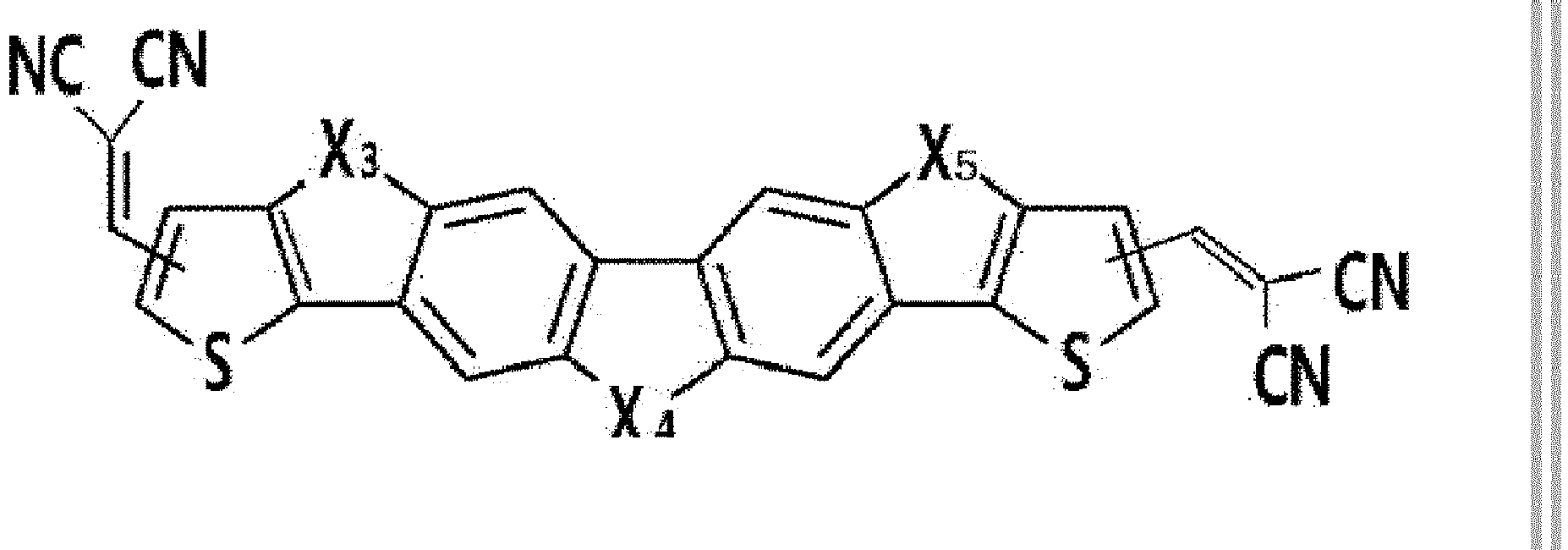
- Unter "anneliert" wird in vorliegender Anmeldung verstanden, wenn 2 heterocyclische oder homocyclische aromatische Ringe sich 2 Ringatome teilen.
- In einer Ausführungsform der Erfindung ist der ausgedehnte Donorblock der allgemeinen Formel I aus heterocyclischen aromatischen 5-Ringen ausgesucht aus Thiophen, Selenophen, Furan oder Pyrrol aufgebaut.
- Bevorzugt ist mindestens einer der heterocyclischen aromatischen 5-Ringe des ausgedehnten Donorblocks nicht Thiophen. Besonders bevorzugt ist mindestens ein heterocyclischen aromatischen 5-Ringe des ausgedehnten Donorblocks ein Pyrrol.
- In einer Ausführungsform der Erfindung ist der ausgedehnte Donorblock D der allgemeinen Formel I ausgesucht ist aus

- In einer Ausführungsform der Erfindung ist der ausgedehnte Donorblock D der allgemeinen Formel I aufgebaut aus maximal 7 annelierten aromatischen heterocyclischen 5-Ringen und/oder aromatischen heterocyclischen oder homocyclischen 6-Ringen.
- In einer Ausführungsform der Erfindung sind in dem ausgedehnten Donorblock D der allgemeinen Formel I 1 oder 2 homocyclischen aromatische 6-Ringe. Bevorzugt sind an den homocyclischen aromatische 6-Ringe zwei O-Alkyl, die in entgegengesetzte räumliche Richtung zeigen.
- In einer Ausführungsform der Erfindung ist mindestens eine dotierte Transportschicht vorhanden ist, die zwischen Elektrode oder der Gegenelektrode und der mindestens einen lichtabsorbierenden Schicht angeordnet ist.
- Gegenstand der vorliegenden Erfindung ist ebenso eine Einzelzelle, eine Tandemzelle oder eine Mehrfachzelle. Unter Tandemzelle wird in vorliegender Anmeldung verstanden, dass zwei funktionale Zellen räumlich übereinander gestapelt und seriell verschaltet sind, wobei zwischen den Zellen eine Zwischenschicht angeordnet sein kann. Ebenso wird unter Mehrfachzelle verstanden, dass mehr als zwei funktionale Zellen räumlich übereinander gestapelt und seriell verschaltet sind, wobei zwischen den Zellen eine Zwischenschicht angeordnet sein kann. Bevorzugt besteht das Bauelement aus einer Kombination aus nip, ni, ip, pnip, pni, pip, nipn, nin, ipn, pnipn, pnon oder pipn-Strukturen, bie der mehrere unabhängige Kombinationen, die mindestens eine i-Schicht enthalten, übereinander gestapelt sind.
- Hierbei bedeutet n bzw. p eine n- bzw. p-Dotierung, die zu einer Erhöhung der Dichte freier Elektronen bzw. Löcher im thermischen Gleichgewichtszustand führt. In diesem Sinne sind derartige Schichten primär als Transportschichten zu verstehen. Die Bezeichnung i-Schicht bezeichnet demgegenüber eine undotierte Schicht (intrinsische Schicht). Eine oder mehrere i-Schicht(en) können hierbei Schichten sowohl aus einem Material, als auch eine Mischung aus zwei oder mehr Materialien (sogenannte interpenetrierende Netzwerke) bestehen.
- Gegenstand der vorliegenden Erfindung ist weiterhin eine organische Solarzelle mit einem photoaktiven Bereich, der wenigstens ein organisches Donormaterial in Kontakt mit wenigstens einem organischen Akzeptormaterial aufweist, wobei das Donormaterial und das Akzeptormaterial einen Donor-Akzeptor-Heteroübergang ausbilden und wobei der photoaktive Bereich wenigstens eine Verbindung der Formel I, wie zuvor definiert, enthält.
- Gemäß einer bevorzugten Ausführungsform der vorliegenden Erfindung ist das photoaktive Bauelement ausgewählt aus einer organischen Solarzelle, einer organischen Elektrolumineszenzvorrichtung, einem Photodetektor und einem organischen Feldeffekttransistor. Insbesondere ist die Vorrichtung eine organische Solarzelle.
- In einer Ausführungsform der Erfindung ist das photoaktive Bauelement eine Tandemsolarzelle mit 2 Donor-Akzeptor-Heteroübergängen, wobei mindesten ein Material des ersten Donor-Akzeptor-Heteroübergangs unterschiedlich ist zu den beiden Hauptkomponenten des zweiten DOnor-Akzeptor-Heteroübergangs.
- Typische elektronenziehende Gruppen EWG sind: aus


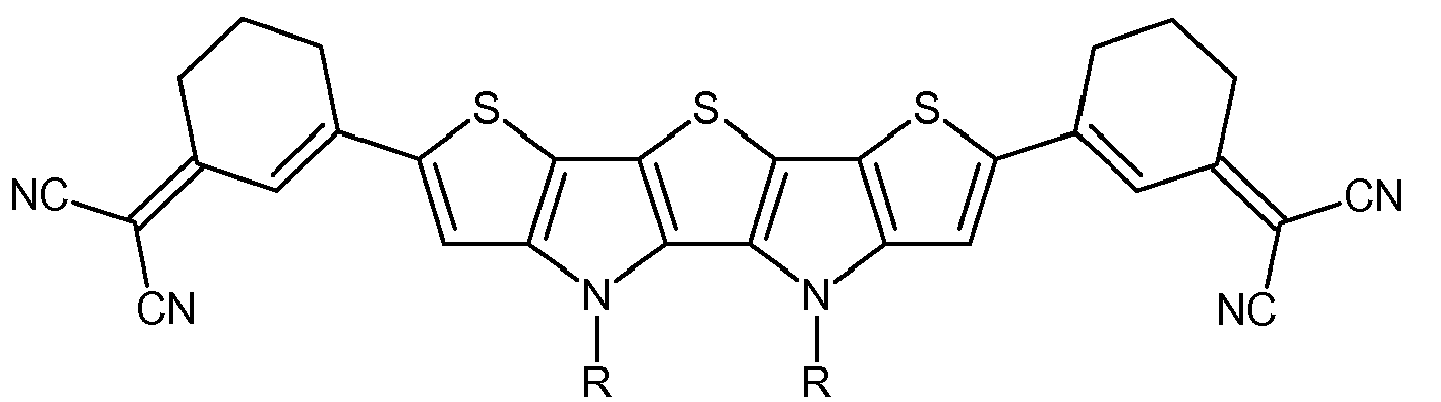
- In einer Ausführungsform der Erfindung ist V ein Cyclohexen und m und/oder o 1. Beispielhaft wird folgende Verbindung gezeigt:
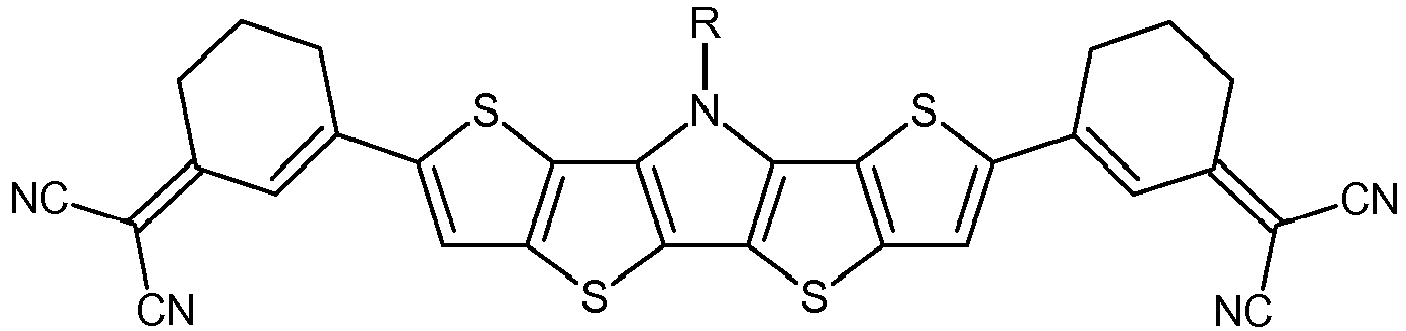
- Cyclohexen als Verbindungsgruppe zwischen dem Donorblock und der elektronenziehenden Gruppen bietet den Vorteil einer einfachen cis-trans-stereomerenreinen Herstellung der Verbindungen. Dabei können am Hexen weitere Substituenten vorhanden sein.
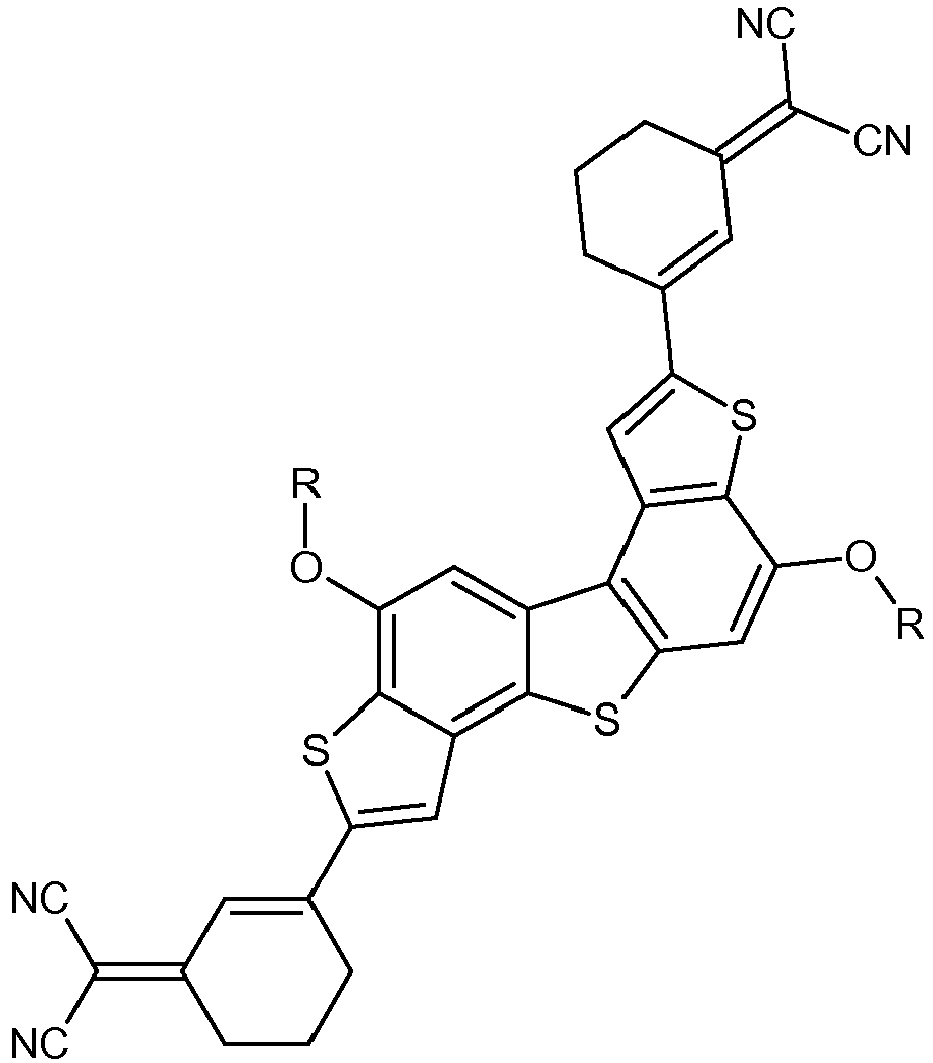
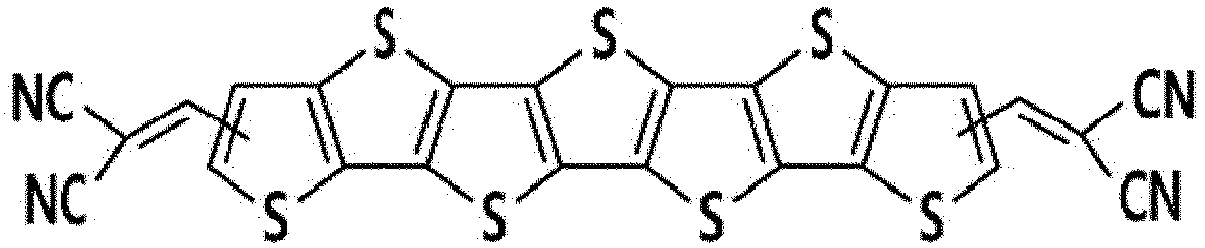
- In einer Ausführungsform der Erfindung sind n und o 0. Typische Verbindungen sind:


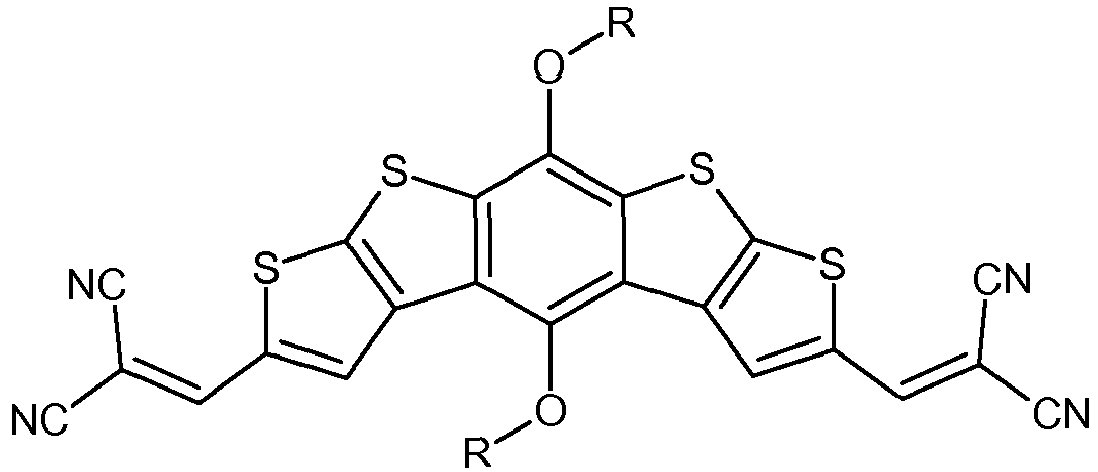


- In einer Ausführungsform der Erfindung sind n und/oder o 1. Typische Verbindungen sind:

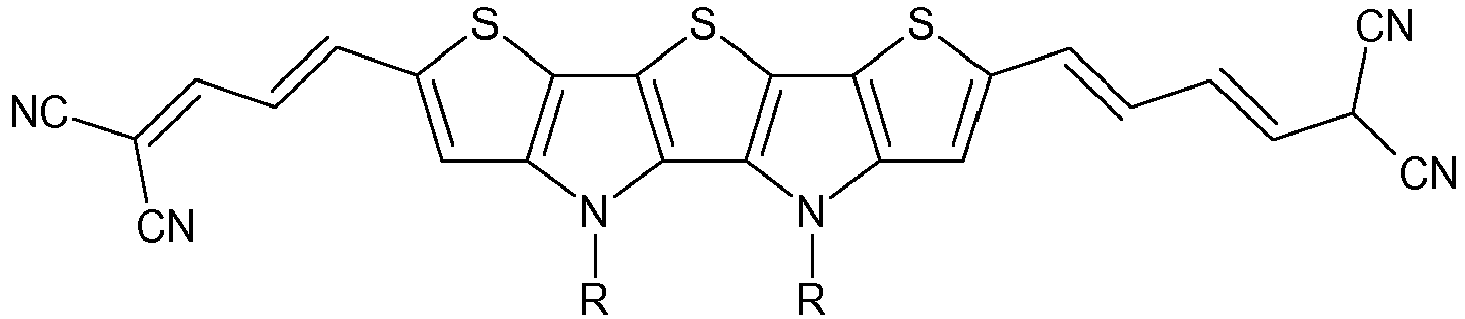





- Die erfindungsgemäß eingesetzten Verbindungen der Formel I zeichnen sich durch wenigstens eine der folgenden vorteilhaften Eigenschaften aus:
- Stannylfreie Syntheseverfahren
- Hohe thermische Stabilität
- Steile Absorptionsflanke, vor allem am längerwelligen Ende
- Sehr hohe Extinktionskoeffizienten
- Der Gehalt an der Verbindung der Formel I in dem photoaktiven Bereich beträgt vorzugsweise 10 bis 90 Gew.-%, besonders bevorzugt 25 bis 75 Gew.-%, bezogen auf das Gesamtgewicht des Halbleitermaterials (p- und n-Halbleiter) in dem photoaktiven Bereich.
- Die Herstellung der annelierten Donorblöcke D können über eine Vielzahl in der Literatur bekannter Verfahren hergestellt werden. Dabei erfolgt vorzugsweise ein Aufbau einer Kette einzelner Heterocyclen oder annelierter kleinerer Fragmente und anschließendem Ringschluss.

- Die Einführung der endständigen Akzeptorgruppen kann beispielsweise erfolgen durch dem Fachmann bekannte Methoden, wie z.B. Gattermann, Gattermann-Koch, Houben-Hoesch, Vilsmeier/ Vilsmeier-Haack, Friedel-Crafts-Acylierung oder nach Lithiierung durch eine Umsetzung mit einem Säurederivat oder Carbonylierungsreagenz.
- Weitere Akzeptorgruppen sind durch Umfunktionalisierung der zuvor beschriebenen Carbonylfunktion C(O)R beispielsweise durch Knoevenagel-Kondensation realisierbar.

- Die Einführung der Akzeptorendgruppen kann beispielsweise mit BuLi und Tetracyanoethylen erfolgen (Cai et al, J. Phys. Chem. B 2006, 110, 14590).
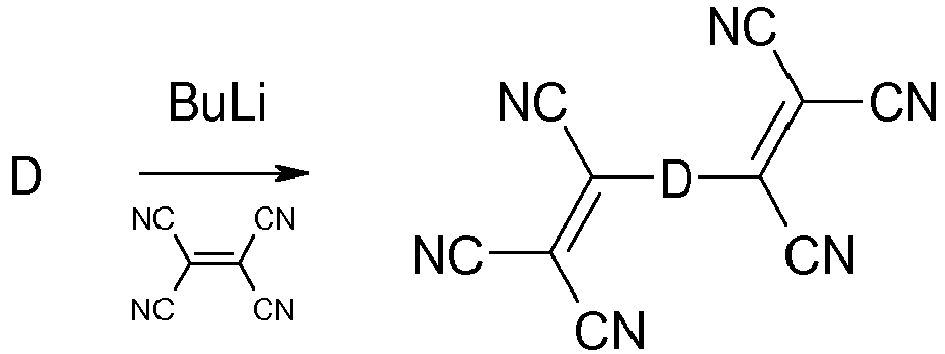
- Alternativ kann die Umsetzung auch ohne BuLi in DMF durchgeführt werden (Pappenfus et al, Org. Lett. 2008, 10, 8, 1553).
- Cyclohexenyl als Akzeptorendgruppe kann beispielsweise über in der Literatur bekannte Kupplungsreaktionen (z.B. Stille, Suzuki, Negishi, ...) erfolgen.

- Verbindungen mit unterschiedlichen Akzeptorendgruppen lassen sich prinzipiell mit den gleichen Methoden herstellen.

- Verbindungen der Formel (I) bei denen n und/oder o gleich 1 sind lassen sich darstellen, indem D mit POCl3 und Dimethylaminoacrolein umgesetzt wird. Alterantiv kann D mit einer Base deprotoniert werden und anschließend mit Dimethylaminoacrolein umgesetzt werden (Theng et al. Chem. Mater. 2007, 19, 432-442). Der so erhaltene Vinylaldehyd kann in einer anschließenden Knoevenagel-Reaktion zu einer Dicyanovinylverbindung umgesetzt werden.

- Erstaunlicherweise wurde gefunden, dass die erfindungsgemäßen Verbindungen einen sehr hohen Extinktionswert besitzen. Dies lässt sich nicht nur mit steigender Anzahl an Mehrfachbindungen im Molekül begründen, wie die folgende Tabelle zeigt.
Verbindung Anzahl Mehrfachbindungen im gesamten Molekül Extinktionskoeffizienz Extinktionskoeffizient pro Mehrfachbindung kL/molcm kL/molcm V-1 10 93,6 9,4 1 12 140 11,7 2 13 160 12,3 3 14 178 12,7 - Dabei stellt V-1 eine nicht erfindungsgemäße Vergleichsverbindung dar und 1 bis 3 sind unterschiedliche lange erfindungsgemäße Verbindungen.


- In
Figur 2 ist ein Vergleich der Absorprtionspektren von erfindungsgemäßen Verbindungen 1 einmal mit R=Hexyl und einmal mit R=Propyl und 2 mit R=Hexyl im Vergleich zu nichterfindungsgemäßer Verbindung V-3 mit gleicher Anzahl an Merhfachbindungen.
- Das Absorpionsspektrum ist für die erfindungsgemäßen Verbindungen deutlich strukturierter, sowie schmaler und in den kürzerwelligen Bereich verschoben. Dies ist ein signifikanter Unterschied, der zu es ermöglicht in Kombination mit einem weiteren photoaktiven Material mit einer Absorption im längerwelligen Bereich zu einem verbesserten photoaktiven Bauelement zu kommen, z.B. in einer Tandem- oder Mehrfachzelle.
- Die Herstellung eines erfindungsgemäßen photoaktiven Bauelements kann entweder ganz oder teilweise hergestellt werden durch Abscheiden im Vakuum mit oder ohne Trägergas, durch Drucken, aufschleudern, Auftropfen, Coaten oder anderen gängige Techniken zum Verarbeiten von gelösten oder suspendierten Materialien zu dünnen Schichten.
- In einer Ausführungsform der Erfindung erfolgt die Herstellung der photoaktiven Donor-Heteroübergänge durch eine gasphasenabscheidung. Hiebei kann die Verbindung der allgemeinen Formel I und ein geeignetes Akzeptormaterial beispielsweise aus der Klasse der Fullerene im Sinne einer Co-Sublimation als Mischschicht abgeschieden werden oder als einzelne Schichten hintereinander als flacher Heteroübergang. Die Abscheidung erfolgt im Hochvakuum bei einem Druck im Bereich von etwa 10-2 bis 10-8mbar. Die Abscheidungsrate liegt üblicherweise in einem Bereich von etwa 0,01 bis 10nm/s.
- Die Temperatur des Substrats bei der Abscheidung liegt vorzugsweise bei 50 bis 150°C.
- Geeignete Substrate für organische Solarzellen sind z. B. oxidische Materialien, Polymere und Kombinationen davon. Bevorzugte oxidische Materialien sind ausgewählt unter Glas, Keramik, SiO2, Quarz, etc. Bevorzugte Polymere sind ausgewählt unter Polyolefinen (wie Polyethylen und Polypropylen), Polyestern (wie Polyethylenterephthalat und Polyethylennaphthalat), Fluorpolymeren, Polyamiden, Polyurethanen, Polyalkyl(meth)acrylaten, Polystyrolen, Polyvinylchloriden und Mischungen und Kompositen davon.
- Als Elektroden (Kathode, Anode) eignen sich prinzipiell Metalle, Halbleiter, Metalllegierungen, Halbleiterlegierungen und Kombinationen davon, sogenannte DMD's, aber auch Silber-Nanoröhrchen oder spezielle Graphite. Bevorzugte Metalle sind die der Gruppen 2, 9, 10, 11 oder 13 des Periodensystems (PES), z. B. die Erdalkalimetalle (Gruppe 2) Mg, Ca und Ba, der 10. Gruppe des PES wie Pt, der 11. Gruppe des PES wie Au, Ag und Cu und der 13. Gruppe des PES wie Al und In. Bevorzugt sind Metalllegierungen, z.B. auf Basis Pt, Au, Ag, Cu, etc. und spezielle Mg/Ag-Legierungen, des Weiteren aber auch Alkalimetallfluoride, wie LiF, NaF, KF, RbF und CsF, und Mischungen aus Alkalimetallfluoriden und Alkalimetallen.
- Geeignete Akzeptormaterialien sind vorzugsweise ausgewählt aus der Gruppe Fullerene und Fullerenderivate, polycyclische aromatische Kohlenwasserstoffen und deren Derivaten, insbesondere Naphthalin und dessen Derivate, Rylene, insbesondere Perylen, Terrylen und Quaterrylen, und deren Derivate, Azene, insbesondere Anthrazen, Tetrazen, in besondere Rubren, Pentazen und deren Derivate, Pyren und dessen Derivat, Chinone, Chinondimethane und deren Derivaten, Phthalocyanine, Subphthalocyanine und deren Derivaten, Porphyrine, Tetraazoporphyrine, Tetrabenzoporphyrine und deren Derivaten, Thiophene, oligo-Thiophene, kondensierte/anellierte Thiophene, wie Thienoth ophen und Bithienothiophen, und deren Derivate, Thiadiazole und deren Derivate, Carbazole und Triarylamine und deren Derivate, Indanthrone, Violanthrone und Flavanthone und deren Derivate und Fulvalene, Tetrathiafulvalene und Tetraselenafulvalene und deren Derivate
- Vorzugsweise ist das Akzeptormaterial ein oder mehrere Fullerene und/oder Fulleren-Derivate. Geeignete Fullerene sind vorzugsweise ausgewählt unter C60, C70, C76, C80, C82, C84, C86, C90 und C94. Geeignete Fullerenderivate sind vorzugsweise ausgewählt unter Phenyl-C61-Butyrsäuremethylester ([60]PCBM), Phenyl-C71-Butyrsäuremethylester ([71]PCBM), Phenyl-C84-Butyrsäuremethylester ([84]PCBM), Phenyl-C61-Butyrsäurebutylester ([60]PCBB), Phenyl-C61-Butyrsäureoctyylester ([60]PCBO) und Thienyl-C61-Butyrsäuremethylester ([60]ThCBM). Besonders bevorzugt sind C60, [60]PCBM und Mischungen davon.
- Zusätzlich zu den Schichten mit Donor-Akzeptor-Heteroübergang kann das photoaktive Bauelement weitere Schichten beinhalten, die beispielsweise als Transportschichten dienen und üblicherweise das einfallende Licht nur bei einer Wellenlänge unterhalb 450nm absorbieren, so genannte wide-gap Materialien. Transportschichten lochleitende oder elektronenleitende Eigenschaften haben und undotiert oder dotiert sein.
- Geeignete Schichten mit lochleitenden Eigenschaften enthalten vorzugsweise wenigstens ein Material mit einer geringen Ionisierungsenergie bezogen auf Vakuumniveau, d.h. die Schicht mit lochleitenden Eigenschaften weist eine kleinere Ionisierungsenergie und eine kleinere Elektronenaffinität, bezogen auf Vakuumniveau, auf als die Schicht mit elektronenleitenden Eigenschaften. Bei den Materialien kann es sich um organische oder anorganische Materialien handeln. Für den Einsatz in einer Schicht mit lochleitenden Eigenschaften geeignete organische Materialien sind vorzugsweise ausgewählt unter Poly(3,4-ethylendioxythiophen)-poly(styrolsulfonat) (PEDOT-PSS), Ir-DPBIC (Tris-N,N'-Diphenylbenzimidazol-2-yliden-iridium(III)), N,N'-diphenyl-N,N'-bis(3-methylphenyl)-1,1'-diphenyl-4,4'-diamin (NPD), 2,2',7,7'-Tetrakis(N,N-di-p-methoxyphenylamin)-9,9'-spirobifluoren (spiro-MeOTAD), 9, 9-Bis (4- (N, N- bis-biphenyl-4-yl-amino) phenyl) -9H-fluoren (BPAF), N,N-Diphenyl-N,N-bis (4- (N,N-bis (naphth-l-yl) - amino) -biphenyl-4-yl) -benzidin (DiNPB) etc. und Mischungen davon.
- Geeignete Schichten mit elektronenleitenden Eigenschaften enthalten vorzugsweise wenigstens ein Material, dessen LUMO, bezogen auf Vakuumniveau, energetisch höher liegt als das LUMO des Materials mit lochleitenden Eigenschaften. Bei den Materialien kann es sich um organische oder anorganische Materialien handeln. Für den Einsatz in einer Schicht mit elektronenleitenden Eigenschaften geeignete organische Materialien sind vorzugsweise ausgewählt unter Fullerenen und Fullerenderivaten wie zuvor definiert, 2,9-Dimethyl-4,7-diphenyl-1,10-phenanthrolin (BCP), 4,7-Diphenyl-1,10-phenanthrolin (Bphen), 1,3-bis[2-(2,2'-bipyridin-6-yl)-1,3,4-oxadiazo-5-yl]benzol (BPY-OXD), etc. Geeignete Fullerene und Fullerenderivate sind vorzugsweise ausgewählt unter C60, C70, C84, Phenyl-C61-Butyrsäuremethylester ([60]PCBM), Phenyl-C71-Butyrsäuremethylester ([71]PCBM), Phenyl-C84-Butyrsäuremethylester ([84]PCBM), Phenyl-C61-Butyrsäurebutylester ([60]PCBB), Phenyl-C61-Butyrsäureoctyylester ([60]PCBO), Thienyl-C61-Butyrsäuremethylester ([60]ThCBM) und Mischungen davon. Besonders bevorzugt sind C60, [60]PCBM und Mischungen davon. Ganz besonders bevorzugt enthält die Schicht mit elektronenleitenden Eigenschaften C60.
- In einer weiteren Ausführungsform enthält das p-Transportschichtsystem einen p-Dotanden, wobei dieser p-Dotand F4-TCNQ, ein p-Dotand wie in
DE10338406 ,DE10347856 ,DE10357044 ,DE102004010954 ,DE102006053320 ,DE102006054524 undDE102008051737 beschrieben oder ein Übergangsmetalloxid (VO, WO, MoO, etc.) ist. - In einer weiteren Ausführungsform enthält das n-Transportschichtsystem einen n-Dotanden, wobei dieser n-Dotand ein TTF-Derivat (Tetrathiafulvalen-Derivat) oder DTT-Derivat (Dithienothiophen), ein n-Dotand wie in
DE10338406 ,DE10347856 ,DE10357044 ,DE102004010954 ,DE102006053320 ,DE102006054524 undDE102008051737 beschrieben oder Cs, Li oder Mg ist. - Die Erfindung soll an einigen nachfolgenden Ausführungsbeispielen und dazu gehöriger Figuren näher erläutert werden, ohne sich auf diese zu beschränken.
- Es zeigen die
-
Figur 1 ein erfindungsgemäßes Bauelement. Dabei stellt 1 das Substrat dar, 2 ein optionales Transportschichtsystem aus einem oder mehreren Schichten, 3 ein photoaktiver Schichtstapel mit mindestens einer erfindungsgemäßen Verbindung, 5 ein weiteres optionales Transportschichtsystem aus einem oder mehreren Schichten und 6 eine Gegenelektrode, -
Figur 2 ein Vergleich von Absoprtionsspektren im Film von 3 erfindungsgemäßen Verbindungen mit einer nichterfindungsgemäßen Verbindung, -
Figur 3 eine Strom-Spannungs-Kurve eines erfindungsgemäßen Bauelements mit Verbindung 1a, -
Figur 4 eine Strom-Spannungs-Kurve eines erfindungsgemäßen Bauelements mit Verbindung 13 und -
Figur 5 eine Strom-Spannungs-Kurve eines erfindungsgemäßen Bauelements mit Verbindung 2a. -
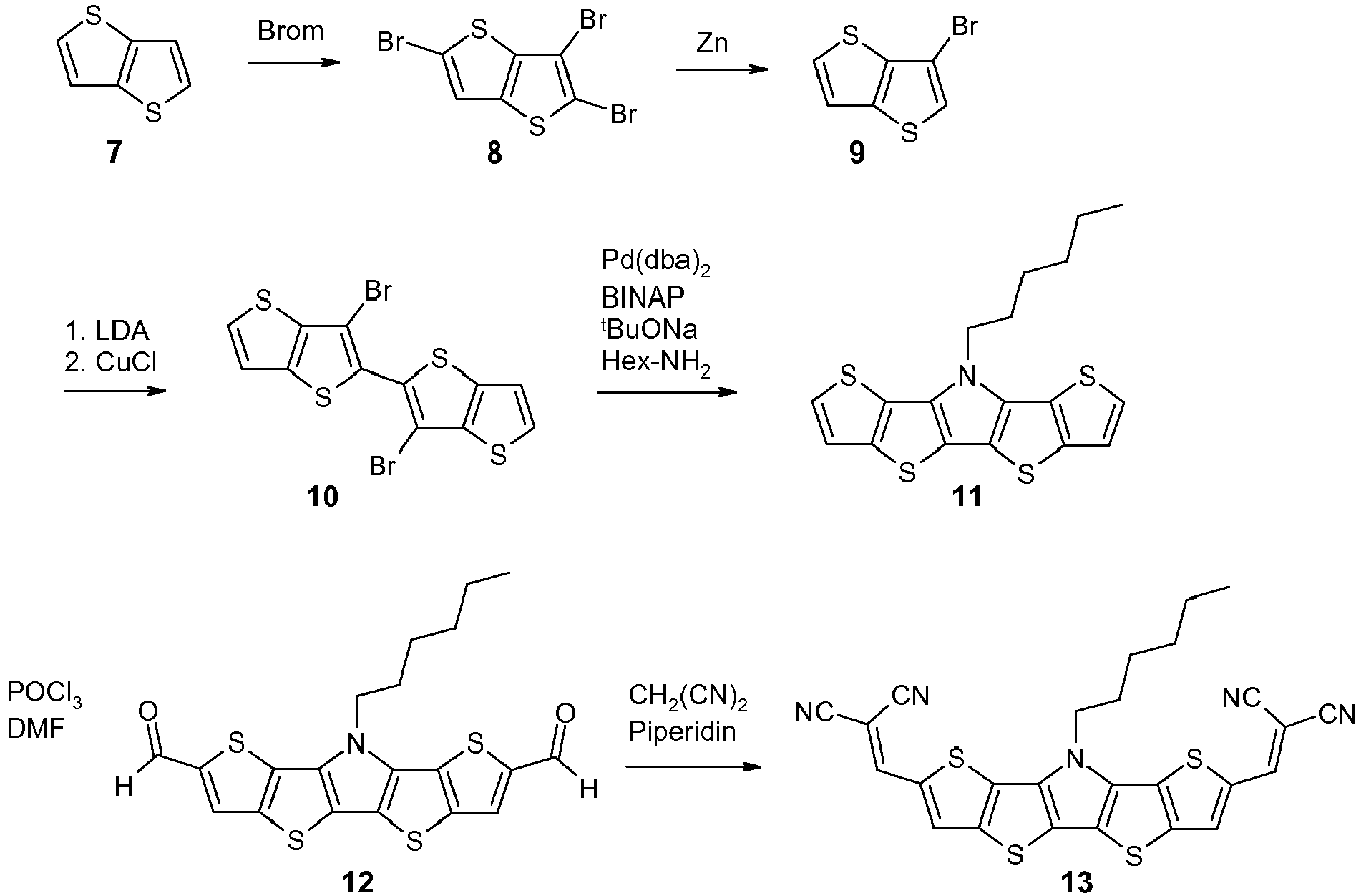
- 10,71 mmol Thienothiophen 7 werden in 30 ml Chloroform gelöst und man tropft unter Eiskühlung langsam 32,14 mmol Brom in 20 ml Chloroform hinzu. Die Reaktionsmischung wird 16 h bei Raumtemperatur gerührt. Es wird mit konz. NaOH-Lösung hydrolisiert und der Niederschlag wird in Chloroform gelöst. Man trennt die organische Phase ab und wäscht sie mit Wasser und ges. NaCl-Lösung. Die organische Phase wird über Natriumsulfat getrocknet und filtriert. Das Lösemittel wird abdestilliert und der Rückstand wird aus einer Mischung von n-Hexan und Chloroform umkristallisiert. Man erhält 9,42 mmol (88%) Produkt 8 als farblosen Feststoff. GC-MS: m/z 378 (100%) (M+).
- 5,5 mmol Tribromthienothiophen 8 werden in 25 ml heißer Essigsäure gelöst. Man gibt vorsichtig, portionsweise 28,0 mmol Zinkstaub hinzu und erhitzt 1h unter Rückfluß. Nach dem Abkühlen auf Raumtemperatur gibt man 100 ml Wasser hinzu und extrahiert die wässrige Phase dreimal mit Diethylether. Die vereinigten organischen Phasen werden mit ges. Natriumcarbonat-Lösung so lange gewaschen bis die wässrige Phase neutral ist. Die organische Phase wird über Natriumcarbonat getrocknet und filtriert. Das Lösemittel wird abdestilliert und der Rückstand wird chromatographisch gereinigt (SiO2, n-Hexan, R f = 0,50). Man erhält 4,1 mmol (74%) Produkt 9 als farblosen Feststoff. GC-MS: m/z 220 (100%) (M+).
- 6,76 mmol Monobromthienothiophen 9 werden in 10 ml trockenem THF gelöst und auf -70°C gekühlt. Man gibt 4,13 ml einer 1,8 M LDA-Lösung hinzu und rührt 30 min bei -70°C. Die Reaktionsmischung wird auf -30°C erwärmt und 14,88 mmol CuCl2 werden hinzugegeben. Man rührt für 1h bei -30°C und lässt anschließend über Nacht die Reaktionsmischung auf Raumtemperatur sich erwärmen. Es wird mit 2N HCL-Lösung versetzt und mit Dichlormethan (DCM) extrahiert. Die organische Phase wird mit Wasser und NaCl-Lösung gewaschen und über Natriumsulfat getrocknet. Es wird filtriert und die Lösemittel werden abdestilliert. Der Rückstand wird im Hochvakuum bei 180°C sublimiert. Das Sublimat wird aus Chloroform / n-Hexan umkristallisiert und man erhält 1,40 mmol (41%) Produkt 10 als leicht gelben Feststoff. GC-MS: m/z 436 (100%) (M+).
- 0,69 mmol Thienothiophen-Dimer 10 werden in 5 ml Toluol gelöst. Man gibt 0,28 mmol BINAP und 1,66 mmol NaOtBu hinzu und rührt 30 min unter Argonatmosphäre. Es werden 0,14 mmol Pd(dba)2 und 0,79 mmol Hexylamin hinzugegeben und man erhitzt das Reaktionsgemisch für 3 Tage bei 110°C. Das Reaktionsgemisch wird über eine kurze Kieselgelsäule filtriert (Eluent: DCM / n-Hexan (1:1)). Die Lösemittel des Filtrates werden abdestilliert und der Rückstand wird chromatographisch gereinigt (SiO2, DCM / n-Hexan (1:4), R f = 0,55). Man erhält 0,21 mmol (30%) Produkt 11 als gelben Feststoff. GC-MS: m/z 375 (100%) (M+).
- 3,31 mmol POCl3 und 3,41 mmol DMF werden in 6 ml 1,2-Dichlorethan (DCE) gelöst und 2h bei Raumtemperatur gerührt. Diese Lösung gibt man zu einer Lösung von 0,41 mmol Bis-thienothiophen-pyrrol 11 in 10 ml DCE und rührt 40h bei 80°C. Man gibt die sich gebildete Suspension in 1N NaOH-Lösung und fügt DCM und Methanol hinzu bis der Feststoff gelöst ist. Man rührt diese Mischung 1h bei Raumtemperatur und gibt dann 20 ml ges. Natriumcarbonat-Lösung hinzu. Es wird für weitere 1,5h bei Raumtemperatur gerührt und anschließend die Phasen getrennt. Die Wässrige Phase wird dreimal mit DCM extrahiert und mit der organischen Phase vereinigt. Die organische Phase wird über Natriumsulfat getrocknet und filtriert. Die Lösemittel werden abdestilliert und der Rückstand wird chromatographisch gereinigt (SiO2, DCM / Aceton (80:1), R f (DCM) = 0,64). Man erhält 0,30 mmol (74%) Produkt 12 als roten Feststoff. 1H-NMR (CDCl3) : 9.96 ppm (s, 2H), 7.97 (s, 2H), 4.40 (dd, 2H), 1.99 (m, 2H), 1.44 (m, 2H), 1.30 (m, 4H), 0.85 (t, 3H).
- 0,30 mmol Dialdehyd 12 und 2,41 mmol Malodinitril werden in 40 ml DCE gelöst. Man gibt 0,03 mmol Piperidin hinzu und erhitzt 24h unter Rückfluß. Das Lösemittel wird abdestilliert und der Rückstand wird mit 20 ml Wasser für 2h unter Rückfluß erhitzt. Es wird filtriert und mit heißem Methanol gewaschen. Der Rückstand wird getrocknet und mittels Soxhletextraktor aus Chlorbenzol umkristallisiert. Man erhält 0,12 mmol (39%) Produkt 13 als schwarzen Feststoff. 1H-NMR (TCE-d2, 375 K): 8.07 ppm (s, 2H), 7.84 (s, 2H), 4.53 (dd, 2H), 2.12 (m, 2H), 1.56-1.40 (m, 6H), 0.95 (t, 3H).
-

- Verbindung 14 wurde, wie in der Literatur beschrieben (Donaghey, Jenny E. et al, Journal of Materials Chemistry, 21(46), 18744-18752; 2011) hergestellt.
- 4,84 mmol POCl3 und 4,99 mmol DMF werden in 9 ml 1,2-Dichlorethan (DCE) gelöst und 2h bei Raumtemperatur gerührt. Diese Lösung gibt man zu einer Lösung von 0,6 mmol Bisthienopyrrolo-indol 14 in 15 ml DCE und rührt 40h bei 80°C. Man gibt die sich gebildete Suspension in 1N NaOH-Lösung und fügt DCM und Methanol hinzu bis der Feststoff gelöst ist. Man rührt diese Mischung 1h bei Raumtemperatur und gibt dann 20 ml ges. Natriumcarbonat-Lösung hinzu. Es wird für weitere 1,5h bei Raumtemperatur gerührt und anschließend die Phasen getrennt. Die Wässrige Phase wird dreimal mit DCM extrahiert und mit der organischen Phase vereinigt. Die organische Phase wird über Natriumsulfat getrocknet und filtriert. Die Lösemittel werden abdestilliert und der Rückstand wird chromatographisch gereinigt (SiO2, DCM, R f (DCM) = 0,39) . Man erhält 0,24 mmol (43%) Produkt 15 als roten Feststoff. Dicyanovinyl-Verbindung 16:
- 0,24 mmol Dialdehyd 15 und 1,95 mmol Malodinitril werden in 5 ml DCE gelöst. Man gibt 0,03 mmol Piperidin hinzu und erhitzt 24h unter Rückfluß. Das Lösemittel wird abdestilliert und der Rückstand wird mit 20 ml Wasser für 2h unter Rückfluß erhitzt. Es wird filtriert und mit heißem Methanol gewaschen. Der Rückstand wird getrocknet und mittels Soxhletextraktor aus Toluol umkristallisiert. Man erhält 0,04 mmol (17%) Produkt 16 als schwarzen Feststoff. MALDI m/z, 588,4 [M].
- In einem weiteren Ausführungsbeispiel wird ein MIP-Bauelement auf eine Probe aus Glas mit transparentem Deckkontakt ITO hergestellt durch zeitlich nacheinander Abscheiden der folgenden Schichtfolge im Vakuum: 15nm C60, 20nm einer 1:1 Mischung durch Co-Verdampfen von Verbindung 1a und C60, wobei das Substrat auf 90°C erhitzt wird, 10nm BPAPF, 45nm p-dotiertes BPAPF und einer Gegenelektrode aus Gold.

-
Figur 3 zeigt die Strom-Spannungs-Kurve des MIP-Bauelements mit Verbindung 1a. Dabei zeigt die gestrichelte Linie den Verlauf der Stromdichte gegen die Spannung ohne Licht und die durchgezogene Linie unter Belichtung dar. Die wichtigsten Kenngrößen zur Beurteilung des MIP-Bauelements zeigen mit dem Füllfaktor von 63,2%, dem Kurzschlussstrom von 7,2 mA/cm2 und der Leerlaufspannung von 0,9V eine gut funktionierende Solarzelle an. - In einem weiteren Ausführungsbeispiel wird ein MIP-Bauelement auf eine Probe aus Glas mit transparentem Deckkontakt ITO hergestellt durch zeitlich nacheinander Abscheiden der folgenden Schichtfolge im Vakuum: 15nm C60, 20nm einer 1:1 Mischung durch Co-Verdampfen von Verbindung 13 und C60, wobei das Substrat auf 90°C erhitzt wird, 5nm BPAPF, 50nm p-dotiertes BPAPF und einer Gegenelektrode aus Gold.

-
Figur 4 zeigt die Strom-Spannungs-Kurve des MIP-Bauelements mit Verbindung 13. Dabei zeigt die gestrichelte Linie den Verlauf der Stromdichte gegen die Spannung ohne Licht und die durchgezogene Linie unter Belichtung dar. Die wichtigsten Kenngrößen zur Beurteilung des MIP-Bauelements zeigen mit dem Füllfaktor von 51,6%, dem Kurzschlussstrom von 8,1 mA/cm2 und der Leerlaufspannung von 0,9V eine gut funktionierende Solarzelle an. - In einem weiteren Ausführungsbeispiel wird ein MIP-Bauelement auf eine Probe aus Glas mit transparentem Deckkontakt ITO hergestellt durch zeitlich nacheinander Abscheiden der folgenden Schichtfolge im Vakuum: 15nm C60, 20nm einer 2:1 Mischung durch Co-Verdampfen von Verbindung 1a und C60, wobei das Substrat auf 90°C erhitzt wird, 10nm BPAPF, 45nm p-dotiertes BPAPF und einer Gegenelektrode aus Gold.

-
Figur 5 zeigt die Strom-Spannungs-Kurve des MIP-Bauelements mit Verbindung 2a. Dabei zeigt die gestrichelte Linie den Verlauf der Stromdichte gegen die Spannung ohne Licht und die durchgezogene Linie unter Belichtung dar. Die wichtigsten Kenngrößen zur Beurteilung des MIP-Bauelements zeigen mit dem Füllfaktor von 51,4%, dem Kurzschlussstrom von 9,3 mA/cm2 und der Leerlaufspannung von 0,9V eine gut funktionierende Solarzelle an. -
- 1 Substrat
- 2 Elektrode
- 3 Transportschichtsystem (ETL bzw. HTL)
- 4 photoaktiver Schichtstapel
- 5 Transportschichtsystem (ETL bzw. HTL)
- 6 Gegenelektrode
Claims (11)
- Optoelektronisches Bauelement mit einer Elektrode (2) und einer Gegenelektrode (6) und mindestens einer organischen lichtempfindlichen Schicht (4) zwischen der Elektrode (2) und der Gegenelektrode (6), dadurch gekennzeichnet dass die organische lichtempfindliche Schicht (4) eine Verbindung der allgemeinen Formel I
EWG-Vn-D-Vo-EWG (I)
enthält, worinEWG gegenüber D elektronenziehende Eigenschaften besitzt,V -CR1=CR2- oder -C≡C- mit R1 und R2 ausgesucht aus H, C1-C10-Alkyl, C1-C10-OAlkyl, C1-C10-SAlkyl, worin R1 und R2 einen Ring bilden können, und n und o unabhängig voneinander 0 oder 1 sind und dadurch gekennzeichnet, dassD ein ausgedehnter Donorblock aus mindestens fünf annelierten, aromatischen heterocyclischen 5-Ringen und/oder heterocyclischen oder homocyclichen 6-Ringen aufgebaut ist, mit der Maßgabe, dass folgende Strukturen ausgeschlossen sind:



- Bauelement nach Anspruch 1, dadurch gekennzeichnet, dass der ausgedehnte Donorblock der allgemeinen Formel I aus heterocyclischen aromatischen 5-Ringen ausgesucht aus Thiophen, Selenophen, Furan oder Pyrrol aufgebaut ist.
- Bauelement nach Anspruch 2, dadurch gekennzeichnet, dass mindestens einer der heterocyclischen aromatischen 5-Ringe ausgesucht aus Selenophen, Furan oder Pyrrol ist.
- Bauelement nach einem der Ansprüche 1 bis 3, dadurch gekennzeichnet, dass der ausgedehnte Donorblock D der allgemeinen Formel I ausgesucht aus

- Bauelement nach einem der Anspruch 1, dadurch gekennzeichnet, dass der ausgedehnte Donorblock D maximal aus sieben annelierten aromatischen heterocyclischen 5-Ringen und/oder aromatischen heterocyclischen oder homocyclischen 6-Ringen aufgebaut ist.
- Bauelement nach Anspruch 1, dadurch gekennzeichnet, dass der ausgedehnten Donorblock D der allgemeinen Formel I einen oder zwei homocyclischen aromatische 6-Ringe umfasst.
- Bauelement nach einem der Ansprüche 1 bis 6, dadurch gekennzeichnet, dass n und/oder o 1 ist.
- Bauelement nach einem der Ansprüche 1 bis 4, wobei die Verbindung der organischen lichtempfindlichen Schicht aus der Gruppe der folgenden Verbindungen ausgewählt ist:




- Bauelement nach einem der Ansprüche 1 bis 8, dadurch gekennzeichnet, dass mindestens eine dotierte Transportschicht vorhanden ist, die zwischen der Elektrode oder der Gegenelektrode und mindestens einer lichtabsorbierenden Schicht angeordnet ist.
- Bauelement nach einem der Ansprüche 1 bis 9, dadurch gekennzeichnet, dass es sich um eine Einzelzelle, um eine Tandemzelle oder um eine Mehrfachzelle handelt.
- Organische Solarzelle mit einem photoaktiven Bereich, der wenigstens ein organisches Donormaterial in Kontakt mit wenigstens einem organischen Akzeptormaterial aufweist, wobei das Donormaterial und das Akzeptormaterial einen Donor-Akzeptor-Heteroübergang ausbilden und wobei der photoaktive Bereich wenigstens eine Verbindung der Formel I, wie in Ansprüchen 1 bis 8 definiert, enthält.
Applications Claiming Priority (2)
| Application Number | Priority Date | Filing Date | Title |
|---|---|---|---|
| DE102013110693.5A DE102013110693B4 (de) | 2013-09-27 | 2013-09-27 | Photoaktives, organisches Material für optoelektronische Bauelemente |
| PCT/EP2014/070671 WO2015044377A1 (de) | 2013-09-27 | 2014-09-26 | Photoaktives; organisches material für optoelektronische bauelemente |
Publications (3)
| Publication Number | Publication Date |
|---|---|
| EP3050134A1 EP3050134A1 (de) | 2016-08-03 |
| EP3050134B1 EP3050134B1 (de) | 2021-05-05 |
| EP3050134B9 true EP3050134B9 (de) | 2021-10-27 |
Family
ID=51743412
Family Applications (1)
| Application Number | Title | Priority Date | Filing Date |
|---|---|---|---|
| EP14786142.1A Active EP3050134B9 (de) | 2013-09-27 | 2014-09-26 | Photoaktives, organisches material für optoelektronische bauelemente |
Country Status (6)
| Country | Link |
|---|---|
| EP (1) | EP3050134B9 (de) |
| KR (1) | KR102233924B1 (de) |
| DE (1) | DE102013110693B4 (de) |
| DK (1) | DK3050134T3 (de) |
| ES (1) | ES2875962T3 (de) |
| WO (1) | WO2015044377A1 (de) |
Families Citing this family (19)
| Publication number | Priority date | Publication date | Assignee | Title |
|---|---|---|---|---|
| DE102014217817B4 (de) * | 2014-09-05 | 2018-08-30 | Technische Universität Dresden | Organische Donor-Akzeptor-Farbstoffe für die Verwendung in elektronischen und optoelektronischen Bauteilen |
| EP3188270B1 (de) | 2015-12-30 | 2018-12-26 | Heliatek GmbH | Organisches halbleitendes material und dessen verwendung in organischen bauelementen |
| EP3187496A1 (de) * | 2015-12-30 | 2017-07-05 | Heliatek GmbH | Verbindung für fotoaktive organische elektronische bauelemente und fotoaktives organisches elektronisches bauelement enthaltend die verbindung |
| CN105838104B (zh) * | 2016-03-28 | 2017-11-10 | 大连理工大学 | 一类并噻吩并吡咯醌式结构化合物及其制备方法 |
| WO2018065356A1 (en) * | 2016-10-05 | 2018-04-12 | Merck Patent Gmbh | Organic semiconducting compounds |
| US11183637B2 (en) * | 2016-10-05 | 2021-11-23 | Raynergy Tek Incorporation | Organic photodetector |
| US10991893B2 (en) * | 2016-10-05 | 2021-04-27 | Raynergy Tek Incorporation | Organic semiconducting compounds |
| US20200361955A1 (en) * | 2017-09-13 | 2020-11-19 | Raynergy Tek Incorporation | Organic semiconducting compounds |
| WO2019161748A1 (en) * | 2018-02-23 | 2019-08-29 | Peking University | Organic semiconducting compounds |
| US12532662B2 (en) | 2018-03-28 | 2026-01-20 | Raynergy Tek Incorporation | Organic semiconducting compounds |
| CN110964036A (zh) * | 2018-12-27 | 2020-04-07 | 深圳睿迅有机太阳能有限公司 | 基于含氮六并稠环单元的共轭分子及其制备方法和应用 |
| CN110606857A (zh) * | 2019-09-25 | 2019-12-24 | 湘潭大学 | 一种基于九环融合芳烃的a-d-a型有机小分子及其制备方法与应用 |
| JP7366841B2 (ja) * | 2020-05-29 | 2023-10-23 | 富士フイルム株式会社 | 光電変換素子、撮像素子、光センサ、化合物 |
| EP4241318A1 (de) * | 2020-11-04 | 2023-09-13 | Ubiquitous Energy, Inc. | Photoaktive verbindungen für in der dampfphase abgelagerte organische fotovoltaische bauelemente |
| WO2022159769A1 (en) * | 2021-01-22 | 2022-07-28 | Ubiquitous Energy, Inc. | Heteroaromatic photoactive compounds for transparent photovoltaic devices |
| GB2624716A (en) | 2022-11-28 | 2024-05-29 | Sumitomo Chemical Co | Compound |
| KR20260038925A (ko) * | 2023-09-06 | 2026-03-19 | 후지필름 가부시키가이샤 | 광전 변환 소자, 촬상 소자, 촬상 소자의 제조 방법, 광센서, 화합물 |
| WO2025258294A1 (ja) * | 2024-06-13 | 2025-12-18 | 富士フイルム株式会社 | 光電変換素子、撮像素子、撮像素子の製造方法、光センサ、化合物 |
| TWI888212B (zh) * | 2024-07-04 | 2025-06-21 | 明志科技大學 | 基於雜并苯(heteroacene)核心之受體-供體-受體(A-D-A)型分子、及應用其之鈣鈦礦太陽能電池、有機光伏元件或有機光感測器元件 |
Family Cites Families (27)
| Publication number | Priority date | Publication date | Assignee | Title |
|---|---|---|---|---|
| SE9802333D0 (sv) | 1998-06-29 | 1998-06-29 | Astra Pharma Prod | Novel combination |
| DE60205824T2 (de) | 2001-07-09 | 2006-05-18 | Merck Patent Gmbh | Thienothiophenderivate |
| DE10338406A1 (de) | 2003-08-18 | 2005-03-24 | Novaled Gmbh | Dotierte organische Halbleitermaterialien sowie Verfahren zu deren Herstellung |
| DE10347856B8 (de) | 2003-10-10 | 2006-10-19 | Colorado State University Research Foundation, Fort Collins | Halbleiterdotierung |
| DE10357044A1 (de) | 2003-12-04 | 2005-07-14 | Novaled Gmbh | Verfahren zur Dotierung von organischen Halbleitern mit Chinondiiminderivaten |
| DE102004010954A1 (de) | 2004-03-03 | 2005-10-06 | Novaled Gmbh | Verwendung eines Metallkomplexes als n-Dotand für ein organisches halbleitendes Matrixmaterial, organisches Halbleitermaterial und elektronisches Bauteil |
| KR100835427B1 (ko) | 2004-03-10 | 2008-06-09 | 재팬 사이언스 앤드 테크놀로지 에이젼시 | 칼코겐함유 축환다환식 유기재료 및 그의 제조방법 |
| US7655809B2 (en) | 2004-05-18 | 2010-02-02 | University Of Ottawa | Compounds comprising a linear series of five fused carbon rings, and preparation thereof |
| DE102005010978A1 (de) | 2005-03-04 | 2006-09-07 | Technische Universität Dresden | Photoaktives Bauelement mit organischen Schichten |
| DE102005018241A1 (de) | 2005-04-19 | 2006-10-26 | Basf Ag | Hexarylen- und Pentarylentetracarbonsäurediimide |
| GB0515710D0 (en) * | 2005-07-29 | 2005-09-07 | Isis Innovation | Charge separation polymers |
| US7919573B2 (en) | 2005-11-16 | 2011-04-05 | Xerox Corporation | Polymer having thieno[3,2-b] thiophene moieties |
| EP1961052B1 (de) | 2005-12-12 | 2013-03-06 | Basf Se | Organische halbleiter und ihre herstellung |
| EP1843407A1 (de) | 2006-04-07 | 2007-10-10 | Basf Aktiengesellschaft | Flüssig-kristalline Rylentetracarbonsäurederivate und deren Verwendung |
| EP2072557A4 (de) | 2006-10-11 | 2010-04-14 | Toray Industries | Elektronenspendendes organisches material für photovoltaische vorrichtungen, material für photovoltaische vorrichtungen und photovoltaische vorrichtungen |
| JP5773568B2 (ja) | 2006-10-11 | 2015-09-02 | メルク パテント ゲーエムベーハー | シロール含有ポリマーを用いた光電池 |
| DE102006053320B4 (de) | 2006-11-13 | 2012-01-19 | Novaled Ag | Verwendung einer Koordinationsverbindung zur Dotierung organischer Halbleiter |
| DE102006054524B4 (de) | 2006-11-20 | 2022-12-22 | Novaled Gmbh | Verwendung von Dithiolenübergangsmetallkomplexen und Selen- analoger Verbindungen als Dotand |
| WO2008145172A1 (en) | 2007-05-25 | 2008-12-04 | Universidad Autónoma de Madrid | Tri-tert-butylcarboxyphthalocyanines, uses thereof and a process for their preparation |
| TWI491677B (zh) | 2007-10-15 | 2015-07-11 | 東進世美肯有限公司 | 新穎的以噻吩為基礎之染料及其製備 |
| DE102008051737B4 (de) | 2007-10-24 | 2022-10-06 | Novaled Gmbh | Quadratisch planare Übergangsmetallkomplexe, organische halbleitende Materialien sowie elektronische oder optoelektronische Bauelemente, die diese umfassen und Verwendung derselben |
| JP2012512201A (ja) | 2008-12-18 | 2012-05-31 | メルク パテント ゲゼルシャフト ミット ベシュレンクテル ハフツング | アントラ[2,3−b]ベンゾ[d]チオフェン誘導体および有機半導体としてのそれらの使用 |
| DE102010030500A1 (de) | 2010-06-24 | 2011-12-29 | Heliatek Gmbh | Verdampfbares organisch halbleitendes Material und dessen Verwendung in einem optoelektronischen Bauelement |
| EP2400575B1 (de) | 2010-06-24 | 2016-03-23 | heliatek GmbH | Optoelektronisches Bauelement mit organischen Schichten |
| JPWO2012176820A1 (ja) | 2011-06-22 | 2015-02-23 | 国立大学法人 岡山大学 | 縮合複素環化合物およびその重合体 |
| US20140221664A1 (en) * | 2011-08-10 | 2014-08-07 | Georgia Tech Research Corporation | Coupled heteroaryl compounds via rearrangement of halogenated heteroaromatics followed by oxidative coupling (electron withdrawing groups) |
| KR101860084B1 (ko) * | 2012-07-06 | 2018-05-23 | 삼성전자주식회사 | 유기 광전 재료, 상기 유기 광전 재료를 포함하는 유기 광전 소자 및 이미지 센서 |
-
2013
- 2013-09-27 DE DE102013110693.5A patent/DE102013110693B4/de active Active
-
2014
- 2014-09-26 ES ES14786142T patent/ES2875962T3/es active Active
- 2014-09-26 EP EP14786142.1A patent/EP3050134B9/de active Active
- 2014-09-26 KR KR1020167010175A patent/KR102233924B1/ko active Active
- 2014-09-26 DK DK14786142.1T patent/DK3050134T3/da active
- 2014-09-26 WO PCT/EP2014/070671 patent/WO2015044377A1/de not_active Ceased
Also Published As
| Publication number | Publication date |
|---|---|
| WO2015044377A1 (de) | 2015-04-02 |
| ES2875962T3 (es) | 2021-11-11 |
| DK3050134T3 (da) | 2021-08-02 |
| EP3050134A1 (de) | 2016-08-03 |
| DE102013110693A1 (de) | 2015-04-02 |
| EP3050134B1 (de) | 2021-05-05 |
| KR102233924B1 (ko) | 2021-03-30 |
| DE102013110693B4 (de) | 2024-04-25 |
| KR20160065885A (ko) | 2016-06-09 |
| ES2875962T9 (es) | 2022-01-21 |
Similar Documents
| Publication | Publication Date | Title |
|---|---|---|
| EP3050134B1 (de) | Photoaktives; organisches material für optoelektronische bauelemente | |
| EP2433317B1 (de) | Halbleitendes bauelement | |
| DE102010030500A1 (de) | Verdampfbares organisch halbleitendes Material und dessen Verwendung in einem optoelektronischen Bauelement | |
| EP2489084B1 (de) | Mischungen zur herstellung von photoaktiven schichten für organische solarzellen und organische photodetektoren | |
| EP2498315B1 (de) | Organische Solarzelle | |
| EP2976794B1 (de) | Photoaktives, organisches material für optoelektronische bauelemente | |
| EP3044818B1 (de) | Vorrichtung der organischen elektronik mit aktiver schicht | |
| DE102012104118B4 (de) | Lochtransportmaterialien für optoelektronische Bauelemente | |
| DE102012104247B4 (de) | Halbleitendes organisches Material für optoelektronische Bauelemente | |
| WO2010139310A2 (de) | Invertierte oder transparente organische solarzelle oder photodetektor mit verbesserter absorption | |
| DE102014217817B4 (de) | Organische Donor-Akzeptor-Farbstoffe für die Verwendung in elektronischen und optoelektronischen Bauteilen | |
| DE102009021881B4 (de) | Organisches halbleitendes Bauelement | |
| EP4271677A1 (de) | Verbindung für ein optoelektronisches bauelement und optoelektronisches bauelement enthaltend die verbindung | |
| DE102009022408A1 (de) | Organische Solarzelle oder Photodetektor mit verbesserter Absorption | |
| EP4272270B1 (de) | Verbindung und deren verwendung in organischen elektronischen bauelementen | |
| DE102019114456A1 (de) | Bispyranilidene, Dithiobispyranilidene und Diselenobispyranilidene und deren Verwendung | |
| DE102009021882B4 (de) | Organisches halbleitendes Bauelement | |
| JP2025060472A (ja) | 化合物、正孔輸送材料、およびそれを用いた光電変換素子 | |
| JP2026012119A (ja) | ジアザトルキセン誘導体を有する化合物、および該化合物を用いた光電変換素子 |
Legal Events
| Date | Code | Title | Description |
|---|---|---|---|
| PUAI | Public reference made under article 153(3) epc to a published international application that has entered the european phase |
Free format text: ORIGINAL CODE: 0009012 |
|
| 17P | Request for examination filed |
Effective date: 20160330 |
|
| AK | Designated contracting states |
Kind code of ref document: A1 Designated state(s): AL AT BE BG CH CY CZ DE DK EE ES FI FR GB GR HR HU IE IS IT LI LT LU LV MC MK MT NL NO PL PT RO RS SE SI SK SM TR |
|
| AX | Request for extension of the european patent |
Extension state: BA ME |
|
| RIN1 | Information on inventor provided before grant (corrected) |
Inventor name: MISHRA, AMARESH Inventor name: PFEIFFER, MARTIN Inventor name: WENZEL, CHRISTOPH Inventor name: VOGT, ASTRID Inventor name: KAST, HANNELORE Inventor name: FITZNER, ROLAND Inventor name: WEISS, ANDRE Inventor name: HILDEBRANDT, DIRK Inventor name: DESOUZA, DANIEL Inventor name: GERDES, OLGA Inventor name: STECK, CHRISTOPHER Inventor name: BAEUERLE, PETER Inventor name: MATTERSTEIG, GUNTER Inventor name: DUSKO, POPOVIC |
|
| DAX | Request for extension of the european patent (deleted) | ||
| GRAP | Despatch of communication of intention to grant a patent |
Free format text: ORIGINAL CODE: EPIDOSNIGR1 |
|
| STAA | Information on the status of an ep patent application or granted ep patent |
Free format text: STATUS: GRANT OF PATENT IS INTENDED |
|
| INTG | Intention to grant announced |
Effective date: 20201208 |
|
| GRAS | Grant fee paid |
Free format text: ORIGINAL CODE: EPIDOSNIGR3 |
|
| GRAA | (expected) grant |
Free format text: ORIGINAL CODE: 0009210 |
|
| STAA | Information on the status of an ep patent application or granted ep patent |
Free format text: STATUS: THE PATENT HAS BEEN GRANTED |
|
| RIN1 | Information on inventor provided before grant (corrected) |
Inventor name: WEISS, ANDRE Inventor name: GERDES, OLGA Inventor name: HILDEBRANDT, DIRK Inventor name: FITZNER, ROLAND Inventor name: MATTERSTEIG, GUNTER Inventor name: D'SOUZA, DANIEL Inventor name: PFEIFFER, MARTIN Inventor name: BAEUERLE, PETER Inventor name: MISHRA, AMARESH Inventor name: KAST, HANNELORE Inventor name: VOGT, ASTRID Inventor name: WENZEL, CHRISTOPH Inventor name: STECK, CHRISTOPHER Inventor name: DUSKO, POPOVIC |
|
| AK | Designated contracting states |
Kind code of ref document: B1 Designated state(s): AL AT BE BG CH CY CZ DE DK EE ES FI FR GB GR HR HU IE IS IT LI LT LU LV MC MK MT NL NO PL PT RO RS SE SI SK SM TR |
|
| REG | Reference to a national code |
Ref country code: GB Ref legal event code: FG4D Free format text: NOT ENGLISH |
|
| REG | Reference to a national code |
Ref country code: CH Ref legal event code: EP |
|
| REG | Reference to a national code |
Ref country code: AT Ref legal event code: REF Ref document number: 1390937 Country of ref document: AT Kind code of ref document: T Effective date: 20210515 |
|
| REG | Reference to a national code |
Ref country code: IE Ref legal event code: FG4D Free format text: LANGUAGE OF EP DOCUMENT: GERMAN |
|
| REG | Reference to a national code |
Ref country code: DE Ref legal event code: R096 Ref document number: 502014015557 Country of ref document: DE |
|
| REG | Reference to a national code |
Ref country code: DK Ref legal event code: T3 Effective date: 20210726 |
|
| REG | Reference to a national code |
Ref country code: NL Ref legal event code: FP |
|
| REG | Reference to a national code |
Ref country code: SE Ref legal event code: TRGR |
|
| REG | Reference to a national code |
Ref country code: LT Ref legal event code: MG9D |
|
| REG | Reference to a national code |
Ref country code: CH Ref legal event code: PK Free format text: TITEL |
|
| REG | Reference to a national code |
Ref country code: CH Ref legal event code: PK Free format text: BERICHTIGUNG B9 |
|
| PG25 | Lapsed in a contracting state [announced via postgrant information from national office to epo] |
Ref country code: HR Free format text: LAPSE BECAUSE OF FAILURE TO SUBMIT A TRANSLATION OF THE DESCRIPTION OR TO PAY THE FEE WITHIN THE PRESCRIBED TIME-LIMIT Effective date: 20210505 Ref country code: LT Free format text: LAPSE BECAUSE OF FAILURE TO SUBMIT A TRANSLATION OF THE DESCRIPTION OR TO PAY THE FEE WITHIN THE PRESCRIBED TIME-LIMIT Effective date: 20210505 Ref country code: FI Free format text: LAPSE BECAUSE OF FAILURE TO SUBMIT A TRANSLATION OF THE DESCRIPTION OR TO PAY THE FEE WITHIN THE PRESCRIBED TIME-LIMIT Effective date: 20210505 Ref country code: BG Free format text: LAPSE BECAUSE OF FAILURE TO SUBMIT A TRANSLATION OF THE DESCRIPTION OR TO PAY THE FEE WITHIN THE PRESCRIBED TIME-LIMIT Effective date: 20210805 |
|
| REG | Reference to a national code |
Ref country code: ES Ref legal event code: FG2A Ref document number: 2875962 Country of ref document: ES Kind code of ref document: T3 Effective date: 20211111 |
|
| PG25 | Lapsed in a contracting state [announced via postgrant information from national office to epo] |
Ref country code: GR Free format text: LAPSE BECAUSE OF FAILURE TO SUBMIT A TRANSLATION OF THE DESCRIPTION OR TO PAY THE FEE WITHIN THE PRESCRIBED TIME-LIMIT Effective date: 20210806 Ref country code: LV Free format text: LAPSE BECAUSE OF FAILURE TO SUBMIT A TRANSLATION OF THE DESCRIPTION OR TO PAY THE FEE WITHIN THE PRESCRIBED TIME-LIMIT Effective date: 20210505 Ref country code: IS Free format text: LAPSE BECAUSE OF FAILURE TO SUBMIT A TRANSLATION OF THE DESCRIPTION OR TO PAY THE FEE WITHIN THE PRESCRIBED TIME-LIMIT Effective date: 20210905 Ref country code: PT Free format text: LAPSE BECAUSE OF FAILURE TO SUBMIT A TRANSLATION OF THE DESCRIPTION OR TO PAY THE FEE WITHIN THE PRESCRIBED TIME-LIMIT Effective date: 20210906 Ref country code: NO Free format text: LAPSE BECAUSE OF FAILURE TO SUBMIT A TRANSLATION OF THE DESCRIPTION OR TO PAY THE FEE WITHIN THE PRESCRIBED TIME-LIMIT Effective date: 20210805 Ref country code: PL Free format text: LAPSE BECAUSE OF FAILURE TO SUBMIT A TRANSLATION OF THE DESCRIPTION OR TO PAY THE FEE WITHIN THE PRESCRIBED TIME-LIMIT Effective date: 20210505 Ref country code: RS Free format text: LAPSE BECAUSE OF FAILURE TO SUBMIT A TRANSLATION OF THE DESCRIPTION OR TO PAY THE FEE WITHIN THE PRESCRIBED TIME-LIMIT Effective date: 20210505 |
|
| PG25 | Lapsed in a contracting state [announced via postgrant information from national office to epo] |
Ref country code: SM Free format text: LAPSE BECAUSE OF FAILURE TO SUBMIT A TRANSLATION OF THE DESCRIPTION OR TO PAY THE FEE WITHIN THE PRESCRIBED TIME-LIMIT Effective date: 20210505 Ref country code: SK Free format text: LAPSE BECAUSE OF FAILURE TO SUBMIT A TRANSLATION OF THE DESCRIPTION OR TO PAY THE FEE WITHIN THE PRESCRIBED TIME-LIMIT Effective date: 20210505 Ref country code: CZ Free format text: LAPSE BECAUSE OF FAILURE TO SUBMIT A TRANSLATION OF THE DESCRIPTION OR TO PAY THE FEE WITHIN THE PRESCRIBED TIME-LIMIT Effective date: 20210505 Ref country code: EE Free format text: LAPSE BECAUSE OF FAILURE TO SUBMIT A TRANSLATION OF THE DESCRIPTION OR TO PAY THE FEE WITHIN THE PRESCRIBED TIME-LIMIT Effective date: 20210505 Ref country code: RO Free format text: LAPSE BECAUSE OF FAILURE TO SUBMIT A TRANSLATION OF THE DESCRIPTION OR TO PAY THE FEE WITHIN THE PRESCRIBED TIME-LIMIT Effective date: 20210505 |
|
| REG | Reference to a national code |
Ref country code: DE Ref legal event code: R097 Ref document number: 502014015557 Country of ref document: DE |
|
| PLBE | No opposition filed within time limit |
Free format text: ORIGINAL CODE: 0009261 |
|
| STAA | Information on the status of an ep patent application or granted ep patent |
Free format text: STATUS: NO OPPOSITION FILED WITHIN TIME LIMIT |
|
| 26N | No opposition filed |
Effective date: 20220208 |
|
| REG | Reference to a national code |
Ref country code: BE Ref legal event code: MM Effective date: 20210930 |
|
| PG25 | Lapsed in a contracting state [announced via postgrant information from national office to epo] |
Ref country code: IS Free format text: LAPSE BECAUSE OF FAILURE TO SUBMIT A TRANSLATION OF THE DESCRIPTION OR TO PAY THE FEE WITHIN THE PRESCRIBED TIME-LIMIT Effective date: 20210905 Ref country code: MC Free format text: LAPSE BECAUSE OF FAILURE TO SUBMIT A TRANSLATION OF THE DESCRIPTION OR TO PAY THE FEE WITHIN THE PRESCRIBED TIME-LIMIT Effective date: 20210505 Ref country code: AL Free format text: LAPSE BECAUSE OF FAILURE TO SUBMIT A TRANSLATION OF THE DESCRIPTION OR TO PAY THE FEE WITHIN THE PRESCRIBED TIME-LIMIT Effective date: 20210505 |
|
| PG25 | Lapsed in a contracting state [announced via postgrant information from national office to epo] |
Ref country code: LU Free format text: LAPSE BECAUSE OF NON-PAYMENT OF DUE FEES Effective date: 20210926 Ref country code: IE Free format text: LAPSE BECAUSE OF NON-PAYMENT OF DUE FEES Effective date: 20210926 Ref country code: BE Free format text: LAPSE BECAUSE OF NON-PAYMENT OF DUE FEES Effective date: 20210930 |
|
| REG | Reference to a national code |
Ref country code: DE Ref legal event code: R079 Ref document number: 502014015557 Country of ref document: DE Free format text: PREVIOUS MAIN CLASS: H01L0051300000 Ipc: H10K0085000000 |
|
| PG25 | Lapsed in a contracting state [announced via postgrant information from national office to epo] |
Ref country code: HU Free format text: LAPSE BECAUSE OF FAILURE TO SUBMIT A TRANSLATION OF THE DESCRIPTION OR TO PAY THE FEE WITHIN THE PRESCRIBED TIME-LIMIT; INVALID AB INITIO Effective date: 20140926 |
|
| PG25 | Lapsed in a contracting state [announced via postgrant information from national office to epo] |
Ref country code: CY Free format text: LAPSE BECAUSE OF FAILURE TO SUBMIT A TRANSLATION OF THE DESCRIPTION OR TO PAY THE FEE WITHIN THE PRESCRIBED TIME-LIMIT Effective date: 20210505 |
|
| PG25 | Lapsed in a contracting state [announced via postgrant information from national office to epo] |
Ref country code: MK Free format text: LAPSE BECAUSE OF FAILURE TO SUBMIT A TRANSLATION OF THE DESCRIPTION OR TO PAY THE FEE WITHIN THE PRESCRIBED TIME-LIMIT Effective date: 20210505 |
|
| PG25 | Lapsed in a contracting state [announced via postgrant information from national office to epo] |
Ref country code: MT Free format text: LAPSE BECAUSE OF FAILURE TO SUBMIT A TRANSLATION OF THE DESCRIPTION OR TO PAY THE FEE WITHIN THE PRESCRIBED TIME-LIMIT Effective date: 20210505 |
|
| REG | Reference to a national code |
Ref country code: CH Ref legal event code: U11 Free format text: ST27 STATUS EVENT CODE: U-0-0-U10-U11 (AS PROVIDED BY THE NATIONAL OFFICE) Effective date: 20251001 |
|
| PGFP | Annual fee paid to national office [announced via postgrant information from national office to epo] |
Ref country code: DK Payment date: 20250924 Year of fee payment: 12 Ref country code: DE Payment date: 20250926 Year of fee payment: 12 |
|
| PGFP | Annual fee paid to national office [announced via postgrant information from national office to epo] |
Ref country code: NL Payment date: 20250925 Year of fee payment: 12 Ref country code: TR Payment date: 20250908 Year of fee payment: 12 Ref country code: IT Payment date: 20250922 Year of fee payment: 12 |
|
| PGFP | Annual fee paid to national office [announced via postgrant information from national office to epo] |
Ref country code: GB Payment date: 20250923 Year of fee payment: 12 |
|
| PGFP | Annual fee paid to national office [announced via postgrant information from national office to epo] |
Ref country code: FR Payment date: 20250925 Year of fee payment: 12 Ref country code: AT Payment date: 20250917 Year of fee payment: 12 |
|
| PGFP | Annual fee paid to national office [announced via postgrant information from national office to epo] |
Ref country code: SE Payment date: 20250924 Year of fee payment: 12 |
|
| PGFP | Annual fee paid to national office [announced via postgrant information from national office to epo] |
Ref country code: CH Payment date: 20251001 Year of fee payment: 12 |
|
| PGFP | Annual fee paid to national office [announced via postgrant information from national office to epo] |
Ref country code: ES Payment date: 20251008 Year of fee payment: 12 |