EP3020745B1 - Makropolyol aus aliphatischem polycarbonat und aromatisches polyestercopolymer davon - Google Patents
Makropolyol aus aliphatischem polycarbonat und aromatisches polyestercopolymer davon Download PDFInfo
- Publication number
- EP3020745B1 EP3020745B1 EP13891408.0A EP13891408A EP3020745B1 EP 3020745 B1 EP3020745 B1 EP 3020745B1 EP 13891408 A EP13891408 A EP 13891408A EP 3020745 B1 EP3020745 B1 EP 3020745B1
- Authority
- EP
- European Patent Office
- Prior art keywords
- substituted
- unsubstituted
- mol
- macropolyol
- aliphatic polycarbonate
- Prior art date
- Legal status (The legal status is an assumption and is not a legal conclusion. Google has not performed a legal analysis and makes no representation as to the accuracy of the status listed.)
- Active
Links
Images
Classifications
-
- C—CHEMISTRY; METALLURGY
- C08—ORGANIC MACROMOLECULAR COMPOUNDS; THEIR PREPARATION OR CHEMICAL WORKING-UP; COMPOSITIONS BASED THEREON
- C08G—MACROMOLECULAR COMPOUNDS OBTAINED OTHERWISE THAN BY REACTIONS ONLY INVOLVING UNSATURATED CARBON-TO-CARBON BONDS
- C08G64/00—Macromolecular compounds obtained by reactions forming a carbonic ester link in the main chain of the macromolecule
- C08G64/02—Aliphatic polycarbonates
- C08G64/0208—Aliphatic polycarbonates saturated
-
- C—CHEMISTRY; METALLURGY
- C08—ORGANIC MACROMOLECULAR COMPOUNDS; THEIR PREPARATION OR CHEMICAL WORKING-UP; COMPOSITIONS BASED THEREON
- C08G—MACROMOLECULAR COMPOUNDS OBTAINED OTHERWISE THAN BY REACTIONS ONLY INVOLVING UNSATURATED CARBON-TO-CARBON BONDS
- C08G64/00—Macromolecular compounds obtained by reactions forming a carbonic ester link in the main chain of the macromolecule
- C08G64/02—Aliphatic polycarbonates
-
- C—CHEMISTRY; METALLURGY
- C08—ORGANIC MACROMOLECULAR COMPOUNDS; THEIR PREPARATION OR CHEMICAL WORKING-UP; COMPOSITIONS BASED THEREON
- C08G—MACROMOLECULAR COMPOUNDS OBTAINED OTHERWISE THAN BY REACTIONS ONLY INVOLVING UNSATURATED CARBON-TO-CARBON BONDS
- C08G18/00—Polymeric products of isocyanates or isothiocyanates
- C08G18/06—Polymeric products of isocyanates or isothiocyanates with compounds having active hydrogen
- C08G18/28—Polymeric products of isocyanates or isothiocyanates with compounds having active hydrogen characterised by the compounds used containing active hydrogen
- C08G18/40—High-molecular-weight compounds
- C08G18/42—Polycondensates having carboxylic or carbonic ester groups in the main chain
- C08G18/44—Polycarbonates
-
- C—CHEMISTRY; METALLURGY
- C08—ORGANIC MACROMOLECULAR COMPOUNDS; THEIR PREPARATION OR CHEMICAL WORKING-UP; COMPOSITIONS BASED THEREON
- C08G—MACROMOLECULAR COMPOUNDS OBTAINED OTHERWISE THAN BY REACTIONS ONLY INVOLVING UNSATURATED CARBON-TO-CARBON BONDS
- C08G63/00—Macromolecular compounds obtained by reactions forming a carboxylic ester link in the main chain of the macromolecule
- C08G63/64—Polyesters containing both carboxylic ester groups and carbonate groups
-
- C—CHEMISTRY; METALLURGY
- C08—ORGANIC MACROMOLECULAR COMPOUNDS; THEIR PREPARATION OR CHEMICAL WORKING-UP; COMPOSITIONS BASED THEREON
- C08G—MACROMOLECULAR COMPOUNDS OBTAINED OTHERWISE THAN BY REACTIONS ONLY INVOLVING UNSATURATED CARBON-TO-CARBON BONDS
- C08G63/00—Macromolecular compounds obtained by reactions forming a carboxylic ester link in the main chain of the macromolecule
- C08G63/78—Preparation processes
-
- C—CHEMISTRY; METALLURGY
- C08—ORGANIC MACROMOLECULAR COMPOUNDS; THEIR PREPARATION OR CHEMICAL WORKING-UP; COMPOSITIONS BASED THEREON
- C08G—MACROMOLECULAR COMPOUNDS OBTAINED OTHERWISE THAN BY REACTIONS ONLY INVOLVING UNSATURATED CARBON-TO-CARBON BONDS
- C08G63/00—Macromolecular compounds obtained by reactions forming a carboxylic ester link in the main chain of the macromolecule
- C08G63/78—Preparation processes
- C08G63/82—Preparation processes characterised by the catalyst used
-
- C—CHEMISTRY; METALLURGY
- C08—ORGANIC MACROMOLECULAR COMPOUNDS; THEIR PREPARATION OR CHEMICAL WORKING-UP; COMPOSITIONS BASED THEREON
- C08G—MACROMOLECULAR COMPOUNDS OBTAINED OTHERWISE THAN BY REACTIONS ONLY INVOLVING UNSATURATED CARBON-TO-CARBON BONDS
- C08G64/00—Macromolecular compounds obtained by reactions forming a carbonic ester link in the main chain of the macromolecule
- C08G64/20—General preparatory processes
- C08G64/30—General preparatory processes using carbonates
- C08G64/305—General preparatory processes using carbonates and alcohols
-
- C—CHEMISTRY; METALLURGY
- C08—ORGANIC MACROMOLECULAR COMPOUNDS; THEIR PREPARATION OR CHEMICAL WORKING-UP; COMPOSITIONS BASED THEREON
- C08G—MACROMOLECULAR COMPOUNDS OBTAINED OTHERWISE THAN BY REACTIONS ONLY INVOLVING UNSATURATED CARBON-TO-CARBON BONDS
- C08G64/00—Macromolecular compounds obtained by reactions forming a carbonic ester link in the main chain of the macromolecule
- C08G64/42—Chemical after-treatment
-
- C—CHEMISTRY; METALLURGY
- C09—DYES; PAINTS; POLISHES; NATURAL RESINS; ADHESIVES; COMPOSITIONS NOT OTHERWISE PROVIDED FOR; APPLICATIONS OF MATERIALS NOT OTHERWISE PROVIDED FOR
- C09D—COATING COMPOSITIONS, e.g. PAINTS, VARNISHES OR LACQUERS; FILLING PASTES; CHEMICAL PAINT OR INK REMOVERS; INKS; CORRECTING FLUIDS; WOODSTAINS; PASTES OR SOLIDS FOR COLOURING OR PRINTING; USE OF MATERIALS THEREFOR
- C09D175/00—Coating compositions based on polyureas or polyurethanes; Coating compositions based on derivatives of such polymers
- C09D175/04—Polyurethanes
- C09D175/06—Polyurethanes from polyesters
Definitions
- the present invention relates to an aliphatic polycarbonate macropolyol, an aliphatic polycarbonate-co-aromatic polyester macropolyol, and methods for producing the macropolyols. More specifically, the present invention relates to an aliphatic polycarbonate-co-aromatic polyester macropolyol that can be utilized as a polyurethane raw material, a coating material, a lubricating agent, etc., and a method for producing the macropolyol.
- Aliphatic polycarbonates are biodegradable eco-friendly polymers.
- the most suitable process for the mass production of aliphatic polycarbonates is the condensation of dimethyl carbonate (DMC) with diols.
- DMC dimethyl carbonate
- Efforts have been made to develop processes for the production of DMC using carbon monoxide or more environmentally friendly carbon dioxide instead of phosgene.
- the use of carbon monoxide or carbon dioxide enables the production of DMC on a large scale at low cost.
- polyurethane Approximately 10 million tons of polyurethane is produced globally every year. Polyurethane can find application in thermoplastic plastics, thermosetting plastics, elastomers, and the like. Most macropolyols having terminal -OH groups for polyurethane production are polyether-based compounds obtained via ring-opening polymerization of ethylene oxide or propylene oxide. Some aliphatic polyester-diols and -polyols are also used for polyurethane production. Aliphatic polycarbonate-diols and - polyols are used in relatively very small amounts but are known to have good hydrolysis resistance and be highly resistant to degradation by light and oxygen ( EP 302712 ).
- US 2008/167430 A1 discloses a high-functionality, highly branched or hyperbranched polycarbonates based on dialkyl or diaryl carbonates or phosgene, diphosgene or triphosgene and on aliphatic, aliphatic/aromatic or aromatic diols or polyols, and to their use for producing paint systems.
- An object of the present invention is to provide an aliphatic polycarbonate macropolyol, an aliphatic polycarbonate-co-aromatic polyester macropolyol, and methods for producing the macropolyols.
- One aspect of the present invention provides an aliphatic polycarbonate macropolyol including -O A O- and Z (O-) a as repeating units in which the repeating units -O A O- and Z (O-) a are linked to each other via carbonyl (-C(O)-) linkers or are bonded to hydrogen to form terminal -OH groups and the number of moles of the terminal -OH groups is from a Z to a Z +0.2Z (where Z represents the number of moles of the repeating unit Z (O-) a ) wherein A is a substituted or unsubstituted C 3 -C 60 alkylene or a combination of two or more substituted or unsubstituted C 3 -C 60 alkylenes, a is an integer from 2 to 4, provided that when a is 2, Z is a substituted or unsubstituted C 3 -C 60 alkylene, when a is 3, Z is a substituted or unsubstituted C 3 -C 60
- the term “macrodiol” refers to a linear polymer whose ends are all capped with -OH and whose degree of polymerization is from 5 to 25.
- the term “macropolyol” refers to a branched polymer whose ends are all capped with -OH and whose degree of polymerization is from 5 to 25. Unless otherwise mentioned, the term “macropolyol” is intended to include the macrodiol.
- alkyl used herein is intended to include straight chained, branched, and cyclic hydrocarbon radicals.
- alkylene refers to a divalent radical derived from alkyl.
- the alkylene includes methylene, ethylene, isobutylene, cyclohexylene, cyclopentylethylene, 2-prophenylene, and 3-butynylene.
- the main chain of the alkylene may be interrupted by -O- or phenylene.
- substituted in the expression of "substituted or unsubstituted” described herein means that one or more hydrogen atoms in the hydrocarbon are each independently replaced by the same or different substituents.
- -NR c R c is meant to include -NH 2 , -NH-alkyl, N-pyrrolidinyl, and N-morpholinyl.
- the substituted alkyl is meant to include -alkylene-O-alkyl, -alkylene-heteroaryl, -alkylene-cycloheteroalkyl, -alkylene-C(O)OR b , -alkylene-C(O)NR b R b , and -CH 2 -CH 2 -C(O)-CH 3 .
- the one or more substituents, together with the atoms to which they are attached, may optionally form cyclic rings including cycloalkyl and cycloheteroalkyl.
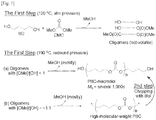
- Fig. 1 compares a conventional method for producing an aliphatic polycarbonate macrodiol with a method for producing an aliphatic polycarbonate macrodiol according to the present invention.
- an aliphatic polycarbonate macropolyol is produced by condensing HOAOH as a diol with DMC in the presence of a base catalyst while removing methanol to prepare an aliphatic polycarbonate with a number average molecular weight of 10000 or higher (first step) and transesterifying the high-molecular-weight condensation product with a diol, triol or tetraol compound Z (OH) a (where a is an integer from 2 to 4) (second step).
- the transesterification occurs in the presence of the catalyst used in the first step according to the mechanism depicted in Reaction Scheme 1 and proceeds rapidly at a condensation temperature of 180 to 190 °C to reach equilibrium in a few hours.
- the equilibrium indicates that the repeating units -O A O-and Z (O-) a shown in Reaction Scheme 1 are randomly distributed in or between the polymer chains.
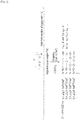
- Fig. 2 shows the distribution of the chains of the macrodiol in which the repeating units -O A O- and Z (O-) 2 are randomly distributed, after transesterification with the diol compound Z (OH) 2 as a chopping material in the second step.
- the degree of polymerization (DP) of the final macrodiol is calculated by dividing the total number of moles N+Z of the repeating units -O A O- and Z (O-) 2 by the sum of the number of moles of the polymer chains formed in the first step and the number of moles Z of the diol compound Z (OH) 2 added in the second step.
- the DP can be defined as ( N+Z )/ Z.
- the probability f k of the number of chains including k Z (O-) 2 repeating units is represented by a C k (1-1/ a ) a - k (1/ a ) k when the DP is expressed as a natural number a close to ( N + Z )/ Z.
- the f k values of macrodiols produced in Examples 1-9 can be calculated as follows.
- High-molecular-weight aliphatic polycarbonates were prepared in yields of about 90% from 111 mmol of HO A OH.
- N is about 100.
- 16.7 mmol of Z (OH) 2 was added as a chopping agent in the second step.
- DP i.e. a
- DP is calculated to be about 7 ((100+16.7)/16.7).
- the probability f 0 of the number of chains having none of the Z (O-) 2 units, the probability f 1 of the number of chains having one Z (O-) 2 unit, the probability f 2 of the number of chains having two Z (O-)2 units, the probability f 3 of the number of chains having three Z (O-) 2 units, and the probability f 4 of the number of chains having four Z (O-) 2 units are calculated to be 35%, 40%, 19%, 5.3%, and 0.9%, respectively. From another viewpoint, the total number of moles of -OH groups is maintained unchanged during chopping.
- Z (OH) 3 as a triol compound may be added as a chopping agent for transesterification.
- a macropolyol is obtained in which the repeating units -O A O- and Z (O-) 3 are randomly distributed in or between the polymer chains.
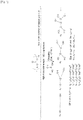
- the statistical distribution of the chains of the macropolyol can also be inferred in the same manner as in the macrodiol ( Fig. 3 ).
- the present invention is based on a technique for producing a high-molecular-weight aliphatic polycarbonate in the presence of a base catalyst.
- the development of efficient techniques for producing aliphatic polycarbonates with molecular weights on the order of several tens of thousands is still in an early stage.
- the equations shown in Figs. 2 and 3 are under the assumption that the DP of the polymer prepared in the first step is very high and the number of moles of the polymer chains before chopping is thus negligibly small compared to the number of moles Z of the Z (OH) 2 added in the second step.
- the number of moles of the polymer chains before chopping is not negligible compared to the number of moles Z of the chopping agent Z (OH) 2 added in the second step.
- the number of moles of the chains of the final macropolyol is the sum of the number of moles ( i.e. N / n ) of the chains of the polymer in the first step before chopping and the number of moles of the Z (OH) 2 added in the second step. This leads to an increase in the number x 0 of the chains having none of the Z (O-) a units in the final macropolyol by the number of moles of the chains of the polymer before chopping.
- macrodiol chains having none of the Z (O-) a units are highly crystalline, which renders the final product waxy or causes crystallization of the final product in an oil, making the final product suspended.
- Macropolyols in the form of waxes or suspended oils are not suitable for use as polyurethane raw materials, coating agents or lubricating agents.
- Another disadvantage is that the linear polymer chains cannot participate in cross-linking.
- the present invention features in that since the polymer prepared in the first step before chopping has a sufficiently high molecular weight, the number of moles (that is, N / n in Figs. 2 and 3 ) of the chains in the polymer is negligible ( ⁇ 10%) compared to the number of moles (that is, Z in Figs. 2 and 3 ) of the chopping agent added in the second step.
- N / n in Figs. 2 and 3 the number of moles of the chains in the polymer is negligible ( ⁇ 10%) compared to the number of moles (that is, Z in Figs. 2 and 3 ) of the chopping agent added in the second step.
- the DP ( i.e. a' ) of the macropolyol of interest is between 5 and 20 (see below).
- n 35. That is, the DP of the polymer before chopping is 7 times greater than that of the final macropolyol after chopping.
- n 171. That is, the DP of the polymer before chopping is about 8.5 times greater than that of the final macropolyol after chopping.
- the number of moles i.e. N / n in Figs.
- the molecular weight of the chopping agent is roughly the same as that of the repeating unit of the polymer before chopping, it is sufficient that the molecular weight of the polymer before chopping is about 20-fold or more higher than that of the final macropolyol after chopping. In the Examples section that follows, most of the polymers before chopping had at least 20-fold higher molecular weights than the macropolyols.
- the ends of the final macropolyol produced by chopping the high-molecular-weight polymer with the Z (OH) a are mostly capped with -OH.
- This chopping is the feature of the present invention. If the molecular weight of the polymer before chopping is not sufficiently high, the number of moles of the end-capping groups included in the polymer is not negligible compared to that of -OH in the Z (OH) a , and as a result, a considerable number of the end-capping groups included in the polymer remain in the final macropolyol.
- the condensation reaction of DMC with HO A OH as a diol affords an aliphatic polycarbonate end-capped with -OH and -C(O)OCH 3 .
- the condensation reaction is carried out while removing mostly the diol.
- the reaction rate is very slow and the yield is also low, making it difficult to obtain a high molecular weight of the polymer (see (a) of Fig. 1 ).
- a method for directly producing a macropolyol was reported ( EP0302712B1 ). According to this method, a large amount (1 mol%) of Na as a catalyst is added to promote the condensation reaction.
- reaction product Due to the considerable amount of the catalyst, the reaction product should be dissolved in methylene chloride and neutralized by washing with a dilute aqueous acid solution. Many attempts have been made to prepare high-molecular-weight polymers end-capped with excess -C(O)OCH 3 groups while removing DMC. However, after the molecular weights of the polymers increase to some extent, the reaction rates are greatly slowed down, leading to a limited increase in the molecular weight of the polymers. Based on this method, Sivaram et al.
- 5,171,830 discloses a process for the preparation of aliphatic polycarbonates whose molecular weights are on the order of 2,400 by condensing DMC with various diols using a tertiary amine or alkylammonium salt as a catalyst.
- a catalyst a tertiary amine or alkylammonium salt.
- an attempt has been made to synthesize aliphatic polycarbonates by condensation of various diols and DMC using 1-n-butyl-3-methylimidazolium-2-carboxylate (1 mol%) as a catalyst ( Polym. Chem., 2012, 3, 1475 ).
- the aliphatic polycarbonates have number average molecular weights not higher than 6,700. Chuncheng Li et al.
- the method of the present invention features in that a polymer with a very high molecular weight is prepared from a diol and DMC in which -OH and -OCH 3 are present in a ratio of ⁇ 1:1, while removing mostly methanol and is then chopped into a macropolyol ((b) of Fig. 1 ).
- the number of moles of the end-capping groups in the polymer before chopping can be greatly reduced to a negligible level, leading to the production of the macropolyol whose terminal groups are mostly - OH groups.
- oligomers are prepared in which -OH and -OCH 3 are present in a ratio of ⁇ 1:1, and are then subjected to condensation. This can considerably enhance the reaction rate.
- the high-molecular-weight aliphatic polycarbonate can be prepared in a short time even in the presence of a small amount of a base catalyst ((b) of Fig. 1 ).
- the condensation catalyst can be used for the subsequent chopping reaction without the need to be removed.
- the base catalyst may include a lithium, sodium, or potassium cation and may be used in an amount of 0.01 to 0.1 mol%, preferably 0.02 to 0.05 mol%, based on the HO A OH.
- the presence of an excess of the catalyst may have an adverse effect on the growth of molecular weight.
- the catalyst may be precipitated and may affect the physical properties of the final macrodiol and polyol.
- the presence of the catalyst in an amount of less than 0.01 mol% does not contribute to an increase in reaction rate, making it difficult to prepare the high-molecular-weight polymer. Since HO- A -OH added after completion of the condensation is mostly incorporated into the polymer chains, there is no significant change between the molar ratio of the HO A OH to the catalyst initially added and the molar ratio of the -O A O-units to the catalyst in the final macropolyol.
- the use of a small amount of the catalyst also avoids the need to remove the catalyst remaining after completion of the reaction.
- the initially added catalyst present in the final macropolyol is a salt composed of an alkali metal cation and an alkoxy anion of the end-capping group.
- the base catalyst remains unremoved or unneutralized, it does not change the final macropolyol at room temperature and can thus be utilized for polyurethane production without the need to be removed.
- the catalyst may be converted to a dibutyltin compound or a tertiary amine, which is a typical catalyst for polyurethane production.
- the total amount of the base catalyst initially added may also be used for urethane production. Alternatively, a portion of the base catalyst may be neutralized and the remaining portion thereof may be utilized as a catalyst for polyurethane production.
- the base catalyst may be neutralized with melamine phenylphosphonate or an acyl halide.
- the initial number of moles of -OH groups corresponds to the sum of the product of the number of moles Z of the Z (OH) a and a and the product of the number of moles of HO A OH and 2.
- the number of moles of -OH decreases and approximates a Z .
- the number of moles of -OH decreases to below a Z .
- US 5,143,997 issued on September 1, 1992 discloses a method for producing a polycarbonate-polyol by transesterification of a polycarbonate-diol with trimethylolpropane as a triol compound or pentaerythritol as a tetraol compound.
- the macrodiol Before chopping, the macrodiol has a number average molecular weight as low as 2000 and is end-capped with -OH. That is, the macrodiol is produced by the method shown in (a) of Fig. 1 and is chopped into a macropolyol having a lower molecular weight ⁇ 1000, which is suitable for use as a polyurethane raw material.
- a poly(hexamethylene carbonate)-polyol having a number average molecular weight of 500 to 1000 is produced by transesterification of a poly(hexamethylene carbonate)-diol having a number average molecular weight of 2000 with trimethylol propane (CH 3 C(CH 2 OH) 3 ) or pentaerythritol (C(CH 2 OH) 4 ) at 220 °C for 8 hours in the presence of tetrabutyl titanate ((nBuO) 4 Ti) as a catalyst.
- the polycarbonate-diol before chopping is chopped with substantially the same number of moles of pentaerythritol (C(CH 2 OH) 4 ) as a chopping agent to produce a macropolyol having a molecular weight of 1000.
- the number of moles of terminal -OH groups is 4 Z +2 Z (where Z represents the number of moles of pentaerythritol), which is well outside the range (4 Z +0.2 Z ) claimed in the present invention.
- Z represents the number of moles of pentaerythritol
- the method of the present invention is distinguished from the prior art in that a high-molecular-weight polymer is chopped into a macropolyol with a broad molecular weight distribution, the number of chopping agent-free chains in the final product is minimized, and the kind of a catalyst used is different.
- the present invention provides an aliphatic polycarbonate macrodiol wherein the HO A OH as a raw material for the repeating unit -O A O- is selected from the group consisting of Formulae 1a to 1c: the repeating unit Z (O-) a is Z (O-) 2 ( i.e. a is 2), and the Z (OH) 2 as a raw material for the Z (O-) 2 is selected from the group consisting of Formulae 1d, 1f and 1h
- the diol compounds of Formulae 1a to 1 d, 1f and 1h are currently prepared on a commercial scale and are in use.
- the HO A OH as a raw material for the repeating unit -O A O- is a mixture of 80 to 95 mol% of 1,4-butanediol represented by Formula 1a and 5 to 20 mol% of the diol compound represented by Formula 1b or 1c, and the Z (O-) 2 repeating units are present in an amount of 5 to 20 mol% with respect to the -O A O- repeating units.
- 1,4-butanediol as the diol compound enables the production of the macropolyol in a highly economical manner due to its low price.
- 1,4-Butanediol is an important compound necessary for the production of biodegradable polymers.
- the molecular weight (i.e. DP) of the macropolyol produced by the method of the present invention varies depending on the amount of the chopping agent added.
- the final product is suitable for use as a polyurethane raw material, a coating material, a lubricating agent, etc.
- An aliphatic polycarbonate-diol obtained by condensation of one of 1,6-hexanediol, 1,5-pentanediol and 1,4-butanediol with DMC is in the form of a crystalline solid. For this reason, the aliphatic polycarbonate-diol is undesirable as a polyurethane raw material ( Journal of Applied Polymer Science, Vol. 111, 217-227 (2009 )). Viscous macrodiols are commonly used as raw materials for polyurethane production. The raw materials are commonly obtained by condensing a mixture of two or more diols with DMC ( EP 302712 ; US 2010/0292497 A1 ).
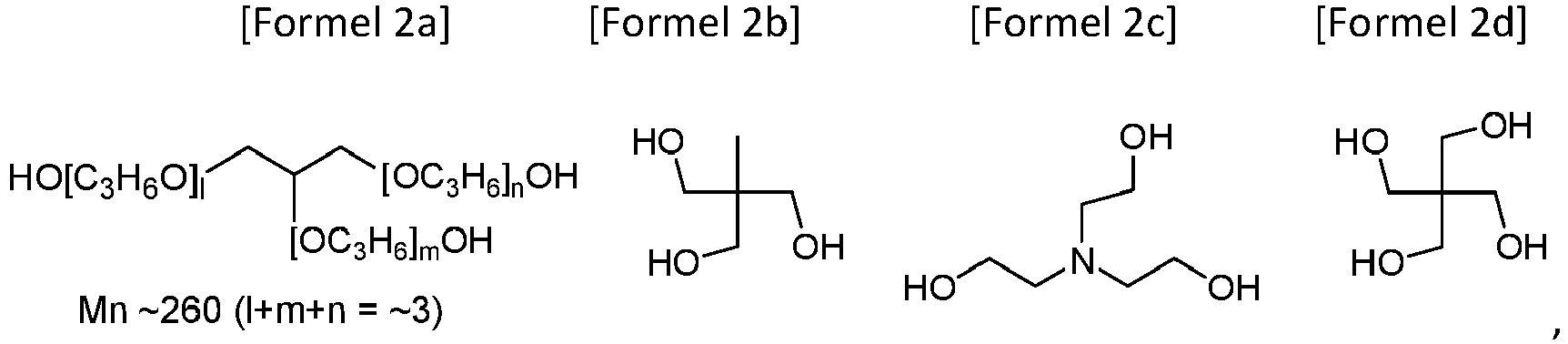
- the present invention also provides a branched aliphatic polycarbonate macropolyol in which the HO A OH as a raw material for the repeating unit -O A O- is selected from the group consisting of Formulae 1a to 1h and the Z (OH) a as a raw material for the repeating unit Z (O-) a is selected from the group consisting of Formulae 2a to 2d:
- the branched macropolyol is cross-linkable during urethane production and can thus be used as an important raw material for a hard foam or a coating agent.
- aliphatic polycarbonate macropolyols are commercially attractive in which the HO A OH as a raw material for the repeating unit - O A O- is a mixture of 80 to 95 mol% of 1,4-butanediol and 5 to 20 mol% of the diol selected from the group consisting of Formulae 1b to 1h and the Z (O-) a repeating units are present in an amount of 5 to 20 mol% with respect to the -O A O- repeating units.
- the chopping agent Z (OH) a of Formula 2a is the most commercially used compound. Chopping with this compound facilitates the production of viscous materials (Examples 22-35).
- Another aspect of the present invention provides an aliphatic polycarbonate-co-aromatic polyester macropolyol including -O A O- and Z (O-) a as repeating units in which the repeating units -O A O- and Z (O-) a are linked via carbonyl (-C(O)-) and - C(O) Y C(O)- as linkers or are bonded to hydrogen to form terminal -OH groups
- A is a substituted or unsubstituted C 3 -C 60 alkylene or a combination of two or more substituted or unsubstituted C 3 -C 60 alkylenes, a is an integer from 2 to 4, provided that when a is 2, Z is a substituted or unsubstituted C 3 -C 60 alkylene, when a is 3, Z is a substituted or unsubstituted C 3 -C 60 trialkylene, and when a is 4, Z is a substituted or unsubstituted C 4 -C 60
- the macropolyol of the present invention is produced by preparing a high-molecular-weight aliphatic polycarbonate in a manner similar to the conventional method, adding an aromatic diester to the aliphatic polycarbonate to prepare a random copolymer of the aliphatic polycarbonate and the aromatic polyester, and chopping the random copolymer with Z (OH) a .
- the aliphatic polycarbonate-aromatic polyester macropolyol is a structurally new compound having the chain distributions analyzed in Figs. 2 and 3 .
- the macropolyol is easy to synthesize.
- the DP of the macropolyol is preferably in the range suitable for use in polyurethane, coatings, and lubricating agents.
- the linker HOC(O) Y C(O)OH as a raw material for the linker -C(O) Y C(O)- is preferably isophthalic acid or terephthalic acid because a viscous form of the final product is easily obtained (Examples 37-39).
- the macropolyol can be branched when the Z (OH) a as a raw material for the repeating unit Z (O-) a is selected from the group consisting of Formulae 2a to 2d.
- the branched macropolyol is suitable for use as a cross-linkable polyurethane raw material.
- the present invention also provides a method for producing the aliphatic polycarbonate macropolyol.
- the method of the present invention includes condensing HO A OH with DMC in the presence of a base catalyst while removing methanol to prepare an aliphatic polycarbonate with a number average molecular weight of 10000 or higher (first step) and transesterifying the condensation product with Z (OH) a (second step).
- US 5,143,997 and US 8,344,092 describe methods in which an aliphatic polycarbonate-diol having a low molecular weight (Mn) of 2000 is chopped into a macropolyol having a lower molecular weight (Mn ⁇ 1000) by transesterification with a triol or tetraol compound. These methods use tetraalkoxytitanium compounds as transesterification catalysts.
- the method of the present invention is distinguished from the known methods in that the base catalyst used is simple.
- the method of the present invention has an advantage in that the catalyst used for the preparation of the high-molecular-weight aliphatic polycarbonate in the first step is used without the need to be removed instead of adding a new base catalyst.
- the method of the present invention is also distinguished from the known methods in that the aliphatic polycarbonate having a molecular weight of 10,000 or higher is subjected to a transesterification reaction. No particular restriction is imposed on the upper limit of the number average molecular weight of the aliphatic polycarbonate.
- the aliphatic polycarbonate may have a number average molecular weight of 10000 to 200000, preferably 10000 to 100000.
- the base catalyst is composed of a lithium, sodium or potassium cation and an alkoxy anion formed by deprotonation of the HO- A -OH.
- the base catalyst is used in an amount ranging from 0.01 mol% to 0.1 mol%, based on the HO- A -OH.
- the use of the base catalyst in the range defined above is economically desirable and is suitable for the preparation of the high-molecular-weight polymer in the first step.
- the present invention also provides a method for producing an aliphatic polycarbonate-co-aromatic polyester macropolyol, including condensing HO A OH, DMC, and MeOC(O) Y C(O)OMe in the presence of a base catalyst while removing methanol to prepare an aliphatic polycarbonate-co-aromatic polyester with a number average molecular weight of 10000 or higher (first step) and transesterifying the condensation product with Z (OH) a (second step).
- an aliphatic polycarbonate or an aliphatic polycarbonate-co-aromatic polyester having a molecular weight of 10000 or higher is prepared and the high-molecular-weight polymer or copolymer is chain-chopped by transesterification with various alcohol compounds ( Z (OH) a ) as chopping agents to produce macropolyols with lower molecular weights.
- the macropolyols have precisely controllable molecular weights and predictably unique polymer chain distributions.
- the macropolyols of the present invention feature in that the number of moles of terminal -OH groups is uniquely in the range of a Z to a Z +0.2 Z (where Z represents the number of moles of the chopping agent Z (OH) a .
- the chopping allows the macropolyols to have various structures and compositions, increasing the possibility that the macropolyols may be utilized as polyurethane raw materials, coating materials, lubricating agents, etc.
- a mechanical stirrer was connected to one neck of the flask, a manifold attached with a vacuum line and a nitrogen line was connected to another neck of the flask, and a distillation unit was connected to the remaining neck of the flask.
- the reaction flask was immersed in a thermostatic bath at 120 °C, the reaction was carried out for 1 h while distilling off formed methanol and a portion of the DMC at ambient pressure.
- the reaction was continued for a total of 3.5 h while removing volatiles at an elevated temperature of 190 °C and a reduced pressure of 570 mmHg for 0.5 h, 380 mmHg for 1 h, and 190 mmHg for 2 h.
- the reaction was allowed to proceed at 190 °C for additional 2 h while removing volatiles under a high vacuum of 0.3 mmHg, which was maintained using a vacuum pump.
- Second step A diol selected from Formulae 1b to 1h was used as a chopping agent.
- the chopping agent was added to the condensation product obtained in the first step.
- the chopping agent was used in an amount of 15 mol% (16.7 mmol), based on the diol(s) initially added.
- the reaction was carried out for 3 h while slowly cooling to 150 °C from 190 °C. Within 10 min from the beginning of the reaction, a remarkable reduction in the viscosity of the reaction mixture was observed. As a result of the reaction, the condensation product was chopped with the chopping agent.
- Table 1 The experimental results are summarized in Table 1.
- Table 1 demonstrate the production of aliphatic polycarbonate macrodiols and show that the molecular weights of the condensation products were reduced to at least 1/10, more preferably 1/20, by chopping, which is the feature of the present invention, and most of the macrodiols were obtained in the form of oils (some thereof were in the form of waxes). Particularly, the oily macrodiols were readily obtained when the diols of Formula 1a and Formula 1b or 1c were used in combination rather than when the diol of Formula 1a was used alone as the HO A OH.
- the results in Table 2 reveal that chopping of the high-molecular-weight aliphatic polycarbonates with the chopping agents of Formulae 2a to 2d led to the production of macropolyols with lower molecular weights.
- the polymers prepared in the first step before chopping were confirmed to have molecular weights at least 10 times (mostly at least 20 times) higher than those of the macropolyols produced after chopping, which is the feature of the present invention.
- the oily macropolyols were readily obtained when the diols of Formula 1a and Formula 1c were used in combination rather than when the diol of Formula 1a was used alone as the HO A OH.
- Examples 22-35 Condensation of Formula 1a and one of Formulae 1b to 1h with DMC and subsequent chopping of the condensation product with Formula 2a
- Second step The triol of Formula 2a as a chopping agent was added to the condensation product obtained in the first step.
- the chopping agent was used in an amount of 15 mol% (4.43 g, 16.7 mmol), based on the diols initially added.
- the reaction was carried out for 3 h while slowly cooling to 150 °C from 190 °C. Within 10 min from the beginning of the reaction, a remarkable reduction in the viscosity of the reaction mixture was observed. As a result of the reaction, the condensation product was chopped with the chopping agent.
- Table 3 The experimental results are summarized in Table 3.
- Table 3 show that most of the macropolyols produced by chopping the high-molecular-weight aliphatic polycarbonates, which were prepared using 1,4-butanediol as a major raw material, with Formula 2a as a chopping agent were in the form of oils. All polymers prepared in the first step before chopping were confirmed to have molecular weights at least 10 times (mostly at least 20 times) higher than those of the macropolyols produced after chopping.
- 1,4-Butanediol (Formula 1a, 10.0 g, 111 mmol) was placed in a 3-neck flask and then NaH (0.111 mmol, 0.1 mol%) was added thereto to form HO(CH 2 ) 4 O - Na + . Thereafter, dimethyl carbonate (DMC) and dimethyl phthalate (or dimethyl isophthalate or dimethyl terephthalate) were added in the amounts shown in Table 4. The DMC was added in an amount corresponding to the number of moles calculated by subtracting the number of moles of the phthalate from the number of moles corresponding to 1.57 equivalents per equivalent of the 1,4-butanediol.
- DMC dimethyl carbonate
- dimethyl phthalate or dimethyl isophthalate or dimethyl terephthalate
- a mechanical stirrer was connected to one neck of the flask, a manifold attached with a vacuum line and a nitrogen line was connected to another neck of the flask, and a distillation unit was connected to the remaining neck of the flask.
- the reaction flask was immersed in a thermostatic bath at 120 °C, the reaction was carried out for 1 h while distilling off formed methanol and a portion of the DMC at ambient pressure.
- the reaction was continued for a total of 3.5 h while removing volatiles at an elevated temperature of 190 °C and a reduced pressure of 570 mmHg for 0.5 h, 380 mmHg for 1 h, and 190 mmHg for 2 h.
- the reaction was allowed to proceed further at an elevated temperature of 210 °C for additional 2 h while removing volatiles under a high vacuum of 0.3 mmHg, which was maintained using a vacuum pump.
- Second step 1,4-Butanediol (Formula 1a) as a chopping agent was added to the condensation product obtained in the first step.
- the chopping agent was used in an amount of 15 mol% (1.50 g, 16.7 mmol), based on the diol initially added.
- the reaction was carried out for 3 h while slowly cooling to 150 °C from 210 °C. Within 10 min from the beginning of the reaction, a remarkable reduction in the viscosity of the reaction mixture was observed. As a result of the reaction, the condensation product was chopped with the chopping agent.
- Table 4 The experimental results are summarized in Table 4.
- Examples 40-60 Condensation of Formula 1a, DMC and MeOC(O)YC(O)OMe and subsequent chopping of the condensation product with one of Formulae 2a to 2d
- the first step of Examples 36-39 was repeated, except that the amount of dimethyl phthalate (or dimethyl isophthalate or dimethyl terephthalate) added was adjusted to the range of 10 to 50 mol%.
- the phthalate was used in an amount not larger than 20 mol%, volatiles were finally removed under a high vacuum of 0.3 mmHg at 190 °C instead of at 210 °C.
- 1,4-Butanediol (Formula 1a, 10.0 g, 111 mmol) and NaH (0.222 mmol, 0.2 mol%) were placed in a 3-neck flask to form HO(CH 2 ) 4 O - Na + . Thereafter, 15.3 g (170 mmol) of dimethyl carbonate (DMC) was further added.
- DMC dimethyl carbonate
- a mechanical stirrer was connected to one neck of the flask, a manifold attached with a vacuum line and a nitrogen line was connected to another neck of the flask, and a distillation unit was connected to the remaining neck of the flask.
- the reaction flask was immersed in a thermostatic bath at 120 °C, the reaction was carried out for 1 h while distilling off formed methanol and a portion of the DMC at ambient pressure. The reaction was carried out at ambient pressure and an elevated temperature of 180 °C for another 1 h until the amount of distilled volatiles (methanol or DMC) reached a negligible level.
- the reaction mixture was sampled for 1 H NMR analysis.
- the ambient -OH groups were hydrogen-bonded with the alkoxy anions to weaken the nucleophilic attack of the alkoxy anions and were also hydrogen-bonded with the formed methanol to impede effective removal of the methanol.
- This hydrogen bonding is interpreted to be responsible for the low rate of the reaction.
- the pressure was further reduced to 0.3 mmHg, the butanediol, DMC, and HO(CH 2 ) 4 OC(O)OCH 3 as well as methanol were removed, and as a result, the chains were connected to each other, leading to a rapid increase in molecular weight. Therefore, the molecular weight of the polymer was confirmed to be difficult to control.
- the molecular weight of the polymer before chopping was on the order of about 2.5-fold higher than that of the macropolyol after chopping.
- the presence of a relatively large number of highly crystalline linear chains free of Z (O-) 3 in the macropolyol made the macropolyol waxy.
- the shape of the macropolyol was compared with that of a macropolyol having a number average molecular weight (Mn) at the same level.
Landscapes
- Chemical & Material Sciences (AREA)
- Organic Chemistry (AREA)
- Health & Medical Sciences (AREA)
- Chemical Kinetics & Catalysis (AREA)
- Medicinal Chemistry (AREA)
- Polymers & Plastics (AREA)
- Life Sciences & Earth Sciences (AREA)
- Engineering & Computer Science (AREA)
- Materials Engineering (AREA)
- Wood Science & Technology (AREA)
- General Chemical & Material Sciences (AREA)
- Polyesters Or Polycarbonates (AREA)
Claims (11)
- Aliphatisches Polycarbonat-Makro-Polyol, umfassend -OAO- und Z(O-)a als sich wiederholende Einheiten, wobei die sich wiederholenden Einheiten -OAO- und Z(O-)a über (-C(O)-)-Carbonyl-Linker aneinander gebunden sind oder an Wasserstoff gebunden sind, um endständige -OH-Gruppen zu bilden, und wobei die Molzahl der endständigen -OH-Gruppen von aZ bis aZ + 0,2Z reicht (wobei Z die Anzahl der Mole der sich wiederholenden Einheit Z(O-)a darstellt), wobei A ein substituiertes oder unsubstituiertes C3-C60-Alkylen oder eine Kombination von zwei oder mehr substituierten oder unsubstituierten C3-C60-Alkylenen ist, a eine ganze Zahl von 2 bis 4 ist, mit der Maßgabe, dass wenn a 2 ist Z substituiertes oder unsubstituiertes C3-C60-Alkylen ist, wenn a 3 ist Z substituiertes oder unsubstituiertes C3-C60-Trialkylen ist, und wenn a 4 ist Z substituiertes oder unsubstituiertes C4-C60-Tetraalkylen ist, wobei HOAOH als das Rohmaterial für die sich wiederholende Einheit -OAO- aus der Gruppe ausgewählt ist, die aus den Formeln 1a bis 1d, 1f und 1h besteht:


Z(OH)a als Rohmaterial für die Wiederholungseinheit Z(O-)a aus der Gruppe ausgewählt ist, die aus den Formeln 2a bis 2d besteht: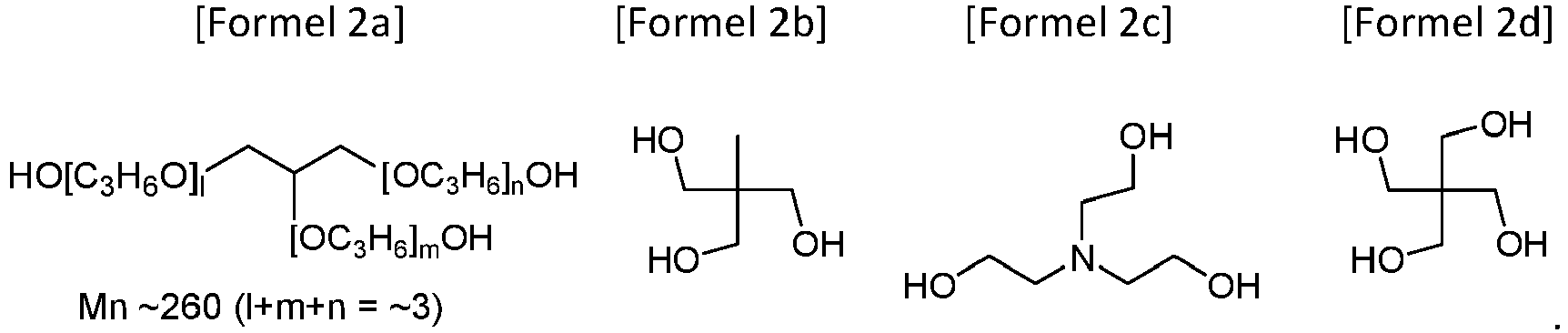
- Aliphatisches Polycarbonat-Makro-Polyol nach Anspruch 1, wobei HOAOH als das Rohmaterial für die sich wiederholende Einheit -OAO- ein Gemisch aus 80 bis 95 Mol-% der Diolverbindung, dargestellt durch Formel 1a, und 5 bis 20 Mol-% der Diolverbindung, ausgewählt aus den Formeln 1b bis 1h, ist, und wobei die sich wiederholenden Einheiten Z(O-)2 in einer Menge von 5 bis 20 Mol-%, bezogen auf die sich wiederholenden Einheiten OAO-, vorhanden sind, wobei vorzugsweise Z(OH)a als das Ausgangsmaterial für die sich wiederholende Einheit Z(O-)a die durch Formel 2a dargestellte Verbindung ist.
- Aliphatisches Polycarbonat-Co-aromatisches Polyester Makro-Polyol, umfassend - OAO- und Z(O-)a als sich wiederholende Einheiten, wobei die sich wiederholenden Einheiten -OAO- und Z(O-)a über (-C(O)-) und -C(O)YC(O)- Carbonyl als Linker verbunden sind oder an Wasserstoff unter Bildung von -OH-Endgruppen verbunden sind, wobei A ein substituiertes oder unsubstituiertes C3-C60-Alkylen oder eine Kombination von zwei oder mehreren substituierten oder unsubstituierten C3-C60-Alkylenen ist, a eine ganze Zahl von 2 bis 4 ist, mit der Maßgabe, dass wenn a 2 ist Z ein substituiertes oder unsubstituiertes C3-C60-Alkylen ist, wenn a 3 ist Z ein substituiertes oder unsubstituiertes C3-C60-Trialkylen ist, und wenn a 4 ist Z ein substituiertes oder unsubstituiertes C4-C60-Tetraalkylen ist, und Y ein substituiertes oder unsubstituiertes C5-C20-Arylen, eine Kombination von zwei oder mehr substituierten oder unsubstituierten C5-C20-Arylenen, ein substituiertes oder unsubstituiertes C5-C20-Heteroarylen oder eine Kombination von zwei oder mehreren substituierten oder unsubstituierten C5-C20-Heteroarylenen ist, wobei das HOAOH als Ausgangsmaterial für die sich wiederholende Einheit -OAO- die Verbindung der Formel 1a ist:

Z(OH)2 als Rohmaterial für die Z(O-)2-Wiederholungseinheit aus der Gruppe ausgewählt ist, die aus den Formeln 1c und 1d, 1f und 1h besteht:


HOC(O)YC(O)OH als Rohmaterial für den Linker -C(O)YC(O)- aus Phthalsäure, Isophthalsäure und Terephthalsäure ausgewählt ist. - Aliphatisches Polycarbonat-co-aromatisches Polyester Makro-Polyol nach Anspruch 3, wobei die -C(O)YC(O)-Linker in einer Menge von 5 bis 50 Mol-%, bezogen auf die -OAO-Wiederholungseinheiten, vorhanden sind, und die Wiederholungseinheiten Z(O-)2 in einer Menge von 5 bis 20 Mol-% bezogen auf die Wiederholungseinheiten -OAO- vorhanden sind, wobei vorzugsweise HOC(O)YC(O)OH als Ausgangsmaterial für den Linker -C(O)YC(O)-Isophthalsäure oder Phthalsäure ist.
- Aliphatisches Polycarbonat-co-aromatisches Polyester Makro-Polyol nach Anspruch 3, wobei HOAOH als Ausgangsmaterial für die -OAO- Wiederholungseinheit die Verbindung der Formel 1a ist:

HOC(O)YC(O)OH als Rohmaterial für den Linker -C(O)YC(O)- aus Phthalsäure, Isophthalsäure und Terephthalsäure ausgewählt ist. - Aliphatisches Polycarbonat-co-aromatisches Polyester Makro-Polyol nach Anspruch 5, wobei die -C(O)YC(O)-Linker in einer Menge von 5 bis 50 Mol-%, bezogen auf die -OAO-Wiederholungseinheiten, und die Z(O-)a-Wiederholungseinheiten in einer Menge von 5 bis 20 Mol-%, bezogen auf die -OAO--Wiederholungseinheiten, vorhanden sind.
- Aliphatisches Polycarbonat-co-aromatisches Polyester Makro-Polyol nach Anspruch 6, wobei das HOC(O)YC(O)OH als Rohmaterial für den -C(O)YC(O)-Linker Isophthalsäure oder Phthalsäure ist und Z(OH)a als Rohmaterial für die Z(O-)a Wiederholungseinheit durch die Formel 2a dargestellt ist.
- Verfahren zur Herstellung eines aliphatischen Polycarbonat-Makro-Polyols, umfassend das Kondensieren von HOAOH mit Dimethylcarbonat in Gegenwart eines Basenkatalysators, während Methanol entfernt wird, um ein aliphatisches Polycarbonat mit einem zahlenmittleren Molekulargewicht von 10.000 oder mehr herzustellen (erster Schritt), und Umestern des Kondensationsprodukts mit Z(OH)a (zweiter Schritt), wobei A ein substituiertes oder unsubstituiertes C3-C60-Alkylen oder eine Kombination von zwei oder mehreren substituierten oder unsubstituierten C3-C60-Alkylenen ist, a eine ganze Zahl von 2 bis 4 ist, mit der Maßgabe, dass, wenn a 2 ist Z ein substituiertes oder unsubstituiertes C3-C60-Alkylen ist, wenn a 3 ist Z ein substituiertes oder unsubstituiertes C3-C60-Trialkylen ist, und wenn a 4 ist Z ein substituiertes oder unsubstituiertes C4-C60-Tetraalkylen ist.
- Verfahren nach Anspruch 8, wobei der Basiskatalysator aus einem Lithium-, Natrium- oder Kaliumkation und einem durch Deprotonierung von HO-A-OH gebildeten Alkoxyanion zusammengesetzt ist und in einer Menge von 0,01 Mol-% bis 0,1 Mol-%, bezogen auf HO-A-OH, verwendet wird.
- Verfahren zur Herstellung eines aliphatischen Polycarbonat-co-aromatischen Polyester Makro-Polyols, umfassend das Kondensieren von HOAOH, Dimethylcarbonat, und MeOC(O)YC(O)OMe in Gegenwart eines Basenkatalysators unter Entfernung von Methanol zur Herstellung eines co-aromatischen aliphatischen Polycarbonat-Polyesters mit einem zahlenmittleren Molekulargewicht von 10.000 oder mehr (erster Schritt) und Umesterung des Kondensationsprodukts mit Z(OH)a (zweiter Schritt), wobei A ein substituiertes oder unsubstituiertes C3-C60-Alkylen oder eine Kombination von zwei oder mehr substituierten oder unsubstituierten C3-C60-Alkylenen ist, a eine ganze Zahl von 2 bis 4 ist, mit der Maßgabe, dass wenn a 2 ist Z substituiertes oder unsubstituiertes C3-C60-Alkylen ist, wenn a 3 ist Z substituiertes oder unsubstituiertes C3-C60-Trialkylen ist, und wenn a 4 ist Z substituiertes oder unsubstituiertes C4-C60-Tetraalkylen ist, und wobei Y ein substituiertes oder unsubstituiertes C5-C20-Arylen, eine Kombination von zwei oder mehr substituierten oder unsubstituierten C5-C20-Arylenen, ein substituiertes oder unsubstituiertes C5-C20-Heteroarylen oder eine Kombination von zwei oder mehr substituierten oder unsubstituierten C5-C20-Heteroarylenen ist.
- Verfahren nach Anspruch 10, wobei der Basenkatalysator aus einem Lithium-, Natrium- oder Kaliumkation und einem durch Deprotonierung von HO-A-OH gebildeten Alkoxyanion zusammengesetzt ist und in einer Menge von 0,01 Mol-% bis 0,1 Mol-%, bezogen auf HO-A-OH, verwendet wird.
Applications Claiming Priority (2)
| Application Number | Priority Date | Filing Date | Title |
|---|---|---|---|
| KR20130096100 | 2013-08-13 | ||
| PCT/KR2013/009222 WO2015023027A1 (ko) | 2013-08-13 | 2013-10-16 | 지방족 폴리카보네이트 및 이의 방향족 폴리에스터 공중합체로 구성된 매크로-폴리올 |
Publications (3)
| Publication Number | Publication Date |
|---|---|
| EP3020745A1 EP3020745A1 (de) | 2016-05-18 |
| EP3020745A4 EP3020745A4 (de) | 2017-02-15 |
| EP3020745B1 true EP3020745B1 (de) | 2021-01-20 |
Family
ID=51996277
Family Applications (1)
| Application Number | Title | Priority Date | Filing Date |
|---|---|---|---|
| EP13891408.0A Active EP3020745B1 (de) | 2013-08-13 | 2013-10-16 | Makropolyol aus aliphatischem polycarbonat und aromatisches polyestercopolymer davon |
Country Status (7)
| Country | Link |
|---|---|
| US (2) | US20160177027A1 (de) |
| EP (1) | EP3020745B1 (de) |
| JP (1) | JP6420833B2 (de) |
| KR (1) | KR101446443B1 (de) |
| CN (1) | CN105473636B (de) |
| ES (1) | ES2853930T3 (de) |
| WO (1) | WO2015023027A1 (de) |
Families Citing this family (9)
| Publication number | Priority date | Publication date | Assignee | Title |
|---|---|---|---|---|
| KR101396110B1 (ko) * | 2013-10-30 | 2014-05-16 | 아주대학교산학협력단 | 장쇄 분지를 갖는 지방족 폴리카보네이트 및 이의 방향족 폴리에스터 공중합체 |
| KR101657261B1 (ko) * | 2014-10-22 | 2016-09-13 | 롯데케미칼 주식회사 | 공중합 폴리카보네이트 수지 및 그 제조방법 |
| KR101768324B1 (ko) * | 2015-09-17 | 2017-08-16 | 롯데케미칼 주식회사 | 이차 알코올을 함유하는 폴리카보네이트 폴리올 제조방법 |
| JP7183539B2 (ja) * | 2016-12-22 | 2022-12-06 | 三菱ケミカル株式会社 | ポリカーボネートポリオール及びポリウレタン |
| TWI673298B (zh) * | 2018-06-19 | 2019-10-01 | 財團法人工業技術研究院 | 聚碳酸酯二醇及其形成之聚氨酯 |
| JP7326743B2 (ja) * | 2019-01-11 | 2023-08-16 | 東ソー株式会社 | ポリカーボネートポリオール及びその製造方法 |
| WO2020203882A1 (ja) * | 2019-03-29 | 2020-10-08 | 帝人株式会社 | 高分子バインダー及び全固体二次電池 |
| JP7442276B2 (ja) * | 2019-08-01 | 2024-03-04 | 東ソー株式会社 | ポリカーボネートポリオールの製造方法 |
| KR102347830B1 (ko) * | 2019-10-31 | 2022-01-05 | 롯데케미칼 주식회사 | 열가소성 수지 조성물 및 이로부터 제조된 성형품 |
Citations (3)
| Publication number | Priority date | Publication date | Assignee | Title |
|---|---|---|---|---|
| JP3078644B2 (ja) * | 1992-04-17 | 2000-08-21 | 帝人株式会社 | ポリエステルブロック共重合体およびその製造法 |
| US20080167430A1 (en) * | 2005-02-25 | 2008-07-10 | Basf Aktiengesellschaft | High-Functionality Highly Branched Or Hyperbranched Polycarbonates And Their Preparation And Use |
| CN102241815A (zh) * | 2010-05-10 | 2011-11-16 | 江苏中科金龙化工股份有限公司 | 脂肪族聚碳酸亚酯-芳香族聚酯共聚物及其制备方法 |
Family Cites Families (20)
| Publication number | Priority date | Publication date | Assignee | Title |
|---|---|---|---|---|
| JPH0647616B2 (ja) * | 1985-05-28 | 1994-06-22 | ダイセル化学工業株式会社 | ポリカ−ボネ−トの製造方法 |
| DE3855663T2 (de) * | 1987-08-04 | 1997-06-05 | Asahi Chemical Ind | Copolycarbonate |
| JP3033778B2 (ja) * | 1989-10-11 | 2000-04-17 | ダイセル化学工業株式会社 | ポリカーボネートポリオール |
| US5143997A (en) * | 1989-10-11 | 1992-09-01 | Daicel Chemical Industries, Ltd. | Polycarbonate-polyol composition and polycarbonate(meth) acrylate compositions and urethane(meth) acrylate compositions prepared therefrom |
| US5171830A (en) | 1991-08-16 | 1992-12-15 | Arco Chemical Technology, L.P. | Catalytic process for the preparation of polyalkylene carbonates |
| JP3474300B2 (ja) * | 1995-03-03 | 2003-12-08 | 株式会社クラレ | ポリウレタンおよびそれに用いるポリエステルポリカーボネートジオール |
| IT1283314B1 (it) | 1996-03-28 | 1998-04-16 | Enichem Spa | Processo per la preparazione di policarbonati copolieteri polioli |
| US6255437B1 (en) * | 1996-12-28 | 2001-07-03 | Eastman Chemical Company | Process for preparing poly (2,2,4,4-tetramethyl-1,3-cyclobutylene carbonate) |
| JP4734696B2 (ja) * | 2000-08-29 | 2011-07-27 | 宇部興産株式会社 | ポリカーボネートジオール共重合体及びその製造法 |
| AU2003278089A1 (en) * | 2003-07-03 | 2005-01-21 | Universiteit Twente | Biocompatible polymer networks |
| JP4605491B2 (ja) * | 2003-07-31 | 2011-01-05 | 日本ポリウレタン工業株式会社 | 1,4−ブタンジオールを主剤とするコポリカーボネートジオールの製造方法、およびそのコポリカーボネートジオールを用いたポリウレタン樹脂。 |
| DE102004031900A1 (de) * | 2004-07-01 | 2006-02-16 | Bayer Materialscience Ag | Oligocarbonatpolyole mit endständig sekundären Hydroxylgruppen |
| EP2036937A1 (de) | 2007-09-13 | 2009-03-18 | Stichting Dutch Polymer Institute | Polykarbonat und Herstellungsverfahren dafür |
| KR101187118B1 (ko) * | 2007-11-16 | 2012-09-28 | 아사히 가세이 케미칼즈 가부시키가이샤 | 폴리카르보네이트 디올 |
| ES2551730T3 (es) | 2007-11-16 | 2015-11-23 | Asahi Kasei Chemicals Corporation | Diol de policarbonato con facilidad de estabilización de la reacción |
| JP2009235291A (ja) | 2008-03-28 | 2009-10-15 | Ube Ind Ltd | ポリカ−ボネートポリオール及びその製造方法 |
| JP5803107B2 (ja) * | 2008-08-01 | 2015-11-04 | 宇部興産株式会社 | ポリカ−ボネートジオール及びポリカーボネートジオール共重合体 |
| CN105906509B (zh) | 2009-06-26 | 2018-04-06 | 出光兴产株式会社 | 双氯甲酸酯化合物的制造方法 |
| EP2451860A4 (de) * | 2009-07-05 | 2014-08-20 | Novomer Inc | Strukturgenaue poly(propylencarbonat)-zusammensetzungen |
| MX2013001484A (es) | 2010-08-09 | 2013-03-12 | Bayer Ip Gmbh | Conversor electromecanico que incluye un polimero de poliuretano con unidades de poliester y/o de policarbonato. |
-
2013
- 2013-10-15 KR KR1020130122688A patent/KR101446443B1/ko active Active
- 2013-10-16 EP EP13891408.0A patent/EP3020745B1/de active Active
- 2013-10-16 US US14/909,568 patent/US20160177027A1/en not_active Abandoned
- 2013-10-16 CN CN201380078810.2A patent/CN105473636B/zh active Active
- 2013-10-16 JP JP2016533000A patent/JP6420833B2/ja active Active
- 2013-10-16 WO PCT/KR2013/009222 patent/WO2015023027A1/ko not_active Ceased
- 2013-10-16 ES ES13891408T patent/ES2853930T3/es active Active
-
2018
- 2018-02-08 US US15/891,642 patent/US10793671B2/en active Active
Patent Citations (3)
| Publication number | Priority date | Publication date | Assignee | Title |
|---|---|---|---|---|
| JP3078644B2 (ja) * | 1992-04-17 | 2000-08-21 | 帝人株式会社 | ポリエステルブロック共重合体およびその製造法 |
| US20080167430A1 (en) * | 2005-02-25 | 2008-07-10 | Basf Aktiengesellschaft | High-Functionality Highly Branched Or Hyperbranched Polycarbonates And Their Preparation And Use |
| CN102241815A (zh) * | 2010-05-10 | 2011-11-16 | 江苏中科金龙化工股份有限公司 | 脂肪族聚碳酸亚酯-芳香族聚酯共聚物及其制备方法 |
Also Published As
| Publication number | Publication date |
|---|---|
| KR101446443B1 (ko) | 2014-10-07 |
| JP6420833B2 (ja) | 2018-11-07 |
| ES2853930T3 (es) | 2021-09-20 |
| US20180186929A1 (en) | 2018-07-05 |
| US10793671B2 (en) | 2020-10-06 |
| CN105473636A (zh) | 2016-04-06 |
| JP2016527376A (ja) | 2016-09-08 |
| US20160177027A1 (en) | 2016-06-23 |
| EP3020745A4 (de) | 2017-02-15 |
| EP3020745A1 (de) | 2016-05-18 |
| WO2015023027A1 (ko) | 2015-02-19 |
| CN105473636B (zh) | 2017-09-08 |
Similar Documents
| Publication | Publication Date | Title |
|---|---|---|
| EP3020745B1 (de) | Makropolyol aus aliphatischem polycarbonat und aromatisches polyestercopolymer davon | |
| EP2902429B1 (de) | Aliphatisches polycarbonatcopolymer mit hohem molekulargewicht und herstellungsverfahren dafür | |
| US8530616B2 (en) | Precise control of molecular weight and chain shape control in carbon dioxide/epoxide alternating copolymerization and preparation of low molecular weight poly(alkylene carbonate) thereby | |
| KR101896019B1 (ko) | 폴리카보네이트 공중합체 및 그 제조방법 | |
| EP2558516B1 (de) | Block- und pfropfcopolymere aus poly(alkylencarbonat) und verschiedenen polymeren | |
| EP3048124B1 (de) | Aliphatisches polycarbonat mit langkettigen verzweigungen und aromatisches polyester-copolymer daraus | |
| KR20100047127A (ko) | 열가소성 수지의 제조 방법, 폴리에스테르 수지 및 폴리카보네이트 수지, 그리고 그들의 용도 | |
| CN104837889A (zh) | 丙交酯共聚物、制备该丙交酯共聚物的方法以及包含该丙交酯共聚物的树脂组合物 | |
| KR102442456B1 (ko) | 낮은 반응성을 가지는 (시클로)지방족 폴리카르보네이트 폴리올의 제조 방법 | |
| KR20100099712A (ko) | 트라이메틸렌 카르보네이트 및 폴리(트라이메틸렌 에테르) 글리콜을 포함하는 공중합체 | |
| KR102286854B1 (ko) | 언하이드로헥시톨계 폴리카보네이트 디올을 함유한 열가소성 폴리에테르 에스테르 엘라스토머 및 이의 제조 방법 | |
| US20180179333A1 (en) | Aliphatic polycarbonate macropolyol and aliphatic polycarbonate-coaromatic polyester macropolyol | |
| EP2942362B1 (de) | Mit einem basischen katalysator hergestelltes aliphatisches polycarbonat von hohem molekulargewicht | |
| TWI731327B (zh) | 具有碳酸酯鏈段化學結構之寡聚物或聚合物 | |
| US9777031B2 (en) | Complex and preparation method of poly(alkylene carbonate) using the same | |
| TW202039624A (zh) | 具有碳酸酯鏈段化學結構之寡聚物或聚合物的製備方法 | |
| WO2004020501A1 (en) | Process for preparing biocompatible polyurea |
Legal Events
| Date | Code | Title | Description |
|---|---|---|---|
| PUAI | Public reference made under article 153(3) epc to a published international application that has entered the european phase |
Free format text: ORIGINAL CODE: 0009012 |
|
| 17P | Request for examination filed |
Effective date: 20160210 |
|
| AK | Designated contracting states |
Kind code of ref document: A1 Designated state(s): AL AT BE BG CH CY CZ DE DK EE ES FI FR GB GR HR HU IE IS IT LI LT LU LV MC MK MT NL NO PL PT RO RS SE SI SK SM TR |
|
| AX | Request for extension of the european patent |
Extension state: BA ME |
|
| RIN1 | Information on inventor provided before grant (corrected) |
Inventor name: HWANG, EUN YEONG Inventor name: PARK, JI HAE Inventor name: LEE, BUN YEOUL Inventor name: LEE, JUNG JAE Inventor name: JEON, JONG YEOB |
|
| DAX | Request for extension of the european patent (deleted) | ||
| A4 | Supplementary search report drawn up and despatched |
Effective date: 20170116 |
|
| RIC1 | Information provided on ipc code assigned before grant |
Ipc: C08G 64/20 20060101ALI20170110BHEP Ipc: C08G 64/02 20060101AFI20170110BHEP Ipc: C08G 64/42 20060101ALI20170110BHEP Ipc: C08G 64/30 20060101ALI20170110BHEP Ipc: C08L 69/00 20060101ALI20170110BHEP |
|
| STAA | Information on the status of an ep patent application or granted ep patent |
Free format text: STATUS: EXAMINATION IS IN PROGRESS |
|
| 17Q | First examination report despatched |
Effective date: 20180316 |
|
| RAP1 | Party data changed (applicant data changed or rights of an application transferred) |
Owner name: LOTTE CHEMICAL CORPORATION |
|
| GRAP | Despatch of communication of intention to grant a patent |
Free format text: ORIGINAL CODE: EPIDOSNIGR1 |
|
| STAA | Information on the status of an ep patent application or granted ep patent |
Free format text: STATUS: GRANT OF PATENT IS INTENDED |
|
| RIC1 | Information provided on ipc code assigned before grant |
Ipc: C08G 64/02 20060101AFI20200630BHEP Ipc: C08G 64/20 20060101ALI20200630BHEP Ipc: C09D 175/06 20060101ALI20200630BHEP Ipc: C08G 18/44 20060101ALI20200630BHEP Ipc: C08G 64/42 20060101ALI20200630BHEP Ipc: C08G 64/30 20060101ALI20200630BHEP Ipc: C08L 69/00 20060101ALI20200630BHEP |
|
| INTG | Intention to grant announced |
Effective date: 20200714 |
|
| GRAS | Grant fee paid |
Free format text: ORIGINAL CODE: EPIDOSNIGR3 |
|
| GRAA | (expected) grant |
Free format text: ORIGINAL CODE: 0009210 |
|
| STAA | Information on the status of an ep patent application or granted ep patent |
Free format text: STATUS: THE PATENT HAS BEEN GRANTED |
|
| AK | Designated contracting states |
Kind code of ref document: B1 Designated state(s): AL AT BE BG CH CY CZ DE DK EE ES FI FR GB GR HR HU IE IS IT LI LT LU LV MC MK MT NL NO PL PT RO RS SE SI SK SM TR |
|
| REG | Reference to a national code |
Ref country code: GB Ref legal event code: FG4D |
|
| REG | Reference to a national code |
Ref country code: CH Ref legal event code: EP |
|
| REG | Reference to a national code |
Ref country code: AT Ref legal event code: REF Ref document number: 1356359 Country of ref document: AT Kind code of ref document: T Effective date: 20210215 |
|
| REG | Reference to a national code |
Ref country code: IE Ref legal event code: FG4D |
|
| REG | Reference to a national code |
Ref country code: DE Ref legal event code: R096 Ref document number: 602013075441 Country of ref document: DE |
|
| REG | Reference to a national code |
Ref country code: NL Ref legal event code: MP Effective date: 20210120 |
|
| REG | Reference to a national code |
Ref country code: LT Ref legal event code: MG9D |
|
| REG | Reference to a national code |
Ref country code: AT Ref legal event code: MK05 Ref document number: 1356359 Country of ref document: AT Kind code of ref document: T Effective date: 20210120 |
|
| PG25 | Lapsed in a contracting state [announced via postgrant information from national office to epo] |
Ref country code: BG Free format text: LAPSE BECAUSE OF FAILURE TO SUBMIT A TRANSLATION OF THE DESCRIPTION OR TO PAY THE FEE WITHIN THE PRESCRIBED TIME-LIMIT Effective date: 20210420 Ref country code: NO Free format text: LAPSE BECAUSE OF FAILURE TO SUBMIT A TRANSLATION OF THE DESCRIPTION OR TO PAY THE FEE WITHIN THE PRESCRIBED TIME-LIMIT Effective date: 20210420 Ref country code: NL Free format text: LAPSE BECAUSE OF FAILURE TO SUBMIT A TRANSLATION OF THE DESCRIPTION OR TO PAY THE FEE WITHIN THE PRESCRIBED TIME-LIMIT Effective date: 20210120 Ref country code: PT Free format text: LAPSE BECAUSE OF FAILURE TO SUBMIT A TRANSLATION OF THE DESCRIPTION OR TO PAY THE FEE WITHIN THE PRESCRIBED TIME-LIMIT Effective date: 20210520 Ref country code: LT Free format text: LAPSE BECAUSE OF FAILURE TO SUBMIT A TRANSLATION OF THE DESCRIPTION OR TO PAY THE FEE WITHIN THE PRESCRIBED TIME-LIMIT Effective date: 20210120 Ref country code: GR Free format text: LAPSE BECAUSE OF FAILURE TO SUBMIT A TRANSLATION OF THE DESCRIPTION OR TO PAY THE FEE WITHIN THE PRESCRIBED TIME-LIMIT Effective date: 20210421 Ref country code: FI Free format text: LAPSE BECAUSE OF FAILURE TO SUBMIT A TRANSLATION OF THE DESCRIPTION OR TO PAY THE FEE WITHIN THE PRESCRIBED TIME-LIMIT Effective date: 20210120 Ref country code: HR Free format text: LAPSE BECAUSE OF FAILURE TO SUBMIT A TRANSLATION OF THE DESCRIPTION OR TO PAY THE FEE WITHIN THE PRESCRIBED TIME-LIMIT Effective date: 20210120 |
|
| PG25 | Lapsed in a contracting state [announced via postgrant information from national office to epo] |
Ref country code: SE Free format text: LAPSE BECAUSE OF FAILURE TO SUBMIT A TRANSLATION OF THE DESCRIPTION OR TO PAY THE FEE WITHIN THE PRESCRIBED TIME-LIMIT Effective date: 20210120 Ref country code: PL Free format text: LAPSE BECAUSE OF FAILURE TO SUBMIT A TRANSLATION OF THE DESCRIPTION OR TO PAY THE FEE WITHIN THE PRESCRIBED TIME-LIMIT Effective date: 20210120 Ref country code: LV Free format text: LAPSE BECAUSE OF FAILURE TO SUBMIT A TRANSLATION OF THE DESCRIPTION OR TO PAY THE FEE WITHIN THE PRESCRIBED TIME-LIMIT Effective date: 20210120 Ref country code: RS Free format text: LAPSE BECAUSE OF FAILURE TO SUBMIT A TRANSLATION OF THE DESCRIPTION OR TO PAY THE FEE WITHIN THE PRESCRIBED TIME-LIMIT Effective date: 20210120 Ref country code: AT Free format text: LAPSE BECAUSE OF FAILURE TO SUBMIT A TRANSLATION OF THE DESCRIPTION OR TO PAY THE FEE WITHIN THE PRESCRIBED TIME-LIMIT Effective date: 20210120 |
|
| REG | Reference to a national code |
Ref country code: ES Ref legal event code: FG2A Ref document number: 2853930 Country of ref document: ES Kind code of ref document: T3 Effective date: 20210920 |
|
| PG25 | Lapsed in a contracting state [announced via postgrant information from national office to epo] |
Ref country code: IS Free format text: LAPSE BECAUSE OF FAILURE TO SUBMIT A TRANSLATION OF THE DESCRIPTION OR TO PAY THE FEE WITHIN THE PRESCRIBED TIME-LIMIT Effective date: 20210520 |
|
| REG | Reference to a national code |
Ref country code: DE Ref legal event code: R097 Ref document number: 602013075441 Country of ref document: DE |
|
| PG25 | Lapsed in a contracting state [announced via postgrant information from national office to epo] |
Ref country code: SM Free format text: LAPSE BECAUSE OF FAILURE TO SUBMIT A TRANSLATION OF THE DESCRIPTION OR TO PAY THE FEE WITHIN THE PRESCRIBED TIME-LIMIT Effective date: 20210120 Ref country code: EE Free format text: LAPSE BECAUSE OF FAILURE TO SUBMIT A TRANSLATION OF THE DESCRIPTION OR TO PAY THE FEE WITHIN THE PRESCRIBED TIME-LIMIT Effective date: 20210120 Ref country code: CZ Free format text: LAPSE BECAUSE OF FAILURE TO SUBMIT A TRANSLATION OF THE DESCRIPTION OR TO PAY THE FEE WITHIN THE PRESCRIBED TIME-LIMIT Effective date: 20210120 |
|
| PLBE | No opposition filed within time limit |
Free format text: ORIGINAL CODE: 0009261 |
|
| STAA | Information on the status of an ep patent application or granted ep patent |
Free format text: STATUS: NO OPPOSITION FILED WITHIN TIME LIMIT |
|
| PG25 | Lapsed in a contracting state [announced via postgrant information from national office to epo] |
Ref country code: DK Free format text: LAPSE BECAUSE OF FAILURE TO SUBMIT A TRANSLATION OF THE DESCRIPTION OR TO PAY THE FEE WITHIN THE PRESCRIBED TIME-LIMIT Effective date: 20210120 Ref country code: SK Free format text: LAPSE BECAUSE OF FAILURE TO SUBMIT A TRANSLATION OF THE DESCRIPTION OR TO PAY THE FEE WITHIN THE PRESCRIBED TIME-LIMIT Effective date: 20210120 Ref country code: RO Free format text: LAPSE BECAUSE OF FAILURE TO SUBMIT A TRANSLATION OF THE DESCRIPTION OR TO PAY THE FEE WITHIN THE PRESCRIBED TIME-LIMIT Effective date: 20210120 |
|
| 26N | No opposition filed |
Effective date: 20211021 |
|
| PG25 | Lapsed in a contracting state [announced via postgrant information from national office to epo] |
Ref country code: AL Free format text: LAPSE BECAUSE OF FAILURE TO SUBMIT A TRANSLATION OF THE DESCRIPTION OR TO PAY THE FEE WITHIN THE PRESCRIBED TIME-LIMIT Effective date: 20210120 |
|
| PG25 | Lapsed in a contracting state [announced via postgrant information from national office to epo] |
Ref country code: SI Free format text: LAPSE BECAUSE OF FAILURE TO SUBMIT A TRANSLATION OF THE DESCRIPTION OR TO PAY THE FEE WITHIN THE PRESCRIBED TIME-LIMIT Effective date: 20210120 |
|
| PG25 | Lapsed in a contracting state [announced via postgrant information from national office to epo] |
Ref country code: IS Free format text: LAPSE BECAUSE OF FAILURE TO SUBMIT A TRANSLATION OF THE DESCRIPTION OR TO PAY THE FEE WITHIN THE PRESCRIBED TIME-LIMIT Effective date: 20210520 |
|
| REG | Reference to a national code |
Ref country code: CH Ref legal event code: PL |
|
| REG | Reference to a national code |
Ref country code: BE Ref legal event code: MM Effective date: 20211031 |
|
| PG25 | Lapsed in a contracting state [announced via postgrant information from national office to epo] |
Ref country code: MC Free format text: LAPSE BECAUSE OF FAILURE TO SUBMIT A TRANSLATION OF THE DESCRIPTION OR TO PAY THE FEE WITHIN THE PRESCRIBED TIME-LIMIT Effective date: 20210120 |
|
| PG25 | Lapsed in a contracting state [announced via postgrant information from national office to epo] |
Ref country code: LU Free format text: LAPSE BECAUSE OF NON-PAYMENT OF DUE FEES Effective date: 20211016 Ref country code: BE Free format text: LAPSE BECAUSE OF NON-PAYMENT OF DUE FEES Effective date: 20211031 |
|
| PG25 | Lapsed in a contracting state [announced via postgrant information from national office to epo] |
Ref country code: LI Free format text: LAPSE BECAUSE OF NON-PAYMENT OF DUE FEES Effective date: 20211031 Ref country code: CH Free format text: LAPSE BECAUSE OF NON-PAYMENT OF DUE FEES Effective date: 20211031 |
|
| PG25 | Lapsed in a contracting state [announced via postgrant information from national office to epo] |
Ref country code: IE Free format text: LAPSE BECAUSE OF NON-PAYMENT OF DUE FEES Effective date: 20211016 |
|
| PG25 | Lapsed in a contracting state [announced via postgrant information from national office to epo] |
Ref country code: HU Free format text: LAPSE BECAUSE OF FAILURE TO SUBMIT A TRANSLATION OF THE DESCRIPTION OR TO PAY THE FEE WITHIN THE PRESCRIBED TIME-LIMIT; INVALID AB INITIO Effective date: 20131016 |
|
| PG25 | Lapsed in a contracting state [announced via postgrant information from national office to epo] |
Ref country code: CY Free format text: LAPSE BECAUSE OF FAILURE TO SUBMIT A TRANSLATION OF THE DESCRIPTION OR TO PAY THE FEE WITHIN THE PRESCRIBED TIME-LIMIT Effective date: 20210120 |
|
| P01 | Opt-out of the competence of the unified patent court (upc) registered |
Effective date: 20230630 |
|
| PG25 | Lapsed in a contracting state [announced via postgrant information from national office to epo] |
Ref country code: MK Free format text: LAPSE BECAUSE OF FAILURE TO SUBMIT A TRANSLATION OF THE DESCRIPTION OR TO PAY THE FEE WITHIN THE PRESCRIBED TIME-LIMIT Effective date: 20210120 |
|
| PG25 | Lapsed in a contracting state [announced via postgrant information from national office to epo] |
Ref country code: TR Free format text: LAPSE BECAUSE OF FAILURE TO SUBMIT A TRANSLATION OF THE DESCRIPTION OR TO PAY THE FEE WITHIN THE PRESCRIBED TIME-LIMIT Effective date: 20210120 |
|
| PG25 | Lapsed in a contracting state [announced via postgrant information from national office to epo] |
Ref country code: MT Free format text: LAPSE BECAUSE OF FAILURE TO SUBMIT A TRANSLATION OF THE DESCRIPTION OR TO PAY THE FEE WITHIN THE PRESCRIBED TIME-LIMIT Effective date: 20210120 |
|
| PGFP | Annual fee paid to national office [announced via postgrant information from national office to epo] |
Ref country code: IT Payment date: 20250922 Year of fee payment: 13 |
|
| PGFP | Annual fee paid to national office [announced via postgrant information from national office to epo] |
Ref country code: GB Payment date: 20250904 Year of fee payment: 13 |
|
| PGFP | Annual fee paid to national office [announced via postgrant information from national office to epo] |
Ref country code: FR Payment date: 20250908 Year of fee payment: 13 |
|
| PGFP | Annual fee paid to national office [announced via postgrant information from national office to epo] |
Ref country code: DE Payment date: 20250902 Year of fee payment: 13 |
|
| PGFP | Annual fee paid to national office [announced via postgrant information from national office to epo] |
Ref country code: ES Payment date: 20251105 Year of fee payment: 13 |