EP2900732B1 - Dual condensation cure silicone - Google Patents
Dual condensation cure silicone Download PDFInfo
- Publication number
- EP2900732B1 EP2900732B1 EP12812795.8A EP12812795A EP2900732B1 EP 2900732 B1 EP2900732 B1 EP 2900732B1 EP 12812795 A EP12812795 A EP 12812795A EP 2900732 B1 EP2900732 B1 EP 2900732B1
- Authority
- EP
- European Patent Office
- Prior art keywords
- iii
- iron
- silicone
- catalyst
- complex
- Prior art date
- Legal status (The legal status is an assumption and is not a legal conclusion. Google has not performed a legal analysis and makes no representation as to the accuracy of the status listed.)
- Not-in-force
Links
Images
Classifications
-
- C—CHEMISTRY; METALLURGY
- C08—ORGANIC MACROMOLECULAR COMPOUNDS; THEIR PREPARATION OR CHEMICAL WORKING-UP; COMPOSITIONS BASED THEREON
- C08G—MACROMOLECULAR COMPOUNDS OBTAINED OTHERWISE THAN BY REACTIONS ONLY INVOLVING UNSATURATED CARBON-TO-CARBON BONDS
- C08G77/00—Macromolecular compounds obtained by reactions forming a linkage containing silicon with or without sulfur, nitrogen, oxygen or carbon in the main chain of the macromolecule
- C08G77/48—Macromolecular compounds obtained by reactions forming a linkage containing silicon with or without sulfur, nitrogen, oxygen or carbon in the main chain of the macromolecule in which at least two but not all the silicon atoms are connected by linkages other than oxygen atoms
- C08G77/58—Metal-containing linkages
-
- C—CHEMISTRY; METALLURGY
- C09—DYES; PAINTS; POLISHES; NATURAL RESINS; ADHESIVES; COMPOSITIONS NOT OTHERWISE PROVIDED FOR; APPLICATIONS OF MATERIALS NOT OTHERWISE PROVIDED FOR
- C09J—ADHESIVES; NON-MECHANICAL ASPECTS OF ADHESIVE PROCESSES IN GENERAL; ADHESIVE PROCESSES NOT PROVIDED FOR ELSEWHERE; USE OF MATERIALS AS ADHESIVES
- C09J183/00—Adhesives based on macromolecular compounds obtained by reactions forming in the main chain of the macromolecule a linkage containing silicon, with or without sulfur, nitrogen, oxygen, or carbon only; Adhesives based on derivatives of such polymers
- C09J183/04—Polysiloxanes
- C09J183/06—Polysiloxanes containing silicon bound to oxygen-containing groups
-
- C—CHEMISTRY; METALLURGY
- C08—ORGANIC MACROMOLECULAR COMPOUNDS; THEIR PREPARATION OR CHEMICAL WORKING-UP; COMPOSITIONS BASED THEREON
- C08G—MACROMOLECULAR COMPOUNDS OBTAINED OTHERWISE THAN BY REACTIONS ONLY INVOLVING UNSATURATED CARBON-TO-CARBON BONDS
- C08G77/00—Macromolecular compounds obtained by reactions forming a linkage containing silicon with or without sulfur, nitrogen, oxygen or carbon in the main chain of the macromolecule
- C08G77/04—Polysiloxanes
- C08G77/06—Preparatory processes
- C08G77/08—Preparatory processes characterised by the catalysts used
-
- C—CHEMISTRY; METALLURGY
- C08—ORGANIC MACROMOLECULAR COMPOUNDS; THEIR PREPARATION OR CHEMICAL WORKING-UP; COMPOSITIONS BASED THEREON
- C08K—Use of inorganic or non-macromolecular organic substances as compounding ingredients
- C08K3/00—Use of inorganic substances as compounding ingredients
- C08K3/10—Metal compounds
- C08K3/11—Compounds containing metals of Groups 4 to 10 or of Groups 14 to 16 of the Periodic Table
-
- C—CHEMISTRY; METALLURGY
- C08—ORGANIC MACROMOLECULAR COMPOUNDS; THEIR PREPARATION OR CHEMICAL WORKING-UP; COMPOSITIONS BASED THEREON
- C08K—Use of inorganic or non-macromolecular organic substances as compounding ingredients
- C08K5/00—Use of organic ingredients
- C08K5/0091—Complexes with metal-heteroatom-bonds
-
- C—CHEMISTRY; METALLURGY
- C08—ORGANIC MACROMOLECULAR COMPOUNDS; THEIR PREPARATION OR CHEMICAL WORKING-UP; COMPOSITIONS BASED THEREON
- C08K—Use of inorganic or non-macromolecular organic substances as compounding ingredients
- C08K5/00—Use of organic ingredients
- C08K5/04—Oxygen-containing compounds
- C08K5/05—Alcohols; Metal alcoholates
- C08K5/057—Metal alcoholates
-
- C—CHEMISTRY; METALLURGY
- C08—ORGANIC MACROMOLECULAR COMPOUNDS; THEIR PREPARATION OR CHEMICAL WORKING-UP; COMPOSITIONS BASED THEREON
- C08K—Use of inorganic or non-macromolecular organic substances as compounding ingredients
- C08K5/00—Use of organic ingredients
- C08K5/54—Silicon-containing compounds
- C08K5/541—Silicon-containing compounds containing oxygen
- C08K5/5415—Silicon-containing compounds containing oxygen containing at least one Si—O bond
-
- C—CHEMISTRY; METALLURGY
- C08—ORGANIC MACROMOLECULAR COMPOUNDS; THEIR PREPARATION OR CHEMICAL WORKING-UP; COMPOSITIONS BASED THEREON
- C08K—Use of inorganic or non-macromolecular organic substances as compounding ingredients
- C08K5/00—Use of organic ingredients
- C08K5/54—Silicon-containing compounds
- C08K5/541—Silicon-containing compounds containing oxygen
- C08K5/5415—Silicon-containing compounds containing oxygen containing at least one Si—O bond
- C08K5/5419—Silicon-containing compounds containing oxygen containing at least one Si—O bond containing at least one Si—C bond
-
- C—CHEMISTRY; METALLURGY
- C08—ORGANIC MACROMOLECULAR COMPOUNDS; THEIR PREPARATION OR CHEMICAL WORKING-UP; COMPOSITIONS BASED THEREON
- C08L—COMPOSITIONS OF MACROMOLECULAR COMPOUNDS
- C08L83/00—Compositions of macromolecular compounds obtained by reactions forming in the main chain of the macromolecule a linkage containing silicon with or without sulfur, nitrogen, oxygen or carbon only; Compositions of derivatives of such polymers
-
- C—CHEMISTRY; METALLURGY
- C08—ORGANIC MACROMOLECULAR COMPOUNDS; THEIR PREPARATION OR CHEMICAL WORKING-UP; COMPOSITIONS BASED THEREON
- C08L—COMPOSITIONS OF MACROMOLECULAR COMPOUNDS
- C08L83/00—Compositions of macromolecular compounds obtained by reactions forming in the main chain of the macromolecule a linkage containing silicon with or without sulfur, nitrogen, oxygen or carbon only; Compositions of derivatives of such polymers
- C08L83/04—Polysiloxanes
-
- C—CHEMISTRY; METALLURGY
- C09—DYES; PAINTS; POLISHES; NATURAL RESINS; ADHESIVES; COMPOSITIONS NOT OTHERWISE PROVIDED FOR; APPLICATIONS OF MATERIALS NOT OTHERWISE PROVIDED FOR
- C09D—COATING COMPOSITIONS, e.g. PAINTS, VARNISHES OR LACQUERS; FILLING PASTES; CHEMICAL PAINT OR INK REMOVERS; INKS; CORRECTING FLUIDS; WOODSTAINS; PASTES OR SOLIDS FOR COLOURING OR PRINTING; USE OF MATERIALS THEREFOR
- C09D183/00—Coating compositions based on macromolecular compounds obtained by reactions forming in the main chain of the macromolecule a linkage containing silicon, with or without sulfur, nitrogen, oxygen, or carbon only; Coating compositions based on derivatives of such polymers
- C09D183/04—Polysiloxanes
-
- C—CHEMISTRY; METALLURGY
- C09—DYES; PAINTS; POLISHES; NATURAL RESINS; ADHESIVES; COMPOSITIONS NOT OTHERWISE PROVIDED FOR; APPLICATIONS OF MATERIALS NOT OTHERWISE PROVIDED FOR
- C09J—ADHESIVES; NON-MECHANICAL ASPECTS OF ADHESIVE PROCESSES IN GENERAL; ADHESIVE PROCESSES NOT PROVIDED FOR ELSEWHERE; USE OF MATERIALS AS ADHESIVES
- C09J7/00—Adhesives in the form of films or foils
- C09J7/40—Adhesives in the form of films or foils characterised by release liners
- C09J7/401—Adhesives in the form of films or foils characterised by release liners characterised by the release coating composition
-
- C—CHEMISTRY; METALLURGY
- C08—ORGANIC MACROMOLECULAR COMPOUNDS; THEIR PREPARATION OR CHEMICAL WORKING-UP; COMPOSITIONS BASED THEREON
- C08G—MACROMOLECULAR COMPOUNDS OBTAINED OTHERWISE THAN BY REACTIONS ONLY INVOLVING UNSATURATED CARBON-TO-CARBON BONDS
- C08G77/00—Macromolecular compounds obtained by reactions forming a linkage containing silicon with or without sulfur, nitrogen, oxygen or carbon in the main chain of the macromolecule
- C08G77/04—Polysiloxanes
- C08G77/14—Polysiloxanes containing silicon bound to oxygen-containing groups
- C08G77/16—Polysiloxanes containing silicon bound to oxygen-containing groups to hydroxy groups
-
- C—CHEMISTRY; METALLURGY
- C08—ORGANIC MACROMOLECULAR COMPOUNDS; THEIR PREPARATION OR CHEMICAL WORKING-UP; COMPOSITIONS BASED THEREON
- C08G—MACROMOLECULAR COMPOUNDS OBTAINED OTHERWISE THAN BY REACTIONS ONLY INVOLVING UNSATURATED CARBON-TO-CARBON BONDS
- C08G77/00—Macromolecular compounds obtained by reactions forming a linkage containing silicon with or without sulfur, nitrogen, oxygen or carbon in the main chain of the macromolecule
- C08G77/04—Polysiloxanes
- C08G77/20—Polysiloxanes containing silicon bound to unsaturated aliphatic groups
-
- Y—GENERAL TAGGING OF NEW TECHNOLOGICAL DEVELOPMENTS; GENERAL TAGGING OF CROSS-SECTIONAL TECHNOLOGIES SPANNING OVER SEVERAL SECTIONS OF THE IPC; TECHNICAL SUBJECTS COVERED BY FORMER USPC CROSS-REFERENCE ART COLLECTIONS [XRACs] AND DIGESTS
- Y10—TECHNICAL SUBJECTS COVERED BY FORMER USPC
- Y10T—TECHNICAL SUBJECTS COVERED BY FORMER US CLASSIFICATION
- Y10T428/00—Stock material or miscellaneous articles
- Y10T428/28—Web or sheet containing structurally defined element or component and having an adhesive outermost layer
- Y10T428/2848—Three or more layers
Definitions
- the present disclosure relates to condensation cure silicone systems. Specifically, to dual condensation cure silicone systems including both an iron catalyst and a titanate ester. Methods of curing, cured compositions, and articles incorporating cured compositions are also described.
- the present disclosure provides a dual cure silicone system comprising a silanol-functional polyorganosiloxane, a hydride-functional silane, an iron catalyst, and a Ti(IV) complex.
- the system comprises two or more different silanol-functional polyorganosiloxanes.
- the iron catalyst comprises at least one Fe(III) complex.
- the Fe(III) catalyst is selected from the group consisting of iron (III) 2,4-pentanedionate, iron (III) 2,4-hexanedionate, iron (III) 2,4-heptanedionate, iron (III) 3,5-heptanedionate, iron (III) 1-phenyl-1,3-heptanedionate, iron (III) 1,3-diphenyl-1,3-propanedionate, iron (III) chloride, iron (III) bromide, and combinations thereof.
- the Ti(IV) complex is titanium(IV) 2-ethylhexoxide.
- the dual cure silicone system comprises 1 to 5 weight percent of the Fe(III) catalyst and 2 to 10 weight percent of the Ti(IV) complex, based on the total weight of the silanol-functional polyorganosiloxane, the hydride-functional silane, the Fe(III) catalyst, and the Ti(IV) complex.
- the present disclosure provides an article comprising a crosslinked silicone layer comprising the reaction product of a dual cure silicone system of the present disclosure.
- the article further comprises a substrate, wherein the crosslinked silicone layer covers at least a portion of a first surface of the substrate.
- the article further comprises an adhesive layer, wherein the adhesive layer covers at least a portion of the crosslinked silicone layer.
- Curable silicone materials are useful in a variety of applications.
- some curable silicone systems can be used to prepare release materials, e.g., release coatings for adhesives including, e.g., pressure sensitive adhesives.
- Silicone systems have been prepared using a variety of approaches, including addition-cure and condensation-cure chemistries.
- Addition-cure refers to a system where curing is achieved through the addition of Si-H across a pi ( ⁇ ) bond, i.e., hydrosilation.
- addition-cure systems One advantage of addition-cure systems is that precious metal catalysts (e.g., platinum catalysts) are exceptionally efficient, e.g., even with low parts per million (ppm) of platinum, the hydrosilylation reaction can occur rapidly without producing by-products.
- precious metal catalysts e.g., platinum catalysts
- thermal-cure and radiation-cure precious metal catalysts have been used in addition-cure (i.e., hydrosilation) silicone systems.
- Condensation cure refers to a system where curing is achieved through the reaction of Si-OH and Si-H groups or Si-OH and Si-OH groups leading to the formation of Si-O-Si linkages and hydrogen gas or water.
- Exemplary condensation-cure silicone systems include those comprising hydroxyl-functional polyorganosiloxane(s) and hydride-functional silane(s).
- condensation-cure silicone systems have been cured with tin catalysts. Tin-based catalysts catalyze two major reactions, i.e., chain-extension reactions involving two silanol groups, and cross-linking or curing reactions involving a silanol group and a silicon hydride group.
- the present disclosure relates to the inventors surprising discovery that synergistic improvements in the cure of silicone systems could be achieved by combining an iron-catalyzed silicone system with a titanium complex.
- such "dual cure" silicone systems exhibit one or more of the following synergistic effects: (1) reduction in the amount of iron catalyst, (2) reduction in the amount of residual silicone, and (4) improvement in control of the release of adhesives from the cured silicone compositions.
- the iron-catalyzed silicone systems comprise a condensation-cure silicone system and a catalyst comprising a iron complex.
- the silicone system comprises a hydroxyl-functional polyorganosiloxane and a hydride-functional silane.
- the hydride-functional silane comprises at least two, and in some embodiments three or more silicon-bonded hydrogen atoms.
- any known hydroxyl-functional polyorganosiloxane suitable for use in condensation-cure systems can be used in the compositions of the present disclosure, and such materials are well-known and readily obtainable.
- Exemplary polyorganosiloxanes include poly(dialkylsiloxane) (e.g., poly(dimethylsiloxane)), poly(diarylsiloxane) (e.g., poly(diphenylsiloxane)), poly(alkylarylsiloxane) (e.g., poly(methylphenylsiloxane)), poly(dialkylalkylarylsiloxane) (e.g., poly(dimethylmethylphenylsiloxane)), and poly(dialkyldiarylsiloxane) (e.g., poly(dimethyldiphenylsiloxane). Both linear and branched polyorganosiloxanes may be used. In some embodiments, one or more of the
- Exemplary hydroxyl-functional polyorganosiloxanes include silanol-terminated polydimethylsiloxanes including, e.g., those available from Gelest, Inc., Morrisville, Pennsylvania, including those available under the trade names DMS-S12, -514, -S15, -S21, -S27, -S31, -S32, -S33,-S35,- S42, -S45, and -S51; and those available from Dow Coming Corporation, Midland, Michigan, including those available under the trade names XIAMETER OHX Polymers and 3-0084 Polymer, 3-0113 Polymer, 3-0133 Polymer, 3-0134 Polymer, 3-0135 Polymer, 3-0213 Polymer, and 3-3602 Polymer.
- silanol-terminated polydimethylsiloxanes including, e.g., those available from Gelest, Inc., Morrisville, Pennsylvania, including those available under the trade names DMS-S12, -514, -S15
- any known hydride-functional silane suitable for use in condensation-cure systems can be used in the compositions of the present disclosure, and such materials are well-known and readily obtainable.
- Exemplary hydride-functional silanes include those available from Dow Coming Corporation, including those available under the trade name SYL-OFF (e.g., SYL-OFF 7016, 7028, 7048, 7137, 7138, 7367, 7678, 7689, and SL-series crosslinkers), and those available from Gelest, Inc.
- Condensation cure silicone systems that contain both one or more silanol-terminated polyorganosiloxane(s) and one or more hydride-functional silane crosslinkers are also known. Examples of such systems include those available from Dow Coming Corporation, including those available under the trade names SYL-OFF (e.g., SYL-OFF 292 and SYL-OFF 294).
- the relative amounts of the hydroxyl-functional polyorganosiloxane(s) and the hydride-functional silane(s) can be selected to obtain a variety of use compositions. Factors affecting such selections include the specific polyorganosiloxane(s) and silane(s) selected, the relative functionality of the silane(s) compared to the polyorganosiloxane(s), the desired degree of cross-linking and/or chain extension, and the desired final properties including, e.g., release force, mechanical properties, cure conditions, percent extractables, and the like. Generally, the relative amounts are selected such that ratio of molar equivalents of hydroxyl functionality to molar equivalents of hydride functionality is between 0.01 and 10, inclusive, e.g., between 0.04 and 2, inclusive.
- the iron-catalyzed silicone systems comprise an iron complex, e.g., Fe(III) complex.
- exemplary catalysts suitable for use in various embodiments of the curable composition of the present disclosure include those comprising iron (III) and at least one thermally-displaceable or radiation-displaceable ligand.
- a displaceable ligand is one that, when associated with iron (III) inhibits its ability to catalyze, but, when exposed to heat or to actinic radiation, is either displaced or otherwise modified such that the iron (III) becomes available to catalyze the curing reaction.
- Suitable forms of actinic radiation include photochemically active radiation and particle beams, including, but not limited to, accelerated particles (for example, electron beams); and electromagnetic radiation (for example, microwaves, infrared radiation, visible light, ultraviolet light, X-rays, and gamma-rays).
- the ligand(s) are thermally-displaceable upon exposure to temperatures of about 50°C to about 150°C (more preferably, about 80°C to about 130°C).
- the ligand(s) are radiation-displaceable upon exposure to actinic radiation having a wavelength of about 200 nanometers to about 800 nanometers (more preferably, about 200 nanometers to about 400 nanometers).
- Useful ligands include those that comprise at least one moiety selected from beta-diketonato ( ⁇ -diketonato), eta-bonded cyclopentadienyl ( ⁇ -cyclopentadienyl), sigma-bonded aryl ( ⁇ -acryl), halo, and combinations thereof.
- the ligands comprise at least one moiety selected from beta-diketonato, halo, and combinations thereof (more preferably, at least one moiety selected from beta-diketonato and combinations thereof).
- Suitable beta-diketonato moieties include 2,4-pentanedionato, 2,4-hexanedionato, 2,4-heptanedionato, 3,5-heptanedionato, 1-phenyl-1,3-heptanedionato, 1,3-diphenyl-1,3-propanedionato, and combinations thereof; and suitable halo moieties include chloro, bromo, and combinations thereof.
- useful catalysts include (a) sigma-bonded aryl complexes of iron (III), including those of the formula COD-M-(Aryl)2, wherein COD is a cyclooctadienyl group, M is iron (III), and Aryl is a sigma-bonded aryl moiety that is unsubstituted or substituted (for example, a phenyl group optionally substituted with one or more of alkyl, alkoxy, halogen, perfluoroalkyl, and perfluoroalkoxy); (b) ⁇ -cyclopentadienyl complexes of iron (III), including those of the formula CpFe3+(Rb)3, wherein Cp represents a cyclopentadienyl moiety that is eta-bonded to iron (III), and each Rb group is, independently, a saturated aliphatic group having from one to about eighteen carbon atoms and sigma bonded to iron (III) (for example
- preferred catalysts include iron (III) 2,4-pentanedionate, iron (III) 2,4-hexanedionate, iron (III) 2,4-heptanedionate, iron (III) 3,5-heptanedionate, iron (III) 1-phenyl-1,3-heptanedionate, iron (III) 1,3-diphenyl-1,3-propanedionate, iron (III) chloride, iron (III) bromide, and combinations thereof.
- More preferred catalysts include iron (III) 2,4-pentanedionate, iron (III) 2-ethylhexanoate, iron (III) chloride, iron (III) bromide, and combinations thereof (even more preferably, iron (III) 2,4-pentanedionate, iron (III) 2-ethylhexanoate, and combinations thereof; most preferably, iron (III) 2,4-pentanedionate).
- the amount of iron catalyst present will be at least 1 part per million (ppm) iron based on the total weight of the hydroxyl-functional polyorganosiloxane and the hydride-functional silane, e.g., at least 5 ppm, or even at least 10 ppm.
- the composition comprises 5 to 200 ppm iron based on the total weight of the hydroxyl-functional polyorganosiloxane and the hydride-functional silane, e.g., 5 to 100 ppm, 10 to 100 ppm, or even 10 to 50 ppm.
- compositions of the present disclosure also includes a Ti(IV) complex suitable as a catalyst, titanium(IV) 2-ethylhexoxide.
- the compositions of the present disclosure include at least 3 wt.%, e.g., at least 5 wt.% or even at least 8 wt.% of the Ti(IV) complex(es), based on the total weight of solids in the composition. In some embodiments, the compositions of the present disclosure include no greater than 30 wt.%, e.g., no greater than 20 wt.%, or even no greater than 15 wt.%, of the Ti(IV) complex(es), based on the total weight of solids in the composition.
- compositions of the present disclosure include 3 to 30 wt.%, e.g., 5 to 20 wt.%, or even 8 to 15 wt.% of the Ti(IV) complex(es)), based on the total weight of solids in the composition.
- compositions of the present disclosure also include one or more alkoxy-functional silane crosslinkers.
- Any known alkoxy-functional silane crosslinker may be used.
- such crosslinkers include at least two, and preferably three or more, alkoxy-functional groups.
- Exemplary alkoxy-functional silane crosslinkers suitable for use in various embodiments of the present disclosure include divinyldiethoxysilane, triethoxysilane, tetraethoxysilane, and bis(triethoxysilyl)ethane (alternatively known as hexaethoxydisilethylene).
- combinations of two or more alkoxy-functional silane crosslinkers may be used.
- the compositions of the present disclosure include at least 3 wt.%, e.g., at least 5 wt.% or even at least 8 wt.% of the alkoxy-functional silane(s), based on the total weight of solids in the composition. In some embodiments, the compositions of the present disclosure include no greater than 30 wt.%, e.g., no greater than 20 wt.%, or even no greater than 15 wt.%, of the alkoxy-functional silane(s), based on the total weight of solids in the composition.
- compositions of the present disclosure include 3 to 30 wt.%, e.g., 5 to 20 wt.%, or even 8 to 15 wt.% of the alkoxy-functional silane(s), based on the total weight of solids in the composition.
- the dual condensation cure systems of the present disclosure may be suitable for a wide variety of applications.
- the cured compositions may be suitable as release layers for release liners.
- such liners may be suitable for use with an adhesive article.
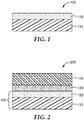
- Release article 100 includes release layer 120 and substrate 110.
- release layer 120 is directly bonded to substrate 110.
- one or more layers e.g., primer layers, may be located between release layer 120 and substrate 110.
- Any known material may be suitable for use in substrate 110 including paper and polymeric films.
- Any of the compositions of the present disclosure may coated on such substrates and cured to provide the release layer. Conventional coating and curing methods are well known, and one of ordinary skill in the art may select those appropriate for the selected condensation-cure composition and substrate selected.
- Adhesive layer 130 is in direct contact with the surface of release layer 120, opposite substrate 110.
- any known adhesive may be used and one of ordinary skill in the art can select an adhesive appropriate for the selected release layer.
- acrylic adhesives may be used.
- adhesive article 200 may also include optional layer 140, which may be adhered directly to adhesive layer 130, opposite release layer 120.
- one or more intervening layers e.g., primer layers, may be present between adhesive layer 130 and optional layer 140.
- Optional layer 140 may be any of a wide variety of known materials including paper, polymeric film, foam, woven and nonwoven webs, scrims, foils (e.g., metal foils), laminates, and combinations thereof.
- silicone-A was a 30 percent solids dispersion of a blend of reactive siloxane polymers in toluene (said to comprise dimethyl siloxane, hydroxy-terminated in toluene). This silanol-functional polyorganosiloxane was obtained from Dow Coming Corporation, Midland, Michigan, under the trade designation SYL-OFF SB 2792.
- Standard-B was a 100 weight percent solids silane crosslinker said to comprise methylhydrogen siloxane. This hydride-functional silane was obtained from Dow Coming Corporation under the trade designation SYL-OFF 7048.
- Fe-Cat was iron (III) 2,4-pentanedionate, an Fe(III) catalyst alternatively known as iron (III) tris(acetylacetonate), or tris(pentane-2,4-dionato-O,O) iron (III). It was obtained from Sigma-Aldrich Chemical Company, St. Louis. Missouri, and was used as a 10 weight percent solution in dichloromethane.
- Ti-Comp was titanium (IV)-2-ethylhexoxide, a Ti(IV) complex alternatively known as tetraoctyltitanate. It was obatined from Gelest, Inc., Morrisville, Pennsylvania.
- Silicone Coat Weight Procedure Silicone coat weights were determined by comparing approximately 3.69 centimeter diameter samples of coated and uncoated substrates using an EDXRF spectrophotometer (obtained from Oxford Instruments, Elk Grove Village, Illinois under trade designation OXFORD LAB X3000).
- the silicone coat weight of a 3.69 centimeter diameter sample of coated substrate was determined according to the Silicone Coat Weight Procedure.
- the coated substrate sample was then immersed in and shaken with methyl isobutyl ketone (MIBK) for 5 minutes, removed, and allowed to dry.
- the silicone coating weight was measured again according to the Silicone Coat Weight Procedure.
- the exemplary release liners prepared as described below were coated with an acrylic radiation-sensitive syrup (90 parts by weight isooctyl acrylate and 10 parts by weight acrylic acid) with a notched bar coater to form a continuous coating of acrylic syrup nominally 50 micrometers thick.
- the resulting "wet" coating was then polymerized to more than 95 % conversion by exposing the acrylic syrup to UV-A irradiation from 20W 350BL lamps (available from Osram Sylvania, Danvers, MA) in a nitrogen-inerted environment.
- UV-A irradiation from 20W 350BL lamps (available from Osram Sylvania, Danvers, MA) in a nitrogen-inerted environment.
- the polymerized syrup formed a pressure-sensitive adhesive (PSA) transfer tape on the release liner.
- PSA pressure-sensitive adhesive
- a 2.54 centimeter wide and approximately 20 centimeter in length sample of the adhesive transfer tape was cut using a specimen razor cutter.
- the cut sample was applied with its exposed adhesive side down and lengthwise onto the platen surface of a peel adhesion tester (Slip/Peel Tester, Model 3M90, obtained from Instrumentors, Incorporated, Strongsville, Ohio).
- the applied sample was rubbed down on the test panel using light thumb pressure.
- the adhesive transfer tape on the platen surface was then rolled twice with a 2 kilograms rubber roller at a rate of 61 centimeter/minute.
- the release liner was carefully lifted away from the adhesive transfer tape on the platen surface, doubled-back at an angle of 180 degrees, and secured to clamp of the peel adhesion tester.
- the 180 degree angle release liner peel adhesion strength was then measured at a peel rate of 38.1 millimeters/second.
- a minimum of two test specimens were evaluated with results obtained in gram/inch which were used to calculate the average peel force. This average value was then converted to Newtons per meter (N/m). All release tests were carried out in a facility at constant temperature (23 °C) and constant relative humidity (50 percent).
- Table 1 summarizes the compositions and results of the Comparative Examples, which contained either an iron catalyst or a titanium complex alone.
- Table 2 summarizes the compositions and results of the Examples, which contained a combination of an Fe(III) catalyst and a Ti(IV) complex.
- Table 1 Composition and Percent Extractables of the Comparative Examples.
- CE-1 CE-2 CE-3 CE-4 CE-5 CE-6 Heptane (g) 12 12 12 12 12 12 12 Silicone-A (g) 3.0 3.0 3.0 3.0 3.0 Silicone-B (g) 0.1 0.1 0.1 0.1 0.1 0.1 Fe-Cat (wt.%) 1 1.5 2 3 - - Ti-Comp (wt.%) - - - - 2.5 5 Extractables (wt.%) 33 28 20 12 90 87 Table 2 : Composition and Percent Extractables of the Examples.
- EX-1 EX-2 EX-3 EX-4 EX-5 EX-6 EX-7 Heptane (g) 12 12 12 12 12 12 12 Silicone-A (g) 3.0 3.0 3.0 3.0 3.0 3.0 Silicone-B (g) 0.1 0.1 0.1 0.1 0.1 0.1 0.1 0.1 0.1 Fe-Cat (wt.%) 1.5 2 3 1 1.5 2 3 Ti-Cat (wt.%) 2.5 2.5 2.5 5 5 5 5 Extractables (wt.%) 23 19 9 23 18 16 7
Landscapes
- Chemical & Material Sciences (AREA)
- Organic Chemistry (AREA)
- Chemical Kinetics & Catalysis (AREA)
- Health & Medical Sciences (AREA)
- Medicinal Chemistry (AREA)
- Polymers & Plastics (AREA)
- Materials Engineering (AREA)
- Engineering & Computer Science (AREA)
- Life Sciences & Earth Sciences (AREA)
- Wood Science & Technology (AREA)
- Adhesives Or Adhesive Processes (AREA)
- Compositions Of Macromolecular Compounds (AREA)
- Paints Or Removers (AREA)
- Silicon Polymers (AREA)
- Catalysts (AREA)
- Adhesive Tapes (AREA)
Applications Claiming Priority (2)
| Application Number | Priority Date | Filing Date | Title |
|---|---|---|---|
| US201261706852P | 2012-09-28 | 2012-09-28 | |
| PCT/US2012/071013 WO2014051650A1 (en) | 2012-09-28 | 2012-12-20 | Dual condensation cure silicone |
Publications (2)
| Publication Number | Publication Date |
|---|---|
| EP2900732A1 EP2900732A1 (en) | 2015-08-05 |
| EP2900732B1 true EP2900732B1 (en) | 2017-09-13 |
Family
ID=47521180
Family Applications (1)
| Application Number | Title | Priority Date | Filing Date |
|---|---|---|---|
| EP12812795.8A Not-in-force EP2900732B1 (en) | 2012-09-28 | 2012-12-20 | Dual condensation cure silicone |
Country Status (6)
| Country | Link |
|---|---|
| US (1) | US20150252236A1 (enExample) |
| EP (1) | EP2900732B1 (enExample) |
| JP (1) | JP6110497B2 (enExample) |
| KR (1) | KR20150065745A (enExample) |
| CN (1) | CN104736604A (enExample) |
| WO (1) | WO2014051650A1 (enExample) |
Families Citing this family (3)
| Publication number | Priority date | Publication date | Assignee | Title |
|---|---|---|---|---|
| CN116802227A (zh) * | 2020-12-06 | 2023-09-22 | 迈图高新材料公司 | 包含非有机锡催化剂的固化性有机硅涂料 |
| JP7875416B2 (ja) * | 2021-12-02 | 2026-06-18 | エルジー・ケム・リミテッド | 硬化性組成物、保護フィルム、光学素子及び液晶ディスプレイ装置 |
| US20260092077A1 (en) * | 2024-09-30 | 2026-04-02 | Canon Kabushiki Kaisha | Laminate containing an adhesion promoter layer and method of making the laminate |
Family Cites Families (17)
| Publication number | Priority date | Publication date | Assignee | Title |
|---|---|---|---|---|
| US4534928A (en) * | 1983-12-19 | 1985-08-13 | Dow Corning Corporation | Molding process using room temperature curing silicone coatings to provide multiple release of articles |
| US4898903A (en) * | 1989-03-14 | 1990-02-06 | Dow Corning Corporation | Thermally stable fluorinated organosiloxane gel composition |
| US5545831A (en) * | 1993-10-22 | 1996-08-13 | Dow Corning Toray Silicone Co., Ltd. | Silicone compositions for the formation of cured release coatings |
| GB9919083D0 (en) * | 1999-08-13 | 1999-10-13 | Dow Corning | Silicone coated textile fabrics |
| US6281305B1 (en) * | 1999-11-05 | 2001-08-28 | Bridgestone Corporation | Iron-based catalyst for producing oligomers of conjugated dienes |
| DE10103446C5 (de) * | 2001-01-25 | 2007-06-28 | Kettenbach Gmbh & Co. Kg | Zweistufig härtbare mischergängige Materialien |
| US6482888B1 (en) * | 2001-06-06 | 2002-11-19 | Dow Corning Corporation | Silicone composition and cured silicone product |
| JP4440517B2 (ja) * | 2002-05-07 | 2010-03-24 | 信越化学工業株式会社 | 室温硬化性オルガノポリシロキサン組成物及び該組成物を接着剤として用いた部品 |
| JP5534640B2 (ja) * | 2007-12-27 | 2014-07-02 | 東レ・ダウコーニング株式会社 | シリコーン系感圧接着剤組成物、感圧接着シートおよびシリコーンゴム積層体 |
| FR2946981A1 (fr) * | 2009-06-19 | 2010-12-24 | Bluestar Silicones France | Composition silicone reticulable par deshydrogenocondensation en presence d'un catalyseur metallique |
| JP5447284B2 (ja) * | 2009-08-19 | 2014-03-19 | 旭硝子株式会社 | 硬化性組成物、粘着体、粘着積層体および粘着体の製造方法 |
| JP2012021131A (ja) * | 2010-06-18 | 2012-02-02 | Mitsubishi Chemicals Corp | 半導体発光デバイス部材用2液型硬化性ポリオルガノシロキサン組成物、該組成物を硬化させてなるポリオルガノシロキサン硬化物及びその製造方法 |
| CN102002240B (zh) * | 2010-11-22 | 2012-09-26 | 绵阳惠利电子材料有限公司 | 一种阻燃脱醇型室温固化硅橡胶 |
| US20140182483A1 (en) * | 2011-09-20 | 2014-07-03 | Dow Corning Corporation | Titanium Containing Hydrosilylation Catalysts And Compositions Containing The Catalysts |
| CN103842441B (zh) * | 2011-10-04 | 2015-12-23 | 道康宁公司 | 含铁(iii)络合物和缩合反应催化剂、制备该催化剂的方法及含有该催化剂的组合物 |
| CN104254559A (zh) * | 2011-12-20 | 2014-12-31 | 3M创新有限公司 | 铂催化的缩合固化硅酮体系 |
| JP2015508433A (ja) * | 2011-12-20 | 2015-03-19 | スリーエム イノベイティブ プロパティズ カンパニー | 二重縮合硬化シリコーン |
-
2012
- 2012-12-20 US US14/431,236 patent/US20150252236A1/en not_active Abandoned
- 2012-12-20 JP JP2015534456A patent/JP6110497B2/ja not_active Expired - Fee Related
- 2012-12-20 EP EP12812795.8A patent/EP2900732B1/en not_active Not-in-force
- 2012-12-20 WO PCT/US2012/071013 patent/WO2014051650A1/en not_active Ceased
- 2012-12-20 CN CN201280076127.0A patent/CN104736604A/zh active Pending
- 2012-12-20 KR KR1020157010389A patent/KR20150065745A/ko not_active Abandoned
Non-Patent Citations (1)
| Title |
|---|
| None * |
Also Published As
| Publication number | Publication date |
|---|---|
| JP6110497B2 (ja) | 2017-04-05 |
| EP2900732A1 (en) | 2015-08-05 |
| US20150252236A1 (en) | 2015-09-10 |
| JP2016501916A (ja) | 2016-01-21 |
| KR20150065745A (ko) | 2015-06-15 |
| CN104736604A (zh) | 2015-06-24 |
| WO2014051650A1 (en) | 2014-04-03 |
Similar Documents
| Publication | Publication Date | Title |
|---|---|---|
| JP3098946B2 (ja) | 剥離性硬化皮膜形成性オルガノポリシロキサン組成物 | |
| EP0446030B1 (en) | Solventless silicone release coating | |
| JP5868177B2 (ja) | 電子ビーム硬化される非官能化シリコーン感圧接着剤 | |
| JP6594991B2 (ja) | 硬化性オルガノポリシロキサン組成物、該組成物の使用、及び該組成物から作製した積層体 | |
| JP3781105B2 (ja) | シリコーン組成物及びこれを用いた剥離フィルム | |
| US20140356620A1 (en) | Dual condensation cure silicone | |
| EP0165059B1 (en) | Low-surface energy material | |
| CN104685013A (zh) | 可固化有机聚硅氧烷组合物、具有由所述组合物形成的固化层的片状制品以及层合材料 | |
| KR20150068391A (ko) | 경화성 오가노폴리실록산 조성물, 상기 조성물로부터 형성된 경화층을 갖는 시트형 물품, 및 라미네이트 | |
| TWI765957B (zh) | 無溶劑型矽酮組成物、剝離紙以及剝離膜 | |
| EP3824882B1 (en) | Addition reaction-curable silicone adhesive composition for skin patch and adhesive tape for skin patch | |
| US20140314985A1 (en) | Platinum-catalyzed Condensation-cure Silicone Systems | |
| EP3999604B1 (en) | Additive organopolysiloxane composition, curable composition, and film | |
| US20150252236A1 (en) | Dual Condensation Cure Silicone | |
| JP3891260B2 (ja) | 硬化性シリコ−ン剥離剤組成物及び剥離紙 | |
| JPH0711228A (ja) | シリコーン粘着剤組成物、粘着テープ及び粘着方法 | |
| JPH01217068A (ja) | 離型性組成物 | |
| JP7842855B2 (ja) | シリコーン粘着剤組成物、粘着テープおよび粘着フィルム | |
| JP2007284685A (ja) | シリコーン剥離剤組成物及び剥離紙 | |
| JP2002161208A (ja) | シリコーン剥離剤組成物及び剥離紙 | |
| JPH0797520A (ja) | オルガノポリシロキサン組成物 | |
| KR20040082725A (ko) | 프라이머 조성물 |
Legal Events
| Date | Code | Title | Description |
|---|---|---|---|
| PUAI | Public reference made under article 153(3) epc to a published international application that has entered the european phase |
Free format text: ORIGINAL CODE: 0009012 |
|
| 17P | Request for examination filed |
Effective date: 20150413 |
|
| AK | Designated contracting states |
Kind code of ref document: A1 Designated state(s): AL AT BE BG CH CY CZ DE DK EE ES FI FR GB GR HR HU IE IS IT LI LT LU LV MC MK MT NL NO PL PT RO RS SE SI SK SM TR |
|
| AX | Request for extension of the european patent |
Extension state: BA ME |
|
| DAX | Request for extension of the european patent (deleted) | ||
| 17Q | First examination report despatched |
Effective date: 20160122 |
|
| GRAP | Despatch of communication of intention to grant a patent |
Free format text: ORIGINAL CODE: EPIDOSNIGR1 |
|
| STAA | Information on the status of an ep patent application or granted ep patent |
Free format text: STATUS: GRANT OF PATENT IS INTENDED |
|
| INTG | Intention to grant announced |
Effective date: 20170322 |
|
| GRAS | Grant fee paid |
Free format text: ORIGINAL CODE: EPIDOSNIGR3 |
|
| GRAA | (expected) grant |
Free format text: ORIGINAL CODE: 0009210 |
|
| STAA | Information on the status of an ep patent application or granted ep patent |
Free format text: STATUS: THE PATENT HAS BEEN GRANTED |
|
| AK | Designated contracting states |
Kind code of ref document: B1 Designated state(s): AL AT BE BG CH CY CZ DE DK EE ES FI FR GB GR HR HU IE IS IT LI LT LU LV MC MK MT NL NO PL PT RO RS SE SI SK SM TR |
|
| REG | Reference to a national code |
Ref country code: GB Ref legal event code: FG4D |
|
| REG | Reference to a national code |
Ref country code: CH Ref legal event code: EP |
|
| REG | Reference to a national code |
Ref country code: IE Ref legal event code: FG4D |
|
| REG | Reference to a national code |
Ref country code: AT Ref legal event code: REF Ref document number: 928070 Country of ref document: AT Kind code of ref document: T Effective date: 20171015 |
|
| REG | Reference to a national code |
Ref country code: DE Ref legal event code: R096 Ref document number: 602012037384 Country of ref document: DE |
|
| REG | Reference to a national code |
Ref country code: NL Ref legal event code: MP Effective date: 20170913 |
|
| REG | Reference to a national code |
Ref country code: LT Ref legal event code: MG4D |
|
| PG25 | Lapsed in a contracting state [announced via postgrant information from national office to epo] |
Ref country code: SE Free format text: LAPSE BECAUSE OF FAILURE TO SUBMIT A TRANSLATION OF THE DESCRIPTION OR TO PAY THE FEE WITHIN THE PRESCRIBED TIME-LIMIT Effective date: 20170913 Ref country code: HR Free format text: LAPSE BECAUSE OF FAILURE TO SUBMIT A TRANSLATION OF THE DESCRIPTION OR TO PAY THE FEE WITHIN THE PRESCRIBED TIME-LIMIT Effective date: 20170913 Ref country code: FI Free format text: LAPSE BECAUSE OF FAILURE TO SUBMIT A TRANSLATION OF THE DESCRIPTION OR TO PAY THE FEE WITHIN THE PRESCRIBED TIME-LIMIT Effective date: 20170913 Ref country code: NO Free format text: LAPSE BECAUSE OF FAILURE TO SUBMIT A TRANSLATION OF THE DESCRIPTION OR TO PAY THE FEE WITHIN THE PRESCRIBED TIME-LIMIT Effective date: 20171213 Ref country code: LT Free format text: LAPSE BECAUSE OF FAILURE TO SUBMIT A TRANSLATION OF THE DESCRIPTION OR TO PAY THE FEE WITHIN THE PRESCRIBED TIME-LIMIT Effective date: 20170913 |
|
| PGFP | Annual fee paid to national office [announced via postgrant information from national office to epo] |
Ref country code: DE Payment date: 20171212 Year of fee payment: 6 |
|
| REG | Reference to a national code |
Ref country code: AT Ref legal event code: MK05 Ref document number: 928070 Country of ref document: AT Kind code of ref document: T Effective date: 20170913 |
|
| PG25 | Lapsed in a contracting state [announced via postgrant information from national office to epo] |
Ref country code: GR Free format text: LAPSE BECAUSE OF FAILURE TO SUBMIT A TRANSLATION OF THE DESCRIPTION OR TO PAY THE FEE WITHIN THE PRESCRIBED TIME-LIMIT Effective date: 20171214 Ref country code: BG Free format text: LAPSE BECAUSE OF FAILURE TO SUBMIT A TRANSLATION OF THE DESCRIPTION OR TO PAY THE FEE WITHIN THE PRESCRIBED TIME-LIMIT Effective date: 20171213 Ref country code: ES Free format text: LAPSE BECAUSE OF FAILURE TO SUBMIT A TRANSLATION OF THE DESCRIPTION OR TO PAY THE FEE WITHIN THE PRESCRIBED TIME-LIMIT Effective date: 20170913 Ref country code: RS Free format text: LAPSE BECAUSE OF FAILURE TO SUBMIT A TRANSLATION OF THE DESCRIPTION OR TO PAY THE FEE WITHIN THE PRESCRIBED TIME-LIMIT Effective date: 20170913 Ref country code: LV Free format text: LAPSE BECAUSE OF FAILURE TO SUBMIT A TRANSLATION OF THE DESCRIPTION OR TO PAY THE FEE WITHIN THE PRESCRIBED TIME-LIMIT Effective date: 20170913 |
|
| PG25 | Lapsed in a contracting state [announced via postgrant information from national office to epo] |
Ref country code: NL Free format text: LAPSE BECAUSE OF FAILURE TO SUBMIT A TRANSLATION OF THE DESCRIPTION OR TO PAY THE FEE WITHIN THE PRESCRIBED TIME-LIMIT Effective date: 20170913 |
|
| PG25 | Lapsed in a contracting state [announced via postgrant information from national office to epo] |
Ref country code: RO Free format text: LAPSE BECAUSE OF FAILURE TO SUBMIT A TRANSLATION OF THE DESCRIPTION OR TO PAY THE FEE WITHIN THE PRESCRIBED TIME-LIMIT Effective date: 20170913 Ref country code: CZ Free format text: LAPSE BECAUSE OF FAILURE TO SUBMIT A TRANSLATION OF THE DESCRIPTION OR TO PAY THE FEE WITHIN THE PRESCRIBED TIME-LIMIT Effective date: 20170913 Ref country code: PL Free format text: LAPSE BECAUSE OF FAILURE TO SUBMIT A TRANSLATION OF THE DESCRIPTION OR TO PAY THE FEE WITHIN THE PRESCRIBED TIME-LIMIT Effective date: 20170913 |
|
| PG25 | Lapsed in a contracting state [announced via postgrant information from national office to epo] |
Ref country code: SK Free format text: LAPSE BECAUSE OF FAILURE TO SUBMIT A TRANSLATION OF THE DESCRIPTION OR TO PAY THE FEE WITHIN THE PRESCRIBED TIME-LIMIT Effective date: 20170913 Ref country code: SM Free format text: LAPSE BECAUSE OF FAILURE TO SUBMIT A TRANSLATION OF THE DESCRIPTION OR TO PAY THE FEE WITHIN THE PRESCRIBED TIME-LIMIT Effective date: 20170913 Ref country code: EE Free format text: LAPSE BECAUSE OF FAILURE TO SUBMIT A TRANSLATION OF THE DESCRIPTION OR TO PAY THE FEE WITHIN THE PRESCRIBED TIME-LIMIT Effective date: 20170913 Ref country code: IT Free format text: LAPSE BECAUSE OF FAILURE TO SUBMIT A TRANSLATION OF THE DESCRIPTION OR TO PAY THE FEE WITHIN THE PRESCRIBED TIME-LIMIT Effective date: 20170913 Ref country code: AT Free format text: LAPSE BECAUSE OF FAILURE TO SUBMIT A TRANSLATION OF THE DESCRIPTION OR TO PAY THE FEE WITHIN THE PRESCRIBED TIME-LIMIT Effective date: 20170913 Ref country code: IS Free format text: LAPSE BECAUSE OF FAILURE TO SUBMIT A TRANSLATION OF THE DESCRIPTION OR TO PAY THE FEE WITHIN THE PRESCRIBED TIME-LIMIT Effective date: 20180113 |
|
| REG | Reference to a national code |
Ref country code: DE Ref legal event code: R097 Ref document number: 602012037384 Country of ref document: DE |
|
| PLBE | No opposition filed within time limit |
Free format text: ORIGINAL CODE: 0009261 |
|
| STAA | Information on the status of an ep patent application or granted ep patent |
Free format text: STATUS: NO OPPOSITION FILED WITHIN TIME LIMIT |
|
| PG25 | Lapsed in a contracting state [announced via postgrant information from national office to epo] |
Ref country code: DK Free format text: LAPSE BECAUSE OF FAILURE TO SUBMIT A TRANSLATION OF THE DESCRIPTION OR TO PAY THE FEE WITHIN THE PRESCRIBED TIME-LIMIT Effective date: 20170913 |
|
| REG | Reference to a national code |
Ref country code: CH Ref legal event code: PL |
|
| 26N | No opposition filed |
Effective date: 20180614 |
|
| GBPC | Gb: european patent ceased through non-payment of renewal fee |
Effective date: 20171220 |
|
| REG | Reference to a national code |
Ref country code: IE Ref legal event code: MM4A |
|
| PG25 | Lapsed in a contracting state [announced via postgrant information from national office to epo] |
Ref country code: MT Free format text: LAPSE BECAUSE OF NON-PAYMENT OF DUE FEES Effective date: 20171220 Ref country code: LU Free format text: LAPSE BECAUSE OF NON-PAYMENT OF DUE FEES Effective date: 20171220 |
|
| REG | Reference to a national code |
Ref country code: FR Ref legal event code: ST Effective date: 20180831 |
|
| REG | Reference to a national code |
Ref country code: BE Ref legal event code: MM Effective date: 20171231 |
|
| PG25 | Lapsed in a contracting state [announced via postgrant information from national office to epo] |
Ref country code: FR Free format text: LAPSE BECAUSE OF NON-PAYMENT OF DUE FEES Effective date: 20180102 Ref country code: IE Free format text: LAPSE BECAUSE OF NON-PAYMENT OF DUE FEES Effective date: 20171220 |
|
| PG25 | Lapsed in a contracting state [announced via postgrant information from national office to epo] |
Ref country code: LI Free format text: LAPSE BECAUSE OF NON-PAYMENT OF DUE FEES Effective date: 20171231 Ref country code: GB Free format text: LAPSE BECAUSE OF NON-PAYMENT OF DUE FEES Effective date: 20171220 Ref country code: SI Free format text: LAPSE BECAUSE OF FAILURE TO SUBMIT A TRANSLATION OF THE DESCRIPTION OR TO PAY THE FEE WITHIN THE PRESCRIBED TIME-LIMIT Effective date: 20170913 Ref country code: BE Free format text: LAPSE BECAUSE OF NON-PAYMENT OF DUE FEES Effective date: 20171231 Ref country code: CH Free format text: LAPSE BECAUSE OF NON-PAYMENT OF DUE FEES Effective date: 20171231 |
|
| PG25 | Lapsed in a contracting state [announced via postgrant information from national office to epo] |
Ref country code: MC Free format text: LAPSE BECAUSE OF FAILURE TO SUBMIT A TRANSLATION OF THE DESCRIPTION OR TO PAY THE FEE WITHIN THE PRESCRIBED TIME-LIMIT Effective date: 20170913 Ref country code: HU Free format text: LAPSE BECAUSE OF FAILURE TO SUBMIT A TRANSLATION OF THE DESCRIPTION OR TO PAY THE FEE WITHIN THE PRESCRIBED TIME-LIMIT; INVALID AB INITIO Effective date: 20121220 |
|
| REG | Reference to a national code |
Ref country code: DE Ref legal event code: R119 Ref document number: 602012037384 Country of ref document: DE |
|
| PG25 | Lapsed in a contracting state [announced via postgrant information from national office to epo] |
Ref country code: DE Free format text: LAPSE BECAUSE OF NON-PAYMENT OF DUE FEES Effective date: 20190702 Ref country code: CY Free format text: LAPSE BECAUSE OF FAILURE TO SUBMIT A TRANSLATION OF THE DESCRIPTION OR TO PAY THE FEE WITHIN THE PRESCRIBED TIME-LIMIT Effective date: 20170913 |
|
| PG25 | Lapsed in a contracting state [announced via postgrant information from national office to epo] |
Ref country code: MK Free format text: LAPSE BECAUSE OF FAILURE TO SUBMIT A TRANSLATION OF THE DESCRIPTION OR TO PAY THE FEE WITHIN THE PRESCRIBED TIME-LIMIT Effective date: 20170913 |
|
| PG25 | Lapsed in a contracting state [announced via postgrant information from national office to epo] |
Ref country code: TR Free format text: LAPSE BECAUSE OF FAILURE TO SUBMIT A TRANSLATION OF THE DESCRIPTION OR TO PAY THE FEE WITHIN THE PRESCRIBED TIME-LIMIT Effective date: 20170913 |
|
| PG25 | Lapsed in a contracting state [announced via postgrant information from national office to epo] |
Ref country code: PT Free format text: LAPSE BECAUSE OF FAILURE TO SUBMIT A TRANSLATION OF THE DESCRIPTION OR TO PAY THE FEE WITHIN THE PRESCRIBED TIME-LIMIT Effective date: 20170913 |
|
| PG25 | Lapsed in a contracting state [announced via postgrant information from national office to epo] |
Ref country code: AL Free format text: LAPSE BECAUSE OF FAILURE TO SUBMIT A TRANSLATION OF THE DESCRIPTION OR TO PAY THE FEE WITHIN THE PRESCRIBED TIME-LIMIT Effective date: 20170913 |