EP2869802B1 - Tampon für zwischenmenstruationstage - Google Patents
Tampon für zwischenmenstruationstage Download PDFInfo
- Publication number
- EP2869802B1 EP2869802B1 EP13734750.6A EP13734750A EP2869802B1 EP 2869802 B1 EP2869802 B1 EP 2869802B1 EP 13734750 A EP13734750 A EP 13734750A EP 2869802 B1 EP2869802 B1 EP 2869802B1
- Authority
- EP
- European Patent Office
- Prior art keywords
- tampon
- absorbent body
- absorbent
- grooves
- core region
- Prior art date
- Legal status (The legal status is an assumption and is not a legal conclusion. Google has not performed a legal analysis and makes no representation as to the accuracy of the status listed.)
- Active
Links
Images



Classifications
-
- A—HUMAN NECESSITIES
- A61—MEDICAL OR VETERINARY SCIENCE; HYGIENE
- A61F—FILTERS IMPLANTABLE INTO BLOOD VESSELS; PROSTHESES; DEVICES PROVIDING PATENCY TO, OR PREVENTING COLLAPSING OF, TUBULAR STRUCTURES OF THE BODY, e.g. STENTS; ORTHOPAEDIC, NURSING OR CONTRACEPTIVE DEVICES; FOMENTATION; TREATMENT OR PROTECTION OF EYES OR EARS; BANDAGES, DRESSINGS OR ABSORBENT PADS; FIRST-AID KITS
- A61F13/00—Bandages or dressings; Absorbent pads
- A61F13/15—Absorbent pads, e.g. sanitary towels, swabs or tampons for external or internal application to the body; Supporting or fastening means therefor; Tampon applicators
- A61F13/15203—Properties of the article, e.g. stiffness or absorbency
-
- A—HUMAN NECESSITIES
- A61—MEDICAL OR VETERINARY SCIENCE; HYGIENE
- A61F—FILTERS IMPLANTABLE INTO BLOOD VESSELS; PROSTHESES; DEVICES PROVIDING PATENCY TO, OR PREVENTING COLLAPSING OF, TUBULAR STRUCTURES OF THE BODY, e.g. STENTS; ORTHOPAEDIC, NURSING OR CONTRACEPTIVE DEVICES; FOMENTATION; TREATMENT OR PROTECTION OF EYES OR EARS; BANDAGES, DRESSINGS OR ABSORBENT PADS; FIRST-AID KITS
- A61F13/00—Bandages or dressings; Absorbent pads
- A61F13/15—Absorbent pads, e.g. sanitary towels, swabs or tampons for external or internal application to the body; Supporting or fastening means therefor; Tampon applicators
- A61F13/20—Tampons, e.g. catamenial tampons; Accessories therefor
- A61F13/2002—Tampons, e.g. catamenial tampons; Accessories therefor characterised by the use
-
- A—HUMAN NECESSITIES
- A61—MEDICAL OR VETERINARY SCIENCE; HYGIENE
- A61F—FILTERS IMPLANTABLE INTO BLOOD VESSELS; PROSTHESES; DEVICES PROVIDING PATENCY TO, OR PREVENTING COLLAPSING OF, TUBULAR STRUCTURES OF THE BODY, e.g. STENTS; ORTHOPAEDIC, NURSING OR CONTRACEPTIVE DEVICES; FOMENTATION; TREATMENT OR PROTECTION OF EYES OR EARS; BANDAGES, DRESSINGS OR ABSORBENT PADS; FIRST-AID KITS
- A61F13/00—Bandages or dressings; Absorbent pads
- A61F13/15—Absorbent pads, e.g. sanitary towels, swabs or tampons for external or internal application to the body; Supporting or fastening means therefor; Tampon applicators
- A61F13/20—Tampons, e.g. catamenial tampons; Accessories therefor
- A61F13/2002—Tampons, e.g. catamenial tampons; Accessories therefor characterised by the use
- A61F13/202—Catamenial tampons
-
- A—HUMAN NECESSITIES
- A61—MEDICAL OR VETERINARY SCIENCE; HYGIENE
- A61F—FILTERS IMPLANTABLE INTO BLOOD VESSELS; PROSTHESES; DEVICES PROVIDING PATENCY TO, OR PREVENTING COLLAPSING OF, TUBULAR STRUCTURES OF THE BODY, e.g. STENTS; ORTHOPAEDIC, NURSING OR CONTRACEPTIVE DEVICES; FOMENTATION; TREATMENT OR PROTECTION OF EYES OR EARS; BANDAGES, DRESSINGS OR ABSORBENT PADS; FIRST-AID KITS
- A61F13/00—Bandages or dressings; Absorbent pads
- A61F13/15—Absorbent pads, e.g. sanitary towels, swabs or tampons for external or internal application to the body; Supporting or fastening means therefor; Tampon applicators
- A61F13/20—Tampons, e.g. catamenial tampons; Accessories therefor
- A61F13/2022—Tampons, e.g. catamenial tampons; Accessories therefor characterised by the shape
-
- A—HUMAN NECESSITIES
- A61—MEDICAL OR VETERINARY SCIENCE; HYGIENE
- A61F—FILTERS IMPLANTABLE INTO BLOOD VESSELS; PROSTHESES; DEVICES PROVIDING PATENCY TO, OR PREVENTING COLLAPSING OF, TUBULAR STRUCTURES OF THE BODY, e.g. STENTS; ORTHOPAEDIC, NURSING OR CONTRACEPTIVE DEVICES; FOMENTATION; TREATMENT OR PROTECTION OF EYES OR EARS; BANDAGES, DRESSINGS OR ABSORBENT PADS; FIRST-AID KITS
- A61F13/00—Bandages or dressings; Absorbent pads
- A61F13/15—Absorbent pads, e.g. sanitary towels, swabs or tampons for external or internal application to the body; Supporting or fastening means therefor; Tampon applicators
- A61F13/20—Tampons, e.g. catamenial tampons; Accessories therefor
- A61F13/2022—Tampons, e.g. catamenial tampons; Accessories therefor characterised by the shape
- A61F13/2034—Tampons, e.g. catamenial tampons; Accessories therefor characterised by the shape having grooves or ribs, having a main axis in the longitudinal direction
-
- A—HUMAN NECESSITIES
- A61—MEDICAL OR VETERINARY SCIENCE; HYGIENE
- A61F—FILTERS IMPLANTABLE INTO BLOOD VESSELS; PROSTHESES; DEVICES PROVIDING PATENCY TO, OR PREVENTING COLLAPSING OF, TUBULAR STRUCTURES OF THE BODY, e.g. STENTS; ORTHOPAEDIC, NURSING OR CONTRACEPTIVE DEVICES; FOMENTATION; TREATMENT OR PROTECTION OF EYES OR EARS; BANDAGES, DRESSINGS OR ABSORBENT PADS; FIRST-AID KITS
- A61F13/00—Bandages or dressings; Absorbent pads
- A61F13/15—Absorbent pads, e.g. sanitary towels, swabs or tampons for external or internal application to the body; Supporting or fastening means therefor; Tampon applicators
- A61F13/20—Tampons, e.g. catamenial tampons; Accessories therefor
- A61F13/2022—Tampons, e.g. catamenial tampons; Accessories therefor characterised by the shape
- A61F13/2042—Tampons, e.g. catamenial tampons; Accessories therefor characterised by the shape having a central tubular opening
-
- A—HUMAN NECESSITIES
- A61—MEDICAL OR VETERINARY SCIENCE; HYGIENE
- A61F—FILTERS IMPLANTABLE INTO BLOOD VESSELS; PROSTHESES; DEVICES PROVIDING PATENCY TO, OR PREVENTING COLLAPSING OF, TUBULAR STRUCTURES OF THE BODY, e.g. STENTS; ORTHOPAEDIC, NURSING OR CONTRACEPTIVE DEVICES; FOMENTATION; TREATMENT OR PROTECTION OF EYES OR EARS; BANDAGES, DRESSINGS OR ABSORBENT PADS; FIRST-AID KITS
- A61F13/00—Bandages or dressings; Absorbent pads
- A61F13/15—Absorbent pads, e.g. sanitary towels, swabs or tampons for external or internal application to the body; Supporting or fastening means therefor; Tampon applicators
- A61F13/20—Tampons, e.g. catamenial tampons; Accessories therefor
- A61F13/2051—Tampons, e.g. catamenial tampons; Accessories therefor characterised by the material or the structure of the inner absorbing core
-
- A—HUMAN NECESSITIES
- A61—MEDICAL OR VETERINARY SCIENCE; HYGIENE
- A61F—FILTERS IMPLANTABLE INTO BLOOD VESSELS; PROSTHESES; DEVICES PROVIDING PATENCY TO, OR PREVENTING COLLAPSING OF, TUBULAR STRUCTURES OF THE BODY, e.g. STENTS; ORTHOPAEDIC, NURSING OR CONTRACEPTIVE DEVICES; FOMENTATION; TREATMENT OR PROTECTION OF EYES OR EARS; BANDAGES, DRESSINGS OR ABSORBENT PADS; FIRST-AID KITS
- A61F13/00—Bandages or dressings; Absorbent pads
- A61F13/15—Absorbent pads, e.g. sanitary towels, swabs or tampons for external or internal application to the body; Supporting or fastening means therefor; Tampon applicators
- A61F13/20—Tampons, e.g. catamenial tampons; Accessories therefor
- A61F13/2051—Tampons, e.g. catamenial tampons; Accessories therefor characterised by the material or the structure of the inner absorbing core
- A61F13/2057—Tampons, e.g. catamenial tampons; Accessories therefor characterised by the material or the structure of the inner absorbing core made of foam
-
- A—HUMAN NECESSITIES
- A61—MEDICAL OR VETERINARY SCIENCE; HYGIENE
- A61F—FILTERS IMPLANTABLE INTO BLOOD VESSELS; PROSTHESES; DEVICES PROVIDING PATENCY TO, OR PREVENTING COLLAPSING OF, TUBULAR STRUCTURES OF THE BODY, e.g. STENTS; ORTHOPAEDIC, NURSING OR CONTRACEPTIVE DEVICES; FOMENTATION; TREATMENT OR PROTECTION OF EYES OR EARS; BANDAGES, DRESSINGS OR ABSORBENT PADS; FIRST-AID KITS
- A61F13/00—Bandages or dressings; Absorbent pads
- A61F13/15—Absorbent pads, e.g. sanitary towels, swabs or tampons for external or internal application to the body; Supporting or fastening means therefor; Tampon applicators
- A61F13/20—Tampons, e.g. catamenial tampons; Accessories therefor
- A61F13/2051—Tampons, e.g. catamenial tampons; Accessories therefor characterised by the material or the structure of the inner absorbing core
- A61F13/206—Tampons made of rolled-up material
-
- A—HUMAN NECESSITIES
- A61—MEDICAL OR VETERINARY SCIENCE; HYGIENE
- A61F—FILTERS IMPLANTABLE INTO BLOOD VESSELS; PROSTHESES; DEVICES PROVIDING PATENCY TO, OR PREVENTING COLLAPSING OF, TUBULAR STRUCTURES OF THE BODY, e.g. STENTS; ORTHOPAEDIC, NURSING OR CONTRACEPTIVE DEVICES; FOMENTATION; TREATMENT OR PROTECTION OF EYES OR EARS; BANDAGES, DRESSINGS OR ABSORBENT PADS; FIRST-AID KITS
- A61F13/00—Bandages or dressings; Absorbent pads
- A61F13/15—Absorbent pads, e.g. sanitary towels, swabs or tampons for external or internal application to the body; Supporting or fastening means therefor; Tampon applicators
- A61F13/20—Tampons, e.g. catamenial tampons; Accessories therefor
- A61F13/2074—Tampons, e.g. catamenial tampons; Accessories therefor impregnated with hydrophobic, hydrophilic, skin enhancers, medicinal etc. substances
-
- A—HUMAN NECESSITIES
- A61—MEDICAL OR VETERINARY SCIENCE; HYGIENE
- A61F—FILTERS IMPLANTABLE INTO BLOOD VESSELS; PROSTHESES; DEVICES PROVIDING PATENCY TO, OR PREVENTING COLLAPSING OF, TUBULAR STRUCTURES OF THE BODY, e.g. STENTS; ORTHOPAEDIC, NURSING OR CONTRACEPTIVE DEVICES; FOMENTATION; TREATMENT OR PROTECTION OF EYES OR EARS; BANDAGES, DRESSINGS OR ABSORBENT PADS; FIRST-AID KITS
- A61F13/00—Bandages or dressings; Absorbent pads
- A61F13/15—Absorbent pads, e.g. sanitary towels, swabs or tampons for external or internal application to the body; Supporting or fastening means therefor; Tampon applicators
- A61F13/56—Supporting or fastening means
- A61F13/64—Straps, belts, ties or endless bands
-
- A—HUMAN NECESSITIES
- A61—MEDICAL OR VETERINARY SCIENCE; HYGIENE
- A61F—FILTERS IMPLANTABLE INTO BLOOD VESSELS; PROSTHESES; DEVICES PROVIDING PATENCY TO, OR PREVENTING COLLAPSING OF, TUBULAR STRUCTURES OF THE BODY, e.g. STENTS; ORTHOPAEDIC, NURSING OR CONTRACEPTIVE DEVICES; FOMENTATION; TREATMENT OR PROTECTION OF EYES OR EARS; BANDAGES, DRESSINGS OR ABSORBENT PADS; FIRST-AID KITS
- A61F13/00—Bandages or dressings; Absorbent pads
- A61F13/15—Absorbent pads, e.g. sanitary towels, swabs or tampons for external or internal application to the body; Supporting or fastening means therefor; Tampon applicators
- A61F13/15203—Properties of the article, e.g. stiffness or absorbency
- A61F2013/15284—Properties of the article, e.g. stiffness or absorbency characterized by quantifiable properties
- A61F2013/15365—Dimensions
-
- A—HUMAN NECESSITIES
- A61—MEDICAL OR VETERINARY SCIENCE; HYGIENE
- A61F—FILTERS IMPLANTABLE INTO BLOOD VESSELS; PROSTHESES; DEVICES PROVIDING PATENCY TO, OR PREVENTING COLLAPSING OF, TUBULAR STRUCTURES OF THE BODY, e.g. STENTS; ORTHOPAEDIC, NURSING OR CONTRACEPTIVE DEVICES; FOMENTATION; TREATMENT OR PROTECTION OF EYES OR EARS; BANDAGES, DRESSINGS OR ABSORBENT PADS; FIRST-AID KITS
- A61F13/00—Bandages or dressings; Absorbent pads
- A61F13/15—Absorbent pads, e.g. sanitary towels, swabs or tampons for external or internal application to the body; Supporting or fastening means therefor; Tampon applicators
- A61F13/15203—Properties of the article, e.g. stiffness or absorbency
- A61F2013/15284—Properties of the article, e.g. stiffness or absorbency characterized by quantifiable properties
- A61F2013/15463—Absorbency
- A61F2013/15471—Total capacity
Definitions
- the invention relates to a tampon for insectsstruationstage the at least one absorbent body, of which at least a portion of its volume is formed from an absorbent material and having a central part, a proximal end and a distal end and a tampon associated with the extraction means.
- the conventional tampons known in the prior art are used in particular as menstruation tampon and introduced via a body opening, in particular the vagina, whereby the tampon can be placed in this body opening.
- Such tampons are for example from the EP 0 422 660 . EP 0 611 562 . US 2,499,414 . DE 60 2004 003 888 . DE 1 9825 877A . DE 37 39 163A . DE 4 304 505A . CH 248 634A . DE 1187 345A . DE 20 320 992A . DE 10 306 678A . DE 20 2008 020 640A . DE 20 2006 0007A . DE 20 2009 000 983U known.
- the length of the conventional tampon is for example between 40 mm to 70 mm and diameter is greater than 11 mm
- the conventional tampon may be made of absorbent material, highly compressed absorbent material and / or absorbent material. It has a removal means for removal from the body opening, e.g. a pull-back thread.
- the conventional tampon may have marks on its surface, it can be made in different colors. Also, the tampon can be made with a chemical indicator that changes color in certain diseases, such as anemia, diabetes, hepatitis A, B or C, and HIV.
- this tampon is not used every day, but only on menstruation days and undergoes a strong increase in weight during wear by the accumulating in this period of time, high amount of liquid.
- Tampons are known in which the absorbency between 4.4 and 6 g and between 10.85 and 18.40 g.
- WO 0217844 discloses a tampon formed with a volume of absorbent material for receiving less than 6 grams of fluid.
- US 7014637 discloses tampons whose absorbency is reduced by a cavity to avoid toxic shock.
- the present invention is therefore based on the object, an everyday tampon or tampon that can be applied between the individual menstrual phases, cheap wearing properties allows and is preferably inexpensive to produce to create.
- the tampon and / or the absorbent body has a length of less than 40 mm, preferably a length between 40 and 10 mm or between 38 and 30 mm, which also reduces the expansion and the pressure of the tampon against the uterus and thus a seal and a damming the exit opening of the uterus, which can generate considerable discomfort is prevented.
- the absorbent body is formed over its entire volume of an absorbent material, whereby the dimensions of the diameter and the amount of the receivable can be optimized in a tampon.
- the absorbent material is formed from fibrous material, whereby the droplets of the liquid can adhere to the individual fibers and thus a high absorption capacity of the absorbent body of a daily tampon or tampon is achieved.
- the absorbent material is formed from a compressed, fibrous material, as this facilitates the handling of the tampon, in particular the insertion and removal of the tampon.
- the volume of the absorbent material is designed to hold a quantity of liquid between 0.5 g and 4 g, preferably 3.5 g.
- TSS toxic shock syndrome
- a maximum diameter of the absorbent body or of an enveloping body enclosing the absorbent body amounts to a maximum of 10 mm, preferably has a value of between 2 and 10 mm.
- this small diameter also increases the load reduces the musculature of the vagina and achieves a better wearing comfort.
- the sphincter musculature of the bladder is less stressed.
- At least the central part of the absorbent body or an enveloping this enveloping body is cylindrical, whereby a uniform contact with the mucous membranes of the vagina can be achieved.
- the cone or the truncated cone extends continuously from the proximal end to the distal end, whereby the removal of the everyday tampon or tampon can be simplified.
- a core region of fibrous material is arranged, which is formed at the same volume for receiving a smaller amount of liquid, as the material of the absorbent body.
- a core region may be arranged from a material which is formed at the same volume for receiving a smaller amount of liquid than the material of the absorbent body or liquid repellent.
- the amount of liquid to be absorbed can be determined solely by the design and the volume of the absorbent body.
- the fibrous material of the absorbent body has a total weight of not more than 2 g, preferably 1.7 g and a minimum weight of 0.5 g, preferably 0.2 g, since thereby the weight of the filled with liquid Tampons is so low so that the difficulties mentioned in the previous paragraph can be reduced or prevented.
- the absorbent body is formed with a cavity and has an opening in the region of its distal end to this cavity. This makes it possible to produce a uniform absorbent which, by inserting different core areas with different three-dimensional shape, but in particular with different diameters, regardless of whether this is consistent or changing over the entire length, to achieve different outer dimensions of the tampon and still the Absorbance of liquid and the suction effect caused by it can be kept the same.
- the pull-out means is connected to the absorbent body and / or the core region of the tampon, since thereby a secure removal of the tampon from the body cavity can be achieved.
- an outer surface of the absorbent body or the central part is at least partially provided with a sheath, for example a nonwoven. This reduces or eliminates fiber loss and adherence of fibers to the mucous membranes.
- proximal end and the middle part are formed with an at least partially liquid-permeable envelope, for example a nonwoven.
- an at least partially liquid-permeable envelope for example a nonwoven.
- the envelope is formed by a net or a perforated foil.
- the absorbent, fibrous material consists of one or more of materials such as rayon, cotton, cellulose, cellulose wadding, tissue laminates, peat waste, bamboo or chemically reinforced, modified or crosslinked cellulose fibers.
- This fibrous material has high hygroscopes and allows the attachment of high amounts of fluid to the outside of the fibers and is biologically neutral.
- absorbent fibrous materials made by one or more of the following synthetic materials such as polyester fibers, polyolefin fibers, absorbent foams, absorbent sponges, absorbent polymers, capillary channel fibers, synthetic fibers, predominantly open-cell flexible polyurethane foam or fibers or threads of rayon or a structure type of the crystalline modification of cellulose II is formed.
- the core region of the absorbent body within a Hüllnikes or enveloping cylinder is formed over its length with a preferably same diameter (21), preferably less than 4 mm formed or between 4 mm and 1mm is. This creates a more stable absorbent body.
- the absorbent, fibrous material is compressed higher in the core region of the absorbent body than in the other regions of the absorbent body. This also simplifies handling, making the whole body more stable.
- the everyday tampon or tampon is round or rounded at the proximal end. As a result, an easy insertion into a body opening is achieved. This is beneficial for tampon users (e.g., young girls) and dry-sheathed women.
- a further advantageous embodiment provides that the absorbent body is provided with depressions or grooves running in the longitudinal direction thereof and / or that the depressions or grooves in the direction of the longitudinal central axis of the absorbent body are wavy, preferably with a constant height of the amplitude, whereby an enlargement of the Surface of the tampon takes place.
- an increased intake of body fluid is possible because the body can distribute different amounts of body fluid between the consecutive menstrual phases.
- These grooves are also advantageous when using insertion aids for the everyday tampon or tampon.
- Another advantage is achieved in that a plurality of grooves or depressions are distributed in the circumferential direction over the absorbent body. As a result, there is likewise an enlargement of the surface of the tampon, which leads to an increased uptake of body fluid, since the body can distribute different amounts of body fluid between the menstrual phases. For women with increased discharge greater hygiene is given as a panty liner. Also, these grooves are in the use of everyday tampon or tampons insertion aids advantage.
- Another advantage of using the everyday tampon or tampon according to the invention is the strengthening of the pelvic floor.
- the Figures 1 and 2 show a tampon for the insectsmenstruationstage 1 with a dome-shaped proximal end 2, an elongated, cylindrical central part 3, a distal end 4 and a superior this extracting means 5, in particular a thread.
- the cylindrical or frusto-conical middle part 3 extends with substantially constant or expanding or varying diameter 6 to its proximal end 2.
- recesses 9 are formed in the tampon or in the middle part 3, for example by grooves 8 .
- An outer diameter 6 of the absorbent body 16 or of an enveloping body 37 enclosing the absorbent body 16 can be between 2 mm and 14 mm, or 6 to 10 mm or less than 8 mm.
- the enveloping body is a fictitious outer sheath within which the outer circumference of the tampon 1 or the absorbent body 16 is at least partially adjacent or tangent.
- the maximum value of the diameter may be a value between the specified value limits or below the value limit, wherein this maximum value over the entire length 7 of the tampon 1 or at least over a partial area may be constant or optionally also be variable over the length 7 of the tampon 1 or a part of the same within the specified value limits or below a maximum value of the diameter, ie changing.
- Fig. 1 schematically seen the tampon 1 - see dash-dotted line - in the middle part 3 has a circumferential recess 38, for example, a groove or a depression with any other spatial form.
- At least part of the middle part 3 of the absorbent body 16 or an enveloping body 37 enclosing it, or the tampon can be cylindrical. But it is also possible that at least the middle part 3 of the absorbent body 16 or the tampon 1 or an enveloping this envelope body 37 is formed frusto-conical or frustoconical.
- the cylinder or the cone or the truncated cone can also extend continuously from the proximal end to the distal end.
- any changes in cross-section over the length extending to the longitudinal central axis 10 are possible, such as e.g. a wave-shaped course or at least over a part of the circumference circumferential or extending in the longitudinal direction depressions which are arranged within the enveloping body 37.
- distal end refers to those portions of the assembly and their parts farthest from a user's body when the tampon 1 is inserted into a body orifice, eg, the vagina
- proximal end refers to those portions of the assembly and their parts that are closest to a user's body when the tampon is inserted.
- proximal or distal indicate that a particular part or structure of the assembly, or its parts, is closer to the proximal end 2 and the distal end 4, respectively, of the assembly or its parts
- proximal direction or distal direction refer to the directions toward the proximal end 2 and the distal end 4 of the tampon 1, respectively.
- the tampon 1 or at least its middle part 3 may have a substantially cylindrical shape or a cylindrical envelope surface. It is also possible that the middle part tapers from the middle part 3 in the distal and / or proximal direction. This taper can be conical or formed with any spatial form. Especially in the proximal direction of the middle part 3 can also expand.
- the recesses 9 on the outside or in the surface of the tampon 1 can be formed by immediately adjacent or merging a different distance to the central longitudinal central axis 10 of the tampon 1 arranged areas, the areas 11 at a greater distance 12 to the longitudinal central axis 10 ribs and the intermediate regions 13 have grooves.
- the density of the absorbent body of the tampon 1 forming material, in the region 13 of the recess 9 of the density in the region 11 of the recess 9 adjacent increases correspond. But it is also possible that the density in the region 13 of the recesses 9 or in the region 11 of the elevations is higher.
- the outer side or the surface 14 of the tampon 1 can also be formed substantially smooth.
- the outer surface or surface 14 is both the partial surface which is separated from the regions 13 with radial depression 9 e.g. the grooves 8 are formed, as well as the partial surfaces which are formed by the regions 11 which adjoin these regions 13.
- a groove 8 represents a unique area of radial recess 9 on the outside of the tampon 1 which can be defined at least in part by its length, width, depth and orientation. The length of a groove 8 is usually greater than its depth.
- Each of the depressions 9 or grooves 8 can pass through or be interrupted over at least a partial length of the length 7.
- the tampon 1 or its middle part 3 can have, for example, between 2 and 3 recesses 9 or grooves 8.
- Exemplary tampons 1 may have 2, 3, 4, 5, 6, 7, 8, 9, 10, 11 or 12 grooves.
- the tampon 1 may have an even or an odd number of recesses 9 or grooves 8 have. Because of the manufacturing requirements, an even number may be preferable.
- the depressions 9 or grooves 8 running in the direction of the longitudinal central axis 10 of the all-day tampon 1 can be designed to be spiral-shaped or helical in the axial direction. These spiral or helical depressions 9 or grooves 8 are longer than those grooves which run parallel to the longitudinal central axis 10 of the tampon. These recesses 9 or grooves 8 cover a larger area of the surface 14 or the outer side 7. By the number of depressions 9 or grooves 8 whose length or depth, the entire surface 14, which can be used to absorb liquid, be adapted to the required performance required. Above all, thereby the forwarding of the liquids in a central region 15 of the absorbent body 16 of the tampon 1 to the different needs is easily adjusted.
- the maximum outer diameter 6 of the tampon 1 or its middle part 3 may be substantially uniform in the longitudinal direction or it may vary.
- the part of the tampon 1 close to the distal withdrawal end may, for example, have a larger maximum outer diameter 6 than the remaining part of the central part 3. This thicker at the lower end of the tampon 1 reduces the risk of body fluid escaping when the tampon 1 is in the vagina is placed.
- the density of the absorbent material across the cross-section of the tampon 1 may be substantially equal.
- the central region 15 of the tampon 1 and the absorbent body 16 may consist of highly compressed, absorbent, fibrous material.
- the present tampon 1 has a narrowed proximal insertion end 2, i. an insertion end with a smaller diameter in cross-section than the diameter 6 of the middle part 3 of the tampon 1.
- the insertion end may be conical or rounded, for example, and may preferably have a rounded dome shape.
- the formation of the proximal end 2 also allows the tampon 1 to be inserted deeper into the vagina, i. closer to the cervix, which promotes wetting of the tampon 1 advantageously, since the liquid to be collected is located deep in the vagina. Tampons 1 with a narrowed insertion end, in particular a rounded or round, dome-shaped proximal end 2, are therefore generally preferred by consumers.
- Absorbent fiber material for the tampon 1 or its absorbent body 16 may consist of any absorbent material 36 which has a good absorbency and modulus of elasticity, which can absorb and / or retain liquid.
- the absorbent structure can be made from a variety of sizes and shapes and from a variety of liquid-absorbent materials 36.
- absorbent materials containing a minimum level of extraneous materials because the product remains in the body for a period of time. Retained soluble foreign materials could present a safety hazard if toxic or irritating.
- a list of useful materials includes cellulosic materials such as rayon, cotton, pulp, cellulose wadding, tissue sheeting, peat gauze, bamboo and chemically reinforced, modified or crosslinked cellulosic fibers; synthetic materials such as polyester fibers, polyolefin fibers, absorbent foams, for example, a resilient polyurethane foam, absorbent sponges, absorbent polymers, absorbent gelling materials, processed fibers such as capillary channel fibers, and multi-limbed fibers; synthetic fibers or an equivalent material or combinations of materials or mixtures thereof.
- cellulosic materials such as rayon, cotton, pulp, cellulose wadding, tissue sheeting, peat gauze, bamboo and chemically reinforced, modified or crosslinked cellulosic fibers
- synthetic materials such as polyester fibers, polyolefin fibers, absorbent foams, for example, a resilient polyurethane foam, absorbent sponges, absorbent polymers, absorbent gelling materials, processed fibers such as capillary channel fibers, and multi-limbed fibers
- the preparation of the tampon 1 can be carried out in the context of the invention of different materials that maintain their condition under conditions in the vagina or uterus, that is, at body temperatures a pH of about 4 for a long time and no toxins or release harmful mucous membrane solutions or the like.
- Especially flexible polyurethane foams with very low density and a predominantly open-cell structure can be used with advantages.
- the use of more absorbent material also further reduces the risk of fluid leakage.
- foam-like structures are also that the open cells in the delivery state or before insertion into the vagina with drugs or Lubricants can be filled, which can be delivered in the inserted state to the mucous membranes of the vagina or the uterus.
- the surface of the tampon 1 can be at least partially provided with an at least partially liquid-permeable casing 19.
- the wrap 19 provides a smoother surface. This reduces the risk of fibers detaching from the surface 14 of the tampon 1 during use. The likelihood that tampon material is lost is also reduced.
- the wrapper 19 usually does not reduce the absorbency and absorbency or extensibility of the tampon 1.
- the use of tampon wrappers is well known in the art, as are the suitable materials for these wraps.
- the envelope can be omitted at the proximal insertion end 2 or the front side of the tampon 1, so that the body fluid can be better absorbed there, or, for example, be provided with openings or openings 20 at least in this area.
- the materials used are biodegradable and consist, for example, of PLA or other, biodegradable plastics or plastic mixtures or threads or fibers or recycled plastics, such as R-PP, R-PET or the like, where appropriate in different mixtures or be formed as a multi-layer parts of these materials 36.
- the measures are advantageous in which the pressure on the mucous membranes, even in the relaxed state of the vagina, is low and especially erosions of the mucous membrane and / or damage and / or adverse change in pH in the mucous membranes is reduced or avoided at all.
- a diameter 6 of the tampon 1 has a value between 6 and 14 mm, preferably less than 10 mm, for example less than 8 mm.
- the diameter 6 of the tampon 1 By choosing the value of the diameter 6 of the tampon 1, these can be easily adapted to different anatomical conditions in different people. Moreover, it is also possible by the size of the diameter, the volume of the absorbent materials and thereby the absorption of liquid to be sized so that produced depending on the different conditions in different people tampons 1 with different moisture absorption and adapted to the needs of different people can be. In this case, if a higher absorption capacity of liquid is required, it is possible to produce the absorbent body 16 over its entire volume of an absorbent material. If tampons 1 are to be produced with a lower absorbency, it is also possible to produce a central part 15 or a core region 18 either of fibrous material or of other materials, for example moisture-repellent. If fibrous materials are arranged in the core region 18 or central region 15, it is also possible that they are formed at the same volume for receiving a smaller amount of liquid than the material 36 of the absorbent body 16 enclosing this central or core region
- the extraction means 5 is connected either to the absorbent body 16 and / or to the central or core region 15, 18 of the tampon.
- the outer shell of the absorbent body 16, which surrounds the central or core region 15, 18, consists of low-density fibers or of a thin layer or a layer with low tear resistance.
- the length 7 of a tampon 1 is less than 40 mm and preferably has a minimum diameter of 5 mm.
- a favorable diameter for such a tampon 1 for use on the days between the menstrual periods is a length 7 between 30 and 38 mm, but for certain applications, however, it is also possible that the length 7 is between 30 mm and 10 mm. This means that the length 7 can assume any value between 10 and 30 mm. The same applies to the length values given above.
- this tampon 1 it is advantageous if the basis weight of the strip used for the production of the tampon 1, based on a width which preferably corresponds approximately to the length of the tampon 1, between a minimum value of 1 g / running meter and 30th g / lfm is selected.
- a weight of the tampon 1 without the extraction means 5 of less than 2 g, preferably less than 1.7 g, for example, but also between 1.5 and 0.5 g can be achieved.
- a diameter 21 for the higher-density core region 15 of the absorbent body 16 is recommended from values below 6 mm, preferably below 4 mm, to a lower value of 0 , 5 mm.
- the tampon 1, in particular its absorbent body 16 allows a higher elasticity in deformations about perpendicular to the longitudinal central axis 10 extending axes and therefore can better adapt to the conditions inside the body of the user.
- the weight of the absorbent body 16 can be correspondingly reduced without the extraction means 5, and thus the tensile load on the body parts of the user lying on the absorbent body can be correspondingly reduced, both in the dry state and after absorption of liquid or moisture Moisture in wet condition. But this can also reduce the downward forces on the sphincter muscle of the bladder in the area of the bladder outlet.
- this absorption amount of the absorbent body 16 can be further increased and thereby the volume can be made smaller, whereby advantageously, the absorption capacity of the absorbent body 16 smaller 4 ml can be achieved.
- the absorption capacity of the absorbent body 16 to very low values can also be achieved by arranging regions with extremely low moisture absorption or even liquid-repellent materials in the central or core region 15, 18.
- a variation of the absorption amount of the liquid by the respective absorbent body 16 can be achieved in a simple manner.
- An absorption amount of liquid of 4 ml or less than 4 ml has proven to be advantageous.
- the tampon 1 generally has a withdrawal means 5, such as a withdrawal thread which protrudes beyond the proximal removal end of the tampon 1 and is fixed in the absorbent body of the tampon 1 in order to facilitate withdrawal of the tampon 1 after use.
- the extraction means 5 may preferably be elastic and water repellent and must have enough tension so that it does not tear when removing the tampon 1. It may be made of any materials used in the prior art for withdrawal threads. It can be a single string, a ribbon or a variety of threads. A water-repellent cotton thread, a water-repellent polyester thread or a mixture thereof are materials which have proven to be extractable 5 or withdrawal thread. With polyester, the extractant can become stronger.
- the extraction means 5 may be attached to the tampon 1 in any manner known to those skilled in the art.
- the extraction means or the withdrawal thread is sewn to the band part from which the absorbent body 16 of the tampon 1 is made, or the two strip parts which form the absorbent body 16 are at least adjacent to the extraction means 5 two spaced-apart points are interspersed and are arranged within a loop of this extraction means 5.
- the extraction means 5 can also form a loop through which the band part of the absorbent body 16 is made, interspersed. The weaving, welding, gluing the extract means to the absorbent body 16 and the tape parts making them is also possible.
- Another possibility is to place the active substance inside a tampon 1 or absorbent body 16, and as soon as it becomes moist, the active substance is released. This would correspond to a sustained release.
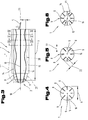
- a tampon 1 is in the Fig. 3 to 6 shown.
- This has an elongated absorbent body 16 with a part of its length 7 conically tapered and dome-shaped, proximal end 2.
- recesses 9, for example grooves 8 are arranged on the outer side or in the surface 14.
- These recesses 9, in particular grooves 8, one can to the longitudinal central axis 10 wave-shaped course both in the circumferential direction of the absorbent body 16 and in the depth 22, as shown schematically in the figures in the end views in different longitudinally spaced in the longitudinal direction of the central axis 10 areas in the 4 to 6 is shown.
- a height 23 of the amplitude of this wave-shaped course can run uniformly over the length 7 of the absorbent body 16 or, however, can have different values over the length 7.
- the height of the amplitude for the undulating course of the recesses 9 or grooves 8 can also extend uniformly over the length 7 of the absorbent body 16 or a part thereof or in different areas, for example in the middle part 3 or in the region of the ends 2, 4 can be of different sizes.
- the pad 1 in this embodiment is not covered with a wrapping 19, for example made of a nonwoven fabric, then this wrapping 19 will extend or extend only over part of the length 7 of the pad 1, as is schematically illustrated by dashed lines Fig. 3 is indicated, the absorbent body 16 swells when wetted from the proximal end 2 ago in the radial direction and assumes a spatial shape, as it is purely schematic and greatly exaggerated by the dot-dash line 24 is indicated. If the covering 19 is provided over the illustrated partial region of the length 7 of the tampon 1, for example only over the length of the middle part 3, the swelling in the radial direction in the middle region is thereby reduced more than if this covering 19 is not provided.
- a wrapping 19 for example made of a nonwoven fabric
- FIGS. 7 and 8 Another embodiment of a tampon 1 according to the invention is from the FIGS. 7 and 8 seen.
- This tampon 1 or its absorbent body 16 has in the direction of the longitudinal central axis 10 extending recesses 9 and longitudinal grooves 8.
- the middle part 3 of the absorbent body 16 then extends to a conically tapering in the direction of the proximal end 2 end portion has a cylindrical diameter, but it is also possible that a diameter 6 in the region of the distal end 4, as indicated by dash-dotted lines, may be smaller or larger than in the central part 3.
- the course of the recesses 9 does not have to be rectilinear and parallel to the longitudinal central axis 10, but can, as in, for example, in Fig. 3 have a wave-shaped course both in the circumferential direction of the absorbent body 16 and in the direction of the depth 22.
- the recesses for example, in the manner of a thread spiral and extend at least over part of the length of the central part 3.
- the projecting leaf-shaped end regions 26 of the absorbent body can also be designed so that they open, for example under the action of moisture to the outside, ie in the direction of the arrows 27, similar to the petals of a tulip, thus forming an additional catchment zone or a collecting space in which the liquid coming from the interior of the body can collect, in order then to be sucked up in the individual depressions 9 or grooves 8 over the length 7 of the absorbent body 16.
- FIGS. 9 and 10 Furthermore, show different embodiments of the cross-sectional shape of the next to the wells 9 remaining rib-like protruding regions 11.
- the ribs 28 have an L- or shoe-shaped cross-section in the in Fig. 9 shown top view.
- the front ends 29 of the regions 11 at the rear end portions 30 are almost at and it is formed between these a cavity 31 and surrounded by this, which extends at least over part of the length 7 of the absorbent body 16.
- a large surface 14 of the absorbent body 16 is provided for receiving moisture or liquid and also ensures that the more distant from the distal end 2 areas of the absorbent body 16 corresponding moisture or liquid can be added and absorbed by them, so that the absorption capacity of the tampon 1 can be optimally utilized.
- the ribs 28 projecting approximately radially outward during the production of the depressions 9 are bent in the radial direction and deformed such that they form a peripheral, outer envelope surface of the tampon 1.
- the end regions 29 of the ribs 28 lie directly against the end regions 30 of the adjacent rib 28.
- the recess 8 forms a longer, capillary-like channel which can exert a higher suction effect into the interior of the absorbent body 16.
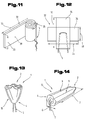
- Fig. 11 is the pre-fabricated for the production of the absorbent body 16 during the production of the tampon 1 winding shown in half-finished state.
- Such reels are mainly used for the so-called digital tampons.
- These consist of a band 32, which has a width 33 of 20 to 50 mm, preferably less than 38 mm, for example 15 to 30 mm.
- band parts 34 with a developed, elongated length 35 which is determined in dependence on a desired volume of the absorbent body 16 and the planned diameter 6 and / or the running meter weight of the belt 32 of the tampon 1, from.
- the length may be about 250 mm or shorter, for example, but also between 80 and 150 mm, preferably between 100 and 120 mm.
- the running meter weight of such a strip with a width 33 of the blank of the strip part 34 for producing a tampon corresponding width is only between 1 and 30 g.
- These tampons in the form of digital tampons are manufactured in such a way that the elongated band part 34 is rolled up into a cylindrical body about an axis running transversely to the longitudinal direction of the band 32. The cylindrical body is then compressed in the radial direction and subjected to shaping so that optionally one, namely the distal end 2, with a conically tapered, rounded end or a spherical or spherical cap-shaped end portion, such as in the Fig. 1 to 10 shown, is formed.
- the opposite end, from which protrudes around the tape before rolling around and over the broad side of the tape projecting extraction means 5, for example, the withdrawal thread, is formed with a flat finish or a concavely curved end face.
- any of the materials 36 known from the prior art as shown in FIG Fig. 10 can be formed schematically by more or less strongly compressed fibers or filaments or cells may be used.
- the central or core region 15,18 such as in Fig. 1 indicated by two-dot chain lines, be formed by an inserted molding.
- This inserted molded body may be made of a moisture-repellent material, but it is also possible that it is also formed of a fibrous material 36, which may have a smaller amount of liquid per unit volume than the same by appropriate treatment, eg compression or by using the appropriate materials Volume unit of the material 36 of the absorbent body 16. It is also possible that the green body of a moisture-repellent material, such as plastic part is formed.
- This green body or central or core region 15,18 formed thereby is then enclosed by the absorbent body 26 at least in the area of its proximal end 2 and in the region of the central part 3 by the absorbent body, wherein the absorbent body may preferably be formed by a cylindrical cavity which is closed in the region forming the proximal end and is open or provided with an opening on the end opposite the distal end 4 of the tampon 1, so that a green body which forms the central or core region 15, 18 is inserted into this one fingerstall appropriate envelope can be introduced.
- the amount of liquid that can be absorbed by this absorbent body 16 can vary depending on the overall diameter of the tampon 1 Use cases can be easily customized. Thus, a high flexibility both in terms of the amount of liquid that can be absorbed by the tampon 1 on the one hand, regardless of the required anatomical reasons for different people different diameters of the central or core regions 15, 18 - have the most diverse spatial forms can - achieved. In the production of the absorbent body 16 with a radial elastic bias, this can adapt to the outer shape of the green body forming this central or core region 15, 18, and thus also different outer shapes of tampons 1 according to the invention can be produced.
- the absorbent body 16 thus has a cavity 39, which is arranged in the absorbent body 16 via an opening 40 in the end facing the distal end region 4 or the end region forming the proximal end 2.
- the individual tampons 1 are coated with so-called nonwovens or provided with other, reticulate or breakthrough coatings that reduce fiber loss and in particular increased friction between the mucous membranes of the vagina and the outer surface of the tampon to avoid a fiber loss.
- a different type of tampon 1 is shown and described based on a different manufacturing method to the previously described production. It is in this embodiment of the tampon 1 to a so-called mushroom head tampons, in which two approximately rectangular band portions 34 with a length 35 between 40 to 80 mm and a width 33 of 10 to 30 mm with their longitudinal central axes offset by 90 ° are superimposed. In the region of the intersecting points of intersection of the diagonals of the two hinge parts 35 shown in phantom, a loop of a pull-out means 5 is pulled through the two hinge parts 35. The free ends of the two band parts 35 are then folded tulpenblütenartig - see Fig.
- a substantially cylindrical body is formed, via which the mushroom-shaped in the front end region or as a spherical cap or conical, the pull-out means 5 protrudes.
- the thus prefabricated, cylindrical green body is usually compressed at elevated temperature with radially acting on these pressing tools, so that he has a final, cylindrical shape, as in Fig. 14 represented, receives.
- any soft absorbent material, as well as cotton, gauze, or even multi-layered material having high absorbency may be used.
- the running meter weight at a width which corresponds approximately to the length 35 of the band parts 34 is usually between 10 and 35 g.
- tampon 1 Another possible embodiment for the tampon 1 is in the 15 to 17 shown.
- This special shape of the tampon 1, which is assigned to the so-called "teabag bag” category, consists of a rectangular blank made of a strip of absorbent material such as cotton, gauze, cotton or the like.
- this tape 32 is wrapped in the course of the manufacturing process with a material layer, such as a nonwoven, for producing a sheath 19.
- the wrapped with the wrapper 19 band 32 is divided by means of a schematically indicated knife into band parts 34.
- These band parts 34 in this case usually have a length of the band 32 in the length of 20 to 50 mm, preferably 40 mm and a width of 40 mm and 20 to 40 mm.
- An extraction means 5, for example a withdrawal thread, is sewn or glued or woven together with the strip part in the direction of the longitudinal center axis. This protrudes beyond one of the two longitudinal end sides of the band member 34 in the longitudinal direction, as in Fig. 16 is shown.
- the running meter weight of the belt 32 which is used to produce the tampon, is at a width 33 of the belt 32, a running meter weight between 10 and 40 g, preferably between 10 and 25 g.
- This band portion 34 will then, as in Fig. 16 shown with two deliverable in the direction of the arrow press punches zig-zag folded or W-shaped and, as in Fig. 17 shown deformed in an approximately cylindrical shape.
- the absorbent 16 made from the band member 34 is typically inserted into a tubular applicator for insertion into the vagina.
- tea bag tampon tampon with stitched thread
- tea bag tampon tampon with stitched thread
- this type of tampon can be prepared as a tampon 1 and the tampon 1 can be used in the usual way for the user, however, with applicators with smaller diameter in the vagina mechanically.
- the tampon 1 can be used both as a "digital tampon" in which it is manually inserted by the user with the finger into the vagina, as well as for applicator tampons.
Landscapes
- Health & Medical Sciences (AREA)
- Epidemiology (AREA)
- Engineering & Computer Science (AREA)
- Biomedical Technology (AREA)
- Heart & Thoracic Surgery (AREA)
- Vascular Medicine (AREA)
- Life Sciences & Earth Sciences (AREA)
- Animal Behavior & Ethology (AREA)
- General Health & Medical Sciences (AREA)
- Public Health (AREA)
- Veterinary Medicine (AREA)
- Dermatology (AREA)
- Absorbent Articles And Supports Therefor (AREA)
Applications Claiming Priority (2)
| Application Number | Priority Date | Filing Date | Title |
|---|---|---|---|
| ATA751/2012A AT513070B1 (de) | 2012-07-06 | 2012-07-06 | Alltagstampon |
| PCT/EP2013/064277 WO2014006188A1 (de) | 2012-07-06 | 2013-07-05 | Tampon für zwischenmenstruationstage |
Publications (2)
| Publication Number | Publication Date |
|---|---|
| EP2869802A1 EP2869802A1 (de) | 2015-05-13 |
| EP2869802B1 true EP2869802B1 (de) | 2016-05-18 |
Family
ID=48748229
Family Applications (1)
| Application Number | Title | Priority Date | Filing Date |
|---|---|---|---|
| EP13734750.6A Active EP2869802B1 (de) | 2012-07-06 | 2013-07-05 | Tampon für zwischenmenstruationstage |
Country Status (18)
| Country | Link |
|---|---|
| US (1) | US9861535B2 (pl) |
| EP (1) | EP2869802B1 (pl) |
| JP (1) | JP6327676B2 (pl) |
| KR (1) | KR102210356B1 (pl) |
| CN (1) | CN104822351B (pl) |
| AT (1) | AT513070B1 (pl) |
| AU (1) | AU2013285395B2 (pl) |
| BR (1) | BR112015000152B1 (pl) |
| CA (1) | CA2914656C (pl) |
| CO (1) | CO7240351A2 (pl) |
| DE (1) | DE202013102981U1 (pl) |
| ES (1) | ES2587743T3 (pl) |
| GB (1) | GB2518579A (pl) |
| IL (1) | IL236531B (pl) |
| MX (1) | MX356064B (pl) |
| PL (1) | PL2869802T3 (pl) |
| RU (1) | RU2629872C2 (pl) |
| WO (1) | WO2014006188A1 (pl) |
Families Citing this family (11)
| Publication number | Priority date | Publication date | Assignee | Title |
|---|---|---|---|---|
| US10342712B1 (en) * | 2014-07-31 | 2019-07-09 | Samantha A. McCrory | Disposable feminine-hygiene product |
| CN205849990U (zh) * | 2016-06-23 | 2017-01-04 | 北京英佳麦迪克医用材料有限公司 | 一种妇科疾病治疗兼经期卫生用海绵 |
| GB2567365B (en) * | 2016-07-29 | 2021-09-15 | Kimberly Clark Co | Tampon |
| CN108210172A (zh) * | 2016-12-15 | 2018-06-29 | 简元正 | 多节式卫生棉条 |
| CN108338868A (zh) * | 2017-01-25 | 2018-07-31 | 简元正 | 卫生棉条 |
| CN108175576A (zh) * | 2017-12-29 | 2018-06-19 | 高文 | 内置型经期卫生用品 |
| WO2021031165A1 (zh) * | 2019-08-21 | 2021-02-25 | 吴静茹 | 丝带型卫生棉条 |
| USD977632S1 (en) | 2020-02-26 | 2023-02-07 | Tampro Inc. | Tampon |
| WO2022051228A1 (en) | 2020-09-01 | 2022-03-10 | Tampro Inc. | Reduced-leakage tampon |
| USD1039690S1 (en) | 2020-09-01 | 2024-08-20 | Tampro Inc. | Tampon |
| USD1046123S1 (en) | 2023-04-28 | 2024-10-08 | Tampro Inc. | Tampon |
Family Cites Families (35)
| Publication number | Priority date | Publication date | Assignee | Title |
|---|---|---|---|---|
| CH248634A (de) * | 1946-03-25 | 1947-05-15 | Int Cellucotton Products Compa | Tampon. |
| US2499414A (en) | 1947-04-15 | 1950-03-07 | Miriam E Rabell | Tampon |
| US2849000A (en) * | 1953-06-08 | 1958-08-26 | Tampax Inc | Tampons and the like |
| US2761449A (en) * | 1954-12-17 | 1956-09-04 | Kimberly Clark Co | Cellulosic product |
| DE1187345B (de) * | 1958-07-21 | 1965-02-18 | Tampax Inc | Menstruationstampon |
| US3320956A (en) * | 1964-11-24 | 1967-05-23 | Johnson & Johnson | Catamenial tampon and method of making |
| DE10306678A1 (de) * | 2003-02-18 | 2004-08-26 | Hysalma Gmbh | Vaginal-Tampon |
| DE20320992U1 (de) * | 1980-06-14 | 2005-08-25 | Hysalma Hygiene Sales + Marketing Gmbh | Vaginal-Tampon |
| US4374522A (en) | 1981-03-16 | 1983-02-22 | Kimberly-Clark Corporation | Tampon with central reservoir |
| DE3739163A1 (de) * | 1987-11-19 | 1989-06-01 | Ver Papierwerke Ag | Tampon fuer die frauenhygiene und herstellungsverfahren |
| DE3934153A1 (de) | 1989-10-12 | 1991-04-18 | Johnson & Johnson Gmbh | Tampon, insbesondere fuer die frauenhygiene, sowie verfahren und vorrichtung zur herstellung desselben |
| DE4304505C2 (de) | 1993-02-15 | 1995-05-18 | Johnson & Johnson Gmbh | Tampon, insbesondere für die Frauenhygiene, sowie Verfahren und Vorrichtung zur Herstellung desselben |
| US5395308A (en) * | 1993-09-24 | 1995-03-07 | Kimberly-Clark Corporation | Thermoplastic applicator exhibiting accelerated breakup when immersed in water |
| EP0955982B1 (en) * | 1996-08-12 | 2002-10-02 | Kimberly-Clark Worldwide, Inc. | A laterally expandable tampon and a method of forming the tampon |
| DE19825877C1 (de) | 1998-06-10 | 1999-11-18 | Ruggli Projects Ag Hagendorn | Verfahren sowie Vorrichtung zur Herstellung eines Tampons |
| US7144391B1 (en) | 2000-09-01 | 2006-12-05 | The Proctor & Gamble Company | Feminine hygiene kit |
| DE20121759U1 (de) * | 2001-03-26 | 2003-05-22 | Johnson & Johnson GmbH, 40474 Düsseldorf | Tampon für die Frauenhygiene sowie Vorrichtung zur Herstellung desselben |
| US6840927B2 (en) * | 2001-11-16 | 2005-01-11 | The Proctor & Gamble Company | Tampon with fluid wicking overwrap with skirt portion |
| US6932805B2 (en) * | 2002-03-18 | 2005-08-23 | The Procter & Gamble Company | Shaped tampon |
| DE10244874C5 (de) * | 2002-09-26 | 2010-10-07 | Johnson & Johnson Gmbh | Verfahren und Einrichtung zur Herstellung eines Tampons für die Frauenhygiene |
| CN101259064A (zh) * | 2003-10-31 | 2008-09-10 | 强生消费者公司 | 提供干净的手指插入的吸收棉塞 |
| US7338483B2 (en) * | 2003-11-21 | 2008-03-04 | The Procter & Gamble Company | Tampon |
| US20050113807A1 (en) * | 2003-11-21 | 2005-05-26 | The Procter & Gamble Company | Tampon with recessed portions |
| EP1547554A1 (en) | 2003-12-22 | 2005-06-29 | Ontex N.V. | Absorbent article |
| EP1683503B1 (en) * | 2005-01-19 | 2011-10-05 | Ontex International N.V. | Tampon |
| US7175616B2 (en) * | 2005-01-21 | 2007-02-13 | The Procter & Gamble Company | Absorbency protuberance identifier disposed on each tampon in the article array |
| WO2007038535A1 (en) * | 2005-09-26 | 2007-04-05 | The Procter & Gamble Company | Tampon with overwrap and method of manufacture |
| JP4939079B2 (ja) * | 2006-02-27 | 2012-05-23 | ユニ・チャーム株式会社 | アプリケータ付き生理用タンポン |
| MX2009004940A (es) * | 2006-11-08 | 2009-05-21 | Playtex Products Inc | Tampon para aumentar la proteccion del derrame por desviacion. |
| GB2470324B (en) * | 2008-03-11 | 2012-04-11 | Playtex Products Llc | Low absorbency tampon pledget and method of testing |
| DE102008020640B4 (de) * | 2008-04-24 | 2010-09-09 | Frank Ruhlmann | Tampon |
| JP5318531B2 (ja) * | 2008-10-31 | 2013-10-16 | ユニ・チャーム株式会社 | タンポン用吸収体 |
| DE202009000983U1 (de) * | 2009-01-27 | 2010-07-01 | Med.Sse-System Gmbh | Tampon |
| RU2477992C1 (ru) * | 2009-04-06 | 2013-03-27 | Ска Хайджин Продактс Аб | Покрытый смазкой тампон, имеющий переворачиваемые клапаны для облегченного введения и удаления |
| RU2508085C2 (ru) * | 2009-06-29 | 2014-02-27 | Ска Хайджин Продактс Аб | Менструальный тампон с волнообразными линиями сдавливания |
-
2012
- 2012-07-06 AT ATA751/2012A patent/AT513070B1/de not_active IP Right Cessation
-
2013
- 2013-07-05 EP EP13734750.6A patent/EP2869802B1/de active Active
- 2013-07-05 PL PL13734750T patent/PL2869802T3/pl unknown
- 2013-07-05 GB GB1501695.9A patent/GB2518579A/en not_active Withdrawn
- 2013-07-05 ES ES13734750.6T patent/ES2587743T3/es active Active
- 2013-07-05 CA CA2914656A patent/CA2914656C/en active Active
- 2013-07-05 BR BR112015000152-1A patent/BR112015000152B1/pt active IP Right Grant
- 2013-07-05 CN CN201380046471.XA patent/CN104822351B/zh active Active
- 2013-07-05 AU AU2013285395A patent/AU2013285395B2/en active Active
- 2013-07-05 RU RU2015103907A patent/RU2629872C2/ru active
- 2013-07-05 KR KR1020157003188A patent/KR102210356B1/ko active Active
- 2013-07-05 JP JP2015519231A patent/JP6327676B2/ja active Active
- 2013-07-05 DE DE202013102981U patent/DE202013102981U1/de not_active Expired - Lifetime
- 2013-07-05 WO PCT/EP2013/064277 patent/WO2014006188A1/de not_active Ceased
- 2013-07-05 MX MX2015000058A patent/MX356064B/es active IP Right Grant
-
2014
- 2014-12-31 IL IL236531A patent/IL236531B/en active IP Right Grant
-
2015
- 2015-01-05 CO CO15000910A patent/CO7240351A2/es unknown
- 2015-01-05 US US14/589,488 patent/US9861535B2/en active Active
Also Published As
| Publication number | Publication date |
|---|---|
| AU2013285395A1 (en) | 2015-02-19 |
| US20150164702A1 (en) | 2015-06-18 |
| ES2587743T3 (es) | 2016-10-26 |
| AU2013285395B2 (en) | 2017-08-31 |
| PL2869802T3 (pl) | 2017-03-31 |
| AT513070A1 (de) | 2014-01-15 |
| GB2518579A (en) | 2015-03-25 |
| CA2914656A1 (en) | 2014-01-09 |
| MX356064B (es) | 2018-05-11 |
| US9861535B2 (en) | 2018-01-09 |
| DE202013102981U1 (de) | 2013-08-06 |
| JP2015521869A (ja) | 2015-08-03 |
| IL236531A0 (en) | 2015-02-26 |
| WO2014006188A1 (de) | 2014-01-09 |
| AT513070B1 (de) | 2014-04-15 |
| CN104822351B (zh) | 2019-04-19 |
| CN104822351A (zh) | 2015-08-05 |
| GB201501695D0 (en) | 2015-03-18 |
| CO7240351A2 (es) | 2015-04-17 |
| RU2015103907A (ru) | 2016-08-27 |
| BR112015000152B1 (pt) | 2021-07-13 |
| EP2869802A1 (de) | 2015-05-13 |
| CA2914656C (en) | 2021-02-02 |
| RU2629872C2 (ru) | 2017-09-04 |
| KR102210356B1 (ko) | 2021-02-02 |
| KR20150030266A (ko) | 2015-03-19 |
| JP6327676B2 (ja) | 2018-05-23 |
| IL236531B (en) | 2018-04-30 |
| BR112015000152A2 (pt) | 2017-06-27 |
| MX2015000058A (es) | 2015-06-05 |
Similar Documents
| Publication | Publication Date | Title |
|---|---|---|
| EP2869802B1 (de) | Tampon für zwischenmenstruationstage | |
| DE69922247T2 (de) | Gerät zum verhindern von weiblicher harninkontinenz | |
| DE60012078T2 (de) | Interlabialer, absorbierender Artikel | |
| DE69718682T2 (de) | Absorbierender artikel mit einem flüssigkeitspumpenelement | |
| DE10196647B4 (de) | Harninkontinenzvorrichtung und Verfahren zu deren Herstellung | |
| EP1411874B2 (de) | Absorptionskörper zum anschluss an haut- und schleimhautoberflächen | |
| DE60309485T2 (de) | Tampon mit sauberem erscheinungsbild nach dem gebrauch | |
| EP3313342B1 (de) | Verfahren zur herstellung eines tampons | |
| DE60225297T2 (de) | Tamponapplikator mit blütenförmiger spitze | |
| DE2520595A1 (de) | Medizinal-monatstampon | |
| DE202006000746U1 (de) | Tampon | |
| DE1170581B (de) | Damenbinde | |
| DE212004000063U1 (de) | Tampon mit erhöhten Abschnitten | |
| DE60113761T2 (de) | Absorbierende Kernschicht zur Verwendung in einem absorbierenden Hygieneartikel und Verfahren zur Herstellung | |
| DE102007049430A1 (de) | Wundpflegeartikel, aufweisend mindestens einen Anteil an stützenden Fasern und einen Anteil an hydroaktiven Polymeren | |
| EP3741338B1 (de) | Tampon | |
| WO2015104301A1 (de) | Verfahren zur herstellung eines tampons | |
| EP1025827B1 (de) | Absorbierender Hygieneartikel zum einmaligen Gebrauch | |
| AT524830B1 (de) | Analtampon und applikator | |
| EP4205711B1 (de) | Selbstklebende atmungsaktive wundauflage für stark exsudierende wunden | |
| DE2324849B2 (de) | Tampon | |
| EP2401992A1 (de) | Verband | |
| EP4623879A1 (de) | Hygieneartikel für männer | |
| DE60127515T2 (de) | Absorbierender Artikel mit Auslaufsicherheit | |
| AT367299B (de) | Wundauflage |
Legal Events
| Date | Code | Title | Description |
|---|---|---|---|
| PUAI | Public reference made under article 153(3) epc to a published international application that has entered the european phase |
Free format text: ORIGINAL CODE: 0009012 |
|
| 17P | Request for examination filed |
Effective date: 20150205 |
|
| AK | Designated contracting states |
Kind code of ref document: A1 Designated state(s): AL AT BE BG CH CY CZ DE DK EE ES FI FR GB GR HR HU IE IS IT LI LT LU LV MC MK MT NL NO PL PT RO RS SE SI SK SM TR |
|
| AX | Request for extension of the european patent |
Extension state: BA ME |
|
| DAX | Request for extension of the european patent (deleted) | ||
| GRAP | Despatch of communication of intention to grant a patent |
Free format text: ORIGINAL CODE: EPIDOSNIGR1 |
|
| INTG | Intention to grant announced |
Effective date: 20151208 |
|
| GRAS | Grant fee paid |
Free format text: ORIGINAL CODE: EPIDOSNIGR3 |
|
| GRAA | (expected) grant |
Free format text: ORIGINAL CODE: 0009210 |
|
| AK | Designated contracting states |
Kind code of ref document: B1 Designated state(s): AL AT BE BG CH CY CZ DE DK EE ES FI FR GB GR HR HU IE IS IT LI LT LU LV MC MK MT NL NO PL PT RO RS SE SI SK SM TR |
|
| REG | Reference to a national code |
Ref country code: GB Ref legal event code: FG4D Free format text: NOT ENGLISH |
|
| REG | Reference to a national code |
Ref country code: CH Ref legal event code: EP |
|
| REG | Reference to a national code |
Ref country code: AT Ref legal event code: REF Ref document number: 799759 Country of ref document: AT Kind code of ref document: T Effective date: 20160615 Ref country code: IE Ref legal event code: FG4D Free format text: LANGUAGE OF EP DOCUMENT: GERMAN |
|
| REG | Reference to a national code |
Ref country code: DE Ref legal event code: R096 Ref document number: 502013003083 Country of ref document: DE |
|
| REG | Reference to a national code |
Ref country code: FR Ref legal event code: PLFP Year of fee payment: 4 |
|
| REG | Reference to a national code |
Ref country code: CH Ref legal event code: NV Representative=s name: ABP PATENT NETWORK AG, CH |
|
| REG | Reference to a national code |
Ref country code: NL Ref legal event code: FP |
|
| REG | Reference to a national code |
Ref country code: LT Ref legal event code: MG4D |
|
| REG | Reference to a national code |
Ref country code: ES Ref legal event code: FG2A Ref document number: 2587743 Country of ref document: ES Kind code of ref document: T3 Effective date: 20161026 |
|
| PG25 | Lapsed in a contracting state [announced via postgrant information from national office to epo] |
Ref country code: LT Free format text: LAPSE BECAUSE OF FAILURE TO SUBMIT A TRANSLATION OF THE DESCRIPTION OR TO PAY THE FEE WITHIN THE PRESCRIBED TIME-LIMIT Effective date: 20160518 Ref country code: NO Free format text: LAPSE BECAUSE OF FAILURE TO SUBMIT A TRANSLATION OF THE DESCRIPTION OR TO PAY THE FEE WITHIN THE PRESCRIBED TIME-LIMIT Effective date: 20160818 Ref country code: FI Free format text: LAPSE BECAUSE OF FAILURE TO SUBMIT A TRANSLATION OF THE DESCRIPTION OR TO PAY THE FEE WITHIN THE PRESCRIBED TIME-LIMIT Effective date: 20160518 |
|
| PG25 | Lapsed in a contracting state [announced via postgrant information from national office to epo] |
Ref country code: RS Free format text: LAPSE BECAUSE OF FAILURE TO SUBMIT A TRANSLATION OF THE DESCRIPTION OR TO PAY THE FEE WITHIN THE PRESCRIBED TIME-LIMIT Effective date: 20160518 Ref country code: GR Free format text: LAPSE BECAUSE OF FAILURE TO SUBMIT A TRANSLATION OF THE DESCRIPTION OR TO PAY THE FEE WITHIN THE PRESCRIBED TIME-LIMIT Effective date: 20160819 Ref country code: HR Free format text: LAPSE BECAUSE OF FAILURE TO SUBMIT A TRANSLATION OF THE DESCRIPTION OR TO PAY THE FEE WITHIN THE PRESCRIBED TIME-LIMIT Effective date: 20160518 Ref country code: SE Free format text: LAPSE BECAUSE OF FAILURE TO SUBMIT A TRANSLATION OF THE DESCRIPTION OR TO PAY THE FEE WITHIN THE PRESCRIBED TIME-LIMIT Effective date: 20160518 Ref country code: LV Free format text: LAPSE BECAUSE OF FAILURE TO SUBMIT A TRANSLATION OF THE DESCRIPTION OR TO PAY THE FEE WITHIN THE PRESCRIBED TIME-LIMIT Effective date: 20160518 Ref country code: PT Free format text: LAPSE BECAUSE OF FAILURE TO SUBMIT A TRANSLATION OF THE DESCRIPTION OR TO PAY THE FEE WITHIN THE PRESCRIBED TIME-LIMIT Effective date: 20160919 |
|
| PG25 | Lapsed in a contracting state [announced via postgrant information from national office to epo] |
Ref country code: BE Free format text: LAPSE BECAUSE OF NON-PAYMENT OF DUE FEES Effective date: 20160731 |
|
| PG25 | Lapsed in a contracting state [announced via postgrant information from national office to epo] |
Ref country code: RO Free format text: LAPSE BECAUSE OF FAILURE TO SUBMIT A TRANSLATION OF THE DESCRIPTION OR TO PAY THE FEE WITHIN THE PRESCRIBED TIME-LIMIT Effective date: 20160518 Ref country code: EE Free format text: LAPSE BECAUSE OF FAILURE TO SUBMIT A TRANSLATION OF THE DESCRIPTION OR TO PAY THE FEE WITHIN THE PRESCRIBED TIME-LIMIT Effective date: 20160518 Ref country code: DK Free format text: LAPSE BECAUSE OF FAILURE TO SUBMIT A TRANSLATION OF THE DESCRIPTION OR TO PAY THE FEE WITHIN THE PRESCRIBED TIME-LIMIT Effective date: 20160518 Ref country code: SK Free format text: LAPSE BECAUSE OF FAILURE TO SUBMIT A TRANSLATION OF THE DESCRIPTION OR TO PAY THE FEE WITHIN THE PRESCRIBED TIME-LIMIT Effective date: 20160518 Ref country code: CZ Free format text: LAPSE BECAUSE OF FAILURE TO SUBMIT A TRANSLATION OF THE DESCRIPTION OR TO PAY THE FEE WITHIN THE PRESCRIBED TIME-LIMIT Effective date: 20160518 |
|
| REG | Reference to a national code |
Ref country code: DE Ref legal event code: R097 Ref document number: 502013003083 Country of ref document: DE |
|
| PG25 | Lapsed in a contracting state [announced via postgrant information from national office to epo] |
Ref country code: SM Free format text: LAPSE BECAUSE OF FAILURE TO SUBMIT A TRANSLATION OF THE DESCRIPTION OR TO PAY THE FEE WITHIN THE PRESCRIBED TIME-LIMIT Effective date: 20160518 |
|
| PLBE | No opposition filed within time limit |
Free format text: ORIGINAL CODE: 0009261 |
|
| STAA | Information on the status of an ep patent application or granted ep patent |
Free format text: STATUS: NO OPPOSITION FILED WITHIN TIME LIMIT |
|
| PG25 | Lapsed in a contracting state [announced via postgrant information from national office to epo] |
Ref country code: MC Free format text: LAPSE BECAUSE OF FAILURE TO SUBMIT A TRANSLATION OF THE DESCRIPTION OR TO PAY THE FEE WITHIN THE PRESCRIBED TIME-LIMIT Effective date: 20160518 |
|
| 26N | No opposition filed |
Effective date: 20170221 |
|
| REG | Reference to a national code |
Ref country code: IE Ref legal event code: MM4A |
|
| PG25 | Lapsed in a contracting state [announced via postgrant information from national office to epo] |
Ref country code: SI Free format text: LAPSE BECAUSE OF FAILURE TO SUBMIT A TRANSLATION OF THE DESCRIPTION OR TO PAY THE FEE WITHIN THE PRESCRIBED TIME-LIMIT Effective date: 20160518 |
|
| REG | Reference to a national code |
Ref country code: FR Ref legal event code: PLFP Year of fee payment: 5 |
|
| PG25 | Lapsed in a contracting state [announced via postgrant information from national office to epo] |
Ref country code: IE Free format text: LAPSE BECAUSE OF NON-PAYMENT OF DUE FEES Effective date: 20160705 |
|
| PG25 | Lapsed in a contracting state [announced via postgrant information from national office to epo] |
Ref country code: LU Free format text: LAPSE BECAUSE OF NON-PAYMENT OF DUE FEES Effective date: 20160705 |
|
| REG | Reference to a national code |
Ref country code: DE Ref legal event code: R082 Ref document number: 502013003083 Country of ref document: DE |
|
| REG | Reference to a national code |
Ref country code: CH Ref legal event code: NV Representative=s name: IPRIME RENTSCH KAELIN AG, CH |
|
| PG25 | Lapsed in a contracting state [announced via postgrant information from national office to epo] |
Ref country code: HU Free format text: LAPSE BECAUSE OF FAILURE TO SUBMIT A TRANSLATION OF THE DESCRIPTION OR TO PAY THE FEE WITHIN THE PRESCRIBED TIME-LIMIT; INVALID AB INITIO Effective date: 20130705 |
|
| PG25 | Lapsed in a contracting state [announced via postgrant information from national office to epo] |
Ref country code: MT Free format text: LAPSE BECAUSE OF FAILURE TO SUBMIT A TRANSLATION OF THE DESCRIPTION OR TO PAY THE FEE WITHIN THE PRESCRIBED TIME-LIMIT Effective date: 20160518 Ref country code: CY Free format text: LAPSE BECAUSE OF FAILURE TO SUBMIT A TRANSLATION OF THE DESCRIPTION OR TO PAY THE FEE WITHIN THE PRESCRIBED TIME-LIMIT Effective date: 20160518 Ref country code: IS Free format text: LAPSE BECAUSE OF FAILURE TO SUBMIT A TRANSLATION OF THE DESCRIPTION OR TO PAY THE FEE WITHIN THE PRESCRIBED TIME-LIMIT Effective date: 20160518 Ref country code: MK Free format text: LAPSE BECAUSE OF FAILURE TO SUBMIT A TRANSLATION OF THE DESCRIPTION OR TO PAY THE FEE WITHIN THE PRESCRIBED TIME-LIMIT Effective date: 20160518 |
|
| REG | Reference to a national code |
Ref country code: FR Ref legal event code: PLFP Year of fee payment: 6 |
|
| PG25 | Lapsed in a contracting state [announced via postgrant information from national office to epo] |
Ref country code: BG Free format text: LAPSE BECAUSE OF FAILURE TO SUBMIT A TRANSLATION OF THE DESCRIPTION OR TO PAY THE FEE WITHIN THE PRESCRIBED TIME-LIMIT Effective date: 20160518 |
|
| PG25 | Lapsed in a contracting state [announced via postgrant information from national office to epo] |
Ref country code: TR Free format text: LAPSE BECAUSE OF FAILURE TO SUBMIT A TRANSLATION OF THE DESCRIPTION OR TO PAY THE FEE WITHIN THE PRESCRIBED TIME-LIMIT Effective date: 20160518 Ref country code: AL Free format text: LAPSE BECAUSE OF FAILURE TO SUBMIT A TRANSLATION OF THE DESCRIPTION OR TO PAY THE FEE WITHIN THE PRESCRIBED TIME-LIMIT Effective date: 20160518 |
|
| P01 | Opt-out of the competence of the unified patent court (upc) registered |
Effective date: 20230530 |
|
| REG | Reference to a national code |
Ref country code: NL Ref legal event code: PD Owner name: RUGGLI AG; CH Free format text: DETAILS ASSIGNMENT: CHANGE OF OWNER(S), MERGE; FORMER OWNER NAME: RUGGLI PROJECTS AG Effective date: 20240131 |
|
| REG | Reference to a national code |
Ref country code: DE Ref legal event code: R082 Ref document number: 502013003083 Country of ref document: DE Representative=s name: IPRIME BONNEKAMP SPARING PATENTANWALTSGESELLSC, DE Ref country code: DE Ref legal event code: R081 Ref document number: 502013003083 Country of ref document: DE Owner name: RUGGLI AG, CH Free format text: FORMER OWNER: RUGGLI PROJECTS AG, HAGENDORN, CH |
|
| REG | Reference to a national code |
Ref country code: CH Ref legal event code: PK Free format text: BERICHTIGUNGEN |
|
| REG | Reference to a national code |
Ref country code: ES Ref legal event code: PC2A Owner name: RUGGLI AG Effective date: 20241028 |
|
| PGFP | Annual fee paid to national office [announced via postgrant information from national office to epo] |
Ref country code: PL Payment date: 20250627 Year of fee payment: 13 |
|
| PGFP | Annual fee paid to national office [announced via postgrant information from national office to epo] |
Ref country code: NL Payment date: 20250721 Year of fee payment: 13 |
|
| PGFP | Annual fee paid to national office [announced via postgrant information from national office to epo] |
Ref country code: ES Payment date: 20250826 Year of fee payment: 13 |
|
| PGFP | Annual fee paid to national office [announced via postgrant information from national office to epo] |
Ref country code: DE Payment date: 20250722 Year of fee payment: 13 |
|
| PGFP | Annual fee paid to national office [announced via postgrant information from national office to epo] |
Ref country code: IT Payment date: 20250724 Year of fee payment: 13 |
|
| PGFP | Annual fee paid to national office [announced via postgrant information from national office to epo] |
Ref country code: GB Payment date: 20250722 Year of fee payment: 13 |
|
| PGFP | Annual fee paid to national office [announced via postgrant information from national office to epo] |
Ref country code: FR Payment date: 20250725 Year of fee payment: 13 Ref country code: AT Payment date: 20250722 Year of fee payment: 13 |
|
| PGFP | Annual fee paid to national office [announced via postgrant information from national office to epo] |
Ref country code: CH Payment date: 20250801 Year of fee payment: 13 |