EP2847131B1 - Verfahren zur herstellung eines sio2-granulats - Google Patents
Verfahren zur herstellung eines sio2-granulats Download PDFInfo
- Publication number
- EP2847131B1 EP2847131B1 EP13718837.1A EP13718837A EP2847131B1 EP 2847131 B1 EP2847131 B1 EP 2847131B1 EP 13718837 A EP13718837 A EP 13718837A EP 2847131 B1 EP2847131 B1 EP 2847131B1
- Authority
- EP
- European Patent Office
- Prior art keywords
- sio
- suspension
- sediment
- particles
- granules
- Prior art date
- Legal status (The legal status is an assumption and is not a legal conclusion. Google has not performed a legal analysis and makes no representation as to the accuracy of the status listed.)
- Active
Links
Images
Classifications
-
- C—CHEMISTRY; METALLURGY
- C01—INORGANIC CHEMISTRY
- C01B—NON-METALLIC ELEMENTS; COMPOUNDS THEREOF; METALLOIDS OR COMPOUNDS THEREOF NOT COVERED BY SUBCLASS C01C
- C01B33/00—Silicon; Compounds thereof
- C01B33/113—Silicon oxides; Hydrates thereof
- C01B33/12—Silica; Hydrates thereof, e.g. lepidoic silicic acid
- C01B33/18—Preparation of finely divided silica neither in sol nor in gel form; After-treatment thereof
-
- C—CHEMISTRY; METALLURGY
- C03—GLASS; MINERAL OR SLAG WOOL
- C03B—MANUFACTURE, SHAPING, OR SUPPLEMENTARY PROCESSES
- C03B19/00—Other methods of shaping glass
- C03B19/10—Forming beads
- C03B19/108—Forming porous, sintered or foamed beads
-
- C—CHEMISTRY; METALLURGY
- C03—GLASS; MINERAL OR SLAG WOOL
- C03C—CHEMICAL COMPOSITION OF GLASSES, GLAZES OR VITREOUS ENAMELS; SURFACE TREATMENT OF GLASS; SURFACE TREATMENT OF FIBRES OR FILAMENTS MADE FROM GLASS, MINERALS OR SLAGS; JOINING GLASS TO GLASS OR OTHER MATERIALS
- C03C1/00—Ingredients generally applicable to manufacture of glasses, glazes, or vitreous enamels
- C03C1/02—Pretreated ingredients
- C03C1/026—Pelletisation or prereacting of powdered raw materials
Definitions
- the invention relates to a method for producing a SiO 2 granulate, comprising providing a suspension containing SiO 2 particles in an aqueous liquid, freezing the suspension and removing the liquid, wherein the frozen SiO 2 suspension to form a Liquid phase and a sediment of agglomerated SiO 2 particles is thawed, the liquid phase is removed and the sediment to remove residual moisture and dried to form the SiO 2 granules.
- the invention relates to a use of the granules.
- JP 02-199015 A relates to a method in which an aqueous SiO 2 slicker is used, which is frozen and then subjected to a drying step.
- the thawing process followed by settling and concentrating the SiO 2 particles in the thawed slurry is carried out in a "thickener". Thereafter, drying takes place in a filtration dryer, which is supported by a hot air blower and a vacuum pump. At the end of the process a dry filter cake of synthetic quartz glass is obtained.
- a process for producing a glass granulate using a frozen suspension is out DE 41 00 604 C1 known.
- a finely divided glass granulate is prepared by dispersing and comminuting a glass powder of average particle size in an aqueous grinding fluid with the aid of grinding bodies made of glass. After separation of the grinding media, the glass slip is deep-frozen and then freeze-dried, whereby the frozen aqueous grinding liquid evaporates by sublimation in a high vacuum.
- the resulting glass granules have a mean particle size in the range of 0.5 to 3 microns. Smaller granules can only be achieved with significantly longer grinding times.
- the present invention has for its object to provide a method for producing a SiO 2 granules, which produces a highly pure, fine granules in a particularly simple and economical manner.
- the invention has for its object to provide a suitable use for the granules.
- the suspension to adjust the pH greater than 7 contains an addition of alkali-free bases in the form of nitrogen hydrides.
- an aqueous SiO 2 suspension also called SiO 2 slicker
- a container such as a plastic bottle
- an addition of alkali-free bases in the form of nitrogen hydrides is added to the suspension.
- This additive causes an adjustment of the pH greater than 7 and causes the hydrate shell is broken around the SiO 2 particles, whereby stabilization of the suspension occurs and a very homogeneous slurry is maintained even for hours.
- no SiO 2 agglomerates settle out of the SiO 2 suspension at the bottom of the vessel.
- the original SiO 2 particles During freezing or during the thawing process, the original SiO 2 particles agglomerate and settle out as fine granules at the bottom of the container.
- the original suspension liquid ie water with the nitrogen hydride additives
- the liquid can be removed without difficulty, such as by decantation, suction or centrifugation.
- the moist SiO 2 granulate What remains behind as the sediment is the moist SiO 2 granulate, which only has to undergo a drying step to remove the remaining water.
- the resulting SiO 2 granules with granulate particle sizes up to about 700 microns is relatively soft and thus easily disintegrates into finely divided granules.
- the resulting SiO 2 granules can also be used without further comminution measures. It has also been found that the addition of nitrogen hydrides to the SiO 2 slickener causes the particle size distribution of the resulting SiO 2 granules to increase In favor of smaller grain sizes shifts, - so the coarse fraction can be minimized.
- Granulation does not require a stirrer or other auxiliary mechanical device.
- the freezing and thawing of the slurry can be carried out in the same container in which the slurry formulation has been homogenized so that the risk of contact contamination with other materials is minimized.
- the method according to the invention is therefore particularly suitable for producing high-purity, doped and non-doped SiO 2 granules.
- This procedure for producing a SiO 2 granulate is simple, fast and reliable.
- the SiO 2 slug is a colloidal suspension, the stability of which is obtained by the occupancy of ions on the surface of the SiO 2 particles.
- a sedimentation by leaving the aqueous SiO 2 suspension at rest therefore takes place only after a long time and then usually leads to a more or less solid "SiO 2 cake", but not to a finely divided granules.
- the large dendritic ice crystals forming on freezing destroy the ion occupation on the surface of the SiO 2 particles and thus alter the aggregate tendency or the flow properties of the SiO 2 particles.
- the SiO 2 particles can then be more easily separated from one another or, due to the significantly reduced deposition forces, accumulate to form small granulate particles which sediment easily.
- an advantageous embodiment of the invention is that the water content of the suspension during freezing at least 30 wt .-% to at most 90 wt .-%, preferably at least 70 wt .-% is.
- This relatively high water content guarantees a good wetting of the SiO 2 particles, so that the large ice crystals can show their effect when thawing the suspension.
- the water provides a homogeneous slurry in the production of the SiO 2 suspension. Since the individual SiO 2 particles in the suspension with a high water content are relatively widely spaced from each other, the dopants can distribute accordingly well, whereby a homogeneous doping is possible.
- a SiO 2 suspension with a relatively low solids content leads to rather finely divided granules.
- the period for freezing the suspension is preferably at least 12 hours, a duration that can be integrated into common industrial manufacturing processes.
- nitrogen hydrides preferably in the form of ammonia (NH 3 ), ammonium carbonate (NH 4 ) 2 CO 3 , urotropin (C 6 H 12 N 4 ), or ammonium carbamate (CH 6 N 2 O 2 ) - is the pH the suspension to greater than 7, preferably between 12 and 14 adjustable, which has an advantageous effect on the homogeneous distribution upon addition of a dopant.
- the abovementioned auxiliaries cause the hydration shell to break open around the SiO 2 particles, so that stabilization of the suspension occurs. With the addition of dopants, these can accordingly attach well to the SiO 2 particles and distribute themselves in the suspension.
- the frozen SiO 2 slickener can be subjected to microwaves. Exposure to low power microwave radiation reduces thawing time.
- the suspension contains soluble impurities, it has proved to be advantageous to wash the sediment of agglomerated SiO 2 particles after separation of the liquid phase by slurrying in demineralized water (demineralized water).
- the impurities for example in the form of salts, can be easily removed. This washing process is easy to carry out, since the addition of water to the sediment results in an SiO 2 suspension whose SiO 2 particles sediment rapidly and form a sediment again. The washing process is therefore feasible even with multiple repetitions in a short time.
- the drying to remove the residual moisture of the sediment it is also advantageous to select a temperature range of 100 ° C to 500 ° C. This temperature range is covered by simple drying cabinets, so that no large amount of equipment is required for the drying step.
- the sediment of agglomerated SiO 2 particles can be centrifuged after removal of the liquid phase with the separation of further aqueous liquid.
- the centrifuging shortens the drying time, because within a few minutes the fluid in the sediment is expelled. During centrifugation, even the smallest suspended particles settle out of the liquid safely, so that the separation of solids from liquid is optimized.
- An advantageous embodiment of the invention is that the SiO 2 suspension is frozen in a closed container and thawed again becomes. By this measure, a possible entry of impurities during the freezing and thawing phase is prevented.
- the aqueous SiO 2 suspension also contains dopants in addition to the SiO 2 particles.
- the inventive method is particularly suitable for the production of doped SiO 2 granules, in which the requirements for the homogeneity of the dopant distribution are very high. This is generally the case in optical applications.
- Examples include quartz glasses for passive optical waveguides, laser glasses and filter glasses called.
- the dopant is an oxide or a plurality of oxides - or a precursor thereof; such as chlorides or fluorides, selected from the following group of elements: Al, B, P, Nb, Ta, Mg, Ga, Zn, Ca, Sr, Ba, Cu, Sb, Bi, Ge, Hf, Zr, Ti and all rare earth metals.
- the SiO 2 granules obtained by the process according to the invention are characterized by a particle size of the granules in the range of less than or equal to 700 ⁇ m. These granules are soft and disintegrate under slight pressure into smaller aggregates. This can be advantageous in further processing, since the crushing of the soft granules granules undergoes further mixing.
- the SiO 2 granulate prepared by the process according to the invention is particularly suitable as a starting material for optically active materials for laser-active components, such as fiber lasers, rod or disk bubble. Furthermore, these SiO 2 granules are suitable as starting material for filter glasses or for the production of the synthetic inner layer in quartz glass crucibles for melting silicon. In addition, as an application for the method according to the invention produced SiO 2 granules also to name the production of components made of quartz glass for use in dry etching processes of the semiconductor industry. These uses are particularly given when dopants have been added to the SiO 2 suspension. The homogeneous dopant distribution is retained in the granules, whereby optimal processing options are given.
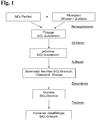
- a suspension of discrete SiO 2 particles in the form of SiO 2 aggregates in demineralized water is produced in a sealable plastic container, for example a PTFE bottle with a lid.
- This SiO 2 suspension is added dropwise a concentrated ammonia solution, so that a pH of 9.5 is established.
- the SiO 2 aggregates in the slurry have an average particle size of about 10 ⁇ m and consist of primary SiO 2 particles with particle sizes in the range from 5 nm to 100 nm.
- the solids content of the SiO 2 suspension is 12% by weight.
- the SiO 2 suspension is stirred for several hours and finally a stable, homogeneous SiO 2 suspension is obtained.
- the bottle of suspension is capped with a lid or suitable foil and then deep-frozen in a freezer at -18 ° C overnight. To thaw the container with the frozen SiO 2 suspension is removed from the freezer and thawed at room temperature.
- the agglomerated SiO 2 particles separate as sediment from the water, so that in the lower half of the container, the sediment is present and above the water as a more or less clear liquid.
- the liquid is then poured off.
- the remaining water left in the sediment can be evaporated by drying the sediment at 120 ° C in a drying oven. This drying step can be accelerated by, for example, gently shaking the container with the moist sediment.
- An alternative method to accelerate the drying process is to add the wet sediment of agglomerated SiO 2 particles into a centrifuge. At a speed of 5000 rpm, depending on the weight and centrifuge performance, an almost completely dried SiO 2 granulate is obtained after about 5 minutes. If the remaining moisture content is not even helpful during the further processing of the granulate, it can be removed within a very short time by slight heating.
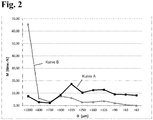
- FIG. 2 shows the result of the sieve analysis by the method according to DIN 66165-2 of the granules thus obtained in comparison to the SiO 2 granules according to Comparative Example 2. Plotted is the relative percentage M (based on the total mass in weight percent) on the particle size D in microns the SiO 2 granules.
- Curve A shows the particle size distribution of the SiO 2 granulate produced according to the invention at a residual moisture content of about 40% compared with a SiO 2 granulate prepared by freeze granulation but without the addition of nitrogen hydrides to the initial SiO 2 suspension (curve B) has been.
- the SiO 2 granules produced according to the invention have a high proportion of particle sizes in the range from 300 ⁇ m to 600 ⁇ m, while the SiO 2 granules produced without adding a nitrogen hydride to the SiO 2 slickener have a very high content Coarse fraction of granules greater than 800 microns shows.
- the addition of nitrogen hydrides to the SiO 2 slug thus has an effect on the particle size distribution of the resulting SiO 2 granules in favor of smaller particle sizes and thereby reduces the resulting coarse fraction.
- the particle size distribution is broader and more homogeneous overall. This confirms that the inventive Method is suitable, in particular to provide finely divided SiO 2 granules.
- the SiO 2 granulate produced according to the invention is suitable for use in the production of high-purity quartz glass.
- this slip is adjusted to a pH of 9.5 by dropwise addition of a concentrated ammonia solution. Thereafter, the homogenized, alkaline SiO 2 suspension dopants are supplied in dissolved form and by timed, dropwise addition of an aqueous dopant solution of AlCl 3 and YbCl 3 under constant stirring.
- this now doped slip is then frozen and thawed again.
- the solid forms a sediment during thawing and above it is the ammoniacal liquid, which is decanted.
- the sediment contains ammonium chloride (NH 4 Cl) from the reaction of the ammonia with the dopants.
- the ammonium chloride can either sublime or wash out at correspondingly high drying temperatures.
- deionised water is added to the sediment, the moist granules settle again as sediment after a short time and the dissolved ammonium salts are removed by pouring off the supernatant liquid.
- the SiO 2 particles - whether doped or undoped - show a strong sedimentation tendency, so that this washing process can be repeated several times if necessary and is not time-consuming.
- the resulting granules are particularly suitable for further processing into components of optically active materials for laser-active components, such as fiber lasers and for the production of quartz glass for use in dry etching.
- An SiO 2 suspension according to Example 1 is not frozen, but allowed to stand in rest position for several days. There is no separation of SiO 2 particles and aqueous liquid. To remove the water, the slip is dried for 24 hours in a drying oven at 120 ° C.
- SiO 2 cake which is ground with a mortar by hand to a coarse, splintered granulate. By working with the mortar there is also an increased risk that contaminants are introduced into the SiO 2 granules.
- An aqueous SiO 2 suspension of discrete SiO 2 particles in the form of SiO 2 aggregates in demineralized water is produced in a sealable plastic container, for example a PTFE bottle with a lid. Subsequently, the SiO 2 suspension is frozen in a freezer without addition of a nitrogen hydride. During thawing at room temperature, the agglomerated SiO 2 particles as sediment separate from the water, so that in the lower half of the container, the sediment is present and above the water as a more or less clear liquid.
- the liquid is then poured off.
- the remaining water left in the sediment can be evaporated by drying the sediment at 120 ° C in a drying oven.
- the SiO 2 slickener without addition of nitrogen hydrides leads to a relatively hard SiO 2 granulate, which is partly present in small clumps.
- the grain analysis according to Fig. 2 Curve B shows a high coarse fraction of up to 65% for grain sizes between about 800 ⁇ m and> 1000 ⁇ m in comparison to granules whose starting material was an SiO 2 slug with addition of ammonia as nitrogen hydride ( Fig. 2 Curve A).
Landscapes
- Chemical & Material Sciences (AREA)
- Organic Chemistry (AREA)
- Engineering & Computer Science (AREA)
- Materials Engineering (AREA)
- Inorganic Chemistry (AREA)
- Life Sciences & Earth Sciences (AREA)
- Chemical Kinetics & Catalysis (AREA)
- General Chemical & Material Sciences (AREA)
- Geochemistry & Mineralogy (AREA)
- Manufacturing & Machinery (AREA)
- Silicon Compounds (AREA)
Applications Claiming Priority (2)
| Application Number | Priority Date | Filing Date | Title |
|---|---|---|---|
| DE102012008175A DE102012008175A1 (de) | 2012-04-26 | 2012-04-26 | Verfahren zur Herstellung eines SiO2-Granulats |
| PCT/EP2013/058585 WO2013160388A1 (de) | 2012-04-26 | 2013-04-25 | Verfahren zur herstellung eines sio2-granulats |
Publications (2)
| Publication Number | Publication Date |
|---|---|
| EP2847131A1 EP2847131A1 (de) | 2015-03-18 |
| EP2847131B1 true EP2847131B1 (de) | 2017-05-31 |
Family
ID=48190502
Family Applications (1)
| Application Number | Title | Priority Date | Filing Date |
|---|---|---|---|
| EP13718837.1A Active EP2847131B1 (de) | 2012-04-26 | 2013-04-25 | Verfahren zur herstellung eines sio2-granulats |
Country Status (7)
| Country | Link |
|---|---|
| US (1) | US9902621B2 (enExample) |
| EP (1) | EP2847131B1 (enExample) |
| JP (1) | JP6207589B2 (enExample) |
| CN (1) | CN104271507B (enExample) |
| DE (1) | DE102012008175A1 (enExample) |
| RU (1) | RU2604617C2 (enExample) |
| WO (1) | WO2013160388A1 (enExample) |
Families Citing this family (16)
| Publication number | Priority date | Publication date | Assignee | Title |
|---|---|---|---|---|
| EP3000790B2 (de) | 2014-09-29 | 2023-07-26 | Heraeus Quarzglas GmbH & Co. KG | Verfahren für die Herstellung von Bauteilen aus synthetischem Quarzglas aus SiO2-Granulat |
| WO2017064177A1 (de) * | 2015-10-13 | 2017-04-20 | Ceramtec Gmbh | Herstellung von keramiken ohne piezoelektrische eigenschaften in wässriger umgebung |
| TWI808933B (zh) | 2015-12-18 | 2023-07-21 | 德商何瑞斯廓格拉斯公司 | 石英玻璃體、二氧化矽顆粒、光導、施照體、及成型體及其製備方法 |
| CN108698888A (zh) | 2015-12-18 | 2018-10-23 | 贺利氏石英玻璃有限两合公司 | 在石英玻璃制备中作为中间物的经碳掺杂的二氧化硅颗粒的制备 |
| KR20180095880A (ko) | 2015-12-18 | 2018-08-28 | 헤래우스 크바르츠글라스 게엠베하 & 컴파니 케이지 | 합성 석영 유리 결정립의 제조 |
| CN108698890A (zh) | 2015-12-18 | 2018-10-23 | 贺利氏石英玻璃有限两合公司 | 利用在熔融烘箱中的露点监测制备石英玻璃体 |
| WO2017103153A1 (de) | 2015-12-18 | 2017-06-22 | Heraeus Quarzglas Gmbh & Co. Kg | Glasfasern und vorformen aus quarzglas mit geringem oh-, cl- und al-gehalt |
| TWI733723B (zh) | 2015-12-18 | 2021-07-21 | 德商何瑞斯廓格拉斯公司 | 不透明石英玻璃體的製備 |
| CN108698894A (zh) | 2015-12-18 | 2018-10-23 | 贺利氏石英玻璃有限两合公司 | 在多腔式烘箱中制备石英玻璃体 |
| KR20180095619A (ko) | 2015-12-18 | 2018-08-27 | 헤래우스 크바르츠글라스 게엠베하 & 컴파니 케이지 | 실리카 유리 제조 동안 규소 함량의 증가 |
| US11299417B2 (en) | 2015-12-18 | 2022-04-12 | Heraeus Quarzglas Gmbh & Co. Kg | Preparation of a quartz glass body in a melting crucible of refractory metal |
| CN108698892A (zh) | 2015-12-18 | 2018-10-23 | 贺利氏石英玻璃有限两合公司 | 从二氧化硅颗粒制备石英玻璃体 |
| KR102492733B1 (ko) | 2017-09-29 | 2023-01-27 | 삼성디스플레이 주식회사 | 구리 플라즈마 식각 방법 및 디스플레이 패널 제조 방법 |
| WO2022109297A1 (en) * | 2020-11-19 | 2022-05-27 | Georgia Tech Research Corporation | Dewatering of cellulose nanofibrils suspensions |
| EP4015459A1 (de) * | 2020-12-21 | 2022-06-22 | LANXESS Deutschland GmbH | Verfahren zur herstellung von eisenoxihydroxid |
| CN223919212U (zh) | 2022-03-28 | 2026-02-17 | 金泰克斯公司 | 具有盲点检测系统的全显示镜组件 |
Family Cites Families (17)
| Publication number | Priority date | Publication date | Assignee | Title |
|---|---|---|---|---|
| US2649388A (en) * | 1948-08-24 | 1953-08-18 | Philadelphia Quartz Co | Manufacture of silica filled materials |
| US3401017A (en) * | 1965-08-16 | 1968-09-10 | Oliver W. Burke Jr. | Modified silica pigments and processes for producing the same |
| JPS497800B1 (enExample) * | 1969-02-13 | 1974-02-22 | ||
| US3681017A (en) * | 1970-07-06 | 1972-08-01 | Grace W R & Co | Platelet silica,its production and uses |
| US4054536A (en) * | 1974-12-23 | 1977-10-18 | Nalco Chemical Company | Preparation of aqueous silica sols free of alkali metal oxides |
| DE2840459C2 (de) | 1978-09-16 | 1982-08-05 | Henkel KGaA, 4000 Düsseldorf | Verfahren zur Herstellung hochreiner Kieselsäure und deren Verwendung |
| JPS61158810A (ja) * | 1984-12-28 | 1986-07-18 | Shokubai Kasei Kogyo Kk | 高純度シリカゾルの製造法 |
| JPH02199015A (ja) * | 1989-01-27 | 1990-08-07 | Tsukishima Kikai Co Ltd | 合成石英の製造方法 |
| DE4100604C1 (enExample) | 1991-01-11 | 1992-02-27 | Schott Glaswerke, 6500 Mainz, De | |
| US5173811A (en) * | 1991-10-11 | 1992-12-22 | Gumbs Associates, Inc. | Nonlinear optical shield |
| DE19729505A1 (de) | 1997-07-10 | 1999-01-14 | Heraeus Quarzglas | Verfahren zur Herstellung von Si0¶2¶-Granulat |
| EP1256547A4 (en) | 1999-12-28 | 2005-07-13 | Watanabe & Co Ltd M | METHOD FOR THE PRODUCTION OF SILICA, SYNTHETIC QUARTZ POWDER AND SYNTHETIC QUARTZ GLASS |
| WO2003033423A1 (en) * | 2001-10-18 | 2003-04-24 | Council Of Scientific And Industrial Research | A process of making rare earth doped optical fibre |
| GB0130907D0 (en) | 2001-12-22 | 2002-02-13 | Ineos Silicas Ltd | Amorphous silica |
| US7119025B2 (en) * | 2004-04-08 | 2006-10-10 | Micron Technology, Inc. | Methods of eliminating pattern collapse on photoresist patterns |
| DE102006043738B4 (de) * | 2006-09-13 | 2008-10-16 | Heraeus Quarzglas Gmbh & Co. Kg | Bauteil aus Quarzglas zum Einsatz bei der Halbleiterfertigung und Verfahren zur Herstellung desselben |
| DE102007045097B4 (de) | 2007-09-20 | 2012-11-29 | Heraeus Quarzglas Gmbh & Co. Kg | Verfahren zur Herstellung von co-dotiertem Quarzglas |
-
2012
- 2012-04-26 DE DE102012008175A patent/DE102012008175A1/de not_active Withdrawn
-
2013
- 2013-04-25 JP JP2015507529A patent/JP6207589B2/ja active Active
- 2013-04-25 RU RU2014147493/05A patent/RU2604617C2/ru active
- 2013-04-25 CN CN201380022103.1A patent/CN104271507B/zh active Active
- 2013-04-25 US US14/397,484 patent/US9902621B2/en not_active Expired - Fee Related
- 2013-04-25 WO PCT/EP2013/058585 patent/WO2013160388A1/de not_active Ceased
- 2013-04-25 EP EP13718837.1A patent/EP2847131B1/de active Active
Also Published As
| Publication number | Publication date |
|---|---|
| JP2015516940A (ja) | 2015-06-18 |
| WO2013160388A1 (de) | 2013-10-31 |
| US9902621B2 (en) | 2018-02-27 |
| CN104271507B (zh) | 2016-08-17 |
| JP6207589B2 (ja) | 2017-10-04 |
| DE102012008175A1 (de) | 2013-10-31 |
| CN104271507A (zh) | 2015-01-07 |
| RU2604617C2 (ru) | 2016-12-10 |
| US20150086462A1 (en) | 2015-03-26 |
| EP2847131A1 (de) | 2015-03-18 |
| RU2014147493A (ru) | 2016-06-20 |
Similar Documents
| Publication | Publication Date | Title |
|---|---|---|
| DE102012008175A1 (de) | Verfahren zur Herstellung eines SiO2-Granulats | |
| EP0725045B1 (de) | Verfahren zur Herstellung gesinterter alpha-Al2O3-Körper sowie deren Verwendung | |
| EP3230205B1 (de) | Verfahren zum herstellen eines elektrodenmaterials für eine batterieelektrode | |
| DE102007045097B4 (de) | Verfahren zur Herstellung von co-dotiertem Quarzglas | |
| EP3000790B2 (de) | Verfahren für die Herstellung von Bauteilen aus synthetischem Quarzglas aus SiO2-Granulat | |
| DE69902867T2 (de) | Hydrothermale verfahren zur herstellung von bariumtitanaten pulvern | |
| EP2751302B1 (de) | Siliziumnitridhaltige trennschicht hoher härte | |
| DE10262015B3 (de) | Verfahren für die Herstellung eines opaken Quarzglas-Kompositwerkstoffs | |
| DE102009001204A1 (de) | Herstellung von Eisenorthophosphat | |
| EP3904303A1 (de) | Festkörper-lithiumionenleiter | |
| DE3633030A1 (de) | Aluminiumoxid-titandioxid-compositpulver und verfahren zu ihrer herstellung | |
| DE10243953A1 (de) | Verfahren für die Herstellung eines Bauteils aus opakem Quarzglas | |
| DE69631093T2 (de) | Anorganischer, poröser träger für eine filtrationsmembran und herstellungsverfahren | |
| DE10243954B3 (de) | Verfahren für die Herstellung eines opaken Quarzglas-Kompositwerkstoffs sowie Verwendung desselben | |
| EP1516864A2 (de) | Verfahren für die Herstellung eines Gussteils aus einem Kompositwerkstoff sowie Gussteil aus keramischen oder glasigem Kompositwerkstoff | |
| EP1518622A1 (de) | Verfahren zum Herstellen eines Hartstoff enthaltenden Granulats | |
| DE3689500T2 (de) | Verfahren zur Herstellung von koagulierten kolloidalen Teilchen. | |
| EP3428132B1 (de) | Quarzglasbauteil mit hoher thermischer stabilität, halbzeug dafür und verfahren zur herstellung desselben | |
| DE10141103B4 (de) | Verfahren zur Herstellung optischer Gläser und Farbgläser bei niederen Temperaturen | |
| EP2822896B1 (de) | Verfahren zur herstellung und verarbeitung einer pastösen sio2-masse, sowie deren verwendung | |
| DE69003311T2 (de) | Verfahren zur Herstellung von Silicaglaspulvern. | |
| EP2982780B1 (de) | Verfahren zur herstellung eines siliziumblocks, zur verfahrensdurchführung geeignete kokille aus quarzglas oder quarzgut sowie verfahren für deren herstellung | |
| DE102016201495B4 (de) | Tiegel mit einer Innenbeschichtung aus SiC als Diffusionsbarriere für Metalle sowie Verfahren zu dessen Herstellung, Verwendung und darin hergestellte Halbleiterkristalle | |
| EP3265424B1 (de) | Verfahren zum herstellen eines faserverstärkten transparenten kompositwerkstoffs und transparenter faserverstärkter kompositwerkstoff | |
| DE60008178T2 (de) | Verfahren zur Herstellung von Formkörpern aus Glas und aus Keramik |
Legal Events
| Date | Code | Title | Description |
|---|---|---|---|
| PUAI | Public reference made under article 153(3) epc to a published international application that has entered the european phase |
Free format text: ORIGINAL CODE: 0009012 |
|
| 17P | Request for examination filed |
Effective date: 20141009 |
|
| AK | Designated contracting states |
Kind code of ref document: A1 Designated state(s): AL AT BE BG CH CY CZ DE DK EE ES FI FR GB GR HR HU IE IS IT LI LT LU LV MC MK MT NL NO PL PT RO RS SE SI SK SM TR |
|
| AX | Request for extension of the european patent |
Extension state: BA ME |
|
| DAX | Request for extension of the european patent (deleted) | ||
| GRAP | Despatch of communication of intention to grant a patent |
Free format text: ORIGINAL CODE: EPIDOSNIGR1 |
|
| INTG | Intention to grant announced |
Effective date: 20161207 |
|
| GRAS | Grant fee paid |
Free format text: ORIGINAL CODE: EPIDOSNIGR3 |
|
| GRAA | (expected) grant |
Free format text: ORIGINAL CODE: 0009210 |
|
| AK | Designated contracting states |
Kind code of ref document: B1 Designated state(s): AL AT BE BG CH CY CZ DE DK EE ES FI FR GB GR HR HU IE IS IT LI LT LU LV MC MK MT NL NO PL PT RO RS SE SI SK SM TR |
|
| REG | Reference to a national code |
Ref country code: CH Ref legal event code: EP Ref country code: GB Ref legal event code: FG4D Free format text: NOT ENGLISH |
|
| REG | Reference to a national code |
Ref country code: AT Ref legal event code: REF Ref document number: 897274 Country of ref document: AT Kind code of ref document: T Effective date: 20170615 |
|
| REG | Reference to a national code |
Ref country code: IE Ref legal event code: FG4D Free format text: LANGUAGE OF EP DOCUMENT: GERMAN |
|
| REG | Reference to a national code |
Ref country code: DE Ref legal event code: R096 Ref document number: 502013007376 Country of ref document: DE |
|
| REG | Reference to a national code |
Ref country code: NL Ref legal event code: MP Effective date: 20170531 |
|
| REG | Reference to a national code |
Ref country code: LT Ref legal event code: MG4D |
|
| PG25 | Lapsed in a contracting state [announced via postgrant information from national office to epo] |
Ref country code: FI Free format text: LAPSE BECAUSE OF FAILURE TO SUBMIT A TRANSLATION OF THE DESCRIPTION OR TO PAY THE FEE WITHIN THE PRESCRIBED TIME-LIMIT Effective date: 20170531 Ref country code: NO Free format text: LAPSE BECAUSE OF FAILURE TO SUBMIT A TRANSLATION OF THE DESCRIPTION OR TO PAY THE FEE WITHIN THE PRESCRIBED TIME-LIMIT Effective date: 20170831 Ref country code: HR Free format text: LAPSE BECAUSE OF FAILURE TO SUBMIT A TRANSLATION OF THE DESCRIPTION OR TO PAY THE FEE WITHIN THE PRESCRIBED TIME-LIMIT Effective date: 20170531 Ref country code: GR Free format text: LAPSE BECAUSE OF FAILURE TO SUBMIT A TRANSLATION OF THE DESCRIPTION OR TO PAY THE FEE WITHIN THE PRESCRIBED TIME-LIMIT Effective date: 20170901 Ref country code: LT Free format text: LAPSE BECAUSE OF FAILURE TO SUBMIT A TRANSLATION OF THE DESCRIPTION OR TO PAY THE FEE WITHIN THE PRESCRIBED TIME-LIMIT Effective date: 20170531 Ref country code: ES Free format text: LAPSE BECAUSE OF FAILURE TO SUBMIT A TRANSLATION OF THE DESCRIPTION OR TO PAY THE FEE WITHIN THE PRESCRIBED TIME-LIMIT Effective date: 20170531 |
|
| PG25 | Lapsed in a contracting state [announced via postgrant information from national office to epo] |
Ref country code: NL Free format text: LAPSE BECAUSE OF FAILURE TO SUBMIT A TRANSLATION OF THE DESCRIPTION OR TO PAY THE FEE WITHIN THE PRESCRIBED TIME-LIMIT Effective date: 20170531 Ref country code: IS Free format text: LAPSE BECAUSE OF FAILURE TO SUBMIT A TRANSLATION OF THE DESCRIPTION OR TO PAY THE FEE WITHIN THE PRESCRIBED TIME-LIMIT Effective date: 20170930 Ref country code: BG Free format text: LAPSE BECAUSE OF FAILURE TO SUBMIT A TRANSLATION OF THE DESCRIPTION OR TO PAY THE FEE WITHIN THE PRESCRIBED TIME-LIMIT Effective date: 20170831 Ref country code: RS Free format text: LAPSE BECAUSE OF FAILURE TO SUBMIT A TRANSLATION OF THE DESCRIPTION OR TO PAY THE FEE WITHIN THE PRESCRIBED TIME-LIMIT Effective date: 20170531 Ref country code: SE Free format text: LAPSE BECAUSE OF FAILURE TO SUBMIT A TRANSLATION OF THE DESCRIPTION OR TO PAY THE FEE WITHIN THE PRESCRIBED TIME-LIMIT Effective date: 20170531 |
|
| PG25 | Lapsed in a contracting state [announced via postgrant information from national office to epo] |
Ref country code: CZ Free format text: LAPSE BECAUSE OF FAILURE TO SUBMIT A TRANSLATION OF THE DESCRIPTION OR TO PAY THE FEE WITHIN THE PRESCRIBED TIME-LIMIT Effective date: 20170531 Ref country code: SK Free format text: LAPSE BECAUSE OF FAILURE TO SUBMIT A TRANSLATION OF THE DESCRIPTION OR TO PAY THE FEE WITHIN THE PRESCRIBED TIME-LIMIT Effective date: 20170531 Ref country code: EE Free format text: LAPSE BECAUSE OF FAILURE TO SUBMIT A TRANSLATION OF THE DESCRIPTION OR TO PAY THE FEE WITHIN THE PRESCRIBED TIME-LIMIT Effective date: 20170531 Ref country code: DK Free format text: LAPSE BECAUSE OF FAILURE TO SUBMIT A TRANSLATION OF THE DESCRIPTION OR TO PAY THE FEE WITHIN THE PRESCRIBED TIME-LIMIT Effective date: 20170531 Ref country code: RO Free format text: LAPSE BECAUSE OF FAILURE TO SUBMIT A TRANSLATION OF THE DESCRIPTION OR TO PAY THE FEE WITHIN THE PRESCRIBED TIME-LIMIT Effective date: 20170531 |
|
| PG25 | Lapsed in a contracting state [announced via postgrant information from national office to epo] |
Ref country code: IT Free format text: LAPSE BECAUSE OF FAILURE TO SUBMIT A TRANSLATION OF THE DESCRIPTION OR TO PAY THE FEE WITHIN THE PRESCRIBED TIME-LIMIT Effective date: 20170531 Ref country code: PL Free format text: LAPSE BECAUSE OF FAILURE TO SUBMIT A TRANSLATION OF THE DESCRIPTION OR TO PAY THE FEE WITHIN THE PRESCRIBED TIME-LIMIT Effective date: 20170531 Ref country code: SM Free format text: LAPSE BECAUSE OF FAILURE TO SUBMIT A TRANSLATION OF THE DESCRIPTION OR TO PAY THE FEE WITHIN THE PRESCRIBED TIME-LIMIT Effective date: 20170531 |
|
| REG | Reference to a national code |
Ref country code: DE Ref legal event code: R097 Ref document number: 502013007376 Country of ref document: DE |
|
| PLBE | No opposition filed within time limit |
Free format text: ORIGINAL CODE: 0009261 |
|
| STAA | Information on the status of an ep patent application or granted ep patent |
Free format text: STATUS: NO OPPOSITION FILED WITHIN TIME LIMIT |
|
| REG | Reference to a national code |
Ref country code: FR Ref legal event code: PLFP Year of fee payment: 6 |
|
| 26N | No opposition filed |
Effective date: 20180301 |
|
| PG25 | Lapsed in a contracting state [announced via postgrant information from national office to epo] |
Ref country code: SI Free format text: LAPSE BECAUSE OF FAILURE TO SUBMIT A TRANSLATION OF THE DESCRIPTION OR TO PAY THE FEE WITHIN THE PRESCRIBED TIME-LIMIT Effective date: 20170531 |
|
| PG25 | Lapsed in a contracting state [announced via postgrant information from national office to epo] |
Ref country code: MT Free format text: LAPSE BECAUSE OF FAILURE TO SUBMIT A TRANSLATION OF THE DESCRIPTION OR TO PAY THE FEE WITHIN THE PRESCRIBED TIME-LIMIT Effective date: 20170531 |
|
| PG25 | Lapsed in a contracting state [announced via postgrant information from national office to epo] |
Ref country code: MC Free format text: LAPSE BECAUSE OF FAILURE TO SUBMIT A TRANSLATION OF THE DESCRIPTION OR TO PAY THE FEE WITHIN THE PRESCRIBED TIME-LIMIT Effective date: 20170531 |
|
| REG | Reference to a national code |
Ref country code: CH Ref legal event code: PL |
|
| REG | Reference to a national code |
Ref country code: BE Ref legal event code: MM Effective date: 20180430 |
|
| REG | Reference to a national code |
Ref country code: IE Ref legal event code: MM4A |
|
| PG25 | Lapsed in a contracting state [announced via postgrant information from national office to epo] |
Ref country code: LU Free format text: LAPSE BECAUSE OF NON-PAYMENT OF DUE FEES Effective date: 20180425 |
|
| PG25 | Lapsed in a contracting state [announced via postgrant information from national office to epo] |
Ref country code: LI Free format text: LAPSE BECAUSE OF NON-PAYMENT OF DUE FEES Effective date: 20180430 Ref country code: BE Free format text: LAPSE BECAUSE OF NON-PAYMENT OF DUE FEES Effective date: 20180430 Ref country code: CH Free format text: LAPSE BECAUSE OF NON-PAYMENT OF DUE FEES Effective date: 20180430 |
|
| PG25 | Lapsed in a contracting state [announced via postgrant information from national office to epo] |
Ref country code: IE Free format text: LAPSE BECAUSE OF NON-PAYMENT OF DUE FEES Effective date: 20180425 |
|
| REG | Reference to a national code |
Ref country code: AT Ref legal event code: MM01 Ref document number: 897274 Country of ref document: AT Kind code of ref document: T Effective date: 20180425 |
|
| PG25 | Lapsed in a contracting state [announced via postgrant information from national office to epo] |
Ref country code: AT Free format text: LAPSE BECAUSE OF NON-PAYMENT OF DUE FEES Effective date: 20180425 |
|
| PG25 | Lapsed in a contracting state [announced via postgrant information from national office to epo] |
Ref country code: TR Free format text: LAPSE BECAUSE OF FAILURE TO SUBMIT A TRANSLATION OF THE DESCRIPTION OR TO PAY THE FEE WITHIN THE PRESCRIBED TIME-LIMIT Effective date: 20170531 |
|
| PG25 | Lapsed in a contracting state [announced via postgrant information from national office to epo] |
Ref country code: PT Free format text: LAPSE BECAUSE OF FAILURE TO SUBMIT A TRANSLATION OF THE DESCRIPTION OR TO PAY THE FEE WITHIN THE PRESCRIBED TIME-LIMIT Effective date: 20170531 Ref country code: HU Free format text: LAPSE BECAUSE OF FAILURE TO SUBMIT A TRANSLATION OF THE DESCRIPTION OR TO PAY THE FEE WITHIN THE PRESCRIBED TIME-LIMIT; INVALID AB INITIO Effective date: 20130425 |
|
| PG25 | Lapsed in a contracting state [announced via postgrant information from national office to epo] |
Ref country code: MK Free format text: LAPSE BECAUSE OF NON-PAYMENT OF DUE FEES Effective date: 20170531 Ref country code: CY Free format text: LAPSE BECAUSE OF FAILURE TO SUBMIT A TRANSLATION OF THE DESCRIPTION OR TO PAY THE FEE WITHIN THE PRESCRIBED TIME-LIMIT Effective date: 20170531 |
|
| PG25 | Lapsed in a contracting state [announced via postgrant information from national office to epo] |
Ref country code: AL Free format text: LAPSE BECAUSE OF FAILURE TO SUBMIT A TRANSLATION OF THE DESCRIPTION OR TO PAY THE FEE WITHIN THE PRESCRIBED TIME-LIMIT Effective date: 20170531 |
|
| P01 | Opt-out of the competence of the unified patent court (upc) registered |
Effective date: 20230530 |
|
| REG | Reference to a national code |
Ref country code: DE Ref legal event code: R082 Ref document number: 502013007376 Country of ref document: DE Representative=s name: BRAND, NORMEN, DR. RER. NAT., DE |
|
| PGFP | Annual fee paid to national office [announced via postgrant information from national office to epo] |
Ref country code: DE Payment date: 20250422 Year of fee payment: 13 |
|
| PGFP | Annual fee paid to national office [announced via postgrant information from national office to epo] |
Ref country code: GB Payment date: 20250423 Year of fee payment: 13 |
|
| PGFP | Annual fee paid to national office [announced via postgrant information from national office to epo] |
Ref country code: LV Payment date: 20250417 Year of fee payment: 13 |
|
| PGFP | Annual fee paid to national office [announced via postgrant information from national office to epo] |
Ref country code: FR Payment date: 20250425 Year of fee payment: 13 |