EP2846389B1 - Energy storage battery - Google Patents
Energy storage battery Download PDFInfo
- Publication number
- EP2846389B1 EP2846389B1 EP12876002.2A EP12876002A EP2846389B1 EP 2846389 B1 EP2846389 B1 EP 2846389B1 EP 12876002 A EP12876002 A EP 12876002A EP 2846389 B1 EP2846389 B1 EP 2846389B1
- Authority
- EP
- European Patent Office
- Prior art keywords
- electrolyte
- mol
- aqueous solution
- polyethyleneimine
- cathode
- Prior art date
- Legal status (The legal status is an assumption and is not a legal conclusion. Google has not performed a legal analysis and makes no representation as to the accuracy of the status listed.)
- Not-in-force
Links
Images




Classifications
-
- H—ELECTRICITY
- H01—ELECTRIC ELEMENTS
- H01M—PROCESSES OR MEANS, e.g. BATTERIES, FOR THE DIRECT CONVERSION OF CHEMICAL ENERGY INTO ELECTRICAL ENERGY
- H01M8/00—Fuel cells; Manufacture thereof
- H01M8/20—Indirect fuel cells, e.g. fuel cells with redox couple being irreversible
-
- H—ELECTRICITY
- H01—ELECTRIC ELEMENTS
- H01M—PROCESSES OR MEANS, e.g. BATTERIES, FOR THE DIRECT CONVERSION OF CHEMICAL ENERGY INTO ELECTRICAL ENERGY
- H01M4/00—Electrodes
- H01M4/02—Electrodes composed of, or comprising, active material
- H01M4/36—Selection of substances as active materials, active masses, active liquids
- H01M4/60—Selection of substances as active materials, active masses, active liquids of organic compounds
- H01M4/602—Polymers
- H01M4/604—Polymers containing aliphatic main chain polymers
-
- H—ELECTRICITY
- H01—ELECTRIC ELEMENTS
- H01M—PROCESSES OR MEANS, e.g. BATTERIES, FOR THE DIRECT CONVERSION OF CHEMICAL ENERGY INTO ELECTRICAL ENERGY
- H01M8/00—Fuel cells; Manufacture thereof
- H01M8/18—Regenerative fuel cells, e.g. redox flow batteries or secondary fuel cells
- H01M8/184—Regeneration by electrochemical means
- H01M8/188—Regeneration by electrochemical means by recharging of redox couples containing fluids; Redox flow type batteries
-
- Y—GENERAL TAGGING OF NEW TECHNOLOGICAL DEVELOPMENTS; GENERAL TAGGING OF CROSS-SECTIONAL TECHNOLOGIES SPANNING OVER SEVERAL SECTIONS OF THE IPC; TECHNICAL SUBJECTS COVERED BY FORMER USPC CROSS-REFERENCE ART COLLECTIONS [XRACs] AND DIGESTS
- Y02—TECHNOLOGIES OR APPLICATIONS FOR MITIGATION OR ADAPTATION AGAINST CLIMATE CHANGE
- Y02E—REDUCTION OF GREENHOUSE GAS [GHG] EMISSIONS, RELATED TO ENERGY GENERATION, TRANSMISSION OR DISTRIBUTION
- Y02E60/00—Enabling technologies; Technologies with a potential or indirect contribution to GHG emissions mitigation
- Y02E60/10—Energy storage using batteries
-
- Y—GENERAL TAGGING OF NEW TECHNOLOGICAL DEVELOPMENTS; GENERAL TAGGING OF CROSS-SECTIONAL TECHNOLOGIES SPANNING OVER SEVERAL SECTIONS OF THE IPC; TECHNICAL SUBJECTS COVERED BY FORMER USPC CROSS-REFERENCE ART COLLECTIONS [XRACs] AND DIGESTS
- Y02—TECHNOLOGIES OR APPLICATIONS FOR MITIGATION OR ADAPTATION AGAINST CLIMATE CHANGE
- Y02E—REDUCTION OF GREENHOUSE GAS [GHG] EMISSIONS, RELATED TO ENERGY GENERATION, TRANSMISSION OR DISTRIBUTION
- Y02E60/00—Enabling technologies; Technologies with a potential or indirect contribution to GHG emissions mitigation
- Y02E60/30—Hydrogen technology
- Y02E60/50—Fuel cells
Definitions
- the invention relates to an energy storage battery, such as a redox flow battery.
- Patent Document 1 proposes a configuration in which the anode electrolyte is an aqueous solution containing an iron-based redox material as an anode active material, and also containing a chelating agent or complexing agent for shifting a potential to the negative side.
- the cathode electrolyte is an aqueous solution containing a manganese-based redox material as a cathode active material.
- manganese oxides are known to have strong oxidizing power to decompose (oxidize) a wide range of organic substances in water.
- potassium permanganate a kind of manganese oxide, is used as an oxidant to measure the amount of organic substances in water, i.e., COD value (Non-Patent Document 1).
- manganese ion also has strong oxidizing power.
- Non-Patent Document 2 it is known that even in a state that manganese ion is complexed with a chelating agent or complexing agent to form a complex such as Mn(III)-EDTA (ethylene diamine tetraacetic acid), the ligand may be oxidized to generate CO 2 gas and thus cause self-decomposition of the complex (Non-Patent Document 2).
- Patent Document 2 proposes using a chelating agent or complexing agent to prevent precipitation of a manganese compound.
- Patent Document 3 proposes using a chelating agent or complexing agent to improve reactivity of manganese ion in a cathode electrolyte of a microbial battery.
- an energy storage battery such as a redox flow battery or the like which uses a manganese-based redox material and has sufficient durability for practical applications in a wide range of fields.
- the invention has been achieved in light of the above problems, and its main purpose is to provide an energy storage battery such as a redox flow battery or the like which uses a manganese-based redox material and has sufficient durability for practical applications in a wide range of fields.
- the inventors of this application made an intensive study on a chelating agent or complexing agent resistant to (not decomposed (oxidized) by) the oxidizing power of manganese ion. As a result, it is discovered that only polyethyleneimine is capable of resisting (not decomposed (oxidized) by) the oxidizing power of manganese ion, and moreover, preventing precipitation of the manganese compound and self-discharge of an energy storage battery, thereby accomplishing this invention.
- the energy storage battery of this invention is a redox type energy storage battery that is characterized in that the cathode electrolyte thereof is an aqueous solution containing a manganese-based redox material as a cathode active material and also containing polyethyleneimine.
- the cathode electrolyte is an aqueous solution containing polyethyleneimine, and is therefore capable of preventing precipitation of the manganese compound, preventing self-discharge of the energy storage battery, and also improving the reactivity of manganese ion.
- an energy storage battery using a manganese-based redox material and having sufficient durability for practical applications in a wide range of fields can be provided.
- the molar ratio of manganese ion to nitrogen atoms contained in polyethyleneimine is more preferably in the range of 1:1 to 1:5.
- the nitrogen atoms contained in polyethyleneimine refer to those contained in ethyleneimine (-CH 2 CH 2 NH-) as the basic unit. According to study of the inventors, it was proved that in the case of using the energy storage battery at around 20°C, the reactivity of manganese ion is most improved when the above molar ratio is 1:1; in the case of using the same at around 60°C, the reactivity of manganese ion is most improved when the above molar ratio is 1:5. Therefore, with the above configuration, an energy storage battery having further improved reactivity of manganese ion may be provided.
- the concentration of the manganese-polyethyleneimine complex contained in the above cathode electrolyte more preferably ranges from 0.2 mol/L to 2.5 mol/L.
- the pH of the above cathode electrolyte is more preferably in a range of 2 to 7.
- the above manganese-based redox material is more preferably manganese sulfate.
- the cathode electrolyte contains chlorine ion
- the cathode electrolyte contains an organic substance
- the organic substance is decomposed due to the oxidizing power of the manganese ion, and the energy storage battery discharges itself.
- the manganese sulfate contains neither chlorine ion nor organic substance, so with the above configuration, an energy storage battery generating no chlorine gas and capable of further preventing self-discharge can be provided.
- the above cathode electrolyte is more preferably electrolytically oxidized.
- the manganese-based redox material is manganese sulfate (II)
- the manganese ion formed by dissolving polyethyleneimine in an aqueous solution containing the manganese (II) sulfate is bivalent.
- the valence of the manganese ion changes between bivalence and trivalence during the redox reaction.
- an aqueous solution containing bivalent manganese ion is electrolytically oxidized, most manganese ions are converted into trivalent ones (however, the exact valence (valence distribution) is unknown).
- the contained manganese ion has a valence changing between trivalence and tetravalence during the redox reaction. Therefore, with the above configuration, an energy storage battery capable of further preventing precipitation of manganese compound and further preventing self-discharge of the energy storage battery, and moreover, having further improved reactivity of manganese ion can be provided.
- the above cathode electrolyte is more preferably shielded from oxygen in the atmosphere.
- an energy storage battery capable of further preventing precipitation of a manganese compound, further preventing self-discharge of the energy storage battery, and moreover, further improving reactivity of manganese ions can be provided.
- an anode electrolyte is more preferably an aqueous solution containing an iron-based redox material as an anode active material.
- the above anode electrolyte is more preferably an aqueous solution containing a Fe-diethylene triamine pentaacetic acid complex.
- the above anode electrolyte is more preferably electrolytically oxidized.
- the energy storage battery of this invention is more preferably a redox flow battery.
- an energy storage battery capable of preventing precipitation of a manganese compound, preventing its self-discharge, and also having an improved reactivity of manganese ion can be provided. Accordingly, there is an effect that an energy storage battery using a manganese-based redox material and having sufficient durability for practical applications in a wide range of fields can be provided.
- the energy storage battery of this invention is of a redox type, and includes a cathode electrolyte that is an aqueous solution containing a manganese-based redox material as a cathode active material and also containing polyethyleneimine.
- manganese-based redox material refers to a compound that generates manganese ion when mixed in an aqueous solution, wherein during a redox reaction, the manganese ion has a varying valence (associated with the redox reaction) in the ionic state.
- the same rule also applies to the case of iron.
- the description "A to B” that indicates a numerical value range means “from A to B” unless otherwise specified. Accordingly, in the invention, “pH of 2 to 7,” for example, refers to that the pH ranges from 2 to 7.
- number of moles of polyethyleneimine refers to the number of moles of nitrogen atoms contained in ethyleneimine (-CH 2 CH 2 NH-) as a basic unit. Accordingly, "1 mol of polyethyleneimine” means that the number of moles of nitrogen atoms contained in ethyleneimine (molecular weight: 43) as a basic unit is 1 mol, i.e., that the number of moles of the ethyleneimine is 1 mol (hence "1 mol of polyethyleneimine” weighs 43 g).
- a redox flow battery is taken as an example of energy storage battery.
- the invention is not limited thereto, and may be carried out in modes that have been modified in various ways within the described scope.
- a redox flow battery 1 of this embodiment mainly includes a charge/discharge cell (battery container) 2, a cathode electrolyte tank 3, and an anode electrolyte tank 4.
- the charge/discharge cell 2 has its inside divided into a cathode cell 2a and an anode cell 2b by a diaphragm 11 composed of, for example, an ion exchange membrane.
- a temperature regulator that maintains a constant temperature may be disposed.
- the cathode cell 2a accommodates a collector plate 12 in the form of, e.g., a glassy carbon plate or the like, and a cathode 13 composed of, e.g., carbon felt.
- the anode cell 2b accommodates a collector plate 14 in the form of, e.g., a glassy carbon plate or the like, and an anode 15 composed of, e.g., carbon felt.
- the cathode 13 is impregnated with a cathode electrolyte, and the anode 15 is impregnated with an anode electrolyte.
- the above cathode electrolyte and anode electrolyte have a pH in a range of 2 to 7, no strong acidity, and little corrosiveness, thus being good in operatability.
- the above collector plates 12 and 14 are electrically connected to a charge/ discharge apparatus 10.
- a reduction reaction is performed on the cathode 13 to receive electrons
- an oxidation reaction is performed on the anode 15 to release electrons.
- the collector plate 12 is configured to receive electrons from the charge/discharge apparatus 10 and supply them to the cathode 13
- the collector plate 14 is configured to collect the electrons released by the anode 15 and supply them to the charge/discharge apparatus 10.
- an oxidation reaction is performed on the cathode 13 to release electrons, while a reduction reaction is performed on the anode 15 to receive electrons.
- the collector plate 12 is configured to collect the electrons released by the cathode 13 and supply them to the charge/discharge apparatus 10
- the collector plate 14 is configured to receive the electrons from the charge/discharge apparatus 10 and supply them to the anode 15.
- the cathode electrolyte tank 3 is a tank for storing the cathode electrolyte and is connected to the cathode cell 2a. That is to say, the above cathode electrolyte tank 3 is configured to supply the cathode electrolyte to the cathode 13 in the cathode cell 2a through a supply pipe 3a, and to recycle the cathode electrolyte that has passed through the cathode 13 through a recycling pipe 3b. Then, the cathode electrolyte is circulated using a pump 5 disposed on the supply pipe 3a.
- the amount of the cathode electrolyte supplied per unit time relative to the cathode cell 2a during the charge/discharge or the capacity of the cathode electrolyte tank 3 only has to be set depending on the size of the charge/discharge cell 2 or the capabilities required by the redox flow battery 1, etc., and is not particularly limited.
- the anode electrolyte tank 4 is a tank for storing the anode electrolyte and is connected to the anode cell 2b. That is to say, the above anode electrolyte tank 4 is configured to supply the anode electrolyte to the anode 15 in the anode cell 2b through a supply pipe 4a, and to recycle the anode electrolyte that has passed through the anode 15 through a recycling pipe 4b. Then, the anode electrolyte is circulated using a pump 6 disposed on the supply pipe 4a.
- the amount of the anode electrolyte supplied per unit time relative to the anode cell 2b during the charge/discharge or the capacity of the anode electrolyte tank 4 only has to be set depending on the size of the charge/discharge cell 2 or the capabilities required for the redox flow battery 1 and so on, and is not particularly limited.
- the electrolyte in the charge/discharge cell 2 may be replaced.
- long-term (so-called large-capacity) charge and discharge become possible.
- an inert gas such as N 2 gas or the like is supplied from a gas supply apparatus (not shown) by an inert gas supply pipe 7.
- an inert gas supply pipe 7 an inert gas supply apparatus (not shown)
- the inert gas supplied from the inert gas supply pipe 7 is evacuated outside through an exhaust pipe 8.
- the tip of the exhaust pipe 8 is water-sealed by a water-seal pipe 9.
- the inert gas supply pipe 7 may be configured to supply the inert gas to the gas phase part of the charge/discharge cell 2, the cathode electrolyte tank 3 and the anode electrolyte tank 4, and may also be configured to supply the inert gas by bubbling into the cathode electrolyte and the anode electrolyte.
- the above cathode electrolyte and anode electrolyte have a pH in the range of 2 to 7, no strong acidity, and little corrosiveness, so there is great flexibility in material choice for each component constituting the redox flow battery 1. That is to say, if the cathode electrolyte and the anode electrolyte are strongly acidic, the choice of materials capable of being used as the battery container is limited (e.g., hydrolyzed plastics cannot be used).
- the cathode electrolyte and the anode electrolyte are not strongly acidic
- specific examples of materials of the charge/discharge cell 2 may include: commodity plastics, or relatively cheap metals such as Sn, Al, Ti, Cu, Fe, Ni and so on.
- the materials of the cathode electrolyte tank 3 or the pump 5, the supply pipe 3a, the recycling pipe 3b, the anode electrolyte tank 4, the pump 6, the supply pipe 4a and the recycling pipe 4b may also include the materials exemplified above.
- the redox flow battery 1 may be manufactured at a relatively low cost.
- the redox flow battery 1 has a long service life compared to conventional redox flow batteries (using strongly acidic electrolytes). Accordingly, compared to that of the conventional redox flow batteries (using strongly acidic electrolytes), mass production (industrialization) of the redox flow battery 1 at relatively low cost is easy. Nevertheless, the components constituting the redox flow battery 1 are not limited to include the materials exemplified above, because they only have to consist of materials having moderate mechanical strength sufficient for maintaining the apparatus and being non-corrodible by the cathode electrolyte and the anode electrolyte.
- the above anode electrolyte only has to be an aqueous solution having a pH preferably in the range of 2 to 7, more preferably in the range of 4 to 6, and containing an anode active material which is able to perform a good oxidation-reduction reaction (having a varying valence in the ionic state) under the condition of the pH of 2 to 7.
- anode electrolyte examples include: an aqueous solution containing a Fe-DTPA (diethylene triamine pentaacetic acid) complex, an aqueous solution containing a Fe-EDTA (ethylene diamine tetraacetic acid) complex, an aqueous solution containing a Fe-EGTA (O,O'-bis(2-aminoethyl)ethyleneglycol-N,N,N',N'- tetraacetic acid) complex, an aqueous solution containing a Fe-EDTA-OH (N-(2-hydroxyethyl)ethylenediamine-N,N',N'-triacetic acid) complex, an aqueous solution containing a Fe-NTA (nitrilotriacetic acid) complex, an aqueous solution containing a Cr-DTPA complex, an aqueous solution containing a Cr-EDTA complex, an aqueous solution containing a Cr-EGTA complex, an aqueous solution containing
- an aqueous solution containing an Fe-based redox material as an anode active material i.e., an aqueous solution containing a Fe-complex is more preferred, and an aqueous solution containing a Fe-DTPA complex is most preferred.
- a redox flow battery using an aqueous solution containing a Fe-complex as the anode electrolyte has an excellent charge/discharge reaction rate.
- the concentration of the Fe-complex in the above aqueous solution more preferably ranges from 0.2 mol/L to 2.5 mol/L, further preferably ranges from 0.3 mol/L to 2.0 mol/L, and most preferably ranges from 0.5 mol/L to 1.0 mol/L.
- the anode electrolyte is more preferably electrolytically oxidized.
- the anode electrolyte is, e.g., an aqueous solution containing a Fe-DTPA complex.
- the complex is a Fe(II)-DTPA complex in the charged state, and is a Fe(III)-DTPA complex after release of electrons in the discharged state.
- the anode electrolyte may further contain, in addition to the above complexes, a well-known electrolyte (conducting salt) such as sodium sulfate (Na 2 SO 4 ), sodium acetate, sodium salt of EDTA, and NaCl, etc.
- a method of preparing the anode electrolyte may be a well-known method including a pH adjusting technique, and is not particularly limited.
- water used in the anode electrolyte is satisfactory as long as it has a purity equal to or higher than that of distilled water.
- the aqueous solution is more preferably refluxed by heating for around 4 to 18 hours.
- the reflux time only has to be properly set depending on the type of ligand. The reflux may also be carried out in several separate operations.
- aminopolycarboxylic acid constituting the aminopolycarboxylic acid chelating compound of Fe or Cr or the like include: diethylene triamine pentaacetic acid ⁇ DTPA (sometimes referred to as DTPA(5H)); (CH 2 COOH) 2 NCH 2 CH 2 N(CH 2 COOH)CH 2 CH 2 N(CH 2 COOH) 2 ⁇ and salts thereof, ethylene diamine tetraacetic acid ⁇ EDTA; (CH 2 COOH) 2 NCH 2 CH 2 N(CH 2 COOH) 2 ⁇ and salts thereof, O,O'-bis(2-aminoethyl)ethyleneglycol-N,N,N',N'-tetraacetic acid ⁇ EGTA; (CH 2 COOH) 2 NCH 2 CH 2 OCH 2 CH 2 OCH 2 CH 2 N(CH 2 COOH) 2 ⁇ and salts thereof, N-(2-hydroxyethyl)ethylene diamine-N,N',N'-triacetic acid ⁇ EDTA-
- the method of preparing, e.g., an aminopolycarboxylic acid chelating compound of Fe having an inorganic compound of Fe and an aminopolycarboxylic acid as starting materials is not particularly limited, and may adopt a well-known chelation technique.
- the Fe-complex may be produced by using FeSO 4 as a starting material (raw material) and coordinating with the aminopolycarboxylic acid as a ligand. That is to say, the preparation method for the aminopolycarboxylic acid chelated compound of Fe is not particularly limited.
- the above inorganic compound of Fe only has to be a water-soluble (having a solubility of 0.2 mol/L or more) compound suitable for performing chelation.
- the above cathode electrolyte only has to be an aqueous solution having a pH preferably in the range of 2 to 7, more preferably in the range of 3 to 6, and containing a cathode active material capable of preforming a good oxidation-reduction reaction (having a varying valence in the ionic state) under the condition of the pH of 2 to 7.
- a cathode active material capable of preforming a good oxidation-reduction reaction (having a varying valence in the ionic state) under the condition of the pH of 2 to 7.
- it only has to be an aqueous solution containing a manganese-based redox material as a cathode active material and also containing polyethyleneimine.
- the above manganese-based redox material is not particularly limited, as long as it is a compound that generates manganese ion when mixed in an aqueous solution in which during a redox reaction the manganese ion has a varying valence (associated with the redox reaction) in the ionic state. Nevertheless, it is desired that the manganese-based redox material contains neither chlorine ion nor organic substance.
- Specific examples of the manganese-based redox material include: manganese sulfate, potassium permanganate and so on. Among them, manganese sulfate is more preferred.
- the cathode electrolyte contains chlorine ion
- the manganese ion is oxidized by charging the redox flow battery
- chlorine gas occurs.
- the cathode electrolyte contains an organic substance
- the organic substance is decomposed due to the oxidizing power of the manganese ion, and the redox flow battery discharges itself.
- the above-exemplified compounds contain neither chlorine ion nor organic substance, no chlorine gas occurs, and also a self-discharge may be further prevented.
- the polyethyleneimine Since the polyethyleneimine is capable of resisting (not decomposed (oxidized) by) the oxidizing power of manganese ion, it serves as a chelating agent or complexing agent for manganese ion to form Mn-polyethyleneimine complex.
- Polyethyleneimine is often commercially available as a mixture of compounds of different polymerization degrees. In this invention, a commercial product may be suitably used. Accordingly, the polyethyleneimine may be a mixture of primary, secondary, and tertiary (branching) amine structures within a scope of not hindering formation of the Mn-complex.
- the average molecular weight of the polyethyleneimine is not particularly limited, but preferably allows a water solubility ( ⁇ 0.2 mol/L) suitable for chelation. Specifically, the average molecular weight is preferably ranges from 300 to 10000, and further preferably from 600 to 1800.
- the molecular weight distribution of the polyethyleneimine is not particularly limited. Nevertheless, for a stable performance, a narrower distribution is desired.
- the cathode electrolyte contains polyethyleneimine, precipitation of a manganese compounds can be prevented, self-discharge of the redox flow battery can be prevented, and also the reactivity of manganese ion can be improved.
- a redox flow battery using a manganese-based redox material and having sufficient durability for practical applications in a wide range of fields can be provided.
- the amount of polyethyleneimine relative to the manganese-based redox material i.e., the molar ratio of manganese ions to nitrogen atoms contained in polyethyleneimine is more preferably in the range of 1:1 to 1:5.
- the nitrogen atoms contained in polyethyleneimine refer to those contained in ethyleneimine (-CH 2 CH 2 NH-) as a basic unit.
- the reactivity of the manganese ion is most improved when the above molar ratio is 1:1; in a case of using the same at around 60°C, the reactivity of the manganese ion is most improved when the above molar ratio is 1:5.
- the reactivity of manganese ion may be further improved.
- the above cathode electrolyte is an aqueous solution containing a Mn-polyethyleneimine complex of which the concentration in the cathode electrolyte more preferably ranges from 0.2 mol/L to 2.5 mol/L, further preferably from 0.2 mol/L to 1.5 mol/L, and most preferably from 0.5 mol/L to 1.5 mol/L.
- the cathode electrolyte is more preferably electrolytically oxidized.
- the Mn-polyethyleneimine complex is a Mn(IV)-polyethyleneimine complex after release of electrons in the charged state, and is a Mn(III)-polyethyleneimine complex in the discharged state.
- the manganese-based redox material is manganese sulfate (II)
- the manganese ion formed by dissolving polyethyleneimine in an aqueous solution containing the manganese sulfate (II) is bivalent.
- the valence of manganese ion varies between bivalence and trivalence during a redox reaction.
- an aqueous solution containing bivalent manganese ions is electrolytically oxidized, most manganese ions will be converted into trivalent ones (but the exact valence (valence distribution) is unknown).
- the contained manganese ion has a valence varying between trivalence and tetravalence during the redox reaction.
- a Mn(IV)-polyethyleneimine complex after release of electrons can be provided in the charged state, and a Mn(III)-polyethyleneimine complex may be provided in the discharged state.
- precipitation of a manganese compounds may be further prevented, self-discharge of the redox flow battery may be further prevented, and also the reactivity of the manganese ion may be further improved.
- the cathode electrolyte may further contain, in addition to the above Mn-polyethyleneimine complex, a well-known electrolyte (conducting salt) such as Na 2 SO 4 , sodium acetate, sodium salt of EDTA, NaCl and so on.
- a well-known electrolyte conducting salt
- the method of preparing the cathode electrolyte may be a well-known one using a pH adjusting technique, and is not particularly limited.
- water used in the cathode electrolyte is satisfactory as long as it has a purity equal to or higher than that of distilled water.
- the above cathode electrolyte is more preferably shielded from the oxygen in the atmosphere by the inert gas in the redox flow battery.
- the cathode electrolyte may discharge itself and cannot perform good charge/discharge thereafter. Therefore, by shielding the cathode electrolyte from the oxygen in the atmosphere, precipitation of a manganese compound can be further prevented, self-discharge of the redox flow battery can be further prevented, and also the reactivity of manganese ions can be further improved.
- the cathode electrolyte is an aqueous solution containing a Mn-polyethyleneimine complex in which Mn has a relatively high electromotive force
- the redox flow battery may be made a redox flow battery having a high output of 1.0 V or higher.
- the energy efficiency of the redox flow battery is increased, the energy efficiency thereof is increased and the charge/discharge cycling characteristic (reversibility) thereof is also improved.
- the coulombic efficiency is preferably 65% or higher, and more preferably 80% or higher.
- the energy efficiency is preferably 40% or higher, and more preferably 60% or higher.
- the charge/discharge cycling characteristic (reversibility) is preferably 90% or higher.
- the voltage efficiency is preferably 60% or higher, and more preferably 75% or higher.
- the electrolyte utilization proportion is preferably 28% or higher, and more preferably 55% or higher.
- the cathode electrolyte is an aqueous solution containing Mn-polyethyleneimine complex
- the coulombic efficiency may be made 65% or higher, and more preferably 80% or higher.
- the energy efficiency may be made 40% or higher, and more preferably 60% or higher.
- the charge/discharge cycling characteristic (reversibility) may be made 90% or higher.
- the voltage efficiency may be made 60% or higher, and more preferably 75% or higher.
- the electrolyte utilization proportion may be made 28% or higher, and more preferably 75% or higher.
- the redox flow battery of this embodiment can withstand thousands of cycles of use, thus being suitably used as an energy storage battery. Moreover, specific calculation methods for the various performances (charge/discharge cycling characteristic (reversibility), coulombic efficiency, voltage efficiency, energy efficiency and electrolyte utilization proportion) are described in the examples in later paragraphs.
- the cathode electrolyte and the anode electrolyte may be composed of aqueous solutions of compositions different from each other (so-called two-liquid type).
- the cathode electrolyte and the anode electrolyte may be composed of aqueous solutions of the same composition formed by mixing the two electrolytes (so-called premix type).
- the performance of the redox flow battery was evaluated by the following method.
- An anode electrolyte was prepared by the following method. Firstly, 0.02 mol (7.87 g) of DTPA(5H) and 0.1 mol (4.0 g) of NaOH were added to and dissolved in 50 ml of distilled water. Next, 0.02 mol (5.56 g) of FeSO 4 ⁇ 7H 2 O was added to and dissolved in the aqueous solution, and then 0.05 mol (7.1 g) of Na 2 SO 4 (conducting salt) was added thereto and dissolves. Next, distilled water was added to make the total amount be 100 ml. In this way, an aqueous solution having a concentration of Fe(II)- DTPA complex of 0.2 mol/L was prepared.
- the resulting aqueous solution was electrolytically oxidized by the method below.
- the electrolytic oxidation of the aqueous solution was performed using a redox flow battery having the configuration shown in FIG. 1 .
- the redox flow battery used for the electrolytic oxidation (and a later-described charge/discharge test) is a small-scale battery for testing.
- GFA5 a kind of carbon felt made by SGL Group, was used as the cathode and the anode, and the electrode area was made 10 cm 2 .
- CMS a kind of ion exchange membrane made by ASTOM Corporation was used as a diaphragm.
- SG Carbon (0.6 mm thick), a kind of glassy carbon plate made by Showa Denko K.K., was used as a collector plate.
- a plastic container was used as a charge/ discharge cell and filled with the above cathode, anode, diaphragm and collector plate. In such state, the capacities (capacity for electrolyte) at the cathode side and anode side were each adjusted to 3 ml.
- Glass containers having a capacity of 30 ml were used as the cathode electrolyte tank and the anode electrolyte tank.
- Silicone tubes were used as various pipes such as a supply pipe, a recycling pipe, an inert gas supply pipe, an exhaust pipe and so on.
- MP-1000 a microtube pump made by Tokyo Rikakikai Co., Ltd., was used as a pump.
- PFX200 a charge/discharge battery test system made by Kikusui Electronics, was used as a charge/discharge apparatus.
- the cathode electrolyte was prepared by the method below. Firstly, 0.02 mol (0.86 g) of polyethyleneimine was added to and dissolved in 50 ml of distilled water. Polyethyleneimine (produced by Wako Pure Chemical Industries, Ltd.) having an average molecular weight of 600 was used as the polyethyleneimine.
- the above aqueous solution was electrolytically oxidized using the same method for electrolytically oxidizing the anode electrolyte. That is to say, 20 ml of an aqueous solution having a concentration of Mn(II)-polyethyleneimine complex of 0.2 mol/L was placed in the cathode electrolyte tank of the redox flow battery having the above configuration, and 20 ml of the above aqueous solution having a concentration of Fe(III)-DTPA complex of 0.2 mol/L was placed in the anode electrolyte tank of the same. Then, a charging (with a total coulomb amount of 384 C) was performed at a constant current of 200 mA for 32 min.
- N 2 gas was supplied from the inert gas supply pipe to expel oxygen from the gas phase parts of the charge/discharge cell, cathode electrolyte tank and anode electrolyte tank. Dissolved oxygen in the aqueous solutions was also expelled.
- the Mn(II)-polyethyleneimine complex contained in the aqueous solution in the cathode electrolyte tank was electrolytically oxidized to prepare an aqueous solution having a concentration of Mn(III)-polyethyleneimine complex of 0.2 mol/L, which served as the cathode electrolyte.
- the exact valence (valence distribution) of the electrolytically oxidized Mn-polyethyleneimine complex is unknown.
- a charge/discharge test of the redox flow battery having the above configuration was done using the above cathode electrolyte and anode electrolyte under the following conditions.
- a charge/discharge cycle starting from charging was repeated 5 times (5 cycles).
- N 2 gas was supplied from the inert gas supply pipe to expel oxygen from the gas phase parts of the charge/discharge cell, the cathode electrolyte tank and the anode electrolyte tank. Dissolved oxygen in the electrolytes was also expelled.
- the redox reaction at the cathode side is "Mn(III)-polyethyleneimine complex ⁇ Mn(IV)-polyethyleneimine complex + e - ,” and the redox reaction at the anode side is "Fe(III)-DTPA complex + e - ⁇ Fe(II)-DTPA complex.”
- charge/discharge cycling characteristic (reversibility) was calculated by obtaining a coulomb amount b during the discharging in the 2 nd cycle of charge/discharge and a coulomb amount e during the discharging in the 3 rd cycle of charge/discharge, and then using the formula "(e/b) ⁇ 100" (%). Then, in a case where the calculated numerical value was 80% or more, the result was evaluated as " ⁇ " (repeated charge/discharge is possible); in a case of less than 80%, the result was evaluated as " ⁇ " (repeated charge/discharge is impossible).
- the above “energy efficiency” was calculated by obtaining an electric energy a during the charging and an electric energy b during the discharging in the 2 nd cycle of charge/discharge, and then using the formula "(b/a) ⁇ 100" (%).
- the above “electrolyte utilization proportion” was calculated by obtaining a coulomb amount c by multiplying the amount (number of moles) of active materials in the electrolyte supplied to the cathode or anode side by the Faraday constant (96500 C/mol), and obtaining a coulomb amount d during the discharging in the 1 st cycle of charge/discharge, and then using the formula "(d/c) ⁇ 100" (%).
- the smaller amount was adopted for the calculation.
- the "electromotive force” was 1.2 V
- the “charge/discharge cycling characteristic (reversibility)” was “ ⁇ ” (103%)
- the “coulombic efficiency” was 85%
- the “voltage efficiency” was 85%
- the “energy efficiency” was 72%
- the “electrolyte utilization proportion” was 53%. Accordingly, it is clear that the redox flow battery having the above configuration is suitably used as an energy storage battery.
- the "electrolyte potential” was evaluated by the method below.
- a graphite electrode and a silver/silver chloride (in saturated KCl solution) electrode are respectively inserted into the cathode electrolyte tank and the anode electrolyte tank of the redox flow battery in advance, and then the potential of the graphite electrode relative to the silver/silver chloride (in saturated KCl solution) electrode during the charging/discharging is measured.
- the potential of the cathode electrolyte was 0.94 V at the end of the discharging, and 1.06 V at the end of the charging.
- the potential of the anode electrolyte was 0.00 V at the end of the discharging, and -0.13 V at the end of the charging.
- a charge (with a total coulomb amount of 180 C) was performed at a constant current of 100 mA for 30 minutes.
- the voltage of the graphite electrode relative to the silver/silver chloride (saturated potassium chloride solution) electrode after the charging was measured.
- the redox flow battery was left still at room temperature (about 25°C) overnight (about 18 hours), and the voltage of the graphite electrode relative to the silver/silver chloride (saturated potassium chloride solution) electrode at that time was measured. The two voltages were compared to each other.
- the Mn(III)-polyethyleneimine complex is contained at a concentration of about 0.1 mol/L, and the Mn(IV)-polyethyleneimine complex is contained at a concentration of about 0.1 mol/L (at about 50%:50%); in the anode electrolyte after charging, the Fe(III)-DTPA complex is contained at a concentration of about 0.1 mol/L, and the Fe(II)-DTPA complex is contained at a concentration of about 0.1 mol/L (at about 50%:50%).
- N 2 gas was supplied from the inert gas supply pipe to expel oxygen from the gas phase parts of the charge/discharge cell, the cathode electrolyte tank and the anode electrolyte tank. Dissolved oxygen in the electrolytes was also expelled.
- the redox flow battery having the above configuration substantially does not, or sufficiently slowly, discharge itself.
- the anode electrolyte was prepared by the following method. Firstly, 0.02 mol (0.86 g) of a polyethyleneimine (by Wako Pure Chemical Industries, Ltd., having an average molecular weight of 600) was added to and dissolved in 50ml of distilled water.
- a cathode electrolyte was made by the method below. First, 0.02 mol (0.86 g) of polyethyleneimine (by Wako Pure Chemical Industries, Ltd., having an average molecular weight of 600) was added to 50 ml of distilled water and dissolved.
- electrolytic oxidation and electrolytic reduction of the aqueous solution were performed using the same method as the electrolytic oxidation method in Example 1. Specifically, 15 ml of an aqueous solution having a concentration of Mn(II)- polyethyleneimine complex of 0.2 mol/L was placed in the cathode electrolyte tank of the redox flow battery having the above configuration, and 15 ml of the above aqueous solution having a concentration of Cu(II)-polyethyleneimine complex of 0.2 mol/L was placed in the anode electrolyte tank of the same.
- collector plates pure titanium (thickness: 0.6 mm) was used for the collector plate on the cathode side, and SG Carbon (thickness: 0.6 mm), a kind of glassy carbon plate made by Showa Denko K.K., was used for the collector plate on the anode side.
- a charging (with a total coulomb amount of 300 C) was performed at a constant current of 100 mA for 50 minutes.
- N 2 was supplied from the inert gas supply pipe to expel oxygen from the gas phase parts of the charge/discharge cell, the cathode electrolyte tank and the anode electrolyte tank. Dissolved oxygen in the aqueous solutions was also expelled.
- the Mn(II)-polyethyleneimine complex contained in the aqueous solution in the cathode electrolyte tank was electrolytically oxidized to prepare an aqueous solution having a concentration of Mn(III)-polyethyleneimine complex of 0.2 mol/L, which served as the cathode electrolyte.
- the exact valence (valence distribution) of the electrolytically oxidized Mn-polyethyleneimine complex was unknown.
- the Cu(II)-polyethyleneimine complex in the anode electrolyte tank was reduced to a Cu(I)-polyethyleneimine complex, and the aqueous solution accordingly became an aqueous solution of Cu(I)-polyethyleneimine complex.
- the exact valence (valence distribution) of the electrolytically reduced Cu-polyethyleneimine complex was unknown.
- a charge/discharge test of a redox flow battery having the same configuration as the redox flow battery described in Example 1 was carried out using the above cathode electrolyte and anode electrolyte under the following conditions.
- the charge/discharge cycle was repeated 20 times (20 cycles; totally 50 cycles).
- N 2 gas was supplied from the inert gas supply pipe to expel oxygen from the gas phase parts of the charge/ discharge cell, the cathode electrolyte tank and the anode electrolyte tank. Dissolved oxygen in the electrolytes was also expelled.
- the redox reaction at the cathode side was "Mn(III)-polyethyleneimine complex ⁇ Mn(IV)-polyethyleneimine complex + e - ,” and the redox reaction at the anode side was "Cu(II)-polyethyleneimine complex + e - ⁇ Cu(I)-polyethyleneimine complex.” It is also conceivable that a Cu(II)-polyethyleneimine complex having a concentration of 0.2 mol/L was formed (reproduced) in the pre-test.
- the above “energy efficiency” was calculated by obtaining the electric energy a during the charging and the electric energy b during the discharging in the 32 nd cycle of charge/discharge, and then using the formula "(b/a) ⁇ 100" (%).
- the above “electrolyte utilization rate” was calculated by obtaining the coulomb amount c by multiplying the amount (number of moles) of the active material in the electrolyte supplied to the cathode or anode side by the Faraday constant, and obtaining the coulomb amount d during the discharging in the 31 st cycle of charge/discharge, and then using the formula "(d/c) ⁇ 100" (%).
- the so-called two-liquid type when there is a difference between the amounts of the active material in the electrolyte supplied to the cathode side and that supplied to the anode side, the smaller amount was adopted for the calculation.
- the "electromotive force” was 1.08 V
- the “charge/discharge cycling characteristic (reversibility)” was “ ⁇ ” (101%)
- the “coulombic efficiency” was 94%
- the “voltage efficiency” was 55%
- the “energy efficiency” was 51%
- the “electrolyte utilization proportion” was 78%. Accordingly, it is clear that the redox flow battery having the above configuration is suitably used as an energy storage battery.
- the "electrolyte potential" was evaluated in the same manner as in Example 1.
- the potential of the cathode electrolyte was 0.94 V at the end of the discharging, and 1.06 V at the end of the charging.
- the potential of the anode electrolyte was 0.14 V at the end of the discharging, and 0.06 V at end of the charging.
- the performance of the redox flow battery having a changed molar ratio between manganese ions and nitrogen atoms contained in polyethyleneimine was evaluated using cyclic voltammetry by the method below.
- the cyclic voltammetry having the following configuration was used as a measurement apparatus to measure (electrochemically measure) electrode characteristics of an electrode immersed in the cathode electrolyte.
- a schematic configuration of the cyclic voltammetry (CV) is described as follows based on FIG. 12 .
- the cyclic voltammetry 20 was provided with a ring-shaped upper block 27a and a plate-shaped lower block 27b, both composed of fluororesin. Between the upper block 27a and the lower block 27b, an electrode 23 composed of glassy carbon (made by Tokai Carbon Co., Ltd.) was interposed as a working electrode through an O-ring 25, and a cell 29 was configured by fixing with bolts 26a and 26b. The cell 29 is filled with the cathode electrolyte as the measured electrolyte 24.
- the cyclic voltammetry 20 includes, in the cell 29, a reference electrode 21 composed of a silver/silver chloride (saturated potassium chloride solution) electrode and a counter electrode 22 composed of a platinum wire to be immersed in the measured electrolyte 24, and also includes a cover 30 covering the cell 29.
- the counter electrode 22 is wound around the reference electrode 21 at a constant interval.
- the cover 30 has holes for passage of the reference electrode 21, the counter electrode 22 and a tube 28 formed therein.
- the tube 28 is configured to supply N 2 gas from a supply apparatus (not shown) to above the measured electrolyte 24 in the cell 29, so as to shield the measured electrolyte 24 from the oxygen in the atmosphere by the supplied N 2 gas, such that the influence of the oxygen is eliminated.
- the performance of the cathode electrolyte was evaluated by (electrochemically) measuring electrode characteristics of the electrode immersed in the cathode electrolyte using the cyclic voltammetry 20 with the above configuration.
- the cyclic voltammetry 20 was electrically connected to an electrochemical measurement system (HZ-5000, made by Hokuto Denko Corporation).
- the measurement temperature was set to 20°C or 60°C.
- the surface area of the electrode 23 contacting the measured electrolyte 24 was made 0.44 cm 2 .
- the sweep speed (scan speed) was set to 100 mV/s.
- the sweep range (scan range) was set to -1.0 V to 1.5 V (relative to the silver/silver chloride (saturated potassium chloride solution) electrode).
- the number of times of sweep (number of repeated cycles of charge/discharge) was set to 50. Thereby, the electrode characteristics of the electrode 23 were measured.
- a cathode electrolyte having a molar ratio of manganese ions to nitrogen atoms contained in polyethyleneimine of 1:1 was prepared by the following method. Firstly, 0.02 mol (0.86 g) of polyethyleneimine was added to and dissolved in 50 ml of distilled water. The used polyethyleneimine (produced by Wako Pure Chemical Industries, Ltd.) had an average molecular weight of 600.
- an aqueous solution having a molar ratio of manganese ions to nitrogen atoms contained in polyethyleneimine of 1:1 and having a concentration of Mn(II)-polyethyleneimine complex of 0.2 mol/L was prepared to serve as the cathode electrolyte a.
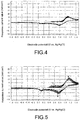
- FIG. 4 is for the case where the measurement temperature was 20°C
- FIG. 5 for the case where the measurement temperature was 60°C
- the horizontal axis indicates electrode potential (V vs Ag/AgCl)
- the vertical axis indicates the response current (mA). From the shapes of the curves (cyclic voltammogram) in the figures, the charge/ discharge cycling characteristic (reversibility) of the cathode electrolyte a can be evaluated.
- the lower curves represent reduction waves
- the upper curves represent oxidation waves.
- the electrode potential By sweeping the electrode potential from 1.5 V to 1.0 V, the reduction waves as the lower curves were plotted from the right side to the left side.
- the Mn(IV)-polyethyleneimine complex as the oxidized complex existing in proximity to the electrode 23 was reduced to the Mn(III)-polyethyleneimine complex as the reduced complex.
- the electrode potential by sweeping the electrode potential from -1.0 V to 1.5 V, the oxidation waves as the upper curves were plotted from the left side toward the right side.
- the Mn(III)-polyethyleneimine complex as the reduced complex existing in proximity to the electrode 23 was oxidized to the Mn(IV)-polyethyleneimine complex as the oxidized complex.
- each response current value in the reduction waves and the oxidation was the value of a weak current occurring in the measured electrolyte 24 by virtue of the redox reaction arising in proximity to the electrode 23.
- the mean value of the peak potentials (Ep) in both the reduction waves and the oxidation waves the redox potential of the redox reaction system of the Mn-polyethyleneimine complex was known.
- a cathode electrolyte having a molar ratio of manganese ions to nitrogen atoms contained in polyethyleneimine of 1:5 was prepared by the method below. Firstly, 0.10 mol (4.30 g) of polyethyleneimine was added to and dissolved in 50 ml of distilled water. The used polyethyleneimine (by Wako Pure Chemical Industries, Ltd.) had an average molecular weight of 600.
- an aqueous solution having a molar ratio of manganese ions to nitrogen atoms contained in polyethyleneimine of 1:5 and having a concentration of Mn(II)-polyethyleneimine complex of 0.2 mol/L was prepared to act as a cathode electrolyte b.
- FIG. 6 is for the case where the measurement temperature was 20°C
- FIG. 7 is for the case where the measurement temperature was 60°C.
- the cathode electrolyte b having a molar ratio of Mn-ions to N-atoms contained in polyethyleneimine of 1:5 had a better charge/ discharge cycling characteristic (reversibility) and is improved in the reactivity of the Mn-ion.
- a cathode electrolyte having a pH in the range of 1.28 to 6.80 was prepared as follows. Firstly, 0.02 mol (0.86 g) of polyethyleneimine was added to and dissolved in 50 ml of distilled water. The used polyethyleneimine (by Wako Pure Chemical Industries, Ltd.) had an average molecular weight of 600.
- the aqueous solution was divided into four equal parts. To each part of the aqueous solution, dilute sulfuric acid having a concentration of 2.5 mol/L was dripped to adjust the pH to 1.28, 3.01, 5.80 or 6.80. Thereby, the cathode electrolytes c-1 to c-4 were prepared.
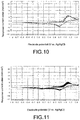
- electrode characteristics of the electrodes immersed in the above cathode electrolytes c-1 to c-4 were (electrochemically) measured using the cyclic voltammetry under the same conditions of Example 3. However, the measurement temperature was set to 20°C.
- the obtained electrode characteristics are plotted in FIGs. 8, 9 , 10 and 11 , which are respectively for the case (cathode electrolyte c-1) where the pH was 1.28, the case (cathode electrolyte c-2) where the pH was 3.01, the case (cathode electrolyte c-3) where the pH was 5.80, and the case (cathode electrolyte c-4) where the pH was 6.80.
- the solubility of the Mn(II)-polyethyleneimine complex contained in the cathode electrolyte was determined by the following method.
- polyethyleneimine 0.02 mol (0.86 g) of polyethyleneimine was added to and dissolved in 50 ml of distilled water.
- the used polyethyleneimine (produced by Wako Pure Chemical Industries, Ltd.) had an average molecular weight of 600.
- the aqueous solution was stirred by a magnetic stirrer while water therein was evaporated away until the total amount reached 8 ml, followed by being cooled to room temperature (about 25°C).
- room temperature about 25°C.
- the solubility of the Mn(II)-polyethyleneimine complex is 2.5 mol/L or more, and the concentration of Mn-polyethyleneimine complex contained in the cathode electrolyte may be adjusted to 0.2 mol/L to 2.5 mol/L. In this way, it was known that a cathode electrolyte containing the Mn(II)-polyethyleneimine complex is suitably used for the redox flow battery.
- the self-discharge test was carried out by the same processes as in Example 1. As a result, it was known that if a large amount ( ⁇ 20% of the atmosphere) of oxygen is contained in the gas contacting a liquid surface of the cathode electrolyte, the redox flow battery discharges itself (very fast).
- the voltage of the cathode electrolyte after the charging was 0.55 V
- the voltage after an overnight standing was 0.30 V. Accordingly, it was known that a redox flow battery using the cathode electrolyte containing EDTA(4Na) ⁇ 2H 2 O as a polyaminocarboxylic acid in place of polyethyleneimine discharges itself (very fast).
- Example 1 0.02 mol (3.38 g) of MnSO 4 -H 2 O was added to and dissolved in 70 ml of distilled water. Next, 0.02 mol (5.56 g) of EDTA-OH and 0.06 mol (2.4 g) of NaOH were added to and dissolved in the aqueous solution little by little, and then 0.05 mol (7.1 g) of Na 2 SO 4 was added and dissolved. Next, distilled water was added to make the total amount 100 ml. In this way, an aqueous solution having a concentration of Mn(II)-EDTA-OH complex of 0.2 mol/L was prepared. Then, except that the above aqueous solution was used as the cathode electrolyte, a self-discharge test was carried out by the operations of Example 1.
- an aqueous solution having a concentration of Mn(II)-DL-malic acid complex of 0.2 mol/L was prepared. Then, except that the above aqueous solution was used as the cathode electrolyte, a self-discharge test was carried out by the operations of Example 1.
- an aqueous solution having a concentration of Mn(II)-citric acid complex of 0.2 mol/L was prepared. Then, except that the above aqueous solution was used as the cathode electrolyte, a self-discharge test was carried out by the same operations of Example 1.
- the anode electrolyte was prepared as follows. Firstly, 0.1 mol (6.0 g) of ethylenediamine was added to and dissolved in 70 ml of distilled water. Next, dilute sulfuric acid having a concentration of 2.5 mol/L was dripped into the aqueous solution to adjust the pH to 7. Then, 0.02 mol (3.19 g) of CuSO 4 was added to and dissolved in the above aqueous solution, and then 0.05 mol (7.1 g) of Na 2 SO 4 (conducting salt) was added and dissolved.
- distilled water was added to make the total amount 100 ml, thus preparing an aqueous solution having a molar ratio of copper to ethylenediamine of 1:5 and having a concentration of Cu(II)-ethylenediamine complex of 0.2 mol/L.
- the cathode electrolyte was prepared as follows. Firstly, 0.1 mol (6.0g) of ethylenediamine was added to and dissolved in 70 ml of distilled water. Next, dilute sulfuric acid having a concentration of 2.5 mol/L was dripped into the aqueous solution to adjust the pH to 7. Then, 0.02 mol (3.38 g) of MnSO 4 ⁇ H 2 O was added to and dissolved in the aqueous solution, and then 0.05 mol (7.1 g) of Na 2 SO 4 (conducting salt) was added and dissolved. Next, distilled water was added to make the total amount 100 ml.
- a charge/discharge test of the redox flow battery was carried out using the above cathode electrolyte and anode electrolyte under the same conditions of Example 2. However, the charge/discharge test was carried out with the charging being performed at a constant current of 100 mA with a cut-off voltage set to 2.0 V. The discharging was performed at a constant current of 100 mA with a cut-off voltage set to 0.3 V.
- Example 2 As a result, there was no big difference between any of the numerical values of "electromotive force,” “coulombic efficiency,” “voltage efficiency” and “energy efficiency” and the numerical values in Example 2.
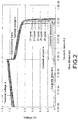
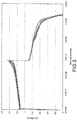
- the redox flow battery of Comparative Example 10 was reduced in capacity after the charge/discharge cycle was repeated 50 times (50 cycles). That is to say, as shown in FIG.
- an energy storage battery capable of preventing precipitation of a manganese compound and preventing self-discharge thereof, and also having an improved reactivity of manganese ion can be provided. Accordingly, there is an effect that an energy storage battery using a manganese-based redox material and having a sufficient durability for practical applications in a wide range of fields can be provided.
- the energy storage battery of this invention not only may be used by electric power companies, but also may be ubiquitously utilized in various industries requiring energy storage.
Landscapes
- Chemical & Material Sciences (AREA)
- Chemical Kinetics & Catalysis (AREA)
- Electrochemistry (AREA)
- General Chemical & Material Sciences (AREA)
- Life Sciences & Earth Sciences (AREA)
- Engineering & Computer Science (AREA)
- Manufacturing & Machinery (AREA)
- Sustainable Development (AREA)
- Sustainable Energy (AREA)
- Fuel Cell (AREA)
Applications Claiming Priority (1)
| Application Number | Priority Date | Filing Date | Title |
|---|---|---|---|
| PCT/JP2012/061546 WO2013164879A1 (ja) | 2012-05-01 | 2012-05-01 | 電力貯蔵電池 |
Publications (3)
| Publication Number | Publication Date |
|---|---|
| EP2846389A1 EP2846389A1 (en) | 2015-03-11 |
| EP2846389A4 EP2846389A4 (en) | 2015-12-16 |
| EP2846389B1 true EP2846389B1 (en) | 2017-02-22 |
Family
ID=49514289
Family Applications (1)
| Application Number | Title | Priority Date | Filing Date |
|---|---|---|---|
| EP12876002.2A Not-in-force EP2846389B1 (en) | 2012-05-01 | 2012-05-01 | Energy storage battery |
Country Status (6)
| Country | Link |
|---|---|
| US (1) | US9577283B2 (enExample) |
| EP (1) | EP2846389B1 (enExample) |
| JP (1) | JP5768933B2 (enExample) |
| CN (1) | CN104054203B (enExample) |
| IN (1) | IN2014DN08835A (enExample) |
| WO (1) | WO2013164879A1 (enExample) |
Families Citing this family (9)
| Publication number | Priority date | Publication date | Assignee | Title |
|---|---|---|---|---|
| AU2016343852A1 (en) | 2015-10-30 | 2018-05-17 | Massachusetts Institute Of Technology | Air-breathing aqueous sulfur rechargeable batteries |
| GB201522003D0 (en) | 2015-12-14 | 2016-01-27 | Imp Innovations Ltd | Regenerative fuel cells |
| KR102006820B1 (ko) * | 2016-11-25 | 2019-08-02 | 울산과학기술원 | 전해액 조성물 및 이를 포함하는 미생물 연료전지 |
| US20210167411A1 (en) * | 2017-06-21 | 2021-06-03 | Sumitomo Electric Industries, Ltd. | Redox flow battery |
| CN111313128B (zh) * | 2018-12-11 | 2021-06-22 | 中国科学院大连化学物理研究所 | 一种通信基站用铝空气电池和控制方法 |
| EP3726633A1 (en) | 2019-04-16 | 2020-10-21 | Universität Innsbruck | Redox flow battery |
| CN114079111B (zh) * | 2020-08-11 | 2023-11-14 | 好风光储能技术(成都)有限公司 | 一种大型竖式储能电池以及储能集装箱 |
| US11664518B2 (en) * | 2021-05-21 | 2023-05-30 | Raytheon Technologies Corporation | Alkaline manganese redox flow battery with inhibitor |
| WO2023149224A1 (ja) * | 2022-02-01 | 2023-08-10 | 国立研究開発法人産業技術総合研究所 | レドックスフロー電池用電解液の再生方法及びレドックスフロー電池の運転方法 |
Family Cites Families (13)
| Publication number | Priority date | Publication date | Assignee | Title |
|---|---|---|---|---|
| JPS5834911B2 (ja) | 1979-09-14 | 1983-07-29 | 工業技術院長 | レドツクス電池 |
| JPS5913154B2 (ja) | 1980-06-17 | 1984-03-28 | 工業技術院長 | レドツクス電池 |
| US4362791A (en) | 1980-06-17 | 1982-12-07 | Agency Of Industrial Science & Technology | Redox battery |
| JPS58133788A (ja) * | 1982-02-01 | 1983-08-09 | Semiconductor Energy Lab Co Ltd | 電解質溶液 |
| DE69630298T2 (de) * | 1995-05-03 | 2004-09-02 | Pinnacle Vrb Limited, Melbourne | Verfahren zur herstellung eines vanadiumelektrolyten für ganzvanadium redoxzellen und -batterien mit hoher energiedichte |
| JP3708310B2 (ja) * | 1997-11-26 | 2005-10-19 | 財団法人化学技術戦略推進機構 | ポリエチレンイミンの製造方法 |
| US20020122980A1 (en) * | 1998-05-19 | 2002-09-05 | Fleischer Niles A. | Electrochemical cell with a non-liquid electrolyte |
| CN100459269C (zh) * | 2006-03-31 | 2009-02-04 | 中国科学院大连化学物理研究所 | 用于液流蓄电的铁-配合物/卤素电化学体系 |
| GB0614337D0 (en) | 2006-07-19 | 2006-08-30 | Acal Energy Ltd | Fuel Cells |
| JP2009231230A (ja) | 2008-03-25 | 2009-10-08 | Kurita Water Ind Ltd | 微生物発電方法および装置 |
| US7820321B2 (en) * | 2008-07-07 | 2010-10-26 | Enervault Corporation | Redox flow battery system for distributed energy storage |
| KR101638595B1 (ko) | 2010-01-29 | 2016-07-12 | 삼성전자주식회사 | 레독스 플로우 전지 |
| ES2413095T3 (es) | 2010-03-12 | 2013-07-15 | Sumitomo Electric Industries, Ltd. | Batería de flujo redox |
-
2012
- 2012-05-01 JP JP2014513318A patent/JP5768933B2/ja active Active
- 2012-05-01 EP EP12876002.2A patent/EP2846389B1/en not_active Not-in-force
- 2012-05-01 CN CN201280067242.1A patent/CN104054203B/zh not_active Expired - Fee Related
- 2012-05-01 WO PCT/JP2012/061546 patent/WO2013164879A1/ja not_active Ceased
- 2012-05-01 IN IN8835DEN2014 patent/IN2014DN08835A/en unknown
- 2012-05-01 US US14/388,246 patent/US9577283B2/en not_active Expired - Fee Related
Non-Patent Citations (1)
| Title |
|---|
| None * |
Also Published As
| Publication number | Publication date |
|---|---|
| US9577283B2 (en) | 2017-02-21 |
| WO2013164879A1 (ja) | 2013-11-07 |
| EP2846389A4 (en) | 2015-12-16 |
| EP2846389A1 (en) | 2015-03-11 |
| IN2014DN08835A (enExample) | 2015-05-22 |
| CN104054203A (zh) | 2014-09-17 |
| CN104054203B (zh) | 2017-03-22 |
| JP5768933B2 (ja) | 2015-08-26 |
| JPWO2013164879A1 (ja) | 2015-12-24 |
| US20150214565A1 (en) | 2015-07-30 |
Similar Documents
| Publication | Publication Date | Title |
|---|---|---|
| EP2846389B1 (en) | Energy storage battery | |
| Shin et al. | All iron aqueous redox flow batteries using organometallic complexes consisting of iron and 3-[bis (2-hydroxyethyl) amino]-2-hydroxypropanesulfonic acid ligand and ferrocyanide as redox couple | |
| JP6698760B2 (ja) | 金属リガンド配位化合物を含む水性レドックスフロー電池 | |
| US10707513B2 (en) | Aqueous redox flow batteries comprising metal ligand coordination compounds | |
| Kar et al. | Ionic liquid electrolytes as a platform for rechargeable metal–air batteries: a perspective | |
| EP2878022B1 (en) | Redox flow batteries comprising matched ionomer membranes | |
| Xie et al. | High performance of zinc-ferrum redox flow battery with Ac−/HAc buffer solution | |
| EP2878021B1 (en) | Electrochemical systems featuring high open circuit potential | |
| US10862153B2 (en) | High-power redox flow battery based on the CrIII/CrVI redox couple and its mediated regeneration | |
| JP5874833B2 (ja) | 電力貯蔵電池及びその製造方法 | |
| Nagy et al. | Environmentally friendly Zn-air rechargeable battery with heavy metal free charcoal based air cathode | |
| Lim et al. | High performance alkaline zinc-iron flow battery achieved by adoption of advanced organic additive | |
| US20230051932A1 (en) | Iron complexes with phosphonate-based ligands as rfb anolyte materials | |
| CN105009343B (zh) | 蓄电池 | |
| KR20150045452A (ko) | 높은 음성 하프-셀 전위를 특징으로 하는 전기화학적 에너지 저장 시스템 및 방법 | |
| Yang et al. | Research Progress and Prospect of All‐Iron Redox Flow Battery Anolyte | |
| Liu et al. | Highly stable aqueous all‑iron alkaline flow battery based on a 6-coordinate Fe (THEED) as active material for anolyte | |
| Pritchard | Low-cost and sustainable all-iron redox flow battery energy storage | |
| EP3641040B1 (en) | Dichromate / zink redox flow batteries | |
| WO2014102898A1 (ja) | 電力貯蔵電池 | |
| WO2014102910A1 (ja) | 電力貯蔵電池 |
Legal Events
| Date | Code | Title | Description |
|---|---|---|---|
| PUAI | Public reference made under article 153(3) epc to a published international application that has entered the european phase |
Free format text: ORIGINAL CODE: 0009012 |
|
| 17P | Request for examination filed |
Effective date: 20141023 |
|
| AK | Designated contracting states |
Kind code of ref document: A1 Designated state(s): AL AT BE BG CH CY CZ DE DK EE ES FI FR GB GR HR HU IE IS IT LI LT LU LV MC MK MT NL NO PL PT RO RS SE SI SK SM TR |
|
| AX | Request for extension of the european patent |
Extension state: BA ME |
|
| DAX | Request for extension of the european patent (deleted) | ||
| RA4 | Supplementary search report drawn up and despatched (corrected) |
Effective date: 20151118 |
|
| RIC1 | Information provided on ipc code assigned before grant |
Ipc: H01M 8/18 20060101AFI20151112BHEP Ipc: H01M 8/20 20060101ALI20151112BHEP Ipc: H01M 4/60 20060101ALI20151112BHEP |
|
| GRAP | Despatch of communication of intention to grant a patent |
Free format text: ORIGINAL CODE: EPIDOSNIGR1 |
|
| INTG | Intention to grant announced |
Effective date: 20160930 |
|
| STAA | Information on the status of an ep patent application or granted ep patent |
Free format text: STATUS: GRANT OF PATENT IS INTENDED |
|
| GRAS | Grant fee paid |
Free format text: ORIGINAL CODE: EPIDOSNIGR3 |
|
| GRAA | (expected) grant |
Free format text: ORIGINAL CODE: 0009210 |
|
| STAA | Information on the status of an ep patent application or granted ep patent |
Free format text: STATUS: THE PATENT HAS BEEN GRANTED |
|
| AK | Designated contracting states |
Kind code of ref document: B1 Designated state(s): AL AT BE BG CH CY CZ DE DK EE ES FI FR GB GR HR HU IE IS IT LI LT LU LV MC MK MT NL NO PL PT RO RS SE SI SK SM TR |
|
| REG | Reference to a national code |
Ref country code: GB Ref legal event code: FG4D |
|
| REG | Reference to a national code |
Ref country code: CH Ref legal event code: EP |
|
| REG | Reference to a national code |
Ref country code: AT Ref legal event code: REF Ref document number: 869919 Country of ref document: AT Kind code of ref document: T Effective date: 20170315 |
|
| REG | Reference to a national code |
Ref country code: IE Ref legal event code: FG4D |
|
| REG | Reference to a national code |
Ref country code: DE Ref legal event code: R096 Ref document number: 602012029080 Country of ref document: DE |
|
| REG | Reference to a national code |
Ref country code: LT Ref legal event code: MG4D |
|
| REG | Reference to a national code |
Ref country code: NL Ref legal event code: MP Effective date: 20170222 |
|
| REG | Reference to a national code |
Ref country code: AT Ref legal event code: MK05 Ref document number: 869919 Country of ref document: AT Kind code of ref document: T Effective date: 20170222 |
|
| PG25 | Lapsed in a contracting state [announced via postgrant information from national office to epo] |
Ref country code: NO Free format text: LAPSE BECAUSE OF FAILURE TO SUBMIT A TRANSLATION OF THE DESCRIPTION OR TO PAY THE FEE WITHIN THE PRESCRIBED TIME-LIMIT Effective date: 20170522 Ref country code: GR Free format text: LAPSE BECAUSE OF FAILURE TO SUBMIT A TRANSLATION OF THE DESCRIPTION OR TO PAY THE FEE WITHIN THE PRESCRIBED TIME-LIMIT Effective date: 20170523 Ref country code: FI Free format text: LAPSE BECAUSE OF FAILURE TO SUBMIT A TRANSLATION OF THE DESCRIPTION OR TO PAY THE FEE WITHIN THE PRESCRIBED TIME-LIMIT Effective date: 20170222 Ref country code: LT Free format text: LAPSE BECAUSE OF FAILURE TO SUBMIT A TRANSLATION OF THE DESCRIPTION OR TO PAY THE FEE WITHIN THE PRESCRIBED TIME-LIMIT Effective date: 20170222 Ref country code: HR Free format text: LAPSE BECAUSE OF FAILURE TO SUBMIT A TRANSLATION OF THE DESCRIPTION OR TO PAY THE FEE WITHIN THE PRESCRIBED TIME-LIMIT Effective date: 20170222 |
|
| PGFP | Annual fee paid to national office [announced via postgrant information from national office to epo] |
Ref country code: DE Payment date: 20170530 Year of fee payment: 6 |
|
| PG25 | Lapsed in a contracting state [announced via postgrant information from national office to epo] |
Ref country code: ES Free format text: LAPSE BECAUSE OF FAILURE TO SUBMIT A TRANSLATION OF THE DESCRIPTION OR TO PAY THE FEE WITHIN THE PRESCRIBED TIME-LIMIT Effective date: 20170222 Ref country code: NL Free format text: LAPSE BECAUSE OF FAILURE TO SUBMIT A TRANSLATION OF THE DESCRIPTION OR TO PAY THE FEE WITHIN THE PRESCRIBED TIME-LIMIT Effective date: 20170222 Ref country code: RS Free format text: LAPSE BECAUSE OF FAILURE TO SUBMIT A TRANSLATION OF THE DESCRIPTION OR TO PAY THE FEE WITHIN THE PRESCRIBED TIME-LIMIT Effective date: 20170222 Ref country code: AT Free format text: LAPSE BECAUSE OF FAILURE TO SUBMIT A TRANSLATION OF THE DESCRIPTION OR TO PAY THE FEE WITHIN THE PRESCRIBED TIME-LIMIT Effective date: 20170222 Ref country code: BG Free format text: LAPSE BECAUSE OF FAILURE TO SUBMIT A TRANSLATION OF THE DESCRIPTION OR TO PAY THE FEE WITHIN THE PRESCRIBED TIME-LIMIT Effective date: 20170522 Ref country code: PT Free format text: LAPSE BECAUSE OF FAILURE TO SUBMIT A TRANSLATION OF THE DESCRIPTION OR TO PAY THE FEE WITHIN THE PRESCRIBED TIME-LIMIT Effective date: 20170622 Ref country code: LV Free format text: LAPSE BECAUSE OF FAILURE TO SUBMIT A TRANSLATION OF THE DESCRIPTION OR TO PAY THE FEE WITHIN THE PRESCRIBED TIME-LIMIT Effective date: 20170222 Ref country code: SE Free format text: LAPSE BECAUSE OF FAILURE TO SUBMIT A TRANSLATION OF THE DESCRIPTION OR TO PAY THE FEE WITHIN THE PRESCRIBED TIME-LIMIT Effective date: 20170222 Ref country code: LU Free format text: LAPSE BECAUSE OF NON-PAYMENT OF DUE FEES Effective date: 20170531 |
|
| PG25 | Lapsed in a contracting state [announced via postgrant information from national office to epo] |
Ref country code: RO Free format text: LAPSE BECAUSE OF FAILURE TO SUBMIT A TRANSLATION OF THE DESCRIPTION OR TO PAY THE FEE WITHIN THE PRESCRIBED TIME-LIMIT Effective date: 20170222 Ref country code: CZ Free format text: LAPSE BECAUSE OF FAILURE TO SUBMIT A TRANSLATION OF THE DESCRIPTION OR TO PAY THE FEE WITHIN THE PRESCRIBED TIME-LIMIT Effective date: 20170222 Ref country code: EE Free format text: LAPSE BECAUSE OF FAILURE TO SUBMIT A TRANSLATION OF THE DESCRIPTION OR TO PAY THE FEE WITHIN THE PRESCRIBED TIME-LIMIT Effective date: 20170222 Ref country code: SK Free format text: LAPSE BECAUSE OF FAILURE TO SUBMIT A TRANSLATION OF THE DESCRIPTION OR TO PAY THE FEE WITHIN THE PRESCRIBED TIME-LIMIT Effective date: 20170222 |
|
| REG | Reference to a national code |
Ref country code: DE Ref legal event code: R097 Ref document number: 602012029080 Country of ref document: DE |
|
| PG25 | Lapsed in a contracting state [announced via postgrant information from national office to epo] |
Ref country code: SM Free format text: LAPSE BECAUSE OF FAILURE TO SUBMIT A TRANSLATION OF THE DESCRIPTION OR TO PAY THE FEE WITHIN THE PRESCRIBED TIME-LIMIT Effective date: 20170222 Ref country code: DK Free format text: LAPSE BECAUSE OF FAILURE TO SUBMIT A TRANSLATION OF THE DESCRIPTION OR TO PAY THE FEE WITHIN THE PRESCRIBED TIME-LIMIT Effective date: 20170222 Ref country code: PL Free format text: LAPSE BECAUSE OF FAILURE TO SUBMIT A TRANSLATION OF THE DESCRIPTION OR TO PAY THE FEE WITHIN THE PRESCRIBED TIME-LIMIT Effective date: 20170222 |
|
| PLBE | No opposition filed within time limit |
Free format text: ORIGINAL CODE: 0009261 |
|
| REG | Reference to a national code |
Ref country code: CH Ref legal event code: PL |
|
| STAA | Information on the status of an ep patent application or granted ep patent |
Free format text: STATUS: NO OPPOSITION FILED WITHIN TIME LIMIT |
|
| GBPC | Gb: european patent ceased through non-payment of renewal fee |
Effective date: 20170522 |
|
| 26N | No opposition filed |
Effective date: 20171123 |
|
| PG25 | Lapsed in a contracting state [announced via postgrant information from national office to epo] |
Ref country code: MC Free format text: LAPSE BECAUSE OF FAILURE TO SUBMIT A TRANSLATION OF THE DESCRIPTION OR TO PAY THE FEE WITHIN THE PRESCRIBED TIME-LIMIT Effective date: 20170222 |
|
| REG | Reference to a national code |
Ref country code: IE Ref legal event code: MM4A |
|
| PG25 | Lapsed in a contracting state [announced via postgrant information from national office to epo] |
Ref country code: CH Free format text: LAPSE BECAUSE OF NON-PAYMENT OF DUE FEES Effective date: 20170531 Ref country code: SI Free format text: LAPSE BECAUSE OF FAILURE TO SUBMIT A TRANSLATION OF THE DESCRIPTION OR TO PAY THE FEE WITHIN THE PRESCRIBED TIME-LIMIT Effective date: 20170222 Ref country code: LI Free format text: LAPSE BECAUSE OF NON-PAYMENT OF DUE FEES Effective date: 20170531 |
|
| REG | Reference to a national code |
Ref country code: FR Ref legal event code: ST Effective date: 20180131 |
|
| PG25 | Lapsed in a contracting state [announced via postgrant information from national office to epo] |
Ref country code: LU Free format text: LAPSE BECAUSE OF NON-PAYMENT OF DUE FEES Effective date: 20170501 |
|
| REG | Reference to a national code |
Ref country code: BE Ref legal event code: MM Effective date: 20170531 |
|
| PG25 | Lapsed in a contracting state [announced via postgrant information from national office to epo] |
Ref country code: GB Free format text: LAPSE BECAUSE OF NON-PAYMENT OF DUE FEES Effective date: 20170522 Ref country code: IE Free format text: LAPSE BECAUSE OF NON-PAYMENT OF DUE FEES Effective date: 20170501 |
|
| PG25 | Lapsed in a contracting state [announced via postgrant information from national office to epo] |
Ref country code: FR Free format text: LAPSE BECAUSE OF NON-PAYMENT OF DUE FEES Effective date: 20170531 |
|
| PG25 | Lapsed in a contracting state [announced via postgrant information from national office to epo] |
Ref country code: BE Free format text: LAPSE BECAUSE OF NON-PAYMENT OF DUE FEES Effective date: 20170531 |
|
| PGFP | Annual fee paid to national office [announced via postgrant information from national office to epo] |
Ref country code: IT Payment date: 20180531 Year of fee payment: 7 |
|
| PG25 | Lapsed in a contracting state [announced via postgrant information from national office to epo] |
Ref country code: MT Free format text: LAPSE BECAUSE OF NON-PAYMENT OF DUE FEES Effective date: 20170501 |
|
| REG | Reference to a national code |
Ref country code: DE Ref legal event code: R119 Ref document number: 602012029080 Country of ref document: DE |
|
| PG25 | Lapsed in a contracting state [announced via postgrant information from national office to epo] |
Ref country code: DE Free format text: LAPSE BECAUSE OF NON-PAYMENT OF DUE FEES Effective date: 20181201 |
|
| PG25 | Lapsed in a contracting state [announced via postgrant information from national office to epo] |
Ref country code: HU Free format text: LAPSE BECAUSE OF FAILURE TO SUBMIT A TRANSLATION OF THE DESCRIPTION OR TO PAY THE FEE WITHIN THE PRESCRIBED TIME-LIMIT; INVALID AB INITIO Effective date: 20120501 |
|
| PG25 | Lapsed in a contracting state [announced via postgrant information from national office to epo] |
Ref country code: CY Free format text: LAPSE BECAUSE OF FAILURE TO SUBMIT A TRANSLATION OF THE DESCRIPTION OR TO PAY THE FEE WITHIN THE PRESCRIBED TIME-LIMIT Effective date: 20170222 |
|
| PG25 | Lapsed in a contracting state [announced via postgrant information from national office to epo] |
Ref country code: MK Free format text: LAPSE BECAUSE OF FAILURE TO SUBMIT A TRANSLATION OF THE DESCRIPTION OR TO PAY THE FEE WITHIN THE PRESCRIBED TIME-LIMIT Effective date: 20170222 |
|
| PG25 | Lapsed in a contracting state [announced via postgrant information from national office to epo] |
Ref country code: TR Free format text: LAPSE BECAUSE OF FAILURE TO SUBMIT A TRANSLATION OF THE DESCRIPTION OR TO PAY THE FEE WITHIN THE PRESCRIBED TIME-LIMIT Effective date: 20170222 |
|
| PG25 | Lapsed in a contracting state [announced via postgrant information from national office to epo] |
Ref country code: IT Free format text: LAPSE BECAUSE OF NON-PAYMENT OF DUE FEES Effective date: 20190501 |
|
| PG25 | Lapsed in a contracting state [announced via postgrant information from national office to epo] |
Ref country code: AL Free format text: LAPSE BECAUSE OF FAILURE TO SUBMIT A TRANSLATION OF THE DESCRIPTION OR TO PAY THE FEE WITHIN THE PRESCRIBED TIME-LIMIT Effective date: 20170222 Ref country code: IS Free format text: LAPSE BECAUSE OF FAILURE TO SUBMIT A TRANSLATION OF THE DESCRIPTION OR TO PAY THE FEE WITHIN THE PRESCRIBED TIME-LIMIT Effective date: 20170622 |