EP2829217A1 - Einsetzvorrichtung - Google Patents
Einsetzvorrichtung Download PDFInfo
- Publication number
- EP2829217A1 EP2829217A1 EP13764985.1A EP13764985A EP2829217A1 EP 2829217 A1 EP2829217 A1 EP 2829217A1 EP 13764985 A EP13764985 A EP 13764985A EP 2829217 A1 EP2829217 A1 EP 2829217A1
- Authority
- EP
- European Patent Office
- Prior art keywords
- rotary body
- knob
- operation input
- bend
- insertion device
- Prior art date
- Legal status (The legal status is an assumption and is not a legal conclusion. Google has not performed a legal analysis and makes no representation as to the accuracy of the status listed.)
- Withdrawn
Links
Images




Classifications
-
- A—HUMAN NECESSITIES
- A61—MEDICAL OR VETERINARY SCIENCE; HYGIENE
- A61B—DIAGNOSIS; SURGERY; IDENTIFICATION
- A61B1/00—Instruments for performing medical examinations of the interior of cavities or tubes of the body by visual or photographical inspection, e.g. endoscopes; Illuminating arrangements therefor
- A61B1/00147—Holding or positioning arrangements
- A61B1/0016—Holding or positioning arrangements using motor drive units
-
- A—HUMAN NECESSITIES
- A61—MEDICAL OR VETERINARY SCIENCE; HYGIENE
- A61B—DIAGNOSIS; SURGERY; IDENTIFICATION
- A61B1/00—Instruments for performing medical examinations of the interior of cavities or tubes of the body by visual or photographical inspection, e.g. endoscopes; Illuminating arrangements therefor
- A61B1/00002—Operational features of endoscopes
- A61B1/00039—Operational features of endoscopes provided with input arrangements for the user
- A61B1/00042—Operational features of endoscopes provided with input arrangements for the user for mechanical operation
-
- A—HUMAN NECESSITIES
- A61—MEDICAL OR VETERINARY SCIENCE; HYGIENE
- A61B—DIAGNOSIS; SURGERY; IDENTIFICATION
- A61B1/00—Instruments for performing medical examinations of the interior of cavities or tubes of the body by visual or photographical inspection, e.g. endoscopes; Illuminating arrangements therefor
- A61B1/00064—Constructional details of the endoscope body
- A61B1/00066—Proximal part of endoscope body, e.g. handles
-
- A—HUMAN NECESSITIES
- A61—MEDICAL OR VETERINARY SCIENCE; HYGIENE
- A61B—DIAGNOSIS; SURGERY; IDENTIFICATION
- A61B1/00—Instruments for performing medical examinations of the interior of cavities or tubes of the body by visual or photographical inspection, e.g. endoscopes; Illuminating arrangements therefor
- A61B1/005—Flexible endoscopes
- A61B1/0051—Flexible endoscopes with controlled bending of insertion part
- A61B1/0052—Constructional details of control elements, e.g. handles
-
- A—HUMAN NECESSITIES
- A61—MEDICAL OR VETERINARY SCIENCE; HYGIENE
- A61B—DIAGNOSIS; SURGERY; IDENTIFICATION
- A61B1/00—Instruments for performing medical examinations of the interior of cavities or tubes of the body by visual or photographical inspection, e.g. endoscopes; Illuminating arrangements therefor
- A61B1/005—Flexible endoscopes
- A61B1/0051—Flexible endoscopes with controlled bending of insertion part
- A61B1/0057—Constructional details of force transmission elements, e.g. control wires
-
- G—PHYSICS
- G02—OPTICS
- G02B—OPTICAL ELEMENTS, SYSTEMS OR APPARATUS
- G02B23/00—Telescopes, e.g. binoculars; Periscopes; Instruments for viewing the inside of hollow bodies; Viewfinders; Optical aiming or sighting devices
- G02B23/24—Instruments or systems for viewing the inside of hollow bodies, e.g. fibrescopes
- G02B23/2476—Non-optical details, e.g. housings, mountings, supports
Definitions
- the present invention relates to an insertion device comprising an operation input portion for performing a bending operation of a bend portion.
- a bend portion is disposed on a distal-end side of an insertion portion, and a forceps port, through which an image pickup portion and various therapeutic devices are passed, is provided in a distal-end surface of the bend portion.
- a bending operation is performed for the distal-end surface, for example, such that a desired observation target falls within an imaging visual field of the image pickup portion. This bending operation is performed by rotating an angle knob of an operation input portion which is provided on a proximal-end side of the insertion portion.
- a structure in which two knobs are placed on each other and are disposed on a main body of the operation input portion there is disclosed a structure in which two knobs are placed on each other and are disposed on a main body of the operation input portion.
- a UD knob which is rotated within a certain angular range in order to perform a bending operation in an up/down direction, is disposed on the main body
- an RL knob which has a smaller diameter than the UD knob and is rotated in order to perform a bending operation in a left/right direction, is disposed on an outside of the UD knob.
- the UD knob and RL knob are configured to have the same center of rotation.
- the endoscope device is normally operated by both hands.
- An observer holds the operation input portion by one hand (usually, the left hand), and the UD knob and RL knob are rotated and operated by fingers.
- the other hand (right hand) holds the insertion portion, and performs advancement/retreatment and rotation of a distal end of the insertion portion, together with a bending operation.
- the UD knob and RL knob in this Jpn. UM Appln. KOKAI Publication No. H05-041501 have such a polygonal shape that arcuate notches are provided on a peripheral edge, for instance, a star shape, which allows easy hooking of fingers.
- first and second knobs which are cylindrical, are proposed.
- the operation input portion of the endoscope device which is the insertion device
- the knob operation be performed by a finger of this hand.
- Such an operation is not a difficult operation if the degree of skill is advanced.
- the observer is not familiar with the operation, or when the size of the hold part of the operation input portion is slightly unsuited to the size of the hand due to a personal difference, such a situation would occur that the force of the finger for rotation is not exactly transmitted to the outer RL knob, and the knob operation is performed by taking the other hand off the insertion portion or by temporarily entrusting the holding of the insertion portion to another person.
- the surface of the insertion portion of the endoscope device is coated with a member with elasticity of rubber or resin material.
- a force of pulling a wire, etc. acts, and the coating member is bent in a contracted state.
- such a force as to restore to the original extended state from the bent state acts by the elastic force, etc. of the coating member. Accordingly, when the observer takes the hand off the knob and sets the knob in a free state, the bend portion deforms in a manner to gradually extend to a halfway position from the bent state, and the observation target falls out of the imaging visual field.
- a fixing mechanism for fixing and holding is provided near the outer periphery of the UD knob, a fixing operation for the knob has to be performed each time.
- the fixing operation is performed by releasing the hand which holds the insertion portion.
- an insertion device comprising an operation input portion, which is held by one hand, can make easier a knob operation for bending a bend portion by a finger of the one hand, and can keep a bending state of the insertion portion.
- an insertion device characterized by comprising: an insertion portion provided with a bend portion which bends in a first axial direction and a second axial direction perpendicular to the first axial direction; a first wire fixed to the bend portion and configured to be pulled and to bend the bend portion in the first axial direction; a second wire fixed to the bend portion and configured to be pulled and to bend the bend portion in the second axial direction; a first rotary body with a rotational shaft, the first rotary body being configured to rotate about the rotational shaft if an operation input for bending the bend portion in the first axial direction is input; a first pulling mechanism provided on the rotational shaft and configured to pull the first wire in interlock with rotation of the first rotary body; a second rotary body provided coaxially with the rotational shaft, the second rotary body being configured to rotate about the rotational shaft if an operation input for bending the bend portion in the second axial direction is input; a driving source configured to generate a driving force for bending
- FIG. 1 is a view illustrating a conceptual configuration of a whole system including an operation input portion of an insertion device according to an embodiment.
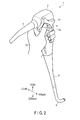
- FIG. 2 is a view illustrating a state in which the operation input portion of the first embodiment is held by one hand, and a knob operation is being performed.
- the present system is composed mainly of an endoscope body 1 which is an insertion device, and a driving control device 6.
- the endoscope body 1 is composed of an insertion portion 3 which is inserted in a lumen, a bend portion 4 provided on a distal-end side of the insertion portion 3, an operation input portion 2 provided on a proximal-end side of the insertion portion 3, and a universal cable 5 including a light guide fiber (or an optical fiber cable) which is a light guide path of illumination light, and a signal cable.
- An image pickup portion (objective lens) 15 and an illumination window 16 of illumination light are disposed on a distal-end surface of the bend portion 4.
- the driving control device 6 is composed of an image processor 7 which applies various image processes to a video signal of an observation target which has been imaged by the image pickup portion 15, a universal light source module 8 which generates illumination light which is emitted from the illumination window 16 through the light guide fiber (not shown), a controller 9 which executes control of the entirety of the endoscope device, including driving control of structural parts provided in the image pickup portion 15 and operation input portion 2, and a motor driver 12 which supplies driving power for driving a motor (to be described later) provided within the operation input portion 2. Furthermore, there are provided a monitor 14 which displays an image of an observation target, which has been processed by the image processor 7, and an input device such as a keyboard (not shown). Incidentally, there is no need to provide the motor driver 12, in a case where the bending operation by an RL knob 11 (to be described later) is performed by a manual method.
- an operation input portion body of the operation input portion 2 has a bat-like oblong shape for easy holding.
- the universal cable 5 is connected to an upper-side surface of the operation input portion body, and a proximal-end portion of the bend portion 4 is coupled to a lower end of the operation input portion body.
- a UD knob first operation input portion
- a star shape which is rotated in order to perform a bending operation in an up/down direction that is a first axial direction.
- an RL knob (second operation input portion) 11 with a cylindrical shape, which is rotated in order to perform a bending operation in a left/right direction that is a second axial direction perpendicular to the first axial direction.
- the UD knob 10 and RL knob 11 are configured to have the same center position of rotation.
- a plurality of wires are provided in the bend portion 4, and the respective wires are coupled at one end to a plurality of bend pieces which constitute the bend portion 4, and are passed, at the other end, over pulleys (not shown) disposed within the operation input portion 2.
- a bending mechanism which is composed of the plural pulleys and wires, is included in the operation input portion body. By rotating the pulleys in interlock with the rotation of the knob and pulling the wires, the bend pieces are pulled and the bend portion 4 is bent.
- the UD knob 10 of the embodiment is of the manual type.
- the pulley for bend driving in the up/down direction is coupled to a rotational shaft of the UD knob 10, and rotates in accordance with the rotational operation of the knob and pulls the wire.
- a gear (numeral 55 in FIG. 8 ) may be interposed between the UD knob 10 and the pulley, and the operational ratio between the rotational operation of the knob and the rotation of the pulley may be adjusted.
- the RL knob 11 of the embodiment is of the manual type, the RL knob 11 has the same structure as the UD knob 10.
- the pulley for bend driving in the left/right direction is equipped with a motor (or a motor driving source) which is not shown, such that the pulley and motor are meshed via a gear interposed.
- the motor generates a driving force to bend the bend portion 4 in the left/right direction, rotates the pulley, and pulls the wire.
- the RL knob 11 functions as a switch, for instance, a rotary switch, for adjusting the supply power that is applied to the motor.
- the voltage (or current) that is supplied to the motor is adjusted in accordance with the amount of rotation, and the motor driving is controlled.
- a rotation detector potentiometer, encoder, etc.
- the controller 9 outputs, in accordance with this rotational angle, a voltage (or current) for bending the bend portion 4 in the left/right direction to the motor as a driving signal.
- driving control of the motor such control is executed by the controller 9 that even if the observer has suddenly rotated the RL knob 11, the bending operation does not temporally follow such rotation and the bending operation is slowly performed.
- the thumb (first finger) of one hand (left hand in this example) 13 is hooked on the UD knob 10 and RL knob 11, the middle finger (third finger), ring finger (fourth finger) and little finger (fifth finger), which extend beyond the back side of the body, hold the operation input portion body, and the index finger (second finger), not shown, is put on the back side of the body, thus stabilizing the hold state.
- the index finger is in charge of the operations thereof.
- the UD knob 10 of the embodiment has a disc shape with a plurality of recesses which are each notched in a recess (arcuate) shape toward the center of rotation from the outer peripheral side. These recesses are each formed with such a curvature (in this example, indicative of the degree of curvature of a curved surface) and a size as to be suited to close contact with the base of the thumb.
- the center position of rotation of the RL knob 11, relative to the operation input portion body is set such that a deepest part of this recess agrees with, or is in the vicinity of, the position of the side surface of the operation input portion body. This aims at utilizing the movable range of the thumb to the maximum, with the base of the thumb being in contact with the deepest part of the recess.
- the RL knob 11 be operably present within the movable range of the thumb beyond the UD knob 10.
- the diameter, thickness and rotational position of the UD knob 10 are determined and, in addition, the diameter and the height of the side surface of the RL knob 11 are determined.
- Detailed numerical values of these are matters of design.
- FIG. 2 shows a so-called star shape with five recesses (recessed curved shapes), the number of recesses is not limited.
- the holding by the thumb is such that the second phalanx (proximal phalanx) between the base of the finger and the first joint is hooked on the UD knob 10, and the part from the inside to tip of the first phalanx (distal phalanx) on the distal side of the first joint is hooked on the RL knob 11.
- the thumb is positioned to extend beyond the UD knob 10, and the tip of the thumb is hooked on the RL knob 11.
- the second phalanx is hooked on the UD knob 10, and the UD knob 10 is rotated by swinging the base part of the thumb.
- the RL knob 11 is rotated by hooking the inside part or the tip of the first phalanx of the thumb and bending and stretching the first joint.
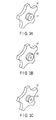
- FIG. 3A to FIG. 3C illustrate modifications of the shape of the RL knob 11.
- An RL knob 21 illustrated in FIG. 3A is configured such that concave and convex lines for preventing a slip are formed, or groove lines are cut, in the entirety of a cylindrical side surface of the above-described RL knob 11.
- An RL knob 22 illustrated in FIG. 3B is configured such that the cylindrical side surface of the RL knob 11 forms a barrel shape with a convex curved surface, and concave and convex lines for preventing a slip are formed, or groove lines are cut, in the cylindrical side surface.
- 3C is configured such that the cylindrical side surface of the RL knob 11 forms a so-called hourglass shape with a concave curved surface, and concave and convex lines for preventing a slip are formed, or groove lines are cut, in the cylindrical side surface.
- the slip prevention processing aside from the concave and convex lines or the groove lines, many minute dot-shaped projections may be formed on the cylindrical side surface. Conversely, many minute holes may be formed on the cylindrical side surface.
- the cylindrical side surface of the RL knob 21 may be covered with a member of, e.g. rubber, on which a slip hardly occurs. However, it is necessary that the member have resistance to cleaning or sterilization.
- the hooking of the finger becomes better, and a fine operation becomes easy.
- the pressing of the finger is performed in a point-by-point fashion, and the RL knob 22 becomes easy to rotate.
- the concave surface as the surface with which the finger comes in contact, the contact area of the finger becomes large, and the RL knob 22 can be rotated with light pressing.
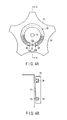
- FIG. 4A to FIG. 4F are views conceptually illustrating the structure of a neutral position restoration mechanism provided in the UD knob 10 of the operation input portion.
- FIG. 4B is a view illustrating a cross-sectional structure taken along line segment A-A in FIG. 4A .
- the neutral position restoration mechanism provided in the UD knob 10 can be provided in this description.
- the UD knob 10 is described by way of example.
- a neutral position of the bend portion in this context, means a position in a state in which the bend portion is extended substantially straight.
- the neutral position is set as a preset range (a middle position region: narrow-width groove 32c to be described later) including the center position.
- an annular groove 32 having a center at a rotational shaft 31 is formed in the UD knob 10, on the surface side opposed to the operation input portion body.
- a narrow-width groove 32c is formed as a middle position region with a partly narrowed width, that is, a range (allowance region) in which the bend portion 4 extends substantially straight.
- a columnar fixing pin 33 is erectingly provided on the body side of the operation input portion 2.
- moving spherical bodies 34, 35 are disposed at end portions 32a, 32b in the annular groove 32. Between these spherical bodies, a coil spring 36 which urges in a manner to extend is fitted in the annular groove 32.
- the moving spherical body 35 together with the end portion 32a is pushed back by the urging force of the coil spring 36 in a direction opposite to the direction of the arrow, and is returned to the state illustrated in FIG. 4A .
- the coil spring 36 adopted in this embodiment is formed by taking into account the choice of material, spring characteristics, etc., so that the coil spring 36 may slowly extend even when it is greatly contracted.
- the UD knob 10 has a neutral position corresponding to a neutral state of the bend portion 4 (a state in which the bend portion 4 becomes substantially straight).
- the UD knob 10 After the bend portion 4 is bent in the up/down direction, the UD knob 10 slowly restores from the rotational position of the UD knob 10, from which the hand has been released, toward the neutral position of the UD knob 10 by receiving the action of the restoration force (e.g. the urging force produced by the coil spring 36) for restoring the UD knob 10 to the neutral position, this restoration force being produced by the above-described neutral position restoration mechanism, that is, by the elastic member (e.g. coil spring 36, spiral spring) provided in the neutral position restoration mechanism. Accordingly, the bend portion 4, which has been bent in the up/down direction, restores slowly to the neutral position.
- the restoration force e.g. the urging force produced by the coil spring 36
- FIG. 4D to FIG. 4F are views illustrating a structure in a case where the above-described neutral position restoration mechanism is provided in the RL knob 11.
- a fixing member 38 and a rotational shaft 37 are added to the same structural elements as those of the neutral position restoration mechanism illustrated in FIG. 4A to FIG. 4C .
- the fixing member 38 fixes the fixing pin 33 to the body side of the operation input portion 2.
- the rotational shaft 37 is fixed to the RL knob 11, and rotates together with the rotation of the RL knob 11.
- a hole, through which the fixing member 38 can be inserted is provided in the rotational shaft 31.
- a hole, through which the rotational shaft 37 can be inserted is provided in the fixing member 38.
- the fixing member 38 is inserted in the hole of the rotational shaft 31, and one end thereof is fixed to the body side of the operation input portion.
- the fixing pin 33 which is engageable with the narrow-width groove 32c, is provided on the fixing member 38 which extends from a stationary portion fixed on the body side of the operation input portion 2, is inserted in the hole provided along the rotational shaft 31 in the UD knob 10, and projects from the UD knob 10. Specifically, the fixing pin 33 is fixed to the operation input portion 2 via the fixing member 38.
- the rotational shaft 37 is inserted in the hole of the fixing member 38, and is attached to the body side of the operation input portion 2 such that the rotational shaft 37 is rotatable on the inner peripheral surface of the hole of the fixing member 38.
- the fixing member 38 fixes the fixing pin 33 such that the fixing pin is located at the central position of the narrow-width groove 32c at a time when the RL knob 11 is in the neutral position.
- the moving spherical body 35 together with the end portion 32a is pushed back by the urging force of the coil spring 36 in a direction opposite to the direction of the arrow, and is returned to the state illustrated in FIG. 4D .
- the coil spring 36 adopted in this embodiment is formed by taking into account the choice of material, spring characteristics, etc., so that the coil spring 36 may slowly extend even when it is greatly contracted.
- the RL knob 11 has a neutral position corresponding to a neutral state of the bend portion 4 (a state in which the bend portion 4 becomes substantially straight).
- the RL knob 11 slowly restores from the rotational position of the RL knob 11, from which the hand has been released, toward the neutral position of the RL knob 11 by receiving the action of the restoration force (e.g. the urging force produced by the coil spring 36) for restoring the RL knob 11 to the neutral position, this restoration force being produced by the elastic member (e.g. coil spring 36, spiral spring) provided in the above-described neutral position restoration mechanism. Accordingly, the bend portion 4, which has been bent in the left/right direction, restores slowly to the neutral position.
- the restoration force e.g. the urging force produced by the coil spring 36
- the rotational operations of both the UD knob 10 and RL knob 11 can easily be performed at the same time.
- the RL knob 11 is the structural part functioning as the electrical switch of the motor, compared to a manual RL knob RL, the load on the rotational operation is lighter, and the operation can easily be performed by the first phalanx or the fingertip. Therefore, the above-described neutral position restoration mechanism is suitably provided on the electrical switch for driving the bend portion 4.
- the neutral position restoration mechanism is provided in each of the UD knob 10 and RL knob 11, it is preferable to provide the neutral position restoration mechanism on, in particular, the RL knob 11, in the case of the endoscope, as in the embodiment of FIG. 1 and FIG. 2 , which is provided with the UD knob 10 which manually bends the bend portion 4 in the up/down direction, and the RL knob 11 functioning as the electrical switch for bending the bend motor 4 in the left/right direction by the motor.
- the bend portion can slowly restore to the straight extended state that is the neutral position, by releasing the knobs. Thereby, the observer can easily estimate the bending state of the bend portion.
- FIG. 5 is a view illustrating an external-appearance structure of an operation input portion in which a bending speed adjuster is provided.
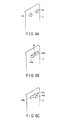
- FIG. 6A to FIG. 6E are views illustrating structure examples of a bending speed adjusting switch provided in the operation input portion.
- a speed adjuster for a motor is provided in the operation input portion 2 and controller 9, and the bending speed of the bend portion 3 is controlled.
- the control of the bending speed of the bend portion 3 of the endoscope device has conventionally been executed by operating a speed adjusting switch which is provided in the universal light source module 8 or the controller 9.
- a speed adjusting switch which is provided in the universal light source module 8 or the controller 9.
- the observer himself/herself executes a switching operation by suspending observation, or the observer gives, from time to time, an instruction to the staff in the vicinity of the switch. This takes a lot of labor, and such a situation is expected that time is consumed for this operation.
- bending speed adjusting switches 41, 42 which instruct an increase or a decrease in rotational speed of the motor, are provided under the UD knob 10 of the operation input portion 2. These switches 41, 42 are connected by wire to the controller 9 via the universal cable 5.
- the rotation speed of the motor is linearly decelerated by pressing the switch 41 in accordance with the time of pressing (count time), and, conversely, the rotation speed of the motor is linearly accelerated by pressing the switch 42 in accordance with the time of pressing.
- the rotation speed of the motor is restored to the preset rotation speed.
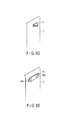
- FIG. 6A to FIG. 6E are views illustrating structure examples of the bending speed adjusting switch provided in the operation input portion. Basically, switches which perform momentary operations are adopted as the bending speed adjusting switches to be described below. Incidentally, the bending speed, that is, the adjustment of increasing/decreasing the rotational speed of the motor, is performed within a preset range of acceleration, and the upper and lower limits of the speed are set.
- Switches 43 and 44 illustrated in FIG. 6A are press-button-type switches. These switches are the same as the above-described switches 41 and 42, and are an acceleration switch 43 and a deceleration switch 44 of the rotational speed, respectively. Needless to say, these switches may be disposed at transposed positions.
- a switch 45 illustrated in FIG. 6B is a so-called rocker-type switch which is supported at a central part thereof and swings (seesaw operation). When each of both ends is pressed, the switch is turned on. As illustrated, a neutral position is a normal position and is an OFF state. For example, when a switch terminal 45a of the switch 45 is pressed, the rotational speed of the motor is linearly decelerated in accordance with the pressing time (count time). Conversely, when a switch terminal 45b is pressed, the rotational speed of the motor is linearly accelerated in accordance with the pressing time. When the hand has been released from either switch terminal 45a, 45b, the switch is restored to the neutral position in FIG. 6B by an urging member (not shown), and the rotational speed of the motor is restored to a preset rotational speed.
- a switch 46 illustrated in FIG. 6C is a slide switch.
- this slide switch 46 for example, when a lever 46a is slid to a slide end 46b, the rotational speed of the motor is linearly decelerated in accordance with a time (count time) during which the lever 46a has been shifted. Conversely, when the lever 46a is slid to a slide end 46c, the rotational speed of the motor is linearly accelerated in accordance with the time during which the lever 46a has been shifted.
- the lever 46a moves back to the neutral position shown in FIG. 6C by an urging member (not shown), and the rotational speed of the motor is restored to a preset rotational speed.
- the rotational speed is accelerated or decelerated in accordance with the time during which the slide switch has been shifted to the end.
- the rotational speed may be adjusted in accordance with a distance from the central position to a position where the slide switch has been shifted.
- a switch 47 illustrated in FIG. 6D is a rotary-type switch.
- This switch 47 is configured such that, for example, a disc-shaped rotational portion is rotatably supported inside the operation input portion 2, and a part of the rotational portion is exposed.
- a slip prevention process by concave and convex lines is applied to a side surface of the switch 47.
- this switch 47 for example, when the rotational portion has been rotated in a CW direction (clockwise direction), the rotational speed of the motor is linearly decelerated in accordance with the amount of rotation of the rotational portion. Conversely, when the rotational portion has been rotated in a CCW direction (counterclockwise direction), the rotational speed of the motor is linearly accelerated in accordance with the amount of rotation of the rotational portion.
- the rotational portion returns to the neutral position shown in FIG. 6D by an urging member (not shown), and the rotational speed of the motor is restored to a preset rotational speed.
- a switch 48 illustrated in FIG. 6E is a touch-type switch configured such that publicly-known pressure-sensing switches, in each of which a pair of electrodes are disposed to face each other, are arranged.
- this switch 48 for example, when a pressure-sensing switch (switch portion) 48a has been touched, the rotational speed of the motor is linearly decelerated in accordance with the time of contact. Conversely, when a pressure-sensing switch 48b has been touched, the rotational speed of the motor is linearly accelerated in accordance with the time of contact.
- the switch enters an OFF state, and the rotational speed of the motor is restored to a preset rotational speed.
- the bending speed adjusting switch is disposed on the operation input portion 2.
- the observer can adjust the bending speed to a desired speed, and when an observation target is to be searched or to be observed with attention, a proper speed of movement can be set in accordance with the condition of observation.
- the operation can be performed by the third finger in the state in which the operation input portion 2 is being held.
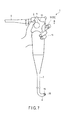
- FIG. 7 is a view illustrating an external-appearance structure of an operation input portion in which a holding mechanism for holding a bending state is mounted.
- FIG. 8 is a view illustrating a conceptual structure example of the holding mechanism provided in the operation input portion.
- the UD knob 10 and RL knob 11 provided with the above-described neutral position restoration mechanism, if the hand is released from the knob, the bending portion is automatically restored to the neutral position.
- the observer performs endoscopic observation, there occurs such a situation that the observer temporarily fixes the bending state and views an observation image. In this case, the observer has no choice but to keep at rest the thumb which is hooked on the UD knob 10 and RL knob 11.
- buttons 51 and 52 which fix the UD knob 10 and RL knob 11, respectively, are juxtaposed on an upper part of a side surface of the operation input portion 2 (a surface opposite to the surface to which the universal cable 5 is coupled).
- the lock buttons 51, 52 have functions of locking, when the lock buttons 51, 52 are pressed down, the rotational shafts of the UD knob 10 and RL knob 11 so that the UD knob 10 and RL knob 11 may not rotate.
- the lock button 51 itself is formed of an operation surface 51a and a shaft portion 51b which are formed of a resin material, and an engaging portion 51c which is attached to the shaft portion 51b and is formed of an elastic material such as rubber.
- the operation surface 51a and shaft portion 51b are formed of a resin as one piece.
- a spring 53 is fitted on the shaft portion 51b under the operation surface 51a, and these are covered with a cover 54.
- the lock button 52 is formed of an operation surface 52a, a shaft portion 52b and an engaging portion 52c, and is provided with a spring 53 and a cover 54.
- the lock button 51, 52 is not provided with a mechanism which keeps or releases the pushed state of the button when the button has been pushed.
- a mechanism by a publicly-known rotary cam method or a ratchet cam method is added so that an alternate operation may be performed.
- the bending state of the bend portion can temporarily be fixed by a one-hand operation.
- a still captured image can be observed.
- the hand can be released from the knob.
- the lock buttons are disposed at a position opposed to the hold position on which the base of the thumb abuts.
- lock buttons having stoppers at their distal ends may be formed and used such that the stoppers engage and hold gears formed on the rotational shafts of the UD knob 10 and RL knob 11.
- a structure including an electrical driving system with use of a solenoid coil may be adopted.
- a shaft portion which is provided at a distal end thereof with an engaging portion for abutment on the rotational shaft, like the above-described engaging portion 51c of the shaft portion 51b, is axially movably supported.
- the supporting of this shaft portion is implemented by projectingly forming a support frame within the operation input portion body, or by attaching an additional part.
- An annular permanent magnet is fitted and fixed on the shaft portion, and an electromagnet (solenoid coil), which annularly surrounds the permanent magnet with a gap, is configured to be fitted over the permanent magnet.
- a closed-loop circuit is constructed by the electromagnet, a magnet driving power supply which causes a driving current (direct current) to flow to the electromagnet, and an electric switch like the above-described switch 41.
- the electric switch is disposed at a position, like the position of the lock button 51 (52) on the operation input portion 2, and is operated by the second finger or third finger.
- the electric switch performs a momentary operation in which the locking of the rotational shaft is released if the electric switch is released.
- a structure in which an alternate operation can be performed may be adopted by adding a latch circuit to the closed-loop circuit which is composed of the electromagnet, magnet driving power supply and electric switch.
- the latch circuit is operated by operating the electric switch, and the setting from OFF to ON is executed.
- the supply of current from the magnet driving power supply to the electromagnet is started and kept. Accordingly, by setting the latch circuit, the engaging portion is abutted on the rotational shaft of the knob, and the rotation is prohibited.
- the latch circuit is operated by operating the electric switch, the reset from ON to OFF is executed, and the supply of current from the magnet driving power supply to the electromagnet is stopped. Accordingly, by resetting the latch circuit, the engaging portion is separated from the rotational shaft of the knob, and the rotation is set in the free state.
- the bend portion can be kept in a desired bending state at a time of observation, where necessary.
- the holding mechanism performs, basically, a momentary operation by a switch operation.
- a structure in which an alternative operation can be performed may easily be implemented by applying a publicly-known rotary cam method or ratchet cam method.
- a structure in which an alternative operation can be performed may be implemented by keeping the ON state of the switch, by making use of a bistable multivibrator such as a latch circuit.
Landscapes
- Health & Medical Sciences (AREA)
- Life Sciences & Earth Sciences (AREA)
- Surgery (AREA)
- Physics & Mathematics (AREA)
- Optics & Photonics (AREA)
- Engineering & Computer Science (AREA)
- Biomedical Technology (AREA)
- General Health & Medical Sciences (AREA)
- Pathology (AREA)
- Nuclear Medicine, Radiotherapy & Molecular Imaging (AREA)
- Biophysics (AREA)
- Heart & Thoracic Surgery (AREA)
- Medical Informatics (AREA)
- Molecular Biology (AREA)
- Animal Behavior & Ethology (AREA)
- Radiology & Medical Imaging (AREA)
- Public Health (AREA)
- Veterinary Medicine (AREA)
- Astronomy & Astrophysics (AREA)
- General Physics & Mathematics (AREA)
- Mechanical Engineering (AREA)
- Instruments For Viewing The Inside Of Hollow Bodies (AREA)
- Endoscopes (AREA)
Applications Claiming Priority (2)
| Application Number | Priority Date | Filing Date | Title |
|---|---|---|---|
| JP2012067553 | 2012-03-23 | ||
| PCT/JP2013/057711 WO2013141216A1 (ja) | 2012-03-23 | 2013-03-18 | 挿入装置 |
Publications (2)
| Publication Number | Publication Date |
|---|---|
| EP2829217A1 true EP2829217A1 (de) | 2015-01-28 |
| EP2829217A4 EP2829217A4 (de) | 2015-12-30 |
Family
ID=49222673
Family Applications (1)
| Application Number | Title | Priority Date | Filing Date |
|---|---|---|---|
| EP13764985.1A Withdrawn EP2829217A4 (de) | 2012-03-23 | 2013-03-18 | Einsetzvorrichtung |
Country Status (5)
| Country | Link |
|---|---|
| US (1) | US9375135B2 (de) |
| EP (1) | EP2829217A4 (de) |
| JP (1) | JP5537746B2 (de) |
| CN (1) | CN104219987B (de) |
| WO (1) | WO2013141216A1 (de) |
Families Citing this family (18)
| Publication number | Priority date | Publication date | Assignee | Title |
|---|---|---|---|---|
| KR102160753B1 (ko) * | 2013-09-13 | 2020-09-28 | 삼성전자주식회사 | 내시경 장치 |
| CN107529958B (zh) | 2014-10-20 | 2021-07-27 | 研发国际公司 | 可操纵微型内窥镜 |
| WO2016111042A1 (ja) * | 2015-01-09 | 2016-07-14 | オリンパス株式会社 | 内視鏡操作機構および内視鏡 |
| WO2016190455A1 (ko) * | 2015-05-22 | 2016-12-01 | 세명대학교 산학협력단 | 코 자침 내시경 |
| US20180147014A1 (en) * | 2016-11-30 | 2018-05-31 | Wipro Limited | Ureteroscope and a method for dusting stones in a body cavity |
| DE102017119691B4 (de) * | 2017-08-28 | 2024-03-21 | Schölly Fiberoptic GmbH | Endoskop mit einem verdrehbaren, elektrischen Verbindungselement |
| JP6779392B2 (ja) * | 2017-12-18 | 2020-11-04 | オリンパス株式会社 | 内視鏡用外付機構及び内視鏡システム |
| WO2019124207A1 (ja) * | 2017-12-18 | 2019-06-27 | オリンパス株式会社 | 内視鏡用外付機構 |
| DE102018130553A1 (de) | 2018-11-30 | 2020-06-04 | Henke-Sass, Wolf Gmbh | Endoskop |
| DE102018130554A1 (de) * | 2018-11-30 | 2020-06-04 | Henke-Sass, Wolf Gmbh | Endoskop |
| JP7061584B2 (ja) * | 2019-03-20 | 2022-04-28 | 富士フイルム株式会社 | 内視鏡 |
| CN110840525A (zh) * | 2019-12-02 | 2020-02-28 | 重庆大学 | 一种腹腔镜手术器械 |
| CN113498369B (zh) * | 2020-02-03 | 2024-06-11 | 元田技研株式会社 | 载荷处理装置的操作部单元 |
| EP4138629A1 (de) * | 2020-04-24 | 2023-03-01 | Ambu A/S | Bremsmechanismus für ein drehbares betätigungselement einer medizinischen vorrichtung |
| WO2021249601A1 (en) | 2020-06-08 | 2021-12-16 | Ambu A/S | A sliding motion transfer member for an endoscope |
| CN215874569U (zh) * | 2020-12-18 | 2022-02-22 | 浙江优亿医疗器械股份有限公司 | 具有自动回弹功能的内窥镜 |
| US20230270323A1 (en) * | 2022-02-28 | 2023-08-31 | Covidien Lp | Dynamic input controls on a drive-by-wire endoscope |
| KR102756630B1 (ko) * | 2023-04-28 | 2025-01-21 | 주식회사 메디인테크 | 내시경용 컨트롤러 노브장치 |
Family Cites Families (32)
| Publication number | Priority date | Publication date | Assignee | Title |
|---|---|---|---|---|
| US3897775A (en) * | 1973-09-07 | 1975-08-05 | Olympus Optical Co | Endoscope with facile bending operation |
| US4207873A (en) * | 1977-05-16 | 1980-06-17 | American Cystoscope Makers, Inc. | Endoscope deflection control |
| EP0105951B1 (de) * | 1982-10-12 | 1986-09-10 | Richard Wolf GmbH | Lichtprojektor mit Anschlussbuchse für den Stecker eines Fiberlichtleitkabels |
| JPH0246300Y2 (de) * | 1985-04-19 | 1990-12-06 | ||
| JPS61255956A (ja) | 1985-05-09 | 1986-11-13 | Teijin Ltd | 熱可塑性樹脂からなる容器 |
| US5060632A (en) * | 1989-09-05 | 1991-10-29 | Olympus Optical Co., Ltd. | Endoscope apparatus |
| JP2565509Y2 (ja) | 1991-11-15 | 1998-03-18 | 富士写真光機株式会社 | 内視鏡のアングル操作装置 |
| DE4332674C2 (de) * | 1993-09-25 | 2003-01-23 | Unaxis Deutschland Holding | Vorrichtung zum Arretieren eines flachen, vorzugsweise kreisscheibenförmigen Substrats am Substratteller einer Vakuumbeschichtungsanlage |
| US5924978A (en) * | 1995-08-04 | 1999-07-20 | Asahi Kogaku Kogyo Kabushiki Kaisha | Portable endoscope system with a bayonet switching mechanism. |
| AT402225B (de) * | 1995-10-30 | 1997-03-25 | Hoerbiger & Co | Synchronring mit ringfeder |
| DE10262282B4 (de) * | 2001-03-30 | 2008-09-11 | Fujinon Corporation | Krümmungsbetätigungsvorrichtung für ein Endoskop |
| JP2004008342A (ja) * | 2002-06-04 | 2004-01-15 | Olympus Corp | 内視鏡 |
| JP2004109222A (ja) * | 2002-09-13 | 2004-04-08 | Olympus Corp | 内視鏡装置 |
| JP4098667B2 (ja) * | 2003-05-14 | 2008-06-11 | オリンパス株式会社 | 電動湾曲内視鏡 |
| JP5144282B2 (ja) | 2007-12-03 | 2013-02-13 | オリンパスメディカルシステムズ株式会社 | 医療器具 |
| US8366603B2 (en) * | 2007-12-21 | 2013-02-05 | Boston Scientific Scimed, Inc. | Endoscope including a multifunction conductor |
| JP5405759B2 (ja) * | 2008-03-25 | 2014-02-05 | 富士フイルム株式会社 | 内視鏡の湾曲部駆動装置 |
| US8137308B2 (en) * | 2008-09-16 | 2012-03-20 | Biosense Webster, Inc. | Catheter with adjustable deflection sensitivity |
| DE102009011434A1 (de) * | 2009-02-20 | 2010-08-26 | Storz Endoskop Produktions Gmbh | Instrument mit selbstentriegelndem Verstellrad |
| JP5500844B2 (ja) * | 2009-03-18 | 2014-05-21 | 富士フイルム株式会社 | 内視鏡 |
| JP2011182981A (ja) * | 2010-03-09 | 2011-09-22 | Olympus Corp | 内視鏡操作部 |
| JP5226897B2 (ja) * | 2010-07-28 | 2013-07-03 | オリンパスメディカルシステムズ株式会社 | 硬性鏡 |
| JP5238099B2 (ja) * | 2011-02-28 | 2013-07-17 | オリンパスメディカルシステムズ株式会社 | 湾曲部付医療装置 |
| JP5274727B2 (ja) * | 2011-06-14 | 2013-08-28 | オリンパスメディカルシステムズ株式会社 | 内視鏡 |
| JP5395282B2 (ja) * | 2011-06-16 | 2014-01-22 | オリンパスメディカルシステムズ株式会社 | 内視鏡 |
| EP2732750B1 (de) * | 2011-07-11 | 2017-05-10 | Olympus Corporation | Endoskop |
| JP5362155B1 (ja) * | 2012-01-16 | 2013-12-11 | オリンパスメディカルシステムズ株式会社 | 内視鏡 |
| JP5826862B2 (ja) * | 2012-01-16 | 2015-12-02 | オリンパス株式会社 | 挿入装置 |
| EP2805664A4 (de) * | 2012-01-16 | 2015-09-02 | Olympus Medical Systems Corp | Endoskop |
| WO2013114913A1 (ja) * | 2012-01-30 | 2013-08-08 | オリンパスメディカルシステムズ株式会社 | 挿入装置 |
| EP2821000A4 (de) * | 2012-02-27 | 2015-11-11 | Olympus Corp | Einsetzvorrichtung mit operationseingabeeinheit |
| WO2014065092A1 (ja) * | 2012-10-22 | 2014-05-01 | オリンパスメディカルシステムズ株式会社 | 内視鏡 |
-
2013
- 2013-03-18 WO PCT/JP2013/057711 patent/WO2013141216A1/ja not_active Ceased
- 2013-03-18 JP JP2013547439A patent/JP5537746B2/ja active Active
- 2013-03-18 CN CN201380015049.8A patent/CN104219987B/zh not_active Expired - Fee Related
- 2013-03-18 EP EP13764985.1A patent/EP2829217A4/de not_active Withdrawn
-
2014
- 2014-09-04 US US14/477,373 patent/US9375135B2/en active Active
Also Published As
| Publication number | Publication date |
|---|---|
| CN104219987B (zh) | 2016-10-26 |
| JP5537746B2 (ja) | 2014-07-02 |
| US20140371534A1 (en) | 2014-12-18 |
| CN104219987A (zh) | 2014-12-17 |
| EP2829217A4 (de) | 2015-12-30 |
| US9375135B2 (en) | 2016-06-28 |
| JPWO2013141216A1 (ja) | 2015-08-03 |
| WO2013141216A1 (ja) | 2013-09-26 |
Similar Documents
| Publication | Publication Date | Title |
|---|---|---|
| US9375135B2 (en) | Insertion device comprising operation input portion | |
| JP4323209B2 (ja) | 電動湾曲内視鏡 | |
| US10561471B2 (en) | Manipulator | |
| EP2545843B1 (de) | Endoskop | |
| US9636001B2 (en) | Introduction device | |
| JP6028125B1 (ja) | 内視鏡操作機構および内視鏡 | |
| US9867667B2 (en) | Placement apparatus | |
| EP3245975A1 (de) | Operationseingabevorrichtung und medizinisches manipulatorsystem | |
| EP4362767B1 (de) | Ablenkungssteuerungsmechanismus für ein lenkbares flexibles endoskop, lenkbares flexibles endoskop und verfahren zur steuerung eines flexiblen endoskops | |
| US8998800B2 (en) | Endoscope | |
| JP6223648B1 (ja) | 内視鏡 | |
| WO2005122865A1 (ja) | 内視鏡及び内視鏡用湾曲操作補助部材 | |
| WO2007055163A1 (ja) | 操作装置と内視鏡の湾曲操作装置 | |
| US9259141B2 (en) | Endoscope | |
| JPH0654795A (ja) | 内視鏡の湾曲操作装置 | |
| CN107848106B (zh) | 操纵器系统 | |
| JP5802866B2 (ja) | 挿入装置 | |
| JP2024125980A (ja) | 医療用マニピュレータシステム、医療用マニピュレータシステムの制御方法および制御装置 | |
| JPH04263830A (ja) | 内視鏡装置 | |
| JP2007301226A (ja) | 医療装置、および、ねじり力解放方法 | |
| EP4593679A1 (de) | Endoskopsystem mit einer drehbar verstellbaren kopplerabdeckung für einen ring zur einstellung eines bildgebungsparameters | |
| JP6839548B2 (ja) | 内視鏡 | |
| JP2010240239A (ja) | ズーム式電子内視鏡 |
Legal Events
| Date | Code | Title | Description |
|---|---|---|---|
| PUAI | Public reference made under article 153(3) epc to a published international application that has entered the european phase |
Free format text: ORIGINAL CODE: 0009012 |
|
| 17P | Request for examination filed |
Effective date: 20141015 |
|
| AK | Designated contracting states |
Kind code of ref document: A1 Designated state(s): AL AT BE BG CH CY CZ DE DK EE ES FI FR GB GR HR HU IE IS IT LI LT LU LV MC MK MT NL NO PL PT RO RS SE SI SK SM TR |
|
| AX | Request for extension of the european patent |
Extension state: BA ME |
|
| DAX | Request for extension of the european patent (deleted) | ||
| RAP1 | Party data changed (applicant data changed or rights of an application transferred) |
Owner name: OLYMPUS CORPORATION |
|
| RA4 | Supplementary search report drawn up and despatched (corrected) |
Effective date: 20151126 |
|
| RIC1 | Information provided on ipc code assigned before grant |
Ipc: G02B 23/24 20060101ALI20151120BHEP Ipc: A61B 1/00 20060101AFI20151120BHEP |
|
| RAP1 | Party data changed (applicant data changed or rights of an application transferred) |
Owner name: OLYMPUS CORPORATION |
|
| RAP1 | Party data changed (applicant data changed or rights of an application transferred) |
Owner name: OLYMPUS CORPORATION |
|
| RIN1 | Information on inventor provided before grant (corrected) |
Inventor name: OKAMOTO, YASUHIRO |
|
| GRAP | Despatch of communication of intention to grant a patent |
Free format text: ORIGINAL CODE: EPIDOSNIGR1 |
|
| STAA | Information on the status of an ep patent application or granted ep patent |
Free format text: STATUS: GRANT OF PATENT IS INTENDED |
|
| GRAJ | Information related to disapproval of communication of intention to grant by the applicant or resumption of examination proceedings by the epo deleted |
Free format text: ORIGINAL CODE: EPIDOSDIGR1 |
|
| GRAP | Despatch of communication of intention to grant a patent |
Free format text: ORIGINAL CODE: EPIDOSNIGR1 |
|
| STAA | Information on the status of an ep patent application or granted ep patent |
Free format text: STATUS: REQUEST FOR EXAMINATION WAS MADE |
|
| INTG | Intention to grant announced |
Effective date: 20170519 |
|
| INTC | Intention to grant announced (deleted) | ||
| GRAP | Despatch of communication of intention to grant a patent |
Free format text: ORIGINAL CODE: EPIDOSNIGR1 |
|
| STAA | Information on the status of an ep patent application or granted ep patent |
Free format text: STATUS: GRANT OF PATENT IS INTENDED |
|
| INTG | Intention to grant announced |
Effective date: 20170703 |
|
| GRAJ | Information related to disapproval of communication of intention to grant by the applicant or resumption of examination proceedings by the epo deleted |
Free format text: ORIGINAL CODE: EPIDOSDIGR1 |
|
| STAA | Information on the status of an ep patent application or granted ep patent |
Free format text: STATUS: REQUEST FOR EXAMINATION WAS MADE |
|
| INTC | Intention to grant announced (deleted) | ||
| RIN1 | Information on inventor provided before grant (corrected) |
Inventor name: OKAMOTO, YASUHIRO |
|
| GRAJ | Information related to disapproval of communication of intention to grant by the applicant or resumption of examination proceedings by the epo deleted |
Free format text: ORIGINAL CODE: EPIDOSDIGR1 |
|
| GRAP | Despatch of communication of intention to grant a patent |
Free format text: ORIGINAL CODE: EPIDOSNIGR1 |
|
| GRAS | Grant fee paid |
Free format text: ORIGINAL CODE: EPIDOSNIGR3 |
|
| GRAR | Information related to intention to grant a patent recorded |
Free format text: ORIGINAL CODE: EPIDOSNIGR71 |
|
| GRAS | Grant fee paid |
Free format text: ORIGINAL CODE: EPIDOSNIGR3 |
|
| STAA | Information on the status of an ep patent application or granted ep patent |
Free format text: STATUS: GRANT OF PATENT IS INTENDED |
|
| INTG | Intention to grant announced |
Effective date: 20180207 |
|
| STAA | Information on the status of an ep patent application or granted ep patent |
Free format text: STATUS: THE APPLICATION IS DEEMED TO BE WITHDRAWN |
|
| 18D | Application deemed to be withdrawn |
Effective date: 20181002 |