EP2825553B1 - Multispecific antigen-binding molecules and uses thereof - Google Patents
Multispecific antigen-binding molecules and uses thereof Download PDFInfo
- Publication number
- EP2825553B1 EP2825553B1 EP13712987.0A EP13712987A EP2825553B1 EP 2825553 B1 EP2825553 B1 EP 2825553B1 EP 13712987 A EP13712987 A EP 13712987A EP 2825553 B1 EP2825553 B1 EP 2825553B1
- Authority
- EP
- European Patent Office
- Prior art keywords
- binding
- antigen
- binding molecule
- multispecific antigen
- antibody
- Prior art date
- Legal status (The legal status is an assumption and is not a legal conclusion. Google has not performed a legal analysis and makes no representation as to the accuracy of the status listed.)
- Active
Links
Images




Classifications
-
- C—CHEMISTRY; METALLURGY
- C07—ORGANIC CHEMISTRY
- C07K—PEPTIDES
- C07K16/00—Immunoglobulins [IGs], e.g. monoclonal or polyclonal antibodies
- C07K16/12—Immunoglobulins [IGs], e.g. monoclonal or polyclonal antibodies against material from bacteria
- C07K16/1203—Immunoglobulins [IGs], e.g. monoclonal or polyclonal antibodies against material from bacteria from Gram-negative bacteria
-
- A—HUMAN NECESSITIES
- A61—MEDICAL OR VETERINARY SCIENCE; HYGIENE
- A61K—PREPARATIONS FOR MEDICAL, DENTAL OR TOILETRY PURPOSES
- A61K39/00—Medicinal preparations containing antigens or antibodies
- A61K39/395—Antibodies; Immunoglobulins; Immune serum, e.g. antilymphocytic serum
- A61K39/39533—Antibodies; Immunoglobulins; Immune serum, e.g. antilymphocytic serum against materials from animals
- A61K39/3955—Antibodies; Immunoglobulins; Immune serum, e.g. antilymphocytic serum against materials from animals against proteinaceous materials, e.g. enzymes, hormones, lymphokines
-
- A—HUMAN NECESSITIES
- A61—MEDICAL OR VETERINARY SCIENCE; HYGIENE
- A61K—PREPARATIONS FOR MEDICAL, DENTAL OR TOILETRY PURPOSES
- A61K47/00—Medicinal preparations characterised by the non-active ingredients used, e.g. carriers or inert additives; Targeting or modifying agents chemically bound to the active ingredient
- A61K47/50—Medicinal preparations characterised by the non-active ingredients used, e.g. carriers or inert additives; Targeting or modifying agents chemically bound to the active ingredient the non-active ingredient being chemically bound to the active ingredient, e.g. polymer-drug conjugates
- A61K47/51—Medicinal preparations characterised by the non-active ingredients used, e.g. carriers or inert additives; Targeting or modifying agents chemically bound to the active ingredient the non-active ingredient being chemically bound to the active ingredient, e.g. polymer-drug conjugates the non-active ingredient being a modifying agent
- A61K47/68—Medicinal preparations characterised by the non-active ingredients used, e.g. carriers or inert additives; Targeting or modifying agents chemically bound to the active ingredient the non-active ingredient being chemically bound to the active ingredient, e.g. polymer-drug conjugates the non-active ingredient being a modifying agent the modifying agent being an antibody, an immunoglobulin or a fragment thereof, e.g. an Fc-fragment
- A61K47/6801—Drug-antibody or immunoglobulin conjugates defined by the pharmacologically or therapeutically active agent
- A61K47/6803—Drugs conjugated to an antibody or immunoglobulin, e.g. cisplatin-antibody conjugates
- A61K47/6811—Drugs conjugated to an antibody or immunoglobulin, e.g. cisplatin-antibody conjugates the drug being a protein or peptide, e.g. transferrin or bleomycin
- A61K47/6817—Toxins
-
- A—HUMAN NECESSITIES
- A61—MEDICAL OR VETERINARY SCIENCE; HYGIENE
- A61K—PREPARATIONS FOR MEDICAL, DENTAL OR TOILETRY PURPOSES
- A61K47/00—Medicinal preparations characterised by the non-active ingredients used, e.g. carriers or inert additives; Targeting or modifying agents chemically bound to the active ingredient
- A61K47/50—Medicinal preparations characterised by the non-active ingredients used, e.g. carriers or inert additives; Targeting or modifying agents chemically bound to the active ingredient the non-active ingredient being chemically bound to the active ingredient, e.g. polymer-drug conjugates
- A61K47/51—Medicinal preparations characterised by the non-active ingredients used, e.g. carriers or inert additives; Targeting or modifying agents chemically bound to the active ingredient the non-active ingredient being chemically bound to the active ingredient, e.g. polymer-drug conjugates the non-active ingredient being a modifying agent
- A61K47/68—Medicinal preparations characterised by the non-active ingredients used, e.g. carriers or inert additives; Targeting or modifying agents chemically bound to the active ingredient the non-active ingredient being chemically bound to the active ingredient, e.g. polymer-drug conjugates the non-active ingredient being a modifying agent the modifying agent being an antibody, an immunoglobulin or a fragment thereof, e.g. an Fc-fragment
- A61K47/6835—Medicinal preparations characterised by the non-active ingredients used, e.g. carriers or inert additives; Targeting or modifying agents chemically bound to the active ingredient the non-active ingredient being chemically bound to the active ingredient, e.g. polymer-drug conjugates the non-active ingredient being a modifying agent the modifying agent being an antibody, an immunoglobulin or a fragment thereof, e.g. an Fc-fragment the modifying agent being an antibody or an immunoglobulin bearing at least one antigen-binding site
- A61K47/6875—Medicinal preparations characterised by the non-active ingredients used, e.g. carriers or inert additives; Targeting or modifying agents chemically bound to the active ingredient the non-active ingredient being chemically bound to the active ingredient, e.g. polymer-drug conjugates the non-active ingredient being a modifying agent the modifying agent being an antibody, an immunoglobulin or a fragment thereof, e.g. an Fc-fragment the modifying agent being an antibody or an immunoglobulin bearing at least one antigen-binding site the antibody being a hybrid immunoglobulin
- A61K47/6879—Medicinal preparations characterised by the non-active ingredients used, e.g. carriers or inert additives; Targeting or modifying agents chemically bound to the active ingredient the non-active ingredient being chemically bound to the active ingredient, e.g. polymer-drug conjugates the non-active ingredient being a modifying agent the modifying agent being an antibody, an immunoglobulin or a fragment thereof, e.g. an Fc-fragment the modifying agent being an antibody or an immunoglobulin bearing at least one antigen-binding site the antibody being a hybrid immunoglobulin the immunoglobulin having two or more different antigen-binding sites, e.g. bispecific or multispecific immunoglobulin
-
- A—HUMAN NECESSITIES
- A61—MEDICAL OR VETERINARY SCIENCE; HYGIENE
- A61P—SPECIFIC THERAPEUTIC ACTIVITY OF CHEMICAL COMPOUNDS OR MEDICINAL PREPARATIONS
- A61P19/00—Drugs for skeletal disorders
- A61P19/08—Drugs for skeletal disorders for bone diseases, e.g. rachitism, Paget's disease
-
- A—HUMAN NECESSITIES
- A61—MEDICAL OR VETERINARY SCIENCE; HYGIENE
- A61P—SPECIFIC THERAPEUTIC ACTIVITY OF CHEMICAL COMPOUNDS OR MEDICINAL PREPARATIONS
- A61P35/00—Antineoplastic agents
-
- C—CHEMISTRY; METALLURGY
- C07—ORGANIC CHEMISTRY
- C07K—PEPTIDES
- C07K14/00—Peptides having more than 20 amino acids; Gastrins; Somatostatins; Melanotropins; Derivatives thereof
- C07K14/435—Peptides having more than 20 amino acids; Gastrins; Somatostatins; Melanotropins; Derivatives thereof from animals; from humans
- C07K14/705—Receptors; Cell surface antigens; Cell surface determinants
-
- C—CHEMISTRY; METALLURGY
- C07—ORGANIC CHEMISTRY
- C07K—PEPTIDES
- C07K16/00—Immunoglobulins [IGs], e.g. monoclonal or polyclonal antibodies
- C07K16/18—Immunoglobulins [IGs], e.g. monoclonal or polyclonal antibodies against material from animals or humans
- C07K16/22—Immunoglobulins [IGs], e.g. monoclonal or polyclonal antibodies against material from animals or humans against growth factors ; against growth regulators
-
- C—CHEMISTRY; METALLURGY
- C07—ORGANIC CHEMISTRY
- C07K—PEPTIDES
- C07K16/00—Immunoglobulins [IGs], e.g. monoclonal or polyclonal antibodies
- C07K16/18—Immunoglobulins [IGs], e.g. monoclonal or polyclonal antibodies against material from animals or humans
- C07K16/28—Immunoglobulins [IGs], e.g. monoclonal or polyclonal antibodies against material from animals or humans against receptors, cell surface antigens or cell surface determinants
-
- C—CHEMISTRY; METALLURGY
- C07—ORGANIC CHEMISTRY
- C07K—PEPTIDES
- C07K16/00—Immunoglobulins [IGs], e.g. monoclonal or polyclonal antibodies
- C07K16/18—Immunoglobulins [IGs], e.g. monoclonal or polyclonal antibodies against material from animals or humans
- C07K16/28—Immunoglobulins [IGs], e.g. monoclonal or polyclonal antibodies against material from animals or humans against receptors, cell surface antigens or cell surface determinants
- C07K16/2803—Immunoglobulins [IGs], e.g. monoclonal or polyclonal antibodies against material from animals or humans against receptors, cell surface antigens or cell surface determinants against the immunoglobulin superfamily
- C07K16/283—Immunoglobulins [IGs], e.g. monoclonal or polyclonal antibodies against material from animals or humans against receptors, cell surface antigens or cell surface determinants against the immunoglobulin superfamily against Fc-receptors, e.g. CD16, CD32, CD64
-
- C—CHEMISTRY; METALLURGY
- C07—ORGANIC CHEMISTRY
- C07K—PEPTIDES
- C07K16/00—Immunoglobulins [IGs], e.g. monoclonal or polyclonal antibodies
- C07K16/18—Immunoglobulins [IGs], e.g. monoclonal or polyclonal antibodies against material from animals or humans
- C07K16/28—Immunoglobulins [IGs], e.g. monoclonal or polyclonal antibodies against material from animals or humans against receptors, cell surface antigens or cell surface determinants
- C07K16/2866—Immunoglobulins [IGs], e.g. monoclonal or polyclonal antibodies against material from animals or humans against receptors, cell surface antigens or cell surface determinants against receptors for cytokines, lymphokines, interferons
-
- C—CHEMISTRY; METALLURGY
- C07—ORGANIC CHEMISTRY
- C07K—PEPTIDES
- C07K16/00—Immunoglobulins [IGs], e.g. monoclonal or polyclonal antibodies
- C07K16/18—Immunoglobulins [IGs], e.g. monoclonal or polyclonal antibodies against material from animals or humans
- C07K16/28—Immunoglobulins [IGs], e.g. monoclonal or polyclonal antibodies against material from animals or humans against receptors, cell surface antigens or cell surface determinants
- C07K16/2896—Immunoglobulins [IGs], e.g. monoclonal or polyclonal antibodies against material from animals or humans against receptors, cell surface antigens or cell surface determinants against molecules with a "CD"-designation, not provided for elsewhere
-
- A—HUMAN NECESSITIES
- A61—MEDICAL OR VETERINARY SCIENCE; HYGIENE
- A61K—PREPARATIONS FOR MEDICAL, DENTAL OR TOILETRY PURPOSES
- A61K39/00—Medicinal preparations containing antigens or antibodies
- A61K2039/505—Medicinal preparations containing antigens or antibodies comprising antibodies
-
- C—CHEMISTRY; METALLURGY
- C07—ORGANIC CHEMISTRY
- C07K—PEPTIDES
- C07K14/00—Peptides having more than 20 amino acids; Gastrins; Somatostatins; Melanotropins; Derivatives thereof
- C07K14/435—Peptides having more than 20 amino acids; Gastrins; Somatostatins; Melanotropins; Derivatives thereof from animals; from humans
- C07K14/475—Growth factors; Growth regulators
-
- C—CHEMISTRY; METALLURGY
- C07—ORGANIC CHEMISTRY
- C07K—PEPTIDES
- C07K14/00—Peptides having more than 20 amino acids; Gastrins; Somatostatins; Melanotropins; Derivatives thereof
- C07K14/435—Peptides having more than 20 amino acids; Gastrins; Somatostatins; Melanotropins; Derivatives thereof from animals; from humans
- C07K14/705—Receptors; Cell surface antigens; Cell surface determinants
- C07K14/70596—Molecules with a "CD"-designation not provided for elsewhere
-
- C—CHEMISTRY; METALLURGY
- C07—ORGANIC CHEMISTRY
- C07K—PEPTIDES
- C07K14/00—Peptides having more than 20 amino acids; Gastrins; Somatostatins; Melanotropins; Derivatives thereof
- C07K14/435—Peptides having more than 20 amino acids; Gastrins; Somatostatins; Melanotropins; Derivatives thereof from animals; from humans
- C07K14/705—Receptors; Cell surface antigens; Cell surface determinants
- C07K14/715—Receptors; Cell surface antigens; Cell surface determinants for cytokines; for lymphokines; for interferons
- C07K14/7155—Receptors; Cell surface antigens; Cell surface determinants for cytokines; for lymphokines; for interferons for interleukins [IL]
-
- C—CHEMISTRY; METALLURGY
- C07—ORGANIC CHEMISTRY
- C07K—PEPTIDES
- C07K16/00—Immunoglobulins [IGs], e.g. monoclonal or polyclonal antibodies
- C07K16/16—Immunoglobulins [IGs], e.g. monoclonal or polyclonal antibodies against material from plants
-
- C—CHEMISTRY; METALLURGY
- C07—ORGANIC CHEMISTRY
- C07K—PEPTIDES
- C07K16/00—Immunoglobulins [IGs], e.g. monoclonal or polyclonal antibodies
- C07K16/18—Immunoglobulins [IGs], e.g. monoclonal or polyclonal antibodies against material from animals or humans
- C07K16/28—Immunoglobulins [IGs], e.g. monoclonal or polyclonal antibodies against material from animals or humans against receptors, cell surface antigens or cell surface determinants
- C07K16/2803—Immunoglobulins [IGs], e.g. monoclonal or polyclonal antibodies against material from animals or humans against receptors, cell surface antigens or cell surface determinants against the immunoglobulin superfamily
- C07K16/2833—Immunoglobulins [IGs], e.g. monoclonal or polyclonal antibodies against material from animals or humans against receptors, cell surface antigens or cell surface determinants against the immunoglobulin superfamily against MHC-molecules, e.g. HLA-molecules
-
- C—CHEMISTRY; METALLURGY
- C07—ORGANIC CHEMISTRY
- C07K—PEPTIDES
- C07K16/00—Immunoglobulins [IGs], e.g. monoclonal or polyclonal antibodies
- C07K16/18—Immunoglobulins [IGs], e.g. monoclonal or polyclonal antibodies against material from animals or humans
- C07K16/28—Immunoglobulins [IGs], e.g. monoclonal or polyclonal antibodies against material from animals or humans against receptors, cell surface antigens or cell surface determinants
- C07K16/2851—Immunoglobulins [IGs], e.g. monoclonal or polyclonal antibodies against material from animals or humans against receptors, cell surface antigens or cell surface determinants against the lectin superfamily, e.g. CD23, CD72
-
- C—CHEMISTRY; METALLURGY
- C07—ORGANIC CHEMISTRY
- C07K—PEPTIDES
- C07K16/00—Immunoglobulins [IGs], e.g. monoclonal or polyclonal antibodies
- C07K16/18—Immunoglobulins [IGs], e.g. monoclonal or polyclonal antibodies against material from animals or humans
- C07K16/28—Immunoglobulins [IGs], e.g. monoclonal or polyclonal antibodies against material from animals or humans against receptors, cell surface antigens or cell surface determinants
- C07K16/2863—Immunoglobulins [IGs], e.g. monoclonal or polyclonal antibodies against material from animals or humans against receptors, cell surface antigens or cell surface determinants against receptors for growth factors, growth regulators
-
- C—CHEMISTRY; METALLURGY
- C07—ORGANIC CHEMISTRY
- C07K—PEPTIDES
- C07K16/00—Immunoglobulins [IGs], e.g. monoclonal or polyclonal antibodies
- C07K16/18—Immunoglobulins [IGs], e.g. monoclonal or polyclonal antibodies against material from animals or humans
- C07K16/28—Immunoglobulins [IGs], e.g. monoclonal or polyclonal antibodies against material from animals or humans against receptors, cell surface antigens or cell surface determinants
- C07K16/2869—Immunoglobulins [IGs], e.g. monoclonal or polyclonal antibodies against material from animals or humans against receptors, cell surface antigens or cell surface determinants against hormone receptors
-
- C—CHEMISTRY; METALLURGY
- C07—ORGANIC CHEMISTRY
- C07K—PEPTIDES
- C07K16/00—Immunoglobulins [IGs], e.g. monoclonal or polyclonal antibodies
- C07K16/18—Immunoglobulins [IGs], e.g. monoclonal or polyclonal antibodies against material from animals or humans
- C07K16/28—Immunoglobulins [IGs], e.g. monoclonal or polyclonal antibodies against material from animals or humans against receptors, cell surface antigens or cell surface determinants
- C07K16/30—Immunoglobulins [IGs], e.g. monoclonal or polyclonal antibodies against material from animals or humans against receptors, cell surface antigens or cell surface determinants from tumour cells
-
- C—CHEMISTRY; METALLURGY
- C07—ORGANIC CHEMISTRY
- C07K—PEPTIDES
- C07K2317/00—Immunoglobulins specific features
- C07K2317/30—Immunoglobulins specific features characterized by aspects of specificity or valency
- C07K2317/31—Immunoglobulins specific features characterized by aspects of specificity or valency multispecific
-
- C—CHEMISTRY; METALLURGY
- C07—ORGANIC CHEMISTRY
- C07K—PEPTIDES
- C07K2317/00—Immunoglobulins specific features
- C07K2317/70—Immunoglobulins specific features characterized by effect upon binding to a cell or to an antigen
- C07K2317/77—Internalization into the cell
-
- C—CHEMISTRY; METALLURGY
- C07—ORGANIC CHEMISTRY
- C07K—PEPTIDES
- C07K2317/00—Immunoglobulins specific features
- C07K2317/90—Immunoglobulins specific features characterized by (pharmaco)kinetic aspects or by stability of the immunoglobulin
- C07K2317/94—Stability, e.g. half-life, pH, temperature or enzyme-resistance
Definitions
- the present invention relates to the field of therapeutic proteins.
- Therapeutic treatments often require the inactivation or blocking of one or more target molecules that act on or in the vicinity of a cell.
- antibody-based therapeutics often function by binding to a particular antigen expressed on the surface of a cell, or to a soluble ligand, thereby interfering with the antigen's normal biological activity.
- Antibodies and other binding constructs directed against various cytokines e.g ., IL-1, IL-4, IL-6, IL-13, IL-22, IL-25, IL-33, etc.
- cytokines e.g IL-1, IL-4, IL-6, IL-13, IL-22, IL-25, IL-33, etc.
- Therapeutic agents of this type typically function by blocking the interaction between the cytokine and its receptor in order to attenuate or inhibit cellular signaling. In certain contexts, however, it would be therapeutically beneficial to inactivate or inhibit the activity of a target molecule in a manner that does not necessarily involve blocking its physical interaction with another component.
- One way in which such non-blocking attenuation of a target molecule could be achieved would be to reduce the extracellular or cell surface concentration of the target molecule.
- genetic and nucleic acid-based strategies for reducing the amount or concentration of a given target molecule are known in the art, such strategies are often fraught with substantial technical complications and unintended side effects in therapeutic settings. Accordingly, alternative non-blocking strategies are needed to facilitate the inactivation or attenuation of various target molecules for therapeutic purposes.
- US 2010/081796 relates to a bispecific antigen binding molecule (scFab-XGFR2_2720) comprising an EGFR binding domain and an IGF1R-binding domain.
- WO 2009/094561 describes hetero-bifunctional ligands which bind a target receptor and their use in treating diseases associated with the target receptor.
- WO 01/09186 describes multispecific molecules which bind to an Fc receptor on the surface of an immune cell; the molecules induce effector cell-mediated killing of target cells.
- WO 2011/147986 describes monoclonal antibodies directed to human epidermal growth factor receptor 2 (HER2) and to uses of such antibodies, in particular their use in the treatment of cancer.
- WO 2009/120922 relates to antagonists of PDGF receptor B (PDGFRB) and VEGF-A, including bispecific antibodies which bind and neutralize both PDGFRB and VEGF-A.
- PDGFRB PDGF receptor B
- VEGF-A including bispecific antibodies which bind and neutral
- the present invention is based, at least in part, on the concept of attenuating or inactivating a target molecule by facilitating or bringing about a physical linkage between the target molecule and an internalizing effector protein.
- the target molecule can be forced to be internalized into the cell along with the internalizing effector protein, and processed by the intracellular degradative machinery.
- This mechanism represents a novel and inventive strategy for inactivating or attenuating the activity of a target molecule without necessarily blocking the interaction between the target molecule and its binding partners.
- the present provides a multispecific antigen-binding molecule that is capable of simultaneously binding a target molecule (T) and an internalizing effector protein (E). More specifically, the present invention provides a multispecific antigen-binding molecule comprising:
- a multispecific antigen-binding molecule comprising a first antigen-binding domain (D1), and a second antigen-binding domain (D2), wherein D1 specifically binds T, and D2 specifically binds E, and wherein the simultaneous binding of T and E by the multispecific antigen-binding molecule attenuates the activity of T to a greater extent than the binding of T by D1 alone.
- the enhanced attenuation of the activity of T may be due to the forced internalization/degradation of T through its physical linkage to E; however, other mechanisms of action are possible and are not excluded from the scope of the present disclosure.
- T target molecule
- D1 first antigen-binding domain
- D2 second antigen-binding domain
- D1 and/or D2 comprise(s) at least one antibody variable region.
- the multispecific antigen-binding molecule can, in some embodiments, be a bispecific antibody, wherein D1 comprises an antibody heavy and light chain variable region (HCVR/LCVR) pair that specifically binds T, and wherein D2 comprises an HCVR/LCVR pair that specifically binds E.
- D1 and/or D2 may comprise a peptide or polypeptide that specifically interacts with the target molecule (T) and/or the internalizing effector protein (E).
- T target molecule
- E internalizing effector protein
- D1 may comprise a portion of a ligand that specifically binds the cell surface receptor target molecule.
- D2 may comprise a portion of a ligand that specifically binds the cell surface internalizing receptor.
- D1 comprises an antibody variable region that specifically binds T
- D2 comprises a peptide or polypeptide that specifically binds E.
- D1 comprises a peptide or polypeptide that specifically binds T
- D2 comprises an antibody variable region that specifically binds E.
- T and E are capable of being physically linked, directly or indirectly, via the simultaneous binding of T and E by a multispecific antigen-binding molecule.
- a target molecule's activity can be attenuated by linking the target molecule to an internalizing effector protein via a multispecific antigen-binding molecule.
- the present invention provides multispecific antigen binding molecules as set forth in the claims and which comprise a first antigen-binding domain (also referred to herein as "D1"), and a second antigen-binding domain (also referred to herein as "D2").
- D1 and D2 each bind different molecules.
- D1 specifically binds a target molecule (T) wherein T is a tumor-associated protein or polypeptide preferentially expressed on the surface of a tumor cell.
- D2 binds an internalizing effector protein (E) that is expressed on the surface of both tumor and non-tumor cells and wherein E undergoes cellular internalization and is processed via an intracellular degradative pathway.
- E is CD63.
- the simultaneous binding of T and E by the multispecific antigen-binding molecule attenuates the activity of T to a greater extent than the binding of T by D1 alone.
- the expression "simultaneous binding,” in the context of a multispecific antigen-binding molecule, means that the multispecific antigen-binding molecule is capable of contacting both a target molecule (T) and an internalizing effector protein (E) for at least some period of time under physiologically relevant conditions to facilitate the physical linkage between T and E.
- Binding of the multispecific antigen-binding molecule to the T and E components may be sequential; e.g., the multispecific antigen-binding molecule may first bind T and then bind E, or it may first bind E first and then bind T. In any event, so long as T and E are both bound by the multispecific antigen-binding molecule for some period of time (regardless of the sequential order of binding), the multispecific antigen-binding molecule will be deemed to "simultaneously bind" T and E for purposes of the present disclosure.
- the enhanced inactivation of T is believed to be caused by the internalization and degradative rerouting of T within a cell due to its physical linkage to E.
- the multispecific antigen-binding molecules of the present invention are thus useful for inactivating and/or reducing the activity and/or extracellular concentration of a target molecule without directly blocking or antagonizing the function of the target molecule.
- a multispecific antigen-binding molecule can be a single multifunctional polypeptide, or it can be a multimeric complex of two or more polypeptides that are covalently or non-covalently associated with one another.
- any antigen binding construct which has the ability to simultaneously bind a T and an E molecule is regarded as a multispecific antigen-binding molecule.
- Any of the multispecific antigen-binding molecules of the invention, or variants thereof, may be constructed using standard molecular biological techniques (e.g., recombinant DNA and protein expression technology), as will be known to a person of ordinary skill in the art.
- the multispecific antigen-binding molecules of the present invention comprise:
- the term "specifically binds" or the like, as used herein, means that the antigen-binding domain forms a complex with a particular antigen characterized by a dissociation constant (K D ) of 500 pM or less, and does not bind other unrelated antigens under ordinary test conditions.
- "Unrelated antigens” are proteins, peptides or polypeptides that have less than 95% amino acid identity to one another.
- antigen-binding domains that can be used include antibodies, antigen-binding portions of antibodies, peptides that specifically interact with a particular antigen (e.g., peptibodies), receptor molecules that specifically interact with a particular antigen, proteins comprising a ligand-binding portion of a receptor that specifically binds a particular antigen, antigen-binding scaffolds (e.g., DARPins, HEAT repeat proteins, ARM repeat proteins, tetratricopeptide repeat proteins, and other scaffolds based on naturally occurring repeat proteins, etc., [ see, e.g., Boersma and Pluckthun, 2011, Curr. Opin. Biotechnol. 22:849-857 ]), and aptamers or portions thereof.
- DARPins e.g., DARPins, HEAT repeat proteins, ARM repeat proteins, tetratricopeptide repeat proteins, and other scaffolds based on naturally occurring repeat proteins, etc., [ see, e.
- an "antigen-binding domain" may comprise or consist of a ligand or portion of a ligand that is specific for the receptor.
- the D1 component of the multispecific antigen-binding molecule may comprise the IL-4 ligand or a portion of the IL-4 ligand that is capable of specifically interacting with IL-4R; or if the internalizing effector protein (E) is transferrin receptor, the D2 component of the multispecific antigen-binding molecule may comprise transferrin or a portion of transferrin that is capable of specifically interacting with the transferrin receptor.
- an "antigen-binding domain” may comprise or consist of the receptor or a ligand-binding portion of the receptor.
- the target molecule (T) is IL-6
- the D1 component of the multispecific antigen-binding molecule may comprise the ligand-binding domain of the IL-6 receptor; or if the internalizing effector protein (E) is an indirectly internalized protein (as that term is defined elsewhere herein), the D2 component of the multispecific antigen-binding molecule may comprise a ligand-binding domain of a receptor specific for E.
- an antigen-binding domain includes polypeptides that bind a particular antigen (e.g., a target molecule [T] or an internalizing effector protein [E]) or a portion thereof with a K D of less than about 500 pM, less than about 400 pM, less than about 300 pM, less than about 200 pM, less than about 100 pM, less than about 90 pM, less than about 80 pM, less than about 70 pM, less than about 60 pM, less than about 50 pM, less than about 40 pM, less than about 30 pM, less than about 20 pM, less than about 10 pM, less than about 5 pM, less than about 4 pM, less than about 2 pM, less than about 1 pM, less than about 0.5 pM, less than
- surface plasmon resonance refers to an optical phenomenon that allows for the analysis of real-time interactions by detection of alterations in protein concentrations within a biosensor matrix, for example using the BIAcoreTM system (Biacore Life Sciences division of GE Healthcare, Piscataway, NJ).
- K D means the equilibrium dissociation constant of a particular protein-protein interaction (e.g., antibody-antigen interaction). Unless indicated otherwise, the K D values disclosed herein refer to K D values determined by surface plasmon resonance assay at 25°C.
- an “antigen-binding domain” can comprise or consist of an antibody or antigen-binding fragment of an antibody.
- antibody means any antigen-binding molecule or molecular complex comprising at least one complementarity determining region (CDR) that specifically binds to or interacts with a particular antigen (e.g., T or E).
- CDR complementarity determining region
- antibody includes immunoglobulin molecules comprising four polypeptide chains, two heavy (H) chains and two light (L) chains inter-connected by disulfide bonds, as well as multimers thereof (e.g., IgM).
- Each heavy chain comprises a heavy chain variable region (abbreviated herein as HCVR or V H ) and a heavy chain constant region.
- the heavy chain constant region comprises three domains, C H 1, C H 2 and C H 3.
- Each light chain comprises a light chain variable region (abbreviated herein as LCVR or V L ) and a light chain constant region.
- the light chain constant region comprises one domain (C L 1).
- the V H and V L regions can be further subdivided into regions of hypervariability, termed complementarity determining regions (CDRs), interspersed with regions that are more conserved, termed framework regions (FR).
- CDRs complementarity determining regions
- Each V H and V L is composed of three CDRs and four FRs, arranged from amino-terminus to carboxy-terminus in the following order: FR1, CDR1, FR2, CDR2, FR3, CDR3, FR4.
- the FRs of the antibodies of the invention may be identical to the human germline sequences, or may be naturally or artificially modified.
- An amino acid consensus sequence may be defined based on a side-by-side analysis of two or more CDRs.
- the D1 and/or D2 components of the multispecific antigen-binding molecules of the present invention may comprise or consist of antigen-binding fragments of full antibody molecules.
- antigen-binding portion of an antibody, "antigen-binding fragment” of an antibody, and the like, as used herein, include any naturally occurring, enzymatically obtainable, synthetic, or genetically engineered polypeptide or glycoprotein that specifically binds an antigen to form a complex.
- Antigen-binding fragments of an antibody may be derived, e.g., from full antibody molecules using any suitable standard techniques such as proteolytic digestion or recombinant genetic engineering techniques involving the manipulation and expression of DNA encoding antibody variable and optionally constant domains.
- DNA is known and/or is readily available from, e.g., commercial sources, DNA libraries (including, e.g., phage-antibody libraries), or can be synthesized.
- the DNA may be sequenced and manipulated chemically or by using molecular biology techniques, for example, to arrange one or more variable and/or constant domains into a suitable configuration, or to introduce codons, create cysteine residues, modify, add or delete amino acids, etc.
- Non-limiting examples of antigen-binding fragments include: (i) Fab fragments; (ii) F(ab')2 fragments; (iii) Fd fragments; (iv) Fv fragments; (v) single-chain Fv (scFv) molecules; (vi) dAb fragments; and (vii) minimal recognition units consisting of the amino acid residues that mimic the hypervariable region of an antibody (e.g., an isolated complementarity determining region (CDR) such as a CDR3 peptide), or a constrained FR3-CDR3-FR4 peptide.
- CDR complementarity determining region
- engineered molecules such as domain-specific antibodies, single domain antibodies, domain-deleted antibodies, chimeric antibodies, CDR-grafted antibodies, diabodies, triabodies, tetrabodies, minibodies, nanobodies (e.g. monovalent nanobodies, bivalent nanobodies, etc.), small modular immunopharmaceuticals (SMIPs), and shark variable IgNAR domains, are also encompassed within the expression "antigen-binding fragment," as used herein.
- SMIPs small modular immunopharmaceuticals
- an antigen-binding fragment of an antibody will typically comprise at least one variable domain.
- the variable domain may be of any size or amino acid composition and will generally comprise at least one CDR which is adjacent to or in frame with one or more framework sequences.
- the V H and V L domains may be situated relative to one another in any suitable arrangement.
- the variable region may be dimeric and contain V H -V H , V H -V L or V L -V L dimers.
- the antigen-binding fragment of an antibody may contain a monomeric V H or V L domain.
- an antigen-binding fragment of an antibody may contain at least one variable domain covalently linked to at least one constant domain.
- variable and constant domains that may be found within an antigen-binding fragment of an antibody of the present invention include: (i) V H -C H 1; (ii) V H -C H 2; (iii) V H -C H 3; (iv) V H -C H 1-C H 2; (v) V H -C H 1-C H 2-C H 3; (vi) V H -C H 2-C H 3; (vii) V H -C L ; (viii) V L -C H 1; (ix) V L -C H 2; (x) V L -C H 3; (xi) V L -C H 1-C H 2; (xii) V L -C H 1-C H 2-C H 3; (xiii) V L -C H 2-C H 3; and (xiv) V L
- variable and constant domains may be either directly linked to one another or may be linked by a full or partial hinge or linker region.
- a hinge region may consist of at least 2 (e.g., 5, 10, 15, 20, 40, 60 or more) amino acids which result in a flexible or semi-flexible linkage between adjacent variable and/or constant domains in a single polypeptide molecule.
- an antigen-binding fragment may comprise a homo-dimer or hetero-dimer (or other multimer) of any of the variable and constant domain configurations listed above in non-covalent association with one another and/or with one or more monomeric V H or V L domain ( e.g., by disulfide bond(s)).
- the multispecific antigen-binding molecules of the present invention may comprise or consist of human antibodies and/or recombinant human antibodies, or fragments thereof.
- human antibody includes antibodies having variable and constant regions derived from human germline immunoglobulin sequences. Human antibodies may nonetheless include amino acid residues not encoded by human germline immunoglobulin sequences (e.g., mutations introduced by random or site-specific mutagenesis in vitro or by somatic mutation in vivo ), for example in the CDRs and in particular CDR3.
- the term "human antibody”, as used herein is not intended to include antibodies in which CDR sequences derived from the germline of another mammalian species, such as a mouse, have been grafted onto human framework sequences.
- the multispecific antigen-binding molecules of the present invention may comprise or consist of recombinant human antibodies or antigen-binding fragments thereof.
- recombinant human antibody as used herein, is intended to include all human antibodies that are prepared, expressed, created or isolated by recombinant means, such as antibodies expressed using a recombinant expression vector transfected into a host cell (described further below), antibodies isolated from a recombinant, combinatorial human antibody library (described further below), antibodies isolated from an animal (e.g., a mouse) that is transgenic for human immunoglobulin genes (see e.g., Taylor et al. (1992) Nucl. Acids Res.
- Such recombinant human antibodies have variable and constant regions derived from human germline immunoglobulin sequences. In certain embodiments, however, such recombinant human antibodies are subjected to in vitro mutagenesis (or, when an animal transgenic for human Ig sequences is used, in vivo somatic mutagenesis) and thus the amino acid sequences of the V H and V L regions of the recombinant antibodies are sequences that, while derived from and related to human germline V H and V L sequences, may not naturally exist within the human antibody germline repertoire in vivo.
- the multispecific antigen-binding molecules of the invention are bispecific antibodies.
- Methods for making bispecific antibodies are known in the art and may be used to construct multispecific antigen-binding molecules of the present invention.
- Exemplary bispecific formats that can be used in the context of the present invention include, without limitation, e.g., scFv-based or diabody bispecific formats, IgG-scFv fusions, dual variable domain (DVD)-Ig, Quadroma, knobs-into-holes, common light chain ( e.g., common light chain with knobs-into-holes, etc.), CrossMab, CrossFab, (SEED)body, leucine zipper, Duobody, IgG1/IgG2, dual acting Fab (DAF)-IgG, and Mab 2 bispecific formats ( see, e.g., Klein et al. 2012, mAbs 4:6, 1-11 for a review of the foregoing formats).
- the multispecific antigen-binding molecules of the present invention may also comprise one or more multimerizing component(s).
- the multimerizing components can function to maintain the association between the antigen-binding domains (D1 and D2).
- a "multimerizing component” is any macromolecule, protein, polypeptide, peptide, or amino acid that has the ability to associate with a second multimerizing component of the same or similar structure or constitution.
- a multimerizing component may be a polypeptide comprising an immunoglobulin C H 3 domain.
- a non-limiting example of a multimerizing component is an Fc portion of an immunoglobulin, e.g., an Fc domain of an IgG selected from the isotypes IgG1, IgG2, IgG3, and IgG4, as well as any allotype within each isotype group.
- the multimerizing component is an Fc fragment or an amino acid sequence of 1 to about 200 amino acids in length containing at least one cysteine residues.
- the multimerizing component is a cysteine residue, or a short cysteine-containing peptide.
- Other multimerizing domains include peptides or polypeptides comprising or consisting of a leucine zipper, a helix-loop motif, or a coiled-coil motif.
- the multispecific antigen-binding molecules of the present invention comprise two multimerizing domains, M1 and M2, wherein D1 is attached to M1 and D2 is attached to M2, and wherein the association of M1 with M2 facilitates the physical linkage of D1 and D2 to one another in a single multispecific antigen-binding molecule.
- M1 and M2 are identical to one another.
- M1 can be an Fc domain having a particular amino acid sequence
- M2 is an Fc domain with the same amino acid sequence as M1.
- M1 and M2 may differ from one another at one or more amino acid position.
- M1 may comprise a first immunoglobulin (Ig) C H 3 domain and M2 may comprise a second Ig C H 3 domain, wherein the first and second Ig C H 3 domains differ from one another by at least one amino acid, and wherein at least one amino acid difference reduces binding of the targeting construct to Protein A as compared to a reference construct having identical M1 and M2 sequences.
- the Ig C H 3 domain of M1 binds Protein A and the Ig C H 3 domain of M2 contains a mutation that reduces or abolishes Protein A binding such as an H95R modification (by IMGT exon numbering; H435R by EU numbering).
- the C H 3 of M2 may further comprise a Y96F modification (by IMGT; Y436F by EU). Further modifications that may be found within the C H 3 of M2 include: D16E, L18M, N44S, K52N, V57M, and V82I (by IMGT; D356E, L358M, N384S, K392N, V397M, and V422I by EU) in the case of an IgG1 Fc domain; N44S, K52N, and V82I (IMGT; N384S, K392N, and V422I by EU) in the case of an IgG2 Fc domain; and Q15R, N44S, K52N, V57M, R69K, E79Q, and V82I (by IMGT; Q355R, N384S, K392N, V397M, R409K, E419Q, and V422I by EU) in the case of an IgG4 Fc
- an internalizing effector protein is a protein that is capable of being internalized into a cell or that otherwise participates in or contributes to retrograde membrane trafficking.
- the internalizing effector protein is a protein that undergoes transcytosis; that is, the protein is internalized on one side of a cell and transported to the other side of the cell (e.g., apical-to-basal).
- the internalizing effector protein is a cell surface-expressed protein or a soluble extracellular protein.
- the present disclosure also contemplates embodiments in which the internalizing effector protein is expressed within an intracellular compartment such as the endosome, endoplasmic reticulum, Golgi, lysosome, etc.
- proteins involved in retrograde membrane trafficking e.g., pathways from early/recycling endosomes to the trans-Golgi network
- the binding of D2 to an internalizing effector protein causes the entire multispecific antigen-binding molecule, and any molecules associated therewith (e.g., a target molecule bound by D1), to also become internalized into the cell.
- internalizing effector proteins include proteins that are directly internalized into a cell, as well as proteins that are indirectly internalized into a cell.
- Internalizing effector proteins that are directly internalized into a cell include membrane-associated molecules with at least one extracellular domain (e.g., transmembrane proteins, GPI-anchored proteins, etc.), which undergo cellular internalization, and are preferably processed via an intracellular degradative and/or recycling pathway.
- extracellular domain e.g., transmembrane proteins, GPI-anchored proteins, etc.
- internalizing effector proteins that are directly internalized into a cell include, e.g., CD63, MHC-I (e.g., HLA-B27), Kremen-1, Kremen-2, LRP5, LRP6, LRP8, transferrin receptor, LDL-receptor, LDL-related protein 1 receptor, ASGR1, ASGR2, amyloid precursor protein-like protein-2 (APLP2), apelin receptor (APLNR), MAL ( M yelin A nd L ymphocyte protein, a.k.a.
- CD63 e.g., CD63, MHC-I (e.g., HLA-B27), Kremen-1, Kremen-2, LRP5, LRP6, LRP8, transferrin receptor, LDL-receptor, LDL-related protein 1 receptor, ASGR1, ASGR2, amyloid precursor protein-like protein-2 (APLP2), apelin receptor (APLNR), MAL ( M yelin A nd L ymphocyte protein, a.k.a.
- V is CD63.
- IGF2R interleukin-2 receptor
- vacuolar-type H + ATPase diphtheria toxin receptor
- folate receptor glutamate receptors
- glutathione receptor glutathione receptor
- leptin receptors scavenger receptors (e.g., SCARA1-5, SCARB1-3, CD36), etc.
- E is CD63.
- the D2 component of the multispecific antigen-binding molecule can be, e.g., an antibody or antigen-binding fragment of an antibody that specifically binds E, or a ligand or portion of a ligand that specifically interacts with the effector protein.
- the D2 component can comprise or consist of a Kremen ligand ( e.g., DKK1) or Kremen-binding portion thereof.
- the D2 component can comprise or consist of a ligand specific for the receptor (e.g., asialoorosomucoid [ASOR] or Beta-GalNAc) or a receptor-binding portion thereof.
- a ligand specific for the receptor e.g., asialoorosomucoid [ASOR] or Beta-GalNAc
- Internalizing effector proteins that are indirectly internalized into a cell include proteins and polypeptides that do not internalize on their own, but become internalized into a cell after binding to or otherwise associating with a second protein or polypeptide that is directly internalized into the cell.
- Proteins that are indirectly internalized into a cell include, e.g., soluble ligands that are capable of binding to an internalizing cell surface-expressed receptor molecule.
- a non-limiting example of a soluble ligand that is (indirectly) internalized into a cell via its interaction with an internalizing cell surface-expressed receptor molecule is transferrin.
- E transferrin (or another indirectly internalized protein)
- the binding of D2 to E, and the interaction of E with transferrin receptor causes the entire multispecific antigen-binding molecule, and any molecules associated therewith (e.g., a target molecule bound by D1), to become internalized into the cell concurrent with the internalization of E and its binding partner.
- the D2 component of the multispecific antigen-binding molecule can be, e.g., an antibody or antigen-binding fragment of an antibody that specifically binds E, or a receptor or portion of a receptor that specifically interacts with the soluble effector protein.
- E is an indirectly internalized effector protein
- the D2 component can comprise or consist of the corresponding cytokine receptor or ligand-binding portion thereof.
- the D1 component of the multispecific antigen-binding molecules described herein specifically binds a target molecule ("T").
- a target molecule is any protein, polypeptide, or other macromolecule whose activity or extracellular concentration is desired to be attenuated, reduced or eliminated.
- the target molecule to which D1 binds is a protein or polypeptide [ i.e., a "target protein”]; however, the present disclosure also includes embodiments wherein the target molecule (“T”) is a carbohydrate, glycoprotein, lipid, lipoprotein, lipopolysaccharide, or other non-protein polymer or molecule to which D1 binds.
- T can be a cell surface-expressed target protein or a soluble target protein.
- Target binding by the multispecific antigen-binding molecule may take place in an extracellular or cell surface context. In certain embodiments, however, the multispecific antigen-binding molecule binds a target molecule inside the cell, for example within an intracellular component such as the endoplasmic reticulum, Golgi, endosome, lysosome, etc.
- cell surface-expressed target molecules examples include cell surface-expressed receptors, membrane-bound ligands, ion channels, and any other monomeric or multimeric polypeptide component with an extracellular portion that is attached to or associated with a cell membrane.
- Non-limiting, exemplary cell surface-expressed target molecules that may be targeted by the multispecific antigen-binding molecules described herein include, e.g., cytokine receptors (e.g., receptors for IL-1, IL-4, IL-6, IL-13, IL-22, IL-25, IL-33, etc.), as well as cell surface targets including other type 1 transmembrane receptors such as PRLR, G-protein coupled receptors such as GCGR, ion channels such as Nav1.7, ASIC1 or ASIC2, non-receptor surface proteins such as MHC-I ( e.g., HLA-B*27), etc.
- cytokine receptors e.g., receptors for IL-1, IL-4, IL-6
- the D1 component of the multispecific antigen-binding molecule can be, e.g., an antibody or antigen-binding fragment of an antibody that specifically binds T, or a ligand or portion of a ligand that specifically interacts with the cell surface-expressed target protein.
- the D1 component can comprise or consist of IL-4 or a receptor-binding portion thereof.
- soluble target molecules examples include cytokines, growth factors, and other ligands and signaling proteins.
- Non-limiting exemplary soluble target proteins that may be targeted by the multispecific antigen-binding molecules described herein include, e.g., IL-1, IL-4, IL-6, IL-13, IL-22, IL-25, IL-33, SOST, DKK1, etc.
- Soluble targets molecules also include, e.g., non-human target molecules such as allergens (e.g., Fel D1, Betv1, CryJ1), pathogens (e.g., Candida albicans, S.
- the D1 component of the multispecific antigen-binding molecule can be, e.g., an antibody or antigen-binding fragment of an antibody that specifically binds T, or a receptor or portion of a receptor that specifically interacts with the soluble target molecule.
- the D1 component can comprise or consist of IL-4R or a ligand-binding portion thereof.
- Target molecules also include tumor-associated antigens, as described elsewhere herein.
- the target molecule "T” is a tumor-associated protein or polypeptide preferentially expressed on the surface of a tumor cell.
- the present invention provides multispecific antigen-binding molecules comprising a first antigen-binding domain (D1) and a second antigen-binding domain (D2), wherein one or both of the antigen-binding domains (D1 and/or D2) binds its antigen (T or E) in a pH-dependent manner.
- an antigen-binding domain (D1 and/or D2) may exhibit reduced binding to its antigen at acidic pH as compared to neutral pH.
- an antigen-binding domain (D1 and/or D2) may exhibit enhanced binding to its antigen at acidic pH as compared to neutral pH.
- Antigen-binding domains with pH-dependent binding characteristics may be obtained, e.g., by screening a population of antibodies for reduced (or enhanced) binding to a particular antigen at acidic pH as compared to neutral pH. Additionally, modifications of the antigen-binding domain at the amino acid level may yield antigen-binding domains with pH-dependent characteristics. For example, by substituting one or more amino acid of an antigen-binding domain (e.g., within a CDR) with a histidine residue, an antigen-binding domain with reduced antigen-binding at acidic pH relative to neutral pH may be obtained.
- the present invention includes multispecific antigen-binding molecules comprising a D1 and/or D2 component that binds its respective antigen (T or E) at acidic pH with a K D that is at least about 3, 5, 10, 11, 12, 13, 14, 15, 16, 17, 18, 19, 20, 25, 30, 35, 40, 45, 50, 55, 60, 65, 70, 75, 80, 85, 90, 95, 100, or more times greater than the K D of the D1 and/or D2 component for binding to its respective antigen at neutral pH. pH dependent binding may also be expressed in terms of the t1 ⁇ 2 of the antigen-binding domain for its antigen at acidic pH compared to neutral pH.
- the present invention includes multispecific antigen-binding molecules comprising a D1 and/or D2 component that binds its respective antigen (T or E) at acidic pH with a t1 ⁇ 2 that is at least about 5, 6, 7, 8, 9, 10, 15, 20, 25, 30, 35, 40, 45, 50, 55, 60, or more times shorter than the t1 ⁇ 2 of the D1 and/or D2 component for binding to its respective antigen at neutral pH.
- T or E respective antigen
- t1 ⁇ 2 that is at least about 5, 6, 7, 8, 9, 10, 15, 20, 25, 30, 35, 40, 45, 50, 55, 60, or more times shorter than the t1 ⁇ 2 of the D1 and/or D2 component for binding to its respective antigen at neutral pH.
- Multispecific antigen-binding molecules of the present invention that comprise a D1 and/or D2 component with reduced antigen binding at acidic pH as compared to neutral pH, when administered to animal subjects, may in certain embodiments exhibit slower clearance from circulation as compared to comparable molecules that do not exhibit pH-dependent binding characteristics.
- multispecific antigen-binding molecules with reduced antigen binding to either T and/or E at acidic pH as compared to neutral pH are provided which exhibit at least 2 times slower clearance from circulation relative to comparable antigen-binding molecules that do not possess reduced antigen binding at acidic pH as compared to neutral pH. Clearance rate can be expressed in terms of the half-life of the antibody, wherein a slower clearance correlates with a longer half-life.
- the expression “acidic pH” means a pH of 6.0 or less.
- the expression “acidic pH” includes pH values of about 6.0, 5.95, 5.8, 5.75, 5.7, 5.65, 5.6, 5.55, 5.5, 5.45, 5.4, 5.35, 5.3, 5.25, 5.2, 5.15, 5.1, 5.05, 5.0, or less.
- the expression “neutral pH” means a pH of about 7.0 to about 7.4.
- the expression “neutral pH” includes pH values of about 7.0, 7.05, 7.1, 7.15, 7.2, 7.25, 7.3, 7.35, and 7.4.
- T target molecule
- E internalizing effector protein
- the expression "attenuates the activity of T to a greater extent than the binding of T by D1 alone” means that, in an assay in which the activity of T can be measured using cells that express E, the level of T activity measured in the presence of a multispecific antigen-binding molecule is at least 10% lower than the level of T activity measured in the presence of a control construct containing D1 by itself ( i.e., not physically linked to the second antigen-binding domain (D2)).
- the level of T activity measured in the presence of the multispecific antigen-binding molecule may be about 10%, 15%, 20%, 25%, 30%, 35%, 40%, 45%, 50%, 55%, 60%, 65%, 70%, 75%, 80%, 85%, 90%, 95%, or 100% lower than the level of T activity measured in the presence of a control construct containing D1 by itself.
- Example 1 A non-limiting, illustrative assay format for determining whether a multispecific antigen-binding molecule attenuates the activity of a target molecule to a greater extent than the binding of the target molecule by the D1 domain alone is shown in working Examples 1 and 2, herein below.
- T is the interleukin-4 receptor (IL-4R)
- E is CD63.
- the multispecific antigen-binding molecule of Example 1 is a 2-antibody conjugate comprising an anti-IL-4R mAb linked to an anti-CD63 mAb via a streptavidin/biotin linker.
- D1 in this exemplary construct is the antigen-binding domain (HCVR/LCVR pair) of the anti-IL-4R antibody
- D2 is the antigen-binding domain (HCVR/LCVR pair) of the anti-CD63 antibody.
- the amount of IL-4-induced reporter activity detected in the presence of the multispecific antigen-binding molecule was compared to the amount of IL-4-induced reporter activity detected in the presence of control constructs containing the anti-IL-4R antibody either connected to an irrelevant control immunoglobulin (control 1), or combined with, but not physically connected to, the anti-CD63 antibody (control 2).
- control constructs thus produce the condition in which T is bound by D1 alone (i.e., wherein D1 is not a part of the multispecific antigen-binding molecule per se ).
- the extent of target molecule activity (represented by the reporter signal) observed in the presence of the multispecific antigen-binding molecule is at least 10% less than the amount of target molecule activity observed in the presence of a control construct comprising the D1 component not physically linked to the D2 component (e.g., control 1 or control 2), then for purposes of the present disclosure, it is concluded that "the simultaneous binding of T and E by the multispecific antigen-binding molecule attenuates the activity of T to a greater extent than the binding of T by D1 alone.”
- the binding of T by D1 alone may, in some embodiments, result in partial attenuation of the activity of T (as in the case of Example 1 where the treatment of reporter cells with an anti-IL-4R antibody alone [ i.e., controls 1 and 2] caused a small level of attenuation of IL-4 signaling relative to untreated cells).
- the binding of T by D1 alone will result in no detectable attenuation of the activity of T; that is, the biological activity of T may be unaffected by the binding of T by D1 alone.
- the simultaneous binding of T and E by a multispecific antigen-binding molecule of the invention will attenuate the activity of T to a greater extent than the binding of T by D1 alone.
- the multispecific antigen-binding molecules of the present invention are useful for targeting tumor cells.
- the target molecule "T" to which D1 binds is a tumor-associated protein or polypeptide preferentially expressed on the surface of a tumor cell.
- the tumor-associated antigen is an antigen that is not ordinarily internalized.
- tumor-associated antigen includes proteins or polypeptides that are preferentially expressed on the surface of a tumor cell.
- the expression “preferentially expressed,” as used in this context, means that the antigen is expressed on a tumor cell at a level that is at least 10% greater ( e.g., 10%, 20%, 30%, 40%, 50%, 60%, 70%, 80%, 90%, 100%, 110%, 150%, 200%, 400%, or more) than the expression level of the antigen on non-tumor cells.
- the target molecule is an antigen that is preferentially expressed on the surface of a tumor cell selected from the group consisting of a renal tumor cell, a colon tumor cell, a breast tumor cell, an ovarian tumor cell, a skin tumor cell, a lung tumor cell, a prostate tumor cell, a pancreatic tumor cell, a glioblastoma cell, a head and neck tumor cell and a melanoma cell.
- a tumor cell selected from the group consisting of a renal tumor cell, a colon tumor cell, a breast tumor cell, an ovarian tumor cell, a skin tumor cell, a lung tumor cell, a prostate tumor cell, a pancreatic tumor cell, a glioblastoma cell, a head and neck tumor cell and a melanoma cell.
- Non-limiting examples of specific tumor-associated antigens include, e.g., AFP, ALK, BAGE proteins, ⁇ -catenin, brc-abl, BRCA1, BORIS, CA9, carbonic anhydrase IX, caspase-8, CD40, CDK4, CEA, CTLA4, cyclin-B1, CYP1B1, EGFR, EGFRvIII, ErbB2/Her2, ErbB3, ErbB4, ETV6-AML, EphA2, Fra-1, FOLR1, GAGE proteins ( e.g., GAGE-1, -2), GD2, GD3, GloboH, glypican-3, GM3, gp100, Her2, HLA/B-raf, HLA/k-ras, HLA/MAGE-A3, hTERT, LMP2, MAGE proteins (e.g., MAGE-1, -2, -3, -4, -6, and -12), MART-1, mesothelin, ML-I
- the multispecific antigen-binding molecules may be conjugated to a drug, toxin, radioisotope, or other substance which is detrimental to the viability of a cell.
- the drug or toxin may be a substance which does not directly kill a cell, but renders a cell more susceptible to killing by other external agents.
- the multispecific antigen-binding molecule of the invention is not itself conjugated to a drug, toxin or radioisotope, but instead is to be administered in combination with a second antigen-binding molecule specific for the target (T) (herein referred to as an "accomplice molecule"), wherein the accomplice molecule is conjugated to a drug, toxin or radioisotope.
- the multispecific antigen binding molecule will preferably bind to an epitope on the target molecule (T) that is distinct from and/or non-overlapping with the epitope recognized by the accomplice molecule ( i.e., to allow for simultaneous binding of the multispecific antigen-binding molecule and the accomplice molecule to the target).
- the present disclosure also includes anti-tumor combinations, and therapeutic methods, comprising: (a) a toxin- or drug-conjugated antigen-binding molecule that specifically binds a tumor-associated antigen; and (b) a multispecific antigen-binding molecule comprising (i) a first binding domain that specifically binds an internalizing effector protein ( e.g., with low affinity) and (ii) a second binding domain that specifically binds the toxin- or drug-conjugated antigen-binding molecule.
- the multispecific antigen-binding molecule functions to link the toxin- or drug-conjugated antigen-binding molecule to the internalizing effector protein, which thereby functions to physically link the tumor associated antigen to the internalizing effector protein. Internalization of the toxin-labeled anti-tumor-associated antigen antibody via its connection to the internalizing effector protein would consequently result in targeted tumor cell killing.
- the multispecific antigen-binding molecule may be conjugated to one or more cytotoxic drugs selected from the group consisting of: calicheamicin, esperamicin, methotrexate, doxorubicin, melphalan, chlorambucil, ARA-C, vindesine, mitomycin C, cis-platinum, etoposide, bleomycin, 5-fluorouracil, estramustine, vincristine, etoposide, doxorubicin, paclitaxel, larotaxel, tesetaxel, orataxel, docetaxel, dolastatin 10, auristatin E, auristatin PHE and maytansine-based compounds ( e.g., DM1, DM4, etc.).
- cytotoxic drugs selected from the group consisting of: calicheamicin, esperamicin, methotrexate, doxorubicin, melphalan, chlorambucil, ARA
- the multispecific antigen-binding molecule may also, or alternatively, be conjugated to a toxin such as diphtheria toxin, Pseudomonas aeruginosa exotoxin A, ricin A chain, abrin A chain, modeccin A chain, alpha-sarcin, Aleurites fordii proteins, dianthin proteins, Phytolaca americana proteins, etc.
- a toxin such as diphtheria toxin, Pseudomonas aeruginosa exotoxin A, ricin A chain, abrin A chain, modeccin A chain, alpha-sarcin, Aleurites fordii proteins, dianthin proteins, Phytolaca americana proteins, etc.
- the multispecific antigen-binding molecule may also, or alternatively, be conjugated to one or more radioisotope selected from the group consisting of 225 Ac, 211 At, 212 Bi, 213 Bi, 186 Rh, 188 Rh, 177 Lu, 90 Y, 131 I, 67 Cu, 125 I, 123 I, 77 Br, 153 Sm, 166 Ho, 64 Cu, 121 Pb, 224 Ra and 223 Ra.
- the invention includes multispecific antigen-binding molecules that are antibody-drug conjugates (ADCs) or antibody-radioisotope conjugates (ARCs).
- the D2 component binds with low affinity to the internalizing effector protein "E” such that the multispecific antigen-binding molecule preferentially targets tumor cells that express the tumor-associated antigen "T".
- the binding affinity of the D2 component for the internalizing effector protein (E) is at least 90% weaker than the binding affinity of the D1 component for the target molecule (T).
- "low affinity" binding means that the D2 component interacts with the internalizing effector protein (E) with a K D of greater than about 10 nM to about 1 ⁇ M, as measured in a surface plasmon resonance assay at about 25°C.
- the simultaneous binding of a multispecific antigen-binding molecule to an internalizing effector protein and a tumor-associated antigen will result in preferential internalization of the multispecific antigen-binding molecule into tumor cells.
- the multispecific antigen-binding molecule is conjugated to a drug, toxin or radioisotope (or if the multispecific antigen-binding molecule is administered in combination with an accomplice antibody that is conjugated to a drug, toxin or radioisotope)
- the targeted internalization of the tumor-associated antigen into the tumor cell via its linkage to the multispecific antigen-binding molecule will result in extremely specific tumor cell killing.
- compositions comprising a multispecific antigen-binding molecule.
- the pharmaceutical compositions can be formulated with suitable carriers, excipients, and other agents that provide improved transfer, delivery, tolerance, and the like.
- Described herein are also methods for inactivating or attenuating the activity of a target molecule (T).
- the methods comprise contacting a target molecule with a multispecific antigen-binding molecule as described herein.
- the methods comprise administering a pharmaceutical composition comprising a multispecific antigen-binding molecule to a patient for whom it is desirable and/or beneficial to inactivate, attenuate, or otherwise decrease the extracellular concentration of a target molecule.
- compositions described herein can be administered by any convenient route, for example by infusion or bolus injection, by absorption through epithelial or mucocutaneous linings ( e.g., oral mucosa, rectal and intestinal mucosa, etc.), and may be administered together with other biologically active agents. Administration can be systemic or local.
- a pharmaceutical composition described herein can be delivered subcutaneously or intravenously with a standard needle and syringe.
- a pen delivery device can be used to administer a pharmaceutical composition described herein to a patient.
- a multispecific antigen-binding molecule was created which is capable of binding (a) an internalizing effector molecule and (b) a cell surface receptor target molecule.
- the internalizing effector protein is Kremen-2 (Krm2)
- the cell surface receptor target molecule is an Fc receptor (Fc ⁇ R1 [Fc-gamma-R1]).
- Kremen molecules are cell-surface proteins known to mediate WNT signaling by directing the internalization and degradation of the WNT pathway signaling molecules LRP5 and LRP6. Internalization of LRP5/6 is accomplished via the soluble interacting protein DKK1. In particular, DKK1 links Kremen to LRP5/6 on the cell surface, and because of this linkage, the internalization of Kremen drives the internalization and degradation of LRP5 and LRP6. (See Li et al., PLoS One 5(6):e11014 ).
- the present inventors sought to exploit the Kremen-binding properties of DKK1 and the internalization properties of Kremen to induce the internalization of Fc ⁇ R1.
- a multispecific antigen-binding molecule was constructed consisting of DKK1 fused to a mouse Fc (DKK1-mFc, having the amino acid sequence of SEQ ID NO:1).
- DKK1-mFc can be endocytosed into cells in a Kremen-dependent manner.
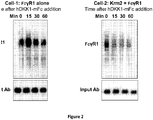
- two cell lines were used: Cell-1, an HEK293 cell line engineered to express Fc ⁇ R1 but not Kremen-2, and Cell-2, an HEK293 cell line engineered to express both Fc ⁇ R1 and Kremen-2.
- a 1:10 dilution of DKK1-mFc conditioned medium was added to the respective cell lines and allowed to incubate at 37°C for 90 minutes. After the 90 minute incubation, cells were stained with Alexa-488-labeled anti-mouse IgG antibody to detect the DKK1-mFc molecule.
- Fc ⁇ R1 immunoprecipitation mouse anti-Fc ⁇ R1 antibody was added to cell lysates and incubated for 1 hour at 4°C. Then Protein-G beads were added and the mixture was incubated for 1 hour at 4°C. The beads were then washed and the proteins eluted and subjected to SDS-PAGE. Proteins were transferred to membrane and probed with HRP-labeled streptavidin to reveal relative amounts of remaining surface-exposed Fc ⁇ R1 protein in each sample. Results are shown in Figure 2 .
- Example 2 IL-4R Activity is Attenuated Using a Multispecific Antigen-Binding Molecule with Specificity for IL-4R and CD63
- a multispecific antigen-binding molecule was constructed which is capable of simultaneously binding a cell surface-expressed target molecule (i.e., IL-4R) and a cell surface-expressed internalizing effector protein (i.e., CD63).
- IL-4R cell surface-expressed target molecule
- CD63 cell surface-expressed internalizing effector protein
- the purpose of these experiments was to determine whether IL-4R activity on a cell can be attenuated to a greater extent by physically linking IL-4R to an effector molecule that is internalized and targeted for degradation within the lysosome (in this case, CD63).
- this Example was designed to test whether the normal internalization and degradation of CD63 could be used to force the internalization and degradative rerouting of IL-4R within a cell.
- a multispecific antigen-binding molecule was constructed that is able to bind both IL-4R and CD63.
- a streptavidin-conjugated anti-IL-4R antibody and a biotinylated anti-CD63 antibody were combined in a 1:1 ratio to produce an anti-IL-4R:anti-CD63 conjugate (i.e., a multispecific antigen-binding molecule that specifically binds both IL-4R and CD63).
- the anti-IL-4R antibody used in this Example is a fully human mAb raised against the IL-4R extracellular domain.
- the anti-IL-4R antibody comprised a heavy chain variable region having SEQ ID NO:3 and a light chain variable region having SEQ ID NO:4).
- the anti-CD63 antibody used in this Example is the mouse anti-human CD63 mAb clone MEM-259, obtained from Biolegend (San Diego, CA), catalog. No. 312002.
- Control-1 streptavidin-conjugated anti-IL-4R antibody combined in a 1:1 ratio with biotinylated control mouse IgG1kappa antibody
- Control-2 streptavidin-conjugated anti-IL-4R antibody combined in a 1:1 ratio with non-biotinylated anti-CD63 antibody.
- the anti-IL-4R antibody used in the experimental and control constructs for this Example is an antibody that is known to specifically bind IL-4R and only partially block IL-4-mediated signaling.
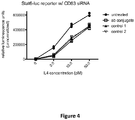
- the experimental cell line used in this Example is an HEK293 cell line containing a STAT6-luciferase reporter construct and additional STAT6 ("HEK293/STAT6-luc cells").
- the cells used in this experiment express both IL-4R and CD63 on their surface. When treated with IL-4 in the absence of any inhibitors, this cell line produces a dose-dependent detectable chemiluminescence signal which reflects the extent of IL-4-mediated signaling.
- this Example provides further proof-of-concept for the inhibition of a target molecule activity through the use of a multispecific antigen-binding molecule that is capable of simultaneously binding both the target molecule (in this case IL-4R) and an internalizing effector protein (in this case CD63) to thereby cause the internalization and degradative rerouting of the target molecule within a cell.
- a multispecific antigen-binding molecule that is capable of simultaneously binding both the target molecule (in this case IL-4R) and an internalizing effector protein (in this case CD63) to thereby cause the internalization and degradative rerouting of the target molecule within a cell.
- the simultaneous binding of IL-4R and CD63 by the exemplary multispecific antigen-binding molecule attenuated the activity of IL-4R to a substantially greater extent ( i.e., > 10%) than the binding of IL-4R by the control constructs alone.
- Example 2 show that an anti-IL-4R/anti-CD63 multispecific molecule inhibits IL-4-mediated signaling in a CD63-dependent manner.
- the multispecific antigen-binding molecule consisted of two separate monoclonal antibodies (anti-IL-4R and anti-CD63) that were connected via a biotin-streptavidin linkage.
- a true bispecific antibody was constructed.
- Standard bispecific antibody technology was used to construct a bispecific antibody consisting of a first arm specific for IL-4R and a second arm specific for CD63.
- the IL-4R-specific arm contained an anti-IL-4R heavy chain paired with a CD63-specific light chain.
- the CD63-specific light chain was paired with the IL-4R specific heavy chain solely for purposes of convenience of construction; nevertheless, the pairing of the anti-IL-4R heavy chain with the anti-CD63 light chain retained full specificity for IL-4R and did not exhibit binding to CD63.
- the CD63-specific arm contained an anti-CD63 heavy chain paired with an anti-CD63 light chain (the same light chain as used in the IL-4R arm).
- the anti-IL-4R heavy chain (comprising SEQ ID NO:3) was derived from the full anti-IL-4R antibody as used in Example 2; However, the anti-CD63 heavy and light chains were derived from the anti-CD63 antibody designated H5C6, obtained from the Developmental Studies Hybridoma Bank (University of Iowa Department of Biology, Iowa City, IA). As with the full anti-IL-4R antibody used in Example 2, the anti-IL-4R component of the bispecific antibody used in this Example exhibited only moderate IL-4R blocking activity on its own.
- IL-4 luciferase assay was carried out to assess the blocking activity of the anti-IL-4R x anti-CD63 bispecific antibody. Briefly, serial dilutions of anti-IL-4R x anti-CD63 bispecific antibody or control molecules were added to HEK293/STAT6-luc reporter cells (see Example 2). Under normal conditions, these cells produce a detectable luciferase signal when treated with IL-4. For this experiment, 10 pM IL-4 was then added to the cells, and luciferase activity was quantified for each dilution of antibody used.
- the controls used in this assay were: (a) mock bispecific antibody that binds IL-4R with one arm and has a non-functional anti-CD63 arm (i.e., containing one anti-IL-4R heavy chain and one anti-CD63 heavy chain, both paired with the anti-IL-4R light chain); (b) anti-IL-4R monospecific antibody; and (c) buffer (PBS) only (without antibody). Results are shown in Figure 7 . As shown in Figure 7 , for the control samples used, luciferase activity remained relatively high even at the highest antibody concentrations, whereas for the bispecific antibody, luciferase activity declined significantly as antibody concentration increased. These results confirm that simultaneous binding of IL-4R and CD63 by a bispecific antibody causes substantial inhibition of IL-4R activity.
- the ability of multispecific antigen-binding molecules to promote the internalization of the soluble target molecule SOST was assessed.
- the target molecule was a fusion protein consisting of a human SOST protein tagged with a pHrodoTM moiety (Life Technologies, Carlsbad, CA) and a myc tag.
- the pHrodoTM moiety is a pH-sensitive dye that is virtually non-fluorescent at neutral pH and brightly fluorescent in an acidic environment such as the endosome. The fluorescent signal, therefore, can be used as an indicator of cellular internalization of the SOST fusion protein.
- the multispecific antigen-binding molecules for these experiments were bispecific antibodies with binding specificity for both CD63 (an internalizing effector protein) and the SOST fusion protein (a soluble target molecule), as described in more detail below.
- HEK293 cells were plated at 10,000 cells/well in poly-D-lysine coated 96 well plates (Greiner Bio-One, Monroe, NC). After allowing the cells to settle overnight, the media was replaced with media containing antibody (5 ⁇ g/mL, as described below), pHrodoTM-myc-tagged-SOST (5 ⁇ g/mL), heparin (10 ⁇ g/mL), and Hoechst 33342. The cells were then incubated for either 3 hours on ice or 3 hours at 37°C.
- anti-CD63 monospecific antibody clone H5C6, Developmental Studies Hybridoma Bank, University of Iowa Department of Biology, Iowa City, IA
- anti-myc antibody clone 9E10, Schiweck et al., 1997, FEBS Lett. 414(1):33-38
- anti-SOST antibody an antibody having the heavy and light chain variable regions of the antibody designated "Ab-B" in US Patent No.
- anti-CD63 x anti-myc bispecific antibody i.e., a multispecific antigen-binding molecule comprising an anti-CD63 arm derived from the antibody H5C6 and an anti-myc arm derived from 9E10
- anti-CD63 x anti-SOST bispecific antibody #1 i.e., a multispecific antigen-binding molecule comprising an anti-CD63 arm derived from the antibody H5C6 and an anti-SOST arm derived from "Ab-B”
- anti-CD63 x anti-SOST bispecific antibody #2 i.e., a multispecific antigen-binding molecule comprising an anti-CD63 arm derived from the antibody H5C6 and an anti-SOST arm derived from the antibody designated "Ab-20" in US Patent No.
- Figure 8 shows the number of spots (labeled vesicles) per cell, under the various treatment conditions tested.
- mice Five groups of mice (about 6 mice per group) are used in these experiments.
- the treatment groups are as follows: (I) untreated negative control mice; (II) mice treated with a blocking anti-SOST monospecific antibody that is known to increase bone mineral density on its own (positive control); (III) mice treated with a bispecific antibody that specifically binds CD63 and SOST but does not inhibit SOST activity on its own or only slightly inhibits SOST activity on its own; (IV) mice treated with an anti-CD63 parental antibody ( i.e., a monospecific antibody containing the same anti-CD63 antigen-binding domain as in the bispecific antibody); and (V) mice treated with an anti-SOST parental antibody ( i.e., a monospecific antibody containing the same anti-SOST antigen-binding domain as in the bispecific antibody).
- the amount of antibody administered to the mice in each group is about 10
- mice in group III (treated with an anti-SOST x anti-CD63 bispecific antibody) will exhibit an increase in bone mineral density that is at least comparable to that which is observed in the mice of group II (treated with a known blocking anti-SOST antibody), even though the anti-SOST component of the bispecific antibody does not inhibit SOST activity on its own (as confirmed by the mice in Group V which are expected to not exhibit an increase in bone mineral density).
- the increase in bone mineral density that is expected in the mice of group III is believed to be driven by CD63-mediated internalization of SOST, as observed in the cellular experiments of Example 4, above.
- LPS lipopolysaccharide
- the multispecific antigen-binding molecule used in this Example was a bispecific antibody with one arm directed to LPS (target) and the other arm directed to CD63 (internalizing effector protein).
- the anti-LPS arm was derived from the antibody known as WN1 222-5.
- the anti-CD63 arm was derived from the H5C6 antibody (see Example 4).
- the anti-LPS x anti-CD63 bispecific antibody i.e., multispecific antigen-binding molecule
- was assembled using the so-called "knobs-into-holes" methodology see, e.g., Ridgway et al., 1996, Protein Eng. 9(7):617-621 ).
- E. coli LPS and Salmonella minnesota LPS were used in these experiments: E. coli LPS and Salmonella minnesota LPS. Both versions were obtained as fluorescent-labeled molecules (ALEXA-FLUOR®-488-labeled LPS, Life Technologies, Carlsbad, CA).
- HEK293 cells were plated in 96-well PDL-coated imaging plates. After overnight rest, media was replaced with fresh medium. Fluorescently labeled LPS (either E. coli- or S. minnesota -derived) was added in regular medium. Next, the anti-LPS x anti-CD63 bispecific antibody, or control half-antibodies paired with dummy Fc, were added to the samples. Following various incubation times at 37°C (1 hour and 3 hours) or on ice (3 hours), cells from the LPS-treated samples were processed as follows: washed - quenched with anti- ALEXA-FLUOR®-488 antibody - washed & fixed.
- the anti-ALEXA-FLUOR®-488 antibody quenches fluorescence from non-internalized (i.e., surface bound) fluorophore.
- any fluorescence observed in the quenching antibody-treated samples is due to internalized LPS.
- the level of fluorescence from each sample at the various time points was measured.
- Figure 9 expresses the results of these experiments in terms of the number of labeled vesicles per cell. As shown in Figure 9 , only cells treated with the anti-CD63 x anti-LPS bispecific antibody demonstrated significant numbers of labeled vesicles that increased over time. Cells treated with labeled LPS and the control antibodies did not exhibit appreciable numbers of fluorescent vesicles, indicating that LPS was not internalized under those treatment conditions.
Landscapes
- Health & Medical Sciences (AREA)
- Chemical & Material Sciences (AREA)
- Organic Chemistry (AREA)
- Immunology (AREA)
- Life Sciences & Earth Sciences (AREA)
- Medicinal Chemistry (AREA)
- General Health & Medical Sciences (AREA)
- Molecular Biology (AREA)
- Biochemistry (AREA)
- Biophysics (AREA)
- Genetics & Genomics (AREA)
- Proteomics, Peptides & Aminoacids (AREA)
- Bioinformatics & Cheminformatics (AREA)
- Engineering & Computer Science (AREA)
- Pharmacology & Pharmacy (AREA)
- Animal Behavior & Ethology (AREA)
- Public Health (AREA)
- Veterinary Medicine (AREA)
- Chemical Kinetics & Catalysis (AREA)
- General Chemical & Material Sciences (AREA)
- Nuclear Medicine, Radiotherapy & Molecular Imaging (AREA)
- Epidemiology (AREA)
- Physical Education & Sports Medicine (AREA)
- Toxicology (AREA)
- Orthopedic Medicine & Surgery (AREA)
- Rheumatology (AREA)
- Gastroenterology & Hepatology (AREA)
- Cell Biology (AREA)
- Zoology (AREA)
- Endocrinology (AREA)
- Microbiology (AREA)
- Mycology (AREA)
- Peptides Or Proteins (AREA)
- Medicines Containing Antibodies Or Antigens For Use As Internal Diagnostic Agents (AREA)
- Medicinal Preparation (AREA)
- Medicines That Contain Protein Lipid Enzymes And Other Medicines (AREA)
Priority Applications (2)
| Application Number | Priority Date | Filing Date | Title |
|---|---|---|---|
| EP18172145.7A EP3421488A3 (en) | 2012-03-14 | 2013-03-13 | Multispecific antigen-binding molecules and uses thereof |
| PL13712987T PL2825553T3 (pl) | 2012-03-14 | 2013-03-13 | Wieloswoiste cząsteczki wiążące antygen i ich zastosowanie |
Applications Claiming Priority (4)
| Application Number | Priority Date | Filing Date | Title |
|---|---|---|---|
| US201261610494P | 2012-03-14 | 2012-03-14 | |
| US201261721831P | 2012-11-02 | 2012-11-02 | |
| US201361751286P | 2013-01-11 | 2013-01-11 | |
| PCT/US2013/030636 WO2013138400A1 (en) | 2012-03-14 | 2013-03-13 | Multispecific antigen-binding molecules and uses thereof |
Related Child Applications (2)
| Application Number | Title | Priority Date | Filing Date |
|---|---|---|---|
| EP18172145.7A Division-Into EP3421488A3 (en) | 2012-03-14 | 2013-03-13 | Multispecific antigen-binding molecules and uses thereof |
| EP18172145.7A Division EP3421488A3 (en) | 2012-03-14 | 2013-03-13 | Multispecific antigen-binding molecules and uses thereof |
Publications (2)
| Publication Number | Publication Date |
|---|---|
| EP2825553A1 EP2825553A1 (en) | 2015-01-21 |
| EP2825553B1 true EP2825553B1 (en) | 2018-07-25 |
Family
ID=48014317
Family Applications (2)
| Application Number | Title | Priority Date | Filing Date |
|---|---|---|---|
| EP13712987.0A Active EP2825553B1 (en) | 2012-03-14 | 2013-03-13 | Multispecific antigen-binding molecules and uses thereof |
| EP18172145.7A Withdrawn EP3421488A3 (en) | 2012-03-14 | 2013-03-13 | Multispecific antigen-binding molecules and uses thereof |
Family Applications After (1)
| Application Number | Title | Priority Date | Filing Date |
|---|---|---|---|
| EP18172145.7A Withdrawn EP3421488A3 (en) | 2012-03-14 | 2013-03-13 | Multispecific antigen-binding molecules and uses thereof |
Country Status (19)
| Country | Link |
|---|---|
| US (2) | US20130243775A1 (enExample) |
| EP (2) | EP2825553B1 (enExample) |
| JP (4) | JP6883944B2 (enExample) |
| KR (3) | KR102283200B1 (enExample) |
| CN (2) | CN114133454A (enExample) |
| AU (2) | AU2013232266A1 (enExample) |
| BR (1) | BR112014022692A8 (enExample) |
| CA (1) | CA2867265C (enExample) |
| DK (1) | DK2825553T3 (enExample) |
| EA (1) | EA036225B1 (enExample) |
| ES (1) | ES2687974T3 (enExample) |
| IL (1) | IL234460B (enExample) |
| MX (3) | MX361875B (enExample) |
| MY (2) | MY198567A (enExample) |
| NZ (1) | NZ631565A (enExample) |
| PL (1) | PL2825553T3 (enExample) |
| SG (3) | SG10201709018QA (enExample) |
| WO (1) | WO2013138400A1 (enExample) |
| ZA (1) | ZA201406671B (enExample) |
Families Citing this family (62)
| Publication number | Priority date | Publication date | Assignee | Title |
|---|---|---|---|---|
| CA2721052C (en) | 2008-04-11 | 2023-02-21 | Chugai Seiyaku Kabushiki Kaisha | Antigen-binding molecule capable of binding to two or more antigen molecules repeatedly |
| BR112013013354A2 (pt) | 2010-11-30 | 2020-10-06 | Chugai Seiyaku Kabushiki Kaisha | molécula de ligação ao antígeno capaz de se ligar a uma pluralidade de moléculas de antígeno repetidamente |
| PL2825553T3 (pl) * | 2012-03-14 | 2018-12-31 | Regeneron Pharmaceuticals, Inc. | Wieloswoiste cząsteczki wiążące antygen i ich zastosowanie |
| CA2872908C (en) | 2012-05-10 | 2023-11-14 | Gerhard Frey | Multi-specific monoclonal antibodies |
| US20150203591A1 (en) * | 2012-08-02 | 2015-07-23 | Regeneron Pharmaceuticals, Inc. | Mutivalent antigen-binding proteins |
| TWI682941B (zh) | 2013-02-01 | 2020-01-21 | 美商再生元醫藥公司 | 含嵌合恆定區之抗體 |
| CA2902572A1 (en) | 2013-03-14 | 2014-10-02 | Regeneron Pharmaceuticals, Inc. | Human antibodies to nav1.7 |
| MX377716B (es) | 2013-11-20 | 2025-03-11 | Regeneron Pharma | Moduladores de aplnr y usos de estos. |
| WO2015127158A1 (en) * | 2014-02-21 | 2015-08-27 | Regeneron Pharmaceuticals, Inc. | Methods, compositions and kits for cell specific modulation of target antigens |
| DK3277725T3 (da) | 2015-03-30 | 2021-01-11 | Regeneron Pharma | Konstante tungkædeområder med reduceret binding til FC-gammareceptorer |
| CA2987641A1 (en) | 2015-07-06 | 2017-01-12 | Regeneron Pharmaceuticals, Inc. | Multispecific antigen-binding molecules and uses thereof |
| KR102851747B1 (ko) * | 2015-12-08 | 2025-08-28 | 리제너론 파마슈티칼스 인코포레이티드 | 효소 내재화 조성물 및 방법 |
| EP3411406B1 (en) * | 2016-02-05 | 2025-04-09 | Genmab A/S | Multispecific antigen-binding molecule with improved internalization characteristics |
| JP7082604B2 (ja) | 2016-03-21 | 2022-06-08 | マレンゴ・セラピューティクス,インコーポレーテッド | 多重特異性および多機能性分子ならびにその使用 |
| WO2017177337A1 (en) * | 2016-04-15 | 2017-10-19 | Zymeworks Inc. | Multi-specific antigen-binding constructs targeting immunotherapeutics |
| US11352446B2 (en) | 2016-04-28 | 2022-06-07 | Regeneron Pharmaceuticals, Inc. | Methods of making multispecific antigen-binding molecules |
| MY199937A (en) | 2016-11-08 | 2023-11-29 | Regeneron Pharma | Steroids and protein-conjugates thereof |
| WO2018107109A1 (en) * | 2016-12-09 | 2018-06-14 | Abbvie Stemcentrx Llc | Novel anti-kremen2 antibodies and methods of use |
| US11608374B2 (en) | 2017-01-30 | 2023-03-21 | Chugai Seiyaku Kabushiki Kaisha | Anti-sclerostin antibodies and methods of use |
| WO2018151820A1 (en) | 2017-02-16 | 2018-08-23 | Elstar Therapeutics, Inc. | Multifunctional molecules comprising a trimeric ligand and uses thereof |
| FI3583120T3 (fi) | 2017-02-17 | 2023-01-13 | Muunneltuja transferriinireseptoria sitovia polypeptidejä | |
| US20210246227A1 (en) | 2017-05-31 | 2021-08-12 | Elstar Therapeutics, Inc. | Multispecific molecules that bind to myeloproliferative leukemia (mpl) protein and uses thereof |
| BR112019025888A2 (pt) | 2017-06-07 | 2020-06-30 | Regeneron Pharmaceuticals, Inc. | polinucleotídeo que codifica uma proteína terapêutica multidomínio, vetor de terapia gênica, proteína terapêutica multidomínio recombinante, método de expressão, métodos para reduzir o acúmulo de glicogênio em um tecido em um paciente em necessidade, para reduzir o acúmulo de glicogênio em um tecido em um paciente em necessidade epara tratar a deficiência enzimática em um paciente em necessidade e/ou tolerar o paciente à enzima para a qual é deficiente, anticorpo anti-cd63 ou fragmento de ligação a antígeno, e, composição farmacêutica |
| IL271561B2 (en) | 2017-06-27 | 2025-08-01 | Regeneron Pharma | Non-human animals comprising a humanized asgr1 locus |
| WO2019035938A1 (en) | 2017-08-16 | 2019-02-21 | Elstar Therapeutics, Inc. | MULTISPECIFIC MOLECULES BINDING TO BCMA AND USES THEREOF |
| CN111601619A (zh) | 2017-11-07 | 2020-08-28 | 里珍纳龙药品有限公司 | 用于抗体药物偶联物的亲水性连接体 |
| US12070506B2 (en) | 2018-01-08 | 2024-08-27 | Regeneron Pharmaceuticals, Inc. | Steroids and antibody-conjugates thereof |
| WO2019139987A1 (en) | 2018-01-09 | 2019-07-18 | Elstar Therapeutics, Inc. | Calreticulin binding constructs and engineered t cells for the treatment of diseases |
| JP7779653B2 (ja) | 2018-02-07 | 2025-12-03 | リジェネロン・ファーマシューティカルズ・インコーポレイテッド | 治療用タンパク質送達のための方法および組成物 |
| US20210009711A1 (en) | 2018-03-14 | 2021-01-14 | Elstar Therapeutics, Inc. | Multifunctional molecules and uses thereof |
| WO2019178362A1 (en) | 2018-03-14 | 2019-09-19 | Elstar Therapeutics, Inc. | Multifunctional molecules that bind to calreticulin and uses thereof |
| EP3788075A1 (en) | 2018-04-30 | 2021-03-10 | Regeneron Pharmaceuticals, Inc. | Antibodies, and bispecific antigen-binding molecules that bind her2 and/or aplp2, conjugates, and uses thereof |
| AU2019265703A1 (en) * | 2018-05-09 | 2020-11-19 | Regeneron Pharmaceuticals, Inc. | Anti-MSR1 antibodies and methods of use thereof |
| MY206284A (en) | 2018-05-17 | 2024-12-06 | Regeneron Pharma | Anti-cd63 antibodies, conjugates, and uses thereof |
| WO2019241216A1 (en) * | 2018-06-14 | 2019-12-19 | Bioatla, Llc | Multi-specific antibody constructs |
| AU2019297451A1 (en) | 2018-07-03 | 2021-01-28 | Marengo Therapeutics, Inc. | Anti-TCR antibody molecules and uses thereof |
| CN113301925A (zh) | 2018-12-19 | 2021-08-24 | 小利兰·斯坦福大学理事会 | 用于溶酶体靶向的双官能分子以及相关的组合物和方法 |
| KR20210108961A (ko) | 2018-12-28 | 2021-09-03 | 쿄와 기린 가부시키가이샤 | TfR에 결합하는 이중 특이적 항체 |
| GB2599228B (en) | 2019-02-21 | 2024-02-07 | Marengo Therapeutics Inc | Multifunctional molecules that bind to T cell related cancer cells and uses thereof |
| AU2020224681A1 (en) | 2019-02-21 | 2021-09-16 | Marengo Therapeutics, Inc. | Antibody molecules that bind to NKp30 and uses thereof |
| CN114127112A (zh) | 2019-02-21 | 2022-03-01 | 马伦戈治疗公司 | 与t细胞结合的多功能分子及其治疗自身免疫性病症的用途 |
| WO2020172596A1 (en) | 2019-02-21 | 2020-08-27 | Elstar Therapeutics, Inc. | Anti-tcr antibody molecules and thereof |
| AU2020224154B2 (en) | 2019-02-21 | 2025-05-08 | Marengo Therapeutics, Inc. | Multifunctional molecules that bind to calreticulin and uses thereof |
| WO2020177717A1 (zh) * | 2019-03-04 | 2020-09-10 | 上海一宸医药科技有限公司 | 新型双特异性结合分子及其药物偶联物 |
| JP2022534808A (ja) * | 2019-06-06 | 2022-08-03 | ミシック セラピューティクス インコーポレイテッド | 抗原結合タンパク質構築物およびその使用 |
| EP4003534A1 (en) * | 2019-07-30 | 2022-06-01 | Mythic Therapeutics, Inc. | Antigen-binding protein constructs and uses thereof |
| JP2023509708A (ja) | 2020-01-03 | 2023-03-09 | マレンゴ・セラピューティクス,インコーポレーテッド | 抗tcr抗体分子およびその使用 |
| EP4084821A4 (en) | 2020-01-03 | 2024-04-24 | Marengo Therapeutics, Inc. | Multifunctional molecules that bind to cd33 and uses thereof |
| KR20230028242A (ko) | 2020-04-24 | 2023-02-28 | 마렝고 테라퓨틱스, 인크. | T 세포 관련 암 세포에 결합하는 다중기능성 분자 및 그것의 용도 |
| JP2023532807A (ja) | 2020-07-08 | 2023-07-31 | ラヴァ・セラピューティクス・エヌ・ヴイ | Psma及びガンマ-デルタt細胞受容体に結合する抗体 |
| WO2022046920A2 (en) | 2020-08-26 | 2022-03-03 | Marengo Therapeutics, Inc. | Multifunctional molecules that bind to calreticulin and uses thereof |
| AU2021331076A1 (en) | 2020-08-26 | 2023-04-06 | Marengo Therapeutics, Inc. | Antibody molecules that bind to NKp30 and uses thereof |
| KR20230074487A (ko) | 2020-08-26 | 2023-05-30 | 마렝고 테라퓨틱스, 인크. | Trbc1 또는 trbc2를 검출하는 방법 |
| EP4288456B1 (en) | 2021-02-03 | 2024-09-18 | Mythic Therapeutics, Inc. | Anti-met antibodies and uses thereof |
| WO2022216993A2 (en) | 2021-04-08 | 2022-10-13 | Marengo Therapeutics, Inc. | Multifuntional molecules binding to tcr and uses thereof |
| JP2024524614A (ja) | 2021-07-14 | 2024-07-05 | ライシア セラピューティクス, インコーポレイテッド | Asgpr細胞表面受容体結合化合物及びコンジュゲート |
| EP4473103A2 (en) | 2022-02-02 | 2024-12-11 | Regeneron Pharmaceuticals, Inc. | Anti-tfr:gaa and anti-cd63:gaa insertions for treatment of pompe disease |
| IL317261A (en) | 2022-07-29 | 2025-01-01 | Regeneron Pharma | Non-human animals containing a modified transferrin receptor locus |
| WO2025029657A2 (en) | 2023-07-28 | 2025-02-06 | Regeneron Pharmaceuticals, Inc. | Anti-tfr:gaa and anti-cd63:gaa insertion for treatment of pompe disease |
| WO2025029654A2 (en) | 2023-07-28 | 2025-02-06 | Regeneron Pharmaceuticals, Inc. | Use of bgh-sv40l tandem polya to enhance transgene expression during unidirectional gene insertion |
| US20250242056A1 (en) | 2024-01-26 | 2025-07-31 | Regeneron Pharmaceuticals, Inc. | Methods and compositions for using plasma cell depleting agents and/or b cell depleting agents to suppress host anti-aav antibody response and enable aav transduction and re-dosing |
| WO2025184567A1 (en) | 2024-03-01 | 2025-09-04 | Regeneron Pharmaceuticals, Inc. | Methods and compositions for re-dosing aav using anti-cd40 antagonistic antibody to suppress host anti-aav antibody response |
Citations (1)
| Publication number | Priority date | Publication date | Assignee | Title |
|---|---|---|---|---|
| US20100081796A1 (en) * | 2008-09-26 | 2010-04-01 | Ulrich Brinkmann | Bispecific anti-egfr/anti-igf-1r antibodies |
Family Cites Families (79)
| Publication number | Priority date | Publication date | Assignee | Title |
|---|---|---|---|---|
| US4444878A (en) | 1981-12-21 | 1984-04-24 | Boston Biomedical Research Institute, Inc. | Bispecific antibody determinants |
| US5156965A (en) | 1983-11-29 | 1992-10-20 | Igen, Inc. | Catalytic antibodies |
| US5229272A (en) | 1989-04-25 | 1993-07-20 | Igen, Inc. | Catalytic antibody components |
| US5126258A (en) | 1984-09-07 | 1992-06-30 | Scripps Clinic And Research Foundation | Molecules with antibody combining sites that exhibit catalytic properties |
| US5030717A (en) | 1986-09-17 | 1991-07-09 | Scripps Clinic And Research Foundation | Antibodies which catalyze hydrolysis of ester bonds |
| US4975278A (en) | 1988-02-26 | 1990-12-04 | Bristol-Myers Company | Antibody-enzyme conjugates in combination with prodrugs for the delivery of cytotoxic agents to tumor cells |
| US5851527A (en) | 1988-04-18 | 1998-12-22 | Immunomedics, Inc. | Method for antibody targeting of therapeutic agents |
| US5601819A (en) * | 1988-08-11 | 1997-02-11 | The General Hospital Corporation | Bispecific antibodies for selective immune regulation and for selective immune cell binding |
| US5858728A (en) | 1991-03-13 | 1999-01-12 | Common Services Agency | Monoclonal antibody against LPS core |
| US5436153A (en) | 1992-12-02 | 1995-07-25 | Sprecher; Cindy A. | Human amyloid protein precursor homolog and Kunitz-type inhibitor |
| EP0696318A4 (en) | 1993-04-23 | 1998-04-15 | Igen Inc | CATALYTIC ANTIBODIES HYDROLYSING PRIMARY AMIDES AND METHODS FOR OBTAINING SUCH ANTIBODIES |
| US5602021A (en) | 1994-12-29 | 1997-02-11 | Catalytic Antibodies, Inc. | Method for generating proteolytic enzymes specific against a selected peptide sequence |
| WO1998016254A1 (en) | 1996-10-17 | 1998-04-23 | Immunomedics, Inc. | Non-antigenic toxin-conjugate and fusion protein of internalizing receptor system |
| EP0989864A1 (en) | 1997-06-11 | 2000-04-05 | The School Of Pharmacy, University Of London | Pharmaceutical compositions containing antibody-enzyme conjugates in combination with prodrugs |
| IT1293511B1 (it) | 1997-07-30 | 1999-03-01 | Gentili Ist Spa | Anticorpi monoclonali catalitici ad attivita' proteasica per la lisi selettiva della componente proteica di placche e aggregati correlati |
| US6703488B1 (en) * | 1998-01-15 | 2004-03-09 | Center For Molecular Medicine And Immunology | Antibody/receptor targeting moiety for enhanced delivery of armed ligand |
| JP2002509158A (ja) | 1998-01-15 | 2002-03-26 | センター・フォー・モレキュラー・メディシン・アンド・イムノロジー | アーム付きリガンドの送達向上のための抗体と受容体ターゲティング部分 |
| US6235714B1 (en) | 1998-03-23 | 2001-05-22 | Sudhir Paul | Methods for identifying inducers and inhibitors of proteolytic antibodies, compositions and their uses |
| US6855804B2 (en) | 1998-03-23 | 2005-02-15 | Board Of Regents, The University Of Texas System | Covalently reactive transition state analogs and methods of use thereof |
| US7138103B2 (en) | 1998-06-22 | 2006-11-21 | Immunomedics, Inc. | Use of bi-specific antibodies for pre-targeting diagnosis and therapy |
| US7223556B1 (en) | 1998-10-09 | 2007-05-29 | President And Fellows Of Harvard College | Targeted proteolysis by recruitment to ubiquitin protein ligases |
| US7087411B2 (en) | 1999-06-08 | 2006-08-08 | Regeneron Pharmaceuticals, Inc. | Fusion protein capable of binding VEGF |
| JP4308470B2 (ja) * | 1999-07-30 | 2009-08-05 | メダレックス インク | 抗Fc受容体結合薬からなる治療用化合物 |
| EP1231944A2 (en) * | 1999-11-15 | 2002-08-21 | University Of Southern California | Targeted delivery of therapeutic and diagnostic moieties |
| DE10034607A1 (de) | 2000-07-20 | 2002-02-07 | Gundram Jung | Multispezifisches Reagenz zur selektiven Stimulierung von Zelloberflächenrezeptoren |
| EP1322750A4 (en) | 2000-09-08 | 2004-09-29 | California Inst Of Techn | PROTEOLYSIS TARGET DRUG TARGET MEDICINE |
| US7105348B2 (en) | 2000-10-31 | 2006-09-12 | Regeneron Pharmaceuticals, Inc. | Methods of modifying eukaryotic cells |
| US7442777B2 (en) | 2000-11-29 | 2008-10-28 | Arius Research Inc. | Cytotoxicity mediation of cells evidencing surface expression of CD63 |
| US20060210474A1 (en) | 2000-11-29 | 2006-09-21 | Young David S | Cytotoxicity mediation of cells evidencing surface expression of CD63 |
| US7431923B2 (en) | 2005-01-03 | 2008-10-07 | Arius Research Inc. | Cytotoxicity mediation of cells evidencing surface expression of CD63 |
| US7534429B2 (en) | 2000-11-29 | 2009-05-19 | Hoffmann-La Roche Inc. | Cytotoxicity mediation of cells evidencing surface expression of CD63 |
| US7560424B2 (en) | 2001-04-30 | 2009-07-14 | Zystor Therapeutics, Inc. | Targeted therapeutic proteins |
| ATE423571T1 (de) | 2001-10-12 | 2009-03-15 | Schering Corp | Verwendung von bispezifischen antikörpern gegen einen aktivierenden rezeptor fcepsilonri und gegen einen inhibierenden rezeptor ox2ra (cd200ra) zur regulierung der immunantworten |
| ATE526399T1 (de) | 2003-06-18 | 2011-10-15 | Bayer Pharma AG | Neue biologische einheiten und deren verwendung |
| WO2005035753A1 (ja) | 2003-10-10 | 2005-04-21 | Chugai Seiyaku Kabushiki Kaisha | 機能蛋白質を代替する二重特異性抗体 |
| CA2543982C (en) * | 2003-11-07 | 2013-01-08 | Immunex Corporation | Antibodies that bind interleukin-4 receptor |
| US7371539B2 (en) | 2003-12-03 | 2008-05-13 | President And Fellows Of Harvard College | Targeted polypeptide degradation |
| US7235641B2 (en) * | 2003-12-22 | 2007-06-26 | Micromet Ag | Bispecific antibodies |
| US8754031B2 (en) | 2004-03-08 | 2014-06-17 | Oncolix, Inc. | Use of prolactin receptor antagonists in combination with an agent that inactivates the HER2/neu signaling pathway |
| CA2570990C (en) | 2004-07-16 | 2014-01-21 | Micromet Ag | Expression-enhanced polypeptides |
| US7592429B2 (en) | 2005-05-03 | 2009-09-22 | Ucb Sa | Sclerostin-binding antibody |
| US9127293B2 (en) | 2006-07-26 | 2015-09-08 | The University Of Chicago | Receptor-mediated delivery: compositions and methods |
| US20080089891A1 (en) * | 2006-07-26 | 2008-04-17 | Arius Research, Inc. | Cancerous disease modifying antibodies |
| PT2511301T (pt) | 2006-08-04 | 2018-03-08 | Medimmune Ltd | Anticorpos humanos para erbb2 |
| WO2008051326A2 (en) * | 2006-08-21 | 2008-05-02 | President And Fellows Of Harvard College | Identification of contactins and l1- cams as ligands for the amyloid precursor protein |
| US20090258005A1 (en) | 2007-05-29 | 2009-10-15 | Trubion Pharmaceuticals Inc. | Therapeutic compositions and methods |
| CN101952312A (zh) * | 2007-07-31 | 2011-01-19 | 米迪缪尼有限公司 | 多特异性表位结合蛋白及其应用 |
| WO2009094561A1 (en) * | 2008-01-24 | 2009-07-30 | The Government Of The United States Of America As Represented By The Secretary Of The Departmentof | Induced internalization of surface receptors |
| WO2009120922A2 (en) * | 2008-03-27 | 2009-10-01 | Zymogenetics, Inc. | Compositions and methods for inhibiting pdgfrbeta and vegf-a |
| MX2011010166A (es) | 2009-04-07 | 2011-10-11 | Roche Glycart Ag | Anticuerpos biespecificos anti-erbb-3/anti-c-met. |
| EP2241576A1 (en) | 2009-04-17 | 2010-10-20 | Trion Pharma Gmbh | Use of trifunctional bispecific antibodies for the treatment of tumors associated with CD133+/EpCAM+ cancer stem cells |
| WO2011029823A1 (en) | 2009-09-09 | 2011-03-17 | Novartis Ag | Monoclonal antibody reactive with cd63 when expressed at the surface of degranulated mast cells |
| EP2332995A1 (en) | 2009-12-10 | 2011-06-15 | Bayer Schering Pharma Aktiengesellschaft | Neutralizing prolactin receptor antibodies and their therapeutic use |
| CA2798562A1 (en) * | 2010-05-07 | 2011-11-10 | Ranju Ralhan | Methods and compositions for the diagnosis and treatment of thyroid cancer |
| WO2011147986A1 (en) * | 2010-05-27 | 2011-12-01 | Genmab A/S | Monoclonal antibodies against her2 |
| WO2012136519A1 (en) | 2011-04-06 | 2012-10-11 | Bayer Pharma Aktiengesellschaft | Use of neutralizing prolactin receptor antibodies for the treatment and prevention of antiestrogen-resistant breast cancer |
| JP6177231B2 (ja) | 2011-04-20 | 2017-08-09 | ゲンマブ エー/エス | Her2に対する二重特異性抗体 |
| AU2012244816B2 (en) | 2011-04-20 | 2015-12-10 | Roche Glycart Ag | Method and constructs for the pH dependent passage of the blood-brain-barrier |
| CN103796677B (zh) | 2011-04-20 | 2019-08-16 | 健玛保 | 针对her2和cd3的双特异性抗体 |
| EP2530089A1 (en) | 2011-06-03 | 2012-12-05 | Bayer Pharma Aktiengesellschaft | Neutralising prolactin receptor antibody Mat3 and its therapeutical use |
| PL2825553T3 (pl) * | 2012-03-14 | 2018-12-31 | Regeneron Pharmaceuticals, Inc. | Wieloswoiste cząsteczki wiążące antygen i ich zastosowanie |
| JP6849868B2 (ja) | 2012-05-10 | 2021-03-31 | ザイムワークス,インコーポレイテッド | シングルアーム一価抗体構築物およびその用途 |
| HUE045144T2 (hu) | 2012-08-29 | 2019-12-30 | Hoffmann La Roche | Véragygát-shuttle |
| US8883979B2 (en) | 2012-08-31 | 2014-11-11 | Bayer Healthcare Llc | Anti-prolactin receptor antibody formulations |
| UY35460A (es) | 2013-03-15 | 2014-10-31 | Bayer Healthcare Llc | Formulaciones de anticuerpos anti-receptor de prolactina |
| WO2014182970A1 (en) | 2013-05-08 | 2014-11-13 | Zymeworks Inc. | Bispecific her2 and her3 antigen binding constructs |
| US9738717B2 (en) | 2013-05-15 | 2017-08-22 | The Translational Genomics Research Institute | Hybridoma clones, monoclonal antibodies, and methods of use |
| CN104211814A (zh) | 2013-05-29 | 2014-12-17 | 三星电子株式会社 | 用于消耗靶膜蛋白的组合物 |
| US9545451B2 (en) | 2013-08-21 | 2017-01-17 | Regeneron Pharmaceuticals, Inc. | Anti-PRLR antibodies and methods for killing PRLR-expressing cells |
| TWI641620B (zh) | 2013-08-21 | 2018-11-21 | 再生元醫藥公司 | 抗-prlr抗體及其用途 |
| EP3148592A2 (en) | 2014-06-02 | 2017-04-05 | Regeneron Pharmaceuticals, Inc. | Antibody-drug conjugates, their preparation and their therapeutic use |
| CA2987641A1 (en) | 2015-07-06 | 2017-01-12 | Regeneron Pharmaceuticals, Inc. | Multispecific antigen-binding molecules and uses thereof |
| KR102851747B1 (ko) | 2015-12-08 | 2025-08-28 | 리제너론 파마슈티칼스 인코포레이티드 | 효소 내재화 조성물 및 방법 |
| EP3411406B1 (en) | 2016-02-05 | 2025-04-09 | Genmab A/S | Multispecific antigen-binding molecule with improved internalization characteristics |
| US11352446B2 (en) | 2016-04-28 | 2022-06-07 | Regeneron Pharmaceuticals, Inc. | Methods of making multispecific antigen-binding molecules |
| KR20190091290A (ko) | 2016-11-29 | 2019-08-05 | 리제너론 파아마슈티컬스, 인크. | Prlr 양성 유방암 치료 방법 |
| BR112019025888A2 (pt) | 2017-06-07 | 2020-06-30 | Regeneron Pharmaceuticals, Inc. | polinucleotídeo que codifica uma proteína terapêutica multidomínio, vetor de terapia gênica, proteína terapêutica multidomínio recombinante, método de expressão, métodos para reduzir o acúmulo de glicogênio em um tecido em um paciente em necessidade, para reduzir o acúmulo de glicogênio em um tecido em um paciente em necessidade epara tratar a deficiência enzimática em um paciente em necessidade e/ou tolerar o paciente à enzima para a qual é deficiente, anticorpo anti-cd63 ou fragmento de ligação a antígeno, e, composição farmacêutica |
| US20210128728A1 (en) | 2017-07-10 | 2021-05-06 | Bayer Pharma Aktiengesellschaft | Prolactin receptor antibody for male and female pattern hair loss |
| EP3788075A1 (en) | 2018-04-30 | 2021-03-10 | Regeneron Pharmaceuticals, Inc. | Antibodies, and bispecific antigen-binding molecules that bind her2 and/or aplp2, conjugates, and uses thereof |
-
2013
- 2013-03-13 PL PL13712987T patent/PL2825553T3/pl unknown
- 2013-03-13 SG SG10201709018QA patent/SG10201709018QA/en unknown
- 2013-03-13 EP EP13712987.0A patent/EP2825553B1/en active Active
- 2013-03-13 MY MYPI2018703207A patent/MY198567A/en unknown
- 2013-03-13 DK DK13712987.0T patent/DK2825553T3/en active
- 2013-03-13 ES ES13712987.0T patent/ES2687974T3/es active Active
- 2013-03-13 US US13/798,205 patent/US20130243775A1/en not_active Abandoned
- 2013-03-13 MX MX2014011052A patent/MX361875B/es active IP Right Grant
- 2013-03-13 CN CN202111438717.0A patent/CN114133454A/zh active Pending
- 2013-03-13 KR KR1020207017530A patent/KR102283200B1/ko active Active
- 2013-03-13 KR KR20147027652A patent/KR20140135233A/ko not_active Ceased
- 2013-03-13 BR BR112014022692A patent/BR112014022692A8/pt not_active Application Discontinuation
- 2013-03-13 EP EP18172145.7A patent/EP3421488A3/en not_active Withdrawn
- 2013-03-13 CA CA2867265A patent/CA2867265C/en active Active
- 2013-03-13 MY MYPI2014002545A patent/MY171761A/en unknown
- 2013-03-13 NZ NZ631565A patent/NZ631565A/en unknown
- 2013-03-13 KR KR1020217023450A patent/KR102494534B1/ko active Active
- 2013-03-13 CN CN201380020750.9A patent/CN104302664B/zh active Active
- 2013-03-13 SG SG11201405468QA patent/SG11201405468QA/en unknown
- 2013-03-13 SG SG10201704846VA patent/SG10201704846VA/en unknown
- 2013-03-13 EA EA201491686A patent/EA036225B1/ru not_active IP Right Cessation
- 2013-03-13 JP JP2015500534A patent/JP6883944B2/ja active Active
- 2013-03-13 WO PCT/US2013/030636 patent/WO2013138400A1/en not_active Ceased
- 2013-03-13 AU AU2013232266A patent/AU2013232266A1/en not_active Abandoned
-
2014
- 2014-09-04 IL IL23446014A patent/IL234460B/en active IP Right Grant
- 2014-09-11 ZA ZA2014/06671A patent/ZA201406671B/en unknown
- 2014-09-12 MX MX2022012083A patent/MX2022012083A/es unknown
- 2014-09-12 MX MX2018010776A patent/MX2018010776A/es unknown
-
2017
- 2017-10-27 AU AU2017251854A patent/AU2017251854B2/en active Active
-
2018
- 2018-04-03 JP JP2018071539A patent/JP2018168152A/ja not_active Withdrawn
-
2019
- 2019-02-01 JP JP2019016596A patent/JP7308041B2/ja active Active
- 2019-04-25 US US16/394,849 patent/US11578135B2/en active Active
-
2022
- 2022-01-24 JP JP2022008369A patent/JP7579291B2/ja active Active
Patent Citations (1)
| Publication number | Priority date | Publication date | Assignee | Title |
|---|---|---|---|---|
| US20100081796A1 (en) * | 2008-09-26 | 2010-04-01 | Ulrich Brinkmann | Bispecific anti-egfr/anti-igf-1r antibodies |
Non-Patent Citations (2)
| Title |
|---|
| CHARLOTTE F MCDONAGH ET AL: "Antitumor Activity of a Novel Bispecific Antibody That Targets the ErbB2/ErbB3 Oncogenic Unit and Inhibits Heregulin-Induced Activation of ErbB3", MOLECULAR CANCER THERAPEUTICS, AMERICAN ASSOCIATION FOR CANCER RESEARCH, US, vol. 11, no. 3, 1 March 2012 (2012-03-01), pages 582 - 593, XP002684950, ISSN: 1535-7163, [retrieved on 20120116], DOI: 10.1158/1535-7163.MCT-11-0820 * |
| ROBINSON M K ET AL: "Targeting ErbB2 and ErbB3 with a bispecific single-chain Fv enhances targeting selectivity and induces a therapeutic effect in vitro", BRITISH JOURNAL OF CA, NATURE PUBLISHING GROUP, GB, vol. 99, no. 9, 28 October 2008 (2008-10-28), pages 1415 - 1425, XP009115294, ISSN: 0007-0920, [retrieved on 20081007], DOI: 10.1038/SJ.BJC.6604700 * |
Also Published As
Similar Documents
| Publication | Publication Date | Title |
|---|---|---|
| US11578135B2 (en) | Multispecific antigen-binding molecules binding to a target and an internalizing effector protein that is CD63 and uses thereof | |
| US12297257B2 (en) | Multispecific antigen-binding molecules and uses thereof | |
| HK40002252A (en) | Multispecific antigen-binding molecules and uses thereof | |
| HK40030178A (en) | Multispecific antigen-binding molecules and uses thereof | |
| HK1255092B (en) | Multispecific antigen-binding molecules and uses thereof | |
| HK1255092A1 (en) | Multispecific antigen-binding molecules and uses thereof | |
| BR122021001361B1 (pt) | Molécula de ligação de antígeno multiespecífica |
Legal Events
| Date | Code | Title | Description |
|---|---|---|---|
| PUAI | Public reference made under article 153(3) epc to a published international application that has entered the european phase |
Free format text: ORIGINAL CODE: 0009012 |
|
| 17P | Request for examination filed |
Effective date: 20140929 |
|
| AK | Designated contracting states |
Kind code of ref document: A1 Designated state(s): AL AT BE BG CH CY CZ DE DK EE ES FI FR GB GR HR HU IE IS IT LI LT LU LV MC MK MT NL NO PL PT RO RS SE SI SK SM TR |
|
| AX | Request for extension of the european patent |
Extension state: BA ME |
|
| RIN1 | Information on inventor provided before grant (corrected) |
Inventor name: ECONOMIDES, ARIS N. Inventor name: MURPHY, ANDREW, J. Inventor name: PAPADOPOULOS, NICHOLAS, J. Inventor name: CYGNAR, KATHERINE, DIANA |
|
| DAX | Request for extension of the european patent (deleted) | ||
| 17Q | First examination report despatched |
Effective date: 20160204 |
|
| STAA | Information on the status of an ep patent application or granted ep patent |
Free format text: STATUS: EXAMINATION IS IN PROGRESS |
|
| REG | Reference to a national code |
Ref country code: DE Ref legal event code: R079 Ref document number: 602013040780 Country of ref document: DE Free format text: PREVIOUS MAIN CLASS: C07K0014705000 Ipc: A61K0039395000 |
|
| GRAP | Despatch of communication of intention to grant a patent |
Free format text: ORIGINAL CODE: EPIDOSNIGR1 |
|
| STAA | Information on the status of an ep patent application or granted ep patent |
Free format text: STATUS: GRANT OF PATENT IS INTENDED |
|
| GRAS | Grant fee paid |
Free format text: ORIGINAL CODE: EPIDOSNIGR3 |
|
| GRAA | (expected) grant |
Free format text: ORIGINAL CODE: 0009210 |
|
| STAA | Information on the status of an ep patent application or granted ep patent |
Free format text: STATUS: THE PATENT HAS BEEN GRANTED |
|
| RIC1 | Information provided on ipc code assigned before grant |
Ipc: A61P 19/08 20060101ALI20180518BHEP Ipc: A61P 35/00 20060101ALI20180518BHEP Ipc: A61K 39/395 20060101AFI20180518BHEP |
|
| INTG | Intention to grant announced |
Effective date: 20180611 |
|
| AK | Designated contracting states |
Kind code of ref document: B1 Designated state(s): AL AT BE BG CH CY CZ DE DK EE ES FI FR GB GR HR HU IE IS IT LI LT LU LV MC MK MT NL NO PL PT RO RS SE SI SK SM TR |
|
| REG | Reference to a national code |
Ref country code: GB Ref legal event code: FG4D |
|
| GRAP | Despatch of communication of intention to grant a patent |
Free format text: ORIGINAL CODE: EPIDOSNIGR1 |
|
| REG | Reference to a national code |
Ref country code: CH Ref legal event code: EP |
|
| REG | Reference to a national code |
Ref country code: AT Ref legal event code: REF Ref document number: 1021055 Country of ref document: AT Kind code of ref document: T Effective date: 20180815 |
|
| REG | Reference to a national code |
Ref country code: IE Ref legal event code: FG4D |
|
| REG | Reference to a national code |
Ref country code: DE Ref legal event code: R096 Ref document number: 602013040780 Country of ref document: DE |
|
| REG | Reference to a national code |
Ref country code: CH Ref legal event code: NV Representative=s name: VENI GMBH, CH |
|
| REG | Reference to a national code |
Ref country code: DK Ref legal event code: T3 Effective date: 20180919 |
|
| REG | Reference to a national code |
Ref country code: SE Ref legal event code: TRGR |
|
| REG | Reference to a national code |
Ref country code: NL Ref legal event code: FP |
|
| REG | Reference to a national code |
Ref country code: ES Ref legal event code: FG2A Ref document number: 2687974 Country of ref document: ES Kind code of ref document: T3 Effective date: 20181030 |
|
| REG | Reference to a national code |
Ref country code: NO Ref legal event code: T2 Effective date: 20180725 |
|
| REG | Reference to a national code |
Ref country code: LT Ref legal event code: MG4D |
|
| REG | Reference to a national code |
Ref country code: AT Ref legal event code: MK05 Ref document number: 1021055 Country of ref document: AT Kind code of ref document: T Effective date: 20180725 |
|
| PG25 | Lapsed in a contracting state [announced via postgrant information from national office to epo] |
Ref country code: LT Free format text: LAPSE BECAUSE OF FAILURE TO SUBMIT A TRANSLATION OF THE DESCRIPTION OR TO PAY THE FEE WITHIN THE PRESCRIBED TIME-LIMIT Effective date: 20180725 Ref country code: IS Free format text: LAPSE BECAUSE OF FAILURE TO SUBMIT A TRANSLATION OF THE DESCRIPTION OR TO PAY THE FEE WITHIN THE PRESCRIBED TIME-LIMIT Effective date: 20181125 Ref country code: BG Free format text: LAPSE BECAUSE OF FAILURE TO SUBMIT A TRANSLATION OF THE DESCRIPTION OR TO PAY THE FEE WITHIN THE PRESCRIBED TIME-LIMIT Effective date: 20181025 Ref country code: AT Free format text: LAPSE BECAUSE OF FAILURE TO SUBMIT A TRANSLATION OF THE DESCRIPTION OR TO PAY THE FEE WITHIN THE PRESCRIBED TIME-LIMIT Effective date: 20180725 Ref country code: GR Free format text: LAPSE BECAUSE OF FAILURE TO SUBMIT A TRANSLATION OF THE DESCRIPTION OR TO PAY THE FEE WITHIN THE PRESCRIBED TIME-LIMIT Effective date: 20181026 Ref country code: RS Free format text: LAPSE BECAUSE OF FAILURE TO SUBMIT A TRANSLATION OF THE DESCRIPTION OR TO PAY THE FEE WITHIN THE PRESCRIBED TIME-LIMIT Effective date: 20180725 |
|
| PG25 | Lapsed in a contracting state [announced via postgrant information from national office to epo] |
Ref country code: LV Free format text: LAPSE BECAUSE OF FAILURE TO SUBMIT A TRANSLATION OF THE DESCRIPTION OR TO PAY THE FEE WITHIN THE PRESCRIBED TIME-LIMIT Effective date: 20180725 Ref country code: AL Free format text: LAPSE BECAUSE OF FAILURE TO SUBMIT A TRANSLATION OF THE DESCRIPTION OR TO PAY THE FEE WITHIN THE PRESCRIBED TIME-LIMIT Effective date: 20180725 Ref country code: HR Free format text: LAPSE BECAUSE OF FAILURE TO SUBMIT A TRANSLATION OF THE DESCRIPTION OR TO PAY THE FEE WITHIN THE PRESCRIBED TIME-LIMIT Effective date: 20180725 |
|
| REG | Reference to a national code |
Ref country code: DE Ref legal event code: R097 Ref document number: 602013040780 Country of ref document: DE |
|
| PG25 | Lapsed in a contracting state [announced via postgrant information from national office to epo] |
Ref country code: EE Free format text: LAPSE BECAUSE OF FAILURE TO SUBMIT A TRANSLATION OF THE DESCRIPTION OR TO PAY THE FEE WITHIN THE PRESCRIBED TIME-LIMIT Effective date: 20180725 Ref country code: CZ Free format text: LAPSE BECAUSE OF FAILURE TO SUBMIT A TRANSLATION OF THE DESCRIPTION OR TO PAY THE FEE WITHIN THE PRESCRIBED TIME-LIMIT Effective date: 20180725 Ref country code: RO Free format text: LAPSE BECAUSE OF FAILURE TO SUBMIT A TRANSLATION OF THE DESCRIPTION OR TO PAY THE FEE WITHIN THE PRESCRIBED TIME-LIMIT Effective date: 20180725 |
|
| PG25 | Lapsed in a contracting state [announced via postgrant information from national office to epo] |
Ref country code: SM Free format text: LAPSE BECAUSE OF FAILURE TO SUBMIT A TRANSLATION OF THE DESCRIPTION OR TO PAY THE FEE WITHIN THE PRESCRIBED TIME-LIMIT Effective date: 20180725 Ref country code: SK Free format text: LAPSE BECAUSE OF FAILURE TO SUBMIT A TRANSLATION OF THE DESCRIPTION OR TO PAY THE FEE WITHIN THE PRESCRIBED TIME-LIMIT Effective date: 20180725 |
|
| PLBE | No opposition filed within time limit |
Free format text: ORIGINAL CODE: 0009261 |
|
| STAA | Information on the status of an ep patent application or granted ep patent |
Free format text: STATUS: NO OPPOSITION FILED WITHIN TIME LIMIT |
|
| 26N | No opposition filed |
Effective date: 20190426 |
|
| PG25 | Lapsed in a contracting state [announced via postgrant information from national office to epo] |
Ref country code: SI Free format text: LAPSE BECAUSE OF FAILURE TO SUBMIT A TRANSLATION OF THE DESCRIPTION OR TO PAY THE FEE WITHIN THE PRESCRIBED TIME-LIMIT Effective date: 20180725 |
|
| PG25 | Lapsed in a contracting state [announced via postgrant information from national office to epo] |
Ref country code: MC Free format text: LAPSE BECAUSE OF FAILURE TO SUBMIT A TRANSLATION OF THE DESCRIPTION OR TO PAY THE FEE WITHIN THE PRESCRIBED TIME-LIMIT Effective date: 20180725 |
|
| PG25 | Lapsed in a contracting state [announced via postgrant information from national office to epo] |
Ref country code: LU Free format text: LAPSE BECAUSE OF NON-PAYMENT OF DUE FEES Effective date: 20190313 |
|
| PG25 | Lapsed in a contracting state [announced via postgrant information from national office to epo] |
Ref country code: TR Free format text: LAPSE BECAUSE OF FAILURE TO SUBMIT A TRANSLATION OF THE DESCRIPTION OR TO PAY THE FEE WITHIN THE PRESCRIBED TIME-LIMIT Effective date: 20180725 |
|
| PG25 | Lapsed in a contracting state [announced via postgrant information from national office to epo] |
Ref country code: MT Free format text: LAPSE BECAUSE OF NON-PAYMENT OF DUE FEES Effective date: 20190313 Ref country code: PT Free format text: LAPSE BECAUSE OF FAILURE TO SUBMIT A TRANSLATION OF THE DESCRIPTION OR TO PAY THE FEE WITHIN THE PRESCRIBED TIME-LIMIT Effective date: 20181125 |
|
| PG25 | Lapsed in a contracting state [announced via postgrant information from national office to epo] |
Ref country code: CY Free format text: LAPSE BECAUSE OF FAILURE TO SUBMIT A TRANSLATION OF THE DESCRIPTION OR TO PAY THE FEE WITHIN THE PRESCRIBED TIME-LIMIT Effective date: 20180725 |
|
| PG25 | Lapsed in a contracting state [announced via postgrant information from national office to epo] |
Ref country code: MK Free format text: LAPSE BECAUSE OF FAILURE TO SUBMIT A TRANSLATION OF THE DESCRIPTION OR TO PAY THE FEE WITHIN THE PRESCRIBED TIME-LIMIT Effective date: 20180725 |
|
| GRAP | Despatch of communication of intention to grant a patent |
Free format text: ORIGINAL CODE: EPIDOSNIGR1 |
|
| P01 | Opt-out of the competence of the unified patent court (upc) registered |
Effective date: 20230503 |
|
| PGFP | Annual fee paid to national office [announced via postgrant information from national office to epo] |
Ref country code: NL Payment date: 20250219 Year of fee payment: 13 |
|
| PGFP | Annual fee paid to national office [announced via postgrant information from national office to epo] |
Ref country code: DE Payment date: 20250218 Year of fee payment: 13 |
|
| PGFP | Annual fee paid to national office [announced via postgrant information from national office to epo] |
Ref country code: DK Payment date: 20250218 Year of fee payment: 13 Ref country code: FI Payment date: 20250218 Year of fee payment: 13 |
|
| PGFP | Annual fee paid to national office [announced via postgrant information from national office to epo] |
Ref country code: HU Payment date: 20250313 Year of fee payment: 13 |
|
| PGFP | Annual fee paid to national office [announced via postgrant information from national office to epo] |
Ref country code: SE Payment date: 20250218 Year of fee payment: 13 Ref country code: IE Payment date: 20250220 Year of fee payment: 13 |
|
| PGFP | Annual fee paid to national office [announced via postgrant information from national office to epo] |
Ref country code: NO Payment date: 20250219 Year of fee payment: 13 |
|
| PGFP | Annual fee paid to national office [announced via postgrant information from national office to epo] |
Ref country code: BE Payment date: 20250218 Year of fee payment: 13 |
|
| PGFP | Annual fee paid to national office [announced via postgrant information from national office to epo] |
Ref country code: FR Payment date: 20250218 Year of fee payment: 13 Ref country code: PL Payment date: 20250225 Year of fee payment: 13 |
|
| PGFP | Annual fee paid to national office [announced via postgrant information from national office to epo] |
Ref country code: IT Payment date: 20250218 Year of fee payment: 13 Ref country code: GB Payment date: 20250221 Year of fee payment: 13 |
|
| PGFP | Annual fee paid to national office [announced via postgrant information from national office to epo] |
Ref country code: ES Payment date: 20250401 Year of fee payment: 13 |
|
| PGFP | Annual fee paid to national office [announced via postgrant information from national office to epo] |
Ref country code: CH Payment date: 20250401 Year of fee payment: 13 |