EP2802104A1 - Verwaltungsvorrichtung für zugauskunft - Google Patents
Verwaltungsvorrichtung für zugauskunft Download PDFInfo
- Publication number
- EP2802104A1 EP2802104A1 EP12864367.3A EP12864367A EP2802104A1 EP 2802104 A1 EP2802104 A1 EP 2802104A1 EP 12864367 A EP12864367 A EP 12864367A EP 2802104 A1 EP2802104 A1 EP 2802104A1
- Authority
- EP
- European Patent Office
- Prior art keywords
- data
- serial number
- car
- information
- received
- Prior art date
- Legal status (The legal status is an assumption and is not a legal conclusion. Google has not performed a legal analysis and makes no representation as to the accuracy of the status listed.)
- Granted
Links
Images




Classifications
-
- H—ELECTRICITY
- H04—ELECTRIC COMMUNICATION TECHNIQUE
- H04L—TRANSMISSION OF DIGITAL INFORMATION, e.g. TELEGRAPHIC COMMUNICATION
- H04L67/00—Network arrangements or protocols for supporting network services or applications
- H04L67/01—Protocols
- H04L67/12—Protocols specially adapted for proprietary or special-purpose networking environments, e.g. medical networks, sensor networks, networks in vehicles or remote metering networks
- H04L67/125—Protocols specially adapted for proprietary or special-purpose networking environments, e.g. medical networks, sensor networks, networks in vehicles or remote metering networks involving control of end-device applications over a network
-
- B—PERFORMING OPERATIONS; TRANSPORTING
- B61—RAILWAYS
- B61L—GUIDING RAILWAY TRAFFIC; ENSURING THE SAFETY OF RAILWAY TRAFFIC
- B61L15/00—Indicators provided on the vehicle or train for signalling purposes
- B61L15/0072—On-board train data handling
-
- B—PERFORMING OPERATIONS; TRANSPORTING
- B61—RAILWAYS
- B61L—GUIDING RAILWAY TRAFFIC; ENSURING THE SAFETY OF RAILWAY TRAFFIC
- B61L15/00—Indicators provided on the vehicle or train for signalling purposes
- B61L15/0018—Communication with or on the vehicle or train
- B61L15/0036—Conductor-based, e.g. using CAN-Bus, train-line or optical fibres
-
- B—PERFORMING OPERATIONS; TRANSPORTING
- B61—RAILWAYS
- B61L—GUIDING RAILWAY TRAFFIC; ENSURING THE SAFETY OF RAILWAY TRAFFIC
- B61L25/00—Recording or indicating positions or identities of vehicles or trains or setting of track apparatus
- B61L25/02—Indicating or recording positions or identities of vehicles or trains
- B61L25/028—Determination of vehicle position and orientation within a train consist, e.g. serialisation
-
- H—ELECTRICITY
- H04—ELECTRIC COMMUNICATION TECHNIQUE
- H04L—TRANSMISSION OF DIGITAL INFORMATION, e.g. TELEGRAPHIC COMMUNICATION
- H04L69/00—Network arrangements, protocols or services independent of the application payload and not provided for in the other groups of this subclass
- H04L69/22—Parsing or analysis of headers
-
- H—ELECTRICITY
- H04—ELECTRIC COMMUNICATION TECHNIQUE
- H04L—TRANSMISSION OF DIGITAL INFORMATION, e.g. TELEGRAPHIC COMMUNICATION
- H04L67/00—Network arrangements or protocols for supporting network services or applications
- H04L67/01—Protocols
- H04L67/12—Protocols specially adapted for proprietary or special-purpose networking environments, e.g. medical networks, sensor networks, networks in vehicles or remote metering networks
Definitions
- a train-information managing apparatus can collect and manage state data of devices mounted on cars of a train and individually control the operations of the devices.
- the train-information managing apparatus generally includes central apparatuses and terminal apparatuses.
- the central apparatuses are mounted on a head car and a tail car of the train.
- the terminal apparatuses are respectively mounted in the other intermediate cars.
- the central apparatuses and the terminal apparatuses are connected to each other by a trunk transmission line disposed among the cars.
- the central apparatuses and the terminal apparatuses collect and manage state data of the devices in the cars on which the apparatuses are respectively mounted.
- the central apparatuses and the terminal apparatuses transmit and receive the collected to state data through inter-car communication via the trunk transmission line and share the data with each other.
- Patent Literature 1 describes a configuration example in which a central apparatus is mounted on a head car of a train and terminal apparatuses are mounted on the other cars.
- the central apparatuses are connected to a master controller and transmit, to the terminal apparatuses, control information (e.g., power running notch information and brake notch information) input from the master controller.
- control information e.g., power running notch information and brake notch information
- the terminal apparatuses transmit the received control information to control target devices.
- the control target devices operate according to the received control information.
- the terminal apparatuses need to receive the control information transmitted from the central apparatuses in order and carry out control in that order. For example, when respective kinds of control information are transmitted from the central apparatuses in the order of deceleration 8 notches, deceleration 2 notches, deceleration 1 notch, and acceleration 1 notch, the terminal apparatuses need to receive these kinds of control information in this order and carry out control indicated by the control information in this order.
- Patent Literature 1 Japanese Patent Application Laid-Open No. 2003-137097
- At least one of the central apparatuses in both the end cars starts to operate as a terminal apparatus.
- a new central apparatus starts serial numbering.
- a terminal apparatus in a car in a separating place starts to operate as a central apparatus and a new central apparatus starts serial numbering.
- a central apparatus fails, a terminal apparatus in a car adjacent to a car mounted with the central apparatus can start serial numbering in place of the central apparatus. Further, when the central apparatus recovers from the failure, the central apparatus starts serial numbering again in place of the terminal apparatus. In all of these cases, the central apparatus or the terminal apparatus that starts serial numbering anew starts the serial numbering from "1", which is a first number used at the start of the serial numbering, irrespective of continuity of serial numbers used immediately before the start.
- the terminal apparatus when the terminal apparatus receives control information attached to a serial number "1" after receiving a serial number "30" immediately before receiving the control information, because the order of the serial numbers is reversed from "30" to "1", the terminal apparatus discards the control information attached to the serial number "1" and does not use the control information for control.
- the terminal apparatus carries out the same processing until the terminal apparatus receives control information attached to a serial number "31" or larger. While the processing is carried out, a blank period of control occurs. Such a blank period of control is longer as a number of a serial number used immediately before the serial number is reset is larger. This is undesirable in terms of car control.
- the present invention is directed to a train-information managing apparatus that achieves the object.
- the train-information managing apparatus includes central apparatuses mounted on each car at both ends of a formation of a train; terminal apparatuses mounted on each intermediate car of the formation; and a trunk transmission line that communicatively connects the central apparatuses and the terminal apparatuses.
- the central apparatuses transmits data including its own car information to the other central apparatus side at a fixed cycle via the trunk transmission line, only the first time after a start-up of the one central apparatus, the one central apparatus gives first serial numbers including a plurality of numbers, order of which is specified in advance, to the data in order according to transmission order.
- the present invention produces an effect that it is possible to provide a train-information managing apparatus that can receive a series of control information attached to serial numbers, which are transmitted from a central apparatus, in order of the transmission and carry out control in the order, and even when the central apparatus is changed and serial numbers are reset, prevent a blank period of control from occurring.
- FIG. 1 is a diagram of an example of a formation of a train mounted with a train-information managing apparatus according to this embodiment.
- the formation of the train includes, for example, six cars, specifically, cars TC1, M2-1, M1-1, M2-2, M1-2, and TC2, corresponding to a car No. 1 to a car No. 6 respectively.
- the car No. 1 is a head car and the car No. 6 is a tail car.
- this embodiment can be applied to a formation of any number of cars. This formation can be connected or separated.
- Central apparatuses of the train-information managing apparatus (hereinafter simply referred to as "central apparatuses") 1-1 and 1-2 are respectively mounted on the cars TC1 and TC2, which are the cars at both the ends of the formation.
- Terminal apparatuses of the train-information managing apparatus (hereinafter simply referred to as “terminal apparatuses”) 2-1, 2-2, 2-3, and 2-4 are respectively mounted on the cars M2-1, M1-1, M2-2, and M1-2, which are intermediate cars.
- the train-information managing apparatus in this embodiment includes the central apparatuses 1-1 and 1-2 and the terminal apparatuses 2-1 to 2-4.
- the train TC1 includes the central apparatus 1-1, devices 3-1 to 3-3 respectively connected to the central apparatus 1-1 via branch transmission lines (intra-car transmission lines) 5, and a master controller 3-4 connected to the central apparatus 1-1 via the branch transmission line 5.
- the branch transmission lines 5 are communication paths disposed in a car.
- the central apparatus 1-1 transmits control information for respectively controlling the devices 3-1 to 3-3 and acquires device information (state data) respectively from the devices 3-1 to 3-3.
- the master controller 3-4 is controlled and managed by the central apparatus 1-1 in the same manner as the devices 3-1 to 3-3.
- the master controller 3-4 transmits, to the central apparatus 1-1, control information such as power running notch information (acceleration information) and brake notch information (deceleration information) input from a motorman's cab.
- the car M1-1 includes the terminal apparatus 2-2, devices 3-5, 3-6, and 3-8 respectively connected to the terminal apparatus 2-2 via the branch transmission lines 5, a VVVF (a propulsion apparatus) 3-9 connected to the terminal apparatus 2-2 via the branch transmission line 5, and a brake apparatus 3-10 connected to the terminal apparatus 2-2 via the branch transmission line 5.
- the VVVF 3-9 is a VVVF (Variable Voltage Variable Frequency) inverter.
- the VVVF 3-9 varies a voltage and a frequency of a motor (not shown in the figure) to perform control of car propulsion.
- the terminal apparatus 2-2 transmits control information for respectively controlling the devices 3-5, 3-6, and 3-8, the VVVF 3-9, and the brake apparatus 3-10 and acquires device information (state data) respectively from the devices 3-5, 3-6, and 3-8, the VVVF 3-9, and the brake apparatus 3-10.
- the car M1-2 has a configuration same as the configuration of the car M1-1. That is, the car M1-2 includes the terminal apparatus 2-4, the devices 3-5, 3-6, and 3-8 respectively connected to the terminal apparatus 2-4 via the branch transmission line 5, the VVVF (the propulsion apparatus) 3-9 connected to the terminal apparatus 2-4 via the branch transmission line 5, and the brake apparatus 3-10 connected to the terminal apparatus 2-4 via the branch transmission line 5.
- the terminal apparatus 2-4 has a function same as the function of the terminal apparatus 2-2.
- the car TC2 has a configuration same as the configuration of the car TC1. That is, the car TC2 includes the central apparatus 1-2, the devices 3-1 to 3-3 respectively connected to the central apparatus 1-2 via the branch transmission lines (the intra-car transmission lines) 5, and the master controller 3-4 connected to the central apparatus 1-2 via the branch transmission line 5.
- the central apparatus 1-2 has a function same as the function of the central apparatus 1-1.
- the devices 3 when simply described as devices 3, the devices 3 include not only the devices 3-1 to 3-3 and 3-5 to 3-8 but also the master controller 3-4, the VVVF 3-9, and the brake apparatus 3-10.
- the devices 3 collectively represent these devices.
- the terminal apparatuses 2 When simply described as terminal apparatuses 2, the terminal apparatuses 2 collectively represent the terminal apparatuses 2-1 to 2-4.
- the central apparatuses 1 When simply described as central apparatuses 1, the central apparatuses 1 collectively represent the central apparatuses 1-1 and 1-2.
- the train-information managing apparatus can be configured by a redundant system.
- FIG. 11 the train-information managing apparatus configured by a double system is shown. That is, central apparatuses 1-1-1 and 1-2-1 and terminal apparatuses 2-1-1 to 2-4-1 indicate a first system and central apparatuses 1-1-2 and 1-2-2 and terminal apparatuses 2-1-2 to 2-4-2 indicate a second system.
- transmission lines between the first system and the second system for example, a transmission line 4b that connects the central apparatus 1-1-1 and the central apparatus 2-1-1 and a transmission line 4d that connects the central apparatus 2-1-1 and the central apparatus 2-1-2 are shown with reference signs attached thereto.
- transmission data transmitted among the cars is transmitted in order in one direction from the car No. 1 to the car No. 6 or transmitted in order in one direction from the car No. 6 to the car No. 1.
- the central apparatus 1-1 transmits the transmission data with serial numbers given thereto. That is, the central apparatus 1-1 gives serial numbers to data transmitted to the tail car side.
- the serial numbers are, for example, 1 to N.
- N is a natural number larger than 1. However, actually, N is set to a sufficiently large value.
- the central apparatus 1-1 starts use of serial numbers from "1", which is the smallest number, and thereafter uses numbers following "1" in an ascending order.
- the central apparatus 1-1 uses the serial numbers up to "N", which is the largest number, the central apparatus 1-1 returns to M+1 (1 ⁇ M ⁇ N) and thereafter repeatedly uses the numbers M+1 to N. That is, the numbers 1 to M are numbers used only in the first time after the start or after the reset of the central apparatus 1-1 and are not used thereafter as long as the central apparatus 1-1 is normally operating.
- 1 to M are referred to as "preferential serial numbers" (first serial numbers).
- the central apparatus 1-1 cyclically uses M+1 to N.
- M+1 to N are referred to as “cyclical serial numbers” (second serial numbers).
- the serial numbers can be any serial numbers as long as the orders of the serial numbers are set according to a fixed rule. Therefore, more generally, order identification information can be given instead of the serial numbers.
- the serial numbers can be given in a descending order instead of the ascending order. In this embodiment, for example, decimal numbers are explained as an example. However, for example, hexadecimal numbers can be used.
- the terminal apparatus 2-1 receives the data D1-1 transmitted from the central apparatus 1-1 via the trunk transmission line 4, creates data D1-2 in which own car information (in this case, No. 2 car information) is added to the data D1-1, and transmits the data D1-2 to the car No. 3 via the trunk transmission line 4.
- FIG. 3(b) an example of the data D1-2 transmitted by the terminal apparatus 2-1 is shown.
- the data D1-2 includes the car No. 2 information in addition to the data D1-1.
- the car No. 2 information includes a car number (“car No. 2") serving as an own car ID and "data length" and "data content" of a data body.
- the terminal apparatus 2-2 receives the data D1-2 transmitted from the terminal apparatus 2-1 via the trunk transmission line 4, creates data D1-3 in which own car information (in this case, car No. 3 information) is added to the data D1-2, and transmits the data D1-3 to the car No. 4 via the trunk transmission line 4.
- FIG. 3(c) an example of the data D1-3 transmitted by the terminal apparatus 2-2 is shown.
- the data D1-3 includes the car No. 3 information in addition to the data D1-2.
- the car No. 3 information includes a car number (“car No. 3") serving as an own car ID and "data length" and "data content" of a data body.
- the terminal apparatus 2-4 receives the data D1-4 transmitted from the terminal apparatus 2-3 via the trunk transmission line 4, creates data D1-5 in which own car information (in this case, car No. 5 information) is added to the data D1-4, and transmits the data D1-5 to the car No. 6 via the trunk transmission line 4.
- own car information in this case, car No. 5 information
- FIG. 3(e) an example of the data D1-5 transmitted by the terminal apparatus 2-4 is shown.
- the data D1-5 includes the car No. 5 information in addition to the data D1-4.
- the car No. 5 information includes a car number ("car No. 5") serving as an own car ID and "data length" and "data content" of a data body.
- a transmission method in this case is substantially the same as the transmission method in the transmission in one direction from the car No. 1 to the car No. 6. That is, in the car No. 6, the central apparatus 1-2 transmits own car information (in this case, car No. 6 information) to the car No. 5 via the trunk transmission line 4 as transmission data at the fixed cycle T1. In this case, the central apparatus 1-2 transmits the transmission data with serial numbers given thereto. That is, the central apparatus 1-2 gives serial numbers to transmission data transmitted to the head car side.
- the serial numbers are, for example, as explained with reference to FIG. 2 .
- the serial numbers can be the same as the serial numbers used by the central apparatus 1-1 or can be different from the serial numbers used by the central apparatus 1-1.
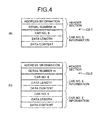
- FIG. 4 is a diagram of an example of transmission data of the train-information managing apparatus.
- the data D2-1 includes a header section and car No. 6 information.
- the header section includes "address information" such as a transmission source address and a "serial number m".
- m is any number among 1 to N.
- the car No. 6 information includes a car number information ("car No. 6") serving as an own car ID and "data length” and "data content” of a data body. Note that information other than the information shown in the figure can be respectively included in the header section and the car No. 6 information.
- the terminal apparatus 2-4 receives the data D2-1 transmitted from the central apparatus 1-2 via the trunk transmission line 4, creates data D2-2 in which own car information (in this case, No. 5 car information) is added to the data D2-1, and transmits the data D2-2 to the car No. 4 via the trunk transmission line 4.
- the terminal apparatus 2-4 can acquire all kinds of car information in the formation including the car No. 6 information included in the data D2-1, the car No. 1 to No. 4 information included in the data D1-4, and own car information (car No. 5 information).
- FIG. 4(b) an example of data D2-2 transmitted by the terminal apparatus 2-4 is shown.
- the data D2-2 includes the car No. 5 information in addition to the data D2-1.
- the car No. 5 information includes a car number information ("car No. 5") serving as an own car ID and "data length" and "data content" of a data body.
- the terminal apparatus 2-3 receives the data D2-2 transmitted from the terminal apparatus 2-4 via the trunk transmission line 4, creates data D2-3 in which own car information (in this case, No. 4 car information) is added to the data D2-2, and transmits the data D2-3 to the car No. 3 via the trunk transmission line 4.
- the terminal apparatus 2-3 can acquire all kinds of car information in the formation including the car No. 5 and car No. 6 information included in the data D2-2, the car No. 1 to No. 3 information included in the data D1-3, and own car information (car No. 4 information).
- the terminal apparatus 2-2 receives the data D2-3 transmitted from the terminal apparatus 2-3 via the trunk transmission line 4, creates data D2-4 in which own car information (in this case, No. 3 car information) is added to the data D2-3, and transmits the data D2-4 to the car No. 2 via the trunk transmission line 4.
- the terminal apparatus 2-2 can acquire all kinds of car information in the formation including the car No. 4 to car No. 6 information included in the data D2-3, the car No. 1 and No. 2 information included in the data D1-2, and own car information (car No. 3 information).
- the terminal apparatus 2-1 receives the data D2-4 transmitted from the terminal apparatus 2-2 via the trunk transmission line 4, creates data D2-5 in which own car information (in this case, No. 2 car information) is added to the data D2-4, and transmits the data D2-5 to the car No. 1 via the trunk transmission line 4.
- the terminal apparatus 2-1 can acquire all kinds of car information in the formation including the car No. 3 to car No. 6 information included in the data D2-4, the car No. 1 information included in the data D1-1, and own car information (car No. 2 information).
- the central apparatus 1-1 receives the data D2-5 transmitted from the terminal apparatus 2-1 via the trunk transmission line 4.
- the central apparatus 1-1 can acquire all kinds of car information in the formation including the car No. 2 to car No. 6 information included in the data D2-5 and own car information (car No. 1 information).
- the central apparatus 1 includes a control processing unit 6, a storing unit 9 connected to the control processing unit 6, a transmitting and receiving unit 8 connected to the control processing unit 6 and capable of performing transmission and reception of data between the cars via the trunk transmission line 4, and a transmitting and receiving unit 7 connected to the control processing unit 6 and capable of performing transmission and reception of data in the car via the branch transmission lines 5.
- the control processing unit 6 includes, as functional components thereof, other-car-information-reception detecting units 6a and 6b, a transmission-information creating unit 6c, and a serial-number comparing and determining unit 6d.
- the control processing unit 6 includes hardware such as a CPU and operates according to a control program for specifying a control operation of the control processing unit 6.
- the other-car-information-reception detecting unit 6a detects whether transmission data from an adjacent car on the head car side is received by the transmitting and receiving unit 8.
- the central apparatus 1 is the central apparatus 1-1 mounted on the head car
- the other-car-information-reception detecting unit 6a does not detect reception of transmission data.
- the central apparatus 1 is the central apparatus 1-2 mounted on the tail car
- the other-car-information-reception detecting unit 6a detects whether transmission data from the car No. 5 is received by the transmitting and receiving unit 8.
- the other-car-information-reception detecting unit 6b detects whether transmission data from an adjacent car on the tail car side is received by the transmitting and receiving unit 8.
- the central apparatus 1 is the central apparatus 1-2 mounted on the tail car
- the other-car-information-reception detecting unit 6b does not detect reception of transmission data.
- the central apparatus 1 is the central apparatus 1-1 mounted on the head car
- the other-car-information-reception detecting unit 6b detects whether transmission data from the car No. 2 is received by the transmitting and receiving unit 8.
- the serial-number comparing and determining unit 6d compares a serial number given to data received from the adjacent car (hereinafter referred to as "reception serial number” and a serial number given to data used for control received from the adjacent car last time (hereinafter referred to as "old number") and determines, on the basis of a result of the comparison, whether the data given with the reception serial number is used for control or discarded. Note that details of the processing of the serial-number comparing and determining unit 6d are explained below.
- the other-car-information-reception detecting unit 15a detects whether transmission data from an adjacent car on the head car side is received by the transmitting and receiving unit 17.
- the terminal apparatus 2 is, for example, the terminal apparatus 2-1 mounted on the car No. 2, the other-car-information-reception detecting unit 15a detects whether transmission data from the car NO. 1 is received by the transmitting and receiving unit 17.
- the other-car-information-reception detecting units 15b detects whether transmission data from an adjacent car on the tail car side is received by the transmitting and receiving unit 17.
- the terminal apparatus 2 is, for example, the terminal apparatus 2-1 mounted on the car No. 2, the other-car-information-reception detecting unit 15b detects whether transmission data from the car NO. 3 is received by the transmitting and receiving unit 17.
- the transmission-information creating unit 15c creates data to be transmitted to the adjacent car.
- the terminal apparatus 2 is, for example, the terminal apparatus 2-1 mounted on the car No. 2, the terminal apparatus 2-1 creates the data D1-2 and D2-5.
- the transmission-information creating unit 15c transmits the created data to the adjacent car via the transmitting and receiving unit 17.
- the transmission-information creating unit 6c has a serial numbering function like the transmission-information creating unit 15c. However, for example, except when the formation is separated and the terminal apparatus 2 is arranged at the formation end and functions as a central apparatus, the serial numbering function is in a disabled state and does not give a serial number to the data to be transmitted.
- the serial-number comparing and determining unit 15d compares a serial number given to data received from the adjacent car (reception serial number) and a serial number given to data used for control received from the adjacent car last time (old number) and determines, on the basis of a result of the comparison, whether the data given with the reception serial number is used for control or discarded.
- the terminal apparatus 2 is, for example, the terminal apparatus 2-1 mounted on the car No. 2, the serial-number comparing and determining unit 15d compares a reception number and an old number concerning the data D1-1 received from the car No. 1 and determines whether the data D1-1 is used for control or discarded.
- serial-number comparing and determining unit 15d compares a reception number and an old number concerning the data D2-4 received from the car No. 3 and determines whether the data D2-4 is used for control or discarded. Note that details of the processing of the serial-number comparing and determining unit 15d are explained below.
- the serial numbering function is enabled in the central apparatuses 1-1 and 1-2 of at the formation ends (both the end cars) in principle.
- the central apparatus 1-1 operates as a post-connection terminal apparatus. Therefore, the central apparatus 1-1 operating as a terminal apparatus after the connection needs to disable the serial numbering function and stops the serial numbering.
- the terminal apparatuses 2-2 and 2-3 respectively operate as central apparatuses after the separation.
- FIG. 8 is a flowchart for explaining determination processing performed by the train-information managing apparatus in enabling or disabling the serial numbering function of the train-information managing apparatus concerning data transmission from the head car side to the tail car side.
- FIG. 9 is a flowchart for explaining determination processing performed by the train-information managing apparatus in enabling or disabling the serial numbering function of the train-information managing apparatus concerning data transmission from the tail car side to the head car side.
- the train-information managing apparatus is the central apparatus 1 or the terminal apparatus 2.
- the train-information managing apparatus carries out data reception detection processing from the head car side (S20).
- the train-information managing apparatus is the central apparatus 1
- the other-car-information-reception detecting unit 6a always detects presence or absence of transmission data from the adjacent car on the head car side.
- the other-car-information-reception detecting unit 6a outputs a detection result to the transmission-information creating unit 6c.
- the train-information managing apparatus is the terminal apparatus 2
- the other-car-information-reception detecting unit 15a always detects presence or absence of transmission data from the adjacent car on the head car side.
- the other-car-information-reception detecting unit 15a outputs a detection result to the transmission-information creating unit 15c.
- the train-information managing apparatus determines whether transmission data is received from the head car side within a fixed time T2 (S21).
- T2 is set to a value larger than T1.
- the transmission-information creating unit 6c determines, on the basis of the output of the other-car-information-reception detecting unit 6a, whether transmission data is received from the adjacent car on the head car side within the fixed time T2.
- the train-information managing apparatus disables the serial numbering function of the train-information managing apparatus concerning data transmission from the head car side to the tail car side (S22).
- the train-information managing apparatus enables the serial numbering function of the train-information managing apparatus concerning data transmission from the head car side to the tail car side (S23). The processing explained above is repeatedly performed.
- the central apparatus 1-1 when the train-information managing apparatus is the central apparatus 1-1, the central apparatus 1-1 does not receive data from the adjacent car on the head car side as long as the central apparatus 1-1 is mounted on the head car. Therefore, in this case, the transmission-information creating unit 6c maintains a state in which the serial numbering function of the train-information managing apparatus is enabled concerning transmission data from the head car side to the tail car side.
- the central apparatus 1-1 when the formation is connected to another formation (not shown in the figure) on the car TC1 Side, the central apparatus 1-1 operates as a terminal apparatus after the connection. Therefore, the central apparatus 1-1 receives data from the head car side. In this case, the transmission-information creating unit 6c disables the serial numbering function of the train-information managing apparatus concerning data transmission from the head car side to the tail car side.
- the terminal apparatus 2-3 when the train-information managing apparatus is the terminal apparatus 2-3, the terminal apparatus 2-3 usually receives the data D1-3 at the cycle of T1. Therefore, in this case, the transmission-information creating unit 15c maintains a state in which the sequential numbering function of the train-information managing apparatus is maintained concerning data transmission from the head car side to the tail car side. However, when the formation is separated between the cars M1-1 and M2-2, the terminal apparatus 2-3 operating as a central apparatus after the separation does not receive data from the head car side. Therefore, in this case, the transmission-information creating unit 15c disables the serial numbering function of the train-information managing apparatus concerning data transmission from the head car side to the tail car side.
- the train-information managing apparatus forms the double system, for example, when a deficiency occurs in a trunk transmission line 4a that connects the central apparatus 1-1-1 and the terminal apparatus 2-1-1, after acquiring car No. 1 information from the central apparatus 1-1-2 of the second system via a trunk transmission line 4c and the transmission line 4d in order, the terminal apparatus 2-1-1 adds a header section (including a serial number) created by the terminal apparatus 2-1-1 to the car No. 1 information and own car information and creates data D1-2.
- a header section including a serial number
- the train-information managing apparatus carries out data reception detection processing from the tail car side (S30).
- the other-car-information-reception detecting unit 6b always detects presence or absence of transmission data from the adjacent car on the tail car side.
- the other-car-information-reception detecting unit 6b outputs a detection result to the transmission-information creating unit 6c.
- the train-information managing apparatus is the terminal apparatus 2
- the other-car-information-reception detecting unit 15b always detects presence or absence of transmission data from the adjacent car on the tail car side.
- the other-car-information-reception detecting unit 15b outputs a detection result to the transmission-information creating unit 15c.
- the train-information managing apparatus determines whether data is received from the tail car side within the fixed time T2 (S31).
- T2 is as explained above.
- the transmission-information creating unit 6c determines, on the basis of the output of the other-car-information-reception detecting unit 6b, whether transmission data is received from the adjacent car on the tail car side within the fixed time T2.
- the transmission-information creating unit 15c determines, on the basis of the output of the other-car-information-reception detecting unit 15b, whether transmission data is received from the adjacent car on the tail car side within the fixed time T2.
- the train-information managing apparatus When transmission data is received from the tail car side within the fixed time T2 as a result of the determination (Yes at S31), the train-information managing apparatus disables the serial numbering function of the train-information managing apparatus concerning the data transmission from the tail car side to the head car side (S32). When transmission data is not received from the tail car side within the fixed time T2 (No at S31), the train-information managing apparatus enables the serial numbering function of the train-information managing apparatus concerning the data transmission from the tail car side to the head car side (S33). The processing explained above is repeatedly performed.
- the terminal apparatus 2-3 when the train-information managing apparatus is the terminal apparatus 2-3, the terminal apparatus 2-3 usually receives the data D2-2 from the car No. 5 at the cycle T1. Therefore, in this case, the transmission-information creating unit 15c maintains a state in which the serial numbering function of the train-information managing apparatus is disabled concerning the data transmission from the tail car side to the head car side.
- FIG. 10 is a flowchart for explaining a train-information managing apparatus according to this embodiment. Note that FIG. 10 is applied to both of the data transmission from the head car side to the tail car side and the data transmission from the tail car side to the head car side. In the following explanation, the data transmission from the head car side to the tail car side is explained as an example. The same explanation can be applied to the data transmission from the tail car side to the head car side.
- the train-information managing apparatus receives other car information (S1). That is, the train-information managing apparatus receives data from the adjacent car on the head car side via the transmitting and receiving unit.
- the train-information managing apparatus is the central apparatus 1-2
- the central apparatus 1-2 receives the data D1-5 from the terminal apparatus 2-4 of the car No. 5.
- the terminal apparatus 2-1 receives the data D1-1 from the central apparatus 1-1 of the car No. 1.
- the train-information managing apparatus acquires a reception serial number (represented as n) from the received data (S2).
- a reception serial number represented as n
- the serial-number comparing and determining unit 6d acquires the reception serial number n out of the data D1-5.
- the serial-number comparing and determining unit 15d acquires the reception serial number n out of the data D1-1.
- the train-information managing apparatus determines whether the reception serial number n is equal to or smaller than M (S3).
- M is as explained with reference to FIG. 2 .
- the serial-number comparing and determining unit 6d determines whether n ⁇ M.
- the serial-number comparing and determining unit 15d determines whether n ⁇ M.
- an entity of the processing is the serial-number comparing and determining unit 6d.
- the entity of the processing is the serial-number comparing and determining unit 15d when the train-information managing apparatus is the terminal apparatus 2.
- the train-information managing apparatus further determines whether the reception serial number n is larger than an old number (represented as n prev ) (S4). That is, the serial number received this time and a serial number received last time are compared.
- the train-information managing apparatus uses received data (S5). That is, when the reception serial number n is a preferential serial number (n ⁇ M), the old number n prev is also a preferential serial number (n prev ⁇ n), and the reception serial number is larger than the old number (n prev ⁇ n), the received data is received in the order of transmission. Therefore, the train-information managing apparatus stores the received data in the storing unit as car information and uses the received data for control.
- the train-information managing apparatus determines whether the old number n prev is equal to or larger than M+1 (S6). As a result of the determination at S6, when the old number n prev ⁇ M+1 (Yes at S6), the train-information managing apparatus uses received data (S5).
- the train-information managing apparatus determines that reversal of the serial numbers is caused because the serial numbers are reset because of, for example, connection or separation of the formation, stores the received data in the storing unit as car information, and uses the received data for control.
- the train-information managing apparatus discards the received data (S7).
- the train-information managing apparatus further determines whether reception serial number n is larger than the old number n prev (S8).
- n prev ⁇ M+1. That is, in the following explanation, both of the reception serial number n and the old number n prev are cyclical serial numbers. Note that, when n prev ⁇ M, the old number n prev is a preferential serial number and the reception number n is a cyclical serial number. Therefore, received data is received in the order of transmission.
- the train-information managing apparatus stores the received data in the storing unit as car information and uses the received data for control.
- the train-information managing apparatus determines whether n-n prev ⁇ L (S9).
- L is a threshold set in advance.
- the train-information managing apparatus uses received data (S5).
- the train-information managing apparatus discards the received data (S10).
- the train-information managing apparatus stores the latest received data in the storing unit as car information and uses the latest received data for control.
- the present invention is useful as a train-information managing apparatus.
Landscapes
- Engineering & Computer Science (AREA)
- Mechanical Engineering (AREA)
- Computer Networks & Wireless Communication (AREA)
- Signal Processing (AREA)
- Health & Medical Sciences (AREA)
- Computing Systems (AREA)
- General Health & Medical Sciences (AREA)
- Medical Informatics (AREA)
- Computer Security & Cryptography (AREA)
- Electric Propulsion And Braking For Vehicles (AREA)
- Small-Scale Networks (AREA)
- Train Traffic Observation, Control, And Security (AREA)
Applications Claiming Priority (1)
| Application Number | Priority Date | Filing Date | Title |
|---|---|---|---|
| PCT/JP2012/050039 WO2013102998A1 (ja) | 2012-01-04 | 2012-01-04 | 列車情報管理装置 |
Publications (3)
| Publication Number | Publication Date |
|---|---|
| EP2802104A1 true EP2802104A1 (de) | 2014-11-12 |
| EP2802104A4 EP2802104A4 (de) | 2015-09-02 |
| EP2802104B1 EP2802104B1 (de) | 2016-09-21 |
Family
ID=47189501
Family Applications (1)
| Application Number | Title | Priority Date | Filing Date |
|---|---|---|---|
| EP12864367.3A Active EP2802104B1 (de) | 2012-01-04 | 2012-01-04 | Verwaltungsvorrichtung für zugauskunft |
Country Status (8)
| Country | Link |
|---|---|
| US (1) | US9553931B2 (de) |
| EP (1) | EP2802104B1 (de) |
| JP (1) | JP5052704B1 (de) |
| KR (1) | KR101499408B1 (de) |
| CN (1) | CN104040955B (de) |
| HK (1) | HK1199777A1 (de) |
| TW (1) | TW201328924A (de) |
| WO (1) | WO2013102998A1 (de) |
Families Citing this family (13)
| Publication number | Priority date | Publication date | Assignee | Title |
|---|---|---|---|---|
| JP5919205B2 (ja) * | 2013-01-28 | 2016-05-18 | 日立オートモティブシステムズ株式会社 | ネットワーク装置およびデータ送受信システム |
| JP6091385B2 (ja) * | 2013-09-10 | 2017-03-08 | 三菱電機株式会社 | 列車無線システム |
| CN103661493B (zh) * | 2013-12-12 | 2015-07-22 | 合肥工大高科信息科技股份有限公司 | 一种铁路车辆摘挂作业电子感应器及其自动感知方法 |
| SG11201705149QA (en) * | 2014-12-25 | 2017-07-28 | Mitsubishi Electric Corp | Information display device |
| CN107531158B (zh) * | 2015-04-20 | 2020-04-28 | 三菱电机株式会社 | 列车数据传输系统及列车数据传输程序 |
| JP6573726B2 (ja) * | 2016-09-23 | 2019-09-11 | 三菱電機株式会社 | 端末装置、中央装置、列車情報管理システムおよび列車情報管理方法 |
| CN107226110B (zh) * | 2017-05-23 | 2019-02-19 | 杭州迪普科技股份有限公司 | 一种列车车厢的编号方法及装置 |
| JPWO2018229986A1 (ja) * | 2017-06-16 | 2020-05-21 | 三菱電機株式会社 | 車両起動システム、遠隔制御システム、列車統合管理システム、自動列車制御装置および車両起動方法 |
| US11511780B2 (en) * | 2017-11-21 | 2022-11-29 | Crrc Tangshan Co., Ltd. | Carriage, head carriage, middle carriage, and train |
| CN109808666B (zh) | 2017-11-21 | 2021-06-04 | 中车唐山机车车辆有限公司 | 一种列车车厢制动控制方法、列车车厢和列车 |
| DE112018008062B4 (de) * | 2018-11-14 | 2022-01-20 | Mitsubishi Electric Corporation | Einrichtungsverwaltungsvorrichtung, Einrichtungsverwaltungsverfahren und Einrichtungsverwaltungsprogramm |
| EP4105100A1 (de) * | 2021-06-15 | 2022-12-21 | KNORR-BREMSE Systeme für Schienenfahrzeuge GmbH | Digitaler güterwagen - automatische wagenliste |
| CN113918742B (zh) * | 2021-09-29 | 2025-03-21 | 交控科技股份有限公司 | 列车实际运行图数据存储方法及装置 |
Family Cites Families (25)
| Publication number | Priority date | Publication date | Assignee | Title |
|---|---|---|---|---|
| US5353413A (en) | 1992-03-19 | 1994-10-04 | Aeg Transportation Systems, Inc. | Method and apparatus for christening a trainline monitor system |
| JPH09323599A (ja) * | 1996-06-06 | 1997-12-16 | Toshiba Transport Eng Kk | 車両情報記録装置 |
| JP3766194B2 (ja) | 1997-11-20 | 2006-04-12 | 株式会社東芝 | 車内伝送装置 |
| DE19856540C2 (de) * | 1998-12-08 | 2001-11-08 | Deutsche Bahn Ag | Datenkommunikationssystem im Zug |
| DE19929644C2 (de) | 1999-06-28 | 2002-02-21 | Deutsche Bahn Ag | System zur Initialisierung von Zügen auf Basis eines Datenkommunikationssystems, bei dem allen Kommunikationsteilnehmern die Informationen in der Initialisierungsphase zugänglich sind |
| JP2001286001A (ja) | 2000-03-30 | 2001-10-12 | Toyo Electric Mfg Co Ltd | 鉄道車両用情報伝送装置 |
| US7483433B2 (en) * | 2001-09-17 | 2009-01-27 | Foundry Networks, Inc. | System and method for router data distribution |
| JP3895970B2 (ja) | 2001-11-01 | 2007-03-22 | 株式会社東芝 | 車両点検システム |
| JP3873751B2 (ja) * | 2002-01-22 | 2007-01-24 | 松下電工株式会社 | データ通信システム |
| JP3808824B2 (ja) | 2002-11-20 | 2006-08-16 | 株式会社日立製作所 | 情報伝送システム及び情報伝送方法 |
| JP4213621B2 (ja) | 2003-06-26 | 2009-01-21 | 株式会社東芝 | 鉄道車両用伝送装置 |
| JP4202842B2 (ja) | 2003-06-30 | 2008-12-24 | 株式会社東芝 | 電気車の情報伝送システム |
| JP4358608B2 (ja) | 2003-11-25 | 2009-11-04 | 株式会社日立製作所 | 情報伝送システム及び情報伝送方法 |
| JP4664782B2 (ja) | 2004-10-19 | 2011-04-06 | 株式会社東芝 | 鉄道車両用伝送システム及びそれを用いた鉄道車両 |
| DE102006018163B4 (de) * | 2006-04-19 | 2008-12-24 | Siemens Ag | Verfahren zur automatischen Adressvergabe |
| JP5207106B2 (ja) * | 2007-06-06 | 2013-06-12 | 国立大学法人名古屋大学 | 車載通信システム及び車載通信方法 |
| JP2009267772A (ja) | 2008-04-25 | 2009-11-12 | Hitachi Ltd | 列車内ネットワーク制御方法 |
| FR2932447B1 (fr) * | 2008-06-12 | 2016-09-30 | Alstom Transport Sa | Systeme informatique embarque de gestion d'un train |
| US8095253B2 (en) * | 2008-07-24 | 2012-01-10 | Invensys Rail Corporation | Fuel efficiency improvement for locomotive consists |
| JP2010109530A (ja) | 2008-10-29 | 2010-05-13 | Sony Corp | 無線通信装置および無線通信方法 |
| JP5208040B2 (ja) | 2009-04-10 | 2013-06-12 | 三菱電機株式会社 | 車両情報伝送中継装置 |
| US9580091B2 (en) * | 2009-10-22 | 2017-02-28 | General Electric Company | System and method for communicating data in a vehicle system |
| CN101714911B (zh) * | 2009-11-11 | 2013-06-12 | 北京交控科技有限公司 | 基于通信的列车运行控制系统的数据通信方法 |
| CN102231728A (zh) * | 2011-05-16 | 2011-11-02 | 铁道部运输局 | 列车控制数据的通信方法、设备及系统 |
| US9330154B2 (en) * | 2011-08-22 | 2016-05-03 | Sybase, Inc. | Multicast database replication |
-
2012
- 2012-01-04 EP EP12864367.3A patent/EP2802104B1/de active Active
- 2012-01-04 HK HK15100129.7A patent/HK1199777A1/xx unknown
- 2012-01-04 WO PCT/JP2012/050039 patent/WO2013102998A1/ja not_active Ceased
- 2012-01-04 JP JP2012515046A patent/JP5052704B1/ja active Active
- 2012-01-04 KR KR1020147018255A patent/KR101499408B1/ko not_active Expired - Fee Related
- 2012-01-04 US US14/370,493 patent/US9553931B2/en active Active
- 2012-01-04 CN CN201280065940.8A patent/CN104040955B/zh not_active Expired - Fee Related
- 2012-03-29 TW TW101111023A patent/TW201328924A/zh unknown
Also Published As
| Publication number | Publication date |
|---|---|
| US20140376554A1 (en) | 2014-12-25 |
| JPWO2013102998A1 (ja) | 2015-05-11 |
| US9553931B2 (en) | 2017-01-24 |
| EP2802104B1 (de) | 2016-09-21 |
| TW201328924A (zh) | 2013-07-16 |
| EP2802104A4 (de) | 2015-09-02 |
| KR20140100976A (ko) | 2014-08-18 |
| CN104040955B (zh) | 2017-07-14 |
| JP5052704B1 (ja) | 2012-10-17 |
| WO2013102998A1 (ja) | 2013-07-11 |
| CN104040955A (zh) | 2014-09-10 |
| HK1199777A1 (en) | 2015-07-17 |
| KR101499408B1 (ko) | 2015-03-05 |
Similar Documents
| Publication | Publication Date | Title |
|---|---|---|
| EP2802104B1 (de) | Verwaltungsvorrichtung für zugauskunft | |
| EP2690826A2 (de) | Flexray-Kommunikationen über Ethernet | |
| US10700889B2 (en) | Ring network for a vehicle | |
| CN107995189B (zh) | 一种列车控制系统中的寿命预计系统及方法 | |
| CN104115452A (zh) | 通信系统、中继装置以及电源控制方法 | |
| CN112622985B (zh) | 轨道车辆救援限速方法、系统及occ | |
| CN103825791A (zh) | 一种mvb总线主控并联冗余控制的方法 | |
| JPWO2009072473A1 (ja) | 列車情報管理装置 | |
| EP3000650B1 (de) | Vorrichtung zur verwaltung von zuginformationen und verfahren zur verwaltung von zuginformationen | |
| JP6091385B2 (ja) | 列車無線システム | |
| CN219122584U (zh) | 冗余自动驾驶控制系统和自动驾驶车辆 | |
| JP5701197B2 (ja) | 列車情報管理装置及び列車情報管理方法 | |
| CN114500606B (zh) | 一种固定编组列车网络架构系统 | |
| JP5943723B2 (ja) | 情報変換装置 | |
| JP6839302B2 (ja) | 列車制御装置および列車制御方法 | |
| JP7257922B2 (ja) | 車両情報制御システム | |
| US20100125850A1 (en) | Method and Systems for Processing Critical Control System Functions | |
| JP5854962B2 (ja) | 電文制御通信装置 | |
| EP3118052B1 (de) | Verwaltungsvorrichtung für ein zug | |
| JP5824322B2 (ja) | 車両間情報伝送装置 | |
| CN104442930B (zh) | Pmi联锁系统与车辆段接口转换轨管理权分配方法 | |
| JP5711622B2 (ja) | 故障検知機能付きats−p地上子 | |
| CN106527117B (zh) | 一种全自动驾驶车载控制器与列车冗余控制系统及方法 | |
| JP2015204690A (ja) | 列車情報管理装置 | |
| ITTO20090172A1 (it) | Sistema di supporto alla protezione del personale di manutenzione su linee, in particolare su linee ferroviare, e relativo metodo |
Legal Events
| Date | Code | Title | Description |
|---|---|---|---|
| PUAI | Public reference made under article 153(3) epc to a published international application that has entered the european phase |
Free format text: ORIGINAL CODE: 0009012 |
|
| 17P | Request for examination filed |
Effective date: 20140630 |
|
| AK | Designated contracting states |
Kind code of ref document: A1 Designated state(s): AL AT BE BG CH CY CZ DE DK EE ES FI FR GB GR HR HU IE IS IT LI LT LU LV MC MK MT NL NO PL PT RO RS SE SI SK SM TR |
|
| DAX | Request for extension of the european patent (deleted) | ||
| RA4 | Supplementary search report drawn up and despatched (corrected) |
Effective date: 20150730 |
|
| RIC1 | Information provided on ipc code assigned before grant |
Ipc: H04L 29/08 20060101ALN20150724BHEP Ipc: B61L 25/02 20060101AFI20150724BHEP Ipc: B61L 15/00 20060101ALI20150724BHEP |
|
| REG | Reference to a national code |
Ref country code: DE Ref legal event code: R079 Ref document number: 602012023405 Country of ref document: DE Free format text: PREVIOUS MAIN CLASS: H04L0012280000 Ipc: B61L0025020000 |
|
| GRAP | Despatch of communication of intention to grant a patent |
Free format text: ORIGINAL CODE: EPIDOSNIGR1 |
|
| RIC1 | Information provided on ipc code assigned before grant |
Ipc: H04L 29/08 20060101ALN20160414BHEP Ipc: B61L 25/02 20060101AFI20160414BHEP Ipc: B61L 15/00 20060101ALI20160414BHEP |
|
| INTG | Intention to grant announced |
Effective date: 20160510 |
|
| GRAS | Grant fee paid |
Free format text: ORIGINAL CODE: EPIDOSNIGR3 |
|
| GRAA | (expected) grant |
Free format text: ORIGINAL CODE: 0009210 |
|
| AK | Designated contracting states |
Kind code of ref document: B1 Designated state(s): AL AT BE BG CH CY CZ DE DK EE ES FI FR GB GR HR HU IE IS IT LI LT LU LV MC MK MT NL NO PL PT RO RS SE SI SK SM TR |
|
| REG | Reference to a national code |
Ref country code: GB Ref legal event code: FG4D |
|
| REG | Reference to a national code |
Ref country code: CH Ref legal event code: EP |
|
| REG | Reference to a national code |
Ref country code: AT Ref legal event code: REF Ref document number: 830775 Country of ref document: AT Kind code of ref document: T Effective date: 20161015 |
|
| REG | Reference to a national code |
Ref country code: IE Ref legal event code: FG4D |
|
| REG | Reference to a national code |
Ref country code: DE Ref legal event code: R096 Ref document number: 602012023405 Country of ref document: DE |
|
| REG | Reference to a national code |
Ref country code: FR Ref legal event code: PLFP Year of fee payment: 6 |
|
| REG | Reference to a national code |
Ref country code: LT Ref legal event code: MG4D Ref country code: NL Ref legal event code: MP Effective date: 20160921 |
|
| PG25 | Lapsed in a contracting state [announced via postgrant information from national office to epo] |
Ref country code: RS Free format text: LAPSE BECAUSE OF FAILURE TO SUBMIT A TRANSLATION OF THE DESCRIPTION OR TO PAY THE FEE WITHIN THE PRESCRIBED TIME-LIMIT Effective date: 20160921 Ref country code: FI Free format text: LAPSE BECAUSE OF FAILURE TO SUBMIT A TRANSLATION OF THE DESCRIPTION OR TO PAY THE FEE WITHIN THE PRESCRIBED TIME-LIMIT Effective date: 20160921 Ref country code: LT Free format text: LAPSE BECAUSE OF FAILURE TO SUBMIT A TRANSLATION OF THE DESCRIPTION OR TO PAY THE FEE WITHIN THE PRESCRIBED TIME-LIMIT Effective date: 20160921 Ref country code: NO Free format text: LAPSE BECAUSE OF FAILURE TO SUBMIT A TRANSLATION OF THE DESCRIPTION OR TO PAY THE FEE WITHIN THE PRESCRIBED TIME-LIMIT Effective date: 20161221 |
|
| REG | Reference to a national code |
Ref country code: AT Ref legal event code: MK05 Ref document number: 830775 Country of ref document: AT Kind code of ref document: T Effective date: 20160921 |
|
| PG25 | Lapsed in a contracting state [announced via postgrant information from national office to epo] |
Ref country code: NL Free format text: LAPSE BECAUSE OF FAILURE TO SUBMIT A TRANSLATION OF THE DESCRIPTION OR TO PAY THE FEE WITHIN THE PRESCRIBED TIME-LIMIT Effective date: 20160921 Ref country code: GR Free format text: LAPSE BECAUSE OF FAILURE TO SUBMIT A TRANSLATION OF THE DESCRIPTION OR TO PAY THE FEE WITHIN THE PRESCRIBED TIME-LIMIT Effective date: 20161222 Ref country code: SE Free format text: LAPSE BECAUSE OF FAILURE TO SUBMIT A TRANSLATION OF THE DESCRIPTION OR TO PAY THE FEE WITHIN THE PRESCRIBED TIME-LIMIT Effective date: 20160921 Ref country code: LV Free format text: LAPSE BECAUSE OF FAILURE TO SUBMIT A TRANSLATION OF THE DESCRIPTION OR TO PAY THE FEE WITHIN THE PRESCRIBED TIME-LIMIT Effective date: 20160921 |
|
| PG25 | Lapsed in a contracting state [announced via postgrant information from national office to epo] |
Ref country code: RO Free format text: LAPSE BECAUSE OF FAILURE TO SUBMIT A TRANSLATION OF THE DESCRIPTION OR TO PAY THE FEE WITHIN THE PRESCRIBED TIME-LIMIT Effective date: 20160921 Ref country code: EE Free format text: LAPSE BECAUSE OF FAILURE TO SUBMIT A TRANSLATION OF THE DESCRIPTION OR TO PAY THE FEE WITHIN THE PRESCRIBED TIME-LIMIT Effective date: 20160921 |
|
| PG25 | Lapsed in a contracting state [announced via postgrant information from national office to epo] |
Ref country code: SK Free format text: LAPSE BECAUSE OF FAILURE TO SUBMIT A TRANSLATION OF THE DESCRIPTION OR TO PAY THE FEE WITHIN THE PRESCRIBED TIME-LIMIT Effective date: 20160921 Ref country code: BE Free format text: LAPSE BECAUSE OF FAILURE TO SUBMIT A TRANSLATION OF THE DESCRIPTION OR TO PAY THE FEE WITHIN THE PRESCRIBED TIME-LIMIT Effective date: 20160921 Ref country code: CZ Free format text: LAPSE BECAUSE OF FAILURE TO SUBMIT A TRANSLATION OF THE DESCRIPTION OR TO PAY THE FEE WITHIN THE PRESCRIBED TIME-LIMIT Effective date: 20160921 Ref country code: PT Free format text: LAPSE BECAUSE OF FAILURE TO SUBMIT A TRANSLATION OF THE DESCRIPTION OR TO PAY THE FEE WITHIN THE PRESCRIBED TIME-LIMIT Effective date: 20170123 Ref country code: ES Free format text: LAPSE BECAUSE OF FAILURE TO SUBMIT A TRANSLATION OF THE DESCRIPTION OR TO PAY THE FEE WITHIN THE PRESCRIBED TIME-LIMIT Effective date: 20160921 Ref country code: BG Free format text: LAPSE BECAUSE OF FAILURE TO SUBMIT A TRANSLATION OF THE DESCRIPTION OR TO PAY THE FEE WITHIN THE PRESCRIBED TIME-LIMIT Effective date: 20161221 Ref country code: SM Free format text: LAPSE BECAUSE OF FAILURE TO SUBMIT A TRANSLATION OF THE DESCRIPTION OR TO PAY THE FEE WITHIN THE PRESCRIBED TIME-LIMIT Effective date: 20160921 Ref country code: AT Free format text: LAPSE BECAUSE OF FAILURE TO SUBMIT A TRANSLATION OF THE DESCRIPTION OR TO PAY THE FEE WITHIN THE PRESCRIBED TIME-LIMIT Effective date: 20160921 Ref country code: PL Free format text: LAPSE BECAUSE OF FAILURE TO SUBMIT A TRANSLATION OF THE DESCRIPTION OR TO PAY THE FEE WITHIN THE PRESCRIBED TIME-LIMIT Effective date: 20160921 Ref country code: IS Free format text: LAPSE BECAUSE OF FAILURE TO SUBMIT A TRANSLATION OF THE DESCRIPTION OR TO PAY THE FEE WITHIN THE PRESCRIBED TIME-LIMIT Effective date: 20170121 |
|
| REG | Reference to a national code |
Ref country code: DE Ref legal event code: R097 Ref document number: 602012023405 Country of ref document: DE |
|
| PG25 | Lapsed in a contracting state [announced via postgrant information from national office to epo] |
Ref country code: IT Free format text: LAPSE BECAUSE OF FAILURE TO SUBMIT A TRANSLATION OF THE DESCRIPTION OR TO PAY THE FEE WITHIN THE PRESCRIBED TIME-LIMIT Effective date: 20160921 |
|
| PLBE | No opposition filed within time limit |
Free format text: ORIGINAL CODE: 0009261 |
|
| STAA | Information on the status of an ep patent application or granted ep patent |
Free format text: STATUS: NO OPPOSITION FILED WITHIN TIME LIMIT |
|
| PG25 | Lapsed in a contracting state [announced via postgrant information from national office to epo] |
Ref country code: DK Free format text: LAPSE BECAUSE OF FAILURE TO SUBMIT A TRANSLATION OF THE DESCRIPTION OR TO PAY THE FEE WITHIN THE PRESCRIBED TIME-LIMIT Effective date: 20160921 |
|
| 26N | No opposition filed |
Effective date: 20170622 |
|
| REG | Reference to a national code |
Ref country code: CH Ref legal event code: PL |
|
| PG25 | Lapsed in a contracting state [announced via postgrant information from national office to epo] |
Ref country code: MC Free format text: LAPSE BECAUSE OF FAILURE TO SUBMIT A TRANSLATION OF THE DESCRIPTION OR TO PAY THE FEE WITHIN THE PRESCRIBED TIME-LIMIT Effective date: 20160921 |
|
| PG25 | Lapsed in a contracting state [announced via postgrant information from national office to epo] |
Ref country code: CH Free format text: LAPSE BECAUSE OF NON-PAYMENT OF DUE FEES Effective date: 20170131 Ref country code: LI Free format text: LAPSE BECAUSE OF NON-PAYMENT OF DUE FEES Effective date: 20170131 |
|
| REG | Reference to a national code |
Ref country code: IE Ref legal event code: MM4A |
|
| PG25 | Lapsed in a contracting state [announced via postgrant information from national office to epo] |
Ref country code: LU Free format text: LAPSE BECAUSE OF NON-PAYMENT OF DUE FEES Effective date: 20170104 Ref country code: SI Free format text: LAPSE BECAUSE OF FAILURE TO SUBMIT A TRANSLATION OF THE DESCRIPTION OR TO PAY THE FEE WITHIN THE PRESCRIBED TIME-LIMIT Effective date: 20160921 |
|
| REG | Reference to a national code |
Ref country code: FR Ref legal event code: PLFP Year of fee payment: 7 |
|
| PG25 | Lapsed in a contracting state [announced via postgrant information from national office to epo] |
Ref country code: IE Free format text: LAPSE BECAUSE OF NON-PAYMENT OF DUE FEES Effective date: 20170104 |
|
| PGFP | Annual fee paid to national office [announced via postgrant information from national office to epo] |
Ref country code: GB Payment date: 20180103 Year of fee payment: 7 |
|
| PG25 | Lapsed in a contracting state [announced via postgrant information from national office to epo] |
Ref country code: MT Free format text: LAPSE BECAUSE OF NON-PAYMENT OF DUE FEES Effective date: 20170104 |
|
| PG25 | Lapsed in a contracting state [announced via postgrant information from national office to epo] |
Ref country code: AL Free format text: LAPSE BECAUSE OF FAILURE TO SUBMIT A TRANSLATION OF THE DESCRIPTION OR TO PAY THE FEE WITHIN THE PRESCRIBED TIME-LIMIT Effective date: 20160921 |
|
| REG | Reference to a national code |
Ref country code: DE Ref legal event code: R084 Ref document number: 602012023405 Country of ref document: DE |
|
| PGFP | Annual fee paid to national office [announced via postgrant information from national office to epo] |
Ref country code: FR Payment date: 20181212 Year of fee payment: 8 |
|
| PG25 | Lapsed in a contracting state [announced via postgrant information from national office to epo] |
Ref country code: HU Free format text: LAPSE BECAUSE OF FAILURE TO SUBMIT A TRANSLATION OF THE DESCRIPTION OR TO PAY THE FEE WITHIN THE PRESCRIBED TIME-LIMIT; INVALID AB INITIO Effective date: 20120104 |
|
| GBPC | Gb: european patent ceased through non-payment of renewal fee |
Effective date: 20190104 |
|
| PG25 | Lapsed in a contracting state [announced via postgrant information from national office to epo] |
Ref country code: CY Free format text: LAPSE BECAUSE OF FAILURE TO SUBMIT A TRANSLATION OF THE DESCRIPTION OR TO PAY THE FEE WITHIN THE PRESCRIBED TIME-LIMIT Effective date: 20160921 |
|
| PG25 | Lapsed in a contracting state [announced via postgrant information from national office to epo] |
Ref country code: MK Free format text: LAPSE BECAUSE OF FAILURE TO SUBMIT A TRANSLATION OF THE DESCRIPTION OR TO PAY THE FEE WITHIN THE PRESCRIBED TIME-LIMIT Effective date: 20160921 |
|
| PG25 | Lapsed in a contracting state [announced via postgrant information from national office to epo] |
Ref country code: GB Free format text: LAPSE BECAUSE OF NON-PAYMENT OF DUE FEES Effective date: 20190104 |
|
| PG25 | Lapsed in a contracting state [announced via postgrant information from national office to epo] |
Ref country code: TR Free format text: LAPSE BECAUSE OF FAILURE TO SUBMIT A TRANSLATION OF THE DESCRIPTION OR TO PAY THE FEE WITHIN THE PRESCRIBED TIME-LIMIT Effective date: 20160921 |
|
| PG25 | Lapsed in a contracting state [announced via postgrant information from national office to epo] |
Ref country code: HR Free format text: LAPSE BECAUSE OF FAILURE TO SUBMIT A TRANSLATION OF THE DESCRIPTION OR TO PAY THE FEE WITHIN THE PRESCRIBED TIME-LIMIT Effective date: 20160921 |
|
| PG25 | Lapsed in a contracting state [announced via postgrant information from national office to epo] |
Ref country code: FR Free format text: LAPSE BECAUSE OF NON-PAYMENT OF DUE FEES Effective date: 20200131 |
|
| P01 | Opt-out of the competence of the unified patent court (upc) registered |
Effective date: 20230512 |
|
| PGFP | Annual fee paid to national office [announced via postgrant information from national office to epo] |
Ref country code: DE Payment date: 20251203 Year of fee payment: 15 |