EP2774494B1 - Fettarme mayonnaisezusammensetzung und herstellungsverfahren dafür - Google Patents
Fettarme mayonnaisezusammensetzung und herstellungsverfahren dafür Download PDFInfo
- Publication number
- EP2774494B1 EP2774494B1 EP12844688.7A EP12844688A EP2774494B1 EP 2774494 B1 EP2774494 B1 EP 2774494B1 EP 12844688 A EP12844688 A EP 12844688A EP 2774494 B1 EP2774494 B1 EP 2774494B1
- Authority
- EP
- European Patent Office
- Prior art keywords
- mayonnaise
- composition
- cellulose ether
- excipient
- total weight
- Prior art date
- Legal status (The legal status is an assumption and is not a legal conclusion. Google has not performed a legal analysis and makes no representation as to the accuracy of the status listed.)
- Active
Links
Images


Classifications
-
- A—HUMAN NECESSITIES
- A23—FOODS OR FOODSTUFFS; TREATMENT THEREOF, NOT COVERED BY OTHER CLASSES
- A23L—FOODS, FOODSTUFFS OR NON-ALCOHOLIC BEVERAGES, NOT OTHERWISE PROVIDED FOR; PREPARATION OR TREATMENT THEREOF
- A23L27/00—Spices; Flavouring agents or condiments; Artificial sweetening agents; Table salts; Dietetic salt substitutes; Preparation or treatment thereof
- A23L27/60—Salad dressings; Mayonnaise; Ketchup
-
- A—HUMAN NECESSITIES
- A23—FOODS OR FOODSTUFFS; TREATMENT THEREOF, NOT COVERED BY OTHER CLASSES
- A23D—EDIBLE OILS OR FATS, e.g. MARGARINES, SHORTENINGS OR COOKING OILS
- A23D7/00—Edible oil or fat compositions containing an aqueous phase, e.g. margarines
- A23D7/005—Edible oil or fat compositions containing an aqueous phase, e.g. margarines characterised by ingredients other than fatty acid triglycerides
- A23D7/0053—Compositions other than spreads
-
- A—HUMAN NECESSITIES
- A23—FOODS OR FOODSTUFFS; TREATMENT THEREOF, NOT COVERED BY OTHER CLASSES
- A23D—EDIBLE OILS OR FATS, e.g. MARGARINES, SHORTENINGS OR COOKING OILS
- A23D7/00—Edible oil or fat compositions containing an aqueous phase, e.g. margarines
- A23D7/015—Reducing calorie content; Reducing fat content, e.g. "halvarines"
-
- A—HUMAN NECESSITIES
- A23—FOODS OR FOODSTUFFS; TREATMENT THEREOF, NOT COVERED BY OTHER CLASSES
- A23D—EDIBLE OILS OR FATS, e.g. MARGARINES, SHORTENINGS OR COOKING OILS
- A23D7/00—Edible oil or fat compositions containing an aqueous phase, e.g. margarines
- A23D7/02—Edible oil or fat compositions containing an aqueous phase, e.g. margarines characterised by the production or working-up
-
- A—HUMAN NECESSITIES
- A23—FOODS OR FOODSTUFFS; TREATMENT THEREOF, NOT COVERED BY OTHER CLASSES
- A23L—FOODS, FOODSTUFFS OR NON-ALCOHOLIC BEVERAGES, NOT OTHERWISE PROVIDED FOR; PREPARATION OR TREATMENT THEREOF
- A23L29/00—Foods or foodstuffs containing additives; Preparation or treatment thereof
- A23L29/20—Foods or foodstuffs containing additives; Preparation or treatment thereof containing gelling or thickening agents
- A23L29/206—Foods or foodstuffs containing additives; Preparation or treatment thereof containing gelling or thickening agents of vegetable origin
- A23L29/262—Cellulose; Derivatives thereof, e.g. ethers
-
- A—HUMAN NECESSITIES
- A23—FOODS OR FOODSTUFFS; TREATMENT THEREOF, NOT COVERED BY OTHER CLASSES
- A23L—FOODS, FOODSTUFFS OR NON-ALCOHOLIC BEVERAGES, NOT OTHERWISE PROVIDED FOR; PREPARATION OR TREATMENT THEREOF
- A23L33/00—Modifying nutritive qualities of foods; Dietetic products; Preparation or treatment thereof
- A23L33/20—Reducing nutritive value; Dietetic products with reduced nutritive value
Definitions
- the present invention relates to a low fat mayonnaise composition and a method of preparing the same, according to claims 1 to 7, and more particularly, to a low fat mayonnaise composition and a method of preparing the same, in which without using an egg, cellulose ether and an excipient are used as a fat substitute such that an oil and fat content in the low fat mayonnaise composition is reduced to 1/2 or less, and the low fat mayonnaise composition is stable at various temperatures.
- Mayonnaise is one of representative high fat foods having a fat content of 80% or more, and a food in a type of O/W emulsion, in which lipoprotein and lecithin, that is an egg or a yolk component, have an emulsifying capacity and thus surround a fat component, thereby allowing the fat component to be dispersed in water.
- an egg generally is a perfect food having all kinds of nutrients together with milk, and is used as an emulsifier at the time of producing mayonnaise.
- the yolk of an egg contains averagely 210 mg of cholesterol. It can be known that such an amount is higher than the recommended allowance for cholesterol, that is, 200 mg/2,000 kcal, recommended by WHO.
- ovalbumin and ovomucoid among the proteins in the egg white are allergens, an allergy inducing substance. Therefore, recently, in addition to an attempt to produce mayonnaise with removing cholesterol from the yolk in an egg or without using an egg, various attempts for securing heat resistance or cold resistance have been reported.
- Korean Patent No. 288012 it is described that in order to reduce cholesterol in the yolk of an egg, a frozen liquid egg prepared by using ⁇ -cyclodextrin is used.
- a frozen liquid egg prepared by using ⁇ -cyclodextrin is used.
- cholesterol cannot be completely removed from the yolk of an egg, and also the allergens, and the like included in an egg cannot be removed.
- a method of producing mayonnaise in which the method includes mixing 1 to 10 wt% of cooking oil, 1 to 20 wt% of the white of an egg, 0.25 to 5 wt% of microcrystalline cellulose, and 1 to 15 wt% of polydextrose with 40 to 90 wt% of water, with respect to the total weight.
- the method includes mixing 1 to 10 wt% of cooking oil, 1 to 20 wt% of the white of an egg, 0.25 to 5 wt% of microcrystalline cellulose, and 1 to 15 wt% of polydextrose with 40 to 90 wt% of water, with respect to the total weight.
- emulsion stability is reduced though the white of an egg used, and problems such as oil separation occurs as time passes.
- Korean Patent Publication No. 1995-0016982 discloses a mayonnaise composition, in which cold resistance is increased by changing fats to be used and also controlling a size of a fat globule through a process such as vacuum emulsification, and a method thereof.
- a composition is not free from an egg component and there are no significant differences between the composition and the conventional mayonnaise in terms of calorie and an oil and fat content.
- US 5 759 609A relates to a low-fat whipped topping having good performance and organoleptic properties comprising on a weight basis about 0.0% to 7.0% fat, 0.20% to 0.8% emulsifiers, 1.0% to 1.75% stabilizers and 40% to 55% water soluble carbohydrates.
- the low-fat whipped topping has a caloric density of from 1.5 to 2.5 calories per gram and an overrun of at least 300%.
- the present inventors researched on maintaining shape retention of mayonnaise, reducing an oil and fat content, and implementing possibility with a vegetable raw material.
- the present inventors found that a mayonnaise product having such a concept can be prepared by using cellulose ether and an excipient, and then completed the present invention.
- An object of the present invention is to provide a low fat mayonnaise composition, in which without using an egg, an oil and fat content in the low fat mayonnaise composition is reduced to 1/2 or less, and the low fat mayonnaise composition is stable at various temperatures.
- Another object of the present invention is to provide a method of producing a low fat mayonnaise composition, in which without using an egg, an oil and fat content in the low fat mayonnaise composition is reduced to 1/2 or less, and the low fat mayonnaise composition is stable at various temperatures.
- the present invention is to provide a low fat mayonnaise composition in which an emulsion composed of vegetable oil is reduced to 50 wt% or less with respect to the total weight of the composition and also cellulose ether and an excipient are included as a fat substitute.
- the cellulose ether is preferably included in a range of 1 to 3 wt% with respect to the total weight of the mayonnaise composition and the excipient is included in a range of 1 to 20 wt% with the respect to the total weight of the mayonnaise composition.
- the cellulose ether is hydroxypropylmethyl cellulose, and has a structure, in which 19 to 30% of a methoxyl group and 4 to 20% of a hydroxypropyl group are substituted at a main chain of the cellulose.
- the excipient is preferably selected from an isolated soy protein, powdered skim milk, or starch.
- the low fat mayonnaise composition according to the present invention may further include a stabilizer.
- the stabilizer is preferably included in a range of 0.05 to 1 wt% with respect to the total weight of the mayonnaise composition, and is preferably at least one selected from the group consisting of xanthan gum, carrageenan, locust bean gum, guar gum, alginic acid, and agar.
- the present invention is to provide a method of producing a low fat mayonnaise composition, in which the method includes hydrating cellulose ether and an excipient; mixing the hydrate thus obtained with an emulsion composed of vegetable oil, and primarily stirring the mixture; mixing the primarily stirred mixture thus obtained with sugar, salt, or vinegar; and the secondarily stirring the mixture.
- the method of producing a low fat mayonnaise composition according to the present invention the kinds and contents of the cellulose ether and excipient are the same as described above.
- the cellulose ether and excipient may be mixed in advance and then hydrated; or the cellulose ether may be hydrated, and then the excipient may be mixed to the hydrated cellulose ether and then hydrated.
- adding a stabilizer may be further included, and especially, it is preferable to further add a stabilizer in the mixing of sugar and salt.
- pH of the final product is preferably within a range of 4.5 to 5.5.
- a low fat mayonnaise composition including cellulose ether and an excipient according to an embodiment of the present invention and a method of producing the same will be described in more detail.
- the low fat mayonnaise composition allows an emulsion composed of vegetable oil to be 50 wt% or less with respect to the total weight of the composition, and also includes cellulose ether and an excipient as a fat substitute.
- Such an emulsion is composed of vegetable oil, for example, soybean oil, and the like, and may be included in a range of 50 wt% or less with respect to the total weight of the composition, thereby realizing to be low fat, and preferably included within a range of 20 to 50 wt%.
- the cellulose ether is being used for a food composition and a producing process in order to provide physical properties, such as a thickening property, freezing/thawing stability, a lubrication property, a moisturizing property, a moisture releasing property, a density property, a form maintaining property, emulsifiability, a binding property, a suspension property, and a gelation property.
- physical properties such as a thickening property, freezing/thawing stability, a lubrication property, a moisturizing property, a moisture releasing property, a density property, a form maintaining property, emulsifiability, a binding property, a suspension property, and a gelation property.
- the preferable cellulose ether used in the present invention is hydroxypropylmethyl cellulose that is a cellulose-based dietary fiber, and has a chemical structure, in which a methoxyl group and a hydroxypropyl group are substituted at a main chain of the cellulose. With the properties of such a substituent, the cellulose ether has a water-soluble property.
- the methoxyl group preferably has the structure, in which 19 to 30% thereof is substituted
- the hydroxypropyl group preferably has the structure, in which 4 to 12% thereof is substituted.
- the cellulose ether is swelled in water thereby producing a transparent viscous suspension, and has no smell and no taste. Therefore, it is used as food additives having the functions of an emulsifying agent, a thickening agent, a stabilizer, and the like.
- the cellulose ether may be included in a range of 1 to 3 wt% with respect to the total weight of the low fat mayonnaise composition.
- the content of the cellulose ether is less than 1 wt% with respect to the total weight, the mayonnaise produced by using the composition may have low viscosity and deteriorated phase stability of the mayonnaise.
- it exceeds 3 wt% it may lose physical properties and tactility of the conventional mayonnaise.
- a process of hydrating the cellulose ether is firstly required to produce a vegetable low fat mayonnaise, and at this time, the required viscosity of the solution is preferably 200 to 450 ⁇ 10 2 cps at room temperature.
- the excipient is included to improve shape retention and stability of mayonnaise at various temperatures, and the preferable examples of the excipient may include an isolated soy protein, powdered skim milk, starch, and the like.
- the powdered skim milk is produced by isolating and removing a fat from milk, and then drying to make powder.
- the powdered skim milk has high oxidation stability and can be stored for a long period of time.
- the powdered skim milk is being used for diet foods or fortifying nutrient as a low-fat, high-protein, and high-calcium product, and also for the foods using its thickening strength, binding strength, and emulsifying capacity.
- the isolated soy protein means the protein isolated from a soybean.
- a protein is a complex of about 20 amino acids, and some amino acids thereamong have an electrical charge according to a kind of its functional group and function as an acid or a base. Therefore, the protein that is a complex thereof has a positive charge or negative charge of a specific value that is referred to as a net charge.
- the value of the charge is high, it may be hydrophilic.
- a protein may gain or lose H + according to a surrounding pH, and for this reason, the value of the net charge may be increased or decreased. As the value of the net charge approaches to 0, it tends to decrease the solubility of the protein and cause precipitation.
- the pH in case of being 0 of the net charge of the protein is referred to as an isoelectric point (pI).
- the general protein isolation in foods including milk and soy proteins is performed by using the principle of an isoelectric point through an adjustment of pH.
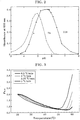
- the precipitation may occur at pH 4.0 to 5.6 and in case of 11S, the precipitation may occur at pH 4.4 to 6.8 (see FIG. 3 , and the book by KeShun Liu [Soybeans, Chemistry, Technology, and Utilization, An Aspen Publication, 1999, p41]).
- the protein precipitate obtained at the level of pH 4.5 is neutralized and powdered to obtain the isolated soy proteins.
- the isolated soy protein is used for various foods such as drinks, processed meat, bread products and confectionery, and is excellent in emulsifying capacity, and has gel formation ability and water binding and holding capacity.
- the isolated soy protein has the above mentioned properties, and thus can help in effective emulsification of fat components in the present invention.
- mayonnaise is generally an acid food
- when the pH of the product approaches the isoelectric point of an isolated soy protein its viscosity is increased according to an aggregation and precipitation of proteins, and thus it may positively affect the final physical properties of the product.
- the isolated soy protein used for the mayonnaise composition according to the present invention is a protein isolated from a soybean, and is separated into 7S and 11S experimentally, and is used as a powdered product in practice having the protein content of 90% or more.
- the excipient may be included in a range of 1 to 20 wt% with respect to the total weight of the mayonnaise composition.
- the excipient When the excipient is used in an amount of less than 1 wt%, its shape retention is decreased and flowability is increased, and thus it is difficult to implement the desired physical properties, while when the amount of excipient used exceeds 20 wt%, its viscosity may be excessively increased thereby causing problems that are significantly different from the general physical properties of the mayonnaise.
- the general additional components such as sugar, salt, or vinegar which are generally used in the art, are added.
- the low fat mayonnaise composition according to the present invention includes 20 to 50 wt% of vegetable oil, 1 to 2 wt% of sugar, 1 to 2 wt% of salt, 3 to 10 wt% of vinegar, 1 to 3 wt% of cellulose ether, 5 to 10 wt% of an isolated soy protein, and water as the remainder with respect to the total weight of the composition.
- the low fat mayonnaise composition according to the present invention may further include a stabilizer if necessary.
- the stabilizer may be further included in order to improve physical properties and tactility of the mayonnaise, and the preferable example of the stabilizer may include xanthan gum, carrageenan, locust bean gum, guar gum, alginic acid, agar, and the like.
- the xanthan gum is a food additive capable of increasing viscosity and improving emulsion stability and used as a thickening agent, a stabilizer, an emulsifying agent, a molding agent, and the like.
- the xanthan gum is a pale yellow powder which is dissolved easily in water, and its aqueous solution is neutral and dissolved in water, but not dissolved in ethanol.
- the xanthan gum is dispersed in cold water and dissolved in hot water; the viscosity of xanthan gum solution has no difference according to the dissolution temperatures; the viscosity is not decreased according to pH; and is excellent in heat resistance.
- the content of the stabilizer may be included in a range of 0.05 to 1 wt% with respect to the total weight of the composition. However, when it exceeds 1 wt%, its viscosity is excessively high, thereby decreasing work efficiency and losing texture of the conventional mayonnaise. Therefore, the content of the stabilizer is preferably used in an amount of 1 wt% or less.
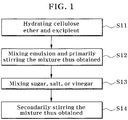
- FIG. 1 is a flowchart illustrating a method of producing low fat mayonnaise according to an embodiment of the present invention.
- the method according to the present embodiment includes hydrating cellulose ether and an excipient (S11); mixing the hydrate thus obtained with an emulsion composed of vegetable oil, and then primarily stirring the mixture thus obtained (S12); mixing the primarily stirred mixture with sugar, salt, or vinegar (S13); and secondarily mixing the mixture thus obtained (S14).
- the hydrating of the cellulose ether and excipient (S11) allows the hydrated cellulose ether to have physical properties that are similar to those of a fat by including water inside of the cellulose ether and excipient.
- the cellulose ether is preferably included in a range of 1 to 3 wt% with respect to the total weight of the mayonnaise composition.
- the viscosity of the hydrated cellulose ether added as a fat substitute is preferably 200 to 450 ⁇ 10 2 cps at room temperature.
- the excipient is preferably included in a range of 1 to 20 wt% with respect to the total weight of the mayonnaise composition.
- the hydration may be performed by mixing the hydrated cellulose ether with the excipient or may be performed by mixing the cellulose ether and excipient in advance before hydrating, and then adding the mixture thus obtained to water.
- the hydration is preferably performed by stirring at 5,000 to 10,000 rpm for about 3 minutes and 5 minutes.
- the primary stirring (S12) is performed by mixing an emulsion composed of vegetable oil.
- it is preferably stirred at 5,000 to 10,000 rpm for about 3 to 8 minutes.
- the emulsion composed of the vegetable oil is preferably used in a range of 50 wt% or less, more preferably 20 to 50 wt% with respect to the total weight of the mayonnaise composition.
- sugar, salt, or vinegar is mixed with the primarily stirred mixture (S13).
- sugar and salt are mixed as a sweetener.
- the salt may be included in the range that is generally used in the related art. It is preferable that the sugar is 1 to 2 wt% and the salt is 1 to 2 wt% with respect to the total weight of the mayonnaise composition.
- the vinegar may be included in the range that is generally used in the related art, and it is preferable to include in a range of 3 to 10 wt% with respect to the total weight of the mayonnaise composition.
- it is required to stir for mixing and the stirring is preferably performed at 5,000 to 10,000 rpm for 30 seconds to 5 minutes.
- a stabilizer may be selectively mixed. Meanwhile, it may be required to stir for mixing in this process (S13). At this time, the stirring is preferably performed at 5,000 to 10,000 rpm for about 3 minutes.
- the mixtures are secondarily stirred (S14).
- the stirring is performed at 5,000 to 10,000 rpm for 1 to 2 minutes to complete mayonnaise.
- HPMC which is used as a fat substitute in the present invention
- HPMC was prepared in 10% aqueous solutions, and then the change of viscosity of HPMC solutions according to the temperature variation was measured through a cup-cone type Rheometer (a shear rate: 5/s) by heating HPMC solutions at the rates of 0.5°C per minute, 2°C per minute, 3.33°C per minute, and 5°C per minute, respectively.
- the results thus obtained are illustrated in FIG. 3 .
- the viscosity is decreased as the temperature is increased like the general hydrocolloid or thickening agents, but at 50°C to 60°C or more, there is a gelling point in which the viscosity is sharply increased. Due to such properties of the cellulose ether, it can be possible to implement mayonnaise having shape retention at a high temperature.
- the mayonnaises having compositions listed in the following Table 1 were prepared as the following method.
- hydroxypropylmethyl cellulose HPMC
- purified water purified water
- the 5% solution of hydroxypropylmethyl cellulose thus obtained was added with an isolated soy protein and then stirred at 8,000 rpm for 5 minutes to completely hydrate.
- vegetable oil soybean oil
- sugar, salt, or a stabilizer xanthan gum
- the hydroxypropylmethyl cellulose used in the present Examples was HPMC manufactured by SAMSUNG FINE CHEMICALS CO., LTD, which is produced by using the method disclosed in Korean Patent Publication No. 20100118800 .
- Mayonnaise with the yolk of an egg having composition listed in the following Table 1 was prepared by using the following method.
- the yolk and the white of an egg, and vegetable oil were added and stirred at 8,000 rpm for 8 minutes. Then, salt and sugar were added and then mixed at the same speed for 1 minute. Subsequently, vinegar was added and mixed for 30 seconds. After completing the emulsification, the mixture thus obtained was stirred at 8,000 rpm for 1 minute to prepare mayonnaise.
- Example 1 Example 2
- Example 3 Example 7
- Viscosity(cP) 1.27x10 5 4.72x10 5 7.57x10 5 6.12x10 5 7.20x10 5
- Heat resistance for heat resistances of the mayonnaises prepared from Examples 6 to 10 and Comparative Example 1, the mayonnaises were taken out to maintain a specific shape of a 3 g level onto a weighing dish using a tube for mayonnaise. The levels of shape retention and oil separation were measured at 75°C for 1 hour and at 100°C for 40 minutes by 10 minutes. The results thus obtained are listed in the following Table 3. In addition, after 60 minutes at 75°C, the changes in oil separation and shape retention of the mayonnaises prepared from Comparative Example 1 and Example 7 were photographed. The results thus obtained are illustrated in FIG. 4 . [Table 3] Division Storage Tem. 75°C 100°C Time 10 min. 20 min. 30 min. 40 min. 50 min. 60 min. 10 min. 20 min. 30 min.
- Shape retention A first state is maintained as it is, ⁇ : The oil separation of the surface is observed, ⁇ : The oil separation of the surface is definitely observed, but is not flowed down. ⁇ : The texture is completely melted down
- Oil separation - (Not occur), + (the oil separation is observed at the peripheral part), ++++ (the oil is completely isolated, and thus is everywhere). Scaling with 5 points.
- the calorie of mayonnaise was calculated using an Atwater index.
- the caloric values of the calorie nutrients are different at the time of combusting in a calorimeter and at the time of combusting in the body.
- per 1 g, 4.1 kcal, 9.45 kcal, and 5.65 kcal are generated in case of carbohydrate, fat, and protein, respectively.
- only 98% of carbohydrate, 95% of fat, and 92% of protein are absorbed on average, for the calorie generated at the time of actually taking in nutrients, per 1 g, 4 kcal, 9 kcal, and 4 kcal are generated in case of carbohydrate, fat, and protein, respectively.
- Table 5 exhibits general nutrient compositions per 100 g of the yellow and white of an egg, and an isolated soy protein.
- Example 6 For the mayonnaises prepared in Examples 6 to 10 and Comparative Example 1, the calculated calories are listed in the following Table 6. [Table 6] Content per 100g Com. Example 1 Example 6 Example 7 Example 8 Example 9 Example 10 Calorie (kcal) 749 400 400 359 400 396 Carbohydrate (%) 2.3 2.0 2.0 2.0 2.0 2.0 Fat (%) 82.4 40.0 40.0 35.0 40.0 40.0 Protein (%) 1.6 7.2 7.2 8.1 7.2 6.3
- the amount of vegetable oil used is decreased to 50 wt% or less, and thus its calorie is 400 kcal/100 g or less that is significantly lower than the calorie of the commercially available mayonnaise, that is 749 kcal/100 g.
- the content of protein is enhanced by 4.6 times or more compared to the conventional content of the protein, and thus the above vegetable low fat mayonnaise can impart the functionality of mayonnaise as a healthy food.
- Cellulose ether for example, hydroxypropylmethyl cellulose that is used as a fat substitute in the low fat mayonnaise composition according to the present invention is not digested in the body, and thus has no calories, thereby exhibiting excellent effect of dieting.
- the cellulose ether can prevent all sorts of adult diseases, such as circulatory diseases, for example, cardiocerebral apoplexy, arteriosclerosis, and the like, diabetes, and cancers.
- the low fat mayonnaise composition according to the present invention can provide mayonnaise capable of minimizing cholesterol by not using an egg. Therefore, a demand for mayonnaise by patients having adult diseases, in which the patients have cholesterol resistance or a cholesterol intake is banned, can be caused, and the low fat mayonnaise can be edible by food-allergic patients, thereby increasing mayonnaise consumption.
- the cellulose ether for example, hydroxypropylmethyl cellulose used in the low fat mayonnaise composition according to the present invention can play a role as a fat substitute, and also can have a stable emulsification function. Therefore, since the cellulose ether can substitute for a fat in liquid foods, and thus can realize a physical property of strong emulsified liquid and impart a soft taste, low calorie/low fat foods can be developed when it is applied to sauces, diet drinks, ice creams, frozen desserts, and milk products, which are applied with the mayonnaise according to the present invention and whose emulsion stabilities are improved, in addition to mayonnaise.
- the mayonnaise produced by using cellulose ether as a fat substitute has excellent stability at a low temperature or high temperature as compared with the mayonnaise produced by adding 100% of pure vegetable oil, it can be used for developing various foods, such as bakeries and frozen foods.
- the isolated soy protein used as an excipient in the low fat mayonnaise composition according to the present invention includes a soy protein that is the representative food capable of reducing cholesterol and preventing cardiovascular disorders. Therefore, it can reduce a negative health image of the mayonnaise having a great quantity of a fat and cholesterol.
Landscapes
- Chemical & Material Sciences (AREA)
- Life Sciences & Earth Sciences (AREA)
- Engineering & Computer Science (AREA)
- Food Science & Technology (AREA)
- Polymers & Plastics (AREA)
- Health & Medical Sciences (AREA)
- Nutrition Science (AREA)
- Oil, Petroleum & Natural Gas (AREA)
- Mycology (AREA)
- Dispersion Chemistry (AREA)
- Seasonings (AREA)
Claims (7)
- Fettarme Mayonnaisezusammensetzung, umfassend 20 bis 50 Gew.-% pflanzliches Öl, 1 bis 2 Gew.-% Zucker, 1 bis 2 Gew.-% Salz, 3 bis 10 Gew.-% Essig, 1 bis 3 Gew.-% Celluloseether, 5 bis 10 Gew.-% eines isolierten Sojaproteins und als Rest Wasser, und zwar in Bezug auf das Gesamtgewicht der Zusammensetzung,
wobei der Celluloseether Hydroxypropylmethylcellulose ist, und
wobei die Hydroxypropylmethylcellulose eine Struktur aufweist, in der 19 bis 30 % von einer Methoxylgruppe und 4 bis 20 % von einer Hydroxypropylgruppe an einer Hauptkette der Cellulose substituiert sind. - Fettarme Mayonnaisezusammensetzung nach Anspruch 1, ferner umfassend einen Stabilisator.
- Fettarme Mayonnaisezusammensetzung nach Anspruch 2, wobei der Stabilisator einer oder mehrere ausgewählt aus der Gruppe ist, bestehend aus Xanthangummi, Carrageenan, Johannisbrotkernmehl, Guarkernmehl, Alginsäure und Agar, und er in einem Bereich von 0,05 bis 1 Gew.-% in Bezug auf das Gesamtgewicht der Mayonnaisezusammensetzung enthalten ist.
- Verfahren zum Herstellen einer fettarm Mayonnaisezusammensetzung, wobei das Verfahren das Folgende umfasst:Hydratisieren von Celluloseether und einem Hilfsstoff;wobei der Celluloseether in einem Bereich von 1 bis 3 Gew.-% in Bezug auf das Gesamtgewicht der Mayonnaisezusammensetzung enthalten ist,wobei der Celluloseether Hydroxypropylmethylcellulose ist, undwobei die Hydroxypropylmethylcellulose eine Struktur aufweist, in der 19 bis 30 % von einer Methoxylgruppe und 4 bis 20 % von einer Hydroxypropylgruppe an einer Hauptkette der Cellulose substituiert sind, undwobei der Hilfsstoff in einem Bereich von 1 bis 20 Gew.-% in Bezug auf das Gesamtgewicht der Mayonnaisezusammensetzung enthalten ist,
Mischen von dem auf diese Weise erhaltenen Hydrat mit einer Emulsion, die aus 20 bis 50 Gew.-% pflanzlichem Öl in Bezug auf das Gesamtgewicht der Zusammensetzung zusammengesetzt ist, und dann erstes Rühren;
Mischen von der erstgerührten Mischung mit 1 bis 2 Gew.-% Zucker, 1 bis 2 Gew.-% Salz, 3 bis 10 Gew.-% Essig in Bezug auf das Gesamtgewicht der Zusammensetzung; und
zweites Rühren von der auf diese Weise erhaltenen Mischung. - Verfahren nach Anspruch 4, wobei das Verfahren ferner das Umfassen von 0,05 bis 1 Gew.-% von einem Stabilisator in Bezug auf das Gesamtgewicht der Zusammensetzung bei dem Mischen von Zucker, Salz oder Essig umfasst.
- Verfahren nach Anspruch 5, wobei das Hydratisieren von Celluloseether und Hilfsstoff durchgeführt wird, indem nach dem Hydratisieren des Celluloseethers der Hilfsstoff gemischt und hydratisiert wird.
- Verfahren nach Anspruch 5, wobei das Hydratisieren von Celluloseether und Hilfsstoff durchgeführt wird, indem, nachdem der Celluloseether und der Hilfsstoff vorab gemischt wurden, hydratisiert wird.
Applications Claiming Priority (2)
| Application Number | Priority Date | Filing Date | Title |
|---|---|---|---|
| KR20110114223 | 2011-11-04 | ||
| PCT/KR2012/009254 WO2013066137A1 (ko) | 2011-11-04 | 2012-11-05 | 저지방 마요네즈 조성물 및 이의 제조방법 |
Publications (3)
| Publication Number | Publication Date |
|---|---|
| EP2774494A1 EP2774494A1 (de) | 2014-09-10 |
| EP2774494A4 EP2774494A4 (de) | 2015-05-27 |
| EP2774494B1 true EP2774494B1 (de) | 2019-01-02 |
Family
ID=48660392
Family Applications (1)
| Application Number | Title | Priority Date | Filing Date |
|---|---|---|---|
| EP12844688.7A Active EP2774494B1 (de) | 2011-11-04 | 2012-11-05 | Fettarme mayonnaisezusammensetzung und herstellungsverfahren dafür |
Country Status (6)
| Country | Link |
|---|---|
| US (1) | US20140234521A1 (de) |
| EP (1) | EP2774494B1 (de) |
| JP (1) | JP6147268B2 (de) |
| KR (1) | KR101949534B1 (de) |
| AU (1) | AU2012331729B2 (de) |
| WO (1) | WO2013066137A1 (de) |
Families Citing this family (8)
| Publication number | Priority date | Publication date | Assignee | Title |
|---|---|---|---|---|
| PL3250041T3 (pl) * | 2015-01-29 | 2019-12-31 | Venta De Especialidades Químicas S.A. | Jadalne emulsje zasadniczo wolne od kwasów tłuszczowych trans |
| KR102417611B1 (ko) * | 2018-02-26 | 2022-08-12 | 농업회사법인 케이원(주) | 유산균이 함유된 정장 기능성 저열량 마일드 및 소프트 타입 마요네즈 및 그 제조방법 |
| KR102417609B1 (ko) * | 2018-02-26 | 2022-08-05 | 농업회사법인 케이원(주) | 유산균이 함유된 정장 기능성 저열량 하드타입 마요네즈 및 그 제조방법 |
| KR102219335B1 (ko) | 2018-12-17 | 2021-02-24 | 박규완 | 식이섬유가 함유된 양념 및 그 제조 방법 |
| JP7128782B2 (ja) * | 2019-08-09 | 2022-08-31 | 信越化学工業株式会社 | エアゾール食品用組成物、ヒドロキシプロピルメチルセルロース及びヒドロキシプロピルメチルセルロースの製造方法 |
| JP7074729B2 (ja) * | 2019-08-09 | 2022-05-24 | 信越化学工業株式会社 | ホイップクリーム用水中油型組成物 |
| WO2022157960A1 (ja) | 2021-01-25 | 2022-07-28 | ハウスウェルネスフーズ株式会社 | マヨネーズ風ドレッシング |
| CN116941755A (zh) | 2022-04-27 | 2023-10-27 | 信越化学工业株式会社 | 乳化组合物 |
Family Cites Families (19)
| Publication number | Priority date | Publication date | Assignee | Title |
|---|---|---|---|---|
| US2944906A (en) * | 1957-12-23 | 1960-07-12 | Carter Prod Inc | Mayonnaise product and method of manufacture |
| US3414413A (en) * | 1966-02-01 | 1968-12-03 | Hca Food Corp | Edible composition and method of making the same |
| SE401602B (sv) * | 1976-06-18 | 1978-05-22 | Nedre Norrlands Producentsfore | Sett att framstella lagkaloriprodukter av typ majones och dressing |
| US4238520A (en) * | 1979-06-28 | 1980-12-09 | Scm Corporation | Low-fat comestible spread substitutes |
| JPS56158073A (en) * | 1980-05-08 | 1981-12-05 | Nisshin Oil Mills Ltd:The | Production of mayonaiselike food product |
| IL90063A0 (en) * | 1988-04-29 | 1989-12-15 | Kraft Inc | Microfragmented anisotropic poly-saccharide/protein complex dispersions |
| US5366755A (en) * | 1989-02-10 | 1994-11-22 | Maritta Timonen | Foodstuffs containing novel degraded cellulose derivatives |
| FI900632A7 (fi) * | 1989-02-10 | 1990-08-11 | Alko Yhtioet Oy | Selluloosajohdannaisia |
| US5080921A (en) * | 1990-02-05 | 1992-01-14 | Pfizer Inc. | Low calorie fat substitute |
| NZ239858A (en) * | 1990-09-25 | 1994-08-26 | Cpc International Inc | No fat or low fat mayonnaise product including microcrystalline cellulose,polydextrose and egg white |
| US5721221A (en) * | 1991-03-08 | 1998-02-24 | Regents Of The University Of Minnesota | Lowering blood cholesterol levels using water soluble cellulose ethers |
| US5641533A (en) * | 1995-08-09 | 1997-06-24 | Hercules Incorporated | No and low fat mayonnaise compositions |
| US5759609A (en) * | 1995-10-02 | 1998-06-02 | Rich Products Corporation | Low-fat whipped topping |
| US5976587A (en) * | 1997-07-03 | 1999-11-02 | Morita Co., Ltd. | Mayonnaise base and method for producing it |
| KR100514017B1 (ko) * | 2003-02-19 | 2005-09-13 | 주식회사 온바이오 | 디글리세리드유를 함유하는 마요네즈 조성물 |
| US7510737B2 (en) * | 2003-10-24 | 2009-03-31 | Unilever Bestfoods, North America, Division Of Conopco, Inc. | Low carbohydrate fiber containing emulsion |
| CA2626071A1 (en) * | 2005-11-14 | 2007-05-18 | Unilever Plc | A mayonnaise product and a process for preparing it |
| US20070123490A1 (en) * | 2005-11-30 | 2007-05-31 | Yokoyama Wallace H | Preventing or reducing oxidative stress or oxidative cell injury |
| KR100791956B1 (ko) * | 2006-03-07 | 2008-01-04 | 오승훈 | 냉ㆍ해동에 안정성을 갖는 마요네즈 첨가용 다기능성유화안정제 조성물 |
-
2012
- 2012-11-05 EP EP12844688.7A patent/EP2774494B1/de active Active
- 2012-11-05 AU AU2012331729A patent/AU2012331729B2/en active Active
- 2012-11-05 JP JP2014539882A patent/JP6147268B2/ja active Active
- 2012-11-05 KR KR1020120124411A patent/KR101949534B1/ko active Active
- 2012-11-05 US US14/346,926 patent/US20140234521A1/en not_active Abandoned
- 2012-11-05 WO PCT/KR2012/009254 patent/WO2013066137A1/ko not_active Ceased
Also Published As
| Publication number | Publication date |
|---|---|
| JP6147268B2 (ja) | 2017-06-14 |
| EP2774494A4 (de) | 2015-05-27 |
| JP2014533101A (ja) | 2014-12-11 |
| KR20130049763A (ko) | 2013-05-14 |
| US20140234521A1 (en) | 2014-08-21 |
| AU2012331729B2 (en) | 2016-08-25 |
| KR101949534B1 (ko) | 2019-02-18 |
| AU2012331729A1 (en) | 2014-04-03 |
| WO2013066137A1 (ko) | 2013-05-10 |
| EP2774494A1 (de) | 2014-09-10 |
Similar Documents
| Publication | Publication Date | Title |
|---|---|---|
| EP2774494B1 (de) | Fettarme mayonnaisezusammensetzung und herstellungsverfahren dafür | |
| US6777016B2 (en) | Food products comprising pea or lentil flours and the process of making the same | |
| US4308294A (en) | Oil replacement composition | |
| KR20040062680A (ko) | 고단백질, 저탄수화물 도우 및 빵 생성물, 및 그의 제조방법 | |
| JP4950105B2 (ja) | 加工食品及び加工食品の食感改良方法 | |
| CN104473139A (zh) | 一种低脂无蛋/蛋黄/全蛋沙拉酱及其制作方法 | |
| US20230354860A1 (en) | Starch composition for food products and method for producing said starch composition | |
| WO2011033807A1 (ja) | 飲食品の物性改善用素材 | |
| CN104824335A (zh) | 一种沙拉酱专用脂肪模拟物及其制备方法 | |
| JP5015364B1 (ja) | 気泡入り加工食品及びその製造方法、並びに気泡入り加工食品を用いた食品。 | |
| JPH04356169A (ja) | フラクトースポリマー含有食品 | |
| Cash et al. | Cellulose derivatives | |
| Moser et al. | Nutritional and technological benefits of inulin‐type oligosaccharides | |
| CN108601380A (zh) | 面条类食品及其制造法 | |
| Sun et al. | Replacement of fat or starch | |
| JP2008154578A (ja) | クリームコロッケ及びその製造方法 | |
| JP3512003B2 (ja) | 起泡剤組成物及びこれを用いた起泡食品 | |
| JPH02409A (ja) | デンプン質素材の製造法 | |
| Argin et al. | Biopolymers and functional biopolymers in food technology | |
| JP3217499B2 (ja) | 低カロリー食品 | |
| JP2021016348A (ja) | シート状蛋白質含有食品の製造方法 | |
| JP3762739B2 (ja) | アイスクリーム類及びその製造方法 | |
| JP2007166924A (ja) | フィリング材 | |
| Berk | Effects of different flour, gum and protein types on quality of gluten-free cakes | |
| EP3135124B1 (de) | Verwendung eines wasserlöslichen erbsenpolysaccharids |
Legal Events
| Date | Code | Title | Description |
|---|---|---|---|
| PUAI | Public reference made under article 153(3) epc to a published international application that has entered the european phase |
Free format text: ORIGINAL CODE: 0009012 |
|
| 17P | Request for examination filed |
Effective date: 20140414 |
|
| AK | Designated contracting states |
Kind code of ref document: A1 Designated state(s): AL AT BE BG CH CY CZ DE DK EE ES FI FR GB GR HR HU IE IS IT LI LT LU LV MC MK MT NL NO PL PT RO RS SE SI SK SM TR |
|
| DAX | Request for extension of the european patent (deleted) | ||
| RA4 | Supplementary search report drawn up and despatched (corrected) |
Effective date: 20150429 |
|
| RIC1 | Information provided on ipc code assigned before grant |
Ipc: A23L 1/24 20060101AFI20150422BHEP Ipc: A23D 7/02 20060101ALI20150422BHEP Ipc: A23D 7/005 20060101ALI20150422BHEP Ipc: A23D 7/015 20060101ALI20150422BHEP Ipc: A23L 1/052 20060101ALI20150422BHEP |
|
| RAP1 | Party data changed (applicant data changed or rights of an application transferred) |
Owner name: LOTTE FINE CHEMICAL CO., LTD. |
|
| REG | Reference to a national code |
Ref country code: DE Ref legal event code: R079 Ref document number: 602012055528 Country of ref document: DE Free format text: PREVIOUS MAIN CLASS: A23L0001240000 Ipc: A23D0007015000 |
|
| GRAP | Despatch of communication of intention to grant a patent |
Free format text: ORIGINAL CODE: EPIDOSNIGR1 |
|
| STAA | Information on the status of an ep patent application or granted ep patent |
Free format text: STATUS: GRANT OF PATENT IS INTENDED |
|
| RIC1 | Information provided on ipc code assigned before grant |
Ipc: A23D 7/02 20060101ALI20180430BHEP Ipc: A23D 7/005 20060101ALI20180430BHEP Ipc: A23L 33/20 20160101ALI20180430BHEP Ipc: A23D 7/015 20060101AFI20180430BHEP Ipc: A23L 29/262 20160101ALI20180430BHEP Ipc: A23L 27/60 20160101ALI20180430BHEP |
|
| INTG | Intention to grant announced |
Effective date: 20180525 |
|
| GRAS | Grant fee paid |
Free format text: ORIGINAL CODE: EPIDOSNIGR3 |
|
| GRAA | (expected) grant |
Free format text: ORIGINAL CODE: 0009210 |
|
| STAA | Information on the status of an ep patent application or granted ep patent |
Free format text: STATUS: THE PATENT HAS BEEN GRANTED |
|
| AK | Designated contracting states |
Kind code of ref document: B1 Designated state(s): AL AT BE BG CH CY CZ DE DK EE ES FI FR GB GR HR HU IE IS IT LI LT LU LV MC MK MT NL NO PL PT RO RS SE SI SK SM TR |
|
| REG | Reference to a national code |
Ref country code: GB Ref legal event code: FG4D |
|
| REG | Reference to a national code |
Ref country code: CH Ref legal event code: EP Ref country code: AT Ref legal event code: REF Ref document number: 1083278 Country of ref document: AT Kind code of ref document: T Effective date: 20190115 |
|
| REG | Reference to a national code |
Ref country code: DE Ref legal event code: R096 Ref document number: 602012055528 Country of ref document: DE |
|
| REG | Reference to a national code |
Ref country code: IE Ref legal event code: FG4D |
|
| REG | Reference to a national code |
Ref country code: NL Ref legal event code: MP Effective date: 20190102 |
|
| REG | Reference to a national code |
Ref country code: LT Ref legal event code: MG4D |
|
| REG | Reference to a national code |
Ref country code: AT Ref legal event code: MK05 Ref document number: 1083278 Country of ref document: AT Kind code of ref document: T Effective date: 20190102 |
|
| PG25 | Lapsed in a contracting state [announced via postgrant information from national office to epo] |
Ref country code: NL Free format text: LAPSE BECAUSE OF FAILURE TO SUBMIT A TRANSLATION OF THE DESCRIPTION OR TO PAY THE FEE WITHIN THE PRESCRIBED TIME-LIMIT Effective date: 20190102 |
|
| PG25 | Lapsed in a contracting state [announced via postgrant information from national office to epo] |
Ref country code: PL Free format text: LAPSE BECAUSE OF FAILURE TO SUBMIT A TRANSLATION OF THE DESCRIPTION OR TO PAY THE FEE WITHIN THE PRESCRIBED TIME-LIMIT Effective date: 20190102 Ref country code: ES Free format text: LAPSE BECAUSE OF FAILURE TO SUBMIT A TRANSLATION OF THE DESCRIPTION OR TO PAY THE FEE WITHIN THE PRESCRIBED TIME-LIMIT Effective date: 20190102 Ref country code: LT Free format text: LAPSE BECAUSE OF FAILURE TO SUBMIT A TRANSLATION OF THE DESCRIPTION OR TO PAY THE FEE WITHIN THE PRESCRIBED TIME-LIMIT Effective date: 20190102 Ref country code: NO Free format text: LAPSE BECAUSE OF FAILURE TO SUBMIT A TRANSLATION OF THE DESCRIPTION OR TO PAY THE FEE WITHIN THE PRESCRIBED TIME-LIMIT Effective date: 20190402 Ref country code: PT Free format text: LAPSE BECAUSE OF FAILURE TO SUBMIT A TRANSLATION OF THE DESCRIPTION OR TO PAY THE FEE WITHIN THE PRESCRIBED TIME-LIMIT Effective date: 20190502 Ref country code: FI Free format text: LAPSE BECAUSE OF FAILURE TO SUBMIT A TRANSLATION OF THE DESCRIPTION OR TO PAY THE FEE WITHIN THE PRESCRIBED TIME-LIMIT Effective date: 20190102 Ref country code: SE Free format text: LAPSE BECAUSE OF FAILURE TO SUBMIT A TRANSLATION OF THE DESCRIPTION OR TO PAY THE FEE WITHIN THE PRESCRIBED TIME-LIMIT Effective date: 20190102 |
|
| PG25 | Lapsed in a contracting state [announced via postgrant information from national office to epo] |
Ref country code: HR Free format text: LAPSE BECAUSE OF FAILURE TO SUBMIT A TRANSLATION OF THE DESCRIPTION OR TO PAY THE FEE WITHIN THE PRESCRIBED TIME-LIMIT Effective date: 20190102 Ref country code: RS Free format text: LAPSE BECAUSE OF FAILURE TO SUBMIT A TRANSLATION OF THE DESCRIPTION OR TO PAY THE FEE WITHIN THE PRESCRIBED TIME-LIMIT Effective date: 20190102 Ref country code: GR Free format text: LAPSE BECAUSE OF FAILURE TO SUBMIT A TRANSLATION OF THE DESCRIPTION OR TO PAY THE FEE WITHIN THE PRESCRIBED TIME-LIMIT Effective date: 20190403 Ref country code: IS Free format text: LAPSE BECAUSE OF FAILURE TO SUBMIT A TRANSLATION OF THE DESCRIPTION OR TO PAY THE FEE WITHIN THE PRESCRIBED TIME-LIMIT Effective date: 20190502 Ref country code: LV Free format text: LAPSE BECAUSE OF FAILURE TO SUBMIT A TRANSLATION OF THE DESCRIPTION OR TO PAY THE FEE WITHIN THE PRESCRIBED TIME-LIMIT Effective date: 20190102 Ref country code: BG Free format text: LAPSE BECAUSE OF FAILURE TO SUBMIT A TRANSLATION OF THE DESCRIPTION OR TO PAY THE FEE WITHIN THE PRESCRIBED TIME-LIMIT Effective date: 20190402 |
|
| REG | Reference to a national code |
Ref country code: DE Ref legal event code: R097 Ref document number: 602012055528 Country of ref document: DE |
|
| PG25 | Lapsed in a contracting state [announced via postgrant information from national office to epo] |
Ref country code: EE Free format text: LAPSE BECAUSE OF FAILURE TO SUBMIT A TRANSLATION OF THE DESCRIPTION OR TO PAY THE FEE WITHIN THE PRESCRIBED TIME-LIMIT Effective date: 20190102 Ref country code: SK Free format text: LAPSE BECAUSE OF FAILURE TO SUBMIT A TRANSLATION OF THE DESCRIPTION OR TO PAY THE FEE WITHIN THE PRESCRIBED TIME-LIMIT Effective date: 20190102 Ref country code: RO Free format text: LAPSE BECAUSE OF FAILURE TO SUBMIT A TRANSLATION OF THE DESCRIPTION OR TO PAY THE FEE WITHIN THE PRESCRIBED TIME-LIMIT Effective date: 20190102 Ref country code: CZ Free format text: LAPSE BECAUSE OF FAILURE TO SUBMIT A TRANSLATION OF THE DESCRIPTION OR TO PAY THE FEE WITHIN THE PRESCRIBED TIME-LIMIT Effective date: 20190102 Ref country code: AL Free format text: LAPSE BECAUSE OF FAILURE TO SUBMIT A TRANSLATION OF THE DESCRIPTION OR TO PAY THE FEE WITHIN THE PRESCRIBED TIME-LIMIT Effective date: 20190102 Ref country code: AT Free format text: LAPSE BECAUSE OF FAILURE TO SUBMIT A TRANSLATION OF THE DESCRIPTION OR TO PAY THE FEE WITHIN THE PRESCRIBED TIME-LIMIT Effective date: 20190102 Ref country code: DK Free format text: LAPSE BECAUSE OF FAILURE TO SUBMIT A TRANSLATION OF THE DESCRIPTION OR TO PAY THE FEE WITHIN THE PRESCRIBED TIME-LIMIT Effective date: 20190102 |
|
| PLBE | No opposition filed within time limit |
Free format text: ORIGINAL CODE: 0009261 |
|
| STAA | Information on the status of an ep patent application or granted ep patent |
Free format text: STATUS: NO OPPOSITION FILED WITHIN TIME LIMIT |
|
| PG25 | Lapsed in a contracting state [announced via postgrant information from national office to epo] |
Ref country code: SM Free format text: LAPSE BECAUSE OF FAILURE TO SUBMIT A TRANSLATION OF THE DESCRIPTION OR TO PAY THE FEE WITHIN THE PRESCRIBED TIME-LIMIT Effective date: 20190102 |
|
| 26N | No opposition filed |
Effective date: 20191003 |
|
| PG25 | Lapsed in a contracting state [announced via postgrant information from national office to epo] |
Ref country code: SI Free format text: LAPSE BECAUSE OF FAILURE TO SUBMIT A TRANSLATION OF THE DESCRIPTION OR TO PAY THE FEE WITHIN THE PRESCRIBED TIME-LIMIT Effective date: 20190102 |
|
| PG25 | Lapsed in a contracting state [announced via postgrant information from national office to epo] |
Ref country code: TR Free format text: LAPSE BECAUSE OF FAILURE TO SUBMIT A TRANSLATION OF THE DESCRIPTION OR TO PAY THE FEE WITHIN THE PRESCRIBED TIME-LIMIT Effective date: 20190102 |
|
| REG | Reference to a national code |
Ref country code: CH Ref legal event code: PL |
|
| PG25 | Lapsed in a contracting state [announced via postgrant information from national office to epo] |
Ref country code: LU Free format text: LAPSE BECAUSE OF NON-PAYMENT OF DUE FEES Effective date: 20191105 Ref country code: LI Free format text: LAPSE BECAUSE OF NON-PAYMENT OF DUE FEES Effective date: 20191130 Ref country code: MC Free format text: LAPSE BECAUSE OF FAILURE TO SUBMIT A TRANSLATION OF THE DESCRIPTION OR TO PAY THE FEE WITHIN THE PRESCRIBED TIME-LIMIT Effective date: 20190102 Ref country code: CH Free format text: LAPSE BECAUSE OF NON-PAYMENT OF DUE FEES Effective date: 20191130 |
|
| REG | Reference to a national code |
Ref country code: BE Ref legal event code: MM Effective date: 20191130 |
|
| PG25 | Lapsed in a contracting state [announced via postgrant information from national office to epo] |
Ref country code: IE Free format text: LAPSE BECAUSE OF NON-PAYMENT OF DUE FEES Effective date: 20191105 |
|
| PG25 | Lapsed in a contracting state [announced via postgrant information from national office to epo] |
Ref country code: BE Free format text: LAPSE BECAUSE OF NON-PAYMENT OF DUE FEES Effective date: 20191130 |
|
| PG25 | Lapsed in a contracting state [announced via postgrant information from national office to epo] |
Ref country code: CY Free format text: LAPSE BECAUSE OF FAILURE TO SUBMIT A TRANSLATION OF THE DESCRIPTION OR TO PAY THE FEE WITHIN THE PRESCRIBED TIME-LIMIT Effective date: 20190102 |
|
| PG25 | Lapsed in a contracting state [announced via postgrant information from national office to epo] |
Ref country code: MT Free format text: LAPSE BECAUSE OF FAILURE TO SUBMIT A TRANSLATION OF THE DESCRIPTION OR TO PAY THE FEE WITHIN THE PRESCRIBED TIME-LIMIT Effective date: 20190102 Ref country code: HU Free format text: LAPSE BECAUSE OF FAILURE TO SUBMIT A TRANSLATION OF THE DESCRIPTION OR TO PAY THE FEE WITHIN THE PRESCRIBED TIME-LIMIT; INVALID AB INITIO Effective date: 20121105 |
|
| PG25 | Lapsed in a contracting state [announced via postgrant information from national office to epo] |
Ref country code: MK Free format text: LAPSE BECAUSE OF FAILURE TO SUBMIT A TRANSLATION OF THE DESCRIPTION OR TO PAY THE FEE WITHIN THE PRESCRIBED TIME-LIMIT Effective date: 20190102 |
|
| P01 | Opt-out of the competence of the unified patent court (upc) registered |
Effective date: 20230630 |
|
| PGFP | Annual fee paid to national office [announced via postgrant information from national office to epo] |
Ref country code: DE Payment date: 20251007 Year of fee payment: 14 |
|
| PGFP | Annual fee paid to national office [announced via postgrant information from national office to epo] |
Ref country code: GB Payment date: 20251016 Year of fee payment: 14 |
|
| PGFP | Annual fee paid to national office [announced via postgrant information from national office to epo] |
Ref country code: IT Payment date: 20251022 Year of fee payment: 14 |
|
| PGFP | Annual fee paid to national office [announced via postgrant information from national office to epo] |
Ref country code: FR Payment date: 20251008 Year of fee payment: 14 |