EP2768868B1 - Improved synthesis of conjugated polymers via oxidative polymerization and related compositions - Google Patents
Improved synthesis of conjugated polymers via oxidative polymerization and related compositions Download PDFInfo
- Publication number
- EP2768868B1 EP2768868B1 EP12780380.7A EP12780380A EP2768868B1 EP 2768868 B1 EP2768868 B1 EP 2768868B1 EP 12780380 A EP12780380 A EP 12780380A EP 2768868 B1 EP2768868 B1 EP 2768868B1
- Authority
- EP
- European Patent Office
- Prior art keywords
- monomer
- optionally substituted
- polymer
- thiophene
- group
- Prior art date
- Legal status (The legal status is an assumption and is not a legal conclusion. Google has not performed a legal analysis and makes no representation as to the accuracy of the status listed.)
- Not-in-force
Links
- 0 *1C(C=C(*2)C3=C(C=C*4)C4=C*3)=C2C=C1 Chemical compound *1C(C=C(*2)C3=C(C=C*4)C4=C*3)=C2C=C1 0.000 description 10
- OSZRWRVRYLTHBP-UHFFFAOYSA-N CCCCOCCOCCOc1c[s]cc1OCCOCCOCCCCCCCCOCCOCCOc1c(C)[s]c(C)c1OCCOCCOCCCC Chemical compound CCCCOCCOCCOc1c[s]cc1OCCOCCOCCCCCCCCOCCOCCOc1c(C)[s]c(C)c1OCCOCCOCCCC OSZRWRVRYLTHBP-UHFFFAOYSA-N 0.000 description 1
- JLZNWMQQOXORKX-UHFFFAOYSA-N COCCOCCOc1c[nH]cc1 Chemical compound COCCOCCOc1c[nH]cc1 JLZNWMQQOXORKX-UHFFFAOYSA-N 0.000 description 1
- LHYNYTDUZMSYNO-UHFFFAOYSA-N COCCOCCOc1c[s]cc1 Chemical compound COCCOCCOc1c[s]cc1 LHYNYTDUZMSYNO-UHFFFAOYSA-N 0.000 description 1
- IZUKQUVSCNEFMJ-UHFFFAOYSA-N [O-][N+](c(cccc1)c1[N+]([O-])=O)=O Chemical compound [O-][N+](c(cccc1)c1[N+]([O-])=O)=O IZUKQUVSCNEFMJ-UHFFFAOYSA-N 0.000 description 1
- JWSNVFJCKKXKRE-UHFFFAOYSA-N [O-][N+](c1cc(S(O)(=O)=O)cc([N+]([O-])=O)c1)=O Chemical compound [O-][N+](c1cc(S(O)(=O)=O)cc([N+]([O-])=O)c1)=O JWSNVFJCKKXKRE-UHFFFAOYSA-N 0.000 description 1
- UATJOMSPNYCXIX-UHFFFAOYSA-N [O-][N+](c1cc([N+]([O-])=O)cc([N+]([O-])=O)c1)=O Chemical compound [O-][N+](c1cc([N+]([O-])=O)cc([N+]([O-])=O)c1)=O UATJOMSPNYCXIX-UHFFFAOYSA-N 0.000 description 1
- WDCYWAQPCXBPJA-UHFFFAOYSA-N [O-][N+](c1cc([N+]([O-])=O)ccc1)=O Chemical compound [O-][N+](c1cc([N+]([O-])=O)ccc1)=O WDCYWAQPCXBPJA-UHFFFAOYSA-N 0.000 description 1
- LQNUZADURLCDLV-UHFFFAOYSA-N [O-][N+](c1ccccc1)=O Chemical compound [O-][N+](c1ccccc1)=O LQNUZADURLCDLV-UHFFFAOYSA-N 0.000 description 1
Images








Classifications
-
- A—HUMAN NECESSITIES
- A61—MEDICAL OR VETERINARY SCIENCE; HYGIENE
- A61B—DIAGNOSIS; SURGERY; IDENTIFICATION
- A61B8/00—Diagnosis using ultrasonic, sonic or infrasonic waves
- A61B8/44—Constructional features of the ultrasonic, sonic or infrasonic diagnostic device
- A61B8/4427—Device being portable or laptop-like
-
- A—HUMAN NECESSITIES
- A61—MEDICAL OR VETERINARY SCIENCE; HYGIENE
- A61B—DIAGNOSIS; SURGERY; IDENTIFICATION
- A61B34/00—Computer-aided surgery; Manipulators or robots specially adapted for use in surgery
- A61B34/25—User interfaces for surgical systems
-
- A—HUMAN NECESSITIES
- A61—MEDICAL OR VETERINARY SCIENCE; HYGIENE
- A61B—DIAGNOSIS; SURGERY; IDENTIFICATION
- A61B8/00—Diagnosis using ultrasonic, sonic or infrasonic waves
- A61B8/08—Clinical applications
- A61B8/0833—Clinical applications involving detecting or locating foreign bodies or organic structures
- A61B8/0841—Clinical applications involving detecting or locating foreign bodies or organic structures for locating instruments
-
- A—HUMAN NECESSITIES
- A61—MEDICAL OR VETERINARY SCIENCE; HYGIENE
- A61B—DIAGNOSIS; SURGERY; IDENTIFICATION
- A61B8/00—Diagnosis using ultrasonic, sonic or infrasonic waves
- A61B8/44—Constructional features of the ultrasonic, sonic or infrasonic diagnostic device
- A61B8/4444—Constructional features of the ultrasonic, sonic or infrasonic diagnostic device related to the probe
- A61B8/4455—Features of the external shape of the probe, e.g. ergonomic aspects
-
- C—CHEMISTRY; METALLURGY
- C08—ORGANIC MACROMOLECULAR COMPOUNDS; THEIR PREPARATION OR CHEMICAL WORKING-UP; COMPOSITIONS BASED THEREON
- C08G—MACROMOLECULAR COMPOUNDS OBTAINED OTHERWISE THAN BY REACTIONS ONLY INVOLVING UNSATURATED CARBON-TO-CARBON BONDS
- C08G61/00—Macromolecular compounds obtained by reactions forming a carbon-to-carbon link in the main chain of the macromolecule
- C08G61/12—Macromolecular compounds containing atoms other than carbon in the main chain of the macromolecule
- C08G61/122—Macromolecular compounds containing atoms other than carbon in the main chain of the macromolecule derived from five- or six-membered heterocyclic compounds, other than imides
- C08G61/123—Macromolecular compounds containing atoms other than carbon in the main chain of the macromolecule derived from five- or six-membered heterocyclic compounds, other than imides derived from five-membered heterocyclic compounds
- C08G61/124—Macromolecular compounds containing atoms other than carbon in the main chain of the macromolecule derived from five- or six-membered heterocyclic compounds, other than imides derived from five-membered heterocyclic compounds with a five-membered ring containing one nitrogen atom in the ring
-
- C—CHEMISTRY; METALLURGY
- C08—ORGANIC MACROMOLECULAR COMPOUNDS; THEIR PREPARATION OR CHEMICAL WORKING-UP; COMPOSITIONS BASED THEREON
- C08G—MACROMOLECULAR COMPOUNDS OBTAINED OTHERWISE THAN BY REACTIONS ONLY INVOLVING UNSATURATED CARBON-TO-CARBON BONDS
- C08G61/00—Macromolecular compounds obtained by reactions forming a carbon-to-carbon link in the main chain of the macromolecule
- C08G61/12—Macromolecular compounds containing atoms other than carbon in the main chain of the macromolecule
- C08G61/122—Macromolecular compounds containing atoms other than carbon in the main chain of the macromolecule derived from five- or six-membered heterocyclic compounds, other than imides
- C08G61/123—Macromolecular compounds containing atoms other than carbon in the main chain of the macromolecule derived from five- or six-membered heterocyclic compounds, other than imides derived from five-membered heterocyclic compounds
- C08G61/125—Macromolecular compounds containing atoms other than carbon in the main chain of the macromolecule derived from five- or six-membered heterocyclic compounds, other than imides derived from five-membered heterocyclic compounds with a five-membered ring containing one oxygen atom in the ring
-
- C—CHEMISTRY; METALLURGY
- C08—ORGANIC MACROMOLECULAR COMPOUNDS; THEIR PREPARATION OR CHEMICAL WORKING-UP; COMPOSITIONS BASED THEREON
- C08G—MACROMOLECULAR COMPOUNDS OBTAINED OTHERWISE THAN BY REACTIONS ONLY INVOLVING UNSATURATED CARBON-TO-CARBON BONDS
- C08G61/00—Macromolecular compounds obtained by reactions forming a carbon-to-carbon link in the main chain of the macromolecule
- C08G61/12—Macromolecular compounds containing atoms other than carbon in the main chain of the macromolecule
- C08G61/122—Macromolecular compounds containing atoms other than carbon in the main chain of the macromolecule derived from five- or six-membered heterocyclic compounds, other than imides
- C08G61/123—Macromolecular compounds containing atoms other than carbon in the main chain of the macromolecule derived from five- or six-membered heterocyclic compounds, other than imides derived from five-membered heterocyclic compounds
- C08G61/126—Macromolecular compounds containing atoms other than carbon in the main chain of the macromolecule derived from five- or six-membered heterocyclic compounds, other than imides derived from five-membered heterocyclic compounds with a five-membered ring containing one sulfur atom in the ring
-
- C—CHEMISTRY; METALLURGY
- C08—ORGANIC MACROMOLECULAR COMPOUNDS; THEIR PREPARATION OR CHEMICAL WORKING-UP; COMPOSITIONS BASED THEREON
- C08G—MACROMOLECULAR COMPOUNDS OBTAINED OTHERWISE THAN BY REACTIONS ONLY INVOLVING UNSATURATED CARBON-TO-CARBON BONDS
- C08G75/00—Macromolecular compounds obtained by reactions forming a linkage containing sulfur with or without nitrogen, oxygen, or carbon in the main chain of the macromolecule
- C08G75/02—Polythioethers
- C08G75/06—Polythioethers from cyclic thioethers
-
- A—HUMAN NECESSITIES
- A61—MEDICAL OR VETERINARY SCIENCE; HYGIENE
- A61B—DIAGNOSIS; SURGERY; IDENTIFICATION
- A61B17/00—Surgical instruments, devices or methods
- A61B17/34—Trocars; Puncturing needles
- A61B17/3403—Needle locating or guiding means
- A61B2017/3413—Needle locating or guiding means guided by ultrasound
-
- A—HUMAN NECESSITIES
- A61—MEDICAL OR VETERINARY SCIENCE; HYGIENE
- A61B—DIAGNOSIS; SURGERY; IDENTIFICATION
- A61B8/00—Diagnosis using ultrasonic, sonic or infrasonic waves
- A61B8/08—Clinical applications
- A61B8/0891—Clinical applications for diagnosis of blood vessels
-
- A—HUMAN NECESSITIES
- A61—MEDICAL OR VETERINARY SCIENCE; HYGIENE
- A61B—DIAGNOSIS; SURGERY; IDENTIFICATION
- A61B8/00—Diagnosis using ultrasonic, sonic or infrasonic waves
- A61B8/46—Ultrasonic, sonic or infrasonic diagnostic devices with special arrangements for interfacing with the operator or the patient
- A61B8/461—Displaying means of special interest
- A61B8/465—Displaying means of special interest adapted to display user selection data, e.g. icons or menus
-
- C—CHEMISTRY; METALLURGY
- C08—ORGANIC MACROMOLECULAR COMPOUNDS; THEIR PREPARATION OR CHEMICAL WORKING-UP; COMPOSITIONS BASED THEREON
- C08G—MACROMOLECULAR COMPOUNDS OBTAINED OTHERWISE THAN BY REACTIONS ONLY INVOLVING UNSATURATED CARBON-TO-CARBON BONDS
- C08G2261/00—Macromolecular compounds obtained by reactions forming a carbon-to-carbon link in the main chain of the macromolecule
- C08G2261/10—Definition of the polymer structure
- C08G2261/14—Side-groups
- C08G2261/142—Side-chains containing oxygen
- C08G2261/1424—Side-chains containing oxygen containing ether groups, including alkoxy
-
- C—CHEMISTRY; METALLURGY
- C08—ORGANIC MACROMOLECULAR COMPOUNDS; THEIR PREPARATION OR CHEMICAL WORKING-UP; COMPOSITIONS BASED THEREON
- C08G—MACROMOLECULAR COMPOUNDS OBTAINED OTHERWISE THAN BY REACTIONS ONLY INVOLVING UNSATURATED CARBON-TO-CARBON BONDS
- C08G2261/00—Macromolecular compounds obtained by reactions forming a carbon-to-carbon link in the main chain of the macromolecule
- C08G2261/30—Monomer units or repeat units incorporating structural elements in the main chain
- C08G2261/32—Monomer units or repeat units incorporating structural elements in the main chain incorporating heteroaromatic structural elements in the main chain
- C08G2261/322—Monomer units or repeat units incorporating structural elements in the main chain incorporating heteroaromatic structural elements in the main chain non-condensed
- C08G2261/3222—Monomer units or repeat units incorporating structural elements in the main chain incorporating heteroaromatic structural elements in the main chain non-condensed containing one or more oxygen atoms as the only heteroatom, e.g. furan
-
- C—CHEMISTRY; METALLURGY
- C08—ORGANIC MACROMOLECULAR COMPOUNDS; THEIR PREPARATION OR CHEMICAL WORKING-UP; COMPOSITIONS BASED THEREON
- C08G—MACROMOLECULAR COMPOUNDS OBTAINED OTHERWISE THAN BY REACTIONS ONLY INVOLVING UNSATURATED CARBON-TO-CARBON BONDS
- C08G2261/00—Macromolecular compounds obtained by reactions forming a carbon-to-carbon link in the main chain of the macromolecule
- C08G2261/30—Monomer units or repeat units incorporating structural elements in the main chain
- C08G2261/32—Monomer units or repeat units incorporating structural elements in the main chain incorporating heteroaromatic structural elements in the main chain
- C08G2261/322—Monomer units or repeat units incorporating structural elements in the main chain incorporating heteroaromatic structural elements in the main chain non-condensed
- C08G2261/3223—Monomer units or repeat units incorporating structural elements in the main chain incorporating heteroaromatic structural elements in the main chain non-condensed containing one or more sulfur atoms as the only heteroatom, e.g. thiophene
-
- C—CHEMISTRY; METALLURGY
- C08—ORGANIC MACROMOLECULAR COMPOUNDS; THEIR PREPARATION OR CHEMICAL WORKING-UP; COMPOSITIONS BASED THEREON
- C08G—MACROMOLECULAR COMPOUNDS OBTAINED OTHERWISE THAN BY REACTIONS ONLY INVOLVING UNSATURATED CARBON-TO-CARBON BONDS
- C08G2261/00—Macromolecular compounds obtained by reactions forming a carbon-to-carbon link in the main chain of the macromolecule
- C08G2261/30—Monomer units or repeat units incorporating structural elements in the main chain
- C08G2261/32—Monomer units or repeat units incorporating structural elements in the main chain incorporating heteroaromatic structural elements in the main chain
- C08G2261/324—Monomer units or repeat units incorporating structural elements in the main chain incorporating heteroaromatic structural elements in the main chain condensed
- C08G2261/3241—Monomer units or repeat units incorporating structural elements in the main chain incorporating heteroaromatic structural elements in the main chain condensed containing one or more nitrogen atoms as the only heteroatom, e.g. carbazole
-
- C—CHEMISTRY; METALLURGY
- C08—ORGANIC MACROMOLECULAR COMPOUNDS; THEIR PREPARATION OR CHEMICAL WORKING-UP; COMPOSITIONS BASED THEREON
- C08G—MACROMOLECULAR COMPOUNDS OBTAINED OTHERWISE THAN BY REACTIONS ONLY INVOLVING UNSATURATED CARBON-TO-CARBON BONDS
- C08G2261/00—Macromolecular compounds obtained by reactions forming a carbon-to-carbon link in the main chain of the macromolecule
- C08G2261/30—Monomer units or repeat units incorporating structural elements in the main chain
- C08G2261/32—Monomer units or repeat units incorporating structural elements in the main chain incorporating heteroaromatic structural elements in the main chain
- C08G2261/324—Monomer units or repeat units incorporating structural elements in the main chain incorporating heteroaromatic structural elements in the main chain condensed
- C08G2261/3243—Monomer units or repeat units incorporating structural elements in the main chain incorporating heteroaromatic structural elements in the main chain condensed containing one or more sulfur atoms as the only heteroatom, e.g. benzothiophene
-
- C—CHEMISTRY; METALLURGY
- C08—ORGANIC MACROMOLECULAR COMPOUNDS; THEIR PREPARATION OR CHEMICAL WORKING-UP; COMPOSITIONS BASED THEREON
- C08G—MACROMOLECULAR COMPOUNDS OBTAINED OTHERWISE THAN BY REACTIONS ONLY INVOLVING UNSATURATED CARBON-TO-CARBON BONDS
- C08G2261/00—Macromolecular compounds obtained by reactions forming a carbon-to-carbon link in the main chain of the macromolecule
- C08G2261/40—Polymerisation processes
- C08G2261/43—Chemical oxidative coupling reactions, e.g. with FeCl3
Definitions
- Kang, E. T. et al, J. Polym. Sci., Polym. Chem. Ed, 1987, 25, 2143-2153 disclose a method for the polymerization of pyrrole by DDQ and tetrachloro-o-benzoquinone (chloranil) either in bulk or in a solvent medium.
- Embodiments described herein include methods for polymerizing at least one heterocyclic ring in the presence of at least one organic oxidant, wherein a Lewis acid or a Broensted acid is also present in order to obtain a conjugated polymer.
- the present invention provides a method comprising: polymerizing at least one first monomer in the presence of at least one organic oxidant, wherein the organic oxidant comprises an optionally substituted quinone group or an optionally substituted quinonimine group or an optionally substituted quinondiimine group, or an optionally substituted nitroarene group, producing a polymer having an M w of at least 10,000 or an M n of at least 2,000, wherein the first monomer is represented by: wherein R, R 1 , R 2 , and R 3 are each a hydrogen or an optionally substituted linear, branched or cyclic alkyl, aryl, alkoxy, aryloxy, alkylthio, arylthio, acyl, ether, or polyether, preferably wherein R, R 1 , R 2 , and R 3 comprise a crown ether, or wherein the first monomer is represented by: wherein x and y are independently represented by NR, O, S, or Se, and
- the first monomer is represented by: wherein R, R 1 , R 2 , and R 3 are each independently a linear or branched alkyl, alkoxy, ether or polyether, or together a cyclic alkyl, alkoxy, ether or polyether.
- the first monomer is a substituted thiophene. In another embodiment, the first monomer is a 3-substituted thiophene. In another embodiment, the first monomer is a 3,4-substituted thiophene. In another embodiment, the first monomer is a dimer comprising a first substituted thiophene unit and a second substituted thiophene unit.
- the first monomer is free of any halogen substituents.
- the first monomer can be free of any polymerizable halogen group directly bonded to the heterocyclic ring.
- the first monomer comprises at least one sulfonate substituent. This can be produced by a sulfonation reaction.
- the first monomer comprises at least one fluorinated substituent.
- the first monomer comprises at least one polyether substituent.
- the first monomer comprises at least one alkoxy substituent.
- the organic oxidant comprises an optionally substituted quinone group.
- the organic oxidant comprises an optionally substituted quinonimine group or an optionally substituted quinondiimine group.
- the organic oxidant comprises an optionally substituted nitroarene group.
- the Lewis acid comprises BF 3 .
- the Lewis acid comprises at least one BF 3 etherate.
- the polymerizing is carried out with BF 3 •(C 2 H 5 ) 2 O present. In another embodiment, the polymerizing is carried out in the presence of at least one solvent. In another embodiment, the polymerizing is carried out substantially in absence of any solvent.
- the reaction mixture further comprises a second monomer different from the first monomer.
- the reaction mixture further comprises a second monomer different from the first monomer, wherein the first monomer is 3,4-disubstituted thiophene, and wherein the second monomer is 3-substituted thiophene.
- the method further comprises quenching the reaction with an organometallic quenching agent, a metal quenching agent, or an organic quenching agent.
- the method can comprise quenching the reaction with at least one metallocene.
- the method can comprise quenching the reaction with zinc.
- the method further comprises dedoping the conjugated polymer with at least one reducing agent.
- the method can further comprise dedoping the conjugated polymer with hydrazine.
- the polymerizing is carried out substantially free of any metal-based oxidant or metal-based catalyst. In another embodiment, the polymerization is carried out without a Bronsted acid. In another embodiment, the polymerization is carried out substantially in absence of any proton source.
- Some embodiments of the method of the present invention provide a conjugated polymer represented by: wherein n, x and y are each an integer of one or more; and wherein R 1 , R 2 , R 3 and R 4 are each independently a hydrogen or an optionally substituted linear, branched, or cyclic alkyl, aryl, alkoxy, aryloxy, alkylthio, arylthio, ether, or polyether.
- the method of the present invention provides a conjugated polymer which is regioregular. In another embodiment, the method of the present invention provides a conjugated polymer which is regioirregular.
- the method of the present invention provides a conjugated polymer which is a homopolymer of 3,4-disubstituted thiophene repeat units. In another embodiment, the method of the present invention provides a conjugated polymer which is a copolymer comprising 3,4-disubstituted thiophene repeat units and 3-substituted thiophene repeat units. In other embodiments, the method of the present invention provides a composition having a halogen impurity level of 2,000 ppm or less before de-halogenation. In other embodiments, the method of the present invention provides a composition having a metal impurity level of 1,000 ppm or less before any metal purification step. In other embodiments, the method of the present invention provides a composition having a level of organic impurity of less than 10 ppm.
- Another embodiment provides a method comprising: polymerizing at least one first monomer in the presence of at least one organic oxidant, wherein the first monomer does not comprise a halogen bonded to the heterocyclic ring, and wherein polymerization is carried out without a metal oxidant, initiator, or catalyst.
- the monomer is a thiophene monomer. In another embodiment, the monomer is a 3-substituted thiophene monomer or a 3,4-substituted thiophene monomer.
- the polymerizing step is carried out in the presence of a Lewis acid. In another embodiment, the polymerizing step is carried out in the presence of a Lewis acid and the organic oxidant is a quinone or a quinone derivative.
- the method further comprises the steps of treating with a quenching agent and treating with a dedoping reagent. In another embodiment, the polymerizing is carried out with at least one second monomer different from the thiophene monomer.
- Another embodiment provides a method comprising: polymerizing at least one first monomer in the presence of at least one organic oxidant and at least one acid.
- the monomer comprises at least one heterocyclic thiophene ring.
- the acid is a Lewis acid or a Bronsted acid.
- the organic oxidant is a quinone or quinone derivative.
- the organic oxidant can be, for example, DDQ.
- the polymerization produces a polymer, and the polymer is purified so the level of organic oxidant is less than 1,000 ppm.
- the polymerization produces a polymer, and the polymer is purified so the level of organic oxidant is less than 10 ppm.
- the polymerization produces a polymer, and the polymerizing is quenched with zinc. In another embodiment, the polymerization produces a polymer, and the polymerizing is quenched with zinc and the polymer is washed with methanol. In another embodiment, the monomer comprises a ring and does not comprise a halogen atom bonded to the ring.
- Another embodiment provides a method comprising: (i) providing a reaction mixture comprising at least one first monomer, at least one organic oxidant, and at least one Lewis acid or Bronsted acid; (ii) polymerizing the monomer to form a conjugated polymer; (iii) quenching the reaction with a quenching agent, and (iv) dedoping the conjugated polymer.
- the quenching reagent is zinc.
- the conjugated polymer is washed with methanol.
- the conjugated polymer is washed with a mixture of at least one alcohol and aqueous acid and/or a mixture of reducing agent and water.
- the organic oxidant is DDQ and the level of DDQ after purification is less than 1,000 ppm. In another embodiment, the organic oxidant is DDQ and the level of DDQ after purification is less than 10 ppm.
- Another embodiment provides a method comprising: oxidatively polymerizing at least one first monomer, wherein the polymerization is carried out substantially in absence of any solvent.
- the first monomer comprises at least one optionally substituted thiophene ring, and wherein the polymerization is carried out in the presence of at least one the organic oxidant and at least one Lewis acid.
- the polymerization results in a polymer composition having a halogen impurity level of 2,000 ppm or less and a metal impurity level of 1,000 ppm or less.
- Another embodiment provides for a method comprising: oxidatively polymerizing at least one first monomer comprising at least one heterocyclic ring, wherein the polymerization is carried out substantially in absence of any proton source.
- the first monomer comprises at least one optionally substituted thiophene ring, and wherein the polymerization is carried out in the presence of at least one the organic oxidant and at least one Lewis acid.
- the polymerization results in a polymer composition having a halogen impurity level of 2,000 ppm or less and a metal impurity level of 1,000 ppm or less.
- Another embodiment provides a method comprising: oxidatively polymerizing at least one first monomer, wherein the polymerization is carried out without a metal oxidant, metal initiator or metal catalyst, and wherein the first monomer is not treated with any halogenation step before polymerization.
- the first monomer comprises at least one optionally substituted thiophene ring, and wherein the polymerization is carried out in the presence of at least one the organic oxidant and at least one Lewis acid.
- At least one advantage for at least one embodiment includes better purity of polymers including, for example, halogen and metal content. Side reactions can be minimized or eliminated.
- At least one additional advantage for at least one embodiment includes the absence of any halogenation step which affords stable and highly pure monomeric precursors.
- At least one additional advantage for at least one embodiment includes the absence of any dehalogenation step and/or end-capping step to remove functional groups such as halogen, methylated tin, and the like.
- At least one additional advantage for at least one embodiment is that regioregularity can be controlled for un-symmetric monomers via, for example, choice of organic oxidant, choice of Lewis acid, rate of addition of oxidant, and concentration. Additional advantages for at least some embodiments include the absence of any dehalogenation step of polymer that requires additional organometallic reagents and/or metal-based catalysts, e.g., Grignard or organolithium reagents and Ni(0) or Pd(0), respectively. It has been known in the art that presence of halogens and/or metals can reduce lifetime of organic electronic devices. Thus, reducing and/or avoiding using these reagents during polymerizations can (1) reduce labor and number of synthetic steps, and/or (2) expedite and improve manufacturing process.
- organometallic reagents and/or metal-based catalysts e.g., Grignard or organolithium reagents and Ni(0) or Pd(0)
- oxidative chemical polymerization utilizing organic oxidants for the synthesis of conjugated polymers with low oxidation potentials.
- This type of oxidative polymerization present multiple advantages in contrast to other common oxidative polymerizations, which utilize metal based oxidants, e.g., ferric chloride (FeCl 3 ), and are complicated by the removal of residual metal ions which, in turn, can prevent the complete reduction of the easily oxidized polymers.
- metal based oxidants e.g., ferric chloride (FeCl 3 )
- FeCl 3 ferric chloride
- oxidative chemical polymerization with FeCl 3 can produce molecular weight fractions of these polymers that are infusible and insoluble solids due to cross-linking via ⁇ , ⁇ ' couplings between thiophene rings.
- Optionally substituted groups can be, for example, functional groups that may be substituted or unsubstituted by additional functional groups.
- groups that may be substituted or unsubstituted by additional functional groups.
- groups name for example alkyl or aryl.
- substituted alkyl or substituted aryl when a group is substituted with additional functional groups it may more generically be referred to as substituted alkyl or substituted aryl.
- Heterocyclic ring can be, for example, a carbocyclic ring wherein at least one carbon atom is substituted with a heteroatom.
- the heteroatom can be, for example, O, S, N, P, etc.
- Preferred heterocyclic rings include five-member ring and six-member ring
- Alkyl can be, for example, straight chain or branched alkyl groups having from 1 to 20 carbon atoms, or from 1 to 15 carbon atoms, or from 1 to 10, or from 1 to 5, or from 1 to 3 carbon atoms. This term is exemplified by groups such as for example methyl, ethyl, n-propyl, iso-propyl, n-butyl, t-butyl, n-pentyl, ethylhexyl, dodecyl, isopentyl, and the like.
- Aryl can be, for example, an aromatic carbocyclic group of from 5 to 14 carbon atoms having a single ring (e.g., phenyl) or multiple condensed rings (e.g., naphthyl or anthryl) which condensed rings may or may not be aromatic provided that the point of attachment is at an aromatic carbon atom.
- Preferred aryls include phenyl, naphthyl, and the like.
- Alkoxy can be, for example, the group “alkyl-O-” which includes, by way of example, methoxy, ethoxy, n-propyloxy, iso-propyloxy, n-butyloxy, t-butyloxy, n-pentyloxy, 1-ethylhex-1-yloxy, dodecyloxy, isopentyloxy, and the like.
- Aryloxy can be, for example, the group “aryl-O-” which includes, by way of example, phenoxy, naphthoxy, and the like.
- Thioaryl can be, for example, the group “aryl-S-” which includes, by way of example, thiophenyl, thionaphthyl, and the like.
- Acyl can be, for example, the groups “H/alkyl/aryl-C(O)-", wherein the alkyl and aryl group can be optionally substituted.
- “Ether” can be, for example, the group “alkyl/aryl-O-alkylene/arylene-", wherein the alkyl, aryl, alkylene and arylene group can be optionally substituted.
- Polyether can be, for example, the group “H/alkyl/aryl-(alkylene-O) n -" or the group “H/alkyl/aryl-(O-alkylene) n -", wherein the alkyl, aryl, alkylene and arylene group can be optionally substituted.
- Ester can be, for example, the group “alkyl/aryl-C(O)-O-alkylene/arylene-", wherein the alkyl, aryl, alkylene and arylene group can be optionally substituted.
- Ketone can be, for example, the group “alkyl/aryl-C(O)-alkylene/arylene-", wherein the alkyl, aryl, alkylene and arylene group can be optionally substituted.
- Embodiments described herein relate to methods for polymerizing at least one first monomer.
- a polymer can be prepared which is a homopolymer or a copolymer.
- the polymer can comprise, for example, at least 50, or at least 60, or at least 70, or at least 80, or at least 90, or at least 95, or at least 99 molar percent of repeat units based on the first monomer.
- the first monomer can be an organic compound comprising at least one optionally substituted heterocyclic ring.
- the heterocyclic ring can comprise, for example, at least one heteroatom, or at least two heteroatoms, or at least three heteroatoms.
- the heteroatom can be, for example, O, S, or N.
- the first monomer can comprise, for example, two or more optionally substituted heterocyclic rings, or three or more optionally substituted heterocyclic rings, or a combination of one or more heterocyclic rings and one or more carbocyclic rings.
- heterocyclic rings and the optional carbocyclic rings can be saturated or unsaturated.
- the heterocyclic rings and the optional carbocyclic rings can be substituted or unsubstituted.
- at least one heterocyclic ring can be substituted with at least one optionally substituted alkyl, alkoxy, alkylthio, aryl, aryloxy, arylthio, acyl, ether, or polyether group.
- the substituent group can be linear, branched or cyclic.
- the heterocyclic rings and the optional carbocyclic rings of the first monomer can be, for example, fused together or connected via covalent aryl-aryl bond.
- the first monomer can comprise, for example, at least two optionally substituted heterocyclic rings connected by covalent aryl-aryl bond, or at least three optionally substituted heterocyclic rings connected by covalent aryl-aryl bond, or at least two optionally substituted heterocyclic rings fused together, or at least three optionally substituted heterocyclic rings fused together.
- the first monomer can comprise a non-heterocyclic bridge.
- the monomer can be represented by H1-A-H2 wherein H1 and H2 are heterocyclic moieties but A is a non-heterocyclic bridging moiety such as, for example, phenyl, biphenyl, or fluorene.
- the substituents which form side groups are not particularly limited. In general, they can be substituents which allow for an oxidative polymerization without degradation. They can provide a solubilizing function. Examples include hydrogen, alkyl, fluoroalkyl (including perfluoroalkyl and partially fluorinated alkyl), alkoxy optionally substituted with at least one fluoroalkyl group, and polyether optionally substituted with at least one fluoroalkyl group. Silicon substituents can be used such as, for example, -Si(R) 3 , wherein R is an organic group such as alkyl or alkoxy. Two substituents can join to form a ring structure.
- the first monomer is represented by: and wherein substituents R, R 1 , R 2 , and R 3 are each independently a hydrogen or an optionally substituted linear, branched, or cyclic alkyl, aryl, alkoxy, aryloxy, alkylthio, arylthio, acyl, ether, or polyether.
- the substituent can also comprise one or more halogen moieties such as fluoro, chloro, bromo, or iodo.
- R, R 1 , R 2 , and R 3 can be, for example, fluoroalkyl, or alkoxy or polyether optionally substituted with at least one fluoroalkyl. Perfluorinated groups can be used.
- the substituent can also comprise one or more ionic moieties such as sulfonate or carboxylic including acid, salt, and basic forms.
- ionic moieties such as sulfonate or carboxylic including acid, salt, and basic forms.
- X and Y are independently selected from NR, O, S, or Se.
- Substituents can be electron-withdrawing or electron-releasing moieties. They can be polar or non-polar groups.
- the first monomer is a substituted thiophene. In some embodiment, the first monomer is substantially free of any halogen substitution, such as less than 5 wt.% of halogen, or less than 2 wt.% of halogen, or less than 1 wt.% of halogen, or less than 0.5 wt.% of halogen, or less than 0.2 wt.% of halogen, or less than 0.1 wt.% of halogen. In one embodiment, the first monomer comprises a 3-substituted thiophene which comprises halogen in the 3-substituent but free of any halogen at 2 and 5 positions. In another embodiment, the first monomer comprises a 3,4-disubstituted thiophene which comprises halogen in the 3-substituent and/or the 4-substituent but free of any halogen at 2 and 5 positions.
- any halogen substitution such as less than 5 wt.% of halogen, or
- Examples of monomers can be found in, for example, US Patent Publications 2006/0078761 and 2009/0256117 and US Patents 7,569,159 and 8,017,241 .
- Bithiophene monomers can be used. See, for example, Zagorska, Polymer, 1990, 31, July, 1379 ; Fald et al., Macromolecules, 1993, 26, 2501-2507 .
- Polymers can be self-doped.
- ionic groups like sulfonate can be linked directly to the monomer and polymer. See, e.g., Karlsson et al., Chem. Mater., 2009, 21, 1815-1821 .
- the monomer is a symmetric monomer. In another embodiment, the monomer is an unsymmetric monomer.
- the oxidant according to the present invention comprises at least one organic oxidant, wherein the organic oxidant comprises optionally substituted quinones, optionally substituted quinone derivatives such as quinone imines and quinone diimines, and optionally substituted nitroarenes.
- Oxidants which can be used are, for example, those disclosed in USP 7,368,624 .
- the organic oxidant is a quinone or quinone derivative selected from the following:
- the organic oxidant is a optionally substituted nitroarenes selected from the following: and
- the organic oxidant is 2,3-dichloro-5,6-dicyanobenzoquinone (DDQ).
- Lewis acids and Bronsted acids are known in the art and are described in, for example, USP 7,368,624 and R. P. Bell, The Proton in Chemistry, second edition, Cornell University Press, Ithaca, N.Y. 1973 . Bronsted acids are generally proton donors while Lewis acids are more broadly defined as compounds containing a vacant orbital which can accept an unshared pair of electrons from a base.
- a Lewis acid is used exclusively as the acid.
- the Bronsted acid is not used.
- the Bronsted acid can be excluded.
- the reaction mixture is substantially or totally free of any proton source to avoid unwanted side reactions.
- the Bronsted acid is a trichloroacetic acid, a trifluoroacetic acid, a trifluoromethanesulfonic acid, a methanesulfonic acid, a fluorosulfonic acid, and/or a hexafluoroisopropanol.
- the Bronsted acids may also be used in combination, such as a combination of trifluoroacetic acid and methanesulfonic acid.
- trifluoroacetic acid is excluded.
- the Lewis acid are based on metals from Groups, IIA, IIB, IIIA, IIIB, IVB, IVA, VA, VB, VIB and VIIB of the Periodic Table of the Elements.
- the Group IIB Lewis acids can be represented by, for example, formula (IV): MX 2 (IV), wherein M is a Group IIB metal, X is a halogen or an organic ligand.
- the Group IIIA and IIIB Lewis acid can be represented by, for example, formula (V): R n MX (3-n) (V), wherein n is equal to 1 or 2, each R is either the same or different aryl or alkyl C1 to C15 linear or cyclic group, and each X is the same or different halogen; and wherein M is a Group IIIA or IIIB metal.
- the Group IVB and IVA Lewis acid can be represented by, for example, formula (VI): MX 4 (VI) wherein M is a Group IVB metal, X is a ligand such as halogen. Examples include titanium tetrachloride, zirconium tetrachloride, or tin tetrachloride.
- the Lewis acid comprise an element from rows I-V of the Periodic Table. In another embodiment, the Lewis acid comprises an element from rows I-IV of the Periodic Table. In a further embodiment, the Lewis acid comprises an element from rows I-III of the Periodic Table.
- the Lewis acid comprises an element from group IIA-VIIB or IIB-VA of the Periodic Table. In another embodiment, the Lewis acid comprises an element from group IIA-IIIB or IIIA-IVA of the Periodic Table. In a further embodiment, the Lewis acid comprises an element from group IVB or IIIAA of the Periodic Table.
- the Lewis acid comprises a compound of B, Al, Ti, Zr, Sn, Sb, Sc, La, or Zn.
- the Lewis acid comprises a halogen or an organic ligand.
- the Lewis acid comprises a halogen such as F or Cl.
- the Lewis acid comprises an organic ligand selected from CF 3 SO 3 ", CH 3 CO 2 - , and NO 3 - .
- Lewis acid examples include the following: BF 3 , BF 3 •(C 2 H 5 ) 2 O, BCl 3 , BBr 3 , AlCl 3 , Al(CH 3 ) 3 , TiCl 4 , ZrCl 4 , SnCl 4 , SnCl 4 •5H 2 O, SnF 4 , VCl 4 , SbF 5 , ScCl 3 , ScCl 3 •6H 2 O, Sc(CF 3 SO 3 ) 3 , La(CH 3 CO 2 )•xH 2 O, LaCl 3 , LaCl 3 •7H 2 O, LaF 3 , La(NO 3 ) 3 •6H 2 O, La(C 2 O 4 )3•xH 2 O, La(SO 4 ) 3 •xH 2 O, La(CF 3 SO 3 ) 3 , ZnCl 2 , ZnBr 2 , ZnF 2 , Zn(CH 3 CO 2 ) 2 , Zn(CH 3 CO 2
- the Lewis acid is BF 3 •(C 2 H 5 ) 2 O.
- a combination of Lewis acid and Bronsted acid is used, such as a combination of CF 3 CO 2 H and BF 3 •(C 2 H 5 ) 2 O.
- Polymerization can be stopped by use of a quenching agent, which is either added directly to the reaction mixture or is contacted with the polymer as part of purification and work-up.
- Quenching agents are known in the art and described in, for example, USP 7,368,624 and Oxidizing and Reducing Agents; Handbook of Reagents for Organic Synthesis, S. D. Burke and R. L. Danheiser, Wiley, 1999 .
- the quenching agent can be used to terminate the reaction, which can improve the purity and yield of the desired product.
- the quenching agent is an organometallic quenching agent.
- Organometallic quenching agent include, for example, metallocenes, such as ferrocene and zirconocene, metal cyanides hexacyanoferrate and hexacyanoruthenate.
- the quenching agent is an inorganic quenching agent.
- Inorganic quenching agent can include, for example, Li, Na, K, Zn, Mg, Co, Fe, Al, Sn and their complexes such as FeCl 2 and SnCl 2 .
- the quenching agent can be a metal quenching agent including zinc.
- the quenching agents are those that are commercially available and inexpensive, soluble in the reaction medium, and readily separable from the reaction product mixture.
- metals are not preferred because they introduce additional risks such as fire and purification challenges.
- quenching agents examples include the following: metallocenes such as ferrocene, zirconocene, and methanol.
- the quenching agent is ferrocene. In one embodiment, the quenching agent is not methanol.
- the present invention discloses a polymerization reaction comprising the following steps: (i) providing a reaction mixture comprising a first monomer, an organic oxidant, and at least one Lewis acid and/or Bronsted acid, wherein the first monomer comprises at least one optionally substituted heterocyclic ring, wherein the first monomer is represented by one of the aforementioned heterocyclic rings; and (ii) reacting the reaction mixture to form a conjugated polymer.
- the polymerization reaction also comprises one or more of the following steps: (iii) quenching the reaction with a quenching agent, and (iv) dedoping (reducing) the conjugated polymer.
- Materials suitable for dedoping the conjugated polymer include, for example, a reducing agent such as hydrazine.
- Other examples include bases, ammonia, ammonium hydroxide, hydroxylamine, and its derivatives, tetrabutylammonium hydroxide.
- the reaction mixture can also comprise, for example, one or more solvents including mixtures of solvents.
- Solvents suitable for the polymerization reaction described herein include, for example, an organic solvent such as, for example, a halogenated solvent such as, for example, CHCl 3 or dichloromethane.
- the solvent includes a fluorinated ether, such as trifluoromethyl ether.
- the solvent includes an high boiling ether such as dibutyl ether.
- Non-halogenated solvents can be also used.
- Additional solvents include, for example, acetonitrile, methanol, and mixtures of thereof, or water.
- reaction mixture can also comprise at least one second monomer structurally different from the first monomer.
- second monomer structurally different from the first monomer. Examples include 3,4-ethylenedioxythiophene (EDOT), thiophene, and benzobithiophene.
- the reaction mixture can be, for example, substantially or totally free of any solvent other than the monomers.
- the reaction mixture can consist essentially of the first monomer, the organic oxidant, the Lewis acid/Brönsted acid, and optionally one or more additional monomers.
- the reaction mixture can consist of the first monomer, the organic oxidant, the Lewis acid/Brönsted acid, and optionally one or more additional monomers.
- the amount of solvent can be, for example, less than 20 wt.% of the reaction mixture, or less than 10 wt.% of the reaction mixture, or less than 5 wt.% of the reaction mixture, or less than 2 wt.% of the reaction mixture, or less than 1 wt.% of the reaction mixture.
- the solvent-free reaction mixture can be, for example, substantially or totally free of any metal-based oxidant or Br 2 oxidant.
- the overall synthesis of monomer and polymer can be, for example, free of any monomer halogenation step.
- the overall synthesis of monomer and polymer can be, for example, free of any polymer de-halogenation step.
- the reaction mixture can be, for example, free of any metal-based oxidants or metal-based catalysts.
- the reaction mixture can be, for example, substantially free of metal ions, such as less than 1 wt.% of metal ions, or less than 0.5 wt.% of metal ions, or less than 0.2 wt.% of metal ions, or less than 0.1 wt.% of metal ions, or less than 0.05 wt.% of metal ions, or less than 0.02 wt.% of metal ions, or less than 0.01 wt.% of metal ions.
- the reacting step (ii) can be conducted at a temperature of, for example, less than 200 °C, or less than 150 °C, or less than 100 °C, or less than 50 °C, or less than 25 °C.
- Polymerization can be carried out at, for example, 50°C to 150°C, or 70°C to 120°C, or 10°C to 80°C, or 18°C to 25°C.
- the reacting step (ii) can be conducted for a time period of, for example, 2 hours or more, or 4 hours or more, or 8 hours or more, or 12 hours or more, or 24 hours or more, or 48 hours or more.
- Polymerization can be carried out for, for example, 2 to 96 hours, or 4 to 48 hours, or 6 to 24 hours.
- the molar ratio of the first monomer to the organic oxidant can be, for example, 1:8 or less, or 1:4 or less, or 1:2 or less, or 1:1 to 1:8, or 1:2 to 1:4.
- the molar ratio of the first monomer to the Lewis/Brönsted acid can be, for example, 10:1 or more, or 4:1 or more, or 2:1 or more, or 1:2 or more, or 1:4 or more, or 2:1 to 1:8, or 1:1 to 1:4.
- compositions comprising a conjugated polymer having an M w of at least 10,000 or an M n of at least 2,000 are obtained by polymerizing the first monomer, with or without other monomers according to the method of the present invention. Copolymerization can be carried out.
- the conjugated polymer can be, for example, soluble in at least one common inorganic or organic solvent such as chlorobenzene.
- the Mw of the polymer can be, for example, 10,000 or more, or 15,000 or more, or 20,000 or more, or 25,000 or more, or 30,000 or more, or 50,000 or more, or 100,000 or more.
- the Mn of the polymer can be, for example, 1,000 or more, or 2,000 or more, or 3,000 or more, or 4,000 or more, or 5,000 or more, or 10,000 or more, or 15,000 or more, or 20,000 or more, or 30,000 or more, or 50,000 or more.
- the average number of repeat units can be, for example, at least 40, or at least 50, or at least 100.
- the conjugated polymer can comprise three or repeating units, which can be same or different.
- the conjugated polymer is an oligomer comprising at least one 3,4-ethylenedioxythiophene comonomer.
- the conjugated polymer can be a trimer or tetramer.
- the composition comprising the conjugated polymer can be, for example, substantially free of any halogen ions, such as less than 1 wt.% of halogen ions, or less than 0.5 wt.% of halogen ions, or less than 0.2 wt.% of halogen ions, or less than 0.1 wt.% of halogen ions, or less than 0.05 wt.% of halogen ions, or less than 0.02 wt.% of halogen ions, or less than 0.01 wt.% of halogen ions, or less than 0.001 wt.% of halogen ions.
- any halogen ions such as less than 1 wt.% of halogen ions, or less than 0.5 wt.% of halogen ions, or less than 0.2 wt.% of halogen ions, or less than 0.1 wt.% of halogen ions, or less than 0.05 wt.% of halogen ions
- the halogen impurity level before de-halogenation can be, for example, less than 5,000 ppm, or less than 2,000 ppm, or less than 1,000 ppm, or less than 500 ppm, or less than 200 ppm, or less than 100 ppm, or less than 50 ppm.
- composition comprising the conjugated polymer can be, for example, substantially free of residual metal, such as less than 1 wt.% of residual metal, or less than 0.5 wt.% of residual metal, or less than 0.2 wt.% of residual metal, or less than 0.1 wt.% of residual metal, or less than 0.05 wt.% of residual metal, or less than 0.02 wt.% of residual metal, or less than 0.01 wt.% of residual metal, or less than 0.001 wt.% of residual metal.
- residual metal such as less than 1 wt.% of residual metal, or less than 0.5 wt.% of residual metal, or less than 0.2 wt.% of residual metal, or less than 0.1 wt.% of residual metal, or less than 0.05 wt.% of residual metal, or less than 0.02 wt.% of residual metal, or less than 0.01 wt.% of residual metal, or less than 0.001 wt.% of residual metal.
- the metal impurity level before any metal purification step can be, for example, less than 1,000 ppm, or less than 500 ppm, or less than 200 ppm, or less than 100 ppm, or less than 50 ppm, or less than 20 ppm.
- the conjugated polymer can be an optionally substituted polythiophene or polydithieno[3,2-b:2',3'-d]pyrrole, or substituted polythiophene.
- the conjugated polymer can be regioregular.
- the degree of regioregularity can be at least 60%, or at least 70%, or at least 80%, or at least 90%, or at least 95%, or at least 98%.
- the conjugated polymer is regioirregular.
- the degree of regioregularity can be left than 50%, or less than 40%, or less than 30%.
- the conjugated polymer can comprise, for example, at least 50, or at least 60, or at least 70, or at least 80, or at least 90, or at least 95, or at least 99 molar percent of repeat units based on the first monomer.
- conjugated polymer examples include the following: wherein n, x and y are each an integer of one or more; and wherein R 1 , R 2 , R 3 and R 4 are each independently a hydrogen or an optionally substituted linear, branched or cyclic alkyl, alkoxy, alkylthio, aryl, aryloxy, arylthio, acyl, ether, or polyether group.
- the conjugated polymer can be a copolymer comprising a first thiophene repeat unit and a second thiophene repeat unit.
- the thiophene copolymer can be, for example, a block copolymer, an alternating copolymer, or a random copolymer.
- the first thiophene repeat unit can be, for example, 3,4-disubstituted thiophene.
- the second thiophene repeat unit can be, for example, 3-substituted thiophene.
- the thiophene copolymer can comprise, for example, a block of poly(3,4-disubstituted thiophene).
- the conjugated polymer can be made from a thiophene dimer.
- the two thiophene units in said dimer can be same or different.
- the conjugated polymer can comprise thiophene repeat units that are sulfonated.
- the degree of sulfonation can be, for example 10-100%, or 30-95%, or 50-90%, or more than 75%.
- the sulfonated polymer can be made by, for example, replacing a hydrogen atom at the 4-position of a 3-substituted thiophene repeat unit with a sulfur acid functional group.
- the sulfonated polymer can be, for example, neutralized to a substantial neutral pH.
- the sulfonated polymer can be, for example, self-doped.
- the sulfonation of polythiophene is described in U.S. Patent No. 8,017,241 .
- the conjugated polymer can comprise: (i) at least one first repeat unit represented by: wherein R 5 and R 6 are each independently an optionally substituted linear, branched, or cyclic alkoxy, alkylene oxide or polyether; and (ii) at least one second repeat unit represented by wherein R 7 is an optionally substituted linear, branched, or cyclic alkyl, alkoxy, alkylene oxide or polyether.
- the copolymer can be further doped including sulfonated.
- the first repeating unit can be 3,4-dipolyether-thiophene or 3,4-ethylenedioxy-thiophene.
- the second repeat unit is 3-alkyl-thiophene, 3-polyether-thiophene, or a 3-substituted thiophene comprising at least one fluorinated group (e.g., 3-(2,2,2-trifluoroethoxy)thiophene).
- the conjugated polymer obtained according to the method of the present invention can be conjugated conductive polymers with reduced band gaps, low oxidation potentials, and/or a highly stable conducting state, such as alkoxy- or polyether-substituted polythiophenes, polypyrroles, poly(dithieno[3,2-b:2',3'-d]pyrrole), polyisothionaphthalene, etc., which can be used in HILs (hole injection layers), HTLs (hole transport layers), transparent conductive oxides (TCO, since these polymers become nearly transparent in the oxidized form), Li-batteries, capacitors, and other organic electronics applications.
- Devices can be prepared including, for example, OLED (organic light emitting device) devices, organic photovoltaic devices, and transistors.
- the polythiophene can be, for example, a copolymer or homopolymer comprising at least one 3-substituted thiophene repeating unit, wherein the 3-substituent comprises a fluorinated alkoxy or polyether group. 3,4-Substituted polymers also can be used.
- the polythiophene can comprise, for example, at least one sulfonate group directly bonded to the thiophene ring.
- Crown ether substituents can be used, wherein the crown ether can be, for example, adapted for binding to lithium.
- the conjugated polymers (e.g., polythiophenes) described herein can be used in capacitors.
- the cathode of the capacitor can comprise, for example, a composition comprising the polythiophene described herein.
- the polythiophene can comprise, for example, at least one 3,4-ethylenedioxythiophene repeating unit.
- the polythiophene can be, for example, an oligomer comprising at least three or at least four 3,4-ethylenedioxythiophene repeating unit.
- a polythiophene can comprise, for example, at least one sulfonate group directly bonded to the thiophene ring.
- the polythiophene described herein can be used in OLED devices.
- the OLED devices can comprise, for example, a cathode, an anode, an emissive layer, and a hole injection layer, wherein the hole injection layer comprises the polythiophene described herein.
- the polythiophene can be, for example, a copolymer or homopolymer comprising at least one 3-substituted thiophene, wherein the 3-substituent comprises an alkyl, alkoxy, polyether or alkylene oxide.
- the polythiophene can be, for example, a copolymer or homopolymer comprising at least one 3,4-disubstituted thiophene, wherein the substituents are selected from alkoxy, polyether and alkylene oxide.
- the polythiophene can comprise, for example, at least one sulfonation group directly bonded to the thiophene ring.
- the widely-used synthetic methodologies for producing these materials are based on transition metal promoted cross-coupling of organic dihalide derivatives of functionalized polymer precursors. Even though these techniques allow synthesis of processable and regio-specific materials, they can be limited to monomeric precursors with low oxidation potentials, especially in their halogenated state. Also, due to limited stability, synthesis and purification of halogenated monomers can become cumbersome and very expensive and thereby limits its usefulness in many commercial applications.
- the reaction flask was cooled to 0°C and a 0.05 M suspension of 2,3-dichloro-5,6-dicyanobenzoquinone (DDQ) in CHCl 3 (80 mL, 4.0 mmol) was added drop-wise via deoxygenated syringe. Formation of black precipitate was noticed within 1 hour upon addition of DDQ. After addition was completed, stirring was continued for 24 hours, at which point the reaction mixture was poured into 200 mL of hexanes forming fine black particles. The combined organic solid was washed with hexanes two times and dried. The crude product was re-dissolved in minimal amount of methanol and precipitated in water. The polymer was collected via filtration and washed thoroughly with hot water.
- DDQ 2,3-dichloro-5,6-dicyanobenzoquinone
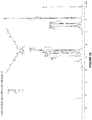
- NMR spectral data confirmed the structural integrity and regio-irregular microstructure of the polymer ( Figure 1a ) and then compared to a regioregular polymer prepared by GRIM method ( Figure 1b ).
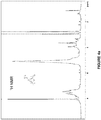
- NMR spectral data confirmed the structural integrity of the polymer ( Figure 2a ) compared to polymer prepared by GRIM method ( Figure 2b ).
- DDQ 2,3-Dichloro-5,6-dicyanobenzoquinone
- DDQ 2,3-dichloro-5,6-dicyanobenzoquinone
- the mixture was then concentrated by rotary evaporation until all the ethylene chloride had dissolved and the round bottom flask contained a suspension of black solids in water. The mixture was then filtered and the recovered solids were dissolved in a minimal amount of chloroform. The mixture was passed through a 350 mL silica plug (coarse silica gel) with chloroform. DI water (300 mL) was added to the collected eluent and the mixture was concentrated by rotary evaporation (water is added to keep solids from adhering to the sides of the round bottom flask during solvent evaporation). After all the chloroform had evaporated and the flask contained only water and black solid material, the mixture was filtered.
- the recovered solids were dissolved in a minimal amount of chloroform. This mixture was again passed through silica gel using the aforementioned procedure. The recovered solids were then washed with 50 mL IPA in 400 mL 1% HCl (aq) at 50°C for 2 hours. The mixture was filtered and recovered solids were added to 50 mL IPA in 300 mL 5% hydrazine (aq) and stirred at 40°C for 1 hour. The mixture was filtered and recovered solids were washed in 50 mL IPA in 300 mL DI water for 1 hour at 40°C for 1 hour. The mixture was filtered and recovered solids were dried overnight in a vacuum oven at 60°C.
- DDQ 2,3-dichloro-5,6-dicyanobenzoquinone
- the mixture was then concentrated by rotary evaporation until all the ethylene chloride had dissolved and the round bottom flask contained a suspension of black solids in water. The mixture was then filtered and the recovered solids were dissolved in a minimal amount of chloroform. The mixture was passed through a 350 mL silica plug (coarse silica gel) with chloroform. DI water (300 mL) was added to the collected eluent and the mixture was concentrated by rotary evaporation (water is added to keep solids from adhering to the sides of the round bottom flask during solvent evaporation). After all the chloroform had evaporated and the flask contained only water and black solid material, the mixture was filtered.
- the recovered solids were dissolved in a minimal amount of chloroform. This mixture was again passed through silica gel using the aforementioned procedure. The recovered solids were then washed twice with 50 mL IPA in 400 mL 1% HCl (aq) at 50°C for 2 hours. The mixture was filtered and recovered solids were added to 50 mL IPA in 300 mL 5% hydrazine (aq) and stirred at 40°C for 1 hour. The mixture was filtered and recovered solids were washed in 50 mL IPA in 300 mL DI water for 1 hour at 40°C for 1 hour. The mixture was filtered and recovered solids were dried overnight in a vacuum oven at 60°C.
- DDQ 2,3-dichloro-5,6-dicyanobenzoquinone
- the mixture was then concentrated by rotary evaporation until all the ethylene chloride had dissolved and the round bottom flask contained a suspension of black solids in water. The mixture was then filtered and the recovered solids were dissolved in a minimal amount of chloroform. The mixture was passed through a 350 mL silica plug (coarse silica gel) with chloroform. DI water (300 mL) was added to the collected eluent and the mixture was concentrated by rotary evaporation (water is added to keep solids from adhering to the sides of the round bottom flask during solvent evaporation). After all the chloroform had evaporated and the flask contained only water and black solid material, the mixture was filtered.
- the recovered solids were dissolved in a minimal amount of chloroform and again passed through silica gel using the aforementioned procedure.
- the recovered solids were then washed twice with 50 mL IPA in 400 mL 1% HCl (aq) at 50°C for 2 hours.
- the mixture was filtered and recovered solids were added to 50mL IPA in 300 mL 5% hydrazine (aq) and stirred at 40°C for 1 hour.
- the mixture was filtered and recovered solids were washed in 50 mL IPA in 300 mL DI water for 1 hour at 40°C for 1 hour.
- the mixture was filtered and recovered solids were dried overnight in a vacuum oven at 60°C.
- DDQ 2,3-dichloro-5,6-dicyanobenzoquinone
- the recovered solids were combined with 400 mL MeOH, and the mixture was stirred at 50°C for 1 hour.
- the mixture was filtered and the recovered solids were purified via soxhlet extraction with MeOH overnight.
- the solids remaining in the thimble were added to 200 mL MeOH and stirred at 50°C for 1 hour.
- the mixture was filtered and the recovered solids were purified again by Soxhlet extraction overnight with MeOH.
- the solids remaining in the thimble were added to 200 mL MeOH and stirred at 50°C for 1 hour.
- the mixture was filtered and the recovered solids were added to 300 mL 5% N 2 H 4 (aq) and stirred at 50°C for 1 hour.
- the mixture was filtered and the filtercake was rinsed twice with 100mL DI water and once with 100 mL IPA.
- the recovered solids were dried overnight in a vacuum oven at 60°C.
- polythiophene-based polymers produced by oxidative polymerization has similar material properties as those produced by traditional GRIM method.
- the impurity level of metal and/or halogen in polymers produced by oxidative polymerization is significantly less than GRIM-produced polymers.
- GRIM methodology requires two additional steps: (a) dehalogenation and (b) metal purification step to remove Br, Mg, and Ni, respectively. These steps are introduced during polymerization or done during post-polymerization treatment of polymer.
- Results presented in Tables 1, 2, 3 show a range of metals and Br content for polymer batches before the de-halogenation treatment with or without metal purification steps applied [e.g., at least 30 batches of PMEET, PdiBEET, or P2EF3 prepared via GRIM method were analyzed].
- Lit. Ref. (a) Loewe, R. S.; Khersonsky, S. K.; McCullough, R. D. Adv. Mater. 1999, 3, 250 (GRIM method); (b) Sheina, E. E. US 2010/0273007 A1 (dehalogenation method).
- GRIM polymerization is described in, for example, US Patent No. 6,166,172 . Table 4.
- Example 10 Preparation of Non-aqueous (NQ) Inks with 4-methyl- N -phenyl- N -(4-(phenyl(p-tolyl)amino)phenyl)benzenaminium tetrakis(pentafluorophenyl)borate [NQ -NN- PTAPB-PB 4 ]
- a 2:1 mixture of methyl benzoate and 3-methoxy propionitrile was prepared by shaking the solvent together in a vial. This solvent system was combined with polymer in a separate vial, and the mixture was stirred at 80°C for one hour. The solution was then removed from heating and allowed to cool to room temperature for fifteen minutes.
- NQ- NN- PTAPB-PB 4 was added to a 2:1 mixture of methyl benzoate and 3-methoxy propionitrile in a separate vial from the polymer solution, and the mixture was stirred for 15 minutes. The solution was then added dropwise over two minutes to the stirred solution of the polymer. After the addition was complete, the mixture is stirred for thirty minutes at 50°C. The solution was then allowed to sit at room temperature for thirty minutes before filterability tests were performed.
- the hole only device is a unipolar device wherein the hole only injection efficiency of the HIL into the HTL was studied.
- the hole only devices to test the hole injection were fabricated on indium tin oxide (ITO) surfaces deposited on glass substrates.
- ITO surface was pre-patterned to define the pixel area of 0.09 cm 2 .
- the device substrates were cleaned by ultrasonication in a dilute soap solution for 20 minutes each followed by distilled water washes. This was followed by ultrasonication in isopropanol for 20 minutes.
- the substrates were dried under nitrogen flow, following which they were treated in a UV-Ozone chamber operating at 300 W for 20 minutes.
- the cleaned substrates were then coated with an HIL ink and dried at 90-170°C for 5-15 minutes to form an HIL layer. Dry film thicknesses ranged from approximately 20 nm to 60 nm.
- the coating process was done on a spin coater but can be similarly achieved with spray coating, ink-jetting, contact printing or any other deposition method capable of resulting in an HIL film of the desired thickness.
- the substrates were then transferred to a vacuum chamber where the remaining layers of the device stack were deposited by means of physical vapor deposition.
- N,N' (di naphthalen-1-yl)- N,N '-diphenyl-benzidine (NPB) a hole transporting layer (HTL) was deposited on top of the HIL followed by a Gold (Au) cathode.
- the hole only devices comprise pixels on a glass substrate whose electrodes extended outside the encapsulated area of the device which contain the light emitting portion of the pixels.
- the typical area of each pixel is 0.09 cm 2 .
- the electrodes were contacted with a current source meter such as a Keithley 2400 source meter with a bias applied to the indium tin oxide electrode while the gold electrode was earthed. This results in positively charged carriers (holes) being injected into the device.
- the HIL assists the injection of charge carriers into the hole transporting layer. This resulted in a low operating voltage of the device (defined as the voltage required to run a given current density through the pixel).
- polythiophene-based polymers produced by oxidative polymerization showed equivalent or better HOD results that are within typical statistical variation observed in HOD devices based on polymers produced by traditional GRIM method, indicating that all polymer batches deliver HILs with similar level of injection. Voltage is measured at 10 mA/cm 2 . Table 5.
- Exemplary HOD device data containing HILs formulated from NQ- NN -PTAPB-PB 4 and PdiBEET polymers synthesized via oxidative route and GRIM methodologies see Figure 6 for plot of current density against voltage
- Device # Ink Formulation Polymer Synthetic Method Voltage (V) 1 NQ- NN -PTAPB-PB 4 PdiBEET GRIM 2.32 ⁇ 0.05 2 NQ- NN -PTAPB-PB 4 PdiBEET GRIM 2.25 ⁇ 0.02 3 NQ- NN -PTAPB-PB 4 PdiBEET oxidative 2.25 ⁇ 0.02 4 NQ- NN -PTAPB-PB 4 PdiBEET oxidative 2.28 ⁇ 0.06 Table 6.
- Exemplary HOD device data containing HILs formulated from NQ- NN -PTAPB-PB 4 and P(diBEET-r-BEET) copolymers synthesized via oxidative route and GRIM methodologies see Figure 7 for plot of current density against voltage
- device 3, as shown in Figure 7 showed a higher voltage, which can be a disadvantage for a HOD measurement.
Landscapes
- Health & Medical Sciences (AREA)
- Life Sciences & Earth Sciences (AREA)
- Chemical & Material Sciences (AREA)
- Engineering & Computer Science (AREA)
- Surgery (AREA)
- Animal Behavior & Ethology (AREA)
- Veterinary Medicine (AREA)
- Public Health (AREA)
- General Health & Medical Sciences (AREA)
- Nuclear Medicine, Radiotherapy & Molecular Imaging (AREA)
- Molecular Biology (AREA)
- Medical Informatics (AREA)
- Heart & Thoracic Surgery (AREA)
- Biomedical Technology (AREA)
- Polymers & Plastics (AREA)
- Medicinal Chemistry (AREA)
- Chemical Kinetics & Catalysis (AREA)
- Organic Chemistry (AREA)
- Radiology & Medical Imaging (AREA)
- Pathology (AREA)
- Biophysics (AREA)
- Physics & Mathematics (AREA)
- Human Computer Interaction (AREA)
- Robotics (AREA)
- Polyoxymethylene Polymers And Polymers With Carbon-To-Carbon Bonds (AREA)
- Ultra Sonic Daignosis Equipment (AREA)
Applications Claiming Priority (2)
| Application Number | Priority Date | Filing Date | Title |
|---|---|---|---|
| US201161550332P | 2011-10-21 | 2011-10-21 | |
| PCT/US2012/061179 WO2013059712A1 (en) | 2011-10-21 | 2012-10-19 | Improved synthesis of conjugated polymers via oxidative polymerization and related compositions |
Publications (2)
| Publication Number | Publication Date |
|---|---|
| EP2768868A1 EP2768868A1 (en) | 2014-08-27 |
| EP2768868B1 true EP2768868B1 (en) | 2018-06-27 |
Family
ID=47116492
Family Applications (1)
| Application Number | Title | Priority Date | Filing Date |
|---|---|---|---|
| EP12780380.7A Not-in-force EP2768868B1 (en) | 2011-10-21 | 2012-10-19 | Improved synthesis of conjugated polymers via oxidative polymerization and related compositions |
Country Status (7)
| Country | Link |
|---|---|
| US (4) | US8859718B2 (https=) |
| EP (1) | EP2768868B1 (https=) |
| JP (1) | JP6252480B2 (https=) |
| KR (1) | KR101938922B1 (https=) |
| CN (1) | CN103987735B (https=) |
| TW (1) | TWI555772B (https=) |
| WO (2) | WO2013059714A1 (https=) |
Families Citing this family (71)
| Publication number | Priority date | Publication date | Assignee | Title |
|---|---|---|---|---|
| EP2992825B1 (en) | 2007-11-26 | 2017-11-01 | C.R. Bard Inc. | Integrated system for intravascular placement of a catheter |
| US8781555B2 (en) | 2007-11-26 | 2014-07-15 | C. R. Bard, Inc. | System for placement of a catheter including a signal-generating stylet |
| US9521961B2 (en) | 2007-11-26 | 2016-12-20 | C. R. Bard, Inc. | Systems and methods for guiding a medical instrument |
| US9532724B2 (en) | 2009-06-12 | 2017-01-03 | Bard Access Systems, Inc. | Apparatus and method for catheter navigation using endovascular energy mapping |
| US10386990B2 (en) | 2009-09-22 | 2019-08-20 | Mederi Rf, Llc | Systems and methods for treating tissue with radiofrequency energy |
| CN102711642B (zh) | 2009-09-22 | 2015-04-29 | 麦迪尼治疗公司 | 用于控制一类不同治疗装置的使用和操作的系统和方法 |
| WO2011150376A1 (en) | 2010-05-28 | 2011-12-01 | C.R. Bard, Inc. | Apparatus for use with needle insertion guidance system |
| JP6252480B2 (ja) | 2011-10-21 | 2017-12-27 | 日産化学工業株式会社 | 酸化重合による共役ポリマーの改善された合成方法および関連する組成物 |
| US9330809B2 (en) * | 2013-12-17 | 2016-05-03 | Dow Global Technologies Llc | Electrically conducting composites, methods of manufacture thereof and articles comprising the same |
| US9336921B2 (en) * | 2013-12-17 | 2016-05-10 | Dow Global Technologies Llc | Electrically conducting composites, methods of manufacture thereof and articles comprising the same |
| US20150305631A1 (en) * | 2014-04-25 | 2015-10-29 | Medtronic, Inc. | Real-Time Relationship Between Geometries of an Instrument and a Structure |
| CN104095654B (zh) * | 2014-08-04 | 2016-05-25 | 深圳开立生物医疗科技股份有限公司 | 一种导管尺寸选取方法、装置和系统 |
| EP3220828B1 (en) | 2014-11-18 | 2021-12-22 | C.R. Bard, Inc. | Ultrasound imaging system having automatic image presentation |
| US10646201B2 (en) | 2014-11-18 | 2020-05-12 | C. R. Bard, Inc. | Ultrasound imaging system having automatic image presentation |
| US20170362451A1 (en) * | 2014-12-15 | 2017-12-21 | Nissan Chemical Industries, Ltd., | Compositions containing hole carrier materials and poly(aryl ether sulfone)s, and uses thereof |
| KR102408799B1 (ko) * | 2014-12-15 | 2022-06-13 | 닛산 가가쿠 가부시키가이샤 | 정공 캐리어 물질 및 플루오로중합체를 함유하는 조성물 및 그의 용도 |
| US20160313901A1 (en) * | 2015-04-21 | 2016-10-27 | Stephen Arnold | Interactive medical system and methods |
| JP6638730B2 (ja) * | 2015-04-22 | 2020-01-29 | 日産化学株式会社 | 有機エレクトロニクスにおける使用に適した非水系組成物 |
| WO2016210325A1 (en) | 2015-06-26 | 2016-12-29 | C.R. Bard, Inc. | Connector interface for ecg-based catheter positioning system |
| CN107849376B (zh) * | 2015-07-17 | 2021-11-30 | 日产化学工业株式会社 | 适用于有机电子的包含金属纳米颗粒的非水性油墨组合物 |
| WO2017172393A1 (en) * | 2016-03-26 | 2017-10-05 | Mederi Therapeutics, Inc. | Systems and methods for treating tissue with radiofrequency energy |
| JP6643741B2 (ja) * | 2016-04-15 | 2020-02-12 | 株式会社ソシオネクスト | 超音波プローブ制御方法及びプログラム |
| US11020563B2 (en) * | 2016-07-14 | 2021-06-01 | C. R. Bard, Inc. | Automated catheter-to-vessel size comparison tool and related methods |
| CN111712732A (zh) * | 2018-02-12 | 2020-09-25 | 皇家飞利浦有限公司 | 针对医学多普勒超声评价的工作流程辅助 |
| CN108822282B (zh) * | 2018-05-28 | 2020-11-24 | 上海大学 | 一种导电聚合物及其制备方法 |
| JP6640917B2 (ja) * | 2018-06-04 | 2020-02-05 | キヤノンメディカルシステムズ株式会社 | 医用画像診断装置及び医用画像診断装置における穿刺針の管理装置 |
| CN112867443B (zh) | 2018-10-16 | 2024-04-26 | 巴德阿克塞斯系统股份有限公司 | 用于建立电连接的安全装备连接系统及其方法 |
| US11898061B2 (en) | 2018-11-02 | 2024-02-13 | Industrial Technology Research Institute | Modified conductive structure and method for producing the same |
| US12544101B2 (en) * | 2019-01-30 | 2026-02-10 | Bard Access Systems, Inc. | Systems and methods for tracking medical devices |
| CN110176300B (zh) * | 2019-05-28 | 2024-01-09 | 上海联影医疗科技股份有限公司 | 一种穿刺选针方法、装置、服务器和存储介质 |
| US11730443B2 (en) | 2019-06-13 | 2023-08-22 | Fujifilm Sonosite, Inc. | On-screen markers for out-of-plane needle guidance |
| CN114144120B (zh) * | 2019-07-23 | 2024-06-04 | 富士胶片株式会社 | 超声波诊断装置及超声波诊断装置的控制方法 |
| EP4699545A3 (en) * | 2019-08-16 | 2026-04-22 | FUJIFILM Corporation | Ultrasound diagnostic apparatus and control method of ultrasound diagnostic apparatus |
| US11759166B2 (en) | 2019-09-20 | 2023-09-19 | Bard Access Systems, Inc. | Automatic vessel detection tools and methods |
| US12447310B2 (en) * | 2020-06-03 | 2025-10-21 | Atif Hameed Farooqi | Catheter guide and method for operating the same |
| CN113952031B (zh) | 2020-07-21 | 2025-10-17 | 巴德阿克塞斯系统股份有限公司 | 磁跟踪超声探头及生成其3d可视化的系统、方法和设备 |
| CN114052905A (zh) | 2020-08-04 | 2022-02-18 | 巴德阿克塞斯系统股份有限公司 | 用于优化的医疗部件插入监测和成像增强的系统和方法 |
| CN217907826U (zh) | 2020-08-10 | 2022-11-29 | 巴德阿克塞斯系统股份有限公司 | 医学分析系统 |
| CN114129181A (zh) | 2020-09-03 | 2022-03-04 | 巴德阿克塞斯系统股份有限公司 | 便携式超声探测器、系统和方法 |
| CN216135922U (zh) | 2020-09-08 | 2022-03-29 | 巴德阿克塞斯系统股份有限公司 | 动态调整超声成像系统 |
| CN114159098B (zh) | 2020-09-10 | 2026-01-02 | 巴德阿克塞斯系统股份有限公司 | 具有压力测量能力的超声探测器 |
| US12492953B2 (en) | 2020-09-18 | 2025-12-09 | Bard Access Systems, Inc. | Ultrasound probe with pointer remote control capability |
| CN114246614B (zh) * | 2020-09-25 | 2025-09-23 | 巴德阿克塞斯系统股份有限公司 | 超声成像系统和最小导管长度工具 |
| WO2022072727A2 (en) | 2020-10-02 | 2022-04-07 | Bard Access Systems, Inc. | Ultrasound systems and methods for sustained spatial attention |
| CN121221162A (zh) | 2020-10-15 | 2025-12-30 | 巴德阿克塞斯系统股份有限公司 | 超声成像系统和使用其创建目标区域的三维超声图像的方法 |
| EP4247267A1 (en) * | 2020-11-24 | 2023-09-27 | Bard Access Systems, Inc. | Ultrasound system with target and medical instrument awareness |
| CN114569155A (zh) | 2020-12-01 | 2022-06-03 | 巴德阿克塞斯系统股份有限公司 | 超声成像系统和用于通过其获得超声图像的方法 |
| WO2022119856A1 (en) | 2020-12-01 | 2022-06-09 | Bard Access Systems, Inc. | Ultrasound system with pressure and flow determination capability |
| WO2022132651A1 (en) | 2020-12-14 | 2022-06-23 | Bard Access Systems, Inc. | Securement of hands-free ultrasound probe |
| US12349983B2 (en) | 2021-03-05 | 2025-07-08 | Bard Access Systems, Inc. | Systems and methods for ultrasound-and-bioimpedance-based guidance of medical devices |
| US12605140B2 (en) * | 2021-03-29 | 2026-04-21 | Bard Access Systems, Inc. | System and method for a vessel assessment tool |
| CN217907828U (zh) * | 2021-04-15 | 2022-11-29 | 巴德阿克塞斯系统股份有限公司 | 配置为检测目标区域内的一个或多个血管的医疗设备系统 |
| CN217960146U (zh) | 2021-04-15 | 2022-12-06 | 巴德阿克塞斯系统股份有限公司 | 超声成像系统 |
| US11900593B2 (en) | 2021-04-23 | 2024-02-13 | Fujifilm Sonosite, Inc. | Identifying blood vessels in ultrasound images |
| US12357266B2 (en) | 2021-04-23 | 2025-07-15 | Fujifilm Sonosite, Inc. | Displaying blood vessels in ultrasound images |
| US11896425B2 (en) * | 2021-04-23 | 2024-02-13 | Fujifilm Sonosite, Inc. | Guiding instrument insertion |
| EP4358853A1 (en) | 2021-06-22 | 2024-05-01 | Bard Access Systems, Inc. | Ultrasound detection system |
| CN115960338B (zh) * | 2021-10-09 | 2024-07-05 | 华南理工大学 | 一种n型共轭聚合物共混物及其制备方法与应用 |
| CN115969409A (zh) | 2021-10-14 | 2023-04-18 | 巴德阿克塞斯系统股份有限公司 | 光纤超声探头 |
| US12376817B2 (en) | 2021-11-03 | 2025-08-05 | Bard Access Systems, Inc. | Optimized functionality through interoperation of doppler and image based vessel differentiation |
| EP4426225A1 (en) | 2021-11-16 | 2024-09-11 | Bard Access Systems, Inc. | Ultrasound probe with integrated data collection methodologies |
| US12514533B2 (en) | 2022-03-01 | 2026-01-06 | Bard Access Systems, Inc. | Ultrasound imaging system |
| US12514532B2 (en) | 2022-03-01 | 2026-01-06 | Bard Access Systems, Inc. | Ultrasound imaging system |
| EP4489661B1 (en) | 2022-03-16 | 2025-10-29 | Bard Access Systems, Inc. | Ultrasound imaging system |
| US12207967B2 (en) * | 2022-04-20 | 2025-01-28 | Bard Access Systems, Inc. | Ultrasound imaging system |
| US12102481B2 (en) | 2022-06-03 | 2024-10-01 | Bard Access Systems, Inc. | Ultrasound probe with smart accessory |
| US12137989B2 (en) | 2022-07-08 | 2024-11-12 | Bard Access Systems, Inc. | Systems and methods for intelligent ultrasound probe guidance |
| CN115082647B (zh) * | 2022-07-20 | 2022-12-13 | 江苏霆升科技有限公司 | 一种面向三维超声点云内标测导管识别定位跟踪方法 |
| US12564373B2 (en) | 2022-08-15 | 2026-03-03 | Bard Access Systems, Inc. | Spatially aware medical device configured for performance of insertion pathway approximation |
| CN115911542A (zh) * | 2022-12-05 | 2023-04-04 | 电子科技大学长三角研究院(衢州) | 一种高锂离子电导复合固体电解质制备方法 |
| US20250017559A1 (en) * | 2023-07-12 | 2025-01-16 | Bard Access Systems, Inc. | System and Method for Suggesting Catheter Parameters |
Family Cites Families (67)
| Publication number | Priority date | Publication date | Assignee | Title |
|---|---|---|---|---|
| US4599194A (en) * | 1984-06-18 | 1986-07-08 | Allied Corporation | Simultaneous polymerization, doping and solubilization of heterocyclic polymers, solutions and cast articles |
| EP0203438A1 (en) * | 1985-05-31 | 1986-12-03 | Corporation Allied | Solution processible forms of neutral and electrically conductive poly(substituted heterocycles) |
| EP0257573B1 (de) * | 1986-08-26 | 1994-10-12 | Hoechst Aktiengesellschaft | Lösliche, elektrisch leitende Polymere, Verfahren zu ihrer Herstellung und ihre Verwendung |
| JPH0739477B2 (ja) * | 1986-11-06 | 1995-05-01 | 昭和電工株式会社 | イソチアナフテン構造を有する重合体の製造方法 |
| US4956444A (en) * | 1987-04-09 | 1990-09-11 | National University Of Singapore | Chemical synthesis of stable and electroactive polypyrrole and related polyheterocyclic compounds |
| US4975317A (en) * | 1987-08-03 | 1990-12-04 | Milliken Research Corporation | Electrically conductive textile materials and method for making same |
| FR2648140B1 (fr) * | 1989-06-08 | 1991-05-03 | Centre Nat Rech Scient | Procede de preparation d'oligomeres d'heterocycles aromatiques par couplage oxydant d'oligomeres inferieurs |
| US4986886A (en) * | 1990-05-30 | 1991-01-22 | Drexel University | Polymerization of thiophene and its derivatives |
| US5325293A (en) | 1992-02-18 | 1994-06-28 | Dorne Howard L | System and method for correlating medical procedures and medical billing codes |
| US5549554A (en) | 1994-04-01 | 1996-08-27 | Advanced Cardiovascular Systems, Inc. | Catheters having separable reusable components |
| US5573529A (en) | 1994-10-31 | 1996-11-12 | Haak; Benjamin A. | Color coded medical instruments |
| US5908387A (en) | 1996-06-21 | 1999-06-01 | Quinton Instrument Company | Device and method for improved quantitative coronary artery analysis |
| DE69823214T2 (de) | 1997-10-01 | 2005-03-10 | Boston Scientific Ltd., St. Michael | Kit zur Längenbestimmung von Kathetern vor ihrer Einführung |
| US5970119A (en) | 1997-11-18 | 1999-10-19 | Douglas Holtz (Part Interest) | Radiological scaling and alignment device |
| US7713190B2 (en) * | 1998-02-24 | 2010-05-11 | Hansen Medical, Inc. | Flexible instrument |
| US6166172A (en) | 1999-02-10 | 2000-12-26 | Carnegie Mellon University | Method of forming poly-(3-substituted) thiophenes |
| EP1185200B1 (en) | 1999-06-05 | 2008-01-09 | Wilson-Cook Medical Inc. | Indicia for an endoscopic medical device |
| US6687386B1 (en) | 1999-06-15 | 2004-02-03 | Hitachi Denshi Kabushiki Kaisha | Object tracking method and object tracking apparatus |
| DE60128749T2 (de) * | 2000-05-11 | 2008-02-07 | Nec Tokin Toyama Ltd. | Herstellungsverfahren von einem Festelektrolytkondensator |
| US6640976B1 (en) | 2000-06-13 | 2003-11-04 | Careguide, Inc. | Male clean intermittent catheter system |
| US7831449B2 (en) | 2001-02-02 | 2010-11-09 | Thompson Reuters (Healthcare) Inc. | Method and system for extracting medical information for presentation to medical providers on mobile terminals |
| US6592565B2 (en) | 2001-04-26 | 2003-07-15 | Zbylut J. Twardowski | Patient-tailored, central-vein catheters |
| DE60238369D1 (de) | 2001-05-23 | 2011-01-05 | Radi Medical Systems | Interaktives Messsystem |
| US7217266B2 (en) * | 2001-05-30 | 2007-05-15 | Anderson R Rox | Apparatus and method for laser treatment with spectroscopic feedback |
| WO2003022169A1 (en) | 2001-09-12 | 2003-03-20 | Scimed Life Systems, Inc. | System for identifying medical devices |
| US6543642B1 (en) | 2001-09-21 | 2003-04-08 | Daydots International, Inc. | Disposable glove dispenser system |
| US6602974B1 (en) | 2001-12-04 | 2003-08-05 | Carnegie Mellon University | Polythiophenes, block copolymers made therefrom, and methods of forming the same |
| US6601705B2 (en) | 2001-12-07 | 2003-08-05 | The Procter & Gamble Company | Package containing a window and performance characteristic indicator |
| US7697972B2 (en) | 2002-11-19 | 2010-04-13 | Medtronic Navigation, Inc. | Navigation system for cardiac therapies |
| KR100543121B1 (ko) * | 2002-12-06 | 2006-01-31 | 나노캠텍주식회사 | 전도성 고분자 폴리티오펜의 제조방법 |
| USD496596S1 (en) | 2003-04-30 | 2004-09-28 | Robert Dalrymple | Image french measuring adjunct |
| US20050000975A1 (en) | 2003-05-28 | 2005-01-06 | Carco Darlene Marie | Sterile surgical glove dispenser |
| TW200516094A (en) * | 2003-09-25 | 2005-05-16 | Showa Denko Kk | Pi-Conjugated copolymer, production method thereof, and capacitor using the copolymer |
| CN1933787A (zh) * | 2004-01-23 | 2007-03-21 | 特拉克斯医疗有限公司 | 在体内目标位置上完成某些程序的方法和装置 |
| US7368624B2 (en) * | 2004-03-30 | 2008-05-06 | Eastman Kodak Company | Synthesis for polycyclic aromatic hydrocarbon compounds |
| US20060015039A1 (en) | 2004-07-19 | 2006-01-19 | Cassidy Kenneth T | Guidewire bearing markings simplifying catheter selection |
| DE602005020175D1 (de) | 2004-09-24 | 2010-05-06 | Plextronics Inc | Heteroatomische regioreguläre poly (3-subtituierte thiophene) in elektrolumineszenzbauelementen |
| WO2006086480A2 (en) | 2005-02-10 | 2006-08-17 | Plextronics, Inc. | Hole injection/transport layer compositions and devices |
| US7892177B2 (en) * | 2005-02-28 | 2011-02-22 | Scimed Life Systems, Inc. | Systems and methods for estimating the length and position of a stent to be applied within a patient |
| US7785302B2 (en) * | 2005-03-04 | 2010-08-31 | C. R. Bard, Inc. | Access port identification systems and methods |
| JP5193851B2 (ja) | 2005-04-01 | 2013-05-08 | カーネギー メロン ユニバーシティ | レジオレギュラーポリマー、ポリチオフェンおよびブロックコポリマーを含む導電性ポリマーのリビング合成法 |
| JP5376947B2 (ja) * | 2005-07-18 | 2013-12-25 | リーケ メタルズ インコーポレイテッド | 置換ポリチオフェンポリマーのための改良プロセス |
| US8852111B2 (en) * | 2005-09-02 | 2014-10-07 | Ultrasound Ventures, Llc | Ultrasound guidance system |
| US20070199848A1 (en) | 2006-02-28 | 2007-08-30 | Ellswood Mark R | Packaging with color-coded identification |
| US8112292B2 (en) * | 2006-04-21 | 2012-02-07 | Medtronic Navigation, Inc. | Method and apparatus for optimizing a therapy |
| WO2008115188A2 (en) * | 2006-05-08 | 2008-09-25 | C. R. Bard, Inc. | User interface and methods for sonographic display device |
| CN101563388B (zh) | 2006-07-21 | 2013-05-15 | 普莱克斯托尼克斯公司 | 导电聚合物的磺化和oled器件、光电器件以及esd器件 |
| US20080033759A1 (en) | 2006-08-02 | 2008-02-07 | Vastrac, Inc. | Information manager for a procedure-based medical practice |
| US20080177186A1 (en) | 2007-01-18 | 2008-07-24 | Slater Charles R | Methods and Apparatus for Determining a Treatment Volume of a Fluid Treatment Agent for Treating The Interior of a Blood Vessel |
| US7976469B2 (en) * | 2007-06-04 | 2011-07-12 | Medtronic, Inc. | Percutaneous needle guide |
| EP2992825B1 (en) | 2007-11-26 | 2017-11-01 | C.R. Bard Inc. | Integrated system for intravascular placement of a catheter |
| US8073529B2 (en) | 2007-12-04 | 2011-12-06 | Civco Medical Instruments Co., Inc. | Needle guide system for use with ultrasound transducers to effect shallow path needle entry and method of use |
| US20090143672A1 (en) | 2007-12-04 | 2009-06-04 | Harms Steven E | Method for mapping image reference points to facilitate biopsy using magnetic resonance imaging |
| KR101683026B1 (ko) | 2008-04-11 | 2016-12-07 | 닛산 가가쿠 고교 가부시키 가이샤 | 도핑된 공액 중합체, 소자, 및 소자의 제조 방법 |
| EP2364331A4 (en) | 2008-11-26 | 2013-12-11 | Univ Florida | BLACK SOLUBLE CONJUGATED POLYMERS WITH HIGH CHARGE STRENGTH MOBILITY |
| JP2012523483A (ja) | 2009-04-10 | 2012-10-04 | プレックストロニクス インコーポレーティッド | 脱ハロゲン化方法 |
| US20100312121A1 (en) | 2009-06-09 | 2010-12-09 | Zhonghui Guan | Apparatus for a needle director for an ultrasound transducer probe |
| EP2449561A2 (en) | 2009-06-30 | 2012-05-09 | Plextronics, Inc. | Polymers comprising at least one bithiophene repeat unit, methods synthetising said polymers and compositions comprising the same |
| AU2010298333B2 (en) * | 2009-09-23 | 2014-04-17 | Lightlab Imaging, Inc. | Lumen morphology and vascular resistance measurements data collection systems, apparatus and methods |
| CN103228219B (zh) * | 2010-08-09 | 2016-04-27 | C·R·巴德股份有限公司 | 用于超声探测器头的支撑和覆盖结构 |
| JP6252480B2 (ja) | 2011-10-21 | 2017-12-27 | 日産化学工業株式会社 | 酸化重合による共役ポリマーの改善された合成方法および関連する組成物 |
| WO2019232454A1 (en) | 2018-05-31 | 2019-12-05 | Matt Mcgrath Design & Co, Llc | Anatomical attachment device and associated method of use |
| JP7357015B2 (ja) | 2018-06-29 | 2023-10-05 | コーニンクレッカ フィリップス エヌ ヴェ | 生検予測及び超音波撮像によるガイド並びに関連するデバイス、システム、及び方法 |
| WO2020186198A1 (en) | 2019-03-13 | 2020-09-17 | University Of Florida Research Foundation | Guidance and tracking system for templated and targeted biopsy and treatment |
| CN114246614B (zh) | 2020-09-25 | 2025-09-23 | 巴德阿克塞斯系统股份有限公司 | 超声成像系统和最小导管长度工具 |
| WO2022072727A2 (en) | 2020-10-02 | 2022-04-07 | Bard Access Systems, Inc. | Ultrasound systems and methods for sustained spatial attention |
| CN121221162A (zh) | 2020-10-15 | 2025-12-30 | 巴德阿克塞斯系统股份有限公司 | 超声成像系统和使用其创建目标区域的三维超声图像的方法 |
-
2012
- 2012-10-19 JP JP2014537332A patent/JP6252480B2/ja active Active
- 2012-10-19 KR KR1020147012813A patent/KR101938922B1/ko active Active
- 2012-10-19 TW TW101138791A patent/TWI555772B/zh active
- 2012-10-19 US US13/656,561 patent/US8859718B2/en not_active Expired - Fee Related
- 2012-10-19 US US13/656,563 patent/US9949720B2/en active Active
- 2012-10-19 CN CN201280061750.9A patent/CN103987735B/zh active Active
- 2012-10-19 WO PCT/US2012/061182 patent/WO2013059714A1/en not_active Ceased
- 2012-10-19 WO PCT/US2012/061179 patent/WO2013059712A1/en not_active Ceased
- 2012-10-19 EP EP12780380.7A patent/EP2768868B1/en not_active Not-in-force
-
2014
- 2014-09-09 US US14/481,692 patent/US20150105534A1/en not_active Abandoned
-
2018
- 2018-04-12 US US15/951,903 patent/US11413015B2/en active Active
Non-Patent Citations (5)
| Title |
|---|
| E. T. KANG ET AL: "Polymerization and oxidation of pyrrole by organic electron acceptors", JOURNAL OF POLYMER SCIENCE PART A: POLYMER CHEMISTRY, vol. 25, no. 8, 1 August 1987 (1987-08-01), pages 2143 - 2153, XP055049498, ISSN: 0887-624X, DOI: 10.1002/pola.1987.080250811 * |
| LI TAN ET AL: "Characterization of Organic p/n Junction Photodiodes Based on Poly(alkylthiophene)/Perylene Diimide Bilayers", CHEMISTRY OF MATERIALS, vol. 15, no. 11, 1 June 2003 (2003-06-01), pages 2272 - 2279, XP055049488, ISSN: 0897-4756, DOI: 10.1021/cm034183a * |
| LINDSEY J S ET AL: "Rothemund and Adler-Longo Reactions Revisited. Synthesis of Tetraphenylporphyrins under Equilibrium Conditions", THE JOURNAL OF ORGANIC CHEMISTRY, AMERICAN CHEMICAL SOCIETY, US, vol. 52, no. 5, 6 March 1987 (1987-03-06), pages 827 - 836, XP002125259, ISSN: 0022-3263, DOI: 10.1021/JO00381A022 * |
| MICHAEL L MACHALA ET AL: "On-substrate polymerization of solution-processed, transparent PEDOT:DDQ thin film electrodes with a hydrophobic polymer matrix", ORGANIC ELECTRONICS, ELSEVIER, AMSTERDAM, NL, vol. 12, no. 9, 21 May 2011 (2011-05-21), pages 1518 - 1526, XP028237119, ISSN: 1566-1199, [retrieved on 20110526], DOI: 10.1016/J.ORGEL.2011.05.017 * |
| TANIGUCHI R ET AL: "Ring size selective synthesis of meso-aryl expanded porphyrins", TETRAHEDRON LETTERS, PERGAMON, GB, vol. 44, no. 12, 17 March 2003 (2003-03-17), pages 2505 - 2507, XP004412211, ISSN: 0040-4039, DOI: 10.1016/S0040-4039(03)00328-9 * |
Also Published As
| Publication number | Publication date |
|---|---|
| TW201326251A (zh) | 2013-07-01 |
| US8859718B2 (en) | 2014-10-14 |
| WO2013059712A1 (en) | 2013-04-25 |
| US9949720B2 (en) | 2018-04-24 |
| JP2014530940A (ja) | 2014-11-20 |
| KR20140093679A (ko) | 2014-07-28 |
| US20180228465A1 (en) | 2018-08-16 |
| TWI555772B (zh) | 2016-11-01 |
| US11413015B2 (en) | 2022-08-16 |
| CN103987735B (zh) | 2017-10-31 |
| US20130109813A1 (en) | 2013-05-02 |
| KR101938922B1 (ko) | 2019-04-10 |
| US20130102889A1 (en) | 2013-04-25 |
| US20150105534A1 (en) | 2015-04-16 |
| EP2768868A1 (en) | 2014-08-27 |
| JP6252480B2 (ja) | 2017-12-27 |
| WO2013059714A1 (en) | 2013-04-25 |
| CN103987735A (zh) | 2014-08-13 |
Similar Documents
| Publication | Publication Date | Title |
|---|---|---|
| EP2768868B1 (en) | Improved synthesis of conjugated polymers via oxidative polymerization and related compositions | |
| Wang et al. | Stimuli-responsive conjugated copolymers having electro-active azulene and bithiophene units in the polymer skeleton: Effect of protonation and p-doping on conducting properties | |
| TWI602797B (zh) | 改良的富勒烯衍生物及相關材料、方法及裝置 | |
| US10538633B2 (en) | Conjugated heteroaromatic homopolymer and copolymer, and applications thereof | |
| CN111315796B (zh) | 有机半导体化合物 | |
| TW201139505A (en) | Semiconducting polymers | |
| TW201231490A (en) | Conjugated polymers | |
| US10475592B2 (en) | Composition and method for forming electroactive coating comprising conjugated heteroaromatic polymer, capacitor and antistatic object comprising the electroactive coating, and solid electrolytic capacitor and method for fabricating the same | |
| CN108165140B (zh) | 电活性涂层及形成电活性涂层用的组合物 | |
| CN102884102A (zh) | 掺杂的共轭聚合物和装置 | |
| TW201139507A (en) | Polymers of 8,9-dihydrobenzo[def]carbazole and their use as organic semiconductors | |
| Ponder Jr et al. | Metal‐like Charge Transport in PEDOT (OH) Films by Post‐processing Side Chain Removal from a Soluble Precursor Polymer | |
| KR20170057354A (ko) | 공액 중합체 | |
| EP3703144B1 (en) | Charge-transport polymer and organic electronic element | |
| EP3457449A1 (en) | Charge transport material, organic electronic element and organic electroluminescent element | |
| EP3157976B1 (en) | Composition and method for forming electroactive polymer solution or coating comprising conjugated heteroaromatic polymer, electroactive polymer solution, capacitor and antistatic object comprising the electroactive coating, and solid electrolytic capacitor and method for fabricating the same | |
| US9859062B2 (en) | Composition and method for forming electroactive polymer solution or coating comprising conjugated heteroaromatic polymer, electroactive polymer solution, capacitor and antistatic object comprising the electroactive coating, and solid electrolytic capacitor and method for fabricating the same | |
| CN110998888B (zh) | 有机半导体聚合物 | |
| KR20180097671A (ko) | 티아디아졸로피리딘 중합체, 그것의 합성 및 그것의 용도 | |
| KR20180005701A (ko) | 티아디아졸로피리딘 중합체, 이의 합성 및 이의 용도 | |
| WO2019206926A1 (en) | Organic semiconducting polymers | |
| Lee et al. | Two TPD-Based Conjugated Polymers: Synthesis and Photovoltaic Applications as Donor Materials | |
| US20180223037A1 (en) | Method of forming and use of a crosslinked polymer |
Legal Events
| Date | Code | Title | Description |
|---|---|---|---|
| PUAI | Public reference made under article 153(3) epc to a published international application that has entered the european phase |
Free format text: ORIGINAL CODE: 0009012 |
|
| 17P | Request for examination filed |
Effective date: 20140513 |
|
| AK | Designated contracting states |
Kind code of ref document: A1 Designated state(s): AL AT BE BG CH CY CZ DE DK EE ES FI FR GB GR HR HU IE IS IT LI LT LU LV MC MK MT NL NO PL PT RO RS SE SI SK SM TR |
|
| DAX | Request for extension of the european patent (deleted) | ||
| RAP1 | Party data changed (applicant data changed or rights of an application transferred) |
Owner name: SOLVAY USA INC. |
|
| 17Q | First examination report despatched |
Effective date: 20151117 |
|
| RAP1 | Party data changed (applicant data changed or rights of an application transferred) |
Owner name: NISSAN CHEMICAL INDUSTRIES, LTD. |
|
| GRAJ | Information related to disapproval of communication of intention to grant by the applicant or resumption of examination proceedings by the epo deleted |
Free format text: ORIGINAL CODE: EPIDOSDIGR1 |
|
| GRAP | Despatch of communication of intention to grant a patent |
Free format text: ORIGINAL CODE: EPIDOSNIGR1 |
|
| INTG | Intention to grant announced |
Effective date: 20170801 |
|
| RAP1 | Party data changed (applicant data changed or rights of an application transferred) |
Owner name: NISSAN CHEMICAL INDUSTRIES, LTD. |
|
| GRAP | Despatch of communication of intention to grant a patent |
Free format text: ORIGINAL CODE: EPIDOSNIGR1 |
|
| INTG | Intention to grant announced |
Effective date: 20170807 |
|
| INTC | Intention to grant announced (deleted) | ||
| INTG | Intention to grant announced |
Effective date: 20170904 |
|
| GRAJ | Information related to disapproval of communication of intention to grant by the applicant or resumption of examination proceedings by the epo deleted |
Free format text: ORIGINAL CODE: EPIDOSDIGR1 |
|
| INTC | Intention to grant announced (deleted) | ||
| GRAP | Despatch of communication of intention to grant a patent |
Free format text: ORIGINAL CODE: EPIDOSNIGR1 |
|
| INTG | Intention to grant announced |
Effective date: 20180126 |
|
| GRAS | Grant fee paid |
Free format text: ORIGINAL CODE: EPIDOSNIGR3 |
|
| GRAA | (expected) grant |
Free format text: ORIGINAL CODE: 0009210 |
|
| AK | Designated contracting states |
Kind code of ref document: B1 Designated state(s): AL AT BE BG CH CY CZ DE DK EE ES FI FR GB GR HR HU IE IS IT LI LT LU LV MC MK MT NL NO PL PT RO RS SE SI SK SM TR |
|
| REG | Reference to a national code |
Ref country code: GB Ref legal event code: FG4D |
|
| REG | Reference to a national code |
Ref country code: AT Ref legal event code: REF Ref document number: 1012255 Country of ref document: AT Kind code of ref document: T Effective date: 20180715 |
|
| REG | Reference to a national code |
Ref country code: IE Ref legal event code: FG4D |
|
| REG | Reference to a national code |
Ref country code: DE Ref legal event code: R096 Ref document number: 602012047868 Country of ref document: DE |
|
| REG | Reference to a national code |
Ref country code: FR Ref legal event code: PLFP Year of fee payment: 7 |
|
| RAP2 | Party data changed (patent owner data changed or rights of a patent transferred) |
Owner name: NISSAN CHEMICAL CORPORATION |
|
| REG | Reference to a national code |
Ref country code: NL Ref legal event code: FP |
|
| PG25 | Lapsed in a contracting state [announced via postgrant information from national office to epo] |
Ref country code: LT Free format text: LAPSE BECAUSE OF FAILURE TO SUBMIT A TRANSLATION OF THE DESCRIPTION OR TO PAY THE FEE WITHIN THE PRESCRIBED TIME-LIMIT Effective date: 20180627 Ref country code: FI Free format text: LAPSE BECAUSE OF FAILURE TO SUBMIT A TRANSLATION OF THE DESCRIPTION OR TO PAY THE FEE WITHIN THE PRESCRIBED TIME-LIMIT Effective date: 20180627 Ref country code: BG Free format text: LAPSE BECAUSE OF FAILURE TO SUBMIT A TRANSLATION OF THE DESCRIPTION OR TO PAY THE FEE WITHIN THE PRESCRIBED TIME-LIMIT Effective date: 20180927 Ref country code: NO Free format text: LAPSE BECAUSE OF FAILURE TO SUBMIT A TRANSLATION OF THE DESCRIPTION OR TO PAY THE FEE WITHIN THE PRESCRIBED TIME-LIMIT Effective date: 20180927 Ref country code: SE Free format text: LAPSE BECAUSE OF FAILURE TO SUBMIT A TRANSLATION OF THE DESCRIPTION OR TO PAY THE FEE WITHIN THE PRESCRIBED TIME-LIMIT Effective date: 20180627 |
|
| REG | Reference to a national code |
Ref country code: LT Ref legal event code: MG4D |
|
| PG25 | Lapsed in a contracting state [announced via postgrant information from national office to epo] |
Ref country code: RS Free format text: LAPSE BECAUSE OF FAILURE TO SUBMIT A TRANSLATION OF THE DESCRIPTION OR TO PAY THE FEE WITHIN THE PRESCRIBED TIME-LIMIT Effective date: 20180627 Ref country code: GR Free format text: LAPSE BECAUSE OF FAILURE TO SUBMIT A TRANSLATION OF THE DESCRIPTION OR TO PAY THE FEE WITHIN THE PRESCRIBED TIME-LIMIT Effective date: 20180928 Ref country code: HR Free format text: LAPSE BECAUSE OF FAILURE TO SUBMIT A TRANSLATION OF THE DESCRIPTION OR TO PAY THE FEE WITHIN THE PRESCRIBED TIME-LIMIT Effective date: 20180627 Ref country code: LV Free format text: LAPSE BECAUSE OF FAILURE TO SUBMIT A TRANSLATION OF THE DESCRIPTION OR TO PAY THE FEE WITHIN THE PRESCRIBED TIME-LIMIT Effective date: 20180627 |
|
| REG | Reference to a national code |
Ref country code: AT Ref legal event code: MK05 Ref document number: 1012255 Country of ref document: AT Kind code of ref document: T Effective date: 20180627 |
|
| PG25 | Lapsed in a contracting state [announced via postgrant information from national office to epo] |
Ref country code: RO Free format text: LAPSE BECAUSE OF FAILURE TO SUBMIT A TRANSLATION OF THE DESCRIPTION OR TO PAY THE FEE WITHIN THE PRESCRIBED TIME-LIMIT Effective date: 20180627 Ref country code: SK Free format text: LAPSE BECAUSE OF FAILURE TO SUBMIT A TRANSLATION OF THE DESCRIPTION OR TO PAY THE FEE WITHIN THE PRESCRIBED TIME-LIMIT Effective date: 20180627 Ref country code: CZ Free format text: LAPSE BECAUSE OF FAILURE TO SUBMIT A TRANSLATION OF THE DESCRIPTION OR TO PAY THE FEE WITHIN THE PRESCRIBED TIME-LIMIT Effective date: 20180627 Ref country code: PL Free format text: LAPSE BECAUSE OF FAILURE TO SUBMIT A TRANSLATION OF THE DESCRIPTION OR TO PAY THE FEE WITHIN THE PRESCRIBED TIME-LIMIT Effective date: 20180627 Ref country code: IS Free format text: LAPSE BECAUSE OF FAILURE TO SUBMIT A TRANSLATION OF THE DESCRIPTION OR TO PAY THE FEE WITHIN THE PRESCRIBED TIME-LIMIT Effective date: 20181027 Ref country code: AT Free format text: LAPSE BECAUSE OF FAILURE TO SUBMIT A TRANSLATION OF THE DESCRIPTION OR TO PAY THE FEE WITHIN THE PRESCRIBED TIME-LIMIT Effective date: 20180627 Ref country code: EE Free format text: LAPSE BECAUSE OF FAILURE TO SUBMIT A TRANSLATION OF THE DESCRIPTION OR TO PAY THE FEE WITHIN THE PRESCRIBED TIME-LIMIT Effective date: 20180627 |
|
| PG25 | Lapsed in a contracting state [announced via postgrant information from national office to epo] |
Ref country code: ES Free format text: LAPSE BECAUSE OF FAILURE TO SUBMIT A TRANSLATION OF THE DESCRIPTION OR TO PAY THE FEE WITHIN THE PRESCRIBED TIME-LIMIT Effective date: 20180627 Ref country code: SM Free format text: LAPSE BECAUSE OF FAILURE TO SUBMIT A TRANSLATION OF THE DESCRIPTION OR TO PAY THE FEE WITHIN THE PRESCRIBED TIME-LIMIT Effective date: 20180627 Ref country code: IT Free format text: LAPSE BECAUSE OF FAILURE TO SUBMIT A TRANSLATION OF THE DESCRIPTION OR TO PAY THE FEE WITHIN THE PRESCRIBED TIME-LIMIT Effective date: 20180627 |
|
| REG | Reference to a national code |
Ref country code: DE Ref legal event code: R097 Ref document number: 602012047868 Country of ref document: DE |
|
| PLBE | No opposition filed within time limit |
Free format text: ORIGINAL CODE: 0009261 |
|
| STAA | Information on the status of an ep patent application or granted ep patent |
Free format text: STATUS: NO OPPOSITION FILED WITHIN TIME LIMIT |
|
| PG25 | Lapsed in a contracting state [announced via postgrant information from national office to epo] |
Ref country code: DK Free format text: LAPSE BECAUSE OF FAILURE TO SUBMIT A TRANSLATION OF THE DESCRIPTION OR TO PAY THE FEE WITHIN THE PRESCRIBED TIME-LIMIT Effective date: 20180627 |
|
| REG | Reference to a national code |
Ref country code: CH Ref legal event code: PL |
|
| 26N | No opposition filed |
Effective date: 20190328 |
|
| REG | Reference to a national code |
Ref country code: BE Ref legal event code: MM Effective date: 20181031 |
|
| PG25 | Lapsed in a contracting state [announced via postgrant information from national office to epo] |
Ref country code: MC Free format text: LAPSE BECAUSE OF FAILURE TO SUBMIT A TRANSLATION OF THE DESCRIPTION OR TO PAY THE FEE WITHIN THE PRESCRIBED TIME-LIMIT Effective date: 20180627 Ref country code: LU Free format text: LAPSE BECAUSE OF NON-PAYMENT OF DUE FEES Effective date: 20181019 |
|
| REG | Reference to a national code |
Ref country code: IE Ref legal event code: MM4A |
|
| PG25 | Lapsed in a contracting state [announced via postgrant information from national office to epo] |
Ref country code: BE Free format text: LAPSE BECAUSE OF NON-PAYMENT OF DUE FEES Effective date: 20181031 Ref country code: CH Free format text: LAPSE BECAUSE OF NON-PAYMENT OF DUE FEES Effective date: 20181031 Ref country code: SI Free format text: LAPSE BECAUSE OF FAILURE TO SUBMIT A TRANSLATION OF THE DESCRIPTION OR TO PAY THE FEE WITHIN THE PRESCRIBED TIME-LIMIT Effective date: 20180627 Ref country code: LI Free format text: LAPSE BECAUSE OF NON-PAYMENT OF DUE FEES Effective date: 20181031 |
|
| PG25 | Lapsed in a contracting state [announced via postgrant information from national office to epo] |
Ref country code: IE Free format text: LAPSE BECAUSE OF NON-PAYMENT OF DUE FEES Effective date: 20181019 |
|
| PG25 | Lapsed in a contracting state [announced via postgrant information from national office to epo] |
Ref country code: AL Free format text: LAPSE BECAUSE OF FAILURE TO SUBMIT A TRANSLATION OF THE DESCRIPTION OR TO PAY THE FEE WITHIN THE PRESCRIBED TIME-LIMIT Effective date: 20180627 |
|
| PG25 | Lapsed in a contracting state [announced via postgrant information from national office to epo] |
Ref country code: MT Free format text: LAPSE BECAUSE OF NON-PAYMENT OF DUE FEES Effective date: 20181019 |
|
| PG25 | Lapsed in a contracting state [announced via postgrant information from national office to epo] |
Ref country code: TR Free format text: LAPSE BECAUSE OF FAILURE TO SUBMIT A TRANSLATION OF THE DESCRIPTION OR TO PAY THE FEE WITHIN THE PRESCRIBED TIME-LIMIT Effective date: 20180627 |
|
| PG25 | Lapsed in a contracting state [announced via postgrant information from national office to epo] |
Ref country code: PT Free format text: LAPSE BECAUSE OF FAILURE TO SUBMIT A TRANSLATION OF THE DESCRIPTION OR TO PAY THE FEE WITHIN THE PRESCRIBED TIME-LIMIT Effective date: 20180627 |
|
| PG25 | Lapsed in a contracting state [announced via postgrant information from national office to epo] |
Ref country code: MK Free format text: LAPSE BECAUSE OF NON-PAYMENT OF DUE FEES Effective date: 20180627 Ref country code: HU Free format text: LAPSE BECAUSE OF FAILURE TO SUBMIT A TRANSLATION OF THE DESCRIPTION OR TO PAY THE FEE WITHIN THE PRESCRIBED TIME-LIMIT; INVALID AB INITIO Effective date: 20121019 Ref country code: CY Free format text: LAPSE BECAUSE OF FAILURE TO SUBMIT A TRANSLATION OF THE DESCRIPTION OR TO PAY THE FEE WITHIN THE PRESCRIBED TIME-LIMIT Effective date: 20180627 |
|
| PGFP | Annual fee paid to national office [announced via postgrant information from national office to epo] |
Ref country code: FR Payment date: 20200914 Year of fee payment: 9 Ref country code: NL Payment date: 20200915 Year of fee payment: 9 |
|
| PGFP | Annual fee paid to national office [announced via postgrant information from national office to epo] |
Ref country code: DE Payment date: 20201006 Year of fee payment: 9 Ref country code: GB Payment date: 20201007 Year of fee payment: 9 |
|
| REG | Reference to a national code |
Ref country code: DE Ref legal event code: R119 Ref document number: 602012047868 Country of ref document: DE |
|
| REG | Reference to a national code |
Ref country code: NL Ref legal event code: MM Effective date: 20211101 |
|
| GBPC | Gb: european patent ceased through non-payment of renewal fee |
Effective date: 20211019 |
|
| PG25 | Lapsed in a contracting state [announced via postgrant information from national office to epo] |
Ref country code: NL Free format text: LAPSE BECAUSE OF NON-PAYMENT OF DUE FEES Effective date: 20211101 Ref country code: GB Free format text: LAPSE BECAUSE OF NON-PAYMENT OF DUE FEES Effective date: 20211019 Ref country code: DE Free format text: LAPSE BECAUSE OF NON-PAYMENT OF DUE FEES Effective date: 20220503 |
|
| PG25 | Lapsed in a contracting state [announced via postgrant information from national office to epo] |
Ref country code: FR Free format text: LAPSE BECAUSE OF NON-PAYMENT OF DUE FEES Effective date: 20211031 |