EP2748240B1 - Water expandable polymer beads - Google Patents
Water expandable polymer beads Download PDFInfo
- Publication number
- EP2748240B1 EP2748240B1 EP12759001.6A EP12759001A EP2748240B1 EP 2748240 B1 EP2748240 B1 EP 2748240B1 EP 12759001 A EP12759001 A EP 12759001A EP 2748240 B1 EP2748240 B1 EP 2748240B1
- Authority
- EP
- European Patent Office
- Prior art keywords
- stands
- group
- stand
- carboxylic acid
- nanoclay
- Prior art date
- Legal status (The legal status is an assumption and is not a legal conclusion. Google has not performed a legal analysis and makes no representation as to the accuracy of the status listed.)
- Not-in-force
Links
- 239000011324 bead Substances 0.000 title claims description 117
- XLYOFNOQVPJJNP-UHFFFAOYSA-N water Substances O XLYOFNOQVPJJNP-UHFFFAOYSA-N 0.000 title claims description 99
- 229920000642 polymer Polymers 0.000 title claims description 28
- PPBRXRYQALVLMV-UHFFFAOYSA-N Styrene Chemical compound C=CC1=CC=CC=C1 PPBRXRYQALVLMV-UHFFFAOYSA-N 0.000 claims description 94
- 239000000178 monomer Substances 0.000 claims description 81
- 239000012802 nanoclay Substances 0.000 claims description 77
- 239000000203 mixture Substances 0.000 claims description 72
- 238000000034 method Methods 0.000 claims description 40
- MYRTYDVEIRVNKP-UHFFFAOYSA-N 1,2-Divinylbenzene Chemical compound C=CC1=CC=CC=C1C=C MYRTYDVEIRVNKP-UHFFFAOYSA-N 0.000 claims description 34
- 238000006243 chemical reaction Methods 0.000 claims description 32
- WOBHKFSMXKNTIM-UHFFFAOYSA-N Hydroxyethyl methacrylate Chemical compound CC(=C)C(=O)OCCO WOBHKFSMXKNTIM-UHFFFAOYSA-N 0.000 claims description 28
- 125000004432 carbon atom Chemical group C* 0.000 claims description 26
- 125000002843 carboxylic acid group Chemical group 0.000 claims description 24
- CERQOIWHTDAKMF-UHFFFAOYSA-N Methacrylic acid Chemical compound CC(=C)C(O)=O CERQOIWHTDAKMF-UHFFFAOYSA-N 0.000 claims description 20
- 229920001577 copolymer Polymers 0.000 claims description 19
- 239000000725 suspension Substances 0.000 claims description 19
- 239000006185 dispersion Substances 0.000 claims description 18
- NIXOWILDQLNWCW-UHFFFAOYSA-N 2-Propenoic acid Natural products OC(=O)C=C NIXOWILDQLNWCW-UHFFFAOYSA-N 0.000 claims description 16
- 125000002496 methyl group Chemical group [H]C([H])([H])* 0.000 claims description 14
- 239000003431 cross linking reagent Substances 0.000 claims description 13
- 239000000839 emulsion Substances 0.000 claims description 13
- 125000002887 hydroxy group Chemical group [H]O* 0.000 claims description 12
- 238000010438 heat treatment Methods 0.000 claims description 11
- 238000002360 preparation method Methods 0.000 claims description 11
- GUJOJGAPFQRJSV-UHFFFAOYSA-N dialuminum;dioxosilane;oxygen(2-);hydrate Chemical class O.[O-2].[O-2].[O-2].[Al+3].[Al+3].O=[Si]=O.O=[Si]=O.O=[Si]=O.O=[Si]=O GUJOJGAPFQRJSV-UHFFFAOYSA-N 0.000 claims description 9
- SMZOUWXMTYCWNB-UHFFFAOYSA-N 2-(2-methoxy-5-methylphenyl)ethanamine Chemical compound COC1=CC=C(C)C=C1CCN SMZOUWXMTYCWNB-UHFFFAOYSA-N 0.000 claims description 8
- RTZKZFJDLAIYFH-UHFFFAOYSA-N Diethyl ether Chemical group CCOCC RTZKZFJDLAIYFH-UHFFFAOYSA-N 0.000 claims description 8
- JUJWROOIHBZHMG-UHFFFAOYSA-N Pyridine Chemical group C1=CC=NC=C1 JUJWROOIHBZHMG-UHFFFAOYSA-N 0.000 claims description 8
- 125000003277 amino group Chemical group 0.000 claims description 8
- 239000012736 aqueous medium Substances 0.000 claims description 8
- 229910052799 carbon Inorganic materials 0.000 claims description 8
- 150000001732 carboxylic acid derivatives Chemical class 0.000 claims description 8
- 125000000896 monocarboxylic acid group Chemical group 0.000 claims description 8
- 229940044192 2-hydroxyethyl methacrylate Drugs 0.000 claims description 7
- 125000003368 amide group Chemical group 0.000 claims description 7
- 125000004494 ethyl ester group Chemical group 0.000 claims description 6
- RRHGJUQNOFWUDK-UHFFFAOYSA-N Isoprene Chemical compound CC(=C)C=C RRHGJUQNOFWUDK-UHFFFAOYSA-N 0.000 claims description 4
- 239000002253 acid Substances 0.000 claims description 4
- 229940035423 ethyl ether Drugs 0.000 claims description 4
- 125000004433 nitrogen atom Chemical group N* 0.000 claims description 4
- 125000004430 oxygen atom Chemical group O* 0.000 claims description 4
- UMJSCPRVCHMLSP-UHFFFAOYSA-N pyridine Natural products COC1=CC=CN=C1 UMJSCPRVCHMLSP-UHFFFAOYSA-N 0.000 claims description 4
- OFOBLEOULBTSOW-UHFFFAOYSA-N Propanedioic acid Natural products OC(=O)CC(O)=O OFOBLEOULBTSOW-UHFFFAOYSA-N 0.000 claims description 3
- 125000000217 alkyl group Chemical group 0.000 claims description 3
- 239000007900 aqueous suspension Substances 0.000 claims description 3
- 125000003917 carbamoyl group Chemical group [H]N([H])C(*)=O 0.000 claims description 3
- 125000001449 isopropyl group Chemical group [H]C([H])([H])C([H])(*)C([H])([H])[H] 0.000 claims description 3
- VZCYOOQTPOCHFL-UPHRSURJSA-N maleic acid Chemical compound OC(=O)\C=C/C(O)=O VZCYOOQTPOCHFL-UPHRSURJSA-N 0.000 claims description 3
- 239000011976 maleic acid Substances 0.000 claims description 3
- 125000000547 substituted alkyl group Chemical group 0.000 claims description 3
- VZCYOOQTPOCHFL-UHFFFAOYSA-N trans-butenedioic acid Natural products OC(=O)C=CC(O)=O VZCYOOQTPOCHFL-UHFFFAOYSA-N 0.000 claims description 3
- JAHNSTQSQJOJLO-UHFFFAOYSA-N 2-(3-fluorophenyl)-1h-imidazole Chemical compound FC1=CC=CC(C=2NC=CN=2)=C1 JAHNSTQSQJOJLO-UHFFFAOYSA-N 0.000 claims description 2
- UGIJCMNGQCUTPI-UHFFFAOYSA-N 2-aminoethyl prop-2-enoate Chemical compound NCCOC(=O)C=C UGIJCMNGQCUTPI-UHFFFAOYSA-N 0.000 claims description 2
- CEYHHQSTMVVZQP-UHFFFAOYSA-N 2-ethenoxyethanamine Chemical compound NCCOC=C CEYHHQSTMVVZQP-UHFFFAOYSA-N 0.000 claims description 2
- VUIWJRYTWUGOOF-UHFFFAOYSA-N 2-ethenoxyethanol Chemical compound OCCOC=C VUIWJRYTWUGOOF-UHFFFAOYSA-N 0.000 claims description 2
- 229940095095 2-hydroxyethyl acrylate Drugs 0.000 claims description 2
- OMIGHNLMNHATMP-UHFFFAOYSA-N 2-hydroxyethyl prop-2-enoate Chemical compound OCCOC(=O)C=C OMIGHNLMNHATMP-UHFFFAOYSA-N 0.000 claims description 2
- HEBDGRTWECSNNT-UHFFFAOYSA-N 2-methylidenepentanoic acid Chemical compound CCCC(=C)C(O)=O HEBDGRTWECSNNT-UHFFFAOYSA-N 0.000 claims description 2
- KGIGUEBEKRSTEW-UHFFFAOYSA-N 2-vinylpyridine Chemical compound C=CC1=CC=CC=N1 KGIGUEBEKRSTEW-UHFFFAOYSA-N 0.000 claims description 2
- AYKYXWQEBUNJCN-UHFFFAOYSA-N 3-methylfuran-2,5-dione Chemical compound CC1=CC(=O)OC1=O AYKYXWQEBUNJCN-UHFFFAOYSA-N 0.000 claims description 2
- OFNISBHGPNMTMS-UHFFFAOYSA-N 3-methylideneoxolane-2,5-dione Chemical compound C=C1CC(=O)OC1=O OFNISBHGPNMTMS-UHFFFAOYSA-N 0.000 claims description 2
- HRPVXLWXLXDGHG-UHFFFAOYSA-N Acrylamide Chemical compound NC(=O)C=C HRPVXLWXLXDGHG-UHFFFAOYSA-N 0.000 claims description 2
- FTWHFXMUJQRNBK-UHFFFAOYSA-N alpha-Methylen-gamma-aminobuttersaeure Natural products NCCC(=C)C(O)=O FTWHFXMUJQRNBK-UHFFFAOYSA-N 0.000 claims description 2
- CDQSJQSWAWPGKG-UHFFFAOYSA-N butane-1,1-diol Chemical compound CCCC(O)O CDQSJQSWAWPGKG-UHFFFAOYSA-N 0.000 claims description 2
- HNEGQIOMVPPMNR-IHWYPQMZSA-N citraconic acid Chemical compound OC(=O)C(/C)=C\C(O)=O HNEGQIOMVPPMNR-IHWYPQMZSA-N 0.000 claims description 2
- 229940018557 citraconic acid Drugs 0.000 claims description 2
- 150000005690 diesters Chemical class 0.000 claims description 2
- 150000002009 diols Chemical class 0.000 claims description 2
- 125000001033 ether group Chemical group 0.000 claims description 2
- ACCCMOQWYVYDOT-UHFFFAOYSA-N hexane-1,1-diol Chemical compound CCCCCC(O)O ACCCMOQWYVYDOT-UHFFFAOYSA-N 0.000 claims description 2
- FPYJFEHAWHCUMM-UHFFFAOYSA-N maleic anhydride Chemical compound O=C1OC(=O)C=C1 FPYJFEHAWHCUMM-UHFFFAOYSA-N 0.000 claims description 2
- FQPSGWSUVKBHSU-UHFFFAOYSA-N methacrylamide Chemical compound CC(=C)C(N)=O FQPSGWSUVKBHSU-UHFFFAOYSA-N 0.000 claims description 2
- 125000005395 methacrylic acid group Chemical group 0.000 claims description 2
- LVHBHZANLOWSRM-UHFFFAOYSA-N methylenebutanedioic acid Natural products OC(=O)CC(=C)C(O)=O LVHBHZANLOWSRM-UHFFFAOYSA-N 0.000 claims description 2
- ZQXSMRAEXCEDJD-UHFFFAOYSA-N n-ethenylformamide Chemical compound C=CNC=O ZQXSMRAEXCEDJD-UHFFFAOYSA-N 0.000 claims description 2
- UWJJYHHHVWZFEP-UHFFFAOYSA-N pentane-1,1-diol Chemical compound CCCCC(O)O UWJJYHHHVWZFEP-UHFFFAOYSA-N 0.000 claims description 2
- 230000000379 polymerizing effect Effects 0.000 claims description 2
- 125000001302 tertiary amino group Chemical group 0.000 claims 1
- 239000003995 emulsifying agent Substances 0.000 description 19
- 239000011541 reaction mixture Substances 0.000 description 16
- -1 poly(styrene sulfonate) Polymers 0.000 description 14
- 239000000523 sample Substances 0.000 description 14
- 239000004793 Polystyrene Substances 0.000 description 13
- 239000003999 initiator Substances 0.000 description 12
- 238000005187 foaming Methods 0.000 description 11
- OFBQJSOFQDEBGM-UHFFFAOYSA-N Pentane Chemical compound CCCCC OFBQJSOFQDEBGM-UHFFFAOYSA-N 0.000 description 10
- 238000000113 differential scanning calorimetry Methods 0.000 description 10
- 238000009826 distribution Methods 0.000 description 10
- 229920002451 polyvinyl alcohol Polymers 0.000 description 10
- APSBXTVYXVQYAB-UHFFFAOYSA-M sodium docusate Chemical compound [Na+].CCCCC(CC)COC(=O)CC(S([O-])(=O)=O)C(=O)OCC(CC)CCCC APSBXTVYXVQYAB-UHFFFAOYSA-M 0.000 description 10
- 238000003756 stirring Methods 0.000 description 10
- 210000004027 cell Anatomy 0.000 description 9
- 229920002223 polystyrene Polymers 0.000 description 9
- 238000001878 scanning electron micrograph Methods 0.000 description 9
- IJGRMHOSHXDMSA-UHFFFAOYSA-N Atomic nitrogen Chemical compound N#N IJGRMHOSHXDMSA-UHFFFAOYSA-N 0.000 description 8
- 150000001875 compounds Chemical class 0.000 description 8
- 239000002245 particle Substances 0.000 description 7
- OMPJBNCRMGITSC-UHFFFAOYSA-N Benzoylperoxide Chemical compound C=1C=CC=CC=1C(=O)OOC(=O)C1=CC=CC=C1 OMPJBNCRMGITSC-UHFFFAOYSA-N 0.000 description 6
- 235000019400 benzoyl peroxide Nutrition 0.000 description 6
- 239000006260 foam Substances 0.000 description 6
- 238000002156 mixing Methods 0.000 description 6
- 238000006116 polymerization reaction Methods 0.000 description 6
- 230000035484 reaction time Effects 0.000 description 6
- 239000003381 stabilizer Substances 0.000 description 6
- LYCAIKOWRPUZTN-UHFFFAOYSA-N Ethylene glycol Chemical compound OCCO LYCAIKOWRPUZTN-UHFFFAOYSA-N 0.000 description 5
- PEDCQBHIVMGVHV-UHFFFAOYSA-N Glycerol Natural products OCC(O)CO PEDCQBHIVMGVHV-UHFFFAOYSA-N 0.000 description 5
- 230000006835 compression Effects 0.000 description 5
- 238000007906 compression Methods 0.000 description 5
- 238000001704 evaporation Methods 0.000 description 5
- 229910052901 montmorillonite Inorganic materials 0.000 description 5
- 238000010557 suspension polymerization reaction Methods 0.000 description 5
- 239000004342 Benzoyl peroxide Substances 0.000 description 4
- 125000004429 atom Chemical group 0.000 description 4
- 230000015572 biosynthetic process Effects 0.000 description 4
- 239000008199 coating composition Substances 0.000 description 4
- 230000007423 decrease Effects 0.000 description 4
- 238000002474 experimental method Methods 0.000 description 4
- 229910052757 nitrogen Inorganic materials 0.000 description 4
- 125000000864 peroxy group Chemical group O(O*)* 0.000 description 4
- 239000000047 product Substances 0.000 description 4
- 150000003839 salts Chemical class 0.000 description 4
- 238000012360 testing method Methods 0.000 description 4
- 239000000654 additive Substances 0.000 description 3
- FBELJLCOAHMRJK-UHFFFAOYSA-L disodium;2,2-bis(2-ethylhexyl)-3-sulfobutanedioate Chemical compound [Na+].[Na+].CCCCC(CC)CC(C([O-])=O)(C(C([O-])=O)S(O)(=O)=O)CC(CC)CCCC FBELJLCOAHMRJK-UHFFFAOYSA-L 0.000 description 3
- 238000001035 drying Methods 0.000 description 3
- 230000000694 effects Effects 0.000 description 3
- 229920001519 homopolymer Polymers 0.000 description 3
- 238000005259 measurement Methods 0.000 description 3
- 150000002978 peroxides Chemical class 0.000 description 3
- 229920000728 polyester Polymers 0.000 description 3
- 239000003505 polymerization initiator Substances 0.000 description 3
- 239000011148 porous material Substances 0.000 description 3
- 238000003786 synthesis reaction Methods 0.000 description 3
- QGZKDVFQNNGYKY-UHFFFAOYSA-O Ammonium Chemical compound [NH4+] QGZKDVFQNNGYKY-UHFFFAOYSA-O 0.000 description 2
- OYPRJOBELJOOCE-UHFFFAOYSA-N Calcium Chemical compound [Ca] OYPRJOBELJOOCE-UHFFFAOYSA-N 0.000 description 2
- CURLTUGMZLYLDI-UHFFFAOYSA-N Carbon dioxide Chemical compound O=C=O CURLTUGMZLYLDI-UHFFFAOYSA-N 0.000 description 2
- QIGBRXMKCJKVMJ-UHFFFAOYSA-N Hydroquinone Chemical compound OC1=CC=C(O)C=C1 QIGBRXMKCJKVMJ-UHFFFAOYSA-N 0.000 description 2
- NBIIXXVUZAFLBC-UHFFFAOYSA-N Phosphoric acid Chemical compound OP(O)(O)=O NBIIXXVUZAFLBC-UHFFFAOYSA-N 0.000 description 2
- 239000004372 Polyvinyl alcohol Substances 0.000 description 2
- 239000013543 active substance Substances 0.000 description 2
- 239000011575 calcium Substances 0.000 description 2
- 229910052791 calcium Inorganic materials 0.000 description 2
- 150000007942 carboxylates Chemical class 0.000 description 2
- 150000001735 carboxylic acids Chemical class 0.000 description 2
- 239000004927 clay Substances 0.000 description 2
- 230000000052 comparative effect Effects 0.000 description 2
- 238000001816 cooling Methods 0.000 description 2
- 230000001419 dependent effect Effects 0.000 description 2
- LSXWFXONGKSEMY-UHFFFAOYSA-N di-tert-butyl peroxide Chemical compound CC(C)(C)OOC(C)(C)C LSXWFXONGKSEMY-UHFFFAOYSA-N 0.000 description 2
- 238000009792 diffusion process Methods 0.000 description 2
- 238000004945 emulsification Methods 0.000 description 2
- 230000008020 evaporation Effects 0.000 description 2
- 229920006248 expandable polystyrene Polymers 0.000 description 2
- 125000005842 heteroatom Chemical group 0.000 description 2
- 239000007970 homogeneous dispersion Substances 0.000 description 2
- 150000002976 peresters Chemical class 0.000 description 2
- 235000019422 polyvinyl alcohol Nutrition 0.000 description 2
- 238000010992 reflux Methods 0.000 description 2
- 238000003860 storage Methods 0.000 description 2
- GJBRNHKUVLOCEB-UHFFFAOYSA-N tert-butyl benzenecarboperoxoate Chemical compound CC(C)(C)OOC(=O)C1=CC=CC=C1 GJBRNHKUVLOCEB-UHFFFAOYSA-N 0.000 description 2
- 238000004448 titration Methods 0.000 description 2
- 125000006527 (C1-C5) alkyl group Chemical group 0.000 description 1
- OZAIFHULBGXAKX-UHFFFAOYSA-N 2-(2-cyanopropan-2-yldiazenyl)-2-methylpropanenitrile Chemical compound N#CC(C)(C)N=NC(C)(C)C#N OZAIFHULBGXAKX-UHFFFAOYSA-N 0.000 description 1
- XMNIXWIUMCBBBL-UHFFFAOYSA-N 2-(2-phenylpropan-2-ylperoxy)propan-2-ylbenzene Chemical compound C=1C=CC=CC=1C(C)(C)OOC(C)(C)C1=CC=CC=C1 XMNIXWIUMCBBBL-UHFFFAOYSA-N 0.000 description 1
- XKBHBVFIWWDGQX-UHFFFAOYSA-N 2-bromo-3,3,4,4,5,5,5-heptafluoropent-1-ene Chemical compound FC(F)(F)C(F)(F)C(F)(F)C(Br)=C XKBHBVFIWWDGQX-UHFFFAOYSA-N 0.000 description 1
- KFGFVPMRLOQXNB-UHFFFAOYSA-N 3,5,5-trimethylhexanoyl 3,5,5-trimethylhexaneperoxoate Chemical compound CC(C)(C)CC(C)CC(=O)OOC(=O)CC(C)CC(C)(C)C KFGFVPMRLOQXNB-UHFFFAOYSA-N 0.000 description 1
- 239000004604 Blowing Agent Substances 0.000 description 1
- OKTJSMMVPCPJKN-UHFFFAOYSA-N Carbon Chemical compound [C] OKTJSMMVPCPJKN-UHFFFAOYSA-N 0.000 description 1
- 239000004215 Carbon black (E152) Substances 0.000 description 1
- 229920002134 Carboxymethyl cellulose Polymers 0.000 description 1
- FBPFZTCFMRRESA-FSIIMWSLSA-N D-Glucitol Natural products OC[C@H](O)[C@H](O)[C@@H](O)[C@H](O)CO FBPFZTCFMRRESA-FSIIMWSLSA-N 0.000 description 1
- FBPFZTCFMRRESA-JGWLITMVSA-N D-glucitol Chemical compound OC[C@H](O)[C@@H](O)[C@H](O)[C@H](O)CO FBPFZTCFMRRESA-JGWLITMVSA-N 0.000 description 1
- KCXVZYZYPLLWCC-UHFFFAOYSA-N EDTA Chemical compound OC(=O)CN(CC(O)=O)CCN(CC(O)=O)CC(O)=O KCXVZYZYPLLWCC-UHFFFAOYSA-N 0.000 description 1
- 239000001828 Gelatine Substances 0.000 description 1
- 229920000663 Hydroxyethyl cellulose Polymers 0.000 description 1
- 239000004354 Hydroxyethyl cellulose Substances 0.000 description 1
- 238000003109 Karl Fischer titration Methods 0.000 description 1
- 229930195725 Mannitol Natural products 0.000 description 1
- CBENFWSGALASAD-UHFFFAOYSA-N Ozone Chemical compound [O-][O+]=O CBENFWSGALASAD-UHFFFAOYSA-N 0.000 description 1
- ABLZXFCXXLZCGV-UHFFFAOYSA-N Phosphorous acid Chemical compound OP(O)=O ABLZXFCXXLZCGV-UHFFFAOYSA-N 0.000 description 1
- 229920002845 Poly(methacrylic acid) Polymers 0.000 description 1
- 239000002202 Polyethylene glycol Substances 0.000 description 1
- ULUAUXLGCMPNKK-UHFFFAOYSA-N Sulfobutanedioic acid Chemical compound OC(=O)CC(C(O)=O)S(O)(=O)=O ULUAUXLGCMPNKK-UHFFFAOYSA-N 0.000 description 1
- 239000006096 absorbing agent Substances 0.000 description 1
- 150000007513 acids Chemical class 0.000 description 1
- 230000000996 additive effect Effects 0.000 description 1
- 125000001931 aliphatic group Chemical group 0.000 description 1
- 229910052783 alkali metal Inorganic materials 0.000 description 1
- 150000001340 alkali metals Chemical class 0.000 description 1
- 229910052784 alkaline earth metal Inorganic materials 0.000 description 1
- 229910000147 aluminium phosphate Inorganic materials 0.000 description 1
- 150000001412 amines Chemical class 0.000 description 1
- 125000003118 aryl group Chemical group 0.000 description 1
- 229920001400 block copolymer Polymers 0.000 description 1
- 238000009835 boiling Methods 0.000 description 1
- 239000001506 calcium phosphate Substances 0.000 description 1
- 239000001569 carbon dioxide Substances 0.000 description 1
- 229910002092 carbon dioxide Inorganic materials 0.000 description 1
- 239000001768 carboxy methyl cellulose Substances 0.000 description 1
- 235000010948 carboxy methyl cellulose Nutrition 0.000 description 1
- 239000008112 carboxymethyl-cellulose Substances 0.000 description 1
- 210000002421 cell wall Anatomy 0.000 description 1
- 125000003636 chemical group Chemical group 0.000 description 1
- 239000007795 chemical reaction product Substances 0.000 description 1
- 238000005345 coagulation Methods 0.000 description 1
- 230000015271 coagulation Effects 0.000 description 1
- 238000004581 coalescence Methods 0.000 description 1
- 239000011248 coating agent Substances 0.000 description 1
- 238000000576 coating method Methods 0.000 description 1
- 238000012669 compression test Methods 0.000 description 1
- 238000004132 cross linking Methods 0.000 description 1
- SPTHWAJJMLCAQF-UHFFFAOYSA-M ctk4f8481 Chemical compound [O-]O.CC(C)C1=CC=CC=C1C(C)C SPTHWAJJMLCAQF-UHFFFAOYSA-M 0.000 description 1
- 230000001186 cumulative effect Effects 0.000 description 1
- 238000005520 cutting process Methods 0.000 description 1
- XJOBOFWTZOKMOH-UHFFFAOYSA-N decanoyl decaneperoxoate Chemical compound CCCCCCCCCC(=O)OOC(=O)CCCCCCCCC XJOBOFWTZOKMOH-UHFFFAOYSA-N 0.000 description 1
- 230000003247 decreasing effect Effects 0.000 description 1
- 150000001983 dialkylethers Chemical class 0.000 description 1
- 239000000975 dye Substances 0.000 description 1
- 229960001484 edetic acid Drugs 0.000 description 1
- 230000005489 elastic deformation Effects 0.000 description 1
- 230000001804 emulsifying effect Effects 0.000 description 1
- 125000001495 ethyl group Chemical group [H]C([H])([H])C([H])([H])* 0.000 description 1
- 239000004794 expanded polystyrene Substances 0.000 description 1
- 239000000945 filler Substances 0.000 description 1
- 238000001914 filtration Methods 0.000 description 1
- 210000003811 finger Anatomy 0.000 description 1
- 239000004088 foaming agent Substances 0.000 description 1
- 229920000159 gelatin Polymers 0.000 description 1
- 235000019322 gelatine Nutrition 0.000 description 1
- 239000011521 glass Substances 0.000 description 1
- 230000009477 glass transition Effects 0.000 description 1
- PCHJSUWPFVWCPO-UHFFFAOYSA-N gold Chemical compound [Au] PCHJSUWPFVWCPO-UHFFFAOYSA-N 0.000 description 1
- 239000010931 gold Substances 0.000 description 1
- 229910052737 gold Inorganic materials 0.000 description 1
- 229930195733 hydrocarbon Natural products 0.000 description 1
- 150000002430 hydrocarbons Chemical class 0.000 description 1
- 239000001257 hydrogen Substances 0.000 description 1
- 229910052739 hydrogen Inorganic materials 0.000 description 1
- 150000002432 hydroperoxides Chemical class 0.000 description 1
- WGCNASOHLSPBMP-UHFFFAOYSA-N hydroxyacetaldehyde Natural products OCC=O WGCNASOHLSPBMP-UHFFFAOYSA-N 0.000 description 1
- 235000019447 hydroxyethyl cellulose Nutrition 0.000 description 1
- 229910052500 inorganic mineral Inorganic materials 0.000 description 1
- 239000007788 liquid Substances 0.000 description 1
- 239000000314 lubricant Substances 0.000 description 1
- 239000000594 mannitol Substances 0.000 description 1
- 235000010355 mannitol Nutrition 0.000 description 1
- 238000004519 manufacturing process Methods 0.000 description 1
- 239000002609 medium Substances 0.000 description 1
- 229910052751 metal Inorganic materials 0.000 description 1
- 239000002184 metal Substances 0.000 description 1
- 239000011707 mineral Substances 0.000 description 1
- 230000005405 multipole Effects 0.000 description 1
- 150000002829 nitrogen Chemical class 0.000 description 1
- 239000002667 nucleating agent Substances 0.000 description 1
- 125000005702 oxyalkylene group Chemical group 0.000 description 1
- 239000012188 paraffin wax Substances 0.000 description 1
- 150000004978 peroxycarbonates Chemical class 0.000 description 1
- 238000005191 phase separation Methods 0.000 description 1
- 238000007539 photo-oxidation reaction Methods 0.000 description 1
- 229920001467 poly(styrenesulfonates) Polymers 0.000 description 1
- 229920002401 polyacrylamide Polymers 0.000 description 1
- 229920001223 polyethylene glycol Polymers 0.000 description 1
- 229920000036 polyvinylpyrrolidone Polymers 0.000 description 1
- 239000001267 polyvinylpyrrolidone Substances 0.000 description 1
- 235000013855 polyvinylpyrrolidone Nutrition 0.000 description 1
- WQGWDDDVZFFDIG-UHFFFAOYSA-N pyrogallol Chemical compound OC1=CC=CC(O)=C1O WQGWDDDVZFFDIG-UHFFFAOYSA-N 0.000 description 1
- 238000010791 quenching Methods 0.000 description 1
- 239000000376 reactant Substances 0.000 description 1
- 238000011160 research Methods 0.000 description 1
- 230000000717 retained effect Effects 0.000 description 1
- 230000000979 retarding effect Effects 0.000 description 1
- 238000000926 separation method Methods 0.000 description 1
- 239000002002 slurry Substances 0.000 description 1
- MNCGMVDMOKPCSQ-UHFFFAOYSA-M sodium;2-phenylethenesulfonate Chemical compound [Na+].[O-]S(=O)(=O)C=CC1=CC=CC=C1 MNCGMVDMOKPCSQ-UHFFFAOYSA-M 0.000 description 1
- 239000000600 sorbitol Substances 0.000 description 1
- 229910001220 stainless steel Inorganic materials 0.000 description 1
- 239000010935 stainless steel Substances 0.000 description 1
- 239000000126 substance Substances 0.000 description 1
- 125000001424 substituent group Chemical group 0.000 description 1
- 239000004094 surface-active agent Substances 0.000 description 1
- 239000000454 talc Substances 0.000 description 1
- 229910052623 talc Inorganic materials 0.000 description 1
- OPQYOFWUFGEMRZ-UHFFFAOYSA-N tert-butyl 2,2-dimethylpropaneperoxoate Chemical compound CC(C)(C)OOC(=O)C(C)(C)C OPQYOFWUFGEMRZ-UHFFFAOYSA-N 0.000 description 1
- PFBLRDXPNUJYJM-UHFFFAOYSA-N tert-butyl 2-methylpropaneperoxoate Chemical compound CC(C)C(=O)OOC(C)(C)C PFBLRDXPNUJYJM-UHFFFAOYSA-N 0.000 description 1
- SWAXTRYEYUTSAP-UHFFFAOYSA-N tert-butyl ethaneperoxoate Chemical compound CC(=O)OOC(C)(C)C SWAXTRYEYUTSAP-UHFFFAOYSA-N 0.000 description 1
- 150000003512 tertiary amines Chemical group 0.000 description 1
- 239000010409 thin film Substances 0.000 description 1
- 210000003813 thumb Anatomy 0.000 description 1
- 230000007704 transition Effects 0.000 description 1
- QORWJWZARLRLPR-UHFFFAOYSA-H tricalcium bis(phosphate) Chemical group [Ca+2].[Ca+2].[Ca+2].[O-]P([O-])([O-])=O.[O-]P([O-])([O-])=O QORWJWZARLRLPR-UHFFFAOYSA-H 0.000 description 1
- 229940078499 tricalcium phosphate Drugs 0.000 description 1
- 229910000391 tricalcium phosphate Inorganic materials 0.000 description 1
- 235000019731 tricalcium phosphate Nutrition 0.000 description 1
- 238000009827 uniform distribution Methods 0.000 description 1
- 239000001993 wax Substances 0.000 description 1
- XOOUIPVCVHRTMJ-UHFFFAOYSA-L zinc stearate Chemical compound [Zn+2].CCCCCCCCCCCCCCCCCC([O-])=O.CCCCCCCCCCCCCCCCCC([O-])=O XOOUIPVCVHRTMJ-UHFFFAOYSA-L 0.000 description 1
Images


Classifications
-
- C—CHEMISTRY; METALLURGY
- C08—ORGANIC MACROMOLECULAR COMPOUNDS; THEIR PREPARATION OR CHEMICAL WORKING-UP; COMPOSITIONS BASED THEREON
- C08J—WORKING-UP; GENERAL PROCESSES OF COMPOUNDING; AFTER-TREATMENT NOT COVERED BY SUBCLASSES C08B, C08C, C08F, C08G or C08H
- C08J9/00—Working-up of macromolecular substances to porous or cellular articles or materials; After-treatment thereof
- C08J9/16—Making expandable particles
- C08J9/20—Making expandable particles by suspension polymerisation in the presence of the blowing agent
-
- C—CHEMISTRY; METALLURGY
- C08—ORGANIC MACROMOLECULAR COMPOUNDS; THEIR PREPARATION OR CHEMICAL WORKING-UP; COMPOSITIONS BASED THEREON
- C08J—WORKING-UP; GENERAL PROCESSES OF COMPOUNDING; AFTER-TREATMENT NOT COVERED BY SUBCLASSES C08B, C08C, C08F, C08G or C08H
- C08J9/00—Working-up of macromolecular substances to porous or cellular articles or materials; After-treatment thereof
- C08J9/04—Working-up of macromolecular substances to porous or cellular articles or materials; After-treatment thereof using blowing gases generated by a previously added blowing agent
- C08J9/12—Working-up of macromolecular substances to porous or cellular articles or materials; After-treatment thereof using blowing gases generated by a previously added blowing agent by a physical blowing agent
- C08J9/125—Water, e.g. hydrated salts
-
- C—CHEMISTRY; METALLURGY
- C08—ORGANIC MACROMOLECULAR COMPOUNDS; THEIR PREPARATION OR CHEMICAL WORKING-UP; COMPOSITIONS BASED THEREON
- C08K—Use of inorganic or non-macromolecular organic substances as compounding ingredients
- C08K3/00—Use of inorganic substances as compounding ingredients
- C08K3/34—Silicon-containing compounds
- C08K3/346—Clay
-
- C—CHEMISTRY; METALLURGY
- C08—ORGANIC MACROMOLECULAR COMPOUNDS; THEIR PREPARATION OR CHEMICAL WORKING-UP; COMPOSITIONS BASED THEREON
- C08J—WORKING-UP; GENERAL PROCESSES OF COMPOUNDING; AFTER-TREATMENT NOT COVERED BY SUBCLASSES C08B, C08C, C08F, C08G or C08H
- C08J2325/00—Characterised by the use of homopolymers or copolymers of compounds having one or more unsaturated aliphatic radicals, each having only one carbon-to-carbon double bond, and at least one being terminated by an aromatic carbocyclic ring; Derivatives of such polymers
- C08J2325/02—Homopolymers or copolymers of hydrocarbons
- C08J2325/04—Homopolymers or copolymers of styrene
- C08J2325/08—Copolymers of styrene
-
- C—CHEMISTRY; METALLURGY
- C08—ORGANIC MACROMOLECULAR COMPOUNDS; THEIR PREPARATION OR CHEMICAL WORKING-UP; COMPOSITIONS BASED THEREON
- C08L—COMPOSITIONS OF MACROMOLECULAR COMPOUNDS
- C08L25/00—Compositions of, homopolymers or copolymers of compounds having one or more unsaturated aliphatic radicals, each having only one carbon-to-carbon double bond, and at least one being terminated by an aromatic carbocyclic ring; Compositions of derivatives of such polymers
- C08L25/02—Homopolymers or copolymers of hydrocarbons
- C08L25/04—Homopolymers or copolymers of styrene
- C08L25/08—Copolymers of styrene
Definitions
- the present invention relates to a process for the preparation of a water expandable polymer beads (WEPS).
- WEPS water expandable polymer beads
- EPS expandable polystyrene beads
- pentane as the blowing agent.
- the application of pentane and its isomers results in homogeneous EPS foams of low density.
- pentane or its isomers one main disadvantage of using pentane or its isomers is the harmfulness to the environment. Research showed that both pentane and its isomers contribute to ozone formation in the lower atmosphere. Also carbon dioxide, which contributes to the greenhouse effect, is being formed during the photo-oxidation of pentane.
- US6160027 describes the preparation of beads consisting of polystyrene homopolymer.
- An additional emulsifier preferably sodium bis(2-ethylhexyl)sulfosuccinate: AOT
- AOT sodium bis(2-ethylhexyl)sulfosuccinate
- surfactant rich domains are formed which will subsequently negatively affect water droplet size and shape.
- coalescence of dispersed water droplets will eventually occur.
- the eventual result is a phase separation between the water phase and the styrene/polystyrene phase.
- emulsifiers such as AOT may have negative influence on the suspension stability.
- the styrene/polystyrene viscous droplets containing emulsified water may consequently change in shape and size to result in non-spherical beads.
- the present suspension water that is used as medium to disperse the styrene/polystyrene droplets may become fully emulsified as small water droplets in a continuous styrene/polystyrene phase (inverse emulsion).
- the Montmorillonite nanoclay forms a layer around the cell wall during foaming of the WEPS beads. This layer reduces free diffusion of water out of the bead during the foaming procedure so that more water is available for expansion and hence larger expansion ratios are obtained.
- Emulsifiers such as AOT may have a negative influence on the suspension stability.
- emulsifiers used for the preparation of water-expandable polymer beads in the prior art are sorbitan carboxylates, sorbitol or mannitol carboxylates, glycol or glycerol carboxylates, alkanolamides, alkyl phenols and dialkyl ethers (any of which emulsifiers may or may not contain a polyalkoxy chain with 1 to 20 oxyalkylene groups).
- emulsifiers used for the preparation of water-expandable polymer beads are salts of long chain (C8 -C30) carboxylic acids, long chain (C8-30) alkyl sulphonic acid, Other known emulsifiers used for the preparation of water-expandable polymer beads are alkylarylsulphonic acid, sulphosuccinic acid. high-molecular-weight fatty amines, ammonium or other nitrogen derivatives of long chain carboxylic acids.
- emulsifier-free process is herein meant a process in which the monomer composition includes no or little amount, e.g. less than 0.01 wt% (with respect to the monomers in the monomer composition), of the emulsifiers mentioned in the preceding paragraph.
- styrene and a polar comonomer are copolymerized.
- the polar comonomer allows the emulsification of the water droplets in the prepolymer composition of copolymer/styrene/polar monomer, hence providing the possibility of an emulsifier-free process for the preparation of water expandable polymer beads. It was advantageously found that the presence of the polar monomers does not influence the stability of the suspension subjected to the suspension polymerization step. In comparison, addition of the emulsifier was found to result in a complete inverse emulsion. Hence, beads were no longer present.
- the addition of the nanoclay dispersion should be done after some portion of the monomers have been converted to copolymer. Without wishing to be bound by any theory, it is thought that the viscosity of the prepolymer mixture has to be sufficiently high prior to addition of the dispersion of nanoclay. Water droplet coagulation and inhomogeneous droplet distribution may occur when the nanoclay dispersion is added to a low viscous reaction mixture.
- the degree of conversion from the monomers to copolymer is preferably 20 to 55%, based on the monomers.
- the conversion rate can be determined by evaporating the volatile monomers from a sample of the reaction mixture of a known weight and measuring the residual weight of the non-volatile copolymer.
- the sample may be dried e.g. at 60 °C for at least 24 hours under vacuum for the evaporation.
- the nanoclay used in the present invention is a modifier-free nanoclay. It was found that modified nanoclays resulted in a decreased suspension stability. The resulting beads were non-spherical "egg-shaped" beads, or in some cases the process results even in complete suspension failure which is comparable when using AOT. In comparison, modifier-free nanoclays were found not to decrease the suspension stability and therefore are suitable. Modifier-free nanoclays used in the present invention are not particularly limited and include modifier-free nanoclays such as sodium montmorillonite (Na + MMT), and calcium montmorillonite (Ca 2+ MMT), which can be synthetic or natural.
- Na + MMT sodium montmorillonite
- Ca 2+ MMT calcium montmorillonite
- the nanoclay is Na + MMT. It is commercially available from e.g. Southern Clay Products, Inc or Nanocor Company. The nanoclay from Southern Clay Products Inc is sold under the name Nanofil116. The sodium montmorillonite available from Nanocor is sold under the name Nanocor PGV. Nanocor PGV and has an aspect ratio of 150-200 and a maximum moisture uptake of 18 wt%.
- the polar comonomer containing a carbon-to-carbon double bond may be selected from a wide range of monomers as long as it can be copolymerized with styrene.
- polar as referred to herein is well-known to the skilled person in the art; for instance, a polar molecule is defined in the prior art as a molecule having a permanent electric dipole moment or polarity refers in the prior art to a separation of electric charge leading to a molecule or its chemical groups having an electric dipole or multipole moment, molecular polarity being typically dependent on the difference in electronegativity between atoms in a compound and the asymmetry of the compound's structure; the polar molecules interact through dipole-dipole intermolecular forces and hydrogen bonds (see e.g. http://en.wikipedia.org/wiki/Chemical_polarity and R. T. Morrison and R. N.
- a polar comonomer as referred to in the present invention can be defined thus as a molecule comprising at least one carbon to carbon double bond together with at least two atoms of different electronegativities forming a covalent bond with each other.
- Examples of the polar comonomer containing a carbon-to-carbon double bond may be represented by the comonomer of formula (1),
- Examples of the polar comonomer of formula (1) include but are not limited to acrylic acid (R 1 , R 2 and R 3 stand for H and R 4 stands for a carboxylic acid group), methacrylic acid (R 1 and R 2 stand for H, R 3 stands for methyl and R 4 stands for a carboxylic acid group), propyl acrylic acid (R 1 and R 2 stand for H, R 3 stands for i-propyl and R 4 stands for a carboxylic acid group), maleic acid or citraconic acid (R 1 and R 3 stand for a carboxylic acid group and R 2 and R 4 stand for H), itaconic acid (R 1 and R 2 stand for H, R 3 stands for methyl substituted with a carboxylic acid group and R 4 stands for a carboxylic acid group), measconic acid (R 1 stands for methyl, R 2 stands for a carboxylic acid group, R 3 stands for H and R 4 stands for a carboxylic acid group), acrylamide (R 1 , R 2 and R 3 stand for
- the polar comonomer is selected from the group consisting of acrylic acid, methacrylic acid and 2-hydroxyethyl methacrylate (HEMA).
- the amount of the polar comonomer with respect to styrene influences the water droplet distribution, as well as the degree of the emulsification of water in the prepolymer composition.
- the weight ratio of styrene and the polar comonomer in the monomer composition is preferably between 99:1 to 70:30.
- the combination of styrene, HEMA and nanoclay showed a particularly large increase in the water entrapment compared to the combination of styrene and HEMA without the use of nanoclay.
- the pores containing water droplets present in the beads are small.
- the weight ratio of styrene and HEMA in the monomer composition is preferably between 95:5 to 85:15. This range was found to result in a highly uniform distribution of water droplets in the WEPS beads, which may lead to large expansion ratios.
- a further advantage of such PSPHEMA copolymers comprising up to 15 wt% of HEMA is that they have a single glass transition temperature Tg. This improves homogeneous expansion upon heating.
- the weight ratio of styrene and methacrylic acid in the monomer composition is preferably between 99:1 to 90:10, preferably 98:2 to 94:6.
- the pores containing water in the PSPMAA beads showed a homogeneous distribution in the beads, i.e. the pores were present evenly in the center of the beads and closer to the surface.
- the weight ratio of styrene and acrylic acid in the monomer composition is preferably between 99:1 to 90:10, preferably 98:2 to 94:6
- the amount of the nanoclay is preferably 0.1-10 wt% with respect to the total weight of the monomers in the monomer composition, more preferably 0.1-1.5 wt%, more preferably 0.1-1.0 wt%, more preferably 0.3-1.0 wt%. Even more preferably, the amount of the nanoclay is 0.5-1.0 wt%. This range of nanoclay results in a particularly improved water uptake.
- the amount of the nanoclay in the aqueous dispersion used in step c) is preferably 1-10 wt%. This range allows making a homogeneous dispersion of nanoclay.
- the monomer composition comprises styrene and a polar comonomer which results in a copolymer of styrene and the polar comonomer.
- the monomer composition may further comprise a polymerization initiator and a cross-linking agent. It is noted that a combination of more than one initiators or a combination of more than one cross-linking agents may also be used.
- the monomer composition does not contain an emulsifier, i.e. the monomer composition is an emulsifier-free composition.
- the cross-linking agent is selected from the group of compounds having at least two olefinic double bonds.
- examples of such compounds include divinylbenzene (or a mixture of its isomers), ⁇ , ⁇ -alkadienes, e.g. isoprene, the diester of acrylic acid or methacrylic acid with a diol, such as ethylene glycol,butanediol, pentanediol or hexanediol.
- Preferred for its compatibility with styrene is divinylbenzene (or mixture of its isomers).
- the amount of the cross-linking agent should not be too low. On the other hand, if the amount of cross-linking agent would be too high, the expandability of the eventual particles would be deteriorated.
- a suitable range is from 0.01 to 5% wt, preferably from 0.01 to 1.5% wt, more preferably 0.01 to 0.5 wt%, based on the amount of monomers. Most preferably from 0.01 to 0.1% wt of cross-linking agent is used.
- cross linking agent improves the mechanical properties of the expanded beads resulting from the WEPS of the present invention. After the beads are compressed and the pressure is released, the increase of the thickness was found to be larger than the beads in which no cross linking agent was used.
- the polymerization initiator can be selected from the conventional initiators for free-radical styrene polymerization. They include in particular organic peroxy compounds, such as peroxides, peroxycarbonates and peresters. Combinations of peroxy compounds can also be used.
- Suitable peroxy initiators are C6 -C20 acyl peroxides such as decanoyl peroxide, benzoyl peroxide, octanoyl peroxy, stearyl peroxide, 3,5,5-trimethyl hexanoyl peroxide, per-esters of C2 -C18 acids and C1 -C5 alkyl groups, such as t-butylperbenzoate, t-butylperacetate, t-butyl-perpivalate, t-butylperisobutyrate and t-butyl-peroxylaurate, and hydroperoxides and dihydrocarbyl (C3 -C10)peroxides, such as diisopropylbenzene hydroperoxide, di-t-butyl peroxide, dicumyl peroxide or combinations thereof.
- Radical initiators different from peroxy compounds are not excluded.
- a suitable example of such a compound is ⁇ , ⁇ '-azobisisobutyronitrile.
- the amount of radical initiator is suitably from 0.01 to 1% wt, based on the weight of the monomers.
- the monomer composition may further contain other additives in effective amounts.
- additives include dyes, fillers, flame retarding compounds, nucleating agents, antistatic compounds and lubricants.
- the monomer composition is subjected to a prepolymerization step to obtain a mixture of styrene, the polar comonomer and their copolymer.
- the monomer composition may be added to a reactor, e.g. a double-walled reactor equipped with motorized stirrer, reflux cooler, temperature sensor and nitrogen inlet.
- the reactor may be purged with a nitrogen flow of e.g. 0.5 L/min during the whole reaction.
- the stirring speed is set to an appropriate speed, e.g. at 300 rpm.
- the monomer composition is heated to the reaction temperature to obtain a prepolymer composition.
- the reaction temperature depends e.g. on the type of the initiators. For example, when benzoyl peroxide is used as the initiator, the reaction temperature is preferably chosen to be in the range of 80 to 90 °C. More preferably, the reaction temperature is chosen to be in the range of 85 to 90 °C. In the cases where azo type initiators are used, the reaction temperature may be chosen to be lower than 80 °C, e.g. 70-80 °C.
- the reaction temperature is chosen to control the reaction rate to an appropriate level. When the temperature is too low, the reaction the overall reaction rate is too low. Similarly, when the temperature is too high, the overall reaction rate becomes too high. Especially in the cases where the polar comonomer is acrylic acid, an increased reaction rate was observed which becomes more difficult to control.
- the reaction mixture is subsequently held at the reaction temperature e.g. for 30-120 minutes.
- the reaction time is 45-90 minutes, more preferably 75-90 minutes.
- Particularly preferred is heating at a temperature of 85-90 °C for 75-90 minutes.
- the degree of conversion of the prepolymer composition to which the nanoclay dispersion is added is preferably 20 to 55 %, based on the monomers.
- the degree of conversion can be determined by evaporating the volatile monomers from a sample of the reaction mixture of a known weight and measuring the residual weight of the non-volatile copolymer. Before evaporating the volatile monomers from the sample, a few mg of hydroquinone is added to quench the reaction. The sample may be dried e.g. at 60 °C for at least 24 hours under vacuum for the evaporation.
- the nanoclay is mixed with the prepolymer composition as an aqueous dispersion.
- the aqueous dispersion of the nanoclay may be obtained by high shear mixing and ultrasonification.
- an aqueous medium containing the nanoclay is subjected to a high shear mixing of 15000-20000 rpm for 30 minutes followed by ultrasonification of 750 W for 30 minutes.
- suitable rates and time depend on the type and the size of high shear mixer to a large degree. These steps may be performed at room temperature. These steps may be repeated until a stable and homogeneous dispersion of nanoclay is obtained.
- an inverse emulsion of nanoclay/water in the prepolymer composition is obtained, i.e. droplets of a mixture of nanoclay and water are dispersed in the prepolymer composition.
- the inverse emulsion is kept isothermally for some time, e.g. 20-40 min at or close to the reaction temperature, e.g. at 90 °C.
- the inverse emulsion obtained by step c) is suspended in an aqueous medium.
- the aqueous medium may be added to the inverse emulsion while stirring.
- the aqueous medium contains a suspension stabilizer. Any conventional suspension stabilizer may be used, such as polyvinylalcohol, gelatine, polyethyleneglycol, hydroxyethylcellulose, carboxymethylcellulose, polyvinylpyrrolidone, polyacrylamide, but also salts of poly(meth)acrylic acid, phosphonic acid or (pyro)phosphoric acid, maleic acid, ethylene diamine tetracetic acid, and the like, as will be appreciated by the person skilled in the art.
- Suitable salts include the ammonium, alkali metal and alkaline earth metal salts.
- An advantageous example of such a salt is tricalcium phosphate.
- the stabilizing agent is based on polyvinylalcohol.
- the amount of the stabilizing agents may suitably vary from 0.05 to 1.2, preferably from 0.15 to 0.8% wt, based on the weight of the water.
- the volume ratio between the aqueous medium and the prepolymer composition may vary between wide ranges, as will be appreciated by a person skilled in the art. Suitable volume ratios include 1:1 to 1:10 (prepolymer composition: aqueous suspension). The optimal ratio is determined by economic considerations.
- the aqueous medium has a temperature close to the inverse emulsion. This avoids the temperature decrease of the inverse emulsion after addition.
- the suspension is subjected to suspension polymerization.
- the temperature of this polymerization step may depend on the pressure at which this polymerization step is performed. When this step is performed in at atmospheric pressure, the temperature is preferably 85-90 °C. The temperature is preferably at least as high as the prepolymerization step b).
- the polymerization is preferably performed for a period of 180-360 min, more preferably 200-270 min. When this step is performed at a higher pressure, the temperature may be higher. For example, at a pressure of 4 bars, the step may be performed at a temperature of up to 125-130 °C.
- the polymerization is preferably performed in this case for a period of up to 410 minutes.
- steps a)-e) can be performed in the same reactor. This provides a simple process compared e.g. to the processes in which the prepolymerization step and the polymerization step are performed in different reactors.
- the reactor may be a glass reactor where one can look inside, or a pressurized reactor made of e.g. a stainless steel.
- the expandable polymer beads may further be coated with a coating composition for suppressing the diffusion of water out of the beads.
- coating compositions are compositions containing glycerol- or metal carboxylates. Such compounds reduce the tendency of the particles to agglomerate. Suitable carboxylates are glycerol mono-, di- and/or tristearate and zinc stearate. Examples for such additive composition are disclosed in GB-A-1,409,285 .
- Particularly useful coating composition comprises wax, especially paraffin wax.
- the coating composition are deposited onto the particles via known methods e.g. via dry-coating in a ribbon blender or via a slurry or solution in a readily vaporising liquid.
- the present invention also relates to water expandable polymer beads obtainable by the present invention.
- the present invention also relates to water expandable polymer beads comprising a copolymer of styrene and a polar comonomer containing a carbon-to-carbon double bond and a modifier-free nanoclay.
- the polar comonomer may be any of the polar comonomer described above.
- the polar comonomer may be 2-hydroxyethyl methacrylate and the weight ratio of styre and 2-hydroxyethyl methacrylate in the monomer composition may be between 99:1 to 70:30, preferably 95:5 to 85:15.
- the polar comonomer may be methacrylic acid and the weight ratio of styrene and methacrylic acid in the monomer composition may be between 99:1 to 90:10, preferably 98:2 to 94:6.
- the polar comonomer may be acrylic acid and the weight ratio of styrene and acrylic acid in the monomer composition may be between 99:1 to 90:10, preferably 98:2 to 94:6.
- the water expandable polymer beads according to the present invention preferably has an average diameter of 0.1 to 3 mm, preferably from 0.4 to 3 mm .
- the expandable particles can be prefoamed by hot air or by using (superheated) steam, to yield expanded or pre-expanded particles. Such particles have a reduced density, e.g. from 800 to 30 kg/m 3 . It will be appreciated that in order to vaporize the water included in the particles to effect foaming, the temperature must be higher than used for C3 -C6 hydrocarbon foaming agents which have a lower boiling point than water. Foaming can also be effected by heating in oil or by using microwaves.
- the present invention also relates to expanded polymer beads obtainable by expanding the water expandable polymer beads according to the present invention.
- the monomers styrene (Sty), methacrylic acid (MAA) and 2-hydroxyethyl methacrylate (HEMA) were obtained from Aldrich and used as received.
- the initiator benzoyl peroxide contained 25 wt% water and was also supplied by Aldrich.
- Nanoclay was Nanocor PGV from Nanocor. Nanocor PGV has an aspect ratio of 150-200 and a maximum moisture uptake of 18 wt%.
- Table 1 shows an overview of the composition feeds used in the experiments.
- the synthesized polymer beads (sometimes referred herein as WEPS beads) are abbreviated as PSPHEMA for copolymers prepared from Sty/HEMA mixtures and PSPMAA for copolymers prepared from Sty/MAA mixtures.
- the weight percentage PGV is included in the abbreviation.
- a PSPHEMA95/05_0.42%PGV copolymer is prepared from a monomer feed consisting of 95 wt% Sty and 5 wt% HEMA.
- a dispersion of 0.42 wt% (with respect to the total amount of the monomers) of PGV (2.5 g) in 50 ml water is added to the prepolymer mixture during the reaction.
- the amount of PGV nanoclay varied between 0.375-0.63 wt% based on the total monomer weight.
- monomers Sty and HEMA were mixed using weight percentages: 95-5 and 90-10 wt%, respectively.
- Monomers Sty and MAA were mixed using weight percentages: 97.5-2.5 and 95-5 wt%, respectively.
- the amount of cross-linking agent divinylbenzene (DVB) varied between 0.05-0.08 wt% with respect to the total amount of the monomers. Table 1.1.
- a general recipe for the WEPS beads containing PGV nanoclay is summarized in Table 2.
- the calculated quantities are listed in the third column of Table 2.
- the letter 'x' denotes the weight percentage of Sty monomer used in the monomer feed.
- Table 3 shows the different synthesis steps that were used to prepare WEPS beads containing PGV nanoclay.
- Table 4 summarizes the procedure that was used to disperse PGV nanoclay in water. Table 2.
- Table 4 General procedure for dispersing PGV nanoclay in water Step Time [min] Settings 1) High shear mixing 30 15000-20000 rpm 2) Ultrasonification 30 750 W 3) High shear mixing 20 15000-20000 rpm 4) Ultrasonification 30 750 W 5) High shear mixing 10 15000-20000 rpm
- PSPHEMA95/05_0.42%PGV was prepared in the following manner. First, 2.50 g nanoclay (Nanocor PGV from Nanocor) was dispersed in 50 g water using a high shear mixer (IKA Ultra-Turrax T8) and an ultrasonic probe (Sonics Vibra Cell) (step A ). The dispersing procedure is summarized in Table 4.
- step B 1200 g water containing 4.8 g (0.4 wt%) poly(vinyl alcohol) (Mowiol 40-88) was placed in a beaker and subsequently heated stepwise to 90 °C (step B ).
- the monomers Sty and HEMA together with initiator DPBO and cross-linking agent DVB were added to a double-walled reactor, equipped with motorized stirrer, reflux cooler, temperature sensor and nitrogen inlet (step C )).
- the reactor was purged with a nitrogen flow of 0.5 Umin during the whole reaction.
- the stirring speed was set at 300 rpm and the reaction temperature at 89 °C step D ).
- the reaction time tR started when the temperature of the reaction mixture reached 89 °C (step E ).
- the stirring rate was set at 600 rpm and the PGV nanoclay (2.50 g) dispersed in water (50 g) of ambient temperature was slowly added to the viscous monomer/polymer reaction mixture (step F )). Due to the addition of water, the temperature of the bulk reaction mixture dropped to 81 °C but increased to 89 °C within 10 min.
- the reaction mixture was cooled down to 50 °C (step K ) and the beads were collected by filtering the reaction product over a polyester sieve of 80 ⁇ m. The outside of the polyester sieve was wiped off with tissue paper. The beads were subsequently take from the polyester sieve and placed into a drying oven at 50 °C without vacuum for 3.5 h to remove the water on the outside of the beads as much as possible.
- Examples 2-7 have been performed in the same manner as Example 1, except that the parameters were varied as summarized in Table 1.
- DSC Differential scanning calorimetry
- the samples were dried for 24 h in an oven under vacuum at 60 °C to remove the entrapped water inside the beads.
- the temperature was varied between -50 and 150 °C using heating and cooling rates of 10 °C/min and isothermal periods of 2 min at -50 and 150 °C, respectively. Only the second DSC heating run was evaluated.
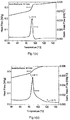
- the second DSC heating runs of PSPHEMA90/10_0.42%PGV (Ex.4) and PSPMAA97.5/2.5 (Ex.6) are shown in Figure 1(a) and 1(b) , respectively.
- T end is defined as the temperature at which the transition ends.
- the amount of water inside the synthesized beads was determined by Karl Fischer titration. For most batches listed in Table 1, 8.3 wt% water (based on the total amount of monomer) was added to the prepolymer mixture. If all added water is entrapped inside the beads, then 7.7 wt% water will be theoretically present with respect to the total weight of polymer, water and nanoclay.
- the beads were dried in such a way that water present on the surface will be removed as much as possible, but water inside the bead should be retained. All samples were therefore dried for 3.5 h in an oven at 50 °C (without vacuum). The beads were no longer sticky when being removed from the oven. However, there is always equilibrium between water inside and on the surface of the bead so that after some storage time, the beads become sticky again. This thin film of water that is present on the surface can be considered to be similar and thus comparison can be made between the different samples.
- Table 6 gives an overview of the synthesized batches and the corresponding measured water contents. After drying in the oven, the beads were sieved into 3 fractions: 400-600 ⁇ m, 600-800 ⁇ m, 800-1180 ⁇ m. For each fraction, the entrapped amount of water was determined. From Table 6, it can be seen that the amount of entrapped water is dependent on the bead size. Smaller beads have a higher surface/volume ratio so that relatively more water is evaporated during the residence time in the oven compared to large beads. As a consequence, small beads will normally contain less water after drying than large beads from the same batch. For most batches, the entrapped amount of water is smaller than the amount of water that can be theoretically present (7.7wt%).
- Comp. Ex. G was prepared in the same manner as Ex. 4 except for that no nanoclay was used and that the prepolymerization step was performed at a temperature of 85 °C instead of 88-89 °C.
- water contents in the beads according to the present invention is generally higher than in the beads according to the comparative experiments.
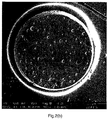
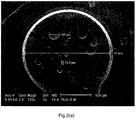
- FIG. 2(a)-(f) shows a cross section of a bead from the Comp. Ex. C (PS_0.4%PGV) batch. Large holes can be seen all over the surface of the cross-section. These holes originate from water droplets which are entrapped inside the bead. It can be seen that the holes are not randomly distributed over the surface.
- Figure 2(b) shows the cross section of a PSPMAA97.5/2.5_0.42%PGV bead (Ex.6). It can be seen that MAA in combination with PGV nanoclay results in a more random distribution of water droplets compared to the homopolymer PS_0.42%PGV (Comp. Ex.C) batch.
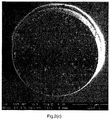
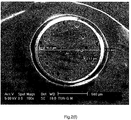
- Figure 2(c) shows the cross section of a PSPHEMA95/05_0.42%PGV batch. It can be observed that the average size of the holes is smaller compared to the size of the holes in the PSPMAA97.5/2.5_0.42%PGV (Ex.6) bead ( Figure 2(b) ). Therefore, the copmonomer HEMA decreases the hole size even more than the comonomer MAA. However, more holes are present close to the edge of the bead than in the center which may negatively influence homogeneous foaming of these beads.
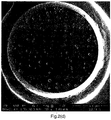
- Figure 2(d) shows the cross section of a PSPHEMA90/10_0.42%PGV (Ex.4) batch. Again, small holes are present. Compared to Figure 2(c) , the increased HEMA fraction results in an even more homogeneous distribution of holes over the surface of the cross section.
- Figure 2(e) shows the cross section of a WEPS bead prepared without the use of nanoclay.
- the monomers used for making the bead was styrene and MAA with a weight ratio of 95:5 (PSPAA95/05). It can be seen that the water droplets inside the WEPS beads are large and inhomogeneously distributed.
- Figure 2(f) shows the cross section of a WEPS bead prepared without the use of nanoclay.
- the monomers used for making the bead was styrene and HEMA with a weight ratio of 85:15 (PSPHEMA85/15). It can be seen that the number of holes on the surface is limited. Although the holes are more randomly distributed than for the PSPAA95/05 sample of Figure 2(d) , some holes are rather large and may therefore not result in homogeneous foam after expansion.
- the foaming temperature used for foaming of the WEPS beads was approximately 120-130 °C.
- Figure 3(a) shows the cross section of an expanded WEPS bead of Ex. 6 in which MAA was used as the comonomer.
- the beads have been successfully expanded. However, large cells are visible in the center of the bead, whereas smaller cells can be observed closer to the edge.
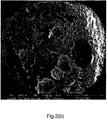
- Figure 3(b) shows the cross section of an expanded WEPS bead in which 5wt% of HEMA was used as the comonomer.
- the beads have been successfully expanded. Some large cells are visible, but the largest fraction of cells is collapsed.
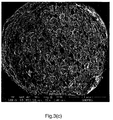
- Figure 3(c) shows the cross sectional area of a WEPS bead of Ex. 4 in which 10 wt% of HEMA was used as the comonomer.
- the beads have been successfully expanded. Small cells are present all over the surface of the cross section. Consequently, the original morphology as shown in Figure 2(d) shows that the criterion to obtain foams with a uniform cell structure is to have WEPS beads with a homogeneous distribution of small water droplets throughout the bead.
Landscapes
- Chemical & Material Sciences (AREA)
- Polymers & Plastics (AREA)
- Health & Medical Sciences (AREA)
- Chemical Kinetics & Catalysis (AREA)
- Medicinal Chemistry (AREA)
- Organic Chemistry (AREA)
- Materials Engineering (AREA)
- Engineering & Computer Science (AREA)
- Dispersion Chemistry (AREA)
- Addition Polymer Or Copolymer, Post-Treatments, Or Chemical Modifications (AREA)
- Polymerisation Methods In General (AREA)
- Manufacture Of Porous Articles, And Recovery And Treatment Of Waste Products (AREA)
- Compositions Of Macromolecular Compounds (AREA)
Priority Applications (1)
| Application Number | Priority Date | Filing Date | Title |
|---|---|---|---|
| EP12759001.6A EP2748240B1 (en) | 2011-08-26 | 2012-08-21 | Water expandable polymer beads |
Applications Claiming Priority (3)
| Application Number | Priority Date | Filing Date | Title |
|---|---|---|---|
| EP11006977 | 2011-08-26 | ||
| EP12759001.6A EP2748240B1 (en) | 2011-08-26 | 2012-08-21 | Water expandable polymer beads |
| PCT/EP2012/003537 WO2013029757A1 (en) | 2011-08-26 | 2012-08-21 | Water expandable polymer beads |
Publications (2)
| Publication Number | Publication Date |
|---|---|
| EP2748240A1 EP2748240A1 (en) | 2014-07-02 |
| EP2748240B1 true EP2748240B1 (en) | 2016-04-06 |
Family
ID=46851375
Family Applications (1)
| Application Number | Title | Priority Date | Filing Date |
|---|---|---|---|
| EP12759001.6A Not-in-force EP2748240B1 (en) | 2011-08-26 | 2012-08-21 | Water expandable polymer beads |
Country Status (9)
| Country | Link |
|---|---|
| US (1) | US20140213674A1 (enExample) |
| EP (1) | EP2748240B1 (enExample) |
| JP (1) | JP2014524498A (enExample) |
| KR (1) | KR101990585B1 (enExample) |
| CN (1) | CN103797056B (enExample) |
| AU (1) | AU2012303778B2 (enExample) |
| BR (1) | BR112014004357A2 (enExample) |
| CA (1) | CA2845139A1 (enExample) |
| WO (1) | WO2013029757A1 (enExample) |
Families Citing this family (6)
| Publication number | Priority date | Publication date | Assignee | Title |
|---|---|---|---|---|
| US9453083B2 (en) * | 2013-03-14 | 2016-09-27 | Saudi Basic Industries Corporation | Vinyl polymers prepared via suspension polymerization and methods thereof |
| WO2015181113A1 (en) | 2014-05-28 | 2015-12-03 | Sabic Global Technologies B.V. | Water expandable polymer beads |
| US9850361B2 (en) | 2014-12-02 | 2017-12-26 | Sabic Global Technologies B.V. | Water expandable polymer beads containing latex particles |
| WO2018135928A1 (ko) * | 2017-01-23 | 2018-07-26 | 주식회사 엘지화학 | 고흡수성 수지 및 이의 제조 방법 |
| KR102192638B1 (ko) * | 2017-01-23 | 2020-12-17 | 주식회사 엘지화학 | 고흡수성 수지 및 이의 제조 방법 |
| KR101860884B1 (ko) * | 2017-04-28 | 2018-05-25 | 한국생산기술연구원 | 질산은 수용액을 이용한 시트라콘산 함유 고흡수성 수지의 제조방법 및 이에 따라 제조된 항균성을 갖는 고흡수성 수지 |
Family Cites Families (10)
| Publication number | Priority date | Publication date | Assignee | Title |
|---|---|---|---|---|
| CA884652A (en) * | 1971-11-02 | W. Baugh Charles | Hydraulic drive pin rivet | |
| CA844652A (en) * | 1970-06-16 | W. Jurgeleit Hans | Expandable polymer compositions | |
| GB1409285A (en) | 1972-12-08 | 1975-10-08 | Shell Int Research | Expandable polymers of vinyl-idene aromatic compounds |
| DE3129515C2 (de) * | 1980-07-29 | 1986-07-24 | Hitachi Chemical Co., Ltd., Tokio/Tokyo | Schäumbare Styrolharzmasse und Verfahren zu ihrer Herstellung |
| US5043404A (en) * | 1989-04-21 | 1991-08-27 | Xerox Corporation | Semisuspension polymerization processes |
| CA2020778A1 (en) * | 1989-07-27 | 1991-01-28 | James W. Treleaven | Process for producing uniformly sized beads of a styrene/methacrylic acid copolymer |
| JP3168882B2 (ja) * | 1995-09-05 | 2001-05-21 | 三菱化学フォームプラスティック株式会社 | スチレン系発泡性樹脂粒子及びその製造方法 |
| MY117649A (en) * | 1996-07-04 | 2004-07-31 | Shell Int Research | Process for the preparation of polymer particles |
| US6242540B1 (en) * | 1996-07-04 | 2001-06-05 | Nova Chemicals (International) S.A. | Process for the preparation of polymer particles |
| US9187608B2 (en) * | 2005-09-08 | 2015-11-17 | Owens Corning Intellectual Capital, Llc | Polystyrene foam containing a modifier-free nanoclay and having improved fire protection performance |
-
2012
- 2012-08-21 JP JP2014526416A patent/JP2014524498A/ja not_active Ceased
- 2012-08-21 KR KR1020147007706A patent/KR101990585B1/ko not_active Expired - Fee Related
- 2012-08-21 US US14/241,024 patent/US20140213674A1/en not_active Abandoned
- 2012-08-21 BR BR112014004357A patent/BR112014004357A2/pt not_active IP Right Cessation
- 2012-08-21 AU AU2012303778A patent/AU2012303778B2/en not_active Ceased
- 2012-08-21 WO PCT/EP2012/003537 patent/WO2013029757A1/en not_active Ceased
- 2012-08-21 CA CA2845139A patent/CA2845139A1/en not_active Abandoned
- 2012-08-21 CN CN201280041319.8A patent/CN103797056B/zh not_active Expired - Fee Related
- 2012-08-21 EP EP12759001.6A patent/EP2748240B1/en not_active Not-in-force
Also Published As
| Publication number | Publication date |
|---|---|
| JP2014524498A (ja) | 2014-09-22 |
| AU2012303778A1 (en) | 2014-02-27 |
| CN103797056B (zh) | 2015-07-22 |
| EP2748240A1 (en) | 2014-07-02 |
| CA2845139A1 (en) | 2013-03-07 |
| KR20140074906A (ko) | 2014-06-18 |
| US20140213674A1 (en) | 2014-07-31 |
| WO2013029757A1 (en) | 2013-03-07 |
| AU2012303778B2 (en) | 2015-01-15 |
| CN103797056A (zh) | 2014-05-14 |
| BR112014004357A2 (pt) | 2017-03-21 |
| KR101990585B1 (ko) | 2019-06-18 |
Similar Documents
| Publication | Publication Date | Title |
|---|---|---|
| AU2012303778B2 (en) | Water expandable polymer beads | |
| RU2526549C2 (ru) | Композиция на основе вспениваемых винилароматических полимеров с улучшенной теплоизоляционной способностью, способы ее получения и вспененное изделие, полученное из этой композиции | |
| HU223596B1 (hu) | Eljárás polimerszemcsék előállítására, valamint habosítható polimerszemcsék | |
| EP2753657B1 (en) | Water expandable polymer beads | |
| CN104024327B (zh) | 用于聚合泡沫的包含苯乙烯聚合物、聚乙烯蜡和溴化乙烯基芳族/丁二烯共聚物的组合物 | |
| HU223709B1 (hu) | Eljárás polimerszemcsék előállítására, habosítható polimerszemcsék | |
| JP6364418B2 (ja) | ビニル芳香族重合体及び/又は共重合体の濃縮重合体組成物 | |
| EP3805297A1 (en) | Foamable resin composition, preparation method therefor, and molded foam product | |
| EP3149074B1 (en) | Water expandable polymer beads | |
| EP3227366B1 (en) | Water expandable polymer beads containing latex particles | |
| JP3766105B6 (ja) | ポリマー粒子製造方法 | |
| KR20230008128A (ko) | 중합성 브롬화 난연제를 포함하는 발포성 스티렌 중합체 | |
| EP3052557A1 (en) | Method of producing polystyrene particles comprising carbon particles having a conical shape |
Legal Events
| Date | Code | Title | Description |
|---|---|---|---|
| PUAI | Public reference made under article 153(3) epc to a published international application that has entered the european phase |
Free format text: ORIGINAL CODE: 0009012 |
|
| 17P | Request for examination filed |
Effective date: 20140325 |
|
| AK | Designated contracting states |
Kind code of ref document: A1 Designated state(s): AL AT BE BG CH CY CZ DE DK EE ES FI FR GB GR HR HU IE IS IT LI LT LU LV MC MK MT NL NO PL PT RO RS SE SI SK SM TR |
|
| DAX | Request for extension of the european patent (deleted) | ||
| GRAP | Despatch of communication of intention to grant a patent |
Free format text: ORIGINAL CODE: EPIDOSNIGR1 |
|
| INTG | Intention to grant announced |
Effective date: 20151127 |
|
| GRAS | Grant fee paid |
Free format text: ORIGINAL CODE: EPIDOSNIGR3 |
|
| GRAA | (expected) grant |
Free format text: ORIGINAL CODE: 0009210 |
|
| AK | Designated contracting states |
Kind code of ref document: B1 Designated state(s): AL AT BE BG CH CY CZ DE DK EE ES FI FR GB GR HR HU IE IS IT LI LT LU LV MC MK MT NL NO PL PT RO RS SE SI SK SM TR |
|
| REG | Reference to a national code |
Ref country code: GB Ref legal event code: FG4D |
|
| REG | Reference to a national code |
Ref country code: AT Ref legal event code: REF Ref document number: 787775 Country of ref document: AT Kind code of ref document: T Effective date: 20160415 Ref country code: CH Ref legal event code: EP |
|
| REG | Reference to a national code |
Ref country code: IE Ref legal event code: FG4D |
|
| REG | Reference to a national code |
Ref country code: DE Ref legal event code: R096 Ref document number: 602012016693 Country of ref document: DE |
|
| REG | Reference to a national code |
Ref country code: NL Ref legal event code: FP |
|
| REG | Reference to a national code |
Ref country code: FR Ref legal event code: PLFP Year of fee payment: 5 |
|
| REG | Reference to a national code |
Ref country code: LT Ref legal event code: MG4D |
|
| REG | Reference to a national code |
Ref country code: AT Ref legal event code: MK05 Ref document number: 787775 Country of ref document: AT Kind code of ref document: T Effective date: 20160406 |
|
| PG25 | Lapsed in a contracting state [announced via postgrant information from national office to epo] |
Ref country code: IS Free format text: LAPSE BECAUSE OF FAILURE TO SUBMIT A TRANSLATION OF THE DESCRIPTION OR TO PAY THE FEE WITHIN THE PRESCRIBED TIME-LIMIT Effective date: 20160806 Ref country code: PL Free format text: LAPSE BECAUSE OF FAILURE TO SUBMIT A TRANSLATION OF THE DESCRIPTION OR TO PAY THE FEE WITHIN THE PRESCRIBED TIME-LIMIT Effective date: 20160406 Ref country code: LT Free format text: LAPSE BECAUSE OF FAILURE TO SUBMIT A TRANSLATION OF THE DESCRIPTION OR TO PAY THE FEE WITHIN THE PRESCRIBED TIME-LIMIT Effective date: 20160406 Ref country code: NO Free format text: LAPSE BECAUSE OF FAILURE TO SUBMIT A TRANSLATION OF THE DESCRIPTION OR TO PAY THE FEE WITHIN THE PRESCRIBED TIME-LIMIT Effective date: 20160706 Ref country code: FI Free format text: LAPSE BECAUSE OF FAILURE TO SUBMIT A TRANSLATION OF THE DESCRIPTION OR TO PAY THE FEE WITHIN THE PRESCRIBED TIME-LIMIT Effective date: 20160406 |
|
| PG25 | Lapsed in a contracting state [announced via postgrant information from national office to epo] |
Ref country code: ES Free format text: LAPSE BECAUSE OF FAILURE TO SUBMIT A TRANSLATION OF THE DESCRIPTION OR TO PAY THE FEE WITHIN THE PRESCRIBED TIME-LIMIT Effective date: 20160406 Ref country code: SE Free format text: LAPSE BECAUSE OF FAILURE TO SUBMIT A TRANSLATION OF THE DESCRIPTION OR TO PAY THE FEE WITHIN THE PRESCRIBED TIME-LIMIT Effective date: 20160406 Ref country code: GR Free format text: LAPSE BECAUSE OF FAILURE TO SUBMIT A TRANSLATION OF THE DESCRIPTION OR TO PAY THE FEE WITHIN THE PRESCRIBED TIME-LIMIT Effective date: 20160707 Ref country code: LV Free format text: LAPSE BECAUSE OF FAILURE TO SUBMIT A TRANSLATION OF THE DESCRIPTION OR TO PAY THE FEE WITHIN THE PRESCRIBED TIME-LIMIT Effective date: 20160406 Ref country code: PT Free format text: LAPSE BECAUSE OF FAILURE TO SUBMIT A TRANSLATION OF THE DESCRIPTION OR TO PAY THE FEE WITHIN THE PRESCRIBED TIME-LIMIT Effective date: 20160808 Ref country code: HR Free format text: LAPSE BECAUSE OF FAILURE TO SUBMIT A TRANSLATION OF THE DESCRIPTION OR TO PAY THE FEE WITHIN THE PRESCRIBED TIME-LIMIT Effective date: 20160406 Ref country code: RS Free format text: LAPSE BECAUSE OF FAILURE TO SUBMIT A TRANSLATION OF THE DESCRIPTION OR TO PAY THE FEE WITHIN THE PRESCRIBED TIME-LIMIT Effective date: 20160406 Ref country code: AT Free format text: LAPSE BECAUSE OF FAILURE TO SUBMIT A TRANSLATION OF THE DESCRIPTION OR TO PAY THE FEE WITHIN THE PRESCRIBED TIME-LIMIT Effective date: 20160406 |
|
| PG25 | Lapsed in a contracting state [announced via postgrant information from national office to epo] |
Ref country code: BE Free format text: LAPSE BECAUSE OF FAILURE TO SUBMIT A TRANSLATION OF THE DESCRIPTION OR TO PAY THE FEE WITHIN THE PRESCRIBED TIME-LIMIT Effective date: 20160406 Ref country code: IT Free format text: LAPSE BECAUSE OF FAILURE TO SUBMIT A TRANSLATION OF THE DESCRIPTION OR TO PAY THE FEE WITHIN THE PRESCRIBED TIME-LIMIT Effective date: 20160406 |
|
| REG | Reference to a national code |
Ref country code: DE Ref legal event code: R097 Ref document number: 602012016693 Country of ref document: DE |
|
| PG25 | Lapsed in a contracting state [announced via postgrant information from national office to epo] |
Ref country code: RO Free format text: LAPSE BECAUSE OF FAILURE TO SUBMIT A TRANSLATION OF THE DESCRIPTION OR TO PAY THE FEE WITHIN THE PRESCRIBED TIME-LIMIT Effective date: 20160406 Ref country code: CZ Free format text: LAPSE BECAUSE OF FAILURE TO SUBMIT A TRANSLATION OF THE DESCRIPTION OR TO PAY THE FEE WITHIN THE PRESCRIBED TIME-LIMIT Effective date: 20160406 Ref country code: SK Free format text: LAPSE BECAUSE OF FAILURE TO SUBMIT A TRANSLATION OF THE DESCRIPTION OR TO PAY THE FEE WITHIN THE PRESCRIBED TIME-LIMIT Effective date: 20160406 Ref country code: EE Free format text: LAPSE BECAUSE OF FAILURE TO SUBMIT A TRANSLATION OF THE DESCRIPTION OR TO PAY THE FEE WITHIN THE PRESCRIBED TIME-LIMIT Effective date: 20160406 Ref country code: DK Free format text: LAPSE BECAUSE OF FAILURE TO SUBMIT A TRANSLATION OF THE DESCRIPTION OR TO PAY THE FEE WITHIN THE PRESCRIBED TIME-LIMIT Effective date: 20160406 |
|
| PLBE | No opposition filed within time limit |
Free format text: ORIGINAL CODE: 0009261 |
|
| STAA | Information on the status of an ep patent application or granted ep patent |
Free format text: STATUS: NO OPPOSITION FILED WITHIN TIME LIMIT |
|
| PG25 | Lapsed in a contracting state [announced via postgrant information from national office to epo] |
Ref country code: SM Free format text: LAPSE BECAUSE OF FAILURE TO SUBMIT A TRANSLATION OF THE DESCRIPTION OR TO PAY THE FEE WITHIN THE PRESCRIBED TIME-LIMIT Effective date: 20160406 |
|
| 26N | No opposition filed |
Effective date: 20170110 |
|
| PG25 | Lapsed in a contracting state [announced via postgrant information from national office to epo] |
Ref country code: MC Free format text: LAPSE BECAUSE OF FAILURE TO SUBMIT A TRANSLATION OF THE DESCRIPTION OR TO PAY THE FEE WITHIN THE PRESCRIBED TIME-LIMIT Effective date: 20160406 |
|
| REG | Reference to a national code |
Ref country code: CH Ref legal event code: PL |
|
| PG25 | Lapsed in a contracting state [announced via postgrant information from national office to epo] |
Ref country code: LI Free format text: LAPSE BECAUSE OF NON-PAYMENT OF DUE FEES Effective date: 20160831 Ref country code: CH Free format text: LAPSE BECAUSE OF NON-PAYMENT OF DUE FEES Effective date: 20160831 |
|
| PG25 | Lapsed in a contracting state [announced via postgrant information from national office to epo] |
Ref country code: SI Free format text: LAPSE BECAUSE OF FAILURE TO SUBMIT A TRANSLATION OF THE DESCRIPTION OR TO PAY THE FEE WITHIN THE PRESCRIBED TIME-LIMIT Effective date: 20160406 |
|
| REG | Reference to a national code |
Ref country code: IE Ref legal event code: MM4A |
|
| REG | Reference to a national code |
Ref country code: FR Ref legal event code: PLFP Year of fee payment: 6 |
|
| PG25 | Lapsed in a contracting state [announced via postgrant information from national office to epo] |
Ref country code: IE Free format text: LAPSE BECAUSE OF NON-PAYMENT OF DUE FEES Effective date: 20160821 |
|
| PG25 | Lapsed in a contracting state [announced via postgrant information from national office to epo] |
Ref country code: LU Free format text: LAPSE BECAUSE OF NON-PAYMENT OF DUE FEES Effective date: 20160821 |
|
| PG25 | Lapsed in a contracting state [announced via postgrant information from national office to epo] |
Ref country code: CY Free format text: LAPSE BECAUSE OF FAILURE TO SUBMIT A TRANSLATION OF THE DESCRIPTION OR TO PAY THE FEE WITHIN THE PRESCRIBED TIME-LIMIT Effective date: 20160406 Ref country code: HU Free format text: LAPSE BECAUSE OF FAILURE TO SUBMIT A TRANSLATION OF THE DESCRIPTION OR TO PAY THE FEE WITHIN THE PRESCRIBED TIME-LIMIT; INVALID AB INITIO Effective date: 20120821 |
|
| PG25 | Lapsed in a contracting state [announced via postgrant information from national office to epo] |
Ref country code: MK Free format text: LAPSE BECAUSE OF FAILURE TO SUBMIT A TRANSLATION OF THE DESCRIPTION OR TO PAY THE FEE WITHIN THE PRESCRIBED TIME-LIMIT Effective date: 20160406 Ref country code: MT Free format text: LAPSE BECAUSE OF NON-PAYMENT OF DUE FEES Effective date: 20160831 |
|
| REG | Reference to a national code |
Ref country code: FR Ref legal event code: PLFP Year of fee payment: 7 |
|
| PG25 | Lapsed in a contracting state [announced via postgrant information from national office to epo] |
Ref country code: BG Free format text: LAPSE BECAUSE OF FAILURE TO SUBMIT A TRANSLATION OF THE DESCRIPTION OR TO PAY THE FEE WITHIN THE PRESCRIBED TIME-LIMIT Effective date: 20160406 |
|
| PG25 | Lapsed in a contracting state [announced via postgrant information from national office to epo] |
Ref country code: AL Free format text: LAPSE BECAUSE OF FAILURE TO SUBMIT A TRANSLATION OF THE DESCRIPTION OR TO PAY THE FEE WITHIN THE PRESCRIBED TIME-LIMIT Effective date: 20160406 Ref country code: TR Free format text: LAPSE BECAUSE OF FAILURE TO SUBMIT A TRANSLATION OF THE DESCRIPTION OR TO PAY THE FEE WITHIN THE PRESCRIBED TIME-LIMIT Effective date: 20160406 |
|
| PGFP | Annual fee paid to national office [announced via postgrant information from national office to epo] |
Ref country code: NL Payment date: 20190814 Year of fee payment: 8 |
|
| PGFP | Annual fee paid to national office [announced via postgrant information from national office to epo] |
Ref country code: DE Payment date: 20190806 Year of fee payment: 8 Ref country code: FR Payment date: 20190711 Year of fee payment: 8 |
|
| PGFP | Annual fee paid to national office [announced via postgrant information from national office to epo] |
Ref country code: GB Payment date: 20190822 Year of fee payment: 8 |
|
| REG | Reference to a national code |
Ref country code: DE Ref legal event code: R119 Ref document number: 602012016693 Country of ref document: DE |
|
| REG | Reference to a national code |
Ref country code: NL Ref legal event code: MM Effective date: 20200901 |
|
| GBPC | Gb: european patent ceased through non-payment of renewal fee |
Effective date: 20200821 |
|
| PG25 | Lapsed in a contracting state [announced via postgrant information from national office to epo] |
Ref country code: DE Free format text: LAPSE BECAUSE OF NON-PAYMENT OF DUE FEES Effective date: 20210302 Ref country code: FR Free format text: LAPSE BECAUSE OF NON-PAYMENT OF DUE FEES Effective date: 20200831 |
|
| PG25 | Lapsed in a contracting state [announced via postgrant information from national office to epo] |
Ref country code: GB Free format text: LAPSE BECAUSE OF NON-PAYMENT OF DUE FEES Effective date: 20200821 |
|
| PG25 | Lapsed in a contracting state [announced via postgrant information from national office to epo] |
Ref country code: NL Free format text: LAPSE BECAUSE OF NON-PAYMENT OF DUE FEES Effective date: 20200901 |