EP2740631A1 - Abschiebewagen zum Transport von heißem Gut - Google Patents
Abschiebewagen zum Transport von heißem Gut Download PDFInfo
- Publication number
- EP2740631A1 EP2740631A1 EP13194885.3A EP13194885A EP2740631A1 EP 2740631 A1 EP2740631 A1 EP 2740631A1 EP 13194885 A EP13194885 A EP 13194885A EP 2740631 A1 EP2740631 A1 EP 2740631A1
- Authority
- EP
- European Patent Office
- Prior art keywords
- push
- trolley according
- trough
- abschiebewand
- sealing flaps
- Prior art date
- Legal status (The legal status is an assumption and is not a legal conclusion. Google has not performed a legal analysis and makes no representation as to the accuracy of the status listed.)
- Granted
Links
Images



Classifications
-
- B—PERFORMING OPERATIONS; TRANSPORTING
- B60—VEHICLES IN GENERAL
- B60P—VEHICLES ADAPTED FOR LOAD TRANSPORTATION OR TO TRANSPORT, TO CARRY, OR TO COMPRISE SPECIAL LOADS OR OBJECTS
- B60P1/00—Vehicles predominantly for transporting loads and modified to facilitate loading, consolidating the load, or unloading
- B60P1/006—Vehicles predominantly for transporting loads and modified to facilitate loading, consolidating the load, or unloading charge and discharge with pusher plates
Definitions
- the invention relates to a Abschiebewagen for the transport of hot material, in particular for the transport of asphalt, with a trough having a discharge opening and a discharge device for discharging the hot Guts on the discharge opening.
- An asphalt layer is only stable and long-lasting if it has as few cavities as possible, and this requires that it has been optimally compacted. However, this can only be achieved if the asphalt to be applied is hot enough. However, this is often not the case in practice.
- the hot asphalt In road construction, the hot asphalt is usually transported on trucks with dump troughs, the hot asphalt is entered by tilting the trough directly into the tarmac machine. This results in the problem that the hot asphalt usually already cools very strongly during transport from the asphalt plant to the asphalt animal machine, so that optimum compaction is no longer possible. In addition, cold nests are formed in the vehicle, hindering the uniform discharge of the asphalt into the asphalt machine and result in an uneven slippage of the estate. On the cooled side walls and on the ground often very much asphalt sticks, which usually has to be scraped by hand very time consuming. Another difficulty arises with the use of large tippers when it is to be paved under overhead lines, trees, bridges or in road tunnels.
- the trough in the bottom area has a conveyor belt.
- the integration of the conveyor belt at the bottom of the trough is associated with a great deal of effort, especially with regard to the wear caused by the hot asphalt.
- spraying the truck bed with a lubricant required is therefore very limited.
- the invention is therefore based on the object to provide a vehicle that is suitable for the transport of hot material, especially hot asphalt and allows a uniform discharge, especially in an asphalt machine.
- the Abschiebewagen according to the invention for the transport of hot material in particular for the transport of asphalt has a trough with a discharge opening and a discharge device for discharging the hot Guts on the discharge, wherein the trough is formed isolated and the discharge means provided in the trough and in the direction the discharge opening slidable Abschiebewand comprises.
- Isolation of the trough prevents premature cooling of the hot asphalt before the tarmac enters the tarmac machine, thus preventing the discharge of cold asphalt nests into the tarmac machine and resulting poor asphalt pavement.
- the Abschiebewand moreover, a uniform discharge of the hot material is ensured.
- the mixture is mixed again during the unloading by the "sliced" slipping, whereby the segregation of the transported hot material is substantially reduced. Uniformly hot and homogeneous mix is the basic requirement for a permanent asphalt surface.
- the Abschiebewagen invention can also be used wherever the height is not available for a tilting operation.
- the trough is preferably delimited by a trough bottom, two side walls, a rear wall arranged in the region of the discharge opening, preferably pivotable, and the push-off wall.
- at least the side walls, but preferably also the bottom, are formed insulated.
- the discharge device is preferably formed in two stages, wherein a first stage is formed by a sliding floor, which is displaceable together with the Abschiebewand in the direction of the discharge opening and the second stage is formed by the Abschiebewand which is displaceable relative to the sliding floor.
- a first stage is formed by a sliding floor, which is displaceable together with the Abschiebewand in the direction of the discharge opening
- the second stage is formed by the Abschiebewand which is displaceable relative to the sliding floor.
- the sliding floor and / or the Abschiebewand can be formed isolated.
- the Abschiebewand be provided with prestressed sealing flaps, which cover the two gaps between the Abschiebewand and the side walls.
- the push-off wall can also be provided with sealing flaps which cover the gap between the push-off wall and the sliding floor.
- the sliding floor at one of the discharge opening facing the front edge may have sealing flaps, which cover the gap between the front edge of the sliding floor and the trough bottom.
- each gap may be covered with a plurality of sealing flaps arranged side by side, wherein each sealing flap is biased with an associated spring element in a sealing position.
- the spring-loaded sealing flaps prevent sticky material (asphalt or similar) from sticking to the side wall or trough bottom and make manual cleaning by hand, which is otherwise very time-consuming, superfluous.
- sealing flaps are formed insulated.
- the sealing flaps are formed with a cavity for heat insulation.
- the sealing flaps can, for example, in sandwich construction be formed, wherein a middle layer is formed by an insulation or an insulating cavity. The insulation or the cavity formed as insulation of the heat loss of the goods is reduced accordingly. A sticking of the goods by excessive cooling can be avoided.
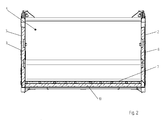
- a trough 1 is shown, which may be mounted on a conventional, unspecified darg Homelanden truck. It is limited by two side walls 2, 3, a arranged in the region of a discharge opening 4, preferably pivotally formed rear wall 5, a Abschiebewand 6 and a trough bottom 7. As can be seen from the sectional view according to Fig. 2 reveals the side walls 2, 3 are provided with insulation 8, 9. Also, the trough bottom 7 has an insulation 10.
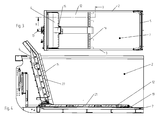
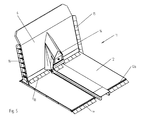
- the Abschiebewand 6 is part of a discharge 11, which in the FIGS. 1 . 3 . 4 and 5 is shown in more detail. It consists essentially of the Abschiebewand 6 and a sliding floor 12, wherein the sliding floor 12 together with the Abschiebewand 6 of the in the Fig. 3 Asked position can be moved in the direction of the rear wall 5 via a first drive 13. Furthermore, the push-off wall 6 is displaceable relative to the sliding floor 12 via a second drive 14.
- the two drives 13, 14 can each be formed in a suitable manner, wherein, for example, hydraulic cylinders, a running nut cooperating with a threaded spindle, or a roller chain driven by a sprocket can be used.
- the discharge device 11 shown is thus formed in two stages, wherein for discharging the tray 1 loaded with a hot material, first the rear wall 5 is pivoted to release the discharge opening 4. Then we the sliding floor 12 together with the Abschiebewand 6 of the in Fig. 3 shown shifted position in the direction of the discharge opening 4. In this way, about half of the loaded goods can be discharged. The rest is then effected by a displacement of the push-off wall 6 relative to the stationary sliding floor 12. In this way, the push-off wall 6 will be moved over the entire length of the trough in two stages.
- each sealing flap 15 or 16 is provided with an associated spring element 17, wherein the sealing flaps 15, 16 are biased by the spring element 17 in the sealing position.
- sealing flaps 18 are also provided at the lower end of the sliding wall 6 in order to cover the gap between the push-off wall 6 and the sliding floor 12 ( Fig. 5 ).
- sealing flaps 19 are arranged in the region of the front edge 12a of the sliding floor 12 in order to cover the gap between the front edge 12a of the sliding floor 12 and the trough bottom 7.
- the sealing flaps 18, 19 are each pivotally hinged to the Abschiebewand 6 and the sliding floor 12 and biased with a corresponding spring element 20 in its sealing position.
- the 8 and 9 show an embodiment with insulated sealing flaps 19 ', which are pivotally arranged here in the region of the front edge 12a of the sliding floor.
- the sealing flaps 19 ' are formed in sandwich construction with a cavity 19'a for heat insulation. Through the cavity, the heat loss of the material lying on the sealing flaps is reduced accordingly, so that sticking of the goods is avoided by excessive cooling.
- the sealing flaps 19 ' can be pivotally hinged to the push-off wall 6 of the sliding floor 12 and optionally biased with a corresponding spring element 20' in its sealing position. In this way, a 100% investment on the ground or the side wall can be ensured.
Landscapes
- Engineering & Computer Science (AREA)
- Transportation (AREA)
- Mechanical Engineering (AREA)
- Road Paving Machines (AREA)
- Specific Sealing Or Ventilating Devices For Doors And Windows (AREA)
Abstract
Description
- Die Erfindung betrifft einen Abschiebewagen zum Transport von heißem Gut, insbesondere zum Transport von Asphalt, mit einer Mulde, die eine Entladeöffnung aufweist sowie einer Austragseinrichtung zum Austrag des heißen Guts über die Entladeöffnung.
- Eine Asphaltschicht ist nur dann stabil und langlebig, wenn sie möglichst wenige Hohlräume hat und dies setzt voraus, dass sie optimal verdichtet wurde. Dies lässt sich aber nur dann erreichen, wenn der aufzubringende Asphalt heiß genug ist. Dies ist in der Praxis aber oftmals nicht der Fall.
- Beim Straßenbau wird der heiße Asphalt üblicherweise auf Lastwägen mit Kippmulden transportiert, wobei der heiße Asphalt durch Kippen der Mulde direkt in die Asphalttiermaschine eingetragen wird. Dabei ergibt sich die Problematik, dass der heiße Asphalt während des Transports vom Asphaltwerk zur Asphalttiermaschine meist bereits sehr stark abkühlt, sodass eine optimale Verdichtung nicht mehr möglich ist. Außerdem bilden sich im Fahrzeug kalte Nester, die ein gleichmäßiges Austragen des Asphalts in die Asphalttiermaschinen behindern und ein ungleichmäßiges Rutschen des Guts zur Folge haben. An den abgekühlten Seitenwänden und am Boden bleibt oftmals sehr viel Asphalt kleben, welcher meist sehr zeitaufwändig von Hand abgekratzt werden muss. Eine weitere Schwierigkeit ergibt sich bei der Verwendung von großen Kippern, wenn unter Oberleitungen, Bäumen, Brücken oder in Straßentunneln asphaltiert werden soll.
- In der
DE-A-2 040 885 wird ein Transportfahrzeug zur Zuführung von Asphalt zu einer Asphalttiermaschine beschrieben, dessen Mulde im Bodenbereich ein Förderband aufweist. Auf diese Weise kann das Anheben bzw. Kippen der Ladefläche vermieden werden. Die Integration des Förderbands am Boden der Mulde ist jedoch gerade hinsichtlich des Verschleißes durch den heißen Asphalt mit einem großen Aufwand verbunden. Außerdem ist vor dem Beladen mit heißem Asphalt ein Besprühen der Ladefläche mit einem Schmiermittel erforderlich. Der Einsatzbereich dieses Systems ist daher sehr eingeschränkt. - Der Erfindung liegt daher die Aufgabe zugrunde, ein Fahrzeug anzugeben, dass für den Transport von heißem Gut, insbesondere von heißem Asphalt geeignet ist und einen gleichmäßigen Austrag, insbesondere in einer Asphalttiermaschine ermöglicht.
- Erfindungsgemäß wird diese Aufgabe durch die Merkmale des Anspruches 1 gelöst.
- Der erfindungsgemäße Abschiebewagen zum Transport von heißem Gut, insbesondere zum Transport von Asphalt weist eine Mulde mit einer Entladeöffnung sowie eine Austragseinrichtung zum Austragen des heißen Guts über die Entladeöffnung auf, wobei die Mulde isoliert ausgebildet ist und die Austragseinrichtung eine in der Mulde vorgesehene und in Richtung der Entladeöffnung verschiebbare Abschiebewand umfasst.
- Durch die Isolierung der Mulde wird ein frühzeitiges Abkühlen des heißen Asphalts, bevor der Asphalt in die Asphalttiermaschine gelangt, vermieden, sodass der Austrag von kalten Asphaltnestern in die Asphalttiermaschine und eine daraus resultierende mangelhafte Asphaltdecke, verhindert werden. Durch die Abschiebewand wird darüber hinaus ein gleichmäßiger Austrag des heißen Gutes gewährleistet. Zudem wird durch das "scheibchenweise" Abrutschen das Mischgut während des Abladens nochmals durchmischt, wodurch die Entmischung des zu transportierenden heißen Gutes wesentlich reduziert wird. Gleichmäßig heißes und homogenes Mischgut ist die Grundvoraussetzung für eine dauerhafte Asphaltdecke. Mit der erfindungsgemäßen Austragseinrichtung ist somit ein Kippen der Mulde zum Austrag des Gutes nicht erforderlich, sodass auch der durch ein Kippen bedingte ungleichmäßige Austrag vermieden wird. Darüber hinaus kann der erfindungsgemäße Abschiebewagen auch überall dort eingesetzt werden, wo die Höhe für einen Kippvorgang nicht zur Verfügung steht.
- Weitere Ausgestaltungen der Erfindung sind Gegenstand der Unteransprüche.
- Die Mulde wird vorzugsweise durch einen Muldenboden, zwei Seitenwände, eine im Bereich der Entladeöffnung angeordnete, vorzugsweise verschwenkbar ausgebildete Rückwand und die Abschiebewand begrenzt. Dabei können zumindest die Seitenwände, vorzugsweise aber auch der Boden, isoliert ausgebildet werden.
- Die Austrageinrichtung ist vorzugsweise 2-stufig ausgebildet, wobei eine erste Stufe durch einen Schiebeboden gebildet wird, der zusammen mit der Abschiebewand in Richtung der Entladeöffnung verschiebbar ist und die zweite Stufe durch die Abschiebewand gebildet wird, die relativ zum Schiebeboden verschiebbar ist. Auf diese Weise kann der Kraftaufwand für den Entladevorgang deutlich reduziert werden, weil der Reibwiderstand zwischen dem heißen Gut und dem Muldenboden um die anteilige Fläche des Schiebebodens reduziert wird.
- Gemäß einer weiteren Ausgestaltung kann dann auch der Schiebeboden und/oder die Abschiebewand isoliert ausgebildet werden.
- Weiterhin kann die Abschiebewand mit vorgespannten Dichtklappen versehen sein, welche die beiden Spalte zwischen Abschiebewand und den Seitenwänden abdecken. In entsprechender Weise kann die Abschiebewand auch mit Dichtklappen versehen sein, die den Spalt zwischen Abschiebewand und dem Schiebeboden abdecken. Weiterhin kann auch der Schiebeboden an einer der Entladeöffnung zugewandten Vorderkante Dichtklappen aufweisen, die den Spalt zwischen der Vorderkante des Schiebebodens und dem Muldenboden abdecken. Dabei kann jeder Spalt mit einer Vielzahl von nebeneinander angeordneten Dichtklappen abgedeckt sein, wobei jede Dichtklappe mit einem zugeordneten Federelement in eine Dichtstellung vorgespannt wird. Durch die federvorgespannten Dichtklappen wird verhindert, dass sich klebriges Material (Asphalt o.ä.) an der Seitenwand oder Muldenboden anklebt und macht ein sonst sehr zeitaufwändiges manuelles Reinigen von Hand überflüssig.
- Gemäß einer weiteren Ausgestaltung der Erfindung sind zumindest einzelne, vorzugsweise alle Dichtklappen isoliert ausgebildet. Dies kann dadurch realisiert werden, dass die Dichtklappen mit einem Hohlraum zur Wärmeisolation ausgebildet sind. Die Dichtklappen können dabei beispielsweise in Sandwichbauweise ausgebildet sein, wobei eine mittlere Lage durch eine Isolierung oder einen isolierenden Hohlraum gebildet wird. Durch die Isolierung bzw. den als Isolierung ausgebildeten Hohlraum wird der Wärmeverlust des Gutes entsprechend reduziert. Ein Ankleben des Gutes durch zu starkes Abkühlen kann dadurch vermieden werden.
- Weitere Vorteile und Ausgestaltungen der Erfindung werden im Folgenden anhand der Beschreibung und der Zeichnung näher erläutert.
- In der Zeichnung zeigen
- Fig. 1
- eine dreidimensionale Darstellung der Mulde mit Austragseinrichtung,
- Fig. 2
- eine Querschnittdarstellung der Mulde gemäß
Fig. 1 , - Fig. 3
- eine Draufsicht der Mulde gemäß
Fig. 1 , - Fig. 4
- eine Längsschnittdarstellung im Bereich der Austragseinrichtung,
- Fig. 5
- eine dreidimensionale Darstellung der Austragseinrichtung,
- Fig. 6
- eine Detailansicht der Dichtklappen zwischen Abschiebewand und Seitenwand,
- Fig. 7
- eine Detailansicht der Dichtklappen zwischen Schiebeboden und Muldenboden,
- Fig. 8
- eine Schnittdarstellung einer isolierten Dichtklappe und
- Fig. 9
- eine dreidimensionale Darstellung der isolierten Dichtklappe gemäß
Fig.8 . - In den
Figuren 1 bis 3 ist eine Mulde 1 gezeigt, die auf einem herkömmlichen, nicht näher dargstellten Lastwagen montiert sein kann. Sie wird durch zwei Seitenwände 2, 3, eine im Bereich einer Entladeöffnung 4 angeordnete, vorzugsweise verschwenkbar ausgebildete Rückwand 5, eine Abschiebewand 6 und einen Muldenboden 7 begrenzt. Wie sich aus der Schnittdarstellung gemäßFig. 2 ergibt, sind die Seitenwände 2, 3 mit Isolierungen 8, 9 versehen. Auch der Muldenboden 7 weist eine Isolierung 10 auf. - Die Abschiebewand 6 ist Teil einer Austragseinrichtung 11, die in den
Figuren 1 ,3 ,4 und5 näher dargestellt ist. Sie besteht im Wesentlichen aus der Abschiebewand 6 und einem Schiebeboden 12, wobei der Schiebeboden 12 zusammen mit der Abschiebewand 6 von der in derFig. 3 gestellten Stellung in Richtung der Rückwand 5 über einen ersten Antrieb 13 verschoben werden kann. Des Weiteren ist die Abschiebewand 6 relativ zum Schiebeboden 12 über einen zweiten Antrieb 14 verschiebbar. Die beiden Antrieb 13, 14 können jeder in geeigneter Art und Weise ausgebildet werden, wobei beispielsweise Hydraulikzylinder, eine mit einer Gewindespindel zusammenwirkende Laufmutter oder eine über ein Kettenrad angetriebene Rollkette zum Einsatz kommen können. Die dargestellte Austragseinrichtung 11 ist somit 2-stufig ausgebildet, wobei zur Entladung der mit einer heißen Gut beladenden Mulde 1 zunächst die Rückwand 5 verschwenkt wird, um die Entladeöffnung 4 freizugeben. Alsdann wir der Schiebeboden 12 zusammen mit der Abschiebewand 6 von der inFig. 3 gezeigten Stellung in Richtung der Entladeöffnung 4 verschoben. Auf diese Weise kann etwa die Hälfte des geladenen Gutes ausgetragen werden. Der Rest erfolgt dann durch eine Verschiebung der Abschiebewand 6 relativ zum stillstehenden Schiebeboden 12. Auf diese Weise wird die Abschiebewand 6 über die gesamte Länge der Mulde in zwei Stufen verschoben werden. - Der zwischen Abschiebewand 6 und den Seitenwänden 2, 3 vorhandene schmale Spalt wird durch Dichtklappen 15, 16 abgedeckt, wobei auf jede Seite eine Vielzahl von unmittelbar nebeneinander angeordneten Dichtklappen 15 bzw. 16 vorgesehen ist. Aus der Detailansicht gemäß
Fig. 6 ist ersichtlich, dass jede Dichtklappe 15 bzw. 16 mit einem zugeordneten Federelement 17 versehen ist, wobei die Dichtklappen 15, 16 durch das Federelement 17 in die Dichtstellung vorgespannt sind. Nachdem die Dichtklappen 15, 16 schwenkbeweglich an der Abschiebewand befestigt sind, werden die Dichtklappen durch das Federelement 17 gegen die jeweils zugeordnete Seitenwand 2, 3 gedrückt und schaben dabei beim Entladevorgang an den Seitenwänden entlang und verhindern dadurch, dass etwaiges Gut in den Spalt zwischen Abschiebewand 6 und der jeweiligen Seitenwand 2, 3 gelangt. - In entsprechender Weise sind auch federvorgespannte Dichtklappen 18 am unteren Ende der Schiebewand 6 vorgesehen, um den Spalt zwischen Abschiebewand 6 und Schiebeboden 12 abzudecken (
Fig. 5 ). Schließlich sind noch Dichtklappen 19 im Bereich der Vorderkante 12a des Schiebebodens 12 angeordnet, um den Spalt zwischen der Vorderkante 12a des Schiebebodens 12 und dem Muldenboden 7 abzudecken. Auch die Dichtklappen 18, 19 sind jeweils schwenkbeweglich an der Abschiebewand 6 bzw. dem Schiebeboden 12 angelenkt und mit einem entsprechenden Federelement 20 in ihre Dichtstellung vorgespannt. - Aus
Fig. 4 wird ferner ersichtlich, dass auch der Schiebeboden 12 und die Abschiebewand 6 jeweils mit einer Isolierung 21 bzw. 22 versehen sind. - Durch die Isolierungen wird das heiße Gut auf dem Weg zur Entladestelle nur geringfügig abgekühlt. Gerade in den Randbereichen bilden sich keine kalten Nester, die im Falle von Asphalt eine verminderte Qualität der Asphaltdecke hervorrufen. Im Gegensatz zum Abkippen ist der Austrag mit der Austragseinrichtung 11 wesentlich gleichmäßiger, sodass eine sehr gleichmäßige und kontinuierliche Beladung einer Asphalttiermaschine möglich ist.
- Die
Fig. 8 und 9 zeigen ein Ausführungsbeispiel mit isoliert ausgebildeten Dichtklappen 19', die hier im Bereich Vorderkante 12a des Schiebebodens schwenkbeweglich angeordnet sind. Die Dichtklappen 19' sind in Sandwichbauweise mit einem Hohlraum 19'a zur Wärmeisolation ausgebildet. Durch den Hohlraum wird der Wärmeverlust des auf den Dichtklappen liegenden Gutes entsprechend reduziert, sodass ein Ankleben des Gutes durch zu starkes Abkühlen vermieden wird. Auch die Dichtklappen 19' können schwenkbeweglich an der Abschiebewand 6 dem Schiebeboden 12 angelenkt sein und optional mit einem entsprechenden Federelement 20' in ihre Dichtstellung vorgespannt. Auf diese Weise kann ein 100%ige Anlage am Boden oder der Seitenwand sichergestellt werden.
Claims (14)
- Abschiebewagen zum Transport von heißem Gut, insbesondere zum Transport von Asphalt, mit einer Mulde (1), die eine Entladeöffnung (4) aufweist, sowie einer Austragseinrichtung (11) zum Austrag des heißen Guts über die Entladeöffnung,
dadurch gekennzeichnet, dass die Mulde (1) isoliert ausgebildet ist und die Austragseinrichtung (11) eine in der Mulde (1) vorgesehene und in Richtung der Entladeöffnung (4) verschiebbare Abschiebewand (6) umfasst. - Abschiebewagen nach Anspruch 1, dadurch gekennzeichnet, dass die Mulde (1) durch einen Muldenboden (7), zwei Seitenwände (2, 3), eine im Bereich der Entladeöffnung (4) angeordnete, vorzugsweise verschwenkbar ausgebildete Rückwand (5) und die Abschiebewand (6) begrenzt wird.
- Abschiebewagen nach Anspruch 2, dadurch gekennzeichnet, dass zumindest die Seitenwände (2, 3) isoliert ausgebildet sind.
- Abschiebewagen nach Anspruch 3, dadurch gekennzeichnet, dass der Muldenoden (7) isoliert ausgebildet ist.
- Abschiebewagen nach einem oder mehreren der vorhergehenden Ansprüche, dadurch gekennzeichnet, dass die Austragseinrichtung (11) 2-stufig ausgebildet ist, wobei eine 1. Stufe durch einen Schiebeboden (12) gebildet wird, der zusammen mit der Abschiebewand (6) in Richtung der Entladeöffnung (4) verschiebbar ist und die 2. Stufe durch die Abschiebewand (6) gebildet wird, die relativ zum Schiebeboden (12) verschiebbar ist.
- Abschiebewagen nach Anspruch 5, dadurch gekennzeichnet, dass der Schiebeboden und/oder die Abschiebewand (6) isoliert ausgebildet ist.
- Abschiebewagen nach Anspruch 2, dadurch gekennzeichnet, dass die Abschiebewand (6) mit federvorgespannten Dichtklappen (15, 16) versehen ist, welche die beiden Spalte zwischen Abschiebewand (6) und den beiden Seitenwänden (2, 3) abdecken.
- Abschiebewagen nach Anspruch 5, dadurch gekennzeichnet, dass die Abschiebewand mit federvorgespannten Dichtklappen (18) versehen ist, die den Spalt zwischen Abschiebewand (6) und dem Schiebeboden (12) abdecken.
- Abschiebewagen nach Anspruch 5, dadurch gekennzeichnet, dass der Schiebeboden (12) an einer der Entladeöffnung (4) zugewandten Vorderkante (12a) mit federvorgespannten Dichtklappen versehen ist, die den Spalt zwischen der Vorderkante (12a) des Schiebebodens (12) und dem Muldenboden abdecken.
- Abschiebewagen nach einem oder mehreren der Ansprüche 7 bis 9, dadurch gekennzeichnet, dass jeder Spalt mit einer Vielzahl von nebeneinander angeordneten Dichtklappen (15, 16, 18, 19) abgedeckt ist.
- Abschiebewagen nach einem oder mehreren der Ansprüche 7 bis 10, dadurch gekennzeichnet, dass jede Dichtklappe (15, 16, 18, 19) mit einem zugeordneten Federelement (17, 20) in einer Dichtstellung vorgespannt ist.
- Abschiebewagen nach einem oder mehreren der Ansprüche 7 bis 11, dadurch gekennzeichnet, dass zumindest einzelne Dichtklappen isoliert ausgebildet sind.
- Abschiebewagen nach einem oder mehreren der Ansprüche 7 bis 11, dadurch gekennzeichnet, dass zumindest einzelne Dichtklappen mit einem Hohlraum zur Wärmeisolation ausgebildet sind.
- Abschiebewagen nach einem oder mehreren der Ansprüche 7 bis 11, dadurch gekennzeichnet, dass zumindest einzelne Dichtklappen in Sandwichbauweise ausgebildet sind, wobei eine mittlere Lage durch eine Isolierung oder einen isolierenden Hohlraum gebildet wird.
Applications Claiming Priority (1)
| Application Number | Priority Date | Filing Date | Title |
|---|---|---|---|
| DE201220104724 DE202012104724U1 (de) | 2012-12-05 | 2012-12-05 | Abschiebewagen zum Transport von heißem Gut |
Publications (2)
| Publication Number | Publication Date |
|---|---|
| EP2740631A1 true EP2740631A1 (de) | 2014-06-11 |
| EP2740631B1 EP2740631B1 (de) | 2016-03-09 |
Family
ID=47751775
Family Applications (1)
| Application Number | Title | Priority Date | Filing Date |
|---|---|---|---|
| EP13194885.3A Active EP2740631B1 (de) | 2012-12-05 | 2013-11-28 | Abschiebewagen zum Transport von heißem Gut |
Country Status (4)
| Country | Link |
|---|---|
| EP (1) | EP2740631B1 (de) |
| DE (1) | DE202012104724U1 (de) |
| DK (1) | DK2740631T3 (de) |
| PL (1) | PL2740631T3 (de) |
Cited By (4)
| Publication number | Priority date | Publication date | Assignee | Title |
|---|---|---|---|---|
| RU170371U1 (ru) * | 2016-09-21 | 2017-04-24 | Дмитрий Владимирович Петренко | Устройство для горизонтальной выгрузки или загрузки грузов с помощью гидравлического передвижного борта |
| WO2018009965A1 (en) * | 2016-07-14 | 2018-01-18 | Superior Pak Holdings Pty Ltd | Ejection blade for a compaction chamber of a waste collection vehicle |
| RU184503U1 (ru) * | 2018-04-19 | 2018-10-29 | Дмитрий Владимирович Петренко | Устройство для горизонтальной выгрузки или загрузки грузов с помощью одного гидроцилиндра и передвижного борта |
| WO2023156942A1 (en) * | 2022-02-18 | 2023-08-24 | K-Tec Earthmovers Inc. | Ejector blade and mounting assembly |
Families Citing this family (7)
| Publication number | Priority date | Publication date | Assignee | Title |
|---|---|---|---|---|
| DE202013102388U1 (de) * | 2013-06-04 | 2013-06-12 | Josef Fliegl jun. | Überladefahrzeug |
| DE102014103931B4 (de) | 2014-03-21 | 2020-06-04 | Kögel Trailer GmbH | Mulde für ein Nutzfahrzeug und Nutzfahrzeug |
| DE202014101421U1 (de) * | 2014-03-26 | 2014-04-09 | Josef Fliegl jun. | Fahrzeug zum Transport von Flüssigkeiten und/oder Feststoffen |
| DE102018002945B4 (de) | 2018-04-11 | 2020-06-18 | Nadler Straßentechnik GmbH | Behälter mit Stetigförderer zum schichtweisen Austrag von Schüttgut |
| DE102018122542B4 (de) * | 2018-09-14 | 2021-03-25 | Fahrzeugbau Kempf GmbH & Co. KG | Thermisch isolierte Kippbrücke |
| DE102018122839B4 (de) * | 2018-09-18 | 2020-11-12 | Krampe Fahrzeugbau GmbH | Fahrzeug |
| DE102024001092A1 (de) * | 2024-04-05 | 2025-10-09 | Linnhoff & Henne GmbH & Co. KG | Mobiles, an ein Fahrzeug kuppelbares Ausbringgerät mit beheizbarer Fördereinrichtung und Betriebsverfahren hierzu |
Citations (10)
| Publication number | Priority date | Publication date | Assignee | Title |
|---|---|---|---|---|
| NL20641C (de) * | ||||
| US3212657A (en) * | 1962-11-09 | 1965-10-19 | Murfitt Bulk Transporters Ltd | Bulk transporting vehicles |
| US3273728A (en) * | 1966-09-20 | Kelso rear unloading box | ||
| DE2040885A1 (de) | 1969-08-22 | 1971-03-11 | Arkansas Rock And Gravel Corp | Materialzufuehreinrichtung,insbesondere Transportfahrzeug zur Zufuehrung von Asphalt zu einer Asphaltiermaschine |
| US3887153A (en) * | 1973-11-05 | 1975-06-03 | Reilly Daniel W O | Attachments for unloading devices |
| DE20117346U1 (de) * | 2001-08-25 | 2002-03-28 | Annaburger Nutzfahrzeug GmbH, 06925 Annaburg | Ladewagen mit Entladungseinrichtung |
| EP1221398A1 (de) * | 2001-01-08 | 2002-07-10 | Cleri Industrie SARL | Schubschild zum Entladen eines Transportfahrzeugs mit horizontalem Behälter |
| DE202004015512U1 (de) * | 2004-10-05 | 2004-12-02 | Fliegl, Josef | Fahrzeug |
| FR2862294A1 (fr) * | 2003-11-17 | 2005-05-20 | Philippe Legrand | Dispositif de dechargement par un bloc poussant du contenu d'une benne agricole |
| FR2954243A1 (fr) * | 2009-12-23 | 2011-06-24 | Rosso Gerard Marc Constant De | Bouclier d'ejection pour benne a dechargement horizontal a verin de poussee reglable en hauteur. |
-
2012
- 2012-12-05 DE DE201220104724 patent/DE202012104724U1/de not_active Expired - Lifetime
-
2013
- 2013-11-28 PL PL13194885.3T patent/PL2740631T3/pl unknown
- 2013-11-28 DK DK13194885.3T patent/DK2740631T3/en active
- 2013-11-28 EP EP13194885.3A patent/EP2740631B1/de active Active
Patent Citations (10)
| Publication number | Priority date | Publication date | Assignee | Title |
|---|---|---|---|---|
| NL20641C (de) * | ||||
| US3273728A (en) * | 1966-09-20 | Kelso rear unloading box | ||
| US3212657A (en) * | 1962-11-09 | 1965-10-19 | Murfitt Bulk Transporters Ltd | Bulk transporting vehicles |
| DE2040885A1 (de) | 1969-08-22 | 1971-03-11 | Arkansas Rock And Gravel Corp | Materialzufuehreinrichtung,insbesondere Transportfahrzeug zur Zufuehrung von Asphalt zu einer Asphaltiermaschine |
| US3887153A (en) * | 1973-11-05 | 1975-06-03 | Reilly Daniel W O | Attachments for unloading devices |
| EP1221398A1 (de) * | 2001-01-08 | 2002-07-10 | Cleri Industrie SARL | Schubschild zum Entladen eines Transportfahrzeugs mit horizontalem Behälter |
| DE20117346U1 (de) * | 2001-08-25 | 2002-03-28 | Annaburger Nutzfahrzeug GmbH, 06925 Annaburg | Ladewagen mit Entladungseinrichtung |
| FR2862294A1 (fr) * | 2003-11-17 | 2005-05-20 | Philippe Legrand | Dispositif de dechargement par un bloc poussant du contenu d'une benne agricole |
| DE202004015512U1 (de) * | 2004-10-05 | 2004-12-02 | Fliegl, Josef | Fahrzeug |
| FR2954243A1 (fr) * | 2009-12-23 | 2011-06-24 | Rosso Gerard Marc Constant De | Bouclier d'ejection pour benne a dechargement horizontal a verin de poussee reglable en hauteur. |
Cited By (6)
| Publication number | Priority date | Publication date | Assignee | Title |
|---|---|---|---|---|
| WO2018009965A1 (en) * | 2016-07-14 | 2018-01-18 | Superior Pak Holdings Pty Ltd | Ejection blade for a compaction chamber of a waste collection vehicle |
| US10781042B2 (en) | 2016-07-14 | 2020-09-22 | Superior Pak Holdings Pty Ltd | Ejection blade for a compaction chamber of a waste collection vehicle |
| AU2023203131B2 (en) * | 2016-07-14 | 2025-05-08 | Superior Pak Holdings Pty Ltd | Ejection blade for a compaction chamber of a waste collection vehicle |
| RU170371U1 (ru) * | 2016-09-21 | 2017-04-24 | Дмитрий Владимирович Петренко | Устройство для горизонтальной выгрузки или загрузки грузов с помощью гидравлического передвижного борта |
| RU184503U1 (ru) * | 2018-04-19 | 2018-10-29 | Дмитрий Владимирович Петренко | Устройство для горизонтальной выгрузки или загрузки грузов с помощью одного гидроцилиндра и передвижного борта |
| WO2023156942A1 (en) * | 2022-02-18 | 2023-08-24 | K-Tec Earthmovers Inc. | Ejector blade and mounting assembly |
Also Published As
| Publication number | Publication date |
|---|---|
| PL2740631T3 (pl) | 2016-09-30 |
| DK2740631T3 (en) | 2016-06-20 |
| EP2740631B1 (de) | 2016-03-09 |
| DE202012104724U1 (de) | 2013-01-28 |
Similar Documents
| Publication | Publication Date | Title |
|---|---|---|
| EP2740631B1 (de) | Abschiebewagen zum Transport von heißem Gut | |
| DE69917096T2 (de) | Verlegeverfahren und -Vorrichtung | |
| EP3078256B1 (de) | Landwirtschaftlicher erntewagen mit dosiergerät und breitverteilung | |
| DE2040885A1 (de) | Materialzufuehreinrichtung,insbesondere Transportfahrzeug zur Zufuehrung von Asphalt zu einer Asphaltiermaschine | |
| DE102020100986A1 (de) | Beschicker, Förderer und Mischeinheit für einen Beschicker sowie Verfahren zum Mischen von Straßenbaumaterial | |
| DE2856635A1 (de) | Maschine zum beschichten von abgefraesten oder abgeschaelten strassendecken | |
| DE102018002945B4 (de) | Behälter mit Stetigförderer zum schichtweisen Austrag von Schüttgut | |
| DE69903184T2 (de) | Vorrichtung und förderband zur herstellung von granulaten | |
| AT391460B (de) | Beschickungseinrichtung | |
| DE102016006530B4 (de) | Straßenbaumaschine vom Typ Straßenfertiger oder Beschicker | |
| DE69102046T2 (de) | Strassenfahrzeug zum Verteilen von Materialien bei der Wiederherstellung von Strassen, mit integrierten Walzen. | |
| DE2628325A1 (de) | Vorrichtung zum beschicken eines fertigers fuer bituminoese belaege | |
| DE102014014384A1 (de) | Straßenfertiger und Verfahren zur Herstellung eines Straßenbelags | |
| DE69307550T2 (de) | Vorrichtung für vorübergehende lagerung von schüttgütern | |
| DE102004027454B4 (de) | Materialspeicher zur Annahme und Abgabe von Schüttgütern | |
| DE102018005312A1 (de) | Beschicker und Fördergurtabstreifer für einen Beschicker und Verfahren zum Abstreifen eines Fördergurtes eines Beschickers | |
| DE20201638U1 (de) | Überladewagen für körniges Erntegut | |
| EP3825178A1 (de) | Lademulde für lastkraftwagen, auflieger und/oder anhänger sowie lastkraftwagen, auflieger und/oder anhänger mit einer derartigen lademulde | |
| AT8455U1 (de) | Vorrichtung und verfahren zur herstellung und zum ausbringen von flüssigem, bituminösen kaltmischgut | |
| DE8910379U1 (de) | Straßentransportfahrzeug für heißes bituminöses Mischgut od.dgl. | |
| DE1925370A1 (de) | Vorrichtung zum Streuen von pulverigem oder koernigem Streugut | |
| DE19537085A1 (de) | Silobeschickungsvorrichtung | |
| EP2975179B1 (de) | Beschicker | |
| DE102020120833B4 (de) | Anbauvorrichtung für einen Lastkraftwagen zum Aufbringen einer Deckschicht aus schüttfähigem Baumaterial auf einem Straßen- und/oder Wegeunterbau | |
| DE102023104199A1 (de) | Verfahren zur Herstellung einer Betondecke für eine Fahrbahn oder dergleichen und Verwendung eines Abschiebewagens für die Herstellung der Betondecke |
Legal Events
| Date | Code | Title | Description |
|---|---|---|---|
| PUAI | Public reference made under article 153(3) epc to a published international application that has entered the european phase |
Free format text: ORIGINAL CODE: 0009012 |
|
| 17P | Request for examination filed |
Effective date: 20131128 |
|
| AK | Designated contracting states |
Kind code of ref document: A1 Designated state(s): AL AT BE BG CH CY CZ DE DK EE ES FI FR GB GR HR HU IE IS IT LI LT LU LV MC MK MT NL NO PL PT RO RS SE SI SK SM TR |
|
| AX | Request for extension of the european patent |
Extension state: BA ME |
|
| R17P | Request for examination filed (corrected) |
Effective date: 20140722 |
|
| RBV | Designated contracting states (corrected) |
Designated state(s): AL AT BE BG CH CY CZ DE DK EE ES FI FR GB GR HR HU IE IS IT LI LT LU LV MC MK MT NL NO PL PT RO RS SE SI SK SM TR |
|
| GRAP | Despatch of communication of intention to grant a patent |
Free format text: ORIGINAL CODE: EPIDOSNIGR1 |
|
| INTG | Intention to grant announced |
Effective date: 20151027 |
|
| GRAS | Grant fee paid |
Free format text: ORIGINAL CODE: EPIDOSNIGR3 |
|
| GRAA | (expected) grant |
Free format text: ORIGINAL CODE: 0009210 |
|
| AK | Designated contracting states |
Kind code of ref document: B1 Designated state(s): AL AT BE BG CH CY CZ DE DK EE ES FI FR GB GR HR HU IE IS IT LI LT LU LV MC MK MT NL NO PL PT RO RS SE SI SK SM TR |
|
| REG | Reference to a national code |
Ref country code: GB Ref legal event code: FG4D Free format text: NOT ENGLISH |
|
| REG | Reference to a national code |
Ref country code: AT Ref legal event code: REF Ref document number: 779223 Country of ref document: AT Kind code of ref document: T Effective date: 20160315 Ref country code: CH Ref legal event code: EP |
|
| REG | Reference to a national code |
Ref country code: IE Ref legal event code: FG4D Free format text: LANGUAGE OF EP DOCUMENT: GERMAN |
|
| REG | Reference to a national code |
Ref country code: DE Ref legal event code: R096 Ref document number: 502013002112 Country of ref document: DE |
|
| REG | Reference to a national code |
Ref country code: CH Ref legal event code: NV Representative=s name: FIAMMENGHI-FIAMMENGHI, CH |
|
| REG | Reference to a national code |
Ref country code: DK Ref legal event code: T3 Effective date: 20160616 |
|
| REG | Reference to a national code |
Ref country code: SE Ref legal event code: TRGR |
|
| REG | Reference to a national code |
Ref country code: NL Ref legal event code: FP |
|
| REG | Reference to a national code |
Ref country code: LT Ref legal event code: MG4D |
|
| REG | Reference to a national code |
Ref country code: NO Ref legal event code: T2 Effective date: 20160309 |
|
| PG25 | Lapsed in a contracting state [announced via postgrant information from national office to epo] |
Ref country code: ES Free format text: LAPSE BECAUSE OF FAILURE TO SUBMIT A TRANSLATION OF THE DESCRIPTION OR TO PAY THE FEE WITHIN THE PRESCRIBED TIME-LIMIT Effective date: 20160309 Ref country code: GR Free format text: LAPSE BECAUSE OF FAILURE TO SUBMIT A TRANSLATION OF THE DESCRIPTION OR TO PAY THE FEE WITHIN THE PRESCRIBED TIME-LIMIT Effective date: 20160610 Ref country code: HR Free format text: LAPSE BECAUSE OF FAILURE TO SUBMIT A TRANSLATION OF THE DESCRIPTION OR TO PAY THE FEE WITHIN THE PRESCRIBED TIME-LIMIT Effective date: 20160309 |
|
| PG25 | Lapsed in a contracting state [announced via postgrant information from national office to epo] |
Ref country code: LV Free format text: LAPSE BECAUSE OF FAILURE TO SUBMIT A TRANSLATION OF THE DESCRIPTION OR TO PAY THE FEE WITHIN THE PRESCRIBED TIME-LIMIT Effective date: 20160309 Ref country code: LT Free format text: LAPSE BECAUSE OF FAILURE TO SUBMIT A TRANSLATION OF THE DESCRIPTION OR TO PAY THE FEE WITHIN THE PRESCRIBED TIME-LIMIT Effective date: 20160309 Ref country code: RS Free format text: LAPSE BECAUSE OF FAILURE TO SUBMIT A TRANSLATION OF THE DESCRIPTION OR TO PAY THE FEE WITHIN THE PRESCRIBED TIME-LIMIT Effective date: 20160309 |
|
| PG25 | Lapsed in a contracting state [announced via postgrant information from national office to epo] |
Ref country code: IS Free format text: LAPSE BECAUSE OF FAILURE TO SUBMIT A TRANSLATION OF THE DESCRIPTION OR TO PAY THE FEE WITHIN THE PRESCRIBED TIME-LIMIT Effective date: 20160709 Ref country code: EE Free format text: LAPSE BECAUSE OF FAILURE TO SUBMIT A TRANSLATION OF THE DESCRIPTION OR TO PAY THE FEE WITHIN THE PRESCRIBED TIME-LIMIT Effective date: 20160309 |
|
| REG | Reference to a national code |
Ref country code: FR Ref legal event code: PLFP Year of fee payment: 4 |
|
| PG25 | Lapsed in a contracting state [announced via postgrant information from national office to epo] |
Ref country code: SM Free format text: LAPSE BECAUSE OF FAILURE TO SUBMIT A TRANSLATION OF THE DESCRIPTION OR TO PAY THE FEE WITHIN THE PRESCRIBED TIME-LIMIT Effective date: 20160309 Ref country code: PT Free format text: LAPSE BECAUSE OF FAILURE TO SUBMIT A TRANSLATION OF THE DESCRIPTION OR TO PAY THE FEE WITHIN THE PRESCRIBED TIME-LIMIT Effective date: 20160711 Ref country code: SK Free format text: LAPSE BECAUSE OF FAILURE TO SUBMIT A TRANSLATION OF THE DESCRIPTION OR TO PAY THE FEE WITHIN THE PRESCRIBED TIME-LIMIT Effective date: 20160309 Ref country code: RO Free format text: LAPSE BECAUSE OF FAILURE TO SUBMIT A TRANSLATION OF THE DESCRIPTION OR TO PAY THE FEE WITHIN THE PRESCRIBED TIME-LIMIT Effective date: 20160309 |
|
| REG | Reference to a national code |
Ref country code: DE Ref legal event code: R097 Ref document number: 502013002112 Country of ref document: DE |
|
| PG25 | Lapsed in a contracting state [announced via postgrant information from national office to epo] |
Ref country code: IT Free format text: LAPSE BECAUSE OF FAILURE TO SUBMIT A TRANSLATION OF THE DESCRIPTION OR TO PAY THE FEE WITHIN THE PRESCRIBED TIME-LIMIT Effective date: 20160309 |
|
| PLBE | No opposition filed within time limit |
Free format text: ORIGINAL CODE: 0009261 |
|
| STAA | Information on the status of an ep patent application or granted ep patent |
Free format text: STATUS: NO OPPOSITION FILED WITHIN TIME LIMIT |
|
| 26N | No opposition filed |
Effective date: 20161212 |
|
| PG25 | Lapsed in a contracting state [announced via postgrant information from national office to epo] |
Ref country code: BG Free format text: LAPSE BECAUSE OF FAILURE TO SUBMIT A TRANSLATION OF THE DESCRIPTION OR TO PAY THE FEE WITHIN THE PRESCRIBED TIME-LIMIT Effective date: 20160609 |
|
| PG25 | Lapsed in a contracting state [announced via postgrant information from national office to epo] |
Ref country code: SI Free format text: LAPSE BECAUSE OF FAILURE TO SUBMIT A TRANSLATION OF THE DESCRIPTION OR TO PAY THE FEE WITHIN THE PRESCRIBED TIME-LIMIT Effective date: 20160309 |
|
| REG | Reference to a national code |
Ref country code: IE Ref legal event code: MM4A |
|
| REG | Reference to a national code |
Ref country code: FR Ref legal event code: PLFP Year of fee payment: 5 |
|
| PG25 | Lapsed in a contracting state [announced via postgrant information from national office to epo] |
Ref country code: IE Free format text: LAPSE BECAUSE OF NON-PAYMENT OF DUE FEES Effective date: 20161128 |
|
| PG25 | Lapsed in a contracting state [announced via postgrant information from national office to epo] |
Ref country code: HU Free format text: LAPSE BECAUSE OF FAILURE TO SUBMIT A TRANSLATION OF THE DESCRIPTION OR TO PAY THE FEE WITHIN THE PRESCRIBED TIME-LIMIT; INVALID AB INITIO Effective date: 20131128 |
|
| PG25 | Lapsed in a contracting state [announced via postgrant information from national office to epo] |
Ref country code: MC Free format text: LAPSE BECAUSE OF FAILURE TO SUBMIT A TRANSLATION OF THE DESCRIPTION OR TO PAY THE FEE WITHIN THE PRESCRIBED TIME-LIMIT Effective date: 20160309 Ref country code: CY Free format text: LAPSE BECAUSE OF FAILURE TO SUBMIT A TRANSLATION OF THE DESCRIPTION OR TO PAY THE FEE WITHIN THE PRESCRIBED TIME-LIMIT Effective date: 20160309 Ref country code: MK Free format text: LAPSE BECAUSE OF FAILURE TO SUBMIT A TRANSLATION OF THE DESCRIPTION OR TO PAY THE FEE WITHIN THE PRESCRIBED TIME-LIMIT Effective date: 20160309 |
|
| PG25 | Lapsed in a contracting state [announced via postgrant information from national office to epo] |
Ref country code: MT Free format text: LAPSE BECAUSE OF FAILURE TO SUBMIT A TRANSLATION OF THE DESCRIPTION OR TO PAY THE FEE WITHIN THE PRESCRIBED TIME-LIMIT Effective date: 20160309 |
|
| PG25 | Lapsed in a contracting state [announced via postgrant information from national office to epo] |
Ref country code: TR Free format text: LAPSE BECAUSE OF FAILURE TO SUBMIT A TRANSLATION OF THE DESCRIPTION OR TO PAY THE FEE WITHIN THE PRESCRIBED TIME-LIMIT Effective date: 20160309 Ref country code: AL Free format text: LAPSE BECAUSE OF FAILURE TO SUBMIT A TRANSLATION OF THE DESCRIPTION OR TO PAY THE FEE WITHIN THE PRESCRIBED TIME-LIMIT Effective date: 20160309 |
|
| REG | Reference to a national code |
Ref country code: CH Ref legal event code: U11 Free format text: ST27 STATUS EVENT CODE: U-0-0-U10-U11 (AS PROVIDED BY THE NATIONAL OFFICE) Effective date: 20251201 |
|
| PGFP | Annual fee paid to national office [announced via postgrant information from national office to epo] |
Ref country code: NL Payment date: 20251119 Year of fee payment: 13 Ref country code: LU Payment date: 20251118 Year of fee payment: 13 |
|
| PGFP | Annual fee paid to national office [announced via postgrant information from national office to epo] |
Ref country code: DE Payment date: 20251118 Year of fee payment: 13 |
|
| PGFP | Annual fee paid to national office [announced via postgrant information from national office to epo] |
Ref country code: GB Payment date: 20251120 Year of fee payment: 13 |
|
| PGFP | Annual fee paid to national office [announced via postgrant information from national office to epo] |
Ref country code: NO Payment date: 20251118 Year of fee payment: 13 |
|
| PGFP | Annual fee paid to national office [announced via postgrant information from national office to epo] |
Ref country code: AT Payment date: 20251117 Year of fee payment: 13 |
|
| PGFP | Annual fee paid to national office [announced via postgrant information from national office to epo] |
Ref country code: FI Payment date: 20251118 Year of fee payment: 13 Ref country code: DK Payment date: 20251119 Year of fee payment: 13 |
|
| PGFP | Annual fee paid to national office [announced via postgrant information from national office to epo] |
Ref country code: FR Payment date: 20251120 Year of fee payment: 13 |
|
| PGFP | Annual fee paid to national office [announced via postgrant information from national office to epo] |
Ref country code: BE Payment date: 20251118 Year of fee payment: 13 |
|
| PGFP | Annual fee paid to national office [announced via postgrant information from national office to epo] |
Ref country code: SE Payment date: 20251119 Year of fee payment: 13 Ref country code: CH Payment date: 20251201 Year of fee payment: 13 |
|
| PGFP | Annual fee paid to national office [announced via postgrant information from national office to epo] |
Ref country code: CZ Payment date: 20251118 Year of fee payment: 13 |
|
| PGFP | Annual fee paid to national office [announced via postgrant information from national office to epo] |
Ref country code: PL Payment date: 20251119 Year of fee payment: 13 |