EP2710288B1 - Rohrleitung zur förderung einer salzschmelze - Google Patents
Rohrleitung zur förderung einer salzschmelze Download PDFInfo
- Publication number
- EP2710288B1 EP2710288B1 EP12720912.0A EP12720912A EP2710288B1 EP 2710288 B1 EP2710288 B1 EP 2710288B1 EP 12720912 A EP12720912 A EP 12720912A EP 2710288 B1 EP2710288 B1 EP 2710288B1
- Authority
- EP
- European Patent Office
- Prior art keywords
- pipeline
- heating conductor
- heating
- conductor
- pipe
- Prior art date
- Legal status (The legal status is an assumption and is not a legal conclusion. Google has not performed a legal analysis and makes no representation as to the accuracy of the status listed.)
- Active
Links
Images








Classifications
-
- F—MECHANICAL ENGINEERING; LIGHTING; HEATING; WEAPONS; BLASTING
- F16—ENGINEERING ELEMENTS AND UNITS; GENERAL MEASURES FOR PRODUCING AND MAINTAINING EFFECTIVE FUNCTIONING OF MACHINES OR INSTALLATIONS; THERMAL INSULATION IN GENERAL
- F16L—PIPES; JOINTS OR FITTINGS FOR PIPES; SUPPORTS FOR PIPES, CABLES OR PROTECTIVE TUBING; MEANS FOR THERMAL INSULATION IN GENERAL
- F16L53/00—Heating of pipes or pipe systems; Cooling of pipes or pipe systems
- F16L53/30—Heating of pipes or pipe systems
- F16L53/35—Ohmic-resistance heating
- F16L53/38—Ohmic-resistance heating using elongate electric heating elements, e.g. wires or ribbons
-
- F—MECHANICAL ENGINEERING; LIGHTING; HEATING; WEAPONS; BLASTING
- F24—HEATING; RANGES; VENTILATING
- F24S—SOLAR HEAT COLLECTORS; SOLAR HEAT SYSTEMS
- F24S40/00—Safety or protection arrangements of solar heat collectors; Preventing malfunction of solar heat collectors
-
- F—MECHANICAL ENGINEERING; LIGHTING; HEATING; WEAPONS; BLASTING
- F24—HEATING; RANGES; VENTILATING
- F24S—SOLAR HEAT COLLECTORS; SOLAR HEAT SYSTEMS
- F24S20/00—Solar heat collectors specially adapted for particular uses or environments
- F24S20/20—Solar heat collectors for receiving concentrated solar energy, e.g. receivers for solar power plants
-
- F—MECHANICAL ENGINEERING; LIGHTING; HEATING; WEAPONS; BLASTING
- F24—HEATING; RANGES; VENTILATING
- F24S—SOLAR HEAT COLLECTORS; SOLAR HEAT SYSTEMS
- F24S80/00—Details, accessories or component parts of solar heat collectors not provided for in groups F24S10/00-F24S70/00
- F24S80/20—Working fluids specially adapted for solar heat collectors
-
- F—MECHANICAL ENGINEERING; LIGHTING; HEATING; WEAPONS; BLASTING
- F24—HEATING; RANGES; VENTILATING
- F24S—SOLAR HEAT COLLECTORS; SOLAR HEAT SYSTEMS
- F24S90/00—Solar heat systems not otherwise provided for
-
- F—MECHANICAL ENGINEERING; LIGHTING; HEATING; WEAPONS; BLASTING
- F28—HEAT EXCHANGE IN GENERAL
- F28D—HEAT-EXCHANGE APPARATUS, NOT PROVIDED FOR IN ANOTHER SUBCLASS, IN WHICH THE HEAT-EXCHANGE MEDIA DO NOT COME INTO DIRECT CONTACT
- F28D20/00—Heat storage plants or apparatus in general; Regenerative heat-exchange apparatus not covered by groups F28D17/00 or F28D19/00
- F28D20/0034—Heat storage plants or apparatus in general; Regenerative heat-exchange apparatus not covered by groups F28D17/00 or F28D19/00 using liquid heat storage material
- F28D2020/0047—Heat storage plants or apparatus in general; Regenerative heat-exchange apparatus not covered by groups F28D17/00 or F28D19/00 using liquid heat storage material using molten salts or liquid metals
-
- Y—GENERAL TAGGING OF NEW TECHNOLOGICAL DEVELOPMENTS; GENERAL TAGGING OF CROSS-SECTIONAL TECHNOLOGIES SPANNING OVER SEVERAL SECTIONS OF THE IPC; TECHNICAL SUBJECTS COVERED BY FORMER USPC CROSS-REFERENCE ART COLLECTIONS [XRACs] AND DIGESTS
- Y02—TECHNOLOGIES OR APPLICATIONS FOR MITIGATION OR ADAPTATION AGAINST CLIMATE CHANGE
- Y02E—REDUCTION OF GREENHOUSE GAS [GHG] EMISSIONS, RELATED TO ENERGY GENERATION, TRANSMISSION OR DISTRIBUTION
- Y02E10/00—Energy generation through renewable energy sources
- Y02E10/40—Solar thermal energy, e.g. solar towers
Definitions
- the invention relates to a pipeline for conveying a molten salt with a pipe wall which is stable with respect to temperatures occurring.
- Pipelines through which a molten salt flows are to be used, for example, in solar power plants, in particular parabolic trough solar power plants.
- the pipelines are connected to networks that serve to record solar energy in the solar power plant.
- the radiant energy of the sun is concentrated on receivers by means of parabolic mirrors.
- the combination of parabolic mirror and receiver is called collector.
- a number of collectors are connected in series to form solar loops.
- the radiant energy detected by the receivers is transferred to a heat transfer fluid.
- a biphenyl / diphenyl ether mixture is used as the heat transfer fluid in particular, but limited by its decomposition temperature of about 400 ° C in its maximum operating temperature.
- salt melts for example so-called solar salt 60, a mixture of sodium nitrate and potassium nitrate in a ratio of 60:40 are used for this purpose.
- molten salts are high-melting.
- a sodium / potassium nitrate mixture melts in the eutectic, that is, at a mixing ratio of 56:44 at a temperature of 218 ° C.
- molten salts with high melting points are difficult to operate safely. Freezing the molten salt can cause great economic damage in piping systems. The cause of the damage is, for example, the strong volume expansion of molten salts during melting. There is a risk that fittings and pipelines are pressed open and severely damaged.
- molten salt freezes which in principle can take place outside of the operating hours of the solar power plant, that is outside the radiation times of the sun, there is a volume contraction, which can lead to a different solidification state depending on the piping network and operating condition. It is expected that generally evacuated bubbles will be created in the pipeline, which will converge to more or less larger units. When remelting may be due to possibly large spatial distance between the melting points with volume expansion and the evacuated areas are not sufficient volume compensation to reduce occurring pressures.
- Inner heating conductors are known for frost protection of water piping systems with wide application, for example in Scandinavia.
- An insulated electrical heating conductor is placed loosely in the pipeline system to be protected. If there is a risk of frost, the heating conductor prevents the pipes from freezing. This method is thermally more efficient than external heating.
- such a heating conductor inserted in the pipeline can not be applied to molten salt-carrying pipelines. Apart from the much higher service temperature and the oxidizing conditions of a molten salt, the inner conductor in water systems protects against volume expansion during freezing. In contrast, however, the volume expansion in molten salts does not occur during freezing but during melting.
- the object of the invention is to provide a pipeline for promoting a molten salt, which allows reflowed in the pipeline solidified heat transfer salt without causing damage to the pipeline.
- Another object of the invention is to reduce the heat radiation of a solar field at standstill, for example overnight, by lowering the operating temperature of the heat carrier salt.
- a pipeline for conveying a molten salt with a pipe wall which is stable with respect to temperatures wherein a heating conductor is led to the heating in the interior of the pipeline, wherein the heating conductor does not bear against the inner wall of the pipeline.
- the pipeline according to the invention through which a heating conductor is guided, is used in particular in solar power plants, for example parabolic trough solar power plants.
- the pipelines are generally substantially horizontal, i. with a pitch of less than 5 °, usually less than 1 °.
- the individual pipelines in such a solar power plant each have curvature-free sections with a length of at least up to 100 m, usually up to 300 m. Due to the large straight sections, it is possible to insert a heating element into the pipe without having to be guided around pipe bends.
- the heating conductor is arranged in the pipe acentric, wherein the distance of the heating element is greater at a downwardly extending pipe section with a maximum slope of 45 ° than upwards.
- the eccentric insertion of the heat conductor in the tube avoids that, when the thermal expansion of the heating conductor causes sagging areas of the heating conductor between two fastening points, the heating conductor touches the inner wall of the pipeline. Even in the case of sagging, it is necessary that the heating element does not have direct contact with the inner wall of the pipeline. For fastening the heating element, it is possible, for example, to guide it in eyelets in the pipeline through which the molten salt flows.
- the heating conductor runs centrally in the pipeline.
- the heat conductor which has expanded due to the high temperature in its length, is entrained with the molten salt and especially in the flow direction is stretched at the beginning of the pipeline, it is preferable to apply an insulator to the heating element and the heating element to fix with the insulator in the eyelet. This ensures that the heating element is always attached to the same point in the eyelet. Pulling through the heating element through the eyelets due to the flowing molten salt is avoided. As a result, tearing of the heat conductor due to stresses occurring during cooling, when the heating element contracts again, can be avoided. The contraction of the heating element can lead to problems especially when the entrained part is fixed in the solidified salt during solidification of the molten salt and the heating element can not move.
- the heat conductor As an alternative to mounting the heat conductor with an eyelet, it is also possible to secure the heat conductor with resilient spacers inside the tube.
- the spacers can be attached to the pipe wall, for example detachable with screws or unsolvable with a welded joint.
- the conductor with the spacers is fixed in addition to the eyelets inside the pipe.
- loops are attached to the heating conductor, which are hooked into fastening hooks to secure the heating element in the pipeline.
- the attachment of the loops on the heating element can be done for example by welding.
- the heating conductor in the form of a pipe or a channel with an arbitrary cross-section and the wall of the pipe or the channel with openings to provide, can flow through the molten salt into the interior of the designed in the form of a tube or channel heat conductor and is transported inside the heat conductor.
- the heating element for example, as an annular knit or fabric. Also for this purpose, a cavity is formed in the interior of the fabric or knitted fabric, through which molten salt can already flow.
- the heating element is also possible for the heating element to have at least one U-shaped or V-shaped depression extending in the axial direction. In the depression, the salt will first melt so that the depression forms a channel through which the molten salt can flow.
- a heating conductor with more than one U-shaped or more than one V-shaped recess may for example have a star-shaped cross-section. It is also possible that such a heating conductor is designed, for example, in the form of a channel with a U-shaped cross section.
- a hollow body or a heating conductor having at least one U-shaped or V-shaped recess it is also possible, for example, to provide a solid electrical conductor, which is wrapped with a wire mesh.
- the molten salt may initially flow in the wire mesh before outside of the wire mesh has formed a surrounding the heating conductor channel.
- the heating element is a solid wire or designed in the form of a rope.
- the heating conductor may be formed of a material of good electrical conductivity, for example copper or aluminum, which is enclosed by a corrosion-resistant shell. This avoids that the highly electrically conductive material in the presence of salt, which flows through the pipe, corroded, whereby the heat carrier salt is contaminated and loses its thermal stability.
- a conventional conductor for example with a live core and electrical insulation, as formerlyitesleiter, wherein in addition to the electrical insulation, a corrosion-resistant shell is applied.
- a protective metal shell as a corrosion-resistant shell can also serve as a return conductor for the current in this case.
- a Zietenelenan extract with insulated outer shell made of stainless steel is used. Such insulated heating conductors can also rest against the wall of the pipeline.
- a rigid conductor for example a rigid rod
- one or more expansion areas must be provided in order to be able to compensate for strains caused by temperature fluctuations during operation.
- the advantage of using a rigid conductor is that it requires fewer supports within the piping system to prevent displacement in the flow direction than a flexible conductor.
- the conductor can also be constructed of segments, for example, one segment per receiver, which are electrically connected to each other during assembly, for example by screwing, welding or jamming.
- the design of segments also provides a concept for replacing a receiver within a series by cutting and reconnecting. The connections must be designed so that sufficiently low contact resistances are realized.
- the heating conductor When the heating conductor is in the form of a rope, one or more strands are twisted into a rope.
- the rope is preferably Holitzig.
- a gusset channel is created in the middle of the rope through which molten salt can flow and thus equalize the pressure.
- a rope with a strand By twisting a rope with a strand a spiral winding can be made, which in its Center has a gusset channel.
- Another advantage of using a rope is that the horizontal balance of thermal expansion can be facilitated.
- the individual tubes are preferably filled with a gas, for example air.
- the gas in the tubular strands increases buoyancy in the molten salt. This allows a reduction in the holding force required for fixing near the center of the tube springs.
- the lowest output forces occur when the average density of the tubular strands corresponds to the density of the molten salt of 1,800 kg / m 3 .
- the tubular strands may have a circular cross section or a non-circular cross section.
- a non-circular cross section is, for example, an oval or an elliptical cross section.
- a non-circular cross-section it is possible that locally occurring increased pressures can be better elastically cushioned when melting the salt.
- the gusset cross-section is increased by non-circular cross-sections, thereby facilitating the pressure compensation flow in the nip channel.
- tubes for forming the strands and to plate them for example by rolling.
- Another way to form a strand with a non-circular tube is a kidney-shaped cross-section.
- kidney-shaped cross-section which is formed, for example, when squeezing stranded round tubes over a round mandrel, a particularly large Zwickelkanal between the strands is created. Since the strands are taken up in a molten salt, it is advantageous to anneal the mechanically deformed parts stress-free in order to minimize the risk of corrosive attacks.
- the pipeline When the pipeline is used as a pipeline in a solar field of a parabolic trough solar power plant, the pipeline usually comprises an inner tube through which the molten salt flows and an outer shell made of glass. The space between the inner tube and the outer shell of glass is evacuated. The surface of the inner tube is usually designed that it absorbs the solar radiation and warms it up in this way. The heat is then transferred from the inner tube to the heat transfer medium, which flows through the tubes. These areas are generally also called receivers.
- the pipes are usually U-shaped, with one leg of the pipe being connected to an inlet and a second leg to a drain.
- the legs of the pipeline extend without curvature over a distance of usually at least 100 m, preferably over at least 300 m.
- the two legs are connected to each other via a transverse piece of pipe.
- the molten salt then flows through an arc into the crosspiece and from the arc into the parallel, the second leg forming second pipeline.
- the pipe bends for flow deflection each have a pipe section which continues in the direction of the pipe, wherein the pipe section is closed with a closure and the heating element is guided through the closure of the pipe section. So that no voltage is transmitted to the pipeline during operation of the insulated heating conductor, the heating conductor is usually conducted with insulation through the closure of the pipeline. The insulation also serves as a seal.
- the closure of the pipe section can be designed, for example, as a blind flange. Also, any other lid that can withstand the pressure occurring in the piping can be used. However, a blind flange is preferred.
- a round rod is preferably attached to the end of the heat conductor.
- This can be connected, for example, by a welded connection, a screw connection or a clamping connection with the heating conductor and insulating or non-insulating with the pipeline.
- the connection must be designed so that the round rod is well connected electrically conductive with the heating element.
- the round rod for mounting, for example, electrically insulating or non-insulating out in a stuffing box construction and fastened.
- the stuffing box packing of the stuffing box construction is made electrically insulating.
- a gap between the round rod and the implementation of the heating element is achieved in the pipeline.
- a low voltage of up to 0.7 V can be applied across the gap.
- This high electric field strength causes a flow of current to and over the pipe wall when the piping system is filled with electrically conductive molten salt.
- the electrical insulation can be constructed, for example, in the region of a stuffing box or in the region of a flat gasket. If a gasket is used, electrically insulated fittings should also be used.
- thermal insulating materials For example, it is possible in the area of the blind flange in the pipeline to take up a fiber material for thermal insulation.
- fiber material for example, a quartz fiber fabric can be used.
- the round rod, to which the heating conductor is attached, is guided through an electrically insulating and high-temperature-resistant sleeve, for example made of ceramic or silicon carbide.
- an electrically insulating and high-temperature-resistant sleeve for example made of ceramic or silicon carbide.
- a second electrically insulating sleeve which does not have to be so high temperature resistant closes.
- the second sleeve As a material for the second sleeve is for example polytetrafluoroethylene (PTFE) or another high-temperature plastic.
- PTFE polytetrafluoroethylene
- the two electrically insulating sleeves are enclosed by a further sleeve, which ends in a flange.
- the flange is closed with electrical insulation with a second flange.
- a stuffing box is used, which is sealed with a seal. Due to the insulating materials used, the temperature in the area of the stuffing box is so low that the seal can be manufactured from a standard material.
- the heat conductor may produce only a small amount of heat in the introduction, so as not to jeopardize the formation of a temperature gradient. This can be achieved, for example, by virtue of the fact that the heating conductor has a lower electrical resistance in the region of its introduction into the pipeline than in the actual heating zone.
- the lower electrical resistance can be achieved, for example, in that the round rod into which the heating conductor opens is designed with a larger diameter than the heating conductor in the heating zone.
- the heating conductor can contain a particularly well electrically conductive material in order to avoid heating of the heating conductor in the region of the introduction into the pipeline.
- a suitable electrically highly conductive material is, for example, copper or aluminum.
- the heating conductor in the region of the introduction can be completely or partially made of the electrically highly conductive material.
- a rod with any other cross-section can also be used.
- a round bar is preferred.
- the inner conductor can not be installed in isolation in the piping system In this case, the introduction is designed without any isolation measure. This is particularly advantageous if, for example, individual pipe sections of a solar loop are not connected to one another by flange connections, but are welded together. Then it is no longer possible to control the electrical resistance of the entire pipeline by insulating the individual pipe sections.
- the heating conductor is not electrically insulated from the pipe sections welded together, when a voltage is applied through the individual pipe sections and the inner conductor, currents are flowing whose ratio is proportional to the ratio of the conductivity of the pipe to the conductivity of the heating conductor. According to the ratio, heat is generated at the pipeline or at the heating conductor.
- the resistance of the heating element can be lowered so far and the conductivity can be increased so that the current sufficiently led into the inner conductor is concentrated and the heat on the guided inside the pipe heating element to an extent that the mecanicleiter is heated faster than the pipeline. It is beneficial for a faster heating of the inner conductor that the pipe has a generally much higher mass and thus a significantly higher heat capacity than the inner conductor.
- the pipeline is to be electrically insulated from the equipment frame carrying the pipeline.
- the heat conductor is not damaged by the molten salt flowing through the pipeline, it is preferably made from a material resistant to corrosion compared to the salt used, in particular to nitrate.
- the heating conductor is provided with a corrosion-resistant casing.
- the heat conductor is made of a corrosion-resistant material, in particular stainless steel, for example, preferably the steels of the type St 1.4571 and St 1.4541, but also St 1.4301 or nickel-based steels such as St 2. 4856.
- a passivating, approximately 15 ⁇ m thick corrosion-inhibiting metal oxide / nitride layer first forms on the heating conductor, which counteracts the flow of current to a noticeable resistance.
- the resistance of the protective layer helps to control the potential of the heating conductor system.
- Small electrical voltages can trigger electrode processes on conductive salts, leading to corrosive erosion. The electrode processes can start at a certain threshold voltage.
- the corrosion-inhibiting protective layer causes overvoltage protection and thus increases the decomposition voltage of the system.
- the use of the heat conductor inside the pipeline allows the control of high melting points of the heat carrier used in the pipeline.
- salt mixtures containing sodium nitrate as the main component can be used.
- potassium deposits which can be used for the production of potash fertilizers, are largely spared.
- so-called "solar salt 60" contains 60% by weight of sodium nitrate and 40% by weight of potassium nitrate. The proportion of sodium nitrate in the salt can be increased to 80% by weight or even more than 90% by weight or more.
- the melting point of the salt accordingly increases from 235 ° C with a mixture of 40 wt .-% potassium nitrate and 60 wt.% Sodium nitrate to 273 ° C with a mixture of 80 wt .-% sodium nitrate and 20 wt.% Potassium nitrate and 293 ° C with a mixture of 90 wt .-% sodium nitrate and 10 wt .-% potassium nitrate.
- the melting point is 306 ° C.
- the inner conductor in combination with these molten salts shows great advantages.
- the solidified refractory crystals are specifically heavier than the surrounding molten salt and sink to the bottom of the pipeline.
- the rate of descent is greater for large crystallites than for small crystallites.
- An adhesion of the crystallites to the tube wall and its occupancy is conceivable, but has not hitherto been observed in well-insulated tubes.
- high-melting crystals separate at the low points. The extent of this separation depends on the quality of the insulation of the pipeline. Very well-insulated pipelines, in which the melt solidifies slowly over a long period of time, can show a stronger separation than less well insulated pipelines.
- the supernatant residual melt is depleted of sodium nitrate. This depletion continues until the eutectic concentration ratio is reached in the melt. In this concentration ratio then solidifies in the upper region of the piping system, the residual melt.
- the heating element can be targeted placed in the upper part of the pipeline. There it is surrounded by a Kristallitgemenge, which has an increased proportion of crystallites with a low melting temperature, namely that of the eutectic. In addition, a large number of cavities can be found in the upper area of the pipeline. There, a melt channel can be created in a relatively simple manner, which degrades optionally occurring during heating horizontal pressure differences.
- a pipe usually also includes fittings, such as valves, in addition to the actual pipe sections, it is necessary to heat the valves accordingly to ensure their function and on the other not to destroy them by expansion of the molten salt during melting.
- To heat a valve it is possible, for example, to heat the area of the static closing element directly from the réelleraceleiter out and thereby to melt the salt in the valve. In this case, the heating element from both sides of the valve directly to the static closing element connected. If resistance matching is required there, an annular, good electrical conductor can be placed around the static closure element.
- the ring is preferably installed in the valve body so that it does not weaken supporting parts of the valve construction. By an electrical insulation against the valve body of heat released by the heat conductor is concentrated on the seat of the valve.
- the ring in the valve is preferably adjusted in its resistance to the value of the heating element.
- the ring forms part of the heating element in the region of the valve.
- an analogous design can be used with other fittings, for example with flaps or slides.
- the ring has in each case the geometric shape of the passage through which the molten salt flows.
- FIG. 1 shows a schematic representation of a solar field of a parabolic trough solar power plant.
- a solar field 1 of a parabolic trough solar power plant has several solar loops 3.
- the solar loops 3 are each formed by a pipe 5, which is flowed through by a heat transfer medium.
- the heat transfer medium according to the invention is a molten salt, preferably solar salt, i. a mixture of potassium nitrate and sodium nitrate in the ratio of 40: 60, or used as a eutectic with a mixing ratio of 44: 56.
- the heat transfer medium is heated by means of radiating solar energy.
- the pipes 5 are enclosed in segments by a glass tube 7.
- the space between the pipe 5 and the glass pipe 7 is evacuated.
- Below the glass tubes 7 is still a parabolic trough, reflected in the einstrahlendes sunlight and is directed to the glass tube 7.
- the incident radiation to the glass tube 7 heat to the heat transfer medium, which flows through the pipe 5, passed, whereby the heat carrier is heated.
- the heat transfer medium flowing through the pipes 5 of the solar loops 3 flows into a collector 9 and from the collector 9 into a heat carrier outlet 11.
- the heat carrier flowing through the heat carrier outlet 11 is usually passed into a heat exchanger in which it gives off heat to a steam cycle, with which Example turbines are operated to generate electricity.
- the heat exchanger leaving the cooled heat transfer medium is passed through a heat carrier inlet 13 in a manifold 15 and from the manifold 15 in the pipes 5 of the solar loops third
- solidified solar salt 60 that is, a salt mixture of 60% by weight of sodium nitrate and 40% by weight of potassium nitrate is exemplified by FIG. 3 shown.
- This range generally does not contain crystallites of sodium nitrate.
- an evacuated bubble 17 is formed above the foam-like region 20, an evacuated bubble 17 is formed.
- the crystals collect in the lower regions of the flow-accessible region of the pipeline. Cavities preferably form in upper regions of the flow-accessible area.
- a heat conductor 21 with uniform resistivity is placed through the pipe 5 according to the invention. This is exemplary in FIG. 4 shown.
- the heating conductor 21 is guided inside the pipe 5.
- the heating element is designed, for example, as an electrical resistance wire. When a voltage is applied, the heating conductor 21 heats up and the salt surrounding the heating conductor 21 melts to form a channel surrounding the heating conductor 21.
- the supply of the heating conductor 21 via a main power supply 23 via a main power supply 23. From the main power supply 23 branches off a supply line 25 for the heating element 21 from. In a transformer 27, the supply voltage is transformed to the necessary for the heating of the molten salt in the pipe 5 voltage. It is possible to connect several heating loops to a power supply. The power supply is switched one after the other to the loops and the loops are heated one after the other.
- this is preferably led out of the pipe 5 at the end of a leg of the U-shaped pipe 5 and electrically connected to the heating conductor, which is led out of the second leg.
- the receivers themselves are to be electrically insulated.
- the receivers can also be isolated from each other.
- a resistance of the insulator is sufficient, which is greater by a factor of 10 than the resistance of the heating conductor.
- the insulation state of the heat conductor can be monitored for example by an online resistance measurement.
- FIG. 5 a pipe section is shown with heating conductor extending therein.
- the heating conductor 21 is suspended in the pipe 5, for example, as in FIG. 5 shown attached.
- the eyelets 29 are attached, for example hanging on the top of the pipe 5.
- the heating element 21 is preferably performed azentrisch in the pipe 5, wherein the distance to the top of the pipe 5 is selected to be smaller than the distance to the bottom of the pipe 5.
- resilient spacers are preferably arranged in a cross shape in the pipe 5 and the heating element 21 is guided at the intersection of the cross.
- Another advantage of the acentric arrangement of the heating conductor 21 in the upper region of the pipeline 5 is also that the evacuated bubbles 17 usually occur in the upper part of the pipeline 5.
- a liquid channel along the heating element 21 is formed quickly. Through this channel formed pressures that may occur by volume expansion during melting, are discharged to the relieving acting evacuated bubbles 17.
- heating conductor 21 is not fastened in the eyelets 29, however, this can lead to the heating conductor 21 being entrained with the molten salt flowing through the pipe 5 until it runs in tension in the pipe 5.
- FIG. 6 shows Only at the end, that is, immediately before a fixation of the heating element 21, a large loop 31 is formed, which may possibly also touch the pipe 5.
- this is preferably fixed axially in the pipe 5.
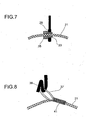
- FIGS. 7 and 8 A possible fixation of the heating conductor 21 is exemplified in the FIGS. 7 and 8 shown.
- FIG. 7 an attachment of a heat conductor is shown in an eyelet with an insulator.
- the heating conductor 21 For fixing the heating conductor 21, it is possible, for example, to provide the heating conductor 21 with an insulating sleeve 33.
- the insulating sleeve 33 is thereby connected to the heating conductor 21 that the insulating sleeve is not displaced.
- the insulating sleeve 33 has an extension 35 on one side.
- the heating conductor 21 with the insulating applied thereto Sleeve 33 is guided by a fixed eyelet 29 in the pipe 5.
- the extension 35 With the extension 35, the insulating sleeve 33 then abuts against the eyelet 29, so that the insulating sleeve 33 can not slip through the eyelet 29.
- the extension 35 is positioned on the side of the eyelet 29, which flows against the heat carrier.
- FIG. 8 An alternative attachment of the heating conductor 21 is in FIG. 8 shown.
- a loop 37 is attached to the heating element 21.
- the loop 37 is inserted into a hook 39, which, for example, as in FIG. 8 represented, can be designed spirally hung.
- a hook 39 By the helically shaped hook 39 is avoided that the loop 37 can solve during operation due to different flow influences.
- the loop 37 can be fastened to the heating conductor 21, for example, by means of a sleeve 41.
- the sleeve 41 is, for example, a clamping sleeve which is connected to the heating conductor 21.
- the fastening of the sleeve 41 can be done for example by jamming or by welding or screwing.
- the sleeve 41 and / or the loop 37 are made of an insulating material.
- FIG. 9 a formation of a channel in the solidified salt along the heating conductor is shown.
- the heating conductor 21 is first supplied with power for recommissioning, whereby this heats up.
- the salt contained in the pipes 5 starts around the heated heating conductor 21 melt.
- the salt melts uniformly, and it forms a channel 43.
- the molten salt can flow, whereby occurring pressures can be reduced due to the volume increase during melting of the salt.
- the heating element 21 Through the use of the heating element 21, it is also possible to dispense with emptying the pipes 5 and thus the entire solar field 1 at will short standstill. Also, it is not necessary, as an alternative to emptying the pipes 5, to completely prevent the salt from solidifying.
- the heating conductor only has to keep a sufficiently large flow channel free.
- the issekosleiter offers great advantages when restarting after a loop emptying.
- the piping system can already be flowed through, if only the heating conductor but not the piping system has clearly exceeded the melting temperature.
- the uniform resistivity over the entire length of the heating conductor certainly ensures a lack of cold spots.
- FIG. 10 An attachment of a heat conductor in the region of a pipe bend for flow diversion is exemplary in FIG. 10 shown.
- a solar loop 3 as out FIG. 1 visible, U-shaped.
- the molten salt flows through the one leg of the U-shaped solar loop 3, then over the two legs connecting cross-threaded pipe section and through the second pipe 5 back to the collector 9.
- a pipe bend 45 used for the flow deflection as a T-piece and to provide a pipe section 47, which continues in the direction of the pipe 5.
- the pipe section 47 is closed with a shutter 49, and the heating conductor 21 is passed through the shutter 49.
- a blind flange is suitable.
- the heating conductor 21 is guided isolated by the shutter 49.
- the guided through the shutter 49 heating element 21 can then be connected to a suitable potential supply.
- FIG. 11 A deflection of the molten salt over 180 ° by two elbows, as in FIG. 10 are shown in FIG. 11 shown.
- a heating conductor 21 is first performed insulated along the pipe 5 through the shutter 49.
- a 90 ° rotated pipe section 121 is connected to the pipe 5.
- a heating element 21 is also performed.
- the ends of the respective heating conductors which are isolated by the closures 49, contacted by an external wiring 119 with each other electrically.
- FIG. 12 an alternative form of a 90 ° angled piping is shown.
- the heating conductor 21 is held by a clamping device 122 in the middle of the tube.
- the clamping device 122 is attached to the bend of the heating conductor 21 by jamming or welding.
- a pipe socket and the external wiring are saved.
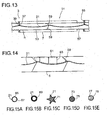
- FIG. 13 is a cross section through a multi-segment pipe section shown.
- a solar loop 3 of a solar power plant is generally divided into several segments 51.
- Each of these segments 51 has a pipe section 53 which is enclosed by a glass tube 7.
- the respective segments 51 each serve as receivers for trapping solar energy.
- the individual pipe sections 53 are usually made of a highly electrically conductive metal, for example made of stainless steel.
- a material for the insulators 55 a material is selected which has a greater resistance than the resistance of the heating conductor 21 used as a heat conductor.
- heat-resistant ceramics, mineral fiber seals or mica seals are suitable as material for the insulators 55.
- the individual segments 51 are connected to one another via mechanical connections or compensators 57.
- the mechanical compensators 57 may be necessary to compensate for linear expansion of the pipes 5 during operation.
- the insulated heating conductor 21 can be fixed with insulators inside the pipe 5, as exemplified in FIGS. 7 and 8 is shown, it is beneficial to some of FIG. 13 placed insulators 55 in a solar loop to prevent accumulated parasitic currents accumulate in the pipe system.
- the heating element according to the invention 21 for heating a pipe 5 can also be used to heat collector 9, manifold 15, heat transfer 11 and heat transfer inlet 13 and all other flowed through by molten salt pipes.
- the application in flexible hose lines is possible when using flexible conductors.
- the resistance of a metal is temperature-dependent
- the attachment of the heating element 21 in the in FIG. 13 illustrated embodiment is carried out in each case at the beginning of a segment 51 with a loop 37 and a hook 39, as in FIG. 8 are shown.
- the heating conductor 21 is secured against displacement within the segment 51.
- the fastening of the heating conductor 21 within the respective pipe section 53 takes place, for example, by way of resilient spacers 59.
- fastening with resilient spacers may be provided at one or more positions in the pipe section 53 of the segment 51.
- the resilient spacers 59 are preferably for Mounting inserted into the tube and are not connected to the pipe wall but rely only against the pipe wall.
- high-temperature steels for example, St 2.4668 or Inconel X750 are preferred.
- a current flows through the resilient spacers 59 to the pipe 5. This is exemplified by dashed arrows.
- the occurring parasitic currents 61 cause heating power is not obtained at the heating element 21, but elsewhere, for example, on the wall of the pipe 5. As long as the currents through the heating conductor 21 dominate, although parasitic currents 61 reduce the efficiency of the heating, they do not jeopardize the function of the heating by the heating conductor 21.
- a current flow through the molten salt continues to occur due to the high conductivity of the molten salt in the pipeline 5. This is exemplified by arrows 63. If the wall of the pipe 5 is covered with solidified, low-conductivity salt, the current flow 63 largely eliminated by the molten salt.
- the use of stainless steel for the heating conductor 21 reduces the parasitic current flow 63 through the molten salt, which usually forms a passivating, approximately 15 ⁇ m thick metal oxide / nitrate layer on the stainless steel, the metal oxide / nitrate layer having a noticeable resistance to the current flow opposes.
- FIGS. 15A to 15E Examples of suitable Schuleitergeometrien are in the FIGS. 15A to 15E shown.
- the heating conductor 21 may, for example, as in Figure 15A represented, designed as a tubular rope.
- the heating conductor 21 is preferably formed from a steel braid.
- melts First, the salt in the interior of the heating conductor 21, whereby a channel is formed in the interior of the heating element 21, can flow through the molten salt. Salt surrounding the heating conductor 21, which melts, can flow into the inner channel 67 through openings in the braid forming the tubular cable 65.
- heating element 21 in the form of a tube 69.
- the tube with a perforation through which molten salt can flow into the interior of the tube.
- the functioning of the in FIG. 15B shown heating conductor 21 corresponds largely to the operation of the in Figure 15A Heat conductor 21 shown.
- FIG. 15C a heating conductor is shown with a star-shaped cross-section.
- a star-shaped cross section has V-shaped recesses 71.
- the salt initially begins to melt in the V-shaped recesses 71, so that in each case a channel is formed in the V-shaped depressions 71 through which the molten salt can flow.
- FIG. 15C illustrated embodiment as a 5-pointed star is also any other number of v-shaped depressions and associated teeth possible.
- V-shaped depressions it is alternatively also possible to provide, for example, U-shaped depressions.
- FIG 15D a heating conductor designed as a rod 73 is shown, wherein the rod 73 is surrounded by a mesh 75, preferably an electrically conductive wire mesh.
- a heat conductor as in Figure 15D is designed to form, first formed in the braid 75 channels through which the molten salt can flow. Subsequently, a channel surrounding the heating conductor 21 forms.
- FIGS. 15A to 15D designed embodiments each require a heating element made of a material that does not corrode in the presence of the molten salt flowing through the pipe 5.
- a heating element made of a material that does not corrode in the presence of the molten salt flowing through the pipe 5.
- These are, for example, stainless steel, for example St 1.4571 or also St 1.4301.
- stainless steels are less conductive than, for example, copper or aluminum, but generally corrode easily in the salt used.
- a heat conductor made of a better than stainless steel electrically conductive material it is possible, for example, as in FIG. 15E shown to provide a core 77 of a material with very good electrical conductivity, for example of copper or aluminum, which is enclosed by a corrosion-resistant coating 79.
- the corrosion-resistant coating 79 may be, for example, a corrosion-resistant tube, which is connected to the core 77 with good thermal conductivity. This design offers the option of operating the inner heating conductor completely without electrical insulation measures in a pipeline.
- a heating conductor with a cross-sectional geometry, as in the FIGS. 15A to 15E can be flexible or designed as a rigid conductor. If the heating conductor 21 is designed as a rigid conductor, it is advantageous to provide expansion regions 81 to compensate for changes in length due to temperature fluctuations.
- a rigid heating conductor with expansion region 81 is exemplified in FIG FIG. 16 shown.
- the expansion region 81 is designed wave-shaped. In addition to the wave-shaped design shown here, any other geometry that allows a length compensation is suitable for the design of the expansion region 81.
- FIGS. 17 to 19 a heating element is shown, which is held in a pipeline with resilient spacers.
- the resilient spacers 59 are preferably arranged in a cross shape. Alternatively, however, it is also possible to provide, for example, only three resilient spacers 59, in which case one of the resilient spacers 59 is preferably oriented vertically.
- the vertically aligned resilient spacer can be arranged either below or above the heat conductor 21.
- FIG. 18 One way to attach the resilient spacers 59 on the heating element 21 is in FIG. 18 shown.
- the sleeve 83 is pushed over the heating conductor 21 and an end portion 85 of the resilient spacers 59.
- An additional attachment is possible, for example, that the sleeve 83 is welded to the heating element 21.
- the heating conductor facing away from the end portion 87 of the resilient spacer 59 is preferably bent to a foot 89.
- the foot 89 may be designed, for example, in the form of an eyelet.
- the resilient spacer 59 With the foot 89, the resilient spacer 59 is supported on the wall of the pipeline. This is FIG. 19 shown.
- the use of the resilient spacers 59, as in the FIGS. 17 to 19 The fact that the resilient spacers 59 are pressed only by their spring pressure with their respective foot 89 against the wall of the pipe 5, is used to hold the heating element 21 at a predetermined height in the pipe 5. It is possible that the resilient Spacers 59 are moved with the flow of molten salt in the pipe 5. Therefore, it is preferable as in FIG. 13 shown, at regular intervals, preferably provide at least once in each receiver a holder of the heating element 21, as shown in the FIGS. 7 and 8 is shown.
- the positioning of the resilient spacers 59 only by pressing the feet 89 against the wall of the pipe 5 has the advantage that the heating element 21 together with the resilient spacers 59 can be pulled out of the pipe 5 in a simple manner if necessary. This may be necessary, for example, in the case of necessary maintenance.
- resilient spacers 59 it is also possible to hold the resilient spacers 59 not only by their contact pressure in the pipe 5, but releasably secure the resilient spacers 59 in the pipeline, for example by screwing, or permanently, for example by welding, to secure.
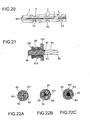
- FIG. 20 is a long pipe 5 of interconnected by welding pipe sections 53, for example receivers of a solar loop shown. If the heating conductor 21 is not electrically insulated against the chain of welded pipe sections 53 and a voltage applied, flows through the chain of pipe sections 53, a current I a and through the inner conductor, a current I i whose current intensity ratio I i / I a in the ratio of Resistance of the pipe 5 to the resistance of the heating element 21 is. According to the ratio, heat is generated at the pipe 5 and at the heating conductor 21, respectively.
- the resistance of the heating element 21 can be lowered so that the current sufficiently strong in the heating element 21 in and out the heat to the heating conductor 21 is concentrated.
- the pipeline 5 is to be electrically insulated from an apparatus scaffold, not shown here, from which the pipeline 5 is borne.
- the introduction of the heating element 21 in the tube interior can be easily designed in the case of uninsulated réelleloomleiters by compression fittings.
- FIG. 21 is designed as a cable heating conductor with passage through a blind flange.
- the heating conductor 21 is formed in the form of a cable 91.
- the rope 91 is twisted from several strands 93.
- the rope can, for example, three strands, as in FIG. 21 represented, made or from one or two or more than three strands.
- the cable 91 For attachment of the trained as a cable 91 heat conductor 21 at one end of a pipe section 47, the cable 91 is connected to a round rod 95.
- the connection of the cable 91 with the round rod 95 is effected for example by a welded joint or alternatively by screwing or jamming. In a clamping connection, the round rod 95 is clamped onto the cable 91.
- the cable 91 is connected to the round rod 95 with a welded connection 97.
- the round rod 95 is guided through a gland bushing 99 through the blind flange 101, with which the pipe section 53 is completed.
- the stuffing box bushing 99 comprises a stuffing box 103. This is clamped with a clamping sleeve 105.
- a voltage can be applied to the round bar 95 in order to supply the heating conductor 21 designed as a cable 91 with voltage.
- ropes 91 are each constructed of three strands 93.
- the strands 93 are solid. Between the individual strands, a gusset 107 forms, can flow through the melting salt during reflow.
- the strands 93 are designed as flattened tubes. Due to the flattening forms in comparison to the in Figure 22A illustrated embodiment larger gusset 107 from. An even larger gusset channel 107 results from the in Figure 22C illustrated embodiment, in which the individual strands 93, from which the cable 91 is twisted, have a kidney-shaped configuration.
- FIG. 23 An alternative embodiment for passing the heat conductor through an end portion of a pipeline is in FIG. 23 shown.
- the stuffing box In order to make the stuffing box with conventional materials, in particular a sealing ring made of a conventional polymer material, it is necessary to realize a temperature gradient along the heating conductor and the round rod.
- the temperature gradient is adjusted by isolating the end of the pipeline 5, through which the round bar 95 is guided, less well.
- the formation of a gradient by a thermal inner insulation of the implementation of the heating element 21 can be supported.
- the thermal inner insulation can be realized, for example, by using ceramic fibers which have a thermal resistance of, for example, up to 580 ° C.
- a corresponding filling with ceramic fibers is designated by reference numeral 109.
- the round rod 95 is initially surrounded by a first sleeve of an electrically insulating and temperature-resistant material, such as ceramic or silicon carbide.
- the first sleeve 111 preferably has a temperature resistance of up to 580 ° C.
- the first sleeve 111 is followed by a second sleeve 113.
- the second sleeve 113 is made of a likewise electrically insulating material, which, however, may have a lower temperature resistance. For example, a temperature resistance up to 260 ° C is sufficient.
- a high-temperature plastic such as PTFE can be used.
- the stuffing box bushing 99 then adjoins the second sleeve 113.
- the stuffing box bushing 99 is fastened with a flange 115 at the pipe end.
- the inserted round rod 95 preferably contains a good electrically conductive material. It is on the one hand possible to make the round rod completely out of the good electrically conductive material or alternatively provide a core of a good electrically conductive material, which is surrounded by a less well conductive material, such as steel.
- electrically good conductive material are, for example, copper or aluminum.
- a round rod 95 is used with a copper core.
- FIG. 24 a guide of a heat conductor is shown in a movable pipe connection.
- a pipe bend 117 is made of a flexible material.
- the heating conductor 21 for example, with a resilient spacer 59, as shown in the Figures 17 and 18 is shown fixed in the pipeline.
- the distance between the individual resilient spacers 59 is chosen so that even with a bending of the pipe joint of the heating element 21 does not come into contact with the pipe wall.
- a movable pipe connection as in FIG. 24 is shown, for example, be included between individual solar receivers to adjust the pipeline with the receivers each to the optimum position to the sun.
- FIGS. 25 and 26 A cross section through a valve with a heating conductor guided therein is exemplary in FIGS FIGS. 25 and 26 shown.
- FIG. 25 shows a cross section through a valve 123 with a heating conductor 21 and guided therein
- FIG. 26 shows a section through the valve FIG. 25 in plan view.
- a valve usually comprises a valve body 125 with a valve seat 127 and a closing element 129.
- the heating conductor 21 is guided annularly along the valve seat 127. This means that the heating conductor forms a heating ring 131.
- the heating ring 131 is positioned so that the closing function of the valve 123 is not affected.
- the electrical insulation 133 preferably forms the valve seat 127.
- the heating ring 131 and the heating element 21 also relative to the valve body 125 electrically to isolate.
- an electrically insulating material for example a ceramic in the region in which the heating ring 131 bears against the valve body 125, is introduced into the valve body 125. It is essential here that the material used for electrical insulation is thermally stable with respect to the valves occurring in the valve.
- FIGS. 25 and 26 illustrated embodiment of a valve
- the heating element 21 for example via a heating ring 131 or other geometric design in other fittings such as flaps or sliders.
- a heating conductor 21 designed as a stainless steel rod is used.
- the heating conductor has a diameter of 25 mm.
- the heating element is made of stainless steel St 1.4301.
- the resistivity of the heating conductor 21 is 0.00073 ohms / mm at a working temperature of 290 ° C.
- the specific power required for heating is 100 W / m.
- the voltage applied for heating is 77.3 V and the current 259 A.
- the power required due to the length of 200 m is 20 kW. However, this power is needed only in the very short time of melting.
- the falling at the heat conductor heat output can be reduced, for example, via a thyristor switched pulse operation.
- a stainless steel 1.4541 pipe has a specific conductivity of 1.7 m / (ohm.mm 2 ) and an inner diameter of 65 mm and a wall thickness of 2 mm.
- the cross-sectional area of the pipeline is 421 mm 2 .
- the conductivity of the tube is 716 m / ohm. If 90% of the heat is to be generated on an inner conductor contained in the pipeline, it is necessary that the inner conductor absorbs 10 times the amount of electricity. For this he needs a conductivity of 7,157 m / ohm. Copper has an electrical conductivity of 56.2 m / (ohm ⁇ mm 2 ) at a temperature of 20 ° C.
- a copper inner conductor of 127 mm 2 In order to a necessary cross-sectional area is calculated for a copper inner conductor of 127 mm 2 . This corresponds to a copper wire with a diameter of 12.7 mm or three copper wires, each with a diameter of 7.4 mm. If an inner conductor made of aluminum is to be used, it requires a diameter of 15.8 mm for the same conductivity.
- the inner conductor Due to the much smaller mass and thus the much smaller heat capacity of the inner conductor relative to the pipeline even smaller diameter for the inner conductor to the preferred heating sufficient. In general, it is sufficient if even less than 50% of the total current is conducted to the inner conductor. This makes it possible to make the inner conductor with a small diameter and to use only a little expensive, electrically good conductive material, such as copper. In a DN65 piping system, for example, it may be sufficient to make the heating conductor of three copper wires each 5 mm in diameter. The copper wires are preferably twisted into a rope.
- St 1.4541 has a low electrical conductivity for steels. However, in this case it may be favorable to completely or partially manufacture the pipe material, for example the absorber pipe of the individual receivers in a solar loop, from another stainless steel which has an even lower conductivity. Such a steel is for example St 1.4301. In this case, however, care must be taken to the corrosion compatibility with the heat transfer medium used.
- molten salt it may be necessary to avoid direct contact of copper or aluminum, which is used for the heating element, with the molten salt, in order to avoid corrosion on the heating element or to affect the stability of the salt.
- a possible incompatibility of the material of the heat conductor, such as copper or aluminum, with the salt used as a heat carrier can be achieved, for example, that the individual strands of the heating element are performed with an outer stainless steel shell.
Landscapes
- Engineering & Computer Science (AREA)
- General Engineering & Computer Science (AREA)
- Mechanical Engineering (AREA)
- Sustainable Energy (AREA)
- Life Sciences & Earth Sciences (AREA)
- Sustainable Development (AREA)
- Physics & Mathematics (AREA)
- Thermal Sciences (AREA)
- Chemical & Material Sciences (AREA)
- Combustion & Propulsion (AREA)
- Pipe Accessories (AREA)
- Resistance Heating (AREA)
- Pipeline Systems (AREA)
- Seasonings (AREA)
Priority Applications (1)
| Application Number | Priority Date | Filing Date | Title |
|---|---|---|---|
| EP12720912.0A EP2710288B1 (de) | 2011-05-19 | 2012-05-16 | Rohrleitung zur förderung einer salzschmelze |
Applications Claiming Priority (6)
| Application Number | Priority Date | Filing Date | Title |
|---|---|---|---|
| US201161487719P | 2011-05-19 | 2011-05-19 | |
| EP11166724 | 2011-05-19 | ||
| US201161539494P | 2011-09-27 | 2011-09-27 | |
| EP11182898 | 2011-09-27 | ||
| EP12720912.0A EP2710288B1 (de) | 2011-05-19 | 2012-05-16 | Rohrleitung zur förderung einer salzschmelze |
| PCT/EP2012/059185 WO2012156472A1 (de) | 2011-05-19 | 2012-05-16 | Rohrleitung zur förderung einer salzschmelze |
Publications (2)
| Publication Number | Publication Date |
|---|---|
| EP2710288A1 EP2710288A1 (de) | 2014-03-26 |
| EP2710288B1 true EP2710288B1 (de) | 2015-07-08 |
Family
ID=47176331
Family Applications (1)
| Application Number | Title | Priority Date | Filing Date |
|---|---|---|---|
| EP12720912.0A Active EP2710288B1 (de) | 2011-05-19 | 2012-05-16 | Rohrleitung zur förderung einer salzschmelze |
Country Status (10)
| Country | Link |
|---|---|
| EP (1) | EP2710288B1 (https=) |
| JP (1) | JP6038126B2 (https=) |
| KR (1) | KR102008536B1 (https=) |
| CN (1) | CN103688096B (https=) |
| AU (1) | AU2012258271B2 (https=) |
| BR (1) | BR112013029613A2 (https=) |
| CA (1) | CA2835271C (https=) |
| ES (1) | ES2546603T3 (https=) |
| PT (1) | PT2710288E (https=) |
| WO (1) | WO2012156472A1 (https=) |
Families Citing this family (23)
| Publication number | Priority date | Publication date | Assignee | Title |
|---|---|---|---|---|
| US9347596B2 (en) | 2013-02-27 | 2016-05-24 | Basf Se | Apparatus for heating a pipeline |
| AU2014222767B2 (en) * | 2013-02-27 | 2018-11-15 | Basf Se | Apparatus for heating a pipeline |
| PT2965023T (pt) * | 2013-03-06 | 2018-08-08 | Basf Se | Campo solar para uma central de energia solar de concentração linear |
| US10443897B2 (en) | 2013-03-06 | 2019-10-15 | Basf Se | Pipeline system and drainage container for receiving liquid flowing through a pipeline system |
| DE102013108311A1 (de) | 2013-08-01 | 2015-02-05 | Novatec Solar Gmbh | Geometrieanpassung eines Rohres zum Leiten einer Salzschmelze |
| CN103615624B (zh) * | 2013-11-30 | 2015-12-02 | 中国科学院电工研究所 | 一种熔融盐管道加热装置 |
| JP6529218B2 (ja) * | 2014-03-28 | 2019-06-12 | 千代田化工建設株式会社 | 熱媒排出装置および熱媒排出方法 |
| JP2015190674A (ja) * | 2014-03-28 | 2015-11-02 | 千代田化工建設株式会社 | 熱媒排出装置 |
| JP6529219B2 (ja) * | 2014-03-28 | 2019-06-12 | 千代田化工建設株式会社 | 熱媒排出装置および熱媒排出方法 |
| JP6378520B2 (ja) * | 2014-03-28 | 2018-08-22 | 千代田化工建設株式会社 | 熱媒排出装置 |
| DE102014221497B4 (de) * | 2014-10-23 | 2025-02-06 | Ipco Germany Gmbh | Vorrichtung und Verfahren zum Kühlen eines Fluids |
| PT3318816T (pt) * | 2015-07-02 | 2021-02-10 | Chiyoda Corp | Sistema de aquecimento |
| CN107923657A (zh) * | 2015-07-02 | 2018-04-17 | 千代田化工建设株式会社 | 太阳热收集装置 |
| ES2806149T3 (es) * | 2015-07-02 | 2021-02-16 | Chiyoda Corp | Estructura de conexión a tierra de un colector solar térmico y colector solar térmico |
| WO2017002262A1 (ja) * | 2015-07-02 | 2017-01-05 | 千代田化工建設株式会社 | 加熱装置 |
| MA42285B1 (fr) * | 2015-07-02 | 2021-04-30 | Chiyoda Corp | Dispositif de chauffage |
| MA42286B1 (fr) * | 2015-07-02 | 2021-04-30 | Chiyoda Corp | Dispositif de captation de chaleur solaire |
| KR101820939B1 (ko) * | 2015-10-07 | 2018-02-28 | 양성훈 | 관로 동파방지 장치 |
| CN105972339A (zh) * | 2016-07-11 | 2016-09-28 | 江苏爱能森科技有限公司 | 一种预热及防凝固的输送管道结构 |
| CN108758349B (zh) * | 2018-07-30 | 2023-09-29 | 中国石油工程建设有限公司 | 中长距离液体硫磺管道停输和再启动安全泄放系统及方法 |
| CN116772019B (zh) * | 2023-05-31 | 2025-07-04 | 浙江高晟光热发电技术研究院有限公司 | 一种熔盐缓冲装置 |
| DE102023132905A1 (de) * | 2023-11-24 | 2025-05-28 | Frenell Ip Gmbh | Vorrichtung zum erhitzen eines flüssigen oder gasförmigen wärmeträgermediums |
| CN121612105B (zh) * | 2026-02-03 | 2026-04-21 | 成都锐思环保技术股份有限公司 | 一种熔盐储罐低位短轴泵输盐系统及方法 |
Family Cites Families (21)
| Publication number | Priority date | Publication date | Assignee | Title |
|---|---|---|---|---|
| DE859549C (de) * | 1943-07-16 | 1952-12-15 | Koppers Gmbh Heinrich | Beheizungseinrichtung fuer Rohrleitungen |
| US3293407A (en) * | 1962-11-17 | 1966-12-20 | Chisso Corp | Apparatus for maintaining liquid being transported in a pipe line at an elevated temperature |
| JPS5247583B2 (https=) * | 1974-01-09 | 1977-12-03 | ||
| SU540102A1 (ru) * | 1975-05-28 | 1976-12-25 | Всесоюзный научно-исследовательский институт природных газов | Электронагреватель |
| JPS51143934A (en) * | 1975-06-05 | 1976-12-10 | Sadao Shimazaki | Solar heat absorbing exothermic pipe |
| JPS52133141A (en) * | 1976-05-01 | 1977-11-08 | Ichirou Kawashima | Solar heat receiving section for heat carrier |
| JPS59107397U (ja) * | 1983-01-10 | 1984-07-19 | 三菱重工業株式会社 | 凝固性流体の配管装置 |
| JP2874204B2 (ja) * | 1989-08-04 | 1999-03-24 | 松下電器産業株式会社 | 発熱体 |
| JPH04321895A (ja) * | 1991-04-19 | 1992-11-11 | Nichias Corp | 流体加熱管 |
| JPH08270899A (ja) * | 1995-03-27 | 1996-10-15 | Toray Ind Inc | 缶体接続管装置 |
| JPH08320096A (ja) * | 1995-05-26 | 1996-12-03 | Kurita Kogyo:Kk | 保温管システム |
| JPH1187024A (ja) * | 1997-09-08 | 1999-03-30 | Toshiyuki Kitsunai | パイプ状発熱体および加熱炉 |
| US6167883B1 (en) * | 1998-01-23 | 2001-01-02 | Respiratory Support Products, Inc. | Medical air hose internal flow heater |
| DE10327493B4 (de) * | 2003-06-17 | 2007-12-20 | Böhm GmbH & Co. KG | Temperaturmessanordnung |
| GB0513044D0 (en) * | 2005-06-27 | 2005-08-03 | Saipem Uk Ltd | Pipe structure and methods of laying and use of a pipeline including such a pipe structure |
| JP2008082655A (ja) * | 2006-09-28 | 2008-04-10 | Covalent Materials Corp | 液体加熱装置 |
| US7685820B2 (en) * | 2006-12-08 | 2010-03-30 | United Technologies Corporation | Supercritical CO2 turbine for use in solar power plants |
| DE102007007761A1 (de) * | 2007-02-16 | 2008-08-21 | Vola Plast Werner Hoppach Kg | Scheiben-oder Scheinwerferwaschanlage eines Fahrzeuges und ein Fluidzuführschlauch hierfür |
| JP2009002424A (ja) * | 2007-06-21 | 2009-01-08 | Nitta Moore Co | 加熱・保温管の配管構造 |
| CN101978224B (zh) * | 2008-02-20 | 2013-10-16 | 康宁股份有限公司 | 具有玻璃陶瓷中央管的太阳热能收集装置 |
| JP2009270659A (ja) * | 2008-05-09 | 2009-11-19 | Alpha Tekku:Kk | 加熱手段を備えた配管 |
-
2012
- 2012-05-16 ES ES12720912.0T patent/ES2546603T3/es active Active
- 2012-05-16 KR KR1020137033805A patent/KR102008536B1/ko not_active Expired - Fee Related
- 2012-05-16 EP EP12720912.0A patent/EP2710288B1/de active Active
- 2012-05-16 AU AU2012258271A patent/AU2012258271B2/en not_active Ceased
- 2012-05-16 BR BR112013029613A patent/BR112013029613A2/pt not_active IP Right Cessation
- 2012-05-16 JP JP2014510808A patent/JP6038126B2/ja not_active Expired - Fee Related
- 2012-05-16 PT PT127209120T patent/PT2710288E/pt unknown
- 2012-05-16 WO PCT/EP2012/059185 patent/WO2012156472A1/de not_active Ceased
- 2012-05-16 CA CA2835271A patent/CA2835271C/en not_active Expired - Fee Related
- 2012-05-16 CN CN201280035681.4A patent/CN103688096B/zh active Active
Also Published As
| Publication number | Publication date |
|---|---|
| JP6038126B2 (ja) | 2016-12-07 |
| KR102008536B1 (ko) | 2019-10-21 |
| CA2835271C (en) | 2019-08-20 |
| CN103688096B (zh) | 2016-09-28 |
| AU2012258271B2 (en) | 2017-04-20 |
| BR112013029613A2 (pt) | 2024-01-23 |
| KR20140033149A (ko) | 2014-03-17 |
| EP2710288A1 (de) | 2014-03-26 |
| WO2012156472A1 (de) | 2012-11-22 |
| AU2012258271A1 (en) | 2013-11-21 |
| CA2835271A1 (en) | 2012-11-22 |
| CN103688096A (zh) | 2014-03-26 |
| JP2014523997A (ja) | 2014-09-18 |
| PT2710288E (pt) | 2015-10-02 |
| ES2546603T3 (es) | 2015-09-25 |
Similar Documents
| Publication | Publication Date | Title |
|---|---|---|
| EP2710288B1 (de) | Rohrleitung zur förderung einer salzschmelze | |
| EP3624141B1 (de) | Kühlbare einzelleitung und ladekabel | |
| EP3882929B1 (de) | Kühlbare einzelleitung und ladekabel | |
| DE2808462C2 (de) | Vorrichtung zur Herstellung von hochreinen Siliziumstäben | |
| DE102008055891A1 (de) | Flexibler, elektrisch beheizbarer Schlauch | |
| EP2962523B1 (de) | Vorrichtung zur beheizung einer rohrleitung | |
| DE3414284A1 (de) | Elektrisches heizelement fuer rohrleitungen, insbesondere fuer lange rohrleitungen | |
| EP2158058A1 (de) | Schlauchpaket | |
| US8895901B2 (en) | Pipeline for carrying a molten salt | |
| EP2314971B1 (de) | Wärmespeicher mit Energieeinspeisung zur langzeitstabilen und gleichmäßigen Leistungsabgabe und Verfahren hierzu | |
| DE102009040476A1 (de) | Geothermiesonde und Verfahren zu deren Betrieb | |
| EP0041653A1 (de) | Wärmeaustauschelement | |
| DE102011118106A1 (de) | Wärmespeichermodul und modularer Wärmespeicher | |
| DE2542582C2 (de) | Stromzuführungsvorrichtung für einen Elektrodenbadofen | |
| AT522369B1 (de) | Elektrischer Heizstab und Energiespeicher | |
| DE102019112229B4 (de) | Durchlauferhitzer, Vorrichtung mit Durchlauferhitzer und Anlage mit Vorrichtung | |
| DE10108843A1 (de) | Kühlbarer Koaxialleiter | |
| DE102015003481A1 (de) | Verfahren zur elektrischen Begleitbeheizung von Pipelines für den Fluidtransport | |
| DE1074779B (de) | Elektro-Heißwassergerät | |
| EP4273447B1 (de) | Dampferzeuger | |
| WO2019149434A1 (de) | Rohrreaktor und verfahren zum betreiben eines rohrreaktors | |
| WO2010043416A2 (de) | Verfahren zur herstellung von wärmetauscherrohren sowie betonwärmespeicher | |
| DE2011555A1 (de) | Heizvorrichtung | |
| DE7836518U1 (de) | Heizrohr | |
| IL229352A (en) | Pipe for dissolving salt |
Legal Events
| Date | Code | Title | Description |
|---|---|---|---|
| PUAI | Public reference made under article 153(3) epc to a published international application that has entered the european phase |
Free format text: ORIGINAL CODE: 0009012 |
|
| 17P | Request for examination filed |
Effective date: 20131219 |
|
| AK | Designated contracting states |
Kind code of ref document: A1 Designated state(s): AL AT BE BG CH CY CZ DE DK EE ES FI FR GB GR HR HU IE IS IT LI LT LU LV MC MK MT NL NO PL PT RO RS SE SI SK SM TR |
|
| DAX | Request for extension of the european patent (deleted) | ||
| RIN1 | Information on inventor provided before grant (corrected) |
Inventor name: LADENBERGER, MICHAEL Inventor name: GARLICHS, FLORIAN Inventor name: GEYER, KAROLIN Inventor name: MAURER, STEPHAN Inventor name: SCHIERLE-ARNDT, KERSTIN Inventor name: WORTMANN, JUERGEN Inventor name: GAERTNER, MARTIN Inventor name: LUTZ, MICHAEL |
|
| GRAP | Despatch of communication of intention to grant a patent |
Free format text: ORIGINAL CODE: EPIDOSNIGR1 |
|
| INTG | Intention to grant announced |
Effective date: 20150120 |
|
| GRAS | Grant fee paid |
Free format text: ORIGINAL CODE: EPIDOSNIGR3 |
|
| GRAA | (expected) grant |
Free format text: ORIGINAL CODE: 0009210 |
|
| AK | Designated contracting states |
Kind code of ref document: B1 Designated state(s): AL AT BE BG CH CY CZ DE DK EE ES FI FR GB GR HR HU IE IS IT LI LT LU LV MC MK MT NL NO PL PT RO RS SE SI SK SM TR |
|
| REG | Reference to a national code |
Ref country code: GB Ref legal event code: FG4D Free format text: NOT ENGLISH |
|
| REG | Reference to a national code |
Ref country code: AT Ref legal event code: REF Ref document number: 735683 Country of ref document: AT Kind code of ref document: T Effective date: 20150715 Ref country code: CH Ref legal event code: EP |
|
| REG | Reference to a national code |
Ref country code: IE Ref legal event code: FG4D Free format text: LANGUAGE OF EP DOCUMENT: GERMAN |
|
| REG | Reference to a national code |
Ref country code: DE Ref legal event code: R096 Ref document number: 502012003717 Country of ref document: DE |
|
| REG | Reference to a national code |
Ref country code: ES Ref legal event code: FG2A Ref document number: 2546603 Country of ref document: ES Kind code of ref document: T3 Effective date: 20150925 |
|
| REG | Reference to a national code |
Ref country code: PT Ref legal event code: SC4A Free format text: AVAILABILITY OF NATIONAL TRANSLATION Effective date: 20150820 |
|
| REG | Reference to a national code |
Ref country code: NL Ref legal event code: MP Effective date: 20150708 |
|
| REG | Reference to a national code |
Ref country code: LT Ref legal event code: MG4D |
|
| PG25 | Lapsed in a contracting state [announced via postgrant information from national office to epo] |
Ref country code: FI Free format text: LAPSE BECAUSE OF FAILURE TO SUBMIT A TRANSLATION OF THE DESCRIPTION OR TO PAY THE FEE WITHIN THE PRESCRIBED TIME-LIMIT Effective date: 20150708 Ref country code: GR Free format text: LAPSE BECAUSE OF FAILURE TO SUBMIT A TRANSLATION OF THE DESCRIPTION OR TO PAY THE FEE WITHIN THE PRESCRIBED TIME-LIMIT Effective date: 20151009 Ref country code: LT Free format text: LAPSE BECAUSE OF FAILURE TO SUBMIT A TRANSLATION OF THE DESCRIPTION OR TO PAY THE FEE WITHIN THE PRESCRIBED TIME-LIMIT Effective date: 20150708 Ref country code: NO Free format text: LAPSE BECAUSE OF FAILURE TO SUBMIT A TRANSLATION OF THE DESCRIPTION OR TO PAY THE FEE WITHIN THE PRESCRIBED TIME-LIMIT Effective date: 20151008 Ref country code: LV Free format text: LAPSE BECAUSE OF FAILURE TO SUBMIT A TRANSLATION OF THE DESCRIPTION OR TO PAY THE FEE WITHIN THE PRESCRIBED TIME-LIMIT Effective date: 20150708 |
|
| PG25 | Lapsed in a contracting state [announced via postgrant information from national office to epo] |
Ref country code: IS Free format text: LAPSE BECAUSE OF FAILURE TO SUBMIT A TRANSLATION OF THE DESCRIPTION OR TO PAY THE FEE WITHIN THE PRESCRIBED TIME-LIMIT Effective date: 20151108 Ref country code: SE Free format text: LAPSE BECAUSE OF FAILURE TO SUBMIT A TRANSLATION OF THE DESCRIPTION OR TO PAY THE FEE WITHIN THE PRESCRIBED TIME-LIMIT Effective date: 20150708 Ref country code: RS Free format text: LAPSE BECAUSE OF FAILURE TO SUBMIT A TRANSLATION OF THE DESCRIPTION OR TO PAY THE FEE WITHIN THE PRESCRIBED TIME-LIMIT Effective date: 20150708 Ref country code: HR Free format text: LAPSE BECAUSE OF FAILURE TO SUBMIT A TRANSLATION OF THE DESCRIPTION OR TO PAY THE FEE WITHIN THE PRESCRIBED TIME-LIMIT Effective date: 20150708 Ref country code: PL Free format text: LAPSE BECAUSE OF FAILURE TO SUBMIT A TRANSLATION OF THE DESCRIPTION OR TO PAY THE FEE WITHIN THE PRESCRIBED TIME-LIMIT Effective date: 20150708 |
|
| REG | Reference to a national code |
Ref country code: DE Ref legal event code: R097 Ref document number: 502012003717 Country of ref document: DE |
|
| PG25 | Lapsed in a contracting state [announced via postgrant information from national office to epo] |
Ref country code: EE Free format text: LAPSE BECAUSE OF FAILURE TO SUBMIT A TRANSLATION OF THE DESCRIPTION OR TO PAY THE FEE WITHIN THE PRESCRIBED TIME-LIMIT Effective date: 20150708 Ref country code: CZ Free format text: LAPSE BECAUSE OF FAILURE TO SUBMIT A TRANSLATION OF THE DESCRIPTION OR TO PAY THE FEE WITHIN THE PRESCRIBED TIME-LIMIT Effective date: 20150708 Ref country code: SK Free format text: LAPSE BECAUSE OF FAILURE TO SUBMIT A TRANSLATION OF THE DESCRIPTION OR TO PAY THE FEE WITHIN THE PRESCRIBED TIME-LIMIT Effective date: 20150708 Ref country code: DK Free format text: LAPSE BECAUSE OF FAILURE TO SUBMIT A TRANSLATION OF THE DESCRIPTION OR TO PAY THE FEE WITHIN THE PRESCRIBED TIME-LIMIT Effective date: 20150708 |
|
| PLBE | No opposition filed within time limit |
Free format text: ORIGINAL CODE: 0009261 |
|
| STAA | Information on the status of an ep patent application or granted ep patent |
Free format text: STATUS: NO OPPOSITION FILED WITHIN TIME LIMIT |
|
| PG25 | Lapsed in a contracting state [announced via postgrant information from national office to epo] |
Ref country code: RO Free format text: LAPSE BECAUSE OF FAILURE TO SUBMIT A TRANSLATION OF THE DESCRIPTION OR TO PAY THE FEE WITHIN THE PRESCRIBED TIME-LIMIT Effective date: 20150708 |
|
| 26N | No opposition filed |
Effective date: 20160411 |
|
| PG25 | Lapsed in a contracting state [announced via postgrant information from national office to epo] |
Ref country code: BE Free format text: LAPSE BECAUSE OF NON-PAYMENT OF DUE FEES Effective date: 20160531 Ref country code: SI Free format text: LAPSE BECAUSE OF FAILURE TO SUBMIT A TRANSLATION OF THE DESCRIPTION OR TO PAY THE FEE WITHIN THE PRESCRIBED TIME-LIMIT Effective date: 20150708 |
|
| PG25 | Lapsed in a contracting state [announced via postgrant information from national office to epo] |
Ref country code: LU Free format text: LAPSE BECAUSE OF FAILURE TO SUBMIT A TRANSLATION OF THE DESCRIPTION OR TO PAY THE FEE WITHIN THE PRESCRIBED TIME-LIMIT Effective date: 20160516 |
|
| GBPC | Gb: european patent ceased through non-payment of renewal fee |
Effective date: 20160516 |
|
| REG | Reference to a national code |
Ref country code: IE Ref legal event code: MM4A |
|
| REG | Reference to a national code |
Ref country code: FR Ref legal event code: ST Effective date: 20170131 |
|
| PG25 | Lapsed in a contracting state [announced via postgrant information from national office to epo] |
Ref country code: FR Free format text: LAPSE BECAUSE OF NON-PAYMENT OF DUE FEES Effective date: 20160531 |
|
| PG25 | Lapsed in a contracting state [announced via postgrant information from national office to epo] |
Ref country code: IE Free format text: LAPSE BECAUSE OF NON-PAYMENT OF DUE FEES Effective date: 20160516 Ref country code: GB Free format text: LAPSE BECAUSE OF NON-PAYMENT OF DUE FEES Effective date: 20160516 |
|
| PG25 | Lapsed in a contracting state [announced via postgrant information from national office to epo] |
Ref country code: NL Free format text: LAPSE BECAUSE OF FAILURE TO SUBMIT A TRANSLATION OF THE DESCRIPTION OR TO PAY THE FEE WITHIN THE PRESCRIBED TIME-LIMIT Effective date: 20150708 |
|
| PG25 | Lapsed in a contracting state [announced via postgrant information from national office to epo] |
Ref country code: HU Free format text: LAPSE BECAUSE OF FAILURE TO SUBMIT A TRANSLATION OF THE DESCRIPTION OR TO PAY THE FEE WITHIN THE PRESCRIBED TIME-LIMIT; INVALID AB INITIO Effective date: 20120516 Ref country code: SM Free format text: LAPSE BECAUSE OF FAILURE TO SUBMIT A TRANSLATION OF THE DESCRIPTION OR TO PAY THE FEE WITHIN THE PRESCRIBED TIME-LIMIT Effective date: 20150708 Ref country code: CY Free format text: LAPSE BECAUSE OF FAILURE TO SUBMIT A TRANSLATION OF THE DESCRIPTION OR TO PAY THE FEE WITHIN THE PRESCRIBED TIME-LIMIT Effective date: 20150708 |
|
| PG25 | Lapsed in a contracting state [announced via postgrant information from national office to epo] |
Ref country code: MT Free format text: LAPSE BECAUSE OF FAILURE TO SUBMIT A TRANSLATION OF THE DESCRIPTION OR TO PAY THE FEE WITHIN THE PRESCRIBED TIME-LIMIT Effective date: 20150708 Ref country code: MC Free format text: LAPSE BECAUSE OF FAILURE TO SUBMIT A TRANSLATION OF THE DESCRIPTION OR TO PAY THE FEE WITHIN THE PRESCRIBED TIME-LIMIT Effective date: 20150708 Ref country code: MK Free format text: LAPSE BECAUSE OF FAILURE TO SUBMIT A TRANSLATION OF THE DESCRIPTION OR TO PAY THE FEE WITHIN THE PRESCRIBED TIME-LIMIT Effective date: 20150708 |
|
| REG | Reference to a national code |
Ref country code: AT Ref legal event code: MM01 Ref document number: 735683 Country of ref document: AT Kind code of ref document: T Effective date: 20170516 |
|
| PG25 | Lapsed in a contracting state [announced via postgrant information from national office to epo] |
Ref country code: BG Free format text: LAPSE BECAUSE OF FAILURE TO SUBMIT A TRANSLATION OF THE DESCRIPTION OR TO PAY THE FEE WITHIN THE PRESCRIBED TIME-LIMIT Effective date: 20150708 |
|
| PG25 | Lapsed in a contracting state [announced via postgrant information from national office to epo] |
Ref country code: AT Free format text: LAPSE BECAUSE OF NON-PAYMENT OF DUE FEES Effective date: 20170516 |
|
| PG25 | Lapsed in a contracting state [announced via postgrant information from national office to epo] |
Ref country code: AL Free format text: LAPSE BECAUSE OF FAILURE TO SUBMIT A TRANSLATION OF THE DESCRIPTION OR TO PAY THE FEE WITHIN THE PRESCRIBED TIME-LIMIT Effective date: 20150708 |
|
| PGFP | Annual fee paid to national office [announced via postgrant information from national office to epo] |
Ref country code: CH Payment date: 20200527 Year of fee payment: 9 Ref country code: TR Payment date: 20200504 Year of fee payment: 9 Ref country code: PT Payment date: 20200427 Year of fee payment: 9 |
|
| PGFP | Annual fee paid to national office [announced via postgrant information from national office to epo] |
Ref country code: DE Payment date: 20200728 Year of fee payment: 9 |
|
| REG | Reference to a national code |
Ref country code: DE Ref legal event code: R119 Ref document number: 502012003717 Country of ref document: DE |
|
| REG | Reference to a national code |
Ref country code: CH Ref legal event code: PL |
|
| PG25 | Lapsed in a contracting state [announced via postgrant information from national office to epo] |
Ref country code: LI Free format text: LAPSE BECAUSE OF NON-PAYMENT OF DUE FEES Effective date: 20210531 Ref country code: CH Free format text: LAPSE BECAUSE OF NON-PAYMENT OF DUE FEES Effective date: 20210531 Ref country code: PT Free format text: LAPSE BECAUSE OF NON-PAYMENT OF DUE FEES Effective date: 20211116 |
|
| PG25 | Lapsed in a contracting state [announced via postgrant information from national office to epo] |
Ref country code: DE Free format text: LAPSE BECAUSE OF NON-PAYMENT OF DUE FEES Effective date: 20211201 |
|
| PG25 | Lapsed in a contracting state [announced via postgrant information from national office to epo] |
Ref country code: TR Free format text: LAPSE BECAUSE OF NON-PAYMENT OF DUE FEES Effective date: 20210516 |
|
| PGFP | Annual fee paid to national office [announced via postgrant information from national office to epo] |
Ref country code: ES Payment date: 20250612 Year of fee payment: 14 |
|
| PGFP | Annual fee paid to national office [announced via postgrant information from national office to epo] |
Ref country code: IT Payment date: 20250522 Year of fee payment: 14 |