EP2705734B1 - Metal alloys from molecular inks - Google Patents
Metal alloys from molecular inks Download PDFInfo
- Publication number
- EP2705734B1 EP2705734B1 EP12722986.2A EP12722986A EP2705734B1 EP 2705734 B1 EP2705734 B1 EP 2705734B1 EP 12722986 A EP12722986 A EP 12722986A EP 2705734 B1 EP2705734 B1 EP 2705734B1
- Authority
- EP
- European Patent Office
- Prior art keywords
- metal
- complex
- metal complex
- ligand
- precursor composition
- Prior art date
- Legal status (The legal status is an assumption and is not a legal conclusion. Google has not performed a legal analysis and makes no representation as to the accuracy of the status listed.)
- Not-in-force
Links
- 0 O*N1CCCC1 Chemical compound O*N1CCCC1 0.000 description 2
Images


Classifications
-
- C—CHEMISTRY; METALLURGY
- C09—DYES; PAINTS; POLISHES; NATURAL RESINS; ADHESIVES; COMPOSITIONS NOT OTHERWISE PROVIDED FOR; APPLICATIONS OF MATERIALS NOT OTHERWISE PROVIDED FOR
- C09D—COATING COMPOSITIONS, e.g. PAINTS, VARNISHES OR LACQUERS; FILLING PASTES; CHEMICAL PAINT OR INK REMOVERS; INKS; CORRECTING FLUIDS; WOODSTAINS; PASTES OR SOLIDS FOR COLOURING OR PRINTING; USE OF MATERIALS THEREFOR
- C09D11/00—Inks
- C09D11/52—Electrically conductive inks
-
- C—CHEMISTRY; METALLURGY
- C22—METALLURGY; FERROUS OR NON-FERROUS ALLOYS; TREATMENT OF ALLOYS OR NON-FERROUS METALS
- C22C—ALLOYS
- C22C1/00—Making non-ferrous alloys
-
- B—PERFORMING OPERATIONS; TRANSPORTING
- B01—PHYSICAL OR CHEMICAL PROCESSES OR APPARATUS IN GENERAL
- B01J—CHEMICAL OR PHYSICAL PROCESSES, e.g. CATALYSIS OR COLLOID CHEMISTRY; THEIR RELEVANT APPARATUS
- B01J23/00—Catalysts comprising metals or metal oxides or hydroxides, not provided for in group B01J21/00
- B01J23/38—Catalysts comprising metals or metal oxides or hydroxides, not provided for in group B01J21/00 of noble metals
- B01J23/48—Silver or gold
- B01J23/52—Gold
-
- B—PERFORMING OPERATIONS; TRANSPORTING
- B01—PHYSICAL OR CHEMICAL PROCESSES OR APPARATUS IN GENERAL
- B01J—CHEMICAL OR PHYSICAL PROCESSES, e.g. CATALYSIS OR COLLOID CHEMISTRY; THEIR RELEVANT APPARATUS
- B01J37/00—Processes, in general, for preparing catalysts; Processes, in general, for activation of catalysts
- B01J37/02—Impregnation, coating or precipitation
- B01J37/0215—Coating
- B01J37/0219—Coating the coating containing organic compounds
-
- B—PERFORMING OPERATIONS; TRANSPORTING
- B01—PHYSICAL OR CHEMICAL PROCESSES OR APPARATUS IN GENERAL
- B01J—CHEMICAL OR PHYSICAL PROCESSES, e.g. CATALYSIS OR COLLOID CHEMISTRY; THEIR RELEVANT APPARATUS
- B01J37/00—Processes, in general, for preparing catalysts; Processes, in general, for activation of catalysts
- B01J37/08—Heat treatment
- B01J37/082—Decomposition and pyrolysis
- B01J37/086—Decomposition of an organometallic compound, a metal complex or a metal salt of a carboxylic acid
-
- C—CHEMISTRY; METALLURGY
- C09—DYES; PAINTS; POLISHES; NATURAL RESINS; ADHESIVES; COMPOSITIONS NOT OTHERWISE PROVIDED FOR; APPLICATIONS OF MATERIALS NOT OTHERWISE PROVIDED FOR
- C09D—COATING COMPOSITIONS, e.g. PAINTS, VARNISHES OR LACQUERS; FILLING PASTES; CHEMICAL PAINT OR INK REMOVERS; INKS; CORRECTING FLUIDS; WOODSTAINS; PASTES OR SOLIDS FOR COLOURING OR PRINTING; USE OF MATERIALS THEREFOR
- C09D11/00—Inks
- C09D11/30—Inkjet printing inks
- C09D11/32—Inkjet printing inks characterised by colouring agents
- C09D11/322—Pigment inks
-
- C—CHEMISTRY; METALLURGY
- C09—DYES; PAINTS; POLISHES; NATURAL RESINS; ADHESIVES; COMPOSITIONS NOT OTHERWISE PROVIDED FOR; APPLICATIONS OF MATERIALS NOT OTHERWISE PROVIDED FOR
- C09D—COATING COMPOSITIONS, e.g. PAINTS, VARNISHES OR LACQUERS; FILLING PASTES; CHEMICAL PAINT OR INK REMOVERS; INKS; CORRECTING FLUIDS; WOODSTAINS; PASTES OR SOLIDS FOR COLOURING OR PRINTING; USE OF MATERIALS THEREFOR
- C09D11/00—Inks
- C09D11/30—Inkjet printing inks
- C09D11/36—Inkjet printing inks based on non-aqueous solvents
-
- C—CHEMISTRY; METALLURGY
- C22—METALLURGY; FERROUS OR NON-FERROUS ALLOYS; TREATMENT OF ALLOYS OR NON-FERROUS METALS
- C22B—PRODUCTION AND REFINING OF METALS; PRETREATMENT OF RAW MATERIALS
- C22B5/00—General methods of reducing to metals
-
- C—CHEMISTRY; METALLURGY
- C22—METALLURGY; FERROUS OR NON-FERROUS ALLOYS; TREATMENT OF ALLOYS OR NON-FERROUS METALS
- C22C—ALLOYS
- C22C19/00—Alloys based on nickel or cobalt
- C22C19/03—Alloys based on nickel or cobalt based on nickel
-
- C—CHEMISTRY; METALLURGY
- C22—METALLURGY; FERROUS OR NON-FERROUS ALLOYS; TREATMENT OF ALLOYS OR NON-FERROUS METALS
- C22C—ALLOYS
- C22C27/00—Alloys based on rhenium or a refractory metal not mentioned in groups C22C14/00 or C22C16/00
-
- C—CHEMISTRY; METALLURGY
- C22—METALLURGY; FERROUS OR NON-FERROUS ALLOYS; TREATMENT OF ALLOYS OR NON-FERROUS METALS
- C22C—ALLOYS
- C22C5/00—Alloys based on noble metals
-
- C—CHEMISTRY; METALLURGY
- C22—METALLURGY; FERROUS OR NON-FERROUS ALLOYS; TREATMENT OF ALLOYS OR NON-FERROUS METALS
- C22C—ALLOYS
- C22C9/00—Alloys based on copper
-
- C—CHEMISTRY; METALLURGY
- C23—COATING METALLIC MATERIAL; COATING MATERIAL WITH METALLIC MATERIAL; CHEMICAL SURFACE TREATMENT; DIFFUSION TREATMENT OF METALLIC MATERIAL; COATING BY VACUUM EVAPORATION, BY SPUTTERING, BY ION IMPLANTATION OR BY CHEMICAL VAPOUR DEPOSITION, IN GENERAL; INHIBITING CORROSION OF METALLIC MATERIAL OR INCRUSTATION IN GENERAL
- C23F—NON-MECHANICAL REMOVAL OF METALLIC MATERIAL FROM SURFACE; INHIBITING CORROSION OF METALLIC MATERIAL OR INCRUSTATION IN GENERAL; MULTI-STEP PROCESSES FOR SURFACE TREATMENT OF METALLIC MATERIAL INVOLVING AT LEAST ONE PROCESS PROVIDED FOR IN CLASS C23 AND AT LEAST ONE PROCESS COVERED BY SUBCLASS C21D OR C22F OR CLASS C25
- C23F1/00—Etching metallic material by chemical means
- C23F1/10—Etching compositions
- C23F1/14—Aqueous compositions
- C23F1/16—Acidic compositions
-
- H—ELECTRICITY
- H01—ELECTRIC ELEMENTS
- H01B—CABLES; CONDUCTORS; INSULATORS; SELECTION OF MATERIALS FOR THEIR CONDUCTIVE, INSULATING OR DIELECTRIC PROPERTIES
- H01B1/00—Conductors or conductive bodies characterised by the conductive materials; Selection of materials as conductors
- H01B1/02—Conductors or conductive bodies characterised by the conductive materials; Selection of materials as conductors mainly consisting of metals or alloys
-
- H—ELECTRICITY
- H05—ELECTRIC TECHNIQUES NOT OTHERWISE PROVIDED FOR
- H05K—PRINTED CIRCUITS; CASINGS OR CONSTRUCTIONAL DETAILS OF ELECTRIC APPARATUS; MANUFACTURE OF ASSEMBLAGES OF ELECTRICAL COMPONENTS
- H05K1/00—Printed circuits
- H05K1/02—Details
- H05K1/09—Use of materials for the conductive, e.g. metallic pattern
- H05K1/092—Dispersed materials, e.g. conductive pastes or inks
-
- H—ELECTRICITY
- H05—ELECTRIC TECHNIQUES NOT OTHERWISE PROVIDED FOR
- H05K—PRINTED CIRCUITS; CASINGS OR CONSTRUCTIONAL DETAILS OF ELECTRIC APPARATUS; MANUFACTURE OF ASSEMBLAGES OF ELECTRICAL COMPONENTS
- H05K3/00—Apparatus or processes for manufacturing printed circuits
- H05K3/10—Apparatus or processes for manufacturing printed circuits in which conductive material is applied to the insulating support in such a manner as to form the desired conductive pattern
- H05K3/12—Apparatus or processes for manufacturing printed circuits in which conductive material is applied to the insulating support in such a manner as to form the desired conductive pattern using thick film techniques, e.g. printing techniques to apply the conductive material or similar techniques for applying conductive paste or ink patterns
- H05K3/1283—After-treatment of the printed patterns, e.g. sintering or curing methods
-
- B—PERFORMING OPERATIONS; TRANSPORTING
- B41—PRINTING; LINING MACHINES; TYPEWRITERS; STAMPS
- B41F—PRINTING MACHINES OR PRESSES
- B41F17/00—Printing apparatus or machines of special types or for particular purposes, not otherwise provided for
-
- B—PERFORMING OPERATIONS; TRANSPORTING
- B41—PRINTING; LINING MACHINES; TYPEWRITERS; STAMPS
- B41J—TYPEWRITERS; SELECTIVE PRINTING MECHANISMS, i.e. MECHANISMS PRINTING OTHERWISE THAN FROM A FORME; CORRECTION OF TYPOGRAPHICAL ERRORS
- B41J2/00—Typewriters or selective printing mechanisms characterised by the printing or marking process for which they are designed
- B41J2/005—Typewriters or selective printing mechanisms characterised by the printing or marking process for which they are designed characterised by bringing liquid or particles selectively into contact with a printing material
- B41J2/01—Ink jet
-
- H—ELECTRICITY
- H05—ELECTRIC TECHNIQUES NOT OTHERWISE PROVIDED FOR
- H05K—PRINTED CIRCUITS; CASINGS OR CONSTRUCTIONAL DETAILS OF ELECTRIC APPARATUS; MANUFACTURE OF ASSEMBLAGES OF ELECTRICAL COMPONENTS
- H05K2203/00—Indexing scheme relating to apparatus or processes for manufacturing printed circuits covered by H05K3/00
- H05K2203/14—Related to the order of processing steps
- H05K2203/1476—Same or similar kind of process performed in phases, e.g. coarse patterning followed by fine patterning
-
- H—ELECTRICITY
- H05—ELECTRIC TECHNIQUES NOT OTHERWISE PROVIDED FOR
- H05K—PRINTED CIRCUITS; CASINGS OR CONSTRUCTIONAL DETAILS OF ELECTRIC APPARATUS; MANUFACTURE OF ASSEMBLAGES OF ELECTRICAL COMPONENTS
- H05K3/00—Apparatus or processes for manufacturing printed circuits
- H05K3/10—Apparatus or processes for manufacturing printed circuits in which conductive material is applied to the insulating support in such a manner as to form the desired conductive pattern
- H05K3/105—Apparatus or processes for manufacturing printed circuits in which conductive material is applied to the insulating support in such a manner as to form the desired conductive pattern by conversion of non-conductive material on or in the support into conductive material, e.g. by using an energy beam
Definitions
- Printed electronics is projected to be a multi-billion dollar business within the next 7-10 years, with the inks alone constituting 10-15% of that amount, according to some sources. More particularly, a need exists for better methods of printing metals such as, for example, copper, silver, and gold. These metals are important chip components ranging from interconnects to organic field effect transistor source and drain electrodes. In general, improved compositions and methods for producing metal structures are needed, particularly for commercial applications and inkjet printing. See, for example, U.S. Patent Nos.
- Metal alloys are important to many areas of technology. However, printing mixtures of metals to form alloys can be difficult to achieve, especially from nanoparticles, as inhomogeneities can arise. Many alloys are prepared using high temperature processing and melting of the metals. A need exists for better, lower temperature methods and ink formulations for use in making alloys.
- compositions, devices, methods of making compositions and devices, and methods of using compositions and devices are Described herein.
- one embodiment provides a method comprising: depositing at least one precursor composition on at least one substrate to form at least one deposited structure, wherein the precursor composition comprises at least two metal complexes, including at least one first metal complex comprising at least one first metal and at least one second metal complex different from the first metal complex and comprising at least one second metal different from the first metal; treating the deposited structure so that the first metal and the second metal form elemental forms of the first metal and the second metal in a treated structure.
- the precursor composition is a homogeneous composition.
- the precursor composition is prepared by mixing at least one first metal complex and at least one second metal complex.
- the precursor composition is substantially free of metallic nanoparticles. In one embodiment, the precursor composition is free of metallic nanoparticles. In one embodiment, the precursor composition comprises metallic nanoparticles at a level of less than 0.1 wt.%.
- the first metal complex is a silver, gold, copper, platinum, iridium, or a rhodium complex. In one embodiment, the first metal complex is a silver complex. In one embodiment, the second metal complex is a silver, gold, copper, nickel, platinum, iridium, or a rhodium complex. In one embodiment, the second metal complex is a gold complex. In one embodiment, the precursor composition further comprises at least one third metal complex different from the first and second metal complexes and comprising at least one third metal different from the first and second metals. In one embodiment, for the precursor composition the atomic percent of the first metal is about 10% to about 90% and the atomic percent of the second metal is about 10% to about 90% relative to the total metal content. More particularly, for the precursor composition the atomic percent of the first metal is about 20% to about 80% and the atomic percent of the second metal is about 20% to about 80% relative to the total metal content.
- both the first and the second metal are FCC metals. In another embodiment, both the first and the second metals are BCC metals.
- the precursor composition further comprises at least one solvent.
- the precursor composition further comprises at least one solvent, wherein the solvent is a hydrocarbon.
- the hydrocarbon can be, for example, linear, branched, or aromatic.
- the amount of the first complex and the second complex relative to the total amount of precursor composition is about 500 mg/mL or less. In one embodiment, the amount of the first complex and the second complex relative to the total amount of precursor composition is about 250 mg/mL or less.
- the precursor composition has a viscosity adapted for use in ink jet printing for the depositing step. In one embodiment, for example, the precursor composition has a viscosity of about 100 cps or less at 25°C.
- the first metal complex and the second metal complex each comprise only one metal center.
- the first metal of the first metal complex and the second metal of the second metal complex each are in an oxidation state of (I) or (II).
- the first metal complex and the second metal complex are each neutral complexes.
- the first metal complex comprises at least one carboxylate ligand.
- the first metal complex comprises at least one multidentate amino ligand.
- the ligand can be, for example, unsymmetrical.
- the first metal complex comprises at least one carboxylate ligand and at least one multidentate amino ligand.
- the second metal complex comprises at least one carboxylate ligand.
- the second metal complex comprises at least one sulfur-containing ligand.
- the second metal complex comprises at least one carboxylate ligand and at least one sulfur-containing ligand, such as a thioether.
- the depositing step comprises drop casting, spin coating, ink jet printing, roll-to-roll, slot-die, gravure, microcontact printing, or flexographic printing.
- the depositing step comprises ink jet printing.
- the depositing step is not carried out under a vacuum.
- the depositing step does not comprise sputtering.
- the depositing step does not comprise electrochemical deposition.
- the depositing step is carried out at least twice on the same position on the substrate.
- the deposited structure is a line.
- the substrate is flexible or rigid.
- the substrate is a polymeric substrate.
- the substrate is glass or a semiconductor material.
- the treating step is a heating step or an exposure to radiation step.
- the treated structure has a thickness of about 500 nm or less.
- the treating step is a heating step at less than 250°C. In one embodiment, the treating step is a heating step at less than 200°C.
- the two elemental metals in the treated structure are in the form of an alloy. In one embodiment, the two elemental metals in the treated structure are in the form of a solid solution. In one embodiment, the two elemental metals in the treated structure are not in the form of a solid solution. In one embodiment, the atomic ratio of metals in the precursor composition and in the treated deposit is substantially the same. In one embodiment, the atomic ratio of metals in the precursor composition and in the treated deposit are within five percent of each other. In one embodiment, the atomic ratio of metals in the precursor composition and in the treated deposit are within one percent of each other.
- the removing step is chemical removal by selective etching. In one embodiment, the removing is not an electrochemical removal. In one embodiment, the removing is carried out with acid.
- the nanoporous material has an average pore size of about 100 nm or less. In one embodiment, at least a portion of the first metal which is removed is recovered. In one embodiment, the nanoporous material is further subjected to a chemisorption step. In one embodiment, the nanoporous material is further chemically or biochemically modified. In one embodiment, the nanoporous material is further used in a metal Plasmon frequency monitoring process.
- the first and second metals are silver, gold, copper, platinum, iridium, nickel, or rhodium, and the precursor composition further comprises at least one solvent. In one embodiment, the first and second metals are silver or gold, and the precursor composition further comprises at least one hydrocarbon solvent.
- the first and second metals are silver or gold
- the precursor composition further comprises at least one hydrocarbon solvent
- the depositing step comprises ink jet printing
- the treating step is a heating step at a temperature of less than 250°C
- a removing step is carried out by chemical etching.
- compositions comprising: at least one first metal complex, wherein the first metal complex comprises a first metal and at least one first ligand and at least one second ligand, different from the first ligand, for the first metal; at least one second metal complex, which is different from the first metal complex, and comprises a second metal and at least one first ligand and at least one second ligand, different from the first ligand, for the second metal; at least one solvent, wherein (i) the selection of the amount of the first metal complex and the amount of the second metal complex, (ii) the selection of the first ligands and the selection of the second ligands for the first and second metals, and (iii) the selection of the solvent are adapted to provide a homogeneous composition.
- composition comprising: at least one first metal complex, wherein the first metal complex is a neutral, dissymmetrical complex comprising at least one first metal in an oxidation state of (I) or (II), and at least two ligands, wherein at least one first ligand is an amine and at least one second ligand is a carboxylate anion; at least one second metal complex, which is different from the first metal complex, wherein the second metal complex is a neutral, dissymmetrical complex comprising at least one second metal in an oxidation state of (I) or (II), and at least two ligands, wherein at least one first ligand is sulfur compound and at least one second ligand is the carboxylate anion of the first metal complex; at least one organic solvent, and wherein the atomic percent of the first metal is about 20% to about 80% and the atomic percent of the second metal is about 20% to about 80% relative to the total metal content.
- Another embodiment provides a method comprising: combining at least one first precursor composition comprising at least one first metal complex and at least one first solvent, and at least one second precursor composition comprising at least one second metal complex different from the first and at least one second solvent, wherein the amounts of the first and second precursor compositions, the first and second solvent, and the ligands of the first and second metal complexes are selected to form a homogeneous and/or completely miscible composition.
- At least one additional advantage in at least one embodiment includes formation of porous metal networks that display high conductivity and flexibility.
- At least one additional advantage in at least one embodiment includes high optical transparency including increased transparency upon etching.
- At least one additional advantage in at least one embodiment includes ability to form homogeneous inks which allow for an intimate alloy to be formed.
- At least one additional advantage in at least one embodiment includes ease of controlling film stoichiometry.
- At least one additional advantage in at least one embodiment includes ability to tune physical properties of the end product, such as, for example, work function, adhesion, and the like. For example, adhesion to the underlying substrate can be better controlled in at least one embodiment.
- At least one advantage in at least one embodiment includes low temperature processing.
- At least one additional advantage in at least one embodiment includes not using expensive and cumbersome vacuum conditions and equipment for processing.
- At least one additional advantage in at least one embodiment includes ability to tune and control closely the atomic ratio of the metals in the alloy. This can allow, for example, tuning of work function. That can be important for, for example, lowering the overpotential for charge injection into organic semiconductive devices.
- At least one additional advantage in at least one embodiment includes lowering of cost by using a less expensive metal as a filler component in an alloy.
- At least one additional advantage in at least one embodiment includes providing an excellent, high surface area, porous medium for detection of various analytes.
- metal Plasmon frequency monitoring can be carried out.
- At least one additional advantage in at least one embodiment includes ability to recycle metal which has been removed.
- Microfabrication, printing, ink jet printing, electrodes, and electronics are described in, for example, Madou, Fundamentals of Microfabrication, The Science of Miniaturization, 2nd Ed., 2002 .
- Metals, metal alloys, and metal solid solutions are known in the art. See, for example, Shackelford, Introduction to Materials Science for Engineers, 4th Ed., 1996 ; Metals Handbook, 9th Ed., Vol. 2, American Society for Metals, Metals Park, Ohio, 1979 .
- ferrous alloys including carbon and low-alloy steels, high-alloy steels, cast irons, and rapidly solidified ferrous alloys.
- nonferrous alloys including aluminum, magnesium, titanium, copper, nickel, zinc, lead, and other alloys.
- Inks and alloys are noted in, for example, Ginley U.S. Patent Publication 2010/0163810 ; Kodas U.S. Patent No. 6,951,666 ; Li U.S. Patent No. 7,270,694 ; Kodas U.S. Patent No. 7,553,512 ; and Castillo U.S. Patent Publication No. 2009/0188556 .
- One embodiment described in further detail below provides a method comprising: depositing at least one precursor composition on at least one substrate to form at least one deposited structure, wherein the precursor composition comprises at least two metal complexes, including at least one first metal complex comprising at least one first metal and at least one second metal complex different from the first metal complex and comprising at least one second metal different from the first metal, treating the deposited structure so that the first metal and the second metal form elemental forms of the first metal and the second metal in a treated structure.
- the precursor composition which can be also called an ink, is adapted to be deposited onto a substrate.
- the precursor composition can be liquid at ambient temperature.
- it can be treated to form elemental metal structures.
- the metal is, for example, reduced from a (I) or (II) valent state to a zero valent, elemental state, forming the base metal in a mixture with at least one other base metal in an elemental, zero valent state.
- the precursor composition comprises at least one first metal complex, and at least one second metal complex different from the first. It can optionally comprise a third metal complex, or a fourth metal complex, and so forth, with additional metal complexes, wherein each of the metal complexes are different from the other complexes.
- the first and second metal complexes do not react with each other when they are mixed together in the precursor composition.
- the precursor composition can further comprise at least one solvent including a linear, branched, or aromatic hydrocarbon solvent such as toluene.
- the solvent is a polar protic solvent, such as water, alcohol (including methanol, ethanol, propanol, and the like), glycol, amine or PEG (including ethylene glycol and propylene glycol).
- the solvent system comprises a mixture of solvents.
- the precursor composition can comprise additives including, for example, surfactants, dispersants, binders, and viscosity modifiers.
- the metal complexes can be self-reducing.
- the precursor composition can be a homogeneous composition.
- the precursor composition can be a composition that does not phase separate upon mixing.
- compositions with an unaided eye under ambient conditions for homogeneity and phase separation.
- the precursor composition can be substantially free or totally free of metallic nanoparticles.
- the precursor composition comprises metallic nanoparticles at a level of less than 0.1 wt.%, or less than 0.01 wt.%, or less than 0.001 wt.%.
- the composition comprising the metal complexes can be also free of flakes.
- the precursor composition does not comprise a polymer. In one embodiment, the precursor composition does not comprise a surfactant. In one embodiment, the composition comprises only metal complexes and solvent.
- the precursor composition further comprises at least one solvent.
- the solvent can be, for example, a hydrocarbon including an aromatic hydrocarbon.
- the solvent can be, for example, a polar protic solvent, such as water, alcohol, glycol, amine or PEG. Alcohols include methanol, ethanol, propanol, and the like.
- the metal complexes are used without additional solvent.
- the composition is free of, or substantially free of water.
- the amount of water can be less than 1 wt.%, or the amount of water can be less than 0.1 wt.%, or less than 0.01 wt.%.
- the composition is free of, or substantially free of oxygenated solvent.
- the amount of oxygenated solvent can be less than 1 wt.%.
- the amount of oxygenated solvent can be less than 0.1 wt.%, or less than 0.01 wt.%.
- Oxygenated solvents include, for example, water, methanol, ethanol, alcohols including primary, secondary, and tertiary alcohols, glycols including ethylene glycol, polyethers, aldehydes, and the like.
- the precursor composition has a viscosity adapted for use in ink jet printing for the depositing step.
- the viscosity can be adapted for the deposition method.
- the viscosity measured at 25°C can be, for example, about 500 cps or less, or about 250 cps or less, or about 100 cps or less. In another embodiment, it can be about 1,000 cps or more. In one embodiment, the precursor composition has a viscosity of about 1 cps to about 20 cps, or about 1 cps to about 10 cps.
- the metal complex can be a precursor to a homogeneous mixture of two or more complexes that is a precursor to a metal alloy film.
- Metal organic and transition metal compounds, metal complexes, metals, and ligands are described in, for example, Lukehart, Fundamental Transition Metal Organometallic Chemistry, Brooks/Cole, 1985 ; Cotton and Wilkinson, Advanced Inorganic Chemistry: A Comprehensive Text, 4th Ed., John Wiley, 2000 .
- the metal complex can be homoleptic or heteroleptic.
- the metal complex can be mononuclear, dinuclear, trinuclear, and higher.
- the metal complex can be a covalent complex.
- the metal complex can be free from metal-carbon formal bonding.
- the metal complexes can be readily soluble at 25°C.
- the first metal complex can comprise at least one first metal
- the second metal complex can comprise at least one second metal
- the third metal complex can comprise at least on third metal, and so forth.
- the metal complexes can be soluble, including soluble in, for example, a nonpolar or less polar solvent such as a hydrocarbon, including an aromatic hydrocarbon.
- Aromatic hydrocarbon solvents to test solubility include, for example, benzene and toluene, as well as xylene and mixtures of xylenes. Polyalkylaromatics can be used.
- the metal complexes can be soluble in, for example, a polar protic solvent such as water, alcohol, glycol, amine or PEG.
- the metal complexes are dissymmetric which can facilitate solubility and good homogeneity for mixtures of metal complexes.
- Dissymmetric molecules are known in the art. See, for example, Cotton, Chemical Applications of Group Theory, 3rd Ed ., and US Patent Nos. 7,001,526 , 5,585,457 , 4,619,970 , and 4,410,538 .
- dissymmetric molecules can have a C1 symmetry with only the identity operator E.
- Metals and transition metals are known in the art. Examples include Sc, Ti, V, Cr, Mn, Fe, Co, Ni, Cu, Zn, Y, Zr, Nb, Mo, Tc, Ru, Rh, Pd, Ag, Cd, La, Hf, Ta, W, Re, Os, Ir, Pt, Au, and Hg.
- coinage metals can be used including silver, gold, and copper.
- Precious metals can be used including gold, iridium, osmium, palladium, platinum, rhodium, ruthenium, and silver.
- platinum, nickel, cobalt, and palladium can be used.
- lead, iron, tin, ruthenium, rhodium, iridium, zinc, and aluminum can be used.
- Other metals and elements can be used as known in the art.
- the first metal complex is a silver, gold, copper, platinum, nickel, iridium, or rhodium complex. In one embodiment, the first metal complex is a silver complex.
- the second metal complex is a silver, gold, copper, platinum, nickel, iridium, or rhodium complex. In one embodiment, the second metal complex is a gold complex.
- the precursor composition further comprises at least one third metal complex different from the first and second metal complexes and comprising at least one third metal different from the first and second metals.
- the third metal can be, for example, copper, platinum, and iridium. In one embodiment, in particular, the third metal is copper.
- the atomic percent of the first metal is about 1% to about 99% and the atomic percent of the second metal is about 1% to about 99% relative to the total metal content. In one embodiment, for the precursor composition the atomic percent of the first metal is about 10% to about 90% and the atomic percent of the second metal is about 10% to about 90% relative to the total metal content. For the precursor composition, the atomic percent of the first metal is about 20% to about 80% and the atomic percent of the second metal is about 20% to about 80% relative to the total metal content.
- the total amount of metal complex including for example the total amount of the first metal complex and the second metal complex, relative to the total amount of precursor composition is about 500 mg/mL or less, or about 250 mg/mL or less, or about 200 mg/mL or less, or about 150 mg/mL or less, or about 100 mg/mL or less.
- the lower amount can be, for example about 1 mg/mL or more, or about 10 mg/mL or more. Ranges can be formulated with these upper and lower embodiments, including for example, about 1 mg/mL to about 500 mg/mL. One particular range is about 60 mg/mL to about 200 mg/mL.
- the first metal complex and the second metal complex each comprise only one metal center.
- the first metal of the first metal complex and the second metal of the second metal complex each are in an oxidation state of (I) or (II).
- the metal complex can comprise a plurality of ligands including two or more ligands, or just two ligands. There can be, for example, a first ligand and a second ligand, different from each other.
- the first ligand can provide sigma electron donation, or dative bonding.
- the first ligand can be in a neutral state, not an anion or cation.
- Examples of the first ligand include amines, oxygen-containing ligands, and sulfur-containing ligands including oxygenated ethers and thioethers, including cyclic thioethers.
- Asymmetrical or symmetrical amines can be used.
- the amines can comprise, for example, at least two primary or secondary amine groups.
- Monodentate ligands can be used.
- Polydentate or multidentate ligands can be used.
- Alkylamino ligands can be used.
- the second ligand can be different from the first ligand and can volatilize upon heating the metal complex. For example, it can release carbon dioxide, as well as volatile small organic molecules such as propene, in some embodiments.
- the second ligand can be a chelator with minimum number of atoms that can bear an anionic charge and provide a neutral complex.
- the second ligand can be anionic.
- the second ligand can be a carboxylate, including a carboxylate comprising a small alkyl group.
- the number of carbon atoms in the alkyl group can be, for example, ten or less, or eight or less, or five or less.
- the molecular weight of the second ligand can be, for example, about 1,000 g/mol or less, or about 250 g/mol or less, or about 150 g/mole or less.
- the first and second ligand, as well as any other ligands, can be selected to provide dissymmetrical complexes.
- the first metal complex comprises at least one carboxylate ligand. In one embodiment, the first metal complex comprises at least one amino ligand. In one embodiment, the first metal complex comprises at least one carboxylate ligand and at least one amino ligand.
- the second metal complex comprises at least one carboxylate ligand. In one embodiment, the second metal complex comprises at least one neutral, sulfur-containing ligand. In one embodiment, the second metal complex comprises at least one carboxylate ligand and at least one neutral, sulfur-containing ligand.
- metal complexes include:
- the complexes can be treated to form elemental metal alloys. If desired, one or more of the metals in the alloy can be removed.
- binary combinations of metals to form binary alloys include Ag-Au, Pt-Rh, Au-Cu, Zn-Cu, Pt-Cu, Ni-Al, Cu-Al, Pt-Ni, and Pt-Ir.
- One of the metals can be removed if desired, and the selection of the first metal and the second metal can be adapted so that one (the first metal) can be removed.
- aluminum can be removed as a first metal from a nickel-aluminum alloy to yield porous nickel, or from a copper-aluminum alloy to yield porous copper.
- a third metal or additional metal is present, it can be adapted to be removed or to remain upon removal of metal.
- ternary metal combinations and alloys include, for example, Fe-Ni-Cr, Co-Cr-Fe, Co-Cr-Ni, Co-Cr-W, Co-Fe-Mo, Co-Fe-Ni, Co-Fe-W, and Co-Mo-Ni.
- Quaternary metal combinations and alloys are known in the art and can be prepared.
- Combinatorial arrays of alloys can be prepared.
- the concentrations of the metal in the alloy can be varied, and it can be controlled by the concentration of the metal (or metal complex) in the precursor composition.
- Gradient embodiments can be practiced where, for example, multilayer structures can be prepared with varying, gradient concentrations of metal from layer to layer. Upon heating, the metals will begin to diffuse giving rise to a functionally graded alloy of metals varied from their interfaces.
- One embodiment provides a composition
- a composition comprising: at least one first metal complex, wherein the first metal complex comprises a first metal and at least one first ligand and at least one second ligand, different from the first ligand, for the first metal; at least one second metal complex, which is different from the first metal complex, and comprises a second metal and at least one first ligand and at least one second ligand, different from the first ligand, for the second metal; at least one solvent, wherein (i) the selection of the amount of the first metal complex and the amount of the second metal complex, (ii) the selection of the first ligands and the selection of the second ligands for the first and second metals, and (iii) the selection of the solvent are adapted to provide a homogeneous composition.
- the first metal complex is a silver, gold, copper, platinum, iridium, nickel, or rhodium complex.
- the first metal complex can be a silver complex.
- the second metal complex is a silver, gold, copper, platinum, iridium, nickel, or rhodium complex. In a particular embodiment, the second metal complex is a gold complex.
- the first metal complex is a silver complex and the second metal complex is a gold complex
- the first metal complex is a platinum complex and the second metal complex is a gold complex
- the first metal complex is a platinum complex and the second metal complex is an iridium complex
- the first metal complex is a platinum complex and the second metal complex is a rhodium complex
- the first metal complex is a silver complex and the second metal complex is a gold complex.
- the first ligand of the first metal complex is a carboxylate. In another embodiment, the first ligand of the second metal complex is a carboxylate. In one embodiment, the two first ligands of the two complexes are the same.
- the first metal complex and the second metal complex are each dissymmetric complexes.
- the atomic percent of the first metal is about 10% to about 90% and the atomic percent of the second metal is about 10% to about 90% relative to the total metal content.
- the atomic percent of the first metal is about 20% to about 80% and the atomic percent of the second metal is about 20% to about 80% relative to the total metal content.
- the solvent is a hydrocarbon, or an aromatic hydrocarbon, or a substituted aromatic hydrocarbon.
- the solvent is a polar protic solvent such as water, alcohol, glycol, amine or PEG.
- the first and second metal complexes comprise at least 25 wt.% metal, or at least 50 wt.% metal, or at least 70 wt.% metal.
- the amount of the first complex and the second complex relative to the total amount of composition is about 500 mg/mL or less, or about 250 mg/mL or less.
- the composition has a viscosity adapted for use in ink jet printing.
- the precursor composition can have a viscosity of about 1 cps to about 20 cps.
- the first metal complex and the second metal complex each comprise only one metal center.
- the first metal of the first metal complex and the second metal of the second metal complex each are in an oxidation state of (I) or (II).
- the first metal complex comprises at least one alkylcarboxylate ligand. In one embodiment, the first metal complex comprises at least one amino ligand. In one embodiment, the first metal complex comprises at least one carboxylate ligand and at least one amino ligand.
- the second metal complex comprises at least one alkylcarboxylate ligand.
- the second metal complex can comprise at least one sulfur-containing ligand.
- the second metal complex comprises at least one carboxylate ligand and at least one sulfur-containing ligand.
- the first metal complex is a silver complex
- the second metal complex is a gold complex
- the precursor composition is totally free of metallic nanoparticles.
- the first metal complex comprises at least one carboxylate ligand and at least one amine ligand
- the second metal complex comprises at least one carboxylate ligand and at least one thioether ligand.
- the amine ligand can be polydentate.
- the first metal complex and the second metal complex each comprise a carboxylate ligand which is the same for each complex.
- the first metal complex and the second metal complex each comprise a carboxylate ligand which has eight or fewer carbon atoms.
- the solvent is a hydrocarbon, and wherein the amount of the first complex and the second complex relative to the total amount of composition is about 500 mg/mL or less.
- the first metal complex is a silver complex
- the second metal complex is a gold complex
- the amount of the first complex and the second complex relative to the total amount of composition is about 500 mg/mL or less.
- the first metal complex is a silver complex
- the second metal complex is a gold complex
- the amount of the first complex and the second complex relative to the total amount of composition is about 500 mg/mL or less, and wherein the composition has a viscosity adapted for use in ink jet printing.
- the first metal complex is a silver complex
- the second metal complex is a gold complex
- the precursor composition is substantially free of metallic nanoparticles
- the first metal of the first metal complex and the second metal of the second metal complex each are in an oxidation state of (I) or (II).
- the atomic percent of the first metal is about 20% to about 80% and the atomic percent of the second metal is about 20% to about 80% relative to the total metal content, wherein the solvent is a hydrocarbon, and wherein the first and second metal complexes comprise at least 50 wt.% metal.
- a precursor composition comprising: at least one first metal complex, wherein the first metal complex is a neutral complex comprising at least one first metal in an oxidation state of (I) or (II), and at least two ligands, wherein at least one first ligand is an amine and at least one second ligand is a carboxylate anion; at least one second metal complex, which is different from the first metal complex, wherein the second metal complex is a neutral complex comprising at least one second metal in an oxidation state of (I) or (II), and at least two ligands, wherein at least one first ligand is sulfur compound and at least one second ligand is the carboxylate anion of the first metal complex; and at least one organic solvent, and wherein the atomic percent of the first metal is about 20% to about 80% and the atomic percent of the second metal is about 20% to about 80% relative to the total metal content.
- the metal complexes can be made by a variety of methods, many of which are described in US Serial No. 12/941,932 and US Serial No. 61/603,852 .
- Precursor compositions can be made by combining the metal complex containing the first metal with the metal complex containing the second metal to obtain a mixture.
- the solubility or homogeneity the metal complex composition may be tuned by alternating and/or decorating the periphery of the organic ligands associated with one or more of the metal complexes.
- the mixture does not show separation upon visual observation.
- the mixture is a homogeneous solution.
- the mixture contains a solvent.
- One embodiment provides a method comprising: combining at least one first precursor composition comprising at least one first metal complex and at least one first solvent, and at least one second precursor composition comprising at least one second metal complex different from the first and at least one second solvent, wherein the amounts of the first and second precursor compositions, the first and second solvent, and the ligands of the first and second metal complexes are selected to form a homogeneous composition.
- Methods known in the art can be used to deposit inks including direct and indirect methods. See, for example, Direct-Write Technologies for Rapid Prototyping Applications (Ed. A. Pique and D. Chrisey), 2002 .
- Methods for depositing include, for example, spin coating, pipetting, inkjet printing, blade coating, rod coating, dip coating, lithography or offset printing, gravure, flexography, screen printing, stencil printing, drop casting, slot die, roll-to-roll, spraying, microcontact printing, and stamping.
- One can adapt the ink formulation and the substrate with the deposition method. See also Direct Write Technologies book cited above, wherein for example, chapter 7 describes inkjet printing.
- Contact and non-contact deposition can be used. In one embodiment, evaporation or vacuum deposition is not used. In one embodiment, sputtering is not used. The line-of-sight issues, high vacuum and high expenses associated with sputtering can be avoided. Liquid deposition can be used.
- the depositing step comprises drop casting, spin coating, inkjet printing, roll-to-roll, slot-die, gravure, and microcontact printing.
- the rpm can be, for example, 500 rpm to 10, 000 rpm, or 700 rpm to 5,000 rpm.
- the depositing step comprises inkjet printing. In one embodiment, the depositing step is not carried out under a vacuum. In one embodiment, the depositing step does not comprise sputtering. In one embodiment, the depositing step does not comprise electrochemical deposition.
- the depositing step is carried out at least twice on the same position on the substrate.
- the same precursor composition can be used in the multiple layers, or different precursor compositions can be used from layer-to-layer.
- Viscosity can be adapted for ink jet printing. Viscosity can be, for example, about 500 Cps or less. Or viscosity can be, for example, 1,000 Cps or more.
- concentration of dissolved solids in the ink can be, for example, about 500 mg/mL or less, or about 250 mg/mL or less, or about 100 mg/mL or less, or about 150 mg/mL or less, or about 100 mg/mL or less.
- a lower amount can be, for example, about 1 mg/mL or more, or about 10 mg/mL or more. Ranges can be formulated with these upper and lower embodiments including, for example, about 1 mg/mL to about 500 mg/mL.
- the wetting properties of the ink can be adapted.
- Additives such as, for example, surfactants, dispersants, and/or binders can be used to control one or more ink properties if desired for use in a particular depositing method. In one embodiment, an additive is not used. In one embodiment, a surfactant is not used.
- Nozzles can be used to deposit the precursor, and nozzle diameter can be, for example, less than 100 microns, or less than 50 microns. The absence of particulates can help with prevention of nozzle clogging.
- solvent can be removed, and the initial steps for converting metal precursor to metal can be started.
- the deposited structure can be a film or a line, for example, whether linear or curvilinear.
- the deposited structure is a dot, spot, circle, or vertex-shared polygon or polygon-like structures.
- a wide variety of solid materials can be subjected to deposition of the metal inks.
- Polymers, plastics, metals, ceramics, glasses, silicon, semiconductors, insulators, and other solids can be used.
- Organic and inorganic substrates can be used.
- High temperature polymers can be used.
- Polyester or polyimide types of substrates can be used.
- Paper substrates can be used.
- Printed circuit boards can be used. Substrates used in applications described herein can be used.
- substrates include three dimensional substrates, fabrics, gauze, porous substrates, and antimicrobial substrates including porous antimicrobial substrates.
- Substrates can comprise electrodes and other structures including conductive or semiconductive structures.
- the substrate is a flexible or a rigid substrate. In one embodiment, the substrate is a polymeric substrate. In one embodiment, the substrate is a glass or a semiconductor material.
- the inks and compositions comprising metal complexes can be deposited and treated, reacted, or otherwise converted to metallic structures including films and lines.
- Heat and/or light can be used including laser light.
- a variety of radiations can be used including a full spectrum of wavelengths.
- Electron beam, x-ray, and/or deep UV methods can be used.
- the atmosphere around the metal film can be controlled. For example, oxygen can be included or excluded. Volatile by-products can be eliminated.
- the heating temperature can be lower than the melting temperature of the metals.
- the heating temperature can be determined with use of measurement of the thermal decomposition profiles.
- the treating step is a heating step or an exposure to radiation step.
- the treating step is a heating step at less than 300°C.
- the treating step is a heating step at less than 250°C. In one embodiment, the treating step is a heating step at less than 200°C. In one embodiment, the treating step is a heating step at less than 150°C.
- the two elemental metals in the treated structure are in the form of an alloy.
- the two elemental metals in the treated structure are in the form of a solid solution. In one embodiment, the two elemental metals in the treated structure are not in the form of a solid solution.
- the atomic ratio of metals in the precursor composition and in the treated deposit is substantially the same. In another embodiment, the atomic ratio of metals in the precursor composition and in the treated deposit are within ten percent of each other. In another embodiment, the atomic ratio of metals in the precursor composition and in the treated deposit are within five percent of each other. In another embodiment, the atomic ratio of metals in the precursor composition and in the treated deposit are within one percent of each other.
- the metallic structures including lines and films, can be coherent and continuous. Continuous metallization can be observed with good connectivity between grains and low surface roughness.
- the metals can form an alloy.
- the metals can form a solid solution.
- electrum-like alloys can be prepared.
- Line width can be, for example, 1 micron to 500 microns, or 5 microns to 300 microns. Line width can be less than one micron if nanoscale patterning methods are used.
- Line thickness can be, for example, about one micron or less, or about 500 nm or less, or about 300 nm or less, or about 100 nm or less.
- Dots or circles can be also made.
- Curvilinear structures can be made.
- vertex-shared polygon or polygon-like structures such as vertex-shared polyhedrons, can be made.
- ink formulations can be converted to metallic lines and films without formation of substantial amounts of metal particles, microparticles, or nanoparticles.
- Metal lines and films can be prepared with characteristics of metal and lines prepared by other methods like sputtering.
- Metal lines and films can be, for example, at least 90 wt.% metal, or at least 95 wt.% metal, or at least 98 wt.% metal.
- Metal lines and films can be relative smooth ( ⁇ 10 nm) according to AFM measurements.
- Metal lines and films can be used to join structures such as electrodes or other conductive structures.
- the metal can have a work function which is substantially the same as a native metal work function, or in the case of alloys, work functions that reflect the mixture of metals.
- the difference can be 25% or less, or 10% or less.
- Lines and grids can be formed.
- Multi-layer and multi-component metal features can be prepared.
- Some alloys such as a gold-silver alloy can provide excellent transport properties with superior alloy adhesion to a substrate compared to that of either pure metal alone.
- the metallic structure is different in size compared to the metal leaf as described in WO 2004/020064 (Erlebacher ).
- the metal complexes and methods of using them can be selected so that one metal can be separated from the other metal.
- Dealloying can be carried out by methods such as chemical etching or electrochemical methods. Dealloying, for example, is described in WO 2004/020064 (Erlebacher ). See also US Patent No. 4,977,038 (Sieradzki ).
- the dealloying can be carried out when the metallic structure is disposed on the substrate.
- the removal step is not optional but carried out.
- the removing step is a chemical removal. In one embodiment, the removing is not an electrochemical removal.
- the metallic lines can be, for example, selectively etched to remove some or all of the first metal from the reacted deposit to yield a porous metallic material.
- Methods for removal of some or all of one elemental metal from a mixture of two or more elemental metals is known in the art.
- the temperature of etching can be, for example, about 20°C to about 50°C. Methods like sonication can be carried out to enhance removal.
- Etching can be carried out with use of acid, including inorganic or organic acid.
- Mineral acids can be used including, for example, nitric acid, sulfuric acid, or hydrochloric acid.
- Perchloric acid can be used.
- a single acid or a mixture of acids including, for example, aqua regia, can be used.
- the concentration of the acid can be, for example, 3 M or less, or 1 M or less.
- thionyl chloride can be used.
- the first metal is selectively removed by contact with acidic aqueous solution.
- the etching/dealloying can cause a change in impedance of the resulting nanoporous material.
- the nanoporous material may have a unique electrical property for various biological applications, including, for example, stimulating muscle response in vivo.
- the etching/dealloying results in a gold nanoporous material suitable for making glucose sensors.
- the nanoporous material has an average pore size of about 100 nm or less, or about 50 nm or less, or about 25 nm or less. Porosity and other properties can be measured by methods known in the art including, for example, SEM and BET. In addition, the nanoporous materials can be characterized by nanoindentation methods.
- At least a portion of the first metal such as silver which is removed is recovered.
- the first metal such as silver which is removed
- at least 50 wt.%, or at least 75 wt.%, or at least 90 wt.%, of the material can be recovered.
- the nanoporous material is further subjected to a chemisorption step.
- a compound or material can be chemisorbed to the metal.
- a sulfur compound such as a thiol or disulfide can be chemisorbed to a second metal such as gold.
- one or more biomolecules including receptors, ligands, antibodies, antigens, polypeptides or polynucleotides can be chemisorbed to the nanoporous material, directly or indirectly. Intermediate layers can be used between the metal and the biomolecule of interest.
- the resulting nanoporous material can be used for various biological applications including, for example, cell culture, drug delivery, and detecting one or more analytes from a sample via, for example, antigen-antibody interaction, receptor-ligand interaction, or DNA-DNA interaction.
- the nanoporous material is further chemically modified.
- the material can be modified with a lumiphore for the detection of analytes through absorption changes in the optical properties upon binding.
- the nanoporous material is further used in a metal plasmon frequency monitoring process.
- Metastable alloys can be prepared. Non-thermodynamic pathways to new morphology can be prepared. In other words, metastable phases can be formed. An example is a quasicrystal with five-fold symmetry for hydrogen storage.
- One application for embodiments described herein includes optics fabrication. Examples of such applications include transparent conductors or waveguides.
- One application for embodiments described herein includes electronics fabrication. Examples of such applications include organic electronic devices, including organic photovoltaic devices and electroluminescent devices, electrodes, and interconnects.
- One application for embodiments described herein includes heterogeneous catalysis. Examples of such applications include hydrogenation and oxidation.
- Another application for embodiments described herein includes bioanalyte detection. Examples of such applications include SERS.
- Another application for embodiments described herein includes as a structural material.
- Another application for embodiments described herein includes materials with desirable transport properties. Examples include electrodes.
- the material can be conductive and transparent.
- Another application for embodiments described herein includes in fuel cells including gas diffusion membranes.
- the magnetic material is a metallic alloy comprising nickel.
- the porous material can be used as a framework for other materials.
- the porous metal material, attached with biomolecules can be used for detecting one or more analytes from a sample.
- the porous metal material due to its unique electrical property, can be used for stimulating muscle responses in vivo.
- the porous gold material can be used as a sensor including, for example, glucose sensors.
- Devices can be prepared comprising the materials prepared by methods described herein.
- the first and second metals are silver, gold, copper, or platinum, and the precursor composition further comprises at least one solvent.
- the first and second metals are silver or gold
- the precursor composition further comprises at least one hydrocarbon solvent.
- the first and second metals are silver or gold
- the precursor composition further comprises at least one solvent
- the depositing step comprises ink jet printing
- the treating step is a heating step at a temperature of less than 250°C
- the optional removing step is carried out by chemical etching.
- Sources of materials included Aldrich, Amresco, Fisher, STREM, and VWR. Purification of Materials: Materials were filtered and volatiles removed under vacuum in some examples. Solvents were distilled over calcium hydride in some examples.
- Films made from a 50:50 gold:silver ink (atomic ratio) were spun cast on phosphorus doped silicon which had been washed with hexane/acetone/IPA and ozone treated. Films were spun at 800, 1500, and 5,000 rpm and heated to 250°C for 20 min.
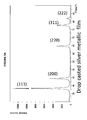
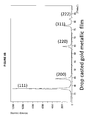
- Figures 5A , 5B , and 5C illustrate one embodiment, showing structural characterization by PXRD of the resulting metallic alloy films from an ink containing a 50% Ag and 50% Au atomic ratio (5C), as well as the individual metals Ag (5A) and gold (5B).
- Silver and gold crystallize in face centered cubic (FCC) and have nearly identical lattice constants, thus the diffraction patterns of these metals support the formation of silver and gold crystalline films.
- Figures 6A and 6B illustrate one embodiment, showing diffraction overlays of Au, Ag and the resulting alloy films from an ink containing a 50% Ag and 50% Au atomic ratio.
- the overlay plots show shifts of the alloy peaks to areas between the silver and gold peaks. The fact that the alloy shows a single peak, as well as its slightly shifted position, is indicative of a solid solution chemical alloy with the Ag and Au atoms positioned randomly about the FCC lattice.
- Figure 6A shows a broader range of peaks compared to Figure 6B . The higher angle in Figure 6B provides better resolution.
- the gold trace is red; the silver trace is blue, and the alloy trace is green.
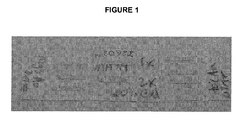
- the films were inspected including determination if any delamination from the substrate occurred.
Landscapes
- Chemical & Material Sciences (AREA)
- Engineering & Computer Science (AREA)
- Organic Chemistry (AREA)
- Materials Engineering (AREA)
- Microelectronics & Electronic Packaging (AREA)
- Mechanical Engineering (AREA)
- Metallurgy (AREA)
- Life Sciences & Earth Sciences (AREA)
- Wood Science & Technology (AREA)
- Manufacturing & Machinery (AREA)
- Chemical Kinetics & Catalysis (AREA)
- Dispersion Chemistry (AREA)
- Physics & Mathematics (AREA)
- Thermal Sciences (AREA)
- Inorganic Chemistry (AREA)
- General Chemical & Material Sciences (AREA)
- Inks, Pencil-Leads, Or Crayons (AREA)
- Ink Jet Recording Methods And Recording Media Thereof (AREA)
- Manufacture Of Metal Powder And Suspensions Thereof (AREA)
Applications Claiming Priority (2)
| Application Number | Priority Date | Filing Date | Title |
|---|---|---|---|
| US201161482571P | 2011-05-04 | 2011-05-04 | |
| PCT/US2012/036549 WO2012151500A1 (en) | 2011-05-04 | 2012-05-04 | Metal alloys from molecular inks |
Publications (2)
| Publication Number | Publication Date |
|---|---|
| EP2705734A1 EP2705734A1 (en) | 2014-03-12 |
| EP2705734B1 true EP2705734B1 (en) | 2014-12-10 |
Family
ID=46147714
Family Applications (1)
| Application Number | Title | Priority Date | Filing Date |
|---|---|---|---|
| EP12722986.2A Not-in-force EP2705734B1 (en) | 2011-05-04 | 2012-05-04 | Metal alloys from molecular inks |
Country Status (7)
| Country | Link |
|---|---|
| US (4) | US9487669B2 (enExample) |
| EP (1) | EP2705734B1 (enExample) |
| JP (1) | JP6204348B2 (enExample) |
| KR (1) | KR101969427B1 (enExample) |
| CN (1) | CN103609204B (enExample) |
| TW (1) | TWI567205B (enExample) |
| WO (1) | WO2012151500A1 (enExample) |
Families Citing this family (14)
| Publication number | Priority date | Publication date | Assignee | Title |
|---|---|---|---|---|
| US20130236656A1 (en) * | 2012-02-27 | 2013-09-12 | Liquid X Printed Metals, Inc. | Self-reduced metal complex inks soluble in polar protic solvents and improved curing methods |
| JPWO2014046306A1 (ja) | 2012-09-21 | 2016-08-18 | 住友化学株式会社 | 導電性膜形成用の組成物 |
| EP2781607A1 (en) * | 2013-03-20 | 2014-09-24 | Heraeus Electro-Nite International N.V. | Sampler for molten iron |
| WO2017214633A1 (en) * | 2016-06-10 | 2017-12-14 | University Of Washington | Chalcogen copolymers |
| CN112334029A (zh) * | 2018-02-13 | 2021-02-05 | 液体X印刷金属有限公司 | 使用无颗粒导电油墨制造的电子纺织物 |
| US20210307163A1 (en) * | 2018-08-03 | 2021-09-30 | Electroninks Incorporated | Conductive materials and their methods of preparation by metallization with metal complex conductive ink compositions |
| WO2020041392A1 (en) * | 2018-08-23 | 2020-02-27 | Kunlun Ding | Multimetallic nanoparticles and methods of making thereof |
| WO2020236895A1 (en) * | 2019-05-20 | 2020-11-26 | Liquid X Printed Metals, Inc. | Triboelectric energy generation methods and articles |
| WO2020236934A1 (en) * | 2019-05-20 | 2020-11-26 | Liquid X Printed Metals, Inc. | Particle-free adhesive gold inks |
| DE102019219615A1 (de) | 2019-12-13 | 2021-06-17 | Heraeus Deutschland GmbH & Co. KG | Herstellungsverfahren für Edelmetall-Elektroden |
| WO2021155370A1 (en) | 2020-01-30 | 2021-08-05 | Liquid X Printed Metals, Inc. | Force sensor controlled conductive heating elements |
| KR102295712B1 (ko) * | 2020-05-07 | 2021-08-31 | 서울대학교산학협력단 | 합금 나노입자, 상기 합금 나노입자의 형성 방법 및 상기 합금 나노입자를 포함하는 합금 나노촉매 |
| EP4192202A4 (en) * | 2020-07-29 | 2024-09-04 | Kyocera Corporation | CIRCUIT SUBSTRATE AND MANUFACTURING METHOD THEREOF |
| CN115301228B (zh) * | 2021-05-08 | 2024-05-07 | 中国石油天然气股份有限公司 | 环己烷氧化制备己二酸的方法、金属准晶合金催化剂的制备方法 |
Family Cites Families (49)
| Publication number | Priority date | Publication date | Assignee | Title |
|---|---|---|---|---|
| US4102820A (en) | 1975-12-29 | 1978-07-25 | Texaco Development Corp. | Silver catalyst for ethylene epoxidation |
| US4097414A (en) | 1976-08-30 | 1978-06-27 | Texaco Development Corp. | Modified ethylene oxide catalyst and a process for its preparation |
| CH644459A5 (de) | 1978-09-29 | 1984-07-31 | Ciba Geigy Ag | Verfahren zur herstellung farbphotographischer bilder nach dem silberfarbbleichverfahren. |
| DE3030736A1 (de) | 1980-08-14 | 1982-03-25 | Basf Ag, 6700 Ludwigshafen | N-disubstituierte anilinderivate, ihre herstellung, ihre verwendung als mikrobizide und mittel dafuer |
| US4758588A (en) | 1983-06-20 | 1988-07-19 | Research Corporation Technologies | Diaminocyclohexane platinum complexes |
| JPS60196663A (ja) | 1984-03-19 | 1985-10-05 | Daicel Chem Ind Ltd | 分離剤 |
| JP2561678B2 (ja) | 1987-11-06 | 1996-12-11 | 三菱化学株式会社 | エチレンオキシド製造用銀触媒 |
| US4977038A (en) | 1989-04-14 | 1990-12-11 | Karl Sieradzki | Micro- and nano-porous metallic structures |
| US5041640A (en) | 1990-09-20 | 1991-08-20 | Warner-Lambert Company | Process for mono-, di-, trisubstituted acetic acids |
| JPH0718453A (ja) * | 1993-07-02 | 1995-01-20 | Tanaka Kikinzoku Kogyo Kk | ソルダーリーチング防止用メタロオーガニック及びソルダーリーチング防止法 |
| US5422379A (en) | 1993-09-07 | 1995-06-06 | University Of South Florida | Metallospheres and superclusters |
| GB9425030D0 (en) | 1994-12-09 | 1995-02-08 | Alpha Metals Ltd | Silver plating |
| US6010969A (en) | 1996-10-02 | 2000-01-04 | Micron Technology, Inc. | Method of depositing films on semiconductor devices by using carboxylate complexes |
| US5703254A (en) * | 1996-10-02 | 1997-12-30 | Arco Chemical Technology, L.P. | Propylene oxide process using mixed precious metal catalyst supported on alkaline earth metal carbonate |
| US20030148024A1 (en) * | 2001-10-05 | 2003-08-07 | Kodas Toivo T. | Low viscosity precursor compositons and methods for the depositon of conductive electronic features |
| AU779429B2 (en) * | 1999-07-14 | 2005-01-27 | Hoya Corporation | Spectacle frame surface treatment method |
| GB9928069D0 (en) | 1999-11-29 | 2000-01-26 | Johnson Matthey Plc | Liquid compositions |
| GB0006050D0 (en) | 2000-03-14 | 2000-05-03 | Johnson Matthey Plc | Liquid gold compositions |
| KR100807947B1 (ko) | 2001-01-30 | 2008-02-28 | 삼성전자주식회사 | 비대칭형 β-케토이미네이트 리간드 화합물의 제조방법 |
| JP3854889B2 (ja) * | 2001-04-19 | 2006-12-06 | キヤノン株式会社 | 金属または金属化合物パターンの製造方法および電子源の製造方法 |
| CN100530494C (zh) | 2001-04-19 | 2009-08-19 | 佳能株式会社 | 一种图形及一种制造金属或金属化合物的方法 |
| US6491803B1 (en) | 2001-05-18 | 2002-12-10 | Apex Biotechnology Corporation | Test strip and biosensor incorporating with nanometer metal particles |
| US20030216246A1 (en) | 2001-09-21 | 2003-11-20 | Cook Jessica A | Transition metal complexes containing sulfur ligands, and polylefin production processes using them |
| EP1448725A4 (en) * | 2001-10-05 | 2008-07-23 | Cabot Corp | LOW VISCOSIS PRECURSOR COMPOSITIONS AND METHOD FOR APPLYING ELECTRONICALLY CONDUCTIVE STRUCTURAL ELEMENTS |
| US6951666B2 (en) * | 2001-10-05 | 2005-10-04 | Cabot Corporation | Precursor compositions for the deposition of electrically conductive features |
| US7553512B2 (en) | 2001-11-02 | 2009-06-30 | Cabot Corporation | Method for fabricating an inorganic resistor |
| KR20030057133A (ko) | 2001-12-28 | 2003-07-04 | 삼성전자주식회사 | 금속 패턴 형성용 유기금속 전구체 및 이를 이용한 금속패턴 형성방법 |
| US7001526B1 (en) | 2002-02-28 | 2006-02-21 | Hla Ngwe Tin | Optical isomer separation method |
| KR100772790B1 (ko) * | 2002-04-30 | 2007-11-01 | 삼성전자주식회사 | 금속 패턴 형성용 유기금속 전구체 및 이를 이용한 금속패턴 형성방법 |
| US6805972B2 (en) | 2002-08-27 | 2004-10-19 | Johns Hopkins University | Method of forming nanoporous membranes |
| US7391116B2 (en) | 2003-10-14 | 2008-06-24 | Gbc Metals, Llc | Fretting and whisker resistant coating system and method |
| US20050129843A1 (en) | 2003-12-11 | 2005-06-16 | Xerox Corporation | Nanoparticle deposition process |
| TWI318173B (en) * | 2004-03-01 | 2009-12-11 | Sumitomo Electric Industries | Metallic colloidal solution and inkjet-use metallic ink |
| US7632536B2 (en) | 2004-09-01 | 2009-12-15 | Canon Kabushiki Kaisha | Method for producing electroconductive pattern, and method for producing electronic device, electron emitting device and image forming apparatus |
| US7270694B2 (en) | 2004-10-05 | 2007-09-18 | Xerox Corporation | Stabilized silver nanoparticles and their use |
| US20060130700A1 (en) | 2004-12-16 | 2006-06-22 | Reinartz Nicole M | Silver-containing inkjet ink |
| US20080003364A1 (en) | 2006-06-28 | 2008-01-03 | Ginley David S | Metal Inks |
| US7491646B2 (en) | 2006-07-20 | 2009-02-17 | Xerox Corporation | Electrically conductive feature fabrication process |
| JP5034047B2 (ja) * | 2007-01-31 | 2012-09-26 | 国立大学法人東北大学 | ナノ多孔質金属及びその製造方法 |
| US7893006B2 (en) | 2007-03-23 | 2011-02-22 | American Superconductor Corporation | Systems and methods for solution-based deposition of metallic cap layers for high temperature superconductor wires |
| US7696367B2 (en) * | 2007-04-10 | 2010-04-13 | Lyondell Chemical Technology, L.P. | Direct epoxidation process using a mixed catalyst system |
| JP2008293578A (ja) | 2007-05-24 | 2008-12-04 | Hitachi Ltd | ストリームデータ制御モジュール |
| US8143431B2 (en) | 2007-06-05 | 2012-03-27 | Air Products And Chemicals, Inc. | Low temperature thermal conductive inks |
| KR100856508B1 (ko) * | 2007-06-15 | 2008-09-04 | 주식회사 잉크테크 | 투명도전막 및 이의 제조방법 |
| US20090148600A1 (en) * | 2007-12-05 | 2009-06-11 | Xerox Corporation | Metal Nanoparticles Stabilized With a Carboxylic Acid-Organoamine Complex |
| US8308993B2 (en) | 2008-01-30 | 2012-11-13 | Basf Se | Conductive inks |
| JP2011034750A (ja) * | 2009-07-31 | 2011-02-17 | Tosoh Corp | 導電膜形成用組成物、及び導電膜形成法 |
| SG10201500985UA (en) | 2009-11-09 | 2015-04-29 | Univ Carnegie Mellon | Metal ink compositions, conductive patterns, methods, and devices |
| US20130236656A1 (en) | 2012-02-27 | 2013-09-12 | Liquid X Printed Metals, Inc. | Self-reduced metal complex inks soluble in polar protic solvents and improved curing methods |
-
2012
- 2012-05-04 EP EP12722986.2A patent/EP2705734B1/en not_active Not-in-force
- 2012-05-04 KR KR1020137029236A patent/KR101969427B1/ko not_active Expired - Fee Related
- 2012-05-04 CN CN201280021249.XA patent/CN103609204B/zh not_active Expired - Fee Related
- 2012-05-04 WO PCT/US2012/036549 patent/WO2012151500A1/en not_active Ceased
- 2012-05-04 TW TW101116056A patent/TWI567205B/zh not_active IP Right Cessation
- 2012-05-04 US US13/464,605 patent/US9487669B2/en active Active
- 2012-05-04 JP JP2014509483A patent/JP6204348B2/ja not_active Expired - Fee Related
-
2016
- 2016-05-20 US US15/160,018 patent/US9920212B2/en not_active Expired - Fee Related
-
2018
- 2018-03-16 US US15/923,686 patent/US10738211B2/en active Active
-
2020
- 2020-08-03 US US16/983,343 patent/US11118078B2/en not_active Expired - Fee Related
Also Published As
| Publication number | Publication date |
|---|---|
| CN103609204B (zh) | 2017-09-12 |
| US9920212B2 (en) | 2018-03-20 |
| JP2014519532A (ja) | 2014-08-14 |
| US11118078B2 (en) | 2021-09-14 |
| WO2012151500A1 (en) | 2012-11-08 |
| KR101969427B1 (ko) | 2019-08-20 |
| WO2012151500A9 (en) | 2013-11-28 |
| TWI567205B (zh) | 2017-01-21 |
| US20200362188A1 (en) | 2020-11-19 |
| US20120304889A1 (en) | 2012-12-06 |
| JP6204348B2 (ja) | 2017-09-27 |
| US10738211B2 (en) | 2020-08-11 |
| KR20140059166A (ko) | 2014-05-15 |
| CN103609204A (zh) | 2014-02-26 |
| EP2705734A1 (en) | 2014-03-12 |
| US9487669B2 (en) | 2016-11-08 |
| US20160264802A1 (en) | 2016-09-15 |
| TW201250008A (en) | 2012-12-16 |
| US20180208790A1 (en) | 2018-07-26 |
Similar Documents
| Publication | Publication Date | Title |
|---|---|---|
| US11118078B2 (en) | Metal alloys from molecular inks | |
| KR101795088B1 (ko) | 금속 잉크 조성물, 전도성 패턴, 방법, 및 장치 | |
| Jong Lee et al. | Direct synthesis and inkjetting of silver nanocrystals toward printed electronics | |
| Black et al. | Silver ink formulations for sinter-free printing of conductive films | |
| JP7356729B2 (ja) | 粒子非含有導電性インクを用いて製作されたe-テキスタイル | |
| US20090169730A1 (en) | Method of forming conductors at low temperatures using metallic nanocrystals and product | |
| TWI674300B (zh) | 可溶於極性質子溶劑之自還原性金屬錯合物墨水及改良的固化方法 | |
| EP2353348A2 (en) | Method and kit for manufacturing metal nanoparticles and metal-containing nanostructured composite materials | |
| KR20100092392A (ko) | 유기 아민 안정화 은 나노입자 및 그의 제조 방법 | |
| JP5456129B1 (ja) | めっき処理のための触媒粒子を担持する基板の処理方法 | |
| US7976737B2 (en) | Silver organo-sol ink for forming electronically conductive patterns | |
| EP2281646A1 (en) | Method and kit for manufacturing metal nanoparticles and metal-containing nanostructured composite materials | |
| HK1195191A (en) | Metal alloys from molecular inks | |
| HK1195191B (en) | Metal alloys from molecular inks | |
| WO2009132665A1 (en) | Method for generation of metal surface structures and use of silver complex for forming surface patterns | |
| HK1173475B (en) | Metal ink compositions, conductive patterns, methods, and devices | |
| Zheng et al. | Low‐Temperature Sintering Copper Inks: In‐Situ X‐Ray Diffraction of Decomposition, Enhanced Conductivity and Morphology, and Nickel‐Improved Weather Resistance | |
| HK1145901A (zh) | 導電圖形和使用方法 |
Legal Events
| Date | Code | Title | Description |
|---|---|---|---|
| PUAI | Public reference made under article 153(3) epc to a published international application that has entered the european phase |
Free format text: ORIGINAL CODE: 0009012 |
|
| 17P | Request for examination filed |
Effective date: 20131106 |
|
| AK | Designated contracting states |
Kind code of ref document: A1 Designated state(s): AL AT BE BG CH CY CZ DE DK EE ES FI FR GB GR HR HU IE IS IT LI LT LU LV MC MK MT NL NO PL PT RO RS SE SI SK SM TR |
|
| 17Q | First examination report despatched |
Effective date: 20140428 |
|
| GRAJ | Information related to disapproval of communication of intention to grant by the applicant or resumption of examination proceedings by the epo deleted |
Free format text: ORIGINAL CODE: EPIDOSDIGR1 |
|
| GRAP | Despatch of communication of intention to grant a patent |
Free format text: ORIGINAL CODE: EPIDOSNIGR1 |
|
| DAX | Request for extension of the european patent (deleted) | ||
| INTG | Intention to grant announced |
Effective date: 20140623 |
|
| GRAS | Grant fee paid |
Free format text: ORIGINAL CODE: EPIDOSNIGR3 |
|
| GRAA | (expected) grant |
Free format text: ORIGINAL CODE: 0009210 |
|
| AK | Designated contracting states |
Kind code of ref document: B1 Designated state(s): AL AT BE BG CH CY CZ DE DK EE ES FI FR GB GR HR HU IE IS IT LI LT LU LV MC MK MT NL NO PL PT RO RS SE SI SK SM TR |
|
| REG | Reference to a national code |
Ref country code: GB Ref legal event code: FG4D |
|
| REG | Reference to a national code |
Ref country code: CH Ref legal event code: EP |
|
| REG | Reference to a national code |
Ref country code: IE Ref legal event code: FG4D |
|
| REG | Reference to a national code |
Ref country code: AT Ref legal event code: REF Ref document number: 701187 Country of ref document: AT Kind code of ref document: T Effective date: 20150115 |
|
| REG | Reference to a national code |
Ref country code: DE Ref legal event code: R096 Ref document number: 602012004259 Country of ref document: DE Effective date: 20150122 |
|
| REG | Reference to a national code |
Ref country code: NL Ref legal event code: T3 |
|
| REG | Reference to a national code |
Ref country code: AT Ref legal event code: MK05 Ref document number: 701187 Country of ref document: AT Kind code of ref document: T Effective date: 20141210 |
|
| PG25 | Lapsed in a contracting state [announced via postgrant information from national office to epo] |
Ref country code: LT Free format text: LAPSE BECAUSE OF FAILURE TO SUBMIT A TRANSLATION OF THE DESCRIPTION OR TO PAY THE FEE WITHIN THE PRESCRIBED TIME-LIMIT Effective date: 20141210 Ref country code: NO Free format text: LAPSE BECAUSE OF FAILURE TO SUBMIT A TRANSLATION OF THE DESCRIPTION OR TO PAY THE FEE WITHIN THE PRESCRIBED TIME-LIMIT Effective date: 20150310 Ref country code: ES Free format text: LAPSE BECAUSE OF FAILURE TO SUBMIT A TRANSLATION OF THE DESCRIPTION OR TO PAY THE FEE WITHIN THE PRESCRIBED TIME-LIMIT Effective date: 20141210 Ref country code: FI Free format text: LAPSE BECAUSE OF FAILURE TO SUBMIT A TRANSLATION OF THE DESCRIPTION OR TO PAY THE FEE WITHIN THE PRESCRIBED TIME-LIMIT Effective date: 20141210 |
|
| REG | Reference to a national code |
Ref country code: LT Ref legal event code: MG4D |
|
| PG25 | Lapsed in a contracting state [announced via postgrant information from national office to epo] |
Ref country code: GR Free format text: LAPSE BECAUSE OF FAILURE TO SUBMIT A TRANSLATION OF THE DESCRIPTION OR TO PAY THE FEE WITHIN THE PRESCRIBED TIME-LIMIT Effective date: 20150311 Ref country code: SE Free format text: LAPSE BECAUSE OF FAILURE TO SUBMIT A TRANSLATION OF THE DESCRIPTION OR TO PAY THE FEE WITHIN THE PRESCRIBED TIME-LIMIT Effective date: 20141210 Ref country code: HR Free format text: LAPSE BECAUSE OF FAILURE TO SUBMIT A TRANSLATION OF THE DESCRIPTION OR TO PAY THE FEE WITHIN THE PRESCRIBED TIME-LIMIT Effective date: 20141210 Ref country code: RS Free format text: LAPSE BECAUSE OF FAILURE TO SUBMIT A TRANSLATION OF THE DESCRIPTION OR TO PAY THE FEE WITHIN THE PRESCRIBED TIME-LIMIT Effective date: 20141210 Ref country code: AT Free format text: LAPSE BECAUSE OF FAILURE TO SUBMIT A TRANSLATION OF THE DESCRIPTION OR TO PAY THE FEE WITHIN THE PRESCRIBED TIME-LIMIT Effective date: 20141210 Ref country code: LV Free format text: LAPSE BECAUSE OF FAILURE TO SUBMIT A TRANSLATION OF THE DESCRIPTION OR TO PAY THE FEE WITHIN THE PRESCRIBED TIME-LIMIT Effective date: 20141210 |
|
| PG25 | Lapsed in a contracting state [announced via postgrant information from national office to epo] |
Ref country code: EE Free format text: LAPSE BECAUSE OF FAILURE TO SUBMIT A TRANSLATION OF THE DESCRIPTION OR TO PAY THE FEE WITHIN THE PRESCRIBED TIME-LIMIT Effective date: 20141210 Ref country code: SK Free format text: LAPSE BECAUSE OF FAILURE TO SUBMIT A TRANSLATION OF THE DESCRIPTION OR TO PAY THE FEE WITHIN THE PRESCRIBED TIME-LIMIT Effective date: 20141210 Ref country code: CZ Free format text: LAPSE BECAUSE OF FAILURE TO SUBMIT A TRANSLATION OF THE DESCRIPTION OR TO PAY THE FEE WITHIN THE PRESCRIBED TIME-LIMIT Effective date: 20141210 Ref country code: PT Free format text: LAPSE BECAUSE OF FAILURE TO SUBMIT A TRANSLATION OF THE DESCRIPTION OR TO PAY THE FEE WITHIN THE PRESCRIBED TIME-LIMIT Effective date: 20150410 Ref country code: RO Free format text: LAPSE BECAUSE OF FAILURE TO SUBMIT A TRANSLATION OF THE DESCRIPTION OR TO PAY THE FEE WITHIN THE PRESCRIBED TIME-LIMIT Effective date: 20141210 |
|
| PG25 | Lapsed in a contracting state [announced via postgrant information from national office to epo] |
Ref country code: IS Free format text: LAPSE BECAUSE OF FAILURE TO SUBMIT A TRANSLATION OF THE DESCRIPTION OR TO PAY THE FEE WITHIN THE PRESCRIBED TIME-LIMIT Effective date: 20150410 Ref country code: PL Free format text: LAPSE BECAUSE OF FAILURE TO SUBMIT A TRANSLATION OF THE DESCRIPTION OR TO PAY THE FEE WITHIN THE PRESCRIBED TIME-LIMIT Effective date: 20141210 |
|
| REG | Reference to a national code |
Ref country code: DE Ref legal event code: R097 Ref document number: 602012004259 Country of ref document: DE |
|
| PLBE | No opposition filed within time limit |
Free format text: ORIGINAL CODE: 0009261 |
|
| STAA | Information on the status of an ep patent application or granted ep patent |
Free format text: STATUS: NO OPPOSITION FILED WITHIN TIME LIMIT |
|
| PG25 | Lapsed in a contracting state [announced via postgrant information from national office to epo] |
Ref country code: DK Free format text: LAPSE BECAUSE OF FAILURE TO SUBMIT A TRANSLATION OF THE DESCRIPTION OR TO PAY THE FEE WITHIN THE PRESCRIBED TIME-LIMIT Effective date: 20141210 |
|
| 26N | No opposition filed |
Effective date: 20150911 |
|
| PG25 | Lapsed in a contracting state [announced via postgrant information from national office to epo] |
Ref country code: IT Free format text: LAPSE BECAUSE OF FAILURE TO SUBMIT A TRANSLATION OF THE DESCRIPTION OR TO PAY THE FEE WITHIN THE PRESCRIBED TIME-LIMIT Effective date: 20141210 |
|
| REG | Reference to a national code |
Ref country code: CH Ref legal event code: PL |
|
| PG25 | Lapsed in a contracting state [announced via postgrant information from national office to epo] |
Ref country code: CH Free format text: LAPSE BECAUSE OF NON-PAYMENT OF DUE FEES Effective date: 20150531 Ref country code: LI Free format text: LAPSE BECAUSE OF NON-PAYMENT OF DUE FEES Effective date: 20150531 Ref country code: LU Free format text: LAPSE BECAUSE OF FAILURE TO SUBMIT A TRANSLATION OF THE DESCRIPTION OR TO PAY THE FEE WITHIN THE PRESCRIBED TIME-LIMIT Effective date: 20150504 Ref country code: MC Free format text: LAPSE BECAUSE OF FAILURE TO SUBMIT A TRANSLATION OF THE DESCRIPTION OR TO PAY THE FEE WITHIN THE PRESCRIBED TIME-LIMIT Effective date: 20141210 |
|
| REG | Reference to a national code |
Ref country code: IE Ref legal event code: MM4A |
|
| PG25 | Lapsed in a contracting state [announced via postgrant information from national office to epo] |
Ref country code: SI Free format text: LAPSE BECAUSE OF FAILURE TO SUBMIT A TRANSLATION OF THE DESCRIPTION OR TO PAY THE FEE WITHIN THE PRESCRIBED TIME-LIMIT Effective date: 20141210 |
|
| PG25 | Lapsed in a contracting state [announced via postgrant information from national office to epo] |
Ref country code: IE Free format text: LAPSE BECAUSE OF NON-PAYMENT OF DUE FEES Effective date: 20150504 |
|
| REG | Reference to a national code |
Ref country code: FR Ref legal event code: PLFP Year of fee payment: 5 |
|
| PG25 | Lapsed in a contracting state [announced via postgrant information from national office to epo] |
Ref country code: BE Free format text: LAPSE BECAUSE OF FAILURE TO SUBMIT A TRANSLATION OF THE DESCRIPTION OR TO PAY THE FEE WITHIN THE PRESCRIBED TIME-LIMIT Effective date: 20141210 |
|
| PG25 | Lapsed in a contracting state [announced via postgrant information from national office to epo] |
Ref country code: MT Free format text: LAPSE BECAUSE OF FAILURE TO SUBMIT A TRANSLATION OF THE DESCRIPTION OR TO PAY THE FEE WITHIN THE PRESCRIBED TIME-LIMIT Effective date: 20141210 |
|
| REG | Reference to a national code |
Ref country code: FR Ref legal event code: PLFP Year of fee payment: 6 |
|
| PG25 | Lapsed in a contracting state [announced via postgrant information from national office to epo] |
Ref country code: SM Free format text: LAPSE BECAUSE OF FAILURE TO SUBMIT A TRANSLATION OF THE DESCRIPTION OR TO PAY THE FEE WITHIN THE PRESCRIBED TIME-LIMIT Effective date: 20141210 Ref country code: BG Free format text: LAPSE BECAUSE OF FAILURE TO SUBMIT A TRANSLATION OF THE DESCRIPTION OR TO PAY THE FEE WITHIN THE PRESCRIBED TIME-LIMIT Effective date: 20141210 Ref country code: HU Free format text: LAPSE BECAUSE OF FAILURE TO SUBMIT A TRANSLATION OF THE DESCRIPTION OR TO PAY THE FEE WITHIN THE PRESCRIBED TIME-LIMIT; INVALID AB INITIO Effective date: 20120504 |
|
| PG25 | Lapsed in a contracting state [announced via postgrant information from national office to epo] |
Ref country code: CY Free format text: LAPSE BECAUSE OF FAILURE TO SUBMIT A TRANSLATION OF THE DESCRIPTION OR TO PAY THE FEE WITHIN THE PRESCRIBED TIME-LIMIT Effective date: 20141210 |
|
| PG25 | Lapsed in a contracting state [announced via postgrant information from national office to epo] |
Ref country code: TR Free format text: LAPSE BECAUSE OF FAILURE TO SUBMIT A TRANSLATION OF THE DESCRIPTION OR TO PAY THE FEE WITHIN THE PRESCRIBED TIME-LIMIT Effective date: 20141210 |
|
| REG | Reference to a national code |
Ref country code: FR Ref legal event code: PLFP Year of fee payment: 7 |
|
| PG25 | Lapsed in a contracting state [announced via postgrant information from national office to epo] |
Ref country code: MK Free format text: LAPSE BECAUSE OF FAILURE TO SUBMIT A TRANSLATION OF THE DESCRIPTION OR TO PAY THE FEE WITHIN THE PRESCRIBED TIME-LIMIT Effective date: 20141210 |
|
| PG25 | Lapsed in a contracting state [announced via postgrant information from national office to epo] |
Ref country code: AL Free format text: LAPSE BECAUSE OF FAILURE TO SUBMIT A TRANSLATION OF THE DESCRIPTION OR TO PAY THE FEE WITHIN THE PRESCRIBED TIME-LIMIT Effective date: 20141210 |
|
| REG | Reference to a national code |
Ref country code: DE Ref legal event code: R082 Ref document number: 602012004259 Country of ref document: DE Representative=s name: SIMMONS & SIMMONS LLP, DE |
|
| P01 | Opt-out of the competence of the unified patent court (upc) registered |
Effective date: 20230522 |
|
| PGFP | Annual fee paid to national office [announced via postgrant information from national office to epo] |
Ref country code: NL Payment date: 20240526 Year of fee payment: 13 |
|
| PGFP | Annual fee paid to national office [announced via postgrant information from national office to epo] |
Ref country code: GB Payment date: 20240527 Year of fee payment: 13 |
|
| PGFP | Annual fee paid to national office [announced via postgrant information from national office to epo] |
Ref country code: DE Payment date: 20240530 Year of fee payment: 13 |
|
| PGFP | Annual fee paid to national office [announced via postgrant information from national office to epo] |
Ref country code: FR Payment date: 20240527 Year of fee payment: 13 |
|
| REG | Reference to a national code |
Ref country code: DE Ref legal event code: R119 Ref document number: 602012004259 Country of ref document: DE |
|
| REG | Reference to a national code |
Ref country code: NL Ref legal event code: MM Effective date: 20250601 |
|
| GBPC | Gb: european patent ceased through non-payment of renewal fee |
Effective date: 20250504 |
|
| PG25 | Lapsed in a contracting state [announced via postgrant information from national office to epo] |
Ref country code: NL Free format text: LAPSE BECAUSE OF NON-PAYMENT OF DUE FEES Effective date: 20250601 |
|
| PG25 | Lapsed in a contracting state [announced via postgrant information from national office to epo] |
Ref country code: GB Free format text: LAPSE BECAUSE OF NON-PAYMENT OF DUE FEES Effective date: 20250504 |
|
| PG25 | Lapsed in a contracting state [announced via postgrant information from national office to epo] |
Ref country code: DE Free format text: LAPSE BECAUSE OF NON-PAYMENT OF DUE FEES Effective date: 20251202 |
|
| PG25 | Lapsed in a contracting state [announced via postgrant information from national office to epo] |
Ref country code: FR Free format text: LAPSE BECAUSE OF NON-PAYMENT OF DUE FEES Effective date: 20250531 |