EP2671906B1 - Flexible, Low Temperature, Filled Composite Material Compositions, Coatings, and Methods - Google Patents
Flexible, Low Temperature, Filled Composite Material Compositions, Coatings, and Methods Download PDFInfo
- Publication number
- EP2671906B1 EP2671906B1 EP13170874.5A EP13170874A EP2671906B1 EP 2671906 B1 EP2671906 B1 EP 2671906B1 EP 13170874 A EP13170874 A EP 13170874A EP 2671906 B1 EP2671906 B1 EP 2671906B1
- Authority
- EP
- European Patent Office
- Prior art keywords
- poly
- composite material
- material composition
- species
- amine
- Prior art date
- Legal status (The legal status is an assumption and is not a legal conclusion. Google has not performed a legal analysis and makes no representation as to the accuracy of the status listed.)
- Active
Links
Images





Classifications
-
- C—CHEMISTRY; METALLURGY
- C08—ORGANIC MACROMOLECULAR COMPOUNDS; THEIR PREPARATION OR CHEMICAL WORKING-UP; COMPOSITIONS BASED THEREON
- C08L—COMPOSITIONS OF MACROMOLECULAR COMPOUNDS
- C08L83/00—Compositions of macromolecular compounds obtained by reactions forming in the main chain of the macromolecule a linkage containing silicon with or without sulfur, nitrogen, oxygen or carbon only; Compositions of derivatives of such polymers
- C08L83/04—Polysiloxanes
-
- C—CHEMISTRY; METALLURGY
- C08—ORGANIC MACROMOLECULAR COMPOUNDS; THEIR PREPARATION OR CHEMICAL WORKING-UP; COMPOSITIONS BASED THEREON
- C08G—MACROMOLECULAR COMPOUNDS OBTAINED OTHERWISE THAN BY REACTIONS ONLY INVOLVING UNSATURATED CARBON-TO-CARBON BONDS
- C08G18/00—Polymeric products of isocyanates or isothiocyanates
- C08G18/06—Polymeric products of isocyanates or isothiocyanates with compounds having active hydrogen
- C08G18/08—Processes
- C08G18/10—Prepolymer processes involving reaction of isocyanates or isothiocyanates with compounds having active hydrogen in a first reaction step
-
- C—CHEMISTRY; METALLURGY
- C08—ORGANIC MACROMOLECULAR COMPOUNDS; THEIR PREPARATION OR CHEMICAL WORKING-UP; COMPOSITIONS BASED THEREON
- C08G—MACROMOLECULAR COMPOUNDS OBTAINED OTHERWISE THAN BY REACTIONS ONLY INVOLVING UNSATURATED CARBON-TO-CARBON BONDS
- C08G18/00—Polymeric products of isocyanates or isothiocyanates
- C08G18/06—Polymeric products of isocyanates or isothiocyanates with compounds having active hydrogen
- C08G18/28—Polymeric products of isocyanates or isothiocyanates with compounds having active hydrogen characterised by the compounds used containing active hydrogen
- C08G18/40—High-molecular-weight compounds
- C08G18/61—Polysiloxanes
-
- C—CHEMISTRY; METALLURGY
- C08—ORGANIC MACROMOLECULAR COMPOUNDS; THEIR PREPARATION OR CHEMICAL WORKING-UP; COMPOSITIONS BASED THEREON
- C08G—MACROMOLECULAR COMPOUNDS OBTAINED OTHERWISE THAN BY REACTIONS ONLY INVOLVING UNSATURATED CARBON-TO-CARBON BONDS
- C08G18/00—Polymeric products of isocyanates or isothiocyanates
- C08G18/06—Polymeric products of isocyanates or isothiocyanates with compounds having active hydrogen
- C08G18/70—Polymeric products of isocyanates or isothiocyanates with compounds having active hydrogen characterised by the isocyanates or isothiocyanates used
- C08G18/72—Polyisocyanates or polyisothiocyanates
- C08G18/74—Polyisocyanates or polyisothiocyanates cyclic
- C08G18/75—Polyisocyanates or polyisothiocyanates cyclic cycloaliphatic
- C08G18/758—Polyisocyanates or polyisothiocyanates cyclic cycloaliphatic containing two or more cycloaliphatic rings
-
- C—CHEMISTRY; METALLURGY
- C08—ORGANIC MACROMOLECULAR COMPOUNDS; THEIR PREPARATION OR CHEMICAL WORKING-UP; COMPOSITIONS BASED THEREON
- C08G—MACROMOLECULAR COMPOUNDS OBTAINED OTHERWISE THAN BY REACTIONS ONLY INVOLVING UNSATURATED CARBON-TO-CARBON BONDS
- C08G77/00—Macromolecular compounds obtained by reactions forming a linkage containing silicon with or without sulfur, nitrogen, oxygen or carbon in the main chain of the macromolecule
- C08G77/42—Block-or graft-polymers containing polysiloxane sequences
- C08G77/452—Block-or graft-polymers containing polysiloxane sequences containing nitrogen-containing sequences
- C08G77/458—Block-or graft-polymers containing polysiloxane sequences containing nitrogen-containing sequences containing polyurethane sequences
-
- C—CHEMISTRY; METALLURGY
- C08—ORGANIC MACROMOLECULAR COMPOUNDS; THEIR PREPARATION OR CHEMICAL WORKING-UP; COMPOSITIONS BASED THEREON
- C08K—Use of inorganic or non-macromolecular organic substances as compounding ingredients
- C08K3/00—Use of inorganic substances as compounding ingredients
-
- C—CHEMISTRY; METALLURGY
- C08—ORGANIC MACROMOLECULAR COMPOUNDS; THEIR PREPARATION OR CHEMICAL WORKING-UP; COMPOSITIONS BASED THEREON
- C08K—Use of inorganic or non-macromolecular organic substances as compounding ingredients
- C08K5/00—Use of organic ingredients
- C08K5/16—Nitrogen-containing compounds
- C08K5/29—Compounds containing one or more carbon-to-nitrogen double bonds
-
- C—CHEMISTRY; METALLURGY
- C09—DYES; PAINTS; POLISHES; NATURAL RESINS; ADHESIVES; COMPOSITIONS NOT OTHERWISE PROVIDED FOR; APPLICATIONS OF MATERIALS NOT OTHERWISE PROVIDED FOR
- C09D—COATING COMPOSITIONS, e.g. PAINTS, VARNISHES OR LACQUERS; FILLING PASTES; CHEMICAL PAINT OR INK REMOVERS; INKS; CORRECTING FLUIDS; WOODSTAINS; PASTES OR SOLIDS FOR COLOURING OR PRINTING; USE OF MATERIALS THEREFOR
- C09D175/00—Coating compositions based on polyureas or polyurethanes; Coating compositions based on derivatives of such polymers
- C09D175/04—Polyurethanes
- C09D175/08—Polyurethanes from polyethers
-
- C—CHEMISTRY; METALLURGY
- C09—DYES; PAINTS; POLISHES; NATURAL RESINS; ADHESIVES; COMPOSITIONS NOT OTHERWISE PROVIDED FOR; APPLICATIONS OF MATERIALS NOT OTHERWISE PROVIDED FOR
- C09D—COATING COMPOSITIONS, e.g. PAINTS, VARNISHES OR LACQUERS; FILLING PASTES; CHEMICAL PAINT OR INK REMOVERS; INKS; CORRECTING FLUIDS; WOODSTAINS; PASTES OR SOLIDS FOR COLOURING OR PRINTING; USE OF MATERIALS THEREFOR
- C09D183/00—Coating compositions based on macromolecular compounds obtained by reactions forming in the main chain of the macromolecule a linkage containing silicon, with or without sulfur, nitrogen, oxygen, or carbon only; Coating compositions based on derivatives of such polymers
- C09D183/04—Polysiloxanes
Definitions
- the disclosure relates to composite material compositions, coatings, and methods using segmented copolymers, and in particular, to composite material compositions, coatings, and methods using segmented copolymer elastomers and solid particulate fillers.
- Elastomeric materials are required in a broad variety of applications, including use in low temperature, subfreezing environments, such as less than -50°C. Elastomeric materials that possess the ability to demonstrate a high degree of toughness through both high elongation and tensile strength find application in a variety of environments, such as the aerospace environment, where such low temperatures are common.
- known elastomers may not maintain their advantageous elastic properties at such low temperatures because such known elastomers may comprise polymer species that cause the elastomers to stiffen and become brittle.
- known elastomeric polymers such as polysiloxanes, that are able to individually maintain flexibility at low temperatures may have reduced mechanical strength at low temperatures.
- Known elastomeric systems may exhibit dramatic stiffening at low temperatures due to onset of the glass transition temperature (T g ) from polymeric chains in the material. Below T g , the elastomer may experience an abrupt increase in modulus of 10-100 times upon cooling, rendering the material hard and brittle.
- particulate fillers in the range of 10-100 nm (nanometers) may have a beneficial effect on the mechanical properties of elastomers, and they are typically referred to as "reinforcing fillers".
- larger particles such as in the 1-100 ⁇ m (micrometer) range, may have a detrimental effect on elastomer mechanical properties, yet these particles are often desirable in order to add additional functionality to the overall composite material.
- elastomeric materials may possess lower Tgs, they may be incapable of being processed in solution mixed with high levels of solid fillers and easily applied over vehicle scale areas.
- polyether compounds to improve the mechanical properties of segmented polyurea silioxanes.
- these materials use the polyether compounds as a second soft segment block to reside between the silicone and urea hard segments rather than as a chain extender or curative, thus producing a different chain backbone structure.
- Such an intermediate polyether segment introduces a structural element into the polymer system with a higher glass transition temperature (Tg) of approximately -50oC that may reduce the low temperature range over which the material is elastic.
- Tg glass transition temperature
- fillers to these materials is desirable.
- EP 1,460,095 discloses a polyurethane composition for the production of films comprising the following at least partially separated components: a) a di- and/or polyisocyanate, b) an active hydrogen containing compound for a polyurethane reaction, c) a catalyst or catalysing system, d) more than 3wt% of a highly dispersed oxide of a metal or a metalloid, and e) optionally additives in the absence of amine initiators.
- elastomeric materials it is desirable for elastomeric materials to be able to be formulated into a form that may be conveniently prepared and applied in the field. This may require precursor components that are capable of being stored and stable over acceptable time periods. Once combined, the elastomeric precursors may demonstrate an acceptable pot life or be suspended in a medium that allows for convenient application. Low general toxicity of individual components, chemical resistance to fluids commonly found in aerospace environments, and the ability to be compounded with filler materials are also desirable.
- a flexible, low temperature, filled composite material composition comprises a segmented copolymer elastomer comprising an ⁇ , ⁇ -(alpha, omega)-dihydroxy terminated polysiloxane species, a diisocyanate species, and an amine or hydroxy terminated chain extender.
- the composite material composition further comprises a solid particulate filler and fumed silica as a reinforcing filler.
- the composite material composition has a high flexibility at a temperature of down to about -100 degrees Celsius, has a percent elongation of greater than about 100%, and has a tensile strength of greater than about 5MPa (megapascals).
- the amine or hydroxy terminated chain extender is a linear ⁇ , ⁇ -(alpha,omega) amino or hydroxyl end terminated oligomeric species having an average molecular weight of 400 grams per mole to 5000 grams per mole.
- a flexible, low temperature, filled composite coating comprising a composite material composition comprising a segmented copolymer elastomer and a solid particulate filler.
- the segmented copolymer elastomer comprises an ⁇ , ⁇ -(alpha, omega)-dihydroxy terminated polysiloxane species, a diisocyanate species, and an amine or hydroxy terminated chain extender.
- the coating has a high flexibility at a temperature of down to about -100 degrees Celsius, has a percent elongation of greater than about 100%, and has a tensile strength of greater than about 5MPa (megapascals).
- a method of synthesizing a flexible, low temperature, filled composite material composition comprises mixing an ⁇ , ⁇ -(alpha, omega)-dihydroxy terminated polysiloxane species, a diisocyanate species, and an amine or hydroxy terminated chain extender to form a segmented copolymer elastomer.
- the method further comprises mixing the segmented copolymer elastomer with a solid particulate filler and adding fumed silica as a reinforcing filler to form a composite material composition.
- the composite material composition has a high flexibility at a temperature of down to about -100 degrees Celsius, has a percent elongation of greater than about 100%, and has a tensile strength of greater than about 5MPa (megapascals).
- a flexible, low temperature, filled composite material composition comprising: a segmented copolymer elastomer comprising: an ⁇ , ⁇ -(alpha, omega)-dihydroxy terminated polysiloxane species; a diisocyanate species; and, an amine or hydroxy terminated chain extender; and, a solid particulate filler, wherein the composite material composition has a high flexibility at a temperature of down to about -100 degrees Celsius, has a percent elongation of greater than about 100%, and has a tensile strength of greater than about 5MPa (megapascals).
- the ⁇ , ⁇ -(alpha, omega)-dihydroxy terminated polysiloxane species is selected from a group consisting of poly(dimethylsiloxane) (PDMS), poly(diphenyl-co-dimethylsiloxane), poly(methyl-3,3,3-trifluoropropylsiloxane), poly(methyl-n-octylsiloxane), poly(di-n-pentylsiloxane), poly(methyl-n-hexylsiloxane), poly(di-n-propylsiloxane), poly(methyl-n-pentylsiloxane), poly(methyl-n-butylsiloxane), poly(di-n-butylsiloxane), poly(methyl-n-poropylsiloxane), poly(methylethylsiloxane), poly(methylhydridosiloxane), and polydiethylsiloxane.
- the ⁇ , ⁇ -(alpha, omega)-dihydroxy terminated polysiloxane species is poly(dimethylsiloxane) (PDMS); wherein the ⁇ , ⁇ -(alpha, omega)-dihydroxy terminated polysiloxane species is present in an amount of from about 30% by weight to about 80% by weight, based on a total weight percent of the composite material composition; wherein the diisocyanate species is selected from a group consisting of 4,4'-methylenebis(cyclohexyl isocyanate) (HMDI), cycloalkyl based diisocyanates, tolylene-2,4-diisocyante (TDI), 4,4'-methylenebis(phenyl isocyanate) (MDI), and isophorone diisocyanate (IDI); wherein the diisocyanate species is 4,4'-methylenebis(cyclohexyl isocyanate) (HMDI): wherein the diisocyanate species is
- a flexible, low temperature, filled composite coating comprising: a composite material composition comprising a segmented copolymer elastomer and a solid particulate filler, the segmented copolymer elastomer comprising: an ⁇ , ⁇ -(alpha, omega)-dihydroxy terminated polysiloxane species; a diisocyanate species; and, an amine or hydroxy terminated chain extender, wherein the coating has a high flexibility at a temperature of down to about -100 degrees Celsius, has a percent elongation of greater than about 100%, and has a tensile strength of greater than about 5MPa (megapascals).
- the ⁇ , ⁇ -(alpha, omega)-dihydroxy terminated polysiloxane species is selected from a group consisting of poly(dimethylsiloxane) (PDMS), poly(diphenyl-co-dimethylsiloxane), poly(methyl-3,3,3-trifluoropropylsiloxane), poly(methyl-n-octylsiloxane), poly(di-n-pentylsiloxane), poly(methyl-n-hexylsiloxane), poly(di-n-propylsiloxane), poly(methyl-n-pentylsiloxane), poly(methyl-n-butylsiloxane), poly(di-n-butylsiloxane), poly(methyl-n-poropylsiloxane), poly(methylethylsiloxane), poly(methylhydridosiloxane), and polydiethylsiloxane
- a method of synthesizing a flexible, low temperature, filled composite material composition comprising: mixing an ⁇ , ⁇ -(alpha, omega)-dihydroxy terminated polysiloxane species, a diisocyanate species, and an amine or hydroxy terminated chain extender to form a segmented copolymer elastomer; and, mixing the segmented copolymer elastomer with a solid particulate filler to form a composite material composition having a high flexibility at a temperature of down to about -100 degrees Celsius, having a percent elongation of greater than about 100%, and having a tensile strength of greater than about 5MPa (megapascals).
- the mixing the segmented copolymer elastomer with the solid particulate filler comprises mixing the solid particulate filler in an amount of 5 volume percent (vol%) to about 70 volume percent (vol%), based on a total volume percent (vol%) of the mixture of the segmented copolymer elastomer and the solid particulate filler; wherein the mixing the segmented copolymer elastomer with the solid particulate filler further comprises adding fumed silica as a reinforcing filler; and further comprising formulating the composite material composition into a solution for application via a spray coating method to a surface to be exposed to extended, subfreezing temperatures.
- a flexible, low temperature, filled composite material composition comprising a segmented copolymer elastomer comprising an ⁇ , ⁇ -(alpha, omega)-dihydroxy terminated polysiloxane species, a diisocyanate species, and an amine or hydroxy terminated chain extender.
- the composite material composition further comprises a solid particulate filler.
- the composite material composition has a high flexibility at a temperature of down to about negative one hundred (-100) degrees Celsius, has a percent elongation of greater than about one hundred percent (100%), and has a tensile strength of greater than about five megapascals (5MPa).
- the segmented copolymer elastomer comprises an ⁇ , ⁇ -(alpha, omega)-dihydroxy terminated polysiloxane species.
- the ⁇ , ⁇ -(alpha, omega)-dihydroxy terminated polysiloxane species preferably consists of poly(dimethylsiloxane) (PDMS), poly(diphenyl-co-dimethylsiloxane), poly(methyl-3,3,3-trifluoropropylsiloxane), poly(methyl-n-octylsiloxane), poly(di-n-pentylsiloxane), poly(methyl-n-hexylsiloxane), poly(di-n-propylsiloxane), poly(methyl-n-pentylsiloxane), poly(methyl-n-butylsiloxane), poly(di-n-butylsiloxane), poly(methyl-n-poropylsiloxan
- ⁇ , ⁇ -(alpha, omega)-dihydroxy terminated polysiloxane species is poly(dimethylsiloxane) (PDMS).
- Fig. 1A is an illustration of the chemical structure 10 of poly(dimethylsiloxane) (PDMS) used in one or more embodiments of the composite material compositions of the disclosure.
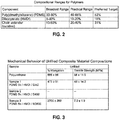
- Fig. 2 is a table showing the compositional ranges for polymer components used in one or more of the embodiments of the composite material of the disclosure.
- the ⁇ , ⁇ -(alpha, omega)-dihydroxy terminated polysiloxane species is present in a broadest range in an amount of from about 30% by weight to about 80% by weight, based on a total weight percent of the composite material composition. More preferably, the ⁇ , ⁇ -(alpha, omega)-dihydroxy terminated polysiloxane species is present in a practical range in an amount of from about 40% by weight to about 65% by weight, based on a total weight percent of the composite material composition.
- the ⁇ , ⁇ -(alpha, omega)-dihydroxy terminated polysiloxane species is present at a preferred target in an amount of 52% by weight of the composite material composition, based on a total weight percent of the composite material composition.
- the ⁇ , ⁇ -(alpha, omega)-dihydroxy terminated polysiloxane species may comprise one or more ⁇ , ⁇ -(alpha, omega)-dihydroxy terminated polysiloxane first soft segments having an average molecular weight of between about 2500 grams per mole to about 10,000 grams per mole.
- the one or more ⁇ , ⁇ -(alpha, omega)-dihydroxy terminated polysiloxane first soft segments have an average molecular weight of between about 4000 grams per mole to about 7000 grams per mole. More preferably, the one or more ⁇ , ⁇ -(alpha, omega)-dihydroxy terminated polysiloxane first soft segments have an average molecular weight of 5000 grams per mole.
- the segmented copolymer elastomer further comprises a diisocyanate species.
- the segmented copolymer elastomer comprises one or more diisocyanate species.
- the diisocyanate species preferably consists of 4,4'-methylenebis(cyclohexyl isocyanate) (HMDI - hexamethylene diisocyanate), cycloalkyl based diisocyanates, tolylene-2,4-diisocyante (TDI), 4,4'-methylenebis(phenyl isocyanate) (MDI), isophorone diisocyanate (IDI), or another suitable diisocyanate species.
- HMDI 4,4'-methylenebis(cyclohexyl isocyanate)
- TDI tolylene-2,4-diisocyante
- MDI 4,4'-methylenebis(phenyl isocyanate)
- IDI isophorone diisocyanate
- the diisocyanate species is 4,4'-methylenebis(cyclohexyl isocyanate) (HMDI - hexamethylene diisocyanate).
- Fig. 1B is an illustration of the chemical structure 14 of diisocyanate 4,4'-methylenebis(cyclohexyl isocyanate) (HMDI) used in one or more of the embodiments of the composite material compositions of the disclosure.
- the diisocyanate species is present in a broadest range in an amount of from about 5% by weight to about 40% by weight, based on a total weight percent of the composite material composition. More preferably, the diisocyanate species is present in a practical range in an amount of from about 10% by weight to about 20% by weight, based on a total weight percent of the composite material composition. Most preferably, the diisocyanate species is present at a preferred target in an amount of 16% by weight, based on a total weight percent of the composite material composition.
- the segmented copolymer elastomer further comprises the amine or hydroxy terminated chain extender, also known as a curative.
- the amine or hydroxy terminated chain extender preferably comprises a linear ⁇ , ⁇ -(alpha, omega) amino or hydroxy end terminated oligomeric species consisting of an oligomeric diol or amine polyether, a linear polyether, poly(ethylene oxide), poly(propylene oxide), poly(propylene oxide) diamine, a copolymer of poly(ethylene oxide) and poly(propylene oxide), a linear polycarbonate, a mixture of two or more thereof, or another suitable amine or hydroxy terminated chain extender.
- the amine or hydroxy terminated chain extender may comprise an amine terminated poly(propylene oxide) (also referred to as poly(propylene oxide) diamine), such as, for example, JEFFAMINE D400.
- JEFFAMINE is a registered trademark of Huntsman Corporation of The Woodlands, Texas.
- JEFFAMINE D400 is a difunctional, primary amine with an average molecular weight of about 430. The primary amine groups are located on secondary carbon atoms at the end of the aliphatic polyether chains.
- Fig. 1C is an illustration of the chemical structure 16 of the amine terminated chain extender poly(propylene oxide) (JEFFAMINE D400) used in one or more of the embodiments of the composite material composition of the disclosure.
- the amine or hydroxy terminated chain extender may comprise a copolymer of poly(ethylene oxide) and poly(propylene oxide), such as for example, JEFFAMINE ED600.
- JEFFAMINE is a registered trademark of Huntsman Corporation of The Woodlands, Texas.
- JEFFAMINE ED600 is an aliphatic polyether diamine (polyetheramine) derived from a propylene oxide-capped polyethylene glycol and has an approximate molecular weight of 600. Primary amino groups are attached to the end of a polyether backbone that may be based on propylene oxide, ethylene oxide, or a combination of propylene oxide and ethylene oxide.) Fig.
- 1D is an illustration of the chemical structure 18 of the amine terminated chain extender of a copolymer of poly(ethylene oxide) and poly(propylene oxide) (JEFFAMINE ED600) used in one or more of the embodiments of the composite material composition of the disclosure.
- the amine or hydroxy terminated chain extender (curative) is present in a broadest range in an amount of from about 10% by weight to about 50% by weight, based on a total weight percent of the composite material composition. More preferably, the amine or hydroxy terminated chain extender (curative) is present in a practical range in an amount of from about 20% by weight to about 40% by weight, based on a total weight percent of the composite material composition. Most preferably, the amine or hydroxy terminated chain extender (curative) is present at a preferred target in an amount of 31% by weight, based on a total weight percent of the composite material composition.
- the amine or hydroxy terminated chain extender is a linear ⁇ , ⁇ -(alpha, omega) amino or hydroxy end terminated oligomeric species, such as a linear polyether or polycarbonate, having an average molecular weight of the extended chains of equal to or greater than 400 grams per mole. More preferably, the amine or hydroxy terminated chain extender is a linear ⁇ , ⁇ -(alpha, omega) amino or hydroxy end terminated oligomeric species, such as a linear polyether or polycarbonate, having an average molecular weight of the extended chains of 400 grams per mole to about 5000 grams per mole.
- the amine or hydroxy terminated chain extender is a linear ⁇ , ⁇ -(alpha, omega) amino or hydroxy end terminated oligomeric species, such as a linear polyether or polycarbonate, having an average molecular weight of the extended chains of 400 grams per mole to about 2000 grams per mole.
- a combination of the diisocyanate species and the amine or hydroxy terminated chain extender may comprise one or more hard segments.
- the components are added at a ratio such that the equivalent functional groups of isocyanate species are stoichiometrically equal to the total hydroxy and/or amine species in the composition.
- the one or more hard segments comprised of a combination of one or more diisocyanate species and one or more amine or hydroxy chain extenders is present in an amount of from about 5% by weight to about 60% by weight, based on a total weight percent of the composite material composition.
- the one or more hard segments comprised of a combination of one or more diisocyanate species and one or more amine or hydroxy chain extenders is present in an amount of from about 15% by weight to about 40% by weight, based on a total weight percent of the composition.
- the one or more hard segments comprised of a combination of one or more diisocyanate species and one or more amine or hydroxy chain extenders is present in an amount of 25% by weight, based on a total weight percent of the composition.
- the composite material composition further comprises a solid particulate filler.
- the solid particulate filler preferably comprises or consists of a pulverized or powdered metal, a pulverized or powdered salt, a pulverized or powdered inorganic oxide, a pulverized or powdered carbon, a pulverized or powdered ceramic, a mixture of two or more thereof, or another suitable solid particulate filler.
- the pulverized or powdered metal comprises or consists of a pulverized or powdered - iron, aluminum, silicon, titanium, chromium, manganese, cobalt, nickel, copper, zinc, palladium, silver, cadmium, tin, tantalum, vanadium, neodymium, samarium, yttrium, tungsten, platinum, gold, and combinations thereof in the form of alloys, or another suitable pulverized or powdered metal.
- the pulverized or powdered inorganic oxide and pulverized or powdered ceramic comprises or consists of ceramics; inorganic oxide compounds where the anion is oxygen (O 2- ) including alumina, silica, zirconia, yttria, ceria, oxides of tin and zinc; inorganic oxide compounds where the anion is carbonate (CO 3 2- ) including calcium carbonate, potassium carbonate, sodium carbonate, iron carbonate, and ammonium carbonate; inorganic oxide compounds where the anion is phosphate (PO 4 2- ) including minerals in the apatite group; or another suitable pulverized or powdered inorganic oxide or ceramic.
- O 2- oxygen
- CO 3 2- carbonate
- PO 4 2- phosphate
- the pulverized or powdered carbon comprises or consists of elemental non-metallics such as carbons in the form of graphite, carbon nanotubes, carbon fiber, carbon black, coke or another suitable pulverized or powdered carbon.
- the solid particulate filler may be present in an amount of about 5 volume percent (vol%) to about 70 volume percent (vol %), based on a total volume percent (vol%) of the composite material composition.
- the solid particulate filler may be present in an amount of about 10 volume percent (vol %) to about 60 volume percent (vol %), based on a total volume percent (vol%) of the composite material composition.
- the solid particulate filler may be present in an amount of greater than or equal to 40 volume percent (vol%), based on a total volume percent (vol%) of the composite material composition. Most preferably, the solid particulate filler may be present in an amount of about 30 volume percent (vol %) to about 40 volume percent (vol %), based on a total volume percent (vol%) of the composite material composition.
- a flexible, low temperature, filled composite coating comprising a composite material composition comprising a segmented copolymer elastomer and a solid particulate filler.
- the segmented copolymer elastomer comprises an ⁇ , ⁇ -(alpha, omega)-dihydroxy terminated polysiloxane species, a diisocyanate species, and an amine or hydroxy terminated chain extender.
- the coating has a high flexibility at a temperature of down to about -100 degrees Celsius, has a percent elongation of greater than about 100%, and has a tensile strength of greater than about 5MPa (megapascals).
- the ⁇ , ⁇ -(alpha, omega)-dihydroxy terminated polysiloxane species preferably consists of poly(dimethylsiloxane) (PDMS), poly(diphenyl-co-dimethylsiloxane), poly(methyl-3,3,3-trifluoropropylsiloxane), poly(methyl-n-octylsiloxane), poly(di-n-pentylsiloxane), poly(methyl-n-hexylsiloxane), poly(di-n-propylsiloxane), poly(methyl-n-pentylsiloxane), poly(methyl-n-butylsiloxane), poly(di-n-butylsiloxane), poly(methyl-n-poropylsiloxane), poly(methylethylsiloxane), poly(methylhydridosiloxane), polydiethylsiloxane, or
- the diisocyanate species preferably consists of 4,4'-methylenebis(cyclohexyl isocyanate) (HMDI - Hexamethylene diisocyanate), cycloalkyl based diisocyanates, tolylene-2,4-diisocyante (TDI), 4,4'-methylenebis(phenyl isocyanate) (MDI), isophorone diisocyanate (IDI), or another suitable diisocyanate species. More preferably, the diisocyanate species is 4,4'-methylenebis(cyclohexyl isocyanate) (HMDI - Hexamethylene diisocyanate).
- the amine or hydroxy terminated chain extender preferably comprises a linear ⁇ , ⁇ -(alpha, omega) amino or hydroxy end terminated oligomeric species consisting of an oligomeric diol or amine polyether, a linear polyether, poly(ethylene oxide), poly(propylene oxide), poly(propylene oxide) diamine, a copolymer of poly(ethylene oxide) and poly(propylene oxide), a linear polycarbonate, a mixture of two or more thereof, or another suitable amine or hydroxy terminated chain extender.
- a linear ⁇ , ⁇ -(alpha, omega) amino or hydroxy end terminated oligomeric species consisting of an oligomeric diol or amine polyether, a linear polyether, poly(ethylene oxide), poly(propylene oxide), poly(propylene oxide) diamine, a copolymer of poly(ethylene oxide) and poly(propylene oxide), a linear polycarbonate, a mixture of two or more thereof, or another suitable amine or hydroxy terminated
- the amine or hydroxy terminated chain extender may comprise an amine terminated poly(propylene oxide) (also referred to as poly(propylene oxide) diamine), such as, for example, JEFFAMINE D400 (see Fig. 1C ).
- JEFFAMINE is a registered trademark of Huntsman Corporation of The Woodlands, Texas.
- the amine or hydroxy terminated chain extender may comprise a copolymer of poly(ethylene oxide) and poly(propylene oxide), such as for example, JEFFAMINE ED600 (see Fig. 1D ).
- JEFFAMINE is a registered trademark of Huntsman Corporation of The Woodlands, Texas.
- the solid particulate filler preferably comprises or consists of a pulverized or powdered metal, a pulverized or powdered salt, a pulverized or powdered inorganic oxide, a pulverized or powdered carbon, a pulverized or powdered ceramic, a mixture of two or more thereof, or another suitable solid particulate filler.
- the pulverized or powdered metal comprises or consists of a pulverized or powdered - iron, aluminum, silicon, titanium, chromium, manganese, cobalt, nickel, copper, zinc, palladium, silver, cadmium, tin, tantalum, vanadium, neodymium, samarium, yttrium, tungsten, platinum, gold, and combinations thereof in the form of alloys, or another suitable pulverized or powdered metal.
- the pulverized or powdered inorganic oxide and pulverized or powdered ceramic comprises or consists of ceramics; inorganic oxide compounds where the anion is oxygen (O 2- ) including alumina, silica, zirconia, yttria, ceria, oxides of tin and zinc; inorganic oxide compounds where the anion is carbonate (CO 3 2- ) including calcium carbonate, potassium carbonate, sodium carbonate, iron carbonate, and ammonium carbonate; inorganic oxide compounds where the anion is phosphate (PO 4 2- ) including minerals in the apatite group; or another suitable pulverized or powdered inorganic oxide or ceramic.
- O 2- oxygen
- CO 3 2- carbonate
- PO 4 2- phosphate
- the pulverized or powdered carbon comprises or consists of elemental non-metallics such as carbons in the form of graphite, carbon nanotubes, carbon fiber, carbon black, coke or another suitable pulverized or powdered carbon.
- the composite material compositions of the disclosed embodiments preferably have a high flexibility at a temperature of down to about -100 (negative one hundred) degrees Celsius.
- the composite material compositions of the disclosed embodiments further have a percent elongation of greater than about 100%.
- the composite material compositions of the disclosed embodiments further have a tensile strength of greater than about 5MPa (five megapascals).
- a method 100 of synthesizing a flexible, low temperature, filled composite material composition comprises step 102 of mixing an ⁇ , ⁇ -(alpha, omega)-dihydroxy terminated polysiloxane species, a diisocyanate species, and an amine or hydroxy terminated chain extender to form a segmented copolymer elastomer.
- the ⁇ , ⁇ -(alpha, omega)-dihydroxy terminated polysiloxane species, the diisocyanate species, and the amine or hydroxy terminated chain extender are discussed in detail above with respect to the composite material compositions and preferred compounds.
- the step 102 of the method 100 may further comprise mixing one or more of the ⁇ , ⁇ -(alpha, omega)-dihydroxy terminated polysiloxane species, the diisocyanate species, and the amine or hydroxy terminated chain extender together in a solvent to form the segmented copolymer elastomer.
- the components may be added at a ratio such that the equivalents of diisocyanate species are stoichiometrically equal to the total amine or hydroxy terminated chain extender species in the composition.
- the solvent is a secondary or tertiary alcohol or ketone. More preferably, the solvent is isopropanol, methylethyl ketone, or methylisobutyl ketone.
- the method may further comprise removing the solvent. In one embodiment of the method, the solvent is not removed and the composite material composition remains in solution for subsequent use.
- the method 100 further comprises step 104 of mixing the segmented copolymer elastomer with a solid particulate filler to form a composite material composition.
- the solid particulate filler is discussed in detail above with respect to the composite material compositions.
- the composite material composition preferably has a high flexibility at a temperature of down to about -100 degrees Celsius, has a percent elongation of greater than about 100%, and has a tensile strength of greater than about 5MPa (megapascals).
- the step 104 of mixing the segmented copolymer elastomer with the solid particulate filler may comprise mixing the solid particulate filler in an amount 5 volume percent (vol%) to about 70 volume percent (vol%), based on a total volume percent (vol%) of the composite material composition, such as the mixture of the segmented copolymer elastomer and the solid particulate filler; preferably mixing the solid particulate filler in an amount 10 volume percent (vol%) to about 60 volume percent (vol%), based on a total volume percent (vol%) of the composite material composition, such as the mixture of the segmented copolymer elastomer and the solid particulate filler; more preferably, mixing the solid particulate filler in an amount of greater than or equal to 40 volume percent (vol%), based on a total volume percent (vol%) of the composite material composition, such as the mixture of the segmented copolymer elastomer and the solid particulate filler; or most preferably, mixing the solid particulate
- the method 100 may further comprise formulating the composite material composition into a solution for application via a spray coating method to a surface to be exposed to extended, subfreezing temperatures, such as down to -100 degrees Celsius. This may be applied to a surface at a later time convenient for a user.
- the composite material composition in the form of a coating may be applied to surfaces via spray coating directly from solution.
- the segmented copolymer elastomer may be prepared separately and may be able to be stored long term prior to the addition of a solvent and combination to form the final product.
- Spray coating methods or processes that may be used may comprise known spray coating methods or processes used by those skilled in the art. Examples may include thermal spray processes, high-volume low-pressure spray processes, plasma spray processes, vapor deposition processes, or other suitable spray processes.
- Fig. 2 is a table showing the compositional ranges for polymer components used in the composite material compositions.
- Fig. 3 is a table showing the mechanical behavior of unfilled composite material compositions.
- Fig. 4 is a table showing the mechanical behavior of filled composite material compositions. Experiments were conducted with unfilled and filled composite material compositions in order to demonstrate the need to remove polyether segments to achieve low temperature ( ⁇ -50°C (less than negative fifty degrees Celsius)) flexibility.
- PDMS poly(dimethylsiloxane)
- HMDI 4,4'-methylenebis(cyclohexyl isocyanate)
- amine or hydroxy terminated chain extenders of linear ⁇ , ⁇ -(alpha, omega) amino or hydroxy end terminated oligomeric species such as amine terminated poly(propylene oxide) (JEFFAMINE D400), and a copolymer of poly(ethylene oxide) and poly(propylene oxide) (JEFFAMINE ED600), were obtained from Huntsman Corporation of The Woodlands, Texas (JEFFAMINE is a registered trademark of Huntsman Corporation of The Woodlands, Texas.); (5) isopropanol solvent was obtained from Mallinckrodt Baker of Phillipsburg, New Jersey, and the isopropanol was dried over activated 4 ⁇ (Angstrom) molecular sieves; (6) triethylamine was obtained from Sigma-Aldrich of St.
- Tensile testing was performed on an INSTRON 5565 tensile testing machine obtained from Instron of Norwood, Massachusetts (INSTRON is a registered trademark owned by Illinois Tool Works Inc. of Glenview, Illinois) using a crosshead speed of 2.5 mm/min (millimeters per minute).
- Dynamic mechanical analysis was performed on a DMA Q800 dynamic mechanical analysis machine obtained from TA Instruments of New Castle, Delaware. Scans were run at a frequency of 1Hz (one Hertz) with a temperature ramp rate of 3°C/min (three degrees Celsius per minute).
- Films were cast from shallow PTFE (polytetrafluoroethylene) molds of either two (2) inches by two (2) inches or three (3) inches by three (3) inches in area. Viscous polymer solution was poured into the shallow tray and covered to allow the film to flow and achieve a uniform thickness for mechanical testing samples. The cover was then removed and the solvent allowed to evaporate. Films were then placed in a vacuum chamber to ensure removal of residual solvent.
- shallow PTFE polytetrafluoroethylene
- Unfilled aerospace polyurethane resin (“unfilled Polyurethane”).
- Example 1 an unfilled Polyurethane sample was charged to a vial and combined with a curative.
- Methyl ethyl ketone (MEK) was added as necessary to dilute the viscous resin to that of a pourable viscosity and the transferred into a 3 inch by 3 inch PTFE (polytetrafluoroethylene) mold and covered overnight.
- the MEK was then removed through evaporation to produce a film (approximately 0.5 mm (millimeters) thick) for use in mechanical testing.
- MEK Methyl ethyl ketone
- Unfilled PDMS 5k/HMDI/DAC Sample 1 was prepared. PDMS - ⁇ , ⁇ -dihydroxy terminated poly(dimethylsiloxane) (5.0g, 0.893 mmoles) and HMDI (1.17g, 4.46 mmoles) were charged to a vial and stirred with heating at 100°C for eight (8) hours with triethylamine as catalyst (40mg) in a Nitrogen glove box. The mixture was then cooled to ambient temperature. Isopropanol (8g) dried over 4 Angstrom molecular sieves was added to the mixture and stirred until the mixture was homogeneous.
- DAC was measured (407mg, 3.57mmoles) and dissolved in isopropanol (2g) that had been dried over 4 Angstrom molecular sieves. These two solutions were combined and vigorously mixed. After approximately five (5) minutes, the solution was poured into a three inch by three inch (3"x3") PTFE (polytetrafluoroethylene) mold and covered overnight. The isopropanol was then removed through evaporation to produce a film (approximately 0.5mm thick) for use in mechanical testing.
- PTFE polytetrafluoroethylene
- Unfilled PDMS 5k/HMDI/ED600 Sample 3 was prepared.
- PDMS poly(dimethylsiloxane)
- HMDI 157.2g, 600mmoles
- TEFLON is a registered trademark of E.I. Du Pont De Nemours and Company of Wilmington, Delaware
- the prepared prepolymer resin (150g) was weighed into an empty half (1 ⁇ 2) gallon paint can where it was diluted with a total of 975g MEK (methyl ethyl ketone) + 109g MIBK(methyl isobutyl ketone)/Cyclohexanone.
- MEK methyl ethyl ketone
- MIBK methyl isobutyl ketone
- This solution was dispersed on a paint can shaker and a copolymer of poly(ethylene oxide) and poly(propylene oxide) (JEFFAMINE ED600) (58.71g) was slowly added with gentle mixing to prevent aggregates.
- the polymer solution was then sprayed onto an aluminum panel using multiple passes. The thickness of the coating was increased as desired and allowed to dry over many hours before being transferred to a 120°F (degrees Fahrenheit) oven overnight.
- Example 4 Filled aerospace polyurethane resin
- MEK Methyl ethyl ketone
- Example 4 a filled Polyurethane sample was charged to a vial and combined with a curative.
- Methyl ethyl ketone (MEK) was added to dilute the mixture to a thin viscosity and solid particulate filler in the form of a metal iron powder was then added (40% volume final composition) using a COWLES dispersing blade apparatus (COWLES is a registered trademark of Morehouse Cowles of Chino, California).
- COWLES COWLES dispersing blade apparatus
- MEK was added as necessary to maintain an acceptable spray viscosity.
- the polymer solution was then sprayed onto an aluminum panel using multiple passes with approximately seven (7) minute intervals to allow carrier solvent to flash off. Thickness of the coating was increased as desired and allowed to dry over many hours before being transferred to a 120°F (degrees Fahrenheit) oven overnight.
- Example 5 Filled PDMS 5k/HMDI/DAC Sample 1.
- a filled PDMS 5k/HMDI/DAC Sample 1 was prepared.
- PDMS - ⁇ , ⁇ -(alpha, omega)-dihydroxy terminated poly(dimethylsiloxane) (5.0g, 0.893mmoles) and HMDI (1.17g, 4.46mmoles) were charged to a vial and stirred with heating at 100°C for eight (8) hours with triethylamine as a catalyst (20mg) in a Nitrogen glove box. The mixture was then cooled to ambient temperature. Isopropanol (8g) dried over 4 Angstrom molecular sieves was added to the mixture and stirred until the mixture was homogeneous.
- DAC was measured (407mg, 3.57mmoles) and dissolved in isopropanol (2g) that had been dried over 4 Angstrom molecular sieves along with fine iron powder (27.2 g, 40 vol% total). These two solutions were combined and vigorously mixed. After approximately five (5) minutes, the solution was poured into a three inch by three inch (3"x3") PTFE (Polytetrafluoroethylene) mold and covered overnight. The isopropanol was then removed through evaporation to produce a film (approximately 0.5mm thick) for use in mechanical testing.
- PTFE Polytetrafluoroethylene
- Example 6 Filled PDMS 5k/HMDI/D400 Sample 2.
- a filled PDMS 5k/HMDI/D400 Sample 2 was prepared.
- PDMS - ⁇ , ⁇ -(alpha, omega)-dihydroxy terminated poly(dimethylsiloxane) 600g, 120mmoles
- HMDI 125.8g, 480mmoles
- TEFLON is a registered trademark of E.I. Du Pont De Nemours and Company of Wilmington, Delaware
- the resin was mixed for twenty (20) minutes or until the temperature rose to approximately 110°C (degrees Celsius). If excessive heat was an issue, slower mix speeds could be used. Following homogenization, the can was capped, a nitrogen blanket placed in the can headspace and the mixture left to cool to room temperature.
- the mixture was next transferred to a one-half (1 ⁇ 2) gallon paint can where it was diluted with a total of 975g MEK (methyl ethyl ketone) + 109g MIBK(methyl isobutyl ketone)/Cyclohexanone. This was next dispersed on a paint can shaker and amine terminated poly(propylene oxide) (JEFFAMINE D400) (34g) was slowly added with gentle mixing to prevent aggregates.
- MEK methyl ethyl ketone
- MIBK methyl isobutyl ketone
- the polymer solution was then sprayed onto an aluminum panel using multiple passes. Thickness of the coating was increased as desired and allowed to dry over many hours before being transferred to a 120°F (degrees Fahrenheit) oven overnight.
- HMDI (17.2 g, 600 mmoles) was then added and an overhead TEFLON (TEFLON is a registered trademark of E.I. Du Pont De Nemours and Company of Wilmington, Delaware) paddle stirrer was fitted through an adapter in the center neck.
- the atmosphere of the headspace in the flask was continuously purged with nitrogen during the course of the reaction.
- An oil bath was placed under the flask and set to 110°C (degrees Celsius) while the paddle stirrer was adjusted to 300 rpm (revolutions per minute).
- triethylamine 0.5mL was introduced into the reaction and allowed to mix for three hours (3 hrs).
- the mixture was next transferred to a one-half (1 ⁇ 2) gallon paint can where it was diluted with a total of 975g MEK (methyl ethyl ketone) + 109g MIBK(methyl isobutyl ketone)/Cyclohexanone.
- MEK methyl ethyl ketone
- MIBK methyl isobutyl ketone
- Cyclohexanone a copolymer of poly(ethylene oxide) and poly(propylene oxide) (JEFFAMINE ED600) (58.71g) was slowly added with gentle mixing to prevent aggregates.
- the polymer solution was then sprayed onto an aluminum panel using multiple passes. The thickness of the coating was increased as desired and allowed to dry over many hours before being transferred to a 120°F (degrees Fahrenheit) oven overnight.
- Example 8 Fluid Tests. In Example 8, fluid compatibility testing was performed by submerging test strips of composite material compositions having solid particulate filler into fluids over a fixed time and temperature. Test materials were approximately 30mm (millimeters) in length by 6mm (millimeters) in width by 0.5mm (millimeters) in height. Each strip was measured for both the initial dimension and mass before exposure to fluid.
- Fig. 9 is a table showing percent volume change of filled composite material compositions of the disclosure following fluid exposure. The table in Fig.
- jet fuel such as JP8 (Jet Propellant 8)
- hydraulic fluid such as CASTROL BRAYCO Micronic 882 obtained from Air BP Lubricants of Parsippany, New Jersey (CASTROL and BRAYCO are registered trademarks of Castrol Industrial North America of Warrenville, Illinois)
- lubricating oil such as engine oil MOBIL Jet Oil II from Exxon Mobil Corporation of Irving, Texas (MOBIL is a registered trademark of Exxon Mobil Corporation of Irving, Texas)
- water such as deionized water.
- the exposure time for the jet fuel was 7 (seven) days and the exposure temperature was ambient.
- the exposure time for the hydraulic fluid was 7 (seven) days and the exposure temperature was ambient.
- Fig. 9 is shows the percent volume change following fluid exposure for the filled Polyurethane, the filled PDMS 5k/HMDI/D400 Sample 2, and the filled PDMS 5k/HMDI/ED600 + 2% CAB-O-SIL Sample 3.
- the filled Polyurethane, filled PDMS 5k/HMDI/D400 Sample 2, and filled PDMS 5k/HMDI/ED600 + 2% CAB-O-SIL Sample 3 were filled with 40 vol% metal iron powder and were screened for compatibility with various fluids common to aircraft environments, including jet fuel, hydraulic fluid, lubricating oil, and water.
- the filled Polyurethane showed a 10.7% volume change upon exposure to jet fuel for 7 days at ambient temperature; showed a 6.5% volume change upon exposure to hydraulic fluid for 7 days at ambient temperature; showed a 15.9% volume change upon exposure to lubricating oil for 24 hours at 120°C; and, showed a 4.2% volume change upon exposure to water for 7 days at 49°C.
- the filled PDMS 5k/HMDI/D400 Sample 2 showed a 125% volume change upon exposure to jet fuel for 7 days at ambient temperature; showed a 8.4% volume change upon exposure to hydraulic fluid for 7 days at ambient temperature; showed a 63% volume change upon exposure to lubricating oil for 24 hours at 120°C; and showed a 3.5% volume change upon exposure to water for 7 days at 49°C.
- the filled PDMS 5k/HMDI/ED600 + 2% CAB-O-SIL Sample 3 showed a 54.6% volume change upon exposure to jet fuel for 7 days at ambient temperature; showed a 9.6% volume change upon exposure to hydraulic fluid for 7 days at ambient temperature; showed a 12.7% volume change upon exposure to lubricating oil for 24 hours at 120°C; and showed a 5.7% volume change upon exposure to water for 7 days at 49°C.
- Fig. 3 is a table showing the mechanical behavior of unfilled composite material compositions of the disclosure.
- the unfilled Polyurethane showed a percent (%) elongation of 566 +/- 86% and a tensile strength of 58 +/- 11.9 MPa (megapascals).
- the unfilled Polyurethane showed a decrease in mechanical properties but overall maintained excellent elongation and tensile strength at room temperature.
- the unfilled PDMS 5k/HMDI/DAC Sample 1 showed a percent (%) elongation of 473 +/- 91 and a tensile strength of 48 +/- 14.2 MPa. Sample 1 was an extreme case, showing excellent mechanical properties and flexible low temperature behavior in the unfilled state.
- the percent (%) elongation and tensile strength for the unfilled PDMS 5k/HMDI/D400 Sample 2 was not measured, but the dynamic mechanical analysis was performed with the unfilled PDMS 5k/HMDI/D400 Sample 2, with the results shown in Fig. 5 .
- the unfilled PDMS 5k/HMDI/ED600 Sample 3 showed a percent (%) elongation of 2700 +/- 360 and a tensile strength of 7.0 +/- 1.9 MPa.
- ED600 poly(propylene oxide) and poly(ethylene oxide)
- curative and % composition produced an unfilled material with excellent elongational performance capable of extension up to 2700% with a corresponding tensile strength of 7 MPa as shown in Fig. 3 .
- Fig. 4 is a table showing the mechanical behavior of filled composite material compositions of the disclosure.
- the filled Polyurethane showed a percent (%) elongation of 214 +/- 5.5% and a tensile strength of 31.2+/- 1.4 MPa (megapascals).
- the unfilled Polyurethane and the filled Polyurethane did show a decrease in mechanical properties but overall they maintained excellent elongation and tensile strength at room temperature.
- the filled PDMS 5k/HMDI/DAC Sample 1 showed a percent (%) elongation of 5.7 +/- 0.8 and a tensile strength of 3.3 +/- 0.3 MPa.
- the filled PDMS 5k/HMDI/DAC Sample 1 showed that addition of high levels of solid particulate filler rendered filled PDMS 5k/HMDI/DAC Sample 1 rigid and brittle.
- the filled PDMS 5k/HMDI/D400 Sample 2 showed a percent (%) elongation of 87.2 +/- 1.3 and a tensile strength of 3.0 +/- 0.4 MPa.
- a solid particulate filler for example, metal iron powder
- PDMS 5k/HMDI/D400 Sample 2 increased elongation over PDMS 5k/HMDI/DAC Sample 1 from 5.7% to 87.2% while maintaining a similar tensile strength. While softening of the base material and incorporation of polyether curatives improved mechanical properties of the filled PDMS 5k/HMDI/D400 Sample 2 over the filled PDMS 5k/HMDI/DAC Sample 1, the reduced crosslinking density from modifying isocyanate to siloxane ratios and increased molecular weight of curative also produced a material that softened rapidly with increased temperature by showing a modulus of ⁇ 0.1 MPa above 130°C.
- a solid particulate filler for example, metal iron powder
- filled PDMS 5k/HMDI/D400 Sample 2 was modified further to: 1) increase the ratio of isocyanate to siloxane in order to improve high temperature performance; and 2) increase molecular weight of the curative to compensate for the stiffening effect of modification 1; and 3) incorporate 2% fumed silica (CAB-O-SIL) as a reinforcing filler.
- CAB-O-SIL is a registered trademark of Cabot Corporation of Boston, Massachusetts.
- the filled PDMS 5k/HMDI/ED600 + 2% CAB-O-SIL Sample 3 showed a percent (%) elongation of 237 +/- 8.6 and a tensile strength of 11.2+/-0.3 MPa.
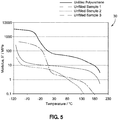
- Fig. 5 is a graph showing the modulus behavior with respect to temperature of unfilled composite material compositions of Fig. 3 .
- the scan rate was equal to 3°C / minute.
- Fig. 5 shows that with unfilled PDMS 5k/HMDI/D400 Sample 2, the low temperature behavior showed no evidence of stiffening due to JEFFAMINE D400 components and kept a modulus below unfilled PDMS 5k/HMDI/DAC Sample 1 down to -110°C.
- unfilled PDMS 5k/HMDI/ED600 Sample 3 possessed an increase in diisocyante to siloxane ratio of 6 to 1 versus 4 to 1 for unfilled PDMS 5k/HMDI/DAC Sample 2 and a higher molecular weight polyether chain extender of 600 Da (Dalton) versus 400 Da for unfilled PDMS 5k/HMDI/ED600 Sample 3 and unfilled PDMS 5k/HMDI/D400 Sample 2, respectively.
- the consequence of these modifications was to improve the high temperature softening point of unfilled PDMS 5k/HMDI/ED600 Sample 3 over unfilled PDMS 5k/HMDI/D400 Sample 2 by 40°C for unfilled materials (see Fig.
- the molecular weight of the amine or hydroxy chain extender was increased in order to reduce the density of hydrogen bonding urea groups used to create intermolecular bonding between chains.
- a filled Polyurethane sample (see Fig. 6 ) clearly showed dramatic stiffening at -20°C as it passed the glass transition temperature.
- the previously developed low temperature polyurea siloxane copolymer (Sample 1) was also presented with its low constant modulus (5-15 MPa) across a broad temperature range of -90 °C to 150°C.
- This specific formulation was produced from a siloxane ( ⁇ , ⁇ -(alpha, omega)-dihydroxy terminated PDMS, molecular weight approximately 5000 g/mole) and isocyanate prepolymer cured with a low molecular weight amine compound (1,2 diaminocyclohexane, FW 114). All samples in Fig. 3 showed elongational behavior dramatically decreased upon the addition of 40vol% (83wt%) of solid particulate filler, for example, metal iron powder. Their primary shortcoming was the poor temperature performance due to extreme stiffening as found in Fig. 5 .
- Fig. 6 is a graph showing the modulus behavior with respect to temperature of filled composite material compositions of Fig. 4 , that is, composite material compositions loaded with 40 vol% solid particulate filler, for example, metal iron powder.
- Fig. 7 is a graph showing the modulus behavior with respect to time of filled Polyurethane and composite material composition filled PDMS 5k/HMDI/ED600 + 2% CAB-O-SIL Sample 3 of Fig. 4 .
- Fig. 7 also shows the dynamic mechanical analysis showing modulus versus time of 40 vol% solid particulate filler, for example, metal iron powder, filled Polyurethane and composite material composition filled PDMS 5k/HMDI/ED600 + 2% CAB-O-SIL Sample 3 exposed to extended low temperatures.
- both filled Polyurethane and filled PDMS 5k/HMDI/ED600 + 2% CAB-O-SIL Sample 3 were exposed to fixed low temperatures for multiple hours.
- the composite material compositions When filled with 40 vol% solid particulate filler, for example, metal iron powder, and sprayed onto a surface, the composite material compositions showed a steady monotonic rise in modulus (see Fig. 7 ) due to the addition of solid particulate fillers. Such an increase in modulus at low temperatures was likely unavoidable with such high levels of filled material, and the best low temperature performance possible could be achieved through minimization of any stiffening contribution due to the surrounding elastomeric matrix.
- solid particulate filler for example, metal iron powder
- Fig. 8 is a table showing soak temperature, soak duration, and final modulus of filled Polyurethane and filled composite material composition PDMS 5k/HMDI/ED600 + 2% CAB-O-SIL Sample 3 shown in Fig. 7 .
- Filled PDMS 5k/HMDI/ED600 + 2% CAB-O-SIL Sample 3 was soaked for five (5) hours at a soak temperature of -60°C and had a final modulus of 601 MPa.
- Filled PDMS 5k/HMDI/ED600 + 2% CAB-O-SIL Sample 3 was soaked for 3.5 hours at a soak temperature of -80°C and had a final modulus of 1430 MPa.
- Filled Polyurethane was soaked for five (5) hours at a soak temperature of -60°C and had a final modulus of 9300 MPa. Filled Polyurethane was soaked for 3.5 hours at a soak temperature of -80°C and had a final modulus of 11100 MPa.
- Embodiments of the disclosed composite material compositions and coatings accommodate high levels of functional solid particulate fillers while remaining much more flexibility at low temperatures compared to existing polyurethane and silicone materials.
- modification of PDMS 5k/HMDI/DAC Sample 1 was undertaken to reduce material modulus through a decrease in the molar ratio of isocyanate to siloxane and incorporation of higher molecular weight curatives.
- a decreased isocyanate to siloxane ratio softened the material due to a decreased number of physically associating urea groups.
- PDMS 5k/HMDI/DAC Sample 1 possessed an isocyanate to siloxane ratio of 5 to 1 whereas PDMS 5k/HMDI/D400 Sample 2 decreased to a ratio of 4 to 1.
- oligomeric ⁇ , ⁇ -(alpha, omega)-diamino linear polyetheramine compounds of poly(propylene oxide) and poly(propylene oxide)/poly(ethylene oxide) (JEFFAMINE D400, JEFFAMINE ED600) were exchanged for the lower molecular weight curatives in PDMS 5k/HMDI/DAC Sample 1. This created a base material with a modulus that decreased from 9.3 MPa to 4.5 MPa at 25°C.
- segmented copolymer elastomers an ⁇ , ⁇ -(alpha, omega)-dihydroxy terminated polysiloxane species, a diisocyanate species, and an amine or hydroxy terminated chain extender
- high loading levels such as greater than or equal to 40 vol%
- solid particulate filler materials maintained flexibility at a temperature of down to about -100 degrees Celsius, exhibited a percent elongation of greater than about 100%, and exhibited a tensile strength of greater than about 5MPa (megapascals).
- Embodiments of the disclosed composite material compositions and coatings dramatically outperformed existing filled polyurethane systems by producing moduli ten (10) times lower for equivalent filler down to temperatures of -100°C.
Landscapes
- Chemical & Material Sciences (AREA)
- Organic Chemistry (AREA)
- Chemical Kinetics & Catalysis (AREA)
- Health & Medical Sciences (AREA)
- Medicinal Chemistry (AREA)
- Polymers & Plastics (AREA)
- Life Sciences & Earth Sciences (AREA)
- Engineering & Computer Science (AREA)
- Materials Engineering (AREA)
- Wood Science & Technology (AREA)
- Compositions Of Macromolecular Compounds (AREA)
- Polyurethanes Or Polyureas (AREA)
- Paints Or Removers (AREA)
- Sealing Material Composition (AREA)
Applications Claiming Priority (1)
| Application Number | Priority Date | Filing Date | Title |
|---|---|---|---|
| US13/492,861 US8748532B2 (en) | 2012-06-09 | 2012-06-09 | Flexible, low temperature, filled composite material compositions, coatings, and methods |
Publications (2)
| Publication Number | Publication Date |
|---|---|
| EP2671906A1 EP2671906A1 (en) | 2013-12-11 |
| EP2671906B1 true EP2671906B1 (en) | 2018-08-15 |
Family
ID=48576834
Family Applications (1)
| Application Number | Title | Priority Date | Filing Date |
|---|---|---|---|
| EP13170874.5A Active EP2671906B1 (en) | 2012-06-09 | 2013-06-06 | Flexible, Low Temperature, Filled Composite Material Compositions, Coatings, and Methods |
Country Status (8)
| Country | Link |
|---|---|
| US (1) | US8748532B2 (enExample) |
| EP (1) | EP2671906B1 (enExample) |
| JP (1) | JP6498380B2 (enExample) |
| KR (1) | KR102077343B1 (enExample) |
| CN (1) | CN103483799B (enExample) |
| AU (1) | AU2013203635B2 (enExample) |
| CA (1) | CA2815203C (enExample) |
| RU (1) | RU2636274C2 (enExample) |
Cited By (1)
| Publication number | Priority date | Publication date | Assignee | Title |
|---|---|---|---|---|
| US12674072B2 (en) | 2020-01-14 | 2026-07-07 | Gkn Aerospace Services Limited | Coating compositions |
Families Citing this family (8)
| Publication number | Priority date | Publication date | Assignee | Title |
|---|---|---|---|---|
| CN104177581B (zh) * | 2013-05-27 | 2019-07-30 | 科思创德国股份有限公司 | 用于聚氨酯复合材料的聚氨酯组合物 |
| CN106029723B (zh) | 2014-01-17 | 2019-07-09 | 莫门蒂夫性能材料股份有限公司 | 具有增强的柔性的组合物 |
| WO2019118483A1 (en) * | 2017-12-11 | 2019-06-20 | Innovative Surface Technologies, Inc. | Polyurea copolymer coating compositions and methods |
| CN109503847B (zh) * | 2018-11-15 | 2021-06-22 | 纳派化学(上海)有限公司 | 一种抗静电硅油的制备方法 |
| CN112491293B (zh) * | 2020-12-03 | 2023-10-20 | 苏州大学 | 一种摩擦纳米发电机的制备方法及摩擦纳米发电机 |
| CN113773794A (zh) * | 2021-08-27 | 2021-12-10 | 金冠电气股份有限公司 | 封装避雷器用高阻隔pbt-聚硅氧烷共聚物基复合材料 |
| CN115368531A (zh) * | 2022-07-09 | 2022-11-22 | 苏州净涵新材料科技有限公司 | 一种自润滑耐污热塑性聚氨酯弹性体及其制备方法 |
| CN116102976B (zh) * | 2022-12-08 | 2024-03-26 | 国网湖北省电力有限公司孝感供电公司 | 一种电缆线路包覆专用防覆冰阻燃绝缘硅涂料 |
Family Cites Families (29)
| Publication number | Priority date | Publication date | Assignee | Title |
|---|---|---|---|---|
| SU653271A1 (ru) * | 1975-01-06 | 1979-03-25 | Ордена Ленина Институт Элементоорганических Соединений Ан Ссср | Способ получени полиуретансилоксановых эластомеров |
| DE2730744A1 (de) * | 1977-07-07 | 1979-05-03 | Bayer Ag | Mit polyurethan modifizierte organopolysiloxan-massen |
| US4269945A (en) * | 1980-01-24 | 1981-05-26 | The Dow Chemical Company | Reaction injection molded polyurethanes employing aliphatic amine chain extenders |
| JPS6010417A (ja) * | 1983-06-30 | 1985-01-19 | Konishiroku Photo Ind Co Ltd | 磁気記録媒体 |
| JPH0616766A (ja) * | 1992-07-03 | 1994-01-25 | Furukawa Electric Co Ltd:The | 液状重合体組成物 |
| JP2771744B2 (ja) * | 1992-08-24 | 1998-07-02 | 大日精化工業株式会社 | 塗料組成物 |
| JP3404854B2 (ja) * | 1994-02-04 | 2003-05-12 | 横浜ゴム株式会社 | 湿気硬化型ポリウレタン樹脂組成物 |
| US5670598A (en) * | 1995-03-24 | 1997-09-23 | Minnesota Mining And Manufacturing Company | Diblock and triblock polydiorganosiloxane-polyurea block copolymers |
| US5614575A (en) * | 1995-04-24 | 1997-03-25 | Rpg. Inc. | Sprayable polyurethane compositions |
| HUP9802301A2 (hu) * | 1995-09-26 | 1999-03-29 | Ameron International Corporation | Polisziloxán-poliuretán kompozíciók |
| AUPO251096A0 (en) * | 1996-09-23 | 1996-10-17 | Cardiac Crc Nominees Pty Limited | Polysiloxane-containing polyurethane elastomeric compositions |
| JP3617349B2 (ja) * | 1998-12-22 | 2005-02-02 | 東海ゴム工業株式会社 | 導電性ロール |
| AUPP991799A0 (en) * | 1999-04-23 | 1999-05-20 | Cardiac Crc Nominees Pty Limited | Siloxane-containing polyurethane-urea compositions |
| DE10024439A1 (de) * | 2000-05-19 | 2001-12-06 | Koppe Franz | Verguss- oder Einbettmasse mit elektromagnetischen Abschirmeigenschaften zur Herstellung elektronischer Bauteile |
| US6451438B1 (en) * | 2000-11-30 | 2002-09-17 | Mearthane Products Corporation | Copolymerization of reactive silicone and urethane precursors for use in conductive, soft urethane rollers |
| CN1246388C (zh) * | 2001-10-23 | 2006-03-22 | 陶氏康宁公司 | 热塑性聚氨酯-硅氧烷弹性体 |
| DE10312063A1 (de) | 2003-03-18 | 2004-10-07 | Otto Bock Schaumsysteme Gmbh | Polyurethanmasse für die Herstellung von Folien |
| WO2006002045A2 (en) * | 2004-06-15 | 2006-01-05 | Virginia Tech Intellectual Properties, Inc. | Segmented urea and siloxane copolymers and their preparation methods |
| US20080027201A1 (en) * | 2004-06-15 | 2008-01-31 | Iskender Yilgor | Segmented urea and siloxane copolymers and their preparation methods |
| JP4529665B2 (ja) * | 2004-12-07 | 2010-08-25 | 横浜ゴム株式会社 | ウレタン樹脂組成物 |
| US20060276613A1 (en) * | 2005-05-12 | 2006-12-07 | Iskender Yilgor | Polyurethaneurea segmented copolymers |
| AU2007233559C1 (en) * | 2006-03-31 | 2011-11-17 | Aortech International Plc | Biostable polyurethanes |
| JP5087881B2 (ja) * | 2006-08-07 | 2012-12-05 | 横浜ゴム株式会社 | 一液湿気硬化型ウレタン樹脂組成物 |
| AU2007363150B2 (en) * | 2007-12-28 | 2013-09-05 | Nitrochemie Aschau Gmbh | Room temperature vulcanizable polymers |
| DE102008054774A1 (de) * | 2008-12-16 | 2010-06-17 | Wacker Chemie Ag | Siliconhaltiger Polyurethanschaum |
| DE102009028640A1 (de) * | 2009-08-19 | 2011-02-24 | Evonik Goldschmidt Gmbh | Härtbare Masse enthaltend Urethangruppen aufweisende silylierte Polymere und deren Verwendung in Dicht- und Klebstoffen, Binde- und/oder Oberflächenmodifizierungsmitteln |
| US8242189B2 (en) * | 2009-10-13 | 2012-08-14 | Advansource Biomaterials Corporation | Silicone-urethane copolymers |
| CN101798375A (zh) * | 2010-02-09 | 2010-08-11 | 东莞市贝特利新材料有限公司 | 一种改性聚氨酯 |
| US9200160B2 (en) * | 2010-03-29 | 2015-12-01 | Momentive Performance Materials Inc. | Silylated polyurethane/polyorganosiloxane blend and sealant composition and fumed silica composition containing same |
-
2012
- 2012-06-09 US US13/492,861 patent/US8748532B2/en active Active
-
2013
- 2013-04-11 AU AU2013203635A patent/AU2013203635B2/en active Active
- 2013-04-17 KR KR1020130042217A patent/KR102077343B1/ko active Active
- 2013-05-02 CA CA2815203A patent/CA2815203C/en active Active
- 2013-06-06 EP EP13170874.5A patent/EP2671906B1/en active Active
- 2013-06-07 JP JP2013120746A patent/JP6498380B2/ja active Active
- 2013-06-07 RU RU2013126215A patent/RU2636274C2/ru active
- 2013-06-08 CN CN201310227605.XA patent/CN103483799B/zh active Active
Non-Patent Citations (1)
| Title |
|---|
| None * |
Cited By (1)
| Publication number | Priority date | Publication date | Assignee | Title |
|---|---|---|---|---|
| US12674072B2 (en) | 2020-01-14 | 2026-07-07 | Gkn Aerospace Services Limited | Coating compositions |
Also Published As
| Publication number | Publication date |
|---|---|
| EP2671906A1 (en) | 2013-12-11 |
| JP2014012832A (ja) | 2014-01-23 |
| JP6498380B2 (ja) | 2019-04-10 |
| CA2815203A1 (en) | 2013-12-09 |
| AU2013203635A1 (en) | 2014-01-09 |
| KR102077343B1 (ko) | 2020-02-13 |
| RU2013126215A (ru) | 2014-12-20 |
| AU2013203635B2 (en) | 2014-10-23 |
| CN103483799B (zh) | 2018-06-22 |
| RU2636274C2 (ru) | 2017-11-22 |
| KR20130138098A (ko) | 2013-12-18 |
| US20130331509A1 (en) | 2013-12-12 |
| CA2815203C (en) | 2016-11-22 |
| CN103483799A (zh) | 2014-01-01 |
| US8748532B2 (en) | 2014-06-10 |
Similar Documents
| Publication | Publication Date | Title |
|---|---|---|
| AU2013203635B2 (en) | Flexible, low temperature, filled composite material compositions coatings, and methods | |
| JP5758498B2 (ja) | 超低遊離モノマーイソシアナートを有するプレポリマーに由来するmdiベースのライニングおよびメンブラン | |
| EP2631277B1 (en) | Addition Curable Silicone Emulsion Release Composition and Release Film | |
| EP3052568B1 (en) | Fluid resistant, high performance reactive hot melt sealant and/or adhesive compositions | |
| EP3063209B1 (en) | Synthesis and use of metallized polyhedral oligomeric silsequioxane catalyst compositions | |
| EP3875556A1 (en) | Coating | |
| TW201231543A (en) | Epoxy resin composition | |
| TW202330693A (zh) | 含異氰酸酯的組成物及二液反應型聚胺基甲酸酯樹脂組成物 | |
| JP2012077234A (ja) | ウレタン系樹脂用可塑剤、それを用いたウレタン系樹脂組成物及びその硬化物 | |
| US9771495B2 (en) | Low temperature segmented copolymer compositions and methods | |
| WO2019048956A1 (en) | POLYMER MATERIAL COMPRISING URETDIANE-CONTAINING MATERIAL, TWO-PART COMPOSITIONS AND METHODS | |
| US8334356B1 (en) | Low temperature segmented copolymer compositions and methods | |
| KR101091474B1 (ko) | 아크릴 졸 조성물 | |
| EP3853278B1 (en) | Polymeric material including a uretdione-containing material and an epoxy component, two-part compositions, and methods | |
| WO2022003602A1 (en) | A polyurethane adhesive composition, a polyurethane adhesive, a polyurethane adhesive tape, and the method for preparing the polyurethane adhesive tape | |
| JP3976422B2 (ja) | 新規可塑剤およびそのウレタン樹脂組成物 | |
| JP7328400B2 (ja) | ポリウレタンビーズ | |
| JP2019127497A (ja) | ポリウレタン樹脂組成物及びポリウレタンビーズ | |
| TW202517703A (zh) | 胺酯組成物、硬化物、耐衝擊性接著劑、及功率半導體密封劑 | |
| JP2026081438A (ja) | ポリウレタンシール材 | |
| JP2003026756A (ja) | 一液湿気硬化型ウレタン樹脂組成物 | |
| WO2025254150A1 (ja) | ウレタン組成物、硬化物、及び放熱接着剤 | |
| JPS61216A (ja) | 複合ブロツク多元重合体界面活性剤及びこれを使用したポリウレタン発泡体 |
Legal Events
| Date | Code | Title | Description |
|---|---|---|---|
| PUAI | Public reference made under article 153(3) epc to a published international application that has entered the european phase |
Free format text: ORIGINAL CODE: 0009012 |
|
| 17P | Request for examination filed |
Effective date: 20130606 |
|
| AK | Designated contracting states |
Kind code of ref document: A1 Designated state(s): AL AT BE BG CH CY CZ DE DK EE ES FI FR GB GR HR HU IE IS IT LI LT LU LV MC MK MT NL NO PL PT RO RS SE SI SK SM TR |
|
| AX | Request for extension of the european patent |
Extension state: BA ME |
|
| STAA | Information on the status of an ep patent application or granted ep patent |
Free format text: STATUS: EXAMINATION IS IN PROGRESS |
|
| 17Q | First examination report despatched |
Effective date: 20161026 |
|
| GRAP | Despatch of communication of intention to grant a patent |
Free format text: ORIGINAL CODE: EPIDOSNIGR1 |
|
| STAA | Information on the status of an ep patent application or granted ep patent |
Free format text: STATUS: GRANT OF PATENT IS INTENDED |
|
| INTG | Intention to grant announced |
Effective date: 20180305 |
|
| GRAS | Grant fee paid |
Free format text: ORIGINAL CODE: EPIDOSNIGR3 |
|
| GRAA | (expected) grant |
Free format text: ORIGINAL CODE: 0009210 |
|
| STAA | Information on the status of an ep patent application or granted ep patent |
Free format text: STATUS: THE PATENT HAS BEEN GRANTED |
|
| AK | Designated contracting states |
Kind code of ref document: B1 Designated state(s): AL AT BE BG CH CY CZ DE DK EE ES FI FR GB GR HR HU IE IS IT LI LT LU LV MC MK MT NL NO PL PT RO RS SE SI SK SM TR |
|
| REG | Reference to a national code |
Ref country code: CH Ref legal event code: EP Ref country code: GB Ref legal event code: FG4D Ref country code: AT Ref legal event code: REF Ref document number: 1029690 Country of ref document: AT Kind code of ref document: T Effective date: 20180815 |
|
| REG | Reference to a national code |
Ref country code: IE Ref legal event code: FG4D |
|
| REG | Reference to a national code |
Ref country code: DE Ref legal event code: R096 Ref document number: 602013041926 Country of ref document: DE |
|
| REG | Reference to a national code |
Ref country code: NL Ref legal event code: MP Effective date: 20180815 |
|
| REG | Reference to a national code |
Ref country code: LT Ref legal event code: MG4D |
|
| REG | Reference to a national code |
Ref country code: AT Ref legal event code: MK05 Ref document number: 1029690 Country of ref document: AT Kind code of ref document: T Effective date: 20180815 |
|
| PG25 | Lapsed in a contracting state [announced via postgrant information from national office to epo] |
Ref country code: IS Free format text: LAPSE BECAUSE OF FAILURE TO SUBMIT A TRANSLATION OF THE DESCRIPTION OR TO PAY THE FEE WITHIN THE PRESCRIBED TIME-LIMIT Effective date: 20181215 Ref country code: RS Free format text: LAPSE BECAUSE OF FAILURE TO SUBMIT A TRANSLATION OF THE DESCRIPTION OR TO PAY THE FEE WITHIN THE PRESCRIBED TIME-LIMIT Effective date: 20180815 Ref country code: LT Free format text: LAPSE BECAUSE OF FAILURE TO SUBMIT A TRANSLATION OF THE DESCRIPTION OR TO PAY THE FEE WITHIN THE PRESCRIBED TIME-LIMIT Effective date: 20180815 Ref country code: SE Free format text: LAPSE BECAUSE OF FAILURE TO SUBMIT A TRANSLATION OF THE DESCRIPTION OR TO PAY THE FEE WITHIN THE PRESCRIBED TIME-LIMIT Effective date: 20180815 Ref country code: NL Free format text: LAPSE BECAUSE OF FAILURE TO SUBMIT A TRANSLATION OF THE DESCRIPTION OR TO PAY THE FEE WITHIN THE PRESCRIBED TIME-LIMIT Effective date: 20180815 Ref country code: BG Free format text: LAPSE BECAUSE OF FAILURE TO SUBMIT A TRANSLATION OF THE DESCRIPTION OR TO PAY THE FEE WITHIN THE PRESCRIBED TIME-LIMIT Effective date: 20181115 Ref country code: FI Free format text: LAPSE BECAUSE OF FAILURE TO SUBMIT A TRANSLATION OF THE DESCRIPTION OR TO PAY THE FEE WITHIN THE PRESCRIBED TIME-LIMIT Effective date: 20180815 Ref country code: GR Free format text: LAPSE BECAUSE OF FAILURE TO SUBMIT A TRANSLATION OF THE DESCRIPTION OR TO PAY THE FEE WITHIN THE PRESCRIBED TIME-LIMIT Effective date: 20181116 Ref country code: AT Free format text: LAPSE BECAUSE OF FAILURE TO SUBMIT A TRANSLATION OF THE DESCRIPTION OR TO PAY THE FEE WITHIN THE PRESCRIBED TIME-LIMIT Effective date: 20180815 Ref country code: NO Free format text: LAPSE BECAUSE OF FAILURE TO SUBMIT A TRANSLATION OF THE DESCRIPTION OR TO PAY THE FEE WITHIN THE PRESCRIBED TIME-LIMIT Effective date: 20181115 |
|
| PG25 | Lapsed in a contracting state [announced via postgrant information from national office to epo] |
Ref country code: LV Free format text: LAPSE BECAUSE OF FAILURE TO SUBMIT A TRANSLATION OF THE DESCRIPTION OR TO PAY THE FEE WITHIN THE PRESCRIBED TIME-LIMIT Effective date: 20180815 Ref country code: HR Free format text: LAPSE BECAUSE OF FAILURE TO SUBMIT A TRANSLATION OF THE DESCRIPTION OR TO PAY THE FEE WITHIN THE PRESCRIBED TIME-LIMIT Effective date: 20180815 Ref country code: AL Free format text: LAPSE BECAUSE OF FAILURE TO SUBMIT A TRANSLATION OF THE DESCRIPTION OR TO PAY THE FEE WITHIN THE PRESCRIBED TIME-LIMIT Effective date: 20180815 |
|
| PG25 | Lapsed in a contracting state [announced via postgrant information from national office to epo] |
Ref country code: IT Free format text: LAPSE BECAUSE OF FAILURE TO SUBMIT A TRANSLATION OF THE DESCRIPTION OR TO PAY THE FEE WITHIN THE PRESCRIBED TIME-LIMIT Effective date: 20180815 Ref country code: RO Free format text: LAPSE BECAUSE OF FAILURE TO SUBMIT A TRANSLATION OF THE DESCRIPTION OR TO PAY THE FEE WITHIN THE PRESCRIBED TIME-LIMIT Effective date: 20180815 Ref country code: CZ Free format text: LAPSE BECAUSE OF FAILURE TO SUBMIT A TRANSLATION OF THE DESCRIPTION OR TO PAY THE FEE WITHIN THE PRESCRIBED TIME-LIMIT Effective date: 20180815 Ref country code: EE Free format text: LAPSE BECAUSE OF FAILURE TO SUBMIT A TRANSLATION OF THE DESCRIPTION OR TO PAY THE FEE WITHIN THE PRESCRIBED TIME-LIMIT Effective date: 20180815 Ref country code: ES Free format text: LAPSE BECAUSE OF FAILURE TO SUBMIT A TRANSLATION OF THE DESCRIPTION OR TO PAY THE FEE WITHIN THE PRESCRIBED TIME-LIMIT Effective date: 20180815 Ref country code: PL Free format text: LAPSE BECAUSE OF FAILURE TO SUBMIT A TRANSLATION OF THE DESCRIPTION OR TO PAY THE FEE WITHIN THE PRESCRIBED TIME-LIMIT Effective date: 20180815 |
|
| REG | Reference to a national code |
Ref country code: DE Ref legal event code: R097 Ref document number: 602013041926 Country of ref document: DE |
|
| PG25 | Lapsed in a contracting state [announced via postgrant information from national office to epo] |
Ref country code: SK Free format text: LAPSE BECAUSE OF FAILURE TO SUBMIT A TRANSLATION OF THE DESCRIPTION OR TO PAY THE FEE WITHIN THE PRESCRIBED TIME-LIMIT Effective date: 20180815 Ref country code: DK Free format text: LAPSE BECAUSE OF FAILURE TO SUBMIT A TRANSLATION OF THE DESCRIPTION OR TO PAY THE FEE WITHIN THE PRESCRIBED TIME-LIMIT Effective date: 20180815 Ref country code: SM Free format text: LAPSE BECAUSE OF FAILURE TO SUBMIT A TRANSLATION OF THE DESCRIPTION OR TO PAY THE FEE WITHIN THE PRESCRIBED TIME-LIMIT Effective date: 20180815 |
|
| PLBE | No opposition filed within time limit |
Free format text: ORIGINAL CODE: 0009261 |
|
| STAA | Information on the status of an ep patent application or granted ep patent |
Free format text: STATUS: NO OPPOSITION FILED WITHIN TIME LIMIT |
|
| 26N | No opposition filed |
Effective date: 20190516 |
|
| PG25 | Lapsed in a contracting state [announced via postgrant information from national office to epo] |
Ref country code: SI Free format text: LAPSE BECAUSE OF FAILURE TO SUBMIT A TRANSLATION OF THE DESCRIPTION OR TO PAY THE FEE WITHIN THE PRESCRIBED TIME-LIMIT Effective date: 20180815 |
|
| REG | Reference to a national code |
Ref country code: DE Ref legal event code: R082 Ref document number: 602013041926 Country of ref document: DE Representative=s name: MAIER, LL.M., MICHAEL C., DE Ref country code: DE Ref legal event code: R082 Ref document number: 602013041926 Country of ref document: DE Representative=s name: BOULT WADE TENNANT LLP, DE |
|
| PG25 | Lapsed in a contracting state [announced via postgrant information from national office to epo] |
Ref country code: MC Free format text: LAPSE BECAUSE OF FAILURE TO SUBMIT A TRANSLATION OF THE DESCRIPTION OR TO PAY THE FEE WITHIN THE PRESCRIBED TIME-LIMIT Effective date: 20180815 |
|
| REG | Reference to a national code |
Ref country code: CH Ref legal event code: PL |
|
| REG | Reference to a national code |
Ref country code: DE Ref legal event code: R082 Ref document number: 602013041926 Country of ref document: DE Representative=s name: BOULT WADE TENNANT LLP, DE |
|
| REG | Reference to a national code |
Ref country code: BE Ref legal event code: MM Effective date: 20190630 |
|
| PG25 | Lapsed in a contracting state [announced via postgrant information from national office to epo] |
Ref country code: TR Free format text: LAPSE BECAUSE OF FAILURE TO SUBMIT A TRANSLATION OF THE DESCRIPTION OR TO PAY THE FEE WITHIN THE PRESCRIBED TIME-LIMIT Effective date: 20180815 |
|
| PG25 | Lapsed in a contracting state [announced via postgrant information from national office to epo] |
Ref country code: IE Free format text: LAPSE BECAUSE OF NON-PAYMENT OF DUE FEES Effective date: 20190606 |
|
| PG25 | Lapsed in a contracting state [announced via postgrant information from national office to epo] |
Ref country code: BE Free format text: LAPSE BECAUSE OF NON-PAYMENT OF DUE FEES Effective date: 20190630 Ref country code: LU Free format text: LAPSE BECAUSE OF NON-PAYMENT OF DUE FEES Effective date: 20190606 Ref country code: LI Free format text: LAPSE BECAUSE OF NON-PAYMENT OF DUE FEES Effective date: 20190630 Ref country code: CH Free format text: LAPSE BECAUSE OF NON-PAYMENT OF DUE FEES Effective date: 20190630 |
|
| PG25 | Lapsed in a contracting state [announced via postgrant information from national office to epo] |
Ref country code: PT Free format text: LAPSE BECAUSE OF FAILURE TO SUBMIT A TRANSLATION OF THE DESCRIPTION OR TO PAY THE FEE WITHIN THE PRESCRIBED TIME-LIMIT Effective date: 20181215 |
|
| PG25 | Lapsed in a contracting state [announced via postgrant information from national office to epo] |
Ref country code: CY Free format text: LAPSE BECAUSE OF FAILURE TO SUBMIT A TRANSLATION OF THE DESCRIPTION OR TO PAY THE FEE WITHIN THE PRESCRIBED TIME-LIMIT Effective date: 20180815 |
|
| PG25 | Lapsed in a contracting state [announced via postgrant information from national office to epo] |
Ref country code: MT Free format text: LAPSE BECAUSE OF FAILURE TO SUBMIT A TRANSLATION OF THE DESCRIPTION OR TO PAY THE FEE WITHIN THE PRESCRIBED TIME-LIMIT Effective date: 20180815 Ref country code: HU Free format text: LAPSE BECAUSE OF FAILURE TO SUBMIT A TRANSLATION OF THE DESCRIPTION OR TO PAY THE FEE WITHIN THE PRESCRIBED TIME-LIMIT; INVALID AB INITIO Effective date: 20130606 |
|
| PG25 | Lapsed in a contracting state [announced via postgrant information from national office to epo] |
Ref country code: MK Free format text: LAPSE BECAUSE OF FAILURE TO SUBMIT A TRANSLATION OF THE DESCRIPTION OR TO PAY THE FEE WITHIN THE PRESCRIBED TIME-LIMIT Effective date: 20180815 |
|
| P01 | Opt-out of the competence of the unified patent court (upc) registered |
Effective date: 20230516 |
|
| PGFP | Annual fee paid to national office [announced via postgrant information from national office to epo] |
Ref country code: GB Payment date: 20260629 Year of fee payment: 14 |
|
| PGFP | Annual fee paid to national office [announced via postgrant information from national office to epo] |
Ref country code: DE Payment date: 20260629 Year of fee payment: 14 |
|
| PGFP | Annual fee paid to national office [announced via postgrant information from national office to epo] |
Ref country code: FR Payment date: 20260625 Year of fee payment: 14 |