EP2665876B1 - Composite thermal insulation system - Google Patents
Composite thermal insulation system Download PDFInfo
- Publication number
- EP2665876B1 EP2665876B1 EP12700805.0A EP12700805A EP2665876B1 EP 2665876 B1 EP2665876 B1 EP 2665876B1 EP 12700805 A EP12700805 A EP 12700805A EP 2665876 B1 EP2665876 B1 EP 2665876B1
- Authority
- EP
- European Patent Office
- Prior art keywords
- thermal insulation
- fibres
- layer
- building wall
- inorganic
- Prior art date
- Legal status (The legal status is an assumption and is not a legal conclusion. Google has not performed a legal analysis and makes no representation as to the accuracy of the status listed.)
- Revoked
Links
Images
Classifications
-
- E—FIXED CONSTRUCTIONS
- E04—BUILDING
- E04B—GENERAL BUILDING CONSTRUCTIONS; WALLS, e.g. PARTITIONS; ROOFS; FLOORS; CEILINGS; INSULATION OR OTHER PROTECTION OF BUILDINGS
- E04B1/00—Constructions in general; Structures which are not restricted either to walls, e.g. partitions, or floors or ceilings or roofs
- E04B1/62—Insulation or other protection; Elements or use of specified material therefor
- E04B1/74—Heat, sound or noise insulation, absorption, or reflection; Other building methods affording favourable thermal or acoustical conditions, e.g. accumulating of heat within walls
- E04B1/76—Heat, sound or noise insulation, absorption, or reflection; Other building methods affording favourable thermal or acoustical conditions, e.g. accumulating of heat within walls specifically with respect to heat only
- E04B1/78—Heat insulating elements
- E04B1/80—Heat insulating elements slab-shaped
-
- E—FIXED CONSTRUCTIONS
- E04—BUILDING
- E04F—FINISHING WORK ON BUILDINGS, e.g. STAIRS, FLOORS
- E04F13/00—Coverings or linings, e.g. for walls or ceilings
- E04F13/07—Coverings or linings, e.g. for walls or ceilings composed of covering or lining elements; Sub-structures therefor; Fastening means therefor
- E04F13/08—Coverings or linings, e.g. for walls or ceilings composed of covering or lining elements; Sub-structures therefor; Fastening means therefor composed of a plurality of similar covering or lining elements
- E04F13/0885—Coverings or linings, e.g. for walls or ceilings composed of covering or lining elements; Sub-structures therefor; Fastening means therefor composed of a plurality of similar covering or lining elements specially adapted for being adhesively fixed to the wall; Fastening means therefor; Fixing by means of plastics materials hardening after application
-
- E—FIXED CONSTRUCTIONS
- E04—BUILDING
- E04B—GENERAL BUILDING CONSTRUCTIONS; WALLS, e.g. PARTITIONS; ROOFS; FLOORS; CEILINGS; INSULATION OR OTHER PROTECTION OF BUILDINGS
- E04B1/00—Constructions in general; Structures which are not restricted either to walls, e.g. partitions, or floors or ceilings or roofs
- E04B1/62—Insulation or other protection; Elements or use of specified material therefor
- E04B1/74—Heat, sound or noise insulation, absorption, or reflection; Other building methods affording favourable thermal or acoustical conditions, e.g. accumulating of heat within walls
- E04B1/76—Heat, sound or noise insulation, absorption, or reflection; Other building methods affording favourable thermal or acoustical conditions, e.g. accumulating of heat within walls specifically with respect to heat only
-
- E—FIXED CONSTRUCTIONS
- E04—BUILDING
- E04B—GENERAL BUILDING CONSTRUCTIONS; WALLS, e.g. PARTITIONS; ROOFS; FLOORS; CEILINGS; INSULATION OR OTHER PROTECTION OF BUILDINGS
- E04B1/00—Constructions in general; Structures which are not restricted either to walls, e.g. partitions, or floors or ceilings or roofs
- E04B1/62—Insulation or other protection; Elements or use of specified material therefor
- E04B1/74—Heat, sound or noise insulation, absorption, or reflection; Other building methods affording favourable thermal or acoustical conditions, e.g. accumulating of heat within walls
- E04B1/76—Heat, sound or noise insulation, absorption, or reflection; Other building methods affording favourable thermal or acoustical conditions, e.g. accumulating of heat within walls specifically with respect to heat only
- E04B1/762—Exterior insulation of exterior walls
-
- E—FIXED CONSTRUCTIONS
- E04—BUILDING
- E04B—GENERAL BUILDING CONSTRUCTIONS; WALLS, e.g. PARTITIONS; ROOFS; FLOORS; CEILINGS; INSULATION OR OTHER PROTECTION OF BUILDINGS
- E04B1/00—Constructions in general; Structures which are not restricted either to walls, e.g. partitions, or floors or ceilings or roofs
- E04B1/62—Insulation or other protection; Elements or use of specified material therefor
- E04B1/74—Heat, sound or noise insulation, absorption, or reflection; Other building methods affording favourable thermal or acoustical conditions, e.g. accumulating of heat within walls
- E04B2001/742—Use of special materials; Materials having special structures or shape
-
- Y—GENERAL TAGGING OF NEW TECHNOLOGICAL DEVELOPMENTS; GENERAL TAGGING OF CROSS-SECTIONAL TECHNOLOGIES SPANNING OVER SEVERAL SECTIONS OF THE IPC; TECHNICAL SUBJECTS COVERED BY FORMER USPC CROSS-REFERENCE ART COLLECTIONS [XRACs] AND DIGESTS
- Y02—TECHNOLOGIES OR APPLICATIONS FOR MITIGATION OR ADAPTATION AGAINST CLIMATE CHANGE
- Y02A—TECHNOLOGIES FOR ADAPTATION TO CLIMATE CHANGE
- Y02A30/00—Adapting or protecting infrastructure or their operation
- Y02A30/24—Structural elements or technologies for improving thermal insulation
-
- Y—GENERAL TAGGING OF NEW TECHNOLOGICAL DEVELOPMENTS; GENERAL TAGGING OF CROSS-SECTIONAL TECHNOLOGIES SPANNING OVER SEVERAL SECTIONS OF THE IPC; TECHNICAL SUBJECTS COVERED BY FORMER USPC CROSS-REFERENCE ART COLLECTIONS [XRACs] AND DIGESTS
- Y02—TECHNOLOGIES OR APPLICATIONS FOR MITIGATION OR ADAPTATION AGAINST CLIMATE CHANGE
- Y02B—CLIMATE CHANGE MITIGATION TECHNOLOGIES RELATED TO BUILDINGS, e.g. HOUSING, HOUSE APPLIANCES OR RELATED END-USER APPLICATIONS
- Y02B80/00—Architectural or constructional elements improving the thermal performance of buildings
- Y02B80/10—Insulation, e.g. vacuum or aerogel insulation
Definitions
- the present invention relates to an insulated building wall comprising a composite thermal insulation systems for thermally insulating an outer wall of a building, which comprises an at least two-layer thermal insulation cladding, with at least two layers each containing from 25 to 95% by weight of aerogel and from 5 to 75% by weight of inorganic fibres, wherein the layers of the thermal insulation cladding are joined to one another by means of an inorganic binder and the composite thermal insulation system has a gross calorific potential of less than 3 MJ per kilogram.
- composite thermal insulation systems are preferably applied to outer walls or exterior ceilings of heated buildings in order to reduce heat losses by transmission from the interior of the building.
- Such composite thermal insulation systems comprise an insulation layer, preferably in the form of boards, which are usually adhesively bonded to the building.
- Layers of render are applied to the insulation layer in order to protect the insulation layer against weathering influences. It is usual to apply a base render which is reinforced with a woven fabric layer and is covered by a layer of covering render. Both render layers together are applied in thicknesses of from about 2 to about 7 mm, preferably less than 3 mm, when synthetic resin renders are used, while mineral render systems can reach thicknesses in the range from about 8 mm to about 20 mm.
- the strengths of insulation board and/or the load-bearing capacity of the surface of the building are generally not sufficient to ensure reliable long-term stability of a composite thermal insulation system having insulation elements which are merely adhesively bonded. For this reason, such insulation elements generally have to be secured, i.e. joined to the exterior wall, by means of insulation fasteners.
- partial adhesive bonding of the insulation elements to the supporting substrate, namely the exterior wall serves only to aid mounting, with the stiffness of the insulation elements to withstand the shear stresses resulting from shrinkage of the render being increased at the same time.
- the insulation fasteners are anchored into the supporting substrate. They have discs having various diameters in the range from about 50 to 140 mm, which are applied to the side of the thermal insulation cladding farthest from the building. Their load-bearing capacity results from a metallic mandrel which at the same time spreads the anchor so as to produce a frictional bond.
- the insulation fasteners are introduced either before application of the reinforced base render layer or immediately after rendering. The discs of the insulation fasteners are consequently either above or below the layer of render.
- a significant advantage of installation of the insulation fasteners after rendering is that the reinforcing fabric is therefore also held by the insulation fasteners, as a result of which a more favourable low distribution and thus a possible reduction in the number of insulation fasteners required per unit area is achieved.
- the number of insulation fasteners is determined as a function of the building height, the intrinsic load which is not insignificantly determined by the render thickness, the strength of the insulation material and the diameter of the insulation fasteners. It is usual to install from two to eight insulation fasteners per square metre, although up to fourteen insulation fasteners per square metre may be necessary in edge zones. Such edge zones encompass the from 1 to 2 m wide region around the margin of the exterior wall to be insulated. A further increase in the number of insulation fasteners necessary can result from the use of cut-to-size insulation elements which is required for practical construction reasons. The costs for the composite thermal insulation system increase with the number of insulation fasteners required, both in respect of the materials required and in respect of the working time, since precise placement of the insulation fasteners is necessary.
- a further disadvantageous effect of the insulation fasteners embedded in or arranged underneath the layer of render is that the insulation fasteners show up on the surface due to reduced coverage in the case of weathering or penetration of moisture through the render.
- the insulation fasteners are arranged in an irregular pattern, this gives disadvantageous visual effects.
- hydrogels e.g. silica hydrogels, which can be produced by precipitation of gel from water glass
- the surface tension of the fluid present in the microporous, three-dimensionally crosslinked particles is completely or largely eliminated.
- the objective here is to avoid shrinkage of the microporous three-dimensionally crosslinked particles to a significant extent during drying, since characteristic properties of the microporous, three-dimensionally crosslinked particles are entirely or partly lost on shrinkage.
- Such a product obtained by supercritical drying is, in the case of gels, referred to as an aerogel.
- an aerogel Unlike conventional drying without special precautions, in which the gels experience a large volume contraction and form xerogels, only a small volume contraction (less than 15% by volume) thus takes place during drying in the vicinity of the critical point.
- Aerogels in particular those based on silicates, are already being used in composite thermal insulation systems because of their very good insulating properties and have the advantage that they lead to a significantly lower buildup of the wall at a given insulation performance.
- a typical value for the thermal conductivity of silicate aerogels in air at atmospheric pressure is in the range from 0.017 to 0.021 W/(m ⁇ K).
- the differences in the thermal conductivity of the silicate aerogels are essentially determined by the different size of the pores resulting from the production process, which is in the range from 10 to 100 nm.
- WO-A-95 06 617 relates to hydrophobic silica aerogels which can be obtained by reacting a water glass solution with an acid at a pH of from 7.5 to 11, removing most of the ionic constituents from the hydrogel formed by washing with water or dilute aqueous solutions of inorganic bases while maintaining the pH of the hydrogel in the range from 7.5 to 11, displacing the aqueous phase present in the hydrogel by an alcohol and subsequently drying the resulting alcogel under supercritical conditions.
- silicate aerogel powders for example Nanogel ® from Cabot, are classified according to DIN 4102-1 into the burning class B1 (not readily flammable). However, for high-rise buildings up to a height of 100 metres, non-flammable systems (at least a burning class A2) are required.
- WO 2010/046074 discloses a composite thermal insulation system for insulating a wall of a building, which system comprises a first thermal insulation board containing from 20 to 90% by weight of aerogel and a second thermal insulation board which contains mineral wool.
- the system can also comprise at least one composite board which contains mineral wool and from 20 to 90% by weight of aerogels.
- an insulated building wall comprising a composite thermal insulation system for the thermal insulation of an exterior wall of a building, which system has a very low thermal conductivity and thus achieves very good insulation performance even at low layer thicknesses.
- the thermal insulation cladding should have such a structure that it is very easy to work by the user and can thus be matched on the building site to the circumstances of the building.
- the thermal insulation cladding should have a high flexural strength and ideally be flat in order to achieve a very high long-term mechanical stability of the composite thermal insulation system.
- an insulated building wall comprising a composite thermal insulation system and an external building wall, wherein the composite thermal insulation system is affixed to the side of the building wall facing away from the building, the composite thermal insulation system comprising an at least two-layer thermal insulation cladding, with at least two layers each containing from 25 to 95% by weight of aerogel and from 5 to 75% by weight of inorganic fibres and from 0 to 70% by weight of inorganic fillers, wherein the layers of the thermal insulation cladding are joined to one another by means of an inorganic binder and the composite thermal insulation system has a gross calorific potential of less than 3 MJ per kilogram.
- the composite thermal insulation system of the invention has a high long-term mechanical stability even when the thermal insulation cladding is adhesively bonded to the building, in particular by means of a mortar.
- mechanical fastening points such as insulation fasteners can be dispensed with.
- the structure according to the invention makes it possible to obtain a composite thermal insulation system which is non-combustible.
- the composite thermal insulation system comes under burning class A2 in accordance with DIN 4102-1, having a gross calorific potential of less than 3 MJ per kilogram and thus being suitable, inter alia, as a composite thermal insulation system for high-rise buildings.
- the gross calorific potential of the composite thermal insulation system is determined in accordance with DIN EN ISO 1716. This describes a method in which the specific heat of combustion of building materials is measured at constant volume in a bomb calorimeter.
- the gross calorific potential is also referred to as the PCS (pouvoir calorifique Hampshire) value or calorific potential.
- the gross calorific potential is preferably less than 2.5 MJ per kilogram, particularly preferably less than 2 MJ per kilogram and in particular less than 1 MJ per kilogram.
- the gross heat of combustion of the inorganic binders is less than 4 MJ per square meter of the surface of the composite insulation system and preferably less than 3 MJ and most preferably less than 2 MJ.
- Any coating materials that may be used in the embodiments of the present application has preferably a gross heat of combustion of less than 4 MJ per square meter of the surface of the composite insulation system and particularly preferably less than 3 MJ and most preferably less than 2 MJ. Coatings and binders are used in such quantities to serve their primary coating or binding purpose and at the same time allow minimal fuel content that may contribute to gross heat of combustion.
- aerogels which are formulated to have intrinsically low gross heat of combustion.
- the use of supercritical drying of an alcogel treated with a minimum of hydrophobic content is preferred to meet the requirements for burning class A2.
- Such a process is disclosed, for example, in WO 9506617 .
- the aerogels which are preferably present in powder form, can subsequently be mixed with inorganic fibres and pressed to form boards, with an inorganic binder preferably being added.
- the inorganic fibres are mixed with the aerogels during production and before drying of the latter, enabling board-shaped components to be produced directly.
- US 6068882 US 6068882 .
- the thermal insulation cladding preferably has at least two layers, preferably at least three layers, which each contain from 35 to 65% by weight of aerogel, from 15 to 65% by weight of inorganic fibres and from 0 to 50% by weight of inorganic fillers, in particular from 40 to 60% by weight of aerogel, from 25 to 50% by weight of inorganic fibres and from 0 to 35% by weight of inorganic fillers.
- the composite thermal insulation system of the invention comprises an at least three-layer thermal insulation cladding, with at least three layers each containing from 25 to 95% by weight of aerogel, from 5 to 75% by weight of inorganic fibres and from 0 to 80% by weight of inorganic fillers and each layer having a thickness in the range from 0.5 to 2 cm.
- aerogels all aerogels based on metal oxides are particularly suitable for the present invention.
- the aerogel is preferably at least one aerogel based on silicon, aluminium and/or titanium, in particular a silicate aerogel.
- the at least two-layer thermal insulation cladding is a board which is prefabricated and is joined to the other constituents on the building site to form a composite thermal insulation system.
- the thermal insulation cladding preferably has a thickness of from 250 mm to 10 mm, in particular from 100 mm to 20 mm and particularly preferably from 80 mm to 30 mm.
- the dimensions of the board can vary within wide ranges and the board preferably has a height of from 2000 to 800 mm and a width of from 1200 mm to 400 mm.
- the inorganic binder by means of which the layers of the thermal insulation cladding are joined preferably has a layer thickness in the range from 0.05 to 1 cm, in particular from 0.1 to 0.6 cm and preferably from 0.15 to 0.4 cm. This can be mixed with fillers to form a mortar before application to the board and/or be provided with fillers by application and/or spraying after installation.
- the inorganic binder comprises polymers, in particular polar polymers and redispersible polymer powders, preferably homopolymers or copolymers composed of vinyl acetate, styrene, butadiene, ethylene, vinyl esters of Versatic acid and/or urea-formaldehyde condensation products, silicone and silicate resins and/or melamine-formaldehyde condensation products.
- the binder can contain thickeners, water retention agents, dispersants, rheology improvers, antifoams, retardants, accelerators, additives, pigments and organic or inorganic fibres.
- Joining of the at least two layers of the thermal insulation cladding by means of an inorganic binder has the advantage that a very good mechanical bond between the layers is achieved. Furthermore, a high flexural strength of the thermal insulation cladding is achieved.
- the at least two-layer thermal insulation cladding is preferably a board, so that this can be more easily transported to the site of use and processed there. Overall, significant use properties of the thermal insulation cladding are improved in this way.
- the inorganic binder by means of which the layers of the thermal insulation cladding are joined is at least one component selected from the group consisting of potassium water glass, sodium water glass, cement, in particular portland cement, and alkali-activated aluminosilicates, preferably potassium water glass.
- a number of inorganic binders or adhesives may be employed to produce bonded panels and/or shapes.
- Such binders may be water based or based on other solvents.
- the water-based adhesives range from pure sodium silicate with various silica to sodium oxide ratios, to commercially available silicate based mixtures containing various inorganic fillers. Shown in table 1 are the adhesives used in aerogel panelization and their respective product composition. Table 1. Inorganic adhesives utilized in bonding aerogel materials.
- the adhesives listed above can be applied to the surface of a composite aerogel using standard HVLP spray or direct application methods. It is typically advantageous to include a very small percentage ( ⁇ 0.02 wt%) of a wetting agent within the inorganic binder. These wetting agents typically serve to reduce the interfacial surface tension of aqueous-based adhesive, enabling slight wet-out of the inherently hydrophobic aerogel surface and thus providing for substantially improved bond strengths. Failure to use a wetting agent typically results in weakened bond strengths at equivalent loadings due mainly to poor spreading of the substantially aqueous adhesive on lower surface energy substrates such as hydrophobic aerogel. Any type of anionic, cationic or non-ionic surfactants can be used.
- Surfactant/Wetting agents used to improve the compatibility of aqueous inorganic adhesives with an aerogel substrate.
- Surfactant/Wetting Agent Type Chemical Composition Brij Non-ionic Polyoxyethylene glycol alkyl ether Triton X-100 Non-ionic Polyoxyethyleneglycol octylphenol ether Dow Coming Q2-5211 Non-ionic Silicone polyether CTAB Cationic Cetyl trimethylammonium bromide SDS Anionic Sodium Dodecyl sulfate
- inorganic adhesives with the aforementioned surfactant/wetting agent are applied at a level between 10 and 600 grams (dry coat weight) per square meter, preferably between 50 and 400 grams per square meter, more preferably between 100 and 300 grams per square meter. Any and all of the inorganic adhesives can be diluted with water to provide for improved wet-out and to enable and ease application via spray methods.
- Sodium or potassium silicate based adhesives can affect bonding by two distinct methods: (1) chemical polymerization or (2) evaporation of water/dehydration. Evaporation of residual water content in the aqueous-based adhesive can be conducted using common heating methods such as convection, radiative or dielectric heating. It is preferable to initially treat wet panels and/or shapes at a temperature of not more than 95 °C. Initial exposure of wetted panels/shapes above 95 °C resulted in diminished bond strengths due to the blistering and foaming of the silicate bond formed via the rapid/flash evaporation of water.
- Flat panel or board-type insulation for horizontal, vertical or slanted surfaces may be prepared by the methods and structures of the present invention.
- the creation of said structure, or system; comprising a composite of aerogel insulation, inorganic binder, coating material and an exterior covering material; can be performed in many ways as explained by the different embodiments of the present application.
- a fiber-reinforced aerogel material is cut to this particular length and width (assuming that it is rectangular in shape, although it could be any shape to match the geometry of the building section that is to be insulated).
- a certain amount of inorganic or mostly inorganic binder is applied to one or both sides of each insulation layer, not including the exterior facing layers (i.e., the side facing away from the building).
- the covering weight for this inorganic adhesive can be between 1.0-750 g/m 2 .
- This insulation system may comprise a minimum of two layers of aerogel blanket. The maximum layers are limited only by the handling considerations. Typically, 20 or more layers of aerogel blanket may be combined using the described approach.
- each layer is stacked upon one another and the edges are aligned such that all of the layers create one geometric shape with smooth edges (such as rectangle, in this case). It is possible to trim the edges of said insulation element in post-production, after the inorganic binder has cooled/cured and either before or after the coating material and/or exterior covering material is applied. Weights may optionally be applied over the surface of the adhered layers to ensure that the insulation system layers are bonded tightly together, but they are not necessary.
- the flat panel type insulation system is then cured either at room temperature (allowing the solvent, usually water, in the inorganic binder to evaporate) or is accelerated by placing in an oven at 30-115°C. The temperature and duration of curing may be varied depending on the number of aerogel layers, amount and solids content of the inorganic binder and the geometry and/or shape of the aerogel system.
- the inorganic binder Once the inorganic binder is completely cured, it creates a semi-rigid, high-flexural strength board-type insulation element that is multiple layers of aerogel thick.
- a covering/coating material may be applied.
- This coating is in a preferred embodiment polymeric in nature and applied via spray, dip, gravure roll, meyer roll, knife-over-roll, knife-over-web, curtain, roll or extrusion coated. Initially, this coating material was applied via roll coating.
- the board-type insulation element can be fastened to a vertical, horizontal or slanted structure via mechanical or chemical bonding.
- Pin type fasteners are used to either puncture directly through the aerogel insulation system or fit into pre-drilled, pre-routed or pre-cut holes in the insulation system.
- the specific tip or type of pin fastener is selected based on the substrate that the aerogel system will be fastened to. Oftentimes, a hole will have to be drilled into the substrate in order for the pin to enter, expand and anchor itself via friction fit into the substrate structure.
- a disc is typically located on the opposite side of this pin type fastener. This disc is meant to distribute the load imparted by the fastener and physically hold the aerogel insulation system onto the substrate.
- a preferred value of the thermal conductivity of the thermal insulation cladding of the invention in air at atmospheric pressure is ⁇ 0.020 W/(m ⁇ K), in particular ⁇ 0.018 W/(m ⁇ K) and particularly preferably ⁇ 0.016 W/(m ⁇ K).
- the cladding For the mechanical stability of the thermal insulation cladding, it is essential for the purposes of the invention for the cladding to contain fibres.
- inorganic fibres these can be, in a preferred embodiment, glass fibres, rock fibres, metal fibres, boron fibres, ceramic fibres and/or basalt fibres, in particular glass fibres.
- organic fibres are fibres based on polyethylene, polypropylene, polyacrylonitrile, polyamide, aramid or polyester.
- the composite thermal insulation system more particularly comprises ⁇ 1% by weight of organic fibres and preferably no organic fibres, since, in particular, the simple workability, for example by means of a knife, is adversely affected by the flexibility of the organic fibres.
- the thermal insulation cladding can contain inorganic fillers. These can be, for example, magnesium dioxide, titanium dioxide, titanium carbide, silicon carbide, iron(III) oxide, iron(II) oxide, zirconium silicate, zirconium oxide, tin oxide, manganese oxide or mixtures thereof, in particular magnesium dioxide or titanium dioxide.
- the thermal insulation cladding is coated on the side facing the building and/or the side facing away from the building, preferably on the side facing the building and the side facing away from the building, with a polymeric material, in particular an acrylate coating, silicone-containing coating, phenol-containing coating, vinyl acetate coating, ethylene-vinyl acetate coating, styrene acrylate coating, styrenebutadiene coating, polyvinyl alcohol coating, polyvinyl chloride coating, acrylamide coating or mixtures thereof, with the coatings also being able to contain crosslinkers.
- a polymeric material in particular an acrylate coating, silicone-containing coating, phenol-containing coating, vinyl acetate coating, ethylene-vinyl acetate coating, styrene acrylate coating, styrenebutadiene coating, polyvinyl alcohol coating, polyvinyl chloride coating, acrylamide coating or mixtures thereof, with the coatings also being able to contain crosslinkers.
- the coating
- the thermal insulation cladding is coated on the side facing the building and/or the side facing away from the building, preferably on the side facing the building and the side facing away from the building, with an inorganic binder. It is advantageous here for the coating to lead to a particularly torsion-resistant thermal insulation cladding and thus to a particularly high long-term mechanical stability of the composite thermal insulation system. In this context, it is particularly advantageous for the thermal insulation cladding to be joined on the side facing the building and/or the side facing away from the building in the outward direction in the following order by at least
- the inorganic binder for coating the thermal insulation cladding is in particular a hydraulic binder, preferably cement, in particular portland cement.
- a hydraulic binder preferably cement, in particular portland cement.
- geopolymers are also possible as binders.
- alkali-activated aluminosilicate binders i.e. mineral materials which are formed by reaction of at least two components.
- the first component is one or more hydraulic, reactive solids containing SiO 2 and Al 2 O 3 , e.g. fly ash and/or metakaolin and/or cement.
- the second component is an alkaline activator, e.g. sodium water glass or sodium hydroxide. In the presence of water, contact of the two components results in curing by formation of an aluminosilicate-containing, amorphous to partially crystalline network, which is water-resistant.
- hydraulic lime can also be used as inorganic binder.
- the inorganic binder is preferably mixed with fillers to produce a mortar before application to the board and/or is provided with fillers by application and/or spraying after application to the board.
- the inorganic binder comprises polymers, in particular polar polymers and redispersed polymer powders, preferably homopolymers or copolymers composed of vinyl acetate, styrene, butadiene, ethylene, vinyl esters of Versatic acid and/or urea-formaldehyde condensation products and/or melamine-formaldehyde condensation products.
- the binder can contain thickeners, water retention agents, dispersants, rheology improvers, antifoams, retarders, accelerators, additives, pigments and organic or inorganic fibres.
- the woven mesh ⁇ ) comprises monofilament wires or fibres, in particular glass fibres or metal mesh. Corrosion-resistant alloy steels, in particular stainless steel, can advantageously be used. However, it is also possible to use multifilament threads composed of natural fibres, synthetic fibres or glass fibres.
- the woven mesh ⁇ ) preferably contains or consists of glass fibres.
- the woven mesh preferably has a wide mesh opening and can, in particular, have a spacing of the fibres in the range from 1 to 20 mm. The woven mesh is therefore capable of accommodating more inorganic binder in the voids formed by the mesh and as a result it gives the board excellent flexural stiffness, which is particularly advantageous in the mounting of relatively large thermal insulation boards.
- the woven fabric or nonwoven layer ⁇ ) preferably consists of a nonwoven, a textile fabric, a fine-meshed woven fabric or a fine-meshed knitted.
- the layer ⁇ ) thus comprises or consists of individual synthetic fibres, synthetic yarn or glass fibres.
- the nonwoven layer ⁇ ) is preferably a structural nonwoven made of polyester, polypropylene, polystyrene, glass fibres or mixtures thereof, in particular glass fibres.
- nonwovens are textile fabrics which comprise entangled individual fibres or threads.
- the nonwoven layer is configured so that it can be compressed under gentle pressure.
- the nonwoven layer can be simultaneously impregnated with binder. Excess binder which would have to be removed by a wiping process is thus obtained to only a minimal extent, if at all.
- the nonwoven layer is also provided with binder on the future surface of the thermal insulation cladding.
- the layers ⁇ ) and ⁇ ) joined by the inorganic binder preferably have a combined thickness of from 0.5 to 5 mm.
- the inorganic binder at least partly forms the outermost layer of the thermal insulation cladding.
- the thermal insulation cladding of the invention can be processed particularly well.
- a further aspect of the present invention is a process for producing a thermal insulation cladding according to the invention in the form of boards, in which the at least two layers of the thermal insulation cladding are firstly joined by means of the inorganic binder and the thermal insulation cladding is subsequently coated if appropriate.
- the thermal insulation cladding is preferably simultaneously coated from both sides.
- the thermal insulation cladding is coated with an inorganic binder, with the inorganic binder preferably being in each case introduced between the outsides of the thermal insulation cladding and the woven fabric or nonwoven layer ⁇ ), with all layers being assembled and joined to one another under pressure, resulting in the inorganic binder penetrating into the woven fabric or nonwoven layer ⁇ ).
- the inorganic binder is preferably firstly brought into contact with the woven mesh ⁇ ), with the woven mesh ⁇ ) taking up the inorganic binder and additionally serving as layer thickness control for the inorganic binder.
- the layer thickness of the binder should, in the case of two-sided coating of the thermal insulation cladding, preferably be the same on both sides of the board in order to avoid bending of the plates by the shrinkage processes during drying.
- the woven mesh ⁇ ) can for this purpose be, for example, conveyed through a gap between two contrarotating rollers and in this way be provided with the inorganic binder.
- the woven mesh ⁇ ) is preferably conveyed through a reservoir of the inorganic binder.
- This reservoir can be, for example, an impregnation tank which is filled with the inorganic binder.
- the amount of mortar taken up is dependent on the viscosity of the inorganic binder and also, in particular, on the layer thickness and structure of the woven mesh.
- the woven mesh ⁇ ) is subsequently combined with the core layer and the woven fabric or nonwoven layer ⁇ ).
- introduction can be effected by injection by means of a flexible tube.
- the process can, in particular, be carried out continuously and/or in an automated manner. It has been found that the process allows very wide variation in respect of the thickness of the thermal insulation cladding. As a result of the optionally simultaneous coating of the thermal insulation cladding on both sides, the cladding is stabilized particularly well and warping of the thermal insulation cladding is prevented.
- Joining of the layers of the thermal insulation cladding can be carried out under pressure using all methods known for this purpose to a person skilled in the art.
- the at least two-layer thermal insulation cladding can be pressed between two contrarotating rollers.
- the surface of the rollers can be smooth.
- the adhesion on fastening to the surface of a building and the adhesion of the render can be improved in this way.
- the side facing the building and/or the side facing away from the building of the thermal insulation cladding to be coated with an organic or inorganic binder after joining.
- a binder accelerator is brought into contact with the inorganic binder before and/or after application of the inorganic binder.
- the accelerator is preferably brought into contact with the binder, preferably by spraying, shortly before application to the thermal insulation cladding.
- the accelerator it is also possible for the accelerator to be incorporated beforehand into the inorganic binder.
- the accelerator is applied only after the binder layer has been applied to the thermal insulation cladding. This can once again preferably be effected by spraying.
- the accelerator can be, for example, a sulphate, nitrate, nitrite, formate, aluminate, silicate or hydroxide or a mixture thereof.
- aluminium salts such as aluminium sulphate and aluminium hydroxide, which are particularly preferably used as aqueous solutions.
- the use of an accelerator has the advantage that the thermal insulation cladding has a high strength after a very short time. If the thermal insulation cladding is in the form of boards and a woven mesh ⁇ ) and a woven fabric or nonwoven layer ⁇ ) are applied, the thermal insulation boards can also be stacked immediately after production even without use of an accelerator. Hydraulic binders in particular in this way acquire optimal conditions during further curing since premature loss of water does not occur. Drying of the boards in an oven is not necessary in this case. This process according to the invention thus conserves resources particularly well and also leads to a significant cost reduction and improved stiffness of the board, based on the amount of inorganic binder used.
- the thermal insulation cladding of the invention can comprise further layers; in particular, these layers can comprise glass fibres or rock wool.
- the composite thermal insulation system of the invention has less than 4, in particular less than 2 and particularly preferably no, mechanical fastening points per square metre for joining to the wall of the building.
- the thermal insulation cladding is preferably fastened to the exterior wall of the building by adhesive bonding.
- a mineral adhesive and reinforcing composition in particular a composition based on white hydrated lime and cement, is, for example, suitable for this purpose.
- an adhesive composition based on synthetic resin in a preferred embodiment, from 1 to 50% by weight, in particular from 2 to 40% by weight, particularly preferably from 3 to 30% by weight and more preferably from 4 to 20% by weight, of aerogel, in particular silicate aerogel in powder form, is mixed into the adhesive. In this way, the layer thickness of the total composite thermal insulation system can be reduced further while maintaining the same heat transmission coefficient.
- Suitable renders for the composite thermal insulation system of the invention are, in particular, mineral renders or decorative renders based on silicone resin.
- from 1 to 50% by weight, in particular from 2 to 40% by weight, particularly preferably from 3 to 30% by weight and more preferably from 4 to 20% by weight, of aerogel, in particular silicate aerogel in powder form, are mixed into the render.
- the thickness of the total composite thermal insulation system can be reduced further in this way at a given heat transmission coefficient.
- the composite thermal insulation system for the thermal insulation of an exterior wall of a building to comprise a thermal insulation cladding, where the thermal insulation cladding contains from 25 to 95% by weight of aerogel and the thermal insulation cladding is joined on the side facing away from the building in an outward direction in the following order by at least
- the thermal insulation cladding has a high flexural strength and the composite thermal insulation system of the invention has a high long-term mechanical stability.
- a further advantage of the system of the invention is that it comes within the burning class A2 in accordance with DIN 4102-1 and can thus also be used as composite thermal insulation system for high-rise buildings.
- Thickness expansion of Spaceloft A2 a non-combustible insulation blanket available from Aspen Aerogels, has also been conducted using inorganic binders. Specifically, a series of 10 mm thick insulation samples measuring 20 x 20 cm were bonded to form a 50 mm monolithic insulation system via application of sodium silicate N at each interply interface. The materials were allowed to dry at 80 °C for 12 hours in a laboratory convection oven, followed by subsequent heat treatment at 120 °C. The shear strength of panelized Spaceloft A2 prepared in such a fashion is shown in table 3 as a function of nominal glue loading. Table 3.
- the thermal conductivity of the resulting 50 mm Spaceloft A2 panels was acquired according to the methods of ASTM C518 (3). The thermal conductivity values were within 10% of that observed for the individual layers.
- the heat of combustion values of a bonded 50 mm panel of Spaceloft A2 was also determined according to the methods outlined in ISO 1716. Panels prepared in such a fashion exhibited an average heat of combustion value of 2.2 MJ per kilogram.
- Rapid set of inorganic adhesives or binders can be achieved via chemical setting methods. These methods typically entail the use of acidic compounds to promote silica polymerization and/or the addition of multivalent ions to promote rapid precipitation. Such a strategy was used to rapidly fabricate insulation systems of Spaceloft A2 with thicknesses in excess of 10 mm. Specifically, a 10:1 (wt:wt) mixture of sodium silicate N and 40 wt.-% glyoxal in water was applied to the interfacial area of two plies of Spaceloft A2.
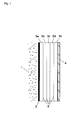
- FIG. 1 schematically shows the structure of a composite thermal insulation system according to the invention.
- the composite thermal insulation system is affixed to a wall (1) of a building.
- Layer 2 is a reinforcing mortar based on white hydrated lime and cement (Heck K + A Plus ® from BASF Wall System GmbH), to which 5% by weight of silicate aerogel powder (Nanogel ® from Cabot Corporation) have been added and which has a layer thickness of from about 5 to 10 mm.
- the thermal insulation cladding is formed by five boards (3a to 3e).
- the boards 3a to 3e each have a layer thickness of 10 mm and comprise 50% by weight of silicate aerogel, 15% by weight of inorganic filler (magnesium oxide) and 35% by weight of glass fibres.
- a process for producing the boards 3a to 3e is disclosed in US 2002094426 .
- the boards 3a to 3e are joined to one another by means of a potassium water glass binder ( 5 ), with in each case about 120 g of potassium water glass binder ( 5 ), based on the solids content thereof, being used per square metre of wall area for adhesively bonding two layers.
- a layer of a polymeric material (acrylate dispersion; not shown in Fig. 1 ) is present on both sides of the thermal insulation cladding between layers 2 and 3a and between layers 3e and 4, with about 90 g having been applied to each of the two sides of the thermal insulation cladding ( 3a to 3e ), based on the solids content of the dispersion, per square metre of wall area.
- Layer 4 is a decorative render based on silicone resin (Heck SHP ® from BASF Wall System GmbH), to which 8% by weight of silicate aerogel powder (Nanogel ® from Cabot Corporation) have been added and which has a layer thickness of about 4 mm.
Landscapes
- Engineering & Computer Science (AREA)
- Architecture (AREA)
- Physics & Mathematics (AREA)
- Civil Engineering (AREA)
- Structural Engineering (AREA)
- Acoustics & Sound (AREA)
- Electromagnetism (AREA)
- Building Environments (AREA)
- Laminated Bodies (AREA)
Priority Applications (2)
| Application Number | Priority Date | Filing Date | Title |
|---|---|---|---|
| PL12700805T PL2665876T3 (pl) | 2011-01-17 | 2012-01-12 | System kompozytowej izolacji termicznej |
| EP12700805.0A EP2665876B1 (en) | 2011-01-17 | 2012-01-12 | Composite thermal insulation system |
Applications Claiming Priority (3)
| Application Number | Priority Date | Filing Date | Title |
|---|---|---|---|
| EP11151091 | 2011-01-17 | ||
| PCT/EP2012/050405 WO2012098040A1 (en) | 2011-01-17 | 2012-01-12 | Composite thermal insulation system |
| EP12700805.0A EP2665876B1 (en) | 2011-01-17 | 2012-01-12 | Composite thermal insulation system |
Publications (2)
| Publication Number | Publication Date |
|---|---|
| EP2665876A1 EP2665876A1 (en) | 2013-11-27 |
| EP2665876B1 true EP2665876B1 (en) | 2015-03-18 |
Family
ID=45524524
Family Applications (1)
| Application Number | Title | Priority Date | Filing Date |
|---|---|---|---|
| EP12700805.0A Revoked EP2665876B1 (en) | 2011-01-17 | 2012-01-12 | Composite thermal insulation system |
Country Status (10)
| Country | Link |
|---|---|
| US (1) | US10344484B2 (pl) |
| EP (1) | EP2665876B1 (pl) |
| JP (1) | JP2014508869A (pl) |
| KR (1) | KR20140006886A (pl) |
| CN (1) | CN103328735B (pl) |
| BR (1) | BR112013017497A2 (pl) |
| CA (1) | CA2824305A1 (pl) |
| PL (1) | PL2665876T3 (pl) |
| RU (1) | RU2582528C2 (pl) |
| WO (1) | WO2012098040A1 (pl) |
Cited By (5)
| Publication number | Priority date | Publication date | Assignee | Title |
|---|---|---|---|---|
| EP3278956A1 (de) | 2016-08-03 | 2018-02-07 | Basf Se | Verfahren zur herstellung von zumindest zweilagigen platten aus einem material mit niedrigem mittlerem zelldurchmesser |
| EP3366465A1 (de) | 2017-02-28 | 2018-08-29 | Basf Se | Verfahren zur herstellung von zumindest zweilagigen platten aus mindestens einer ausgangsplatte aus einem anorganischen isolationsmaterial |
| EP3434478A1 (de) | 2017-07-28 | 2019-01-30 | Basf Se | Verfahren zur herstellung von zumindest zweilagigen platten durch verkleben aus mindestens einer ausgangsplatte aus einem anorganischen isolationsmaterial |
| RU2687816C1 (ru) * | 2018-04-23 | 2019-05-16 | Акционерное общество Научно-производственное объединение "УНИХИМТЕК" (АО НПО "УНИХИМТЕК") | Строительная плита (варианты) |
| WO2021099130A1 (en) | 2019-11-22 | 2021-05-27 | Basf Se | A thermal insulation board comprising at least one aerogel composite material for the thermal insulation of buildings |
Families Citing this family (43)
| Publication number | Priority date | Publication date | Assignee | Title |
|---|---|---|---|---|
| EP2536893A2 (en) * | 2010-02-15 | 2012-12-26 | Construction Research & Technology GmbH | Exterior finish system |
| EP2481859A1 (en) | 2011-01-17 | 2012-08-01 | Aspen Aerogels Inc. | Composite aerogel thermal insulation system |
| EP2670924B1 (en) * | 2011-01-31 | 2021-08-11 | Rockwool International A/S | Insulation system for covering a facade of a building |
| EP2722319B1 (de) | 2012-10-16 | 2019-07-03 | STO SE & Co. KGaA | Schall- und/oder Wärmedämmung sowie Wärmedämmsystem |
| KR101454233B1 (ko) * | 2013-08-21 | 2014-10-23 | 주식회사 관평기술 | 에어로젤 블랑켓의 연속 생산방법과 생산장치 및 생산된 에어로젤 블랑켓 |
| JP6361022B2 (ja) * | 2013-09-17 | 2018-07-25 | パナソニックIpマネジメント株式会社 | 複合シート |
| EP2873656B1 (en) * | 2013-11-14 | 2019-07-31 | Imertech Sas | Method of formation for composite materials comprising cement and geopolymer containing layers, and products obtained from such methods |
| DE102014101704A1 (de) * | 2013-12-20 | 2015-06-25 | Interbran Systems Ag | Wärmedämmputz |
| FR3030354B1 (fr) | 2014-12-17 | 2019-06-07 | Saint-Gobain Isover | Produits d'isolation thermique hautes performances |
| JP2016160553A (ja) * | 2015-03-02 | 2016-09-05 | 鉦則 藤田 | 成形体、該成形体を含む建築資材、車両、船舶、航空機及び電化製品、並びに成形体の製造方法 |
| US10543660B2 (en) * | 2015-03-30 | 2020-01-28 | Panasonic Intellectual Property Managment Co., Ltd. | Heat-insulation sheet, electronic device using same, and method for producing heat-insulation sheet |
| EP3328631B1 (en) | 2015-07-27 | 2021-09-08 | Basf Se | Foam as adhesive for composites for thermal insulation |
| JP6771195B2 (ja) * | 2015-08-07 | 2020-10-21 | パナソニックIpマネジメント株式会社 | 断熱材およびそれを使用した機器と断熱材の製造方法 |
| CN107098354A (zh) * | 2016-02-20 | 2017-08-29 | 金承黎 | 一种自疏水硅酸盐气凝胶材料的制备方法 |
| SI3455425T1 (sl) | 2016-05-13 | 2021-11-30 | Rockwool International A/S | Metoda za zagotavljanje izolacije strukture |
| JP2019168476A (ja) * | 2016-08-12 | 2019-10-03 | Agc株式会社 | 多孔質体および遮音材 |
| US10480189B2 (en) * | 2017-11-06 | 2019-11-19 | Johns Manville | Aerogel containing construction board |
| KR102714602B1 (ko) | 2018-02-07 | 2024-10-08 | 바스프 에스이 | 단열재, 접착제 및 외부층의 복합 부재 |
| RU185206U1 (ru) * | 2018-05-23 | 2018-11-26 | Общество с ограниченной ответственностью "Всесоюзный научно-исследовательский центр транспортных технологий" (ООО "ВНИЦТТ") | Контейнер-цистерна |
| CN108673997B (zh) * | 2018-05-29 | 2021-08-17 | 安徽弘徽科技有限公司 | 一种制备大尺寸、高厚度气凝胶板的制备方法 |
| US11168485B2 (en) * | 2018-09-15 | 2021-11-09 | VBBT Corp. | Low cost emergency housing |
| CN109868909B (zh) * | 2019-03-27 | 2024-03-01 | 河北亿华保温工程有限公司 | 一种增强型抗压保温板 |
| JP7426553B2 (ja) * | 2019-05-29 | 2024-02-02 | パナソニックIpマネジメント株式会社 | 断熱シートおよびその製造方法、ならびに電子機器および電池ユニット |
| US10759697B1 (en) | 2019-06-11 | 2020-09-01 | MSB Global, Inc. | Curable formulations for structural and non-structural applications |
| CN114270606B (zh) * | 2019-08-01 | 2024-01-30 | 3M创新有限公司 | 用于可再充电的电能存储系统的热屏障材料 |
| CZ308884B6 (cs) | 2019-08-06 | 2021-08-04 | First Point a.s | Protipožární materiál |
| CZ309105B6 (cs) | 2019-08-06 | 2022-02-02 | First Point a.s. | Protipožární zateplovací materiál a způsob jeho výroby |
| EP3831869B1 (en) | 2019-12-05 | 2024-03-06 | Basf Se | Composite polystyrene foam molding with low thermal conductivity |
| CN115516180A (zh) * | 2020-03-30 | 2022-12-23 | Nexii建筑解决方案股份有限公司 | 用于粘附包覆物的系统和方法 |
| CN111893649B (zh) * | 2020-07-17 | 2022-07-26 | 3M创新有限公司 | 保暖材料、制备保暖材料的方法、以保暖材料制备的制品 |
| RU2756440C1 (ru) * | 2020-11-11 | 2021-09-30 | Общество С Ограниченной Ответственностью "Атоминпром" | Самозапирающийся вентиляционный блок, увеличивающийся в объеме при воздействии тепла элемент для самозапирающегося вентиляционного блока и огнестойкий кабельный короб, содержащий такой вентиляционный блок |
| CN112355441B (zh) * | 2020-11-18 | 2021-11-12 | 上海交通大学 | 一种减小镁稀土合金tig焊接头热影响区的熔覆剂及tig焊接方法 |
| CN114683627A (zh) * | 2020-12-11 | 2022-07-01 | 包城吉 | 隔热保温复合板及其制造方法 |
| CN112537936A (zh) * | 2020-12-28 | 2021-03-23 | 苏州启创新材料科技有限公司 | 一种气凝胶改性的高强防火砂浆材料及其制备方法 |
| KR102666096B1 (ko) * | 2022-02-21 | 2024-05-13 | 주식회사 아이원 | 단열코팅층이 연속무늬 형상으로 형성되는 실리카-에어로젤 절연시트의 연속 제조방법 |
| CN114725582A (zh) * | 2022-03-28 | 2022-07-08 | 广汽埃安新能源汽车有限公司 | 缓冲隔热复合层及其制备方法、电池及用电装置 |
| CN117621550A (zh) * | 2022-08-10 | 2024-03-01 | 高启峯 | 可持久耐高温的板体 |
| CN116411382B (zh) * | 2023-01-06 | 2026-02-13 | 神州节能科技集团有限公司 | 一种高效绝热玻璃棉制品及其制备方法 |
| CN116332616B (zh) * | 2023-01-18 | 2023-10-27 | 常熟理工学院 | 由垃圾焚烧飞灰制备保温材料的方法与保温材料 |
| IT202300022344A1 (it) * | 2023-10-25 | 2025-04-25 | Aldo Kocani | Pannello isolante e procedimento di realizzazione di detto pannello isolante |
| IT202300022347A1 (it) * | 2023-10-25 | 2025-04-25 | Aldo Kocani | Pannello isolante e procedimento di realizzazione di detto pannello isolante |
| IT202300022350A1 (it) * | 2023-10-25 | 2025-04-25 | Aldo Kocani | Pannello isolante e procedimento di realizzazione di detto pannello isolante |
| WO2026006433A1 (en) * | 2024-06-28 | 2026-01-02 | Carlisle Construction Materials, LLC | Polyisocyanurate aerogel composite material for building insulation |
Citations (14)
| Publication number | Priority date | Publication date | Assignee | Title |
|---|---|---|---|---|
| DE3223246A1 (de) | 1981-06-24 | 1983-01-13 | Österreichische Heraklith AG, 9702 Ferndorf, Kärnten | Mehrschicht-daemmplatte und verfahren zu ihrer herstellung |
| DE3229318A1 (de) | 1982-08-05 | 1984-02-09 | Grünzweig + Hartmann und Glasfaser AG, 6700 Ludwigshafen | Durch pressen verdichteter waermedaemmkoerper aus einem hochdispersen daemmaterial, sowie verfahren zu seiner herstellung |
| WO1996041924A1 (en) | 1995-06-12 | 1996-12-27 | Kaefer Isoleringsteknikk A/S | High temperature resistant insulating element |
| DE19533564A1 (de) | 1995-09-11 | 1997-03-13 | Hoechst Ag | Faserhaltiges Aerogel-Verbundmaterial |
| DE19702240A1 (de) | 1997-01-24 | 1998-07-30 | Hoechst Ag | Mehrschichtige Verbundmaterialien, die mindestens eine aerogelhaltige Schicht und mindestens eine weitere Schicht aufweisen, Verfahren zu ihrer Herstellung sowie ihre Verwendung |
| US5866027A (en) | 1994-08-29 | 1999-02-02 | Hoechst Aktiengesellschaft | Process for producing fiber-reinforced xerogels and their use |
| US6415573B1 (en) | 1999-09-15 | 2002-07-09 | Certainteed Corporation | Metal building insulation assembly |
| US20020094426A1 (en) | 2000-12-22 | 2002-07-18 | Aspen Aerogels, Inc. | Aerogel composite with fibrous batting |
| US20030077438A1 (en) | 1995-09-11 | 2003-04-24 | Dierk Frank | Composite aerogel material that contains fibres |
| EP1408168A1 (de) | 2002-10-11 | 2004-04-14 | Saint Gobain Isover G+H Aktiengesellschaft | Wärmedämm-Verbundsystem sowie hiermit ausgestattetes Gebäude |
| WO2006074449A2 (en) | 2005-01-07 | 2006-07-13 | Aspen Aerogels, Inc. | A thermal management system for high temperature events |
| WO2007086819A2 (en) | 2004-11-24 | 2007-08-02 | Aspen Aerogels, Inc. | High strength aerogel panels |
| WO2008110818A1 (en) | 2007-03-14 | 2008-09-18 | A. Proctor Group Ltd | Wall insulation system |
| WO2010046074A1 (en) | 2008-10-21 | 2010-04-29 | Rockwool International A/S | Facade insulation system |
Family Cites Families (17)
| Publication number | Priority date | Publication date | Assignee | Title |
|---|---|---|---|---|
| DE3274475D1 (en) * | 1981-12-10 | 1987-01-15 | Gruenzweig Hartmann Glasfaser | Heat insulating body from a highly dispersed insulating material densified by compression, and process for its production |
| DE3914850A1 (de) | 1989-05-05 | 1990-11-08 | Basf Ag | Thermisches isoliermaterial auf der basis von pigmenthaltigen kieselsaeureaerogelen |
| JP3157286B2 (ja) * | 1992-06-16 | 2001-04-16 | 日本バイリーン株式会社 | 断熱性材料 |
| US5641584A (en) * | 1992-08-11 | 1997-06-24 | E. Khashoggi Industries | Highly insulative cementitious matrices and methods for their manufacture |
| US5830548A (en) * | 1992-08-11 | 1998-11-03 | E. Khashoggi Industries, Llc | Articles of manufacture and methods for manufacturing laminate structures including inorganically filled sheets |
| US5631097A (en) * | 1992-08-11 | 1997-05-20 | E. Khashoggi Industries | Laminate insulation barriers having a cementitious structural matrix and methods for their manufacture |
| CA2157765A1 (en) * | 1993-03-08 | 1994-09-15 | Per Just Andersen | Insulation barriers having a hydraulically settable matrix |
| DK0716641T3 (da) | 1993-08-31 | 1998-02-09 | Basf Ag | Hydrofobe kiselsyreaerogeler |
| DE4441567A1 (de) | 1994-11-23 | 1996-05-30 | Hoechst Ag | Aerogelhaltiges Verbundmaterial, Verfahren zu seiner Herstellung sowie seine Verwendung |
| WO1997017308A1 (en) | 1995-11-09 | 1997-05-15 | Aspen Systems, Inc. | Flexible aerogel superinsulation and its manufacture |
| JPH10147664A (ja) * | 1996-11-20 | 1998-06-02 | C I Kasei Co Ltd | エアロゲル断熱パネルおよびその製造方法 |
| US20020061396A1 (en) * | 1997-11-17 | 2002-05-23 | Susan M White | Aerogel loaded tile composite material |
| JP2001171030A (ja) * | 1999-12-21 | 2001-06-26 | Tokiwa Electric Co Ltd | 不燃耐火断熱パネル、不燃耐火断熱パネル用枠材、発泡不燃断熱材及び発泡不燃断熱材の製造方法 |
| JP2001279904A (ja) * | 2000-04-03 | 2001-10-10 | Dainippon Printing Co Ltd | 断熱性壁材および断熱性壁の工法 |
| US20040077738A1 (en) * | 2002-05-15 | 2004-04-22 | Cabot Corporation | Aerogel and hollow particle binder composition, insulation composite, and method for preparing the same |
| CN101088954A (zh) * | 2006-06-13 | 2007-12-19 | 瞿爱花 | 憎水阻燃保温隔热材料的制备方法 |
| GB2497230A (en) * | 2010-08-06 | 2013-06-05 | Shanghai One Gold Energy Saving Technology Co Ltd | Externally insulated wall having machine anchored grid-enforced insulation board |
-
2012
- 2012-01-12 PL PL12700805T patent/PL2665876T3/pl unknown
- 2012-01-12 BR BR112013017497A patent/BR112013017497A2/pt active Search and Examination
- 2012-01-12 RU RU2013138282/03A patent/RU2582528C2/ru active
- 2012-01-12 CA CA2824305A patent/CA2824305A1/en not_active Abandoned
- 2012-01-12 JP JP2013549772A patent/JP2014508869A/ja active Pending
- 2012-01-12 CN CN201280005631.1A patent/CN103328735B/zh not_active Expired - Fee Related
- 2012-01-12 US US13/978,615 patent/US10344484B2/en not_active Expired - Fee Related
- 2012-01-12 KR KR1020137021647A patent/KR20140006886A/ko not_active Ceased
- 2012-01-12 WO PCT/EP2012/050405 patent/WO2012098040A1/en not_active Ceased
- 2012-01-12 EP EP12700805.0A patent/EP2665876B1/en not_active Revoked
Patent Citations (17)
| Publication number | Priority date | Publication date | Assignee | Title |
|---|---|---|---|---|
| DE3223246A1 (de) | 1981-06-24 | 1983-01-13 | Österreichische Heraklith AG, 9702 Ferndorf, Kärnten | Mehrschicht-daemmplatte und verfahren zu ihrer herstellung |
| DE3229318A1 (de) | 1982-08-05 | 1984-02-09 | Grünzweig + Hartmann und Glasfaser AG, 6700 Ludwigshafen | Durch pressen verdichteter waermedaemmkoerper aus einem hochdispersen daemmaterial, sowie verfahren zu seiner herstellung |
| US5866027A (en) | 1994-08-29 | 1999-02-02 | Hoechst Aktiengesellschaft | Process for producing fiber-reinforced xerogels and their use |
| WO1996041924A1 (en) | 1995-06-12 | 1996-12-27 | Kaefer Isoleringsteknikk A/S | High temperature resistant insulating element |
| US20030077438A1 (en) | 1995-09-11 | 2003-04-24 | Dierk Frank | Composite aerogel material that contains fibres |
| DE19533564A1 (de) | 1995-09-11 | 1997-03-13 | Hoechst Ag | Faserhaltiges Aerogel-Verbundmaterial |
| CA2231428A1 (en) | 1995-09-11 | 1997-03-20 | Hoechst Research & Technology Deutschland Gmbh & Co. Kg | Composite aerogel material that contains fibres |
| DE19702240A1 (de) | 1997-01-24 | 1998-07-30 | Hoechst Ag | Mehrschichtige Verbundmaterialien, die mindestens eine aerogelhaltige Schicht und mindestens eine weitere Schicht aufweisen, Verfahren zu ihrer Herstellung sowie ihre Verwendung |
| US20020025427A1 (en) | 1997-01-24 | 2002-02-28 | Fritz Schwertfeger | Multilayer composite materials with at least one aerogel-containing layer and at least one other layer, process for producing the same and their use |
| US6415573B1 (en) | 1999-09-15 | 2002-07-09 | Certainteed Corporation | Metal building insulation assembly |
| US20020094426A1 (en) | 2000-12-22 | 2002-07-18 | Aspen Aerogels, Inc. | Aerogel composite with fibrous batting |
| EP1408168A1 (de) | 2002-10-11 | 2004-04-14 | Saint Gobain Isover G+H Aktiengesellschaft | Wärmedämm-Verbundsystem sowie hiermit ausgestattetes Gebäude |
| WO2007086819A2 (en) | 2004-11-24 | 2007-08-02 | Aspen Aerogels, Inc. | High strength aerogel panels |
| WO2006074449A2 (en) | 2005-01-07 | 2006-07-13 | Aspen Aerogels, Inc. | A thermal management system for high temperature events |
| US20070026214A1 (en) | 2005-01-07 | 2007-02-01 | Bullock Daniel E | Thermal management system for high temperature events |
| WO2008110818A1 (en) | 2007-03-14 | 2008-09-18 | A. Proctor Group Ltd | Wall insulation system |
| WO2010046074A1 (en) | 2008-10-21 | 2010-04-29 | Rockwool International A/S | Facade insulation system |
Non-Patent Citations (4)
| Title |
|---|
| BONDING AND COATING APPLICATIONS OF PQ® SOLUBLE SILICATES, 2006, XP055260640 |
| PQ ® POTASSIUM SILICATES INFORMATION BOOKLET, 2004, XP055260639 |
| SPACELOFT ® INSULATION INFORMATION SHEET., 2010, XP055260632 |
| SUPER CALSTIK ® DATA SHEET (NG-10804-10)., 2005, XP055260638 |
Cited By (7)
| Publication number | Priority date | Publication date | Assignee | Title |
|---|---|---|---|---|
| EP3278956A1 (de) | 2016-08-03 | 2018-02-07 | Basf Se | Verfahren zur herstellung von zumindest zweilagigen platten aus einem material mit niedrigem mittlerem zelldurchmesser |
| EP3366465A1 (de) | 2017-02-28 | 2018-08-29 | Basf Se | Verfahren zur herstellung von zumindest zweilagigen platten aus mindestens einer ausgangsplatte aus einem anorganischen isolationsmaterial |
| EP3434478A1 (de) | 2017-07-28 | 2019-01-30 | Basf Se | Verfahren zur herstellung von zumindest zweilagigen platten durch verkleben aus mindestens einer ausgangsplatte aus einem anorganischen isolationsmaterial |
| RU2687816C1 (ru) * | 2018-04-23 | 2019-05-16 | Акционерное общество Научно-производственное объединение "УНИХИМТЕК" (АО НПО "УНИХИМТЕК") | Строительная плита (варианты) |
| WO2021099130A1 (en) | 2019-11-22 | 2021-05-27 | Basf Se | A thermal insulation board comprising at least one aerogel composite material for the thermal insulation of buildings |
| EP4219142A1 (en) | 2019-11-22 | 2023-08-02 | Basf Se | A thermal insulation board comprising at least one aerogel composite material for the thermal insulation of buildings |
| US12202242B2 (en) | 2019-11-22 | 2025-01-21 | Aspen Aerogels, Inc. | Thermal insulation board comprising at least one aerogel composite material for the thermal insulation of buildings |
Also Published As
| Publication number | Publication date |
|---|---|
| US20140318069A1 (en) | 2014-10-30 |
| KR20140006886A (ko) | 2014-01-16 |
| PL2665876T3 (pl) | 2015-08-31 |
| CA2824305A1 (en) | 2012-07-26 |
| CN103328735B (zh) | 2018-07-27 |
| EP2665876A1 (en) | 2013-11-27 |
| BR112013017497A2 (pt) | 2016-09-27 |
| RU2582528C2 (ru) | 2016-04-27 |
| CN103328735A (zh) | 2013-09-25 |
| US10344484B2 (en) | 2019-07-09 |
| WO2012098040A1 (en) | 2012-07-26 |
| RU2013138282A (ru) | 2015-02-27 |
| JP2014508869A (ja) | 2014-04-10 |
Similar Documents
| Publication | Publication Date | Title |
|---|---|---|
| EP2665876B1 (en) | Composite thermal insulation system | |
| US20130196137A1 (en) | Composite Aerogel Thermal Insulation System | |
| EP2481859A1 (en) | Composite aerogel thermal insulation system | |
| US10987910B2 (en) | Foam as adhesive for composites for thermal insulation | |
| US20220205244A1 (en) | Fiber-reinforced coated mats and mat-faced panels and methods | |
| US10060058B2 (en) | Hybrid nonwoven mats and methods | |
| DK3084091T3 (en) | THERMAL INSULATION PLATE | |
| US20040209074A1 (en) | Mat faced gypsum board | |
| WO2015031344A1 (en) | Membrane-ready fibrous faced gypsum panels, apparatus, and methods | |
| WO2017120611A1 (en) | Fibrous mats and panels having a gypsum-based coating and methods for the manufacture thereof | |
| CN111212946A (zh) | 矿物纤维屋顶盖板 | |
| CA2844575C (en) | Insulation element for a flat roof or a flat inclined roof, roofing system for a flat roof or a flat inclined roof and method for producing an insulation element | |
| CN111733992A (zh) | 一种含岩棉条复合板的外墙外保温系统及施工工艺 | |
| EP3666989A1 (en) | Mineral wool insulation | |
| CN110331822A (zh) | 一种屋面保温保护一体化产品及其施工方法 | |
| CN207829238U (zh) | 一种被动房保温墙体 |
Legal Events
| Date | Code | Title | Description |
|---|---|---|---|
| PUAI | Public reference made under article 153(3) epc to a published international application that has entered the european phase |
Free format text: ORIGINAL CODE: 0009012 |
|
| 17P | Request for examination filed |
Effective date: 20130819 |
|
| AK | Designated contracting states |
Kind code of ref document: A1 Designated state(s): AL AT BE BG CH CY CZ DE DK EE ES FI FR GB GR HR HU IE IS IT LI LT LU LV MC MK MT NL NO PL PT RO RS SE SI SK SM TR |
|
| DAX | Request for extension of the european patent (deleted) | ||
| 17Q | First examination report despatched |
Effective date: 20140512 |
|
| GRAP | Despatch of communication of intention to grant a patent |
Free format text: ORIGINAL CODE: EPIDOSNIGR1 |
|
| INTG | Intention to grant announced |
Effective date: 20141020 |
|
| GRAS | Grant fee paid |
Free format text: ORIGINAL CODE: EPIDOSNIGR3 |
|
| GRAA | (expected) grant |
Free format text: ORIGINAL CODE: 0009210 |
|
| AK | Designated contracting states |
Kind code of ref document: B1 Designated state(s): AL AT BE BG CH CY CZ DE DK EE ES FI FR GB GR HR HU IE IS IT LI LT LU LV MC MK MT NL NO PL PT RO RS SE SI SK SM TR |
|
| REG | Reference to a national code |
Ref country code: GB Ref legal event code: FG4D |
|
| REG | Reference to a national code |
Ref country code: CH Ref legal event code: EP |
|
| REG | Reference to a national code |
Ref country code: IE Ref legal event code: FG4D |
|
| REG | Reference to a national code |
Ref country code: AT Ref legal event code: REF Ref document number: 716681 Country of ref document: AT Kind code of ref document: T Effective date: 20150415 |
|
| REG | Reference to a national code |
Ref country code: DE Ref legal event code: R096 Ref document number: 602012005972 Country of ref document: DE Effective date: 20150430 |
|
| REG | Reference to a national code |
Ref country code: SE Ref legal event code: TRGR |
|
| REG | Reference to a national code |
Ref country code: NL Ref legal event code: T3 |
|
| PG25 | Lapsed in a contracting state [announced via postgrant information from national office to epo] |
Ref country code: LT Free format text: LAPSE BECAUSE OF FAILURE TO SUBMIT A TRANSLATION OF THE DESCRIPTION OR TO PAY THE FEE WITHIN THE PRESCRIBED TIME-LIMIT Effective date: 20150318 Ref country code: NO Free format text: LAPSE BECAUSE OF FAILURE TO SUBMIT A TRANSLATION OF THE DESCRIPTION OR TO PAY THE FEE WITHIN THE PRESCRIBED TIME-LIMIT Effective date: 20150618 Ref country code: FI Free format text: LAPSE BECAUSE OF FAILURE TO SUBMIT A TRANSLATION OF THE DESCRIPTION OR TO PAY THE FEE WITHIN THE PRESCRIBED TIME-LIMIT Effective date: 20150318 Ref country code: HR Free format text: LAPSE BECAUSE OF FAILURE TO SUBMIT A TRANSLATION OF THE DESCRIPTION OR TO PAY THE FEE WITHIN THE PRESCRIBED TIME-LIMIT Effective date: 20150318 |
|
| REG | Reference to a national code |
Ref country code: LT Ref legal event code: MG4D |
|
| PG25 | Lapsed in a contracting state [announced via postgrant information from national office to epo] |
Ref country code: RS Free format text: LAPSE BECAUSE OF FAILURE TO SUBMIT A TRANSLATION OF THE DESCRIPTION OR TO PAY THE FEE WITHIN THE PRESCRIBED TIME-LIMIT Effective date: 20150318 Ref country code: LV Free format text: LAPSE BECAUSE OF FAILURE TO SUBMIT A TRANSLATION OF THE DESCRIPTION OR TO PAY THE FEE WITHIN THE PRESCRIBED TIME-LIMIT Effective date: 20150318 Ref country code: GR Free format text: LAPSE BECAUSE OF FAILURE TO SUBMIT A TRANSLATION OF THE DESCRIPTION OR TO PAY THE FEE WITHIN THE PRESCRIBED TIME-LIMIT Effective date: 20150619 |
|
| REG | Reference to a national code |
Ref country code: PL Ref legal event code: T3 |
|
| PG25 | Lapsed in a contracting state [announced via postgrant information from national office to epo] |
Ref country code: ES Free format text: LAPSE BECAUSE OF FAILURE TO SUBMIT A TRANSLATION OF THE DESCRIPTION OR TO PAY THE FEE WITHIN THE PRESCRIBED TIME-LIMIT Effective date: 20150318 Ref country code: PT Free format text: LAPSE BECAUSE OF FAILURE TO SUBMIT A TRANSLATION OF THE DESCRIPTION OR TO PAY THE FEE WITHIN THE PRESCRIBED TIME-LIMIT Effective date: 20150720 Ref country code: SK Free format text: LAPSE BECAUSE OF FAILURE TO SUBMIT A TRANSLATION OF THE DESCRIPTION OR TO PAY THE FEE WITHIN THE PRESCRIBED TIME-LIMIT Effective date: 20150318 Ref country code: EE Free format text: LAPSE BECAUSE OF FAILURE TO SUBMIT A TRANSLATION OF THE DESCRIPTION OR TO PAY THE FEE WITHIN THE PRESCRIBED TIME-LIMIT Effective date: 20150318 Ref country code: RO Free format text: LAPSE BECAUSE OF FAILURE TO SUBMIT A TRANSLATION OF THE DESCRIPTION OR TO PAY THE FEE WITHIN THE PRESCRIBED TIME-LIMIT Effective date: 20150318 |
|
| PG25 | Lapsed in a contracting state [announced via postgrant information from national office to epo] |
Ref country code: IS Free format text: LAPSE BECAUSE OF FAILURE TO SUBMIT A TRANSLATION OF THE DESCRIPTION OR TO PAY THE FEE WITHIN THE PRESCRIBED TIME-LIMIT Effective date: 20150718 |
|
| REG | Reference to a national code |
Ref country code: DE Ref legal event code: R026 Ref document number: 602012005972 Country of ref document: DE |
|
| PLBI | Opposition filed |
Free format text: ORIGINAL CODE: 0009260 |
|
| PG25 | Lapsed in a contracting state [announced via postgrant information from national office to epo] |
Ref country code: IT Free format text: LAPSE BECAUSE OF FAILURE TO SUBMIT A TRANSLATION OF THE DESCRIPTION OR TO PAY THE FEE WITHIN THE PRESCRIBED TIME-LIMIT Effective date: 20150318 |
|
| PLAX | Notice of opposition and request to file observation + time limit sent |
Free format text: ORIGINAL CODE: EPIDOSNOBS2 |
|
| REG | Reference to a national code |
Ref country code: FR Ref legal event code: PLFP Year of fee payment: 5 |
|
| 26 | Opposition filed |
Opponent name: ROCKWOOL INTERNATIONAL A/S Effective date: 20151218 |
|
| PG25 | Lapsed in a contracting state [announced via postgrant information from national office to epo] |
Ref country code: DK Free format text: LAPSE BECAUSE OF FAILURE TO SUBMIT A TRANSLATION OF THE DESCRIPTION OR TO PAY THE FEE WITHIN THE PRESCRIBED TIME-LIMIT Effective date: 20150318 |
|
| PLAB | Opposition data, opponent's data or that of the opponent's representative modified |
Free format text: ORIGINAL CODE: 0009299OPPO |
|
| PG25 | Lapsed in a contracting state [announced via postgrant information from national office to epo] |
Ref country code: SI Free format text: LAPSE BECAUSE OF FAILURE TO SUBMIT A TRANSLATION OF THE DESCRIPTION OR TO PAY THE FEE WITHIN THE PRESCRIBED TIME-LIMIT Effective date: 20150318 |
|
| R26 | Opposition filed (corrected) |
Opponent name: ROCKWOOL INTERNATIONAL A/S Effective date: 20151218 |
|
| PLAF | Information modified related to communication of a notice of opposition and request to file observations + time limit |
Free format text: ORIGINAL CODE: EPIDOSCOBS2 |
|
| PG25 | Lapsed in a contracting state [announced via postgrant information from national office to epo] |
Ref country code: BE Free format text: LAPSE BECAUSE OF NON-PAYMENT OF DUE FEES Effective date: 20160131 |
|
| PLBB | Reply of patent proprietor to notice(s) of opposition received |
Free format text: ORIGINAL CODE: EPIDOSNOBS3 |
|
| PG25 | Lapsed in a contracting state [announced via postgrant information from national office to epo] |
Ref country code: LU Free format text: LAPSE BECAUSE OF FAILURE TO SUBMIT A TRANSLATION OF THE DESCRIPTION OR TO PAY THE FEE WITHIN THE PRESCRIBED TIME-LIMIT Effective date: 20160112 Ref country code: BE Free format text: LAPSE BECAUSE OF FAILURE TO SUBMIT A TRANSLATION OF THE DESCRIPTION OR TO PAY THE FEE WITHIN THE PRESCRIBED TIME-LIMIT Effective date: 20150318 |
|
| REG | Reference to a national code |
Ref country code: AT Ref legal event code: UEP Ref document number: 716681 Country of ref document: AT Kind code of ref document: T Effective date: 20150318 |
|
| PG25 | Lapsed in a contracting state [announced via postgrant information from national office to epo] |
Ref country code: MC Free format text: LAPSE BECAUSE OF FAILURE TO SUBMIT A TRANSLATION OF THE DESCRIPTION OR TO PAY THE FEE WITHIN THE PRESCRIBED TIME-LIMIT Effective date: 20150318 |
|
| RAP2 | Party data changed (patent owner data changed or rights of a patent transferred) |
Owner name: BASF SE |
|
| REG | Reference to a national code |
Ref country code: IE Ref legal event code: MM4A |
|
| REG | Reference to a national code |
Ref country code: FR Ref legal event code: PLFP Year of fee payment: 6 |
|
| PG25 | Lapsed in a contracting state [announced via postgrant information from national office to epo] |
Ref country code: IE Free format text: LAPSE BECAUSE OF NON-PAYMENT OF DUE FEES Effective date: 20160112 |
|
| RDAF | Communication despatched that patent is revoked |
Free format text: ORIGINAL CODE: EPIDOSNREV1 |
|
| STAA | Information on the status of an ep patent application or granted ep patent |
Free format text: STATUS: THE PATENT HAS BEEN GRANTED |
|
| PG25 | Lapsed in a contracting state [announced via postgrant information from national office to epo] |
Ref country code: MT Free format text: LAPSE BECAUSE OF FAILURE TO SUBMIT A TRANSLATION OF THE DESCRIPTION OR TO PAY THE FEE WITHIN THE PRESCRIBED TIME-LIMIT Effective date: 20150318 |
|
| APBM | Appeal reference recorded |
Free format text: ORIGINAL CODE: EPIDOSNREFNO |
|
| APBP | Date of receipt of notice of appeal recorded |
Free format text: ORIGINAL CODE: EPIDOSNNOA2O |
|
| APAH | Appeal reference modified |
Free format text: ORIGINAL CODE: EPIDOSCREFNO |
|
| APBQ | Date of receipt of statement of grounds of appeal recorded |
Free format text: ORIGINAL CODE: EPIDOSNNOA3O |
|
| REG | Reference to a national code |
Ref country code: FR Ref legal event code: PLFP Year of fee payment: 7 |
|
| PG25 | Lapsed in a contracting state [announced via postgrant information from national office to epo] |
Ref country code: HU Free format text: LAPSE BECAUSE OF FAILURE TO SUBMIT A TRANSLATION OF THE DESCRIPTION OR TO PAY THE FEE WITHIN THE PRESCRIBED TIME-LIMIT; INVALID AB INITIO Effective date: 20120112 Ref country code: SM Free format text: LAPSE BECAUSE OF FAILURE TO SUBMIT A TRANSLATION OF THE DESCRIPTION OR TO PAY THE FEE WITHIN THE PRESCRIBED TIME-LIMIT Effective date: 20150318 Ref country code: CY Free format text: LAPSE BECAUSE OF FAILURE TO SUBMIT A TRANSLATION OF THE DESCRIPTION OR TO PAY THE FEE WITHIN THE PRESCRIBED TIME-LIMIT Effective date: 20150318 |
|
| PG25 | Lapsed in a contracting state [announced via postgrant information from national office to epo] |
Ref country code: MT Free format text: LAPSE BECAUSE OF FAILURE TO SUBMIT A TRANSLATION OF THE DESCRIPTION OR TO PAY THE FEE WITHIN THE PRESCRIBED TIME-LIMIT Effective date: 20160131 Ref country code: MK Free format text: LAPSE BECAUSE OF FAILURE TO SUBMIT A TRANSLATION OF THE DESCRIPTION OR TO PAY THE FEE WITHIN THE PRESCRIBED TIME-LIMIT Effective date: 20150318 |
|
| PG25 | Lapsed in a contracting state [announced via postgrant information from national office to epo] |
Ref country code: BG Free format text: LAPSE BECAUSE OF FAILURE TO SUBMIT A TRANSLATION OF THE DESCRIPTION OR TO PAY THE FEE WITHIN THE PRESCRIBED TIME-LIMIT Effective date: 20150318 |
|
| PG25 | Lapsed in a contracting state [announced via postgrant information from national office to epo] |
Ref country code: AL Free format text: LAPSE BECAUSE OF FAILURE TO SUBMIT A TRANSLATION OF THE DESCRIPTION OR TO PAY THE FEE WITHIN THE PRESCRIBED TIME-LIMIT Effective date: 20150318 |
|
| PGFP | Annual fee paid to national office [announced via postgrant information from national office to epo] |
Ref country code: DE Payment date: 20200327 Year of fee payment: 9 |
|
| PGFP | Annual fee paid to national office [announced via postgrant information from national office to epo] |
Ref country code: PL Payment date: 20201218 Year of fee payment: 10 |
|
| REG | Reference to a national code |
Ref country code: DE Ref legal event code: R064 Ref document number: 602012005972 Country of ref document: DE Ref country code: DE Ref legal event code: R103 Ref document number: 602012005972 Country of ref document: DE |
|
| APBU | Appeal procedure closed |
Free format text: ORIGINAL CODE: EPIDOSNNOA9O |
|
| PGFP | Annual fee paid to national office [announced via postgrant information from national office to epo] |
Ref country code: CZ Payment date: 20210112 Year of fee payment: 10 Ref country code: CH Payment date: 20210122 Year of fee payment: 10 Ref country code: FR Payment date: 20210127 Year of fee payment: 10 Ref country code: NL Payment date: 20210126 Year of fee payment: 10 |
|
| RDAG | Patent revoked |
Free format text: ORIGINAL CODE: 0009271 |
|
| STAA | Information on the status of an ep patent application or granted ep patent |
Free format text: STATUS: PATENT REVOKED |
|
| REG | Reference to a national code |
Ref country code: CH Ref legal event code: PL |
|
| PGFP | Annual fee paid to national office [announced via postgrant information from national office to epo] |
Ref country code: GB Payment date: 20210128 Year of fee payment: 10 Ref country code: TR Payment date: 20210105 Year of fee payment: 10 Ref country code: SE Payment date: 20210122 Year of fee payment: 10 Ref country code: AT Payment date: 20210120 Year of fee payment: 10 |
|
| REG | Reference to a national code |
Ref country code: FI Ref legal event code: MGE |
|
| 27W | Patent revoked |
Effective date: 20210304 |
|
| GBPR | Gb: patent revoked under art. 102 of the ep convention designating the uk as contracting state |
Effective date: 20210304 |
|
| REG | Reference to a national code |
Ref country code: AT Ref legal event code: MA03 Ref document number: 716681 Country of ref document: AT Kind code of ref document: T Effective date: 20210304 |
|
| REG | Reference to a national code |
Ref country code: SE Ref legal event code: ECNC |