EP2658842B1 - Verfahren zur herstellung von methylmercaptopropionaldehyd - Google Patents
Verfahren zur herstellung von methylmercaptopropionaldehyd Download PDFInfo
- Publication number
- EP2658842B1 EP2658842B1 EP11802046.0A EP11802046A EP2658842B1 EP 2658842 B1 EP2658842 B1 EP 2658842B1 EP 11802046 A EP11802046 A EP 11802046A EP 2658842 B1 EP2658842 B1 EP 2658842B1
- Authority
- EP
- European Patent Office
- Prior art keywords
- mixture
- methylmercaptopropionaldehyde
- process according
- acrolein
- mol
- Prior art date
- Legal status (The legal status is an assumption and is not a legal conclusion. Google has not performed a legal analysis and makes no representation as to the accuracy of the status listed.)
- Active
Links
- CLUWOWRTHNNBBU-UHFFFAOYSA-N 3-methylthiopropanal Chemical compound CSCCC=O CLUWOWRTHNNBBU-UHFFFAOYSA-N 0.000 title claims description 85
- 238000004519 manufacturing process Methods 0.000 title claims description 3
- HGINCPLSRVDWNT-UHFFFAOYSA-N Acrolein Chemical compound C=CC=O HGINCPLSRVDWNT-UHFFFAOYSA-N 0.000 claims description 171
- LSDPWZHWYPCBBB-UHFFFAOYSA-N Methanethiol Chemical compound SC LSDPWZHWYPCBBB-UHFFFAOYSA-N 0.000 claims description 168
- QMMFVYPAHWMCMS-UHFFFAOYSA-N Dimethyl sulfide Chemical compound CSC QMMFVYPAHWMCMS-UHFFFAOYSA-N 0.000 claims description 58
- 239000000203 mixture Substances 0.000 claims description 48
- 238000000034 method Methods 0.000 claims description 40
- OKKJLVBELUTLKV-UHFFFAOYSA-N Methanol Chemical compound OC OKKJLVBELUTLKV-UHFFFAOYSA-N 0.000 claims description 39
- XLYOFNOQVPJJNP-UHFFFAOYSA-N water Substances O XLYOFNOQVPJJNP-UHFFFAOYSA-N 0.000 claims description 34
- 229910001868 water Inorganic materials 0.000 claims description 32
- 230000008569 process Effects 0.000 claims description 28
- 239000006096 absorbing agent Substances 0.000 claims description 23
- LCGLNKUTAGEVQW-UHFFFAOYSA-N Dimethyl ether Chemical compound COC LCGLNKUTAGEVQW-UHFFFAOYSA-N 0.000 claims description 22
- WQOXQRCZOLPYPM-UHFFFAOYSA-N dimethyl disulfide Chemical compound CSSC WQOXQRCZOLPYPM-UHFFFAOYSA-N 0.000 claims description 22
- QTBSBXVTEAMEQO-UHFFFAOYSA-N Acetic acid Chemical compound CC(O)=O QTBSBXVTEAMEQO-UHFFFAOYSA-N 0.000 claims description 21
- CURLTUGMZLYLDI-UHFFFAOYSA-N Carbon dioxide Chemical compound O=C=O CURLTUGMZLYLDI-UHFFFAOYSA-N 0.000 claims description 15
- QQONPFPTGQHPMA-UHFFFAOYSA-N Propene Chemical compound CC=C QQONPFPTGQHPMA-UHFFFAOYSA-N 0.000 claims description 13
- 239000006227 byproduct Substances 0.000 claims description 13
- ATUOYWHBWRKTHZ-UHFFFAOYSA-N Propane Chemical compound CCC ATUOYWHBWRKTHZ-UHFFFAOYSA-N 0.000 claims description 11
- 239000007788 liquid Substances 0.000 claims description 11
- RWSOTUBLDIXVET-UHFFFAOYSA-N Dihydrogen sulfide Chemical compound S RWSOTUBLDIXVET-UHFFFAOYSA-N 0.000 claims description 8
- IKHGUXGNUITLKF-XPULMUKRSA-N acetaldehyde Chemical compound [14CH]([14CH3])=O IKHGUXGNUITLKF-XPULMUKRSA-N 0.000 claims description 8
- 229910002092 carbon dioxide Inorganic materials 0.000 claims description 8
- 239000003054 catalyst Substances 0.000 claims description 8
- 238000005259 measurement Methods 0.000 claims description 8
- 238000009835 boiling Methods 0.000 claims description 7
- 150000001875 compounds Chemical class 0.000 claims description 7
- 239000012535 impurity Substances 0.000 claims description 7
- 239000001569 carbon dioxide Substances 0.000 claims description 5
- XXBDWLFCJWSEKW-UHFFFAOYSA-N dimethylbenzylamine Chemical group CN(C)CC1=CC=CC=C1 XXBDWLFCJWSEKW-UHFFFAOYSA-N 0.000 claims description 5
- 239000001294 propane Substances 0.000 claims description 5
- GSEJCLTVZPLZKY-UHFFFAOYSA-N Triethanolamine Chemical compound OCCN(CCO)CCO GSEJCLTVZPLZKY-UHFFFAOYSA-N 0.000 claims description 4
- 239000007791 liquid phase Substances 0.000 claims description 4
- 238000005033 Fourier transform infrared spectroscopy Methods 0.000 claims description 3
- 239000002815 homogeneous catalyst Substances 0.000 claims description 3
- 150000007529 inorganic bases Chemical class 0.000 claims description 3
- 150000007524 organic acids Chemical class 0.000 claims description 3
- 235000005985 organic acids Nutrition 0.000 claims description 3
- FEWJPZIEWOKRBE-UHFFFAOYSA-N Tartaric acid Natural products [H+].[H+].[O-]C(=O)C(O)C(O)C([O-])=O FEWJPZIEWOKRBE-UHFFFAOYSA-N 0.000 claims description 2
- 239000002638 heterogeneous catalyst Substances 0.000 claims description 2
- 150000007522 mineralic acids Chemical class 0.000 claims description 2
- 150000007530 organic bases Chemical class 0.000 claims description 2
- 235000002906 tartaric acid Nutrition 0.000 claims description 2
- KNZPMGNXOMIDTC-UHFFFAOYSA-N 2-sulfanylpropanal Chemical compound CC(S)C=O KNZPMGNXOMIDTC-UHFFFAOYSA-N 0.000 claims 1
- FEWJPZIEWOKRBE-JCYAYHJZSA-N Dextrotartaric acid Chemical compound OC(=O)[C@H](O)[C@@H](O)C(O)=O FEWJPZIEWOKRBE-JCYAYHJZSA-N 0.000 claims 1
- 239000011975 tartaric acid Substances 0.000 claims 1
- 239000007789 gas Substances 0.000 description 36
- 238000006243 chemical reaction Methods 0.000 description 24
- IKHGUXGNUITLKF-UHFFFAOYSA-N Acetaldehyde Chemical compound CC=O IKHGUXGNUITLKF-UHFFFAOYSA-N 0.000 description 15
- 230000015572 biosynthetic process Effects 0.000 description 14
- 239000000047 product Substances 0.000 description 11
- XXROGKLTLUQVRX-UHFFFAOYSA-N allyl alcohol Chemical compound OCC=C XXROGKLTLUQVRX-UHFFFAOYSA-N 0.000 description 8
- SMZOUWXMTYCWNB-UHFFFAOYSA-N 2-(2-methoxy-5-methylphenyl)ethanamine Chemical compound COC1=CC=C(C)C=C1CCN SMZOUWXMTYCWNB-UHFFFAOYSA-N 0.000 description 7
- NIXOWILDQLNWCW-UHFFFAOYSA-N 2-Propenoic acid Natural products OC(=O)C=C NIXOWILDQLNWCW-UHFFFAOYSA-N 0.000 description 7
- 235000011054 acetic acid Nutrition 0.000 description 7
- IJGRMHOSHXDMSA-UHFFFAOYSA-N Atomic nitrogen Chemical compound N#N IJGRMHOSHXDMSA-UHFFFAOYSA-N 0.000 description 6
- 229910000037 hydrogen sulfide Inorganic materials 0.000 description 6
- 239000012495 reaction gas Substances 0.000 description 6
- 238000010521 absorption reaction Methods 0.000 description 5
- 238000009833 condensation Methods 0.000 description 5
- 230000005494 condensation Effects 0.000 description 5
- -1 dimethyl sulfide Chemical compound 0.000 description 5
- 238000003786 synthesis reaction Methods 0.000 description 5
- XKRFYHLGVUSROY-UHFFFAOYSA-N Argon Chemical compound [Ar] XKRFYHLGVUSROY-UHFFFAOYSA-N 0.000 description 4
- QAOWNCQODCNURD-UHFFFAOYSA-N Sulfuric acid Chemical compound OS(O)(=O)=O QAOWNCQODCNURD-UHFFFAOYSA-N 0.000 description 4
- 239000002253 acid Substances 0.000 description 4
- 239000011261 inert gas Substances 0.000 description 4
- 238000010791 quenching Methods 0.000 description 4
- 125000003903 2-propenyl group Chemical group [H]C([*])([H])C([H])=C([H])[H] 0.000 description 3
- FFEARJCKVFRZRR-BYPYZUCNSA-N L-methionine Chemical compound CSCC[C@H](N)C(O)=O FFEARJCKVFRZRR-BYPYZUCNSA-N 0.000 description 3
- MUBZPKHOEPUJKR-UHFFFAOYSA-N Oxalic acid Chemical compound OC(=O)C(O)=O MUBZPKHOEPUJKR-UHFFFAOYSA-N 0.000 description 3
- KWYUFKZDYYNOTN-UHFFFAOYSA-M Potassium hydroxide Chemical compound [OH-].[K+] KWYUFKZDYYNOTN-UHFFFAOYSA-M 0.000 description 3
- HEMHJVSKTPXQMS-UHFFFAOYSA-M Sodium hydroxide Chemical compound [OH-].[Na+] HEMHJVSKTPXQMS-UHFFFAOYSA-M 0.000 description 3
- ZMANZCXQSJIPKH-UHFFFAOYSA-N Triethylamine Chemical compound CCN(CC)CC ZMANZCXQSJIPKH-UHFFFAOYSA-N 0.000 description 3
- 150000007513 acids Chemical class 0.000 description 3
- 230000008901 benefit Effects 0.000 description 3
- 230000003197 catalytic effect Effects 0.000 description 3
- 238000001816 cooling Methods 0.000 description 3
- 229930182817 methionine Natural products 0.000 description 3
- 229910052757 nitrogen Inorganic materials 0.000 description 3
- 238000002360 preparation method Methods 0.000 description 3
- 125000004805 propylene group Chemical group [H]C([H])([H])C([H])([*:1])C([H])([H])[*:2] 0.000 description 3
- 238000005086 pumping Methods 0.000 description 3
- 239000011541 reaction mixture Substances 0.000 description 3
- 239000000126 substance Substances 0.000 description 3
- QGZKDVFQNNGYKY-UHFFFAOYSA-N Ammonia Chemical compound N QGZKDVFQNNGYKY-UHFFFAOYSA-N 0.000 description 2
- UGFAIRIUMAVXCW-UHFFFAOYSA-N Carbon monoxide Chemical compound [O+]#[C-] UGFAIRIUMAVXCW-UHFFFAOYSA-N 0.000 description 2
- JLTDJTHDQAWBAV-UHFFFAOYSA-N N,N-dimethylaniline Chemical compound CN(C)C1=CC=CC=C1 JLTDJTHDQAWBAV-UHFFFAOYSA-N 0.000 description 2
- NBIIXXVUZAFLBC-UHFFFAOYSA-N Phosphoric acid Chemical compound OP(O)(O)=O NBIIXXVUZAFLBC-UHFFFAOYSA-N 0.000 description 2
- NQRYJNQNLNOLGT-UHFFFAOYSA-N Piperidine Chemical compound C1CCNCC1 NQRYJNQNLNOLGT-UHFFFAOYSA-N 0.000 description 2
- JUJWROOIHBZHMG-UHFFFAOYSA-N Pyridine Chemical compound C1=CC=NC=C1 JUJWROOIHBZHMG-UHFFFAOYSA-N 0.000 description 2
- SMWDFEZZVXVKRB-UHFFFAOYSA-N Quinoline Chemical compound N1=CC=CC2=CC=CC=C21 SMWDFEZZVXVKRB-UHFFFAOYSA-N 0.000 description 2
- CDBYLPFSWZWCQE-UHFFFAOYSA-L Sodium Carbonate Chemical compound [Na+].[Na+].[O-]C([O-])=O CDBYLPFSWZWCQE-UHFFFAOYSA-L 0.000 description 2
- UIIMBOGNXHQVGW-UHFFFAOYSA-M Sodium bicarbonate Chemical compound [Na+].OC([O-])=O UIIMBOGNXHQVGW-UHFFFAOYSA-M 0.000 description 2
- DTQVDTLACAAQTR-UHFFFAOYSA-N Trifluoroacetic acid Chemical compound OC(=O)C(F)(F)F DTQVDTLACAAQTR-UHFFFAOYSA-N 0.000 description 2
- WNLRTRBMVRJNCN-UHFFFAOYSA-N adipic acid Chemical compound OC(=O)CCCCC(O)=O WNLRTRBMVRJNCN-UHFFFAOYSA-N 0.000 description 2
- 229910052786 argon Inorganic materials 0.000 description 2
- WPYMKLBDIGXBTP-UHFFFAOYSA-N benzoic acid Chemical compound OC(=O)C1=CC=CC=C1 WPYMKLBDIGXBTP-UHFFFAOYSA-N 0.000 description 2
- 229910052799 carbon Inorganic materials 0.000 description 2
- 229910002091 carbon monoxide Inorganic materials 0.000 description 2
- VLXBWPOEOIIREY-UHFFFAOYSA-N dimethyl diselenide Natural products C[Se][Se]C VLXBWPOEOIIREY-UHFFFAOYSA-N 0.000 description 2
- XBDQKXXYIPTUBI-UHFFFAOYSA-N dimethylselenoniopropionate Natural products CCC(O)=O XBDQKXXYIPTUBI-UHFFFAOYSA-N 0.000 description 2
- USIUVYZYUHIAEV-UHFFFAOYSA-N diphenyl ether Chemical compound C=1C=CC=CC=1OC1=CC=CC=C1 USIUVYZYUHIAEV-UHFFFAOYSA-N 0.000 description 2
- 230000000694 effects Effects 0.000 description 2
- 238000010574 gas phase reaction Methods 0.000 description 2
- 239000001257 hydrogen Substances 0.000 description 2
- 229910052739 hydrogen Inorganic materials 0.000 description 2
- BDAGIHXWWSANSR-UHFFFAOYSA-N methanoic acid Natural products OC=O BDAGIHXWWSANSR-UHFFFAOYSA-N 0.000 description 2
- WSFSSNUMVMOOMR-NJFSPNSNSA-N methanone Chemical compound O=[14CH2] WSFSSNUMVMOOMR-NJFSPNSNSA-N 0.000 description 2
- WWZKQHOCKIZLMA-UHFFFAOYSA-N octanoic acid Chemical compound CCCCCCCC(O)=O WWZKQHOCKIZLMA-UHFFFAOYSA-N 0.000 description 2
- 230000003647 oxidation Effects 0.000 description 2
- 238000007254 oxidation reaction Methods 0.000 description 2
- 238000012856 packing Methods 0.000 description 2
- 239000012071 phase Substances 0.000 description 2
- XNGIFLGASWRNHJ-UHFFFAOYSA-N phthalic acid Chemical compound OC(=O)C1=CC=CC=C1C(O)=O XNGIFLGASWRNHJ-UHFFFAOYSA-N 0.000 description 2
- SCVFZCLFOSHCOH-UHFFFAOYSA-M potassium acetate Chemical compound [K+].CC([O-])=O SCVFZCLFOSHCOH-UHFFFAOYSA-M 0.000 description 2
- BWHMMNNQKKPAPP-UHFFFAOYSA-L potassium carbonate Chemical compound [K+].[K+].[O-]C([O-])=O BWHMMNNQKKPAPP-UHFFFAOYSA-L 0.000 description 2
- 239000012429 reaction media Substances 0.000 description 2
- 238000000926 separation method Methods 0.000 description 2
- WBYWAXJHAXSJNI-VOTSOKGWSA-M .beta-Phenylacrylic acid Natural products [O-]C(=O)\C=C\C1=CC=CC=C1 WBYWAXJHAXSJNI-VOTSOKGWSA-M 0.000 description 1
- KZDCMKVLEYCGQX-UDPGNSCCSA-N 2-(diethylamino)ethyl 4-aminobenzoate;(2s,5r,6r)-3,3-dimethyl-7-oxo-6-[(2-phenylacetyl)amino]-4-thia-1-azabicyclo[3.2.0]heptane-2-carboxylic acid;hydrate Chemical compound O.CCN(CC)CCOC(=O)C1=CC=C(N)C=C1.N([C@H]1[C@H]2SC([C@@H](N2C1=O)C(O)=O)(C)C)C(=O)CC1=CC=CC=C1 KZDCMKVLEYCGQX-UDPGNSCCSA-N 0.000 description 1
- DNOUKPGPAUUCPC-UHFFFAOYSA-N 2-methylsulfanylpropanal Chemical compound CSC(C)C=O DNOUKPGPAUUCPC-UHFFFAOYSA-N 0.000 description 1
- WLJVXDMOQOGPHL-PPJXEINESA-N 2-phenylacetic acid Chemical compound O[14C](=O)CC1=CC=CC=C1 WLJVXDMOQOGPHL-PPJXEINESA-N 0.000 description 1
- OSWFIVFLDKOXQC-UHFFFAOYSA-N 4-(3-methoxyphenyl)aniline Chemical compound COC1=CC=CC(C=2C=CC(N)=CC=2)=C1 OSWFIVFLDKOXQC-UHFFFAOYSA-N 0.000 description 1
- USFZMSVCRYTOJT-UHFFFAOYSA-N Ammonium acetate Chemical compound N.CC(O)=O USFZMSVCRYTOJT-UHFFFAOYSA-N 0.000 description 1
- 239000005695 Ammonium acetate Substances 0.000 description 1
- ATRRKUHOCOJYRX-UHFFFAOYSA-N Ammonium bicarbonate Chemical compound [NH4+].OC([O-])=O ATRRKUHOCOJYRX-UHFFFAOYSA-N 0.000 description 1
- 239000005711 Benzoic acid Substances 0.000 description 1
- LSNNMFCWUKXFEE-UHFFFAOYSA-M Bisulfite Chemical compound OS([O-])=O LSNNMFCWUKXFEE-UHFFFAOYSA-M 0.000 description 1
- CPELXLSAUQHCOX-UHFFFAOYSA-M Bromide Chemical compound [Br-] CPELXLSAUQHCOX-UHFFFAOYSA-M 0.000 description 1
- VEXZGXHMUGYJMC-UHFFFAOYSA-M Chloride anion Chemical compound [Cl-] VEXZGXHMUGYJMC-UHFFFAOYSA-M 0.000 description 1
- WBYWAXJHAXSJNI-SREVYHEPSA-N Cinnamic acid Chemical compound OC(=O)\C=C/C1=CC=CC=C1 WBYWAXJHAXSJNI-SREVYHEPSA-N 0.000 description 1
- KRHYYFGTRYWZRS-UHFFFAOYSA-N Fluorane Chemical compound F KRHYYFGTRYWZRS-UHFFFAOYSA-N 0.000 description 1
- UFHFLCQGNIYNRP-UHFFFAOYSA-N Hydrogen Chemical compound [H][H] UFHFLCQGNIYNRP-UHFFFAOYSA-N 0.000 description 1
- 102000002274 Matrix Metalloproteinases Human genes 0.000 description 1
- 108010000684 Matrix Metalloproteinases Proteins 0.000 description 1
- VMHLLURERBWHNL-UHFFFAOYSA-M Sodium acetate Chemical compound [Na+].CC([O-])=O VMHLLURERBWHNL-UHFFFAOYSA-M 0.000 description 1
- KDYFGRWQOYBRFD-UHFFFAOYSA-N Succinic acid Natural products OC(=O)CCC(O)=O KDYFGRWQOYBRFD-UHFFFAOYSA-N 0.000 description 1
- 230000009471 action Effects 0.000 description 1
- 239000001361 adipic acid Substances 0.000 description 1
- 235000011037 adipic acid Nutrition 0.000 description 1
- 125000001931 aliphatic group Chemical group 0.000 description 1
- OBETXYAYXDNJHR-UHFFFAOYSA-N alpha-ethylcaproic acid Natural products CCCCC(CC)C(O)=O OBETXYAYXDNJHR-UHFFFAOYSA-N 0.000 description 1
- 229910000147 aluminium phosphate Inorganic materials 0.000 description 1
- 150000001412 amines Chemical class 0.000 description 1
- 229910021529 ammonia Inorganic materials 0.000 description 1
- 235000019257 ammonium acetate Nutrition 0.000 description 1
- 229940043376 ammonium acetate Drugs 0.000 description 1
- 239000001099 ammonium carbonate Substances 0.000 description 1
- 235000012501 ammonium carbonate Nutrition 0.000 description 1
- 239000008346 aqueous phase Substances 0.000 description 1
- 125000003118 aryl group Chemical group 0.000 description 1
- 235000010233 benzoic acid Nutrition 0.000 description 1
- 239000004305 biphenyl Substances 0.000 description 1
- 235000010290 biphenyl Nutrition 0.000 description 1
- ZCILODAAHLISPY-UHFFFAOYSA-N biphenyl ether Natural products C1=C(CC=C)C(O)=CC(OC=2C(=CC(CC=C)=CC=2)O)=C1 ZCILODAAHLISPY-UHFFFAOYSA-N 0.000 description 1
- KDYFGRWQOYBRFD-NUQCWPJISA-N butanedioic acid Chemical compound O[14C](=O)CC[14C](O)=O KDYFGRWQOYBRFD-NUQCWPJISA-N 0.000 description 1
- 230000008859 change Effects 0.000 description 1
- 235000013985 cinnamic acid Nutrition 0.000 description 1
- 229930016911 cinnamic acid Natural products 0.000 description 1
- 238000002485 combustion reaction Methods 0.000 description 1
- 239000000470 constituent Substances 0.000 description 1
- 238000010924 continuous production Methods 0.000 description 1
- 239000002826 coolant Substances 0.000 description 1
- 238000011161 development Methods 0.000 description 1
- 238000010790 dilution Methods 0.000 description 1
- 239000012895 dilution Substances 0.000 description 1
- ZUOUZKKEUPVFJK-UHFFFAOYSA-N diphenyl Chemical compound C1=CC=CC=C1C1=CC=CC=C1 ZUOUZKKEUPVFJK-UHFFFAOYSA-N 0.000 description 1
- 238000010494 dissociation reaction Methods 0.000 description 1
- 230000005593 dissociations Effects 0.000 description 1
- 238000004821 distillation Methods 0.000 description 1
- 239000002360 explosive Substances 0.000 description 1
- 238000000605 extraction Methods 0.000 description 1
- 235000019253 formic acid Nutrition 0.000 description 1
- 238000004817 gas chromatography Methods 0.000 description 1
- VKYKSIONXSXAKP-UHFFFAOYSA-N hexamethylenetetramine Chemical compound C1N(C2)CN3CN1CN2C3 VKYKSIONXSXAKP-UHFFFAOYSA-N 0.000 description 1
- 229910000042 hydrogen bromide Inorganic materials 0.000 description 1
- 229910000041 hydrogen chloride Inorganic materials 0.000 description 1
- 229910000040 hydrogen fluoride Inorganic materials 0.000 description 1
- 238000002955 isolation Methods 0.000 description 1
- 150000004715 keto acids Chemical class 0.000 description 1
- 230000014759 maintenance of location Effects 0.000 description 1
- WBYWAXJHAXSJNI-UHFFFAOYSA-N methyl p-hydroxycinnamate Natural products OC(=O)C=CC1=CC=CC=C1 WBYWAXJHAXSJNI-UHFFFAOYSA-N 0.000 description 1
- 235000006408 oxalic acid Nutrition 0.000 description 1
- 230000000737 periodic effect Effects 0.000 description 1
- 229920000642 polymer Polymers 0.000 description 1
- 238000006116 polymerization reaction Methods 0.000 description 1
- 229920001021 polysulfide Polymers 0.000 description 1
- 239000005077 polysulfide Substances 0.000 description 1
- 150000008117 polysulfides Polymers 0.000 description 1
- 235000011056 potassium acetate Nutrition 0.000 description 1
- 229960004109 potassium acetate Drugs 0.000 description 1
- 239000011736 potassium bicarbonate Substances 0.000 description 1
- 229910000028 potassium bicarbonate Inorganic materials 0.000 description 1
- 235000015497 potassium bicarbonate Nutrition 0.000 description 1
- 229910000027 potassium carbonate Inorganic materials 0.000 description 1
- 235000011181 potassium carbonates Nutrition 0.000 description 1
- TYJJADVDDVDEDZ-UHFFFAOYSA-M potassium hydrogencarbonate Chemical compound [K+].OC([O-])=O TYJJADVDDVDEDZ-UHFFFAOYSA-M 0.000 description 1
- 229940086066 potassium hydrogencarbonate Drugs 0.000 description 1
- 235000011118 potassium hydroxide Nutrition 0.000 description 1
- 235000019260 propionic acid Nutrition 0.000 description 1
- 238000000746 purification Methods 0.000 description 1
- UMJSCPRVCHMLSP-UHFFFAOYSA-N pyridine Natural products COC1=CC=CN=C1 UMJSCPRVCHMLSP-UHFFFAOYSA-N 0.000 description 1
- 230000000171 quenching effect Effects 0.000 description 1
- IUVKMZGDUIUOCP-BTNSXGMBSA-N quinbolone Chemical compound O([C@H]1CC[C@H]2[C@H]3[C@@H]([C@]4(C=CC(=O)C=C4CC3)C)CC[C@@]21C)C1=CCCC1 IUVKMZGDUIUOCP-BTNSXGMBSA-N 0.000 description 1
- 230000009467 reduction Effects 0.000 description 1
- 230000000717 retained effect Effects 0.000 description 1
- 239000001632 sodium acetate Substances 0.000 description 1
- 235000017281 sodium acetate Nutrition 0.000 description 1
- 229960004249 sodium acetate Drugs 0.000 description 1
- 235000017557 sodium bicarbonate Nutrition 0.000 description 1
- 229910000030 sodium bicarbonate Inorganic materials 0.000 description 1
- 229910000029 sodium carbonate Inorganic materials 0.000 description 1
- 235000017550 sodium carbonate Nutrition 0.000 description 1
- 235000011121 sodium hydroxide Nutrition 0.000 description 1
- 239000002904 solvent Substances 0.000 description 1
- 239000003381 stabilizer Substances 0.000 description 1
- 239000007858 starting material Substances 0.000 description 1
- 238000003860 storage Methods 0.000 description 1
- QERYCTSHXKAMIS-UHFFFAOYSA-N thiophene-2-carboxylic acid Chemical compound OC(=O)C1=CC=CS1 QERYCTSHXKAMIS-UHFFFAOYSA-N 0.000 description 1
- 238000012546 transfer Methods 0.000 description 1
- STCOOQWBFONSKY-UHFFFAOYSA-N tributyl phosphate Chemical compound CCCCOP(=O)(OCCCC)OCCCC STCOOQWBFONSKY-UHFFFAOYSA-N 0.000 description 1
- YNJBWRMUSHSURL-UHFFFAOYSA-N trichloroacetic acid Chemical compound OC(=O)C(Cl)(Cl)Cl YNJBWRMUSHSURL-UHFFFAOYSA-N 0.000 description 1
- 238000011144 upstream manufacturing Methods 0.000 description 1
- 239000002912 waste gas Substances 0.000 description 1
- 238000010626 work up procedure Methods 0.000 description 1
Images
Classifications
-
- C—CHEMISTRY; METALLURGY
- C07—ORGANIC CHEMISTRY
- C07C—ACYCLIC OR CARBOCYCLIC COMPOUNDS
- C07C319/00—Preparation of thiols, sulfides, hydropolysulfides or polysulfides
- C07C319/14—Preparation of thiols, sulfides, hydropolysulfides or polysulfides of sulfides
- C07C319/16—Preparation of thiols, sulfides, hydropolysulfides or polysulfides of sulfides by addition of hydrogen sulfide or its salts to unsaturated compounds
-
- C—CHEMISTRY; METALLURGY
- C07—ORGANIC CHEMISTRY
- C07C—ACYCLIC OR CARBOCYCLIC COMPOUNDS
- C07C319/00—Preparation of thiols, sulfides, hydropolysulfides or polysulfides
- C07C319/14—Preparation of thiols, sulfides, hydropolysulfides or polysulfides of sulfides
- C07C319/20—Preparation of thiols, sulfides, hydropolysulfides or polysulfides of sulfides by reactions not involving the formation of sulfide groups
Definitions
- the invention relates to a process for the preparation of methylmercaptopropionaldehyde (MMP) from gaseous acrolein (AC) and methylmercaptan (MC).
- MMP methylmercaptopropionaldehyde
- AC gaseous acrolein
- MC methylmercaptan
- the present invention relates in particular to a process for the preparation of methylmercaptopropionaldehyde from gaseous acrolein and methylmercaptan, which comprises simultaneously (a) gaseous acrolein from a mixture containing at least one compound selected from the group consisting of the hemithioacetal of methylmercaptopropionaldehyde in a process step, Methylmercaptopropionaldehyde and methylmercaptan is absorbed, (b) in this mixture acrolein is reacted with methylmercaptan and / or the hemithioacetal of the methylmercaptopropional
- MMP formation from methylmercaptan and an acrolein-containing gas mixture is known in the art.
- the gas mixture formed during the catalytic oxidation of propylene is separated from the containing acrylic acid in a solvent such as, for example, tri-n-butyl phosphate ( FR 7718136 ), a mixture of biphenyl and diphenyl ether ( FR 1393175 ) or water ( FR 1393175 ) and, after carrying out this process step in a condenser at -5 - 0 ° C freed of water. This condensation step also leads to higher investment and operating costs.
- a solvent such as, for example, tri-n-butyl phosphate ( FR 7718136 ), a mixture of biphenyl and diphenyl ether ( FR 1393175 ) or water ( FR 1393175 )
- NL-OS 68/09647 it is also possible first to contact MC with MMP in the reaction zone and to contact the resulting mixture with the gas containing AC.
- an additional step for the treatment of the aqueous phase (extraction) is needed, and it is achieved only a MMP yield of 91% based on the AC used.
- WO 9429254 describes the continuous production of MMP from an acrolein-containing gas mixture and MC in a "gas / liquid" reaction zone in which non-condensable gases are additionally separated from the AC process. Hemithioacetal formation is avoided by the equimolar addition of MC and AC, preferably monitored by periodic gas chromatography. As a result, according to the description, the MMP formation speed can be increased by a factor of 3 to 10. The limitation of the AC mass transfer is kept small by turbulent conditions in the reaction system.
- the product mixture of the synthesis contains, in addition to the desired MC, the water formed in the reaction and as by-products dimethyl sulfide, dimethyl ether, small amounts of polysulfides, as well as unreacted methanol, excess hydrogen sulfide and the reaction gases inert gases nitrogen, carbon monoxide, carbon dioxide and hydrogen.
- the separation of the product gas mixture into its components serves to obtain methylmercaptan and dimethylsulphide, to remove water and inert gas fractions, and to recycle unused methanol and hydrogen sulphide into the synthesis reactor.
- a pure MC with an MC content of up to 99.6% by weight EP 0850923 u. DE 1768826 ).
- DE 10359636 describes a process which avoids the high distillative effort to obtain a pure methylmercaptan and still that in the catalytic conversion of H 2 S with methanol obtained methylmercaptan without losses for further conversion to MMP with liquid AC used.
- the isolation yield is quasi quantitative, ie> 99.9%. This is achieved by separating off the constituents from the MC synthesis which are still present in the MMP reaction mixture by distillation and preferably by feeding in an inert entrainer, for example nitrogen. The method is not described for the use of gases containing AC.
- reaction temperatures in the MMP synthesis can be controlled by dividing the exotherm of hemithioacetal formation as an intermediate and, after adding liquid AC, the MMP reaction enthalpy of the MMP reaction into two zones.
- the method is also not described for the use of gases containing AC.
- the object of the present invention is, therefore, in as few process steps from AC-containing gas without separate water condensation and from crude MC (MC> 87 wt .-%, dimethyl sulfide 1.5 - 5 wt .-%, dimethyl disulfide 0.2 - 1 Wt .-%, dimethyl ether 0 - 3 wt .-%, water ⁇ 0 - 2 wt .-% and methanol ⁇ 0 - 2 wt .-%) MMP of the highest possible purity and the highest possible yield based on the amounts of AC used and MC.
- This object is achieved by a process for the preparation of methylmercaptopropionaldehyde from gaseous acrolein and methylmercaptan, which is characterized in that in one process step simultaneously (a) gaseous acrolein of a mixture containing at least one compound from the group consisting of the Hemithioacetal of Methylmercaptopropionaldehyds, Methylmercaptopropionaldehyd and methylmercaptan is absorbed, (b) in this mixture acrolein is reacted with methylmercaptan and / or the hemithioacetal of the methylmercaptopropionaldehyde in the liquid phase to methylmercaptopropionaldehyde and (c) impurities and by-products are removed from this mixture by means of a reactive absorber.
- hemithioacetal does not react directly with acrolein, but first decomposes into acrolein and methylmercaptan (equilibrium) and the methylmercaptan thus released then reacts with acrolein to form the MMP.
- Process step (c) is carried out in a reactive absorber.
- the reactive absorber is characterized in that in only one container or in only one stage gaseous AC is absorbed in a mixture of mainly MMP, MC and hemithioacetal, AC reacts directly or via the intermediate hemithioacetal with MC to MMP and low-boiling secondary components (including dimethyl sulfide, acetaldehyde, water and dimethyl disulfide) are stripped whereby the exhaust gas losses of educts and target product are minimized.
- low-boiling secondary components including dimethyl sulfide, acetaldehyde, water and dimethyl disulfide
- the removed impurities contain at least one compound selected from the group consisting of dimethyl sulfide, acetaldehyde, water, dimethyl disulfide, methanol, carbon dioxide, propane, propene, hydrogen sulfide and dimethyl ether.
- water is not additionally removed from the resulting methylmercaptopropionaldehyde.
- MMP is produced from the chemical reaction between AC and MC.
- the AC required for this reaction arises from the partial oxidation of propylene in a gas-phase reaction in a shell-and-tube reactor.
- the gas containing AC in the quench column is replaced by excess water, undesirable by-products, e.g. Acetic acid, formaldehyde, allyl alcohol, and mainly acrylic acid, freed.
- undesirable by-products e.g. Acetic acid, formaldehyde, allyl alcohol, and mainly acrylic acid, freed.
- acetaldehyde is deposited at this point.
- AC is absorbed from the gas phase in a mixture of MMP and hemithioacetal and reacts in the same container with MC or hemithioacetal.
- the MC required for the reaction is continuously metered in liquid or gaseous form into an MMP feed to the reactive absorber.
- the present invention is a considerable simplification to the above-described prior art, since the reactive absorber used additionally acts as a stripping column and thus in addition to the low-boiling substances from the gas containing AC also low-boiling minor components from the reaction between hydrogen sulfide and methanol, such as dimethyl sulfide , disconnects.
- MC with low purity (MC> 87% by weight, dimethyl sulfide 1.5-5% by weight, dimethyl disulfide 0.2-1% by weight, dimethyl ether 0-3% by weight, Water ⁇ 0 - 2 wt .-% and methanol ⁇ 0 - 2 wt .-%) can be used and thus a complex purification, such as in EP 0850923 and DE 1768826 described, can be omitted.
- the methylmercaptan used contains 1.5-5% by weight of dimethyl sulfide and 0-3% by weight of dimethyl ether.
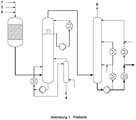
- Acrolein is produced in a catalytic gas phase reaction in the tube bundle reactor (A).
- propylene (1) is mixed with air (2) and an inert gas stream (3) composed of nitrogen and small amounts of carbon dioxide and water vapor.
- the dilution of the reaction gas is necessary in order to avoid the risk of an explosive mixture and to keep temperature peaks in the catalyst bed small.
- the temperature of the gas mixture is about 130-200 ° C.
- by-products such as mainly acrylic acid, acetic acid, formaldehyde, acetaldehyde, carbon dioxide and carbon monoxide are also formed in the tube bundle reactor (A).
- the reaction gas enters the lower region of the so-called quench column (B), in which the temperature of the gas mixture is rapidly cooled by intensive contact with water. A large part of the water vapor in the gas mixture is condensed. In this region of the column, a large proportion of the by-products, mainly acrylic acid and acetic acid, is also retained and leaves the column (B) via the bottom.
- This liquid is circulated through a so-called "pump-around" system and thus used as a cooling medium for quenching the AC reaction gas.
- the reaction gas On the way to the top of the column, the reaction gas is brought into contact in countercurrent to a water stream, which causes a further reduction of the by-product content in the reaction gas.
- This water stream is formed from the condensation by further cooling of the reaction gas to ⁇ 20 ° C (1.2-2.5 bara) in the upper region of the column (B) (upper "Pumparound”).
- the liquid stream leaving the column (B) can be pumped to the top of a stripping column (D) in which most of the dissolved acrolein can be recovered. Inert gases can be used as stripping medium (5).
- the remaining liquid (4) can finally be supplied for thermal disposal for disposal.
- the gas rich in AC (11) enters the reactive absorber (C) in the standard case via a jet pump (12).
- the AC feed can also be made directly into the lower section of the reactive absorber.
- AC is first absorbed in a mixture of mainly MMP, free MC, hemithioacetal and water (12, 13, 14) and then reacts with MC or hemithioacetal in the presence of a homogeneous catalyst to produce further MMP.
- MMP reactive absorber
- the mixture contains the hemithioacetal of the methylmercaptopropionaldehyde formed by addition of methylmercaptan to methylmercaptopropionaldehyde in a concentration of between 0.1 and 10% by weight, preferably between 1 and 10% by weight.
- the quantitative ratio between MC and AC in the liquid phase of the reactive absorber is adjusted by means of an in-line near-infrared measurement (NIR) (accuracy +/- 0.0005 mol / mol). It is advantageous that the quantitative ratio between methylmercaptan and acrolein in the mixture to a value between 0.95 and 1.1 mol / mol, preferably between 1.00 and 1.01 mol / mol, particularly preferably between 1.004 and 1.009 mol / mol, and particularly preferably adjusted to 1.005 mol / mol.
- NIR in-line near-infrared measurement
- the input concentration of the gaseous acrolein (11) in the mixture is detected by means of an in-line Fourier transformed infrared (FTIR) measurement to adjust the feed, i. to be able to adjust the MC dosage (6) as early as possible.
- FTIR Fourier transformed infrared
- the MMP reaction takes place mainly on the internals and in the bottom of the column (C).
- internals for example, structured packings, random packing or trays can be used.
- the pressure at the top of the column (C) is in the range from 1 to 2.5 bara, preferably from 1.2 to 1.6 bara.
- a pump circulates a portion of the MMP from the column bottom through two series-connected heat exchangers to reduce the temperature of that stream.
- Cooling Tower Water CCW
- CW Chilled Water
- MMP enters to a large extent at the head of the reactive absorber (C) (14) and acts as an absorption / reaction medium. Another portion of the MMP is discharged either as the product stream (7) after the first (preferred) or second cooling step.
- a second "pumping point" which in the standard case uses MMP from the bottom of the column (C), occurs in the central region of the column (C) as the absorption / reaction medium (13).
- the temperature of this stream is in the range 20-50 ° C, preferably 30-40 ° C.
- a third "pumping" (12) enters the column below (13). Liquid and / or gaseous MC (6) is preferably added to this stream, but can also be supplied at any other point, preferably in the lower part of the column or in one of the other "pumping".
- the temperatures in the lower part of the column can be controlled by the heat exchanger in the stream (12).
- the temperature in this part of the column is in the range 20 ° C to 90 ° C, preferably 40 ° C to 75 ° C.
- the low temperatures at the top of the column (C) help to minimize AC, MC and MMP losses.
- too low temperatures cause the retention of undesirable components such as dimethyl sulfide (DMS) and acetaldehyde (AA).
- DMS dimethyl sulfide
- AA acetaldehyde
- These components are byproducts of the MC or AC reaction and must be largely removed before MMP can be used, for example, in methionine or MHA production.
- these by-products are largely stripped in the reactive absorber (C) and are located in the exhaust gas (8), which leaves the column (C) at the top and is then fed to a thermal combustion.
- the impurities and by-products are removed by stripping at 0.3 to 5 bara, preferably at 1 to 2 bara, and at 5 to 70 ° C, preferably at 5 to 20 ° C, from the mixture.
- the process step is carried out in the presence of a homogeneous and / or heterogeneous catalyst (9).
- the catalyst is dimethylbenzylamine (DMBA) and / or triethanolamine.
- the concentration of the catalyst in the mixture is in the range of 50 to 500 ppmw, preferably in the range of 130 to 150 ppmw.
- inorganic and organic acids preferably acetic and tartaric acids
- inorganic and organic bases preferably triethanolamine
- organic acids such as aliphatic monocarboxylic acids (eg, formic acid, propionic acid, octanoic acid, acrylic acid, trichloroacetic acid, trifluoroacetic acid), aliphatic polycarboxylic acids (oxalic acid, succinic acid, adipic acid), aromatic monocarboxylic acids (phenylacetic acid, benzoic acid, cinnamic acid, furoic acid, thiophenecarboxylic acid) and aromatic polycarboxylic acids (Phthalic acid, monoesters of sulfuric acid, sulfonic acid) suitable.
- aliphatic monocarboxylic acids eg, formic acid, propionic acid, octanoic acid, acrylic acid, trichloroacetic acid, trifluoroacetic acid
- aliphatic polycarboxylic acids oxalic acid, succinic acid, adipic acid
- aromatic monocarboxylic acids phenylace
- Examples of basic substances are inorganic bases (ammonia, sodium hydroxide, potassium hydroxide, ammonium carbonate, sodium carbonate, potassium carbonate, sodium hydrogencarbonate, potassium hydrogencarbonate, ammonium acetate, sodium acetate, potassium acetate) and nitrogen-containing organic bases (piperidine, triethylamine, pyridine, quinoline, urotropine, N, N-dimethylaniline ).
- inorganic bases ammonia, sodium hydroxide, potassium hydroxide, ammonium carbonate, sodium carbonate, potassium carbonate, sodium hydrogencarbonate, potassium hydrogencarbonate, ammonium acetate, sodium acetate, potassium acetate
- nitrogen-containing organic bases piperidine, triethylamine, pyridine, quinoline, urotropine, N, N-dimethylaniline
- the gas stream (11) containing AC entering the reactive absorber (C) has the following composition (Table 1): Table 1: Composition of AC process gas (% by volume) CO2 0.651 O2 5,112 argon 0.625 N2 85.147 H2O 1,331 propene 0.162 propane 0,030 CO 0.354 acetaldehyde 0.143 acrolein 6,430 allyl alcohol 0,003 allyl 0.001 acetic acid 0.011 acrylic acid 0,000
- methylmercaptan (6) in the following composition was introduced into the reactive absorber (C).
- Table 2 Composition MC (% by weight) H2S 0.212 H20 0.860 dimethyl ether 0,068 methanol 0.410 methyl mercaptan 95.981 dimethyl sulfide 1,830 dimethyl disulfide 0,650
- MMP product (7) was additionally distilled for 25 minutes at 200 ° C and at 30 mbara to determine the residue concentration. This was surprisingly 0.20-0.25 wt% even below the residue concentration of 0.30-0.40 wt% of an MMP sample derived from an MMP process using liquid AC ( US 3529940 ). Also, the residue development when stored up to 32 days in the present invention was lower at 0.03 wt% per day than in a process using liquid AC (0.05 wt% per day).
- an NIR measuring device is suitable for the most accurate setting of the MC / AC stoichiometry of 1.004 - 1.009.
- Inline measurements allow a quick reaction to a change in the process, such as an adjustment of the feed streams (AC and / or MC), and thus a constant MMP quality.
- educt and product losses via the exhaust gas (8) are minimized.
- the input concentration of the AC gas can be carried out via an online GC measurement, but also preferably via an inline FTIR measurement.
Landscapes
- Chemical & Material Sciences (AREA)
- Organic Chemistry (AREA)
- Chemical Kinetics & Catalysis (AREA)
- Organic Low-Molecular-Weight Compounds And Preparation Thereof (AREA)
- Low-Molecular Organic Synthesis Reactions Using Catalysts (AREA)
Description
- Gegenstand der Erfindung ist ein Verfahren zur Herstellung von Methylmercaptopropionaldehyd (MMP) aus gasförmigem Acrolein (AC) und Methylmercaptan (MC). Gegenstand der vorliegenden Erfindung ist insbesondere ein Verfahren zur Herstellung von Methylmercaptopropionaldehyd aus gasförmigem Acrolein und Methylmercaptan, welches dadurch gekennzeichnet ist, dass in einem Verfahrensschritt gleichzeitig (a) gasförmiges Acrolein von einem Gemisch mindestens enthaltend eine Verbindung aus der Gruppe bestehend aus dem Hemithioacetal des Methylmercaptopropionaldehyds, Methylmercaptopropionaldehyd und Methylmercaptan absorbiert wird, (b) in diesem Gemisch Acrolein mit Methylmercaptan und/oder dem Hemithioacetal des Methylmercaptopropionaldehyds in der Flüssigphase zu Methylmercaptopropionaldehyd umgesetzt wird und (c) Verunreinigungen und Nebenprodukte aus diesem Gemisch entfernt werden, wobei der Verfahrensschritt in einem Reaktivabsorber durchgeführt wird, wobei der Reaktivabsorber dadurch gekennzeichnet ist, dass in nur einem Behälter bzw. in nur einer Stufe gasförmiges Acrolein in einem Gemisch aus hauptsächlich Methlymercaptopropionaldehyd, Methylmercaptan und Hemithioacetal des Methylmercaptopropionaldehyds absorbiert wird, Acrolein direkt bzw. über die Zwischenstufe Hemithioacetal des Methylmercaptopropionaldehyds mit Methylmercaptan zu Methlymercaptopropionaldehyd reagiert und die leichtsiedenden Nebenkomponenten Dimethylsulfid, Acetaldehyd, Wasser und Dimethyldisulfid gestrippt werden.
- Die MMP-Bildung aus Methylmercaptan und einem Acrolein enthaltendem Gasgemisch ist aus dem Stand der Technik bekannt.
- In
DE 2627430 ist beispielsweise ein zweistufiges Verfahren beschrieben, wobei in der ersten Stufe das AC aus einem Gasgemisch in MMP absorbiert wird und in einer zweiten Stufe das in MMP gelöste AC mit MC bei Temperaturen zwischen 10 und 50 °C in Gegenwart eines Katalysators reagiert. Ein großer wirtschaftlicher Nachteil dieser Trennung in zwei Stufen ist die Notwendigkeit der MMP-Rezyklierung bei -10 °C, um AC komplett in MMP zu absorbieren. Die MMP-Ausbeute bezogen auf das in die Absorptionskolonne eingeführte MMP beträgt im beschriebenen Beispiel 99 %. Dabei werden im Reaktionsgemisch vorzugsweise 0,1 bis 0,2 % Hemithioacetal eingestellt. Bei Hemithioacetal-Konzentrationen unter 0,1 % geht AC aufgrund von unvollständigem Umsatz verloren, während sich bei Hemithioacetal-Konzentrationen über 1 % die Ausbeute der MMP-Reaktion verschlechtert. Das während der katalytischen Oxidation von Propylen entstandene Gasgemisch wird von der enthaltenden Acrylsäure in einem Lösungsmittel wie z.B. Tri-n-butylphosphat (FR 7718136 FR 1393175 FR 1393175 - Gemäß
NL-OS 68/09647 -
WO 9429254 - In allen oben beschriebenen Dokumenten wird destillativ aufgearbeitetes MC eingesetzt. Dies ist ersichtlich daraus, dass die Hauptnebenkomponenten aus der MC-Reaktion, wie Dimethylsulfid und Dimethyldisulfid, weder im MMP-Produkt noch im MMP-Abgas vorhanden sind (
WO 9429254 US 4319047 ). Die Synthese von MC erfolgt gewöhnlich in der Gasphase bei Temperaturen zwischen 300 und 500 °C und bei Drücken zwischen 1 und 25 bara. Ein Verfahren wird zum Beispiel in derEP 850922 EP 0850923 u.DE 1768826 ). Nachteile dieser destillativen Aufarbeitung des komplexen Reaktionsgemisches sind neben den hohen Investitions- und Betriebskosten die unvermeidliche Bildung von zu entsorgenden Rückständen und damit einhergehend der Verlust von Wertstoffen. -
DE 10359636 beschreibt ein Verfahren, welches den hohen destillativen Aufwand zur Gewinnung eines reinen Methylmercaptans vermeidet und trotzdem das bei der katalytischen Umsetzung von H2S mit Methanol erhaltene Methylmercaptan ohne Verluste für die weitere Umsetzung zu MMP mit flüssigem AC verwendet. Bezogen auf das eingesetzte Roh-MC ist die Isolationsausbeute quasi quantitativ, d.h. > 99,9 %. Dies wird dadurch erreicht, dass die im MMP-Reaktionsgemisch noch enthaltenden Bestandteile aus der MC-Synthese destillativ und bevorzugt durch die Einspeisung eines inerten Schleppmittels, wie z.B. Stickstoff, abgetrennt werden. Das Verfahren ist nicht für den Einsatz von AC enthaltenden Gasen beschrieben. - Aus
US 3529940 ist bekannt, dass Reaktionstemperaturen in der MMP-Synthese dadurch kontrolliert werden können, dass die Exothermie der Hemithioacetal-Bildung als Intermediat und nach anschließender Zugabe von Flüssig-AC die MMP-Reaktionsenthalpie der MMP-Reaktion in 2 Zonen aufteilt wird. Allerdings ist das Verfahren ebenfalls nicht für den Einsatz von AC enthaltenden Gasen beschrieben. - Aufgabe der vorliegenden Erfindung ist es daher, in möglichst wenigen Verfahrensschritten aus AC enthaltendem Gas ohne separate Wasserkondensation und aus Roh-MC (MC > 87 Gew.-%, Dimethylsulfid 1,5 - 5 Gew.-%, Dimethyldisulfid 0,2 - 1 Gew.-%, Dimethylether 0 - 3 Gew.-%, Wasser ∼ 0 - 2 Gew.-% und Methanol ∼0 - 2 Gew.-%) MMP von möglichst hoher Reinheit und möglichst hoher Ausbeute bezogen auf die eingesetzten Mengen an AC und MC herzustellen.
- Diese Aufgabe wird gelöst durch ein Verfahren zur Herstellung von Methylmercaptopropionaldehyd aus gasförmigem Acrolein und Methylmercaptan, welches dadurch gekennzeichnet ist, dass in einem Verfahrensschritt gleichzeitig (a) gasförmiges Acrolein von einem Gemisch mindestens enthaltend eine Verbindung aus der Gruppe bestehend aus dem Hemithioacetal des Methylmercaptopropionaldehyds, Methylmercaptopropionaldehyd und Methylmercaptan absorbiert wird, (b) in diesem Gemisch Acrolein mit Methylmercaptan und/oder dem Hemithioacetal des Methylmercaptopropionaldehyds in der Flüssigphase zu Methylmercaptopropionaldehyd umgesetzt wird und (c) Verunreinigungen und Nebenprodukte mittels eines Reaktivabsorbers aus diesem Gemisch entfernt werden. Bei der Umsetzung von Acrolein mit Methylmercaptan und/oder Hemithioacetal ist davon auszugehen, dass Hemithioacetal nicht direkt mit Acrolein reagiert, sondern zunächst in Acrolein und Methylmercaptan zerfällt (Gleichgewicht) und das so freigesetzte Methylmercaptan dann mit Acrolein zum MMP reagiert.
- Verfahrensschritt (c) wird in einem Reaktivabsorber durchgeführt. Der Reaktivabsorber ist dadurch gekennzeichnet, dass in nur einem Behälter bzw. in nur einer Stufe gasförmiges AC in einem Gemisch aus hauptsächlich MMP, MC und Hemithioacetal absorbiert wird, AC direkt bzw. über die Zwischenstufe Hemithioacetal mit MC zu MMP reagiert und leichtsiedende Nebenkomponenten (u.a. Dimethylsulfid, Acetaldehyd, Wasser und Dimethyldisulfid) gestrippt werden, wobei die Abgasverluste von Edukten und Zielprodukt minimiert werden.
- In einer vorteilhaften Ausführungsform enthalten die entfernten Verunreinigungen mindestens eine Verbindung aus der Gruppe bestehend aus Dimethylsulfid, Acetaldehyd, Wasser, Dimethyldisulfid, Methanol, Kohlenstoffdioxid, Propan, Propen, Schwefelwasserstoff und Dimethylether.
- Es ist nicht nötig, Wasser aus dem Produkt zu entfernen, um MMP-Ausbeuten bezogen auf das eingesetzte AC in der Nähe von 100 % zu erzielen. In einer bevorzugten Ausführungsform wird Wasser nicht zusätzlich aus dem erhaltenen Methylmercaptopropionaldehyd entfernt.
- In der vorliegenden Erfindung wird MMP aus der chemischen Reaktion zwischen AC und MC produziert. Das für diese Reaktion benötigte AC entsteht durch die partielle Oxidation von Propylen in einer Gasphasenreaktion in einem Rohrbündelreaktor. Nach Verlassen des Reaktors wird das AC enthaltende Gas in der Quenchkolonne von überschüssigem Wasser, unerwünschten Nebenprodukten, wie z.B. Essigsäure, Formaldehyd, Allylalkohol, und hauptsächlich Acrylsäure, befreit. Auch ein kleiner Anteil an Acetaldehyd wird an dieser Stelle abgeschieden. Im folgenden Schritt wird AC aus der Gasphase in einer Mischung aus MMP und Hemithioacetal absorbiert und reagiert im gleichen Behälter mit MC bzw. Hemithioacetal.
- In einer bevorzugten Ausführungsform wird das für die Reaktion benötigte MC kontinuierlich flüssig oder gasförmig in einen MMP-Zustrom zum Reaktivabsorber dosiert.
- Die vorliegende Erfindung ist eine erhebliche Vereinfachung zu oben beschriebenem Stand der Technik, da der eingesetzte Reaktivabsorber zusätzlich als Strippkolonne fungiert und somit zusätzlich zu den leicht siedenden Substanzen aus dem AC enthaltenden Gas auch leicht siedende Nebenkomponenten aus der Reaktion zwischen Schwefelwasserstoff und Methanol, wie z.B. Dimethylsulfid, abtrennt. So ist gewährleistet, dass auch MC mit geringer Reinheit (MC > 87 Gew.-%, Dimethylsulfid 1,5 - 5 Gew.-%, Dimethyldisulfid 0,2 - 1 Gew.-%, Dimethylether 0 - 3 Gew.-%, Wasser ∼ 0 - 2 Gew.-% und Methanol ∼ 0 - 2 Gew.-%) eingesetzt werden kann und somit eine komplexe Aufreinigung, wie beispielsweise in
EP 0850923 undDE 1768826 beschrieben, entfallen kann. Es ist bevorzugt, dass das eingesetzte Methylmercaptan 1,5 - 5 Gew.-% Dimethylsulfid und 0 - 3 Gew.-% Dimethylether enthält. - Im folgenden wird die vorliegende Erfindung anhand eines Fließbildes (
Abbildung 1 ) näher beschrieben. - Acrolein wird in einer katalytischen Gasphasenreaktion im Rohrbündelreaktor (A) hergestellt. Am Eingang des Reaktors wird Propylen (1) mit Luft (2) und einem inerten Gasstrom (3) sich zusammensetzend aus Stickstoff und kleinen Mengen an Kohlenstoffdioxid und Wasserdampf vermischt. Die Verdünnung des Reaktionsgases ist von Nöten, um das Risiko einer explosiven Mischung zu vermeiden und um Temperaturspitzen im Katalysatorbett klein zu halten. Die Temperatur der Gasmischung beträgt etwa 130 - 200 °C.
- Neben Acrolein und Wasser werden im Rohrbündelreaktor (A) auch Nebenprodukte, wie hauptsächlich Acrylsäure, Essigsäure, Formaldehyd, Acetaldehyd, Kohlenstoffdioxid und Kohlenstoffmonoxid, gebildet. Das Reaktionsgas tritt im unteren Bereich der sogenannten Quenchkolonne (B) ein, in welcher die Temperatur des Gasgemisches durch einen intensiven Kontakt mit Wasser schnell abgekühlt wird. Ein Großteil des Wasserdampfes im Gasgemisch wird kondensiert. In diesem Bereich der Kolonne wird ebenso ein großer Anteil der Nebenprodukte, hauptsächlich Acrylsäure und Essigsäure, zurückgehalten und verlässt die Kolonne (B) über den Sumpf. Diese Flüssigkeit wird über ein sogenanntes "Pumparound"-System umgewälzt und somit als Kühlmedium zum Quenchen des AC-Reaktionsgases verwendet. Auf dem Weg zum Kopf der Kolonne wird das Reaktionsgas im Gegenfluss zu einem Wasserstrom in Kontakt gebracht, was eine weitere Reduzierung des Nebenproduktgehalts im Reaktionsgas bewirkt. Dieser Wasserstrom entsteht aus der Kondensation durch weitere Abkühlung des Reaktionsgases auf < 20 °C (1,2 - 2,5 bara) im oberen Bereich der Kolonne (B) (oberer "Pumparound"). Der die Kolonne (B) verlassende Flüssigstrom kann auf den Kopf einer Strippkolonne (D) gepumpt werden, in welcher der Großteil des gelösten Acroleins wieder gewonnen werden kann. Als Strippmedium (5) können Inertgase eingesetzt werden. Die verbleibende Flüssigkeit (4) kann schließlich einer thermischen Verbrennung zur Entsorgung zugeführt werden.
- Vom Kopf der Quenchkolonne (B) tritt das an AC reiche Gas (11) in den Reaktivabsorber (C) im Standardfall über eine Strahlpumpe ein (12). Dies hat den Vorteil, dass Polymerisation von AC vermieden werden kann, eine optimale Druckführung im Reaktivabsorber (C) leichter möglich ist und der vorgeschaltete AC-Prozess bei geringeren Drücken gefahren werden kann. In einer alternativen Ausführungsform kann die AC-Einspeisung auch direkt in die untere Sektion des Reaktivabsorbers erfolgen.
- Im Reaktivabsorber (C) wird AC zunächst in einer Mischung aus hauptsächlich MMP, freiem MC, Hemithioacetal und Wasser (12, 13, 14) absorbiert und reagiert dann mit MC bzw. Hemithioacetal in Anwesenheit eines homogenen Katalysators unter Bildung von weiterem MMP. Im Gegensatz zum Stand der Technik ist weder die Hemithioacetal-Bildung aus MC und MMP zu vermeiden (
WO 9429254 US 3529940 ), um quantitative MMP-Ausbeuten bezogen auf das eingesetzte AC zu erhalten. Es ist vorteilhaft, dass das Gemisch das Hemithioacetal des Methylmercaptopropionaldehyds gebildet durch Addition von Methylmercaptan an Methylmercaptopropionaldehyd in einer Konzentration zwischen 0,1 und 10 Gew.-%, bevorzugt zwischen 1 und 10 Gew.-% enthält. - In einer vorteilhaften Ausführungsform wird das Mengenverhältnis zwischen MC und AC in der Flüssigphase des Reaktivabsorbers mit Hilfe einer inline durchgeführten Nahinfrarotmessung (NIR) (Genauigkeit +/- 0,0005 mol/mol) eingestellt. Dabei ist vorteilhaft, dass das Mengenverhältnis zwischen Methylmercaptan und Acrolein in dem Gemisch auf einen Wert zwischen 0,95 und 1,1 mol/mol, bevorzugt zwischen 1,00 und 1,01 mol/mol, besonders bevorzugt zwischen 1,004 und 1,009 mol/mol, und insbesondere bevorzugt auf 1,005 mol/mol eingestellt wird.
- In einer bevorzugten Ausführungsform wird die Eingangskonzentration des gasförmigen Acroleins (11) in dem Gemisch mit Hilfe einer inline durchgeführten Fourier transformierten Infrarotmessung (FTIR) erfasst, um die Einspeisung einzustellen, d.h. um die MC-Dosierung (6) möglichst frühzeitig anpassen zu können. Diese inline-Messungen haben den Vorteil, dass unmittelbar auf Änderungen im System reagiert werden kann und damit die Abgasverluste an Edukt und Produkt klein und die MMP-Produktqualität kontinuierlich hoch gehalten werden kann.
- Die MMP-Reaktion erfolgt hauptsächlich auf den Einbauten und im Sumpf der Kolonne (C). Als Einbauten können z.B. strukturierte Packungen, regellose Füllkörper oder Böden eingesetzt werden. Der Druck am Kopf der Kolonne (C) liegt im Bereich von 1 bis 2,5 bara, bevorzugt von 1,2 bis 1,6 bara. Eine Pumpe zirkuliert einen Teil des MMPs aus dem Kolonnensumpf durch zwei in Reihe gesetzte Wärmeüberträger, um die Temperatur dieses Stroms zu reduzieren. In der ersten Stufe wird mit "Cooling Tower Water (CTW)" auf ∼ 35 °C gekühlt, und dann mit "Chilled Water (CW)" auf 0 - 20 °C, bevorzugt 5 - 10 °C. Das so abgekühlte MMP tritt zu einem großen Teil am Kopf des Reaktivabsorbers (C) ein (14) und fungiert als Absorptions-/Reaktionsmedium. Ein weiterer Teil des MMPs wird entweder nach dem ersten (bevorzugt) oder dem zweiten Kühlungsschritt als Produktstrom (7) abgeführt. Ein zweiter "Pumparound", der sich im Standardfall an MMP aus dem Sumpf der Kolonne (C) bedient, tritt im mittleren Bereich der Kolonne (C) als Absorptions-/Reaktionsmedium ein (13). Die Temperatur dieses Stroms liegt im Bereich 20 - 50 °C, bevorzugt 30 - 40 °C. Ein in einer besonders bevorzugten Ausführungsform dritter "Pumparound" (12) tritt unterhalb von (13) in die Kolonne ein. Flüssiges und/oder gasförmiges MC (6) wird bevorzugt in diesen Strom zugegeben, kann aber auch an jedem anderen Punkt, bevorzugt im unteren Bereich der Kolonne bzw. in eine der anderen "Pumparounds", zugeführt werden.
- Die Temperaturen im unteren Teil der Kolonne können durch den Wärmeüberträger im Strom (12) gezielt gesteuert werden. Die Temperatur in diesem Teil der Kolonne liegt im Bereich 20 °C bis 90 °C, bevorzugt 40 °C bis 75 °C. Die niedrigen Temperaturen am Kopf der Kolonne (C) helfen, AC-, MC- und MMP-Verluste zu minimieren. Allerdings bewirken zu niedrige Temperaturen die Rückhaltung von unerwünschten Komponenten wie Dimethylsulfid (DMS) und Acetaldehyd (AA). Diese Komponenten sind Nebenprodukte der MC- bzw. AC-Reaktion und müssen weitgehend entfernt werden, bevor MMP beispielsweise in der Methionin- oder MHA-Produktion eingesetzt werden kann. Im Standardfall der Erfindung werden diese Nebenprodukte weitgehend im Reaktivabsorber (C) gestrippt und befinden sich im Abgas (8), das die Kolonne (C) am Kopf verlässt und anschließend einer thermischen Verbrennung zugeführt wird.
- In einer vorteilhaften Ausführungsform werden die Verunreinigungen und Nebenprodukte durch Strippen bei 0,3 bis 5 bara, bevorzugt bei 1 bis 2 bara, und bei 5 bis 70 °C, bevorzugt bei 5 bis 20 °C, aus dem Gemisch entfernt.
- In einer vorteilhaften Ausführungsform wird der Verfahrensschritt in Gegenwart eines homogenen und/oder heterogenen Katalysators (9) durchgeführt. Dabei ist es bevorzugt, dass der Katalysator Dimethylbenzylamin (DMBA) und/oder Triethanolamin ist. Darüber hinaus ist es vorteilhaft, dass die Konzentration des Katalysators in dem Gemisch im Bereich von 50 bis 500 ppmw, bevorzugt im Bereich von 130 bis 150 ppmw liegt.
- Zur Regulierung des pH-Werts und der damit verbundenen besseren Lagerstabilität des produzierten MMPs ist es vorteilhaft, dem Gemisch kontinuierlich mindestens eine Verbindung aus der Gruppe bestehend aus anorganischen und organischen Säuren, bevorzugt Essigsäure und Weinsäure, und anorganischen und organischen Basen, bevorzugt Triethanolamin, zuzuführen.
- Diese Substanzen bilden beispielsweise im Gemisch mit DMBA die sogenannte Katalysator/Stabilisator-Mischung, welche kontinuierlich dem Reaktivabsorber (C) zugeführt wird. Grundsätzlich sind auch andere Säuren und Basen möglich. In
EP 1408029 werden beispielhaft anorganische Oxosäuren, wie z.B. Schwefel- und Phosphorsäure, Halogenwasserstoffe, wie z.B. Wasserstofffluorid, -bromid und -chlorid, genannt. Außerdem sind organische Säuren, wie z.B. aliphatische Monocarbonsäuren (z.B. Ameisensäure, Propionsäure, Octansäure, Acrylsäure, Trichloressigsäure, Trifluoressigsäure), aliphatische Polycarbonsäuren (Oxalsäure, Bernsteinsäure, Adipinsäure), aromatische Monocarbonsäuren (Phenylessigsäure, Benzoesäure, Zimtsäure, Furoesäure, Thiophencarbonsäure) und aromatische Polycarbonsäuren (Phthalsäure, Monoester der Schwefelsäure, Sulfonsäure) geeignet. - Beispiele für basische Substanzen sind anorganische Basen (Ammoniak, Natriumhydroxid, Kaliumhydroxid, Ammoniumcarbonat, Natriumcarbonat, Kaliumcarbonat, Natriumhydrogencarbonat, Kaliumhydrogencarbonat, Ammoniumacetat, Natriumacetat, Kaliumacetat) und stickstoffhaltige organische Basen (Piperidin, Triethylamin, Pyridin, Chinolin, Urotropin, N,N-Dimethylanilin).
- Die vorliegende Erfindung hat die Vorteile, dass
- ▪ die Absorption von AC aus einem Gas, die MMP-Reaktion unter Einsatz von Roh-MC und die Strippung von Leichtsiedern, wie z.B. DMS, DMDS, DME, Methanol, CO2, H2S, Wasser, Propen, Propan, Acetaldehyd, in nur einem Verfahrensschritt, beispielsweise in einem Reaktivabsorber, möglich ist,
- ▪ dass Verluste an MC, AC und MMP minimiert werden können,
- ▪ dass die MC/AC-Stöchiometrie durch Einsatz eines NIRs und FTIRs kontrolliert werden kann,
- ▪ dass auf eine separate Wasserkondensation aus dem AC enthaltenden Gas verzichtet werden kann, und
- ▪ dass die Polymerbildungswahrscheinlichkeit minimiert werden kann.
- Die folgenden Ausführungsbeispiele sollen die vorteilhaften Aspekte der vorliegenden Erfindung verdeutlichen.
- Der in den Reaktivabsorber (C) eintretende AC enthaltende Gasstrom (11) hat folgende Zusammensetzung (Tabelle 1):
Tabelle 1: Zusammensetzung AC-Prozessgas (Vol-%) CO2 0,651 O2 5,112 Argon 0,625 N2 85,147 H2O 1,331 Propen 0,162 Propan 0,030 CO 0,354 Acetaldehyd 0,143 Acrolein 6,430 Allylalkohol 0,003 Allylacrylat 0,001 Essigsäure 0,011 Acrylsäure 0,000 - Um die zusätzliche Strippwirkung auf Leichtsieder wie Dimethylsulfid und Acetaldehyd zu zeigen, wurde Methylmercaptan (6) in folgender Zusammensetzung (Tabelle 2) in den Reaktivabsorber (C) eingeleitet.
Tabelle 2: Zusammensetzung MC (Gew.-%) H2S 0,212 H20 0,860 Dimethylether 0,068 Methanol 0,410 Methylmercaptan 95,981 Dimethylsulfid 1,830 Dimethyldisulfid 0,650 - So findet sich im Abgas (8) der Großteil an Dimethylsulfid und Acetaldehyd wieder, während nur ein sehr geringer Anteil im MMP-Produkt (7) verbleibt. Die MC-, AC- und MMP-Verluste werden sehr gering gehalten (Tabellen 3 und 4).
Tabelle 3: Zusammensetzung MMP (Gew.-%) Methylmercaptan 0,443 Acetaldehyd 0,043 Dimethylsulfid 0,043 Acrolein 0,015 Methanol 0,126 H2O 2,415 Dimethyldisulfid 0,212 Allylalkohol 0,025 Allylacrylat 0,015 Dimethylbenzylamin 0,016 MMP 96,500 Acrylsäure 0,000 Essigsäure 0,148 Dimethylether 0,000 Tabelle 4: Zusammensetzung Abgas (Gew.-%) CO2 1,064 H2S 0,000 Wasser 0,341 Propen 0,254 Propan 0,049 Dimethylether 0,034 Methanol 0,016 Acetaldehyd 0,223 Methylmercaptan 0,356 Acrolein 0,000 Dimethylsulfid 0,216 Allylalkohol 0,000 Essigsäure 0,014 Dimethyldisulfid 0,021 Allylacrylat 0,000 MMP 0,150 O2 6,079 CO 0,368 N2 89,891 Argon 0,926 - MMP-Produkt (7) wurde zusätzlich für 25 Minuten bei 200 °C und bei 30 mbara destilliert, um die Rückstandskonzentration zu bestimmen. Diese lag überraschenderweise mit 0,20 - 0,25 Gew.-% sogar unter der Rückstandskonzentration von 0,30 - 0,40 Gew.-% einer MMP-Probe, die aus einem MMP-Verfahren unter Nutzung von Flüssig-AC stammt (
US 3529940 ). Auch war die Rückstandsentwicklung bei Lagerung bis zu 32 Tagen bei der vorliegenden Erfindung mit 0,03 Gew.-% pro Tag geringer als in einem Verfahren unter Nutzung von Flüssig-AC (0,05 Gew.-% pro Tag). - Um die MMP-Qualität für einen nachfolgenden Methioninprozess zu gewährleisten ist also keine separate Wasserkondensation aus dem AC-haltigen Gas (11), wie in
DE 2627430 beschrieben, notwendig. Ein gewisser Wasseranteil kann sogar einen positiven Einfluss auf die MMP-Bildungsgeschwindigkeit haben, da Wasser bis zu einer gewissen Konzentration einen höheren Dissoziationsgrad des eingesetzten basischen Aminkatalysators hat. Auch liegen alle Nebenproduktkomponenten im MMP (7) innerhalb der Spezifikation für den nachfolgenden Methioninprozess trotz des Einsatzes des oben beschriebenen Roh-MC's (6). Somit konnte die ausreichende Strippwirkung des Reaktivabsorbers (C) bestätigt werden. Die MC-, AC- und MMP-Verluste im Abgas (8) sind ausreichend klein, um den Prozess wirtschaftlich fahren zu können. Zur möglichst genauen Einstellung der MC/AC-Stöchiometrie von 1,004 - 1,009 eignet sich insbesondere ein NIR-Messgerät. Inline-Messungen erlauben eine schnelle Reaktion auf eine Veränderung im Prozess, wie z.B. eine Anpassung der Feedströme (AC und/oder MC), und damit eine konstant bleibende MMP-Qualität. Zudem werden Edukt- und Produktverluste über das Abgas (8) minimiert. Die Eingangskonzentration des AC-Gases kann über eine online-GC-Messung, aber auch bevorzugt über eine inline-FTIR-Messung erfolgen. - Bei Einspeisung von MC direkt in die Kolonne (C) ist ein großer Einfluss auf das Reaktionssystem erkennbar. Die erhöhte Menge an MC, die dadurch in der Kolonne absorbiert werden muss, in Verbindung mit exothermer Hemithioacetalbildung resultiert in einem deutlich erhöhten Temperaturprofil im Reaktivabsorber (C). Dieser Effekt führt zusätzlich zu erhöhten MC- und AC-Verlusten im Abgas (8) (Tabelle 5).
Tabelle 5: Abgasverluste (8) bei unterschiedlichen MC-Einspeisungsstellen Standard MC-Dosierung direkt in Kolonne MC 0,111 0,608 AC 0,030 0,281 MMP 0,040 0,057
Claims (15)
- Verfahren zur Herstellung von Methylmercaptopropionaldehyd aus gasförmigem Acrolein und Methylmercaptan dadurch gekennzeichnet, dass in einem Verfahrensschritt gleichzeitig(a) gasförmiges Acrolein von einem Gemisch mindestens enthaltend eine Verbindung aus der Gruppe bestehend aus dem Hemithioacetal des Methylmercaptopropionaldehyds, Methylmercaptopropionaldehyd und Methylmercaptan absorbiert wird,(b) in diesem Gemisch Acrolein mit Methylmercaptan und/oder dem Hemithioacetal des Methylmercaptopropionaldehyds in der Flüssigphase zu Methylmercaptopropionaldehyd umgesetzt wird und(c) Verunreinigungen und Nebenprodukte aus diesem Gemisch entfernt werden, wobei der Verfahrensschritt in einem Reaktivabsorber durchgeführt wird, wobei der Reaktivabsorber dadurch gekennzeichnet ist, dass in nur einem Behälter bzw. in nur einer Stufe gasförmiges Acrolein in einem Gemisch aus hauptsächlich Methlymercaptopropionaldehyd, Methylmercaptan und Hemithioacetal des Methylmercaptopropionaldehyds absorbiert wird, Acrolein direkt bzw. über die Zwischenstufe Hemithioacetal des Methylmercaptopropionaldehyds mit Methylmercaptan zu Methlymercaptopropionaldehyd reagiert und die leichtsiedenden Nebenkomponenten Dimethylsulfid, Acetaldehyd, Wasser und Dimethyldisulfid gestrippt werden.
- Verfahren nach Anspruch 1 dadurch gekennzeichnet, dass das Gemisch das Hemithioacetal des Methylmercaptopropionaldehyds gebildet durch Addition von Methylmercaptan an Methylmercaptopropionaldehyd in einer Konzentration zwischen 0,1 und 10 Gew enthält.
- Verfahren gemäß Anspruch 2 dadurch gekennzeichnet, dass das Gemisch zwischen 1 und 10 Gew.-% Hemithioacetal des Methylmercaptopropionaldehyds enthält.
- Verfahren nach mindestens einem der Ansprüche 1 bis 3 dadurch gekennzeichnet, dass die Verunreinigungen und Nebenprodukte durch Strippen bei 0,3 bis 5 bara, bevorzugt bei 1 bis 2 bara, und bei 5 bis 70 °C, bevorzugt bei 5 bis 20 °C, aus dem Gemisch entfernt werden.
- Verfahren nach mindestens einem der Ansprüche 1 bis 4 dadurch gekennzeichnet, dass die entfernten Verunreinigungen mindestens eine Verbindung aus der Gruppe bestehend aus Dimethylsulfid, Acetaldehyd, Wasser, Dimethyldisulfid, Methanol, Kohlenstoffdioxid, Propan, Propen, Schwefelwasserstoff und Dimethylether enthalten.
- Verfahren nach mindestens einem der Ansprüche 1 bis 5 dadurch gekennzeichnet, dass Methylmercaptan kontinuierlich in flüssiger Form und/oder gasförmig dem Gemisch zugeführt wird.
- Verfahren nach mindestens einem der Ansprüche 1 bis 6 dadurch gekennzeichnet, dass der Verfahrensschritt in Gegenwart eines homogenen und/oder heterogenen Katalysators durchgeführt wird.
- Verfahren nach Anspruch 7 dadurch gekennzeichnet, dass der Katalysator Dimethylbenzylamin und/oder Triethanolamin ist.
- Verfahren nach mindestens einem der Ansprüche 7 bis 8 dadurch gekennzeichnet, dass die Konzentration des Katalysators in dem Gemisch im Bereich von 50 bis 500 ppmw, bevorzugt im Bereich von 130 bis 150 ppmw liegt.
- Verfahren nach mindestens einem der Ansprüche 1 bis 9 dadurch gekennzeichnet, dass das Mengenverhältnis zwischen Methylmercaptan und Acrolein in dem Gemisch auf einen Wert zwischen 0,95 und 1,1 mol/mol, bevorzugt zwischen 1,00 und 1,01 mol/mol, besonders bevorzugt zwischen 1,004 und 1,009 mol/mol, und insbesondere bevorzugt auf 1,005 mol/mol eingestellt wird.
- Verfahren nach Anspruch 10 dadurch gekennzeichnet, dass das Mengenverhältnis zwischen Methylmercaptan und Acrolein in dem Gemisch mit Hilfe einer inline durchgeführten Nahinfrarotmessung (NIR) eingestellt wird.
- Verfahren nach mindestens einem der Ansprüche 1 bis 11 dadurch gekennzeichnet, dass die Eingangskonzentration des gasförmigen Acroleins in dem Gemisch mit Hilfe einer inline durchgeführten Fourier transformierten Infrarotmessung (FTIR) erfasst wird, um die Einspeisung einzustellen.
- Verfahren nach mindestens einem der Ansprüche 1 bis 12 dadurch gekennzeichnet, dass dem Gemisch kontinuierlich mindestens eine Verbindung aus der Gruppe bestehend aus anorganischen und organischen Säuren, bevorzugt Essigsäure und Weinsäure, und anorganischen und organischen Basen, bevorzugt Triethanolamin, zugeführt wird.
- Verfahren nach mindestens einem der Ansprüche 1 bis 13 dadurch gekennzeichnet, dass das eingesetzte Methylmercaptan 1,5 - 5 Gew.-% Dimethylsulfid und 0 - 3 Gew.-% Dimethylether enthält.
- Verfahren nach mindestens einem der Ansprüche 1 bis 14 dadurch gekennzeichnet, dass Wasser nicht zusätzlich aus dem erhaltenen Methylmercaptopropionaldehyd entfernt wird.
Applications Claiming Priority (2)
| Application Number | Priority Date | Filing Date | Title |
|---|---|---|---|
| DE102010064250A DE102010064250A1 (de) | 2010-12-28 | 2010-12-28 | Verfahren zur Herstellung von Methylmercaptopropionaldehyd |
| PCT/EP2011/072868 WO2012089518A1 (de) | 2010-12-28 | 2011-12-15 | Verfahren zur herstellung von methylmercaptopropionaldehyd |
Publications (2)
| Publication Number | Publication Date |
|---|---|
| EP2658842A1 EP2658842A1 (de) | 2013-11-06 |
| EP2658842B1 true EP2658842B1 (de) | 2019-06-12 |
Family
ID=45418663
Family Applications (1)
| Application Number | Title | Priority Date | Filing Date |
|---|---|---|---|
| EP11802046.0A Active EP2658842B1 (de) | 2010-12-28 | 2011-12-15 | Verfahren zur herstellung von methylmercaptopropionaldehyd |
Country Status (12)
| Country | Link |
|---|---|
| US (2) | US8624066B2 (de) |
| EP (1) | EP2658842B1 (de) |
| JP (1) | JP5980227B2 (de) |
| CN (1) | CN103476747B (de) |
| BR (1) | BR112013016578B1 (de) |
| DE (1) | DE102010064250A1 (de) |
| ES (1) | ES2741882T3 (de) |
| MX (1) | MX353250B (de) |
| MY (1) | MY172658A (de) |
| RU (1) | RU2595039C2 (de) |
| SG (1) | SG191319A1 (de) |
| WO (1) | WO2012089518A1 (de) |
Families Citing this family (12)
| Publication number | Priority date | Publication date | Assignee | Title |
|---|---|---|---|---|
| EP2678312B1 (de) | 2011-02-23 | 2017-10-11 | Evonik Degussa GmbH | Verfahren zur herstellung von 2-hydroxy-4-(methylthio)buttersäurenitril aus 3-(methylthio)propanal und cyanwasserstoff |
| MX2014002250A (es) | 2011-08-30 | 2014-04-25 | Evonik Degussa Gmbh | Metodo para producir una sal de metionina. |
| DE102011081828A1 (de) | 2011-08-30 | 2013-02-28 | Evonik Degussa Gmbh | Verfahren zur Umsetzung von Methylmercaptopropionaldehyd aus Roh-Acrolein und Roh-Methylmercaptan |
| EP2679579A1 (de) * | 2012-06-27 | 2014-01-01 | Evonik Industries AG | Integriertes Verfahren zur Herstellung von Acrolein und 3-Methylmercaptopropionaldehyd |
| EP2813489A1 (de) * | 2013-06-11 | 2014-12-17 | Evonik Degussa GmbH | Verfahren zur Herstellung von lagerstabilem 3-Methylmercaptopropionaldehyd |
| EP3205643A1 (de) * | 2016-02-15 | 2017-08-16 | Evonik Degussa GmbH | Verfahren zur herstellung von 3-methylthiopropionaldehyd |
| EP3339290B1 (de) * | 2016-12-22 | 2019-06-19 | Evonik Degussa GmbH | Lagerung von 3-methylthiopropionaldehyd und methylmercaptan |
| EP3453447B1 (de) * | 2017-09-06 | 2020-12-23 | Evonik Operations GmbH | Verfahren zur herstellung von alkansulfonsäure |
| CN107903197B (zh) * | 2017-12-22 | 2018-12-14 | 蓝星安迪苏南京有限公司 | 用于3-甲硫基丙醛制备及储存的稳定剂 |
| EP3604277A1 (de) | 2018-07-30 | 2020-02-05 | Evonik Operations GmbH | Verfahren zur reinigung von acrolein |
| CN111116437B (zh) * | 2018-11-01 | 2021-02-05 | 山东新和成氨基酸有限公司 | 制备2-羟基-4-甲硫基丁酸及其中间体的方法和装置 |
| WO2022008505A1 (en) | 2020-07-08 | 2022-01-13 | Evonik Operations Gmbh | Process for preparing 3-methylthiopropionaldehyde |
Family Cites Families (22)
| Publication number | Priority date | Publication date | Assignee | Title |
|---|---|---|---|---|
| GB653497A (en) * | 1945-10-25 | 1951-05-16 | Merck & Co Inc | Improvements in or relating to the production of ª‰-methylmercaptopropionaldehyde |
| US2626282A (en) * | 1949-10-05 | 1953-01-20 | Standard Oil Dev Co | Vapor phase production of betamethylmercaptopropionaldehyde |
| FR1393175A (fr) | 1963-05-18 | 1965-03-19 | Distillers Co Yeast Ltd | Procédé de production d'acides aliphatiques non saturés |
| GB1173174A (en) * | 1966-04-18 | 1969-12-03 | Sumitomo Chemical Co | Process for producing beta-Methylmercaptopropionaldehyde |
| US3529940A (en) | 1966-04-25 | 1970-09-22 | Sumitomo Chemical Co | Apparatus for two-stage production of beta-methylmercaptopropionaldehyde |
| BE697818A (de) * | 1966-04-30 | 1967-10-02 | ||
| DE1768826B1 (de) | 1968-07-04 | 1971-08-26 | Degussa | Verfahren zur Gewinnung von niederen aliphatischen Mercaptanen |
| NL6809647A (de) | 1968-07-09 | 1970-01-13 | ||
| DE2320544C2 (de) * | 1973-04-21 | 1975-06-05 | Deutsche Gold- Und Silber-Scheideanstalt Vormals Roessler, 6000 Frankfurt | Verfahren zur Herstellung von 3-Methylmercaptopropionaldehyd |
| FR2314917A1 (fr) * | 1975-06-20 | 1977-01-14 | Rhone Poulenc Ind | Procede de fabrication de l'aldehyde beta-methylthiopropionique |
| FR2394512A1 (fr) | 1977-06-14 | 1979-01-12 | Rhone Poulenc Ind | Procede de separation d'acide acrylique a partir de ses solutions dans le phosphate de tri-n-butyle |
| FR2460925A1 (fr) | 1979-07-10 | 1981-01-30 | Rhone Poulenc Ind | Procede de preparation directe d'aldehyde beta-methylthiopropionique |
| US5637766A (en) * | 1993-06-08 | 1997-06-10 | Novus International, Inc. | Process for the preparation of 3-(methylthio) propanal |
| US5352837A (en) * | 1993-06-08 | 1994-10-04 | Novus International, Inc. | Process for the preparation of 3-(methylthio)propanal |
| JPH10504812A (ja) * | 1994-07-11 | 1998-05-12 | ノーバス インターナショナル インコーポレイテッド | 3−(メチルチオ)プロパナールの製造方法 |
| US6057481A (en) * | 1996-04-01 | 2000-05-02 | Union Carbide Chemicals & Plastics Technology Corporation | Processes for the manufacture of methylmercaptopropanal |
| DE19654516C1 (de) | 1996-12-27 | 1998-10-01 | Degussa | Verfahren zur Auftrennung des Produktgasgemisches der katalytischen Synthese von Methylmercaptan |
| DE19654515C1 (de) | 1996-12-27 | 1998-10-01 | Degussa | Verfahren zur kontinuierlichen Herstellung von Methylmercaptan |
| JP4186572B2 (ja) | 2002-09-27 | 2008-11-26 | 住友化学株式会社 | 3−メチルチオプロパナールの製造方法 |
| DE10359636A1 (de) * | 2003-12-18 | 2005-07-28 | Degussa Ag | Verfahren zur Abtrennung von Methylmercaptan aus Reaktionsgemischen |
| MX2014002250A (es) | 2011-08-30 | 2014-04-25 | Evonik Degussa Gmbh | Metodo para producir una sal de metionina. |
| DE102011081828A1 (de) | 2011-08-30 | 2013-02-28 | Evonik Degussa Gmbh | Verfahren zur Umsetzung von Methylmercaptopropionaldehyd aus Roh-Acrolein und Roh-Methylmercaptan |
-
2010
- 2010-12-28 DE DE102010064250A patent/DE102010064250A1/de not_active Withdrawn
-
2011
- 2011-12-15 JP JP2013546654A patent/JP5980227B2/ja not_active Expired - Fee Related
- 2011-12-15 ES ES11802046T patent/ES2741882T3/es active Active
- 2011-12-15 EP EP11802046.0A patent/EP2658842B1/de active Active
- 2011-12-15 CN CN201180063159.2A patent/CN103476747B/zh active Active
- 2011-12-15 MX MX2013007486A patent/MX353250B/es active IP Right Grant
- 2011-12-15 SG SG2013048574A patent/SG191319A1/en unknown
- 2011-12-15 WO PCT/EP2011/072868 patent/WO2012089518A1/de not_active Ceased
- 2011-12-15 MY MYPI2013002209A patent/MY172658A/en unknown
- 2011-12-15 RU RU2013135116/04A patent/RU2595039C2/ru active
- 2011-12-15 BR BR112013016578-2A patent/BR112013016578B1/pt not_active IP Right Cessation
- 2011-12-27 US US13/337,434 patent/US8624066B2/en not_active Expired - Fee Related
-
2013
- 2013-10-30 US US14/067,098 patent/US8759592B2/en active Active
Non-Patent Citations (1)
| Title |
|---|
| None * |
Also Published As
| Publication number | Publication date |
|---|---|
| US8759592B2 (en) | 2014-06-24 |
| JP2014508730A (ja) | 2014-04-10 |
| EP2658842A1 (de) | 2013-11-06 |
| MX2013007486A (es) | 2013-08-15 |
| SG191319A1 (en) | 2013-07-31 |
| CN103476747A (zh) | 2013-12-25 |
| MY172658A (en) | 2019-12-09 |
| RU2013135116A (ru) | 2015-02-10 |
| BR112013016578B1 (pt) | 2019-04-09 |
| RU2595039C2 (ru) | 2016-08-20 |
| US20120165573A1 (en) | 2012-06-28 |
| JP5980227B2 (ja) | 2016-08-31 |
| ES2741882T3 (es) | 2020-02-12 |
| DE102010064250A1 (de) | 2012-06-28 |
| US20140051890A1 (en) | 2014-02-20 |
| US8624066B2 (en) | 2014-01-07 |
| MX353250B (es) | 2018-01-05 |
| CN103476747B (zh) | 2016-01-20 |
| WO2012089518A1 (de) | 2012-07-05 |
| BR112013016578A2 (pt) | 2016-09-27 |
Similar Documents
| Publication | Publication Date | Title |
|---|---|---|
| WO2012089518A1 (de) | Verfahren zur herstellung von methylmercaptopropionaldehyd | |
| EP2678313B1 (de) | Lagerstabiles 2-hydroxy-4-(methylthio)buttersäurenitril | |
| EP2678312B1 (de) | Verfahren zur herstellung von 2-hydroxy-4-(methylthio)buttersäurenitril aus 3-(methylthio)propanal und cyanwasserstoff | |
| EP2867203B1 (de) | Integriertes verfahren zur herstellung von acrolein und 3-methylmercaptopropionaldehyd | |
| DE69324380T2 (de) | Verfahren zur herstellung von 3-(methylthio) propanal | |
| DE2627430C3 (de) | Verfahren zur Herstellung von beta- Methylthiopropionaldehyd | |
| EP2714640B1 (de) | Verfahren zur herstellung von methacrylsäure | |
| DE69626119T2 (de) | Verfahren zur herstellung von 3- (methylthio) propanol | |
| DE69615022T2 (de) | Verfahren zur herstellung von 3-(methylthio)propanal und 2-hydroxy-4-(methylthio)butansäurenitril | |
| DE102011081828A1 (de) | Verfahren zur Umsetzung von Methylmercaptopropionaldehyd aus Roh-Acrolein und Roh-Methylmercaptan | |
| WO2016097125A1 (de) | Verfahren zur herstellung von acrylsäure aus formaldehyd und essigsäure | |
| EP2569271B1 (de) | Verfahren zur herstellung von neopentylglykol | |
| DE2451990C3 (de) | Verfahren zur Herstellung von konzentrierten, wäßrigen Lösungen von Formaleyhd und Harnstoff | |
| DE10146689C2 (de) | Verfahren zur Herstellung von Sorbinsäure aus Sorbinsäurepolyester | |
| EP1841732B1 (de) | Herstellung von 3-(alkylthio)propanal | |
| WO2011015644A2 (de) | Verfahren zur farbzahlverbesserung von trimethylolpropan | |
| EP2467355B1 (de) | Verfahren zur herstellung von 4-pentensäure | |
| DE102010042936A1 (de) | Verfahren zur kontinuierlichen Herstellung von Dialkylcarbonat | |
| DE102016221972A1 (de) | Verfahren zur Herstellung von Acrylsäurederivaten aus einem Strom enthaltend Acrylsäurederivate, Formaldehyd und Essigsäurederivate bei einem molaren Überschuss an Essigsäurederivat | |
| DE2632898A1 (de) | Kobaltkatalysierte oxidation von gesaettigten, aliphatischen c tief 3 - c tief 7 -kohlenwasserstoffen zu essigsaeure | |
| WO2016024012A1 (de) | Verfahren zur herstellung von 2-mercaptoethanol | |
| DE2224258A1 (de) | Verfahren zur herstellung von konzentrierten, waessrigen loesungen von formaldehyd und harnstoff | |
| DE4323675A1 (de) | Verfahren zur Herstellung von Dimethylcarbonat |
Legal Events
| Date | Code | Title | Description |
|---|---|---|---|
| PUAI | Public reference made under article 153(3) epc to a published international application that has entered the european phase |
Free format text: ORIGINAL CODE: 0009012 |
|
| 17P | Request for examination filed |
Effective date: 20130613 |
|
| AK | Designated contracting states |
Kind code of ref document: A1 Designated state(s): AL AT BE BG CH CY CZ DE DK EE ES FI FR GB GR HR HU IE IS IT LI LT LU LV MC MK MT NL NO PL PT RO RS SE SI SK SM TR |
|
| DAX | Request for extension of the european patent (deleted) | ||
| STAA | Information on the status of an ep patent application or granted ep patent |
Free format text: STATUS: EXAMINATION IS IN PROGRESS |
|
| 17Q | First examination report despatched |
Effective date: 20170516 |
|
| REG | Reference to a national code |
Ref country code: DE Ref legal event code: R079 Ref document number: 502011015796 Country of ref document: DE Free format text: PREVIOUS MAIN CLASS: C07C0319160000 Ipc: C07C0319200000 |
|
| GRAP | Despatch of communication of intention to grant a patent |
Free format text: ORIGINAL CODE: EPIDOSNIGR1 |
|
| STAA | Information on the status of an ep patent application or granted ep patent |
Free format text: STATUS: GRANT OF PATENT IS INTENDED |
|
| INTG | Intention to grant announced |
Effective date: 20181026 |
|
| RIC1 | Information provided on ipc code assigned before grant |
Ipc: C07C 319/16 20060101ALI20181012BHEP Ipc: C07C 319/20 20060101AFI20181012BHEP |
|
| GRAJ | Information related to disapproval of communication of intention to grant by the applicant or resumption of examination proceedings by the epo deleted |
Free format text: ORIGINAL CODE: EPIDOSDIGR1 |
|
| STAA | Information on the status of an ep patent application or granted ep patent |
Free format text: STATUS: EXAMINATION IS IN PROGRESS |
|
| INTC | Intention to grant announced (deleted) | ||
| GRAP | Despatch of communication of intention to grant a patent |
Free format text: ORIGINAL CODE: EPIDOSNIGR1 |
|
| STAA | Information on the status of an ep patent application or granted ep patent |
Free format text: STATUS: GRANT OF PATENT IS INTENDED |
|
| INTG | Intention to grant announced |
Effective date: 20190329 |
|
| INTG | Intention to grant announced |
Effective date: 20190329 |
|
| GRAS | Grant fee paid |
Free format text: ORIGINAL CODE: EPIDOSNIGR3 |
|
| GRAA | (expected) grant |
Free format text: ORIGINAL CODE: 0009210 |
|
| STAA | Information on the status of an ep patent application or granted ep patent |
Free format text: STATUS: THE PATENT HAS BEEN GRANTED |
|
| AK | Designated contracting states |
Kind code of ref document: B1 Designated state(s): AL AT BE BG CH CY CZ DE DK EE ES FI FR GB GR HR HU IE IS IT LI LT LU LV MC MK MT NL NO PL PT RO RS SE SI SK SM TR |
|
| REG | Reference to a national code |
Ref country code: GB Ref legal event code: FG4D Free format text: NOT ENGLISH |
|
| REG | Reference to a national code |
Ref country code: CH Ref legal event code: EP |
|
| REG | Reference to a national code |
Ref country code: AT Ref legal event code: REF Ref document number: 1142390 Country of ref document: AT Kind code of ref document: T Effective date: 20190615 |
|
| REG | Reference to a national code |
Ref country code: DE Ref legal event code: R096 Ref document number: 502011015796 Country of ref document: DE |
|
| REG | Reference to a national code |
Ref country code: IE Ref legal event code: FG4D Free format text: LANGUAGE OF EP DOCUMENT: GERMAN |
|
| REG | Reference to a national code |
Ref country code: NL Ref legal event code: MP Effective date: 20190612 |
|
| REG | Reference to a national code |
Ref country code: LT Ref legal event code: MG4D |
|
| PG25 | Lapsed in a contracting state [announced via postgrant information from national office to epo] |
Ref country code: AL Free format text: LAPSE BECAUSE OF FAILURE TO SUBMIT A TRANSLATION OF THE DESCRIPTION OR TO PAY THE FEE WITHIN THE PRESCRIBED TIME-LIMIT Effective date: 20190612 Ref country code: NO Free format text: LAPSE BECAUSE OF FAILURE TO SUBMIT A TRANSLATION OF THE DESCRIPTION OR TO PAY THE FEE WITHIN THE PRESCRIBED TIME-LIMIT Effective date: 20190912 Ref country code: LT Free format text: LAPSE BECAUSE OF FAILURE TO SUBMIT A TRANSLATION OF THE DESCRIPTION OR TO PAY THE FEE WITHIN THE PRESCRIBED TIME-LIMIT Effective date: 20190612 Ref country code: FI Free format text: LAPSE BECAUSE OF FAILURE TO SUBMIT A TRANSLATION OF THE DESCRIPTION OR TO PAY THE FEE WITHIN THE PRESCRIBED TIME-LIMIT Effective date: 20190612 Ref country code: SE Free format text: LAPSE BECAUSE OF FAILURE TO SUBMIT A TRANSLATION OF THE DESCRIPTION OR TO PAY THE FEE WITHIN THE PRESCRIBED TIME-LIMIT Effective date: 20190612 Ref country code: HR Free format text: LAPSE BECAUSE OF FAILURE TO SUBMIT A TRANSLATION OF THE DESCRIPTION OR TO PAY THE FEE WITHIN THE PRESCRIBED TIME-LIMIT Effective date: 20190612 |
|
| PG25 | Lapsed in a contracting state [announced via postgrant information from national office to epo] |
Ref country code: RS Free format text: LAPSE BECAUSE OF FAILURE TO SUBMIT A TRANSLATION OF THE DESCRIPTION OR TO PAY THE FEE WITHIN THE PRESCRIBED TIME-LIMIT Effective date: 20190612 Ref country code: LV Free format text: LAPSE BECAUSE OF FAILURE TO SUBMIT A TRANSLATION OF THE DESCRIPTION OR TO PAY THE FEE WITHIN THE PRESCRIBED TIME-LIMIT Effective date: 20190612 Ref country code: GR Free format text: LAPSE BECAUSE OF FAILURE TO SUBMIT A TRANSLATION OF THE DESCRIPTION OR TO PAY THE FEE WITHIN THE PRESCRIBED TIME-LIMIT Effective date: 20190913 Ref country code: BG Free format text: LAPSE BECAUSE OF FAILURE TO SUBMIT A TRANSLATION OF THE DESCRIPTION OR TO PAY THE FEE WITHIN THE PRESCRIBED TIME-LIMIT Effective date: 20190912 |
|
| RAP2 | Party data changed (patent owner data changed or rights of a patent transferred) |
Owner name: EVONIK OPERATIONS GMBH |
|
| REG | Reference to a national code |
Ref country code: DE Ref legal event code: R081 Ref document number: 502011015796 Country of ref document: DE Owner name: EVONIK OPERATIONS GMBH, DE Free format text: FORMER OWNER: EVONIK DEGUSSA GMBH, 45128 ESSEN, DE |
|
| PG25 | Lapsed in a contracting state [announced via postgrant information from national office to epo] |
Ref country code: PT Free format text: LAPSE BECAUSE OF FAILURE TO SUBMIT A TRANSLATION OF THE DESCRIPTION OR TO PAY THE FEE WITHIN THE PRESCRIBED TIME-LIMIT Effective date: 20191014 Ref country code: CZ Free format text: LAPSE BECAUSE OF FAILURE TO SUBMIT A TRANSLATION OF THE DESCRIPTION OR TO PAY THE FEE WITHIN THE PRESCRIBED TIME-LIMIT Effective date: 20190612 Ref country code: EE Free format text: LAPSE BECAUSE OF FAILURE TO SUBMIT A TRANSLATION OF THE DESCRIPTION OR TO PAY THE FEE WITHIN THE PRESCRIBED TIME-LIMIT Effective date: 20190612 Ref country code: RO Free format text: LAPSE BECAUSE OF FAILURE TO SUBMIT A TRANSLATION OF THE DESCRIPTION OR TO PAY THE FEE WITHIN THE PRESCRIBED TIME-LIMIT Effective date: 20190612 Ref country code: NL Free format text: LAPSE BECAUSE OF FAILURE TO SUBMIT A TRANSLATION OF THE DESCRIPTION OR TO PAY THE FEE WITHIN THE PRESCRIBED TIME-LIMIT Effective date: 20190612 Ref country code: SK Free format text: LAPSE BECAUSE OF FAILURE TO SUBMIT A TRANSLATION OF THE DESCRIPTION OR TO PAY THE FEE WITHIN THE PRESCRIBED TIME-LIMIT Effective date: 20190612 |
|
| REG | Reference to a national code |
Ref country code: ES Ref legal event code: FG2A Ref document number: 2741882 Country of ref document: ES Kind code of ref document: T3 Effective date: 20200212 |
|
| PG25 | Lapsed in a contracting state [announced via postgrant information from national office to epo] |
Ref country code: IT Free format text: LAPSE BECAUSE OF FAILURE TO SUBMIT A TRANSLATION OF THE DESCRIPTION OR TO PAY THE FEE WITHIN THE PRESCRIBED TIME-LIMIT Effective date: 20190612 Ref country code: IS Free format text: LAPSE BECAUSE OF FAILURE TO SUBMIT A TRANSLATION OF THE DESCRIPTION OR TO PAY THE FEE WITHIN THE PRESCRIBED TIME-LIMIT Effective date: 20191012 Ref country code: SM Free format text: LAPSE BECAUSE OF FAILURE TO SUBMIT A TRANSLATION OF THE DESCRIPTION OR TO PAY THE FEE WITHIN THE PRESCRIBED TIME-LIMIT Effective date: 20190612 |
|
| REG | Reference to a national code |
Ref country code: DE Ref legal event code: R097 Ref document number: 502011015796 Country of ref document: DE |
|
| PG25 | Lapsed in a contracting state [announced via postgrant information from national office to epo] |
Ref country code: TR Free format text: LAPSE BECAUSE OF FAILURE TO SUBMIT A TRANSLATION OF THE DESCRIPTION OR TO PAY THE FEE WITHIN THE PRESCRIBED TIME-LIMIT Effective date: 20190612 |
|
| PLBE | No opposition filed within time limit |
Free format text: ORIGINAL CODE: 0009261 |
|
| STAA | Information on the status of an ep patent application or granted ep patent |
Free format text: STATUS: NO OPPOSITION FILED WITHIN TIME LIMIT |
|
| PG25 | Lapsed in a contracting state [announced via postgrant information from national office to epo] |
Ref country code: DK Free format text: LAPSE BECAUSE OF FAILURE TO SUBMIT A TRANSLATION OF THE DESCRIPTION OR TO PAY THE FEE WITHIN THE PRESCRIBED TIME-LIMIT Effective date: 20190612 Ref country code: PL Free format text: LAPSE BECAUSE OF FAILURE TO SUBMIT A TRANSLATION OF THE DESCRIPTION OR TO PAY THE FEE WITHIN THE PRESCRIBED TIME-LIMIT Effective date: 20190612 |
|
| 26N | No opposition filed |
Effective date: 20200313 |
|
| PG25 | Lapsed in a contracting state [announced via postgrant information from national office to epo] |
Ref country code: SI Free format text: LAPSE BECAUSE OF FAILURE TO SUBMIT A TRANSLATION OF THE DESCRIPTION OR TO PAY THE FEE WITHIN THE PRESCRIBED TIME-LIMIT Effective date: 20190612 Ref country code: IS Free format text: LAPSE BECAUSE OF FAILURE TO SUBMIT A TRANSLATION OF THE DESCRIPTION OR TO PAY THE FEE WITHIN THE PRESCRIBED TIME-LIMIT Effective date: 20200224 |
|
| PG2D | Information on lapse in contracting state deleted |
Ref country code: IS |
|
| REG | Reference to a national code |
Ref country code: CH Ref legal event code: PL |
|
| REG | Reference to a national code |
Ref country code: BE Ref legal event code: HC Owner name: EVONIK OPERATIONS GMBH; DE Free format text: DETAILS ASSIGNMENT: CHANGE OF OWNER(S), CHANGEMENT DE NOM DU PROPRIETAIRE; FORMER OWNER NAME: EVONIK DEGUSSA GMBH Effective date: 20200403 |
|
| PG25 | Lapsed in a contracting state [announced via postgrant information from national office to epo] |
Ref country code: MC Free format text: LAPSE BECAUSE OF FAILURE TO SUBMIT A TRANSLATION OF THE DESCRIPTION OR TO PAY THE FEE WITHIN THE PRESCRIBED TIME-LIMIT Effective date: 20190612 |
|
| GBPC | Gb: european patent ceased through non-payment of renewal fee |
Effective date: 20191215 |
|
| PG25 | Lapsed in a contracting state [announced via postgrant information from national office to epo] |
Ref country code: IE Free format text: LAPSE BECAUSE OF NON-PAYMENT OF DUE FEES Effective date: 20191215 Ref country code: LU Free format text: LAPSE BECAUSE OF NON-PAYMENT OF DUE FEES Effective date: 20191215 Ref country code: GB Free format text: LAPSE BECAUSE OF NON-PAYMENT OF DUE FEES Effective date: 20191215 |
|
| PG25 | Lapsed in a contracting state [announced via postgrant information from national office to epo] |
Ref country code: LI Free format text: LAPSE BECAUSE OF NON-PAYMENT OF DUE FEES Effective date: 20191231 Ref country code: CH Free format text: LAPSE BECAUSE OF NON-PAYMENT OF DUE FEES Effective date: 20191231 |
|
| REG | Reference to a national code |
Ref country code: AT Ref legal event code: MM01 Ref document number: 1142390 Country of ref document: AT Kind code of ref document: T Effective date: 20191215 |
|
| PG25 | Lapsed in a contracting state [announced via postgrant information from national office to epo] |
Ref country code: CY Free format text: LAPSE BECAUSE OF FAILURE TO SUBMIT A TRANSLATION OF THE DESCRIPTION OR TO PAY THE FEE WITHIN THE PRESCRIBED TIME-LIMIT Effective date: 20190612 Ref country code: AT Free format text: LAPSE BECAUSE OF NON-PAYMENT OF DUE FEES Effective date: 20191215 |
|
| PGFP | Annual fee paid to national office [announced via postgrant information from national office to epo] |
Ref country code: ES Payment date: 20210223 Year of fee payment: 10 |
|
| PG25 | Lapsed in a contracting state [announced via postgrant information from national office to epo] |
Ref country code: MT Free format text: LAPSE BECAUSE OF FAILURE TO SUBMIT A TRANSLATION OF THE DESCRIPTION OR TO PAY THE FEE WITHIN THE PRESCRIBED TIME-LIMIT Effective date: 20190612 Ref country code: HU Free format text: LAPSE BECAUSE OF FAILURE TO SUBMIT A TRANSLATION OF THE DESCRIPTION OR TO PAY THE FEE WITHIN THE PRESCRIBED TIME-LIMIT; INVALID AB INITIO Effective date: 20111215 |
|
| PGFP | Annual fee paid to national office [announced via postgrant information from national office to epo] |
Ref country code: DE Payment date: 20211210 Year of fee payment: 11 |
|
| PGFP | Annual fee paid to national office [announced via postgrant information from national office to epo] |
Ref country code: BE Payment date: 20211221 Year of fee payment: 11 |
|
| PG25 | Lapsed in a contracting state [announced via postgrant information from national office to epo] |
Ref country code: MK Free format text: LAPSE BECAUSE OF FAILURE TO SUBMIT A TRANSLATION OF THE DESCRIPTION OR TO PAY THE FEE WITHIN THE PRESCRIBED TIME-LIMIT Effective date: 20190612 |
|
| REG | Reference to a national code |
Ref country code: ES Ref legal event code: FD2A Effective date: 20230307 |
|
| PG25 | Lapsed in a contracting state [announced via postgrant information from national office to epo] |
Ref country code: ES Free format text: LAPSE BECAUSE OF NON-PAYMENT OF DUE FEES Effective date: 20211216 |
|
| P01 | Opt-out of the competence of the unified patent court (upc) registered |
Effective date: 20230524 |
|
| REG | Reference to a national code |
Ref country code: DE Ref legal event code: R119 Ref document number: 502011015796 Country of ref document: DE |
|
| REG | Reference to a national code |
Ref country code: BE Ref legal event code: MM Effective date: 20221231 |
|
| PG25 | Lapsed in a contracting state [announced via postgrant information from national office to epo] |
Ref country code: DE Free format text: LAPSE BECAUSE OF NON-PAYMENT OF DUE FEES Effective date: 20230701 |
|
| PG25 | Lapsed in a contracting state [announced via postgrant information from national office to epo] |
Ref country code: BE Free format text: LAPSE BECAUSE OF NON-PAYMENT OF DUE FEES Effective date: 20221231 |
|
| PGFP | Annual fee paid to national office [announced via postgrant information from national office to epo] |
Ref country code: FR Payment date: 20241223 Year of fee payment: 14 |