EP2583621A2 - Augenlid-Erkennungsvorrichtung und Programme dafür - Google Patents
Augenlid-Erkennungsvorrichtung und Programme dafür Download PDFInfo
- Publication number
- EP2583621A2 EP2583621A2 EP20130150818 EP13150818A EP2583621A2 EP 2583621 A2 EP2583621 A2 EP 2583621A2 EP 20130150818 EP20130150818 EP 20130150818 EP 13150818 A EP13150818 A EP 13150818A EP 2583621 A2 EP2583621 A2 EP 2583621A2
- Authority
- EP
- European Patent Office
- Prior art keywords
- face
- region
- image
- images
- eyelid
- Prior art date
- Legal status (The legal status is an assumption and is not a legal conclusion. Google has not performed a legal analysis and makes no representation as to the accuracy of the status listed.)
- Withdrawn
Links
Images








Classifications
-
- A—HUMAN NECESSITIES
- A61—MEDICAL OR VETERINARY SCIENCE; HYGIENE
- A61B—DIAGNOSIS; SURGERY; IDENTIFICATION
- A61B3/00—Apparatus for testing the eyes; Instruments for examining the eyes
- A61B3/10—Objective types, i.e. instruments for examining the eyes independent of the patients' perceptions or reactions
- A61B3/113—Objective types, i.e. instruments for examining the eyes independent of the patients' perceptions or reactions for determining or recording eye movement
-
- G—PHYSICS
- G06—COMPUTING OR CALCULATING; COUNTING
- G06V—IMAGE OR VIDEO RECOGNITION OR UNDERSTANDING
- G06V40/00—Recognition of biometric, human-related or animal-related patterns in image or video data
- G06V40/10—Human or animal bodies, e.g. vehicle occupants or pedestrians; Body parts, e.g. hands
- G06V40/16—Human faces, e.g. facial parts, sketches or expressions
- G06V40/161—Detection; Localisation; Normalisation
- G06V40/165—Detection; Localisation; Normalisation using facial parts and geometric relationships
-
- G—PHYSICS
- G06—COMPUTING OR CALCULATING; COUNTING
- G06V—IMAGE OR VIDEO RECOGNITION OR UNDERSTANDING
- G06V40/00—Recognition of biometric, human-related or animal-related patterns in image or video data
- G06V40/10—Human or animal bodies, e.g. vehicle occupants or pedestrians; Body parts, e.g. hands
- G06V40/18—Eye characteristics, e.g. of the iris
- G06V40/19—Sensors therefor
Definitions
- This invention relates to an eyelid detection apparatus and programs therefor.
- a face detection apparatus which detects positions of a human face or eyes in an image including the human face.
- the apparatus divides an input image into sub-regions to detect a candidate region for eyes and a candidate region for an area between the eyes by utilizing the luminance feature of each sub-region. Then, the area between the eyes is determined by the positional relationship of the candidate region for the eyes and the candidate region for the area between the eyes to determine the face and eye regions so as to include the detected region of the area between the eyes.
- the face detection apparatus disclosed in JP 2001-216515A detects a narrow region such as the area between the eyes in a wide face region, therefore leading to a large load imposed during the image processing. Further, the apparatus judges whether a subject wears a pair of glasses based on a gray level histogram or edge information of the sub regions which are adjacent vertically and horizontally. Thus, the determination of the presence of the glasses may be subject to influences of the frame design of the glasses. Since the apparatus identifies the positions of the left and right eyes based on the region of the area between the eyes, which is detected under the above-described conditions, the possibility of the error detection is not eliminated.
- an open and closed state detection apparatus is disclosed in JP 2004-220080A .
- the apparatus detects the open and closed state of a driver's eye who operates a movable body such as a vehicle.
- the open and closed state detection apparatus disclosed in JP 2004-220080A captures an image of a subject's face to detect an (image of) upper eyelid in the obtained face image, and then the apparatus approximates the detected eyelid by a multidimensional curve to calculate the curvature of the approximated multidimensional curve.
- the calculated curvature is set as a curvature of the upper eyelid, and the state of the eye is judged to be open or closed based on how large (or small) the curvature is.
- the invention provides the eyelid detection apparatus which correctly detects the eyelid with fewer-operations.
- an eyelid detection apparatus includes a face image storing means storing a plurality of face images of a subject captured at different timings, a change detecting means detecting changes in each face image caused by blinking after processing the plurality of face images stored by the face image storing means, and an eyelid detecting means detecting a position of an eyelid of the subject based on the changes detected by the change detecting means.
- the eyelid detection apparatus which detects the eyelid correctly with few operations, and the programs therefore are provided.
- the eyelid detection apparatus is characterized by comprising the face image storing means storing the plurality of face images of the subject captured at the different timings, the change detecting means detecting changes in each face image caused by the blinking after processing the plurality of face images stored by the face image storing means, the eyelid detecting means detecting the position of the eyelid of the subject based on the changes detected by the change detecting means.
- the eyelid detection apparatus may include an edge line extracting means extracting edge lines, each corresponding to a boundary of an image region after processing the plurality of face images stored by the face image storing means, and an eyelid candidate extracting means extracting edge line pairs, which are candidates for a combination of edge lines corresponding to upper and lower eyelids, from the edge lines extracted by the edge line extracting means, wherein the eyelid detecting means comprises an eyelid identifying means identifying an edge line pair including an upper eyelid candidate edge line whose representative point moves in a predetermined direction as the combination of the edge lines corresponding to the upper and lower eyelids of the subject, from the edge line pairs extracted by the eyelid candidate extracting means.
- the eyelid detection apparatus may be characterized by further comprising a centerline detecting means detecting a centerline of a face contour of the subject included in each image stored by the face image storing means, wherein the eyelid candidate extracting means extracts edge line pairs, which are candidates for the combination of the edge lines corresponding to the upper and lower eyelids, from the edge line pairs extracted by the edge line extracting means, each of the edge line pair being paired with another edge line pair axisymmetrically arranged with respect to the centerline detected by the centerline detecting means.
- a centerline detecting means detecting a centerline of a face contour of the subject included in each image stored by the face image storing means
- the eyelid candidate extracting means extracts edge line pairs, which are candidates for the combination of the edge lines corresponding to the upper and lower eyelids, from the edge line pairs extracted by the edge line extracting means, each of the edge line pair being paired with another edge line pair axisymmetrically arranged with respect to the centerline detected by the centerline detecting means.
- the change detecting means may be characterized by comprising a parameter calculating means calculating a parameter indicating variations of a distance between the representative point of the edge line corresponding to the upper eyelid and a representative point of the edge line corresponding to the lower eyelid for the edge line pairs extracted by the eyelid candidate extracting means, and a reliability calculating means calculating reliability indicating a probability that an edge line pair is the eyelid of the subject based on the parameter calculated by the parameter calculating means, wherein the eyelid identifying means detects an edge line pair whose reliability calculated by the reliability calculating means reaches a predetermined value from the edge line pairs extracted by the eyelid candidate extracting means and identifies the detected pair as the eyelid of the subject.
- the parameter may be at least one of an amplitude and a cycle of the variations of the distance.
- an eyelid detection apparatus may be characterized by comprising a detecting means detecting the centerline of the face contour of the subject included in each image stored by the face image storing means, wherein the change detection means comprises the parameter calculating means calculating the parameter indicating the variations of the distance between the representative point of the edge line corresponding to the upper eyelid and the representative point af the edge line corresponding to the lower eyelid for each edge line pair extracted by the eyelid candidate extracting means, and the reliability calculating means calculating the reliability indicating the probability that the edge line pair is the edge line pair corresponding to the upper and lower eyelids based on the parameter based on the parameter calculating means, wherein the eyelid identifying means detects the edge line pair whose reliability calculated by the reliability calculating means reaches the predetermined value from the edge line pairs, each being paired with another edge line pair axisymmetrically arranged with respect to the centerline detected by the detecting means and selected from the edge line pairs extracted by the edge line extracting means, and identifies the detected edge pair as the edge line pair
- the detection processing may be performed after normalizing at least one of size (longitudinal and lateral) and a gray level and colors of each face image and the like.
- the change detecting means may comprise a face region detecting means detecting a face region from each face image stored by the face image storing means, a normalization means normalizing the face regions detected by the face region detecting means to be a predetermined size and creating face region images, a normalized image storing means storing the face region images created by the normalization means, a difference image creating means taking differences between the latest face region image and other face region images and creating difference images and an active region detecting means detecting regions, each having a gray level value higher than or equal to a predetermined value, as active regions from each of the difference images, wherein the eyelid detecting means comprises a difference image selecting means selecting a difference image whose active region is detected as the largest active region by the active region detecting means from the difference images and an eye region identifying means identifying the eye region from the active regions of the difference image selected by the difference image selecting means.
- the eye region identifying means may identify the eye region based on left-right symmetry of the active region.
- the normalized image storing means may store the face region images for a time period set based on a time period required for a human to close an eye.
- the eyelid detection apparatus is characterized by comprising the face image storing means storing the face images of the subject, the edge line extracting means extracting the edge lines from the predetermined region of each face image stored by the face image storing means based on the gray level of the image, the eyelid candidate extracting means extracting the edge line pairs, which are the candidates for the combination of the edge lines corresponding to the upper and lower eyelids, from the edge lines extracted by the edge line extracting means, the centerline detecting means detecting the centerline of the face contour included in each image stored by the face image storing means, and the eyelid identifying means detecting the edge line pairs extracted by the eyelid candidate extracting means, each of the edge line pairs being paired with another edge line pair axisymmetrically arranged with respect to the centerline detected by the centerline detecting means, and identifying the detected edge line pairs as the combination of the edge lines corresponding to the upper and lower eyelids of the subject.
- a program according to the embodiment of the invention is characterized by functioning the computer as a face image storing means storing the plurality of the face images of the subject captured at the different timings, the edge line extracting means extracting the edge lines, each corresponding to the boundary of each image region, after processing the face images stored by the face image storing means, the eyelid candidate extracting means extracting the edge line pairs, which are the candidates for the combination of the edge lines corresponding to the upper and lower eyelids, from the edge lines extracted by the edge line extracting means, and the eyelid identifying means identifying the edge line pair having the upper eyelid candidate edge line whose representative point moves in the predetermined direction as the edge line pair corresponding to the upper and lower eyelids of the subject, from the edge line pairs extracted by the eyelid candidate extracting means.
- a program is characterized by functioning the computer as the face image storing means storing the plurality of the face images of the subject captured at the different timings, the edge line extracting means extracting the edge lines from the predetermined region of each image stored by the face image storing means based on the gray-scale of the image, the eyelid candidate extracting means extracting the edge line pairs, which are the candidates for the edge lines corresponding to the upper and lower eyelids, from the edge lines extracted by the edge line extracting means, the centerline detecting means detecting the centerline of the face contour included in each image stored by the face image storing means, and the eyelid identifying means detecting the edge line pairs extracted by the eyelid candidate extracting means, each of the edge line pairs being paired with another edge line pair axisymmetrically arranged with respect to the centerline detected by the centerline detecting means from the edge line pairs, and identifying the detected edge line pairs as the combination of the edge lines corresponding to the upper and lower eyelids of the subject.
- a program according to the second embodiment is characterized by functioning the computer as the image storing means storing the images including the face of the subject, the face region detecting means detecting the face region from each image stored by the image storing means, the normalization means normalizing the face regions detected by the face region detecting means to be the predetermined size and creating the face region images, the face image storing means storing the face region images created by the normalization means, the difference image creating means creating the difference images by taking the differences between the latest face region image and other face region images accumulated by the face image storing means, the active region detecting means detecting regions, each having the gray level value higher than or equal to the predetermined value, as the active regions from each of the difference images, the difference image selecting means selecting the difference image whose active region is detected as the largest active region by the active region detecting means from the difference images, and the eye region identifying means identifying the eye region from the active regions of the difference image selected by the difference image selecting means.
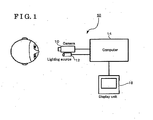
- Fig.1 is a block diagram showing a configuration of an eyelid detection apparatus according to a first embodiment of the invention
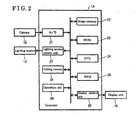
- Fig. 2 is a block diagram showing a configuration of a computer shown in Fig. 1 ;
- Figs. 3A to 3C are diagrams used for describing various kinds of data stored in a ROM or a RAM;
- FIGs. 4A to 4C are diagrams used for outlining processing according to the first embodiment of the invention.
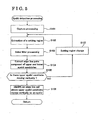
- Fig. 5 is a flowchart used for describing eyelid detection processing of the first embodiment
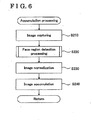
- Fig. 6 is a flowchart showing an operation of accumulating processing of an eyelid detection apparatus according to a second embodiment of the invention.
- Fig. 7 is a flowchart showing an operation of face region detection processing shown in Fig. 6 ;
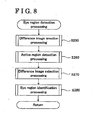
- Fig. 8 is a flowchart used for describing an operation of eye region detection processing of the eyelid detection apparatus according to the second embodiment
- Fig. 9 is a flowchart showing an operation of difference image creation processing shown in Fig. 8 ;
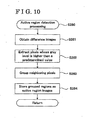
- Fig. 10 is a flowchart showing an operation of active region detection processing shown in Fig. 8 ;
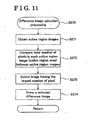
- Fig. 11 is a flowchart showing an operation of difference image selection processing shown in Fig. 8 ;
- Fig. 12 is a flowchart showing an operation of eye region identification processing shown in Fig. 8 ;
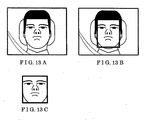
- Figs. 13A to 13C are diagrams showing a specific example of the face image detection
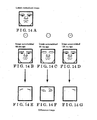
- Figs. 14A to 14G are diagrams showing a specific example of the difference image creation
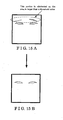
- Figs. 15A and 15B are diagrams showing a specific example of the eye region detection
- FIGs. 16A and 16B are diagrams for outlining processing according to a third embodiment of the invention.
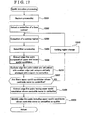
- Fig. 17 is a flowchart used for describing eyelid detection processing of the third embodiment
- Fig. 18 is a diagram used for outlining processing according to a fourth embodiment of the invention.
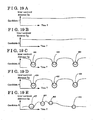
- Figs. 19A to 19E are diagrams used for outlining processing according to the fourth embodiment of the invention.
- Fig. 20 is a flowchart used for describing eyelid detection processing of the fourth embodiment.
- the eyelid detection apparatus 50 detects changes caused by blinking in a plurality of face images of a driver, and further detects a position of an eyelid in the changed portion.
- the eyelid detection apparatus 50 according to the first embodiment extracts the edge lines of eyelid candidates by extracting edge lines based on a gray level of each image and identifies a combination of one edge line whose representative point (centroids are used as a representing point in this embodiment) moves in a predetermined direction and the other edge line whose representative point does not move as the eyelid.
- the eyelid detection apparatus 50 used in each embodiment of the invention is composed of a camera 10, a lighting source 12 lighting a driver's face, a computer 14 and a display unit 16 connected to the computer 14.
- the camera IO captures images of the driver's face to create the face images and the computer 14 detects a center position of the driver's face.
- the camera 10 composed of a CCD camera and the like, captures gray-scale images of the driver's face at a predetermined cycle (for instance, 1/30 seconds) to output the images.
- the face images sequentially output from the camera 10 include not only the images of the driver's face, but also the images ot tile background.
- the display unit 16 composed of a LCD (Liquid Crystal Display) or a CRT (Cathode Ray Tube), displays binarized images created based on the face images captured by the camera 10 and the like.
- the display 16 is not an essential component in the apparatus, and may be eliminated therefrom.
- the computer 14 processes the face motion images captured by the camera 10 to detect the position of the eyelid.
- the computer 14 is composed of an A-D converter 21, an image memory 22, a ROM (Read Only Memory) 23, a CPU (Central Processing Unit) 24, a RAM (Random Access Memory) 25, a display control unit 26, a lighting source control unit 27, a setting memory 28, and an operation unit 29.
- the A-D (analog-digital) converter 21 converts an analog image signal captured by the camera 10 into a digital signal.
- the image memory 22 is created by the camera 10 to store image data which are digitized by the A-D converter 21.
- the ROM 23 stores programs for controlling the CPU operation. Further, the ROM 23 stores various kinds of fixed data used for executing image processing described below.
- the CPU 24 controls the computer 14 entirely. Further, the CPU 24 executes the programs stored in the ROM 23 to process the succession of the face images captured by the camera 10 and to detect the eyelid.
- the RAM 25 functions as a work area of the CPU 24..
- the display control unit 26 converts the image data and the like into the data format so as to be output by the display unit 16 and outputs the converted data on the display unit 16 under the control of the CPU 24.
- the lighting source control unit 27 controls the turning on and off of the lighting source 12.
- the setting memory 28 stores information (hereinafter, referred to as setting information) regarding the setting of the processing executed when the CPU 24 processes the face motion images to detect the eyelid.
- the operation unit 29 receives operation information from a user and sends an operation signal suitable for each operation to the CPU 24.
- the ROM 23 stores an operator of a sobel filter for the transverse edge lines.
- the sobel filter for the transverse edge lines is an operator for stressing gray level differences appeared in a transverse direction, as shown in Fig. 3B .
- the setting memory 28 pre-stores the setting information indicating regions where images of the eyes and the eyebrows are presumed to be present in the face images stored in the RAM 25, as shown in Fig. 3C .
- the region where the images of the eyes and the eyebrows are presumed to be present is set so as to be within a range in which a value of the y-axis is larger than y1 and smaller than y2 (y1 ⁇ y ⁇ y2).
- the region where the images of the eyes and the eyebrows are presumed to be present is referred to as a setting region.
- the eyelid detection apparatus 50 is configured as described above.
- an operation of the eyelid detecting apparatus 50 for detecting the eyelid in the face image will be outlined with reference to Fig. 4 .
- the camera 10 captures face images of a subject, as shown in Fig. 3C , at a predetermined cycle (for example, 1/30 seconds) to output the face images.
- the output face images are sequentially stored in the image memory 22.
- the CPU 24 sequentially loads the face images stored in the image memory 22 to execute the following processing.
- the CPU 24 obtains the setting region indicated by the setting information stored in the setting memory 28 and extracts transverse edge lines in the setting region of each face motion image by applying the sobel filter for the transverse edge lines shown in Fig. 3A . Consequently, as shown in Fig. 4A , edge lines whose pixels changes from a bright side to a dark side with respect to a y-axis are represented as minus edges and edge lines whose luminance changes from dark pixels to bright pixels with respect to the y-axis are represented as plus edges. In the drawings, the minus edges are indicated by a broken line and the plus edges are indicated by a solid line.
- the CPU 24 extracts combinations of the minus and plus edges, which satisfy the following three formulas, from among the minus and plus edge lines obtained in the previous processing.
- Lp - Lm ⁇ Lth Provided that Lp is a value indicating length of the plus edge, Lm is a value indicating length of the minus edge, and Lth indicates a threshold value.
- the lengths of the plus and minus edges are approximate within the threshold value Lth.
- Cxp - Cxm ⁇ Cxth Provided that Cxp indicates an x-coordinate of the centroid (representative point) of the plus edge, Cxm indicates an x-coordinate of the centroid (representative point) of the minus edge, and Cxth indicate a threshold value.
- the x-coordinates of the centroids of the plus and minus edges are approximate within the threshold value Cxth.
- Dg ⁇ Dth Provided that Dg indicates a distance between the centroids of the plus edge and the minus edge, and Dth indicates a thresnold value.
- an inter-centroid distance of the plus edge and the minus edge is below the threshold value Dth.
- the CPU 24 extracts the combinations of the minus and plus edges by using the above-described three formulas.
- the plus edges are considered as upper eyelid candidates and the minus edges are considered as lower eyelid candidates.
- the plus and minus edges, forming each combination are identical in length, approximate, and the centroids of the plus and minus edges have the identical x-axis.
- Fig. 4B shows an example of the combinations of the minus and plus edges extracted by using the formulas (1) to (3).
- the combinations of a plus edge 102 and a minus edge 103, of a plus edge 105 and a minus edge 106, of a plus edge 107 and a minus edge 108, and of a plus edge 109 and a minus edge 110 are the subject's eyelid candidates.
- the CPU 24 analyzes the plurality of face images which are obtained at different timings to determine which candidate, from among the above-described candidates, corresponds to the eyelid. Specifically, as described in Fig. 4C , when the centroid of the plus edge moves in a direction that the value of the y-axis increases (hereinafter, referred to as y-axis direction) or a direction opposite to the y-axis direction and the centroid of the minus edge does not move much, the combination of the plus and minus edges is identified as the eyelid.
- the centroid is employed as the representative point of the edge line, however, other points may be employed as the representative point.
- a point calculated by weighting edge strength, a local maximum point ofthe edge strength, a local minimum point of the edge strength, a highest point of the edge line in a longitudinal direction of the image, a lowest point of the edge line in the longitudinal direction of the image and the like may be employed as the representative point
- the CPU 24 initiates the processing of Fig. 5 at the predetermined cycle (for example, 1/30 seconds).
- the CPU 24 loads the subject's face images captured by the camera 10 via the A/D converter 21 to store the face images in the image memory 22 (Step S101) (face image storing means).
- the CPU 24 extracts the setting region determined based on the setting information stored in the setting memory 28 from each face image stored in the image memory 22 (Step S102).
- the CPU 24 extracts the transverse edge lines from the setting region of each face motion image by applying the sobel filter for the transverse edge lines stored in the ROM 23 (Step S103) (edge line extracting means).
- the CPU 24 further extracts the combinations of the minus and plus edges, which satisfy the above-described formulas (1) to (3), from among the edge lines extracted in the previous step (Step S104) (eyelid candidate extracting means).
- the CPU 24 respectively calculates the centroids of the plus and minus edges. Then, the CPU 24 further calculates the centroids of the pair of the plus and minus edges obtained from the previous face images to create a record of the centroids of each edge line obtained from the succession of the face images (change detecting means). The CPU 24 determines whether the combination of the plus edge whose centroid moves in the y-axis direction or the direction opposite to the y-axis direction as shown in Fig. 4C and the minus edge whose centroid does not move (much) is included in the extracted combination (Step S105) (eyelid detecting means).
- Step S105 If no combination of the plus edge whose centroid moves in the y-axis direction or in the direction opposite to the y-axis direction and the minus edge whose centroid does not move is included (Step S105; NO), the CPU 24 changes the setting information stored in the setting memory 28 to change or expand the setting region (Step S107) and then the processing is resumed from Step S102.
- Step S105 If the combination of the plus edge whose centroid moves in the y-axis direction or in the direction opposite to the y-axis direction and the minus edge whose centroid does not move is included (Step S105; YES), the CPU 24 identifies the combination of the plus and minus edges as the eyelid of the subject (Step S106) (eyelid identifying means) and terminates the processing.
- the eyelid detection apparatus 50 correctly detects the eyelid, i.e. (the position of) the eye, with fewer processing operations.
- the positions of the upper and lower eyelids are identified as described above, and the information is utilized for identifying a driver's gaze direction and determining whether or not the driver is awake. For instance, a position of a pupil corresponding to the position of the eyelid is determined as well as face orientation, and the driver's gaze direction is determined based on the information.
- the information indicative of the driver's gaze direction may be utilized for various kinds of vehicle control. Further, when a state, in which a distance between the upper and lower eyelids is shorter than a certain criteria, lasts for a predefined period, it is assumed that the driver falls asleep, and predetermined controls may be performed.
- the eyelid detection apparatus 50 identifies the combination(s) of the plus edge whose centroid moves in the predetermined directions and the minus edge whose centroid does not move (much) as the subject's eyelid(s) from the extracted combination of the minus and plus edges.
- differences between the images are taken to extract changed portions of the images.
- the apparatus detects the eyelid in the changed portions. Namely, the eyelid detection apparatus 50 detects blinking of the driver, thereby detecting the positions of the eyelids (eye region).
- Fig. 6 is a flowchart showing an operation of accumulation processing performed by the CPU 24.
- the CPU 24 extracts a face region from each image captured by the camera 10 and accumulates the extracted data in the image memory 22 after normalization.
- the CPU 24 executes the accumulating processing at a predetermined frame cycle, for example, 33 milliseconds (image storing means). First, the CPU 24 controls the camera 10 so as to capture the images (Step S210).
- the CPU 24 executes face region detection processing (Step S220).
- the face region detection processing the face region is detected in each original image including the face image, which is captured by the camera 10, for extraction.
- Fig. 7 is a flowchart showing an operation of the face region detection processing (Step S220).
- the CPU 24 obtains the images captured by the camera 10 (Step S221). Then, the CPU 24 differentiates luminance of each image with respect to a transverse direction of the image (Step S222) so as to extract a longitudinal edge image from each captured image (Step 8223). Further, in order to define the longitudinal edge portions obtained in Step S223, the longitudinal edge image is binarized (Step S224). Subsequently, the binarized image is weighted by longitudinal length to be projected (Step S225) for creation of a histogram (Step S226).
- Step S221 to S227) the image is weighted by a square of the longitudinal length of the edge and is projected for stressing the longitudinally long edges.
- Steps 225 to 226 allow longitudinally long face edges to be identified (Step S227). Transverse edges are obtained by repeating a similar processing. However, in this case, the processing is executed with respect to a longitudinal direction of the image (Step S221 to S227).
- Step S2248 face region detecting means
- the face region is detected and extracted in the face region detection processing.
- the method detecting the face region from the image is not limited to the above-described method.
- the sobel filter may be applied.
- the face region may be detected by differentiating the accumulated captured images over time (taking differences) and creating a histogram based on the differentiated images.
- the alternative method may be integrated with the above-described method.
- the face region may be detected by matching the image with a pre-registered template.
- the CPU 24 normalizes the face region images (Step S230).
- normalization means converting the data into a desired form by following a certain rule for easy handling, and the face region extracted in the face region detection processing (Step 8 220) is normalized to a predetermined size.
- the face region extracted in the face region detection processing constantly varies in size or form depending on posture of the driver and the-like.
- the size of the images is normalized for handling the images uniformly.
- each face image extracted in the face region detection processing (Step S 220) is linearly normalized so as to be an image whose size is 100 pixels by 100 pixels (normalization means).
- the CPU 24 stores parameters used for normalization in the RAM 25 so as to convert the eye region obtained from the normalized image into coordinate values of the original image (Step S230). Further, the gray level may be normalized.
- Step S240 normalized image storing means. Since only the normalized face region images are accumulated here, the memory region of the image memory 22 is saved. In order to perform inter-frame differentiation, the plurality of the normalized face region images are required to be accumulated. In this processing, the face region images are accumulated for 150 milliseconds. This time period is longer than a time period corresponding to four frames and is determined based on a time period required for human to close his/her eye, which is estimated by statistical research.
- Step S210 an image including a face of a driver, i.e. the original image shown in Fig. 13A in Step S210.
- a face region is detected as shown in Fig. 13B by the face region detection processing (Step S220).
- the face image is normalized in Step S230.
- Fig. 8 is a flowchart used for describing an operation of the eye region detection processing.
- Step S250 the CPU 24 executes difference image creation processing.
- difference image creation processing differences between the latest image and the other images, accumulated in the image memory 22, are taken to create difference images. Details of the processing will be described below.
- Step S260 the CPU 24 executes active region detection processing.
- active region detection processing moving regions (active region) are detected based on the difference images created in the difference image creation processing (Step S250). Details of the processing will be described below.
- Step S270 a difference image, used for detecting the eye region, is selected from among the plurality of difference images whose active regions detected in the active region detection processing (Step S260) after being created in the difference image creation processing (Step S250). Details of the processing will be described below.
- the CPU 24 executes eye region identification processing (Step S280).
- the eye region is identified from the active regions of the difference image selected in the difference image section processing (Step S270). Details of the processing will be described below.
- Fig. 9 is a flowchart showing the operation of the difference image creation processing (Step S250).
- the CPU 24 obtains the plurality of face images accumulated in the image memory 22 (Step S 251). Then, the latest image is identified from among the obtained images (Step S252). Subsequently, the CPU 24 takes the differences between the latest image and the other images to create the plurality of difference images (Step S253) (difference image creating means) and stores the difference images in the RAM 25 (Step S254).
- difference images Figs. 14E, 14F, 14G are respectively created by taking differences between a latest normalized image ( Fig. 14A ) and a normalized image accumulated 66 milliseconds before ( Fig. 14B ), between the latest normalized image ( Fig. 14A ) and a normalized image accumulated 99 milliseconds before ( Fig. 14C ) and between the normalized image ( Fig. 14A ) and a normalized image accumulated 132 milliseconds before ( Fig. 14D ).
- the difference images may be created by taking differences between pre-stored images, created by analyses such as statistics, and the latest normalized image.
- Fig.10 is a flowchart showing the operation of the active region detection processing (Step S260).
- the CPU 24 obtains the difference images created in the difference image creation processing (Step S250) in Step S261. Then, pixels having a gray level value larger than a predetermined value, for example, the pixels having the gray level value larger than or equal to 50 are extracted from the obtained difference images (Step S262), Then, the CPU 24 groups neighboring pixels extracted in Step S262 (Step S263). More specifically, the pixels located within 3 pixels are grouped together in this embodiment. The grouped regions are stored in the RAM 25 as an active region image (Step S264) (active region detecting means). These steps are iteratively looped back until the processing is completed for all of the difference images, thereby detecting the respective active regions in all of the difference images.
- Step S264 active region detecting means
- the gray level information may be used for the grouping conditions as well as the pixel position information.
- Fig. 11 is a flowchart showing the operation of the difference image selection processing (Step S270).
- the CPU 24 obtains the plurality of difference images, i.e. active region image whose active region is detected in the active region detection processing (Step S260) in Step S271. Then, the CPU 24 compares the total number of pixels in the active regions, i.e, active region area between the difference images (Step S272). As a result of the comparison, the difference image having the largest number of the pixels (Step S273) is selected (difference image selecting means) to be stored in the RAM 25 (Step S274).
- Fig 14F having the largest active region area, is selected from among the difference images of Fig. 14E to 14G .
- the difference image is selected for the detection of the eye region.
- the difference image, having the largest active region in terms of area, is selected here, thereby selecting the difference image having the differences occurred between before and after the blinking of the driver.
- Fig. 12 is a flowchart showing an operation ofthe eye region identification processing (Step S280).
- the eye region identification processing the eye region is identified by utilizing left-right symmetry of the eye region.
- the CPU 24 obtains the difference images selected in the difference image selection processing (Step S281). The CPU 24 then searches the active regions being present at left and right sides in the grouped active regions (Step S282) and determines whether or not centroid and area, i.e. the number ofthe pixels of each active region detected in Step S282 is within a predetermined threshold value (Step S283). If the centroid and the area are not within the threshold value (Step S283: NO), the processing returns to Step S282 in order to search the active region.
- Step S283 the active regions are identified as the eye region (Step S284) (eye region identifying means) so as to be stored in the RAM 25 (Step S285). Namely, in Steps 282 and 283, the active regions having the centroid and the area, which are unsuitable for the eye region, are excluded. For example, the active regions, which are ill-balanced, extremely small or left-right asymmetry, are excluded.
- a portion which is asymmetric in terms of area is excluded from the image shown in Fig. 15A and the eye region is identified as shown in Fig. 15B .
- the eye region is identified.
- a region having a high average value of the gray level, or a region having a peak of the gray level differences therein may be identified as the eye region. Further, positional relationship with the edge portion extracted from the original image may be added to the conditions for identification.
- the image is converted into an original image size based on the parameter used for the normalization after the identification of the eye region.
- the converted image is used to identify the direction of the driver's gaze, and determine whether or not the driver is awake.
- the eye detection apparatus may detect the edge pair, as shown in the first embodiment, in the region identified as the eye region and process one edge of the pair as an edge corresponding to the upper eyelid and the other edge of the pair as an edge corresponding to the lower eyelid.
- whether the edge presumed to correspond to the upper eyelid is a real upper eyelid may be confirmed by checking movement of a centroid of the edge presumed to correspond to the upper eyelid.
- the confirmation is not an imperative procedure and may be omitted.
- the parameter of the eye may be extracted from the region identified as the eye region by any known methods for utilization in other controls,
- the blinking of the eyes is extracted by taking the inter-frame difference. Thereafter, the eye is detected by utilizing pictorial features of the eye. Thus, the error detection of an eyebrow, a whisker, an eyeglass frame and the like is prevented. Further, the detection of the eye region is performed to a limited region, i.e. the face image, by utilizing the pictorial features of the eye and thus speeding up the processing time. The positions of the eyes are detected promptly with higher accuracy in this way.
- the subject of the normalization is not limited to the face size.
- the gray level of the images (gray-scale) and colors may be normalized.
- the gray level normalization for example, in order to uniform the average luminance of each images to be processed, the average luminance is determined for each image, and the ratio of the average luminance to the standard luminance, i.e. "the standard luminance/the average luminance" is obtained. Then, the luminance of each pixel is corrected by multiplying all pixels of each image by the above-mentioned ratio. Then, the accumulation processing is executed after the correction.
- the standard luminance is a standard value common to the plurality of the images.
- the eyelid detection apparatus 50 identifies the combination of the plus edge whose centroid moves to the predetermined direction and the minus edge whose centroid does not move as the subject's eyelid from the extracted combinations of the minus and plus edges.
- a centerline of a contour of the subject's face is detected, and the combination of the minus and plus edges, which is axisymmetrically arranged to another combination of the minus and plus edges with respect to the centerline, is identified as the subject's eyelid.
- the configuration of the third embodiment is similar to that of the first embodiment.
- the eyelid detection apparatus 50 processes the face motion images in a similar manner to the first embodiment and obtains a centerline of a face contour from a face image shown in Fig. 16A .
- a combination of a plus edge 301 and a minus edge 302 is referred to as Candidate 1
- a combination of a plus edge 305 and a minus edge 306 is referred to as Candidate 2
- a combination of a plus edge 303 and a minus edge 304 is referred to as Candidate 3
- a combination of a plus edge 307 and a minus edge 308 is referred to as Candidate 4
- a combination of a plus edge 309 and a minus edge 310 is referred to as Candidate 5.
- the eyelid detection apparatus 50 excludes the candidate(s) that is (are) not paired with another edge line combination axisymmetrically arranged with respect to a centerline 200.
- Candidate 5 composed of the combination of the edge lines 309 and 310, is excluded, Subsequently, the combination, in which the centroid of the edge line corresponding to the upper eyelid moves, is selected from the remaining candidates. Namely, Candidates 3 and 4 are processed as the edge pair of the eyelid.
- the CPU 24 initiates the processing of Fig. 17 periodically. Firstly, motion images of the subject's face are captured by the camera 10 via the A/D converter 21 to be stored in the image memory 22 (Step S301).
- the CPU 24 detects the centerline of the face contour in each image which is obtained in Step S301 (Step S302) (centerline detecting means, detecting means).
- the CPU 24 extracts the setting region determined based on the setting information stored in the setting memory 28 from each face image stored in the image memory 22 (Step S303).
- the CPU 24 extracts the transverse edge lines from the setting region of each face image by applying the sobel filter for the transverse edge lines (Step S3 04).
- the CPU 24 extracts the combinations of the minus and plus edges satisfying the formulas (1) to (3) used in the first embodiment from the extracted edge lines (Step S305).
- the CPU 24 excludes the combination(s) that is (are) not paired with another edge line combination axisymmetrically arranged with respect to the centerline 200 from the combinations ofthe minus and plus edges extracted in Step S305 (Step S306) (eyelid candidate extracting means).
- the CPU 24 determines whether or not the combination of the plus edge whose centroid moves to the centerline and the minus edge whose centroid does not move (much) is included in the remaining combinations of the plus and minus edges (Step S307).
- step S307, NO When the combination of the plus edge whose centroid moves to the centerline and the minus edge whose centroid does not move (much) is not included in the remaining combinations (step S307, NO), the CPU24 changes the setting information stored in the setting memory 28 to change or expand the setting region (Step S310). Then, the processing returns to Step S303.
- Step S307 If the combination of the plus edge whose centroid moves to the centerline and the minus edge whose centroid does not move (much) is included in the remaining combinations (Step S307; YES), the CPU 24 extracts the combination of the minus and plus edges (Step S308).
- the CPU 24 identifies the combination, which is paired with another combination axisymmetrically arranged with respect to the centerline 200 and composed of the plus edge whose centroid moves to the centerline and the minus edge whose centroid does not move (much), as the subjects eyelid (Step S309).
- the eyelid detection apparatus 50 detects the eyelids correctly with fewer operations even when a subject's mouth and the like are included in the setting region.
- the method adopted in the third embodiment may be applied to the identification of the eye region in Step S282 to S284, shown in Fig. 12 of the second embodiment.
- the eyelid detection apparatus 50 identifies the combination of the plus edge whose centroid moves to the predetermined direction and the minus edge whose centroid does not move (much) as the subject's eyelid from the extracted combination of the minus and plus edges.
- whether or not blinking causes the centroid of the plus edge to move in the predetermined direction is confirmed.
- the combination of the minus and plus edges, in which a relationship between the movement of the centroids of the plus edge and the blinking is confirmed, is identified as the subject's eyelid.
- the configuration of the fourth embodiment is similar to that of the first embodiment.
- the eyelid detection apparatus 50 processes the face motion images in the similar manner to the first embodiment and extracts the combinations of the minus and plus edges as shown in Fig.18 .
- a combination of a plus edge 301 and a minus edge 302 is referred to as Candidate 1
- a combination of a plus edge 305 and a minus edge 306 is referred to as Candidate 2
- a combination of a plus edge 303 and a minus edge 304 is referred to as Candidate 3
- a combination of a plus edge 307 and a minus edge 308 is referred to as Candidate 4
- a combination of a plus edge 309 and a minus edge 310 is referred to as Candidate 5.
- the eyelid detection apparatus 50 monitors variations of an inter-controid distance of the minus and plus edges Dg against each temporal axis for Candidates 1 to 5.
- the graphs illustrated in Figs. 19A to 19E respectively show the variations of the inter-centroid distance of the minus and plus edges Dg against the temporal axis for Candidates 1 to 5.
- Candidate 1 shows little variation of the distance Dg against the temporal axis.
- Candidate 2 also shows little variation of the distance Dg against the temporal axis.
- Candidate 3 has local minimum values 401 to 403
- Candidate 4 has local minimum values 404 to 406
- Candidate 5 has local minimum values 407 to 410.
- the eyelid detection apparatus 50 calculates reliability, indicating the probability that the candidate is the subject's eyelid, based on a cycle of local minimum point position of the inter-centroid distance Dg, and/or a distance between the local minimum value and the local maximum value, i.e. amplitude. If the reliability meets predetermined conditions, the candidate is identified as the subject's eyelid.
- the reliability for example, an inverse number of a sum of amplitude dispersion and cycle dispersion may be employed (parameter calculating means). In a movement such as the blinking, the amplitude and the cycle stay relatively constant, and the reliability becomes high. On the other hand, in other movements, the amplitude and the cycle usually scatter and the dispersions become large, leading to the low reliability.
- the eyelid detection processing executed by the eyelid detection apparatus 50 according to the fourth embodiment of the invention will be descried in detail with reference to Fig. 20 .
- the CPU 24 initiates the processing of Fig. 20 periodically and captures the motion images of the subject's face by the camera 10 via the A/D converter 21 so as to store the captured images in the image memory 22 (Step S401).
- the CPU 24 extracts the setting region determined based on the setting information stored in the setting memory 28 from each face image stored in the image memory 22 (Step S402).
- the CPU 24 extracts the transverse edge lines from the setting region of the face image by applying the sobel filter for the transverse edge lines (Step S403) stored in the ROM 23.
- the CPU 24 extracts the combinations of the minus and plus edges satisfying the formulas (1) to (3) used in the first embodiment from the extracted edge lines (Step S404).
- the CPU 24 calculates centroids of the plus and minus edges that are extracted in Step. S404.
- the CPU 24 further calculates a position of the centroid of each plus and minus edge in the face image previously accumulated to create a record of the centroid position of the edge lines extracted in the succession of the face images.
- the CPU24 determines whether or not the combination(s) of the plus edge whose centroid moves in the y-axis direction or the direction opposite to the y-axis direction and the minus edge whose centroid does not move (much), is (are) included in the candidates (Step S405).
- Step S405 When the combination of the plus edge whose centroid moves in the y-axis direction or the direction opposite to the y-axis direction and the minus edge whose centroid does not move (much), is not included in the candidates (Step S405; NO), the CPU 24 changes the setting information stored in the setting memory 28 so as to change or expand the setting region (Step S410). Then, the processing returns to Step S402.
- Step S405 When the above-described combination(s) is (are) included in the candidates (Step S405; YES), the CPU 24 extracts the combination(s) of the minus and plus edges (Step S406).
- the CPU24 calculates the reliability of each combination of the minus and plus edges, extracted in Step S406, as described above (Step S407) (reliability calculating means).
- the CPU24 determines whether or not the combination(s) of the minus and plus edges whose reliability is higher than a predetermined value is (are) included in the candidates (Step S408).
- Step S408 When the combination of the minus and plus edges whose reliability is higher than the predetermined value is not included in the candidates (Step S408; NO), the CPU 24 changes the setting information stored in the setting memory 28 so as to change or expand the setting region (Step S410). Then, the processing returns to Step S402.
- Step S408 If the combination(s) of the minus and plus edges whose reliability is higher than the predetermined value is (are) included in the candidates (Step S408; YES), the CPU 24 identifies the combination of the plus and minus edges whose reliability is higher than the predetermined value as the subject's eyelid (Step S409) and terminates the processing.
- the eyelid detection apparatus 50 detects the eyelid correctly with fewer operations even when the subject's mouth and the like are included in the setting region.
- Candidate 3 i.e. the combination of the plus edge 303 and the minus edge 304
- Candidate 4 i.e. the combination of the plus edge 307 and the minus edge 308, are detected as the eyelids.
- the eyelid detection apparatus 50 extracts the combinations of the minus and plus edges and identifies the pairs of the combinations of the moving plus edge and minus edge as the eyelids from the pairs of combinations arranged axisymmetrically with respect to the centerline of the face contour. In the fourth embodiment, the eyelid detection apparatus 50 extracts the combinations of the minus edge and the moving plus edge and calculates the reliability based on the movements of the centroids of the plus and minus edges so as to identify the combination whose reliability is higher than the predetermined value as the eyelid.
- the eyelid detection apparatus 50 may detect the eyelids by executing the following steps: (1) extracting the combinations of the minus and plus edges, (2) selecting the pairs of the combinations which are arranged axisymmetrically with respect to the centerline of the face contour, (3) calculating the reliability by evaluating the movements of the centroids of the minus and plus edges. The combination of the minus and plus edges whose reliability is higher than the predetermined value is identified as the eyelids (eyelid identifying means).
- the eyelid detection apparatus 50 may simply extract edge lines as candidates for the combination of the upper and lower eyelids and identify the pairs of the combinations of the edge lines, which are axisymmetrically arranged with respect to the centerline of the face contour, as the subject's left and right eyelids from the extracted edge lines.
- the computer 14 performs the eyelid detection processing for the motion images of the subject's face captured by the camera 10.
- the eye detection processing may be performed for motion images of the subject's face captured by an external device other than the camera 10 and stored in the image memory 22.
- the eyelid detection processing may be performed for images of plural faces.
- An eyelid detection apparatus includes a face image storing means storing a plurality of face images of a subject captured at different timings, a change detecting means detecting changes in each face image caused by blinking after processing the plurality of face images stored by the face image storing means, and an eyelid detecting means detecting a position of an eyelid of the subject based on the changes detected by the change detecting means.
Landscapes
- Engineering & Computer Science (AREA)
- Health & Medical Sciences (AREA)
- Physics & Mathematics (AREA)
- Human Computer Interaction (AREA)
- Life Sciences & Earth Sciences (AREA)
- General Health & Medical Sciences (AREA)
- Ophthalmology & Optometry (AREA)
- General Physics & Mathematics (AREA)
- Multimedia (AREA)
- Theoretical Computer Science (AREA)
- Oral & Maxillofacial Surgery (AREA)
- Medical Informatics (AREA)
- Biophysics (AREA)
- Biomedical Technology (AREA)
- Heart & Thoracic Surgery (AREA)
- Geometry (AREA)
- Molecular Biology (AREA)
- Surgery (AREA)
- Animal Behavior & Ethology (AREA)
- Public Health (AREA)
- Veterinary Medicine (AREA)
- Image Processing (AREA)
- Image Analysis (AREA)
Applications Claiming Priority (2)
| Application Number | Priority Date | Filing Date | Title |
|---|---|---|---|
| JP2007028822A JP4895847B2 (ja) | 2007-02-08 | 2007-02-08 | 瞼検出装置及びプログラム |
| EP20080151104 EP1955647B1 (de) | 2007-02-08 | 2008-02-06 | Augenlid-Erkennungsvorrichtung und Programme dafür |
Related Parent Applications (2)
| Application Number | Title | Priority Date | Filing Date |
|---|---|---|---|
| EP20080151104 Division EP1955647B1 (de) | 2007-02-08 | 2008-02-06 | Augenlid-Erkennungsvorrichtung und Programme dafür |
| EP08151104.0 Division | 2008-02-06 |
Publications (2)
| Publication Number | Publication Date |
|---|---|
| EP2583621A2 true EP2583621A2 (de) | 2013-04-24 |
| EP2583621A3 EP2583621A3 (de) | 2014-01-22 |
Family
ID=39468830
Family Applications (2)
| Application Number | Title | Priority Date | Filing Date |
|---|---|---|---|
| EP20080151104 Ceased EP1955647B1 (de) | 2007-02-08 | 2008-02-06 | Augenlid-Erkennungsvorrichtung und Programme dafür |
| EP20130150818 Withdrawn EP2583621A3 (de) | 2007-02-08 | 2008-02-06 | Augenlid-Erkennungsvorrichtung und Programme dafür |
Family Applications Before (1)
| Application Number | Title | Priority Date | Filing Date |
|---|---|---|---|
| EP20080151104 Ceased EP1955647B1 (de) | 2007-02-08 | 2008-02-06 | Augenlid-Erkennungsvorrichtung und Programme dafür |
Country Status (4)
| Country | Link |
|---|---|
| US (1) | US8351658B2 (de) |
| EP (2) | EP1955647B1 (de) |
| JP (1) | JP4895847B2 (de) |
| CN (1) | CN101241548A (de) |
Families Citing this family (25)
| Publication number | Priority date | Publication date | Assignee | Title |
|---|---|---|---|---|
| JP4137969B2 (ja) * | 2006-12-04 | 2008-08-20 | アイシン精機株式会社 | 眼部検出装置、眼部検出方法及びプログラム |
| JP4895847B2 (ja) | 2007-02-08 | 2012-03-14 | アイシン精機株式会社 | 瞼検出装置及びプログラム |
| JP5262243B2 (ja) * | 2008-03-31 | 2013-08-14 | アイシン精機株式会社 | 眼開閉判別装置、及びプログラム |
| JP5296458B2 (ja) * | 2008-08-27 | 2013-09-25 | 安川情報システム株式会社 | 瞼開度検出装置、瞼開度検出方法および瞼開度検出プログラム |
| JP5128454B2 (ja) * | 2008-12-17 | 2013-01-23 | アイシン精機株式会社 | 瞼検出装置、瞼検出方法及びプログラム |
| US8562659B2 (en) * | 2008-12-30 | 2013-10-22 | Koninklijke Philips N.V. | System and method for administering light therapy |
| KR101032726B1 (ko) * | 2009-09-01 | 2011-05-06 | 엘지이노텍 주식회사 | 눈 상태 검출방법 |
| DE112010005290T5 (de) * | 2010-02-22 | 2012-12-27 | Toyota Jidosha K.K. | Bildverarbeitungsvorrichtung und Müdigkeitsbeurteilungsvorrichtung |
| US20120076368A1 (en) * | 2010-09-27 | 2012-03-29 | David Staudacher | Face identification based on facial feature changes |
| JP2013015970A (ja) * | 2011-07-01 | 2013-01-24 | Aisin Seiki Co Ltd | 瞼検出装置、瞼検出方法及びプログラム |
| DE112011105441B4 (de) * | 2011-07-11 | 2019-11-14 | Toyota Jidosha Kabushiki Kaisha | Augenliderfassungsvorrichtung |
| US9110501B2 (en) * | 2012-04-17 | 2015-08-18 | Samsung Electronics Co., Ltd. | Method and apparatus for detecting talking segments in a video sequence using visual cues |
| US9076034B2 (en) * | 2012-12-07 | 2015-07-07 | Analog Devices, Inc. | Object localization using vertical symmetry |
| JP6187817B2 (ja) | 2013-10-09 | 2017-08-30 | アイシン精機株式会社 | 顔検出装置、方法およびプログラム |
| JP6234762B2 (ja) | 2013-10-09 | 2017-11-22 | アイシン精機株式会社 | 眼部検出装置、方法、およびプログラム |
| JP6304999B2 (ja) | 2013-10-09 | 2018-04-04 | アイシン精機株式会社 | 顔検出装置、方法およびプログラム |
| JP6276662B2 (ja) | 2013-10-16 | 2018-02-07 | 日本特殊陶業株式会社 | ガスセンサ |
| CN104013384B (zh) * | 2014-06-11 | 2016-04-20 | 温州眼视光发展有限公司 | 眼前节断层图像特征提取方法 |
| US9335819B1 (en) * | 2014-06-26 | 2016-05-10 | Audible, Inc. | Automatic creation of sleep bookmarks in content items |
| TWI522257B (zh) * | 2014-07-09 | 2016-02-21 | 原相科技股份有限公司 | 車用安全系統及其運作方法 |
| US9944296B1 (en) | 2015-01-13 | 2018-04-17 | State Farm Mutual Automobile Insurance Company | Apparatuses, systems and methods for determining distractions associated with vehicle driving routes |
| JP6514651B2 (ja) * | 2016-02-15 | 2019-05-15 | ルネサスエレクトロニクス株式会社 | 開眼度検出システム、居眠り検知システム、自動シャッタシステム、開眼度検出方法及び開眼度検出プログラム |
| US11321951B1 (en) | 2017-01-19 | 2022-05-03 | State Farm Mutual Automobile Insurance Company | Apparatuses, systems and methods for integrating vehicle operator gesture detection within geographic maps |
| JP7290930B2 (ja) | 2018-09-27 | 2023-06-14 | 株式会社アイシン | 乗員モデリング装置、乗員モデリング方法および乗員モデリングプログラム |
| EP4113464A1 (de) | 2021-06-30 | 2023-01-04 | Tobii AB | Augenverfolgungssystem |
Citations (4)
| Publication number | Priority date | Publication date | Assignee | Title |
|---|---|---|---|---|
| EP0815110A1 (de) | 1994-10-10 | 1998-01-07 | Gerhard Bringmann | HALOGENIERTE $g(b)-CARBOLIN-DERIVATE, VERFAHREN ZU IHRER HERSTELLUNG UND VERWENDUNG DIESER SUBSTANZEN ZUR HEMMUNG DER ATMUNGSKETTE |
| JP2001216515A (ja) | 2000-02-01 | 2001-08-10 | Matsushita Electric Ind Co Ltd | 人物の顔の検出方法およびその装置 |
| JP2004220080A (ja) | 2003-01-09 | 2004-08-05 | Nissan Motor Co Ltd | 開閉眼判定装置 |
| EP1955647A1 (de) | 2007-02-08 | 2008-08-13 | Aisin Seiki Kabushiki Kaisha | Augenlid-Erkennungsvorrichtung und Programme dafür |
Family Cites Families (30)
| Publication number | Priority date | Publication date | Assignee | Title |
|---|---|---|---|---|
| JP2500726B2 (ja) | 1992-06-12 | 1996-05-29 | 日本電気株式会社 | 上まぶた領域、目頭・目尻・上まぶた領域及び目の構造の検出方法及び装置 |
| JPH06308918A (ja) * | 1993-04-21 | 1994-11-04 | Fujitsu Ltd | 画面表示制御方法及び画面表示制御装置 |
| JP3293308B2 (ja) * | 1994-03-10 | 2002-06-17 | 三菱電機株式会社 | 人物状態検出装置 |
| JP3422183B2 (ja) | 1996-08-22 | 2003-06-30 | トヨタ自動車株式会社 | 顔画像における目の検出方法 |
| FR2773521B1 (fr) | 1998-01-15 | 2000-03-31 | Carlus Magnus Limited | Procede et dispositif pour surveiller en continu l'etat de vigilance du conducteur d'un vehicule automobile, afin de detecter et prevenir une tendance eventuelle a l'endormissement de celui-ci |
| JP2000123188A (ja) * | 1998-10-20 | 2000-04-28 | Toyota Motor Corp | 眼開閉判定装置 |
| FR2784887B1 (fr) * | 1998-10-22 | 2001-01-19 | Renault | Systeme pour surveiller des yeux afin de detecter et de prevenir des baisses de vigilance d'un conducteur de vehicule |
| JP2000137792A (ja) | 1998-10-30 | 2000-05-16 | Toyota Motor Corp | 眼部検出装置 |
| JP3695990B2 (ja) * | 1999-05-25 | 2005-09-14 | 三菱電機株式会社 | 顔画像処理装置 |
| US6130617A (en) | 1999-06-09 | 2000-10-10 | Hyundai Motor Company | Driver's eye detection method of drowsy driving warning system |
| JP2001010368A (ja) | 1999-06-17 | 2001-01-16 | Hyundai Motor Co Ltd | 居眠り運転警報システムの居眠り運転判断方法 |
| US6535223B1 (en) * | 2000-05-31 | 2003-03-18 | Schmidt Laboratories, Inc. | Method and system for determining pupiltary distant and element height |
| AUPQ896000A0 (en) * | 2000-07-24 | 2000-08-17 | Seeing Machines Pty Ltd | Facial image processing system |
| JP2003158643A (ja) * | 2001-11-20 | 2003-05-30 | Shibasoku:Kk | 信号処理方法及び信号処理装置 |
| CN100398065C (zh) | 2002-10-15 | 2008-07-02 | 沃尔沃技术公司 | 解释对象的头部和眼睛活动的方法和装置 |
| JP2004192552A (ja) * | 2002-12-13 | 2004-07-08 | Nissan Motor Co Ltd | 開閉眼判定装置 |
| JP4162503B2 (ja) | 2003-01-31 | 2008-10-08 | 富士通株式会社 | 眼の状態判定装置、眼の状態判定方法及びコンピュータプログラム |
| US7792335B2 (en) * | 2006-02-24 | 2010-09-07 | Fotonation Vision Limited | Method and apparatus for selective disqualification of digital images |
| KR100682889B1 (ko) * | 2003-08-29 | 2007-02-15 | 삼성전자주식회사 | 영상에 기반한 사실감 있는 3차원 얼굴 모델링 방법 및 장치 |
| CA2440015A1 (en) * | 2003-09-03 | 2005-03-03 | National Research Council Of Canada | Second order change detection in video |
| US7091471B2 (en) * | 2004-03-15 | 2006-08-15 | Agilent Technologies, Inc. | Using eye detection for providing control and power management of electronic devices |
| JP4059224B2 (ja) * | 2004-04-13 | 2008-03-12 | 株式会社デンソー | 運転者の外観認識システム |
| EP1748387B1 (de) * | 2004-05-21 | 2018-12-05 | Asahi Kasei Kabushiki Kaisha | Anordnungen für die klassifizierung des errugunszustands der augen eines fahrers, korrespondierende methode und computer lesbares speichermedium |
| US7689010B2 (en) * | 2004-12-03 | 2010-03-30 | Invacare International Sarl | Facial feature analysis system |
| US7253739B2 (en) | 2005-03-10 | 2007-08-07 | Delphi Technologies, Inc. | System and method for determining eye closure state |
| US7746235B2 (en) | 2005-03-10 | 2010-06-29 | Delphi Technologies, Inc. | System and method of detecting eye closure based on line angles |
| JP2007156650A (ja) * | 2005-12-01 | 2007-06-21 | Sony Corp | 画像処理装置 |
| JP4760349B2 (ja) * | 2005-12-07 | 2011-08-31 | ソニー株式会社 | 画像処理装置および画像処理方法、並びに、プログラム |
| US8208764B2 (en) * | 2006-01-21 | 2012-06-26 | Elizabeth Guckenberger | Photo automatic linking system and method for accessing, linking, and visualizing “key-face” and/or multiple similar facial images along with associated electronic data via a facial image recognition search engine |
| JP4137969B2 (ja) | 2006-12-04 | 2008-08-20 | アイシン精機株式会社 | 眼部検出装置、眼部検出方法及びプログラム |
-
2007
- 2007-02-08 JP JP2007028822A patent/JP4895847B2/ja not_active Expired - Fee Related
-
2008
- 2008-02-05 CN CNA200810005812XA patent/CN101241548A/zh active Pending
- 2008-02-06 EP EP20080151104 patent/EP1955647B1/de not_active Ceased
- 2008-02-06 EP EP20130150818 patent/EP2583621A3/de not_active Withdrawn
- 2008-02-06 US US12/026,959 patent/US8351658B2/en active Active
Patent Citations (4)
| Publication number | Priority date | Publication date | Assignee | Title |
|---|---|---|---|---|
| EP0815110A1 (de) | 1994-10-10 | 1998-01-07 | Gerhard Bringmann | HALOGENIERTE $g(b)-CARBOLIN-DERIVATE, VERFAHREN ZU IHRER HERSTELLUNG UND VERWENDUNG DIESER SUBSTANZEN ZUR HEMMUNG DER ATMUNGSKETTE |
| JP2001216515A (ja) | 2000-02-01 | 2001-08-10 | Matsushita Electric Ind Co Ltd | 人物の顔の検出方法およびその装置 |
| JP2004220080A (ja) | 2003-01-09 | 2004-08-05 | Nissan Motor Co Ltd | 開閉眼判定装置 |
| EP1955647A1 (de) | 2007-02-08 | 2008-08-13 | Aisin Seiki Kabushiki Kaisha | Augenlid-Erkennungsvorrichtung und Programme dafür |
Also Published As
| Publication number | Publication date |
|---|---|
| US20080212850A1 (en) | 2008-09-04 |
| US8351658B2 (en) | 2013-01-08 |
| JP2008192100A (ja) | 2008-08-21 |
| EP1955647B1 (de) | 2013-06-05 |
| EP1955647A1 (de) | 2008-08-13 |
| EP2583621A3 (de) | 2014-01-22 |
| JP4895847B2 (ja) | 2012-03-14 |
| CN101241548A (zh) | 2008-08-13 |
Similar Documents
| Publication | Publication Date | Title |
|---|---|---|
| EP1955647B1 (de) | Augenlid-Erkennungsvorrichtung und Programme dafür | |
| EP2101296B1 (de) | Augendetektionseinrichtung, augendetektionsverfahren und programm | |
| US7936926B2 (en) | Apparatus, method, and program for face feature point detection | |
| US7197166B2 (en) | Iris extraction method capable of precisely determining positions and sizes of irises in a digital face image | |
| EP1969994B1 (de) | Augenlid-Erkennungsvorrichtung, Augenlid-Erkennungsverfahren und Programm dafür | |
| JP4845698B2 (ja) | 眼部検出装置、眼部検出方法及びプログラム | |
| EP1973059A2 (de) | Vorrichtung und Verfahren und Programm zur Erkennung von Gesichtsregionen | |
| EP1969993B1 (de) | Augenlid-Erkennungsvorrichtung | |
| CN112767366B (zh) | 基于深度学习的图像识别方法、装置、设备及存储介质 | |
| EP1630719B1 (de) | Anordnung, Verfahren und Programm zur Bestimmung der Position von Gesichtsteilen | |
| KR20120006493A (ko) | 얼굴특징점 검출 장치 및 프로그램 | |
| US7522752B2 (en) | Central location of a face detecting device, method and program | |
| US8139862B2 (en) | Character extracting apparatus, method, and program | |
| JP2006260397A (ja) | 開眼度推定装置 | |
| US20170004616A1 (en) | Visual inspection support apparatus, visual inspection support method and program | |
| EP3961495B1 (de) | System und verfahren zum auffinden eines augenbereichs aus einem gesichtsbild | |
| EP1970859B1 (de) | Detektionsverfahren und detektionssystem für positionen von gesichtsteilen | |
| EP3157245A1 (de) | Dispositif de détérmination d'état d'une person | |
| KR101084594B1 (ko) | 영상 인식 시스템 및 그 방법 | |
| JP2013058036A (ja) | 画像処理装置、画像処理プログラム、ロボット装置及び画像処理方法 | |
| WO2020149001A1 (ja) | 情報処理装置、制御方法、及びプログラム | |
| CN113989588A (zh) | 一种基于自学习的五边形绘图测试智能评价系统及方法 | |
| WO2017159215A1 (ja) | 情報処理装置及び情報処理方法 | |
| JP5493676B2 (ja) | 眼位置認識装置 | |
| JP2010015463A (ja) | 目の位置の検出方法 |
Legal Events
| Date | Code | Title | Description |
|---|---|---|---|
| PUAI | Public reference made under article 153(3) epc to a published international application that has entered the european phase |
Free format text: ORIGINAL CODE: 0009012 |
|
| AC | Divisional application: reference to earlier application |
Ref document number: 1955647 Country of ref document: EP Kind code of ref document: P |
|
| AK | Designated contracting states |
Kind code of ref document: A2 Designated state(s): DE FR |
|
| PUAL | Search report despatched |
Free format text: ORIGINAL CODE: 0009013 |
|
| AK | Designated contracting states |
Kind code of ref document: A3 Designated state(s): DE FR |
|
| RIC1 | Information provided on ipc code assigned before grant |
Ipc: A61B 3/113 20060101AFI20131216BHEP Ipc: A61B 3/10 20060101ALI20131216BHEP |
|
| 17P | Request for examination filed |
Effective date: 20140716 |
|
| RBV | Designated contracting states (corrected) |
Designated state(s): DE FR |
|
| 17Q | First examination report despatched |
Effective date: 20150928 |
|
| STAA | Information on the status of an ep patent application or granted ep patent |
Free format text: STATUS: THE APPLICATION IS DEEMED TO BE WITHDRAWN |
|
| 18D | Application deemed to be withdrawn |
Effective date: 20160209 |