EP2565352A2 - Türverschluss-antriebsvorrichtung - Google Patents
Türverschluss-antriebsvorrichtung Download PDFInfo
- Publication number
- EP2565352A2 EP2565352A2 EP11775240A EP11775240A EP2565352A2 EP 2565352 A2 EP2565352 A2 EP 2565352A2 EP 11775240 A EP11775240 A EP 11775240A EP 11775240 A EP11775240 A EP 11775240A EP 2565352 A2 EP2565352 A2 EP 2565352A2
- Authority
- EP
- European Patent Office
- Prior art keywords
- door lock
- drive assembly
- lock drive
- unit
- shaft
- Prior art date
- Legal status (The legal status is an assumption and is not a legal conclusion. Google has not performed a legal analysis and makes no representation as to the accuracy of the status listed.)
- Withdrawn
Links
Images






Classifications
-
- E—FIXED CONSTRUCTIONS
- E05—LOCKS; KEYS; WINDOW OR DOOR FITTINGS; SAFES
- E05B—LOCKS; ACCESSORIES THEREFOR; HANDCUFFS
- E05B47/00—Operating or controlling locks or other fastening devices by electric or magnetic means
- E05B47/0001—Operating or controlling locks or other fastening devices by electric or magnetic means with electric actuators; Constructional features thereof
- E05B47/0012—Operating or controlling locks or other fastening devices by electric or magnetic means with electric actuators; Constructional features thereof with rotary electromotors
-
- E—FIXED CONSTRUCTIONS
- E05—LOCKS; KEYS; WINDOW OR DOOR FITTINGS; SAFES
- E05B—LOCKS; ACCESSORIES THEREFOR; HANDCUFFS
- E05B13/00—Devices preventing the key or the handle or both from being used
- E05B13/005—Disconnecting the handle
-
- E—FIXED CONSTRUCTIONS
- E05—LOCKS; KEYS; WINDOW OR DOOR FITTINGS; SAFES
- E05B—LOCKS; ACCESSORIES THEREFOR; HANDCUFFS
- E05B47/00—Operating or controlling locks or other fastening devices by electric or magnetic means
- E05B47/06—Controlling mechanically-operated bolts by electro-magnetically-operated detents
- E05B47/0676—Controlling mechanically-operated bolts by electro-magnetically-operated detents by disconnecting the handle
- E05B47/0684—Controlling mechanically-operated bolts by electro-magnetically-operated detents by disconnecting the handle radially
- E05B47/0692—Controlling mechanically-operated bolts by electro-magnetically-operated detents by disconnecting the handle radially with a rectilinearly moveable coupling element
-
- E—FIXED CONSTRUCTIONS
- E05—LOCKS; KEYS; WINDOW OR DOOR FITTINGS; SAFES
- E05B—LOCKS; ACCESSORIES THEREFOR; HANDCUFFS
- E05B65/00—Locks or fastenings for special use
- E05B65/10—Locks or fastenings for special use for panic or emergency doors
- E05B65/1086—Locks with panic function, e.g. allowing opening from the inside without a ley even when locked from the outside
-
- E—FIXED CONSTRUCTIONS
- E05—LOCKS; KEYS; WINDOW OR DOOR FITTINGS; SAFES
- E05B—LOCKS; ACCESSORIES THEREFOR; HANDCUFFS
- E05B47/00—Operating or controlling locks or other fastening devices by electric or magnetic means
- E05B47/0001—Operating or controlling locks or other fastening devices by electric or magnetic means with electric actuators; Constructional features thereof
- E05B2047/0014—Constructional features of actuators or power transmissions therefor
- E05B2047/0018—Details of actuator transmissions
- E05B2047/002—Geared transmissions
-
- E—FIXED CONSTRUCTIONS
- E05—LOCKS; KEYS; WINDOW OR DOOR FITTINGS; SAFES
- E05B—LOCKS; ACCESSORIES THEREFOR; HANDCUFFS
- E05B47/00—Operating or controlling locks or other fastening devices by electric or magnetic means
- E05B2047/0084—Key or electric means; Emergency release
- E05B2047/0086—Emergency release, e.g. key or electromagnet
Definitions
- the present invention relates to a door lock drive assembly, and more particularly to a door lock drive assembly, in which inner and outer door handle shafts are selectively bound according to an authentication signal or a key action, and a tight binding force can be maintained even when a strong torque is transmitted to the handle shafts.
- a door is installed with a mechanical or electronic door lock in order to keep the safety of a residential space or the security of a working space against an illegal entry of a third party.
- an anti-panic type door lock has been frequently used, of which the latch is operated in cooperation with an inner door handle so as to allow a resident to quickly escape to the outside from a disaster, such as a fire, occurring indoors or a dangerous situation, such as a break-in.
- a conventional electronic door lock (including an anti-panic type door lock) is typically configured such that the latch of the door lock is operated using a motor. That is, the conventional electronic door lock includes a plurality of gears and link members therein for interconnecting the motor and the latch, and the torque of the motor is transmitted to the latch through the gears and the link members to perform a locking action and an unlocking action by the latch.
- the conventional structure as described above may cause a situation in which the latch is not smoothly operated by the motor, thereby making it difficult to open the door from the outside to enter indoors.
- the door lock may not be smoothly operated unless the torque of the motor is sufficient to forcibly operate the latch.
- the conventional structure requires a plurality of decelerating gears and link members to convert the torque of the motor into the rectilinear reciprocating movement of the latch, which makes the construction of the door lock complicated, and hinders the miniaturization of the door lock.
- an anti-panic type door lock has been frequently used as briefly described above. Because such an anti-panic type door lock is configured such that the latch is operated by the rotation of the inner door handle, the latch can be operated relatively easily even when the latch is jammed in the door frame if the outer and inner door handle shafts are capable of being tightly bound selectively depending on an authentication signal or a key action.
- the present invention was made in an effort to solve the above-mentioned problems, and an aspect of the present invention is to provide a door lock drive assembly which can selectively bind the inner and outer door handle shafts depending on an authentication signal or a key action, and maintain a strong binding force even when a strong torque is transmitted to the handle shafts.
- a door lock drive assembly including: a shaft connection unit that is provided with a pushing member configured to selectively connect a first handle shaft and a second handle shaft in such a manner that the first handle shaft and the second handle shaft are connected with or disconnected from each other; a slide unit that is provided with a pressing unit which is vertically movable to press the pushing member; and a mechanical driving unit that is formed with a keyway and vertically moves the pressing unit of the slide unit when a key is inserted into the keyway and rotated.
- the door lock drive assembly may further include a pushing member, wherein the pushing member is provided with a rotary axle hinged to the first handle shaft, and with reference to the rotary axle, one end of the pushing member is elastically supported on the outer peripheral surface of the first handle shaft, and the other end is positioned in the inside of the slide unit.
- the slide unit may be formed with an inclined groove, and the other end of the pushing member is positioned in the inclined groove.
- the slide unit may include: a slide body; a slide member installed in the sliding body to be capable of being reciprocated to press the pushing member, which is configured to connect and disconnect the handle shafts, to a side; a driving motor installed in the inside of the slide body; a guide coil disposed in the reciprocating direction of the slide member, a side surface of the slide member being fixed to the guide coil; and a guide member comprising a guide plate which is rotated by the driving motor and formed with a protrusion step on the outer peripheral surface thereof to be moved along the guide coil, and a shaft slider configured to control the guide plate to be contacted with or separated from the guide coil.
- the guide plate may be configured such that the protrusion step is contacted with the guide coil in the state in which the guide plate is elastically supported in the guide coil.
- an inclined part may be formed at a tail end where the guide plate and the shaft slider are contacted with each other, so that when the shaft slider pushes the guide plate, the protrusion step in a pressed state is released from the guide coil.
- the other end of the slide member may be formed with a protrusion plate configured to be interlocked with a manual driving shaft provided in the door lock.
- the mechanical driving unit may include: a driving unit body; a first cam that is rotatably installed in the driving unit body, and configured to push a tail end of the slide unit to a side by being interlocked with a keyway shaft to be rotated; and a second cam that is coaxially connected with the first cam, and positioned in front of the first cam, the second cam being formed with a recess for fixing a position.
- the pressing unit protrusively formed on the slide unit may be retained in a close contact state in the recess to fix the position of the second cam.
- the first cam may be formed in such a manner that its outer peripheral, which is in contact with the slide unit, forms an oval shape.
- the driving unit body may be provided with a cover unit for protecting the first cam.
- the pushing member may include: a pin inserted into the insertion hole of the handle shaft, and a guide part fixed to the leading end of the pin, and coupled with the leading end of the pressing unit.
- the leading end of the pressing unit is formed with a fixing groove, into which the guide part is inserted.
- the guide part may be formed in a circular arc shape.
- the pin may be fitted with a spring to elastically support the pushing member.
- the pin and the guide part may be formed integrally with each other.
- the slide member when a door lock drive assembly presses a pushing member according to an authentication signal, the slide member connects inner and outer door handle shafts with each other.
- inner and outer door handle shafts can be selectively connected with each other, thereby improving the convenience in use.
- the inventive door lock drive assembly allows a user to connect or disconnect the handle shafts using a key, thereby improving the convenience in use.
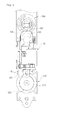
- FIG. 1 is a schematic view illustrating a construction of a door lock drive assembly according to a first exemplary embodiment of the present invention.
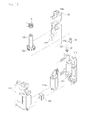
- the inventive door lock drive assembly includes a slide unit 100, a shaft connection unit 200, and a mechanical driving unit 300.
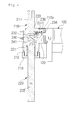
- FIG. 2 is a cross-sectional view illustrating a shaft connection unit of the door lock drive assembly according to the first exemplary embodiment
- FIG. 3 is a perspective view illustrating a pushing member of the shaft connection unit of the door lock drive assembly according to the first exemplary embodiment
- FIG. 4 is a cross-sectional view illustrating the disconnected state of the shaft connection unit of the door lock drive assembly according to the first exemplary embodiment
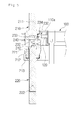
- FIG. 5 is a cross-sectional view illustrating the connected state of the shaft connection unit of the door lock drive assembly according to the first exemplary embodiment.
- the shaft connection unit 200 generally includes a first handle shaft 210, a second handle shaft 220, a slide member 240, and a pushing member 230.
- the first handle shaft 210 is formed with a main body 212 and a connection end 211 at an end of the main body 212 to be capable of being connected with an outer door handle unit (not illustrated).
- the interior of the main body 212 is formed with a space in which the slide member 240 is positioned to be capable of being vertically reciprocated.
- a threaded part is formed at the lower end of the main body 212, and a coupling member 213 is fastened to the threaded part to accommodate a part of the second handle shaft 220.
- the slide member 240 is formed with an inclined groove 242 (see FIG. 5 ) on a lateral side thereof, and a part of the pushing member 230 is positioned in the inclined groove 242.
- the slide member 240 is formed with a fastening groove 241 on the bottom side thereof, and a lug 221 formed to extend from an end of the second handle shaft 220 is selectively introduced into or withdrawn from the fastening groove 241. Further, when the first handle shaft 210 is rotated, the slide member 240 is cooperatively moved with the first handle shaft 210 in the inside of the first handle shaft 210.
- the slide member 240 when the slide member 240 is moved in the inside of the first handle shaft 210 and connected with the lug 221 of the second handle shaft(220), the first handle shaft 210 and the second handle shaft 220 may be interlocked with each other.
- the tail end 222 of the second handle shaft 220 may be connected with a deadbolt interlocking body of a mortis, the door lock is opened when the handle shafts are rotated.
- the pushing member 230 is provided with a rotary axle 233 which is hinged to the main body 212 of the first handle shaft 210.
- the pushing member 230 is elastically supported on the outer peripheral surface of the main body 212 at one end thereof with reference to the rotary axle 233. Further, the other end of pushing member 230 is inserted into the inclined groove 242 (see FIG. 5 ) of the slide member 240.
- the pushing member 230 is formed with a hooking end 232 positioned in the inclined groove 242, and at the other end, the pushing member 230 is formed with a pushing end 234, against which the pressing unit 120 of the slide unit 100 is abutted.
- the pushing end 234 is formed with extension end portions 236 and 238 which extend to opposite sides, respectively.
- the pushing end 234 is formed with a spring anchoring part 235 on the inner surface thereof.
- a spring 231 is installed in such a manner that one end is anchored to the spring anchoring part 235, and the other end is positioned on the outer surface of the main body 212 of the first handle shaft 210, thereby elastically supporting pushing member 230 with reference to the rotary axle 233. That is, because the one end of pushing member 230 is elastically supported, the hooking end 232 of the pushing member 230 may come into close contact with the inclined groove 242 of the slide member 240.
- the shaft connection unit 200 may be configured in such a manner that a separate slide unit 100 may be equipped in a door lock to be capable of selectively pressing the pushing member 230.
- the slide unit 100 is installed on an inner frame 110a of the door lock adjacent to the shaft connection unit 200.
- the slide unit 100 drives the pressing unit 120, and the pressing unit 120 presses the pushing end 234 (see FIG. 3 ) of the pushing member 230 as illustrated in FIG. 5 .
- the pushing member 230 When the pushing member 230 is pressed in this manner, the pushing member 230 is pivoted about the rotary axle 233, and the hooking end 232 of the pushing member 230 moves the slide member 240 downward.
- the slide member 240 moved in this manner makes the lug 221 of the second handle shaft 220 approach to the fastening groove 241 of the slide member 240, whereby the first handle shaft 210 and the second handle shaft 220 may be interlocked with each other.
- the pushing member 230 is pressed by the spring 231 to move the slide member 240 inwardly, thereby disconnecting the connection with the second handle shaft 220.
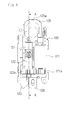
- FIG. 6 is a perspective view illustrating a slide unit of the door lock drive assembly according to the first exemplary embodiment
- FIG. 7 is a perspective view illustrating the internal construction of the slide unit of the door lock drive assembly according to the first exemplary embodiment
- FIG. 8 is a front view illustrating the internal construction of the slide unit of the door lock drive assembly according to the first exemplary embodiment
- FIG. 9 is a side view illustrating the internal construction of the slide unit of the door lock drive assembly according to the first exemplary embodiment
- FIG. 10 is an exploded perspective view illustrating the internal construction of the slide unit of the door lock drive assembly according to the first exemplary embodiment.
- the slide unit 100 generally includes a slide body 110, a pressing unit 120, and a guide member.
- the pressing unit 120 is installed in the inside of the slide body 110 to be capable of being vertically reciprocated.
- a slide bar 125 may be formed at an end of the pressing unit 120 to press the pushing member 230, and the slide bar 125 may be formed with a seating groove 125a, with which the pushing member 230 may be contacted.
- the slide body 110 is installed with a driving motor 121, and the driving motor 121 is provided with a driving gear 121a at the bottom side thereof.
- the driving gear 121a is gear-coupled with the interlocking post 122 which is formed with a gear unit 122a.
- a guide member may be configured by a guide coil S1 which is fitted on the interlocking post 122, and a guide plate 128 and a shaft slider 127 which are provided in the interlocking post 122.
- a protrusion step 128a is formed on a side of the guide plate 128 to selectively contact with the guide coil S1, and the guide coil S1 is anchored to a side of the pressing unit 120 at the opposite ends thereof.
- a spring S2 is fitted on the shaft slider 127 so that the shaft slider 127 is elastically supported in the interlocking post 122, and the tail end of the shaft slider 127 is installed to be in close contact with the pressing member 126.
- an inclined part 129 is formed, so that when the shaft slider 127 pushes the guide plate 128, the protrusion step 128a is disengaged from the guide coil S1.
- the slide body 110 may be configured by combining a first cover body 111 and a second cover body 112.
- the inventive slide unit 100 is installed in a door lock body between the shaft connection unit 200 and a mechanical driving unit 300.
- the handle shafts (not illustrated) are in the connected state. To the contrary, when the pressing unit 120 does not push the pushing member 230, the handle shafts are disconnected.
- the mechanical driving unit 300 is provided with a second cam 310 and a first cam 330 interlocked with the second cam 310, and the cams 310 and 330 are connected to a keyway shaft.
- the first cam 330 is a means for moving the pressing member 126
- the second cam 310 is a means for moving the protrusion plate (slide bar) of the pressing unit 120.
- the pressing member 126 When the second cam 310 is rotated, the pressing member 126 is pushed upward. Then, the pressing member 126 pushes the shaft slider 127 upward, the guide plate 128 is lowered along the inclined part 129, and the protrusion step 128a of the guide plate 128 is disengaged from the guide coil S1.
- the pressing unit 120 In the state in which the guide plate 128 is disengaged from the guide coil S1, the pressing unit 120 is freely movable. Especially, when the second cam 320 of the mechanical driving unit 300 is rotated to push the protrusion plate 123, the pressing unit 120 may be manually pushed. Accordingly, the handle shafts may be manually connected with each other.
- the torque of the motor 121 rotates the interlocking post 122 through the gear connection.
- the protrusion step 128a of the guide plate 128 installed in the interlocking post 122 is rotated along the guide coil S1 to move the pressing unit 120, to which the guide coil S1 is connected, and to press the pushing member 230, whereby the shaft connection unit 200 can connect the handle shafts with each other.
- FIG. 11 is a perspective view illustrating a mechanical driving unit of the door lock drive assembly according to the first exemplary embodiment
- FIG. 12 is an exploded perspective view illustrating the mechanical driving unit of the door lock drive assembly according to the first exemplary embodiment
- FIG. 13 is a front view illustrating the mechanical driving unit of the door lock drive assembly according to the first exemplary embodiment
- FIG. 14 is a perspective view illustrating the internal construction of the mechanical driving unit of the door lock drive assembly according to the first exemplary embodiment
- FIG. 15 is a front view illustrating the internal construction of the mechanical driving unit of the door lock drive assembly according to the first exemplary embodiment.
- the mechanical driving unit 300 essentially consists of a driving body 340, a first cam 330, and a second cam 310.
- the first cam 330 is rotatably installed on the driving body 340 to be interlocked with the keyway shaft. Specifically, the first cam 330 is rotatably installed in the connection groove 342 formed in the driving body 340. In addition, the first cam 330 is formed with an oval-shaped flange 331 along the outer periphery, and is formed with a rotary axle (no reference numeral is designated) at the center thereof. In front of the rotary axle, a second cam 310 is mounted.
- a gear driving unit 350 gear-coupled with the first cam 330 is rotatably installed in a seating groove 341 formed in the driving body 340.
- a gear 351 provided in the gear driving unit 350 is interlocked with a gear (not illustrated) provided on a side of the first cam 330, thereby enabling the first cam 330 to be rotated.
- the gear driving unit 350 may be connected with a keyway shaft (not illustrated), into which a key may be inserted such that the keyway shaft can be interlocked with the key, in which case the gear driving unit 350 may be driven when a user rotates the keyway shaft with the key.
- a cover unit 320 is mounted to protect the first cam 330, in which a surrounding part 315 is bulgingly formed in the cover unit 320 to have a space which is sufficient for allowing the oval-shaped flange 331 of the first cam 330 to be rotated therein.
- an opened part 312 is formed at an area of the surrounding part 315 to allow the oval-shaped flange 331 to be partially exposed to the outside.
- an anchoring part 332 is protrusively formed so as to mount the second cam 310.
- the anchoring part 332 is coupled with the second cam 310 in the state in which it extends through the front side of the cover unit 320 to be exposed.
- the second cam 310 has an outer peripheral surface with a circular shape, and a recess 311 for fixing a position is formed on the outer peripheral surface of the second cam 310.
- the mechanical driving unit 300 is installed to be interlocked with the slide unit 100 for driving the shaft connection unit 200 installed in the door lock body.
- the shaft connection unit 200 is a means for selectively connecting or disconnecting the handle shafts, in which when the shaft connection unit pushes the pushing member 230, the handle shafts are connected with each other, and when the shaft connection unit 200 does not push the pushing member 230, the handle shafts are disconnected from each other.
- the shaft connection unit 200 may be operated through the slide unit 100. That is, when the pressing unit 120 of the slide unit 100 presses the pushing member 230, the shaft connection unit 200 renders the handle shafts to be connected with each other.
- the slide unit 100 is formed with a protrusion plate 123 for driving the pressing unit 120, in which the protrusion plate 123 is installed at a position where it is interlocked with the oval-shaped flange 331 of the first cam 330.
- the protrusion plate 123 is pushed to a side in the state in which the oval-shaped flange 331 and the protrusion plate 123 are in contact with each other.
- the protrusion plate 123 is moved along the oval-shaped flange 331, and the pressing unit 120 connected with the protrusion plate 123 is also moved to press the pushing member 230, thereby enabling the handle shafts to be connected with each other.
- a pressing member 126 is installed in a state in which the pressing member 126 is elastically supported by a spring (not illustrated).
- the pressing member 126 is installed in a state in which its tail end is in close contact with the seating groove 311 of the second cam 310.
- the pressing member 126 is a means for fixing a reference point for the second cam 310 and the first cam 330 interlocked with the second cam 310. That is, the pressing member 126 maintains the state in which it is in close contact with the seating groove 311 of the second cam 310.
- FIG. 16 is a perspective view illustrating a shaft connection unit of a door lock drive assembly according to a second exemplary embodiment of the present invention
- FIG. 17 is a plan view illustrating the shaft connection unit of the door lock drive assembly according to the second exemplary embodiment
- FIG. 18 is a partial exploded perspective view illustrating a connective relationship of a pushing member of the door lock drive assembly according to the second exemplary embodiment
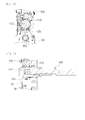
- FIG. 19 is a partial front view illustrating the operating state of a shaft connection unit of the door lock drive assembly according to the second exemplary embodiment
- FIG. 20 is a partial side view illustrating the operating state of the shaft connection unit of the door lock drive assembly according to the second exemplary embodiment.
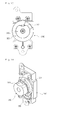
- the shaft connection unit As illustrated in FIGs. 16 to 20 , with reference to a clutch body 410, the shaft connection unit according to the second exemplary embodiment is formed with a handle shaft 420 at one end and a connection end 416 at the other end.
- the handle shaft 420 is equipped with an inner door handle, and hence serves as a means to which the driving force is transmitted. As illustrated in FIG. 16 , the connection end 416 is formed with a coupling groove 412, into which the shaft of an outer door handle is inserted.
- the clutch body 410 is equipped with a pushing member 430, in which as illustrated in FIG. 17 , the pushing member 430 consists of a guide part 431 and a pin 432.
- the guide part 431 and the pin 432 may be integrally formed, and takes a shape formed by coupling separate members.
- the guide part 431 is coupled to the leading end of the pin 432.
- the guide part 431 is formed in a circular arc shape.
- the pin 432 may be introduced into the insertion hole 415 ( FIG. 20 ) formed in a handle shaft 420. In that event, the state in which the pin 432 of the pushing member 430 is inserted into the insertion hole 415 corresponds to the connection state of the clutch where the driving force of the handle shaft 420 can be transmitted to the shaft coupled to the other side (the connection end 416).
- the state in which the pin 432 is released from the insertion hole 415 corresponds to the disconnection state of the clutch where the driving force of the handle shaft 420 is not transmitted to the shaft coupled to the connection end 416 and the handle shaft 420 idles alone.
- the clutch body 410 is equipped with a bracket 433.
- a pin 432 is mounted in the inside of the bracket 433 in a state in which a spring 434 is inserted into the bracket 433, and the guide part 431 is fixed to the leading end of the pin 432.
- the spring 434 may be occasionally omitted. That is, the pushing member 430 and the slide bar 125 may provide structures interlocked with each other even without the spring 434.
- the slide bar 125 of the slide unit 100 is formed with a fixing groove 455 on the bottom side thereof.
- the fixing groove 455 is a place where the guide part 431 is inserted, and may be formed in a shape corresponding to the shape of the guide part 431, for example, in a circular arc shape.
- reference numeral 500 designates the frame body.
- the pushing member 430 and the slide bar 125 may be interlocked with each other in the fixed state.
- the slide bar 125 is interlocked with the pushing member 430 without being separated from the pushing member 430, and hence the position sensing of the slide bar 125 recognizes the clutch as not being in the disconnected state.
- the present invention can recognize that the pushing member 430 is positioned at an incompletely released state (in which the pin 432 is caught midway) through a position sensor provided in a slide device.
Landscapes
- Business, Economics & Management (AREA)
- Emergency Management (AREA)
- Lock And Its Accessories (AREA)
Applications Claiming Priority (5)
| Application Number | Priority Date | Filing Date | Title |
|---|---|---|---|
| KR1020100038472A KR101371503B1 (ko) | 2010-04-26 | 2010-04-26 | 도어락의 손잡이 축 연결구조체 |
| KR1020100038473A KR101369400B1 (ko) | 2010-04-26 | 2010-04-26 | 도어락의 손잡이 축 연결을 위한 구동조립체 |
| KR2020100004371U KR200471675Y1 (ko) | 2010-04-26 | 2010-04-26 | 도어락의 기계식 구동조립체 |
| KR2020110003449U KR200462783Y1 (ko) | 2011-04-22 | 2011-04-22 | 도어락용 기계식 구동조립체의 클러치 |
| PCT/KR2011/003018 WO2011136535A2 (ko) | 2010-04-26 | 2011-04-26 | 도어락의 구동조립체 |
Publications (2)
| Publication Number | Publication Date |
|---|---|
| EP2565352A2 true EP2565352A2 (de) | 2013-03-06 |
| EP2565352A4 EP2565352A4 (de) | 2017-12-27 |
Family
ID=44862031
Family Applications (1)
| Application Number | Title | Priority Date | Filing Date |
|---|---|---|---|
| EP11775240.2A Withdrawn EP2565352A4 (de) | 2010-04-26 | 2011-04-26 | Türverschluss-antriebsvorrichtung |
Country Status (4)
| Country | Link |
|---|---|
| EP (1) | EP2565352A4 (de) |
| CN (1) | CN102906362B (de) |
| AU (1) | AU2011245881B2 (de) |
| WO (1) | WO2011136535A2 (de) |
Families Citing this family (5)
| Publication number | Priority date | Publication date | Assignee | Title |
|---|---|---|---|---|
| CN106593087A (zh) * | 2017-01-04 | 2017-04-26 | 中山市安思曼智能科技有限公司 | 置于门锁把手内的离合机构及包括其的门锁把手 |
| CN108868326B (zh) * | 2018-07-16 | 2024-08-20 | 中山市摩根金属制品有限公司 | 锁具防撬结构 |
| CN109252751A (zh) * | 2018-10-13 | 2019-01-22 | 陕西铭贤电子科技有限公司 | 一种防技术开启的电磁离合器控制方法及该电磁离合器 |
| CN110836047B (zh) * | 2019-12-06 | 2023-09-15 | 广东雅洁五金有限公司 | 利用门把手转动触发控制的电动锁具 |
| CN118361162A (zh) * | 2023-01-19 | 2024-07-19 | 深圳好博窗控技术股份有限公司 | 一种传动轴与转轮连接结构、传动组件及门窗 |
Family Cites Families (17)
| Publication number | Priority date | Publication date | Assignee | Title |
|---|---|---|---|---|
| CN2133632Y (zh) * | 1992-08-25 | 1993-05-19 | 刘岩水 | 强固门锁 |
| JP3276776B2 (ja) * | 1994-05-25 | 2002-04-22 | 松下電工株式会社 | 電気錠 |
| JP3398725B2 (ja) * | 1994-06-30 | 2003-04-21 | 美和ロック株式会社 | 錠片作動用角軸のがたつき防止装置 |
| KR0137881B1 (ko) * | 1994-11-17 | 1998-06-15 | 김경수 | 카드키를 이용한 시건장치 |
| US5640863A (en) * | 1995-09-06 | 1997-06-24 | Harrow Products, Inc. | Clutch mechanism for door lock system |
| DE19612156C2 (de) * | 1996-03-27 | 1998-07-02 | Leonhard Lerchner | Türschloß |
| US5960656A (en) * | 1998-09-02 | 1999-10-05 | Shyang Feng Electric & Machinery Co., Ltd. | Electronic lock |
| US6302455B1 (en) * | 1999-09-27 | 2001-10-16 | Chao-Lin Huang | Electric safeguard door lock |
| US6865916B2 (en) * | 2002-08-28 | 2005-03-15 | Ilan Goldman | Door cylinder lock |
| US6725693B2 (en) * | 2002-08-30 | 2004-04-27 | Jer Ming Yu | Door lock with a clutch having a cam-styled axle sleeve |
| TWI220910B (en) * | 2003-03-14 | 2004-09-11 | Ez Trend Technology Co Ltd | An electric handle |
| ITBO20030582A1 (it) * | 2003-10-10 | 2005-04-11 | Cisa Spa | Serratura elettrica provvista di molla multifunzione |
| DK200500222U3 (da) * | 2005-09-30 | 2005-12-23 | Birkegaarden Holding As | Biometrisk lås kombineret med kodetastatur + mekanisk lås til 3-punkt dör |
| DE102005059384B4 (de) * | 2005-12-09 | 2011-07-07 | Burg-Wächter KG, 58540 | Schloss |
| US8353189B2 (en) * | 2006-01-09 | 2013-01-15 | Schlage Lock Company | Manual override mechanism for electromechanical locks |
| DE102008063061A1 (de) * | 2008-12-12 | 2010-06-17 | Bin Li | Betätigungsvorrichtung für ein elektronisches Türschloß |
| CN201339347Y (zh) * | 2008-12-19 | 2009-11-04 | 固力保安制品有限公司 | 带把手的锁具 |
-
2011
- 2011-04-26 CN CN201180025666.7A patent/CN102906362B/zh active Active
- 2011-04-26 WO PCT/KR2011/003018 patent/WO2011136535A2/ko not_active Ceased
- 2011-04-26 EP EP11775240.2A patent/EP2565352A4/de not_active Withdrawn
- 2011-04-26 AU AU2011245881A patent/AU2011245881B2/en not_active Ceased
Non-Patent Citations (1)
| Title |
|---|
| See references of WO2011136535A2 * |
Also Published As
| Publication number | Publication date |
|---|---|
| CN102906362B (zh) | 2015-04-29 |
| AU2011245881B2 (en) | 2016-05-26 |
| CN102906362A (zh) | 2013-01-30 |
| EP2565352A4 (de) | 2017-12-27 |
| AU2011245881A1 (en) | 2012-11-29 |
| WO2011136535A3 (ko) | 2012-03-01 |
| WO2011136535A2 (ko) | 2011-11-03 |
Similar Documents
| Publication | Publication Date | Title |
|---|---|---|
| US7621571B2 (en) | Door lock system | |
| CA2698041C (en) | Keypad lockset | |
| US7770946B2 (en) | Door lock device for vehicle | |
| AU2011245881B2 (en) | Door lock drive assembly | |
| CN101713267B (zh) | 门锁装置 | |
| KR100957167B1 (ko) | 도어락 모티스 | |
| JP2004143754A (ja) | 電気錠 | |
| JP2004143739A (ja) | 電気錠 | |
| KR101595853B1 (ko) | 클러치 구조를 갖는 문 잠금장치 | |
| KR20180114861A (ko) | 레버형 도어락의 클러치 연결 구동 조립체 | |
| CN106150218A (zh) | 驱动多个门闩的门锁 | |
| KR200458730Y1 (ko) | 오링 내장형 동력 전달수단을 구비한 패닉 기능을 갖는 도어록 | |
| CN206035136U (zh) | 一种电子防盗锁 | |
| KR19980019241A (ko) | 자동차 전동식 도어래치(electric door latch of automobles) | |
| KR102014746B1 (ko) | 도어락의 해정 조립체 | |
| KR102060741B1 (ko) | 구동 모듈에 의해 자동으로 해정되는 도어락의 자동 해정 조립체 | |
| CN110685509B (zh) | 可排障的锁体 | |
| KR101371503B1 (ko) | 도어락의 손잡이 축 연결구조체 | |
| CN221073846U (zh) | 一种汽车侧门电开锁的机械辅助开启装置及汽车侧门电开锁 | |
| CN217501316U (zh) | 一种玻璃门指纹锁机械开锁传动装置 | |
| KR100763820B1 (ko) | 디지털 도어록용 모티스록 | |
| WO2003016660A1 (en) | Device at a lock | |
| JP2025122291A (ja) | ドア装置 | |
| JP4910166B2 (ja) | ロック装置 | |
| CN119491629A (zh) | 汽车侧门电开锁及机械辅助开启装置 |
Legal Events
| Date | Code | Title | Description |
|---|---|---|---|
| PUAI | Public reference made under article 153(3) epc to a published international application that has entered the european phase |
Free format text: ORIGINAL CODE: 0009012 |
|
| 17P | Request for examination filed |
Effective date: 20121026 |
|
| AK | Designated contracting states |
Kind code of ref document: A2 Designated state(s): AL AT BE BG CH CY CZ DE DK EE ES FI FR GB GR HR HU IE IS IT LI LT LU LV MC MK MT NL NO PL PT RO RS SE SI SK SM TR |
|
| DAX | Request for extension of the european patent (deleted) | ||
| A4 | Supplementary search report drawn up and despatched |
Effective date: 20171127 |
|
| RIC1 | Information provided on ipc code assigned before grant |
Ipc: E05B 47/00 20060101ALI20171121BHEP Ipc: E05B 47/06 20060101ALI20171121BHEP Ipc: E05B 13/00 20060101AFI20171121BHEP Ipc: E05B 65/10 20060101ALI20171121BHEP |
|
| STAA | Information on the status of an ep patent application or granted ep patent |
Free format text: STATUS: EXAMINATION IS IN PROGRESS |
|
| 17Q | First examination report despatched |
Effective date: 20180709 |
|
| GRAP | Despatch of communication of intention to grant a patent |
Free format text: ORIGINAL CODE: EPIDOSNIGR1 |
|
| STAA | Information on the status of an ep patent application or granted ep patent |
Free format text: STATUS: GRANT OF PATENT IS INTENDED |
|
| INTG | Intention to grant announced |
Effective date: 20191018 |
|
| STAA | Information on the status of an ep patent application or granted ep patent |
Free format text: STATUS: THE APPLICATION IS DEEMED TO BE WITHDRAWN |
|
| 18D | Application deemed to be withdrawn |
Effective date: 20200229 |