EP2522033B1 - Conversion of high-energy photons into electricity - Google Patents
Conversion of high-energy photons into electricity Download PDFInfo
- Publication number
- EP2522033B1 EP2522033B1 EP11732017.6A EP11732017A EP2522033B1 EP 2522033 B1 EP2522033 B1 EP 2522033B1 EP 11732017 A EP11732017 A EP 11732017A EP 2522033 B1 EP2522033 B1 EP 2522033B1
- Authority
- EP
- European Patent Office
- Prior art keywords
- layers
- energy
- photon
- converter
- layer
- Prior art date
- Legal status (The legal status is an assumption and is not a legal conclusion. Google has not performed a legal analysis and makes no representation as to the accuracy of the status listed.)
- Active
Links
Images




Classifications
-
- H—ELECTRICITY
- H10—SEMICONDUCTOR DEVICES; ELECTRIC SOLID-STATE DEVICES NOT OTHERWISE PROVIDED FOR
- H10F—INORGANIC SEMICONDUCTOR DEVICES SENSITIVE TO INFRARED RADIATION, LIGHT, ELECTROMAGNETIC RADIATION OF SHORTER WAVELENGTH OR CORPUSCULAR RADIATION
- H10F30/00—Individual radiation-sensitive semiconductor devices in which radiation controls the flow of current through the devices, e.g. photodetectors
- H10F30/301—Individual radiation-sensitive semiconductor devices in which radiation controls the flow of current through the devices, e.g. photodetectors the devices being sensitive to very short wavelength, e.g. being sensitive to X-rays, gamma-rays or corpuscular radiation
-
- G—PHYSICS
- G01—MEASURING; TESTING
- G01T—MEASUREMENT OF NUCLEAR OR X-RADIATION
- G01T1/00—Measuring X-radiation, gamma radiation, corpuscular radiation, or cosmic radiation
- G01T1/16—Measuring radiation intensity
- G01T1/28—Measuring radiation intensity with secondary-emission detectors
-
- G—PHYSICS
- G21—NUCLEAR PHYSICS; NUCLEAR ENGINEERING
- G21H—OBTAINING ENERGY FROM RADIOACTIVE SOURCES; APPLICATIONS OF RADIATION FROM RADIOACTIVE SOURCES, NOT OTHERWISE PROVIDED FOR; UTILISING COSMIC RADIATION
- G21H1/00—Arrangements for obtaining electrical energy from radioactive sources, e.g. from radioactive isotopes, nuclear or atomic batteries
- G21H1/04—Cells using secondary emission induced by alpha radiation, beta radiation, or gamma radiation
-
- G—PHYSICS
- G21—NUCLEAR PHYSICS; NUCLEAR ENGINEERING
- G21H—OBTAINING ENERGY FROM RADIOACTIVE SOURCES; APPLICATIONS OF RADIATION FROM RADIOACTIVE SOURCES, NOT OTHERWISE PROVIDED FOR; UTILISING COSMIC RADIATION
- G21H1/00—Arrangements for obtaining electrical energy from radioactive sources, e.g. from radioactive isotopes, nuclear or atomic batteries
- G21H1/06—Cells wherein radiation is applied to the junction of different semiconductor materials
-
- H—ELECTRICITY
- H10—SEMICONDUCTOR DEVICES; ELECTRIC SOLID-STATE DEVICES NOT OTHERWISE PROVIDED FOR
- H10F—INORGANIC SEMICONDUCTOR DEVICES SENSITIVE TO INFRARED RADIATION, LIGHT, ELECTROMAGNETIC RADIATION OF SHORTER WAVELENGTH OR CORPUSCULAR RADIATION
- H10F10/00—Individual photovoltaic cells, e.g. solar cells
- H10F10/10—Individual photovoltaic cells, e.g. solar cells having potential barriers
- H10F10/16—Photovoltaic cells having only PN heterojunction potential barriers
- H10F10/161—Photovoltaic cells having only PN heterojunction potential barriers comprising multiple PN heterojunctions, e.g. tandem cells
-
- H—ELECTRICITY
- H10—SEMICONDUCTOR DEVICES; ELECTRIC SOLID-STATE DEVICES NOT OTHERWISE PROVIDED FOR
- H10F—INORGANIC SEMICONDUCTOR DEVICES SENSITIVE TO INFRARED RADIATION, LIGHT, ELECTROMAGNETIC RADIATION OF SHORTER WAVELENGTH OR CORPUSCULAR RADIATION
- H10F30/00—Individual radiation-sensitive semiconductor devices in which radiation controls the flow of current through the devices, e.g. photodetectors
- H10F30/20—Individual radiation-sensitive semiconductor devices in which radiation controls the flow of current through the devices, e.g. photodetectors the devices having potential barriers, e.g. phototransistors
- H10F30/29—Individual radiation-sensitive semiconductor devices in which radiation controls the flow of current through the devices, e.g. photodetectors the devices having potential barriers, e.g. phototransistors the devices being sensitive to radiation having very short wavelengths, e.g. X-rays, gamma-rays or corpuscular radiation
-
- H—ELECTRICITY
- H10—SEMICONDUCTOR DEVICES; ELECTRIC SOLID-STATE DEVICES NOT OTHERWISE PROVIDED FOR
- H10F—INORGANIC SEMICONDUCTOR DEVICES SENSITIVE TO INFRARED RADIATION, LIGHT, ELECTROMAGNETIC RADIATION OF SHORTER WAVELENGTH OR CORPUSCULAR RADIATION
- H10F77/00—Constructional details of devices covered by this subclass
-
- H—ELECTRICITY
- H10—SEMICONDUCTOR DEVICES; ELECTRIC SOLID-STATE DEVICES NOT OTHERWISE PROVIDED FOR
- H10F—INORGANIC SEMICONDUCTOR DEVICES SENSITIVE TO INFRARED RADIATION, LIGHT, ELECTROMAGNETIC RADIATION OF SHORTER WAVELENGTH OR CORPUSCULAR RADIATION
- H10F77/00—Constructional details of devices covered by this subclass
- H10F77/10—Semiconductor bodies
- H10F77/12—Active materials
-
- H—ELECTRICITY
- H10—SEMICONDUCTOR DEVICES; ELECTRIC SOLID-STATE DEVICES NOT OTHERWISE PROVIDED FOR
- H10F—INORGANIC SEMICONDUCTOR DEVICES SENSITIVE TO INFRARED RADIATION, LIGHT, ELECTROMAGNETIC RADIATION OF SHORTER WAVELENGTH OR CORPUSCULAR RADIATION
- H10F77/00—Constructional details of devices covered by this subclass
- H10F77/10—Semiconductor bodies
- H10F77/14—Shape of semiconductor bodies; Shapes, relative sizes or dispositions of semiconductor regions within semiconductor bodies
-
- H—ELECTRICITY
- H10—SEMICONDUCTOR DEVICES; ELECTRIC SOLID-STATE DEVICES NOT OTHERWISE PROVIDED FOR
- H10F—INORGANIC SEMICONDUCTOR DEVICES SENSITIVE TO INFRARED RADIATION, LIGHT, ELECTROMAGNETIC RADIATION OF SHORTER WAVELENGTH OR CORPUSCULAR RADIATION
- H10F77/00—Constructional details of devices covered by this subclass
- H10F77/40—Optical elements or arrangements
-
- Y—GENERAL TAGGING OF NEW TECHNOLOGICAL DEVELOPMENTS; GENERAL TAGGING OF CROSS-SECTIONAL TECHNOLOGIES SPANNING OVER SEVERAL SECTIONS OF THE IPC; TECHNICAL SUBJECTS COVERED BY FORMER USPC CROSS-REFERENCE ART COLLECTIONS [XRACs] AND DIGESTS
- Y02—TECHNOLOGIES OR APPLICATIONS FOR MITIGATION OR ADAPTATION AGAINST CLIMATE CHANGE
- Y02E—REDUCTION OF GREENHOUSE GAS [GHG] EMISSIONS, RELATED TO ENERGY GENERATION, TRANSMISSION OR DISTRIBUTION
- Y02E10/00—Energy generation through renewable energy sources
- Y02E10/50—Photovoltaic [PV] energy
-
- Y—GENERAL TAGGING OF NEW TECHNOLOGICAL DEVELOPMENTS; GENERAL TAGGING OF CROSS-SECTIONAL TECHNOLOGIES SPANNING OVER SEVERAL SECTIONS OF THE IPC; TECHNICAL SUBJECTS COVERED BY FORMER USPC CROSS-REFERENCE ART COLLECTIONS [XRACs] AND DIGESTS
- Y02—TECHNOLOGIES OR APPLICATIONS FOR MITIGATION OR ADAPTATION AGAINST CLIMATE CHANGE
- Y02E—REDUCTION OF GREENHOUSE GAS [GHG] EMISSIONS, RELATED TO ENERGY GENERATION, TRANSMISSION OR DISTRIBUTION
- Y02E10/00—Energy generation through renewable energy sources
- Y02E10/50—Photovoltaic [PV] energy
- Y02E10/542—Dye sensitized solar cells
Definitions
- the embodiments described herein relate generally to photonic energy conversion and, more particularly, to systems and methods that facilitate the conversion of energy from high-energy photons into electricity.
- photovoltaic cells 'solar cells'
- These devices are generally made up of at least two materials (i.e. silicon-based semiconductors) with different physical properties, such as different electron affinities (see, P. Würfel, The Physics of Solar Cells, 1st Edition, Wiley-VCH (2004 )).
- silicon-based semiconductors i.e. silicon-based semiconductors
- electron affinities see, P. Würfel, The Physics of Solar Cells, 1st Edition, Wiley-VCH (2004 )
- solar photons excite photoelectrons from a valence band into a conduction band, which provides electric mobility.
- the energy gap between valence and conduction bands is typically on the order of an electron-volt, which is similar to the energy of the incident solar photons.
- the arrangement of two materials with different electron affinities gives rise to an electric voltage across the material boundary, which may be tapped for electric energy.
- Difficulties in providing such devices arise from the great penetrability of high-energy photons through matter, which is a consequence of much less interaction of such photons with matter when compared with visible light, and from the fact that for most materials the mean-free-path of electrons is typically many orders of magnitude shorter than the mean-free-path of high-energy photons.
- electrons emitted from an atom in a material used to trap the high-energy photons tend to succumb to recombination while their energy converts to heat within the high-energy photon trapping material.
- US2003019517-A1 discloses an apparatus and method for solar energy production comprising a multi-layer solid-state structure including a photosensitive layer, a thin conductor, a charge separation layer, and a back ohmic conductor, wherein light absorption occurs in a photosensitive layer and the charge carriers produced thereby are transported through the thin conductor through the adjacent potential energy barrier.
- the open circuit voltage of the solar cell can be manipulated by choosing from among a wide selection of materials making up the thin conductor, the charge separation layer, and the back ohmic layer.
- US5111099 discloses an apparatus and method for converting radioactive energy into electrical energy, with the apparatus including an outer radioactive protective shell and a radioactive fuel source located within that shell.
- three mutually perpendicular magnetic fields are provided to separate alpha and beta particles emitted from the radioactive fuel source and to direct the alpha particles to a first predetermined region of the shell while directing the beta particles to a second predetermined region.
- An alpha collector is situated adjacent the first region to collect the alpha particles directed to that region, while a beta collector is situated within the second region to collect beta particles directed thereto.
- Structure is provided to permit removal of gaseous by-product from within the shell, and output leads are provided to utilize the collected alpha and beta particles to create electric current.
- US2004163942-A1 discloses a plurality of metallic plates arranged alternately so that the main surface of one of the metallic plates is faced to the main surface of the adjacent one of the metallic plates.
- JPS63182870 discloses a laminated radiation detection element.
- the present application provides an energy converter system for converting high energy photon emissions into electrical energy in accordance with the claims which follow.
- the systems and methods described herein may be utilized in a wide range of applications - from energy detection and absorption, to energy conversion of high-energy photons in particle accelerators and from other extremely hot matter (such as high temperature plasmas) and/or detonation sources that emit copious high-energy photons (such as explosives), energy capture of emissions of radioactive nuclear wastes (such as spent fission fuel rods), and space applications (such as power sources, shielding, and the like), as well as other applications readily recognizable to one skilled in the art.
- energy detection and absorption to energy conversion of high-energy photons in particle accelerators and from other extremely hot matter (such as high temperature plasmas) and/or detonation sources that emit copious high-energy photons (such as explosives), energy capture of emissions of radioactive nuclear wastes (such as spent fission fuel rods), and space applications (such as power sources, shielding, and the like), as well as other applications readily recognizable to one skilled in the art.
- the embodiments described herein are directed to the conversion of energy from high-energy photons (such as, e.g., photons with energy preferably in a range of about 100 eV or greater) into electricity.
- the principle underlying the embodiments is based on the ejection of electrons from an atom (including the ejection of deep seated inner shell electrons from an atom of high atomic number (high-Z) materials) by high-energy photons.
- the ejected electrons carry kinetic energy, which can lead to the migration of the ejected electrons into different regions of a device where the accumulation of the ejected electrons can create an electric potential that can be tapped to drive an external electric circuit.
- the photon spectrum of interest includes photons preferably in the non-visible regime including, but not limited to, XUV rays, X-rays, gamma rays and the like.
- the energy of such photons is orders of magnitude larger and, thus, the margin for thermalization is much greater (the theoretical Carnot coefficient is near unity), than the energy of photons in the visible regime.
- the systems and methods described herein are capable of extraordinarily high efficiency of energy conversion, as compared with other standard energy converters of photons, such as photoelectric devices (e.g. solar cells), or devices based on the thermoelectric effect (e.g., Seebeck effect).
- the systems and methods used to harness this potentially high gain effectively channel the energies of the high-energy photons into an appropriate form of electric energy, which can then be tapped to drive an external circuit, and, thus, cover a wide range of applications, including those where strong magnetic fields are present (such that electron dynamics are characterized by gyromotion across the magnetic fields).
- the systems and methods described herein may be utilized in a wide range of applications - from energy detection and absorption, to energy conversion of high-energy photons in particle accelerators, direct energy conversion of high-energy photons from other extremely hot matter (such as high temperature plasmas) and/or detonation sources that emit copious high-energy photons (such as explosives), energy capture of emissions of radioactive nuclear wastes (such as spent fission fuel rods), and space applications (such as power sources, shielding, and the like), as well as other applications readily recognizable to one skilled in the art.
- energy detection and absorption to energy conversion of high-energy photons in particle accelerators
- direct energy conversion of high-energy photons from other extremely hot matter such as high temperature plasmas
- detonation sources that emit copious high-energy photons (such as explosives)
- energy capture of emissions of radioactive nuclear wastes such as spent fission fuel rods
- space applications such as power sources, shielding, and the like
- a high-energy photon converter preferably includes a linearly layered nanometric-scaled wafer made up of a first plurality of layers of materials for absorbing high energy photons and emitting electrons combined with a second plurality of layers of other materials for absorbing or collecting electrons emitted from the first plurality of layers.
- the materials of the second plurality of layers having an atomic charge number differing from the atomic charge numbers of the materials of the first plurality of layers.
- the nanometric-scaled layers are configured in a tubular or shell-like configuration.
- the nanometric layers facilitate the segregation of photoelectrons from donor atoms.
- the resultant converter may reduce the power flux incident on materials that would otherwise be directly exposed to high-energy photons, thereby reducing the amount of heating of these materials and may also ameliorate the degradation of the materials that are otherwise subject to severe high-energy photon irradiation damages.
- the converter device or devices are assumed to be embedded in strong magnetic fields that can decisively impact the electron orbits.
- the electron orbital properties are minimally affected by the magnetic fields (with strengths that are practically attainable) so that the embodiments are equally applicable to applications where there are little or no magnetic fields present, such as, e.g., spent fission fuel rod applications.
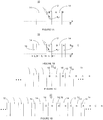
- the most basic building block or converter element 10 of a photon energy converter having a linear structure is comprised of a first layer 12 of type A material having a first atomic number Z 1 and preferably comprising a high atomic number component, such as, for example, a refractory metal or metal oxide.
- the first layer 12 is preferably sandwiched between two layers 14 of type B material having a second atomic number Z 2 differing from the atomic number of the first layer 12 of type A material, and preferably comprising a metal that is typically preferably characterized by a lower atomic number than the atomic number of the first layer 12 of type A material (i.e., Z 2 ⁇ Z 1 ).
- the basic building block 10 can optionally be enhanced by the addition of an insulator layer 16 of type C material.
- converters 11 and 13 include a series or an array of the basic building blocks stacked laterally side-by-side (i.e., face-to-face) until the theoretical maximum aggregate photon path-length spent by the photon in all type A layers 12 is comparable to or larger than the mean free path of the high energy photons v to be absorbed by the type A material.
- one or more layers 14 of type B material interpose adjacent layers 12 of type A material, and, optionally, a layer 16 of type C insulation material interposes adjacent layers 14 of type B material.
- Stacking the building blocks or converter elements 10 side-by-side provides a geometry for the overall structure that is well suited to effectively accommodate the electron emissions caused by the high energy photons v absorbed in the type A material. Because the polarization of photons E , as depicted in Figure 3 , is perpendicular to the direction of propagation of the photon v, the direction of the ejected electron e - is primarily in a plane P e (with an appropriately decaying angular distribution away from that plane, but peaking on that plane) perpendicular to the direction of the propagation of the photons v (but such plane contains the polarization of the photons v).
- the layers 12 and 14 of the converter elements 10 are stacked side-by-side in a direction such that the normal vector to the boundary surfaces between layers is generally orthogonal to the direction of the propagation of the photons v.
- the boundary surfaces between layers can be aligned at a grazing (shallow) angle with the direction of propagation of the incident high-energy photon v.
- each layer 12 of type A material is preferably smaller than or on the order of the length of the mean free path of electrons in such type A material.
- each layer 14 of type B material is preferably larger than or on the order of the length of the mean free path of electrons in the type B material.
- the nanometric arrangement of the layers of these embodiments is reflective of the intrinsic physical principles that the electron mean free path in the type A material, l e (Z 1 ), is not too different from the electron mean free path in the type B material, l e (Z 2 ), while at the same time the photon mean free path in the type A material is much less than its mean free path in the type B material, i.e., l p (Z 1 ) ⁇ l p (Z 2 ).
- typical layer thickness dimensions for these systems include l 1 for type A material equal to approximately 1 nm and l 2 for type B material equal to approximately 100 nm, with l 3 for the optional type C material adjusted to prevent arcing between neighboring layers where necessary.
- l 1 for type A material equal to approximately 1 nm
- l 2 for type B material equal to approximately 100 nm
- l 3 for the optional type C material adjusted to prevent arcing between neighboring layers where necessary.
- these dimensions are less than the gyroradius ⁇ e of the electrons. Therefore, on these length scales the electrons are not magnetized, but their dynamics are primarily in the collisional regime.
- the converter elements 10 or converters 11 and 13 discussed above are also applicable to applications where magnetic fields are absent or negligibly small.
- individual layers 12 and 14 can be connected in a fashion whereby each layer 12 of type A material is connected to one of the nearest layers 14 of type B material as depicted in Figure 1E , or each layer 12 of type A material can be connected to one of the nearest layers 14 of type B material that is separated from it by an insulating layer 16 of type C material as depicted in Figure 1F .
- the electrically coupled layers effectively form nano-batteries and the spontaneously formed electric potential difference is on the order of the kinetic energy of migrating electrons.
- the total voltage available to drive a load is equal to the voltage of an individual nano-battery cell 15 or the sum of the series of nano-battery cells 17 and 19.
- an external circuit 20 comprising a load 22 is coupled to the nano-battery cells 17 and 19, which are depicted as coupled in series but could be coupled in parallel.
- the load 22 may comprise an electrically drivable system or component, an energy storage system, an electrical grid, or the like.
- the steady state voltage can be externally controlled and the thickness of the insulating layer 16 sized accordingly.
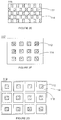
- the basic building block includes a cylindrical tube or shell configuration.
- a cylindrical converter element 110 comprises a cylindrical core 112 of type A material surrounded by a cylindrical tube or shell 114 of type B material.
- a cylindrical tube or shell 114 of type B material As depicted in Figure 2B , it is again possible to optionally surround each shell 114 of type B material with an insulating shell 116 of type C material.
- the same dimensional rules apply to the various thicknesses, i.e., the radius of the cylindrical cores 112 of type A material is less than or on the order of about half of the electron mean free path in type A material, about l e (Z 1 )/2, while the thickness of the shell 114 of type B material is on the order of the electron mean free path in material B, about l e (Z 2 ).
- the advantage of the cylindrical tube or shell arrangement of the converter element 110 is the higher efficiency it affords in capturing the emitted electrons as they are emitted with equal probability over an entire 360° azimuth.
- electrons e - are ejected in a direction primarily in a plane P c (with an appropriately decaying angular distribution away from that plane, but peaking on that plane) perpendicular to the direction of propagation of the photon v and parallel to the polarization ( E ⁇ ) of the photons.
- the ejected electron e - can be directed anywhere about the 360° azimuth and in such case the cylindrical arrangement of the cell leads to higher electron capture in type B material and effectively a higher electron capture efficiency as compared to the linear configurations depicted in Figure 1A through IF.
- the cylindrical building blocks 110 are bundled to form aggregate structures that conform to the same physical size constraints as the linear geometry converter.
- one particular stacking arrangement 111 is depicted in Figure 2C .
- insulating material 116 can fill the void spaces between adjacent converter elements or cells 110.
- Such void space can also serve as a conduit for circulating gas coolants, such as pressurized Helium. This forms an effective means of cooling because the photon absorption by He is negligible over the photon energies of interest.
- Electrical connections are again similar to the linear geometry configurations and likewise afford many different options in connecting the layers or shells 112 and 114 of the building blocks 110.
- Figures 2E, 2F and 2G Alternative geometric configurations are shown in Figures 2E, 2F and 2G.
- Figure 2E shows a staggered linear stacked layered arrangement in which layers 112 of type A material are offset to be positioned adjacent layers 114 of type B material.
- Figure 2F shows a plurality of cores 112 of type A material surround by type B material filing the void spaces 114 between the cores 112. Although shown square shaped, the cores 112 could be circular, oval, or the like.
- Figure 2G is similar to the configuration in Figure 2D with the exception of the core 112 and shell layer 114 being square shaped. In these cases the dimensioning of elements 112, 114 and 116 conforms to the same constraints discussed in Figures 1A through 1C and Figures 2A through 2D .
- the electron dynamics at the edges of the squares are different, but aside from these edge effects the other physical properties are generally similar to the cylindrical cases.
- the basic building block in either geometry, which as described above is made up of up to three kinds of materials, is suitable to spontaneously generate electron separation from the original site of donor atoms, which have been ionized by high-energy photons. This in turn gives rise to the generation of electric voltages between the layers and/or across the optional insulator.
- such an arrangement can be electrically connected to a circuit to do electric work or transmit power from the converter.
- an external voltage bias voltage
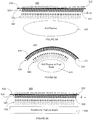
- the stacked layers 212 and 214 of type A and B materials, and the optional layer 216 of type C insulation material, of a converter tile or cell 200 are preferably tilted at a grazing (shallow) angle ⁇ to the direction of propagation of the incident high-energy photon v, which, for example, may be on the order of about 1/100 radian.
- Tilting the converter tile 200 also assures adequate cooling of the bombarded type A material and minimizes the thickness of each individual layer 212 of type A material (relative to the mean free path of electrons) as well as the aggregate effective thickness of all layers 212 of type A material in the entire converter assembly. Tilting the converter tile 200 at a grazing angle also causes the electrons to be ejected predominantly perpendicularly to the surface of the type A material. It also reduces the necessary number of repeated layers per tile 200 by a factor of approximately 1/ ⁇ , as the transmission distance in the type A material is enhanced by the same factor over the case where the orientation angle ⁇ of the surface of tile 200 is organized normal to the propagation direction of the incident high energy photon v. It also maximizes the escape of electrons into the adjacent layer of type B material.
- the converter tile 200 depicted in Figures 4A and 4B comprises a plurality of cylindrical converter elements 110 (shown in Figures 2A and 2B ) stacked side by side and tilted at a grazing angle ⁇ .
- the height H of the device needs to extend to orders of length of about one centimeter (1 cm) in the general direction of the predominant photon propagation. This is due to the desire to intercept the entire photon flux with type A material with sufficient aggregate thickness in the photon propagation direction.
- each layer of type B material is typically much greater than the thickness of each layer of type A material (l 1 ⁇ l 2 )
- the total height H of the complete stack of building blocks projected onto the direction of the photon flux needs to be much greater than the mean free path of the particular photons in the type A material to insure that high energy photons encounter type A material over an aggregate distance greater than their mean free path in such material.
- the height of the complete stack of building blocks therefore, should exceed the mean free path of photons in the type A material by a factor of at least l 2 / l 1 or, in the case of inclusion of the insulating layer, by a factor of at least (l 3 + l 2 )/ l 1 .
- the overall arrangement also provides effective cooling of the converter materials as they are heated by photon absorption as well as subsequent electron heating.
- the cooling is facilitated because the total surface area in the present embodiment, as depicted in Figure 4A , is enlarged compared to a simple arrangement of layering the stacks at an orientation angle ⁇ perpendicular to the direction of the incident photon flux by a factor of 1/ ⁇ .
- An assembly 220 of the converter tiles 200 can be arranged along a conforming surface 230 that intercepts and is substantially perpendicular to the photon flux 242 emitted from a given photon flux source 240.
- This configuration provides flexibility and adaptability to a wide spectrum of applications that might require (or benefit from) energy generation from the emitted photon flux.
- Figure 6A shows a plasma containment system 300 that includes a cylindrical chamber 330 having a surface 334 that intercepts and is substantially perpendicular to a photon flux 342 emitted from a source 340 of photon flux shown as hot plasma.
- the containment system 300 further comprises a magnetic field generator 332 positioned along the cylindrical chamber 330 and an array 332 of converter tiles 200 affixed along the surface 334 of the chamber 330. Each of the tiles is oriented at a grazing angle to the direction of propagation of the incident high-energy photons v of the photon flux 342.
- Figure 6B shows a containment system 400 that includes a cylindrical container 430 having a surface 434 that intercepts and is substantially perpendicular to a photon flux 442 emitted from a source 440 of photon flux shown as hot plasma or expend fission fuel rods.
- the containment system 400 further comprises an array 432 of converter tiles 200 affixed about the surface 434 of the container 430. Each of the tiles is oriented at a grazing angle to the direction of propagation of the incident high-energy photons v of the photon flux 442.
- Figure 6C shows a particle acceleration system 500 that includes a cylindrical tube 530 having a surface 534 that intercepts and is substantially perpendicular to a photon flux 542 emitted from a source 540 of photon flux shown as an accelerated particle beam.
- the accelerator system 500 further comprises a magnetic field generator 532 positioned along the cylindrical tube 530 and an array 532 of converter tiles 200 affixed along the surface 534 of the tube 530. Each of the tiles is oriented at a grazing angle to the direction of propagation of the incident high-energy photons v of the photon flux 542.
- the emitted high energy photons encounter type A material over an aggregate distance greater than their mean free path in such material A. This assures their proper absorption by atoms within the type A layers and ultimately amplified conversion of photon current to electron current.
- the type A material densely covers all high energy photon flux exposed surface areas, while at the same time allowing for cooling and electrical connections.
- multiple electrons are emitted from a particular atom in the type A material due to absorption of high-energy photons. This is because an electron that is knocked out from a particular deep electronic inner shell state creates a vacancy, which is quickly filled by the Auger process, which in turn triggers secondary and tertiary Auger processes, or a cascade of processes.
- secondary photon re-emission can trigger further such processes in neighboring atoms. Accordingly, one photon can in principle trigger the aggregate emission of some 100 electrons (and sometimes more). Therefore, this multiple ionization provides double benefits.
- the voltage generated is manageable relative to break down concerns. This provides enhanced conversion of photon energy to electricity (its charge and current), while it also minimizes heating of the target.
- the system serves as an efficacious coolant means by removing most of the deposited photon energy (via electric energy) from the material that sits next to the photon source and readily transports the converted energy away to remote sites not in the vicinity of the radiation.
Landscapes
- High Energy & Nuclear Physics (AREA)
- Physics & Mathematics (AREA)
- Engineering & Computer Science (AREA)
- General Engineering & Computer Science (AREA)
- Life Sciences & Earth Sciences (AREA)
- Spectroscopy & Molecular Physics (AREA)
- General Physics & Mathematics (AREA)
- Molecular Biology (AREA)
- Health & Medical Sciences (AREA)
- Particle Accelerators (AREA)
- Sustainable Development (AREA)
- Sustainable Energy (AREA)
- Optical Modulation, Optical Deflection, Nonlinear Optics, Optical Demodulation, Optical Logic Elements (AREA)
- X-Ray Techniques (AREA)
- Surface Treatment Of Glass (AREA)
- Luminescent Compositions (AREA)
- Analysing Materials By The Use Of Radiation (AREA)
- Physical Or Chemical Processes And Apparatus (AREA)
Applications Claiming Priority (2)
| Application Number | Priority Date | Filing Date | Title |
|---|---|---|---|
| US29328210P | 2010-01-08 | 2010-01-08 | |
| PCT/US2011/020001 WO2011084903A1 (en) | 2010-01-08 | 2011-01-01 | Conversion of high-energy photons into electricity |
Publications (3)
| Publication Number | Publication Date |
|---|---|
| EP2522033A1 EP2522033A1 (en) | 2012-11-14 |
| EP2522033A4 EP2522033A4 (en) | 2016-04-20 |
| EP2522033B1 true EP2522033B1 (en) | 2018-11-14 |
Family
ID=44305761
Family Applications (1)
| Application Number | Title | Priority Date | Filing Date |
|---|---|---|---|
| EP11732017.6A Active EP2522033B1 (en) | 2010-01-08 | 2011-01-01 | Conversion of high-energy photons into electricity |
Country Status (20)
| Country | Link |
|---|---|
| US (3) | US9324897B2 (enExample) |
| EP (1) | EP2522033B1 (enExample) |
| JP (3) | JP6097563B2 (enExample) |
| KR (1) | KR101962974B1 (enExample) |
| CN (2) | CN107123692B (enExample) |
| AR (1) | AR079858A1 (enExample) |
| AU (2) | AU2010339631B2 (enExample) |
| BR (1) | BR112012016873B1 (enExample) |
| CA (1) | CA2786590C (enExample) |
| EA (1) | EA025124B1 (enExample) |
| ES (1) | ES2705690T3 (enExample) |
| IL (2) | IL220819A (enExample) |
| MX (1) | MX2012007991A (enExample) |
| NZ (1) | NZ601448A (enExample) |
| PH (1) | PH12012501379A1 (enExample) |
| SG (1) | SG182383A1 (enExample) |
| TW (2) | TWI552362B (enExample) |
| UA (1) | UA111585C2 (enExample) |
| WO (1) | WO2011084903A1 (enExample) |
| ZA (1) | ZA201205568B (enExample) |
Families Citing this family (28)
| Publication number | Priority date | Publication date | Assignee | Title |
|---|---|---|---|---|
| CN102301832B (zh) | 2009-02-04 | 2014-07-23 | 全面熔合有限公司 | 用于压缩等离子体的系统和方法 |
| AU2010237049B2 (en) | 2009-04-16 | 2015-12-03 | Eric H. Silver | Monochromatic x-ray methods and apparatus |
| BR112012002147B1 (pt) | 2009-07-29 | 2020-12-22 | General Fusion, Inc | sistemas e métodos para compressão de plasma com reciclagem de projéteis |
| SG182383A1 (en) | 2010-01-08 | 2012-08-30 | Tri Alpha Energy Inc | Conversion of high-energy photons into electricity |
| CN104604338B (zh) | 2012-08-29 | 2017-06-13 | 全面熔合有限公司 | 用于加速和压缩等离子体的设备和系统 |
| SG10202008475UA (en) * | 2014-03-03 | 2020-09-29 | Brilliant Light Power Inc | Photovoltaic power generation systems and methods regarding same |
| WO2015200551A1 (en) | 2014-06-24 | 2015-12-30 | Silver Eric H | Methods and apparatus for determining information regarding chemical composition using x-ray radiation |
| WO2015200494A1 (en) | 2014-06-25 | 2015-12-30 | Mayo Foundation For Medical Education And Research | System and method for quantitative muscle ultrasound for diagnosis of neuromuscular disease |
| JP6429996B2 (ja) | 2014-08-19 | 2018-11-28 | ジェネラル フュージョン インコーポレイテッド | プラズマ磁場を制御するためのシステム及び方法 |
| US10269463B2 (en) * | 2015-02-03 | 2019-04-23 | The United States Of America As Represented By The Administrator Of Nasa | Nuclear thermionic avalanche cells with thermoelectric (NTAC-TE) generator in tandem mode |
| WO2022187176A1 (en) * | 2021-03-01 | 2022-09-09 | Tae Technologies, Inc. | Carbon negative reactors |
| US11063198B2 (en) | 2016-04-05 | 2021-07-13 | United States Of America As Represented By The Administrator Of Nasa | Metallic junction thermoelectric generator |
| CN111225613B (zh) | 2017-05-19 | 2024-08-02 | 想像科学有限公司 | 单色x射线成像系统及方法 |
| CN107783170A (zh) * | 2017-09-28 | 2018-03-09 | 摩瑞尔电器(昆山)有限公司 | 采用复合结构壳体的伽马射线检测设备 |
| US10811144B2 (en) | 2017-11-06 | 2020-10-20 | General Fusion Inc. | System and method for plasma generation and compression |
| US10886452B2 (en) | 2018-01-25 | 2021-01-05 | United States Of America As Represented By The Administrator Of Nasa | Selective and direct deposition technique for streamlined CMOS processing |
| EP3749203A4 (en) * | 2018-02-09 | 2021-11-03 | Imagine Scientific, Inc. | MONOCHROMATIC X-RAY IMAGING SYSTEMS AND METHODS |
| US10818467B2 (en) * | 2018-02-09 | 2020-10-27 | Imagine Scientific, Inc. | Monochromatic x-ray imaging systems and methods |
| US11037687B2 (en) | 2018-03-13 | 2021-06-15 | United States Of America As Represented By The Administrator Of Nasa | Co-60 breeding reactor tandem with thermionic avalanche cell |
| US11004666B2 (en) | 2018-03-15 | 2021-05-11 | United States Of America As Represented By The Administrator Of Nasa | Portable miniaturized thermionic power cell with multiple regenerative layers |
| US10985676B2 (en) | 2018-03-15 | 2021-04-20 | United States Of America As Represented By The Administrator Of Nasa | High performance electric generators boosted by nuclear electron avalanche (NEA) |
| US11257604B2 (en) | 2018-05-30 | 2022-02-22 | United States Of America As Represented By The Administrator Of Nasa | Multi-layered radio-isotope for enhanced photoelectron avalanche process |
| KR102091228B1 (ko) * | 2018-06-05 | 2020-03-19 | 서울방사선서비스주식회사 | 외부 피폭 선량계를 위한 대면적/연속식 품질 관리 시스템 및 방법 |
| WO2020056281A1 (en) | 2018-09-14 | 2020-03-19 | Imagine Scientific, Inc. | Monochromatic x-ray component systems and methods |
| US11581104B2 (en) | 2019-05-21 | 2023-02-14 | United States Of America As Represented By The Administrator Of Nasa | Multi-layer structure of nuclear thermionic avalanche cells |
| US20220108814A1 (en) * | 2020-10-01 | 2022-04-07 | Robert W Moses | Surface Flashover and Material Texturing for Multiplying and Collecting Electrons for Nuclear Thermal Avalanche Cells and Nuclear Battery Devices |
| US12310143B2 (en) | 2021-03-22 | 2025-05-20 | Yttrium SAIYAN | Methods, systems, and apparatuses for producing, generating and utilizing power and energy |
| US20220302331A1 (en) * | 2021-03-22 | 2022-09-22 | Matthew Ryan Hankla | Methods, systems, and apparatuses for producing, generating and utilizing power and energy |
Citations (1)
| Publication number | Priority date | Publication date | Assignee | Title |
|---|---|---|---|---|
| JPS63182870A (ja) * | 1987-01-26 | 1988-07-28 | Nippon Mining Co Ltd | 積層型CdTe放射線検出素子 |
Family Cites Families (31)
| Publication number | Priority date | Publication date | Assignee | Title |
|---|---|---|---|---|
| US739987A (en) * | 1898-11-11 | 1903-09-29 | American Tobacco Co | Delivery mechanism for cigarette-machines. |
| US2847585A (en) * | 1952-10-31 | 1958-08-12 | Rca Corp | Radiation responsive voltage sources |
| GB761404A (en) * | 1953-06-30 | 1956-11-14 | Rca Corp | Improved methods of and means for converting the energy of nuclear radiations into useful electrical energy |
| US3284241A (en) | 1962-02-13 | 1966-11-08 | Philco Corp | Photo-emissive device including emitter and insulator of less than mean free path dimensions |
| BE716262A (enExample) | 1967-07-25 | 1968-11-04 | ||
| US3591860A (en) * | 1968-07-22 | 1971-07-06 | Henry T Sampson | Gamma-electric cell |
| US3821556A (en) * | 1972-02-15 | 1974-06-28 | Nasa | Three mirror glancing incidence system for x ray telescope |
| CH539928A (de) * | 1972-05-26 | 1973-07-31 | Biviator Sa | Nuklearbatterie |
| US4178524A (en) * | 1976-09-01 | 1979-12-11 | Ritter James C | Radioisotope photoelectric generator |
| JPH065291B2 (ja) | 1986-07-02 | 1994-01-19 | 株式会社日立製作所 | 放射線検出器 |
| US4873555A (en) * | 1987-06-08 | 1989-10-10 | University Of Pittsburgh Of The Commonwealth System Of Higher Education | Intraband quantum well photodetector and associated method |
| US5111099A (en) * | 1990-03-02 | 1992-05-05 | Genesis Energy Systems, Inc. | Apparatus and method for converting radioactive energy into electrical energy |
| JP3126158B2 (ja) | 1991-04-10 | 2001-01-22 | 日本放送協会 | 薄膜冷陰極 |
| GB9415584D0 (en) | 1994-08-02 | 1994-09-21 | Imperial College | Photo detector |
| SK18512000A3 (sk) | 1998-06-11 | 2003-01-09 | Petr Viscor | Planárny elektrónový emitor (PEE) |
| FR2792418B1 (fr) * | 1999-04-15 | 2001-06-01 | Commissariat Energie Atomique | Detecteur bidimensionnel de rayonnements ionisants et procede de fabrication de ce detecteur |
| SE514471C2 (sv) | 1999-04-30 | 2001-02-26 | Xcounter Ab | Röntgendetektorenhet med omvandlare av fast typ |
| DE60039545D1 (de) * | 2000-10-20 | 2008-08-28 | Josuke Nakata | Lichtemittierdende oder lichtempfindliche Halbleiteranordnung und ihre Herstellungsmethode |
| US6774300B2 (en) * | 2001-04-27 | 2004-08-10 | Adrena, Inc. | Apparatus and method for photovoltaic energy production based on internal charge emission in a solid-state heterostructure |
| CA2450229C (en) | 2001-06-18 | 2008-09-16 | Wisconsin Alumni Research Foundation | Radiation detector with converters |
| US7485799B2 (en) | 2002-05-07 | 2009-02-03 | John Michael Guerra | Stress-induced bandgap-shifted semiconductor photoelectrolytic/photocatalytic/photovoltaic surface and method for making same |
| JP3837528B2 (ja) * | 2002-12-13 | 2006-10-25 | 国立大学法人名古屋大学 | 発電方法及び電池 |
| JP3861154B2 (ja) | 2003-09-04 | 2006-12-20 | 国立大学法人名古屋大学 | 発電方法及び電池 |
| CN101042945A (zh) * | 2006-07-20 | 2007-09-26 | 永州市健民射线防护设备有限公司 | 一种环保型防辐射复合板 |
| TW200812096A (en) * | 2006-08-25 | 2008-03-01 | Kinik Co | Amorphous diamond energy converter |
| CN100501924C (zh) * | 2006-12-19 | 2009-06-17 | 华东师范大学 | 一种辐射能量转换芯片的制作方法 |
| CN101627479B (zh) * | 2007-01-30 | 2011-06-15 | 索拉斯特公司 | 光电池及其制造方法 |
| WO2008144414A1 (en) * | 2007-05-15 | 2008-11-27 | Aeroflex Colorado Springs Inc. | Energy sensitive direct conversion radiation detector |
| WO2009036308A1 (en) | 2007-09-12 | 2009-03-19 | Sub-One Technology | Hybrid photovoltaically active layer and method for forming such a layer |
| FI121828B (fi) | 2007-12-04 | 2011-04-29 | Finphys Oy | Säteilynilmaisin, menetelmä säteilynilmaisimen valmistamiseksi ja ilmaisimen käyttö säteilyn mittaamiseen |
| SG182383A1 (en) | 2010-01-08 | 2012-08-30 | Tri Alpha Energy Inc | Conversion of high-energy photons into electricity |
-
2011
- 2011-01-01 SG SG2012049854A patent/SG182383A1/en unknown
- 2011-01-01 CA CA2786590A patent/CA2786590C/en active Active
- 2011-01-01 EP EP11732017.6A patent/EP2522033B1/en active Active
- 2011-01-01 MX MX2012007991A patent/MX2012007991A/es active IP Right Grant
- 2011-01-01 AU AU2010339631A patent/AU2010339631B2/en not_active Ceased
- 2011-01-01 BR BR112012016873-8A patent/BR112012016873B1/pt not_active IP Right Cessation
- 2011-01-01 EA EA201290620A patent/EA025124B1/ru unknown
- 2011-01-01 ES ES11732017T patent/ES2705690T3/es active Active
- 2011-01-01 WO PCT/US2011/020001 patent/WO2011084903A1/en not_active Ceased
- 2011-01-01 UA UAA201209620A patent/UA111585C2/uk unknown
- 2011-01-01 KR KR1020127020707A patent/KR101962974B1/ko active Active
- 2011-01-01 JP JP2012548054A patent/JP6097563B2/ja not_active Expired - Fee Related
- 2011-01-01 US US13/521,220 patent/US9324897B2/en active Active
- 2011-01-01 NZ NZ601448A patent/NZ601448A/en not_active IP Right Cessation
- 2011-01-01 CN CN201610882742.0A patent/CN107123692B/zh active Active
- 2011-01-01 PH PH1/2012/501379A patent/PH12012501379A1/en unknown
- 2011-01-01 CN CN201180012910.6A patent/CN102859706B/zh active Active
- 2011-01-07 TW TW103137578A patent/TWI552362B/zh active
- 2011-01-07 AR ARP110100050 patent/AR079858A1/es active IP Right Grant
- 2011-01-07 TW TW100100596A patent/TWI463681B/zh not_active IP Right Cessation
-
2012
- 2012-07-08 IL IL220819A patent/IL220819A/en active IP Right Grant
- 2012-07-24 ZA ZA2012/05568A patent/ZA201205568B/en unknown
-
2016
- 2016-02-19 AU AU2016201030A patent/AU2016201030B2/en not_active Ceased
- 2016-03-31 US US15/087,283 patent/US9570644B2/en not_active Expired - Fee Related
- 2016-05-24 JP JP2016103082A patent/JP6327722B2/ja active Active
- 2016-12-28 US US15/392,769 patent/US9893226B2/en active Active
-
2017
- 2017-01-11 IL IL250054A patent/IL250054B/en active IP Right Grant
- 2017-10-23 JP JP2017204520A patent/JP2018028552A/ja not_active Withdrawn
Patent Citations (1)
| Publication number | Priority date | Publication date | Assignee | Title |
|---|---|---|---|---|
| JPS63182870A (ja) * | 1987-01-26 | 1988-07-28 | Nippon Mining Co Ltd | 積層型CdTe放射線検出素子 |
Also Published As
Similar Documents
| Publication | Publication Date | Title |
|---|---|---|
| EP2522033B1 (en) | Conversion of high-energy photons into electricity | |
| JP2013516624A5 (enExample) | ||
| US20130015363A1 (en) | Detector, method for manufacturing a detector and imaging apparatus | |
| US4178524A (en) | Radioisotope photoelectric generator | |
| US20130154438A1 (en) | Power-Scalable Betavoltaic Battery | |
| JP5906088B2 (ja) | 電離放射線により励起される発電機 | |
| US5861701A (en) | Charged-particle powered battery | |
| US20040163942A1 (en) | Method for generating electric power and electric battery | |
| HK1180107B (en) | Conversion of high-energy photons into electricity | |
| HK1180107A (en) | Conversion of high-energy photons into electricity | |
| Ronen et al. | Conceptual design of Americium nuclear battery for space power applications | |
| Moir | Review of direct energy conversion of ion beams: experimental results and reactor applications | |
| Popa-Samil | Meta-material based nuclear structure applications in beamed thrust and space energy harvesting | |
| Micelli | 3D sensors for the Insertable B-Layer of the ATLAS experiment at the CERN LHC | |
| Klose et al. | X-Ray Multi Camera Tomography System of Wendelstein 7-X |
Legal Events
| Date | Code | Title | Description |
|---|---|---|---|
| PUAI | Public reference made under article 153(3) epc to a published international application that has entered the european phase |
Free format text: ORIGINAL CODE: 0009012 |
|
| 17P | Request for examination filed |
Effective date: 20120724 |
|
| AK | Designated contracting states |
Kind code of ref document: A1 Designated state(s): AL AT BE BG CH CY CZ DE DK EE ES FI FR GB GR HR HU IE IS IT LI LT LU LV MC MK MT NL NO PL PT RO RS SE SI SK SM TR |
|
| DAX | Request for extension of the european patent (deleted) | ||
| RA4 | Supplementary search report drawn up and despatched (corrected) |
Effective date: 20160323 |
|
| RIC1 | Information provided on ipc code assigned before grant |
Ipc: H01L 31/00 20060101AFI20160317BHEP Ipc: H01L 31/0352 20060101ALI20160317BHEP Ipc: H01L 31/0725 20120101ALI20160317BHEP Ipc: G21H 1/06 20060101ALI20160317BHEP Ipc: G01T 1/28 20060101ALI20160317BHEP Ipc: G21H 1/04 20060101ALI20160317BHEP Ipc: H01L 31/115 20060101ALI20160317BHEP |
|
| STAA | Information on the status of an ep patent application or granted ep patent |
Free format text: STATUS: EXAMINATION IS IN PROGRESS |
|
| 17Q | First examination report despatched |
Effective date: 20170504 |
|
| RAP1 | Party data changed (applicant data changed or rights of an application transferred) |
Owner name: TAE TECHNOLOGIES, INC. |
|
| GRAP | Despatch of communication of intention to grant a patent |
Free format text: ORIGINAL CODE: EPIDOSNIGR1 |
|
| STAA | Information on the status of an ep patent application or granted ep patent |
Free format text: STATUS: GRANT OF PATENT IS INTENDED |
|
| INTG | Intention to grant announced |
Effective date: 20180607 |
|
| GRAS | Grant fee paid |
Free format text: ORIGINAL CODE: EPIDOSNIGR3 |
|
| GRAA | (expected) grant |
Free format text: ORIGINAL CODE: 0009210 |
|
| STAA | Information on the status of an ep patent application or granted ep patent |
Free format text: STATUS: THE PATENT HAS BEEN GRANTED |
|
| AK | Designated contracting states |
Kind code of ref document: B1 Designated state(s): AL AT BE BG CH CY CZ DE DK EE ES FI FR GB GR HR HU IE IS IT LI LT LU LV MC MK MT NL NO PL PT RO RS SE SI SK SM TR |
|
| REG | Reference to a national code |
Ref country code: GB Ref legal event code: FG4D |
|
| REG | Reference to a national code |
Ref country code: CH Ref legal event code: EP Ref country code: AT Ref legal event code: REF Ref document number: 1065861 Country of ref document: AT Kind code of ref document: T Effective date: 20181115 |
|
| REG | Reference to a national code |
Ref country code: DE Ref legal event code: R096 Ref document number: 602011053862 Country of ref document: DE |
|
| REG | Reference to a national code |
Ref country code: IE Ref legal event code: FG4D |
|
| REG | Reference to a national code |
Ref country code: CH Ref legal event code: NV Representative=s name: IP PARTNERS J. WENGER, CH |
|
| REG | Reference to a national code |
Ref country code: NL Ref legal event code: FP |
|
| REG | Reference to a national code |
Ref country code: LT Ref legal event code: MG4D |
|
| REG | Reference to a national code |
Ref country code: ES Ref legal event code: FG2A Ref document number: 2705690 Country of ref document: ES Kind code of ref document: T3 Effective date: 20190326 |
|
| REG | Reference to a national code |
Ref country code: AT Ref legal event code: MK05 Ref document number: 1065861 Country of ref document: AT Kind code of ref document: T Effective date: 20181114 |
|
| PG25 | Lapsed in a contracting state [announced via postgrant information from national office to epo] |
Ref country code: LV Free format text: LAPSE BECAUSE OF FAILURE TO SUBMIT A TRANSLATION OF THE DESCRIPTION OR TO PAY THE FEE WITHIN THE PRESCRIBED TIME-LIMIT Effective date: 20181114 Ref country code: FI Free format text: LAPSE BECAUSE OF FAILURE TO SUBMIT A TRANSLATION OF THE DESCRIPTION OR TO PAY THE FEE WITHIN THE PRESCRIBED TIME-LIMIT Effective date: 20181114 Ref country code: HR Free format text: LAPSE BECAUSE OF FAILURE TO SUBMIT A TRANSLATION OF THE DESCRIPTION OR TO PAY THE FEE WITHIN THE PRESCRIBED TIME-LIMIT Effective date: 20181114 Ref country code: BG Free format text: LAPSE BECAUSE OF FAILURE TO SUBMIT A TRANSLATION OF THE DESCRIPTION OR TO PAY THE FEE WITHIN THE PRESCRIBED TIME-LIMIT Effective date: 20190214 Ref country code: AT Free format text: LAPSE BECAUSE OF FAILURE TO SUBMIT A TRANSLATION OF THE DESCRIPTION OR TO PAY THE FEE WITHIN THE PRESCRIBED TIME-LIMIT Effective date: 20181114 Ref country code: LT Free format text: LAPSE BECAUSE OF FAILURE TO SUBMIT A TRANSLATION OF THE DESCRIPTION OR TO PAY THE FEE WITHIN THE PRESCRIBED TIME-LIMIT Effective date: 20181114 Ref country code: NO Free format text: LAPSE BECAUSE OF FAILURE TO SUBMIT A TRANSLATION OF THE DESCRIPTION OR TO PAY THE FEE WITHIN THE PRESCRIBED TIME-LIMIT Effective date: 20190214 Ref country code: IS Free format text: LAPSE BECAUSE OF FAILURE TO SUBMIT A TRANSLATION OF THE DESCRIPTION OR TO PAY THE FEE WITHIN THE PRESCRIBED TIME-LIMIT Effective date: 20190314 |
|
| PG25 | Lapsed in a contracting state [announced via postgrant information from national office to epo] |
Ref country code: RS Free format text: LAPSE BECAUSE OF FAILURE TO SUBMIT A TRANSLATION OF THE DESCRIPTION OR TO PAY THE FEE WITHIN THE PRESCRIBED TIME-LIMIT Effective date: 20181114 Ref country code: GR Free format text: LAPSE BECAUSE OF FAILURE TO SUBMIT A TRANSLATION OF THE DESCRIPTION OR TO PAY THE FEE WITHIN THE PRESCRIBED TIME-LIMIT Effective date: 20190215 Ref country code: PT Free format text: LAPSE BECAUSE OF FAILURE TO SUBMIT A TRANSLATION OF THE DESCRIPTION OR TO PAY THE FEE WITHIN THE PRESCRIBED TIME-LIMIT Effective date: 20190314 Ref country code: AL Free format text: LAPSE BECAUSE OF FAILURE TO SUBMIT A TRANSLATION OF THE DESCRIPTION OR TO PAY THE FEE WITHIN THE PRESCRIBED TIME-LIMIT Effective date: 20181114 Ref country code: SE Free format text: LAPSE BECAUSE OF FAILURE TO SUBMIT A TRANSLATION OF THE DESCRIPTION OR TO PAY THE FEE WITHIN THE PRESCRIBED TIME-LIMIT Effective date: 20181114 |
|
| PG25 | Lapsed in a contracting state [announced via postgrant information from national office to epo] |
Ref country code: CZ Free format text: LAPSE BECAUSE OF FAILURE TO SUBMIT A TRANSLATION OF THE DESCRIPTION OR TO PAY THE FEE WITHIN THE PRESCRIBED TIME-LIMIT Effective date: 20181114 Ref country code: PL Free format text: LAPSE BECAUSE OF FAILURE TO SUBMIT A TRANSLATION OF THE DESCRIPTION OR TO PAY THE FEE WITHIN THE PRESCRIBED TIME-LIMIT Effective date: 20181114 Ref country code: DK Free format text: LAPSE BECAUSE OF FAILURE TO SUBMIT A TRANSLATION OF THE DESCRIPTION OR TO PAY THE FEE WITHIN THE PRESCRIBED TIME-LIMIT Effective date: 20181114 |
|
| REG | Reference to a national code |
Ref country code: DE Ref legal event code: R097 Ref document number: 602011053862 Country of ref document: DE |
|
| PG25 | Lapsed in a contracting state [announced via postgrant information from national office to epo] |
Ref country code: SK Free format text: LAPSE BECAUSE OF FAILURE TO SUBMIT A TRANSLATION OF THE DESCRIPTION OR TO PAY THE FEE WITHIN THE PRESCRIBED TIME-LIMIT Effective date: 20181114 Ref country code: EE Free format text: LAPSE BECAUSE OF FAILURE TO SUBMIT A TRANSLATION OF THE DESCRIPTION OR TO PAY THE FEE WITHIN THE PRESCRIBED TIME-LIMIT Effective date: 20181114 Ref country code: SM Free format text: LAPSE BECAUSE OF FAILURE TO SUBMIT A TRANSLATION OF THE DESCRIPTION OR TO PAY THE FEE WITHIN THE PRESCRIBED TIME-LIMIT Effective date: 20181114 Ref country code: MC Free format text: LAPSE BECAUSE OF FAILURE TO SUBMIT A TRANSLATION OF THE DESCRIPTION OR TO PAY THE FEE WITHIN THE PRESCRIBED TIME-LIMIT Effective date: 20181114 Ref country code: RO Free format text: LAPSE BECAUSE OF FAILURE TO SUBMIT A TRANSLATION OF THE DESCRIPTION OR TO PAY THE FEE WITHIN THE PRESCRIBED TIME-LIMIT Effective date: 20181114 |
|
| PLBE | No opposition filed within time limit |
Free format text: ORIGINAL CODE: 0009261 |
|
| STAA | Information on the status of an ep patent application or granted ep patent |
Free format text: STATUS: NO OPPOSITION FILED WITHIN TIME LIMIT |
|
| PG25 | Lapsed in a contracting state [announced via postgrant information from national office to epo] |
Ref country code: LU Free format text: LAPSE BECAUSE OF NON-PAYMENT OF DUE FEES Effective date: 20190101 |
|
| REG | Reference to a national code |
Ref country code: BE Ref legal event code: MM Effective date: 20190131 |
|
| 26N | No opposition filed |
Effective date: 20190815 |
|
| PG25 | Lapsed in a contracting state [announced via postgrant information from national office to epo] |
Ref country code: SI Free format text: LAPSE BECAUSE OF FAILURE TO SUBMIT A TRANSLATION OF THE DESCRIPTION OR TO PAY THE FEE WITHIN THE PRESCRIBED TIME-LIMIT Effective date: 20181114 |
|
| PG25 | Lapsed in a contracting state [announced via postgrant information from national office to epo] |
Ref country code: BE Free format text: LAPSE BECAUSE OF NON-PAYMENT OF DUE FEES Effective date: 20190131 |
|
| PG25 | Lapsed in a contracting state [announced via postgrant information from national office to epo] |
Ref country code: TR Free format text: LAPSE BECAUSE OF FAILURE TO SUBMIT A TRANSLATION OF THE DESCRIPTION OR TO PAY THE FEE WITHIN THE PRESCRIBED TIME-LIMIT Effective date: 20181114 |
|
| PG25 | Lapsed in a contracting state [announced via postgrant information from national office to epo] |
Ref country code: MT Free format text: LAPSE BECAUSE OF NON-PAYMENT OF DUE FEES Effective date: 20190101 |
|
| PG25 | Lapsed in a contracting state [announced via postgrant information from national office to epo] |
Ref country code: CY Free format text: LAPSE BECAUSE OF FAILURE TO SUBMIT A TRANSLATION OF THE DESCRIPTION OR TO PAY THE FEE WITHIN THE PRESCRIBED TIME-LIMIT Effective date: 20181114 |
|
| PG25 | Lapsed in a contracting state [announced via postgrant information from national office to epo] |
Ref country code: HU Free format text: LAPSE BECAUSE OF FAILURE TO SUBMIT A TRANSLATION OF THE DESCRIPTION OR TO PAY THE FEE WITHIN THE PRESCRIBED TIME-LIMIT; INVALID AB INITIO Effective date: 20110101 |
|
| PG25 | Lapsed in a contracting state [announced via postgrant information from national office to epo] |
Ref country code: MK Free format text: LAPSE BECAUSE OF FAILURE TO SUBMIT A TRANSLATION OF THE DESCRIPTION OR TO PAY THE FEE WITHIN THE PRESCRIBED TIME-LIMIT Effective date: 20181114 |
|
| P01 | Opt-out of the competence of the unified patent court (upc) registered |
Effective date: 20230519 |
|
| PGFP | Annual fee paid to national office [announced via postgrant information from national office to epo] |
Ref country code: NL Payment date: 20231123 Year of fee payment: 14 |
|
| PGFP | Annual fee paid to national office [announced via postgrant information from national office to epo] |
Ref country code: GB Payment date: 20231116 Year of fee payment: 14 |
|
| PGFP | Annual fee paid to national office [announced via postgrant information from national office to epo] |
Ref country code: IE Payment date: 20231123 Year of fee payment: 14 Ref country code: FR Payment date: 20231122 Year of fee payment: 14 |
|
| PGFP | Annual fee paid to national office [announced via postgrant information from national office to epo] |
Ref country code: ES Payment date: 20240208 Year of fee payment: 14 |
|
| PGFP | Annual fee paid to national office [announced via postgrant information from national office to epo] |
Ref country code: DE Payment date: 20231121 Year of fee payment: 14 Ref country code: CH Payment date: 20240201 Year of fee payment: 14 |
|
| PGFP | Annual fee paid to national office [announced via postgrant information from national office to epo] |
Ref country code: IT Payment date: 20231212 Year of fee payment: 14 |
|
| REG | Reference to a national code |
Ref country code: DE Ref legal event code: R079 Ref document number: 602011053862 Country of ref document: DE Free format text: PREVIOUS MAIN CLASS: H01L0031000000 Ipc: H10F0077000000 |
|
| REG | Reference to a national code |
Ref country code: DE Ref legal event code: R119 Ref document number: 602011053862 Country of ref document: DE |
|
| REG | Reference to a national code |
Ref country code: CH Ref legal event code: PL |
|
| REG | Reference to a national code |
Ref country code: NL Ref legal event code: MM Effective date: 20250201 |
|
| GBPC | Gb: european patent ceased through non-payment of renewal fee |
Effective date: 20250101 |
|
| PG25 | Lapsed in a contracting state [announced via postgrant information from national office to epo] |
Ref country code: DE Free format text: LAPSE BECAUSE OF NON-PAYMENT OF DUE FEES Effective date: 20250801 |
|
| PG25 | Lapsed in a contracting state [announced via postgrant information from national office to epo] |
Ref country code: NL Free format text: LAPSE BECAUSE OF NON-PAYMENT OF DUE FEES Effective date: 20250201 |
|
| PG25 | Lapsed in a contracting state [announced via postgrant information from national office to epo] |
Ref country code: GB Free format text: LAPSE BECAUSE OF NON-PAYMENT OF DUE FEES Effective date: 20250101 |
|
| PG25 | Lapsed in a contracting state [announced via postgrant information from national office to epo] |
Ref country code: FR Free format text: LAPSE BECAUSE OF NON-PAYMENT OF DUE FEES Effective date: 20250131 |
|
| PG25 | Lapsed in a contracting state [announced via postgrant information from national office to epo] |
Ref country code: CH Free format text: LAPSE BECAUSE OF NON-PAYMENT OF DUE FEES Effective date: 20250131 |