EP2485761B1 - Methods and compositions for increasing iduronate 2-sulfatase activity in the cns - Google Patents
Methods and compositions for increasing iduronate 2-sulfatase activity in the cns Download PDFInfo
- Publication number
- EP2485761B1 EP2485761B1 EP10822810.7A EP10822810A EP2485761B1 EP 2485761 B1 EP2485761 B1 EP 2485761B1 EP 10822810 A EP10822810 A EP 10822810A EP 2485761 B1 EP2485761 B1 EP 2485761B1
- Authority
- EP
- European Patent Office
- Prior art keywords
- ids
- amino acid
- antibody
- hir
- fusion
- Prior art date
- Legal status (The legal status is an assumption and is not a legal conclusion. Google has not performed a legal analysis and makes no representation as to the accuracy of the status listed.)
- Active
Links
Images








Classifications
-
- C—CHEMISTRY; METALLURGY
- C07—ORGANIC CHEMISTRY
- C07K—PEPTIDES
- C07K16/00—Immunoglobulins [IG], e.g. monoclonal or polyclonal antibodies
- C07K16/18—Immunoglobulins [IG], e.g. monoclonal or polyclonal antibodies against material from animals or humans
-
- A—HUMAN NECESSITIES
- A61—MEDICAL OR VETERINARY SCIENCE; HYGIENE
- A61P—SPECIFIC THERAPEUTIC ACTIVITY OF CHEMICAL COMPOUNDS OR MEDICINAL PREPARATIONS
- A61P25/00—Drugs for disorders of the nervous system
- A61P25/28—Drugs for disorders of the nervous system for treating neurodegenerative disorders of the central nervous system, e.g. nootropic agents, cognition enhancers, drugs for treating Alzheimer's disease or other forms of dementia
-
- C—CHEMISTRY; METALLURGY
- C07—ORGANIC CHEMISTRY
- C07K—PEPTIDES
- C07K16/00—Immunoglobulins [IG], e.g. monoclonal or polyclonal antibodies
- C07K16/18—Immunoglobulins [IG], e.g. monoclonal or polyclonal antibodies against material from animals or humans
- C07K16/28—Immunoglobulins [IG], e.g. monoclonal or polyclonal antibodies against material from animals or humans against receptors, cell surface antigens or cell surface determinants
- C07K16/2869—Immunoglobulins [IG], e.g. monoclonal or polyclonal antibodies against material from animals or humans against receptors, cell surface antigens or cell surface determinants against hormone receptors
-
- C—CHEMISTRY; METALLURGY
- C12—BIOCHEMISTRY; BEER; SPIRITS; WINE; VINEGAR; MICROBIOLOGY; ENZYMOLOGY; MUTATION OR GENETIC ENGINEERING
- C12N—MICROORGANISMS OR ENZYMES; COMPOSITIONS THEREOF; PROPAGATING, PRESERVING, OR MAINTAINING MICROORGANISMS; MUTATION OR GENETIC ENGINEERING; CULTURE MEDIA
- C12N9/00—Enzymes; Proenzymes; Compositions thereof; Processes for preparing, activating, inhibiting, separating or purifying enzymes
- C12N9/14—Hydrolases (3)
- C12N9/16—Hydrolases (3) acting on ester bonds (3.1)
-
- A—HUMAN NECESSITIES
- A61—MEDICAL OR VETERINARY SCIENCE; HYGIENE
- A61K—PREPARATIONS FOR MEDICAL, DENTAL OR TOILETRY PURPOSES
- A61K39/00—Medicinal preparations containing antigens or antibodies
- A61K2039/505—Medicinal preparations containing antigens or antibodies comprising antibodies
-
- A—HUMAN NECESSITIES
- A61—MEDICAL OR VETERINARY SCIENCE; HYGIENE
- A61K—PREPARATIONS FOR MEDICAL, DENTAL OR TOILETRY PURPOSES
- A61K38/00—Medicinal preparations containing peptides
-
- C—CHEMISTRY; METALLURGY
- C07—ORGANIC CHEMISTRY
- C07K—PEPTIDES
- C07K2317/00—Immunoglobulins specific features
- C07K2317/50—Immunoglobulins specific features characterized by immunoglobulin fragments
- C07K2317/56—Immunoglobulins specific features characterized by immunoglobulin fragments variable (Fv) region, i.e. VH and/or VL
- C07K2317/565—Complementarity determining region [CDR]
-
- C—CHEMISTRY; METALLURGY
- C07—ORGANIC CHEMISTRY
- C07K—PEPTIDES
- C07K2317/00—Immunoglobulins specific features
- C07K2317/90—Immunoglobulins specific features characterized by (pharmaco)kinetic aspects or by stability of the immunoglobulin
- C07K2317/92—Affinity (KD), association rate (Ka), dissociation rate (Kd) or EC50 value
-
- C—CHEMISTRY; METALLURGY
- C07—ORGANIC CHEMISTRY
- C07K—PEPTIDES
- C07K2319/00—Fusion polypeptide
- C07K2319/30—Non-immunoglobulin-derived peptide or protein having an immunoglobulin constant or Fc region, or a fragment thereof, attached thereto
-
- C—CHEMISTRY; METALLURGY
- C07—ORGANIC CHEMISTRY
- C07K—PEPTIDES
- C07K2319/00—Fusion polypeptide
- C07K2319/33—Fusion polypeptide fusions for targeting to specific cell types, e.g. tissue specific targeting, targeting of a bacterial subspecies
-
- C—CHEMISTRY; METALLURGY
- C12—BIOCHEMISTRY; BEER; SPIRITS; WINE; VINEGAR; MICROBIOLOGY; ENZYMOLOGY; MUTATION OR GENETIC ENGINEERING
- C12Y—ENZYMES
- C12Y301/00—Hydrolases acting on ester bonds (3.1)
- C12Y301/06—Sulfuric ester hydrolases (3.1.6)
- C12Y301/06013—Iduronate-2-sulfatase (3.1.6.13)
Definitions
- Type II mucopolysaccharidosis also known as Hunter's syndrome, is an inherited metabolic disease caused by a defect in the enzyme iduronate 2-sulfatase (IDS), which functions to degrade mucopolysaccharides.
- IDS iduronate 2-sulfatase
- An insufficient level of IDS causes a pathological buildup of heparan sulfate and dermatan sulfate in, e.g., the heart, liver, and central nervous system (CNS). Symptoms including neurodegeneration and mental retardation appear during childhood; and early death can occur due to organ damage in the brain.
- treatment includes intravenous enzyme replacement therapy with recombinant IDS.
- compositions containing an IDS covalently linked to a structure e.g., immunoglobulin, antibody
- a structure e.g., immunoglobulin, antibody
- BBB blood brain barrier
- the IDS retains at least about 10, 20, 30, 40, 50, 60, 70, 80, 90, 95, 99, or 100% of its activity, compared to its activity as a separate entity.
- the IDS retains at least about 10% of its activity compared to its activity as a separate entity.
- the IDS retains at least 20% of its activity, compared to its activity as a separate entity.
- the IDS retains at least 30% of its activity, compared to its activity as a separate entity.
- the invention provides the claimed fusion antibody for use in a method for treating an IDS deficiency in the central nervous system of a subject in need thereof, comprising systemically administering to the subject a therapeutically effective dose of a fusion antibody having IDS activity.
- the therapeutically effective dose of the fusion antibody comprises at least about 2.5 x 10 6 units of IDS activity or at least about 50,000 units/Kg of body weight.
- the IDS specific activity of the fusion antibody is at least 30,000 units/mg.
- systemic administration is parenteral, intravenous, subcutaneous, intra-muscular, trans-nasal, intra-arterial, transdermal, or respiratory.
- At least about 25,000, 30,000, 35,000, 40,000, 45,000, 50,000, 60,000, 70,000, 80,000, 90,000, 110,000, 120,000, 130,000, 140,000, 150,000, 160,000, 170,000, 180,000, 190,000, 200,000, 210,000, 220,000, 230,000, 250,000 units of iduronate-2-sulfatase activity is delivered to the brain, normalized per 50 kg body weight. In some disclosures, at least about 25,000 units of iduronate-2-sulfatase activity is delivered to the brain, normalized per 50 kg body weight.
- the immunoglobulin light chain of the fusion antibody comprises a CDR1 corresponding to the amino acid sequence of SEQ ID NO:4, a CDR2 corresponding to the amino acid sequence of SEQ ID NO:5, or a CDR3 corresponding to the amino acid sequence of SEQ ID NO:6.
- the immunoglobulin heavy chain of the fusion antibody is at least 90% identical to SEQ ID NO:7 and the amino acid sequence of the light chain immunoglobulin is at least 90% identical to SEQ ID NO:8.
- the immunoglobulin heavy chain of the fusion antibody comprises SEQ ID NO:7 and the amino acid sequence of the light chain immunoglobulin comprises SEQ ID NO:8
- amino acid sequence of the immunoglobulin heavy chain of the fusion antibody comprises SEQ ID NO:8
- amino acid sequence of the immunoglobulin light chain comprises SEQ ID NO:8
- amino acid sequence of the IDS comprises SEQ ID NO:9.
- compositions comprising a therapeutically effective amount of a fusion antibody and a pharmaceutically acceptable excipient.
- isolated polynucleotides encoding a fusion antibody.
- the isolated polynucleotide comprises the nucleic acid sequence of SEQ ID NO:14.
- host cells comprising the vectors comprising the isolated polynucleotides encoding a fusion antibody.
- the host cell is a Chinese Hamster Ovary (CHO).
- the blood brain barrier is a severe impediment to the delivery of systemically administered IDS (e.g., recombinant IDS) to the central nervous system.
- IDS systemically administered IDS
- the present disclosure provides methods and compositions for delivering therapeutically significant levels of IDS activity across the BBB to the CNS.
- the IDS is modified to allow it to cross the BBB.
- the amount and rate of uptake of systemically administered modified IDS into the CNS is provided.
- the IDS retains a certain activity after being modified or after crossing the BBB.
- the present disclosure provides, inter alia : (1) IDS fusion antibodies comprising an IDS fused, with or without intervening sequence, to an immunoglobulin (heavy chain or light chain) capable of crossing the BBB, and related methods and compositions. (2) human insulin receptor (HIR) antibody (Ab)-IDS fusion antibodies comprising an IDS fused, with or without intervening sequence, to an immunoglobulin (heavy chain or light chain) directed against the extracellular domain of a human insulin receptor, and related methods and compositiosn; (3) methods of treating an IDS deficiency; and (4) methods of establishing therapeutically effective systemic doses of the fusion antibodies based on a characterization of their uptake in the CNS and their specific activity.
- a prophylactic benefit of treatment includes prevention of a condition, retarding the progress of a condition (e.g., slowing the progression of a lysosomal storage disorder), or decreasing the likelihood of occurrence of a condition.
- “treating” or “treatment” includes prophylaxis.
- an “effective amount” of a composition of the invention is an amount that is sufficient to palliate, ameliorate, stabilize, reverse or slow the progression of a disorder, e.g., a neurological disorder.
- An “effective amount” may be of any of the compositions of the invention used alone or in conjunction with one or more agents used to treat a disease or disorder.
- An “effective amount” of a therapeutic agent within the meaning of the present invention is determined by a patient's attending physician or veterinarian. Such amounts are readily ascertained by one of ordinary skill in the art and will a therapeutic effect when administered in accordance with the present disclosure.
- a “subject” or an “individual,” as used herein, is an animal, for example, a mammal. In some disclosures a “subject” or an “individual” is a human. In some disclosures, the subject suffers from Mucopolysaccharidosis Type II ("Hunter's Syndrome").
- a pharmacological composition comprising an IDS fusion antibody (e.g., HIR Ab-IDS ) fusion antibody is "administered peripherally" or “peripherally administered.”
- IDS fusion antibody e.g., HIR Ab-IDS
- these terms refer to any form of administration of an agent, e.g., a therapeutic agent, to an individual that is not direct administration to the CNS, i.e., that brings the agent in contact with the non-brain side of the blood-brain barrier.
- Peripheral administration includes intravenous, intra-arterial, subcutaneous, intramuscular, intraperitoneal, transdermal, by inhalation, transbuccal, intranasal, rectal, oral, parenteral, sublingual, or trans-nasal.
- a “pharmaceutically acceptable carrier” or “pharmaceutically acceptable excipient” herein refers to any carrier that does not itself induce the production of antibodies harmful to the individual receiving the composition. Such carriers are well known to those of ordinary skill in the art. A thorough discussion of pharmaceutically acceptable carriers/excipients can be found in Remington's Pharmaceutical Sciences, Gennaro, AR, ed., 20th edition, 2000: Williams and Wilkins PA, USA ..
- Exemplary pharmaceutically acceptable carriers can include salts, for example, mineral acid salts such as hydrochlorides, hydrobromides, phosphates, sulfates, and the like; and the salts of organic acids such as acetates, propionates, malonates, benzoates, and the like.
- a “recombinant host cell” or “host cell” refers to a cell that includes an exogenous polynucleotide, regardless of the method used for insertion, for example, direct uptake, transduction, f-mating, or other methods known in the art to create recombinant host cells.
- the exogenous polynucleotide may be maintained as a nonintegrated vector, for example, a plasmid, or alternatively, may be integrated into the host genome.
- polypeptide peptide
- protein protein
- polypeptide polymer of amino acid residues. That is, a description directed to a polypeptide applies equally to a description of a peptide and a description of a protein, and vice versa.
- the terms apply to naturally occurring amino acid polymers as well as amino acid polymers in which one or more amino acid residues is a non-naturally occurring amino acid, e.g., an amino acid analog.
- the terms encompass amino acid chains of any length, including full length proteins ( i . e ., antigens), wherein the amino acid residues are linked by covalent peptide bonds.
- amino acid refers to naturally occurring and non-naturally occurring amino acids, as well as amino acid analogs and amino acid mimetics that function in a manner similar to the naturally occurring amino acids.
- Naturally encoded amino acids are the 20 common amino acids (alanine, arginine, asparagine, aspartic acid, cysteine, glutamine, glutamic acid, glycine, histidine, isoleucine, leucine, lysine, methionine, phenylalanine, proline, serine, threonine, tryptophan, tyrosine, and valine) and pyrolysine and selenocysteine.
- nucleic acid refers to deoxyribonucleotides, deoxyribonucleosides, ribonucleosides, or ribonucleotides and polymers thereof in either single- or double-stranded form. Unless specifically limited, the term encompasses nucleic acids containing known analogues of natural nucleotides which have similar binding properties as the reference nucleic acid and are metabolized in a manner similar to naturally occurring nucleotides. Unless specifically limited otherwise, the term also refers to oligonucleotide analogs including PNA (peptidonucleic acid), analogs of DNA used in antisense technology (phosphorothioates, phosphoroamidates, and the like).
- PNA peptidonucleic acid
- analogs of DNA used in antisense technology phosphorothioates, phosphoroamidates, and the like.
- nucleic acid sequence also implicitly encompasses conservatively modified variants thereof (including but not limited to, degenerate codon substitutions) and complementary sequences as well as the sequence explicitly indicated.
- degenerate codon substitutions may be achieved by generating sequences in which the third position of one or more selected (or all) codons is substituted with mixed-base and/or deoxyinosine residues ( Batzer et al., Nucleic Acid Res. 19:5081 (1991 ); Ohtsuka et al., J. Biol. Chem. 260:2605-2608 (1985 ); and Cassol et al. (1992); Rossolini et al., Mol. Cell. Probes 8:91-98 (1994 )).
- the invention provides compositions and methods that utilize an IDS fusion antibody (e.g., HIR Ab-IDS) capable of crossing the blood brain barrier (BBB).
- IDS fusion antibody e.g., HIR Ab-IDS
- BBB blood brain barrier
- the compositions and methods are useful in transporting IDS from the peripheral blood and across the blood brain barrier into the CNS.
- the "blood-brain barrier” refers to the barrier between the peripheral circulation and the brain and spinal cord which is formed by tight junctions within the brain capillary endothelial plasma membranes and creates an extremely tight barrier that restricts the transport of molecules into the brain; the BBB is so tight that it is capable of restricting even molecules as small as urea, molecular weight of 60 Da.
- the blood-brain barrier within the brain, the blood-spinal cord barrier within the spinal cord, and the blood-retinal barrier within the retina, are contiguous capillary barriers within the central nervous system (CNS), and are collectively referred to as the blood-brain barrier or BBB.
- CNS central nervous system
- MTH molecular Trojan horses
- a MTH is an exogenous peptide or peptidomimetic moiety (e.g., a MAb) capable of binding to an endogenous BBB receptor mediated transport system that traverses the BBB on the endogenous BBB receptor-mediated transport system.
- the MTH can be an antibody to a receptor of the transport system, e.g., the insulin receptor.
- the method comprises a method of transporting IDS across the BBB, by using a fusion antibody comprising IDS fused to an antibody capable of selectively binding to the ECD of the insulin receptor.
- Insulin receptors expressed on the BBB can thereby serve as a vector for transport of the IDS across the BBB.
- Certain ECD-specific antibodies may mimic the endogenous ligand and thereby traverse a plasma membrane barrier via transport on the specific receptor system.
- Such insulin receptor antibodies act as molecular "Trojan horses," or "TH" as depicted schematically in Fig. 7 .
- IDS normally does not cross the blood-brain barrier (BBB).
- BBB blood-brain barrier
- the enzyme is able to cross the BBB, and the brain cell membrane, by trafficking on the IR, which is expressed at both membranes in the brain.
- “Native antibodies” and “native immunoglobulins” are usually heterotetrameric glycoproteins of about 150,000 daltons, composed of two identical light (L) chains and two identical heavy (H) chains. Each light chain is typically linked to a heavy chain by one covalent disulfide bond, while the number of disulfide linkages varies among the heavy chains of different immunoglobulin isotypes. Each heavy and light chain also has regularly spaced intrachain disulfide bridges. Each heavy chain has at one end a variable domain ("VH”) followed by a number of constant domains ("CH").
- VH variable domain
- CH constant domains
- hypervariable region when used herein refers to the amino acid residues of an antibody which are responsible for antigen-binding.
- the hypervariable region comprises amino acid residues from three “complementarity determining regions” or “CDRs”, which directly bind, in a complementary manner, to an antigen and are known as CDR1, CDR2, and CDR3 respectively.
- residues from a "hypervariable loop” i.e., residues 26-32 (L1), 50-52 (L2) and 91-96 (L3) in the light chain variable domain and 26-32 (H1), 53-55 (H2) and 96-101 (H3) in the heavy chain variable domain; Chothia and Lesk, J. Mol. Biol. 196:901 917 (1987 )).
- the three dimensional structure of the antibody variable domain can be derived from a crystal structure or protein modeling.
- the VFR comprises, consist essentially of, or consists of amino acid positions corresponding to amino acid positions 71 to 78 of the heavy chain variable domain, the positions defined according to Kabat et al ., 1991.
- VFR forms a portion of Framework Region 3 located between CDRH2 and CDRH3. The VFR can form a loop that is well positioned to make contact with a target antigen or form a part of the antigen binding pocket.
- the terms “selectively bind,” “selectively binding,” “specifically binds,” or “specifically binding” refer to binding to the antibody or fusion antibody to its target antigen for which the dissociation constant (Kd) is about 10 -6 M or lower, i.e., 10 -7 , 10 -8 , 10 -9 , 10 -10 , 10 -11 , or 10 -12 M.
- antibody as used herein will also be understood to mean one or more fragments of an antibody that retain the ability to specifically bind to an antigen, (see generally, Holliger et al., Nature Biotech. 23 (9) 1126-1129 (2005 )).
- Non-limiting examples of such antibodies include (i) a Fab fragment, a monovalent fragment consisting of the VL, VH, CL and CH1 domains; (ii) a F(ab')2 fragment, a bivalent fragment comprising two Fab fragments linked by a disulfide bridge at the hinge region; (iii) a Fd fragment consisting of the VH and CH1 domains; (iv) a Fv fragment consisting of the VL and VH domains of a single arm of an antibody, (v) a dAb fragment ( Ward et al., (1989) Nature 341:544 546 ), which consists of a VH domain; and (vi) an isolated complementarity determining region (CDR).
- CDR
- the Fab fragment also contains the constant domain of the light chain and the first constant domain (CH1) of the heavy chain.
- Fab' fragments differ from Fab fragments by the addition of a few residues at the carboxyl terminus of the heavy chain CH1 domain including one or more cysteine(s) from the antibody hinge region.
- Fab'-SH is the designation herein for Fab' in which the cysteine residue(s) of the constant domains bear a free thiol group.
- F(ab')2 antibody fragments originally were produced as pairs of Fab' fragments which have hinge cysteines between them. Other chemical couplings of antibody fragments are also known.
- Single-chain Fv or “sFv” antibody fragments comprise a VH, a VL, or both a VH and VL domain of an antibody, wherein both domains are present in a single polypeptide chain.
- the Fv polypeptide further comprises a polypeptide linker between the VH and VL domains which enables the sFv to form the desired structure for antigen binding.
- a chimeric antibody e.g., HIR Ab, other antibodies capable of crossing the BBB
- contains enough human sequence that it is not significantly immunogenic when administered to humans, e.g., about 80% human and about 20% mouse, or about 85% human and about 15% mouse, or about 90% human and about 10% mouse, or about 95% human and 5% mouse, or greater than about 95% human and less than about 5% mouse.
- a more highly humanized form of the antibody(e.g., HIR Ab, other antibodies capable of crossing the BBB) can also be engineered, and the humanized antibody (e.g. HIR Ab) has activity comparable to the murine HIR Ab and can be used in disclosures of the invention. See, e.g., U.S.
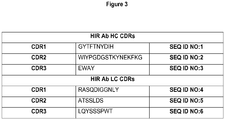
- a HC CDR1 corresponding to the amino acid sequence of SEQ ID NO:1 with up to 1, 2, 3, 4, 5, or 6 single amino acid mutations
- a HC CDR2 corresponding to the amino acid sequence of SEQ ID NO:2 with up to 1, 2, 3, 4, 5, 6, 7, 8, 9, or 10 single amino acid mutations
- a HC CDR3 corresponding to the amino acid sequence of SEQ ID NO:3 with up to 1, or 2 single amino acid mutations, where the single amino acid mutations are substitutions, deletions, or insertions.
- the HIR Abs or HIR Ab-IDS fusion Abs contain an immunoglobulin HC the amino acid sequence of which is at least 50% identical (i.e., at least, 55, 60, 65, 70, 75, 80, 85, 90, 95, or any other percent up to 100% identical) to SEQ ID NO:7 (shown in Fig. 1 ).
- the HIR Abs or HIR Ab-IDS fusion Abs include an immunoglobulin light chain comprising CDRs corresponding to the sequence of at least one of the LC CDRs listed in Fig. 3 (SEQ ID NOs: 4-6) or a variant thereof.
- a LC CDR1 corresponding to the amino acid sequence of SEQ ID NO:4 with up to 1, 2, 3, 4, or 5 single amino acid mutations
- a LC CDR2 corresponding to the amino acid sequence of SEQ ID NO:5 with up to 1, 2, 3, or 4 single amino acid mutations
- a LC CDR3 corresponding to the amino acid sequence of SEQ ID NO:6 with up to 1, 2, 3, 4, or 5 single amino acid mutations.
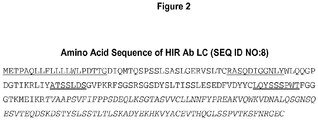
- the HIR Abs or HIR Ab-IDS fusion Abs contain an immunoglobulin LC the amino acid sequence of which is at least 50% identical (i.e., at least, 55, 60, 65, 70, 75, 80, 85, 90, 95, or any other percent up to 100% identical) to SEQ ID NO:8 (shown in Fig. 2 ).
- the HIR Abs or HIR Ab-IDS fusion Abs contain both a heavy chain and a light chain corresponding to any of the above-mentioned HIR heavy chains and HIR light chains.
- HIR antibodies used in the invention may be glycosylated or non-glycosylated. If the antibody is glycosylated, any pattern of glycosylation that does not significantly affect the function of the antibody may be used. Glycosylation can occur in the pattern typical of the cell in which the antibody is made, and may vary from cell type to cell type. For example, the glycosylation pattern of a monoclonal antibody produced by a mouse myeloma cell can be different than the glycosylation pattern of a monoclonal antibody produced by a transfected Chinese hamster ovary (CHO) cell. In some disclosures, the antibody is glycosylated in the pattern produced by a transfected Chinese hamster ovary (CHO) cell..
- sequence variants of candidate antibodies e.g., HIR Ab, other antibodies capable of crossing the BBB
- candidate antibodies e.g., HIR Ab, other antibodies capable of crossing the BBB
- a target antigen such as the ECD of the human insulin receptor or an isolated epitope thereof.
- Fukuda et al. (2006) "In vitro evolution of single-chain antibodies using mRNA display," Nuc. Acid Res., 34(19 ) (published online) for an example of ⁇ ltra high throughput screening of antibody sequence variants. See also, Chen et al.
- An insulin receptor ECD can be purified as described in, e.g., Coloma et al. (2000) Pharm Res, 17:266-274 , and used to screen for HIR Abs and HIR Ab sequence variants of known HIR Abs.
- a IDS fusion antibody e.g., HIR Ab-IDS
- a systemic dose of a IDS fusion antibody e.g., HIR Ab-IDS
- appropriate systemic doses of an IDS fusion antibody are established based on a quantitative determination of CNS uptake characteristics and enzymatic activity of an HIR Ab-enzyme fusion antibody.
- Dermatan sulfate, heparan sulfate and heparin are variably sulfated glycosaminoglycans, which are long, unbranched polysaccharides made up of a repeating disaccharide unit.
- L-iduronate or L-iduronic acid
- IDS is a major component of dermatan sulfate and heparin. It is also present in heparan sulfate.
- IDS e.g., the human IDS sequence listed under GenBank Accession No.
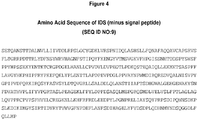
- the subject composition comprises an IDS has an amino acid sequence that is at least 50% identical (i.e., at least, 55, 60, 65, 70, 75, 80, 85, 90, 95, or any other percent up to 100% identical) to the amino acid sequence of human IDS, a 550 amino acid protein listed under GenBank Accession No. NP_000193, or a 525 amino acid subsequence thereof, which lacks a 25 amino acid signal peptide, and corresponds to SEQ ID NO:9 ( Fig. 4 ).
- the structure-function relationship of human IDS is well established, as described in, e.g., Sukegawa-Hayasaka et al.
- IDS has an amino acid sequence at least 50% identical (i.e., at least, 55, 60, 65, 70, 75, 80, 85, 90, 95, or any other percent up to 100% identical) to SEQ ID NO:9 (shown in Fig. 4 ).
- Sequence variants of a canonical IDS sequence such as SEQ ID NO:9 can be generated, e.g., by random mutagenesis of the entire sequence or specific subsequences corresponding to particular domains.
- site directed mutagenesis can be performed reiteratively while avoiding mutations to residues known to be critical to IDS function such as those given above.
- mutation tolerance prediction programs can be used to greatly reduce the number of non-functional sequence variants that would be generated by strictly random mutagenesis.
- Various programs) for predicting the effects of amino acid substitutions in a protein sequence on protein function are described in, e.g., Henikoff et al. (2006), "Predicting the Effects of Amino Acid Substitutions on Protein Function," Annu. Rev. Genomics Hum. Genet., 7:61-80 .
- IDS sequence variants can be screened for of IDS activity/retention of IDS activity by, e.g., 4-methylumbelliferyl ⁇ -L-iduronide-2-sulphate (4-MUS) flurometric IDS assays known in the art. See, e.g., Voznyi et al. (2001), J. Inherit. Metab. Dis.24: 675-680 .
- One unit of IDS activity is defined as the hydrolysis of 1 nmole substrate/hour. Accordingly, one of ordinary skill in the art will appreciate that a very large number of operable IDS sequence variants can be obtained by generating and screening extremely diverse "libraries" of IDS sequence variants by methods that are routine in the art, as described above.
- the "FASTA" similarity search algorithm of Pearson and Lipman is a suitable protein alignment method for examining the level of identity shared by an amino acid sequence disclosed herein and the amino acid sequence of another peptide.
- the FASTA algorithm is described by Pearson and Lipman, Proc. Nat'l Acad. Sci. USA 85:2444 (1988 ), and by Pearson, Meth. Enzymol. 183:63 (1990 ).
- the ten regions with the highest density of identities are then rescored by comparing the similarity of all paired amino acids using an amino acid substitution matrix, and the ends of the regions are "trimmed" to include only those residues that contribute to the highest score.
- the trimmed initial regions are examined to determine whether the regions can be joined to form an approximate alignment with gaps.
- the highest scoring regions of the two amino acid sequences are aligned using a modification of the Needleman-Wunsch-Sellers algorithm ( Needleman and Wunsch, J. Mol. Biol. 48:444 (1970 ); Sellers, SIAM J. Appl. Math. 26:787 (1974 )), which allows for amino acid insertions and deletions.
- the BLOSUM62 table is an amino acid substitution matrix derived from about 2,000 local multiple alignments of protein sequence segments, representing highly conserved regions of more than 500 groups of related proteins ( Henikoff and Henikoff, Proc. Nat'l Acad. Sci. USA 89:10915 (1992 )). Accordingly, the BLOSUM62 substitution frequencies can be used to define conservative amino acid substitutions that may be introduced into the amino acid sequences of the present invention. Although it is possible to design amino acid substitutions based solely upon chemical properties (as discussed above), the language "conservative amino acid substitution” preferably refers to a substitution represented by a BLOSUM62 value of greater than -1.
- compositions of the invention are useful for multiple reasons including being useful for: transporting IDS across the BBB, delivering a therapeutic effective dose of IDS, and/or retaining activity of the IDS once transported across the BBB, or once fused to a targeting antibody.
- Compositions of the invention are also useful in that the IDS and/or the structure it is bound to (e.g., immunogloblulin, antibody) within the fusion antibody each retains a certain amount of its activity compared to its activity as a separate entity.
- compositions containing an IDS covalently linked to a structure e.g., immunoglobulin, antibody
- a structure e.g., immunoglobulin, antibody
- BBB blood brain barrier
- this disclosure provides compositions containing an IDS covalently linked to a structure (e.g., immunoglobulin, antibody) that is capable of crossing the blood brain barrier (BBB), where the structure retains at least about 10, 20, 30, 40, 50, 60, 70, 80, 90, 95, 99, or 100% of its activity, compared to its activity as a separate entity.
- compositions containing an IDS covalently linked to a structure e.g., immunoglobulin, antibody
- a structure e.g., immunoglobulin, antibody
- BBB blood brain barrier
- the IDS retains at least about 10, 20, 30, 40, 50, 60, 70, 80, 90, 95, 99, or 100% of its activity, compared to its activity as a separate entity.
- the IDS retains at least about 10% of its activity compared to its activity as a separate entity.
- the IDS retains at least 20% of its activity, compared to its activity as a separate entity.
- the IDS retains at least 30% of its activity, compared to its activity as a separate entity.
- the invention also provides compositions containing an IDS that is covalently linked to a chimeric MAb to the human BBB insulin receptor.
- the invention also provides pharmaceutical compositions that contain one or more compositions of the invention and a pharmaceutically acceptable excipient.
- the subject composition comprises a IDS fusion antibody where at least about 0.3% (i.e., about 0.32%), 0.4%, 0.48%, 0.6%, 0.74%, 0.8%, 0.9%, 1.05, 1.1, 1.2, 1.3%, 1.5%, 2%, 2.5%, 5%, or any % from about 0.3% to about 12%) of the systemically administered IDS fusion antibody is capable of being delivered to the brain as a result of its uptake from peripheral blood across the BBB.
- the composition comprises an IDS fusion antibody wherein at least 0.5%, (i.e., about 0.32%, 0.4%, 0.48%, 0.6%, 0.74%, 0.8%, 0.9%, 1.05, 1.1, 1.2, 1.3%, 1.5%, 2%, 2.5%, 5%, or any % from about 0.3% to about 12%) of the systemically administered dose of the IDS fusion antibody is delivered to the brain within two hours or less, i.e., 1.8, 1.7, 1.5, 1.4, 1.3, 1.2, 1.1, 0.9, 0.8, 0.6, 0.5 or any other period from about 0.5 to about two hours after systemic administration.
- the present IDS fusion antibodies can cross the BBB, and thereby provide at least 0.125 units of IDS activity/mg protein in the subject's brain, e.g., 0.14, 0.15, 0.16, 0.17, 0.18, 0.19, 0.2, 0.21, 0.22, 0.23, 0.24, 0.25, 0.3, 0.4, 0.5, 0.75, 1.0, 1.5, 2, or any other value from 0.125 to 2.5 of units of IDS activity/mg protein in the subject's brain.
- the total number of units of IDS activity delivered to a subject's brain is at least, 12,500 units, e.g., at least 25,000, 30,000, 35,000, 40,000, 45,000, 50,000, 60,000, 70,000, 80,000, 90,000, 110,000, 120,000, 130,000, 140,000, 150,000, 160,000, 170,000, 180,000, 190,000, 200,000, 210,000, 220,000, 230,000, 250,000 or any other total number of IDS units from about 12,500 to 250,000 units of IDS activity.
- the total number of units of IDS activity delivered to a subject's brain is at least, 10,000 units, e.g., at least 10,000, 12,500, 25,000, 30,000, 35,000, 40,000, 45,000, 50,000, 60,000, 70,000, 80,000, 90,000, 110,000, 120,000, 130,000, 140,000, 150,000, 160,000, 170,000, 180,000, 190,000, 200,000, 210,000, 220,000, 230,000, 250,000, 300,000, 5000,000 any other total number of IDS units from about 10,000 to 500,000 units of IDS activity.
- at least about 25,000 units of iduronate-2-sulfatase activity is delivered to the brain, normalized per 50 kg body weight.
- At least about 10,000, 15,000, 25,000, 30,000, 35,000, 40,000, 45,000, 50,000, 60,000, 70,000, 80,000, 90,000, 110,000, 120,000, 130,000, 140,000, 150,000, 160,000, 170,000, 180,000, 190,000, 200,000, 210,000, 220,000, 230,000, 250,000 units of iduronate-2-sulfatase activity is delivered to the brain, normalized per 50 kg body weight. In some disclosures, at least about 25,000 000 units of iduronate-2-sulfatase activity is delivered to the brain, normalized per 50 kg body weight.
- a therapeutically effective systemic dose comprises at least 5 x 10 5 , 1 x 10 6 , 2 x 10 6 , 3 x 10 6 , 4, 10 6 , 5 x 10 6 , 6 x 10 6 , 7 x 10 6 , 8 x 10 6 , 9 x 10 6 , 1 x 10 7 , 1.1 x 10 7 , 1.2 x 10 7 , 1.5 x 10 7 , 1.6 x 10 7 , 1.7 x 10 7 , 1.8 x 10 7 , 1.9 x 10 7 , 2 x 10 7 , 2.1 x 10 7 , 3 x 10 7 , or any other systemic dose from about 5 x 10 5 to 3 x 10 7 units of IDS activity.
- a therapeutically effective systemic dose is at least about 20,000 units, or at least about 10,000 units of IDS activity/kg body weight, at least about 10,000, 15,000, 20,000, 22,000, 24,000, 25,000, 30,000, 40,000, 50,000, 60,000, 70,000, 80,000, 90,000, 100,000, 125,000, 150,000, 200,000, or 500,000 units/kg body weight.
- the mass amount of a therapeutically effective systemic dose of an IDS fusion antibody will depend, in part, on its IDS specific activity.
- the IDS specific activity of the IDS fusion antibody is at least 10,000 U/mg of protein, at least about 11,000, 12,000, 13,000, 14,000, 20,000, 21,000, 22,000, 23,000, 24,000, 25,000, 26,000, 27,000, 28,000, 30,000, 32,000, 34,000, 35,000, 36,000, 37,000, 40,000, 45,000, 50,000, or any other specific activity value from about 10,000 units/mg to about 50,000 units/mg.
- the structure that is capable of crossing the BBB utilizes an endogenous BBB receptor mediated transport system, such as a system that utilizes the insulin receptor, transferrin receptor, leptin receptor, LDL receptor, or IGF receptor.
- the endogenous BBB receptor mediated transport system is the insulin BBB receptor mediated transport system.
- the structure that is capable of crossing the BBB is an antibody, e.g., a monoclonal antibody (MAb) such as a chimeric MAb.
- the antibody can be a chimeric antibody with sufficient human sequence that it is suitable for administration to a human.
- the structure capable of crossing the blood brain barrier crosses the BBB on an endogenous BBB receptor-mediated transporter, such as a transporter selected from the group consisting of the insulin transporter, the transferrin transporter, the leptin transporter, the LDL transporter, and the IGF receptor.
- the endogenous BBB receptor-mediated transporter is selected from the group consisting of the insulin transporter and the transferrin transporter.
- the endogenous BBB receptor-mediated transporter is the insulin transporter, e.g., the human insulin transporter.
- the structure capable of crossing the BBB can be an antibody, e.g., a MAb such as a chimeric MAb.
- the antibody can be an antibody to an endogenous BBB receptor-mediated transporter, as described herein.
- the antibody can be glycosylated or nonglycosylated; in some disclosures, the antibody is glycosylated, e.g., in a glycosylation pattern produced by its synthesis in a CHO cell.
- the covalent linkage between the antibody and the IDS may be a linkage between any suitable portion of the antibody and the IDS, as long as it allows the IDS fusion antibody to cross the blood brain barrier and/or the IDS to retain a therapeutically useful portion of its activity within the CNS.
- the covalent link is between one or more light chains of the antibody and the IDS.
- the IDS can be covalently linked by its carboxy or amino terminus to the carboxy or amino terminus of the light chain (LC) or heavy chain (HC) of the antibody.
- Any suitable linkage may be used, e.g., carboxy terminus of light chain to amino terminus of peptide, carboxy terminus of heavy chain to amino terminus of peptide, amino terminus of light chain to amino terminus of peptide, amino terminus of heavy chain to amino terminus of peptide, carboxy terminus of light chain to carboxy terminus of peptide, carboxy terminus of heavy chain to carboxy terminus of peptide, amino terminus of light chain to carboxy terminus of peptide, or amino terminus of heavy chain to carboxy terminus of peptide.
- more than one molecule of the IDS is attached to the structure that crosses the BBB.
- 2, 3, 4, 5, 6, 7, 8, 9, 10, or more than 10 IDS molecules (or fraction thereof) may be attached to the structure that is capable of crossing the blood brain barrier.
- the bifunctional IDS fusion antibody (e.g., HIR Ab-IDS) described herein, may retain a high proportion of the activity of their separate constituent proteins, e.g., binding of the HIR Ab to the IR ECD, and the enzymatic activity of IDS.
- Construction of cDNAs and expression vectors encoding any of the proteins described herein, as well as their expression and purification are well within those of ordinary skill in the art, and are described in detail herein in, e.g., Examples 1-3, and, in Boado et al (2007), Biotechnol Bioeng 96:381-391 , U.S. Patent Application Serial No. 11/061,956 , and U.S. Patent Application Serial No. 11/245,710 .
- the invention provides a fusion HIR Ab-IDS fusion antibody where the HIR Ab and IDS each retain an average of at least about 90% of their activities, compared to their activities as separate entities.
- the HIR Ab retains at least about 10, 20, 30, 40, 50, 60, 70, 80, 90, 95, 99, or 100% of its activity, compared to its activity as a separate entity
- the IDS retains at least about 10, 20, 30, 40, 50, 60, 70, 80, 90, 95, 99, or 100% of its activity, compared to its activity as a separate entity.
- compositions containing a bifunctional IDS fusion antibody capable of crossing the BBB, where the constituent antibody (e.g., HIR Ab) and IDS each retain, as part of the fusion antibody, an average of at least about 10, 20, 30, 40, 50, 60, 70, 80, 90, 95, 99, or 100% of their activities, e.g., HIR binding and IDS activity, respectively, compared to their activities as separate proteins.
- a bifunctional IDS fusion antibody e.g., HIR Ab-IDS
- HIR Ab-IDS bifunctional IDS fusion antibody capable of crossing the BBB
- the constituent antibody e.g., HIR Ab
- IDS each retain, as part of the fusion antibody, an average of at least about 10, 20, 30, 40, 50, 60, 70, 80, 90, 95, 99, or 100% of their activities, e.g., HIR binding and IDS activity, respectively, compared to their activities as separate proteins.
- An HIR Ab IDS fusion antibody refers to a fusion protein comprising
- the IDS fusion antibodies (e.g., HIR Ab-IDS) described herein, comprise a covalent linkage between the carboxy terminus of the antibody (e.g., HIR Ab) and the amino terminus of the IDS (or, between the amino terminus of the antibody and the carboxy terminus of the IDS), wherein the IDS fusion antibody (e.g., HIR Ab-IDS) binds to the receptor-mediated BBB transport system (e.g., to the ECD of the IR) and crosses the blood brain barrier.
- the IDS retains a therapeutically useful portion of its activity.
- the covalent linkage between the antibody and the IDS may be to the carboxy terminal of the targeting antibody (e.g., HIR antibody) and the amino terminal of the IDS and linkage allows the HIR Ab-IDS fusion antibody to bind to the ECD of the IR and cross the blood brain barrier, and allows the IDS to retain a therapeutically useful portion of its activity.
- the covalent link is between an HC of the antibody and the IDS or a LC of the antibody and the IDS.
- the IDS may be fused, or covalently linked, to the targeting antibody (e.g., MAb, HIR-MAb) through a linker.
- a linkage between terminal amino acids can be accomplished by an intervening peptide linker sequence that forms part of the fused amino acid sequence.
- the peptide sequence linker may be 0, 1, 2, 3, 4, 5, 6, 7, 8, 9, 10, or more than 10 amino acids in length. In some disclosures, including some preferred disclosures, the peptide linker is less than 20, 15, 14, 13, 12, 11, 10, 9, 8, 7, 6, 5, 4, 3, 2, or 1 amino acids in length. In some disclosures, including some preferred disclosures, the peptide linker is at least 0, 1, 2, 3, 4, 5, 6, 7, 8, 9, 10 amino acids in length.
- the IDS is directly linked to the targeting antibody, and is therefore 0 amino acids in length. In some disclosures, there is no linker linking the IDS to the targeting antibody. In some disclosures, the amino terminus of the IDS is fused directly to the carboxyl terminal of the targeting antibody (e.g., HIR MAb), and therefore there is no linker linking the IDS to the targeting antibody (e.g., HIR MAb),. In some disclosures, the carboxy terminus of the IDS is fused directly to the amino terminus of the targeting antibody (e.g., HIR MAb), and therefore there is no linker linking the IDS to the targeting antibody (e.g., HIR MAb).
- the amino terminus of the IDS is fused directly to the carboxyl terminal of the targeting antibody (e.g., HIR MAb), and therefore there is no linker linking the IDS to the targeting antibody (e.g., HIR MAb).
- the linker comprises glycine, serine, and/or alanine residues in any combination or order.
- the combined percentage of glycine, serine, and alanine residues in the linker is at least 5%, 10%, 15%, 20%, 25%, 30%, 40%, 50%, 60%, 70%, 75%, 80%, 90%, or 95% of the total number of residues in the linker.
- the combined percentage of glycine, serine, and alanine residues in the linker is at least 50%, 60%, 70%, 75%, 80%, 90%, or 95% of the total number of residues in the linker.
- any number of combinations of amino acids can be used for the linker.
- a two amino acid linker is used.
- the linker has the sequence Ser-Ser.
- a two amino acid linker comprises glycine, serine, and/or alanine residues in any combination or order (e.g., Gly-Gly, Ser-Gly, Gly-Ser, Ser-Ser, Ala-Ala, Ser-Ala, or Ala-Ser linker).
- a linker for use in the present disclosure is greater than two amino acids in length.
- Such linker may also comprise glycine, serine, and/or alanine residues in any combination or order, as described further herein..
- the linker consists of one glycine, serine, and/or alanine residue along with other amino acids (e.g., Ser-nX, where X is any known amino acid, and n is the number of amino acids).
- the linker consists of any two amino acids (e.g., X-X).
- said any two amino acids are Gly, Ser, or Ala, in any combination or order, and within a variable number of amino acids intervening between them.
- the linker consists of at least one Gly.
- the linker consists of at least one Ser.
- the linker consists of at least one Ala.
- the linker consists of at least 1, 2, 3, 4, 5, 6, 7, 8, 9, or 10 Gly, Ser, and/or Ala residues.
- the linker comprises Gly and Ser in repeating sequences, in any combination or number, such as (Gly 4 Ser) 3 , or other variations.
- a linker for use in the present invention may be designed by using any method known in the art. For example, there are multiple publicly-available programs for determining optimal amino acid linkers in the engineering of fusion proteins. Publicly-available computer programs (such as the LINKER program) that automatically generate the amino acid sequence of optimal linkers based on the user's input of the sequence of the protein and the desired length of the linker may be used for the present methods and compositions. Often, such programs may use observed trends of naturally-occurring linkers joining protein subdomains to predict optimal protein linkers for use in protein engineering. In some cases, such programs use other methods of predicting optimal linkers.
- Publicly-available computer programs such as the LINKER program
- Such programs may use observed trends of naturally-occurring linkers joining protein subdomains to predict optimal protein linkers for use in protein engineering. In some cases, such programs use other methods of predicting optimal linkers.
- the peptide linker sequence may include a protease cleavage site, however this is not a requirement for activity of the IDS; indeed, an advantage of these disclosures of the present invention is that the bifunctional IDS fusion antibody (e.g., HIR Ab-IDS) described herein, without cleavage, is partially or fully active both for transport and for activity once across the BBB.
- Fig. 5 shows an exemplary embodiment of the amino acid sequence of a HIR Ab-IDS fusion antibody (SEQ ID NO:10) in which the HC is fused through its carboxy terminus via a two amino acid "ser-ser" linker to the amino terminus of the IDS.
- the fused IDS sequence is devoid of its 25 amino acid signal peptide, as shown in Fig. 4 .
- the targeting antibody used as part of the IDS fusion antibody can be glycosylated or nonglycosylated; in some disclosures, the antibody is glycosylated, e.g., in a glycosylation pattern produced by its synthesis in a CHO cell.
- Transport of the IDS fusion antibody (e.g., HIR Ab-IDS) across the BBB may be compared to transport across the BBB of the targeting antibody (e.g., HIR Ab) alone by standard methods.
- the targeting antibody e.g., HIR Ab
- pharmacokinetics and brain uptake of the HIR Ab-IDS fusion antibody by a model animal, e.g., a mammal such as a primate may be used.
- standard models for determining IDS activity may also be used to compare the function of the IDS alone and as part of a HIR Ab-IDS fusion antibody. See, e.g., Example 3, which demonstrates the enzymatic activity of IDS versus HIR Ab-IDS fusion antibody.
- Binding affinity for the IR ECD can be compared for the HIR Ab-IDS fusion antibody versus the HIR Ab alone. See, e.g., Example 3 herein.
- compositions that contain one or more IDS fusion antibodies (e.g., HIR Ab-IDS) described herein and a pharmaceutically acceptable excipient.
- IDS fusion antibodies e.g., HIR Ab-IDS
- a pharmaceutically acceptable excipient e.g., a pharmaceutically acceptable excipient.
- Pharmaceutical compositions of the invention include compositions suitable for administration via any peripheral route, including intravenous, subcutaneous, intramuscular, intraperitoneal injection; oral, rectal, transbuccal, pulmonary, transdermal, intranasal, or any other suitable route of peripheral administration.
- Exemplary pharmaceutically acceptable carriers for injectable compositions can include salts, for example, mineral acid salts such as hydrochlorides, hydrobromides, phosphates, sulfates, and the like; and the salts of organic acids such as acetates, propionates, malonates, benzoates, and the like.
- compositions of the invention may be provided in liquid form, and formulated in saline based aqueous solution of varying pH (5-8), with or without detergents such polysorbate-80 at 0.01-1 %, or carbohydrate additives, such mannitol, sorbitol, or trehalose.
- Commonly used buffers include histidine, acetate, phosphate, or citrate.
- compositions For human administration, preparations meet sterility, pyrogenicity, general safety, and purity standards as required by FDA and other regulatory agency standards.
- the active compounds will generally be formulated for parenteral administration, e.g., formulated for injection via the intravenous, intramuscular, subcutaneous, intralesional, or intraperitoneal routes.
- parenteral administration e.g., formulated for injection via the intravenous, intramuscular, subcutaneous, intralesional, or intraperitoneal routes.
- the preparation of an aqueous composition that contains an active component or ingredient will be known to those of skill in the art in light of the present disclosure.
- such compositions can be prepared as injectables, either as liquid solutions or suspensions; solid forms suitable for use in preparing solutions or suspensions upon the addition of a liquid prior to injection can also be prepared; and the preparations can also be emulsified.
- Sterile injectable solutions are prepared by incorporating the active compounds in the required amount in the appropriate solvent with various of the other ingredients enumerated above, as required, followed by filtered sterilization.
- dispersions are prepared by incorporating the various sterilized active ingredients into a sterile vehicle which contains the basic dispersion medium and the required other ingredients from those enumerated above.
- methods of preparation include vacuum-drying and freeze-drying techniques which yield a powder of the active ingredient plus any additional desired ingredient from a previously sterile-filtered solution thereof.
- solutions Upon formulation, solutions will be systemically administered in a manner compatible with the dosage formulation and in such amount as is therapeutically effective based on the criteria described herein.
- the formulations are easily administered in a variety of dosage forms, such as the type of injectable solutions described above, but drug release capsules and the like can also be employed
- the appropriate quantity of a pharmaceutical composition to be administered, the number of treatments, and unit dose will vary according to the CNS uptake characteristics of the IDS fusion antibody (e.g., HIR Ab-IDS) as described herein, and according to the subject to be treated, the state of the subject and the effect desired. The person responsible for administration will, in any event, determine the appropriate dose for the individual subject.
- the IDS fusion antibody e.g., HIR Ab-IDS
- nasal solutions are usually aqueous solutions designed to be administered to the nasal passages in drops or sprays.
- Nasal solutions are prepared so that they are similar in many respects to nasal secretions.
- the aqueous nasal solutions usually are isotonic and slightly buffered to maintain a pH of 5.5 to 6.5.
- antimicrobial preservatives similar to those used in ophthalmic preparations and appropriate drug stabilizers, if required, may be included in the formulation.
- Various commercial nasal preparations are known and include, for example, antibiotics and antihistamines and are used for asthma prophylaxis.
- Additional formulations which are suitable for other modes of administration, include suppositories and pessaries.
- a rectal pessary or suppository may also be used.
- Suppositories are solid dosage forms of various weights and shapes, usually medicated, for insertion into the rectum or the urethra. After insertion, suppositories soften, melt or dissolve in the cavity fluids.
- traditional binders and carriers generally include, for example, polyalkylene glycols or triglycerides; such suppositories may be formed from mixtures containing the active ingredient in any suitable range, e.g., in the range of 0.5% to 10%, preferably 1%-2%.
- Oral formulations include such normally employed excipients as, for example, pharmaceutical grades of mannitol, lactose, starch, magnesium stearate, sodium saccharine, cellulose, magnesium carbonate and the like. These compositions take the form of solutions, suspensions, tablets, pills, capsules, sustained release formulations, or powders.
- oral pharmaceutical compositions will comprise an inert diluent or assimilable edible carrier, or they may be enclosed in a hard or soft shell gelatin capsule, or they may be compressed into tablets, or they may be incorporated directly with the food of the diet.
- the active compounds may be incorporated with excipients and used in the form of ingestible tablets, buccal tables, troches, capsules, elixirs, suspensions, syrups, wafers, and the like.
- Such compositions and preparations can contain at least 0.1% of active compound.
- the percentage of the compositions and preparations may, of course, be varied, and may conveniently be between about 2 to about 75% of the weight of the unit, or between about 25-60%.
- the amount of active compounds in such therapeutically useful compositions is such that a suitable dosage will be obtained.
- the tablets, troches, pills, capsules and the like may also contain the following: a binder, such as gum tragacanth, acacia, cornstarch, or gelatin; excipients, such as dicalcium phosphate; a disintegrating agent, such as corn starch, potato starch, alginic acid and the like; a lubricant, such as magnesium stearate; and a sweetening agent, such as sucrose, lactose or saccharin may be added or a flavoring agent, such as peppermint, oil of wintergreen, or cherry flavoring.
- a binder such as gum tragacanth, acacia, cornstarch, or gelatin
- excipients such as dicalcium phosphate
- a disintegrating agent such as corn starch, potato starch, alginic acid and the like
- a lubricant such as magnesium stearate
- a sweetening agent such as sucrose, lactose or saccharin may be added or
- Described herein are methods for delivering an effective dose of IDS to the CNS across the BBB by systemically administering a therapeutically effective amount of a HIR Ab-IDS fusion antibody, as described herein.
- Suitable systemic doses for delivery of a IDS fusion antibody e.g., HIR MAb
- a IDS fusion antibody e.g., HIR MAb
- Systemic administration of of a IDS fusion antibody (e.g., HIR MAb) to a subject suffering from an IDS deficiency is an effective approach to the non-invasive delivery of IDS to the CNS.
- the amount of a IDS fusion antibody (e.g., HIR MAb) fusion antibody that is a therapeutically effective systemic dose depends, in part, on the CNS uptake characteristics of the of a IDS fusion antibody (e.g., HIR MAb) to be administered, as described herein., e.g., the percentage of the systemically administered dose to be taken up in the
- 0.3% i.e., about 0.32%
- 0.4%, 0.48%, 0.6%, 0.74%, 0.8%, 0.9%, 1.05, 1.1, 1.2, 1.3%, 1.5%, 2%, 2.5%, 5%, or any % from about 0.3% to about 12%) of the systemically administered of the IDS fusion antibody (e.g., HIR MAb) is delivered to the brain as a result of its uptake from peripheral blood across the BBB.
- At least 0.5%, (i.e., about 0.32%, 0.4%, 0.48%, 0.6%, 0.74%, 0.8%, 0.9%, 1.05, 1.1, 1.2, 1.3%, 1.5%, 2%, 2.5%, 5%, or any % from about 0.3% to about 12%) of the systemically administered dose of a IDS fusion antibody (e.g., HIR MAb) is delivered to the brain within two hours or less, i.e., 1.8, 1.7, 1.5, 1.4, 1.3, 1.2, 1.1, 0.9, 0.8, 0.6, 0.5 or any other period from about 0.5 to about two hours after systemic administration.
- a IDS fusion antibody e.g., HIR MAb
- the total number of units of IDS activity delivered to a subject's brain is at least, 12,500 units, e.g., at least 12,500, 25,000, 30,000, 35,000, 40,000, 45,000, 50,000, 60,000, 70,000, 80,000, 90,000, 110,000, 120,000, 130,000, 140,000, 150,000, 160,000, 170,000, 180,000, 190,000, 200,000, 210,000, 220,000, 230,000, 250,000 or any other total number of IDS units from about 12,500 to 250,000 units of IDS activity.
- a therapeutically effective systemic dose comprises at least 5 x 10 5 , 1 x 10 6 , 2 x 10 6 , 3 x 10 6 4, 10 6 , 5 x 10 6 , 6 x 10 6 , 7 x 10 6 , 8 x 10 6 , 9 x 10 6 , 1 x 10 7 , 1.1 x 10 7 , 1.2 x 10 7 , 1.5 x 10 7 , 1.6 x 10 7 , 1.7 x 10 7 , 1.8 x 10 7 , 1.9 x 10 7 , 2 x 10 7 , 2.1 x 10 7 , 3 x 10 7 , or any other systemic dose from about 5 x 10 5 to 3 x 10 7 units of IDS activity.
- a therapeutically effective systemic dose is at least about 20,000 units of IDS activity/kg body weight, at least about 22,000, 24,000, 25,000, 30,000, 40,000, 50,000, 60,000, 70,000, 80,000, 90,000, 100,000, 125,000, 150,000, 200,000 or any other number of IDS units from about 20,000 to 200,000 units of IDS activity/kg of body weight.
- At least about 10,000, 15,000, 25,000, 30,000, 35,000, 40,000, 45,000, 50,000, 60,000, 70,000, 80,000, 90,000, 110,000, 120,000, 130,000, 140,000, 150,000, 160,000, 170,000, 180,000, 190,000, 200,000, 210,000, 220,000, 230,000, 250,000 units of iduronate-2-sulfatase activity is delivered to the brain, normalized per 50 kg body weight. In some disclosures, at least about 25,000 000 units of iduronate-2-sulfatase activity is delivered to the brain, normalized per 50 kg body weight.
- the mass amount of a therapeutically effective systemic dose of a IDS fusion antibody will depend, in part, on its IDS specific activity.
- the IDS specific activity of a IDS fusion antibody is at least 10,000 U/mg of protein, at least about 11,000, 12,000, 13,000, 14,000, 20,000, 21,000, 22,000, 23,000, 24,000, 25,000, 26,000, 27,000, 28,000, 30,000, 32,000, 34,000, 35,000, 36,000, 37,000, 40,000, 45,000, 50,000, or any other specific activity value from about 10,000 units/mg to about 50,000 units/mg.
- a systemic dose of a IDS fusion antibody can be at least 2 mg, e.g., 5, 10, 15, 20, 25, 30, 35, 40, 45, 50, 55, 60, 65, 70, 75, 100, or any other value from about 2 mg to about 100 mg of a IDS fusion antibody (e.g., HIR MAb).
- systemic administration includes any method of administration that is not direct administration into the CNS, i.e., that does not involve physical penetration or disruption of the BBB.
- Systemic administration includes, but is not limited to, intravenous , intra-arterial intramuscular, subcutaneous, intraperitoneal, intranasal, transbuccal, transdermal, rectal, transalveolar (inhalation), or oral administration. Any suitable IDS fusion antibody (e.g., HIR MAb), as described herein, may be used.
- An IDS deficiency as referred to herein includes, one or more conditions known as Hunter's syndrome, Hunter's disease, and mucopolysaccharidosis type II.
- the IDS deficiency is characterized by the buildup of heparan sulfate and dermatan sulfate that occurs in the body (the heart, liver, brain etc.).
- compositions of the invention may be administered as part of a combination therapy.
- the combination therapy involves the administration of a composition of the invention in combination with another therapy for treatment or relief of symptoms typically found in a patient suffering from an IDS deficiency.
- any combination of the composition of the invention and the additional method or composition may be used.
- the two may be administered simultaneously, consecutively, in overlapping durations, in similar, the same, or different frequencies, etc.
- a composition will be used that contains a composition of the invention in combination with one or more other CNS disorder treatment agents.
- MPS-VII The lysosomal enzyme mutated in MPS-VII, also called Sly syndrome, is ⁇ -glucuronidase (GUSB).
- GUSB ⁇ -glucuronidase
- MPS-VII results in accumulation of glycosoaminoglycans in the brain.
- Enzyme replacement therapy (ERT) of MPS-VII would not likely be effective for treatment of the brain because the GUSB enzyme does not cross the BBB.
- ERT enzyme replacement therapy
- RT reverse transcription
- ODNs custom oligodexoynucleotides
- This substrate is hydolyzed to 4-methylumbelliferone (4-MU) by GUSB, and the 4-MU is detected fluorometrically with a fluorometer using an emission wavelength of 450 nm and an excitation wavelength of 365 nm.
- a new pCD-HC-GUSB plasmid expression plasmid was engineered, which expresses the fusion protein wherein the carboxyl terminus of the heavy chain (HC) of the HIR Ab is fused to the amino terminus of human GUSB, minus the 22 amino acid GUSB signal peptide, and minus the 18 amino acid carboxyl terminal GUSB propeptide.
- the GUSB cDNA was cloned by PCR using the pCD-GUSB as template.
- the forward PCR primer introduces "CA” nucleotides to maintain the open reading frame and to introduce a Ser-Ser linker between the carboxyl terminus of the CH3 region of the HIR Ab HC and the amino terminus of the GUSB minus the 22 amino acid signal peptide of the enzyme.
- the GUSB reverse PCR primer introduces a stop codon, "TGA,” immediately after the terminal Thr of the mature human GUSB protein.
- the plasmid encoded for a 1,075 amino acid protein comprised of a 19 amino acid IgG signal peptide, the 443 amino acid HIRMAb HC, a 2 amino acid linker (Ser-Ser), and the 611 amino acid human GUSB minus the enzyme signal peptide and carboxyl terminal propeptide.
- the GUSB sequence was 100% identical to Leu 23 -Thr 633 of human GUSB (NP_000172).
- the predicted molecular weight of the heavy chain fusion protein, minus glycosylation, is 119,306 Da, with a predicted isoelectric point (pI) of 7.83.
- COS cells were plated in 6-well cluster dishes, and were dual transfected with pCD-LC and pCD-HC-GUSB, where pCD-LC is the expression plasmid encoding the light chain (LC) of the chimeric HIR Ab. Transfection was performed using Lipofectamine 2000, with a ratio of 1:2.5, ug DNA:uL Lipofectamine 2000, and conditioned serum free medium was collected at 3 and 7 days. However, there was no specific increase in GUSB enzyme activity following dual transfection of COS cells with the pCD-HC-GUSB and pCD-LC expression plasmids (Table 1, Experiment B).
- the low GUSB activity in the medium could be attributed to the low secretion of the HIRMAb-GUSB fusion protein, as the medium IgG was only 23 ⁇ 2 ng/mL, as determined by a human IgG-specific ELISA. Therefore, COS cell transfection was scaled up to 10xT500 plates, and the HIRMAb-GUSB fusion protein was purified by protein A affinity chromatography. IgG Western blotting demonstrated the expected increase in size of the fusion protein heavy chain. However, the GUSB enzyme activity of the HIRMAb-GUSB fusion protein was low at 6.1 ⁇ 0.1 nmol/hr/ug protein.
- CHO cells permanently transfected with the HIR ECD were grown in serum free media (SFM), and the HIR ECD was purified with a wheat germ agglutinin affinity column.
- SFM serum free media
- the HIR ECD was plated on 96-well dishes and the binding of the HIR Ab, and the HIR Ab-GUSB fusion protein to the HIR ECD was detected with a biotinylated goat anti-human IgG (H+L) secondary antibody, followed by avidin and biotinylated peroxidase.
- the concentration of protein that gave 50% maximal binding, ED 50 was determined with a non-linear regression analysis.
- the GUSB 18 amino acid carboxyl terminal propeptide in pCD-GUSB was deleted by site-directed mutagenesis (SDM). The latter created an AfeI site on the 3'-flanking region of the Thr 633 residue of GUSB, and it was designated pCD-GUSB-AfeI.
- SDM site-directed mutagenesis
- the carboxyl terminal propeptide was then deleted with AfeI and HindIII (located on the 3'-non coding region of GUSB).
- the PCR generated HIRMAb HC cDNA was inserted at the AfeI-HindIII sites of pCD-GUSB-AfeI to form the pCD-GUSB-HC.
- a Ser-Ser linker between the carboxyl terminus of GUSB and amino terminus of the HIRMAb HC was introduced within the AfeI site by the PCR primer used for the cloning of the HIRMAb HC cDNA.
- MPS-II The lysosomal enzyme mutated in MPS-II, also called Hunter's syndrome, is iduronate 2-sulfatase (IDS).
- IDDS iduronate 2-sulfatase
- MPS-II results in accumulation of glycosoaminoglycans in the brain.
- Enzyme replacement therapy of MPS-II would likely not be effective for treatment of the brain because the IDS enzyme does not cross the BBB.
- IDS was fused to the HIR Ab in order to develop a bifunctional molecule capable of both crossing the BBB and exhibiting enzymatic activity.
- the IDS cDNA was cloned using 2 ⁇ l liver cDNA reverse transcription reaction, 0.2 ⁇ M IDS forward and reverse ODN primers (Table 2), 0.2 mM deoxynucleotidetriphosphates and 2.5 U PfuUltra DNA polymerase (Stratagene, San Diego, CA) in a 50 ⁇ l Pfu buffer (Stratagene).
- the amplification was performed in a Mastercycler temperature cycler (Eppendorf, Hamburg, Germany) with an initial denaturing step of 95°C for 2 min followed by 30 cycles of denaturing at 95°C for 30 sec, annealing at 55°C for 30 sec and amplification at 72°C for 1 min.
- the IDS forward PCR primer (SEQ ID NO:11) was a 23-mer coding for the 7 amino acids at the beginning of the mature IDS protein. This primer introduces "CC" nucleotides to maintain the open reading frame and to introduce a Ser-Ser linker between the carboxyl terminus of the CH3 region of the HIRMAb HC and the amino terminus of the IDS minus the 25 amino acid signal peptide of the enzyme.
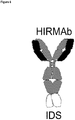
- the IDS reverse PCR primer (SEQ ID NO:12) was a 27-mer complementary to the end of the IDS cDNA including the stop codon, "TGA,” immediately after the terminal Pro of the mature human IDS protein. The fusion of the IDS monomer to the carboxyl terminus of each HC is depicted in Fig. 6 . The entire expression cassette of the plasmid was confirmed by sequencing both strands.
- DNA sequencing of the expression cassette of the pCD-HIRMAb-IDS plasmid encompassed 4,063 nucleotides (nt), including a 714 nt cytomegalovirus promoter, a 9 nt full Kozak site (GCCGCCACC), a 2,970 nt HIRMAb HC-IDS fusion protein open reading frame, and a 370 nt bovine growth hormone polyA sequence.
- nt 4,063 nucleotides
- COS cells were plated in 6-well cluster dishes, and were dually transfected with the pCD-HC-IDS, and pCD-LC, where pCD-LC is the expression plasmid encoding the light chain (LC) of the chimeric HIRMAb, which is also used by the HIR Ab-IDS fusion protein. Expression of the fusion protein was screened with an ELISA specific for human IgG. For production of larger amounts of fusion protein, COS cells were transfected in 10 x T500 flasks. The 3 day and 7 day medium was pooled, and the 2 L of serum free conditioned medium was concentrated to 400 mL with tangential flow filtration (Millipore) followed by purification with protein A affinity chromatography.
- LC light chain
- the purity of protein A purified fusion protein produced by COS cells was evaluated with 12% sodium dodecyl sulfate polyacrylamide gel electrophoresis (SDSPAGE) with 5% ⁇ -mercaptoethanol, and shown to have a homogeneity comparable to the purified HIR Ab ( Figure 9 ). Immunoreactivity was tested with a goat antibody to human IDS, or a primary goat antiserum against human IgG heavy and light chains.
- SDSPAGE sodium dodecyl sulfate polyacrylamide gel electrophoresis
- the anti-human IgG antibody reacts with a 135 kDa HC for the fusion protein, and a 50 kDa HC for the chimeric HIR Ab, and the difference in size, 85 kDa, is due to the fusion of IDS ( Fig. 10A ).
- the anti-human IgG antibody reacts equally with the light chain of either the HIR Ab-IDS fusion protein or the HIR Ab, since both proteins are comprised of the same light chain.
- the anti-IDS antibody reacts with the 135 kDa HC of the fusion protein, but not with the HC of the chimeric HIR Ab ( Fig. 10B ).
- the affinity of the fusion protein for the HIR extracellular domain (ECD) was determined with an ELISA.
- CHO cells permanently transfected with the HIR ECD were grown in serum free media (SFM), and the HIR ECD was purified with a wheat germ agglutinin affinity column, as previously described in Coloma et al. (2000) Pharm Res, 17:266-274 .
- the HIR ECD was plated on Nunc-Maxisorb 96 well dishes and the binding of the HIR Ab, or the HIR Ab-IDS fusion protein, to the HIR ECD was detected with a biotinylated goat anti-human IgG (H+L) secondary antibody, followed by avidin and biotinylated peroxidase (Vector Labs, Burlingame, CA).
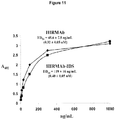
- the concentration of either HIR Ab or HIR Ab-IDS fusion protein that gave 50% maximal binding was determined with a non-linear regression analysis. As shown in Fig. 11 there was comparable binding of either the chimeric HIR Ab or the HIR Ab-IDS fusion protein for the HIR ECD with ED50 of 0.32 ⁇ 0.05 nM and 0.40 ⁇ 0.05 nM, respectively.
- the IDS enzyme activity was determined with a fluorometric assay using 4-methylumbelliferyl a-L-iduronide-2-sulphate (4-MUS), which was purchased from Moscerdam Substrates (Rotterdam, The Netherlands).
- This substrate is hydrolyzed by IDS to 4-methylumbelliferyl a-L-iduronide (MUBI), and the MUBI is hydrolyzed by iduronidase (IDUA, Aldurazyme, Genzyme, Boston, MA) to 4-methylumbelliferone (4-MU), which is detected fluorometrically with a Farrand filter fluorometer using an emission wavelength of 450 nm and an excitation wavelength of 365 nm.
- 4-MUS 4-methylumbelliferyl a-L-iduronide-2-sulphate
- a standard curve was constructed with known amounts of 4-MU (Sigma-Aldrich, St. Louis, MO).
- One unit 1 nmol/hr.
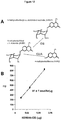
- the 2-step enzymatic fluorometric assay is outlined in Fig. 12A .
- the fluorometric units were proportional to the mass of purified HIRMAb-IDS fusion protein and the enzymatic activity of the fusion protein was 51 ⁇ 7 nmol/hr/ug protein ( Fig. 12B ), which is comparable to the IDS enzyme activity reported for human recombinant Idursulfase ( G. Zareba, Idursulfase in Hunter syndrome treatment. Drugs Today (Barc) 43 (2007) 759-767 ).
- Type II MPS Hunter fibroblasts (GM000298) and healthy human fibroblasts (GM000497) were obtained from the Coriell Institute for Medical Research (Camden, NJ), and grown in 6-well cluster dishes to confluency. The medium was aspirated, wells washed with phosphate buffered saline (PBS), and incubated with 1 mL of Dulbecco's modified Eagle medium without serum, along with a range of concentrations of the HIRMAb-IDS fusion protein, for 2 hr at 37C.
- PBS phosphate buffered saline
- the HIRMAb-IDS fusion protein was taken up by MPS Type II fibroblasts ( Fig. 13 ).
- the basal IDS activity in these cells without treatment is very low, ⁇ 10 nmol/hr/mg p .
- the intracellular IDS enzyme activity increases in proportion to the concentration of medium HIRMAb-IDS ( Fig. 13 ).
- the normal IDS enzymatic activity in healthy human fibroblasts is shown by the horizontal bar in Fig.13 .
- HIRMAb-IDS fusion protein on cell glycosoaminoglycan (GAG) accumulation was assessed with a 35 S incorporation assay.
- Type II MPS or healthy human fibroblasts were plated in 6-well cluster dishes at 250,000 cells/well and grown for 4 days in DMEM with 10% fetal bovine serum.
- the medium was discarded, the wells were washed with PBS, and 1 mL/well of low sulfate F12 medium with 10% dialyzed fetal bovine serum was added, along with 5 mM CaCl2, the HIRMAb-IDS fusion protein (0.3 ug/mL), and 10 uCi/mL of 35 S-sodium sulfate (Perkin Elmer, Boston, MA).
- the medium was aspirated, the wells were washed with cold PBS (1 mL, 5 washes), and the cells were lysed with 0.4 mL/well of 1 N NaOH.
- the lysate was heated 60°C 60 min to solubilize protein, an aliquot was removed for BCA protein assay, and the sample was counted for radioactivity with a Perkin Elmer Tri-Carb 2100 liquid scintillation counter. The data were expressed as 35 S counts per minute (CPM) per ug protein.
- Treatment with the HIRMAb-IDS fusion protein reduces GAG accumulation in Hunter fibroblasts by 84% as compared to healthy fibroblasts (p ⁇ 0.0005) ( Fig.14 ).
- the prevention of GAG accumulation in Hunter fibroblasts indicates the HIR Ab-IDS fusion antibody was directed to the lysosomal compartment of the cell, where GAG accumulates.
- a drug such as methotrexate (MTX)
- MTX methotrexate
- DHFR dihydrofolate reductase
- the expression cassettes encoding these 3 genes were all placed on a single strand of DNA, called a tandem vector, which is outlined in Figure 15 .
- the HC fusion gene and the LC gene are 5'-flanked by a cytomegalovirus (CMV)-derived promoter and 5'-flanked by the polyA+ sequence from the bovine growth hormone (BGH) gene.
- CMV cytomegalovirus
- BGH bovine growth hormone
- the DHFR gene was 5'-flanked by the SV40 promoter and 3'-flanked by the polyA sequence from the hepatitis B virus (HBV) genome.
- the TV-HIRMAb-IDS also included the expression cassette encoding neo, the neomycin resistance gene, to enable selection with G418 ( Figure 15 )
- the engineering of the TV was validated by (a) agarose gel electrophoresis, (b) IgG expression in COS cells, and (c) by bi-directional DNA sequencing.
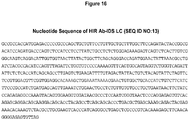
- nucleotide (nt) sequence encoding the open reading frame of the LC, the HC fusion protein, and the DHFR is given in SEQ ID NO:13, SEQ ID NO:14, and SEQ ID NO:15, respectively ( Figures 16 , 17 , 18 respectively).
- amino acid (AA) sequences encoded by the HC fusion gene, the LC gene, and the DHFR gene on the tandem vector are given in SEQ ID NO:10, SEQ ID NO:16, and SEQ ID NO:17, respectively ( Figures 5 , 19 , and 20 , respectively).
- the CHO cells were placed in the incubator at 37 C and 8% CO2. Owing to the presence of the neo gene in the TV, transfected cell lines were initially selected with G418.
- the TV-HIRMAb-IDS also contains the gene for DHFR ( Figure 15 ), so the transfected cells were also selected with 20 nM methotrexate (MTX) and HT deficient medium.
- MTX methotrexate
- HT deficient medium Once visible colonies were detected at about 21 days after EP, the conditioned medium was sampled for human IgG by ELISA. Wells with high human IgG signals in the ELISA were transferred from the 96-well plate to a 24-well plate with 1mL of HyQ SFM4CHO-Utility.
- the 24-well plates were returned to the incubator at 37 C and 8% CO2.
- the following week IgG ELISA was performed on the clones in the 24-well plates. This was repeated through the 6-well plates to T75 flasks and finally to 60 mL and 125 mL square plastic bottles on an orbital shaker. At this stage, the final MTX concentration was 80 nM, and the medium IgG concentration, which was a measure of HIRMAb-IDS fusion protein in the medium is >10 mg/L at a cell density of 10 6 /mL.
- Clones selected for dilutional cloning were removed from the orbital shaker in the incubator and transferred to the sterile hood.
- the cells were diluted to 500 mL in F-12K medium with 5% dialyzed fetal bovine serum (d-FBS) and Penicillin/Streptomycin, and the final dilution is 8 cells per mL, so that 4,000 wells in 40 x 96-well plates can be plated at a cell density of 1 cell per well (CPW).
- d-FBS dialyzed fetal bovine serum
- Penicillin/Streptomycin Penicillin/Streptomycin
- the plates were returned to the incubator at 37 C and 8% CO2. The cells diluted to 1 cell/well cannot survive without serum.
- DC plates were removed from the incubator and transferred to the sterile hood where 125 ⁇ l of F-12K medium with 5% dialyzed fetal bovine serum (d-FBS) was added to each well.
- This selection media now contained 5% d-FBS, 30 nM MTX and 0.25 mg/mL Geneticin.
- aliquots from each of the 4,000 wells were removed for human IgG ELISA, using robotics equipment.
- DC plates were removed from the incubator and transferred to the sterile hood, where 100 ⁇ l of media was removed per well of the 96-well plate and transferred into a new, sterile sample 96-well plate using an 8-channel pipettor or the precision pipettor system.
- the highest producing 24-well plates from the 1 CPW DC were transferred to the sterile hood and gradually subcloned through 6-well dishes, T75 flasks, and 125 mL square plastic bottles on an orbital shaker. During this process the serum was reduced to zero, at the final stage of centrifugation of the cells and resuspension in SFM.
- the CHO-derived fusion protein was shown to have a high affinity for binding to the HIR, with an EC50 of 0.36 ⁇ 0.04 nM, which was not significantly different from the EC50, 0.41 ⁇ 0.09 nM, for the HIR Ab without the fused IDS.
- the CHO-derived HIR Ab-IDS fusion protein retained high IDS enzyme activity despite fusion of the IDS to the HIR Ab.
- the first 8 amino acids of IDS following the 25 amino acid signal peptide constitute a propeptide ( Flomen et al, Determination of the organization of coding sequences within the iduronate sulphate sulphatase (IDS) gene, Hum. Mol. Genet. 2, 5-10, 1993 ), which may be subject to cleavage by endoproteases. Such cleavage could result in the separation of the IDS from the HIR Ab, in which case the IDS could not be carried across the BBB by the HIR Ab Trojan horse. In this event, the IDS cDNA would be re-amplified by PCR using the new forward ODN listed in Table 2 (SEQ ID NO:19).
- IDS FWD2 ODN PCR with the IDS FWD2 ODN and IDS REV ODN listed in Table 2 will amplify an IDS cDNA that encodes for the IDS enzyme minus the 25 amino acid signal peptide, from Met-1 to Gly-25, and minus the 8 amino acid propeptide, from Ser-26 to Thr-33, and beginning with Thr-34 and ending in Pro-550 of the human IDS sequence (NP_000193).
- the IDS FWD2 ODN has 'CC' on the 5'-end to maintain the open reading frame with the carboxyl terminus of the CH3 region of the HC of the HIR Ab, and the Ser-Ser linker placed between the carboxyl terminus of the HIR Ab HC and the amino terminus of the IDS.
- the mature human IDS is fused to the carboxyl terminus of the HC of the HIR Ab with a 2-amino acid linker, Ser-Ser (underlined in Figure 5 ). Any number of variations of linkers are used as substitutions for the Ser-Ser linker.
- the 2-amino acid linker may be retained, but the amino acid sequence is changed to alternative amino acids, such as Gly-Gly, or Ser-Gly, or Ala-Ser, or any number of combinations of the 20 natural amino acids. Or, the linker is reduced to a single amino acid, or zero amino acids. In the case of a zero amino acid linker, the amino terminus of the IDS is fused directly to the carboxyl terminus of the HC of the HIR Ab.
- the length of the linker is expanded to 3,4,5,6,7,8,9,10,11,12,13,14,15 amino acids.
- linkers are well known in the art, as there are multiple publicly available programs for determining optimal amino acid linkers in the engineering of fusion proteins.
- a frequently used linker includes various combinations of Gly and Ser in repeating sequences, such as (Gly 4 Ser) 3 , or other variations.
- the uptake of the fusion protein by brain is expected to be reduced, as compared to the primate, in proportion to body weight. Therefore, the expected brain uptake of the fusion protein in the human brain is about 1% of the injected dose per human brain, or about 1% of the ID per 1000 g human brain.
- One gram of brain contains about 100 mg brain protein.
- the IDS activity delivered to the human brain is expected to be about 60,000 units.
- the normal IDS enzyme activity in brain is about 2.5 units/mg protein ( Tomatsu et al, Murine model of MPS IVA with missense mutation at the active site cysteine conserved among sulfatase proteins. Molec. Genet. Metab. 91, 251-258, 2007 ).
- the administration of the HIR Ab-IDSfusion protein is expected to produce a 20% replacement of the normal brain IDS enzyme activity.
- Therapeutic effects in lysosomal storage disorders are achieved with the replacement of ⁇ 5% of normal tissue enzyme activity [ Muenzer and Fisher, Advances in the treatment of mucopolysaccharidosis type I. N Engl J Med 350 (2004) 1932-1934 ]. Higher degrees of replacement of IDS enzyme activity in the human brain would be possible by increasing the dosage of the HIR Ab-IDS fusion protein
Landscapes
- Health & Medical Sciences (AREA)
- Chemical & Material Sciences (AREA)
- Organic Chemistry (AREA)
- Life Sciences & Earth Sciences (AREA)
- Genetics & Genomics (AREA)
- Immunology (AREA)
- Engineering & Computer Science (AREA)
- Medicinal Chemistry (AREA)
- General Health & Medical Sciences (AREA)
- Biochemistry (AREA)
- Molecular Biology (AREA)
- Biomedical Technology (AREA)
- Bioinformatics & Cheminformatics (AREA)
- Biophysics (AREA)
- Proteomics, Peptides & Aminoacids (AREA)
- Wood Science & Technology (AREA)
- Zoology (AREA)
- Neurology (AREA)
- Biotechnology (AREA)
- Microbiology (AREA)
- Endocrinology (AREA)
- General Engineering & Computer Science (AREA)
- Neurosurgery (AREA)
- Chemical Kinetics & Catalysis (AREA)
- Psychiatry (AREA)
- Public Health (AREA)
- Animal Behavior & Ethology (AREA)
- Pharmacology & Pharmacy (AREA)
- Nuclear Medicine, Radiotherapy & Molecular Imaging (AREA)
- General Chemical & Material Sciences (AREA)
- Veterinary Medicine (AREA)
- Hospice & Palliative Care (AREA)
- Peptides Or Proteins (AREA)
- Enzymes And Modification Thereof (AREA)
- Medicinal Preparation (AREA)
- Medicines Containing Antibodies Or Antigens For Use As Internal Diagnostic Agents (AREA)
- Micro-Organisms Or Cultivation Processes Thereof (AREA)
- Medicines That Contain Protein Lipid Enzymes And Other Medicines (AREA)
Priority Applications (5)
| Application Number | Priority Date | Filing Date | Title |
|---|---|---|---|
| HRP20190690TT HRP20190690T1 (hr) | 2009-10-09 | 2010-10-08 | Postupci i pripravci za povećanje aktiviteta iduronat-2-sulfataze u centralnom nervnom sustavu |
| PL10822810T PL2485761T3 (pl) | 2009-10-09 | 2010-10-08 | Sposoby i kompozycje do zwiększania aktywności 2-sulfatazy iduronianu w cns |
| SI201031879T SI2485761T1 (sl) | 2009-10-09 | 2010-10-08 | Postopki in sestavki za povečanje aktivnosti iduronat-2-sulfataze v CŽS |
| EP19150184.0A EP3533467B1 (en) | 2009-10-09 | 2010-10-08 | Methods and compositions for increasing iduronate 2-sulfatase activity in the cns |
| EP23183395.5A EP4273164A3 (en) | 2009-10-09 | 2010-10-08 | Methods and compositions for increasing iduronate 2-sulfatase activity in the cns |
Applications Claiming Priority (3)
| Application Number | Priority Date | Filing Date | Title |
|---|---|---|---|
| US25037809P | 2009-10-09 | 2009-10-09 | |
| US25604909P | 2009-10-29 | 2009-10-29 | |
| PCT/US2010/052113 WO2011044542A1 (en) | 2009-10-09 | 2010-10-08 | Methods and compositions for increasing iduronate 2-sulfatase activity in the cns |
Related Child Applications (3)
| Application Number | Title | Priority Date | Filing Date |
|---|---|---|---|
| EP23183395.5A Division EP4273164A3 (en) | 2009-10-09 | 2010-10-08 | Methods and compositions for increasing iduronate 2-sulfatase activity in the cns |
| EP19150184.0A Division EP3533467B1 (en) | 2009-10-09 | 2010-10-08 | Methods and compositions for increasing iduronate 2-sulfatase activity in the cns |
| EP19150184.0A Division-Into EP3533467B1 (en) | 2009-10-09 | 2010-10-08 | Methods and compositions for increasing iduronate 2-sulfatase activity in the cns |
Publications (3)
| Publication Number | Publication Date |
|---|---|
| EP2485761A1 EP2485761A1 (en) | 2012-08-15 |
| EP2485761A4 EP2485761A4 (en) | 2013-04-03 |
| EP2485761B1 true EP2485761B1 (en) | 2019-02-27 |
Family
ID=43857180
Family Applications (3)
| Application Number | Title | Priority Date | Filing Date |
|---|---|---|---|
| EP10822810.7A Active EP2485761B1 (en) | 2009-10-09 | 2010-10-08 | Methods and compositions for increasing iduronate 2-sulfatase activity in the cns |
| EP19150184.0A Active EP3533467B1 (en) | 2009-10-09 | 2010-10-08 | Methods and compositions for increasing iduronate 2-sulfatase activity in the cns |
| EP23183395.5A Pending EP4273164A3 (en) | 2009-10-09 | 2010-10-08 | Methods and compositions for increasing iduronate 2-sulfatase activity in the cns |
Family Applications After (2)
| Application Number | Title | Priority Date | Filing Date |
|---|---|---|---|
| EP19150184.0A Active EP3533467B1 (en) | 2009-10-09 | 2010-10-08 | Methods and compositions for increasing iduronate 2-sulfatase activity in the cns |
| EP23183395.5A Pending EP4273164A3 (en) | 2009-10-09 | 2010-10-08 | Methods and compositions for increasing iduronate 2-sulfatase activity in the cns |
Country Status (11)
| Country | Link |
|---|---|
| US (6) | US8834874B2 (https=) |
| EP (3) | EP2485761B1 (https=) |
| JP (5) | JP2013507131A (https=) |
| DK (1) | DK2485761T3 (https=) |
| ES (1) | ES2725200T3 (https=) |
| HR (1) | HRP20190690T1 (https=) |
| HU (1) | HUE044865T2 (https=) |
| PL (1) | PL2485761T3 (https=) |
| PT (1) | PT2485761T (https=) |
| SI (1) | SI2485761T1 (https=) |
| WO (1) | WO2011044542A1 (https=) |
Families Citing this family (53)
| Publication number | Priority date | Publication date | Assignee | Title |
|---|---|---|---|---|
| WO2003057179A2 (en) | 2002-01-11 | 2003-07-17 | Biomarin Pharmaceutical, Inc. | Use of p97 as an enzyme delivery system for the delivery of therapeutic lysosomal enzymes |
| US8741260B2 (en) * | 2005-10-07 | 2014-06-03 | Armagen Technologies, Inc. | Fusion proteins for delivery of GDNF to the CNS |
| US8759297B2 (en) * | 2006-08-18 | 2014-06-24 | Armagen Technologies, Inc. | Genetically encoded multifunctional compositions bidirectionally transported between peripheral blood and the cns |
| AU2008282496B2 (en) | 2007-07-27 | 2013-04-04 | Armagen Technologies, Inc. | Methods and compositions for increasing alpha-iduronidase activity in the CNS |
| CA2748889A1 (en) * | 2009-03-18 | 2010-09-23 | Armagen Technologies, Inc. | Compositions and methods for blood-brain barrier delivery of igg-decoy receptor fusion proteins |
| EP2485761B1 (en) | 2009-10-09 | 2019-02-27 | Armagen, Inc. | Methods and compositions for increasing iduronate 2-sulfatase activity in the cns |
| US20160145589A1 (en) | 2011-06-24 | 2016-05-26 | Green Cross Corporation | Composition and formulation comprising recombinant human iduronate-2-sulfatase and preparation method thereof |
| CN103747807B (zh) | 2011-07-05 | 2016-12-07 | 比奥阿赛斯技术有限公司 | P97‑抗体缀合物和使用方法 |
| AU2012346448B2 (en) * | 2011-12-02 | 2017-09-14 | Armagen, Inc. | Methods and compositions for increasing arylsulfatase A activity in the CNS |
| CA2863224A1 (en) | 2012-01-09 | 2013-07-18 | The Scripps Research Institute | Ultralong complementarity determining regions and uses thereof |
| JP2015509091A (ja) | 2012-01-09 | 2015-03-26 | ザ スクリプス リサーチ インスティテュート | ヒト化抗体 |
| MX2014011836A (es) | 2012-03-30 | 2015-03-09 | Shire Human Genetic Therapies | Administracion subcutanea de iduronato-2-sulfatasa. |
| KR101380740B1 (ko) * | 2012-06-29 | 2014-04-11 | 쉐어 휴먼 제네텍 세러피스, 인코포레이티드 | 이듀로네이트-2-설파타제의 정제 |
| US20140004097A1 (en) * | 2012-06-29 | 2014-01-02 | Shire Human Genetic Therapies, Inc. | Method of producing recombinant iduronate-2-sulfatase |
| US9150841B2 (en) * | 2012-06-29 | 2015-10-06 | Shire Human Genetic Therapies, Inc. | Cells for producing recombinant iduronate-2-sulfatase |
| CA3140358A1 (en) * | 2012-07-31 | 2014-02-06 | Bioasis Technologies, Inc. | Dephosphorylated lysosomal storage disease proteins and methods of use thereof |
| JP2015536658A (ja) * | 2012-11-30 | 2015-12-24 | アンジオケム インコーポレーテッド | 標的化イズロン酸−2−スルファターゼ化合物 |
| EP2943512A4 (en) * | 2013-01-11 | 2016-06-01 | California Inst Biomedical Res | BOVINE FUSION ANTIBODY |
| AU2014243816B2 (en) | 2013-03-13 | 2019-01-31 | Bioasis Technologies Inc. | Fragments of p97 and uses thereof |
| CA2918370A1 (en) | 2013-07-18 | 2015-01-22 | Fabrus, Inc. | Humanized antibodies with ultralong complementarity determining regions |
| JP6692293B2 (ja) * | 2013-07-22 | 2020-05-13 | アーマジェン・インコーポレイテッドArmagen, Inc. | Cnsにおける酵素活性を増大するための方法および組成物 |
| US20150093399A1 (en) | 2013-08-28 | 2015-04-02 | Bioasis Technologies, Inc. | Cns-targeted conjugates having modified fc regions and methods of use thereof |
| EP3088518A4 (en) | 2013-12-25 | 2017-09-20 | JCR Pharmaceuticals Co., Ltd. | Novel anti-transferrin receptor antibody that passes through blood-brain barrier |
| JP6603227B2 (ja) | 2014-02-03 | 2019-11-06 | バイオアシス テクノロジーズ インコーポレイテッド | P97融合タンパク質 |
| DK3107562T3 (da) | 2014-02-19 | 2019-12-16 | Bioasis Technologies Inc | P97-ids-fusionsproteiner |
| DK3114141T3 (da) | 2014-03-06 | 2020-08-10 | Nat Res Council Canada | Insulinlignende vækstfaktor 1-receptor-specifikke antistoffer og anvendelse deraf |
| PE20170088A1 (es) * | 2014-03-06 | 2017-03-09 | Nat Res Council Canada | Anticuerpos especificos del receptor del factor 1 de crecimiento similar a la insulina y usos de los mismos |
| NZ724869A (en) * | 2014-03-06 | 2022-07-01 | Nat Res Council Canada | Insulin-like growth factor 1 receptor -specific antibodies and uses thereof |
| DE102014205817A1 (de) * | 2014-03-28 | 2015-10-01 | Aktiebolaget Skf | Wälzlagerkäfig und Verfahren zur Montage eines Wälzlagerkäfigs |
| US10538589B2 (en) | 2015-01-14 | 2020-01-21 | Armagen Inc. | Methods and compositions for increasing N-acetylglucosaminidase (NAGLU) activity in the CNS using a fusion antibody comprising an anti-human insulin receptor antibody and NAGLU |
| EP3101125A1 (en) * | 2015-06-05 | 2016-12-07 | Laboratorios Del Dr. Esteve, S.A. | Adenoassociated virus vectors for the treatment of mucopolysaccharidoses |
| EP3307326B9 (en) | 2015-06-15 | 2021-02-24 | Angiochem Inc. | Methods for the treatment of leptomeningeal carcinomatosis |
| EA039366B1 (ru) * | 2015-06-24 | 2022-01-19 | Джей Си Ар ФАРМАСЬЮТИКАЛЗ КО., ЛТД. | Антитело к рецептору трансферрина человека, проникающее через гематоэнцефалический барьер |
| AU2016283344B2 (en) | 2015-06-24 | 2022-08-04 | Jcr Pharmaceuticals Co., Ltd. | Fusion protein containing BDNF |
| US20180243370A1 (en) | 2015-09-14 | 2018-08-30 | Children's Hospital Medical Center | Methods and compositions for treatment of gaucher disease via modulation of c5a receptor |
| RU2673038C2 (ru) * | 2016-01-18 | 2018-11-21 | ООО "Международный Биотехнологический Центр "Генериум" | Лекарственное средство на основе бифункционального антитела для лечения мукополисахаридоза II типа |
| SG11201901495YA (en) * | 2016-08-25 | 2019-03-28 | Jcr Pharmaceuticals Co Ltd | Method for producing antibody fusion protein |
| CA3052936A1 (en) | 2016-12-26 | 2018-07-05 | Jcr Pharmaceuticals Co., Ltd. | Fusion protein of bdnf and anti-transferrin receptor antibody |
| KR102497564B1 (ko) | 2016-12-26 | 2023-02-07 | 제이씨알 파마 가부시키가이샤 | 혈액뇌관문을 통과하는 신규한 항인간 트랜스페린 수용체 항체 |
| CR20200129A (es) | 2017-10-02 | 2020-08-22 | Denali Therapeutics Inc | Proteínas de fusión que comprenden enzimas de terapia de reemplazo de enzimas |
| WO2019143761A1 (en) * | 2018-01-17 | 2019-07-25 | Children's Hospital Medical Center | Compositions and methods for treatment of hunter's syndrome |
| US12344671B2 (en) | 2018-04-24 | 2025-07-01 | National Research Council Of Canada | Blood-brain barrier transmigrating therapeutic compounds and uses thereof |
| AU2019317460A1 (en) * | 2018-08-07 | 2021-03-18 | Armagen, Inc. | Methods and compositions for increasing the activity in the CNS of hexosaminidase a, acid sphingomyelinase, and palmitoyl-protein thioesterase 1 |
| KR102692543B1 (ko) * | 2018-10-26 | 2024-08-07 | 재단법인 목암생명과학연구소 | Ids를 포함하는 융합 단백질 및 이의 용도 |
| US20220002688A1 (en) | 2018-12-20 | 2022-01-06 | Armagen, Inc. | Purification of iduronate-2-sulfatase immunoglobulin fusion protein |
| CA3134538A1 (en) * | 2019-04-03 | 2020-10-08 | Denali Therapeutics Inc. | Formulations of protein molecules comprising iduronate 2-sulfatase |
| CA3128035A1 (en) | 2020-08-13 | 2022-02-13 | Bioasis Technologies, Inc. | Combination therapies for delivery across the blood brain barrier |
| US20240066149A1 (en) | 2021-01-12 | 2024-02-29 | Jcr Pharmaceuticals Co., Ltd. | Nucleic Acid Molecule Containing Incorporated Gene Encoding Fused Protein of Ligand and Protein Having Physiological Activity |
| EP4389772A4 (en) * | 2021-08-18 | 2025-08-20 | Joint Stock Company Generium | TARGETED ADMINISTRATION OF THERAPEUTIC FERMENTS |
| MX2024005968A (es) | 2021-11-19 | 2024-08-06 | Japan Chem Res | Peptido que tiene afinidad por el receptor de transferrina humano. |
| CA3244685A1 (en) | 2021-12-28 | 2025-06-13 | Jcr Pharmaceuticals Co., Ltd. | Fusion protein of anti-transferrin receptor antibody and physiologically active protein for safe gene therapy |
| TW202436352A (zh) | 2023-02-07 | 2024-09-16 | 日商Jcr製藥股份有限公司 | 人類運鐵蛋白受體親和性肽 |
| KR20250149177A (ko) | 2023-02-21 | 2025-10-15 | 조인트-스톡 컴퍼니 "제네리움" | 제2형 점액다당류증을 앓고 있는 대상체의 리소좀 효소 결핍을 예방 및 치료하기 위한 약제학적 조성물 및 방법 |
Family Cites Families (156)
| Publication number | Priority date | Publication date | Assignee | Title |
|---|---|---|---|---|
| US5618920A (en) * | 1985-11-01 | 1997-04-08 | Xoma Corporation | Modular assembly of antibody genes, antibodies prepared thereby and use |
| US4801575A (en) * | 1986-07-30 | 1989-01-31 | The Regents Of The University Of California | Chimeric peptides for neuropeptide delivery through the blood-brain barrier |
| US4902505A (en) * | 1986-07-30 | 1990-02-20 | Alkermes | Chimeric peptides for neuropeptide delivery through the blood-brain barrier |
| US4946778A (en) * | 1987-09-21 | 1990-08-07 | Genex Corporation | Single polypeptide chain binding molecules |
| US5530101A (en) * | 1988-12-28 | 1996-06-25 | Protein Design Labs, Inc. | Humanized immunoglobulins |
| US5180820A (en) * | 1989-08-30 | 1993-01-19 | Barde Yves Alain | Brain-derived neurotrophic factor |
| US5229500A (en) * | 1989-08-30 | 1993-07-20 | Regeneron Pharmaceuticals, Inc. | Brain derived neurotrophic factor |
| US6541610B1 (en) | 1989-09-05 | 2003-04-01 | Immunex Corporation | Fusion proteins comprising tumor necrosis factor receptor |
| NZ235148A (en) | 1989-09-05 | 1991-12-23 | Immunex Corp | Tumour necrosis factor receptor protein and dna sequences |
| US5977307A (en) * | 1989-09-07 | 1999-11-02 | Alkermes, Inc. | Transferrin receptor specific ligand-neuropharmaceutical agent fusion proteins |
| US5527527A (en) * | 1989-09-07 | 1996-06-18 | Alkermes, Inc. | Transferrin receptor specific antibody-neuropharmaceutical agent conjugates |
| US6329508B1 (en) * | 1989-09-07 | 2001-12-11 | Alkermes, Inc. | Transferrin receptor reactive chimeric antibodies |
| US5154924A (en) * | 1989-09-07 | 1992-10-13 | Alkermes, Inc. | Transferrin receptor specific antibody-neuropharmaceutical agent conjugates |
| US5182107A (en) * | 1989-09-07 | 1993-01-26 | Alkermes, Inc. | Transferrin receptor specific antibody-neuropharmaceutical or diagnostic agent conjugates |
| US5672683A (en) | 1989-09-07 | 1997-09-30 | Alkermes, Inc. | Transferrin neuropharmaceutical agent fusion protein |
| EP0939121B2 (de) * | 1989-09-12 | 2007-12-26 | AHP Manufacturing B.V. | TFN-bindende Proteine |
| US5527288A (en) | 1990-12-13 | 1996-06-18 | Elan Medical Technologies Limited | Intradermal drug delivery device and method for intradermal delivery of drugs |
| TW279133B (https=) | 1990-12-13 | 1996-06-21 | Elan Med Tech | |
| US6060069A (en) | 1991-05-20 | 2000-05-09 | Dura Pharmaceuticals, Inc. | Pulmonary delivery of pharmaceuticals |
| US6287792B1 (en) * | 1991-06-17 | 2001-09-11 | The Regents Of The University Of California | Drug delivery of antisense oligonucleotides and peptides to tissues in vivo and to cells using avidin-biotin technology |
| DK0528767T3 (da) * | 1991-08-21 | 2000-04-17 | Novartis Ag | antistofderivater |
| AU679167B2 (en) * | 1991-09-20 | 1997-06-26 | Amgen, Inc. | Glial derived neurotrophic factor |
| US5932211A (en) * | 1991-11-12 | 1999-08-03 | Women's And Children's Hospital | Glycosylation variants of iduronate 2-sulfatase |
| JPH06228199A (ja) | 1992-11-27 | 1994-08-16 | Takeda Chem Ind Ltd | 血液脳関門通過可能なペプチド結合体 |
| CA2115900A1 (en) | 1993-02-22 | 1994-08-23 | Gerald W. Becker | Pharmaceutical screens and antibodies |
| US6195608B1 (en) | 1993-05-28 | 2001-02-27 | Lucent Technologies Inc. | Acoustic highway monitor |
| US5997501A (en) | 1993-11-18 | 1999-12-07 | Elan Corporation, Plc | Intradermal drug delivery device |
| DE69523857T2 (de) * | 1994-09-16 | 2002-06-13 | Merck Patent Gmbh | Immunokonjugate |
| US5656284A (en) | 1995-04-24 | 1997-08-12 | Balkin; Michael S. | Oral transmucosal delivery tablet and method of making it |
| AU6163196A (en) * | 1995-06-07 | 1996-12-30 | Smithkline Beecham Corporation | Method for obtaining receptor agonist antibodies |
| CN1137680C (zh) | 1995-09-19 | 2004-02-11 | 藤泽药品工业株式会社 | 气雾剂组合物 |
| US6015662A (en) * | 1996-01-23 | 2000-01-18 | Abbott Laboratories | Reagents for use as calibrators and controls |
| US5837231A (en) * | 1996-06-27 | 1998-11-17 | Regents Of The University Of Minnesota | GM-CSF administration for the treatment and prevention of recurrence of brain tumors |
| PT915851E (pt) | 1996-07-16 | 2002-09-30 | Staat Nl Verteg Door Min Welzi | Esteres dibenzodihidropiridinecarboxilicos e seu uso no ensaio dos metodos quimiluminiscente |
| US8173127B2 (en) | 1997-04-09 | 2012-05-08 | Intellect Neurosciences, Inc. | Specific antibodies to amyloid beta peptide, pharmaceutical compositions and methods of use thereof |
| AU8269898A (en) | 1997-06-27 | 1999-01-19 | Regents Of The University Of California, The | Drug targeting of a peptide radiopharmaceutical through the primate blood-brain barrier in vivo with a monoclonal antibody to the human insulin receptor |
| WO1999000951A1 (en) | 1997-06-30 | 1999-01-07 | Motorola Inc. | Circuit and packet switched network interconnection |
| US6165476A (en) | 1997-07-10 | 2000-12-26 | Beth Israel Deaconess Medical Center | Fusion proteins with an immunoglobulin hinge region linker |
| US6482923B1 (en) | 1997-09-17 | 2002-11-19 | Human Genome Sciences, Inc. | Interleukin 17-like receptor protein |
| US6165783A (en) * | 1997-10-24 | 2000-12-26 | Neuro Spheres Holdings Ltd. | Erythropoietin-mediated neurogenesis |
| US6016800A (en) | 1997-10-24 | 2000-01-25 | Century; Theodore J. | Intrapulmonary aerosolizer |
| US6905686B1 (en) * | 1997-12-02 | 2005-06-14 | Neuralab Limited | Active immunization for treatment of alzheimer's disease |
| ES2314995T3 (es) | 1997-12-11 | 2009-03-16 | Alza Corporation | Dispositivo para mejorar el flujo de agentes tansdermicos. |
| DK1071700T3 (da) | 1998-04-20 | 2010-06-07 | Glycart Biotechnology Ag | Glykosylerings-modifikation af antistoffer til forbedring af antistofafhængig cellulær cytotoksicitet |
| US7074405B1 (en) | 1998-06-22 | 2006-07-11 | Immunomedics, Inc. | Use of bi-specific antibodies for pre-targeting diagnosis and therapy |
| US6348210B1 (en) | 1998-11-13 | 2002-02-19 | Alza Corporation | Methods for transdermal drug administration |
| US6375975B1 (en) | 1998-12-21 | 2002-04-23 | Generex Pharmaceuticals Incorporated | Pharmaceutical compositions for buccal and pulmonary application |
| DK1140173T4 (da) | 1998-12-22 | 2013-06-10 | Genentech Inc | Vaskulære endothelcellevækstfaktorantagonister og anvendelser deraf |
| US6284262B1 (en) | 1999-01-26 | 2001-09-04 | Virgil A. Place | Compact dosage unit for buccal administration of a pharmacologically active agent |
| US7214658B2 (en) * | 2004-07-06 | 2007-05-08 | Tact Ip, Llc | Method of delivering a TNF antagonist to the brain of a human by perispinal administration without direct intrathecal injection |
| MXPA01008870A (es) | 1999-03-05 | 2004-08-12 | Epigenesis Pharmaceuticals Inc | Metodo para validar y/o invalidar blancos y rutas. |
| US7309687B1 (en) * | 1999-04-13 | 2007-12-18 | The Kenneth S. Warren Institute, Inc. | Methods for treatment and prevention of neuromuscular and muscular conditions by peripherally administered erythropoietin |
| AU780474B2 (en) * | 1999-06-16 | 2005-03-24 | Boston Biomedical Research Institute Incorporated | Immunological control of beta-amyloid levels in vivo |
| CZ299516B6 (cs) * | 1999-07-02 | 2008-08-20 | F. Hoffmann-La Roche Ag | Konjugát erythropoetinového glykoproteinu, zpusobjeho výroby a použití a farmaceutická kompozice sjeho obsahem |
| AU6607100A (en) | 1999-07-23 | 2001-02-13 | Regents Of The University Of California, The | Anti-growth factor receptor avidin fusion proteins as universal vectors for drugdelivery |
| US20020052311A1 (en) * | 1999-09-03 | 2002-05-02 | Beka Solomon | Methods and compostions for the treatment and/or diagnosis of neurological diseases and disorders |
| JP3589912B2 (ja) * | 1999-09-03 | 2004-11-17 | 泰久 福井 | ホスファチジルイノシトール−3,4−二リン酸を認識するモノクローナル抗体 |
| US6195605B1 (en) | 1999-09-29 | 2001-02-27 | Bmi Technologies Inc. | Impact monitor |
| US6585971B1 (en) * | 1999-11-12 | 2003-07-01 | Harbor-Ucla Research And Education Institute | Recombinant α-L-iduronidase, methods for producing and purifying the same and methods for treating disease caused by deficiencies thereof |
| EP2298333A3 (en) | 1999-12-20 | 2012-05-02 | Immunex Corporation | Tweak receptor |
| US6248262B1 (en) * | 2000-02-03 | 2001-06-19 | General Electric Company | Carbon-reinforced thermoplastic resin composition and articles made from same |
| US6531309B1 (en) * | 2000-02-29 | 2003-03-11 | Lexicon Genetics Incorporated | Human transporter proteins and polynucleotides encoding the same |
| US6372250B1 (en) * | 2000-04-25 | 2002-04-16 | The Regents Of The University Of California | Non-invasive gene targeting to the brain |
| US6696274B2 (en) * | 2000-05-03 | 2004-02-24 | Supratek Pharma, Inc. | Ligand for enhancing oral and CNS delivery of biological agents |
| US7078376B1 (en) * | 2000-08-11 | 2006-07-18 | Baxter Healthcare S.A. | Therapeutic methods for treating subjects with a recombinant erythropoietin having high activity and reduced side effects |
| WO2002055736A2 (en) * | 2000-12-04 | 2002-07-18 | Univ California | Antisense imaging of gene expression of the brain in vivo |
| DE60219961T8 (de) * | 2001-02-02 | 2008-04-17 | Ortho-Mcneil Pharmaceutical, Inc. | Behandlung von neurologischen funktionsstörungen mit fructopyranosesulfamaten und erythropoetin |
| KR20030074789A (ko) * | 2001-02-06 | 2003-09-19 | 메르크 파텐트 게엠베하 | 감소된 면역원성을 갖는 개질된 인간 뇌유래 신경영양인자 (bdnf) |
| US8163289B2 (en) | 2001-03-09 | 2012-04-24 | Iterative Therapeutics, Inc. | Methods and compositions involving polymeric immunoglobulin fusion proteins |
| US7560424B2 (en) | 2001-04-30 | 2009-07-14 | Zystor Therapeutics, Inc. | Targeted therapeutic proteins |
| US7629309B2 (en) | 2002-05-29 | 2009-12-08 | Zystor Therapeutics, Inc. | Targeted therapeutic proteins |
| WO2002087510A2 (en) | 2001-04-30 | 2002-11-07 | Symbiontics, Inc. | Subcellular targeting of therapeutic proteins |
| US20040005309A1 (en) | 2002-05-29 | 2004-01-08 | Symbiontics, Inc. | Targeted therapeutic proteins |
| AU2002322720B2 (en) * | 2001-07-25 | 2008-11-13 | Raptor Pharmaceutical Inc. | Compositions and methods for modulating blood-brain barrier transport |
| PT1944040E (pt) * | 2001-08-17 | 2012-10-31 | Univ Washington | Método de avaliação para a doença de alzheimer |
| US7125843B2 (en) | 2001-10-19 | 2006-10-24 | Neose Technologies, Inc. | Glycoconjugates including more than one peptide |
| US20030072761A1 (en) | 2001-10-16 | 2003-04-17 | Lebowitz Jonathan | Methods and compositions for targeting proteins across the blood brain barrier |
| AU2002347910A1 (en) | 2001-10-16 | 2003-04-28 | Symbiontics Inc. | Methods and compositions for targeting proteins across the blood brain barrier |
| US7053202B2 (en) * | 2001-10-19 | 2006-05-30 | Millennium Pharmaceuticals, Inc. | Immunoglobulin DNA cassette molecules, monobody constructs, methods of production, and methods of use therefor |
| EP1514106A4 (en) | 2002-05-29 | 2007-05-09 | Zystor Therapeutics Inc | TARGETED THERAPEUTIC PROTEINS |
| AU2003244817B2 (en) | 2002-06-28 | 2010-08-26 | Domantis Limited | Antigen-binding immunoglobulin single variable domains and dual-specific constructs |
| US20050142141A1 (en) | 2002-11-27 | 2005-06-30 | Pardridge William M. | Delivery of enzymes to the brain |
| US7388079B2 (en) * | 2002-11-27 | 2008-06-17 | The Regents Of The University Of California | Delivery of pharmaceutical agents via the human insulin receptor |
| US20040102369A1 (en) * | 2002-11-27 | 2004-05-27 | The Regents Of The University Of California | Transport of basic fibroblast growth factor across the blood brain barrier |
| DK2236154T3 (en) * | 2003-02-10 | 2018-06-25 | Biogen Ma Inc | IMMUNOGLOBULIN INFORMATION AND METHOD OF PREPARING IT |
| CA2515708A1 (en) * | 2003-02-11 | 2004-08-26 | Transkaryotic Therapies, Inc. | Diagnosis and treatment of multiple sulfatase deficiency and other sulfatase deficiencies |
| MXPA05010555A (es) | 2003-04-04 | 2006-03-09 | Genentech Inc | Formulaciones de proteina y anticuerpo de alta concentracion. |
| AU2003286870A1 (en) | 2003-06-05 | 2005-01-04 | Salk Institute For Biological Studies | Targeting polypeptides to the central nervous system |
| US20050026823A1 (en) | 2003-06-20 | 2005-02-03 | Biomarin Pharmaceutical Inc. | Use of the chaperone receptor-associated protein (RAP) for the delivery of therapeutic compounds to the brain and other tissues |
| NZ544924A (en) | 2003-06-27 | 2009-03-31 | Biogen Idec Inc | Modified binding molecules comprising connecting peptides |
| US7112299B2 (en) | 2003-07-09 | 2006-09-26 | Michael Merrick | Systems and methods for fabricating composite fiberglass laminate articles |
| US7294704B2 (en) * | 2003-08-15 | 2007-11-13 | Diadexus, Inc. | Pro108 antibody compositions and methods of use and use of Pro108 to assess cancer risk |
| EP1548031A1 (en) * | 2003-12-22 | 2005-06-29 | Dubai Genetics FZ-LLC | Nature-identical erythropoietin |
| EP1713904B1 (en) * | 2004-01-30 | 2016-06-29 | Shire Pharmaceuticals Ireland Limited | Production and purification of recombinant arylsulfatase a |
| CA2553955C (en) | 2004-02-10 | 2012-08-28 | Zystor Therapeutics, Inc. | Acid alpha-glucosidase and fragments thereof |
| RU2390353C2 (ru) * | 2004-02-12 | 2010-05-27 | Мерк Патент Гмбх | Высококонцентрированные жидкие композиции анти-egfr антител |
| US7939490B2 (en) * | 2004-12-13 | 2011-05-10 | University Of Maryland, Baltimore | TWEAK as a therapeutic target for treating central nervous system diseases associated with cerebral edema and cell death |
| WO2006074399A2 (en) | 2005-01-05 | 2006-07-13 | Biogen Idec Ma Inc. | Multispecific binding molecules comprising connecting peptides |
| US7906625B2 (en) * | 2005-01-24 | 2011-03-15 | Amgen Inc. | Humanized anti-amyloid antibody |
| EP1877099B1 (en) | 2005-04-06 | 2012-09-19 | Genzyme Corporation | Therapeutic conjugates comprising a lysosomal enzyme, polysialic acid and a targeting moiety |
| CA2607133A1 (en) | 2005-05-02 | 2006-11-09 | Toray Industries, Inc. | Composition and method for diagnosing esophageal cancer and metastasis of esophageal cancer |
| WO2007019232A2 (en) | 2005-08-03 | 2007-02-15 | Immunogen, Inc. | Immunoconjugate formulations |
| EP1937720B1 (en) | 2005-08-18 | 2014-04-09 | Ramot at Tel-Aviv University Ltd. | Single chain antibodies against beta-amyloid peptide |
| US20090047338A1 (en) | 2005-10-05 | 2009-02-19 | Immune Disease Institute, Inc. | Method to Treat Flavivirus Infection with siRNA |
| US8124095B2 (en) | 2005-10-07 | 2012-02-28 | Armagen Technologies, Inc. | Fusion proteins for delivery of erythropoietin to the CNS |
| US8053569B2 (en) | 2005-10-07 | 2011-11-08 | Armagen Technologies, Inc. | Nucleic acids encoding and methods of producing fusion proteins |
| US8741260B2 (en) | 2005-10-07 | 2014-06-03 | Armagen Technologies, Inc. | Fusion proteins for delivery of GDNF to the CNS |
| US7807409B2 (en) | 2005-10-21 | 2010-10-05 | Roche Palo Alto Llc | Method for the recombinant expression of a polypeptide |
| IL193282A (en) | 2006-02-06 | 2013-04-30 | Yeda Res & Dev | Chimeric protein of therapeutic enzyme and granulocyte-stimulating factor for treatment of lysosomal storage diseases |
| CA2641070C (en) | 2006-02-06 | 2017-01-03 | Ramot At Tel-Aviv University Ltd. | Enzyme replacement therapy for treating lysosomal storage diseases |
| US7744879B2 (en) | 2006-06-07 | 2010-06-29 | Wisconsin Alumni Research Foundation | Blood-brain barrier targeting antibodies |
| US7981417B2 (en) | 2006-06-07 | 2011-07-19 | Wisconsin Alumni Research Foundation | Blood-brain barrier targeting anti-bodies |
| GB0614780D0 (en) | 2006-07-25 | 2006-09-06 | Ucb Sa | Biological products |
| US8759297B2 (en) * | 2006-08-18 | 2014-06-24 | Armagen Technologies, Inc. | Genetically encoded multifunctional compositions bidirectionally transported between peripheral blood and the cns |
| US9388425B2 (en) | 2006-10-20 | 2016-07-12 | Trustees Of Boston University | Tunable genetic switch for regulating gene expression |
| WO2008065372A2 (en) * | 2006-11-28 | 2008-06-05 | Nautilus Biotech, S.A. | Modified erythropoietin polypeptides and uses thereof for treatment |
| WO2008151841A2 (en) * | 2007-06-15 | 2008-12-18 | University Of Zurich | Treatment for alzheimer' s disease |
| AU2008282496B2 (en) | 2007-07-27 | 2013-04-04 | Armagen Technologies, Inc. | Methods and compositions for increasing alpha-iduronidase activity in the CNS |
| WO2009070597A2 (en) | 2007-11-26 | 2009-06-04 | Armagen Technologies, Inc. | Fusion proteins for delivery of gdnf to the cns |
| JP5627571B2 (ja) | 2008-05-07 | 2014-11-19 | バイオマリン ファーマシューティカル インコーポレイテッド | リソソーム標的化ペプチドおよびその使用 |
| MX2011000071A (es) | 2008-07-02 | 2011-05-03 | Emergent Product Dev Seattle | Inmunoterapeuticos de interleucina-6 (il6). |
| US20100077498A1 (en) * | 2008-09-11 | 2010-03-25 | Pardridge William M | Compositions and methods for blood-brain barrier delivery in the mouse |
| US20100098693A1 (en) * | 2008-10-07 | 2010-04-22 | Pardridge William M | Compositions and methods for blood-brain barrier delivery of organophosphatases |
| US8853353B2 (en) | 2008-12-17 | 2014-10-07 | Angiochem, Inc. | Membrane type-1 matrix metalloprotein inhibitors and uses thereof |
| CA2748889A1 (en) | 2009-03-18 | 2010-09-23 | Armagen Technologies, Inc. | Compositions and methods for blood-brain barrier delivery of igg-decoy receptor fusion proteins |
| WO2010141932A1 (en) | 2009-06-05 | 2010-12-09 | Link Medicine Corporation | Aminopyrrolidinone derivatives and uses thereof |
| WO2010151671A2 (en) | 2009-06-24 | 2010-12-29 | Curna, Inc. | Treatment of tumor necrosis factor receptor 2 (tnfr2) related diseases by inhibition of natural antisense transcript to tnfr2 |
| EP2485761B1 (en) * | 2009-10-09 | 2019-02-27 | Armagen, Inc. | Methods and compositions for increasing iduronate 2-sulfatase activity in the cns |
| KR20230159646A (ko) | 2010-06-25 | 2023-11-21 | 샤이어 휴먼 지네틱 테라피즈 인크. | 이듀로네이트-2-설파타제의 cns 전달을 위한 방법들 및 조성물들 |
| PT3103469T (pt) | 2010-06-25 | 2021-03-04 | Shire Human Genetic Therapies | Administração de agentes terapêuticos no snc |
| JP6073783B2 (ja) | 2010-06-25 | 2017-02-01 | シャイアー ヒューマン ジェネティック セラピーズ インコーポレイテッド | ヘパランn−スルファターゼのcns送達のための方法および組成物 |
| AU2011270672B2 (en) | 2010-06-25 | 2017-01-12 | Shire Human Genetic Therapies, Inc. | Treatment of Sanfilippo Syndrome type B |
| CA2818173C (en) | 2010-11-30 | 2022-05-03 | Genentech, Inc. | Low affinity blood brain barrier receptor antibodies and uses therefor |
| AU2010366066B2 (en) | 2010-12-22 | 2016-01-14 | Fondazione Telethon | Therapeutic strategies to treat CNS pathology in mucopolysaccharidoses |
| US8580922B2 (en) | 2011-03-04 | 2013-11-12 | Shire Human Genetic Therapies, Inc. | Peptide linkers for polypeptide compositions and methods for using same |
| US20130039888A1 (en) | 2011-06-08 | 2013-02-14 | Nationwide Children's Hospital Inc. | Products and methods for delivery of polynucleotides by adeno-associated virus for lysosomal storage disorders |
| CA2840224C (en) | 2011-06-22 | 2019-08-13 | The General Hospital Corporation | Treatment of proteinopathies |
| WO2013052915A2 (en) | 2011-10-05 | 2013-04-11 | Genelux Corporation | Method for detecting replication or colonization of a biological therapeutic |
| SG10201510106PA (en) | 2011-10-12 | 2016-01-28 | Synageva Biopharma Corp | Recombinant human naglu protein and uses thereof |
| AU2012346448B2 (en) | 2011-12-02 | 2017-09-14 | Armagen, Inc. | Methods and compositions for increasing arylsulfatase A activity in the CNS |
| EP2854834A4 (en) | 2012-05-30 | 2016-05-18 | Biostrategies LC | PLANT LENSES AS CARRIER CORRESPONDING AGENTS IN ANIMAL AND HUMAN CELLS |
| KR101380740B1 (ko) | 2012-06-29 | 2014-04-11 | 쉐어 휴먼 제네텍 세러피스, 인코포레이티드 | 이듀로네이트-2-설파타제의 정제 |
| JP2015524821A (ja) | 2012-08-02 | 2015-08-27 | ジェイエヌ バイオサイエンシーズ エルエルシー | システイン変異及びμ尾部を介して多量体化した抗体又は融合タンパク質 |
| CA2888628A1 (en) | 2012-10-19 | 2014-04-24 | Tokushima University | Novel high functional enzyme having modified substrate specificity of human beta-hexosaminidase b and exhibiting protease resistance |
| JP6083219B2 (ja) | 2012-12-06 | 2017-02-22 | 富士通セミコンダクター株式会社 | プラズマフラッドガン及びイオン注入装置 |
| US20140354655A1 (en) | 2013-06-04 | 2014-12-04 | Qualcomm Mems Technologies, Inc. | Reducing floating node leakage current with a feedback transistor |
| WO2015009961A1 (en) | 2013-07-19 | 2015-01-22 | Armagen Technologies, Inc. | Compositions and methods related to structures that cross the blood brain barrier |
| JP6692293B2 (ja) | 2013-07-22 | 2020-05-13 | アーマジェン・インコーポレイテッドArmagen, Inc. | Cnsにおける酵素活性を増大するための方法および組成物 |
| WO2015150922A2 (en) | 2014-03-17 | 2015-10-08 | The Hospital For Sick Children | β-HEXOSAMINIDASE PROTEIN VARIANTS AND ASSOCIATED METHODS FOR TREATING GM2 GANGLIOSIDOSES |
| US10538589B2 (en) | 2015-01-14 | 2020-01-21 | Armagen Inc. | Methods and compositions for increasing N-acetylglucosaminidase (NAGLU) activity in the CNS using a fusion antibody comprising an anti-human insulin receptor antibody and NAGLU |
| EP3448874A4 (en) | 2016-04-29 | 2020-04-22 | Voyager Therapeutics, Inc. | COMPOSITIONS FOR TREATING A DISEASE |
| KR102497564B1 (ko) | 2016-12-26 | 2023-02-07 | 제이씨알 파마 가부시키가이샤 | 혈액뇌관문을 통과하는 신규한 항인간 트랜스페린 수용체 항체 |
| AU2017386888B2 (en) | 2016-12-28 | 2024-08-08 | Jcr Pharmaceuticals Co., Ltd. | Lyophilized preparation |
| AU2019317460A1 (en) | 2018-08-07 | 2021-03-18 | Armagen, Inc. | Methods and compositions for increasing the activity in the CNS of hexosaminidase a, acid sphingomyelinase, and palmitoyl-protein thioesterase 1 |
| US20220002688A1 (en) | 2018-12-20 | 2022-01-06 | Armagen, Inc. | Purification of iduronate-2-sulfatase immunoglobulin fusion protein |
| US20210403584A1 (en) | 2019-01-08 | 2021-12-30 | Armagen, Inc. | Methods and compositions for increasing galactosidase beta-1 activity in the cns |
-
2010
- 2010-10-08 EP EP10822810.7A patent/EP2485761B1/en active Active
- 2010-10-08 SI SI201031879T patent/SI2485761T1/sl unknown
- 2010-10-08 JP JP2012533375A patent/JP2013507131A/ja not_active Withdrawn
- 2010-10-08 ES ES10822810T patent/ES2725200T3/es active Active
- 2010-10-08 PL PL10822810T patent/PL2485761T3/pl unknown
- 2010-10-08 EP EP19150184.0A patent/EP3533467B1/en active Active
- 2010-10-08 HU HUE10822810 patent/HUE044865T2/hu unknown
- 2010-10-08 EP EP23183395.5A patent/EP4273164A3/en active Pending
- 2010-10-08 HR HRP20190690TT patent/HRP20190690T1/hr unknown
- 2010-10-08 PT PT10822810T patent/PT2485761T/pt unknown
- 2010-10-08 DK DK10822810.7T patent/DK2485761T3/da active
- 2010-10-08 WO PCT/US2010/052113 patent/WO2011044542A1/en not_active Ceased
- 2010-10-08 US US12/901,481 patent/US8834874B2/en active Active
-
2014
- 2014-06-16 US US14/305,402 patent/US10011651B2/en active Active
-
2016
- 2016-01-28 JP JP2016014716A patent/JP2016155805A/ja active Pending
-
2018
- 2018-05-08 JP JP2018089998A patent/JP2018154629A/ja active Pending
- 2018-05-17 US US15/982,990 patent/US11028156B2/en active Active
-
2020
- 2020-10-01 JP JP2020167101A patent/JP2021008488A/ja active Pending
-
2021
- 2021-04-30 US US17/246,288 patent/US12043661B2/en active Active
-
2022
- 2022-12-22 JP JP2022205808A patent/JP2023033321A/ja active Pending
-
2024
- 2024-06-11 US US18/740,035 patent/US20240327507A1/en active Pending
-
2025
- 2025-11-26 US US19/401,802 patent/US20260078178A1/en active Pending
Non-Patent Citations (5)
| Title |
|---|
| ESTER ZITO ET AL: "Sulphatase activities are regulated by the interaction of sulphatase-modifying factor 1 with SUMF2", EMBO REPORTS, vol. 6, no. 7, 1 July 2005 (2005-07-01), pages 655 - 660, XP055150221, ISSN: 1469-221X, DOI: 10.1038/sj.embor.7400454 * |
| JERRY THOMPSON ET AL: "Improved binding of a bivalent single-chain immunotoxin results in increased efficacy for in vivo T-cell depletion", PROTEIN ENGINEERING, DESIGN AND SELECTION, vol. 14, no. 12, 1 December 2001 (2001-12-01), GB, pages 1035 - 1041, XP055439051, ISSN: 1741-0126, DOI: 10.1093/protein/14.12.1035 * |
| MCGRATH J P ET AL: "Bifunctional fusion between nerve growth factor and a transferrin receptor antibody", JOURNAL OF NEUROSCIENCE RESEARCH, WILEY-LISS, US, vol. 47, 1 January 1997 (1997-01-01), pages 123 - 133, XP002698610, ISSN: 0360-4012 * |
| PARDRIDGE W M: "Blood-Brain Barrier Drug Targeting: The Future of Brain Drug Development", MOLECULAR INTERVENTIONS, AMERICAN SOCIETY FOR PHARMACOLOGY AND EXPERIMENTAL THERAPEUTICS, BETHESDA,MD, US, vol. 3, no. 2, 1 March 2003 (2003-03-01), pages 90 - 105, XP002993086, ISSN: 1534-0384, DOI: 10.1124/MI.3.2.90 * |
| QI LIN ET AL: "Binding and cytotoxicity of conjugated and recombinant fusion proteins targeted to the gonadotropin-releasing hormone receptor", CANCER RESEARCH, AACR - AMERICAN ASSOCIATION FOR CANCER RESEARCH, US, vol. 64, no. 6, 15 March 2004 (2004-03-15), pages 2090 - 2095, XP002557871, ISSN: 0008-5472, DOI: 10.1158/0008-5472.CAN-3192-2 * |
Also Published As
| Publication number | Publication date |
|---|---|
| US10011651B2 (en) | 2018-07-03 |
| EP3533467B1 (en) | 2023-07-26 |
| DK2485761T3 (da) | 2019-05-06 |
| PL2485761T3 (pl) | 2019-10-31 |
| US20180251535A1 (en) | 2018-09-06 |
| US12043661B2 (en) | 2024-07-23 |
| HRP20190690T1 (hr) | 2019-06-28 |
| US8834874B2 (en) | 2014-09-16 |
| EP3533467A2 (en) | 2019-09-04 |
| SI2485761T1 (sl) | 2019-05-31 |
| EP3533467A3 (en) | 2020-01-15 |
| US20110110935A1 (en) | 2011-05-12 |
| HUE044865T2 (hu) | 2019-11-28 |
| JP2023033321A (ja) | 2023-03-10 |
| JP2021008488A (ja) | 2021-01-28 |
| US11028156B2 (en) | 2021-06-08 |
| US20190185551A2 (en) | 2019-06-20 |
| JP2016155805A (ja) | 2016-09-01 |
| EP2485761A4 (en) | 2013-04-03 |
| ES2725200T3 (es) | 2019-09-20 |
| WO2011044542A1 (en) | 2011-04-14 |
| US20240327507A1 (en) | 2024-10-03 |
| EP4273164A3 (en) | 2024-01-24 |
| JP2018154629A (ja) | 2018-10-04 |
| EP2485761A1 (en) | 2012-08-15 |
| US20150004160A1 (en) | 2015-01-01 |
| EP4273164A2 (en) | 2023-11-08 |
| US20210253681A1 (en) | 2021-08-19 |
| US20260078178A1 (en) | 2026-03-19 |
| JP2013507131A (ja) | 2013-03-04 |
| PT2485761T (pt) | 2019-05-30 |
Similar Documents
| Publication | Publication Date | Title |
|---|---|---|
| US12043661B2 (en) | Methods and compositions for increasing iduronate 2-sulfatase activity in the CNS | |
| US20220348672A1 (en) | Methods and compositions for increasing enzyme activity in the cns | |
| US8920801B2 (en) | Methods and compositions for increasing arylsulfatase A activity in the CNS | |
| US20240409650A1 (en) | Methods and compositions for increasing n-acetylglucosaminidase activity in the cns | |
| HK40013772A (en) | Methods and compositions for increasing iduronate 2-sulfatase activity in the cns |
Legal Events
| Date | Code | Title | Description |
|---|---|---|---|
| PUAI | Public reference made under article 153(3) epc to a published international application that has entered the european phase |
Free format text: ORIGINAL CODE: 0009012 |
|
| 17P | Request for examination filed |
Effective date: 20120328 |
|
| AK | Designated contracting states |
Kind code of ref document: A1 Designated state(s): AL AT BE BG CH CY CZ DE DK EE ES FI FR GB GR HR HU IE IS IT LI LT LU LV MC MK MT NL NO PL PT RO RS SE SI SK SM TR |
|
| DAX | Request for extension of the european patent (deleted) | ||
| RIC1 | Information provided on ipc code assigned before grant |
Ipc: A61K 39/395 20060101AFI20130219BHEP |
|
| A4 | Supplementary search report drawn up and despatched |
Effective date: 20130301 |
|
| 17Q | First examination report despatched |
Effective date: 20151120 |
|
| STAA | Information on the status of an ep patent application or granted ep patent |
Free format text: STATUS: EXAMINATION IS IN PROGRESS |
|
| RAP1 | Party data changed (applicant data changed or rights of an application transferred) |
Owner name: ARMAGEN, INC. |
|
| GRAP | Despatch of communication of intention to grant a patent |
Free format text: ORIGINAL CODE: EPIDOSNIGR1 |
|
| STAA | Information on the status of an ep patent application or granted ep patent |
Free format text: STATUS: GRANT OF PATENT IS INTENDED |
|
| INTG | Intention to grant announced |
Effective date: 20180831 |
|
| GRAS | Grant fee paid |
Free format text: ORIGINAL CODE: EPIDOSNIGR3 |
|
| GRAA | (expected) grant |
Free format text: ORIGINAL CODE: 0009210 |
|
| STAA | Information on the status of an ep patent application or granted ep patent |
Free format text: STATUS: THE PATENT HAS BEEN GRANTED |
|
| AK | Designated contracting states |
Kind code of ref document: B1 Designated state(s): AL AT BE BG CH CY CZ DE DK EE ES FI FR GB GR HR HU IE IS IT LI LT LU LV MC MK MT NL NO PL PT RO RS SE SI SK SM TR |
|
| RAP1 | Party data changed (applicant data changed or rights of an application transferred) |
Owner name: ARMAGEN, INC. |
|
| REG | Reference to a national code |
Ref country code: GB Ref legal event code: FG4D |
|
| REG | Reference to a national code |
Ref country code: CH Ref legal event code: EP |
|
| REG | Reference to a national code |
Ref country code: AT Ref legal event code: REF Ref document number: 1100370 Country of ref document: AT Kind code of ref document: T Effective date: 20190315 |
|
| REG | Reference to a national code |
Ref country code: IE Ref legal event code: FG4D |
|
| REG | Reference to a national code |
Ref country code: DE Ref legal event code: R096 Ref document number: 602010057290 Country of ref document: DE |
|
| REG | Reference to a national code |
Ref country code: RO Ref legal event code: EPE |
|
| REG | Reference to a national code |
Ref country code: HR Ref legal event code: TUEP Ref document number: P20190690 Country of ref document: HR |
|
| REG | Reference to a national code |
Ref country code: DK Ref legal event code: T3 Effective date: 20190429 |
|
| REG | Reference to a national code |
Ref country code: NL Ref legal event code: FP |
|
| REG | Reference to a national code |
Ref country code: SE Ref legal event code: TRGR |
|
| REG | Reference to a national code |
Ref country code: PT Ref legal event code: SC4A Ref document number: 2485761 Country of ref document: PT Date of ref document: 20190530 Kind code of ref document: T Free format text: AVAILABILITY OF NATIONAL TRANSLATION Effective date: 20190507 |
|
| REG | Reference to a national code |
Ref country code: HR Ref legal event code: T1PR Ref document number: P20190690 Country of ref document: HR |
|
| REG | Reference to a national code |
Ref country code: NO Ref legal event code: T2 Effective date: 20190227 |
|
| REG | Reference to a national code |
Ref country code: LT Ref legal event code: MG4D |
|
| PG25 | Lapsed in a contracting state [announced via postgrant information from national office to epo] |
Ref country code: LT Free format text: LAPSE BECAUSE OF FAILURE TO SUBMIT A TRANSLATION OF THE DESCRIPTION OR TO PAY THE FEE WITHIN THE PRESCRIBED TIME-LIMIT Effective date: 20190227 |
|
| REG | Reference to a national code |
Ref country code: SK Ref legal event code: T3 Ref document number: E 30940 Country of ref document: SK |
|
| REG | Reference to a national code |
Ref country code: GR Ref legal event code: EP Ref document number: 20190401457 Country of ref document: GR Effective date: 20190708 |
|
| PG25 | Lapsed in a contracting state [announced via postgrant information from national office to epo] |
Ref country code: IS Free format text: LAPSE BECAUSE OF FAILURE TO SUBMIT A TRANSLATION OF THE DESCRIPTION OR TO PAY THE FEE WITHIN THE PRESCRIBED TIME-LIMIT Effective date: 20190627 Ref country code: LV Free format text: LAPSE BECAUSE OF FAILURE TO SUBMIT A TRANSLATION OF THE DESCRIPTION OR TO PAY THE FEE WITHIN THE PRESCRIBED TIME-LIMIT Effective date: 20190227 Ref country code: RS Free format text: LAPSE BECAUSE OF FAILURE TO SUBMIT A TRANSLATION OF THE DESCRIPTION OR TO PAY THE FEE WITHIN THE PRESCRIBED TIME-LIMIT Effective date: 20190227 |
|
| REG | Reference to a national code |
Ref country code: ES Ref legal event code: FG2A Ref document number: 2725200 Country of ref document: ES Kind code of ref document: T3 Effective date: 20190920 |
|
| REG | Reference to a national code |
Ref country code: HR Ref legal event code: ODRP Ref document number: P20190690 Country of ref document: HR Payment date: 20190920 Year of fee payment: 10 |
|
| PG25 | Lapsed in a contracting state [announced via postgrant information from national office to epo] |
Ref country code: EE Free format text: LAPSE BECAUSE OF FAILURE TO SUBMIT A TRANSLATION OF THE DESCRIPTION OR TO PAY THE FEE WITHIN THE PRESCRIBED TIME-LIMIT Effective date: 20190227 Ref country code: AL Free format text: LAPSE BECAUSE OF FAILURE TO SUBMIT A TRANSLATION OF THE DESCRIPTION OR TO PAY THE FEE WITHIN THE PRESCRIBED TIME-LIMIT Effective date: 20190227 |
|
| PGFP | Annual fee paid to national office [announced via postgrant information from national office to epo] |
Ref country code: SK Payment date: 20190919 Year of fee payment: 10 Ref country code: RO Payment date: 20190924 Year of fee payment: 10 |
|
| REG | Reference to a national code |
Ref country code: HU Ref legal event code: AG4A Ref document number: E044865 Country of ref document: HU Ref country code: DE Ref legal event code: R097 Ref document number: 602010057290 Country of ref document: DE |
|
| PG25 | Lapsed in a contracting state [announced via postgrant information from national office to epo] |
Ref country code: SM Free format text: LAPSE BECAUSE OF FAILURE TO SUBMIT A TRANSLATION OF THE DESCRIPTION OR TO PAY THE FEE WITHIN THE PRESCRIBED TIME-LIMIT Effective date: 20190227 |
|
| PGFP | Annual fee paid to national office [announced via postgrant information from national office to epo] |
Ref country code: PL Payment date: 20190919 Year of fee payment: 10 Ref country code: HR Payment date: 20190920 Year of fee payment: 10 |
|
| PLBE | No opposition filed within time limit |
Free format text: ORIGINAL CODE: 0009261 |
|
| STAA | Information on the status of an ep patent application or granted ep patent |
Free format text: STATUS: NO OPPOSITION FILED WITHIN TIME LIMIT |
|
| PGFP | Annual fee paid to national office [announced via postgrant information from national office to epo] |
Ref country code: BG Payment date: 20191018 Year of fee payment: 10 Ref country code: CZ Payment date: 20191002 Year of fee payment: 10 Ref country code: HU Payment date: 20190925 Year of fee payment: 10 |
|
| 26N | No opposition filed |
Effective date: 20191128 |
|
| PGFP | Annual fee paid to national office [announced via postgrant information from national office to epo] |
Ref country code: SI Payment date: 20190919 Year of fee payment: 10 |
|
| PG25 | Lapsed in a contracting state [announced via postgrant information from national office to epo] |
Ref country code: MC Free format text: LAPSE BECAUSE OF FAILURE TO SUBMIT A TRANSLATION OF THE DESCRIPTION OR TO PAY THE FEE WITHIN THE PRESCRIBED TIME-LIMIT Effective date: 20190227 |
|
| REG | Reference to a national code |
Ref country code: AT Ref legal event code: UEP Ref document number: 1100370 Country of ref document: AT Kind code of ref document: T Effective date: 20190227 |
|
| REG | Reference to a national code |
Ref country code: HR Ref legal event code: PBON Ref document number: P20190690 Country of ref document: HR Effective date: 20201008 |
|
| PG25 | Lapsed in a contracting state [announced via postgrant information from national office to epo] |
Ref country code: CZ Free format text: LAPSE BECAUSE OF NON-PAYMENT OF DUE FEES Effective date: 20201008 |
|
| PG25 | Lapsed in a contracting state [announced via postgrant information from national office to epo] |
Ref country code: CY Free format text: LAPSE BECAUSE OF FAILURE TO SUBMIT A TRANSLATION OF THE DESCRIPTION OR TO PAY THE FEE WITHIN THE PRESCRIBED TIME-LIMIT Effective date: 20190227 |
|
| REG | Reference to a national code |
Ref country code: SK Ref legal event code: MM4A Ref document number: E 30940 Country of ref document: SK Effective date: 20201008 |
|
| PG25 | Lapsed in a contracting state [announced via postgrant information from national office to epo] |
Ref country code: BG Free format text: LAPSE BECAUSE OF NON-PAYMENT OF DUE FEES Effective date: 20210430 Ref country code: MT Free format text: LAPSE BECAUSE OF FAILURE TO SUBMIT A TRANSLATION OF THE DESCRIPTION OR TO PAY THE FEE WITHIN THE PRESCRIBED TIME-LIMIT Effective date: 20190227 Ref country code: RO Free format text: LAPSE BECAUSE OF NON-PAYMENT OF DUE FEES Effective date: 20201008 Ref country code: SK Free format text: LAPSE BECAUSE OF NON-PAYMENT OF DUE FEES Effective date: 20201008 Ref country code: HR Free format text: LAPSE BECAUSE OF NON-PAYMENT OF DUE FEES Effective date: 20201008 |
|
| PG25 | Lapsed in a contracting state [announced via postgrant information from national office to epo] |
Ref country code: HU Free format text: LAPSE BECAUSE OF NON-PAYMENT OF DUE FEES Effective date: 20201009 Ref country code: SI Free format text: LAPSE BECAUSE OF NON-PAYMENT OF DUE FEES Effective date: 20201009 |
|
| REG | Reference to a national code |
Ref country code: SI Ref legal event code: KO00 Effective date: 20210812 |
|
| PG25 | Lapsed in a contracting state [announced via postgrant information from national office to epo] |
Ref country code: MK Free format text: LAPSE BECAUSE OF FAILURE TO SUBMIT A TRANSLATION OF THE DESCRIPTION OR TO PAY THE FEE WITHIN THE PRESCRIBED TIME-LIMIT Effective date: 20190227 |
|
| PGFP | Annual fee paid to national office [announced via postgrant information from national office to epo] |
Ref country code: PT Payment date: 20220923 Year of fee payment: 13 |
|
| PG25 | Lapsed in a contracting state [announced via postgrant information from national office to epo] |
Ref country code: PL Free format text: LAPSE BECAUSE OF NON-PAYMENT OF DUE FEES Effective date: 20201008 |
|
| PGFP | Annual fee paid to national office [announced via postgrant information from national office to epo] |
Ref country code: NL Payment date: 20221026 Year of fee payment: 13 |
|
| PGFP | Annual fee paid to national office [announced via postgrant information from national office to epo] |
Ref country code: TR Payment date: 20221006 Year of fee payment: 13 Ref country code: SE Payment date: 20221027 Year of fee payment: 13 Ref country code: NO Payment date: 20221027 Year of fee payment: 13 Ref country code: LU Payment date: 20221027 Year of fee payment: 13 Ref country code: IE Payment date: 20221027 Year of fee payment: 13 Ref country code: FI Payment date: 20221027 Year of fee payment: 13 Ref country code: ES Payment date: 20221102 Year of fee payment: 13 Ref country code: DK Payment date: 20221027 Year of fee payment: 13 Ref country code: AT Payment date: 20220921 Year of fee payment: 13 |
|
| PGFP | Annual fee paid to national office [announced via postgrant information from national office to epo] |
Ref country code: GR Payment date: 20221031 Year of fee payment: 13 Ref country code: CH Payment date: 20221116 Year of fee payment: 13 Ref country code: BE Payment date: 20221027 Year of fee payment: 13 |
|
| REG | Reference to a national code |
Ref country code: SE Ref legal event code: EUG |
|
| REG | Reference to a national code |
Ref country code: CH Ref legal event code: PL |
|
| REG | Reference to a national code |
Ref country code: DK Ref legal event code: EBP Effective date: 20231031 |
|
| REG | Reference to a national code |
Ref country code: NL Ref legal event code: MM Effective date: 20231101 |
|
| REG | Reference to a national code |
Ref country code: AT Ref legal event code: MM01 Ref document number: 1100370 Country of ref document: AT Kind code of ref document: T Effective date: 20231008 |
|
| REG | Reference to a national code |
Ref country code: BE Ref legal event code: MM Effective date: 20231031 |
|
| PG25 | Lapsed in a contracting state [announced via postgrant information from national office to epo] |
Ref country code: LU Free format text: LAPSE BECAUSE OF NON-PAYMENT OF DUE FEES Effective date: 20231008 |
|
| PG25 | Lapsed in a contracting state [announced via postgrant information from national office to epo] |
Ref country code: LU Free format text: LAPSE BECAUSE OF NON-PAYMENT OF DUE FEES Effective date: 20231008 |
|
| PG25 | Lapsed in a contracting state [announced via postgrant information from national office to epo] |
Ref country code: GR Free format text: LAPSE BECAUSE OF NON-PAYMENT OF DUE FEES Effective date: 20240515 |
|
| PG25 | Lapsed in a contracting state [announced via postgrant information from national office to epo] |
Ref country code: CH Free format text: LAPSE BECAUSE OF NON-PAYMENT OF DUE FEES Effective date: 20231031 Ref country code: NL Free format text: LAPSE BECAUSE OF NON-PAYMENT OF DUE FEES Effective date: 20231101 |
|
| PG25 | Lapsed in a contracting state [announced via postgrant information from national office to epo] |
Ref country code: AT Free format text: LAPSE BECAUSE OF NON-PAYMENT OF DUE FEES Effective date: 20231008 |
|
| PG25 | Lapsed in a contracting state [announced via postgrant information from national office to epo] |
Ref country code: NO Free format text: LAPSE BECAUSE OF NON-PAYMENT OF DUE FEES Effective date: 20231031 Ref country code: NL Free format text: LAPSE BECAUSE OF NON-PAYMENT OF DUE FEES Effective date: 20231101 Ref country code: GR Free format text: LAPSE BECAUSE OF NON-PAYMENT OF DUE FEES Effective date: 20240515 Ref country code: FI Free format text: LAPSE BECAUSE OF NON-PAYMENT OF DUE FEES Effective date: 20231008 Ref country code: CH Free format text: LAPSE BECAUSE OF NON-PAYMENT OF DUE FEES Effective date: 20231031 Ref country code: AT Free format text: LAPSE BECAUSE OF NON-PAYMENT OF DUE FEES Effective date: 20231008 |
|
| PG25 | Lapsed in a contracting state [announced via postgrant information from national office to epo] |
Ref country code: PT Free format text: LAPSE BECAUSE OF NON-PAYMENT OF DUE FEES Effective date: 20240408 |
|
| PG25 | Lapsed in a contracting state [announced via postgrant information from national office to epo] |
Ref country code: SE Free format text: LAPSE BECAUSE OF NON-PAYMENT OF DUE FEES Effective date: 20231009 Ref country code: PT Free format text: LAPSE BECAUSE OF NON-PAYMENT OF DUE FEES Effective date: 20240408 Ref country code: BE Free format text: LAPSE BECAUSE OF NON-PAYMENT OF DUE FEES Effective date: 20231031 |
|
| PG25 | Lapsed in a contracting state [announced via postgrant information from national office to epo] |
Ref country code: IE Free format text: LAPSE BECAUSE OF NON-PAYMENT OF DUE FEES Effective date: 20231008 |
|
| PG25 | Lapsed in a contracting state [announced via postgrant information from national office to epo] |
Ref country code: DK Free format text: LAPSE BECAUSE OF NON-PAYMENT OF DUE FEES Effective date: 20231031 |
|
| PG25 | Lapsed in a contracting state [announced via postgrant information from national office to epo] |
Ref country code: IE Free format text: LAPSE BECAUSE OF NON-PAYMENT OF DUE FEES Effective date: 20231008 Ref country code: DK Free format text: LAPSE BECAUSE OF NON-PAYMENT OF DUE FEES Effective date: 20231031 |
|
| REG | Reference to a national code |
Ref country code: ES Ref legal event code: FD2A Effective date: 20241127 |
|
| PGFP | Annual fee paid to national office [announced via postgrant information from national office to epo] |
Ref country code: DE Payment date: 20241029 Year of fee payment: 15 |
|
| PGFP | Annual fee paid to national office [announced via postgrant information from national office to epo] |
Ref country code: GB Payment date: 20241028 Year of fee payment: 15 |
|
| PGFP | Annual fee paid to national office [announced via postgrant information from national office to epo] |
Ref country code: FR Payment date: 20241025 Year of fee payment: 15 |
|
| PG25 | Lapsed in a contracting state [announced via postgrant information from national office to epo] |
Ref country code: ES Free format text: LAPSE BECAUSE OF NON-PAYMENT OF DUE FEES Effective date: 20231009 |
|
| PGFP | Annual fee paid to national office [announced via postgrant information from national office to epo] |
Ref country code: IT Payment date: 20241021 Year of fee payment: 15 |
|
| PG25 | Lapsed in a contracting state [announced via postgrant information from national office to epo] |
Ref country code: ES Free format text: LAPSE BECAUSE OF NON-PAYMENT OF DUE FEES Effective date: 20231009 |