EP2459867B1 - Nozzle and method of making same - Google Patents
Nozzle and method of making same Download PDFInfo
- Publication number
- EP2459867B1 EP2459867B1 EP10742637.1A EP10742637A EP2459867B1 EP 2459867 B1 EP2459867 B1 EP 2459867B1 EP 10742637 A EP10742637 A EP 10742637A EP 2459867 B1 EP2459867 B1 EP 2459867B1
- Authority
- EP
- European Patent Office
- Prior art keywords
- nozzle
- microstructured pattern
- hole
- shape
- microstructures
- Prior art date
- Legal status (The legal status is an assumption and is not a legal conclusion. Google has not performed a legal analysis and makes no representation as to the accuracy of the status listed.)
- Not-in-force
Links
- 238000004519 manufacturing process Methods 0.000 title claims description 7
- 239000000463 material Substances 0.000 claims description 117
- 238000000034 method Methods 0.000 claims description 48
- 238000000576 coating method Methods 0.000 claims description 17
- 239000000446 fuel Substances 0.000 claims description 17
- 239000011248 coating agent Substances 0.000 claims description 15
- 238000009713 electroplating Methods 0.000 claims description 13
- 230000003362 replicative effect Effects 0.000 claims description 12
- 238000006243 chemical reaction Methods 0.000 claims description 10
- 229920000642 polymer Polymers 0.000 claims description 6
- 238000010521 absorption reaction Methods 0.000 claims description 5
- 238000001746 injection moulding Methods 0.000 claims description 4
- 238000006116 polymerization reaction Methods 0.000 claims description 3
- PXHVJJICTQNCMI-UHFFFAOYSA-N nickel Substances [Ni] PXHVJJICTQNCMI-UHFFFAOYSA-N 0.000 description 26
- 239000000758 substrate Substances 0.000 description 23
- -1 poly(methyl methacrylate) Polymers 0.000 description 15
- 229910052759 nickel Inorganic materials 0.000 description 12
- 235000012431 wafers Nutrition 0.000 description 11
- WYURNTSHIVDZCO-UHFFFAOYSA-N Tetrahydrofuran Chemical compound C1CCOC1 WYURNTSHIVDZCO-UHFFFAOYSA-N 0.000 description 10
- 239000000203 mixture Substances 0.000 description 10
- 230000003287 optical effect Effects 0.000 description 10
- 238000000227 grinding Methods 0.000 description 9
- 239000004417 polycarbonate Substances 0.000 description 8
- 229920000515 polycarbonate Polymers 0.000 description 8
- LFQSCWFLJHTTHZ-UHFFFAOYSA-N Ethanol Chemical compound CCO LFQSCWFLJHTTHZ-UHFFFAOYSA-N 0.000 description 7
- BQCADISMDOOEFD-UHFFFAOYSA-N Silver Chemical compound [Ag] BQCADISMDOOEFD-UHFFFAOYSA-N 0.000 description 7
- 238000001878 scanning electron micrograph Methods 0.000 description 7
- 229910052709 silver Inorganic materials 0.000 description 7
- 239000004332 silver Substances 0.000 description 7
- 239000002904 solvent Substances 0.000 description 7
- CSCPPACGZOOCGX-UHFFFAOYSA-N Acetone Chemical compound CC(C)=O CSCPPACGZOOCGX-UHFFFAOYSA-N 0.000 description 6
- WEVYAHXRMPXWCK-UHFFFAOYSA-N Acetonitrile Chemical compound CC#N WEVYAHXRMPXWCK-UHFFFAOYSA-N 0.000 description 6
- OKKJLVBELUTLKV-UHFFFAOYSA-N Methanol Chemical compound OC OKKJLVBELUTLKV-UHFFFAOYSA-N 0.000 description 6
- 238000002347 injection Methods 0.000 description 6
- 239000007924 injection Substances 0.000 description 6
- 230000010076 replication Effects 0.000 description 6
- 239000000243 solution Substances 0.000 description 6
- 239000007921 spray Substances 0.000 description 6
- 238000003491 array Methods 0.000 description 5
- XUIMIQQOPSSXEZ-UHFFFAOYSA-N Silicon Chemical compound [Si] XUIMIQQOPSSXEZ-UHFFFAOYSA-N 0.000 description 4
- 229910052782 aluminium Inorganic materials 0.000 description 4
- XAGFODPZIPBFFR-UHFFFAOYSA-N aluminium Chemical compound [Al] XAGFODPZIPBFFR-UHFFFAOYSA-N 0.000 description 4
- 230000003247 decreasing effect Effects 0.000 description 4
- 239000012530 fluid Substances 0.000 description 4
- 239000000178 monomer Substances 0.000 description 4
- 239000004926 polymethyl methacrylate Substances 0.000 description 4
- PYWVYCXTNDRMGF-UHFFFAOYSA-N rhodamine B Chemical compound [Cl-].C=12C=CC(=[N+](CC)CC)C=C2OC2=CC(N(CC)CC)=CC=C2C=1C1=CC=CC=C1C(O)=O PYWVYCXTNDRMGF-UHFFFAOYSA-N 0.000 description 4
- 229910052710 silicon Inorganic materials 0.000 description 4
- 239000010703 silicon Substances 0.000 description 4
- XLYOFNOQVPJJNP-UHFFFAOYSA-N water Substances O XLYOFNOQVPJJNP-UHFFFAOYSA-N 0.000 description 4
- ZWEHNKRNPOVVGH-UHFFFAOYSA-N 2-Butanone Chemical compound CCC(C)=O ZWEHNKRNPOVVGH-UHFFFAOYSA-N 0.000 description 3
- QTBSBXVTEAMEQO-UHFFFAOYSA-N Acetic acid Chemical compound CC(O)=O QTBSBXVTEAMEQO-UHFFFAOYSA-N 0.000 description 3
- VYZAMTAEIAYCRO-UHFFFAOYSA-N Chromium Chemical compound [Cr] VYZAMTAEIAYCRO-UHFFFAOYSA-N 0.000 description 3
- YMWUJEATGCHHMB-UHFFFAOYSA-N Dichloromethane Chemical compound ClCCl YMWUJEATGCHHMB-UHFFFAOYSA-N 0.000 description 3
- RTZKZFJDLAIYFH-UHFFFAOYSA-N Diethyl ether Chemical compound CCOCC RTZKZFJDLAIYFH-UHFFFAOYSA-N 0.000 description 3
- XEKOWRVHYACXOJ-UHFFFAOYSA-N Ethyl acetate Chemical compound CCOC(C)=O XEKOWRVHYACXOJ-UHFFFAOYSA-N 0.000 description 3
- ZMXDDKWLCZADIW-UHFFFAOYSA-N N,N-Dimethylformamide Chemical compound CN(C)C=O ZMXDDKWLCZADIW-UHFFFAOYSA-N 0.000 description 3
- ATJFFYVFTNAWJD-UHFFFAOYSA-N Tin Chemical compound [Sn] ATJFFYVFTNAWJD-UHFFFAOYSA-N 0.000 description 3
- YXFVVABEGXRONW-UHFFFAOYSA-N Toluene Chemical compound CC1=CC=CC=C1 YXFVVABEGXRONW-UHFFFAOYSA-N 0.000 description 3
- 239000002253 acid Substances 0.000 description 3
- 239000000919 ceramic Substances 0.000 description 3
- 229910052804 chromium Inorganic materials 0.000 description 3
- 239000011651 chromium Substances 0.000 description 3
- 238000010276 construction Methods 0.000 description 3
- 230000007423 decrease Effects 0.000 description 3
- PCHJSUWPFVWCPO-UHFFFAOYSA-N gold Chemical compound [Au] PCHJSUWPFVWCPO-UHFFFAOYSA-N 0.000 description 3
- 229910052737 gold Inorganic materials 0.000 description 3
- 239000010931 gold Substances 0.000 description 3
- 239000003960 organic solvent Substances 0.000 description 3
- 229940043267 rhodamine b Drugs 0.000 description 3
- 238000004544 sputter deposition Methods 0.000 description 3
- 229920001169 thermoplastic Polymers 0.000 description 3
- 239000004416 thermosoftening plastic Substances 0.000 description 3
- 229910052718 tin Inorganic materials 0.000 description 3
- 239000011135 tin Substances 0.000 description 3
- HEDRZPFGACZZDS-UHFFFAOYSA-N Chloroform Chemical compound ClC(Cl)Cl HEDRZPFGACZZDS-UHFFFAOYSA-N 0.000 description 2
- RYGMFSIKBFXOCR-UHFFFAOYSA-N Copper Chemical compound [Cu] RYGMFSIKBFXOCR-UHFFFAOYSA-N 0.000 description 2
- 239000004593 Epoxy Substances 0.000 description 2
- MHAJPDPJQMAIIY-UHFFFAOYSA-N Hydrogen peroxide Chemical compound OO MHAJPDPJQMAIIY-UHFFFAOYSA-N 0.000 description 2
- KFZMGEQAYNKOFK-UHFFFAOYSA-N Isopropanol Chemical compound CC(C)O KFZMGEQAYNKOFK-UHFFFAOYSA-N 0.000 description 2
- 229920004142 LEXAN™ Polymers 0.000 description 2
- 239000004418 Lexan Substances 0.000 description 2
- SECXISVLQFMRJM-UHFFFAOYSA-N N-Methylpyrrolidone Chemical compound CN1CCCC1=O SECXISVLQFMRJM-UHFFFAOYSA-N 0.000 description 2
- VYPSYNLAJGMNEJ-UHFFFAOYSA-N Silicium dioxide Chemical compound O=[Si]=O VYPSYNLAJGMNEJ-UHFFFAOYSA-N 0.000 description 2
- GWEVSGVZZGPLCZ-UHFFFAOYSA-N Titan oxide Chemical compound O=[Ti]=O GWEVSGVZZGPLCZ-UHFFFAOYSA-N 0.000 description 2
- MCMNRKCIXSYSNV-UHFFFAOYSA-N Zirconium dioxide Chemical compound O=[Zr]=O MCMNRKCIXSYSNV-UHFFFAOYSA-N 0.000 description 2
- 229910045601 alloy Inorganic materials 0.000 description 2
- 239000000956 alloy Substances 0.000 description 2
- 229910010293 ceramic material Inorganic materials 0.000 description 2
- 239000003153 chemical reaction reagent Substances 0.000 description 2
- 238000002485 combustion reaction Methods 0.000 description 2
- 239000004020 conductor Substances 0.000 description 2
- 229910052802 copper Inorganic materials 0.000 description 2
- 239000010949 copper Substances 0.000 description 2
- BGTOWKSIORTVQH-UHFFFAOYSA-N cyclopentanone Chemical compound O=C1CCCC1 BGTOWKSIORTVQH-UHFFFAOYSA-N 0.000 description 2
- 239000008367 deionised water Substances 0.000 description 2
- 229910021641 deionized water Inorganic materials 0.000 description 2
- 239000007789 gas Substances 0.000 description 2
- 229910052738 indium Inorganic materials 0.000 description 2
- APFVFJFRJDLVQX-UHFFFAOYSA-N indium atom Chemical compound [In] APFVFJFRJDLVQX-UHFFFAOYSA-N 0.000 description 2
- 238000005304 joining Methods 0.000 description 2
- 239000007788 liquid Substances 0.000 description 2
- 229910052751 metal Inorganic materials 0.000 description 2
- 239000002184 metal Substances 0.000 description 2
- 238000002156 mixing Methods 0.000 description 2
- 238000000879 optical micrograph Methods 0.000 description 2
- 229920002120 photoresistant polymer Polymers 0.000 description 2
- 239000003504 photosensitizing agent Substances 0.000 description 2
- 239000004033 plastic Substances 0.000 description 2
- 229920003023 plastic Polymers 0.000 description 2
- 229920003229 poly(methyl methacrylate) Polymers 0.000 description 2
- BDERNNFJNOPAEC-UHFFFAOYSA-N propan-1-ol Chemical compound CCCO BDERNNFJNOPAEC-UHFFFAOYSA-N 0.000 description 2
- 229920013730 reactive polymer Polymers 0.000 description 2
- 238000002310 reflectometry Methods 0.000 description 2
- 229910052703 rhodium Inorganic materials 0.000 description 2
- 239000010948 rhodium Substances 0.000 description 2
- MHOVAHRLVXNVSD-UHFFFAOYSA-N rhodium atom Chemical compound [Rh] MHOVAHRLVXNVSD-UHFFFAOYSA-N 0.000 description 2
- 238000000926 separation method Methods 0.000 description 2
- 238000007493 shaping process Methods 0.000 description 2
- YLQBMQCUIZJEEH-UHFFFAOYSA-N tetrahydrofuran Natural products C=1C=COC=1 YLQBMQCUIZJEEH-UHFFFAOYSA-N 0.000 description 2
- 239000010936 titanium Substances 0.000 description 2
- WSLDOOZREJYCGB-UHFFFAOYSA-N 1,2-Dichloroethane Chemical compound ClCCCl WSLDOOZREJYCGB-UHFFFAOYSA-N 0.000 description 1
- YIJYFLXQHDOQGW-UHFFFAOYSA-N 2-[2,4,6-trioxo-3,5-bis(2-prop-2-enoyloxyethyl)-1,3,5-triazinan-1-yl]ethyl prop-2-enoate Chemical compound C=CC(=O)OCCN1C(=O)N(CCOC(=O)C=C)C(=O)N(CCOC(=O)C=C)C1=O YIJYFLXQHDOQGW-UHFFFAOYSA-N 0.000 description 1
- XDLMVUHYZWKMMD-UHFFFAOYSA-N 3-trimethoxysilylpropyl 2-methylprop-2-enoate Chemical compound CO[Si](OC)(OC)CCCOC(=O)C(C)=C XDLMVUHYZWKMMD-UHFFFAOYSA-N 0.000 description 1
- 229910052684 Cerium Inorganic materials 0.000 description 1
- 229920000089 Cyclic olefin copolymer Polymers 0.000 description 1
- ZOKXTWBITQBERF-UHFFFAOYSA-N Molybdenum Chemical compound [Mo] ZOKXTWBITQBERF-UHFFFAOYSA-N 0.000 description 1
- 229910000990 Ni alloy Inorganic materials 0.000 description 1
- 239000004698 Polyethylene Substances 0.000 description 1
- 239000004793 Polystyrene Substances 0.000 description 1
- RTAQQCXQSZGOHL-UHFFFAOYSA-N Titanium Chemical compound [Ti] RTAQQCXQSZGOHL-UHFFFAOYSA-N 0.000 description 1
- QYKIQEUNHZKYBP-UHFFFAOYSA-N Vinyl ether Chemical class C=COC=C QYKIQEUNHZKYBP-UHFFFAOYSA-N 0.000 description 1
- HCHKCACWOHOZIP-UHFFFAOYSA-N Zinc Chemical compound [Zn] HCHKCACWOHOZIP-UHFFFAOYSA-N 0.000 description 1
- 230000002378 acidificating effect Effects 0.000 description 1
- 150000001252 acrylic acid derivatives Chemical class 0.000 description 1
- NIXOWILDQLNWCW-UHFFFAOYSA-N acrylic acid group Chemical group C(C=C)(=O)O NIXOWILDQLNWCW-UHFFFAOYSA-N 0.000 description 1
- 150000001298 alcohols Chemical class 0.000 description 1
- PNEYBMLMFCGWSK-UHFFFAOYSA-N aluminium oxide Inorganic materials [O-2].[O-2].[O-2].[Al+3].[Al+3] PNEYBMLMFCGWSK-UHFFFAOYSA-N 0.000 description 1
- 150000001408 amides Chemical class 0.000 description 1
- 239000003125 aqueous solvent Substances 0.000 description 1
- 230000002238 attenuated effect Effects 0.000 description 1
- 229910052788 barium Inorganic materials 0.000 description 1
- DSAJWYNOEDNPEQ-UHFFFAOYSA-N barium atom Chemical compound [Ba] DSAJWYNOEDNPEQ-UHFFFAOYSA-N 0.000 description 1
- 229910052797 bismuth Inorganic materials 0.000 description 1
- JCXGWMGPZLAOME-UHFFFAOYSA-N bismuth atom Chemical compound [Bi] JCXGWMGPZLAOME-UHFFFAOYSA-N 0.000 description 1
- ZMIGMASIKSOYAM-UHFFFAOYSA-N cerium Chemical compound [Ce][Ce][Ce][Ce][Ce][Ce][Ce][Ce][Ce][Ce][Ce][Ce][Ce][Ce][Ce][Ce][Ce][Ce][Ce][Ce][Ce][Ce][Ce][Ce][Ce][Ce][Ce][Ce][Ce][Ce][Ce][Ce][Ce][Ce][Ce][Ce][Ce][Ce] ZMIGMASIKSOYAM-UHFFFAOYSA-N 0.000 description 1
- 238000005229 chemical vapour deposition Methods 0.000 description 1
- 239000004643 cyanate ester Substances 0.000 description 1
- 150000001913 cyanates Chemical class 0.000 description 1
- 239000012955 diaryliodonium Substances 0.000 description 1
- 125000005520 diaryliodonium group Chemical group 0.000 description 1
- 238000003618 dip coating Methods 0.000 description 1
- 230000000694 effects Effects 0.000 description 1
- 238000005516 engineering process Methods 0.000 description 1
- 230000007613 environmental effect Effects 0.000 description 1
- 125000003700 epoxy group Chemical group 0.000 description 1
- 125000004185 ester group Chemical group 0.000 description 1
- 150000002148 esters Chemical class 0.000 description 1
- 150000002170 ethers Chemical class 0.000 description 1
- 238000000605 extraction Methods 0.000 description 1
- 239000004811 fluoropolymer Substances 0.000 description 1
- 229920002313 fluoropolymer Polymers 0.000 description 1
- 239000011521 glass Substances 0.000 description 1
- 238000007756 gravure coating Methods 0.000 description 1
- 229910052735 hafnium Inorganic materials 0.000 description 1
- VBJZVLUMGGDVMO-UHFFFAOYSA-N hafnium atom Chemical compound [Hf] VBJZVLUMGGDVMO-UHFFFAOYSA-N 0.000 description 1
- 150000008282 halocarbons Chemical class 0.000 description 1
- 231100001261 hazardous Toxicity 0.000 description 1
- 150000002576 ketones Chemical class 0.000 description 1
- 229910052747 lanthanoid Inorganic materials 0.000 description 1
- 150000002602 lanthanoids Chemical class 0.000 description 1
- 238000003701 mechanical milling Methods 0.000 description 1
- 150000002734 metacrylic acid derivatives Chemical class 0.000 description 1
- 238000005649 metathesis reaction Methods 0.000 description 1
- 238000001000 micrograph Methods 0.000 description 1
- 238000012986 modification Methods 0.000 description 1
- 230000004048 modification Effects 0.000 description 1
- 229910052750 molybdenum Inorganic materials 0.000 description 1
- 239000011733 molybdenum Substances 0.000 description 1
- 230000007935 neutral effect Effects 0.000 description 1
- 229910052758 niobium Inorganic materials 0.000 description 1
- 239000010955 niobium Substances 0.000 description 1
- GUCVJGMIXFAOAE-UHFFFAOYSA-N niobium atom Chemical compound [Nb] GUCVJGMIXFAOAE-UHFFFAOYSA-N 0.000 description 1
- 150000002825 nitriles Chemical class 0.000 description 1
- 239000012299 nitrogen atmosphere Substances 0.000 description 1
- 239000003921 oil Substances 0.000 description 1
- 238000012856 packing Methods 0.000 description 1
- 238000000016 photochemical curing Methods 0.000 description 1
- 238000005498 polishing Methods 0.000 description 1
- 229920000647 polyepoxide Polymers 0.000 description 1
- 229920000573 polyethylene Polymers 0.000 description 1
- 229920000139 polyethylene terephthalate Polymers 0.000 description 1
- 239000005020 polyethylene terephthalate Substances 0.000 description 1
- 229920002223 polystyrene Polymers 0.000 description 1
- SCUZVMOVTVSBLE-UHFFFAOYSA-N prop-2-enenitrile;styrene Chemical compound C=CC#N.C=CC1=CC=CC=C1 SCUZVMOVTVSBLE-UHFFFAOYSA-N 0.000 description 1
- LLHKCFNBLRBOGN-UHFFFAOYSA-N propylene glycol methyl ether acetate Chemical compound COCC(C)OC(C)=O LLHKCFNBLRBOGN-UHFFFAOYSA-N 0.000 description 1
- 238000007763 reverse roll coating Methods 0.000 description 1
- 239000000377 silicon dioxide Substances 0.000 description 1
- 238000002791 soaking Methods 0.000 description 1
- 238000003980 solgel method Methods 0.000 description 1
- 239000007787 solid Substances 0.000 description 1
- 238000004528 spin coating Methods 0.000 description 1
- 238000005507 spraying Methods 0.000 description 1
- 229910052712 strontium Inorganic materials 0.000 description 1
- CIOAGBVUUVVLOB-UHFFFAOYSA-N strontium atom Chemical compound [Sr] CIOAGBVUUVVLOB-UHFFFAOYSA-N 0.000 description 1
- 229920000638 styrene acrylonitrile Polymers 0.000 description 1
- 150000003440 styrenes Chemical class 0.000 description 1
- 239000000126 substance Substances 0.000 description 1
- QAOWNCQODCNURD-UHFFFAOYSA-N sulfuric acid Substances OS(O)(=O)=O QAOWNCQODCNURD-UHFFFAOYSA-N 0.000 description 1
- 230000003746 surface roughness Effects 0.000 description 1
- 229910052715 tantalum Inorganic materials 0.000 description 1
- GUVRBAGPIYLISA-UHFFFAOYSA-N tantalum atom Chemical compound [Ta] GUVRBAGPIYLISA-UHFFFAOYSA-N 0.000 description 1
- 238000010345 tape casting Methods 0.000 description 1
- 229910052719 titanium Inorganic materials 0.000 description 1
- WFKWXMTUELFFGS-UHFFFAOYSA-N tungsten Chemical compound [W] WFKWXMTUELFFGS-UHFFFAOYSA-N 0.000 description 1
- 229910052721 tungsten Inorganic materials 0.000 description 1
- 239000010937 tungsten Substances 0.000 description 1
- 125000000391 vinyl group Chemical group [H]C([*])=C([H])[H] 0.000 description 1
- 229910052727 yttrium Inorganic materials 0.000 description 1
- VWQVUPCCIRVNHF-UHFFFAOYSA-N yttrium atom Chemical compound [Y] VWQVUPCCIRVNHF-UHFFFAOYSA-N 0.000 description 1
- 229910052725 zinc Inorganic materials 0.000 description 1
- 239000011701 zinc Substances 0.000 description 1
Images







Classifications
-
- F—MECHANICAL ENGINEERING; LIGHTING; HEATING; WEAPONS; BLASTING
- F02—COMBUSTION ENGINES; HOT-GAS OR COMBUSTION-PRODUCT ENGINE PLANTS
- F02M—SUPPLYING COMBUSTION ENGINES IN GENERAL WITH COMBUSTIBLE MIXTURES OR CONSTITUENTS THEREOF
- F02M61/00—Fuel-injectors not provided for in groups F02M39/00 - F02M57/00 or F02M67/00
- F02M61/16—Details not provided for in, or of interest apart from, the apparatus of groups F02M61/02 - F02M61/14
- F02M61/18—Injection nozzles, e.g. having valve seats; Details of valve member seated ends, not otherwise provided for
- F02M61/1806—Injection nozzles, e.g. having valve seats; Details of valve member seated ends, not otherwise provided for characterised by the arrangement of discharge orifices, e.g. orientation or size
- F02M61/1833—Discharge orifices having changing cross sections, e.g. being divergent
-
- B—PERFORMING OPERATIONS; TRANSPORTING
- B05—SPRAYING OR ATOMISING IN GENERAL; APPLYING FLUENT MATERIALS TO SURFACES, IN GENERAL
- B05B—SPRAYING APPARATUS; ATOMISING APPARATUS; NOZZLES
- B05B1/00—Nozzles, spray heads or other outlets, with or without auxiliary devices such as valves, heating means
- B05B1/02—Nozzles, spray heads or other outlets, with or without auxiliary devices such as valves, heating means designed to produce a jet, spray, or other discharge of particular shape or nature, e.g. in single drops, or having an outlet of particular shape
- B05B1/06—Nozzles, spray heads or other outlets, with or without auxiliary devices such as valves, heating means designed to produce a jet, spray, or other discharge of particular shape or nature, e.g. in single drops, or having an outlet of particular shape in annular, tubular or hollow conical form
-
- B—PERFORMING OPERATIONS; TRANSPORTING
- B23—MACHINE TOOLS; METAL-WORKING NOT OTHERWISE PROVIDED FOR
- B23P—METAL-WORKING NOT OTHERWISE PROVIDED FOR; COMBINED OPERATIONS; UNIVERSAL MACHINE TOOLS
- B23P15/00—Making specific metal objects by operations not covered by a single other subclass or a group in this subclass
- B23P15/16—Making specific metal objects by operations not covered by a single other subclass or a group in this subclass plates with holes of very small diameter, e.g. for spinning or burner nozzles
-
- B—PERFORMING OPERATIONS; TRANSPORTING
- B29—WORKING OF PLASTICS; WORKING OF SUBSTANCES IN A PLASTIC STATE IN GENERAL
- B29C—SHAPING OR JOINING OF PLASTICS; SHAPING OF MATERIAL IN A PLASTIC STATE, NOT OTHERWISE PROVIDED FOR; AFTER-TREATMENT OF THE SHAPED PRODUCTS, e.g. REPAIRING
- B29C59/00—Surface shaping of articles, e.g. embossing; Apparatus therefor
-
- C—CHEMISTRY; METALLURGY
- C23—COATING METALLIC MATERIAL; COATING MATERIAL WITH METALLIC MATERIAL; CHEMICAL SURFACE TREATMENT; DIFFUSION TREATMENT OF METALLIC MATERIAL; COATING BY VACUUM EVAPORATION, BY SPUTTERING, BY ION IMPLANTATION OR BY CHEMICAL VAPOUR DEPOSITION, IN GENERAL; INHIBITING CORROSION OF METALLIC MATERIAL OR INCRUSTATION IN GENERAL
- C23C—COATING METALLIC MATERIAL; COATING MATERIAL WITH METALLIC MATERIAL; SURFACE TREATMENT OF METALLIC MATERIAL BY DIFFUSION INTO THE SURFACE, BY CHEMICAL CONVERSION OR SUBSTITUTION; COATING BY VACUUM EVAPORATION, BY SPUTTERING, BY ION IMPLANTATION OR BY CHEMICAL VAPOUR DEPOSITION, IN GENERAL
- C23C14/00—Coating by vacuum evaporation, by sputtering or by ion implantation of the coating forming material
- C23C14/06—Coating by vacuum evaporation, by sputtering or by ion implantation of the coating forming material characterised by the coating material
- C23C14/14—Metallic material, boron or silicon
-
- C—CHEMISTRY; METALLURGY
- C23—COATING METALLIC MATERIAL; COATING MATERIAL WITH METALLIC MATERIAL; CHEMICAL SURFACE TREATMENT; DIFFUSION TREATMENT OF METALLIC MATERIAL; COATING BY VACUUM EVAPORATION, BY SPUTTERING, BY ION IMPLANTATION OR BY CHEMICAL VAPOUR DEPOSITION, IN GENERAL; INHIBITING CORROSION OF METALLIC MATERIAL OR INCRUSTATION IN GENERAL
- C23C—COATING METALLIC MATERIAL; COATING MATERIAL WITH METALLIC MATERIAL; SURFACE TREATMENT OF METALLIC MATERIAL BY DIFFUSION INTO THE SURFACE, BY CHEMICAL CONVERSION OR SUBSTITUTION; COATING BY VACUUM EVAPORATION, BY SPUTTERING, BY ION IMPLANTATION OR BY CHEMICAL VAPOUR DEPOSITION, IN GENERAL
- C23C14/00—Coating by vacuum evaporation, by sputtering or by ion implantation of the coating forming material
- C23C14/58—After-treatment
-
- C—CHEMISTRY; METALLURGY
- C25—ELECTROLYTIC OR ELECTROPHORETIC PROCESSES; APPARATUS THEREFOR
- C25D—PROCESSES FOR THE ELECTROLYTIC OR ELECTROPHORETIC PRODUCTION OF COATINGS; ELECTROFORMING; APPARATUS THEREFOR
- C25D3/00—Electroplating: Baths therefor
- C25D3/02—Electroplating: Baths therefor from solutions
- C25D3/12—Electroplating: Baths therefor from solutions of nickel or cobalt
-
- C—CHEMISTRY; METALLURGY
- C25—ELECTROLYTIC OR ELECTROPHORETIC PROCESSES; APPARATUS THEREFOR
- C25D—PROCESSES FOR THE ELECTROLYTIC OR ELECTROPHORETIC PRODUCTION OF COATINGS; ELECTROFORMING; APPARATUS THEREFOR
- C25D5/00—Electroplating characterised by the process; Pretreatment or after-treatment of workpieces
- C25D5/48—After-treatment of electroplated surfaces
-
- C—CHEMISTRY; METALLURGY
- C25—ELECTROLYTIC OR ELECTROPHORETIC PROCESSES; APPARATUS THEREFOR
- C25D—PROCESSES FOR THE ELECTROLYTIC OR ELECTROPHORETIC PRODUCTION OF COATINGS; ELECTROFORMING; APPARATUS THEREFOR
- C25D7/00—Electroplating characterised by the article coated
-
- F—MECHANICAL ENGINEERING; LIGHTING; HEATING; WEAPONS; BLASTING
- F02—COMBUSTION ENGINES; HOT-GAS OR COMBUSTION-PRODUCT ENGINE PLANTS
- F02M—SUPPLYING COMBUSTION ENGINES IN GENERAL WITH COMBUSTIBLE MIXTURES OR CONSTITUENTS THEREOF
- F02M61/00—Fuel-injectors not provided for in groups F02M39/00 - F02M57/00 or F02M67/00
- F02M61/16—Details not provided for in, or of interest apart from, the apparatus of groups F02M61/02 - F02M61/14
- F02M61/168—Assembling; Disassembling; Manufacturing; Adjusting
-
- F—MECHANICAL ENGINEERING; LIGHTING; HEATING; WEAPONS; BLASTING
- F02—COMBUSTION ENGINES; HOT-GAS OR COMBUSTION-PRODUCT ENGINE PLANTS
- F02M—SUPPLYING COMBUSTION ENGINES IN GENERAL WITH COMBUSTIBLE MIXTURES OR CONSTITUENTS THEREOF
- F02M61/00—Fuel-injectors not provided for in groups F02M39/00 - F02M57/00 or F02M67/00
- F02M61/16—Details not provided for in, or of interest apart from, the apparatus of groups F02M61/02 - F02M61/14
- F02M61/18—Injection nozzles, e.g. having valve seats; Details of valve member seated ends, not otherwise provided for
- F02M61/1806—Injection nozzles, e.g. having valve seats; Details of valve member seated ends, not otherwise provided for characterised by the arrangement of discharge orifices, e.g. orientation or size
-
- F—MECHANICAL ENGINEERING; LIGHTING; HEATING; WEAPONS; BLASTING
- F02—COMBUSTION ENGINES; HOT-GAS OR COMBUSTION-PRODUCT ENGINE PLANTS
- F02M—SUPPLYING COMBUSTION ENGINES IN GENERAL WITH COMBUSTIBLE MIXTURES OR CONSTITUENTS THEREOF
- F02M61/00—Fuel-injectors not provided for in groups F02M39/00 - F02M57/00 or F02M67/00
- F02M61/16—Details not provided for in, or of interest apart from, the apparatus of groups F02M61/02 - F02M61/14
- F02M61/18—Injection nozzles, e.g. having valve seats; Details of valve member seated ends, not otherwise provided for
- F02M61/1806—Injection nozzles, e.g. having valve seats; Details of valve member seated ends, not otherwise provided for characterised by the arrangement of discharge orifices, e.g. orientation or size
- F02M61/184—Discharge orifices having non circular sections
-
- F—MECHANICAL ENGINEERING; LIGHTING; HEATING; WEAPONS; BLASTING
- F02—COMBUSTION ENGINES; HOT-GAS OR COMBUSTION-PRODUCT ENGINE PLANTS
- F02M—SUPPLYING COMBUSTION ENGINES IN GENERAL WITH COMBUSTIBLE MIXTURES OR CONSTITUENTS THEREOF
- F02M2200/00—Details of fuel-injection apparatus, not otherwise provided for
- F02M2200/80—Fuel injection apparatus manufacture, repair or assembly
- F02M2200/8069—Fuel injection apparatus manufacture, repair or assembly involving removal of material from the fuel apparatus, e.g. by punching, hydro-erosion or mechanical operation
-
- Y—GENERAL TAGGING OF NEW TECHNOLOGICAL DEVELOPMENTS; GENERAL TAGGING OF CROSS-SECTIONAL TECHNOLOGIES SPANNING OVER SEVERAL SECTIONS OF THE IPC; TECHNICAL SUBJECTS COVERED BY FORMER USPC CROSS-REFERENCE ART COLLECTIONS [XRACs] AND DIGESTS
- Y10—TECHNICAL SUBJECTS COVERED BY FORMER USPC
- Y10T—TECHNICAL SUBJECTS COVERED BY FORMER US CLASSIFICATION
- Y10T29/00—Metal working
- Y10T29/49—Method of mechanical manufacture
- Y10T29/49428—Gas and water specific plumbing component making
- Y10T29/49432—Nozzle making
-
- Y—GENERAL TAGGING OF NEW TECHNOLOGICAL DEVELOPMENTS; GENERAL TAGGING OF CROSS-SECTIONAL TECHNOLOGIES SPANNING OVER SEVERAL SECTIONS OF THE IPC; TECHNICAL SUBJECTS COVERED BY FORMER USPC CROSS-REFERENCE ART COLLECTIONS [XRACs] AND DIGESTS
- Y10—TECHNICAL SUBJECTS COVERED BY FORMER USPC
- Y10T—TECHNICAL SUBJECTS COVERED BY FORMER US CLASSIFICATION
- Y10T29/00—Metal working
- Y10T29/49—Method of mechanical manufacture
- Y10T29/49428—Gas and water specific plumbing component making
- Y10T29/49432—Nozzle making
- Y10T29/49433—Sprayer
Definitions
- This invention generally relates to nozzles.
- the invention is further applicable to fuel injectors incorporating such nozzles.
- Fuel injection is increasingly becoming the preferred method for mixing fuel and air in internal combustion engines. Fuel injection generally can be used to increase fuel efficiency of the engine and reduces hazardous emissions. Fuel injectors generally include a nozzle for atomizing the fuel under pressure for combustion. Increasing stringent environmental standards require more efficient fuel injectors.
- WO 2007/112309 A2 discloses a process for making microneedles, microneedle arrays, masters, and replication tools.
- a method of fabricating a nozzle includes the steps of: (a) providing a first material that is capable of undergoing multiphoton reaction; (b) forming a first microstructured pattern in the first material using a multiphoton process; (c) replicating the first microstructured pattern in a second material different than the first material to make a first mold that includes a second microstructured pattern in the second material; (d) replicating the second micro structured pattern in a third material that is different than the first and second materials to make a second mold that includes a third microstructured pattern that includes a plurality of microstructures in the third material; (e) planarizing the third microstructured pattern of the second mold with a layer of a fourth material that is different than the third material, where the layer exposes the tops of the microstructures in the plurality of microstructures in the third microstructured pattern; and (f) removing the third material resulting in a nozzle
- the steps in the method are carried sequentially.
- the first material includes poly(methyl methacrylate).
- the first material is capable of undergoing a two photon reaction.
- the first microstructured pattern includes a plurality of discrete microstructures.
- the plurality of discrete microstructures includes a discrete microstructure that is a three-dimensional rectilinear body, a portion of a three-dimensional rectilinear body, a three-dimensional curvilinear body, a portion of a three-dimensional curvilinear body, a polyhedron, a cone, a tapered microstructure, or a spiraling microstructure.
- the first microstructured pattern is formed in the first material using a two photon process.
- the step of forming the first microstructured pattern in the first material includes exposing at least a portion of the first material to cause a simultaneous absorption of multiple photons.
- the step of forming the first microstructured pattern in the first material includes removing the exposed portions of the first material, or the unexposed portions of the first material.
- replicating the first microstructured pattern in the second material includes electroplating the first microstructured pattern.
- the second material comprises an electroplating material.
- the first mold comprises a metal.
- the first mold comprises Ni.
- the second microstructured pattern is substantially a negative replica of the first microstructured pattern.
- the step of replicating the second microstructured pattern in the third material includes injection molding.
- the third material includes a polymer, such as polycarbonate.
- the second mold includes a polymer.
- the third microstructured pattern is substantially a negative replica of the second microstructured pattern.
- the step of planarizing the third microstructured pattern includes electroplating the third microstructured pattern.
- the step of planarizing the third microstructured pattern includes coating the third microstructured pattern with the fourth material.
- the step of planarizing the third microstructured pattern includes electroplating the third microstructured pattern with the fourth material.
- the step of planarizing the third microstructured pattern includes removing a portion of the fourth material, where, in some cases, the portion of the coated fourth material is removed by a grinding method.
- the fourth material includes an electroplating material.
- the nozzle includes a metal. In some cases, the nozzle includes Ni.
- a nozzle in another embodiment, includes a hollow interior and at least one hole that connects the hollow interior with an outside of the nozzle.
- the at least one hole includes a hole entry at the hollow interior of the nozzle having a first shape, and a hole exit at the outside of the nozzle having a second shape that is different than the first shape.
- the first shape is an elliptical shape and the second shape is a circular shape.
- the first shape is a racetrack shape and the second shape is a circular shape.
- the perimeter of the first shape includes the outer arcs of a plurality of closely packed circles, where the outer arcs are connected by curve-like fillets.
- a nozzle in another embodiment, includes a hollow interior and at least one hole that connects the hollow interior with an outside of the nozzle.
- the at least one hole includes a hole entry at the hollow interior of the nozzle and a hole exit at the outside of the nozzle.
- the at least one hole has a cross-section that rotates from the hole entry to the hole exit.
- the cross-section has an increasing rotation rate from the hole entry to the hole exit.
- the cross-section has a decreasing rotation rate from the hole entry to the hole exit.
- the cross-section has a constant rotation rate from the hole entry to the hole exit.
- the hole entry has a first shape and the hole exit has a second shape that is different than the first shape.
- the nozzle includes a plurality of holes that are arranged in an array of concentric circles that includes an outermost circle.
- the discrete nozzle holes are arranged such that no diameter of the outermost circle includes at lease one discrete nozzle hole from each circle in the array of concentric circles.
- each circle in the array of concentric circles includes equally spaced discrete nozzle holes.
- the disclosed nozzles include one or more holes designed to improve spray direction and fluid dynamics at the hole inlet, within the hole wall, and at the hole outlet.
- the disclosed nozzles can advantageously be incorporated into fuel injector systems to improve fuel efficiency.
- the disclosed nozzles can be fabricated using multiphoton, such as two photon, processes.
- multiphoton processes can be used to fabricate microstructures that can, in turn, be used as molds to fabricate holes for use in nozzles or other applications.
- nozzle may have a number of different meanings in the art.
- the term nozzle has a broad definition.
- U.S. Patent Publication No. 2009/0308953 A1 Patent et al.
- the nozzle of the current description would correspond generally to the orifice insert 24 of Palestrant et al.
- the nozzle of the current description can be understood as the final tapered portion of an atomizing spray system from which the spray is ultimately emitted, see e.g., Merriam Webster's dictionary definition of nozzle ("a short tube with a taper or constriction used (as on a hose) to speed up or direct a flow of fluid.” Further understanding may be gained by reference to U.S. Patent No. 5,716,009 (Ogihara et al. ) issued to Nippondenso Co., Ltd. (Kariya, Japan). In this reference, again, fluid injection "nozzle” is defined broadly as the multi-piece valve element 10 ("fuel injection valve 10 acting as fluid injection nozzle" - see col.
- nozzle as used herein would relate to first and second orifice plates 130 and 132 and potentially sleeve 138 (see Figs. 14 and 15 of Ogihara et al.), for example, which are located immediately proximate the fuel spray.
- a similar understanding of the term "nozzle” to that described herein is used in U.S. Patent No. 5,127,156 (Yokoyama et al. ) to Hitachi, Ltd. (Ibaraki, Japan).There, the nozzle 10 is defined separately from elements of the attached and integrated structure, such as "swirler” 12 (see Fig. 1(II) ).
- the above-defined understanding should be understood when the term "nozzle” is referred to throughout the remainder of the description and claims.
- a disclosed microstructure can be a three-dimensional rectilinear body such as a polyhedron, such as a tetrahedron or a hexahedron, a prism, or a pyramid, or a portion, or a combination, of such bodies, such as a frustum.
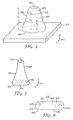
- FIG. 2 is a schematic three-dimensional view of a microstructure 220 that is disposed on a substrate 210 and includes a planar or flat base 230, a planar or flat top 240 and a side 250 that connects the top to the base.
- Side 250 includes a plurality of planar or flat facets, such as facets 260, 265 and 270.
- Microstructure 220 can be used as a mold to fabricate holes for use in, for example, a nozzle.
- a disclosed microstructure can be a three-dimensional curvilinear body or a portion of such body, such as a segment of a sphere, an asphere, an ellipsoid, a spheroid, a paraboloid, a cone or a truncated cone, or a cylinder.
- FIG. 3 is a schematic three-dimensional view of a microstructure 320 that is disposed on a substrate 310 and includes a planar or flat base 330, a planar or flat top 340 and a curvilinear side 350 that connects the top to the base.
- top 340 and base 330 have the same shape.
- Microstructure 320 tapers narrower from base 330 to top 340. As a result, top 340 has a smaller area than base 330.
- Microstructure 320 can be used as a mold to fabricate holes for use in, for example, a nozzle.
- FIG. 4 is a schematic three-dimensional view of a microstructure 420 that can be fabricated using a multiphoton process.
- Microstructure 420 can be used as a mold to fabricate holes for use in, for example, a nozzle.
- Microstructure 420 is disposed on a substrate 410 and includes a base 430, a top 440, and a side 450 connecting the top to the base.
- Microstructure 420 has a height or thickness h 1 which is the distance between base 430 and top 440 along the z-axis.
- Microstructure 420 is tapered.
- microstructure 420 includes a cross-section 460 at height h 2 in the xy-plane and a cross-section 470 at height h 3 > h 2 in the xy-plane.
- the area of cross-section 470 is less than the area of cross-section 460, and the area of cross-section 460 is less than the area of base 430.
- FIG. 5 is a schematic three-dimensional view of a microstructure 520 that includes an elliptical base 530, a circular top 540, and a side 550 that connects the top to the base.
- Elliptical base 530 has a major axis 560 along the y-direction having a length "a" and a minor axis 570 along the x-direction having a length "b" different than "a”.
- Circular top 540 has a radius r.
- Microstructure 520 is tapered. In particular, the area of circular top 540 is less than the area of elliptical base 530.
- the first shape can be a racetrack and the second shape can, for example, be a circle.
- FIG. 6 is a schematic of a base 630 that can be the base of a disclosed microstructure.
- Base 630 includes two circles 642 and 644 and a middle portion 650.
- Base 630 has a perimeter 660 that includes curved portions or arcs 632 and 634 and linear portions 636 and 638. Curved portions 632 and 634 are portions of respective circles 642 and 644.
- a disclosed microstructure has a cross-section along the thickness or height direction of the microstructure that rotates from the base of the microstructure to the top of the microstructure.
- FIG. 7 is a schematic three-dimensional view of a microstructure 720 that includes a base 730 disposed in the xy-plane, a top 740 disposed in the xy-plane; and a side 780 that connects the top to the base.
- Microstructure 720 has a height h 4 .
- Microstructure 720 has an xy cross-section that rotates clockwise from top 740 to base 730.
- top 740 has an axis of symmetry 742 along the x-direction
- an xy cross-section 750 of the microstructure at a height h 5 ⁇ h 4 has an axis of symmetry 752 that is rotated clockwise relative to axis of symmetry 742
- an xy cross-section 755 of the microstructure at a height h 6 ⁇ h 5 has an axis of symmetry 757 that is rotated clockwise relative to axis of symmetry 752
- an xy cross-section 760 of the microstructure at height a h 7 ⁇ h 6 has an axis of symmetry 762 that is rotated clockwise relative to axis of symmetry 757
- base 730 has an axis of symmetry 732 along the y-axis that is rotated clockwise relative to axis of symmetry 762.
- microstructure 720 has an xy cross-section that rotates counter clockwise from base 730 to top 740.
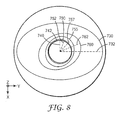
- FIG. 8 is a schematic top-view of microstructure 720 illustrating top 740 and its axis of symmetry 742, cross-section 750 and its axis of symmetry 752, cross-section 755 and its axis of symmetry 757, cross-section 760 and its axis of symmetry 762, and base 730 and its axis of symmetry 732. Viewed from the top, the axes of symmetry of the cross-sections rotate clockwise from the top to the base. Such a rotation results in a twist in the microstructure along its height or thickness.
- each cross-section can be an ellipse with a corresponding major axis acting as an axis of symmetry.
- the major axis rotates from the base to the top.
- the cross-sections rotate and become smaller from the base to the top.
- an elliptical base 730 has a major axis 732 along the y-direction having a length "a" and a minor axis 734 along the x-direction having a length "b" different than "a".
- a disclosed microstructure can include a taper and/or a twist or spiral along the thickness of the microstructure from the base to the top.
- Microstructure 720 can be used as a mold to fabricate one or more holes in a nozzle with the holes having substantially the same profile as microstructure 720.
- the fabrication results in a hole 720 having a hole entry 730, a hole exit 740 and a wall 752 extending from the hole entry to the hole exit.
- the hole tapers and spirals or twists from the hole entry to the hole exit.
- a disclosed spiraling or twisting nozzle hole can advantageously be used in a fuel injector to enhance the flow velocity of the fuel, reduce droplet size, and improve the mixing of fuel with air.
- the microstructure may be understood as having a "diameter" at different heights of the microstructure (e.g. h 6 , h 5 , etc.).
- the diameter may be understood as the maximum distance between the edges of the microstructure at a common height. In the situation, where there is an elliptical base, such as at hole entry 730, the diameter will be the distance between the edges of the microstructure along the major axis 732. At the opposite end of the structure, corresponding to hole exit 740, the diameter will similarly be the maximum distance between the edges of the microstructure at the common height (here, h 4 ). Thus, the distance between the edges of the microstructure along axis 742 will correspond to the diameter of the hole exit.
- the hole entry may have a diameter of less than 300 microns, or of less than 200 microns, or of less than or equal to 160 microns, or of less than 140 microns. In some embodiments the hole exit may have a diameter of less than 300 microns, or less than 200 microns, or less than 100 microns, or less than or equal to 40 microns, or less than 25 microns.
- the cross-section of nozzle hole 720 has an increasing rotation rate from the hole entry to the hole exit. In some cases, the cross-section of nozzle hole 720 has a decreasing rotation rate from the hole entry to the hole exit. In some cases, the cross-section has a constant rotation rate from the hole entry to the hole exit.
- a base or a lateral cross-section of a disclosed microstructure, or an entry hole or a lateral cross-section of a disclosed nozzle hole can have any cross-section that may be desirable in an application.
- the base or the entry hole can have a perimeter that includes the outer arcs of closely packed circles, where the outer arcs are connected by curve-like fillets.
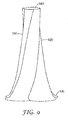
- FIG. 9 is a schematic three-dimensional view of a microstructure 920 that includes a base 930, a top 940, and a side 950 that connects the base to the top.
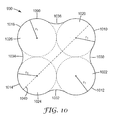
- perimeter 10 is a schematic of base 930 having a perimeter 1090 that includes the outer arcs of four closely packed circles, where the outer arcs are connected by curve-like fillets.
- perimeter 1090 includes an outer arc 1010 of a circle 1020, an outer arc 1012 of a circle 1022, an outer arc 1011 of a circle 1024, and an outer arc 1016 of a circle 1026, where outer arcs 1010 and 1012 are connected by curve-like fillet 1030, outer arcs 1012 and 1014 are connected by curve-like fillet 1032, outer arcs 1014 and 1016 are connected by curve-like fillet 1034, and outer arcs 1016 and 1010 are connected by curve-like fillet 1036.
- Circles 1010, 1012, 1014 and 1016 form a square array of equal and touching circles where each circle has a radius r 1 .
- Base 930 includes an axis of symmetry 1040.
- the lateral cross-sections of microstructure 920 rotate and the radius r 1 decreases from base 930 to top 940 resulting in a microstructure that spirals and tapers narrower from base 930 to top 940.
- a nozzle hole 920 includes a hole entry 930, a hole exit 940 and a wall 950 extending from the hole entry to the hole exit.
- Hole 920 has a lateral cross-section that rotates and becomes smaller from the hole entry to the hole exit.
- FIG. 11 is a schematic top-view of nozzle hole (or microstructure) 920 illustrating hole entry 930 having axis of symmetry 1040 and hole exit 940 having axis of symmetry 942. Viewed from the top, the axes of symmetry of the cross-sections of hole 920 rotate counter clockwise from the hole entry to the hole exit. Such a rotation results in a twist in the hole along its height or thickness.
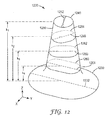
- FIG. 12 is a schematic three-dimensional view of a nozzle hole (or microstructure) 1220 that has a height k 1 and includes a hole entry 1230, a hole exit 1240, and a wall 1250 that extends from the hole entry to the hole exit.
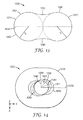
- FIG. 13 is a schematic of hole entry 1230 having a perimeter 1235 that includes the outer arcs of two closely packed or touching circles, where the outer arcs are connected by curve-like fillets.
- perimeter 1090 includes an outer arc 1270 of a circle 1280 and an outer arc 1272 of a circle 1282, where each circle has a radius r 2 and outer arcs 1270 and 1272 are connected by curve-like fillets 1290 and 1292.
- Hole entry 1230 includes an axis of symmetry 1232.
- the lateral cross-sections of nozzle hole 1220 rotate and the radius r 2 decreases from hole entry 1230 to hole exit 1240 resulting in a microstructure that spirals and tapers narrower from hole entry 1230 to hole exit 1240.
- top 1240 has an axis of symmetry 1242 along the x-direction
- an xy cross-section 1264 of the hole at a height k 2 ⁇ k 1 has an axis of symmetry 1265 that is rotated clockwise relative to axis of symmetry 1242
- an xy cross-section 1262 of the hole at a height k 3 ⁇ k 2 has an axis of symmetry 1263 that is rotated clockwise relative to axis of symmetry 1265
- an xy cross-section 1260 of the hole at a height k 4 ⁇ k 3 has an axis of symmetry 1261 that is rotated clockwise relative to axis of symmetry 1263
- hole entry 1230 has an axis of symmetry 1232 along the y-axis that is rotated clockwise relative to axis of symmetry 1261.
- hole 1220 has an xy cross-section that rotates clockwise from hole exit 1240 to hole entry 1230. Equivalantly, hole 1220 has an xy cross-section that rotates counter clockwise from the hole entry to the hole exit.
- FIG. 14 is a schematic top-view of nozzle hole 1220 illustrating hole exit 1242 and its axis of symmetry 1242 along the x-axis, cross-section 1264 and its axis of symmetry 1265, cross-section 1262 and its axis of symmetry 1263, cross-section 1260 and its axis of symmetry 1261, and hole entry 1230 and its axis of symmetry 1232 along the y-axis. Viewed from the top, the axes of symmetry of the lateral cross-sections of the hole rotate clockwise from the hole exit to the hole entry.
- a microstructure 1220 includes a base 1230, a top 1240 and a side 1250 that connects the base to the top.
- Microstructure 1220 has a cross-section that rotates and becomes smaller from the base to the top.
- the microstructures disclosed herein that serve as nozzles may be monolithic structures.
- the microstructures 220, 320, 420 etc. that forms the actual nozzles are created from, and ultimately form a common, single piece of material. This may be understood as different from nozzles that are formed through a combination of a number of different parts, where such parts are potentially made up of different materials.
- the nozzles disclosed herein may be monolithic structures.
- a plurality of disclosed microstructures or holes can have any arrangement that may be desirable in an application.
- the disclosed holes can be arranged regularly or irregularly.
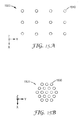
- FIG. 15A is a schematic top-view of a two-dimensional square array 1500 of holes or microstructures 1510
- FIG. 15B is a schematic top-view of a two-dimensional hexagonal array 1520 of holes or microstructures 1530, where holes or microstructures 1510 and 1530 can be any nozzle hole or microstructure disclosed herein.
- a plurality of disclosed microstructures or hole may be arranged on a non-planar surface.
- FIG. 16 is a schematic three-dimensional view of a plurality of nozzle holes or microstructures 1610 disposed or arranged on a spherical surface 1620.
- FIG. 17 is a schematic side-view of a microstructure 1720 that is disposed on a substrate 1710 and includes a base 1730, a top 1740, and a side 1750 connecting the base to the top.
- Microstructure 1720 includes fillets 1760 and 1761 smoothly joining side 1750 and top 1740, and fillets 1770 and 1771 smoothly joining side 1750 and top surface 1705 of substrate 1710.
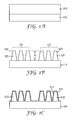
- the nozzle holes and microstructures disclosed herein can be fabricated using the method outlined in reference to FIGs. 1A-1M .
- the method provides flexibility and control in producing a variety of individual microstructures and holes in a single array, yet can be used to achieve desirably low levels of average surface roughness while maintaining industrially acceptable fabrication speeds or "throughput.”
- FIG. 1A is a schematic side-view of a layer 115 of a first material disposed on a substrate 110.
- the first material is capable of undergoing multiphoton reaction by simultaneously absorbing multiple photons.
- the first material is capable of undergoing a two photon reaction by simultaneously absorbing two photons.
- the first material can be any material or material system that is capable of undergoing multiphoton, such as two photon, reaction, such as those describe in pending U.S. Application Serial No. 11/313482 , "Process For Making Microlens Arrays And Masteroforms" (Attorney Docket No. 60893US002), filed December 21, 2005; U.S.
- Patent Application Publication US 2009/0175050 "Process For Making Light Guides With Extraction Structures And Light Guides Produced Thereby” (Attorney Docket No. 62162US007), filed May 17, 2007; and PCT Publication WO 2009/048705 , "Highly Functional Multiphoton Curable Reactive Species” (Attorney Docket No. 63221 W0003), filed September 9, 2008; all of which are incorporated herein by reference.
- the first material can be a photoreactive composition that includes at least one reactive species that is capable of undergoing an acid- or radical-initiated chemical reaction, and at least one multiphoton photoinitiator system.
- Reactive species suitable for use in the photoreactive compositions include both curable and non-curable species.
- Exemplary curable species include addition-polymerizable monomers and oligomers and addition-crosslinkable polymers (such as free-radically polymerizable or crosslinkable ethylenically-unsaturated species including, for example, acrylates, methacrylates, and certain vinyl compounds such as styrenes), as well as cationically-polymerizable monomers and oligomers and cationically-crosslinkable polymers (which species are most commonly acid-initiated and which include, for example, epoxies, vinyl ethers, cyanate esters, etc.), and the like, and mixtures thereof.
- Exemplary non-curable species include reactive polymers whose solubility can be increased upon acid- or radical-induced reaction.
- Such reactive polymers include, for example, aqueous insoluble polymers bearing ester groups that can be converted by photogenerated acid to aqueous soluble acid groups (for example, poly(4- tert -butoxycarbonyloxystyrene).
- Non-curable species also include the chemically-amplified photoresists.
- the multiphoton photoinitiator system enables polymerization to be confined or limited to the focal region of a focused beam of light used to expose the first material.
- a system preferably is a two- or three-component system that includes at least one multiphoton photosensitizer, at least one photoinitiator (or electron acceptor), and, optionally, at least one electron donor.
- Layer 115 of the first material can be coated on substrate 110 using any coating method that may be desirable in an application.
- the first material can be coated on substrate 110 by flood coating.
- Other exemplary coating methods include knife coating, notch coating, reverse roll coating, gravure coating, spray coating, bar coating, spin coating and dip coating.
- Substrate 110 can be chosen from a wide variety of films, sheets, and other surfaces (including silicon wafers and glass plates), depending upon the particular application and the method of exposure to be utilized. In some cases, substrate 110 is sufficiently flat so that layer 115 of the first material has a uniform thickness. In some cases, layer 115 can be exposed in bulk form. In such cases, substrate 110 may be excluded from the fabrication process. In some cases, such as when the process includes one or more electroplating steps, substrate 110 can be electrically conductive or semiconductive.
- the first material is selectively exposed to an incident light having sufficient intensity to cause simultaneous absorption of multiple photons by the first material in the exposed region.
- the exposure can be accomplished by any method that is capable of providing light with sufficient intensity. Exemplary exposure methods are described in U.S. Patent Application Publication US 2009/0099537 , "Process For Making Microneedles, Microneedle Arrays, Masters, And Replication Tools" (Attorney Docket No. 61795US005), filed March 23, 2007, which is incorporated herein by reference.
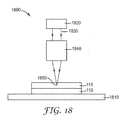
- FIG. 18 is a schematic side-view of an exemplary exposure system 1800 for exposing layer 115 of the first material.
- the exposure system includes a light source 1820 emitting light 1830 and a stage 1810 that is capable of moving in one, two, or three dimensions.
- Substrate 110 coated with layer of first material 115 is placed on the stage.
- Optical system 1840 focuses emitted light 1830 at a focal region 1850 within the first material.
- optical system 1840 is designed so that simultaneous absorption of multiple photons by the first material occurs only at or very near focal region 1850. Regions of layer 115 that undergo the multiphoton reaction become more, or less, soluble in at least one solvent compared to regions of layer 115 that do not undergo the multiphoton reaction.
- Focal region 1850 can scan a three-dimensional pattern within the first material by moving stage 1810 and/or light 1830 and/or one or more components, such as one or more mirrors, in optical system 1840.
- layer 115 is disposed on a planar substrate 110.
- substrate 110 can have any shape that may be desirable in an application.
- substrate 110 can have a spherical shape.
- Light source 1820 can be any light source that is capable of producing sufficient light intensity to effect multiphoton absorption.
- Exemplary light sources include lasers, such as femtosecond lasers, operating in a range from about 300 nm to about 1500 nm, or from about 400 nm to about 1100 nm, or from about 600 nm to about 900 nm, or from about 750 to about 850 nm.
- Optical system 1840 can include, for example, refractive optical elements (for example, lenses or microlens arrays), reflective optical elements (for example, retroreflectors or focusing mirrors), diffractive optical elements (for example, gratings, phase masks, and holograms), polarizing optical elements (for example, linear polarizers and waveplates), dispersive optical elements (for example, prisms and gratings), diffusers, Pockels cells, waveguides, and the like.
- refractive optical elements for example, lenses or microlens arrays
- reflective optical elements for example, retroreflectors or focusing mirrors
- diffractive optical elements for example, gratings, phase masks, and holograms
- polarizing optical elements for example, linear polarizers and waveplates
- dispersive optical elements for example, prisms and gratings
- diffusers for example, Pockels cells, waveguides, and the like.
- Such optical elements are useful for focusing
- solvents that can be used for developing the exposed first material include aqueous solvents such as, for example, water (for example, having a pH in a range of from 1 to 12) and miscible blends of water with organic solvents (for example, methanol, ethanol, propanol, acetone, acetonitrile, dimethylformamide, N-methylpyrrolidone, and the like, and mixtures thereof); and organic solvents.
- aqueous solvents such as, for example, water (for example, having a pH in a range of from 1 to 12) and miscible blends of water with organic solvents (for example, methanol, ethanol, propanol, acetone, acetonitrile, dimethylformamide, N-methylpyrrolidone, and the like, and mixtures thereof); and organic solvents.
- Exemplary useful organic solvents include alcohols (for example, methanol, ethanol, and propanol), ketones (for example, acetone, cyclopentanone, and methyl ethyl ketone), aromatics (for example, toluene), halocarbons (for example, methylene chloride and chloroform), nitriles (for example, acetonitrile), esters (for example, ethyl acetate and propylene glycol methyl ether acetate), ethers (for example, diethyl ether and tetrahydrofuran), amides (for example, N-methylpyrrolidone), and the like, and mixtures thereof.
- alcohols for example, methanol, ethanol, and propanol
- ketones for example, acetone, cyclopentanone, and methyl ethyl ketone
- aromatics for example, toluene
- halocarbons for example, methylene chloride and
- the first microstructured pattern includes a first cluster 122 of microstructures 120 and a second cluster 124 of microstructures 125, where microstructures 120 and 125 can be any microstructures including any microstructures disclosed herein. In some cases, microstructures 120 and 125 have different structures. In some cases, microstructures 120 and 125 have the same structure. In the exemplary first microstructured pattern 121, microstructures 120 and 125 have heights t 1 .
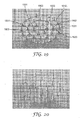
- FIGs. 19 and 20 are scanning electron micrographs of a cluster of microstructures 120 fabricated according to the processes disclosed herein.
- the microstructures in FIGs. 19 and 20 are similar to microstructures 1220 shown in FIG. 12 .
- the microstructures are viewed along the minor axes of the bases of the microstructures and in FIG. 20 , the microstructures are viewed along the major axes of the bases of the microstructures.
- the plurality of microstructures in FIG. 19 are arranged in an array of concentric circles that includes an outermost circle 1910.
- the microstructures are arranged such that no diameter of the outermost circle includes at lease one discrete microstructure from each circle in the array of concentric circles.
- a diameter 1920 of outermost circle 1910 includes microstructures 1901-1905 but not microstructures 1930 and 1931.
- Each circle in the array of concentric circles in FIG. 19 includes equally spaced discrete microstructures.
- a nozzle includes a plurality of holes that are arranged in an array of concentric circles that includes an outermost circle.
- the discrete nozzle holes are arranged such that no diameter of the outermost circle includes at lease one discrete nozzle hole from each circle in the array of concentric circles.
- each circle in the array of concentric circles comprises equally spaced discrete nozzle holes.
- top surface 126 of first microstructured pattern 121 is metalized or made electrically conductive by coating the top surface with a thin electrically conductive seed layer 127.
- Conductive seed layer 127 can include any electrically conductive material that is desirable in an application. Exemplary conductive materials include silver, chromium, gold and titanium. In some cases, seed layer 127 has a thickness that is less than about 50 nm, or less than about 40 nm, or less than about 30 nm, or less than about 20 nm.
- seed layer 127 is used to electroplate first microstructured pattern 121 with a second material resulting in a layer 130 of the second material.
- the electroplating of first microstructured pattern 121 is continued until the minimum thickness t 2 of layer 130 is greater than t 1 .
- Suitable second materials for electroplating include silver, passivated silver, gold, rhodium, aluminum, enhanced reflectivity aluminum, copper, indium, nickel, chromium, tin, and alloys thereof.
- layer 130 of the second material has an uneven or rough top surface 132.
- layer 130 of the second material is polished or ground resulting in a layer 135 of the second material having a thickness t 3 >t 1 as illustrated schematically in FIG. 1E .
- the grinding or polishing can be accomplished using any grinding method that may be desirable in an application. Exemplary grinding methods include surface grinding and mechanical milling.
- layer of second material 130 can be directly deposited on first microstructured pattern 121 without first coating pattern 121 with seed layer 127.
- layer 130 can be coated on pattern 121 by any using suitable method including, for example, sputtering and chemical vapor deposition.
- substrate 110 and the first material are removed resulting in a first mold 140 of the second material shown schematically in FIG. 1F .
- seed layer 127 is not shown in FIG. 1F .
- substrate 110 and the patterned first material can be separated from layer 135 by hand. In some cases, the separation can be carried out prior to grinding layer 130.
- First mold 140 includes a second microstructured pattern 141 that is substantially the negative replica of first microstructured pattern 121.
- first mold 140 of the second material includes a first cluster 146 of microstructures 145 and a second cluster 147 of microstructures 148, where microstructures 145 are substantially negative replicas of microstructures 120 and microstructures 148 are substantially negative replicas of microstructures 125.
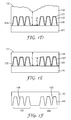
- the second microstructured pattern is replicated in a third material 150 different than the first and second materials by disposing the third material in between first mold 140 of the second material and a substrate 155 having a smooth top surface 157 as schematically illustrated in FIG. 1 G .
- the replication process can be accomplished using any suitable replication method.
- the replication can be accomplished by using an injection molding process.
- a molten third material 150 can be introduced between substrate 155 and first mold 140 and solidified after the molten third material fills the second microstructured pattern.
- the third material 150 can be any material that is capable of replicating a pattern.
- Exemplary third materials include polycarbonate and other thermoplastics such as polystyrene, acrylic, styrene acrylonitrile, poly-methyl methacrylate (PMMA), cyclo olefin polymer, polyethylene terephthalate, polyethylene 2,6-naphthalate, and fluoropolymers.
- thermoplastics such as polystyrene, acrylic, styrene acrylonitrile, poly-methyl methacrylate (PMMA), cyclo olefin polymer, polyethylene terephthalate, polyethylene 2,6-naphthalate, and fluoropolymers.
- first mold 140 of the second material and substrate 155 are removed resulting in a second mold 160 of the third material having a substrate portion 162 and a third microstructured pattern 161 that is substantially the negative replica of second microstructured pattern 141 and substantially a positive replica of first microstructured pattern 121.
- Third microstructured pattern 161 includes a first cluster 168 of microstructures 165 and a second cluster 169 of microstructures 159, where microstructures 165 are substantially negative replicas of microstructures 145 and microstructures 159 are substantially negative replicas of microstructures 148.
- microstructures 165 are substantially positive replicas of microstructures 120 and microstructures 159 are substantially positive replicas of microstructures 125.
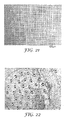
- FIG. 21 is a scanning electron micrograph of a cluster of polycarbonate microstructures 165 fabricated according to the processes disclosed herein.
- top surface 154 of third microstructured pattern 161 is metalized or made electrically conductive by coating the top surface with a thin electrically conductive seed layer 167 similar to seed layer 127.
- seed layer 167 is used to electroplate third microstructured pattern 161 with a fourth material different than the third material resulting in a layer 170 of the fourth material.
- the electroplating of second microstructured pattern 161 is continued until the minimum thickness t 5 of layer 130 is greater than t 4 , the height of the microstructures in second mold 160.
- height t 4 is substantially equal to height t 1 .
- Suitable fourth materials for electroplating include silver, passivated silver, gold, rhodium, aluminum, enhanced reflectivity aluminum, copper, indium, nickel, chromium, tin, and alloys thereof.
- the fourth material may be a ceramic that is deposited on third microstructured pattern.
- a ceramic material may be formed, e.g., by a sol-gel process as described in commonly owned and assigned U.S. Patent No. 5,453,104 , or by photocuring of a ceramic-filled or pre-ceramic polymeric composition as described in commonly owned and assigned U.S. Patents No. 6,572,693, 6,387,981 , 6,899,948 , 7,393,882 , 7,297,374 , and 7,582,685 , each of which is herein incorporated by reference in its entirety.
- Such ceramic materials may comprise, e.g., silica, zirconia, alumina, titania, or oxides of yttrium, strontium, barium, hafnium, niobium, tantalum, tungsten, bismuth, molybdenum, tin, zinc, lanthanide elements (i.e. elements having atomic numbers ranging from 57 to 71, inclusive), cerium and combinations thereof.
- top surface of 172 of layer 170 is ground until tops 171 of microstructures 165 and tops 173 of microstructures 159 are exposed.
- the third material is softer than the fourth material.
- the third material is polycarbonate and the fourth material is a nickel alloy.
- small portions of tops 171 and 173 can be removed during the grinding process to ensure that the tops of all the microstructures in third microstructured pattern 161 are exposed.
- the grinding results, as schematically illustrated in FIG. 1K , in a layer 175 of the fourth material planarizing the third microstructured pattern and exposing tops 185 of the microstructures in the plurality of microstructures in the third microstructured pattern.
- Layer 175 of the fourth material has a top surface 177 that is substantially even with tops 184 of microstructures 180 and tops 186 of microstructures 181.
- the microstructures have a height t 6 that can be slightly less than I 4 .
- second mold 160 is removed resulting in a layer 190 of the fourth material that includes a plurality of holes 106 that correspond to the plurality of microstructures in third microstructured pattern 161.
- layer 190 of the fourth material includes a first cluster 192 of holes 195 and a second cluster 193 of holes 198.
- holes 195 are substantial replicas of microstructures 120 and holes 198 are substantial replicas of microstructures 125.
- Holes 195 include hole entries 182 and hole exits 183 and holes 198 include hole entries 196 and hole exits 197.
- FIGs. 22 and 23 are optical micrographs of respective hole entries 182 and hole exits 183 of a cluster 192 of holes 195 made according to the processes disclosed herein.
- FIG. 25 is a scanning electron micrograph of one of the holes 195, viewed from the hole entry side. The hole has a hole entry 2510 and a hole exit 2520 that is smaller than the hole entry. The micrograph clearly illustrates a taper and a twist in the hole.
- two clusters 192 and 193 are separated along a direction 199 resulting, as illustrated schematically in FIG. 1M , in a part 102 and a separate, and in some cases substantially identical, part 103, where each part can be used in a spray nozzle and/or a fuel injector.
- FIG. 24 is a schematic side-view of a nozzle 2400 that includes a hollow interior 2410 and a wall 2405 separating the hollow interior from an outside 2430 of the nozzle.
- the nozzle further includes at least one hole, such as a hole 2420, that connects hollow interior 2410 to outside 2430 of the nozzle.
- the holes deliver gas or liquid from the hollow interior to the outside.
- Hole 2420 can be any hole disclosed herein.
- Hole 2420 includes a hole entry 2440 at an inner surface 2406 of wall 2405 and a hole exit 2445 at an outside surface 2407 of wall 2405.
- Hole entry 2440 is also at hollow interior 2410 of the nozzle and hole exit 2445 is at outside 2430 of the nozzle.
- hole entry 2440 has a first shape and hole exit 2445 has a second shape that is different than the first shape.
- the first shape is an elliptical shape and the second shape is a circular shape.
- the first shape can be a racetrack shape and the second shape can be a circular shape.
- the second shape can be a circle or an ellipse and the perimeter of the first shape can include outer arcs of a plurality of closely packed circles, where the outer arcs are connected to each other by curve-like fillets.
- the first shape can be substantially the same as the second shape, but they can have different magnifications or sizes.
- the first shape can be a circle with a radius a 1 and the second shape can also be a circle, but with a radius a 2 different than a 1 .
- hole 2420 has a lateral cross-section that rotates from hole entry 2440 to hole exit 2445 where lateral cross-section refers to a cross-section that is substantially perpendicular to the general flow direction of, for example, a liquid or gas within the hole.
- lateral cross-section refers to a cross-section that is substantially perpendicular to the general flow direction of, for example, a liquid or gas within the hole.
- the cross-section has an increasing rotation rate from the hole entry to the hole exit.
- the cross-section has a decreasing rotation rate from the hole entry to the hole exit.
- the cross-section has a constant rotation rate from the hole entry to the hole exit.
- microstructures, holes, layers, constructions, and methods of this invention are further illustrated by the following example.
- all chemical procedures were carried out under a dry nitrogen atmosphere with dry and deoxygenated solvents and reagents.
- solvents and reagents were or can be obtained from Aldrich Chemical Co., Milwaukee, WI.
- Rhodamine B hexafluoroantimonate was prepared by metathesis of Rhodamine B chloride with sodium hexafluoroantimonate.
- SR368 refers to tris-(2-hydroxyethyl)isocyanurate triacrylate, (obtained from Sartomer Co.
- SR9008 refers to a trifunctional acrylate ester (obtained from Sartomer); SR1012 refers to diaryliodonium hexafluoroantimonate (obtained from Sartomer); SU-8 R2150 refers to an epoxy negative photoresist (obtained from MicroChem Corp., Newton, MA); THF refers to tetrahydrofuran; LEXAN HPS1R refers to a thermoplastic polycarbonate (obtained from Sabic Innovative Plastics, Pittsfield, MA; and Inco S-Rounds refers to nickel (obtained from Vale Inco America's, Inc., Saddle Brook, NJ).
- a circular silicon wafer (substrate 110 in FIG. 1A ), 10.2 cm in diameter, was obtained from Wafer World, Inc., West Palm Beach, Florida.
- the Si wafer was cleaned by soaking it for approximately ten minutes in a 3: mixture by volume of concentrated sulfuric acid and 30% by weight aqueous hydrogen peroxide.
- the wafer was then rinsed with deionized water and then with isopropanol, after which it was dried under a stream of air.
- the wafer was then dipped into a two weight percent solution of 3-(trimethoxysilyl)propyl methacrylate in 190-proof ethanol that had been made acidic (pH between 4 and 5) with acetic acid.
- the wafer was then rinsed with absolute ethanol and was then heated in an oven at 130°C for ten minutes.
- Poly(methyl methacrylate), having a number average molecular weight of approximately 120,000, SR9008, and SR368 were combined in a weight ratio of 30:35:35 resulting in a monomer mixture that was dissolved in sufficient 1,2-dichloroethane to afford a solution that was 54 weight percent of the monomer mixture.
- To this solution there were then added aliquots of concentrated solutions of photosensitizer Rhodamine B hexafluoroantimonate in THF and SR1012 in THF sufficient to give a coating solution that was 0.5 weight percent Rhodamine B hexafluoroantimonate and 1.0 weight percent SR1012, based on the total weight of solids.
- This coating solution was filtered through a 1-micron syringe filter and was spin-coated onto the silicon wafer.
- the coated wafer was placed in a forced air oven at 60°C for 18 hours to afford a coated silicon wafer with a substantially solvent-free (hereinafter, "dry") coating (layer 115 of the first material in FIG. 1A ) having a thickness of approximately 300 ⁇ m.
- dry substantially solvent-free
- Two-photon polymerization of the dry coating was carried out using a diode-pumped Ti:sapphire laser (obtained from Spectra-Physics, Mountain View, CA) that operated at 800 nm with a nominal pulse width of 80 fs, a pulse repetition rate of 80 MHz, and an average power of approximately 1 W.
- the coated wafer was placed on a computer-controlled three-axis stage (obtained from Aerotech, Inc., Pittsburgh, PA).
- the laser beam was attenuated by neutral density filters and was focused into the dry coating using a galvoscanner with a telescope for x-, y-, and z-axis control (available from Nutfield Technology, Inc., Windham, NH).
- a Nikon CFI Plan Achromat 50X oil objective N.A. 0.90 with a working distance of 0.400 mm and a 4.0 mm focal length was applied directly onto the surface of the dry coating.
- the average power was measured at the output of the objective lens using a wavelength-calibrated photodiode (obtained from Ophir Optronics, Ltd., Wilmington, MA) and was determined to be approximately 8 mW.
- the surface of the first microstructured pattern was made conductive by sputtering a thin layer (about 100 angstroms) of Silver (Ag) on the surface of the pattern.
- the metalized front surface was then electroplated with Inco S-Rounds (nickel) until it was approximately 2mm thick.
- the electroplated nickel slug was then separated from the first pattern and ground and machined resulting in a first mold 140 having a second microstructured pattern 141 (FIG. IF).
- the first mold was then placed into an injection die mold which was placed into a single screw plastic injection molding system to inject thermoplastic polycarbonate (LEXAN HPS1R) into the mold cavity resulting in a second mold 160 having a third microstructured pattern 161 ( FIG. 1H ).
- thermoplastic polycarbonate LEXAN HPS1R
- the front surface of the second mold was then metalized by sputtering the surface with about 100 angstroms of silver.
- the metalized second mold was then electroplated with Inco S-Rounds (nickel) to totally cover the third microstructured pattern resulting in a nickel layer 170 ( FIG. 1J ).
- the front surface 172 ( FIG. 1J ) of the nickel layer was ground in a planar fashion to remove the nickel material from the tops 171 of the third microstructured pattern.
- the electroplated nickel layer was separated from the polycarbonate mold 160 resulting in a nickel disc, approximately 8 mm in diameter and 160 um thick having 37 through-holes arranged in a circular hexagonal packing arrangement.
- the separation between neighboring holes was about 200 ⁇ m.
- Each hole had a hole entry in the shape of a racetrack modified with fillets along the linear portions of the racetrack.
- the racetrack had a major diameter of about 80 ⁇ m and a minor diameter of about 50 ⁇ m.
- Each hole had a hole exit in the shape of a smaller racetrack with a major diameter of about 50 ⁇ m and a minor diameter of about 35 ⁇ m. Viewed from the hole exit side, the major diameters of the cross-section of the holes rotated clockwise from the hole exit to the hole entry by about 30 degrees for every 50 ⁇ m of depth below the hole exit.
- terms such as “vertical”, “horizontal”, “above”, “below”, “left” , “right”, “upper” and “lower”, “clockwise” and “counter clockwise” and other similar terms refer to relative positions as shown in the figures.
- a physical embodiment can have a different orientation, and in that case, the terms are intended to refer to relative positions modified to the actual orientation of the device. For example, even if the image in FIG. 1B is flipped as compared to the orientation in the figure, surface 126 is still considered to be the top surface.
Landscapes
- Engineering & Computer Science (AREA)
- Chemical & Material Sciences (AREA)
- Mechanical Engineering (AREA)
- Combustion & Propulsion (AREA)
- General Engineering & Computer Science (AREA)
- Organic Chemistry (AREA)
- Materials Engineering (AREA)
- Metallurgy (AREA)
- Chemical Kinetics & Catalysis (AREA)
- Electrochemistry (AREA)
- Manufacturing & Machinery (AREA)
- Fuel-Injection Apparatus (AREA)
- Particle Formation And Scattering Control In Inkjet Printers (AREA)
- Moulds For Moulding Plastics Or The Like (AREA)
- Nozzles (AREA)
- Nozzles For Spraying Of Liquid Fuel (AREA)
Priority Applications (3)
| Application Number | Priority Date | Filing Date | Title |
|---|---|---|---|
| PL10742637T PL2459867T3 (pl) | 2009-07-30 | 2010-07-29 | Dysza i sposób jej wytwarzania |
| EP14152972.7A EP2728162A3 (en) | 2009-07-30 | 2010-07-29 | Nozzle and method of making same |
| EP13176670.1A EP2657510A1 (en) | 2009-07-30 | 2010-07-29 | Nozzle and method of making same |
Applications Claiming Priority (2)
| Application Number | Priority Date | Filing Date | Title |
|---|---|---|---|
| US22982109P | 2009-07-30 | 2009-07-30 | |
| PCT/US2010/043628 WO2011014607A1 (en) | 2009-07-30 | 2010-07-29 | Nozzle and method of making same |
Related Child Applications (3)
| Application Number | Title | Priority Date | Filing Date |
|---|---|---|---|
| EP14152972.7A Division EP2728162A3 (en) | 2009-07-30 | 2010-07-29 | Nozzle and method of making same |
| EP14152972.7A Division-Into EP2728162A3 (en) | 2009-07-30 | 2010-07-29 | Nozzle and method of making same |
| EP13176670.1A Division-Into EP2657510A1 (en) | 2009-07-30 | 2010-07-29 | Nozzle and method of making same |
Publications (2)
| Publication Number | Publication Date |
|---|---|
| EP2459867A1 EP2459867A1 (en) | 2012-06-06 |
| EP2459867B1 true EP2459867B1 (en) | 2014-03-12 |
Family
ID=42753452
Family Applications (3)
| Application Number | Title | Priority Date | Filing Date |
|---|---|---|---|
| EP10742637.1A Not-in-force EP2459867B1 (en) | 2009-07-30 | 2010-07-29 | Nozzle and method of making same |
| EP13176670.1A Withdrawn EP2657510A1 (en) | 2009-07-30 | 2010-07-29 | Nozzle and method of making same |
| EP14152972.7A Withdrawn EP2728162A3 (en) | 2009-07-30 | 2010-07-29 | Nozzle and method of making same |
Family Applications After (2)
| Application Number | Title | Priority Date | Filing Date |
|---|---|---|---|
| EP13176670.1A Withdrawn EP2657510A1 (en) | 2009-07-30 | 2010-07-29 | Nozzle and method of making same |
| EP14152972.7A Withdrawn EP2728162A3 (en) | 2009-07-30 | 2010-07-29 | Nozzle and method of making same |
Country Status (9)
| Country | Link |
|---|---|
| US (3) | US9333598B2 (enExample) |
| EP (3) | EP2459867B1 (enExample) |
| JP (6) | JP6103938B2 (enExample) |
| KR (3) | KR20180001595A (enExample) |
| CN (2) | CN103912428B (enExample) |
| BR (1) | BR112012002118A2 (enExample) |
| ES (1) | ES2464495T3 (enExample) |
| PL (1) | PL2459867T3 (enExample) |
| WO (1) | WO2011014607A1 (enExample) |
Families Citing this family (47)
| Publication number | Priority date | Publication date | Assignee | Title |
|---|---|---|---|---|
| WO2009142741A1 (en) | 2008-05-21 | 2009-11-26 | Theraject, Inc. | Method of manufacturing solid solution peforator patches and uses thereof |
| CN102104972B (zh) * | 2010-05-24 | 2014-01-29 | 电信科学技术研究院 | Uci信息传输的配置方法和设备 |
| US10406537B2 (en) | 2011-11-02 | 2019-09-10 | 3M Innovative Properties Company | Method of making a nozzle |
| WO2014022640A1 (en) * | 2012-08-01 | 2014-02-06 | 3M Innovative Properties Company | Fuel injectors with non-coined three-dimensional nozzle inlet face |
| US20150211462A1 (en) * | 2012-08-01 | 2015-07-30 | 3M Innovative Properties Company | Fuel injector nozzles with at least one multiple inlet port and/or multiple outlet port |
| CN104736836B (zh) * | 2012-08-01 | 2019-01-11 | 3M创新有限公司 | 具有改善的燃料排放系数的燃料喷射器 |
| CN103056609B (zh) * | 2012-12-15 | 2015-03-11 | 艾尼科环保技术(安徽)有限公司 | 燃烧器喷嘴斜孔的简易加工方法 |
| BR112015014874A2 (pt) * | 2012-12-21 | 2017-07-11 | 3M Innovative Properties Co | método para fabricação de um bocal, incluindo moldagem por injeção |
| WO2014105408A2 (en) | 2012-12-28 | 2014-07-03 | 3M Innovative Properties Company | Hybrid tailight article |
| CN104884307A (zh) | 2012-12-28 | 2015-09-02 | 3M创新有限公司 | 堆叠光导尾灯制品 |
| WO2014105470A1 (en) | 2012-12-28 | 2014-07-03 | 3M Innovative Properties Company | Multifunction lightguide tailight article |
| DE102013202532A1 (de) * | 2013-02-16 | 2014-08-21 | Aptar Radolfzell Gmbh | Verfahren zur Herstellung eines Spenders, Spender sowie Werkzeug hierfür |
| JP2015078604A (ja) * | 2013-10-15 | 2015-04-23 | 三菱電機株式会社 | 流体噴射弁並びに火花点火式エンジン |
| US10133174B2 (en) | 2013-12-06 | 2018-11-20 | 3M Innovative Properties Company | Liquid photoreactive composition and method of fabricating structures |
| JP6000296B2 (ja) * | 2014-03-06 | 2016-09-28 | 三菱電機株式会社 | 流体噴射弁およびこれを備えた噴霧生成装置 |
| CN104975310B (zh) * | 2015-06-12 | 2017-09-22 | 中国科学院宁波材料技术与工程研究所 | 一种喷嘴和喷嘴模具以及喷嘴和喷嘴模具的加工方法 |
| SE539875C2 (en) * | 2015-09-14 | 2017-12-27 | Scania Cv Ab | A fuel injector |
| CN105750848B (zh) * | 2016-05-18 | 2017-10-17 | 昆山精诚得精密五金模具有限公司 | 相贯面带微细孔的金属喷嘴套的加工方法 |
| WO2018116179A1 (en) | 2016-12-23 | 2018-06-28 | 3M Innovative Properties Company | Nozzle structures with thin welding rings and fuel injectors using the same |
| WO2018116249A1 (en) | 2016-12-23 | 2018-06-28 | 3M Innovative Properties Company | Method of electroforming microstructured articles |
| US20200086434A1 (en) * | 2016-12-23 | 2020-03-19 | 3M Innovative Properties Company | Making nozzle structures on a structured surface |
| CN107522478A (zh) * | 2017-08-24 | 2017-12-29 | 广州普华灵动机器人技术有限公司 | 陶瓷燃烧器制作工艺方法与陶瓷燃烧器 |
| CN107877107B (zh) * | 2017-12-01 | 2019-04-16 | 浙江晋巨化工有限公司 | 一种高耐磨料浆喷嘴的制造方法 |
| CN108225256B (zh) * | 2017-12-08 | 2020-05-22 | 长春理工大学 | 光线入射角度测量结果的校准方法 |
| WO2019126457A1 (en) | 2017-12-21 | 2019-06-27 | 3M Innovative Properties Company | Fluid injector nozzle with swirl chamber |
| WO2019133585A1 (en) | 2017-12-26 | 2019-07-04 | 3M Innovative Properties Company | Fuel injector nozzle structure with choked through-hole outlet opening |
| WO2019215642A1 (en) | 2018-05-09 | 2019-11-14 | 3M Innovative Properties Company | Fuel injector nozzle plate and valve guide |
| CN110805512A (zh) * | 2018-08-05 | 2020-02-18 | 大连理工大学 | 一种带扭转式复合孔的喷嘴 |
| CN110801951A (zh) * | 2018-08-05 | 2020-02-18 | 大连理工大学 | 一种带多孔并联式喷孔的喷嘴 |
| CN110805513B (zh) * | 2018-08-05 | 2021-06-01 | 大连理工大学 | 一种带扭转式椭圆形喷孔的喷嘴 |
| CN110801955A (zh) * | 2018-08-05 | 2020-02-18 | 大连理工大学 | 一种带扭转式变截面喷孔的喷嘴 |
| CN110801949A (zh) * | 2018-08-05 | 2020-02-18 | 大连理工大学 | 一种带部分扭转式圆角矩形喷孔的喷嘴 |
| CN110801950A (zh) * | 2018-08-05 | 2020-02-18 | 大连理工大学 | 一种带部分扭转式窄缝型喷孔的喷嘴 |
| CN110801945A (zh) * | 2018-08-05 | 2020-02-18 | 大连理工大学 | 一种带扭转式窄缝型喷孔的喷嘴 |
| CN110801946A (zh) * | 2018-08-05 | 2020-02-18 | 大连理工大学 | 一种带扭转式圆角矩形喷孔的喷嘴 |
| CN110805511A (zh) * | 2018-08-05 | 2020-02-18 | 大连理工大学 | 一种带部分扭转式椭圆形喷孔的喷嘴 |
| WO2020056241A1 (en) | 2018-09-13 | 2020-03-19 | 3M Innovative Properties Company | Nozzle with microstructured through-holes |
| CN111173661A (zh) * | 2019-11-18 | 2020-05-19 | 莆田市宏业精密机械有限公司 | 喷油嘴 |
| CN111534838B (zh) * | 2020-06-16 | 2021-01-29 | 广东嘉元科技股份有限公司 | 一种电解铜箔生箔机 |
| CN111906503B (zh) * | 2020-08-12 | 2022-02-11 | 南京国祺新能源设备有限公司 | 一种侧壁式喷嘴的制备工艺 |
| CN114695745A (zh) * | 2020-12-31 | 2022-07-01 | Tcl科技集团股份有限公司 | 一种量子点发光二极管及其制备方法 |
| DE102021110884A1 (de) * | 2021-04-28 | 2022-11-03 | Liebherr-Components Deggendorf Gmbh | Einblasleitung für einen Injektor zum Einblasen von Kraftstoff |
| CN113211013A (zh) * | 2021-05-14 | 2021-08-06 | 安徽华东光电技术研究所有限公司 | 梳形光栅零件的制作方法 |
| DE102022101750A1 (de) * | 2022-01-26 | 2023-07-27 | Aero Pump Gmbh | Multistrahl Hohlkegeldüse |
| DE102022206197A1 (de) * | 2022-06-21 | 2023-12-21 | Continental Automotive Technologies GmbH | Spritzdüse mit laminarer Strömungscharakteristik |
| CN115265260A (zh) * | 2022-08-02 | 2022-11-01 | 江苏环球龙圣环境科技发展有限公司 | 多级旋流反射式喷溅装置 |
| CN119353679A (zh) * | 2024-10-31 | 2025-01-24 | 北京航化节能环保技术有限公司 | 一种圆切型平焰喷嘴及其组合排布阵列结构 |
Family Cites Families (53)
| Publication number | Priority date | Publication date | Assignee | Title |
|---|---|---|---|---|
| DE1905229A1 (de) | 1968-01-30 | 1969-10-02 | Brunswick Corp | Einrichtungen mit einem eine Vielzahl von Durchlaessen aufweisenden Lochkoerper |
| CA1254238A (en) | 1985-04-30 | 1989-05-16 | Alvin P. Gerk | Process for durable sol-gel produced alumina-based ceramics, abrasive grain and abrasive products |
| JPH0710471B2 (ja) | 1989-09-25 | 1995-02-08 | 株式会社日立製作所 | 複数部材からなる精密部品の同心結合方法、及びこれを利用した燃料噴射弁のノズル組立方法 |
| DE4222137B4 (de) * | 1992-07-06 | 2006-05-04 | Robert Bosch Gmbh | Kraftstoff-Einspritzdüse für Diesel-Brennkraftmaschinen |
| JPH07289953A (ja) | 1994-03-03 | 1995-11-07 | Nippondenso Co Ltd | 流体噴射ノズル |
| JP3440534B2 (ja) * | 1994-03-03 | 2003-08-25 | 株式会社デンソー | 流体噴射ノズル |
| DE4409848A1 (de) * | 1994-03-22 | 1995-10-19 | Siemens Ag | Vorrichtung zur Zumessung und Zerstäubung von Fluiden |
| US5685491A (en) * | 1995-01-11 | 1997-11-11 | Amtx, Inc. | Electroformed multilayer spray director and a process for the preparation thereof |
| RU2158846C2 (ru) * | 1995-03-29 | 2000-11-10 | Роберт Бош Гмбх | Диск с отверстиями, в частности, для клапанных форсунок и способ изготовления диска с отверстиями |
| WO1996030643A1 (de) * | 1995-03-29 | 1996-10-03 | Robert Bosch Gmbh | Lochscheibe, insbesondere für einspritzventile |
| US5622611A (en) * | 1996-05-22 | 1997-04-22 | Amtx, Inc. | Electroformed multilayer flow regulator incorporating force-generating means for selectively constricting the fluid flow path, and a process for the preparation thereof |
| JPH11117833A (ja) * | 1997-10-13 | 1999-04-27 | Honda Motor Co Ltd | 燃料噴射ノズル及びその製造方法 |
| DE19814858A1 (de) * | 1998-04-02 | 1999-10-14 | Siemens Ag | Kraftstoffeinspritzdüse mit optimierter Spritzlochkanalgeometrie sowie Verfahren zur Herstellung einer solchen Spritzlochkanalgeometrie |
| DE19937961A1 (de) * | 1999-08-11 | 2001-02-15 | Bosch Gmbh Robert | Brennstoffeinspritzventil und Verfahren zur Herstellung von Austrittsöffnungen an Ventilen |
| US6387981B1 (en) | 1999-10-28 | 2002-05-14 | 3M Innovative Properties Company | Radiopaque dental materials with nano-sized particles |
| JP4800535B2 (ja) | 1999-10-28 | 2011-10-26 | スリーエム イノベイティブ プロパティズ カンパニー | ナノサイズシリカ粒子を含有する歯科材料 |
| US6572693B1 (en) | 1999-10-28 | 2003-06-03 | 3M Innovative Properties Company | Aesthetic dental materials |
| US20040009614A1 (en) | 2000-05-12 | 2004-01-15 | Ahn Chong H | Magnetic bead-based arrays |
| JP2002115627A (ja) | 2000-10-05 | 2002-04-19 | Optonix Seimitsu:Kk | オリフィスプレートおよびオリフィスプレートの製造方法 |
| JP2002258490A (ja) | 2001-02-27 | 2002-09-11 | Optonix Seimitsu:Kk | 微細精密部品あるいは光学部品のx線あるいは紫外線を用いた製造方法およびその製品 |
| DE10124748A1 (de) * | 2001-05-21 | 2003-02-27 | Bosch Gmbh Robert | Brennstoffeinspritzventil |
| US6767341B2 (en) * | 2001-06-13 | 2004-07-27 | Abbott Laboratories | Microneedles for minimally invasive drug delivery |
| JP4748938B2 (ja) | 2002-01-31 | 2011-08-17 | スリーエム イノベイティブ プロパティズ カンパニー | 歯科ペースト、歯科物品、および方法 |
| JP2003227445A (ja) | 2002-02-01 | 2003-08-15 | Hitachi Ltd | 電磁燃料噴射弁 |
| DE50209986D1 (de) | 2002-11-25 | 2007-05-31 | Weidmann Plastics Tech Ag | Verfahren zur Herstellung eines Werkzeugeinsatzes zum spritzgiessen eines teils mit einstufigen Mikrostrukturen |
| JP3941109B2 (ja) * | 2003-04-30 | 2007-07-04 | 株式会社デンソー | 燃料噴射弁 |
| DE102004005526B4 (de) * | 2003-02-05 | 2022-03-31 | Denso Corporation | Kraftstoffeinspritzvorrichtung einer Brennkraftmaschine mit innerer Verbrennung |
| JP2005131539A (ja) * | 2003-10-30 | 2005-05-26 | Yoshinobu Shimoitani | 噴射ノズル |
| DE102004005727A1 (de) | 2004-02-05 | 2005-09-01 | Robert Bosch Gmbh | Brennstoffeinspritzsystem |
| JP4345522B2 (ja) * | 2004-03-03 | 2009-10-14 | 株式会社デンソー | X線による材料の加工方法 |
| JP4127237B2 (ja) * | 2004-04-28 | 2008-07-30 | 株式会社デンソー | 燃料噴射ノズル |
| JP2006002720A (ja) | 2004-06-21 | 2006-01-05 | Mitsubishi Electric Corp | 燃料噴射装置および、その製造方法 |
| JP4500962B2 (ja) | 2004-07-26 | 2010-07-14 | 国立大学法人横浜国立大学 | 微小構造体の製造方法 |
| JP4134966B2 (ja) | 2004-08-17 | 2008-08-20 | 株式会社デンソー | 噴孔部材、燃料噴射弁、および噴孔部材の製造方法 |
| JP2006125273A (ja) | 2004-10-28 | 2006-05-18 | Yoshinobu Shimoitani | 燃料噴射ノズル |
| JP2006150343A (ja) | 2004-10-29 | 2006-06-15 | Ishihara Chem Co Ltd | 噴霧器、及び噴霧器に用いられる原液容器 |
| US7297374B1 (en) | 2004-12-29 | 2007-11-20 | 3M Innovative Properties Company | Single- and multi-photon polymerizable pre-ceramic polymeric compositions |
| EP1846527B1 (en) | 2004-12-29 | 2008-08-06 | 3M Innovative Properties Company | Multi-photon polymerizable pre-ceramic polymeric compositions |
| JP4855768B2 (ja) | 2005-12-09 | 2012-01-18 | 株式会社クラレ | 微細パターン成形用金型の製造方法 |
| US7583444B1 (en) * | 2005-12-21 | 2009-09-01 | 3M Innovative Properties Company | Process for making microlens arrays and masterforms |
| EP1998844A4 (en) * | 2006-03-24 | 2017-03-01 | 3M Innovative Properties Company | Process for making microneedles, microneedle arrays, masters, and replication tools |
| DE102006013962A1 (de) * | 2006-03-27 | 2007-10-04 | Robert Bosch Gmbh | Einspritzdüse mit Spritzkanälen sowie Verfahren zur Einbringung von Kanälen |
| EP2018263B1 (en) * | 2006-05-18 | 2017-03-01 | 3M Innovative Properties Company | Process for making light guides with extraction structures |
| DE102006041472A1 (de) | 2006-09-05 | 2008-03-06 | Robert Bosch Gmbh | Brennstoffeinspritzventil |
| JP2008064038A (ja) * | 2006-09-07 | 2008-03-21 | Denso Corp | 燃料噴射装置 |
| DE102006062216A1 (de) | 2006-12-22 | 2008-06-26 | Robert Bosch Gmbh | Kraftstoffinjektor |
| US7572997B2 (en) * | 2007-02-28 | 2009-08-11 | Caterpillar Inc. | EDM process for manufacturing reverse tapered holes |
| GB0712403D0 (en) * | 2007-06-26 | 2007-08-01 | Delphi Tech Inc | A Spray Hole Profile |
| JP2009085041A (ja) * | 2007-09-28 | 2009-04-23 | Hitachi Ltd | 燃料噴射装置 |
| EP2207820A4 (en) * | 2007-10-11 | 2011-10-26 | 3M Innovative Properties Co | HIGHLY FUNCTIONAL REACTIVE SPECIES WITH MULTIPHOTONIC HARDENING |
| DE102007051408A1 (de) * | 2007-10-25 | 2009-05-28 | Prelatec Gmbh | Verfahren zum Bohren von Löchern definierter Geometrien mittels Laserstrahlung |
| US20090308953A1 (en) | 2008-06-16 | 2009-12-17 | Amfog Nozzle Technology, Inc. | Atomizing nozzle |
| JP5320116B2 (ja) * | 2009-03-18 | 2013-10-23 | 日立オートモティブシステムズ株式会社 | 燃料噴射弁 |
-
2010
- 2010-07-29 KR KR1020177037333A patent/KR20180001595A/ko not_active Ceased
- 2010-07-29 PL PL10742637T patent/PL2459867T3/pl unknown
- 2010-07-29 EP EP10742637.1A patent/EP2459867B1/en not_active Not-in-force
- 2010-07-29 WO PCT/US2010/043628 patent/WO2011014607A1/en not_active Ceased
- 2010-07-29 CN CN201410061336.9A patent/CN103912428B/zh not_active Expired - Fee Related
- 2010-07-29 ES ES10742637.1T patent/ES2464495T3/es active Active
- 2010-07-29 EP EP13176670.1A patent/EP2657510A1/en not_active Withdrawn
- 2010-07-29 JP JP2012523022A patent/JP6103938B2/ja not_active Expired - Fee Related
- 2010-07-29 CN CN201080042612.7A patent/CN102575630B/zh not_active Expired - Fee Related
- 2010-07-29 KR KR1020187022121A patent/KR20180088933A/ko not_active Abandoned
- 2010-07-29 KR KR1020127004998A patent/KR101914793B1/ko not_active Expired - Fee Related
- 2010-07-29 BR BR112012002118A patent/BR112012002118A2/pt not_active Application Discontinuation
- 2010-07-29 US US13/387,550 patent/US9333598B2/en active Active
- 2010-07-29 EP EP14152972.7A patent/EP2728162A3/en not_active Withdrawn
-
2014
- 2014-12-16 JP JP2014254234A patent/JP2015110949A/ja active Pending
-
2016
- 2016-04-14 US US15/099,084 patent/US10495043B2/en active Active
- 2016-04-14 US US15/099,122 patent/US10539106B2/en active Active
-
2017
- 2017-02-28 JP JP2017036711A patent/JP6549170B2/ja not_active Expired - Fee Related
- 2017-03-01 JP JP2017038481A patent/JP2017166480A/ja active Pending
- 2017-09-28 JP JP2017188435A patent/JP6644751B2/ja not_active Expired - Fee Related
-
2020
- 2020-01-23 JP JP2020009185A patent/JP6926253B2/ja active Active
Also Published As
| Publication number | Publication date |
|---|---|
| JP6926253B2 (ja) | 2021-08-25 |
| PL2459867T3 (pl) | 2014-08-29 |
| EP2728162A3 (en) | 2016-01-27 |
| JP6103938B2 (ja) | 2017-03-29 |
| JP6549170B2 (ja) | 2019-07-24 |
| KR20180088933A (ko) | 2018-08-07 |
| JP6644751B2 (ja) | 2020-02-12 |
| US20160230732A1 (en) | 2016-08-11 |
| EP2459867A1 (en) | 2012-06-06 |
| CN102575630A (zh) | 2012-07-11 |
| US10539106B2 (en) | 2020-01-21 |
| JP2017137869A (ja) | 2017-08-10 |
| EP2728162A2 (en) | 2014-05-07 |
| KR20120046757A (ko) | 2012-05-10 |
| KR101914793B1 (ko) | 2018-11-02 |
| WO2011014607A1 (en) | 2011-02-03 |
| US10495043B2 (en) | 2019-12-03 |
| JP2015110949A (ja) | 2015-06-18 |
| BR112012002118A2 (pt) | 2016-05-31 |
| EP2657510A1 (en) | 2013-10-30 |
| ES2464495T3 (es) | 2014-06-03 |
| CN102575630B (zh) | 2014-07-23 |
| CN103912428A (zh) | 2014-07-09 |
| KR20180001595A (ko) | 2018-01-04 |
| JP2018048637A (ja) | 2018-03-29 |
| JP2017166480A (ja) | 2017-09-21 |
| US9333598B2 (en) | 2016-05-10 |
| CN103912428B (zh) | 2017-10-17 |
| US20160230731A1 (en) | 2016-08-11 |
| JP2020109295A (ja) | 2020-07-16 |
| US20120126038A1 (en) | 2012-05-24 |
| JP2013501185A (ja) | 2013-01-10 |
Similar Documents
| Publication | Publication Date | Title |
|---|---|---|
| US9333598B2 (en) | Method of making a nozzle | |
| US20180363613A1 (en) | Nozzle and method of making same | |
| CN104781544B (zh) | 燃料喷射器喷嘴和燃料喷射器 | |
| US20190388911A1 (en) | Method of making a nozzle | |
| US20200086434A1 (en) | Making nozzle structures on a structured surface | |
| WO2019133585A1 (en) | Fuel injector nozzle structure with choked through-hole outlet opening |
Legal Events
| Date | Code | Title | Description |
|---|---|---|---|
| PUAI | Public reference made under article 153(3) epc to a published international application that has entered the european phase |
Free format text: ORIGINAL CODE: 0009012 |
|
| 17P | Request for examination filed |
Effective date: 20120215 |
|
| AK | Designated contracting states |
Kind code of ref document: A1 Designated state(s): AL AT BE BG CH CY CZ DE DK EE ES FI FR GB GR HR HU IE IS IT LI LT LU LV MC MK MT NL NO PL PT RO SE SI SK SM TR |
|
| DAX | Request for extension of the european patent (deleted) | ||
| 17Q | First examination report despatched |
Effective date: 20130213 |
|
| GRAP | Despatch of communication of intention to grant a patent |
Free format text: ORIGINAL CODE: EPIDOSNIGR1 |
|
| INTG | Intention to grant announced |
Effective date: 20130924 |
|
| GRAS | Grant fee paid |
Free format text: ORIGINAL CODE: EPIDOSNIGR3 |
|
| GRAA | (expected) grant |
Free format text: ORIGINAL CODE: 0009210 |
|
| AK | Designated contracting states |
Kind code of ref document: B1 Designated state(s): AL AT BE BG CH CY CZ DE DK EE ES FI FR GB GR HR HU IE IS IT LI LT LU LV MC MK MT NL NO PL PT RO SE SI SK SM TR |
|
| REG | Reference to a national code |
Ref country code: GB Ref legal event code: FG4D |
|
| REG | Reference to a national code |
Ref country code: CH Ref legal event code: EP |
|
| REG | Reference to a national code |
Ref country code: AT Ref legal event code: REF Ref document number: 656474 Country of ref document: AT Kind code of ref document: T Effective date: 20140315 |
|
| REG | Reference to a national code |
Ref country code: IE Ref legal event code: FG4D |
|
| REG | Reference to a national code |
Ref country code: DE Ref legal event code: R096 Ref document number: 602010014245 Country of ref document: DE Effective date: 20140424 |
|
| REG | Reference to a national code |
Ref country code: ES Ref legal event code: FG2A Ref document number: 2464495 Country of ref document: ES Kind code of ref document: T3 Effective date: 20140603 |
|
| REG | Reference to a national code |
Ref country code: NL Ref legal event code: VDEP Effective date: 20140312 |
|
| PG25 | Lapsed in a contracting state [announced via postgrant information from national office to epo] |
Ref country code: LT Free format text: LAPSE BECAUSE OF FAILURE TO SUBMIT A TRANSLATION OF THE DESCRIPTION OR TO PAY THE FEE WITHIN THE PRESCRIBED TIME-LIMIT Effective date: 20140312 Ref country code: NO Free format text: LAPSE BECAUSE OF FAILURE TO SUBMIT A TRANSLATION OF THE DESCRIPTION OR TO PAY THE FEE WITHIN THE PRESCRIBED TIME-LIMIT Effective date: 20140612 |
|
| REG | Reference to a national code |
Ref country code: AT Ref legal event code: MK05 Ref document number: 656474 Country of ref document: AT Kind code of ref document: T Effective date: 20140312 |
|
| REG | Reference to a national code |
Ref country code: LT Ref legal event code: MG4D |
|
| PG25 | Lapsed in a contracting state [announced via postgrant information from national office to epo] |
Ref country code: CY Free format text: LAPSE BECAUSE OF FAILURE TO SUBMIT A TRANSLATION OF THE DESCRIPTION OR TO PAY THE FEE WITHIN THE PRESCRIBED TIME-LIMIT Effective date: 20140312 Ref country code: FI Free format text: LAPSE BECAUSE OF FAILURE TO SUBMIT A TRANSLATION OF THE DESCRIPTION OR TO PAY THE FEE WITHIN THE PRESCRIBED TIME-LIMIT Effective date: 20140312 Ref country code: SE Free format text: LAPSE BECAUSE OF FAILURE TO SUBMIT A TRANSLATION OF THE DESCRIPTION OR TO PAY THE FEE WITHIN THE PRESCRIBED TIME-LIMIT Effective date: 20140312 |
|
| REG | Reference to a national code |
Ref country code: PL Ref legal event code: T3 |
|
| PG25 | Lapsed in a contracting state [announced via postgrant information from national office to epo] |
Ref country code: LV Free format text: LAPSE BECAUSE OF FAILURE TO SUBMIT A TRANSLATION OF THE DESCRIPTION OR TO PAY THE FEE WITHIN THE PRESCRIBED TIME-LIMIT Effective date: 20140312 Ref country code: HR Free format text: LAPSE BECAUSE OF FAILURE TO SUBMIT A TRANSLATION OF THE DESCRIPTION OR TO PAY THE FEE WITHIN THE PRESCRIBED TIME-LIMIT Effective date: 20140312 |
|
| PG25 | Lapsed in a contracting state [announced via postgrant information from national office to epo] |
Ref country code: BG Free format text: LAPSE BECAUSE OF FAILURE TO SUBMIT A TRANSLATION OF THE DESCRIPTION OR TO PAY THE FEE WITHIN THE PRESCRIBED TIME-LIMIT Effective date: 20140612 Ref country code: BE Free format text: LAPSE BECAUSE OF FAILURE TO SUBMIT A TRANSLATION OF THE DESCRIPTION OR TO PAY THE FEE WITHIN THE PRESCRIBED TIME-LIMIT Effective date: 20140312 Ref country code: EE Free format text: LAPSE BECAUSE OF FAILURE TO SUBMIT A TRANSLATION OF THE DESCRIPTION OR TO PAY THE FEE WITHIN THE PRESCRIBED TIME-LIMIT Effective date: 20140312 Ref country code: RO Free format text: LAPSE BECAUSE OF FAILURE TO SUBMIT A TRANSLATION OF THE DESCRIPTION OR TO PAY THE FEE WITHIN THE PRESCRIBED TIME-LIMIT Effective date: 20140312 Ref country code: IS Free format text: LAPSE BECAUSE OF FAILURE TO SUBMIT A TRANSLATION OF THE DESCRIPTION OR TO PAY THE FEE WITHIN THE PRESCRIBED TIME-LIMIT Effective date: 20140712 Ref country code: NL Free format text: LAPSE BECAUSE OF FAILURE TO SUBMIT A TRANSLATION OF THE DESCRIPTION OR TO PAY THE FEE WITHIN THE PRESCRIBED TIME-LIMIT Effective date: 20140312 |
|
| PG25 | Lapsed in a contracting state [announced via postgrant information from national office to epo] |
Ref country code: SK Free format text: LAPSE BECAUSE OF FAILURE TO SUBMIT A TRANSLATION OF THE DESCRIPTION OR TO PAY THE FEE WITHIN THE PRESCRIBED TIME-LIMIT Effective date: 20140312 Ref country code: AT Free format text: LAPSE BECAUSE OF FAILURE TO SUBMIT A TRANSLATION OF THE DESCRIPTION OR TO PAY THE FEE WITHIN THE PRESCRIBED TIME-LIMIT Effective date: 20140312 |
|
| REG | Reference to a national code |
Ref country code: DE Ref legal event code: R097 Ref document number: 602010014245 Country of ref document: DE |
|
| PG25 | Lapsed in a contracting state [announced via postgrant information from national office to epo] |
Ref country code: PT Free format text: LAPSE BECAUSE OF FAILURE TO SUBMIT A TRANSLATION OF THE DESCRIPTION OR TO PAY THE FEE WITHIN THE PRESCRIBED TIME-LIMIT Effective date: 20140714 |
|
| PLBE | No opposition filed within time limit |
Free format text: ORIGINAL CODE: 0009261 |
|
| STAA | Information on the status of an ep patent application or granted ep patent |
Free format text: STATUS: NO OPPOSITION FILED WITHIN TIME LIMIT |
|
| PG25 | Lapsed in a contracting state [announced via postgrant information from national office to epo] |
Ref country code: DK Free format text: LAPSE BECAUSE OF FAILURE TO SUBMIT A TRANSLATION OF THE DESCRIPTION OR TO PAY THE FEE WITHIN THE PRESCRIBED TIME-LIMIT Effective date: 20140312 |
|
| 26N | No opposition filed |
Effective date: 20141215 |
|
| PG25 | Lapsed in a contracting state [announced via postgrant information from national office to epo] |
Ref country code: LU Free format text: LAPSE BECAUSE OF FAILURE TO SUBMIT A TRANSLATION OF THE DESCRIPTION OR TO PAY THE FEE WITHIN THE PRESCRIBED TIME-LIMIT Effective date: 20140729 |
|
| REG | Reference to a national code |
Ref country code: CH Ref legal event code: PL |
|
| REG | Reference to a national code |
Ref country code: DE Ref legal event code: R097 Ref document number: 602010014245 Country of ref document: DE Effective date: 20141215 |
|
| REG | Reference to a national code |
Ref country code: IE Ref legal event code: MM4A |
|
| PG25 | Lapsed in a contracting state [announced via postgrant information from national office to epo] |
Ref country code: LI Free format text: LAPSE BECAUSE OF NON-PAYMENT OF DUE FEES Effective date: 20140731 Ref country code: CH Free format text: LAPSE BECAUSE OF NON-PAYMENT OF DUE FEES Effective date: 20140731 |
|
| REG | Reference to a national code |
Ref country code: FR Ref legal event code: PLFP Year of fee payment: 6 |
|
| PG25 | Lapsed in a contracting state [announced via postgrant information from national office to epo] |
Ref country code: SI Free format text: LAPSE BECAUSE OF FAILURE TO SUBMIT A TRANSLATION OF THE DESCRIPTION OR TO PAY THE FEE WITHIN THE PRESCRIBED TIME-LIMIT Effective date: 20140312 |
|
| PG25 | Lapsed in a contracting state [announced via postgrant information from national office to epo] |
Ref country code: IE Free format text: LAPSE BECAUSE OF NON-PAYMENT OF DUE FEES Effective date: 20140729 |
|
| PG25 | Lapsed in a contracting state [announced via postgrant information from national office to epo] |
Ref country code: MC Free format text: LAPSE BECAUSE OF FAILURE TO SUBMIT A TRANSLATION OF THE DESCRIPTION OR TO PAY THE FEE WITHIN THE PRESCRIBED TIME-LIMIT Effective date: 20140312 Ref country code: SM Free format text: LAPSE BECAUSE OF FAILURE TO SUBMIT A TRANSLATION OF THE DESCRIPTION OR TO PAY THE FEE WITHIN THE PRESCRIBED TIME-LIMIT Effective date: 20140312 |
|
| REG | Reference to a national code |
Ref country code: FR Ref legal event code: PLFP Year of fee payment: 7 |
|
| PG25 | Lapsed in a contracting state [announced via postgrant information from national office to epo] |
Ref country code: GR Free format text: LAPSE BECAUSE OF FAILURE TO SUBMIT A TRANSLATION OF THE DESCRIPTION OR TO PAY THE FEE WITHIN THE PRESCRIBED TIME-LIMIT Effective date: 20140613 Ref country code: MT Free format text: LAPSE BECAUSE OF FAILURE TO SUBMIT A TRANSLATION OF THE DESCRIPTION OR TO PAY THE FEE WITHIN THE PRESCRIBED TIME-LIMIT Effective date: 20140312 |
|
| PG25 | Lapsed in a contracting state [announced via postgrant information from national office to epo] |
Ref country code: TR Free format text: LAPSE BECAUSE OF FAILURE TO SUBMIT A TRANSLATION OF THE DESCRIPTION OR TO PAY THE FEE WITHIN THE PRESCRIBED TIME-LIMIT Effective date: 20140312 Ref country code: HU Free format text: LAPSE BECAUSE OF FAILURE TO SUBMIT A TRANSLATION OF THE DESCRIPTION OR TO PAY THE FEE WITHIN THE PRESCRIBED TIME-LIMIT; INVALID AB INITIO Effective date: 20100729 |
|
| REG | Reference to a national code |
Ref country code: FR Ref legal event code: PLFP Year of fee payment: 8 |
|
| REG | Reference to a national code |
Ref country code: FR Ref legal event code: PLFP Year of fee payment: 9 |
|
| PG25 | Lapsed in a contracting state [announced via postgrant information from national office to epo] |
Ref country code: MK Free format text: LAPSE BECAUSE OF FAILURE TO SUBMIT A TRANSLATION OF THE DESCRIPTION OR TO PAY THE FEE WITHIN THE PRESCRIBED TIME-LIMIT Effective date: 20140312 |
|
| PG25 | Lapsed in a contracting state [announced via postgrant information from national office to epo] |
Ref country code: AL Free format text: LAPSE BECAUSE OF FAILURE TO SUBMIT A TRANSLATION OF THE DESCRIPTION OR TO PAY THE FEE WITHIN THE PRESCRIBED TIME-LIMIT Effective date: 20140312 |
|
| PGFP | Annual fee paid to national office [announced via postgrant information from national office to epo] |
Ref country code: PL Payment date: 20190613 Year of fee payment: 10 |
|
| PGFP | Annual fee paid to national office [announced via postgrant information from national office to epo] |
Ref country code: FR Payment date: 20190619 Year of fee payment: 10 |
|
| PGFP | Annual fee paid to national office [announced via postgrant information from national office to epo] |
Ref country code: ES Payment date: 20190801 Year of fee payment: 10 Ref country code: CZ Payment date: 20190718 Year of fee payment: 10 Ref country code: IT Payment date: 20190719 Year of fee payment: 10 |
|
| PGFP | Annual fee paid to national office [announced via postgrant information from national office to epo] |
Ref country code: GB Payment date: 20190724 Year of fee payment: 10 |
|
| PGFP | Annual fee paid to national office [announced via postgrant information from national office to epo] |
Ref country code: DE Payment date: 20200714 Year of fee payment: 11 |
|
| GBPC | Gb: european patent ceased through non-payment of renewal fee |
Effective date: 20200729 |
|
| PG25 | Lapsed in a contracting state [announced via postgrant information from national office to epo] |
Ref country code: FR Free format text: LAPSE BECAUSE OF NON-PAYMENT OF DUE FEES Effective date: 20200731 Ref country code: GB Free format text: LAPSE BECAUSE OF NON-PAYMENT OF DUE FEES Effective date: 20200729 Ref country code: CZ Free format text: LAPSE BECAUSE OF NON-PAYMENT OF DUE FEES Effective date: 20200729 |
|
| PG25 | Lapsed in a contracting state [announced via postgrant information from national office to epo] |
Ref country code: IT Free format text: LAPSE BECAUSE OF NON-PAYMENT OF DUE FEES Effective date: 20200729 |
|
| REG | Reference to a national code |
Ref country code: ES Ref legal event code: FD2A Effective date: 20220103 |
|
| PG25 | Lapsed in a contracting state [announced via postgrant information from national office to epo] |
Ref country code: ES Free format text: LAPSE BECAUSE OF NON-PAYMENT OF DUE FEES Effective date: 20200730 |
|
| REG | Reference to a national code |
Ref country code: DE Ref legal event code: R119 Ref document number: 602010014245 Country of ref document: DE |
|
| PG25 | Lapsed in a contracting state [announced via postgrant information from national office to epo] |
Ref country code: DE Free format text: LAPSE BECAUSE OF NON-PAYMENT OF DUE FEES Effective date: 20220201 |
|
| PG25 | Lapsed in a contracting state [announced via postgrant information from national office to epo] |
Ref country code: PL Free format text: LAPSE BECAUSE OF NON-PAYMENT OF DUE FEES Effective date: 20200729 |