EP2435034B1 - Verwendung von anthracen-derivaten als antiinfektiva - Google Patents
Verwendung von anthracen-derivaten als antiinfektiva Download PDFInfo
- Publication number
- EP2435034B1 EP2435034B1 EP10726409.5A EP10726409A EP2435034B1 EP 2435034 B1 EP2435034 B1 EP 2435034B1 EP 10726409 A EP10726409 A EP 10726409A EP 2435034 B1 EP2435034 B1 EP 2435034B1
- Authority
- EP
- European Patent Office
- Prior art keywords
- anthracene
- methoxy
- methyl
- resistant
- infective
- Prior art date
- Legal status (The legal status is an assumption and is not a legal conclusion. Google has not performed a legal analysis and makes no representation as to the accuracy of the status listed.)
- Not-in-force
Links
- 230000002924 anti-infective effect Effects 0.000 title claims description 11
- 150000001454 anthracenes Chemical class 0.000 title claims description 9
- 229960005475 antiinfective agent Drugs 0.000 title claims description 9
- 150000001875 compounds Chemical class 0.000 claims description 41
- 239000003814 drug Substances 0.000 claims description 15
- 229940079593 drug Drugs 0.000 claims description 15
- 244000005700 microbiome Species 0.000 claims description 15
- 241000700605 Viruses Species 0.000 claims description 13
- 241000589517 Pseudomonas aeruginosa Species 0.000 claims description 11
- 241000191967 Staphylococcus aureus Species 0.000 claims description 10
- 244000052769 pathogen Species 0.000 claims description 10
- WCDSEXBCUGEBMO-YFVPKAEFSA-N (1r,2r,3r,4as,9ar,10r)-1,2,3,5,10-pentahydroxy-7-methoxy-2-methyl-1,3,4,4a,9a,10-hexahydroanthracen-9-one Chemical compound C1[C@@H](O)[C@@](C)(O)[C@H](O)[C@@H]2C(=O)C3=CC(OC)=CC(O)=C3[C@H](O)[C@H]21 WCDSEXBCUGEBMO-YFVPKAEFSA-N 0.000 claims description 9
- 238000002955 isolation Methods 0.000 claims description 9
- 230000000241 respiratory effect Effects 0.000 claims description 9
- NDGIDBHYSCKXJM-CBDPYCFPSA-N (2r,3r,4r,4as,9as,10r)-2,3,4,8,10-pentahydroxy-6-methoxy-3-methyl-1,2,4,4a,9a,10-hexahydroanthracen-9-one Chemical compound C1[C@@H](O)[C@@](C)(O)[C@H](O)[C@@H]2[C@@H](O)C3=CC(OC)=CC(O)=C3C(=O)[C@H]21 NDGIDBHYSCKXJM-CBDPYCFPSA-N 0.000 claims description 8
- 238000000034 method Methods 0.000 claims description 8
- 241000588626 Acinetobacter baumannii Species 0.000 claims description 7
- RJQXTJLFIWVMTO-TYNCELHUSA-N Methicillin Chemical compound COC1=CC=CC(OC)=C1C(=O)N[C@@H]1C(=O)N2[C@@H](C(O)=O)C(C)(C)S[C@@H]21 RJQXTJLFIWVMTO-TYNCELHUSA-N 0.000 claims description 7
- 241000193998 Streptococcus pneumoniae Species 0.000 claims description 7
- 229960003085 meticillin Drugs 0.000 claims description 7
- 229940031000 streptococcus pneumoniae Drugs 0.000 claims description 7
- WNKYPOGUIDZODB-BVEPWEIPSA-N Alterporriol G and H (Atropisomers) Chemical compound O=C1C2=CC(O)=C(C)C=C2C(=O)C(C=C2OC)=C1C(O)=C2C1=C2C(=O)C([C@@H](O)[C@](C)(O)[C@H](O)[C@H]3O)=C3C(=O)C2=C(O)C=C1OC WNKYPOGUIDZODB-BVEPWEIPSA-N 0.000 claims description 6
- 241000194031 Enterococcus faecium Species 0.000 claims description 6
- 241000588724 Escherichia coli Species 0.000 claims description 6
- 241000588754 Klebsiella sp. Species 0.000 claims description 6
- 238000000855 fermentation Methods 0.000 claims description 6
- 230000004151 fermentation Effects 0.000 claims description 6
- WCDSEXBCUGEBMO-UHFFFAOYSA-N Altersolanol K Natural products C1C(O)C(C)(O)C(O)C2C(=O)C3=CC(OC)=CC(O)=C3C(O)C21 WCDSEXBCUGEBMO-UHFFFAOYSA-N 0.000 claims description 5
- 241000194032 Enterococcus faecalis Species 0.000 claims description 5
- 241000430519 Human rhinovirus sp. Species 0.000 claims description 5
- 241001557905 Nigrospora sp. Species 0.000 claims description 5
- NDGIDBHYSCKXJM-UHFFFAOYSA-N altersolanol L Natural products C1C(O)C(C)(O)C(O)C2C(O)C3=CC(OC)=CC(O)=C3C(=O)C21 NDGIDBHYSCKXJM-UHFFFAOYSA-N 0.000 claims description 5
- 229940032049 enterococcus faecalis Drugs 0.000 claims description 5
- 241000228257 Aspergillus sp. Species 0.000 claims description 4
- 241000191940 Staphylococcus Species 0.000 claims description 4
- 210000002615 epidermis Anatomy 0.000 claims description 4
- 238000000605 extraction Methods 0.000 claims description 4
- GYPNJHLHXZTDFI-UHFFFAOYSA-N tetrahydroaltersolanol B Natural products C1C(O)C(C)(O)CC2C(O)C3=CC(OC)=CC(O)=C3C(=O)C21 GYPNJHLHXZTDFI-UHFFFAOYSA-N 0.000 claims description 4
- GYPNJHLHXZTDFI-AGMUGAOZSA-N (2r,3s,4as,9as,10r)-2,3,8,10-tetrahydroxy-6-methoxy-3-methyl-1,2,4,4a,9a,10-hexahydroanthracen-9-one Chemical compound C1[C@@H](O)[C@@](C)(O)C[C@@H]2[C@@H](O)C3=CC(OC)=CC(O)=C3C(=O)[C@H]21 GYPNJHLHXZTDFI-AGMUGAOZSA-N 0.000 claims description 3
- 239000000287 crude extract Substances 0.000 claims description 3
- UAUSQOPQNLXSFB-KRPHMEEQSA-N (2r,3s,10r)-2,3,5,10-tetrahydroxy-6-methoxy-3-methyl-1,2,4,4a,9a,10-hexahydroanthracen-9-one Chemical compound C1[C@@H](O)[C@@](C)(O)CC2[C@@H](O)C3=C(O)C(OC)=CC=C3C(=O)C21 UAUSQOPQNLXSFB-KRPHMEEQSA-N 0.000 claims description 2
- WNKYPOGUIDZODB-IHZBLBIESA-N 1,7-dihydroxy-3-methoxy-6-methyl-2-[(5s,6r,7s,8s)-4,5,6,7,8-pentahydroxy-2-methoxy-7-methyl-9,10-dioxo-6,8-dihydro-5h-anthracen-1-yl]anthracene-9,10-dione Chemical compound O=C1C2=CC(O)=C(C)C=C2C(=O)C(C=C2OC)=C1C(O)=C2C1=C2C(=O)C([C@H](O)[C@](C)(O)[C@H](O)[C@H]3O)=C3C(=O)C2=C(O)C=C1OC WNKYPOGUIDZODB-IHZBLBIESA-N 0.000 claims description 2
- 241000711920 Human orthopneumovirus Species 0.000 claims 2
- LNMXRONIHUOFQM-HVRKRCABSA-N (2r,3s,4as,9as,10r)-2,3,5,8,10-pentahydroxy-6-methoxy-3-methyl-1,2,4,4a,9a,10-hexahydroanthracen-9-one Chemical compound C1[C@@H](O)[C@@](C)(O)C[C@@H]2[C@@H](O)C3=C(O)C(OC)=CC(O)=C3C(=O)[C@H]21 LNMXRONIHUOFQM-HVRKRCABSA-N 0.000 claims 1
- 238000004519 manufacturing process Methods 0.000 claims 1
- 230000000694 effects Effects 0.000 description 23
- 239000000126 substance Substances 0.000 description 17
- OKKJLVBELUTLKV-UHFFFAOYSA-N Methanol Chemical compound OC OKKJLVBELUTLKV-UHFFFAOYSA-N 0.000 description 15
- 241000233866 Fungi Species 0.000 description 13
- 238000012360 testing method Methods 0.000 description 12
- 239000004599 antimicrobial Substances 0.000 description 9
- 241000894006 Bacteria Species 0.000 description 8
- XEKOWRVHYACXOJ-UHFFFAOYSA-N Ethyl acetate Chemical compound CCOC(C)=O XEKOWRVHYACXOJ-UHFFFAOYSA-N 0.000 description 7
- 241000894007 species Species 0.000 description 7
- VSMBLBOUQJNJIL-UHFFFAOYSA-N Altersolanol-A Natural products O=C1C2=CC(OC)=CC(O)=C2C(=O)C2=C1C(O)C(C)(O)C(O)C2O VSMBLBOUQJNJIL-UHFFFAOYSA-N 0.000 description 6
- 241001024533 Stemphylium globuliferum Species 0.000 description 6
- 230000001580 bacterial effect Effects 0.000 description 6
- 230000015572 biosynthetic process Effects 0.000 description 5
- 239000002243 precursor Substances 0.000 description 5
- 238000003786 synthesis reaction Methods 0.000 description 5
- 229920001817 Agar Polymers 0.000 description 4
- VSMBLBOUQJNJIL-JJXSEGSLSA-N Altersolanol A Chemical compound O=C1C2=CC(OC)=CC(O)=C2C(=O)C2=C1[C@@H](O)[C@](C)(O)[C@H](O)[C@H]2O VSMBLBOUQJNJIL-JJXSEGSLSA-N 0.000 description 4
- 208000035473 Communicable disease Diseases 0.000 description 4
- 239000008272 agar Substances 0.000 description 4
- 230000000844 anti-bacterial effect Effects 0.000 description 4
- 230000000845 anti-microbial effect Effects 0.000 description 4
- 108090000790 Enzymes Proteins 0.000 description 3
- 102000004190 Enzymes Human genes 0.000 description 3
- LFQSCWFLJHTTHZ-UHFFFAOYSA-N Ethanol Chemical compound CCO LFQSCWFLJHTTHZ-UHFFFAOYSA-N 0.000 description 3
- 241000192125 Firmicutes Species 0.000 description 3
- 240000007594 Oryza sativa Species 0.000 description 3
- 235000007164 Oryza sativa Nutrition 0.000 description 3
- 241000725643 Respiratory syncytial virus Species 0.000 description 3
- 229930194972 alterporriol Natural products 0.000 description 3
- PYKYMHQGRFAEBM-UHFFFAOYSA-N anthraquinone Natural products CCC(=O)c1c(O)c2C(=O)C3C(C=CC=C3O)C(=O)c2cc1CC(=O)OC PYKYMHQGRFAEBM-UHFFFAOYSA-N 0.000 description 3
- 150000004056 anthraquinones Chemical class 0.000 description 3
- RJGDLRCDCYRQOQ-UHFFFAOYSA-N anthrone Chemical compound C1=CC=C2C(=O)C3=CC=CC=C3CC2=C1 RJGDLRCDCYRQOQ-UHFFFAOYSA-N 0.000 description 3
- 230000000843 anti-fungal effect Effects 0.000 description 3
- 230000003115 biocidal effect Effects 0.000 description 3
- 125000004432 carbon atom Chemical group C* 0.000 description 3
- 208000015181 infectious disease Diseases 0.000 description 3
- 239000000049 pigment Substances 0.000 description 3
- 238000002360 preparation method Methods 0.000 description 3
- 235000009566 rice Nutrition 0.000 description 3
- 238000012216 screening Methods 0.000 description 3
- XLYOFNOQVPJJNP-UHFFFAOYSA-N water Chemical compound O XLYOFNOQVPJJNP-UHFFFAOYSA-N 0.000 description 3
- WYVKBAUSAOYEHR-DQJRHUNDSA-N (1s,2r,3s,4r,4as,9ar,10r)-1,2,3,4,8,10-hexahydroxy-6-methoxy-3-methyl-1,2,4,4a,9a,10-hexahydroanthracen-9-one Chemical compound O[C@@H]1[C@@H](O)[C@@](C)(O)[C@H](O)[C@@H]2[C@@H](O)C3=CC(OC)=CC(O)=C3C(=O)[C@H]21 WYVKBAUSAOYEHR-DQJRHUNDSA-N 0.000 description 2
- FKTPLNFTYJEAAB-UHFFFAOYSA-N 1,7-dihydroxy-3-methoxy-6-methylanthracene-9,10-dione Chemical compound OC1=C(C)C=C2C(=O)C3=CC(OC)=CC(O)=C3C(=O)C2=C1 FKTPLNFTYJEAAB-UHFFFAOYSA-N 0.000 description 2
- 241000212254 Alternaria porri Species 0.000 description 2
- 241001558165 Alternaria sp. Species 0.000 description 2
- YHXUFRJJYFYRSH-UHFFFAOYSA-N Alterporriol B Natural products O=C1C2=CC(O)=C(C)C=C2C(=O)C2=C1C(O)=CC(OC)=C2C1=C2C(=O)C(C(O)C(C)(O)C(O)C3O)=C3C(=O)C2=C(O)C=C1OC YHXUFRJJYFYRSH-UHFFFAOYSA-N 0.000 description 2
- 241001225321 Aspergillus fumigatus Species 0.000 description 2
- 0 Cc(c(*)c1C(c2cc(OC)cc(O)c22)=O)c(*)c(*)c1C2=O Chemical compound Cc(c(*)c1C(c2cc(OC)cc(O)c22)=O)c(*)c(*)c1C2=O 0.000 description 2
- 235000006679 Mentha X verticillata Nutrition 0.000 description 2
- 235000002899 Mentha suaveolens Nutrition 0.000 description 2
- 235000001636 Mentha x rotundifolia Nutrition 0.000 description 2
- ADPBTBPPIIKLEH-UHFFFAOYSA-N altenusin Chemical compound COC1=CC(O)=C(C(O)=O)C(C=2C(=CC(O)=C(O)C=2)C)=C1 ADPBTBPPIIKLEH-UHFFFAOYSA-N 0.000 description 2
- 229930192172 altersolanol Natural products 0.000 description 2
- WYVKBAUSAOYEHR-HBICXTKESA-N ampelanol Natural products COc1cc(O)c2C(=O)[C@@H]3[C@@H](O)[C@H](O)[C@](C)(O)[C@@H](O)[C@H]3[C@H](O)c2c1 WYVKBAUSAOYEHR-HBICXTKESA-N 0.000 description 2
- 239000003242 anti bacterial agent Substances 0.000 description 2
- 229940091771 aspergillus fumigatus Drugs 0.000 description 2
- 239000003795 chemical substances by application Substances 0.000 description 2
- 238000011161 development Methods 0.000 description 2
- 238000010790 dilution Methods 0.000 description 2
- 239000012895 dilution Substances 0.000 description 2
- 239000000539 dimer Substances 0.000 description 2
- 239000012153 distilled water Substances 0.000 description 2
- 239000003480 eluent Substances 0.000 description 2
- 230000002255 enzymatic effect Effects 0.000 description 2
- 238000001640 fractional crystallisation Methods 0.000 description 2
- 230000002538 fungal effect Effects 0.000 description 2
- 125000002887 hydroxy group Chemical group [H]O* 0.000 description 2
- 230000002401 inhibitory effect Effects 0.000 description 2
- 239000002207 metabolite Substances 0.000 description 2
- VLKZOEOYAKHREP-UHFFFAOYSA-N n-Hexane Chemical compound CCCCCC VLKZOEOYAKHREP-UHFFFAOYSA-N 0.000 description 2
- 238000011160 research Methods 0.000 description 2
- 239000007787 solid Substances 0.000 description 2
- 238000004809 thin layer chromatography Methods 0.000 description 2
- CVXJXGVRIVGSFV-AQHGXEDSSA-N (1s,2r,3r,4r)-2,3,4,8-tetrahydroxy-6-methoxy-1,3-dimethyl-2,4-dihydro-1h-anthracene-9,10-dione Chemical compound O=C1C2=CC(OC)=CC(O)=C2C(=O)C2=C1[C@@H](O)[C@](C)(O)[C@H](O)[C@H]2C CVXJXGVRIVGSFV-AQHGXEDSSA-N 0.000 description 1
- AAHQQIFXAQHGBD-WBMJQRKESA-N (2r,3s)-2,3,8-trihydroxy-6-methoxy-3-methyl-2,4-dihydro-1h-anthracene-9,10-dione Chemical compound O=C1C2=CC(OC)=CC(O)=C2C(=O)C2=C1C[C@](C)(O)[C@H](O)C2 AAHQQIFXAQHGBD-WBMJQRKESA-N 0.000 description 1
- QJPIXVDUWUJAIT-YLHGYNODSA-N (2s,3r,4as,9as,10r)-2,3,5,10-tetrahydroxy-7-methoxy-2-methyl-1,3,4,4a,9a,10-hexahydroanthracen-9-one Chemical compound C1[C@@H](O)[C@@](C)(O)C[C@@H]2C(=O)C3=CC(OC)=CC(O)=C3[C@H](O)[C@H]21 QJPIXVDUWUJAIT-YLHGYNODSA-N 0.000 description 1
- VEGRZYSJCNPLRM-AMKSKSKJSA-N (2s,3r,4r)-2,3,4,8-tetrahydroxy-6-methoxy-3-methyl-2,4-dihydro-1h-anthracene-9,10-dione Chemical compound O=C1C2=CC(OC)=CC(O)=C2C(=O)C2=C1[C@@H](O)[C@](C)(O)[C@@H](O)C2 VEGRZYSJCNPLRM-AMKSKSKJSA-N 0.000 description 1
- -1 1,7-dihydroxy-6-methyl-3-methoxy-9,10-dioxo-9H, 10H-anthracen-2-yl Chemical group 0.000 description 1
- 238000001644 13C nuclear magnetic resonance spectroscopy Methods 0.000 description 1
- 238000005160 1H NMR spectroscopy Methods 0.000 description 1
- SBNOTUDDIXOFSN-UHFFFAOYSA-N 1h-indole-2-carbaldehyde Chemical compound C1=CC=C2NC(C=O)=CC2=C1 SBNOTUDDIXOFSN-UHFFFAOYSA-N 0.000 description 1
- WIIZWVCIJKGZOK-IUCAKERBSA-N 2,2-dichloro-n-[(1s,2s)-1,3-dihydroxy-1-(4-nitrophenyl)propan-2-yl]acetamide Chemical compound ClC(Cl)C(=O)N[C@@H](CO)[C@@H](O)C1=CC=C([N+]([O-])=O)C=C1 WIIZWVCIJKGZOK-IUCAKERBSA-N 0.000 description 1
- YHXUFRJJYFYRSH-SYEZAVJTSA-N 4,6-dihydroxy-2-methoxy-7-methyl-1-[(5s,6r,7r,8r)-4,5,6,7,8-pentahydroxy-2-methoxy-7-methyl-9,10-dioxo-6,8-dihydro-5h-anthracen-1-yl]anthracene-9,10-dione Chemical compound O=C1C2=CC(O)=C(C)C=C2C(=O)C2=C1C(O)=CC(OC)=C2C1=C2C(=O)C([C@@H](O)[C@@](C)(O)[C@H](O)[C@H]3O)=C3C(=O)C2=C(O)C=C1OC YHXUFRJJYFYRSH-SYEZAVJTSA-N 0.000 description 1
- YHXUFRJJYFYRSH-BVEPWEIPSA-N 4,6-dihydroxy-2-methoxy-7-methyl-1-[(5s,6r,7s,8r)-4,5,6,7,8-pentahydroxy-2-methoxy-7-methyl-9,10-dioxo-6,8-dihydro-5h-anthracen-1-yl]anthracene-9,10-dione Chemical compound O=C1C2=CC(O)=C(C)C=C2C(=O)C2=C1C(O)=CC(OC)=C2C1=C2C(=O)C([C@@H](O)[C@](C)(O)[C@H](O)[C@H]3O)=C3C(=O)C2=C(O)C=C1OC YHXUFRJJYFYRSH-BVEPWEIPSA-N 0.000 description 1
- MBVFRSJFKMJRHA-UHFFFAOYSA-N 4-fluoro-1-benzofuran-7-carbaldehyde Chemical compound FC1=CC=C(C=O)C2=C1C=CO2 MBVFRSJFKMJRHA-UHFFFAOYSA-N 0.000 description 1
- RZVHIXYEVGDQDX-UHFFFAOYSA-N 9,10-anthraquinone Chemical group C1=CC=C2C(=O)C3=CC=CC=C3C(=O)C2=C1 RZVHIXYEVGDQDX-UHFFFAOYSA-N 0.000 description 1
- WPDAVTSOEQEGMS-UHFFFAOYSA-N 9,10-dihydroanthracene Chemical compound C1=CC=C2CC3=CC=CC=C3CC2=C1 WPDAVTSOEQEGMS-UHFFFAOYSA-N 0.000 description 1
- 235000001674 Agaricus brunnescens Nutrition 0.000 description 1
- 244000291564 Allium cepa Species 0.000 description 1
- 235000002732 Allium cepa var. cepa Nutrition 0.000 description 1
- 241000223600 Alternaria Species 0.000 description 1
- 241000213004 Alternaria solani Species 0.000 description 1
- VEGRZYSJCNPLRM-UHFFFAOYSA-N Altersolanol C Natural products O=C1C2=CC(OC)=CC(O)=C2C(=O)C2=C1C(O)C(C)(O)C(O)C2 VEGRZYSJCNPLRM-UHFFFAOYSA-N 0.000 description 1
- CVXJXGVRIVGSFV-UHFFFAOYSA-N Altersolanol G Natural products COc1cc(O)c2C(=O)C3=C(C(O)C(C)(O)C(O)C3C)C(=O)c2c1 CVXJXGVRIVGSFV-UHFFFAOYSA-N 0.000 description 1
- 241000501812 Ampelomyces Species 0.000 description 1
- 241000409653 Bruguiera sexangula Species 0.000 description 1
- CQTQJBOKAAKYPY-RNEJQIJTSA-N C[C@](C[C@@](C)([C@@H](C1)O)O)([C@H]1C(c(c1c(c(OC)c2)O)c2O)=O)[C@H]1O Chemical compound C[C@](C[C@@](C)([C@@H](C1)O)O)([C@H]1C(c(c1c(c(OC)c2)O)c2O)=O)[C@H]1O CQTQJBOKAAKYPY-RNEJQIJTSA-N 0.000 description 1
- 241000222120 Candida <Saccharomycetales> Species 0.000 description 1
- 241001133184 Colletotrichum agaves Species 0.000 description 1
- 206010011409 Cross infection Diseases 0.000 description 1
- 230000004544 DNA amplification Effects 0.000 description 1
- 241000147019 Enterobacter sp. Species 0.000 description 1
- 241000194033 Enterococcus Species 0.000 description 1
- 102000002068 Glycopeptides Human genes 0.000 description 1
- 108010015899 Glycopeptides Proteins 0.000 description 1
- 241000588747 Klebsiella pneumoniae Species 0.000 description 1
- 206010025323 Lymphomas Diseases 0.000 description 1
- 244000246386 Mentha pulegium Species 0.000 description 1
- 235000016257 Mentha pulegium Nutrition 0.000 description 1
- 241000191938 Micrococcus luteus Species 0.000 description 1
- GXCLVBGFBYZDAG-UHFFFAOYSA-N N-[2-(1H-indol-3-yl)ethyl]-N-methylprop-2-en-1-amine Chemical compound CN(CCC1=CNC2=C1C=CC=C2)CC=C GXCLVBGFBYZDAG-UHFFFAOYSA-N 0.000 description 1
- 206010029803 Nosocomial infection Diseases 0.000 description 1
- 240000004808 Saccharomyces cerevisiae Species 0.000 description 1
- VYPSYNLAJGMNEJ-UHFFFAOYSA-N Silicium dioxide Chemical compound O=[Si]=O VYPSYNLAJGMNEJ-UHFFFAOYSA-N 0.000 description 1
- 244000061456 Solanum tuberosum Species 0.000 description 1
- 235000002595 Solanum tuberosum Nutrition 0.000 description 1
- 241000295644 Staphylococcaceae Species 0.000 description 1
- 101100377749 Staphylococcus aureus str gene Proteins 0.000 description 1
- 238000010521 absorption reaction Methods 0.000 description 1
- 125000002777 acetyl group Chemical group [H]C([H])([H])C(*)=O 0.000 description 1
- IXBPWSPJMNOFJJ-UHFFFAOYSA-N alterporriol E Natural products COC1=CC(O)=C2C(=O)C(C(C(O)C(C)(O)C3O)O)=C3C(=O)C2=C1C(C=1C2=O)=C(OC)C=C(O)C=1C(=O)C1=C2C(O)C(C)(O)C(O)C1O IXBPWSPJMNOFJJ-UHFFFAOYSA-N 0.000 description 1
- IXBPWSPJMNOFJJ-KNEUHGCLSA-N alterporriol E Chemical compound COC1=CC(O)=C2C(=O)C([C@@H]([C@@H](O)[C@@](C)(O)[C@@H]3O)O)=C3C(=O)C2=C1C(C=1C2=O)=C(OC)C=C(O)C=1C(=O)C1=C2[C@@H](O)[C@](C)(O)[C@H](O)[C@H]1O IXBPWSPJMNOFJJ-KNEUHGCLSA-N 0.000 description 1
- QJPIXVDUWUJAIT-UHFFFAOYSA-N altersolanol J Natural products C1C(O)C(C)(O)CC2C(=O)C3=CC(OC)=CC(O)=C3C(O)C21 QJPIXVDUWUJAIT-UHFFFAOYSA-N 0.000 description 1
- 230000000840 anti-viral effect Effects 0.000 description 1
- 229940124350 antibacterial drug Drugs 0.000 description 1
- 238000009635 antibiotic susceptibility testing Methods 0.000 description 1
- 229940121375 antifungal agent Drugs 0.000 description 1
- 238000002827 antifungal susceptibility testing Methods 0.000 description 1
- 238000013459 approach Methods 0.000 description 1
- 125000003118 aryl group Chemical group 0.000 description 1
- 244000052616 bacterial pathogen Species 0.000 description 1
- 230000000975 bioactive effect Effects 0.000 description 1
- 230000033228 biological regulation Effects 0.000 description 1
- NCLWGURXHFTQGF-MGPLVRAMSA-N bostrycin Natural products COC1=CC(=O)c2c(O)c3C[C@H](O)[C@](C)(O)Cc3c(O)c2C1=O NCLWGURXHFTQGF-MGPLVRAMSA-N 0.000 description 1
- ZQNOLGRKZRDRQO-XHSDSOJGSA-N bostrycin Chemical compound O[C@@H]1[C@@H](O)[C@@](C)(O)CC2=C1C(O)=C1C(=O)C=C(OC)C(=O)C1=C2O ZQNOLGRKZRDRQO-XHSDSOJGSA-N 0.000 description 1
- 229910052799 carbon Inorganic materials 0.000 description 1
- 238000006555 catalytic reaction Methods 0.000 description 1
- 238000006243 chemical reaction Methods 0.000 description 1
- 238000004587 chromatography analysis Methods 0.000 description 1
- 238000003776 cleavage reaction Methods 0.000 description 1
- 238000012258 culturing Methods 0.000 description 1
- 230000001472 cytotoxic effect Effects 0.000 description 1
- 230000006378 damage Effects 0.000 description 1
- 230000018044 dehydration Effects 0.000 description 1
- 238000006297 dehydration reaction Methods 0.000 description 1
- 201000010099 disease Diseases 0.000 description 1
- 208000037265 diseases, disorders, signs and symptoms Diseases 0.000 description 1
- 239000000890 drug combination Substances 0.000 description 1
- 238000007877 drug screening Methods 0.000 description 1
- 239000002024 ethyl acetate extract Substances 0.000 description 1
- 230000001747 exhibiting effect Effects 0.000 description 1
- LPEPZBJOKDYZAD-UHFFFAOYSA-N flufenamic acid Chemical compound OC(=O)C1=CC=CC=C1NC1=CC=CC(C(F)(F)F)=C1 LPEPZBJOKDYZAD-UHFFFAOYSA-N 0.000 description 1
- 238000004362 fungal culture Methods 0.000 description 1
- 244000053095 fungal pathogen Species 0.000 description 1
- 230000009422 growth inhibiting effect Effects 0.000 description 1
- 238000003919 heteronuclear multiple bond coherence Methods 0.000 description 1
- 125000004435 hydrogen atom Chemical group [H]* 0.000 description 1
- 238000005984 hydrogenation reaction Methods 0.000 description 1
- 238000000338 in vitro Methods 0.000 description 1
- 238000011081 inoculation Methods 0.000 description 1
- 125000000468 ketone group Chemical group 0.000 description 1
- 230000002503 metabolic effect Effects 0.000 description 1
- GBMDVOWEEQVZKZ-UHFFFAOYSA-N methanol;hydrate Chemical compound O.OC GBMDVOWEEQVZKZ-UHFFFAOYSA-N 0.000 description 1
- XELZGAJCZANUQH-UHFFFAOYSA-N methyl 1-acetylthieno[3,2-c]pyrazole-5-carboxylate Chemical compound CC(=O)N1N=CC2=C1C=C(C(=O)OC)S2 XELZGAJCZANUQH-UHFFFAOYSA-N 0.000 description 1
- 239000000203 mixture Substances 0.000 description 1
- 210000000214 mouth Anatomy 0.000 description 1
- 229930014626 natural product Natural products 0.000 description 1
- 239000002547 new drug Substances 0.000 description 1
- 239000007800 oxidant agent Substances 0.000 description 1
- 230000001717 pathogenic effect Effects 0.000 description 1
- 108010023506 peroxygenase Proteins 0.000 description 1
- 239000008194 pharmaceutical composition Substances 0.000 description 1
- 235000012015 potatoes Nutrition 0.000 description 1
- 238000002953 preparative HPLC Methods 0.000 description 1
- 238000011084 recovery Methods 0.000 description 1
- 239000013558 reference substance Substances 0.000 description 1
- 230000007017 scission Effects 0.000 description 1
- 238000011894 semi-preparative HPLC Methods 0.000 description 1
- 238000012163 sequencing technique Methods 0.000 description 1
- 239000000741 silica gel Substances 0.000 description 1
- 229910002027 silica gel Inorganic materials 0.000 description 1
- 239000000243 solution Substances 0.000 description 1
- 238000001228 spectrum Methods 0.000 description 1
- 238000010561 standard procedure Methods 0.000 description 1
- 239000008223 sterile water Substances 0.000 description 1
- 238000006467 substitution reaction Methods 0.000 description 1
- 208000024891 symptom Diseases 0.000 description 1
- 238000002560 therapeutic procedure Methods 0.000 description 1
- 210000001519 tissue Anatomy 0.000 description 1
- 235000013311 vegetables Nutrition 0.000 description 1
- 150000003952 β-lactams Chemical class 0.000 description 1
Classifications
-
- A—HUMAN NECESSITIES
- A61—MEDICAL OR VETERINARY SCIENCE; HYGIENE
- A61K—PREPARATIONS FOR MEDICAL, DENTAL OR TOILETRY PURPOSES
- A61K31/00—Medicinal preparations containing organic active ingredients
- A61K31/12—Ketones
- A61K31/122—Ketones having the oxygen directly attached to a ring, e.g. quinones, vitamin K1, anthralin
-
- A—HUMAN NECESSITIES
- A61—MEDICAL OR VETERINARY SCIENCE; HYGIENE
- A61P—SPECIFIC THERAPEUTIC ACTIVITY OF CHEMICAL COMPOUNDS OR MEDICINAL PREPARATIONS
- A61P31/00—Antiinfectives, i.e. antibiotics, antiseptics, chemotherapeutics
-
- A—HUMAN NECESSITIES
- A61—MEDICAL OR VETERINARY SCIENCE; HYGIENE
- A61P—SPECIFIC THERAPEUTIC ACTIVITY OF CHEMICAL COMPOUNDS OR MEDICINAL PREPARATIONS
- A61P31/00—Antiinfectives, i.e. antibiotics, antiseptics, chemotherapeutics
- A61P31/04—Antibacterial agents
-
- A—HUMAN NECESSITIES
- A61—MEDICAL OR VETERINARY SCIENCE; HYGIENE
- A61P—SPECIFIC THERAPEUTIC ACTIVITY OF CHEMICAL COMPOUNDS OR MEDICINAL PREPARATIONS
- A61P31/00—Antiinfectives, i.e. antibiotics, antiseptics, chemotherapeutics
- A61P31/04—Antibacterial agents
- A61P31/06—Antibacterial agents for tuberculosis
-
- A—HUMAN NECESSITIES
- A61—MEDICAL OR VETERINARY SCIENCE; HYGIENE
- A61P—SPECIFIC THERAPEUTIC ACTIVITY OF CHEMICAL COMPOUNDS OR MEDICINAL PREPARATIONS
- A61P31/00—Antiinfectives, i.e. antibiotics, antiseptics, chemotherapeutics
- A61P31/12—Antivirals
-
- A—HUMAN NECESSITIES
- A61—MEDICAL OR VETERINARY SCIENCE; HYGIENE
- A61P—SPECIFIC THERAPEUTIC ACTIVITY OF CHEMICAL COMPOUNDS OR MEDICINAL PREPARATIONS
- A61P31/00—Antiinfectives, i.e. antibiotics, antiseptics, chemotherapeutics
- A61P31/12—Antivirals
- A61P31/14—Antivirals for RNA viruses
- A61P31/16—Antivirals for RNA viruses for influenza or rhinoviruses
-
- C—CHEMISTRY; METALLURGY
- C07—ORGANIC CHEMISTRY
- C07C—ACYCLIC OR CARBOCYCLIC COMPOUNDS
- C07C49/00—Ketones; Ketenes; Dimeric ketenes; Ketonic chelates
- C07C49/587—Unsaturated compounds containing a keto groups being part of a ring
- C07C49/753—Unsaturated compounds containing a keto groups being part of a ring containing ether groups, groups, groups, or groups
- C07C49/755—Unsaturated compounds containing a keto groups being part of a ring containing ether groups, groups, groups, or groups a keto group being part of a condensed ring system with two or three rings, at least one ring being a six-membered aromatic ring
-
- C—CHEMISTRY; METALLURGY
- C07—ORGANIC CHEMISTRY
- C07C—ACYCLIC OR CARBOCYCLIC COMPOUNDS
- C07C50/00—Quinones
- C07C50/26—Quinones containing groups having oxygen atoms singly bound to carbon atoms
- C07C50/34—Quinones containing groups having oxygen atoms singly bound to carbon atoms the quinoid structure being part of a condensed ring system having three rings
-
- Y—GENERAL TAGGING OF NEW TECHNOLOGICAL DEVELOPMENTS; GENERAL TAGGING OF CROSS-SECTIONAL TECHNOLOGIES SPANNING OVER SEVERAL SECTIONS OF THE IPC; TECHNICAL SUBJECTS COVERED BY FORMER USPC CROSS-REFERENCE ART COLLECTIONS [XRACs] AND DIGESTS
- Y02—TECHNOLOGIES OR APPLICATIONS FOR MITIGATION OR ADAPTATION AGAINST CLIMATE CHANGE
- Y02A—TECHNOLOGIES FOR ADAPTATION TO CLIMATE CHANGE
- Y02A50/00—TECHNOLOGIES FOR ADAPTATION TO CLIMATE CHANGE in human health protection, e.g. against extreme weather
- Y02A50/30—Against vector-borne diseases, e.g. mosquito-borne, fly-borne, tick-borne or waterborne diseases whose impact is exacerbated by climate change
Definitions
- the present invention relates to anthracene derivatives for use as anti-infective agents, in particular against multiply drug-resistant pathogens, and to a process for their preparation.
- nosocomial infections a few bacterial species, namely Enterococcus faecium, Staphylococcus aureus, Klebsiella pneumoniae, Acinetobacter baumanii, Pseudomonas aeruginosa and Enterobacter sp., which are referred to in their initial letters as "ESKAPE” pathogens ( Boucher et al., IDSA Report on Development Pipeline, CID 2009: 48, Infectious Disease Society of America, January 1, 2009 ).
- antibiotic resistance means nothing at the molecular level as that a microorganism has acquired the ability to the growth-inhibiting or bactericidal Effect of an antimicrobial substance to oppose. That is, the substance becomes clinically ineffective.
- MRSA methicillin-resistant Staphylococcus aureus
- MRSA multidrug-resistant Staphylococcus aureus
- dimers ie bisanthraquinones
- Alternaria porri another member of the genus Alternariae, which, inter alia, causes the purple stain disease in onion vegetables, which is why these dimers were called vira asteroids.
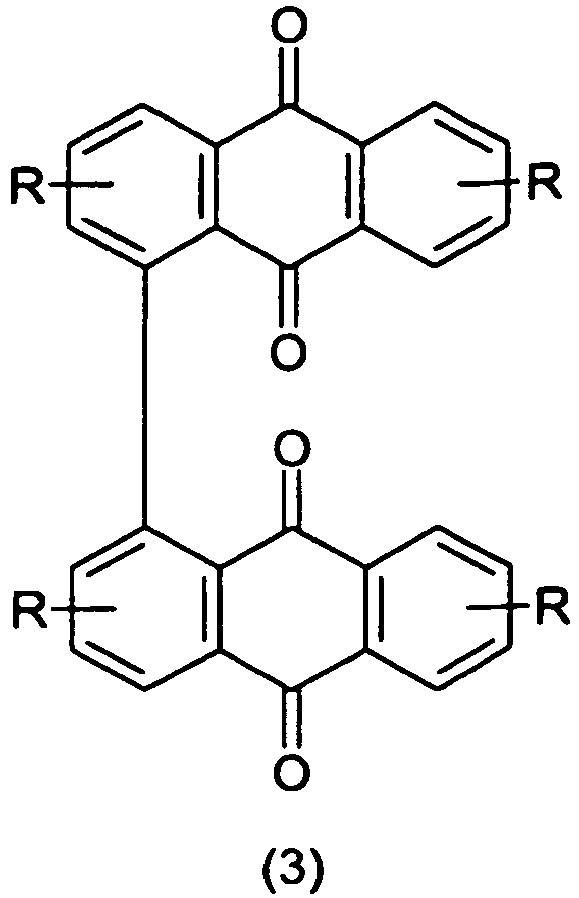
- They correspond, for example, to the following formula (3): where similarly diverse substitution and hydrogenation patterns on the aromatic rings are possible as for the "monomeric" age olanols. Due to limited freedom of rotation about the axis of chemical bonding between the anthraquinone nuclei, many Alterporriol derivatives exist in the form of two atropisomers.
- the object of the invention against this background was the identification, isolation and preparation of new substances for use as anti-infective agents in pharmaceutical compositions, especially of compounds exhibiting activity against multiple drug resistant (MDR) agents.
- MDR multiple drug resistant
- these anthracene derivatives are used as anti-infective agents against multiple drug resistant (MDR) pathogens, since they show very good to excellent efficacy here. While the structures of these five compounds have been published in the past, virtually nothing is known about their effects.
- the invention further relates to (2 R, 3 S, 4a S, 9a S, 10 R) -2,3,5,8,10-pentahydroxy-6-methoxy-3-methyl-1,2,3,4,4a , 9a-hexahydro-9H, 10H-anthracene-9-one (8-hydroxytetrahydro-altersolanol B) of the formula (8) for use as an anti-infective agent against MDR pathogens.
- the structure of this compound is already known. Regarding their activity, however, has so far been exclusively by Xu et al., J. Antibiot.
- the above compounds of formulas (4) to (7) are therefore preferably for use against multidrug-resistant strains of methicillin-resistant Staphylococcus aureus (MRSA), Staphylococcus epidermis, Streptococcus pneumoniae, Acinetobacter baumanii, Enterococcus faecalis and faecium, E. coli, Klebsiella sp ., Pseudomonas aeruginosa, Aspergillus sp.
- MRSA methicillin-resistant Staphylococcus aureus
- Staphylococcus epidermis Streptococcus pneumoniae
- Acinetobacter baumanii Enterococcus faecalis and faecium
- E. coli Klebsiella sp .
- Pseudomonas aeruginosa Aspergillus sp.
- the present invention also relates in a further aspect to a process for the preparation of the compounds of formulas (4) to (8) which consists in fermenting a microorganism producing the compound or a precursor thereof under growth conditions and the respective compound, optionally after destruction the cells of the microorganism to increase the yield, to win from the culture.
- a fermentation process is according to the invention as a microorganism, a pure strain of Nigrospora sp. used because the inventors were able to achieve the best yields with this species.
- precursors are obtained by the fermentation, these can be converted into the desired compounds of the formulas (4) to (8) by any methods well known to those skilled in the art of organic synthesis, it also being possible to use process steps under enzyme catalysis to ensure higher enantioselectivity.
- Another synthetic route consists in the cleavage of an OH group together with the adjacent hydrogen atom, ie dehydration, eg on the hydrogenated ring of Altersolanol A or B, to obtain a double bond between the corresponding C atoms and two prochiral centers at these positions. Subsequently, this double bond can be enzymatically rehydrated or cis- or trans-dihydroxylated, resulting in a suitable choice of the stereospecificity of the enzyme (eg hydratase, peroxygenase) or the oxidizing agent (eg permanganate) the desired compound.
- the enzyme eg hydratase, peroxygenase
- the oxidizing agent eg permanganate
- the Alterporriole G and H can be obtained, for example, by chemical (again optionally enzymatic) attachment of the corresponding anthraquinone substituent at position 8 of Altersolanol M - the corresponding, at position 3 acetylated, "monomeric" anthraquinone - which was optionally derivatized before suitable after which the acetyl group is hydrolytically split off from the OH group at position 3.
- Suitable enzymes for the synthesis steps for the reaction of precursors of the desired compound can in some cases also be isolated from that used for fermentation or else from another microorganism. The latter case may be useful if, for example, a microorganism produces the desired product, but e.g. in so small amounts or so heavily contaminated that it is more economical to obtain a precursor of the product by culturing another strain (or even another species or genus) and to convert it to the target compound by enzymatic synthesis.
- the recovery of the respective compound (4) to (8) is carried out according to the present invention, however, preferably by extraction and subsequent isolation from a crude extract of a culture, for example by fractional crystallization or chromatography, more preferably preparative HPLC, which again the best yields at the same time highest Purity has resulted.
- a crude extract of a culture for example by fractional crystallization or chromatography, more preferably preparative HPLC, which again the best yields at the same time highest Purity has resulted.
- other isolation methods such as direct fractional crystallization of the crude extract or absorption methods, conceivable.
- one skilled in the art can determine the isolation method suitable for the particular culture (or synthesis or partial synthesis) step without undue experimentation.
- the compounds of the formulas (4) to (8) were prepared by cultivating Stemphylium globuliferum for the compounds (5) to (7) and Nigrospora sp. for compounds (4) and (8) and subsequent extraction.
- the isolation and identification was analogous to that of Stemphylium globuliferum, but instead of the mint stems leaves of Bruguiera sexangula, a Magrovenspezies were used.
- the culture was extracted twice with 300 ml of ethyl acetate (EtOAc).
- EtOAc extract was evaporated to dryness and partitioned between n-hexane and 90% aqueous methanol (MeOH).
- the aqueous methanolic phase was evaporated to dryness and the residue was first column chromatographed on a Sephadex LH-20 column with 100% methanol (MeOH) as eluent, using thin layer chromatography (TLC) on silica gel F245 (Merck, Darmstadt, Germany). Germany) using EtOAc / MeOH / H 2 O (77:13:10) as eluent.
- the proportions of the individual compounds in the total yield were 49.0% by weight of Alterporriol G and H, 10.4% by weight of Altersolanol K, 7.8% by weight of Altersolanol L, 14.6% by weight of Tetrahydroaltersolanol B and 18.2% by weight of 8-hydroxytetrahydro-anolanol B.
- MIC stands for the "minimum inhibitory concentration" (MIC for "minimal inhibitory concentration") and refers to the lowest concentration of a substance in which no increase of microorganisms can be detected with the naked eye.
- the MIC is determined by a so-called titer method in which the substance is diluted out and then the pathogen is added.
- MIC is expressed in micrograms per milliliter ( ⁇ g / ml), and dilutions are usually in log2 increments.
- a starting concentration of 250 ⁇ g / ml was in each case doubled, which consequently resulted in test concentrations of 250 ⁇ g / ml, 125 ⁇ g / ml, 62.5 ⁇ g / ml, 31.2 ⁇ g / ml, 15.6 ⁇ g / ml, 7.8 ⁇ g / ml and so on. Lower values therefore reflect better activity as an anti-infective agent.
- the virus screening system is an infection system in which host cells are infected in vitro and the test substance is added before or after infection and its activity determined. All of these tests were performed according to the standard operating procedures of SeaLife Pharma for drug screening using analogous dilution series as in the Antibacterial Anti-Fungal Test.
- test results are anti-infective against some multi-drug resistant bacteria and fungi (all of which are kindly available from Prof. Georgopulos of the Medical University of Vienna were submitted) for Altersolanol M, Alterporriol I and J and some known and structurally similar reference substances.
- the data are each averages of multiple determinations.
Landscapes
- Health & Medical Sciences (AREA)
- Chemical & Material Sciences (AREA)
- Organic Chemistry (AREA)
- Life Sciences & Earth Sciences (AREA)
- Veterinary Medicine (AREA)
- Public Health (AREA)
- General Health & Medical Sciences (AREA)
- Medicinal Chemistry (AREA)
- Animal Behavior & Ethology (AREA)
- Pharmacology & Pharmacy (AREA)
- General Chemical & Material Sciences (AREA)
- Nuclear Medicine, Radiotherapy & Molecular Imaging (AREA)
- Chemical Kinetics & Catalysis (AREA)
- Oncology (AREA)
- Communicable Diseases (AREA)
- Virology (AREA)
- Epidemiology (AREA)
- Pulmonology (AREA)
- Molecular Biology (AREA)
- Pharmaceuticals Containing Other Organic And Inorganic Compounds (AREA)
- Acyclic And Carbocyclic Compounds In Medicinal Compositions (AREA)
- Organic Low-Molecular-Weight Compounds And Preparation Thereof (AREA)
- Medicines That Contain Protein Lipid Enzymes And Other Medicines (AREA)
Description
- Die vorliegende Erfindung betrifft Anthracen-Derivate zur Verwendung als Antiinfektiva, insbesondere gegen mehrfach wirkstoffresistente Erreger, sowie ein Verfahren zu ihrer Herstellung.
- Durch den höchst erfolgreichem Einsatz antimikrobieller Arzneimittel wurde in den späten 1960er- und frühen 1970er-Jahren angenommen, dass Infektionskrankheiten fortan keine Gefahr mehr darstellen würden. Dies sollte sich als schwerer Irrtum herausstellen, zumal die Mikroben 40 Jahre danach eine größere Bedrohung als jemals zuvor darstellen, weswegen ein dringender Bedarf an neuen antimikrobiellen Wirkstoffen besteht. Heutzutage sind Infektionskrankheiten die dritthäufigste Todesursache in den USA und die zweithäufigste weltweit. Für die meisten dieser Fälle sind unwirksame antimikrobielle Arzneimittel verantwortlich, und die Resistenz mancher Bakterien und Pilze gegen diese Wirkstoffe stellt in unserer Gesellschaft ein ernstes Problem dar. Statistischen Daten aus den USA zufolge wird der Großteil der im Krankenhaus erlittenen Infektionen (den sog. nosokomialen Infektionen) von wenigen Bakterienspezies hervorgerufen, nämlich von Enterococcus faecium, Staphylococcus aureus, Klebsiella pneumoniae, Acinetobacter baumanii, Pseudomonas aeruginosa und Enterobacter sp., die nach ihren Anfangsbuchstaben als "ESKAPE"-Pathogene bezeichnet werden (Boucher et al., "IDSA Report on Development Pipeline", CID 2009:48, Infectious Disease Society of America, 1. Januar 2009). Mit diesem Begriff soll freilich gleichzeitig ausgedrückt werden, dass sich diese resistenten Erreger der Wirkung antibakterieller Arzneimittel entziehen (engl.: to escape), zumal Antibiotikaresistenz auf molekularer Ebene nichts anderes bedeutet als, dass ein Mikroorganismus die Fähigkeit erlangt hat, sich der wachstumshemmenden oder bakteriziden Wirkung einer antimikrobiellen Substanz zu widersetzen. Das heißt, die Substanz wird klinisch unwirksam. So bedeutet etwa "methicillinresistenter Staphylococcus aureus" (auch als MRSA abgekürzt, wiewohl dieselbe Abkürzung auch in allgemeinerer Weise für "multiresistenten Staphylococcus aureus" gebraucht wird), dass die Verwendung von β-lactamen in der Therapie von S. aureus unwirksam ist, während beispielsweise Glykopeptide zumeist Wirkung zeigen. Es ist daher unbedingt erforderlich die Wirkung von neuen Antünfektiva gegen multiresistente Stämmen zu testen, da Wirksamkeit gegen dafür empfindliche Spezies oder Stämme nicht zwangsläufig auch Wirksamkeit gegen multiresistente Bakterien bedeutet, wie auch beispielsweise ein gegen grampositive Bakterien wirksames Mittel nicht notwendigerweise gegen gramnegative Bakterien wirkt oder umgekehrt (siehe u.a. Boucher et al., s.o.).
- Neben Bakterien und Pilzen fehlen gegenwärtig aber auch wirksame Strategien gegen respiratorische Viren. Zumeist werden lediglich die Symptome geheilt, ohne das Virus selbst zu bekämpfen. Eine Lösung für die Zukunft könnten vor allem Wirkstoffkombinationen sein.
- In der Vergangenheit wurden in endophytischen Pilzen zahlreiche Substanzen zur Bekämpfung der Vermehrung von Mikroorganismen gefunden. Diese Substanzen zeigen in einer Reihe von Fällen sehr gute antibakterielle, antifungale und antivirale Aktivität und könnten für zahlreiche Anwendungen eingesetzt werden (G. A. Strobel, Crit. Rev. Biotechnol. 22, 315-333 (2002)). Aufgrund der Tatsache, dass diesbezügliche Forschung überwiegend akademisch war und nicht direkt die Entwicklung neuer Wirkstoffe zum Ziel hatte, sind heute kaum entsprechende Arzneimittel auf dem Markt. Insbesondere das Screenen gegen resistente Mikroben wurde in der Vergangenheit vernachlässigt, so dass nur einige wenige Substanzen gegen arzneimittelresistente Mikroben gestestet wurden. Noch schlimmer ist die Lage bei respiratorischen Viren, gegen die bisher nahezu keine Substanzen gescreent wurden.
- Bereits im Jahre 1969 beschrieb A. Stoessl, Can. J. Chem. 47, 767 (1969), die Isolierung eines neuen metabolischen Pigments aus Alternaria solani, einem Schimmelpilz, der die sog. Dürrfleckenkrankheit bei Kartoffeln hervorruft. Dieses Pigment wurde Altersolanol A genannt und seine Struktur wie folgt indentifiziert:

- Der chemische Name dieses Anthrachinons lautet demnach 7-Methoxy-2-methyl-(1R,2S,3R,4S)-1,2,3,4-tetrahydro-1,2,3,4,5-pentahydroxyanthracen-9,10-dion.
- In weiterer Folge wurde dieses Pigment sowie mehrere Isomere und Derivate davon auch in weiteren Alternaria-Spezies (z.B. Alternaria porri) und in manchen anderen Pilzgattungen nachgewiesen (siehe beispielsweise R. Suemitsu et al., Agric. Biol. Chem. 45(10), 2363-2364 (1981)). Die Mehrzahl der Isomere und Derivate entspricht den folgenden allgemeinen Formeln (1) oder (2):

- In weiterer Folge wurden auch Dimere, d.h. Bisanthrachinone, als Metaboliten entdeckt, und das erstmals in Alternaria porri, einem weiteren Vertreter der Gattung der Alternariae, der u.a. die Purpurfleckenkrankheit bei Zwiebelgemüse hervorruft, weswegen diese Dimere Alterporriole genannt wurden. Sie entsprechen beispielsweise der folgenden Formel (3):
- Für manche als Altersolanole bzw. Alterporriole bezeichnete Verbindungen existieren Berichte über ihre Wirksamkeit gegen bestimmte Mikroorganismen, während andere als nicht antiinfektiv beschrieben wurden. So wurden etwa von Aly et al., Phytochemistry 69, 1716-1725 (2009), bioaktive Metaboliten endophytischer Pilze der Gattung Ampelomyces sowie deren antiinfektive Wirkung untersucht. Dabei wurde unter anderem festgestellt, dass Altersolanol J, die Alterporriole D und E (Atropisomere), sowie die mit Altersolanolen eng verwandte Verbindung Ampelanol keine Aktivität gegen Bakterien und Pilze zeigen, während Altersolanol A die wirksamste der getesteten Substanzen war. Weiters offenbaren beispielsweise Okamura et al., Phytochemistry 42(1), 77-80 (1996), keinerlei Wirkung von Tetrahydroaltersolanol B gegen grampositive Bakterien und die gramnegative Spezies Pseudomonas aeruginosa, während sich Altersolanol A und G gegen Micrococcus luteus, Staphylococcus aureus und Pseudomonas aeruginosa als wirksam erwiesen. Yagi et al., Phytochemistry 33(1), 87-91 (1993), berichten über die antimikrobielle Aktivität der Altersolanole A, B, C und E, während die Altersolanole D und F in demselben Test völlig unwirksam waren. Weiters offenbaren Okamura et al. in Phytochemistry 34(4), 1005-1009 (1993), Folgendes: Wirksamkeit von Altersolanol A und Altersolanol G gegen grampositive Bakterien und Pseudomonas aeruginosa, sehr schwache Wirksamkeit von Alterporriol A, B und D, keine Wirksamkeit von Altersolanol H sowie keine Wirksamkeit irgendeiner dieser Verbindungen gegen Candida-Hefepilze. In der
US-Pa-tentanmeldung Nr. 2007/258913 werden die atropisomeren Altersolanole D und E hingegen, wenn auch nur ganz allgemein, als geeignete Verbindungen zur Verhinderung der Bildung eines Biofilms in der Mundhöhle offenbart, ohne allerdings konkrete Daten bezüglich ihrer Wirksamkeit anzugeben, und Debbab et al., J. Nat. Prod. 72, 626-631 (2009), beschreiben eine gewisse zytotxische Wirksamkeit der Alterporriole G+H gegen Mäuse-Lymphomzellen. - Somit ist es jedenfalls unmöglich vorherzusagen, ob ein bestimmtes Altersolanol- bzw. Alterporriol-Isomer oder -Derivat antiinfektive Wirkung zeigt oder nicht, geschweige denn gegen welche Gattungen oder gar Spezies von Mikroorganismen.
- Das Ziel der Erfindung war vor diesem Hintergrund die Identifikation, Isolierung und Herstellung neuer Substanzen zur Verwendung als antiinfektive Wirkstoffe in pharmazeutischen Zusammensetzungen, vor allem von Verbindungen, die Aktivität gegen mehrfach wirkstoffresistente ("multiple drug resistant", MDR-) Erreger zeigen.
- Die Erfinder konnten nun im Verlauf ihrer Forschungen mehrere Substanzen - zum Teil mit bisher unveröffentlichter Struktur, d.h. neue chemische Verbindungen - identifizieren, die gute Aktivität gegen Mikroorganismen, aber auch gegen respiratorische Viren, insbesondere auch gegen MDR-Erreger, zeigen. Während in der parallelen, gleichzeitig eingereichten österreichischen Patentanmeldung mit der Anmeldenummer
A 842/09 - Konkret haben die Erfinder herausgefunden, dass die nachstehenden Anthracen-Derivate mitunter ausgezeichnete Aktivität gegen verschiedene Bakterien, Pilze und Viren zeigen, weswegen die vorliegende Erfindung in einem ersten Aspekt diese Derivate zur Verwendung als Antiinfektiva betrifft:
- a) (2R,3S,10R)-2,3,5,10-Tetrahydroxy-6-methoxy-3-methyl-1,2,3,4,4a,9a-hexahydro-9H,10H-anthracen-9-on (Tetrahydroaltersolanol B) der Formel (4)

- b) (1R,2R,3R,4aS,9aR,10R)-1,2,3,5,10-Pentahydroxy-7-methoxy-2-methyl-1,2,3,4, 4a,9a-hexahydro-9H,10H-anthracen-9-on (Altersolanol K) der Formel (5)

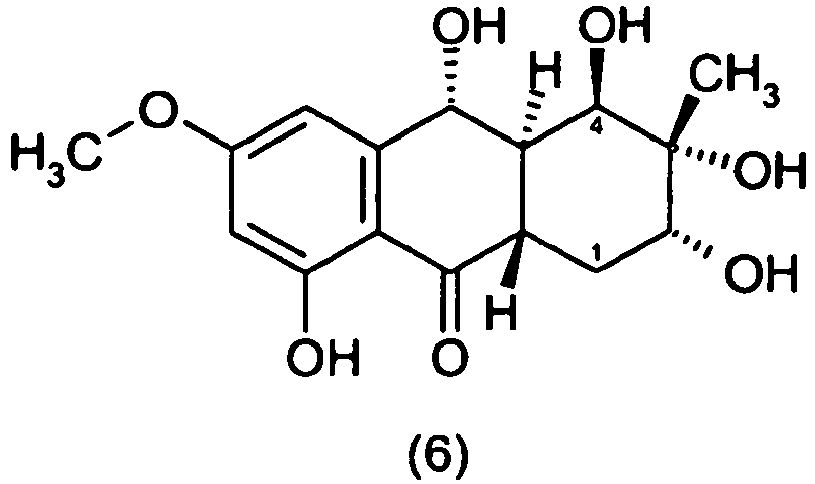
- c) (2R,3R,4R,4aS,9aS,10R)-2,3,4,8,10-Pentahydroxy-6-methoxy-3-methyl-1,2,3,4, 4a,9a-hexahydro-9H,10H-anthracen-9-on (Altersolanol L) der Formel (6)
- d) 8-(1,7-Dihydroxy-6-methyl-3-methoxy-9,10-dioxo-9H,10H-anthracen-2-yl)-(1S,2S,3R,4S)-1,2,3,4,5-pentahydroxy-7-methoxy-2-methyl-1,2,3,4-tetrahydro-9H,10H-anthracen-9,10-dion (Atropisomere Alterporriol G und H) der Formel (7)

- Vorzugsweise dienen diese Anthracen-Derivate zur Verwendung als Antiinfektiva gegen mehrfach wirkstoffresistente ("multiple drug resistant", MDR-) Erreger, da sie gerade hier sehr gute bis ausgezeichnete Wirksamkeit zeigen. Die Strukturen dieser fünf Substanzen wurden in der Vergangenheit zwar bereits veröffentlicht, über ihre Wirkung ist jedoch praktisch nichts bekannt.
- Für Verbindung (4), Tetrahydroaltersolanol B, beschreiben Okamura et al. (s.o.), wie zuvor erwähnt, sogar Unwirksamkeit gegen grampositive Bakterien und die gramnegative Spezies Pseudomonas aeruginosa. Zu den Verbindungen (5), (6) und (7), d.h. Altersolanol K, Altersolanol L und den Atropisomeren Alterporriol G und H, wurden hingegen noch keinerlei Aktivitätstests offenbart. Alle wurden von Miterfindem des vorliegenden Anmeldungsgegenstands erstmalig aus Stemphylium globuliferum isoliert, wie dies auch auf der Website des Journal of Natural Products am 9. März 2009 publiziert wurde (Debbab et al., s.o.).
- Die Erfindung betrifft weiters (2R,3S,4aS,9aS,10R)-2,3,5,8,10-Pentahydroxy-6-methoxy-3-methyl-1,2,3,4,4a,9a-hexahydro-9H,10H-anthracen-9-on (8-Hydroxytetrahydro-altersolanol B) der Formel (8)

- Die obigen Verbindungen der Formeln (4) bis (7) dienen daher vorzugsweise zur Verwendung gegen mehrfach wirkstoffresistente Stämme von methicillinresistentem Staphylococcus aureus (MRSA), Staphylococcus epidermis, Streptococcus pneumoniae, Acinetobacter baumanii, Enterococcus faecalis bzw. faecium, E. coli, Klebsiella sp., Pseudomonas aeruginosa, Aspergillus sp. sowie respiratorische Viren aus der Gruppe der humanen Rhinoviren und der respiratorischen Synzytial-Viren, und die Verbindung der Formel (8) vorzugsweise gegen dieselben Erreger mit Ausnahme von Staphylococci, d.h. gegen Streptococcus pneumoniae, Acinetobacter baumanii, Enterococcus faecatis bzw. faecium, E. coli, Klebsiella sp., Pseudomonas aeruginosa, Aspergillus sp. sowie ebenfalls respiratorische Viren aus der Gruppe der humanen Rhinoviren und der respiratorischen Synzytial-Viren, was durch die späteren Ausführungsbeispiele im Detail belegt wird.
- Die vorliegende Erfindung betrifft in einem weiteren Aspekt auch ein Verfahren zur Herstellung der Verbindungen der Formeln (4) bis (8), das darin besteht, einen die Verbindung oder einen Vorläufer davon produzierenden Mikroorganismus unter Wachstumsbedingungen zu fermentieren und die jeweilige Verbindung, gegebenenfalls nach Zerstörung der Zellen des Mikroorganismus zur Erhöhung der Ausbeute, aus der Kultur zu gewinnen. In einem solchen Fermentationsverfahren wird als Mikroorganismus erfindungsgemäß ein reiner Stamm von Nigrospora sp. eingesetzt, da die Erfinder mit dieser Spezies die besten Ausbeuten erzielen konnten. Alternativ dazu können jedoch auch beliebige andere Mikroorganismen, die in der Lage sind, die jeweilige Verbindung - oder auch eine Vorstufe davon - zu produzieren, z.B. Alternaria sp., zur Fermentation eingesetzt werden. Werden durch die Fermentation Vorstufen erhalten, können diese nach beliebigen, dem einschlägigen Fachmann auf dem Gebiet der organischen Synthese wohlbekannten Verfahren in die gewünschten Verbindungen der Formeln (4) bis (8) übergeführt werden, wobei gegebenenfalls auch Verfahrensschritte unter Enzymkatalyse eingesetzt werden können, um höhere Enantioselektivität zu gewährleisten.
- Beispielsweise kann etwa Alternaria sp. kultiviert werden, um aus der Fermentationsbrühe Altersolanol B - oder auch ein anderes Mitglied der Altersolanol-Familie - zu erhalten, das durch Hydrierung der nichtaromatischen Doppelbindung zwischen den Kohlenstoffatomen 4a und 9a sowie der Ketogruppe an Position 9 in die gewünschte Verbindung einer der Formeln (4) bis (6) oder (8), z.B. in Tetrahydroaltersolanol B, oder ein Stereoisomer davon übergeführt werden kann. Ein weiterer Syntheseweg besteht in der Abspaltung einer OH-Gruppe zusammen mit dem benachbarten Wasserstoffatom, d.h. Dehydratisierung, z.B. am hydrierten Ring von Altersolanol A oder B, um eine Doppelbindung zwischen den ensprechenden C-Atomen sowie zwei prochirale Zentren an diesen Positionen zu erhalten. Anschließend kann diese Doppelbindung enzymatisch rehydratisiert oder aber cis- oder trans-dihydroxyliert werden, was bei geeigneter Wahl der Stereospezifität des Enzyms (z.B. Hydratase, Peroxygenase) oder des Oxidationsmittels (z.B. Permanganat) die gewünschte Verbindung ergibt. Die Alterporriole G und H können beispielsweise auch durch chemische (wiederum gegebenenfalls enzymatische) Anbindung des entsprechenden Anthrachinon-Substituenten an Position 8 von Altersolanol M - dem entsprechenden, an Position 3 acetylierten, "monomeren" Anthrachinon - erhalten werden, das gegebenenfalls davor geeignet derivatisiert wurde, wonach die Acetylgruppe von der OH-Gruppe an Position 3 hydrolytisch abgespalten wird.
- Geeignete Enzyme für die Syntheseschritte zur Umsetzung von Vorläufern der gewünschten Verbindung können in manchen Fällen ebenfalls aus dem zur Fermentation eingesetzten oder auch aus einem anderen Mikroorganismus isoliert werden. Letzterer Fall kann sinnvoll sein, wenn beispielsweise ein Mikroorganismus zwar das gewünschte Produkt produziert, aber z.B. in so geringen Mengen oder so stark verunreinigt, dass es wirtschaftlicher ist, durch Kultivierung eines anderen Stamms (oder sogar einer anderen Spezies oder Gattung) einen Vorläufer des Produkts zu erhalten und diesen mittels enzymatischer Synthese zur Zielverbindung umzusetzen.
- Die Gewinnung der jeweiligen Verbindung (4) bis (8) erfolgt gemäß vorliegender Erfindung jedoch vorzugsweise durch Extraktion und anschließende Isolierung aus einem Rohextrakt einer Kultur, z.B. mittels fraktionierter Kristallisation oder Chromatographieverfahren, noch bevorzugter präparativer HPLC, was bisher erneut die besten Ausbeuten bei gleichzeitig höchster Reinheit ergeben hat. Freilich sind speziell bei Ansätzen in größerem Maßstab auch andere Isolierungsverfahren, wie z.B. direkte fraktionierte Kristallisation des Rohextrakts oder auch Absorptionsmethoden, denkbar. Der Fachmann kann jedoch ohne übermäßiges Experimentieren das für den jeweiligen Kultivierungs- (bzw. Synthese- oder Partialsynthese-) Schritt geeignete Isolierungsverfahren ermitteln.
- Die Erfindung wird nachstehend unter Bezugnahme auf konkrete Ausführungsbeispiele näher beschrieben, die jedoch den Schutzumfang nicht einschränken sollen.
- Die Verbindungen der Formeln (4) bis (8) wurden durch Kultivierung von Stemphylium globuliferum für die Verbindungen (5) bis (7) bzw. Nigrospora sp. für die Verbindungen (4) und (8) und anschließende Extraktion erhalten.
- Frische, gesunde Stängel von Mentha pulegium (Polei-Minze) wurden zur Isolierung des endophytischen Pilzes verwendet. Die Oberfläche der Stängel wurde mit 70%-igem Ethanol 1 min lang sterilisiert und danach mit sterilem Wasser abgespült, um den Alkohol zu entfernen. Zur Unterscheidung etwaiger verbliebener epiphytischer Pilze von endophytischen Pilzen wurde ein Abdruck der Stängeloberfläche auf Biomalzagar angefertigt. Kleine Gewebeproben aus dem Inneren wurden aseptisch aufgeschnitten und auf Agarplatten gepresst, die zur Unterdrückung von bakteriellem Wachstum ein Antibiotikum enthielten. Die Zusammensetzung des Isoliermediums war folgende: 15 g/l Malzextrakt, 15 g/l Agar und 0,2 g/l Chloramphenicol in destillier-tem Wasser, pH 7,4-7,8). Aus den Kulturen wurde durch wiederholtes Überimpfen auf Malzagarplatten ein reiner Pilzstamm erhalten. Die Pilzkultur wurde nach einer molekularbiologischen Vorschrift mittels DNA-Amplifikation und Sequenzierung der ITS-Region als Stemphylium globuliferum identifiziert. Die Sequenzdaten wurden bei GenBank unter der Zugriffsnummer EU859960 hinterlegt.
- Die Isolierung und Identifizierung erfolgte analog zu jener von Stemphylium globuliferum, wobei jedoch anstelle der Minzstängel Blätter von Bruguiera sexangula, einer Magrovenspezies, verwendet wurden.
- Zur Kultivierung beider isolierter Mikroorganismen wurden je zwei 1-Liter-Erlenmeyer-Kolben, die jeweils 100 g Reis und 100 ml destilliertes Wasser enthielten, autoklaviert, um ein gequollenes, festes Reismedium zu erhalten. Ein kleiner Teil des obigen Isoliermediums, das den reinen Pilzstamm enthielt, wurde unter sterilen Bedingungen auf das feste Reismedium aufgebracht, und der Pilz wurde bei Raumtemperatur (22 °C) 40 d lang für Stemphylium globuliferum bzw. 30 d lang für Nigrospora sp. kultiviert.
- Nach 30 bzw. 40 d wurde die Kultur zweimal mit 300 ml Ethylacetat (EtOAc) extrahiert. Der EtOAc-Extrakt wurde bis zur Trockene eingedampft und zwischen n-Hexan und 90%igem wässrigen Methanol (MeOH) verteilt. Die wässrig-methanolische Phase wurde bis zur Trockene eingedampft, und der Rückstand wurde zunächst Säulenchromatographie über eine Sephadex LH-20-Säule mit 100%igem Methanol (MeOH) als Laufmittel unter Detektion mittels Dünnschichtchromatographie (DC) auf Kieselgel F245 (Merck, Darmstadt, Deutschland) unter Verwendung von EtOAc/MeOH/H2O (77:13:10) als Laufmittel unterzogen wurde. Die die gewünschten Verbindungen enthaltenden Fraktionen wurden vereinigt und semipräparativer HPLC (Merck, Hitachi L-7100) unter Verwendung einer Eurosphere 100-10 C18-Säule (300 x 8 mm, L x i.d.) und eines linearen Wasser-Methanol-Gradienten unterzogen. Auf diese Weise wurden die Verbindungen der Formeln (4) bis (8) in reiner Form erhalten, wobei die Atropisomere Alterporriol G und H nicht getrennt werden konnten.
- Die Anteile der einzelnen Verbindungen an der Gesamtausbeute betrugen 49,0 Gew.-% Alterporriol G und H, 10,4 Gew.-% Altersolanol K, 7,8 Gew.% Altersolanol L, 14,6 Gew.-% Tetrahydroaltersolanol B und 18,2 Gew.-% 8-Hydroxytetrahydroaltersolanol B.
- Die Identifizierung der Verbindungen erfolgte anhand ihrer 1H-NMR-, 13C-NMR-, HMBC- und COSY-Spektren sowie Vergleich mit den in der erwähnten Literatur zitierten Werten.
- Die Aktivität der Verbindungen wurden in zwei unterschiedlichen Screeningsystemen getestet. Die antibakterielle und antifungale Aktivität wurde in einem MHK-Test untersucht. MHK steht für die "minimale Hemm-Konzentration" (engl.: MIC für "minimal inhibitory concentration") und bezeichnet die niedrigste Konzentration einer Substanz, bei der mit bloßem Auge keine Vermehrung von Mikroorganismen wahrgenommen werden kann. Bestimmt wird die MHK mit einem so genannten Titerverfahren, bei dem die Substanz ausverdünnt und anschließend der Erreger zugefügt wird.
- In der Regel wird so die Konzentration eines Antibiotikums bestimmt, die das Wachstum eines Bakterienstammes gerade noch hemmt. Die MHK wird in Mikrogramm pro Milliliter (µg/ml) angegeben, und die Verdünnungen erfolgen in der Regel in log2-Schritten. Hierin wurde eine Ausgangskonzentration von 250 µg/ml jeweils auf das Doppelte verdünnt, was folglich Testkonzentrationen von 250 µg/ml, 125 µg/ml, 62,5 µg/ml, 31,2 µg/ml, 15,6 µg/ml, 7,8 µg/ml usw. ergab. Niedrigere Werte spiegeln demnach bessere Aktivität als Antiinfektivum wider.
- Die Tests wurden nach den vom EUCAST (European Committee for Antimicrobial Susceptibility Testing) geforderten Standards und gemäß den AFST- ("Antifungal Susceptibility Testing") Vorschriften der European Society of Clinical Microbiology and Infectious Diseases (ESCMID) durchgeführt.
- Das Screeningsystem für Viren ist ein Infektionssystem, bei dem Wirtszellen in vitro infiziert werden und die Testsubstanz vor oder nach der Infektion zugesetzt und ihre Aktivität bestimmt wird. Alle diese Tests wurden gemäß den betriebsintemen Standardvorschriften von SeaLife Pharma zum Arzneimittelscreening durchgeführt, wobei analoge Verdünnungsreihen wie im antibakteriellenlantifungalen Test eingesetzt wurden.
- In der nachstehenden Tabelle 1 sind die Testergebnisse bezüglich der antiinfektiven Wirkung gegen einige multiresistente Bakterien und Pilze (die allesamt freundlicherweise von Prof. Georgopulos von der Medizinischen Universität Wien zur Verfügung gestellt worden waren) für Altersolanol M, Alterporriol I und J sowie einige bekannte und strukturell ähnliche Vergleichssubstanzen angeführt. Die Daten sind jeweils Mittelwerte von Mehrfachbestimmungen.
- Es ist klar ersichtlich, dass die Verbindungen der Formeln (4) bis (8) gute bis ausgezeichnete Aktivität gegen fünf Bakterienspezies, nämlich Enterococcus faecalis bzw. faecium, methicillinresistenten Staphylococcus aureus, Streptococcus pneumoniae, Staphylococcus epidermis und Acinetobacter baumanii, und darüber hinaus auch - wenn auch nur mäßige bis geringe - Aktivität gegen Aspergillus fumigatus bzw. faecalis zeigen. Als einzige Verbindung in dieser Testreihe zeigte Tetrahydroaltersolanol B auch schwache Wirkung gegen E. coli, Klebsiella sp. und Pseudomonas aeruginosa.
- Als Ergebnis der Aktivitätstest der Verbindungen (4) bis (8) gegen drei verschiedene Spezies respiratorischer Viren, nämlich ein humanes Rhinovirus (hrv), ein respiratorisches Synzytial-Virus (rsv) und Paraflu, die von der ATCC erhalten worden waren, wurde festgestellt, dass beide (bzw. alle drei) Verbindungen bereits ab einer Konzentration von 0,1 µg/ml für 100%igen Schutz der Zellen sorgten.
- Somit wurde eindeutig belegt, dass die erfindungsgemäße Verwendung der fünf bekannten Verbindungen mitunter ausgezeichnete Wirksamkeit sowohl gegen mehrfach arzneimittelresistente bakterielle und fungale Erreger als auch gegen respiratorische Viren zeigen und daher breite Anwendung als Antiinfektiva finden können.
Tabelle 1: MHK-Werte bei multiresistenten Bakterien und Pilzen Substanzen EC KL PS EK MRSA STR SE AB ASP Beispiel 1: Tetrahydroaltersolanol B (4) 125 125 125 31,2 15,6 31,2 31,2 Beispiel 2: Altersolanol K (5) 31,2 31,2 31,2 31,2 62,5 Beispiel 3: Altersolanol L (6) 7,8 7,8 7,8 7,8 7,8 31,2 Beispiel 4: Alterporriol G + H (7) 7,8 7,8 7,8 7,8 125 Beispiel 5: 8-Hydroxytetrahydroaltersolanol B (8) 125 15,6 7,8 15,6 31,2 Bostrycin 125 62,5 125 125 Altenusin 62,5 62,5 31,2 31,2 31,2 62,5 Alterporriol A + B 15,6 15,6 7,8 15,6 125 62,5 Altersolanol A 62,5 15,6 7,8 7,8 7,8 62,5 7,8 Altersolanol J 125 31,2 62,5 15,6 62,5 125 125 Ampelanol Macrosporin 62,5 62,5 62,5 125 Macrosporinsulfat 31,2 125 Indolcarbaldehyd (Carboxaldehyd) 125 62,5 125 EC E. coli
KL Klebsiella sp.
PS Pseudomonas aeruginosa
EK Enterococcus faecalis bzw. faecium
MRSA methicillinresistenter Staphylococcus aureus
STR Streptococcus pneumoniae
SE Staphylococcus epidermis
AB Acinetobacter baumanii
ASP Aspergillus fumigatus bzw. faecalis
Claims (6)
- Nachstehende Anthracen-Derivate zur Verwendung als Antiinfektiva:a) (2R,3S,10R)-2,3,5,10-Tetrahydroxy-6-methoxy-3-methyl-1,2,3,4,4a,9a-hexahydro-9H,10H-anthracen-9-on (Tetrahydroaltersolanol B)
 b) (1R,2R,3R,4aS,9aR,10R)-1,2,3,5,10-Pentahydroxy-7-methoxy-2-methyl-1,2,3,4, 4a,9a-hexahydro-9H,10H-anthracen-9-on (Altersolanol K)
 c) (2R,3R,4R,4aS,9aS,10R)-2,3,4,8,10-Pentahydroxy-6-methoxy-3-methyl-1,2,3,4, 4a,9a-hexahydro-9H,10H-anthracen-9-on (Altersolanol L)
 d) 8-(1,7-Dihydroxy-6-methyl-3-methoxy-9,10-dioxo-9H,10H-anthracen-2-yl)-(1S,2S,3R,4S)-1,2,3,4,5-pentahydroxy-7-methoxy-2-methyl-1,2,3,4-tetrahydro-9H,10H-anthracen-9,10-dion (Atropisomere Alterporriol G und H)
- Anthracen-Derivat zur Verwendung als Antünfektivum nach Anspruch 1, dadurch gekennzeichnet, dass das Anthracen-Derivat zur Verwendung als Antiinfektivum gegen mehrfach wirkstoffresistente ("multiple drug resistant", MDR-) Erreger dient.
- Anthracen-Derivat zur Verwendung als Antünfektivum nach Anspruch 2, dadurch gekennzeichnet, dass das Anthracen-Derivat zur Verwendung als Antiinfektivum gegen mehrfach wirkstoffresistente Stämme von methicillinresistentem Staphylococcus aureus (MRSA), Staphylococcus epidermis, Streptococcus pneumoniae, Acinetobacter baumanii, Enterococcus faecalis bzw. faecium, Escherichia coli, Klebsiella sp., Pseudomonas aeruginosa, Aspergillus sp. sowie respiratorische Viren aus der Gruppe der humanen Rhinoviren und der respiratorischen Synzytial-Viren dient.
- (2R,3S,4aS,9aS,10R)-2,3,5,8,10-Pentahydroxy-6-methoxy-3-methyl-1,2,3,4, 4a,9a-hexahydro-9H,10H-anthracen-9-on(8-Hydroxytetrahydroaltersolanol B)

- Verfahren zur Herstellung einer der in Anspruch 1 oder 4 definierten Verbindungen, dadurch gekennzeichnet, dass ein Stamm von Nigrospora sp. unter Wachstumsbedingungen fermentiert wird und die Verbindung, gegebenenfalls nach Zerstörung der Zellen des Mikroorganismus, aus der Fermentationsbrühe gewonnen wird.
- Verfahren nach Anspruch 5, dadurch gekennzeichnet, dass die Verbindung durch Extraktion und anschließende Isolierung aus dem Rohextrakt gewonnen wird.
Applications Claiming Priority (2)
| Application Number | Priority Date | Filing Date | Title |
|---|---|---|---|
| AT0084309A AT507999B1 (de) | 2009-05-29 | 2009-05-29 | Verwendung von anthracen-derivaten als antiinfektiva |
| PCT/AT2010/000189 WO2010135758A1 (de) | 2009-05-29 | 2010-05-31 | Verwendung von anthracen-derivaten als antiinfektiva |
Publications (2)
| Publication Number | Publication Date |
|---|---|
| EP2435034A1 EP2435034A1 (de) | 2012-04-04 |
| EP2435034B1 true EP2435034B1 (de) | 2013-10-23 |
Family
ID=42541529
Family Applications (1)
| Application Number | Title | Priority Date | Filing Date |
|---|---|---|---|
| EP10726409.5A Not-in-force EP2435034B1 (de) | 2009-05-29 | 2010-05-31 | Verwendung von anthracen-derivaten als antiinfektiva |
Country Status (5)
| Country | Link |
|---|---|
| US (1) | US20120129949A1 (de) |
| EP (1) | EP2435034B1 (de) |
| CN (1) | CN102481272A (de) |
| AT (1) | AT507999B1 (de) |
| WO (1) | WO2010135758A1 (de) |
Families Citing this family (8)
| Publication number | Priority date | Publication date | Assignee | Title |
|---|---|---|---|---|
| CN102531868B (zh) * | 2011-12-03 | 2016-03-02 | 中国海洋大学 | 一种蒽醌类衍生物及其制备方法与应用 |
| CN102633616B (zh) * | 2011-12-03 | 2016-02-03 | 中国海洋大学 | 蒽醌二聚体衍生物Alterporriol P及其制备方法与应用 |
| CN102643186B (zh) * | 2011-12-03 | 2016-03-02 | 中国海洋大学 | 一种蒽醌二聚体衍生物及其制备方法与应用 |
| CN105152901A (zh) * | 2015-09-28 | 2015-12-16 | 三峡大学 | 一种蒽醌类化合物的制备方法及作为受体酪氨酸激酶抑制剂的应用 |
| CN110734939A (zh) * | 2019-10-16 | 2020-01-31 | 湖北省荆楚药材研究院 | 利用HCH285菌株固态发酵生产bostrycin的方法 |
| CN112521261B (zh) * | 2020-11-11 | 2022-07-08 | 湖南科技学院 | 银杏内生真菌球黑孢菌次级代谢产物及其抑菌用途 |
| CN113214071A (zh) * | 2021-05-19 | 2021-08-06 | 云南民族大学 | 一种抗mrsa化合物及其制备方法和应用 |
| CN119462867B (zh) * | 2024-11-25 | 2025-12-09 | 湖南农业大学 | 一种匍柄霉交链茄醇a的转运蛋白及其编码基因和应用 |
Family Cites Families (1)
| Publication number | Priority date | Publication date | Assignee | Title |
|---|---|---|---|---|
| EP1796656A2 (de) | 2004-09-17 | 2007-06-20 | Oystershell NV | Zusammensetzung zur unterdrückung oder prävention der bildung eines biofilms |
-
2009
- 2009-05-29 AT AT0084309A patent/AT507999B1/de not_active IP Right Cessation
-
2010
- 2010-05-31 EP EP10726409.5A patent/EP2435034B1/de not_active Not-in-force
- 2010-05-31 US US13/375,059 patent/US20120129949A1/en not_active Abandoned
- 2010-05-31 CN CN201080032522XA patent/CN102481272A/zh active Pending
- 2010-05-31 WO PCT/AT2010/000189 patent/WO2010135758A1/de not_active Ceased
Also Published As
| Publication number | Publication date |
|---|---|
| WO2010135758A1 (de) | 2010-12-02 |
| AT507999B1 (de) | 2010-10-15 |
| US20120129949A1 (en) | 2012-05-24 |
| CN102481272A (zh) | 2012-05-30 |
| EP2435034A1 (de) | 2012-04-04 |
| AT507999A4 (de) | 2010-10-15 |
Similar Documents
| Publication | Publication Date | Title |
|---|---|---|
| AT507298B1 (de) | Neue anthrachinon-derivate | |
| AT507999B1 (de) | Verwendung von anthracen-derivaten als antiinfektiva | |
| Rančić et al. | Isolation and structural elucidation of two secondary metabolites from the filamentous fungus Penicillium ochrochloron with antimicrobial activity | |
| Mani et al. | Antioxidant and antimicrobial evaluation of bioactive pigment from Fusarium sp. isolated from stressed environment | |
| Famuyiwa et al. | A new homoisoflavonoid and the bioactivities of some selected homoisoflavonoids from the inter-bulb surfaces of Scilla nervosa subsp. rigidifolia | |
| AT509716B1 (de) | Neue tetrahydroanthracenon-derivate | |
| EP1791823B1 (de) | Antibiotikum und verfahren zur herstellung | |
| DE3048421C2 (de) | Antibiotische Substanz, Verfahren zu deren Herstellung und antimykotisches Mittel, welches diese enthält | |
| KR20160086479A (ko) | 신규한 고리형 뎁시펩타이드계 화합물, 이의 제조방법 및 이를 유효성분으로 함유하는 항균용 약학적 조성물 | |
| DE2342404C3 (de) | 3-(5,7-Dimethyl-2-hydroxy-4-oxo-6,8-decadienyI)-glutarimid sowie Verfahren zu dessen Herstellung | |
| DE102004004906A1 (de) | O-Verbrückte Angucyclinone, Verfahren zu ihrer Herstellung, sie enthaltende Arzneimittel und deren Verwendung | |
| DE3032302A1 (de) | 3,4-dihydro-4-hydroxy-5-(3-hydroxy-2-pyridinyl)-4-methyl-2h-pyrrol-2-carboxamid und seine stereoisomeren, verfahren zu ihrer herstellung, sowie die verwendung dieser verbindungen bei der bekaempfung grampositiver und gram-negativer bakterien, hefen, pilze, acholeplasmen und trichomonas vaginalis | |
| DE2938993A1 (de) | Herbicolin, verfahren zu seiner herstellung und es enthaltende mittel | |
| DE1593964C3 (de) | Triacetyl-Spiramycin I und Verfahren zu seiner Herstellung | |
| WO2005080311A1 (de) | Hygrophorone und deren derivate | |
| EP1478731A1 (de) | Phenalenon-derivative, verfahren zur herstellung und verwendung derselben | |
| DE1617796C (de) | Fermentatives Verfahren zur Herstel lung der Antibiotika N 329A und N 329B Ausscheidung aus 1567095 | |
| JP2540671B2 (ja) | 新規微生物生育抑制物質、その製造法および用途 | |
| DE2167020A1 (de) | Verfahren zur herstellung von rosamicin (antibiotikum 67-694) | |
| DD261608A1 (de) | Verfahren zur herstellung eines sesquiterpen-antibiotikums | |
| EP1740595A1 (de) | Polyzyklische makrolactone | |
| DD252616B1 (de) | Verfahren zur herstellung von cerulenin auf mikrobiologischem wege | |
| DE10353300A1 (de) | Polyzyklische Makrolactone | |
| WO2001047881A1 (de) | Ascosalipyrrolon derivatives | |
| DE1617796B (de) | Fermentatives Verfahren zur Herstellung der Antibiotika N-329A und N-329B. Ausscheidung aus: 1567095 |
Legal Events
| Date | Code | Title | Description |
|---|---|---|---|
| PUAI | Public reference made under article 153(3) epc to a published international application that has entered the european phase |
Free format text: ORIGINAL CODE: 0009012 |
|
| 17P | Request for examination filed |
Effective date: 20111213 |
|
| AK | Designated contracting states |
Kind code of ref document: A1 Designated state(s): AL AT BE BG CH CY CZ DE DK EE ES FI FR GB GR HR HU IE IS IT LI LT LU LV MC MK MT NL NO PL PT RO SE SI SK SM TR |
|
| DAX | Request for extension of the european patent (deleted) | ||
| 17Q | First examination report despatched |
Effective date: 20120920 |
|
| RIC1 | Information provided on ipc code assigned before grant |
Ipc: A61P 31/16 20060101ALI20130315BHEP Ipc: A61P 31/06 20060101ALI20130315BHEP Ipc: C07C 50/34 20060101ALI20130315BHEP Ipc: A61P 31/00 20060101ALI20130315BHEP Ipc: C07C 49/755 20060101ALI20130315BHEP Ipc: A61K 31/122 20060101AFI20130315BHEP |
|
| GRAP | Despatch of communication of intention to grant a patent |
Free format text: ORIGINAL CODE: EPIDOSNIGR1 |
|
| INTG | Intention to grant announced |
Effective date: 20130515 |
|
| GRAS | Grant fee paid |
Free format text: ORIGINAL CODE: EPIDOSNIGR3 |
|
| GRAA | (expected) grant |
Free format text: ORIGINAL CODE: 0009210 |
|
| AK | Designated contracting states |
Kind code of ref document: B1 Designated state(s): AL AT BE BG CH CY CZ DE DK EE ES FI FR GB GR HR HU IE IS IT LI LT LU LV MC MK MT NL NO PL PT RO SE SI SK SM TR |
|
| REG | Reference to a national code |
Ref country code: GB Ref legal event code: FG4D Free format text: NOT ENGLISH |
|
| REG | Reference to a national code |
Ref country code: CH Ref legal event code: EP |
|
| REG | Reference to a national code |
Ref country code: AT Ref legal event code: REF Ref document number: 637162 Country of ref document: AT Kind code of ref document: T Effective date: 20131115 |
|
| REG | Reference to a national code |
Ref country code: IE Ref legal event code: FG4D Free format text: LANGUAGE OF EP DOCUMENT: GERMAN |
|
| REG | Reference to a national code |
Ref country code: DE Ref legal event code: R096 Ref document number: 502010005160 Country of ref document: DE Effective date: 20131219 |
|
| REG | Reference to a national code |
Ref country code: NL Ref legal event code: VDEP Effective date: 20131023 |
|
| REG | Reference to a national code |
Ref country code: LT Ref legal event code: MG4D |
|
| PG25 | Lapsed in a contracting state [announced via postgrant information from national office to epo] |
Ref country code: FI Free format text: LAPSE BECAUSE OF FAILURE TO SUBMIT A TRANSLATION OF THE DESCRIPTION OR TO PAY THE FEE WITHIN THE PRESCRIBED TIME-LIMIT Effective date: 20131023 Ref country code: IS Free format text: LAPSE BECAUSE OF FAILURE TO SUBMIT A TRANSLATION OF THE DESCRIPTION OR TO PAY THE FEE WITHIN THE PRESCRIBED TIME-LIMIT Effective date: 20140223 Ref country code: NL Free format text: LAPSE BECAUSE OF FAILURE TO SUBMIT A TRANSLATION OF THE DESCRIPTION OR TO PAY THE FEE WITHIN THE PRESCRIBED TIME-LIMIT Effective date: 20131023 Ref country code: HR Free format text: LAPSE BECAUSE OF FAILURE TO SUBMIT A TRANSLATION OF THE DESCRIPTION OR TO PAY THE FEE WITHIN THE PRESCRIBED TIME-LIMIT Effective date: 20131023 Ref country code: LT Free format text: LAPSE BECAUSE OF FAILURE TO SUBMIT A TRANSLATION OF THE DESCRIPTION OR TO PAY THE FEE WITHIN THE PRESCRIBED TIME-LIMIT Effective date: 20131023 Ref country code: SE Free format text: LAPSE BECAUSE OF FAILURE TO SUBMIT A TRANSLATION OF THE DESCRIPTION OR TO PAY THE FEE WITHIN THE PRESCRIBED TIME-LIMIT Effective date: 20131023 Ref country code: NO Free format text: LAPSE BECAUSE OF FAILURE TO SUBMIT A TRANSLATION OF THE DESCRIPTION OR TO PAY THE FEE WITHIN THE PRESCRIBED TIME-LIMIT Effective date: 20140123 |
|
| PG25 | Lapsed in a contracting state [announced via postgrant information from national office to epo] |
Ref country code: LV Free format text: LAPSE BECAUSE OF FAILURE TO SUBMIT A TRANSLATION OF THE DESCRIPTION OR TO PAY THE FEE WITHIN THE PRESCRIBED TIME-LIMIT Effective date: 20131023 Ref country code: CY Free format text: LAPSE BECAUSE OF FAILURE TO SUBMIT A TRANSLATION OF THE DESCRIPTION OR TO PAY THE FEE WITHIN THE PRESCRIBED TIME-LIMIT Effective date: 20131023 Ref country code: ES Free format text: LAPSE BECAUSE OF FAILURE TO SUBMIT A TRANSLATION OF THE DESCRIPTION OR TO PAY THE FEE WITHIN THE PRESCRIBED TIME-LIMIT Effective date: 20131023 |
|
| PG25 | Lapsed in a contracting state [announced via postgrant information from national office to epo] |
Ref country code: PT Free format text: LAPSE BECAUSE OF FAILURE TO SUBMIT A TRANSLATION OF THE DESCRIPTION OR TO PAY THE FEE WITHIN THE PRESCRIBED TIME-LIMIT Effective date: 20140224 |
|
| REG | Reference to a national code |
Ref country code: DE Ref legal event code: R097 Ref document number: 502010005160 Country of ref document: DE |
|
| PG25 | Lapsed in a contracting state [announced via postgrant information from national office to epo] |
Ref country code: EE Free format text: LAPSE BECAUSE OF FAILURE TO SUBMIT A TRANSLATION OF THE DESCRIPTION OR TO PAY THE FEE WITHIN THE PRESCRIBED TIME-LIMIT Effective date: 20131023 |
|
| PG25 | Lapsed in a contracting state [announced via postgrant information from national office to epo] |
Ref country code: IT Free format text: LAPSE BECAUSE OF FAILURE TO SUBMIT A TRANSLATION OF THE DESCRIPTION OR TO PAY THE FEE WITHIN THE PRESCRIBED TIME-LIMIT Effective date: 20131023 Ref country code: CZ Free format text: LAPSE BECAUSE OF FAILURE TO SUBMIT A TRANSLATION OF THE DESCRIPTION OR TO PAY THE FEE WITHIN THE PRESCRIBED TIME-LIMIT Effective date: 20131023 Ref country code: PL Free format text: LAPSE BECAUSE OF FAILURE TO SUBMIT A TRANSLATION OF THE DESCRIPTION OR TO PAY THE FEE WITHIN THE PRESCRIBED TIME-LIMIT Effective date: 20131023 Ref country code: SK Free format text: LAPSE BECAUSE OF FAILURE TO SUBMIT A TRANSLATION OF THE DESCRIPTION OR TO PAY THE FEE WITHIN THE PRESCRIBED TIME-LIMIT Effective date: 20131023 Ref country code: RO Free format text: LAPSE BECAUSE OF FAILURE TO SUBMIT A TRANSLATION OF THE DESCRIPTION OR TO PAY THE FEE WITHIN THE PRESCRIBED TIME-LIMIT Effective date: 20131023 |
|
| PLBE | No opposition filed within time limit |
Free format text: ORIGINAL CODE: 0009261 |
|
| STAA | Information on the status of an ep patent application or granted ep patent |
Free format text: STATUS: NO OPPOSITION FILED WITHIN TIME LIMIT |
|
| PG25 | Lapsed in a contracting state [announced via postgrant information from national office to epo] |
Ref country code: DK Free format text: LAPSE BECAUSE OF FAILURE TO SUBMIT A TRANSLATION OF THE DESCRIPTION OR TO PAY THE FEE WITHIN THE PRESCRIBED TIME-LIMIT Effective date: 20131023 |
|
| 26N | No opposition filed |
Effective date: 20140724 |
|
| REG | Reference to a national code |
Ref country code: DE Ref legal event code: R097 Ref document number: 502010005160 Country of ref document: DE Effective date: 20140724 |
|
| REG | Reference to a national code |
Ref country code: DE Ref legal event code: R119 Ref document number: 502010005160 Country of ref document: DE |
|
| PG25 | Lapsed in a contracting state [announced via postgrant information from national office to epo] |
Ref country code: LU Free format text: LAPSE BECAUSE OF FAILURE TO SUBMIT A TRANSLATION OF THE DESCRIPTION OR TO PAY THE FEE WITHIN THE PRESCRIBED TIME-LIMIT Effective date: 20140531 |
|
| REG | Reference to a national code |
Ref country code: CH Ref legal event code: PL |
|
| GBPC | Gb: european patent ceased through non-payment of renewal fee |
Effective date: 20140531 |
|
| PG25 | Lapsed in a contracting state [announced via postgrant information from national office to epo] |
Ref country code: CH Free format text: LAPSE BECAUSE OF NON-PAYMENT OF DUE FEES Effective date: 20140531 Ref country code: MC Free format text: LAPSE BECAUSE OF FAILURE TO SUBMIT A TRANSLATION OF THE DESCRIPTION OR TO PAY THE FEE WITHIN THE PRESCRIBED TIME-LIMIT Effective date: 20131023 Ref country code: LI Free format text: LAPSE BECAUSE OF NON-PAYMENT OF DUE FEES Effective date: 20140531 |
|
| REG | Reference to a national code |
Ref country code: DE Ref legal event code: R119 Ref document number: 502010005160 Country of ref document: DE Effective date: 20141202 |
|
| REG | Reference to a national code |
Ref country code: IE Ref legal event code: MM4A |
|
| PG25 | Lapsed in a contracting state [announced via postgrant information from national office to epo] |
Ref country code: SI Free format text: LAPSE BECAUSE OF FAILURE TO SUBMIT A TRANSLATION OF THE DESCRIPTION OR TO PAY THE FEE WITHIN THE PRESCRIBED TIME-LIMIT Effective date: 20131023 |
|
| REG | Reference to a national code |
Ref country code: FR Ref legal event code: ST Effective date: 20150130 |
|
| PG25 | Lapsed in a contracting state [announced via postgrant information from national office to epo] |
Ref country code: DE Free format text: LAPSE BECAUSE OF NON-PAYMENT OF DUE FEES Effective date: 20141202 Ref country code: IE Free format text: LAPSE BECAUSE OF NON-PAYMENT OF DUE FEES Effective date: 20140531 |
|
| PG25 | Lapsed in a contracting state [announced via postgrant information from national office to epo] |
Ref country code: GB Free format text: LAPSE BECAUSE OF NON-PAYMENT OF DUE FEES Effective date: 20140531 Ref country code: FR Free format text: LAPSE BECAUSE OF NON-PAYMENT OF DUE FEES Effective date: 20140602 |
|
| PG25 | Lapsed in a contracting state [announced via postgrant information from national office to epo] |
Ref country code: MT Free format text: LAPSE BECAUSE OF FAILURE TO SUBMIT A TRANSLATION OF THE DESCRIPTION OR TO PAY THE FEE WITHIN THE PRESCRIBED TIME-LIMIT Effective date: 20131023 |
|
| PG25 | Lapsed in a contracting state [announced via postgrant information from national office to epo] |
Ref country code: SM Free format text: LAPSE BECAUSE OF FAILURE TO SUBMIT A TRANSLATION OF THE DESCRIPTION OR TO PAY THE FEE WITHIN THE PRESCRIBED TIME-LIMIT Effective date: 20131023 |
|
| PG25 | Lapsed in a contracting state [announced via postgrant information from national office to epo] |
Ref country code: GR Free format text: LAPSE BECAUSE OF FAILURE TO SUBMIT A TRANSLATION OF THE DESCRIPTION OR TO PAY THE FEE WITHIN THE PRESCRIBED TIME-LIMIT Effective date: 20140124 Ref country code: BG Free format text: LAPSE BECAUSE OF FAILURE TO SUBMIT A TRANSLATION OF THE DESCRIPTION OR TO PAY THE FEE WITHIN THE PRESCRIBED TIME-LIMIT Effective date: 20131023 |
|
| REG | Reference to a national code |
Ref country code: AT Ref legal event code: MM01 Ref document number: 637162 Country of ref document: AT Kind code of ref document: T Effective date: 20150531 |
|
| PG25 | Lapsed in a contracting state [announced via postgrant information from national office to epo] |
Ref country code: BE Free format text: LAPSE BECAUSE OF FAILURE TO SUBMIT A TRANSLATION OF THE DESCRIPTION OR TO PAY THE FEE WITHIN THE PRESCRIBED TIME-LIMIT Effective date: 20140531 Ref country code: HU Free format text: LAPSE BECAUSE OF FAILURE TO SUBMIT A TRANSLATION OF THE DESCRIPTION OR TO PAY THE FEE WITHIN THE PRESCRIBED TIME-LIMIT; INVALID AB INITIO Effective date: 20100531 Ref country code: TR Free format text: LAPSE BECAUSE OF FAILURE TO SUBMIT A TRANSLATION OF THE DESCRIPTION OR TO PAY THE FEE WITHIN THE PRESCRIBED TIME-LIMIT Effective date: 20131023 |
|
| PG25 | Lapsed in a contracting state [announced via postgrant information from national office to epo] |
Ref country code: AT Free format text: LAPSE BECAUSE OF NON-PAYMENT OF DUE FEES Effective date: 20150531 |
|
| PG25 | Lapsed in a contracting state [announced via postgrant information from national office to epo] |
Ref country code: MK Free format text: LAPSE BECAUSE OF FAILURE TO SUBMIT A TRANSLATION OF THE DESCRIPTION OR TO PAY THE FEE WITHIN THE PRESCRIBED TIME-LIMIT Effective date: 20131023 |
|
| PG25 | Lapsed in a contracting state [announced via postgrant information from national office to epo] |
Ref country code: AL Free format text: LAPSE BECAUSE OF FAILURE TO SUBMIT A TRANSLATION OF THE DESCRIPTION OR TO PAY THE FEE WITHIN THE PRESCRIBED TIME-LIMIT Effective date: 20131023 |