EP2433985A2 - Verbesserte Epoxysysteme für Verbundwerkstoffe - Google Patents
Verbesserte Epoxysysteme für Verbundwerkstoffe Download PDFInfo
- Publication number
- EP2433985A2 EP2433985A2 EP11005046A EP11005046A EP2433985A2 EP 2433985 A2 EP2433985 A2 EP 2433985A2 EP 11005046 A EP11005046 A EP 11005046A EP 11005046 A EP11005046 A EP 11005046A EP 2433985 A2 EP2433985 A2 EP 2433985A2
- Authority
- EP
- European Patent Office
- Prior art keywords
- group
- epoxy resin
- amine
- composition
- amine compound
- Prior art date
- Legal status (The legal status is an assumption and is not a legal conclusion. Google has not performed a legal analysis and makes no representation as to the accuracy of the status listed.)
- Granted
Links
Images




Classifications
-
- C—CHEMISTRY; METALLURGY
- C08—ORGANIC MACROMOLECULAR COMPOUNDS; THEIR PREPARATION OR CHEMICAL WORKING-UP; COMPOSITIONS BASED THEREON
- C08G—MACROMOLECULAR COMPOUNDS OBTAINED OTHERWISE THAN BY REACTIONS ONLY INVOLVING UNSATURATED CARBON-TO-CARBON BONDS
- C08G59/00—Polycondensates containing more than one epoxy group per molecule; Macromolecules obtained by polymerising compounds containing more than one epoxy group per molecule using curing agents or catalysts which react with the epoxy groups
- C08G59/18—Macromolecules obtained by polymerising compounds containing more than one epoxy group per molecule using curing agents or catalysts which react with the epoxy groups ; e.g. general methods of curing
- C08G59/40—Macromolecules obtained by polymerising compounds containing more than one epoxy group per molecule using curing agents or catalysts which react with the epoxy groups ; e.g. general methods of curing characterised by the curing agents used
- C08G59/50—Amines
- C08G59/5006—Amines aliphatic
- C08G59/5013—Amines aliphatic containing more than seven carbon atoms, e.g. fatty amines
-
- C—CHEMISTRY; METALLURGY
- C08—ORGANIC MACROMOLECULAR COMPOUNDS; THEIR PREPARATION OR CHEMICAL WORKING-UP; COMPOSITIONS BASED THEREON
- C08G—MACROMOLECULAR COMPOUNDS OBTAINED OTHERWISE THAN BY REACTIONS ONLY INVOLVING UNSATURATED CARBON-TO-CARBON BONDS
- C08G59/00—Polycondensates containing more than one epoxy group per molecule; Macromolecules obtained by polymerising compounds containing more than one epoxy group per molecule using curing agents or catalysts which react with the epoxy groups
- C08G59/18—Macromolecules obtained by polymerising compounds containing more than one epoxy group per molecule using curing agents or catalysts which react with the epoxy groups ; e.g. general methods of curing
- C08G59/40—Macromolecules obtained by polymerising compounds containing more than one epoxy group per molecule using curing agents or catalysts which react with the epoxy groups ; e.g. general methods of curing characterised by the curing agents used
- C08G59/50—Amines
- C08G59/5006—Amines aliphatic
-
- C—CHEMISTRY; METALLURGY
- C08—ORGANIC MACROMOLECULAR COMPOUNDS; THEIR PREPARATION OR CHEMICAL WORKING-UP; COMPOSITIONS BASED THEREON
- C08G—MACROMOLECULAR COMPOUNDS OBTAINED OTHERWISE THAN BY REACTIONS ONLY INVOLVING UNSATURATED CARBON-TO-CARBON BONDS
- C08G59/00—Polycondensates containing more than one epoxy group per molecule; Macromolecules obtained by polymerising compounds containing more than one epoxy group per molecule using curing agents or catalysts which react with the epoxy groups
- C08G59/18—Macromolecules obtained by polymerising compounds containing more than one epoxy group per molecule using curing agents or catalysts which react with the epoxy groups ; e.g. general methods of curing
- C08G59/40—Macromolecules obtained by polymerising compounds containing more than one epoxy group per molecule using curing agents or catalysts which react with the epoxy groups ; e.g. general methods of curing characterised by the curing agents used
- C08G59/50—Amines
- C08G59/5033—Amines aromatic
-
- C—CHEMISTRY; METALLURGY
- C08—ORGANIC MACROMOLECULAR COMPOUNDS; THEIR PREPARATION OR CHEMICAL WORKING-UP; COMPOSITIONS BASED THEREON
- C08G—MACROMOLECULAR COMPOUNDS OBTAINED OTHERWISE THAN BY REACTIONS ONLY INVOLVING UNSATURATED CARBON-TO-CARBON BONDS
- C08G59/00—Polycondensates containing more than one epoxy group per molecule; Macromolecules obtained by polymerising compounds containing more than one epoxy group per molecule using curing agents or catalysts which react with the epoxy groups
- C08G59/18—Macromolecules obtained by polymerising compounds containing more than one epoxy group per molecule using curing agents or catalysts which react with the epoxy groups ; e.g. general methods of curing
- C08G59/40—Macromolecules obtained by polymerising compounds containing more than one epoxy group per molecule using curing agents or catalysts which react with the epoxy groups ; e.g. general methods of curing characterised by the curing agents used
- C08G59/50—Amines
- C08G59/504—Amines containing an atom other than nitrogen belonging to the amine group, carbon and hydrogen
-
- C—CHEMISTRY; METALLURGY
- C08—ORGANIC MACROMOLECULAR COMPOUNDS; THEIR PREPARATION OR CHEMICAL WORKING-UP; COMPOSITIONS BASED THEREON
- C08G—MACROMOLECULAR COMPOUNDS OBTAINED OTHERWISE THAN BY REACTIONS ONLY INVOLVING UNSATURATED CARBON-TO-CARBON BONDS
- C08G59/00—Polycondensates containing more than one epoxy group per molecule; Macromolecules obtained by polymerising compounds containing more than one epoxy group per molecule using curing agents or catalysts which react with the epoxy groups
- C08G59/18—Macromolecules obtained by polymerising compounds containing more than one epoxy group per molecule using curing agents or catalysts which react with the epoxy groups ; e.g. general methods of curing
- C08G59/40—Macromolecules obtained by polymerising compounds containing more than one epoxy group per molecule using curing agents or catalysts which react with the epoxy groups ; e.g. general methods of curing characterised by the curing agents used
- C08G59/50—Amines
- C08G59/56—Amines together with other curing agents
-
- C—CHEMISTRY; METALLURGY
- C08—ORGANIC MACROMOLECULAR COMPOUNDS; THEIR PREPARATION OR CHEMICAL WORKING-UP; COMPOSITIONS BASED THEREON
- C08J—WORKING-UP; GENERAL PROCESSES OF COMPOUNDING; AFTER-TREATMENT NOT COVERED BY SUBCLASSES C08B, C08C, C08F, C08G or C08H
- C08J5/00—Manufacture of articles or shaped materials containing macromolecular substances
- C08J5/04—Reinforcing macromolecular compounds with loose or coherent fibrous material
- C08J5/0405—Reinforcing macromolecular compounds with loose or coherent fibrous material with inorganic fibres
- C08J5/043—Reinforcing macromolecular compounds with loose or coherent fibrous material with inorganic fibres with glass fibres
-
- C—CHEMISTRY; METALLURGY
- C08—ORGANIC MACROMOLECULAR COMPOUNDS; THEIR PREPARATION OR CHEMICAL WORKING-UP; COMPOSITIONS BASED THEREON
- C08L—COMPOSITIONS OF MACROMOLECULAR COMPOUNDS
- C08L63/00—Compositions of epoxy resins; Compositions of derivatives of epoxy resins
-
- F—MECHANICAL ENGINEERING; LIGHTING; HEATING; WEAPONS; BLASTING
- F03—MACHINES OR ENGINES FOR LIQUIDS; WIND, SPRING, OR WEIGHT MOTORS; PRODUCING MECHANICAL POWER OR A REACTIVE PROPULSIVE THRUST, NOT OTHERWISE PROVIDED FOR
- F03D—WIND MOTORS
- F03D1/00—Wind motors with rotation axis substantially parallel to the air flow entering the rotor
- F03D1/06—Rotors
- F03D1/065—Rotors characterised by their construction elements
- F03D1/0675—Rotors characterised by their construction elements of the blades
-
- C—CHEMISTRY; METALLURGY
- C08—ORGANIC MACROMOLECULAR COMPOUNDS; THEIR PREPARATION OR CHEMICAL WORKING-UP; COMPOSITIONS BASED THEREON
- C08J—WORKING-UP; GENERAL PROCESSES OF COMPOUNDING; AFTER-TREATMENT NOT COVERED BY SUBCLASSES C08B, C08C, C08F, C08G or C08H
- C08J2363/00—Characterised by the use of epoxy resins; Derivatives of epoxy resins
-
- Y—GENERAL TAGGING OF NEW TECHNOLOGICAL DEVELOPMENTS; GENERAL TAGGING OF CROSS-SECTIONAL TECHNOLOGIES SPANNING OVER SEVERAL SECTIONS OF THE IPC; TECHNICAL SUBJECTS COVERED BY FORMER USPC CROSS-REFERENCE ART COLLECTIONS [XRACs] AND DIGESTS
- Y02—TECHNOLOGIES OR APPLICATIONS FOR MITIGATION OR ADAPTATION AGAINST CLIMATE CHANGE
- Y02E—REDUCTION OF GREENHOUSE GAS [GHG] EMISSIONS, RELATED TO ENERGY GENERATION, TRANSMISSION OR DISTRIBUTION
- Y02E10/00—Energy generation through renewable energy sources
- Y02E10/70—Wind energy
- Y02E10/72—Wind turbines with rotation axis in wind direction
-
- Y—GENERAL TAGGING OF NEW TECHNOLOGICAL DEVELOPMENTS; GENERAL TAGGING OF CROSS-SECTIONAL TECHNOLOGIES SPANNING OVER SEVERAL SECTIONS OF THE IPC; TECHNICAL SUBJECTS COVERED BY FORMER USPC CROSS-REFERENCE ART COLLECTIONS [XRACs] AND DIGESTS
- Y02—TECHNOLOGIES OR APPLICATIONS FOR MITIGATION OR ADAPTATION AGAINST CLIMATE CHANGE
- Y02P—CLIMATE CHANGE MITIGATION TECHNOLOGIES IN THE PRODUCTION OR PROCESSING OF GOODS
- Y02P70/00—Climate change mitigation technologies in the production process for final industrial or consumer products
- Y02P70/50—Manufacturing or production processes characterised by the final manufactured product
Definitions
- the present invention relates to curing compositions for epoxy resin systems and to epoxy resins prepared utilizing the curing composition.
- the present invention also relates to methods of preparing epoxy resin systems and to articles made therefrom.
- the epoxy resin systems of the invention include a curing agent containing at least one tertiary amine.
- Epoxy resin systems are used in the manufacturing of various articles, including composites.
- articles that are being evaluated for manufacturing from epoxy resin systems include windmill blades. Fabricating windmill blades includes a number of requirements for effective manufacturing especially when a resin infusion manufacturing process is used.
- One need is for reduced exothermic heat release during the epoxy resin system cure of the article (composite) in thicker sections of the article since in such sections, the exothermic heat released during cure cannot be easily conducted away from the article. If excessive temperatures are reached during the cure process, thermal degradation of the cured resin in the "hot spots" can occur with resultant mechanical property loss in the fabricated article.
- the article may undergo thermal shrinkage.
- Thermal shrinkage of a cured epoxy resin causes stresses to build up in a composite during cooling down from the maximum temperature reached at or after gelation. The stresses sometimes lead to interlaminar cracking in the article, with resultant loss of mechanical properties. The higher the temperature reached during cure after the gel point, the greater the amount of stress that will accumulate in the article during cooling.
- Standard epoxy systems used for fabricating windmill blades are cured with stoichiometric quantities of aliphatic amines, usually primary amines.
- the systems generally have high cure exothermic temperatures, with the center of a 100 g mass of resin/curing agent mixture often reaching a peak temperature of 250°C or higher when cured in a 70°C water bath, which water bath simulates typical mold conditions for windmill blade cure.
- Such cured articles frequently have indentations with areas of apparent "collapse" of the part due to thermal (and/or chemical) shrinkage.
- Epoxy systems cured with anhydrides often have lower cure exothermic heat release than those cured with primary amines.
- anhydride-cured systems typically require higher mold temperatures than systems cured with primary aliphatic amines in order to reach an acceptable degree of cure and level of cured properties.
- Many fabricators of windmill blades lack the ability to heat the molds to the temperatures required for a typical anhydride cure.
- Resin systems used for large commercial windmill blade fabrication normally must reach a cured glass transition temperature (Tg) of at least 70°C in a mold itself held at 70°C.
- Tg cured glass transition temperature
- a fast development of glass transition temperature is highly desirable since the fast development enables the part to be removed from the mold sooner and thereby reduces mold cycle time, enabling more parts to be fabricated in one mold in a given amount of time.
- Epoxy resin systems for windmill blade fabrication must generally also meet certain cured mechanical property requirements such as a minimum tensile strength of 60 MPa, a minimum tensile modulus of 2500 MPa, and a minimum tensile elongation of 4%. Also, it is undesirable for the systems to contain components which are volatile enough that the system poses a combustibility hazard during normal fabrication conditions, or which are volatile enough that they tend to "boil" and form voids when the system is cured under vacuum.
- the invention is a composition including an epoxy resin system, which system includes a reaction product of an epoxy resin component and at least a tertiary amine curing agent.
- a composition for an epoxy resin system including a reaction product of an epoxy resin component and a curing agent component comprising a first amine compound represented by the formula: wherein R1 and R2 each comprise an organic functional group having from 1-6 carbon atoms, and R3 comprises an alkyl group, having a backbone of 2-18 carbon atoms and a second amine compound having one or more primary or secondary amine groups, wherein the stoichiometic ratio of the -NH bonds of the second amine compound to the epoxy groups of the epoxy resin component is from 1:20 to 21:20 and the molar ratio of the second amine compound to the first amine compound is from 0.01:1 to 100:1.
- a composite that is prepared using an epoxy resin composition having been prepared using formulation components including an epoxy resin component and a curing agent component comprising a first amine compound represented by the formula: wherein R1 and R2 each comprise an organic functional group having from 1-6 carbon atoms, and R3 comprises an alkyl group, having a backbone of 2-18 carbon atoms and a second amine compound having one or more primary or secondary amine groups, wherein the stoichiometic ratio of the -NH bonds of the second amine compound to the epoxy groups of the epoxy resin component is from 1:20 to 21:20 and molar ratio of the second amine compound to the first amine compound is from 0.01:1 to 100:1.
- a method for preparing an epoxy resin composition including providing an epoxy resin component to a mixing device, providing a curing agent component to the mixing device, and the curing agent component comprising a first amine compound represented by the formula: wherein R1 and R2 each comprise an organic functional group having from 1-6 carbon atoms, and R3 comprises an alkyl group, having a backbone of 2-18 carbon atoms and a second amine compound having one or more primary or secondary amine groups, wherein the stoichiometic ratio of the -NH bonds of the second amine compound to the epoxy groups of the epoxy resin component is from 1:20 to 21:20 and molar ratio of the second amine compound to the first amine compound is from 0.01:1 to 100:1, and reacting the epoxy resin component and curing agent.
- R1 and R2 each comprise an organic functional group having from 1-6 carbon atoms
- R3 comprises an alkyl group, having a backbone of 2-18 carbon atoms and a second amine compound having one or more primary or secondary
- a method for manufacturing a composite including providing a reinforcing fiber substrate, mixing an epoxy resin system from a composition comprising an epoxy resin component and a curing agent component comprising a first amine compound represented by the formula: wherein R1 and R2 each comprise an organic functional group having from 1-6 carbon atoms, and R3 comprises an alkyl group, having a backbone of 2-18 carbon atoms, and a second amine compound having one or more primary or secondary amine groups, wherein the stoichiometic ratio of the -NH bonds of the second amine compound to the epoxy groups of the epoxy resin component is from 1:20 to 21:20 and molar ratio of the second amine compound to the first amine compound is from 0.01:1 to 100:1, contacting the reinforcing fiber substrate with the epoxy resin system, and curing the epoxy resin system to form the composite.
- R1 and R2 each comprise an organic functional group having from 1-6 carbon atoms
- R3 comprises an alkyl group, having a backbone of 2-18 carbon
- the second amine compound comprises one or more amine compounds selected from the group consisting of a polyether diamine, a saturated aliphatic ring diamine, a linear aliphatic amine, and combinations thereof.
- the stoichiometic ratio of the -NH bonds of the second amine compound to the epoxy groups of the epoxy resin component may be up to 1:1, such as from 1:20 to 1:1, for example, from 3:10 to 3:4.
- the polyether amine may have the formula: H 2 NCH(CH 3 )CH 2 [OCH 2 CH(CH 3 )] X NH 2 , and x is from 2 to 70.
- the R3 group may comprise a 3-12 carbon atom alkyl group, such as an 8-12 carbon atom alkyl group, selected from the group consisting of a linear alkyl group, a branched alkyl group, an unsaturated alkyl group, a cyclic group, an arylalkyl group, and combinations thereof.
- the R3 group may further comprise a functional group selected from the group consisting of a primary amine group, a secondary amine group, a tertiary amine group, and combinations thereof.
- the R3 group may comprise an alkyl group having a backbone of 2-18 carbon atoms and a functional group selected from the group consisting of an acrylate group, a methacrylate group, an acrylamide group, a methacrylamide group, and combinations thereof.
- Each R1 and R2 may each comprise a functional group selected from the group consisting of a methyl group, an ethyl group, a propyl group, a C5-C6 carbocyclic aliphatic ring, a C5-C6 heterocyclic aliphatic ring, a C5-C6 saturated aliphatic ring, a C5-C6 unsaturated aliphatic ring, and combinations thereof.
- R1 and R2 are both methyl functional groups. Additionally, both R1 and R2 may jointly form a ring.
- the first amine compound may be one or more compounds selected from the group consisting of dimethylaminopropylmethacrylamide (DMAPMA), octyldimethylamine (ODMA), dodecyldimethylamine (DDMA), decyldimethylamine (DMA), dimethylaminoethoxyethanol (DMAEE), and combinations thereof.
- the first amine compound may comprise dodecyldimethylamine
- the second amine may comprise a mixture of isophoronediamine and the polyetheramine: H 2 NCH(CH 3 )CH 2 [OCH 2 CH(CH 3 )] 2.5 NH 2 .
- the above first amine compound formula may also comprise a tertiary amine Mannich base.
- a modified amine compound may also be used with the first amine compound described herein.
- the modified amine compound may include a compound selected from the group of a secondary amine Mannich base, a polyamide compound, an amine-epoxy adduct, and combinations thereof.
- the modified amine compound may be used as a co-curing agent for use with the tertiary amine first amine compounds as described herein. Alternatively, the modified amine compound may used in place of the first amine compound.
- the epoxy resin component may further comprise a polyglycidyl ether of a compound selected from the group consisting of an aliphatic glycol, a cycloaliphatic glycol, a triol, a polyol, a polyglycol, and combinations thereof.
- the epoxy resin system may further comprise a polyacrylate or polymethacrylate ester of a polyol.
- the reaction product of the epoxy resin component and the curing agent When cured, the reaction product of the epoxy resin component and the curing agent may exhibit a T g of 70°C or greater at a cure time of less than 2 hours as measured by Differential Scanning Calorimetry. When curing, the reaction product of the epoxy resin component and the curing agent may exhibit a maximum exothermic temperature of 230°C or lower for a 100 gram mass in a water bath at 70°C.
- the composite formed from the epoxy resin component and the curing agent may exhibit a maximum exothermic temperature of 230°C or lower during formation.
- the composite may further include a reinforcing fiber substrate.
- the composite may be in the form of a windmill blade.
- the composite may exhibit a transverse tensile strength of greater than 50 MPa with a strain of 0.5% or greater and transverse tensile modulus of greater than 11 GPa, a 0° flex strength of greater than 900 MPa with a 0° flex modulus of greater than 33 GPa, and an in-plane shear strength of greater than 60 MPa.
- the reaction of the epoxy resin component and the curing agent may exhibit a maximum exothermic temperature of 230°C or lower for a 100 gram mass in a water bath at 70°C.
- the reinforced fiber substrate may be one or more layers of fiberglass material.
- the contacting the reinforcing fiber substrate with the epoxy resin system may comprise an application process selected from the group consisting of including hand lamination, an infusion process, filament winding, pultrusion, resin transfer molding, fiber pre-impregnation processes, and combinations thereof.
- the epoxy resin system of the invention includes the reaction product of at least one epoxy resin component and a curing agent component containing at least a tertiary amine.
- the invention comprises the use of tertiary amines as curing agents for epoxy resins, especially in composites applications or ambient and heat cured coating applications.
- the tertiary amines can be used either alone or in combination with primary and/or secondary amines.
- the -NH bonds of the primary and/or secondary amines may be provided with stoichiometric ratios to epoxy groups of less than 1.
- the epoxy resin systems described herein have unexpectedly and surprisingly provided the advantages of lowered cure exothermic temperatures and heat generation with improved control on cure shrinkage, and in some cases, a more rapid cure rate under typical mold conditions (enabling reduced cycle times). Additionally, composite materials made from the epoxy resin systems have surprisingly and unexpectedly shown improved properties with regard to tensile stress, flex, and shear strength.
- a composition of an epoxy resin system includes a reaction product of an epoxy resin component and a curing agent component comprising at least a tertiary aliphatic amine represented by the formula: and R1 and R2 groups may each be, independently, an organic functional group having from 1-6 carbon atoms.
- the organic functional group may be an aliphatic or an alicyclic organic functional group.
- R1 and R2 may comprise one common ring.
- the R3 group may be an alkyl group, having a backbone of 2-18 carbon atoms, such as from 4-12 carbon atoms, or in one example, from 8-18 carbon atoms.
- the curing agent component may further include a second amine compound having one or more primary or secondary amine groups.
- the stoichiometric ratio of the -NH bonds of the second amine compound to the epoxy groups of the epoxy resin component may be from 1:20 to 21:20, such as from 1:10 to 19:20.
- the epoxy resin systems of the invention include at least one epoxy resin component.
- Epoxy resins are those compounds containing at least one vicinal epoxy group.
- the epoxy resin may be saturated or unsaturated, aliphatic, cycloaliphatic, aromatic or heterocyclic and may be substituted.
- the epoxy resin may also be monomeric or polymeric.
- the epoxy resin component comprises from 55 percent by weight (wt.%) to 98 wt.%, such as 70 wt.% to 95 wt.% of the epoxy resin system.
- the epoxy resin component may be prepared by reacting an epihalohydrin, such as epichlorohydrin, with a compound containing at least one, two or more, hydroxyl groups under basic conditions, such as in an alkaline reaction medium or in the presence of a suitable base.
- an epihalohydrin such as epichlorohydrin
- suitable epoxy resin components include, but are not limited to, polyglycidyl ethers of poly- or dihydric phenols, polyglycidyl ethers of glycols or polyglycols, epoxy novolacs, other glycidated polyphenolic resins, polyglycidyl esters of polycarboxylic acids, fusion reaction products between the epoxy resins and additional polyhydric phenolic compounds as those disclosed and described in U.S. Pat. Nos. 3,477,990 and 4,734,468 , and combinations thereof.
- Suitable phenolic compounds used in preparing the epoxy resins include, but are not limited to resorcinol, catechol, t-butylcatechol, hydroquinone, bisphenol A (BPA), bisphenol E (BPE), bisphenol F (BPF), tris(4-hydroxyphenyl)methane, 1,1-bis(4-hydroxyphenyl)isobutane, 2,2-bis(4-hydroxyphenyl)butane, 2,2-bis(4-hydroxy-3-tert-butylphenyl)propane, 1,1-bis(4-hydroxyphenyl)cyclohexane, 2,6,2',6'-tetrachloro-p, p'-bisphenol A, 2,6,2',6'-tetrabromo-p,p'-bisphenol A, 2,6,2',6'-tetramethyl-3,5,3'-tribromo-p-p'-biphenol, 2,6,2',6'-tetramethyl-3,5,3',
- epoxy resin components include, but are not limited to, EPON Resins 825, 826, 828, 862 and 1001 commercially available from Momentive Specialty Chemicals, Inc., of Columbus, Ohio.
- the epoxy resin may contain a monofunctional or multifunctional epoxy diluent as a viscosity reducer.
- the epoxy resin component optionally includes a diluent, such as monofunctional ethers or polyglycidyl ethers of aliphatic or cycloaliphatic glycols or triols or polyols, or polyglycols.
- a diluent such as monofunctional ethers or polyglycidyl ethers of aliphatic or cycloaliphatic glycols or triols or polyols, or polyglycols.
- the monofunctional epoxy diluents may also include monoglycidyl esters.
- glycols examples include, but are not limited to, 1,4-butanediol, 1,5-pentanediol, 1,6-hexanediol, neopentyl glycol, cyclohexanedimethanol, hydrogenated BPA, polyethylene glycol, polypropylene glycol, trimethylolethane, trimethylolpropane and combinations thereof.
- the aliphatic glycidyl and polyglycidyl ethers are usually prepared by reacting epichlorohydrin with a selected aliphatic diol (or triol or polyol or polyglycol or mixtures) in the presence of a Lewis acid catalyst, followed by conversion of the reaction intermediate(s) with sodium hydroxide to the product(s).
- polyglycidyl ethers of an aliphatic glycol examples include 1,6 hexanediol diglycidyl ether (HDDGE) and 1,4 butanediol diglycidyl ether (BDDGE).
- epoxy resin diluent components include, but are not limited to, HELOXY Modifier 32 (a diglycidyl ether of a poly(propylene oxide) glycol), HELOXY Modifier 68 (the diglycidyl ether of neopentyl glycol), HELOXY Modifier 67 (a diglycidyl ether of 1,4 butanediol), HELOXY HD (a diglycidyl ether of 1,6 hexanediol), and HELOXY Modifier 107 (the diglycidyl ether of 1,4-cyclohexanedimethanol) from Momentive Specialty Chemicals, Inc.
- HELOXY Modifier 32 a diglycidyl ether of a poly(propylene oxide) glycol
- HELOXY Modifier 68 the diglycidyl ether of neopentyl glycol
- HELOXY Modifier 67 a diglycidyl
- the optional polyglycidyl ethers of aliphatic or cycloaliphatic glycols or triols or polyols, or polyglycols are blended with the epoxy resin component in a weight ratio of from 0 to up to 100 parts of ether, such as from 5 parts to 35 parts, for each 100 parts of epoxy resin component.
- the polyglycidyl ethers of aliphatic or cycloaliphatic glycols or triols or polyols, or polyglycols are blended with the epoxy resin component in a weight ratio of 5 to 100 parts of ether for each 100 parts of epoxy resin component.
- Monofunctional ethers may include monoglycidyl ethers of phenols or glycidyl ethers based on mono- or multivalent aliphatic or cycloaliphatic alcohols.
- diluents are, for example, phenyl glycidyl ether, cresyl glycidyl ether, p-tert-butylphenyl glycidyl ether, butyl glycidyl ether, C 12 -C 14 alcohol glycidyl ether, butanediol diglycidyl ether, hexanediol diglycidyl ether, cyclohexanedimethanol diglycidyl ether, glycidyl ethers based on polyethylene- or polypropylene glycols, and combinations thereof.
- the monofunctional epoxy diluents may also include monoglycidyl esters.
- Suitable monoglycidyl esters include aliphatic monoglycidyl esters, such as glycidyl esters of monocarboxylic acids, for example a glycidyl ester of hexanoic acid or a glycidyl ester of neodecanoic acid.
- the epoxy resin component optionally includes a polyacrylate or polymethacrylate ester of a polyol which contains more than one terminal acrylate or methacrylate group.
- the esters are the acrylic and methacrylic acid esters of aliphatic polyhydric alcohols such as, for example, the di- and polyacrylates and the di- and polymethacrylates of alkylene glycols, alkoxylene glycols, alicyclic glycols and higher polyols, such as ethylene glycol, triethylene glycol, tetraethylene glycol, tetramethylene glycol, hexanediol, trimethylolethane, trimethylolpropane, pentaerythritol, dipentaerythritol, tripentaerythritol and the like, or mixtures of the with each other or with their partially esterified analogs.
- the epoxy resin component optionally includes a monoacrylate or monomethacrylate ester of an alcohol or
- Suitable acrylate or methacrylate esters of polyols include, and are not limited to, trimethylolpropane triacrylate, trimethylolethane triacrylate, trimethylolpropane trimethacrylate, trimethylolethane trimethacrylate, tetramethylene glycol dimethacrylate, ethylene glycol dimethacrylate, triethylene glycol dimethacrylate, pentaerythritol triacrylate, pentaerythritol tetraacrylate, 1,6-hexanediol diacrylate, 1,6-hexanediol dimethacrylate, dipentaerythritol tetraacrylate, dipentaerythritol pentaacrylate, and combinations thereof.
- Particularly preferred acrylate or methacrylate esters of polyols are 1,6-hexanediol diacrylate, trimethylolpropane triacrylate, pentaerythritol triacrylate, and pentaerythritol tetraacrylate.
- Additional acrylate or methacrylate esters of polyols are the acrylate or methacrylate esters of epoxide resins, wherein epoxide resins as used herein are considered to be polyols.
- the epoxide resins useful in reacting with acrylic or methacylic acid are those epoxide resins described above.
- the procedures for preparing the acrylate and methacrylate esters of epoxide resins are described in U.S. 3,377,406 which is hereby incorporated by reference.
- the optional acrylate or methacrylate esters of the polyols are blended with the epoxy resin component in a weight ratio of from 0 to up to 100 parts of ester for each 100 parts of epoxy resin component.
- the acrylate or methacrylate esters of the polyols are blended with the epoxy resin component in a weight ratio of 5 to 100 parts of ester for each 100 parts of epoxy resin component.
- the epoxy resin systems of the invention include a curing agent component containing at least one tertiary amine, and optionally, one or more amines having one or more primary amine groups, secondary amine groups, or both.
- the tertiary amine may be added directly as the curing agent component or may be formed in situ as the curing agent component of the epoxy resin system.
- the curing agent component comprises from about 5 percent by weight (wt.%) to about 30 wt.%, such as from 10 wt.% to 25 wt.% of the epoxy resin system.
- Suitable tertiary amines for use in the curing agent may include one or more tertiary amines having the formula:
- R1 and R2 groups may each be, independently, an organic functional group having from 1-6 carbon atoms, such as an aliphatic organic group, an alicyclic organic group, or combinations thereof.
- aliphatic groups include alkyl groups selected from the group of a methyl group, an ethyl group, and a propyl group.
- the alicyclic organic group may include, for example, a C5-C6 carbocyclic aliphatic ring, a C5-C6 heterocyclic aliphatic ring, a C5-C6 saturated aliphatic ring, or a C5-C6 unsaturated aliphatic ring.
- R1 and R2 may jointly comprise one common ring
- R3 may have one carbon atom, such as a methyl group when R1 and R2 jointly comprise one common ring.
- the R3 group may be an alkyl group, having a backbone of 2-18 carbon atoms, such as a 3-12 carbon atoms, for example, an 8-12 carbon atom alkyl group.
- the R3 alkyl group may include a structure selected from the group consisting of a linear alkyl group, a branched alkyl group, an unsaturated alkyl group, a cyclic group, an alkyl group having an arylalkyl ring, and combinations thereof.
- the arylalkyl ring is not bonded to the tertiary nitrogen atom.
- Suitable R3 alkyl groups may further include a functional group selected from the group consisting of a hydroxyl group, a ketone group, an ester group, an ether group, an amide group, a thioether group, a sulfoxide group, sulfone linkages, and combinations thereof.
- the R3 alkyl group may further include a functional group selected from the group consisting of a primary amine group, a secondary amine group, a tertiary amine group, and combinations thereof.
- the R3 alkyl group may include a functional group selected from the group consisting of an acrylate group, a methacrylate group, an acrylamide group, a methacrylamide group, and combinations thereof.
- R 1 and R 2 may be both methyl and R 3 contains an acrylate, methacrylate, acrylamide or methacrylamide group.
- the methacrylamide group may comprise from 7-18 non-hydrogen atoms, and including any additional hydrogen atoms as required to form the group, such as a methacrylamidopropyl group.
- An example of such a compound is dimethylaminopropylmethacrylamide (DMAPMA).
- the R3 group may comprise an aralkyl.
- the aralkyl group may have one or more carbon atoms disposed between the aryl ring structure and the nitrogen group.
- One example of the R3 group is a benzyl group, and one example of such a compound is benzyldimethylamine (BDMA).
- Suitable tertiary amines may further contain between 10 to 50 non-hydrogen atoms, such as carbon atoms, nitrogen atoms, oxygen atoms, sulfur atoms, and combinations thereof.
- tertiary amines may be alkyl dimethyl amines represented by the formula: with Me representing a methyl group and the R3 group being an aliphatic linear alkyl group having a backbone of 8-12 carbon atoms as described herein.
- Suitable tertiary amines include, and are not limited to, dimethylaminopropylmethacrylamide (DMAPMA), octyldimethylamine (ODMA), dodecyldimethylamine (DDMA or ADMA-12), decyldimethylamine (DMA), dimethylaminoethoxyethanol (DMAEE), and combinations thereof.
- DMAPMA dimethylaminopropylmethacrylamide
- ODMA octyldimethylamine
- DDMA or ADMA-12 dodecyldimethylamine
- DMA dimethylaminoethoxyethanol
- the tertiary amine described above is the only curing agent component present in the epoxy resin system.
- the first amine compound of the tertiary amine described above is used in combination with a second tertiary amine.
- a second tertiary amine is 1,1,3,3-tetramethylguanidine (TMG).
- TMG 1,1,3,3-tetramethylguanidine
- the combination of the first amine compound of the tertiary amine described above in combination with a second tertiary amine may be as the only curing agent component present in the epoxy resin system.
- the combination of the first amine compound of the tertiary amine described above in combination with a second tertiary amine may be used in conjunction with the second amine compound described herein.
- the curing agent component includes a first amine compound of a tertiary amine having the formula described herein and a second amine compound having one or more active hydrogen atoms in a -NH bond, and the active hydrogen atoms may be bonded to the same nitrogen atom or to different nitrogen atoms.
- the second amine compound may include one or more amines selected from the group of a primary amine, a secondary amine, and combinations thereof.
- the primary amine may have one or more primary amine groups, such as a diamine with two primary amine groups; and the secondary amine may have at least one secondary amine group and one or more primary amine groups or secondary amine groups.
- the second amine compound may include an amine compound selected from the group consisting of a polyether amine compound, a monoprimary amine, a linear diamine compound, a cyclic diamine compound, a triamine, a polyamine, and combinations thereof.
- a suitable polyether amine may have the formula: H 2 NCH(CH 3 )CH 2 [OCH 2 CH(CH 3 )] X NH 2 , where X is the number of repeating ether groups of the polyether amine backbone and X may be from 1 to 70 in number, for example, 2.5, 6.1, 33, or 68. Non-integer numbers of X represent the average value over a molecular weight distribution of a compound.
- Examples of commercial polyether amines are JeffamineTM polyetheramines, such as JeffamineTM D-230 available from Huntsman, Inc., of The Woodlands, Texas.
- the polyether amine described above may have one or more of the amine groups substituted with a hydrogen atom or an organic functional group, such as an ethyl group.
- the monoprimary amine may have two carbons or more, and may be a cyclic monoprimary amine.
- Suitable monoprimary amines for use in the compositions described herein may include, and are not limited to, N-(3-aminopropyl)morpholine, benzylamine, ⁇ -methylbenzylamine, phenethylamine, cyclohexylamine, benzhydrylamine, and combinations thereof.
- a diamine may include a linear diamine compound or a cyclic diamine compound, such as isophoronediamine.
- diamines that may be used include isophoronediamine (IPDA), 1,3-bis(aminomethyl)benzene, 1,2-diaminocyclohexane, hexamethylenediamine, and combinations thereof.
- the polyamine may be an aliphatic primary or secondary polyamine.
- aliphatic primary or secondary polyamines include 1,6-hexanediamine, 1,2-ethanediamine, 2-methyl-1,3-pentanediamine, aminoethylethanolamine, diethylene triamine, triethylene tetramine, tetraethylenepentamine, and combinations thereof, among others.
- the second amine when utilized, may be present in an amount to provide a stoichiometric ratio of the -NH bonds of the second amine compound to the epoxy groups of the epoxy resin component of at least 1:100 or greater, such as 1:20 or greater, including from 1:20 to 21:20, such as from 1:10 to 19:20, including from 3:10 to 3:4, for example, from 2:5 to 1:2.
- the molar ratio of the second amine compound to the first amine compound, such as the aliphatic tertiary amine, in the curing agent may be from 0:1 (when no second amine compound is used) to 10:1, such as from 0.01:1 to 100:1, such as from 0.1 to 8:1 or 9:1, and for example, from 1:1 to 6:1.
- the molar ratio of second amine compound to the first amine compound is from 2:1 1 to 3:1.
- the equivalent ratio of -NH bonds to tertiary amine nitrogen atoms of the second amine compound to the first amine may comprise from 1 to 4 times the molar ratio.
- a diamine with four -NH bonds as compared to a tertiary amine having a single tertiary amine nitrogen, such as dodecyldimethylamine will have an equivalent ratio of 4 times the molar ratio.
- the first amine compound may comprise from 5 wt.% to 95 wt.%, such as from 20 wt.% to 80 wt.% of the curing agent component when used in combination with the second amine compound to provide a total 100 wt.%.
- the first amine compound may comprise from 1 wt.% to 10 wt.%, such as from 2 wt.% to 8 wt.% of the epoxy system composition.
- the second amine compound may comprise from less than 95 percent by weight (wt.%), such as from 5 wt.% to 95 wt.%, based upon the weight of the curing agent component.
- the second amine compound may comprise from 1 wt.% to 35 wt.%, such as from 5 wt.% to 20 wt.% of the epoxy system composition.
- the epoxy resin system may include a reaction product of a monofunctional or multifunctional acrylate or methacrylate ester, a substoichiometric quantity of an amine containing two or more primary or secondary amine groups, and a tertiary aliphatic amine as described above. It is believed that one particular advantage of this type of system is that the acrylate ester acts as a viscosity reducer for the system, promoting infusion into a composite matrix while still providing a cured T g close to that of the system not containing a diluent.
- the curing agent may further include a modified amine compound.
- the modified amine compound may be used with the first amine compound described herein.
- the modified amine compound may include a compound selected from the group of a secondary amine Mannich base, an aminopolyamide compound, an amine-epoxy adduct, and combinations thereof.
- the modified amine compound may be used as a co-curing agent for use with the tertiary amine first amine compounds as described herein. Alternatively, the modified amine compound may used in place of the first amine compound.
- a Mannich base is an aminoalkylphenol or aminoalkylcarbonyl compound formed by the reaction of an amine, an aldehyde, such as formaldehyde, and an enolate or phenolate anion.
- the Mannich base is a product of a nucleophilic addition of a non-enolizable aldehyde and any primary or secondary amine (Mannich reaction) to produce a resonance stabilized imine (iminium ion or imine salt) respectively having a secondary or tertiary amine group, which then reacts with the phenolate or enolate anion.
- Examples may include the condensates of phenol and formaldehyde or butyraldehyde with diethylenetriamine or triethylenetetramine.
- the aminopolyamide is an amine-terminated oligomer of a dicarboxylic acid, such as a dimerized fatty acid, with a diamine or polyamine, such as diethylenetriamine or a triethylenetetramine.
- the aminopolyamide compound may be an aromatic polyamide compound, an aliphatic polyamide compound, or combinations thereof.
- An amine-epoxy adduct is an adduct of an epoxy resin with one or more aliphatic amines.
- the epoxy-amine adduct may be the adduct of a diglycidyl ether of bisphenol A with a diamine or polyamine, such as ethylenediamine or diethylenetriamine.
- composition may alternatively include additional compounds, such as an accelerator, toughening agent, fillers, a viscosity modifying agent, a release agent for molds, and combinations thereof.
- additional compounds such as an accelerator, toughening agent, fillers, a viscosity modifying agent, a release agent for molds, and combinations thereof.
- the composition may include an accelerator known to be compatible with amine-functional groups.
- accelerators such as alkylbenzenesulfonates, phosphonates, sulfates, tetrafluoroborates, carboxylates and nitrates of Groups IA, IIA and transition metals of the Periodic Table (CAS version), preferably Mg, Ca, and Sn (II) salts and complexes.
- accelerators include inorganic acids such as HBF 4 , H 2 SO 4 , H 2 NSO 3 H, and H 3 PO 4 , carboxylic acids, particularly hydroxyl-group containing carboxylic acids such as salicylic acid, lactic acid, glycolic acid and resorcylic acid; phenolic compounds such as phenol, t-butylphenol, nonylphenol and BPA; imidazoles; cyanamide compounds such as dicyandiamide and cyanamide; sulfonamides such as p-toluenesulfonamide; and imides such as phthalimide, succinimide, maleimide, perylenetetracarboxylic diimide, and saccharin.
- carboxylic acids particularly hydroxyl-group containing carboxylic acids such as salicylic acid, lactic acid, glycolic acid and resorcylic acid
- phenolic compounds such as phenol, t-butylphenol, nonylphenol and BPA
- accelerators useful for the present invention include, but are not limited to calcium nitrate, calcium alkylbenzene sulfonates, magnesium alkanesulfonates, dicyandiamide, tetrafluoroboric acid, salicylic acid, phenol, dichloroacetic acid, trifluoroacetic acid, thiocyanic acid and mercaptoacetic acid.
- the ammonium, calcium or magnesium salt of an acid may be used in place of the acids themselves.
- the amount of optional accelerator will vary depending upon the particular curing agent used (due to cure chemistry and curing agent equivalent weight) and may be readily determined by one of ordinary skill in the art. In one embodiment, the accelerator is typically used in an amount of about 5 wt% or less, based upon the total weight of the curing agent.
- the toughening agent may be core shell polymers, rubber, or thermoplastic materials, including any combination or subset thereof.
- Exemplary core shell polymers include, but are not limited to Kaneka Kane Ace® MX products which are core shell rubber dispersions in epoxy, cyanate ester, or other resins.
- the core shell polymers include a styrene butadiene rubber, a polybutadiene rubber or a siloxane rubber.
- the core of the core shell polymer includes a styrene butadiene rubber, a polybutadiene rubber or a siloxane rubber.
- Exemplary rubber materials include, but are not limited to carboxyl-terminated butadiene acrylonitrile rubber (CTBN), amine terminated butadiene acrylonitrile rubber (ATBN), butyl acrylate rubber and silicon rubber.
- Exemplary thermoplastic materials include, but are not limited to Arkema Nanostrength® MMA (methyl methacrylate) and SBM (styrene-butadiene-methacrylate) block copolymers, styrene-butadiene block copolymers, polysulfone, polyethersulfone, polyamide, polyurethane, and poly(butylene terephthalate).
- CTBN rubber may be used with an ATBN rubber, in some embodiments.
- Combinations of different types of toughening agents may also be used.
- a core shell polymer may be used with a rubber material. Subsets of these combinations may also be used with the invention.
- Polycarbonate may also be used as a toughening agent.
- Fillers may include nanomaterials, nanofibers, and combinations thereof.
- Exemplary nanomaterials include, but are not limited to nanoclays such as halloysite nanotubes (such as those provided by NaturalNanoTM) and single- and multi-walled carbon nanotubes (such as those provided by Zyvex® Performance Materials and Nanocyl® S.A.).
- the nanomaterial is characterized as a structure having a size of from 1 to 100 nm in at least one dimension.
- Exemplary nanofibers include those such as the graphite nanofibers provided by Catalyx NanotechTM.
- the nanofiber is characterized as a structure having a size of from 1 to 100 nm in at least one dimension.
- Filler material may also comprise mineral materials including clay, boehmite, calcium carbonates, aluminosilicates, silica, such as glass spheres, and combinations thereof.
- the toughening agents may be used in combinations.
- first amine compound of a tertiary amine and the second amine compound including primary and/or secondary amines as a curing agent component in the epoxy resin systems with the described stoichiometric ratios of -NH bonds to epoxy groups provides for reduced exothermic heat generation and reduced processing temperature, controlled cure shrinkage, and a more rapid cure rate under typical mold conditions than conventional known epoxy resin systems.
- the maximum exothermic temperature of the cured composition is 230°C or less, such as from 170°C to 230°C, as measured from the center of a resin mass.
- Prior art compositions have maximum exothermic temperatures of 260°C or greater as shown below.
- the cure time at 70°C needed to reach a glass transition temperature (T g ) of 70°C was achieved at 3 hours or less, for example, at 2 hours or less.
- Prior art compositions required greater than 3 hours as shown below.
- the tensile elongation of the fully cured resin composition is greater than 8%, such as from 8 to 15%.
- composites made with the invention compositions showed unexpectedly and surprisingly improved transverse tensile strength and transverse tensile strain properties with improved 0° flex strength and in-plane shear strength
- Epoxy resin systems described herein were formed by providing an epoxy resin component to a mixing device, providing a curing agent component to the mixing device, and reacting the epoxy resin component and curing agent.
- the epoxy resin component and the curing agent component may be provided at an equivalent ratio of epoxy resin component (epoxy group) to curing agent component (N-H bond) from 1:1 to 100:1, such as from 1.2:1 to 10:1.
- the initial mixing temperature of the components may be from 20°C to 80°C, such as from 30°C to 70°C.
- the curing reaction was performed from 0.08 hours to 24 hours, such as from 1 hour to 6 hours.
- the mixing device may include a batch reaction vessel, a semi-batch reaction vessel, a mold, a continuous static mixer, or other suitable device known in the art.
- the glass transition temperature (T g ) of the cured resins in the Examples was measured by Differential Scanning Calorimetry (DSC) at a heat-up rate of 20°C/minute from 50°C to 220°C followed by rapid cooling and a second identical heating rate scan.
- the midpoint of the curve in which heat capacity (C p ) increases from the glass plateau to the rubbery plateau was taken as the T g .
- the DSC instrument utilized was a TA Instruments DSC Model Q20 and its temperature was calibrated using an indium and a tin standard.
- the tensile strength, tensile modulus, and the tensile elongation of the cured resins in the Examples were measured by ASTM D-638.
- the tensile strength was determined as the maximum value in the stress-strain curve.
- the maximum peak exothermic temperatures were measured by the following testing procedure on 100 gram mass in a water bath.
- the epoxy resin component and the curing agent component were preheated to 30°C or 70°C and were mixed.
- the mixture (100 g) was poured into a paper cup with a height of 8.9 cm (3.5 inches), a bottom diameter of 5.1 cm (2 inches) and a top diameter of 7.6 cm (3 inches).
- the paper cup was trimmed to slightly over the level of the contained liquid and placed into a polypropylene beaker slightly larger in diameter than the cup.
- the beaker was immersed in a heating bath at the test temperature of 30°C or 70°C such that the bath liquid level outside the beaker was higher than the level of mixture in the cup.
- a thermocouple was placed inside the mixture with the tip of the thermocouple in the center of the mixture. The temperature was determined through the exothermic peak as a function of time until the exothermic energy essentially dissipated.
- EXAMPLE 1 Cure of EPON Resin 828 with one curing agent component described herein.
- a blend containing 80% by weight of EPON Resin 828 and 20% by weight of 1,6-hexanediol diglycidyl ether (HDDGE) was hand-mixed in small polypropylene beakers with different amounts of two primary amines (isophoronediamine (IPDA)) and Jeffamine D-230) and one tertiary amine (dodecyldimethylamine, DDMA) as indicated in Table 1 below. Small amounts of each blend were placed into several sealed aluminum sample pans for differential scanning calorimetry (DSC). Both the material in the beakers and the material in the sample pans were cured in an oven at 70°C.
- IPDA isophoronediamine
- DDMA tertiary amine
- T g glass transition temperature of the samples in the DSC pans was determined by running a DSC scan from room temperature to 200°C. The midpoint of the steep portion of the scan was taken as the T g .
- the cured samples were removed from the polypropylene beakers after 6 hours of cure at 70°C and evaluated visually. Results are shown in Table 1 below. The rate of increase in Tg with cure time at 70°C is shown in FIG. 1 for various formulations from Table 1.
- FIG. 1 illustrates a comparison of T g development rate of invention systems and control (from Table 1) during cure at 70°C.
- the compositions had a faster rate of development of glass transition temperature (T g ) at the 70°C cure temperature than the first control system (#1).
- the first control composition (#1) required almost 4 hours at a 70°C cure temperature to reach a 70°C T g .
- Three of the invention compositions (#6, #3 and #10) reached this T g value in 3 hours or less (as measured by Differential Scanning Calorimetry) despite much lower maximum cure exotherm temperatures of 208, 233 and 191 °C respectively (in comparison with 261 °C for control system #1).
- FIG. 2 illustrates temperature versus time at center of a 100-gram mass of resin during cure in a 70°C water bath for invention and control and comparative systems from Table 1.
- several of the compositions had a much lower maximum exothermic peak in a 100 g mass in a 70°C water bath ( FIG. 2 ).
- the control system #1 had a maximum exothermic peak temperature of 261°C whereas the maximum exothermic peak temperature for most of the systems incorporating the tertiary amines described herein was 210°C or lower as shown in Table 1.
- EXAMPLE 2 Cure of EPON Resin 828 with different curing agents.
- a blend containing 100 parts of a composition of 80% EPON Resin 828 and 20% by weight of 1,6-hexanediol diglycidyl ether (HDDGE) was hand-mixed in small polypropylene beakers with 10 to 30 parts of two primary diamines (isophoronediamine (IPDA)) and a polyetheramine, Jeffamine D-230) and one tertiary amine (dodecyldimethylamine, DDMA, decyldimethylamine, DMA, or dimethylaminoethoxyethanol, DMAEE) or tetramethylguanidine (TMG) as indicated in Table 2 below.
- IPDA isophoronediamine
- TMG tetramethylguanidine
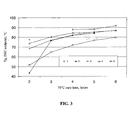
- Example 2 The samples were placed into DSC pans as in Example 1 above and were cured at 70°C for different amounts of time. The results are shown in Table 2 below. The rate of increase in Tg with cure time at 70°C is shown in FIG. 3 for various formulations from Table 2.
- FIG. 3 illustrates a comparison of T g development rate of invention systems and control and comparative systems (from Table 2) during cure at 70°C.
- T g glass transition temperature
- the first control composition (#1) required almost 4 hours at a 70°C cure temperature to reach a 70°C T g .
- FIG. 4 illustrates temperature versus time at center of a 100-gram mass of resin during cure in a 70°C water bath for invention and control and comparative systems from Table 2.
- Systems #3, #4, and #5 using the respective tertiary amines described herein have a much lower maximum exothermic peak (228°C, 218°C, and 208°C respectively) in a 100-gram mass in a 70°C water bath ( FIG. 4 ).
- the control system #1 had a maximum exothermic peak temperature of 261°C and comparative system #2 had a maximum exothermic peak temperature of 275°C.
- a control mixture contained 18 parts of Jeffamine D-230 and 12 parts of IPDA (stoichiometric N-H/epoxy ratio)
- FIGS. 5 and 6 are plots of data from Tables 3A and 3B for maximum peak exotherm temperature (in degrees Celsius for 100 grams mass and 70°C ambient) versus Tg (glass transition temperature at the DSC midpoint) after 2 hours ( FIG. 5 ) or 3 hours ( FIG. 6 ) of cure at 70°C.
- T g time at which such a T g is achieved, the shorter the production cycle time can be for that part. Hence it is important to have rapid development of T g in the mold while still having a value of maximum peak exotherm temperature low enough to minimize the likelihood of thermal degradation and cured property loss in thick sections.
- a blend containing 100 parts of a composition of 81.5% EPON Resin 826 and 18.5% by weight of 1,4-butanediol diglycidyl ether (BDDGE) was hand-mixed in small polypropylene beakers with curing agent blends as shown in Table 4.
- BDDGE 1,4-butanediol diglycidyl ether
- Various crystallization-resistant blends of EPON Resin 828, EPON Resin 827 and EPON Resin 862 (an epoxy resin based on the bisphenol of formaldehyde, BPF) with BDDGE were similarly hand-mixed with curing agent blends as shown in Table 5.
- FIG. 7 is a plot of T g (glass transition temperature at the DSC midpoint after a standard 6-hour cure cycle at 70°C) versus mixed viscosity (Initial 25°C Brookfield viscosity of mixture in mPa-s(cp)) for the systems in Table 4.
- the three lines/curves in FIG. 7 connect points for systems with three different N-H/epoxy ratios (0.991, 0.95 and 0.902).
- N-H/epoxy ratio the farther a point is to the left (lower viscosity), the higher the amount of DDMA it contains (reflecting the diluent effect of the DDMA).
- T g up to a point
- viscosity decrease in viscosity as DDMA is added to the systems at different N-H/epoxy ratios.
- the curing agent includes 27.25 wt% of IPDA, 27.25 wt% of ADMA-12, and 45.5 of JeffamineTM D-230.
- the curing agent mixture may be added to an epoxy resin mixture of 58 wt% of a BPA epoxy with a WPE (weight per epoxide) from about 179 to about 184, 20 wt% of a BPF epoxy with a WPE from 165 to 173, and 22 wt% of 1,4 butanediol digycidyl ether (BDDGE).
- BDDGE 1,4 butanediol digycidyl ether
- the epoxy resin systems described herein may be used for the manufacturing of coating compositions such as ambient temperature cure coating compositions as well as heat cured coating compositions.
- the epoxy resin systems may be used and/or formed in one-part or two-part (2K) coating formulations.
- the epoxy resin systems described herein may be used for the manufacturing of composites.
- Composites may be formed by applying a curable epoxy resin composition to a substrate or a reinforcing material, such as by impregnating, infusing, molding, or coating the substrate or reinforcing material, and curing the curable composition.
- Curing of the curable compositions disclosed herein may require a temperature of up to 250°C, such as at a temperature from 30°C to 120°C, for example, 70°C, for periods of minutes up to hours, depending on the epoxy resin system components.
- the above described epoxy resin systems may be in the form of a powder, slurry, or a liquid. After a curable epoxy resin system has been produced, as described above, it may be disposed on, in, or between the described substrates, before or during cure of the curable composition.
- a composite may be made by a process of providing a reinforcing fiber substrate, mixing an epoxy resin system from a composition comprising an epoxy resin component and a curing agent component as described herein, contacting the reinforcing fiber substrate with the epoxy resin system, and curing the epoxy resin system to form the composite.
- Contacting the reinforcing fiber substrate with the epoxy resin system may involve any typical composite fabrication process including hand lamination, an infusion process, filament winding, pultrusion, resin transfer molding, fiber pre-impregnation processes, compression molding, and combinations thereof.
- the reinforcing fiber substrate may fibers and or fabrics of organic materials, such as polymeric materials, inorganic materials, such as glass, ceramics, metal-containing fibers, or combinations thereof, and combinations of organic or inorganic materials.
- the fibers may include carbon/graphite, boron, quartz, aluminum oxide; glass, such as E-glass (electrical glass), S glass, S-2 GLASS® material, C glass, or basalt glass; silicon carbide or silicon carbide fibers containing titanium, and combinations thereof.
- the fibers may have a random orientation, or be uni-directional fibers or +/- 45° direction fibers, such as uni-directional fibers or +/- 45° direction E-glass fibers.
- Examples of commercially available fibers may include organic fibers, such as KEVLARTM, aluminum oxide-containing fibers, such as NEXTELTM fibers from 3M, silicon carbide fibers, such as NICALONTM from Nippon Carbon, and silicon carbide fibers containing titanium, such as TYRANNOTM from Ube.
- organic fibers such as KEVLARTM
- aluminum oxide-containing fibers such as NEXTELTM fibers from 3M
- silicon carbide fibers such as NICALONTM from Nippon Carbon
- silicon carbide fibers containing titanium such as TYRANNOTM from Ube.
- the fabrics may be made of woven or non-woven fibers as described herein.
- the fabrics may be composed of fibers have multiple directions including 0°/90°, +/- 45° direction fibers, random orientations, or other orientations.
- the fabrics may be of two or more layers of fibers.
- the substrate may be a monolayer or a multi-layer material structure.
- the substrate may be a composite of two alloys, a multi-layered polymeric article, and a metal-coated polymer, among others, for example.
- one or more layers of the curable composition may be disposed on a substrate.
- the fiber reinforced substrates comprise high strength filaments or fibers of carbon (graphite), glass, boron, and the like.
- Composites may contain up to 75%, such as from 45% to 60 %, of these fibers based on the total volume (vol%) of the composite.
- the fibers of the composite may comprise about 70 vol% continuous uni-directional E-glass fibers or comprise up to about 75 vol% continuous +/- 45° direction E-glass fibers.
- Fiber reinforced composites may be formed by hot melt prepregging.
- the prepregging method involves impregnating bands or fabrics of continuous fiber with an epoxy resin system as described herein in liquid form to yield a prepreg, which is laid up and cured or partially cured to provide a composite.
- Composites may be in various forms, such as circuit boards and the like for the electronics industry, automotive industry, aerospace industry, wind turbine blades, and sports equipment including skis, ski poles, and fishing rods, among others.
- a composite forming device an infusion assembly, was assembled as follows.
- a rigid mold was provided and a rectangular fiberglass fabric "stack" with specified fiber orientation and one or more fabric layers (plys) were disposed on the mold.
- a resin flow medium was provided along one end of the fiberglass stack used as a manifold to bring resin into the fiberglass stack and a vacuum flow medium was provided along one end of the fiberglass stack (opposite to the resin end) to provide even vacuum flow from the fiberglass stack to the vacuum source.
- a rigid metal plate was placed on top of the fiberglass stack to provide a flat top surface and the components were then covered in a flexible plastic container ("bag”) to provide a vacuum tight seal between the mold surface and all the above components.
- bag flexible plastic container
- a flexible heating blanket with a temperature controlling unit to provide even heating and accurate temperature control during the curing portion of the heating cycle was placed on top of the mold and bag.
- a resin tube with a vacuum tight connection to the resin flow medium and a vacuum tube with a vacuum tight connection to the vacuum flow medium were connected to the flexible plastic container, and a vacuum pump capable of providing absolute pressures typically less than 35 millibars was coupled to the vacuum tubing.
- the process was then performed by turning on the vacuum to the infusion assembly with resin tube closed, measuring and thoroughly mixing the resin and curing agent components as described herein, placing the mixed resin into an infusion container and securing the resin tube to the infusion container. Opening of the infusion tube allows resin to flow into the mold until the resin has completely filled the fiberglass fabric. Heat was applied by turning on the heating blanket and heating to the desired cure temperature and the infusion process was continued by maintaining the cure temperature for a specified curing time.
- the fiberglass fabrics used for the reported test results were "non-crimped" stitched fabrics which are typically used to make large wind turbine blades. Uni-directional (nominal 970 gram/sq meter) and ⁇ 45° (nominal 818 g/sq meter) fabrics were used.
- the tensile strength, tensile modulus, and the tensile elongation of the cured resins in the Examples were measured by the ISO 527-5 procedure.
- the tensile first break strength was determined as the maximum value in the stress-strain curve at the strain value where the first significant drop of the stress/lead value is observed.
- the 0° Flex Strength and 0° Flex Modulus were measured by the ASTM D790 procedure.
- the in-Plane Shear Strength was measured by ISO 14129.
- Table 6 illustrates a comparison between the DDMA made composites verses the Control 1 composites at different cure times.
- Table 6 Property Test Control Panel 1 Control Panel 2 DDMA based Panel 1 DDMA based Panel 1 Resin System Resin Mixture R Curing Agent C Resin Mixture R Curing Agent C Resin Mixture R Curing Agent C DDMA Resin Mixture R Curing Agent C DDMA Mix Ratio (parts by wt) 100:30 100:30 100:15:6 100:15:6 Cure conditions 75°C at 5 hours 75°C at 8.3 hours 72°C and 75°C each at 3 hours 75°C at 7.5 hours Transverse Tensile Strength (TTS) MPa-1 st break 29.9 25.5 51.1 53.7 TTS Strain-1 st break, % 0.25 0.25 0.56 0.51 0° Flex Strength MPa 813 852 1015 998 0° Flex Modulus GPa 32.7 33.7 33.9 35 In-Plane Shear Strength (+-45 tensile), MP
- Resin Mixture R contains 80% by weight EPONTM Resin 828 and 20% by weight of 1,6 hexanediol diglycidyl ether (HDDGE). 2.
- Curing Agent mixture C contains 60% by weight JeffamineTM D-230 and 40% by weight of isophoronediamine (IPDA).
- Transverse Tensile Strength was measured to have a range from 49 to 57.5 MPa as compared to the control panel range of 24.4 to 46.3 MPa.
- Transverse Tensile Strain properties for the DDMA based panels were found to be 0.39 to 0.62 as compared to 0.23 to 0.27 of the control panels.
- 0° Flex Strength properties for the DDMA based panels were found to be 970 to 1051 MPa as compared to 729 to 952 MPa of the control panels.
- In-Plane Shear Strength properties for the DDMA based panels were found to be 60.9 to 63.1 MPa as compared to the 51.6 to 57.1 MPa of the control panels.
Landscapes
- Chemical & Material Sciences (AREA)
- Medicinal Chemistry (AREA)
- Organic Chemistry (AREA)
- Polymers & Plastics (AREA)
- Health & Medical Sciences (AREA)
- Chemical Kinetics & Catalysis (AREA)
- Engineering & Computer Science (AREA)
- Sustainable Energy (AREA)
- Life Sciences & Earth Sciences (AREA)
- Sustainable Development (AREA)
- Combustion & Propulsion (AREA)
- Mechanical Engineering (AREA)
- General Engineering & Computer Science (AREA)
- Materials Engineering (AREA)
- Manufacturing & Machinery (AREA)
- Inorganic Chemistry (AREA)
- Epoxy Resins (AREA)
- Reinforced Plastic Materials (AREA)
Applications Claiming Priority (1)
| Application Number | Priority Date | Filing Date | Title |
|---|---|---|---|
| US35831310P | 2010-06-24 | 2010-06-24 |
Publications (3)
| Publication Number | Publication Date |
|---|---|
| EP2433985A2 true EP2433985A2 (de) | 2012-03-28 |
| EP2433985A3 EP2433985A3 (de) | 2015-12-09 |
| EP2433985B1 EP2433985B1 (de) | 2020-04-01 |
Family
ID=45353131
Family Applications (1)
| Application Number | Title | Priority Date | Filing Date |
|---|---|---|---|
| EP11005046.5A Revoked EP2433985B1 (de) | 2010-06-24 | 2011-06-21 | Verbesserte Epoxysysteme für Verbundwerkstoffe |
Country Status (10)
| Country | Link |
|---|---|
| US (3) | US20110319564A1 (de) |
| EP (1) | EP2433985B1 (de) |
| CN (1) | CN102432838B (de) |
| BR (1) | BRPI1102649B1 (de) |
| CA (1) | CA2743800C (de) |
| DK (1) | DK2433985T3 (de) |
| ES (1) | ES2795830T3 (de) |
| MX (1) | MX2011006417A (de) |
| PT (1) | PT2433985T (de) |
| RU (1) | RU2487148C2 (de) |
Cited By (3)
| Publication number | Priority date | Publication date | Assignee | Title |
|---|---|---|---|---|
| CN104672789A (zh) * | 2015-03-12 | 2015-06-03 | 江苏恒神股份有限公司 | 中温固化真空导入树脂 |
| CN106380785A (zh) * | 2016-08-29 | 2017-02-08 | 道生天合材料科技(上海)有限公司 | 一种风电叶片用真空灌注环氧树脂系统 |
| EP3472221A4 (de) * | 2016-06-16 | 2020-04-01 | Huntsman Petrochemical LLC | Mischung zur härtung von epoxidharzzusammensetzungen |
Families Citing this family (37)
| Publication number | Priority date | Publication date | Assignee | Title |
|---|---|---|---|---|
| KR20100017712A (ko) * | 2007-05-09 | 2010-02-16 | 다우 글로벌 테크놀로지스 인크. | 과잉 에폭시 수지를 포함하는 에폭시 열경화성 조성물 및 이의 제조 방법 |
| GB2472423B (en) | 2009-08-05 | 2012-01-11 | Gurit Uk Ltd | Fire-retardant composite materials |
| US20110319564A1 (en) | 2010-06-24 | 2011-12-29 | Larry Steven Corley | Epoxy systems for composites |
| WO2013003202A1 (en) | 2011-06-30 | 2013-01-03 | Dow Global Technologies Llc | Curable epoxy resin systems containing mixtures of amine hardeners and an excess of epoxide groups |
| CN102675998B (zh) * | 2012-03-20 | 2014-07-09 | 河北晨阳工贸集团有限公司 | 一种风电叶片用水性氟碳面漆及其制备方法 |
| CN103509425A (zh) * | 2012-06-28 | 2014-01-15 | 永记造漆工业(昆山)有限公司 | 固体份涂料及其制备方法 |
| EP2895525A2 (de) * | 2012-09-17 | 2015-07-22 | 3M Innovative Properties Company | Flüssige epoxidbeschichtungszusammensetzungen, verfahren und artikel |
| CN103694455B (zh) * | 2012-09-28 | 2015-12-02 | 中国石油天然气股份有限公司 | 一种适用于中温热熔法制备碳纤维预浸料的环氧树脂的调配方法 |
| WO2014186279A1 (en) | 2013-05-13 | 2014-11-20 | Momentive Specialty Chem Inc | Composites and epoxy resins based on aryl substituted compounds |
| CN104151527B (zh) * | 2014-01-22 | 2017-03-29 | 惠柏新材料科技(上海)股份有限公司 | 一种风电叶片用手糊环氧树脂组合物 |
| EP2993195A1 (de) * | 2014-09-05 | 2016-03-09 | Huntsman International Llc | Verfahren zur Verbesserung der Frakturbeständigkeit von Polyisocyanurat mit Reaktionsprodukten |
| US10308757B2 (en) * | 2014-11-11 | 2019-06-04 | Dow Global Technologies Llc | Fast curing high glass transition temperature epoxy resin system |
| JP6695046B2 (ja) * | 2015-09-25 | 2020-05-20 | パナソニックIpマネジメント株式会社 | プリプレグ、金属張積層板、配線板、並びに、配線板材料の熱応力の測定方法 |
| CN108431101A (zh) * | 2015-12-02 | 2018-08-21 | 阿科玛股份有限公司 | 液体预聚物组合物的过氧酯固化 |
| EP3178861B1 (de) * | 2015-12-11 | 2019-08-28 | Evonik Degussa GmbH | Latente epoxidharzformulierungen für flüssigimprägnierprozesse zur herstellung von faserverbundwerkstoffen |
| PL3178862T3 (pl) * | 2015-12-11 | 2020-04-30 | Evonik Degussa Gmbh | Utajone formulacje żywic epoksydowych do ciekłego impregnowania kompozytów wzmocnionych włóknami |
| KR101638574B1 (ko) * | 2015-12-15 | 2016-07-11 | 도레이첨단소재 주식회사 | 저점도 액상 에폭시 수지 조성물 및 이로부터 제조되는 압력용기 |
| TWI595045B (zh) * | 2016-09-23 | 2017-08-11 | 適用於軟硬結合板之樹脂組成物及其應用 | |
| WO2018140576A1 (en) * | 2017-01-26 | 2018-08-02 | Huntsman Advanced Materials Licensing (Switzerland) Gmbh | A thermosetting epoxy resin composition for the preparation of articles for electrical engineering, and the articles obtained therefrom |
| WO2018144974A1 (en) * | 2017-02-06 | 2018-08-09 | Huntsman Petrochemical Llc | Curing agent for epoxy resins |
| MX2019014065A (es) * | 2017-06-09 | 2020-02-07 | Hexion Inc | Sistemas de resina epoxidica para materiales compuestos. |
| CN111093366A (zh) * | 2017-10-31 | 2020-05-01 | 古洛布莱株式会社 | 具有安装有安装部件的竿体的钓竿 |
| CN107722242B (zh) * | 2017-11-08 | 2019-12-06 | 青岛哈工资源环境技术有限公司 | 基于甲基丙烯酸甲酯釜底废料的环氧树脂固化剂及其制备方法和应用 |
| CN109054296B (zh) * | 2018-07-04 | 2020-12-04 | 法尔胜泓昇集团有限公司 | 一种表面带树脂肋的高强度碳纤维复合材料筋材及其制备方法 |
| CN109251305B (zh) * | 2018-07-10 | 2020-09-22 | 吉林乾仁新材料有限公司 | 自组装自乳化两亲水性阳离子环氧树脂型高性能纤维上浆剂/浸润剂/成膜剂及其制备方法 |
| CN109385047B (zh) * | 2018-10-31 | 2020-11-10 | 成都市冠宇复合材料制品有限公司 | 一种树脂组合物及其制备方法 |
| CN109897342A (zh) * | 2019-03-07 | 2019-06-18 | 海南必凯水性新材料有限公司 | 一种用于船舶修补的增强胶泥 |
| US11661489B2 (en) * | 2020-08-19 | 2023-05-30 | Saudi Arabian Oil Company | Foamable resin composition for controlling loss circulation |
| CN114085358B (zh) * | 2020-08-24 | 2023-05-26 | 万华化学集团股份有限公司 | 一种低放热改性固化剂组合物及其制备方法,一种环氧树脂组合物及用途 |
| JP7501232B2 (ja) * | 2020-08-26 | 2024-06-18 | 三菱ケミカル株式会社 | 積層体並びに該積層体に用いられる部材及び樹脂組成物 |
| US12053908B2 (en) | 2021-02-01 | 2024-08-06 | Regen Fiber, Llc | Method and system for recycling wind turbine blades |
| KR102638999B1 (ko) * | 2021-10-14 | 2024-02-20 | 부산대학교 산학협력단 | 에폭시계 조성물 및 이를 포함하는 높은 연신율을 가지는 이액형 에폭시 접착제 조성물 |
| CN114539878B (zh) * | 2022-03-03 | 2023-03-24 | 湖北三棵树新材料科技有限公司 | 湿碰湿专用水性环氧漆及其制备方法 |
| US20240279414A1 (en) * | 2023-02-16 | 2024-08-22 | United States Of America As Represented By The Secretary Of The Army | High-performance composite panel and manufacturing method |
| WO2024211144A1 (en) * | 2023-04-04 | 2024-10-10 | Westlake Epoxy Inc. | Processes for forming epoxy resin compositions and separation processes |
| CN118853046A (zh) * | 2024-07-08 | 2024-10-29 | 江西倍韬新材料科技有限公司 | 一种覆铜板用胶液及其制备方法 |
| CN118684860B (zh) * | 2024-07-22 | 2025-09-26 | 江苏特丽亮新材料科技有限公司 | 一种多官能团环氧树脂的制备方法及在导电胶上的应用 |
Citations (3)
| Publication number | Priority date | Publication date | Assignee | Title |
|---|---|---|---|---|
| US3377406A (en) | 1963-12-16 | 1968-04-09 | Shell Oil Co | Process of esterification of polyepoxides with ethylenically unsaturated monocarboxylic acids in the presence of onium salts of inorganic acids |
| US3477990A (en) | 1967-12-07 | 1969-11-11 | Shell Oil Co | Process for reacting a phenol with an epoxy compound and resulting products |
| US4734468A (en) | 1986-02-28 | 1988-03-29 | Shell Oil Company | Epoxy resin composition |
Family Cites Families (44)
| Publication number | Priority date | Publication date | Assignee | Title |
|---|---|---|---|---|
| NL176719B (nl) * | 1952-03-11 | 1900-01-01 | Goodyear Aerospace Corp | Meervoudig toegankelijk informatiegeheugenarray. |
| US3164375A (en) * | 1955-10-14 | 1965-01-05 | Frenkel Ag C D | Apparatus for intensive mixing |
| NL105999C (de) | 1957-10-11 | |||
| GB1019925A (en) | 1963-09-26 | 1966-02-09 | Ciba Ltd | Epoxide resin compositions |
| CH481963A (de) * | 1967-06-08 | 1969-11-30 | Ciba Geigy | Neue härtbare Mischungen aus Diepoxydverbindungen, disekundären Aminen sowie mindestens 3 Aminwasserstoffatome enthaltenden Polyaminen |
| CH565216A5 (de) * | 1970-06-12 | 1975-08-15 | Schering Ag | |
| US3947395A (en) | 1974-05-07 | 1976-03-30 | Hitachi, Ltd. | Epoxy surface coating compositions |
| US4051195A (en) * | 1975-12-15 | 1977-09-27 | Celanese Polymer Specialties Company | Polyepoxide-polyacrylate ester compositions |
| SU713889A1 (ru) * | 1977-08-10 | 1980-02-05 | Предприятие П/Я В-2304 | Эпоксидна композици |
| JPS562315A (en) | 1979-06-22 | 1981-01-12 | Shigeo Kiyono | Cure accelerating liquid composition containing amine |
| DE3006053A1 (de) * | 1980-02-18 | 1981-10-01 | Siemens AG, 1000 Berlin und 8000 München | Giessharzmassen |
| JPS59232117A (ja) | 1983-06-15 | 1984-12-26 | Toray Chiokoole Kk | エポキシ樹脂の硬化方法 |
| US4485229A (en) | 1984-02-15 | 1984-11-27 | Texaco Inc. | Epoxy resin containing a combination of high and low molecular weight polyoxyalkylene polyamine curing agents |
| JPS61145152A (ja) * | 1984-12-20 | 1986-07-02 | Nippon Shokubai Kagaku Kogyo Co Ltd | N−アミノアルキル置換(メタ)アクリルアミド類の製造方法 |
| JPS61148280A (ja) | 1984-12-24 | 1986-07-05 | Toray Chiokoole Kk | エポキシ樹脂接着剤 |
| JPS61162517A (ja) | 1985-01-09 | 1986-07-23 | Nisso Yuka Kogyo Kk | エポキシ樹脂硬化剤 |
| JPH0764916B2 (ja) | 1987-03-03 | 1995-07-12 | 広栄化学工業株式会社 | 硬化性アクリレ−ト変性エポキシ樹脂組成物 |
| US5385990A (en) | 1992-11-02 | 1995-01-31 | Lord Corporation | Structural adhesive composition having high temperature resistance |
| EP0659833B1 (de) * | 1993-12-21 | 2000-08-16 | Ciba SC Holding AG | Zusammensetzungen auf der Basis von Epoxidharzen, Zähigkeitsvermittlern und Aminen |
| JP3742102B2 (ja) | 1994-03-11 | 2006-02-01 | レイケム・コーポレイション | 硬化性ポリマー組成物および基材保護における使用 |
| US5656703A (en) | 1995-06-09 | 1997-08-12 | Sartomer Company | Coating composition of epoxy resin, metal di(meth)acrylate and poly(meth)acrylate |
| US5688905A (en) * | 1995-09-20 | 1997-11-18 | Air Products And Chemicals, Inc. | Primary-tertiary diamines mixed with polyamines as epoxy resin hardeners |
| JPH1160693A (ja) * | 1997-08-11 | 1999-03-02 | Yuka Shell Epoxy Kk | エポキシ樹脂用硬化剤組成物及びエポキシ樹脂組成物 |
| DE19806225A1 (de) | 1998-02-16 | 1999-08-19 | Huels Chemische Werke Ag | Epoxidharz- und Hybridpulverbeschichtungszusammensetzungen |
| US6319967B1 (en) | 1998-08-31 | 2001-11-20 | Ppg Industries Ohio, Inc. | Thermosetting compositions containing epoxy-functional polymers prepared using atom transfer radical polymerization |
| DE19856397A1 (de) | 1998-12-07 | 2000-06-08 | Siemens Ag | Epoxidharzmischung für Prepregs und Verbundwerkstoffe |
| EP1205498A1 (de) | 2000-11-13 | 2002-05-15 | Nippon Shokubai Co., Ltd. | Harzzusammensetzung auf Basis eines (Meth)acrylatesters |
| US6491845B1 (en) * | 2000-11-16 | 2002-12-10 | Richard D. Schile | Epoxy hardener of phenolic or 2° OH polyol and methylol polyol |
| US6987161B2 (en) * | 2000-11-16 | 2006-01-17 | Ardes Enterprise, Inc. | Epoxy hardeners for low temperature curing |
| RU2189997C1 (ru) * | 2001-01-22 | 2002-09-27 | ООО НПП "Прикладные перспективные технологии-АпАТэК" | Эпоксидная композиция |
| MXPA03006972A (es) | 2001-04-23 | 2004-04-02 | Basf Corp | Composiciones de revestimiento curables que tienen compatibilidad y resistencia al rayado y al desgaste, los substratos revestidos curados con las mismas y metodos para obtener el mismo revestimiento. |
| JP4603978B2 (ja) * | 2002-11-28 | 2010-12-22 | 三菱レイヨン株式会社 | 繊維強化複合材料成形品の製造方法 |
| RU2252229C2 (ru) | 2003-03-25 | 2005-05-20 | ООО НПП "Прикладные перспективные технологии-АпАТэК" | Эпоксидная композиция |
| JP2005075915A (ja) | 2003-08-29 | 2005-03-24 | New Japan Chem Co Ltd | エポキシ樹脂用硬化剤組成物及びそれを含有するエポキシ樹脂組成物 |
| ATE374227T1 (de) * | 2003-12-18 | 2007-10-15 | Kaneka Corp | Härtbare zusammensetzung |
| DE102006050697A1 (de) | 2006-10-24 | 2008-04-30 | Henkel Kgaa | Duktile Strukturschäume |
| JP4829766B2 (ja) * | 2006-12-13 | 2011-12-07 | 横浜ゴム株式会社 | 繊維強化複合材料用エポキシ樹脂組成物 |
| RU2363712C2 (ru) * | 2007-03-05 | 2009-08-10 | Учреждение Российской Академии Наук Институт Проблем Химической Физики Ран (Ипхф Ран) | Высокопрочная эпоксидная композиция и способ ее получения |
| KR20100017712A (ko) | 2007-05-09 | 2010-02-16 | 다우 글로벌 테크놀로지스 인크. | 과잉 에폭시 수지를 포함하는 에폭시 열경화성 조성물 및 이의 제조 방법 |
| RU2375174C1 (ru) * | 2008-06-09 | 2009-12-10 | Закрытое акционерное общество "САФИТ" | Способ изготовления изделия трубчатой формы (варианты) и изделие трубчатой формы (варианты) |
| PT2307360E (pt) | 2008-07-22 | 2012-01-11 | Basf Se | Processo para a produção de corpos moldados com misturas de aminas com derivados de guanidina |
| US8741426B2 (en) | 2008-07-22 | 2014-06-03 | Basf Se | Blends comprising epoxy resins and mixtures of amines with guanidine derivatives |
| WO2010010045A1 (de) * | 2008-07-22 | 2010-01-28 | Basf Se | Mischungen von aminen mit guanidin-derivaten |
| US20110319564A1 (en) | 2010-06-24 | 2011-12-29 | Larry Steven Corley | Epoxy systems for composites |
-
2011
- 2011-06-15 US US13/160,964 patent/US20110319564A1/en not_active Abandoned
- 2011-06-15 MX MX2011006417A patent/MX2011006417A/es active IP Right Grant
- 2011-06-20 CA CA2743800A patent/CA2743800C/en active Active
- 2011-06-21 ES ES11005046T patent/ES2795830T3/es active Active
- 2011-06-21 PT PT110050465T patent/PT2433985T/pt unknown
- 2011-06-21 EP EP11005046.5A patent/EP2433985B1/de not_active Revoked
- 2011-06-21 DK DK11005046.5T patent/DK2433985T3/da active
- 2011-06-22 BR BRPI1102649-9A patent/BRPI1102649B1/pt not_active IP Right Cessation
- 2011-06-23 RU RU2011125990/05A patent/RU2487148C2/ru active
- 2011-06-24 CN CN201110267866.5A patent/CN102432838B/zh not_active Expired - Fee Related
-
2016
- 2016-03-03 US US15/060,411 patent/US9751973B2/en not_active Expired - Fee Related
-
2017
- 2017-08-10 US US15/674,060 patent/US9920161B2/en active Active
Patent Citations (3)
| Publication number | Priority date | Publication date | Assignee | Title |
|---|---|---|---|---|
| US3377406A (en) | 1963-12-16 | 1968-04-09 | Shell Oil Co | Process of esterification of polyepoxides with ethylenically unsaturated monocarboxylic acids in the presence of onium salts of inorganic acids |
| US3477990A (en) | 1967-12-07 | 1969-11-11 | Shell Oil Co | Process for reacting a phenol with an epoxy compound and resulting products |
| US4734468A (en) | 1986-02-28 | 1988-03-29 | Shell Oil Company | Epoxy resin composition |
Cited By (4)
| Publication number | Priority date | Publication date | Assignee | Title |
|---|---|---|---|---|
| CN104672789A (zh) * | 2015-03-12 | 2015-06-03 | 江苏恒神股份有限公司 | 中温固化真空导入树脂 |
| EP3472221A4 (de) * | 2016-06-16 | 2020-04-01 | Huntsman Petrochemical LLC | Mischung zur härtung von epoxidharzzusammensetzungen |
| CN106380785A (zh) * | 2016-08-29 | 2017-02-08 | 道生天合材料科技(上海)有限公司 | 一种风电叶片用真空灌注环氧树脂系统 |
| CN106380785B (zh) * | 2016-08-29 | 2018-05-04 | 道生天合材料科技(上海)有限公司 | 一种风电叶片用真空灌注环氧树脂系统 |
Also Published As
| Publication number | Publication date |
|---|---|
| US9920161B2 (en) | 2018-03-20 |
| EP2433985A3 (de) | 2015-12-09 |
| CN102432838A (zh) | 2012-05-02 |
| BRPI1102649A2 (pt) | 2012-11-20 |
| EP2433985B1 (de) | 2020-04-01 |
| US20110319564A1 (en) | 2011-12-29 |
| RU2487148C2 (ru) | 2013-07-10 |
| US20170335050A1 (en) | 2017-11-23 |
| CA2743800A1 (en) | 2011-12-24 |
| RU2011125990A (ru) | 2012-12-27 |
| ES2795830T3 (es) | 2020-11-24 |
| US20160244552A1 (en) | 2016-08-25 |
| MX2011006417A (es) | 2012-01-02 |
| DK2433985T3 (da) | 2020-06-15 |
| US9751973B2 (en) | 2017-09-05 |
| BRPI1102649B1 (pt) | 2020-11-24 |
| CA2743800C (en) | 2015-01-13 |
| CN102432838B (zh) | 2015-05-06 |
| PT2433985T (pt) | 2020-06-18 |
Similar Documents
| Publication | Publication Date | Title |
|---|---|---|
| US9920161B2 (en) | Epoxy systems for composites | |
| JP6144734B2 (ja) | 溶媒和された固体を使用するエポキシ樹脂組成物 | |
| CN102884100B (zh) | 包括作为增韧剂的聚(环氧丙烷)多元醇的环氧树脂组合物 | |
| CN103619899A (zh) | 环氧树脂组合物 | |
| KR102205915B1 (ko) | 섬유-매트릭스 반마감 생성물용 에폭시드 수지 조성물 | |
| KR20120101096A (ko) | 에폭시 수지 조성물 | |
| TWI791096B (zh) | 用於環氧樹脂調配物之環脂族胺:用於環氧樹脂系統之新穎固化劑 | |
| EP3559077B1 (de) | N-hydroxylethylpiperidin (nhep): neuartiges härtungsmittel für epoxidsysteme | |
| JP2014118576A (ja) | 溶媒和された固体を使用するエポキシ樹脂組成物 | |
| US10040914B2 (en) | Composites and epoxy resins based on aryl substituted compounds |
Legal Events
| Date | Code | Title | Description |
|---|---|---|---|
| PUAI | Public reference made under article 153(3) epc to a published international application that has entered the european phase |
Free format text: ORIGINAL CODE: 0009012 |
|
| 17P | Request for examination filed |
Effective date: 20110621 |
|
| AK | Designated contracting states |
Kind code of ref document: A2 Designated state(s): AL AT BE BG CH CY CZ DE DK EE ES FI FR GB GR HR HU IE IS IT LI LT LU LV MC MK MT NL NO PL PT RO RS SE SI SK SM TR |
|
| AX | Request for extension of the european patent |
Extension state: BA ME |
|
| RAP1 | Party data changed (applicant data changed or rights of an application transferred) |
Owner name: HEXION RESEARCH BELGIUM SA |
|
| PUAL | Search report despatched |
Free format text: ORIGINAL CODE: 0009013 |
|
| AK | Designated contracting states |
Kind code of ref document: A3 Designated state(s): AL AT BE BG CH CY CZ DE DK EE ES FI FR GB GR HR HU IE IS IT LI LT LU LV MC MK MT NL NO PL PT RO RS SE SI SK SM TR |
|
| AX | Request for extension of the european patent |
Extension state: BA ME |
|
| RIC1 | Information provided on ipc code assigned before grant |
Ipc: B32B 27/38 20060101ALI20151103BHEP Ipc: C08L 63/00 20060101AFI20151103BHEP Ipc: C08G 59/50 20060101ALI20151103BHEP Ipc: C08G 59/56 20060101ALI20151103BHEP |
|
| STAA | Information on the status of an ep patent application or granted ep patent |
Free format text: STATUS: EXAMINATION IS IN PROGRESS |
|
| 17Q | First examination report despatched |
Effective date: 20181212 |
|
| GRAP | Despatch of communication of intention to grant a patent |
Free format text: ORIGINAL CODE: EPIDOSNIGR1 |
|
| STAA | Information on the status of an ep patent application or granted ep patent |
Free format text: STATUS: GRANT OF PATENT IS INTENDED |
|
| INTG | Intention to grant announced |
Effective date: 20190404 |
|
| GRAJ | Information related to disapproval of communication of intention to grant by the applicant or resumption of examination proceedings by the epo deleted |
Free format text: ORIGINAL CODE: EPIDOSDIGR1 |
|
| STAA | Information on the status of an ep patent application or granted ep patent |
Free format text: STATUS: EXAMINATION IS IN PROGRESS |
|
| GRAP | Despatch of communication of intention to grant a patent |
Free format text: ORIGINAL CODE: EPIDOSNIGR1 |
|
| STAA | Information on the status of an ep patent application or granted ep patent |
Free format text: STATUS: GRANT OF PATENT IS INTENDED |
|
| INTG | Intention to grant announced |
Effective date: 20190627 |
|
| GRAS | Grant fee paid |
Free format text: ORIGINAL CODE: EPIDOSNIGR3 |
|
| GRAA | (expected) grant |
Free format text: ORIGINAL CODE: 0009210 |
|
| STAA | Information on the status of an ep patent application or granted ep patent |
Free format text: STATUS: THE PATENT HAS BEEN GRANTED |
|
| AK | Designated contracting states |
Kind code of ref document: B1 Designated state(s): AL AT BE BG CH CY CZ DE DK EE ES FI FR GB GR HR HU IE IS IT LI LT LU LV MC MK MT NL NO PL PT RO RS SE SI SK SM TR |
|
| REG | Reference to a national code |
Ref country code: GB Ref legal event code: FG4D |
|
| REG | Reference to a national code |
Ref country code: CH Ref legal event code: EP Ref country code: AT Ref legal event code: REF Ref document number: 1251295 Country of ref document: AT Kind code of ref document: T Effective date: 20200415 |
|
| REG | Reference to a national code |
Ref country code: DE Ref legal event code: R096 Ref document number: 602011065927 Country of ref document: DE |
|
| REG | Reference to a national code |
Ref country code: IE Ref legal event code: FG4D |
|
| REG | Reference to a national code |
Ref country code: DK Ref legal event code: T3 Effective date: 20200609 |
|
| REG | Reference to a national code |
Ref country code: PT Ref legal event code: SC4A Ref document number: 2433985 Country of ref document: PT Date of ref document: 20200618 Kind code of ref document: T Free format text: AVAILABILITY OF NATIONAL TRANSLATION Effective date: 20200609 |
|
| PG25 | Lapsed in a contracting state [announced via postgrant information from national office to epo] |
Ref country code: BG Free format text: LAPSE BECAUSE OF FAILURE TO SUBMIT A TRANSLATION OF THE DESCRIPTION OR TO PAY THE FEE WITHIN THE PRESCRIBED TIME-LIMIT Effective date: 20200701 |
|
| REG | Reference to a national code |
Ref country code: NL Ref legal event code: MP Effective date: 20200401 |
|
| REG | Reference to a national code |
Ref country code: LT Ref legal event code: MG4D |
|
| PG25 | Lapsed in a contracting state [announced via postgrant information from national office to epo] |
Ref country code: CZ Free format text: LAPSE BECAUSE OF FAILURE TO SUBMIT A TRANSLATION OF THE DESCRIPTION OR TO PAY THE FEE WITHIN THE PRESCRIBED TIME-LIMIT Effective date: 20200401 Ref country code: LT Free format text: LAPSE BECAUSE OF FAILURE TO SUBMIT A TRANSLATION OF THE DESCRIPTION OR TO PAY THE FEE WITHIN THE PRESCRIBED TIME-LIMIT Effective date: 20200401 Ref country code: NL Free format text: LAPSE BECAUSE OF FAILURE TO SUBMIT A TRANSLATION OF THE DESCRIPTION OR TO PAY THE FEE WITHIN THE PRESCRIBED TIME-LIMIT Effective date: 20200401 Ref country code: FI Free format text: LAPSE BECAUSE OF FAILURE TO SUBMIT A TRANSLATION OF THE DESCRIPTION OR TO PAY THE FEE WITHIN THE PRESCRIBED TIME-LIMIT Effective date: 20200401 Ref country code: NO Free format text: LAPSE BECAUSE OF FAILURE TO SUBMIT A TRANSLATION OF THE DESCRIPTION OR TO PAY THE FEE WITHIN THE PRESCRIBED TIME-LIMIT Effective date: 20200701 Ref country code: GR Free format text: LAPSE BECAUSE OF FAILURE TO SUBMIT A TRANSLATION OF THE DESCRIPTION OR TO PAY THE FEE WITHIN THE PRESCRIBED TIME-LIMIT Effective date: 20200702 Ref country code: SE Free format text: LAPSE BECAUSE OF FAILURE TO SUBMIT A TRANSLATION OF THE DESCRIPTION OR TO PAY THE FEE WITHIN THE PRESCRIBED TIME-LIMIT Effective date: 20200401 Ref country code: IS Free format text: LAPSE BECAUSE OF FAILURE TO SUBMIT A TRANSLATION OF THE DESCRIPTION OR TO PAY THE FEE WITHIN THE PRESCRIBED TIME-LIMIT Effective date: 20200801 |
|
| REG | Reference to a national code |
Ref country code: AT Ref legal event code: MK05 Ref document number: 1251295 Country of ref document: AT Kind code of ref document: T Effective date: 20200401 |
|
| REG | Reference to a national code |
Ref country code: ES Ref legal event code: FG2A Ref document number: 2795830 Country of ref document: ES Kind code of ref document: T3 Effective date: 20201124 |
|
| PG25 | Lapsed in a contracting state [announced via postgrant information from national office to epo] |
Ref country code: RS Free format text: LAPSE BECAUSE OF FAILURE TO SUBMIT A TRANSLATION OF THE DESCRIPTION OR TO PAY THE FEE WITHIN THE PRESCRIBED TIME-LIMIT Effective date: 20200401 Ref country code: HR Free format text: LAPSE BECAUSE OF FAILURE TO SUBMIT A TRANSLATION OF THE DESCRIPTION OR TO PAY THE FEE WITHIN THE PRESCRIBED TIME-LIMIT Effective date: 20200401 Ref country code: LV Free format text: LAPSE BECAUSE OF FAILURE TO SUBMIT A TRANSLATION OF THE DESCRIPTION OR TO PAY THE FEE WITHIN THE PRESCRIBED TIME-LIMIT Effective date: 20200401 |
|
| REG | Reference to a national code |
Ref country code: DE Ref legal event code: R026 Ref document number: 602011065927 Country of ref document: DE |
|
| PLBI | Opposition filed |
Free format text: ORIGINAL CODE: 0009260 |
|
| PG25 | Lapsed in a contracting state [announced via postgrant information from national office to epo] |
Ref country code: AL Free format text: LAPSE BECAUSE OF FAILURE TO SUBMIT A TRANSLATION OF THE DESCRIPTION OR TO PAY THE FEE WITHIN THE PRESCRIBED TIME-LIMIT Effective date: 20200401 |
|
| 26 | Opposition filed |
Opponent name: BASF SE Effective date: 20201218 |
|
| PLAX | Notice of opposition and request to file observation + time limit sent |
Free format text: ORIGINAL CODE: EPIDOSNOBS2 |
|
| PG25 | Lapsed in a contracting state [announced via postgrant information from national office to epo] |
Ref country code: SM Free format text: LAPSE BECAUSE OF FAILURE TO SUBMIT A TRANSLATION OF THE DESCRIPTION OR TO PAY THE FEE WITHIN THE PRESCRIBED TIME-LIMIT Effective date: 20200401 Ref country code: EE Free format text: LAPSE BECAUSE OF FAILURE TO SUBMIT A TRANSLATION OF THE DESCRIPTION OR TO PAY THE FEE WITHIN THE PRESCRIBED TIME-LIMIT Effective date: 20200401 Ref country code: RO Free format text: LAPSE BECAUSE OF FAILURE TO SUBMIT A TRANSLATION OF THE DESCRIPTION OR TO PAY THE FEE WITHIN THE PRESCRIBED TIME-LIMIT Effective date: 20200401 Ref country code: MC Free format text: LAPSE BECAUSE OF FAILURE TO SUBMIT A TRANSLATION OF THE DESCRIPTION OR TO PAY THE FEE WITHIN THE PRESCRIBED TIME-LIMIT Effective date: 20200401 Ref country code: AT Free format text: LAPSE BECAUSE OF FAILURE TO SUBMIT A TRANSLATION OF THE DESCRIPTION OR TO PAY THE FEE WITHIN THE PRESCRIBED TIME-LIMIT Effective date: 20200401 |
|
| REG | Reference to a national code |
Ref country code: CH Ref legal event code: PL |
|
| PG25 | Lapsed in a contracting state [announced via postgrant information from national office to epo] |
Ref country code: SK Free format text: LAPSE BECAUSE OF FAILURE TO SUBMIT A TRANSLATION OF THE DESCRIPTION OR TO PAY THE FEE WITHIN THE PRESCRIBED TIME-LIMIT Effective date: 20200401 Ref country code: PL Free format text: LAPSE BECAUSE OF FAILURE TO SUBMIT A TRANSLATION OF THE DESCRIPTION OR TO PAY THE FEE WITHIN THE PRESCRIBED TIME-LIMIT Effective date: 20200401 |
|
| PG25 | Lapsed in a contracting state [announced via postgrant information from national office to epo] |
Ref country code: LU Free format text: LAPSE BECAUSE OF NON-PAYMENT OF DUE FEES Effective date: 20200621 |
|
| REG | Reference to a national code |
Ref country code: BE Ref legal event code: MM Effective date: 20200630 |
|
| PG25 | Lapsed in a contracting state [announced via postgrant information from national office to epo] |
Ref country code: IE Free format text: LAPSE BECAUSE OF NON-PAYMENT OF DUE FEES Effective date: 20200621 Ref country code: LI Free format text: LAPSE BECAUSE OF NON-PAYMENT OF DUE FEES Effective date: 20200630 Ref country code: CH Free format text: LAPSE BECAUSE OF NON-PAYMENT OF DUE FEES Effective date: 20200630 |
|
| PG25 | Lapsed in a contracting state [announced via postgrant information from national office to epo] |
Ref country code: BE Free format text: LAPSE BECAUSE OF NON-PAYMENT OF DUE FEES Effective date: 20200630 Ref country code: SI Free format text: LAPSE BECAUSE OF FAILURE TO SUBMIT A TRANSLATION OF THE DESCRIPTION OR TO PAY THE FEE WITHIN THE PRESCRIBED TIME-LIMIT Effective date: 20200401 |
|
| PLBB | Reply of patent proprietor to notice(s) of opposition received |
Free format text: ORIGINAL CODE: EPIDOSNOBS3 |
|
| PG25 | Lapsed in a contracting state [announced via postgrant information from national office to epo] |
Ref country code: MT Free format text: LAPSE BECAUSE OF FAILURE TO SUBMIT A TRANSLATION OF THE DESCRIPTION OR TO PAY THE FEE WITHIN THE PRESCRIBED TIME-LIMIT Effective date: 20200401 Ref country code: CY Free format text: LAPSE BECAUSE OF FAILURE TO SUBMIT A TRANSLATION OF THE DESCRIPTION OR TO PAY THE FEE WITHIN THE PRESCRIBED TIME-LIMIT Effective date: 20200401 |
|
| PG25 | Lapsed in a contracting state [announced via postgrant information from national office to epo] |
Ref country code: MK Free format text: LAPSE BECAUSE OF FAILURE TO SUBMIT A TRANSLATION OF THE DESCRIPTION OR TO PAY THE FEE WITHIN THE PRESCRIBED TIME-LIMIT Effective date: 20200401 |
|
| RAP2 | Party data changed (patent owner data changed or rights of a patent transferred) |
Owner name: WESTLAKE EPOXY INC. |
|
| RDAF | Communication despatched that patent is revoked |
Free format text: ORIGINAL CODE: EPIDOSNREV1 |
|
| REG | Reference to a national code |
Ref country code: DE Ref legal event code: R103 Ref document number: 602011065927 Country of ref document: DE Ref country code: DE Ref legal event code: R064 Ref document number: 602011065927 Country of ref document: DE |
|
| PGFP | Annual fee paid to national office [announced via postgrant information from national office to epo] |
Ref country code: PT Payment date: 20230621 Year of fee payment: 13 Ref country code: IT Payment date: 20230510 Year of fee payment: 13 Ref country code: FR Payment date: 20230523 Year of fee payment: 13 Ref country code: DK Payment date: 20230613 Year of fee payment: 13 Ref country code: DE Payment date: 20230502 Year of fee payment: 13 |
|
| PGFP | Annual fee paid to national office [announced via postgrant information from national office to epo] |
Ref country code: TR Payment date: 20230619 Year of fee payment: 13 |
|
| RDAG | Patent revoked |
Free format text: ORIGINAL CODE: 0009271 |
|
| STAA | Information on the status of an ep patent application or granted ep patent |
Free format text: STATUS: PATENT REVOKED |
|
| REG | Reference to a national code |
Ref country code: CH Ref legal event code: PL |
|
| 27W | Patent revoked |
Effective date: 20230612 |
|
| GBPR | Gb: patent revoked under art. 102 of the ep convention designating the uk as contracting state |
Effective date: 20230612 |
|
| PGFP | Annual fee paid to national office [announced via postgrant information from national office to epo] |
Ref country code: GB Payment date: 20230504 Year of fee payment: 13 Ref country code: ES Payment date: 20230711 Year of fee payment: 13 |