EP2415085B1 - Optoelektronischer halbleiterchip - Google Patents
Optoelektronischer halbleiterchip Download PDFInfo
- Publication number
- EP2415085B1 EP2415085B1 EP10707304.1A EP10707304A EP2415085B1 EP 2415085 B1 EP2415085 B1 EP 2415085B1 EP 10707304 A EP10707304 A EP 10707304A EP 2415085 B1 EP2415085 B1 EP 2415085B1
- Authority
- EP
- European Patent Office
- Prior art keywords
- semiconductor chip
- quantum well
- zones
- indium content
- active quantum
- Prior art date
- Legal status (The legal status is an assumption and is not a legal conclusion. Google has not performed a legal analysis and makes no representation as to the accuracy of the status listed.)
- Active
Links
Images




Classifications
-
- H—ELECTRICITY
- H10—SEMICONDUCTOR DEVICES; ELECTRIC SOLID-STATE DEVICES NOT OTHERWISE PROVIDED FOR
- H10H—INORGANIC LIGHT-EMITTING SEMICONDUCTOR DEVICES HAVING POTENTIAL BARRIERS
- H10H20/00—Individual inorganic light-emitting semiconductor devices having potential barriers, e.g. light-emitting diodes [LED]
- H10H20/80—Constructional details
- H10H20/81—Bodies
- H10H20/811—Bodies having quantum effect structures or superlattices, e.g. tunnel junctions
- H10H20/812—Bodies having quantum effect structures or superlattices, e.g. tunnel junctions within the light-emitting regions, e.g. having quantum confinement structures
-
- B—PERFORMING OPERATIONS; TRANSPORTING
- B82—NANOTECHNOLOGY
- B82Y—SPECIFIC USES OR APPLICATIONS OF NANOSTRUCTURES; MEASUREMENT OR ANALYSIS OF NANOSTRUCTURES; MANUFACTURE OR TREATMENT OF NANOSTRUCTURES
- B82Y20/00—Nanooptics, e.g. quantum optics or photonic crystals
-
- H—ELECTRICITY
- H01—ELECTRIC ELEMENTS
- H01S—DEVICES USING THE PROCESS OF LIGHT AMPLIFICATION BY STIMULATED EMISSION OF RADIATION [LASER] TO AMPLIFY OR GENERATE LIGHT; DEVICES USING STIMULATED EMISSION OF ELECTROMAGNETIC RADIATION IN WAVE RANGES OTHER THAN OPTICAL
- H01S5/00—Semiconductor lasers
- H01S5/30—Structure or shape of the active region; Materials used for the active region
- H01S5/34—Structure or shape of the active region; Materials used for the active region comprising quantum well or superlattice structures, e.g. single quantum well [SQW] lasers, multiple quantum well [MQW] lasers or graded index separate confinement heterostructure [GRINSCH] lasers
- H01S5/3407—Structure or shape of the active region; Materials used for the active region comprising quantum well or superlattice structures, e.g. single quantum well [SQW] lasers, multiple quantum well [MQW] lasers or graded index separate confinement heterostructure [GRINSCH] lasers characterised by special barrier layers
-
- H—ELECTRICITY
- H01—ELECTRIC ELEMENTS
- H01S—DEVICES USING THE PROCESS OF LIGHT AMPLIFICATION BY STIMULATED EMISSION OF RADIATION [LASER] TO AMPLIFY OR GENERATE LIGHT; DEVICES USING STIMULATED EMISSION OF ELECTROMAGNETIC RADIATION IN WAVE RANGES OTHER THAN OPTICAL
- H01S5/00—Semiconductor lasers
- H01S5/30—Structure or shape of the active region; Materials used for the active region
- H01S5/34—Structure or shape of the active region; Materials used for the active region comprising quantum well or superlattice structures, e.g. single quantum well [SQW] lasers, multiple quantum well [MQW] lasers or graded index separate confinement heterostructure [GRINSCH] lasers
- H01S5/3408—Structure or shape of the active region; Materials used for the active region comprising quantum well or superlattice structures, e.g. single quantum well [SQW] lasers, multiple quantum well [MQW] lasers or graded index separate confinement heterostructure [GRINSCH] lasers characterised by specially shaped wells, e.g. triangular
-
- H—ELECTRICITY
- H01—ELECTRIC ELEMENTS
- H01S—DEVICES USING THE PROCESS OF LIGHT AMPLIFICATION BY STIMULATED EMISSION OF RADIATION [LASER] TO AMPLIFY OR GENERATE LIGHT; DEVICES USING STIMULATED EMISSION OF ELECTROMAGNETIC RADIATION IN WAVE RANGES OTHER THAN OPTICAL
- H01S5/00—Semiconductor lasers
- H01S5/30—Structure or shape of the active region; Materials used for the active region
- H01S5/34—Structure or shape of the active region; Materials used for the active region comprising quantum well or superlattice structures, e.g. single quantum well [SQW] lasers, multiple quantum well [MQW] lasers or graded index separate confinement heterostructure [GRINSCH] lasers
- H01S5/3425—Structure or shape of the active region; Materials used for the active region comprising quantum well or superlattice structures, e.g. single quantum well [SQW] lasers, multiple quantum well [MQW] lasers or graded index separate confinement heterostructure [GRINSCH] lasers comprising couples wells or superlattices
-
- H—ELECTRICITY
- H01—ELECTRIC ELEMENTS
- H01S—DEVICES USING THE PROCESS OF LIGHT AMPLIFICATION BY STIMULATED EMISSION OF RADIATION [LASER] TO AMPLIFY OR GENERATE LIGHT; DEVICES USING STIMULATED EMISSION OF ELECTROMAGNETIC RADIATION IN WAVE RANGES OTHER THAN OPTICAL
- H01S5/00—Semiconductor lasers
- H01S5/30—Structure or shape of the active region; Materials used for the active region
- H01S5/34—Structure or shape of the active region; Materials used for the active region comprising quantum well or superlattice structures, e.g. single quantum well [SQW] lasers, multiple quantum well [MQW] lasers or graded index separate confinement heterostructure [GRINSCH] lasers
- H01S5/343—Structure or shape of the active region; Materials used for the active region comprising quantum well or superlattice structures, e.g. single quantum well [SQW] lasers, multiple quantum well [MQW] lasers or graded index separate confinement heterostructure [GRINSCH] lasers in AIIIBV compounds, e.g. AlGaAs-laser, InP-based laser
- H01S5/34333—Structure or shape of the active region; Materials used for the active region comprising quantum well or superlattice structures, e.g. single quantum well [SQW] lasers, multiple quantum well [MQW] lasers or graded index separate confinement heterostructure [GRINSCH] lasers in AIIIBV compounds, e.g. AlGaAs-laser, InP-based laser with a well layer based on Ga(In)N or Ga(In)P, e.g. blue laser
-
- H—ELECTRICITY
- H10—SEMICONDUCTOR DEVICES; ELECTRIC SOLID-STATE DEVICES NOT OTHERWISE PROVIDED FOR
- H10F—INORGANIC SEMICONDUCTOR DEVICES SENSITIVE TO INFRARED RADIATION, LIGHT, ELECTROMAGNETIC RADIATION OF SHORTER WAVELENGTH OR CORPUSCULAR RADIATION
- H10F10/00—Individual photovoltaic cells, e.g. solar cells
- H10F10/10—Individual photovoltaic cells, e.g. solar cells having potential barriers
- H10F10/16—Photovoltaic cells having only PN heterojunction potential barriers
-
- H—ELECTRICITY
- H10—SEMICONDUCTOR DEVICES; ELECTRIC SOLID-STATE DEVICES NOT OTHERWISE PROVIDED FOR
- H10F—INORGANIC SEMICONDUCTOR DEVICES SENSITIVE TO INFRARED RADIATION, LIGHT, ELECTROMAGNETIC RADIATION OF SHORTER WAVELENGTH OR CORPUSCULAR RADIATION
- H10F30/00—Individual radiation-sensitive semiconductor devices in which radiation controls the flow of current through the devices, e.g. photodetectors
- H10F30/20—Individual radiation-sensitive semiconductor devices in which radiation controls the flow of current through the devices, e.g. photodetectors the devices having potential barriers, e.g. phototransistors
- H10F30/21—Individual radiation-sensitive semiconductor devices in which radiation controls the flow of current through the devices, e.g. photodetectors the devices having potential barriers, e.g. phototransistors the devices being sensitive to infrared, visible or ultraviolet radiation
- H10F30/22—Individual radiation-sensitive semiconductor devices in which radiation controls the flow of current through the devices, e.g. photodetectors the devices having potential barriers, e.g. phototransistors the devices being sensitive to infrared, visible or ultraviolet radiation the devices having only one potential barrier, e.g. photodiodes
- H10F30/222—Individual radiation-sensitive semiconductor devices in which radiation controls the flow of current through the devices, e.g. photodetectors the devices having potential barriers, e.g. phototransistors the devices being sensitive to infrared, visible or ultraviolet radiation the devices having only one potential barrier, e.g. photodiodes the potential barrier being a PN heterojunction
-
- H—ELECTRICITY
- H10—SEMICONDUCTOR DEVICES; ELECTRIC SOLID-STATE DEVICES NOT OTHERWISE PROVIDED FOR
- H10F—INORGANIC SEMICONDUCTOR DEVICES SENSITIVE TO INFRARED RADIATION, LIGHT, ELECTROMAGNETIC RADIATION OF SHORTER WAVELENGTH OR CORPUSCULAR RADIATION
- H10F77/00—Constructional details of devices covered by this subclass
- H10F77/10—Semiconductor bodies
- H10F77/12—Active materials
-
- H—ELECTRICITY
- H10—SEMICONDUCTOR DEVICES; ELECTRIC SOLID-STATE DEVICES NOT OTHERWISE PROVIDED FOR
- H10H—INORGANIC LIGHT-EMITTING SEMICONDUCTOR DEVICES HAVING POTENTIAL BARRIERS
- H10H20/00—Individual inorganic light-emitting semiconductor devices having potential barriers, e.g. light-emitting diodes [LED]
- H10H20/80—Constructional details
- H10H20/81—Bodies
- H10H20/822—Materials of the light-emitting regions
- H10H20/824—Materials of the light-emitting regions comprising only Group III-V materials, e.g. GaP
- H10H20/825—Materials of the light-emitting regions comprising only Group III-V materials, e.g. GaP containing nitrogen, e.g. GaN
-
- H—ELECTRICITY
- H01—ELECTRIC ELEMENTS
- H01S—DEVICES USING THE PROCESS OF LIGHT AMPLIFICATION BY STIMULATED EMISSION OF RADIATION [LASER] TO AMPLIFY OR GENERATE LIGHT; DEVICES USING STIMULATED EMISSION OF ELECTROMAGNETIC RADIATION IN WAVE RANGES OTHER THAN OPTICAL
- H01S2301/00—Functional characteristics
- H01S2301/17—Semiconductor lasers comprising special layers
- H01S2301/173—The laser chip comprising special buffer layers, e.g. dislocation prevention or reduction
-
- Y—GENERAL TAGGING OF NEW TECHNOLOGICAL DEVELOPMENTS; GENERAL TAGGING OF CROSS-SECTIONAL TECHNOLOGIES SPANNING OVER SEVERAL SECTIONS OF THE IPC; TECHNICAL SUBJECTS COVERED BY FORMER USPC CROSS-REFERENCE ART COLLECTIONS [XRACs] AND DIGESTS
- Y02—TECHNOLOGIES OR APPLICATIONS FOR MITIGATION OR ADAPTATION AGAINST CLIMATE CHANGE
- Y02E—REDUCTION OF GREENHOUSE GAS [GHG] EMISSIONS, RELATED TO ENERGY GENERATION, TRANSMISSION OR DISTRIBUTION
- Y02E10/00—Energy generation through renewable energy sources
- Y02E10/50—Photovoltaic [PV] energy
-
- Y—GENERAL TAGGING OF NEW TECHNOLOGICAL DEVELOPMENTS; GENERAL TAGGING OF CROSS-SECTIONAL TECHNOLOGIES SPANNING OVER SEVERAL SECTIONS OF THE IPC; TECHNICAL SUBJECTS COVERED BY FORMER USPC CROSS-REFERENCE ART COLLECTIONS [XRACs] AND DIGESTS
- Y10—TECHNICAL SUBJECTS COVERED BY FORMER USPC
- Y10S—TECHNICAL SUBJECTS COVERED BY FORMER USPC CROSS-REFERENCE ART COLLECTIONS [XRACs] AND DIGESTS
- Y10S977/00—Nanotechnology
- Y10S977/902—Specified use of nanostructure
- Y10S977/932—Specified use of nanostructure for electronic or optoelectronic application
- Y10S977/949—Radiation emitter using nanostructure
- Y10S977/95—Electromagnetic energy
-
- Y—GENERAL TAGGING OF NEW TECHNOLOGICAL DEVELOPMENTS; GENERAL TAGGING OF CROSS-SECTIONAL TECHNOLOGIES SPANNING OVER SEVERAL SECTIONS OF THE IPC; TECHNICAL SUBJECTS COVERED BY FORMER USPC CROSS-REFERENCE ART COLLECTIONS [XRACs] AND DIGESTS
- Y10—TECHNICAL SUBJECTS COVERED BY FORMER USPC
- Y10S—TECHNICAL SUBJECTS COVERED BY FORMER USPC CROSS-REFERENCE ART COLLECTIONS [XRACs] AND DIGESTS
- Y10S977/00—Nanotechnology
- Y10S977/902—Specified use of nanostructure
- Y10S977/932—Specified use of nanostructure for electronic or optoelectronic application
- Y10S977/949—Radiation emitter using nanostructure
- Y10S977/95—Electromagnetic energy
- Y10S977/951—Laser
Definitions
- An optoelectronic semiconductor chip is specified.
- a light-emitting, GaN-III-V semiconductor device can be found in the document EP 1 667 292 A1 ,
- An object to be solved is to specify an optoelectronic semiconductor chip with a quantum well structure which generates radiation with high efficiency during operation.
- the optoelectronic semiconductor chip is based on a nitride material system.
- a component of the semiconductor material with which the semiconductor chip is made is nitrogen.
- the material system is thus about a III-nitride semiconductor material.
- the semiconductor chip is based on AlGaN, GaN, InGaN or InAlGaN.
- the optoelectronic semiconductor chip has grown epitaxially.
- the epitaxial growth defines a growth direction z.
- the optoelectronic semiconductor chip comprises at least one active quantum well.
- the term quantum trough has no significance with regard to the dimensionality of the quantization.
- the quantum well can thus represent a zero-dimensional quantum dot, a one-dimensional quantum wire or a multidimensional quantum well or any combination of these structures.
- an electromagnetic radiation is generated in the operation of the semiconductor chip in the at least one active quantum well.
- a wavelength of the electromagnetic radiation is preferably in the spectral range between 200 nm and 3000 nm, in particular in the spectral range between 360 nm and 540 nm inclusive.
- the at least one active quantum well has, in a direction parallel to the growth direction z of the semiconductor chip N, successive zones.
- At least two of the zones have a different mean indium content c from each other. This means, within the active quantum well, the indium content is deliberately varied.
- the active quantum well satisfies the following condition: 40 ⁇ ⁇ c z dz - 2.5 N - 1.5 ⁇ dz ⁇ 80th
- the at least one active quantum well satisfies the above-mentioned condition means that the parameters indium content c, number of zones N and expansion of the zones and the active quantum well in a direction parallel to the growth direction z are chosen such that the integral extends along the indium content c the growth direction z within the active quantum well, subtracted by 2.5 times the number N of zones and subtracted by 1.5 times the extension of the active quantum well in a direction parallel to the growth direction z between 40 and 80 inclusive, is preferred between 50 and 70 inclusive.
- Indium content here means that a proportion of the non-nitrogen lattice sites is substituted by indium atoms.
- the indium content c is to be given dimensionless in percent. That is, c has a dimensionless number between 0 and 100 inclusive.
- the number N of zones must also be dimensionless in the above condition.
- z is also dimensionless and corresponds to a coordinate along a direction parallel to the growth direction z in nanometers.
- Such an active quantum well has at least in sections a stepped and / or ramp-like shape with respect to the indium content along the growth direction.
- a charge trapping rate may be increased.
- a charge carrier for example an electron
- a charge carrier for example an electron
- piezoelectric fields can be reduced by these localized interface charges, as a result of which an efficiency of the radiation generation of the semiconductor chip can likewise be increased.
- the above condition regarding the parameters of the quantum well indicates a parameter range for designing the active quantum well, via which a surprisingly high efficiency and thus a particularly high efficiency in the radiation generation of the semiconductor chip can be achieved is.
- ⁇ c ( z ) dz -2.5 N- 1.5 ⁇ dz is not subject to any fundamental restrictions.
- the term for conventional active quantum wells 200 may exceed 200, or may be less than zero.
- c i is the mean indium content of the ith zone and w i is a width of the ith zone of the at least one active quantum well.
- the zones of the quantum tray are numbered consecutively in the direction parallel to the growth direction z of the semiconductor chip.
- a zone of the active quantum well is such a region in which the indium content along the growth direction z deviates locally from an indium content averaged over the entire zone by at most 30%, preferably by at most 15%.
- pronounced, step-like rises or drops in indium content form boundaries or border areas between adjacent zones.
- the indium content c is in each case constant within the zones of the at least one active quantum well, taking into account the manufacturing tolerances. For example, it may be constant that the indium content c within the zones deviates from a mean by at most 2 percentage points, in particular by at most 1 percentage point, shows.
- the term constant does not exclude that step edges in the course of indium content along a direction parallel to the growth direction may have a rounded shape. In other words, the course of the indium content can be approximated by a step function.
- the at least one active quantum well has at least three zones.
- N is greater than or equal to 3.
- the optoelectronic semiconductor chip has a p-connection side and an n-connection side.
- p-doped semiconductor material is located on the p-terminal side of the semiconductor chip and n-doped semiconductor material is on the n-terminal side.
- the semiconductor chip can preferably be electrically contacted via the connection sides.
- the active quantum well has a central zone with a high indium content, which is surrounded on both sides by zones with a reduced indium content.
- the active quantum well has a central zone with a high indium content.
- a zone closer to the p-terminal side than the central zone has a smaller indium content than the zone closer to the n-terminal side.
- the optoelectronic semiconductor chip in a direction from the p-terminal side to the n-terminal side, for the mean indium content for a part of the zones: c i > c i + 1 and c i + 2 > c i + 1 and c i > c i + 2 .
- zone i + 1 is surrounded by two zones of higher indium content.
- zone i + 1 represents an intermediate barrier in the quantum well profile.
- the at least one active quantum well comprises between three and ten zones inclusive. In other words, 3 ⁇ N ⁇ 10, preferably 3 ⁇ N ⁇ 6.
- a total width of the active quantum well is between 0.25 nm and 12 nm inclusive, in particular between 0.5 nm and 10 nm inclusive, preferably between 3.5 nm and 8 nm inclusive.
- the widths w for at least part of the zones of the active quantum well the following applies: w i ⁇ w i + 1 and w i ⁇ w i + 2 .
- w i + 1 > w i + 2 apply.
- a width in a direction parallel to the growth direction z of the at least one intermediate barrier of the active quantum well is smaller than a minimum width of the further zones of the at least one active quantum well.
- the intermediate barrier is made thin.
- the intermediate barrier has a thickness along the growth direction between 0.25 nm and 1.25 nm inclusive.
- the thicknesses of the zones are, with the exception of the thicknesses of any intermediate barriers present, between 1.5 nm and 4 nm, in particular between 1.75 nm and 3 nm.
- an indium content of the zone with the highest indium content is between 15% and 50% inclusive.
- an indium content of at least one zone adjacent to the zone of maximum indium content is between 30% and 80%, in particular between 40% and 60% of the mean indium content of the zone with the maximum indium content.
- this comprises, in a direction parallel to the growth direction z, between two and five active quantum wells inclusive.
- the semiconductor chip has a multi-quantum well structure.
- the latter comprises at least one inactive one Quantum well.
- a mean indium content of the inactive quantum well is smaller than the mean indium content of the zones of the at least one active quantum well, which has the maximum mean indium content.
- Inactive means that the inactive quantum well is not set up for generating radiation. During operation of the semiconductor chip, therefore, no or only a negligibly small proportion of the emitted radiation is generated in the at least one inactive quantum well.
- the proportion of radiation generated in the inactive quantum wells is less than 10%, in particular less than 2%.
- a thickness of the inactive quantum well is smaller than a thickness of the active quantum well, along a direction parallel to the growth direction z.
- the thickness of the inactive quantum well is at most 75% of the thickness of the active quantum well.
- the latter comprises at least two inactive quantum wells, which enclose the at least one active quantum well.
- At least one inactive quantum well is located between two adjacent active quantum wells, in particular between one and five inactive quantum wells.
- at least one inactive quantum well is also located between the p connection side and the active quantum well closest to the p connection side, especially between one and five inactive quantum wells. The same applies preferably also for the active quantum well closest to the n-connection side.
- the latter has at least two waveguide layers, wherein the at least one active quantum well, in particular all active quantum wells, are located between the waveguide layers. In other words, the at least one active quantum well is enclosed by the waveguide layers.
- At least one of the waveguide layers contains one or more charge carrier barrier layers.
- the carrier barrier layer is, for example, an electron barrier layer incorporated in the p-terminal side waveguide layer.
- the charge carrier barrier layer may have an increased Al content and a small thickness between 0.25 nm and 20 nm inclusive.
- the optoelectronic semiconductor chip is set up to generate a laser radiation.
- the semiconductor chip is a laser chip.
- this is set up to generate electromagnetic radiation of between 430 nm and 540 nm inclusive.
- the semiconductor chip emits in the blue and / or green spectral range.
- an optoelectronic semiconductor chip is specified in which an aluminum content in at least one active quantum well is varied.
- this is based on a nitride material system and has at least one active quantum well, wherein in the active quantum well in operation, an electromagnetic radiation is generated.
- this N In a direction parallel to a growth direction z of the semiconductor chip, this N has successive zones, wherein at least two of the zones have a different average aluminum content k and N is a natural number greater than or equal to 2.
- the at least one active quantum well fulfills the condition: 70 ⁇ ⁇ 35 - k z dz - 2.5 N - 1.5 ⁇ dz ⁇ 120 for radiation with wavelengths greater than 285 nm and in particular less than or equal to 360 nm, or 50 ⁇ ⁇ k z dz - 2.5 N - 1.5 ⁇ dz ⁇ 100 for radiation with wavelengths less than or equal to 285 nm and in particular greater than or equal to 210 nm.
- Some application areas in which optoelectronic semiconductor chips described here can be used are, for example, the backlighting of displays or display devices. Furthermore, semiconductor chips described here can also be used in illumination devices for projection purposes, in headlights or light emitters or in general lighting.
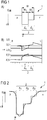
- FIG 1A a modification of an optoelectronic semiconductor chip 1 is schematically illustrated by the course of an indium content c and a bandgap E g along a growth direction z.
- An active quantum well 2 has a higher indium content c in comparison to the quantum well 2 surrounding regions of the semiconductor chip 1.
- the quantum well 2 comprises two zones A 1 , 2 .
- the indium content c is increased in comparison to the second zone A 2 .
- radiation generation preferably takes place approximately exclusively in the first zone A 1 .
- the semiconductor chip 1 is based, for example, on the InGaN material system.
- the band gap E g is given here in eV. As the indium content increases, the band gap E g decreases. For a band gap E g corresponding to a wavelength of about 450 nm, the indium content is preferably between 17% and 22% inclusive, corresponding to a wavelength of about 490 nm, preferably between 24% and 29% inclusive.
- the indium content c in the zones A 1 , A 2 is approximately constant in each case.
- the indium content c 1 of the first zone A 1 is 22% and the indium content c 2 of the second zone A 2 is approximately 12%.
- a width w 1 of the first zone A 1 is approximately 2.5 nm
- a width w 2 of the second zone A 2 is approximately 2 nm.
- a total width W of the active quantum well 2 is approximately 4.5 nm.
- the zones A 1 , 2 are consecutively numbered against the growth direction z of the semiconductor chip 1. The numbering therefore runs in a direction from a p-terminal side p to an n-terminal side n of the semiconductor chip 1.
- the indium content c i of the i-th zone is to be specified dimensionless in percent and the widths w i dimensionless in nanometers.
- N is the number of zones A 1 , 2 .
- the result is a value of: 22 ⁇ 2.5 + 12 ⁇ 2 - 2.5 ⁇ 2 - 1.5 ⁇ 2.5 + 2 ⁇ 67th
- FIG. 1B is a schematic of a course of the energies E of the valence band and the conduction band of the semiconductor chip 1 according to Figure 1A illustrated along the growth direction z.
- the band gap E g corresponds to the difference between the energies E of the valence band and the conduction band, in each case along the growth direction z.
- Wave functions of the valence band and the conduction band are each symbolized as thick lines, the corresponding energy levels as thin horizontal lines.
- An overlap range of the wave functions of the ground states of the valence band and the conduction band is comparatively large. In this way, in particular a high recombination rate of charge carriers, that is to say electrons and holes, in the quantum well 2 is made possible. Also, the trapping rate of carriers in the active quantum well 2 may be increased.
- FIG. 2 a further modification of a semiconductor chip 1 is schematically illustrated.
- the course of the indium content c along the growth direction z has three zones A 1 , 2 , 3 .
- Through the three zones of the active quantum well 2 is formed.
- As a dashed line an approximate mean indium content of the zones A 1 , 2 , 3 is shown.
- the real course of the indium content c has deviations therefrom, in particular in the areas of the edges of the dashed lines of the idealized course.
- the individual zones A 1 , 2 , 3 are clearly separated from one another by regions of a sharp increase or decrease in the indium content c.
- FIG. 3A a modification of a semiconductor device is shown in which the active quantum well 2 has a width W of about 6 nm and a mean indium content c of about 22%.
- FIGS. 3B and 3C only a relatively small overlap on each other.
- a gradient of the energies of the valence band and the conduction band in the area of the quantum well 2 due to piezoelectric fields is comparatively large, symbolized by an inclined dashed line in FIG FIG. 3C ,
- flanks of the quantum well 2 show a ramp-like course and a modified active quantum well 2 ', symbolized by a dash-and-dot line.
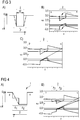
- FIG. 4 Another modification of the semiconductor chip 1 is shown in FIG. 4 shown.
- the zone A 2 with the highest indium content c 2 of the active quantum well 2 is adjacent in the direction of the p-terminal side p of a zone A 1 , which has a smaller mean indium content c 1 .
- the zone A 1 can also be ramp-shaped, indicated by a dash-dot line.
- FIG. 4B As in FIG. 4B can be seen is compared with FIG. 3C due to the zone A 1, the gradient of the energy E along the growth direction z in the region of the zone A 2 with the maximum indium content c 2 is significantly reduced, indicated in FIG. 4B through a thick line.
- the slope of the energy E of the quantum well 2 according to FIG. 3C drawn as a dash line.
- a gradient in the potential profile is reduced by the zone A 1 . This reduction of the gradient leads to an increased efficiency with respect to the radiation generation in the active quantum well 2.
- the active quantum well 2 has three zones A 1 , 2 , 3 .
- the zone A 2 with the maximum indium content c 2 has the largest width w 2 .
- the indium content c 1 of the p-terminal-side zone A 1 is smaller than the indium content c 3 of the n-terminal-side zone A 3 .
- the quantum well 2 has a comparatively large effective width and thus a high Charge carrier capture rate. Also, the gradient is reduced in the potential curve. By local charges at the hetero boundaries between the zones A 1 , 3 and the surrounding semiconductor material outside the active quantum well 2 piezoelectric fields are reduced. As a result, a particularly high efficiency in the generation of radiation in the quantum well 2 can be achieved.
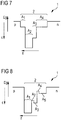
- the active quantum well 2 has three zones A 1 , 2 , 3 .
- the indium content c i rises monotone in the direction of growth z, starting from the zone A 1 .
- the step edge between the zones A 2 , 3 can, as indicated by a dotted line, for example, different, as in FIG. 6 drawn, rounded shape.
- the active quantum well 2 may also have significantly more than three zones A 1 , 2 , 3 .
- the active quantum well 2 has both a p-terminal-side zone A 1 and a plurality of n-terminal-side zones A 3 , 4 , which surround the zone A 2 with the maximum mean indium content c 2 .
- the active quantum well 2 has two intermediate barriers formed by the zones A 2 , 4 .
- the indium content c 2 , 4 of the zones A 2 , 4 is lowered in comparison to the respectively adjacent zones and / or an aluminum content of the zones is A 2 , 4 increased.
- FIG. 9 Furthermore, a p-terminal-side zone A 1 with a lower indium content c 1 is additionally present.
- the modification of the semiconductor chip 1 has two active quantum wells 2a, b.
- Each of the quantum wells 2a, b comprises two zones A 1 , 2 .
- the semiconductor chip 1 for example, have three, four, five or more active quantum wells.
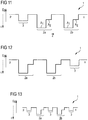
- the semiconductor chip 1 also comprises an inactive quantum well 3.
- An indium content of the inactive quantum well 3 is, for example, between that of the zones A 1 , 2 of the active quantum wells 2a, b.
- the inactive quantum well 3 is located on the p-terminal side p of the semiconductor chip 1. Unlike in FIG. 11 it is also possible for the inactive quantum well 3 to comprise several zones with different indium content and / or aluminum content.
- FIG. 12 a modification is shown, according to which the inactive quantum well 3 can also be located on the n-terminal side n. It is also possible that groups with up to five inactive quantum wells 3 are formed on the n-connection side n and / or on the p-connection side p. In this case, it is not necessary that the different groups of inactive quantum wells 3 each have an equal number of inactive quantum wells 3. The same applies, see FIG. 13 , for an inactive quantum well 3 or a group with a plurality of inactive quantum wells 3 located between the active quantum wells 2a, b.
- the optoelectronic semiconductor chip 1 further includes two cladding layers 4a, b, which enclose or enclose the active quantum wells 2a, b.
- the semiconductor chip 1 furthermore has a respective barrier layer 6 between the active quantum well 2 and the waveguide layers 4a, b.
- the p-terminal-side waveguide layer 4a comprises a charge carrier barrier layer 5.
- the charge carrier barrier layer 5 is formed, for example, by a thin layer having an increased aluminum content.
- the semiconductor chip 1 can also have a plurality of active quantum wells 2 and optionally also one or more inactive quantum wells 3.
- FIGS. 16 and 17 a parameter variation with respect to the indium content c and the widths w of the zones A of the active quantum well 2 of semiconductor chips is schematically illustrated.
- the value of the term ⁇ c z dz - 2.5 N - 1.5 ⁇ dz is schematically illustrated.
- the active quantum well has two zones A each. Between FoM values of 40 and 80, in particular between 50 and 70, the semiconductor chips show a high efficiency, which manifests itself, for example, in a laser action. The same applies to the semiconductor chips according to FIG. 17 in which the active quantum well has three zones A in each case.
- an efficiency of the semiconductor chips in the given FoM value ranges is greater than outside these value ranges, the efficiency being the quotient of an emitted optical output power and an electrical input power with which the semiconductor chips are operated.
- the efficiency for FoM values outside the stated ranges may be less than 6%, and for FoM values in particular between 50 and 70, greater than or equal to 8 % be.
- the efficiency for FoM values outside the specified ranges is below 0.5%, and for FoM values in particular between 50 and 70 at least 0, 6%, preferably at least 0.8%.
- FIG. 18 1 illustrates a modification of a semiconductor chip 1 in which an aluminum content k is adjusted differently along the growth direction z of the active quantum well 2 into two zones A 1 , 2 .
- the aluminum content k and thicknesses of the zones A 1 , 2 are selected such that the active quantum well 2 satisfies the condition: 50 ⁇ ⁇ 35 - k z dz - 2.5 N - 1.5 ⁇ dz ⁇ 120th
- modification according to FIG. 18 may comprise inactive quantum wells, a plurality of active quantum wells and / or cladding layers and barrier layers, for example analogously to the modification according to FIG. 15 ,
Landscapes
- Physics & Mathematics (AREA)
- Optics & Photonics (AREA)
- Condensed Matter Physics & Semiconductors (AREA)
- General Physics & Mathematics (AREA)
- Electromagnetism (AREA)
- Engineering & Computer Science (AREA)
- Nanotechnology (AREA)
- Chemical & Material Sciences (AREA)
- Biophysics (AREA)
- Crystallography & Structural Chemistry (AREA)
- Life Sciences & Earth Sciences (AREA)
- Led Devices (AREA)
- Semiconductor Lasers (AREA)
Applications Claiming Priority (2)
| Application Number | Priority Date | Filing Date | Title |
|---|---|---|---|
| DE102009015569.4A DE102009015569B9 (de) | 2009-03-30 | 2009-03-30 | Optoelektronischer Halbleiterchip |
| PCT/EP2010/053047 WO2010112310A1 (de) | 2009-03-30 | 2010-03-10 | Optoelektronischer halbleiterchip |
Publications (2)
| Publication Number | Publication Date |
|---|---|
| EP2415085A1 EP2415085A1 (de) | 2012-02-08 |
| EP2415085B1 true EP2415085B1 (de) | 2019-01-02 |
Family
ID=42340450
Family Applications (1)
| Application Number | Title | Priority Date | Filing Date |
|---|---|---|---|
| EP10707304.1A Active EP2415085B1 (de) | 2009-03-30 | 2010-03-10 | Optoelektronischer halbleiterchip |
Country Status (8)
| Country | Link |
|---|---|
| US (2) | US8908733B2 (enExample) |
| EP (1) | EP2415085B1 (enExample) |
| JP (3) | JP2012522390A (enExample) |
| KR (2) | KR101645057B1 (enExample) |
| CN (2) | CN104319331B (enExample) |
| DE (1) | DE102009015569B9 (enExample) |
| TW (1) | TWI452723B (enExample) |
| WO (1) | WO2010112310A1 (enExample) |
Families Citing this family (17)
| Publication number | Priority date | Publication date | Assignee | Title |
|---|---|---|---|---|
| DE102009015569B9 (de) * | 2009-03-30 | 2023-06-29 | OSRAM Opto Semiconductors Gesellschaft mit beschränkter Haftung | Optoelektronischer Halbleiterchip |
| KR101712049B1 (ko) * | 2010-11-17 | 2017-03-03 | 엘지이노텍 주식회사 | 발광 소자 |
| JP5417307B2 (ja) * | 2010-12-02 | 2014-02-12 | 株式会社東芝 | 半導体発光素子 |
| JP2014067893A (ja) | 2012-09-26 | 2014-04-17 | Toyoda Gosei Co Ltd | Iii族窒化物半導体発光素子 |
| DE102013200507A1 (de) * | 2013-01-15 | 2014-07-17 | Osram Opto Semiconductors Gmbh | Optoelektronisches Halbleiterbauelement |
| DE102013104351B4 (de) | 2013-04-29 | 2022-01-20 | OSRAM Opto Semiconductors Gesellschaft mit beschränkter Haftung | Halbleiterschichtenfolge und Verfahren zum Betreiben eines optoelektronischen Halbleiterchips |
| JP2015038949A (ja) * | 2013-07-17 | 2015-02-26 | 株式会社東芝 | 半導体発光素子及びその製造方法 |
| KR102019858B1 (ko) * | 2013-07-18 | 2019-09-09 | 엘지이노텍 주식회사 | 발광소자 및 조명시스템 |
| FR3009894B1 (fr) | 2013-08-22 | 2016-12-30 | Commissariat Energie Atomique | Diode electroluminescente dont une zone active comporte des couches d'inn |
| JP6183060B2 (ja) * | 2013-08-24 | 2017-08-23 | 日亜化学工業株式会社 | 半導体発光素子 |
| CN108463930B (zh) * | 2016-01-08 | 2020-05-12 | 索尼公司 | 半导体发光器件、显示单元和电子设备 |
| DE102016117477B4 (de) * | 2016-09-16 | 2026-03-26 | OSRAM Opto Semiconductors Gesellschaft mit beschränkter Haftung | Halbleiterschichtenfolge und optoelektronischer Halbleiterchip |
| JP7295371B2 (ja) * | 2018-08-31 | 2023-06-21 | 日亜化学工業株式会社 | 半導体レーザ素子 |
| JP6891865B2 (ja) * | 2018-10-25 | 2021-06-18 | 日亜化学工業株式会社 | 発光素子 |
| US10735354B1 (en) | 2018-10-30 | 2020-08-04 | Facebook, Inc. | Photo space user interface facilitating contextual discussion between users of a social networking system |
| FR3096508A1 (fr) * | 2019-05-21 | 2020-11-27 | Aledia | Dispositif optoélectronique à diodes électroluminescentes |
| US20240395966A1 (en) * | 2023-05-24 | 2024-11-28 | Wisconsin Alumni Research Foundation | Light-emitters with group iii-nitride-based quantum well active regions having gan interlayers |
Family Cites Families (23)
| Publication number | Priority date | Publication date | Assignee | Title |
|---|---|---|---|---|
| KR950000119B1 (ko) * | 1991-12-30 | 1995-01-09 | 주식회사 금성사 | 반도체 레이저의 구조 |
| JP3543498B2 (ja) * | 1996-06-28 | 2004-07-14 | 豊田合成株式会社 | 3族窒化物半導体発光素子 |
| DE19955747A1 (de) * | 1999-11-19 | 2001-05-23 | Osram Opto Semiconductors Gmbh | Optische Halbleitervorrichtung mit Mehrfach-Quantentopf-Struktur |
| JP3876649B2 (ja) * | 2001-06-05 | 2007-02-07 | ソニー株式会社 | 窒化物半導体レーザ及びその製造方法 |
| ATE387736T1 (de) * | 2001-11-05 | 2008-03-15 | Nichia Corp | Halbleiterelement |
| US6618413B2 (en) * | 2001-12-21 | 2003-09-09 | Xerox Corporation | Graded semiconductor layers for reducing threshold voltage for a nitride-based laser diode structure |
| JP2003229645A (ja) * | 2002-01-31 | 2003-08-15 | Nec Corp | 量子井戸構造およびそれを用いた半導体素子ならびに半導体素子の製造方法 |
| JP4047150B2 (ja) * | 2002-11-28 | 2008-02-13 | ローム株式会社 | 半導体発光素子 |
| JP4412918B2 (ja) | 2003-05-28 | 2010-02-10 | シャープ株式会社 | 窒化物半導体発光素子及びその製造方法 |
| JP2004356356A (ja) | 2003-05-29 | 2004-12-16 | Oki Electric Ind Co Ltd | 洗浄終了判定方法および洗浄装置 |
| US6995389B2 (en) | 2003-06-18 | 2006-02-07 | Lumileds Lighting, U.S., Llc | Heterostructures for III-nitride light emitting devices |
| DE602004029910D1 (de) * | 2003-08-26 | 2010-12-16 | Sony Corp | LICHTEMITTIERENDES BAUELEMENT AUS GaN III-V VERBINDUNGSHALBLEITERMATERIAL UND ZUGEHÖRIGES HERSTELLUNGSVERFAHREN |
| US7138648B2 (en) * | 2003-12-17 | 2006-11-21 | Palo Alto Research Center Incorporated | Ultraviolet group III-nitride-based quantum well laser diodes |
| KR100513923B1 (ko) | 2004-08-13 | 2005-09-08 | 재단법인서울대학교산학협력재단 | 질화물 반도체층을 성장시키는 방법 및 이를 이용하는 질화물 반도체 발광소자 |
| DE102005035722B9 (de) * | 2005-07-29 | 2021-11-18 | OSRAM Opto Semiconductors Gesellschaft mit beschränkter Haftung | Optoelektronischer Halbleiterchip und Verfahren zu dessen Herstellung |
| US20070045638A1 (en) | 2005-08-24 | 2007-03-01 | Lumileds Lighting U.S., Llc | III-nitride light emitting device with double heterostructure light emitting region |
| JP5244297B2 (ja) * | 2006-04-12 | 2013-07-24 | 株式会社日立製作所 | 半導体発光素子 |
| JP2008288397A (ja) | 2007-05-17 | 2008-11-27 | Eudyna Devices Inc | 半導体発光装置 |
| KR101459752B1 (ko) | 2007-06-22 | 2014-11-13 | 엘지이노텍 주식회사 | 반도체 발광소자 및 그 제조방법 |
| DE102007044439B4 (de) * | 2007-09-18 | 2022-03-24 | OSRAM Opto Semiconductors Gesellschaft mit beschränkter Haftung | Optoelektronischer Halbleiterchip mit Quantentopfstruktur |
| JP5281162B2 (ja) * | 2008-09-03 | 2013-09-04 | テレフオンアクチーボラゲット エル エム エリクソン(パブル) | 通信帯域を割当てるための方法及び関連する装置 |
| DE102009015569B9 (de) * | 2009-03-30 | 2023-06-29 | OSRAM Opto Semiconductors Gesellschaft mit beschränkter Haftung | Optoelektronischer Halbleiterchip |
| US8779412B2 (en) * | 2011-07-20 | 2014-07-15 | Samsung Electronics Co., Ltd. | Semiconductor light emitting device |
-
2009
- 2009-03-30 DE DE102009015569.4A patent/DE102009015569B9/de active Active
-
2010
- 2010-03-10 JP JP2012502545A patent/JP2012522390A/ja active Pending
- 2010-03-10 CN CN201410437730.8A patent/CN104319331B/zh active Active
- 2010-03-10 US US13/262,583 patent/US8908733B2/en active Active
- 2010-03-10 EP EP10707304.1A patent/EP2415085B1/de active Active
- 2010-03-10 WO PCT/EP2010/053047 patent/WO2010112310A1/de not_active Ceased
- 2010-03-10 KR KR1020117025789A patent/KR101645057B1/ko active Active
- 2010-03-10 KR KR1020167017756A patent/KR101704985B1/ko active Active
- 2010-03-10 CN CN201080014639.5A patent/CN102369606B/zh active Active
- 2010-03-25 TW TW099108846A patent/TWI452723B/zh not_active IP Right Cessation
-
2014
- 2014-11-06 US US14/535,044 patent/US9202971B2/en active Active
-
2015
- 2015-02-12 JP JP2015025476A patent/JP5933775B2/ja not_active Expired - Fee Related
-
2016
- 2016-05-02 JP JP2016092753A patent/JP2016157977A/ja active Pending
Non-Patent Citations (1)
| Title |
|---|
| None * |
Also Published As
| Publication number | Publication date |
|---|---|
| CN102369606B (zh) | 2014-10-01 |
| KR20160085909A (ko) | 2016-07-18 |
| JP2016157977A (ja) | 2016-09-01 |
| KR101704985B1 (ko) | 2017-02-08 |
| US20150063395A1 (en) | 2015-03-05 |
| JP2012522390A (ja) | 2012-09-20 |
| TWI452723B (zh) | 2014-09-11 |
| CN104319331B (zh) | 2017-05-10 |
| KR101645057B1 (ko) | 2016-08-02 |
| US20130028281A1 (en) | 2013-01-31 |
| US8908733B2 (en) | 2014-12-09 |
| US9202971B2 (en) | 2015-12-01 |
| DE102009015569A1 (de) | 2010-10-07 |
| WO2010112310A1 (de) | 2010-10-07 |
| KR20120009475A (ko) | 2012-01-31 |
| CN102369606A (zh) | 2012-03-07 |
| JP5933775B2 (ja) | 2016-06-15 |
| JP2015092636A (ja) | 2015-05-14 |
| EP2415085A1 (de) | 2012-02-08 |
| DE102009015569B4 (de) | 2023-03-23 |
| TW201044635A (en) | 2010-12-16 |
| CN104319331A (zh) | 2015-01-28 |
| DE102009015569B9 (de) | 2023-06-29 |
Similar Documents
| Publication | Publication Date | Title |
|---|---|---|
| DE102009015569B4 (de) | Optoelektronischer Halbleiterchip | |
| EP1883141B1 (de) | LD oder LED mit Übergitter-Mantelschicht | |
| DE102009060747B4 (de) | Halbleiterchip | |
| DE102007057674A1 (de) | LED mit Stromaufweitungsschicht | |
| EP2539980B1 (de) | Optoelektronischer halbleiterchip | |
| WO2016151112A1 (de) | Optoelektronischer halbleiterkörper und verfahren zur herstellung eines optoelektronischen halbleiterkörpers | |
| DE102013104351B4 (de) | Halbleiterschichtenfolge und Verfahren zum Betreiben eines optoelektronischen Halbleiterchips | |
| WO2018050466A1 (de) | Halbleiterschichtenfolge | |
| EP2409368A2 (de) | Optoelektronisches halbleiterbauteil | |
| DE102012111512A1 (de) | Halbleiterstreifenlaser | |
| WO2016110433A1 (de) | Optoelektronisches bauelement | |
| EP1883119B1 (de) | Halbleiter-Schichtstruktur mit Übergitter | |
| WO2015055500A1 (de) | Optoelektronisches halbleiterbauelement | |
| WO2020182545A1 (de) | Optoelektronischer halbleiterchip und verfahren zum herstellen eines optoelektronischen halbleiterchips | |
| DE102006035627A1 (de) | LED-Halbleiterkörper | |
| DE102009037416B4 (de) | Elektrisch gepumpter optoelektronischer Halbleiterchip | |
| DE102016113274B4 (de) | Optoelektronischer Halbleiterchip | |
| DE112017003255B4 (de) | Optoelektronischer Halbleiterkörper und Leuchtdiode | |
| DE102019119991A1 (de) | Optoelektronischer halbleiterchip | |
| DE102006046237A1 (de) | Halbleiter-Schichtstruktur mit Übergitter | |
| WO2014029633A1 (de) | Optoelektronischer halbleiterkörper und optoelektronischer halbleiterchip | |
| DE10220333B4 (de) | Strahlungsemittierendes Halbleiterbauelement mit einer Mehrzahl von Strukturelementen | |
| DE102023108165A1 (de) | Halbleiterschichtenfolge | |
| DE102012109590A1 (de) | Verfahren zur Herstellung eines optoelektronischen Halbleiterchips und optoelektronischer Halbleiterchip | |
| DE102023128322A1 (de) | Oberflächenemittierende Laservorrichtung und Verfahren zu ihrer Herstellung |
Legal Events
| Date | Code | Title | Description |
|---|---|---|---|
| PUAI | Public reference made under article 153(3) epc to a published international application that has entered the european phase |
Free format text: ORIGINAL CODE: 0009012 |
|
| 17P | Request for examination filed |
Effective date: 20110803 |
|
| AK | Designated contracting states |
Kind code of ref document: A1 Designated state(s): AT BE BG CH CY CZ DE DK EE ES FI FR GB GR HR HU IE IS IT LI LT LU LV MC MK MT NL NO PL PT RO SE SI SK SM TR |
|
| RIN1 | Information on inventor provided before grant (corrected) |
Inventor name: LUTGEN, STEPHAN Inventor name: STRAUSS, UWE Inventor name: QUEREN, DESIREE Inventor name: AVRAMESCU, ADRIAN, STEFAN Inventor name: EICHLER, CHRISTOPH Inventor name: SABATHIL, MATTHIAS |
|
| DAX | Request for extension of the european patent (deleted) | ||
| GRAP | Despatch of communication of intention to grant a patent |
Free format text: ORIGINAL CODE: EPIDOSNIGR1 |
|
| STAA | Information on the status of an ep patent application or granted ep patent |
Free format text: STATUS: GRANT OF PATENT IS INTENDED |
|
| RIC1 | Information provided on ipc code assigned before grant |
Ipc: H01S 5/343 20060101ALI20180712BHEP Ipc: H01S 5/34 20060101ALI20180712BHEP Ipc: B82Y 20/00 20110101AFI20180712BHEP |
|
| RIC1 | Information provided on ipc code assigned before grant |
Ipc: B82Y 20/00 20110101ALI20180717BHEP Ipc: H01L 33/32 20100101AFI20180717BHEP Ipc: H01S 5/34 20060101ALI20180717BHEP Ipc: H01S 5/343 20060101ALI20180717BHEP Ipc: H01L 33/06 20100101ALI20180717BHEP |
|
| INTG | Intention to grant announced |
Effective date: 20180803 |
|
| RIN1 | Information on inventor provided before grant (corrected) |
Inventor name: LUTGEN, STEPHAN Inventor name: STRAUSS, UWE Inventor name: EICHLER, CHRISTOPH Inventor name: SABATHIL, MATTHIAS Inventor name: QUEREN, DESIREE Inventor name: AVRAMESCU, ADRIAN, STEFAN |
|
| GRAJ | Information related to disapproval of communication of intention to grant by the applicant or resumption of examination proceedings by the epo deleted |
Free format text: ORIGINAL CODE: EPIDOSDIGR1 |
|
| STAA | Information on the status of an ep patent application or granted ep patent |
Free format text: STATUS: REQUEST FOR EXAMINATION WAS MADE |
|
| GRAP | Despatch of communication of intention to grant a patent |
Free format text: ORIGINAL CODE: EPIDOSNIGR1 |
|
| INTC | Intention to grant announced (deleted) | ||
| STAA | Information on the status of an ep patent application or granted ep patent |
Free format text: STATUS: GRANT OF PATENT IS INTENDED |
|
| INTG | Intention to grant announced |
Effective date: 20181008 |
|
| INTG | Intention to grant announced |
Effective date: 20181011 |
|
| GRAS | Grant fee paid |
Free format text: ORIGINAL CODE: EPIDOSNIGR3 |
|
| GRAA | (expected) grant |
Free format text: ORIGINAL CODE: 0009210 |
|
| STAA | Information on the status of an ep patent application or granted ep patent |
Free format text: STATUS: THE PATENT HAS BEEN GRANTED |
|
| AK | Designated contracting states |
Kind code of ref document: B1 Designated state(s): AT BE BG CH CY CZ DE DK EE ES FI FR GB GR HR HU IE IS IT LI LT LU LV MC MK MT NL NO PL PT RO SE SI SK SM TR |
|
| REG | Reference to a national code |
Ref country code: GB Ref legal event code: FG4D Free format text: NOT ENGLISH |
|
| REG | Reference to a national code |
Ref country code: CH Ref legal event code: EP Ref country code: AT Ref legal event code: REF Ref document number: 1085491 Country of ref document: AT Kind code of ref document: T Effective date: 20190115 |
|
| REG | Reference to a national code |
Ref country code: IE Ref legal event code: FG4D Free format text: LANGUAGE OF EP DOCUMENT: GERMAN |
|
| REG | Reference to a national code |
Ref country code: DE Ref legal event code: R096 Ref document number: 502010015687 Country of ref document: DE |
|
| REG | Reference to a national code |
Ref country code: NL Ref legal event code: MP Effective date: 20190102 |
|
| REG | Reference to a national code |
Ref country code: LT Ref legal event code: MG4D |
|
| PG25 | Lapsed in a contracting state [announced via postgrant information from national office to epo] |
Ref country code: NL Free format text: LAPSE BECAUSE OF FAILURE TO SUBMIT A TRANSLATION OF THE DESCRIPTION OR TO PAY THE FEE WITHIN THE PRESCRIBED TIME-LIMIT Effective date: 20190102 |
|
| PG25 | Lapsed in a contracting state [announced via postgrant information from national office to epo] |
Ref country code: PL Free format text: LAPSE BECAUSE OF FAILURE TO SUBMIT A TRANSLATION OF THE DESCRIPTION OR TO PAY THE FEE WITHIN THE PRESCRIBED TIME-LIMIT Effective date: 20190102 Ref country code: LT Free format text: LAPSE BECAUSE OF FAILURE TO SUBMIT A TRANSLATION OF THE DESCRIPTION OR TO PAY THE FEE WITHIN THE PRESCRIBED TIME-LIMIT Effective date: 20190102 Ref country code: SE Free format text: LAPSE BECAUSE OF FAILURE TO SUBMIT A TRANSLATION OF THE DESCRIPTION OR TO PAY THE FEE WITHIN THE PRESCRIBED TIME-LIMIT Effective date: 20190102 Ref country code: FI Free format text: LAPSE BECAUSE OF FAILURE TO SUBMIT A TRANSLATION OF THE DESCRIPTION OR TO PAY THE FEE WITHIN THE PRESCRIBED TIME-LIMIT Effective date: 20190102 Ref country code: ES Free format text: LAPSE BECAUSE OF FAILURE TO SUBMIT A TRANSLATION OF THE DESCRIPTION OR TO PAY THE FEE WITHIN THE PRESCRIBED TIME-LIMIT Effective date: 20190102 Ref country code: PT Free format text: LAPSE BECAUSE OF FAILURE TO SUBMIT A TRANSLATION OF THE DESCRIPTION OR TO PAY THE FEE WITHIN THE PRESCRIBED TIME-LIMIT Effective date: 20190502 Ref country code: NO Free format text: LAPSE BECAUSE OF FAILURE TO SUBMIT A TRANSLATION OF THE DESCRIPTION OR TO PAY THE FEE WITHIN THE PRESCRIBED TIME-LIMIT Effective date: 20190402 |
|
| PG25 | Lapsed in a contracting state [announced via postgrant information from national office to epo] |
Ref country code: BG Free format text: LAPSE BECAUSE OF FAILURE TO SUBMIT A TRANSLATION OF THE DESCRIPTION OR TO PAY THE FEE WITHIN THE PRESCRIBED TIME-LIMIT Effective date: 20190402 Ref country code: LV Free format text: LAPSE BECAUSE OF FAILURE TO SUBMIT A TRANSLATION OF THE DESCRIPTION OR TO PAY THE FEE WITHIN THE PRESCRIBED TIME-LIMIT Effective date: 20190102 Ref country code: IS Free format text: LAPSE BECAUSE OF FAILURE TO SUBMIT A TRANSLATION OF THE DESCRIPTION OR TO PAY THE FEE WITHIN THE PRESCRIBED TIME-LIMIT Effective date: 20190502 Ref country code: HR Free format text: LAPSE BECAUSE OF FAILURE TO SUBMIT A TRANSLATION OF THE DESCRIPTION OR TO PAY THE FEE WITHIN THE PRESCRIBED TIME-LIMIT Effective date: 20190102 Ref country code: GR Free format text: LAPSE BECAUSE OF FAILURE TO SUBMIT A TRANSLATION OF THE DESCRIPTION OR TO PAY THE FEE WITHIN THE PRESCRIBED TIME-LIMIT Effective date: 20190403 |
|
| RAP2 | Party data changed (patent owner data changed or rights of a patent transferred) |
Owner name: OSRAM OPTO SEMICONDUCTORS GMBH |
|
| REG | Reference to a national code |
Ref country code: DE Ref legal event code: R097 Ref document number: 502010015687 Country of ref document: DE |
|
| PG25 | Lapsed in a contracting state [announced via postgrant information from national office to epo] |
Ref country code: MC Free format text: LAPSE BECAUSE OF FAILURE TO SUBMIT A TRANSLATION OF THE DESCRIPTION OR TO PAY THE FEE WITHIN THE PRESCRIBED TIME-LIMIT Effective date: 20190102 Ref country code: DK Free format text: LAPSE BECAUSE OF FAILURE TO SUBMIT A TRANSLATION OF THE DESCRIPTION OR TO PAY THE FEE WITHIN THE PRESCRIBED TIME-LIMIT Effective date: 20190102 Ref country code: SK Free format text: LAPSE BECAUSE OF FAILURE TO SUBMIT A TRANSLATION OF THE DESCRIPTION OR TO PAY THE FEE WITHIN THE PRESCRIBED TIME-LIMIT Effective date: 20190102 Ref country code: IT Free format text: LAPSE BECAUSE OF FAILURE TO SUBMIT A TRANSLATION OF THE DESCRIPTION OR TO PAY THE FEE WITHIN THE PRESCRIBED TIME-LIMIT Effective date: 20190102 Ref country code: EE Free format text: LAPSE BECAUSE OF FAILURE TO SUBMIT A TRANSLATION OF THE DESCRIPTION OR TO PAY THE FEE WITHIN THE PRESCRIBED TIME-LIMIT Effective date: 20190102 Ref country code: CZ Free format text: LAPSE BECAUSE OF FAILURE TO SUBMIT A TRANSLATION OF THE DESCRIPTION OR TO PAY THE FEE WITHIN THE PRESCRIBED TIME-LIMIT Effective date: 20190102 Ref country code: RO Free format text: LAPSE BECAUSE OF FAILURE TO SUBMIT A TRANSLATION OF THE DESCRIPTION OR TO PAY THE FEE WITHIN THE PRESCRIBED TIME-LIMIT Effective date: 20190102 |
|
| REG | Reference to a national code |
Ref country code: CH Ref legal event code: PL |
|
| PLBE | No opposition filed within time limit |
Free format text: ORIGINAL CODE: 0009261 |
|
| STAA | Information on the status of an ep patent application or granted ep patent |
Free format text: STATUS: NO OPPOSITION FILED WITHIN TIME LIMIT |
|
| PG25 | Lapsed in a contracting state [announced via postgrant information from national office to epo] |
Ref country code: LU Free format text: LAPSE BECAUSE OF NON-PAYMENT OF DUE FEES Effective date: 20190310 Ref country code: SM Free format text: LAPSE BECAUSE OF FAILURE TO SUBMIT A TRANSLATION OF THE DESCRIPTION OR TO PAY THE FEE WITHIN THE PRESCRIBED TIME-LIMIT Effective date: 20190102 |
|
| 26N | No opposition filed |
Effective date: 20191003 |
|
| REG | Reference to a national code |
Ref country code: BE Ref legal event code: MM Effective date: 20190331 |
|
| GBPC | Gb: european patent ceased through non-payment of renewal fee |
Effective date: 20190402 |
|
| PG25 | Lapsed in a contracting state [announced via postgrant information from national office to epo] |
Ref country code: CH Free format text: LAPSE BECAUSE OF NON-PAYMENT OF DUE FEES Effective date: 20190331 Ref country code: GB Free format text: LAPSE BECAUSE OF NON-PAYMENT OF DUE FEES Effective date: 20190402 Ref country code: IE Free format text: LAPSE BECAUSE OF NON-PAYMENT OF DUE FEES Effective date: 20190310 Ref country code: LI Free format text: LAPSE BECAUSE OF NON-PAYMENT OF DUE FEES Effective date: 20190331 |
|
| PG25 | Lapsed in a contracting state [announced via postgrant information from national office to epo] |
Ref country code: BE Free format text: LAPSE BECAUSE OF NON-PAYMENT OF DUE FEES Effective date: 20190331 Ref country code: FR Free format text: LAPSE BECAUSE OF NON-PAYMENT OF DUE FEES Effective date: 20190331 Ref country code: SI Free format text: LAPSE BECAUSE OF FAILURE TO SUBMIT A TRANSLATION OF THE DESCRIPTION OR TO PAY THE FEE WITHIN THE PRESCRIBED TIME-LIMIT Effective date: 20190102 |
|
| PG25 | Lapsed in a contracting state [announced via postgrant information from national office to epo] |
Ref country code: TR Free format text: LAPSE BECAUSE OF FAILURE TO SUBMIT A TRANSLATION OF THE DESCRIPTION OR TO PAY THE FEE WITHIN THE PRESCRIBED TIME-LIMIT Effective date: 20190102 |
|
| PG25 | Lapsed in a contracting state [announced via postgrant information from national office to epo] |
Ref country code: MT Free format text: LAPSE BECAUSE OF FAILURE TO SUBMIT A TRANSLATION OF THE DESCRIPTION OR TO PAY THE FEE WITHIN THE PRESCRIBED TIME-LIMIT Effective date: 20190102 |
|
| REG | Reference to a national code |
Ref country code: AT Ref legal event code: MM01 Ref document number: 1085491 Country of ref document: AT Kind code of ref document: T Effective date: 20190310 |
|
| PG25 | Lapsed in a contracting state [announced via postgrant information from national office to epo] |
Ref country code: AT Free format text: LAPSE BECAUSE OF NON-PAYMENT OF DUE FEES Effective date: 20190310 |
|
| PG25 | Lapsed in a contracting state [announced via postgrant information from national office to epo] |
Ref country code: CY Free format text: LAPSE BECAUSE OF FAILURE TO SUBMIT A TRANSLATION OF THE DESCRIPTION OR TO PAY THE FEE WITHIN THE PRESCRIBED TIME-LIMIT Effective date: 20190102 |
|
| PG25 | Lapsed in a contracting state [announced via postgrant information from national office to epo] |
Ref country code: HU Free format text: LAPSE BECAUSE OF FAILURE TO SUBMIT A TRANSLATION OF THE DESCRIPTION OR TO PAY THE FEE WITHIN THE PRESCRIBED TIME-LIMIT; INVALID AB INITIO Effective date: 20100310 |
|
| PG25 | Lapsed in a contracting state [announced via postgrant information from national office to epo] |
Ref country code: MK Free format text: LAPSE BECAUSE OF FAILURE TO SUBMIT A TRANSLATION OF THE DESCRIPTION OR TO PAY THE FEE WITHIN THE PRESCRIBED TIME-LIMIT Effective date: 20190102 |
|
| P01 | Opt-out of the competence of the unified patent court (upc) registered |
Effective date: 20230825 |
|
| REG | Reference to a national code |
Ref country code: DE Ref legal event code: R079 Ref document number: 502010015687 Country of ref document: DE Free format text: PREVIOUS MAIN CLASS: H01L0033320000 Ipc: H10H0020825000 |
|
| PGFP | Annual fee paid to national office [announced via postgrant information from national office to epo] |
Ref country code: DE Payment date: 20260319 Year of fee payment: 17 |