EP2397474A1 - 2-Oxo-1,3-dioxolan-4-carbonsäureester, ihre Herstellung und Verwendung - Google Patents
2-Oxo-1,3-dioxolan-4-carbonsäureester, ihre Herstellung und Verwendung Download PDFInfo
- Publication number
- EP2397474A1 EP2397474A1 EP10166244A EP10166244A EP2397474A1 EP 2397474 A1 EP2397474 A1 EP 2397474A1 EP 10166244 A EP10166244 A EP 10166244A EP 10166244 A EP10166244 A EP 10166244A EP 2397474 A1 EP2397474 A1 EP 2397474A1
- Authority
- EP
- European Patent Office
- Prior art keywords
- oxo
- dioxolane
- groups
- carboxylic acid
- acid ester
- Prior art date
- Legal status (The legal status is an assumption and is not a legal conclusion. Google has not performed a legal analysis and makes no representation as to the accuracy of the status listed.)
- Withdrawn
Links
- 0 *C1OC(*)(*)OC1* Chemical compound *C1OC(*)(*)OC1* 0.000 description 5
- LAVHAFGNTCKHJK-UHFFFAOYSA-N CC(C)(COC(C(CO1)OC1=O)=O)COC(C(CO1)OC1=O)=O Chemical compound CC(C)(COC(C(CO1)OC1=O)=O)COC(C(CO1)OC1=O)=O LAVHAFGNTCKHJK-UHFFFAOYSA-N 0.000 description 1
- WOPXFUMTJVCBCM-UHFFFAOYSA-N CCC(COCC(CO1)OC1=O)(COCC(CO1)OC1=O)COC(CO1)OC1=O Chemical compound CCC(COCC(CO1)OC1=O)(COCC(CO1)OC1=O)COC(CO1)OC1=O WOPXFUMTJVCBCM-UHFFFAOYSA-N 0.000 description 1
- HNHHKYXWATVPLU-UHFFFAOYSA-N COC(C(CO1)OC1=O)=O Chemical compound COC(C(CO1)OC1=O)=O HNHHKYXWATVPLU-UHFFFAOYSA-N 0.000 description 1
Images

Classifications
-
- C—CHEMISTRY; METALLURGY
- C07—ORGANIC CHEMISTRY
- C07D—HETEROCYCLIC COMPOUNDS
- C07D317/00—Heterocyclic compounds containing five-membered rings having two oxygen atoms as the only ring hetero atoms
- C07D317/08—Heterocyclic compounds containing five-membered rings having two oxygen atoms as the only ring hetero atoms having the hetero atoms in positions 1 and 3
- C07D317/10—Heterocyclic compounds containing five-membered rings having two oxygen atoms as the only ring hetero atoms having the hetero atoms in positions 1 and 3 not condensed with other rings
- C07D317/32—Heterocyclic compounds containing five-membered rings having two oxygen atoms as the only ring hetero atoms having the hetero atoms in positions 1 and 3 not condensed with other rings with hetero atoms or with carbon atoms having three bonds to hetero atoms with at the most one bond to halogen, e.g. ester or nitrile radicals, directly attached to ring carbon atoms
- C07D317/34—Oxygen atoms
Definitions
- the present invention relates to novel 2-oxo-1,3-dioxolane-4-carboxylic acid esters of the formula in which R 1 may preferably be Me or Et or an n-valent radical which may be substituted by a maximum of n-1 further 2-oxo-1,3-dioxolane-4-carboxyl groups, process for their preparation, process for their transesterification as well as their use for the preparation of hydroxyurethanes and as end groups for blocking amines.
- EP 1941946 A1 describes the use of a carbonitride catalyst, inter alia for the preparation of certain disubstituted organic carbonates.
- These may also be compounds of the general formula (II), wherein R 10 and R 11 are independently selected optional substituents.
- R 10 and R 11 are independently selected optional substituents.
- Possible meanings of the substituents are alkyl, aryl, herteroaryl and ester groups CO 2 A, where in turn A may be alkyl or aryl, for example straight-chain or branched C 1-6 -alkyl, preferably C 1-3 -alkyl and particularly preferably methyl or ethyl.
- no syntheses for 2-oxo-1,3-dioxolane systems are given.
- a sealant for liquid crystal display elements which comprises a compound of general formula (III), wherein R represents H, a hydroxyl group, a cyano group, a carboxylic acid group, an optionally substituted aromatic ring, a straight-chain, branched or cyclic alkyl group, an acyl group or an ester group.
- R represents H, a hydroxyl group, a cyano group, a carboxylic acid group, an optionally substituted aromatic ring, a straight-chain, branched or cyclic alkyl group, an acyl group or an ester group.
- R represents H, a hydroxyl group, a cyano group, a carboxylic acid group, an optionally substituted aromatic ring, a straight-chain, branched or cyclic alkyl group, an acyl group or an ester group.
- R represents H, a hydroxyl group, a cyano group, a carboxylic acid group, an optionally substituted aromatic ring
- Polyurethanes based on polyisocyanates belong to the state of the art. These are used, for example, as adhesives, sealants, potting compounds, as corrosion protection and for coatings. The high acid, alkali and chemical resistance of the cured compositions thus obtained are advantageous. However, monomeric low molecular weight (poly) isocyanate compounds are toxicologically questionable, especially if they are volatile or migrate.
- Polyurethane systems can also be obtained starting from cyclic carbonate compounds which are toxicologically harmless.
- glycerin carbonate (4- (hydroxymethyl) -2-oxo-1,3-dioxolane) is used in cosmetics. Cyclic carbonate compounds react with amines to form hydroxyurethanes.
- the object underlying the present invention was to substantially avoid at least some of the disadvantages of the prior art described above.
- a 2-oxo-1,3-dioxolane system should be provided which is safe, readily available and highly reactive with amines and carries at least one further or further reactive functional group (s).
- the present invention relates to 2-oxo-1,3-dioxolane-4-carboxylic esters of the formula (V) which are characterized in that R 1 is selected from straight-chain or branched aliphatic groups, aryl groups, aralkyl groups and alkaryl groups.
- R 1 may be selected, for example, from straight-chain or branched alkyl groups, in particular methyl, ethyl, n-propyl, isopropyl, n-butyl, sec-butyl, tert-butyl, n-pentyl, neo-pentyl, n-hexyl, 2-ethyl-n-hexyl, and be selected from cyclohexyl, phenyl and benzyl.
- the 2-oxo-1,3-dioxolane-4-carboxylic acid ester according to the invention is 4-methoxycarbonyl-2-oxo-1,3-dioxolane or 4-ethoxycarbonyl-2-oxo-1,3-dioxolane.
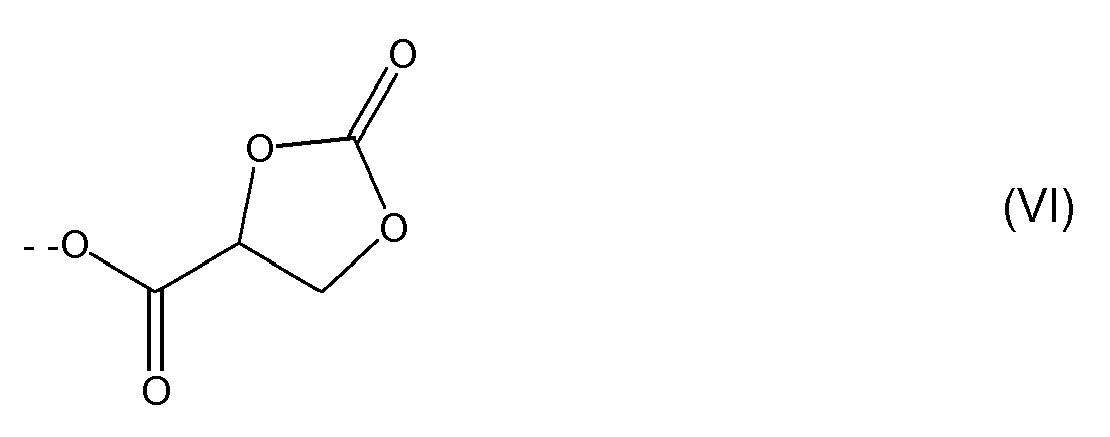
- R 1 is also possible for R 1 to be an n-valent radical derived by abstraction of the OH groups of an n-valent polyol and to be n-1 further 2-oxo-1,3-dioxolane-4-carboxylate groups of the general formula Formula (VI) may be substituted. If less than n-1 further 2-oxo-1,3-dioxolane-4-carboxylate groups are present, R 1 is additionally substituted with the stoichiometrically necessary number of OH groups.
- the n-valent polyol may, for example, comprise C 2-4 (poly) oxyalkylene groups, ie groups derived from ethylene oxide, propylene oxide and / or butylene oxide with one or more oxyalkylene repeat units.
- n 2 to 5. Examples of such higher molecular weight multifunctional compounds useful as binders are discussed below.
- a further subject of the present invention can be seen in the preparation of the low molecular weight, monomeric 2-oxo-1,3-dioxolane-4-carboxylic acid esters according to the invention.
- These 2-oxo-1,3-dioxolane-4-carboxylic acid esters can be prepared, for example, by reacting the corresponding epoxides of the formula (VII), wherein R 1 has the meaning indicated, with CO 2 .
- the temperature of the above-mentioned reaction with CO 2 can be varied within wide limits. It should suitably be in the range of 15 ° C to 150 ° C, preferably in the range of 30 ° C to 100 ° C.
- the reaction can be carried out in open equipment at ambient pressure (about 1 bar), for example by passing gaseous CO 2 through a suitable reaction solution. However, the reaction can also be carried out in closed systems at elevated pressure, for example at a pressure of 1 bar to 75 bar, preferably at a pressure of 1 bar to 30 bar.
- the reaction with CO 2 can be carried out without solvent, since the starting materials and the products are usually liquid. However, it has proven to be expedient to carry out the reaction in polar aprotic solvents.
- suitable solvents includes tetrabutylmethyl ether, acetonitrile, acetone, tetrahydrofuran, dimethyl carbonate, toluene, xylene, N-methyl-2-pyrrolidone, N-ethyl-2-pyrrolidone and mixtures thereof.
- the reaction with CO 2 can be carried out usually without a catalyst. However, it is expedient to work in the presence of a catalyst which is selected from metal halides and halogen salts of organic nitrogen compounds and mixtures thereof.
- low molecular weight, monomeric 2-oxo-1,3-dioxolane-4-carboxylic acid esters are not suitable as binders.
- the COOR 1 group has the advantage that it is available for further implementation.
- higher molecular weight, multi-functional representatives of the compound of general formula (V) according to the invention can be prepared by transesterification. Accordingly, a process for producing these higher molecular weight, multifunctional esters as a further object of the present invention, wherein a low molecular weight, monomeric 2-oxo-1,3-dioxolane-4-carboxylic acid ester of the general formula (V) with an n-valent Polyol is transesterified.
- the transesterification is carried out in the presence of an enzymatic catalyst or an acidic cation exchanger.
- an enzymatic catalyst or an acidic cation exchanger One of the difficulties which was associated with this transesterification reaction, was to find catalysts that catalyze the transesterification of the -COOR 1 group, but do not lead to attacks on the -O-COO group. The above catalysts circumvent these difficulties.
- Novozymes A / S an immobilized lipase have to be particularly suitable, and the H + form of Amberlite ® 200 from. Rohm & Haas Company, that a strongly acidic cation proven.
- the polyol and the low molecular weight 2-oxo-1,3-dioxolane-4-carboxylic acid ester are preferably used in stoichiometric proportions, wherein the conversion of the transesterification preferably above 80%, based on the low molecular weight 2-oxo-1,3-dioxolane used 4-carboxylic acid ester, should be.
- the reaction temperature is in the range of 50 to 100 ° C, wherein Novozyme ® 435 should be used at about 50 to 80 ° C and Amberlite ® 200 at about 100 ° C.
- Transesterification with Novozym ® 435 may be conveniently carried out without a solvent, the transesterification with Amberlite ® 200 is advantageously carried out in a suitable solvent. The reaction is conveniently carried out until essentially the calculated amount of R 1 -OH has distilled off.
- polyols examples include diols, in particular glycols, triols and tetraols, for example 1,4-butanediol, neopentyl glycol (2,2-dimethylolpropane), 1,1,1-trimethylolpropane, pentaerythritol and tetramethylolmethane.
- the said polyols can also be modified with C 2-4 -alkylene oxides, in particular ethylene oxide and propylene oxide.
- all polyols are usable, which are also useful for the production of conventional polyurethanes.
- Another object of the invention is the use of 2-oxo-1,3-dioxolane-4-carboxylic acid esters for the preparation of hydroxyurethanes.
- the cyclic carbonate compounds according to the invention react with amines to form hydroxyurethanes.
- Suitable amines are primary and secondary amines having alkyl groups, aryl groups, aralkyl groups and alkaryl groups as radicals.
- Primary amines react faster than secondary amines; Aliphatic amines react faster than aromatic amines.
- Aliphatic amines react faster than aromatic amines.
- Regarding the relative reactivities of different amines compare C. Diakoumakos, D. Kotzev, Non-Isocyanate-Based Polyurethanes Derived upon the Reaction of Amines with Cyclocarbonate Resins, Macromol. Symp., 216, 37-46 (2004 Scheme 4 on page 45. All of the amines mentioned therein are also suitable for carrying out the present invention. Also higher molecular weight amines such as Jeffamine ® Fa. Huntsman Corp. and polyetheramines of BASF SE are suitable.
- the 2-oxo-1,3-dioxolane-4-carboxylic acid esters according to the invention are much more reactive towards amines than, for example, the comparable compounds glycerol carbonate (4- (hydroxymethyl) -2-oxo-1,3- dioxolane) and propylene carbonate (4-methyl-2-oxo-1,3-dioxolane).
- glycerol carbonate (4- (hydroxymethyl) -2-oxo-1,3- dioxolane)
- propylene carbonate (4-methyl-2-oxo-1,3-dioxolane).
- the reactivity of the 4-methoxycarbonyl-2-oxo-1,3-dioxolane according to the invention towards amines is expected to be in the order of magnitude of that in " H. Tomita, F. Sanda, T.
- poly-hydroxyurethane systems An additional advantage of poly-hydroxyurethane systems is the higher hydrophilicity of these systems, due to the OH groups they contain. In principle, these OH groups are also available for crosslinking with polyisocyanates, although the isocyanate-free systems which are possible according to the invention are preferred because of their lower toxicity.
- the low molecular weight 2-oxo-1,3-dioxolane-4-carboxylic acid esters can be used to block end groups (so-called "end caps") amines, which is a further subject of the present invention.
- end caps end groups
- This is also of interest with respect to conventional, amine-crosslinked polyurethane systems, since an excess of amine may lead to discoloration, while an excess of isocyanate is of toxicological concern.
- GECA 4-methoxycarbonyl-2-oxo-1,3-dioxolane
- GECA 4-methoxycarbonyl-2-oxo-1,3-dioxolane
- 1,4-butanediol Sigma-Aldrich
- Novozym ® 435 Novozymes A / S 5 wt .-% (based on GECA). The mixture was stirred and heated to 55-60 ° C. After 72 hours, 0.2 mol of methanol was distilled off and the reaction was completed.
- GECA 4-methoxycarbonyl-2-oxo-1,3-dioxolane
- 1,1,1-trimethylolpropane Sigma-Aldrich
- Novozym ® 435 Novozymes A / S 5 wt .-% (based on GECA). The mixture was stirred and heated to 55-60 ° C. After 72 hours, 0.3 mol of methanol was distilled off and the reaction was completed.
- GECA 4-methoxycarbonyl-2-oxo-1,3-dioxolane
- M n average molecular weight approx. 308
- Novozym ® 435 Novozymes A / S 5 wt .-% (based on GECA). The mixture was stirred and heated to 55-60 ° C. After 72 hours, 0.3 mol of methanol was distilled off and the reaction was completed.
- GECA 4-methoxycarbonyl-2-oxo-1,3-dioxolane
- GECA 4-methoxycarbonyl-2-oxo-1,3-dioxolane
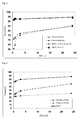
- 0.1 mol of ethanolamine was mixed with 0.1 mol of 4-methoxycarbonyl-2-oxo-1,3-dioxolane ("GE-CA”) and stirred at room temperature. After 0.5 h, 1 h, 3 h and 24 h, the amine number was determined by means of titration and from this the conversion was calculated. This procedure was also carried out with 4-methyl-2-oxo-1,3-dioxolane ("propylene carbonate”) and 4- (hydroxymethyl) -2-oxo-1,3-dioxolane ("glycerol carbonate”). The results are in Fig. 1 graphically and show the high reactivity of 4-methoxycarbonyl-2-oxo-1,3-dioxolane.
- Example 11 was repeated using benzylamine instead of ethanolamine.
- 4-methoxycarbonyl-2-oxo-1,3-dioxolane (“GECA”) was tested at both room temperature and + 5 ° C, while 4-methyl-2-oxo-1,3-dioxolane ("propylene carbonate”) and 4- (hydroxymethyl) -2-oxo-1,3-dioxolane (“glycerol carbonate”) were tested at room temperature only.
- the results are in Fig. 2 graphically reproduced and impressively show the outstanding reactivity of 4-methoxycarbonyl-2-oxo-1,3-dioxolane (even at + 5 ° C).
- Example 13 was repeated using Jeffamine ® D 400th Since the reaction with high molecular weight amines was generally slower than with low molecular weight amines, the 4-methoxycarbonyl-2-oxo-1,3-dioxolane (GECA) was also studied only at room temperature. The results are in Fig. 4 graphically reproduced and show in the present case, the high reactivity of 4-methoxycarbonyl-2-oxo-1,3-dioxolane.
- GECA 4-methoxycarbonyl-2-oxo-1,3-dioxolane
- Example 17 Film formation with 1,3-cyclohexane-bis (methylamine)
Landscapes
- Chemical & Material Sciences (AREA)
- Organic Chemistry (AREA)
- Polyurethanes Or Polyureas (AREA)
- Organic Low-Molecular-Weight Compounds And Preparation Thereof (AREA)
- Preparation Of Compounds By Using Micro-Organisms (AREA)
- Low-Molecular Organic Synthesis Reactions Using Catalysts (AREA)
- Catalysts (AREA)
Abstract
Vorgeschlagen werden neue 2-Oxo-1,3-dioxolan-4-carbonsäureester der Formel
bei denen R 1 vorzugsweise Me oder Et oder ein n-wertiger Rest sein kann, der mit maximal n-1 weiteren 2-Oxo-1,3-dioxolan-4-carboxylgruppen substituiert sein kann, ein Verfahren zu ihrer Herstellung mittels Carboxylierung der entsprechenden Epoxide, ein Verfahren zu ihrer Umesterung sowie ihre Verwendung zur Herstellung von Hydroxyurethanen und als Endgruppen zum Blockieren von Aminen.
Description
- Die vorliegende Erfindung betrifft neue 2-Oxo-1,3-dioxolan-4-carbonsäureester der Formel

- Strukturell ähnliche Verbindungen sind im Stand der Technik bereits bekannt. So beschreibt
WO2004/003001 A1 Verbindungen der allgemeinen Formel (I)
WO2004/003001 die enzymatische Racematentrennung der Enantiomeren vom Typ (I), ohne jedoch eine Synthese für diese Verbindungen anzugeben. -
EP 1941946 A1 beschreibt die Verwendung eines Carbonitrid-Katalysators u.a. zur Herstellung bestimmter disubstituierter organischer Carbonate. Dabei kann es sich auch um Verbindungen der allgemeinen Formel (II) handeln,
- Aus
JP 2006-003433 A 
- In
EP 0001088 A1 werden u.a. 2-Oxo-1,3-dioxolane der allgemeinen Formel (IV) beschrieben, wobei R = H oder CH3 sein kann.
- Polyurethane auf Basis von Polyisocyanaten gehören zum Stand der Technik. Diese werden beispielsweise als Klebstoffe, Dichtstoffe, Vergussmassen, als Korrosionsschutz und für Beschichtungen verwendet. Vorteilhaft sind die hohe Säure-, Laugen-und Chemikalienbeständigkeit der so erhaltenen gehärteten Zusammensetzungen. Allerdings sind monomere niedermolekulare (Poly)Isocyanatverbindungen toxikologisch bedenklich, insbesondere wenn diese leichtflüchtig sind oder migrieren.
- Polyurethan-Systeme können auch ausgehend von cyclischen Carbonatverbindungen erhalten werden, welche toxikologisch unbedenklich sind. So findet Glycerincarbonat (4-(Hydroxymethyl)-2-oxo-1,3-dioxolan) beispielsweise Anwendung in Kosmetika. Cyclische Carbonatverbindungen reagieren mit Aminen zu Hydroxyurethanen.
- Einfache cyclische Carbonate wie z.B. 4-Methyl-2-oxo-1,3-dioxolan oder besagtes 4-(Hydroxymethyl)-2-oxo-1,3-dioxolan sind indessen nicht besonders reaktionsfähig. Es wurden Studien durchgeführt, vergl. H. Tomita, F. Sanda, T. Endo, Journal of Polymer Science: Part A: Polymer Chemistry, Vol. 39, 3678-3685 (2001), wonach die Reaktionsfähigkeit der in 4-Position mit der Gruppe R substituierten 2-Oxo-1,3-dioxolane mit Aminen in der Reihenfolge: R = Me < R = H < R = Ph < R = CH2OPh << R = CF3 ansteigt. Leider sind solche fluorierten Verbindungen schwer zugänglich, teuer und (z.B. im Brandfall) potentiell toxisch. Zudem sind niedermolekulare, monomere 2-Oxo-1,3-dioxolane nicht als Bindemittel geeignet. Vielmehr sind reaktionsfähige funktionelle Gruppen beispielsweise in 4-Position erforderlich um höhermolekulare, multifunktionelle Bindemittel herzustellen, die dann zur Polyurethanbildung mit Aminen umgesetzt werden können. Auch die industrielle Zugänglichkeit dieser 2-Oxo-1,3-dioxolane spielt eine wichtige Rolle.
- Die der vorliegenden Erfindung zu Grunde liegende Aufgabe war es, zumindest einige der Nachteile des vorstehend geschilderten Standes der Technik im Wesentlichen zu vermeiden. Insbesondere sollte ein 2-Oxo-1,3-dioxolan-System zur Verfügung gestellt werden, das unbedenklich, gut zugänglich und mit Aminen hochreaktiv ist und zumindest eine weitere bzw. weitere reaktionsfähige funktionelle Gruppe(n) trägt.
- Diese Aufgabe wurde mit den Merkmalen der unabhängigen Ansprüche gelöst. Die abhängigen Ansprüche beziehen sich auf bevorzugte Ausführungsformen.
- Gegenstand der vorliegenden Erfindung sind 2-Oxo-1,3-dioxolan-4-carbonsäureester der Formel (V),

- In diesen 2-Oxo-1,3-dioxolan-4-carbonsäureestern kann R1 beispielsweise aus geradkettigen oder verzweigten Alkylgruppen, insbesondere Methyl, Ethyl, n-Propyl, iso-Propyl, n-Butyl, sec-Butyl, tert-Butyl, n-Pentyl, neo-Pentyl, n-Hexyl, 2-Ethyl-n-hexyl, sowie aus Cyclohexyl, Phenyl und Benzyl ausgewählt sein.
- Insbesondere handelt es sich bei dem erfindungsgemäßen 2-Oxo-1,3-dioxolan-4-carbonsäureester um 4-Methoxycarbonyl-2-oxo-1,3-dioxolan bzw. 4-Ethoxycarbonyl-2-oxo-1,3-dioxolan.
- Es ist allerdings ebenfalls möglich, dass R1 ein durch Abstraktion der OH -Gruppen eines n-wertigen Polyols abgeleiteter n-wertiger Rest ist, der mit maximal n-1 weiteren 2-Oxo-1,3-dioxolan-4-carboxylatgruppen der allgemeinen Formel (VI)

- In diesen höhermolekularen 2-Oxo-1,3-dioxolan-4-carbonsäureestern kann das n-wertige Polyol beispielsweise C2-4-(Poly)Oxyalkylengruppen umfassen, d.h. von Ethylenoxid, Propylenoxid und/oder Butylenoxid abgeleitete Gruppen mit einer oder mehreren Oxyalkylen-Wiederholungseinheiten. Vorzugsweise ist n = 2 bis 5. Beispiele solcher höhermolekularen, multifunktionellen, als Bindemittel geeigneten Verbindungen werden weiter unten diskutiert.
- Ein weiterer Gegenstand der vorliegenden Erfindung ist in der Herstellung der erfindungsgemäßen, niedermolekularen, monomeren 2-Oxo-1,3-dioxolan-4-carbonsäureester zu sehen. Diese 2-Oxo-1,3-dioxolan-4-carbonsäureester können beispielsweise hergestellt werden, indem die entsprechenden Epoxide der Formel (VII), wobei R1 die angegebene Bedeutung aufweist, mit CO2 umgesetzt werden.

- Epoxide der Formel (VII) sind im Stand der Technik wohlbekannte, kommerziell erhältliche Verbindungen, die beispielsweise mittels Epoxidierung der entsprechenden Acrylsäureester (VIII) hergestellt werden können; für R1 = Me vergl. z.B. Organic Syntheses, Vol. 83, S. 162 (2006):

- Auch alternative Synthesen sind bekannt; für R1 = Et vergl. z.B. Organic Syntheses, Coll. Vol. 10, S. 401 (2004); Vol. 75, S. 37 (1998).
- Die Temperatur der oben erwähnten Umsetzung mit CO2 kann in weiten Bereichen variiert werden. Sie sollte zweckmäßig im Bereich von 15 °C bis 150 °C, vorzugsweise im Bereich von 30 °C bis 100 °C, liegen. Die Umsetzung kann in offenen Apparaturen bei Umgebungsdruck (ca. 1 bar) durchgeführt werden, beispielsweise mittels Durchleitens von gasförmigem CO2 durch eine geeignete Reaktionslösung. Die Umsetzung kann aber auch in geschlossenen Systemen bei erhöhtem Druck erfolgen, beispielsweise bei einem Druck von 1 bar bis 75 bar, vorzugsweise bei einem Druck von 1 bar bis 30 bar.
- Die Umsetzung mit CO2 kann ohne Lösungsmittel erfolgen, da die Ausgangsstoffe und die Produkte in der Regel flüssig sind. Es hat sich jedoch als zweckmäßig erwiesen, die Umsetzung in polaren aprotischen Lösungsmitteln durchzuführen. Eine nicht abschließende Aufzählung geeigneter Lösungsmittel umfasst Tetrabutylmethyleter, Acetonitril, Aceton, Tetrahydrofuran, Dimethylcarbonat, Toluol, Xylol, N-Methyl-2-pyrrolidon, N-Ethyl-2-pyrrolidon sowie Mischungen davon.
- Die Umsetzung mit CO2 kann in der Regel ohne Katalysator durchgeführt werden. Zweckmäßig wird jedoch in Gegenwart eines Katalysators gearbeitet, der aus Metallhalogeniden und Halogensalzen organischer Stickstoffverbindungen sowie Mischungen davon, ausgewählt ist.
- Wie weiter oben festgestellt wurde, sind niedermolekulare, monomere 2-Oxo-1,3-dioxolan-4-carbonsäureester nicht als Bindemittel geeignet. Die COOR1 -Gruppe weist indessen den Vorteil auf, dass sie für weitere Umsetzungen zur Verfügung steht. So können höhermolekulare, multifunktionelle Vertreter der erfindungsgemäßen Verbindung der allgemeinen Formel (V) mittels Umesterung hergestellt werden. Demgemäß ist ein Verfahren zur Herstellung dieser höhermolekularen, multifunktionellen Ester als ein weiterer Gegenstand der vorliegenden Erfindung zu werten, wobei ein niedermolekularer, monomerer 2-Oxo-1,3-dioxolan-4-carbonsäureester der allgemeinen Formel (V) mit einem n-wertigen Polyol umgeestert wird.
- In dem besagten Verfahren wird die Umesterung in Gegenwart eines enzymatischen Katalysators oder eines sauren Kationenaustauschers durchgeführt. Eine der Schwierigkeiten, die mit dieser Umesterungsreaktion verbunden war, bestand darin, Katalysatoren zu finden, die zwar die Umesterung an der -COOR1 -Gruppe katalysieren, nicht aber zu Angriffen auf die -O-COO- Gruppe führen. Die oben angegebenen Katalysatoren umgehen diese Schwierigkeiten. Als besonders geeignet haben sich Novozym® 435 der Fa. Novozymes A/S, eine immobilisierte Lipase, und die H+-Form von Amberlite® 200 der Fa. Rohm & Haas Company, d.h. eines stark sauren Kationenaustauschers, erwiesen.
- Das Polyol und der niedermolekulare 2-Oxo-1,3-dioxolan-4-carbonsäureester werden vorzugsweise in stöchiometrischen Anteilen eingesetzt, wobei der Umsatz der Umesterung vorzugsweise über 80 %, bezogen auf den eingesetzten niedermolekularen 2-Oxo-1,3-dioxolan-4-carbonsäureester, liegen sollte. Die Reaktionstemperatur liegt im Bereich von 50 bis 100 °C, wobei Novozym® 435 bei etwa 50 bis 80 °C und Amberlite® 200 bei ca. 100 °C eingesetzt werden sollte. Die Umesterung mit Novozym® 435 kann zweckmäßig ohne Lösungsmittel durchgeführt werden, die Umesterung mit Amberlite® 200 wird zweckmäßig in einem geeigneten Lösungsmittel durchgeführt. Die Reaktion wird zweckmäßig solange durchgeführt, bis im Wesentlichen die berechnete Menge an R1-OH abdestilliert ist.
- Geeignete Polyole sind beispielsweise Diole, insbesondere Glykole, Triole und Tetraole wie z.B. 1,4-Butandiol, Neopentylglykol (2,2-Dimethylolpropan), 1,1,1-Trimethylolpropan, Pentaerythrit und Tetramethylolmethan. Die besagten Polyole können auch mit C2-4-Alkylenoxiden, insbesondere Ethylenoxid und Propylenoxid, modifiziert sein. Allgemein sind alle Polyole einsetzbar, die auch für die Herstellung herkömmlicher Polyurethane verwendbar sind.
- Alternativ ist es möglich, niedermolekulare Acrylsäureester zunächst mit den besagten Polyolen umzuestern, anschließend zu epoxidieren und dann mit CO2 zu carboxylieren. Man erhält so Verbindungen, die ebenfalls unter die allgemeine Formel (V) fallen.
- Ein weiterer Gegenstand der Erfindung ist die Verwendung der 2-Oxo-1,3-dioxolan-4-carbonsäureester zur Herstellung von Hydroxyurethanen. Die erfindungsgemäßen cyclischen Carbonatverbindungen reagieren mit Aminen zu Hydroxyurethanen.
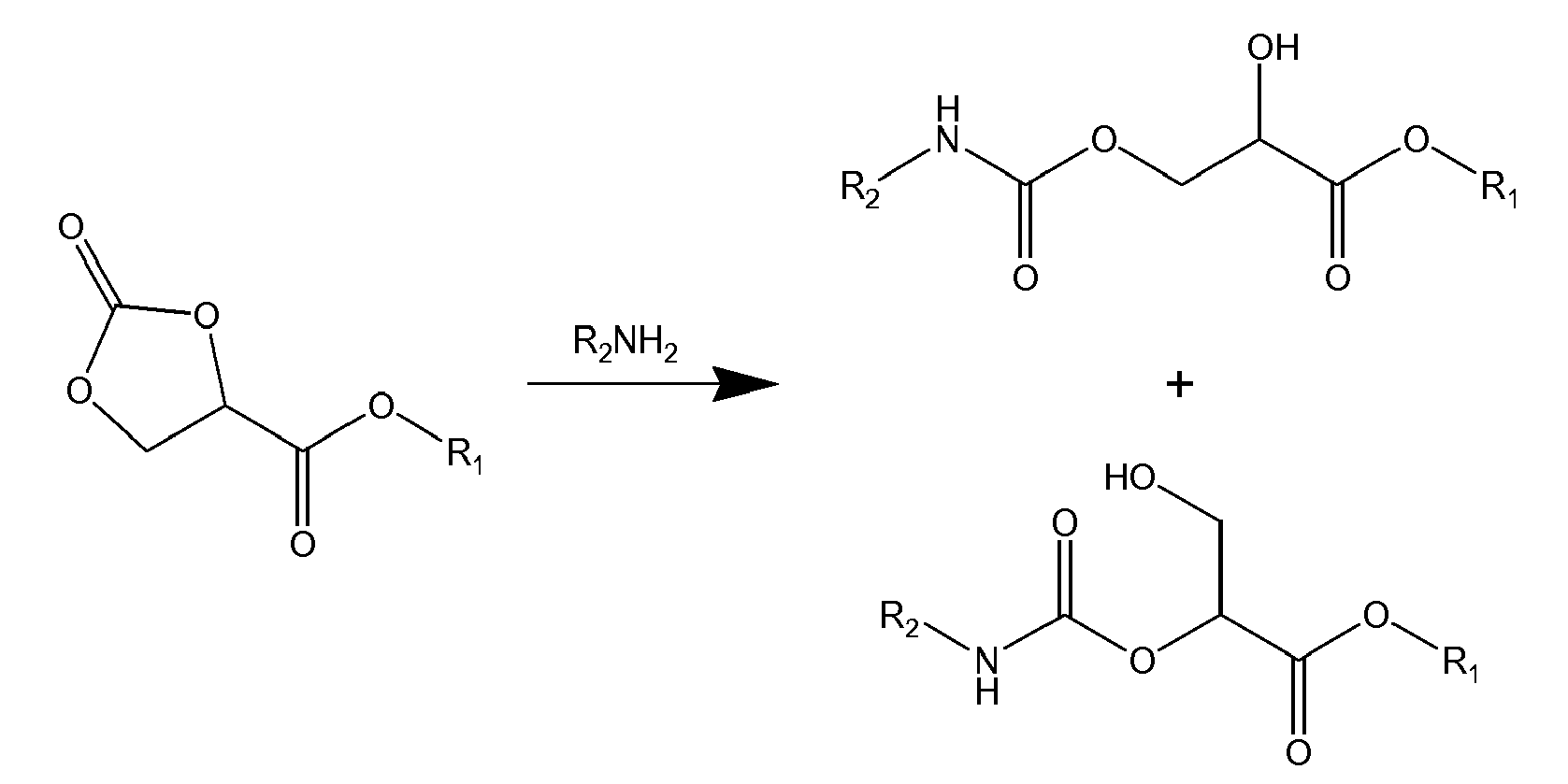
- Hierbei sind grundsätzlich zwei unterschiedliche Hydroxyurethane möglich, nämlich Hydroxyurethane mit primären bzw. sekundären Hydroxylgruppen. Es hat sich indessen gezeigt, dass die elektronenziehende COOR1 -Gruppe die Reaktion im Wesentlichen in Richtung der Hydroxyurethane mit sekundären Hydroxylgruppen lenkt, da beim Angriff des nucleophilen Stickstoffatoms die negative Ladung am Sauerstoffatom, das der COOR1 -Gruppe näher liegt, besser stabilisiert wird. Hydroxyurethane mit sekundären Hydroxylgruppen weisen den zusätzlichen Vorteil auf, dass die Rückreaktion erschwert ist. Theoretisch denkbar wäre auch ein Angriff des Amins an der Estergruppe; es konnte aber analytisch gezeigt werden, dass das Amin im Wesentlichen nur die 2-Oxo-1,3-dioxolangruppe angreift.
- Als Amine kommen primäre und sekundäre Amine mit Alkylgruppen, Arylgruppen, Aralkylgruppen sowie Alkarylgruppen als Reste in Frage. Primäre Amine reagieren schneller als sekundäre Amine; aliphatische Amine reagieren schneller als aromatische Amine. Hinsichtlich der relativen Reaktivitäten verschiedener Amine vergleiche C. Diakoumakos, D. Kotzev, Non-Isocyanate-Based Polyurethanes Derived upon the Reaction of Amines with Cyclocarbonate Resins, Macromol. Symp., 216, 37-46 (2004), insbesondere Schema 4 auf S. 45. Alle dort genannten Amine eignen sich auch zur Durchführung der vorliegenden Erfindung. Auch höhermolekulare Amine wie z.B. Jeffamine® der Fa. Huntsman Corp. und Polyetheramine der BASF SE kommen in Frage.
- Wie weiter unten anhand von Beispielen gezeigt wird, sind die erfindungsgemäßen 2-Oxo-1,3-dioxolan-4-carbonsäureester gegenüber Aminen wesentlich reaktiver als beispielsweise die vergleichbaren Verbindungen Glycerincarbonat (4-(Hydroxymethyl)-2-oxo-1,3-dioxolan) und Propylencarbonat (4-Methyl-2-oxo-1,3-dioxolan). Dies gilt sowohl für die niedermolekularen als auch für die höhermolekularen Vertreter. Die Reaktivität des erfindungsgemäßen 4-Methoxycarbonyl-2-Oxo-1,3-dioxolans gegenüber Aminen dürfte in der Größenordnung des in "H. Tomita, F. Sanda, T. Endo, Journal of Polymer Science: Part A: Polymer Chemistry, Vol. 39, 3678-3685 (2001)" untersuchten 4-Trifluormethyl-2-oxo-1,3-dioxolans liegen, ohne jedoch die oben beschriebenen Nachteile der CF3 -Gruppe aufzuweisen.
- Ein zusätzlicher Vorteil von Poly-Hydroxyurethansystemen liegt in der höheren Hydrophilie dieser Systeme, was auf die enthaltenen OH -Gruppen zurückzuführen ist. Diese OH -Gruppen stehen prinzipiell auch zur Vernetzung mit Polyisocyanaten zur Verfügung, wobei die erfindungsgemäß möglichen, isocyanatfreien Systeme aufgrund ihrer geringeren Toxizität indessen bevorzugt werden.
- Außerdem kann es bei der Erzeugung von Poly-Hydroxyurethansystemen, die auf 2-Oxo-1,3-dioxolanen beruhen, auch bei der Anwesenheit von Feuchtigkeit nicht zur Blasenbildung durch entstehendes CO2 kommen. Dadurch werden weitgehend poren-und blasenfreie Beschichtungen möglich, was bei klassischen Polyurethansystemen mitunter problematisch ist. Des Weiteren ist auch die thermische Stabilität solcher Poly-Hydroxyurethansysteme höher als die Stabilität klassischer Polyurethansysteme.
- Zudem können die niedermolekularen 2-Oxo-1,3-dioxolan-4-carbonsäureester dazu verwendet werden, als Endgruppen (sog. "end caps") Amine zu blockieren, was einen weiteren Gegenstand der vorliegenden Erfindung darstellt. Dies ist auch im Hinblick auf herkömmliche, aminvernetzte Polyurethan-Systeme von Interesse, da ein Aminüberschuss zu Verfärbungen führen kann, während ein Isocyanatüberschuss toxikologisch bedenklich ist.
- Die vorliegende Erfindung wird nun anhand der nachfolgenden Beispiele unter Bezug auf die beigefügten Zeichnungen näher erläutert. Hierbei zeigen:
- Fig. 1
- den zeitlichen Verlauf der Umsetzung verschiedener 2-Oxo-1,3-dioxolane mit Ethanolamin,
- Fig. 2
- den zeitlichen Verlauf der Umsetzung verschiedener 2-Oxo-1,3-dioxolane mit Benzylamin,
- Fig. 3
- den zeitlichen Verlauf der Umsetzung verschiedener 2-Oxo-1,3-dioxolane mit Isophorondiamin,
- Fig. 4
- den zeitlichen Verlauf der Umsetzung verschiedener 2-Oxo-1,3-dioxolane mit Jeffamin® D 400,
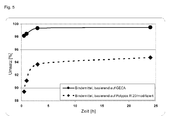
- Fig. 5
- den zeitlichen Verlauf der Umsetzung verschiedener auf 2-Oxo-1,3-dioxolanen basierenden Bindemittel mit n-Butylamin.
-

- In einem 1000 ml Dreihalskolben wurden 80 g Natriumcarbonat in 200 ml destilliertem Wasser gelöst. Die Lösung wurde auf 10 °C abgekühlt. Anschließend wurden 58,5 g Methylacrylat zugegeben und nach ca. 10 Minuten ebenfalls bei 10 °C 400 ml einer 7 %-igen wässrigen Natriumhypochloritlösung eingerührt. Daraufhin wurde sofort intensiv mit CO2 gespült. Man ließ die Temperatur auf Raumtemperatur steigen. Der Kolben wurde noch 1 h bei ca. 25 bis 30 °C intensiv mit CO2 gespült, wobei die Temperatur durch gelegentliches Kühlen mit einem Eisbad im angegebenen Bereich gehalten wurde. Der entstandene weiße Feststoff wurde über eine Nutsche abfiltriert. Das Filtrat wurde mit 4 x 90 ml Dichlormethan extrahiert. Die vereinigte organische Phase wurde mit Natriumsulfat getrocknet und abfiltriert. Das Filtrat wurde am Rotationsverdampfer abrotiert. Es wurde Epoxypropionsäuremethylester in 50 bis 60 %-iger Ausbeute und einer Reinheit von 97% erhalten.
- 20 g des Epoxypropionsäuremethylesters wurden mit 20 g tert-Butyl-methylether und 1 g Tetrabutylammoniumbromid gemischt. Die homogene Mischung wurde in einen 100 ml Druckreaktor überführt und 4 Tage bei 40 °C und 20 bar CO2-Druck carboxyliert. Nach der Carboxylierung wurde ein Zweiphasensystem erhalten; die obere Phase bestand aus tert-Butyl-methylether, die untere Phase aus 4-Methoxycarbonyl-2-oxo-1,3-dioxolan (Reinheit 94 % (GC), Ausbeute 94 %).
- Das Produkt wurde wie folgt charakterisiert: 1H NMR (500 MHz, CDCl3) 6: 3,82 (3H, s, CH3), 4,50 (1H, dd, J = 5,5, 9,0, CH2), 4,66 (1H, dd, J = 9,0, 9.0, CH2), 5,09 (1H, dd, J = 9,0, 5,5, CH); 13C NMR (125 MHz, CDCl3) 6: 53,81 (CH3), 67,00 (CH2), 72,34 (CH), 153,97 (-O-CO-O-), 167,42 (-CO-O-); IR (neat): 1812 cm-1, (-O-CO-O-), 1742 cm-1 (-CO-O-).
-

- 940 ml einer 7 %-igen wässrigen Natriumhypochloritlösung wurden in einem 2000 ml Dreihalskolben vorgelegt. Die Lösung wurde mit Hilfe eines Eis-Salz-Wasserbades auf 0 °C abgekühlt. Anschließend wurden 58,5 g Methylacrylat zugegeben und 30 Minuten bei 0 °C gehalten. Danach wurde die Kältemischung entfernt und ca. 1,5 h weitergerührt, so dass sich die Mischung von selbst erwärmte (65 - 70 °C). Es entstand eine farblose, trübe Lösung. Danach wurde die Lösung auf Raumtemperatur abgekühlt und mit 4 x 150 ml Dichlormethan extrahiert. Die vereinigte organische Phase wurde mit Magnesiumsulfat getrocknet und abfiltriert. Das Filtrat wurde am Rotationsverdampfer abrotiert. Es wurde Epoxypropionsäuremethylester in 70 bis 80 %-iger Ausbeute und einer Reinheit von 97% erhalten. Die weitere Umsetzung zum 4-Methoxycarbonyl-2-oxo-1,3-dioxolan verlief wie in Beispiel 1 beschrieben.
-

- 20 g Epoxypropionsäuremethylester wurden mit 20 g Acetonitril, 1,5 g Benzyltrimethylamoniumchlorid und 1,5 g ZnBr2 gemischt. Die homogene Mischung wurde in einen 100 ml Druckreaktor überführt und 6 Tage bei 25 °C und 30 bar CO2-Druck carboxyliert. Nach der Carboxylierung wurde mit 100 g Acetonitril verdünnt. Die die Mischung wurde mit Aluminiumoxid und Aktivkohle gereinigt. Danach wurde das Acetonitril abdestilliert. Man erhielt 4-Methoxycarbonyl-2-oxo-1,3-dioxolan (Reinheit 72 % (GC), Ausbeute 65 %).
-

- 20 g Epoxypropionsäuremethylester wurden mit 20 g tert-Butyl-methylether, 1,5 g Tetrabutylammoniumbromid und 1,5 g Kaliumiodid gemischt. Die homogene Mischung wurde in einen 100 ml Druckreaktor überführt und 6 Tage bei 50 °C und 30 bar CO2-Druck carboxyliert. Nach der Carboxylierung wurde ein Zweiphasensystem erhalten; die obere Phase bestand aus tert-Butyl-methylether, die untere Phase aus 4-Methoxycarbonyl-2-oxo-1,3-dioxolan (Reinheit 83 % (GC), Ausbeute 79 %).
-

- 0,2 mol 4-Methoxycarbonyl-2-oxo-1,3-dioxolan ("GECA") wurden mit 0,1 mol Neopentylglykol (Sigma-Aldrich) gemischt. Dazu wurden 5 Gew.-% (bezogen auf GECA) Novozym® 435 (Novozymes A/S) gegeben. Die Mischung wurde gerührt und auf 55 bis 60 °C erhitzt. Nach 72 h waren 0,2 mol Methanol abdestilliert und die Reaktion war beendet.
-

- 0,2 mol 4-Methoxycarbonyl-2-oxo-1,3-dioxolan ("GECA") wurden mit 0,1 mol 1,4-Butandiol (Sigma-Aldrich) gemischt. Dazu wurden 5 Gew.-% (bezogen auf GECA) Novozym® 435 (Novozymes A/S) gegeben. Die Mischung wurde gerührt und auf 55 bis 60 °C erhitzt. Nach 72 h waren 0,2 mol Methanol abdestilliert und die Reaktion war beendet.
-

- 0,3 mol 4-Methoxycarbonyl-2-oxo-1,3-dioxolan ("GECA") wurden mit 0,1 mol 1,1,1-Trimetylolpropan (Sigma-Aldrich) gemischt. Dazu wurden 5 Gew.-% (bezogen auf GECA) Novozym® 435 (Novozymes A/S) gegeben. Die Mischung wurde gerührt und auf 55 bis 60 °C erhitzt. Nach 72 h waren 0,3 mol Methanol abdestilliert und die Reaktion war beendet.
-

- 0,3 mol 4-Methoxycarbonyl-2-oxo-1,3-dioxolan ("GECA") wurden mit 0,1 mol 1,1,1-Trimethylolpropan-propoxylat (Sigma-Aldrich, mittleres Molekulargewicht (Mn) ca. 308) gemischt. Dazu wurden 5 Gew.-% (bezogen auf GECA) Novozym® 435 (Novozymes A/S) gegeben. Die Mischung wurde gerührt und auf 55 bis 60 °C erhitzt. Nach 72 h waren 0,3 mol Methanol abdestilliert und die Reaktion war beendet.
-

- 0,2 mol 4-Methoxycarbonyl-2-oxo-1,3-dioxolan ("GECA") wurden mit 0,1 mol Neopentylglykol (Sigma-Aldrich) und 200ml Cyclohexan gemischt. Dazu wurden 5 Gew.-% (bezogen auf GECA) Amberlite® 200 (Fluka) zugegeben. Die Mischung wurde am Wasserabscheider bei 100°C gerührt. Nach 5 Stunden waren 0,2 mol Methanol abgeschieden und die Reaktion war beendet.
-
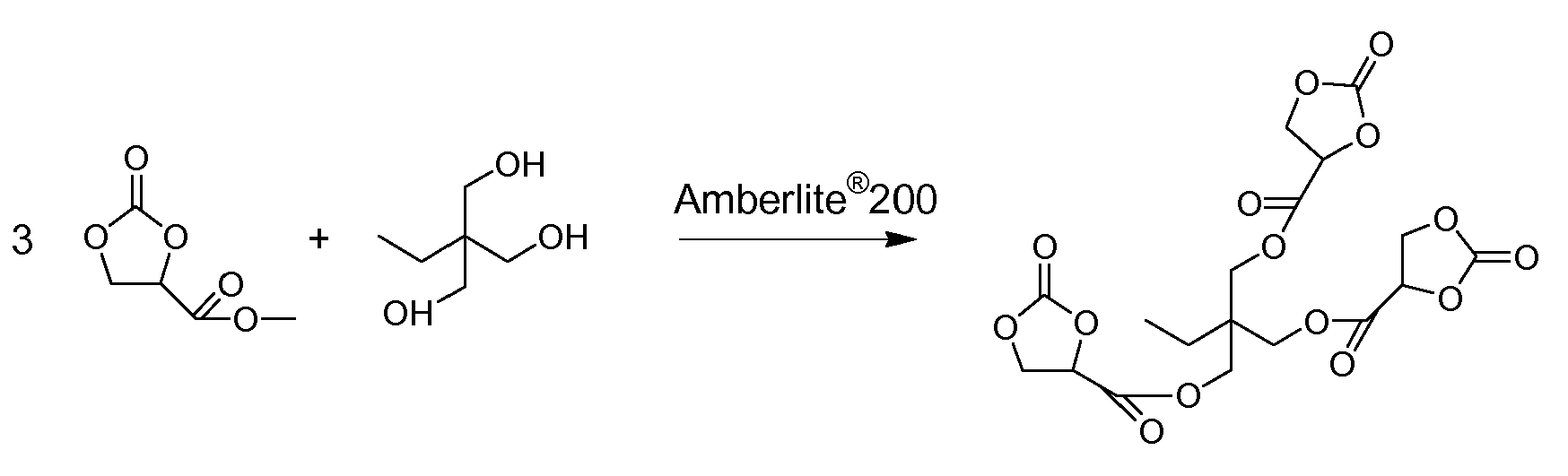
- 0,3 mol 4-Methoxycarbonyl-2-oxo-1,3-dioxolan ("GECA") wurden mit 0,1 mol 1,1,1-Trimetylolpropan (Sigma-Aldrich) gemischt. Dazu wurden 5 Gew.-% (bezogen auf GECA) Amberlite® 200 (Fluka) zugegeben. Die Mischung wurde am Wasserabscheider bei 100°C gerührt. Nach 5 Stunden waren 0,3 mol Methanol abgeschieden und die Reaktion war beendet.
- 0,1 mol Ethanolamin wurden mit 0,1 mol 4-Methoxycarbonyl-2-oxo-1,3-dioxolan ("GE-CA") gemischt und bei Raumtemperatur gerührt. Nach 0,5 h, 1 h, 3 h und 24 h wurde die Aminzahl mittels Titration bestimmt und daraus der Umsatz berechnet. Diese Prozedur wurde auch mit 4-Methl-2-oxo-1,3-dioxolan ("Propylencarbonat") und 4-(Hydroxymethyl)-2-oxo-1,3-dioxolan ("Glycerincarbonat") durchgeführt. Die Ergebnisse sind in
Fig. 1 graphisch wiedergegeben und zeigen die hohe Reaktivität des 4-Methoxycarbonyl-2-oxo-1,3-dioxolans. - Beispiel 11 wurde unter Verwendung von Benzylamin statt Ethanolamin wiederholt. 4-Methoxycarbonyl-2-oxo-1,3-dioxolan ("GECA") wurde sowohl bei Raumtemperatur als auch bei +5 °C untersucht, während 4-Methl-2-oxo-1,3-dioxolan ("Propylencarbonat") und 4-(Hydroxymethyl)-2-oxo-1,3-dioxolan ("Glycerincarbonat") lediglich bei Raumtemperatur getestet wurden. Die Ergebnisse sind in
Fig. 2 graphisch wiedergegeben und zeigen eindrucksvoll die überragende Reaktivität des 4-Methoxycarbonyl-2-oxo-1,3-dioxolans (selbst bei + 5 °C). - 0,1 mol Isophorondiamin wurde mit 0,2 mol 4-Methoxycarbonyl-2-oxo-1,3-dioxolan ("GECA") gemischt und bei Raumtemperatur gerührt. Nach 0,5h, 1 h, 3h und 24h wurde die Aminzahl mittels Titration bestimmt und daraus der Umsatz berechnet. Diese Prozedur wurde auch mit 4-Methoxycarbonyl-2-oxo-1,3-dioxolan ("GECA") bei +5 °C und mit 4-Methl-2-oxo-1,3-dioxolan ("Propylencarbonat") und 4-(Hydroxymethyl)-2-oxo-1,3-dioxolan ("Glycerincarbonat") bei Raumtemperatur durchgeführt. Die Ergebnisse sind in
Fig. 3 graphisch wiedergegeben und zeigen eindrucksvoll die hervorragende Reaktivität des 4-Methoxycarbonyl-2-oxo-1,3-dioxolans (selbst bei + 5 °C). - Beispiel 13 wurde unter Verwendung von Jeffamin® D 400 wiederholt. Da die Reaktion mit hochmolekularen Aminen allgemein langsamer als mit niedermolekularen Aminen verlief, wurde auch das 4-Methoxycarbonyl-2-oxo-1,3-dioxolan (GECA) nur bei Raumtemperatur untersucht. Die Ergebnisse sind in
Fig. 4 graphisch wiedergegeben und zeigen auch im vorliegenden Fall die hohe Reaktivität des 4-Methoxycarbonyl-2-oxo-1,3-dioxolans. - 0,1 mol des Bindemittels 3 aus Beispiel 7 bzw. 10

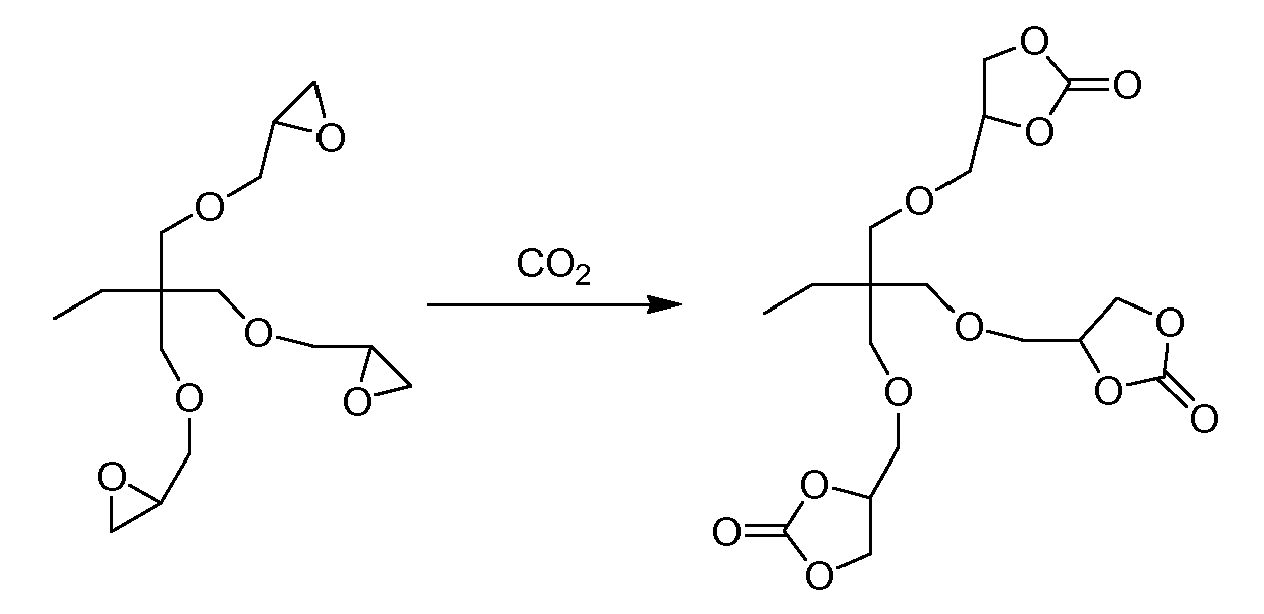
Fig. 5 graphisch wiedergegeben und zeigen die hervorragende Reaktivität unseres Bindemittels. - 0,000666 mol des Bindemittels 3 aus Beispiel 7 bzw. 10 wurden mit 0,001 mol Isophorondiamin gemischt (Bindemittel im Überschuss). Die beiden Komponenten wurden per Hand 20 Sekunden zusammengerührt, danach wurde ein 300 µm dicker Film aufgezogen (Topfzeit 2 min, klebfrei nach 6 Stunden).
- 0,000666 mol des Bindemittels 3 aus Beispiel 7 bzw. 10 wurden mit 0,001 mol 1,3-Cyclohexan-bis(methylamin) gemischt (Bindemittel im Überschuss). Die beiden Komponenten wurden per Hand 20 Sekunden zusammengerührt, danach wurde ein 300 µm dicker Film aufgezogen (Topfzeit 2 min, klebfrei nach 7 Stunden)
Claims (14)
- 2-Oxo-1,3-dioxolan-4-carbonsäureester der Formel (V),

R1 aus geradkettigen oder verzweigten aliphatischen Gruppen, Arylgruppen, Aralkylgruppen sowie Alkarylgruppen ausgewählt ist. - 2-Oxo-1,3-dioxolan-4-carbonsäureester nach Anspruch 1, dadurch gekennzeichnet, dass R1 aus geradkettigen oder verzweigten Alkylgruppen, insbesondere Methyl, Ethyl, n-Propyl, iso-Propyl, n-Butyl, sec-Butyl, tert-Butyl, n-Pentyl, neo-Pentyl, n-Hexyl, 2-Ethyl-n-hexyl, sowie aus Cyclohexyl, Phenyl und Benzyl ausgewählt ist.
- 2-Oxo-1,3-dioxolan-4-carbonsäureester nach Anspruch 1 oder 2, ausgewählt aus 4-Methoxycarbonyl-2-oxo-1,3-dioxolan und 4-Ethoxycarbonyl-2-oxo-1,3-dioxolan.
- 2-Oxo-1,3-dioxolan-4-carbonsäureester nach Anspruch 1, dadurch gekennzeichnet, dass R1 ein durch Abstraktion der OH -Gruppen eines n-wertigen Polyols abgeleiteter n-wertiger Rest ist, der mit maximal n-1 weiteren 2-Oxo-1,3-dioxolan-4-carboxylatgruppen der allgemeinen Formel (VI)
- 2-Oxo-1,3-dioxolan-4-carbonsäureester nach Anspruch 4, dadurch gekennzeichnet, dass das n-wertige Polyol C2-4-(Poly)Oxyalkylengruppen umfasst.
- 2-Oxo-1,3-dioxolan-4-carbonsäureester nach Anspruch 4 oder 5, dadurch gekennzeichnet, dass n = 2 bis 5 ist.
- Verfahren zur Herstellung der 2-Oxo-1,3-dioxolan-4-carbonsäureester nach einem der Ansprüche 1 bis 3, dadurch gekennzeichnet, dass ein Epoxid der Formel (VII),

- Verfahren nach Anspruch 7, dadurch gekennzeichnet, dass die Umsetzung bei einer Temperatur von 15 °C bis 150 °C, vorzugsweise von 30 °C bis 100 °C, und einem Druck von 1 bar bis 75 bar, vorzugsweise von 1 bar bis 30 bar, durchgeführt wird.
- Verfahren nach Anspruch 7 oder 8, dadurch gekennzeichnet, dass die Umsetzung ohne Lösungsmittel oder in einem polaren aprotischen Lösungsmittel durchgeführt wird.
- Verfahren nach einem der Ansprüche 7 bis 9, dadurch gekennzeichnet, dass die Umsetzung in Gegenwart eines Katalysators, ausgewählt aus Metallhalogeniden und Halogensalzen organischer Stickstoffverbindungen sowie Mischungen davon, durchgeführt wird.
- Verfahren zur Herstellung der 2-Oxo-1,3-dioxolan-4-carbonsäureester nach einem der Ansprüche 4 bis 6, dadurch gekennzeichnet, dass ein 2-Oxo-1,3-dioxolan-4-carbonsäureester nach Anspruch 2 oder 3 mit einem n-wertigen Polyol gemäß der Definition eines der Ansprüche 4 bis 6 umgeestert wird.
- Verfahren nach Anspruch 11, dadurch gekennzeichnet, dass die Umesterung in Gegenwart eines enzymatischen Katalysators oder eines sauren Kationenaustauschers durchgeführt wird.
- Verwendung der 2-Oxo-1,3-dioxolan-4-carbonsäureester nach einem der Ansprüche 1 bis 6 zur Herstellung von Hydroxyurethanen.
- Verwendung der 2-Oxo-1,3-dioxolan-4-carbonsäureester nach einem der Ansprüche 1 bis 3 als Endgruppen zum Blockieren von Aminen.
Priority Applications (10)
| Application Number | Priority Date | Filing Date | Title |
|---|---|---|---|
| EP10166244A EP2397474A1 (de) | 2010-06-17 | 2010-06-17 | 2-Oxo-1,3-dioxolan-4-carbonsäureester, ihre Herstellung und Verwendung |
| CN201180029736.6A CN102947286B (zh) | 2010-06-17 | 2011-05-31 | 2-氧代-1,3-二氧戊环-4-羧酸酯、其制备和用途 |
| BR112012032260-5A BR112012032260B1 (pt) | 2010-06-17 | 2011-05-31 | Ésteres do ácido 2-oxo-1,3-dioxolano-4-carboxílico, processos para a preparação de um éster do ácido 2-oxo-1,3-dioxolano-4-carboxílico e uso de um éster do ácido 2-oxo-1,3-dioxolano-4-carboxílico |
| EP11723932.7A EP2582687B1 (de) | 2010-06-17 | 2011-05-31 | 2-Oxo-1,3-dioxolan-4-carbonsäure und ihre Derivate, ihre Herstellung und Verwendung |
| RU2013101974/04A RU2576621C2 (ru) | 2010-06-17 | 2011-05-31 | 2-оксо-1, 3-диоксолан-4-карбоновая кислота и ее производные, их получение и применение |
| PCT/EP2011/058945 WO2011157551A1 (en) | 2010-06-17 | 2011-05-31 | 2-oxo-1,3-dioxolane-4-carboxylic acid and derivatives thereof, their preparation and use |
| JP2013514624A JP5797750B2 (ja) | 2010-06-17 | 2011-05-31 | 2−オキソ−1,3−ジオキソラン−4−カルボン酸エステル、その製造及び使用 |
| AU2011267271A AU2011267271B2 (en) | 2010-06-17 | 2011-05-31 | 2-Oxo-1,3-dioxolane-4-carboxylic acid esters, their preparation and use |
| ES11723932.7T ES2525888T3 (es) | 2010-06-17 | 2011-05-31 | Ácido 2-oxo-1,3-dioxolano-4-carboxílico y derivados del mismo, su preparación y uso |
| CA2802266A CA2802266C (en) | 2010-06-17 | 2011-05-31 | 2-oxo-1,3-dioxolane-4-carboxylic acid and derivatives thereof, their preparation and use |
Applications Claiming Priority (1)
| Application Number | Priority Date | Filing Date | Title |
|---|---|---|---|
| EP10166244A EP2397474A1 (de) | 2010-06-17 | 2010-06-17 | 2-Oxo-1,3-dioxolan-4-carbonsäureester, ihre Herstellung und Verwendung |
Publications (1)
| Publication Number | Publication Date |
|---|---|
| EP2397474A1 true EP2397474A1 (de) | 2011-12-21 |
Family
ID=43003391
Family Applications (2)
| Application Number | Title | Priority Date | Filing Date |
|---|---|---|---|
| EP10166244A Withdrawn EP2397474A1 (de) | 2010-06-17 | 2010-06-17 | 2-Oxo-1,3-dioxolan-4-carbonsäureester, ihre Herstellung und Verwendung |
| EP11723932.7A Active EP2582687B1 (de) | 2010-06-17 | 2011-05-31 | 2-Oxo-1,3-dioxolan-4-carbonsäure und ihre Derivate, ihre Herstellung und Verwendung |
Family Applications After (1)
| Application Number | Title | Priority Date | Filing Date |
|---|---|---|---|
| EP11723932.7A Active EP2582687B1 (de) | 2010-06-17 | 2011-05-31 | 2-Oxo-1,3-dioxolan-4-carbonsäure und ihre Derivate, ihre Herstellung und Verwendung |
Country Status (9)
| Country | Link |
|---|---|
| EP (2) | EP2397474A1 (de) |
| JP (1) | JP5797750B2 (de) |
| CN (1) | CN102947286B (de) |
| AU (1) | AU2011267271B2 (de) |
| BR (1) | BR112012032260B1 (de) |
| CA (1) | CA2802266C (de) |
| ES (1) | ES2525888T3 (de) |
| RU (1) | RU2576621C2 (de) |
| WO (1) | WO2011157551A1 (de) |
Cited By (6)
| Publication number | Priority date | Publication date | Assignee | Title |
|---|---|---|---|---|
| WO2013092011A1 (en) | 2011-12-22 | 2013-06-27 | Construction Research & Technology Gmbh | 2-oxo-1,3-dioxolane-4-carboxamides, their preparation and use |
| EP2762471A1 (de) | 2013-01-31 | 2014-08-06 | Construction Research & Technology GmbH | 2-oxo-1,3-dioxolan-4-carboxamidbausteine, ihre Herstellung und Verwendung |
| EP2818465A1 (de) | 2013-06-26 | 2014-12-31 | Construction Research & Technology GmbH | 2-Oxo-1,3-dioxolan-4-acylhalogenide, ihre Herstellung und Verwendung |
| US9079871B2 (en) | 2011-12-29 | 2015-07-14 | Basf Se | Preparing cyclocarbonate-functionalized compounds |
| US10059685B2 (en) | 2014-03-07 | 2018-08-28 | Construction Research & Technology, Gmbh | 2-hydroxyethyl 2-oxo-1,3-dioxolane-4-carboxylates, their preparation and use |
| US10899866B2 (en) | 2015-08-10 | 2021-01-26 | Construction Research & Technology Gmbh | Process for producing a ring-opening polymerization product |
Families Citing this family (12)
| Publication number | Priority date | Publication date | Assignee | Title |
|---|---|---|---|---|
| US9150709B2 (en) | 2011-10-04 | 2015-10-06 | Basf Se | Epoxy resin compositions comprising a 2-oxo-[1,3] dioxolane derivative |
| US8614342B2 (en) | 2012-01-31 | 2013-12-24 | Basf Se | Process for preparing epoxycarboxylic esters |
| JP6224529B2 (ja) * | 2014-06-04 | 2017-11-01 | 大日精化工業株式会社 | ポリヒドロキシウレタンの製造方法 |
| EP2998331A1 (de) | 2014-09-17 | 2016-03-23 | Construction Research & Technology GmbH | Härtbares organisches Polymer mit mindestens einer Acylureaeinheit, dessen Herstellung und Verwendung |
| US10219515B2 (en) | 2014-11-07 | 2019-03-05 | Basf Se | Agrochemical adjuvant containing 2-oxo-1,3-dioxolan-4 carboxylates |
| US9656943B2 (en) | 2015-10-20 | 2017-05-23 | Chang Chun Plastics Co. Ltd. | Process for producing dimethyl carbonate |
| US10131620B2 (en) | 2015-10-20 | 2018-11-20 | Chang Chun Plastics Co., Ltd. | Process for producing dimethyl carbonate |
| MX373201B (es) * | 2015-11-16 | 2020-05-04 | Firmenich & Cie | Neutralizador de olor para amoniaco y aminas primarias o secundarias. |
| US11613681B2 (en) | 2016-06-03 | 2023-03-28 | Basf Se | Use of compounds having n 2-oxo-1,3-dioxolane-4-carboxamide units in two-component adhesives |
| ES2773783T3 (es) | 2017-05-11 | 2020-07-14 | Henkel Ag & Co Kgaa | Método para producir poliésteres funcionalizados |
| FR3088326B1 (fr) | 2018-11-09 | 2021-12-03 | Bostik Sa | Hydroxysilanes fonctionnalises, polyurethanes silyles, et compositions les comprenant |
| PT3670618T (pt) | 2018-12-20 | 2023-06-15 | Henkel Ag & Co Kgaa | Método de produção de poliésteres funcionalizados |
Citations (5)
| Publication number | Priority date | Publication date | Assignee | Title |
|---|---|---|---|---|
| EP0001088A1 (de) | 1977-09-05 | 1979-03-21 | BASF Aktiengesellschaft | Carbonatgruppen enthaltende Polymerisate |
| JPH07285960A (ja) * | 1994-04-19 | 1995-10-31 | Mitsubishi Chem Corp | ジオキソラン含有溶剤 |
| WO2004003001A1 (en) | 2002-06-28 | 2004-01-08 | Altus Biologics Inc. | Process for the enzymatic resolution of 1,3-dioxolane-4-carboxylates |
| JP2006003433A (ja) | 2004-06-15 | 2006-01-05 | Sekisui Chem Co Ltd | 液晶表示素子用シール剤、上下導通材料及び液晶表示素子 |
| EP1941946A1 (de) | 2007-01-04 | 2008-07-09 | Max-Planck-Gesellschaft zur Förderung der Wissenschaften e.V. | Carbonitride als Katalysatoren |
Family Cites Families (5)
| Publication number | Priority date | Publication date | Assignee | Title |
|---|---|---|---|---|
| GB9112419D0 (en) * | 1991-06-10 | 1991-07-31 | Shell Int Research | Process for polymer preparation |
| EP0661355B2 (de) * | 1993-12-21 | 2006-01-25 | Basf Corporation | Zyklisches Karbonat-härtbare Beschichtungszusammensetzung |
| DE10118109A1 (de) * | 2001-04-11 | 2002-10-17 | Cognis Deutschland Gmbh | Alkyl- und/oder Alkenylglycerincarbamate |
| KR20060013632A (ko) * | 2002-05-17 | 2006-02-13 | 오쎄라 파마슈티걸즈, 인크. | 백내장 및 다른 안질환 발병의 개선 |
| JP2006009001A (ja) * | 2004-05-26 | 2006-01-12 | Japan Paint Manufacturers Association | ポリヒドロキシウレタンの製造方法 |
-
2010
- 2010-06-17 EP EP10166244A patent/EP2397474A1/de not_active Withdrawn
-
2011
- 2011-05-31 CA CA2802266A patent/CA2802266C/en active Active
- 2011-05-31 ES ES11723932.7T patent/ES2525888T3/es active Active
- 2011-05-31 RU RU2013101974/04A patent/RU2576621C2/ru active
- 2011-05-31 WO PCT/EP2011/058945 patent/WO2011157551A1/en not_active Ceased
- 2011-05-31 BR BR112012032260-5A patent/BR112012032260B1/pt active Search and Examination
- 2011-05-31 JP JP2013514624A patent/JP5797750B2/ja active Active
- 2011-05-31 AU AU2011267271A patent/AU2011267271B2/en active Active
- 2011-05-31 EP EP11723932.7A patent/EP2582687B1/de active Active
- 2011-05-31 CN CN201180029736.6A patent/CN102947286B/zh active Active
Patent Citations (5)
| Publication number | Priority date | Publication date | Assignee | Title |
|---|---|---|---|---|
| EP0001088A1 (de) | 1977-09-05 | 1979-03-21 | BASF Aktiengesellschaft | Carbonatgruppen enthaltende Polymerisate |
| JPH07285960A (ja) * | 1994-04-19 | 1995-10-31 | Mitsubishi Chem Corp | ジオキソラン含有溶剤 |
| WO2004003001A1 (en) | 2002-06-28 | 2004-01-08 | Altus Biologics Inc. | Process for the enzymatic resolution of 1,3-dioxolane-4-carboxylates |
| JP2006003433A (ja) | 2004-06-15 | 2006-01-05 | Sekisui Chem Co Ltd | 液晶表示素子用シール剤、上下導通材料及び液晶表示素子 |
| EP1941946A1 (de) | 2007-01-04 | 2008-07-09 | Max-Planck-Gesellschaft zur Förderung der Wissenschaften e.V. | Carbonitride als Katalysatoren |
Non-Patent Citations (6)
| Title |
|---|
| CYCLOCARBONATE RESINS, MACROMOL. SYMP., vol. 216, 2004, pages 37 - 46 |
| H. TOMITA; F. SANDA; T. ENDO, JOURNAL OF POLYMER SCIENCE: PART A: POLYMER CHEMISTRY, vol. 39, 2001, pages 3678 - 3685 |
| ORGANIC SYNTHESES, vol. 10, 2004, pages 401 |
| ORGANIC SYNTHESES, vol. 75, 1998, pages 37 |
| ORGANIC SYNTHESES, vol. 83, 2006, pages 162 |
| TOMITA H ET AL: "MODEL REACTION FOR THE SYNTHESIS OF POLYHYDROXYURETHANES FROM CYCLIC CARBONATES WITH AMINES: SUBSTITUENT EFFECT ON THE REACTIVITY AND SELECTIVITY OF RING-OPENING DIRECTION IN THE REACTION OF FIVE-MEMBERED CYCLIC CARBONATES WITH AMINE", JOURNAL OF POLYMER SCIENCE, INTERSCIENCE PUBLISHERS, XX, vol. 39, no. 21, 1 January 2001 (2001-01-01), pages 3678 - 3685, XP001080699 * |
Cited By (21)
| Publication number | Priority date | Publication date | Assignee | Title |
|---|---|---|---|---|
| US9309218B2 (en) | 2011-12-22 | 2016-04-12 | Construction Research & Technology Gmbh | 2-Oxo-1,3-dioxolane-4-carboxamides, their preparation and use |
| RU2632903C2 (ru) * | 2011-12-22 | 2017-10-11 | Констракшн Рисёрч Энд Текнолоджи Гмбх | 2-оксо-1,3-диоксолан-4-карбоксамиды, их получение и применение |
| WO2013092011A1 (en) | 2011-12-22 | 2013-06-27 | Construction Research & Technology Gmbh | 2-oxo-1,3-dioxolane-4-carboxamides, their preparation and use |
| CN104011040A (zh) * | 2011-12-22 | 2014-08-27 | 建筑研究和技术有限公司 | 2-氧代-1,3-二氧戊环-4-甲酰胺、其制备方法和用途 |
| CN104011040B (zh) * | 2011-12-22 | 2017-03-15 | 建筑研究和技术有限公司 | 2‑氧代‑1,3‑二氧戊环‑4‑甲酰胺、其制备方法和用途 |
| AU2012358695B2 (en) * | 2011-12-22 | 2016-10-27 | Sika Technology Ag | 2-oxo-1,3-dioxolane-4-carboxamides, their preparation and use |
| JP2015502374A (ja) * | 2011-12-22 | 2015-01-22 | コンストラクション リサーチ アンド テクノロジー ゲーエムベーハーConstruction Research & Technology GmbH | 2−オキソ−1,3−ジオキソラン−4−カルボキサミド、その製造方法および使用 |
| US9079871B2 (en) | 2011-12-29 | 2015-07-14 | Basf Se | Preparing cyclocarbonate-functionalized compounds |
| AU2014211407B2 (en) * | 2013-01-31 | 2017-09-21 | Sika Technology Ag | 2-oxo-1,3-dioxolane-4-carboxamide building blocks, their preparation and use |
| JP2016508493A (ja) * | 2013-01-31 | 2016-03-22 | コンストラクション リサーチ アンド テクノロジー ゲーエムベーハーConstruction Research & Technology GmbH | 2−オキソ−1,3−ジオキソラン−4−カルボキサミドのビルディングブロック、その製造及び使用 |
| US9617238B2 (en) | 2013-01-31 | 2017-04-11 | Construction Research & Technology Gmbh | 2-oxo-1,3-dioxolane-4-carboxamide building blocks, their preparation and use |
| WO2014118268A1 (en) | 2013-01-31 | 2014-08-07 | Construction Research & Technology Gmbh | 2-oxo-1,3-dioxolane-4-carboxamide building blocks, their preparation and use |
| EP2762471A1 (de) | 2013-01-31 | 2014-08-06 | Construction Research & Technology GmbH | 2-oxo-1,3-dioxolan-4-carboxamidbausteine, ihre Herstellung und Verwendung |
| RU2674343C2 (ru) * | 2013-01-31 | 2018-12-07 | Констракшн Рисёрч Энд Текнолоджи Гмбх | 2-оксо-1,3-диоксолан-4-карбоксамидные структурные элементы, их получение и применение |
| CN105283448A (zh) * | 2013-06-26 | 2016-01-27 | 建筑研究和技术有限公司 | 2-氧代-1,3-二氧戊环-4-酰基卤、其制备及用途 |
| WO2014206636A1 (en) * | 2013-06-26 | 2014-12-31 | Construction Research & Technology Gmbh | 2-oxo-1,3-dioxolane-4-acyl halides, their preparation and use |
| EP2818465A1 (de) | 2013-06-26 | 2014-12-31 | Construction Research & Technology GmbH | 2-Oxo-1,3-dioxolan-4-acylhalogenide, ihre Herstellung und Verwendung |
| US9643948B2 (en) | 2013-06-26 | 2017-05-09 | Construction Research & Technology Gmbh | 2-oxo-1,3-dioxolane-4-acyl halides, their preparation and use |
| AU2014301613B2 (en) * | 2013-06-26 | 2017-12-14 | Sika Technology Ag | 2-oxo-1,3-dioxolane-4-acyl halides, their preparation and use |
| US10059685B2 (en) | 2014-03-07 | 2018-08-28 | Construction Research & Technology, Gmbh | 2-hydroxyethyl 2-oxo-1,3-dioxolane-4-carboxylates, their preparation and use |
| US10899866B2 (en) | 2015-08-10 | 2021-01-26 | Construction Research & Technology Gmbh | Process for producing a ring-opening polymerization product |
Also Published As
| Publication number | Publication date |
|---|---|
| BR112012032260A2 (pt) | 2015-09-15 |
| ES2525888T3 (es) | 2015-01-02 |
| CA2802266C (en) | 2018-05-15 |
| JP2013530169A (ja) | 2013-07-25 |
| RU2576621C2 (ru) | 2016-03-10 |
| WO2011157551A1 (en) | 2011-12-22 |
| EP2582687B1 (de) | 2014-11-12 |
| CN102947286B (zh) | 2015-07-08 |
| AU2011267271B2 (en) | 2014-01-30 |
| CA2802266A1 (en) | 2011-12-22 |
| CN102947286A (zh) | 2013-02-27 |
| EP2582687A1 (de) | 2013-04-24 |
| BR112012032260B1 (pt) | 2018-03-20 |
| JP5797750B2 (ja) | 2015-10-21 |
| RU2013101974A (ru) | 2014-07-27 |
| AU2011267271A1 (en) | 2013-01-10 |
Similar Documents
| Publication | Publication Date | Title |
|---|---|---|
| EP2397474A1 (de) | 2-Oxo-1,3-dioxolan-4-carbonsäureester, ihre Herstellung und Verwendung | |
| US8742137B2 (en) | 2-oxo-1, 3-dioxolane-4-carboxylic acid and derivatives thereof, their preparation and use | |
| EP0229622A2 (de) | Verfahren zur Herstellung von 2-Oxo-1,3-dioxolanen | |
| EP0449913B1 (de) | Verfahren zur verbesserten herstellung von (meth)acrylsäureestern mehrwertiger alkohole (iii) | |
| EP3114116B1 (de) | 2-hydroxyethyl-2-oxo-1,3-dioxolan-4-carbonsäure und ihre derivate, herstellung und verwendung | |
| DE3723782C2 (de) | ||
| DE19602035C2 (de) | Verfahren zur Herstellung von Alkoxypolyglycol(meth)acrylaten | |
| DE4129753C2 (de) | Verfahren zur Herstellung von Cyclocarbonatverbindungen | |
| EP2818465A1 (de) | 2-Oxo-1,3-dioxolan-4-acylhalogenide, ihre Herstellung und Verwendung | |
| DE102004021129A1 (de) | Verfahren zur Isolierung von hochreinem 2-Methoxypropen | |
| DE102009032235A1 (de) | Verfahren zur Herstellung von 1-Alkylglycerinethern | |
| DE4129752C2 (de) | Verfahren zur Herstellung von 2-Oxo-1,3-dioxolanen | |
| WO2012038459A1 (de) | Verfahren zur herstellung von (meth)acrylsäureestern von n,n-substituierten aminoalkoholen | |
| EP0048927B1 (de) | Verfahren zur Herstellung von N,O-disubstituierten Urethanen und ihre Verwendung als Ausgangsmaterial zur Herstellung von organischen Isocyanaten | |
| DE4018262A1 (de) | Verfahren zur herstellung von ketonverbindungen | |
| EP0411415B1 (de) | Polyethercarbonsäureester und ihre Herstellung | |
| WO2010089264A1 (de) | Verfahren zur herstellung von biscarbonaten | |
| DE19652017A1 (de) | Verfahren zur Herstellung von omega-Hydroxyestern alpha,beta-ungesättigter Carbonsäuren | |
| EP0042352B1 (de) | Verfahren zur Herstellung von N-(1'-Alkoxycarbonyläthyl)-2,6-dialkylanilinen | |
| DE2528368C3 (de) | Verfahren zur Herstellung von heterocyclischen Verbindungen | |
| EP4594391B1 (de) | Derivate von poly-3-hydroxy-alkanoaten und verfahren zu deren herstellung | |
| EP0041921B1 (de) | Verfahren zur Herstellung von N-(1'-Alkoxycarbonyläthyl)-2,6-dialkylanilinen | |
| EP3590917B1 (de) | Verfahren zur herstellung von dialkyldicarbonaten mittels aminoxide | |
| DE19935966A1 (de) | Verfahren zur Reduktion von Ketoalkoholen | |
| EP3750940A1 (de) | Verfahren zur herstellung von polyethercarbonatpolyolen |
Legal Events
| Date | Code | Title | Description |
|---|---|---|---|
| AK | Designated contracting states |
Kind code of ref document: A1 Designated state(s): AL AT BE BG CH CY CZ DE DK EE ES FI FR GB GR HR HU IE IS IT LI LT LU LV MC MK MT NL NO PL PT RO SE SI SK SM TR |
|
| AX | Request for extension of the european patent |
Extension state: BA ME RS |
|
| PUAI | Public reference made under article 153(3) epc to a published international application that has entered the european phase |
Free format text: ORIGINAL CODE: 0009012 |
|
| STAA | Information on the status of an ep patent application or granted ep patent |
Free format text: STATUS: THE APPLICATION IS DEEMED TO BE WITHDRAWN |
|
| 18D | Application deemed to be withdrawn |
Effective date: 20120622 |