EP0449913B1 - Verfahren zur verbesserten herstellung von (meth)acrylsäureestern mehrwertiger alkohole (iii) - Google Patents
Verfahren zur verbesserten herstellung von (meth)acrylsäureestern mehrwertiger alkohole (iii) Download PDFInfo
- Publication number
- EP0449913B1 EP0449913B1 EP90900821A EP90900821A EP0449913B1 EP 0449913 B1 EP0449913 B1 EP 0449913B1 EP 90900821 A EP90900821 A EP 90900821A EP 90900821 A EP90900821 A EP 90900821A EP 0449913 B1 EP0449913 B1 EP 0449913B1
- Authority
- EP
- European Patent Office
- Prior art keywords
- reaction
- acrylic acid
- esterification
- meth
- koh
- Prior art date
- Legal status (The legal status is an assumption and is not a legal conclusion. Google has not performed a legal analysis and makes no representation as to the accuracy of the status listed.)
- Expired - Lifetime
Links
- 238000000034 method Methods 0.000 title claims abstract description 23
- 230000008569 process Effects 0.000 title claims abstract description 23
- CERQOIWHTDAKMF-UHFFFAOYSA-N Methacrylic acid Chemical compound CC(=C)C(O)=O CERQOIWHTDAKMF-UHFFFAOYSA-N 0.000 title claims abstract description 16
- 150000005846 sugar alcohols Polymers 0.000 title claims description 8
- 150000002148 esters Chemical class 0.000 title abstract description 3
- 238000005886 esterification reaction Methods 0.000 claims abstract description 35
- 230000032050 esterification Effects 0.000 claims abstract description 30
- 238000006243 chemical reaction Methods 0.000 claims abstract description 19
- 239000003112 inhibitor Substances 0.000 claims abstract description 17
- XLYOFNOQVPJJNP-UHFFFAOYSA-N water Substances O XLYOFNOQVPJJNP-UHFFFAOYSA-N 0.000 claims abstract description 10
- 230000002378 acidificating effect Effects 0.000 claims abstract description 9
- 239000003054 catalyst Substances 0.000 claims abstract description 9
- 238000006116 polymerization reaction Methods 0.000 claims abstract description 9
- 239000011541 reaction mixture Substances 0.000 claims abstract description 9
- 235000004835 α-tocopherol Nutrition 0.000 claims abstract description 9
- 150000002989 phenols Chemical class 0.000 claims abstract description 8
- 229930003799 tocopherol Natural products 0.000 claims abstract description 6
- 239000011732 tocopherol Substances 0.000 claims abstract description 6
- 239000007788 liquid Substances 0.000 claims abstract description 5
- 235000019149 tocopherols Nutrition 0.000 claims abstract description 5
- QUEDXNHFTDJVIY-UHFFFAOYSA-N γ-tocopherol Chemical class OC1=C(C)C(C)=C2OC(CCCC(C)CCCC(C)CCCC(C)C)(C)CCC2=C1 QUEDXNHFTDJVIY-UHFFFAOYSA-N 0.000 claims abstract description 5
- 238000009833 condensation Methods 0.000 claims abstract description 4
- 230000005494 condensation Effects 0.000 claims abstract description 4
- 239000002904 solvent Substances 0.000 claims abstract description 3
- NIXOWILDQLNWCW-UHFFFAOYSA-N 2-Propenoic acid Natural products OC(=O)C=C NIXOWILDQLNWCW-UHFFFAOYSA-N 0.000 claims description 12
- 239000007789 gas Substances 0.000 claims description 12
- SMZOUWXMTYCWNB-UHFFFAOYSA-N 2-(2-methoxy-5-methylphenyl)ethanamine Chemical compound COC1=CC=C(C)C=C1CCN SMZOUWXMTYCWNB-UHFFFAOYSA-N 0.000 claims description 11
- 239000003795 chemical substances by application Substances 0.000 claims description 10
- 239000000203 mixture Substances 0.000 claims description 10
- GVJHHUAWPYXKBD-IEOSBIPESA-N α-tocopherol Chemical compound OC1=C(C)C(C)=C2O[C@@](CCC[C@H](C)CCC[C@H](C)CCCC(C)C)(C)CCC2=C1C GVJHHUAWPYXKBD-IEOSBIPESA-N 0.000 claims description 10
- 239000007795 chemical reaction product Substances 0.000 claims description 9
- IJGRMHOSHXDMSA-UHFFFAOYSA-N Atomic nitrogen Chemical compound N#N IJGRMHOSHXDMSA-UHFFFAOYSA-N 0.000 claims description 8
- 229940087168 alpha tocopherol Drugs 0.000 claims description 8
- 229960000984 tocofersolan Drugs 0.000 claims description 8
- 239000002076 α-tocopherol Substances 0.000 claims description 8
- QVGXLLKOCUKJST-UHFFFAOYSA-N atomic oxygen Chemical compound [O] QVGXLLKOCUKJST-UHFFFAOYSA-N 0.000 claims description 7
- 239000001301 oxygen Substances 0.000 claims description 7
- 229910052760 oxygen Inorganic materials 0.000 claims description 7
- 238000004519 manufacturing process Methods 0.000 claims description 5
- 238000006386 neutralization reaction Methods 0.000 claims description 5
- 230000035484 reaction time Effects 0.000 claims description 5
- 229910052757 nitrogen Inorganic materials 0.000 claims description 4
- 239000000376 reactant Substances 0.000 claims description 3
- 229910052783 alkali metal Inorganic materials 0.000 claims description 2
- 150000001340 alkali metals Chemical class 0.000 claims description 2
- 229910052784 alkaline earth metal Inorganic materials 0.000 claims description 2
- 150000001342 alkaline earth metals Chemical class 0.000 claims description 2
- 229910052782 aluminium Inorganic materials 0.000 claims description 2
- XAGFODPZIPBFFR-UHFFFAOYSA-N aluminium Chemical compound [Al] XAGFODPZIPBFFR-UHFFFAOYSA-N 0.000 claims description 2
- 150000004679 hydroxides Chemical class 0.000 claims description 2
- 239000004411 aluminium Substances 0.000 claims 1
- 150000001298 alcohols Chemical class 0.000 abstract description 8
- 239000003153 chemical reaction reagent Substances 0.000 abstract 1
- 239000007792 gaseous phase Substances 0.000 abstract 1
- 150000003772 α-tocopherols Chemical class 0.000 abstract 1
- 239000000047 product Substances 0.000 description 30
- 239000002253 acid Substances 0.000 description 17
- JOXIMZWYDAKGHI-UHFFFAOYSA-N toluene-4-sulfonic acid Chemical compound CC1=CC=C(S(O)(=O)=O)C=C1 JOXIMZWYDAKGHI-UHFFFAOYSA-N 0.000 description 14
- AOBORMOPSGHCAX-DGHZZKTQSA-N tocofersolan Chemical compound OCCOC(=O)CCC(=O)OC1=C(C)C(C)=C2O[C@](CCC[C@H](C)CCC[C@H](C)CCCC(C)C)(C)CCC2=C1C AOBORMOPSGHCAX-DGHZZKTQSA-N 0.000 description 7
- 239000012043 crude product Substances 0.000 description 6
- ZJCCRDAZUWHFQH-UHFFFAOYSA-N Trimethylolpropane Chemical compound CCC(CO)(CO)CO ZJCCRDAZUWHFQH-UHFFFAOYSA-N 0.000 description 5
- 239000000126 substance Substances 0.000 description 5
- GVJHHUAWPYXKBD-UHFFFAOYSA-N (±)-α-Tocopherol Chemical compound OC1=C(C)C(C)=C2OC(CCCC(C)CCCC(C)CCCC(C)C)(C)CCC2=C1C GVJHHUAWPYXKBD-UHFFFAOYSA-N 0.000 description 4
- FAPWRFPIFSIZLT-UHFFFAOYSA-M Sodium chloride Chemical compound [Na+].[Cl-] FAPWRFPIFSIZLT-UHFFFAOYSA-M 0.000 description 4
- QAOWNCQODCNURD-UHFFFAOYSA-N Sulfuric acid Chemical compound OS(O)(=O)=O QAOWNCQODCNURD-UHFFFAOYSA-N 0.000 description 4
- 239000011575 calcium Substances 0.000 description 4
- 150000001875 compounds Chemical class 0.000 description 4
- LYCAIKOWRPUZTN-UHFFFAOYSA-N Ethylene glycol Chemical compound OCCO LYCAIKOWRPUZTN-UHFFFAOYSA-N 0.000 description 3
- PEDCQBHIVMGVHV-UHFFFAOYSA-N Glycerine Chemical compound OCC(O)CO PEDCQBHIVMGVHV-UHFFFAOYSA-N 0.000 description 3
- DNIAPMSPPWPWGF-UHFFFAOYSA-N Propylene glycol Chemical compound CC(O)CO DNIAPMSPPWPWGF-UHFFFAOYSA-N 0.000 description 3
- CDBYLPFSWZWCQE-UHFFFAOYSA-L Sodium Carbonate Chemical compound [Na+].[Na+].[O-]C([O-])=O CDBYLPFSWZWCQE-UHFFFAOYSA-L 0.000 description 3
- 125000001931 aliphatic group Chemical group 0.000 description 3
- MTHSVFCYNBDYFN-UHFFFAOYSA-N diethylene glycol Chemical compound OCCOCCO MTHSVFCYNBDYFN-UHFFFAOYSA-N 0.000 description 3
- 125000002887 hydroxy group Chemical group [H]O* 0.000 description 3
- SLCVBVWXLSEKPL-UHFFFAOYSA-N neopentyl glycol Chemical compound OCC(C)(C)CO SLCVBVWXLSEKPL-UHFFFAOYSA-N 0.000 description 3
- 239000007787 solid Substances 0.000 description 3
- 238000003756 stirring Methods 0.000 description 3
- UIIMBOGNXHQVGW-UHFFFAOYSA-M Sodium bicarbonate Chemical compound [Na+].OC([O-])=O UIIMBOGNXHQVGW-UHFFFAOYSA-M 0.000 description 2
- 239000000853 adhesive Substances 0.000 description 2
- 230000001070 adhesive effect Effects 0.000 description 2
- PNEYBMLMFCGWSK-UHFFFAOYSA-N aluminium oxide Inorganic materials [O-2].[O-2].[O-2].[Al+3].[Al+3] PNEYBMLMFCGWSK-UHFFFAOYSA-N 0.000 description 2
- 150000004945 aromatic hydrocarbons Chemical class 0.000 description 2
- 238000009835 boiling Methods 0.000 description 2
- WERYXYBDKMZEQL-UHFFFAOYSA-N butane-1,4-diol Chemical compound OCCCCO WERYXYBDKMZEQL-UHFFFAOYSA-N 0.000 description 2
- 239000011248 coating agent Substances 0.000 description 2
- 238000000576 coating method Methods 0.000 description 2
- 239000000470 constituent Substances 0.000 description 2
- 229910052593 corundum Inorganic materials 0.000 description 2
- 150000002500 ions Chemical class 0.000 description 2
- 150000007522 mineralic acids Chemical class 0.000 description 2
- 150000007524 organic acids Chemical class 0.000 description 2
- 238000002360 preparation method Methods 0.000 description 2
- 230000009467 reduction Effects 0.000 description 2
- 239000011780 sodium chloride Substances 0.000 description 2
- 239000000243 solution Substances 0.000 description 2
- 229910001845 yogo sapphire Inorganic materials 0.000 description 2
- WJFKNYWRSNBZNX-UHFFFAOYSA-N 10H-phenothiazine Chemical compound C1=CC=C2NC3=CC=CC=C3SC2=C1 WJFKNYWRSNBZNX-UHFFFAOYSA-N 0.000 description 1
- KXZLHMICGMACLR-UHFFFAOYSA-N 2-(hydroxymethyl)-2-pentylpropane-1,3-diol Chemical compound CCCCCC(CO)(CO)CO KXZLHMICGMACLR-UHFFFAOYSA-N 0.000 description 1
- OYPRJOBELJOOCE-UHFFFAOYSA-N Calcium Chemical compound [Ca] OYPRJOBELJOOCE-UHFFFAOYSA-N 0.000 description 1
- RYGMFSIKBFXOCR-UHFFFAOYSA-N Copper Chemical compound [Cu] RYGMFSIKBFXOCR-UHFFFAOYSA-N 0.000 description 1
- 239000005749 Copper compound Substances 0.000 description 1
- IAYPIBMASNFSPL-UHFFFAOYSA-N Ethylene oxide Chemical compound C1CO1 IAYPIBMASNFSPL-UHFFFAOYSA-N 0.000 description 1
- FYYHWMGAXLPEAU-UHFFFAOYSA-N Magnesium Chemical compound [Mg] FYYHWMGAXLPEAU-UHFFFAOYSA-N 0.000 description 1
- ISWSIDIOOBJBQZ-UHFFFAOYSA-N Phenol Chemical compound OC1=CC=CC=C1 ISWSIDIOOBJBQZ-UHFFFAOYSA-N 0.000 description 1
- 229920002845 Poly(methacrylic acid) Polymers 0.000 description 1
- 238000003848 UV Light-Curing Methods 0.000 description 1
- 229930003427 Vitamin E Natural products 0.000 description 1
- 239000003377 acid catalyst Substances 0.000 description 1
- 150000007513 acids Chemical class 0.000 description 1
- 230000002411 adverse Effects 0.000 description 1
- 239000007864 aqueous solution Substances 0.000 description 1
- 230000015572 biosynthetic process Effects 0.000 description 1
- 229910052791 calcium Inorganic materials 0.000 description 1
- 238000005266 casting Methods 0.000 description 1
- 230000008859 change Effects 0.000 description 1
- 229940125507 complex inhibitor Drugs 0.000 description 1
- 229910052802 copper Inorganic materials 0.000 description 1
- 239000010949 copper Substances 0.000 description 1
- 150000001880 copper compounds Chemical class 0.000 description 1
- 238000001723 curing Methods 0.000 description 1
- 230000006866 deterioration Effects 0.000 description 1
- 239000003085 diluting agent Substances 0.000 description 1
- 238000002845 discoloration Methods 0.000 description 1
- 238000004821 distillation Methods 0.000 description 1
- 238000001227 electron beam curing Methods 0.000 description 1
- WIGCFUFOHFEKBI-UHFFFAOYSA-N gamma-tocopherol Natural products CC(C)CCCC(C)CCCC(C)CCCC1CCC2C(C)C(O)C(C)C(C)C2O1 WIGCFUFOHFEKBI-UHFFFAOYSA-N 0.000 description 1
- XXMIOPMDWAUFGU-UHFFFAOYSA-N hexane-1,6-diol Chemical compound OCCCCCCO XXMIOPMDWAUFGU-UHFFFAOYSA-N 0.000 description 1
- 239000000976 ink Substances 0.000 description 1
- 239000004922 lacquer Substances 0.000 description 1
- 229910052749 magnesium Inorganic materials 0.000 description 1
- 239000011777 magnesium Substances 0.000 description 1
- 238000000465 moulding Methods 0.000 description 1
- 230000003472 neutralizing effect Effects 0.000 description 1
- 150000002895 organic esters Chemical class 0.000 description 1
- TWNQGVIAIRXVLR-UHFFFAOYSA-N oxo(oxoalumanyloxy)alumane Chemical compound O=[Al]O[Al]=O TWNQGVIAIRXVLR-UHFFFAOYSA-N 0.000 description 1
- 229950000688 phenothiazine Drugs 0.000 description 1
- 238000000746 purification Methods 0.000 description 1
- 238000003847 radiation curing Methods 0.000 description 1
- 239000002994 raw material Substances 0.000 description 1
- 239000002683 reaction inhibitor Substances 0.000 description 1
- 230000009257 reactivity Effects 0.000 description 1
- 230000004044 response Effects 0.000 description 1
- 229920006395 saturated elastomer Polymers 0.000 description 1
- 238000007086 side reaction Methods 0.000 description 1
- 229910000030 sodium bicarbonate Inorganic materials 0.000 description 1
- 235000017557 sodium bicarbonate Nutrition 0.000 description 1
- 229910000029 sodium carbonate Inorganic materials 0.000 description 1
- 238000003860 storage Methods 0.000 description 1
- 238000003786 synthesis reaction Methods 0.000 description 1
- ISIJQEHRDSCQIU-UHFFFAOYSA-N tert-butyl 2,7-diazaspiro[4.5]decane-7-carboxylate Chemical compound C1N(C(=O)OC(C)(C)C)CCCC11CNCC1 ISIJQEHRDSCQIU-UHFFFAOYSA-N 0.000 description 1
- 235000010384 tocopherol Nutrition 0.000 description 1
- 229960001295 tocopherol Drugs 0.000 description 1
- ZIBGPFATKBEMQZ-UHFFFAOYSA-N triethylene glycol Chemical compound OCCOCCOCCO ZIBGPFATKBEMQZ-UHFFFAOYSA-N 0.000 description 1
- QXJQHYBHAIHNGG-UHFFFAOYSA-N trimethylolethane Chemical compound OCC(C)(CO)CO QXJQHYBHAIHNGG-UHFFFAOYSA-N 0.000 description 1
- 235000019165 vitamin E Nutrition 0.000 description 1
- 239000011709 vitamin E Substances 0.000 description 1
- 229940046009 vitamin E Drugs 0.000 description 1
Classifications
-
- C—CHEMISTRY; METALLURGY
- C08—ORGANIC MACROMOLECULAR COMPOUNDS; THEIR PREPARATION OR CHEMICAL WORKING-UP; COMPOSITIONS BASED THEREON
- C08G—MACROMOLECULAR COMPOUNDS OBTAINED OTHERWISE THAN BY REACTIONS ONLY INVOLVING UNSATURATED CARBON-TO-CARBON BONDS
- C08G65/00—Macromolecular compounds obtained by reactions forming an ether link in the main chain of the macromolecule
- C08G65/02—Macromolecular compounds obtained by reactions forming an ether link in the main chain of the macromolecule from cyclic ethers by opening of the heterocyclic ring
- C08G65/32—Polymers modified by chemical after-treatment
- C08G65/329—Polymers modified by chemical after-treatment with organic compounds
- C08G65/331—Polymers modified by chemical after-treatment with organic compounds containing oxygen
- C08G65/332—Polymers modified by chemical after-treatment with organic compounds containing oxygen containing carboxyl groups, or halides, or esters thereof
- C08G65/3322—Polymers modified by chemical after-treatment with organic compounds containing oxygen containing carboxyl groups, or halides, or esters thereof acyclic
-
- C—CHEMISTRY; METALLURGY
- C07—ORGANIC CHEMISTRY
- C07C—ACYCLIC OR CARBOCYCLIC COMPOUNDS
- C07C67/00—Preparation of carboxylic acid esters
- C07C67/08—Preparation of carboxylic acid esters by reacting carboxylic acids or symmetrical anhydrides with the hydroxy or O-metal group of organic compounds
Definitions
- the invention relates to a process for the preparation of polyfunctional esters of acrylic acid and / or methacrylic acid with polyhydric alcohols - hereinafter also referred to as (meth) acrylic acid ester or poly (meth) acrylic acid ester - by reacting the reactants in the presence of acidic esterification catalysts with the addition of polymerization inhibitors to the reaction mixture.
- (Meth) acrylic acid esters of polyhydric alcohols are becoming increasingly important as highly reactive constituents in radiation-curing systems.
- Such polyfunctional (meth) acrylic acid esters can be used, for example, as coating raw materials for electron beam curing or as a constituent of UV light-curing printing inks or corresponding coating lacquers, spatulas, molding or casting compounds and in adhesives, in particular anaerobically curing adhesives.
- their manufacture is not without problems. In particular, colorless products with a low acid number and high storage stability are required, which practically do not have their own odor.
- Organic or inorganic acids or acidic ion exchangers are used as acidic catalysts, p-toluenesulfonic acid and sulfuric acid being preferred.
- the esterification takes place in particular at temperatures from 40 to 120 ° C.
- Suitable azeotropic entraining agents for the removal of the water of reaction are aliphatic or cycloaliphatic or aromatic hydrocarbons or their mixtures with boiling ranges within the specified temperature limits.
- the invention is based on the object of determining reaction conditions for the esterification reaction concerned here, which on the one hand can lead to a substantial reduction in the reaction time, but on the other hand does not adversely affect the quality of the esterification products formed and in particular the high color quality.
- the invention furthermore wants to be able to do without having to use comparatively complex inhibitor systems such as are described in the aforementioned DE-OS 29 13 218.
- the invention is based inter alia on the knowledge that comparatively high-purity esterification products can be obtained as immediate process products even if the use of diluents or azeotropic entraining agents is dispensed with and that it is even possible under the conditions of solvent-free working, comparatively to use stricter esterification conditions, which lead to a considerable reduction in the reaction time.
- a prerequisite for this is, in particular, that the correct polymerization inhibitor is selected and the process conditions described below are used.
- the invention accordingly relates to a process for the preparation of (meth) acrylic esters of polyhydric alcohols by reacting them with acrylic acid and / or methacrylic acid in the presence of acidic esterification catalysts with the addition of sterically hindered phenolic compounds as Polymerization inhibitors.
- the new process is characterized in that tocopherols, preferably at least partially alpha-tocopherol, are used as the sterically hindered phenol compounds.
- Tocopherols as polymerization inhibitors have occasionally been proposed in the literature. However, a practical application has so far not become known. Rather, as vitamin E, this class of compounds has a completely different practical application.
- the invention is based on the surprising finding that the particular problems associated with the problem described at the outset can be effectively solved by using precisely these tocopherols and in particular alpha-tocopherol. In fact, it has been found that when these inhibitors are used, more stringent process conditions can be used than have previously been considered useful.
- reaction mixtures which are liquid at the reaction temperature and which are at least largely free of solvents and / or azeotropic entraining agents are used, working in the complete absence of such liquid auxiliaries being particularly preferred.
- the water of condensation formed in the esterification reaction is drawn off from the gas phase of the reaction space.
- the oxygen content of the gas mixture is generally at least about 1% by volume and preferably in the range from about 2 to 20% by volume. For reasons of reaction security, it can be preferred to work with free oxygen contents in the lower half of the range mentioned, ie up to about 10% by volume and preferably up to about 7% by volume.
- the gas stream is fed into the liquid reaction mixture and can, for example, bubble through it in finely divided form. It is expedient to work with limited amounts of this gas stream so that there is no undesirably high discharge of reaction components - in particular the comparatively more volatile acids.
- the polymerization inhibitor or optionally the inhibitor mixture is usually added to the reaction mixture in amounts of 200 to 10,000 ppm and preferably in the range of about 300 to 2000 ppm.
- the figures in each case relate to the weight of the reaction mixture consisting of (meth) acrylic acid and polyfunctional alcohols.
- polyalcohols to be esterified are: ethylene glycol, propylene glycol, 1,4-butanediol, 1,6-hexanediol, neopentyl glycol, diethylene glycol, triethylene glycol, dimethylolpropane, glycerol, trimethylolpropane, trimethylolhexane, trimethylolethane, hexanetriol-1,3,5 and pentraerythritol.
- the polyfunctional alcohols come in particular also the oxalkylation products of these polyfunctional alcohols mentioned above, the oxethylation products and / or the oxopropylation products being of particular importance here.
- Chain-extended polyfunctional alcohols of this type can contain considerable amounts of polyalkoxide radicals, for example 1 to 50 mol, preferably about 1 to 20 mol, of ethylene oxide per g equivalent of hydroxyl groups.
- Esterification catalysts for the production process according to the invention are commercially available organic or inorganic acids or else acidic ion exchangers, p-toluenesulfonic acid and sulfuric acid being of particular importance for the corresponding compounds which are frequently used in practice.
- the amounts of the esterification catalyst are, for example, in the range from 0.1 to 5% by weight, based on the esterification mixture.
- the reaction of the reactants is preferably carried out at bottom temperatures of at least about 90 ° C. and in particular of at least about 100 ° C.
- the temperature range up to about 150 ° C is particularly suitable. It can work under normal pressure, but expediently also under reduced pressure. In a special embodiment, when working with reduced pressure, the pressure can be reduced gradually or continuously in the direction of lower pressures.
- reaction time is greatly shortened compared to previously described processes.
- conversion yields of at least 90% of theory and preferably of at least about 94% of theory can be achieved in the temperature range from about 100 to 140 ° C with a reaction time of no more than about 10 hours and preferably no more than about 8 hours.
- the reaction products are obtained in the form of a light-colored stabilized mass or one which can be effectively cleaned by simple post-treatment.
- the crude reaction product containing the acidic esterification catalyst is subjected to a subsequent neutralization. This neutralization can be carried out under known wet conditions, for example by using aqueous solutions containing soda and optionally sodium chloride.
- the crude reaction product containing the acid catalyst is subjected to dry neutralization.
- Suitable dry neutralizing agents are the oxides and / or hydroxides of the alkali metals, the alkaline earth metals and / or of aluminum.
- Corresponding compounds of magnesium or calcium are particularly suitable for dry neutralization.
- (Meth) acrylic acid and the alcohols can be used for the esterification in equivalent proportions. With the more than dihydric alcohols, however, it is also readily possible to esterify only a part of the hydroxyl groups. For full esterification, it may be expedient to use the acid component in a slight excess over the stoichiometric amount required for the esterification of the hydroxyl groups. Such an excess can be at least about 10 mole percent. After completion of the reaction, an inhibitor can be added to the reaction product, if desired.
- a suitable decolorizing agent is, for example, aluminum oxide.
- the esterification time was 4 hours.
- the crude product was washed with 700 ml of 10% strength by weight aqueous sodium carbonate solution, dried in vacuo at 40 mbar and 80 ° C. for 3 hours and then filtered.
- the crude product was washed with 1400 g of aqueous 16% by weight NaCl / 4% by weight NaHCO3 solution, dried in vacuo at 40 mbar and 80 ° C. for 2 hours and then filtered.
- Example 2 was repeated with the change that 5000 ppm of a mixed tocopherol (from Henkel) was used instead of the 2000 ppm alpha-tocopherol.
- the crude product was neutralized by adding 102.1 g of solid Ca (OH) 2 and stirring for 1.5 hours at 80 ° C and 50 mbar.
- the crude product was neutralized by adding 107.8 g of solid Ca (OH) 2 and stirring for 1.5 hours at 80 ° C and 50 mbar and then filtered with a pressure filter.
- the crude product was neutralized by adding 114 g of solid Ca (OH) 2 and stirring for 2 hours at 80 ° C and 50 mbar and then filtered using a suction filter.
Landscapes
- Chemical & Material Sciences (AREA)
- Organic Chemistry (AREA)
- General Chemical & Material Sciences (AREA)
- Health & Medical Sciences (AREA)
- Chemical Kinetics & Catalysis (AREA)
- Medicinal Chemistry (AREA)
- Polymers & Plastics (AREA)
- Organic Low-Molecular-Weight Compounds And Preparation Thereof (AREA)
- Low-Molecular Organic Synthesis Reactions Using Catalysts (AREA)
- Agricultural Chemicals And Associated Chemicals (AREA)
Abstract
Description
- Die Erfindung betrifft ein Verfahren zur Herstellung von polyfunktionellen Estern der Acrylsäure und/oder der Methacrylsäure mit mehrwertigen Alkoholen - im folgenden auch als (Meth)acrylsäureester bzw. Poly(Meth)acrylsäureester bezeichnet - durch Umsetzung der Reaktanten in Gegenwart saurer Veresterungskatalysatoren unter Zusatz von Polymerisationsinhibitoren zum Reaktionsgemisch.
- (Meth)acrylsäureester mehrwertiger Alkohole insbesondere aus der Gruppe der 2- bis 4wertigen aliphatischen gesättigten Alkohole und deren Oxalkylierungsprodukte finden zunehmende Bedeutung als hochreaktive Bestandteile in strahlenhärtenden Systemen. Solche polyfunktionellen (Meth)acrylsäureester können beispielsweise als Lackrohstoffe für die Elektronenstrahlhärtung oder als Bestandteil von UV-Licht-härtenden Druckfarben oder entsprechenden Überzugslacken, Spachtel, Form- oder Vergußmassen sowie in Klebstoffen, insbesondere anaerob härtenden Klebstoffen Verwendung finden. Ihre Herstellung ist allerdings nicht problemlos. Gefordert werden insbesondere farblose Produkte mit geringer Säurezahl und hoher Lagerstabilität, die praktisch auch keinen Eigengeruch aufweisen. Eine destillative Reinigung der (Meth)acrylsäureester der hier betroffenen Art scheidet in aller Regel aufgrund ihres hohen Molekulargewichtes und ihrer hohen Reaktivität aus. Die Produkte sollen also unmittelbar als möglichst farblose Reaktionsprodukte der Veresterung anfallen. Die Durchführung der Veresterungsreaktion fordert die Mitverwendung hochwiksamer Inhibitoren, die ihrerseits keine unerwünschten Nebenreaktionen, beispielsweise Verfärbungen, auslösen.
- Zur Herstellung solcher polyfunktioneller (Meth)acrylsäureester mehrwertiger Alkohole besteht umfangreiche Vorliteratur. Verwiesen sei insbesondere auf die deutsche Offenlegungsschrift 29 13 218 und die darin zitierte einschlägige Literatur. So ist es aus der DE-AS 12 67 547 und aus der Zeitschrift "Chem. and Ind." 18 (1970), 597, bekannt, polyfunktionelle (Meth)acrylsäureester durch azeotrope Veresterung der (Meth)acrylsäure mit mehrwertigen Alkoholen in Gegenwart von azeotropen Schleppmitteln sowie von sauren Katalysatoren und Polymerisationsinhibitoren herzustellen. Als Polymerisationsinhibitoren wurden vorgeschlagen Phenole, Phenolderivate, Kupfer, Kupferverbindungen oder Phenothiazin. Als saure Katalysatoren werden organische oder anorganische Säuren oder saure lonenaustauscher eingesetzt, wobei p-Toluolsulfonsäure und Schwefelsäure bevorzugt sein können. Die Veresterung erfolgt insbesondere bei Temperaturen von 40 bis 120 °C. Geeignete azeotrope Schleppmittel für die Entfernung des Reaktionswassers sind aliphatische oder cycloaliphatische oder aromatische Kohlenwssserstoffe bzw. deren Gemische mit Siedebereichen innerhalb der angegebenen Temperaturgrenzen.
- In der genannten DE-OS 29 13 218 wird vorgeschlagen, die azeotrope Veresterung in Gegenwart mindestens eines organischen Esters der phosphorigen Säure zusätzlich zu einem mitverwendeten Inhibitor auf Phenolbasis durchzuführen. Zwingend wird allerdings auch hier die Mitverwendung mindestens eines aliphatischen, cycloaliphatischen und/oder aromatischen Kohlenwasserstoffs mit einem Siedepunkt im Bereich von 40 bis 120 °C gefordert. Das entstehende Reaktionswasser soll mittels dieser Schleppmittel azeotrop ausgekreist werden. Die Reaktionsdauer wird nach den Beispielen dieser Druckschrift mit 10 bis 18 Stunden angesetzt.
- Die Erfindung geht von der Aufgabe aus, Reaktionsbedingungen für die hier betroffene Veresterungsreaktion zu ermitteln, die einerseits zu einer substantiellen Abkürzung der Reaktionsdauer führen können, andererseits aber die Qualität der entstehenden Veresterungsprodukte und insbesondere die hohe Farbqualität nicht negativ beeinflussen. Die Erfindung will weiterhin darauf verzichten können, vergleichsweise komplexe Inhibitorsysteme derart einsetzen zu müssen, wie sie in der genannten DE-OS 29 13 218 beschrieben sind. Es soll dabei erfindungsgemäß auch möglich sein, den im praktischen Einsatz gewünschten Applikationsinhibitor der hier betroffenen hochreaktiven Systeme gleichzeitig schon als Reaktionsinhibitor bei der Synthese der polyfunktionellen (Meth)acrylsäureester einzusehen.
- Die Erfindung geht dabei unter anderem von der Erkenntnis aus, daß vergleichsweise hochreine Veresterungsprodukte als unmittelbare Verfahrensprodukte selbst dann erhalten werden können, wenn auf die Mitverwendung von Verdünnungsmitteln bzw. azeotropen Schleppmitteln verzichtet wird und daß es unter den Bedingungen des lösungsmittelfreien Arbeitens sogar möglich ist, vergleichsweise schärfere Veresterungsbedingungen einzusetzen, die zu einer beträchtlichen Abkürzung der Reaktionszeit führen. Voraussetzung hierfür ist insbesondere, daß der richtige Polymerisationsinhibitor gewählt und unter den nachfolgenden geschilderten Verfahrensbedingungen gearbeitet wird.
- Gegenstand der Erfindung ist dementsprechend einVerfahren zur Herstellung von (Meth)acrylsäureestern mehrwertiger Alkohole durch deren Umsetzung mit Acrylsäure und/oder Methacrylsäure in Gegenwart von sauren Veresterungskatalysatoren unter Zusatz von sterisch gehinderten phenolischen Verbindungen als Polymerisationsinhibitoren. Das neue Verfahren ist dadurch gekennzeichnet, daß man als sterisch gehinderte Phenolverbindungen Tocopherole und dabei bevorzugt wenigstens anteilsweise alpha-Tocopherol einsetzt.
- Tocopherole als Polymerisationsinhibitoren sind in der Literatur gelegentlich schon vorgeschlagen worden. Ein praktischer Einsatz ist bisher jedoch nicht bekanntgeworden. Als Vitamin-E kommt dieser Verbindungsklasse vielmehr eine ganz andere praktische Anwendung zu. Die Erfindung geht von der überraschenden Erkenntnis aus, daß die mit der eingangs geschilderten Aufgabenstellung verbundenen besonderen Probleme durch die Verwendung gerade dieser Tocopherole und insbesondere des Alpha-Tocopherols wirkungsvoll gelöst werden können. Tatsächlich hat sich gezeigt, daß beim Einsatz dieser Inhibitoren verschärfte Verfahrensbedingungen eingesetzt werden können, wie sie bisher nicht als brauchbar angesehen wurden. So wird in der bevorzugten Ausführungsform des erfindungsgemäßen Verfahrens mit bei Reaktionstemperatur flüssigen Reaktionsgemishen gearbeitet, die wenigstens weitgehendfrei von Lösungs- und/oder azeotropen Schleppmitteln sind, wobei das Arbeiten in vollständiger Abwesenheit solcher flüssiger Hilfsmittel besonders bevorzugt ist. in einer weiterhin bevorzugten Ausführungsform des erfindungsgemäßen Verfahrens wird das bei der Veresterungsreaktion entstehende Kondensationswasser aus der Gasphase des Reaktionsraumes abgezogen.
- Es ist erfindungsgemäß weiterhin bevorzugt, den Reaktionsraum mit einem Gasstrom zu durchspülen und diesen Gasstrom insbesondere dazu zu benutzen, das Kondensationswasser aus der Veresterungsreaktion aus dem Reaktor auszuschleusen. Bevorzugt wird dabei mit einem Gasstrom gearbeitet, der einen beschränkten Anteil an freiem Sauerstoff enthält. In Abhängigkeit von den jeweils gewählten Verfahrensbedingungen kann Luft oder ein an Sauerstoff verarmtes Gasgemisch eingesetzt werden. Ein Beispiel der zuletzt genannten Art sind Stickstoff/Luft-Gemische. In aller Regel wird allerdings ein gewisser Gehalt an freiem Sauerstoff in dieser der Reaktionsmischung zugeführten Gasphase gewünscht. Diese beschränkten Sauerstoffmengen aktivieren in an sich bekannter Weise den Inhibitor während des Reaktionsgeschehens.
- Der Sauerstoffgehalt des Gasgemisches liegt im allgemeinen bei wenigstens etwa 1 Volumen-% und bevorzugt im Bereich von etwa 2 bis 20 Volumen-%. Aus Gründen der Reaktionssicherheit kann es dabei bevorzugt sein, mit Gehalten an freiem Sauerstoff in der unteren Hälfte des genannten Bereiches, also bis etwa 10 Volumen-% und bevorzugt bis etwa 7 Volumen-% zu arbeiten. Der Gasstrom wird in einer bevorzugten Ausführungsform der Erfindung in das flüssige Reaktionsgemisch eingespeist und kann dieses beispielsweise feinverteilt durchperlen. Es wird dabei zweckmäßigerweise mit begrenzten Mengen dieses Gasstromes gearbeitet, so daß kein unerwünscht hoher Austrag an Reaktionskomponenten - insbesondere der vergleichsweise leichter flüchtigen Säuren - stattfindet.
- Der Polymerisationsinhibitor bzw. gegebenenfalls das inhibitorgemisch wird dem Reaktionsgemisch üblicherweise in Mengen von 200 bis 10000 ppm und bevorzugt im Bereich von etwa 300 bis 2000 ppm zugesetzt. Die Zahlenangaben beziehen sich dabei jeweils auf das Gewicht des aus (Meth)acrylsäure und polyfunktionellen Alkoholen bestehenden Reaktionsgemisches.
- Als zu veresternde Polyalkohole seien beispielsweise genannt: Ethylenglycol, Propylenglycol, Butandiol-1,4, Hexandiol-1,6, Neopentylglycol, Diethylenglycol, Triethylenglycol, Dimethylolpropan, Glycerin, Trimethylolpropan, Trimethylolhexan, Trimethylolethan, Hexantriol-1,3,5 und Pentraerythrit. Erfindungsgemäß kommen als polyfunktionelle Alkohole insbesondere aber auch die Oxalkylierungsprodukte dieser zuvor genannten polyfunktionellen Alkohole in Betracht, wobei hier den Oxethylierungsprodukten und/oder den Oxpropylierungsprodukten besondere Bedeutung zukommt. Kettenverlängerte polyfunktionelle Alkohole dieser Art können beträchtliche Mengen an Polyalkoxidresten enthalten, beispielsweise 1 bis 50 Mol, vorzugsweise etwa 1 bis 20 Mol Ethylenoxid pro g-Äquivalent an Hydroxylgruppen.
- Veresterungskatalysatoren für das erfindungsgemäße Herstellungsverfahren sind handelsübliche organische oder anorganische Säuren oder auch saure lonenaustauscher, wobei den in der Praxis häufig eingesetzten entsprechenden Verbindungen p-Toluolsulfonsäure und Schwefelsäure besondere Bedeutung zukommt. Die Mengen des Veresterungskatalysators liegen beispielsweise im Bereich von 0,1 bis 5 Gew.-% bezogen auf das Veresterungsgemisch.
- Die Umsetzung der Reaktanten wird vorzugsweise bei Sumpftemperaturen von wenigstens etwa 90 °C und insbesondere von wenigstens etwa 100 °C durchgeführt. Besonders geeignet ist der Temperaturbereich bis etwa 150 °C. Dabei kann unter Normaldruck, zweckmäßigerweise aber auch unter abgesenktem Druck gearbeitet werden. Beim Arbeiten mit vermindertem Druck kann in einer besonderen Ausführungsform der Druck in Richtung auf niedrigere Drucke stufenweise oder auch kontinuierlich verringert werden.
- Durch die Möglichkeit unter vergleichsweise scharfen Veresterungsbedingungen und gleichzeitig vermindertem Druck zu arbeiten, wird die Reaktionsdauer gegenüber bisher beschriebenen Verfahren stark abgekürzt. So können im erfindungsgemäßen Verfahren Umsatzausbeuten von wenigstens 90 % der Theorie und vorzugsweise von wenigstens etwa 94 % der Theorie im Temperaturbereich von etwa 100 bis 140 °C bei einer Reaktionsdauer von nicht mehr als etwa 10 Stunden und vorzugsweise von nicht mehr als etwa 8 Stunden erzielt werden. Gleichwohl fallen die Reaktionsprodukte als hellfarbige oder durch eine einfache Nachbehandlung wirkungsvoll zu reinigende stabilisierte Masse an. Das den sauren Veresterungskatalysator enthaltende Reaktionsrohprodukt wird einer nachfolgenden Neutralisation unterworfen. Diese Neutralisation kann unter bekannten Naßbedingungen, beispielsweise durch Einsatz von wäßrigen Soda- und gegebenenfalls Natriumchlorid enthaltenden Lösungen erfolgen. In einer bevorzugten Ausführungsform wird allerdings das den sauren Katalysator enthaltende Reaktionsrohprodukt einer trockenen Neutralisation unterworfen. Geeignete trockene Neutralisationsmittel sind die Oxide und/oder Hydroxide der Alkalimetalle, der Erdalkalimetalle und/oder des Aluminiums. Besonders geeignet sind zur Trockenneutralisation entsprechende Verbindungen des Magnesiums bzw. des Calciums.
- (Meth)acrylsäure und die Alkohole können für die Veresterung in äquivalenten Menganverhältnissen eingesetzt werden. Bei den mehr als zweiwertigen Alkoholen ist es allerdings auch ohne weiteres möglich, nur einen Teil der Hydroxylgruppen zu verestern. Zur Vollveresterung kann es zweckmäßig sein, die Säurekomponente in leichtem Überschuß über die zur Veresterung der Hydroxylgruppen erforderliche stöchiometrische Menge einzusetzen. Ein solcher Überschuß kann wenigstens etwa 10 Mol-% ausmachen. Nach Abschluß der Reaktion kann gewünschtenfalls zusätzlich ein Inhibitor dem Reaktionsprodukt beigemischt werden.
- Treten bei der Herstellung der Reaktionsprodukte unter den erfindungsgemäßen drastischen Veresterungsbedingungen dann doch einmal leichte Farbverschlechterungen im Reaktionsprodukt auf, so lassen sich diese problemlos durch eine Nachbehandlung mit Entfärbungsmitteln beseitigen. Ein geeignetes Entfärbungsmittel ist beispielsweise Aluminiumoxid.
- 324,0 g Acrylsäure, 368,2 g eines ethoxylierten Trimethylolpropans (OH-Zahl 680 mg KOH/g Substanz), 24,2 g p-Toluolsulfonsäure und 1,38 g D,L-alpha-Tocopherol (Fa. Merck, 2260 ppm bezogen auf die Produktmenge) wurden in einen 1-Liter-Dreihalskolben eingewogen.
- Unter Durch leiten eines Luft/Stickstoff-Gemisches (5 Vol-% O₂; 40 l/h) wurde die Veresterung unter Wasserabtrennung durchgeführt. Bei einer konstanten Badtemperatur von 145 °C und einer maximalen Sumpftemperatur von 140 °C betrug die Veresterungszeit 4 Stunden.
-
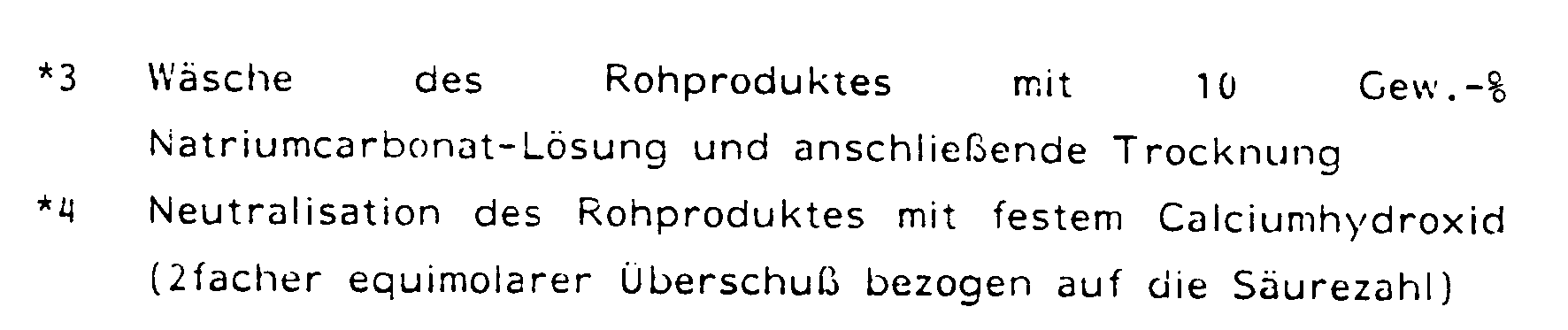
Säurezahl: 20,3 mg KOH/g OH-Zahl: 19,7 mg KOH/g Umsatz: 95,0 % Gardner Farbzahl: 7 - 8 H₂O-Gehalt: 0,12 % - Das Rohprodukt wurde mit 700 ml 10 Gew.-%iger wäßriger Natriumcarbonat-Lösung gewaschen, im Vakuum bei 40 mbar und 80 °C 3 Stunden getrocknet und anschließend filtriert.
-
Säurezahl: < 1 mg KOH/g OH-Zahl: 43 mg KOH/g Gardner Farbzahl: 3 - 4 H₂O-Gehalt: 0,31 % - 324,0 g Acrylsäure, 368,2 g eines ethoxylierten Trimethylolpropans (OH-Zahl 680 mg KOH/g Substanz), 24,2 g p-Toluolsulfonsäure wurden in einen 1-Liter-Kolben eingewogen und mit 1,22 g Alpha-Tocopherol (Fa. Henkel, 2000 ppm bezogen auf die Produktmenge) inhibiert. Unter Durchleiten eines Luft/StickstoffGemisches (5 Vol-% O₂; 40 l/h) wurde die Veresterung unter Wasserabtrennung durchgeführt. Bei einer konstanten Badtemperatur von 125 °C und einer maximalen Sumpftemperatur von 120 °C betrug bei einem Druck von 700 mbar die Veresterungszeit 4 Stunden.
-
Säurezahl: 17,0 mg KOH/g OH-Zahl: 33,6 mg KOH/g Umsatz: 91,4 % Gardner Farbzahl: 7 - 8 H₂O-Gehalt: 0,16 % - Das Rohprodukt wurde mit 1400 g wäßriger 16 Gew.-% NaCl/4 Gew.-% NaHCO₃-Lösung gewaschen, im Vakuum bei 40 mbar und 80 °C 2 Stunden getrocknet und anschließend filtriert.
-
Säurezahl: < 1 mg KOH/g OH-Zahl: 43 mg KOH/g Gardner Farbzahl: 5 - 6 H₂O-Gehalt: 0,42 % - Beispiel 2 wurde wiederholt mit der Änderung, daß anstelle des 2000 ppm Alpha-Tocopherols 5000 ppm eines Misch-Tocopherols (Fa. Henkel) verwendet wurde.
-
Säurezahl: 33,1 mg KOH/g OH-Zahl: 27,8 mg KOH/g Umsatz: 92,9 % Gardner Farbzahl: 12 H₂O-Gehalt: 0,18 % - Das Rohprodukt wurde wie in Beispiel 1 aufgearbeitet.
-
Säurezahl: < 1 mg KOH/g OH-Zahl: 39 mg KOH/g Gardner Farbzahl: 5 - 6 H₂O-Gehalt: 0,25 % - 1559,5 g Acrylsäure, 1521,0 g eines ethoxylierten Trimethylolpropans (OH-Zahl 665 mg KOH/g Substanz) und 107,8 g p-Toluosulfonsäure würden in einen 3-Liter-Reaktor eingewogen und mit 4,12 g Alpha-Tocopherol (Fa. Henkel, 1650 ppm bezogen auf die Produktmenge) inhibiert. Unter Durchleiten von Luft (40 l/h) wurde die Veresterung unter Acrylsäureüberschuß-Abtrennung durchgeführt. Bei einer maximalen Sumpftemperatur von 105 °C betrug die Veresterungszeit 6 Stunden bei einem Druck von 400 mbar.
-
Säurezahl: 24,9 mg KOH/g OH-Zahl: 23,5 mg KOH/g Umsatz: 93,9 % Gardner Farbzahl: 11 H₂O-Gehalt: 0,25 % - Das Rohprodukt wurde durch Zugabe von 102,1 g festen Ca(OH)₂ und 1,5-stündigem Rühren bei 80 °C und 50 mbar neutralisiert.
-
Säurezahl: < 1 mg KOH/g OH-Zahl: 26,5 mg KOH/g Gardner Farbzahl: 3 - 4 H₂O-Gehalt: 0,18 % 
- 1559,5 g Acrylsäure, 1521,0 g eines ethoxylierten Trimethylolpropans (OH-Zahl 665 mg KOH/g Substanz) und 107,8 g p-Toluolsulfonsäure wurden in einen 3-Liter-Reaktor eingewogen und mit 4,99 g Alpha-Tocopherol (Fa. Henkel, 2000 ppm bezogen auf die Produktmenge) inhibiert. Unter Durchleiten von Luft (40 l/h) wurde die Veresterung unter Acrylsäureüberschuß- und Wasser-Abtrennung durchgeführt. Bei einer Sumpftemperatur von 105 °C betrug die Veresterungszeit 6 Stunden bei einem Druck von 400 mbar.
-
Säurezahl: 26,3 mg KOH/g OH-Zahl: 24,8 mg KOH/g Umsatz: 94,2 % Gardner Farbzahl: 10 H₂O-Gehalt: 0,18 % - Das Rohprodukt wurde durch Zugabe von 107,8 g festem Ca(OH)₂ und 1,5-stündigem Rühren bei 80 °C und 50 mbar neutralisiert und anschließend mit einer Druckfilternutsche filtriert.
-
Säurezahl: < 1 mg KOH/g OH-Zahl: 27,0 mg KOH/g Gardner Farbzahl: 3 - 4 H₂O-Gehalt: 0,17 % - Zur Verbesserung der Produktfarbe wurde das Produkt mit 240 g Al₂O₃ (basisch) 2 Stunden bei 80 °C gerührt und anschließend mit Hilfe einer Druckfilternutsche filtriert.
Säurezahl: < 1 mg KOH/g OH-Zahl: 28,0 mg KOH/g Gardner Farbzahl: < 1 - 1320,0 g Acrylsäure, 1861,7 g eines propoxylierten Neopentylglycols (OH-Zahl: 460 mg KOH/g Substanz) sowie 111,4 g p-Toluolsulfonsäure wurden in einen 3-Liter-Reaktor eingewogen und mit 5,37 g alpha-Tocopherol (Fa. Henkel, 2000 ppm bezogen auf die Produktmenge) inhibiert. Unter Durchleiten von Luft (40 l/h) wurde die Veresterung unter Wasser- und Acrylsäureüberschuß-Abtrennung durchgeführt. Bei einer Sumpftemperatur von 105 °C betrug die Veresterungszeit 6 Stunden bei einem Druck von 400 mbar.
-
Säurezahl: 31,0 mg KOH/g OH-Zahl: 18,0 mg KOH/g Umsatz: 94,6 % Gardner Farbzahl: 8 H₂O-Gehalt: 0,21 % - Das Rohprodukt wurde durch Zugabe von 114 g festem Ca(OH)₂ und 2-stündigem Rühren bei 80 °C und 50 mbar neutralisiert und anschließend mit Hilfe einer Druckfilternutsche filtriert.
-
Säurezahl: < 1 mg KOH/g OH-Zahl: 21,0 mg KOH/g Gardner Farbzahl: 3 H₂O-Gehalt: 0,17 % - Zur Verbesserung der Produktfarbe wurde das Produkt mit 260 g Al₂O₃ (basisch) 2 Stunden bei 80 °C gerührt und anschließend mit Hilfe einer Druckfilternutsche filtriert.
Säurezahl: < 1 mg KOH/g OH-Zahl: 21,0 mg KOH/g Gardner Farbzahl: < 1 
Claims (9)
- Verfahren zur Herstellung von (Meth)acrylsäureestern mehrwertiger Alkohole durch Umsetzung der Reaktanten in Gegenwart von sauren Veresterungskatalysatoren unter Zusatz von sterisch gehinderten Phenolverbindungen als Polymerisationsinhibitoren, dadurch gekennzeichnet, daß man als sterisch gehinderte Phenolverbindungen Tocopherole und dabei bevorzugt wenigstens anteilsweise alpha-Tocopherol einsetzt.
- Verfahren nach Anspruch 1, dadurch gekennzeichnet, daß man mit bei Reaktionstemperatur flüssigen Reaktionsgemischen arbeitet, die wenigstens weitgehend frei sind von Lösungs- und/oder azeotropen Schleppmitteln und daß das entstehende Kondensationswasser aus der Gasphase des Reaktionsraumes abgezogen wird.
- Verfahren nach Ansprüchen 1 und 2, dadurch gekennzeichne, daß man den Reaktionsraum mit einem freien Sauerstoff enthaltenden Gasstrom durchspült.
- Verfahren nach Ansprüchen 1 bis 3, dadurch gekennzeichnet, daß man mit Luft oder einem an O₂-abgereicherten Gasgemisch, insbesondere mit Stickstoff/Luft-Gemischen arbeitet.
- Verfahren nach Ansprüchen 1 bis 4, dadurch gekennzeichnet, daß die Veresterung bei Sumpftemperaturen von wenigstens etwa 90 °C, vorzugsweise von wenigstens etwa 100 °C und insbesondere im Bereich bis etwa 150 °C durchgeführt wird, wobei bevorzugt wenigstens absatzweise bei vermindertem, gegebenenfalls stufenweise zunehmend vermindertem Druck, gearbeitet wird.
- Verfahren nach Ansprüchen 1 bis 5, dadurch gekennzeichnet, daß die Inhibitoren in Mengen von 200 bis 10000 ppm, bevorzugt im Bereich von 300 bis 2000 ppm - jeweils bezogen auf das Gewicht des Reaktionsgemisches - eingesetzt werden.
- Verfahren nach Ansprüchen 1 bis 6, dadurch gekennzeichnet, daß die Reaktion auf einen Umsatz von wenigstens 90 % der Theorie, vorzugsweise von wenigstens 94 % der Theorie geführt wird, wobei man bevorzugt im Temperaturbereich von etwa 100 bis 140 °C - gewünschtenfalls unter Vakuum - für eine Reaktionsdauer von nicht mehr als 10 Stunden, insbesondere von nicht mehr als 8 Stunden, arbeitet.
- Verfahren nach Ansprüchen 1 bis 7, dadurch gekennzeichnet, daß das Reaktionsrohprodukt einer trockenen Neutralisation - bevorzugt mit Oxiden und/oder Hydroxiden der Alkalimetalle, der Erdalkalimetalle und/oder des Aluminiums - unterworfen wird.
- Verfahren nach Ansprüchen 1 bis 8, dadurch gekennzeichnet, daß die primär anfallenden Reaktionsprodukte einer abschließenden Behandlung mit Entfärbungsmitteln unterworfen werden.
Applications Claiming Priority (2)
| Application Number | Priority Date | Filing Date | Title |
|---|---|---|---|
| DE3843930 | 1988-12-24 | ||
| DE3843930A DE3843930A1 (de) | 1988-12-24 | 1988-12-24 | Verfahren zur verbesserten herstellung von (meth)acrylsaeureestern mehrwertiger alkohole (iii) |
Publications (2)
| Publication Number | Publication Date |
|---|---|
| EP0449913A1 EP0449913A1 (de) | 1991-10-09 |
| EP0449913B1 true EP0449913B1 (de) | 1994-03-09 |
Family
ID=6370286
Family Applications (2)
| Application Number | Title | Priority Date | Filing Date |
|---|---|---|---|
| EP90900821A Expired - Lifetime EP0449913B1 (de) | 1988-12-24 | 1989-12-15 | Verfahren zur verbesserten herstellung von (meth)acrylsäureestern mehrwertiger alkohole (iii) |
| EP89123219A Withdrawn EP0376090A1 (de) | 1988-12-24 | 1989-12-15 | Verfahren zur verbesserten Herstellung von (Meth)acrylsäureestern mehrwertiger Alkohole (II) |
Family Applications After (1)
| Application Number | Title | Priority Date | Filing Date |
|---|---|---|---|
| EP89123219A Withdrawn EP0376090A1 (de) | 1988-12-24 | 1989-12-15 | Verfahren zur verbesserten Herstellung von (Meth)acrylsäureestern mehrwertiger Alkohole (II) |
Country Status (8)
| Country | Link |
|---|---|
| US (1) | US5648518A (de) |
| EP (2) | EP0449913B1 (de) |
| JP (1) | JP3036832B2 (de) |
| AU (1) | AU623222B2 (de) |
| CA (1) | CA2006431A1 (de) |
| DE (2) | DE3843930A1 (de) |
| ES (1) | ES2050427T3 (de) |
| WO (1) | WO1990007485A1 (de) |
Families Citing this family (24)
| Publication number | Priority date | Publication date | Assignee | Title |
|---|---|---|---|---|
| DE3843843A1 (de) * | 1988-12-24 | 1990-07-05 | Henkel Kgaa | Verfahren zur verbesserten herstellung von (meth)acrylsaeureestern mehrwertiger alkohole (iv) |
| DE4037516A1 (de) * | 1990-11-26 | 1992-05-27 | Henkel Kgaa | Hochfeste und abbaubare werkstoffe und formkoerper fuer die implantation in den menschlichen und tierischen organismus |
| DE4140373A1 (de) * | 1991-12-07 | 1993-06-09 | Henkel Kgaa, 4000 Duesseldorf, De | Verbesserte trockenneutralisation olefinisch reaktiver organischer fluessigphasen |
| US6369164B1 (en) | 1993-05-26 | 2002-04-09 | Dentsply G.M.B.H. | Polymerizable compounds and compositions |
| US6353061B1 (en) | 1993-05-26 | 2002-03-05 | Dentsply Gmbh | α, ω-methacrylate terminated macromonomer compounds |
| US5998499A (en) | 1994-03-25 | 1999-12-07 | Dentsply G.M.B.H. | Liquid crystalline (meth)acrylate compounds, composition and method |
| US5571935A (en) * | 1994-01-14 | 1996-11-05 | Cpc International Inc. | Process for producing esterified alkoxylated polyols with improved stability |
| CA2146816A1 (en) | 1994-04-22 | 1995-10-23 | Joachim E. Klee | Process and composition for preparing a dental polymer product |
| US5750751A (en) * | 1995-11-02 | 1998-05-12 | Michigan Molecular Institute | Glycol co-esters of drying-oil fatty acids and vinyl carboxylic acids made via biphasic catalysis and resulting products |
| US6225398B1 (en) | 1997-03-25 | 2001-05-01 | Henkel Corporation | Aqueous dispersions of polymers |
| DE19728898A1 (de) * | 1997-07-07 | 1999-01-14 | Henkel Kgaa | Verfahren zur lösemittelfreien Herstellung von ungesättigten Polyolestern |
| DE19737017A1 (de) * | 1997-08-26 | 1999-03-04 | Bayer Ag | Verfahren zur Herstellung von Estern ethylenisch ungesättigter Carbonsäuren und deren Verwendung |
| DE19740450A1 (de) * | 1997-09-15 | 1999-03-18 | Henkel Kgaa | Verfahren zur Herstellung von Dialkylethern |
| DE19841342A1 (de) * | 1998-09-10 | 2000-04-20 | Merck Patent Gmbh | Neue Reaktivsysteme aus polymerisierbaren Monomeren , die Peroxide und stabilisierten Boralkylverbindungen enthalten |
| US6175037B1 (en) | 1998-10-09 | 2001-01-16 | Ucb, S.A. | Process for the preparation of (meth)acrylate esters and polyester (meth)acrylates using microwave energy as a heating source |
| DE19929258A1 (de) | 1999-06-25 | 2000-12-28 | Basf Ag | Verfahren zur Herstellung von (Meth)acrylsäureestern |
| DE19937911A1 (de) | 1999-08-11 | 2001-02-15 | Cognis Deutschland Gmbh | Verfahren zum Herstellen von Estern aus ungesättigten Carbonsäuren und mehrwertigen Alkoholen |
| DE10131479B4 (de) | 2001-06-29 | 2005-05-19 | Röhm GmbH & Co. KG | Farbstabilisierung von grundstabilisierten ethylenisch ungesättigten Monomeren, insbesondere von grundstabilisierten Hydroxyalkyl(meth)acrylaten |
| DE10225943A1 (de) * | 2002-06-11 | 2004-01-08 | Basf Ag | Verfahren zur Herstellung von Estern von Polyalkoholen |
| JP2005532432A (ja) * | 2002-06-11 | 2005-10-27 | ビーエーエスエフ アクチェンゲゼルシャフト | ポリアルコキシル化されたトリメチロールプロパンの(メタ)アクリルエステル |
| ATE325150T1 (de) * | 2002-06-11 | 2006-06-15 | Basf Ag | (meth)acrylester von polyalkoxyliertem glycerin |
| RU2320677C2 (ru) * | 2002-06-11 | 2008-03-27 | Басф Акциенгезелльшафт | Сложный (мет)акриловый эфир полиалкоксилированного триметилолпропана (варианты) и его применение для получения абсорбирующих водосодержащие жидкости полимеров |
| US20070129564A1 (en) * | 2004-02-20 | 2007-06-07 | Basf Aktiengesellschaft | Method for the production of (meth)acrylic acid esters |
| US8318964B2 (en) | 2006-10-23 | 2012-11-27 | Wako Pure Chemical Industries, Ltd. | Process for producing ester compound |
Family Cites Families (5)
| Publication number | Priority date | Publication date | Assignee | Title |
|---|---|---|---|---|
| DE2527005A1 (de) * | 1975-06-18 | 1977-01-13 | Bayer Ag | Stabilisierte acrylsaeureester mehrwertiger alkohole und verfahren zu ihrer herstellung |
| EP0348063B1 (de) * | 1988-06-10 | 1993-05-26 | Asahi Kasei Kogyo Kabushiki Kaisha | Thermoplastisches Elastomer und darauf basierende lichtempfindliche Harzzusammensetzung und Druckplattenvorläufer, der die Zusammensetzung enthält |
| DE3843854A1 (de) * | 1988-12-24 | 1990-06-28 | Henkel Kgaa | Verfahren zur verbesserten herstellung von (meth)acrylsaeureestern mehrwertiger alkohole (i) |
| DE3843843A1 (de) * | 1988-12-24 | 1990-07-05 | Henkel Kgaa | Verfahren zur verbesserten herstellung von (meth)acrylsaeureestern mehrwertiger alkohole (iv) |
| DE3939163A1 (de) * | 1989-11-27 | 1991-05-29 | Henkel Kgaa | Verbessertes trockenneutralisationsverfahren fuer organische fluessigphasen |
-
1988
- 1988-12-24 DE DE3843930A patent/DE3843930A1/de not_active Withdrawn
-
1989
- 1989-12-15 ES ES90900821T patent/ES2050427T3/es not_active Expired - Lifetime
- 1989-12-15 JP JP02501714A patent/JP3036832B2/ja not_active Expired - Lifetime
- 1989-12-15 WO PCT/EP1989/001548 patent/WO1990007485A1/de not_active Ceased
- 1989-12-15 EP EP90900821A patent/EP0449913B1/de not_active Expired - Lifetime
- 1989-12-15 DE DE90900821T patent/DE58907195D1/de not_active Expired - Lifetime
- 1989-12-15 US US07/679,075 patent/US5648518A/en not_active Expired - Lifetime
- 1989-12-15 EP EP89123219A patent/EP0376090A1/de not_active Withdrawn
- 1989-12-21 CA CA002006431A patent/CA2006431A1/en not_active Abandoned
-
1990
- 1990-02-12 AU AU49718/90A patent/AU623222B2/en not_active Ceased
Also Published As
| Publication number | Publication date |
|---|---|
| EP0376090A1 (de) | 1990-07-04 |
| DE58907195D1 (de) | 1994-04-14 |
| AU623222B2 (en) | 1992-05-07 |
| JPH04502466A (ja) | 1992-05-07 |
| DE3843930A1 (de) | 1990-06-28 |
| ES2050427T3 (es) | 1994-05-16 |
| AU4971890A (en) | 1991-09-05 |
| WO1990007485A1 (de) | 1990-07-12 |
| EP0449913A1 (de) | 1991-10-09 |
| US5648518A (en) | 1997-07-15 |
| JP3036832B2 (ja) | 2000-04-24 |
| CA2006431A1 (en) | 1990-06-24 |
Similar Documents
| Publication | Publication Date | Title |
|---|---|---|
| EP0376090A1 (de) | Verfahren zur verbesserten Herstellung von (Meth)acrylsäureestern mehrwertiger Alkohole (II) | |
| EP0449919B1 (de) | Verfahren zur verbesserten herstellung von (meth)acrylsäureestern mehrwertiger alkohole (iv) | |
| DE69434318T2 (de) | Organozinn katalysierte Transesterifizierung | |
| EP0449918B1 (de) | Verfahren zur verbesserten herstellung von (meth)acrylsäureestern mehrwertiger alkohole (i) | |
| EP0449912B1 (de) | Verfahren zur verbesserten herstellung von (meth)acrylsäureestern mehrwertiger alkohole (ii) | |
| WO2003042151A1 (de) | Verfahren zur herstellung von (meth) acrylsäureestern mehrwertiger alkohole | |
| EP3044200A1 (de) | Verfahren zur nachbehandlung von polyolestern | |
| DE1932625B2 (de) | Zinnorganischer Katalysator und seine Verwendung zur Umesterung | |
| EP1063225A2 (de) | Verfahren zur Herstellung von (Meth)acrylsäureestern | |
| DE2731085C3 (de) | Verfahren zur Herstellung von Acryl- und/oder Methacrylsäureestern | |
| DE2913218A1 (de) | Verfahren zur herstellung von (meth)acrylsaeureestern | |
| EP0449865B1 (de) | Verbessertes trockenneutralisationsverfahren für organische flüssigphasen | |
| DE1745919B2 (de) | Verfahren zur herstellung von polyurethanen | |
| EP0890568B1 (de) | Verfahren zur lösemittelfreien Herstellung von ungesättigten Polyolestern | |
| EP1511789B1 (de) | Verfahren zur herstellung von polyetherolen | |
| EP2554535B1 (de) | Verfahren zur Herstellung von (Meth)acrylsäureestern von Polyolen | |
| DE4019788A1 (de) | Verfahren zur herstellung von mehrfunktionellen (meth)acrylsaeureestern | |
| EP0087517A1 (de) | Verfahren zur Herstellung von Polyester- und/oder Polyester-polyether-polyolen | |
| EP0623579A1 (de) | Verfahren zur Herstellung von Ethercarbonsäuren | |
| DE3939163A1 (de) | Verbessertes trockenneutralisationsverfahren fuer organische fluessigphasen | |
| EP4056550A1 (de) | Verfahren zur herstellung von orthoestern | |
| WO2011003669A2 (de) | Verfahren und anlage zur aufreinigung von reaktionsmischungen, die polyalkylenglykolmono(meth)acrylate umfassen | |
| WO2003093213A1 (de) | Verfahren zur herstellung von (alkyl)polyalkylenglycol(meth)acrylsäureestern unter verwendung von heteropolysäuren als katalysatoren |
Legal Events
| Date | Code | Title | Description |
|---|---|---|---|
| PUAI | Public reference made under article 153(3) epc to a published international application that has entered the european phase |
Free format text: ORIGINAL CODE: 0009012 |
|
| 17P | Request for examination filed |
Effective date: 19910617 |
|
| AK | Designated contracting states |
Kind code of ref document: A1 Designated state(s): BE CH DE ES FR GB IT LI NL |
|
| 17Q | First examination report despatched |
Effective date: 19930309 |
|
| GRAA | (expected) grant |
Free format text: ORIGINAL CODE: 0009210 |
|
| AK | Designated contracting states |
Kind code of ref document: B1 Designated state(s): BE CH DE ES FR GB IT LI NL |
|
| ET | Fr: translation filed | ||
| GBT | Gb: translation of ep patent filed (gb section 77(6)(a)/1977) |
Effective date: 19940316 |
|
| REF | Corresponds to: |
Ref document number: 58907195 Country of ref document: DE Date of ref document: 19940414 |
|
| REG | Reference to a national code |
Ref country code: ES Ref legal event code: FG2A Ref document number: 2050427 Country of ref document: ES Kind code of ref document: T3 |
|
| ITF | It: translation for a ep patent filed | ||
| PLBE | No opposition filed within time limit |
Free format text: ORIGINAL CODE: 0009261 |
|
| STAA | Information on the status of an ep patent application or granted ep patent |
Free format text: STATUS: NO OPPOSITION FILED WITHIN TIME LIMIT |
|
| 26N | No opposition filed | ||
| REG | Reference to a national code |
Ref country code: GB Ref legal event code: IF02 |
|
| REG | Reference to a national code |
Ref country code: CH Ref legal event code: PUE Owner name: HENKEL KOMMANDITGESELLSCHAFT AUF AKTIEN TRANSFER- |
|
| NLS | Nl: assignments of ep-patents |
Owner name: COGNIS DEUTSCHLAND GMBH & CO. KG |
|
| REG | Reference to a national code |
Ref country code: GB Ref legal event code: 732E |
|
| BECA | Be: change of holder's address |
Owner name: *COGNIS DEUTSCHLAND G.M.B.H. & CO. K.G.HENKELSTRAS Effective date: 20031016 |
|
| REG | Reference to a national code |
Ref country code: FR Ref legal event code: TP |
|
| PG25 | Lapsed in a contracting state [announced via postgrant information from national office to epo] |
Ref country code: IT Free format text: LAPSE BECAUSE OF NON-PAYMENT OF DUE FEES;WARNING: LAPSES OF ITALIAN PATENTS WITH EFFECTIVE DATE BEFORE 2007 MAY HAVE OCCURRED AT ANY TIME BEFORE 2007. THE CORRECT EFFECTIVE DATE MAY BE DIFFERENT FROM THE ONE RECORDED. Effective date: 20051215 |
|
| REG | Reference to a national code |
Ref country code: GB Ref legal event code: 732E |
|
| PGFP | Annual fee paid to national office [announced via postgrant information from national office to epo] |
Ref country code: NL Payment date: 20081203 Year of fee payment: 20 Ref country code: CH Payment date: 20081216 Year of fee payment: 20 |
|
| PGFP | Annual fee paid to national office [announced via postgrant information from national office to epo] |
Ref country code: ES Payment date: 20090120 Year of fee payment: 20 Ref country code: FR Payment date: 20081212 Year of fee payment: 20 |
|
| PGFP | Annual fee paid to national office [announced via postgrant information from national office to epo] |
Ref country code: DE Payment date: 20081211 Year of fee payment: 20 |
|
| PGFP | Annual fee paid to national office [announced via postgrant information from national office to epo] |
Ref country code: GB Payment date: 20081210 Year of fee payment: 20 |
|
| PGFP | Annual fee paid to national office [announced via postgrant information from national office to epo] |
Ref country code: BE Payment date: 20090112 Year of fee payment: 20 |
|
| NLS | Nl: assignments of ep-patents |
Owner name: COGNIS IP MANAGEMENT GMBH Effective date: 20090507 |
|
| BE20 | Be: patent expired |
Owner name: COGNIS IP MANAGEMENT G.M.B.H. Effective date: 20091215 |
|
| REG | Reference to a national code |
Ref country code: CH Ref legal event code: PL |
|
| REG | Reference to a national code |
Ref country code: GB Ref legal event code: PE20 Expiry date: 20091214 |
|
| NLV7 | Nl: ceased due to reaching the maximum lifetime of a patent |
Effective date: 20091215 |
|
| PG25 | Lapsed in a contracting state [announced via postgrant information from national office to epo] |
Ref country code: NL Free format text: LAPSE BECAUSE OF EXPIRATION OF PROTECTION Effective date: 20091215 |
|
| REG | Reference to a national code |
Ref country code: ES Ref legal event code: FD2A Effective date: 20091216 |
|
| PG25 | Lapsed in a contracting state [announced via postgrant information from national office to epo] |
Ref country code: GB Free format text: LAPSE BECAUSE OF EXPIRATION OF PROTECTION Effective date: 20091214 Ref country code: ES Free format text: LAPSE BECAUSE OF EXPIRATION OF PROTECTION Effective date: 20091216 |