EP2390933B1 - Lichtemittierendes Halbleiterbauelement - Google Patents
Lichtemittierendes Halbleiterbauelement Download PDFInfo
- Publication number
- EP2390933B1 EP2390933B1 EP20100186525 EP10186525A EP2390933B1 EP 2390933 B1 EP2390933 B1 EP 2390933B1 EP 20100186525 EP20100186525 EP 20100186525 EP 10186525 A EP10186525 A EP 10186525A EP 2390933 B1 EP2390933 B1 EP 2390933B1
- Authority
- EP
- European Patent Office
- Prior art keywords
- electrode
- layer
- major surface
- semiconductor layer
- light emitting
- Prior art date
- Legal status (The legal status is an assumption and is not a legal conclusion. Google has not performed a legal analysis and makes no representation as to the accuracy of the status listed.)
- Not-in-force
Links
- 239000004065 semiconductor Substances 0.000 title claims description 147
- 229910052751 metal Inorganic materials 0.000 claims description 82
- 239000002184 metal Substances 0.000 claims description 82
- 239000000758 substrate Substances 0.000 description 45
- 229920005989 resin Polymers 0.000 description 23
- 239000011347 resin Substances 0.000 description 23
- OAICVXFJPJFONN-UHFFFAOYSA-N Phosphorus Chemical compound [P] OAICVXFJPJFONN-UHFFFAOYSA-N 0.000 description 11
- PXHVJJICTQNCMI-UHFFFAOYSA-N Nickel Chemical compound [Ni] PXHVJJICTQNCMI-UHFFFAOYSA-N 0.000 description 10
- 238000007747 plating Methods 0.000 description 10
- 238000004519 manufacturing process Methods 0.000 description 8
- 229910003564 SiAlON Inorganic materials 0.000 description 6
- 239000010949 copper Substances 0.000 description 6
- 238000000034 method Methods 0.000 description 5
- 229910052759 nickel Inorganic materials 0.000 description 5
- 229910052791 calcium Inorganic materials 0.000 description 4
- 238000001020 plasma etching Methods 0.000 description 4
- 230000009467 reduction Effects 0.000 description 4
- 229910052710 silicon Inorganic materials 0.000 description 4
- RYGMFSIKBFXOCR-UHFFFAOYSA-N Copper Chemical compound [Cu] RYGMFSIKBFXOCR-UHFFFAOYSA-N 0.000 description 3
- VYPSYNLAJGMNEJ-UHFFFAOYSA-N Silicium dioxide Chemical compound O=[Si]=O VYPSYNLAJGMNEJ-UHFFFAOYSA-N 0.000 description 3
- 229910052782 aluminium Inorganic materials 0.000 description 3
- 239000003086 colorant Substances 0.000 description 3
- 229910052802 copper Inorganic materials 0.000 description 3
- 230000007423 decrease Effects 0.000 description 3
- 239000000463 material Substances 0.000 description 3
- 150000004767 nitrides Chemical class 0.000 description 3
- 229910052814 silicon oxide Inorganic materials 0.000 description 3
- 229910052712 strontium Inorganic materials 0.000 description 3
- 239000000126 substance Substances 0.000 description 3
- 238000001039 wet etching Methods 0.000 description 3
- 229910000789 Aluminium-silicon alloy Inorganic materials 0.000 description 2
- XUIMIQQOPSSXEZ-UHFFFAOYSA-N Silicon Chemical group [Si] XUIMIQQOPSSXEZ-UHFFFAOYSA-N 0.000 description 2
- 229910052788 barium Inorganic materials 0.000 description 2
- 238000006243 chemical reaction Methods 0.000 description 2
- 238000005229 chemical vapour deposition Methods 0.000 description 2
- 238000007796 conventional method Methods 0.000 description 2
- 230000001747 exhibiting effect Effects 0.000 description 2
- PCHJSUWPFVWCPO-UHFFFAOYSA-N gold Chemical compound [Au] PCHJSUWPFVWCPO-UHFFFAOYSA-N 0.000 description 2
- 229910052737 gold Inorganic materials 0.000 description 2
- 239000010931 gold Substances 0.000 description 2
- 238000004806 packaging method and process Methods 0.000 description 2
- 238000002310 reflectometry Methods 0.000 description 2
- 239000010703 silicon Substances 0.000 description 2
- 229910000679 solder Inorganic materials 0.000 description 2
- 238000004544 sputter deposition Methods 0.000 description 2
- IJGRMHOSHXDMSA-UHFFFAOYSA-N Atomic nitrogen Chemical compound N#N IJGRMHOSHXDMSA-UHFFFAOYSA-N 0.000 description 1
- 229910015363 Au—Sn Inorganic materials 0.000 description 1
- 108010043121 Green Fluorescent Proteins Proteins 0.000 description 1
- BPQQTUXANYXVAA-UHFFFAOYSA-N Orthosilicate Chemical compound [O-][Si]([O-])([O-])[O-] BPQQTUXANYXVAA-UHFFFAOYSA-N 0.000 description 1
- 239000004642 Polyimide Substances 0.000 description 1
- BQCADISMDOOEFD-UHFFFAOYSA-N Silver Chemical compound [Ag] BQCADISMDOOEFD-UHFFFAOYSA-N 0.000 description 1
- 238000010521 absorption reaction Methods 0.000 description 1
- XAGFODPZIPBFFR-UHFFFAOYSA-N aluminium Chemical compound [Al] XAGFODPZIPBFFR-UHFFFAOYSA-N 0.000 description 1
- 238000013459 approach Methods 0.000 description 1
- 239000011248 coating agent Substances 0.000 description 1
- 238000000576 coating method Methods 0.000 description 1
- 238000005336 cracking Methods 0.000 description 1
- 239000013078 crystal Substances 0.000 description 1
- 238000005520 cutting process Methods 0.000 description 1
- 238000000354 decomposition reaction Methods 0.000 description 1
- 229910001873 dinitrogen Inorganic materials 0.000 description 1
- 238000009826 distribution Methods 0.000 description 1
- 239000003822 epoxy resin Substances 0.000 description 1
- 238000005530 etching Methods 0.000 description 1
- 238000000605 extraction Methods 0.000 description 1
- 230000002349 favourable effect Effects 0.000 description 1
- NBVXSUQYWXRMNV-UHFFFAOYSA-N fluoromethane Chemical compound FC NBVXSUQYWXRMNV-UHFFFAOYSA-N 0.000 description 1
- -1 for example Polymers 0.000 description 1
- 229910052909 inorganic silicate Inorganic materials 0.000 description 1
- 238000007689 inspection Methods 0.000 description 1
- 239000007788 liquid Substances 0.000 description 1
- 229910052749 magnesium Inorganic materials 0.000 description 1
- 239000007769 metal material Substances 0.000 description 1
- 230000005012 migration Effects 0.000 description 1
- 238000013508 migration Methods 0.000 description 1
- 230000003287 optical effect Effects 0.000 description 1
- 230000005693 optoelectronics Effects 0.000 description 1
- 239000002245 particle Substances 0.000 description 1
- 238000000059 patterning Methods 0.000 description 1
- 229920000647 polyepoxide Polymers 0.000 description 1
- 229920001721 polyimide Polymers 0.000 description 1
- 230000005855 radiation Effects 0.000 description 1
- 230000006798 recombination Effects 0.000 description 1
- 238000005215 recombination Methods 0.000 description 1
- 230000003014 reinforcing effect Effects 0.000 description 1
- 229910052594 sapphire Inorganic materials 0.000 description 1
- 239000010980 sapphire Substances 0.000 description 1
- 238000000926 separation method Methods 0.000 description 1
- 229920002050 silicone resin Polymers 0.000 description 1
- 229910052709 silver Inorganic materials 0.000 description 1
- 239000004332 silver Substances 0.000 description 1
- 238000009751 slip forming Methods 0.000 description 1
- 238000004528 spin coating Methods 0.000 description 1
- 238000006467 substitution reaction Methods 0.000 description 1
- 229920001187 thermosetting polymer Polymers 0.000 description 1
Images





Classifications
-
- H—ELECTRICITY
- H10—SEMICONDUCTOR DEVICES; ELECTRIC SOLID-STATE DEVICES NOT OTHERWISE PROVIDED FOR
- H10H—INORGANIC LIGHT-EMITTING SEMICONDUCTOR DEVICES HAVING POTENTIAL BARRIERS
- H10H20/00—Individual inorganic light-emitting semiconductor devices having potential barriers, e.g. light-emitting diodes [LED]
- H10H20/80—Constructional details
- H10H20/83—Electrodes
- H10H20/831—Electrodes characterised by their shape
- H10H20/8314—Electrodes characterised by their shape extending at least partially onto an outer side surface of the bodies
-
- H—ELECTRICITY
- H10—SEMICONDUCTOR DEVICES; ELECTRIC SOLID-STATE DEVICES NOT OTHERWISE PROVIDED FOR
- H10H—INORGANIC LIGHT-EMITTING SEMICONDUCTOR DEVICES HAVING POTENTIAL BARRIERS
- H10H20/00—Individual inorganic light-emitting semiconductor devices having potential barriers, e.g. light-emitting diodes [LED]
- H10H20/80—Constructional details
- H10H20/81—Bodies
- H10H20/816—Bodies having carrier transport control structures, e.g. highly-doped semiconductor layers or current-blocking structures
Definitions
- Embodiments described herein relate generally to a semiconductor light emitting device.
- an n-side electrode and a p-side electrode are formed on one major surface side of the semiconductor layer.
- the planar surface area of the p-side electrode is increased without changing the chip size (the planar size)
- the planar surface area of the n-side electrode is relatively reduced. In the case where the planar surface area of the n-side electrode is reduced, the reliability may decrease due to current concentration in the n-side electrode.
- US 2009/0283787 A1 discloses light emitting diodes including a diode region having first and second opposing faces that include therein an n-type layer and a p-type layer, an anode contact and a cathode contact. The anode or cathode contacts may further provide a hybrid reflective structure on the first face for reflecting light emerging from the first face back into the first face.
- US2009/0289273 A1 discloses a light emitting device including a substrate serving as a carrier supporting an LED chip and separate chip and substrate sides. Two conductive traces electrically connect a first and second electrode layer of the LED chip which are formed along the chip side and the substrate side simultaneously.
- WO 2008/131736 A1 discloses an optoelectronic component comprising a semiconductor body with an active region that is suitable for generating radiation and two electric contacts situated on the semiconductor body. Each of the contacts which are electrically connected to the active region has a connection surface facing away from the semiconductor body and being situated on a connection side of the component. One side of the component which is not the connection side is covered with a reflective surface.
- US 2002/0017651 A1 discloses a light emitting diode arranged so that the rays emitted from an exciting element comprising a n-type semiconductor layer and a p-type semiconductor layer are converted by a wavelength converting element to white light which is then irradiated through molded resin.
- the wavelength converting element is provided on one surface of the exciting element and an insulating film is deposited on the other surface with interposition of a p-type ohmic electrode exhibiting a high reflectivity in UV wavelength band.
- the exciting element has its side surface covered with a n-type ohmic electrode exhibiting a high reflectivity in UV wavelength band.
- a semiconductor light emitting device includes a semiconductor layer, a first electrode, a second electrode, a first insulating layer, a first interconnect layer, a second interconnect layer, a first metal pillar, a second metal pillar, and a second insulating layer.
- the semiconductor layer includes a light emitting layer, a first major surface, and a second major surface opposite to the first major surface.
- the first electrode is provided on the second major surface of the semiconductor layer.
- the second electrode is provided on a side face of a portion of the semiconductor layer between the light emitting layer and the first major surface.
- the first insulating layer is provided on a side of the second major surface of the semiconductor layer.
- the first insulating layer has a first opening reaching the first electrode and a second opening reaching the second electrode provided on the side face.
- the first interconnect layer is provided in the first opening and on the first insulating layer on a side opposite to the second major surface to connect to the first electrode.
- the second interconnect layer is provided in the second opening and on the first insulating layer on the side opposite to the second major surface to connect to the second electrode provided on the side face.
- the second interconnect layer is provided on the side face of the portion of the semiconductor layer with interposing the second electrode.
- the first metal pillar is provided on a face of the first interconnect layer on a side opposite to the first electrode.
- the second metal pillar is provided on a face of the second interconnect layer on a side opposite to the second electrode.
- the second insulating layer covers a periphery of the first metal pillar and a periphery of the second metal pillar.
- FIG. 1A is a schematic cross-sectional view taken along A-A' line in FIG. 1B of a semiconductor light emitting device of a first embodiment.
- FIG. 1B is a schematic perspective view of a semiconductor layer 15 and electrodes 17 and 18 of the semiconductor light emitting device.
- a first major surface 15a of the semiconductor layer 15 is illustrated on the upper side; and in FIG. 1B , the first major surface 15a is illustrated on the lower side.
- the semiconductor layer 15 includes a first semiconductor layer 11 and a second semiconductor layer 13.
- the first semiconductor layer 11 is, for example, an n-type GaN layer that functions as a lateral current path.
- the conductivity type of the first semiconductor layer 11 is not limited to the n-type; and the conductivity type may be a p-type.
- the semiconductor layer 15 includes a light emitting layer (an active layer) 12 and, for example, a p-type GaN layer and an n-type GaN layer with the light emitting layer 12 interposed therebetween.
- the second semiconductor layer 13 is provided on the side opposite to the first major surface 15a. Light is mainly extracted from the first major surface 15a of the semiconductor layer 15.
- a second major surface side of the semiconductor layer 15 on the side opposite to the first major surface 15a is patterned into a recessed and protruding configuration; and an upper level portion 15b and a lower level portion 15c are provided on the second major surface side.
- the upper level portion 15b is positioned more on the upper level side than is the lower level portion 15c as viewed from the first major surface 15a.
- the upper level portion 15b includes the light emitting layer 12.
- the lower level portion 15c does not include the light emitting layer 12 and is provided in the portion between the light emitting layer 12 and the first major surface 15a.
- the p-side electrode 17 is provided as a first electrode on the second major surface of the upper level portion 15b (the surface of the second semiconductor layer 13).
- the n-side electrode 18 is provided as a second electrode on the second major surface of the lower level portion 15c (the surface of the first semiconductor layer 11).
- the n-side electrode 18 is provided also on a side face 15d of the lower level portion 15c.
- the n-side electrode 18 formed on the side face 15d and the n-side electrode 18 formed on the surface of the lower level portion 15c (the second major surface) are formed as a single body from the same material and are joined at the corner between the side face 15d and the surface of the lower level portion 15c.
- the n-side electrode 18 formed on the side face 15d encloses the outer circumference of the lower level portion 15c, that is, is formed to be continuously formed on the side face 15d.
- the surface area of the portion of the n-side electrode 18 provided on the side face 15d is greater than the surface area of the portion of the n-side electrode 18 provided on the second major surface.
- the n-side electrode 18 surrounds the side surfaces 15d of the n-type semiconductor layer 11.
- the p-side electrode 17 is formed on the surface of the upper level portion 15b in a region (a light emitting region) in the surface direction of the semiconductor layer 15 including the light emitting layer 12.
- the surface area of the p-side electrode 17 on the second major surface is greater than the surface area of the n-side electrode 18 formed on the surface (on the second major surface) of the lower level portion 15c.
- An insulating film 16 such as, for example, a silicon oxide film is provided on the side face of the upper level portion 15b; and the insulating film 16 covers the side face of the light emitting layer 12.
- the insulating film 16 is interposed between the p-side electrode 17 and the n-side electrode 18 to insulatively separate the p-side electrode 17 and the n-side electrode 18.
- the second major surface and the side face 15d of the semiconductor layer 15 are covered with an insulating layer (a first insulating layer) 19.
- the insulating layer 19 is, for example, a resin or a silicon oxide film.
- the face of the insulating layer 19 on the side opposite to the second major surface is planarized; a p-side interconnect layer 21 is provided on the face as a first interconnect layer; and an n-side interconnect layer 22 is provided on the face as a second interconnect layer.
- the face of the n-side interconnect layer 22 on the side opposite to the face of the n-side interconnect layer 22 connected to the n-side electrode 18 on the lower level portion 15c surface (the second major surface) is larger than the face connected to the n-side electrode 18 on the lower level portion 15c surface.
- the layout of the n-side interconnect layer 22 on the insulating layer 19 has a surface area greater than that of the n-side electrode 18 on the lower level portion 15c surface.
- the p-side interconnect layer 21 is provided also in a first opening 19a made in the insulating layer 19 to reach the p-side electrode 17; and the p-side interconnect layer 21 is connected to the p-side electrode 17.
- a second opening 19b is made in the insulating layer 19 to reach the n-side electrode 18.
- the second opening 19b is made to reach the n-side electrode 18 on the surface of the lower level portion 15c and is made in a portion beside the n-side electrode 18 formed on the side face 15d. Accordingly, the second opening 19b communicates with the n-side electrode 18 formed on the side face 15d.
- the n-side interconnect layer 22 is provided also in the second opening 19b. In other words, the n-side interconnect layer 22 is provided also in the portion beside the n-side electrode 18 formed on the side face 15d. Accordingly, the n-side interconnect layer 22 is connected to the n-side electrode 18 provided on the side face 15d and on the surface of the lower level portion 15c.
- the side face 15d is tapered with respect to the first major surface 15a and the second major surface.
- the width of the portion of the second opening 19b beside the side face 15d gradually increases from the first major surface 15a side toward the second major surface side. Therefore, the fillability of the n-side interconnect layer 22 into the portion beside the side face 15d is good; and the n-side interconnect layer 22 can be reliably connected to the n-side electrode 18 provided on the side face 15d.
- a p-side metal pillar 24 is provided as the first metal pillar on the face of the p-side interconnect layer 21 on the side opposite to the p-side electrode 17.
- An n-side metal pillar 25 is provided as a second metal pillar on the face of the n-side interconnect layer 22 on the side opposite to the n-side electrode 18 on the second major surface.
- the second insulating layer may be an inorganic layer.
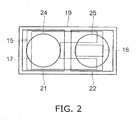
- FIG. 2 illustrates one example of a planar layout of the semiconductor layer 15, the p-side electrode 17, the n-side electrode 18, the p-side interconnect layer 21, the n-side interconnect layer 22, the p-side metal pillar 24, and the n-side metal pillar 25.
- FIG. 2 corresponds to a plan view of FIG. 1A as viewed from the lower face (the mounting surface) side.
- the resin layer 23 is not illustrated.
- the semiconductor light emitting device has a rectangular shape in a plan view, as shown in FIG. 2 .
- the layout of the p-side electrode 17 (shown a broken line in FIG. 2 ) on the second major surface of the semiconductor layer 15 has a surface area greater than that of the n-side electrode 18 (shown a broken line in FIG. 2 ).
- the p-side electrode 17 has a U shape.
- the n-side electrode 18 is provided between the opening of the U shape.
- the planar size of the insulating layer 19 is larger than the planar size of the semiconductor layer 15.
- the layout of the p-side interconnect layer 21 (shown a solid line in FIG. 2 ) is in a region of about one half of the lower face of the insulating layer 19, and the layout of the n-side interconnect layer 22 (shown a solid line in FIG. 2 ) is in a region of about the remaining half.
- the n-side interconnect layer 22 is formed to spread over the insulating layer 19 with a surface area greater than that of the portion of the n-side electrode 18 provided on the second major surface.
- the planar shape of the p-side interconnect layer 21 and the n-side interconnect layer 22 has a square shape or rectangular shape.
- the configurations of the metal pillars 24 and 25 are not limited to circular columnar configurations.
- the surface areas of the metal pillars 24 and 25 are same in a plan view.
- the metal pillars 24 and 25 are symmetric with a center line perpendicular to a longitudinal direction. Further the metal pillars 24 and 25 are symmetric with respect to a center in a plan view.
- Prismatic configurations, columnar configurations having other shapes, or pad configurations may be used.
- the first semiconductor layer 11 is electrically connected to the n-side metal pillar 25 via the n-side electrode 18 and the n-side interconnect layer 22.
- the second semiconductor layer 13 is electrically connected to the p-side metal pillar 24 via the p-side electrode 17 and the p-side interconnect layer 21.
- External terminals such as, for example, solder balls, metal bumps, etc., are provided on the lower end faces of the n-side metal pillar 25 and the p-side metal pillar 24 exposed from the resin layer 23.
- the semiconductor light emitting device is electrically connectable to an external circuit via the external terminals.
- the p-side interconnect layer 21 and the n-side interconnect layer 22 have a same planar shape as in FIG.2 . Further the surface areas of the p-side interconnect layer 21 and the n-side interconnect layer 22 are same.
- the p-side interconnect layer 21 and the n-side interconnect layer 22 are symmetric with a center line perpendicular to a longitudinal direction. Distances from the p-side interconnect layer 21 and the n-side interconnect layer 22 to short side lines (left outline and right outline in FIG.2 ) are same. Further the p-side interconnect layer 21 and the n-side interconnect layer 22 are symmetric with respect to a center in a plan view.
- the p-side interconnect layer 21 and the n-side interconnect layer 22 are symmetric with respect to a center and the metal pillars 24 and 25 are symmetric with respect to the center in a plan view. Therefore, the semiconductor light emitting device has a stability and rarely topples (inclines).
- Each of the thickness of the n-side metal pillar 25 and the thickness of the p-side metal pillar 24 is thicker than the thickness of a stacked body including the semiconductor layer 15, the n-side electrode 18, the p-side electrode 17, the insulating film 16, the insulating layer 19, the n-side interconnect layer 22, and the p-side interconnect layer 21.
- the aspect ratios (the ratio of the thickness to the planar size) of the metal pillars 24 and 25 are not limited to being 1 or more; and the ratios may be less than 1. In other words, the thicknesses of the metal pillars 24 and 25 may be smaller than the planar sizes thereof.
- the structure of this embodiment it is possible to maintain the mechanical strength even in the case where the semiconductor layer 15 is thin by making the n-side metal pillar 25, the p-side metal pillar 24, and the resin layer 23 thick.
- the n-side metal pillar 25 and the p-side metal pillar 24 can absorb and mitigate the stress applied to the semiconductor layer 15 via the external terminals.
- the materials of the n-side interconnect layer 22, the p-side interconnect layer 21, the n-side metal pillar 25, and the p-side metal pillar 24 may include copper, gold, nickel, silver, etc. Thereof, copper may be favorable because copper provides good thermal conductivity, high migration resistance, and excellent adhesion with insulating films.
- the resin layer 23, which performs the role of reinforcing the n-side metal pillar 25 and the p-side metal pillar 24, may be a substance having a coefficient of thermal expansion equal to or near that of the circuit board the like.
- Examples of such a resin layer 23 may include, for example, epoxy resin, silicone resin, fluorocarbon resin, etc.
- a fluorescent layer 26 is provided on the first major surface 15a of the semiconductor layer 15.
- the fluorescent layer 26 is capable of absorbing light from the light emitting layer 12 and emitting wavelength-converted light. Therefore, it is possible to emit mixed light of the light from the light emitting layer 12 and the wavelength-converted light of the fluorescent layer 26.
- the light emitting layer 12 is nitride-based, it is possible to obtain white light, lamp light, etc., as mixed-color light of blue light from the light emitting layer 12 and yellow light from, for example, the wavelength-converted light of a yellow fluorescent layer 26.
- the fluorescent layer 26 may have a configuration including multiple types of fluorescers (e.g., a red fluorescer and a green fluorescer).
- the light emitted by the light emitting layer 12 mainly travels through the first semiconductor layer 11, the first major surface 15a, and the fluorescent layer 26 to be emitted externally.
- the light emission surface area can be increased and the luminous efficacy can be increased by relatively increasing the planar surface area of the p-side electrode formed in the region including the light emitting layer.
- the planar surface area of the p-side electrode is increased without changing the chip size (the planar size)
- the planar surface area of the n-side electrode is relatively reduced.
- the reliability may decrease due to current concentration in the n-side electrode.
- the n-side electrode 18 is formed also on the side face 15d of the semiconductor layer 11.
- the surface area of the n-side electrode 18 contacting the first semiconductor layer 11 which is an n-type layer can be increased without reducing the surface area of the p-side electrode 17 on the second major surface.
- the surface area reduction of the p-side electrode 17 can be suppressed; the luminance can be increased; and the reliability can be increased by increasing the surface area of the n-side electrode 18.
- an increase of the chip size can be suppressed.
- the surface area of the p-side electrode 17 formed in the region including the light emitting layer 12 is greater than the surface area (the surface area on the second major surface) of the n-side electrode 18; and a larger light emitting region can be ensured.
- the p-side and the n-side are formed with substantially the same surface area; and current can be supplied efficiently.
- the n-side electrode 18 is made of a metal having light-shielding properties with respect to the light emitted by the light emitting layer 12. Accordingly, a structure is provided in which the side face 15d of the semiconductor layer 15 is covered with a light-shielding film. Therefore, light leakage from the side face 15d can be prevented; and uneven colors and uneven luminance can be suppressed. Further, the metal forming the n-side electrode 18 is reflective with respect to the light emitted by the light emitting layer. Therefore, the amount of the light reflected from the side face and extracted from the first major surface 15a side can be increased; and the luminance can be increased.
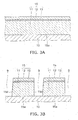
- the first semiconductor layer 11 is grown on the major surface of a substrate 10; and the light emitting layer 12 and the second semiconductor layer 13are grown thereupon.
- the semiconductor layer 15 may be formed by, for example, crystal growth on a sapphire substrate.
- a separating trench 9 is made to pierce the semiconductor layer 15 and reach the substrate 10 by, for example, Reactive Ion Etching (RIE) using a not-illustrated resist as a mask.
- RIE Reactive Ion Etching
- the separating trench 9 is made, for example, in a lattice configuration on the substrate 10 to multiply separate the semiconductor layer 15.
- the upper level portion 15b is formed on the second major surface side of the semiconductor layer 15 and positioned relatively in the upper level as viewed from the substrate 10; and the lower level portion 15c is formed on the second major surface side of the semiconductor layer 15 and positioned more in the lower level on the substrate 10 side than is the upper level portion 15b.
- the upper level portion 15b includes the light emitting layer 12; and the lower level portion 15c does not include the light emitting layer 12.
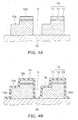
- the insulating film 16 made of a silicon oxide film or the like is formed on all exposed faces of the substrate 10 by, for example, chemical vapor deposition (CVD).
- the insulating film 16 covers exposed surface of the semiconductor layer 15 including the side face 15d and the second major surface of the semiconductor layer 15.
- the insulating film 16 also is formed on the side face and the bottom face of the separating trench 9.
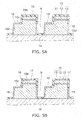
- n-side electrode 18 is formed as illustrated in FIG. 5A on the exposed portions by, for example, sputtering. At this time, the portions other than the portions where the n-side electrode 18 is formed are covered with a not-illustrated mask such as a resist.
- the n-side electrode 18 includes, for example, a nickel film formed on the first semiconductor layer 11 side and an aluminum film stacked on the nickel film.
- an opening is selectively made in the insulating film 16 on the upper level portion 15b by, for example, wet etching to expose the upper face of the upper level portion 15b (the upper face of the second semiconductor layer 13).
- the p-side electrode 17 is formed as illustrated in FIG. 5B on the exposed portions by, for example, sputtering. At this time, the portions other than the portions where the p-side electrode 17 is formed are covered with a not-illustrated mask such as a resist.
- the p-side electrode 17 includes, for example, a nickel film formed on the second semiconductor layer 13 side and a gold film stacked on the nickel film.
- the p-side electrode 17 may be formed prior to the n-side electrode 18; or the p-side electrode 17 and the n-side electrode 18 may be formed simultaneously from the same material.
- the manufacturing step is provided in two steps as in FIGS. 5A and 5B .
- the manufacturing step may be one step. Namely, openings are formed in above a region to be formed the p-side electrode 17 and the n-side electrode 18 thereon.
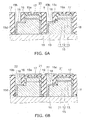
- the insulating layer 19 is patterned as illustrated in FIG. 6A by, for example, wet etching to make the first opening 19a and the second opening 19b in the insulating layer 19.
- the insulating layer 19 is made of a resin such as, for example, polyimide having excellent patternability in ultra-fine patterns.
- the first opening 19a reaches the p-side electrode 17.
- the second opening 19b reaches the n-side electrode 18 formed on the upper face of the lower level portion 15c. Further, the second opening 19b is made in the portion beside the side face 15d and communicates with the n-side electrode 18 formed on the side face 15d.
- a continuous seed metal 20 is formed on the upper face of the insulating layer 19 and on the inner faces of the first opening 19a and the second opening 19b; and after forming a not-illustrated plating resist, Cu plating is performed using the seed metal 20 as a current path.
- the seed metal 20 includes, for example, Cu.
- the p-side interconnect layer 21 and the n-side interconnect layer 22 are formed selectively on the insulating layer 19.
- the p-side interconnect layer 21 and the n-side interconnect layer 22 are formed simultaneously by plating.
- the p-side interconnect layer 21 is formed also in the first opening 19a to connect to the p-side electrode 17.
- the n-side interconnect layer 22 is formed also in the second opening 19b to connect to the n-side electrode 18.
- the side face 15d is obtained when making the separating trench 9 described above referring to FIG. 3B .
- the separating trench 9 is made by RIE using a resist film selectively formed on the semiconductor layer 15 as a mask. At this time, the resist film is consumed isotropically in the film thickness direction and the planar direction; and the planar size of the resist film is reduced as the etching progresses. Accordingly, the width of the separating trench 9 gradually decreases in the depth direction. Accordingly, each of the cross-sectional configurations of the multiply subdivided semiconductor layer 15 on the substrate 10 is a trapezoidal configuration; and the side face 15d adjacent to the separating trench 9 is tapered with respect to the first major surface 15a and the second major surface.
- the width of the portion of the second opening 19b beside the side face 15d is wider upward; and it is possible to reliably form the seed metal 20 and the n-side interconnect layer 22 to the bottom of the second opening 19b.
- the plating resist used during the plating of the p-side interconnect layer 21 and the n-side interconnect layer 22 is removed by a chemical solution. Subsequently, another plating resist (not illustrated) is formed for forming the metal pillars; and Cu plating is performed using the seed metal 20 described above as a current path. Thereby, as illustrated in FIG. 7A , the p-side metal pillar 24 is formed above the p-side interconnect layer 21; and the n-side metal pillar 25 is formed above the n-side interconnect layer 22. The p-side metal pillar 24 and the n-side metal pillar 25 are formed simultaneously by plating.
- the plating resist for forming the metal pillars is removed by a chemical solution; and the exposed portions of the seed metal 20 also are removed. Thereby, the electrical connection between the p-side interconnect layer 21 and the n-side interconnect layer 22 via the seed metal 20 is divided.
- the p-side interconnect layer 21, the n-side interconnect layer 22, the p-side metal pillar 24, and the n-side metal pillar 25 are covered with the resin layer 23. Subsequently, the surface of the resin layer 23 is polished to expose the end faces (the upper faces) of the p-side metal pillar 24 and the n-side metal pillar 25.
- the substrate 10 is removed.
- the substrate 10 may be removed by, for example, laser lift-off. Specifically, laser light is irradiated from the backside of the substrate 10 toward the first semiconductor layer 11.
- the substrate 10 is permeable to laser light; and the laser light has a wavelength in the absorption region of the first semiconductor layer 11.
- the first semiconductor layer 11 proximal to the interface absorbs the energy of the laser light and decomposes.
- the first semiconductor layer 11 decomposes into Ga and nitrogen gas.
- a micro gap is formed between the substrate 10 and the first semiconductor layer 11 by the decomposition reaction; and the substrate 10 and the first semiconductor layer 11 separate. The irradiation of the laser light is performed over the entire wafer by performing multiply for each set region; and the substrate 10 is removed.
- the layer made of the resin and the metal is flexible, and the metal is formed by plating at near room temperature. Hence, the residual stress occurring with respect to the translucent substrate 10 is relatively low.
- the semiconductor layer made of GaN is separated by laser irradiation.
- the translucent substrate and the silicon substrate being different in thermal expansion coefficient are both rigid, and are bonded together at high temperature. Hence, a high residual stress remains between these substrates. Consequently, when the separation is started by laser irradiation, the residual stress is locally relieved from the separated portion and unfortunately causes cracks in the thin, brittle semiconductor layer.
- the residual stress is low, and the semiconductor layer 15 is separated in the state of being fixed to a flexible support.
- the device can be manufactured at high yield without trouble such as cracking in the semiconductor layer 15.
- the fluorescent layer 26 is formed on the first major surface 15a as illustrated in FIG. 7B ,
- the fluorescent layer 26 may be formed, for example, by coating a liquid resin in which phosphor particles are mixed by spin coating and then thermosetting.
- the substrate 10 By forming the fluorescent layer 26 after removing the substrate 10 from the first major surface 15a, the substrate 10 does not exist between the first major surface 15a and the fluorescent layer 26; and the light extraction efficiency can be increased.
- dicing is performed to obtain the singulated semiconductor light emitting device illustrated in FIG. 1A .
- the substrate 10 is already removed; and in the separating trench 9 which is the dicing region, the semiconductor layer 15 does not exist and the insulating layer 19 which is a resin is filled. Accordingly, the dicing is easy because the insulating layer 19, which is a resin, and the resin layer 23 are cut; and the productivity can be improved. Further, damage to the semiconductor layer 15 during the dicing can be avoided. Also, a structure is obtained after singulation in which the periphery of the device is covered with resin and protected.
- the singulated semiconductor light emitting device may have a single-chip structure including one semiconductor layer 15 or a multi-chip structure including multiple semiconductor layers 15.
- FIG. 8A is a schematic cross-sectional view of a semiconductor light emitting device of a second embodiment.
- FIG. 8B is a schematic perspective view of the semiconductor layer 15 and the electrodes 17 and 18 of the semiconductor light emitting device.
- the first major surface 15a of the semiconductor layer 15 is illustrated on the upper side; and in FIG. 8B , the first major surface 15a is illustrated on the lower side.
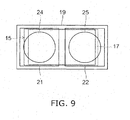
- FIG. 9 illustrates one example of a planar layout of the semiconductor layer 15 (shown as broken line in FIG. 9 ), the p-side electrode 17 (shown as broken line in FIG. 9 ), the p-side interconnect layer 21, the n-side interconnect layer 22, the p-side metal pillar 24, and the n-side metal pillar 25 of this embodiment.
- FIG. 9 corresponds to a plan view as viewed from the lower face (the mounting surface) side of FIG. 8A .
- the resin layer 23 is not illustrated.
- the n-side electrode 18 is formed on the side face 15d of the first semiconductor layer 11 between the first major surface 15a and the light emitting layer 12 of the semiconductor layer 15.
- the surface area reduction of the p-side electrode 17 can be suppressed; the luminance can be increased; and the reliability can be increased by increasing the surface area of the n-side electrode 18.
- the light leakage from the side face 15d can be prevented; and the uneven colors and the uneven luminance can be suppressed.
- the amount of light reflected by the side face and extracted from the first major surface 15a side can be increased; and the luminance can be increased.
- the n-side electrode 18 is not provided on the second major surface and is provided only on the side face 15d. Accordingly, as illustrated in FIG. 8B and FIG. 9 , the surface area of the p-side electrode 17 provided on the second major surface can be greater; and a larger light emitting region can be obtained. Thereby, the luminous efficacy can be increased. Because the processes described above and illustrated in FIG. 4A that expose the second major surface of the first semiconductor layer 11 can be omitted, cost reductions also are possible.
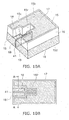
- FIG. 10A is a schematic perspective view of the semiconductor layer 15 and the electrodes 17 and 18 of a semiconductor light emitting device of a third embodiment.
- FIG. 10B corresponds to a plan view of FIG. 10A .
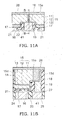
- FIG. 11A corresponds to a cross section along A-A of FIG. 10B .
- FIG. 11B corresponds to a cross section along B-B of FIG. 11A .
- FIG. 12 illustrates one example of a planar layout of the semiconductor layer 15, the p-side electrode 17, the n-side electrode 18, the p-side interconnect layer 21, the n-side interconnect layer 22, the p-side metal pillar 24, and the n-side metal pillar 25 of this embodiment.
- FIG. 12 corresponds to a plan view as viewed from the lower face (the mounting surface) side of FIG. 11B .
- the resin layer 23 is not illustrated.
- the layout of the p-side electrode 17 has a surface area greater than that of the n-side electrode 18.
- the n-side interconnect layer 22 is formed to spread over the insulating layer 19 with a surface area greater than that of the portion of the n-side electrode 18 provided on the second major surface.
- the n-side electrode 18 is formed on the side face 15d and the upper face (the second major surface) of the lower level portion 15c of the semiconductor layer 15.
- a trench 41 is formed in the lower level portion 15c.
- the trench 41 is formed from the second major surface of the lower level portion 15c to reach the substrate 10 in a state in which the semiconductor layer 15 is formed on the substrate 10. In other words, the trench 41 reaches the first major surface 15a from the second major surface of the lower level portion 15c.
- the trench 41 pierces the n-type semiconductor layer 11.
- the n-side electrode 18 is formed also on the side face of the trench 41.
- the n-side electrode 18 is formed also on the side face of the trench 41. Thereby, the region of the n-side electrode 18 on the second major surface can be reduced. The surface area of the p-side electrode 17 on the second major surface can be relatively increased; and the luminous efficacy can be increased.
- the semiconductor layer 15 has a recess portion 15r toward longitudinal direction.
- the recess portion 15r is set back one move step with comparing to the semiconductor light emitting device shown in FIGS. 1A, 1B and 2 .
- the semiconductor layer 15 is two step recesses, in which one is wide and provided outside and the other recess portion 15r is narrow, as shown in FIGS. 10A and 10B .
- a protruded portion 182 of the n-side electrode 18 is formed in the recess portion 15r.
- the n-side electrode 18 has a protrusion portion 182 toward the p-side electrode 17 in longitudinal direction (horizontal direction in FIG. 10B ) of the semiconductor light emitting device.
- the n-side electrode 18 includes a wide portion 181 and a narrow (protruded) portion 182.
- the wide portion 181 is similar to the n-side electrode 18 in FIGS. 1A, 1B and 2 .
- the trench 41 is formed from the lower level portion 15c and the recess portion 15r to the first major surface 15a.
- the trench 41 has a line shape in a plan view in FIG. 10B , and uniform width, in this embodiment.
- the protrusion portion 182 is protruded a bottom of the U shape of the p-side electrode 17 as in FIGS. 10B and 12 .
- the light leakage from the side face 15d can be prevented; and the uneven colors and the uneven luminance can be suppressed. Further, the amount of the light reflected by the side face and extracted from the first major surface 15a side can be increased; and the luminance can be increased.
- the n-side electrode 18 is formed also on the bottom portion of the trench 41.
- the n-side electrode 18 is formed on the bottom portion of the trench 41, i.e., the major surface of the substrate 10, in the state in which the semiconductor layer 15 is formed on the substrate 10. Therefore, the fluorescent layer 26 does not enter the trench 41 when forming the fluorescent layer 26 on the first major surface 15a after removing the substrate 10; and the fluorescent layer 26 can be formed with a uniform thickness.
- the n-side interconnect layer 22 is filled also on the inner side of the n-side electrode 18 in the trench 41. Accordingly, the n-side electrode 18 and the n-side interconnect layer 22 are in contact also inside the trench 41. Therefore, the contact surface area between the n-side electrode 18 and the n-side interconnect layer 22 can be increased; and the contact resistance can be reduced.
- the trench 41 is made from the second major surface of the lower level portion 15c to reach the first major surface 15a on the side opposite to the second major surface.
- the substrate 10 forms a stopper when patterning the trench 41; and the trench 41 can be obtained with a constant depth. Therefore, characteristic variations due to variation of the contact surface area between the n-side electrode 18 and the first semiconductor layer 11 via the side face of the trench 41 can be prevented.
- the n-side metal pillar 25 is provided above (beneath) the wide portion 181 and the narrow protruded portion 182 of the n-side electrode 18.
- the narrow protruded portion 182 of the n-side electrode 18 is provided. Therefore, a radiative recombination is generated around a center of the semiconductor light emitting device. Furthermore, the trench 41 is formed and the n-side electrode 18 is formed on the side surface of the trench 41. Thus, a current pass from the p-side electrode 17 to the n-side electrode 18 is spread and optical output may be improved.
- FIG. 13A is a schematic cross-sectional view of a semiconductor light emitting device of an illustrative example.
- FIG. 13B is a schematic perspective view of the semiconductor layer 15 and the electrodes 17 and 18 of the semiconductor light emitting device.
- FIG. 14 illustrates one example of a planar layout of the semiconductor layer 15, the p-side electrode 17, the n-side electrode 18, the p-side interconnect layer 21, the n-side interconnect layer 22, the p-side metal pillar 24, and the n-side metal pillar 25 of this illustrative example.
- FIG. 14 corresponds to a plan view as viewed from the lower face (the mounting surface) of FIG. 13A .
- the resin layer 23 is not illustrated.
- the layout of the p-side electrode 17 on the second major surface of the semiconductor layer 15 has a surface area greater than that of the n-side electrode 18.
- the n-side interconnect layer 22 is formed to spread over the insulating layer 19 with a surface area greater than that of the n-side electrode 18 provided on the second major surface.
- the p-side electrode 17 is provided on the second major surface of the upper level portion 15b including the light emitting layer 12; and the n-side electrode 18 is provided on the second major surface of the lower level portion 15c provided outside the outer circumference of the light emitting layer 12.
- the p-side electrode 17 is provided also on the side face 15d side of the semiconductor layer 15.
- the insulating film 16 is formed on the side face 15d; and the p-side electrode 17 is provided also on the insulating film 16 provided on the side face 15d.
- the p-side electrode 17 is provided via the insulating film 16 on the side face 15d on the side opposite to the lower level portion 15c with the upper level portion 15b between the side face 15d and the lower level portion 15c.
- the p-side electrode 17 is formed continuously from the second major surface of the upper level portion 15b to the side face 15d side.
- a high potential (a positive potential) with respect to the n-side electrode 18 may be applied to the p-side electrode 17. Then, electrons injected from the n-side electrode 18 into the first semiconductor layer 11 are attracted by the potential of the p-side electrode 17 provided on the side face 15d side; and the electrons can be efficiently injected even into the portions of the light emitting layer 12 distal to the n-side electrode 18 as illustrated by the broken-line arrows of FIG. 13A .
- the concentration of the electrons in the side of the light emitting layer 12 proximal to the n-side electrode 18 can be suppressed; the current distribution in the surface direction of the light emitting layer 12 can be uniform; and a local increase of the current density can be suppressed.
- the electrons contribute more efficiently to the light emission; and the luminous efficacy increases.
- the n-side electrode 18 is provided only on the second major surface in the structure illustrated in FIGS. 13A and 13B , the n-side electrode 18 may be formed on the side face of the lower level portion 15c similarly to the embodiments described above. In such a case, the p-side electrode 17 and the n-side electrode 18 are separated from each other by an insulating film such that the electrodes 17 and 18 do not contact each other on the side face 15d.
- the substrate 10 may not be removed entirely; and the substrate 10 may be polished to thinly remain on the first major surface 15a.
- the mechanical strength can be higher than that of the structure in which the substrate 10 is entirely removed; and a structure having high reliability can be provided.
- the remaining substrate 10 can suppress warp after singulation; and the mounting onto the circuit substrate and the like is easy.
- a red fluorescent layer may contain, for example, a nitride-based phosphor of CaAlSiN 3 :Eu or a SiAlON-based phosphor.
- a SiAlON-based phosphor it may be used M 1 - x ⁇ R x a ⁇ 1 ⁇ AlSi b ⁇ 1 ⁇ O c ⁇ 1 ⁇ N d ⁇ 1
- M is at least one type of metal element excluding Si and Al, and it may be desirable for M to be at least one selected from Ca and Sr
- R is a light emission center element, and it may be desirable for R to be Eu
- x, a1, b1, c1, and d1 satisfy the relationships 0 ⁇ x ⁇ 1, 0.6 ⁇ a1 ⁇ 0.95, 2 ⁇ b1 ⁇ 3.9, 0.25 ⁇ c1 ⁇ 0.45, and 4 ⁇ d1 ⁇ 5.7.
- the temperature characteristics of the wavelength conversion efficiency can be improved; and the efficiency in the high current density region can be improved further.
- a yellow fluorescent layer may contain, for example, a silicate-based phosphor of (Sr, Ca, Ba) 2 SiO 4 : Eu.
- a green fluorescent layer may contain, for example, a halophosphate-based phosphor of (Ba, Ca, Mg) 10 (PO 4 ) 6 ⁇ Cl 2 :Eu or a SiAlON-based phosphor.
- a SiAlON-based phosphor it may be used M 1 - x ⁇ R x a ⁇ 2 ⁇ AlSi b ⁇ 2 ⁇ O c ⁇ 2 ⁇ N d ⁇ 2
- M is at least one type of metal element excluding Si and Al, and it may be desirable for M to be at least one selected from Ca and Sr
- R is a light emission center element, and it may be desirable for R to be Eu
- x, a2, b2, c2, and d2 satisfy the relationships 0 ⁇ x ⁇ 1, 0.93 ⁇ a2 ⁇ 1.3, 4.0 ⁇ b2 ⁇ 5.8, 0.6 ⁇ c2 ⁇ 1, and 6 ⁇ d2 ⁇ 11.
- the temperature characteristics of the wavelength conversion efficiency can be improved; and the efficiency in the high current density region can be improved further.
- a blue fluorescent layer may contain, for example, an oxide-based phosphor of BaMgAl 10 O 17 :Eu.
- the method for manufacturing the semiconductor light emitting device includes:
- the manufacturing method further includes forming an upper level portion including the light emitting layer and a lower level portion not including the light emitting layer on the second major surface side of the semiconductor layer.
- the second electrode is formed on a side face of the lower level portion.
- the second electrode is formed also on an upper face of the lower level portion.
- the manufacturing method further includes making a trench to pierce the lower level portion and reach the substrate; and the second electrode is formed also on a side face of the trench.
- a resin is filled as an insulating layer into the separating trench; and singulation is performed by cutting the resin in the separating trench.
Landscapes
- Led Devices (AREA)
- Led Device Packages (AREA)
Claims (17)
- Lichtemittierende Halbleitereinrichtung, mit:einer Halbleiterschicht (15) mit einer lichtemittierenden Schicht (12), wobei die Halbleiterschicht (15) eine erste Hauptfläche (15a) und eine zweite Hauptfläche gegenüber der ersten Hauptfläche (15a) aufweist;einer ersten Elektrode (17), die an der zweiten Hauptfläche der Halbleiterschicht (15) vorgesehen ist;einer zweiten Elektrode (18), die an einer Seitenfläche (15d) eines Abschnitts der Halbleiterschicht (15) zwischen der lichtemittierenden Schicht (12) und der ersten Hauptfläche (15a) vorgesehen ist;einer ersten isolierenden Schicht (19), die an einer Seite der zweiten Hauptfläche der Halbleiterschicht (15) vorgesehen ist, wobei die erste isolierende Schicht (19) eine erste Öffnung (19a) aufweist, welche die erste Elektrode (17) erreicht;einer ersten Zwischenverbindungsschicht (21), die in der ersten Öffnung (19a) und an der ersten isolierenden Schicht (19) an einer Seite der ersten isolierenden Schicht (19) gegenüber der zweiten Hauptfläche vorgesehen ist, um die erste Elektrode (17) zu verbinden; undeiner zweiten Zwischenverbindungsschicht (22);dadurch gekennzeichnet, dassdie erste isolierende Schicht (19) eine zweite Öffnung (19b) vorgesehen an der Seitenfläche (15d) aufweist, welche die zweite Elektrode (18) erreicht;die zweite Zwischenverbindungsschicht (22) in der zweiten Öffnung (19b) und an der ersten isolierenden Schicht (19) an der Seite der ersten isolierenden Schicht (19) gegenüber der zweiten Hauptfläche vorgesehen ist, um die zweite Elektrode (18), die an der Seitenfläche (15d) vorgesehen ist, zu verbinden, wobei die zweite Zwischenverbindungsschicht (22) mit Einfügen der zweiten Elektrode (18) an der Seitenfläche (15d) des Abschnitts der Halbleiterschicht (15) vorgesehen ist; undferner miteiner ersten Metallsäule (24), die auf einer Fläche der ersten Zwischenverbindungsschicht (21) an einer Seite gegenüber der ersten Elektrode (17) vorgesehen ist;einer zweiten Metallsäule (25), die auf einer Fläche der zweiten Zwischenverbindungsschicht (22) an einer Seite gegenüber der zweiten Elektrode (18) vorgesehen ist; undeiner zweiten isolierenden Schicht (23), die einen Umfang der ersten Metallsäule (24) und einen Umfang der zweiten Metallsäule (25) bedeckt.
- Einrichtung nach Anspruch 1, wobei
die zweite Elektrode (18) vorgesehen ist, um die zweite Fläche (15d) kontinuierlich zu umgeben. - Einrichtung nach Anspruch 1 oder 2, wobei
die zweite Elektrode auch auf der zweiten Hauptfläche vorgesehen ist. - Einrichtung nach Anspruch 3, wobei
ein Flächenbereich der zweiten Elektrode (18) auf der Seitenfläche (15d) größer ist als ein Flächenbereich der zweiten Elektrode (18) auf der zweiten Hauptfläche. - Einrichtung nach Anspruch 3 oder 4, wobei
die erste Elektrode (17) in Draufsicht eine U-Form aufweist und ein Abschnitt der zweiten Elektrode (18) in einer Öffnung der U-Form in Draufsicht vorgesehen ist. - Einrichtung nach Anspruch 5, wobei
die zweite Elektrode (18) einen Vorsprungsabschnitt auf der zweiten Hauptfläche zu einem Boden der U-Form in Draufsicht hin aufweist. - Einrichtung nach einem der Ansprüche 1 bis 6, wobei
die Halbleiterschicht (15) einen Abschnitt eines oberen Niveaus (15b), der die lichtemittierende Schicht (12) aufweist und einen Abschnitt eines unteren Niveaus (15c) aufweist, der nicht die lichtemittierende Schicht (12) aufweist, wobei die erste Elektrode (17) auf der zweiten Hauptfläche des Abschnitts des oberen Niveaus (15b) vorgesehen ist und die zweite Elektrode (18) auf einer Seitenfläche des Abschnitts des unteren Niveaus (15c) vorgesehen ist. - Einrichtung nach Anspruch 7, wobei
ein Einschnitt (41) in dem Abschnitt des unteren Niveaus (15c) ausgebildet ist und die zweite Elektrode (18) auch auf einer Seitenfläche des Einschnitts (41) vorgesehen ist. - Einrichtung nach Anspruch 8, wobei
die zweite Elektrode (18) auch auf einem Bodenabschnitt des Einschnitts (41) vorgesehen ist. - Einrichtung nach Anspruch 8 oder 9, wobei
die zweite Zwischenverbindungsschicht (22) auch an einer inneren Seite der zweiten Elektrode (18) in dem Einschnitt (41) vorgesehen ist. - Einrichtung nach einem der Ansprüche 7 bis 10, wobei
die zweite Elektrode (18) auch auf der zweiten Hauptfläche des Abschnitts des unteren Niveaus (15c) vorgesehen ist. - Einrichtung nach Anspruch 11, wobei
die erste Elektrode (17) in Draufsicht eine U-Form aufweist, ein Abschnitt der zweiten Elektrode (18) in einer Öffnung der U-Form in Draufsicht vorgesehen ist und die zweite Elektrode (18) einen Vorsprungsabschnitt (182) auf der zweiten Hauptfläche zu einem Boden der U-Form in Draufsicht hin aufweist. - Einrichtung nach Anspruch 12, wobei
ein Einschnitt (41) in dem Abschnitt des unteren Niveaus (15c) ausgebildet ist und der Vorsprungsabschnitt (182) und die zweite Elektrode (18) auch auf einer Seitenfläche des Einschnitts (41) vorgesehen sind. - Einrichtung nach einem der Ansprüche 1 bis 13, wobei
die Seitenfläche (15d) bezüglich der ersten Hauptfläche (15a) und der zweiten Hauptfläche angeschrägt ist, und
eine Breite eines Abschnitts der zweiten Öffnung (19b) neben der Seitenfläche (15d) graduell von einer Seite der ersten Hauptfläche (15a) zu einer Seite der zweiten Hauptfläche hin zunimmt. - Einrichtung nach einem der Ansprüche 3 bis 14, wobei
eine Fläche der zweiten Zwischenverbindungsschicht (22) an einer Seite gegenüber der zweiten Elektrode (18) auf der zweiten Hauptfläche größer ist als eine Fläche der zweiten Zwischenverbindungsschicht (22), die mit der zweiten Elektrode (18) auf der zweiten Hauptfläche verbunden ist. - Einrichtung nach einem der Ansprüche 3 bis 15, wobei
ein Flächenbereich eines Abschnitts der zweiten Elektrode (18), der an der Seitenfläche (15d) der Halbleiterschicht (15) vorgesehen ist, größer ist als ein Flächenbereich eines Abschnitts der zweiten Elektrode (18), der auf der zweiten Hauptfläche vorgesehen ist. - Einrichtung nach einem der Ansprüche 1 bis 16, wobei
eine Dicke der ersten Metallsäule (24) und eine Dicke der zweiten Metallsäule (25) dicker ist als eine Dicke eines gestapelten Körpers, der die Halbleiterschicht (15), die erste Elektrode (17), die zweite Elektrode (18), die erste isolierende Schicht (19), die erste Zwischenverbindungsschicht (21) und die zweite Zwischenverbindungsschicht (22) aufweist.
Applications Claiming Priority (1)
| Application Number | Priority Date | Filing Date | Title |
|---|---|---|---|
| JP2010118697A JP5356312B2 (ja) | 2010-05-24 | 2010-05-24 | 半導体発光装置 |
Publications (2)
| Publication Number | Publication Date |
|---|---|
| EP2390933A1 EP2390933A1 (de) | 2011-11-30 |
| EP2390933B1 true EP2390933B1 (de) | 2015-05-20 |
Family
ID=44019032
Family Applications (1)
| Application Number | Title | Priority Date | Filing Date |
|---|---|---|---|
| EP20100186525 Not-in-force EP2390933B1 (de) | 2010-05-24 | 2010-10-05 | Lichtemittierendes Halbleiterbauelement |
Country Status (4)
| Country | Link |
|---|---|
| US (1) | US8729592B2 (de) |
| EP (1) | EP2390933B1 (de) |
| JP (1) | JP5356312B2 (de) |
| TW (1) | TWI445207B (de) |
Families Citing this family (43)
| Publication number | Priority date | Publication date | Assignee | Title |
|---|---|---|---|---|
| JP4866491B2 (ja) * | 2010-04-01 | 2012-02-01 | パナソニック株式会社 | 発光ダイオード素子および発光ダイオード装置 |
| JP5343040B2 (ja) * | 2010-06-07 | 2013-11-13 | 株式会社東芝 | 半導体発光装置 |
| JP5537446B2 (ja) | 2011-01-14 | 2014-07-02 | 株式会社東芝 | 発光装置、発光モジュール、発光装置の製造方法 |
| JP5603793B2 (ja) | 2011-02-09 | 2014-10-08 | 株式会社東芝 | 半導体発光装置 |
| JP5603813B2 (ja) | 2011-03-15 | 2014-10-08 | 株式会社東芝 | 半導体発光装置及び発光装置 |
| JP5535114B2 (ja) | 2011-03-25 | 2014-07-02 | 株式会社東芝 | 発光装置、発光モジュール、発光装置の製造方法 |
| JP5642623B2 (ja) | 2011-05-17 | 2014-12-17 | 株式会社東芝 | 半導体発光装置 |
| RU2597071C2 (ru) * | 2011-05-24 | 2016-09-10 | Конинклейке Филипс Н.В. | МЕТАЛЛИЧЕСКИЙ НАПОЛНИТЕЛЬ, РАЗДЕЛЯЮЩИЙ СЛОИ р- И n-ТИПА, ДЛЯ СВЕТОИЗЛУЧАЮЩИХ ДИОДОВ, МОНТИРУЕМЫХ МЕТОДОМ ПЕРЕВЕРНУТОГО КРИСТАЛЛА |
| JP5662277B2 (ja) | 2011-08-08 | 2015-01-28 | 株式会社東芝 | 半導体発光装置及び発光モジュール |
| JP2013065726A (ja) | 2011-09-16 | 2013-04-11 | Toshiba Corp | 半導体発光装置及びその製造方法 |
| EP2748865B1 (de) * | 2011-12-08 | 2019-04-10 | Lumileds Holding B.V. | Lichtemittierendes halbleiterbauelement mit dicken metallschichten |
| US20130240934A1 (en) * | 2012-03-14 | 2013-09-19 | Samsung Electronics Co., Ltd. | Light emitting element package and method of manufacturing the same |
| JP5985322B2 (ja) | 2012-03-23 | 2016-09-06 | 株式会社東芝 | 半導体発光装置及びその製造方法 |
| JP5710532B2 (ja) * | 2012-03-26 | 2015-04-30 | 株式会社東芝 | 半導体発光装置及びその製造方法 |
| CN102646769B (zh) * | 2012-03-30 | 2015-08-05 | 达亮电子(苏州)有限公司 | 发光二极管组件、发光二极管封装结构及其制造方法 |
| WO2013171632A1 (en) * | 2012-05-17 | 2013-11-21 | Koninklijke Philips N.V. | Method of separating a wafer of semiconductor devices |
| FR2992465B1 (fr) * | 2012-06-22 | 2015-03-20 | Soitec Silicon On Insulator | Procede de fabrication collective de leds et structure pour la fabrication collective de leds |
| FR2992466A1 (fr) * | 2012-06-22 | 2013-12-27 | Soitec Silicon On Insulator | Procede de realisation de contact pour led et structure resultante |
| US8816383B2 (en) * | 2012-07-06 | 2014-08-26 | Invensas Corporation | High performance light emitting diode with vias |
| JP6239311B2 (ja) * | 2012-08-20 | 2017-11-29 | エルジー イノテック カンパニー リミテッド | 発光素子 |
| KR101886156B1 (ko) * | 2012-08-21 | 2018-09-11 | 엘지이노텍 주식회사 | 발광소자 |
| DE102012113003A1 (de) | 2012-12-21 | 2014-04-03 | Osram Opto Semiconductors Gmbh | Verfahren zur Herstellung eines optoelektronischen Halbleiterbauteils und optoelektronisches Halbleiterbauteil |
| JP2015050256A (ja) * | 2013-08-30 | 2015-03-16 | 株式会社東芝 | 窒化物半導体発光装置 |
| FR3023065B1 (fr) * | 2014-06-27 | 2017-12-15 | Commissariat Energie Atomique | Dispositif optoelectronique a jonction p-n permettant une ionisation de dopants par effet de champ |
| FR3023061B1 (fr) * | 2014-06-27 | 2017-12-15 | Commissariat Energie Atomique | Diode de structure mesa a surface de contact sensiblement plane |
| CN105449064B (zh) * | 2014-09-02 | 2018-02-23 | 展晶科技(深圳)有限公司 | 发光二极管及其制造方法 |
| KR102322841B1 (ko) * | 2014-12-24 | 2021-11-08 | 엘지이노텍 주식회사 | 발광소자 및 이를 포함하는 발광소자 어레이 |
| KR102322842B1 (ko) | 2014-12-26 | 2021-11-08 | 엘지이노텍 주식회사 | 발광 소자 어레이 |
| KR102345751B1 (ko) | 2015-01-05 | 2022-01-03 | 삼성전자주식회사 | 반도체 발광소자 패키지 및 그 제조 방법 |
| JP6545981B2 (ja) * | 2015-03-12 | 2019-07-17 | アルパッド株式会社 | 半導体発光装置 |
| DE102015107586B4 (de) | 2015-05-13 | 2023-10-26 | OSRAM Opto Semiconductors Gesellschaft mit beschränkter Haftung | Verfahren zur Herstellung optoelektronischer Bauelemente und oberflächenmontierbares optoelektronisches Bauelement |
| FR3038127B1 (fr) | 2015-06-24 | 2017-06-23 | Commissariat Energie Atomique | Procede de fabrication d'une pluralite de dipoles en forme d'ilots ayant des electrodes auto-alignees |
| JP7348520B2 (ja) | 2018-12-25 | 2023-09-21 | 日亜化学工業株式会社 | 発光装置及び表示装置 |
| US11387392B2 (en) * | 2018-12-25 | 2022-07-12 | Nichia Corporation | Light-emitting device and display device |
| JP7052188B2 (ja) * | 2019-06-13 | 2022-04-12 | 日亜化学工業株式会社 | 発光素子の製造方法 |
| CN112582511B (zh) * | 2019-09-30 | 2022-08-02 | 成都辰显光电有限公司 | 微发光二极管芯片及显示面板 |
| CN112768484B (zh) * | 2019-11-04 | 2024-03-26 | 厦门三安光电有限公司 | 发光二极管及其制作方法 |
| CN112968089B (zh) * | 2020-11-26 | 2022-04-15 | 重庆康佳光电技术研究院有限公司 | 发光器件及其制作方法、背板及其制作方法 |
| US11955583B2 (en) * | 2020-12-01 | 2024-04-09 | Lumileds Llc | Flip chip micro light emitting diodes |
| US11705534B2 (en) * | 2020-12-01 | 2023-07-18 | Lumileds Llc | Methods of making flip chip micro light emitting diodes |
| KR102758850B1 (ko) * | 2021-09-06 | 2025-01-23 | 엘지전자 주식회사 | 디스플레이 패널용 반도체 발광소자 및 이를 포함하는 디스플레이 장치 |
| CN115132898B (zh) * | 2022-06-30 | 2025-07-08 | 上海天马微电子有限公司 | 一种发光器件、显示面板及显示装置 |
| CN115249757A (zh) * | 2022-09-20 | 2022-10-28 | 南昌凯捷半导体科技有限公司 | 一种无台阶mini LED芯片及其制作方法 |
Citations (1)
| Publication number | Priority date | Publication date | Assignee | Title |
|---|---|---|---|---|
| US20020017651A1 (en) * | 2000-07-25 | 2002-02-14 | Munehiro Kato | White light emission diode |
Family Cites Families (25)
| Publication number | Priority date | Publication date | Assignee | Title |
|---|---|---|---|---|
| JP2661420B2 (ja) | 1991-07-16 | 1997-10-08 | 豊田合成株式会社 | 窒化ガリウム系化合物半導体発光素子の製造方法 |
| JP3557033B2 (ja) * | 1995-03-24 | 2004-08-25 | 三洋電機株式会社 | 半導体発光素子およびその製造方法 |
| US5798536A (en) * | 1996-01-25 | 1998-08-25 | Rohm Co., Ltd. | Light-emitting semiconductor device and method for manufacturing the same |
| JP3556080B2 (ja) * | 1997-11-14 | 2004-08-18 | 日亜化学工業株式会社 | 窒化物半導体素子 |
| JP2000150958A (ja) | 1998-11-13 | 2000-05-30 | Sanyo Electric Co Ltd | 半導体発光素子 |
| JP3589187B2 (ja) * | 2000-07-31 | 2004-11-17 | 日亜化学工業株式会社 | 発光装置の形成方法 |
| JP4644947B2 (ja) * | 2001-02-05 | 2011-03-09 | 日亜化学工業株式会社 | 窒化物半導体素子及びその製造方法 |
| JP2002353503A (ja) * | 2001-05-29 | 2002-12-06 | Seiwa Electric Mfg Co Ltd | 窒化ガリウム系化合物半導体発光素子 |
| JP4214704B2 (ja) * | 2002-03-20 | 2009-01-28 | 日亜化学工業株式会社 | 半導体素子 |
| KR101095753B1 (ko) * | 2002-08-01 | 2011-12-21 | 니치아 카가쿠 고교 가부시키가이샤 | 반도체 발광 소자 및 그 제조 방법과 그것을 이용한 발광장치 |
| US7179670B2 (en) * | 2004-03-05 | 2007-02-20 | Gelcore, Llc | Flip-chip light emitting diode device without sub-mount |
| TWI244228B (en) | 2005-02-03 | 2005-11-21 | United Epitaxy Co Ltd | Light emitting device and manufacture method thereof |
| KR100616693B1 (ko) | 2005-08-09 | 2006-08-28 | 삼성전기주식회사 | 질화물 반도체 발광 소자 |
| JP2007288097A (ja) * | 2006-04-20 | 2007-11-01 | Showa Denko Kk | フリップチップ型半導体発光素子用の実装基板、フリップチップ型半導体発光素子の実装構造及び発光ダイオードランプ |
| JP2007184316A (ja) * | 2006-01-04 | 2007-07-19 | Toshiba Corp | 半導体装置 |
| KR20070111091A (ko) | 2006-05-16 | 2007-11-21 | 삼성전기주식회사 | 질화물계 반도체 발광다이오드 |
| JP2009532895A (ja) | 2006-08-31 | 2009-09-10 | エピヴァレー カンパニー リミテッド | Iii族窒化物半導体発光素子 |
| US7910395B2 (en) | 2006-09-13 | 2011-03-22 | Helio Optoelectronics Corporation | LED structure |
| DE102007019776A1 (de) | 2007-04-26 | 2008-10-30 | Osram Opto Semiconductors Gmbh | Optoelektronisches Bauelement und Verfahren zur Herstellung einer Mehrzahl optoelektronischer Bauelemente |
| US8368100B2 (en) * | 2007-11-14 | 2013-02-05 | Cree, Inc. | Semiconductor light emitting diodes having reflective structures and methods of fabricating same |
| US9634191B2 (en) * | 2007-11-14 | 2017-04-25 | Cree, Inc. | Wire bond free wafer level LED |
| US8431950B2 (en) | 2008-05-23 | 2013-04-30 | Chia-Lun Tsai | Light emitting device package structure and fabricating method thereof |
| JP5286045B2 (ja) * | 2008-11-19 | 2013-09-11 | スタンレー電気株式会社 | 半導体発光素子の製造方法 |
| JP4724222B2 (ja) | 2008-12-12 | 2011-07-13 | 株式会社東芝 | 発光装置の製造方法 |
| JP5197654B2 (ja) * | 2010-03-09 | 2013-05-15 | 株式会社東芝 | 半導体発光装置及びその製造方法 |
-
2010
- 2010-05-24 JP JP2010118697A patent/JP5356312B2/ja not_active Expired - Fee Related
- 2010-09-08 TW TW099130334A patent/TWI445207B/zh not_active IP Right Cessation
- 2010-09-20 US US12/886,092 patent/US8729592B2/en not_active Expired - Fee Related
- 2010-10-05 EP EP20100186525 patent/EP2390933B1/de not_active Not-in-force
Patent Citations (1)
| Publication number | Priority date | Publication date | Assignee | Title |
|---|---|---|---|---|
| US20020017651A1 (en) * | 2000-07-25 | 2002-02-14 | Munehiro Kato | White light emission diode |
Also Published As
| Publication number | Publication date |
|---|---|
| US8729592B2 (en) | 2014-05-20 |
| JP2011249425A (ja) | 2011-12-08 |
| HK1163348A1 (en) | 2012-09-07 |
| US20110284910A1 (en) | 2011-11-24 |
| EP2390933A1 (de) | 2011-11-30 |
| TWI445207B (zh) | 2014-07-11 |
| TW201143141A (en) | 2011-12-01 |
| JP5356312B2 (ja) | 2013-12-04 |
Similar Documents
| Publication | Publication Date | Title |
|---|---|---|
| EP2390933B1 (de) | Lichtemittierendes Halbleiterbauelement | |
| US9136437B2 (en) | Semiconductor light emitting device and method for manufacturing same | |
| US8692279B2 (en) | Semiconductor light emitting device | |
| EP2393131B1 (de) | Lichtemittierendes Halbleiterbauelement und Herstellungsverfahren | |
| EP2393135B1 (de) | Lichtemittierendes Halbleiterbauelement und Verfahren zu dessen Herstellung | |
| US8436378B2 (en) | Semiconductor light emitting device and method for manufacturing same | |
| US8378377B2 (en) | Light emitting device | |
| TWI429108B (zh) | 半導體發光裝置 | |
| EP2423988A1 (de) | Lichtemittierendes Halbleiterbauelement | |
| US8174027B2 (en) | Semiconductor light emitting device and method for manufacturing same | |
| KR20130117875A (ko) | 반도체 발광 장치 및 그 제조 방법 | |
| HK1163348B (en) | Semiconductor light emitting device | |
| HK1165093B (en) | Semiconductor light emitting device | |
| HK1163346B (en) | Semiconductor light emitting device and method for manufacturing the same | |
| HK1165141B (en) | Semiconductor light emitting device and method for manufacturing same |
Legal Events
| Date | Code | Title | Description |
|---|---|---|---|
| 17P | Request for examination filed |
Effective date: 20101005 |
|
| AK | Designated contracting states |
Kind code of ref document: A1 Designated state(s): AL AT BE BG CH CY CZ DE DK EE ES FI FR GB GR HR HU IE IS IT LI LT LU LV MC MK MT NL NO PL PT RO RS SE SI SK SM TR |
|
| AX | Request for extension of the european patent |
Extension state: BA ME |
|
| PUAI | Public reference made under article 153(3) epc to a published international application that has entered the european phase |
Free format text: ORIGINAL CODE: 0009012 |
|
| REG | Reference to a national code |
Ref country code: HK Ref legal event code: DE Ref document number: 1163348 Country of ref document: HK |
|
| 17Q | First examination report despatched |
Effective date: 20120822 |
|
| GRAJ | Information related to disapproval of communication of intention to grant by the applicant or resumption of examination proceedings by the epo deleted |
Free format text: ORIGINAL CODE: EPIDOSDIGR1 |
|
| GRAP | Despatch of communication of intention to grant a patent |
Free format text: ORIGINAL CODE: EPIDOSNIGR1 |
|
| INTG | Intention to grant announced |
Effective date: 20141212 |
|
| GRAS | Grant fee paid |
Free format text: ORIGINAL CODE: EPIDOSNIGR3 |
|
| GRAA | (expected) grant |
Free format text: ORIGINAL CODE: 0009210 |
|
| AK | Designated contracting states |
Kind code of ref document: B1 Designated state(s): AL AT BE BG CH CY CZ DE DK EE ES FI FR GB GR HR HU IE IS IT LI LT LU LV MC MK MT NL NO PL PT RO RS SE SI SK SM TR |
|
| REG | Reference to a national code |
Ref country code: GB Ref legal event code: FG4D |
|
| REG | Reference to a national code |
Ref country code: CH Ref legal event code: EP |
|
| REG | Reference to a national code |
Ref country code: AT Ref legal event code: REF Ref document number: 728135 Country of ref document: AT Kind code of ref document: T Effective date: 20150615 |
|
| REG | Reference to a national code |
Ref country code: IE Ref legal event code: FG4D |
|
| REG | Reference to a national code |
Ref country code: DE Ref legal event code: R096 Ref document number: 602010024722 Country of ref document: DE |
|
| REG | Reference to a national code |
Ref country code: NL Ref legal event code: T3 |
|
| REG | Reference to a national code |
Ref country code: FR Ref legal event code: PLFP Year of fee payment: 6 |
|
| REG | Reference to a national code |
Ref country code: AT Ref legal event code: MK05 Ref document number: 728135 Country of ref document: AT Kind code of ref document: T Effective date: 20150520 |
|
| REG | Reference to a national code |
Ref country code: LT Ref legal event code: MG4D |
|
| PG25 | Lapsed in a contracting state [announced via postgrant information from national office to epo] |
Ref country code: ES Free format text: LAPSE BECAUSE OF FAILURE TO SUBMIT A TRANSLATION OF THE DESCRIPTION OR TO PAY THE FEE WITHIN THE PRESCRIBED TIME-LIMIT Effective date: 20150520 Ref country code: NO Free format text: LAPSE BECAUSE OF FAILURE TO SUBMIT A TRANSLATION OF THE DESCRIPTION OR TO PAY THE FEE WITHIN THE PRESCRIBED TIME-LIMIT Effective date: 20150820 Ref country code: LT Free format text: LAPSE BECAUSE OF FAILURE TO SUBMIT A TRANSLATION OF THE DESCRIPTION OR TO PAY THE FEE WITHIN THE PRESCRIBED TIME-LIMIT Effective date: 20150520 Ref country code: FI Free format text: LAPSE BECAUSE OF FAILURE TO SUBMIT A TRANSLATION OF THE DESCRIPTION OR TO PAY THE FEE WITHIN THE PRESCRIBED TIME-LIMIT Effective date: 20150520 Ref country code: HR Free format text: LAPSE BECAUSE OF FAILURE TO SUBMIT A TRANSLATION OF THE DESCRIPTION OR TO PAY THE FEE WITHIN THE PRESCRIBED TIME-LIMIT Effective date: 20150520 Ref country code: PT Free format text: LAPSE BECAUSE OF FAILURE TO SUBMIT A TRANSLATION OF THE DESCRIPTION OR TO PAY THE FEE WITHIN THE PRESCRIBED TIME-LIMIT Effective date: 20150921 |
|
| PGFP | Annual fee paid to national office [announced via postgrant information from national office to epo] |
Ref country code: GB Payment date: 20150930 Year of fee payment: 6 |
|
| PG25 | Lapsed in a contracting state [announced via postgrant information from national office to epo] |
Ref country code: LV Free format text: LAPSE BECAUSE OF FAILURE TO SUBMIT A TRANSLATION OF THE DESCRIPTION OR TO PAY THE FEE WITHIN THE PRESCRIBED TIME-LIMIT Effective date: 20150520 Ref country code: GR Free format text: LAPSE BECAUSE OF FAILURE TO SUBMIT A TRANSLATION OF THE DESCRIPTION OR TO PAY THE FEE WITHIN THE PRESCRIBED TIME-LIMIT Effective date: 20150821 Ref country code: BG Free format text: LAPSE BECAUSE OF FAILURE TO SUBMIT A TRANSLATION OF THE DESCRIPTION OR TO PAY THE FEE WITHIN THE PRESCRIBED TIME-LIMIT Effective date: 20150820 Ref country code: AT Free format text: LAPSE BECAUSE OF FAILURE TO SUBMIT A TRANSLATION OF THE DESCRIPTION OR TO PAY THE FEE WITHIN THE PRESCRIBED TIME-LIMIT Effective date: 20150520 Ref country code: RS Free format text: LAPSE BECAUSE OF FAILURE TO SUBMIT A TRANSLATION OF THE DESCRIPTION OR TO PAY THE FEE WITHIN THE PRESCRIBED TIME-LIMIT Effective date: 20150520 Ref country code: IS Free format text: LAPSE BECAUSE OF FAILURE TO SUBMIT A TRANSLATION OF THE DESCRIPTION OR TO PAY THE FEE WITHIN THE PRESCRIBED TIME-LIMIT Effective date: 20150920 |
|
| PGFP | Annual fee paid to national office [announced via postgrant information from national office to epo] |
Ref country code: FR Payment date: 20150908 Year of fee payment: 6 |
|
| PG25 | Lapsed in a contracting state [announced via postgrant information from national office to epo] |
Ref country code: EE Free format text: LAPSE BECAUSE OF FAILURE TO SUBMIT A TRANSLATION OF THE DESCRIPTION OR TO PAY THE FEE WITHIN THE PRESCRIBED TIME-LIMIT Effective date: 20150520 Ref country code: DK Free format text: LAPSE BECAUSE OF FAILURE TO SUBMIT A TRANSLATION OF THE DESCRIPTION OR TO PAY THE FEE WITHIN THE PRESCRIBED TIME-LIMIT Effective date: 20150520 |
|
| PGFP | Annual fee paid to national office [announced via postgrant information from national office to epo] |
Ref country code: DE Payment date: 20150929 Year of fee payment: 6 |
|
| REG | Reference to a national code |
Ref country code: DE Ref legal event code: R097 Ref document number: 602010024722 Country of ref document: DE |
|
| PG25 | Lapsed in a contracting state [announced via postgrant information from national office to epo] |
Ref country code: RO Free format text: LAPSE BECAUSE OF NON-PAYMENT OF DUE FEES Effective date: 20150520 Ref country code: SK Free format text: LAPSE BECAUSE OF FAILURE TO SUBMIT A TRANSLATION OF THE DESCRIPTION OR TO PAY THE FEE WITHIN THE PRESCRIBED TIME-LIMIT Effective date: 20150520 Ref country code: CZ Free format text: LAPSE BECAUSE OF FAILURE TO SUBMIT A TRANSLATION OF THE DESCRIPTION OR TO PAY THE FEE WITHIN THE PRESCRIBED TIME-LIMIT Effective date: 20150520 Ref country code: PL Free format text: LAPSE BECAUSE OF FAILURE TO SUBMIT A TRANSLATION OF THE DESCRIPTION OR TO PAY THE FEE WITHIN THE PRESCRIBED TIME-LIMIT Effective date: 20150520 |
|
| PGFP | Annual fee paid to national office [announced via postgrant information from national office to epo] |
Ref country code: NL Payment date: 20151012 Year of fee payment: 6 |
|
| REG | Reference to a national code |
Ref country code: HK Ref legal event code: GR Ref document number: 1163348 Country of ref document: HK |
|
| PLBE | No opposition filed within time limit |
Free format text: ORIGINAL CODE: 0009261 |
|
| STAA | Information on the status of an ep patent application or granted ep patent |
Free format text: STATUS: NO OPPOSITION FILED WITHIN TIME LIMIT |
|
| 26N | No opposition filed |
Effective date: 20160223 |
|
| PG25 | Lapsed in a contracting state [announced via postgrant information from national office to epo] |
Ref country code: IT Free format text: LAPSE BECAUSE OF FAILURE TO SUBMIT A TRANSLATION OF THE DESCRIPTION OR TO PAY THE FEE WITHIN THE PRESCRIBED TIME-LIMIT Effective date: 20150520 |
|
| PG25 | Lapsed in a contracting state [announced via postgrant information from national office to epo] |
Ref country code: SI Free format text: LAPSE BECAUSE OF FAILURE TO SUBMIT A TRANSLATION OF THE DESCRIPTION OR TO PAY THE FEE WITHIN THE PRESCRIBED TIME-LIMIT Effective date: 20150520 Ref country code: LU Free format text: LAPSE BECAUSE OF FAILURE TO SUBMIT A TRANSLATION OF THE DESCRIPTION OR TO PAY THE FEE WITHIN THE PRESCRIBED TIME-LIMIT Effective date: 20151005 |
|
| REG | Reference to a national code |
Ref country code: CH Ref legal event code: PL |
|
| PG25 | Lapsed in a contracting state [announced via postgrant information from national office to epo] |
Ref country code: MC Free format text: LAPSE BECAUSE OF FAILURE TO SUBMIT A TRANSLATION OF THE DESCRIPTION OR TO PAY THE FEE WITHIN THE PRESCRIBED TIME-LIMIT Effective date: 20150520 |
|
| REG | Reference to a national code |
Ref country code: IE Ref legal event code: MM4A |
|
| PG25 | Lapsed in a contracting state [announced via postgrant information from national office to epo] |
Ref country code: LI Free format text: LAPSE BECAUSE OF NON-PAYMENT OF DUE FEES Effective date: 20151031 Ref country code: CH Free format text: LAPSE BECAUSE OF NON-PAYMENT OF DUE FEES Effective date: 20151031 |
|
| PG25 | Lapsed in a contracting state [announced via postgrant information from national office to epo] |
Ref country code: BE Free format text: LAPSE BECAUSE OF FAILURE TO SUBMIT A TRANSLATION OF THE DESCRIPTION OR TO PAY THE FEE WITHIN THE PRESCRIBED TIME-LIMIT Effective date: 20150520 |
|
| PG25 | Lapsed in a contracting state [announced via postgrant information from national office to epo] |
Ref country code: IE Free format text: LAPSE BECAUSE OF NON-PAYMENT OF DUE FEES Effective date: 20151005 |
|
| REG | Reference to a national code |
Ref country code: DE Ref legal event code: R119 Ref document number: 602010024722 Country of ref document: DE |
|
| PG25 | Lapsed in a contracting state [announced via postgrant information from national office to epo] |
Ref country code: HU Free format text: LAPSE BECAUSE OF FAILURE TO SUBMIT A TRANSLATION OF THE DESCRIPTION OR TO PAY THE FEE WITHIN THE PRESCRIBED TIME-LIMIT; INVALID AB INITIO Effective date: 20101005 Ref country code: SM Free format text: LAPSE BECAUSE OF FAILURE TO SUBMIT A TRANSLATION OF THE DESCRIPTION OR TO PAY THE FEE WITHIN THE PRESCRIBED TIME-LIMIT Effective date: 20150520 |
|
| REG | Reference to a national code |
Ref country code: NL Ref legal event code: MM Effective date: 20161101 |
|
| GBPC | Gb: european patent ceased through non-payment of renewal fee |
Effective date: 20161005 |
|
| PG25 | Lapsed in a contracting state [announced via postgrant information from national office to epo] |
Ref country code: SE Free format text: LAPSE BECAUSE OF FAILURE TO SUBMIT A TRANSLATION OF THE DESCRIPTION OR TO PAY THE FEE WITHIN THE PRESCRIBED TIME-LIMIT Effective date: 20150520 Ref country code: CY Free format text: LAPSE BECAUSE OF FAILURE TO SUBMIT A TRANSLATION OF THE DESCRIPTION OR TO PAY THE FEE WITHIN THE PRESCRIBED TIME-LIMIT Effective date: 20150520 |
|
| REG | Reference to a national code |
Ref country code: FR Ref legal event code: ST Effective date: 20170630 |
|
| PG25 | Lapsed in a contracting state [announced via postgrant information from national office to epo] |
Ref country code: GB Free format text: LAPSE BECAUSE OF NON-PAYMENT OF DUE FEES Effective date: 20161005 Ref country code: FR Free format text: LAPSE BECAUSE OF NON-PAYMENT OF DUE FEES Effective date: 20161102 Ref country code: DE Free format text: LAPSE BECAUSE OF NON-PAYMENT OF DUE FEES Effective date: 20170503 |
|
| PG25 | Lapsed in a contracting state [announced via postgrant information from national office to epo] |
Ref country code: TR Free format text: LAPSE BECAUSE OF FAILURE TO SUBMIT A TRANSLATION OF THE DESCRIPTION OR TO PAY THE FEE WITHIN THE PRESCRIBED TIME-LIMIT Effective date: 20150520 Ref country code: MT Free format text: LAPSE BECAUSE OF FAILURE TO SUBMIT A TRANSLATION OF THE DESCRIPTION OR TO PAY THE FEE WITHIN THE PRESCRIBED TIME-LIMIT Effective date: 20150520 Ref country code: NL Free format text: LAPSE BECAUSE OF NON-PAYMENT OF DUE FEES Effective date: 20161101 |
|
| PG25 | Lapsed in a contracting state [announced via postgrant information from national office to epo] |
Ref country code: MK Free format text: LAPSE BECAUSE OF FAILURE TO SUBMIT A TRANSLATION OF THE DESCRIPTION OR TO PAY THE FEE WITHIN THE PRESCRIBED TIME-LIMIT Effective date: 20150520 |
|
| PG25 | Lapsed in a contracting state [announced via postgrant information from national office to epo] |
Ref country code: AL Free format text: LAPSE BECAUSE OF FAILURE TO SUBMIT A TRANSLATION OF THE DESCRIPTION OR TO PAY THE FEE WITHIN THE PRESCRIBED TIME-LIMIT Effective date: 20150520 |