EP2385143A2 - Nicht-invasives fötales genetisches Screening mittels digitaler Analyse - Google Patents
Nicht-invasives fötales genetisches Screening mittels digitaler Analyse Download PDFInfo
- Publication number
- EP2385143A2 EP2385143A2 EP20110175845 EP11175845A EP2385143A2 EP 2385143 A2 EP2385143 A2 EP 2385143A2 EP 20110175845 EP20110175845 EP 20110175845 EP 11175845 A EP11175845 A EP 11175845A EP 2385143 A2 EP2385143 A2 EP 2385143A2
- Authority
- EP
- European Patent Office
- Prior art keywords
- dna
- maternal
- pcr
- fetal
- genetic material
- Prior art date
- Legal status (The legal status is an assumption and is not a legal conclusion. Google has not performed a legal analysis and makes no representation as to the accuracy of the status listed.)
- Granted
Links
Images
Classifications
-
- C—CHEMISTRY; METALLURGY
- C12—BIOCHEMISTRY; BEER; SPIRITS; WINE; VINEGAR; MICROBIOLOGY; ENZYMOLOGY; MUTATION OR GENETIC ENGINEERING
- C12Q—MEASURING OR TESTING PROCESSES INVOLVING ENZYMES, NUCLEIC ACIDS OR MICROORGANISMS; COMPOSITIONS OR TEST PAPERS THEREFOR; PROCESSES OF PREPARING SUCH COMPOSITIONS; CONDITION-RESPONSIVE CONTROL IN MICROBIOLOGICAL OR ENZYMOLOGICAL PROCESSES
- C12Q1/00—Measuring or testing processes involving enzymes, nucleic acids or microorganisms; Compositions therefor; Processes of preparing such compositions
- C12Q1/68—Measuring or testing processes involving enzymes, nucleic acids or microorganisms; Compositions therefor; Processes of preparing such compositions involving nucleic acids
- C12Q1/6876—Nucleic acid products used in the analysis of nucleic acids, e.g. primers or probes
- C12Q1/6883—Nucleic acid products used in the analysis of nucleic acids, e.g. primers or probes for diseases caused by alterations of genetic material
-
- C—CHEMISTRY; METALLURGY
- C12—BIOCHEMISTRY; BEER; SPIRITS; WINE; VINEGAR; MICROBIOLOGY; ENZYMOLOGY; MUTATION OR GENETIC ENGINEERING
- C12Q—MEASURING OR TESTING PROCESSES INVOLVING ENZYMES, NUCLEIC ACIDS OR MICROORGANISMS; COMPOSITIONS OR TEST PAPERS THEREFOR; PROCESSES OF PREPARING SUCH COMPOSITIONS; CONDITION-RESPONSIVE CONTROL IN MICROBIOLOGICAL OR ENZYMOLOGICAL PROCESSES
- C12Q1/00—Measuring or testing processes involving enzymes, nucleic acids or microorganisms; Compositions therefor; Processes of preparing such compositions
- C12Q1/68—Measuring or testing processes involving enzymes, nucleic acids or microorganisms; Compositions therefor; Processes of preparing such compositions involving nucleic acids
- C12Q1/6809—Methods for determination or identification of nucleic acids involving differential detection
-
- C—CHEMISTRY; METALLURGY
- C12—BIOCHEMISTRY; BEER; SPIRITS; WINE; VINEGAR; MICROBIOLOGY; ENZYMOLOGY; MUTATION OR GENETIC ENGINEERING
- C12Q—MEASURING OR TESTING PROCESSES INVOLVING ENZYMES, NUCLEIC ACIDS OR MICROORGANISMS; COMPOSITIONS OR TEST PAPERS THEREFOR; PROCESSES OF PREPARING SUCH COMPOSITIONS; CONDITION-RESPONSIVE CONTROL IN MICROBIOLOGICAL OR ENZYMOLOGICAL PROCESSES
- C12Q1/00—Measuring or testing processes involving enzymes, nucleic acids or microorganisms; Compositions therefor; Processes of preparing such compositions
- C12Q1/68—Measuring or testing processes involving enzymes, nucleic acids or microorganisms; Compositions therefor; Processes of preparing such compositions involving nucleic acids
- C12Q1/6844—Nucleic acid amplification reactions
- C12Q1/6851—Quantitative amplification
-
- C—CHEMISTRY; METALLURGY
- C12—BIOCHEMISTRY; BEER; SPIRITS; WINE; VINEGAR; MICROBIOLOGY; ENZYMOLOGY; MUTATION OR GENETIC ENGINEERING
- C12Q—MEASURING OR TESTING PROCESSES INVOLVING ENZYMES, NUCLEIC ACIDS OR MICROORGANISMS; COMPOSITIONS OR TEST PAPERS THEREFOR; PROCESSES OF PREPARING SUCH COMPOSITIONS; CONDITION-RESPONSIVE CONTROL IN MICROBIOLOGICAL OR ENZYMOLOGICAL PROCESSES
- C12Q1/00—Measuring or testing processes involving enzymes, nucleic acids or microorganisms; Compositions therefor; Processes of preparing such compositions
- C12Q1/68—Measuring or testing processes involving enzymes, nucleic acids or microorganisms; Compositions therefor; Processes of preparing such compositions involving nucleic acids
- C12Q1/6844—Nucleic acid amplification reactions
- C12Q1/6858—Allele-specific amplification
-
- C—CHEMISTRY; METALLURGY
- C12—BIOCHEMISTRY; BEER; SPIRITS; WINE; VINEGAR; MICROBIOLOGY; ENZYMOLOGY; MUTATION OR GENETIC ENGINEERING
- C12Q—MEASURING OR TESTING PROCESSES INVOLVING ENZYMES, NUCLEIC ACIDS OR MICROORGANISMS; COMPOSITIONS OR TEST PAPERS THEREFOR; PROCESSES OF PREPARING SUCH COMPOSITIONS; CONDITION-RESPONSIVE CONTROL IN MICROBIOLOGICAL OR ENZYMOLOGICAL PROCESSES
- C12Q1/00—Measuring or testing processes involving enzymes, nucleic acids or microorganisms; Compositions therefor; Processes of preparing such compositions
- C12Q1/68—Measuring or testing processes involving enzymes, nucleic acids or microorganisms; Compositions therefor; Processes of preparing such compositions involving nucleic acids
- C12Q1/6876—Nucleic acid products used in the analysis of nucleic acids, e.g. primers or probes
- C12Q1/6881—Nucleic acid products used in the analysis of nucleic acids, e.g. primers or probes for tissue or cell typing, e.g. human leukocyte antigen [HLA] probes
-
- C—CHEMISTRY; METALLURGY
- C12—BIOCHEMISTRY; BEER; SPIRITS; WINE; VINEGAR; MICROBIOLOGY; ENZYMOLOGY; MUTATION OR GENETIC ENGINEERING
- C12Q—MEASURING OR TESTING PROCESSES INVOLVING ENZYMES, NUCLEIC ACIDS OR MICROORGANISMS; COMPOSITIONS OR TEST PAPERS THEREFOR; PROCESSES OF PREPARING SUCH COMPOSITIONS; CONDITION-RESPONSIVE CONTROL IN MICROBIOLOGICAL OR ENZYMOLOGICAL PROCESSES
- C12Q2600/00—Oligonucleotides characterized by their use
- C12Q2600/156—Polymorphic or mutational markers
-
- C—CHEMISTRY; METALLURGY
- C12—BIOCHEMISTRY; BEER; SPIRITS; WINE; VINEGAR; MICROBIOLOGY; ENZYMOLOGY; MUTATION OR GENETIC ENGINEERING
- C12Q—MEASURING OR TESTING PROCESSES INVOLVING ENZYMES, NUCLEIC ACIDS OR MICROORGANISMS; COMPOSITIONS OR TEST PAPERS THEREFOR; PROCESSES OF PREPARING SUCH COMPOSITIONS; CONDITION-RESPONSIVE CONTROL IN MICROBIOLOGICAL OR ENZYMOLOGICAL PROCESSES
- C12Q2600/00—Oligonucleotides characterized by their use
- C12Q2600/158—Expression markers
-
- Y—GENERAL TAGGING OF NEW TECHNOLOGICAL DEVELOPMENTS; GENERAL TAGGING OF CROSS-SECTIONAL TECHNOLOGIES SPANNING OVER SEVERAL SECTIONS OF THE IPC; TECHNICAL SUBJECTS COVERED BY FORMER USPC CROSS-REFERENCE ART COLLECTIONS [XRACs] AND DIGESTS
- Y10—TECHNICAL SUBJECTS COVERED BY FORMER USPC
- Y10T—TECHNICAL SUBJECTS COVERED BY FORMER US CLASSIFICATION
- Y10T436/00—Chemistry: analytical and immunological testing
- Y10T436/14—Heterocyclic carbon compound [i.e., O, S, N, Se, Te, as only ring hetero atom]
- Y10T436/142222—Hetero-O [e.g., ascorbic acid, etc.]
- Y10T436/143333—Saccharide [e.g., DNA, etc.]
Definitions
- PCR assays for a variety of fetal genetic screens - gender, Rh, and thalassemia.
- the technique remains limited for two primary reasons: first, the PCR assays trade off sensitivity for specificity, making it difficult to identify particular mutations, and second, the most common genetic disorder, Down Syndrome, is a chromosomal trisomy and therefore cannot be detected by conventional PCR in a mixed sample.
- Digital PCR refers to a quantitative, limited dilution of a nucleic acid sample, such as into multiwell plates, then the amplification of nucleic acid molecules in a well, which due to the dilution, should be either 0 or 1 molecule.
- Digital PCR using multiwell plates has been used previously to detect rare mutations by either serial analysis of single molecule (i.e., clonal) amplicons ( Vogelstein B, Kinzler KW. Proc Natl Acad Sci U S A. 1999 Aug 3; 96 (16): 9236-41 ) or by enhancing the sensitivity of differential amplification (http://www.fluidigm.com/didIFC.htm). Described below is an invention whereby digital PCR can be applied to noninvasive fetal diagnostics in order to detect fetal mutations with specificity and sensitivity beyond what is possible with conventional PCR analysis.
- digital PCR can be used to detect aneuploidy, such as the trisomy that causes Down Syndrome. Since aneuploidies do not present a mutational change in sequence, and are merely a change in the number of chromosomes, it has not been possible to detect them in a fetus without resorting to invasive techniques such as amniocentesis or chorionic villi sampling ( Science 309, 2 September 2005 pp. 1476-8 ).
- the fetal DNA may be enriched relative to maternal DNA.
- Chan, et al., "Size Distribution of Maternal and Fetal DNA in Maternal Plasm,” Clin. Chem. 50(1): 88-92 (2004 ) reports that plasma DNA molecules are mainly short DNA fragments.
- the DNA fragments in the plasm of pregnant women are significantly longer than DNA fragments from non-pregnant women, and longer than fetal DNA.
- PNA peptide-nucleic acids
- the present invention is directed to a method of differential detection of target sequences in a mixture of maternal and fetal genetic material.
- the maternal tissue is maternal peripheral blood or blood plasma.
- plasma may include plasma or serum.
- the genetic material may be genomic DNA or DNA, preferably mRNA. In the case of mRNA, one may choose target sequences corresponding to genes that are highly expressed in the placenta for fetal genetic material.
- the genetic material (e.g., DNA) in each reaction sample is detected with a sequence specific reactant directed to at least one of two target sequences in the genetic material to obtain a detectible reaction product if the target sequence is present in the reaction sample.
- a probe specific to chromosome 21 is bound to the reaction sample, along with a control probe specific to another chromosome.
- the results will be from maternal DNA, but a small number of results will be obtained from fetal DNA.
- the labeling and detection in the present method is used to distinguish the presence or absence of a single target sequence, referred to as "digital analysis," although it may be performed with sensitive nucleic acid detection methods which distinguish between one and more than one target sequence in a discrete sample. Many fluorescent techniques have this sensitivity.
- the target sequences are chosen so that a maternal sequence and a fetal sequence are distinguishable, such as two copies of a maternal sequence versus two copies of a fetal sequence.
- the genetic material thus obtained is distributed into discrete samples, where each sample will contain, on average not more than about one target sequence per sample.
- the average of one target sequence means that, for practical reasons, the sample will contain, preferably 0.1 to 0.8 genome equivalents per discrete sample, ideally 0.5 genome equivalent per sample.
- the method may be performed with dilutions whereby more target sequences are detected in samples containing a trisomic or increased copy number of target sequence. That is, if one is analyzing chromosome 21, the mixture may be diluted such that, on average, one may detect two chromosomes present in a maternal DNA, and three chromosomes in a Down Syndrome fetal DNA.
- the discrete samples are in reaction samples where the target sequences can be analyzed.
- the reaction samples may be, for Example, wells in a microtiter plate, aqueous phases in an emulsion, areas in an array surface, or reaction chambers in a microfluidic device.
- the reaction samples may be used for PCR analysis of the discrete samples.
- the discrete samples are contacted with a plurality of PCR.
- primers including at least one (or one forward and one reverse) primer directed specifically to a maternal control sequence, expected to be the same in both mother and fetus.
- PCR primers are also directed specifically to a fetal sequence, i.e. one which may be present in both mother and fetus, but is amplified or altered in the fetus.
- PCR amplification will allow detection of these two different sequences, and, according to the present method, there will be a differential in the case of an abnormal fetal target sequence.
- the PCR method may be (but is not necessarily) quantitative. Quantitative real time PCR, which includes hybridizing target sequences with a nucleic acid having a fluorescent label, may be used. A fluorescent probe hybridizing to the target sequence may also be used. A number of "digital PCR" protocols are known for this purpose, as well as bead-based or emulsion PCR. While florescent probes are readily available and may be used to provide sensitive results, e.g., in FRET combinations, other labeling techniques may be used.
- the number of discrete samples is chosen according to the results desired. In one aspect, it is preferred that a high degree of statistical significance is obtained, and the number of samples is at least about 10,000. In order to improve statistical confidence, it is preferable to employ large numbers ofreactions, preferably between 500 and 100,000, more preferably between 10,000 and 100,000 or more reactions, depending on the percentage of fetal DNA present in the mixture.
- the results to be obtained should be statistically significant for purposes of the analysis conducted, e.g. initial screening, primary diagnosis, etc.
- a commonly used measure of statistical significance when a highly significant result is desired is p ⁇ 0.01, i.e., a 99% confidence interval based on a chi-square or t-test.
- results can be obtained with less, e.g. on the order of about 500 samples, placed in separate reaction samples. Fewer discrete samples may be analyzed where the genetic material is present in a higher concentration in the mixture.
- the mixture may be enriched for fetal genetic material.
- One method to enrich plasma DNA for fetal DNA is size separation, whereby a preparation comprising only DNA fragments less than about 300 bp are used for measuring target sequences.
- a variety of genetic abnormalities may be detected according to the present method, including known alterations in one or more of the genes: CFTR, Factor VIII (F8 gene), beta globin, hemachromatosis, G6PD, neurofibromatosis, GAPDH, beta amyloid, and pyruvate kinase.
- the sequences and common mutations of these genes are known.
- Other genetic abnormalities may be detected, such as those involving a sequence which is deleted in a human chromosome, is moved in a translocation or inversion, or is duplicated in a chromosome duplication, wherein said sequence is characterized in a known genetic disorder in the fatal genetic material not present in the maternal genetic material.
- chromosome trisomies may include partial, mosaic, ring, 18, 14, 13, 8, 6, 4 etc.
- a listing of known abnormalities may be found in the OMIM Morbid map, http://www.ncbi.nlm.nih.gov/Omim/getmorbid.cgi.
- the present method of differential detection of target sequences may involve direct sequencing of target sequences the genetic material. Single molecules sequencing, as is known, is further described below.
- the method may also comprise sequencing of amplified derivatives of the target sequences clones or amplicons of the genetic material. That is, a target sequence in a discrete sample is amplified by PCR, i.e, as an amplicon, or closed into a vector that is grown up and thereby amplified by obtaining multiple copies of the vector insert.
- the present invention comprises materials selected and combined for carrying out the present methods.
- a kit for differential detection of target sequences in maternal and fetal DNA in a mixed DNA sample comprising primers specific for a genetically abnormal sequence and a control sequence, such as two chromosomes, one of which is possibly aneuploid and one of which is presumed diploid; a PCR reaction buffer for forming a PCR reaction sample with the primers in a device having separate reaction samples; and a size separation medium for separating the DNA sample into a traction having Less than about 1000 bp.
- the size separation medium may be gel or centrifugation material for recovering smaller DNA fragments and thus enriching fetal DNA.
- the kit may further comprise a pair of primers specific to chromosome 21.
- the kit may further comprise the device having separate reaction samples for discrete samples.
- the device may be a microfluidic device or a microtiter plate having at least 1,000 discrete reaction samples.
- tissue sample preferably serum or, more preferably, plasma
- a tissue sample preferably serum or, more preferably, plasma
- the present invention involves the analysis of maternal blood for a genetic condition, wherein the mixed fetal and maternal DNA in the maternal blood is analyzed to distinguish a fetal mutation or genetic abnormality from the background of the maternal DNA. It has been found that, using a combination of steps, a DNA sample containing DNA from both the mother and the fetus can be analyzed to distinguish a genetic condition present in a minor fraction of the DNA, which represents the fetal DNA.
- the method employs "digital analysis," in which the DNA in the sample is isolated to a nominal single target molecule in a small reaction volume. Each sample mixture has a possibility of having distributed in it less than 1 target (i.e., 0 target) or more than one target.
- the target molecules are detected in each reaction well, preferably as target sequences which are amplified, which may include a quantization of starting copy number of the target sequence, that is, 0, 1, 2, 3, etc.
- a control sequence is used to distinguish an abnormal increase in the target sequence, e.g., a trisonomy.
- target sequences one of which is chosen to represent a normal genotype present in both mother and offspring, and one of which is chosen for detection of an abnormal genotype in the offspring, where the target sequence in the offspring will be different from that of the mother, e.g. in trisomy.
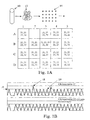
- Peak 18 representing well 3B will be 50% higher than the peaks from the other well, or the peaks from a reference sequence on chromosomes 22.
- Well A2 lacking either 21 or 22, will have no peak.
- the peaks are shown at 20.
- a single run will have numerous random variations, such as wells that have no target sequence, or have duplication through sample variability. Also, samples with no target will clearly result in no peak at all; wells with two or more targets, will give peaks significantly higher than peak 18, i.e., 2X or 2.5 X controls.
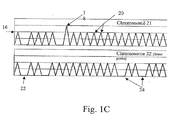
- Fig. 1C illustrates an embodiment where the DNA is distributed in a more dilute fashion (less than 1, or about one half genome equivalents per well).
- chromosome 21 labels will generate more positives than chromosome 22 (a diploid chromosome) specific labels (e.g., primers) due simply to the slightly greater abundance of chromosome 21 in a trisomy-containing sample.
- some wells will contain positives 20 for both chromosomes, some will contain negatives 22 for both chromosomes, but some will contain blanks 24 for the diploid chromosome and peaks for the trisomic chromosome, due to its greater abundance.
- the data from a higher peak 18 is not used in this mode. As explained below, this slight difference can be made statistically significant by examining a large number of wells, and by the sensitivity of the present method to a single molecule.
- the present method comprises generally the following steps:
- the present method is directed to non-invasive testing.
- the preferred starting material is maternal peripheral venous blood.
- 10-20 mL of blood be drawn, in order to obtain about at least 10,000 genome equivalents of total DNA.
- This sample size is based on an estimate of fetal DNA being present as roughly 25 genome equivalents/mL of maternal plasma in early pregnancy, and a fetal DNA concentration of about 3.4% of total plasma DNA.
- less blood may be drawn for a genetic screen where less statistical significance is required, or the DNA sample is enriched for fetal DNA.
- fetal RNA found in maternal blood may be analyzed as well.
- mRNA of placentas origin is readily detectable in maternal plasma
- hPL human placental lactogen
- hCG human chorionic gonadotropin
- mRNA transcripts were detectable in maternal plasma, as analyzed using the respective real-time RT-PCR assays.
- mRNA encoding genes expressed in the placenta and present on the chromosome of interest are used.
- DSCR4 Down syndrome critical region 4
- DSCR4 Down syndrome critical region 4
- mRNA sequence may be found at GenBank NM_005867.
- RNase H- RNase H- reverse transcriptases
- RTs RNase H minus (RNase H-) reverse transcriptases
- RNase H- RTs are available from several manufacturers, with SuperScriptTM II (Invitrogen) being the most widely used.
- Reverse transcriptase PCR may be used as described below for chromosomal DNA.
- the maternal blood may be processed to enrich the fetal DNA concentration in the total DNA, as described in Li et al., supra. Briefly, circulatory DNA is extracted from 5-to 10-mL maternal plasma using commercial column technology (Roche High Pure Template DNA Purification Kit; Roche, Basel, Switzerland) in combination with a vacuum pump. After extraction, the DNA is separated by agarose gel (1%) electrophoresis (Invitrogen, Basel, Switzerland), and the gel fraction containing circulatory DNA with a size of approximately 300 bp is carefully excised.
- the DNA is extracted from this gel slice by using an extraction kit (QIAEX II Gel Extraction Kit; Qiagen, Basel, Switzerland) and eluted into a final volume of 40- ⁇ L sterile 10-mM trishydrochloric acid, pH 8.0 (Roche).
- DNA may be concentrated by known methods, including centrifugation and various enzyme inhibitors.
- the RNA is bound to a selective membrane (e.g., silica) to separate it from contaminants.
- the DNA is preferably enriched for fragments circulating in the plasma, which are less than 1000 base pairs in length, generally less than 300 bp. This size selection is done on a DNA size separation medium, such as an electrophoretic gel or chromatography material.
- enrichment may be accomplished by suppression of certain alleles through the use of peptide nucleic acids (PNAs), which bind to their complementary target sequences, but do not amplify.
- PNAs peptide nucleic acids
- Plasma RNA extraction is described in Enders et al., "The Concentration of Circulating Corticotropin-releasing Hormone mRNA in Maternal Plasma Is Increased in Preeclampsia," Clinical Chemistry 49: 727-731, 2003 .
- plasma harvested after centrifugation steps is mixed Trizol LS reagent (Invitrogen) and chloroform. The mixture is centrifuged, and the aqueous layer transferred to new tubes. Ethanol is added to the aqueous layer. The mixture is then applied to an RNeasy mini column (Qiagen) and processed according to the manufacturer's recommendations.
- Agents that impede cell lysis or stabilize cell membranes can be added to the tubes including but not limited to formaldehyde, and derivatives of formaldehyde, formalin, glutaraldehyde, and derivatives of glutaraldehyde, crosslinkers, primary amine reactive crosslinkers, sulfhydryl reactive crosslinkers, sulfhydryl addition or disulfide reduction, carbohydrate reactive crosslinkers, carboxyl reactive crosslinkers, photoreactive crosslinkers, cleavable crosslinkers, etc. Any concentration of agent that stabilizes cell membranes or impedes cell lysis can be added. In a preferred embodiment, the agent that stabilizes cell membranes or impedes cell lysis is added at a concentration that does not impede or hinder subsequent reactions.
- Flow cytometry techniques can also be used to enrich fetal cells (Sberg et al., PNAS 76: 1453-1455 (1979 ); Bianchi et al., PNAS 87: 3279-3283 (1990 ); Bruch et al., Prenatal Diagnosis 11: 787-798 (1991 )).
- U.S. Pat. No. 5,432,054 also describes a technique for separation of fetal nucleated red blood cells, using a tube having a wide top and a narrow, capillary bottom made of polyethylene. Centrifugation using a variable speed program results in a stacking of red blood cells in the capillary based on the density of the molecules.
- the density fraction containing low-density red blood cells is recovered and then differentially hemolyzed to preferentially destroy maternal red blood cells.
- a density gradient in a hypertonic medium is used to separate red blood cells, now enriched in the fetal red blood cells from lymphocytes and ruptured maternal cells.
- the use of a hypertonic solution shrinks the red blood cells, which increases their density, and facilitates purification from the more dense lymphocytes.
- fetal DNA can be purified using standard techniques in the art.
- an agent that stabilizes cell membranes may be added to the maternal blood to reduce maternal cell lysis including but not limited to aldehydes, urea formaldehyde, phenol formaldehyde, DMAE (dimethylaminoethanol), cholesterol, cholesterol derivatives, high concentrations of magnesium, vitamin E, and vitamin E derivatives, calcium, calcium gluconate, taurine, niacin, hydroxylamine derivatives, bimoclomol, sucrose, astaxanthin, glucose, amitriptyline, isomer A hopane tetral phenylacetate, isomer B hopane tetral phenylacetate, citicoline, inositol, vitamin B, vitamin B complex, cholesterol hemisuccinate, sorbitol, calcium, coenzyme Q, ubiquinone, vitamin K, vitamin K complex, menaquinone, zonegran, zinc, ginkgo biloba extract, diphenylhydantoin, perftoran, polyviny
- An example of a protocol for using this agent is as follows: The blood is stored at 4°C until processing. The tubes are spun at 1000 rpm for ten minutes in a centrifuge with braking power set at zero. The tubes are spun a second time at 1000 rpm for ten minutes. The supernatant (the plasma) of each sample is transferred to a new tube and spun at 3000 rpm for ten minutes with the brake set at zero. The supernatant is transferred to a new tube and stored at -80°C, Approximately two milliliters of the "buffy coat," which contains maternal cells, is placed into a separate tube and stored at -80°C.
- Genomic DNA may be isolated from the plasma using the Qiagen Midi Kit for purification of DNA from blood cells, following the manufacturer's instructions (QIAmp DNA Blood Midi Kit, Catalog number 51183). DNA is eluted in 100mu.l of distilled water. The Qiagen Midi Kit also is used to isolate DNA from the maternal cells contained in the "buffy coat.”
- tissue saliva, urine, tear, vaginal secretion, breast fluid, breast milk, or sweat.
- the genomic DNA obtained from a maternal tissue as described above is diluted into multiple reaction samples, e.g. in multiwell plates, so that there is, on average, less than one genome equivalent per well.
- the DNA (Chromosome) to be analyzed will, on average, either be present or absent, permitting so-called "digital analysis.”
- a reaction sample in general will contain a single template molecule (haplotype), two target molecules (diploid) or three target molecules (trisomy).
- the wells provide discrete reaction samples and may be implemented in a number of devices, such as a microtiter plates, beads in an emulsion, or a microfluidic device. These are described in detail below.
- the device must be capable of carrying out a large number of discrete amplification reactions. As described below, this number should be, at a minimum, 10,000 reactions, and preferably on the order of 100,000 reactions.
- the reaction sample is preferable holds about 10-100 ⁇ L of a PCR reaction sample containing the genomic DNA, nucleotides (dNTPs), polymerase and appropriate PCR primers. The primers are used in conjunction with a label for rapid quantitative detection of PCR products.
- labeling will depend on the amplification/detection system used, e.g., a "molecular beacon" fluorescent probe for microtiter plate based amplification. This type of probe is described, for example, in Vogelstein et al, supra.
- labeling may be done with SYBR Green, which has very low fluorescence in the absence of double stranded DNA and very high fluorescence in the presence of double stranded DNA.
- Another form of parallel analysis useful in the present invention is single molecule analysis.
- a sample is diluted to contain less than a nominal single genome equivalent of DNA, and the presence of the target of interest (i.e., chromosome 21 trisomy) can be determined in a large number of samples.
- the fetal DNA can be distinguished from the maternal DNA. This is termed a "digital analysis,” because each well will have, on average, one genome equivalent per cell, and furthermore, the dilution may be read as a binary "yes-no" result as to the presence of the chromosome or other sequence to be counted.
- DLA direct linear analysis
- the presence of the DNA sequence or chromosome of interest must be quantified. This may be done either in single molecule mode, or with an amplified product.
- the method of amplification maybe, for example, self-sustained sequence reaction, ligase chain reaction, rapid amplification of cDNA ends, polymerase, chain reaction and ligase chain reaction, Q-beta phage amplification, strand displacement amplification, or splice overlap extension polymerase chain reaction.
- detection may be conveniently be carried out by a sequence specific probe, detection may also be carried out by directly sequencing a region of interest to determine if it is the target sequence of interest.
- PCR methods may be multiplexed, that is, run with multiple primers to multiple targets, it is preferred to limit the number of primer pairs in a given reaction.
- primer pairs there will be two primer pairs: one for amplifying a test sequence, and another pair for amplifying a control sequence.
- Primers are designed according to known parameters for avoiding secondary structures and self-hybridization. Further, both primer pairs should anneal and melt at about the same temperatures.
- Primers can be prepared by a variety of methods including but not limited to cloning of appropriate sequences and direct chemical synthesis using methods well known in the art ( Narang et al., Methods Enzymol. 68:90 (1979 ); Brown et al., Methods Enzymol. 68:109 (1979 )). Primers can also be obtained from commercial sources such as Operon Technologies, Amersham Pharmacia Biotech, Sigma, and Life Technologies.
- the primers can have an identical melting temperature.
- the lengths of the primers can be extended or shortened at the 5' end or the 3' end to produce primers with desired melting temperatures.
- the annealing position of each primer pair can be designed such that the sequence and, length of the primer pairs yield the desired melting temperature.
- Computer programs can also be used to design, primers, including but not limited to Array Designer Software (Arrayit Inc.), Oligonucleotide Probe Sequence Design Software for Genetic Analysis (Olympus Optical Co.), NetPrimer, and DNAsis from Hitachi Software Engineering.
- the TM (melting or annealing temperature) of each primer is calculated using software programs such as Oligo Design, available from Invitrogen Corp.
- the annealing temperature of the primers can be recalculated and increased after any cycle of amplification, including but not limited to cycle 1, 2, 3, 4, 5, cycles 6-10, cycles 10-15, cycles 15-20, cycles 20-25, cycles 25-30, cycles 30-35, or cycles 35-40.
- the 5' half of the primers is incorporated into the products from each loci of interest, thus the TM can be recalculated based on both the sequences of the 5' half and the 3' half of each primer.
- Any DNA polymerase that catalyzes primer extension can be used including but not limited to E. coli DNA polymerase, Klenow fragment of E.
- coli DNA polymerase 1 T7 DNA polymerase, T4 DNA, polymerase, Taq polymerase, Pfu DNA polymerase, Vent DNA polymerase, bacteriophage 29, REDTaq.TM. Genomic DNA polymerase, or sequenase.
- a thermostable DNA polymerase is used.
- a "hot start” PCR can also be performed wherein the reaction is heated to 95°C for two minutes prior to addition of the polymerase or the polymerase can be kept inactive until the first heating step in cycle 1.
- "Hot start” PCR can be used to minimize nonspecific amplification. Any number of PCR cycles can be used to amplify the DNA, including but not limited to 2, 5, 10, 15, 20, 25, 30, 35, 40, or 45 cycles. In a most preferred embodiment, the number of PCR cycles performed is such that equimolar amounts of each loci of interest arc produced.
- PCR primers are useful in the present process, such as those disclosed in technical literature of Qiagen. That literature describes a protocol where DNA was purified from peripheral blood and amniocyte cultures using the QIAmp DNA Blood Mini Kit. For amplification of the amyloid gene on chromosome 21, (NCBI gene ID 473931, accession NC_006488) primer and probe sequences were:
- primers and probe were: forward primer SEQ ID NO: 3 , 5'-CCC CAC ACA CAT GCA CTT ACC-3'; reverse primer, SEQ ID NO: 4 , 5'-CCT ACT CCC AGG GCT TTG ATT-3'; and probe, SEQ ID-NO: 5 , 5'-(VIC) AAA GAG CTA GGA AGG ACA GGC AAC TTG GC (TAMRA)-3'.
- PCR was performed using the TaqMan system, with 2 ⁇ l of template DNA in each 25 ⁇ l reaction and final concentrations of 300 nmol/liter of each primer and 150 nmol/liter of each dual-labeled TaqMan probe. Cycling conditions were incubation at 50°C for 2 minutes, then 95°C for 10 minutes, followed by 40 cycles of 60°C, 1 minute and 95°C, 15 seconds.
- Fluorescent probe-based technologies which can be performed on the PCR products "in situ” (i.e., in the same wells), are particularly well suited for this application. This method is described in detail in Vogelstein PNAS 96:9236 , above, and Vogelstein et al. "Digital Amplification," US 6,440,705 , hereby incorporated by reference for its description of this amplification procedure.
- the composition of the reactions is: 67 mM Tris, pH 8.8, 16.6 mM NH 4 SO 4 , 6.7 mM MgCl 2 , 10 mM ⁇ -mercaptoethanol, 1 mM dATP, 1 mM dCTP, 1 mM dGTP, 1 mM TTP, 6% DMSO, 1 ⁇ M primer F1, 1 ⁇ M primer R1, 0.05 units/ ⁇ l Platinum Taq polymerase (Life Technologies, Inc.), and "one-half gnome equivalent" of DNA.
- DNA samples are serially diluted and tested via PCR.
- the amount that yielded amplification products in half the wells is defined as "one-half genome equivalent" and used in each well of subsequent Digital Amplification experiments.
- Fifty ⁇ l light mineral oil (Sigma M-3516) is added to each well and reactions performed in a HybAid Thermal cycles at the following temperatures: denaturation at 94°C for one min; 60 cycles of 94°C for 15 sec, 55°C for 35 sec., 70°C for 15 seconds; 70°C for five minutes.
- MB or molecular beacon probes, which become fluorescent on binding to the target sequence(s), as described in more detail below, may be used as follows:
- MB probes are oligonucleotides with stem-loop structures that contain a fluorescent dye at the 5' end and a quenching agent (Dabcyl) at the 3' end.
- the degree of quenching via fluorescence energy resonance transfer is inversely proportional to the 6th power of the distance between the Dabcyl group and the fluorescent dye.
- MB probes reform a stem-loop structure, which quenches the fluorescent signal from the dye. If a PCR product whose sequence is complementary to the loop sequence is present during the heating/cooling cycle, hybridization of the M.B to one strand of the PCR product will increase the distance between the Dabcyl and the dye, resulting in increased fluorescence.
- RNA as well as DNA. Isolation of plasma RNA is described below. In this case, cDNA copies are made and then amplified by DNA polymerase-based PCR. Different primers may be used for cDNA synthesis. Specific templates, based on genetic sequences in the chromosomes of interest are preferred. See. Bustina et al., "Pitfalls of Quantitative Real-Time Reverse-Transcription Polymerase Chain Reaction," Journal of Biomolecular Techniques, 15:155-166 (2004 ). Use of mRNA from consitutively expressed, i.e., housekeeping genes, may be used for a control, and genes that are highly expressed in placenta (described below) are preferred.
- MessageSensorTM RT Kit includes an RNase H+ MMLV RT.
- MessageSensor includes a total RNA control, a control human GAPDH primer set, RNase inhibitor, and nucleotides, as well as a buffer additive that enables detection with SYBE ® Green dye.
- Ambion recommends using 18S rRNA as an internal control because it shows less variance in expression across treatment conditions than ⁇ -actin and GAPDH.
- a chromosomes 21-encoded gene (LOC90625) which shows strong expression in first trimester placenta similar to CSH1 (human placental lactogen) and was selected for plasma analysis in Oudejans et al., "Detection of Chromosome 21-encodcd mRNA of Placental Origin in Maternal Plasma," Clinical Chemistry 49: 1445-1449, 2003 . Specific primers for use with this gene are given in this paper.
- chromosome 21 transcripts are described at Gardiner et al., "Analysis of human chromosome 21: correlation of physical and cytogenetic maps; gene and CpG island distributions," E.M.B.O.J. 9(1):25-34 (1990 ), namely cDNA of identified products ETS2, MX1, MX2, CBS, COL6AI and BCEI, which can be partially sequenced or mapped according to eh present methods.
- Emulsion PCR has been used to prepare small beads with clonally amplified DNA - in essence, each bead contains one type of amplicon of digital PCR.
- Dressman et al Proc. Natl. Acad. Sci. U S A.100, 8817 (Jul 22, 2003 )
- the non-anchored primers with different fluorophores and use a single bead type.
- the positive beads (amplicons) of each type can be counted with methods such as flow cytometry or simply by counting them in a suitably equipped microscope.
- Step 1 Magnetic beads covalently coated with streptavidin are bound to biotinylated oligonucleotides ("oligos").
- Step 2 an aqueous mix containing all the necessary components for PCR plus primer-bound beads and template DNA are stirred together with an oil/detergent mix to create microemulsions.
- the aqueous compartments (which may be illustrated as small droplets in an oil layer) contain an average of ⁇ 1 template molecule and ⁇ 1 bead. Different templates (control and test) may be pictured in one or less droplets to represent two template molecules whose sequences differ by one or many nucleotides.
- the microemulsions are temperature cycled as in a conventional PCR. If a DNA template and a bead are present together in a single aqueous compartment, the bead bound oligonucleotides act as primers for amplification. Then, one may picture straight lines corresponding to PCR. products attached to the corresponding templates connected to the beads to represent extension products from the two different kinds of templates.
- Step 4 the emulsions are broken and the beads are purified with a magnet.
- Step 5 after denaturation, the beads are incubated with oligonucleotides that can distinguish between the sequences of the different kinds of templates. Fluorescently labeled antibodies are then used to label the bound hybridization probes. This renders the beads containing PCR product as different colors (e.g., red or green) upon appropriate laser excitation.
- Step 6 flow cytometry is used to count the red and green beads.
- each bead is bound to at least 10, 50, 100, 500, or 1000 molecules of the same nucleic acid sequence.
- Step 1-Coupling oligonucleotides to beads Superparamagnetic beads of 1.05 ⁇ 0.1 um in diameter, covalently bound to streptavidin, are purchased from Dynal Biotech, Inc. (650.01, Lake Success; NY). Beads are washed once with 1x PCR buffer (53286, Invitrogen, Carlsbad, CA) then suspended in Bind and Wash Buffer (BWB) (5 mMTris-HCl, 0.5 mM EDTA, 1.0 MNaCl, pH 7.5). Beads are incubated in BWB for 30 min at room temperature in the presence of 10 ⁇ M oligonucleotides.
- Bind and Wash Buffer BWB
- oligonucleotides are modified with a dual biotin group at the 5'end with the biotin groups separated by a six-carbon linker (IDT, Coralville, IA). After binding, the beads are washed 3 times with 1x PCR buffer to thoroughly remove unbound oligonucleotides.
- IDT six-carbon linker
- Microemulsions for PCR are prepared in an oil phase that is composed of 4.5% Span 80 (S6760, Sigma, St. Louis, MO), 0.40 % Tween 80 (Sigma S-8074), and 0.05% Triton X-100 (Sigma T-9284) in mineral oil (Sigma M-3516).
- the aqueous phase consists of 67 mMTris-HCl (pH 8.
- the forward primer is an oligonucleotide whose sequence is identical to the 3'20-22 nt of that described in step 1 and is not modified with biotin.
- Water-in-oil microemulsions are prepared by drop wise addition of 200 microliters of the aqueous phase to 400 microliters of the oil phase previously placed in a 2 ml round bottom cryogenic vial (430661, Coming, Coming, NY).
- the drop wise addition is performed over-one minute white the mixture is being stirred at 1400 RPM with a magnetic microstir bar (58948-353, VWR, Plainfield, NJ) on a VWR model 565 Magnetic Stirrer. After the addition of the aqueous phase, the mixture continued to be stirred for a total time of 30 minutes. Two emulsions are made at once by placing two tubes in a rack placed at the center of the magnetic stirrer.
- Step 3-PCR cycling The emulsions are aliquotted into five wells of a 96 well PCR plate, each containing 100 ⁇ l. PCR is carried out under the following cycling conditions: 94°C for 2 minutes; 40 cycles of 94°C for 15 seconds, 57°C for 30 seconds, 70°C for 30 seconds. The PCR products analyzed in this study ranged from 189 to 239 bp,
- Step 4-Magnetic capture of beads After PCR cycling, the microemulsion from five wells of a PCR plate are pooled and broken by the addition800 microliters of NX buffer (100 mMNaCl containing 1% Triton X-100, 10 mMTris-HCl, pH 7.5, 1 mM EDTA) in a 1.5 ml tube (Corning 430909). After vortexing for-20 sec. the beads are pelleted by centrifugation in a microcentrifuge at 8000 rpm (5000 g) for 90 seconds. The top oil phase, and all but-300 microliters of the aqueous phase, is removed from the tube and 600 microliters of NX buffer is added. These steps are repeated.
- NX buffer 100 mMNaCl containing 1% Triton X-100, 10 mMTris-HCl, pH 7.5, 1 mM EDTA
- the tube is then placed on a magnet (Dynal MPC-S) and the rest of the supernatant is carefully pipetted off.
- the beads are washed an additional 3 times with 1x PCR buffer using magnetic separation rather than centrifugation and finally re-suspended in 100 microliters of Ix PCR buffer.
- Step 5-Sequence differentiation Two oligonucleotide probes are used for each reaction. One is 5'-labeled with 6-carboxyfluorescein (6-FAM) and is specific for one allele while the second is 5'-labeled with biotin and is specific for the other allele. Probes are synthesized by IDT. The 30 microliters hybridization reactions contained 10 ⁇ M of each probe and 5-25 million beads inl x PCR buffer. Reactions are performed in PCR plates on a thermal cycler by heating to94°C for 30 seconds then cooling to75°C at a rate of 0.5°C per second, cooling to 45°C at 0.2°C per second, and finally cooled to 30°C at 1°C per second.
- 6-FAM 6-carboxyfluorescein
- the beads are then incubated for 10 minutes in a total volume of 100 microliters B-PCR buffer containing 3 ⁇ g ofAlexa-488 rabbit anti-fluorescein antibody (Molecular ProbesA-11090, Eugene, OR) and 3 ⁇ g of Nutravidin labeled with R-phycoerytbrin (Molecular Probes A-2660) in B-PCR buffer.
- B-PCR buffer containing 3 ⁇ g ofAlexa-488 rabbit anti-fluorescein antibody (Molecular ProbesA-11090, Eugene, OR) and 3 ⁇ g of Nutravidin labeled with R-phycoerytbrin (Molecular Probes A-2660) in B-PCR buffer.
- the beads are washed three times and resuspended in B-PCR buffer as described above.
- B-PCR buffer containing 6 ⁇ g of Alexa 488-conjugated chicken anti-rabbit antibody (Molecular Probes A-21441) and 3 ⁇ g of biotinylated goat anti-avidin antibody (BA-0300, Vector Laboratories, Burlingame, CA). The beads are washed three times and resuspended in B-PCR buffer as described above.
- Step 6-Flow Cytometry The bead suspension is diluted to a concentration of- 106-107 beads per ml in 10 mMTris-HCI, 1 mMEDTA (351-010-131, Quality Biological, Inc., Gaithersburg, MD) and analyzed using a LSR instrument (BD Biosciences, Franklin Lakes, NJ). The instrument is set up for standard two- color analysis using an argon laser and optical filters that distinguished between the two fluorescent dyes. No spectral deconvolution is required as the major bead populations are well separated. In some cases, scanning is performed with FACScan or FACSCalibur instruments (BD Biosciences).
- Another approach to digital PCR involves the use of microfluidics to achieve the digital PCR conditions used in the present method.
- a DNA sample obtained as described above is diluted into an appropriate concentration, mixed with PCR reagents, primers, dNTPs, etc. and flowed through a number of channels which may be closed off in multiple segments, resulting in a number of discrete reaction samples, or chambers.
- the chambers may be subjected to PCR thermal cycling and the products quantitatively detected by florescence, as described above.
- a suitable microfluidic device is produced by Fluidigm Corporation, termed the Digital Isolation and Detection IFC (integrated fluid circuit).
- a suitable device is also described in United States Patent 6,960,437 to Enzelberger, et al., issued November 1, 2005 entitled "Nucleic acid amplification utilizing microfluidic devices," hereby incorporated by reference for purposes of describing a microfluidic device capable of supporting multiple parallel nucleic acid amplifications and detections.
- one exemplary microfluidic device for conducting thermal cycling reactions includes in the layer with the flow channels a plurality of sample inputs, a mixing T-junction, a central circulation loop (i.e., the substantially circular flow channel), and an output channel.
- a control channel with a flow channel can form a microvalve. This is so because the control and flow channels are separated by a thin elastomeric membrane that can be deflected into the flow channel or retracted therefrom. Deflection or retraction of the elastomeric membrane is achieved by generating a force that causes the deflection or retraction to occur. In certain systems, this is accomplished by increasing or decreasing pressure in the control channel as compared to the flow channel with which the control channel intersects.
- a wide variety of other approaches can be utilized to actuate the valves including various electrostatic, magnetic, electrolytic and electrokinetic approaches.
- microfluidic device adapted to perform PCR reactions, and useful in the present methods, is described in US 2005/0252773 by McBride, et al., published November 17, 2005 , entitled "Thermal reaction device and method for using the same.”
- the substantially circular central loop and the control channels that intersect with it form the central part of the rotary pump.
- the pump(s) that cause solution to be flowed through the substantially circular flow channel consist of a set of at least three control channels that are adjacent to one another and which intersect the substantially circular branch flow channel (i.e., the central loop).
- the fluid in the central loop can be peristaltically pumped in a chosen direction, either clockwise or counterclockwise.
- the peristaltic pumping action results from the sequential deflection of the membranes separating the control channels and flow channel into or out of the flow channel. In general, the higher the actuation frequency, the faster the fluid rotates through the central loop.
- One system exemplified has two sets of pumps and (i.e., two sets of three control channels that overlay the substantially circular flow channel) a single pump can be utilized (i.e., a single set of three control channels overlaying the substantially circular flow channel). Furthermore, while each pump is shown as including three control channels, more control channels can be utilized. It should also be understood that the three control channels can be different segments of a single control channel that overlay the flow channel.
- DNA polymerase may be employed to image sequence information in a single DNA template as its complementary strand is synthesized.
- the nucleotides are inserted sequentially; only the time resolution to discriminate successive incorporations is required. After each successful incorporation event, a fluorescent signal is measured and then nulled by photobleaching. This method lends itself to massive parallelism.
- this technique permits observations of single molecule fluorescence by a conventional microscope equipped with total internal reflection illumination, which reduces background fluorescence.
- the surface of a quartz slide is chemically treated to specifically anchor DNA templates while preventing nonspecific binding of free nucleotides, and a plastic flow cell is attached to the surface to exchange solutions.
- DNA template oligonucleotides are hybridized to a fluorescently labeled primer and bound to the surface via streptavidin and biotin with a surface density low enough to resolve single molecules.
- the primed templates are detected through their fluorescent tags, their locations are recorded for future reference, and the tags arc photobleached.
- Labeled nucleotide triphosphates and DNA polymerase enzyme are then washed in and out of the flow cell while the known locations of the DNA templates are monitored for the appearance of fluorescence.
- the technique uses a combination of evanescent wave microscopy and single-pair fluorescence resonance energy transfer (spFRET) to reject unwanted noise.
- the donor fluorophore excites acceptors only within the Forster radius, thus effectively creating an extremely high-resolution near-field source. Because the Forster radius of this fluorophore pair is 5 nm, the spatial resolution of this method exceeds the diffraction limit by a factor of 50 and conventional near-field microscopy by an order of magnitude.
- the genomic DNA from the tissue taken from the mother i.e. the mixture of fetal and material genetic material
- a target specific sequence e.g., a unique region of chromosome 21, e.g., AML1.
- Further guidance for the preparation of chromosome 21-unique sequences may be found, for example, in Fuscoe et al., "An Efficient Method for Selecting Unique-Sequence Clones from DNA Libraries and Its Application To Fluorescent Staining of Human Chromosome 21 Using in situ Hybridization," Genomics, vol. 5, 1989, pp. 100-109 .
- a methodology useful in the present invention platform is based on massively parallel sequencing of millions of fragments using attachment of randomly fragmented genomic DNA to a planar, optically transparent surface and solid phase amplification to create a high density sequencing flow cell with millions of clusters, each containing ⁇ 1,000 copies of template per sq. cm.
- These templates are sequenced using four-color DNA sequencing-by-synthesis technology. See, products offered by Illumina, Inc., San Diego California. Also, see US 2003/0022207 to Balasubramanian, et al., published January 30, 2003 , entitled "Arrayed polynucleotides and their use in genome analysis.”
- Sequencing may be combined with amplification-based methods in a microfluidic chip having reaction chambers for both PCR and microscopic template-based sequencing. Only about 30 bp of random sequence information are needed to identify a sequence as belonging to a specific human chromosome. Longer sequences can uniquely identify more particular targets.
- An algorithm for designing unique sequences is described in Yamada, et al. "PrimerStation: a highly specific multiplex genomic PCR primer design server for the human genome," Nucleic Acids Res., July 1, 2006; 34(Web Server issue): W665 - W669 , illustrative of software methods that can be used to identify a sequence in comparison to the known genome sequence.
- DLA Direct Linear Analysis
- Another method of determining the identity of genomic DNA from the present samples is termed direct linear analysis, and is described in Chan et al. "DNA Mapping Using Microfluidic Stretching and Single-Molecule Detection of Fluorescent Site-Specific Tags," Genome Research 14:1137-1146 (2004 ).
- a microfluidic device is used for stretching DNA molecules in elongational flow that is coupled to a multicolor detection system capable of single-fluorophore sensitivity. Double-stranded DNA molecules are tagged at sequence-specific motif sites with fluorescent bisPNA (Peptide Nucleic Acid) tags.
- the DNA molecules are then stretched in the microfluidic device and driven in a flow stream past confocal fluorescence detectors.
- DLA can provide the spatial locations of multiple specific sequence motifs along individual DNA molecules, and thousands of individual molecules can be analyzed per minute.
- a microchip configuration and operating conditions may be prepared according to this publication that are adequate for stretching 50-kb long DNA.
- the chip includes a post field, a funnel with a 10:1 1 taper reduction ratio, a taper shape providing W(x)1/x2 profile (W is the channel width, and x is the coordinate along the flow direction), and a 5 ⁇ m-wide interrogation channel.
- the interrogation channel has uniform cross-section to ensure constant solution velocity, which was 10-15 ⁇ m/msec.
- the excitation laser beams are directed into the microscope objective with a dichroic mirror that reflects the light with 532 nm (beam ExI) and 633 nm (beams ExII and ExIII) wavelengths, but is transparent to the fluorescence emission excited by these beams.
- the emission is further split by another dichroic mirror and bandpass filters.
- Fluorescence excited by the green laser is delivered by optical fiber to the photon-counting avalanche photodiode (APD) for signal detection in data channel 1.
- APD avalanche photodiode
- the above-described device may be configured with larger path.lengths in order to accommodate larger DNA strands, presumably up to entire chromosome lengths.
- the genomic sample is probed with a chromosome 21 specific probe threaded through the interrogation channel, and the presence of one or more chromosomes is detected.
- Digital PCR allows the detection of aneuploidy merely by counting transcripts, as illustrated by the following calculation.
- chromosome A is euploid and represents an internal control
- chromosome B is aneuploid and is the target to be measured, then one can amplify representative segments from both chromosomes via digital PCR.
- the requisite statistical confidence to resolve the difference in proportions can be estimated as follows. There is a random statistical variation associated with the initial sample size, which goes roughly as the square root of the number of samples taken. It is in fact often difficult to precisely start with a fixed number of cell equivalents, and in the previous example we expect statistical error of order 32 amplicons (32 ⁇ square root(1,000)) for most sample preparation techniques. This is the same size as the signal we are trying to detect and thus in practice one requires more than 1,000 cell equivalents for robust detection. Precisely how many one requires depends on the statistical certainty that is required.
- the number of amplicons N must be at least 10,000 for Down Syndrome detection.
- the number of target sequences needed for statistical sequences may be reduced by using controls sequences, and, in addition, the sample may be enriched for fetal DNA,
- the present invention is particularly adapted to detecting genetic abnormalities that involve quantitative differences between maternal, and fetal genetic sequences.
- genetic abnormalities include mutations that may be heterozygous and homozygous between maternal and fetal DNA, and to aneuploidies.
- a missing copy of chromosome X results in Turner's Syndrome
- an additional copy of chromosome 21 results in Down Syndrome.
- Other diseases such as Edward's Syndrome and Patau Syndrome are caused by an additional copy of chromosome 18, and chromosome 13, respectively.
- the present method may be used for detection of a translocation, addition, amplification, transversion, inversion, aneuploidy, polyploidy, monosomy, trisomy, trisomy 21, trisomy 13, trisomy 14, trisomy 15, trisomy 16, trisomy 18, trisomy 22, triploidy, tetraploidy, and sex chromosome abnormalities including but not limited to XO, XXY, XYY, and XXX.
- chromosome specific primers arc disclosed in United States Patent Application 20050164241 to Hahn, Sinuhe, et al., published July 28, 2005 , entitled “Non-invasive detection of fetal genetic traits,” hereby incorporated by reference in its entirety for describing methods of sample preparation and certain PCR primers, described as follows:
- UniSTS is a comprehensive database of sequence tagged sites (STSs) derived from STS-based maps and other experiments. STSs are defined by PCR primer pairs and are associated with additional information such as genomic position, genes, and sequences. Similarly, primer sequences for other human chromosomes can be found by appropriately modifying the search query.
- Examples of diseases where the target sequence may exist in one copy in the maternal DNA (heterozygous) but cause disease in a fetus (homozygous), include sickle cell anemia, cystic fibrosis, hemophilia, and Tay Sachs disease. Accordingly, using the methods described here, one may distinguish genomes with one mutation from genomes with two mutations.
- Sickle-cell anemia is an autosomal recessive disease.
- Nine-percent of US blacks are heterozygous, while 0.2% are homozygous recessive.
- the recessive allele causes a single amino acid substitution in the beta chains of hemoglobin.
- Tay-Sachs Disease is an autosomal recessive resulting in degeneration of the nervous system. Symptoms manifest after birth. Children homozygous recessive for this allele rarely survive past five years of age. Sufferers lack the ability to make the enzyme N-acetyl-hexosaminidase, which breaks down the GM2 ganglioside lipid.
- PKU phenylketonuria
- Hemophilia is a group of diseases in which blood does not clot normally. Factors in blood are involved in clotting. Hemophiliacs lacking the normal Factor VIII are said to have Hemophilia A, and those who lack Factor IX have hemophilia B. These genes are carried on the X chromosome, so primers and probes may be used in the present method to detect whether or not a fetus inherited the mother's defective X chromosome, or the father's normal allele.
- the number of positive reaction samples is used, disregarding increased intensity from three versus two chromosomes in a reaction sample. That is, as described above, trisomy can be detected either by looking for an increased signal from a single well having multiple chromosomal DNA copies, or by diluting a sample and counting the frequency of responses of the trisomic marker versus a control diploid marker.
- Fetal DNA circulating in maternal plasma is here used to provide sufficient material for chromosomal analysis.
- DNA is extracted from a blood sample and aliquotted to different reaction chambers on the basis of genome equivalents, i.e., the entire genomic content of a single normal cell (46 chromosomes). This weighs about 6.6 pg.
- genome equivalent is used to refer to the calculated distribution of sample DNA based on a calculated genome size and DNA weight. In practice, there will be some experimental variation in DNA sample size, and, due to random fragment distribution, a given genome equivalent will not contain exactly the DNA fragments corresponding only to a single complete diploid genome, but a large number, on average, will.
- reaction mix For each panel on the Digital Array chip, 10ul of reaction mix is required. To achieve ⁇ 1/3 panel filled, the required final concentration of template in reaction mix should be approximately 48 copies/ ⁇ l (every 0.33 template per 7nl chamber). Thus for a 10 ⁇ l reaction volume (1 panel), 480 copies ( ⁇ 240 genome equivalents, "GE") of total free-floating DNA is required. These calculations are based on Chiu et al., "Effects of Blood-Processing Protocols on Fetal and Total DNA Quantification in Maternal Plasma," Clinical Chemistry, 47:9, 1607-1613.
- a 20 ml blood draw should contain enough total DNA less than 300 bp (which is about 85% fetal DNA) for about 10 panels, enough, as shown below, to achieve statistical significance.
- the following sample protocol provides a procedure for use in preparing a sample from maternal plasma and increasing the signal from chromosome 21.
- Plasma Collection collect 20 ml peripheral blood from the pregnant subject. This is collected in 2 tubes with EDTA as anticoagulant. Process blood within 2 hours of sample collection. The blood is processed first by centrifugation at 1600g for 10 min. One aliquots plasma to polypropylene tubes (1ml each), with care not to disturb buffy coat layer. Next, the supernatant is microcentrifuged at 16000g (full speed) for 10 min to remove residual maternal cells. Then, one extracts DNA from plasma with QIAamp Blood Mini Kit ("body fluid protocol"). 800 ⁇ l of plasma is applied per column and eluted in 40 ⁇ l buffer.
- body fluid protocol body fluid protocol
- DNA is subjected to gel electrophoresis ( Li et al Clin. Chem. 50:6 1002-1011 2004 ) to separate smaller sized DNA fragments.
- a UV gel tray is prepared with 1% agarose gel with 0.5 mg/L ethidium bromide. 100 bp ladder and HindIII digested Lambda phage DNA is used as markers.
- the extracted DNA is loaded on a gel; the gel is run at 80V for 1 hour.
- the DNA is extracted from the gel by first excising DNA ⁇ 300 bp with clean razor blade. This band is recovered with QIAEX II Gel Extraction Kit (Qiagen) and eluted 40ul in elution buffer.
- the amount of total free-floating DNA can be quantified using primers and Taqman probe designed for GAPDH gene (Chromosome 12). Real time PCR is run with GAPDH and Amyloid (Chromosome 21) primers and probes before running with Digital Array to confirm that the amplification regions are intact. To increase the signal from Chromosome 21, an additional set of primers and probes can be used.
- the Digital Isolation and Detection (DID) chip works by partitioning a sample/assay (TaqMan® assays) mixture into hundreds to tens of thousands of reaction chambers, where real-time QPCR reactions are contiguously monitored by a dynamic array reader.
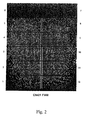
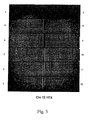
- the DID chip described here contains inputs for 12 sample/assay mixtures, and its architecture partitions 7.5 ⁇ L of fluid for each input into 1,200 reaction chambers. These are shown as 12 panels in Figures 2 and 3 . Instrumentation is used to drive the sample/assay mixtures from the wells in the carrier into the appropriate reaction chambers.
- white spots indicate the location of reaction chambers positive for the indicated primer and dye.
- the sum of the positive wells in each section will be consistent with the gene/chromosome copies that were measured in the sample.
- the number of light spots shown represents the number of positive reaction chambers; no quantification was used in these experiments, and the results do not depend on quantization of a signal from an individual (discrete) sample mixture. Such quantization can be used, but can also be a source of error in methods that depend on this.
- kits with pre-optimized reagents such as the Qiagen QuantiTect Multiplex PCR Kit, which contains QuantiTect Multiplex PCR Buffer, having synthetic factor MP and an optimized combination of KCl and (NH 4 ) 2 SO 4 , which promote specific and stable annealing of primers to templates.
- This kit also contains HotStarTaq DNA Polymerase: Since this polymerase requires incubation at 95°C for activation, misprimed products and primer-dimers, which can compete for reactants, are not formed during reaction setup.
- the preferred concentration of DNA sample should be ⁇ 140-240 copies/ ⁇ l, i.e., ⁇ 70-120 GE/ ⁇ l. This corresponds to ⁇ 3.4 to 2 ⁇ l of required template volume in a digital PCR reaction volume of 10 ⁇ l.
- the mixture of maternal and fetal genetic material obtained from the mother is diluted to achieve a high likelihood that only one target sequence will be present in a given sample to be analyzed. As shown in Fig. 1A , it is also possible to carry out this process with less dilution and less empty sample sites if quantitation is used to distinguish a number of target sequences in a sample.
- HEX hexachloro-6-carboxyfluorescein
- FAM 6-carboxy-fluorescein
- Amyloid Forward 5' GGG AGC TGG TAC AGA AAT GAC TTC 3' (SEQ ID NO: 11)
- Amyloid Reverse 5' TTG CTC ATT GCG CTG ACA A 3' (SEQ ID NO: 12)
- Amyloid Probe 5' (FAM) AGC CAT CCT TCC CGG GCC TAG G (BHQ)3' (SEQ ID NO: 13 )
- GAPDH Forward 5' CCC CAC ACA CAT GCA CTT ACC 3'(SEQ ID NO: 14 )
- GAPDH Reverse 5' CCT AGT CCC AGG GCT TTG ATT 3' (SEQ ID NO: 15 )
- GAPDH Probe 5' (HEX)AAA GAG CTA GGA AGG ACA GGC AAC TTG GC (BHQ)3' (SEQ ID NO: 16 ) primers and probes were synthesized by IDT (Integrated DNA Technologies)).
- DNA samples were analyzed by digital PCR using microfluidic Digital PCR on a Fluidigm® microfluidic chip having 12 panels with 765 (wells) partitions each.
- Various mixtures of normal and Downs DNA (representing a mixture of fetal and maternal cells in a blood sample) were analyzed.
- Small amounts of each template were pipetted directly into each PCR mix; alternatively, a mixture of templates could be prepared first, then pipetted into the PCR mix, which should yield more accurate results. This alternate method was used in these experiments. In these examples, trisomy is detected based on the number of wells showing the triplicate chromosomal marker, i.e., the analysis illustrated in Fig. 1C .
- Intensity data of the triplicate chromosome are not used, except as a ratio to a normal chromosome marker. Because the sample is dilute many of the wells will have no Chromosome of interest (or marker fragment), as can be seen in Figs. 2 and 3 , which show photographs of chips from Example 2.
- Protocol combine Primers 300 nM; Probes 150 nM; iTaq supermix with ROX or iQ supermix. Tween20 (0.1%); DNA template (2 ⁇ l, premixed with the desired percentage of Downs DNA); Water (make up to total reaction volume of 10 ⁇ l).
- Each panel was loaded with reaction mix of 10 ⁇ l, and PCR was performed on a thermal cycler similar to the commercially available BIOMARK System from Fluidigm according to manufacturer's instructions. Cycling conditions were: 98°C 30s, 97°C 30s, 95°C 2min, [56°C. 30s, 58°C 30s, 60°C 30s, 98°C 13s] x 40 cycles, 60°C for 10 min.
- a MATLAB program was written to subtract the image of the chip taken before cycling from that taken at cycle 40 for each fluorescent channel. The number of positive wells in each fluorescent channel was counted.
- X actual input copy number of Chromosome 12
- Y actual input copy number of Chromosome 21
- X log ⁇ 1 - X * / N / log ⁇ 1 - 1 / N
- Y log ⁇ 1 - Y * / N / log ⁇ 1 - 1 / N
- Confidence interval k (Y-X)/sqrt(Y)
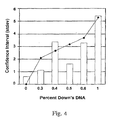
- Fig. 4 the confidence level obtained for a single chip was plotted against percent downs DNA and compared to the predicted confidence interval (line).
- the confidence interval k corresponds to the standard deviation, where a higher standard deviation indicates a greater difference between the normal and the Down's DNA. Even at the lowest concentration used (30%) and with only 10 panels analyzed, statistical analysis showed the feasibility of the present method.
- Figs. 2 and 3 show results from 100% Downs sample, for easy of visual analysis.
- the number of white spots indicates the positive wells for the markers tested.
- Chromosome 21 can be seen to have more spots by simple visual observation, distinguishing the trisomic from the normal chromosome.
- a 30% mixture depicting an enriched maternal blood sample
- the results were analyzed statistically.
- Table 1 shows the results for each panel (numbered as in Figs. 2 and 3 ) in a single experiment using 30% Down's DNA.
- Table 1 Panel Sample FAM HEX Ratio 1 Normal 221 213 1.04 2 Normal 254 264 0.96 3 Normal 271 252 1.08 4 Normal 246 257 0.96 5 Normal 241 238 1.01 8 30% Downs 270 222 1.22 9 30% Downs 219 194 1.13 10 30% Downs 249 234 1.06 11 30% Downs 230 223 1.03 12 30% Downs 216 189 1.14
- the "FAM” column shows the compartments (wells) positive for chromosome 21, and the "HEX” column shows the compartments positive for chromosome 12.
- the significance of the higher ratios in the Downs cases is shown in Fig. 4 , and was also analyzed in a Student's T-test, with a value of 0.036599344.
Landscapes
- Chemical & Material Sciences (AREA)
- Life Sciences & Earth Sciences (AREA)
- Organic Chemistry (AREA)
- Health & Medical Sciences (AREA)
- Proteomics, Peptides & Aminoacids (AREA)
- Zoology (AREA)
- Wood Science & Technology (AREA)
- Engineering & Computer Science (AREA)
- Analytical Chemistry (AREA)
- Genetics & Genomics (AREA)
- Immunology (AREA)
- Molecular Biology (AREA)
- General Engineering & Computer Science (AREA)
- Biotechnology (AREA)
- General Health & Medical Sciences (AREA)
- Microbiology (AREA)
- Biochemistry (AREA)
- Bioinformatics & Cheminformatics (AREA)
- Physics & Mathematics (AREA)
- Biophysics (AREA)
- Chemical Kinetics & Catalysis (AREA)
- Pathology (AREA)
- Cell Biology (AREA)
- Measuring Or Testing Involving Enzymes Or Micro-Organisms (AREA)
- Dispersion Chemistry (AREA)
Priority Applications (7)
| Application Number | Priority Date | Filing Date | Title |
|---|---|---|---|
| SI200731842A SI2385143T1 (sl) | 2006-02-02 | 2007-02-02 | Neinvazivni genetski presejalni test ploda z digitalno analizo |
| EP19172977.1A EP3591068A1 (de) | 2006-02-02 | 2007-02-02 | Nicht-invasives fötales genetisches screening mittels digitaler analyse |
| EP15195673.7A EP3002339B1 (de) | 2006-02-02 | 2007-02-02 | Nicht-invasives fötales genetisches screening mittels digitaler analyse |
| DK15195663.8T DK3002338T3 (da) | 2006-02-02 | 2007-02-02 | Ikke-invasiv føtal genetisk screening ved digital analyse |
| PL15195663T PL3002338T3 (pl) | 2006-02-02 | 2007-02-02 | Nieinwazyjne badania przesiewowe płodu poprzez analizę cyfrową |
| EP15195663.8A EP3002338B1 (de) | 2006-02-02 | 2007-02-02 | Nicht-invasives fötales genetisches screening mittels digitaler analyse |
| CY20191100841T CY1122112T1 (el) | 2006-02-02 | 2019-08-07 | Μη-επεμβατικη εμβρυικη γενετικη σαρωση με ψηφιακη αναλυση |
Applications Claiming Priority (2)
| Application Number | Priority Date | Filing Date | Title |
|---|---|---|---|
| US76442006P | 2006-02-02 | 2006-02-02 | |
| EP07763674.4A EP1981995B2 (de) | 2006-02-02 | 2007-02-02 | Nicht-invasives fötales genetisches screening mittels digitaler analyse |
Related Parent Applications (3)
| Application Number | Title | Priority Date | Filing Date |
|---|---|---|---|
| EP07763674.4A Division EP1981995B2 (de) | 2006-02-02 | 2007-02-02 | Nicht-invasives fötales genetisches screening mittels digitaler analyse |
| EP07763674.4A Division-Into EP1981995B2 (de) | 2006-02-02 | 2007-02-02 | Nicht-invasives fötales genetisches screening mittels digitaler analyse |
| EP07763674.4 Division | 2007-02-02 |
Related Child Applications (5)
| Application Number | Title | Priority Date | Filing Date |
|---|---|---|---|
| EP15195663.8A Division EP3002338B1 (de) | 2006-02-02 | 2007-02-02 | Nicht-invasives fötales genetisches screening mittels digitaler analyse |
| EP15195663.8A Division-Into EP3002338B1 (de) | 2006-02-02 | 2007-02-02 | Nicht-invasives fötales genetisches screening mittels digitaler analyse |
| EP19172977.1A Division EP3591068A1 (de) | 2006-02-02 | 2007-02-02 | Nicht-invasives fötales genetisches screening mittels digitaler analyse |
| EP15195673.7A Division EP3002339B1 (de) | 2006-02-02 | 2007-02-02 | Nicht-invasives fötales genetisches screening mittels digitaler analyse |
| EP15195673.7A Division-Into EP3002339B1 (de) | 2006-02-02 | 2007-02-02 | Nicht-invasives fötales genetisches screening mittels digitaler analyse |
Publications (3)
| Publication Number | Publication Date |
|---|---|
| EP2385143A2 true EP2385143A2 (de) | 2011-11-09 |
| EP2385143A3 EP2385143A3 (de) | 2011-12-21 |
| EP2385143B1 EP2385143B1 (de) | 2016-07-13 |
Family
ID=38345760
Family Applications (6)
| Application Number | Title | Priority Date | Filing Date |
|---|---|---|---|
| EP11175845.4A Active EP2385143B1 (de) | 2006-02-02 | 2007-02-02 | Nicht-invasives fötales genetisches Screening mittels digitaler Analyse |
| EP19172977.1A Pending EP3591068A1 (de) | 2006-02-02 | 2007-02-02 | Nicht-invasives fötales genetisches screening mittels digitaler analyse |
| EP20110182181 Withdrawn EP2423334A3 (de) | 2006-02-02 | 2007-02-02 | Nicht-invasives fötales genetisches Screening mittels digitaler Analyse |
| EP15195673.7A Active EP3002339B1 (de) | 2006-02-02 | 2007-02-02 | Nicht-invasives fötales genetisches screening mittels digitaler analyse |
| EP15195663.8A Active EP3002338B1 (de) | 2006-02-02 | 2007-02-02 | Nicht-invasives fötales genetisches screening mittels digitaler analyse |
| EP07763674.4A Active EP1981995B2 (de) | 2006-02-02 | 2007-02-02 | Nicht-invasives fötales genetisches screening mittels digitaler analyse |
Family Applications After (5)
| Application Number | Title | Priority Date | Filing Date |
|---|---|---|---|
| EP19172977.1A Pending EP3591068A1 (de) | 2006-02-02 | 2007-02-02 | Nicht-invasives fötales genetisches screening mittels digitaler analyse |
| EP20110182181 Withdrawn EP2423334A3 (de) | 2006-02-02 | 2007-02-02 | Nicht-invasives fötales genetisches Screening mittels digitaler Analyse |
| EP15195673.7A Active EP3002339B1 (de) | 2006-02-02 | 2007-02-02 | Nicht-invasives fötales genetisches screening mittels digitaler analyse |
| EP15195663.8A Active EP3002338B1 (de) | 2006-02-02 | 2007-02-02 | Nicht-invasives fötales genetisches screening mittels digitaler analyse |
| EP07763674.4A Active EP1981995B2 (de) | 2006-02-02 | 2007-02-02 | Nicht-invasives fötales genetisches screening mittels digitaler analyse |
Country Status (12)
| Country | Link |
|---|---|
| US (11) | US7888017B2 (de) |
| EP (6) | EP2385143B1 (de) |
| CY (2) | CY1118095T1 (de) |
| DK (3) | DK2385143T3 (de) |
| ES (4) | ES2739483T3 (de) |
| HU (2) | HUE030215T2 (de) |
| LT (2) | LT3002338T (de) |
| PL (3) | PL2385143T3 (de) |
| PT (2) | PT2385143T (de) |
| SI (3) | SI3002338T1 (de) |
| TR (1) | TR201910868T4 (de) |
| WO (1) | WO2007092473A2 (de) |
Cited By (4)
| Publication number | Priority date | Publication date | Assignee | Title |
|---|---|---|---|---|
| US9493831B2 (en) | 2010-01-23 | 2016-11-15 | Verinata Health, Inc. | Methods of fetal abnormality detection |
| US10704090B2 (en) | 2006-06-14 | 2020-07-07 | Verinata Health, Inc. | Fetal aneuploidy detection by sequencing |
| US11525134B2 (en) | 2017-10-27 | 2022-12-13 | Juno Diagnostics, Inc. | Devices, systems and methods for ultra-low volume liquid biopsy |
| US12462935B2 (en) | 2018-03-30 | 2025-11-04 | Nucleix Ltd. | Deep learning-based methods, devices, and systems for prenatal testing |
Families Citing this family (393)
| Publication number | Priority date | Publication date | Assignee | Title |
|---|---|---|---|---|
| EP1413874A1 (de) | 2002-10-16 | 2004-04-28 | Streck Laboratories, Inc. | Verfahren und Vorrichtung zum Sammeln und Konservieren von Zellen für die Analyse |
| GB0307428D0 (en) | 2003-03-31 | 2003-05-07 | Medical Res Council | Compartmentalised combinatorial chemistry |
| US20060078893A1 (en) | 2004-10-12 | 2006-04-13 | Medical Research Council | Compartmentalised combinatorial chemistry by microfluidic control |
| EP1720636A4 (de) | 2004-02-02 | 2012-06-20 | Univ British Columbia | Scodaphorese und verfahren und vorrichtungen zum bewegen und aufkonzentrieren von teilchen |
| US10337054B2 (en) | 2004-02-02 | 2019-07-02 | Quantum-Si Incorporated | Enrichment of nucleic acid targets |
| US8518228B2 (en) | 2011-05-20 | 2013-08-27 | The University Of British Columbia | Systems and methods for enhanced SCODA |
| US8529744B2 (en) | 2004-02-02 | 2013-09-10 | Boreal Genomics Corp. | Enrichment of nucleic acid targets |
| US20050221339A1 (en) | 2004-03-31 | 2005-10-06 | Medical Research Council Harvard University | Compartmentalised screening by microfluidic control |
| US8024128B2 (en) * | 2004-09-07 | 2011-09-20 | Gene Security Network, Inc. | System and method for improving clinical decisions by aggregating, validating and analysing genetic and phenotypic data |
| US7968287B2 (en) | 2004-10-08 | 2011-06-28 | Medical Research Council Harvard University | In vitro evolution in microfluidic systems |
| US20070196820A1 (en) | 2005-04-05 | 2007-08-23 | Ravi Kapur | Devices and methods for enrichment and alteration of cells and other particles |
| US20060223178A1 (en) * | 2005-04-05 | 2006-10-05 | Tom Barber | Devices and methods for magnetic enrichment of cells and other particles |
| US20070026418A1 (en) * | 2005-07-29 | 2007-02-01 | Martin Fuchs | Devices and methods for enrichment and alteration of circulating tumor cells and other particles |
| US20090317798A1 (en) * | 2005-06-02 | 2009-12-24 | Heid Christian A | Analysis using microfluidic partitioning devices |
| US10083273B2 (en) | 2005-07-29 | 2018-09-25 | Natera, Inc. | System and method for cleaning noisy genetic data and determining chromosome copy number |
| US11111544B2 (en) | 2005-07-29 | 2021-09-07 | Natera, Inc. | System and method for cleaning noisy genetic data and determining chromosome copy number |
| US10081839B2 (en) | 2005-07-29 | 2018-09-25 | Natera, Inc | System and method for cleaning noisy genetic data and determining chromosome copy number |
| US20070027636A1 (en) * | 2005-07-29 | 2007-02-01 | Matthew Rabinowitz | System and method for using genetic, phentoypic and clinical data to make predictions for clinical or lifestyle decisions |
| US8532930B2 (en) | 2005-11-26 | 2013-09-10 | Natera, Inc. | Method for determining the number of copies of a chromosome in the genome of a target individual using genetic data from genetically related individuals |
| US9424392B2 (en) | 2005-11-26 | 2016-08-23 | Natera, Inc. | System and method for cleaning noisy genetic data from target individuals using genetic data from genetically related individuals |
| US8515679B2 (en) * | 2005-12-06 | 2013-08-20 | Natera, Inc. | System and method for cleaning noisy genetic data and determining chromosome copy number |
| US8921102B2 (en) | 2005-07-29 | 2014-12-30 | Gpb Scientific, Llc | Devices and methods for enrichment and alteration of circulating tumor cells and other particles |
| US11111543B2 (en) | 2005-07-29 | 2021-09-07 | Natera, Inc. | System and method for cleaning noisy genetic data and determining chromosome copy number |
| US20070178501A1 (en) * | 2005-12-06 | 2007-08-02 | Matthew Rabinowitz | System and method for integrating and validating genotypic, phenotypic and medical information into a database according to a standardized ontology |
| US8831887B2 (en) * | 2005-10-12 | 2014-09-09 | The Research Foundation For The State University Of New York | Absolute PCR quantification |
| EP2363205A3 (de) | 2006-01-11 | 2014-06-04 | Raindance Technologies, Inc. | Mikrofluidische Vorrichtungen Und Verfahren Zur Verwendung Bei Der Bildung Und Kontrolle Von Nanoreaktoren |
| PL2385143T3 (pl) | 2006-02-02 | 2017-02-28 | The Board Of Trustees Of The Leland Stanford Junior University | Nieinwazyjne genetyczne badania przesiewowe płodu metodą analizy cyfrowej |
| AU2007223102A1 (en) * | 2006-03-06 | 2007-09-13 | The Trustees Of Columbia University In The City Of New York | Specific amplification of fetal DNA sequences from a mixed, fetal-maternal source |
| EP2002016B1 (de) * | 2006-04-12 | 2009-11-18 | Medical Research Council | Verfahren zur bestimmung der kopienummer |
| US9562837B2 (en) | 2006-05-11 | 2017-02-07 | Raindance Technologies, Inc. | Systems for handling microfludic droplets |
| EP3782722B1 (de) | 2006-05-11 | 2022-07-06 | Bio-Rad Laboratories, Inc. | Mikrofluidische vorrichtungen |
| US8679741B2 (en) * | 2006-05-31 | 2014-03-25 | Sequenom, Inc. | Methods and compositions for the extraction and amplification of nucleic acid from a sample |
| US8372584B2 (en) | 2006-06-14 | 2013-02-12 | The General Hospital Corporation | Rare cell analysis using sample splitting and DNA tags |
| US20080050739A1 (en) | 2006-06-14 | 2008-02-28 | Roland Stoughton | Diagnosis of fetal abnormalities using polymorphisms including short tandem repeats |
| WO2007147018A1 (en) * | 2006-06-14 | 2007-12-21 | Cellpoint Diagnostics, Inc. | Analysis of rare cell-enriched samples |
| US8137912B2 (en) | 2006-06-14 | 2012-03-20 | The General Hospital Corporation | Methods for the diagnosis of fetal abnormalities |
| EP3536396B1 (de) | 2006-08-07 | 2022-03-30 | The President and Fellows of Harvard College | Fluorkohlenstoffemulsionsstabilisierende tenside |
| US7902345B2 (en) | 2006-12-05 | 2011-03-08 | Sequenom, Inc. | Detection and quantification of biomolecules using mass spectrometry |
| US8772046B2 (en) | 2007-02-06 | 2014-07-08 | Brandeis University | Manipulation of fluids and reactions in microfluidic systems |
| US8592221B2 (en) | 2007-04-19 | 2013-11-26 | Brandeis University | Manipulation of fluids, fluid components and reactions in microfluidic systems |
| US12180549B2 (en) | 2007-07-23 | 2024-12-31 | The Chinese University Of Hong Kong | Diagnosing fetal chromosomal aneuploidy using genomic sequencing |
| AU2013203077B2 (en) * | 2007-07-23 | 2014-05-08 | The Chinese University Of Hong Kong | Diagnosing fetal chromosomal aneuploidy using genomic sequencing |
| AU2013200581B2 (en) * | 2007-07-23 | 2014-06-05 | The Chinese University Of Hong Kong | Diagnosing cancer using genomic sequencing |
| PL2183693T5 (pl) * | 2007-07-23 | 2019-04-30 | Univ Hong Kong Chinese | Diagnozowanie aneuploidii chromosomów u płodu przy użyciu sekwencjonowania genomowego |
| AU2013202160B2 (en) * | 2007-07-23 | 2015-07-23 | The Chinese University Of Hong Kong | Determining percentage of fetal dna in maternal sample |
| US20090053719A1 (en) * | 2007-08-03 | 2009-02-26 | The Chinese University Of Hong Kong | Analysis of nucleic acids by digital pcr |
| US9404150B2 (en) | 2007-08-29 | 2016-08-02 | Sequenom, Inc. | Methods and compositions for universal size-specific PCR |
| KR101518085B1 (ko) * | 2007-09-07 | 2015-05-07 | 플루이다임 코포레이션 | 카피수 변이 측정, 방법 및 시스템 |
| US8852864B2 (en) * | 2008-01-17 | 2014-10-07 | Sequenom Inc. | Methods and compositions for the analysis of nucleic acids |
| US8475641B2 (en) | 2008-02-01 | 2013-07-02 | The University Of British Columbia | Methods and apparatus for particle introduction and recovery |
| US8173080B2 (en) | 2008-02-14 | 2012-05-08 | Illumina, Inc. | Flow cells and manifolds having an electroosmotic pump |
| US20110033862A1 (en) * | 2008-02-19 | 2011-02-10 | Gene Security Network, Inc. | Methods for cell genotyping |
| CA2717320A1 (en) | 2008-03-11 | 2009-09-17 | Sequenom, Inc. | Nucleic acid-based tests for prenatal gender determination |
| DE102008019132A1 (de) * | 2008-04-16 | 2009-10-22 | Olympus Life Science Research Europa Gmbh | Verfahren zur quantitativen Bestimmung der Kopienzahl einer vorbestimmten Sequenz in einer Probe |
| US20110092763A1 (en) * | 2008-05-27 | 2011-04-21 | Gene Security Network, Inc. | Methods for Embryo Characterization and Comparison |
| US12038438B2 (en) | 2008-07-18 | 2024-07-16 | Bio-Rad Laboratories, Inc. | Enzyme quantification |
| WO2010009365A1 (en) | 2008-07-18 | 2010-01-21 | Raindance Technologies, Inc. | Droplet libraries |
| US20100159506A1 (en) * | 2008-07-25 | 2010-06-24 | Cellscape Corporation | Methods and systems for genetic analysis of fetal nucleated red blood cells |
| EP2314050B1 (de) * | 2008-08-04 | 2018-03-14 | NEC Corporation | Verfahren zur kommunikationsherstellung in einem mobilen kommunikationssystem und mobiles kommunikationssystem |
| CA3116156C (en) * | 2008-08-04 | 2023-08-08 | Natera, Inc. | Methods for allele calling and ploidy calling |
| CN102232114A (zh) | 2008-08-12 | 2011-11-02 | 斯特凯斯生物有限公司 | 用于数字pcr的方法 |
| US20100069250A1 (en) * | 2008-08-16 | 2010-03-18 | The Board Of Trustees Of The Leland Stanford Junior University | Digital PCR Calibration for High Throughput Sequencing |
| US8962247B2 (en) | 2008-09-16 | 2015-02-24 | Sequenom, Inc. | Processes and compositions for methylation-based enrichment of fetal nucleic acid from a maternal sample useful for non invasive prenatal diagnoses |
| US8476013B2 (en) | 2008-09-16 | 2013-07-02 | Sequenom, Inc. | Processes and compositions for methylation-based acid enrichment of fetal nucleic acid from a maternal sample useful for non-invasive prenatal diagnoses |
| CA2737200C (en) | 2008-09-16 | 2020-03-31 | Sequenom Center For Molecular Medicine | Processes and compositions for methylation-based enrichment of fetal nucleic acid from a maternal sample useful for non-invasive prenatal diagnoses |
| SI2334812T1 (sl) | 2008-09-20 | 2017-05-31 | The Board of Trustees of the Leland Stanford Junior University Office of the General Counsel Building 170 | Neinvazivna diagnoza fetalne anevploidije s sekvenciranjem |
| AU2015202167B2 (en) * | 2008-09-20 | 2017-12-21 | The Board Of Trustees Of The Leland Stanford Junior University | Noninvasive diagnosis of fetal aneuploidy by sequencing |
| WO2011120020A1 (en) | 2010-03-25 | 2011-09-29 | Quantalife, Inc. | Droplet transport system for detection |
| US12090480B2 (en) | 2008-09-23 | 2024-09-17 | Bio-Rad Laboratories, Inc. | Partition-based method of analysis |
| US8951939B2 (en) | 2011-07-12 | 2015-02-10 | Bio-Rad Laboratories, Inc. | Digital assays with multiplexed detection of two or more targets in the same optical channel |
| US9764322B2 (en) | 2008-09-23 | 2017-09-19 | Bio-Rad Laboratories, Inc. | System for generating droplets with pressure monitoring |
| US9156010B2 (en) | 2008-09-23 | 2015-10-13 | Bio-Rad Laboratories, Inc. | Droplet-based assay system |
| US8633015B2 (en) | 2008-09-23 | 2014-01-21 | Bio-Rad Laboratories, Inc. | Flow-based thermocycling system with thermoelectric cooler |
| US12162008B2 (en) | 2008-09-23 | 2024-12-10 | Bio-Rad Laboratories, Inc. | Partition-based method of analysis |
| CA3149293C (en) | 2008-09-23 | 2023-09-12 | Bio-Rad Laboratories, Inc. | Droplet-based assay system |
| US9194861B2 (en) | 2009-09-02 | 2015-11-24 | Bio-Rad Laboratories, Inc. | Method of mixing fluids by coalescence of multiple emulsions |
| US10512910B2 (en) | 2008-09-23 | 2019-12-24 | Bio-Rad Laboratories, Inc. | Droplet-based analysis method |
| US20120252015A1 (en) * | 2011-02-18 | 2012-10-04 | Bio-Rad Laboratories | Methods and compositions for detecting genetic material |
| US11130128B2 (en) | 2008-09-23 | 2021-09-28 | Bio-Rad Laboratories, Inc. | Detection method for a target nucleic acid |
| US9417190B2 (en) | 2008-09-23 | 2016-08-16 | Bio-Rad Laboratories, Inc. | Calibrations and controls for droplet-based assays |
| US8709762B2 (en) | 2010-03-02 | 2014-04-29 | Bio-Rad Laboratories, Inc. | System for hot-start amplification via a multiple emulsion |
| US9132394B2 (en) | 2008-09-23 | 2015-09-15 | Bio-Rad Laboratories, Inc. | System for detection of spaced droplets |
| US9492797B2 (en) | 2008-09-23 | 2016-11-15 | Bio-Rad Laboratories, Inc. | System for detection of spaced droplets |
| US20100112588A1 (en) * | 2008-11-04 | 2010-05-06 | Caerus Molecular Diagnostics, Inc. | Methods for sanger sequencing using particle associated clonal amplicons and highly parallel electrophoretic size-based separation |
| AU2009319742B2 (en) | 2008-11-26 | 2014-10-23 | Illumina, Inc. | Electroosmotic pump with improved gas management |
| CN104531837A (zh) * | 2008-12-22 | 2015-04-22 | 赛卢拉有限公司 | 检测等位基因、基因组和转录物组的方法和基因型分析谱 |
| US20100167271A1 (en) * | 2008-12-30 | 2010-07-01 | Streck, Inc. | Method for screening blood using a preservative that may be in a substantially solid state form |
| DE202010018561U1 (de) | 2009-01-21 | 2017-08-28 | Streck Inc. | Blutsammelröhrchen |
| US11634747B2 (en) | 2009-01-21 | 2023-04-25 | Streck Llc | Preservation of fetal nucleic acids in maternal plasma |
| US20100298453A1 (en) * | 2009-01-26 | 2010-11-25 | Invista North America S.A R.L. | Board stock foam having biobased content |
| EP3290530B1 (de) | 2009-02-18 | 2020-09-02 | Streck Inc. | Konservierung von zellfreien nukleinsäuren |
| EP3415235B1 (de) | 2009-03-23 | 2025-11-12 | Bio-Rad Laboratories, Inc. | Manipulation von mikrofluidiktröpfchen |
| JP5766178B2 (ja) | 2009-03-24 | 2015-08-19 | ザ・ユニバーシティ・オブ・シカゴThe University Of Chicago | SlipChip装置および方法 |
| US10196700B2 (en) | 2009-03-24 | 2019-02-05 | University Of Chicago | Multivolume devices, kits and related methods for quantification and detection of nucleic acids and other analytes |
| US9464319B2 (en) | 2009-03-24 | 2016-10-11 | California Institute Of Technology | Multivolume devices, kits and related methods for quantification of nucleic acids and other analytes |
| US9447461B2 (en) | 2009-03-24 | 2016-09-20 | California Institute Of Technology | Analysis devices, kits, and related methods for digital quantification of nucleic acids and other analytes |
| CA2757493C (en) | 2009-04-03 | 2018-11-13 | Sequenom, Inc. | Nucleic acid preparation compositions and methods |
| US8877028B2 (en) | 2009-04-21 | 2014-11-04 | The University Of British Columbia | System and methods for detection of particles |
| WO2010123625A1 (en) | 2009-04-24 | 2010-10-28 | University Of Southern California | Cd133 polymorphisms predict clinical outcome in patients with cancer |
| WO2011014741A1 (en) * | 2009-07-31 | 2011-02-03 | Artemis Health, Inc. | Methods and compositions for cell stabilization |
| CA2774252C (en) | 2009-09-30 | 2020-04-14 | Natera, Inc. | Methods for non-invasive prenatal ploidy calling |
| WO2011053790A2 (en) * | 2009-10-30 | 2011-05-05 | Fluidigm Corporation | Assay of closely linked targets in fetal diagnosis and coincidence detection assay for genetic analysis |
| EP2496717B1 (de) * | 2009-11-05 | 2017-06-07 | The Chinese University of Hong Kong | Fetale genomanalyse aus einer mütterlichen biologischen probe |
| US8703652B2 (en) * | 2009-11-06 | 2014-04-22 | The Board Of Trustees Of The Leland Stanford Junior University | Non-invasive diagnosis of graft rejection in organ transplant patients |
| CN107312844B (zh) | 2009-11-06 | 2021-01-22 | 香港中文大学 | 基于大小的基因组分析 |
| EP3103883A1 (de) * | 2009-11-09 | 2016-12-14 | Streck, Inc. | Stabilisierung von rna in und extraktion aus intakten zellen in einer blutprobe |
| JP2013511991A (ja) * | 2009-11-25 | 2013-04-11 | クアンタライフ, インコーポレイテッド | 遺伝子材料を検出する方法および組成物 |
| WO2011084757A1 (en) | 2009-12-21 | 2011-07-14 | University Of Southern California | Germline polymorphisms in the sparc gene associated with clinical outcome in gastric cancer |
| CA2785020C (en) * | 2009-12-22 | 2020-08-25 | Sequenom, Inc. | Processes and kits for identifying aneuploidy |
| US8574842B2 (en) * | 2009-12-22 | 2013-11-05 | The Board Of Trustees Of The Leland Stanford Junior University | Direct molecular diagnosis of fetal aneuploidy |
| WO2011079176A2 (en) | 2009-12-23 | 2011-06-30 | Raindance Technologies, Inc. | Microfluidic systems and methods for reducing the exchange of molecules between droplets |
| WO2011085334A1 (en) | 2010-01-11 | 2011-07-14 | University Of Southern California | Cd44 polymorphisms predict clinical outcome in patients with gastric cancer |
| US9260745B2 (en) | 2010-01-19 | 2016-02-16 | Verinata Health, Inc. | Detecting and classifying copy number variation |
| EP2513341B1 (de) | 2010-01-19 | 2017-04-12 | Verinata Health, Inc | Identifizierung von polymorphen sequenzen in mischungen aus genomischer dna durch gesamtgenomsequenzierung |
| US9323888B2 (en) | 2010-01-19 | 2016-04-26 | Verinata Health, Inc. | Detecting and classifying copy number variation |
| US20120010085A1 (en) | 2010-01-19 | 2012-01-12 | Rava Richard P | Methods for determining fraction of fetal nucleic acids in maternal samples |
| US20120100548A1 (en) | 2010-10-26 | 2012-04-26 | Verinata Health, Inc. | Method for determining copy number variations |
| EP2526415B1 (de) | 2010-01-19 | 2017-05-03 | Verinata Health, Inc | Durch partitionen definierte erkennungsverfahren |
| US10388403B2 (en) | 2010-01-19 | 2019-08-20 | Verinata Health, Inc. | Analyzing copy number variation in the detection of cancer |
| ES2704701T3 (es) | 2010-01-19 | 2019-03-19 | Verinata Health Inc | Nuevo protocolo de preparación de bibliotecas de secuenciación |
| US9366632B2 (en) | 2010-02-12 | 2016-06-14 | Raindance Technologies, Inc. | Digital analyte analysis |
| US9399797B2 (en) | 2010-02-12 | 2016-07-26 | Raindance Technologies, Inc. | Digital analyte analysis |
| US10351905B2 (en) | 2010-02-12 | 2019-07-16 | Bio-Rad Laboratories, Inc. | Digital analyte analysis |
| JP5934657B2 (ja) * | 2010-02-12 | 2016-06-15 | レインダンス テクノロジーズ, インコーポレイテッド | デジタル検体分析 |
| US8399198B2 (en) | 2010-03-02 | 2013-03-19 | Bio-Rad Laboratories, Inc. | Assays with droplets transformed into capsules |
| US8774488B2 (en) | 2010-03-11 | 2014-07-08 | Cellscape Corporation | Method and device for identification of nucleated red blood cells from a maternal blood sample |
| EP2550351A4 (de) | 2010-03-25 | 2014-07-09 | Quantalife Inc | Detektionssystem für assays auf tröpfchenbasis |
| CA2767182C (en) | 2010-03-25 | 2020-03-24 | Bio-Rad Laboratories, Inc. | Droplet generation for droplet-based assays |
| ES2633111T3 (es) | 2010-03-26 | 2017-09-19 | Hongzhi Zou | Métodos y materiales para detectar neoplasia colorrectal |
| US9068017B2 (en) | 2010-04-08 | 2015-06-30 | Ibis Biosciences, Inc. | Compositions and methods for inhibiting terminal transferase activity |
| EP2854057B1 (de) | 2010-05-18 | 2018-03-07 | Natera, Inc. | Verfahren zur nichtinvasiven pränatalen Ploidiezuordnung |
| US12545960B2 (en) | 2010-05-18 | 2026-02-10 | Natera, Inc. | Methods for simultaneous amplification of target loci |
| US12152275B2 (en) | 2010-05-18 | 2024-11-26 | Natera, Inc. | Methods for non-invasive prenatal ploidy calling |
| US11332785B2 (en) | 2010-05-18 | 2022-05-17 | Natera, Inc. | Methods for non-invasive prenatal ploidy calling |
| US11322224B2 (en) | 2010-05-18 | 2022-05-03 | Natera, Inc. | Methods for non-invasive prenatal ploidy calling |
| US11408031B2 (en) | 2010-05-18 | 2022-08-09 | Natera, Inc. | Methods for non-invasive prenatal paternity testing |
| AU2015252046B2 (en) * | 2010-05-18 | 2017-10-19 | Natera, Inc. | Methods for Non-Invasive Prenatal Ploidy Calling |
| US11332793B2 (en) | 2010-05-18 | 2022-05-17 | Natera, Inc. | Methods for simultaneous amplification of target loci |
| US9677118B2 (en) | 2014-04-21 | 2017-06-13 | Natera, Inc. | Methods for simultaneous amplification of target loci |
| US11326208B2 (en) | 2010-05-18 | 2022-05-10 | Natera, Inc. | Methods for nested PCR amplification of cell-free DNA |
| US10316362B2 (en) | 2010-05-18 | 2019-06-11 | Natera, Inc. | Methods for simultaneous amplification of target loci |
| US20190010543A1 (en) | 2010-05-18 | 2019-01-10 | Natera, Inc. | Methods for simultaneous amplification of target loci |
| US12221653B2 (en) | 2010-05-18 | 2025-02-11 | Natera, Inc. | Methods for simultaneous amplification of target loci |
| US11339429B2 (en) | 2010-05-18 | 2022-05-24 | Natera, Inc. | Methods for non-invasive prenatal ploidy calling |
| US11939634B2 (en) | 2010-05-18 | 2024-03-26 | Natera, Inc. | Methods for simultaneous amplification of target loci |
| US20120034603A1 (en) | 2010-08-06 | 2012-02-09 | Tandem Diagnostics, Inc. | Ligation-based detection of genetic variants |
| US11203786B2 (en) | 2010-08-06 | 2021-12-21 | Ariosa Diagnostics, Inc. | Detection of target nucleic acids using hybridization |
| US10533223B2 (en) | 2010-08-06 | 2020-01-14 | Ariosa Diagnostics, Inc. | Detection of target nucleic acids using hybridization |
| US10167508B2 (en) | 2010-08-06 | 2019-01-01 | Ariosa Diagnostics, Inc. | Detection of genetic abnormalities |
| US8700338B2 (en) | 2011-01-25 | 2014-04-15 | Ariosa Diagnosis, Inc. | Risk calculation for evaluation of fetal aneuploidy |
| US20130261003A1 (en) | 2010-08-06 | 2013-10-03 | Ariosa Diagnostics, In. | Ligation-based detection of genetic variants |
| US11031095B2 (en) | 2010-08-06 | 2021-06-08 | Ariosa Diagnostics, Inc. | Assay systems for determination of fetal copy number variation |
| US20130040375A1 (en) | 2011-08-08 | 2013-02-14 | Tandem Diagnotics, Inc. | Assay systems for genetic analysis |
| US20140342940A1 (en) | 2011-01-25 | 2014-11-20 | Ariosa Diagnostics, Inc. | Detection of Target Nucleic Acids using Hybridization |
| US9562897B2 (en) | 2010-09-30 | 2017-02-07 | Raindance Technologies, Inc. | Sandwich assays in droplets |
| WO2012054730A1 (en) | 2010-10-22 | 2012-04-26 | Oslo Universitetssykehus Hf | Methods and kits for detection of 5-hydroxymethylcytosine |
| CN103534591B (zh) * | 2010-10-26 | 2016-04-06 | 利兰·斯坦福青年大学托管委员会 | 通过测序分析进行的非侵入性胎儿遗传筛选 |
| WO2012061444A2 (en) | 2010-11-01 | 2012-05-10 | Hiddessen Amy L | System for forming emulsions |
| US8916344B2 (en) | 2010-11-15 | 2014-12-23 | Exact Sciences Corporation | Methylation assay |
| US8361720B2 (en) | 2010-11-15 | 2013-01-29 | Exact Sciences Corporation | Real time cleavage assay |
| EP2649199A2 (de) | 2010-12-07 | 2013-10-16 | Stanford University | Nicht-invasive bestimmung fötaler vererbung von elterlichen haplotypen auf genomweiter skala |
| BR112013016193B1 (pt) | 2010-12-22 | 2019-10-22 | Natera Inc | método ex vivo para determinar se um suposto pai é o pai biológico de um feto que está em gestação em uma gestante e relatório |
| EP3901955B1 (de) | 2011-01-05 | 2024-10-09 | The Chinese University Of Hong Kong | Nichtinvasive pränatale genotypisierung fetaler geschlechtschromosomen |
| US8756020B2 (en) | 2011-01-25 | 2014-06-17 | Ariosa Diagnostics, Inc. | Enhanced risk probabilities using biomolecule estimations |
| US9994897B2 (en) | 2013-03-08 | 2018-06-12 | Ariosa Diagnostics, Inc. | Non-invasive fetal sex determination |
| US11270781B2 (en) | 2011-01-25 | 2022-03-08 | Ariosa Diagnostics, Inc. | Statistical analysis for non-invasive sex chromosome aneuploidy determination |
| US10131947B2 (en) | 2011-01-25 | 2018-11-20 | Ariosa Diagnostics, Inc. | Noninvasive detection of fetal aneuploidy in egg donor pregnancies |
| WO2012102945A1 (en) | 2011-01-25 | 2012-08-02 | Ariosa Diagnostics, Inc. | Risk calculation for evaluation of fetal aneuploidy |
| EP3441479B1 (de) | 2011-02-02 | 2020-09-02 | Exact Sciences Development Company, LLC | Digitale sequenzanalyse einer dna-methylierung |
| CA2824387C (en) * | 2011-02-09 | 2019-09-24 | Natera, Inc. | Methods for non-invasive prenatal ploidy calling |
| CA2826748C (en) | 2011-02-09 | 2020-08-04 | Bio-Rad Laboratories, Inc. | Method of detecting variations in copy number of a target nucleic acid |
| EP3187597B1 (de) | 2011-02-09 | 2020-06-03 | Natera, Inc. | Verfahren zur nichtinvasiven pränatalen ploidiezuordnung |
| EP3859011A1 (de) | 2011-02-11 | 2021-08-04 | Bio-Rad Laboratories, Inc. | Verfahren zur bildung gemischter tröpfchen |
| US12097495B2 (en) | 2011-02-18 | 2024-09-24 | Bio-Rad Laboratories, Inc. | Methods and compositions for detecting genetic material |
| EP2675819B1 (de) | 2011-02-18 | 2020-04-08 | Bio-Rad Laboratories, Inc. | Zusammensetzungen und verfahren für molekulare etikettierung |
| US20120219950A1 (en) | 2011-02-28 | 2012-08-30 | Arnold Oliphant | Assay systems for detection of aneuploidy and sex determination |
| JP2014508528A (ja) | 2011-03-10 | 2014-04-10 | オスロ ウニヴェルスィテーツスィーケフース ハーエフ | 消化管癌の検出方法および検出マーカー |
| EP2686449B1 (de) | 2011-03-18 | 2020-11-18 | Bio-Rad Laboratories, Inc. | Multiplexierte digitalassays mit kombinatorischer nutzung von signalen |
| EP3567124B1 (de) | 2011-04-12 | 2021-12-15 | Verinata Health, Inc. | Auflösung von genomfraktionen anhand von polymorphismenzählungen |
| GB2484764B (en) | 2011-04-14 | 2012-09-05 | Verinata Health Inc | Normalizing chromosomes for the determination and verification of common and rare chromosomal aneuploidies |
| US9411937B2 (en) | 2011-04-15 | 2016-08-09 | Verinata Health, Inc. | Detecting and classifying copy number variation |
| CA2834291A1 (en) | 2011-04-25 | 2012-11-01 | Biorad Laboratories, Inc. | Methods and compositions for nucleic acid analysis |
| WO2012149339A2 (en) | 2011-04-29 | 2012-11-01 | Sequenom, Inc. | Quantification of a minority nucleic acid species |
| WO2012151391A2 (en) | 2011-05-04 | 2012-11-08 | Streck, Inc. | Inactivated virus compositions and methods of preparing such compositions |
| US8993341B2 (en) | 2011-05-12 | 2015-03-31 | Exact Sciences Corporation | Removal of PCR inhibitors |
| JP6040226B2 (ja) | 2011-05-12 | 2016-12-07 | エクザクト サイエンシーズ コーポレイションExact Sciences Corporation | 核酸の単離 |
| US8808990B2 (en) | 2011-05-12 | 2014-08-19 | Exact Sciences Corporation | Serial isolation of multiple DNA targets from stool |
| EP3216872B1 (de) | 2011-06-02 | 2020-04-01 | Bio-Rad Laboratories, Inc. | Enzymquantifizierung |
| US8841071B2 (en) | 2011-06-02 | 2014-09-23 | Raindance Technologies, Inc. | Sample multiplexing |
| US20140235474A1 (en) | 2011-06-24 | 2014-08-21 | Sequenom, Inc. | Methods and processes for non invasive assessment of a genetic variation |
| ES2512448T3 (es) | 2011-06-29 | 2014-10-24 | Bgi Diagnosis Co., Ltd. | Detección no invasiva de anormalidades genéticas fetales |
| US8658430B2 (en) | 2011-07-20 | 2014-02-25 | Raindance Technologies, Inc. | Manipulating droplet size |
| WO2013019714A1 (en) | 2011-07-29 | 2013-02-07 | The Trustees Of Columbia University In The City Of New York | Mems affinity sensor for continuous monitoring of analytes |
| WO2013019751A1 (en) | 2011-07-29 | 2013-02-07 | Bio-Rad Laboratories, Inc., | Library characterization by digital assay |
| US8712697B2 (en) | 2011-09-07 | 2014-04-29 | Ariosa Diagnostics, Inc. | Determination of copy number variations using binomial probability calculations |
| WO2013044217A1 (en) * | 2011-09-23 | 2013-03-28 | The Trustees Of Columbia University In The City Of New York | Isolation and enrichment of nucleic acids on microchip |
| US9367663B2 (en) | 2011-10-06 | 2016-06-14 | Sequenom, Inc. | Methods and processes for non-invasive assessment of genetic variations |
| US10196681B2 (en) | 2011-10-06 | 2019-02-05 | Sequenom, Inc. | Methods and processes for non-invasive assessment of genetic variations |
| US9984198B2 (en) | 2011-10-06 | 2018-05-29 | Sequenom, Inc. | Reducing sequence read count error in assessment of complex genetic variations |
| US10424394B2 (en) | 2011-10-06 | 2019-09-24 | Sequenom, Inc. | Methods and processes for non-invasive assessment of genetic variations |
| CA2850785C (en) | 2011-10-06 | 2022-12-13 | Sequenom, Inc. | Methods and processes for non-invasive assessment of genetic variations |
| US8688388B2 (en) | 2011-10-11 | 2014-04-01 | Sequenom, Inc. | Methods and processes for non-invasive assessment of genetic variations |
| AU2012327251A1 (en) | 2011-10-27 | 2013-05-23 | Verinata Health, Inc. | Set membership testers for aligning nucleic acid samples |
| JP2014533100A (ja) | 2011-11-04 | 2014-12-11 | オスロ ウニヴェルスィテーツスィーケフース ハーエフOslo Universitetssykehus Hf | 結腸直腸癌の分析のための方法およびバイオマーカー |
| EP3425065B1 (de) | 2011-12-13 | 2021-04-21 | Oslo Universitetssykehus HF | Verfahren und kits zur detektion des methylierungsstatus |
| WO2013101741A1 (en) | 2011-12-30 | 2013-07-04 | Abbott Molecular, Inc. | Channels with cross-sectional thermal gradients |
| EP2798089B1 (de) | 2011-12-30 | 2018-05-23 | Bio-rad Laboratories, Inc. | Verfahren und zusammensetzungen zur durchführung von nucleinsäureamplifikationsreaktionen |
| JP2015503923A (ja) | 2012-01-09 | 2015-02-05 | オスロ ウニヴェルスィテーツスィーケフース ハーエフOslo Universitetssykehus Hf | 結腸直腸癌の解析のための方法およびバイオマーカー |
| WO2013104994A2 (en) | 2012-01-13 | 2013-07-18 | The University Of British Columbia | Multiple arm apparatus and methods for separation of particles |
| ES2929923T3 (es) | 2012-01-20 | 2022-12-02 | Sequenom Inc | Procesos de diagnóstico que condicionan las condiciones experimentales |
| CA2863035C (en) * | 2012-01-27 | 2023-08-29 | The Board Of Trustees Of The Leland Stanford Junior University | Methods for profiling and quantitating cell-free rna |
| EP2817627A2 (de) | 2012-02-21 | 2014-12-31 | Oslo Universitetssykehus HF | Verfahren und biomarker zur erkennung und prognose von gebärmutterhalskrebs |
| KR101256206B1 (ko) * | 2012-03-02 | 2013-04-19 | 의료법인 제일의료재단 | 태아의 성별 결정을 위한 분석방법 및 장치 |
| US9605313B2 (en) | 2012-03-02 | 2017-03-28 | Sequenom, Inc. | Methods and processes for non-invasive assessment of genetic variations |
| US9892230B2 (en) | 2012-03-08 | 2018-02-13 | The Chinese University Of Hong Kong | Size-based analysis of fetal or tumor DNA fraction in plasma |
| WO2013148496A1 (en) | 2012-03-26 | 2013-10-03 | The Johns Hopkins University | Rapid aneuploidy detection |
| CN107841543B (zh) | 2012-04-06 | 2021-12-31 | 香港中文大学 | 通过使用靶向大规模并行测序的等位基因比率分析进行的胎儿三体性的非侵入性产前诊断 |
| WO2013155531A2 (en) | 2012-04-13 | 2013-10-17 | Bio-Rad Laboratories, Inc. | Sample holder with a well having a wicking promoter |
| US9512477B2 (en) | 2012-05-04 | 2016-12-06 | Boreal Genomics Inc. | Biomarker anaylsis using scodaphoresis |
| JP6045686B2 (ja) * | 2012-05-14 | 2016-12-14 | ビージーアイ ダイアグノーシス カンパニー リミテッドBgi Diagnosis Co., Ltd. | 胎児ゲノムにおける所定領域の塩基情報を確定する方法、システム及びコンピューター読み取り可能な記録媒体 |
| US9920361B2 (en) | 2012-05-21 | 2018-03-20 | Sequenom, Inc. | Methods and compositions for analyzing nucleic acid |
| US10504613B2 (en) | 2012-12-20 | 2019-12-10 | Sequenom, Inc. | Methods and processes for non-invasive assessment of genetic variations |
| US10289800B2 (en) | 2012-05-21 | 2019-05-14 | Ariosa Diagnostics, Inc. | Processes for calculating phased fetal genomic sequences |
| CA2874343C (en) | 2012-05-21 | 2021-11-09 | Fluidigm Corporation | Single-particle analysis of particle populations |
| US11261494B2 (en) | 2012-06-21 | 2022-03-01 | The Chinese University Of Hong Kong | Method of measuring a fractional concentration of tumor DNA |
| US10497461B2 (en) | 2012-06-22 | 2019-12-03 | Sequenom, Inc. | Methods and processes for non-invasive assessment of genetic variations |
| US20140004105A1 (en) | 2012-06-29 | 2014-01-02 | Sequenom, Inc. | Age-related macular degeneration diagnostics |
| CA2878979C (en) | 2012-07-13 | 2021-09-14 | Sequenom, Inc. | Processes and compositions for methylation-based enrichment of fetal nucleic acid from a maternal sample useful for non-invasive prenatal diagnoses |
| WO2014015269A1 (en) | 2012-07-19 | 2014-01-23 | Ariosa Diagnostics, Inc. | Multiplexed sequential ligation-based detection of genetic variants |
| AU2012385961B9 (en) | 2012-07-24 | 2017-05-18 | Natera, Inc. | Highly multiplex PCR methods and compositions |
| EP2885418A4 (de) | 2012-08-14 | 2016-03-02 | 10X Genomics Inc | Mikrokapselzusammensetzungen und verfahren dafür |
| US10584381B2 (en) | 2012-08-14 | 2020-03-10 | 10X Genomics, Inc. | Methods and systems for processing polynucleotides |
| US9951386B2 (en) | 2014-06-26 | 2018-04-24 | 10X Genomics, Inc. | Methods and systems for processing polynucleotides |
| US10323279B2 (en) | 2012-08-14 | 2019-06-18 | 10X Genomics, Inc. | Methods and systems for processing polynucleotides |
| US10752949B2 (en) | 2012-08-14 | 2020-08-25 | 10X Genomics, Inc. | Methods and systems for processing polynucleotides |
| US11591637B2 (en) | 2012-08-14 | 2023-02-28 | 10X Genomics, Inc. | Compositions and methods for sample processing |
| US10221442B2 (en) | 2012-08-14 | 2019-03-05 | 10X Genomics, Inc. | Compositions and methods for sample processing |
| US9701998B2 (en) | 2012-12-14 | 2017-07-11 | 10X Genomics, Inc. | Methods and systems for processing polynucleotides |
| US10273541B2 (en) | 2012-08-14 | 2019-04-30 | 10X Genomics, Inc. | Methods and systems for processing polynucleotides |
| US20140100126A1 (en) | 2012-08-17 | 2014-04-10 | Natera, Inc. | Method for Non-Invasive Prenatal Testing Using Parental Mosaicism Data |
| US9212392B2 (en) | 2012-09-25 | 2015-12-15 | Exact Sciences Corporation | Normalization of polymerase activity |
| CA2887094C (en) | 2012-10-04 | 2021-09-07 | Sequenom, Inc. | Methods and processes for non-invasive assessment of genetic variations |
| US10482994B2 (en) | 2012-10-04 | 2019-11-19 | Sequenom, Inc. | Methods and processes for non-invasive assessment of genetic variations |
| WO2014055963A1 (en) * | 2012-10-05 | 2014-04-10 | California Institute Of Technology | Methods and systems for microfluidics imaging and analysis |
| US9710596B2 (en) | 2012-11-21 | 2017-07-18 | Exact Sciences Corporation | Methods for quantifying nucleic acid variations |
| WO2014093676A1 (en) | 2012-12-14 | 2014-06-19 | 10X Technologies, Inc. | Methods and systems for processing polynucleotides |
| US10533221B2 (en) | 2012-12-14 | 2020-01-14 | 10X Genomics, Inc. | Methods and systems for processing polynucleotides |
| US10643738B2 (en) | 2013-01-10 | 2020-05-05 | The Chinese University Of Hong Kong | Noninvasive prenatal molecular karyotyping from maternal plasma |
| US20130309666A1 (en) | 2013-01-25 | 2013-11-21 | Sequenom, Inc. | Methods and processes for non-invasive assessment of genetic variations |
| CA2900481A1 (en) | 2013-02-08 | 2014-08-14 | 10X Genomics, Inc. | Polynucleotide barcode generation |
| WO2014168711A1 (en) | 2013-03-13 | 2014-10-16 | Sequenom, Inc. | Primers for dna methylation analysis |
| AU2014244608B2 (en) | 2013-03-14 | 2017-09-14 | Exact Sciences Corporation | Detecting neoplasm |
| AU2014231358A1 (en) | 2013-03-15 | 2015-09-24 | The Chinese University Of Hong Kong | Determining fetal genomes for multiple fetus pregnancies |
| US9340835B2 (en) | 2013-03-15 | 2016-05-17 | Boreal Genomics Corp. | Method for separating homoduplexed and heteroduplexed nucleic acids |
| EP4187543A1 (de) | 2013-04-03 | 2023-05-31 | Sequenom, Inc. | Verfahren und prozesse zur nichtinvasiven beurteilung genetischer variationen |
| WO2014184684A2 (en) | 2013-05-16 | 2014-11-20 | Oslo Universitetssykehus Hf | Methods and biomarkers for detection of hematological cancers |
| AU2014268377B2 (en) | 2013-05-24 | 2020-10-08 | Sequenom, Inc. | Methods and processes for non-invasive assessment of genetic variations |
| EP3540076B1 (de) | 2013-06-21 | 2025-05-07 | Sequenom, Inc. | Verfahren und prozesse zur nichtinvasiven beurteilung genetischer variationen |
| ES2938048T3 (es) | 2013-07-24 | 2023-04-04 | Streck Llc | Composiciones y procedimientos para estabilizar las células tumorales circulantes |
| CA2924669C (en) | 2013-09-20 | 2023-03-21 | The Regents Of The University Of Michigan | Compositions and methods for the analysis of radiosensitivity |
| US10262755B2 (en) | 2014-04-21 | 2019-04-16 | Natera, Inc. | Detecting cancer mutations and aneuploidy in chromosomal segments |
| US10577655B2 (en) | 2013-09-27 | 2020-03-03 | Natera, Inc. | Cell free DNA diagnostic testing standards |
| WO2015048535A1 (en) | 2013-09-27 | 2015-04-02 | Natera, Inc. | Prenatal diagnostic resting standards |
| EP4258269A3 (de) | 2013-10-04 | 2024-01-10 | Sequenom, Inc. | Verfahren und prozesse zur nichtinvasiven beurteilung genetischer variationen |
| US11901041B2 (en) | 2013-10-04 | 2024-02-13 | Bio-Rad Laboratories, Inc. | Digital analysis of nucleic acid modification |
| US10438691B2 (en) | 2013-10-07 | 2019-10-08 | Sequenom, Inc. | Non-invasive assessment of chromosome alterations using change in subsequence mappability |
| WO2015066695A1 (en) | 2013-11-04 | 2015-05-07 | Exact Sciences Corporation | Multiple-control calibrators for dna quantitation |
| US9944977B2 (en) | 2013-12-12 | 2018-04-17 | Raindance Technologies, Inc. | Distinguishing rare variations in a nucleic acid sequence from a sample |
| EP3084004A4 (de) | 2013-12-19 | 2017-08-16 | Exact Sciences Corporation | Synthetische nukleinsäuresteuerungsmoleküle |
| EP3090063B1 (de) | 2013-12-31 | 2019-11-06 | Bio-Rad Laboratories, Inc. | Verfahren zur detektion von latentem retrovirus |
| WO2015107430A2 (en) | 2014-01-16 | 2015-07-23 | Oslo Universitetssykehus Hf | Methods and biomarkers for detection and prognosis of cervical cancer |
| WO2015138774A1 (en) | 2014-03-13 | 2015-09-17 | Sequenom, Inc. | Methods and processes for non-invasive assessment of genetic variations |
| EP4234722A3 (de) | 2014-03-31 | 2023-09-20 | Mayo Foundation for Medical Education and Research | Detektion von kolorektalem neoplasma |
| US9694361B2 (en) | 2014-04-10 | 2017-07-04 | 10X Genomics, Inc. | Fluidic devices, systems, and methods for encapsulating and partitioning reagents, and applications of same |
| US12492429B2 (en) | 2014-04-21 | 2025-12-09 | Natera, Inc. | Detecting mutations and ploidy in chromosomal segments |
| AU2015249846B2 (en) | 2014-04-21 | 2021-07-22 | Natera, Inc. | Detecting mutations and ploidy in chromosomal segments |
| US20180173845A1 (en) | 2014-06-05 | 2018-06-21 | Natera, Inc. | Systems and Methods for Detection of Aneuploidy |
| JP2017523774A (ja) * | 2014-06-26 | 2017-08-24 | 10エックス ジェノミクス, インコーポレイテッド | サンプル分析のための方法及び組成物 |
| CN106536756A (zh) | 2014-06-26 | 2017-03-22 | 10X基因组学有限公司 | 核酸序列的分析 |
| US12312640B2 (en) | 2014-06-26 | 2025-05-27 | 10X Genomics, Inc. | Analysis of nucleic acid sequences |
| EP3161160B1 (de) | 2014-06-26 | 2021-10-13 | 10X Genomics, Inc. | Verfahren zur analyse von nukleinsäuren aus einzelzellen oder zellpopulationen |
| CN107002122B (zh) | 2014-07-25 | 2023-09-19 | 华盛顿大学 | 确定导致无细胞dna的产生的组织和/或细胞类型的方法以及使用其鉴定疾病或紊乱的方法 |
| EP3175000B1 (de) | 2014-07-30 | 2020-07-29 | Sequenom, Inc. | Verfahren und prozesse zur nicht-invasiven beurteilung genetischer variationen |
| WO2016022696A1 (en) | 2014-08-05 | 2016-02-11 | The Trustees Of Columbia University In The City Of New York | Method of isolating aptamers for minimal residual disease detection |
| US10184154B2 (en) | 2014-09-26 | 2019-01-22 | Mayo Foundation For Medical Education And Research | Detecting cholangiocarcinoma |
| CA2964472A1 (en) | 2014-10-29 | 2016-05-06 | 10X Genomics, Inc. | Methods and compositions for targeted nucleic acid sequencing |
| US9975122B2 (en) | 2014-11-05 | 2018-05-22 | 10X Genomics, Inc. | Instrument systems for integrated sample processing |
| CN107003314B (zh) | 2014-12-12 | 2021-10-15 | 精密科学公司 | 用于进行甲基化检测测定的组合物和方法 |
| EP3230476B1 (de) | 2014-12-12 | 2020-02-05 | Exact Sciences Development Company, LLC | Zdhhc1 zur normalisierung von methylierungsdetektionstests |
| CN107427808B (zh) | 2015-01-12 | 2020-10-23 | 10X基因组学有限公司 | 用于制备核酸测序文库的方法和系统以及用其制备的文库 |
| US10364467B2 (en) | 2015-01-13 | 2019-07-30 | The Chinese University Of Hong Kong | Using size and number aberrations in plasma DNA for detecting cancer |
| CA2976303A1 (en) | 2015-02-10 | 2016-08-18 | The Chinese University Of Hong Kong | Detecting mutations for cancer screening and fetal analysis |
| WO2016137973A1 (en) | 2015-02-24 | 2016-09-01 | 10X Genomics Inc | Partition processing methods and systems |
| BR112017018054A2 (pt) | 2015-02-24 | 2018-07-24 | 10X Genomics Inc | métodos para a cobertura de sequências de ácidos nucleicos direcionadas |
| US11168351B2 (en) | 2015-03-05 | 2021-11-09 | Streck, Inc. | Stabilization of nucleic acids in urine |
| CN107532124B (zh) | 2015-03-27 | 2022-08-09 | 精密科学公司 | 检测食管疾病 |
| EP4428863A3 (de) | 2015-05-11 | 2024-12-11 | Natera, Inc. | Verfahren und zusammensetzungen zur bestimmung der ploidie |
| US11130986B2 (en) | 2015-05-20 | 2021-09-28 | Quantum-Si Incorporated | Method for isolating target nucleic acid using heteroduplex binding proteins |
| PT3666902T (pt) | 2015-05-22 | 2024-09-19 | Medicover Public Co Ltd | Análise paralela multiplexada de regiões genómicas alvo para testes pré-natais não invasivos |
| CN104951671B (zh) * | 2015-06-10 | 2017-09-19 | 东莞博奥木华基因科技有限公司 | 基于单样本外周血检测胎儿染色体非整倍性的装置 |
| US10955411B2 (en) | 2015-08-04 | 2021-03-23 | Psomagen, Inc. | Manipulation of sample droplets with an electrode system |
| US10647981B1 (en) | 2015-09-08 | 2020-05-12 | Bio-Rad Laboratories, Inc. | Nucleic acid library generation methods and compositions |
| KR101848438B1 (ko) | 2015-10-29 | 2018-04-13 | 바이오코아 주식회사 | 디지털 pcr을 이용한 산전진단 방법 |
| WO2017074094A1 (en) * | 2015-10-29 | 2017-05-04 | Biocore Co., Ltd. | A method for prenatal diagnosis using digital pcr. |
| WO2017075061A1 (en) | 2015-10-30 | 2017-05-04 | Exact Sciences Corporation | Multiplex amplification detection assay and isolation and detection of dna from plasma |
| US20170145475A1 (en) | 2015-11-20 | 2017-05-25 | Streck, Inc. | Single spin process for blood plasma separation and plasma composition including preservative |
| PT3882357T (pt) | 2015-12-04 | 2022-09-05 | 10X Genomics Inc | Métodos e composições para análise de ácidos nucleicos |
| EP3427060B1 (de) | 2016-03-07 | 2025-08-13 | Father Flanagan's Boys' Home doing Business as Boys Town National Research Hospital | Nichtinvasive molekulare kontrollen |
| WO2017180909A1 (en) | 2016-04-13 | 2017-10-19 | Nextgen Jane, Inc. | Sample collection and preservation devices, systems and methods |
| RU2760913C2 (ru) | 2016-04-15 | 2021-12-01 | Натера, Инк. | Способы выявления рака легкого |
| AU2017260630B2 (en) | 2016-05-05 | 2023-07-13 | Exact Sciences Corporation | Detection of lung neoplasia by analysis of methylated DNA |
| US20170321286A1 (en) | 2016-05-05 | 2017-11-09 | Exact Sciences Corporation | Detection of lung neoplasia by amplification of rna sequences |
| WO2017197343A2 (en) | 2016-05-12 | 2017-11-16 | 10X Genomics, Inc. | Microfluidic on-chip filters |
| WO2017197338A1 (en) | 2016-05-13 | 2017-11-16 | 10X Genomics, Inc. | Microfluidic systems and methods of use |
| AU2017299597B2 (en) | 2016-07-19 | 2023-08-24 | Exact Sciences Corporation | Methylated control DNA |
| US11208680B2 (en) | 2016-07-19 | 2021-12-28 | Exact Sciences Development Company, Llc | Nucleic acid control molecules from non-human organisms |
| US11200963B2 (en) | 2016-07-27 | 2021-12-14 | Sequenom, Inc. | Genetic copy number alteration classifications |
| WO2018022991A1 (en) | 2016-07-29 | 2018-02-01 | Streck, Inc. | Suspension composition for hematology analysis control |
| CN116064795A (zh) | 2016-09-02 | 2023-05-05 | 梅约医学教育与研究基金会 | 确定差异甲基化区域的甲基化状态的方法和试剂盒 |
| WO2018064486A1 (en) | 2016-09-29 | 2018-04-05 | Counsyl, Inc. | Noninvasive prenatal screening using dynamic iterative depth optimization |
| US11485996B2 (en) | 2016-10-04 | 2022-11-01 | Natera, Inc. | Methods for characterizing copy number variation using proximity-litigation sequencing |
| EP3535415A4 (de) | 2016-10-24 | 2020-07-01 | The Chinese University of Hong Kong | Verfahren und systeme zur tumordetektion |
| GB201618485D0 (en) | 2016-11-02 | 2016-12-14 | Ucl Business Plc | Method of detecting tumour recurrence |
| US10011870B2 (en) | 2016-12-07 | 2018-07-03 | Natera, Inc. | Compositions and methods for identifying nucleic acid molecules |
| US10550429B2 (en) | 2016-12-22 | 2020-02-04 | 10X Genomics, Inc. | Methods and systems for processing polynucleotides |
| US10011872B1 (en) | 2016-12-22 | 2018-07-03 | 10X Genomics, Inc. | Methods and systems for processing polynucleotides |
| US10815525B2 (en) | 2016-12-22 | 2020-10-27 | 10X Genomics, Inc. | Methods and systems for processing polynucleotides |
| WO2018127786A1 (en) | 2017-01-06 | 2018-07-12 | Oslo Universitetssykehus Hf | Compositions and methods for determining a treatment course of action |
| IL319365A (en) | 2017-01-24 | 2025-05-01 | Sequenom Inc | Methods and processes for assessing genetic variations |
| DK3574108T3 (da) | 2017-01-25 | 2024-09-16 | Univ Hong Kong Chinese | Diagnostisk anvendelse ved brug af nukleinsyrefragment |
| AU2018211956B2 (en) | 2017-01-27 | 2024-06-20 | Exact Sciences Corporation | Detection of colon neoplasia by analysis of methylated DNA |
| US12264411B2 (en) | 2017-01-30 | 2025-04-01 | 10X Genomics, Inc. | Methods and systems for analysis |
| CN117512066A (zh) | 2017-01-30 | 2024-02-06 | 10X基因组学有限公司 | 用于基于微滴的单细胞条形编码的方法和系统 |
| US10894976B2 (en) | 2017-02-21 | 2021-01-19 | Natera, Inc. | Compositions, methods, and kits for isolating nucleic acids |
| CN110431241B (zh) | 2017-02-28 | 2024-04-19 | 梅约医学教育与研究基金会 | 检测前列腺癌 |
| PT3596233T (pt) | 2017-03-17 | 2022-08-22 | Sequenom Inc | Métodos e processos para avaliação de mosaicismo genético |
| US20180340169A1 (en) | 2017-05-26 | 2018-11-29 | 10X Genomics, Inc. | Single cell analysis of transposase accessible chromatin |
| EP3445876B1 (de) | 2017-05-26 | 2023-07-05 | 10X Genomics, Inc. | Einzelzellenanalyse von transposasezugänglichem chromatin |
| EP3631008B1 (de) | 2017-06-02 | 2025-12-03 | Affymetrix, Inc. | Array-basiertes verfahren zur analyse von gemischten proben unter verwendung unterschiedlich markierter allelspezifischer sonden |
| CN108342455B (zh) * | 2017-06-25 | 2021-11-30 | 北京新羿生物科技有限公司 | 一种从母体外周血检测胎儿非整倍体染色体的方法及其试剂盒 |
| AU2018296568B2 (en) | 2017-07-07 | 2024-11-14 | Medicover Public Co Ltd | Enrichment of targeted genomic regions for multiplexed parallel analysis |
| PL3649258T3 (pl) | 2017-07-07 | 2022-10-03 | Nipd Genetics Public Company Limited | Multipleksowa analiza równoległa ze wzbogaceniem sekwencji docelowych do oznaczania próbek dna płodowego |
| CA3068122A1 (en) | 2017-07-07 | 2019-01-10 | Nipd Genetics Public Company Limited | Target-enriched multiplexed parallel analysis for assessment of tumor biomarkers |
| WO2019008167A1 (en) | 2017-07-07 | 2019-01-10 | Nipd Genetics Public Company Limited | MULTIPLEXED PARALLEL ANALYSIS ENRICHED IN TARGET FOR RISK ASSESSMENT FOR GENETIC DISORDERS |
| CN111051536A (zh) | 2017-07-26 | 2020-04-21 | 香港中文大学 | 利用不含细胞的病毒核酸改善癌症筛选 |
| JP7537746B2 (ja) * | 2017-08-11 | 2024-08-21 | アティラ バイオシステムズ インコーポレイテッド | ヌクレオチド組成が限定されたプライマーを用いたデジタル増幅 |
| SK862017A3 (sk) | 2017-08-24 | 2020-05-04 | Grendar Marian Doc Mgr Phd | Spôsob použitia fetálnej frakcie a chromozómovej reprezentácie pri určovaní aneuploidného stavu v neinvazívnom prenatálnom testovaní |
| US12020779B1 (en) | 2017-09-06 | 2024-06-25 | Myriad Women's Health, Inc. | Noninvasive prenatal screening using dynamic iterative depth optimization with depth-scaled variance determination |
| JP7293244B2 (ja) | 2017-10-19 | 2023-06-19 | ストレック, インコーポレイテッド | 溶血、凝固調節および細胞外小胞の安定化のための組成物 |
| EP3625361A1 (de) | 2017-11-15 | 2020-03-25 | 10X Genomics, Inc. | Funktionalisierte gelperlen |
| US10829815B2 (en) | 2017-11-17 | 2020-11-10 | 10X Genomics, Inc. | Methods and systems for associating physical and genetic properties of biological particles |
| US10934594B2 (en) | 2017-11-30 | 2021-03-02 | Mayo Foundation For Medical Education And Research | Detecting breast cancer |
| US10648025B2 (en) | 2017-12-13 | 2020-05-12 | Exact Sciences Development Company, Llc | Multiplex amplification detection assay II |
| WO2019118926A1 (en) | 2017-12-14 | 2019-06-20 | Tai Diagnostics, Inc. | Assessing graft suitability for transplantation |
| KR102036609B1 (ko) * | 2018-02-12 | 2019-10-28 | 바이오코아 주식회사 | 디지털 pcr을 이용한 산전진단 방법 |
| US12398389B2 (en) | 2018-02-15 | 2025-08-26 | Natera, Inc. | Methods for isolating nucleic acids with size selection |
| EP3759239A4 (de) * | 2018-02-28 | 2021-12-01 | Chromacode, Inc. | Zielmoleküle für die analyse von fetalen nukleinsäuren |
| CN120905352A (zh) | 2018-04-02 | 2025-11-07 | 埃努梅拉分子股份有限公司 | 用于对核酸分子进行计数的方法、系统和组合物 |
| KR102383799B1 (ko) | 2018-04-02 | 2022-04-05 | 일루미나, 인코포레이티드 | 서열-기반의 유전 검사용 대조군을 제조하기 위한 조성물 및 방법 |
| GB2587939B (en) | 2018-04-02 | 2023-06-14 | Grail Llc | Methylation markers and targeted methylation probe panels |
| CN112262218B (zh) | 2018-04-06 | 2024-11-08 | 10X基因组学有限公司 | 用于单细胞处理中的质量控制的系统和方法 |
| EP3781714B1 (de) | 2018-04-14 | 2026-01-07 | Natera, Inc. | Verfahren zur krebserkennung und -überwachung durch personalisierte detektion zirkulierender tumor-dna |
| CN109097451A (zh) * | 2018-04-23 | 2018-12-28 | 上海浦东解码生命科学研究院 | 一种检测g6pd缺乏症致病基因突变的试剂盒 |
| JP2021529951A (ja) * | 2018-06-28 | 2021-11-04 | ザ リージェンツ オブ ザ ユニバーシティ オブ カリフォルニアThe Regents Of The University Of California | 画像データを組み合わせることによる染色組織試料の合成画像の作成 |
| US20230287497A1 (en) | 2018-07-03 | 2023-09-14 | Natera, Inc. | Methods for detection of donor-derived cell-free dna |
| US12234509B2 (en) | 2018-07-03 | 2025-02-25 | Natera, Inc. | Methods for detection of donor-derived cell-free DNA |
| US20210301342A1 (en) | 2018-09-07 | 2021-09-30 | Sequenom, Inc. | Methods, and systems to detect transplant rejection |
| US11408030B2 (en) | 2018-09-10 | 2022-08-09 | Andy Madrid | Test for detecting Alzheimer's disease |
| CA3111887A1 (en) | 2018-09-27 | 2020-04-02 | Grail, Inc. | Methylation markers and targeted methylation probe panel |
| US20220017966A1 (en) | 2018-11-16 | 2022-01-20 | Oslo Universitetssykehus Hf | Methods and compositions for characterizing bladder cancer |
| WO2020131699A2 (en) | 2018-12-17 | 2020-06-25 | Natera, Inc. | Methods for analysis of circulating cells |
| TWI725686B (zh) | 2018-12-26 | 2021-04-21 | 財團法人工業技術研究院 | 用於產生液珠的管狀結構及液珠產生方法 |
| WO2020172164A1 (en) | 2019-02-19 | 2020-08-27 | Sequenom, Inc. | Compositions, methods, and systems to detect hematopoietic stem cell transplantation status |
| WO2020206170A1 (en) | 2019-04-02 | 2020-10-08 | Progenity, Inc. | Methods, systems, and compositions for counting nucleic acid molecules |
| EP3980559A1 (de) | 2019-06-06 | 2022-04-13 | Natera, Inc. | Verfahren zur detektion von immunzellen-dna und zur überwachung des immunsystems |
| WO2021055508A1 (en) | 2019-09-16 | 2021-03-25 | Exact Sciences Development Company, Llc | Structure and temperature-dependent flap endonuclease substrates |
| EP4051903A1 (de) | 2019-10-29 | 2022-09-07 | Quantum-Si Incorporated | Peristaltisches pumpen von fluiden und zugehörige verfahren, systeme und vorrichtungen |
| WO2021087275A1 (en) | 2019-10-31 | 2021-05-06 | Mayo Foundation For Medical Education And Research | Detecting ovarian cancer |
| US11211147B2 (en) | 2020-02-18 | 2021-12-28 | Tempus Labs, Inc. | Estimation of circulating tumor fraction using off-target reads of targeted-panel sequencing |
| US11211144B2 (en) | 2020-02-18 | 2021-12-28 | Tempus Labs, Inc. | Methods and systems for refining copy number variation in a liquid biopsy assay |
| US11475981B2 (en) | 2020-02-18 | 2022-10-18 | Tempus Labs, Inc. | Methods and systems for dynamic variant thresholding in a liquid biopsy assay |
| EP4110953A2 (de) | 2020-02-28 | 2023-01-04 | Laboratory Corporation of America Holdings | Zusammensetzungen, verfahren und systeme zur bestimmung der paternität |
| WO2021237105A1 (en) * | 2020-05-22 | 2021-11-25 | Invitae Corporation | Methods for determining a genetic variation |
| US20230357852A1 (en) | 2020-08-19 | 2023-11-09 | Mayo Foundation For Medical Education And Research | Detecting non-hodgkin lymphoma |
| AU2021345359A1 (en) | 2020-09-21 | 2023-05-11 | Enumera Molecular, Inc. | Compositions and methods for isolation of cell-free dna |
| CN117241878A (zh) | 2021-03-05 | 2023-12-15 | 伊努梅里斯公司 | 用于生成微滴和执行数字分析的系统和方法 |
| AU2022261868A1 (en) | 2021-04-22 | 2023-10-26 | Natera, Inc. | Methods for determining velocity of tumor growth |
| EP4381099A1 (de) | 2021-08-02 | 2024-06-12 | Natera, Inc. | Verfahren zum nachweis von neoplasmen bei schwangeren frauen |
| WO2023021330A1 (en) | 2021-08-16 | 2023-02-23 | University Of Oslo | Compositions and methods for determining a treatment course of action |
| EP4396378A1 (de) | 2021-09-01 | 2024-07-10 | Natera, Inc. | Verfahren für nichtinvasive pränatale tests |
| US12252745B2 (en) | 2021-09-02 | 2025-03-18 | Enumerix, Inc. | Detection and digital quantitation of multiple targets |
| CN119032182A (zh) | 2022-01-04 | 2024-11-26 | 纳特拉公司 | 用于癌症检测和监测的方法 |
| WO2025240660A1 (en) | 2024-05-15 | 2025-11-20 | Foresite Labs, Llc | Drug development and drug activity determination for coronary artery disease (cad) |
Citations (9)
| Publication number | Priority date | Publication date | Assignee | Title |
|---|---|---|---|---|
| US5432054A (en) | 1994-01-31 | 1995-07-11 | Applied Imaging | Method for separating rare cells from a population of cells |
| US6440705B1 (en) | 1998-10-01 | 2002-08-27 | Vincent P. Stanton, Jr. | Method for analyzing polynucleotides |
| US20030022207A1 (en) | 1998-10-16 | 2003-01-30 | Solexa, Ltd. | Arrayed polynucleotides and their use in genome analysis |
| US20040137470A1 (en) | 2002-03-01 | 2004-07-15 | Dhallan Ravinder S. | Methods for detection of genetic disorders |
| WO2005010145A2 (en) | 2003-07-05 | 2005-02-03 | The Johns Hopkins University | Method and compositions for detection and enumeration of genetic variations |
| US20050164241A1 (en) | 2003-10-16 | 2005-07-28 | Sinuhe Hahn | Non-invasive detection of fetal genetic traits |
| US6960437B2 (en) | 2001-04-06 | 2005-11-01 | California Institute Of Technology | Nucleic acid amplification utilizing microfluidic devices |
| US20050252773A1 (en) | 2003-04-03 | 2005-11-17 | Fluidigm Corporation | Thermal reaction device and method for using the same |
| WO2007092473A2 (en) | 2006-02-02 | 2007-08-16 | The Board Of Trustees Of The Leland Stanford Junior University | Non-invasive fetal genetic screening by digital analysis |
Family Cites Families (74)
| Publication number | Priority date | Publication date | Assignee | Title |
|---|---|---|---|---|
| US994963A (en) * | 1910-12-16 | 1911-06-13 | Louis O Sutton | Game apparatus. |
| US5641628A (en) | 1989-11-13 | 1997-06-24 | Children's Medical Center Corporation | Non-invasive method for isolation and detection of fetal DNA |
| WO1993007296A1 (en) * | 1991-10-03 | 1993-04-15 | Indiana University Foundation | Method for screening for alzheimer's disease |
| US5695934A (en) * | 1994-10-13 | 1997-12-09 | Lynx Therapeutics, Inc. | Massively parallel sequencing of sorted polynucleotides |
| US6100029A (en) | 1996-08-14 | 2000-08-08 | Exact Laboratories, Inc. | Methods for the detection of chromosomal aberrations |
| US20010051341A1 (en) | 1997-03-04 | 2001-12-13 | Isis Innovation Limited | Non-invasive prenatal diagnosis |
| GB9704444D0 (en) | 1997-03-04 | 1997-04-23 | Isis Innovation | Non-invasive prenatal diagnosis |
| US6143496A (en) | 1997-04-17 | 2000-11-07 | Cytonix Corporation | Method of sampling, amplifying and quantifying segment of nucleic acid, polymerase chain reaction assembly having nanoliter-sized sample chambers, and method of filling assembly |
| US6566101B1 (en) | 1997-06-16 | 2003-05-20 | Anthony P. Shuber | Primer extension methods for detecting nucleic acids |
| WO2000050172A1 (en) | 1999-02-23 | 2000-08-31 | Caliper Technologies Corp. | Manipulation of microparticles in microfluidic systems |
| AU3567900A (en) | 1999-03-30 | 2000-10-16 | Solexa Ltd. | Polynucleotide sequencing |
| US6818395B1 (en) | 1999-06-28 | 2004-11-16 | California Institute Of Technology | Methods and apparatus for analyzing polynucleotide sequences |
| US6440706B1 (en) | 1999-08-02 | 2002-08-27 | Johns Hopkins University | Digital amplification |
| US6664056B2 (en) | 2000-10-17 | 2003-12-16 | The Chinese University Of Hong Kong | Non-invasive prenatal monitoring |
| US20020164816A1 (en) | 2001-04-06 | 2002-11-07 | California Institute Of Technology | Microfluidic sample separation device |
| US7118907B2 (en) * | 2001-06-06 | 2006-10-10 | Li-Cor, Inc. | Single molecule detection systems and methods |
| US20050037388A1 (en) | 2001-06-22 | 2005-02-17 | University Of Geneva | Method for detecting diseases caused by chromosomal imbalances |
| US6927028B2 (en) | 2001-08-31 | 2005-08-09 | Chinese University Of Hong Kong | Non-invasive methods for detecting non-host DNA in a host using epigenetic differences between the host and non-host DNA |
| DE60232013D1 (de) | 2001-11-20 | 2009-05-28 | Exact Sciences Corp | Automatische probenvorbereitungsverfahren und -vorrichtungen |
| US7691333B2 (en) | 2001-11-30 | 2010-04-06 | Fluidigm Corporation | Microfluidic device and methods of using same |
| CA2467587A1 (en) | 2001-11-30 | 2003-06-12 | Fluidigm Corporation | Microfluidic device and methods of using same |
| US7727720B2 (en) | 2002-05-08 | 2010-06-01 | Ravgen, Inc. | Methods for detection of genetic disorders |
| US7442506B2 (en) | 2002-05-08 | 2008-10-28 | Ravgen, Inc. | Methods for detection of genetic disorders |
| US20070178478A1 (en) | 2002-05-08 | 2007-08-02 | Dhallan Ravinder S | Methods for detection of genetic disorders |
| US7106905B2 (en) * | 2002-08-23 | 2006-09-12 | Hewlett-Packard Development Company, L.P. | Systems and methods for processing text-based electronic documents |
| US7704687B2 (en) | 2002-11-15 | 2010-04-27 | The Johns Hopkins University | Digital karyotyping |
| CN101260429B (zh) | 2003-01-17 | 2011-03-30 | 香港中文大学 | 作为妊娠相关病症的诊断标志物的循环mRNA |
| WO2004078999A1 (en) | 2003-03-05 | 2004-09-16 | Genetic Technologies Limited | Identification of fetal dna and fetal cell markers in maternal plasma or serum |
| WO2004081183A2 (en) * | 2003-03-07 | 2004-09-23 | Rubicon Genomics, Inc. | In vitro dna immortalization and whole genome amplification using libraries generated from randomly fragmented dna |
| US20040197832A1 (en) | 2003-04-03 | 2004-10-07 | Mor Research Applications Ltd. | Non-invasive prenatal genetic diagnosis using transcervical cells |
| JP5419248B2 (ja) | 2003-04-03 | 2014-02-19 | フルイディグム コーポレイション | マイクロ流体装置およびその使用方法 |
| US20050145496A1 (en) | 2003-04-03 | 2005-07-07 | Federico Goodsaid | Thermal reaction device and method for using the same |
| US7476363B2 (en) | 2003-04-03 | 2009-01-13 | Fluidigm Corporation | Microfluidic devices and methods of using same |
| WO2005023091A2 (en) | 2003-09-05 | 2005-03-17 | The Trustees Of Boston University | Method for non-invasive prenatal diagnosis |
| WO2005035725A2 (en) | 2003-10-08 | 2005-04-21 | The Trustees Of Boston University | Methods for prenatal diagnosis of chromosomal abnormalities |
| WO2005039389A2 (en) | 2003-10-22 | 2005-05-06 | 454 Corporation | Sequence-based karyotyping |
| WO2005044086A2 (en) | 2003-10-30 | 2005-05-19 | Tufts-New England Medical Center | Prenatal diagnosis using cell-free fetal dna in amniotic fluid |
| US7667001B1 (en) * | 2004-01-27 | 2010-02-23 | Compugen Ltd. | Nucleotide and amino acid sequences, and assays and methods of use thereof for diagnosis of lung cancer |
| EP1725684A2 (de) | 2004-02-27 | 2006-11-29 | Applera Corporation | Mit schlaganfall assoziierte genetischepolymorphismen, nachweisverfahren und verwendungen dafür |
| US20060046258A1 (en) | 2004-02-27 | 2006-03-02 | Lapidus Stanley N | Applications of single molecule sequencing |
| US20100216151A1 (en) | 2004-02-27 | 2010-08-26 | Helicos Biosciences Corporation | Methods for detecting fetal nucleic acids and diagnosing fetal abnormalities |
| US20100216153A1 (en) | 2004-02-27 | 2010-08-26 | Helicos Biosciences Corporation | Methods for detecting fetal nucleic acids and diagnosing fetal abnormalities |
| US20050233338A1 (en) * | 2004-04-20 | 2005-10-20 | Barrett Michael T | Methods and compositions for assessing chromosome copy number |
| US7709194B2 (en) | 2004-06-04 | 2010-05-04 | The Chinese University Of Hong Kong | Marker for prenatal diagnosis and monitoring |
| DE102004036285A1 (de) | 2004-07-27 | 2006-02-16 | Advalytix Ag | Verfahren zum Bestimmen der Häufigkeit von Sequenzen einer Probe |
| WO2006090389A2 (en) | 2005-02-24 | 2006-08-31 | Compugen Ltd. | Novel diagnostic markers, especially for in vivo imaging, and assays and methods of use thereof |
| TWI367259B (en) | 2005-03-18 | 2012-07-01 | Univ Hong Kong Chinese | A method for the detection of chromosomal aneuploidies |
| US7718367B2 (en) | 2005-03-18 | 2010-05-18 | The Chinese University Of Hong Kong | Markers for prenatal diagnosis and monitoring |
| US20070196820A1 (en) | 2005-04-05 | 2007-08-23 | Ravi Kapur | Devices and methods for enrichment and alteration of cells and other particles |
| US20090317798A1 (en) | 2005-06-02 | 2009-12-24 | Heid Christian A | Analysis using microfluidic partitioning devices |
| WO2007001259A1 (en) | 2005-06-16 | 2007-01-04 | Government Of The United States Of America, Represented By The Secretary, Department Of Health And Human Services | Methods and materials for identifying polymorphic variants, diagnosing susceptibilities, and treating disease |
| US20070059680A1 (en) | 2005-09-15 | 2007-03-15 | Ravi Kapur | System for cell enrichment |
| WO2007100911A2 (en) | 2006-02-28 | 2007-09-07 | University Of Louisville Research Foundation | Detecting fetal chromosomal abnormalities using tandem single nucleotide polymorphisms |
| AU2007223102A1 (en) | 2006-03-06 | 2007-09-13 | The Trustees Of Columbia University In The City Of New York | Specific amplification of fetal DNA sequences from a mixed, fetal-maternal source |
| US20080038733A1 (en) | 2006-03-28 | 2008-02-14 | Baylor College Of Medicine | Screening for down syndrome |
| US8058055B2 (en) | 2006-04-07 | 2011-11-15 | Agilent Technologies, Inc. | High resolution chromosomal mapping |
| US7901884B2 (en) | 2006-05-03 | 2011-03-08 | The Chinese University Of Hong Kong | Markers for prenatal diagnosis and monitoring |
| US7754428B2 (en) | 2006-05-03 | 2010-07-13 | The Chinese University Of Hong Kong | Fetal methylation markers |
| US8137912B2 (en) | 2006-06-14 | 2012-03-20 | The General Hospital Corporation | Methods for the diagnosis of fetal abnormalities |
| WO2009035447A1 (en) | 2006-06-14 | 2009-03-19 | Living Microsystems, Inc. | Diagnosis of fetal abnormalities by comparative genomic hybridization analysis |
| US20080070792A1 (en) | 2006-06-14 | 2008-03-20 | Roland Stoughton | Use of highly parallel snp genotyping for fetal diagnosis |
| US8372584B2 (en) | 2006-06-14 | 2013-02-12 | The General Hospital Corporation | Rare cell analysis using sample splitting and DNA tags |
| US20080050739A1 (en) | 2006-06-14 | 2008-02-28 | Roland Stoughton | Diagnosis of fetal abnormalities using polymorphisms including short tandem repeats |
| WO2007147018A1 (en) | 2006-06-14 | 2007-12-21 | Cellpoint Diagnostics, Inc. | Analysis of rare cell-enriched samples |
| AU2007260750A1 (en) | 2006-06-16 | 2007-12-21 | Sequenom, Inc. | Methods and compositions for the amplification, detection and quantification of nucleic acid from a sample |
| KR20090051005A (ko) | 2006-07-21 | 2009-05-20 | 쇼와 덴코 가부시키가이샤 | 투명 복합재료 |
| US20080113358A1 (en) | 2006-07-28 | 2008-05-15 | Ravi Kapur | Selection of cells using biomarkers |
| EP2118298B1 (de) | 2007-02-08 | 2013-01-09 | Sequenom, Inc. | Tests auf nukleinsäurebasis für rhd-typisierung |
| WO2008135986A2 (en) | 2007-05-04 | 2008-11-13 | Mor Research Applications Ltd | System, method and device for comprehensive individualized genetic information or genetic counseling |
| PL2183693T5 (pl) | 2007-07-23 | 2019-04-30 | Univ Hong Kong Chinese | Diagnozowanie aneuploidii chromosomów u płodu przy użyciu sekwencjonowania genomowego |
| US20090053719A1 (en) | 2007-08-03 | 2009-02-26 | The Chinese University Of Hong Kong | Analysis of nucleic acids by digital pcr |
| SI2334812T1 (sl) | 2008-09-20 | 2017-05-31 | The Board of Trustees of the Leland Stanford Junior University Office of the General Counsel Building 170 | Neinvazivna diagnoza fetalne anevploidije s sekvenciranjem |
| US20120270739A1 (en) | 2010-01-19 | 2012-10-25 | Verinata Health, Inc. | Method for sample analysis of aneuploidies in maternal samples |
| US8756020B2 (en) | 2011-01-25 | 2014-06-17 | Ariosa Diagnostics, Inc. | Enhanced risk probabilities using biomolecule estimations |
-
2007
- 2007-02-02 PL PL11175845T patent/PL2385143T3/pl unknown
- 2007-02-02 EP EP11175845.4A patent/EP2385143B1/de active Active
- 2007-02-02 SI SI200732119T patent/SI3002338T1/sl unknown
- 2007-02-02 LT LT15195663T patent/LT3002338T/lt unknown
- 2007-02-02 SI SI200731842A patent/SI2385143T1/sl unknown
- 2007-02-02 HU HUE11175845A patent/HUE030215T2/en unknown
- 2007-02-02 PL PL07763674T patent/PL1981995T5/pl unknown
- 2007-02-02 EP EP19172977.1A patent/EP3591068A1/de active Pending
- 2007-02-02 ES ES15195663T patent/ES2739483T3/es active Active
- 2007-02-02 LT LTEP11175845.4T patent/LT2385143T/lt unknown
- 2007-02-02 EP EP20110182181 patent/EP2423334A3/de not_active Withdrawn
- 2007-02-02 ES ES07763674T patent/ES2429408T5/es active Active
- 2007-02-02 EP EP15195673.7A patent/EP3002339B1/de active Active
- 2007-02-02 SI SI200731330T patent/SI1981995T2/sl unknown
- 2007-02-02 PT PT111758454T patent/PT2385143T/pt unknown
- 2007-02-02 DK DK11175845.4T patent/DK2385143T3/en active
- 2007-02-02 US US11/701,686 patent/US7888017B2/en active Active
- 2007-02-02 TR TR2019/10868T patent/TR201910868T4/tr unknown
- 2007-02-02 EP EP15195663.8A patent/EP3002338B1/de active Active
- 2007-02-02 EP EP07763674.4A patent/EP1981995B2/de active Active
- 2007-02-02 PL PL15195663T patent/PL3002338T3/pl unknown
- 2007-02-02 HU HUE15195663A patent/HUE045358T2/hu unknown
- 2007-02-02 ES ES15195673T patent/ES2739484T3/es active Active
- 2007-02-02 ES ES11175845.4T patent/ES2595373T3/es active Active
- 2007-02-02 WO PCT/US2007/003209 patent/WO2007092473A2/en not_active Ceased
- 2007-02-02 PT PT15195663T patent/PT3002338T/pt unknown
- 2007-02-02 DK DK15195663.8T patent/DK3002338T3/da active
- 2007-02-02 DK DK07763674.4T patent/DK1981995T4/da active
-
2009
- 2009-02-26 US US12/393,833 patent/US20090170114A1/en not_active Abandoned
- 2009-02-26 US US12/393,803 patent/US8008018B2/en active Active
-
2010
- 2010-01-19 US US12/689,517 patent/US9777328B2/en active Active
- 2010-01-19 US US12/689,548 patent/US9777329B2/en active Active
- 2010-06-15 US US12/816,043 patent/US9441273B2/en active Active
- 2010-06-15 US US12/815,674 patent/US20100255492A1/en not_active Abandoned
- 2010-06-15 US US12/815,647 patent/US8293470B2/en active Active
-
2014
- 2014-12-23 US US14/581,225 patent/US10072295B2/en active Active
-
2016
- 2016-10-12 CY CY20161101018T patent/CY1118095T1/el unknown
-
2018
- 2018-08-03 US US16/053,943 patent/US11692225B2/en active Active
-
2019
- 2019-08-07 CY CY20191100841T patent/CY1122112T1/el unknown
-
2023
- 2023-04-26 US US18/307,093 patent/US20230287503A1/en active Pending
Patent Citations (9)
| Publication number | Priority date | Publication date | Assignee | Title |
|---|---|---|---|---|
| US5432054A (en) | 1994-01-31 | 1995-07-11 | Applied Imaging | Method for separating rare cells from a population of cells |
| US6440705B1 (en) | 1998-10-01 | 2002-08-27 | Vincent P. Stanton, Jr. | Method for analyzing polynucleotides |
| US20030022207A1 (en) | 1998-10-16 | 2003-01-30 | Solexa, Ltd. | Arrayed polynucleotides and their use in genome analysis |
| US6960437B2 (en) | 2001-04-06 | 2005-11-01 | California Institute Of Technology | Nucleic acid amplification utilizing microfluidic devices |
| US20040137470A1 (en) | 2002-03-01 | 2004-07-15 | Dhallan Ravinder S. | Methods for detection of genetic disorders |
| US20050252773A1 (en) | 2003-04-03 | 2005-11-17 | Fluidigm Corporation | Thermal reaction device and method for using the same |
| WO2005010145A2 (en) | 2003-07-05 | 2005-02-03 | The Johns Hopkins University | Method and compositions for detection and enumeration of genetic variations |
| US20050164241A1 (en) | 2003-10-16 | 2005-07-28 | Sinuhe Hahn | Non-invasive detection of fetal genetic traits |
| WO2007092473A2 (en) | 2006-02-02 | 2007-08-16 | The Board Of Trustees Of The Leland Stanford Junior University | Non-invasive fetal genetic screening by digital analysis |
Non-Patent Citations (40)
| Title |
|---|
| "An Earlier Look at Baby's Genes", SCIENCE, vol. 309, 2 September 2005 (2005-09-02), pages 1476 |
| BIANCHI ET AL., PNAS, vol. 87, 1990, pages 3279 - 3283 |
| BLOOD, vol. 104, no. 1, 2004, pages 149 - 158 |
| BRASLAVSKY ET AL.: "Sequence information can be obtained from single DNA molecules", PROC. NAT. ACAD SCI., vol. 100, no. 7, 2003, pages 3960 - 3964 |
| BROWN ET AL., METHODS ENZYMOL., vol. 68, 1979, pages 109 |
| BRUCH ET AL., PRENATAL DIAGNOSIS, vol. 11, 1991, pages 787 - 798 |
| BUSTINA: "Pitfalls of Quantitative Real-Time Reverse-Transcription Polymerase Chain Reaction", JOURNAL OF BIOMOLECULAR TECHNIQUES, vol. 15, 2004, pages 155 - 166 |
| CHAN ET AL.: "DNA Mapping Using Microfluidic Stretching and Single-Molecule Detection of Fluorescent Site-Specific Tags", GENOME RESEARCH, vol. 14, 2004, pages 1137 - 1146 |
| CHAN ET AL.: "Size Distribution of Maternal and Fetal DNA in Maternal Plasma", CLIN. CHEM., vol. 50, January 2004 (2004-01-01), pages 89 - 92 |
| CHAN ET AL.: "Size Distribution of Maternal and Fetal DNA in Maternal Plasma", CLIN. CHEM., vol. 50, no. 1, 2004, pages 88 - 92 |
| CHIU ET AL.: "Effects of Blood-Processing Protocols on Fetal and Total DNA Quantification in Maternal Plasma", CLINICAL CHEMISTRY, vol. 47, no. 9, 2001, pages 1607 - 1613 |
| DHALLAN ET AL.: "Methods to Increase the Percentage of Free Fetal DNA Recovered From the Maternal Circulation", J.AM. MED. SOC., vol. 291, no. 9, March 2004 (2004-03-01), pages 1114 - 1119 |
| DRESSMAN ET AL., PROC. NATL. ACAD. SCI. U S A., vol. 100, 22 July 2003 (2003-07-22), pages 8817 |
| DRESSMAN, PROC NATL ACAD SCI U S A, vol. 100, 22 July 2003 (2003-07-22), pages 8817 |
| ENDERS ET AL.: "The Concentration of Circulating Corticotropin-releasing Hormone mRNA in Maternal Plasma Is Increased in Preeclaµpsia", CLINICAL CHEMISTRY, vol. 49, 2003, pages 727 - 731 |
| FUSCOE ET AL.: "An Efficient Method for Selecting Unique-Sequence Clones from DNA Libraries and Its Application To Fluorescent Staining of Human Chromosome 21 Using in Situ Hybridization", GENOMICS, vol. 5, 1989, pages 100 - 109 |
| GARDINER ET AL.: "Analysis of human chromosome 21: correlation of physical and cytogenetic maps; gene and CpG island distributions", E.M.B.O.J., vol. 9, no. 1, 1990, pages 25 - 34 |
| GRUNDEVIKK, ROSEN, MOLECULAR DIAGNOSIS OF ANEUPLOIDIES |
| HERZENBERG ET AL., PNAS, vol. 76, 1979, pages 1453 - 1455 |
| HROMADNIKOVA ET AL.: "Quantitative analysis of DNA levels in maternal plasma in normal and Down Syndrome pregnancies", BMC PREGNANCY AND CHILDBIRTH, vol. 2, no. 4, 2002, pages 1 - 5 |
| HUBER ET AL.: "High-resolution liquid chromatography of DNA fragments on non-porous poly(styrene-divinylbenzene) particles", NUCLEIC ACIDS RES, vol. 21, no. 5, 11 March 1993 (1993-03-11), pages 1061 - 1066 |
| KATO ET AL.: "A New Packing for Separation of DNA Restriction Fragments by High Performance Liquid Chromatography", J BIOCHEM, vol. 95, no. 1, 1984, pages 83 - 86 |
| LI ET AL., CLIN. CHEM., vol. 50, no. 6, 2004, pages 1002 - 1011 |
| LI ET AL.: "Detection of Paternally Inherited Fetal Point Mutations for ?-Thalassemia Using Size Fractionated Cell-Free DNA in Maternal Plasma", J. AMER. MED ASSOC., vol. 293, 16 February 2005 (2005-02-16), pages 843 - 849 |
| LI Y, ZIMMERMANN ET AL.: "Size Separation of Circulatory DNA in Maternal Plasma Permits Ready Detection of Fetal DNA Polymorphisms", CLINICAL CHEMISTRY, vol. 50, no. 6, 2004, pages 1002 - 1011 |
| LO ET AL.: "Quantitative Analysis of Fetal DNA in Maternal Plasma and Serum: Implications for Noninvasive Prenatal Diagnosis", AM. J. HUM. GENET., vol. 62, 1998, pages 768 - 775 |
| LO: "Fetal DNA in Maternal Plasma: Biology and Diagnostic Applications", CLIN. CHEM., vol. 46, 2000, pages 1903 - 1906 |
| NARANG ET AL., METHODS ENZYMOL., vol. 68, 1979, pages 90 |
| NG ET AL.: "mRNA of placental origin is readily detectable in maternal plasma", PROC. NAT. ACAD. SCI., vol. 100, no. 8, 2003, pages 4748 - 4753 |
| OTTESEN ET AL.: "Microfluidic Digital PCR Enables Multigene Analysis of Individual Environmental Bacteria", SCIENCE, vol. 314, 1 December 2006 (2006-12-01), pages 1464 - 1467 |
| OUDEJANS: "Detection of Chromosome 21-encodcd mRNA of Placental Origin in Maternal Plasma", CLINICAL CHEMISTRY, vol. 49, 2003, pages 1445 - 1449 |
| PNAS, vol. 103, 2006, pages 17807 - 17812 |
| POON ET AL.: "Differential DNA Methylation between Fetus and Mother as a Strategy for Detecting Fetal DNA in Maternal Plasma", CLIN. CHEM., vol. 48, no. 1, pages 35 - 41 |
| SCIENCE, vol. 309, 2 September 2005 (2005-09-02), pages 1476 - 8 |
| TUFAN ET AL.: "Analysis of Cell-Free Fetal DNA from Maternal Plasma and Serum Using a Conventional Multiplex PCR: Factors Influencing Success", TURK. J. MED. SCI., vol. 35, 2005, pages 85 - 92 |
| VOGELSTEIN B, KINZLER KW., PROC NATL ACAD SCI USA., vol. 96, no. 16, 3 August 1999 (1999-08-03), pages 9236 - 41 |
| VOGELSTEIN, PNAS, vol. 96, pages 9236 |
| YAMADA: "PrimerStation: a highly specific multiplex genomic PCR primer design server for the human genome", NUCLEIC ACIDS RES., vol. 34, 1 July 2006 (2006-07-01), pages W665 - W669 |
| ZHU ET AL.: "Single molecule profiling of alternative pre-mRNA splicing", SCIENCE, vol. 301, no. 5634, 8 August 2003 (2003-08-08), pages 836 - 838 |
| ZIMMERMANN B ET AL.: "Novel Real-Time Quantitative PCR Test for Trisomy 21", CLINICAL CHEMISTRY, vol. 48, no. 2, 2002, pages 362 - 363 |
Cited By (6)
| Publication number | Priority date | Publication date | Assignee | Title |
|---|---|---|---|---|
| US10704090B2 (en) | 2006-06-14 | 2020-07-07 | Verinata Health, Inc. | Fetal aneuploidy detection by sequencing |
| US11674176B2 (en) | 2006-06-14 | 2023-06-13 | Verinata Health, Inc | Fetal aneuploidy detection by sequencing |
| US9493831B2 (en) | 2010-01-23 | 2016-11-15 | Verinata Health, Inc. | Methods of fetal abnormality detection |
| US10718020B2 (en) | 2010-01-23 | 2020-07-21 | Verinata Health, Inc. | Methods of fetal abnormality detection |
| US11525134B2 (en) | 2017-10-27 | 2022-12-13 | Juno Diagnostics, Inc. | Devices, systems and methods for ultra-low volume liquid biopsy |
| US12462935B2 (en) | 2018-03-30 | 2025-11-04 | Nucleix Ltd. | Deep learning-based methods, devices, and systems for prenatal testing |
Also Published As
Similar Documents
| Publication | Publication Date | Title |
|---|---|---|
| US20230287503A1 (en) | Non-invasive fetal genetic screening by digtal analysis | |
| US9422606B2 (en) | Cystic fibrosis transmembrane conductance regulator gene mutations | |
| CN103108960A (zh) | 用于检测胎儿核酸和诊断胎儿异常的方法 | |
| WO2010065470A2 (en) | Compositions and methods for detecting background male dna during fetal sex determination | |
| US5840549A (en) | Male infertility Y-deletion detection battery | |
| HK40018317A (en) | Non-invasive fetal genetic screening by digital analysis | |
| HK1159694A (en) | Non-invasive fetal genetic screening by digital analysis | |
| HK1165509A (en) | Non-invasive fetal genetic screening by digital analysis | |
| HK1119206B (en) | Non-invasive fetal genetic screening by digital analysis | |
| HK1159694B (en) | Non-invasive fetal genetic screening by digital analysis | |
| EP1743946A9 (de) | Verfahren und kit zur genotypisierung von hla-drb auf echtzeit-pcr-basis |
Legal Events
| Date | Code | Title | Description |
|---|---|---|---|
| AC | Divisional application: reference to earlier application |
Ref document number: 1981995 Country of ref document: EP Kind code of ref document: P |
|
| AK | Designated contracting states |
Kind code of ref document: A2 Designated state(s): AT BE BG CH CY CZ DE DK EE ES FI FR GB GR HU IE IS IT LI LT LU LV MC NL PL PT RO SE SI SK TR |
|
| AX | Request for extension of the european patent |
Extension state: AL BA HR MK RS |
|
| PUAL | Search report despatched |
Free format text: ORIGINAL CODE: 0009013 |
|
| PUAI | Public reference made under article 153(3) epc to a published international application that has entered the european phase |
Free format text: ORIGINAL CODE: 0009012 |
|
| AK | Designated contracting states |
Kind code of ref document: A3 Designated state(s): AT BE BG CH CY CZ DE DK EE ES FI FR GB GR HU IE IS IT LI LT LU LV MC NL PL PT RO SE SI SK TR |
|
| AX | Request for extension of the european patent |
Extension state: AL BA HR MK RS |
|
| RIC1 | Information provided on ipc code assigned before grant |
Ipc: C12P 19/34 20060101ALI20111111BHEP Ipc: C12Q 1/68 20060101AFI20111111BHEP |
|
| 17P | Request for examination filed |
Effective date: 20120619 |
|
| REG | Reference to a national code |
Ref country code: HK Ref legal event code: DE Ref document number: 1159694 Country of ref document: HK |
|
| TPAC | Observations filed by third parties |
Free format text: ORIGINAL CODE: EPIDOSNTIPA |
|
| 17Q | First examination report despatched |
Effective date: 20121008 |
|
| TPAC | Observations filed by third parties |
Free format text: ORIGINAL CODE: EPIDOSNTIPA |
|
| GRAP | Despatch of communication of intention to grant a patent |
Free format text: ORIGINAL CODE: EPIDOSNIGR1 |
|
| INTG | Intention to grant announced |
Effective date: 20160127 |
|
| RIN1 | Information on inventor provided before grant (corrected) |
Inventor name: FAN, HEI-MUN CHRISTINA Inventor name: QUAKE, STEPHEN |
|
| GRAS | Grant fee paid |
Free format text: ORIGINAL CODE: EPIDOSNIGR3 |
|
| GRAA | (expected) grant |
Free format text: ORIGINAL CODE: 0009210 |
|
| AC | Divisional application: reference to earlier application |
Ref document number: 1981995 Country of ref document: EP Kind code of ref document: P |
|
| AK | Designated contracting states |
Kind code of ref document: B1 Designated state(s): AT BE BG CH CY CZ DE DK EE ES FI FR GB GR HU IE IS IT LI LT LU LV MC NL PL PT RO SE SI SK TR |
|
| RAP1 | Party data changed (applicant data changed or rights of an application transferred) |
Owner name: THE BOARD OF TRUSTEES OF THE LELAND STANFORD JUNIO |
|
| REG | Reference to a national code |
Ref country code: GB Ref legal event code: FG4D |
|
| REG | Reference to a national code |
Ref country code: AT Ref legal event code: REF Ref document number: 812382 Country of ref document: AT Kind code of ref document: T Effective date: 20160715 Ref country code: CH Ref legal event code: EP |
|
| REG | Reference to a national code |
Ref country code: IE Ref legal event code: FG4D |
|
| REG | Reference to a national code |
Ref country code: DE Ref legal event code: R096 Ref document number: 602007047030 Country of ref document: DE |
|
| REG | Reference to a national code |
Ref country code: NL Ref legal event code: FP |
|
| REG | Reference to a national code |
Ref country code: DK Ref legal event code: T3 Effective date: 20160913 |
|
| REG | Reference to a national code |
Ref country code: RO Ref legal event code: EPE |
|
| REG | Reference to a national code |
Ref country code: PT Ref legal event code: SC4A Ref document number: 2385143 Country of ref document: PT Date of ref document: 20161018 Kind code of ref document: T Free format text: AVAILABILITY OF NATIONAL TRANSLATION Effective date: 20161011 |
|
| REG | Reference to a national code |
Ref country code: CH Ref legal event code: NV Representative=s name: PATENTANWAELTE SCHAAD, BALASS, MENZL AND PARTN, CH |
|
| REG | Reference to a national code |
Ref country code: SE Ref legal event code: TRGR |
|
| REG | Reference to a national code |
Ref country code: EE Ref legal event code: FG4A Ref document number: E012721 Country of ref document: EE Effective date: 20161011 |
|
| REG | Reference to a national code |
Ref country code: ES Ref legal event code: FG2A Ref document number: 2595373 Country of ref document: ES Kind code of ref document: T3 Effective date: 20161229 |
|
| REG | Reference to a national code |
Ref country code: SK Ref legal event code: T3 Ref document number: E 22149 Country of ref document: SK |
|
| REG | Reference to a national code |
Ref country code: FR Ref legal event code: PLFP Year of fee payment: 11 |
|
| REG | Reference to a national code |
Ref country code: GR Ref legal event code: EP Ref document number: 20160402521 Country of ref document: GR Effective date: 20170130 |
|
| REG | Reference to a national code |
Ref country code: DE Ref legal event code: R026 Ref document number: 602007047030 Country of ref document: DE |
|
| PLBI | Opposition filed |
Free format text: ORIGINAL CODE: 0009260 |
|
| REG | Reference to a national code |
Ref country code: HU Ref legal event code: AG4A Ref document number: E030215 Country of ref document: HU |
|
| PLAX | Notice of opposition and request to file observation + time limit sent |
Free format text: ORIGINAL CODE: EPIDOSNOBS2 |
|
| 26 | Opposition filed |
Opponent name: HOFFMANN EITLE Effective date: 20170413 |
|
| REG | Reference to a national code |
Ref country code: GB Ref legal event code: 732E Free format text: REGISTERED BETWEEN 20170504 AND 20170510 |
|
| REG | Reference to a national code |
Ref country code: GB Ref legal event code: S72Z Free format text: COUNTERCLAIM LODGED; COUNTERCLAIM FOR REVOCATION LODGED AT THE PATENTS COURT ON 09 FEBRUARY 2017 (HC-2015-001175) Ref country code: GB Ref legal event code: S75Z Free format text: APPLICATION OPEN FOR OPPOSITION; PATENT COURT ACTION NUMBER: HC-2015-001175 TITLE OF PATENT: NON-INVASIVE FETAL GENETIC SCREENING BY DIGITAL ANALYSIS INTERNATIONAL CLASSIFICATION: C12Q NAME OF PROPRIETOR: THE BOARD OF TRUSTEES OF THE LELAND STANFORD _JUNIOR UNIVERSITY PROPRIETOR'S ADDRESS FOR SERVICE: POWELL GILBERT LLP, 85 FLEET STREET, LONDON, EC4Y 1AE THESE AMENDMENTS MAY BE VIEWED ON OUR WEBSITE AND HAVE BEEN OFFERED ON A CONDITIONAL BASIS. |
|
| REG | Reference to a national code |
Ref country code: HK Ref legal event code: GR Ref document number: 1159694 Country of ref document: HK |
|
| PLAF | Information modified related to communication of a notice of opposition and request to file observations + time limit |
Free format text: ORIGINAL CODE: EPIDOSCOBS2 |
|
| PLBB | Reply of patent proprietor to notice(s) of opposition received |
Free format text: ORIGINAL CODE: EPIDOSNOBS3 |
|
| REG | Reference to a national code |
Ref country code: BE Ref legal event code: FP Effective date: 20161003 Ref country code: BE Ref legal event code: QB Free format text: DETAILS LICENCE: LICENCE, ENREGISTREMENT NOUVELLE LICENCE Name of requester: VERINATA HEALTH, INC. Effective date: 20171127 |
|
| REG | Reference to a national code |
Ref country code: FR Ref legal event code: PLFP Year of fee payment: 12 |
|
| PG25 | Lapsed in a contracting state [announced via postgrant information from national office to epo] |
Ref country code: PL Free format text: LAPSE BECAUSE OF NON-PAYMENT OF DUE FEES Effective date: 20170202 |
|
| PLCK | Communication despatched that opposition was rejected |
Free format text: ORIGINAL CODE: EPIDOSNREJ1 |
|
| REG | Reference to a national code |
Ref country code: DE Ref legal event code: R100 Ref document number: 602007047030 Country of ref document: DE |
|
| REG | Reference to a national code |
Ref country code: AT Ref legal event code: UEP Ref document number: 812382 Country of ref document: AT Kind code of ref document: T Effective date: 20160713 |
|
| PLBN | Opposition rejected |
Free format text: ORIGINAL CODE: 0009273 |
|
| STAA | Information on the status of an ep patent application or granted ep patent |
Free format text: STATUS: OPPOSITION REJECTED |
|
| 27O | Opposition rejected |
Effective date: 20181028 |
|
| P01 | Opt-out of the competence of the unified patent court (upc) registered |
Effective date: 20230527 |
|
| REG | Reference to a national code |
Ref country code: ES Ref legal event code: GD2A Effective date: 20241003 |
|
| PGFP | Annual fee paid to national office [announced via postgrant information from national office to epo] |
Ref country code: NL Payment date: 20250205 Year of fee payment: 19 Ref country code: LU Payment date: 20250206 Year of fee payment: 19 |
|
| PGFP | Annual fee paid to national office [announced via postgrant information from national office to epo] |
Ref country code: HU Payment date: 20250117 Year of fee payment: 19 |
|
| PGFP | Annual fee paid to national office [announced via postgrant information from national office to epo] |
Ref country code: MC Payment date: 20250226 Year of fee payment: 19 |
|
| PGFP | Annual fee paid to national office [announced via postgrant information from national office to epo] |
Ref country code: PT Payment date: 20250128 Year of fee payment: 19 Ref country code: IS Payment date: 20250210 Year of fee payment: 19 |
|
| PGFP | Annual fee paid to national office [announced via postgrant information from national office to epo] |
Ref country code: DK Payment date: 20250205 Year of fee payment: 19 Ref country code: RO Payment date: 20250114 Year of fee payment: 19 Ref country code: FI Payment date: 20250205 Year of fee payment: 19 Ref country code: LT Payment date: 20250117 Year of fee payment: 19 |
|
| PGFP | Annual fee paid to national office [announced via postgrant information from national office to epo] |
Ref country code: BG Payment date: 20250120 Year of fee payment: 19 |
|
| PGFP | Annual fee paid to national office [announced via postgrant information from national office to epo] |
Ref country code: ES Payment date: 20250303 Year of fee payment: 19 |
|
| PGFP | Annual fee paid to national office [announced via postgrant information from national office to epo] |
Ref country code: IE Payment date: 20250215 Year of fee payment: 19 Ref country code: SE Payment date: 20250215 Year of fee payment: 19 |
|
| PGFP | Annual fee paid to national office [announced via postgrant information from national office to epo] |
Ref country code: AT Payment date: 20250205 Year of fee payment: 19 Ref country code: LV Payment date: 20250122 Year of fee payment: 19 Ref country code: GR Payment date: 20250207 Year of fee payment: 19 Ref country code: EE Payment date: 20250116 Year of fee payment: 19 Ref country code: BE Payment date: 20250205 Year of fee payment: 19 Ref country code: CH Payment date: 20250301 Year of fee payment: 19 Ref country code: SI Payment date: 20250121 Year of fee payment: 19 |
|
| PGFP | Annual fee paid to national office [announced via postgrant information from national office to epo] |
Ref country code: FR Payment date: 20250227 Year of fee payment: 19 Ref country code: CZ Payment date: 20250120 Year of fee payment: 19 |
|
| PGFP | Annual fee paid to national office [announced via postgrant information from national office to epo] |
Ref country code: SK Payment date: 20250116 Year of fee payment: 19 Ref country code: IT Payment date: 20250221 Year of fee payment: 19 Ref country code: GB Payment date: 20250206 Year of fee payment: 19 |
|
| PGFP | Annual fee paid to national office [announced via postgrant information from national office to epo] |
Ref country code: TR Payment date: 20250117 Year of fee payment: 19 |
|
| PGFP | Annual fee paid to national office [announced via postgrant information from national office to epo] |
Ref country code: DE Payment date: 20250403 Year of fee payment: 19 |
|
| PGFP | Annual fee paid to national office [announced via postgrant information from national office to epo] |
Ref country code: CY Payment date: 20250124 Year of fee payment: 19 |