EP2383448A2 - Kolbenmotor, Verfahren und Verwendung - Google Patents
Kolbenmotor, Verfahren und Verwendung Download PDFInfo
- Publication number
- EP2383448A2 EP2383448A2 EP11158624A EP11158624A EP2383448A2 EP 2383448 A2 EP2383448 A2 EP 2383448A2 EP 11158624 A EP11158624 A EP 11158624A EP 11158624 A EP11158624 A EP 11158624A EP 2383448 A2 EP2383448 A2 EP 2383448A2
- Authority
- EP
- European Patent Office
- Prior art keywords
- fresh air
- piston engine
- pressure waves
- exhaust gas
- exhaust
- Prior art date
- Legal status (The legal status is an assumption and is not a legal conclusion. Google has not performed a legal analysis and makes no representation as to the accuracy of the status listed.)
- Granted
Links
Images

Classifications
-
- F—MECHANICAL ENGINEERING; LIGHTING; HEATING; WEAPONS; BLASTING
- F02—COMBUSTION ENGINES; HOT-GAS OR COMBUSTION-PRODUCT ENGINE PLANTS
- F02B—INTERNAL-COMBUSTION PISTON ENGINES; COMBUSTION ENGINES IN GENERAL
- F02B27/00—Use of kinetic or wave energy of charge in induction systems, or of combustion residues in exhaust systems, for improving quantity of charge or for increasing removal of combustion residues
- F02B27/04—Use of kinetic or wave energy of charge in induction systems, or of combustion residues in exhaust systems, for improving quantity of charge or for increasing removal of combustion residues in exhaust systems only, e.g. for sucking-off combustion gases
-
- F—MECHANICAL ENGINEERING; LIGHTING; HEATING; WEAPONS; BLASTING
- F02—COMBUSTION ENGINES; HOT-GAS OR COMBUSTION-PRODUCT ENGINE PLANTS
- F02B—INTERNAL-COMBUSTION PISTON ENGINES; COMBUSTION ENGINES IN GENERAL
- F02B27/00—Use of kinetic or wave energy of charge in induction systems, or of combustion residues in exhaust systems, for improving quantity of charge or for increasing removal of combustion residues
- F02B27/001—Use of kinetic or wave energy of charge in induction systems, or of combustion residues in exhaust systems, for improving quantity of charge or for increasing removal of combustion residues the system having electrically controlled acoustic pulse generating devices, e.g. loudspeakers
-
- F—MECHANICAL ENGINEERING; LIGHTING; HEATING; WEAPONS; BLASTING
- F02—COMBUSTION ENGINES; HOT-GAS OR COMBUSTION-PRODUCT ENGINE PLANTS
- F02B—INTERNAL-COMBUSTION PISTON ENGINES; COMBUSTION ENGINES IN GENERAL
- F02B29/00—Engines characterised by provision for charging or scavenging not provided for in groups F02B25/00, F02B27/00 or F02B33/00 - F02B39/00; Details thereof
- F02B29/06—After-charging, i.e. supplementary charging after scavenging
-
- F—MECHANICAL ENGINEERING; LIGHTING; HEATING; WEAPONS; BLASTING
- F02—COMBUSTION ENGINES; HOT-GAS OR COMBUSTION-PRODUCT ENGINE PLANTS
- F02D—CONTROLLING COMBUSTION ENGINES
- F02D2200/00—Input parameters for engine control
- F02D2200/02—Input parameters for engine control the parameters being related to the engine
- F02D2200/025—Engine noise, e.g. determined by using an acoustic sensor
-
- F—MECHANICAL ENGINEERING; LIGHTING; HEATING; WEAPONS; BLASTING
- F02—COMBUSTION ENGINES; HOT-GAS OR COMBUSTION-PRODUCT ENGINE PLANTS
- F02M—SUPPLYING COMBUSTION ENGINES IN GENERAL WITH COMBUSTIBLE MIXTURES OR CONSTITUENTS THEREOF
- F02M35/00—Combustion-air cleaners, air intakes, intake silencers, or induction systems specially adapted for, or arranged on, internal-combustion engines
- F02M35/12—Intake silencers ; Sound modulation, transmission or amplification
- F02M35/1244—Intake silencers ; Sound modulation, transmission or amplification using interference; Masking or reflecting sound
- F02M35/125—Intake silencers ; Sound modulation, transmission or amplification using interference; Masking or reflecting sound by using active elements, e.g. speakers
-
- Y—GENERAL TAGGING OF NEW TECHNOLOGICAL DEVELOPMENTS; GENERAL TAGGING OF CROSS-SECTIONAL TECHNOLOGIES SPANNING OVER SEVERAL SECTIONS OF THE IPC; TECHNICAL SUBJECTS COVERED BY FORMER USPC CROSS-REFERENCE ART COLLECTIONS [XRACs] AND DIGESTS
- Y02—TECHNOLOGIES OR APPLICATIONS FOR MITIGATION OR ADAPTATION AGAINST CLIMATE CHANGE
- Y02T—CLIMATE CHANGE MITIGATION TECHNOLOGIES RELATED TO TRANSPORTATION
- Y02T10/00—Road transport of goods or passengers
- Y02T10/10—Internal combustion engine [ICE] based vehicles
- Y02T10/12—Improving ICE efficiencies
Definitions
- the present invention relates to a method for operating a piston engine, in particular of a motor vehicle.
- the invention also relates to a piston engine, in particular of a motor vehicle.
- the present invention relates to a use of an electroacoustic transducer.
- a piston engine has a plurality of cylinders in which pistons are arranged such that they can be adjusted in terms of stroke and in which combustion chambers are formed.
- a fresh air system is used to supply fresh air to the cylinders.
- An exhaust system serves to exhaust gas from the cylinders. During a change of charge, exhaust gas formed after a combustion process is removed from the cylinder and supplied with fresh air for the next combustion process.
- Charge change valves namely intake valves and exhaust valves, are usually provided for controlling the charge exchange.
- active silencers can also be used, which are based on the principle of anti-noise generation.
- Such an active silencer includes at least one electro-acoustic transducer, which may usually be a speaker, with the help of active counter-sound is generated, which is out of phase with the sound to be damped, such that in the superposition of sound and Counter sound results in the greatest possible mutual extinction.
- active silencers can also be used in a fresh air system to dampen fresh air side emitted sound of the piston engine.
- the present invention addresses the problem of providing an improved embodiment for a piston engine or for an associated operating method, which is characterized in particular by an improved charge exchange.
- the invention is based on the general idea to improve the loading of the respective cylinder with fresh air by means of a fresh air side overpressure wave or to improve the discharge of the respective cylinder of exhaust gas by means of an exhaust gas side negative pressure wave.
- the respective pressure wave is generated by means of at least one electroacoustic transducer, which is connected to the fresh air system or to the exhaust system or is integrated therein.
- a fresh air-side overpressure wave which propagates in the fresh air system in the direction of the cylinder and which is specifically tuned to the charge change so that they can still enter the cylinder when the intake valve closes, but then can no longer escape from the cylinder, leads in each cylinder to an increase in pressure and thus to an improved loading of the respective cylinder.
- An exhaust-gas side negative pressure wave which propagates in the exhaust system in the direction of the cylinder and which may still enter the respective cylinder during a closing operation of an exhaust valve, but can no longer escape therefrom, leads to a significant pressure reduction in the cylinder, which is responsible for the subsequent filling with fresh air is beneficial.
- the invention now uses the knowledge that with the help of electro-acoustic transducers, which are known per se for the damping of interfering noise by means of anti-sound, such pressure waves, so overpressure waves in the fresh air system and vacuum waves in the exhaust system can be generated to the charge cycle to improve the single cylinder. It is particularly advantageous that such electroacoustic transducers are comparatively compact and are highly variable with respect to the pressure waves that can be generated.
- the pressure waves generated by means of the electro-acoustic transducer can be adapted particularly favorable to the needs of the charge cycle operations even with varying operating conditions of the piston engine. For example. can be the amplitudes of the generated pressure waves vary. Likewise, the frequency with which the pressure waves are generated can be varied.
- the times for generating the pressure waves as a function of a rotational speed of the piston engine can be determined in relation to the ignition times.
- the electro-acoustic converter can be operated so that the pressure waves generated thereby arrive at each cylinder in time to enter the respective cylinder as fresh air-side overpressure wave immediately before the closing of the respective intake valve or as exhaust-side negative pressure wave immediately before Close the respective exhaust valve to enter the respective cylinder.
- the additional consideration of the temperature can also take into account the rate of sound propagation changing with temperature. As a result, it is possible to better take into account the running time required by the respective pressure wave for the distance from the electroacoustic transducer to the respective cylinder.
- an embodiment is particularly expedient in which, in relation to the ignition times, the times for generating the pressure wave are determined in conjunction with a characteristic map in which, in relation to the ignition times, the times for generating the pressure wave are stored as a function of the rotational speed in characteristic curves, the different temperatures or temperature ranges of the exhaust gas and the fresh air are assigned.
- Map-based control systems operate with high reliability and require comparatively little computer power.
- the amplitudes of the pressure waves can be determined as a function of the current engine power. For example. It may be useful to generate large or maximum amplitudes at full load, while at partial load lower amplitudes are generated and in particular no or minimal amplitudes are generated during idle operation.
- For coupling the pressure wave amplitudes with the engine power it may, for example, be provided to take into account a signal correlated with the current engine power from an engine control unit. This embodiment is based on the idea that in an engine control unit anyway the required information about the engine performance are available, so that the provision or a tapping of a correlated with the engine power signal to the engine control unit is particularly easy to implement.
- the amplitudes of the pressure waves can be adjusted by means of a control that takes into account as control variables measuring signals of a microphone and / or signals of an engine control unit.
- a control loop is built up, which automatically adapts the pressure wave amplitudes to the current demand.
- the electro-acoustic transducer cumulatively or alternatively to generate the pressure waves at least in certain speed ranges and / or load ranges for generating anti-noise to noise that propagate in the fresh air system and / or in the exhaust system to dampen.
- the respective electroacoustic transducer receives an additional function.
- it is used according to the invention for generating pressure waves, with which the charge exchange operations are supported.
- it is conventionally used to reduce the noise emission of the reciprocating engine.
- the invention thus also relates to a novel use of an electroacoustic transducer, namely for generating overpressure waves in a fresh air system of a piston engine, which support a loading of cylinders of the piston engine with fresh air during a charge exchange, and / or for generating negative pressure waves in an exhaust system of a piston engine, assisting discharge of cylinders of the piston engine from exhaust during a charge cycle.
- an electroacoustic transducer can be provided exclusively for this task in the fresh air system or in the exhaust system.
- a piston engine 1 in an engine block 2 comprises a plurality of cylinders 3, a fresh air system 4 and an exhaust system 5.
- a piston engine 1 is arranged in a motor vehicle. In principle, however, stationary applications are conceivable.
- the exhaust system 5 is used for discharging exhaust gas from the cylinders 3.
- the cylinders 3 charge exchange valves are assigned, namely in each case at least one inlet valve 6 and at least one outlet valve 7. Es It is clear that two or more intake valves 6 and exhaust valves 7 per cylinder 3 may be provided.
- an engine control unit 8 is usually also provided, which is coupled in a suitable manner to the components of the piston engine 1 to be controlled.
- the piston engine 1 presented here also has at least one electroacoustic transducer 9, which is coupled to the fresh air system 4 or to the exhaust system 5. At the in Fig. 1 shown embodiment, a single such electro-acoustic transducer 9 is provided, which is connected to the exhaust system 5.
- a single such electro-acoustic transducer 9 is provided, which is connected to the exhaust system 5.
- a single electro-acoustic transducer 9 is provided, which is connected to the fresh air system 4.
- exactly two electroacoustic transducers 9 are provided, one of which is connected to the fresh air system 4, while the other is connected to the exhaust system 5.
- a single electroacoustic transducer 9 is connected both to the fresh air system 4 and to the exhaust system 5.
- a control device 10 is provided, which is connected via at least one control line 11 to the respective transducer 9.
- the control device 10 is coupled via a corresponding signal line 12 with at least one microphone 13.
- the microphone 13 may be arranged at an exhaust side arranged transducer 9 in the region of the exhaust system 5, which in Fig. 1 is reproduced.
- the microphone 9 may be arranged in the region of the fresh air system 4, which in Fig. 2 is shown.
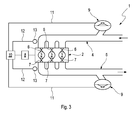
- Fig. 3 shows an embodiment with two microphones 13, one of which is arranged on the fresh air system 4, while the other is arranged on the exhaust system 5.
- the control device 10 can build a control loop, with the aid of which the operation of the respective transducer 9 can be regulated.
- Fig. 1 to 3 are each microphone 13 two alternative positioning options indicated, namely in each case a close-up positioning, in the fresh air downstream or in the exhaust upstream of the respective transducer 9, and a motor remote positioning, in the fresh air upstream or in the exhaust downstream of the respective transducer. 9
- the control device 10 may according to the FIGS. 1 and 3 the exhaust system 5 associated converter 9 targeted to generate negative pressure waves that are tuned to the gas exchange operations so that the respective cylinder 3 a vacuum wave can still enter into the respective cylinder 3, before the associated exhaust valve 7 completely closes.
- the fresh air is sucked when opening the associated intake valve 6 quasi in the respective cylinder 3.
- the control device 10 can control the respective transducer 9 for generating an overpressure wave.
- the generation of such overpressure waves is again specifically tuned to the gas exchange processes so that an overpressure wave can enter the respective cylinder 3, immediately before the respective intake valve 6 closes. This will do this Overpressure wave caught in the respective cylinder 3, whereby there improves the loading of the cylinder 3.
- the control device 10 can now determine the times for generating the pressure waves as a function of a rotational speed of the piston engine 1.
- the speed of the piston engine 1 knows the control device 10, for example, from the engine control unit 8, with which the control device 10 is coupled in a suitable manner.
- the control device 10 also expediently takes into account the current temperature of the fresh air or of the exhaust gas.
- Corresponding temperature sensors are not shown here. In particular, such temperature values can also be called up on the engine control unit 8, if such temperature sensors are available anyway for other purposes.
- control device 10 accesses a map in which several characteristics are stored, the different temperatures or different temperature ranges are assigned and in each of which the relationship between the time to generate the pressure wave and the speed of the piston motor 1 is stored.
- the controller 10 may also the amplitudes of Pressure waves vary. Appropriately, an adaptation of the amplitudes of the pressure waves can be realized depending on the current engine power.
- the control device 10 determines, in particular in conjunction with the engine control unit 8, the current engine power and controls depending on the respective transducer 9 for generating pressure waves with the correspondingly adapted to the engine power amplitudes.
- control device 10 can take into account as a controlled variable the measurement signals of the respective microphone 13.
- control device 10 can also take into account signals of the engine control unit 8 as a controlled variable. For example. a combination of the microphone signals with the current engine power can be used to control the pressure wave amplitudes.
- the respective transducer 9 with the aid of the control device 10 for generating anti-noise, in order to produce noise that occurs in the fresh-air system 4 or in the exhaust system 5 spread, dampen.
- the generation of anti-sound can be realized cumulatively for generating the pressure waves described above to improve the charge exchange.
- the anti-sound waves and the pressure waves which are generated by means of the respective transducer 9, simply superimposed.
Landscapes
- Engineering & Computer Science (AREA)
- Chemical & Material Sciences (AREA)
- Combustion & Propulsion (AREA)
- Mechanical Engineering (AREA)
- General Engineering & Computer Science (AREA)
- Physics & Mathematics (AREA)
- Acoustics & Sound (AREA)
- Exhaust Silencers (AREA)
- Characterised By The Charging Evacuation (AREA)
Abstract
Description
- Die vorliegende Erfindung betrifft ein Verfahren zum Betreiben eines Kolbenmotors, insbesondere eines Kraftfahrzeugs. Die Erfindung betrifft außerdem einen Kolbenmotor, insbesondere eines Kraftfahrzeugs. Außerdem betrifft die vorliegende Erfindung eine Verwendung eines elektroakustischen Wandlers.
- Ein Kolbenmotor weist mehrere Zylinder auf, in denen Kolben hubverstellbar angeordnet sind und in denen Brennräume ausgebildet sind. Eine Frischluftanlage dient zum Zuführen von Frischluft zu den Zylindern. Eine Abgasanlage dient zum Abführen von Abgas von den Zylindern. Während eines Ladungswechsels wird nach einem Verbrennungsvorgang gebildetes Abgas aus dem Zylinder abgeführt und für den nächsten Verbrennungsvorgang Frischluft zugeführt. Zur Steuerung des Ladungswechsels sind üblicherweise Ladungswechselventile, nämlich Einlassventile und Auslassventile vorgesehen.
- Zur Leistungssteigerung und Wirkungsgradverbesserung sowie zur Emissionsreduzierung ist es bekannt, für den Ladungswechsel dynamische Strömungseffekte auszunutzen, die in der Frischluftanlage entstehen. Durch die Ladungswechselvorgänge kommt es in der Frischluftanlage zu Schwingungen. Durch Resonanz- oder Schwingrohre lassen sich Resonanzeffekte ausnutzen, um die Beladung der Zylinder mit Frischluft zu verbessern. Um eine derartige Ladungsverbesserung auch bei unterschiedlichen Drehzahlen des Kolbenmotors erzielen zu können, sind verstellbare Schwingrohre allgemein bekannt, mit denen für niedrige Drehzahlen des Kolbenmotors eine vergleichsweise große Schwingrohrlänge einstellbar ist, während für höhere Drehzahlen des Kolbenmotors eine vergleichsweise kurze Schwingrohrlänge einstellbar ist.
- Darüber hinaus sind unterschiedliche Ladeeinrichtungen bekannt, wie z. B. Kompressoren und Turbolader, mit denen das Druckniveau in der den Zylindern zugeführten Frischluft erhöht werden kann. Auch hierdurch lässt sich die Aufladung der Zylinder verbessern.
- In der Abgasanlage erfolgt zum einen eine Reinigung der Abgase, um Emissionswerte des Kolbenmotors zu reduzieren. Zum anderen erfolgt in der Abgasanlage auch eine Bedämpfung des vom Kolbenmotor erzeugten und im Abgas mitgeführten Schalls, um eine Schallemission des Kolbenmotors zu reduzieren. Bei modernen Abgasanlagen können auch aktive Schalldämpfer zum Einsatz kommen, die auf dem Prinzip der Antischallerzeugung beruhen. Ein derartiger aktiver Schalldämpfer enthält zumindest einen elektroakustischen Wandler, bei dem es sich in der Regel um einen Lautsprecher handeln kann, mit dessen Hilfe aktiv Gegenschall erzeugt wird, der gegenüber dem zu bedämpfenden Schall phasenverschoben ist, derart, dass sich bei der Überlagerung von Schall und Gegenschall eine möglichst weitgehende gegenseitige Auslöschung ergibt. Derartige aktive Schalldämpfer können auch bei einer Frischluftanlage zum Einsatz kommen, um frischluftseitig emittierten Schall des Kolbenmotors zu bedämpfen.
- Die vorliegende Erfindung beschäftigt sich mit dem Problem, für einen Kolbenmotor bzw. für ein zugehöriges Betriebsverfahren eine verbesserte Ausführungsform anzugeben, die sich insbesondere durch einen verbesserten Ladungswechsel auszeichnet.
- Dieses Problem wird erfindungsgemäß durch die Gegenstände der unabhängigen Ansprüche gelöst. Vorteilhafte Ausführungsformen sind Gegenstand der abhängigen Ansprüche.
- Die Erfindung beruht auf dem allgemeinen Gedanken, die Beladung des jeweiligen Zylinders mit Frischluft mit Hilfe einer frischluftseitigen Überdruckwelle zu verbessern bzw. die Entladung des jeweiligen Zylinders von Abgas mit Hilfe einer abgasseitigen Unterdruckwelle zu verbessern. Erfindungsgemäß wird dabei die jeweilige Druckwelle mittels wenigstens eines elektroakustischen Wandlers erzeugt, der hierzu an die Frischluftanlage oder an die Abgasanlage angeschlossen ist oder darin integriert ist.
- Eine frischluftseitige Überdruckwelle, die sich in der Frischluftanlage in Richtung Zylinder ausbreitet und die auf den Ladungswechsel gezielt so abgestimmt ist, dass sie bei schließendem Einlassventil zwar noch in den Zylinder einlaufen kann, danach jedoch nicht mehr aus dem Zylinder entweichen kann, führt im jeweiligen Zylinder zu einer Druckerhöhung und somit zu einer verbesserten Beladung des jeweiligen Zylinders. Eine abgasseitige Unterdruckwelle, die sich in der Abgasanlage in Richtung Zylinder ausbreitet und die während eines Schließvorgangs eines Auslassventils zwar noch in den jeweiligen Zylinder eintreten kann, jedoch danach nicht mehr daraus entweichen kann, führt zu einer signifikanten Druckabsenkung im Zylinder, was für die nachfolgende Befüllung mit Frischluft von Vorteil ist. Die Erfindung nutzt nun die Erkenntnis, dass mit Hilfe von elektroakustischen Wandlern, die für die Bedämpfung von störendem Schall mittels Antischall an sich bekannt sind, gezielt derartige Druckwellen, also Überdruckwellen in der Frischluftanlage und Unterdruckwellen in der Abgasanlage, erzeugt werden können, um den Ladungswechsel der einzelnen Zylinder zu verbessern. Von besonderem Vorteil ist dabei, dass derartige elektroakustische Wandler vergleichsweise kompakt realisierbar sind und bezüglich der erzeugbaren Druckwellen in hohem Maße variabel sind. Somit können die mit Hilfe des elektroakustischen Wandlers erzeugten Druckwellen besonders günstig an die Bedürfnisse der Ladungswechselvorgänge auch bei variierenden Betriebszuständen des Kolbenmotors angepasst werden. Bspw. lassen sich die Amplituden der erzeugten Druckwellen variieren. Ebenso kann die Frequenz variiert werden, mit welcher die Druckwellen erzeugt werden. Somit ist insbesondere eine einfache Adaption an variierende Drehzahlen des Kolbenmotors möglich. Im Vergleich zu verstellbaren Schwingrohren, die lediglich eine Einstellung von zwei verschiedenen Schwingrohrlängen und somit lediglich eine Optimierung für zwei verschiedene Drehzahlen zulassen, ergibt sich mit Hilfe des elektroakustischen Wandlers eine erhebliche Verbesserung, da quasi für jede Drehzahl der Brennkraftmaschine geeignete Druckwellen generiert werden können.
- Entsprechend einer vorteilhaften Ausführungsform lassen sich in Relation zu den Zündzeitpunkten die Zeitpunkte zum Erzeugen der Druckwellen in Abhängigkeit einer Drehzahl des Kolbenmotors ermitteln. Somit kann für jede Drehzahl des Kolbenmotors der elektroakustische Wandler so betrieben werden, dass die damit erzeugten Druckwellen an jedem einzelnen Zylinder rechtzeitig ankommen, um als frischluftseitige Überdruckwelle unmittelbar vor dem Schließen des jeweiligen Einlassventils in den jeweiligen Zylinder einzutreten oder um als abgasseitige Unterdruckwelle unmittelbar vor dem Schließen des jeweiligen Auslassventils in den jeweiligen Zylinder einzutreten.
- Bei einer anderen vorteilhaften Ausführungsform kann vorgesehen sein, in Relation zu den Zündzeitpunkten den Zeitpunkt zum Erzeugen der Druckwellen in Abhängigkeit einer Drehzahl des Kolbenmotors und in Abhängigkeit der Temperatur der Frischluft und/oder des Abgases zu ermitteln. Durch die zusätzliche Berücksichtigung der Temperatur kann außerdem die sich mit der Temperatur ändernde Schallausbreitungsgeschwindigkeit berücksichtigt werden. Folglich kann die Laufzeit besser berücksichtigt werden, welche die jeweilige Druckwelle für die Strecke vom elektroakustischen Wandler bis zum jeweiligen Zylinder benötigt. Besonders zweckmäßig ist dabei eine Ausführungsform, bei welcher in Relation zu den Zündzeitpunkten die Zeitpunkte zum Erzeugen der Druckwelle in Verbindung mit einem Kennfeld ermittelt werden, in dem in Relation zu den Zündzeitpunkten die Zeitpunkte zum Erzeugen der Druckwelle abhängig von der Drehzahl in Kennlinien abgelegt sind, die verschiedenen Temperaturen oder Temperaturbereichen des Abgases bzw. der Frischluft zugeordnet sind. Kennfeldbasierte Steuerungssysteme arbeiten mit hoher Zuverlässigkeit und benötigen vergleichsweise wenig Rechnerleistung.
- Bei einer anderen Ausführungsform können die Amplituden der Druckwellen in Abhängigkeit der aktuellen Motorleistung ermittelt werden. Bspw. kann es sinnvoll sein, bei Volllast große oder maximale Amplituden zu erzeugen, während bei Teillast geringere Amplituden erzeugt werden und insbesondere beim Leerlaufbetrieb keine oder minimale Amplituden erzeugt werden. Zur Kopplung der Druckwellenamplituden mit der Motorleistung kann es bspw. vorgesehen sein, ein mit der aktuellen Motorleistung korreliertes Signal von einem Motorsteuergerät zu berücksichtigen. Diese Ausführungsform beruht auf der Idee, dass in einem Motorsteuergerät ohnehin die benötigten Informationen über die Motorleistung vorhanden sind, sodass die Bereitstellung bzw. ein Abgreifen eines mit der Motorleistung korrelierten Signals am Motorsteuergerät besonders einfach realisierbar ist.
- Entsprechend einer anderen Ausführungsform können die Amplituden der Druckwellen mittels einer Regelung eingestellt werden, die als Regelgrößen Messsignale eines Mikrofons und/oder Signale eines Motorsteuergeräts berücksichtigt. In diesem Fall wird ein Regelkreis aufgebaut, der selbsttätig die Druckwellenamplituden an den aktuellen Bedarf anpasst.
- Entsprechend einer besonders vorteilhaften Ausführungsform kann nun vorgesehen sein, den elektroakustischen Wandler kumulativ oder alternativ zum Erzeugen der Druckwellen zumindest in bestimmten Drehzahlbereichen und/oder Lastbereichen zum Erzeugen von Antischall zu verwenden, um Störgeräusche, die sich in der Frischluftanlage und/oder in der Abgasanlage ausbreiten, zu bedämpfen. Durch diese Maßnahme erhält der jeweilige elektroakustische Wandler eine Zusatzfunktion. Zum einen wird er erfindungsgemäß zum Erzeugen von Druckwellen verwendet, mit denen die Ladungswechselvorgänge unterstützt werden. Zum anderen wird er konventionell verwendet, um die Schallemission des Kolbenmotors zu reduzieren.
- Die Erfindung betrifft somit auch eine neuartige Verwendung eines elektroakustischen Wandlers, nämlich zum Erzeugen von Überdruckwellen in einer Frischluftanlage eines Kolbenmotors, die während eines Ladungswechsels eine Beladung von Zylindern des Kolbenmotors mit Frischluft unterstützen, und/oder zum Erzeugen von Unterdruckwellen in einer Abgasanlage eines Kolbenmotors, die während eines Ladungswechsels eine Entladung von Zylindern des Kolbenmotors von Abgas unterstützen. Dabei kann ein derartiger elektroakustischer Wandler exklusiv für diese Aufgabe in der Frischluftanlage bzw. in der Abgasanlage vorgesehen sein. Ebenso ist es möglich, einen in der Frischluftanlage bzw. in der Abgasanlage ohnehin zur Schalldämpfung mittels Antischall vorgesehenen elektroakustischen Wandler zusätzlich zur Unterstützung der Ladungswechselvorgänge zu betreiben.
- Weitere wichtige Merkmale und Vorteile der Erfindung ergeben sich aus den Unteransprüchen, aus den Zeichnungen und aus der zugehörigen Figurenbeschreibung anhand der Zeichnungen.
- Es versteht sich, dass die vorstehend genannten und die nachstehend noch zu erläuternden Merkmale nicht nur in der jeweils angegebenen Kombination, sondern auch in anderen Kombinationen oder in Alleinstellung verwendbar sind, ohne den Rahmen der vorliegenden Erfindung zu verlassen.
- Bevorzugte Ausführungsbeispiele der Erfindung sind in den Zeichnungen dargestellt und werden in der nachfolgenden Beschreibung näher erläutert, wobei sich gleiche Bezugszeichen auf gleiche oder ähnliche oder funktional gleiche Bauteile beziehen.
- Es zeigen, jeweils schematisch,
- Fig. 1 bis 3
- jeweils eine stark vereinfachte Prinzipdarstellung eines Kolbenmotors bei verschiedenen Ausführungsformen.
- Entsprechend den
Figuren 1 bis 3 umfasst ein Kolbenmotor 1 in einem Motorblock 2 mehrere Zylinder 3, eine Frischluftanlage 4 und eine Abgasanlage 5. Üblicherweise ist ein derartiger Kolbenmotor 1 in einem Kraftfahrzeug angeordnet. Grundsätzlich sind jedoch auch stationäre Anwendungen denkbar. - Die Frischluftanlage 4 dient zum Zuführen von Frischluft zu den Zylindern 3. Die Abgasanlage 5 dient zum Abführen von Abgas von den Zylindern 3. Zum Steuern der Ladungswechselvorgänge sind den Zylindern 3 Ladungswechselventile zugeordnet, nämlich jeweils zumindest ein Einlassventil 6 und zumindest ein Auslassventil 7. Es ist klar, dass auch zwei oder mehr Einlassventile 6 bzw. Auslassventile 7 je Zylinder 3 vorgesehen sein können. Zum Betreiben des Kolbenmotors 1 ist üblicherweise auch ein Motorsteuergerät 8 vorgesehen, das auf geeignete Weise mit den zu steuernden Komponenten des Kolbenmotors 1 gekoppelt ist. Der hier vorgestellte Kolbenmotor 1 weist außerdem zumindest einen elektroakustischen Wandler 9 auf, der mit der Frischluftanlage 4 bzw. mit der Abgasanlage 5 gekoppelt ist. Bei der in
Fig. 1 gezeigten Ausführungsform ist ein einziger solcher elektroakustischer Wandler 9 vorgesehen, der an die Abgasanlage 5 angeschlossen ist. Bei der inFig. 2 gezeigten Ausführungsform ist ein einziger elektroakustischer Wandler 9 vorgesehen, der an die Frischluftanlage 4 angeschlossen ist. Bei der inFig. 3 gezeigten Ausführungsform sind genau zwei elektroakustische Wandler 9 vorgesehen, von denen der eine an die Frischluftanlage 4 angeschlossen ist, während der andere an die Abgasanlage 5 angeschlossen ist. Grundsätzlich ist auch eine Ausführungsform denkbar, bei welcher ein einziger elektroakustischer Wandler 9 sowohl an die Frischluftanlage 4 als auch an die Abgasanlage 5 angeschlossen ist. - Zum Betätigen des jeweiligen elektroakustischen Wandlers 9 ist eine Steuereinrichtung 10 vorgesehen, die über wenigstens eine Steuerleitung 11 mit dem jeweiligen Wandler 9 verbunden ist. Darüber hinaus kann optional vorgesehen sein, dass die Steuereinrichtung 10 über eine entsprechende Signalleitung 12 mit zumindest einem Mikrofon 13 gekoppelt ist. Das Mikrofon 13 kann bei einem abgasseitig angeordneten Wandler 9 im Bereich der Abgasanlage 5 angeordnet sein, was in
Fig. 1 wiedergegeben ist. Bei einem frischluftseitigen Wandler 9 kann das Mikrofon 9 im Bereich der Frischluftanlage 4 angeordnet sein, was inFig. 2 dargestellt ist.Fig. 3 zeigt eine Ausführungsform mit zwei Mikrofonen 13, von denen das eine an der Frischluftanlage 4 angeordnet ist, während das andere an der Abgasanlage 5 angeordnet ist. Mit Hilfe des jeweiligen Mikrofons 13 kann die Steuereinrichtung 10 einen Regelkreis aufbauen, mit dessen Hilfe die Betätigung des jeweiligen Wandlers 9 geregelt erfolgen kann. In denFig. 1 bis 3 sind je Mikrofon 13 zwei alternative Positionierungsmöglichkeiten angedeutet, nämlich jeweils eine motornahe Positionierung, in der Frischluft stromab bzw. im Abgas stromauf des jeweiligen Wandlers 9, sowie eine motorferne Positionierung, in der Frischluft stromauf bzw. im Abgas stromab des jeweiligen Wandlers 9. - Der hier vorgestellte Kolbenmotor 1 lässt sich wie folgt betreiben:
- Während des Betriebs des Kolbenmotors 1 finden laufend Ladungswechsel statt, bei denen im jeweiligen Zylinder 3 nach einem Verbrennungsvorgang Abgas aus dem Zylinder 3 abgeführt wird und anschließend für den nächsten Verbrennungsvorgang Frischluft dem jeweiligen Zylinder 3 zugeführt wird. Hierzu werden die Ladungswechselventile 6,7 entsprechend betätigt. Zur Verbesserung dieser Ladungswechselvorgänge kann die Steuereinrichtung 10 den jeweiligen elektroakustischen Wandler 9 zur Erzeugung von Druckwellen ansteuern.
- Die Steuereinrichtung 10 kann den gemäß den
Figuren 1 und3 der Abgasanlage 5 zugeordneten Wandler 9 gezielt zum Erzeugen von Unterdruckwellen ansteuern, die auf die Ladungswechselvorgänge so abgestimmt sind, dass am jeweiligen Zylinder 3 eine Unterdruckwelle noch in den jeweiligen Zylinder 3 eintreten kann, bevor das zugehörige Auslassventil 7 vollständig schließt. Hierdurch wird der mit Hilfe der Unterdruckwelle der in den jeweiligen Zylinder 3 eingebrachte Unterdruck im Zylinder 3 gefangen, was die nachfolgende Beladung mit Frischluft erheblich verbessert. Die Frischluft wird beim Öffnen des zugehörigen Einlassventils 6 quasi in den jeweiligen Zylinder 3 angesaugt. - Sofern der jeweilige elektroakustische Wandler 9 wie in den
Figuren 2 und3 der Frischluftanlage 4 zugeordnet ist, kann die Steuereinrichtung 10 den jeweiligen Wandler 9 zum Erzeugen einer Überdruckwelle ansteuern. Die Erzeugung derartiger Überdruckwellen ist dabei wieder auf die Ladungswechselvorgänge gezielt so abgestimmt, dass eine Überdruckwelle in den jeweiligen Zylinder 3 eintreten kann, unmittelbar bevor das jeweilige Einlassventil 6 schließt. Hierdurch wird diese Überdruckwelle im jeweiligen Zylinder 3 gefangen, wodurch sich dort die Beladung des Zylinders 3 verbessert. - Um die Druckwellen gezielt so erzeugen zu können, dass sie im jeweiligen Zylinder 3 eingeschlossen werden können, ist der Zeitpunkt, zu welchem die jeweilige Druckwelle vom jeweiligen Wandler 9 erzeugt wird, von entscheidender Bedeutung. Die Steuereinrichtung 10 kann nun in Abhängigkeit einer Drehzahl des Kolbenmotors 1 die Zeitpunkte zum Erzeugen der Druckwellen ermitteln. Die Drehzahl des Kolbenmotors 1 kennt die Steuereinrichtung 10 bspw. von dem Motorsteuergerät 8, mit dem die Steuereinrichtung 10 auf geeignete Weise gekoppelt ist. Zweckmäßig berücksichtigt die Steuereinrichtung 10 bei der Ermittlung der Zeitpunkte für die Erzeugung der Druckwellen außerdem die aktuelle Temperatur der Frischluft bzw. des Abgases. Entsprechende Temperatursensoren sind hier nicht dargestellt. Insbesondere können derartige Temperaturwerte auch am Motorsteuergerät 8 abgerufen werden, sofern für andere Zwecke derartige Temperatursensoren ohnehin vorhanden sind. Durch die Berücksichtigung der aktuellen Temperatur kann die Abhängigkeit der Schallausbreitungsgeschwindigkeit von der Temperatur im jeweiligen Gas, Frischluft oder Abgas, berücksichtigt und dementsprechend kompensiert werden.
- Besonders zweckmäßig ist dabei eine Ausführungsform, bei welcher die Steuereinrichtung 10 auf ein Kennfeld zugreift, in dem mehrere Kennlinien abgelegt sind, die unterschiedlichen Temperaturen oder unterschiedlichen Temperaturbereichen zugeordnet sind und in denen jeweils der Zusammenhang zwischen dem Zeitpunkt zum Erzeugen der Druckwelle und der Drehzahl des Kolbenmotors 1 abgelegt ist.
- Zusätzlich zu den Zeitpunkten, zu denen die Druckwellen vom jeweiligen Wandler 9 erzeugt werden, kann die Steuereinrichtung 10 außerdem die Amplituden der Druckwellen variieren. Zweckmäßig kann dabei eine Adaption der Amplituden der Druckwellen abhängig von der aktuellen Motorleistung realisiert werden. Hierzu ermittelt die Steuereinrichtung 10, insbesondere in Verbindung mit dem Motorsteuergerät 8, die aktuelle Motorleistung und steuert abhängig davon den jeweiligen Wandler 9 zum Erzeugen von Druckwellen mit den entsprechend an die Motorleistung adaptierten Amplituden an.
- Alternativ ist es ebenso möglich, die Amplituden der Druckwellen mittels einer Regelung einzustellen. Die Steuereinrichtung 10 kann dabei als Regelgröße die Messsignale des jeweiligen Mikrofons 13 berücksichtigen. Alternativ oder zusätzlich kann die Steuereinrichtung 10 als Regelgröße auch Signale des Motorsteuergeräts 8 berücksichtigen. Bspw. kann eine Kombination der Mikrofonsignale mit der aktuellen Motorleistung verwendet werden, um die Druckwellenamplituden zu regeln.
- Entsprechend einer besonders vorteilhaften Ausführungsform ist es zumindest in bestimmten Drehzahlbereichen und/oder Lastbereichen möglich, den jeweiligen Wandler 9 mit Hilfe der Steuereinrichtung 10 zum Erzeugen von Antischall zu verwenden, um auf diese Weise Störgeräusche, die sich in der Frischluftanlage 4 bzw. in der Abgasanlage 5 ausbreiten, zu bedämpfen. Dabei kann die Erzeugung von Antischall kumulativ zur Erzeugung der zuvor beschriebenen Druckwellen zur Verbesserung des Ladungswechsels realisiert werden. Hierzu werden die Antischallwellen und die Druckwellen, die mit Hilfe des jeweiligen Wandlers 9 erzeugt werden, einfach überlagert. Ebenso ist es möglich, in bestimmten Drehzahlbereichen den jeweiligen elektroakustischen Wandler 9 alternativ zu betreiben, also in bestimmten Drehzahlbereichen ausschließlich zum Erzeugen von Druckwellen, welche die Ladungswechselvorgänge verbessern, und in anderen Drehzahlbereichen ausschließlich zum Erzeugen von Antischall, um Störgeräusche zu be- dämpfen.
Claims (10)
- Verfahren zum Betreiben eines Kolbenmotors (1), insbesondere eines Kraftfahrzeugs, mit einer Frischluftanlage (4) zum Zuführen von Frischluft zu Zylindern (3) des Kolbenmotors (1) und mit einer Abgasanlage (5) zum Abführen von Abgas von den Zylindern (3),- bei dem während eines Ladungswechsels mittels einer frischluftseitigen Überdruckwelle die Beladung des jeweiligen Zylinders (3) mit Frischluft und/oder mittels einer abgasseitigen Unterdruckwelle die Entladung des jeweiligen Zylinders (3) von Abgas unterstützt wird,- bei dem die jeweilige Druckwelle mittels wenigstens eines elektroakustischen Wandlers (9) erzeugt wird.
- Verfahren nach Anspruch 1,
dadurch gekennzeichnet,
dass Zeitpunkte zum Erzeugen der Druckwellen in Abhängigkeit einer Drehzahl des Kolbenmotors (1) ermittelt werden. - Verfahren nach Anspruch 1 oder 2,
dadurch gekennzeichnet,
dass Zeitpunkte zum Erzeugen der Druckwellen in Abhängigkeit einer Drehzahl des Kolbenmotors (1) und in Abhängigkeit einer Temperatur der Frischluft und/oder des Abgases ermittelt werden, wobei insbesondere vorgesehen sein kann, dass die Zeitpunkte in Verbindung mit einem Kennfeld ermittelt werden, in dem die Zeitpunkte zum Erzeugen der Druckwellen abhängig von der Drehzahl in Kennlinien abgelegt sind, die verschiedenen Temperaturen oder Temperaturbereichen zugeordnet sind. - Verfahren nach einem der Ansprüche 1 bis 3,
dadurch gekennzeichnet,
dass die Amplituden der Druckwellen in Abhängigkeit der aktuellen Motorleistung ermittelt werden, wobei insbesondere vorgesehen sein kann, dass ein mit der aktuellen Motorleistung korreliertes Signal berücksichtigt wird, das von einem Motorsteuergerät (8) bereitgestellt wird. - Verfahren nach einem der Ansprüche 1 bis 4
dadurch gekennzeichnet,
dass die Amplituden der Druckwellen mittels einer Regelung eingestellt werden, die als Regelgrößen Messsignale eines Mikrofons (13) und/oder Signale eines Motorsteuergerätes (8) berücksichtigt. - Verfahren nach einem der Ansprüche 1 bis 5
dadurch gekennzeichnet,
dass der elektroakustische Wandler (9) kumulativ oder alternativ zum Erzeugen der Druckwellen zumindest in bestimmten Drehzahlbereichen und/oder Lastbereichen zum Erzeugen von Antischall verwendet wird, um Störgeräusche, die sich in der Frischluftanlage (4) und/oder in der Abgasanlage (5) ausbreiten, zu bedämpfen. - Kolbenmotor, insbesondere eines Kraftfahrzeuges,- mit einer Frischluftanlage (4) zum Zuführen von Frischluft zu Zylindern (3) des Kolbenmotors (1),- mit einer Abgasanlage (5) zum Abführen von Abgas von den Zylindern (3),- mit wenigstens einem elektroakustischen Wandler (9), der an die Frischluftanlage (4) und/oder an die Abgasanlage (5) angeschlossen ist,- mit einer Steuereinrichtung (10) zum Betreiben des elektroakustischen Wandlers (9), derart, dass vom elektroakustischen Wandler (9) erzeugte Druckwellen als frischluftseitige Überdruckwellen die Beladung der Zylinder (3) mit Frischluft oder als abgasseitige Unterdruckwellen die Entladung der Zylinder (3) von Abgas unterstützen.
- Kolbenmotor nach Anspruch 7,
dadurch gekennzeichnet,
dass zumindest ein Mikrofon (13) mit der Steuereinrichtung (10) verbunden ist, um eine Regelung zum Erzeugen der Druckwellen zu ermöglichen. - Kolbenmotor nach Anspruch 7 oder 8,
dadurch gekennzeichnet,
dass die Steuereinrichtung (10) außerdem so ausgestaltet und/oder programmiert ist, dass sie den jeweiligen elektroakustischen Wandler (9) zumindest in bestimmten Drehzahlbereichen und/oder Lastbereichen kumulativ oder alternativ zum Bedämpfen von sich in der Frischluftanlage (4) oder in der Abgasanlage (5) ausbreitenden Störgeräuschen mittels Antischall betreibt. - Verwendung eines elektroakustischen Wandlers (9) zum Erzeugen von Überdruckwellen in einer Frischluftanlage (4) eines Kolbenmotors (1), die während eines Ladungswechsels eine Beladung von Zylindern (3) des Kolbenmotors (1) mit Frischluft unterstützen, und/oder zum Erzeugen von Unterdruckwellen in einer Abgasanlage (5) eines Kolbenmotors (1), die während eines Ladungswechsels eine Entladung von Zylindern (3) des Kolbenmotors (1) von Abgas unterstützen.
Applications Claiming Priority (1)
| Application Number | Priority Date | Filing Date | Title |
|---|---|---|---|
| DE102010018659A DE102010018659A1 (de) | 2010-04-28 | 2010-04-28 | Kolbenmotor, Verfahren und Verwendung |
Publications (3)
| Publication Number | Publication Date |
|---|---|
| EP2383448A2 true EP2383448A2 (de) | 2011-11-02 |
| EP2383448A3 EP2383448A3 (de) | 2016-06-15 |
| EP2383448B1 EP2383448B1 (de) | 2021-03-03 |
Family
ID=44276089
Family Applications (1)
| Application Number | Title | Priority Date | Filing Date |
|---|---|---|---|
| EP11158624.4A Not-in-force EP2383448B1 (de) | 2010-04-28 | 2011-03-17 | Kolbenmotor, verfahren und verwendung |
Country Status (4)
| Country | Link |
|---|---|
| US (1) | US8857411B2 (de) |
| EP (1) | EP2383448B1 (de) |
| JP (1) | JP5837759B2 (de) |
| DE (1) | DE102010018659A1 (de) |
Cited By (1)
| Publication number | Priority date | Publication date | Assignee | Title |
|---|---|---|---|---|
| DE102017123607A1 (de) * | 2017-10-11 | 2019-04-11 | Volkswagen Aktiengesellschaft | Brennkraftmaschine |
Families Citing this family (3)
| Publication number | Priority date | Publication date | Assignee | Title |
|---|---|---|---|---|
| JP5910034B2 (ja) * | 2011-11-29 | 2016-04-27 | マツダ株式会社 | 多気筒エンジンの排気装置 |
| CN104712405A (zh) * | 2013-12-13 | 2015-06-17 | 上海通用汽车有限公司 | 混合动力车型的进排气系统 |
| JP6734068B2 (ja) | 2016-02-15 | 2020-08-05 | 三菱重工エンジン&ターボチャージャ株式会社 | 内燃機関 |
Family Cites Families (37)
| Publication number | Priority date | Publication date | Assignee | Title |
|---|---|---|---|---|
| US3254484A (en) * | 1964-01-23 | 1966-06-07 | Kopper John Stephen | Acoustical resonance apparatus for increasing the power output of an internal combustion engine |
| JPS6176721A (ja) * | 1984-09-25 | 1986-04-19 | Mazda Motor Corp | エンジンの吸気装置 |
| JPS6278332U (de) * | 1985-11-01 | 1987-05-19 | ||
| JPS63111230A (ja) * | 1986-10-30 | 1988-05-16 | Hino Motors Ltd | 内燃機関の吸気慣性増大装置 |
| GB2203488A (en) * | 1987-04-04 | 1988-10-19 | Ford Motor Co | Manifold tuning for I.C. engines |
| DE3729998A1 (de) * | 1987-09-08 | 1989-03-23 | Gerhard Werner Kappelmeier | Ladungswechselsteuerung fuer eine verbrennungskraftmaschine |
| DE4012558A1 (de) * | 1990-04-20 | 1991-10-24 | Bayerische Motoren Werke Ag | Verfahren zur generierung von frischgasschwingungen in einer ansauganlage fuer brennkraftmaschinen |
| US5060271A (en) * | 1990-05-04 | 1991-10-22 | Ford Motor Company | Active muffler with dynamic tuning |
| US5101626A (en) * | 1990-07-19 | 1992-04-07 | Outboard Marine Corporation | Exhaust gas discharge system for two-stroke internal combustion engine |
| US5048470A (en) * | 1990-12-24 | 1991-09-17 | Ford Motor Company | Electronically tuned intake manifold |
| DE4217630C1 (de) * | 1992-05-28 | 1993-09-23 | Mercedes-Benz Aktiengesellschaft, 70327 Stuttgart, De | |
| KR0130635B1 (ko) * | 1992-10-14 | 1998-04-09 | 모리시타 요이찌 | 연소 장치의 적응 소음 시스템 |
| US5284123A (en) * | 1993-01-22 | 1994-02-08 | Pulso Catalytic Superchargers | Pressure wave supercharger having a stationary cellular member |
| JPH0791264A (ja) * | 1993-09-22 | 1995-04-04 | Yamaha Motor Co Ltd | エンジンの過給装置 |
| JPH07129596A (ja) * | 1993-10-29 | 1995-05-19 | Sony Corp | 自然言語処理装置 |
| JPH07145731A (ja) * | 1993-11-22 | 1995-06-06 | Mazda Motor Corp | エンジンの制御装置 |
| JPH07181995A (ja) * | 1993-12-22 | 1995-07-21 | Oki Electric Ind Co Ltd | 音声合成装置及び音声合成方法 |
| US5515832A (en) * | 1994-07-05 | 1996-05-14 | Ford Motor Company | Method of controlling internal combustion engine exhaust hydrocarbons |
| JPH08158966A (ja) * | 1994-11-30 | 1996-06-18 | Nippondenso Co Ltd | 内燃機関の騒音制御装置 |
| JPH08328578A (ja) * | 1995-06-01 | 1996-12-13 | Oki Electric Ind Co Ltd | テキスト音声合成装置 |
| JPH0944167A (ja) * | 1995-07-28 | 1997-02-14 | Yanmar Diesel Engine Co Ltd | アクティブ消音装置 |
| US6065454A (en) * | 1997-09-12 | 2000-05-23 | Michigan State University | Method and apparatus for active control of the combustion processes in an internal combustion engine |
| CA2220858A1 (en) * | 1998-01-19 | 1999-07-19 | Lloyd Taylor | A precise, controlled exhaust/intake system for the internal combustion engine |
| US6202409B1 (en) * | 1999-10-26 | 2001-03-20 | Lloyd Taylor | Acoustically-enhanced intake/exhaust system and method for internal combustion engines |
| JP2001355426A (ja) * | 2000-06-09 | 2001-12-26 | Yanmar Diesel Engine Co Ltd | アクティブ消音装置 |
| DE10036020A1 (de) * | 2000-07-22 | 2002-01-31 | Jens Lauer | Anordnung zur Beeinflussung des Brennraumfüllgrades von Verbrennungskraftmaschinen, betrieben durch Hilfsenergie und Verfahren zum Betreiben dieser Anordnung |
| SE518687C2 (sv) * | 2001-03-30 | 2002-11-05 | Saab Automobile | Sätt att styra laddtrycket vid turboladdad förbränningsmotor samt dylik motor |
| DE10128721B4 (de) * | 2001-06-13 | 2005-11-17 | Siemens Ag | Vorrichtung zur Aufladung einer Brennkraftmaschine |
| JP3901483B2 (ja) * | 2001-10-04 | 2007-04-04 | ヤマハ発動機株式会社 | エンジンの吸気音調整構造及び排気音調整構造 |
| DE20207300U1 (de) * | 2002-05-10 | 2002-09-05 | Filterwerk Mann + Hummel GmbH, 71638 Ludwigsburg | Vorrichtung zur Beeinflussung des Schalls im Ansaugtrakt eines Verbrennungsmotors |
| US6959679B2 (en) * | 2002-11-15 | 2005-11-01 | Advanced Engine Management Inc. | Air intake device for internal combustion engine |
| US20060086564A1 (en) * | 2004-10-21 | 2006-04-27 | Visteon Global Technologies, Inc. | Dual chamber variable geometry resonator |
| US8083494B2 (en) * | 2005-07-05 | 2011-12-27 | Gestion Serge Benjamin Inc. | Pulse jet engine having an acoustically enhanced ejector system |
| US7650867B2 (en) * | 2006-05-11 | 2010-01-26 | Williams Allan R | Intake and exhaust tuning system |
| US7584821B2 (en) * | 2007-01-23 | 2009-09-08 | Gm Global Technology Operations, Inc. | Adjustable helmholtz resonator |
| US7845466B2 (en) * | 2007-08-28 | 2010-12-07 | Visteon Global Technologies, Inc. | Sound generator with structurally and acoustically coupled sound radiation panel and method for manufacturing the same |
| JP4900333B2 (ja) * | 2007-11-13 | 2012-03-21 | トヨタ自動車株式会社 | 内燃機関の制御装置 |
-
2010
- 2010-04-28 DE DE102010018659A patent/DE102010018659A1/de not_active Ceased
-
2011
- 2011-03-17 EP EP11158624.4A patent/EP2383448B1/de not_active Not-in-force
- 2011-04-27 JP JP2011099705A patent/JP5837759B2/ja not_active Expired - Fee Related
- 2011-04-28 US US13/096,357 patent/US8857411B2/en active Active
Non-Patent Citations (1)
| Title |
|---|
| None |
Cited By (1)
| Publication number | Priority date | Publication date | Assignee | Title |
|---|---|---|---|---|
| DE102017123607A1 (de) * | 2017-10-11 | 2019-04-11 | Volkswagen Aktiengesellschaft | Brennkraftmaschine |
Also Published As
| Publication number | Publication date |
|---|---|
| JP5837759B2 (ja) | 2015-12-24 |
| EP2383448B1 (de) | 2021-03-03 |
| US8857411B2 (en) | 2014-10-14 |
| DE102010018659A1 (de) | 2011-11-03 |
| EP2383448A3 (de) | 2016-06-15 |
| JP2011231766A (ja) | 2011-11-17 |
| US20110265763A1 (en) | 2011-11-03 |
Similar Documents
| Publication | Publication Date | Title |
|---|---|---|
| US8543313B2 (en) | Method and device for determining a vibration-optimised adjustment of an injection device | |
| Xiang et al. | Study of multi-chamber micro-perforated muffler with adjustable transmission loss | |
| DE19861018C2 (de) | Gesteuerter akustischer Wellenleiter zur Schalldämpfung | |
| EP2444605B1 (de) | Schalldämpfer | |
| EP0481450B1 (de) | Schalldämpferanlage für Verbrennungsmotoren | |
| CN109859733A (zh) | 基于fxlms算法的发动机噪声控制方法 | |
| DE102012023643A1 (de) | Aktive Gestaltung von Abgasgeräuschen | |
| DE69120340T2 (de) | Gerät für Rauschkompensation | |
| EP2383448B1 (de) | Kolbenmotor, verfahren und verwendung | |
| DE69112202T2 (de) | Aktive regelung der leistung einer maschine. | |
| WO2004022956A1 (de) | Betriebsverfahren für einen verdichter | |
| DE10015697C1 (de) | Schallwandler für Abgaspulsationen | |
| DE112006002343B4 (de) | Verfahren und Vorrichtung zur Regelung des Schalls eines Motors durch Schaltfrequenzanalyse | |
| DE102015221627A1 (de) | Verfahren zum Erzeugen eines einen Betrieb einer Verbrennungskraftmaschine charakterisierenden Geräuschs | |
| CN107102658B (zh) | 一种离线次级通道的辨识方法及装置 | |
| EP1195499A2 (de) | Vorrichtung und Verfahren zur Reduzierung der Schallemission bei Verbrennungsmotoren und zu deren Diagnose | |
| DE102011018459A1 (de) | Übertragungsstreckenkompensator | |
| EP1717433A9 (de) | Aktiver Ansaugschalldämpfer | |
| DE102015222587A1 (de) | Adaptiver Schwingungsdämpfer | |
| EP2503124A1 (de) | Brennkraftmaschine, Frischluftanlage und zugehöriges Betriebsverfahren | |
| EP1701010B1 (de) | Aktiver Abgasschalldämpfer | |
| DE102006061564A1 (de) | Verfahren zur Betriebsart-abhängigen Schallbeeinflussung | |
| DE102013009181B4 (de) | Verwendung einer Vorrichtung zur Beeinflussung des an die Umgebung abgestrahlten Schalls eines Schallerzeugers | |
| WO2021160826A1 (de) | Fahrzeug mit vorrichtung zur simulation von betriebsgeräuschen eines gewünschten verbrennungsmotors sowie zugehörige verfahren | |
| DE102005028369A1 (de) | Schalldämpfungseinrichtung und Verfahren zum Betreiben einer Schalldämpfungseinrichtung |
Legal Events
| Date | Code | Title | Description |
|---|---|---|---|
| AK | Designated contracting states |
Kind code of ref document: A2 Designated state(s): AL AT BE BG CH CY CZ DE DK EE ES FI FR GB GR HR HU IE IS IT LI LT LU LV MC MK MT NL NO PL PT RO RS SE SI SK SM TR |
|
| AX | Request for extension of the european patent |
Extension state: BA ME |
|
| PUAI | Public reference made under article 153(3) epc to a published international application that has entered the european phase |
Free format text: ORIGINAL CODE: 0009012 |
|
| RAP1 | Party data changed (applicant data changed or rights of an application transferred) |
Owner name: EBERSPAECHER EXHAUST TECHNOLOGY GMBH & CO. KG |
|
| PUAL | Search report despatched |
Free format text: ORIGINAL CODE: 0009013 |
|
| RIC1 | Information provided on ipc code assigned before grant |
Ipc: F02B 27/04 20060101ALI20160504BHEP Ipc: F02M 35/12 20060101ALN20160504BHEP Ipc: F02B 29/06 20060101ALI20160504BHEP Ipc: F02B 27/00 20060101AFI20160504BHEP |
|
| AK | Designated contracting states |
Kind code of ref document: A3 Designated state(s): AL AT BE BG CH CY CZ DE DK EE ES FI FR GB GR HR HU IE IS IT LI LT LU LV MC MK MT NL NO PL PT RO RS SE SI SK SM TR |
|
| AX | Request for extension of the european patent |
Extension state: BA ME |
|
| STAA | Information on the status of an ep patent application or granted ep patent |
Free format text: STATUS: REQUEST FOR EXAMINATION WAS MADE |
|
| 17P | Request for examination filed |
Effective date: 20161213 |
|
| RBV | Designated contracting states (corrected) |
Designated state(s): AL AT BE BG CH CY CZ DE DK EE ES FI FR GB GR HR HU IE IS IT LI LT LU LV MC MK MT NL NO PL PT RO RS SE SI SK SM TR |
|
| STAA | Information on the status of an ep patent application or granted ep patent |
Free format text: STATUS: EXAMINATION IS IN PROGRESS |
|
| 17Q | First examination report despatched |
Effective date: 20180126 |
|
| REG | Reference to a national code |
Ref country code: DE Ref legal event code: R079 Ref document number: 502011017066 Country of ref document: DE Free format text: PREVIOUS MAIN CLASS: F02B0027060000 Ipc: F02B0027000000 |
|
| GRAP | Despatch of communication of intention to grant a patent |
Free format text: ORIGINAL CODE: EPIDOSNIGR1 |
|
| STAA | Information on the status of an ep patent application or granted ep patent |
Free format text: STATUS: GRANT OF PATENT IS INTENDED |
|
| RIC1 | Information provided on ipc code assigned before grant |
Ipc: F02M 35/12 20060101ALN20200917BHEP Ipc: F02B 27/04 20060101ALI20200917BHEP Ipc: F02B 27/00 20060101AFI20200917BHEP Ipc: F02B 29/06 20060101ALI20200917BHEP |
|
| RIC1 | Information provided on ipc code assigned before grant |
Ipc: F02B 29/06 20060101ALI20200921BHEP Ipc: F02M 35/12 20060101ALN20200921BHEP Ipc: F02B 27/00 20060101AFI20200921BHEP Ipc: F02B 27/04 20060101ALI20200921BHEP |
|
| INTG | Intention to grant announced |
Effective date: 20201015 |
|
| GRAS | Grant fee paid |
Free format text: ORIGINAL CODE: EPIDOSNIGR3 |
|
| GRAA | (expected) grant |
Free format text: ORIGINAL CODE: 0009210 |
|
| STAA | Information on the status of an ep patent application or granted ep patent |
Free format text: STATUS: THE PATENT HAS BEEN GRANTED |
|
| AK | Designated contracting states |
Kind code of ref document: B1 Designated state(s): AL AT BE BG CH CY CZ DE DK EE ES FI FR GB GR HR HU IE IS IT LI LT LU LV MC MK MT NL NO PL PT RO RS SE SI SK SM TR |
|
| REG | Reference to a national code |
Ref country code: GB Ref legal event code: FG4D Free format text: NOT ENGLISH |
|
| REG | Reference to a national code |
Ref country code: AT Ref legal event code: REF Ref document number: 1367446 Country of ref document: AT Kind code of ref document: T Effective date: 20210315 Ref country code: CH Ref legal event code: EP |
|
| REG | Reference to a national code |
Ref country code: DE Ref legal event code: R096 Ref document number: 502011017066 Country of ref document: DE |
|
| REG | Reference to a national code |
Ref country code: IE Ref legal event code: FG4D Free format text: LANGUAGE OF EP DOCUMENT: GERMAN |
|
| REG | Reference to a national code |
Ref country code: LT Ref legal event code: MG9D |
|
| PG25 | Lapsed in a contracting state [announced via postgrant information from national office to epo] |
Ref country code: BG Free format text: LAPSE BECAUSE OF FAILURE TO SUBMIT A TRANSLATION OF THE DESCRIPTION OR TO PAY THE FEE WITHIN THE PRESCRIBED TIME-LIMIT Effective date: 20210603 Ref country code: NO Free format text: LAPSE BECAUSE OF FAILURE TO SUBMIT A TRANSLATION OF THE DESCRIPTION OR TO PAY THE FEE WITHIN THE PRESCRIBED TIME-LIMIT Effective date: 20210603 Ref country code: HR Free format text: LAPSE BECAUSE OF FAILURE TO SUBMIT A TRANSLATION OF THE DESCRIPTION OR TO PAY THE FEE WITHIN THE PRESCRIBED TIME-LIMIT Effective date: 20210303 Ref country code: GR Free format text: LAPSE BECAUSE OF FAILURE TO SUBMIT A TRANSLATION OF THE DESCRIPTION OR TO PAY THE FEE WITHIN THE PRESCRIBED TIME-LIMIT Effective date: 20210604 Ref country code: FI Free format text: LAPSE BECAUSE OF FAILURE TO SUBMIT A TRANSLATION OF THE DESCRIPTION OR TO PAY THE FEE WITHIN THE PRESCRIBED TIME-LIMIT Effective date: 20210303 Ref country code: LT Free format text: LAPSE BECAUSE OF FAILURE TO SUBMIT A TRANSLATION OF THE DESCRIPTION OR TO PAY THE FEE WITHIN THE PRESCRIBED TIME-LIMIT Effective date: 20210303 |
|
| REG | Reference to a national code |
Ref country code: DE Ref legal event code: R081 Ref document number: 502011017066 Country of ref document: DE Owner name: PUREM GMBH, DE Free format text: FORMER OWNER: EBERSPAECHER EXHAUST TECHNOLOGY GMBH & CO. KG, 66539 NEUNKIRCHEN, DE |
|
| REG | Reference to a national code |
Ref country code: NL Ref legal event code: MP Effective date: 20210303 |
|
| PG25 | Lapsed in a contracting state [announced via postgrant information from national office to epo] |
Ref country code: SE Free format text: LAPSE BECAUSE OF FAILURE TO SUBMIT A TRANSLATION OF THE DESCRIPTION OR TO PAY THE FEE WITHIN THE PRESCRIBED TIME-LIMIT Effective date: 20210303 Ref country code: RS Free format text: LAPSE BECAUSE OF FAILURE TO SUBMIT A TRANSLATION OF THE DESCRIPTION OR TO PAY THE FEE WITHIN THE PRESCRIBED TIME-LIMIT Effective date: 20210303 Ref country code: LV Free format text: LAPSE BECAUSE OF FAILURE TO SUBMIT A TRANSLATION OF THE DESCRIPTION OR TO PAY THE FEE WITHIN THE PRESCRIBED TIME-LIMIT Effective date: 20210303 Ref country code: PL Free format text: LAPSE BECAUSE OF FAILURE TO SUBMIT A TRANSLATION OF THE DESCRIPTION OR TO PAY THE FEE WITHIN THE PRESCRIBED TIME-LIMIT Effective date: 20210303 |
|
| RAP4 | Party data changed (patent owner data changed or rights of a patent transferred) |
Owner name: PUREM GMBH |
|
| PG25 | Lapsed in a contracting state [announced via postgrant information from national office to epo] |
Ref country code: NL Free format text: LAPSE BECAUSE OF FAILURE TO SUBMIT A TRANSLATION OF THE DESCRIPTION OR TO PAY THE FEE WITHIN THE PRESCRIBED TIME-LIMIT Effective date: 20210303 |
|
| PG25 | Lapsed in a contracting state [announced via postgrant information from national office to epo] |
Ref country code: SM Free format text: LAPSE BECAUSE OF FAILURE TO SUBMIT A TRANSLATION OF THE DESCRIPTION OR TO PAY THE FEE WITHIN THE PRESCRIBED TIME-LIMIT Effective date: 20210303 Ref country code: CZ Free format text: LAPSE BECAUSE OF FAILURE TO SUBMIT A TRANSLATION OF THE DESCRIPTION OR TO PAY THE FEE WITHIN THE PRESCRIBED TIME-LIMIT Effective date: 20210303 Ref country code: EE Free format text: LAPSE BECAUSE OF FAILURE TO SUBMIT A TRANSLATION OF THE DESCRIPTION OR TO PAY THE FEE WITHIN THE PRESCRIBED TIME-LIMIT Effective date: 20210303 |
|
| REG | Reference to a national code |
Ref country code: CH Ref legal event code: PL |
|
| PG25 | Lapsed in a contracting state [announced via postgrant information from national office to epo] |
Ref country code: RO Free format text: LAPSE BECAUSE OF FAILURE TO SUBMIT A TRANSLATION OF THE DESCRIPTION OR TO PAY THE FEE WITHIN THE PRESCRIBED TIME-LIMIT Effective date: 20210303 Ref country code: IS Free format text: LAPSE BECAUSE OF FAILURE TO SUBMIT A TRANSLATION OF THE DESCRIPTION OR TO PAY THE FEE WITHIN THE PRESCRIBED TIME-LIMIT Effective date: 20210703 Ref country code: PT Free format text: LAPSE BECAUSE OF FAILURE TO SUBMIT A TRANSLATION OF THE DESCRIPTION OR TO PAY THE FEE WITHIN THE PRESCRIBED TIME-LIMIT Effective date: 20210705 Ref country code: SK Free format text: LAPSE BECAUSE OF FAILURE TO SUBMIT A TRANSLATION OF THE DESCRIPTION OR TO PAY THE FEE WITHIN THE PRESCRIBED TIME-LIMIT Effective date: 20210303 Ref country code: ES Free format text: LAPSE BECAUSE OF FAILURE TO SUBMIT A TRANSLATION OF THE DESCRIPTION OR TO PAY THE FEE WITHIN THE PRESCRIBED TIME-LIMIT Effective date: 20210303 |
|
| REG | Reference to a national code |
Ref country code: DE Ref legal event code: R097 Ref document number: 502011017066 Country of ref document: DE |
|
| REG | Reference to a national code |
Ref country code: BE Ref legal event code: MM Effective date: 20210331 |
|
| PLBE | No opposition filed within time limit |
Free format text: ORIGINAL CODE: 0009261 |
|
| STAA | Information on the status of an ep patent application or granted ep patent |
Free format text: STATUS: NO OPPOSITION FILED WITHIN TIME LIMIT |
|
| PG25 | Lapsed in a contracting state [announced via postgrant information from national office to epo] |
Ref country code: LI Free format text: LAPSE BECAUSE OF NON-PAYMENT OF DUE FEES Effective date: 20210331 Ref country code: MC Free format text: LAPSE BECAUSE OF FAILURE TO SUBMIT A TRANSLATION OF THE DESCRIPTION OR TO PAY THE FEE WITHIN THE PRESCRIBED TIME-LIMIT Effective date: 20210303 Ref country code: LU Free format text: LAPSE BECAUSE OF NON-PAYMENT OF DUE FEES Effective date: 20210317 Ref country code: CH Free format text: LAPSE BECAUSE OF NON-PAYMENT OF DUE FEES Effective date: 20210331 Ref country code: AL Free format text: LAPSE BECAUSE OF FAILURE TO SUBMIT A TRANSLATION OF THE DESCRIPTION OR TO PAY THE FEE WITHIN THE PRESCRIBED TIME-LIMIT Effective date: 20210303 Ref country code: DK Free format text: LAPSE BECAUSE OF FAILURE TO SUBMIT A TRANSLATION OF THE DESCRIPTION OR TO PAY THE FEE WITHIN THE PRESCRIBED TIME-LIMIT Effective date: 20210303 Ref country code: IE Free format text: LAPSE BECAUSE OF NON-PAYMENT OF DUE FEES Effective date: 20210317 |
|
| 26N | No opposition filed |
Effective date: 20211206 |
|
| PG25 | Lapsed in a contracting state [announced via postgrant information from national office to epo] |
Ref country code: SI Free format text: LAPSE BECAUSE OF FAILURE TO SUBMIT A TRANSLATION OF THE DESCRIPTION OR TO PAY THE FEE WITHIN THE PRESCRIBED TIME-LIMIT Effective date: 20210303 |
|
| PG25 | Lapsed in a contracting state [announced via postgrant information from national office to epo] |
Ref country code: IT Free format text: LAPSE BECAUSE OF FAILURE TO SUBMIT A TRANSLATION OF THE DESCRIPTION OR TO PAY THE FEE WITHIN THE PRESCRIBED TIME-LIMIT Effective date: 20210303 |
|
| REG | Reference to a national code |
Ref country code: AT Ref legal event code: MM01 Ref document number: 1367446 Country of ref document: AT Kind code of ref document: T Effective date: 20210317 |
|
| PG25 | Lapsed in a contracting state [announced via postgrant information from national office to epo] |
Ref country code: IS Free format text: LAPSE BECAUSE OF FAILURE TO SUBMIT A TRANSLATION OF THE DESCRIPTION OR TO PAY THE FEE WITHIN THE PRESCRIBED TIME-LIMIT Effective date: 20210703 |
|
| PG25 | Lapsed in a contracting state [announced via postgrant information from national office to epo] |
Ref country code: BE Free format text: LAPSE BECAUSE OF NON-PAYMENT OF DUE FEES Effective date: 20210331 |
|
| PG25 | Lapsed in a contracting state [announced via postgrant information from national office to epo] |
Ref country code: AT Free format text: LAPSE BECAUSE OF NON-PAYMENT OF DUE FEES Effective date: 20210317 |
|
| PGFP | Annual fee paid to national office [announced via postgrant information from national office to epo] |
Ref country code: FR Payment date: 20230320 Year of fee payment: 13 |
|
| PG25 | Lapsed in a contracting state [announced via postgrant information from national office to epo] |
Ref country code: HU Free format text: LAPSE BECAUSE OF FAILURE TO SUBMIT A TRANSLATION OF THE DESCRIPTION OR TO PAY THE FEE WITHIN THE PRESCRIBED TIME-LIMIT; INVALID AB INITIO Effective date: 20110317 Ref country code: CY Free format text: LAPSE BECAUSE OF FAILURE TO SUBMIT A TRANSLATION OF THE DESCRIPTION OR TO PAY THE FEE WITHIN THE PRESCRIBED TIME-LIMIT Effective date: 20210303 |
|
| PGFP | Annual fee paid to national office [announced via postgrant information from national office to epo] |
Ref country code: GB Payment date: 20230323 Year of fee payment: 13 Ref country code: DE Payment date: 20230320 Year of fee payment: 13 |
|
| PG25 | Lapsed in a contracting state [announced via postgrant information from national office to epo] |
Ref country code: MK Free format text: LAPSE BECAUSE OF FAILURE TO SUBMIT A TRANSLATION OF THE DESCRIPTION OR TO PAY THE FEE WITHIN THE PRESCRIBED TIME-LIMIT Effective date: 20210303 |
|
| PG25 | Lapsed in a contracting state [announced via postgrant information from national office to epo] |
Ref country code: TR Free format text: LAPSE BECAUSE OF FAILURE TO SUBMIT A TRANSLATION OF THE DESCRIPTION OR TO PAY THE FEE WITHIN THE PRESCRIBED TIME-LIMIT Effective date: 20210303 |
|
| PG25 | Lapsed in a contracting state [announced via postgrant information from national office to epo] |
Ref country code: MT Free format text: LAPSE BECAUSE OF FAILURE TO SUBMIT A TRANSLATION OF THE DESCRIPTION OR TO PAY THE FEE WITHIN THE PRESCRIBED TIME-LIMIT Effective date: 20210303 |
|
| REG | Reference to a national code |
Ref country code: DE Ref legal event code: R119 Ref document number: 502011017066 Country of ref document: DE |
|
| GBPC | Gb: european patent ceased through non-payment of renewal fee |
Effective date: 20240317 |
|
| PG25 | Lapsed in a contracting state [announced via postgrant information from national office to epo] |
Ref country code: DE Free format text: LAPSE BECAUSE OF NON-PAYMENT OF DUE FEES Effective date: 20241001 |
|
| PG25 | Lapsed in a contracting state [announced via postgrant information from national office to epo] |
Ref country code: GB Free format text: LAPSE BECAUSE OF NON-PAYMENT OF DUE FEES Effective date: 20240317 |
|
| PG25 | Lapsed in a contracting state [announced via postgrant information from national office to epo] |
Ref country code: FR Free format text: LAPSE BECAUSE OF NON-PAYMENT OF DUE FEES Effective date: 20240331 |
|
| PG25 | Lapsed in a contracting state [announced via postgrant information from national office to epo] |
Ref country code: GB Free format text: LAPSE BECAUSE OF NON-PAYMENT OF DUE FEES Effective date: 20240317 Ref country code: FR Free format text: LAPSE BECAUSE OF NON-PAYMENT OF DUE FEES Effective date: 20240331 Ref country code: DE Free format text: LAPSE BECAUSE OF NON-PAYMENT OF DUE FEES Effective date: 20241001 |