EP2379635B1 - Polymermaterial auf cellulosebasis - Google Patents
Polymermaterial auf cellulosebasis Download PDFInfo
- Publication number
- EP2379635B1 EP2379635B1 EP09801146.3A EP09801146A EP2379635B1 EP 2379635 B1 EP2379635 B1 EP 2379635B1 EP 09801146 A EP09801146 A EP 09801146A EP 2379635 B1 EP2379635 B1 EP 2379635B1
- Authority
- EP
- European Patent Office
- Prior art keywords
- range
- filler
- halogen
- group
- polymer
- Prior art date
- Legal status (The legal status is an assumption and is not a legal conclusion. Google has not performed a legal analysis and makes no representation as to the accuracy of the status listed.)
- Active
Links
- 239000002861 polymer material Substances 0.000 title claims description 145
- 229920003174 cellulose-based polymer Polymers 0.000 title description 3
- 239000000463 material Substances 0.000 claims description 276
- 239000000945 filler Substances 0.000 claims description 247
- 241000196324 Embryophyta Species 0.000 claims description 243
- 239000000835 fiber Substances 0.000 claims description 199
- 239000000178 monomer Substances 0.000 claims description 104
- 239000000203 mixture Substances 0.000 claims description 97
- 229920000642 polymer Polymers 0.000 claims description 96
- 229910052736 halogen Inorganic materials 0.000 claims description 90
- 150000002367 halogens Chemical group 0.000 claims description 90
- 125000000217 alkyl group Chemical group 0.000 claims description 89
- 229920002678 cellulose Polymers 0.000 claims description 87
- 239000001913 cellulose Substances 0.000 claims description 86
- 239000004971 Cross linker Substances 0.000 claims description 83
- LFQSCWFLJHTTHZ-UHFFFAOYSA-N Ethanol Chemical compound CCO LFQSCWFLJHTTHZ-UHFFFAOYSA-N 0.000 claims description 74
- 239000002245 particle Substances 0.000 claims description 70
- 240000005979 Hordeum vulgare Species 0.000 claims description 57
- 235000007340 Hordeum vulgare Nutrition 0.000 claims description 57
- 238000000034 method Methods 0.000 claims description 57
- 239000010902 straw Substances 0.000 claims description 54
- 125000003342 alkenyl group Chemical group 0.000 claims description 53
- 150000001298 alcohols Chemical class 0.000 claims description 49
- 150000002170 ethers Chemical group 0.000 claims description 46
- 239000003999 initiator Substances 0.000 claims description 46
- 150000003254 radicals Chemical class 0.000 claims description 45
- 125000004169 (C1-C6) alkyl group Chemical group 0.000 claims description 44
- 125000003545 alkoxy group Chemical group 0.000 claims description 34
- 244000198134 Agave sisalana Species 0.000 claims description 30
- 235000000346 sugar Nutrition 0.000 claims description 28
- 239000007788 liquid Substances 0.000 claims description 22
- 235000013339 cereals Nutrition 0.000 claims description 21
- 125000004191 (C1-C6) alkoxy group Chemical group 0.000 claims description 18
- -1 C1-6alcohols Chemical group 0.000 claims description 17
- 229910052739 hydrogen Inorganic materials 0.000 claims description 17
- 238000003860 storage Methods 0.000 claims description 16
- 125000001931 aliphatic group Chemical group 0.000 claims description 14
- 241000234295 Musa Species 0.000 claims description 13
- 235000018290 Musa x paradisiaca Nutrition 0.000 claims description 12
- 235000013305 food Nutrition 0.000 claims description 11
- 244000025254 Cannabis sativa Species 0.000 claims description 10
- 238000002156 mixing Methods 0.000 claims description 10
- 229920000742 Cotton Polymers 0.000 claims description 9
- 229920001577 copolymer Polymers 0.000 claims description 9
- 125000005842 heteroatom Chemical group 0.000 claims description 9
- 235000012766 Cannabis sativa ssp. sativa var. sativa Nutrition 0.000 claims description 8
- 235000012765 Cannabis sativa ssp. sativa var. spontanea Nutrition 0.000 claims description 8
- 235000009120 camo Nutrition 0.000 claims description 8
- 235000005607 chanvre indien Nutrition 0.000 claims description 8
- 239000011487 hemp Substances 0.000 claims description 8
- 235000007119 Ananas comosus Nutrition 0.000 claims description 7
- 241000736019 Sansevieria Species 0.000 claims description 7
- 240000006064 Urena lobata Species 0.000 claims description 7
- 238000009281 ultraviolet germicidal irradiation Methods 0.000 claims description 7
- 240000006995 Abutilon theophrasti Species 0.000 claims description 6
- 241001599832 Agave fourcroydes Species 0.000 claims description 6
- 241000609240 Ambelania acida Species 0.000 claims description 6
- 244000146553 Ceiba pentandra Species 0.000 claims description 6
- 240000004792 Corchorus capsularis Species 0.000 claims description 6
- 235000010862 Corchorus capsularis Nutrition 0.000 claims description 6
- 235000002312 Crotalaria ochroleuca Nutrition 0.000 claims description 6
- 244000151799 Crotalaria ochroleuca Species 0.000 claims description 6
- 240000003133 Elaeis guineensis Species 0.000 claims description 6
- 240000000797 Hibiscus cannabinus Species 0.000 claims description 6
- 240000006240 Linum usitatissimum Species 0.000 claims description 6
- 235000004431 Linum usitatissimum Nutrition 0.000 claims description 6
- 244000302544 Luffa aegyptiaca Species 0.000 claims description 6
- 241001562623 Muhlenbergia macroura Species 0.000 claims description 6
- 240000000907 Musa textilis Species 0.000 claims description 6
- 244000104275 Phoenix dactylifera Species 0.000 claims description 6
- 241000499877 Phormium Species 0.000 claims description 6
- 244000046146 Pueraria lobata Species 0.000 claims description 6
- 235000009108 Urtica dioica Nutrition 0.000 claims description 6
- 239000010905 bagasse Substances 0.000 claims description 6
- 239000011521 glass Substances 0.000 claims description 6
- 244000302373 pita floja Species 0.000 claims description 6
- 239000011232 storage material Substances 0.000 claims description 6
- 239000002023 wood Substances 0.000 claims description 6
- 235000017166 Bambusa arundinacea Nutrition 0.000 claims description 5
- 235000017491 Bambusa tulda Nutrition 0.000 claims description 5
- 235000003301 Ceiba pentandra Nutrition 0.000 claims description 5
- 235000011777 Corchorus aestuans Nutrition 0.000 claims description 5
- 235000001950 Elaeis guineensis Nutrition 0.000 claims description 5
- 235000009814 Luffa aegyptiaca Nutrition 0.000 claims description 5
- 235000010659 Phoenix dactylifera Nutrition 0.000 claims description 5
- 235000015334 Phyllostachys viridis Nutrition 0.000 claims description 5
- 244000082204 Phyllostachys viridis Species 0.000 claims description 5
- 235000010575 Pueraria lobata Nutrition 0.000 claims description 5
- 241000063673 Urena Species 0.000 claims description 5
- 239000011425 bamboo Substances 0.000 claims description 5
- 125000004432 carbon atom Chemical group C* 0.000 claims description 5
- 125000000882 C2-C6 alkenyl group Chemical group 0.000 claims description 3
- 244000274883 Urtica dioica Species 0.000 claims description 3
- 244000193174 agave Species 0.000 claims description 3
- 244000099147 Ananas comosus Species 0.000 claims 2
- 235000010980 cellulose Nutrition 0.000 description 85
- XLYOFNOQVPJJNP-UHFFFAOYSA-N water Substances O XLYOFNOQVPJJNP-UHFFFAOYSA-N 0.000 description 66
- 150000001875 compounds Chemical class 0.000 description 60
- 229910052799 carbon Inorganic materials 0.000 description 56
- OKTJSMMVPCPJKN-UHFFFAOYSA-N Carbon Chemical compound [C] OKTJSMMVPCPJKN-UHFFFAOYSA-N 0.000 description 54
- YMWUJEATGCHHMB-UHFFFAOYSA-N Dichloromethane Chemical compound ClCCl YMWUJEATGCHHMB-UHFFFAOYSA-N 0.000 description 46
- 229940063557 methacrylate Drugs 0.000 description 43
- HEMHJVSKTPXQMS-UHFFFAOYSA-M Sodium hydroxide Chemical compound [OH-].[Na+] HEMHJVSKTPXQMS-UHFFFAOYSA-M 0.000 description 39
- 238000012360 testing method Methods 0.000 description 38
- RTZKZFJDLAIYFH-UHFFFAOYSA-N Diethyl ether Chemical compound CCOCC RTZKZFJDLAIYFH-UHFFFAOYSA-N 0.000 description 34
- CERQOIWHTDAKMF-UHFFFAOYSA-M Methacrylate Chemical compound CC(=C)C([O-])=O CERQOIWHTDAKMF-UHFFFAOYSA-M 0.000 description 32
- 238000006243 chemical reaction Methods 0.000 description 32
- ZMANZCXQSJIPKH-UHFFFAOYSA-N Triethylamine Chemical group CCN(CC)CC ZMANZCXQSJIPKH-UHFFFAOYSA-N 0.000 description 30
- 239000002904 solvent Substances 0.000 description 23
- 239000004160 Ammonium persulphate Substances 0.000 description 21
- OKKJLVBELUTLKV-UHFFFAOYSA-N Methanol Chemical compound OC OKKJLVBELUTLKV-UHFFFAOYSA-N 0.000 description 21
- 235000019395 ammonium persulphate Nutrition 0.000 description 21
- 125000002496 methyl group Chemical group [H]C([H])([H])* 0.000 description 21
- ROOXNKNUYICQNP-UHFFFAOYSA-N ammonium persulfate Chemical compound [NH4+].[NH4+].[O-]S(=O)(=O)OOS([O-])(=O)=O ROOXNKNUYICQNP-UHFFFAOYSA-N 0.000 description 20
- 239000000047 product Substances 0.000 description 18
- 239000002689 soil Substances 0.000 description 18
- 238000011534 incubation Methods 0.000 description 17
- 239000000470 constituent Substances 0.000 description 16
- 239000000843 powder Substances 0.000 description 16
- SMZOUWXMTYCWNB-UHFFFAOYSA-N 2-(2-methoxy-5-methylphenyl)ethanamine Chemical compound COC1=CC=C(C)C=C1CCN SMZOUWXMTYCWNB-UHFFFAOYSA-N 0.000 description 15
- NIXOWILDQLNWCW-UHFFFAOYSA-N 2-Propenoic acid Natural products OC(=O)C=C NIXOWILDQLNWCW-UHFFFAOYSA-N 0.000 description 15
- ZMXDDKWLCZADIW-UHFFFAOYSA-N N,N-Dimethylformamide Chemical compound CN(C)C=O ZMXDDKWLCZADIW-UHFFFAOYSA-N 0.000 description 15
- SUPCQIBBMFXVTL-UHFFFAOYSA-N ethyl 2-methylprop-2-enoate Chemical compound CCOC(=O)C(C)=C SUPCQIBBMFXVTL-UHFFFAOYSA-N 0.000 description 15
- 238000010998 test method Methods 0.000 description 15
- KWYHDKDOAIKMQN-UHFFFAOYSA-N N,N,N',N'-tetramethylethylenediamine Chemical compound CN(C)CCN(C)C KWYHDKDOAIKMQN-UHFFFAOYSA-N 0.000 description 14
- NIXOWILDQLNWCW-UHFFFAOYSA-M acrylate group Chemical group C(C=C)(=O)[O-] NIXOWILDQLNWCW-UHFFFAOYSA-M 0.000 description 14
- OZAIFHULBGXAKX-UHFFFAOYSA-N 2-(2-cyanopropan-2-yldiazenyl)-2-methylpropanenitrile Chemical compound N#CC(C)(C)N=NC(C)(C)C#N OZAIFHULBGXAKX-UHFFFAOYSA-N 0.000 description 13
- 239000011541 reaction mixture Substances 0.000 description 13
- OZAIFHULBGXAKX-VAWYXSNFSA-N AIBN Substances N#CC(C)(C)\N=N\C(C)(C)C#N OZAIFHULBGXAKX-VAWYXSNFSA-N 0.000 description 11
- 235000013162 Cocos nucifera Nutrition 0.000 description 11
- 244000060011 Cocos nucifera Species 0.000 description 11
- 108090001060 Lipase Proteins 0.000 description 11
- 239000004367 Lipase Substances 0.000 description 11
- 102000004882 Lipase Human genes 0.000 description 11
- 125000001495 ethyl group Chemical group [H]C([H])([H])C([H])([H])* 0.000 description 11
- 150000004820 halides Chemical group 0.000 description 11
- 235000019421 lipase Nutrition 0.000 description 11
- 230000035699 permeability Effects 0.000 description 11
- 150000002978 peroxides Chemical class 0.000 description 11
- 238000011084 recovery Methods 0.000 description 11
- XKRFYHLGVUSROY-UHFFFAOYSA-N Argon Chemical compound [Ar] XKRFYHLGVUSROY-UHFFFAOYSA-N 0.000 description 10
- JIGUQPWFLRLWPJ-UHFFFAOYSA-N Ethyl acrylate Chemical compound CCOC(=O)C=C JIGUQPWFLRLWPJ-UHFFFAOYSA-N 0.000 description 10
- YIVJZNGAASQVEM-UHFFFAOYSA-N Lauroyl peroxide Chemical compound CCCCCCCCCCCC(=O)OOC(=O)CCCCCCCCCCC YIVJZNGAASQVEM-UHFFFAOYSA-N 0.000 description 10
- 238000005259 measurement Methods 0.000 description 10
- PNJWIWWMYCMZRO-UHFFFAOYSA-N pent‐4‐en‐2‐one Natural products CC(=O)CC=C PNJWIWWMYCMZRO-UHFFFAOYSA-N 0.000 description 10
- 238000006116 polymerization reaction Methods 0.000 description 9
- 238000002360 preparation method Methods 0.000 description 9
- 230000008961 swelling Effects 0.000 description 9
- WQZGKKKJIJFFOK-GASJEMHNSA-N Glucose Natural products OC[C@H]1OC(O)[C@H](O)[C@@H](O)[C@@H]1O WQZGKKKJIJFFOK-GASJEMHNSA-N 0.000 description 8
- WQZGKKKJIJFFOK-VFUOTHLCSA-N beta-D-glucose Chemical compound OC[C@H]1O[C@@H](O)[C@H](O)[C@@H](O)[C@@H]1O WQZGKKKJIJFFOK-VFUOTHLCSA-N 0.000 description 8
- 239000007789 gas Substances 0.000 description 8
- VHRYZQNGTZXDNX-UHFFFAOYSA-N methacryloyl chloride Chemical compound CC(=C)C(Cl)=O VHRYZQNGTZXDNX-UHFFFAOYSA-N 0.000 description 8
- 229910052757 nitrogen Inorganic materials 0.000 description 8
- 239000012071 phase Substances 0.000 description 8
- 239000000243 solution Substances 0.000 description 8
- GSNUFIFRDBKVIE-UHFFFAOYSA-N DMF Natural products CC1=CC=C(C)O1 GSNUFIFRDBKVIE-UHFFFAOYSA-N 0.000 description 7
- 241000219146 Gossypium Species 0.000 description 7
- 240000008042 Zea mays Species 0.000 description 7
- 235000002017 Zea mays subsp mays Nutrition 0.000 description 7
- LXEKPEMOWBOYRF-UHFFFAOYSA-N [2-[(1-azaniumyl-1-imino-2-methylpropan-2-yl)diazenyl]-2-methylpropanimidoyl]azanium;dichloride Chemical compound Cl.Cl.NC(=N)C(C)(C)N=NC(C)(C)C(N)=N LXEKPEMOWBOYRF-UHFFFAOYSA-N 0.000 description 7
- 150000001335 aliphatic alkanes Chemical class 0.000 description 7
- 238000004458 analytical method Methods 0.000 description 7
- 239000002585 base Substances 0.000 description 7
- 238000006065 biodegradation reaction Methods 0.000 description 7
- 239000002131 composite material Substances 0.000 description 7
- 238000002474 experimental method Methods 0.000 description 7
- 239000008103 glucose Substances 0.000 description 7
- 238000010438 heat treatment Methods 0.000 description 7
- 229920000570 polyether Polymers 0.000 description 7
- 239000011347 resin Substances 0.000 description 7
- 229920005989 resin Polymers 0.000 description 7
- 229940086542 triethylamine Drugs 0.000 description 7
- 125000006273 (C1-C3) alkyl group Chemical group 0.000 description 6
- OWEGMIWEEQEYGQ-UHFFFAOYSA-N 100676-05-9 Natural products OC1C(O)C(O)C(CO)OC1OCC1C(O)C(O)C(O)C(OC2C(OC(O)C(O)C2O)CO)O1 OWEGMIWEEQEYGQ-UHFFFAOYSA-N 0.000 description 6
- WQZGKKKJIJFFOK-QTVWNMPRSA-N D-mannopyranose Chemical compound OC[C@H]1OC(O)[C@@H](O)[C@@H](O)[C@@H]1O WQZGKKKJIJFFOK-QTVWNMPRSA-N 0.000 description 6
- GUBGYTABKSRVRQ-PICCSMPSSA-N Maltose Natural products O[C@@H]1[C@@H](O)[C@H](O)[C@@H](CO)O[C@@H]1O[C@@H]1[C@@H](CO)OC(O)[C@H](O)[C@H]1O GUBGYTABKSRVRQ-PICCSMPSSA-N 0.000 description 6
- CERQOIWHTDAKMF-UHFFFAOYSA-N Methacrylic acid Chemical compound CC(=C)C(O)=O CERQOIWHTDAKMF-UHFFFAOYSA-N 0.000 description 6
- WQZGKKKJIJFFOK-PHYPRBDBSA-N alpha-D-galactose Chemical compound OC[C@H]1O[C@H](O)[C@H](O)[C@@H](O)[C@H]1O WQZGKKKJIJFFOK-PHYPRBDBSA-N 0.000 description 6
- GUBGYTABKSRVRQ-QUYVBRFLSA-N beta-maltose Chemical compound OC[C@H]1O[C@H](O[C@H]2[C@H](O)[C@@H](O)[C@H](O)O[C@@H]2CO)[C@H](O)[C@@H](O)[C@@H]1O GUBGYTABKSRVRQ-QUYVBRFLSA-N 0.000 description 6
- 230000015572 biosynthetic process Effects 0.000 description 6
- 238000009264 composting Methods 0.000 description 6
- 238000005520 cutting process Methods 0.000 description 6
- GMSCBRSQMRDRCD-UHFFFAOYSA-N dodecyl 2-methylprop-2-enoate Chemical compound CCCCCCCCCCCCOC(=O)C(C)=C GMSCBRSQMRDRCD-UHFFFAOYSA-N 0.000 description 6
- 235000013399 edible fruits Nutrition 0.000 description 6
- 229930182830 galactose Natural products 0.000 description 6
- 229910052751 metal Inorganic materials 0.000 description 6
- 239000002184 metal Substances 0.000 description 6
- 229940063559 methacrylic acid Drugs 0.000 description 6
- 239000013641 positive control Substances 0.000 description 6
- NLHHRLWOUZZQLW-UHFFFAOYSA-N Acrylonitrile Chemical compound C=CC#N NLHHRLWOUZZQLW-UHFFFAOYSA-N 0.000 description 5
- 241000234671 Ananas Species 0.000 description 5
- 240000007594 Oryza sativa Species 0.000 description 5
- 235000007164 Oryza sativa Nutrition 0.000 description 5
- 239000004372 Polyvinyl alcohol Substances 0.000 description 5
- 241000209056 Secale Species 0.000 description 5
- 235000007238 Secale cereale Nutrition 0.000 description 5
- VYPSYNLAJGMNEJ-UHFFFAOYSA-N Silicium dioxide Chemical compound O=[Si]=O VYPSYNLAJGMNEJ-UHFFFAOYSA-N 0.000 description 5
- 229920002472 Starch Polymers 0.000 description 5
- 239000004809 Teflon Substances 0.000 description 5
- 229920006362 Teflon® Polymers 0.000 description 5
- 235000021307 Triticum Nutrition 0.000 description 5
- 241000209140 Triticum Species 0.000 description 5
- 235000016383 Zea mays subsp huehuetenangensis Nutrition 0.000 description 5
- 229910052786 argon Inorganic materials 0.000 description 5
- 239000012620 biological material Substances 0.000 description 5
- 230000015556 catabolic process Effects 0.000 description 5
- 239000002361 compost Substances 0.000 description 5
- 238000006731 degradation reaction Methods 0.000 description 5
- 239000007850 fluorescent dye Substances 0.000 description 5
- 235000009973 maize Nutrition 0.000 description 5
- 238000003801 milling Methods 0.000 description 5
- 150000001451 organic peroxides Chemical class 0.000 description 5
- 229920002451 polyvinyl alcohol Polymers 0.000 description 5
- 235000009566 rice Nutrition 0.000 description 5
- 239000008107 starch Substances 0.000 description 5
- 235000019698 starch Nutrition 0.000 description 5
- DTQVDTLACAAQTR-UHFFFAOYSA-N trifluoroacetic acid Substances OC(=O)C(F)(F)F DTQVDTLACAAQTR-UHFFFAOYSA-N 0.000 description 5
- 235000007319 Avena orientalis Nutrition 0.000 description 4
- 241000209763 Avena sativa Species 0.000 description 4
- 235000007558 Avena sp Nutrition 0.000 description 4
- CURLTUGMZLYLDI-UHFFFAOYSA-N Carbon dioxide Chemical compound O=C=O CURLTUGMZLYLDI-UHFFFAOYSA-N 0.000 description 4
- VEXZGXHMUGYJMC-UHFFFAOYSA-M Chloride anion Chemical compound [Cl-] VEXZGXHMUGYJMC-UHFFFAOYSA-M 0.000 description 4
- 102000004190 Enzymes Human genes 0.000 description 4
- 108090000790 Enzymes Proteins 0.000 description 4
- QIGBRXMKCJKVMJ-UHFFFAOYSA-N Hydroquinone Chemical compound OC1=CC=C(O)C=C1 QIGBRXMKCJKVMJ-UHFFFAOYSA-N 0.000 description 4
- 244000056945 Maguey de la India Species 0.000 description 4
- 239000002202 Polyethylene glycol Substances 0.000 description 4
- 244000062793 Sorghum vulgare Species 0.000 description 4
- 238000005452 bending Methods 0.000 description 4
- 238000009933 burial Methods 0.000 description 4
- 239000006227 byproduct Substances 0.000 description 4
- 125000002915 carbonyl group Chemical group [*:2]C([*:1])=O 0.000 description 4
- 239000003153 chemical reaction reagent Substances 0.000 description 4
- 238000013016 damping Methods 0.000 description 4
- LSXWFXONGKSEMY-UHFFFAOYSA-N di-tert-butyl peroxide Chemical compound CC(C)(C)OOC(C)(C)C LSXWFXONGKSEMY-UHFFFAOYSA-N 0.000 description 4
- 238000001035 drying Methods 0.000 description 4
- 229940088598 enzyme Drugs 0.000 description 4
- 239000004744 fabric Substances 0.000 description 4
- 239000004615 ingredient Substances 0.000 description 4
- 239000002054 inoculum Substances 0.000 description 4
- 238000003760 magnetic stirring Methods 0.000 description 4
- 238000004519 manufacturing process Methods 0.000 description 4
- 239000013642 negative control Substances 0.000 description 4
- JRKICGRDRMAZLK-UHFFFAOYSA-L persulfate group Chemical group S(=O)(=O)([O-])OOS(=O)(=O)[O-] JRKICGRDRMAZLK-UHFFFAOYSA-L 0.000 description 4
- 229920003023 plastic Polymers 0.000 description 4
- 239000004033 plastic Substances 0.000 description 4
- 238000013001 point bending Methods 0.000 description 4
- 229920001223 polyethylene glycol Polymers 0.000 description 4
- 229920000379 polypropylene carbonate Polymers 0.000 description 4
- 238000002203 pretreatment Methods 0.000 description 4
- 239000000376 reactant Substances 0.000 description 4
- 239000004576 sand Substances 0.000 description 4
- QDRKDTQENPPHOJ-UHFFFAOYSA-N sodium ethoxide Chemical compound [Na+].CC[O-] QDRKDTQENPPHOJ-UHFFFAOYSA-N 0.000 description 4
- 125000000999 tert-butyl group Chemical group [H]C([H])([H])C(*)(C([H])([H])[H])C([H])([H])[H] 0.000 description 4
- 125000003396 thiol group Chemical group [H]S* 0.000 description 4
- 125000000391 vinyl group Chemical group [H]C([*])=C([H])[H] 0.000 description 4
- JENOLWCGNVWTJN-UHFFFAOYSA-N (3,4-dimethylphenyl)-phenylmethanone Chemical compound C1=C(C)C(C)=CC=C1C(=O)C1=CC=CC=C1 JENOLWCGNVWTJN-UHFFFAOYSA-N 0.000 description 3
- 125000006274 (C1-C3)alkoxy group Chemical group 0.000 description 3
- VKQJCUYEEABXNK-UHFFFAOYSA-N 1-chloro-4-propoxythioxanthen-9-one Chemical compound S1C2=CC=CC=C2C(=O)C2=C1C(OCCC)=CC=C2Cl VKQJCUYEEABXNK-UHFFFAOYSA-N 0.000 description 3
- 239000012956 1-hydroxycyclohexylphenyl-ketone Substances 0.000 description 3
- XLPJNCYCZORXHG-UHFFFAOYSA-N 1-morpholin-4-ylprop-2-en-1-one Chemical compound C=CC(=O)N1CCOCC1 XLPJNCYCZORXHG-UHFFFAOYSA-N 0.000 description 3
- QXBUYALKJGBACG-UHFFFAOYSA-N 10-methylphenothiazine Chemical compound C1=CC=C2N(C)C3=CC=CC=C3SC2=C1 QXBUYALKJGBACG-UHFFFAOYSA-N 0.000 description 3
- CCTFAOUOYLVUFG-UHFFFAOYSA-N 2-(1-amino-1-imino-2-methylpropan-2-yl)azo-2-methylpropanimidamide Chemical compound NC(=N)C(C)(C)N=NC(C)(C)C(N)=N CCTFAOUOYLVUFG-UHFFFAOYSA-N 0.000 description 3
- XNMJQRPYVCIXGZ-UHFFFAOYSA-N 2-[2-(2-ethylhexoxy)ethoxy]ethyl prop-2-enoate Chemical compound CCCCC(CC)COCCOCCOC(=O)C=C XNMJQRPYVCIXGZ-UHFFFAOYSA-N 0.000 description 3
- DJKKWVGWYCKUFC-UHFFFAOYSA-N 2-butoxyethyl 2-methylprop-2-enoate Chemical compound CCCCOCCOC(=O)C(C)=C DJKKWVGWYCKUFC-UHFFFAOYSA-N 0.000 description 3
- NDWUBGAGUCISDV-UHFFFAOYSA-N 4-hydroxybutyl prop-2-enoate Chemical compound OCCCCOC(=O)C=C NDWUBGAGUCISDV-UHFFFAOYSA-N 0.000 description 3
- XEKOWRVHYACXOJ-UHFFFAOYSA-N Ethyl acetate Chemical compound CCOC(C)=O XEKOWRVHYACXOJ-UHFFFAOYSA-N 0.000 description 3
- PEDCQBHIVMGVHV-UHFFFAOYSA-N Glycerine Chemical compound OCC(O)CO PEDCQBHIVMGVHV-UHFFFAOYSA-N 0.000 description 3
- VEXZGXHMUGYJMC-UHFFFAOYSA-N Hydrochloric acid Chemical compound Cl VEXZGXHMUGYJMC-UHFFFAOYSA-N 0.000 description 3
- UFHFLCQGNIYNRP-UHFFFAOYSA-N Hydrogen Chemical compound [H][H] UFHFLCQGNIYNRP-UHFFFAOYSA-N 0.000 description 3
- WOBHKFSMXKNTIM-UHFFFAOYSA-N Hydroxyethyl methacrylate Chemical compound CC(=C)C(=O)OCCO WOBHKFSMXKNTIM-UHFFFAOYSA-N 0.000 description 3
- FXHOOIRPVKKKFG-UHFFFAOYSA-N N,N-Dimethylacetamide Chemical compound CN(C)C(C)=O FXHOOIRPVKKKFG-UHFFFAOYSA-N 0.000 description 3
- 239000004721 Polyphenylene oxide Substances 0.000 description 3
- 241000219422 Urtica Species 0.000 description 3
- KYIKRXIYLAGAKQ-UHFFFAOYSA-N abcn Chemical compound C1CCCCC1(C#N)N=NC1(C#N)CCCCC1 KYIKRXIYLAGAKQ-UHFFFAOYSA-N 0.000 description 3
- 239000002253 acid Substances 0.000 description 3
- 239000012298 atmosphere Substances 0.000 description 3
- 230000004888 barrier function Effects 0.000 description 3
- 235000013405 beer Nutrition 0.000 description 3
- 229920002988 biodegradable polymer Polymers 0.000 description 3
- 239000004621 biodegradable polymer Substances 0.000 description 3
- MQDJYUACMFCOFT-UHFFFAOYSA-N bis[2-(1-hydroxycyclohexyl)phenyl]methanone Chemical compound C=1C=CC=C(C(=O)C=2C(=CC=CC=2)C2(O)CCCCC2)C=1C1(O)CCCCC1 MQDJYUACMFCOFT-UHFFFAOYSA-N 0.000 description 3
- 125000000484 butyl group Chemical group [H]C([*])([H])C([H])([H])C([H])([H])C([H])([H])[H] 0.000 description 3
- 235000014171 carbonated beverage Nutrition 0.000 description 3
- 230000006835 compression Effects 0.000 description 3
- 238000007906 compression Methods 0.000 description 3
- 238000009826 distribution Methods 0.000 description 3
- 239000000975 dye Substances 0.000 description 3
- 238000005516 engineering process Methods 0.000 description 3
- 239000000706 filtrate Substances 0.000 description 3
- 150000004676 glycans Chemical class 0.000 description 3
- 238000000227 grinding Methods 0.000 description 3
- LNCPIMCVTKXXOY-UHFFFAOYSA-N hexyl 2-methylprop-2-enoate Chemical compound CCCCCCOC(=O)C(C)=C LNCPIMCVTKXXOY-UHFFFAOYSA-N 0.000 description 3
- 125000004051 hexyl group Chemical group [H]C([H])([H])C([H])([H])C([H])([H])C([H])([H])C([H])([H])C([H])([H])* 0.000 description 3
- 238000004128 high performance liquid chromatography Methods 0.000 description 3
- IXCSERBJSXMMFS-UHFFFAOYSA-N hydrogen chloride Substances Cl.Cl IXCSERBJSXMMFS-UHFFFAOYSA-N 0.000 description 3
- 230000000813 microbial effect Effects 0.000 description 3
- 150000002772 monosaccharides Chemical class 0.000 description 3
- WFKDPJRCBCBQNT-UHFFFAOYSA-N n,2-dimethylprop-2-enamide Chemical compound CNC(=O)C(C)=C WFKDPJRCBCBQNT-UHFFFAOYSA-N 0.000 description 3
- 239000003960 organic solvent Substances 0.000 description 3
- 125000001997 phenyl group Chemical group [H]C1=C([H])C([H])=C(*)C([H])=C1[H] 0.000 description 3
- 229920001282 polysaccharide Polymers 0.000 description 3
- 239000005017 polysaccharide Substances 0.000 description 3
- FBCQUCJYYPMKRO-UHFFFAOYSA-N prop-2-enyl 2-methylprop-2-enoate Chemical compound CC(=C)C(=O)OCC=C FBCQUCJYYPMKRO-UHFFFAOYSA-N 0.000 description 3
- 239000012925 reference material Substances 0.000 description 3
- 238000000518 rheometry Methods 0.000 description 3
- 238000007789 sealing Methods 0.000 description 3
- 159000000000 sodium salts Chemical class 0.000 description 3
- 241000894007 species Species 0.000 description 3
- 239000004458 spent grain Substances 0.000 description 3
- 230000003068 static effect Effects 0.000 description 3
- 238000003756 stirring Methods 0.000 description 3
- 238000003786 synthesis reaction Methods 0.000 description 3
- SJMYWORNLPSJQO-UHFFFAOYSA-N tert-butyl 2-methylprop-2-enoate Chemical compound CC(=C)C(=O)OC(C)(C)C SJMYWORNLPSJQO-UHFFFAOYSA-N 0.000 description 3
- 230000004580 weight loss Effects 0.000 description 3
- HOVAGTYPODGVJG-IECVIRLLSA-N (2r,3r,4r,5r,6r)-2-(hydroxymethyl)-6-methoxyoxane-3,4,5-triol Chemical compound CO[C@@H]1O[C@H](CO)[C@H](O)[C@@H](O)[C@H]1O HOVAGTYPODGVJG-IECVIRLLSA-N 0.000 description 2
- LCPVQAHEFVXVKT-UHFFFAOYSA-N 2-(2,4-difluorophenoxy)pyridin-3-amine Chemical compound NC1=CC=CN=C1OC1=CC=C(F)C=C1F LCPVQAHEFVXVKT-UHFFFAOYSA-N 0.000 description 2
- SSONCJTVDRSLNK-UHFFFAOYSA-N 2-methylprop-2-enoic acid;hydrochloride Chemical compound Cl.CC(=C)C(O)=O SSONCJTVDRSLNK-UHFFFAOYSA-N 0.000 description 2
- 125000003903 2-propenyl group Chemical group [H]C([*])([H])C([H])=C([H])[H] 0.000 description 2
- TXFPEBPIARQUIG-UHFFFAOYSA-N 4'-hydroxyacetophenone Chemical compound CC(=O)C1=CC=C(O)C=C1 TXFPEBPIARQUIG-UHFFFAOYSA-N 0.000 description 2
- VVBLNCFGVYUYGU-UHFFFAOYSA-N 4,4'-Bis(dimethylamino)benzophenone Chemical compound C1=CC(N(C)C)=CC=C1C(=O)C1=CC=C(N(C)C)C=C1 VVBLNCFGVYUYGU-UHFFFAOYSA-N 0.000 description 2
- WIYVVIUBKNTNKG-UHFFFAOYSA-N 6,7-dimethoxy-3,4-dihydronaphthalene-2-carboxylic acid Chemical compound C1CC(C(O)=O)=CC2=C1C=C(OC)C(OC)=C2 WIYVVIUBKNTNKG-UHFFFAOYSA-N 0.000 description 2
- 241000208140 Acer Species 0.000 description 2
- 235000011624 Agave sisalana Nutrition 0.000 description 2
- 229910001369 Brass Inorganic materials 0.000 description 2
- 241000589513 Burkholderia cepacia Species 0.000 description 2
- 240000008570 Digitaria exilis Species 0.000 description 2
- 241000222175 Diutina rugosa Species 0.000 description 2
- 235000009419 Fagopyrum esculentum Nutrition 0.000 description 2
- 240000008620 Fagopyrum esculentum Species 0.000 description 2
- 235000019715 Fonio Nutrition 0.000 description 2
- XEEYBQQBJWHFJM-UHFFFAOYSA-N Iron Chemical compound [Fe] XEEYBQQBJWHFJM-UHFFFAOYSA-N 0.000 description 2
- 229920000168 Microcrystalline cellulose Polymers 0.000 description 2
- YNAVUWVOSKDBBP-UHFFFAOYSA-N Morpholine Chemical group C1COCCN1 YNAVUWVOSKDBBP-UHFFFAOYSA-N 0.000 description 2
- JGFZNNIVVJXRND-UHFFFAOYSA-N N,N-Diisopropylethylamine (DIPEA) Chemical compound CCN(C(C)C)C(C)C JGFZNNIVVJXRND-UHFFFAOYSA-N 0.000 description 2
- 229920002319 Poly(methyl acrylate) Polymers 0.000 description 2
- 241000219492 Quercus Species 0.000 description 2
- 235000016976 Quercus macrolepis Nutrition 0.000 description 2
- 235000011684 Sorghum saccharatum Nutrition 0.000 description 2
- 239000012317 TBTU Substances 0.000 description 2
- 235000019714 Triticale Nutrition 0.000 description 2
- 235000005824 Zea mays ssp. parviglumis Nutrition 0.000 description 2
- CLZISMQKJZCZDN-UHFFFAOYSA-N [benzotriazol-1-yloxy(dimethylamino)methylidene]-dimethylazanium Chemical compound C1=CC=C2N(OC(N(C)C)=[N+](C)C)N=NC2=C1 CLZISMQKJZCZDN-UHFFFAOYSA-N 0.000 description 2
- 230000032683 aging Effects 0.000 description 2
- 150000001447 alkali salts Chemical class 0.000 description 2
- 150000004703 alkoxides Chemical class 0.000 description 2
- 229910052782 aluminium Inorganic materials 0.000 description 2
- XAGFODPZIPBFFR-UHFFFAOYSA-N aluminium Chemical compound [Al] XAGFODPZIPBFFR-UHFFFAOYSA-N 0.000 description 2
- 125000003118 aryl group Chemical group 0.000 description 2
- 125000001797 benzyl group Chemical group [H]C1=C([H])C([H])=C(C([H])=C1[H])C([H])([H])* 0.000 description 2
- 239000011230 binding agent Substances 0.000 description 2
- 229920000704 biodegradable plastic Polymers 0.000 description 2
- 239000010951 brass Substances 0.000 description 2
- 239000000872 buffer Substances 0.000 description 2
- 239000001569 carbon dioxide Substances 0.000 description 2
- 229960004424 carbon dioxide Drugs 0.000 description 2
- 229910002092 carbon dioxide Inorganic materials 0.000 description 2
- 239000000919 ceramic Substances 0.000 description 2
- 238000004140 cleaning Methods 0.000 description 2
- 235000005822 corn Nutrition 0.000 description 2
- 230000007423 decrease Effects 0.000 description 2
- 229920006238 degradable plastic Polymers 0.000 description 2
- 230000000694 effects Effects 0.000 description 2
- 230000032050 esterification Effects 0.000 description 2
- 238000005886 esterification reaction Methods 0.000 description 2
- 150000002148 esters Chemical class 0.000 description 2
- IDGUHHHQCWSQLU-UHFFFAOYSA-N ethanol;hydrate Chemical compound O.CCO IDGUHHHQCWSQLU-UHFFFAOYSA-N 0.000 description 2
- FFYWKOUKJFCBAM-UHFFFAOYSA-N ethenyl 2-methylprop-2-enoate Chemical compound CC(=C)C(=O)OC=C FFYWKOUKJFCBAM-UHFFFAOYSA-N 0.000 description 2
- 238000011049 filling Methods 0.000 description 2
- 229930182470 glycoside Natural products 0.000 description 2
- 229920000578 graft copolymer Polymers 0.000 description 2
- NAQMVNRVTILPCV-UHFFFAOYSA-N hexane-1,6-diamine Chemical compound NCCCCCCN NAQMVNRVTILPCV-UHFFFAOYSA-N 0.000 description 2
- 239000003112 inhibitor Substances 0.000 description 2
- PBOSTUDLECTMNL-UHFFFAOYSA-N lauryl acrylate Chemical compound CCCCCCCCCCCCOC(=O)C=C PBOSTUDLECTMNL-UHFFFAOYSA-N 0.000 description 2
- 238000004895 liquid chromatography mass spectrometry Methods 0.000 description 2
- 239000011159 matrix material Substances 0.000 description 2
- 235000019813 microcrystalline cellulose Nutrition 0.000 description 2
- 239000008108 microcrystalline cellulose Substances 0.000 description 2
- 229940016286 microcrystalline cellulose Drugs 0.000 description 2
- 235000019713 millet Nutrition 0.000 description 2
- 239000004570 mortar (masonry) Substances 0.000 description 2
- 239000010813 municipal solid waste Substances 0.000 description 2
- 239000012074 organic phase Substances 0.000 description 2
- 229910052760 oxygen Inorganic materials 0.000 description 2
- 239000005022 packaging material Substances 0.000 description 2
- 229920001451 polypropylene glycol Polymers 0.000 description 2
- USHAGKDGDHPEEY-UHFFFAOYSA-L potassium persulfate Chemical compound [K+].[K+].[O-]S(=O)(=O)OOS([O-])(=O)=O USHAGKDGDHPEEY-UHFFFAOYSA-L 0.000 description 2
- 150000003839 salts Chemical class 0.000 description 2
- 239000010801 sewage sludge Substances 0.000 description 2
- CHQMHPLRPQMAMX-UHFFFAOYSA-L sodium persulfate Substances [Na+].[Na+].[O-]S(=O)(=O)OOS([O-])(=O)=O CHQMHPLRPQMAMX-UHFFFAOYSA-L 0.000 description 2
- 239000007787 solid Substances 0.000 description 2
- 239000012265 solid product Substances 0.000 description 2
- 238000010561 standard procedure Methods 0.000 description 2
- 239000000126 substance Substances 0.000 description 2
- 239000010414 supernatant solution Substances 0.000 description 2
- 230000002522 swelling effect Effects 0.000 description 2
- 235000020357 syrup Nutrition 0.000 description 2
- 239000006188 syrup Substances 0.000 description 2
- 238000005809 transesterification reaction Methods 0.000 description 2
- 229920002554 vinyl polymer Polymers 0.000 description 2
- 238000004073 vulcanization Methods 0.000 description 2
- 241000228158 x Triticosecale Species 0.000 description 2
- CKGKXGQVRVAKEA-UHFFFAOYSA-N (2-methylphenyl)-phenylmethanone Chemical compound CC1=CC=CC=C1C(=O)C1=CC=CC=C1 CKGKXGQVRVAKEA-UHFFFAOYSA-N 0.000 description 1
- SHULEACXTONYPS-UHFFFAOYSA-N (3-hydroxyphenyl)-phenylmethanone Chemical compound OC1=CC=CC(C(=O)C=2C=CC=CC=2)=C1 SHULEACXTONYPS-UHFFFAOYSA-N 0.000 description 1
- DWUGZIQLSUEMEO-UHFFFAOYSA-M (4-bromophenyl)-diphenylsulfanium;trifluoromethanesulfonate Chemical compound [O-]S(=O)(=O)C(F)(F)F.C1=CC(Br)=CC=C1[S+](C=1C=CC=CC=1)C1=CC=CC=C1 DWUGZIQLSUEMEO-UHFFFAOYSA-M 0.000 description 1
- RLAWXWSZTKMPQQ-UHFFFAOYSA-M (4-tert-butylphenyl)-diphenylsulfanium;trifluoromethanesulfonate Chemical compound [O-]S(=O)(=O)C(F)(F)F.C1=CC(C(C)(C)C)=CC=C1[S+](C=1C=CC=CC=1)C1=CC=CC=C1 RLAWXWSZTKMPQQ-UHFFFAOYSA-M 0.000 description 1
- 125000000027 (C1-C10) alkoxy group Chemical group 0.000 description 1
- 125000006592 (C2-C3) alkenyl group Chemical group 0.000 description 1
- JNHLHPMTMTYLCP-UHFFFAOYSA-N 1-(4-tert-butyl-2,6-dimethylphenyl)ethanone Chemical compound CC(=O)C1=C(C)C=C(C(C)(C)C)C=C1C JNHLHPMTMTYLCP-UHFFFAOYSA-N 0.000 description 1
- PIZHFBODNLEQBL-UHFFFAOYSA-N 2,2-diethoxy-1-phenylethanone Chemical compound CCOC(OCC)C(=O)C1=CC=CC=C1 PIZHFBODNLEQBL-UHFFFAOYSA-N 0.000 description 1
- KWVGIHKZDCUPEU-UHFFFAOYSA-N 2,2-dimethoxy-2-phenylacetophenone Chemical compound C=1C=CC=CC=1C(OC)(OC)C(=O)C1=CC=CC=C1 KWVGIHKZDCUPEU-UHFFFAOYSA-N 0.000 description 1
- FFRBMBIXVSCUFS-UHFFFAOYSA-N 2,4-dinitro-1-naphthol Chemical compound C1=CC=C2C(O)=C([N+]([O-])=O)C=C([N+]([O-])=O)C2=C1 FFRBMBIXVSCUFS-UHFFFAOYSA-N 0.000 description 1
- XMNIXWIUMCBBBL-UHFFFAOYSA-N 2-(2-phenylpropan-2-ylperoxy)propan-2-ylbenzene Chemical compound C=1C=CC=CC=1C(C)(C)OOC(C)(C)C1=CC=CC=C1 XMNIXWIUMCBBBL-UHFFFAOYSA-N 0.000 description 1
- XMLYCEVDHLAQEL-UHFFFAOYSA-N 2-hydroxy-2-methyl-1-phenylpropan-1-one Chemical compound CC(C)(O)C(=O)C1=CC=CC=C1 XMLYCEVDHLAQEL-UHFFFAOYSA-N 0.000 description 1
- HNKRGTLLEKFHJT-YZJMRIMCSA-N 2-methylprop-2-enoic acid (2R,3S,4R,5R)-2,3,4,5,6-pentahydroxyhexanal Chemical compound CC(=C)C(O)=O.CC(=C)C(O)=O.CC(=C)C(O)=O.OC[C@@H](O)[C@@H](O)[C@H](O)[C@@H](O)C=O HNKRGTLLEKFHJT-YZJMRIMCSA-N 0.000 description 1
- FRIBMENBGGCKPD-UHFFFAOYSA-N 3-(2,3-dimethoxyphenyl)prop-2-enal Chemical compound COC1=CC=CC(C=CC=O)=C1OC FRIBMENBGGCKPD-UHFFFAOYSA-N 0.000 description 1
- GNFTZDOKVXKIBK-UHFFFAOYSA-N 3-(2-methoxyethoxy)benzohydrazide Chemical compound COCCOC1=CC=CC(C(=O)NN)=C1 GNFTZDOKVXKIBK-UHFFFAOYSA-N 0.000 description 1
- RIERSGULWXEJKL-UHFFFAOYSA-N 3-hydroxy-2-methylbenzoic acid Chemical compound CC1=C(O)C=CC=C1C(O)=O RIERSGULWXEJKL-UHFFFAOYSA-N 0.000 description 1
- VFXXTYGQYWRHJP-UHFFFAOYSA-N 4,4'-azobis(4-cyanopentanoic acid) Chemical compound OC(=O)CCC(C)(C#N)N=NC(C)(CCC(O)=O)C#N VFXXTYGQYWRHJP-UHFFFAOYSA-N 0.000 description 1
- COCMHKNAGZHBDZ-UHFFFAOYSA-N 4-carboxy-3-[3-(dimethylamino)-6-dimethylazaniumylidenexanthen-9-yl]benzoate Chemical compound C=12C=CC(=[N+](C)C)C=C2OC2=CC(N(C)C)=CC=C2C=1C1=CC(C([O-])=O)=CC=C1C(O)=O COCMHKNAGZHBDZ-UHFFFAOYSA-N 0.000 description 1
- YMZMTOFQCVHHFB-UHFFFAOYSA-N 5-carboxytetramethylrhodamine Chemical compound C=12C=CC(N(C)C)=CC2=[O+]C2=CC(N(C)C)=CC=C2C=1C1=CC=C(C(O)=O)C=C1C([O-])=O YMZMTOFQCVHHFB-UHFFFAOYSA-N 0.000 description 1
- 229920000178 Acrylic resin Polymers 0.000 description 1
- 239000004925 Acrylic resin Substances 0.000 description 1
- QGZKDVFQNNGYKY-UHFFFAOYSA-N Ammonia Chemical compound N QGZKDVFQNNGYKY-UHFFFAOYSA-N 0.000 description 1
- 244000262353 Ananas lucidus Species 0.000 description 1
- 235000010207 Ananas lucidus Nutrition 0.000 description 1
- 235000005587 Attalea funifera Nutrition 0.000 description 1
- 244000080565 Attalea funifera Species 0.000 description 1
- 241000894006 Bacteria Species 0.000 description 1
- 239000004342 Benzoyl peroxide Substances 0.000 description 1
- OMPJBNCRMGITSC-UHFFFAOYSA-N Benzoylperoxide Chemical compound C=1C=CC=CC=1C(=O)OOC(=O)C1=CC=CC=C1 OMPJBNCRMGITSC-UHFFFAOYSA-N 0.000 description 1
- 239000002028 Biomass Substances 0.000 description 1
- 240000008564 Boehmeria nivea Species 0.000 description 1
- 125000003860 C1-C20 alkoxy group Chemical group 0.000 description 1
- 125000006539 C12 alkyl group Chemical group [H]C([H])([H])C([H])([H])C([H])([H])C([H])([H])C([H])([H])C([H])([H])C([H])([H])C([H])([H])C([H])([H])C([H])([H])C([H])([H])C([H])([H])* 0.000 description 1
- RNJFPCXUHNCAMQ-VWFNIEHNSA-N CC(=C)C(O)=O.CC(=C)C(O)=O.CC(=C)C(O)=O.CC(=C)C(O)=O.OC[C@@H](O)[C@@H](O)[C@H](O)[C@@H](O)C=O Chemical compound CC(=C)C(O)=O.CC(=C)C(O)=O.CC(=C)C(O)=O.CC(=C)C(O)=O.OC[C@@H](O)[C@@H](O)[C@H](O)[C@@H](O)C=O RNJFPCXUHNCAMQ-VWFNIEHNSA-N 0.000 description 1
- CVCYKTXEAQWEGM-FAOVPRGRSA-N CC(=C)C(O)=O.CC(=C)C(O)=O.OC[C@@H](O)[C@@H](O)[C@H](O)[C@@H](O)C=O Chemical compound CC(=C)C(O)=O.CC(=C)C(O)=O.OC[C@@H](O)[C@@H](O)[C@H](O)[C@@H](O)C=O CVCYKTXEAQWEGM-FAOVPRGRSA-N 0.000 description 1
- 102000005575 Cellulases Human genes 0.000 description 1
- 108010084185 Cellulases Proteins 0.000 description 1
- 229920003043 Cellulose fiber Polymers 0.000 description 1
- 241000233866 Fungi Species 0.000 description 1
- 240000001079 Helicteres isora Species 0.000 description 1
- 229920002488 Hemicellulose Polymers 0.000 description 1
- 235000001018 Hibiscus sabdariffa Nutrition 0.000 description 1
- 240000004153 Hibiscus sabdariffa Species 0.000 description 1
- 101710098554 Lipase B Proteins 0.000 description 1
- 241001661345 Moesziomyces antarcticus Species 0.000 description 1
- 241001525946 Neoglaziovia Species 0.000 description 1
- 108010084311 Novozyme 435 Proteins 0.000 description 1
- 241000400665 Pleioblastus gramineus Species 0.000 description 1
- 229920002845 Poly(methacrylic acid) Polymers 0.000 description 1
- 239000004698 Polyethylene Substances 0.000 description 1
- 239000004743 Polypropylene Substances 0.000 description 1
- 241000589774 Pseudomonas sp. Species 0.000 description 1
- 229920000297 Rayon Polymers 0.000 description 1
- 235000015358 Samuela carnerosana Nutrition 0.000 description 1
- 244000046890 Sansevieria hyacinthoides Species 0.000 description 1
- UIIMBOGNXHQVGW-DEQYMQKBSA-M Sodium bicarbonate-14C Chemical compound [Na+].O[14C]([O-])=O UIIMBOGNXHQVGW-DEQYMQKBSA-M 0.000 description 1
- 229910000831 Steel Inorganic materials 0.000 description 1
- QAOWNCQODCNURD-UHFFFAOYSA-N Sulfuric acid Chemical compound OS(O)(=O)=O QAOWNCQODCNURD-UHFFFAOYSA-N 0.000 description 1
- PZBFGYYEXUXCOF-UHFFFAOYSA-N TCEP Chemical compound OC(=O)CCP(CCC(O)=O)CCC(O)=O PZBFGYYEXUXCOF-UHFFFAOYSA-N 0.000 description 1
- GSEJCLTVZPLZKY-UHFFFAOYSA-N Triethanolamine Chemical compound OCCN(CCO)CCO GSEJCLTVZPLZKY-UHFFFAOYSA-N 0.000 description 1
- 244000148121 Yucca carnerosana Species 0.000 description 1
- 235000017781 Yucca carnerosana Nutrition 0.000 description 1
- IGSVRQINSVGVTL-DOIPELPJSA-N [(2r,3r,4s,5r)-2,3,4,5-tetrakis(2-methylprop-2-enoyloxy)-6-oxohexyl] 2-methylprop-2-enoate Chemical compound CC(=C)C(=O)OC[C@@H](OC(=O)C(C)=C)[C@@H](OC(=O)C(C)=C)[C@H](OC(=O)C(C)=C)[C@@H](OC(=O)C(C)=C)C=O IGSVRQINSVGVTL-DOIPELPJSA-N 0.000 description 1
- BEUGBYXJXMVRFO-UHFFFAOYSA-N [4-(dimethylamino)phenyl]-phenylmethanone Chemical compound C1=CC(N(C)C)=CC=C1C(=O)C1=CC=CC=C1 BEUGBYXJXMVRFO-UHFFFAOYSA-N 0.000 description 1
- 150000004729 acetoacetic acid derivatives Chemical class 0.000 description 1
- PBCJIPOGFJYBJE-UHFFFAOYSA-N acetonitrile;hydrate Chemical compound O.CC#N PBCJIPOGFJYBJE-UHFFFAOYSA-N 0.000 description 1
- 230000002378 acidificating effect Effects 0.000 description 1
- HFBMWMNUJJDEQZ-UHFFFAOYSA-N acryloyl chloride Chemical compound ClC(=O)C=C HFBMWMNUJJDEQZ-UHFFFAOYSA-N 0.000 description 1
- 125000003647 acryloyl group Chemical group O=C([*])C([H])=C([H])[H] 0.000 description 1
- 239000003513 alkali Substances 0.000 description 1
- 125000004448 alkyl carbonyl group Chemical group 0.000 description 1
- 150000001350 alkyl halides Chemical group 0.000 description 1
- 108090000637 alpha-Amylases Proteins 0.000 description 1
- 239000004411 aluminium Substances 0.000 description 1
- 150000001412 amines Chemical class 0.000 description 1
- 238000013459 approach Methods 0.000 description 1
- 238000003556 assay Methods 0.000 description 1
- 125000004429 atom Chemical group 0.000 description 1
- XCDKDPWBBDERJB-UHFFFAOYSA-N azanium;prop-2-enoate;prop-2-enoic acid Chemical compound [NH4+].OC(=O)C=C.[O-]C(=O)C=C XCDKDPWBBDERJB-UHFFFAOYSA-N 0.000 description 1
- 125000000751 azo group Chemical group [*]N=N[*] 0.000 description 1
- 230000001580 bacterial effect Effects 0.000 description 1
- 230000008901 benefit Effects 0.000 description 1
- 239000012965 benzophenone Substances 0.000 description 1
- 150000008366 benzophenones Chemical class 0.000 description 1
- 125000003236 benzoyl group Chemical group [H]C1=C([H])C([H])=C(C([H])=C1[H])C(*)=O 0.000 description 1
- 235000019400 benzoyl peroxide Nutrition 0.000 description 1
- 108010019077 beta-Amylase Proteins 0.000 description 1
- 235000013361 beverage Nutrition 0.000 description 1
- 239000011176 biofiber Substances 0.000 description 1
- 229920001222 biopolymer Polymers 0.000 description 1
- 239000012267 brine Substances 0.000 description 1
- RBHJBMIOOPYDBQ-UHFFFAOYSA-N carbon dioxide;propan-2-one Chemical compound O=C=O.CC(C)=O RBHJBMIOOPYDBQ-UHFFFAOYSA-N 0.000 description 1
- 235000012174 carbonated soft drink Nutrition 0.000 description 1
- 239000012159 carrier gas Substances 0.000 description 1
- 239000003054 catalyst Substances 0.000 description 1
- 239000012461 cellulose resin Substances 0.000 description 1
- 230000008859 change Effects 0.000 description 1
- 150000001805 chlorine compounds Chemical class 0.000 description 1
- 238000003776 cleavage reaction Methods 0.000 description 1
- 230000001143 conditioned effect Effects 0.000 description 1
- 238000007334 copolymerization reaction Methods 0.000 description 1
- 235000011655 cotton Nutrition 0.000 description 1
- 244000038559 crop plants Species 0.000 description 1
- 239000003431 cross linking reagent Substances 0.000 description 1
- 238000013480 data collection Methods 0.000 description 1
- 230000018044 dehydration Effects 0.000 description 1
- 238000006297 dehydration reaction Methods 0.000 description 1
- 230000001419 dependent effect Effects 0.000 description 1
- 150000002016 disaccharides Chemical class 0.000 description 1
- 238000010494 dissociation reaction Methods 0.000 description 1
- 230000005593 dissociations Effects 0.000 description 1
- HHFAWKCIHAUFRX-UHFFFAOYSA-N ethoxide Chemical compound CC[O-] HHFAWKCIHAUFRX-UHFFFAOYSA-N 0.000 description 1
- DOMLXBPXLNDFAB-UHFFFAOYSA-N ethoxyethane;methyl prop-2-enoate Chemical compound CCOCC.COC(=O)C=C DOMLXBPXLNDFAB-UHFFFAOYSA-N 0.000 description 1
- IIQWTZQWBGDRQG-UHFFFAOYSA-N ethyl 2-methylprop-2-enoate;isocyanic acid Chemical compound N=C=O.CCOC(=O)C(C)=C IIQWTZQWBGDRQG-UHFFFAOYSA-N 0.000 description 1
- DEQYTNZJHKPYEZ-UHFFFAOYSA-N ethyl acetate;heptane Chemical compound CCOC(C)=O.CCCCCCC DEQYTNZJHKPYEZ-UHFFFAOYSA-N 0.000 description 1
- 238000001704 evaporation Methods 0.000 description 1
- 230000008020 evaporation Effects 0.000 description 1
- 239000003337 fertilizer Substances 0.000 description 1
- 235000004426 flaxseed Nutrition 0.000 description 1
- 238000010574 gas phase reaction Methods 0.000 description 1
- 150000002338 glycosides Chemical class 0.000 description 1
- 230000002209 hydrophobic effect Effects 0.000 description 1
- 125000002887 hydroxy group Chemical group [H]O* 0.000 description 1
- 238000003384 imaging method Methods 0.000 description 1
- 230000006872 improvement Effects 0.000 description 1
- 238000010348 incorporation Methods 0.000 description 1
- 239000011261 inert gas Substances 0.000 description 1
- 230000000977 initiatory effect Effects 0.000 description 1
- 229960004903 invert sugar Drugs 0.000 description 1
- 229910052742 iron Inorganic materials 0.000 description 1
- 125000000400 lauroyl group Chemical group O=C([*])C([H])([H])C([H])([H])C([H])([H])C([H])([H])C([H])([H])C([H])([H])C([H])([H])C([H])([H])C([H])([H])C([H])([H])C([H])([H])[H] 0.000 description 1
- 238000004811 liquid chromatography Methods 0.000 description 1
- 229920002521 macromolecule Polymers 0.000 description 1
- 238000004949 mass spectrometry Methods 0.000 description 1
- 230000007246 mechanism Effects 0.000 description 1
- 230000004060 metabolic process Effects 0.000 description 1
- 229910000000 metal hydroxide Inorganic materials 0.000 description 1
- 150000004692 metal hydroxides Chemical class 0.000 description 1
- 239000003658 microfiber Substances 0.000 description 1
- 235000013379 molasses Nutrition 0.000 description 1
- SJYQYOVTHISIKX-UHFFFAOYSA-N n,n-dimethylformamide;n-ethyl-n-propan-2-ylpropan-2-amine Chemical compound CN(C)C=O.CCN(C(C)C)C(C)C SJYQYOVTHISIKX-UHFFFAOYSA-N 0.000 description 1
- 239000002114 nanocomposite Substances 0.000 description 1
- 239000012299 nitrogen atmosphere Substances 0.000 description 1
- 229910052756 noble gas Inorganic materials 0.000 description 1
- 235000016709 nutrition Nutrition 0.000 description 1
- 230000035764 nutrition Effects 0.000 description 1
- 150000002482 oligosaccharides Polymers 0.000 description 1
- 230000003534 oscillatory effect Effects 0.000 description 1
- NWVVVBRKAWDGAB-UHFFFAOYSA-N p-methoxyphenol Chemical compound COC1=CC=C(O)C=C1 NWVVVBRKAWDGAB-UHFFFAOYSA-N 0.000 description 1
- 238000004806 packaging method and process Methods 0.000 description 1
- 210000000496 pancreas Anatomy 0.000 description 1
- 125000001147 pentyl group Chemical group C(CCCC)* 0.000 description 1
- 239000002574 poison Substances 0.000 description 1
- 231100000614 poison Toxicity 0.000 description 1
- 229920002401 polyacrylamide Polymers 0.000 description 1
- 229920000573 polyethylene Polymers 0.000 description 1
- 239000003505 polymerization initiator Substances 0.000 description 1
- 229920001155 polypropylene Polymers 0.000 description 1
- 229910052573 porcelain Inorganic materials 0.000 description 1
- 231100000683 possible toxicity Toxicity 0.000 description 1
- 230000001737 promoting effect Effects 0.000 description 1
- 125000001436 propyl group Chemical group [H]C([*])([H])C([H])([H])C([H])([H])[H] 0.000 description 1
- 238000010926 purge Methods 0.000 description 1
- 238000000746 purification Methods 0.000 description 1
- 238000010791 quenching Methods 0.000 description 1
- 230000005855 radiation Effects 0.000 description 1
- 238000010526 radical polymerization reaction Methods 0.000 description 1
- 239000002994 raw material Substances 0.000 description 1
- 239000002964 rayon Substances 0.000 description 1
- 239000011535 reaction buffer Substances 0.000 description 1
- 238000004007 reversed phase HPLC Methods 0.000 description 1
- 238000012552 review Methods 0.000 description 1
- PYWVYCXTNDRMGF-UHFFFAOYSA-N rhodamine B Chemical compound [Cl-].C=12C=CC(=[N+](CC)CC)C=C2OC2=CC(N(CC)CC)=CC=C2C=1C1=CC=CC=C1C(O)=O PYWVYCXTNDRMGF-UHFFFAOYSA-N 0.000 description 1
- 239000001022 rhodamine dye Substances 0.000 description 1
- XWGJFPHUCFXLBL-UHFFFAOYSA-M rongalite Chemical compound [Na+].OCS([O-])=O XWGJFPHUCFXLBL-UHFFFAOYSA-M 0.000 description 1
- 239000012047 saturated solution Substances 0.000 description 1
- 230000007017 scission Effects 0.000 description 1
- 239000000741 silica gel Substances 0.000 description 1
- 229910002027 silica gel Inorganic materials 0.000 description 1
- 235000020374 simple syrup Nutrition 0.000 description 1
- 239000002002 slurry Substances 0.000 description 1
- 238000002791 soaking Methods 0.000 description 1
- HPALAKNZSZLMCH-UHFFFAOYSA-M sodium;chloride;hydrate Chemical compound O.[Na+].[Cl-] HPALAKNZSZLMCH-UHFFFAOYSA-M 0.000 description 1
- 238000010532 solid phase synthesis reaction Methods 0.000 description 1
- 239000012086 standard solution Substances 0.000 description 1
- 239000007858 starting material Substances 0.000 description 1
- 239000010959 steel Substances 0.000 description 1
- 239000011550 stock solution Substances 0.000 description 1
- 230000035882 stress Effects 0.000 description 1
- 150000008163 sugars Chemical class 0.000 description 1
- 229910052717 sulfur Inorganic materials 0.000 description 1
- 235000011149 sulphuric acid Nutrition 0.000 description 1
- 239000006228 supernatant Substances 0.000 description 1
- 238000009864 tensile test Methods 0.000 description 1
- GJBRNHKUVLOCEB-UHFFFAOYSA-N tert-butyl benzenecarboperoxoate Chemical compound CC(C)(C)OOC(=O)C1=CC=CC=C1 GJBRNHKUVLOCEB-UHFFFAOYSA-N 0.000 description 1
- 150000003512 tertiary amines Chemical class 0.000 description 1
- 239000004753 textile Substances 0.000 description 1
- 238000002411 thermogravimetry Methods 0.000 description 1
- 238000004448 titration Methods 0.000 description 1
- ZGYICYBLPGRURT-UHFFFAOYSA-N tri(propan-2-yl)silicon Chemical compound CC(C)[Si](C(C)C)C(C)C ZGYICYBLPGRURT-UHFFFAOYSA-N 0.000 description 1
- 238000009966 trimming Methods 0.000 description 1
Images



Classifications
-
- C—CHEMISTRY; METALLURGY
- C08—ORGANIC MACROMOLECULAR COMPOUNDS; THEIR PREPARATION OR CHEMICAL WORKING-UP; COMPOSITIONS BASED THEREON
- C08B—POLYSACCHARIDES; DERIVATIVES THEREOF
- C08B3/00—Preparation of cellulose esters of organic acids
- C08B3/08—Preparation of cellulose esters of organic acids of monobasic organic acids with three or more carbon atoms, e.g. propionate or butyrate
-
- C—CHEMISTRY; METALLURGY
- C08—ORGANIC MACROMOLECULAR COMPOUNDS; THEIR PREPARATION OR CHEMICAL WORKING-UP; COMPOSITIONS BASED THEREON
- C08F—MACROMOLECULAR COMPOUNDS OBTAINED BY REACTIONS ONLY INVOLVING CARBON-TO-CARBON UNSATURATED BONDS
- C08F251/00—Macromolecular compounds obtained by polymerising monomers on to polysaccharides or derivatives thereof
- C08F251/02—Macromolecular compounds obtained by polymerising monomers on to polysaccharides or derivatives thereof on to cellulose or derivatives thereof
-
- C—CHEMISTRY; METALLURGY
- C08—ORGANIC MACROMOLECULAR COMPOUNDS; THEIR PREPARATION OR CHEMICAL WORKING-UP; COMPOSITIONS BASED THEREON
- C08L—COMPOSITIONS OF MACROMOLECULAR COMPOUNDS
- C08L1/00—Compositions of cellulose, modified cellulose or cellulose derivatives
- C08L1/08—Cellulose derivatives
- C08L1/10—Esters of organic acids, i.e. acylates
-
- D—TEXTILES; PAPER
- D06—TREATMENT OF TEXTILES OR THE LIKE; LAUNDERING; FLEXIBLE MATERIALS NOT OTHERWISE PROVIDED FOR
- D06M—TREATMENT, NOT PROVIDED FOR ELSEWHERE IN CLASS D06, OF FIBRES, THREADS, YARNS, FABRICS, FEATHERS OR FIBROUS GOODS MADE FROM SUCH MATERIALS
- D06M13/00—Treating fibres, threads, yarns, fabrics or fibrous goods made from such materials, with non-macromolecular organic compounds; Such treatment combined with mechanical treatment
- D06M13/10—Treating fibres, threads, yarns, fabrics or fibrous goods made from such materials, with non-macromolecular organic compounds; Such treatment combined with mechanical treatment with compounds containing oxygen
- D06M13/184—Carboxylic acids; Anhydrides, halides or salts thereof
- D06M13/203—Unsaturated carboxylic acids; Anhydrides, halides or salts thereof
-
- Y—GENERAL TAGGING OF NEW TECHNOLOGICAL DEVELOPMENTS; GENERAL TAGGING OF CROSS-SECTIONAL TECHNOLOGIES SPANNING OVER SEVERAL SECTIONS OF THE IPC; TECHNICAL SUBJECTS COVERED BY FORMER USPC CROSS-REFERENCE ART COLLECTIONS [XRACs] AND DIGESTS
- Y02—TECHNOLOGIES OR APPLICATIONS FOR MITIGATION OR ADAPTATION AGAINST CLIMATE CHANGE
- Y02P—CLIMATE CHANGE MITIGATION TECHNOLOGIES IN THE PRODUCTION OR PROCESSING OF GOODS
- Y02P20/00—Technologies relating to chemical industry
- Y02P20/50—Improvements relating to the production of bulk chemicals
- Y02P20/582—Recycling of unreacted starting or intermediate materials
-
- Y—GENERAL TAGGING OF NEW TECHNOLOGICAL DEVELOPMENTS; GENERAL TAGGING OF CROSS-SECTIONAL TECHNOLOGIES SPANNING OVER SEVERAL SECTIONS OF THE IPC; TECHNICAL SUBJECTS COVERED BY FORMER USPC CROSS-REFERENCE ART COLLECTIONS [XRACs] AND DIGESTS
- Y10—TECHNICAL SUBJECTS COVERED BY FORMER USPC
- Y10T—TECHNICAL SUBJECTS COVERED BY FORMER US CLASSIFICATION
- Y10T428/00—Stock material or miscellaneous articles
- Y10T428/13—Hollow or container type article [e.g., tube, vase, etc.]
-
- Y—GENERAL TAGGING OF NEW TECHNOLOGICAL DEVELOPMENTS; GENERAL TAGGING OF CROSS-SECTIONAL TECHNOLOGIES SPANNING OVER SEVERAL SECTIONS OF THE IPC; TECHNICAL SUBJECTS COVERED BY FORMER USPC CROSS-REFERENCE ART COLLECTIONS [XRACs] AND DIGESTS
- Y10—TECHNICAL SUBJECTS COVERED BY FORMER USPC
- Y10T—TECHNICAL SUBJECTS COVERED BY FORMER US CLASSIFICATION
- Y10T428/00—Stock material or miscellaneous articles
- Y10T428/13—Hollow or container type article [e.g., tube, vase, etc.]
- Y10T428/1352—Polymer or resin containing [i.e., natural or synthetic]
Definitions
- the present invention relates to the field of polymer materials, in particular to biodegradable polymers prepared at least in part from natural fibres.
- the polymer materials of the invention are useful for several purposes including containers for liquids and even for carbonated liquids.
- Packaged liquids are sold in a large number world wide; however, the packaging material often is difficult to dispose.
- carbonated drinks are generally filled in glass containers or plastic container, both of which pose problems with disposal.
- Cellulose-based packaging materials have been used for storing liquids, in particular non-carbonated liquids.
- TetraPak is a practical approach for using cellulose-based cartons for storing liquids.
- nanocomposite films of natural biopolymers are being employed in food packaging applications, but not as containers for liquids ( Rhim et al., 2007, Critical Review in Food Science and Nutrition, 47:411-433 ).
- a graft copolymer of cellulose fibre (cotton, hemp, or rayon) and polymethacrylic acid has been used in carton boxes for food storage. This material was found to be having deodorizing-antimicrobial effects, however, is not useful for storage of liquids ( JP2006137462 ).
- Cellulose resin containing isocyanate ethylmethacrylate are used as binder for ceramic rawmaterial powder.
- the binder provides ceramic green sheet with good adhesivity, mechanical property and strength, however, is not useful for preparation of containers for liquids as such ( JP2005001911 ).
- Cotton cellulose radiation grafting of metharylic acid has also been reported. Vinyl monomers are grafted on cotton fabric using redox catalyst. Vinyl monomer grafted cellulose fabric is crosslinked with hexamethylenediamine to improve the dyeability of the final fabric. These fabrics can be used for preparation of clothes and other textile products ( Zahran et al., 2003, Journal of Applied Polymer Science, 87: 1878-1889 ).
- the present invention provides cellulose based polymers, which are durable and may be useful as containers for liquids, even as containers for carbonated beverages.
- additional components may be added, for example crosslinkers.
- the invention also relates to methods for preparing said polymer materials and methods for preparing useful plant fibre materials and filler materials. Furthermore, the invention relates to products prepared from said polymer material, such as containers (such as bottles) or food storage materials.
- the present invention relates to a polymer material, which is a co-polymer of several constituents, said constituents herein designated "polymer constiuents".
- polymer constiuents the constituents herein designated "polymer constiuents".
- the polymer material is described in terms of the constituents from which it is polymerised.
- the co-polymer is prepared by mixing the constituents and optionally other components in a pre-polymerisation mixture and initiating polymerisation.
- the polymer material of the invention is obtained by co-polymerisation of at least 2 different constituents, wherein said at least 2 different constituents are
- the polymer material of the invention is in one preferred embodiment obtained by co-polymerisation of at least said 3 different constituents, wherein said at least 3 different constituents are
- the filler material is derived from a plant, i.e. that the filler is derived from a plant, and more preferably that the filler consists of material from one or more plants.
- the polymer material may be prepared from a pre-polymerisation mixture comprising one or more plant fibre materials according to c) above, such as one kind of plant fibre material, such as two different kinds of plant fibre material, for example 3 different kinds plant fibre material, for example 4 different kinds of plant fibre material, such as 5 different kinds of plant fibre material, for example more than 5 different kinds of plant fibre material, such as in the range of 5 to 10 different kinds of plant fibre material, for example in the range of 10 to 20 different kinds of plant fibre material, such as more than 20 different kinds of plant fibre material according to c) above.
- one kind of plant fibre material such as two different kinds of plant fibre material, for example 3 different kinds plant fibre material, for example 4 different kinds of plant fibre material, such as 5 different kinds of plant fibre material, for example more than 5 different kinds of plant fibre material, such as in the range of 5 to 10 different kinds of plant fibre material, for example in the range of 10 to 20 different kinds of plant fibre material, such as more than 20 different kinds of plant fibre material according to c) above.
- the polymer material is polymerised from a pre-polymerisation mixture comprising only in the range of 1 to 5 different plant fibre materials, more preferably only in the range of 1 to 2 different plant fibre materials, more preferably only one kind of plant fibre material according to c) above.
- the polymer material may prepared from a pre-polymerisation mixture comprising one or more filler materials according to a) above, such as one kind of filler material, such as two different kinds of filler material, for example 3 different kinds filler material, for example 4 different kinds of filler material, such as 5 different kinds of filler material, for example more than 5 different kinds of filler material, such as in the range of 5 to 10 different kinds of filler material, for example in the range of 10 to 20 different kinds of filler material, such as more than 20 different kinds of filler material according to a) above.
- one kind of filler material such as two different kinds of filler material, for example 3 different kinds filler material, for example 4 different kinds of filler material, such as 5 different kinds of filler material, for example more than 5 different kinds of filler material, such as in the range of 5 to 10 different kinds of filler material, for example in the range of 10 to 20 different kinds of filler material, such as more than 20 different kinds of filler material according to a) above.
- the polymer material is polymerised from a pre-polymerisation mixture comprising only in the range of 1 to 5 different filler materials, more preferably only in the range of 1 to 3 different filler materials, more preferably only 1 to 2 different kinds of filler material according to a) above.
- the polymer material may prepared from a pre-polymerisation mixture comprising one or more monomers according to b) above, such as one kind of monomer, such as two different kinds of monomers, for example 3 different kinds monomers, for example 4 different kinds of monomers, such as 5 different kinds of monomers, for example more than 5 different kinds of monomers, such as in the range of 5 to 10 different kinds of monomers, for example in the range of 10 to 20 different kinds of monomers, such as more than 20 different kinds of monomers according to b) above.
- one kind of monomer such as two different kinds of monomers, for example 3 different kinds monomers, for example 4 different kinds of monomers, such as 5 different kinds of monomers, for example more than 5 different kinds of monomers, such as in the range of 5 to 10 different kinds of monomers, for example in the range of 10 to 20 different kinds of monomers, such as more than 20 different kinds of monomers according to b) above.
- the polymer material is polymerised from a pre-polymerisation mixture comprising in the range of 1 to 10 different monomers, more preferably in the range of 2 to 5 different monomers, more preferably in the range of 2 to 3 different kinds of monomers according to b) above.
- the polymer material may be prepared from a pre-polymerisation mixture comprising one or more cross-linkers, wherein the cross-linker is a sugar moiety covalently O-linked to at least two groups, wherein R 1 and R 2 independently are selected from the group consisting of-H, lower alkyl, lower alcohols, lower alkoxy, lower ethers, lower alkenyl, halogen and lower alkyl substituted with halogen, and wherein said two groups may be identical or different.
- the polymer material may be prepared from a pre-polymerisation mixture comprising one or more of said cross-linkers, such as one kind of said cross-linkers, such as two different kinds of said cross-linkers, for example 3 different kinds said cross-linkers, for example 4 different kinds of said cross-linkers, such as 5 different kinds of said cross-linkers, for example more than 5 different kinds of said cross-linkers. It is however preferred that the polymer material is polymerised from a pre-polymerisation mixture comprising in the range of 1 to 10 different cross-linkers, more preferably in the range of 1 to 5 different cross-linkers, more preferably in the range of 1 to 2 different kinds of said cross-linkers.
- the pre-polymerisation mixture may also contain additional compounds, which may or may not be polymer constituents, however preferably are polymer constituents.
- the polymer material is polymerised at from the above-mentioned constituents and at least one cross-linker, wherein the cross-linker, may be any of the cross-linkers described herein below in the section "Cross-linker”.
- the polymerisation may be undertaken as described herein below in the section "Polymerisation”.
- the polymer material according to the present invention is polymerised from a pre-polymerisation mixture preferably comprising at least one plant fibre material, which is covalently -O-linked to wherein R 1 is selected from the group consisting of of -H, lower alkyl, lower alcohols, lower alkoxy, lower ethers, lower alkenyl, halogen and lower alkyl substituted with halogen and R 2 is selected from the group consisting of of -H, lower alkyl, lower alcohols, lower alkoxy, lower ethers, lower alkenyl, halogen and lower alkyl substituted with halogen.
- the plant fibre material is prepared by obtaining a plant fibre and covalently linking said plant fibre to
- R 1 , R 2 and R 3 are as described above, by any of the method described herein below.
- the plant fibre is obtained from a plant. Any plant producing strong plant fibres may be used as source of the plant fibre. Depending on the nature of the plant various parts of the plant may be used as source of the plant fibre, for example the source of the plant fibre may be stem, leaves, roots or fruits.
- the plant fibre is obtained from a plant selected from the group consisting of Abaca, Bagasse, bamboo, Banana, Broom root, Cantala, Caroa, China jute, Coir, Cotton, Curaua, Date palm, Flax, Hemp, Henequen, Isora, Istle, Jute, Kapok, Kenaf, Kudzu, Mauritius hemp, Nettle, Oil palm, Piassava, Pineapple, Phormium, Roselle, Ramie, Sansevieria, Sisal, Sponge gourd, Cereals, Sun hemp, Cadillo/urena and Wood.
- a plant selected from the group consisting of Abaca, Bagasse, bamboo, Banana, Broom root, Cantala, Caroa, China jute, Coir, Cotton, Curaua, Date palm, Flax, Hemp, Henequen, Isora, Istle, Jute, Kapok, Kenaf, Kudzu, Mauritius hemp, Nettle
- the plant fibre material may comprise fibres from one or more plants selected from the group consisting of Abaca, Bagasse, bamboo, barley, Banana, Broom root, Cantala, Caroa, China jute, Coir, Cotton, Curaua, Date palm, Flax, Hemp, Henequen, Isora, Istle, Jute, Kapok, Kenaf, Kudzu, Mauritius hemp, Nettle, Oil palm, Piassava, Pineapple, Phormium, Roselle, Ramie, Sansevieria, Sisal, Sponge gourd, Cereals, Sun hemp, Cadillo/urena and Wood.
- Cereals may for example be selected from the group consisting of barley, wheat, rye, oat, maize, rice, sorghum, millet, triticale, buckwheat, fonio and quinona. More preferably, the cereal is selected from the groups consisting of barley, wheat, rye, oat, maize and rice, more preferably the cereal is barley.
- the plant fibre may for example be obtained from straw of said cereal.
- the plant fibre material may comprise fibres from one or more plants selected from the group consisting of Banana, Coir, Hemp, Pineapple, manilla and Sisal, more preferably Sisal.
- plant fibres are derived from any of the aforementioned plants, they are preferably derived from the part of the plants as indicated in Table 1 below.
- Table 1 List of important biofibres Fibre source Species Origin Abaca Musa textilis Leaf Bagasse - Grass bamboo (>1250 species) Grass Banana Musa indica Leaf Broom root Muhlenbergia macroura Root Cantala Agave cantala Leaf Caroa Neoglaziovia variegate Leaf China jute Abutilon theophrasti Stem Coir Cocos nucifera Fruit Cotton Gossypium sp.
- Leaf Isora Helicteres isora Stem Istle Samuela carnerosana Leaf Jute Corchorus capsularis Stem Kapok Ceiba pentranda Fruit Kenaf Hibiscus cannabinus Stem Kudzu Pueraria thunbergiana Stem Mauritius hemp Furcraea gigantea Leaf Nettle Urtica dioica Stem Oil palm Elaeis guineensis Fruit Piassava Attalea funifera Leaf Pineapple Ananus comosus Leaf Phormium Phormium tenas Leaf Roselle Hibiscus sabdariffa Stem Ramie Boehmeria nivea Stem Sansevieria (Bowstring hemp) Sansevieria Leaf Sisal Agave sisilana
- Plant fibres are commercially available from many sources. For example many plant fibre can be obtained from Randers REB international A/S, Denmark (for example Sisal (white), Code no: N26-0040-001 N, Hemp (gray), Code no: N04-0060-000N and Manil.H (dark brown) Code no: N18-0060-001 N). Also plant fibre already processed into rope may be used as plant fibre. Such ropes are also available from Rander REB international A/S. The ropes must be divided in smaller parts as described below before use.
- Coir fibres are fibres of coconut.
- the individual fibers are in general narrow and long, with thick walls made of cellulose.
- the coir fibres to be used with the present invention are light brown and they may be approximately 20 to 25 cm long. Before use they are divided in smaller parts as described below.
- the coir fibres are soaked in water to swell and soften the fibres. The fibres may then be separated according to size.
- Coir fibres already treated in this way are commercially available, for example companies based in India.
- Banana fibres are also commercially obtainable.
- the preferred banana fibres used with the present polymers are off white and typically 65 to 70 cm long. Before use they are divided in smaller parts as described below.
- the plant fibres are provided in smaller peaces, in particular it is preferred that the plant fibre has an average particle size of in the range of 1 to 25 mm, preferably in the range of 1 to 20 mm. more preferably in the range of 1 to 15 mm, yet more preferably in the range of 1 to 10 mm, such as in the range of 1 to 5 mm.
- the plant fibres may be even smaller, such as having an average particle size of in the range of 100 ⁇ m to 1 mm, preferably in the range of 100 ⁇ m to 500 ⁇ m, more preferably in the range of 100 ⁇ to 300 ⁇ m.
- the average particle size of the plant fibre to be used with the present invention may be in the range of 100 ⁇ m to 25 mm.
- the shape of the plant fibre is elongated and thus preferably the average particle size denotes the length of the plant fibre.
- the plant fibres to be used with the present invention are elongated in shape and accordingly, it is preferred that the plant fibre is at least 10 times, preferably at least 20 times, more preferably at least 30 times, such as in the range of 30 to 20,000 times, for example in the range of 30 to 10,000 times, such as in the range of 30 to 5,000 times, for example in the range of 30 to 1000 times, such as in the range of 30 to 500 times, for example in the range of 30 to 100 times longer than it is wide.
- the plant fibre may be prepared from longer plant fibres which are turned into fibre of the desired size by any useful means, for example by use of cutting means.
- Cutting means may for example be a knife, a blender, scissors or any other useful cutting means.
- plant fibres comprise polymers and it is preferred that the plant fibre used with the present invention at least comprises cellulose, more preferably the plant fibres comprises cellulose and hemicellulose.
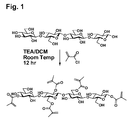
- the polymer material according to the present invention is polymerised from a mixture comprising at least one filler material comprising a polymer covalently linked to -OH or a long chain alcohol covalently -O-linked via said -OH to wherein R 1 is selected from the group consisting of -H, lower alkyl, lower alcohols, lower alkoxy, lower ethers, lower alkenyl, halogen and lower alkyl substituted with halogen and R 2 is selected from the group consisting of of of -H, lower alkyl, lower alcohols, lower alkoxy, lower ethers, lower alkenyl, halogen and lower alkyl substituted with halogen.
- the filler material is prepared by obtaining a filler and covalently linking said filler to wherein R 1 and R 2 are as described above, by any of the method described herein below.
- the filler comprises a polymer comprising -OH groups or a long chain alcohol.
- a long chain alcohol is a linear or branched alkyl or alkenyl covalently linked to one or more -OH groups, or a mono or diglyceride consisting of glycerol covalently bonded to one or two alkyl-C(O)O- or alkenyl-C(O)O via ester bonds, said alkyl or alkenyl comprising at least 10 carbon atoms.
- the alkyl is preferably a C 10-30 alkyl, more preferably a C 10-20 , even more preferably a C 8-18 linear or branched alkyl, more preferably linear alkyl.
- the alkenyl is preferably a C 10-30 alkenyl, more preferably a C 10-20 , even more preferably a C 8-18 linear or branched alkenyl, more preferably linear alkenyl.
- the alkenyl may comprise one or more double bonds, such as in the range of 1 to 4 double bonds, for example in the range of 1 to 2 double bonds, such as 1 double bond.
- the long chain alcohol may comprise one or more -OH groups, for example in the range of 1 to 4 -OH groups, preferably, the long chain alchol comprises only one -OH group, said -OH being -O- linked to when the long chain alcohol is converted to a filler material.
- the fillers according to the present invention are C 10-14 -alkyl-OH, preferably CH 3 (CH 2 ) 11 -OH or CH 3 (CH 2 ) 13 -OH, even more preferably CH 3 (CH 2 ) 11 -OH.
- a preferred filler material is lauryl acrylate.
- the fillers are mono- or diglycerides.
- the filler may preferably comprise or even consist of a polymer comprising -OH.
- a polymer comprising -OH may be any polymer covalently linked to one or more -OH groups.
- the polymer may comprise one or more -OH groups in every monomer from which the polymer is polymerised. Even more preferably, every monomer comprises one or more -OH groups even after polymerisation.
- a preferred example of such a polymer is a polymer of sugar moieties, such as glucose monomers.
- a very preferred polymer is cellulose.
- the filler comprises or even consists of cellulose. Fillers comprising cellulose may for example be derived from plants, such as finely divided plant fibre or it may be cellulose composites.
- the filler may also be purified cellulose, such as crystalline cellulose.
- the filler is a finely divided plant fibre.
- the polymer material is polymerised from a mixture, which does not comprise plant fibre material, then it is preferred that the filler is finely divided plant fibre from one or more different plants.
- Cellulose is a polysaccharide consisting essentially of polymerized glucose monomer units, in general cellulose is a linear chain of D-glucose monomer units linked by ⁇ -(1 ⁇ 4) bonds.
- the cellulose polysaccharide preferably consists of in the range of 300 to 15,000, for example in the range of 500 to 10,000 glucose monomer units.
- the filler material in general comprises cellulose covalently -O- to via ester bonds to one or more of the free -OH groups of the glucose monomer units.
- polyvinyl alcohol is a polymer of -(CH 2 )CH(OH)-.
- the filler may comprise or even consist of polyvinyl alcohol.
- the filler material in general comprises polyvinyl alcohol covalently-O- to via ester bonds to one or more of the free -OH groups of the -(CH 2 )CH(OH)- units.
- the filler may also comprise or consist of polymers, which are polyethers.
- said polyether is a polymer of the formula OH-((lower alkyl)-O-) n -H.
- Said lower alkyl is preferably C 1-6 , more preferably C 1-3 , even more preferably C 2-3 linear or branched alkyl.
- n is an integer, which preferably is at least 9, more preferably at least 10, for example at least 15, such as at least 20.
- the polyether is polyethylene glycol (PEG) or polypropylene glycol (PPG).
- PEG polyethylene glycol
- PPG polypropylene glycol
- polyethers only comprise free -OH groups at the ends.
- the filler material in general comprises polyethers covalently -O- to via ester bonds to one or both of the free -OH groups at the ends of the polyether.
- very preferred fillers according to the invention comprise cellulose.
- the filler is a finely divided plant fibre comprising cellulose.
- the filler is provided in the form of small particles, preferably in the form of a powder.
- the filler comprises or even consists of finely grinded plant material.
- filler is described having an average particle size of at the most 750 ⁇ m, preferably at the most 600 ⁇ m, even more preferably at the most 500 ⁇ m, yet more preferably at the most 400 ⁇ m, even more preferably at the most 300 ⁇ m, yet more preferably at the most 250 ⁇ m, such as in the range of 1 to 750 ⁇ m, for example in the range of 1 to 700 ⁇ m, such as in the range of 1 to 600 ⁇ m, for example in the range of 1 to 500 ⁇ m, such as in the range of 1 to 400 ⁇ m, for example in the range of 1 to 300 ⁇ m, such as in the range of 0.1 to 750 ⁇ m, for example in the range of 0.1 to 700 ⁇ m, such as in the range of 0.1 to 600 ⁇ m, for example in
- the term “particle size” is not equivalent to "particle width", but preferably the term “particle size” refers to the largest size of a given particle. It is thus very preferred that the average longest cross section of the particles is at the most of 750 ⁇ m, preferably at the most 600 ⁇ m, even more preferably at the most 500 ⁇ m, yet more preferably at the most 400 ⁇ m, even more preferably at the most 300 ⁇ M, yet more preferably at the most 250 ⁇ m, such as in the range of 0.1 to 750 ⁇ m, for example in the range of 0.1 to 700 ⁇ m, such as in the range of 0.1 to 600 ⁇ m, for example in the range of 0.1 to 500 ⁇ m, such as in the range of 0.1 to 400 ⁇ m, for example in the range of 0.1 to 300 ⁇ m, for example in the range of 0.1 to 250 ⁇ m, such as in the range of 100 to 750 ⁇ m, for example in the range of 100 to 600 ⁇ m
- the mode of the particle sizes of the filler is at the most 750 ⁇ m, preferably at the most 600 ⁇ m, even more preferably at the most 500 ⁇ m, yet more preferably at the most 400 ⁇ m, such as at the most 300 ⁇ m, for example at the most 250 ⁇ m, such as in the range of 0.1 to 750 ⁇ m, for example in the range of 0.1 to 700 ⁇ m, such as in the range of 0.1 to 600 ⁇ m, for example in the range of 0.1 to 500 ⁇ m, such as in the range of 0.1 to 400 ⁇ m, for example in the range of 0.1 to 300 ⁇ m, for example in the range of 0.1 to 250 ⁇ m, such as in the range of 100 to 750 ⁇ m, for example in the range of 100 to 600 ⁇ m, such as in the range of 100 to 500 ⁇ m, for example in the range of 100 to 400 ⁇ m.
- the mode of the longest particle cross section of the filler is at the most 750 ⁇ m, preferably at the most 600 ⁇ m, even more preferably at the most 500 ⁇ m, yet more preferably at the most 400 ⁇ m, such as at the most 300 ⁇ m, for example at the most 250 ⁇ m, such as in the range of 0.1 to 750 ⁇ m, for example in the range of 0.1 to 700 ⁇ m, such as in the range of 0.1 to 600 ⁇ m, for example in the range of 0.1 to 500 ⁇ m, such as in the range of 0.1 to 400 ⁇ m, for example in the range of 0.1 to 300 ⁇ m, for example in the range of 0.1 to 250 ⁇ m, such as in the range of 100 to 750 ⁇ m, for example in the range of 100 to 600 ⁇ m, such as in the range of 100 to 500 ⁇ m, for example in the range of 100 to 400 ⁇ m.
- the filler comprises or preferably consists of plant material, which has been grinded to an average particle size of at the most 750 ⁇ m, preferably at the most 600 ⁇ m, even more preferably at the most 500 ⁇ m, yet more preferably at the most 400 ⁇ m, preferably at the most 300 ⁇ m, even more preferably at the most 250 ⁇ m, such as in the range of 0.1 to 750 ⁇ m, for example in the range of 0.1 to 700 ⁇ m, such as in the range of 0.1 to 600 ⁇ m, for example in the range of 0.1 to 500 ⁇ m, such as in the range of 0.1 to 400 ⁇ m, for example in the range of 0.1 to 300 ⁇ m, for example in the range of 0.1 to 250 ⁇ m, such as in the range of 100 to 750 ⁇ m, for example in the range of 100 to 600 ⁇ m, such as in the range of 100 to 500 ⁇ m, for example in the range of 100 to 400 ⁇ m, such as in the range of 100
- the average longest cross section of said grinded plant material particles is at the most of 750 ⁇ m, preferably at the most 600 ⁇ m, even more preferably at the most 500 ⁇ m, yet more preferably at the most 400 ⁇ m, even more preferably at the most 300 ⁇ m, even more preferably at the most 250 ⁇ m, such as in the range of 0.1 to 750 ⁇ m, for example in the range of 0.1 to 700 ⁇ m, such as in the range of 0.1 to 600 ⁇ m, for example in the range of 0.1 to 500 ⁇ m, such as in the range of 0.1 to 400 ⁇ m, for example in the range of 0.1 to 300 ⁇ m, such as in the range of 100 to 750 ⁇ m, for example in the range of 100 to 600 ⁇ m, such as in the range of 100 to 500 ⁇ m, for example in the range of 100 to 400 ⁇ m, such as in the range of 100 to 250 ⁇ m.
- the filler particles are extremely small. Accordingly it is preferred that at least 1%, more preferably at least 2%, even more preferably at least 3% of the particles of the filler has a particle size of at the most 10 ⁇ m. It is even more preferred that at least 1%, preferably at least 2%, even more preferably at least 3% of the particles of the filler has a longest cross section which is at the most 10 ⁇ m.
- the filler may in one embodiment of the invention be finely grinded plant material wherein at least 1%, more preferably at least 2%, even more preferably at least 3% of the particles of said grinded plant material has a particle size of at the most 10 ⁇ m.
- the filler particles are very small. Accordingly it is preferred that at least 1%, more preferably at least 5%, even more preferably at least 10% of the particles of the filler has a particle size of at the most 35 ⁇ m. It is even more preferred that at least 1%, preferably at least 5%, even more preferably at least 10% of the particles of the filler has a longest cross section which is at the most 35 ⁇ m.
- the filler may in one embodiment of the invention be finely grinded plant material wherein at least 1%, more preferably at least 5%, even more preferably at least 10% of the particles of said grinded plant material has a particle size of at the most 35 ⁇ m.
- a significant fraction of the filler particles are relatively small. Accordingly it is preferred that at least 10%, more preferably at least 20%, even more preferably at least 30%, yet more preferably at least 40%, yet more preferably at least 50% of the particles of the filler has a particle size of at the most 240 ⁇ m. It is even more preferred that at least 10%, more preferably at least 20%, even more preferably at least 30%, yet more preferably at least 40%, yet more preferably at least 50% of the particles of the filler has a longest cross section which is at the most 240 ⁇ m.
- the filler may in one embodiment of the invention be finely grinded plant material wherein at least 10%, more preferably at least 20%, even more preferably at least 30%, yet more preferably at least 40%, yet more preferably at least 50%of the particles of said grinded plant material has a particle size of at the most 240 ⁇ m.
- the majority filler particles are relatively small. Accordingly it is preferred that at least 50%, more preferably at least 60%, even more preferably at least 70%, yet more preferably at least 80%, yet more preferably at least 90% of the particles of the filler has a particle size of at the most 660 ⁇ m. It is even more preferred that at least 50%, more preferably at least 60%, even more preferably at least 70%, yet more preferably at least 80%, yet more preferably at least 90% of the particles of the filler has a longest cross section which is at the most 660 ⁇ m.
- the filler may in one embodiment of the invention be finely grinded plant material wherein at least 50%, more preferably at least 60%, even more preferably at least 70%, yet more preferably at least 80%, yet more preferably at least 90% of the particles of said grinded plant material has a particle size of at the most 660 ⁇ m.
- the vast majority of the filler particles are small. Accordingly it is preferred that at least 70%, more preferably at least 80%, even more preferably at least 90%, yet more preferably at least 95%, yet more preferably at least 99%, more preferably at least 99.9% of the particles of the filler has a particle size of at the most 2000 ⁇ m, preferably at the most 1500 ⁇ m, such as at the most 1000 ⁇ m, for example at the most 750 ⁇ m.
- the filler material may be converted into small particles or powder by any useful means.
- powders comprising cellulose, for example crystalline cellulose are commercially available (for example from SIGMA-ALDRICH).
- the plant material such as the plant fibre is preferably finely divided. This may be obtained by optionally drying the plant material, optionally dividing the plant material to smaller pieces using cutting means and finely dividing the plant material or the smaller pieces for example by grinding or milling in order to obtain a powder.
- the powder may for example be obtained using a blender and/or a mill and/or a chrusher and/or a grinder, such as for example a jaw crusher, a cone crusher, a gyratory crusher, a roller crusher, an impact crusher, a ball mill, a mortar, a rod mill, an autogenous mill, a semi-autogenous grinding mill, a pebble mill, a hammer mill, a pin mill, a jet mill, a roller mill or a roller press.
- a blender and/or a mill and/or a chrusher and/or a grinder such as for example a jaw crusher, a cone crusher, a gyratory crusher, a roller crusher, an impact crusher, a ball mill, a mortar, a rod mill, an autogenous mill, a semi-autogenous grinding mill, a pebble mill, a hammer mill, a pin mill, a jet mill, a roller mill or a roller press.
- the plant material may be provided in raw form and then subjected to blending and or milling, thus by way of example straw from cereal may be dried and divided using cutting means, such as a blender and then milled.
- cutting means such as a blender and then milled.
- the plant material is finely divided using a Pulsewave Resonance Disintegrating Mill, which is available for example from Pulsewave IIc, United States.
- the filler is purified cellulose, such as crystalline cellulose, which is commercially available (for example from SIGMA-ALDRICH).
- the filler material is frequently prepared from a plant material, such as a plant fibre.
- a plant material such as a plant fibre.
- the plant fibre and the filler may be derived from the same plant, however, the plant fibre is used as larger elongated pieces usually in the range of 1 to 25 mm, but frequently in the range of 100 ⁇ m to 25 mm, wherein the plant fibre is at least 10 times longer than it is wide, whereas the filler is a powder with an average particle size of at the most 750 ⁇ m. It is however preferred in certain embodiments that the filler and the plant fibre is obtained from different plants.
- any plant comprising tissue with sufficient cellulose may be used as source of the plant fibre.
- the source of the plant fibre may be stem, leaves, roots or fruits.
- the filler is obtained from a plant selected from the group consisting of Abaca, Bagasse, bamboo, Banana, Broom root, Cantala, Caroa, China jute, Coir, Cotton, Curaua, Date palm, Flax, Hemp, Henequen, Isora, Istle, Jute, Kapok, Kenaf, Kudzu, Mauritius hemp, Nettle, Oil palm, Piassava, Pineapple, Phormium, Roselle, Ramie, Sansevieria, Sisal, Sponge gourd, Cereals, Sun hemp, Cadillo/urena and Wood.
- the filler is obtained by providing any of the aforementioned plants or parts thereof, optionally dividing said plant or part thereof to smaller pieces using cutting means and then milling or grinding said plant or parts thereof or said smaller pieces.
- the filler is obtained from a plant, which is cereal, preferably a cereal selected from the group consisting of barley, wheat, rye, oat, maize, rice, sorghum, millet, triticale, buckwheat, fonio and quinona. More preferably, the cereal is selected from the groups consisting of barley, wheat, rye, oat, maize and rice, more preferably the cereal is barley.
- the filler is obtained from a plant, which is a cereal, it is preferred that the filler is obtained from the part of the plant, which is otherwise not used for human food, i.e. preferably the filler is not obtained from grains.
- the filler is obtained from leaves and or stems, more preferably from straw. It is however also possible that the filler may be prepared from grains, preferably from by-products containing grains of parts thereof. Preferably said by-products are products, which are not otherwise used for human food.
- One preferred by-product is spent grains, which is a by-product of beer production. Depending on the particular beer type, said spent grains may be derived from various cereals, such as barley, rice, wheat, rye or maize. The spent grains may have been malted or they may be unmalted or a mixture of malted and unmalted grains.
- the filler is obtained from any of the plant of Table 1 above, then it is preferred that the filler is obtained from the part of the plants indicated in Table 1.
- the polymer material according to the present invention is polymerised from a mixture containing both filler material, plant fibre material and monomers, wherein the filler material is different to the plant fibre material and the filler material is different to the monomer.
- Plant fibre material and filler material Plant fibre material and filler material
- the plant fibre material is prepared by covalently linking to a plant fibre a moiety of the formula wherein R 1 is selected from the group consisting of -H, lower alkyl, lower alcohols, lower alkoxy, lower ethers, lower alkenyl, halogen and lower alkyl substituted with halogen and R 2 is selected from the group consisting of of of -H, lower alkyl, lower alcohols, lower alkoxy, lower ethers, lower alkenyl, halogen and lower alkyl substituted with halogen, to any of the plant fibres described herein above in the section "Plant fibre".
- the filler material is prepared by covalently linking to a filler to a moiety of the formula wherein R 1 is selected from the group consisting of -H, lower alkyl, lower alcohols, lower alkoxy, lower ethers, lower alkenyl, halogen and lower alkyl substituted with halogen and R 2 is selected from the group consisting of of of -H, lower alkyl, lower alcohols, lower alkoxy, lower ethers, lower alkenyl, halogen and lower alkyl substituted with halogen, to any of the fillers described herein above in the section "Filler".
- both the filler and the plant fibre comprises cellulose, which comprises several free -OH groups and the moiety of formula is preferably linked to said filler or plant fibre by formation of an ester linkage between the -OH group of cellulose and the carbonyl of the moiety of the formula
- an ester linkage between an -OH group of cellulose and a carbonyl is herein also denoted as -O-linked carbonyl.
- the filler may be linked to a compound of the same formula as the plant fibre or to a different compound. If more than one filler and/or more than one plant material is used they may be covalently linked to a compound of the same formula or to different compounds.
- the compound to which filler(s) and/or plant fibre(s) are covalently linked may independently be selected from the group consisting of moieties of the formula wherein R 1 and R 2 independently are selected from the group consisting of -H, lower alkyl, lower alcohols, lower alkoxy, lower ethers, lower alkenyl, halogen and lower alkyl substituted with halogen.
- lower alkyl is C 1-6 alkyl, more preferably C 1-3 alkyl, even more preferably C 1-2 alkyl.
- the lower alkyl may be linear or branched, however preferably said lower alkyl is linear.
- lower alcohol is C 1-6 alcohol, more preferablv C 1-3 alcohol, even more preferably C 1-2 alcohol.
- lower alkoxy is C 1-6 alkoxy, more preferablv C 1-3 alkoxy, even more preferably C 1-2 alkoxy.
- lower ether is C 1-6 ether, more preferablv C 1-3 ether, even more preferably C 1-2 ether.
- the lower ether may comprise one or more -O-, preferably 1 or 2 -O-, even more preferably one -O-, wherein the -O- may be positioned at any position within the ether.
- R 1 and R 2 are independently selected from the group consisting of -H and lower alkyl, more preferably from the group consisting of -H and C 1-6 alkyl, even more preferably from the group consisting of -H, methyl and ethyl.
- R 1 is methyl and R 2 is -H.
- Covalently linking filler and plant fibre may independently be performed using several different methods.
- R 1 and R 2 of said compounds are as described herein above in the present section and R 3 may be selected from the group consisting of linear and branched alkyl, alkenyl, alkoxy, ethers, aliphatic ring optionally comprising heteroatoms, alcohols, halide, alkyl substituted with halogen and -H.
- R 3 is halide or alkyl halide, more preferably halide, even more preferably chloride.
- the compound comprising cellulose may be a filler in which case the method results in a filler material.
- the compound comprising cellulose may also be a plant fibre in which case the method results in a plant fibre material.
- said compound comprising cellulose is kept in the solid state.
- the reaction takes place at a temperature in the range of 50 to 110oC, preferably in the range of 60 to 100oC, more preferably in the range of 70 to 90 oC, even more preferably in the range of 75 to 85oC, yet more preferably in the range of 78 to 82oC, for example around 80oC, such as at 80oC, for example in the range of 50 to 100 oC, such as in the range of 60 to 100oC for example in the range of 70 to 100 oC, such as in the range of 75 to 100oC for example in the range of 50 to 90 oC, such as in the range of 60 to 90oC, for example in the range of 75 to 90 oC.
- the compound comprising cellulose for example the filler and/or the plant fibre
- the compound comprising cellulose is kept at said temperature. This may be achieved by any suitable method known to the skilled person for example by placing the compound comprising cellulose (for example the filler and/or the plant fibre) in a sand bath with the desired temperature.
- the compound of formula may be kept in gas phase by any suitable method known to the skilled person.
- the compound may be subjected to heating, for example the compound of formula may be kept at a temperature of in the range of 40 to 100oC, such as in the range of 50 to 100 oC, for example in the range of 55 to 100oC, such as in the range of 40 to 90 oC, for example in the range of 50 to 90oC, such as in the range of 55 to 90oC, for example in the range of 40 to 80oC, such as in the range of 50 to 80 oC, for example in the range of 55 to 80oC, such as in the range of 40 to 70 oC, preferably in the range of 50 to 70oC, more preferably in the range of 55 to 70 oC, for example in the range of 40 to 65oC, such as in the range of 50 to 65oC, yet more preferably in the range of 55 to 65oC, even more preferably in the range of 58 to 62oC, yet more preferably around 60
- the compound comprising cellulose should be contacted with the compound of formula for sufficient time to allow the reaction to occur, preferably the compound comprising cellulose is contacted with the compound of formula for in the range of 1 to 50 hours, preferably in the range of 2 to 25 hours, more preferably in the range of 3 to 15 hours, even more preferably in the range of 4 to 10 hours, yet more preferably in the range of 5 to 7 hours, even more preferably for approximately 6 hours, such as for 6 hours.
- a carrier gas which preferably is an inert gas, more preferably a noble gas, for example argon.
- Example 5 A non-limiting example of a useful method for covalently linking a compound comprising cellulose to a compound of formula in gas phase is described in Example 5 herein below.
- the compound comprising cellulose is microcrystalline cellulose, however, the method may equally well be performed using any other of the fillers described herein above in the section “Filler” or any of the plant fibres described herein above in the section "Plant fibre”.
- the compound of formula is methacryloyl chloride, however, the method may equally well be performed using any other of the compounds of formula described herein above in this section.
- the filler and/or the plant fibre may also be covalently linked to the moiety of formula in solution.
- Such methods in general comprise the steps of
- the filler may be any of the fillers described herein above in the section "Filler” and the plant fibre may be any of the plant fibre described herein above in the section "Plant fibre”.
- the solvent may be any useful solvent, wherein an ester bond can be formed between the cellulose within the filler and/or plant fibre and the compound of formula
- the solvent is an organic solvent.
- the solvent may also be a mixture of different solvent, preferably a mixture of organic solvents.
- the organic solvents may for example be a short alkane or a short alkane substituted with one or more halogens or a short alkane substituted with one or more -OH groups, preferably substituted with only one -OH group.
- a short alkane is a C1 to C4 alkane, preferably a C1 alkane.
- the halogens may be any halogen, preferably chloride and the alkane may be substituted with one or more, for example with 2 halogens, such as with two chlorides.
- the solvent may for example be dichloromethane (DCM), ethanol or N,N' Dimethylacetamide (DMA), preferably DCM or DMA.
- the solvent preferably comprises a basic solvent, such as a solvent comprising an amine, such as a tertiary amine.
- An example of such a solvent is triethylamine (TEA).
- the solvent is a mixture of a solvent comprising a halogen and a basic solvent, such as a mixture of DMA and TEA.
- the plant fibre or filler may be pretreated prior to incubation with the compound of formula
- the plant fibre or filler is pretreated prior to incubation with the compound of formula
- the pretreatment is preferably incubation with a base, such as a strong base, preferably with an alkoxide, even more preferably with an ethoxide, such as sodium ethoxide (also denoted NaOEt herein) or the strong base may be an alkaline metal hydroxide, such as NaOH.
- a strong base e.g. alkoxide, such as NaOEt
- Said useful solvent may preferaby be a lower alcohol, more preferably ethanol or methanol, yet more preferably ethanol or the solvent may be water.
- the strong base may be provided in any useful concentration, such as in the range of 0.05 to 10%, for example in the range of 0.1 to 5%, such as in the range of 0.1 to 1%.
- the incubation with said base may in one preferred embodiment be performed at least partly under microwave irradiation preferably with stirring, for example under microwave irradiation for in the range of 1 to 60 min, preferably for in the range of 5 to 60 min, more preferably for in the range of 5 to 50 min, even more preferably for in the range of 5 to 40 min, yet more preferably for in the range of 5 to 30 min, yet more preferably for in the range of 10 to 30 min, for example for 10 to 20 min.
- a temperature of in the range of 40 to 130 oC preferably in the range of 50 to 120oC, more preferably in the range of 60 to 110oC, even more preferably in the range of 70 to 100oC, preferably in the range of 70 to 90oC, yet more preferably in the range of 75 to 85oC, such as at 80oC.
- the treated filler material and/or plant fibre material may be recovered and optionally washed in solvent, such as water and optionally dried.
- Conditions allowing formation of ester bonds between the cellulose of the filler and/or plant fibre and the compound may be any useful conditions known to the skilled person.
- the conditions involve incubation for in the range of 1 to 100 hours, such as in the range of 5 to 100 hours, for example in the range of 8 to 100 hours, such as in the range of 8 to 80 hours, for example in the range of 8 to 60 hours, such as in the range of 8 to 50 hours, for example in the range of 8 to 40 hours, such as in the range of 8 to 30 hours, for example in the range of 8 to 24 hours, such as in the range of 8 to 20 hours, for example in the range of 8 to 15 hours, such as in the range of 10 to 14 hours, for example in the range of 11 to 13 hours, such as for around 12 hours at a temperature in the range of 10 to 40oC, such as in the range of 10 to 30oC, for example in the range of 10 to 25oC, such as in the range of 15 to 40oC, for example in the range of 20 to 40oC, such
- step d) above comprises microwave irradiation preferably under stirring, such as microwave irradiation for in the range of 1 to 60 min, preferably for in the range of 5 to 60 min, more preferably for in the range of 5 to 50 min, even more preferably for in the range of 5 to 40 min, yet more preferably for in the range of 5 to 30 min, yet more preferably for in the range of 5 to 20 min, for example for in the range of 10 to 20 min., such as for 20 min.
- microwave irradiation preferably under stirring, such as microwave irradiation for in the range of 1 to 60 min, preferably for in the range of 5 to 60 min, more preferably for in the range of 5 to 50 min, even more preferably for in the range of 5 to 40 min, yet more preferably for in the range of 5 to 30 min, yet more preferably for in the range of 5 to 20 min, for example for in the range of 10 to 20 min., such as for 20 min.
- a temperature of in the range of 50 to 150 oC preferably in the range of 60 to 140oC, more preferably in the range of 70 to 130oC, even more preferably in the range of 80 to 120oC, preferably in the range of 90 to 110oC, yet more preferably in the range of 90 to 100oC, such as at 95oC.
- Example 1 A preferred non-limiting example of a method of linking a moiety of formula to a filler and/or plant fibre is given in Example 1.
- the degree of -O-linking is herein used to denote to what extend a compound comprising cellulose is covalently linked to a moiety of formula
- the degree of -O-linking is determined by a fluorescence based method, wherein double bonds are allowed to react with a free thiol group on a fluorescent dye. Difference of fluorescence between the compound comprising cellulose (for example filler and/or plant fibre) before reaction with the compound of formula and the fluorescence of the compound comprising cellulose covalently -O-linked to (for example the filler material or the plant fibre material) is then used as a measure of the degree of -O-linking.
- the fluorescence of the compound comprising cellulose covalently -O-linked to is at least 1.2 times higher, more preferably at least 1.3 times higher, even more preferably at least 1.4 time higher, yet more preferably at least 1.5 times higher, even more preferably at least 2 times higher, yet more preferably at least 2.4 times higher, such as at least 4 times higher, for example at least 5 times higher, such as at least 6 times higher, for example at least 7 times higher, such as at least 8 times higher, for example at least 9 times higher, such as at least 10 times higher, such as in the range of 1.4 to 3 times higher, preferably in the range of 1.4 to 20 times higher, more preferably in the range of 2 to 20 times higher, yet more preferably in the range of 2.4 to 20, for example in the range of 5 to 20 times higher, such as in the range of 7 to 20, for example in the range of 9 to 20 times higher, preferably in the range of 2 to 15 times higher, even more preferably in the
- the fluorescent dye may be any fluorescent dye comprising a thiol group, but in a preferred method the fluorescent dye is a cys-reactive rhodamine, preferablt RMA1118-69 as described herein below in Example 6.
- the filler material to be used with the present invention preferably has a minimal degree of -O-linking.
- the filler material to be used with the present invention has a fluorescence, which is at least 1.2 times higher, more preferably at least 1.3 times higher, even more preferably at least 1.4 time higher, yet more preferably at least 1.5 times higher, even more preferably at least 2 times higher, yet more preferably at least 2.4 times higher, such as at least 4 times higher, for example at least 5 times higher, such as at least 6 times higher, for example at least 7 times higher, such as at least 8 times higher, for example at least 9 times higher, such as at least 10 times higher, for example in the range of 1.2 to 10 times higher, such as in the range of 1.3 to 10 times higher, for example in the range of 1.4 to 10 times higher, such as in the range of 1.5 to 10 times higher, for example in the range of 1.2 to 5 times higher, such as in the range of 1.3 to 5 times higher, for example in the range of 1.4 to 5 times higher, such
- the plant fibre material to be used with the present invention preferably has a minimal degree of -O-linking.
- the plant fibre material to be used with the present invention has a fluorescence, which is at least 1.2 times higher, more preferably at least 1.3 times higher, even more preferably at least 1.4 time higher, yet more preferably at least 1.5 times higher, even more preferably at least 2 times higher, yet more preferably at least 2.4 times higher, such as at least 4 times higher, for example at least 5 times higher, such as at least 6 times higher, for example at least 7 times higher, such as at least 8 times higher, for example at least 9 times higher, such as at least 10 times higher, for example in the range of 1.2 to 10 times higher, such as in the range of 1.3 to 10 times higher, for example in the range of 1.4 to 10 times higher, such as in the range of 1.5 to 10 times higher, for example in the range of 1.2 to 5 times higher, such as in the range of 1.3 to 5 times higher, for example in the range of 1.4 to 5 times higher, such
- the polymer material according to the invention is polymerised from a prepolymerisation mixture comprising at least a filler material, preferably also at least one plant fibre material (both of which are described in more detail herein above in the section "Plant fibre material and filler material” and preferably also at least one monomer an optionally at least one cross-linker.
- the monomer is a compound of the formula or of the formula wherein R 1 , R 2 and R 3 are as described in the following:
- the monomer is a compound of the formula wherein R 1 , R 2 and R 3 are as described in the following:
- R 1 is lower alkyl or -H, more preferably C 1-6 alkyl or -H, even more preferably C 1-3 alkyl or -H, yet more preferably R 1 is selected from the group consisting of -H, methyl and ethyl, most preferably R 1 is methyl or -H.
- R 2 is lower alkyl or -H, more preferably C 1-6 alkyl or -H, even more preferably C 1-3 alkyl or -H, yet more preferably R 2 is selected from the group consisting of -H, methyl and ethyl, most preferably R 2 is -H.
- R 3 is selected from the group consisting of linear and branched alkyl, alkenyl, alkoxy, ethers, aliphatic ring optionally comprising heteroatoms, alcohols, halide, alkyl substituted with halogen and -H.
- Linear and branched alkyl may preferably be C 1-9 linear or branched alkyl, more preferably C 1-6 linear or branched alkyl.
- Preferred linear or branched alkyl are selected from the group consisting of methyl, ethyl, propyl, butyl, tert-butyl, pentyl and hexyl, more preferably from the group consisting of methyl, ethyl, butyl, tert-butyl and hexyl, even more preferably ethyl.
- Alkenyl is preferably C 2-9 alkenyl, , even more preferably C 2-6 alkenyl, yet more preferably C 2-3 alkenyl.
- Said alkenyls may comprise one or more double bonds, preferably however, they comprise only one double bond.
- Alkoxy is preferably C 1-20 alkoxy, more preferably C 1-15 alkoxy, even more preferably C 1-10 alkoxy, yet more preferably C 1-3 alkoxy.
- Ether is preferably C 3-10 ether, yet more preferably C 4-8 ether, for example C 6 ether.
- Ethers may comprise one or more ether bonds (-O-), preferably in the range of 1 to 4 -O-, more preferably in the range of 1 to 2 -O-.
- ethers are selected from the group consisting of ethers of the general structures -(CH 2 ) n -O-(CH 2 ) m -CH 3 and -(CH 2 ) n -O(-CH 2 )P-O-(CH 2 ) m -CH 3 , wherein n and p individually are integers in the range of 1 to 8, preferably in the range of 1 to 5, even more preferably 2 and m is an integer in the range of 0 to 8, more preferably in the range of 0 to 5, even more preferably in the range of 1 to 3.
- ethers examples include -(CH 2 ) 2 -O-(CH 2 ) 3 -CH 3 and -(CH 2 ) 2 -O(-CH 2 ) 2 -O-(CH 2 ) 1 -CH 3 .
- Aliphatic rings are preferably in the range of 5 to 8 membered rings, more preferably 5 to 6 membered rings, preferably 6 membered rings.
- the aliphatic ring may comprise atoms selected from the group consisting of C, N, O and S, preferably selected from the group consisting of C, O and N.
- a preferred aliphatic ring according to the invention is a sugar, preferably a mono-saccharide, such as glucose, maltose, mannose or galactose.
- Alcohols are preferably C 1-9 alcohols, more preferably C 1-6 alcohols, yet more preferably C 1-4 alcohols. It is preferred that alcohols are alkyl-OH, and thus alcohols are preferably C 1-9 alkyl-OH, more preferably C 1-6 alkyl-OH, yet more preferably C 1-4 alkyl-OH, wherein the -OH group may be positioned at any position within the alkyl, however, preferably at the terminal position.
- Halide may be any halide, preferably chloride.
- Alkyl substituted with halide may be any of the aforementioned alkyls substituted with one or more halides, preferably with one halide, said halide preferably being chloride.
- R 3 is selected from the group consisting of -H and alkyl, more preferably from the group consisting of -H, methyl and ethyl, even more preferably from the group consisting of -H and ethyl.
- the polymer material is polymerised at least from a filler material, a plant fibre material and one or more monomers, wherein said one or more monomers are selected from the group consisting of ethylmethacrylate, ethylacrylate, acrylic acid, methacrylic acid, Allyl methacrylate, 2-Butoxyethyl methacrylate, tert -Butyl methacrylate, 2-(Dimethylamino)ethyl methacrylate, Hexyl methacrylate, 2-Hydroxyethyl methacrylate, Vinyl methacrylate, 4-Acryloylmorpholine, Di(ethylene glycol) 2-ethylhexyl ether acrylate, 4-Hydroxybutyl acrylate and Methacrylic acid, more preferably from the group consisting of ethylmethacrylate, ethylacrylate, acrylic acid and methacrylic acid.
- the polymer material is polymerised at least from a filler material, a plant fibre material and at least two, preferably at least three, such as in the range of 1 to 10, for example in the range of 2 to 10, such as in the range of 3 to 10, for example in the range of 1 to 7, such as in the range of 2 to 7, for example in the range of 3 to 7, such as in the range of 1 to 5, very preferably in the range of 2 to 5, such as in the range of 3 to 5, for example in the range of 1 to 4, yet more preferably in the range of 2 to 4, most preferably in the range of 2 to 3 different monomers of the formula wherein R 1 , R 2 and R 3 are as described herein above in this section.
- all of said monomers are selected from the group consisting of ethylmethacrylate, ethylacrylate, acrylic acid, methacrylic acid, Allyl methacrylate, 2-Butoxyethyl methacrylate, tert-Butyl methacrylate, 2-(Dimethylamino)ethyl methacrylate, Hexyl methacrylate, 2-Hydroxyethyl methacrylate, Vinyl methacrylate, 4-Acryloylmorpholine, Di(ethylene glycol) 2-ethylhexyl ether acrylate, 4-Hydroxybutyl acrylate, Methacrylicacid and Lauryl acrylate, more preferably from the group consisting of ethylmethacrylate, ethylacrylate, acrylic acid and methacrylic acid.
- the monomers are one or more, preferably two or more, even more preferably in the range of 2 to 4 different monomers selected from the group consisting of Allyl methacrylate, 2-Butoxyethyl methacrylate, tert -Butyl methacrylate, Hexyl methacrylate, 2-Hydroxyethyl methacrylate, 4-Acryloylmorpholine, Di(ethylene glycol) 2-ethylhexyl ether acrylate, 4-Hydroxybutyl acrylate, Metharylic acid, Ethylmethacrylate, methyl ether acrylate and Acrylonitrile.
- the polymer material according to the invention is polymerised from a prepolymerisation mixture comprising at least one filler material and in one embodiment at least one cross-linker.
- the polymer material according to the invention may also be polymerised from a mixture further comprising one or more cross-linkers.
- cross-linkers are compounds comprising at least two reactive groups, which are individually capable of reacting with an acrylate group, for example with methacrylate.
- crosslinkers comprise at least two reactive groups selected from the group consisting of acrylate groups.
- the crosslinker may be a compound comprising two acrylate groups, such as three acrylate groups, for example four acrylate groups, such as five acrylate groups, such as more than 5 acrylate groups.
- the cross-linker is a sugar moiety covalently O-linked to at least two groups, wherein R 1 and R 2 independently are selected from the group consisting of-H, lower alkyl, lower alcohols, lower alkoxy, lower ethers, lower alkenyl, halogen and lower alkyl substituted with halogen, and wherein said two groups may be identical or different.
- Said sugar moiety may be covalently linked to at least two, such as 2, for example 3, such as 4, for example 5, such as more than 5 of said groups, wherein said group may be identical or different.
- each R 1 is independently lower alkyl or -H, more preferably C 1-6 alkyl or -H, even more preferably C 1-3 alkyl or -H, yet more preferably R 1 is selected from the group consisting of -H, methyl and ethyl, most preferably R 1 is methyl or -H.
- each R 2 is independently lower alkyl or -H, more preferably C 1-6 alkyl or -H, even more preferably C 1-3 alkyl or -H, yet more preferably R 2 is selected from the group consisting of -H, methyl and ethyl, most preferably R 2 is -H.
- a preferred cross-linker to be used with the present invention is a cross-linker comprising or preferably consisting of a sugar moiety covalently linked to at least two, such as 2, for example 3, such as 4, for example 5, such as more than 5 acrylate groups as well as salts thereof, preferably alkali salts thereof, such as sodium salts.
- a sugar moiety within the meaning of the above section is a mono-saccharide, a disaccharide or an oligo-saccharide, preferably the sugar moiety is a mono-saccharide, more preferably the sugar moiety is selected from the group consisting of glucose, maltose, mannose and galactose.
- the crosslinker may for example be selected from the group consisting of glucose di-methacrylate, glucose tri-methacrylate, glucose tetra-methacrylate, glucose penta-methacrylate, maltose di-methacrylate,maltose tri-methacrylate, maltose tetra-methacrylate, maltose penta-methacrylate, galactose tri-methacrylate, galactose tetra-methacrylate, galactose di-methacrylate, galactose penta-methacrylate, mannose di-methacrylate, mannose tri-methacrylate, mannose tetra-methacrylate and mannose penta-methacrylate as well as salts thereof, preferably alkali salts thereof, such as sodium salts.
- crosslinker is a compound comprising a sugar moiety covalently linked to acrylate of the following structure including the sodium salt thereof:
- Cross-linkers which are sugar moieties linked to group may be prepared by any useful method, for example by a method comprising incubation of a mixture comprising said sugar and a compound of the formula wherein R 1 and R 2 independently are selected from the group consisting of of -H, lower alkyl, lower alcohols, lower alkoxy, lower ethers, lower alkenyl, halogen and lower alkyl substituted with halogen and R 3 is selected from the group consisting of linear and branched alkyl, alkenyl, alkoxy, ethers, aliphatic ring optionally comprising heteroatoms, alcohols, halide, alkyl substituted with halogen and -H, preferably R 3 is - OH,
- said enzyme capable of catalysing esterification is a lipase, such as a lipase selected from the group consisting of Novozym 435, lipase PC ( Pseudomonas cepacia ), lipase from Candida Antarctica, lipase CA or CA lipase B (CALB) immobilized on an acrylic resin and lipase CR (Candida rugosa).
- a lipase such as a lipase selected from the group consisting of Novozym 435, lipase PC ( Pseudomonas cepacia ), lipase from Candida Antarctica, lipase CA or CA lipase B (CALB) immobilized on an acrylic resin and lipase CR (Candida rugosa).
- said enzyme capable of catalysing transesterification is a lipase, such as a lipase selected from the group consisting of Porcine pancreas lipase (PPL) and Pseudomonas sp. lipase (lipase PS).
- a lipase selected from the group consisting of Porcine pancreas lipase (PPL) and Pseudomonas sp. lipase (lipase PS).
- the mixture comprising said sugar may be any mixture comprising a sugar or its alkyl glycosides, but preferably it is a mixture from a biological source such as molasse or invert sugar syrup.
- the mixture comprising sugar may also be prepared from any source of starch treated with useful enzymes e.g. alpha and beta-amylases which can be used to produce sugar by starch degradation. The acidic degradation of polysaccharides such as starch with strong acid such as HCl or H2SO4 can also be used for production of sugars or sugar glycosides.
- the mixture comprising sugar may also be prepared from cellulose using cellulases, which allow the use of celluloses for the production of glucose syrups.
- the mixture comprising sugar may also be other sugar sources such as cane or beeet sugar. All these mixtures comprising sugar may be used for methacryloylation to form molecules that can be used as crosslinkers.
- crosslinkers are compounds comprising a branched alkyl covalently linked to at least 2, preferably 3 acrylate groups via ester bonds.
- One nonlimiting example of such a crosslinker is a compound of the structure:
- the cross-linker may be added in any useful amount depending on the desired properties of the polymer material.
- the polymer material is co-polymerised from a mixture comprising plant fibre materials, filler materials and monomers in the amount indicated herein above in the section "Ratio" and additionally in the range of 0 to 30%, preferably 0 to 20%, such as in the range of 0 to 15%, for example in the range of 0 to 10%, such as in the range of 0 to 5%, for example in the range 1 to 20%, such as in the range of 1 to 15%, for example in the range of 1 to 10%, such as in the range of 1 to 5% crosslinker.
- the amount of cross-linker is at the most 10%, even more preferably at the most 9%.
- the invention also relates to a polymer material which is a copolymer polymerised at least from
- the ratio between the individual components may be any useful ratio. In general the ratio is chosen taking the desired properties of the polymer material into consideration.
- the polymer material is co-polymerised from a mixture comprising a large percentage plant derived material.
- the polymer material is co-polymerised from a mixture comprising in the range of 5 to 50%, preferably in the range of 10 to 50%, yet more preferably in the range of 15 to 50%, such as in the range of 10 to 40%, for example in the range of 10 to 30%, such as in the range of 15 to 40%, for example in the range of 15 to 30% the plant fibre material and the filler material.
- the polymer material is co-polymerised from a mixture comprising in the range of 1 to 50%, preferably in the range of 1 to 25%, yet more preferably in the range of 1 to 20%, even more preferably in the range of 1 to 15 %, such as in the range of 1 to 10%, for example in the range of 1 to 5%, such as in the range of 2 to 4%, for example in the range of 3 to 4%, such as in the range of 10 to 50%, for example in the range of 10 to 40%, such as in the range of 10 to 30%, for example in the rang of 10 to 25%, yet more preferably in the range of 5 to 40%, even more preferably in the range of 5 to 35%, yet more preferably in the range of 5 to 30%, even more preferably in the range of 5 to 20%, yet more preferably in the range of 3 to 40%, even more preferably in the range of 3 to 35%, yet more preferably in the range of 3 to 30%, even more preferably in the range of 3 to 20% of said plant fibre materials.
- the polymer material is co-polymerised from a mixture comprising in the range of 1 to 60%, preferably in the range of 5 to 50%, yet more preferably in the range of 5 to 30%, even more preferably in the range of 10 to 20%, such as in the range of 1 to 50%, for example in the range of 1 to 40%, such as in the range of 1 to 30%, for example in the range of 1 to 20% such as in the range of 5 to 60%, for example in the range of 5 to 40%, such as in the range of 5 to 30%, for example in the range of 5 to 20%, such as in the range of 10 to 60%, for example in the range of 10 to 50%, such as in the range of 10 to 40%, for example in the range of 10 to 30%, such as in the range of 12 to 20%, for example in the range of 14 to 20%, such as in the range of 16 to 18%, for example in the range of 17 to 18%, such as in the range of 12 to 18%, for example in the range of 14 to 16%, more preferably in the range of 10
- the polymer material is co-polymerised from a mixture comprising in the range of 20 to 90%, preferably in the range of 40 to 90%, yet more preferably in the range of 40 to 80%, even more preferably in the range of 40 to 70%, such as in the range of 30 to 90%, for example in the range of 50 to 90%, such as in the range of 60 to 90%, for example in the range of 70 to 90% such as in the range of 80 to 90%, for example in the range of 20 to 80%, such as in the range of 30 to 80%, for example in the range of 50 to 80%, such as in the range of 60 to 80%, for example in the range of 70 to 80%, such as in the range of 20 to 70%, for example in the range of 30 to 80%, such as in the range of 50 to 70%, for example in the range of 60 to 70%, such as in the range of 20 to 60%, for example in the range of 30 to 60%, such as in the range of 40 to 60%, for example in the range of 50 to 60%, such as in the range of the range of
- the polymer material is co-polymerised from a mixture comprising at the most 80%, preferably at the most 70%, even more preferably at the most 65%, yet more preferably at the most 60% of said plant fibre material and said filler material in total.
- said mixture comprises at least 20%, more preferably at least 30%, yet more preferably at least 40% of said monomers.
- the polymer material is polymerised from a mixture comprising in the range of 1 to 5% said plant fibre material, in the range of 10 to 20% of said filler material and in the range of 70 to 80% of said monomers, more preferably from a mixture comprising in the range of 5 to 10% said plant fibre material, in the range of 15 to 25% of said filler material and in the range of 70 to 80% of said monomers.
- the polymer material is polymerised from a mixture comprising in the range of 10 to 20% of said filler material and in the range of 60 to 70% of said monomers.
- the polymer material after polymerisation comprises at much plant derived material as possible.
- the polymer material comprises at least 50%, more preferably at least 60%, yet more preferably at least 70%, such as in the range of 50 to 90%, preferably in the range of 60 to 90%, more preferably in the range of 70 to 90% polymerised plant fibre material and filler material
- the polymer material may be prepared by any useful method known to the skilled person.
- the polymer material is prepared by a method comprising the steps of
- the polymer material is prepared by a method comprising the steps of
- Steps a), b) and c) of both of the aforementioned methods may be performed simultaneously or sequentially in any order. If more than one plant fibre material, more than one filler, more than one monomer and/or more than one cross-linker is used, then these may individually be added in any order. Thus, by way of example a monomer may be added first, then a filler and then a monomer.
- step a) is performed subsequent to step e).
- Said additional components of step d) may for example be one or more of the crosslinkers described in the section "Crosslinkers" herein above.
- Said additional components may also be one or more solvents, for example water and/or an alcohol, such as ethanol.
- one or more free radical initiators is added to the mixture (see step e).
- the free radical initiator may be any compound capable of promoting radical polymerization reactions.
- the free radical initiator is a substance comprising one or more bonds that have low bond dissociation energies.
- the free radical initiators are selected from the group consisting of azo compounds, organic peroxides, inorganic peroxides, TEMED and organic photoinitiators.
- the free radical initiators may be selected from the group consisting of TEMED, azo compounds and peroxides, more preferably from the group consisting of azo compounds and peroxides.
- Preferred azo compounds useful as free radical initiators with the present invention may be one or more selected from the group consisting of 1,1'-Azobis(cyclohexanecarbonitrile), 2,2'-Azobis(2-methylpropionitrile), 4,4'-Azobis(4-cyanovaleric acid) and 2,2'-Azobis(2-methylpropionamidine) dihydrochloride, more preferably the free radical initiator may be 2,2'-Azobis(2-methylpropionamidine) dihydrochloride of the formula: Another very preferred free radical initiator is 1,1'-Azobis(cyclohexanecarbonitrile)
- Peroxides are compounds comprising the group -O-O-.
- the free radical initiator may be an organic peroxide or an inorganic peroxide.
- Preferred organic peroxides useful as free radical initiators with the present invention may be peroxides of the formula R 1 -O-O-R 2 , wherein R 1 and R 2 individually may be selected from the group consisting of aromatic rings (preferably phenyl), linear or branched alkyls (preferably tert-butyl), aromatic rings substituted with alkyl or carbonyl (preferably cumyl or benzoyl) and alkyl carbonyl (preferably Dodecanoyl).
- the organic peroxide may be one or more selected from the group consisting of Dicumyl peroxide, tert -Butyl peroxide, tert-Butyl peroxybenzoate, Cumene hydroperoxide, benzoyl peroxide and Lauroyl peroxide, more preferably the organic peroxide may be one or more selected from the group consisting of lauroyl peroxide and tert -Butyl peroxide, more preferably tert -Butyl peroxide.
- Preferred inorganic peroxides useful as free radical initiators with the present invention may be persulphates.
- the inorganic peroxide is one or more selected from the group consisting of Hydroxymethanesulfinic acid monosodium salt dehydrate, Potassium persulfate, Sodium persulfate, ammonium persulphate, more preferably the inorganic peroxide is ammonium persulphate.
- organic photoinitiators which for example may be phenones, such as benzophenones.
- the organic photoinitiators are one or more selected from the group consisting of 2-Methylbenzophenone, 3,4-Dimethylbenzophenone, 3-Hydroxybenzophenone, Michler's ketone, 4-(Dimethylamino)benzophenone, 1-Hydroxycyclohexyl phenyl ketone, 2,2-Diethoxyacetophenone, 2-Hydroxy-2-methylpropiophenone, 4'-Hydroxyacetophenone, 4'- tert -Butyl-2',6'-dimethylacetophenone,(4-Bromophenyl)diphenylsulfonium triflate,(4- tert -Butylphenyl)diphenylsulfonium triflate, 10-Methylphenothiazine
- the organic photoinitiators are one or more selected from the group consisting of 3,4-Dimethylbenzophenone, 1-Hydroxycyclohexyl phenyl ketone, 10-Methylphenothiazine and 1-Chloro-4-propoxy-9 H -thioxanthen-9-one.
- TEMED tetramethylethylenediamine
- at least one inorganic peroxide preferably a persulphate, more preferably ammonium persulphate is also used as a free radical initiator.
- TEMED is not used as a free radical initiator due to potential toxicity.
- step e more than one free radical initiator may be added in step e), preferably at least 2 different free radical initiators are added, such as 2, for example 3, such as four, for example 5, such as 6 for example more than 6 different free radical initiators may be added in step e). It is preferred that at least two different free radical initiators with different properties are added in step e), for example free radical initiators with different hydrophobicity may be used.
- free radical initiators with different hydrophobicity may be used.
- lauroyl peroxide which is hydrophobic and 2,2'-Azobis(2-methylpropionamidine) which is hydrophilic may be used together.
- a hydrobic free radical initiator such as lauroyl peroxide
- a hydrophilic free radical initiator such as 2,2'-Azobis(2-methylpropionamidine) or 2,2'-Azobis(2-methylpropionamidine) dihydrochloride
- a free radical initiator which is an inorganic persulphate, such as ammonium persulphate and TEMED are all added as free radical initiators in step e) of either of above-mentioned methods.
- hydrophilic free radical initiator such as 2,2'-Azobis(2-methylpropionamidine) or 2,2'-Azobis(2-methylpropionamidine) dihydrochloride and an inorganic persulphate such as ammonium persulphate are added as free radical initiators in step e) of either of above mentioned methods.
- the free radical initiators are one or more, preferably two or more, for example three or more selected from the group consisting of 1,1'-Azobis(cyclohexanecarbonitrile), 2,2'-Azobis(2-methylpropionitrile), 2,2'-Azobis(2-methylpropionamidine) dihydrochloride, tert -Butyl peroxide, Potassium persulfate, Sodium persulfate, 3,4-Dimethylbenzophenone, 10-Methylphenothiazine, 1-Hydroxycyclohexyl phenyl ketone and 1-Chloro-4-propoxy-9 H -thioxanthen-9-one.
- the free radical initiators are at least one of, preferably both of 2,2'-Azobis(2-methylpropionamidine) dihydrochloride and ammonium persulphate.
- the free radical initiators in total constitute in the range of 1 to 10%, more preferably in the range of 1 to 5%, even more preferably in the range of 1 to 3%, yet more preferably in the range of 1.5 to 2% of the mixture.
- less free radical initiator is added, preferably in the range of 1 to 10 ⁇ , more preferably in the range of 5 to 10 ⁇ of the mixture.
- the mixture may be transferred to a mould. Unless the mixture is prepared directly in a mould, then typically the mixture will be transferred to a mould. If the polymer material is used for preparing a container, the mould would have the shape of said container, for example the shape of a bottle or the shape of a cup.
- the mixture When the mixture has been transferred to a mould or if no mould is used, after the mixture has been prepared, usually the mixture is heated in order to allow polymerisation. Alternatively or additionally the mixture may be subjected to UV irradiation. In particular, if at least one free radical initiator is an organic photoinitiator, then the mixture is preferably subjected to UV irradiation.
- the mixture is heated to a temperature in the range of 30 to 200oC, more preferably in the range of 30 to 150oC, yet more preferably in the range of 30 to 125oC, even more preferably a temperature in the range of 30 to 110oC, for example in the range of 30 to 100oC, more preferably in the range of 60 to 200oC, yet more preferably in the range of 60 to 150oC, even more preferably in the range of 60 to 125oC, such as in the range of 60 to 100oC, for example in the range of 60 to 100oC, preferably in the range of 65 to 95oC, more preferably in the range of 70 to 90oC, yet more preferably in the range of 75 to 200o, even more preferably in the range of 75 to 150oC, yet more preferably in the range of 75 to 125oC, even more preferably in the range of 75 to 110oC, for example in the range of 75 to 85oC, for example in the range of of 70 to 100oC, such as in the
- the mixture may in one embodiment be heated by slowly raising the temperature to above mentioned temperature, for example the temperature may be raised from ambient to above mentioned temperature over a time of in the range of 1 min to 5 hours, such as in the range of 5 min to 5 hours, for example in the range of 15 min to 5 hours, such as in the range of 15 min to 4 hours, for example in the range of 15 min to 3 hours, such as in the range of 15 min to 2 hours, for example in the range of 15 min to 1 hour.
- the mixture is kept at aforementioned temperature for in the range of 30 min to 24 hours, preferably from in the range of 1 to 15 hours, more preferably from in the range of 1 to 10 hours, even more preferably in the range of 1 to 6 hours, for example in the range of 1 to 3 hours, preferably in the range of 2 to 10 hours, even more preferably in the range of 2 to 6 hours, yet more preferably from in the range of 3 to 6 hours, for example in the range of 3 to 15 hours, such as in the range of 3 to 10 hours.
- step g) also comprises application of pressure to said mixture.
- the pressure applied is preferably at least 1 ton, preferably at least 2 ton, even more preferably at least 3 ton, yet more preferably at least 4 ton, even more preferably at least 5 ton, such as at least 6 ton, for example in the range of 1 to 15 ton, such as in the range of 1 to 10 ton, for example in the range of 1 to 7 ton, such as in the range of 3 to 15 ton, for example in the range of 3 to 10 ton, such as in the range of 3 to 7 ton, for example in the range of 5 to 15 ton, such as in the range of 5 to 10 ton, for example in the range of 5 to 7 ton.
- the pressure applied may be dependent on the size of the polymer material to be prepared.
- the pressure is at least 0.01 ton/cm 2 surface area, more preferably at least 0.05 ton/cm 2 , yet more preferably at least 0.1 ton/cm 2 , even more preferably 0.5 ton/cm 2 , yet more preferably at least 1 ton/cm 2 , such as in the range of 0.01 to 200 ton/cm 2 , for example in the range of 0.05 to 200 ton/cm 2 , such as in the range of 0.1 to 200 ton/cm 2 , for example in the range of 0.5 to 200 ton/cm 2 , such as in the range of 1 to 200 ton/cm 2 .
- the pressure may be applied gradually.
- the polymer material After the heating, the polymer material is usually allowed to cool, where after it is in general ready to use.
- the polymer material according to the invention is in general biodegradable. It is thus very preferred that the polymer material according to the invention is biodegradable as determined by at least one of the methods, preferably two or more of the methods described herein below.
- the polymer In order for the polymer to be biodegradable it is preferred that a substantial part of the material used for polymerisation is plant fibre material and/or filler material derived from plant fibres. Preferred ratios of the individual polymer constituents used for polymerisation of the polymers of the invention are described herein above in the section "Ratio".
- One useful method for determining biodegradability is incubation of the polymer material with a fresh sample of sewage sludge for a predetermined period of time. The CO 2 recovery is determined and compared to the theoretically possible CO 2 .
- One example of such a method is described herein below in Example 7a.
- the polymer material according to the invention is biodegradable as determined by the test for biodegradability as described in Example 7a, and thus when subjecting the polymer material of the invention to the test of Example 7a then preferably at least at least 30%, more preferably at least 40%, even more preferably at least 50%, yet more preferably at least 60% of the theoretically possible CO 2 is recovered after 30 days of incubation.
- biodegradability is incubation of the polymer material with a mixture of sand, soil and compost matrix for a predetermined period of time. The CO 2 recovery is determined and compared to the theoretically possible CO 2 .
- One example of such a method is described herein below in Example 7b.
- the polymer material according to the invention is biodegradable as determined by the test for biodegradability as described in Example 7b, and thus when subjecting the polymer material of the invention to the test of Example 7b then preferably at least at least 30%, more preferably at least 40%, even more preferably at least 50%, yet more preferably at least 60% of the theoretically possible CO 2 is recovered after 60 days of incubation.
- a preferred test method for determining biodegradability is incubation of the polymer material with an inoculum that is derived from compost from municipal solid waste.
- the inoculum is preferably a sample of compost from municipal solid waste.
- the polymer material is preferably incubated with the inoculum for a predetermined amount of time, preferably for 45 days.
- the CO 2 recovery is determined and compared to the theoretically possible CO 2 .
- One example of such a method is described herein below in Example 7c.
- the polymer material according to the invention is biodegradable as determined by the test for biodegradability as described in Example 7c.
- the recovery rate of CO 2 i.e.
- % CO 2 recovered of total possible is preferably at least at least 30%, more preferably at least 40%, even more preferably at least 50%, yet more preferably at least 60%, even more preferably at least 70%, yet more preferably at least 80% of the recovery rate of CO 2 of the positive control, wherein the positive control is selected from the group consisting of cellulose, starch, oak, maple, corn leaves and craft paper.
- Another very preferred test for biodegradability according to the present invention is a soil burial test.
- a sample is buried in natural soil outdoors and incubated for a predetermined amount of time. After incubation the weight of the sample is determined. Preferably, said weight is determined after cleaning and drying of said sample. Cleaning may for example be thorough rinsing with water. Drying may for example be incubation at an elevated temperature, such as a temperature of in the range of 60 to 80oC, such as in the range of 65 to 75°C, for example at 70°C for in the range of 1 to 5 hours, such as in the range of 1 to 3 hours, for example for 2 hours. It is preferred that the polymer material according to the present invention looses weight over time during incubation in soil.
- preferred polymer materials according to the invention have lost at least 5%, more preferably at least 10%, such as at least 15%, for example in the range of 5 to 25%, such as in the range of 5 to 20%, such as in the range of 10 to 25%, for example in the range of 10 to 20% of the initial weight after incubation for 8 months in natural soil outdoors.
- the polymer materials according to the invention have lost at least 5%, more preferably at least 10%, even more preferably at least 15%, yet more preferably at least 20%, even more preferably at least 25%, for example in the range of 5 to 50%, such as in the range of 5 to 40%, such as in the range of 10 to 50%, for example in the range of 10 to 40%, such as in the range of 20 to 50%, for example in the range of 20 to 40%, such as in the range of 25 to 35% of the initial weight after incubation for 15 months in natural soil outdoors.
- Said natural soil is preferably ordinary garden mould..
- the polymer material of the invention is strong.
- the amount of plant fibre material and/or filler material used for polymerisation is important for acquiring a desired strength.
- Preferred amounts of plant fibre material and/or filler material are described herein above in the section "Ratio”.
- the size of the filler is of importance and in this regard it is preferred that a filler with a small particle size is used.
- Preferred particle size of the filler is described herein above in the section "Filler”.
- the degree of O-linking of the plant fibre material and/or the filler material may influence the strength of the polymer material and accordingly it is preferred that a plant fibre material and a filler material with a sufficient degree of O-linking is used.
- Preferred degree of O-linking of the filler material and the plant fibre material is described in the section "Plant fibre material and filler material”.
- the polymer material can withstand a pressure of at the most 5 bars, preferably of at the most 7 bars, more preferably at the most 9 bars, yet more preferably of at the most 10 bars, such as in the range of 1 to 10 bars, for example in the range of 5 to 10 bars, such as in the range of 8 to 10 bars, for example in the range of 9 to 11 bars, such as 10 bars.
- the polymer material can withstand aforementioned pressure at a temperature in the range of 0 to 40°C, preferably at a temperature in the range of 5 to 35°C, more preferably at a temperature in the range of 10 to 30°C, even more preferably at a temperature in the range of 15 to 25°C, yet more preferably at a temperature of 20°C.
- the polymer material can withstand aforementioned pressure for at least 10 sec, more preferably for at least 30 sec, even more preferably for at least 60 sec, such as for in the range of 10 to 120 sec. for example for in the range of 30 to 90 sec., such as for in the range of 50 to 70 sec., for example for 60 sec. without breaking.
- the polymer material when the polymer material is shaped as a bottle, it is preferred that said bottle can withstand a pressure of at the most 5 bars, preferably of at the most 7 bars, more preferably at the most 9 bars, yet more preferably of at the most 10 bars, at a temperature in the range of 5 to 35°C, more preferably at a temperature in the range of 10 to 30°C, even more preferably at a temperature in the range of 15 to 25°C, yet more preferably at a temperature of 20°C for at least 10 sec, more preferably for at least 30 sec, even more preferably for at least 60 sec, such as for in the range of 10 to 120 sec.
- leaking means that the bottle cannot keep a content of water or similar liquids.
- the tensile strength of the polymer material is high. Using above described plant fibre material and/or filler material and monomers and/or cross-linkers in the described ratios may lead to polymer materials with useful tensile strength.
- the tensile modulus G of the polymer material is at least 50 MPa, more preferably at least 60 MPa, even more preferably at least 70 MPa, for example at least 80 MPa, such as at least 85 MPa, for example in the range of 50 to 200 MPa, more preferably in the range of 60 to 200 MPa, even more preferably in the range of 70 to 200 MPa, for example in the range of 80 to 200 MPa, such as in the range of 85 to 200 MPa when determined using Hounsfield Test Equipment as described in Example 8 herein below.
- the polymer material has a tensile strength of at least 9 MPa, preferably at least 10 MPa, more preferably at least 15 MPa, yet more preferably at least 20 MPa, even more preferably at least 25 MPa, for example at least 27 MPa, such as in the range of 9 to 100 MPa, for example in the range of 15 to 100 MPa, such as in the range of 25 to 100 MPa.
- the strength of the polymer material according to the invention is at least 9 MPa, preferably at least 10 MPa, more preferably at least 20 MPa, even more preferably at least 25 MPa, for example at least 27 MPa, such as at least 29 MPa, for example in the range of 10 to 200 MPa, more preferably in the range of 20 to 200 MPa, even more preferably in the range of 25 to 100 MPa, for example in the range of 28 to 100 MPa, such as in the range of 29 to 100 MPa when determined using Hounsfield Test Equipment as described in Example 8 herein below.
- the storage modulus E' of the material is sufficiently high.
- the storage modulus E' is also an indicator of the strength of the material and above mentioned factors are also relevant for achieving a polymer material with a useful storage modulus E'.
- Using above described filler material of the described small particle size and optionally the above described plant fibre material and the monomers and/or cross-linkers, preferably in the described ratios may lead to polymer materials with useful storage modulus E'.
- the storage modulus E' is at least 2500, more preferably at least 3000, for example at least 3200, such as at least 3300, for example at least 3400 Mpa at a temperature of in the range of -40°C to -30°C, preferably in the range of -37°C to -32°C.
- the storage modulus E' is at least 3000, more preferably at least 4000, even more preferably at least 5000, yet more preferably at least 6000, even more preferably at least 7000, yet more preferably at least 7500, even more preferably at least 8000 MPa at a temperature of in the range of 20°C to 30°C, preferably in the range of 23°C to 27°C, such as at 25°C.
- the storage modulus E' is at least 5000, more preferably at least 7000, even more preferably at least 8000, yet more preferably at least 9000, even more preferably at least 10,000, yet more preferably at least 11,000, even more preferably at least 11,500 MPa at a temperature of in the range of -45°C to -55°C, preferably in the range of -48°C to -52°C, such as at -50°C.
- One major advantage of the polymer material according to the invention is that it has low permeability to gasses and/or liquids, preferably the polymer material is impermeable to gasses and/or water.
- This property of the material is achieved by polymerising the filler material described above with the monomers and/or cross-linkers as described above and potentially with the plant fibre material described above.
- the preferred filler materials, monomers, cross-linker and plant fibre materials used in the preferred ratios may be used for preparing a polymer material with low or no permeability to gasses and/or water.
- Containers prepared from the polymer material are preferably used for storage of liquids. Accordingly, it is preferred that the polymer material only has a limited water intake when soaked in water.
- the water intake (herein also referred to as the water swelling) is at the most 30%, even more preferably at the most 20%, yet more preferably at the most 10%, such as at the most 8%, for example at the most 5%.
- the water intake may be determined by any suitable method. However preferably it is determined by soaking the dry polymer material in water at ambient temperature (for example at 20 °C) for 24 hours.
- the polymer has low permeability to water or more preferably is impermeable to water.
- Water permeability may be determined by placing a disc prepared from the polymer material so that it separates two chambers and sealing off the edges of the disc to ensure that no water can pass at the edge of said disc. Water is filled into one chamber and optionally a pressure is applied. Then it is incubated for a given amount of time and water recovery in the second chamber is determined. Preferably, no detectable water can be recovered in the second chamber.
- the polymer has low permeability or preferably is essentially impermeable to one or more gasses, such as CO 2 .
- the polymer material is essentially impermeable to CO 2 , preferably impermeable to CO 2 .
- the polymer material has a permeability to CO 2 which is similar to or lower than that of PET with a similar thickness. Permeability to CO 2 may be determined by any suitable method known to the person skilled in the art. However, preferably it is determined by placing a disc or another flat specimen prepared from the polymer material so that it separates two chambers and sealing off the edges of the disc or the specimen to ensure that no CO 2 can pass at the edge of said disc or specimen.
- CO 2 is filled into one chamber and optionally a pressure is applied. After incubation for a given amount of time, CO 2 is measured in the other chamber.
- Said CO 2 may be filled into said one chamber by filling the chamber with a solvent (preferably water), wherein said CO 2 has been dissolved, such as filling in carbonated water.
- Said pressure may be a pressure in the range of 2 to 6 bar, such as 3 to 5 bar, for example 4 bar.
- the partial pressure of said CO 2 . may be in the range of 2 to 6 bar, such as 3 to 5 bar, for example 4 bar.
- the level of CO 2 in the second chamber is essentially unchanged, i.e. it has increased with less than 30%, preferably less than 20%.
- the CO 2 is measured using an IR sensor electrode.
- CO 2 permeability is measured using this method the polymer material is said to be essentially impermeable to CO 2 , when the level of CO 2 in the second chamber increases with less than 30%, preferably with less than 20% in 8000 min.
- the polymer material according to the present invention is useful for a number of different applications.
- One preferred use of the polymer material is as a container for liquids.
- the polymer material When the polymer material should be used as a container for liquids, the polymer material is preferably prepared using a mould of a suitable shape for such containers.
- Suitable shapes for containers for liquid includes for example various bottle shapes, cubic shapes, cylindrical shapes and boxes, preferably, however the container for liquid is a bottle. It is preferred that the bottle it self is prepared entirely of the polymer material of the invention, however, any closure means (such as a lid or a cap, for example a crown cap) may be prepared from another material, for example metal (such as aluminium or iron) and/or plastic.
- any closure means such as a lid or a cap, for example a crown cap
- metal such as aluminium or iron
- the liquid may be any liquid.
- the polymer material is used as a container for beverages, in particular, the polymer material may be used as a container for carbonated beverages, such as carbonated soft drinks or beer. In this embodiment it is of particular importance that the polymer material has the preferred strength described herein above in the section "Properties of the polymer material".
- the polymer material may be used for preparing food storage materials.
- the food storage materials may be selected from the group consisting of rates, cans, boxes, glass substitutes and table utensils.
- said glass substitutes are disposable glass substitutes.
- the invention relates to table utensils comprising or preferably consisting of the polymer material according to the invention.
- said table utensils are disposable table utensils, which due to the biodegradable nature of the polymer material would then preferably also be biodegradable.
- the table utensils may for example be cutlery, such as spoon, forks or knifes or it may be plates or cups or polymer-glasses.
- Barley straw was ground in a laboratory blender and further powdered three times in a FOSS CYCLOTEC 1093 sample mill. The average particle size of the powder was 36 to 360 to 590 ⁇ m. Three times powdered barley straw (5 g) was taken into a 500 ml RB flask fitted with a dropping funnel. Dichloromethan (DCM) dry 30 ml was added followed by addition of triethanolamine (TEA) (13.02 ml 93.75 mmol). The reaction mixture was maintained under argon and cooled in an ice bath. Methacryloyl chloride (9.027ml, 93.75 mmol) was added drop wise within 30 min.
- DCM dichloromethan
- TEA triethanolamine
- Barley straw was first cut into small pieces 5 cm long using scissors and milled using a Pulsewave resonance mill.
- the particle size distribution of the barley straw milled using a Pulsewave resonance mill is shown in fig. 5 .
- the powder was passed through a 600-mesh sieve which removed all the larger particles. 10 g samples were weighed into Teflon microwave reaction vessel and 100 ml NaOH solution (0.32%) was added.
- the pre-treated barley straw (7.5 g) was weighed into a Teflon microwave reaction vessel and added 100 ml N, N'dimethylacetamide (DMA) containing hydroquinone inhibitor (100 mg). The mixture was stirred and added triethylamine (7.7 ml; 55.3 mmol) followed by drop wise addition of methacryloyl chloride (5.5 ml; 56.3 mmol). The vessel was immediately sealed for microwave heating. Three reaction vessels with same amount of reactants along with a DMA sample for temperature control, was simultaneously heated in a Milestone Microwave equipment under constant magnetic stirring at 95 °C for 20 min. The reaction mixture was cooled to room temperature and filtered. The product was washed with DMA, methanol, ethanol, DCM 3 times each and dried under high vacuum to yield 22 g dry powder.
- DMA N, N'dimethylacetamide
- Cellulose-acrylate macro-monomers were prepared as described in Example 1. The micro-fibre character of the cellulose is maintained and only the surface hydroxyl groups are modified by acryloyl/methacryloyl chloride reaction in presence of a base (triethylamine). Acrylic acid was co-polymerized with cellulose-acrylate at 80°C to obtain the polymers shown in table 1. Table 1 Polymer Cellulose Cellulose Acrylate Acrylic acid Ammonium persulphate Water TEMED Dry wt.
- a standard solution of Ammonium per sulphate 500 mg/mL water was prepared and 100 or 400 ⁇ l (see Table 1) of this solution was added to the polymerisation reaction.
- Table 2B The composition from which another more stable polymers were prepared is given in Table 2B.
- Table 2B RMA-1118-110A Swelling Cellulose methacrylate 160 mg Barley straw methacrylate 100 mg EtOH 1.81 g Ethylmetharylate 400 ul Ethylacrylate 400 ul Water 1.86 g Acrylic acid 800 ul Crosslinker Aldrich 24,684-0 200 ul DCM 1.81 g coconut fiber metharylate 50 mg TEMED 200 ul DMF 1.83 g Ammonium persulphate 90 mg AIBN Aldrich 44,091-4 75 mg Lauroyl peroxide Aldrich 290785 75 mg EtOH 1 ml Water 1 ml Dry yield 1.46 g
- the plant fibre material used in this polymer material is methacrylated coconut fibre prepared as described in Example 1.
- Two different filler materials are used, namely cellulose methacrylate prepared as described in Example 1 and barly straw methacrylate also prepared as described in Example 1.
- FIG. 2 A schematic overview of the polymerisation is given in figure 2 .
- the same polymer was cast in a steel polymerization block, fitted with vacuum sealing and provision to introduce inert atmosphere.
- the inner diameter of the block is 9 cm and thickness of the polymer sheets can be varied; 3 mm 4 mm and 5 mm.
- the amount and order of addition of the various reagents is given in Table 3.
- reagents plant fibre material, filler materials, monomers, crosslinker and free radical initiators
- the order of addition of reagents was as presented in table 3.
- the slurry was transferred into the polymerization block, purged with argon and sealed.
- the whole apparatus was kept in an oven maintained at 80°C with occasional purging of N 2 .
- the polymerization is carried out for 3 to 6 hr.
- the vessel was cooled to 20°C and opened and the polymer sheet was pushed out with a piston from the bottom of the mould.
- the polymer sheet was washed in ethanol 100 mL and dialysed in 3x2 L of water and was allowed to dry in the air.
- the polymer sheets thus prepared may be used in the rheology test described herein below in Example 4.
- Plant fibre material and filler material may also be prepared by a vapour phase reaction.
- Vapour phase methacryloylation was carried out in 1 g scale, however the reaction may also be performed at larger scale.
- Microcrystalline cellulose was taken in a polypropylene syringe and capped using another fritted syringe. The setup was maintained at 80 °C in a sand bath and passed methacryloyl chloride vapours.
- Methacryloyl chloride was taken in a 500 ml RB fitted with a bubbler.
- a slow stream of dry argon was passed though the flask maintained at 60 °C.
- the outlet was passed through a freeze trap cooled in a dry ice acetone mixture.
- the reaction was stopped and product transferred to a sintered funnel and washed with methanol, water ethanol and DCM. The product dried under high vacuum. (Yield 1.15 g).
- grounded barley stray and/or coconut fibre may be methacrylated using this method.
- the free thiol group in the dye will react with the double bonds on the surface modified coconut fibre, grounded barley straw or cellulose. This will give increased fluorescence compared to unmodified fibre/cellulose. It is possible to measure the fluorescence intensity under a fluorescence microscope and get relative fluorescence values from the pictures taken using computer programme.
- methacryloylated barley straw/cellulose samples and blanc samples i.e. barley straw/cellulose, which has not been methacryloylated
- the samples washed with reaction buffer.
- PBS buffer (500 ul) was added to the sample followed by addition of dye stock solution (1 ⁇ g RMA-1118-69 ⁇ l) in DMF (25 ⁇ l).
- the reaction mixture was shaken thoroughly and kept at room temp with occasional shaking for 3 hr.
- the samples was washed with water and DMF, kept in DMF over night and further washed with water left in water over night and final water wash.
- the samples was transferred to an 8 well titre-plate (1 ml water) and viewed under microscope (ZESS inverted microscope AXiOVERT 200M)
- sample average intensity value is approximately 2 times that of blanc, the methacryloylation reaction has taken place to desired extend.
- the tests are performed to determine whether biodegradation of polymeric materials and other organic components in the plastic product can occur and optionally also to improve the understanding of the degradation mechanism.
- test methods are standard methods for assessing the compostability of environmentally degradable plastics and are further described in
- test method numbers also refer to above mentioned standard.
- Biodegradation is based on carbon dioxide production. The following test methods may be used to determine biodegradability of polymer materials, monomeric subunits of the polymer, and other organic components:
- Test Method D 5209 (Sturm Test) This aqueous test method uses a fresh sample of activated sewage sludge that has been aerated, homogenized, and settled. The supernatant is used as the inoculum. It contains primarily a mixed bacterial population that promotes rapid biodegradation under mesophilic conditions. The metabolism of test materials produces CO 2 , which is trapped in alkali solution and quantified by titration. The test length is 30 days if nothing else is indicated. It is however possible to perform the test with an extended test length if the medium is reinoculated. A positive result (recovery of at least 60 % of theoretical CO 2 after 30 days) indicates that the material will also be biodegrade in a composting environment.
- thermophilic composting test such as Test Method D 5338.
- the contribution of nonmicrobial degradation are quantified by including sterile or poison controls and comparing changes in molecular weight or mass.
- Soil Contact Test (Test Method D 5988) —This static test uses a defined sand/soil/mature compost matrix to provide a consortium of mesophilic and thermophilic bacteria and fungi. Biodegradation is measured in a manner similar to the Sturm test, based on the amount of material carbon converted to gaseous carbon (CO 2 ). Readily biodegradable materials can be screened in 30 to 60 days. Recovery of 60 % + of theoretical CO 2 after 60 days is considered a positive result. A negative result should be confirmed under thermophilic composting conditions (Test Method D 5338).
- the following test method is used for establishing the biodegradation rate of a polymeric material in a composting environment.
- Test Method D 5338 is for establishing the biodegradability of a polymer material in a composting environment.
- Material biodegradability is based on the amount of material carbon recovered as gaseous carbon (CO 2 ) relative to the amount of material carbon originally added to the compost. Biodegradation rates or end points should be compared to the reference materials described in below.
- Products or polymer materials may be compared under identical conditions to natural reference materials known to be biodegradable in a composting environment for example, cellulose or starch.
- natural reference materials known to be biodegradable in a composting environment for example, cellulose or starch.
- Other materials considered as biodegradable within this context are oak, maple, and corn leaves and craft paper.
- Unmodified polyethylene film, typically used to collect yard trimmings, is in this context considered a negative reference material.
- a recovery rate of CO 2 (i.e. % CO 2 recovered of total possible) of at least 50%, preferably at least 60%, more preferably at least 70%, yet more preferably at least 80% of the recovery rate of CO 2 of the positive control is considered a positive result and such materials are considered biodegradable according to the invention.
- test duration is 45 days if nothing else is indicated, but it may be extended to simulate field conditions.
- the polymer material to be tested is buried in soil beds prepared in the laboratory using standard sieved soil.
- the soil beds are normally conditioned up to 4 weeks prior to use and may be supplemented with organic fertiliser to encourage an active microbial flora.
- the soil beds containing the samples are incubated at a constant temperature for between 28 days and 15 months.
- the moisture content is set at 30-40%. Samples are removed for assessment of changes in their properties such as weight loss, mechanical strength changes or microscopic examination to assess surface damage and to look for the presence and nature of microbial growth.
- a set of polymers sheets were prepared for testing the tensile strength properties of the polymer material.
- the plant fibre material, the filler materials, the monomer, the cross-linkers and the radical initiator as well as the amounts used for polymerisation are described in Table 4 below.
- the components were added to the polymerisation mixture in the indicated order.
- the mixture was transferred to a mould of circular shape to prepare the disc shaped polymers.
- Circular polymer sheet 9 cm diameter were cut into strips 10 mm breadth. 5 pieces were obtained from each circular sheet. The free end of each strip was covered with a Scotch tape (3M) leaving 30 mm in the middle portion. The covered ends were clipped onto the test equipment. The samples were moisturized with a few drops of water-ethanol (25%) mixture and kept in a sealed plastic envelope before the testing was carried out.
- New polymer materials were therefore prepared, wherein barley straw was treated with 5% NaOH 4 hr. prior to methacryloylation.
- the plant fibre material, the filler materials, the monomer, the crosslinkers and the radical initiator as well as the amounts used for polymerisation are described in Table 5 below.
- the components were added to the polymerisation mixture in the indicated order.
- the mixture was transferred to a mould of circular shape to prepare the disc shaped polymers (1 mm thick, 9 cm in diameter).
- the sisal polymer material designated RMA-1118-177 contains 45.5% biomaterial. The results of the tests are also shown in Table 5.
- Table 5 Polymer prepared to study the effect of NaOH treated barley straw RMA-1118- 175 176 177 178 180 1 mm 9cm 1 mm 9cm 1 mm 9cm 1 mm 9cm 1 mm 9cm 1 mm 9cm Coir Banana Sisal - Hemp Cellulose methacrylate 1.5 g 1.5 g 1.5 g 1.5 g 1.8 g 1.5 g Ethylmetharylate 3 ml 3 ml 3 ml 3 ml 3 ml 3 ml 3 ml Barley straw methacrylate 1.4 g 1.4 g 1.4 g g 1.7 g 1.4 g LaurylMethacrylat e 3.0 ml 3 ml 3.0 ml 3.0 ml 3.0 ml Acrylic acid 7 ml 7 ml 7 ml 7 ml 7
- DMA Dynamic Mechanical Analyzer
- storage modulus E', loss modulus E" and loss factor tan ⁇ ratio of E" to E', damping
- ratio of E" to E', damping are quantitatively determined as a function of temperature, time and frequency of an oscillating sample load.
- DMA supplies data on temperature application limits, rigidity and damping, flow and relaxation behaviour, the composition and structure of polymers, ageing, vulcanization and curing of materials.
- the DMA measurements were carried out in 3-point-bending mode with a free bending length of 20 mm. The applied parameters are listed in table 6.
- the storage Modulus E' was determined (see Table 7).
- the polymers used in the study included RMA 1118-127 and RMA 1118-128 prepared as described in Example 3 herein above and polymer 162 prepared as described herein above in this example.
- Table 7 Polymer sample Fiber Length Width Thickness Storage Modulus E' RMA_1118_127 Coir 60 mm 10 mm 3.1mm 3300 Mpa @ -33°C RMA_1118_128 Banana 60 mm 10 mm 3.5 mm 3200 (2400) Mpa @ -32°C RMA_1118_162 Sisal 60 mm 10 mm 0.94 mm 3400 (3200) Mpa @ -37°C
- the method is useful for preparing either filler material or plant fibre material.
- a filler for example purified cellulose or plant material is provided.
- a plant fibre is provided for preparation of plant fibre material.
- Cellulose/plant material/plant fibre is first dried under a stream of dry air and then treated with NaOEt and absolute ethanol as solvent at 70 °C.
- the reaction mixture is filtered and dried.
- the dry powder re-suspended in absolute ethanol and five fold excess ethyl methacrylate added.
- the reaction mixture kept at 70 °C overnight and filtered washed with EtOH and dried.
- the product is characterized by fluorescence dye assay.
- This example shows a preferred polymer according to the invention.
- the polymer was polymerised from the constituents shown in table 8. The constituents are mentioned in the order of addition.
- Table 8 RMA-1118-190 Thin_Sheet_1 mm 9 cm Dia Order of Addition Monomers/initators Amount 1 Ethylmethacrylate 7 ml 2 PEG Methacrylate 3 ml 3 Acrylic acid 3 ml 4 Crosslinker; Aldrich 24,684-0 2 ml 5 AIBN 100 mg 6 Ammonium persulphate soln. 130 mg 7 Water 1 ml 8 Sisal_methacrylate (1-2 mm) 4.2 g
- Pulsewave resonance mill Pulsewave, from Pulsewave llc, United States
- the size distribution of the particles after Pulsewave milling is shown in fig. 5 .
- the powder was passed through a 600-mesh sieve which removed all the larger particles.
- 10 g samples were weighed into Teflon microwave reaction vessel and 100 ml NaOH solution (0.32%) was added.
- reaction mixture was allowed to cool and transferred into 50 ml centrifuge tubes and centrifuged. The dark coloured supernatant solution was discarded and the solid product was washed with water (sonicated) 6 times. The product was lyophilized to obtain 22 g (73%) dry powder.
- the pre-treated barley straw (7.5 g) was weighed into a Teflon microwave reaction vessel and added 100 ml N, N'dimethylacetamide (DMA) containing hydroquinone inhibitor (100 mg). The mixture was stirred and added triethylamine (7.7 ml; 55.3 mmol) followed by drop wise addition of methacryloyl chloride (5.5 ml; 56.3 mmol). The vessel was immediately sealed for microwave heating. Three reaction vessels with same amount of reactants along with a DMA sample for temperature control, was simultaneously heated in a Milestone Microwave equipment under constant magnetic stirring at 95 °C for 20 min. The reaction mixture was cooled to room temperature and filtered. The product was washed with DMA, methanol, ethanol, DCM 3 times each and dried under high vacuum to yield 22 g dry powder.
- DMA N, N'dimethylacetamide
- sisal fiber In the case of methacryloylation of sisal fiber, said sisal fiber was cut in 5 mm pieces using scissors before pre-treatment with NaOH and methacryloylation.
- methacryloylation of sisal fiber and commercial cellulose powder triethyl amine was not used.
- the monomers indicated in Table 9 were mixed and along with polymerization initiators under N 2 atmosphere they were thoroughly mixed with barley straw methacrylate/sisal fibre methacrylate and loaded on to a mould. The mould was closed and pressure applied from 0 to 6 ton gradually. Excess monomers were removed and temperature was slowly raised to 104 °C in 45 minutes. The polymerization mould was maintained at 104 °C pressures 6 ton for 2 hours.
- DMA Dynamic Mechanical Analyzer
- NETZSCH-DMA 242 C The samples were measured using the Dynamic Mechanical Analyzer (DMA) NETZSCH-DMA 242 C.
- DMA mechanical properties such as storage modulus E', loss modulus E” and loss factor tan ⁇ (ratio of E" to E', damping) are quantitatively determined as a function of temperature, time and frequency of an oscillating sample load.
- DMA supplies data on temperature application limits, rigidity and damping, flow and relaxation behaviour, the composition and structure of polymers, ageing, vulcanization and curing of materials.
- the DMA measurements were carried out in 3-point-bending mode with a free bending length of 50 mm. The applied parameters are listed in table 10.
- Table 10 Measurement parameters Parameters Sample holder 3-point-bending (free bending length of 50 mm) Temperature range -50 °C to 90 °C Heating rate 2 K/min Atmosphere Air Proportional force factor 1.1 Max. dynamic force 7.2 N Const. part of static force 0 N Max. deformation amplitude ⁇ 40 ⁇ m Frequency 1 Hz Sample length > 50 mm Sample width about 10 mm Sample thickness About 4 mm
- the DMA results show that high-pressure compression moulded samples has enhanced storage modulus compared to low pressure-moulded samples.
- Higher methacryloylaton of the fibre samples under microwave irradiation plus resonance disintegration milled barley straw plays a role in increasing the strength of the polymer material. Further more sisal containing polymer is showing a relatively ordered state during heating as indicated by lower tan ⁇ value 0.062.
- dumb-bell shaped test specimen according to ASTM D 638-89 type III. Length 246 mm; width 19 mm; thickness 2.2-2.7 mm. Polymerization was carried out as mentioned above in Example 11 with the ingredients of Table 12.
- a special apparatus was designed and fabricated in brass and aluminum to study the CO 2 permeability of the polymer composites. It consists of an upper chamber to hold water and lower chamber to house a CO 2 gas sensor. The outlet was connected to a trap containing 5% NaOH.
- a polymer was prepared essentially as described in Example 11 using the ingredients described in Table 14. Table 14 RMA-1258-87 Disc_2.2 mm thick 5 cm diameter Sl.no.
- the polymer was prepared in circular form 50 mm diameter and 2.2 mm thick by same compression polymerization technique as described in Example 11 and inserted into the upper chamber fitted with a brass sieve.
- the chamber was closed air tight using an O-ring (Viton FPM ) and water-containing CO 2 was introduced into the chamber.
- the chamber was connected to CO 2 cylinder at 4-bar pressure and the pressure was maintained through out the experiment.
- CO 2 permeation through the polymer disc was monitored by an IR gas sensor CO2-BTA Vernier. Logger Lite software was used for data collection every minute. The whole experiment was carried out for 8000 min.
- a metal disc was used as a negative control.
- PET sheet (0.3 mm thick) was cut into circular form and compression moulded composite polymer (RMA-1258-87) was used for the permeability experiments.
- a sieved metal disc was used as positive control.
- Swelling factor was calculated based on weight gained by the polymer after swelling in water for 24 h. Biomaterial percentage is calculated based on the final yield of the polymer and weight of natural fibre added during polymer preparation. The results show that the water swelling properties of the polymers were reduced compared to the polymers described in Example 2.
- the filtrate was collected and ethanol (10 ml) was added to quench the reaction.
- the reaction mixture was evaporated to dryness and redissolved in ethyl acetate (200 ml) and organic phase washed with saturated solution of sodium bicarbonate, water, and HCl (0.05N) and finally with brine.
- the organic phase was concentrated and loaded on to a silica gel flash column and eluted with 10 % ethyl acetate - heptane solution.
- the product was obtained (10 g, 80 %) as golden yellow syrup after evaporation of solvent.
- Test specimens of polymer material RMA-1118-120 were dried in air oven and weighed before burying it outdoor garden in ordinary garden mould (black soil) under bushes in specified areas.
- the RMA-1118-120 polymer was prepared essentially as described in Example 1 from the ingredients described in Table 16.
- Table 16 RMA-1118-120 Polymer for Biodegradation studies Order of Addition Amount 1 Cellulose methacrylate 800 mg 2 Barley straw methacrylate 500 mg 3 Ethylmetharylate 2 ml 4 Acrylic acid 4 ml 5 Coconut fibre metharylate 250 mg 6 Crosslinker; Aldrich 24,684-0 1 ml 7 Ethylacrylate 2 ml 8 TEMED 1 ml 9 Lauroyl peroxide; Aldrich 290785 375 mg 10 AIBN; Aldrich 44,091-4 375 mg 11 Ammonium persulphate 800 mg 12 EtOH 5 ml 13 Water 4 ml
- PET bottle cap was used as negative control.
- the samples were taken out and checked in 2-3 months time and thoroughly cleaned using water and photograph taken, the samples were dried at 70 °C two hr and weighted. After weight analysis the samples were put back to soil. There was no weight change observed in the case of PET bottle cap. The weight loss over time of the test specimen is shown in figure 9 and Table 15. Table 15 Date In Sample No.
Landscapes
- Chemical & Material Sciences (AREA)
- Organic Chemistry (AREA)
- Health & Medical Sciences (AREA)
- Chemical Kinetics & Catalysis (AREA)
- Medicinal Chemistry (AREA)
- Polymers & Plastics (AREA)
- Engineering & Computer Science (AREA)
- Materials Engineering (AREA)
- Life Sciences & Earth Sciences (AREA)
- Biochemistry (AREA)
- Textile Engineering (AREA)
- Compositions Of Macromolecular Compounds (AREA)
- Treatments For Attaching Organic Compounds To Fibrous Goods (AREA)
- Application Of Or Painting With Fluid Materials (AREA)
- Polysaccharides And Polysaccharide Derivatives (AREA)
- Paper (AREA)
- Paints Or Removers (AREA)
- Biological Depolymerization Polymers (AREA)
- Chemical And Physical Treatments For Wood And The Like (AREA)
- Sealing Material Composition (AREA)
Claims (19)
- Polymermaterial, das ein mindestens aus:a. mindestens einem Füllmaterial, wobei das Füllmaterial in Form von kleinen Partikeln vorgesehen ist, wobei der durchschnittlich größte Querschnitt der Partikel im Bereich von 0,1 bis 750 µm liegt, das Füllmaterial aus einem mit
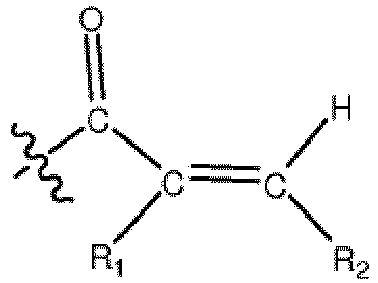 b. mindestens einem Monomer und/oder mindestens einem Vernetzer, wobeii. das Monomer ein Monomer der allgemeinen Struktur
 ii.der Vernetzer eine kovalent mit mindestens zwei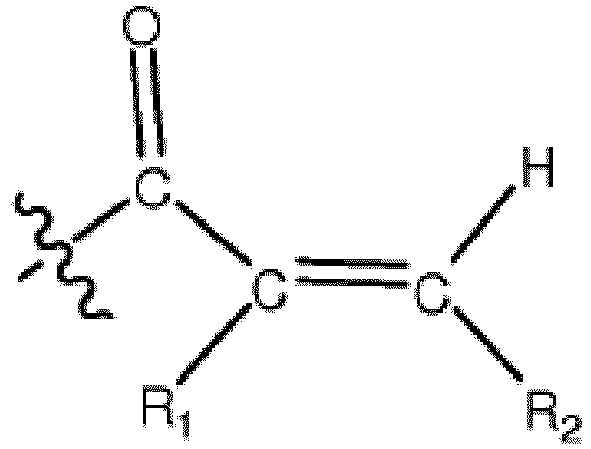
und wobei die beiden Gruppen gleich oder verschieden sein können; undc. gegebenenfalls mindestens einem kovalent mit
- Polymermaterial nach Anspruch 1, wobei das Polymermaterial ein mindestens aus:a. mindestens einem Füllmaterial mit einer durchschnittlichen Partikelgröße von höchstens 750 µm, das aus einem kovalent mit
 b. mindestens einem Vernetzer, wobei der Vernetzer eine kovalent mit mindestens zwei
wobei R1 und R2 unabhängig voneinander aus der Gruppe bestehend aus -H und C1-6-Alkyl ausgewählt sind und wobei die mindestens zwei Gruppen gleich oder verschieden sein können,
polymerisiertes Copolymer ist. - Polymermaterial nach einem der Ansprüche 1 bis 2, wobei der Füllstoff Cellulose umfasst.
- Polymermaterial nach Anspruch 1, wobei das Polymermaterial ein mindestens aus:a. mindestens einem Füllmaterial mit einer durchschnittlichen Partikelgröße von höchstens 750 µm, das aus einem kovalent mit
 b. mindestens einem Monomer der allgemeinen Struktur
 c. mindestens einem kovalent mit
- Polymermaterial nach einem der Ansprüche 1 bis 4, wobei das Pflanzenfasermaterial eine durchschnittliche Partikelgröße im Bereich von 100 µm bis 25 mm aufweist.
- Polymermaterial nach einem der Ansprüche 1 bis 5, wobei das Pflanzenfasermaterial Pflanzenfasern von einer oder mehreren Pflanzen ausgewählt aus der Gruppe bestehend aus Abaka, Bagasse, Bambus, Banane, Gerste, Stechendem Mäusedorn, Maguey-Faser, Caroa, Chinesischer Jute, Coir, Baumwolle, Curauá, Dattelpalme, Flachs, Hanf, Henequen, Isora, Istle, Jute, Kapok, Kenaf, Kudzu, Mauritiushanf, Nessel, Ölpalme, Piassava, Ananas, Phormium, Roselle, Ramie, Sansevieria, Sisal, Luffa, Getreidearten, Ostindischem Hanf, Spitzklette/Kongojute und Holz umfasst.
- Polymermaterial nach einem der Ansprüche 1 bis 6, wobei mindestens 1 % der Partikel des Füllstoffs einen größten Querschnitt von höchstens 10 µm aufweisen.
- Polymermaterial nach einem der Ansprüche 1 bis 7, wobei mindestens ein Füllstoff Material aus einer Pflanze ausgewählt aus der Gruppe bestehend aus Abaka, Bagasse, Bambus, Banane, Stechendem Mäusedorn, Maguey-Faser, Caroa, Chinesischer Jute, Coir, Baumwolle, Curauá, Dattelpalme, Flachs, Hanf, Henequen, Isora, Istle, Jute, Kapok, Kenaf, Kudzu, Mauritiushanf, Nessel, Ölpalme, Piassava, Ananas, Phormium, Roselle, Ramie, Sansevieria, Sisal, Luffa, Getreidearten, Ostindischem Hanf, Spitzklette/Kongojute und Holz umfasst.
- Polymermaterial nach einem der Ansprüche 1 bis 8, wobei mindestens ein Füllstoff fein gemahlenes Gerstenstroh umfasst oder aus diesem besteht.
- Polymermaterial nach einem der Ansprüche 1 bis 9, wobei das Polymermaterial mindestens 50 % Pflanzenfasermaterial und Füllmaterial umfasst und wobei das Füllmaterial von einer Pflanze abgeleitet ist.
- Polymermaterial nach einem der Ansprüche 1 bis 10, wobei das Polymermaterial mindestens 50 % polymerisiertes Pflanzenfasermaterial und Füllmaterial umfasst.
- Polymermaterial nach einem der Ansprüche 1 bis 11, wobei das Material biologisch abbaubar ist.
- Polymermaterial nach einem der Ansprüche 1 bis 12, wobei das Material im Wesentlichen CO2-undurchlässig ist.
- Behälter zur Lagerung von Flüssigkeiten, der das Polymermaterial nach einem der Ansprüche 1 bis 13 umfasst.
- Behälter nach Anspruch 14, wobei der Behälter aus dem Polymermaterial hergestellt wird.
- Material zur Aufbewahrung von Nahrungsmitteln, das das Polymer nach einem der Ansprüche 1 bis 13 umfasst.
- Material zur Aufbewahrung von Nahrungsmitteln nach Anspruch 16, wobei das Material zur Aufbewahrung von Nahrungsmitteln aus der Gruppe bestehend aus Kisten, Dosen, Schachteln, Glasersatz und Tischutensilien ausgewählt ist.
- Verfahren zur Herstellung eines Polymermaterials nach einem der Ansprüche 1 bis 13, wobei das Verfahren die folgenden Schritte umfasst:a) Bereitstellen von mindestens einem Füllmaterial, wobei das Füllmaterial in Form von kleinen Partikeln bereitgestellt wird, wobei der durchschnittliche größte Querschnitt der Partikel im Bereich von 0,1 bis 750 µm liegt, das Füllmaterial kovalent mit
 b) Bereitstellen mindestens eines Monomers und/oder mindestens eines Vernetzers, wobeii) das Monomer ein Monomer der allgemeinen Struktur
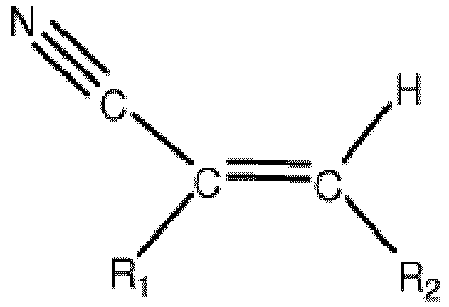 i. ii) der Vernetzer eine kovalent mit mindestens zwei
und wobei die beiden Gruppen gleich oder verschieden sein können;c) gegebenenfalls Bereitstellen mindestens eines Pflanzenfasermaterials, das kovalent mit d) Vermischen des Pflanzenmaterials, Füllmaterials, Monomers und gegebenenfalls von zusätzlichen Komponenten,e) Zugeben eines oder mehrerer Initiatoren für freie Radikale und dadurch Erhalten eines Gemischsf) Gegebenenfalls Transferieren des Gemischs in eine Formg) Inkubieren des Gemischs bei einer Temperatur im Bereich von 30 bis 200°C und/oder Einwirkenlassen von UV-Strahlung auf das Gemisch,wobei die Schritte a), b) und c) gleichzeitig oder in beliebiger Reihenfolge nacheinander ausgeführt werden können und Schritt c) gegebenenfalls nach Schritt e) ausgeführt werden kann.
 - Verfahren nach Anspruch 18, wobei das Verfahren die folgenden Schritte umfasst:a) Bereitstellen mindestens eines Füllmaterials wie in Anspruch 18 definiert;b) Bereitstellen mindestens eines Monomers wie in Anspruch 18 definiert;c) Bereitstellen mindestens eines Pflanzenfasermaterials wie in Anspruch 18 definiert;d) Vermischen des Pflanzenmaterials, Füllmaterials, Monomers und gegebenenfalls von zusätzlichen Komponenten,e) Zugeben eines oder mehrerer Initiatoren für freie Radikale und dadurch Erhalten eines Gemischsf) Gegebenenfalls Transferieren des Gemischs in eine Formg) Inkubieren des Gemischs bei einer Temperatur im Bereich von 30 bis 200°C, zum Beispiel im Bereich von 30 bis 100°C, und/oder Einwirkenlassen von UV-Strahlung auf das Gemisch,wobei die Schritte a), b) und c) gleichzeitig oder in beliebiger Reihenfolge nacheinander ausgeführt werden können und Schritt c) gegebenenfalls nach Schritt e) ausgeführt werden kann.
Applications Claiming Priority (2)
| Application Number | Priority Date | Filing Date | Title |
|---|---|---|---|
| DKPA200801816 | 2008-12-16 | ||
| PCT/DK2009/050339 WO2010069329A1 (en) | 2008-12-16 | 2009-12-16 | Cellulose based polymer material |
Publications (2)
| Publication Number | Publication Date |
|---|---|
| EP2379635A1 EP2379635A1 (de) | 2011-10-26 |
| EP2379635B1 true EP2379635B1 (de) | 2016-08-10 |
Family
ID=59021639
Family Applications (2)
| Application Number | Title | Priority Date | Filing Date |
|---|---|---|---|
| EP09801146.3A Active EP2379635B1 (de) | 2008-12-16 | 2009-12-16 | Polymermaterial auf cellulosebasis |
| EP09801147.1A Active EP2379636B1 (de) | 2008-12-16 | 2009-12-16 | Beschichtung von hydroxylierten oberflächen durch gasphasenpfropfung |
Family Applications After (1)
| Application Number | Title | Priority Date | Filing Date |
|---|---|---|---|
| EP09801147.1A Active EP2379636B1 (de) | 2008-12-16 | 2009-12-16 | Beschichtung von hydroxylierten oberflächen durch gasphasenpfropfung |
Country Status (14)
| Country | Link |
|---|---|
| US (2) | US8796362B2 (de) |
| EP (2) | EP2379635B1 (de) |
| JP (1) | JP5597204B2 (de) |
| CN (2) | CN102317364B (de) |
| AU (1) | AU2009328762B2 (de) |
| BR (2) | BRPI0922382B1 (de) |
| CA (2) | CA2746699C (de) |
| DK (2) | DK2379635T3 (de) |
| EA (2) | EA021761B9 (de) |
| ES (1) | ES2617323T3 (de) |
| MY (1) | MY158710A (de) |
| NZ (1) | NZ593559A (de) |
| WO (2) | WO2010069330A2 (de) |
| ZA (2) | ZA201104609B (de) |
Families Citing this family (32)
| Publication number | Priority date | Publication date | Assignee | Title |
|---|---|---|---|---|
| EA021761B9 (ru) | 2008-12-16 | 2015-12-30 | Карлсберг А/С | Полимерный материал на основе целлюлозы |
| NL2007240C2 (en) * | 2011-08-09 | 2013-02-12 | Konink Co Peratie Cosun U A | Sugar-based plasticizers. |
| WO2013081138A1 (ja) * | 2011-11-30 | 2013-06-06 | 国立大学法人京都大学 | 変性セルロースファイバー及び変性セルロースファイバーを含むゴム組成物 |
| CN103159552B (zh) * | 2013-03-05 | 2014-12-03 | 漳州职业技术学院 | 一种基于香蕉树杆茎粉末的缓释肥料及其制备方法 |
| US9847302B2 (en) * | 2013-08-23 | 2017-12-19 | Taiwan Semiconductor Manufacturing Co., Ltd. | Wafer surface conditioning for stability in fab environment |
| CN105814120B (zh) | 2013-09-19 | 2019-07-05 | 泰尔茂株式会社 | 聚合物颗粒 |
| KR102340388B1 (ko) * | 2013-09-19 | 2021-12-17 | 마이크로벤션, 인코포레이티드 | 중합체 필름 |
| EP3065719A4 (de) | 2013-11-08 | 2017-08-09 | Terumo Corporation | Polymerpartikel |
| CN103835133B (zh) * | 2014-03-18 | 2015-10-28 | 浙江理工大学 | 一种制备无氟超疏水织物表面的方法 |
| US9624312B2 (en) * | 2014-03-26 | 2017-04-18 | International Business Machines Corporation | Flame retardant modified cellulosic nanomaterials (FR-CNs) prepared using phosphorus-containing monomers |
| CN106536568B (zh) * | 2014-07-14 | 2019-08-16 | 株式会社大赛璐 | 乙酸纤维素制造用的纸浆的破碎方法及乙酸纤维素的制造方法 |
| JP2016023275A (ja) * | 2014-07-23 | 2016-02-08 | セイコーエプソン株式会社 | セルロース系材料およびセルロース系部材 |
| WO2016154592A1 (en) | 2015-03-26 | 2016-09-29 | Microvention, Inc. | Embiolic particles |
| EP3370698B1 (de) | 2015-11-03 | 2022-01-26 | Zoetis Services LLC | Polymere sol-gel-verbundwerkstoffe und verwendungen davon |
| WO2017089467A1 (en) | 2015-11-24 | 2017-06-01 | Carlsberg A/S | Plant based material for injection molding |
| CN107022906A (zh) * | 2016-01-29 | 2017-08-08 | 上海水星家用纺织品股份有限公司 | 洛神花染料对蚕丝面料进行染色的染色工艺 |
| WO2017163095A1 (en) * | 2016-03-23 | 2017-09-28 | Narendra Reddy | Natural fiber or fibrous material based completely biodegradable food containers |
| CN107365168B (zh) * | 2016-05-11 | 2019-11-22 | 航天特种材料及工艺技术研究所 | 一种提高二氧化硅陶瓷基复合材料拉伸强度的方法 |
| CN106279731B (zh) * | 2016-08-16 | 2018-10-23 | 东华大学 | 以椰壳纤维中螺旋纤维制备同质复合膜的方法及用途 |
| AU2017336785B2 (en) | 2016-09-28 | 2019-12-05 | Terumo Corporation | Polymer particles |
| CN108179630B (zh) * | 2016-12-08 | 2020-08-07 | 远东先进纤维股份有限公司 | 改质的拨水纤维及其制法 |
| US9896342B1 (en) | 2017-09-27 | 2018-02-20 | King Saud University | Synthesis of nanostructures from Phoenix dactylifera agro-wastes |
| CN108102030B (zh) * | 2018-01-09 | 2020-05-22 | 南通华利康医疗器械有限公司 | 一种具有止血作用的高分子共聚物材料及其制备方法 |
| JPWO2019203239A1 (ja) * | 2018-04-17 | 2021-05-13 | 王子ホールディングス株式会社 | シート及び積層体 |
| CN110790968B (zh) * | 2019-11-18 | 2021-11-05 | 佛山杜邦鸿基薄膜有限公司 | 一种在线涂覆型改性双向拉伸聚酯薄膜及其制备方法 |
| US11492476B2 (en) | 2020-03-12 | 2022-11-08 | Ford Global Technologies, Llc | Pupunha-reinforced polypropylene composite |
| US20230265613A1 (en) * | 2020-08-13 | 2023-08-24 | Cellulotech Inc | Process for acylation of a hydroxylated solid material |
| KR20230116893A (ko) * | 2020-12-01 | 2023-08-04 | 셀룰로테크 인코포레이티드 | 움직이는 하이드록실화 재료를 아실화하기 위한 방법및 장치 |
| CN117561306A (zh) * | 2021-06-28 | 2024-02-13 | 伊士曼化工公司 | 可生物降解的组合物和由其形成的制品 |
| JPWO2023021551A1 (de) * | 2021-08-16 | 2023-02-23 | ||
| CN115321842B (zh) * | 2022-09-16 | 2023-05-05 | 四川轻化工大学 | 耐蚀玄武岩纤维及其制备方法 |
| CN116655277B (zh) * | 2023-05-29 | 2023-12-12 | 金华市瑞城商品混凝土有限公司 | 一种含磺酸纤维素减水剂的高性能混凝土及其制备工艺 |
Family Cites Families (45)
| Publication number | Priority date | Publication date | Assignee | Title |
|---|---|---|---|---|
| US2336985A (en) * | 1940-09-07 | 1943-12-14 | Freund Ernest | Copolymerization product of cellulose compounds and method of preparing same |
| US2379890A (en) * | 1942-06-20 | 1945-07-10 | Masonite Corp | Esterification of lignins and ligninlike material |
| US2789030A (en) * | 1950-03-30 | 1957-04-16 | Cluett Peabody & Co Inc | Process of topochemical modification of clllulose fabrics by reacting with a copolymerizable monomer and copolymerizing the reaction product and product produced thereby |
| US2824778A (en) | 1954-09-28 | 1958-02-25 | Robbart Edward | Process for imparting water repellency to cellulosic material comprising cellulosic fibers by reaction with an aerosol containing organo silicon halide |
| FR1235424A (fr) * | 1959-05-26 | 1960-07-08 | Usines Chimique Rhone Poulenc | Procédé de greffage de monomères polymérisables sur des objets en alcool polyvinylique |
| US3318826A (en) * | 1963-02-27 | 1967-05-09 | Tee Pak Inc | Molded plastic article containing polymer grafted filler or reinforcement |
| GR33592B (el) | 1966-03-28 | 1967-12-21 | Gagliardi Research Corporation | Κατεργασια υφασματων κατα την φασιν ατμου. |
| FR1522387A (fr) * | 1966-05-20 | 1968-04-26 | Inst Textile De France | Procédé de greffage de polymères contenant des groupes hydroxyles |
| US3880830A (en) * | 1972-09-21 | 1975-04-29 | Us Agriculture | Process for acylating functional groups bearing active hydrogen with isopropenyl esters of long-chain fatty acids |
| US3947426A (en) * | 1974-04-12 | 1976-03-30 | Story Chemical Corporation | Solid particle-form polymerizable polymeric material and compositions, structures and methods of employing and producing the same |
| US4107426A (en) * | 1976-07-06 | 1978-08-15 | Roy Gerald Gordon | Process for treating cellulose |
| JPS5432493A (en) * | 1977-08-15 | 1979-03-09 | Meiji Seika Kaisha Ltd | Preparation of macrolide antibiotics derivatives |
| JPS6086109A (ja) | 1983-10-17 | 1985-05-15 | Kanegafuchi Chem Ind Co Ltd | 気相グラフト重合方法 |
| US5135965A (en) * | 1984-12-18 | 1992-08-04 | T. R. Developments, Ltd. | Hydrogel-forming polymers used in intraocular lenses |
| US4663388A (en) * | 1985-08-05 | 1987-05-05 | A. E. Staley Manufacturing Company | Process for producing filled or reinforced polymer compositions |
| US4656202A (en) * | 1985-08-28 | 1987-04-07 | Reliance Universal, Inc. | Acrylated cellulosic furniture coatings |
| GB2214857B (en) * | 1988-02-05 | 1992-05-13 | Agrifibre Dev Ltd | Compositions and manufacture of structural members, in particular furniture components |
| US4925698A (en) | 1988-02-23 | 1990-05-15 | Tekmat Corporation | Surface modification of polymeric materials |
| EP0541549A1 (de) | 1989-11-02 | 1993-05-19 | AlliedSignal Inc. | Biodegradierbare polymere materialien und daraus hergestellte gegenstände |
| US5157093A (en) * | 1990-05-10 | 1992-10-20 | Ciba-Geigy Corporation | Hydroxyethyl cellulose derivatives containing pendant (meth)acryloyl units bound through urethane groups and hydrogel contact lenses made therefrom |
| US5227529A (en) * | 1990-06-01 | 1993-07-13 | Hoechst Aktiengesellschaft | Process for the acylation of naphthyl ethers with the aid of zeolite catalysts |
| SE468054B (sv) * | 1990-12-03 | 1992-10-26 | Mo Och Domsjoe Ab | Papper samt foerfarande foer framstaellning av papper |
| JPH079411A (ja) | 1993-06-25 | 1995-01-13 | Sumitomo Chem Eng Kk | セルロース含有材のアセチル化法および改質木材の製造方法 |
| DE4431350A1 (de) * | 1994-09-02 | 1996-03-07 | Fraunhofer Ges Forschung | Umsetzungsprodukte von Sacchariden mit bifunktionellen Verbindungen, deren Herstellung sowie deren Verwendung |
| DE19532489C2 (de) | 1995-09-02 | 2002-06-20 | Feinchemie Gmbh Sebnitz | Antimikrobielles Verpackungsmaterial und Verfahren zu dessen Herstellung |
| US5876753A (en) * | 1996-04-16 | 1999-03-02 | Board Of Regents, The University Of Texas System | Molecular tailoring of surfaces |
| US6018033A (en) | 1997-05-13 | 2000-01-25 | Purdue Research Foundation | Hydrophilic, hydrophobic, and thermoreversible saccharide gels and forms, and methods for producing same |
| US6726133B2 (en) | 1997-07-18 | 2004-04-27 | Pulsewave Llc | Process for micronizing materials |
| EP1015120B1 (de) | 1997-07-18 | 2004-03-24 | C.A. Arnold & Associates, Inc. | Feinzerkleinerung von materialien |
| US6405948B1 (en) | 1997-07-18 | 2002-06-18 | Pulsewave Llc | Liberating intracellular matter from biological material |
| FR2767270B1 (fr) | 1997-08-14 | 2000-02-11 | Daniel Gamain | Procede de traitement en phase gazeuse d'un materiau solide pour le rendre hydrophobe, materiau obtenu et applications |
| NO20002632L (no) * | 1999-06-01 | 2000-12-04 | Nippon Catalytic Chem Ind | Herdbart behandlingsmiddel og herdebehandlingsprosess |
| AU7620800A (en) | 1999-09-30 | 2001-04-30 | Dow Chemical Company, The | Heat stable article, latex composition, and method of making |
| DE10126650B4 (de) | 2001-06-01 | 2005-08-18 | Basf Coatings Ag | Funktionale organische Pulver, Verfahren zu ihrer Herstellung und ihre Verwendung |
| FR2826274B1 (fr) | 2001-06-21 | 2003-09-26 | Aventis Pharma Sa | Formulation pharmaceutique au gout masque et son procede de preparation |
| DE10156352A1 (de) * | 2001-11-16 | 2003-05-28 | Basf Ag | Enzymatische Synthese von Zuckeracrylaten |
| JP4581341B2 (ja) | 2003-06-10 | 2010-11-17 | 藤倉化成株式会社 | セラミックグリーンシート成形用バインダおよびその製造方法 |
| MY140204A (en) | 2004-09-16 | 2009-11-30 | Papyrus Australia Ltd | Method and apparatus for removing sheets of fibres from banana plants for the production of paper products |
| JP2006137462A (ja) | 2004-11-12 | 2006-06-01 | Nippon Sanmou Senshoku Kk | 消臭および抗菌機能を備えた収納ケース用板紙およびその製造方法 |
| DE102005041330B4 (de) * | 2005-08-29 | 2008-12-18 | Silcos Gmbh | Silikonelastomere und deren Oberflächenmodifikation mittels Plasmaverfahren zwecks Beschichtung |
| US7825050B2 (en) * | 2006-12-22 | 2010-11-02 | Milliken & Company | VOC-absorbing nonwoven composites |
| EP1967644A1 (de) * | 2007-03-07 | 2008-09-10 | Jacobs University Bremen gGmbH | Verbundmikrofaser |
| US20100019598A1 (en) | 2008-07-28 | 2010-01-28 | Direct Drive Systems, Inc. | Rotor for an electric machine |
| EA021761B9 (ru) | 2008-12-16 | 2015-12-30 | Карлсберг А/С | Полимерный материал на основе целлюлозы |
| JP2012513545A (ja) | 2008-12-24 | 2012-06-14 | パピルス テクノロジー ピーティーワイ リミテッド | 改良型紙料 |
-
2009
- 2009-12-16 EA EA201170825A patent/EA021761B9/ru not_active IP Right Cessation
- 2009-12-16 AU AU2009328762A patent/AU2009328762B2/en not_active Ceased
- 2009-12-16 DK DK09801146.3T patent/DK2379635T3/en active
- 2009-12-16 CA CA2746699A patent/CA2746699C/en not_active Expired - Fee Related
- 2009-12-16 NZ NZ593559A patent/NZ593559A/xx not_active IP Right Cessation
- 2009-12-16 EA EA201170826A patent/EA023975B1/ru not_active IP Right Cessation
- 2009-12-16 CA CA2746704A patent/CA2746704C/en not_active Expired - Fee Related
- 2009-12-16 CN CN200980156921.4A patent/CN102317364B/zh not_active Expired - Fee Related
- 2009-12-16 EP EP09801146.3A patent/EP2379635B1/de active Active
- 2009-12-16 EP EP09801147.1A patent/EP2379636B1/de active Active
- 2009-12-16 ES ES09801147.1T patent/ES2617323T3/es active Active
- 2009-12-16 US US13/140,186 patent/US8796362B2/en not_active Expired - Fee Related
- 2009-12-16 BR BRPI0922382-7A patent/BRPI0922382B1/pt not_active IP Right Cessation
- 2009-12-16 WO PCT/DK2009/050340 patent/WO2010069330A2/en not_active Ceased
- 2009-12-16 US US13/140,195 patent/US9428635B2/en not_active Expired - Fee Related
- 2009-12-16 WO PCT/DK2009/050339 patent/WO2010069329A1/en not_active Ceased
- 2009-12-16 DK DK09801147.1T patent/DK2379636T3/en active
- 2009-12-16 MY MYPI2011002783A patent/MY158710A/en unknown
- 2009-12-16 CN CN200980156922.9A patent/CN102317365B/zh not_active Expired - Fee Related
- 2009-12-16 BR BRPI0922385-1A patent/BRPI0922385B1/pt not_active IP Right Cessation
- 2009-12-16 JP JP2011541091A patent/JP5597204B2/ja not_active Expired - Fee Related
-
2011
- 2011-06-22 ZA ZA2011/04609A patent/ZA201104609B/en unknown
- 2011-06-22 ZA ZA2011/04608A patent/ZA201104608B/en unknown
Also Published As
Similar Documents
| Publication | Publication Date | Title |
|---|---|---|
| US8796362B2 (en) | Cellulose based polymer material | |
| Tapias et al. | Bacterial cellulose films production by Kombucha symbiotic community cultured on different herbal infusions | |
| Vasconcelos et al. | Oxidized bacterial cellulose membrane as support for enzyme immobilization: properties and morphological features | |
| Asgher et al. | Bacterial cellulose-assisted de-lignified wheat straw-PVA based bio-composites with novel characteristics | |
| Tedeschi et al. | Multifunctional bioplastics inspired by wood composition: effect of hydrolyzed lignin addition to xylan–cellulose matrices | |
| Abral et al. | Highly transparent and antimicrobial PVA based bionanocomposites reinforced by ginger nanofiber | |
| Mohite et al. | Physical, structural, mechanical and thermal characterization of bacterial cellulose by G. hansenii NCIM 2529 | |
| Soucy et al. | The potential of paper mill sludge for wood–plastic composites | |
| Lin et al. | Surface modification of PVA hydrogel membranes with carboxybetaine methacrylate via PET-RAFT for anti-fouling | |
| Sahari et al. | A new approach to use Arenga pinnata as sustainable biopolymer: Effects of plasticizers on physical properties | |
| Moustafa et al. | Kenaf fibre treatment and its impact on the static, dynamic, hydrophobicity and barrier properties of sustainable polystyrene biocomposites | |
| Benito-González et al. | Cellulose nanocrystal-based films produced by more sustainable extraction protocols from Posidonia oceanica waste biomass | |
| Ybañez et al. | Designing hydrophobic bacterial cellulose film composites assisted by sound waves | |
| Majrashi et al. | Novel enhancement of interfacial interaction and properties in biodegradable polymer composites using green chemically treated spent coffee ground microfiller | |
| Zannen et al. | Polypropylene composites reinforced by Marine Posidonia fiber waste: effect of Silane and Alkali treatment | |
| Kiattipanich et al. | Properties of polypropylene composites reinforced with stearic acid treated sugarcane fiber | |
| Wacikowski et al. | The possibility of using bacterial cellulose in particleboard technology | |
| Narita et al. | A novel approach of adhesive property of cellulose nanofibers obtained from the discarded wooden part of Kozo plant | |
| Julkapli et al. | Preparation and properties of kenaf dust-filled chitosan biocomposites | |
| ISLAM | Enhancing the Performance of Natural Fiber Hybrid Green Composites through Coupling Agent modification | |
| Botha et al. | Production and Biodegradation Testing of Bioplastics | |
| Betlej et al. | Influence of SCOBY microorganisms’ cultivation conditions on the synthesis efficiency and selected qualities of bacterial cellulose | |
| Zimmermann | Cellulose fibrils in wood cell walls and their potential for technical applications | |
| Mukbaniani et al. | Composite Materials on the Basis of Various Binders | |
| Duan et al. | Application of cellulose nanofibrils in polyvinyl alcohol composite films |
Legal Events
| Date | Code | Title | Description |
|---|---|---|---|
| PUAI | Public reference made under article 153(3) epc to a published international application that has entered the european phase |
Free format text: ORIGINAL CODE: 0009012 |
|
| 17P | Request for examination filed |
Effective date: 20110718 |
|
| AK | Designated contracting states |
Kind code of ref document: A1 Designated state(s): AT BE BG CH CY CZ DE DK EE ES FI FR GB GR HR HU IE IS IT LI LT LU LV MC MK MT NL NO PL PT RO SE SI SK SM TR |
|
| AX | Request for extension of the european patent |
Extension state: AL BA RS |
|
| 17Q | First examination report despatched |
Effective date: 20150828 |
|
| GRAP | Despatch of communication of intention to grant a patent |
Free format text: ORIGINAL CODE: EPIDOSNIGR1 |
|
| INTG | Intention to grant announced |
Effective date: 20160314 |
|
| GRAS | Grant fee paid |
Free format text: ORIGINAL CODE: EPIDOSNIGR3 |
|
| GRAA | (expected) grant |
Free format text: ORIGINAL CODE: 0009210 |
|
| AK | Designated contracting states |
Kind code of ref document: B1 Designated state(s): AT BE BG CH CY CZ DE DK EE ES FI FR GB GR HR HU IE IS IT LI LT LU LV MC MK MT NL NO PL PT RO SE SI SK SM TR |
|
| AX | Request for extension of the european patent |
Extension state: AL BA RS |
|
| REG | Reference to a national code |
Ref country code: GB Ref legal event code: FG4D |
|
| REG | Reference to a national code |
Ref country code: CH Ref legal event code: EP Ref country code: AT Ref legal event code: REF Ref document number: 819002 Country of ref document: AT Kind code of ref document: T Effective date: 20160815 |
|
| REG | Reference to a national code |
Ref country code: IE Ref legal event code: FG4D |
|
| REG | Reference to a national code |
Ref country code: DE Ref legal event code: R096 Ref document number: 602009040322 Country of ref document: DE |
|
| REG | Reference to a national code |
Ref country code: CH Ref legal event code: NV Representative=s name: STOLMAR AND PARTNER INTELLECTUAL PROPERTY S.A., CH |
|
| REG | Reference to a national code |
Ref country code: FR Ref legal event code: PLFP Year of fee payment: 8 |
|
| REG | Reference to a national code |
Ref country code: DK Ref legal event code: T3 Effective date: 20161129 |
|
| REG | Reference to a national code |
Ref country code: SE Ref legal event code: TRGR |
|
| REG | Reference to a national code |
Ref country code: LT Ref legal event code: MG4D Ref country code: NO Ref legal event code: T2 Effective date: 20160810 |
|
| REG | Reference to a national code |
Ref country code: NL Ref legal event code: MP Effective date: 20160810 |
|
| REG | Reference to a national code |
Ref country code: AT Ref legal event code: MK05 Ref document number: 819002 Country of ref document: AT Kind code of ref document: T Effective date: 20160810 |
|
| PG25 | Lapsed in a contracting state [announced via postgrant information from national office to epo] |
Ref country code: IS Free format text: LAPSE BECAUSE OF FAILURE TO SUBMIT A TRANSLATION OF THE DESCRIPTION OR TO PAY THE FEE WITHIN THE PRESCRIBED TIME-LIMIT Effective date: 20161210 Ref country code: LT Free format text: LAPSE BECAUSE OF FAILURE TO SUBMIT A TRANSLATION OF THE DESCRIPTION OR TO PAY THE FEE WITHIN THE PRESCRIBED TIME-LIMIT Effective date: 20160810 Ref country code: IT Free format text: LAPSE BECAUSE OF FAILURE TO SUBMIT A TRANSLATION OF THE DESCRIPTION OR TO PAY THE FEE WITHIN THE PRESCRIBED TIME-LIMIT Effective date: 20160810 Ref country code: NL Free format text: LAPSE BECAUSE OF FAILURE TO SUBMIT A TRANSLATION OF THE DESCRIPTION OR TO PAY THE FEE WITHIN THE PRESCRIBED TIME-LIMIT Effective date: 20160810 Ref country code: HR Free format text: LAPSE BECAUSE OF FAILURE TO SUBMIT A TRANSLATION OF THE DESCRIPTION OR TO PAY THE FEE WITHIN THE PRESCRIBED TIME-LIMIT Effective date: 20160810 |
|
| PG25 | Lapsed in a contracting state [announced via postgrant information from national office to epo] |
Ref country code: ES Free format text: LAPSE BECAUSE OF FAILURE TO SUBMIT A TRANSLATION OF THE DESCRIPTION OR TO PAY THE FEE WITHIN THE PRESCRIBED TIME-LIMIT Effective date: 20160810 Ref country code: LV Free format text: LAPSE BECAUSE OF FAILURE TO SUBMIT A TRANSLATION OF THE DESCRIPTION OR TO PAY THE FEE WITHIN THE PRESCRIBED TIME-LIMIT Effective date: 20160810 Ref country code: PT Free format text: LAPSE BECAUSE OF FAILURE TO SUBMIT A TRANSLATION OF THE DESCRIPTION OR TO PAY THE FEE WITHIN THE PRESCRIBED TIME-LIMIT Effective date: 20161212 Ref country code: PL Free format text: LAPSE BECAUSE OF FAILURE TO SUBMIT A TRANSLATION OF THE DESCRIPTION OR TO PAY THE FEE WITHIN THE PRESCRIBED TIME-LIMIT Effective date: 20160810 Ref country code: AT Free format text: LAPSE BECAUSE OF FAILURE TO SUBMIT A TRANSLATION OF THE DESCRIPTION OR TO PAY THE FEE WITHIN THE PRESCRIBED TIME-LIMIT Effective date: 20160810 Ref country code: GR Free format text: LAPSE BECAUSE OF FAILURE TO SUBMIT A TRANSLATION OF THE DESCRIPTION OR TO PAY THE FEE WITHIN THE PRESCRIBED TIME-LIMIT Effective date: 20161111 |
|
| REG | Reference to a national code |
Ref country code: DE Ref legal event code: R082 Ref document number: 602009040322 Country of ref document: DE |
|
| PG25 | Lapsed in a contracting state [announced via postgrant information from national office to epo] |
Ref country code: EE Free format text: LAPSE BECAUSE OF FAILURE TO SUBMIT A TRANSLATION OF THE DESCRIPTION OR TO PAY THE FEE WITHIN THE PRESCRIBED TIME-LIMIT Effective date: 20160810 Ref country code: RO Free format text: LAPSE BECAUSE OF FAILURE TO SUBMIT A TRANSLATION OF THE DESCRIPTION OR TO PAY THE FEE WITHIN THE PRESCRIBED TIME-LIMIT Effective date: 20160810 |
|
| REG | Reference to a national code |
Ref country code: DE Ref legal event code: R097 Ref document number: 602009040322 Country of ref document: DE |
|
| PG25 | Lapsed in a contracting state [announced via postgrant information from national office to epo] |
Ref country code: BE Free format text: LAPSE BECAUSE OF FAILURE TO SUBMIT A TRANSLATION OF THE DESCRIPTION OR TO PAY THE FEE WITHIN THE PRESCRIBED TIME-LIMIT Effective date: 20160810 Ref country code: CZ Free format text: LAPSE BECAUSE OF FAILURE TO SUBMIT A TRANSLATION OF THE DESCRIPTION OR TO PAY THE FEE WITHIN THE PRESCRIBED TIME-LIMIT Effective date: 20160810 Ref country code: SM Free format text: LAPSE BECAUSE OF FAILURE TO SUBMIT A TRANSLATION OF THE DESCRIPTION OR TO PAY THE FEE WITHIN THE PRESCRIBED TIME-LIMIT Effective date: 20160810 Ref country code: BG Free format text: LAPSE BECAUSE OF FAILURE TO SUBMIT A TRANSLATION OF THE DESCRIPTION OR TO PAY THE FEE WITHIN THE PRESCRIBED TIME-LIMIT Effective date: 20161110 Ref country code: SK Free format text: LAPSE BECAUSE OF FAILURE TO SUBMIT A TRANSLATION OF THE DESCRIPTION OR TO PAY THE FEE WITHIN THE PRESCRIBED TIME-LIMIT Effective date: 20160810 |
|
| PLBE | No opposition filed within time limit |
Free format text: ORIGINAL CODE: 0009261 |
|
| STAA | Information on the status of an ep patent application or granted ep patent |
Free format text: STATUS: NO OPPOSITION FILED WITHIN TIME LIMIT |
|
| 26N | No opposition filed |
Effective date: 20170511 |
|
| PG25 | Lapsed in a contracting state [announced via postgrant information from national office to epo] |
Ref country code: SI Free format text: LAPSE BECAUSE OF FAILURE TO SUBMIT A TRANSLATION OF THE DESCRIPTION OR TO PAY THE FEE WITHIN THE PRESCRIBED TIME-LIMIT Effective date: 20160810 |
|
| PG25 | Lapsed in a contracting state [announced via postgrant information from national office to epo] |
Ref country code: MC Free format text: LAPSE BECAUSE OF FAILURE TO SUBMIT A TRANSLATION OF THE DESCRIPTION OR TO PAY THE FEE WITHIN THE PRESCRIBED TIME-LIMIT Effective date: 20160810 |
|
| REG | Reference to a national code |
Ref country code: IE Ref legal event code: MM4A |
|
| REG | Reference to a national code |
Ref country code: CH Ref legal event code: PCAR Free format text: NEW ADDRESS: RUE DU CENDRIER 15 CP 1489, 1201 GENEVE (CH) |
|
| PG25 | Lapsed in a contracting state [announced via postgrant information from national office to epo] |
Ref country code: LU Free format text: LAPSE BECAUSE OF NON-PAYMENT OF DUE FEES Effective date: 20161216 |
|
| PG25 | Lapsed in a contracting state [announced via postgrant information from national office to epo] |
Ref country code: IE Free format text: LAPSE BECAUSE OF NON-PAYMENT OF DUE FEES Effective date: 20161216 |
|
| REG | Reference to a national code |
Ref country code: FR Ref legal event code: PLFP Year of fee payment: 9 |
|
| PG25 | Lapsed in a contracting state [announced via postgrant information from national office to epo] |
Ref country code: CY Free format text: LAPSE BECAUSE OF FAILURE TO SUBMIT A TRANSLATION OF THE DESCRIPTION OR TO PAY THE FEE WITHIN THE PRESCRIBED TIME-LIMIT Effective date: 20160810 Ref country code: HU Free format text: LAPSE BECAUSE OF FAILURE TO SUBMIT A TRANSLATION OF THE DESCRIPTION OR TO PAY THE FEE WITHIN THE PRESCRIBED TIME-LIMIT; INVALID AB INITIO Effective date: 20091216 |
|
| PG25 | Lapsed in a contracting state [announced via postgrant information from national office to epo] |
Ref country code: MK Free format text: LAPSE BECAUSE OF FAILURE TO SUBMIT A TRANSLATION OF THE DESCRIPTION OR TO PAY THE FEE WITHIN THE PRESCRIBED TIME-LIMIT Effective date: 20160810 Ref country code: TR Free format text: LAPSE BECAUSE OF FAILURE TO SUBMIT A TRANSLATION OF THE DESCRIPTION OR TO PAY THE FEE WITHIN THE PRESCRIBED TIME-LIMIT Effective date: 20160810 |
|
| PG25 | Lapsed in a contracting state [announced via postgrant information from national office to epo] |
Ref country code: MT Free format text: LAPSE BECAUSE OF NON-PAYMENT OF DUE FEES Effective date: 20161216 |
|
| PGFP | Annual fee paid to national office [announced via postgrant information from national office to epo] |
Ref country code: SE Payment date: 20191211 Year of fee payment: 11 Ref country code: DE Payment date: 20191126 Year of fee payment: 11 Ref country code: FI Payment date: 20191129 Year of fee payment: 11 Ref country code: NO Payment date: 20191212 Year of fee payment: 11 |
|
| PGFP | Annual fee paid to national office [announced via postgrant information from national office to epo] |
Ref country code: FR Payment date: 20191211 Year of fee payment: 11 Ref country code: DK Payment date: 20191212 Year of fee payment: 11 |
|
| PGFP | Annual fee paid to national office [announced via postgrant information from national office to epo] |
Ref country code: CH Payment date: 20191129 Year of fee payment: 11 |
|
| PGFP | Annual fee paid to national office [announced via postgrant information from national office to epo] |
Ref country code: GB Payment date: 20191211 Year of fee payment: 11 |
|
| REG | Reference to a national code |
Ref country code: DE Ref legal event code: R119 Ref document number: 602009040322 Country of ref document: DE |
|
| REG | Reference to a national code |
Ref country code: FI Ref legal event code: MAE |
|
| REG | Reference to a national code |
Ref country code: DK Ref legal event code: EBP Effective date: 20201231 |
|
| REG | Reference to a national code |
Ref country code: NO Ref legal event code: MMEP |
|
| PG25 | Lapsed in a contracting state [announced via postgrant information from national office to epo] |
Ref country code: FI Free format text: LAPSE BECAUSE OF NON-PAYMENT OF DUE FEES Effective date: 20201216 |
|
| REG | Reference to a national code |
Ref country code: CH Ref legal event code: PL |
|
| REG | Reference to a national code |
Ref country code: SE Ref legal event code: EUG |
|
| GBPC | Gb: european patent ceased through non-payment of renewal fee |
Effective date: 20201216 |
|
| PG25 | Lapsed in a contracting state [announced via postgrant information from national office to epo] |
Ref country code: FR Free format text: LAPSE BECAUSE OF NON-PAYMENT OF DUE FEES Effective date: 20201231 |
|
| PG25 | Lapsed in a contracting state [announced via postgrant information from national office to epo] |
Ref country code: NO Free format text: LAPSE BECAUSE OF NON-PAYMENT OF DUE FEES Effective date: 20201231 Ref country code: CH Free format text: LAPSE BECAUSE OF NON-PAYMENT OF DUE FEES Effective date: 20201231 Ref country code: GB Free format text: LAPSE BECAUSE OF NON-PAYMENT OF DUE FEES Effective date: 20201216 Ref country code: DE Free format text: LAPSE BECAUSE OF NON-PAYMENT OF DUE FEES Effective date: 20210701 Ref country code: LI Free format text: LAPSE BECAUSE OF NON-PAYMENT OF DUE FEES Effective date: 20201231 Ref country code: SE Free format text: LAPSE BECAUSE OF NON-PAYMENT OF DUE FEES Effective date: 20201217 |
|
| PG25 | Lapsed in a contracting state [announced via postgrant information from national office to epo] |
Ref country code: DK Free format text: LAPSE BECAUSE OF NON-PAYMENT OF DUE FEES Effective date: 20201231 |