EP2368955A1 - Formgedächtnis-Material auf Basis eines Strukturklebstoffs - Google Patents
Formgedächtnis-Material auf Basis eines Strukturklebstoffs Download PDFInfo
- Publication number
- EP2368955A1 EP2368955A1 EP20100158076 EP10158076A EP2368955A1 EP 2368955 A1 EP2368955 A1 EP 2368955A1 EP 20100158076 EP20100158076 EP 20100158076 EP 10158076 A EP10158076 A EP 10158076A EP 2368955 A1 EP2368955 A1 EP 2368955A1
- Authority
- EP
- European Patent Office
- Prior art keywords
- structural adhesive
- composition
- curable
- epoxy resin
- curable structural
- Prior art date
- Legal status (The legal status is an assumption and is not a legal conclusion. Google has not performed a legal analysis and makes no representation as to the accuracy of the status listed.)
- Withdrawn
Links
- 239000000853 adhesive Substances 0.000 title claims abstract description 97
- 230000001070 adhesive effect Effects 0.000 title claims abstract description 97
- 239000012781 shape memory material Substances 0.000 title description 5
- 239000000203 mixture Substances 0.000 claims abstract description 144
- 239000003822 epoxy resin Substances 0.000 claims abstract description 55
- 229920000647 polyepoxide Polymers 0.000 claims abstract description 55
- 239000004814 polyurethane Substances 0.000 claims abstract description 33
- 229920002635 polyurethane Polymers 0.000 claims abstract description 33
- 230000003014 reinforcing effect Effects 0.000 claims abstract description 33
- 238000002844 melting Methods 0.000 claims abstract description 30
- 230000008018 melting Effects 0.000 claims abstract description 30
- 230000009477 glass transition Effects 0.000 claims abstract description 29
- 229920001971 elastomer Polymers 0.000 claims abstract description 22
- 239000000806 elastomer Substances 0.000 claims abstract description 21
- 229920000642 polymer Polymers 0.000 claims abstract description 20
- 229920002725 thermoplastic elastomer Polymers 0.000 claims abstract description 19
- 230000002787 reinforcement Effects 0.000 claims abstract description 10
- 238000007493 shaping process Methods 0.000 claims abstract description 9
- 238000010438 heat treatment Methods 0.000 claims abstract description 7
- 230000000149 penetrating effect Effects 0.000 claims abstract description 6
- 238000001816 cooling Methods 0.000 claims abstract description 4
- 230000002441 reversible effect Effects 0.000 claims abstract description 3
- 229910052751 metal Inorganic materials 0.000 claims description 29
- 239000002184 metal Substances 0.000 claims description 29
- 229920003023 plastic Polymers 0.000 claims description 20
- 239000004033 plastic Substances 0.000 claims description 20
- 239000004848 polyfunctional curative Substances 0.000 claims description 15
- 229920001187 thermosetting polymer Polymers 0.000 claims description 13
- 238000000034 method Methods 0.000 claims description 12
- 239000000463 material Substances 0.000 claims description 10
- LNEPOXFFQSENCJ-UHFFFAOYSA-N haloperidol Chemical compound C1CC(O)(C=2C=CC(Cl)=CC=2)CCN1CCCC(=O)C1=CC=C(F)C=C1 LNEPOXFFQSENCJ-UHFFFAOYSA-N 0.000 claims description 7
- 229920000098 polyolefin Polymers 0.000 claims description 6
- 230000008569 process Effects 0.000 claims description 6
- 230000006698 induction Effects 0.000 claims description 4
- 238000000465 moulding Methods 0.000 abstract description 9
- 238000005728 strengthening Methods 0.000 abstract 1
- 238000001723 curing Methods 0.000 description 18
- 239000007787 solid Substances 0.000 description 16
- 239000003795 chemical substances by application Substances 0.000 description 8
- 239000000126 substance Substances 0.000 description 8
- -1 diethylhexyl Chemical group 0.000 description 7
- 229920000768 polyamine Polymers 0.000 description 7
- 238000002360 preparation method Methods 0.000 description 7
- 239000004609 Impact Modifier Substances 0.000 description 6
- 230000008901 benefit Effects 0.000 description 6
- 238000013007 heat curing Methods 0.000 description 6
- 229920003319 Araldite® Polymers 0.000 description 5
- 239000004952 Polyamide Substances 0.000 description 5
- 229920002647 polyamide Polymers 0.000 description 5
- YBRVSVVVWCFQMG-UHFFFAOYSA-N 4,4'-diaminodiphenylmethane Chemical compound C1=CC(N)=CC=C1CC1=CC=C(N)C=C1 YBRVSVVVWCFQMG-UHFFFAOYSA-N 0.000 description 4
- 239000004698 Polyethylene Substances 0.000 description 4
- FAPWRFPIFSIZLT-UHFFFAOYSA-M Sodium chloride Chemical compound [Na+].[Cl-] FAPWRFPIFSIZLT-UHFFFAOYSA-M 0.000 description 4
- 125000001931 aliphatic group Chemical group 0.000 description 4
- IISBACLAFKSPIT-UHFFFAOYSA-N bisphenol A Chemical compound C=1C=C(O)C=CC=1C(C)(C)C1=CC=C(O)C=C1 IISBACLAFKSPIT-UHFFFAOYSA-N 0.000 description 4
- PXKLMJQFEQBVLD-UHFFFAOYSA-N bisphenol F Chemical compound C1=CC(O)=CC=C1CC1=CC=C(O)C=C1 PXKLMJQFEQBVLD-UHFFFAOYSA-N 0.000 description 4
- 150000001875 compounds Chemical class 0.000 description 4
- QGBSISYHAICWAH-UHFFFAOYSA-N dicyandiamide Chemical compound NC(N)=NC#N QGBSISYHAICWAH-UHFFFAOYSA-N 0.000 description 4
- 238000005187 foaming Methods 0.000 description 4
- 150000002739 metals Chemical class 0.000 description 4
- 238000002156 mixing Methods 0.000 description 4
- 229920000573 polyethylene Polymers 0.000 description 4
- 229920001228 polyisocyanate Polymers 0.000 description 4
- 239000005056 polyisocyanate Substances 0.000 description 4
- 238000012545 processing Methods 0.000 description 4
- 239000004743 Polypropylene Substances 0.000 description 3
- 239000000470 constituent Substances 0.000 description 3
- 239000000945 filler Substances 0.000 description 3
- IQPQWNKOIGAROB-UHFFFAOYSA-N isocyanate group Chemical group [N-]=C=O IQPQWNKOIGAROB-UHFFFAOYSA-N 0.000 description 3
- 239000007788 liquid Substances 0.000 description 3
- 239000004850 liquid epoxy resins (LERs) Substances 0.000 description 3
- 229920001155 polypropylene Polymers 0.000 description 3
- 229920005989 resin Polymers 0.000 description 3
- 239000011347 resin Substances 0.000 description 3
- HZAXFHJVJLSVMW-UHFFFAOYSA-N 2-Aminoethan-1-ol Chemical compound NCCO HZAXFHJVJLSVMW-UHFFFAOYSA-N 0.000 description 2
- XMTQQYYKAHVGBJ-UHFFFAOYSA-N 3-(3,4-DICHLOROPHENYL)-1,1-DIMETHYLUREA Chemical compound CN(C)C(=O)NC1=CC=C(Cl)C(Cl)=C1 XMTQQYYKAHVGBJ-UHFFFAOYSA-N 0.000 description 2
- CSCPPACGZOOCGX-UHFFFAOYSA-N Acetone Chemical compound CC(C)=O CSCPPACGZOOCGX-UHFFFAOYSA-N 0.000 description 2
- VTYYLEPIZMXCLO-UHFFFAOYSA-L Calcium carbonate Chemical compound [Ca+2].[O-]C([O-])=O VTYYLEPIZMXCLO-UHFFFAOYSA-L 0.000 description 2
- 229920003345 Elvax® Polymers 0.000 description 2
- 239000004593 Epoxy Substances 0.000 description 2
- PXHVJJICTQNCMI-UHFFFAOYSA-N Nickel Chemical compound [Ni] PXHVJJICTQNCMI-UHFFFAOYSA-N 0.000 description 2
- 238000004026 adhesive bonding Methods 0.000 description 2
- 150000004705 aldimines Chemical class 0.000 description 2
- 150000001412 amines Chemical class 0.000 description 2
- 125000003118 aryl group Chemical group 0.000 description 2
- 229940106691 bisphenol a Drugs 0.000 description 2
- 230000000903 blocking effect Effects 0.000 description 2
- 239000004202 carbamide Substances 0.000 description 2
- 239000003054 catalyst Substances 0.000 description 2
- 230000008859 change Effects 0.000 description 2
- 239000011248 coating agent Substances 0.000 description 2
- 238000000576 coating method Methods 0.000 description 2
- 229920001577 copolymer Polymers 0.000 description 2
- 238000005260 corrosion Methods 0.000 description 2
- 230000007797 corrosion Effects 0.000 description 2
- 238000013461 design Methods 0.000 description 2
- JBKVHLHDHHXQEQ-UHFFFAOYSA-N epsilon-caprolactam Chemical compound O=C1CCCCCN1 JBKVHLHDHHXQEQ-UHFFFAOYSA-N 0.000 description 2
- 239000005038 ethylene vinyl acetate Substances 0.000 description 2
- XXOYNJXVWVNOOJ-UHFFFAOYSA-N fenuron Chemical compound CN(C)C(=O)NC1=CC=CC=C1 XXOYNJXVWVNOOJ-UHFFFAOYSA-N 0.000 description 2
- 239000006260 foam Substances 0.000 description 2
- 238000009472 formulation Methods 0.000 description 2
- 239000004615 ingredient Substances 0.000 description 2
- 238000004519 manufacturing process Methods 0.000 description 2
- 239000011159 matrix material Substances 0.000 description 2
- 239000003094 microcapsule Substances 0.000 description 2
- BMLIZLVNXIYGCK-UHFFFAOYSA-N monuron Chemical compound CN(C)C(=O)NC1=CC=C(Cl)C=C1 BMLIZLVNXIYGCK-UHFFFAOYSA-N 0.000 description 2
- 229920003986 novolac Polymers 0.000 description 2
- 229920000728 polyester Polymers 0.000 description 2
- 229920005862 polyol Polymers 0.000 description 2
- 150000003077 polyols Chemical class 0.000 description 2
- 238000003825 pressing Methods 0.000 description 2
- VYPSYNLAJGMNEJ-UHFFFAOYSA-N silicon dioxide Inorganic materials O=[Si]=O VYPSYNLAJGMNEJ-UHFFFAOYSA-N 0.000 description 2
- 239000011780 sodium chloride Substances 0.000 description 2
- 238000003860 storage Methods 0.000 description 2
- 239000004616 structural foam Substances 0.000 description 2
- 125000001424 substituent group Chemical group 0.000 description 2
- 150000003672 ureas Chemical class 0.000 description 2
- XLYOFNOQVPJJNP-UHFFFAOYSA-N water Substances O XLYOFNOQVPJJNP-UHFFFAOYSA-N 0.000 description 2
- 239000001993 wax Substances 0.000 description 2
- VZXTWGWHSMCWGA-UHFFFAOYSA-N 1,3,5-triazine-2,4-diamine Chemical compound NC1=NC=NC(N)=N1 VZXTWGWHSMCWGA-UHFFFAOYSA-N 0.000 description 1
- QTWJRLJHJPIABL-UHFFFAOYSA-N 2-methylphenol;3-methylphenol;4-methylphenol Chemical compound CC1=CC=C(O)C=C1.CC1=CC=CC(O)=C1.CC1=CC=CC=C1O QTWJRLJHJPIABL-UHFFFAOYSA-N 0.000 description 1
- BLFRQYKZFKYQLO-UHFFFAOYSA-N 4-aminobutan-1-ol Chemical compound NCCCCO BLFRQYKZFKYQLO-UHFFFAOYSA-N 0.000 description 1
- OMIHGPLIXGGMJB-UHFFFAOYSA-N 7-oxabicyclo[4.1.0]hepta-1,3,5-triene Chemical compound C1=CC=C2OC2=C1 OMIHGPLIXGGMJB-UHFFFAOYSA-N 0.000 description 1
- 229910002012 Aerosil® Inorganic materials 0.000 description 1
- 239000005995 Aluminium silicate Substances 0.000 description 1
- 239000004215 Carbon black (E152) Substances 0.000 description 1
- 239000005494 Chlorotoluron Substances 0.000 description 1
- 239000005510 Diuron Substances 0.000 description 1
- 238000012695 Interfacial polymerization Methods 0.000 description 1
- OPKOKAMJFNKNAS-UHFFFAOYSA-N N-methylethanolamine Chemical compound CNCCO OPKOKAMJFNKNAS-UHFFFAOYSA-N 0.000 description 1
- 229920000459 Nitrile rubber Polymers 0.000 description 1
- 229920002292 Nylon 6 Polymers 0.000 description 1
- 229920002302 Nylon 6,6 Polymers 0.000 description 1
- ISWSIDIOOBJBQZ-UHFFFAOYSA-N Phenol Chemical compound OC1=CC=CC=C1 ISWSIDIOOBJBQZ-UHFFFAOYSA-N 0.000 description 1
- 239000004793 Polystyrene Substances 0.000 description 1
- WUGQZFFCHPXWKQ-UHFFFAOYSA-N Propanolamine Chemical compound NCCCO WUGQZFFCHPXWKQ-UHFFFAOYSA-N 0.000 description 1
- 229910000831 Steel Inorganic materials 0.000 description 1
- 239000004433 Thermoplastic polyurethane Substances 0.000 description 1
- GSEJCLTVZPLZKY-UHFFFAOYSA-N Triethanolamine Chemical compound OCCN(CCO)CCO GSEJCLTVZPLZKY-UHFFFAOYSA-N 0.000 description 1
- 229920004482 WACKER® Polymers 0.000 description 1
- 239000004164 Wax ester Substances 0.000 description 1
- 239000004676 acrylonitrile butadiene styrene Substances 0.000 description 1
- 230000009471 action Effects 0.000 description 1
- 230000002411 adverse Effects 0.000 description 1
- 239000000956 alloy Substances 0.000 description 1
- 229910045601 alloy Inorganic materials 0.000 description 1
- 229910052782 aluminium Inorganic materials 0.000 description 1
- XAGFODPZIPBFFR-UHFFFAOYSA-N aluminium Chemical compound [Al] XAGFODPZIPBFFR-UHFFFAOYSA-N 0.000 description 1
- WNROFYMDJYEPJX-UHFFFAOYSA-K aluminium hydroxide Chemical compound [OH-].[OH-].[OH-].[Al+3] WNROFYMDJYEPJX-UHFFFAOYSA-K 0.000 description 1
- 235000012211 aluminium silicate Nutrition 0.000 description 1
- HAMNKKUPIHEESI-UHFFFAOYSA-N aminoguanidine Chemical class NNC(N)=N HAMNKKUPIHEESI-UHFFFAOYSA-N 0.000 description 1
- 239000000440 bentonite Substances 0.000 description 1
- 229910000278 bentonite Inorganic materials 0.000 description 1
- SVPXDRXYRYOSEX-UHFFFAOYSA-N bentoquatam Chemical compound O.O=[Si]=O.O=[Al]O[Al]=O SVPXDRXYRYOSEX-UHFFFAOYSA-N 0.000 description 1
- 230000005540 biological transmission Effects 0.000 description 1
- 229910000019 calcium carbonate Inorganic materials 0.000 description 1
- BRPQOXSCLDDYGP-UHFFFAOYSA-N calcium oxide Chemical compound [O-2].[Ca+2] BRPQOXSCLDDYGP-UHFFFAOYSA-N 0.000 description 1
- 239000000292 calcium oxide Substances 0.000 description 1
- ODINCKMPIJJUCX-UHFFFAOYSA-N calcium oxide Inorganic materials [Ca]=O ODINCKMPIJJUCX-UHFFFAOYSA-N 0.000 description 1
- QXJJQWWVWRCVQT-UHFFFAOYSA-K calcium;sodium;phosphate Chemical compound [Na+].[Ca+2].[O-]P([O-])([O-])=O QXJJQWWVWRCVQT-UHFFFAOYSA-K 0.000 description 1
- 239000002775 capsule Substances 0.000 description 1
- 239000000919 ceramic Substances 0.000 description 1
- 239000002666 chemical blowing agent Substances 0.000 description 1
- 229910001919 chlorite Inorganic materials 0.000 description 1
- 229910052619 chlorite group Inorganic materials 0.000 description 1
- JXCGFZXSOMJFOA-UHFFFAOYSA-N chlorotoluron Chemical compound CN(C)C(=O)NC1=CC=C(C)C(Cl)=C1 JXCGFZXSOMJFOA-UHFFFAOYSA-N 0.000 description 1
- QBWCMBCROVPCKQ-UHFFFAOYSA-N chlorous acid Chemical compound OCl=O QBWCMBCROVPCKQ-UHFFFAOYSA-N 0.000 description 1
- 238000005354 coacervation Methods 0.000 description 1
- 238000007906 compression Methods 0.000 description 1
- 230000006835 compression Effects 0.000 description 1
- 238000010276 construction Methods 0.000 description 1
- 239000011258 core-shell material Substances 0.000 description 1
- 229930003836 cresol Natural products 0.000 description 1
- 229910052906 cristobalite Inorganic materials 0.000 description 1
- 238000005520 cutting process Methods 0.000 description 1
- 238000000354 decomposition reaction Methods 0.000 description 1
- 230000001419 dependent effect Effects 0.000 description 1
- GUJOJGAPFQRJSV-UHFFFAOYSA-N dialuminum;dioxosilane;oxygen(2-);hydrate Chemical compound O.[O-2].[O-2].[O-2].[Al+3].[Al+3].O=[Si]=O.O=[Si]=O.O=[Si]=O.O=[Si]=O GUJOJGAPFQRJSV-UHFFFAOYSA-N 0.000 description 1
- 150000001991 dicarboxylic acids Chemical class 0.000 description 1
- ZBCBWPMODOFKDW-UHFFFAOYSA-N diethanolamine Chemical compound OCCNCCO ZBCBWPMODOFKDW-UHFFFAOYSA-N 0.000 description 1
- GYZLOYUZLJXAJU-UHFFFAOYSA-N diglycidyl ether Chemical group C1OC1COCC1CO1 GYZLOYUZLJXAJU-UHFFFAOYSA-N 0.000 description 1
- 239000003085 diluting agent Substances 0.000 description 1
- 238000003618 dip coating Methods 0.000 description 1
- 239000006185 dispersion Substances 0.000 description 1
- 239000010459 dolomite Substances 0.000 description 1
- 229910000514 dolomite Inorganic materials 0.000 description 1
- 238000004070 electrodeposition Methods 0.000 description 1
- 230000005672 electromagnetic field Effects 0.000 description 1
- 238000009713 electroplating Methods 0.000 description 1
- 238000005538 encapsulation Methods 0.000 description 1
- 125000003700 epoxy group Chemical group 0.000 description 1
- 125000001033 ether group Chemical group 0.000 description 1
- XXUJMEYKYHETBZ-UHFFFAOYSA-N ethyl 4-nitrophenyl ethylphosphonate Chemical compound CCOP(=O)(CC)OC1=CC=C([N+]([O-])=O)C=C1 XXUJMEYKYHETBZ-UHFFFAOYSA-N 0.000 description 1
- 239000010433 feldspar Substances 0.000 description 1
- 230000006870 function Effects 0.000 description 1
- 239000011521 glass Substances 0.000 description 1
- 150000002357 guanidines Chemical class 0.000 description 1
- 239000008240 homogeneous mixture Substances 0.000 description 1
- 229940042795 hydrazides for tuberculosis treatment Drugs 0.000 description 1
- 229930195733 hydrocarbon Natural products 0.000 description 1
- 150000002430 hydrocarbons Chemical class 0.000 description 1
- 125000004435 hydrogen atom Chemical group [H]* 0.000 description 1
- 125000002887 hydroxy group Chemical group [H]O* 0.000 description 1
- 150000002460 imidazoles Chemical class 0.000 description 1
- 238000009413 insulation Methods 0.000 description 1
- NLYAJNPCOHFWQQ-UHFFFAOYSA-N kaolin Chemical compound O.O.O=[Al]O[Si](=O)O[Si](=O)O[Al]=O NLYAJNPCOHFWQQ-UHFFFAOYSA-N 0.000 description 1
- 230000033001 locomotion Effects 0.000 description 1
- 239000000395 magnesium oxide Substances 0.000 description 1
- CPLXHLVBOLITMK-UHFFFAOYSA-N magnesium oxide Inorganic materials [Mg]=O CPLXHLVBOLITMK-UHFFFAOYSA-N 0.000 description 1
- AXZKOIWUVFPNLO-UHFFFAOYSA-N magnesium;oxygen(2-) Chemical compound [O-2].[Mg+2] AXZKOIWUVFPNLO-UHFFFAOYSA-N 0.000 description 1
- 238000012423 maintenance Methods 0.000 description 1
- 230000007246 mechanism Effects 0.000 description 1
- WSFSSNUMVMOOMR-NJFSPNSNSA-N methanone Chemical compound O=[14CH2] WSFSSNUMVMOOMR-NJFSPNSNSA-N 0.000 description 1
- 125000002496 methyl group Chemical group [H]C([H])([H])* 0.000 description 1
- 239000010445 mica Substances 0.000 description 1
- 229910052618 mica group Inorganic materials 0.000 description 1
- 239000003607 modifier Substances 0.000 description 1
- 229910052901 montmorillonite Inorganic materials 0.000 description 1
- 229910052759 nickel Inorganic materials 0.000 description 1
- 229920000620 organic polymer Polymers 0.000 description 1
- 239000003973 paint Substances 0.000 description 1
- 238000010422 painting Methods 0.000 description 1
- 239000002245 particle Substances 0.000 description 1
- 239000000049 pigment Substances 0.000 description 1
- 229920001200 poly(ethylene-vinyl acetate) Polymers 0.000 description 1
- 229920002492 poly(sulfone) Polymers 0.000 description 1
- 229920000058 polyacrylate Polymers 0.000 description 1
- 229920005906 polyester polyol Polymers 0.000 description 1
- 229920006393 polyether sulfone Polymers 0.000 description 1
- 229920000193 polymethacrylate Polymers 0.000 description 1
- 229920002223 polystyrene Polymers 0.000 description 1
- 108090000623 proteins and genes Proteins 0.000 description 1
- 230000001698 pyrogenic effect Effects 0.000 description 1
- 239000010453 quartz Substances 0.000 description 1
- 238000011084 recovery Methods 0.000 description 1
- 238000005096 rolling process Methods 0.000 description 1
- 239000005060 rubber Substances 0.000 description 1
- 238000007789 sealing Methods 0.000 description 1
- 239000008247 solid mixture Substances 0.000 description 1
- 238000001694 spray drying Methods 0.000 description 1
- 239000007858 starting material Substances 0.000 description 1
- 239000010959 steel Substances 0.000 description 1
- 150000005846 sugar alcohols Polymers 0.000 description 1
- 239000010435 syenite Substances 0.000 description 1
- 239000000454 talc Substances 0.000 description 1
- 229910052623 talc Inorganic materials 0.000 description 1
- 238000010998 test method Methods 0.000 description 1
- 238000012360 testing method Methods 0.000 description 1
- 229920002803 thermoplastic polyurethane Polymers 0.000 description 1
- 239000013008 thixotropic agent Substances 0.000 description 1
- 125000003944 tolyl group Chemical group 0.000 description 1
- 235000019386 wax ester Nutrition 0.000 description 1
- 239000010456 wollastonite Substances 0.000 description 1
- 229910052882 wollastonite Inorganic materials 0.000 description 1
Images
Classifications
-
- C—CHEMISTRY; METALLURGY
- C08—ORGANIC MACROMOLECULAR COMPOUNDS; THEIR PREPARATION OR CHEMICAL WORKING-UP; COMPOSITIONS BASED THEREON
- C08L—COMPOSITIONS OF MACROMOLECULAR COMPOUNDS
- C08L75/00—Compositions of polyureas or polyurethanes; Compositions of derivatives of such polymers
- C08L75/04—Polyurethanes
-
- C—CHEMISTRY; METALLURGY
- C09—DYES; PAINTS; POLISHES; NATURAL RESINS; ADHESIVES; COMPOSITIONS NOT OTHERWISE PROVIDED FOR; APPLICATIONS OF MATERIALS NOT OTHERWISE PROVIDED FOR
- C09J—ADHESIVES; NON-MECHANICAL ASPECTS OF ADHESIVE PROCESSES IN GENERAL; ADHESIVE PROCESSES NOT PROVIDED FOR ELSEWHERE; USE OF MATERIALS AS ADHESIVES
- C09J163/00—Adhesives based on epoxy resins; Adhesives based on derivatives of epoxy resins
-
- C—CHEMISTRY; METALLURGY
- C08—ORGANIC MACROMOLECULAR COMPOUNDS; THEIR PREPARATION OR CHEMICAL WORKING-UP; COMPOSITIONS BASED THEREON
- C08L—COMPOSITIONS OF MACROMOLECULAR COMPOUNDS
- C08L23/00—Compositions of homopolymers or copolymers of unsaturated aliphatic hydrocarbons having only one carbon-to-carbon double bond; Compositions of derivatives of such polymers
- C08L23/02—Compositions of homopolymers or copolymers of unsaturated aliphatic hydrocarbons having only one carbon-to-carbon double bond; Compositions of derivatives of such polymers not modified by chemical after-treatment
- C08L23/18—Homopolymers or copolymers of hydrocarbons having four or more carbon atoms
-
- C—CHEMISTRY; METALLURGY
- C08—ORGANIC MACROMOLECULAR COMPOUNDS; THEIR PREPARATION OR CHEMICAL WORKING-UP; COMPOSITIONS BASED THEREON
- C08L—COMPOSITIONS OF MACROMOLECULAR COMPOUNDS
- C08L31/00—Compositions of homopolymers or copolymers of compounds having one or more unsaturated aliphatic radicals, each having only one carbon-to-carbon double bond, and at least one being terminated by an acyloxy radical of a saturated carboxylic acid, of carbonic acid or of a haloformic acid; Compositions of derivatives of such polymers
- C08L31/02—Homopolymers or copolymers of esters of monocarboxylic acids
- C08L31/04—Homopolymers or copolymers of vinyl acetate
-
- C—CHEMISTRY; METALLURGY
- C09—DYES; PAINTS; POLISHES; NATURAL RESINS; ADHESIVES; COMPOSITIONS NOT OTHERWISE PROVIDED FOR; APPLICATIONS OF MATERIALS NOT OTHERWISE PROVIDED FOR
- C09J—ADHESIVES; NON-MECHANICAL ASPECTS OF ADHESIVE PROCESSES IN GENERAL; ADHESIVE PROCESSES NOT PROVIDED FOR ELSEWHERE; USE OF MATERIALS AS ADHESIVES
- C09J175/00—Adhesives based on polyureas or polyurethanes; Adhesives based on derivatives of such polymers
-
- C—CHEMISTRY; METALLURGY
- C09—DYES; PAINTS; POLISHES; NATURAL RESINS; ADHESIVES; COMPOSITIONS NOT OTHERWISE PROVIDED FOR; APPLICATIONS OF MATERIALS NOT OTHERWISE PROVIDED FOR
- C09J—ADHESIVES; NON-MECHANICAL ASPECTS OF ADHESIVE PROCESSES IN GENERAL; ADHESIVE PROCESSES NOT PROVIDED FOR ELSEWHERE; USE OF MATERIALS AS ADHESIVES
- C09J175/00—Adhesives based on polyureas or polyurethanes; Adhesives based on derivatives of such polymers
- C09J175/04—Polyurethanes
-
- C—CHEMISTRY; METALLURGY
- C08—ORGANIC MACROMOLECULAR COMPOUNDS; THEIR PREPARATION OR CHEMICAL WORKING-UP; COMPOSITIONS BASED THEREON
- C08G—MACROMOLECULAR COMPOUNDS OBTAINED OTHERWISE THAN BY REACTIONS ONLY INVOLVING UNSATURATED CARBON-TO-CARBON BONDS
- C08G2280/00—Compositions for creating shape memory
-
- C—CHEMISTRY; METALLURGY
- C08—ORGANIC MACROMOLECULAR COMPOUNDS; THEIR PREPARATION OR CHEMICAL WORKING-UP; COMPOSITIONS BASED THEREON
- C08L—COMPOSITIONS OF MACROMOLECULAR COMPOUNDS
- C08L2666/00—Composition of polymers characterized by a further compound in the blend, being organic macromolecular compounds, natural resins, waxes or and bituminous materials, non-macromolecular organic substances, inorganic substances or characterized by their function in the composition
- C08L2666/02—Organic macromolecular compounds, natural resins, waxes or and bituminous materials
- C08L2666/14—Macromolecular compounds according to C08L59/00 - C08L87/00; Derivatives thereof
- C08L2666/22—Macromolecular compounds not provided for in C08L2666/16 - C08L2666/20
-
- C—CHEMISTRY; METALLURGY
- C08—ORGANIC MACROMOLECULAR COMPOUNDS; THEIR PREPARATION OR CHEMICAL WORKING-UP; COMPOSITIONS BASED THEREON
- C08L—COMPOSITIONS OF MACROMOLECULAR COMPOUNDS
- C08L63/00—Compositions of epoxy resins; Compositions of derivatives of epoxy resins
-
- Y—GENERAL TAGGING OF NEW TECHNOLOGICAL DEVELOPMENTS; GENERAL TAGGING OF CROSS-SECTIONAL TECHNOLOGIES SPANNING OVER SEVERAL SECTIONS OF THE IPC; TECHNICAL SUBJECTS COVERED BY FORMER USPC CROSS-REFERENCE ART COLLECTIONS [XRACs] AND DIGESTS
- Y10—TECHNICAL SUBJECTS COVERED BY FORMER USPC
- Y10T—TECHNICAL SUBJECTS COVERED BY FORMER US CLASSIFICATION
- Y10T428/00—Stock material or miscellaneous articles
- Y10T428/31504—Composite [nonstructural laminate]
- Y10T428/31511—Of epoxy ether
-
- Y—GENERAL TAGGING OF NEW TECHNOLOGICAL DEVELOPMENTS; GENERAL TAGGING OF CROSS-SECTIONAL TECHNOLOGIES SPANNING OVER SEVERAL SECTIONS OF THE IPC; TECHNICAL SUBJECTS COVERED BY FORMER USPC CROSS-REFERENCE ART COLLECTIONS [XRACs] AND DIGESTS
- Y10—TECHNICAL SUBJECTS COVERED BY FORMER USPC
- Y10T—TECHNICAL SUBJECTS COVERED BY FORMER US CLASSIFICATION
- Y10T428/00—Stock material or miscellaneous articles
- Y10T428/31504—Composite [nonstructural laminate]
- Y10T428/31511—Of epoxy ether
- Y10T428/31529—Next to metal
Definitions
- the invention is in the field of compositions comprising curable structural adhesives, which are designed as so-called shape memory materials. Furthermore, the invention relates to a reinforcing element for reinforcement in cavities of structural components, such as those used in automobile bodies and the like.
- hollow structures are used in structures of any kind. This design makes it possible to keep the weight of the construction and the cost of materials low, but are often lost in this design, stability and strength.
- the cavities also offer, due to the larger surface of the hollow component, a larger surface for corrosion if moisture or dirt penetrates into it. Also, noise caused by, for example, wind or vibration may be transmitted in or along the cavities.
- the object of the present invention is therefore to provide a reinforcing element which overcomes the disadvantages of the prior art and makes it possible to close a gap between the cavity and the reinforcing element without impairing the mechanical properties of the structural adhesive.
- shape-memory materials can be realized with compositions according to the invention which change their shape in particular as a result of the influence of temperature and thus expand in a desired direction, without causing an increase in volume, for example by a foaming process.
- the curable structural adhesive is preferably an epoxy resin composition or a polyurethane composition.
- the curable structural adhesive is an epoxy resin composition, it should have a glass transition temperature T g which is above room temperature.
- the curable structural adhesive is a polyurethane composition, it should have a melting point above room temperature.
- information on the glass transition temperature T g refers to that embodiment of the inventive composition in which the curable structural adhesive is an epoxy resin composition, unless otherwise specified. Accordingly, data on the melting point refers to that embodiment in which the curable structural adhesive is a polyurethane composition.
- the term "penetrating polymer network” is used in the present document based on the definition of a “semi-interpenetrating polymer network (SIPN)" according to IUPAC Compendium of Chemical Terminology, 2nd Edition (1997 ) used. Accordingly, the SIPN comprises at least one network and at least one linear or branched polymer, which polymer at least partially penetrates the network. In the inventive composition, the elastomer forms the network, the polymer is part of the curable structural adhesive.
- the composition according to the invention which constitutes a "shape memory material" can be brought into a specific shape ("original shape") during its production or processing and, after this shaping, has a solid consistency, that is to say in that the structural adhesive is present at a temperature below its glass transition temperature T g or below its melting point.
- the elastomer which is present as a penetrating polymer network in the structural adhesive, is substantially relaxed before. If necessary, the composition is then at a temperature above the glass transition temperature T g or the melting point of the structural adhesive heated and brought into any shape ("temporary shape"). In this temporary form, the elastomer is in a stretched form.
- the composition is held in this temporary form and the temperature of the composition is lowered again below the glass transition temperature T g or below the melting point of the structural adhesive, whereby the composition solidifies in the temporary mold.
- the composition is storage-stable and can be subjected to processing, for example stamping or cutting. If the composition is heated at a later time back to a temperature which is above the glass transition temperature T g or the melting point of the structural adhesive, the elastomer returns to its relaxed form and thus deforms the entire composition in its original form.
- composition according to the invention is a shape-memory material which is solid at room temperature (23 ° C.), which allows optimum handling of the material in its original and temporary form.
- the curable structural adhesive should have a glass transition temperature T g , in the case of an epoxy resin composition, or a melting point, in the case of a polyurethane composition, which is above room temperature. Otherwise, the composition according to the invention, after being brought into its temporary form, could not keep the elastomer, which is tensed in this temporary form, in this form at room temperature.
- the surface of the inventive composition is not tacky at room temperature, which facilitates their handling.
- the curable structural adhesive is in particular a heat-curing structural adhesive which preferably has a curing temperature in the range from 120 ° C. to 220 ° C., in particular from 160 ° C. to 200 ° C.
- the curable structural adhesive is a thermoset structural adhesive
- care must be taken during processing of the composition to bring it into its temporary shape so that the composition does not heat enough to begin the curing process.
- the curable structural adhesive is an epoxy resin composition comprising at least one epoxy resin A and at least one curing agent B for epoxy resins, which is activated by elevated temperature.
- it is a one-component epoxy resin composition.
- the epoxy resin A has on average more than one epoxy group per molecule and is in particular a solid epoxy resin or a mixture of a solid epoxy resin with an epoxy liquid resin.
- solid epoxy resin is well known to the person skilled in the epoxy art and is used in contrast to "liquid epoxy resin”.
- the glass transition temperature T g of solid resins is above room temperature.
- Preferred solid epoxy resins have the formula (I).
- the substituents R 'and R are independently of one another either H or CH 3.
- the index s stands for a value of ⁇ 1, in particular of ⁇ 1.5, preferably of 2 to 12.
- Such solid epoxy resins are, for example, commercially available from Dow Chemical Company, USA, from Huntsman International LLC, USA, or from Hexion Specialty Chemicals Inc, USA.
- Preferred liquid epoxy resins which can be used in particular together with a solid epoxy resin, have the formula (II).
- the substituents R '''andR''independently of one another are either H or CH 3 -
- the index r stands for a value of 0 to 1.
- r stands for a value of ⁇ 0.2.
- a / F refers to a mixture of acetone with formaldehyde, which is used as starting material in its preparation.
- liquid resins are available, for example under the trade names Araldite ® GY 250, Araldite ® PY 304, Araldite ® GY 282 from Huntsman International LLC, USA, or DER ® 331 or DER ® 330 from Dow Chemical Company, USA, or under the trade name Epikote ® 828 or Epikote ® 862 from Hexion Specialty Chemicals Inc, USA, are commercially available.
- radical X is a hydrogen atom or a methyl group.
- radical Y is -CH 2 - or a radical of the formula (IV).
- the index z stands for a value from 0 to 7, in particular for a value ⁇ 3.
- these are phenol or cresol novolacs (Y is -CH 2 -).
- Epoxy resins are sold under the trade names EPN or ECN and Tactix ® 556 from Huntsman International, LLC, United States, or through the product series DEN TM from Dow Chemical Company, USA, commercially available.
- the epoxy resin A is a solid epoxy resin of the formula (I).
- the thermosetting epoxy resin composition contains at least one solid epoxy resin of formula (I) and at least one liquid epoxy resin of formula (II).
- the proportion of epoxy resin A is preferably 2 to 90 wt .-%, in particular 5 to 70 wt .-%, preferably 10 to 60 wt .-%, based on the total weight of the curable structural adhesive.
- Hardener B for epoxy resins is activated by increased temperature.
- Hardener B is preferably a hardener selected from the group consisting of dicyandiamide, guanamine, guanidines, aminoguanidines methylphenyl) -1,1-dimethylurea (chlorotoluron), or phenyl-dimethylureas, in particular p-chlorophenyl-N, N-dimethylurea (monuron), 3-phenyl-1,1-dimethylurea (Fenuron), 3,4-dichlorophenyl- N, N-dimethylurea (diuron), as well as imidazoles and amine complexes.
- hardener B is dicyandiamide, in particular in combination with a substituted urea.
- the advantage of combining dicyandiamide with a substituted urea is the accelerated cure of the composition achieved thereby.
- the proportion of the curing agent B is preferably 0.05 to 8 wt .-%, in particular 0.1 to 6 wt .-%, preferably 0.2 to 5 wt .-%, based on the total weight of the curable structural adhesive.
- hardener in the present document also includes catalysts and catalytically active compounds. Those skilled in the clear in this case that the proportion of the curing agent B is located on the total curable structural adhesive in the use of a catalyst or a catalytically active compound as the curing agent B, in the lower region of the specified range of values.
- the epoxy resin composition may comprise at least one impact modifier.
- an “impact modifier” is meant in this document an addition of an organic polymer to an epoxy resin matrix which is already present in minor amounts, i. typically between 0.1 and 20% by weight, causes a significant increase in toughness and thus is able to absorb higher impact stress before the matrix breaks or breaks.
- Suitable impact modifiers are, in particular, reactive liquid rubbers based on nitrile rubber or derivatives of polyetherpolyol-polyurethanes, core-shell polymers and similar systems known to the person skilled in the art.
- Suitable impact modifiers are described as impact modifiers D in the European patent application with the application number EP08168009.2 , the contents of which are hereby incorporated by reference.
- the impact modifier is a non-thermoplastic elastomer.
- curable structural adhesive is a one-component, heat-curing polyurethane composition which has a solid consistency at room temperature.
- One-component, heat-curing polyurethane compositions which have a solid consistency at room temperature are known to the person skilled in the art and can have different curing mechanisms.
- polyurethane compositions which, in addition to a solid isocyanate-terminated polyurethane polymer, further comprise at least one aldimine, in particular a polyaldimine, as a hardener.
- aldimine in particular a polyaldimine
- water in particular in the form of humidity, penetrate into the polyurethane composition, which leads to the hydrolyzation of the aldimines and thereby to the release of amines, which then react with the isocyanate groups and to cure the Lead composition.
- thermosetting polyurethane compositions are described in WO 2008/059056 A1 the entire disclosure of which is hereby incorporated by reference.
- polyurethane compositions which, in addition to an isocyanate-group-terminated polyurethane polymer, furthermore have at least one curing agent which contains isocyanate-reactive groups and is present in blocked form.
- the blocking can be chemical or physical nature.
- suitable chemically blocked hardeners are via a Complex bonding to polyamide-bound polyamines, especially complex compounds of methylenedianiline (MDA) and sodium chloride. Such complex compounds are commonly described by the gross formula (MDA) 3 ⁇ NaCl.
- MDA methylenedianiline
- One suitable type is as a dispersion in diethylhexyl under the trade name Caytur ® 21 from Chemtura Corp., USA. The complex decomposes on heating to 80 to 160 ° C with increasing rate at higher temperature, releasing methylenedianiline as an active hardener.
- microencapsulated hardeners are microencapsulated hardeners. Particularly suitable for use as a hardener in microencapsulated form are dihydric or polyhydric alcohols, short-chain polyesterpolyols, aliphatic, cycloaliphatic and aromatic aminoalcohols, hydrazides of dicarboxylic acids, aliphatic polyamines, cycloaliphatic polyamines, aliphatic polyamines containing ether groups, polyoxyalkylene polyamines, obtainable, for example, under US Pat name Jeffamine ® (Huntsman International LLC, USA), aromatic polyamines. Preference is given to aliphatic, cycloaliphatic and aromatic polyamines, in particular ethanolamine, propanolamine, butanolamine, N-methylethanolamine, diethanolamine, triethanolamine.
- microencapsulation of these hardeners can be carried out by one of the common methods, for example by spray drying, interfacial polymerization, coacervation, dip or centrifuge method, fluidized bed method, vacuum encapsulation, electrostatic microencapsulation.
- the microcapsules thus obtained have a particle size of 0.1 to 100 .mu.m, preferably 0.3 to 50 microns.
- the size of the microcapsules is dimensioned so that they open effectively when heated on the one hand, and on the other hand, after curing, optimum homogeneity and thus cohesive strength of the structural adhesive is obtained. Furthermore, they must not exert any harmful influence on the adhesion properties of the structural adhesive.
- Suitable materials for the capsule shell are polymers which are used in the to be encapsulated hardener are insoluble and have a melting point of 50 to 150 ° C.
- suitable polymers are hydrocarbon waxes, polyethylene waxes, wax esters, polyesters, polyamides, polyacrylates, polymethacrylates or mixtures of several such polymers.
- isocyanate-group-terminated polyurethane polymers whose isocyanate groups have been reacted with thermally labile blocking groups, such as, for example, caprolactam, or those whose isocyanate groups have been dimerized to thermally labile uretdiones.
- polyurethane compositions may be used which further comprise, in addition to a hydroxyl group-terminated polyurethane polymer and / or at least one polymeric polyol as previously described, at least one encapsulated or surface-deactivated polyisocyanate curing agent.
- Encapsulated or surface-deactivated polyisocyanates are known to the person skilled in the art and described, for example, in US Pat EP 0 204 970 or in EP 0 922 720 , the disclosure of which is hereby incorporated by reference. Suitable polyisocyanates are those previously described.
- the constituents for their preparation in particular polyisocyanate and polyol, with respect to their molecular weight and functionality, are preferably to be chosen such that the polyurethane has a melting point above room temperature, in particular in the region of 23 up to 95 ° C.
- the curable structural adhesive may contain other ingredients commonly used in curable structural adhesives.
- the curable structural adhesive additionally contains at least one filler.
- these are preferably mica, talc, kaolin, wollastonite, feldspar, syenite, chlorite, bentonite, montmorillonite, Calcium carbonate (precipitated or ground), dolomite, quartz, silicas (pyrogenic or precipitated), cristobalite, calcium oxide, aluminum hydroxide, magnesium oxide, ceramic hollow spheres, glass hollow spheres, organic hollow spheres, glass spheres, colored pigments.
- Filler means both the organic coated and the uncoated commercially available and known in the art forms. Another example is functionalized alumoxanes, as z. In US 6,322,890 are described and the contents of which are hereby incorporated by reference.
- the proportion of the filler is 1 to 60 wt .-%, preferably 5 to 50 wt .-%, in particular 10 to 35 wt .-%, based on the weight of the total curable structural adhesive.
- the curable structural adhesive comprises, in particular, thixotropic agents such as, for example, aerosils or nanoclays, toughness modifiers, reactive diluents and other constituents known to the person skilled in the art.
- the curable structural adhesive is a one-component, thermosetting epoxy resin composition.
- thermoplastic elastomer present in the composition of the invention which is present as a penetrating polymer network in the structural adhesive, preferably has a glass transition temperature T g (elastomer) which is lower than the glass transition temperature T g or the melting point of the curable structural adhesive.
- thermoplastic elastomer has a melting point which is above the glass transition temperature T g or the melting point of the curable structural adhesive.
- the thermoplastic elastomer has a melting point of 50 ° C to 200 ° C, in particular from 70 ° C to 160 ° C, on.
- the thermoplastic elastomer preferably has a molecular weight M n of ⁇ 50,000 g / mol, in particular 70,000 to 300,000 g / mol. In this molecular weight range, the thermoplastic elastomer has the Advantage on that it is thermoplastically processable and has good mechanical properties.
- thermoplastic elastomer is selected from the group consisting of polyolefins and polyolefin copolymers.
- polyolefins polyethylene (PE), polypropylene (PP), ethylene vinyl acetate (EVA) and the like.
- PE polyethylene
- PP polypropylene
- EVA ethylene vinyl acetate
- the curable structural adhesive is mixed at a temperature above its glass transition temperature T g or its melting point with the thermoplastic elastomer until a homogeneous mixture is obtained.
- the mixing of the curable structural adhesive with the thermoplastic elastomer is most preferably carried out at a temperature above the melting point of the elastomer, for example in an extruder.
- the structural adhesive may be mixed with the elastomer prior to the addition of the curing agent.
- the temperature during mixing can be adjusted to or even above the curing temperature of the thermosetting structural adhesive, without resulting in curing of the structural adhesive. At higher temperatures, more efficient mixing is usually achieved.
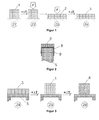
- FIG. 1 shows schematically the preparation of a novel molding of a composition based on an epoxy resin composition, as described above.
- the solid composition 1 is in its original state Z1 in the original form, in which it was brought, for example, in their preparation.
- the composition is then heated by a temperature ⁇ T 1 to a temperature which is above the glass transition temperature T g of the epoxy resin composition but, in the case of a thermosetting epoxy resin composition, below its curing temperature. If the composition is in this state Z2, it is brought into its temporary, yet deformable form 2 under the action of a force F. In this temporary, yet deformable form, as shown in state Z3, the elastomer is in a stretched form.
- the composition is maintained in this temporary form and the temperature of the composition is again lowered by the temperature ⁇ T 1 to a temperature which is below the glass transition temperature T g of the epoxy resin composition.
- the composition solidifies and is now firmly in its temporary form 3, as shown in state Z4.
- the composition is storage stable and can be further processed.
- the shaped body can be punched or cut and / or in particular be attached to a carrier or arranged in a cavity to be reinforced of a structural component.
- the deformation of the composition according to the invention, in which it is brought into its temporary form, is typically carried out by pressing, rolling, drawing and the like. It is important in shaping that the composition in the deformed state can be cooled to a temperature below the glass transition temperature T g or the melting point of the curable structural adhesive so that it remains in its temporary form.
- the present invention relates to a reinforcing element for reinforcement in cavities of structural components comprising a support, to which a shaped body according to the above description is attached.
- This carrier can consist of any materials.
- the carrier consists of a plastic, a metal or a combination of plastic and metal.
- Preferred plastics are polyurethanes, polyamides, polyesters and polyolefins and polyolefin copolymers, in particular high-temperature-resistant polymers such as poly (phenylene ether), polysulfones or polyethersulfones.
- Most preferred plastics are polyamides (PA) such as PA6 or PA66, polyethylenes and polypropylene as well as polystyrene and copolymers such as acrylonitrile-butadiene-styrene (ABS).
- Preferred metals are aluminum, steel, nickel and alloys of these metals. The metal may further be untreated or it may be pretreated by suitable means, for example to prevent corrosion or to improve adhesion.
- the carrier may further have any structure and structure. It may, for example, be solid, hollow or foamed or have a lattice-like structure.
- the surface of the carrier may typically be smooth, rough or textured.
- the carrier in addition to its function as a carrier for the composition according to the invention or the molded part produced from it, the carrier can contribute to structural reinforcement or to sealing of the component or also to noise insulation.
- the carrier can furthermore have at least one fastening means, in particular a clip, for fastening and placing the reinforcing element in a cavity.
- a fastening means in particular a clip
- the attachment of the reinforcing element with a clip is particularly suitable for applications in which the entire surface of the component, including the cavity inner wall, for example, must be accessible for dip coating. In such cases, an attachment, for example by gluing is not suitable because the paint can not reach the point of bonding.
- the carrier consists of a plastic which is coated with a metal.
- plastic and as metal the materials described above are preferred.
- the metal with which the plastic is coated can be attached to the plastic in any way.
- the attachment by mechanical fasteners such as nails, screws, rivets, mechanical clips, clamps, flanging and the like, or by gluing the metal to the plastic.
- the metal may also have been applied to the plastic by means of plastic electroplating.
- the layer thickness of the metal layer on the plastic carrier is 0.03 to 1.5 mm.
- the plastic support which is coated with a metal, has the advantage over a pure metal support that on the one hand it is lighter and on the other hand, by the properties of the plastic as the choice of material and its processing, in its mechanical properties and in its embodiment can be varied very wide.
- the advantage of the metal coating over a pure plastic carrier is that the metals are generally more adhesive.
- Another advantage of the metal coating is that with heat-curing structural adhesives, the metal layer can be heated very locally and efficiently by induction.
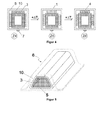
- FIG. 2 shows a carrier 5 made of a plastic, which is coated with a metal 8. The metal is attached with nails 9 on the carrier. On the metal layer is a shaped body 3, consisting of a composition according to the invention in its temporary state.
- FIG. 3 schematically shows a reinforcing element, consisting of a support 5, to which a molded body 3 is mounted from a composition according to the invention with thermosetting epoxy resin composition as a structural adhesive and elastomer in its temporary form, in its initial state Z4.
- the molded body 3 is then heated by a temperature .DELTA.T 1 to a temperature which is above the glass transition temperature T g of the epoxy resin composition, wherein the elastomer relaxes and leads to a deformation of the molding or the composition 1 in its original shape , This corresponds to state Z5 in FIG FIG. 3 , Thereafter, the temperature is further increased by ⁇ T 2 to a temperature at which the epoxy resin composition cures.
- the cured composition 4 is shown in state Z6.
- the invention includes the use of a reinforcing element, as previously described, for reinforcement in cavities of structural components.
- structural components are preferably used in bodies and / or frames of means of transport and locomotion, in particular of vehicles by water or on land or by aircraft.
- the invention comprises the use of a reinforcing element according to the invention in the bodies or frames of automobiles, trucks, railway carriages, boats, ships, helicopters and aircraft, most preferably in automobiles.
- the support of the reinforcing element consists of an induction-heatable metal or of a material which is coated with an induction-heatable metal
- the curable structural adhesive is a thermosetting structural adhesive
- FIG. 4 shows analogously to FIG. 3 schematically the gain in a cavity of a structural member 6, wherein in the interior of the structural member, a reinforcing member consisting of a carrier 5 and a plurality of molded articles 3 of a composition according to the invention with thermosetting epoxy resin composition as a structural adhesive and elastomer in its temporary form attached.
- the carrier of the reinforcing element is fastened with a clip 7 on the structural component.
- the molding or the composition is in its temporary form (state Z4) and is then heated by a temperature .DELTA.T 1 to a temperature which exceeds the Glass transition temperature T g of the curable structural adhesive is.
- the elastomer relaxes and leads to a deformation of the molded body or the composition 1 in its original shape, whereby the open gap 10 between the reinforcing element and cavity is closed and the inventive composition adheres to the cavity inner wall (state Z5).
- the heat-curing structural adhesive cures.
- FIG. 4 Condition Z6, shows the reinforced structural member with the cured composition 4.
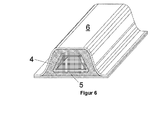
- FIG. 5 shows a reinforcing element, as it is used in a cavity 10 of a structural member 6 before the deformation of the molding or the inventive composition in its temporary shape 3, which is located on a support 5.
- FIG. 6 shows the reinforcing element FIG. 5 as it is used in a cavity of a structural member 6, wherein the molding or the inventive composition in this case has already returned to its original shape and adheres to the inner walls of the structural member 6. Further shows FIG. 6 the cured composition 4.
- the shape and structure of reinforcing elements according to the invention can be chosen according to their place of use.
- the present invention relates to a cured composition as obtainable by a curing process, in particular by heat curing, from a previously described composition.
- modulus of elasticity (modulus of elasticity) and the yield stress were determined on the basis of DIN EN ISO 604 at a constant deformation rate of 10 mm / min on cured specimens of dimensions 10x10x6 mm (LxWxH).
- the modulus of elasticity was determined as a secant modulus for the strain difference of 0.5 and 1%.
- the flow stress corresponds to the intersection of two secants of the elongation differences of 0.5 and 1% or 10 and 15%.
- the dimensional stability of the material in the temporary mold was determined during 7 days at standard climate (23 ° C / 50% humidity) ("Relaxation"), the resilience to the original form after 7 days of storage under standard conditions.
- the dimensions of the original shape of the specimens measures 10x10x6 mm (LxWxH).
- the height in original form ( H 0 ) was thus 6 mm.
- thermoplastic elastomers include an ethylene-vinyl acetate copolymer (Elvax ® 470, available from DuPont Company, USA), an ethylene-octene copolymer (Engage ® 8450, available from Dow Chemical Company, USA) and a thermoplastic polyurethane (Pearl Bond ® D12C75, available from Merquinsa SL, Spain).
- the formulations 1 to 6 and the reference foam Ref were prepared by mixing the ingredients according to Table 1 in the corresponding percentages by weight on a twin-screw extruder at temperatures above the melting temperature of the particular used thermoplastic elastomers or below the decomposition temperature of the chemical blowing agent ( Ref ).
- the structural adhesive was cured for 60 minutes at 180 ° C. in all test specimens.
Landscapes
- Chemical & Material Sciences (AREA)
- Organic Chemistry (AREA)
- Health & Medical Sciences (AREA)
- Chemical Kinetics & Catalysis (AREA)
- Medicinal Chemistry (AREA)
- Polymers & Plastics (AREA)
- Adhesives Or Adhesive Processes (AREA)
- Compositions Of Macromolecular Compounds (AREA)
- Epoxy Resins (AREA)
Abstract
Die vorliegende Erfindung betrifft eine Zusammensetzung umfassend
a) mindestens einen härtbaren Strukturklebstoff, sowie
b) mindestens ein thermoplastisches Elastomer, wobei das thermoplastische Elastomer als durchdringendes Polymernetzwerk im Strukturklebstoff vorliegt. Eine derartige Zusammensetzung stellt ein sogenanntes Formgedächtnis-Material dar und eignet sich zur Verstärkung von Hohlräumen in strukturellen Bauteilen, wie beispielsweise in Automobilkarosserien.
Description
- Die Erfindung liegt auf dem Gebiet der Zusammensetzungen umfassend härtbare Strukturklebstoffe, welche als so genannte Formgedächtnis-Materialien ausgebildet sind. Weiterhin betrifft die Erfindung ein Verstärkungselement zur Verstärkung in Hohlräumen von strukturellen Bauteilen, wie sie beispielsweise bei Automobilkarosserien und dergleichen eingesetzt werden.
- Oftmals werden bei Konstruktionen jeglicher Art hohlräumige strukturelle Bauteile eingesetzt. Diese Bauweise erlaubt es, das Gewicht der Konstruktion und den Materialaufwand niedrig zu halten, jedoch gehen bei dieser Bauweise häufig auch Stabilität und Festigkeit verloren. Die Hohlräume bieten zudem, aufgrund der grösseren Oberfläche des hohlen Bauteils, eine grössere Angriffsfläche für Korrosion, falls Feuchtigkeit oder Schmutz in sie eindringt. Ebenfalls können Geräusche, die beispielsweise durch Wind oder Vibrationen verursacht werden, in oder entlang der Hohlräume übertragen werden.
- Aufgrund der Form und/oder des engen Ausmasses solcher Hohlräume ist es vielfach schwierig diese effizient zu verstärken, abzudichten oder die Geräuschübertragung einzudämmen.
- Insbesondere um die mechanischen Eigenschaften hohlräumiger struktureller Bauteile zu verbessern, ist es weitgehend üblich, lokale Verstärkungselemente in die Bauteile einzusetzen oder einzubauen. Derartige Verstärkungselemente bestehen typischerweise aus Metallen oder Kunststoffen oder aus Kombinationen dieser Werkstoffe. An schwer zugänglichen Stellen, welche beispielsweise erst nach der Montage des Bauteils verstärkt oder abgedichtet werden sollen, werden häufig auch Strukturschäume eingesetzt. Dies ist etwa bei der Herstellung von Fahrzeugstrukturen bzw. Karosserien der Fall. Der Vorteil der Strukturschäume ist, dass sie im nicht expandierten Zustand in einem Hohlraum montiert werden können und später, vor allem durch Temperaturerhöhung geschäumt werden können. So kann beispielsweise die Innenwand des Hohlraums auch nach der Montage des Verstärkungselements mittels kathodischer Tauchlackierung (KTL) vollständig beschichtet und erst danach durch Schäumung des Strukturklebstoffs verstärkt werden. Die Schäumung erfolgt dabei typischerweise während der Härtung der KTL-Schicht im Ofen.
- Der Nachteil derartiger Verstärkungselemente ist, dass die mechanischen Eigenschaften des Strukturklebstoffs mit dem Schäumungsvorgang beeinträchtigt werden.
- Die Aufgabe der vorliegenden Erfindung ist es daher, ein Verstärkungselement zur Verfügung zu stellen, welcher die Nachteile des Standes der Technik überwindet und es erlaubt, einen Spalt zwischen Hohlraum und Verstärkungselement zu schliessen, ohne dass dabei die mechanischen Eigenschaften des Strukturklebstoffs beeinträchtigt werden.
- Überraschenderweise wurde gefunden, dass mit Zusammensetzungen gemäss Anspruch 1 diese Aufgabe gelöst werden kann.
- Es wurde gefunden, dass sich mit erfindungsgemässen Zusammensetzungen Formgedächtnis-Materialien realisieren lassen, welche insbesondere durch Temperatureinfluss ihre Form ändern und somit in eine gewünschte Richtung expandieren, ohne dass dabei eine Volumenzunahme, beispielsweise durch einen Schäumungsvorgang, einhergeht.
- Weitere Aspekte der Erfindung sind Gegenstand weiterer unabhängiger Ansprüche. Besonders bevorzugte Ausführungsformen der Erfindung sind Gegenstand der abhängigen Ansprüche.
- Anhand der Zeichnungen werden Ausführungsbeispiele der Erfindung näher erläutert. Gleiche Elemente sind in den verschiedenen Figuren mit den gleichen Bezugszeichen versehen. Selbstverständlich ist die Erfindung nicht auf gezeigte und beschriebene Ausführungsbeispiele beschränkt.
- Es zeigen:
- Figur 1
- eine schematische Darstellung der Herstellung eines Formkörpers bzw. einer Zusammensetzung in ihrer temporären Form;
- Figur 2
- eine schematische Darstellung Verstärkungselements;
- Figur 3
- eine schematische Darstellung der Formänderung und Aushärtung der Zusammensetzung;
- Figur 4
- eine schematische Darstellung der Verstärkung eines Hohlraums eines strukturellen Bauteils;
- Figur 5
- eine schematische Darstellung eines Verstärkungselements in einem Hohlraum eines strukturellen Bauteils;
- Figur 6
- eine schematische Darstellung eines verstärkten strukturellen Bauteils.
- In den Figuren sind nur die für das unmittelbare Verständnis der Erfindung wesentlichen Elemente gezeigt.
- Die vorliegende Erfindung betrifft in einem ersten Aspekt eine Zusammensetzung umfassend
- i) mindestens einen härtbaren Strukturklebstoff, sowie
- ii) mindestens ein thermoplastisches Elastomer;
wobei das thermoplastische Elastomer als durchdringendes Polymernetzwerk im Strukturklebstoff vorliegt. - Beim härtbaren Strukturklebstoff handelt es sich vorzugsweise um eine Epoxidharzzusammensetzung oder um eine Polyurethanzusammensetzung.
- Handelt es sich beim härtbaren Strukturklebstoff um eine Epoxidharzzusammensetzung, sollte diese eine Glasübergangstemperatur Tg aufweisen, welche über Raumtemperatur liegt.
- Handelt es sich beim härtbaren Strukturklebstoff um eine Polyurethanzusammensetzung, sollte diese einen Schmelzpunkt aufweist, welcher über Raumtemperatur liegt.
- Im vorliegenden Dokument beziehen sich also Angaben zur Glasübergangstemperatur Tg, auf jene Ausführungsform der erfindungsgemässen Zusammensetzung, bei welcher der härtbare Strukturklebstoff eine Epoxidharzzusammensetzung ist, sofern nichts anderes angegeben ist. Entsprechend beziehen sich Angaben zum Schmelzpunkt auf jene Ausführungsform, bei welcher der härtbare Strukturklebstoff eine Polyurethanzusammensetzung ist.
- Der Term "durchdringendes Polymernetzwerk" wird im vorliegenden Dokument in Anlehnung an die Definition eines "Semi-interpenetrierenden Polymernetzwerks" (semi-interpenetrating polymer network (SIPN)) gemäss IUPAC Compendium of Chemical Terminology, 2nd Edition (1997) verwendet. Demnach umfasst das SIPN mindestens ein Netzwerk sowie mindestens ein lineares oder verzweigtes Polymer, wobei dieses Polymer das Netzwerk zumindest teilweise durchdringt. In der erfindungsgemässen Zusammensetzung bildet das Elastomer das Netzwerk, das Polymer ist Bestandteil des härtbaren Strukturklebstoffs.
- Die erfindungsgemässe Zusammensetzung, welche ein "Formgedächtnis-Material" ("shape memory material") darstellt, kann bei ihrer Herstellung oder Verarbeitung in eine bestimmte Form ("ursprüngliche Form") gebracht werden und weist nach dieser Formgebung eine feste Konsistenz auf, das heisst, dass der Strukturklebstoff bei einer Temperatur unterhalb seiner Glasübergangstemperatur Tg bzw. unterhalb seines Schmelzpunktes vorliegt. In dieser Form liegt das Elastomer, welches als durchdringendes Polymernetzwerk im Strukturklebstoff vorliegt, im Wesentlichen entspannt vor. Bei Bedarf wird die Zusammensetzung dann auf eine Temperatur oberhalb der Glasübergangstemperatur Tg bzw. des Schmelzpunkts des Strukturklebstoffs erwärmt und in eine beliebige Form ("temporäre Form") gebracht. In dieser temporären Form liegt das Elastomer in einer gespannten Form vor. Die Zusammensetzung wird in dieser temporären Form gehalten und die Temperatur der Zusammensetzung wird wieder unter die Glasübergangstemperatur Tg bzw. unter den Schmelzpunkt des Strukturklebstoffs gesenkt, wodurch sich die Zusammensetzung in der temporären Form verfestigt. In dieser temporären Form ist die Zusammensetzung lagerstabil und kann einer Verarbeitung, beispielsweise Stanzen oder Schneiden, unterzogen werden. Wird die Zusammensetzung zu einem späteren Zeitpunkt wieder auf eine Temperatur erwärmt, welche oberhalb der Glasübergangstemperatur Tg bzw. des Schmelzpunkts des Strukturklebstoffs liegt, bringt sich das Elastomer wieder in seine entspannte Form und verformt somit die gesamte Zusammensetzung in ihre ursprüngliche Form.
- Insbesondere handelt es sich bei der erfindungsgemässen Zusammensetzung um ein Formgedächtnis-Material, welches bei Raumtemperatur (23°C) fest ist, was eine optimale Handhabung des Materials in seiner ursprünglichen und in seiner temporären Form erlaubt.
- Damit die erfindungsgemässe Zusammensetzung bei Raumtemperatur fest ist, sollte der härtbare Strukturklebstoff eine Glasübergangstemperatur Tg, im Fall einer Epoxidharzzusammensetzung, bzw. einen Schmelzpunkt, im Fall einer Polyurethanzusammensetzung, aufweisen, welcher über der Raumtemperatur liegt. Ansonsten könnte die erfindungsgemässe Zusammensetzung, nachdem sie in ihre temporäre Form gebracht wurde, das in dieser temporären Form angespannte Elastomer, bei Raumtemperatur nicht in dieser Form halten.
- Vorzugsweise handelt es sich beim härtbaren Strukturklebstoff um
- eine Epoxidharzzusammensetzung mit einer Glasübergangstemperatur Tg im Bereich von 23°C bis 95°C, insbesondere von 30°C bis 80°C, bevorzugt von 35°C bis 75°C; oder um
- eine Polyurethanzusammensetzung mit einem Schmelzpunkt im Bereich von 23°C bis 95°C, insbesondere von 30°C bis 80°C, bevorzugt von 35°C bis 75°C.
- Weiterhin bevorzugt ist die Oberfläche der erfindungsgemässen Zusammensetzung bei Raumtemperatur nicht klebrig, was ihre Handhabung erleichtert.
- Beim härtbaren Strukturklebstoff handelt es sich insbesondere um einen hitzehärtenden Strukturklebstoff, welcher vorzugsweise eine Aushärtungstemperatur im Bereich von 120°C bis 220°C, insbesondere 160°C bis 200°C, aufweist.
- Handelt es sich beim härtbaren Strukturklebstoff um einen hitzehärtenden Strukturklebstoff, muss bei der Verarbeitung der Zusammensetzung, bei welcher sie in ihre temporäre Form gebracht wird, darauf geachtet werden, dass die Zusammensetzung nicht soweit erwärmt wird, dass der Aushärtungsvorgang einsetzt.
- Meist bevorzugt ist der härtbare Strukturklebstoff eine Epoxidharzzusammensetzung umfassend mindestens ein Epoxidharz A und mindestens einen Härter B für Epoxidharze, welcher durch erhöhte Temperatur aktiviert wird. Insbesondere handelt es sich dabei um eine einkomponentige Epoxidharzzusammensetzung.
- Das Epoxidharz A, weist durchschnittlich mehr als eine Epoxidgruppe pro Molekül auf und ist insbesondere ein Epoxid-Festharz oder eine Mischung eines Epoxid-Festharzes mit einem Epoxid-Flüssigharz. Der Begriff "Epoxid-Festharz" ist dem Epoxid-Fachmann bestens bekannt und wird im Gegensatz zu "Epoxid-Flüssigharz" verwendet. Die Glasübergangstemperatur Tg von Festharzen liegt über Raumtemperatur.
Bevorzugte Epoxid-Festharze weisen die Formel (I) auf.
- Hierbei stehen die Substituenten R' und R" unabhängig voneinander entweder für H oder CH3. Weiterhin steht der Index s für einen Wert von ≥ 1, insbesondere von ≥ 1.5, bevorzugt von 2 bis 12.
- Derartige Epoxid-Festharze sind beispielsweise kommerziell erhältlich von Dow Chemical Company, USA, von Huntsman International LLC, USA, oder von Hexion Specialty Chemicals Inc, USA.
- Bevorzugte Epoxid-Flüssigharze, welche insbesondere zusammen mit einem Epoxid-Festharz verwendet werden können, weisen die Formel (II) auf.

- Hierbei stehen die Substituenten R''' und R"" unabhängig voneinander entweder für H oder CH3- Weiterhin steht der Index r für einen Wert von 0 bis 1. Bevorzugt steht r für einen Wert von ≤ 0.2.
- Es handelt sich somit vorzugsweise um Diglycidylether von Bisphenol-A (DGEBA), von Bisphenol-F sowie von Bisphenol-A/F. Die Bezeichnung "A/F" verweist hierbei auf eine Mischung von Aceton mit Formaldehyd, welche als Edukt bei dessen Herstellung verwendet wird. Solche Flüssigharze sind beispielsweise unter den Handelsnamen Araldite® GY 250, Araldite® PY 304, Araldite® GY 282 von Huntsman International LLC, USA, oder D.E.R.® 331 oder D.E.R.® 330 von Dow Chemical Company, USA, oder unter dem Handelsnamen Epikote® 828 oder Epikote® 862 von Hexion Specialty Chemicals Inc, USA, kommerziell erhältlich.
- Weitere geeignete Epoxidharze sind sogenannte Novolake. Diese weisen insbesondere die folgende Formel (III) auf.

- Dabei steht der Rest X für ein Wasserstoffatom oder für eine Methylgruppe. Der Rest Y steht für -CH2- oder für einen Rest der Formel (IV).

- Weiterhin steht der Index z für einen Wert von 0 bis 7, insbesondere für einen Wert ≥ 3.
- Insbesondere handelt es sich hierbei um Phenol- oder Kresol-Novolake (Y steht für -CH2-).
- Derartige Epoxidharze sind unter dem Handelsnamen EPN oder ECN sowie Tactix® 556 von Huntsman International, LLC, USA, oder unter der Produktreihe D.E.N.™ von Dow Chemical Company, USA, kommerziell erhältlich.
- Bevorzugt stellt das Epoxidharz A ein Epoxid-Festharz der Formel (I) dar. In einer ebenfalls bevorzugten Ausführungsform enthält die hitzehärtende Epoxidharzzusammensetzung sowohl mindestens ein Epoxid-Festharz der Formel (I) als auch mindestens ein Epoxid-Flüssigharz der Formel (II).
- Der Anteil von Epoxidharz A beträgt vorzugsweise 2 bis 90 Gew.-%, insbesondere 5 bis 70 Gew.-%, bevorzugt 10 bis 60 Gew.-%, bezogen auf das Gesamtgewicht des härtbaren Strukturklebstoffs.
- Der Härter B für Epoxidharze wird durch erhöhte Temperatur aktiviert. Bevorzugt handelt es sich beim Härter B um einen Härter, ausgewählt aus der Gruppe bestehend aus Dicyandiamid, Guanamine, Guanidine, Aminoguanidine methylphenyl)-1,1-dimethylharnstoff (Chlortoluron), oder Phenyl-Dimethylharnstoffe, insbesondere p-Chlorphenyl-N,N-dimethylharnstoff (Monuron), 3-Phenyl-1,1-dimethylharnstoff (Fenuron), 3,4-Dichlorphenyl-N,N-dimethylharnstoff (Diuron), sowie Imidazole und Amin-Komplexe.
- Besonders bevorzugt als Härter B ist Dicyandiamid, insbesondere in Kombination mit einem substituierten Harnstoff. Der Vorteil der Kombination von Dicyandiamid mit einem substituierten Harnstoff liegt in der dadurch erzielten beschleunigten Aushärtung der Zusammensetzung.
- Der Anteil des Härters B beträgt vorzugsweise 0.05 bis 8 Gew.-%, insbesondere 0.1 bis 6 Gew.-%, bevorzugt 0.2 bis 5 Gew.-%, bezogen auf das Gesamtgewicht des härtbaren Strukturklebstoffs.
- Der Begriff "Härter" schliesst im vorliegenden Dokument auch Katalysatoren und katalytisch wirkende Verbindungen mit ein. Dem Fachmann ist in diesem Fall klar, dass beim Einsatz eines Katalysators oder einer katalytisch wirkenden Verbindung als Härter B, der Anteil der Härters B am gesamten härtbaren Strukturklebstoff im unteren Bereich des angegebenen Wertebereichs liegt.
- Zusätzlich kann die Epoxidharzzusammensetzung mindestens ein Schlagzähigkeitsmodifikator umfassen.
- Unter einem "Schlagzähigkeitsmodifikator" wird in diesem Dokument ein Zusatz eines organischen Polymers zu einer Epoxidharzmatrix verstanden, der bereits in geringen Mengen, d.h. von typischerweise zwischen 0.1 und 20 Gew.-%, eine deutliche Zunahme der Zähigkeit bewirkt und somit in der Lage ist, höhere Schlag- oder Stossbeanspruchung aufzunehmen, bevor die Matrix einreisst oder bricht.
- Als Schlagzähigkeitsmodifikatoren eignen sich insbesondere reaktive Flüssigkautschuke auf Basis von Nitrilkautschuk oder Derivate von Polyetherpolyol-Polyurethanen, Core-Shell Polymere und ähnliche dem Fachmann bekannte Systeme.
- Geeignete Schlagzähigkeitsmodifikatoren sind als Schlagzähigkeitsmodifikatoren D beschrieben in der europäischen Patentanmeldung mit der Anmeldenummer
EP08168009.2 - Insbesondere handelt es sich beim Schlagzähigkeitsmodifikator um ein nicht-thermoplastisches Elastomer.
- Ebenfalls geeignet ist der härtbare Strukturklebstoff eine einkomponentige, hitzehärtende Polyurethanzusammensetzung, welche bei Raumtemperatur eine feste Konsistenz aufweist.
- Einkomponentige, hitzehärtende Polyurethanzusammensetzungen, welche bei Raumtemperatur eine feste Konsistenz aufweisen, sind dem Fachmann bekannt und können unterschiedliche Härtungsmechanismen aufweisen.
- In einer ersten Ausführungsform werden Polyurethanzusammensetzungen eingesetzt, welche neben einem festen Isocyanatgruppen terminierten Polyurethanpolymer, weiterhin mindestens ein Aldimin, insbesondere ein Polyaldimin, als Härter aufweisen. Beim Erhöhen der Temperatur und der dadurch verursachten Erweichung des Polyurethanpolymers, kann Wasser, insbesondere in Form von Luftfeuchtigkeit, in die Polyurethanzusammensetzung eindringen, wodurch es zur Hydrolysierung der Aldimine und dadurch zur Freisetzung von Aminen kommt, welche dann mit den Isocyanatgruppen reagieren und zur Aushärtung der Zusammensetzung führen.
- Beispielsweise sind derartige geeignete hitzehärtende Polyurethanzusammensetzungen beschreiben in
WO 2008/059056 A1 , deren gesamte Offenbarung hiermit durch Bezugnahme eingeschlossen wird. - In einer zweiten Ausführungsform können Polyurethanzusammensetzungen eingesetzt werden, welche neben einem Isocyanatgruppen terminierten Polyurethanpolymer weiterhin mindestens einen Härter aufweisen, welcher gegenüber Isocyanaten reaktive Gruppen enthält und in blockierter Form vorliegt. Die Blockierung kann dabei chemischer oder physikalischer Natur sein. Beispiele für geeignete chemisch blockierte Härter sind über eine Komplexbindung an Metalle gebundene Polyamine, im Besonderen Komplexverbindungen von Methylendianilin (MDA) und Natriumchlorid. Solche Komplexverbindungen werden üblicherweise mit der Bruttoformel (MDA)3·NaCl beschrieben. Ein geeigneter Typ ist als Dispersion in Diethylhexylphthalat unter dem Handelsnamen Caytur® 21 von Chemtura Corp., USA, erhältlich. Der Komplex zersetzt sich beim Erwärmen auf 80 bis 160°C mit bei höherer Temperatur zunehmender Geschwindigkeit, wodurch Methylendianilin als aktiver Härter freigesetzt wird.
- Beispiele für physikalisch blockierte Härter sind mikroverkapselte Härter. Zur Verwendung als Härter in mikroverkapselter Form insbesondere geeignet sind zwei- oder mehrwertige Alkohole, kurzkettige Polyesterpolyole, aliphatische, cycloaliphatische und aromatische Aminoalkohole, Hydrazide von Dicarbonsäuren, aliphatische Polyamine, cycloaliphatische Polyamine, Ethergruppen-haltige aliphatische Polyamine, Polyoxyalkylen-Polyamine, beispielsweise erhältlich unter dem Namen Jeffamine® (von Huntsman International LLC, USA), aromatische Polyamine. Bevorzugt sind aliphatische, cycloaliphatische und aromatische Polyamine, insbesondere Ethanolamin, Propanolamin, Butanolamin, N-Methylethanolamin, Diethanolamin, Triethanolamin.
- Eine ausführliche Aufzählung von geeigneten Härtern zur Verwendung in mikroverkapselter Form ist beispielsweise zu finden auf Seite 14, ab Zeile 25 in
WO 2009/016106 A1 , dessen gesamte Offenbarung hiermit durch Bezugnahme eingeschlossen wird. - Die Mikroverkapselung dieser Härter kann nach einem der gängigen Verfahren durchgeführt werden, beispielsweise mittels Sprühtrocknung, Grenzflächenpolymerisation, Koazervation, Tauch- oder Zentrifugenverfahren, Wirbelbettverfahren, Vakuum-Verkapselung, elektrostatische Mikroverkapselung. Die so erhaltenen Mikrokapseln haben eine Partikelgrösse von 0.1 bis 100 µm, bevorzugt 0.3 bis 50 µm. Die Grösse der Mikrokapseln ist so bemessen, dass sie sich beim Erhitzen einerseits effektiv öffnen, und andererseits nach der Aushärtung eine optimale Homogenität und damit Kohäsionsfestigkeit des Strukturklebstoffs erhalten wird. Sie dürfen weiterhin keinen schädlichen Einfluss auf die Adhäsionseigenschaften des Strukturklebstoffs ausüben. Als Material für die Kapselhülle kommen Polymere in Betracht, die im zu verkapselnden Härter unlöslich sind und einen Schmelzpunkt von 50 bis 150°C aufweisen. Beispiele für geeignete Polymere sind KohlenwasserstoffWachse, Polyethylenwachse, Wachsester, Polyester, Polyamide, Polyacrylate, Polymethacrylate oder Mischungen mehrerer solcher Polymeren.
- In einer dritten Ausführungsform können Isocyanatgruppen terminierte Polyurethanpolymere eingesetzt werden, deren Isocyanatgruppen mit thermisch labilen Blockierungsgruppen, wie beispielsweise mit Caprolactam, umgesetzt wurden oder solche, deren Isocyanatgruppen zu thermisch labilen Uretdionen dimerisiert wurden.
- In einer vierten Ausführungsform können Polyurethanzusammensetzungen eingesetzt werden, welche neben einem Hydroxylgruppen terminierten Polyurethanpolymer und/oder mindestens einem polymeren Polyol, wie es vorhergehend beschrieben wurde, weiterhin mindestens einen verkapseltes oder oberflächendeaktiviertes Polyisocyanat als Härter umfassen. Verkapselte oder oberflächendeaktivierte Polyisocyanate sind dem Fachmann bekannt und beispielsweise beschreiben in
EP 0 204 970 oder inEP 0 922 720 , deren Offenbarung hiermit eingeschlossen ist. Als Polyisocyanate eignen sich dabei die vorhergehend beschriebenen. - Handelt es sich beim härtbaren Strukturklebstoff um eine Polyurethanzusammensetzung sind die Bestandteile zu deren Herstellung, insbesondere Polyisocyanat und Polyol, bezüglich ihrem Molekulargewicht und ihrer Funktionalität, vorzugsweise so zu wählen, dass das Polyurethan einen Schmelzpunkt aufweist, welcher über Raumtemperatur liegt, insbesondere im Bereich von 23 bis 95°C.
- Der härtbare Strukturklebstoff kann weitere Bestandteile enthalten, wie sie üblicherweise in härtbaren Strukturklebstoffen eingesetzt werden.
- Insbesondere enthält der härtbare Strukturklebstoff zusätzlich mindestens einen Füllstoff. Bevorzugt handelt es sich hierbei um Glimmer, Talk, Kaolin, Wollastonit, Feldspat, Syenith, Chlorit, Bentonit, Montmorillonit, Calciumcarbonat (gefällt oder gemahlen), Dolomit, Quarz, Kieselsäuren (pyrogen oder gefällt), Cristobalit, Calciumoxid, Aluminiumhydroxid, Magnesiumoxid, Keramikhohlkugeln, Glashohlkugeln, organische Hohlkugeln, Glaskugeln, Farbpigmente. Als Füllstoff sind sowohl die organisch beschichteten als auch die unbeschichteten kommerziell erhältlichen und dem Fachmann bekannten Formen gemeint. Ein weiteres Beispiel sind funktionalisierte Alumoxane, wie sie z. B. in
US 6,322,890 beschrieben sind und deren Inhalt hiermit durch Bezugnahme eingeschlossen wird. - Vorteilhaft beträgt der Anteil des Füllstoffs 1 bis 60 Gew.-%, vorzugsweise 5 bis 50 Gew.-%, insbesondere 10 bis 35 Gew.-%, bezogen auf das Gewicht des gesamten härtbaren Strukturklebstoffs.
- Als weitere Bestandteile umfasst der härtbare Strukturklebstoff insbesondere auch Thixothropierungsmittel wie beispielsweise Aerosile oder Nanoclays, Zähigkeitsmodifikatoren, Reaktivverdünner sowie weitere dem Fachmann bekannte Bestandteile.
- Meist bevorzugt handelt es sich beim härtbaren Strukturklebstoff um eine einkomponentige, hitzehärtende Epoxidharzzusammensetzung.
- Das in der erfindungsgemässen Zusammensetzung vorhandene thermoplatische Elastomer, welches als durchdringendes Polymernetzwerk im Strukturklebstoff vorliegt, weist vorzugsweise eine Glasübergangstemperatur Tg(Elastomer) auf, welche niedriger als die Glasübergangstemperatur Tg bzw. als der Schmelzpunkt des härtbaren Strukturklebstoffs ist.
- Insbesondere weist das thermoplastische Elastomer einen Schmelzpunkt auf, welcher über der Glasübergangstemperatur Tg bzw. dem Schmelzpunkt des härtbaren Strukturklebstoffs liegt. Bevorzugt weist das thermoplastische Elastomer einen Schmelzpunkt von 50°C bis 200°C, insbesondere von 70°C bis 160°C, auf.
- Das thermoplastische Elastomer weist vorzugsweise ein Molekulargewicht Mn von ≥ 50'000 g/mol, insbesondere 70'000 bis 300'000 g/mol, auf. In diesem Molekulargewichtsbereich weist das thermoplastische Elastomer den Vorteil auf, dass es thermoplastisch verarbeitbar ist und gute mechanische Eigenschaften aufweist.
- Meist bevorzugt ist das thermoplastische Elastomer ausgewählt aus der Gruppe bestehend aus Polyolefinen und Polyolefin-Copolymeren. Beispielsweise sind dies Polyethylen (PE), Polypropylen (PP), Ethylenvinylacetat (EVA) und dergleichen. Es ist beispielsweise auch denkbar, dass in der erfindungsgemässen Zusammensetzung eine Mischung von zwei oder mehr Elastomeren vorhanden ist.
- Bei der Herstellung der erfindungsgemässen Zusammensetzung, wird der härtbare Strukturklebstoff bei einer Temperatur über seiner Glasübergangstemperatur Tg bzw. seinem Schmelzpunkt mit dem thermoplastischen Elastomer vermischt bis eine homogene Mischung erhalten wird. Das Vermischen des härtbaren Strukturklebstoffs mit dem thermoplastischen Elastomer erfolgt meist bevorzugt bei einer Temperatur oberhalb des Schmelzpunktes der Elastomers, beispielsweise in einem Extruder.
- Handelt es sich beim härtbaren Strukturklebstoff um einen hitzehärtenden Strukturklebstoff, kann der Strukturklebstoff vor der Zugabe des Härters mit dem Elastomer vermischt werden. Dadurch kann die Temperatur beim Vermischen bis oder sogar über die Aushärtungstemperatur des hitzehärtenden Strukturklebstoffs eingestellt werden, ohne dass es zu einer Aushärtung des Strukturklebstoffs kommt. Bei höheren Temperaturen wird in der Regel eine effizientere Vermischung erreicht.
- In einem zweiten Aspekt betrifft die vorliegende Erfindung einen Formkörper, welcher einer reversiblen Formgebung unterzogen wurde, wobei die Formgebung die Schritte umfasst:
- a) Erwärmen einer Zusammensetzung, wie sie vorhergehend beschrieben worden ist, auf eine Temperatur oberhalb der Glasübergangstemperatur Tg des härtbaren Strukturklebstoffs, wenn dieser eine Epoxidharzzusammensetzung ist, oder auf eine Temperatur oberhalb des Schmelzpunkts des härtbaren Strukturklebstoffs, wenn dieser eine Polyurethanzusammensetzung ist;
- b) Verformen der Zusammensetzung, unter Spannung des Elastomers;
- c) Abkühlen der verformten Zusammensetzung unter die Glasübergangstemperatur Tg des härtbaren Strukturklebstoffs, wenn dieser eine Epoxidharzzusammensetzung ist, oder unter den Schmelzpunkt des härtbaren Strukturklebstoffs, wenn dieser eine Polyurethanzusammensetzung ist.
-
Figur 1 zeigt schematisch die Herstellung eines erfindungsgemässen Formkörpers aus einer Zusammensetzung auf der Basis einer Epoxidharzzusammensetzung, wie sie vorhergehend beschrieben wurde. - Dabei liegt die feste Zusammensetzung 1 in ihrem Ausgangszustand Z1 in der ursprünglichen Form vor, in welcher sie beispielsweise bei ihrer Herstellung gebracht wurde. In einem ersten Schritt wird die Zusammensetzung dann um eine Temperatur ΔT1 auf eine Temperatur erwärmt, welche über der Glasübergangstemperatur Tg der Epoxidharzzusammensetzung liegt, jedoch, im Fall einer hitzehärtenden Epoxidharzzusammensetzung, unterhalb ihrer Aushärtungstemperatur. Befindet sich die Zusammensetzung in diesem Zustand Z2, wird sie unter Einwirkung einer Kraft F in ihre temporäre, noch verformbare Form 2 gebracht. In dieser temporären, noch verformbaren Form, wie sie in Zustand Z3 dargestellt ist, liegt das Elastomer in gespannter Form vor. Die Zusammensetzung wird in dieser temporären Form gehalten und die Temperatur der Zusammensetzung wird wieder um die Temperatur ΔT1 auf eine Temperatur erniedrigt, welche unterhalb der Glasübergangstemperatur Tg der Epoxidharzzusammensetzung liegt. Dabei verfestigt sich die Zusammensetzung und liegt nun fest in ihrer temporären Form 3 vor, so wie es in Zustand Z4 gezeigt ist. In diesem Zustand als Formkörper ist die Zusammensetzung lagerstabil und kann weiter verarbeitet werden. So kann der Formkörper gestanzt oder geschnitten werden und/oder insbesondere an einem Träger angebracht werden oder in einem zu verstärkenden Hohlraum eines strukturellen Bauteils angeordnet werden.
- Das Verformen der erfindungsgemässen Zusammensetzung, bei welcher sie in ihre temporäre Form gebracht wird, erfolgt typischerweise durch Pressen, Walzen, Ziehen und dergleichen. Wichtig ist beim Verformen, dass die Zusammensetzung im verformten Zustand auf eine Temperatur unterhalb der Glasübergangstemperatur Tg bzw. des Schmelzpunkts des härtbaren Strukturklebstoffs abgekühlt werden kann, damit sie in ihrer temporären Form verbleibt.
- In einem weiteren Aspekt betrifft die vorliegende Erfindung ein Verstärkungselement zur Verstärkung in Hohlräumen von strukturellen Bauteilen umfassend einen Träger, an welchem ein Formkörper gemäss vorhergehender Beschreibung angebracht ist.
- Dieser Träger kann aus beliebigen Materialien bestehen. Insbesondere besteht der Träger aus einem aus einem Kunststoff, aus einem Metall oder aus einer Kombination von Kunststoff und Metall.
- Bevorzugte Kunststoffe sind Polyurethane, Polyamide, Polyester und Polyolefine und Polyolefin-Copolymere, insbesondere hochtemperaturbeständige Polymere wie Poly(phenylenether), Polysulfone oder Polyethersulfone. Meist bevorzugte Kunststoffe sind Polyamide (PA) wie PA6 oder PA66, Polyethlyen und Polypropylen sowie Polystyrol und Copolymere wie Acrylnitril-Butadien-Styrol (ABS). Bevorzugte Metalle sind Aluminium, Stahl, Nickel und Legierungen dieser Metalle. Das Metall kann weiterhin unbehandelt vorliegen oder es kann mit geeigneten Mitteln, beispielsweise zur Verhinderung von Korrosion oder zur Verbesserung der Haftung vorbehandelt sein.
- Der Träger kann weiterhin einen beliebigen Aufbau und eine beliebige Struktur aufweisen. Es kann beispielsweise massiv, hohl oder geschäumt sein oder eine gitterartige Struktur aufweisen. Die Oberfläche des Trägers kann typischerweise glatt, rau oder strukturiert sein.
- Der Träger kann, zusätzlich zur seiner Funktion als Träger für die erfindungsgemässe Zusammensetzung bzw. dem aus ihr hergestellten Formteil, zur strukturellen Verstärkung oder zur Abdichtung des Bauteils oder auch zur Geräuschdämmung beitragen.
- Der Träger kann weiterhin mindestens ein Befestigungsmittel, insbesondere einen Clip, zur Befestigung und Platzierung des Verstärkungselements in einem Hohlraum aufweisen. Die Befestigung des Verstärkungselements mit einem Clip eignet sich insbesondere für Anwendungen, bei welchen die gesamte Oberfläche des Bauteils, also auch die Hohlrauminnenwand, beispielsweise für eine Tauchlackierung erreichbar sein muss. In solchen Fällen ist eine Befestigung beispielsweise durch Verkleben nicht geeignet, da der Lack die Stelle der Verklebung nicht erreichen kann.
- Meist bevorzugt besteht der Träger aus einem Kunststoff, welcher mit einem Metall beschichtet ist. Als Kunststoff und als Metall sind dabei die vorhergehend beschriebenen Materialien bevorzugt.
- Das Metall, mit welchem der Kunststoff beschichtet ist, kann dabei auf beliebige Art und Weise am Kunststoff befestigt sein. Beispielsweise erfolgt die Befestigung durch mechanische Befestigungsmittel wie Nägel, Schrauben, Nieten, mechanischen Clips, Klemmen, Bördeln und dergleichen, oder durch Verkleben des Metalls mit dem Kunststoff. Weiterhin kann das Metall auch mittels Kunststoffgalvanisierung auf den Kunststoff aufgetragen worden sein.
- Meist bevorzugt beträgt die Schichtdicke der Metallschicht auf dem Kunststoffträger 0.03 bis 1.5 mm.
- Der Träger aus Kunststoff, welcher mit einem Metall beschichtet ist, weist gegenüber einem reinen Metallträger den Vorteil auf, dass er einerseits leichter ist und dass er andererseits, durch die Eigenschaften des Kunststoffs wie die Wahl des Materials und dessen Verarbeitung, in seinen mechanischen Eigenschaften und in seiner Ausgestaltung sehr breit variiert werden kann. Der Vorteil der Metallbeschichtung gegenüber einem reinen Kunststoffträger ist, dass die Metalle in der Regel haftfreundlicher sind. Ein weiterer Vorteil der Metallbeschichtung ist, dass bei hitzehärtenden Strukturklebstoffen die Metallschicht sehr lokal und effizient durch Induktion erwärmt werden kann.
-
Figur 2 zeigt einen Träger 5 aus einem Kunststoff, welcher mit einem Metall 8 beschichtet ist. Das Metall ist dabei mit Nägeln 9 am Träger befestigt.
Auf der Metallschicht befindet sich ein Formkörper 3, bestehend aus einer erfindungsgemässen Zusammensetzung in ihrem temporären Zustand. -
Figur 3 zeigt schematisch ein Verstärkungselement, bestehend aus einem Träger 5, an welchem ein Formkörper 3 aus einer erfindungsgemässen Zusammensetzung mit hitzehärtender Epoxidharzzusammensetzung als Strukturklebstoff und Elastomer in ihrer temporären Form, angebracht ist, in seinem Ausgangszustand Z4. In einem ersten Schritt wird der Formkörper 3 dann um eine Temperatur ΔT1 auf eine Temperatur erwärmt, welche über der Glasübergangstemperatur Tg der Epoxidharzzusammensetzung liegt, wobei sich das Elastomer entspannt und zu einer Verformung des Formkörpers bzw. der Zusammensetzung 1 in ihre ursprüngliche Form führt. Dies entspricht Zustand Z5 inFigur 3 . Danach wird die Temperatur weiter um ΔT2 auf eine Temperatur erhöht, bei welcher die Epoxidharzzusammensetzung aushärtet. Die ausgehärtete Zusammensetzung 4 ist in Zustand Z6 gezeigt. - Die Temperaturerhöhung, welche zur Verformung des Formkörpers führt, und die Temperaturerhöhung zur Aushärtung des Strukturklebstoffs, müssen nicht zwingend zweistufig verlaufen. Es ist durchaus möglich, die beiden Schritte durch einen stetigen Temperaturanstieg nacheinander ablaufen zu lassen.
- Weiterhin umfasst die Erfindung die Verwendung eines Verstärkungselements, wie es vorhergehend beschrieben wurde, zur Verstärkung in Hohlräumen von strukturellen Bauteilen. Vorzugsweise werden derartige strukturelle Bauteile in Karosserien und/oder Rahmen von Transport- und Fortbewegungsmitteln, insbesondere von Fahrzeugen zu Wasser oder zu Land oder von Luftfahrzeugen, eingesetzt. Bevorzugt umfasst die Erfindung die Verwendung eines erfindungsgemässen Verstärkungselements in Karosserien oder Rahmen von Automobilen, Lastkraftwagen, Eisenbahnwagen, Booten, Schiffen, Hubschraubern und Flugzeugen, meist bevorzugt in Automobilen.
- Ein weiterer Aspekt der vorliegenden Erfindung betrifft ein Verfahren zur Verstärkung in Hohlräumen von strukturellen Bauteilen umfassend die Schritte:
- a') Platzieren eines Verstärkungselements gemäss vorhergehender Beschreibung in den Hohlraum eines strukturellen Bauteils;
- b') Erwärmen des Formkörpers 3 auf dem Verstärkungselement auf eine Temperatur oberhalb der Glasübergangstemperatur Tg des härtbaren Strukturklebstoffs, wenn dieser eine Epoxidharzzusammensetzung ist, oder auf eine Temperatur oberhalb des Schmelzpunkts des härtbaren Strukturklebstoffs, wenn dieser eine Polyurethanzusammensetzung ist, wodurch der Formkörper in seine Form vor der Formgebung, also in die ursprüngliche Form, zurückgeht;
- c') Aushärten des härtbaren Strukturklebstoffs.
- In einer Ausführungsform des beschriebenen Verfahrens zur Verstärkung in Hohlräumen von strukturellen Bauteilen, bei welchem die Massgabe gilt, dass der Träger des Verstärkungselements aus einem durch Induktion erwärmbaren Metall oder aus einem Material besteht, welcher mit einem durch Induktion erwärmbaren Metall beschichtet ist, und mit der Massgabe, dass der härtbare Strukturklebstoff eine hitzehärtender Strukturklebstoff ist, werden die Schritte b') und c') durch Induktion, das heisst durch ein elektromagnetisches Wechselfeld einer Induktionsspule, bewirkt.
-
Figur 4 zeigt analog zuFigur 3 schematisch die Verstärkung in einem Hohlraum eines strukturellen Bauteils 6, wobei im Inneren des strukturellen Bauteils ein Verstärkungselement, bestehend aus einem Träger 5 und mehreren Formkörpern 3 aus einer erfindungsgemässen Zusammensetzung mit hitzehärtender Epoxidharzzusammensetzung als Strukturklebstoff und Elastomer in ihrer temporären Form, angebracht ist. Der Träger des Verstärkungselements ist dabei mit einem Clip 7 am strukturellen Bauteil befestigt. Der Formkörper bzw. die Zusammensetzung liegt dabei in seiner temporären Form vor (Zustand Z4) und wird anschliessend um eine Temperatur ΔT1 auf eine Temperatur erwärmt, welche über der Glasübergangstemperatur Tg des härtbaren Strukturklebstoffs liegt. Dabei entspannt sich das Elastomer und führt zu einer Verformung des Formkörpers bzw. der Zusammensetzung 1 in ihre ursprüngliche Form, wodurch der offen gelassene Spalt 10 zwischen Verstärkungselement und Hohlraum geschlossen wird und sich die erfindungsgemässe Zusammensetzung an die Hohlrauminnenwand haftet (Zustand Z5). Nach einer weiteren Temperaturerhöhung um eine Temperatur ΔT2 härtet der hitzehärtende Strukturklebstoff aus.Figur 4 , Zustand Z6, zeigt das verstärkte strukturelle Bauteil mit der ausgehärteten Zusammensetzung 4. -
Figur 5 zeigt ein Verstärkungselement, wie es in einem Hohlraum 10 eines strukturellen Bauteils 6 eingesetzt wird vor der Verformung des Formkörpers bzw. der erfindungsgemässen Zusammensetzung in ihrer temporären Form 3, welche sich auf einem Träger 5 befindet. -
Figur 6 zeigt das Verstärkungselement ausFigur 5 wie es in einem Hohlraum eines strukturellen Bauteils 6 eingesetzt ist, wobei das Formteil bzw. die erfindungsgemässe Zusammensetzung in diesem Fall bereits in seine ursprüngliche Form zurückgegangen ist und an die Innenwände des strukturellen Bauteils 6 haftet. Weiterhin zeigtFigur 6 die ausgehärtete Zusammensetzung 4.
Die Form und Struktur erfindungsgemässer Verstärkungselemente kann gemäss ihrem Einsatzort beliebig gewählt werden. - Weiterhin betrifft die vorliegende Erfindung eine gehärtete Zusammensetzung, wie sie durch einen Härtungsvorgang, insbesondere durch Hitzehärtung, aus einer vorhergehend beschriebenen Zusammensetzung erhältlich ist.
- Im Folgenden sind Ausführungsbeispiele aufgeführt, welche die beschriebene Erfindung näher erläutern sollen. Selbstverständlich ist die Erfindung nicht auf diese beschriebenen Ausführungsbeispiele beschränkt.
- Der Elastizitätsmodul (E-Modul) und die Fliessspannung wurden, in Anlehnung an DIN EN ISO 604, bei einer konstanten Deformationsgeschwindigkeit von 10 mm/min an ausgehärteten Probekörpern der Abmessung 10x10x6 mm (LxBxH) bestimmt. Der E-Modul wurde als Sekantenmodul für die Dehnungsdifferenz von 0.5 und 1 % bestimmt. Die Fliessspannung entspricht dem Schnittpunkt zweier Sekanten der Dehnungsdifferenzen von 0.5 und 1 % bzw. 10 und 15 %.
- Die Formstabilität des Materials in der temporären Form wurde während 7 Tagen bei Normklima (23°C / 50% Luftfeuchtigkeit) ("Relaxation"), das Rückstellvermögen zur ursprünglichen Form nach 7 Tagen Lagerung bei Normklima bestimmt. Die Dimensionen der ursprünglichen Form der Probekörper misst 10x10x6 mm (LxBxH). Die Höhe in ursprünglicher Form (H0 ) betrug also 6 mm. Durch Pressen bei erhöhter Temperatur und anschliessendem Abkühlen wurden die Probekörper in die temporäre Form mit einer Höhe von 3 mm gebracht (HTemp ), was einer Kompression von 50 % entspricht und somit beim Rückstellvorgang einen Höhengewinn von 100 % erlaubt.
- Die Relaxation ist hier definiert als:

- Das Rückstellvermögen ist bestimmt als:

- Für die folgenden Beispiele wurde ein Strukturklebstoff auf Basis von Epoxidharzzusammensetzungen verwendet. Die in den Beispielen 1 bis 6 verwendeten thermoplastischen Elastomere sind ein Ethylen-Vinylacetat-Copolymer (Elvax® 470, erhältlich von DuPont Company, USA), ein Ethylen-Octen Copolymer (Engage® 8450, erhältlich von Dow Chemical Company, USA) und ein thermoplastisches Polyurethan (Pearlbond® D12C75, erhältlich von Merquinsa S.L., Spanien).
Tabelle 1 Formulierungen 1 bis 6 und Referenzschaum Ref in Gew.-% sowie Resultate Ref 1 2 3 4 5 6 Araldite® GT 7004 a) 85.4 88.3 79.5 57.9 79.5 57.9 57.9 Araldite® GY 250 a) Dicyandiamid b) 1.6 1.7 1.5 1.1 1.5 1.1 1.1 Jeffamine® D230 a) Armeen® CD c) Elvax® 470 9 31 Engage® 8450 9 31 Pearlbond® D12C75 31 Luvopor® OB d) 3 Aerosil® e) 10 10 10 10 10 10 10 Relaxation [%] - 0 0 0 0 0 0 Rückstellvermögen [%] - 0 50 90 65 90 55 E-Modul [MPa] 230 1700 1500 480 1400 740 2200 Fliessspannung [MPa] 11 60 47 20 48 30 65
b) erhältlich von AlzChem GmbH, Deutschland;
c) erhältlich von Akzo Nobel Surface Chemistry AB, Schweden;
d) erhältlich von Lehmann&Voss&Co, Deutschland;
e) erhältlich von Wacker Chemie AG, Deutschland. - Die Formulierungen 1 bis 6 sowie der Referenzschaum Ref wurden hergestellt durch Vermischen der Bestandteile gemäss Tabelle 1 in den entsprechenden Gewichtsprozenten auf einem Doppelschneckenextruder bei Temperaturen oberhalb der Schmelztemperatur des jeweils verwendeten thermoplastischen Elastomeren bzw. unterhalb der Zersetzungstemperatur des chemischen Treibmittels (Ref).
- Der Strukturklebstofif wurde bei allen Probekörpern während 60 min bei 180°C ausgehärtet.
-
- 1
- Zusammensetzung in der ursprünglichen Form
- 2
- Zusammensetzung (verformbar)
- 3
- Formkörper (temporäre Form)
- 4
- Ausgehärtete Zusammensetzung
- 5
- Träger
- 6
- strukturelles Bauteil
- 7
- Clip
- 8
- Metallschicht
- 9
- Nagel
- 10
- Spalt
- F
- Kraft
- Z1
- Zustand der Zusammensetzung in ursprünglicher Form
- Z2
- Zustand der verformbaren Zusammensetzung
- Z3
- Zustand der Zusammensetzung im temporären Zustand (Formkörper)
- Z4
- Zustand der ausgehärteten Zusammensetzung
- ΔT1
- Temperaturunterschied zwischen Temperatur unterhalb der Tg der Epoxidharzzusammensetzung und Temperatur oberhalb des Tg der Epoxidharzzusammensetzung
- ΔT2
- Temperaturunterschied zwischen Temperatur oberhalb der Tg der Epoxidharzzusammensetzung und der Aushärtungstemperatur der Epoxidharzzusammensetzung
Claims (15)
- Zusammensetzung umfassendi) mindestens einen härtbaren Strukturklebstoff, sowieii) mindestens ein thermoplastisches Elastomer;
dadurch gekennzeichnet, dass das thermoplastische Elastomer als durchdringendes Polymernetzwerk im Strukturklebstoff vorliegt. - Zusammensetzung gemäss Anspruch 1, dadurch gekennzeichnet, dass der härtbare Strukturklebstoff ein hitzehärtender Strukturklebstoff ist.
- Zusammensetzung gemäss Anspruch 2, dadurch gekennzeichnet, dass der hitzehärtende Strukturklebstoff eine Aushärtungstemperatur von 120°C bis 220°C aufweist.
- Zusammensetzung gemäss einem der vorhergehenden Ansprüche, dadurch gekennzeichnet, dass der härtbare Strukturklebstoff ausgewählt ist aus der Gruppe bestehend aus einer Epoxidharzzusammensetzung und Polyurethanzusammensetzung.
- Zusammensetzung gemäss Anspruch 4, dadurch gekennzeichnet, dass der härtbare Strukturklebstoff
eine Glasübergangstemperatur Tg im Bereich von 23°C bis 95°C aufweist, wenn der härtbare Strukturklebstoff eine Epoxidharzzusammensetzung ist; oder
einen Schmelzpunkt im Bereich von 23°C bis 95°C aufweist, wenn der härtbare Strukturklebstoff eine Polyurethanzusammensetzung ist. - Zusammensetzung gemäss Anspruch 4, dadurch gekennzeichnet, dass der härtbare Strukturklebstoff eine Epoxidharzzusammensetzung ist umfassend mindestens ein Epoxidharz A und mindestens einen Härter B für Epoxidharze, welcher durch erhöhte Temperatur aktiviert wird.
- Zusammensetzung gemäss einem der vorhergehenden Ansprüche, dadurch gekennzeichnet, dass das Elastomer ein Molekulargewicht Mn von ≥ 50'000 g/mol aufweist.
- Zusammensetzung gemäss Anspruch 4, dadurch gekennzeichnet, dass das thermoplastische Elastomer einen Schmelzpunkt aufweist der- über der Glasübergangstemperatur Tg des härtbaren Strukturklebstoffs liegt, wenn dieser eine Epoxidharzzusammensetzung ist; bzw.- über dem Schmelzpunkt des härtbaren Strukturklebstoffs liegt, wenn dieser eine Polyurethanzusammensetzung ist.
- Zusammensetzung gemäss Anspruch 8, dadurch gekennzeichnet, dass das thermoplastische Elastomer ausgewählt ist aus der Gruppe bestehend aus Polyolefinen und Polyolefin-Copolymeren.
- Formkörper (3), dadurch gekennzeichnet, dass er einer reversiblen Formgebung unterzogen wurde, wobei die Formgebung die Schritte umfasst:a) Erwärmen einer Zusammensetzung gemäss einem der Ansprüche 4 bis 9
auf eine Temperatur oberhalb der Glasübergangstemperatur Tg des härtbaren Strukturklebstoffs, wenn dieser eine Epoxidharzzusammensetzung ist, oder
auf eine Temperatur oberhalb des Schmelzpunkts des härtbaren Strukturklebstoffs, wenn dieser eine Polyurethanzusammensetzung ist;b) Verformen der Zusammensetzung, unter Spannung des Elastomers;c) Abkühlen der verformten Zusammensetzung unter die Glasübergangstemperatur Tg des härtbaren Strukturklebstoffs, wenn dieser eine Epoxidharzzusammensetzung ist, oder unter den Schmelzpunkt des härtbaren Strukturklebstoffs, wenn dieser eine Polyurethanzusammensetzung ist. - Verstärkungselement zur Verstärkung in Hohlräumen von strukturellen Bauteilen umfassend einen Träger (5), an welchem ein Formkörper (3) gemäss Anspruch 10 angebracht ist.
- Verstärkungselement gemäss Anspruch 11, dadurch gekennzeichnet, dass der Träger (5) aus einem Kunststoff, aus einem Metall oder aus einer Kombination von Kunststoff und Metall besteht.
- Verstärkungselement gemäss Anspruch 12, dadurch gekennzeichnet, dass der Träger (5) aus einem Kunststoff besteht, welcher mit einem Metall beschichtet ist.
- Verfahren zur Verstärkung in Hohlräumen von strukturellen Bauteilen umfassend die Schritte:a') Platzieren eines Verstärkungselements gemäss einem der Ansprüche 11 bis 13 in den Hohlraum eines strukturellen Bauteils;b') Erwärmen des Formkörpers (3) auf dem Verstärkungselement auf eine Temperatur oberhalb der Glasübergangstemperatur Tg des härtbaren Strukturklebstoffs, wenn dieser eine Epoxidharzzusammensetzung ist, oder
auf eine Temperatur oberhalb des Schmelzpunkts des härtbaren Strukturklebstoffs, wenn dieser eine Polyurethanzusammensetzung ist;c') Aushärten des härtbaren Strukturklebstoffs. - Verfahren gemäss Anspruch 14,
mit der Massgabe, dass der Träger (5) des Verstärkungselements aus einem induktiv heizbaren Metall oder aus einem Material besteht, welcher mit einem induktiv heizbaren Metall beschichtet ist; und
mit der Massgabe, dass der härtbare Strukturklebstoff eine hitzehärtender Strukturklebstoff ist;
dadurch gekennzeichnet, dass die Schritte b') und c') durch Induktion bewirkt werden.
Priority Applications (9)
| Application Number | Priority Date | Filing Date | Title |
|---|---|---|---|
| EP20100158076 EP2368955A1 (de) | 2010-03-26 | 2010-03-26 | Formgedächtnis-Material auf Basis eines Strukturklebstoffs |
| CN201180021936.7A CN102869741B (zh) | 2010-03-26 | 2011-03-25 | 基于结构粘合剂的形状记忆材料 |
| JP2013501771A JP5990159B2 (ja) | 2010-03-26 | 2011-03-25 | 元々の形状へと可逆的成形が可能な、一時的形状に変形された物品の製造方法 |
| EP11709967.1A EP2553034B2 (de) | 2010-03-26 | 2011-03-25 | Formgedächtnis-Material auf Basis eines Strukturklebstoffs |
| BR112012024435A BR112012024435A2 (pt) | 2010-03-26 | 2011-03-25 | composição, corpo moldado, elemento de reforço e processo de reforço para reforçar espaços ocos de componentes estruturais |
| PCT/EP2011/054642 WO2011117398A1 (de) | 2010-03-26 | 2011-03-25 | Formgedächtnis-material auf basis eines strukturklebstoffs |
| KR1020127027355A KR20130057986A (ko) | 2010-03-26 | 2011-03-25 | 구조 접착제를 기초로 한 형상기억물질 |
| US13/627,359 US9884962B2 (en) | 2010-03-26 | 2012-09-26 | Shape memory material based on a structural adhesive |
| JP2015196932A JP6495796B2 (ja) | 2010-03-26 | 2015-10-02 | 構造用接着剤に基づく形状記憶材料 |
Applications Claiming Priority (1)
| Application Number | Priority Date | Filing Date | Title |
|---|---|---|---|
| EP20100158076 EP2368955A1 (de) | 2010-03-26 | 2010-03-26 | Formgedächtnis-Material auf Basis eines Strukturklebstoffs |
Publications (1)
| Publication Number | Publication Date |
|---|---|
| EP2368955A1 true EP2368955A1 (de) | 2011-09-28 |
Family
ID=42558479
Family Applications (2)
| Application Number | Title | Priority Date | Filing Date |
|---|---|---|---|
| EP20100158076 Withdrawn EP2368955A1 (de) | 2010-03-26 | 2010-03-26 | Formgedächtnis-Material auf Basis eines Strukturklebstoffs |
| EP11709967.1A Active EP2553034B2 (de) | 2010-03-26 | 2011-03-25 | Formgedächtnis-Material auf Basis eines Strukturklebstoffs |
Family Applications After (1)
| Application Number | Title | Priority Date | Filing Date |
|---|---|---|---|
| EP11709967.1A Active EP2553034B2 (de) | 2010-03-26 | 2011-03-25 | Formgedächtnis-Material auf Basis eines Strukturklebstoffs |
Country Status (7)
| Country | Link |
|---|---|
| US (1) | US9884962B2 (de) |
| EP (2) | EP2368955A1 (de) |
| JP (2) | JP5990159B2 (de) |
| KR (1) | KR20130057986A (de) |
| CN (1) | CN102869741B (de) |
| BR (1) | BR112012024435A2 (de) |
| WO (1) | WO2011117398A1 (de) |
Cited By (3)
| Publication number | Priority date | Publication date | Assignee | Title |
|---|---|---|---|---|
| US20130186562A1 (en) * | 2010-03-26 | 2013-07-25 | Sika Technology Ag | Shape memory material based on a structural adhesive |
| US9884962B2 (en) | 2010-03-26 | 2018-02-06 | Sika Technology Ag | Shape memory material based on a structural adhesive |
| EP2598590B1 (de) | 2010-07-27 | 2019-11-13 | Zephyros Inc. | Ausgerichtete strukturkleber |
Families Citing this family (13)
| Publication number | Priority date | Publication date | Assignee | Title |
|---|---|---|---|---|
| EP2759514A1 (de) | 2013-01-29 | 2014-07-30 | tesa SE | Haftklebemasse enthaltend ein verbundenes Nanopartikelnetzwerk, Verfahren zu ihrer Herstellung sowie die Verwendung derselben |
| CN105722933A (zh) | 2013-07-26 | 2016-06-29 | 泽费罗斯股份有限公司 | 热固性粘合膜的改进或涉及它的改进 |
| DE102014103884A1 (de) * | 2014-03-21 | 2015-09-24 | Endress + Hauser Flowtec Ag | Ultraschallwandler und Ultraschall-Durchflussmessgerät |
| US10167854B2 (en) | 2016-07-28 | 2019-01-01 | International Business Machines Corporation | Shape memory article with heat-generating microcapsule |
| EP3523354B1 (de) * | 2016-10-06 | 2022-05-11 | 3M Innovative Properties Company | Härtbare zusammensetzungen und zugehörige verfahren |
| EP3421331B1 (de) | 2017-06-29 | 2021-06-16 | Sika Technology Ag | System eines verstärkten strukturelementes eines kraftfahrzeugs |
| EP3466800B1 (de) | 2017-10-06 | 2024-03-13 | Sika Technology Ag | Verstärkungsvorrichtung zur verstärkung eines strukturelementes in einem kraftfahrzeug |
| KR101943755B1 (ko) | 2017-11-07 | 2019-01-29 | 국방과학연구소 | 우주구조물의 가변형 안테나용 형상 기억 고분자 필름 |
| CN111491978B (zh) * | 2018-01-25 | 2023-05-09 | Sika技术股份公司 | 具有改善机械性能的形状记忆材料 |
| JP7198590B2 (ja) * | 2018-03-16 | 2023-01-04 | 三菱重工業株式会社 | 樹脂含有材料構造体及び樹脂含有材料構造体の製造方法 |
| KR102090058B1 (ko) * | 2018-07-11 | 2020-03-17 | 안동대학교 산학협력단 | 형상기억 소재를 이용하여 오브젝트를 접착하는 방법, 접착된 오브젝트를 분리하는 방법 및 형상기억 소재를 포함하는 접착제 |
| EP3770227A1 (de) * | 2019-07-23 | 2021-01-27 | Sika Technology Ag | Formgedächtnismaterial und verwendung davon zum verbinden von substraten |
| JP7223090B1 (ja) * | 2021-09-28 | 2023-02-15 | 古河電気工業株式会社 | 接着剤用組成物及びフィルム状接着剤、並びに、フィルム状接着剤を用いた半導体パッケージ及びその製造方法 |
Citations (8)
| Publication number | Priority date | Publication date | Assignee | Title |
|---|---|---|---|---|
| EP0204970A2 (de) | 1985-05-14 | 1986-12-17 | BASF Aktiengesellschaft | Verfahren zur Herstellung stabiler Dispersionen feinteiliger Polyisocyanate und deren Verwendung |
| EP0922720A1 (de) | 1997-12-11 | 1999-06-16 | Abend, Thomas | Verfahren zur Herstellung und Verwendung von lagerstabilen latentreaktiven Schichten oder Pulvern aus oberflächendesaktivierten festen Polyisocyanaten und Dispersionspolymeren mit funktionellen Gruppen |
| WO2000002968A1 (en) * | 1998-07-10 | 2000-01-20 | 3M Innovative Properties Company | Tackified thermoplastic-epoxy pressure sensitive adhesives |
| EP1155084A1 (de) * | 1998-11-05 | 2001-11-21 | Sika Corporation | Geräuschvermindernde und strukturelle verstärkungszusammensetzungen sowie verfahren zu deren verwendung |
| US6322890B1 (en) | 1998-03-30 | 2001-11-27 | Wm. Marsh Rice University | Supra-molecular alkylalumoxanes |
| WO2008059056A1 (de) | 2006-11-17 | 2008-05-22 | Sika Technology Ag | Polyaldimin enthaltende feuchtigkeitshärtende heissschmelzklebstoff-zusammensetzung |
| WO2009016106A1 (de) | 2007-07-27 | 2009-02-05 | Sika Technology Ag | Verstärkungselement zur verstärkung von hohlräumen von strukturellen bauteilen |
| EP2182025A1 (de) * | 2008-10-31 | 2010-05-05 | Sika Technology AG | Hitzehärtende Epoxidharzzusammensetzungen einsetzbar als Rohbauklebstoff oder Strukturschaum |
Family Cites Families (48)
| Publication number | Priority date | Publication date | Assignee | Title |
|---|---|---|---|---|
| US3227668A (en) * | 1961-09-11 | 1966-01-04 | Atlantic Refining Co | Wax-extended epoxide-ethylene vinyl acetate composition |
| US3649714A (en) | 1969-01-10 | 1972-03-14 | Minnesota Mining & Mfg | Structural adhesive comprising a dicyanate and a copolymer of acrylonitrile and butadiene |
| DE3639266A1 (de) | 1985-12-27 | 1987-07-02 | Fsk K K | Haftfolie |
| ZA87201B (en) | 1986-01-27 | 1987-09-30 | Essex Specialty Prod | Thermosetting composition for an interpenetrating polymer network system |
| US4766183A (en) | 1986-01-27 | 1988-08-23 | Essex Specialty Products, Inc. | Thermosetting composition for an interpenetrating polymer network system |
| US4923934A (en) | 1987-05-29 | 1990-05-08 | Werner Todd A | Interpenetrating polymer network of blocked urethane prepolymer, polyol, epoxy resin and anhydride |
| US5001194A (en) * | 1987-12-21 | 1991-03-19 | The Dow Chemical Company | Method of making functionalized polymeric compositions |
| JP2502132B2 (ja) | 1988-09-30 | 1996-05-29 | 三菱重工業株式会社 | 形状記憶ポリウレタンエラストマ―成形体 |
| US5086088A (en) | 1989-03-09 | 1992-02-04 | Minnesota Mining And Manufacturing Company | Epoxy-acrylate blend pressure-sensitive thermosetting adhesives |
| EP0432923A1 (de) | 1989-11-30 | 1991-06-19 | Lord Corporation | Epoxy-Kautschuk-Legierungsmischungen |
| JP2818254B2 (ja) | 1990-04-13 | 1998-10-30 | セメダイン株式会社 | 樹脂組成物 |
| US5322724A (en) * | 1991-01-14 | 1994-06-21 | Minnesota Mining And Manufacturing Company | Laminate of heat sealable polyolefin and cured polyolefin sheeting |
| US5331062A (en) | 1991-08-28 | 1994-07-19 | The United States Of America As Represented By The Secretary Of The Navy | Polyurethane-epoxy interpenetrating polymer network acoustic damping material |
| JP3128981B2 (ja) * | 1992-08-21 | 2001-01-29 | 東ソー株式会社 | 形状記憶樹脂材料 |
| JP3410202B2 (ja) | 1993-04-28 | 2003-05-26 | 日本テキサス・インスツルメンツ株式会社 | ウェハ貼着用粘着シートおよびこれを用いた半導体装置の製造方法 |
| DE69433206T2 (de) | 1993-06-16 | 2004-06-24 | Minnesota Mining And Mfg. Co., St. Paul | Schwingungsdäampfende konstruktionen, die thermisch polymerisierte epoxide verwenden |
| US5763529A (en) † | 1994-03-31 | 1998-06-09 | Cytec Technology Corp. | Interpenetrating polymer network compositions |
| EP0851894B1 (de) | 1995-09-20 | 2004-04-07 | Minnesota Mining And Manufacturing Company | Halb-interpenetrierende polymernetzwerke aus epoxy und polyolefin-harzen, verfahren dafür, und ihre verwendung |
| CA2202693A1 (en) * | 1996-04-19 | 1997-10-19 | Tsutomu Tomatsu | Thermoplastic resin compositions and temperature-dependent shape-transformable/fixable products making use of the same |
| JPH10176159A (ja) | 1996-12-20 | 1998-06-30 | Dainippon Ink & Chem Inc | 形状記憶性接着剤組成物、並びにそれを用いた積層体及び積層体の製造方法 |
| US6054007A (en) | 1997-04-09 | 2000-04-25 | 3M Innovative Properties Company | Method of forming shaped adhesives |
| US5965256A (en) | 1997-10-14 | 1999-10-12 | Minnesota Mining And Manufacturing Company | Protective films and coatings |
| JP3732404B2 (ja) | 1998-02-23 | 2006-01-05 | ニーモサイエンス ゲーエムベーハー | 形状記憶ポリマー組成物、形状記憶製品を形成する方法、および形状を記憶する組成物を形成する方法 |
| US6136398A (en) | 1998-05-01 | 2000-10-24 | 3M Innovative Properties Company | Energy cured sealant composition |
| US6077601A (en) * | 1998-05-01 | 2000-06-20 | 3M Innovative Properties Company | Coated abrasive article |
| US7429220B2 (en) | 2001-04-13 | 2008-09-30 | Acushnet Company | Golf balls containing interpenetrating polymer networks |
| AU2002309586A1 (en) | 2001-04-19 | 2002-11-05 | Diversified Chemical Technologies, Inc. | Composition of acrylated urethane oligomer, epoxy resin and amine hardener |
| DE10150737A1 (de) | 2001-10-15 | 2003-04-30 | Hilti Ag | Mehrkomponenten-Ortschaumsystem und dessen Verwendung |
| US7094843B2 (en) | 2002-08-19 | 2006-08-22 | 3M Innovative Properties Company | Epoxy compositions having improved shelf life and articles containing the same |
| US20040230309A1 (en) | 2003-02-14 | 2004-11-18 | Depuy Spine, Inc. | In-situ formed intervertebral fusion device and method |
| AU2003262035A1 (en) * | 2003-02-25 | 2004-09-17 | Toda Kogyo Corporation | Resin composition for pavement |
| EP1457509B1 (de) | 2003-03-11 | 2006-06-28 | hanse chemie AG | Polymere Epoxidharz-Zusammensetzung |
| DE10338245A1 (de) | 2003-08-20 | 2005-03-24 | Basf Ag | Formmasse |
| US20050198904A1 (en) | 2004-03-12 | 2005-09-15 | Browne Alan L. | Active seal assemblies for movable windows |
| US20090280318A1 (en) * | 2005-12-09 | 2009-11-12 | Mitsui Chemicals, Inc. | Olefin polymer, composition thereof and adhesive resin comprising the composition |
| JP5449779B2 (ja) | 2005-12-15 | 2014-03-19 | コーナーストーン リサーチ グループ,インコーポレーテッド | 形状記憶エポキシ共重合体 |
| US20090131557A1 (en) | 2006-05-02 | 2009-05-21 | Hiroshi Uyama | Shape memory resin |
| FR2905068B1 (fr) * | 2006-08-25 | 2008-10-31 | Oreal | Procede de maquillage des cils et ensemble de conditionnement. |
| JP4966716B2 (ja) | 2007-04-06 | 2012-07-04 | ユニ・チャーム株式会社 | 加工装置 |
| US8685528B2 (en) | 2007-04-20 | 2014-04-01 | GM Global Technology Operations LLC | Shape memory polymer and adhesive combination and methods of making and using the same |
| US8628838B2 (en) | 2007-04-20 | 2014-01-14 | GM Global Technology Operations LLC | Multilayer thermo-reversible dry adhesives |
| US8618238B2 (en) | 2007-04-20 | 2013-12-31 | GM Global Technology Operations LLC | Shape memory epoxy polymers |
| CA2696950A1 (en) * | 2007-09-13 | 2009-03-19 | Basf Se | Flame retardant combinations of hydroxyalkyl phosphine oxides with 1,3,5-triazines and epoxides |
| DE102008007749A1 (de) | 2008-02-05 | 2009-08-06 | Tesa Se | Thermisch aktivier- und härtbare Klebefolie insbesondere für die Verklebung von elektronischen Bauteilen und flexiblen gedruckten Leiterbahnen |
| KR101662856B1 (ko) | 2008-07-23 | 2016-10-05 | 쓰리엠 이노베이티브 프로퍼티즈 컴파니 | 2액형 에폭시계 구조용 접착제 |
| EP2368955A1 (de) | 2010-03-26 | 2011-09-28 | Sika Technology AG | Formgedächtnis-Material auf Basis eines Strukturklebstoffs |
| EP2368957A1 (de) * | 2010-03-26 | 2011-09-28 | Sika Technology AG | Verstärkungselement zur Verstärkung in Hohlräumen von strukturellen Bauteilen |
| EP2368956A1 (de) | 2010-03-26 | 2011-09-28 | Sika Technology AG | Formgedächtnis-Material auf Basis eines Strukturklebstoffs |
-
2010
- 2010-03-26 EP EP20100158076 patent/EP2368955A1/de not_active Withdrawn
-
2011
- 2011-03-25 KR KR1020127027355A patent/KR20130057986A/ko not_active Ceased
- 2011-03-25 EP EP11709967.1A patent/EP2553034B2/de active Active
- 2011-03-25 BR BR112012024435A patent/BR112012024435A2/pt not_active IP Right Cessation
- 2011-03-25 CN CN201180021936.7A patent/CN102869741B/zh active Active
- 2011-03-25 WO PCT/EP2011/054642 patent/WO2011117398A1/de not_active Ceased
- 2011-03-25 JP JP2013501771A patent/JP5990159B2/ja not_active Expired - Fee Related
-
2012
- 2012-09-26 US US13/627,359 patent/US9884962B2/en active Active
-
2015
- 2015-10-02 JP JP2015196932A patent/JP6495796B2/ja not_active Expired - Fee Related
Patent Citations (8)
| Publication number | Priority date | Publication date | Assignee | Title |
|---|---|---|---|---|
| EP0204970A2 (de) | 1985-05-14 | 1986-12-17 | BASF Aktiengesellschaft | Verfahren zur Herstellung stabiler Dispersionen feinteiliger Polyisocyanate und deren Verwendung |
| EP0922720A1 (de) | 1997-12-11 | 1999-06-16 | Abend, Thomas | Verfahren zur Herstellung und Verwendung von lagerstabilen latentreaktiven Schichten oder Pulvern aus oberflächendesaktivierten festen Polyisocyanaten und Dispersionspolymeren mit funktionellen Gruppen |
| US6322890B1 (en) | 1998-03-30 | 2001-11-27 | Wm. Marsh Rice University | Supra-molecular alkylalumoxanes |
| WO2000002968A1 (en) * | 1998-07-10 | 2000-01-20 | 3M Innovative Properties Company | Tackified thermoplastic-epoxy pressure sensitive adhesives |
| EP1155084A1 (de) * | 1998-11-05 | 2001-11-21 | Sika Corporation | Geräuschvermindernde und strukturelle verstärkungszusammensetzungen sowie verfahren zu deren verwendung |
| WO2008059056A1 (de) | 2006-11-17 | 2008-05-22 | Sika Technology Ag | Polyaldimin enthaltende feuchtigkeitshärtende heissschmelzklebstoff-zusammensetzung |
| WO2009016106A1 (de) | 2007-07-27 | 2009-02-05 | Sika Technology Ag | Verstärkungselement zur verstärkung von hohlräumen von strukturellen bauteilen |
| EP2182025A1 (de) * | 2008-10-31 | 2010-05-05 | Sika Technology AG | Hitzehärtende Epoxidharzzusammensetzungen einsetzbar als Rohbauklebstoff oder Strukturschaum |
Non-Patent Citations (1)
| Title |
|---|
| R. E. TOUHSAENT, D. A. THOMAS, AND L. H. SPERLING: "EPOXY/ACRYLIC SIMULTANEOUSINTERPENETRATING NETWORKS", J. POLYMER SCI.: SYMPOSIUM, no. 46, 1974, pages 175 - 190, XP002597611 * |
Cited By (4)
| Publication number | Priority date | Publication date | Assignee | Title |
|---|---|---|---|---|
| US20130186562A1 (en) * | 2010-03-26 | 2013-07-25 | Sika Technology Ag | Shape memory material based on a structural adhesive |
| US8952097B2 (en) * | 2010-03-26 | 2015-02-10 | Sika Technology Ag | Shape memory material based on a structural adhesive |
| US9884962B2 (en) | 2010-03-26 | 2018-02-06 | Sika Technology Ag | Shape memory material based on a structural adhesive |
| EP2598590B1 (de) | 2010-07-27 | 2019-11-13 | Zephyros Inc. | Ausgerichtete strukturkleber |
Also Published As
| Publication number | Publication date |
|---|---|
| JP6495796B2 (ja) | 2019-04-03 |
| EP2553034A1 (de) | 2013-02-06 |
| BR112012024435A2 (pt) | 2019-09-24 |
| JP5990159B2 (ja) | 2016-09-07 |
| US20130034736A1 (en) | 2013-02-07 |
| WO2011117398A1 (de) | 2011-09-29 |
| CN102869741A (zh) | 2013-01-09 |
| JP2016041812A (ja) | 2016-03-31 |
| JP2013525515A (ja) | 2013-06-20 |
| KR20130057986A (ko) | 2013-06-03 |
| US9884962B2 (en) | 2018-02-06 |
| EP2553034B2 (de) | 2022-06-01 |
| EP2553034B1 (de) | 2014-07-23 |
| CN102869741B (zh) | 2015-12-16 |
Similar Documents
| Publication | Publication Date | Title |
|---|---|---|
| EP2553034B1 (de) | Formgedächtnis-Material auf Basis eines Strukturklebstoffs | |
| EP2553035B1 (de) | Formgedächtnis-Material auf Basis eines Strukturklebstoffs | |
| EP2368957A1 (de) | Verstärkungselement zur Verstärkung in Hohlräumen von strukturellen Bauteilen | |
| EP2183150B1 (de) | Verstärkungselement zur verstärkung von hohlräumen von strukturellen bauteilen | |
| EP2182025B1 (de) | Hitzehärtende Epoxidharzzusammensetzungen einsetzbar als Rohbauklebstoff oder Strukturschaum | |
| EP2337728A1 (de) | Verstärkte struktur eines fahrzeugs | |
| EP2426160B1 (de) | Hitzehärtende Epoxidharzzusammensetzung mit Wasser als Treibmittel | |
| EP3677611B1 (de) | Hitzehärtende epoxidharzzusammensetzung mit tiefer aushärtungstemperatur und guter lagerstabilität | |
| EP1720952A1 (de) | Zweikomponentiger klebstoff zur herstellung von halbzeugen und sandwich-verbundwerkstoffen | |
| EP2176048B1 (de) | Verfahren zur herstellung eines sandwichelements | |
| DE60016879T2 (de) | Gießharz und Verfahren zur Herstellung von Harzformen | |
| EP3460019A1 (de) | Einkomponentiger hitzehärtender epoxidklebstoff mit verbesserter haftung | |
| EP2151369A1 (de) | Dichtteil aus schäumbarem Material | |
| DE102004045844A1 (de) | Verfahren zur Herstellung eines faserverstärkten Produktes | |
| EP3662001A1 (de) | Thermisch expandierbare einkomponentige hitzehärtende epoxidharzzusammensetzung mit hoher standfestigkeit und guter granulierbarkeit | |
| EP2261104A1 (de) | Element zur Abdichtung oder Verstärkung eines Hohlraumes und Verfahren zur Einbringung eines solchen Elements in den Hohlraum eines Bauelementes | |
| DE112023004571T5 (de) | Einkomponentige härtbare zusammensetzung |
Legal Events
| Date | Code | Title | Description |
|---|---|---|---|
| PUAI | Public reference made under article 153(3) epc to a published international application that has entered the european phase |
Free format text: ORIGINAL CODE: 0009012 |
|
| AK | Designated contracting states |
Kind code of ref document: A1 Designated state(s): AT BE BG CH CY CZ DE DK EE ES FI FR GB GR HR HU IE IS IT LI LT LU LV MC MK MT NL NO PL PT RO SE SI SK SM TR |
|
| AX | Request for extension of the european patent |
Extension state: AL BA ME RS |
|
| STAA | Information on the status of an ep patent application or granted ep patent |
Free format text: STATUS: THE APPLICATION IS DEEMED TO BE WITHDRAWN |
|
| 18D | Application deemed to be withdrawn |
Effective date: 20120329 |