EP2314442A1 - Vernetzerbatches, enthaltend markierende Substanzen, neue vernetzbare Kautschukmischungen und ein Verfahren zu deren Herstellung und deren Verwendung - Google Patents
Vernetzerbatches, enthaltend markierende Substanzen, neue vernetzbare Kautschukmischungen und ein Verfahren zu deren Herstellung und deren Verwendung Download PDFInfo
- Publication number
- EP2314442A1 EP2314442A1 EP09173921A EP09173921A EP2314442A1 EP 2314442 A1 EP2314442 A1 EP 2314442A1 EP 09173921 A EP09173921 A EP 09173921A EP 09173921 A EP09173921 A EP 09173921A EP 2314442 A1 EP2314442 A1 EP 2314442A1
- Authority
- EP
- European Patent Office
- Prior art keywords
- crosslinking
- rubber
- powder
- oxides
- compounds
- Prior art date
- Legal status (The legal status is an assumption and is not a legal conclusion. Google has not performed a legal analysis and makes no representation as to the accuracy of the status listed.)
- Granted
Links
Images
Classifications
-
- B—PERFORMING OPERATIONS; TRANSPORTING
- B29—WORKING OF PLASTICS; WORKING OF SUBSTANCES IN A PLASTIC STATE IN GENERAL
- B29C—SHAPING OR JOINING OF PLASTICS; SHAPING OF MATERIAL IN A PLASTIC STATE, NOT OTHERWISE PROVIDED FOR; AFTER-TREATMENT OF THE SHAPED PRODUCTS, e.g. REPAIRING
- B29C55/00—Shaping by stretching, e.g. drawing through a die; Apparatus therefor
-
- C—CHEMISTRY; METALLURGY
- C08—ORGANIC MACROMOLECULAR COMPOUNDS; THEIR PREPARATION OR CHEMICAL WORKING-UP; COMPOSITIONS BASED THEREON
- C08K—Use of inorganic or non-macromolecular organic substances as compounding ingredients
- C08K3/00—Use of inorganic substances as compounding ingredients
- C08K3/10—Metal compounds
- C08K3/105—Compounds containing metals of Groups 1 to 3 or of Groups 11 to 13 of the Periodic Table
-
- B—PERFORMING OPERATIONS; TRANSPORTING
- B41—PRINTING; LINING MACHINES; TYPEWRITERS; STAMPS
- B41M—PRINTING, DUPLICATING, MARKING, OR COPYING PROCESSES; COLOUR PRINTING
- B41M5/00—Duplicating or marking methods; Sheet materials for use therein
-
- C—CHEMISTRY; METALLURGY
- C08—ORGANIC MACROMOLECULAR COMPOUNDS; THEIR PREPARATION OR CHEMICAL WORKING-UP; COMPOSITIONS BASED THEREON
- C08J—WORKING-UP; GENERAL PROCESSES OF COMPOUNDING; AFTER-TREATMENT NOT COVERED BY SUBCLASSES C08B, C08C, C08F, C08G or C08H
- C08J3/00—Processes of treating or compounding macromolecular substances
- C08J3/24—Crosslinking, e.g. vulcanising, of macromolecules
- C08J3/242—Applying crosslinking or accelerating agent onto compounding ingredients such as fillers, reinforcements
-
- C—CHEMISTRY; METALLURGY
- C08—ORGANIC MACROMOLECULAR COMPOUNDS; THEIR PREPARATION OR CHEMICAL WORKING-UP; COMPOSITIONS BASED THEREON
- C08J—WORKING-UP; GENERAL PROCESSES OF COMPOUNDING; AFTER-TREATMENT NOT COVERED BY SUBCLASSES C08B, C08C, C08F, C08G or C08H
- C08J3/00—Processes of treating or compounding macromolecular substances
- C08J3/24—Crosslinking, e.g. vulcanising, of macromolecules
- C08J3/248—Measuring crosslinking reactions
-
- C—CHEMISTRY; METALLURGY
- C08—ORGANIC MACROMOLECULAR COMPOUNDS; THEIR PREPARATION OR CHEMICAL WORKING-UP; COMPOSITIONS BASED THEREON
- C08K—Use of inorganic or non-macromolecular organic substances as compounding ingredients
- C08K3/00—Use of inorganic substances as compounding ingredients
- C08K3/01—Use of inorganic substances as compounding ingredients characterized by their specific function
- C08K3/011—Crosslinking or vulcanising agents, e.g. accelerators
-
- C—CHEMISTRY; METALLURGY
- C08—ORGANIC MACROMOLECULAR COMPOUNDS; THEIR PREPARATION OR CHEMICAL WORKING-UP; COMPOSITIONS BASED THEREON
- C08K—Use of inorganic or non-macromolecular organic substances as compounding ingredients
- C08K3/00—Use of inorganic substances as compounding ingredients
- C08K3/10—Metal compounds
- C08K3/11—Compounds containing metals of Groups 4 to 10 or of Groups 14 to 16 of the Periodic Table
-
- C—CHEMISTRY; METALLURGY
- C08—ORGANIC MACROMOLECULAR COMPOUNDS; THEIR PREPARATION OR CHEMICAL WORKING-UP; COMPOSITIONS BASED THEREON
- C08K—Use of inorganic or non-macromolecular organic substances as compounding ingredients
- C08K5/00—Use of organic ingredients
- C08K5/0008—Organic ingredients according to more than one of the "one dot" groups of C08K5/01 - C08K5/59
- C08K5/0025—Crosslinking or vulcanising agents; including accelerators
-
- C—CHEMISTRY; METALLURGY
- C08—ORGANIC MACROMOLECULAR COMPOUNDS; THEIR PREPARATION OR CHEMICAL WORKING-UP; COMPOSITIONS BASED THEREON
- C08L—COMPOSITIONS OF MACROMOLECULAR COMPOUNDS
- C08L21/00—Compositions of unspecified rubbers
-
- B—PERFORMING OPERATIONS; TRANSPORTING
- B29—WORKING OF PLASTICS; WORKING OF SUBSTANCES IN A PLASTIC STATE IN GENERAL
- B29K—INDEXING SCHEME ASSOCIATED WITH SUBCLASSES B29B, B29C OR B29D, RELATING TO MOULDING MATERIALS OR TO MATERIALS FOR MOULDS, REINFORCEMENTS, FILLERS OR PREFORMED PARTS, e.g. INSERTS
- B29K2105/00—Condition, form or state of moulded material or of the material to be shaped
- B29K2105/0005—Condition, form or state of moulded material or of the material to be shaped containing compounding ingredients
- B29K2105/0052—Tracing elements, e.g. to detect the origin of articles
Definitions
- the invention relates to novel crosslinker batches containing marking substances, novel crosslinkable rubber mixtures and a process for their preparation and their use.
- the object of the present invention was therefore to provide new crosslinker batches, with which an online, preferably also an inline detection for determining the quality of the distribution of the crosslinking batches is possible.
- the object underlying this invention could be achieved by crosslinking batches containing marking substances.
- the present invention therefore crosslinking batches containing marking powdery substances having a density greater than 2 g / cm 3 .
- inorganic compounds are preferable.
- oxidation-resistant compounds is preferred, it being particularly preferred if these are coated.
- combination includes both a combination of compounds from the individual groups or else within the abovementioned groups and a combination thereof.
- All these marking substances preferably have a density of at least 3.5 to 25 g / cm 3 , more preferably greater than 7.5 g / cm 3 , most preferably greater than 10 g / cm 3 .
- pulverulent encompasses all substances which are solid at temperatures below 130 ° C.
- the proportion of marking substances is preferably less than 50 wt .-%, preferably less than 10 wt .-%, more preferably less than 5 wt .-%, based on the Vernetzerbatch.
- the marking substances are preferably suitable for the detection by means of ultrasound, although other measuring methods, such as e.g. RFA (X-ray fluorescence analysis), NIR (near-infrared spectroscopy), LIPS (laser-induced plasma spectroscopy), terahertz spectroscopy, UV / VIS spectroscopy are not imposed.
- RFA X-ray fluorescence analysis
- NIR near-infrared spectroscopy
- LIPS laser-induced plasma spectroscopy
- terahertz spectroscopy UV / VIS spectroscopy
- crosslinker batch encompasses a mixture of at least one crosslinking agent and optionally further additives.
- the crosslinker batch according to the invention additionally contains at least one crosslinking agent.
- crosslinking agents such as sulfur, sulfur donors, peroxides or other crosslinkers, accelerators such as dithiocarbamates, thiurams, Use thioureas, mercapto accelerators, sulfenamides, thio and dithio phosphates, guanidines metal oxides, fatty acids and / or plasticizers.
- a mixture of crosslinking agents whose melting point is below 120 ° C, more preferably below 100 ° C, e.g. a mixture of sulfur, CBS (cyclohexyl benzothiazyl sulfenamide) and MBTS (methylbenzothiazyl disulfide).
- the crosslinker batch according to the invention additionally comprises binders, stabilizers and / or fillers, plasticizers and further auxiliaries.
- the proportion of these additional constituents, such as binders, etc., is preferably less than 30%, based on the crosslinker batch.
- binders it is preferred to select those polymers whose melting points, crystallinity and / or surface structures are similar to those of the rubber mixture so as to improve mixing, ie to obtain a homogeneous mixing result quickly.
- Suitable polymers are, in particular, natural rubber (NR), isoprene rubber (IR), styrene-butadiene rubber (SBR), butadiene rubber (BR), isoprene-isobutylene rubber (IIR), polychloroprene rubber (CR), acrylonitrile-butadiene rubber (NBR ), hydrogenated acrylonitrile-butadiene rubber (HNBR), carboxylated acrylonitrile-butadiene rubber (XNBR), hydrogenated carboxylated acrylonitrile-butadiene rubber (HXNBR), ethylene-propylene-diene rubber (EPDM), ethylene-propylene rubber ( EPM), fluororubber (FKM), perfluorinated fluororubber (FFKM), acrylate-ethylene rubber (AEM), acrylate rubber (ACM), ethylene-methylene-acrylate rubber (EMA), chlorinated polyethylene, chlorosulfonated polyethylene, ethylene-vinyl acetate
- Stabilizers for the purposes of the invention are, for example, discoloring and non-discoloring anti-aging agents, such as, for example, paraphenylenediamines, isopropylphenylparaphenylenediamine (IPPD), para-phenylenediamine (6PPD), N, N-ditoly-p-phenylenediamines (DTPD), etc., amines, such as trimethyl-1,2-dihydroquinoline (TMQ), (phenyl) amine] -1,4-naphthalenedione (PAN), bis (4-octylphenyl) amine (ODPA), styrenated diphenylamine (SDPA), etc.),
- discoloring and non-discoloring anti-aging agents such as, for example, paraphenylenediamines, isopropylphenylparaphenylenediamine (IPPD), para-phenylenediamine (6PPD), N, N-ditoly-p-
- Mono and bisphenols e.g. 2,2'-methylenebis (4-methyl-6-tert-butylphenol (BPH), 2,2'-isobutylidene-bis- (4,6-dimethyl-phenol) (NKF), 2,2'- Dicyclo-pentadienyl-bis (4-methyl-6-tert-butyl-phenol) (SKF), 2,2'-methylene-bis (4-methyl-6-cyclohexyl-phenol (ZKF), 2,6 -Di-tert-butyl-p-cresol (BHT), substituted phenol (DS), styrenated phenols (SPH), mercatpbenzimidazoles such as 2-mercaptobenzimidazole (MBI), 2-mercaptomethylbenzimidazoles (MMBI), zinc 4- and 4-hydroxybenzimidazole 5-methyl-2-mercapto-benzimidazoles (ZMMBI), etc., olefins, paraffinic and / or aromatic plasticizers, the composition
- Fillers according to the invention are e.g. in particular bright inorganic fillers, such as e.g. Mica, kaolin, silica, silica, chalk, talc, carbon fillers, e.g. Carbon black, graphite, carbon nanotubes and / or magnetic fillers such as carbonyl iron powder.
- bright inorganic fillers such as e.g. Mica, kaolin, silica, silica, chalk, talc
- carbon fillers e.g. Carbon black, graphite, carbon nanotubes and / or magnetic fillers such as carbonyl iron powder.
- Plasticizers within the meaning of the invention are, for example, long-chain esters or ethers or mineral oils (paraffinic, naphthenic or synthetic oils).
- Aids within the meaning of the invention are e.g. Dispersing aids, such as e.g. Fatty acids, stearic acid and / or oleic acid.
- This mixture has a melting point of less than 100 ° C., which is markedly reduced compared to the individual components, the melting points of the individual components being as follows: sulfur (melting point: about 115 ° C.), CBS (melting point: about 100 ° C.) and MBTS ( Melting point: about 180 ° C).
- the crosslinker batches according to the invention can be prepared by mixing the crosslinking agents with the marking substances and optionally additionally binders, stabilizers and / or fillers and, if appropriate, further auxiliaries at temperatures of ⁇ 100 ° C. Ideally, this is done so that no reaction of the crosslinking agents takes place during mixing.
- a process for the preparation of crosslinking batches according to the invention according to which the crosslinking agent with the marking substances, and optionally in addition binders, stabilizers and / or fillers and optionally other auxiliaries at temperatures ⁇ 100 ° C are mixed together.
- a further subject of the invention are crosslinkable rubber mixtures containing the crosslinking batches according to the invention and described above.
- the crosslinkable rubber mixtures are base mixtures which comprise rubber.
- NR Natural rubber
- IR isoprene rubber
- SBR styrene-butadiene rubber
- BR butadiene rubber
- IIR isoprene-isobutylene rubber
- CR polychloroprene rubber
- NBR acrylonitrile-butadiene rubber
- Butadiene rubber HNBR
- carboxylated acrylonitrile butadiene rubber XNBR
- hydrogenated carboxylated acrylonitrile butadiene rubber HXNBR
- ethylene propylene diene rubber EPDM
- ethylene propylene rubber EPM
- fluororubber FKM
- perfluorinated fluoro rubber FFKM
- acrylate-ethylene rubber AEM
- acrylate rubber ACM
- chlorinated polyethylene chlorosulfonated polyethylene
- ethylene-vinyl acetate rubber EVA
- silicone rubber fluoro-silicone rubber
- ECO ethylene-epichlorohydrin rubber
- CO epichlorohydrin rubber
- PU polyurethane rubber
- Further constituents of the crosslinkable rubber mixtures are in particular light inorganic fillers, such as mica, kaolin, silica, silica, chalk, talc, carbon
- Fillers such as carbon black, graphite, carbon nanotubes and / or magnetic fillers such as carbonyl iron powder, iron oxides and / or discolouring and non-discoloring anti-aging agents, such as paraphenylenediamines (isopropylphenylparaphenylenediamine / (IPPD), para-phenylenediamine (6PPD), N, N ditolyl-p-phenylenediamine (DTPD), etc.), amines (trimethyl-1,2-dihydroquinoline (TMQ), [phenyl] amine] -1,4-naphthalenedione (PAN), bis (4-octylphenyl) amine ( ODPA), styrenated diphenylamine (SDPA), etc.), mono- and bisphenols, such as Vulcanox types 2,2'-methylene-bis (4-methyl-6-tert-butylphenol (BPH), 2,2'-isobutylidene-bis (4,6-d
- the continuous metering facilitates a homogeneous distribution of the crosslinking agents in the base mixture. Overall, the risk can be reduced so that the desired continuous production fails in practice on mixing the masterbatch with the crosslinking agents.
- Another object of the invention is a process for the preparation of a crosslinkable rubber mixture, after which the crosslinker according to the invention is continuously mixed with a discontinuously prepared base mixture containing rubber.
- crosslinker batch is then metered into this discontinuously prepared base mixture continuously and the finished mixture is then extruded continuously
- the proportion of crosslinker batch, based on the crosslinkable rubber mixture is preferably less than 10% by weight.
- the crosslinker batch is continuously mixed with the masterbatch, which is a preferred embodiment.
- This can e.g. by means of gravimetric dosing units with integrated dosing differential scale, e.g. the Brabender company.
- the crosslinking batch is introduced into the base mixture at high pressure, which is promoted in particular comparatively without pressure.
- a high pressure is in particular more than 10 bar, preferably at least 50 bar, particularly preferably at least 100 bar.
- the crosslinking agents for crosslinking a mixture at a high pressure of preferably at least 50 bar are pumped into a masterbatch containing rubber, and then the master batch is mixed with the crosslinkers in a mixer.
- the masterbatch is transported in an extruder, preferably with only one shaft, while the crosslinkers are pumped into the master mix at high pressure. Due to the large pressure difference creates a turbulence. Further mixing with the aid of the extruder can be shortened accordingly.
- the cross-linking agents are pumped into the base mixture with a gear pump.
- a gear pump on the one hand, the desired high pressure can be generated and, on the other hand, it can be fed in a suitable metered manner.
- the invention also provides crosslinkable rubber mixtures obtainable by the abovementioned process according to the invention.
- Another object of the invention is also the use of crosslinking batches according to the invention for controlling the distribution of crosslinking agents in the rubber mixture, the quality of the distribution is preferably measured by means of ultrasound, although other measurement methods, such as RFA (X-ray fluorescence analysis), NIR
- the extruder strip was about 5 cm wide and 4 mm thick.
- the measuring nozzle was equipped with two ultrasonic transducers from Krautkrämer. The mean frequency of the sounder was 5 MHz.
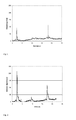
- Fig. 1 the temporal course of the ultrasonic signal (attenuation) is reproduced over all 2 measurements.
- the variation (baseline drift) during extrusion of the rubber composition is slightly ⁇ 20 m-1.
- the noise floor of the baseline is about 1 m -1 .
- EPM Dutral CO 054 from EniChem SpA
- 233 phr zinc oxide Weisssiegel with a density of 5.6 g / ml Brügg
- the response signal is due to the change in damping properties due to the changed composition of the extruder strip (addition of crosslinking binder VB1).
- the measurements show that the crosslinker batch VB1 according to the invention can be detected with the aid of ultrasound technology.
- the rubber compound KM having a Mooney viscosity ML 1 + 4 (100 ° C) 60 MU consisting of 100 phr of natural rubber SMR 10, 55 phr of furnace carbon N550, 5 phr of plasticizer (Vivatec 500) and 1 phr of stearic acid was extruded.
- the extrudate was analyzed as in Embodiment 1 with the ultrasonic transducers.
- Crosslinker VB2 consists of the components 100 phr EPM Dutral CO 054 from EniChem SpA, 156 phr zinc oxide (Weisig seal from Brüggemann), 67 phr sulfur powder, 67 phr MBTS (Vulcacit® DM / C Lanxess Germany GmbH), 36 phr a dithiophosphate accelerator (Rhenocure® ZBOP / S from Rhein Chemie Rheinau GmbH) and 33 phr of a paraffinic plasticizer (Spindelöl R2, Shell).
- the crosslinking CB2 contains other marking substances in each case with a share of 33 phr: carbonyl iron powder CM standard grade (BASF, 7.9 g / ml), 2 luminescent pigments from europium / dysprosium / boron doped strontium aluminates with a density of 3.6 g / ml (PL Pigment MHG-4E and PL Pigment MHG-4B LanXi MinHui Photoluminescent Co., Ltd.
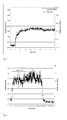
- Fig. 2 the time course of the ultrasonic signal during the extrusion of the basic mixture is shown.
- the variation (drift of the baseline) during extrusion of the rubber composition is slightly ⁇ 20 m -1 .
- the noise floor of the baseline is about 1 m -1 .
- Fig. 1 and Fig. 2 show that at the same dosage of Vernetzerbatche VB1 and VB2, the attenuation (peak height) for the crosslinker VB2 is significantly greater than that of VB1. Even with the low feed of 0.3 g VB 2, the signal in Fig. 2 be distinguished clearly from baseline drift. The higher attenuation of the crosslinking binder VB2 can not be attributed to a different density of the two Vernetzerbatche. The difference between the calculated density of VB1 at 1.75 g / ml and VB2 at 1.79 g / ml is small.
- the proportions of powder chemicals with a density> 3 g / ml are also comparable to 37% (ZnO only) for VB1 and 43% (ZnO, iron carbonyl, chromium iron oxide and doped strontium aluminates). Therefore, the higher attenuation is attributed to the presence of the carbonyl iron powder at a density of 7.9 g / ml. Obviously, the effect of heavy particles on the sensitivity of the measurement method (intensity of the ultrasonic signal) is much more pronounced than with the less heavy labeling substances used here.
- the crosslinkable rubber mixture was prepared in advance by conventional roller processes from 161 phr of the rubber compound KM and 14.3 phr of the crosslinking binder VB2.
- the mixing time on the roller was 10 minutes, so that a homogeneous distribution of the crosslinking chemicals and the marker substances of the crosslinking agent VB2 in the crosslinkable rubber mixture is ensured.
- the extruded strip is analyzed as in Example 1 inline by means of two ultrasonic transducers.
- the crosslinkable rubber compound VKM reaches the ultrasonic measuring chamber.
- the ultrasound signal increases, in particular due to the presence of marking substances in crosslinking buffer VB2. After a short while, the signal reaches a plateau.
- the ultrasonic measuring nozzle is completely filled with the crosslinkable rubber compound.
- the crosslinkable rubber mixture is continuously fed in. The ultrasound signal remains constant over time. Only slight variations in the range of about 10 to 20 m -1 can be seen corresponding to a crosslinkable rubber mixture in which the distribution of the crosslinking agents and the marking substances is homogeneous.
- the extruded strip is divided into 7 g portions. These samples were taken in a Vulkameter MDR from Alpha Technologies at 160 ° C for 15 min. vulcanized.
- the determination of the volumetric curves corresponds to the offline quality control in the discontinuous production of crosslinkable rubber compounds.
- the difference F max -F min of the maximum and minimum torque was determined from the thus determined volumetric curves. This difference is proportional to the proportion of crosslinking agent.
- the values F max -F min of the respective samples were assigned to the time course of the ultrasound signal. First (t ⁇ 1 min.) F max -F min is close to zero, since the rubber mix KM contains no crosslinking agents. From t ⁇ 1 min.
- Example 1 the rubber compound KM is extruded and the damping properties of the extruder strip are analyzed with two ultrasonic transducers.
- the samples are removed from the extruder strip and at 160 ° C for 15 min. vulcanized (offline analysis).
- the values from the volumetric curves F max -F min are given in Fig. 4 again assigned to the time course of the extrusion. It can be seen that the time course of the F max -F min corresponds to the time course of the ultrasonic signal.
- Exemplary embodiment 4 shows, in comparison with exemplary embodiment 3, that a distinction can be made between a homogeneous distribution and a heterogeneous distribution of the crosslinking batch VB2 with the aid of in-line ultrasound analysis.
- the high sensitivity of the measurements is ensured by the marking substances (in particular iron powder at VB2) with a high density> 3 g / ml.
- Ultrasonic inline analysis results correlate with the results of the vulcanization curves (conventional off-line quality control for accelerated rubber compounds).
Landscapes
- Chemical & Material Sciences (AREA)
- Health & Medical Sciences (AREA)
- Chemical Kinetics & Catalysis (AREA)
- Medicinal Chemistry (AREA)
- Polymers & Plastics (AREA)
- Organic Chemistry (AREA)
- Engineering & Computer Science (AREA)
- Mechanical Engineering (AREA)
- Compositions Of Macromolecular Compounds (AREA)
- Processes Of Treating Macromolecular Substances (AREA)
- Organic Low-Molecular-Weight Compounds And Preparation Thereof (AREA)
Abstract
Description
- Die Erfindung betrifft neue Vernetzerbatches, enthaltend markierende Substanzen, neue vernetzbare Kautschukmischungen und ein Verfahren zu deren Herstellung und deren Verwendung.
- Aus
PCT/EP2009/058041 - Aufgabe der vorliegenden Erfindung war es daher, neue Vernetzerbatches bereitzustellen, mit denen eine Online-, vorzugsweise auch noch eine Inline-Detektion zur Bestimmung der Güte der Verteilung des Vernetzerbatches möglich ist.
- Die dieser Erfindung zugrunde liegenden Aufgabe konnte durch Vernetzerbatches gelöst werden, die markierende Substanzen enthalten.
- Gegenstand der vorliegenden Erfindung sind daher Vernetzerbatches, enthaltend markierende pulverförmigen Substanzen mit einer Dichte größer 2 g/cm3.
- Als markierende pulverförmige Substanz im Sinne der Erfindung wird vorzugsweise mindestens eine Verbindung ausgewählt aus den folgenden Gruppen:
- der Alkali- und Erdalkaliverbindungen, besonders bevorzugt Aluminate, Halogenide, Sulfate, Silikate, Carbonate, Oxide und/oder Sulfide des Cäsiums, Calciums, Strontiums und/oder des Bariums, ganz besonders bevorzugt Bariumsulfat, Bariumoxid, Bariumsulfid und/oder Bariumsilikat und/oder Strontiumaluminate, besonders bevorzugt mit seltenen Erden dotierte Strontiumaluminate,
- der Verbindungen der Nebengruppen des Periodensystems der Elemente, vorzugsweise der zweiten bis vierten Nebengruppe des Periodensystems der Elemente, besonders bevorzugt Zinkoxid, Zinksulfid, Titandioxid und/oder Zirkondioxid,
- der Verbindungen der Seltenen Erden, wie z.B. Ceroxide und/oder Gadoliniumoxide,
- der Schwermetallpulver, wie z.B. Carbonyleisenpulver, besonders bevorzugt Edelmetallpulver wie z.B. Tantalpulver, Wolframpulver, Goldpulver, Platinpulver und/oder Iridiumpulver,
- der gecoateten Metallpulver und/oder deren Verbindungen, wie z.B. phosphatiertes oder mit Siliziumdioxid gecoatetes Eisenpulver,
- der Bleiverbindungen, besonders bevorzugt Bleioxide und/oder Bleisulfide,
- der anorganischen Bismutverbindungen, besonders bevorzugt Bismutoxide sowie Bismutsulfide,
- der Wolframverbindungen, besonders bevorzugt Wolframate, Wolframoxide und/oder-Wolframsulfide,
- der Metall-Carbide, besonders bevorzugt Wolframcarbide und/oder
- der natürlich vorkommenden Mineralien, wie z.B. Antimonit, Apatit, Albit, Argentit, Anglesit, Arsenkies, Baryt, Bleiglanz, Cassisterit, Dolomit, Feldspat, Flussspat, Molybdänglanz, Muskovit, Montmorilonit, Monazit, Magensit, Korund, Kryollith, Pyrit, Quarz, Rutil, Scheelit, Speerylith, Strontianit, Tamntalit, Uraninit, Vanadinit, Wismut, Wolframit, Wollastonit, Willemit, Zinnober und/oder Zirkon.
- Als markierende Substanzen sind anorganische Verbindungen bevorzugt.
- In einer weiteren Ausführungsform der Erfindung ist der Einsatz von oxidationsbeständigen Verbindungen bevorzugt, wobei besonders bevorzugt ist, wenn diese gecoated sind.
- Ebenfalls bevorzugt ist der Einsatz einer Kombination von Verbindungen aus den vorgenannten Gruppen. Unter dem Begriff Kombination ist dabei sowohl eine Kombination aus Verbindungen aus den einzelnen Gruppen oder auch innerhalb der vorgenannten Gruppen sowie eine Kombination daraus umfaßt.
- Es handelt sich dabei um handelsübliche Substanzen. Das Coating der Pulver erfolgt nach den, dem Fachmann geläufigen Verfahren.
- Alle diese markierenden Substanzen weisen vorzugsweise eine Dichte von mindestens 3,5 bis 25 g/cm3 auf, besonders bevorzugt größer 7,5 g/cm3, ganz besonders bevorzugt größer 10 g/cm3.
- Bevorzugt sind dabei markierende pulverförmigen Substanzen mit einer Teilchengröße von 0,1µm bis 100 µm besonders bevorzugt von 1 µ bis 10µm.
- Der Begriff pulverförmig umfasst dabei alle bei Temperaturen unterhalb von 130°C festen vorgenannten Substanzen.
- Der Anteil an markierenden Substanzen beträgt vorzugsweise weniger als 50 Gew.-%, bevorzugt bei weniger als 10 Gew.-%, besonders bevorzugt weniger als 5 Gew.-%, bezogen auf den Vernetzerbatch.
- Die markierenden Substanzen eigen sich dabei vorzugsweise für die Detektion mittels Ultraschall, wobei auch andere Meßmethoden, wie z.B. RFA (Röntgenfluoreszenzanalyse), NIR (Nahinfrarotspektroskopie), LIPS (Laser-Induzierte Plasma Spektroskopie), Terahertz-Spektroskopie, UV/VIS-Spektroskopie nicht ausgeschossen sind.
- Der Begriff Vernetzerbatch umfasst dabei eine Abmischung von mindestens einem Vernetzungsmittel und gegebenenfalls weiteren Additiven.
- Der erfindungsgemäße Vernetzerbatch enthält dabei zudem mindestens ein Vernetzungsmittel.
- Vernetzungsmittel im Sinne der Erfindung sind:
- Netzknotenbildner, wie z.B.
- Schwefel (löslich oder unlöslich) und/oder Schwefelspender, wie z.B. Dithiomorpholine (DTDM), Tetramethylthiuramdisulphide (TMTD), Tetraethylthiuramdisulphid (TETD), Dipentamethylenthiuramterasulphide (DPTT), und/oder
- Peroxide, wie z.B. Di-tert.Butyl-Peroxide, Di-(tert,Butyl-Peroxy-Timethyl-Cyclohexane, Di-(tert,Butyl-Peroxy-Isopropyl)benzene, Dicumyl Peroxide, Dimethyl-Di(tert.Butyl-Peroxy)Hexine, Butyl-Di-(tert,Butyl-Peroxy-)Valerate,
- Beschleuniger, wie z.B.
- Carbamate bzw. Triazine, wie z.B. Hexamethylen-diamin-carbamat (HMDC), organische Triazine,
- Thiazole, wie z.B. 2-Mercapto-benzothiazol (MBT), Zink-mercaptobenzothiazol (ZnMBT), Thiadiazole (TDD),
- Sulfenamide, wie Cyclohexyl-benzothiazol-Sulphenamide (CBS), Di-benzothiazyl-disulphid (MBTS), Butyl-benzothiazole-Sulphenamide (TBBS), Dicyclohexyl-Benzothiazol-Sulphenamid (DCBS), 2-(4-Morpholinylmercapto)-benzothiazol (MBS),
- Thiurame, wie Tetramethyl-thiuram-monosulphid (TMTM), Tetraethyl-thiuram-disulphid (TETD), Tetramethyl-thiuram-disulphid (TMTD), Tetrabenzylthiuram Disulphid (TBTD), Dipentamethylene-Thiuram-Tetra(Hexa)-Sulphid (DPTT),
- Dithiocarbamate, wie e Z n-Dimethyldithiocarbamate (ZDMC), Cu-Dimethyldithiocarbamate, B i- Dimethyldithio-carbamate, Zn-Diethyldithiocarbamate (ZDEC), Tellurium-diethyldithio-carbamate (TDEC), Zn-Dibuthyldithiocarbamate (ZDBC), Zn-Ethyl-Phenyl-Dithipocarbamate (ZEPC), Zn-Dibenzyl-Dithiocarbamate (ZBEC), Ni-Dibuthyl-Dithiocarbamate (NBC),
- Thiophosphat- und Dithiophosphat, wie z.B. Zink-O,O-di-n-butyl-dithiophosphat (ZBDP), Zink-O-butyl-O-hexyl-dithiophosphat, Zink-O,O-diisooctyl-dithiophosphat (ZOPD), Dodecylammonium-diisooctyl-dithiophosphat (AOPD), wie z.B. die Rhenogran®-Typen ZDT, ZAT, ZBOP der Firma Rhein Chemie Rheinau GmbH
- Harnstoff/Thioharnstoffe, wie z.B. Ethylenthioharnstoff (ETU), N,N,N'N'-Tetramethylthioharnstoff (TMTU), Diethylthioharnstoff (DETU), Dibutylthioharnstoff (DBTU), 3-(3,4-Dichlorphenyl)-1,1-dimethylharnstoff (Diuron) etc., und/oder
- Guanidine, wie z.B. Diphenylguanidin (DPG) und/oder N',N-di-ortho-tolyl-Guanidin (DOTG) und die Guanidine-frei Ersatzbeschleuniger, wie Rhenogran ® XLA 60 Verzögerer, wie z.B.
- N-Nitrososdiphenylamin, N-Cylcohexylthiophthalimid (CPT), wie z.B. Vulkalent® G), Sulfonamidderivate (wie z.B. Vulkalent ® E/C), Phthalsäureanhydrid (Vulkalent® B/C), wobei die Vulkalent®- Typen beider der Firma Lanxess Deutschland GmbH erhältlich sind, sowie Benzoesäureanhydrid,
- Vernetzungsaktivatoren, wie z.B.
- Metalloxide, wie z.B. ZnO, MgO, PbO, CaO als anorganische Aktivatoren.
- Bei allen vorgenannten Produkten handelt es sich um handelsübliche Produkte.
- Dabei ist es bevorzugt, Mischungen verschiedener Vernetzungsmittel, wie Schwefel, SchwefelSpender, Peroxide oder andere Vernetzer, Beschleuniger wie Dithiocarbamate, Thiurame, Thioharnstoffe, Mercaptobeschleuniger, Sulfenamide, Thio- und Dithio-Phosphate, Guanidine Metalloxide, Fettsäuren und/oder Weichmacher einzusetzen.
- Dabei ist eine Mischung aus Vernetzungsmitteln bevorzugt, deren Schmelzpunkt unterhalb von 120°C, besonders bevorzugt unterhalb von 100°C liegt, wie z.B. eine Mischung aus Schwefel, CBS (Cyclohexyl-Benzozthiazyl-Sulfenamid) sowie MBTS (Methylbenzothiazyldisulfid).
- In einer weiteren bevorzugten Ausführungsform der Erfindung enthält der erfindungsgemäße Vernetzerbatch zusätzlich Binder, Stabilisatoren und/oder Füllstoffe, Weichmacher sowie weitere Hilfsmittel.
- Der Anteil dieser zusätzlichen Bestandteile, wie Binder, etc. liegt vorzugsweise bei weniger als 30 %, bezogen auf den Vernetzerbatch.
- Als Binder werden vorzugsweise solche Polymere ausgesucht, deren Schmelzpunkte, Kristallinität und/ oder Oberflächenstrukturen denen der Kautschukmischung ähneln, um so das Mischen zu verbessern, also um ein homogenes Mischergebnis schnell zu erhalten.
- Als Polymere eignen sich insbesondere Naturkautschuk (NR), Isoprenkautschuk (IR), Styrol-Butadien-Kautschuk (SBR), Butadienkautschuk (BR), Isopren-isobutylen-Kautschuk (IIR), Polychloroprenkautschuk (CR), Acrylnitril-Butadien-Kautschuk (NBR), hydrierter Acrylnitril-Butadien-Kautschuk (HNBR), carboxylierter Acrylnitril-Butadien-Kautschuk (XNBR), hydrierter carboxyliertere Acrylnitril-Butadien-Kautschuk (HXNBR), Ethylen-Propylen-Dien-Kautschuk (EPDM), Ethylen-Propylen-Kautschuk (EPM), Fluorkautschuk (FKM), Perfluorierter Fluorkautschuk (FFKM), Acrylat-Ethylen-Kautschuk (AEM), Acrylatkautschuk (ACM), Ethylen-Methylen-Acrylatkautschuk (EMA), chloriertes Polyethylen, chlorsulfoniertes Polyethylen, Ethylen-Vinylacetat-Kautschuk (EVA), Siliconkautschuk, Fluro-Silicon-Kautschuk, Ethylen-Epichlorhydrin Kautschuk (ECO), Epichlorhydrin-Kautschuk (CO) und/oder Polyurethan-Kautschuk (PU).
- Stabilisatoren im Sinne der Erfindung sind z.B. verfärbende und nicht verfärbende Alterungsschutzmittel, wie z.B. Paraphenylendiamine, Isopropylphenylparaphenylendiamin (IPPD), Para-Phenylen-Diamin (6PPD), N,N-ditoly-p-phenylendiamine (DTPD), etc., Amine, wie z.B. Trimethyl-1,2-dihydrochinolin (TMQ), (Phenyl)amine]-1,4-naphthalendion (PAN), Bis(4-octylphenyl)amin (ODPA), styrolisiertes Diphenylamin (SDPA), etc.),
- Mono- und Bisphenole, wie z.B. 2,2'-Methylen-bis-(4-methyl-6-tert.butylphenol(BPH), 2,2'-Isobutyliden-bis-(4,6-dimethyl-phenol) (NKF), 2,2'-Dicyclo-pentadienyl-bis-(4-methyl-6-tert.-butyl-phenol) (SKF), 2,2'-Methylen-bis-(4-methyl-6-cyclohexyl-phenol (ZKF), 2,6-Di-tert.-butyl-p-kresol (BHT), substituiertes Phenol (DS), styrolisierte Phenole (SPH), Mercatpbenzimidazole, wie z.B. 2-Mercaptobenzimidazol (MBI), 2-Mercaptomethylbenzimidazole (MMBI), Zink-4- und -5-methyl-2-mercapto-benzimidazole (ZMMBI), etc., Olefine, paraffinische und/oder aromatische Weichmacher. Die Zusammensetzung wird dabei auf das gewünschte Endprodukt abgestimmt.
- Füllstoffe im Sinne der Erfindung sind z.B. insbesondere helle anorganische Füllstoffe, wie z.B. Glimmer, Kaolin, Kieselerde, Kieselsäure, Kreide, Talkum, Kohlenstoff-Füllstoffe, wie z.B. Ruß, Graphit, Carbon Nanotubes und/oder magnetische Füllstoffe wie Carbonyl-Eisenpulver.
- Weichmacher im Sinne der Erfindung sind z.B langkettige Ester oder Ether oder Mineralöle (paraffinischen, naphthenische oder synthetische Öle).
- Hilfsmittel im Sinne der Erfindung sind z.B. Dispergierhilfsmittel, wie z.B. Fettsäuren, Stearinsäure und/oder Ölsäure.
- Bevorzugt weist dabei der Vernetzungsbatch die folgende Zusammensetzung auf:
- Zinkoxid (ca. 10% bis 50% ), Schwefel, CBS (Cyclohexyl-Benzozthiazyl-Sulfenamid, ca. 10% bis 30%) und/oder MBTS (Methylbenzothiazyldisulfid, ca. 10% bis 30%), und/oder ZBOP (ca. 10 bis 30%), EPDM/EPM, EVA und/oder Weichmacher (ca. 20%) zusammen mit mindestens einer markierenden pulverförmigen Substanz (ca. 10%), wobei sich die Angaben auf Gewichtsprozente beziehen und die Summe der eingesetzten Komponenten 100% beträgt.
- Diese Mischung hat einen gegenüber den Einzelkomponenten deutlich erniedrigten Schmelzpunkt von weniger als 100°C, wobei der Schmelzpunkte der Einzelkomponenten wie folgt sind: Schwefel (Schmelzpunkt: ca. 115°C), CBS (Schmelzpunkt: ca. 100°C) und MBTS (Schmelzpunkt: ca. 180°C).
- Demnach sind diese als Einzelkomponenten bei T < 100°C deutlich schlechter verarbeitbar.
- Die erfindungsgemäßen Vernetzerbatches lassen sich dabei herstellen, in dem die Vernetzungsmittel mit den markierenden Substanzen, und gegebenenfalls zusätzlich Binder, Stabilisatoren und/oder Füllstoffe sowie gegebenenfalls weiteren Hilfsmittel bei Temperaturen ≤ 100°C miteinander vermischt werden. Idealerweise geschieht dies so, dass keine Reaktion der Vernetzungsmittel während des Vermischens stattfindet.
- Auf diese Weise kann problemlos eine sehr homogene Mischung der Vernetzungsmittel mit den markierenden Substanzen und gegebenenfalls weiteren Zusatzstoffen und Hilfsmitteln hergestellt werden. Dabei können alle üblichen Mischaggregate, wie Innenmischer, Extruder, Doppelschneckenextruder oder ähnliches eingesetzt werden.
- Verfahren zur Herstellung der erfindungsgemäßen Vernetzerbatches, wonach das Vernetzungsmittel mit den markierenden Substanzen, und gegebenenfalls zusätzlich Binder, Stabilisatoren und/oder Füllstoffe sowie gegebenenfalls weiteren Hilfsmittel bei Temperaturen ≤ 100°C miteinander vermischt werden.
- Ein weiterer Gegenstand der Erfindung sind vernetzbare Kautschukmischungen, enthaltend die erfindungemäßen und oben beschriebenen Vernetzerbatches.
- Bei der vernetzbaren Kautschukmischungen im Sinne der Erfindung handelt es sich um Grundmischung, die Kautschuk enthält. Diese umfasst Polymere und deren Verschnitte, die nach Vernetzung elastische Eigenschaften aufweisen, wie z.B. Naturkautschuk (NR), Isoprenkautschuk (IR), Styrol-Butadien-Kautschuk (SBR), Butadienkautschuk (BR), Isopren-Isobutylen-Kautschuk (IIR), Polychloroprenkautschuk (CR), Acrylnitril-Butadien-Kautschuk (NBR), hydrierten Acrylnitril-Butadien-Kautschuk (HNBR), carboxylierten Acrylnitril-Butadien-Kautschuk (XNBR), hydrierten carboxylierten Acrylnitril-Butadien-Kautschuk (HXNBR), Ethylen-Propylen-Dien-Kautschuk (EPDM), Ethylen-Propylen-Kautschuk (EPM), Fluorkautschuk (FKM), perfluorierten Fluorkautschuk (FFKM), Acrylat-Ethylen-Kautschuk (AEM), Acrylatkautschuk (ACM), chloriertes Polyethylen, chlorsulfoniertes Polyethylen, Ethylen-Vinylacetat-Kautschuk (EVA), Siliconkautschuk, Fluoro-Silicon-Kautschuk, Ethylen-Epichlorhydrin Kautschuk (ECO), Epichlorhydrin-Kautschuk (CO) und/oder Polyurethan-Kautschuk (PU).
- Weitere Bestandteile der vernetzbare Kautschukmischungen sind insbesondere helle anorganische Füllstoffe, wie z.B. Glimmer, Kaolin, Kieselerde, Kieselsäure, Kreide, Talkum, Kohlenstoff-
- Füllstoffe, wie Ruß, Graphit, Carbon Nanotubes und/oder magnetische Füllstoffe wie Carbonyl-Eisenpulver, Eisenoxide und/ oder verfärbende und nicht verfärbende Alterungsschutzmittel, wie Paraphenylendiamine (Isopropylphenylparaphenylendiamin/ (IPPD), Para-Phenylen-Diamin (6PPD), N,N-ditolyl-p-phenylendiamine (DTPD), etc.), Amine (Trimethyl-1,2-dihydrochinolin (TMQ), [Phenyl)amine]-1,4-naphthalendion (PAN), Bis(4-octylphenyl)amin (ODPA), styrolisiertes Diphenylamin (SDPA), etc. ), Mono- und Bisphenole, wie z.B. die Vulkanox-Typen 2,2'-Methylen-bis-(4-methyl-6-tert.butylphenol (BPH), 2,2'-Isobutyliden-bis-(4,6-dimethylphenol) (NKF), 2,2'-Dicyclo-pentadienyl-bis-(4-methyl-6-tert.-butyl-phenol) (SKF), 2,2'-Methylen-bis-(4-methyl-6-cyclohexyl-phenol (ZKF), 2, 6-Di-tert.-butyl-p-kresol (BHT), subtituiertes Phenol (DS), styrolisierte Phenole (SPH), Mercatobenz-imidazole (2-Mercaptobenzimidazol (MBI), 2-Mercaptomethylbenzimidazole (MMBI), Zinc-4- und -5-methyl-2-mercapto-benzimidazol- (ZMMBI), etc.) und Olefine und/oder paraffinische und aromatische Weichmacher, Dispergierhilfsmittel sowie gegebenenfalls einen Teil der Vernetzungsmittel (wie z.B.: Zinkoxid).
- Da die Vernetzungsmittel bereits homogen miteinander vermischt sind, wird durch die kontinuierliche Zudosierung eine homogene Verteilung der Vernetzungsmittel in der Grundmischung erleichtert. Insgesamt kann so die Gefahr vermindert werden, dass die angestrebte kontinuierliche Herstellung in der Praxis an dem Mischen der Grundmischung mit den Vernetzungsmitteln scheitert.
- Ein weiterer Gegenstand der Erfindung ist ein Verfahren zur Herstellung einer vernetzbaren Kautschukmischung, wonach der erfindungsgemäße Vernetzerbatch kontinuierlich mit einer diskontinuierlich hergestellten Grundmischung, die Kautschuk enthält, vermischt wird.
- Der Herstellung der Grundmischung erfolgt nach den, dem Fachmann geläufigen Verfahren, wie diese beispielsweise beschrieben sind in
PCT/EP2009/058041 - In diese diskontinuierlich hergestellte Grundmischung wird dann kontinuierlich der Vernetzerbatch zudosiert und die fertige Mischung wird dann kontinuierlich extrudiert
- Dabei beträgt vorzugsweise der Anteil an Vernetzerbatch, bezogen auf die vernetzbaren Kautschukmischung, weniger als 10 Gew%.
- Bei dem erfindungsgemäßen Verfahren wird der Vernetzerbatch kontinuierlich mit der Grundmischung vermischt, was eine bevorzugte Ausführungsform darstellt. Dies kann z.B. mittels gravimetrischer Dosieraggregate mit integrierter Dosierdifferenzialwaage z.B. der Firma Brabender erfolgen.
- In einer Ausführungsform der Erfindung wird der Vernetzerbatch mit hohem Druck in die Grundmischung eingebracht, die dabei insbesondere vergleichsweise drucklos gefördert wird. Ein hoher Druck im Sinne der vorliegenden Erfindung beträgt insbesondere mehrere 10 bar, vorzugsweise wenigstens 50 bar, besonders bevorzugt wenigstens 100 bar. Hierdurch wird erreicht, dass allein aufgrund des hohen Zufuhrdrucks sofort Vernetzungbatch in der Grundmischung durch Verwirbelung verteilt werden, was dazu beiträgt, dass schnell eine homogene Mischung hergestellt wird.
- In einer bevorzugten Ausführungsform der Erfindung werden die Vernetzungsmittel für das Vernetzen einer Mischung mit einem hohem Druck von vorzugsweise wenigstens 50 bar in eine Grundmischung gepumpt, die Kautschuk enthält, und wird anschließend die Grundmischung mit den Vernetzungsmitteln in einer Mischvorrichtung gemischt.
- Vorzugsweise wird die Grundmischung in einem Extruder mit vorzugsweise nur einer Welle transportiert, während die Vernetzungsmittel mit hohem Druck in die Grundmischung gepumpt werden. Durch den großen Druckunterschied entsteht eine Verwirbelung. Ein weiteres Vermischen mit Hilfe des Extruders kann entsprechend verkürzt werden.
- In einer Ausführungsform der Erfindung werden die Vernetzungsmittel mit einer Zahnradpumpe in die Grundmischung gepumpt. Mit Hilfe einer Zahnradpumpe kann einerseits der gewünschte hohe Druck erzeugt und andererseits geeignet dosiert zugeführt werden.
- Gegenstand der Erfindung sind auch vernetzbaren Kautschukmischungen erhältlich nach dem vorgenannten erfindungsgemäßen Verfahren.
- Ein weiterer Gegenstand der Erfindung ist zudem die Verwendung der erfindungsgemäßen Vernetzerbatches zur Kontrolle der Verteilung der Vernetzungsmittel in der Kautschukmischung, wobei die Güte der Verteilung vorzugsweise mittels Ultraschall gemessen wird, wobei auch andere Meßmethoden, wie z.B. RFA (Röntgenfluoreszenzanalyse), NIR
- (Nahinfrarotspektroskopie), LIPS (Laser-Induzierte Plasma Spektroskopie), Terahertz-Spektroskopie, UV/VIS-Spektroskopie nicht ausgeschossen sind.
- Die nachfolgenden Beispiele dienen der Erläuterung der Erfindung, ohne dabei limitierend zu wirken.
-
- Dabei wurden folgende Stoffe eingesetzt:
- SMR 10 = Naturkautschuk (Standard Malaysian Rubber SMR 10),
- N550 = Ruß der Firma Evonik Degussa AG,
- Vivatec 500 = ein Mineralöl (TDAE-Ö1) als Weichmacher,
- Dutral CO 054 = ein Ethylen-Propylen-Dienpolymer der Firma EniChem SpA,
- Zinkoxid Weisssiegel, erhältlich bei der Firma Brüggemann,
- Schwefelpulver, erhältlich bei der Firma Brüggemann,
- MBTS = Di(benzothiazol-2-yl)disulfid, erhältlich unter dem Namen Vulcacit ® DM/C bei der Firma Lanxess Deutschland GmbH,
- Rhenocure ® ZBOP/S von Rhein Chemie Rheinau GmbH,
- paraffinische Weichmacher (Spindelöl R2, der Firma Shell AG),
- PL Pigment MHG-4E und PL Pigment MHG-4B = dotierte Strontiumaluminate (SrAl2O4:Eu+2,Dy+2 , B+3,), erhältlich bei der Firma LanXi MinHui Photoluminescent Co., Ltd. Sicopal Schwarz K0095 = Chromeisenoxid, erhältlich bei der Firma BASF AG, 5,2 g/ml, Hostasol Yellow 3G = fluoreszierenden Naphthalimid, erhältlich bei der Clariant AG,
- Hostasol Red 5B = Thioindigoid Colorant, erhältlich bei der Clariant AG.
- Angaben in phr betreffen Angaben in Gewichtsteilen pro 100 Gewichtsteile Kautschuk
- Eine granulierte Kautschukmischung KM mit einer Mooney-Viskosität ML 1+4 (100°C) = 60 MU, bestehend aus 100 phr Naturkautschuk SMR 10, 55 phr Furnaceruß N550, 5 phr Weichmacher (Vivatec 500) und 1 phr Stearinsäure, wurden mit einem Einwellenextruder (Kompaktextruder der Firma Brabender) bei T = 90°C mit 60 U/min extrudiert. Der Durchsatz betrug ca. 1 kg/h. Der Extruderstreifen war ca. 5 cm breit und 4 mm dick. Die Messdüse war mit zwei Ultraschallwandlern der Firma Krautkrämer ausgerüstet. Die mittlere Frequenz des Schallgebers betrug 5 MHz. Es wurde die Amplitudendämpfung während der Extrusion des Extruderstreifens zwischen dem Ultraschallgeber und dem Ultraschallempfänger im Puls-Transmission-Verfahren ermittelt. Der Abstand zwischen Ultraschallgeber und -empfänger betrug dabei 4 mm. Es wurden zwei Messungen mit einer unterschiedlichen Dosierung des Vernetzerbatches VB 1 durchgeführt.
- In
Abb. 1 ist der zeitliche Verlauf des Ultraschallsignals (Dämpfung) über alle 2 Messungen wiedergegeben. Die Variation (Drift der Basislinie) während der Extrusion der Kautschukmischung ist geringfügig < 20 m-1. Das Grundrauschen der Basislinie beträgt ca. 1 m-1. - Zusätzlich zur Kautschukmischung wurden ca. 3,2 g des erfindungsgemäßen Vernetzerbatches VB 1 (Dichte = 1,75 g/ml) bestehend aus 100 phr EPM (Dutral CO 054 von EniChem SpA), 233 phr Zinkoxid Weisssiegel mit einer Dichte von 5,6 g/ml (Brüggemann), 100 phr Schwefelpulver, 100 phr MBTS (Vulcacit® DM/C Lanxess Deutschland GmbH), 53 phr eines Dithiophosphat-beschleunigers (Rhenocure ZBOP/S von Rhein Chemie Rheinau GmbH) sowie 33 phr eines paraffinischen Weichmachers (Spindelöl R2, Shell) zugefüttert (Pulseingabe). Die Mischwirkung des Einwellenextruders ist gering, was sich dadurch zeigt, dass. ein steil ansteigendes und sofort wieder abfallendes Antwortsignal nach Zugabe des Vernetzerbatches VB1 in Peakform bei t = 3 min. detektiert. Die Peakhöhe beträgt ca. 100 m-1. Das Antwortsignal ist auf die Änderung der Dämpfungseigenschaften aufgrund der geänderten Zusammensetzung des Extruderstreifens (Zugabe des Vernetzerbatches VB1) zurückzuführen.
- Bei Zugabe von ca. 1,6 g des erfindungsgemäßen Vernetzerbatches VB 1 wird wieder ein intensiveres Signal bei t = 18 min. detektiert. Die Peakhöhe beträgt wieder ca. 100 m-1. Aufgrund der geringeren Zugabemenge des Vernetzerbatches VB 1 ist die Halbwertsbreite des Peaks dabei schmaler als diejenige des Peaks bei t = 3 min (Zugabe von 3 g CB1). Zudem liegt die Basislinie etwas höher.
- Die Messungen zeigen, dass mit Hilfe der Ultraschalltechnik der erfindungsgemäße Vernetzerbatch VB1 detektiert werden kann.
- Entsprechend Ausführungsbeispiel 1 wurde die Kautschukmischung KM mit einer Mooney-Viskosität ML 1+4 (100°C) = 60 MU bestehend aus 100 phr Naturkautschuk SMR 10, 55 phr Furnaceruß N550, 5 phr Weichmacher (Vivatec 500) und 1 phr Stearinsäure extrudiert. Das Extrudat wurde wie in Ausführungsbeispiel 1 mit den Ultraschallwandlern analysiert.
- Zu der Kautschukmischung KM wurde der erfindungsgemäße Vernetzerbatch VB2 in den nachstehend aufgeführten Mengen wie in Ausführungsbeispiel 1 zugefüttert (Pulszugabe). Der Vernetzerbatch VB2 besteht aus den in Ausführungsbeispiel 1 genannten Bestandteilen 100 phr EPM Dutral CO 054 von EniChem SpA, 156 phr Zinkoxid (Weisssiegel von Brüggemann), 67 phr Schwefelpulver, 67 phr MBTS (Vulcacit® DM/C Lanxess Deutschland GmbH), 36 phr eines Dithiophosphatbeschleunigers (Rhenocure ® ZBOP/S von Rhein Chemie Rheinau GmbH) sowie 33 phr eines paraffinischen Weichmachers (Spindelöl R2, Shell). Zusätzlich enthält der Vernetzerbatch CB2 weitere Markierungssubstanzen jeweils mit einem Anteil von 33 phr: Carbonyleisenpulver CM standard grade (BASF, 7,9 g/ml), 2 lumineszierende Pigmente aus Europium/Dysprosium/Bor dotierten Strontiumaluminaten mit einer Dichte von 3,6 g/ml(PL Pigment MHG-4E und PL Pigment MHG-4B LanXi MinHui Photoluminescent Co., Ltd. Jeweils 3,6 g/ml) mit unterschiedlicher mittlerer Partikelgröße, Chromeisenoxid (Sicopal Schwarz K0095 BAS mit 5,2 g/ml), einem fluoreszierenden Naphthalimid (Hostasol Yellow 3G, 1,17 g/ml) und einem fluoreszierenden Thioindigoid Colorant (Hostasol Red 5B, Clariant, 1,6 g/ml). Der Anteil an Pulverchemikalien mit einer Dichte > 3 g/ml beträgt 43%. Die Dichte des Vernetzerbatches VB2 beträgt 1,79 g/ml und ist vergleichbar mit dem Vernetzerbatch 1 aus Ausführungsbeispiel 1.
- In
Abb. 2 ist der zeitliche Verlauf des Ultraschallsignals während der Extrusion der Grundmischung dargestellt. Wie in Ausführungsbeispiel 1 ist die Variation (Drift der Basislinie) während der Extrusion der Kautschukmischung geringfügig < 20 m-1. Das Grundrauschen der Basislinie beträgt ca. 1 m-1. - Es wurden 3 Messungen mit unterschiedlichen Dosiermengen an erfindungsgemäßem Vernetzerbatch VB2 durchgeführt.
- Bei Zufütterung (Pulseingabe) von 3,2 g VB2 wird ein Peak bei t = 3 min. mit einer Höhe von 210 m-1 detektiert. Bei Zufütterung von 0,3 g VB 2 beträgt das Ultraschallsignal bei t = 10 min. ca. 30 1/m und nach Zufütterung von 1,7 g VB2 beträgt Ultraschallsignal bei t = 18 min. ca. 110 m-1. Das Ultraschallsignal ist damit proportional der zudosierten Menge an Vernetzerbatch VB2. Mit Ultraschall kann damit die Menge an Vernetzerbatch in einer Kautschukmischung detektiert werden.
- Im Vergleich von Abb,1 und
Abb. 2 zeigt sich zudem, dass bei gleicher Dosierung der Vernetzerbatche VB1 und VB2 die Dämpfung (Peakhöhe) für den Vernetzerbatch VB2 deutlich größer ist als diejenige von VB1. Selbst bei der geringen Zufütterung von 0,3 g VB 2 kann das Signal inAbb. 2 deutlich vom Basisliniendrift unterschieden werden. Die höhere Dämpfung des Vernetzerbatches VB2 kann dabei nicht auf eine unterschiedliche Dichte der beiden Vernetzerbatche zurück geführt werden. Der Unterschied zwischen der aus den Einzelkomponenten berechneten Dichte des VB1 mit 1,75 g/ml und des VB 2 mit 1,79 g/ml ist gering. Die Anteile an Pulverchemikalien mit einer Dichte > 3 g/ml sind mit 37% (nur ZnO) für VB1 und 43% (ZnO, Eisencarbonyl, Chromeisenoxid und dotierten Strontiumaluminaten) ebenfalls vergleichbar. Daher wird die höhere Dämpfung auf das Vorhandensein des Carbonyleisenpulvers mit einer Dichte von 7,9 g/ml zurückgeführt. Offensichtlich ist der Effekt von schweren Partikeln auf die Empfindlichkeit der Messmethode (Intensität des Ultraschallsignales) deutlich stärker ausgeprägt als bei den hier verwendeten weniger schweren Markierungssubstanzen. - Wie in Ausführungsbeispiel 1 wird zunächst die Kautschukmischung KM zum Extruder zugefüttert. Ab dem Zeitpunkt t = 0 min. wird von der Zufütterung der Kautschukmischung auf die Zufütterung der vernetzbaren Kautschukmischung VKM gewechselt.
- Die vernetzbare Kautschukmischung wurde vorab nach herkömmlichen Walzenverfahren hergestellt aus 161 phr der Kautschukmischung KM und 14,3 phr des Vernetzerbatches VB2. Die Mischzeit auf der Walze betrug dabei 10 min, sodass eine homogene Verteilung der Vernetzungschemikaien und der Markersubstanzen des Vernetzerbatches VB2 in der vernetzbaren Kautschukmischung sicher gestellt ist.
- Der extrudierte Streifen wird wie in Ausführungsbeispiel 1 inline mit Hilfe zweier Ultraschallwandler analysiert. Der zeitliche Verlauf der Dämpfung des Ultraschalls durch den Extruderstreifen ist ab t = 0 min. sind in
Abb. 3 dargestellt. - Zum Zeitpunkt t = 0 min. befindet sich noch die Kautschukmischung KM in der Messdüse. Ab dem Zeitpunkt t = 1 min. erreicht die vernetzbare Kautschukmischung VKM die Ultraschallmesskammer. Das Ultraschallsignal (Dämpfung) steigt an insbesondere aufgrund der vorhandenen Markierungssubstanzen im Vernetzerbatch VB2. Nach kurzer Zeit erreicht das Signal ein Plateau. Die Ultraschall-Messdüse ist vollständig mit der vernetzbaren Kautschukmischung gefüllt. Es wird kontinuierlich die vernetzbare Kautschukmischung zugefüttert. Das Ultraschallsignal bleibt zeitlich konstant. Es sind nur geringe Variationen im Bereich von ca. 10 bis 20 m-1 erkennbar entsprechend einer vernetzbaren Kautschukmischung, in der die Verteilung der Vernetzungsmittel und der Markierungssubstanzen homogen ist.
- Nach Abschluss des Experimentes wird der extrudierte Streifen in 7 g Portionen unterteilt. Diese Proben wurden in einem Vulkameter MDR der Firma Alpha Technologies bei 160°C für 15 min. vulkanisiert. Die Bestimmung der Vulkameterkurven entspricht der offline Qualitätskontrolle bei der diskontinuierlichen Herstellung von vernetzbaren Kautschukmischungen. Aus den so bestimmten Vulkameterkurven wurde die Differenz Fmax-Fmin des maximalen und des minimalen Drehmomentes ermittelt. Diese Differenz ist proportional des Anteils an Vernetzungsmittel. In
Abb. 3 wurden die Werte Fmax-Fmin der jeweiligen Proben dem Zeitverlauf des Ultraschall-signales zugeordnet. Zunächst (t < 1 min.) ist Fmax-Fmin nahe null, da die Kautschukmischung KM keine Vernetzungsmittel enthält. Ab t ≥ 1 min. steigen die Werte Fmax-Fmin an und erreichen ebenfalls ein Plateau. Der zeitliche Verlauf der Werte Fmax-Fmin stimmt mit dem Ultraschallsignal überein. Die mittlere Streubreite für Fmax-Fmin ist wie für eine homogene Verteilung der Vernetzungsmittel erwartet mit < 1 % sehr gering. Mit dem gleichen Verlauf der Kurven kann eindrucksvoll belegt werden, dass die erfindungegmäßen Vernetzerbatches eine Inline-spektroskopischen Kontrolle der Vernetzermischung ermöglichen. Beide Messmethoden belegen die homogene Verteilung des Vernetzerbatches VB 2 in KM. - Wie in Ausführungsbeispiel 1 wird die Kautschukmischung KM extrudiert und die Dämpfungseigenschaften des Extruderstreifens mit zwei Ultraschallwandlern analysiert. Im Unterschied zu Ausführungsbeispiel 3 werden ab dem Zeitpunkt t = 0 min. zu der Kautschukmischung KM Granulen des Vernetzerbatches VB2 unregelmäßig zugefüttert. Da der Einwellenextruder nur eine geringfügige Mischwirkung aufweist, entsteht zwar eine vernetzbare Kautschukmischung VKM am Ausgang des Extruders, die Verteilung der Vernetzungsmittel ist jedoch aufgrund der geringen Mischwirkung und der unregelmäßigen Dosierung sehr heterogen.
- Dies zeigt sich in
Abb. 4 . Hier ist die Dämpfung wieder gegen die Messzeit t aufgetragen. Zunächst werden bei Zufütterung t < 1 min. der homogenen Kautschukmischung KM nur geringe Variationen des Ultraschallsignales detektiert. Bei zusätzlicher unregelmäßiger Zufütterung (t > 1 min.) von Granulen des Vernetzerbatches VB2 steigt die Dämpfung entsprechend Ausführungbeispiel 3,Abb. 3 zwar an, das Ultraschallsignal variiert jedoch sehr stark. Die Variation des Ultraschallsignales liegen im Beriech von ca. 80 m-1, entsprechend einer stark inhomogen Verteilung des Vernetzterbatches VB2 bzw. einer inhomogenen Verteilung der Markierungssubstanzen. Wird die Zufütterung des Vernetzerbatches VB2 gestoppt (t > 18 min), reduziert sich die Dämpfung des Signales. Es wird wieder die ursprüngliche Basislinie der Kautschukmischung KM mit einer geringen Variation des Ultraschallsignales erhalten. - Wie in Ausführungsbeispiel 3 werden auch hier die Proben aus dem Extruderstreifen entnommen und bei 160°C für 15 min. vulkanisiert (Offline-Analyse). Die Werte aus den Vulkameterkurven Fmax-Fmin werden in
Abb. 4 wieder dem zeitlichen Verlauf der Extrusion zugeordnet. Es zeigt sich, dass der zeitliche Verlauf der von Fmax-Fmin dem zeitlichen Verlauf des Ultraschallsignales entspricht. Die mittelere Streubreite der Werte für Fmax.-Fmin zwischen t = 1 min und t = 18 min. ist deutlich größer als die Streubreite in der Werte Fmax-Fmin inAbb. 3 für die homogen beschleunigte Mischung. - Ausführungsbeispiel 4 zeigt im Vergleich mit Ausführungsbeispiel 3, dass mit Hilfe der inline-Ultraschallanalytik zwischen einer homogenen Verteilung und einer heterogen Verteilung des Vernetzbatches VB2 unterschieden werden kann. Die hohe Empfindlichkeit der Messungen wird dabei durch die Markierungssubsubstanzen (bei VB2 insbesondere Eisenpulver) mit einer hohen Dichte > 3 g/ml gewährleistet. Die Ergebnisse mit der Ultraschall-Inline-Analytik korrelieren mit den Ergebnissen der Vulkameterkurven (herkömmliche offline-Qualitätskontrolle für beschleunigte Kautschukmischungen).
Claims (10)
- Vernetzerbatch enthaltend markierende, pulverförmige Substanzen mit einer Dichte größer 2 g/cm3.
- Vernetzerbatch nach Anspruch 1, dadurch gekennzeichnet, dass die markierenden Substanzen ausgewählt sind aus den Gruppen:- der Alkali- und Erdalkaliverbindungen,- der Verbindungen der Nebengruppen des Periodensystems der Elemente,- der Verbindungen der Seltenen Erden,- der Schwermetallpulver- der gecoateten Metallpulver und/oder deren Verbindungen,- der Bleiverbindungen,- der anorganischen Bismutverbindungen,- der Metall-Carbide und/oder- der natürlich vorkommenden Mineralien.
- Vernetzerbatch nach einem der Ansprüche 1 bis 2, dadurch gekennzeichnet, dass als markierende Substanzen Aluminate, Halogenide, Sulfate, Silikate, Carbonate, Oxide und/oder Sulfide des Cäsiums, Calciums, Strontiums und/oder des Bariums, Bariumsulfat, Bariumoxid, Bariumsulfid, Bariumsilikat, Strontiumaluminate, Zinkoxid, Zinksulfid, Titandioxid und/oder Zirkondioxid, Ceroxide und/oder Gadoliniumoxide, Carbonyleisenpulver, Tantalpulver, Wolframpulver, Goldpulver, Platinpulver und/oder Iridiumpulver, phosphatiertes oder mit Siliziumdioxid gecoatetes Eisenpulver, Bleioxide und/oder Bleisulfide, Bismutoxide sowie Bismutsulfide, Wolframate, Wolframoxide und/oder- Wolframsulfide, Wolframcarbide und/oder Antimonit, Apatit, Albit, Argentit, Anglesit, Arsenkies, Baryt, Bleiglanz, Cassisterit, Dolomit, Feldspat, Flussspat, Molybdänglanz, Muskovit, Montmorilonit, Monazit, Magensit, Korund, Kryollith, Pyrit, Quarz, Rutil, Scheelit, Speerylith, Strontianit, Tamntalit, Uraninit, Vanadinit, Wismut, Wolframit, Wollastonit, Willemit, Zinnober und/oder Zirkon eingesetzt werden.
- Vernetzerbatch nach einem der Ansprüche 1 bis 3, dadurch gekennzeichnet, dass diese als Vernetzungsmittel, Schwefel, Peroxide, Metalloxide, Fettsäuren, Dithiocarbamate, Thiurame, Thioharnstoffe, Mercaptobeschleuniger, Sulfenamide, Thiophosphat- und Dithiophosphat-Beschleuniger und/oder Guanidine enthalten.
- Vernetzerbatch nach einem der Ansprüche 1 bis 4, dadurch gekennzeichnet, dass dieser zusätzlich Binder, Stabilisatoren und/oder Füllstoffe und gegebenenfalls weitere Hilfsmittel enthält.
- Verfahren zur Herstellung eines Vernetzerbatches nach einem der Ansprüche 1 bis 5, dadurch gekennzeichnet, dass das Vernetzungsmittel mit den markierenden Substanzen, und gegebenenfalls zusätzlich Binder, Stabilisatoren und/oder Füllstoffe sowie gegebenenfalls weiteren Hilfsmitteln bei Temperaturen < 100°C miteinander vermischt werden.
- Vernetzbaren Kautschukmischung enthaltend einen Vernetzerbatch nach einem der Ansprüche 1 bis 5.
- Verfahren zur Herstellung einer vernetzbaren Kautschukmischung, dadurch gekennzeichnet, dass der Vernetzerbatch nach einem der Ansprüche 1 bis 5 mit einer diskontinuierlich hergestellten Grundmischung, die Kautschuk enthält, kontinuierlich vermischt werden.
- Vernetzbaren Kautschukmischungen, erhältlich nach dem Verfahren nach Anspruch 8.
- Verwendung der Vernetzerbatches nach einem oder mehreren der Ansprüche 1 bis 5 zur Kontrolle der Verteilung der Vernetzungsmittel in der Kautschukmischung.
Priority Applications (11)
| Application Number | Priority Date | Filing Date | Title |
|---|---|---|---|
| EP09173921A EP2314442B1 (de) | 2009-10-23 | 2009-10-23 | Vernetzerbatches, enthaltend markierende Substanzen, neue vernetzbare Kautschukmischungen und ein Verfahren zu deren Herstellung und deren Verwendung |
| ES09173921T ES2418455T3 (es) | 2009-10-23 | 2009-10-23 | Lotes de agentes de reticulación que contienen sustancias marcadoras, nuevas mezclas de caucho reticulables y un procedimiento para su fabricación y su uso |
| US13/503,213 US9388290B2 (en) | 2009-10-23 | 2010-10-20 | Batches of cross-linking agents, containing marking substances, novel cross-linkable rubber mixtures, method for the production thereof, and use of same |
| MX2012004596A MX2012004596A (es) | 2009-10-23 | 2010-10-20 | Lotes de agente reticulante que contienen sustancias de marcaje, nuevas mezclas de caucho reticulables y procedimiento para su preparacion y su uso. |
| BR112012009394-0A BR112012009394B1 (pt) | 2009-10-23 | 2010-10-20 | mistura de agentes de reticulação, processo para a produção de uma mistura de agentes de reticulação, mistura de borracha reticulável, processo para a produção de uma mistura de borracha reticulável e uso da mistura de agentes de reticulação |
| CN201080047862.XA CN102596539B (zh) | 2009-10-23 | 2010-10-20 | 含标记物质的交联剂批料、新颖的可交联的橡胶混合物、其生产方法及其用途 |
| IN3339DEN2012 IN2012DN03339A (de) | 2009-10-23 | 2010-10-20 | |
| EP10771419A EP2490879A1 (de) | 2009-10-23 | 2010-10-20 | Vernetzerbatches, enthaltend markierende substanzen, neue vernetzbare kautschukmischungen und ein verfahren zu deren herstellung und deren verwendung |
| KR1020127013137A KR101374995B1 (ko) | 2009-10-23 | 2010-10-20 | 마커 물질을 함유하는 가교제의 배치, 신규한 가교성 고무 혼합물, 그의 제조 방법 및 그의 용도 |
| PCT/EP2010/065774 WO2011048129A1 (de) | 2009-10-23 | 2010-10-20 | Vernetzerbatches, enthaltend markierende substanzen, neue vernetzbare kautschukmischungen und ein verfahren zu deren herstellung und deren verwendung |
| JP2012534679A JP5499176B2 (ja) | 2009-10-23 | 2010-10-20 | 標識物質を含有する架橋剤のバッチ、新規架橋性ゴム混合物、それらの製造方法、およびそれらの使用 |
Applications Claiming Priority (1)
| Application Number | Priority Date | Filing Date | Title |
|---|---|---|---|
| EP09173921A EP2314442B1 (de) | 2009-10-23 | 2009-10-23 | Vernetzerbatches, enthaltend markierende Substanzen, neue vernetzbare Kautschukmischungen und ein Verfahren zu deren Herstellung und deren Verwendung |
Publications (2)
| Publication Number | Publication Date |
|---|---|
| EP2314442A1 true EP2314442A1 (de) | 2011-04-27 |
| EP2314442B1 EP2314442B1 (de) | 2013-04-03 |
Family
ID=41491446
Family Applications (2)
| Application Number | Title | Priority Date | Filing Date |
|---|---|---|---|
| EP09173921A Active EP2314442B1 (de) | 2009-10-23 | 2009-10-23 | Vernetzerbatches, enthaltend markierende Substanzen, neue vernetzbare Kautschukmischungen und ein Verfahren zu deren Herstellung und deren Verwendung |
| EP10771419A Withdrawn EP2490879A1 (de) | 2009-10-23 | 2010-10-20 | Vernetzerbatches, enthaltend markierende substanzen, neue vernetzbare kautschukmischungen und ein verfahren zu deren herstellung und deren verwendung |
Family Applications After (1)
| Application Number | Title | Priority Date | Filing Date |
|---|---|---|---|
| EP10771419A Withdrawn EP2490879A1 (de) | 2009-10-23 | 2010-10-20 | Vernetzerbatches, enthaltend markierende substanzen, neue vernetzbare kautschukmischungen und ein verfahren zu deren herstellung und deren verwendung |
Country Status (10)
| Country | Link |
|---|---|
| US (1) | US9388290B2 (de) |
| EP (2) | EP2314442B1 (de) |
| JP (1) | JP5499176B2 (de) |
| KR (1) | KR101374995B1 (de) |
| CN (1) | CN102596539B (de) |
| BR (1) | BR112012009394B1 (de) |
| ES (1) | ES2418455T3 (de) |
| IN (1) | IN2012DN03339A (de) |
| MX (1) | MX2012004596A (de) |
| WO (1) | WO2011048129A1 (de) |
Cited By (7)
| Publication number | Priority date | Publication date | Assignee | Title |
|---|---|---|---|---|
| EP2551087A1 (de) | 2011-07-28 | 2013-01-30 | Rhein Chemie Rheinau GmbH | Verfahren zur Bestimmung der Qualität von unvernetzten Kautschukmischungen sowie eine entsprechende Vorrichtung |
| WO2013091623A1 (de) * | 2011-12-22 | 2013-06-27 | Grafe Color Batch Gmbh | Verfahren zur überprüfung der einhaltung einer vorgegebenen soll-konzentration einer ersten komponente in einem aus thermoplast bestehenden artikel, sowie erste komponente einer thermoplaste |
| WO2017055066A1 (de) * | 2015-09-28 | 2017-04-06 | Bayerische Motoren Werke Aktiengesellschaft | Verfahren zur bestimmung eines mischungsverhältnisses von n organischen, mischbaren komponenten in einem gemisch dieser komponenten und verwendung eines anorganischen markers |
| EP3196246A1 (de) | 2016-01-25 | 2017-07-26 | LANXESS Deutschland GmbH | Verfahren zur prüfung der in situ silanisierung von hellen füllstoffen |
| EP3699223A1 (de) | 2019-02-19 | 2020-08-26 | LANXESS Deutschland GmbH | Inline ultraschallkontrolle zur detektion des anvernetzens einer kautschukmischung bei der in situ silanisierung von hellen füllstoffen |
| CN114656701A (zh) * | 2022-04-29 | 2022-06-24 | 重庆丰海坤翔实业(集团)有限公司 | 一种氯丁橡胶雨刮条及其制备方法 |
| CN114751847A (zh) * | 2022-05-07 | 2022-07-15 | 包头稀土研究院 | 稀土配合物及其制备方法和用途以及硫化橡胶组合物 |
Families Citing this family (9)
| Publication number | Priority date | Publication date | Assignee | Title |
|---|---|---|---|---|
| JP6105345B2 (ja) * | 2013-03-21 | 2017-03-29 | 三菱電線工業株式会社 | クロロプレンゴム組成物 |
| CN103724775B (zh) * | 2013-12-31 | 2016-02-10 | 浙江明筑新材料有限公司 | 一种具有释放负离子功能的仿真植物 |
| CN104017282A (zh) * | 2014-05-06 | 2014-09-03 | 天长市远洋船舶设备有限公司 | 一种船用高强耐老化橡胶材料 |
| CN104072886A (zh) * | 2014-06-12 | 2014-10-01 | 安徽安尔达机电有限公司 | 一种小型发电机安装支架用减震缓冲橡胶材料 |
| WO2016075667A1 (en) * | 2014-11-13 | 2016-05-19 | Bridgestone Corporation | Rubber compound to produce tyres |
| US10920038B1 (en) * | 2018-08-03 | 2021-02-16 | Dennis D. Krivohlavek And Lucindy June Krivohlavek Revocable Family | Crosslink agent dispersible in oil or water for polymer modified asphalt |
| DE102019207732A1 (de) * | 2019-05-27 | 2020-12-03 | Continental Reifen Deutschland Gmbh | Verfahren zum Herstellen einer extrudierten, schwefelvernetzbaren Kautschukmischung und Vorrichtung zur Durchführung des Verfahrens sowie deren Verwendung |
| DE102019219469A1 (de) * | 2019-12-12 | 2021-06-17 | Fraunhofer-Gesellschaft zur Förderung der angewandten Forschung e.V. | Verfahren zur Herstellung eines markierten Polymers, Marker, Verwendung des Markers und markiertes Polymer |
| US20230064853A1 (en) * | 2020-01-28 | 2023-03-02 | Air Water Mach Inc. | Fluorine-containing elastomer composition and sealing material |
Citations (4)
| Publication number | Priority date | Publication date | Assignee | Title |
|---|---|---|---|---|
| WO2000053428A1 (en) * | 1999-03-12 | 2000-09-14 | Nashua Corporation | Heat-sensitive coating containing acrylate copolymer, recording material and methods of manufacture |
| WO2002003950A2 (en) * | 2000-07-10 | 2002-01-17 | The Procter & Gamble Company | Cosmetic compositions |
| US20070088095A1 (en) * | 2005-10-18 | 2007-04-19 | General Electric Company | Method of improving abrasion resistance of plastic article using nanoparticles and article produced thereby |
| WO2008040670A1 (en) * | 2006-10-03 | 2008-04-10 | Agfa-Gevaert | Non-transparent microvoided axially stretched film, production process therefor and process for obtaining a transparent pattern therewith. |
Family Cites Families (21)
| Publication number | Priority date | Publication date | Assignee | Title |
|---|---|---|---|---|
| CH536655A (de) * | 1970-11-20 | 1973-05-15 | Aweta Anstalt | Verfahren und Vorrichtung zur kontinuierlichen Herstellung von Gummi-, gummiähnlichen oder Kunststoffmischungen |
| CH657106B (de) | 1981-02-03 | 1986-08-15 | ||
| US5145750A (en) * | 1990-10-24 | 1992-09-08 | Bridgestone Corporation | Rubber product identification by tagging |
| JP3178101B2 (ja) * | 1992-08-03 | 2001-06-18 | 日本油脂株式会社 | 架橋剤マスターバッチ |
| DE4434815C2 (de) * | 1994-09-29 | 1998-02-26 | Color Plastic Chemie Albert Sc | Verfahren zum Markieren von thermo- oder duroplastischen Polymeren |
| JP3597956B2 (ja) * | 1996-09-27 | 2004-12-08 | ゼオン化成株式会社 | 有機過酸化物含有マスターバッチの製造方法 |
| JP3633830B2 (ja) * | 1999-07-07 | 2005-03-30 | 化薬アクゾ株式会社 | 高濃度架橋剤マスターバッチ |
| US7030196B2 (en) * | 2000-05-19 | 2006-04-18 | Ciba Specialty Chemicals Corporation | Process for reducing the molecular weight of polypropylene |
| ATE362958T1 (de) | 2001-01-02 | 2007-06-15 | Michelin Soc Tech | Kautschukmischung auf der basis eines dienelastomers und eines verstärkenden siliciumcarbids |
| US6644122B2 (en) | 2001-12-21 | 2003-11-11 | The Goodyear Tire & Rubber Company | Method for ultrasonic monitoring and evaluating of composites |
| US20050112768A1 (en) * | 2003-11-26 | 2005-05-26 | Thomas Evans | Method of authenticating tagged polymers |
| JP2005194421A (ja) * | 2004-01-08 | 2005-07-21 | Sumitomo Rubber Ind Ltd | マスターバッチ |
| US20050277710A1 (en) * | 2004-06-14 | 2005-12-15 | Joyce Richard P | Tagged resin, method of making a tagged resin, and articles made therefrom |
| AU2006268747B2 (en) | 2005-07-13 | 2012-05-03 | Sachtleben Chemie Gmbh | Marked inorganic additives |
| DE102006051388A1 (de) * | 2006-10-27 | 2008-05-08 | Thüringisches Institut für Textil- und Kunststoff-Forschung (TITK) e.V. | Chemische Kennzeichnung von Polymeren und Polymerzusätzen |
| JP5478816B2 (ja) * | 2007-08-09 | 2014-04-23 | 東洋ゴム工業株式会社 | タイヤ用ゴム組成物 |
| DE102008040138A1 (de) * | 2008-07-03 | 2010-01-07 | Rhein Chemie Rheinau Gmbh | Verfahren und Vorrichtung zur Herstellung einer vernetzbaren Kautschukmischung |
| DE102008064012A1 (de) * | 2008-12-19 | 2010-06-24 | Clariant International Limited | Halogenfreie Addukte von Alkylphosphonigsäurederivaten und diesterbildenden Olefinen, halogenfreie Verfahren zu deren Herstellung und ihre Verwendung |
| DE102008064003A1 (de) * | 2008-12-19 | 2010-06-24 | Clariant International Limited | Verfahren zur Herstellung von mono-funktionalisierten Dialkylphosphinsäuren, -estern und -salzen und ihre Verwendung |
| FR2946653B1 (fr) * | 2009-06-15 | 2012-08-03 | Arkema France | Procede de fabrication d'une composition melange-maitre comprenant un peroxyde organique |
| US20110213098A1 (en) * | 2010-03-01 | 2011-09-01 | Sabic Innovative Plastics Ip B.V. | Thermally stable article and method of manufacture thereof |
-
2009
- 2009-10-23 EP EP09173921A patent/EP2314442B1/de active Active
- 2009-10-23 ES ES09173921T patent/ES2418455T3/es active Active
-
2010
- 2010-10-20 KR KR1020127013137A patent/KR101374995B1/ko active Active
- 2010-10-20 EP EP10771419A patent/EP2490879A1/de not_active Withdrawn
- 2010-10-20 MX MX2012004596A patent/MX2012004596A/es active IP Right Grant
- 2010-10-20 BR BR112012009394-0A patent/BR112012009394B1/pt active IP Right Grant
- 2010-10-20 WO PCT/EP2010/065774 patent/WO2011048129A1/de not_active Ceased
- 2010-10-20 CN CN201080047862.XA patent/CN102596539B/zh active Active
- 2010-10-20 IN IN3339DEN2012 patent/IN2012DN03339A/en unknown
- 2010-10-20 US US13/503,213 patent/US9388290B2/en active Active
- 2010-10-20 JP JP2012534679A patent/JP5499176B2/ja active Active
Patent Citations (4)
| Publication number | Priority date | Publication date | Assignee | Title |
|---|---|---|---|---|
| WO2000053428A1 (en) * | 1999-03-12 | 2000-09-14 | Nashua Corporation | Heat-sensitive coating containing acrylate copolymer, recording material and methods of manufacture |
| WO2002003950A2 (en) * | 2000-07-10 | 2002-01-17 | The Procter & Gamble Company | Cosmetic compositions |
| US20070088095A1 (en) * | 2005-10-18 | 2007-04-19 | General Electric Company | Method of improving abrasion resistance of plastic article using nanoparticles and article produced thereby |
| WO2008040670A1 (en) * | 2006-10-03 | 2008-04-10 | Agfa-Gevaert | Non-transparent microvoided axially stretched film, production process therefor and process for obtaining a transparent pattern therewith. |
Cited By (11)
| Publication number | Priority date | Publication date | Assignee | Title |
|---|---|---|---|---|
| EP2551087A1 (de) | 2011-07-28 | 2013-01-30 | Rhein Chemie Rheinau GmbH | Verfahren zur Bestimmung der Qualität von unvernetzten Kautschukmischungen sowie eine entsprechende Vorrichtung |
| WO2013014270A1 (de) | 2011-07-28 | 2013-01-31 | Rhein Chemie Rheinau Gmbh | Verfahren zur bestimmung der qualität von unvernetzten kautschukmischungen sowie eine entsprechende vorrichtung |
| WO2013091623A1 (de) * | 2011-12-22 | 2013-06-27 | Grafe Color Batch Gmbh | Verfahren zur überprüfung der einhaltung einer vorgegebenen soll-konzentration einer ersten komponente in einem aus thermoplast bestehenden artikel, sowie erste komponente einer thermoplaste |
| WO2017055066A1 (de) * | 2015-09-28 | 2017-04-06 | Bayerische Motoren Werke Aktiengesellschaft | Verfahren zur bestimmung eines mischungsverhältnisses von n organischen, mischbaren komponenten in einem gemisch dieser komponenten und verwendung eines anorganischen markers |
| US10656135B2 (en) | 2015-09-28 | 2020-05-19 | Bayerische Motoren Werke Aktiengesellschaft | Method for determining a mixing ratio of N organic, miscible components in a mixture of said components and use of an inorganic marker |
| EP3196246A1 (de) | 2016-01-25 | 2017-07-26 | LANXESS Deutschland GmbH | Verfahren zur prüfung der in situ silanisierung von hellen füllstoffen |
| EP3699223A1 (de) | 2019-02-19 | 2020-08-26 | LANXESS Deutschland GmbH | Inline ultraschallkontrolle zur detektion des anvernetzens einer kautschukmischung bei der in situ silanisierung von hellen füllstoffen |
| WO2020169494A1 (de) | 2019-02-19 | 2020-08-27 | Lanxess Deutschland Gmbh | Inline ultraschallkontrolle zur detektion des anvernetzens einer kautschukmischung bei der in situ silanisierung von hellen füllstoffen |
| CN114656701A (zh) * | 2022-04-29 | 2022-06-24 | 重庆丰海坤翔实业(集团)有限公司 | 一种氯丁橡胶雨刮条及其制备方法 |
| CN114751847A (zh) * | 2022-05-07 | 2022-07-15 | 包头稀土研究院 | 稀土配合物及其制备方法和用途以及硫化橡胶组合物 |
| CN114751847B (zh) * | 2022-05-07 | 2024-03-29 | 包头稀土研究院 | 稀土配合物及其制备方法和用途以及硫化橡胶组合物 |
Also Published As
| Publication number | Publication date |
|---|---|
| EP2490879A1 (de) | 2012-08-29 |
| US20130001466A1 (en) | 2013-01-03 |
| ES2418455T3 (es) | 2013-08-13 |
| IN2012DN03339A (de) | 2015-10-23 |
| JP2013508492A (ja) | 2013-03-07 |
| BR112012009394A2 (pt) | 2016-06-14 |
| CN102596539B (zh) | 2015-09-30 |
| KR101374995B1 (ko) | 2014-03-14 |
| JP5499176B2 (ja) | 2014-05-21 |
| MX2012004596A (es) | 2012-06-08 |
| BR112012009394B1 (pt) | 2020-10-27 |
| EP2314442B1 (de) | 2013-04-03 |
| WO2011048129A1 (de) | 2011-04-28 |
| CN102596539A (zh) | 2012-07-18 |
| KR20120090090A (ko) | 2012-08-16 |
| US9388290B2 (en) | 2016-07-12 |
Similar Documents
| Publication | Publication Date | Title |
|---|---|---|
| EP2314442B1 (de) | Vernetzerbatches, enthaltend markierende Substanzen, neue vernetzbare Kautschukmischungen und ein Verfahren zu deren Herstellung und deren Verwendung | |
| EP2297232B1 (de) | Verfahren und vorrichtung zur herstellung einer vernetzbaren kautschukmischung | |
| EP2736698B1 (de) | Verfahren zur bestimmung der qualität von unvernetzten kautschukmischungen sowie eine entsprechende vorrichtung | |
| EP2336228B1 (de) | Kautschukmischung | |
| DE112013004986B4 (de) | Nasser Kautschuk-Masterbatch, Kautschukzusammensetzung, vulkanisierter Kautschuk sowie pneumatischer Reifen | |
| DE3232692C2 (de) | ||
| DE69030694T2 (de) | Gummiprodukte und Vulkanisationssysteme | |
| DE69213002T2 (de) | Zusammensetzungen für reifenlauffläche | |
| WO2012004054A1 (de) | Kautschukmischung | |
| DE10216657A1 (de) | Vulkanisierbare Kautschukmischungen und Verfahren zur Herstellung | |
| EP2607407A1 (de) | Verfahren zur Herstellung von CNT-Masterbatches in Flüssigkautschuk mittels Dreiwalzenwerk | |
| DE1570090A1 (de) | Verfahren zur verbesserten S-Vulkanisation von AEthylen-Propylen-Terpolymere enthaltenden Elastomerengemischen | |
| DE69308420T2 (de) | Verfahren zur Herstellung von stabilisierten Vulkanisaten von chlorhaltigem Kautschuk und die erhaltene Vulkanisate | |
| DE102017117424B3 (de) | Reifenelement und Verfahren zu seiner Herstellung | |
| DE60218377T2 (de) | Reifen mit Lauffläche aus einer Elastomerzusammensetzung, die Russ enthält, welcher an der Oberfläche Siliziumbereiche aufweist | |
| DE60003324T2 (de) | Grosse russpartikel zur verminderung der benötigten energie zum mischen von sehr harten, steifen reifenzusammensetzungen | |
| EP1127911B1 (de) | Verfahren zur Herstellung von russgefüllten Kautschukpulvern auf Basis wässriger Polymer-Latex-Emulsionen | |
| EP2196496A2 (de) | Additivzusammensetzung | |
| EP3196246A1 (de) | Verfahren zur prüfung der in situ silanisierung von hellen füllstoffen | |
| EP1057603A1 (de) | Zweischneckenextruder und kontinuierliches Verfahren zur Extrusion von Kautschukpulvern | |
| EP4050085A1 (de) | Verfahren zur herstellung von russ aus abfällen, russ hergestellt nach dem verfahren, verfahren zur herstellung einer kautschukmischung, sowie kautschukmischung enthaltend den russ sowie fahrzeugreifen | |
| DE102017201503A1 (de) | Verfahren zur Herstellung einer Rohmaterialmischung, Verfahren zur Herstellung einer Kautschukmischung und Verfahren zur Herstellung eines Vulkanisats | |
| EP3699223A1 (de) | Inline ultraschallkontrolle zur detektion des anvernetzens einer kautschukmischung bei der in situ silanisierung von hellen füllstoffen | |
| EP0221384A1 (de) | Vulkanisierbare Kautschukmischung und deren Vulkanisation | |
| DE102024205999A1 (de) | Kautschukmischung und Fahrzeugluftreifen |
Legal Events
| Date | Code | Title | Description |
|---|---|---|---|
| PUAI | Public reference made under article 153(3) epc to a published international application that has entered the european phase |
Free format text: ORIGINAL CODE: 0009012 |
|
| 17P | Request for examination filed |
Effective date: 20110318 |
|
| AK | Designated contracting states |
Kind code of ref document: A1 Designated state(s): AT BE BG CH CY CZ DE DK EE ES FI FR GB GR HR HU IE IS IT LI LT LU LV MC MK MT NL NO PL PT RO SE SI SK SM TR |
|
| AX | Request for extension of the european patent |
Extension state: AL BA RS |
|
| 17Q | First examination report despatched |
Effective date: 20110404 |
|
| GRAP | Despatch of communication of intention to grant a patent |
Free format text: ORIGINAL CODE: EPIDOSNIGR1 |
|
| GRAP | Despatch of communication of intention to grant a patent |
Free format text: ORIGINAL CODE: EPIDOSNIGR1 |
|
| GRAS | Grant fee paid |
Free format text: ORIGINAL CODE: EPIDOSNIGR3 |
|
| GRAA | (expected) grant |
Free format text: ORIGINAL CODE: 0009210 |
|
| AK | Designated contracting states |
Kind code of ref document: B1 Designated state(s): AT BE BG CH CY CZ DE DK EE ES FI FR GB GR HR HU IE IS IT LI LT LU LV MC MK MT NL NO PL PT RO SE SI SK SM TR |
|
| REG | Reference to a national code |
Ref country code: GB Ref legal event code: FG4D Free format text: NOT ENGLISH |
|
| REG | Reference to a national code |
Ref country code: CH Ref legal event code: EP Ref country code: AT Ref legal event code: REF Ref document number: 604421 Country of ref document: AT Kind code of ref document: T Effective date: 20130415 |
|
| REG | Reference to a national code |
Ref country code: IE Ref legal event code: FG4D Free format text: LANGUAGE OF EP DOCUMENT: GERMAN |
|
| REG | Reference to a national code |
Ref country code: DE Ref legal event code: R096 Ref document number: 502009006714 Country of ref document: DE Effective date: 20130529 |
|
| REG | Reference to a national code |
Ref country code: RO Ref legal event code: EPE |
|
| REG | Reference to a national code |
Ref country code: ES Ref legal event code: FG2A Ref document number: 2418455 Country of ref document: ES Kind code of ref document: T3 Effective date: 20130813 |
|
| PG25 | Lapsed in a contracting state [announced via postgrant information from national office to epo] |
Ref country code: SI Free format text: LAPSE BECAUSE OF FAILURE TO SUBMIT A TRANSLATION OF THE DESCRIPTION OR TO PAY THE FEE WITHIN THE PRESCRIBED TIME-LIMIT Effective date: 20130403 |
|
| REG | Reference to a national code |
Ref country code: NL Ref legal event code: T3 |
|
| REG | Reference to a national code |
Ref country code: LT Ref legal event code: MG4D |
|
| REG | Reference to a national code |
Ref country code: SK Ref legal event code: T3 Ref document number: E 14396 Country of ref document: SK |
|
| PG25 | Lapsed in a contracting state [announced via postgrant information from national office to epo] |
Ref country code: LT Free format text: LAPSE BECAUSE OF FAILURE TO SUBMIT A TRANSLATION OF THE DESCRIPTION OR TO PAY THE FEE WITHIN THE PRESCRIBED TIME-LIMIT Effective date: 20130403 Ref country code: PT Free format text: LAPSE BECAUSE OF FAILURE TO SUBMIT A TRANSLATION OF THE DESCRIPTION OR TO PAY THE FEE WITHIN THE PRESCRIBED TIME-LIMIT Effective date: 20130805 Ref country code: NO Free format text: LAPSE BECAUSE OF FAILURE TO SUBMIT A TRANSLATION OF THE DESCRIPTION OR TO PAY THE FEE WITHIN THE PRESCRIBED TIME-LIMIT Effective date: 20130703 Ref country code: IS Free format text: LAPSE BECAUSE OF FAILURE TO SUBMIT A TRANSLATION OF THE DESCRIPTION OR TO PAY THE FEE WITHIN THE PRESCRIBED TIME-LIMIT Effective date: 20130803 Ref country code: SE Free format text: LAPSE BECAUSE OF FAILURE TO SUBMIT A TRANSLATION OF THE DESCRIPTION OR TO PAY THE FEE WITHIN THE PRESCRIBED TIME-LIMIT Effective date: 20130403 Ref country code: GR Free format text: LAPSE BECAUSE OF FAILURE TO SUBMIT A TRANSLATION OF THE DESCRIPTION OR TO PAY THE FEE WITHIN THE PRESCRIBED TIME-LIMIT Effective date: 20130704 |
|
| PG25 | Lapsed in a contracting state [announced via postgrant information from national office to epo] |
Ref country code: LV Free format text: LAPSE BECAUSE OF FAILURE TO SUBMIT A TRANSLATION OF THE DESCRIPTION OR TO PAY THE FEE WITHIN THE PRESCRIBED TIME-LIMIT Effective date: 20130403 Ref country code: CY Free format text: LAPSE BECAUSE OF FAILURE TO SUBMIT A TRANSLATION OF THE DESCRIPTION OR TO PAY THE FEE WITHIN THE PRESCRIBED TIME-LIMIT Effective date: 20130403 Ref country code: HR Free format text: LAPSE BECAUSE OF FAILURE TO SUBMIT A TRANSLATION OF THE DESCRIPTION OR TO PAY THE FEE WITHIN THE PRESCRIBED TIME-LIMIT Effective date: 20130403 Ref country code: BG Free format text: LAPSE BECAUSE OF FAILURE TO SUBMIT A TRANSLATION OF THE DESCRIPTION OR TO PAY THE FEE WITHIN THE PRESCRIBED TIME-LIMIT Effective date: 20130703 Ref country code: PL Free format text: LAPSE BECAUSE OF FAILURE TO SUBMIT A TRANSLATION OF THE DESCRIPTION OR TO PAY THE FEE WITHIN THE PRESCRIBED TIME-LIMIT Effective date: 20130403 |
|
| PG25 | Lapsed in a contracting state [announced via postgrant information from national office to epo] |
Ref country code: EE Free format text: LAPSE BECAUSE OF FAILURE TO SUBMIT A TRANSLATION OF THE DESCRIPTION OR TO PAY THE FEE WITHIN THE PRESCRIBED TIME-LIMIT Effective date: 20130403 Ref country code: DK Free format text: LAPSE BECAUSE OF FAILURE TO SUBMIT A TRANSLATION OF THE DESCRIPTION OR TO PAY THE FEE WITHIN THE PRESCRIBED TIME-LIMIT Effective date: 20130403 |
|
| PLBE | No opposition filed within time limit |
Free format text: ORIGINAL CODE: 0009261 |
|
| STAA | Information on the status of an ep patent application or granted ep patent |
Free format text: STATUS: NO OPPOSITION FILED WITHIN TIME LIMIT |
|
| 26N | No opposition filed |
Effective date: 20140106 |
|
| REG | Reference to a national code |
Ref country code: DE Ref legal event code: R097 Ref document number: 502009006714 Country of ref document: DE Effective date: 20140106 |
|
| PG25 | Lapsed in a contracting state [announced via postgrant information from national office to epo] |
Ref country code: MC Free format text: LAPSE BECAUSE OF FAILURE TO SUBMIT A TRANSLATION OF THE DESCRIPTION OR TO PAY THE FEE WITHIN THE PRESCRIBED TIME-LIMIT Effective date: 20130403 |
|
| REG | Reference to a national code |
Ref country code: CH Ref legal event code: PL |
|
| REG | Reference to a national code |
Ref country code: IE Ref legal event code: MM4A |
|
| PG25 | Lapsed in a contracting state [announced via postgrant information from national office to epo] |
Ref country code: LI Free format text: LAPSE BECAUSE OF NON-PAYMENT OF DUE FEES Effective date: 20131031 Ref country code: CH Free format text: LAPSE BECAUSE OF NON-PAYMENT OF DUE FEES Effective date: 20131031 |
|
| PG25 | Lapsed in a contracting state [announced via postgrant information from national office to epo] |
Ref country code: IE Free format text: LAPSE BECAUSE OF NON-PAYMENT OF DUE FEES Effective date: 20131023 |
|
| PG25 | Lapsed in a contracting state [announced via postgrant information from national office to epo] |
Ref country code: SM Free format text: LAPSE BECAUSE OF FAILURE TO SUBMIT A TRANSLATION OF THE DESCRIPTION OR TO PAY THE FEE WITHIN THE PRESCRIBED TIME-LIMIT Effective date: 20130403 |
|
| PG25 | Lapsed in a contracting state [announced via postgrant information from national office to epo] |
Ref country code: LU Free format text: LAPSE BECAUSE OF NON-PAYMENT OF DUE FEES Effective date: 20131023 Ref country code: MK Free format text: LAPSE BECAUSE OF FAILURE TO SUBMIT A TRANSLATION OF THE DESCRIPTION OR TO PAY THE FEE WITHIN THE PRESCRIBED TIME-LIMIT Effective date: 20130403 Ref country code: HU Free format text: LAPSE BECAUSE OF FAILURE TO SUBMIT A TRANSLATION OF THE DESCRIPTION OR TO PAY THE FEE WITHIN THE PRESCRIBED TIME-LIMIT; INVALID AB INITIO Effective date: 20091023 |
|
| PG25 | Lapsed in a contracting state [announced via postgrant information from national office to epo] |
Ref country code: MT Free format text: LAPSE BECAUSE OF FAILURE TO SUBMIT A TRANSLATION OF THE DESCRIPTION OR TO PAY THE FEE WITHIN THE PRESCRIBED TIME-LIMIT Effective date: 20130403 |
|
| REG | Reference to a national code |
Ref country code: FR Ref legal event code: PLFP Year of fee payment: 7 |
|
| REG | Reference to a national code |
Ref country code: AT Ref legal event code: MM01 Ref document number: 604421 Country of ref document: AT Kind code of ref document: T Effective date: 20141023 |
|
| PG25 | Lapsed in a contracting state [announced via postgrant information from national office to epo] |
Ref country code: AT Free format text: LAPSE BECAUSE OF NON-PAYMENT OF DUE FEES Effective date: 20141023 |
|
| REG | Reference to a national code |
Ref country code: FR Ref legal event code: PLFP Year of fee payment: 8 |
|
| REG | Reference to a national code |
Ref country code: DE Ref legal event code: R081 Ref document number: 502009006714 Country of ref document: DE Owner name: LANXESS DEUTSCHLAND GMBH, DE Free format text: FORMER OWNER: RHEIN-CHEMIE RHEINAU GMBH, 68219 MANNHEIM, DE Ref country code: DE Ref legal event code: R082 Ref document number: 502009006714 Country of ref document: DE |
|
| REG | Reference to a national code |
Ref country code: FR Ref legal event code: PLFP Year of fee payment: 9 |
|
| REG | Reference to a national code |
Ref country code: GB Ref legal event code: 732E Free format text: REGISTERED BETWEEN 20171012 AND 20171018 |
|
| REG | Reference to a national code |
Ref country code: NL Ref legal event code: PD Owner name: LANXESS DEUTSCHLAND GMBH; DE Free format text: DETAILS ASSIGNMENT: CHANGE OF OWNER(S), MERGE; FORMER OWNER NAME: RHEIN CHEMIE RHEINAU GMBH Effective date: 20180228 |
|
| REG | Reference to a national code |
Ref country code: ES Ref legal event code: PC2A Owner name: LANXESS DEUTSCHLAND GMBH Effective date: 20180626 Ref country code: ES Ref legal event code: PC2A Effective date: 20180626 |
|
| REG | Reference to a national code |
Ref country code: BE Ref legal event code: PD Owner name: LANXESS DEUTSCHLAND GMBH; DE Free format text: DETAILS ASSIGNMENT: CHANGE OF OWNER(S), FUSION; FORMER OWNER NAME: RHEIN CHEMIE RHEINAU GMBH Effective date: 20180528 |
|
| REG | Reference to a national code |
Ref country code: FR Ref legal event code: PLFP Year of fee payment: 10 |
|
| REG | Reference to a national code |
Ref country code: SK Ref legal event code: PC4A Ref document number: E 14396 Country of ref document: SK Owner name: LANXESS DEUTSCHLAND GMBH, KOELN, DE Free format text: FORMER OWNER: RHEIN CHEMIE RHEINAU GMBH, MANNHEIM, DE Effective date: 20181024 |
|
| PGFP | Annual fee paid to national office [announced via postgrant information from national office to epo] |
Ref country code: RO Payment date: 20190927 Year of fee payment: 11 |
|
| PGFP | Annual fee paid to national office [announced via postgrant information from national office to epo] |
Ref country code: BE Payment date: 20190917 Year of fee payment: 11 |
|
| PGFP | Annual fee paid to national office [announced via postgrant information from national office to epo] |
Ref country code: TR Payment date: 20191018 Year of fee payment: 11 |
|
| PGFP | Annual fee paid to national office [announced via postgrant information from national office to epo] |
Ref country code: GB Payment date: 20191024 Year of fee payment: 11 |
|
| GBPC | Gb: european patent ceased through non-payment of renewal fee |
Effective date: 20201023 |
|
| REG | Reference to a national code |
Ref country code: BE Ref legal event code: MM Effective date: 20201031 |
|
| PG25 | Lapsed in a contracting state [announced via postgrant information from national office to epo] |
Ref country code: RO Free format text: LAPSE BECAUSE OF NON-PAYMENT OF DUE FEES Effective date: 20201023 |
|
| PG25 | Lapsed in a contracting state [announced via postgrant information from national office to epo] |
Ref country code: BE Free format text: LAPSE BECAUSE OF NON-PAYMENT OF DUE FEES Effective date: 20201031 Ref country code: GB Free format text: LAPSE BECAUSE OF NON-PAYMENT OF DUE FEES Effective date: 20201023 |
|
| P01 | Opt-out of the competence of the unified patent court (upc) registered |
Effective date: 20230714 |
|
| PG25 | Lapsed in a contracting state [announced via postgrant information from national office to epo] |
Ref country code: TR Free format text: LAPSE BECAUSE OF NON-PAYMENT OF DUE FEES Effective date: 20201023 |
|
| PGFP | Annual fee paid to national office [announced via postgrant information from national office to epo] |
Ref country code: FR Payment date: 20240909 Year of fee payment: 16 |
|
| PGFP | Annual fee paid to national office [announced via postgrant information from national office to epo] |
Ref country code: NL Payment date: 20240917 Year of fee payment: 16 |
|
| PGFP | Annual fee paid to national office [announced via postgrant information from national office to epo] |
Ref country code: SK Payment date: 20240912 Year of fee payment: 16 |
|
| PGFP | Annual fee paid to national office [announced via postgrant information from national office to epo] |
Ref country code: IT Payment date: 20240910 Year of fee payment: 16 |
|
| PGFP | Annual fee paid to national office [announced via postgrant information from national office to epo] |
Ref country code: DE Payment date: 20240904 Year of fee payment: 16 |
|
| PGFP | Annual fee paid to national office [announced via postgrant information from national office to epo] |
Ref country code: FI Payment date: 20241015 Year of fee payment: 16 |
|
| PGFP | Annual fee paid to national office [announced via postgrant information from national office to epo] |
Ref country code: CZ Payment date: 20240930 Year of fee payment: 16 |
|
| PGFP | Annual fee paid to national office [announced via postgrant information from national office to epo] |
Ref country code: ES Payment date: 20241106 Year of fee payment: 16 |
|
| REG | Reference to a national code |
Ref country code: DE Ref legal event code: R119 Ref document number: 502009006714 Country of ref document: DE |
|
| REG | Reference to a national code |
Ref country code: SK Ref legal event code: MM4A Ref document number: E 14396 Country of ref document: SK Effective date: 20251023 Ref country code: NL Ref legal event code: MM Effective date: 20251101 |
|
| PG25 | Lapsed in a contracting state [announced via postgrant information from national office to epo] |
Ref country code: DE Free format text: LAPSE BECAUSE OF NON-PAYMENT OF DUE FEES Effective date: 20260501 |
|
| PG25 | Lapsed in a contracting state [announced via postgrant information from national office to epo] |
Ref country code: FI Free format text: LAPSE BECAUSE OF NON-PAYMENT OF DUE FEES Effective date: 20251023 |
|
| PG25 | Lapsed in a contracting state [announced via postgrant information from national office to epo] |
Ref country code: CZ Free format text: LAPSE BECAUSE OF NON-PAYMENT OF DUE FEES Effective date: 20251023 Ref country code: NL Free format text: LAPSE BECAUSE OF NON-PAYMENT OF DUE FEES Effective date: 20251101 |
|
| PG25 | Lapsed in a contracting state [announced via postgrant information from national office to epo] |
Ref country code: FR Free format text: LAPSE BECAUSE OF NON-PAYMENT OF DUE FEES Effective date: 20251031 |
|
| PG25 | Lapsed in a contracting state [announced via postgrant information from national office to epo] |
Ref country code: SK Free format text: LAPSE BECAUSE OF NON-PAYMENT OF DUE FEES Effective date: 20251023 |