EP2303949B1 - Verfahren zur beschichtung von substraten - Google Patents
Verfahren zur beschichtung von substraten Download PDFInfo
- Publication number
- EP2303949B1 EP2303949B1 EP09780682.2A EP09780682A EP2303949B1 EP 2303949 B1 EP2303949 B1 EP 2303949B1 EP 09780682 A EP09780682 A EP 09780682A EP 2303949 B1 EP2303949 B1 EP 2303949B1
- Authority
- EP
- European Patent Office
- Prior art keywords
- emulsion
- reactive
- based composition
- reactive silicone
- curing
- Prior art date
- Legal status (The legal status is an assumption and is not a legal conclusion. Google has not performed a legal analysis and makes no representation as to the accuracy of the status listed.)
- Not-in-force
Links
- 238000000576 coating method Methods 0.000 title claims description 90
- 238000000034 method Methods 0.000 title claims description 88
- 239000000758 substrate Substances 0.000 title claims description 83
- 239000011248 coating agent Substances 0.000 title claims description 64
- 239000000839 emulsion Substances 0.000 claims description 192
- 239000000203 mixture Substances 0.000 claims description 155
- 229920001296 polysiloxane Polymers 0.000 claims description 117
- 229920002451 polyvinyl alcohol Polymers 0.000 claims description 62
- XLYOFNOQVPJJNP-UHFFFAOYSA-N water Substances O XLYOFNOQVPJJNP-UHFFFAOYSA-N 0.000 claims description 62
- 239000003995 emulsifying agent Substances 0.000 claims description 59
- 239000003054 catalyst Substances 0.000 claims description 56
- 235000019422 polyvinyl alcohol Nutrition 0.000 claims description 54
- 238000002156 mixing Methods 0.000 claims description 43
- 125000003342 alkenyl group Chemical group 0.000 claims description 31
- 239000003112 inhibitor Substances 0.000 claims description 29
- 238000004945 emulsification Methods 0.000 claims description 28
- 238000006459 hydrosilylation reaction Methods 0.000 claims description 24
- 239000000463 material Substances 0.000 claims description 10
- XUIMIQQOPSSXEZ-UHFFFAOYSA-N Silicon Chemical compound [Si] XUIMIQQOPSSXEZ-UHFFFAOYSA-N 0.000 claims description 9
- KPUWHANPEXNPJT-UHFFFAOYSA-N disiloxane Chemical class [SiH3]O[SiH3] KPUWHANPEXNPJT-UHFFFAOYSA-N 0.000 claims description 9
- 238000004804 winding Methods 0.000 claims description 9
- 238000010438 heat treatment Methods 0.000 claims description 8
- 238000012546 transfer Methods 0.000 claims description 8
- 239000002985 plastic film Substances 0.000 claims description 6
- 229920006255 plastic film Polymers 0.000 claims description 6
- 229920001290 polyvinyl ester Polymers 0.000 claims description 5
- 238000000926 separation method Methods 0.000 claims description 5
- 239000012752 auxiliary agent Substances 0.000 claims description 4
- 229910052710 silicon Inorganic materials 0.000 claims description 4
- 229920001577 copolymer Polymers 0.000 claims description 3
- 239000010703 silicon Substances 0.000 claims description 3
- 230000001678 irradiating effect Effects 0.000 claims description 2
- -1 vinylsiloxanes Chemical class 0.000 description 101
- BASFCYQUMIYNBI-UHFFFAOYSA-N platinum Substances [Pt] BASFCYQUMIYNBI-UHFFFAOYSA-N 0.000 description 50
- 238000001723 curing Methods 0.000 description 47
- 230000008569 process Effects 0.000 description 47
- 239000010410 layer Substances 0.000 description 35
- 239000000123 paper Substances 0.000 description 31
- 125000000391 vinyl group Chemical group [H]C([*])=C([H])[H] 0.000 description 25
- 229920002554 vinyl polymer Polymers 0.000 description 25
- 150000001875 compounds Chemical class 0.000 description 21
- 229920000642 polymer Polymers 0.000 description 20
- 239000002245 particle Substances 0.000 description 19
- 229910052697 platinum Inorganic materials 0.000 description 19
- 230000009257 reactivity Effects 0.000 description 18
- 230000007062 hydrolysis Effects 0.000 description 17
- 238000006460 hydrolysis reaction Methods 0.000 description 17
- 239000007787 solid Substances 0.000 description 16
- 239000000654 additive Substances 0.000 description 15
- 238000003860 storage Methods 0.000 description 15
- 229910052751 metal Inorganic materials 0.000 description 14
- 239000002184 metal Substances 0.000 description 14
- 239000000945 filler Substances 0.000 description 13
- 239000011086 glassine Substances 0.000 description 13
- 239000004372 Polyvinyl alcohol Substances 0.000 description 11
- 238000004519 manufacturing process Methods 0.000 description 11
- 125000004469 siloxy group Chemical group [SiH3]O* 0.000 description 11
- VYPSYNLAJGMNEJ-UHFFFAOYSA-N Silicium dioxide Chemical compound O=[Si]=O VYPSYNLAJGMNEJ-UHFFFAOYSA-N 0.000 description 10
- 239000000853 adhesive Substances 0.000 description 10
- 230000001070 adhesive effect Effects 0.000 description 10
- 239000002904 solvent Substances 0.000 description 10
- IAYPIBMASNFSPL-UHFFFAOYSA-N Ethylene oxide Chemical compound C1CO1 IAYPIBMASNFSPL-UHFFFAOYSA-N 0.000 description 9
- 239000000872 buffer Substances 0.000 description 9
- 229910020388 SiO1/2 Inorganic materials 0.000 description 8
- 239000007864 aqueous solution Substances 0.000 description 8
- 239000003446 ligand Substances 0.000 description 8
- 235000013870 dimethyl polysiloxane Nutrition 0.000 description 7
- 239000007788 liquid Substances 0.000 description 7
- 229920000435 poly(dimethylsiloxane) Polymers 0.000 description 7
- 239000000126 substance Substances 0.000 description 7
- 229910020485 SiO4/2 Inorganic materials 0.000 description 6
- 238000006243 chemical reaction Methods 0.000 description 6
- 238000004132 cross linking Methods 0.000 description 6
- 239000004205 dimethyl polysiloxane Substances 0.000 description 6
- 150000002148 esters Chemical class 0.000 description 6
- 235000012907 honey Nutrition 0.000 description 6
- 125000002496 methyl group Chemical group [H]C([H])([H])* 0.000 description 6
- 239000003921 oil Substances 0.000 description 6
- 235000019198 oils Nutrition 0.000 description 6
- 230000002028 premature Effects 0.000 description 6
- 229910020447 SiO2/2 Inorganic materials 0.000 description 5
- ZPOLOEWJWXZUSP-WAYWQWQTSA-N bis(prop-2-enyl) (z)-but-2-enedioate Chemical compound C=CCOC(=O)\C=C/C(=O)OCC=C ZPOLOEWJWXZUSP-WAYWQWQTSA-N 0.000 description 5
- 230000000052 comparative effect Effects 0.000 description 5
- 238000000113 differential scanning calorimetry Methods 0.000 description 5
- 238000001035 drying Methods 0.000 description 5
- 238000010348 incorporation Methods 0.000 description 5
- 125000001997 phenyl group Chemical group [H]C1=C([H])C([H])=C(*)C([H])=C1[H] 0.000 description 5
- 238000006116 polymerization reaction Methods 0.000 description 5
- 229920002689 polyvinyl acetate Polymers 0.000 description 5
- 150000003254 radicals Chemical class 0.000 description 5
- 239000011347 resin Substances 0.000 description 5
- 230000003068 static effect Effects 0.000 description 5
- 238000010998 test method Methods 0.000 description 5
- 238000012360 testing method Methods 0.000 description 5
- OKTJSMMVPCPJKN-UHFFFAOYSA-N Carbon Chemical compound [C] OKTJSMMVPCPJKN-UHFFFAOYSA-N 0.000 description 4
- 239000004971 Cross linker Substances 0.000 description 4
- RTZKZFJDLAIYFH-UHFFFAOYSA-N Diethyl ether Chemical compound CCOCC RTZKZFJDLAIYFH-UHFFFAOYSA-N 0.000 description 4
- UFHFLCQGNIYNRP-UHFFFAOYSA-N Hydrogen Chemical compound [H][H] UFHFLCQGNIYNRP-UHFFFAOYSA-N 0.000 description 4
- 229910020487 SiO3/2 Inorganic materials 0.000 description 4
- 239000002253 acid Substances 0.000 description 4
- 125000000217 alkyl group Chemical group 0.000 description 4
- 125000003118 aryl group Chemical group 0.000 description 4
- 230000015572 biosynthetic process Effects 0.000 description 4
- 229910052799 carbon Inorganic materials 0.000 description 4
- 239000003795 chemical substances by application Substances 0.000 description 4
- 239000000084 colloidal system Substances 0.000 description 4
- 238000009833 condensation Methods 0.000 description 4
- 230000005494 condensation Effects 0.000 description 4
- 150000002170 ethers Chemical group 0.000 description 4
- 229910052739 hydrogen Inorganic materials 0.000 description 4
- 239000001257 hydrogen Substances 0.000 description 4
- 238000005259 measurement Methods 0.000 description 4
- 229920000847 nonoxynol Polymers 0.000 description 4
- 239000011118 polyvinyl acetate Substances 0.000 description 4
- 239000000843 powder Substances 0.000 description 4
- 238000002360 preparation method Methods 0.000 description 4
- 238000012545 processing Methods 0.000 description 4
- 229920005989 resin Polymers 0.000 description 4
- 150000003839 salts Chemical class 0.000 description 4
- 239000004447 silicone coating Substances 0.000 description 4
- 239000004711 α-olefin Substances 0.000 description 4
- IEORSVTYLWZQJQ-UHFFFAOYSA-N 2-(2-nonylphenoxy)ethanol Chemical compound CCCCCCCCCC1=CC=CC=C1OCCO IEORSVTYLWZQJQ-UHFFFAOYSA-N 0.000 description 3
- 239000005977 Ethylene Substances 0.000 description 3
- XEEYBQQBJWHFJM-UHFFFAOYSA-N Iron Chemical compound [Fe] XEEYBQQBJWHFJM-UHFFFAOYSA-N 0.000 description 3
- PXHVJJICTQNCMI-UHFFFAOYSA-N Nickel Chemical compound [Ni] PXHVJJICTQNCMI-UHFFFAOYSA-N 0.000 description 3
- KDLHZDBZIXYQEI-UHFFFAOYSA-N Palladium Chemical compound [Pd] KDLHZDBZIXYQEI-UHFFFAOYSA-N 0.000 description 3
- 239000004820 Pressure-sensitive adhesive Substances 0.000 description 3
- 125000002947 alkylene group Chemical group 0.000 description 3
- 150000001408 amides Chemical class 0.000 description 3
- 125000002091 cationic group Chemical group 0.000 description 3
- 239000008199 coating composition Substances 0.000 description 3
- 125000004122 cyclic group Chemical group 0.000 description 3
- 238000009826 distribution Methods 0.000 description 3
- 230000000694 effects Effects 0.000 description 3
- 229920001971 elastomer Polymers 0.000 description 3
- 230000001804 emulsifying effect Effects 0.000 description 3
- 238000001704 evaporation Methods 0.000 description 3
- 230000008020 evaporation Effects 0.000 description 3
- VZCYOOQTPOCHFL-OWOJBTEDSA-L fumarate(2-) Chemical class [O-]C(=O)\C=C\C([O-])=O VZCYOOQTPOCHFL-OWOJBTEDSA-L 0.000 description 3
- 229930195733 hydrocarbon Natural products 0.000 description 3
- 150000002430 hydrocarbons Chemical group 0.000 description 3
- 125000004435 hydrogen atom Chemical group [H]* 0.000 description 3
- 239000004615 ingredient Substances 0.000 description 3
- 239000002655 kraft paper Substances 0.000 description 3
- 150000002688 maleic acid derivatives Chemical class 0.000 description 3
- 150000002736 metal compounds Chemical class 0.000 description 3
- 125000000962 organic group Chemical group 0.000 description 3
- 239000011088 parchment paper Substances 0.000 description 3
- 125000000914 phenoxymethylpenicillanyl group Chemical group CC1(S[C@H]2N([C@H]1C(=O)*)C([C@H]2NC(COC2=CC=CC=C2)=O)=O)C 0.000 description 3
- 150000003058 platinum compounds Chemical group 0.000 description 3
- 229920001223 polyethylene glycol Polymers 0.000 description 3
- 239000004814 polyurethane Substances 0.000 description 3
- 229920002050 silicone resin Polymers 0.000 description 3
- 239000004094 surface-active agent Substances 0.000 description 3
- 230000008719 thickening Effects 0.000 description 3
- 238000004448 titration Methods 0.000 description 3
- 238000005160 1H NMR spectroscopy Methods 0.000 description 2
- OVSKIKFHRZPJSS-UHFFFAOYSA-N 2,4-D Chemical compound OC(=O)COC1=CC=C(Cl)C=C1Cl OVSKIKFHRZPJSS-UHFFFAOYSA-N 0.000 description 2
- 125000003903 2-propenyl group Chemical group [H]C([*])([H])C([H])=C([H])[H] 0.000 description 2
- 125000006043 5-hexenyl group Chemical group 0.000 description 2
- IJGRMHOSHXDMSA-UHFFFAOYSA-N Atomic nitrogen Chemical compound N#N IJGRMHOSHXDMSA-UHFFFAOYSA-N 0.000 description 2
- 239000004215 Carbon black (E152) Substances 0.000 description 2
- 229920002134 Carboxymethyl cellulose Polymers 0.000 description 2
- 239000004970 Chain extender Substances 0.000 description 2
- VGGSQFUCUMXWEO-UHFFFAOYSA-N Ethene Chemical group C=C VGGSQFUCUMXWEO-UHFFFAOYSA-N 0.000 description 2
- IMROMDMJAWUWLK-UHFFFAOYSA-N Ethenol Chemical compound OC=C IMROMDMJAWUWLK-UHFFFAOYSA-N 0.000 description 2
- 239000004952 Polyamide Substances 0.000 description 2
- 239000004698 Polyethylene Substances 0.000 description 2
- 239000002202 Polyethylene glycol Substances 0.000 description 2
- 239000004793 Polystyrene Substances 0.000 description 2
- GOOHAUXETOMSMM-UHFFFAOYSA-N Propylene oxide Chemical group CC1CO1 GOOHAUXETOMSMM-UHFFFAOYSA-N 0.000 description 2
- 229910004674 SiO0.5 Inorganic materials 0.000 description 2
- 229910020175 SiOH Inorganic materials 0.000 description 2
- 229920004482 WACKER® Polymers 0.000 description 2
- NIXOWILDQLNWCW-UHFFFAOYSA-N acrylic acid group Chemical group C(C=C)(=O)O NIXOWILDQLNWCW-UHFFFAOYSA-N 0.000 description 2
- 125000002252 acyl group Chemical group 0.000 description 2
- 230000000996 additive effect Effects 0.000 description 2
- 150000001336 alkenes Chemical group 0.000 description 2
- 238000004458 analytical method Methods 0.000 description 2
- 125000000129 anionic group Chemical group 0.000 description 2
- 239000003945 anionic surfactant Substances 0.000 description 2
- 229940045985 antineoplastic platinum compound Drugs 0.000 description 2
- 239000008365 aqueous carrier Substances 0.000 description 2
- 150000005840 aryl radicals Chemical class 0.000 description 2
- 239000010426 asphalt Substances 0.000 description 2
- 230000008901 benefit Effects 0.000 description 2
- 125000001797 benzyl group Chemical group [H]C1=C([H])C([H])=C(C([H])=C1[H])C([H])([H])* 0.000 description 2
- 230000033228 biological regulation Effects 0.000 description 2
- 239000006229 carbon black Substances 0.000 description 2
- 235000019241 carbon black Nutrition 0.000 description 2
- 239000001768 carboxy methyl cellulose Substances 0.000 description 2
- 235000010948 carboxy methyl cellulose Nutrition 0.000 description 2
- 239000008112 carboxymethyl-cellulose Substances 0.000 description 2
- 239000011111 cardboard Substances 0.000 description 2
- 239000007795 chemical reaction product Substances 0.000 description 2
- 239000011247 coating layer Substances 0.000 description 2
- 238000010411 cooking Methods 0.000 description 2
- 238000001816 cooling Methods 0.000 description 2
- 239000003431 cross linking reagent Substances 0.000 description 2
- 238000011161 development Methods 0.000 description 2
- 235000014113 dietary fatty acids Nutrition 0.000 description 2
- 238000010790 dilution Methods 0.000 description 2
- 239000012895 dilution Substances 0.000 description 2
- 238000005516 engineering process Methods 0.000 description 2
- 125000001495 ethyl group Chemical group [H]C([H])([H])C([H])([H])* 0.000 description 2
- 239000000194 fatty acid Substances 0.000 description 2
- 229930195729 fatty acid Natural products 0.000 description 2
- 150000004665 fatty acids Chemical class 0.000 description 2
- 230000009969 flowable effect Effects 0.000 description 2
- 239000012530 fluid Substances 0.000 description 2
- 125000001153 fluoro group Chemical group F* 0.000 description 2
- 125000003709 fluoroalkyl group Chemical group 0.000 description 2
- 239000007789 gas Substances 0.000 description 2
- 150000002334 glycols Chemical class 0.000 description 2
- 125000004051 hexyl group Chemical group [H]C([H])([H])C([H])([H])C([H])([H])C([H])([H])C([H])([H])C([H])([H])* 0.000 description 2
- 230000002401 inhibitory effect Effects 0.000 description 2
- 229910052741 iridium Inorganic materials 0.000 description 2
- 229910052742 iron Inorganic materials 0.000 description 2
- 229910052748 manganese Inorganic materials 0.000 description 2
- 239000000178 monomer Substances 0.000 description 2
- 229910052759 nickel Inorganic materials 0.000 description 2
- 150000002825 nitriles Chemical class 0.000 description 2
- 239000004745 nonwoven fabric Substances 0.000 description 2
- RNYFPCBPUJIHRR-WCZCRHMRSA-N norbornenylethyl-poss® Chemical group C1([C@@H]2C[C@@H](C=C2)C1)CC[Si](O1)(O2)O[Si](O3)(C4CCCC4)O[Si](O4)(C5CCCC5)O[Si]1(C1CCCC1)O[Si](O1)(C5CCCC5)O[Si]2(C2CCCC2)O[Si]3(C2CCCC2)O[Si]41C1CCCC1 RNYFPCBPUJIHRR-WCZCRHMRSA-N 0.000 description 2
- 239000007764 o/w emulsion Substances 0.000 description 2
- 150000002894 organic compounds Chemical class 0.000 description 2
- 125000002524 organometallic group Chemical group 0.000 description 2
- 150000003961 organosilicon compounds Chemical class 0.000 description 2
- 229910052763 palladium Inorganic materials 0.000 description 2
- 230000035515 penetration Effects 0.000 description 2
- 229920002647 polyamide Polymers 0.000 description 2
- 229920000570 polyether Polymers 0.000 description 2
- 229920000573 polyethylene Polymers 0.000 description 2
- 229920002223 polystyrene Polymers 0.000 description 2
- 229920001343 polytetrafluoroethylene Polymers 0.000 description 2
- 239000004810 polytetrafluoroethylene Substances 0.000 description 2
- 229920002635 polyurethane Polymers 0.000 description 2
- 239000011148 porous material Substances 0.000 description 2
- 230000001681 protective effect Effects 0.000 description 2
- 230000005855 radiation Effects 0.000 description 2
- 230000009467 reduction Effects 0.000 description 2
- 239000012763 reinforcing filler Substances 0.000 description 2
- 230000002441 reversible effect Effects 0.000 description 2
- 229910052703 rhodium Inorganic materials 0.000 description 2
- 239000010948 rhodium Substances 0.000 description 2
- 239000005060 rubber Substances 0.000 description 2
- 229910052707 ruthenium Inorganic materials 0.000 description 2
- 238000007127 saponification reaction Methods 0.000 description 2
- 229920005573 silicon-containing polymer Polymers 0.000 description 2
- 229920001169 thermoplastic Polymers 0.000 description 2
- 239000004416 thermosoftening plastic Substances 0.000 description 2
- 229910052719 titanium Inorganic materials 0.000 description 2
- 239000002759 woven fabric Substances 0.000 description 2
- 229910052726 zirconium Inorganic materials 0.000 description 2
- 125000004642 (C1-C12) alkoxy group Chemical group 0.000 description 1
- 125000004400 (C1-C12) alkyl group Chemical group 0.000 description 1
- 125000000923 (C1-C30) alkyl group Chemical group 0.000 description 1
- 125000006710 (C2-C12) alkenyl group Chemical group 0.000 description 1
- WRIDQFICGBMAFQ-UHFFFAOYSA-N (E)-8-Octadecenoic acid Natural products CCCCCCCCCC=CCCCCCCC(O)=O WRIDQFICGBMAFQ-UHFFFAOYSA-N 0.000 description 1
- LPYWDDRZGJFZSK-FPLPWBNLSA-N (Z)-2,3-bis(2-methoxypropan-2-yl)but-2-enedioic acid Chemical compound COC(C)(C)C(\C(O)=O)=C(\C(O)=O)C(C)(C)OC LPYWDDRZGJFZSK-FPLPWBNLSA-N 0.000 description 1
- QYLFHLNFIHBCPR-UHFFFAOYSA-N 1-ethynylcyclohexan-1-ol Chemical compound C#CC1(O)CCCCC1 QYLFHLNFIHBCPR-UHFFFAOYSA-N 0.000 description 1
- CVBUKMMMRLOKQR-UHFFFAOYSA-N 1-phenylbutane-1,3-dione Chemical class CC(=O)CC(=O)C1=CC=CC=C1 CVBUKMMMRLOKQR-UHFFFAOYSA-N 0.000 description 1
- 125000000094 2-phenylethyl group Chemical group [H]C1=C([H])C([H])=C(C([H])=C1[H])C([H])([H])C([H])([H])* 0.000 description 1
- LQJBNNIYVWPHFW-UHFFFAOYSA-N 20:1omega9c fatty acid Natural products CCCCCCCCCCC=CCCCCCCCC(O)=O LQJBNNIYVWPHFW-UHFFFAOYSA-N 0.000 description 1
- 125000004975 3-butenyl group Chemical group C(CC=C)* 0.000 description 1
- JQZGUQIEPRIDMR-UHFFFAOYSA-N 3-methylbut-1-yn-1-ol Chemical compound CC(C)C#CO JQZGUQIEPRIDMR-UHFFFAOYSA-N 0.000 description 1
- KBSDLBVPAHQCRY-UHFFFAOYSA-N 307496-19-1 Chemical group C1CC=CCC1CC[Si](O1)(O2)O[Si](O3)(C4CCCC4)O[Si](O4)(C5CCCC5)O[Si]1(C1CCCC1)O[Si](O1)(C5CCCC5)O[Si]2(C2CCCC2)O[Si]3(C2CCCC2)O[Si]41C1CCCC1 KBSDLBVPAHQCRY-UHFFFAOYSA-N 0.000 description 1
- BCFOOQRXUXKJCL-UHFFFAOYSA-N 4-amino-4-oxo-2-sulfobutanoic acid Chemical class NC(=O)CC(C(O)=O)S(O)(=O)=O BCFOOQRXUXKJCL-UHFFFAOYSA-N 0.000 description 1
- QSBYPNXLFMSGKH-UHFFFAOYSA-N 9-Heptadecensaeure Natural products CCCCCCCC=CCCCCCCCC(O)=O QSBYPNXLFMSGKH-UHFFFAOYSA-N 0.000 description 1
- 229910002012 Aerosil® Inorganic materials 0.000 description 1
- 229910002016 Aerosil® 200 Inorganic materials 0.000 description 1
- PNEYBMLMFCGWSK-UHFFFAOYSA-N Alumina Chemical class [O-2].[O-2].[O-2].[Al+3].[Al+3] PNEYBMLMFCGWSK-UHFFFAOYSA-N 0.000 description 1
- NLXLAEXVIDQMFP-UHFFFAOYSA-N Ammonia chloride Polymers [NH4+].[Cl-] NLXLAEXVIDQMFP-UHFFFAOYSA-N 0.000 description 1
- 229920013683 Celanese Polymers 0.000 description 1
- VEXZGXHMUGYJMC-UHFFFAOYSA-M Chloride anion Chemical compound [Cl-] VEXZGXHMUGYJMC-UHFFFAOYSA-M 0.000 description 1
- ZAMOUSCENKQFHK-UHFFFAOYSA-N Chlorine atom Chemical compound [Cl] ZAMOUSCENKQFHK-UHFFFAOYSA-N 0.000 description 1
- VYZAMTAEIAYCRO-UHFFFAOYSA-N Chromium Chemical compound [Cr] VYZAMTAEIAYCRO-UHFFFAOYSA-N 0.000 description 1
- PXGOKWXKJXAPGV-UHFFFAOYSA-N Fluorine Chemical compound FF PXGOKWXKJXAPGV-UHFFFAOYSA-N 0.000 description 1
- GYHNNYVSQQEPJS-UHFFFAOYSA-N Gallium Chemical compound [Ga] GYHNNYVSQQEPJS-UHFFFAOYSA-N 0.000 description 1
- 229910004726 HSiO3/2 Inorganic materials 0.000 description 1
- 239000004354 Hydroxyethyl cellulose Substances 0.000 description 1
- DGAQECJNVWCQMB-PUAWFVPOSA-M Ilexoside XXIX Chemical compound C[C@@H]1CC[C@@]2(CC[C@@]3(C(=CC[C@H]4[C@]3(CC[C@@H]5[C@@]4(CC[C@@H](C5(C)C)OS(=O)(=O)[O-])C)C)[C@@H]2[C@]1(C)O)C)C(=O)O[C@H]6[C@@H]([C@H]([C@@H]([C@H](O6)CO)O)O)O.[Na+] DGAQECJNVWCQMB-PUAWFVPOSA-M 0.000 description 1
- 229920000459 Nitrile rubber Polymers 0.000 description 1
- CTQNGGLPUBDAKN-UHFFFAOYSA-N O-Xylene Chemical compound CC1=CC=CC=C1C CTQNGGLPUBDAKN-UHFFFAOYSA-N 0.000 description 1
- 239000005642 Oleic acid Substances 0.000 description 1
- ZQPPMHVWECSIRJ-UHFFFAOYSA-N Oleic acid Natural products CCCCCCCCC=CCCCCCCCC(O)=O ZQPPMHVWECSIRJ-UHFFFAOYSA-N 0.000 description 1
- 229910019142 PO4 Inorganic materials 0.000 description 1
- 239000004743 Polypropylene Substances 0.000 description 1
- KJTLSVCANCCWHF-UHFFFAOYSA-N Ruthenium Chemical compound [Ru] KJTLSVCANCCWHF-UHFFFAOYSA-N 0.000 description 1
- 241000612118 Samolus valerandi Species 0.000 description 1
- DBMJMQXJHONAFJ-UHFFFAOYSA-M Sodium laurylsulphate Chemical compound [Na+].CCCCCCCCCCCCOS([O-])(=O)=O DBMJMQXJHONAFJ-UHFFFAOYSA-M 0.000 description 1
- 239000004141 Sodium laurylsulphate Substances 0.000 description 1
- 229910000831 Steel Inorganic materials 0.000 description 1
- ULUAUXLGCMPNKK-UHFFFAOYSA-N Sulfobutanedioic acid Chemical class OC(=O)CC(C(O)=O)S(O)(=O)=O ULUAUXLGCMPNKK-UHFFFAOYSA-N 0.000 description 1
- 229920006362 Teflon® Polymers 0.000 description 1
- DKGAVHZHDRPRBM-UHFFFAOYSA-N Tert-Butanol Chemical compound CC(C)(C)O DKGAVHZHDRPRBM-UHFFFAOYSA-N 0.000 description 1
- 125000002777 acetyl group Chemical group [H]C([H])([H])C(*)=O 0.000 description 1
- 230000002378 acidificating effect Effects 0.000 description 1
- 230000004913 activation Effects 0.000 description 1
- 230000001464 adherent effect Effects 0.000 description 1
- 239000002313 adhesive film Substances 0.000 description 1
- 239000012790 adhesive layer Substances 0.000 description 1
- 239000002390 adhesive tape Substances 0.000 description 1
- 150000001298 alcohols Chemical class 0.000 description 1
- 238000006136 alcoholysis reaction Methods 0.000 description 1
- 125000001931 aliphatic group Chemical group 0.000 description 1
- 125000003545 alkoxy group Chemical group 0.000 description 1
- 150000005215 alkyl ethers Chemical class 0.000 description 1
- 125000005529 alkyleneoxy group Chemical group 0.000 description 1
- 230000004075 alteration Effects 0.000 description 1
- WNROFYMDJYEPJX-UHFFFAOYSA-K aluminium hydroxide Chemical class [OH-].[OH-].[OH-].[Al+3] WNROFYMDJYEPJX-UHFFFAOYSA-K 0.000 description 1
- 150000001412 amines Chemical class 0.000 description 1
- 150000003862 amino acid derivatives Chemical class 0.000 description 1
- 239000003963 antioxidant agent Substances 0.000 description 1
- 239000012736 aqueous medium Substances 0.000 description 1
- 238000000149 argon plasma sintering Methods 0.000 description 1
- 125000005603 azodicarboxylic group Chemical group 0.000 description 1
- 235000012487 bakery ware Nutrition 0.000 description 1
- 239000003139 biocide Substances 0.000 description 1
- LLEMOWNGBBNAJR-UHFFFAOYSA-N biphenyl-2-ol Chemical compound OC1=CC=CC=C1C1=CC=CC=C1 LLEMOWNGBBNAJR-UHFFFAOYSA-N 0.000 description 1
- 229960002836 biphenylol Drugs 0.000 description 1
- FSIJKGMIQTVTNP-UHFFFAOYSA-N bis(ethenyl)-methyl-trimethylsilyloxysilane Chemical compound C[Si](C)(C)O[Si](C)(C=C)C=C FSIJKGMIQTVTNP-UHFFFAOYSA-N 0.000 description 1
- ZPOLOEWJWXZUSP-AATRIKPKSA-N bis(prop-2-enyl) (e)-but-2-enedioate Chemical compound C=CCOC(=O)\C=C\C(=O)OCC=C ZPOLOEWJWXZUSP-AATRIKPKSA-N 0.000 description 1
- 239000002981 blocking agent Substances 0.000 description 1
- 230000001680 brushing effect Effects 0.000 description 1
- 125000000484 butyl group Chemical group [H]C([*])([H])C([H])([H])C([H])([H])C([H])([H])[H] 0.000 description 1
- YTIVTFGABIZHHX-UHFFFAOYSA-N butynedioic acid Chemical class OC(=O)C#CC(O)=O YTIVTFGABIZHHX-UHFFFAOYSA-N 0.000 description 1
- 235000012970 cakes Nutrition 0.000 description 1
- 238000003490 calendering Methods 0.000 description 1
- 125000004432 carbon atom Chemical group C* 0.000 description 1
- 150000004649 carbonic acid derivatives Chemical class 0.000 description 1
- 150000001733 carboxylic acid esters Chemical class 0.000 description 1
- 229920003090 carboxymethyl hydroxyethyl cellulose Polymers 0.000 description 1
- 239000003060 catalysis inhibitor Substances 0.000 description 1
- 230000003197 catalytic effect Effects 0.000 description 1
- 239000003093 cationic surfactant Substances 0.000 description 1
- 239000001913 cellulose Substances 0.000 description 1
- 229920002678 cellulose Polymers 0.000 description 1
- 238000005119 centrifugation Methods 0.000 description 1
- 238000012512 characterization method Methods 0.000 description 1
- 239000003610 charcoal Substances 0.000 description 1
- 239000000460 chlorine Substances 0.000 description 1
- 229910052801 chlorine Inorganic materials 0.000 description 1
- 125000001309 chloro group Chemical group Cl* 0.000 description 1
- 229910052804 chromium Inorganic materials 0.000 description 1
- 239000011651 chromium Substances 0.000 description 1
- 238000004581 coalescence Methods 0.000 description 1
- 238000004040 coloring Methods 0.000 description 1
- 239000002131 composite material Substances 0.000 description 1
- 238000006482 condensation reaction Methods 0.000 description 1
- 235000009508 confectionery Nutrition 0.000 description 1
- 238000013270 controlled release Methods 0.000 description 1
- 125000000113 cyclohexyl group Chemical group [H]C1([H])C([H])([H])C([H])([H])C([H])(*)C([H])([H])C1([H])[H] 0.000 description 1
- 125000004956 cyclohexylene group Chemical group 0.000 description 1
- 230000003247 decreasing effect Effects 0.000 description 1
- 239000008367 deionised water Substances 0.000 description 1
- 229910021641 deionized water Inorganic materials 0.000 description 1
- 150000005690 diesters Chemical class 0.000 description 1
- IEPRKVQEAMIZSS-AATRIKPKSA-N diethyl fumarate Chemical compound CCOC(=O)\C=C\C(=O)OCC IEPRKVQEAMIZSS-AATRIKPKSA-N 0.000 description 1
- 238000001938 differential scanning calorimetry curve Methods 0.000 description 1
- 125000005594 diketone group Chemical group 0.000 description 1
- LDCRTTXIJACKKU-ARJAWSKDSA-N dimethyl maleate Chemical compound COC(=O)\C=C/C(=O)OC LDCRTTXIJACKKU-ARJAWSKDSA-N 0.000 description 1
- 238000007598 dipping method Methods 0.000 description 1
- 238000007599 discharging Methods 0.000 description 1
- 239000006185 dispersion Substances 0.000 description 1
- 239000012153 distilled water Substances 0.000 description 1
- 238000007606 doctor blade method Methods 0.000 description 1
- MOTZDAYCYVMXPC-UHFFFAOYSA-N dodecyl hydrogen sulfate Chemical compound CCCCCCCCCCCCOS(O)(=O)=O MOTZDAYCYVMXPC-UHFFFAOYSA-N 0.000 description 1
- 229940043264 dodecyl sulfate Drugs 0.000 description 1
- 239000000806 elastomer Substances 0.000 description 1
- 238000002149 energy-dispersive X-ray emission spectroscopy Methods 0.000 description 1
- 238000011067 equilibration Methods 0.000 description 1
- BITPLIXHRASDQB-UHFFFAOYSA-N ethenyl-[ethenyl(dimethyl)silyl]oxy-dimethylsilane Chemical compound C=C[Si](C)(C)O[Si](C)(C)C=C BITPLIXHRASDQB-UHFFFAOYSA-N 0.000 description 1
- 125000001301 ethoxy group Chemical group [H]C([H])([H])C([H])([H])O* 0.000 description 1
- LYCAIKOWRPUZTN-UHFFFAOYSA-N ethylene glycol Natural products OCCO LYCAIKOWRPUZTN-UHFFFAOYSA-N 0.000 description 1
- 150000002191 fatty alcohols Chemical class 0.000 description 1
- 239000002657 fibrous material Substances 0.000 description 1
- 239000010419 fine particle Substances 0.000 description 1
- 229910052731 fluorine Inorganic materials 0.000 description 1
- 239000011737 fluorine Substances 0.000 description 1
- 229920001973 fluoroelastomer Polymers 0.000 description 1
- 239000006260 foam Substances 0.000 description 1
- 239000011888 foil Substances 0.000 description 1
- 238000009472 formulation Methods 0.000 description 1
- 238000007710 freezing Methods 0.000 description 1
- 230000008014 freezing Effects 0.000 description 1
- 239000000417 fungicide Substances 0.000 description 1
- 229910052733 gallium Inorganic materials 0.000 description 1
- 125000003827 glycol group Chemical group 0.000 description 1
- 238000007756 gravure coating Methods 0.000 description 1
- 238000009499 grossing Methods 0.000 description 1
- 229910052736 halogen Inorganic materials 0.000 description 1
- 150000002367 halogens Chemical class 0.000 description 1
- 150000005826 halohydrocarbons Chemical group 0.000 description 1
- 239000012760 heat stabilizer Substances 0.000 description 1
- 150000004687 hexahydrates Chemical group 0.000 description 1
- 150000002431 hydrogen Chemical class 0.000 description 1
- 150000002432 hydroperoxides Chemical class 0.000 description 1
- 125000004356 hydroxy functional group Chemical group O* 0.000 description 1
- 125000002887 hydroxy group Chemical group [H]O* 0.000 description 1
- WGCNASOHLSPBMP-UHFFFAOYSA-N hydroxyacetaldehyde Natural products OCC=O WGCNASOHLSPBMP-UHFFFAOYSA-N 0.000 description 1
- 235000019447 hydroxyethyl cellulose Nutrition 0.000 description 1
- 230000003116 impacting effect Effects 0.000 description 1
- 230000001771 impaired effect Effects 0.000 description 1
- 238000011065 in-situ storage Methods 0.000 description 1
- 239000011261 inert gas Substances 0.000 description 1
- 230000003993 interaction Effects 0.000 description 1
- 239000002563 ionic surfactant Substances 0.000 description 1
- GKOZUEZYRPOHIO-UHFFFAOYSA-N iridium atom Chemical compound [Ir] GKOZUEZYRPOHIO-UHFFFAOYSA-N 0.000 description 1
- 239000012948 isocyanate Substances 0.000 description 1
- 150000002513 isocyanates Chemical class 0.000 description 1
- QXJSBBXBKPUZAA-UHFFFAOYSA-N isooleic acid Natural products CCCCCCCC=CCCCCCCCCC(O)=O QXJSBBXBKPUZAA-UHFFFAOYSA-N 0.000 description 1
- 125000001449 isopropyl group Chemical group [H]C([H])([H])C([H])(*)C([H])([H])[H] 0.000 description 1
- 150000002576 ketones Chemical class 0.000 description 1
- 238000007759 kiss coating Methods 0.000 description 1
- 229910052746 lanthanum Inorganic materials 0.000 description 1
- 238000007561 laser diffraction method Methods 0.000 description 1
- 239000004816 latex Substances 0.000 description 1
- 229920000126 latex Polymers 0.000 description 1
- 238000012423 maintenance Methods 0.000 description 1
- 239000011159 matrix material Substances 0.000 description 1
- 239000006224 matting agent Substances 0.000 description 1
- 235000013372 meat Nutrition 0.000 description 1
- 230000007246 mechanism Effects 0.000 description 1
- 239000002609 medium Substances 0.000 description 1
- QSHDDOUJBYECFT-UHFFFAOYSA-N mercury Chemical compound [Hg] QSHDDOUJBYECFT-UHFFFAOYSA-N 0.000 description 1
- 229910052753 mercury Inorganic materials 0.000 description 1
- 150000002739 metals Chemical class 0.000 description 1
- 125000005394 methallyl group Chemical group 0.000 description 1
- 229910052618 mica group Inorganic materials 0.000 description 1
- 239000012764 mineral filler Substances 0.000 description 1
- 239000003595 mist Substances 0.000 description 1
- 238000006386 neutralization reaction Methods 0.000 description 1
- 150000004767 nitrides Chemical class 0.000 description 1
- 229910052757 nitrogen Inorganic materials 0.000 description 1
- 239000012875 nonionic emulsifier Substances 0.000 description 1
- 229920001778 nylon Polymers 0.000 description 1
- JRZJOMJEPLMPRA-UHFFFAOYSA-N olefin Natural products CCCCCCCC=C JRZJOMJEPLMPRA-UHFFFAOYSA-N 0.000 description 1
- ZQPPMHVWECSIRJ-KTKRTIGZSA-N oleic acid Chemical compound CCCCCCCC\C=C/CCCCCCCC(O)=O ZQPPMHVWECSIRJ-KTKRTIGZSA-N 0.000 description 1
- 239000003960 organic solvent Substances 0.000 description 1
- 150000002902 organometallic compounds Chemical class 0.000 description 1
- 125000005375 organosiloxane group Chemical group 0.000 description 1
- 125000005386 organosiloxy group Chemical group 0.000 description 1
- 229910052762 osmium Inorganic materials 0.000 description 1
- SYQBFIAQOQZEGI-UHFFFAOYSA-N osmium atom Chemical compound [Os] SYQBFIAQOQZEGI-UHFFFAOYSA-N 0.000 description 1
- 230000003647 oxidation Effects 0.000 description 1
- 238000007254 oxidation reaction Methods 0.000 description 1
- 239000005022 packaging material Substances 0.000 description 1
- 239000011087 paperboard Substances 0.000 description 1
- 238000003921 particle size analysis Methods 0.000 description 1
- 125000001147 pentyl group Chemical group C(CCCC)* 0.000 description 1
- 125000000843 phenylene group Chemical group C1(=C(C=CC=C1)*)* 0.000 description 1
- 235000021317 phosphate Nutrition 0.000 description 1
- 150000003003 phosphines Chemical class 0.000 description 1
- AQSJGOWTSHOLKH-UHFFFAOYSA-N phosphite(3-) Chemical class [O-]P([O-])[O-] AQSJGOWTSHOLKH-UHFFFAOYSA-N 0.000 description 1
- 150000003013 phosphoric acid derivatives Chemical class 0.000 description 1
- 230000002186 photoactivation Effects 0.000 description 1
- 239000000049 pigment Substances 0.000 description 1
- CLSUSRZJUQMOHH-UHFFFAOYSA-L platinum dichloride Chemical class Cl[Pt]Cl CLSUSRZJUQMOHH-UHFFFAOYSA-L 0.000 description 1
- 229920000728 polyester Polymers 0.000 description 1
- 229920000151 polyglycol Polymers 0.000 description 1
- 239000010695 polyglycol Substances 0.000 description 1
- 229920005862 polyol Polymers 0.000 description 1
- 150000003077 polyols Chemical class 0.000 description 1
- 229920001155 polypropylene Polymers 0.000 description 1
- 229920003225 polyurethane elastomer Polymers 0.000 description 1
- 239000011591 potassium Substances 0.000 description 1
- 229910052700 potassium Inorganic materials 0.000 description 1
- 239000002243 precursor Substances 0.000 description 1
- 238000007639 printing Methods 0.000 description 1
- 238000004886 process control Methods 0.000 description 1
- 239000000047 product Substances 0.000 description 1
- 125000001436 propyl group Chemical group [H]C([*])([H])C([H])([H])C([H])([H])[H] 0.000 description 1
- 238000004080 punching Methods 0.000 description 1
- 239000010453 quartz Substances 0.000 description 1
- 150000003242 quaternary ammonium salts Chemical class 0.000 description 1
- 230000002829 reductive effect Effects 0.000 description 1
- 239000005871 repellent Substances 0.000 description 1
- 230000002940 repellent Effects 0.000 description 1
- 238000007763 reverse roll coating Methods 0.000 description 1
- MHOVAHRLVXNVSD-UHFFFAOYSA-N rhodium atom Chemical compound [Rh] MHOVAHRLVXNVSD-UHFFFAOYSA-N 0.000 description 1
- 238000005096 rolling process Methods 0.000 description 1
- 238000010008 shearing Methods 0.000 description 1
- 150000004756 silanes Chemical class 0.000 description 1
- SCPYDCQAZCOKTP-UHFFFAOYSA-N silanol Chemical class [SiH3]O SCPYDCQAZCOKTP-UHFFFAOYSA-N 0.000 description 1
- 239000000741 silica gel Substances 0.000 description 1
- 229910002027 silica gel Inorganic materials 0.000 description 1
- 150000004760 silicates Chemical class 0.000 description 1
- 239000000377 silicon dioxide Substances 0.000 description 1
- 229920006268 silicone film Polymers 0.000 description 1
- 229920002545 silicone oil Polymers 0.000 description 1
- 229920002379 silicone rubber Polymers 0.000 description 1
- 125000003808 silyl group Chemical group [H][Si]([H])([H])[*] 0.000 description 1
- 239000011734 sodium Substances 0.000 description 1
- 229910052708 sodium Inorganic materials 0.000 description 1
- 235000010413 sodium alginate Nutrition 0.000 description 1
- 235000019333 sodium laurylsulphate Nutrition 0.000 description 1
- NTHWMYGWWRZVTN-UHFFFAOYSA-N sodium silicate Chemical compound [Na+].[Na+].[O-][Si]([O-])=O NTHWMYGWWRZVTN-UHFFFAOYSA-N 0.000 description 1
- 239000000243 solution Substances 0.000 description 1
- 235000011069 sorbitan monooleate Nutrition 0.000 description 1
- 238000001228 spectrum Methods 0.000 description 1
- 239000012798 spherical particle Substances 0.000 description 1
- 239000007921 spray Substances 0.000 description 1
- 238000005507 spraying Methods 0.000 description 1
- 230000006641 stabilisation Effects 0.000 description 1
- 238000011105 stabilization Methods 0.000 description 1
- 239000003381 stabilizer Substances 0.000 description 1
- 239000007858 starting material Substances 0.000 description 1
- 239000010959 steel Substances 0.000 description 1
- 239000012536 storage buffer Substances 0.000 description 1
- 125000005504 styryl group Chemical group 0.000 description 1
- AGGIJOLULBJGTQ-UHFFFAOYSA-N sulfoacetic acid Chemical class OC(=O)CS(O)(=O)=O AGGIJOLULBJGTQ-UHFFFAOYSA-N 0.000 description 1
- 125000001273 sulfonato group Chemical group [O-]S(*)(=O)=O 0.000 description 1
- 150000003462 sulfoxides Chemical class 0.000 description 1
- 239000002344 surface layer Substances 0.000 description 1
- 238000004381 surface treatment Methods 0.000 description 1
- 230000008961 swelling Effects 0.000 description 1
- 238000010345 tape casting Methods 0.000 description 1
- 239000002562 thickening agent Substances 0.000 description 1
- 125000003944 tolyl group Chemical group 0.000 description 1
- 125000004665 trialkylsilyl group Chemical group 0.000 description 1
- 238000010977 unit operation Methods 0.000 description 1
- 229930195735 unsaturated hydrocarbon Natural products 0.000 description 1
- 235000015112 vegetable and seed oil Nutrition 0.000 description 1
- 239000008158 vegetable oil Substances 0.000 description 1
- 235000013311 vegetables Nutrition 0.000 description 1
- 229910052724 xenon Inorganic materials 0.000 description 1
- FHNFHKCVQCLJFQ-UHFFFAOYSA-N xenon atom Chemical compound [Xe] FHNFHKCVQCLJFQ-UHFFFAOYSA-N 0.000 description 1
- 239000008096 xylene Substances 0.000 description 1
- 125000005023 xylyl group Chemical group 0.000 description 1
- 229910052725 zinc Inorganic materials 0.000 description 1
Images


Classifications
-
- C—CHEMISTRY; METALLURGY
- C08—ORGANIC MACROMOLECULAR COMPOUNDS; THEIR PREPARATION OR CHEMICAL WORKING-UP; COMPOSITIONS BASED THEREON
- C08J—WORKING-UP; GENERAL PROCESSES OF COMPOUNDING; AFTER-TREATMENT NOT COVERED BY SUBCLASSES C08B, C08C, C08F, C08G or C08H
- C08J3/00—Processes of treating or compounding macromolecular substances
- C08J3/02—Making solutions, dispersions, lattices or gels by other methods than by solution, emulsion or suspension polymerisation techniques
- C08J3/03—Making solutions, dispersions, lattices or gels by other methods than by solution, emulsion or suspension polymerisation techniques in aqueous media
-
- C—CHEMISTRY; METALLURGY
- C09—DYES; PAINTS; POLISHES; NATURAL RESINS; ADHESIVES; COMPOSITIONS NOT OTHERWISE PROVIDED FOR; APPLICATIONS OF MATERIALS NOT OTHERWISE PROVIDED FOR
- C09D—COATING COMPOSITIONS, e.g. PAINTS, VARNISHES OR LACQUERS; FILLING PASTES; CHEMICAL PAINT OR INK REMOVERS; INKS; CORRECTING FLUIDS; WOODSTAINS; PASTES OR SOLIDS FOR COLOURING OR PRINTING; USE OF MATERIALS THEREFOR
- C09D183/00—Coating compositions based on macromolecular compounds obtained by reactions forming in the main chain of the macromolecule a linkage containing silicon, with or without sulfur, nitrogen, oxygen, or carbon only; Coating compositions based on derivatives of such polymers
- C09D183/04—Polysiloxanes
-
- C—CHEMISTRY; METALLURGY
- C08—ORGANIC MACROMOLECULAR COMPOUNDS; THEIR PREPARATION OR CHEMICAL WORKING-UP; COMPOSITIONS BASED THEREON
- C08G—MACROMOLECULAR COMPOUNDS OBTAINED OTHERWISE THAN BY REACTIONS ONLY INVOLVING UNSATURATED CARBON-TO-CARBON BONDS
- C08G77/00—Macromolecular compounds obtained by reactions forming a linkage containing silicon with or without sulfur, nitrogen, oxygen or carbon in the main chain of the macromolecule
- C08G77/04—Polysiloxanes
- C08G77/12—Polysiloxanes containing silicon bound to hydrogen
-
- C—CHEMISTRY; METALLURGY
- C08—ORGANIC MACROMOLECULAR COMPOUNDS; THEIR PREPARATION OR CHEMICAL WORKING-UP; COMPOSITIONS BASED THEREON
- C08G—MACROMOLECULAR COMPOUNDS OBTAINED OTHERWISE THAN BY REACTIONS ONLY INVOLVING UNSATURATED CARBON-TO-CARBON BONDS
- C08G77/00—Macromolecular compounds obtained by reactions forming a linkage containing silicon with or without sulfur, nitrogen, oxygen or carbon in the main chain of the macromolecule
- C08G77/04—Polysiloxanes
- C08G77/20—Polysiloxanes containing silicon bound to unsaturated aliphatic groups
-
- C—CHEMISTRY; METALLURGY
- C08—ORGANIC MACROMOLECULAR COMPOUNDS; THEIR PREPARATION OR CHEMICAL WORKING-UP; COMPOSITIONS BASED THEREON
- C08J—WORKING-UP; GENERAL PROCESSES OF COMPOUNDING; AFTER-TREATMENT NOT COVERED BY SUBCLASSES C08B, C08C, C08F, C08G or C08H
- C08J2383/00—Characterised by the use of macromolecular compounds obtained by reactions forming in the main chain of the macromolecule a linkage containing silicon with or without sulfur, nitrogen, oxygen, or carbon only; Derivatives of such polymers
- C08J2383/04—Polysiloxanes
Definitions
- the present invention relates to a new method of coating substrates with an aqueous emulsion of a reactive silicone-based composition and a method of preparing said aqueous emulsion of said reactive silicone-based composition.
- the invention is related, in particular, to a new process for making emulsions in-line with the coating process and its use to form coatings on sheet-like substrates, such as fiber-like substrates, like paper, and plastic films, as well as to coated substrates manufactured with this process.
- Silicone-based release coatings are designed to provide a layer on a carrier substrate, which allows separating a third tacky layer.
- tacky or adhesion layer can include e.g. pressure sensitive adhesives as adherent layer for labels and the like.
- the silicone layer should not diffuse into the adhesion layer but should be fixed to the carrier substrate as best as possible. Another requirement may be the chemical repellency against chemical compounds used in the adhesion layer in order to maintain constant release properties over longer times.
- solvent-less systems include silicone compositions, which are curable by a condensation reaction; a hydrosilylation reaction as well as light activated curing reactions using several mechanisms. Preferred systems do not contain solvents. Solvents may be added, for example to modify the viscosity of the system, if appropriate and not prohibited by safety or other regulations. Adjusting the viscosity in this way may influence the surface coverage and the penetration of the reactive system into the surface of the substrate.
- emulsified silicone components Due to the high reactivity of such systems the single components are separated in at least 2 emulsified compositions in order to form a reactive emulsion, which will cure not before these multiple emulsified silicone components are mixed and applied on the substrate.
- the emulsified silicone systems curable by hydrosilylation use preferably water as the continuous phase.
- the technical advantage of emulsified silicones curable after mixing is a good penetration of porous, open papers like parchment papers e.g. for bakery applications, and in some cases the option of being miscible with other emulsions like acrylic or SBR-based emulsions (for reasons of cost reduction).
- Water based fast curing emulsions for silicone release coatings are generally thermally curing systems based on mixtures of alkenylsiloxane polymers, hydrogensiloxane crosslinkers, catalysts, inhibitors and additives.
- the emulsions are prepared by dispersing a mixture of components in water under the influence of a shear force, whereby emulsifiers are used to stabilize the emulsions.
- these materials are usually supplied as a two-part-emulsion system.
- the first emulsion contains vinylsiloxanes, the catalyst and additives, whereas the second emulsion contains the hydrogensiloxanes and additional vinylsiloxanes and/or additives. In this way the catalyst is separate from the crosslinking hydrogensiloxanes, providing for storage and transport stable emulsions.
- the stability, termed bath-life, required of the mixed emulsions is thus only that needed for convenient handling at the coater. Typically the bath-life time is required more than 0.5 h, preferable more than 3 hours.
- This two-part-emulsion system according to state of the art has several disadvantages.
- the requirements for coated substrates include on the one hand a sufficient coating performance on a carrier substrate and on the other hand a high cure rate, as well as a storage stability of the two-part-emulsion as supplied. These technical process parameters should be constant and reproducible, because they have a direct impact on the coating quality.
- One of the most critical parameters is the molar vinylsiloxane to hydrogensiloxane ratio.
- a loss of reactive groups such as SiH groups when such hydrogensiloxanes are dispersed in water and stored over 7-100 days or more. If this ratio of the present hydrogensiloxane is too small, then curing will not be complete, impacting the release properties and adhesion of the coating to the substrate.
- emulsions of hydrogensiloxanes are of only limited stability. Reaction of the Si-H groups with water can lead to hydrogen gas formation and loss of the reactive Si-H groups. This loss of reactive groups has a direct impact on the coating performance.
- silicone polymers, crosslinkers, inhibitors and catalysts used in the two emulsions are already fixed in terms of types and its content.
- the ratio of these components to each other can only be realized in a narrow range varying the weight ratio of the two emulsions. This limits the range of coating properties that can be obtained with a given set of emulsions. Therefore there is still a need for greater flexibility in the formulation of silicone-based release coating emulsions.
- the state of the art two-emulsion systems require the shipping of large amounts of water, increasing transportation costs. Also, since freezing can damage these emulsions, the transport and storage must be under frost-free conditions using heated trucks and containers, which adds additional cost.
- emulsifiers are in all cases polymeric polyvinyl alcohols or alkyl ethers of polyethylene glycols, or mixtures thereof.
- EP 0385342 (Bunge ) and US 5,777,017 (Funk and Kuermeier ) disclose the use of different polyvinyl alcohols polymers as stabilizing agent for emulsions, whereby the type of the emulsifier determines the droplet size.
- the patent discloses a polyvinyl alcohol (II) having a higher degree of hydrolysis, which results in a bigger droplet size.
- Kuermeier teaches also to separate the potentially reactive compounds into two emulsions.
- EP-A 1044237 (Duffy ) and US 5,500,148 (Ohba ) try to resolve the problem of storage stability of two-component emulsions. They teach how to stabilize the SiH content of hydrogensiloxanes containing emulsions by controlling the pH-level.
- US 4,637,341 discloses how to dilute a concentrated silicone emulsion of unknown composition in a technical scale and how to apply such emulsion onto a substrate.
- US 6,387,452 teaches how to mix a highly reactive system having a bath-life time below 10 h with premix chambers immediately before the coating process without preparing any emulsified form thereof. In a different attempt the reactive components are cured before coating ( US 4,248,751 ).
- US 5,968,660 relates to a coated substrate obtained by a method comprising (I) applying a silicone emulsion composition to the surface of a substrate wherein the silicone emulsion composition comprises (a) an alkenylated silicone resin, (b) an alkenyl polydiorganosiloxane, (c) a silicone resin having SiH groups, (d) water, (e) a polyorganohydrogensiloxane, (f) an unsaturated organic monomer, (g) a hydrosilylation catalyst, and (h) an emulsifying agent.
- a process is used, wherein first an aqueous emulsion without a hydrosilylation catalyst is formed.
- WO02/42360 relates to a process for the production of a silicone in water emulsion in which a polysiloxane fluid, at least one surfactant and water are continuously fed to a high shear mixer in such proportions as to form a viscous oil in water emulsion which is continuously withdrawn from the mixer.
- the components are directly mixed with water (see e.g. examples 3 and 4) to form a thick oil in water emulsion.
- the step (1) and (2) of this process i.e. the production of the at least 2 emulsions of such a multiple component (2) and (2') system takes place at the silicone manufacturer.
- the step (3) includes transportation and storage of the aqueous emulsion.
- the storage buffer tanks (4 and 4'), an additional water tank (4") and the dosage and metering units (5) and mixing unit (6) represent the units for making the reactive emulsions for the coating process including the units (7)-(12).
- the symbols (7)-(12) represent the dispenser unit (7) and the coating unit (8), which are selected form the group of individuals apparatuses as described below.
- the coated substrate passes the transport rolls (9), which can serve in the same time as heated rolls for drying and curing.
- the unit (10) represents the optional drying unit, whereby symbol (11) represents the optional curing unit, if the cure could not already be completed in the unit (9).
- the function of the unit (12) is to wind-up the coated substrate carrying the cured silicone layer by means of a winding roll.
- any alteration of the ratio of the two or multiple component emulsions has a direct impact onto the ratio of reactive groups in these compositions and changes immediately the reactivity of the total mixture. I.e. there is not too much degree of freedom for adjusting e.g. the reactivity, the presence or absence of additives in the coating process at the end-user, who uses today the pre-manufactured emulsions in the coating process.
- Another major disadvantage is that a huge amount of water has to be shipped over long distances, because the active principle in those aqueous emulsions amounts only to a maximum of about 60 wt.-% generally, more usually round about 40 wt.% solids.
- a further important disadvantage is that the aqueous emulsions of the single components having reactive groups for a curable silicone composition are subject to severe stability problems, such as the chemical instability of the SiOH-or SiH-groups containing silicone cross-linking component in water and physical stability such as the droplet size of the emulsions and the necessity of a frost-proof storage.
- the present inventors have surprisingly found that the above described problems can be overcome by a process which requires only one mixing step for the single water-free components of a reactive silicone-based composition and one emulsification step, wherein the reactive silicone-based compositions are first mixed, emulsified and then used in-line with the coating process.
- a process which requires only one mixing step for the single water-free components of a reactive silicone-based composition and one emulsification step, wherein the reactive silicone-based compositions are first mixed, emulsified and then used in-line with the coating process.
- mixing the silicone composition and emulsification using simple in-line emulsification equipment led to emulsions with sufficient bath-life for convenient use and nevertheless high reactivity.
- the manufacturer of the inventive 'One-Part'-emulsions can control now the period of time and conditions under which the reactive droplets have contact to the water phase.
- the resulting bath-life and coating reactivity were particularly advantageous using emulsifiers in particular based upon polyvinyl alcohol polymers.
- the coatings properties are of high quality.-This highly flexible process can thus be employed by the manufacturers of the coated substrate, avoiding any problems such as loss in reactivity or the need for shipping large amounts of water under frost-free conditions. This result is particularly surprising to those knowledgeable in the field, because it was found that the bath-life of the inventive 'One-Part'-emulsions was sufficient for reasonable handling, for example in buffer tanks or during brief shut- downs for maintenance of the coating lines.
- each emulsion particle all the coating components are contained within each emulsion particle.
- a polyvinyl alcohol surfactant enhances the stability of these emulsions toward the reaction of hydrogensiloxanes with water. The full reactivity is then recovered upon evaporation of the water during curing on the substrate.
- the present invention provides a method of coating substrates with an aqueous emulsion of a reactive silicone-based composition, which comprises the steps i) to iv) as defined in claim 1.
- Fig.1 shows schematically the means of a process state of the art
- the fig. 2 shows schematically the sequence of steps and means of the inventive process.
- the tanks (A) to (F) and the metering systems provide the single components (A) to (F) for the mixing step i) are realized in the mixing unit (1) to give the reactive water-free composition comprising (A) to (E) and optionally (F).
- the water tank (3) provides the aqueous continuous phase for the emulsification unit (2) in step ii).
- the reactive composition is fed after step ii) into an optionally (small) buffer tank (4), which can store an amount of the reactive emulsified composition necessary for the coating process for a period of up to 10 h and which release the reactive component into the dispenser unit (7).
- the units (7) and (8) represent the dispenser and coating unit, which are selected from the group of individual apparatuses as described below.
- the coated substrate passes the transport rolls (9), which can serve in the same time as heated rolls for drying and curing.
- the unit (10) represents the optional drying unit, and symbol (11) represents the optionally used curing unit, if the cure could not already be completed in the unit (9).
- the function of the unit (12) is to wind-up the coated substrate carrying the cured silicone layer by means of a winding roll.
- the process of mixing the single components of the reactive silicone-based composition in the step i) comprises all methods of discontinuous and preferably continuous mixing methods, such as feeding into standard containers, vessels or reactors which are equipped with standard stirrers as well as static mixers, pumps or nozzles which are able to mix the liquid components without additional heat build-up. i.e. the mixing temperature should be controlled to be below 40 °C in order to prevent premature cure of the reactive components.
- a reactive silicone-based composition is a composition that is curable, in particular upon heating and/or irradiation.
- the time after the reactive silicone-based composition has been formed that is, in case of the hydrosilylation curing system, the time after at least the components (A) to (C) have become part of the composition, until the time of doubling the viscosity of the reactive composition at 40 °C as defined or measured respectively below, is the bath-life time according to the invention.
- the residence time in mixing step i) is less than the bath-life time of the reactive silicone-based composition, i.e. preferably less than 36 h, more preferably, less than 10 h, still more preferably less than 1 h.
- the method of the invention can be extended to several embodiments of the reactive siloxane systems suitable for making release coats onto substrates.
- Said reactive silicone-based compositions are suitably selected from the group of heat- and/or light curable siloxane compositions.
- the cure reactions comprise hydrosilylation, condensation or radical or cationic light induced crosslinking.
- step i) the following components are mixed together:
- sequence of mixing components (A) to (F) in general requires to add an inhibitor (D) before the catalyst (C) is admixed, or the siloxane hydrides (B) have to be admixed as the last component.
- the preferred sequence of unification is mixing the components in a sequence (A), optionally (D) or (C), optionally (E), optionally (F) and finally (B), or in a sequence (A), (B), optionally (E), optionally (D), optionally (F) and finally (C).
- this process does not need the assistance of pumps or other complicated mixing units.
- this process does not need the assistance of pumps or other complicated mixing units.
- step ii) i.e. the method to mix the reactive silicone-based composition with water is carried out in an appropriate emulsification unit.
- Step ii) requires that the reactive silicone-based composition obtained in step i) is fed into an emulsification unit for carrying out step ii) before the end of the bath-life time of the reactive silicone-based composition. More preferably the reactive silicone-based composition obtained in step i) is fed into the emulsification unit well before the end of the bath-life time, that is, preferably within less than 36, preferably less than 10 hours after the reactive composition comprising at least components (A) to (C) has been formed, in order to have sufficient time for the emulsification step ii).
- the residence time for both steps i) and ii) are well below the so-called the bath-life time, i.e. below 36 h, preferably less than 10 hours.
- the bath-life time As mentioned above, the time after a reactive silicone-based composition is formed, until the time where the viscosity of the reactive composition has been doubled at 40 °C is called the bath-life time according to the invention.
- the increasing viscosity over the time is measured in a Hoeppler viscosimeter or a Brookfield viscosimeter (spindle LV 1-6 with 10 rpm) at 40 °C.
- Typical bath-life times of the invention are in the range of 0.5 h to 36 h, preferably 3 h to 10 h in order to enable the process in a bigger technical scale having standstill events and minimum buffer capacity on the other and sufficient cure rate.
- the bath-life time is measured only with reactive composition obtained in step i). Nevertheless such a bath-life time also determines the possible time for step i) and ii) until the aqueous emulsion is applied, because the bath-life time of the reactive composition in general determines the reactivity of the reactive coating composition
- Suitable processing times from forming the reactive composition in step i) i.e. characterized by the presence of at least components (A) to (C) as defined below) until step iii) (coating of the reactive emulsion) depend not only on the bath-life times of the reactive composition formed in step i) but also for example from the temperature in the emulsification step ii).
- the bath life time of the reactive composition is generally determined by the amount of inhibitor, the catalyst concentration, the concentration of the reactive groups and their position in the siloxanes molecules, and the temperature level applied.
- the mixing step i) and the emulsification step ii) are carried out preferably at a temperature level below 40 °C, preferably room temperature, i.e. at 25 °C to 35 °C in order to ensure the desired bath-life time.
- the emulsification step ii) comprises the application of shear energy to the mixture by means of suitable mixing units.
- suitable mixing units With the application of suitable mixing units a desired droplet size to form a stable emulsion is achieved and simultaneously the temperature in the emulsification unit is controlled in order not to shorten unduly the bath-life time.
- the heat formed upon shearing is optionally removed from the emulsification unit by appropriate cooling units or direct cooling with crushed ice. If the process temperature exceed by accident the preferred temperature range of more than 40 °C the possible processing time is shortened, which requires in general that the reactive emulsion must be used in a shorter time frame.
- the temperatures in the steps i) and ii) should be therefore controlled in general not to exceed more than 40 °C in order to avoid premature curing of the reactive mixture and the aqueous emulsion thereof.
- premature curing of the aqueous emulsion occurs, that is, if the reactive silicone-based composition present in the oil droplets of the emulsion are cured before the coating is achieved a matt appearance of the silicone coating layer is observed, possibly due to the fact that the premature cured droplets cannot coalesce to a continuous film and cannot penetrate into the surface of the fibrous substrate.
- step (ii) is carried out preferably in an emulsification unit applying for example high shear homogenizers or emulsifiers selected from group of apparatus based on the principles of a rotor-stator, like Ultra-Turrax, dissolver disks, mixing nozzles, like Venturi nozzles, high pressure jets or homogenizers, other injectors, like Gaulin machines, colloid mills and other machine suitable for the manufacture of emulsions as described for example in WO 99/15263 , DE 1519834 , DE 4412261 A1 , GB 2233572 , EP-A-554719 , EP-A- 475284 , and EP-A-1 01 007 .
- a rotor-stator like Ultra-Turrax, dissolver disks, mixing nozzles, like Venturi nozzles, high pressure jets or homogenizers, other injectors, like Gaulin machines, colloid mills and other machine suitable for the manufacture of emulsion
- stator-rotor stirrer obtainable for example under the trade name "Ultra-Turrax" T50 from Janke & Kunkel, D-79219 Staufen, fitted with dispersing tool S50-G45M.
- Suitable machines are those types which can achieve preferably an average droplet size of less than 20 ⁇ m, most preferably less than 10 ⁇ m, determined as average particle size D 50 (50 % of the total volume) by the method of scattering of a laser light beam through the emulsion.
- the values means the volume distribution of the D 50 value, see below.
- the present invention allows in general bigger droplet sizes than one must provide for emulsions intended for longer storage or shipping times as known in state of the art, because the reactive aqueous emulsions are usually used directly. This reduces in general the emulsification efforts and also the amount of emulsifier required, which might have a negative impact during coating. Thus droplet sizes characterized by a D 50 value of more than 1 ⁇ m or even more than 2 ⁇ m are possible.
- the particle size is measured in the present invention in particular by using a Beckman Coulter Particle Sizer Model LS 13320 according to the Fetthofer-Mie-Theory of light scattering applying the method ISO 13320-1 (1990): Particle size analysis - Laser diffraction methods. See also I. Zimmermann Ingenieurtechnik 68 (1996) Nr. 4.
- emulsifiers in smaller concentrations avoids their negative impact on release forces.
- emulsifiers are used.
- the emulsifier can be added in step i) as a part of the reactive composition in order to simplify the formation of the reactive emulsion in step ii). It is also possible to add the emulsifier(s) in step ii) or to add the emulsifier(s) in both steps i) and ii). It is preferred according to the invention to use an emulsifier, preferably to use the emulsifier only in step ii).
- Emulsifiers useable as an optional component (F) (in step i) or ii)) are preferably selected from the group consisting of non-ionic emulsifiers or non-ionic emulsifiers with smaller amounts of ionic emulsifiers, having a viscosity of 5-100 mPa.s at 25 °C preferably 10-70 mPa.s, such as polyethers of ethylene and propylene-oxides bearing OH groups, having ether, esters or amides endgroups, or polyvinylalcohols.
- the preferred emulsifiers are polyvinylalcohols having a degree of hydrolysis of 50 to 100 mol.%, preferably 70 to 95 mol.%, most preferably 85 to 90 mol.%. More details are described under component (F) below.
- the average particle diameter D 50 should be understood to refer to the mean volume, i.e. the calculated diameter of a particle resulting from the total volume of all particles sizes in the emulsion divided by the number of particles.
- the values means the volume distribution of the D 50 value.
- the method of making the reactive emulsion in step ii) comprises a sequence whereby in step ii) water or part of the water preferably including the surface active emulsifier (F) is fed into the emulsification unit before, simultaneously and/or after feeding the reactive silicone-based composition comprising components (A) to (E) into the emulsification unit.
- a preferred method of making the reactive emulsion comprises dispersing the reactive composition obtained in step i) comprising components (A) to (C) and optionally (D) and (E) in a water phase, which contains already the component (F) i.e. the surface active emulsifier, which has been premixed in the water phase by a simple stirrer or static mixer before the components (A) to (E) are emulsified into the water phase.
- the reactive composition obtained in step i) comprising components (A) to (C) and optionally (D) and (E) in a water phase, which contains already the component (F) i.e. the surface active emulsifier, which has been premixed in the water phase by a simple stirrer or static mixer before the components (A) to (E) are emulsified into the water phase.
- the weight of the water fed in step ii) is preferably greater than the weight of the reactive silicone-based composition fed in step ii).
- the percent ratio by weight of water to the total weight of the components (A) to (F) after step ii) is at least 30 %, preferably between 50 and 95 %, whereby in all cases water is the continuous phase of the emulsion.
- the emulsification step ii) can be carried out in two - or more step manner, in that the emulsification is carried out first with only a part of the total amount of the water to form a concentrated emulsion, which is diluted by the addition of water to the application concentration in step iii).
- the according to the invention comprises preferably a step, wherein the aqueous emulsion of said reactive silicone-based composition obtained in step ii) is fed into a dispenser unit before coating the substrate in step iii).
- a dispensing unit or tool which can distribute the liquid silicone composition on transfer roll.
- This tool can be a dispenser or bath, which is in close contact to a transfer roll.
- the dispensers are selected from the group which consists of slit nozzles, needle nozzles, valves, spray nozzles, pouring nozzles, air brushes, trough or bathes close to rolls such as a Foulard process, knifes, bars (Bar Coater), blades, Doctor Blades, Doctor Blade Chambers (15) metering pumps, cartridges or powered syringes, size presses, film presses or other tools by dipping, brushing, flow coating, trailing blade, inverted blade, SDTA (Short Dwell Time Applicator), roller blade, reverse roll coating, Kiss Coating, spraying, rolling or printing, by means of an Offset Gravure-coating apparatus, by (air)-knife or Doctor-blade coating or using an airbrush.
- a Foulard process knifes, bars (Bar Coater), blades, Doctor Blades, Doctor Blade Chambers
- metering pumps cartridges or powered syringes
- size presses film presses or other tools by dipping, brushing,
- Suitable dispenser are described e.g. in Ullmann's Encyclopedia of Industrial Chemistry Release 2007 7th Edition Coating Chap. 8.3 . Fig. 23 to 25 or Paper & Pulp (2005) Tab. 23 p.116 and incorporated by reference the technical brochure -04/e/05.99/111-,e.g. Examples of Coating Methods in Polytpye 'The science of perfect finishing: Coating Heads Polytype', CH 1701 Frivier Switzerland, 26 Route de la Glane .
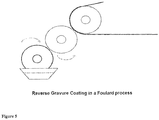
- Preferred dispensers are size presses, troughs such as in a Foulard process, and troughs onside the applicator roll having feed tank such as a Doctor Blade Chamber (15) with circulation pump (14) and a buffer tank (13) as shown in fig. 5 .
- step iii) is carried out preferably with at least one transfer unit in order to apply the aqueous emulsion of said reactive silicone-based composition onto said substrate.
- the transfer units which are suitable for this coating process are selected from group of the afore mentioned dispenser units and transfer units based on multi roller systems, wherein said transfer units are selected from the group consisting of multi-roll systems, Doctor blades, Mayer bars, gravure roller systems or rollers of size press or gate roll types.
- Preferred dispensers are coating heads like all kinds of doctor blade chambers (15) at different positions close to the rolls, multi roll coaters, gravure coaters, size presses, Mayer bar coaters, or Foulard troughs.
- the figures 3 to 5 show the preferred embodiments of the combined dispenser and coating units.
- the process therefore comprises the steps i) to iv), whereby the step
- the size presses which are fed by a buffer tank and a circulating pump are such as shown in fig. 2 unit (7).
- the process therefore comprises the steps i) to iv), whereby the step
- the doctor blade chamber which is fed by a buffer tank and a circulating pump is shown in fig. 3 .
- the process therefore comprises the steps i) to iv), whereby the step
- the Foulard trough or the Reverse Gravure Roll is shown in fig.5 .
- the multi roller systems can comprise one or more metering rolls, a smoothing roll, an applicator roll and at least one backing roll.
- a typical system consists of 5 rolls or more.
- This surface can be made of steel, chromium or non-swelling elastomers or resins, such as polyurethane, nitrile or fluoro rubbers or resins.
- the coating step iii) is carried out preferably by a method wherein said aqueous emulsion is applied onto said substrate in an amount of 0.25 to 200 g/m 2 of the aqueous emulsion on said substrate, preferably 0.25 to 100 g/m 2 .
- the aforementioned amount of the aqueous emulsion is usually applied in an amount to obtain a dry coating weight of the cured siloxane layer on the substrate in an amount of 0.1 to 10 g siloxane per m 2 of said substrate.
- a preferred coating weight of dried siloxanes is 0.2 to 5 g/m 2 , more preferred 0.3 to 3 g/ m 2 siloxanes determined by FINAT (Test method number 7: Energy-Dispersive X-Ray Fluorescence Spectroscopy, described in FINAT Technical Handbook of Test Methods).
- the inventive process comprises also a method according to which after step iii) and before step iv) water is separated from said substrate coated with said aqueous emulsion in a water separation step.
- the emulsified droplets wet and spread over the surface of the substrates the droplets are growing to bigger droplets under the effect of coalescence.
- the water phase appears on the siloxanes layer as separated droplets or becomes partly absorbed by the fibrous substrate.
- the methods for the separation of water from fibrous layers are selected from group of drying processes, like centrifugation, wiping, evaporation assisted by additional air streams including heated air, heated inert gas like nitrogen or steam heated rolls to better control the temperature of the carrier layer.
- the curing step iv) is carried out by passing the coated substrate, optionally after a water separation step, through at least one curing unit.
- Such curing step is preferably carried out continuously, for example by passing the substrates to be coated continuously through a curing unit.
- the curing units applied in this process comprise all types of means, which can heat up the coated substrate to a temperature level sufficient to cure the siloxanes layer in the shortest time possible under the constraint that the substrate is not destroyed.
- suitable curing units wherein an optimal temperature control can be achieved include for example steam heated cylinders or rolls.
- the temperature on the substrate at curing is usually in the range of 40 to 230 °C, preferably 80 to 190 °C.
- the curing step is suitably carried out by passing the substrate continuously through a heating unit, in particular, by heating e.g. in an heating tunnel having an air temperature in the range of 80 to 300 °C, preferably at 80 to 250 °C, more preferably at 90-200 °C.
- the temperature on the substrate surface may differ to this temperature, and is usually somewhat lower than the air temperature.
- the practical cure temperature depends on the material used as substrate and on the reactivity of the coating composition.
- Substrate temperatures therefore can be between 40 - 230 °C, preferably for heat curable systems from 110 - 190 °C, more preferably from 110 -170 °C and preferably for light activated systems 40 - 110 °C.
- the curing unit in step iv) can further include a method, wherein said curing in said curing step iv) is carried out by irradiating the uncured silicone film on the substrate with light of a wave length in the range of 190 to 500 nm, optionally at an elevated temperature.
- the sources for the irradiation or photo-activation are selected from the group of UV-beamers, such as Xenon lamps, which can be used as flashlight lamps, un-doted lamps or mercury lamps doted with iron or gallium, 'Blacklight'- or eximer lamps.
- the irradiation energy (radiation dose x irradiation time per volume element) will be selected with respect to the type of the process, the chosen silicone composition and the temperature of the coating mass or layer in order to ensure a sufficient cure rate.
- the band speed during coating process is adjusted by transport and winding rolls, wherein the coated substrate after passing the curing step in step iv) is collected by winding it on that winding roll.
- the band speed is mainly controlled by the speed of the winding roll, wherein the winding roll is operated preferably with band speed of 50 to 1000 m/minute. A more preferred speed is 50 to 500 m/minute, still more preferred 70 to 300 m/minute.
- the substrates to be coated are preferably fibrous or porous material, which preferably have a sheet-like form.
- These sheet-like substrates are for example selected from the group of woven or non-woven fabrics, papers or plastic films, wherein a preferred substrate to be coated is selected from the group consisting of fiber-like substrates and plastic films.
- Suitable substrates for the production of release, backing and interleaving papers are nearly all kinds of papers, preferably parchment, glassine and Kraft papers.
- the substrates are selected from the group of interleaving papers, cast films or decorative films, foams, including those of polyurethane, interleaving cards, films and cloths, reverse faces of self-adhesive tapes, self-adhesive films, text-bearing faces of self-adhesive labels, packaging material, cardboard boxes, metal foils, drums, cardboards, plastic films such as glassine paper, Kraft paper, chemical papers, calendered or glazed papers, parchmentized papers or precoated papers, woven and non-woven fabrics.
- the preferred fiber-like substrates are selected from the group of papers such as glassine paper, Kraft paper, chemical papers, caelered or glazed papers, glassine papers, parchmentized papers or precoated papers.
- coated substrates having the release layer of this invention can be used for the storage and/or transportation of tacky goods, such as adhesives, sticky foodstuffs, for example cakes, honey, candies and meat, bitumen, asphalt, greased materials and crude rubber, vegetable parchment, polyethylene- or carboxymethyl cellulose-coated papers, cellulose sheets.
- tacky goods such as adhesives, sticky foodstuffs, for example cakes, honey, candies and meat, bitumen, asphalt, greased materials and crude rubber, vegetable parchment, polyethylene- or carboxymethyl cellulose-coated papers, cellulose sheets.
- the substrates may consist of more than one layers, which may include a carrier layer.
- the plastic films are selected from the group of thermoplastics, such as polyethylene, low and high density, polypropylene already axial orientated or not, polyesters, polyterephthalate-copolymers, and polyamides.
- the achieved coatings are mechanical hard enough to get winded on a roll, while remaining sufficiently flexible/supple, which greatly facilitates automatic machine punching of flexible adhesive-coated composites, especially papers.
- the novel process applying directly 'ln-line'-mixed cross-linkable emulsions can be applied nearly to all such surfaces, which are to be rendered repellent to tacky substances.
- the addition-cross-linkable emulsions in this 'In-line'-process are suitable for the production of the self-adhesive layers or sheets connected to the release paper, either applied by the off-line method or by the in-line method.
- the aqueous emulsion compositions according to the invention may be applied to any supple materials or substrates, which will subsequently come into contact,
- the process for mixing, emulsifying, coating and curing of a release coating onto a sheet-like substrate carrier comprises the use of a composition of siloxanes having reactive groups which are curable under the interaction of radiation or heat within a short time frame.
- Suitable reactive silicone-based composition as defined in claim 1, which are mixed in step I) of the process of the invention, comprise
- a suitable mixing range of the components (A) to (F) includes:
- the component (A) is a linear or branched polyorganosiloxane or a mixture of more than one thereof having in average 2 or more alkenyl groups per molecule and has a viscosity of 40 to 400,000 mPa.s at 25 °C and a concentration of the alkenyl groups of 0.15 to 3.9 mol.-%.
- the mol-percentages of the alkenyl groups in the present invention relate to the number of alkenyl groups to the number of Si-atoms.
- At least one of the components (A) and (B) should have a functionality of more than two, in order to achieve cross-linking upon curing.
- the component(s) (A) have about 2 alkenyl groups in average, then at least more than 30 mol% of the component (B) should have a SiH functionality more than 3, in order to provide sufficient cross-linking, resulting in improved toughness and hardness respectively of the cured coating.
- components (A) can have the formula (I): [M a D b T c Q d ] m (I) wherein
- R is selected in particular from n-, iso-, tertiary- or C 1 -C 30 -alkyl, C 2 -C 12 -alkenyl, C 1 -C 12 -alkoxy(C 1 -C 12 )alkyl, C 5 -C 30 -cyclic alkyl, C 5 -C 30 -cyclic alkenyl or, C 6 -C 30 -aryl, C 7 -C 30 -alkylaryl, which can contain one or more O-, N-, S- and/or F-atoms, resulting for example in ethers groups, including poly(C 2 -C 4 -alkylene)ethers with up to 1000 alkyleneoxy units.
- Suitable examples include alkyl radicals, preferably CH 3 -, CH 3 CH 2 -, (CH 3 ) 2 CH-, C 8 H 17 - and C 10 H 21 -, cycloaliphatic radicals, such as cyclohexylethyl, limonenyl, aryl radicals, such as phenyl, tolyl, xylyl, aralkyl radicals, such as benzyl and 2-phenylethyl, fluoroalkyl groups, such as C n F 2n + 1 CH 2 CH 2 - wherein n has a value of from 1 to 10, such as, for example, CF 3 CH 2 CH 2 -, C 4 F 9 CH 2 CH 2 - and C 6 F 13 CH 2 CH 2 -. Particularly preferred groups for R are methyl, phenyl, 3,3,3-trifl uoropropyl.
- the polysiloxanes (A) comprise for R in average at least two alkenyl groups R 1 .
- Suitable groups R 1 include for example n-, iso-, tertiary- or cyclic- C 2 -C 30 -alkenyl, vinyl, C 6 -C 30 -cycloalkenyl, cycloalkenylalkyl, norbornenyl-ethyl, limonenyl, C 8 -C 30 -alkenylaryl, optionally containing one or more O- or F-atoms.
- R 1 examples include vinyl, allyl, methallyl, 3-butenyl, 5-hexenyl, 7-octenyl, cyclohexenylethyl, limonenyl, norbornenylethyl, ethyliden-norbornyl, styryl and vinylphenylethyl.
- the alkenyl radicals are preferable attached to terminal silicon atoms, and the olefin function is preferably at the end of the alkenyl group of the higher alkenyl radicals, because of the more ready availability of the alpha, omega-dienes used to prepare the alkenylsiloxanes by hydrosilylation.
- Particularly preferred groups for R 1 are vinyl and 5-hexenyl.
- Bridging groups R 2 include divalent aliphatic or aromatic n-, iso-, tertiary- or cyclo-C 1 -C 14 -alkylen, arylen or alkylenaryl groups which bridges additionally siloxy units and preferably does not exceed 30 mol.% of all siloxy units.
- suitable divalent hydrocarbon groups of R 2 include any alkylene residue, preferably such as -CH 2 -, -CH 2 CH 2 -, CH 2 (CH 3 )CH-, -(CH 2 )4-, -CH 2 CH(CH 3 )CH 2 -, -(CH 2 ) 6 -, -(CH 2 ) 8 - and -(CH 2 ) 18 -; cycloalkylene radical, such as cyclohexylene; arylene radical, such as phenylene, xylene and combinations of hydrocarbon radicals, such as benzylene, i.e.-CH 2 CH 2 -C 6 H 4 -CH 2 CH 2 - and -C 6 H 4 CH 2 -.
- Preferred groups are ⁇ , ⁇ -ethylene, ⁇ , ⁇ -hexylene or ⁇ , ⁇ -phenylene, or CH 2 CH 2 OCH 2 CH 2 CH 2 - and -C 6 H 4 -O-C 6 H 4 -.
- suitable divalent halohydrocarbon radicals R 2 include any divalent hydrocarbon group, wherein one or more hydrogen atoms have been replaced by halogen, such as fluorine or chlorine.
- Preferable divalent halohydrocarbon residues have the formula - CH 2 CH 2 C n F 2n CH 2 CH 2 - wherein n has a value of from 1 to 10 such as, for example, -CH 2 CH 2 CF 2 CF 2 CH 2 CH 2 -.
- Component (A) thus includes linear siloxanes (A1), comprising essentially no T- and/or Q-groups and branched siloxanes (A2) comprising mandatorily Q- or T-units.
- component (A1) includes linear polyorganosiloxanes having alkenyl endgroups according to formula (la).
- the linear polymers (A1) have the formula: M Alkenyl 2 D 40-2000 , wherein M Alkenyl 2 and D is as defined below.
- component (A) comprises branched, liquid polysiloxanes (A2) [M a1 D b1 T d Q d1 ] m1 (Ib) wherein M, D, T and Q, and a, b, c, d and m is as defined below, preferably T 2-40 -D 50-2000 -M 0-40 M alkenyl 3-40 (Ic) wherein T, D, M and M alkenyl are as defined below, having preferably an alkenyl concentration of preferably 0.5 to 3 mol.% and a preferred ratio of D/T of 10-50.
- component (A) consists of 2 or more single alkenyl polymers
- the above mentioned viscosities or alkenyl preferably vinyl concentrations may exceed the aforementioned range as long as the mixture of component (A) lies in the defined range.
- the average chain length of polymers in the component (A), having the aforementioned viscosities, is in general in the range of 40 to 2000 SiO-units determined by GPC with polystyrene as standard.
- the M n value is the number average molecular mass wherein the rest of low molecular weight polyorganosiloxanes up to 10 siloxy units are not counted. These low molecular weight polyorganosiloxanes are mainly comprised of cyclic polyorganosiloxanes.
- a further preferred embodiment of the component (A2) comprises the vinyl rich polyorganosiloxanes having alkenyl groups according to formula: T 2-10 -D 50-500 -M 0-10 M alkenyl 3-10 (Id) wherein the siloxy units M,D,T and Q can be distributed blockwise or randomly in the polymer chain.
- polysiloxanes (A2) of a preferred embodiment the content of T-and Q-units do not exceed 10 mol.% of all siloxy units.
- polysiloxanes (A2) are referred to as components (A2-1).
- branched polysiloxanes A2
- component (A2-2) which have a high degree of branching i.e. more than 10 mol.%, preferably more than 20 mol.% of all siloxy units.
- Those components (A2-2) provide in particular the effect of controlling, in particular, increasing the release forces of the coated substrates from other substrates attached thereto, in that they lead to an increase in stickiness of the coating layer.
- Linear polysiloxanes (A1) and vinyl rich polysiloxanes (A2-1) (low branching density) and branched polysiloxanes (A2-2) (high branching density) can be combined in any possible combination in order to modify the release forces of the coated substrate.
- A2-1 vinyl rich polysiloxanes
- A2-2 branched polysiloxanes
- the polysiloxane (A-1) is in general a flowable fluid with a Newton like viscosity but not solid at 25 °C.
- the component (A) may optionally contain 0 - 40 wt.% of (A2-2) serving as Controlled Release Additives (CRA), which are in general resin-like polymers liquid or solid at 25°C.
- CRA Controlled Release Additives
- they include solid resins [M 0 . 6-4 Q] 1-1000 and they are either solved or at least dispersed in the main polymer component of (A).
- Such resinous molecules can contain significant concentrations of SiOH and/or (C 1 -C 6 )-alkoxy-Si groups up to 10 mol.% related to the silicon atoms. They can be admixed as solution in polymers or solvents. As mentioned above the purpose of these polymers is to increase the release force of the silicone release layer, i.e. making the release layer more tacky for example in the contact to any label stock.
- CRA-compounds can be used as component (A) including molecules comprising structural elements of [M a D b T c Q d ] m -D x having block-like D x -structures, preferably for example [M 0.6-4 Q] 1-1000 -D 100-2000 .
- PSA Pressure Sensitive Adhesives
- similar compounds without alkenyl groups may be used as additives in the reactive silicone-based composition.
- a weight ratio of (A-alkenyl-poor) : (A-alkenyl-rich) between 100 : 0.5 to 50 : 50, preferably between 98-60 : 2-40, most preferably between 90-70 : 10-30 in order to suitably adjust satisfactory mechanical properties, like hardness or tension/modulus of the cured siloxanes layer.
- the branched polymer (A2) has more than 3 alkenyl groups, because otherwise the reactivity and crosslink density of the polyorganosiloxane is not sufficient with respect to smear and rubb-off of the release layer.
- alkenyl content is determined here by way of 1 H NMR - see A.L. Smith (ed.): The Analytical Chemistry of Silicones, J. Wiley & Sons 1991 Vol. 112 pp. 356 et seq . in Chemical Analysis ed. by J.D. Winefordner .
- the component (B) is preferably selected from linear, cyclic or branched SiH-containing polyorganosiloxanes of the general formula (II): [M a2 D b2 T C2 Q d2 ] m2 (II) in which
- R 4 R, R 1 or hydrogen, with the proviso that in average at least two radicals R 4 per molecule are hydrogen.
- the hydrogen atoms can occur simultaneously bind to one silicon atom preferably they bind two different silicon atoms.
- the siloxy units present in the component (B) can be linked to one another in the polymer chain, blockwise or randomly.
- Each siloxane unit of the polysiloxane chain can bear identical or different radicals of the group R.
- the indices of the formula (II) describe the average degree of polymerization P n , measured as number average M n , determined by GPC (polystyrene as standard).
- the polyhydrogensiloxane (B) in particular encompasses all of the liquid, flowable, and solid polymer structures of the formula (II) with the degrees of polymerization resulting from the indices stated above. Preference is given to the polyhydrogensiloxanes (B) whose molar mass is smaller than about 60,000 g/mol, preferably smaller than 20,000 g/mol.
- the preferred polyhydrogensiloxanes (B) have structures are selected from the group which can be described via the formula (IIa-IIf) HR 2 SiO(R 2 SiO) z (RHSiO) p SiR 2 H (IIa) HMe 2 SiO(Me 2 SiO) z (MeHSiO) p SiMe 2 H (IIb) Me 3 SiO(Me 2 SiO) z (MeHSiO) p SiMe 3 (IIc) Me 3 SiO(MeHSiO) p SiMe 3 (IId) ⁇ [R 2 R 1 SiO 1/2 ] 0-3 [R 1 SiO 3/2 ] ⁇ m2 (IIe) ⁇ [SiO 4/2 ⁇ ][R 2 R 1 SiO 1/2 ] 0.01-10 [R 1 SiO 3/2 ] 0-50 [RR 1 SiO 2/2 ] 0-1000 ⁇ m2 (IIf) where
- class (lie) and (IIf) compound is provided by way of example by monomeric to polymeric compounds which can be described via the formula [(Me 2 HSiO 0.5 ) k SiO 4/2 ] m2 wherein index k can have integer or decimal values from 0.01 to (2*m 2 +2).
- Such resinous molecules can contain significant concentrations of SiOH and/or (C 1 -C 6 )-alkoxy-Si groups up to 10 mol.% related to the silicon atoms.
- the concentration of Si-H groups is preferably in the range from 0.5 to 100 mol.% preferably 1 to 88 mol.% related to total number of silicon atoms.
- mixtures of different Si-H components (B) can be used, in particular, mixtures of compounds of the formula (lid) and (IIa) and/or (IIc).
- this can by way of example be achieved via an increase of the ratio of SiH to alkenyl, or an increased amount of catalyst (C), or an increase in the proportion of polyorganosiloxanes (B) which contain HMe 2 SiO 0.5 units.
- preferred components (B) include HMe 2 SiO 0.5 (MH groups), in order to provide faster curing rates.
- the amount of components (B1) and (B2) is from 0 to 70 mol-% of (B1), and from 30 to 100 mol-% of (B2), based on (B1) and (B2).
- the chain length of the crosslinking agents as component (B2) which are mainly composed of MeHSiO units, is preferably from 3 to 200, particularly preferably being from 15 to 60 MeHSiO units.
- the chain length of the chain extenders as component (B1) is preferably from 2 to 200, particularly preferably being from 2 to 100 Me 2 SiO units.
- the SiH-content in the present invention is determined by way of 1 H NMR, see A.L. Smith (ed.): The Analytical Chemistry of Silicones, J. Wiley & Sons 1991 Vol. 112 pp. 356 et seq . in Chemical Analysis ed. by J.D. Winefordner .
- the polyhydrogensiloxanes (B) can be prepared by processes known per se, e.g. using acidic equilibration or condensation, as disclosed by way of example in US 5 536 803 .
- the polyhydrogensiloxanes (B) can also be reaction products generated by a hydrosilylation reaction of organohydrosiloxanes using siloxanes containing smaller amounts of alkenyl groups in the presence of a hydrosilylation catalyst, where the resultant excess SiH content is preferably within the limits defined above. This gives organohydrogensiloxanes (B) bridged by alkylene groups such as R 2 groups.
- the polyhydrogensiloxanes (B) can moreover also be reaction products which results from condensation of, e.g., organohydrogenalkoxysiloxanes (B) using hydroxy- or alkoxysilanes and, respectively, siloxanes, e.g. as described in US 4,082,726 ; e.g. columns 5 and 6.
- the preferred amount of the polyhydrogensiloxanes (B) is from 0.1 to 100 parts by weight, based on 100 parts by weight of component (A).
- the ratio of component (B) to component (A) in such a way wherein in the reactive silicone-based composition the molar ratio of the SiH- to the Si-alkenyl-groups is between 0.7 to 10, preferably from 1 to 3, most preferably 1.5 to 3.
- the SiH-ratio has general impact on bath-life time and cure rate.
- the catalyst (C) is selected from the group of hydrosilylation catalysts consisting of metals or metal compounds whereby the metal is selected from the group of nickel, palladium, platinum, rhodium, iridium, ruthenium and osmium or as taught in US 3,159,601 ; US 3,159,662 ; US 3,419,593 ; US 3,715,334 ; US 3,775,452 and US 3,814,730 .
- the amounts of these catalysts which are added to the compositions are from 0.5 to 500 ppm, preferably between 1 and 250 ppm, most preferably between 10 and 200 ppm based on the total weight of the catalyst metal and organosilicon compound (A) to (E).
- the preferred metal is platinum or is a platinum compound in any oxidation stage.
- the catalyst component (C) facilitates the reaction of silicon-bonded hydrogen atoms with the silicon-bonded alkenyl radicals
- this component can be platinum metal; a carrier such as silica gel or powdered charcoal, bearing platinum metal; or a compound or complex of a platinum metal.
- a typical platinum-containing catalyst component in the organopolysiloxane compositions of this invention is any form of chloroplatinic acid, such as, for example, the readily available hexahydrate form or the anhydrous form, because of its easy dispersibility in organosiloxane systems.
- a particularly useful form of chloroplatinic acid is that composition obtained when it is reacted with an aliphatically unsaturated organosilicon compound such as divinyltetramethyldisiloxane as disclosed by US 3,419,593 , incorporated herein by reference or tetravinyl-tetramethyl-tetracyclosiloxane.
- the Pt 0 -olefin complexes are especially preferred due to the highest possible cure rates in hydrosilylation one can achieve with such compounds.
- the amount of platinum-containing catalyst component that is used in the compositions of this invention is not narrowly limited as long as there is a sufficient amount to accelerate the hydrosilylation between (A) and (B) at the desired temperature in the required time regime.
- the exact necessary amount of said catalyst component will depend upon the particular catalyst, the amount of other inhibiting compounds and the SiH : olefin ratio and is not easily predictable.
- the amount of platinum containing catalyst component to be applied is preferably sufficient to provide from 1 to 500 ppm preferably 2 to 200 ppm, especially preferred 3 to 100 ppm by weight platinum per weight of polyorganosiloxane components (A) to (B).
- said amount is at least 10 ppm by weight per sum of (A) and (B) if a paper carrier is used as substrate for the siloxane release layer.
- the hydrosilylation catalyst can also be selected from the group of photoactivatable catalysts.
- These catalysts capable of being photoactivated preferably contain at least one metal selected from the group composed of Pt, Pd, Rh, Co, Ni, Ir or Ru.
- the photoactivatable catalyst preferably comprises platinum.
- Photoactivatable catalysts are preferably selected among organometallic compounds, i.e., comprise carbon-containing ligands, or salts thereof.
- photoactivatable catalyst (C2) has metal carbon bonds, including sigma- and pi-bonds.
- the photoactivatable catalyst (C) is an organometallic complex compound having at least one metal carbon sigma bond, still more preferably a platinum complex compound having preferably one or more sigma-bonded alkyl and/or aryl group, preferably alkyl group(s).
- Sigma-bonded ligands include in particular, sigma-bonded organic groups, preferably sigma-bonded C 1 to C 6 -alkyl, more preferably sigma-bonded methyl groups, sigma-bonded aryl groups, like phenyl, sigma-bonded silyl groups, like trialkyl silyl groups.
- Most preferred photoactivatable catalyst include ⁇ 5 -(optionally substituted)-cyclopentadienyl platinum complex compounds having sigma-bonded ligands, preferably sigma-bonded alkyl ligands.
- Further photoactivatable catalysts include ( ⁇ -diolefin)-(sigma-aryl)-platinum complexes (see e.g. US 4,530,879 ). The photoactivatable catalyst can be used as such or supported on a carrier.
- the photo-activatable catalyst is a catalyst, which provides additional options to extend the bath-life time of the reactive silicon based composition obtained in step i), i.e. processing time prior to gelling of the components to form the reactive silicone-based composition once the components have been combined.
- photoactivatable catalysts examples include ⁇ -diolefin- ⁇ -aryl-platinum complexes, such as disclosed in US 4,530,879 , EP 122008 , EP 146307 (corresponding to US 4,510,094 and the prior art documents cited therein), or US 2003-0199603 , and also platinum compounds whose reactivity can be controlled by way for example using azodicarboxylic esters, as disclosed in US 4,640,939 or diketonates.
- Photoactivatable platinum compounds that can be used are moreover those selected from the group having ligands selected from diketones, e.g. benzoyl-acetones or acetylenedicarboxylic esters, and platinum catalysts embedded into photo-degradable organic resins.
- diketones e.g. benzoyl-acetones or acetylenedicarboxylic esters
- platinum catalysts embedded into photo-degradable organic resins e.g. benzoyl-acetones or acetylenedicarboxylic esters
- Other Pt-catalysts are mentioned by way of example in US 3,715,334 or US 3,419,593 , EP 1 672 031 A1 and Lewis, Colborn, Grade, Bryant, Sumpter, and Scott in Organometallics, 1995, 14, 2202-2213 , all incorporated by reference here.
- Photo-activatable catalysts can also be formed in-situ in the silicone composition to be shaped, by using Pt 0 -olefin complexes and adding appropriate photo-activatable ligands thereto.
- Pt 0 -olefin complexes are prepared by way of example in the presence of 1,3-divinyltetramethyldisiloxane (M Vi 2 ) via reduction of hexachloroplatinic acid or of other platinum chlorides.
- the photo-activatable catalysts that can be used here are, however, not restrict-ted to these above mentioned examples.
- the most preferred photoactivatable catalysts to be used in the process of the invention are ( ⁇ 5 -cyclopentadienyl)-trimethyl-platinum, ( ⁇ 5 -cyclopentadienyl)-triphenyl-platinum complexes, in particular, ( ⁇ 5 -methylcyclopentadienyl)-trimethyl-platinum.
- the amount of the photoactivatable catalysts is preferably 1-500 ppm and preferably in the same lower range as defined for the heat-activatable hydrosilylation catalysts mentioned above.
- the inventive compositions may contain an appropriate amount of one or more inhibitors (D) controlling the cure rate and the bath-life time.
- the inhibitor (D) is applied in a sufficient amount in order to retard the hydrosilylation reaction at room temperature in order to enable mixing of the components (A) to (C) as well as the dispensing and coating step without prior curing.
- the cure rate after coating should be achieved in the shortest possible time after heat or light activation within seconds especially above 40°C.
- the inhibitor as component (D) in the compositions of this invention is any material that is known to be, or can be, used as an inhibitor for the catalytic activity of platinum group metal-containing catalysts.
- inhibitor it is meant herein a material that retards the curing at room temperature of a curable mixture of the components (A), (B), and (C), when incorporated therein in small amounts, such as less than 2 wt.% based on the total weight of (A) to (B).
- Inhibitors for the platinum group metal catalysts are well known in the organosilicon art.
- Examples of various classes of such metal catalyst inhibitors include unsaturated organic compounds such as ethylenically or aromatically unsaturated amides, US 4,337,332 ; acetylenic compounds, US 3,445,420 and US 4,347,346 ; ethylenically unsaturated isocyanates, US 3,882,083 ; olefinic siloxanes, US 3,989,667 ; unsaturated hydrocarbon diesters, US 4,256,870 , US 4,476,166 and US 4,562,096 , and conjugated eneynes.
- compositions of this invention can comprise an inhibitor from any of these classes of inhibitors.
- Examples thereof include the acetylenic alcohols of US 3,445,420 , such as ethynylcyclohexanol and methylbutynol; the unsaturated carboxylic esters of US 4,256,870 , such as diallylmaleate and dimethyl maleate; and the maleates and fumarates of US 4,562,096 and US 4,774.111 , such as diethyl fumarate, diallyl fumarate and bis-(methoxyiso-propyl)maleate.
- the half esters and amides of US 4,533,575 ; and the inhibitor mixtures of US 4,476,166 would also be expected to behave similarly.
- the above-mentioned patents relating to inhibitors for platinum group metal-containing catalysts are incorporated herein by reference to teach how to prepare compounds, which are suitable for the use as inhibitor component (D) in our compositions.
- Preferred inhibitors for the compositions of this invention are the maleates and fumarates.
- R 10 can be, for example, an C 1 -C 10 -alkyl radical such as methyl, ethyl, propyl, isopropyl, butyl, pentyl or hexyl, an aryl radical such as phenyl or benzyl, an alkenyl radical such as vinyl or allyl, alkynyl radicals, or a cyclohydrocarbon radical such as cyclohexyl.
- an C 1 -C 10 -alkyl radical such as methyl, ethyl, propyl, isopropyl, butyl, pentyl or hexyl
- an aryl radical such as phenyl or benzyl
- an alkenyl radical such as vinyl or allyl
- alkynyl radicals alkynyl radicals
- a cyclohydrocarbon radical such as cyclohexyl.
- W can be, for example, C 2 - C 4 divalent organic group like -CH 2 CH 2 -, -CH 2 (CH 3 )CH-, -CH 2 CH 2 CH 2 -, -CH 2 CH 2 CH 2 CH 2 -, CH 2 (CH 3 CH 2 )CH- and -CH 2 CH 2 (CH 3 )CH-.
- the amount of inhibitor component (D) to be used in the compositions of this invention is not critical and can be any amount that will retard the above-described platinum-catalyzed hydrosilylation reaction at room temperature while not preventing said reaction at moderately elevated temperature.
- the range of the inhibitor component (D) can be 0.0005 to 2 wt-.% , preferably 0.05 to 2 wt.%, and most preferably 0.1 to 1 wt.% for e.g. alkinoles based on the total weight of components (A) and (B).
- the siloxane composition according to the invention may comprise further ingredients (E).
- the siloxane compositions according to the invention may also comprise further ingredients, like for example solvents (E), added to achieve better process properties for the inventive polymer composition (A) to (D).
- solvents are usual organic solvents in the range of less than 10 wt.-% , preferably less than 5 wt.-% and most less than 1 wt.-% related to (A) to (D), because the invention based on aqueous emulsion aims to avoid any additional solvent, if these must be evaporated after coating and becomes part of the exhaust gases.
- solvent comprise reactive groups linkable to the polymers (A) or (B)
- these solvents can be used as component (E) in amounts beyond above limits for (E).
- Appropriate reactive solvents can be selcted from the group of olefinic hydrocarbons such as alpha-olefins, e.g. C8 to C25-alpha-olefins or preferably C14-C20-alpha-olefins. Mixtures of alpha-olefins can also be used.
- Other additives falling under definition of component (E) are selected from the group of heat stabilzers, coloring compounds or pigments, antioxidants, biocides, fungicides, such as Preventol®, Katon®, Dowicil®, fillers, espec.
- spherical silsesquioxanes for getting additional antiblocking properties of release layers, anti-mist additives as disclosed in US 6,586,535 or US 2003/0134043 , anchorage additives, agents to control the pH-level, slipping agents as disclosed in EP 819735 A1 , leveling agents and the like and further auxiliary components typical for silicone release compositions.
- These ingredients may be contained in said reactive silicone-based composition in a total amount of up to 20 wt.%.
- the fillers used in inventive compositions are preferably selected from the groups of surface-modified fillers or spherically shape fillers.
- the fillers may serve as reinforcing fillers, thickening additive, as anti-blocking or anti-friction or matting additive.
- the fillers include by way of example are all of the fine-particle fillers, i.e. those having particles smaller than 100 ⁇ m, i.e. preferably composed of such particles.
- These can be mineral fillers, such as silicates, carbonates, nitrides, oxides, carbon blacks, or silicas being fumed or precipitated silica, whose BET-surface areas are from 0.3 to 400 m 2 /g, these preferably having been specifically surface-hydrophobicized here.
- Preferred silicas are, for example, Aerosil® 200, 300, HDK® N20 or T30, Cab-O-Sil® MS 7 or HS 5 more than 200 m 2 /g BET surface area or precipitated silicas, or wet silicas, are Vulkasil®VN3, or FK 160 from Degussa, or Nipsil®LP from Nippon Silica K.K. and others.
- silicas pre-hydrophobized with various silanes are: Aerosil R 972, R 974, R 976, or R 812, or, for example, HDK® 2000 or HDK® H30, names for materials known as hydrophobized precipitated silicas or wet silicas are Sipernat®D10 or D15 from Degussa.
- the preferred surface treatment can be achieved with polyorganosiloxanediols, polyorganosiloxanes, chloro or alkoxysilanes which allows a certain concentration of fillers having lowest degree of thickening properties and shear thinning.
- fillers serving as non-transparent non-reinforcing fillers are powdered quartz, diatomaceous earths, powdered crystobalites, micas, aluminum oxides, aluminum hydroxides, oxides and salts of Fe, Mn, Ti, Zn, Zr, chalks, or carbon blacks whose BET-surface areas are from 0.3 to 50 m 2 /g.
- These fillers are available under variety of trade names, examples being Sicron®, Min-U-Sil®, Dicalite®, Crystallite® and serve as matting agents.
- This type of filler especially if the particles have a spherical shape can preferably be used as anti-blocking agents in the release layer and can give an especially soft touch of the surface layer.
- Such filler are selected from the group of spherical particles based on silicas, thermoplastic powders such as PTFE powders, PTFE emulsions or polyamide polyurethane or silsesquioxanes powders, cured silicone elastomers or resins are used in amounts of up to 10 wt.%. Tradenames are Teflon® emulsions, Nylon® powders, Tospearl®, Acemat® etc.
- Heat stabilizers can be selected from the group of metal compounds, organic or inorganic salts, complexes of Ce, Fe, La, Mn, Ti and Zr.
- Levelling agents are selected from the group consisting of polyether-siloxanes, polyols, polyethers, polyhalides, fatty alcohol or fluoroalkyl derivatives.
- Another class of the conventional additives (E) are additives which can improve rheological properties such as thickening additives without essential surface active properties. Examples of said non-essential components include viscosity-increasing additives, such as carboxymethyl cellulose, hydroxyethyl cellulose and sodium alginates.
- the component (F) are emulsifiers which are selected from the group of surface active compounds, whereby at least one such emulsifier is a polymeric emulsifier.
- emulsifiers are in general used to mix and disperse the oily phase of components (A) to (E) with water in step ii).
- component (F) includes all the emulsifiers suitable for the formation of droplets in a continuous aqueous carrier matrix and the stabilization of this emulsion.
- the quantity of the emulsifiers (F) should preferably not exceed 20 wt.-%, based on the total of components (A) to (E).
- the emulsifiers preferably are selected from the group which consists of all non-ionic emulsifiers such as alkylphenoxy ethers, polyoxyalkylene glycols, polyoxyalkylene sorbitan monooleates, polyvinylalcohols, polyvinylesters, polyethersilo-xanes and sorbitan stearates, cationic emulsifiers such as alkyl, aryl, polyethoxylated quaternary ammonium salts such as polyethoxylated quaternary ammonium chloride.
- non-ionic emulsifiers such as alkylphenoxy ethers, polyoxyalkylene glycols, polyoxyalkylene sorbitan monooleates, polyvinylalcohols, polyvinylesters, polyethersilo-xanes and sorbitan stearates
- cationic emulsifiers such as alkyl, aryl, polyeth
- ionic surfactants are preferably anionic surfactants, which can be employed are, e.g., alkyl- or aryl- , alkylaryl-sulphates, sulphonates, phosphates, sulphosuccinates, sulphosuccinamates, sulphoacetates or amino acid derivatives.
- emulsifying agents presently employed for silicones.
- polymeric emulsifiers such as polyvinylalcohols, polyvinylesters, or partially hydrolyzed polyvinylesters and the corresponding copolymers with ethylene, propylene, acrylic acid or other unsaturated organic monomers.
- the emulsifier is added at a ratio of the oil phase ranging from about 0.05 wt.% to about 20 wt.-% of (A) to (E).
- these emulsifiers can also work as protective colloid type, in addition to their emulsifying function.
- These protective colloids, such as PVAs can also be active as promoters of anti-adhesiveness, of water repellency, indeed even of printability, as regards the field of paper anti-adhesiveness.
- emulsifiers that are mentioned in the FDA Regulations 176.170 "Components of Paper and Paperboard”.
- Suitable emulsifiers and thickeners (F) are further selected from the group consisting of: C8-C22-alkyldimethylbenzylammonium chloride, preferably at most 1.5 wt.%, sodium lauryl sulphate, preferably at most 0.5 wt.-%, polyethylene glycol ethers of monohydric aliphatic alcohols C12-C20 and C2-C9-alkyl phenols, or polyethylene glycol esters of natural fatty acids C8-C22 and vegetable oils.
- the most preferred polymeric emulsifiers are polyvinylalcohols such as partially acetylated polyvinyl alcohol with less than 20 mol.% acetyl groups and a K-value of more than 40.
- Polyvinylalcohols (PVA) as emulsifiers are compounds obtained from their corresponding esters, in particular polyvinyl acetate, by hydrolysis in aqueous medium or by alcoholysis in anhydrous medium.
- the precursors as starting material used in praxis are commonly polyvinyl acetates.
- the hydrolysis of these esters resulting in PVAs is generally incomplete. Acyl groups remain in the molecule, this proportion influences the properties of the PVA, in particular its solubility.
- One characterization of PVAs is therefore the indication of the ester number or degree of hydrolysis.
- the ester number can be determined by known methods, e.g. by neutralization of any acid present in the polyvinyl alcohol after saponification of the acyl groups and titration of the excess from alkaline saponification.
- Another method for the description of the polyvinyl alcohols is the degree of polymerization or condensation, which can be determined by measuring the dynamic viscosity (cP/cps (centipoise) or mPa.s) eta c ⁇ of a defined dilution.
- the viscosity eta c ⁇ corresponds to the dynamic viscosity coefficient of a aqueous solution of 4 wt.-% of a PVA at 20 ⁇ 5 °C using an capillary (Ostwald) viscometer.
- Non-ionic emulsifier as component (F) of this invention are polyvinylalcohols (PVA) having preferably a degree of hydrolysis of 70 to 99 mol.-%, more preferably 80 to 90 and most preferably from 86 to 89 mol.-%. It has been discovered that a cured coating has the lowest release force, highest gloss, if an appropriate viscosity or a related degree of hydrolysis of the PVA emulsifier is selected. The highest gloss may be achieved with a degree of hydrolysis of at least 90 mol.-%, the optimum of gloss and lowest release forces if the degree of hydrolysis is at least 80 mol.-% preferably between 85-90 mol.%.
- Preferred PVA emulsifiers have a range of viscosity of an aqueous solution containing 4 wt.-% of the PVA of from 3 to 150 mPa.s at 20 °C , more preferred 6 to 130 mPa.s at 20°C and most preferred greater than 15 mPa.s at 20 °C, most preferred greater than 30 mPa.s.
- the weight-average molecular weights (M w ) of the PVA emulsifiers preferably are between 150 to 250,000 g/mol, more preferably 30,000-250,000 g/mol most preferred > 50,000 to 250,000 g/mol.
- the molecular weight of the PVA has impact on the desired gloss and release forces against adhesives.
- the molecular weight depends on the degree of hydrolysis and viscosity of the PVA.
- the amount of PVA that may be used in the compositions is typically from about 0.5 to 20 wt.%, preferably 1- 5 wt.% based on the total of components (A) to (E).
- a PVA emulsifier is used together with smaller amounts of a second non-ionic or ionic emulsifier selected from anionic or cationic surfactants.
- the second emulsifier may be employed in a proportion of 0.05 to 10 parts, preferably from 0.1 to 5 parts, per 100 parts of components (A) to (E).
- a second emulsifier can be selected from nonionic emulsifiers, different than PVA which are selected from the group of C1 to C15-alkylphenyl derivatives, fatty alcohols glycol alkyl ethers, or fatty acids carrying alkylene oxide groups, such as ethylene or propylene oxide, e.g. nonylphenyl comprising between 9 and 30 ethylene oxide (EO) units or oleic acid with 2 to 8 EO units.
- EO ethylene oxide
- surfactants are available by example as Cemulsol® O.N 10-20 available at Rhodia or Tergipol® NP-40 available at Crompton formerly Union Carbide Corporation, or as Arkopal formerly from Hoechst, e.g. N-150 a nonylphenyl polyglycol ether having on average 15 glycol units.
- polyvinyl alcohol with anionic and cationic emulisifiers is another preferred embodiment, preferred are here sodium alkyl- or alkylaryl-sulphates, most preferably laurylsulfate.
- the liquid carrier the continuous phase of the emulsion which represents the essential component of the composition is water, preferably clear water, and most preferably distilled and/or deionized water.
- the coated substrate obtained after processing the steps i) to iii) comprises a silicone release layer, where the coated substrate can serve as carrier layer for tacky or adhesive materials, which have to be peeled off with low and defined forces and whereby the adhesive properties are not impaired by remaining silicone residues.
- release layers are particular useful in processes for cooking cakes, breds and all kind of bakeries, whereby the substrate is used as bakery paper for the separation of bakery ware after the cooking process.
- reactive components (A) to (E) of a silicone composition curable by hydrosilylation can be dispersed to a stable aqueous emulsion, if the components are first mixed without the aqueous carrier and preferably then dispersed under assistance of an emulsifier (F).
- emulsifier F
- Such emulsion can be dispensed on rolls and spread to curable films preferably if the process times after unification of the components (A) to (F), i.e. forming the reactive silicone-based composition, are below of 10 h at temperatures below 40 °C.
- the release layers on any of the substrates are evaluated by measuring its release force in accordance with FINAT test method No. 3 and for the residual adhesive force of the adhesion layer after contact with silicone release layer in accordance with FINAT test method No. 10 or 11 in order to evaluate one kind of smear.
- the residual adhesive force is measured with the adhesive "Tesa 4154".
- the release forces are measured in relation to acrylic adhesives obtainable under the designation "Tesa® 7475", rubber adhesives available under the designation “Tesa® 7476” and “Tesa® 4154", each from the company Beiersdorf, Hamburg.
- FINAT No. 7 determines the coating weight.
- the Rubb-Off and Smear was determined in addition by rubbing with certain pressure (1 N) on the coating with a finger and observing for the absence of haze in the rubbed area.
- the no-rub-off condition was determined by vigorously rubbing (1 N) the coating with the index finger and noting that the coating could not be removed from the paper even partly.
- cure time and bath-life time are defined above in the description as curing time at 120 °C and a viscosity increase at 40 °C.
- the reactivity of the reactive silicone compositions, which are free of water and which do not include component (F), can also be evaluated by Differential Scanning Calorimetry (DSC).
- DSC-spectra are measured with a Mettler Toledo DSC 12E apparatus.
- the sample size was 8 mg of the water-free composition (A) to (E).
- the starting temperature is 30 °C and ends at 170 °C with a heating rate / increase of 10 °K/min.
- the calculated temperature T onset as starting point for heat development in a DSC measurement is defined to be the point of intersection of a straight line which follows best the tangent in the turning point in the upgrade of the function representing the heat development and the base line.
- the temperature (T onset ) is the point of intersection of that tangent line and the base line of the DSC curve under the applied heating rate.
- the mixture shows a curing time at 120 °C of less than 30 sec on a Honey glassine paper of 60 g/m 2 from Tervasaari applying a coating weight of 1 g/m 2 and showing a bath-life time at 40 °C of 5 h, wherein the viscosity increased on the twofold of the starting value.
- the temperature calculated as T onset in a DSC measurement was ca. 95.8 °C.
- This example illustrates how to achieve curing times and bath-life times in the preferred time regime.
- a water phase containing polyvinyl alcohol (PVA) as component (F) in an amount to provide 2 wt.-% of PVA in the total aqueous emulsion and 40 g of the reactive composition containing components (A) to (D), obtained in example 1, are mixed together.
- the PVA-type of this example is Mowiol® 5-88 ((-CH 2 -CH(OH)-) n ), a partially hydrolyzed polyvinylacetate having a degree of hydrolysis of 88 mol.% and having a viscosity of 5.5 mPa.s at 25 °C (4 wt.-% aqueous solution).
- the emulsion was made by incorporation of the reactive silicone-based composition into the water-phase in two minutes while mixing with an Ultra-Turrax high shear mixer at highest speed (4000 rpm) in a 1500 ml beaker of 14 cm height. During this mixing time the temperature of the emulsion rose to a maximum of 36 °C. The amount of solids in the end-emulsion was 42 wt.-% +/-2 wt.-%.
- This example illustrates how to achieve an emulsion using a low viscous emulsifier.
- a water phase contained that much of polyvinyl alcohol (PVA) as component (F) to provide an amount of 2 wt.-% of PVA in the final emulsion and 40 g of the reactive composition (A) to (D) of example 1 are mixed together.
- PVA-type in this example is Celvol® 540, a partially hydrolyzed polyvinylacetate having a degree of hydrolysis of 88 mol.% and a viscosity of 50 mPa.s at 25 °C (4 wt.-% aqueous solution).
- the emulsion was made by incorporation of the reactive silicone-based composition into the water-phase in two minutes while mixing with an Ultra-Turrax high shear mixer at highest speed (4000 rpm) in a 1500 ml beaker of 14 cm height. During this mixing time the temperature of the emulsion rose to a maximum of 36 °C. The amount of solids in the end-emulsion was 42 wt.-% +/-2 wt.-%.
- This example illustrates how to achieve an emulsion using a high viscous emulsifier, which is preferred.
- the reactive silicone-based composition was made with 3.3 pw of polymethylhydrogensiloxane of the formula Me 3 SiO(Me 2 SiO) 15 -(MeHSiO) 30 SiMe 3 instead of 5.5 pw of the polymethylhydrogensiloxane used in Example 1 providing a SiH:SiVi ratio of 1.5 :1 of the components (A) and (B).
- the mixture has a curing time at 120 °C of less than 30 sec on the paper used in example 1 showing a coating weight of 1 g/m 2 and a bath-life time at 40 °C of 6 h.
- the temperature calculated as T onset in a DSC measurement was ca. 95.8 °C
- This example illustrates how to achieve curing times and bath-life times in the preferred time regime with a composition having a smaller ratio of SiH : Si-alkenyl.
- the smaller SiH-ratio compared to example 2 enlarges the bath-life time. Other differences are detectable in the coating process as shown below.
- a water phase contained that much of polyvinyl alcohol (PVA) as component (F) to provide an amount of 1 wt.-% of PVA in the final emulsion and 40 g of the reactive composition (A) to (D) of example 4 are mixed together.
- PVA-type is Mowiol 5-88 ®, a partially hydrolyzed polyvinylacetate having a degree of hydrolysis of 88 mol.% and a 4 wt.-% aqueous solution viscosity of 5.5 mPa.s at 25 °C.
- the amount of solids in the final emulsion was 42 wt.-% +/-2 wt.-%.
- a water phase contained that much of polyvinyl alcohol (PVA) as component (F) to provide an amount of 1 wt.-% of PVA in the final emulsion and 40 g of the reactive composition (A) to (D) of example 4 are mixed together.
- PVA-type is Celvol® 540, a hydrolyzed PV-Acetate having a degree of hydrolysis of 88 mol.% and a 4 wt.-% aqueous solution viscosity of 50 mPa.s at 25 °C.
- the amount of solids in the end-emulsion was 42 wt.-% +/-2 wt.-%.
- the aqueous emulsions prepared in the examples 2-3 and 5-6 were coated with an adjusted Mayer Bar allowing a higher wet coating weight as in Example 1 on a standard glassine paper from Tervasaari, a Honey glassine paper of 60 g/m 2 .
- the curing time of the aqueous coating was completed at 120 °C in less than 30 seconds.
- the dry coat weight determined after curing was measured to be 1 g/m 2 .
- Tesa® tapes 7476 and 7475 were affixed to the cured silicone surface obtained before (acc. to Finat test No.3), and the taped release liners were aged for 24 hours at room temperature.
- the force required to peel away the Tesa tape from the silicone surface through an angle of 180° at 300 mm/min was determined in (cN/inch) cN/cm (Tesa® tapes have a width of (1 inch) 2.54 cm). The results are given below in table 1. Tab.
- the viscosity of the PVA used as an emulsifier should be preferably higher than 5.5 mPa.s.
- This example shows the storage stability of an SiH-emulsion according to the state of the art
- the example illustrates the manufacture of an aqueous emulsion of a non-reactive silicone-based composition wherein the catalyst component (C) is omitted:
- a vinyl end-stopped polydimethylsiloxane of around 250 mPa.s at 25 °C, (vinyl content 0.22 mmol/g) of the general formula M vi 2 -D 120 as component (A), 5.5 pw of a polymethylhydrogensiloxane of the formula Me 3 SiO(Me 2 SiO) 15 (MeHSiO) 30 SiMe 3 (30 mPa.s at 25 °C) as component (B) providing a molar SiH/SiVi ratio of 2.5, and 0.4 pw inhibitor as component (D), which is the diallylmaleate were mixed together with a kitchen mixer. This mixture is called the 'oil phase'.
- the PVA-type in this example is Celvol® 540, an hydrolysed PVA having a degree of hydrolysis of 88 mol.% and a 4 wt.% aqueous solution viscosity of 50 mPa.s at 25 °C.
- the emulsion was made by addition of the oil-phase to the water-phase in two minutes while mixing with an Ultra-Turrax high shear mixer. During this mixing time the temperature of the emulsion rose to 36 °C maximum.
- the amount of solids in the end-emulsion was targeted at 42 wt.-% +/-2 wt.-%. This emulsion named (Em1a) was separated in two parts.
- the coating was made on a Tervasaari Honey glassine paper of 60 g/m 2 by making a draw down of the emulsion with a knife and curing it in an oven for 30 s at 120 °C. The curing was tested by checking smear on the coating. The smear was testing by rubbing with a finger with a pressure of 1 N.
- the freshly made emulsion comprised of (Em1a) and (Em2) showed full cure and no smear while the aged emulsion (Em1b) and (Em2) stored 100 days at 25 °C showed incomplete cure at 120 °C after 30 s and smear and rubb-off of the coating.
- the SiH-content according to a titration of active hydrogen of the emulsion (Em1b) decreased from 0.184 mmol SiH/g emulsion to 0.128 mmol SiH/g in this period of 100 days, which corresponds to a loss of 30 mol.%.
- This SiH-content was determined by titration of the emulsion (Em1b) with (tert.-butanol)-potassium and the measurement of the amount of hydrogen evacuating from that mixture.
- a water phase contained 0.67 gram of a nonylphenol ethoxylate with 30 EO units and 1.62 gram of a secondary C11-C15-alcohol ethoxylate with 7 EO units and 40 g of the reactive composition (A) to (D) of example 1 are mixed together.
- the ethoxylates in this example used are the Tergitol NP-30 and Tergitol 15-S-7 respectively.
- the emulsion was made by incorporation of the reactive silicone-based composition into the water-phase in two minutes while mixing with an Ultra-Turrax high shear mixer at highest speed (4000 rpm) in a 1500 ml beaker of 14 cm height. During this mixing time the temperature of the emulsion rose to a maximum of 36 °C. The amount of solids in the end-emulsion was 42 wt.-% +/-2 wt.-%.
- the emulsion was made by incorporation of the reactive silicone-based composition into the water-phase in two minutes while mixing with an Ultra-Turrax high shear mixer at highest speed (4000 rpm) in a 1500 ml beaker of 14 cm height. During this mixing time the temperature of the emulsion rose to a maximum of 36 °C. The amount of solids in the end-emulsion was 42 wt.-% +/-2 wt.-%.
- Pt 0 -complex having vinylsiloxane ligands Pt-Karstedt catalyst
- the emulsion was made by incorporation of the reactive silicone-based composition into the water-phase in two minutes while mixing with an Ultra-Turrax high shear mixer at highest speed (4000 rpm) in a 1500 ml beaker of 14 cm height. During this mixing time the temperature of the emulsion rose to a maximum of 36 °C. The amount of solids in the end-emulsion was 42 wt.-% +/-2 wt.-%.
- aqueous emulsions prepared in the examples 10 and 11 were mixed in a ratio of 18:2 to make a reactive emulsion mixture.
- This aqueous reactive emulsion mixture and the aqueous reactive emulsion prepared in the example 9 and 3 were coated with an adjusted Mayer Bar on a standard glassine paper from Tervasaari, a Honey glassine paper of 60 g/m 2 .
- the curing time of the aqueous coating was completed at 120 °C in less than 30 seconds.
- the dry coat weight determined after curing was measured to be 1 g/m 2 .
- the Rubb-Off of the dry coating was determined by rubbing with certain pressure (1 N) on the coating with a finger and observing for the absence of haze in the coating and the appearance of small cured silicone particles.
- the emulsions were stored at 40 °C for 1 hour after which another coating was made on paper. This coating procedure was repeated every hour.
- inventive one-part emulsion of example 3 and the two-part combination of the comparative emulsions made in example 10 and 11 showed good anchorage, less rubb-off even after a bath life of 3 hrs at 40 °C.
- the comparative one-part emulsion made with non-ionic emulsifiers from example 9 failed the anchorage test after even a short bath life.
- PVA polyvinyl alcohol
- F polyvinyl alcohol
- the PVA-type in this example is Celvol® 540, a partially hydrolysed PV-Acetate having a degree of hydrolysis of 88 mol.% and a viscosity of 50 mPa.s at 25 °C (4 wt.-% aqueous solution).
- the aqueous emulsion prepared in this example is coated with a Mayer Bar on a standard glassine paper from Tervasaari Honey glassine paper of 60 g/m 2 .
- the curing time of the aqueous coating was completed at 120 °C in less than 30 sec.
- the dry coat weight determined after curing was measured to be 1 g/m 2 .
- Tesa tapes 7476 and 7475 were affixed to the cured silicone surface obtained before (acc. to Finat test No.3), and the taped release liners were aged for 24 hours at room temperature.
- the force required to peel away the Tesa tape from the silicone surface through an angle of 180 ° at 300 mm/min was determined in (cN/inch) cN/cm (Tesa® tapes have a width of (1 inch) 2.54 cm). The results are given below. Tab.
- the example 13 shows the properties of a release film made by a process, wherein the steps i) and ii), i.e. mixing the oil-phase and making the emulsion are carried out in the same time.
- the performance of the release coat of example 13 in terms of the release forces is not satisfactory.
- a release value of higher than (200 cN/inch) 78.7 cN/cm is less preferred.
Landscapes
- Chemical & Material Sciences (AREA)
- Organic Chemistry (AREA)
- Chemical Kinetics & Catalysis (AREA)
- Health & Medical Sciences (AREA)
- Medicinal Chemistry (AREA)
- Polymers & Plastics (AREA)
- Dispersion Chemistry (AREA)
- Life Sciences & Earth Sciences (AREA)
- Engineering & Computer Science (AREA)
- Materials Engineering (AREA)
- Wood Science & Technology (AREA)
- Paints Or Removers (AREA)
- Application Of Or Painting With Fluid Materials (AREA)
- Processes Of Treating Macromolecular Substances (AREA)
Claims (14)
- Ein Verfahren zum Beschichten von Substraten mit einer wässrigen Emulsion einer reaktiven Silikon-basierten Zusammensetzung, umfassend die Schrittei) Mischen der folgenden Komponenten, um die reaktive Silikon-basierte Zusammensetzung zu bilden(A) ein oder mehrere Polyorganosiloxane mit durchschnittlich mindestens zwei Alkenylgruppen, die linear oder verzweigt sind, einer Viskosität von 40 bis 400,000 mPa s bei 25 °C und einer Schergeschwindigkeit von D=1 s-1 und einer Konzentration der Alkenylgruppen von 0,15 bis 3,9 mol-%,(B) ein oder mehrere Polyorganosiloxane mit durchschnittlich mindestens zwei SiH-Gruppen, wobei das molare Verhältnis der SiH-Gruppen zu den Si-Alkenyl-Gruppen zwischen 0,7 und 10 beträgt,(C) ein oder mehrere Hydrosilylierungskatalysatoren,(D) optional ein oder mehrere Inhibitoren der Hydrosilylierungsreaktion,(E) optional ein oder mehrere Hilfsstoffe,ii) Mischen der genannten reaktiven Silikon-basierten Zusammensetzung mit Wasser, um eine wässrige Emulsion der genannten Silikon-basierten Zusammensetzung zu bilden,iii) Beschichten des Substrates mit der genannten wässrigen Emulsion der genannten reaktiven Silikon-basierten Zusammensetzung, undiv) Härten der genannten reaktiven Silikon-basierten Zusammensetzung, um das genannte Silikon-beschichtete Substrat zu bilden,wobei
die Verweildauer im Mischungsschritt (i) geringer ist als die Verarbeitungszeit der reaktiven Silikon-basierten Zusammensetzung, Schritt ii) erfordert, dass die in Schritt i) erhaltene reaktive Silikon-basierte Zusammensetzung in eine Emulgiereinheit eingespeist wird, um Schritt ii) vor dem Ende der Verarbeitungszeit der reaktiven Silikon-basierten Zusammensetzung durchzuführen, und wobei die genannte Verarbeitungszeit die Zeit ist, nachdem mindestens die Komponenten (A) bis (C) Teil der Zusammensetzung geworden sind, bis zum Zeitpunkt der Verdopplung der Viskosität der reaktiven Zusammensetzung bei 40 °C. - Verfahren gemäß Anspruch 1, wobei die genannte reaktive Silikon-basierte Zusammensetzung hitze- und/oder lichthärtbar ist.
- Verfahren gemäß Anspruch 1, wobei in Schritt ii) das Wasser oder ein Teil des Wassers vor, gleichzeitig mit und/oder nach der Einspeisung der in Schritt i) erhaltenen reaktiven Silikon-basierten Zusammensetzung in die Emulgiereinheit in die Emulgiereinheit eingespeist wird.
- Ein Verfahren gemäß einem der Ansprüche 1 bis 3, wobei in Schritt i) und/oder ii) mindestens ein Emulgator zugegeben wird.
- Verfahren gemäß Anspruch 4, wobei der Emulgator ein polymeres Material ist, das ausgewählt ist aus Polyvinylalkoholen, Polyvinylestern oder teilweise hydrolysierten Polyvinylestern oder Copolymeren derselben, bevorzugt aus Polyvinylalkoholen.
- Verfahren gemäß einem der Ansprüche 1 bis 5, wobei das Gewicht des in Schritt ii) eingespeisten Wassers größer ist als das Gewicht der in Schritt ii) eingespeisten reaktiven Silikon-basierten Zusammensetzung.
- Verfahren nach einem der Ansprüche 1 bis 6, wobei in Schritt ii) eine Scherenergie aufgebracht wird.
- Verfahren nach einem der Ansprüche 1 bis 7, wobei Schritt iii) mit mindestens einer Transfereinheit, ausgewählt aus der Gruppe bestehend aus Mehrwalzensystemen, durchgeführt wird, um die wässrige Emulsion der genannten Silikon-basierten reaktiven Zusammensetzung auf das genannte Substrat aufzutragen.
- Verfahren nach einem der Ansprüche 1 bis 8, wobei in Schritt iii) die genannte wässrige Emulsion in einer Menge von 0,1 bis 10 g Siloxan pro m2 des genannten Substrats auf das genannte Substrat aufgetragen werden, gemessen und berechnet nach der FINAT-Methode Nr. 7.
- Verfahren nach einem der Ansprüche 1 bis 9, wobei der genannte Härtungsschritt in Schritt iv) durchgeführt wird, indem das beschichtete Substrat, gegebenenfalls nach einem Wasserabtrennungsschritt, durch mindestens eine Härtungseinheit geführt wird.
- Verfahren nach einem der Ansprüche 1 bis 10, wobei das beschichtete Substrat nach Durchlaufen des Härtungsschrittes in Schritt iv) durch Aufwickeln auf eine Wickelrolle gesammelt wird, die mit einer Bandgeschwindigkeit von 50 bis 1000 m/Minute betrieben wird.
- Verfahren gemäß einem der Ansprüche 1 bis 11, wobei das zu beschichtende Substrat ein flächiges Substrat ist, ausgewählt aus der Gruppe bestehend aus faserartigen Substraten und Kunststofffolien.
- Verfahren nach einem der Ansprüche 1 bis 12, wobei das genannte Härten in dem genannten Härtungsschritt iv) durch Erhitzen in einem Heiztunnel mit einer Lufttemperatur im Bereich von 80 bis 300 °C durchgeführt wird.
- Verfahren nach einem der Ansprüche 1 bis 13, wobei das genannte Härten in dem genannten Härtungsschritt iv) durch Bestrahlen mit Licht einer Wellenlänge im Bereich von 190 bis 500 nm, gegebenenfalls bei einer erhöhten Temperatur, durchgeführt wird.
Priority Applications (2)
| Application Number | Priority Date | Filing Date | Title |
|---|---|---|---|
| EP09780682.2A EP2303949B1 (de) | 2008-07-19 | 2009-07-16 | Verfahren zur beschichtung von substraten |
| NO09780682A NO2303949T3 (de) | 2008-07-19 | 2009-07-16 |
Applications Claiming Priority (3)
| Application Number | Priority Date | Filing Date | Title |
|---|---|---|---|
| EP08013065A EP2145912A1 (de) | 2008-07-19 | 2008-07-19 | Verfahren zur Beschichtung von Substraten |
| PCT/EP2009/059121 WO2010010030A1 (en) | 2008-07-19 | 2009-07-16 | Method of coating substrates |
| EP09780682.2A EP2303949B1 (de) | 2008-07-19 | 2009-07-16 | Verfahren zur beschichtung von substraten |
Publications (2)
| Publication Number | Publication Date |
|---|---|
| EP2303949A1 EP2303949A1 (de) | 2011-04-06 |
| EP2303949B1 true EP2303949B1 (de) | 2018-01-10 |
Family
ID=40279846
Family Applications (2)
| Application Number | Title | Priority Date | Filing Date |
|---|---|---|---|
| EP08013065A Withdrawn EP2145912A1 (de) | 2008-07-19 | 2008-07-19 | Verfahren zur Beschichtung von Substraten |
| EP09780682.2A Not-in-force EP2303949B1 (de) | 2008-07-19 | 2009-07-16 | Verfahren zur beschichtung von substraten |
Family Applications Before (1)
| Application Number | Title | Priority Date | Filing Date |
|---|---|---|---|
| EP08013065A Withdrawn EP2145912A1 (de) | 2008-07-19 | 2008-07-19 | Verfahren zur Beschichtung von Substraten |
Country Status (5)
| Country | Link |
|---|---|
| US (1) | US8658254B2 (de) |
| EP (2) | EP2145912A1 (de) |
| CN (1) | CN102099399B (de) |
| NO (1) | NO2303949T3 (de) |
| WO (1) | WO2010010030A1 (de) |
Families Citing this family (15)
| Publication number | Priority date | Publication date | Assignee | Title |
|---|---|---|---|---|
| US8883281B2 (en) | 2010-12-17 | 2014-11-11 | Saint-Gobain Performance Plastics Corporation | Multilayer film having pressure sensitive adhesive layer |
| WO2013077700A1 (ko) * | 2011-11-25 | 2013-05-30 | 주식회사 엘지화학 | 경화성 조성물 |
| CN104395377B (zh) * | 2012-08-01 | 2017-02-22 | 道康宁公司 | 水性有机硅分散体和膜及其制备 |
| JP6297558B2 (ja) | 2012-08-01 | 2018-03-20 | ダウ コーニング コーポレーションDow Corning Corporation | 水性シリコーン分散液及びそれらの調製 |
| CN104248910B (zh) * | 2013-06-28 | 2017-07-25 | 中国石油化工股份有限公司 | 一种高分子陶粒复合填料的制造方法及生物填料块 |
| US9796639B2 (en) * | 2014-01-24 | 2017-10-24 | Dryject Inc. Acquisition Corp. | Polymer mixing technique |
| EP3383953B8 (de) | 2015-12-03 | 2025-04-16 | ELANTAS Europe GmbH | Einkomponentige, lagerstabile uv-vernetzbare organosiloxanzusammensetzung |
| JP2023530836A (ja) * | 2020-06-22 | 2023-07-20 | ダウ シリコーンズ コーポレーション | 低強度放射線硬化性シリコーン剥離コーティング組成物並びにその調製及び使用のための方法 |
| US20240066551A1 (en) * | 2020-12-31 | 2024-02-29 | Elkem Silicones Shanghai Co., Ltd. | Method for post-treatment of an additive manufactured object |
| US20230158731A1 (en) * | 2021-11-19 | 2023-05-25 | Sanford, L.P. | Additives for Silicone Compositions |
| CN118574907A (zh) * | 2022-01-28 | 2024-08-30 | 美国陶氏有机硅公司 | 有机硅离型涂层乳液、其制备方法和用于烘焙纸的用途 |
| KR20240117131A (ko) * | 2022-03-29 | 2024-07-31 | 도요보 가부시키가이샤 | 이형 필름 |
| JP2023145969A (ja) * | 2022-03-29 | 2023-10-12 | 東洋紡株式会社 | 離型フィルム |
| JP2023145966A (ja) * | 2022-03-29 | 2023-10-12 | 東洋紡株式会社 | 離型フィルム |
| CN119875507B (zh) * | 2025-02-12 | 2025-10-14 | 松井新材料集团股份有限公司 | 一种水性有机硅涂料及其制备方法和应用 |
Citations (2)
| Publication number | Priority date | Publication date | Assignee | Title |
|---|---|---|---|---|
| US5968660A (en) * | 1993-08-27 | 1999-10-19 | Dow Corning S.A. | Coated substrate |
| WO2002042360A2 (en) * | 2000-11-24 | 2002-05-30 | Dow Corning Corporation | Process for making silicone emulsions |
Family Cites Families (66)
| Publication number | Priority date | Publication date | Assignee | Title |
|---|---|---|---|---|
| US3159601A (en) | 1962-07-02 | 1964-12-01 | Gen Electric | Platinum-olefin complex catalyzed addition of hydrogen- and alkenyl-substituted siloxanes |
| US3159662A (en) | 1962-07-02 | 1964-12-01 | Gen Electric | Addition reaction |
| GB1111156A (en) | 1964-08-04 | 1968-04-24 | Midland Silicones Ltd | Siloxane-coated materials |
| NL131800C (de) | 1965-05-17 | |||
| FR1486341A (fr) | 1965-07-12 | 1967-06-23 | Manton Gaulin Mfg Company | Perfectionnements pour l'obtention de dispersions de matières solides finement divisées dans un véhicule liquide |
| US3527659A (en) | 1966-06-13 | 1970-09-08 | Dow Corning | Dimethylpolysiloxanes and copolymers containing sio2 units as release agent |
| NL129346C (de) | 1966-06-23 | |||
| US3418731A (en) | 1966-08-24 | 1968-12-31 | Albert T.J.H. Anciaux | Shoe sole |
| US3344111A (en) | 1966-09-28 | 1967-09-26 | Gen Electric | Preparation of stable copolymerizable organosilicon compositions containing a platinum catalyst and an acrylonitrile type compound |
| US3461185A (en) | 1968-01-10 | 1969-08-12 | Dow Corning | Heat activated curable organosilicon composition |
| US3579469A (en) | 1968-12-13 | 1971-05-18 | Gen Electric | Siloxane paper release coatings |
| US3814730A (en) | 1970-08-06 | 1974-06-04 | Gen Electric | Platinum complexes of unsaturated siloxanes and platinum containing organopolysiloxanes |
| US3715334A (en) | 1970-11-27 | 1973-02-06 | Gen Electric | Platinum-vinylsiloxanes |
| US3697473A (en) | 1971-01-04 | 1972-10-10 | Dow Corning | Composition curable through si-h and si-ch equals ch2 with improved properties |
| US3775452A (en) | 1971-04-28 | 1973-11-27 | Gen Electric | Platinum complexes of unsaturated siloxanes and platinum containing organopolysiloxanes |
| BE786300A (fr) | 1971-07-16 | 1973-01-15 | Bayer Ag | Procede d'enduction du papier d'une couche d'organopolysiloxanediminuant l'adherence |
| US3819745A (en) | 1972-03-27 | 1974-06-25 | Dow Corning | Coatings giving controlled release |
| US3882083A (en) | 1973-11-21 | 1975-05-06 | Gen Electric | Latent addition curable organopolysiloxane compositions |
| US3900617A (en) | 1973-11-27 | 1975-08-19 | Gen Electric | Method of rendering flexible sheet material non-adherent and article produced thereby |
| US3989667A (en) | 1974-12-02 | 1976-11-02 | Dow Corning Corporation | Olefinic siloxanes as platinum inhibitors |
| DE2515484C3 (de) | 1975-04-09 | 1979-09-20 | Bayer Ag, 5090 Leverkusen | Beschichtungsmittel auf Basis PoIyorganosiloxanen und dessen Verwendung |
| JPS5224258A (en) | 1975-08-19 | 1977-02-23 | Toray Silicone Co Ltd | Curable organopolysiloxane composition |
| DE2601159C3 (de) | 1976-01-14 | 1982-02-04 | Wacker-Chemie GmbH, 8000 München | Verfahren zum Herstellen von klebrige Stoffe abweisenden Überzügen |
| US4061609A (en) | 1976-04-09 | 1977-12-06 | General Electric Company | Inhibitor for platinum catalyzed silicone rubber compositions |
| DE2748406A1 (de) | 1977-10-28 | 1979-05-03 | Bayer Ag | Verfahren zum herstellen von klebrige stoffe abweisenden ueberzuegen |
| US4256870A (en) | 1979-05-17 | 1981-03-17 | General Electric Company | Solventless release compositions, methods and articles of manufacture |
| US4248751A (en) | 1979-08-31 | 1981-02-03 | Dow Corning Corporation | Process for producing a silicone elastomer emulsion and use thereof |
| US4347346A (en) | 1981-04-02 | 1982-08-31 | General Electric Company | Silicone release coatings and inhibitors |
| US4337332A (en) | 1981-04-09 | 1982-06-29 | Minnesota Mining And Manufacturing Company | Latently curable organosilicone compositions |
| JPS6054991B2 (ja) | 1982-04-02 | 1985-12-03 | ト−レ・シリコ−ン株式会社 | オルガノポリシロキサン組成物 |
| DE3230289A1 (de) | 1982-08-14 | 1984-02-16 | Bayer Ag, 5090 Leverkusen | Herstellung von pharmazeutischen oder kosmetischen dispersionen |
| US4476166A (en) | 1983-01-17 | 1984-10-09 | General Electric Company | Silicone release coatings and inhibitors |
| US4530879A (en) | 1983-03-04 | 1985-07-23 | Minnesota Mining And Manufacturing Company | Radiation activated addition reaction |
| US4533575A (en) | 1983-09-23 | 1985-08-06 | Minnesota Mining And Manufacturing Company | Latently-curable organosilicone release coating composition |
| US4510094A (en) | 1983-12-06 | 1985-04-09 | Minnesota Mining And Manufacturing Company | Platinum complex |
| US4472563A (en) | 1984-02-06 | 1984-09-18 | Dow Corning Corporation | Heat curable silicones having improved room temperature stability |
| FR2571732B1 (fr) | 1984-10-15 | 1987-01-09 | Rhone Poulenc Spec Chim | Composition organopolysiloxanique de revetement utilisable notamment pour le traitement antiadherent et son procede d'application |
| US4562096A (en) | 1984-12-24 | 1985-12-31 | Dow Corning Corporation | Heat-curable silicone compositions, use thereof and stabilizer therefor |
| US4637341A (en) | 1985-08-28 | 1987-01-20 | Rayco Graphic Manufacturing, Inc. | Apparatus for applying silicone emulsion to a paper web |
| FR2600660B1 (fr) | 1986-06-24 | 1988-11-18 | Rhone Poulenc Chimie | Emulsions aqueuses de compositions organopolysiloxane polyaddition pour l'enduction de materiaux souples |
| US4774111A (en) | 1987-06-29 | 1988-09-27 | Dow Corning Corporation | Heat-curable silicone compositions comprising fumarate cure-control additive and use thereof |
| GB8815162D0 (en) * | 1988-06-25 | 1988-08-03 | Avery International Corp | Improvements relating to release liners |
| US4954554A (en) | 1989-02-27 | 1990-09-04 | Dow Corning Corporation | Silicone emulsions |
| GB2233572B (en) | 1989-07-10 | 1994-03-23 | Neptune Orient Lines Limited | Method and apparatus for producing layer-in-oil emulsions |
| CA2050624C (en) | 1990-09-06 | 1996-06-04 | Vladimir Vladimirowitsch Fissenko | Method and device for acting upon fluids by means of a shock wave |
| JP2513101B2 (ja) * | 1992-01-23 | 1996-07-03 | 信越化学工業株式会社 | エアバッグ用コ―ティング組成物及びエアバッグ |
| DE4202973A1 (de) | 1992-02-03 | 1993-08-05 | Bayer Ag | Verfahren zur kontinuierlichen herstellung von polyurethan- und polyurethanharnstoff-elastomeren |
| DE69308433T2 (de) | 1992-07-14 | 1997-07-03 | Shinetsu Chemical Co | Silikon-Emulsion-Zusammensetzung für Trennbeschichtung |
| DE4412261C2 (de) | 1994-04-09 | 1996-10-17 | Jonas Konrad H | Vorrichtung zum Zusammenführen wenigstens zweier Fließmedien |
| US5536803A (en) | 1994-06-06 | 1996-07-16 | Shin-Etsu Chemical Co., Ltd. | Adhesive silicone compositions |
| FR2738830B1 (fr) * | 1995-09-14 | 1997-12-05 | Rhone Poulenc Chimie | Emulsion aqueuse de polyorganosiloxane pour l'enduction de matiere textile |
| DE19535005A1 (de) | 1995-09-21 | 1997-03-27 | Wacker Chemie Gmbh | Wäßrige Organopolysiloxanemulsionen sowie Emulgatoren zu deren Herstellung |
| DE19628447A1 (de) | 1996-07-15 | 1998-01-22 | Bayer Ag | Wäßrige Emulsionen, ein Verfahren zur Herstellung und deren Verwendung |
| FR2760981B1 (fr) | 1997-03-21 | 1999-06-04 | Rhodia Chimie Sa | Procede et dispositif d'enduction d'un support en vue de lui conferer des proprietes anti-adherentes, au moyen d'une composition silicone reticulable |
| WO1999015263A1 (de) | 1997-09-25 | 1999-04-01 | Ge Bayer Silicones Gmbh & Co. Kg | Vorrichtung und verfahren zur herstellung von siliconemulsionen |
| FR2773166B1 (fr) | 1997-12-31 | 2000-03-24 | Rhodia Chimie Sa | Emulsion silicone aqueuse, utile comme base de preparation de revetement hydrofuge et antiadherent pour papier, procede de preparation d'une emulsion de ce type et de revetements antiadherents |
| US20030149166A1 (en) * | 1997-12-31 | 2003-08-07 | Sean Duffy | Aqueous silicone emulsion, of use as base for preparing a water-repellent and anti-adhesive paper coating, process for preparing an emulsion of this type and anti-adhesive coatings |
| DE19934438B4 (de) * | 1999-07-22 | 2008-01-17 | Wacker Chemie Ag | Verfahren zur Herstellung einer wässrigen 1-Komponenten Siliconzusammensetzung |
| US6586535B1 (en) | 2000-06-22 | 2003-07-01 | Dow Corning Corporation | Coatings containing silicone mist suppressant compositions |
| US6387487B1 (en) | 2000-08-11 | 2002-05-14 | General Electric Company | Dual cure, low-solvent silicone pressure sensitive adhesives |
| DE10161334A1 (de) | 2001-12-13 | 2003-07-17 | Wacker Chemie Gmbh | Alkenylgruppen aufweisende Siloxancopolymere als Antimisting Additive für Siliconbeschichtungszusammensetzungen |
| US20030199603A1 (en) | 2002-04-04 | 2003-10-23 | 3M Innovative Properties Company | Cured compositions transparent to ultraviolet radiation |
| US6822021B1 (en) * | 2002-12-16 | 2004-11-23 | Toray Saehan Incorporation | Silicone aqueous emulsion release liquid and release film using the same |
| US7005475B2 (en) * | 2003-06-10 | 2006-02-28 | General Electric Company | Curable silicone compositions having improved adhesion to polymeric films |
| EP1724308B1 (de) * | 2004-03-05 | 2017-02-22 | Dow Corning Toray Co., Ltd. | Emulsionszusammensetzung für silikonkautschukschwamm, herstellungsverfahren dafür und verfahren zur herstellung eines silikonkautschukschwamms |
| DE102004060934A1 (de) | 2004-12-17 | 2006-06-29 | Wacker Chemie Ag | Vernetzbare Polyorganosiloxanmassen |
-
2008
- 2008-07-19 EP EP08013065A patent/EP2145912A1/de not_active Withdrawn
-
2009
- 2009-07-16 WO PCT/EP2009/059121 patent/WO2010010030A1/en not_active Ceased
- 2009-07-16 US US13/054,510 patent/US8658254B2/en active Active
- 2009-07-16 CN CN200980127844.XA patent/CN102099399B/zh active Active
- 2009-07-16 EP EP09780682.2A patent/EP2303949B1/de not_active Not-in-force
- 2009-07-16 NO NO09780682A patent/NO2303949T3/no unknown
Patent Citations (2)
| Publication number | Priority date | Publication date | Assignee | Title |
|---|---|---|---|---|
| US5968660A (en) * | 1993-08-27 | 1999-10-19 | Dow Corning S.A. | Coated substrate |
| WO2002042360A2 (en) * | 2000-11-24 | 2002-05-30 | Dow Corning Corporation | Process for making silicone emulsions |
Also Published As
| Publication number | Publication date |
|---|---|
| US8658254B2 (en) | 2014-02-25 |
| NO2303949T3 (de) | 2018-06-09 |
| EP2303949A1 (de) | 2011-04-06 |
| EP2145912A1 (de) | 2010-01-20 |
| US20110124804A1 (en) | 2011-05-26 |
| WO2010010030A1 (en) | 2010-01-28 |
| CN102099399A (zh) | 2011-06-15 |
| CN102099399B (zh) | 2014-09-17 |
Similar Documents
| Publication | Publication Date | Title |
|---|---|---|
| EP2303949B1 (de) | Verfahren zur beschichtung von substraten | |
| JP2983610B2 (ja) | 硬化性有機ケイ素組成物及びその使用方法 | |
| US5741439A (en) | Silicone emulsion compositions | |
| US5708075A (en) | Silicone release coating compositions | |
| US20070099007A1 (en) | Use of hydrophilic (co) polymers in crosslinkable aqueous silicone emulsions | |
| JP5401673B2 (ja) | ロール装置を用いて軟質支持体を架橋性液状シリコーン組成物でコーティングする際のミストの出現を防止する方法 | |
| US10676642B2 (en) | Crosslinked organopolysiloxane and method for producing same, mist suppressant, and solvent-free silicone composition for release paper | |
| JP4335370B2 (ja) | 剥離調節剤組成物、シリコ−ン剥離被膜用組成物、及び硬化被膜の製造方法 | |
| JPS63314275A (ja) | 離型用シリコーンエマルジョンの製造方法 | |
| KR100275288B1 (ko) | 지방족불포화래디컬을 가진 오르가노폴리실록산, 그 제조방법 및 가교조성물에서의 그 사용(organopolysiloxanes having aliphatically unsaturated radicals, the preparation thereof and the use thereof in crosslinkable materials) | |
| JP5753909B2 (ja) | ヒドロシリル化反応阻害剤および安定した硬化性シリコーン組成物の調製を目的とするその使用 | |
| JPH0258294B2 (de) | ||
| KR20130137547A (ko) | 부가 경화형 실리콘 에멀전 조성물 및 박리 필름 | |
| EP3875542A1 (de) | Silikonemulsionszusammensetzung | |
| EP2631277A1 (de) | Zusatzhärtbare Silikonemulsionstrennzusammensetzung und Trennfolie | |
| EP1044237A1 (de) | Wässrige silikonemulsion die als grundlage zur herstellung von wasserabweisenden und auf papier nichthaftenden überzügen verwendbar ist, verfahren zur herstellung dieser emulsionen und nichthaftende überzüge | |
| JP5296412B2 (ja) | 離型用シリコーンエマルジョン組成物及びそれを用いてなる離型性基体 | |
| US5108791A (en) | Heat-curable silicone compositions having improved bath life | |
| JP2000513999A (ja) | 粘着防止性を付与するために架橋可能なシリコーン組成物を用いて支持材を被覆するための方法及び装置 | |
| CN101443385A (zh) | 在辊式装置中当用可交联液体有机硅组合物涂布柔性载体时控制雾出现的方法 | |
| WO2021024910A1 (ja) | オルガノハイドロジェンポリシロキサンのエマルション、及びこれを用いた付加硬化型シリコーンエマルション組成物 | |
| CN101466791A (zh) | 在辊式装置中当用可交联液体有机硅组合物涂布柔性载体时控制雾出现的方法 | |
| TWI435921B (zh) | 用於高固含量溶劑塗覆方法之聚矽氧釋離塗層組合物 | |
| KR20250149990A (ko) | 실리콘 에멀션 조성물 | |
| TW201600569A (zh) | 聚矽氧烷離型塗料組合物,及用於紙張和薄膜塗布使其固化離型塗層具有低離型力的乳液聚矽氧烷離型塗料 |
Legal Events
| Date | Code | Title | Description |
|---|---|---|---|
| PUAI | Public reference made under article 153(3) epc to a published international application that has entered the european phase |
Free format text: ORIGINAL CODE: 0009012 |
|
| 17P | Request for examination filed |
Effective date: 20110207 |
|
| AK | Designated contracting states |
Kind code of ref document: A1 Designated state(s): AT BE BG CH CY CZ DE DK EE ES FI FR GB GR HR HU IE IS IT LI LT LU LV MC MK MT NL NO PL PT RO SE SI SK SM TR |
|
| AX | Request for extension of the european patent |
Extension state: AL BA RS |
|
| DAX | Request for extension of the european patent (deleted) | ||
| TPAC | Observations filed by third parties |
Free format text: ORIGINAL CODE: EPIDOSNTIPA |
|
| 17Q | First examination report despatched |
Effective date: 20160223 |
|
| GRAP | Despatch of communication of intention to grant a patent |
Free format text: ORIGINAL CODE: EPIDOSNIGR1 |
|
| INTG | Intention to grant announced |
Effective date: 20170804 |
|
| GRAS | Grant fee paid |
Free format text: ORIGINAL CODE: EPIDOSNIGR3 |
|
| GRAA | (expected) grant |
Free format text: ORIGINAL CODE: 0009210 |
|
| AK | Designated contracting states |
Kind code of ref document: B1 Designated state(s): AT BE BG CH CY CZ DE DK EE ES FI FR GB GR HR HU IE IS IT LI LT LU LV MC MK MT NL NO PL PT RO SE SI SK SM TR |
|
| REG | Reference to a national code |
Ref country code: GB Ref legal event code: FG4D |
|
| REG | Reference to a national code |
Ref country code: CH Ref legal event code: EP Ref country code: AT Ref legal event code: REF Ref document number: 962352 Country of ref document: AT Kind code of ref document: T Effective date: 20180115 |
|
| REG | Reference to a national code |
Ref country code: IE Ref legal event code: FG4D |
|
| REG | Reference to a national code |
Ref country code: DE Ref legal event code: R096 Ref document number: 602009050354 Country of ref document: DE |
|
| REG | Reference to a national code |
Ref country code: SE Ref legal event code: TRGR |
|
| REG | Reference to a national code |
Ref country code: NL Ref legal event code: MP Effective date: 20180110 |
|
| REG | Reference to a national code |
Ref country code: NO Ref legal event code: T2 Effective date: 20180110 |
|
| REG | Reference to a national code |
Ref country code: AT Ref legal event code: MK05 Ref document number: 962352 Country of ref document: AT Kind code of ref document: T Effective date: 20180110 |
|
| PG25 | Lapsed in a contracting state [announced via postgrant information from national office to epo] |
Ref country code: NL Free format text: LAPSE BECAUSE OF FAILURE TO SUBMIT A TRANSLATION OF THE DESCRIPTION OR TO PAY THE FEE WITHIN THE PRESCRIBED TIME-LIMIT Effective date: 20180110 |
|
| REG | Reference to a national code |
Ref country code: FR Ref legal event code: PLFP Year of fee payment: 10 |
|
| PG25 | Lapsed in a contracting state [announced via postgrant information from national office to epo] |
Ref country code: CY Free format text: LAPSE BECAUSE OF FAILURE TO SUBMIT A TRANSLATION OF THE DESCRIPTION OR TO PAY THE FEE WITHIN THE PRESCRIBED TIME-LIMIT Effective date: 20180110 Ref country code: LT Free format text: LAPSE BECAUSE OF FAILURE TO SUBMIT A TRANSLATION OF THE DESCRIPTION OR TO PAY THE FEE WITHIN THE PRESCRIBED TIME-LIMIT Effective date: 20180110 Ref country code: HR Free format text: LAPSE BECAUSE OF FAILURE TO SUBMIT A TRANSLATION OF THE DESCRIPTION OR TO PAY THE FEE WITHIN THE PRESCRIBED TIME-LIMIT Effective date: 20180110 Ref country code: ES Free format text: LAPSE BECAUSE OF FAILURE TO SUBMIT A TRANSLATION OF THE DESCRIPTION OR TO PAY THE FEE WITHIN THE PRESCRIBED TIME-LIMIT Effective date: 20180110 |
|
| PG25 | Lapsed in a contracting state [announced via postgrant information from national office to epo] |
Ref country code: AT Free format text: LAPSE BECAUSE OF FAILURE TO SUBMIT A TRANSLATION OF THE DESCRIPTION OR TO PAY THE FEE WITHIN THE PRESCRIBED TIME-LIMIT Effective date: 20180110 Ref country code: PL Free format text: LAPSE BECAUSE OF FAILURE TO SUBMIT A TRANSLATION OF THE DESCRIPTION OR TO PAY THE FEE WITHIN THE PRESCRIBED TIME-LIMIT Effective date: 20180110 Ref country code: GR Free format text: LAPSE BECAUSE OF FAILURE TO SUBMIT A TRANSLATION OF THE DESCRIPTION OR TO PAY THE FEE WITHIN THE PRESCRIBED TIME-LIMIT Effective date: 20180411 Ref country code: LV Free format text: LAPSE BECAUSE OF FAILURE TO SUBMIT A TRANSLATION OF THE DESCRIPTION OR TO PAY THE FEE WITHIN THE PRESCRIBED TIME-LIMIT Effective date: 20180110 Ref country code: IS Free format text: LAPSE BECAUSE OF FAILURE TO SUBMIT A TRANSLATION OF THE DESCRIPTION OR TO PAY THE FEE WITHIN THE PRESCRIBED TIME-LIMIT Effective date: 20180510 Ref country code: BG Free format text: LAPSE BECAUSE OF FAILURE TO SUBMIT A TRANSLATION OF THE DESCRIPTION OR TO PAY THE FEE WITHIN THE PRESCRIBED TIME-LIMIT Effective date: 20180410 |
|
| REG | Reference to a national code |
Ref country code: DE Ref legal event code: R097 Ref document number: 602009050354 Country of ref document: DE |
|
| PG25 | Lapsed in a contracting state [announced via postgrant information from national office to epo] |
Ref country code: EE Free format text: LAPSE BECAUSE OF FAILURE TO SUBMIT A TRANSLATION OF THE DESCRIPTION OR TO PAY THE FEE WITHIN THE PRESCRIBED TIME-LIMIT Effective date: 20180110 Ref country code: RO Free format text: LAPSE BECAUSE OF FAILURE TO SUBMIT A TRANSLATION OF THE DESCRIPTION OR TO PAY THE FEE WITHIN THE PRESCRIBED TIME-LIMIT Effective date: 20180110 |
|
| PLBE | No opposition filed within time limit |
Free format text: ORIGINAL CODE: 0009261 |
|
| STAA | Information on the status of an ep patent application or granted ep patent |
Free format text: STATUS: NO OPPOSITION FILED WITHIN TIME LIMIT |
|
| PG25 | Lapsed in a contracting state [announced via postgrant information from national office to epo] |
Ref country code: SK Free format text: LAPSE BECAUSE OF FAILURE TO SUBMIT A TRANSLATION OF THE DESCRIPTION OR TO PAY THE FEE WITHIN THE PRESCRIBED TIME-LIMIT Effective date: 20180110 Ref country code: CZ Free format text: LAPSE BECAUSE OF FAILURE TO SUBMIT A TRANSLATION OF THE DESCRIPTION OR TO PAY THE FEE WITHIN THE PRESCRIBED TIME-LIMIT Effective date: 20180110 Ref country code: SM Free format text: LAPSE BECAUSE OF FAILURE TO SUBMIT A TRANSLATION OF THE DESCRIPTION OR TO PAY THE FEE WITHIN THE PRESCRIBED TIME-LIMIT Effective date: 20180110 Ref country code: DK Free format text: LAPSE BECAUSE OF FAILURE TO SUBMIT A TRANSLATION OF THE DESCRIPTION OR TO PAY THE FEE WITHIN THE PRESCRIBED TIME-LIMIT Effective date: 20180110 |
|
| 26N | No opposition filed |
Effective date: 20181011 |
|
| PG25 | Lapsed in a contracting state [announced via postgrant information from national office to epo] |
Ref country code: SI Free format text: LAPSE BECAUSE OF FAILURE TO SUBMIT A TRANSLATION OF THE DESCRIPTION OR TO PAY THE FEE WITHIN THE PRESCRIBED TIME-LIMIT Effective date: 20180110 |
|
| REG | Reference to a national code |
Ref country code: CH Ref legal event code: PL |
|
| PG25 | Lapsed in a contracting state [announced via postgrant information from national office to epo] |
Ref country code: MC Free format text: LAPSE BECAUSE OF FAILURE TO SUBMIT A TRANSLATION OF THE DESCRIPTION OR TO PAY THE FEE WITHIN THE PRESCRIBED TIME-LIMIT Effective date: 20180110 |
|
| REG | Reference to a national code |
Ref country code: BE Ref legal event code: MM Effective date: 20180731 |
|
| REG | Reference to a national code |
Ref country code: IE Ref legal event code: MM4A |
|
| PG25 | Lapsed in a contracting state [announced via postgrant information from national office to epo] |
Ref country code: IE Free format text: LAPSE BECAUSE OF NON-PAYMENT OF DUE FEES Effective date: 20180716 Ref country code: CH Free format text: LAPSE BECAUSE OF NON-PAYMENT OF DUE FEES Effective date: 20180731 Ref country code: LI Free format text: LAPSE BECAUSE OF NON-PAYMENT OF DUE FEES Effective date: 20180731 |
|
| PG25 | Lapsed in a contracting state [announced via postgrant information from national office to epo] |
Ref country code: BE Free format text: LAPSE BECAUSE OF NON-PAYMENT OF DUE FEES Effective date: 20180731 |
|
| PG25 | Lapsed in a contracting state [announced via postgrant information from national office to epo] |
Ref country code: MT Free format text: LAPSE BECAUSE OF NON-PAYMENT OF DUE FEES Effective date: 20180716 |
|
| PG25 | Lapsed in a contracting state [announced via postgrant information from national office to epo] |
Ref country code: TR Free format text: LAPSE BECAUSE OF FAILURE TO SUBMIT A TRANSLATION OF THE DESCRIPTION OR TO PAY THE FEE WITHIN THE PRESCRIBED TIME-LIMIT Effective date: 20180110 |
|
| PG25 | Lapsed in a contracting state [announced via postgrant information from national office to epo] |
Ref country code: PT Free format text: LAPSE BECAUSE OF FAILURE TO SUBMIT A TRANSLATION OF THE DESCRIPTION OR TO PAY THE FEE WITHIN THE PRESCRIBED TIME-LIMIT Effective date: 20180110 Ref country code: HU Free format text: LAPSE BECAUSE OF FAILURE TO SUBMIT A TRANSLATION OF THE DESCRIPTION OR TO PAY THE FEE WITHIN THE PRESCRIBED TIME-LIMIT; INVALID AB INITIO Effective date: 20090716 |
|
| PG25 | Lapsed in a contracting state [announced via postgrant information from national office to epo] |
Ref country code: MK Free format text: LAPSE BECAUSE OF NON-PAYMENT OF DUE FEES Effective date: 20180110 |
|
| PGFP | Annual fee paid to national office [announced via postgrant information from national office to epo] |
Ref country code: LU Payment date: 20200727 Year of fee payment: 12 |
|
| PGFP | Annual fee paid to national office [announced via postgrant information from national office to epo] |
Ref country code: IT Payment date: 20210721 Year of fee payment: 13 Ref country code: FR Payment date: 20210726 Year of fee payment: 13 Ref country code: FI Payment date: 20210728 Year of fee payment: 13 |
|
| PGFP | Annual fee paid to national office [announced via postgrant information from national office to epo] |
Ref country code: GB Payment date: 20210727 Year of fee payment: 13 Ref country code: NO Payment date: 20210728 Year of fee payment: 13 Ref country code: SE Payment date: 20210728 Year of fee payment: 13 Ref country code: DE Payment date: 20210728 Year of fee payment: 13 |
|
| PG25 | Lapsed in a contracting state [announced via postgrant information from national office to epo] |
Ref country code: LU Free format text: LAPSE BECAUSE OF NON-PAYMENT OF DUE FEES Effective date: 20210716 |
|
| REG | Reference to a national code |
Ref country code: DE Ref legal event code: R119 Ref document number: 602009050354 Country of ref document: DE |
|
| REG | Reference to a national code |
Ref country code: NO Ref legal event code: MMEP |
|
| REG | Reference to a national code |
Ref country code: SE Ref legal event code: EUG |
|
| GBPC | Gb: european patent ceased through non-payment of renewal fee |
Effective date: 20220716 |
|
| PG25 | Lapsed in a contracting state [announced via postgrant information from national office to epo] |
Ref country code: SE Free format text: LAPSE BECAUSE OF NON-PAYMENT OF DUE FEES Effective date: 20220717 Ref country code: NO Free format text: LAPSE BECAUSE OF NON-PAYMENT OF DUE FEES Effective date: 20220731 Ref country code: FR Free format text: LAPSE BECAUSE OF NON-PAYMENT OF DUE FEES Effective date: 20220731 Ref country code: FI Free format text: LAPSE BECAUSE OF NON-PAYMENT OF DUE FEES Effective date: 20220716 |
|
| PG25 | Lapsed in a contracting state [announced via postgrant information from national office to epo] |
Ref country code: GB Free format text: LAPSE BECAUSE OF NON-PAYMENT OF DUE FEES Effective date: 20220716 Ref country code: DE Free format text: LAPSE BECAUSE OF NON-PAYMENT OF DUE FEES Effective date: 20230201 |
|
| PG25 | Lapsed in a contracting state [announced via postgrant information from national office to epo] |
Ref country code: IT Free format text: LAPSE BECAUSE OF NON-PAYMENT OF DUE FEES Effective date: 20220716 |