EP2276493B1 - Antioxidant inflammation modulators: oleanolic acid derivatives with amino and other modifications at c-17 - Google Patents
Antioxidant inflammation modulators: oleanolic acid derivatives with amino and other modifications at c-17 Download PDFInfo
- Publication number
- EP2276493B1 EP2276493B1 EP09732992.4A EP09732992A EP2276493B1 EP 2276493 B1 EP2276493 B1 EP 2276493B1 EP 09732992 A EP09732992 A EP 09732992A EP 2276493 B1 EP2276493 B1 EP 2276493B1
- Authority
- EP
- European Patent Office
- Prior art keywords
- disease
- compound
- carbon
- substituted
- group
- Prior art date
- Legal status (The legal status is an assumption and is not a legal conclusion. Google has not performed a legal analysis and makes no representation as to the accuracy of the status listed.)
- Active
Links
- 0 CC(C)(CC1)CC(C2C3)[C@@]1(*)CC[C@@]2(C)[C@](C)(CCC(C(C)(C)C1=O)[C@@](C)(C2C4)C=C1C#N)C2[C@@]3C4=O Chemical compound CC(C)(CC1)CC(C2C3)[C@@]1(*)CC[C@@]2(C)[C@](C)(CCC(C(C)(C)C1=O)[C@@](C)(C2C4)C=C1C#N)C2[C@@]3C4=O 0.000 description 12
- ZIQKHUAYUNLKRM-VBOSUHKCSA-N CC(C)(CC1)CC(C([C@@](C)(CC2)[C@](C)(CCC(C(C)(C)C3=O)[C@]4(C)C(C)=C3C#N)C4=C3)C3=O)[C@]12C(OC)=O Chemical compound CC(C)(CC1)CC(C([C@@](C)(CC2)[C@](C)(CCC(C(C)(C)C3=O)[C@]4(C)C(C)=C3C#N)C4=C3)C3=O)[C@]12C(OC)=O ZIQKHUAYUNLKRM-VBOSUHKCSA-N 0.000 description 1
- UBRASLQCAYTTEB-UFHYVYMVSA-N CC(C)(CC1)CC(C([C@@](C)(CC2)[C@](C)(CCC(C(C)(C)C3=O)[C@]4(C)C=C3C#N)C4=C3)C3=O)[C@]12C(NCC(F)(F)F)=O Chemical compound CC(C)(CC1)CC(C([C@@](C)(CC2)[C@](C)(CCC(C(C)(C)C3=O)[C@]4(C)C=C3C#N)C4=C3)C3=O)[C@]12C(NCC(F)(F)F)=O UBRASLQCAYTTEB-UFHYVYMVSA-N 0.000 description 1
- TXGZJQLMVSIZEI-BOPWVZDGSA-N CC(C)(CC1)CC(C([C@@](C)(CC2)[C@](C)(CCC(C(C)(C)C3=O)[C@]4(C)C=C3C#N)C4=C3)C3=O)[C@]12C(O)=O Chemical compound CC(C)(CC1)CC(C([C@@](C)(CC2)[C@](C)(CCC(C(C)(C)C3=O)[C@]4(C)C=C3C#N)C4=C3)C3=O)[C@]12C(O)=O TXGZJQLMVSIZEI-BOPWVZDGSA-N 0.000 description 1
- WPTTVJLTNAWYAO-UFHYVYMVSA-N CC(C)(CC1)CC(C([C@@](C)(CC2)[C@](C)(CCC(C(C)(C)C3=O)[C@]4(C)C=C3C#N)C4=C3)C3=O)[C@]12C(OC)=O Chemical compound CC(C)(CC1)CC(C([C@@](C)(CC2)[C@](C)(CCC(C(C)(C)C3=O)[C@]4(C)C=C3C#N)C4=C3)C3=O)[C@]12C(OC)=O WPTTVJLTNAWYAO-UFHYVYMVSA-N 0.000 description 1
- KVMGDMJWSWABBR-PJHXPDSOSA-N CC(C)(CC1)CC(C([C@@](C)(CC2)[C@](C)(CCC3C(C)(C)C4=O)C(C5)[C@@]3(C)C=C4C#N)C5=O)[C@]12N Chemical compound CC(C)(CC1)CC(C([C@@](C)(CC2)[C@](C)(CCC3C(C)(C)C4=O)C(C5)[C@@]3(C)C=C4C#N)C5=O)[C@]12N KVMGDMJWSWABBR-PJHXPDSOSA-N 0.000 description 1
- IHWBAGOEUHPWHZ-UOSYYNMYSA-N CC(C)(CC1)CC(C([C@@](C)(CC2)[C@](C)(CC[C@@H](C(C)(C)C3=O)[C@]4(C)C=C3C#N)C4=C3)C3=O)[C@]12N=C=O Chemical compound CC(C)(CC1)CC(C([C@@](C)(CC2)[C@](C)(CC[C@@H](C(C)(C)C3=O)[C@]4(C)C=C3C#N)C4=C3)C3=O)[C@]12N=C=O IHWBAGOEUHPWHZ-UOSYYNMYSA-N 0.000 description 1
- HTHYDDUVMBWJIN-NUFAXXOBSA-N CC(C)(CC1)CC(C([C@@](C)(CC2)[C@](C)(CC[C@@H](C(C)(C)C3=O)[C@]4(C)C=C3C#N)C4=C3)C3=O)[C@]12NC(Cc1ccccc1)=O Chemical compound CC(C)(CC1)CC(C([C@@](C)(CC2)[C@](C)(CC[C@@H](C(C)(C)C3=O)[C@]4(C)C=C3C#N)C4=C3)C3=O)[C@]12NC(Cc1ccccc1)=O HTHYDDUVMBWJIN-NUFAXXOBSA-N 0.000 description 1
- QFVBVGVBFBZPPP-STRJCBFMSA-N CC(C)(CC1)CC(C([C@@](C)(CC2)[C@](C)(CC[C@@H](C(C)(C)C3=O)[C@]4(C)C=C3C#N)C4=C3)C3=O)[C@]12NC(N(CC1)CCC1O)=O Chemical compound CC(C)(CC1)CC(C([C@@](C)(CC2)[C@](C)(CC[C@@H](C(C)(C)C3=O)[C@]4(C)C=C3C#N)C4=C3)C3=O)[C@]12NC(N(CC1)CCC1O)=O QFVBVGVBFBZPPP-STRJCBFMSA-N 0.000 description 1
- CSKJKSCKGRSUCT-GZNFCTEKSA-N CC(C)(CC1)CC(C([C@@](C)(CC2)[C@](C)(CC[C@@H](C(C)(C)C3=O)[C@]4(C)C=C3C#N)C4=C3)C3=O)[C@]12NC(NC)=O Chemical compound CC(C)(CC1)CC(C([C@@](C)(CC2)[C@](C)(CC[C@@H](C(C)(C)C3=O)[C@]4(C)C=C3C#N)C4=C3)C3=O)[C@]12NC(NC)=O CSKJKSCKGRSUCT-GZNFCTEKSA-N 0.000 description 1
- HDWYQNFCAJZWBZ-HATDOPQBSA-N CC(C)(CC1)CC(C([C@@](C)(CC2)[C@](C)(CC[C@@H](C(C)(C)C3=O)[C@]4(C)C=C3C#N)C4=C3)C3=O)[C@]12NC(c1ccccc1)=O Chemical compound CC(C)(CC1)CC(C([C@@](C)(CC2)[C@](C)(CC[C@@H](C(C)(C)C3=O)[C@]4(C)C=C3C#N)C4=C3)C3=O)[C@]12NC(c1ccccc1)=O HDWYQNFCAJZWBZ-HATDOPQBSA-N 0.000 description 1
- KMIBTBQFRQUEPZ-HSLQXCNGSA-N CC(C)(CC1)CC(C([C@@](C)(CC2)[C@](C)(CC[C@@H](C(C)(C)C3=O)[C@]4(C)C=C3C#N)C4=C3)C3=O)[C@]12NSC1CC1 Chemical compound CC(C)(CC1)CC(C([C@@](C)(CC2)[C@](C)(CC[C@@H](C(C)(C)C3=O)[C@]4(C)C=C3C#N)C4=C3)C3=O)[C@]12NSC1CC1 KMIBTBQFRQUEPZ-HSLQXCNGSA-N 0.000 description 1
- MSUNLVWUFIGAHV-SYIVIAPOSA-N CC(C)(CC1)CC(C([C@@](C)(CC2)[C@](C)(CC[C@H]3C(C)(C)C4=O)[C@H](C5)[C@@]3(C)C=C4C#N)C5=O)[C@]12NC(C)=O Chemical compound CC(C)(CC1)CC(C([C@@](C)(CC2)[C@](C)(CC[C@H]3C(C)(C)C4=O)[C@H](C5)[C@@]3(C)C=C4C#N)C5=O)[C@]12NC(C)=O MSUNLVWUFIGAHV-SYIVIAPOSA-N 0.000 description 1
- BEXNITUHBXPUNE-HIDRNNBBSA-N CC(C)(CC1)CC(C([C@@](C)(CC2)[C@](C)(CC[C@H]3C(C)(C)C4=O)[C@H](C5)[C@@]3(C)C=C4C#N)C5=O)[C@]12O Chemical compound CC(C)(CC1)CC(C([C@@](C)(CC2)[C@](C)(CC[C@H]3C(C)(C)C4=O)[C@H](C5)[C@@]3(C)C=C4C#N)C5=O)[C@]12O BEXNITUHBXPUNE-HIDRNNBBSA-N 0.000 description 1
- ZPTMZAAKRQZSHO-ZRSFGOFKSA-N CC(C)(CC1)CC(C2C(C3)=O)[C@@]1(CCO)CC[C@@]2(C)[C@](C)(CCC1C(C)(C)C2=O)[C@H]3[C@@]1(C)C=C2C#N Chemical compound CC(C)(CC1)CC(C2C(C3)=O)[C@@]1(CCO)CC[C@@]2(C)[C@](C)(CCC1C(C)(C)C2=O)[C@H]3[C@@]1(C)C=C2C#N ZPTMZAAKRQZSHO-ZRSFGOFKSA-N 0.000 description 1
- KVMGDMJWSWABBR-BNXSZRSWSA-N CC(C)(CC1)C[C@@H]([C@H]([C@@](C)(CC2)[C@](C)(CC[C@H]3C(C)(C)C4=O)C(C5)[C@@]3(C)C=C4C#N)C5=O)[C@]12N Chemical compound CC(C)(CC1)C[C@@H]([C@H]([C@@](C)(CC2)[C@](C)(CC[C@H]3C(C)(C)C4=O)C(C5)[C@@]3(C)C=C4C#N)C5=O)[C@]12N KVMGDMJWSWABBR-BNXSZRSWSA-N 0.000 description 1
- UNOXMRVXMPJZKV-CGNBMBQUSA-N CC(C)(CC1)C[C@@H]([C@H]([C@@](C)(CC2)[C@](C)(CC[C@H]3C(C)(C)C4=O)C(C5)[C@@]3(C)C=C4C#N)C5=O)[C@]12N=C=O Chemical compound CC(C)(CC1)C[C@@H]([C@H]([C@@](C)(CC2)[C@](C)(CC[C@H]3C(C)(C)C4=O)C(C5)[C@@]3(C)C=C4C#N)C5=O)[C@]12N=C=O UNOXMRVXMPJZKV-CGNBMBQUSA-N 0.000 description 1
- KVMGDMJWSWABBR-YJPHIFTGSA-N CC(C)(CC1)C[C@@H]([C@H]([C@@](C)(CC2)[C@](C)(CC[C@H]3C(C)(C)C4=O)[C@H](C5)[C@@]3(C)C=C4C#N)C5=O)[C@]12N Chemical compound CC(C)(CC1)C[C@@H]([C@H]([C@@](C)(CC2)[C@](C)(CC[C@H]3C(C)(C)C4=O)[C@H](C5)[C@@]3(C)C=C4C#N)C5=O)[C@]12N KVMGDMJWSWABBR-YJPHIFTGSA-N 0.000 description 1
- XUBOBYDELWRMFT-CCCNGEJOSA-N CCS(N[C@@](CCC(C)(C)C1)(CC[C@@]2(C)[C@](C)(CC[C@@H](C(C)(C)C3=O)[C@]4(C)C=C3C#N)C4=C3)C1C2C3=O)(=O)=O Chemical compound CCS(N[C@@](CCC(C)(C)C1)(CC[C@@]2(C)[C@](C)(CC[C@@H](C(C)(C)C3=O)[C@]4(C)C=C3C#N)C4=C3)C1C2C3=O)(=O)=O XUBOBYDELWRMFT-CCCNGEJOSA-N 0.000 description 1
Images

















Classifications
-
- C—CHEMISTRY; METALLURGY
- C07—ORGANIC CHEMISTRY
- C07C—ACYCLIC OR CARBOCYCLIC COMPOUNDS
- C07C255/00—Carboxylic acid nitriles
- C07C255/45—Carboxylic acid nitriles having cyano groups bound to carbon atoms of rings other than six-membered aromatic rings
- C07C255/47—Carboxylic acid nitriles having cyano groups bound to carbon atoms of rings other than six-membered aromatic rings to carbon atoms of rings being part of condensed ring systems
-
- A—HUMAN NECESSITIES
- A61—MEDICAL OR VETERINARY SCIENCE; HYGIENE
- A61P—SPECIFIC THERAPEUTIC ACTIVITY OF CHEMICAL COMPOUNDS OR MEDICINAL PREPARATIONS
- A61P1/00—Drugs for disorders of the alimentary tract or the digestive system
-
- A—HUMAN NECESSITIES
- A61—MEDICAL OR VETERINARY SCIENCE; HYGIENE
- A61P—SPECIFIC THERAPEUTIC ACTIVITY OF CHEMICAL COMPOUNDS OR MEDICINAL PREPARATIONS
- A61P1/00—Drugs for disorders of the alimentary tract or the digestive system
- A61P1/04—Drugs for disorders of the alimentary tract or the digestive system for ulcers, gastritis or reflux esophagitis, e.g. antacids, inhibitors of acid secretion, mucosal protectants
-
- A—HUMAN NECESSITIES
- A61—MEDICAL OR VETERINARY SCIENCE; HYGIENE
- A61P—SPECIFIC THERAPEUTIC ACTIVITY OF CHEMICAL COMPOUNDS OR MEDICINAL PREPARATIONS
- A61P13/00—Drugs for disorders of the urinary system
- A61P13/12—Drugs for disorders of the urinary system of the kidneys
-
- A—HUMAN NECESSITIES
- A61—MEDICAL OR VETERINARY SCIENCE; HYGIENE
- A61P—SPECIFIC THERAPEUTIC ACTIVITY OF CHEMICAL COMPOUNDS OR MEDICINAL PREPARATIONS
- A61P17/00—Drugs for dermatological disorders
-
- A—HUMAN NECESSITIES
- A61—MEDICAL OR VETERINARY SCIENCE; HYGIENE
- A61P—SPECIFIC THERAPEUTIC ACTIVITY OF CHEMICAL COMPOUNDS OR MEDICINAL PREPARATIONS
- A61P17/00—Drugs for dermatological disorders
- A61P17/02—Drugs for dermatological disorders for treating wounds, ulcers, burns, scars, keloids, or the like
-
- A—HUMAN NECESSITIES
- A61—MEDICAL OR VETERINARY SCIENCE; HYGIENE
- A61P—SPECIFIC THERAPEUTIC ACTIVITY OF CHEMICAL COMPOUNDS OR MEDICINAL PREPARATIONS
- A61P17/00—Drugs for dermatological disorders
- A61P17/06—Antipsoriatics
-
- A—HUMAN NECESSITIES
- A61—MEDICAL OR VETERINARY SCIENCE; HYGIENE
- A61P—SPECIFIC THERAPEUTIC ACTIVITY OF CHEMICAL COMPOUNDS OR MEDICINAL PREPARATIONS
- A61P17/00—Drugs for dermatological disorders
- A61P17/10—Anti-acne agents
-
- A—HUMAN NECESSITIES
- A61—MEDICAL OR VETERINARY SCIENCE; HYGIENE
- A61P—SPECIFIC THERAPEUTIC ACTIVITY OF CHEMICAL COMPOUNDS OR MEDICINAL PREPARATIONS
- A61P19/00—Drugs for skeletal disorders
- A61P19/02—Drugs for skeletal disorders for joint disorders, e.g. arthritis, arthrosis
-
- A—HUMAN NECESSITIES
- A61—MEDICAL OR VETERINARY SCIENCE; HYGIENE
- A61P—SPECIFIC THERAPEUTIC ACTIVITY OF CHEMICAL COMPOUNDS OR MEDICINAL PREPARATIONS
- A61P19/00—Drugs for skeletal disorders
- A61P19/08—Drugs for skeletal disorders for bone diseases, e.g. rachitism, Paget's disease
-
- A—HUMAN NECESSITIES
- A61—MEDICAL OR VETERINARY SCIENCE; HYGIENE
- A61P—SPECIFIC THERAPEUTIC ACTIVITY OF CHEMICAL COMPOUNDS OR MEDICINAL PREPARATIONS
- A61P21/00—Drugs for disorders of the muscular or neuromuscular system
-
- A—HUMAN NECESSITIES
- A61—MEDICAL OR VETERINARY SCIENCE; HYGIENE
- A61P—SPECIFIC THERAPEUTIC ACTIVITY OF CHEMICAL COMPOUNDS OR MEDICINAL PREPARATIONS
- A61P25/00—Drugs for disorders of the nervous system
-
- A—HUMAN NECESSITIES
- A61—MEDICAL OR VETERINARY SCIENCE; HYGIENE
- A61P—SPECIFIC THERAPEUTIC ACTIVITY OF CHEMICAL COMPOUNDS OR MEDICINAL PREPARATIONS
- A61P25/00—Drugs for disorders of the nervous system
- A61P25/14—Drugs for disorders of the nervous system for treating abnormal movements, e.g. chorea, dyskinesia
-
- A—HUMAN NECESSITIES
- A61—MEDICAL OR VETERINARY SCIENCE; HYGIENE
- A61P—SPECIFIC THERAPEUTIC ACTIVITY OF CHEMICAL COMPOUNDS OR MEDICINAL PREPARATIONS
- A61P25/00—Drugs for disorders of the nervous system
- A61P25/14—Drugs for disorders of the nervous system for treating abnormal movements, e.g. chorea, dyskinesia
- A61P25/16—Anti-Parkinson drugs
-
- A—HUMAN NECESSITIES
- A61—MEDICAL OR VETERINARY SCIENCE; HYGIENE
- A61P—SPECIFIC THERAPEUTIC ACTIVITY OF CHEMICAL COMPOUNDS OR MEDICINAL PREPARATIONS
- A61P25/00—Drugs for disorders of the nervous system
- A61P25/28—Drugs for disorders of the nervous system for treating neurodegenerative disorders of the central nervous system, e.g. nootropic agents, cognition enhancers, drugs for treating Alzheimer's disease or other forms of dementia
-
- A—HUMAN NECESSITIES
- A61—MEDICAL OR VETERINARY SCIENCE; HYGIENE
- A61P—SPECIFIC THERAPEUTIC ACTIVITY OF CHEMICAL COMPOUNDS OR MEDICINAL PREPARATIONS
- A61P27/00—Drugs for disorders of the senses
- A61P27/02—Ophthalmic agents
-
- A—HUMAN NECESSITIES
- A61—MEDICAL OR VETERINARY SCIENCE; HYGIENE
- A61P—SPECIFIC THERAPEUTIC ACTIVITY OF CHEMICAL COMPOUNDS OR MEDICINAL PREPARATIONS
- A61P29/00—Non-central analgesic, antipyretic or antiinflammatory agents, e.g. antirheumatic agents; Non-steroidal antiinflammatory drugs [NSAID]
-
- A—HUMAN NECESSITIES
- A61—MEDICAL OR VETERINARY SCIENCE; HYGIENE
- A61P—SPECIFIC THERAPEUTIC ACTIVITY OF CHEMICAL COMPOUNDS OR MEDICINAL PREPARATIONS
- A61P3/00—Drugs for disorders of the metabolism
-
- A—HUMAN NECESSITIES
- A61—MEDICAL OR VETERINARY SCIENCE; HYGIENE
- A61P—SPECIFIC THERAPEUTIC ACTIVITY OF CHEMICAL COMPOUNDS OR MEDICINAL PREPARATIONS
- A61P3/00—Drugs for disorders of the metabolism
- A61P3/04—Anorexiants; Antiobesity agents
-
- A—HUMAN NECESSITIES
- A61—MEDICAL OR VETERINARY SCIENCE; HYGIENE
- A61P—SPECIFIC THERAPEUTIC ACTIVITY OF CHEMICAL COMPOUNDS OR MEDICINAL PREPARATIONS
- A61P3/00—Drugs for disorders of the metabolism
- A61P3/08—Drugs for disorders of the metabolism for glucose homeostasis
- A61P3/10—Drugs for disorders of the metabolism for glucose homeostasis for hyperglycaemia, e.g. antidiabetics
-
- A—HUMAN NECESSITIES
- A61—MEDICAL OR VETERINARY SCIENCE; HYGIENE
- A61P—SPECIFIC THERAPEUTIC ACTIVITY OF CHEMICAL COMPOUNDS OR MEDICINAL PREPARATIONS
- A61P31/00—Antiinfectives, i.e. antibiotics, antiseptics, chemotherapeutics
-
- A—HUMAN NECESSITIES
- A61—MEDICAL OR VETERINARY SCIENCE; HYGIENE
- A61P—SPECIFIC THERAPEUTIC ACTIVITY OF CHEMICAL COMPOUNDS OR MEDICINAL PREPARATIONS
- A61P35/00—Antineoplastic agents
-
- A—HUMAN NECESSITIES
- A61—MEDICAL OR VETERINARY SCIENCE; HYGIENE
- A61P—SPECIFIC THERAPEUTIC ACTIVITY OF CHEMICAL COMPOUNDS OR MEDICINAL PREPARATIONS
- A61P35/00—Antineoplastic agents
- A61P35/02—Antineoplastic agents specific for leukemia
-
- A—HUMAN NECESSITIES
- A61—MEDICAL OR VETERINARY SCIENCE; HYGIENE
- A61P—SPECIFIC THERAPEUTIC ACTIVITY OF CHEMICAL COMPOUNDS OR MEDICINAL PREPARATIONS
- A61P37/00—Drugs for immunological or allergic disorders
- A61P37/02—Immunomodulators
-
- A—HUMAN NECESSITIES
- A61—MEDICAL OR VETERINARY SCIENCE; HYGIENE
- A61P—SPECIFIC THERAPEUTIC ACTIVITY OF CHEMICAL COMPOUNDS OR MEDICINAL PREPARATIONS
- A61P37/00—Drugs for immunological or allergic disorders
- A61P37/02—Immunomodulators
- A61P37/06—Immunosuppressants, e.g. drugs for graft rejection
-
- A—HUMAN NECESSITIES
- A61—MEDICAL OR VETERINARY SCIENCE; HYGIENE
- A61P—SPECIFIC THERAPEUTIC ACTIVITY OF CHEMICAL COMPOUNDS OR MEDICINAL PREPARATIONS
- A61P37/00—Drugs for immunological or allergic disorders
- A61P37/08—Antiallergic agents
-
- A—HUMAN NECESSITIES
- A61—MEDICAL OR VETERINARY SCIENCE; HYGIENE
- A61P—SPECIFIC THERAPEUTIC ACTIVITY OF CHEMICAL COMPOUNDS OR MEDICINAL PREPARATIONS
- A61P39/00—General protective or antinoxious agents
- A61P39/02—Antidotes
-
- A—HUMAN NECESSITIES
- A61—MEDICAL OR VETERINARY SCIENCE; HYGIENE
- A61P—SPECIFIC THERAPEUTIC ACTIVITY OF CHEMICAL COMPOUNDS OR MEDICINAL PREPARATIONS
- A61P43/00—Drugs for specific purposes, not provided for in groups A61P1/00-A61P41/00
-
- A—HUMAN NECESSITIES
- A61—MEDICAL OR VETERINARY SCIENCE; HYGIENE
- A61P—SPECIFIC THERAPEUTIC ACTIVITY OF CHEMICAL COMPOUNDS OR MEDICINAL PREPARATIONS
- A61P9/00—Drugs for disorders of the cardiovascular system
-
- A—HUMAN NECESSITIES
- A61—MEDICAL OR VETERINARY SCIENCE; HYGIENE
- A61P—SPECIFIC THERAPEUTIC ACTIVITY OF CHEMICAL COMPOUNDS OR MEDICINAL PREPARATIONS
- A61P9/00—Drugs for disorders of the cardiovascular system
- A61P9/04—Inotropic agents, i.e. stimulants of cardiac contraction; Drugs for heart failure
-
- A—HUMAN NECESSITIES
- A61—MEDICAL OR VETERINARY SCIENCE; HYGIENE
- A61P—SPECIFIC THERAPEUTIC ACTIVITY OF CHEMICAL COMPOUNDS OR MEDICINAL PREPARATIONS
- A61P9/00—Drugs for disorders of the cardiovascular system
- A61P9/10—Drugs for disorders of the cardiovascular system for treating ischaemic or atherosclerotic diseases, e.g. antianginal drugs, coronary vasodilators, drugs for myocardial infarction, retinopathy, cerebrovascula insufficiency, renal arteriosclerosis
-
- A—HUMAN NECESSITIES
- A61—MEDICAL OR VETERINARY SCIENCE; HYGIENE
- A61P—SPECIFIC THERAPEUTIC ACTIVITY OF CHEMICAL COMPOUNDS OR MEDICINAL PREPARATIONS
- A61P9/00—Drugs for disorders of the cardiovascular system
- A61P9/12—Antihypertensives
-
- C—CHEMISTRY; METALLURGY
- C07—ORGANIC CHEMISTRY
- C07C—ACYCLIC OR CARBOCYCLIC COMPOUNDS
- C07C271/00—Derivatives of carbamic acids, i.e. compounds containing any of the groups, the nitrogen atom not being part of nitro or nitroso groups
- C07C271/06—Esters of carbamic acids
- C07C271/08—Esters of carbamic acids having oxygen atoms of carbamate groups bound to acyclic carbon atoms
- C07C271/24—Esters of carbamic acids having oxygen atoms of carbamate groups bound to acyclic carbon atoms with the nitrogen atom of at least one of the carbamate groups bound to a carbon atom of a ring other than a six-membered aromatic ring
-
- C—CHEMISTRY; METALLURGY
- C07—ORGANIC CHEMISTRY
- C07C—ACYCLIC OR CARBOCYCLIC COMPOUNDS
- C07C275/00—Derivatives of urea, i.e. compounds containing any of the groups, the nitrogen atoms not being part of nitro or nitroso groups
- C07C275/26—Derivatives of urea, i.e. compounds containing any of the groups, the nitrogen atoms not being part of nitro or nitroso groups having nitrogen atoms of urea groups bound to carbon atoms of rings other than six-membered aromatic rings
-
- C—CHEMISTRY; METALLURGY
- C07—ORGANIC CHEMISTRY
- C07C—ACYCLIC OR CARBOCYCLIC COMPOUNDS
- C07C275/00—Derivatives of urea, i.e. compounds containing any of the groups, the nitrogen atoms not being part of nitro or nitroso groups
- C07C275/28—Derivatives of urea, i.e. compounds containing any of the groups, the nitrogen atoms not being part of nitro or nitroso groups having nitrogen atoms of urea groups bound to carbon atoms of six-membered aromatic rings of a carbon skeleton
- C07C275/32—Derivatives of urea, i.e. compounds containing any of the groups, the nitrogen atoms not being part of nitro or nitroso groups having nitrogen atoms of urea groups bound to carbon atoms of six-membered aromatic rings of a carbon skeleton being further substituted by singly-bound oxygen atoms
- C07C275/34—Derivatives of urea, i.e. compounds containing any of the groups, the nitrogen atoms not being part of nitro or nitroso groups having nitrogen atoms of urea groups bound to carbon atoms of six-membered aromatic rings of a carbon skeleton being further substituted by singly-bound oxygen atoms having nitrogen atoms of urea groups and singly-bound oxygen atoms bound to carbon atoms of the same non-condensed six-membered aromatic ring
-
- C—CHEMISTRY; METALLURGY
- C07—ORGANIC CHEMISTRY
- C07C—ACYCLIC OR CARBOCYCLIC COMPOUNDS
- C07C311/00—Amides of sulfonic acids, i.e. compounds having singly-bound oxygen atoms of sulfo groups replaced by nitrogen atoms, not being part of nitro or nitroso groups
- C07C311/01—Sulfonamides having sulfur atoms of sulfonamide groups bound to acyclic carbon atoms
- C07C311/02—Sulfonamides having sulfur atoms of sulfonamide groups bound to acyclic carbon atoms of an acyclic saturated carbon skeleton
- C07C311/07—Sulfonamides having sulfur atoms of sulfonamide groups bound to acyclic carbon atoms of an acyclic saturated carbon skeleton having the nitrogen atom of at least one of the sulfonamide groups bound to a carbon atom of a ring other than a six-membered aromatic ring
-
- C—CHEMISTRY; METALLURGY
- C07—ORGANIC CHEMISTRY
- C07C—ACYCLIC OR CARBOCYCLIC COMPOUNDS
- C07C311/00—Amides of sulfonic acids, i.e. compounds having singly-bound oxygen atoms of sulfo groups replaced by nitrogen atoms, not being part of nitro or nitroso groups
- C07C311/01—Sulfonamides having sulfur atoms of sulfonamide groups bound to acyclic carbon atoms
- C07C311/02—Sulfonamides having sulfur atoms of sulfonamide groups bound to acyclic carbon atoms of an acyclic saturated carbon skeleton
- C07C311/09—Sulfonamides having sulfur atoms of sulfonamide groups bound to acyclic carbon atoms of an acyclic saturated carbon skeleton the carbon skeleton being further substituted by at least two halogen atoms
-
- C—CHEMISTRY; METALLURGY
- C07—ORGANIC CHEMISTRY
- C07C—ACYCLIC OR CARBOCYCLIC COMPOUNDS
- C07C311/00—Amides of sulfonic acids, i.e. compounds having singly-bound oxygen atoms of sulfo groups replaced by nitrogen atoms, not being part of nitro or nitroso groups
- C07C311/01—Sulfonamides having sulfur atoms of sulfonamide groups bound to acyclic carbon atoms
- C07C311/10—Sulfonamides having sulfur atoms of sulfonamide groups bound to acyclic carbon atoms of a saturated carbon skeleton containing rings
-
- C—CHEMISTRY; METALLURGY
- C07—ORGANIC CHEMISTRY
- C07D—HETEROCYCLIC COMPOUNDS
- C07D209/00—Heterocyclic compounds containing five-membered rings, condensed with other rings, with one nitrogen atom as the only ring hetero atom
- C07D209/56—Ring systems containing three or more rings
-
- C—CHEMISTRY; METALLURGY
- C07—ORGANIC CHEMISTRY
- C07D—HETEROCYCLIC COMPOUNDS
- C07D211/00—Heterocyclic compounds containing hydrogenated pyridine rings, not condensed with other rings
- C07D211/04—Heterocyclic compounds containing hydrogenated pyridine rings, not condensed with other rings with only hydrogen or carbon atoms directly attached to the ring nitrogen atom
- C07D211/06—Heterocyclic compounds containing hydrogenated pyridine rings, not condensed with other rings with only hydrogen or carbon atoms directly attached to the ring nitrogen atom having no double bonds between ring members or between ring members and non-ring members
- C07D211/36—Heterocyclic compounds containing hydrogenated pyridine rings, not condensed with other rings with only hydrogen or carbon atoms directly attached to the ring nitrogen atom having no double bonds between ring members or between ring members and non-ring members with hetero atoms or with carbon atoms having three bonds to hetero atoms with at the most one bond to halogen, e.g. ester or nitrile radicals, directly attached to ring carbon atoms
- C07D211/40—Oxygen atoms
- C07D211/44—Oxygen atoms attached in position 4
-
- C—CHEMISTRY; METALLURGY
- C07—ORGANIC CHEMISTRY
- C07D—HETEROCYCLIC COMPOUNDS
- C07D231/00—Heterocyclic compounds containing 1,2-diazole or hydrogenated 1,2-diazole rings
- C07D231/02—Heterocyclic compounds containing 1,2-diazole or hydrogenated 1,2-diazole rings not condensed with other rings
- C07D231/10—Heterocyclic compounds containing 1,2-diazole or hydrogenated 1,2-diazole rings not condensed with other rings having two or three double bonds between ring members or between ring members and non-ring members
- C07D231/12—Heterocyclic compounds containing 1,2-diazole or hydrogenated 1,2-diazole rings not condensed with other rings having two or three double bonds between ring members or between ring members and non-ring members with only hydrogen atoms, hydrocarbon or substituted hydrocarbon radicals, directly attached to ring carbon atoms
-
- C—CHEMISTRY; METALLURGY
- C07—ORGANIC CHEMISTRY
- C07D—HETEROCYCLIC COMPOUNDS
- C07D261/00—Heterocyclic compounds containing 1,2-oxazole or hydrogenated 1,2-oxazole rings
- C07D261/02—Heterocyclic compounds containing 1,2-oxazole or hydrogenated 1,2-oxazole rings not condensed with other rings
- C07D261/06—Heterocyclic compounds containing 1,2-oxazole or hydrogenated 1,2-oxazole rings not condensed with other rings having two or more double bonds between ring members or between ring members and non-ring members
- C07D261/08—Heterocyclic compounds containing 1,2-oxazole or hydrogenated 1,2-oxazole rings not condensed with other rings having two or more double bonds between ring members or between ring members and non-ring members with only hydrogen atoms, hydrocarbon or substituted hydrocarbon radicals, directly attached to ring carbon atoms
-
- C—CHEMISTRY; METALLURGY
- C07—ORGANIC CHEMISTRY
- C07D—HETEROCYCLIC COMPOUNDS
- C07D261/00—Heterocyclic compounds containing 1,2-oxazole or hydrogenated 1,2-oxazole rings
- C07D261/20—Heterocyclic compounds containing 1,2-oxazole or hydrogenated 1,2-oxazole rings condensed with carbocyclic rings or ring systems
-
- C—CHEMISTRY; METALLURGY
- C07—ORGANIC CHEMISTRY
- C07D—HETEROCYCLIC COMPOUNDS
- C07D295/00—Heterocyclic compounds containing polymethylene-imine rings with at least five ring members, 3-azabicyclo [3.2.2] nonane, piperazine, morpholine or thiomorpholine rings, having only hydrogen atoms directly attached to the ring carbon atoms
- C07D295/16—Heterocyclic compounds containing polymethylene-imine rings with at least five ring members, 3-azabicyclo [3.2.2] nonane, piperazine, morpholine or thiomorpholine rings, having only hydrogen atoms directly attached to the ring carbon atoms acylated on ring nitrogen atoms
- C07D295/18—Heterocyclic compounds containing polymethylene-imine rings with at least five ring members, 3-azabicyclo [3.2.2] nonane, piperazine, morpholine or thiomorpholine rings, having only hydrogen atoms directly attached to the ring carbon atoms acylated on ring nitrogen atoms by radicals derived from carboxylic acids, or sulfur or nitrogen analogues thereof
- C07D295/195—Radicals derived from nitrogen analogues of carboxylic acids
-
- C—CHEMISTRY; METALLURGY
- C07—ORGANIC CHEMISTRY
- C07D—HETEROCYCLIC COMPOUNDS
- C07D295/00—Heterocyclic compounds containing polymethylene-imine rings with at least five ring members, 3-azabicyclo [3.2.2] nonane, piperazine, morpholine or thiomorpholine rings, having only hydrogen atoms directly attached to the ring carbon atoms
- C07D295/16—Heterocyclic compounds containing polymethylene-imine rings with at least five ring members, 3-azabicyclo [3.2.2] nonane, piperazine, morpholine or thiomorpholine rings, having only hydrogen atoms directly attached to the ring carbon atoms acylated on ring nitrogen atoms
- C07D295/20—Heterocyclic compounds containing polymethylene-imine rings with at least five ring members, 3-azabicyclo [3.2.2] nonane, piperazine, morpholine or thiomorpholine rings, having only hydrogen atoms directly attached to the ring carbon atoms acylated on ring nitrogen atoms by radicals derived from carbonic acid, or sulfur or nitrogen analogues thereof
- C07D295/215—Radicals derived from nitrogen analogues of carbonic acid
-
- C—CHEMISTRY; METALLURGY
- C07—ORGANIC CHEMISTRY
- C07D—HETEROCYCLIC COMPOUNDS
- C07D307/00—Heterocyclic compounds containing five-membered rings having one oxygen atom as the only ring hetero atom
- C07D307/02—Heterocyclic compounds containing five-membered rings having one oxygen atom as the only ring hetero atom not condensed with other rings
- C07D307/04—Heterocyclic compounds containing five-membered rings having one oxygen atom as the only ring hetero atom not condensed with other rings having no double bonds between ring members or between ring members and non-ring members
- C07D307/18—Heterocyclic compounds containing five-membered rings having one oxygen atom as the only ring hetero atom not condensed with other rings having no double bonds between ring members or between ring members and non-ring members with hetero atoms or with carbon atoms having three bonds to hetero atoms with at the most one bond to halogen, e.g. ester or nitrile radicals, directly attached to ring carbon atoms
- C07D307/20—Oxygen atoms
-
- C—CHEMISTRY; METALLURGY
- C07—ORGANIC CHEMISTRY
- C07D—HETEROCYCLIC COMPOUNDS
- C07D333/00—Heterocyclic compounds containing five-membered rings having one sulfur atom as the only ring hetero atom
- C07D333/02—Heterocyclic compounds containing five-membered rings having one sulfur atom as the only ring hetero atom not condensed with other rings
- C07D333/04—Heterocyclic compounds containing five-membered rings having one sulfur atom as the only ring hetero atom not condensed with other rings not substituted on the ring sulphur atom
- C07D333/26—Heterocyclic compounds containing five-membered rings having one sulfur atom as the only ring hetero atom not condensed with other rings not substituted on the ring sulphur atom with hetero atoms or with carbon atoms having three bonds to hetero atoms with at the most one bond to halogen, e.g. ester or nitrile radicals, directly attached to ring carbon atoms
- C07D333/30—Hetero atoms other than halogen
- C07D333/34—Sulfur atoms
-
- C—CHEMISTRY; METALLURGY
- C07—ORGANIC CHEMISTRY
- C07D—HETEROCYCLIC COMPOUNDS
- C07D487/00—Heterocyclic compounds containing nitrogen atoms as the only ring hetero atoms in the condensed system, not provided for by groups C07D451/00 - C07D477/00
- C07D487/02—Heterocyclic compounds containing nitrogen atoms as the only ring hetero atoms in the condensed system, not provided for by groups C07D451/00 - C07D477/00 in which the condensed system contains two hetero rings
- C07D487/08—Bridged systems
-
- C—CHEMISTRY; METALLURGY
- C07—ORGANIC CHEMISTRY
- C07J—STEROIDS
- C07J63/00—Steroids in which the cyclopenta(a)hydrophenanthrene skeleton has been modified by expansion of only one ring by one or two atoms
- C07J63/008—Expansion of ring D by one atom, e.g. D homo steroids
-
- C—CHEMISTRY; METALLURGY
- C07—ORGANIC CHEMISTRY
- C07C—ACYCLIC OR CARBOCYCLIC COMPOUNDS
- C07C2603/00—Systems containing at least three condensed rings
- C07C2603/02—Ortho- or ortho- and peri-condensed systems
- C07C2603/52—Ortho- or ortho- and peri-condensed systems containing five condensed rings
Definitions
- autoimmune diseases such as rheumatoid arthritis, lupus, psoriasis, and multiple sclerosis involve inappropriate and chronic activation of inflammatory processes in affected tissues, arising from dysfunction of self vs. non-self recognition and response mechanisms in the immune system.
- neurodegenerative diseases such as Alzheimer's and Parkinson's diseases, neural damage is correlated with activation of microglia and elevated levels of pro-inflammatory proteins such as inducible nitric oxide synthase (iNOS).
- iNOS inducible nitric oxide synthase
- the present disclosure provides new compounds with antioxidant and anti-inflammatory properties, methods for their manufacture, and methods for their use.
- Compounds covered by the generic or specific formulas below or specifically named are referred to as “compounds of the invention,” “compounds of the present disclosure,” or “oleanolic acid derivatives” in the present application.
- the present invention provides compounds of the formula: wherein:
- the compound is further defined as: wherein:
- R 1 or R 2 is hydrogen. In some variations of one or more of the above embodiments, R 1 and R 2 are each hydrogen. In some variations of one or more of the above embodiments, R 1 or R 2 comprises a fluoro group. In some variations of one or more of the above embodiments, R 1 or R 2 comprises a trifluoromethyl group. In some variations of one or more of the above embodiments, R 1 and R 2 are each independently hydrogen, alkyl (C ⁇ 8) , aryl (C ⁇ 10) , aralkyl (C ⁇ 10) , heteroaryl (C ⁇ 10) , heteroaralkyl (C ⁇ 10) , or a substituted version of any of these groups.
- R 2 is alkyl (C ⁇ 8) . In some variations of one or more of the above embodiments, R 2 is alkyl (C3-12) or substituted alkyl (C3-12) . In some variations of one or more of the above embodiments, R 2 is alkyl (C ⁇ 4) or substituted alkyl (C ⁇ 4) .
- R 2 is substituted alkylsulphonyl (C ⁇ 8) . In some variations of one or more of the above embodiments, R 2 is arylsulphonyl (C ⁇ 8) . In some variations of one or more of the above embodiments, R 2 is heteroarylsulphonyl (C ⁇ 8) . In some variations of one or more of the above embodiments, R 2 is acyl (C ⁇ 10) . In some variations of one or more of the above embodiments, R 2 is substituted acyl (C ⁇ 10) . In some variations of one or more of the above embodiments, R 2 ' is cyano. In some variations of one or more of the above embodiments, R 2 ' is -CF 3 .
- the bond joining carbon 1 and carbon 2 is a double bond. In some variations of one or more of the above embodiments, the bond joining carbon 9 and carbon 11 is a double bond. In some variations of one or more of the above embodiments, the bond joining carbon 9 and carbon 11 is a single bond. In some variations of one or more of the above embodiments, the bond joining carbon 12 and carbon 13 is a single bond. In some variations of one or more of the above embodiments, the bond joining carbon 13 and carbon 18 is a single bond.
- Examples of specific compounds provided by the present disclosure include:
- R 1 ' is hydrogen.
- R 2 ' is cyano.
- X 2 is hydrogen.
- the bond joining carbon 1 and carbon 2 is a double bond.
- the bond joining carbon 9 and carbon 11 is a double bond.
- the present invention provides also a compound as follows:
- compounds of the present disclosure are in the form of pharmaceutically acceptable salts. In other embodiments, compounds of the present disclosure are not be in the form of a salt. In certain embodiments, a compound of the present disclosure is a hydrate. In other embodiments, a compound of the present disclosure is not a hydrate. In certain embodiments, a compound of the present disclosure is a solvate. In other embodiments, a compound of the present disclosure is not a solvate.
- the compounds of the present disclosure can be present as a mixture of stereoisomers. In certain embodiments, compounds of the present disclosure are present as predominantly one optical isomer. In other embodiments, the compounds of the present disclosure are present as single stereoisomers.
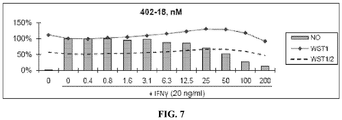
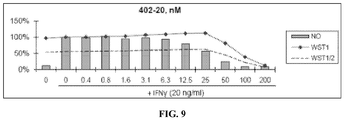
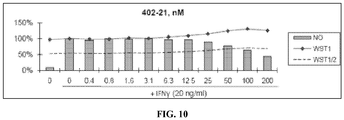
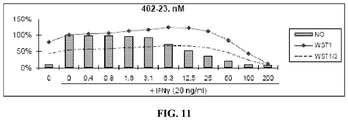
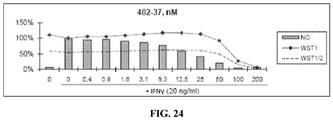
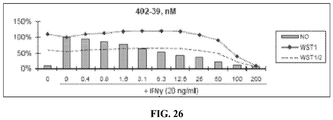
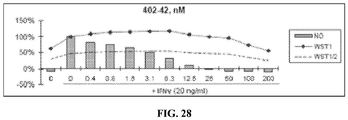
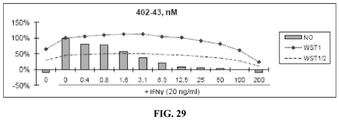
- compounds of the present disclosure may be inhibitors of IFN- ⁇ -induced nitrous oxide (NO) production in macrophages, for example, having an IC 50 value of less than 0.2 ⁇ M.
- NO nitrous oxide
- compositions comprising as an active ingredient a compound of the present disclosure and a pharmaceutically acceptable carrier.
- the composition may, for example, be adapted for administration by a route selected from the group consisting of orally, intraadiposally, intraarterially, intraarticularly, intracranially, intradermally, intralesionally, intramuscularly, intranasally, intraocularally, intrapericardially, intraperitoneally, intrapleurally, intraprostaticaly, intrarectally, intrathecally, intratracheally, intratumorally, intraumbilically, intravaginally, intravenously, intravesicularlly, intravitreally, liposomally, locally, mucosally, orally, parenterally, rectally, subconjunctival, subcutaneously, sublingually, topically, transbuccally, transdermally, vaginally, in crèmes, in lipid compositions, via a catheter, via a lavage, via continuous infusion, via in
- the composition may be formulated for oral delivery.
- the composition is formulated as a hard or soft capsule, a tablet, a syrup, a suspension, a wafer, or an elixir.
- the soft capsule is a gelatin capsule.
- Certain compositions may comprise a protective coating, such as those compositions formulated for oral delivery.
- Certain compositions further comprise an agent that delays absorption, such as those compositions formulated for oral delivery.
- Certain compositions may further comprise an agent that enhances solubility or dispersibility, such as those compositions formulated for oral delivery.
- Certain compositions may comprise a compound of the present disclosure, wherein the compound is dispersed in a liposome, an oil and water emulsion or a water and oil emulsion.
- Another aspect of the present disclosure contemplates a compound of the present invention for use in a method of treating cancer in a subject, the method comprising administering to the subject a pharmaceutically effective amount of a compound of the present disclosure.
- the cancer may be any type of cancer, such as a carcinoma, sarcoma, lymphoma, leukemia, melanoma, mesothelioma, multiple myeloma, or seminoma.
- cancers include cancer of the bladder, blood, bone, brain, breast, central nervous system, colon, endometrium, esophagus, genitourinary tract, head, larynx, liver, lung, neck, ovary, pancreas, prostate, spleen, small intestine, large intestine, stomach, or testicle.
- the subject may be a primate. This or any other method may further comprise identifying a subject in need of treatment.
- the subject may have a family or patient history of cancer.
- the subject has symptoms of cancer.
- the compounds of the invention may be administered via any method described herein, such as locally.
- the compound is administered by direct intratumoral injection or by injection into tumor vasculature.
- the compounds may be administered systemically.
- the compounds may be administered intravenously, intraarterially, intramuscularly, intraperitoneally, subcutaneously or orally, in certain embodiments.
- ⁇ cancer cells include, for example, a bladder cancer cell, a breast cancer cell, a lung cancer cell, a colon cancer cell, a prostate cancer cell, a liver cancer cell, a pancreatic cancer cell, a stomach cancer cell, a testicular cancer cell, a brain cancer cell, an ovarian cancer cell, a lymphatic cancer cell, a skin cancer cell, a brain cancer cell, a bone cancer cell, or a soft tissue cancer cell.
- the second drug may, in certain embodiments, be an antibiotic, anti-inflammatory, anti-neoplastic, anti-proliferative, anti-viral, immunomodulatory, or immunosuppressive.
- the second drug may be an alkylating agent, androgen receptor modulator, cytoskeletal disruptor, estrogen receptor modulator, histone-deacetylase inhibitor, HMG-CoA reductase inhibitor, prenyl-protein transferase inhibitor, retinoid receptor modulator, topoisomerase inhibitor, or tyrosine kinase inhibitor.
- the second drug is 5-azacitidine, 5-fluorouracil, 9-cis-retinoic acid, actinomycin D, alitretinoin, all-trans-retinoic acid, annamycin, axitinib, belinostat, bevacizumab, bexarotene, bosutinib, busulfan, capecitabine, carboplatin, carmustine, CD437, cediranib, cetuximab, chlorambucil, cisplatin, cyclophosphamide, cytarabine, dacarbazine, dasatinib, daunorubicin, decitabine, docetaxel, dolastatin-10, doxifluridine, doxorubicin, doxorubicin, epirubicin, erlotinib, etoposide, etoposide, gefitinib, gemcitabine, gemtuzumab ozogamici
- Such complications include, for example, obesity, hypertension, atherosclerosis, coronary heart disease, stroke, peripheral vascular disease, hypertension, nephropathy, neuropathy, myonecrosis, retinopathy and metabolic syndrome (syndrome X).
- the disease with an inflammatory component may be a skin disease, such as psoriasis, acne, or atopic dermatitis.
- Administration of a compound of the present disclosure in treatment methods of such skin diseases may be, for example, topical or oral.
- Another general aspect of the present disclosure entails compounds of the present invention for use in a method of treating or preventing a cardiovascular disease in a subject, the method comprising administering to the subject a pharmaceutically effective amount of a compound of the present disclosure.
- the cardiovascular disease may be, for example, atherosclerosis, cardiomyopathy, congenital heart disease, congestive heart failure, myocarditis, rheumatic heart disease, valve disease, coronary artery disease, endocarditis, or myocardial infarction.
- Combination therapy is also contemplated for such methods.
- such methods may further comprise administering a pharmaceutically effective amount of a second drug.
- the treatment suppresses the demyelination of neurons in the subject's brain or spinal cord.
- the treatment suppresses inflammatory demyelination.
- the treatment suppresses the transection of neuron axons in the subject's brain or spinal cord.
- the treatment suppresses the transection of neurites in the subject's brain or spinal cord.
- the treatment suppresses neuronal apoptosis in the subject's brain or spinal cord.
- Another general aspect of the present disclosure contemplates compounds of the present invention for use in a method of inhibiting IFN- ⁇ -induced nitric oxide production in cells of a subject, comprising administering to said subject a pharmaceutically effective amount of a compound of the present disclosure.
- RKD renal/kidney disease
- the RKD may result from, for example, a toxic insult.
- the toxic insult may result from, for example, an imaging agent or a drug.
- the drug may be a chemotherapeutic, for example.
- the RKD may result from ischemia/reperfusion injury, in certain embodiments.
- the RKD results from diabetes or hypertension.
- the RKD may result from an autoimmune disease.
- the RKD may be further defined as chronic RKD, or acute RKD.
- Also contemplated by the present disclosure are compounds of the present invention for use in a method for improving glomerular filtration rate or creatinine clearance in a subject, the method comprising administering to the subject a pharmaceutically effective amount of a compound of the present disclosure.
- an article of manufacture may comprise a compound of the present disclosure; and packaging materials.
- the packaging materials may comprise a container for housing the compound, in certain embodiments.
- the container may comprise, for example, a label indicating one or more members of the group consisting of a disease state for which the compound is to be administered, storage information, dosing information and/or instructions regarding how to administer the compound.
- the article of manufacture comprises the compound in a multiple dose form.
- the invention provides compounds that may prevent and/or treat diseases or disorders whose pathology involves oxidative stress, inflammation, and/or dysregulation of inflammatory signaling pathways.
- the diseases or disorders can be characterized by overexpression of inducible nitric oxide synthase (iNOS) and/or inducible cyclooxygenase (COX-2) in affected tissues.
- the diseases or disorders can be characterized by overproduction of reactive oxygen species (ROS) or reactive nitrogen species (RNS) such as superoxide, hydrogen peroxide, nitric oxide or peroxynitrite in affected tissues.
- ROS reactive oxygen species
- RNS reactive nitrogen species
- cardiovascular diseases such as atherosclerosis, heart failure, myocardial infarction, acute coronary syndrome, restenosis following vascular surgery, hypertension, and vasculitis
- neurodegenerative or neuromuscular diseases such as Alzheimer's disease, Parkinson's disease, Huntington's disease, ALS, and muscular dystrophy
- neurological disorders such as epilepsy and dystonia
- neuropsychiatric conditions such as major depression, bipolar disorder, post-traumatic stress disorder, schizophrenia, anorexia nervosa, ADHD, and autism-spectrum disorders
- retinal diseases such as macular degeneration, diabetic retinopathy, glaucoma, and retinitis
- chronic and acute pain syndromes including inflammatory and neuropathic pain
- hearing loss and tinnitus diabetes and complications of diabetes, including metabolic syndrome, diabetic nephropathy, diabetic neuropathy, and diabetic ulcers
- respiratory diseases such as asthma, chronic obstructive pulmonary disease, acute respiratory distress syndrome, and cystic fibrosis
- Non-limiting examples of compounds disclosed herein include:
- (Cn) defines the exact number (n) of carbon atoms in the group.
- (C ⁇ n) defines the maximum number (n) of carbon atoms that can be in the group, with the minimum number of carbon atoms in such at least one, but otherwise as small as possible for the group in question.
- alkenyl (C ⁇ 8) is 2.
- alkoxy (C ⁇ 10) designates those alkoxy groups having from 1 to 10 carbon atoms ( e.g., 1, 2, 3, 4, 5, 6, 7, 8, 9, or 10, or any range derivable therein ( e.g ., 3-10 carbon atoms)).
- Cn-n' defines both the minimum (n) and maximum number (n') of carbon atoms in the group.
- alkyl (C2-10) designates those alkyl groups having from 2 to 10 carbon atoms (e.g., 2, 3, 4, 5, 6, 7, 8, 9, or 10, or any range derivable therein ( e.g., 3- 10 carbon atoms)).
- alkyl when used without the "substituted” modifier refers to a non-aromatic monovalent group with a saturated carbon atom as the point of attachment, a linear or branched, cyclo, cyclic or acyclic structure, no carbon-carbon double or triple bonds, and no atoms other than carbon and hydrogen.
- the groups, -CH 3 (Me), -CH 2 CH 3 (Et), -CH 2 CH 2 CH 3 ( n -Pr), -CH(CH 3 ) 2 ( iso -Pr), -CH(CH 2 ) 2 (cyclopropyl), -CH 2 CH 2 CH 2 CH 3 ( n- Bu), -CH(CH 3 )CH 2 CH 3 ( sec -butyl), -CH 2 CH(CH 3 ) 2 ( iso -butyl), -C(CH 3 ) 3 ( tert -butyl), -CH 2 C(CH 3 ) 3 ( neo -pentyl), cyclobutyl, cyclopentyl, cyclohexyl, and cyclohexylmethyl are non-limiting examples of alkyl groups.
- the following groups are non-limiting examples of substituted alkyl groups: -CH 2 OH, -CH 2 Cl, -CH 2 Br, -CH 2 SH, -CF 3 , -CH 2 CN, -CH 2 C(O)H, -CH 2 C(O)OH, -CH 2 C(O)OCH 3 , -CH 2 C(O)NH 2 , -CH 2 C(O)NHCH 3 , -CH 2 C(O)CH 3 , -CH 2 OCH 3 , -CH 2 OCH 2 CF 3 , -CH 2 OC(O)CH 3 , -CH 2 NH 2 , -CH 2 NHCH 3 , -CH 2 N(CH 3 ) 2 , -CH 2 CH 2 Cl, -CH 2 CH 2 OH, -CH 2 CF 3 , -CH 2 CH 2 OC(O)CH 3 , -CH 2 CH 2 NHCO 2 C(CH 3 ) 3 , and -CH
- alkanediyl when used without the "substituted” modifier refers to a non-aromatic divalent group, wherein the alkanediyl group is attached with two ⁇ -bonds, with one or two saturated carbon atom(s) as the point(s) of attachment, a linear or branched, cyclo, cyclic or acyclic structure, no carbon-carbon double or triple bonds, and no atoms other than carbon and hydrogen.
- substituted alkanediyl refers to a non-aromatic monovalent group, wherein the alkynediyl group is attached with two ⁇ -bonds, with one or two saturated carbon atom(s) as the point(s) of attachment, a linear or branched, cyclo, cyclic or acyclic structure, no carbon-carbon double or triple bonds, and at least one atom independently selected from the group consisting of N, O, F, Cl, Br, I, Si, P, and S.
- the following groups are non-limiting examples of substituted alkanediyl groups: -CH(F)-, -CF 2 -, -CH(Cl)-, -CH(OH)-, -CH(OCH 3 )-, and -CH 2 CH(Cl)-.
- alkenyl when used without the "substituted” modifier refers to a monovalent group with a nonaromatic carbon atom as the point of attachment, a linear or branched, cyclo, cyclic or acyclic structure, at least one nonaromatic carbon-carbon double bond, no carbon-carbon triple bonds, and no atoms other than carbon and hydrogen.
- substituted alkenyl refers to a monovalent group with a nonaromatic carbon atom as the point of attachment, at least one nonaromatic carbon-carbon double bond, no carbon-carbon triple bonds, a linear or branched, cyclo, cyclic or acyclic structure, and at least one atom independently selected from the group consisting of N, O, F, Cl, Br, I, Si, P, and S.
- alkenediyl when used without the "substituted” modifier refers to a non-aromatic divalent group, wherein the alkenediyl group is attached with two ⁇ -bonds, with two carbon atoms as points of attachment, a linear or branched, cyclo, cyclic or acyclic structure, at least one nonaromatic carbon-carbon double bond, no carbon-carbon triple bonds, and no atoms other than carbon and hydrogen.
- substituted alkenediyl refers to a non-aromatic divalent group, wherein the alkenediyl group is attached with two ⁇ -bonds, with two carbon atoms as points of attachment, a linear or branched, cyclo, cyclic or acyclic structure, at least one nonaromatic carbon-carbon double bond, no carbon-carbon triple bonds, and at least one atom independently selected from the group consisting of N, O, F, Cl, Br, I, Si, P, and S.
- alkynyl when used without the "substituted” modifier refers to a monovalent group with a nonaromatic carbon atom as the point of attachment, a linear or branched, cyclo, cyclic or acyclic structure, at least one carbon-carbon triple bond, and no atoms other than carbon and hydrogen.
- the groups, -C ⁇ CH, -C ⁇ CCH 3 , -C ⁇ CC 6 H 5 and -CH 2 C ⁇ CCH 3 are non-limiting examples of alkynyl groups.
- substituted alkynyl refers to a monovalent group with a nonaromatic carbon atom as the point of attachment and at least one carbon-carbon triple bond, a linear or branched, cyclo, cyclic or acyclic structure, and at least one atom independently selected from the group consisting of N, O, F, Cl, Br, I, Si, P, and S.
- the group, -C ⁇ CSi(CH 3 ) 3 is a non-limiting example of a substituted alkynyl group.
- alkynediyl when used without the "substituted” modifier refers to a non-aromatic divalent group, wherein the alkynediyl group is attached with two ⁇ -bonds, with two carbon atoms as points of attachment, a linear or branched, cyclo, cyclic or acyclic structure, at least one carbon-carbon triple bond, and no atoms other than carbon and hydrogen.
- the groups, -C ⁇ C-, -C ⁇ CCH 2 -, and -C ⁇ CCH(CH 3 )- are non-limiting examples of alkynediyl groups.
- substituted alkynediyl refers to a non-aromatic divalent group, wherein the alkynediyl group is attached with two ⁇ -bonds, with two carbon atoms as points of attachment, a linear or branched, cyclo, cyclic or acyclic structure, at least one carbon-carbon triple bond, and at least one atom independently selected from the group consisting of N, O, F, Cl, Br, I, Si, P, and S.
- the groups -C ⁇ CCFH- and -C ⁇ CHCH(Cl)- are non-limiting examples of substituted alkynediyl groups.
- aryl when used without the "substituted” modifier refers to a monovalent group with an aromatic carbon atom as the point of attachment, said carbon atom forming part of a six-membered aromatic ring structure wherein the ring atoms are all carbon, and wherein the monovalent group consists of no atoms other than carbon and hydrogen.
- substituted aryl refers to a monovalent group with an aromatic carbon atom as the point of attachment, said carbon atom forming part of a six-membered aromatic ring structure wherein the ring atoms are all carbon, and wherein the monovalent group further has at least one atom independently selected from the group consisting of N, O, F, Cl, Br, I, Si, P, and S.
- arenediyl when used without the "substituted” modifier refers to a divalent group, wherein the arenediyl group is attached with two ⁇ -bonds, with two aromatic carbon atoms as points of attachment, said carbon atoms forming part of one or more six-membered aromatic ring structure(s) wherein the ring atoms are all carbon, and wherein the monovalent group consists of no atoms other than carbon and hydrogen.
- aralkyl when used without the "substituted” modifier refers to the monovalent group -alkanediyl-aryl, in which the terms alkanediyl and aryl are each used in a manner consistent with the definitions provided above.
- Non-limiting examples of aralkyls are: phenylmethyl (benzyl, Bn), 1-phenyl-ethyl, 2-phenyl-ethyl, indenyl and 2,3-dihydro-indenyl, provided that indenyl and 2,3-dihydro-indenyl are only examples of aralkyl in so far as the point of attachment in each case is one of the saturated carbon atoms.
- substituted heteroaryl refers to a monovalent group with an aromatic carbon atom or nitrogen atom as the point of attachment, said carbon atom or nitrogen atom forming part of an aromatic ring structure wherein at least one of the ring atoms is nitrogen, oxygen or sulfur, and wherein the monovalent group further has at least one atom independently selected from the group consisting of non-aromatic nitrogen, non-aromatic oxygen, non aromatic sulfur F, Cl, Br, I, Si, and P.
- heteroarenediyl when used without the “substituted” modifier refers to a divalent group, wherein the heteroarenediyl group is attached with two ⁇ -bonds, with an aromatic carbon atom or nitrogen atom as the point of attachment, said carbon atom or nitrogen atom two aromatic atoms as points of attachment, said carbon atoms forming part of one or more six-membered aromatic ring structure(s) wherein the ring atoms are all carbon, and wherein the monovalent group consists of no atoms other than carbon and hydrogen.
- heteroarylkyl when used without the “substituted” modifier refers to the monovalent group -alkanediyl-heteroaryl, in which the terms alkanediyl and heteroaryl are each used in a manner consistent with the definitions provided above.
- Non-limiting examples of aralkyls are: pyridylmethyl, and thienylmethyl.
- alkoxy when used without the "substituted” modifier refers to the group -OR, in which R is an alkyl, as that term is defined above.
- alkoxy groups include: -OCH 3 , -OCH 2 CH 3 , -OCH 2 CH 2 CH 3 , -OCH(CH 3 ) 2 , -OCH(CH 2 ) 2 , -O-cyclopentyl, and -O-cyclohexyl.
- substituted alkoxy refers to the group -OR, in which R is a substituted alkyl, as that term is defined above. For example, -OCH 2 CF 3 is a substituted alkoxy group.
- alkenyloxy when used without the “substituted” modifier, refers to groups, defined as -OR, in which R is alkenyl, alkynyl, aryl, aralkyl, heteroaryl, heteroaralkyl and acyl, respectively, as those terms are defined above.
- alkenyloxy, alkynyloxy, aryloxy, aralkyloxy and acyloxy refers to the group -OR, in which R is substituted alkenyl, alkynyl, aryl, aralkyl, heteroaryl, heteroaralkyl and acyl, respectively.
- alkylamino when used without the "substituted” modifier refers to the group -NHR, in which R is an alkyl, as that term is defined above.
- alkylamino groups include: -NHCH 3 , -NHCH 2 CH 3 , -NHCH 2 CH 2 CH 3 , -NHCH(CH 3 ) 2 , -NHCH(CH 2 ) 2 , -NHCH 2 CH 2 CH 2 CH 3 , -NHCH(CH 3 )CH 2 CH 3 , -NHCH 2 CH(CH 3 ) 2 , -NHC(CH 3 ) 3 , -NH-cyclopentyl, and -NH-cyclohexyl.
- substituted alkylamino refers to the group -NHR, in which R is a substituted alkyl, as that term is defined above.
- R is a substituted alkyl
- -NHCH 2 CF 3 is a substituted alkylamino group.
- alkoxyamino, alkenylamino, alkynylamino, arylamino, aralkylamino, heteroarylamino, heteroaralkylamino and alkylsulphonylamino is modified by "substituted,” it refers to the group -NHR, in which R is substituted alkoxy, alkenyl, alkynyl, aryl, aralkyl, heteroaryl, heteroaralkyl and alkylsulphonyl, respectively.
- amido when used without the "substituted” modifier, refers to the group -NHR, in which R is acyl, as that term is defined above.
- a non-limiting example of an acylamino group is -NHC(O)CH 3 .
- amido when used with the "substituted” modifier, it refers to groups, defined as -NHR, in which R is substituted acyl, as that term is defined above.
- the groups -NHC(O)OCH 3 and -NHC(O)NHCH 3 are non-limiting examples of substituted amido groups.
- NCH 2 CF 3 is a substituted alkylimino group.
- substituted fluoroalkyl refers to a non-aromatic monovalent group with a saturated carbon atom as the point of attachment, a linear or branched, cyclo, cyclic or acyclic structure, at least one fluorine atom, no carbon-carbon double or triple bonds, and at least one atom independently selected from the group consisting of N, O, Cl, Br, I, Si, P, and S.
- the following group is a non-limiting example of a substituted fluoroalkyl: -CFHOH.
- alkenylthio, alkynylthio, arylthio, aralkylthio, heteroarylthio, heteroaralkylthio, and acylthio is modified by "substituted,” it refers to the group -SR, in which R is substituted alkenyl, alkynyl, aryl, aralkyl, heteroaryl, heteroaralkyl and acyl, respectively.
- thioacyl when used without the "substituted” modifier refers to a monovalent group with a carbon atom of a thiocarbonyl group as the point of attachment, further having a linear or branched, cyclo, cyclic or acyclic structure, further having no additional atoms that are not carbon or hydrogen, beyond the sulfur atom of the carbonyl group.
- the groups, -CHS, -C(S)CH 3 , -C(S)CH 2 CH 3 , -C(S)CH 2 CH 2 CH 3 , -C(S)CH(CH 3 ) 2 , -C(S)CH(CH 2 ) 2 , -C(S)C 6 H 5 , -C(S)C 6 H 4 CH 3 , -C(S)C 6 H 4 CH 2 CH 3 , -C(S)C 6 H 3 (CH 3 ) 2 , and -C(S)CH 2 C 6 H 5 are non-limiting examples of thioacyl groups.
- thioacyl therefore encompasses, but is not limited to, groups sometimes referred to as “alkyl thiocarbonyl” and “aryl thiocarbonyl” groups.
- substituted thioacyl refers to a radical with a carbon atom as the point of attachment, the carbon atom being part of a thiocarbonyl group, further having a linear or branched, cyclo, cyclic or acyclic structure, further having at least one atom, in addition to the sulfur atom of the carbonyl group, independently selected from the group consisting of N, O, F, Cl, Br, I, Si, P, and S.
- substituted thioacyl encompasses, but is not limited to, "heteroaryl thiocarbonyl” groups.
- alkylsulphonyl when used without the "substituted” modifier refers to the group -S(O) 2 R, in which R is an alkyl, as that term is defined above.
- alkylsulphonyl groups include: -S(O) 2 CH 3 , -S(O) 2 CH 2 CH 3 , -S(O) 2 CH 2 CH 2 CH 3 , -S(O) 2 CH(CH 3 ) 2 , -S(O) 2 CH(CH 2 ) 2 , -S(O) 2 -cyclopentyl, and -S(O) 2 -cyclohexyl.
- substituted alkylsulphonyl refers to the group -S(O) 2 R, in which R is a substituted alkyl, as that term is defined above.
- R is a substituted alkyl
- -S(O) 2 CH 2 CF 3 is a substituted alkylsulphonyl group.
- alkenylsulphonyl refers to groups, defined as -S(O) 2 R, in which R is alkenyl, alkynyl, aryl, aralkyl, heteroaryl, and heteroaralkyl, respectively, as those terms are defined above.
- alkenylsulphonyl, alkynylsulphonyl, arylsulphonyl, aralkylsulphonyl, heteroarylsulphonyl, and heteroaralkylsulphonyl is modified by "substituted,” it refers to the group -S(O) 2 R, in which R is substituted alkenyl, alkynyl, aryl, aralkyl, heteroaryl and heteroaralkyl, respectively.
- alkylammonium when used without the "substituted” modifier refers to a group, defined as -NH 2 R + , -NHRR' + , or -NRR'R” + , in which R, R' and R" are the same or different alkyl groups, or any combination of two of R, R' and R" can be taken together to represent an alkanediyl.
- Non-limiting examples of alkylammonium cation groups include: -NH 2 (CH 3 ) + , -NH 2 (CH 2 CH 3 )+, -NH 2 (CH 2 CH 2 CH 3 )+, -NH(CH 3 ) 2 + , -NH(CH 2 CH 3 ) 2 + , -NH(CH 2 CH 2 CH 3 ) 2 + , -N(CH 3 ) 3 + , -N(CH 3 )(CH 2 CH 3 ) 2 + , -N(CH 3 ) 2 (CH 2 CH 3 ) + , -NH 2 C(CH 3 ) 3 + , -NH(cyclopentyl) 2 + , and -NH 2 (cyclohexyl) + .
- substituted alkylammonium refers -NH 2 R + , -NHRR' + , or -NRR'R” + , in which at least one of R, R' and R" is a substituted alkyl or two of R, R' and R" can be taken together to represent a substituted alkanediyl. When more than one of R, R' and R" is a substituted alkyl, they can be the same of different.
- R, R' and R" that are not either substituted alkyl or substituted alkanediyl can be either alkyl, either the same or different, or can be taken together to represent a alkanediyl with two or more carbon atoms, at least two of which are attached to the nitrogen atom shown in the formula.
- alkylsulfonium when used without the “substituted” modifier refers to the group -SRR' + , in which R and R' can be the same or different alkyl groups, or R and R' can be taken together to represent an alkanediyl.
- Non-limiting examples of alkylsulfonium groups include: -SH(CH 3 ) + , -SH(CH 2 CH 3 ) + , -SH(CH 2 CH 2 CH 3 ) + , -S(CH 3 ) 2 + , -S(CH 2 CH 3 ) 2 + , -S(CH 2 CH 2 CH 3 ) 2 + , -SH(cyclopentyl) + , and -SH(cyclohexyl) + .
- substituted alkylsulfonium refers to the group -SRR' + , in which R and R' can be the same or different substituted alkyl groups, one of R or R' is an alkyl and the other is a substituted alkyl, or R and R' can be taken together to represent a substituted alkanediyl.
- -SH(CH 2 CF 3 ) + is a substituted alkylsulfonium group.
- alkylsilyl when used without the "substituted” modifier refers to a monovalent group, defined as -SiH 2 R, -SiHRR', or -SiRR'R", in which R, R' and R" can be the same or different alkyl groups, or any combination of two of R, R' and R" can be taken together to represent an alkanediyl.
- the groups, -SiH 2 CH 3 , -SiH(CH 3 ) 2 , -Si(CH 3 ) 3 and -Si(CH 3 ) 2 C(CH 3 ) 3 are non-limiting examples of unsubstituted alkylsilyl groups.
- substituted alkylsilyl refers -SiH 2 R, -SiHRR', or -SiRR'R", in which at least one of R, R' and R" is a substituted alkyl or two of R, R' and R" can be taken together to represent a substituted alkanediyl. When more than one of R, R' and R" is a substituted alkyl, they can be the same of different.
- R, R' and R" that are not either substituted alkyl or substituted alkanediyl can be either alkyl, either the same or different, or can be taken together to represent a alkanediyl with two or more saturated carbon atoms, at least two of which are attached to the silicon atom.
- atoms making up the compounds of the present disclosure are intended to include all isotopic forms of such atoms.
- Isotopes include those atoms having the same atomic number but different mass numbers.
- isotopes of hydrogen include tritium and deuterium
- isotopes of carbon include 13 C and 14 C.
- one or more carbon atom(s) of a compound of the present disclosure may be replaced by a silicon atom(s).
- one or more oxygen atom(s) of a compound of the present disclosure may be replaced by a sulfur or selenium atom(s).
- a compound having a formula that is represented with a dashed bond is intended to include the formulae optionally having zero, one or more double bonds.
- the structure includes the structures As will be understood by a person of skill in the art, no one such ring atom forms part of more than one double bond.
- Any undefined valency on an atom of a structure shown in this application implicitly represents a hydrogen atom bonded to the atom.
- a ring structure shown with an unconnected "R" group indicates that any implicit hydrogen atom on that ring can be replaced with that R group.
- R group e.g., oxo, imino, thio, alkylidene, etc.
- any pair of implicit hydrogen atoms attached to one atom of that ring can be replaced by that R group.
- a "chiral auxiliary” refers to a removable chiral group that is capable of influencing the stereoselectivity of a reaction. Persons of skill in the art are familiar with such compounds, and many are commercially available.
- hydrate when used as a modifier to a compound means that the compound has less than one (e.g., hemihydrate), one ( e.g., monohydrate), or more than one ( e.g., dihydrate) water molecules associated with each compound molecule, such as in solid forms of the compound.
- IC 50 refers to an inhibitory dose which is 50% of the maximum response obtained.
- An "isomer" of a first compound is a separate compound in which each molecule contains the same constituent atoms as the first compound, but where the configuration of those atoms in three dimensions differs.
- the term "patient” or “subject” refers to a living mammalian organism, such as a human, monkey, cow, sheep, goat, dog, cat, mouse, rat, guinea pig, or transgenic species thereof.
- the patient or subject is a primate.
- Non-limiting examples of human subjects are adults, juveniles, infants and fetuses.
- “Pharmaceutically acceptable” means that which is useful in preparing a pharmaceutical composition that is generally safe, non-toxic and neither biologically nor otherwise undesirable and includes that which is acceptable for veterinary use as well as human pharmaceutical use.
- “Pharmaceutically acceptable salts” means salts of compounds of the present disclosure which are pharmaceutically acceptable, as defined above, and which possess the desired pharmacological activity. Such salts include acid addition salts formed with inorganic acids such as hydrochloric acid, hydrobromic acid, sulfuric acid, nitric acid, phosphoric acid, and the like; or with organic acids such as 1,2-ethanedisulfonic acid, 2-hydroxyethanesulfonic acid, 2-naphthalenesulfonic acid, 3-phenylpropionic acid, 4,4'-methylenebis(3-hydroxy-2-ene-1-carboxylic acid), 4-methylbicyclo[2.2.2]oct-2-ene-1-carboxylic acid, acetic acid, aliphatic mono- and dicarboxylic acids, aliphatic sulfuric acids, aromatic sulfuric acids, benzenesulfonic acid, benzoic acid, camphorsulfonic acid, carbonic acid, cinnamic acid, citric acid,
- Pharmaceutically acceptable salts also include base addition salts which may be formed when acidic protons present are capable of reacting with inorganic or organic bases.
- Acceptable inorganic bases include sodium hydroxide, sodium carbonate, potassium hydroxide, aluminum hydroxide and calcium hydroxide.
- Acceptable organic bases include ethanolamine, diethanolamine, triethanolamine, tromethamine, N -methylglucamine and the like. It should be recognized that the particular anion or cation forming a part of any salt of this invention is not critical, so long as the salt, as a whole, is pharmacologically acceptable. Additional examples of pharmaceutically acceptable salts and their methods of preparation and use are presented in Handbook of Pharmaceutical Salts: Properties, and Use (P. H. Stahl & C. G. Wermuth eds., Verlag Helvetica Chimica Acta, 2002 ),
- progenitantly one enantiomer means that a compound contains at least about 85% of one enantiomer, or more preferably at least about 90% of one enantiomer, or even more preferably at least about 95% of one enantiomer, or most preferably at least about 99% of one enantiomer.
- the phrase "substantially free from other optical isomers” means that the composition contains at most about 15% of another enantiomer or diastereomer, more preferably at most about 10% of another enantiomer or diastereomer, even more preferably at most about 5% of another enantiomer or diastereomer, and most preferably at most about 1% of another enantiomer or diastereomer.
- Prevention includes: (1) inhibiting the onset of a disease in a subject or patient which may be at risk and/or predisposed to the disease but does not yet experience or display any or all of the pathology or symptomatology of the disease, and/or (2) slowing the onset of the pathology or symptomatology of a disease in a subject or patient which may be at risk and/or predisposed to the disease but does not yet experience or display any or all of the pathology or symptomatology of the disease.
- saturated when referring to an atom means that the atom is connected to other atoms only by means of single bonds.
- a “stereoisomer” or “optical isomer” is an isomer of a given compound in which the same atoms are bonded to the same other atoms, but where the configuration of those atoms in three dimensions differs.
- “Enantiomers” are stereoisomers of a given compound that are mirror images of each other, like left and right hands.
- “Diastereomers” are stereoisomers of a given compound that are not enantiomers.
- stereocenter or axis of chirality for which stereochemistry has not been defined, that stereocenter or axis of chirality can be present in its R form, S form, or as a mixture of the R and S forms, including racemic and non-racemic mixtures.
- “Therapeutically effective amount” or “pharmaceutically effective amount” means that amount which, when administered to a subject or patient for treating a disease, is sufficient to effect such treatment for the disease.
- Treatment includes (1) inhibiting a disease in a subject or patient experiencing or displaying the pathology or symptomatology of the disease (e.g ., arresting further development of the pathology and/or symptomatology), (2) ameliorating a disease in a subject or patient that is experiencing or displaying the pathology or symptomatology of the disease (e.g ., reversing the pathology and/or symptomatology), and/or (3) effecting any measurable decrease in a disease in a subject or patient that is experiencing or displaying the pathology or symptomatology of the disease.
- water soluble means that the compound dissolves in water at least to the extent of 0.010 mole/liter or is classified as soluble according to literature precedence.
- DMSO dimethyl sulfoxide
- NO nitric oxide
- iNOS inducible nitric oxide synthase
- COX-2 cyclooxygenase-2
- NGF nerve growth factor
- IBMX isobutylmethylxanthine
- FBS fetal bovine serum
- GPDH glycerol 3-phosphate dehydrogenase
- RXR retinoid X receptor
- TGF- ⁇ transforming growth factor- ⁇
- IFN ⁇ or IFN- ⁇ interferon- ⁇
- LPS bacterial endotoxic lipopolysaccharide
- TNF ⁇ or TNF- ⁇ , tumor necrosis factor- ⁇
- IL-1 ⁇ interleukin-1 ⁇
- GAPDH glyceraldehyde-3-phosphate dehydrogenase
- MTT 3-[4,5-dimethylthiazol-2-yl]-2,5-diphenyltetrazolium
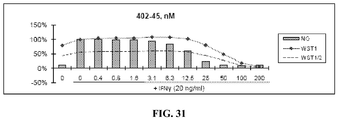
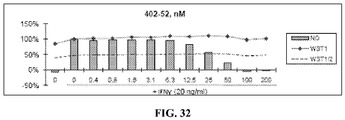
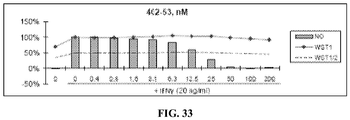
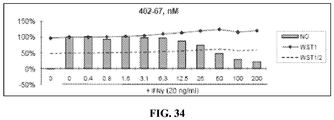
- Biological activity results are provided throughout the present disclosure. These include: inhibition of inhibition of NO production, iNOS induction, Nrf2 target gene induction, inhibition of COX-2 induction, inhibition of STAT3 phosphorylation, suppression of IL-6 induced phosphorylation, inhibition of TNF ⁇ -induced I ⁇ B ⁇ degradation, inhibition of NF-KB activation, induction of HO-1, induction of TrxR1, induction of ⁇ -GCS, and/or induction of ferritin heavy chain. See figures and figure descriptions. Suppression of NO production and induction of Nrf2 induction results can be respectively summarized as shown Tables 1a and 1b, below. Further results, including toxicity studies, are provided in the Examples section. Table 1a.
- Nrf2 target gene induction in MDA-MB-435 cells 160 nM* 400 nM* 250 nM** HO-1 TrxR1 ⁇ -GCS HO-1 TrxR1 ⁇ -GCS HO-1 NQO1 ⁇ -GCS 402-12 61 62 402-14 2 129 73 402-17 4 43 27 402-19 15 86 64 10 48 402-28 28 71 55 402-30 25 57 36 402-31 32 90 90 402-32 1 71 27 402-36 6 86 55 402-39 1 14 9 402-42 25 66 77 402-43 19 76 75 402-52 2 71 1.4 1.8 2.8 402-53 1 36 21 1.7 1.7 3.8 402-67 1.1 1.7 3.2 63254 2 1.7 3 Blank entry: Not determined. * Data expressed as a percent of induction observed for RTA 402. ** Data expressed as fold induction above DMSO control.
- Inflammation is a biological process that provides resistance to infectious or parasitic organisms and the repair of damaged tissue. Inflammation is commonly characterized by localized vasodilation, redness, swelling, and pain, the recruitment of leukocytes to the site of infection or injury, production of inflammatory cytokines such as TNF- ⁇ and IL-1, and production of reactive oxygen or nitrogen species such as hydrogen peroxide, superoxide and peroxynitrite. In later stages of inflammation, tissue remodeling, angiogenesis, and scar formation (fibrosis) may occur as part of the wound healing process. Under normal circumstances, the inflammatory response is regulated and temporary and is resolved in an orchestrated fashion once the infection or injury has been dealt with adequately. However, acute inflammation can become excessive and life-threatening if regulatory mechanisms fail. Alternatively, inflammation can become chronic and cause cumulative tissue damage or systemic complications.
- Atherosclerosis long viewed as a disorder of lipid metabolism, is now understood to be primarily an inflammatory condition, with activated macrophages playing an important role in the formation and eventual rupture of atherosclerotic plaques. Activation of inflammatory signaling pathways has also been shown to play a role in the development of insulin resistance, as well as in the peripheral tissue damage associated with diabetic hyperglycemia.
- Autoimmune diseases such as rheumatoid arthritis, lupus, psoriasis, and multiple sclerosis involve inappropriate and chronic activation of inflammatory processes in affected tissues, arising from dysfunction of self vs. non-self recognition and response mechanisms in the immune system.
- neurodegenerative diseases such as Alzheimer's and Parkinson's diseases
- neural damage is correlated with activation of microglia and elevated levels of pro-inflammatory proteins such as inducible nitric oxide synthase (iNOS).
- iNOS inducible nitric oxide synthase
- Chronic organ failure such as renal failure, heart failure, and chronic obstructive pulmonary disease is closely associated with the presence of chronic oxidative stress and inflammation, leading to the development of fibrosis and eventual loss of organ function.
- oxidative stress and inflammation in affected tissues including inflammatory bowel disease; inflammatory skin diseases; mucositis related to radiation therapy and chemotherapy; eye diseases such as uveitis, glaucoma, macular degeneration, and various forms of retinopathy; transplant failure and rejection; ischemia-reperfusion injury; chronic pain; degenerative conditions of the bones and joints including osteoarthritis and osteoporosis; asthma and cystic fibrosis; seizure disorders; and neuropsychiatric conditions including schizophrenia, depression, bipolar disorder, post-traumatic stress disorder, attention deficit disorders, autism-spectrum disorders, and eating disorders such as anorexia nervosa. Dysregulation of inflammatory signaling pathways is believed to be a major factor in the pathology of muscle wasting diseases including muscular dystrophy and various forms of cachexia.
- a variety of life-threatening acute disorders also involve dysregulated inflammatory signaling, including acute organ failure involving the pancreas, kidneys, liver, or lungs, myocardial infarction or acute coronary syndrome, stroke, septic shock, trauma, severe burns, and anaphylaxis.
- inflammatory responses can kill invading pathogens
- an excessive inflammatory response can also be quite destructive and in some cases can be a primary source of damage in infected tissues.
- an excessive inflammatory response can also lead to systemic complications due to overproduction of inflammatory cytokines such as TNF- ⁇ , and IL-1. This is believed to be a factor in mortality arising from severe influenza, severe acute respiratory syndrome, and sepsis.
- a series of synthetic triterpenoid analogs of oleanolic acid have been shown to be powerful inhibitors of cellular inflammatory processes, such as the induction by IFN- ⁇ of inducible nitric oxide synthase (iNOS) and of COX-2 in mouse macrophages. See Honda et al. (2000a); Hyundai et al. (2000b), and Honda et al. (2002).
- compounds of the invention are characterized by their ability to inhibit the production of nitric oxide in macrophage-derived RAW 264.7 cells induced by exposure to ⁇ -interferon. They are further characterized by their ability to induce the expression of antioxidant proteins such as NQO1 and reduce the expression of pro-inflammatory proteins such as COX-2 and inducible nitric oxide synthase (iNOS).
- antioxidant proteins such as NQO1
- pro-inflammatory proteins such as COX-2 and inducible nitric oxide synthase (iNOS).
- oxidative stress and dysregulation of inflammatory processes including cancer, mucositis resulting from radiation therapy or chemotherapy, autoimmune diseases, cardiovascular diseases including atherosclerosis, ischemia-reperfusion injury, acute and chronic organ failure including renal failure and heart failure, respiratory diseases, diabetes and complications of diabetes, severe allergies, transplant rejection, graft-versus-host disease, neurodegenerative diseases, diseases of the eye and retina, acute and chronic pain, degenerative bone diseases including osteoarthritis and osteoporosis, inflammatory bowel diseases, dermatitis and other skin diseases, sepsis, burns, seizure disorders, and neuropsychiatric disorders.
- autoimmune diseases cardiovascular diseases including atherosclerosis, ischemia-reperfusion injury, acute and chronic organ failure including renal failure and heart failure, respiratory diseases, diabetes and complications of diabetes, severe allergies, transplant rejection, graft-versus-host disease, neurodegenerative diseases, diseases of the eye and retina, acute and chronic pain, degenerative bone diseases including osteoarthritis and osteoporosis, inflammatory bowel diseases, dermatitis
- the activation of the antioxidant/anti-inflammatory Keap1/Nrf2/ARE pathway is believed to be implicated in both the anti-inflammatory and anti-carcinogenic properties of the present oleanolic acid derivatives.
- compounds of the invention may be used for treating a subject having a condition caused by elevated levels of oxidative stress in one or more tissues.
- Oxidative stress results from abnormally high or prolonged levels of reactive oxygen species such as superoxide, hydrogen peroxide, nitric oxide, and peroxynitrite (formed by the reaction of nitric oxide and superoxide).
- the oxidative stress may be accompanied by either acute or chronic inflammation.
- the oxidative stress may be caused by mitochondrial dysfunction, by activation of immune cells such as macrophages and neutrophils, by acute exposure to an external agent such as ionizing radiation or a cytotoxic chemotherapy agent (e.g., doxorubicin), by trauma or other acute tissue injury, by ischemia/reperfusion, by poor circulation or anemia, by localized or systemic hypoxia or hyperoxia, by elevated levels of inflammatory cytokines and other inflammation-related proteins, and/or by other abnormal physiological states such as hyperglycemia or hypoglycemia.
- an external agent such as ionizing radiation or a cytotoxic chemotherapy agent (e.g., doxorubicin)
- trauma or other acute tissue injury by ischemia/reperfusion, by poor circulation or anemia, by localized or systemic hypoxia or hyperoxia, by elevated levels of inflammatory cytokines and other inflammation-related proteins, and/or by other abnormal physiological states such as hyperglycemia or hypoglycemia.
- heme oxygenase a target gene of the Nrf2 pathway
- This enzyme breaks free heme down into iron, carbon monoxide (CO), and biliverdin (which is subsequently converted to the potent antioxidant molecule, bilirubin).
- compounds of this invention may be used in preventing or treating tissue damage or organ failure, acute and chronic, resulting from oxidative stress exacerbated by inflammation.
- diseases that fall in this category include: heart failure, liver failure, transplant failure and rejection, renal failure, pancreatitis, fibrotic lung diseases (cystic fibrosis and COPD, among others), diabetes (including complications), atherosclerosis, ischemia-reperfusion injury, glaucoma, stroke, autoimmune disease, autism, macular degeneration, and muscular dystrophy.
- diseases include: heart failure, liver failure, transplant failure and rejection, renal failure, pancreatitis, fibrotic lung diseases (cystic fibrosis and COPD, among others), diabetes (including complications), atherosclerosis, ischemia-reperfusion injury, glaucoma, stroke, autoimmune disease, autism, macular degeneration, and muscular dystrophy.
- autism studies suggest that increased oxidative stress in the central nervous system may contribute to the development of the disease (Chauhan and Chauhan, 2006).
- Evidence also links oxidative stress and inflammation to the development and pathology of many other disorders of the central nervous system, including psychiatric disorders such as psychosis, major depression, and bipolar disorder; seizure disorders such as epilepsy; pain and sensory syndromes such as migraine, neuropathic pain or tinnitus; and behavioral syndromes such as the attention deficit disorders.
- psychiatric disorders such as psychosis, major depression, and bipolar disorder
- seizure disorders such as epilepsy
- pain and sensory syndromes such as migraine, neuropathic pain or tinnitus
- behavioral syndromes such as the attention deficit disorders.
- Microglial activation has also been linked to major mental illness. Therefore, downregulating inflammatory cytokines and inhibiting excessive activation of microglia could be beneficial in patients with schizophrenia, major depression, bipolar disorder, autism-spectrum disorders, and other neuropsychiatric disorders.
- treatment may comprise administering to a subject a therapeutically effective amount of a compound of this invention, such as those described above or throughout this specification.
- Treatment may be administered preventively, in advance of a predictable state of oxidative stress (e.g., organ transplantation or the administration of radiation therapy to a cancer patient), or it may be administered therapeutically in settings involving established oxidative stress and inflammation.
- the compounds of the invention may be generally applied to the treatment of inflammatory conditions, such as sepsis, dermatitis, autoimmune disease and osteoarthritis.
- the compounds of this invention may be used to treat inflammatory pain and/or neuropathic pain, for example, by inducing Nrf2 and/or inhibiting NF- ⁇ B.
- the compounds of the invention may be used to function as antioxidant inflammation modulators (AIMs) having potent anti-inflammatory properties that mimic the biological activity of cyclopentenone prostaglandins (cyPGs).
- AIMs antioxidant inflammation modulators
- the compounds of the invention may be used to control the production of pro-inflammatory cytokines by selectively targeting regulatory cysteine residues (RCRs) on proteins that regulate the transcriptional activity of redox-sensitive transcription factors.
- RCRs regulatory cysteine residues
- Activation of RCRs by cyPGs or AIMs has been shown to initiate a pro-resolution program in which the activity of the antioxidant and cytoprotective transcription factor Nrf2 is potently induced, and the activities of the pro-oxidant and pro-inflammatory transcription factors NF- ⁇ B and the STATs are suppressed.
- antioxidant and reductive molecules e.g., NQO1, HO-1, SOD1, and/or ⁇ -GCS
- pro-oxidant and pro-inflammatory molecules e.g., iNOS, COX-2, and/or TNF- ⁇
- the compounds of the invention may be used in the treatment and prevention of diseases such as cancer, inflammation, Alzheimer's disease, Parkinson's disease, multiple sclerosis, autism, amyotrophic lateral sclerosis, autoimmune diseases such as rheumatoid arthritis, lupus, and MS, inflammatory bowel disease, all other diseases whose pathogenesis is believed to involve excessive production of either nitric oxide or prostaglandins, and pathologies involving oxidative stress alone or oxidative stress exacerbated by inflammation.
- diseases such as cancer, inflammation, Alzheimer's disease, Parkinson's disease, multiple sclerosis, autism, amyotrophic lateral sclerosis, autoimmune diseases such as rheumatoid arthritis, lupus, and MS, inflammatory bowel disease, all other diseases whose pathogenesis is believed to involve excessive production of either nitric oxide or prostaglandins, and pathologies involving oxidative stress alone or oxidative stress exacerbated by inflammation.
- Another aspect of inflammation is the production of inflammatory prostaglandins such as prostaglandin E.
- These molecules promote vasodilation, plasma extravasation, localized pain, elevated temperature, and other symptoms of inflammation.
- the inducible form of the enzyme COX-2 is associated with their production, and high levels of COX-2 are found in inflamed tissues. Consequently, inhibition of COX-2 may relieve many symptoms of inflammation and a number of important anti-inflammatory drugs (e.g., ibuprofen and celecoxib) act by inhibiting COX-2 activity.
- ibuprofen and celecoxib important anti-inflammatory drugs
- PGJ2 plays a role in stimulating the orchestrated resolution of inflammation (e.g ., Rajakariar et al., 2007).
- COX-2 is also associated with the production of cyclopentenone prostaglandins. Consequently, inhibition of COX-2 may interfere with the full resolution of inflammation, potentially promoting the persistence of activated immune cells in tissues and leading to chronic, "smoldering" inflammation. This effect may be responsible for the increased incidence of cardiovascular disease in patients using selective COX-2 inhibitors for long periods of time.
- the compounds of the invention may be used to control the production of pro-inflammatory cytokines within the cell by selectively activating regulatory cysteine residues (RCRs) on proteins that regulate the activity of redox-sensitive transcription factors.
- RCRs regulatory cysteine residues
- Activation of RCRs by cyPGs has been shown to initiate a pro-resolution program in which the activity of the antioxidant and cytoprotective transcription factor Nrf2 is potently induced and the activities of the pro-oxidant and pro-inflammatory transcription factors NF- ⁇ B and the STATs are suppressed.
- this increases the production of antioxidant and reductive molecules (NQO1, HO-1, SOD1, ⁇ -GCS) and decreases oxidative stress and the production of pro-oxidant and pro-inflammatory molecules (iNOS, COX-2, TNF- ⁇ ).
- the compounds of this invention may cause the cells that host the inflammatory event to revert to a non-inflammatory state by promoting the resolution of inflammation and limiting excessive tissue damage to the host.
- the compounds of the present disclosure may be used to induce apoptosis in tumor cells, to induce cell differentiation, to inhibit cancer cell proliferation, to inhibit an inflammatory response, and/or to function in a chemopreventative capacity.
- the invention provides new compounds that have one or more of the following properties: (1) an ability to induce apoptosis and differentiate both malignant and non-malignant cells, (2) an activity at sub-micromolar or nanomolar levels as an inhibitor of proliferation of many malignant or premalignant cells, (3) an ability to suppress the de novo synthesis of the inflammatory enzyme inducible nitric oxide synthase (iNOS), (4) an ability to inhibit NF- ⁇ B activation, and (5) an ability to induce the expression of heme oxygenase-1 (HO-1).
- iNOS inducible nitric oxide synthase
- HO-1 heme oxygenase-1
- iNOS and COX-2 are elevated in certain cancers and have been implicated in carcinogenesis and COX-2 inhibitors have been shown to reduce the incidence of primary colonic adenomas in humans (Rostom et al., 2007; Brown and DuBois, 2005; Crowel et al., 2003).
- iNOS is expressed in myeloid-derived suppressor cells (MDSCs) (Angulo et al., 2000) and COX-2 activity in cancer cells has been shown to result in the production of prostaglandin E 2 (PGE 2 ), which has been shown to induce the expression of arginase in MDSCs (Sinha et al., 2007).
- MDSCs myeloid-derived suppressor cells
- PGE 2 prostaglandin E 2
- Arginase and iNOS are enzymes that utilize L-arginine as a substrate and produce L-ornithine and urea, and L-citrulline and NO, respectively.
- the depletion of arginine from the tumor microenvironment by MDSCs, combined with the production of NO and peroxynitrite has been shown to inhibit proliferation and induce apoptosis of T cells (Bronte et al., 2003).
- Inhibition of COX-2 and iNOS has been shown to reduce the accumulation of MDSCs, restore cytotoxic activity of tumor-associated T cells, and delay tumor growth (Sinha et al., 2007; Mazzoni et al., 2002; Zhou et al., 2007).
- NF- ⁇ B and JAK/STAT signaling pathways have been implicated as a strategy to inhibit proliferation of cancer epithelial cells and induce their apoptosis.
- Activation of STAT3 and NF- ⁇ B has been shown to result in suppression of apoptosis in cancer cells, and promotion of proliferation, invasion, and metastasis.
- Many of the target genes involved in these processes have been shown to be transcriptionally regulated by both NF- ⁇ B and STAT3 (Yu et al., 2007).
- NF- ⁇ B and STAT3 also have important roles in other cells found within the tumor microenvironment.
- NF- ⁇ B is required in both cancer cells and hematopoeitic cells to propagate the effects of inflammation on cancer initiation and progression (Greten et al., 2004).
- NF- ⁇ B inhibition in cancer and myeloid cells reduces the number and size, respectively, of the resultant tumors.
- Activation of STAT3 in cancer cells results in the production of several cytokines (IL-6, IL-10) which suppress the maturation of tumor-associated dendritic cells (DC).
- DC tumor-associated dendritic cells
- STAT3 is activated by these cytokines in the dendritic cells themselves. Inhibition of STAT3 in mouse models of cancer restores DC maturation, promotes antitumor immunity, and inhibits tumor growth (Kortylewski et al., 2005).
- MS multiple sclerosis
- AD Alzheimer's disease
- PD Parkinson's disease
- ALS amyotrophic lateral sclerosis
- MS Bagasra et al., 1995; McGeer and McGeer, 1995; Simonian and Coyle, 1996; Kaltschmidt et al., 1997).
- NDD neurodegenerative disease
- NID neuroinflammatory disease
- iNOS neuroinflammatory disease
- COX-2 neuroinflammatory cytokines
- agents that block formation of NO and prostaglandins may be used in approaches to prevention and treatment of NDD.
- Successful therapeutic candidates for treating such a disease typically require an ability to penetrate the blood-brain barrier. See, for example, U.S. Patent Publication 2009/0060873 .
- Neuroinflammation encapsulates the idea that microglial and astrocytic responses and actions in the central nervous system have a fundamentally inflammation-like character, and that these responses are central to the pathogenesis and progression of a wide variety of neurological disorders. This idea originated in the field of Alzheimer's disease (Griffin et al., 1989; Rogers et al., 1988), where it has revolutionized our understanding of this disease (Akiyama et al., 2000).
- Neuroinflammation incorporates a wide spectrum of complex cellular responses that include activation of microglia and astrocytes and induction of cytokines, chemokines, complement proteins, acute phase proteins, oxidative injury, and related molecular processes. These events may have detrimental effects on neuronal function, leading to neuronal injury, further glial activation, and ultimately neurodegeneration.
- the compounds and methods of this invention may be used for treating patients with renal failure. See U.S. Patent Application 12/352,473 .
- Another aspect of the present disclosure concerns new methods and compounds for the treatment and prevention of renal disease. Renal failure, resulting in inadequate clearance of metabolic waste products from the blood and abnormal concentrations of electrolytes in the blood, is a significant medical problem throughout the world, especially in developed countries. Diabetes and hypertension are among the most important causes of chronic renal failure, also known as chronic kidney disease (CKD), but it is also associated with other conditions such as lupus.
- CKD chronic kidney disease
- Acute renal failure may arise from exposure to certain drugs (e.g ., acetaminophen) or toxic chemicals, or from ischemia-reperfusion injury associated with shock or surgical procedures such as transplantation, and may result in chronic renal failure.
- drugs e.g ., acetaminophen
- ischemia-reperfusion injury associated with shock or surgical procedures such as transplantation
- renal failure advances to a stage in which the patient requires regular dialysis or kidney transplantation to continue living. Both of these procedures are highly invasive and associated with significant side effects and quality of life issues.
- hyperparathyroidism and hyperphosphatemia no available treatment has been shown to halt or reverse the underlying progression of renal failure.
- agents that can improve compromised renal function would represent a significant advance in the treatment of renal failure.
- Inflammation contributes significantly to the pathology of CKD.
- the NF- ⁇ B signaling pathway plays an important role in the progression of CKD as NF- ⁇ B regulates the transcription of MCP-1, a chemokine that is responsible for the recruitment of monocytes/macrophages resulting in an inflammatory response that ultimately injures the kidney (Wardle, 2001).
- the Keap1/Nrf2/ARE pathway controls the transcription of several genes encoding antioxidant enzymes, including heme oxygenase-1 (HO-1).
- HO-1 heme oxygenase-1
- Ablation of the Nrf2 gene in female mice results in the development of lupus-like glomerular nephritis (Yoh et al., 2001).
- HO-1 expression is induced in response to renal damage and inflammation and that this enzyme and its products - bilirubin and carbon monoxide - play a protective role in the kidney (Nath et al., 2006).
- Acute kidney injury can occur following ischemia-reperfusion, treatment with certain pharmacological agents such as cisplatin and rapamycin, and intravenous injection of radiocontrast media used in medical imaging.
- inflammation and oxidative stress contribute to the pathology of AKI.
- the molecular mechanisms underlying radiocontrast-induced nephropathy (RCN) are not well understood; however, it is likely that a combination of events including prolonged vasoconstriction, impaired kidney autoregulation, and direct toxicity of the contrast media all contribute to renal failure (Tumlin et al., 2006).
- Vasoconstriction results in decreased renal blood flow and causes ischemia-reperfusion and the production of reactive oxygen species.
- CV disease cardiovascular disease
- the compounds and methods of this invention may be used for treating patients with cardiovascular disease. See U.S. Patent Application 12/352,473 .
- Cardiovascular (CV) disease is among the most important causes of mortality worldwide, and is the leading cause of death in many developed nations.
- the etiology of CV disease is complex, but the majority of causes are related to inadequate or completely disrupted supply of blood to a critical organ or tissue. Frequently such a condition arises from the rupture of one or more atherosclerotic plaques, which leads to the formation of a thrombus that blocks blood flow in a critical vessel.
- Such thrombosis is the principal cause of heart attacks, in which one or more of the coronary arteries is blocked and blood flow to the heart itself is disrupted.
- ischemia-reperfusion injury a phenomenon known as ischemia-reperfusion injury.
- Similar damage occurs in the brain during a thrombotic stroke, when a cerebral artery or other major vessel is blocked by thrombosis.
- Hemorrhagic strokes in contrast, involve rupture of a blood vessel and bleeding into the surrounding brain tissue. This creates oxidative stress in the immediate area of the hemorrhage, due to the presence of large amounts of free heme and other reactive species, and ischemia in other parts of the brain due to compromised blood flow.
- Subarachnoid hemorrhage which is frequently accompanied by cerebral vasospasm, also causes ischemia/reperfusion injury in the brain.
- Atherosclerosis may be so extensive in critical blood vessels that stenosis (narrowing of the arteries) develops and blood flow to critical organs (including the heart) is chronically insufficient.
- stenosis narrowing of the arteries
- critical organs including the heart
- chronic ischemia can lead to end-organ damage of many kinds, including the cardiac hypertrophy associated with congestive heart failure.
- Atherosclerosis the underlying defect leading to many forms of cardiovascular disease, occurs when a physical defect or injury to the lining (endothelium) of an artery triggers an inflammatory response involving the proliferation of vascular smooth muscle cells and the infiltration of leukocytes into the affected area.
- a complicated lesion known as an atherosclerotic plaque may form, composed of the above-mentioned cells combined with deposits of cholesterol-bearing lipoproteins and other materials (e.g ., Hansson et al., 2006).
- cardiovascular disease treatments for cardiovascular disease include preventive treatments, such as the use of drugs intended to lower blood pressure or circulating levels of cholesterol and lipoproteins, as well as treatments designed to reduce the adherent tendencies of platelets and other blood cells (thereby reducing the rate of plaque progression and the risk of thrombus formation). More recently, drugs such as streptokinase and tissue plasminogen activator have been introduced and are used to dissolve the thrombus and restore blood flow.
- Surgical treatments include coronary artery bypass grafting to create an alternative blood supply, balloon angioplasty to compress plaque tissue and increase the diameter of the arterial lumen, and carotid endarterectomy to remove plaque tissue in the carotid artery.
- Such treatments may be accompanied by the use of stents, expandable mesh tubes designed to support the artery walls in the affected area and keep the vessel open.
- drug-eluting stents has become common in order to prevent post-surgical restenosis (renarrowing of the artery) in the affected area.
- These devices are wire stents coated with a biocompatible polymer matrix containing a drug that inhibits cell proliferation (e.g ., paclitaxel or rapamycin).
- the polymer allows a slow, localized release of the drug in the affected area with minimal exposure of non-target tissues.
- HO-1 cardiovascular disease
- cardiovascular disorders including but not limited to atherosclerosis, hypertension, myocardial infarction, chronic heart failure, stroke, subarachnoid hemorrhage, and restenosis.
- Diabetes is a complex disease characterized by the body's failure to regulate circulating levels of glucose. This failure may result from a lack of insulin, a peptide hormone that regulates both the production and absorption of glucose in various tissues. Deficient insulin compromises the ability of muscle, fat, and other tissues to absorb glucose properly, leading to hyperglycemia (abnormally high levels of glucose in the blood). Most commonly, such insulin deficiency results from inadequate production in the islet cells of the pancreas. In the majority of cases this arises from autoimmune destruction of these cells, a condition known as type 1 or juvenile-onset diabetes, but may also be due to physical trauma or some other cause.
- Diabetes may also arise when muscle and fat cells become less responsive to insulin and do not absorb glucose properly, resulting in hyperglycemia. This phenomenon is known as insulin resistance, and the resulting condition is known as Type 2 diabetes.
- Type 2 diabetes the most common type, is highly associated with obesity and hypertension. Obesity is associated with an inflammatory state of adipose tissue that is thought to play a major role in the development of insulin resistance ( e.g., Hotamisligil, 2006; Guilherme et al., 2008).
- Diabetes is associated with damage to many tissues, largely because hyperglycemia (and hypoglycemia, which can result from excessive or poorly timed doses of insulin) is a significant source of oxidative stress.
- Chronic kidney failure, retinopathy, peripheral neuropathy, peripheral vasculitis, and the development of dermal ulcers that heal slowly or not at all are among the common complications of diabetes.
- compounds of the invention may be used in treatments for many complications of diabetes.
- chronic inflammation and oxidative stress in the liver are suspected to be primary contributing factors in the development of Type 2 diabetes.
- PPAR ⁇ agonists such as thiazolidinediones are capable of reducing insulin resistance and are known to be effective treatments for Type 2 diabetes.
- the effect of treatment of diabetes may be evaluated as follows. Both the biological efficacy of the treatment modality as well as the clinical efficacy are evaluated, if possible. For example, because the disease manifests itself by increased blood sugar, the biological efficacy of the treatment therefore can be evaluated, for example, by observation of return of the evaluated blood glucose towards normal. Measurement of glycosylated hemoglobin, also called A1c or HbA1c, is another commonly used parameter of blood glucose control. Measuring a clinical endpoint which can give an indication of b-cell regeneration after, for example, a six-month period of time, can give an indication of the clinical efficacy of the treatment regimen.
- the compounds and methods of this invention may be used for treating patients with RA.
- RA rheumatoid arthritis
- macrophages, T cells and other inflammatory cells are recruited into the joint, where they produce a number of mediators, including the cytokines interleukin-1 (IL-1), which contributes to the chronic sequelae leading to bone and cartilage destruction, and tumour necrosis factor (TNF- ⁇ ), which plays a role in inflammation (Dinarello, 1998; Arend and Dayer, 1995; van den Berg, 2001).
- IL-1 interleukin-1
- TNF- ⁇ tumour necrosis factor
- IL-1 concentration of IL-1 in plasma is significantly higher in patients with RA than in healthy individuals and, notably, plasma IL-1 levels correlate with RA disease activity (Eastgate et al., 1988). Moreover, synovial fluid levels of IL-1 are correlated with various radiographic and histologic features of RA (Kahle et al., 1992; Rooney et al., 1990).
- IL-1ra IL-1 receptor antagonist
- IL-1ra is a natural receptor antagonist that competes with IL-1 for binding to type I IL-1 receptors and, as a result, blocks the effects of IL-1 (Arend et al., 1998). A 10- to 100-fold excess of IL-1ra may be needed to block IL-1 effectively; however, synovial cells isolated from patients with RA do not appear to produce enough IL-1ra to counteract the effects of IL-1 (Firestein et al., 1994; Fujikawa et al., 1995).
- the compounds and methods of this invention may be used for treating patients with psoriatic arthritis.
- Psoriasis is an inflammatory and proliferative skin disorder with a prevalence of 1.5-3%. Approximately 20% of patients with psoriasis develop a characteristic form of arthritis that has several patterns (Gladman, 1992; Jones et al., 1994; Gladman et al., 1995). Some individuals present with joint symptoms first but in the majority, skin psoriasis presents first. About one-third of patients have simultaneous exacerbations of their skin and joint disease (Gladman et al., 1987) and there is a topographic relationship between nail and distal interphalangeal joint disease (Jones et al., 1994; Wright, 1956). Although the inflammatory processes which link skin, nail and joint disease remain elusive, an immune-mediated pathology is implicated.
- Psoriatic arthritis is a chronic inflammatory arthropathy characterized by the association of arthritis and psoriasis and was recognized as a clinical entity distinct from rheumatoid arthritis (RA) in 1964 (Blumberg et al., 1964). Subsequent studies have revealed that PsA shares a number of genetic, pathogenic and clinical features with other spondyloarthropathies (SpAs), a group of diseases that comprise ankylosing spondylitis, reactive arthritis and enteropathic arthritis (Wright, 1979).
- PsA belongs to the SpA group has recently gained further support from imaging studies demonstrating widespread enthesitis in the, including PsA but not RA (McGonagle et al., 1999; McGonagle et al., 1998). More specifically, enthesitis has been postulated to be one of the earliest events occurring in the SpAs, leading to bone remodeling and ankylosis in the spine, as well as to articular synovitis when the inflamed entheses are close to peripheral joints.
- PsA family studies have suggested a genetic contribution to the development of PsA (Moll and Wright, 1973). Other chronic inflammatory forms of arthritis, such as ankylosing spondylitis and rheumatoid arthritis, are thought to have a complex genetic basis. However, the genetic component of PsA has been difficult to assess for several reasons. There is strong evidence for a genetic predisposition to psoriasis alone that may mask the genetic factors that are important for the development of PsA. Although most would accept PsA as a distinct disease entity, at times there is a phenotypic overlap with rheumatoid arthritis and ankylosing spondylitis. Also, PsA itself is not a homogeneous condition and various subgroups have been proposed.
- TNF- ⁇ Increased amounts of TNF- ⁇ have been reported in both psoriatic skin (Ettehadi et al., 1994) and synovial fluid (Partsch et al., 1997). Recent trials have shown a positive benefit of anti-TNF treatment in both PsA (Mease et al., 2000) and ankylosing spondylitis (Brandt et al., 2000).
- the compounds and methods of this invention may be used for treating patients with reactive arthritis.
- reactive arthritis ReA
- the mechanism of joint damage is unclear, but it is likely that cytokines play critical roles.
- IFN- ⁇ interferon gamma
- IL-4 interleukin 4
- IL-4 interleukin 4
- SF fluid
- IL-10 acts by suppressing these responses (Autenrieth et al., 1994; Sieper and Braun, 1995).
- IL-10 is a regulatory cytokine that inhibits the synthesis of IL-12 and TNF- ⁇ by activated macrophages (de Waal et al., 1991; Hart et al., 1995; Chomarat et al., 1995) and of IFN- ⁇ by T cells (Macatonia et al., 1993).
- enteropathic arthritis occurs in combination with inflammatory bowel diseases (IBD) such as Crohn's disease or ulcerative colitis. It also can affect the spine and sacroiliac joints.
- IBD inflammatory bowel diseases
- Enteropathic arthritis involves the peripheral joints, usually in the lower extremities such as the knees or ankles. It commonly involves only a few or a limited number of joints and may closely follow the bowel condition. This occurs in approximately 11% of patients with ulcerative colitis and 21% of those with Crohn's disease.
- the synovitis is generally self-limited and non-deforming.
- Enteropathic arthropathies comprise a collection of rheumatologic conditions that share a link to GI pathology. These conditions include reactive (i.e ., infection-related) arthritis due to bacteria (e.g., Shigella, Salmonella, Campylobacter, Yersinia species, Clostridium difficile ), parasites ( e.g., Strongyloides stercoralis, Taenia saginata, Giardia lamblia, Ascaris lumbricoides, Cryptosporidium species), and spondyloarthropathies associated with inflammatory bowel disease (IBD). Other conditions and disorders include intestinal bypass (jejunoileal), arthritis, celiac disease, Whipple disease, and collagenous colitis.
- reactive arthritis i.e ., infection-related
- bacteria e.g., Shigella, Salmonella, Campylobacter, Yersinia species, Clostridium difficile
- parasites e.g., Strongyloid
- JRA Juvenile rheumatoid arthritis
- a term for the most prevalent form of arthritis in children is applied to a family of illnesses characterized by chronic inflammation and hypertrophy of the synovial membranes.
- the term overlaps, but is not completely synonymous, with the family of illnesses referred to as juvenile chronic arthritis and/or juvenile idiopathic arthritis in Europe.
- Polyarticular JRA is a distinct clinical subtype characterized by inflammation and synovial proliferation in multiple joints (four or more), including the small joints of the hands (Jarvis, 2002). This subtype of JRA may be severe, because of both its multiple joint involvement and its capacity to progress rapidly over time. Although clinically distinct, polyarticular JRA is not homogeneous, and patients vary in disease manifestations, age of onset, prognosis, and therapeutic response. These differences very likely reflect a spectrum of variation in the nature of the immune and inflammatory attack that can occur in this disease (Jarvis, 1998).
- the compounds and methods of this invention may be used for treating patients with early inflammatory arthritis.
- the clinical presentation of different inflammatory arthropathies is similar early in the course of disease. As a result, it is often difficult to distinguish patients who are at risk of developing the severe and persistent synovitis that leads to erosive joint damage from those whose arthritis is more self-limited. Such distinction is critical in order to target therapy appropriately, treating aggressively those with erosive disease and avoiding unnecessary toxicity in patients with more self-limited disease.
- Current clinical criteria for diagnosing erosive arthropathies such as rheumatoid arthritis (RA) are less effective in early disease and traditional markers of disease activity such as joint counts and acute phase response do not adequately identify patients likely to have poor outcomes (Harrison et al., 1998). Parameters reflective of the pathologic events occurring in the synovium are most likely to be of significant prognostic value.
- anti-CCP antibodies are often detectable in sera many years prior to clinical symptoms suggesting that they may be reflective of subclinical immune events (Nielen et al., 2004; Rantapaa-Dahlqvist et al., 2003).
- the compounds and methods of this invention may be used for treating patients with ankylosing spondylitis.
- AS is a disease subset within a broader disease classification of spondyloarthropathy. Patients affected with the various subsets of spondyloarthropathy have disease etiologies that are often very different, ranging from bacterial infections to inheritance. Yet, in all subgroups, the end result of the disease process is axial arthritis. Despite the early clinically differences seen in the various patient populations, many of them end up nearly identical after a disease course of ten-to-twenty years. Recent studies suggest the mean time to clinical diagnosis of ankylosing spondylitis from disease onset of disease is 7.5 years (Khan, 1998). These same studies suggest that the spondyloarthropathies may have prevalence close to that of rheumatoid arthritis (Feldtkeller et al., 2003; Doran et al., 2003).
- AS is a chronic systemic inflammatory rheumatic disorder of the axial skeleton with or without extraskeletal manifestations.
- Sacroiliac joints and the spine are primarily affected, but hip and shoulder joints, and less commonly peripheral joints or certain extra-articular structures such as the eye, vasculature, nervous system, and gastrointestinal system may also be involved. Its etiology is not yet fully understood (Wordsworth, 1995; Calin and Taurog, 1998). It is strongly associated with the major histocompatibility class I (MHC I) HLA-B27 allele (Calin and Taurog, 1998).
- MHC I major histocompatibility class I
- AS affects individuals in the prime of their life and is feared because of its potential to cause chronic pain and irreversible damage of tendons, ligaments, joints, and bones (Brewerton et al., 1973a; Brewerton et al., 1973b; Schlosstein et al., 1973).
- AS may occur alone or in association with another form of spondyloarthropathy such as reactive arthritis, psoriasis, psoriatic arthritis, enthesitis, ulcerative colitis, irritable bowel disease, or Crohn's disease, in which case it is classified as secondary AS.
- the affected sites include the discovertebral, apophyseal, costovertebral, and costotransverse joints of the spine, and the paravertebral ligamentous structures.
- Inflammation of the entheses which are sites of musculotendinous and ligamentous attachment to bones, is also prominent in this disease (Calin and Taurog, 1998).
- the site of enthesitis is known to be infiltrated by plasma cells, lymphocytes, and polymorphonuclear cells. The inflammatory process frequently results in gradual fibrous and bony ankylosis, (Ball, 1971; Khan, 1990).
- Delayed diagnosis is common because symptoms are often attributed to more common back problems. A dramatic loss of flexibility in the lumbar spine is an early sign of AS. Other common symptoms include chronic pain and stiffness in the lower back which usually starts where the lower spine is joined to the pelvis, or hip. Although most symptoms begin in the lumbar and sacroiliac areas, they may involve the neck and upper back as well. Arthritis may also occur in the shoulder, hips and feet. Some patients have eye inflammation, and more severe cases must be observed for heart valve involvement.
- Cardiovascular manifestations occur in 1/3 of patients. Recurrent, usually self-limited, acute ulceris (anterior uveitis) rarely is protracted and severe enough to impair vision. Neurologic signs can occasionally result from compression radiculitis or sciatica, vertebral fracture or subluxation, and cauda equina syndrome (which consists of impotence, nocturnal urinary incontinence, diminished bladder and rectal sensation, and absence of ankle jerks). Cardiovascular manifestations can include aortic insufficiency, angina, pericarditis, and ECG conduction abnormalities. A rare pulmonary finding is upper lobe fibrosis, occasionally with cavitation that may be mistaken for TB and can be complicated by infection with Aspergillus.
- AS is characterized by mild or moderate flares of active spondylitis alternating with periods of almost or totally inactive inflammation. Proper treatment in most patients results in minimal or no disability and in full, productive lives despite back stiffness. Occasionally, the course is severe and progressive, resulting in pronounced incapacitating deformities. The prognosis is bleak for patients with refractory ulceris and for the rare patient with secondary amyloidosis.
- Ulcerative colitis is a disease that causes inflammation and sores, called ulcers, in the lining of the large intestine.
- the inflammation usually occurs in the rectum and lower part of the colon, but it may affect the entire colon. Ulcerative colitis rarely affects the small intestine except for the end section, called the terminal ileum. Ulcerative colitis may also be called colitis or proctitis.
- the inflammation makes the colon empty frequently, causing diarrhea. Ulcers form in places where the inflammation has killed the cells lining the colon; the ulcers bleed and produce pus.
- Ulcerative colitis is an inflammatory bowel disease (IBD), the general name for diseases that cause inflammation in the small intestine and colon. Ulcerative colitis can be difficult to diagnose because its symptoms are similar to other intestinal disorders and to another type of IBD, Crohn's disease. Crohn's disease differs from ulcerative colitis because it causes inflammation deeper within the intestinal wall. Also, Crohn's disease usually occurs in the small intestine, although it can also occur in the mouth, esophagus, stomach, duodenum, large intestine, appendix, and anus.
- IBD inflammatory bowel disease
- Ulcerative colitis can be difficult to diagnose because its symptoms are similar to other intestinal disorders and to another type of IBD, Crohn's disease. Crohn's disease differs from ulcerative colitis because it causes inflammation deeper within the intestinal wall. Also, Crohn's disease usually occurs in the small intestine, although it can also occur in the mouth, esophagus, stomach, duodenum, large intestine, appendix,
- Ulcerative colitis may occur in people of any age, but most often it starts between ages 15 and 30, or less frequently between ages 50 and 70. Children and adolescents sometimes develop the disease. Ulcerative colitis affects men and women equally and appears to run in some families.
- ulcerative colitis The most common symptoms of ulcerative colitis are abdominal pain and bloody diarrhea. Patients also may experience fatigue, weight loss, loss of appetite, rectal bleeding, and loss of body fluids and nutrients. About half of patients have mild symptoms. Others suffer frequent fever, bloody diarrhea, nausea, and severe abdominal cramps. Ulcerative colitis may also cause problems such as arthritis, inflammation of the eye, liver disease (hepatitis, cirrhosis, and primary sclerosing cholangitis), osteoporosis, skin rashes, and anemia. No one knows for sure why problems occur outside the colon. Peoples think these complications may occur when the immune system triggers inflammation in other parts of the body. Some of these problems go away when the colitis is treated.
- a thorough physical exam and a series of tests may be required to diagnose ulcerative colitis.
- Blood tests may be done to check for anemia, which could indicate bleeding in the colon or rectum. Blood tests may also uncover a high white blood cell count, which is a sign of inflammation somewhere in the body.
- the doctor can detect bleeding or infection in the colon or rectum. The doctor may do a colonoscopy or sigmoidoscopy. For either test, the doctor inserts an endoscope - a long, flexible, lighted tube connected to a computer and TV monitor - into the anus to see the inside of the colon and rectum. The doctor will be able to see any inflammation, bleeding, or ulcers on the colon wall.
- the doctor may do a biopsy, which involves taking a sample of tissue from the lining of the colon to view with a microscope.
- a barium enema x ray of the colon may also be required. This procedure involves filling the colon with barium, a chalky white solution. The barium shows up white on x-ray film, allowing the doctor a clear view of the colon, including any ulcers or other abnormalities that might be there.
- ulcerative colitis Treatment for ulcerative colitis depends on the seriousness of the disease. Most people are treated with medication. In severe cases, a patient may need surgery to remove the diseased colon. Surgery is the only cure for ulcerative colitis. Some people whose symptoms are triggered by certain foods are able to control the symptoms by avoiding foods that upset their intestines, like highly seasoned foods, raw fruits and vegetables, or milk sugar (lactose). Each person may experience ulcerative colitis differently, so treatment is adjusted for each individual. Emotional and psychological support is important. Some people have remissions - periods when the symptoms go away - that last for months or even years. However, most patients' symptoms eventually return. This changing pattern of the disease means one cannot always tell when a treatment has helped. Some people with ulcerative colitis may need medical care for some time, with regular doctor visits to monitor the condition.
- the compounds and methods of this invention may be used for treating patients with Crohn's disease.
- Crohn's disease symptoms include intestinal inflammation and the development of intestinal stenosis and fistulas; neuropathy often accompanies these symptoms.
- Anti-inflammatory drugs such as 5-aminosalicylates (e.g ., mesalamine) or corticosteroids, are typically prescribed, but are not always effective (reviewed in Botoman et al., 1998). Immunosuppression with cyclosporine is sometimes beneficial for patients resistant to or intolerant of corticosteroids (Brynskov et al., 1989).
- Cytokines are small secreted proteins or factors (5 to 20 kD) that have specific effects on cell-to-cell interactions, intercellular communication, or the behavior of other cells. Cytokines are produced by lymphocytes, especially T H 1 and T H 2 lymphocytes, monocytes, intestinal macrophages, granulocytes, epithelial cells, and fibroblasts (reviewed in Rogler and. Andus, 1998; Galley and Webster, 1996).
- cytokines are pro-inflammatory (e.g ., TNF- ⁇ , IL-1( ⁇ and ⁇ ), IL-6, IL-8, IL-12, or leukemia inhibitory factor [LIF]); others are anti-inflammatory (e.g., IL-1 receptor antagonist, IL-4, IL-10, IL-11, and TGF- ⁇ ).
- pro-inflammatory e.g ., TNF- ⁇ , IL-1( ⁇ and ⁇ ), IL-6, IL-8, IL-12, or leukemia inhibitory factor [LIF]
- anti-inflammatory e.g., IL-1 receptor antagonist, IL-4, IL-10, IL-11, and TGF- ⁇ .
- TNF- ⁇ and IL-6 are secreted into the blood circulation, and TNF- ⁇ , IL-1, IL-6, and IL-8 are produced in excess locally by mucosal cells ( id.; Funakoshi et al., 1998).
- cytokines can have far-ranging effects on physiological systems including bone development, hematopoiesis, and liver, thyroid, and neuropsychiatric function.
- Treatments that have been proposed for Crohn's disease include the use of various cytokine antagonists (e.g., IL-1ra), inhibitors (e.g., of IL-1 ⁇ converting enzyme and antioxidants) and anti-cytokine antibodies (Rogler and Andus, 1998; van Hogezand and Verspaget, 1998; Reimund et al., 1998; Lugering et al., 1998; McAlindon et al., 1998).
- monoclonal antibodies against TNF- ⁇ have been tried with some success in the treatment of Crohn's disease (Targan et al., 1997; Stack et al., 1997; van Dullemen et al., 1995).
- These compounds may be used in combination therapy with compounds of the present disclosure.
- U.S. Patent 5,599,795 discloses a method for the prevention and treatment of Crohn's disease in human patients. Their method was directed to sterilizing the intestinal tract with at least one antibiotic and at least one anti-fungal agent to kill off the existing flora and replacing them with different, select, well-characterized bacteria taken from normal humans.
- the compounds and methods of this invention may be used for treating patients with SLE.
- autoimmune diseases such as systemic lupus erythematosus.
- Systemic lupus erythematosus SLE is an autoimmune rheumatic disease characterized by deposition in tissues of autoantibodies and immune complexes leading to tissue injury (Kotzin, 1996).
- SLE potentially involves multiple organ systems directly, and its clinical manifestations are diverse and variable (reviewed by Kotzin and O'Dell, 1995). For example, some patients may demonstrate primarily skin rash and joint pain, show spontaneous remissions, and require little medication.
- steroids and cytotoxic drugs such as cyclophosphamide
- IgG anti-dsDNA antibodies play a major role in the development of lupus glomerulonephritis (G N) (Hahn and Tsao, 1993; Ohnishi et al., 1994).
- Glomerulonephritis is a serious condition in which the capillary walls of the kidney's blood purifying glomeruli become thickened by accretions on the epithelial side of glomerular basement membranes. The disease is often chronic and progressive and may lead to eventual renal failure.
- IBS Irritable bowel syndrome
- IBS is a functional disorder characterized by abdominal pain and altered bowel habits. This syndrome may begin in young adulthood and can be associated with significant disability. This syndrome is not a homogeneous disorder. Rather, subtypes of IBS have been described on the basis of the predominant symptom--diarrhea, constipation, or pain. In the absence of "alarm" symptoms, such as fever, weight loss, and gastrointestinal bleeding, a limited workup is needed. Once a diagnosis of IBS is made, an integrated treatment approach can effectively reduce the severity of symptoms. IBS is a common disorder, although its prevalence rates have varied. In general, IBS affects about 15% of US adults and occurs about three times more often in women than in men (Jailwala et al., 2000).
- IBS accounts for between 2.4 million and 3.5 million visits to physicians each year. It not only is the most common condition seen by gastroenterologists but also is one of the most common gastrointestinal conditions seen by primary care physicians (Everhart et al., 1991; Sandler, 1990).
- IBS is also a costly disorder. Compared with persons who do not have bowel symptoms, persons with IBS miss three times as many workdays and are more likely to report being too sick to work (Drossman et al., 1993; Drossman et al., 1997). Moreover, those with IBS incur hundreds of dollars more in medical charges than persons without bowel disorders (Talley et al., 1995).
- receptors in the viscera may have increased sensitivity in response to distention or intraluminal contents.
- Neurons in the dorsal horn of the spinal cord may have increased excitability.
- alteration in CNS processing of sensations may be involved (Drossman et al., 1997).
- Functional magnetic resonance imaging studies have recently shown that compared with control subjects, patients with IBS have increased activation of the anterior cingulate cortex, an important pain center, in response to a painful rectal stimulus (Mertz et al., 2000).
- Inflammatory cytokines may play a role.
- a survey of patients with a history of confirmed bacterial gastroenteritis (Neal et al., 1997), 25% reported persistent alteration of bowel habits. Persistence of symptoms may be due to psychological stress at the time of acute infection (Gwee et al., 1999).
- IBS may present with a range of symptoms.
- abdominal pain and altered bowel habits remain the primary features.
- Abdominal discomfort is often described as crampy in nature and located in the left lower quadrant, although the severity and location can differ greatly.
- Patients may report diarrhea, constipation, or alternating episodes of diarrhea and constipation.
- Diarrheal symptoms are typically described as small-volume, loose stools, and stool is sometimes accompanied by mucus discharge. Patients also may report bloating, fecal urgency, incomplete evacuation, and abdominal distention.
- Upper gastrointestinal symptoms such as gastroesophageal reflux, dyspepsia, or nausea, may also be present (Lynn and Friedman, 1993).
- Persistence of symptoms is not an indication for further testing; it is a characteristic of IBS and is itself an expected symptom of the syndrome. More extensive diagnostic evaluation is indicated in patients whose symptoms are worsening or changing. Indications for further testing also include presence of alarm symptoms, onset of symptoms after age 50, and a family history of colon cancer. Tests may include colonoscopy, computed tomography of the abdomen and pelvis, and barium studies of the small or large intestine.
- SS Primary Sjögren's syndrome
- SS is a chronic, slowly progressive, systemic autoimmune disease, which affects predominantly middle-aged women (female-to-male ratio 9:1), although it can be seen in all ages including childhood (Jonsson et al., 2002). It is characterized by lymphocytic infiltration and destruction of the exocrine glands, which are infiltrated by mononuclear cells including CD4+, CD8+ lymphocytes and B-cells (Jonsson et al., 2002). In addition, extraglandular (systemic) manifestations are seen in one-third of patients (Jonsson et al., 2001).
- ectopic lymphoid microstructures in the salivary glands denoted as ectopic germinal centers
- ectopic GCs are defined as T and B cell aggregates of proliferating cells with a network of follicular dendritic cells and activated endothelial cells.
- Psoriasis is a chronic skin disease of scaling and inflammation that affects 2 to 2.6 percent of the United States population, or between 5.8 and 7.5 million people. Although the disease occurs in all age groups, it primarily affects adults. It appears about equally in males and females. Psoriasis occurs when skin cells quickly rise from their origin below the surface of the skin and pile up on the surface before they have a chance to mature. Usually this movement (also called turnover) takes about a month, but in psoriasis it may occur in only a few days. In its typical form, psoriasis results in patches of thick, red (inflamed) skin covered with silvery scales.
- plaques usually itch or feel sore. They most often occur on the elbows, knees, other parts of the legs, scalp, lower back, face, palms, and soles of the feet, but they can occur on skin anywhere on the body.
- the disease may also affect the fingernails, the toenails, and the soft tissues of the genitals and inside the mouth. While it is not unusual for the skin around affected joints to crack, approximately 1 million people with psoriasis experience joint inflammation that produces symptoms of arthritis. This condition is called psoriatic arthritis.
- Psoriasis is a skin disorder driven by the immune system, especially involving a type of white blood cell called a T cell.
- T cells help protect the body against infection and disease.
- T cells are put into action by mistake and become so active that they trigger other immune responses, which lead to inflammation and to rapid turnover of skin cells.
- psoriasis T cells are put into action by mistake and become so active that they trigger other immune responses, which lead to inflammation and to rapid turnover of skin cells.
- psoriasis there is a family history of psoriasis.
- researchers have studied a large number of families affected by psoriasis and identified genes linked to the disease. People with psoriasis may notice that there are times when their skin worsens, then improves. Conditions that may cause flareups include infections, stress, and changes in climate that dry the skin.
- certain medicines, including lithium and beta blockers, which are prescribed for high blood pressure may trigger an outbreak or worsen the disease.
- Compounds of the present disclosure may be useful in the treatment of infectious diseases, including viral and bacterial infections.
- infectious diseases including viral and bacterial infections.
- infections may be associated with severe localized or systemic inflammatory responses.
- influenza may cause severe inflammation of the lung and bacterial infection can cause the systemic hyperinflammatory response, including the excessive production of multiple inflammatory cytokines, that is the hallmark of sepsis.
- compounds of the invention may be useful in directly inhibiting the replication of viral pathogens. Previous studies have demonstrated that related compounds such as CDDO can inhibit the replication of HIV in macrophages (Vazquez et al., 2005 ).
- the compounds of the present disclosure may be administered by a variety of methods, e.g., orally or by injection ( e.g. subcutaneous, intravenous, intraperitoneal, etc .).
- the active compounds may be coated in a material to protect the compound from the action of acids and other natural conditions which may inactivate the compound. They may also be administered by continuous perfusion/infusion of a disease or wound site.
- the therapeutic compound may be administered to a patient in an appropriate carrier, for example, liposomes, or a diluent.
- suitable diluents include saline and aqueous buffer solutions.
- Liposomes include water-in-oil-in-water CGF emulsions as well as conventional liposomes (Strejan et al., 1984).
- the therapeutic compound may also be administered parenterally, intraperitoneally, intraspinally, or intracerebrally.
- Dispersions can be prepared in glycerol, liquid polyethylene glycols, and mixtures thereof and in oils. Under ordinary conditions of storage and use, these preparations may contain a preservative to prevent the growth of microorganisms.
- compositions suitable for injectable use include sterile aqueous solutions (where water soluble) or dispersions and sterile powders for the extemporaneous preparation of sterile injectable solutions or dispersion.
- the composition must be sterile and must be fluid to the extent that easy syringability exists. It must be stable under the conditions of manufacture and storage and must be preserved against the contaminating action of microorganisms such as bacteria and fungi.
- the carrier can be a solvent or dispersion medium containing, for example, water, ethanol, polyol (such as, glycerol, propylene glycol, and liquid polyethylene glycol, and the like), suitable mixtures thereof, and vegetable oils.
- the proper fluidity can be maintained, for example, by the use of a coating such as lecithin, by the maintenance of the required particle size in the case of dispersion and by the use of surfactants.
- Prevention of the action of microorganisms can be achieved by various antibacterial and antifungal agents, for example, parabens, chlorobutanol, phenol, ascorbic acid, thimerosal, and the like.
- isotonic agents for example, sugars, sodium chloride, or polyalcohols such as mannitol and sorbitol, in the composition.
- Prolonged absorption of the injectable compositions can be brought about by including in the composition an agent which delays absorption, for example, aluminum monostearate or gelatin.
- Sterile injectable solutions can be prepared by incorporating the therapeutic compound in the required amount in an appropriate solvent with one or a combination of ingredients enumerated above, as required, followed by filtered sterilization.
- dispersions are prepared by incorporating the therapeutic compound into a sterile carrier which contains a basic dispersion medium and the required other ingredients from those enumerated above.
- the preferred methods of preparation are vacuum drying and freeze-drying which yields a powder of the active ingredient (i.e., the therapeutic compound) plus any additional desired ingredient from a previously sterile-filtered solution thereof.
- the therapeutic compound can be orally administered, for example, with an inert diluent or an assimilable edible carrier.
- the therapeutic compound and other ingredients may also be enclosed in a hard or soft shell gelatin capsule, compressed into tablets, or incorporated directly into the subject's diet.
- the therapeutic compound may be incorporated with excipients and used in the form of ingestible tablets, buccal tablets, troches, capsules, elixirs, suspensions, syrups, wafers, and the like.
- the percentage of the therapeutic compound in the compositions and preparations may, of course, be varied. The amount of the therapeutic compound in such therapeutically useful compositions is such that a suitable dosage will be obtained.
- Dosage unit form refers to physically discrete units suited as unitary dosages for the subjects to be treated; each unit containing a predetermined quantity of therapeutic compound calculated to produce the desired therapeutic effect in association with the required pharmaceutical carrier.
- the specification for the dosage unit forms of the invention are dictated by and directly dependent on (a) the unique characteristics of the therapeutic compound and the particular therapeutic effect to be achieved, and (b) the limitations inherent in the art of compounding such a therapeutic compound for the treatment of a selected condition in a patient.
- the therapeutic compound may also be administered topically to the skin, eye, or mucosa. Alternatively, if local delivery to the lungs is desired the therapeutic compound may be administered by inhalation in a dry-powder or aerosol formulation.
- Active compounds are administered at a therapeutically effective dosage sufficient to treat a condition associated with a condition in a patient.
- a "therapeutically effective amount” preferably reduces the amount of symptoms of the condition in the infected patient by at least about 20%, more preferably by at least about 40%, even more preferably by at least about 60%, and still more preferably by at least about 80% relative to untreated subjects.
- the efficacy of a compound can be evaluated in an animal model system that may be predictive of efficacy in treating the disease in humans, such as the model systems shown in the examples and drawings.
- the actual dosage amount of a compound of the present disclosure or composition comprising a compound of the present disclosure administered to a subject may be determined by physical and physiological factors such as age, sex, body weight, severity of condition, the type of disease being treated, previous or concurrent therapeutic interventions, idiopathy of the subject and on the route of administration. These factors may be determined by a skilled artisan. The practitioner responsible for administration will typically determine the concentration of active ingredient(s) in a composition and appropriate dose(s) for the individual subject. The dosage may be adjusted by the individual physician in the event of any complication.
- An effective amount typically will vary from about 0.001 mg/kg to about 1,000 mg/kg, from about 0.01 mg/kg to about 750 mg/kg, from about 100 mg/kg to about 500 mg/kg, from about 1.0 mg/kg to about 250 mg/kg, from about 10.0 mg/kg to about 150 mg/kg in one or more dose administrations daily, for one or several days (depending, of course, of the mode of administration and the factors discussed above).
- Other suitable dose ranges include 1 mg to 10,000 mg per day, 100 mg to 10,000 mg per day, 500 mg to 10,000 mg per day, and 500 mg to 1,000 mg per day. In some particular embodiments, the amount is less than 10,000 mg per day with a range, for example, of 750 mg to 9,000 mg per day.
- the effective amount may be less than 1 mg/kg/day, less than 500 mg/kg/day, less than 250 mg/kg/day, less than 100 mg/kg/day, less than 50 mg/kg/day, less than 25 mg/kg/day or less than 10 mg/kg/day. It may alternatively be in the range of 1 mg/kg/day to 200 mg/kg/day.
- the unit dosage may be an amount that reduces blood glucose by at least 40% as compared to an untreated subject.
- the unit dosage is an amount that reduces blood glucose to a level that is ⁇ 10% of the blood glucose level of a non-diabetic subject.
- a dose may also comprise from about 1 microgram/kg/body weight, about 5 microgram/kg/body weight, about 10 microgram/kg/body weight, about 50 microgram/kg/body weight, about 100 microgram/kg/body weight, about 200 microgram/kg/body weight, about 350 microgram/kg/body weight, about 500 microgram/kg/body weight, about 1 milligram/kg/body weight, about 5 milligram/kg/body weight, about 10 milligram/kg/body weight, about 50 milligram/kg/body weight, about 100 milligram/kg/body weight, about 200 milligram/kg/body weight, about 350 milligram/kg/body weight, about 500 milligram/kg/body weight, to about 1,000 mg/kg/body weight or more per administration, and any range derivable therein.
- a range of about 5 mg/kg/body weight to about 100 mg/kg/body weight, about 5 microgram/kg/body weight to about 500 milligram/kg/body weight, etc. can be administered, based on the numbers described above.
- a pharmaceutical composition of the present disclosure may comprise, for example, at least about 0.1% of a compound of the present disclosure.
- the compound of the present disclosure may comprise between about 2% to about 75% of the weight of the unit, or between about 25% to about 60%, for example, and any range derivable therein.
- Desired time intervals for delivery of multiple doses can be determined by one of ordinary skill in the art employing no more than routine experimentation. As an example, subjects may be administered two doses daily at approximately 12 hour intervals. In some embodiments, the agent is administered once a day.
- the agent(s) may be administered on a routine schedule.
- a routine schedule refers to a predetermined designated period of time.
- the routine schedule may encompass periods of time which are identical or which differ in length, as long as the schedule is predetermined.
- the routine schedule may involve administration twice a day, every day, every two days, every three days, every four days, every five days, every six days, a weekly basis, a monthly basis or any set number of days or weeks therebetween.
- the predetermined routine schedule may involve administration on a twice daily basis for the first week, followed by a daily basis for several months, etc.
- the invention provides that the agent(s) may taken orally and that the timing of which is or is not dependent upon food intake.
- the agent can be taken every morning and/or every evening, regardless of when the subject has eaten or will eat.
- the compounds of the present disclosure may also find use in combination therapies.
- Effective combination therapy may be achieved with a single composition or pharmacological formulation that includes both agents, or with two distinct compositions or formulations, at the same time, wherein one composition includes the oleanolic acid derivative according to the methods of this invention, and the other includes the second agent(s).
- the therapy may precede or follow the other agent treatment by intervals ranging from minutes to months.
- Administration of the compounds of the present disclosure to a patient will follow general protocols for the administration of pharmaceuticals, taking into account the toxicity, if any, of the drug. It is expected that the treatment cycles would be repeated as necessary.
- Beta interferons may be suitable secondary agents. These are medications derived from human cytokines which help regulate the immune system. They include interferon ⁇ -1b and interferon ⁇ -1a. Betaseron has been approved by the FDA for relapsing forms of secondary progressive MS. Furthermore, the FDA has approved the use of several ⁇ -interferons as treatments for people who have experienced a single attack that suggests multiple sclerosis, and who may be at risk of future attacks and developing definite MS. For example, risk of MS may be suggested when an MRI scan of the brain shows lesions that predict a high risk of conversion to definite MS.
- Glatiramer acetate is a further example of a secondary agent that may be used in a combination treatment.
- Glatiramer is presently used to treat relapsing remitting MS. It is made of four amino acids that are found in myelin. This drug is reported to stimulate T cells in the body's immune system to change from harmful, pro-inflammatory agents to beneficial, anti-inflammatory agents that work to reduce inflammation at lesion sites.
- mitoxantrone a chemotherapy drug used for many cancers.
- This drug is also FDA-approved for treatment of aggressive forms of relapsing remitting MS, as well as certain forms of progressive MS. It is given intravenously, typically every three months. This medication is effective, but is limited by cardiac toxicity. Novantrone has been approved by the FDA for secondary progressive, progressive-relapsing, and worsening relapsing-remitting MS.
- natalizumab Another potential secondary agent is natalizumab.
- natalizumab works by blocking the attachment of immune cells to brain blood vessels, which is a necessary step for immune cells to cross into the brain, thus reducing the immune cells' inflammatory action on brain neurons.
- Natalizumab has been shown to significantly reduce the frequency of attacks in people with relapsing MS.
- patients may be given intravenous corticosteroids, such as methylprednisolone, as a secondary agent, to end the attack sooner and leave fewer lasting deficits.
- corticosteroids such as methylprednisolone
- Histamine H2 receptor blocking agents may also be used in conjunction with the compounds of the current invention, including cimetidine, ranitidine, famotidine and nizatidine.
- nitric oxide such as acetyl-L-carnitine, octacosanol, evening primrose oil, vitamin B6, tyrosine, phenylalanine, vitamin C, L-dopa, or a combination of several antioxidants may be used in conjunction with the compounds of the current invention.
- NO nitric oxide
- prostaglandins such as acetyl-L-carnitine, octacosanol, evening primrose oil, vitamin B6, tyrosine, phenylalanine, vitamin C, L-dopa, or a combination of several antioxidants may be used in conjunction with the compounds of the current invention.
- compounds of the invention may be combined with one or more of the following: radiation, chemotherapy agents (e.g ., cytotoxic agents such as anthracyclines, vincristine, vinblastin, microtubule-targeting agents such as paclitaxel and docetaxel, 5-FU and related agents, cisplatin and other platinum-containing compounds, irinotecan and topotecan, gemcitabine, temozolomide, etc.), targeted therapies (e.g ., imatinib, bortezomib, bevacizumab, rituximab), or vaccine therapies designed to promote an enhanced immune response targeting cancer cells.
- chemotherapy agents e.g ., cytotoxic agents such as anthracyclines, vincristine, vinblastin, microtubule-targeting agents such as paclitaxel and docetaxel, 5-FU and related agents, cisplatin and other platinum-containing compounds, irinotecan and topotecan, gemcitabine,
- compounds of the invention may be combined with one or more of the following: corticosteroids, methotrexate, anti-TNF antibodies, other TNF-targeting protein therapies, and NSAIDs.
- corticosteroids for the treatment of prevention of cardiovascular diseases, compounds of the invention may be combined with antithrombotic therapies, anticholesterol therapies such as statins ( e.g ., atorvastatin), and surgical interventions such as stenting or coronary artery bypass grafting.
- antiresorptive agents such as bisphosphonates or anabolic therapies such as teriparatide or parathyroid hormone.
- compounds of the invention may be combined with antidepressants (e.g ., imipramine or SSRIs such as fluoxetine), antipsychotic agents (e.g., olanzapine, sertindole, risperidone), mood stabilizers (e.g., lithium, valproate semisodium), or other standard agents such as anxiolytic agents.
- antidepressants e.g ., imipramine or SSRIs such as fluoxetine
- antipsychotic agents e.g., olanzapine, sertindole, risperidone
- mood stabilizers e.g., lithium, valproate semisodium
- other standard agents such as anxiolytic agents.
- compounds of the invention may be combined with anticonvulsant agents (e.g ., valproate semisodium, gabapentin, phenytoin, carbamazepine, and topiramate), antithrombotic agents (e.g., tissue plasminogen activator), or analgesics (e.g., opioids, sodium channel blockers, and other antinociceptive agents).
- anticonvulsant agents e.g ., valproate semisodium, gabapentin, phenytoin, carbamazepine, and topiramate
- antithrombotic agents e.g., tissue plasminogen activator
- analgesics e.g., opioids, sodium channel blockers, and other antinociceptive agents.
- BH4 tetrahydrobiopterin
- BH4 is a cofactor for constitutive forms of nitric oxide synthase, and may be depleted by reactions with peroxynitrite. Peroxynitrite is formed by the reaction of nitric oxide and superoxide.
- superoxide can deplete normal, beneficial levels of nitric oxide by converting NO to peroxynitrite.
- the resulting depletion of BH4 by reaction with peroxynitrite results in the "uncoupling" of nitric oxide synthases so that they form superoxide rather than NO.
- RAW264.7 macrophages were pre-treated with DMSO or drugs for 2 hours, then treated with recombinant mouse IFN ⁇ (Sigma) for 24 hours. NO concentration in media was determined using the Griess reagent system (Promega). Cell viability was determined using WST-1 reagent (Roche).
- iNOS induction qPCR RAW264.7 mouse macrophage cells were pre-treated for 2 hours with compounds at the indicated concentrations and subsequently stimulated with 10 ng/ml IFN ⁇ for an additional 2 hours. mRNA levels of iNOS were quantified by qPCR and are shown relative to the vehicle-treated IFN ⁇ -stimulated sample which was normalized to a value of 1. Values are averages of duplicate PCR reactions, each with triplicate wells.
- iNOS and COX-2 induction Western blot RAW264.7 cells were pre-treated for 2 hours with indicated compounds and subsequently stimulated with 10 ng/ml IFN ⁇ for an additional 24 hours. iNOS and COX-2 protein levels were assayed by immunoblotting. Actin was used as a loading control.
- Nrf2 target gene induction MDA-MB-435 human melanoma cells were treated with vehicle (DMSO) or the indicated compounds and concentrations for 16 hours.
- DMSO vehicle
- HO-1, thioredoxin reductase-1 (TrxR1), ⁇ -glutamylcysteine synthetase ( ⁇ -GCS), and ferritin heavy chain mRNA levels were quantified using qPCR and were normalized relative to a DMSO-treated sample run in parallel. Values are averages of duplicate wells. Primer sequences are as follows.
- Compounds 401, 402, 402-02, 403, and 404 can be prepared according to the methods taught by U.S. Patent 6,326,507, Hyundai et al. (1998 ), Honda et al. (2000b), Honda et al. (2002) and Yates et al. (2007).
- the synthesis of the other compounds are disclosed in the following applications: U.S. Application Nos. 61/046,332 , 61/046,352 , 61/046,366 , 61/111,333 , and 61/111,294 .
- the synthesis of the other compounds are also disclosed in the following separate applications filed concurrently herewith: U.S.
- Step 1 Determination of optimal UV/vis wavelengths and generation of standard curves for a compound of interest: (1) For eight standard calibration curves (one plate), prepare 34 mL of 50:50 (v:v) universal buffer:acetonitrile in a 50 mL tube.
- Step 2 Compound Solubility Testing Procedures using the MilliporeTM Multiscreen® Solubility Filter Plate.
- Amine 402-14 was synthesized from acid 1 (Honda et al., 2000b) in 3 steps (Scheme 1). Acid 1 (Honda et al., 2000b) was treated with DPPA/Et 3 N to give the corresponding azide 402-11 in 90% yield. The Curtius rearrangement of compound 2 gave isocyanate 3, which was treated with concentrated HCl to give amine 402-14 in quantitative yield.
- Amine 402-14 was transformed into dimethylamine 402-41 in 14% yield by treatment with iodomethane and K 2 CO 3 (Scheme 3).
- Compound 402-53 was prepared from amine 402-52 using general method A (Scheme 5).
- Compound 12 Compound 11 (41 mg, 0.082 mmol), NH 2 OH ⁇ HCl (9.1 mg, 0.13 mmol), EtOH (2 mL), and water (0.2 mL) were mixed together and heated at 60 °C for 4 h. EtOH was removed by evaporation, and the white slurry obtained was extracted with EtOAc. The combined extracts were washed with water, dried with MgSO 4 , and concentrated.
- Cyclopropyl acid chloride was prepared according to the following procedure: to a solution of cyclopropylcarboxylic acid (258 mg, 3.00 mmol) and DMF (1 drop, cat.) in CH 2 Cl 2 (3 mL) at 0 °C was added oxalyl chloride (0.254 mL 3.0 mmol). The mixture was stirred at 0 °C 2 hrs to give a solution of cyclopropyl acid chloride.
- Example 1 The aqueous solubility of the compounds shown here was determined using the procedures outlined in Example 1.
- Compound ID(s) Structure Aqueous Solubility ( ⁇ M) 63097 (402) (comparative compound) 1.46 63102 (dh404) (comparative compound) 0.06 63198 163.6 63202 (comparative compound) 1.89 63208 9.49 63214 (comparative compound) 112.2 63219 (comparative compound) 13.58 63221 (comparative compound) 8.78 63226 (comparative compound) 0.71 63231 (comparative compound) 1.23 63232 (comparative compound) 0.75 63237 (comparative compound) 5.16
Landscapes
- Chemical & Material Sciences (AREA)
- Organic Chemistry (AREA)
- Health & Medical Sciences (AREA)
- General Health & Medical Sciences (AREA)
- Public Health (AREA)
- Veterinary Medicine (AREA)
- Pharmacology & Pharmacy (AREA)
- Engineering & Computer Science (AREA)
- Bioinformatics & Cheminformatics (AREA)
- Animal Behavior & Ethology (AREA)
- Life Sciences & Earth Sciences (AREA)
- Chemical Kinetics & Catalysis (AREA)
- General Chemical & Material Sciences (AREA)
- Medicinal Chemistry (AREA)
- Nuclear Medicine, Radiotherapy & Molecular Imaging (AREA)
- Neurology (AREA)
- Immunology (AREA)
- Neurosurgery (AREA)
- Biomedical Technology (AREA)
- Cardiology (AREA)
- Diabetes (AREA)
- Hematology (AREA)
- Dermatology (AREA)
- Physical Education & Sports Medicine (AREA)
- Heart & Thoracic Surgery (AREA)
- Rheumatology (AREA)
- Orthopedic Medicine & Surgery (AREA)
- Obesity (AREA)
- Hospice & Palliative Care (AREA)
- Oncology (AREA)
- Urology & Nephrology (AREA)
- Psychology (AREA)
- Ophthalmology & Optometry (AREA)
- Emergency Medicine (AREA)
- Pain & Pain Management (AREA)
- Pulmonology (AREA)
- Toxicology (AREA)
- Vascular Medicine (AREA)
- Psychiatry (AREA)
- Child & Adolescent Psychology (AREA)
Priority Applications (4)
| Application Number | Priority Date | Filing Date | Title |
|---|---|---|---|
| HRP20182060TT HRP20182060T1 (hr) | 2008-04-18 | 2009-04-20 | Antioksidantni modulatori upale: derivati oleanolne kiseline s amino i drugim modifikacijama na c-17 |
| PL09732992T PL2276493T3 (pl) | 2008-04-18 | 2009-04-20 | Antyoksydacyjne modulatory stanu zapalnego: pochodne kwasu oleanolowego z amino- i innymi modyfikacjami przy C-17 |
| SI200931910T SI2276493T1 (sl) | 2008-04-18 | 2009-04-20 | Antioksidantni modulatorji vnetja: derivati oleanolne kisline z amino in drugimi modifikacijami pri C-17 |
| RS20181534A RS58392B1 (sr) | 2008-04-18 | 2009-04-20 | Antioksidantni modulatori inflamacije: derivati oleanoličke kiseline sa amino i drugim modifikacijama na c-17 |
Applications Claiming Priority (3)
| Application Number | Priority Date | Filing Date | Title |
|---|---|---|---|
| US4634208P | 2008-04-18 | 2008-04-18 | |
| US11126908P | 2008-11-04 | 2008-11-04 | |
| PCT/US2009/041172 WO2009129546A1 (en) | 2008-04-18 | 2009-04-20 | Antioxidant inflammation modulators: oleanolic acid derivatives with amino and other modifications at c-17 |
Publications (2)
| Publication Number | Publication Date |
|---|---|
| EP2276493A1 EP2276493A1 (en) | 2011-01-26 |
| EP2276493B1 true EP2276493B1 (en) | 2018-11-14 |
Family
ID=40833485
Family Applications (1)
| Application Number | Title | Priority Date | Filing Date |
|---|---|---|---|
| EP09732992.4A Active EP2276493B1 (en) | 2008-04-18 | 2009-04-20 | Antioxidant inflammation modulators: oleanolic acid derivatives with amino and other modifications at c-17 |
Country Status (25)
| Country | Link |
|---|---|
| US (10) | US8124799B2 (enExample) |
| EP (1) | EP2276493B1 (enExample) |
| JP (1) | JP5529851B2 (enExample) |
| KR (1) | KR101735807B1 (enExample) |
| CN (2) | CN104177468B (enExample) |
| AU (1) | AU2009237579C1 (enExample) |
| CA (1) | CA2721838C (enExample) |
| CO (1) | CO6311071A2 (enExample) |
| CY (1) | CY1121586T1 (enExample) |
| DK (1) | DK2276493T3 (enExample) |
| EA (1) | EA019263B1 (enExample) |
| ES (1) | ES2703274T3 (enExample) |
| HR (1) | HRP20182060T1 (enExample) |
| HU (1) | HUE041221T2 (enExample) |
| IL (1) | IL208758A (enExample) |
| LT (1) | LT2276493T (enExample) |
| MX (1) | MX2010011438A (enExample) |
| NZ (1) | NZ588710A (enExample) |
| PL (1) | PL2276493T3 (enExample) |
| PT (1) | PT2276493T (enExample) |
| RS (1) | RS58392B1 (enExample) |
| SI (1) | SI2276493T1 (enExample) |
| TW (1) | TWI453023B (enExample) |
| WO (1) | WO2009129546A1 (enExample) |
| ZA (1) | ZA201007586B (enExample) |
Families Citing this family (62)
| Publication number | Priority date | Publication date | Assignee | Title |
|---|---|---|---|---|
| US6326507B1 (en) | 1998-06-19 | 2001-12-04 | Trustees Of Dartmouth College | Therapeutic compounds and methods of use |
| NZ556673A (en) | 2005-02-03 | 2010-03-26 | Gen Hospital Corp | Method for treating gefitinib and/or erlotinib resistant cancer with an EGFR inhibitor |
| EP3488866A1 (en) | 2005-11-04 | 2019-05-29 | Wyeth LLC | Antineoplastic combinations with mtor inhibitor, herceptin, and/or hki-272 |
| US8022216B2 (en) | 2007-10-17 | 2011-09-20 | Wyeth Llc | Maleate salts of (E)-N-{4-[3-chloro-4-(2-pyridinylmethoxy)anilino]-3-cyano-7-ethoxy-6-quinolinyl}-4-(dimethylamino)-2-butenamide and crystalline forms thereof |
| ME03529B (me) | 2008-01-11 | 2020-04-20 | Reata Pharmaceuticals Inc | Sintetički triterpenoidi i metode njihove upotrebe u tretmanu bolesti |
| ES2326065B1 (es) * | 2008-03-28 | 2010-07-08 | Consejo Superior De Investigaciones Cientificas (Csic) | Utilizacion de un triterpeno pentaciclico para la preparacion de una composicion farmaceutica destinada al tratamiento de la esclerosis multiple. |
| HUE033288T2 (en) | 2008-04-18 | 2017-11-28 | Reata Pharmaceuticals Inc | Antioxidant inflammation modulators: C-17 homologated oleic acid derivatives |
| TW201006474A (en) | 2008-04-18 | 2010-02-16 | Reata Pharmaceuticals Inc | Natural products including an anti-flammatory pharmacore and methods of use |
| RS58392B1 (sr) | 2008-04-18 | 2019-04-30 | Reata Pharmaceuticals Inc | Antioksidantni modulatori inflamacije: derivati oleanoličke kiseline sa amino i drugim modifikacijama na c-17 |
| US8071632B2 (en) | 2008-04-18 | 2011-12-06 | Reata Pharmaceuticals, Inc. | Antioxidant inflammation modulators: novel derivatives of oleanolic acid |
| EP2279197B1 (en) | 2008-04-18 | 2014-11-05 | Reata Pharmaceuticals, Inc. | Antioxidant inflammation modulators: oleanolic acid derivatives with saturation in the c-ring |
| ES2531322T3 (es) | 2008-06-17 | 2015-03-13 | Wyeth Llc | Combinaciones antineoplásicas que contienen HKI-272 y vinorelbina |
| ES2449396T3 (es) | 2008-07-22 | 2014-03-19 | Trustees Of Dartmouth College | Cianoenonas monocíclicas y métodos de uso de las mismas |
| EP3175853B1 (en) | 2008-08-04 | 2023-11-01 | Wyeth LLC | Antineoplastic combinations of neratinib and capecitabine |
| PT3000467T (pt) | 2009-04-06 | 2023-03-30 | Wyeth Llc | Regime de tratamento utilizando neratinib para o cancro de mama |
| AU2011240690C1 (en) | 2010-04-12 | 2014-11-06 | Reata Pharmaceuticals Holdings, LLC | Method of treating obesity using antioxidant inflammation modulators |
| ES2653717T3 (es) | 2010-12-17 | 2018-02-08 | Reata Pharmaceuticals, Inc. | Pirazolil- y pirimidinil-enonas tricíclicas como moduladores antioxidantes de la inflamación |
| EA026847B1 (ru) | 2011-03-11 | 2017-05-31 | Рита Фармасьютикалз, Инк. | C4-монометилтритерпеноидные производные и способы их применения |
| US9943522B2 (en) * | 2011-05-16 | 2018-04-17 | Bayer Intellectual Property Gmbh | Use of cathepsin K inhibition for the treatment and/or prophylaxis of pulmonary hypertension and/or heart failure |
| US8987502B2 (en) | 2011-12-01 | 2015-03-24 | Hangzhou Bensheng Pharmaceutical Co., Ltd. | Oleanolic acid amidate derivatives, preparation methods and uses thereof |
| EP2841445B1 (en) | 2012-04-27 | 2017-06-14 | Reata Pharmaceuticals, Inc. | 2.2-difluoropropionamide derivatives of bardoxolone methyl, polymorphic forms and methods of use thereof |
| US8921419B2 (en) | 2012-05-08 | 2014-12-30 | Trustees Of Dartmouth College | Triterpenoids and compositions containing the same |
| US8981144B2 (en) | 2012-05-08 | 2015-03-17 | Trustees Of Dartmouth College | Method for synthesizing 2-cyano-3,12-dioxoolean-1, 9(11)-dien-28-oic acid methyl ester and derivatives thereof |
| US9556222B2 (en) | 2012-06-15 | 2017-01-31 | Reata Pharmaceuticals, Inc. | A-ring epoxidized triterpenoid-based anti-inflammation modulators and methods of use thereof |
| US9278912B2 (en) | 2012-09-10 | 2016-03-08 | Reata Pharmaceuticals, Inc. | C13-hydroxy derivatives of oleanolic acid and methods of use thereof |
| LT2892911T (lt) * | 2012-09-10 | 2017-11-10 | Reata Pharmaceuticals, Inc. | Oleanolinės rūgšties c17 heteroarilo dariniai ir jų panaudojimo būdas |
| MX2015003021A (es) * | 2012-09-10 | 2015-11-09 | Abbvie Inc | Derivados de acido glicirretinico y metodos de uso de los mismos. |
| US9512094B2 (en) | 2012-09-10 | 2016-12-06 | Reata Pharmaceuticals, Inc. | C17-heteroaryl derivatives of oleanolic acid and methods of use thereof |
| TWI630212B (zh) | 2012-09-10 | 2018-07-21 | 瑞塔醫藥有限責任公司 | 丁香油素(oleanolic acid)之c17-烷二基與烯二基衍生物及其使用方法 |
| EP2977381B1 (en) | 2013-03-19 | 2018-09-26 | Daiichi Sankyo Company, Limited | Terpenoid derivative |
| TWI649330B (zh) * | 2013-04-24 | 2019-02-01 | 艾伯維有限公司 | 甲基巴多索龍之2,2-二氟丙醯胺衍生物、其多晶形及其使用方法 |
| IL285832B2 (en) | 2013-08-23 | 2024-01-01 | Reata Pharmaceuticals Inc | Methods of treating and preventing endothelial dysfunction using bardoxolone methyl or analogs thereof |
| CN104861027A (zh) * | 2014-02-24 | 2015-08-26 | 上海兰蒂斯生物医药科技有限公司 | 新型齐墩果酸衍生物、其制备方法及其应用 |
| CN104861028A (zh) * | 2014-02-24 | 2015-08-26 | 上海兰蒂斯生物医药科技有限公司 | 新型熊果酸衍生物、其制备方法及其应用 |
| US10189791B2 (en) | 2014-08-26 | 2019-01-29 | Trustees Of Dartmouth College | Pyridyl analogs of 1-(2-cyano-3,12-dioxooleana-1,9(11)dien-28-oyl) imidazole |
| US9896475B2 (en) | 2014-08-26 | 2018-02-20 | Trustees Of Dartmouth College | Pyridyl analogs of 1-(2-cyano-3,12-dioxooleana-1,9(11)dien-28-oyl) imidazole |
| EP3192875B1 (en) | 2014-09-10 | 2019-12-18 | Daiichi Sankyo Company, Limited | Sustained-release pharmaceutical composition for treating and preventing ophthalmic diseases |
| EP3212195A4 (en) * | 2014-10-31 | 2018-06-06 | The Regents of The University of California | Compositions and methods for treating hiv-associated cognitive dysfunction |
| AU2016219109B2 (en) | 2015-02-12 | 2020-05-14 | Reata Pharmaceuticals, Inc. | Imidazolyl tricyclic enones as antioxidant iflammation modulators |
| BR112018005861B1 (pt) | 2015-09-23 | 2022-11-22 | Reata Pharmaceuticals, Inc | Compostos derivados de ácido oleanólico modificado com c4 para a inibição de il-17, composição farmacêutica e usos terapêuticos dos ditos compostos |
| JP2018537983A (ja) * | 2015-12-10 | 2018-12-27 | ウニヴェルズィテート・フューア・ボーデンクルトゥーア・ウィーン | 骨折および骨障害の診断および治療のための組成物および方法 |
| CN105820207A (zh) * | 2016-03-24 | 2016-08-03 | 庄立 | 一种茴拉西坦的药物组合物及其抗氧化作用 |
| BR112019009256A2 (pt) | 2016-11-08 | 2019-07-16 | Reata Pharmaceuticals, Inc. | métodos para tratar síndrome de alport usando bardoxolona metil ou análogos do mesmo |
| TWI831738B (zh) | 2016-12-16 | 2024-02-11 | 美商瑞塔醫藥有限責任公司 | 用於抑制RORγ及其他用途的嘧啶三環烯酮衍生物 |
| CN111417384A (zh) | 2017-09-14 | 2020-07-14 | 菲尼克斯生物技术公司 | 用于治疗神经系统病况的方法和改进的神经保护性组合物 |
| CA3075729A1 (en) | 2017-09-14 | 2019-03-21 | Phoenix Biotechnology, Inc. | Use of oleandrin to treatn viral infection |
| US11993574B2 (en) | 2018-06-15 | 2024-05-28 | Reata Pharmaceuticals, Inc | Pyrazole and imidazole compounds for inhibition of IL-17 and RORgamma |
| US12060340B2 (en) | 2018-06-20 | 2024-08-13 | Reata Pharmaceuticals, Inc | Cysteine-dependent inverse agonists of nuclear receptors ROR-gamma/ROR-gamma-t and methods of treating diseases or disorders therewith |
| MX2021003643A (es) * | 2018-09-28 | 2021-08-19 | Sichuan Haisco Pharmaceutical Co Ltd | Derivados de terpenoides y usos de los mismos. |
| CN120248001A (zh) * | 2019-07-19 | 2025-07-04 | 里亚塔医药公司 | C17极性的-取代的杂芳族合成三萜类化合物及其使用方法 |
| CN114729001A (zh) * | 2019-11-27 | 2022-07-08 | 鲁南制药集团股份有限公司 | 一种齐墩果烷苯丙烯酰胺衍生物及其制备方法和用途 |
| BR112022011919A2 (pt) * | 2019-12-19 | 2022-09-06 | Reata Pharmaceuticals Inc | Triterpenoides sintéticos com substituintes à base de nitrogênio em c-17 e métodos de uso dos mesmos |
| EP4295854A3 (en) | 2020-03-31 | 2024-04-03 | Phoenix Biotechnology, Inc. | Method and compositions for treating coronavirus infection |
| KR20220151038A (ko) | 2020-03-31 | 2022-11-11 | 피닉스 바이오테크놀러지 인코포레이티드. | 코로나바이러스 감염 예방를 위한 조성물 |
| CA3177913A1 (en) | 2020-05-09 | 2021-11-18 | Deborah FERGUSON | Methods of treating covid-19 using bardoxolone methyl or analogs thereof |
| US20240293351A1 (en) | 2020-12-11 | 2024-09-05 | Reata Pharmaceuticals Holdings, LLC | Methods of administering synthetic triterpenoids |
| EP4277916A1 (en) * | 2021-01-18 | 2023-11-22 | Reata Pharmaceuticals, Inc. | Synthetic ursolic acid derivatives and methods of use thereof |
| CN113603743B (zh) * | 2021-08-06 | 2022-07-15 | 南通大学 | 一类具有联合治疗作用的cddo/川芎嗪醇杂合物及其制备方法和用途 |
| CN117050134A (zh) * | 2022-05-05 | 2023-11-14 | 中国科学院上海有机化学研究所 | 酰胺化合物的合成及其用途 |
| KR102927117B1 (ko) | 2023-01-27 | 2026-02-13 | (주)내츄럴코리아 | 올레아놀산 및 유청 단백질 가수분해산물을 포함하는 항산화 화장료 조성물 |
| IL326104A (en) | 2023-07-28 | 2026-03-01 | Reata Pharmaceuticals Holdings Llc | Methods for producing triterpenoid derivatives |
| CN117343122B (zh) * | 2023-09-08 | 2025-09-02 | 安徽医科大学 | 一种治疗炎症免疫性疾病的齐墩果酸酰胺衍生物、其制备方法及其用途 |
Family Cites Families (115)
| Publication number | Priority date | Publication date | Assignee | Title |
|---|---|---|---|---|
| JPS5555153Y2 (enExample) | 1975-03-19 | 1980-12-20 | ||
| US4395423A (en) | 1978-10-10 | 1983-07-26 | Sterling Drug Inc. | Polycyclic cyanoketones |
| NZ191586A (en) | 1978-10-10 | 1981-10-19 | Sterling Drug Inc | Cyanoketones derived from glycyrrhetinic acid and pharmaceutical compositions |
| US4526988A (en) | 1983-03-10 | 1985-07-02 | Eli Lilly And Company | Difluoro antivirals and intermediate therefor |
| DE3587500T2 (de) | 1984-12-04 | 1993-12-16 | Lilly Co Eli | Tumorbehandlung bei Säugetieren. |
| US5013649A (en) | 1986-07-01 | 1991-05-07 | Genetics Institute, Inc. | DNA sequences encoding osteoinductive products |
| IL84842A0 (en) | 1986-12-24 | 1988-06-30 | Lilly Co Eli | Immunoglobulin conjugates |
| CA1312599C (en) | 1988-02-16 | 1993-01-12 | Larry Wayne Hertel | 2',3'dideoxy-2',2'difluoronucleosides |
| US5064823A (en) | 1988-08-24 | 1991-11-12 | Research Triangle Institute | Pentacyclic triterpenoid compounds as topoisomerase inhibitors or cell differentiation inducers |
| CA2004695C (en) | 1988-12-12 | 1999-08-10 | Rosanne Bonjouklian | Phospholipid nucleosides |
| JPH05505815A (ja) | 1990-04-04 | 1993-08-26 | ニユコメド・イメージング・アクシエセルカペト | ヌクレオシド誘導体 |
| SE502569C2 (sv) | 1991-05-31 | 1995-11-13 | British Tech Group | Användning av en immunologiskt inert matris av en sterol och saponiner som kan bilda sfäriska nanopartiklar med snäv storleksfördelning som läkemedelsbärare, partiklar, komposition samt kit |
| US5426183A (en) | 1992-06-22 | 1995-06-20 | Eli Lilly And Company | Catalytic stereoselective glycosylation process for preparing 2'-deoxy-2',2'-difluoronucleosides and 2'-deoxy-2'-fluoronucleosides |
| YU43193A (sh) | 1992-06-22 | 1997-01-08 | Eli Lilly And Company | 2'-deoksi-2',2'-difluoro(4-supstituisani)pirimidinski nukleozidi antivirusnog i antikancerogenog dejstva i međuproizvodi |
| UA41261C2 (uk) | 1992-06-22 | 2001-09-17 | Елі Ліллі Енд Компані | Спосіб одержання збагачених бета-аномером нуклеозидів |
| US5401838A (en) | 1992-06-22 | 1995-03-28 | Eli Lilly And Company | Stereoselective fusion glycosylation process for preparing 2'-deoxy-2',2'-difluoronucleosides and 2'-deoxy-2'-fluoronucleosides |
| US5606048A (en) | 1992-06-22 | 1997-02-25 | Eli Lilly And Company | Stereoselective glycosylation process for preparing 2'-Deoxy-2', 2'-difluoronucleosides and 2'-deoxy-2'-fluoronucleosides |
| DE4308042C2 (de) | 1993-03-13 | 2000-10-12 | Alstom Energy Syst Gmbh | Wälzmühle |
| US6025395A (en) | 1994-04-15 | 2000-02-15 | Duke University | Method of preventing or delaying the onset and progression of Alzheimer's disease and related disorders |
| US5972703A (en) | 1994-08-12 | 1999-10-26 | The Regents Of The University Of Michigan | Bone precursor cells: compositions and methods |
| US5521294A (en) | 1995-01-18 | 1996-05-28 | Eli Lilly And Company | 2,2-difluoro-3-carbamoyl ribose sulfonate compounds and process for the preparation of beta nucleosides |
| DE69724964T2 (de) | 1996-07-03 | 2004-07-22 | Pharmacia & Upjohn Co., Kalamazoo | Zielgerichte arzneimittel abgabe für zulphonamide-derivate |
| KR100483256B1 (ko) | 1997-01-24 | 2005-04-15 | 콘파마 아에스 | 젬시타빈 유도체 |
| US20050276836A1 (en) | 1997-06-11 | 2005-12-15 | Michelle Wilson | Coated vaginal devices for vaginal delivery of therapeutically effective and/or health-promoting agents |
| US5965119A (en) | 1997-12-30 | 1999-10-12 | Enzon, Inc. | Trialkyl-lock-facilitated polymeric prodrugs of amino-containing bioactive agents |
| US6326507B1 (en) * | 1998-06-19 | 2001-12-04 | Trustees Of Dartmouth College | Therapeutic compounds and methods of use |
| US6369101B1 (en) * | 1999-02-26 | 2002-04-09 | Regents Of The University Of Minnesota | Therapeutic method to treat herpes virus infection |
| US6485756B1 (en) | 1999-04-06 | 2002-11-26 | Collaborative Technologies, Inc. | Stable, homogeneous natural product extracts containing polar and apolar fractions |
| PT1178952E (pt) | 1999-05-14 | 2007-12-04 | Univ California | Novos moduladores da interleucina-1 e do factor alfa de necrose tumoral, síntese dos referidos moduladores e métodos de utilização dos referidos moduladores |
| WO2001001135A1 (en) | 1999-06-25 | 2001-01-04 | Roche Diagnostics Corporation | Enzyme inhibition immunoassay |
| US6649654B1 (en) | 1999-11-23 | 2003-11-18 | The Regents Of The University Of California | Methods for identifying and using IKK inhibitors |
| JP2001240573A (ja) * | 2000-03-01 | 2001-09-04 | Meiji Seika Kaisha Ltd | トリテルペン誘導体及び肝疾患治療剤 |
| WO2002003996A1 (en) | 2000-07-12 | 2002-01-17 | RAJKUMAR, Sujatha | Use of dammarane-type tritepenoid saporins |
| US6689767B2 (en) | 2000-09-29 | 2004-02-10 | Regents Of The University Of Minnesota | Triterpenes having antibacterial activity |
| JP2004509972A (ja) | 2000-09-29 | 2004-04-02 | リージェンツ オブ ザ ユニバーシティ オブ ミネソタ | 酵母に対する殺真菌活性を有するトリテルペン |
| US6951847B2 (en) * | 2000-09-29 | 2005-10-04 | Regents Of The University Of Minnesota | Methods of treating fungal infections using lupeol |
| US6878751B1 (en) | 2000-10-19 | 2005-04-12 | Imperial College Of Science Technology And Medicine | Administration of resveratrol to treat inflammatory respiratory disorders |
| WO2002047611A2 (en) | 2000-11-28 | 2002-06-20 | Board Of Regents, The University Of Texas System | Cddo-compounds and combination therapies thereof |
| US7435755B2 (en) | 2000-11-28 | 2008-10-14 | The Trustees Of Dartmouth College | CDDO-compounds and combination therapies thereof |
| CN1636058B (zh) | 2001-05-14 | 2011-06-08 | 龚大为 | 新型丙氨酸转氨酶及其应用方法 |
| NZ532882A (en) | 2001-11-23 | 2007-07-27 | Chugai Pharmaceutical Co Ltd | Method for identification of tumor targeting enzymes |
| DK1465615T3 (da) | 2002-01-15 | 2012-11-12 | Dartmouth College | Tricykliske bisenonderivater og fremgangsmåder til anvendelse heraf |
| DE60325329D1 (de) | 2002-01-18 | 2009-01-29 | Univ Minnesota | Quaternäre terpensalze als biologisch aktive tenside |
| EP1507541A4 (en) * | 2002-05-13 | 2009-06-03 | Dartmouth College | HEMMER AND APPLICATION METHOD THEREFOR |
| WO2004041203A2 (en) | 2002-11-04 | 2004-05-21 | Xenoport, Inc. | Gemcitabine prodrugs, pharmaceutical compositions and uses thereof |
| US20050014730A1 (en) | 2003-04-02 | 2005-01-20 | Carlson Robert M. | Anti-fungal formulation of triterpene and essential oil |
| AU2005282437B2 (en) | 2004-09-07 | 2013-01-10 | Pacific Arrow Limited | Anti-tumor compounds with angeloyl groups |
| US20050208151A1 (en) | 2003-10-30 | 2005-09-22 | Entelos, Inc. | Treatment of rheumatoid arthritis with FLIP antagonists |
| WO2005046732A2 (en) | 2003-11-04 | 2005-05-26 | THE UNITED SATES OF AMERICA as represented by THE SECRETARY OF HEALTH AND HUMAN SERVICES, NIH | Methods and compositions for the inhibition of hiv-1 replication |
| ATE357932T1 (de) | 2003-12-22 | 2007-04-15 | Alcon Inc | Mittel zur behandlung von glaukomatöser retinopathie und optischer neuropathie |
| US20060258752A1 (en) | 2004-02-12 | 2006-11-16 | Vander Jagt David L | Method and compounds for cancer treatment utilizing NFkB as a direct or ultimate target for small molecule inhibitors |
| JP2005314381A (ja) | 2004-03-30 | 2005-11-10 | Anges Mg Inc | 増殖性腎疾患の予防・治療・改善剤 |
| CN1272340C (zh) * | 2004-07-14 | 2006-08-30 | 中国药科大学 | 齐墩果酸偶联衍生物及其药物用途 |
| CN101235071B (zh) * | 2004-12-29 | 2013-02-06 | 浙江大学 | 一类双烯齐墩果酸五环三萜类衍生物及用途 |
| JP2006347952A (ja) * | 2005-06-16 | 2006-12-28 | Yoshihiro Futamura | リパーゼ活性化作用を呈するアントラキノン誘導体、それからなる抗肥満薬、食品製剤及び化粧品 |
| AU2006265113A1 (en) | 2005-07-01 | 2007-01-11 | The Johns Hopkins University | Compositions and methods for the treatment or prevention of disorders relating to oxidative stress |
| DE102005041613A1 (de) | 2005-09-01 | 2007-03-08 | Ergonex Pharma Gmbh | Pharmazeutische Zusammensetzungen zur Behandlung von Karzinoid-Syndrom |
| NZ569078A (en) | 2005-12-12 | 2012-01-12 | Mosamedix Bv | Annexin derivatives suitable for pretargeting in therapy and diagnosis |
| US20070232577A1 (en) * | 2006-03-23 | 2007-10-04 | Advanced Life Sciences, Inc. | Synthetic pentacyclic triterpenoids and derivatives of betulinic acid and betulin |
| WO2007127791A2 (en) | 2006-04-25 | 2007-11-08 | The Administrators Of The Tulane Educational Fund | New pharmacological method for treatment of neuropathic pain |
| WO2008000070A1 (en) | 2006-06-27 | 2008-01-03 | Wellington Laboratories Inc. | Glycyrrhetinic acid derivatives |
| CN101117348B (zh) * | 2006-08-01 | 2010-12-29 | 浙江海正药业股份有限公司 | A环和c环多氧化取代的五环三萜及其制备方法和用途 |
| WO2008016095A1 (en) | 2006-08-02 | 2008-02-07 | Santen Pharmaceutical Co., Ltd. | PREVENTIVE OR REMEDY FOR KERATOCONJUNCTIVAL DISORDERS CONTAINING Nrf2 ACTIVATOR AS THE ACTIVE INGREDIENT |
| JP2008110962A (ja) | 2006-08-02 | 2008-05-15 | Santen Pharmaceut Co Ltd | Nrf2活性化物質を有効成分として含む角結膜障害の予防または治療剤 |
| WO2008063318A2 (en) | 2006-10-12 | 2008-05-29 | The Texas A & M University System And Safe Et Al | Betulinic acid, derivatives and analogs thereof and uses therefor |
| EP2094651A1 (en) | 2006-11-17 | 2009-09-02 | Trustees Of Dartmouth College | Synthesis and biological activities of new tricyclic-bis-enones (tbes) |
| WO2008064132A2 (en) | 2006-11-17 | 2008-05-29 | Trustees Of Dartmouth College | Synthetic triterpenoids and tricyclic-bis-enones for use in stimulating bone and cartilage growth |
| WO2012106190A1 (en) | 2011-01-31 | 2012-08-09 | Bristol-Myers Squibb Company | C-17 and c-3 modified triterpenoids with hiv maturation inhibitory activity |
| EP2653873B8 (en) | 2007-02-08 | 2022-08-24 | Biogen MA Inc. | Compositions and uses for treating Multiple Sclerosis |
| JP2008247898A (ja) | 2007-03-08 | 2008-10-16 | Santen Pharmaceut Co Ltd | トリテルペノイドを有効成分として含有する酸化ストレスが関連する眼疾患の予防又は治療剤 |
| US20080254055A1 (en) | 2007-04-11 | 2008-10-16 | John Erich Oblong | Compositions for Regulation of Hair Growth |
| WO2008136838A1 (en) * | 2007-05-04 | 2008-11-13 | Trustees Of Dartmouth College | Novel amide derivatives of cddo and methods of use thereof |
| US20090048205A1 (en) | 2007-08-15 | 2009-02-19 | Colin Meyer | Combination therapy with synthetic triterpenoids and gemcitabine |
| US8088824B2 (en) | 2007-08-15 | 2012-01-03 | Reata Pharmaceuticals Inc. | Forms of CDDO methyl ester |
| US9012439B2 (en) | 2007-10-29 | 2015-04-21 | University Of Rochester | Use of electrophilic compounds for inducing platelet production or maintaining platelet function |
| ME03529B (me) | 2008-01-11 | 2020-04-20 | Reata Pharmaceuticals Inc | Sintetički triterpenoidi i metode njihove upotrebe u tretmanu bolesti |
| TW201006474A (en) | 2008-04-18 | 2010-02-16 | Reata Pharmaceuticals Inc | Natural products including an anti-flammatory pharmacore and methods of use |
| HUE033288T2 (en) | 2008-04-18 | 2017-11-28 | Reata Pharmaceuticals Inc | Antioxidant inflammation modulators: C-17 homologated oleic acid derivatives |
| EP2279197B1 (en) | 2008-04-18 | 2014-11-05 | Reata Pharmaceuticals, Inc. | Antioxidant inflammation modulators: oleanolic acid derivatives with saturation in the c-ring |
| US8071632B2 (en) * | 2008-04-18 | 2011-12-06 | Reata Pharmaceuticals, Inc. | Antioxidant inflammation modulators: novel derivatives of oleanolic acid |
| RS58392B1 (sr) * | 2008-04-18 | 2019-04-30 | Reata Pharmaceuticals Inc | Antioksidantni modulatori inflamacije: derivati oleanoličke kiseline sa amino i drugim modifikacijama na c-17 |
| JP2010016572A (ja) * | 2008-07-02 | 2010-01-21 | Fujitsu Ltd | 無線通信装置及びシステム |
| ES2449396T3 (es) | 2008-07-22 | 2014-03-19 | Trustees Of Dartmouth College | Cianoenonas monocíclicas y métodos de uso de las mismas |
| WO2010053817A1 (en) | 2008-11-04 | 2010-05-14 | Trustees Of Dartmouth College | Betulinic acid derivatives and methods of use thereof |
| SG173601A1 (en) | 2009-02-13 | 2011-09-29 | Reata Pharmaceuticals Inc | Delayed release, oral dosage compositions that contain amorphous cddo-me |
| JP2012525415A (ja) | 2009-05-01 | 2012-10-22 | オプソテツク・コーポレイシヨン | 眼科疾患を処置または予防するための方法 |
| AU2011240690C1 (en) | 2010-04-12 | 2014-11-06 | Reata Pharmaceuticals Holdings, LLC | Method of treating obesity using antioxidant inflammation modulators |
| WO2011140078A1 (en) | 2010-05-04 | 2011-11-10 | Concert Pharmaceuticals, Inc. | Synthetic triterpenoid derivatives |
| CN102070697A (zh) | 2010-12-09 | 2011-05-25 | 中国药科大学 | 一种齐墩果酸衍生物、其制备方法及用途 |
| ES2653717T3 (es) | 2010-12-17 | 2018-02-08 | Reata Pharmaceuticals, Inc. | Pirazolil- y pirimidinil-enonas tricíclicas como moduladores antioxidantes de la inflamación |
| EA026847B1 (ru) | 2011-03-11 | 2017-05-31 | Рита Фармасьютикалз, Инк. | C4-монометилтритерпеноидные производные и способы их применения |
| WO2012154554A1 (en) | 2011-05-06 | 2012-11-15 | Catabasis Pharmaceuticals, Inc. | Fatty acid triterpene derivatives and their uses |
| EP2841445B1 (en) | 2012-04-27 | 2017-06-14 | Reata Pharmaceuticals, Inc. | 2.2-difluoropropionamide derivatives of bardoxolone methyl, polymorphic forms and methods of use thereof |
| US8981144B2 (en) | 2012-05-08 | 2015-03-17 | Trustees Of Dartmouth College | Method for synthesizing 2-cyano-3,12-dioxoolean-1, 9(11)-dien-28-oic acid methyl ester and derivatives thereof |
| WO2013169740A2 (en) | 2012-05-08 | 2013-11-14 | Trustees Of Dartmouth College | Synthetic triterpenoids and methods for modulating stem/progenitor cell gene expression |
| US8921419B2 (en) | 2012-05-08 | 2014-12-30 | Trustees Of Dartmouth College | Triterpenoids and compositions containing the same |
| WO2013181232A2 (en) | 2012-05-29 | 2013-12-05 | Michael Ross Johnson | Dendrimer like amino amides possessing sodium channel blocker activity for the treatment of dry eye and other mucosal diseases |
| US9556222B2 (en) | 2012-06-15 | 2017-01-31 | Reata Pharmaceuticals, Inc. | A-ring epoxidized triterpenoid-based anti-inflammation modulators and methods of use thereof |
| US9278912B2 (en) | 2012-09-10 | 2016-03-08 | Reata Pharmaceuticals, Inc. | C13-hydroxy derivatives of oleanolic acid and methods of use thereof |
| US9512094B2 (en) | 2012-09-10 | 2016-12-06 | Reata Pharmaceuticals, Inc. | C17-heteroaryl derivatives of oleanolic acid and methods of use thereof |
| LT2892911T (lt) | 2012-09-10 | 2017-11-10 | Reata Pharmaceuticals, Inc. | Oleanolinės rūgšties c17 heteroarilo dariniai ir jų panaudojimo būdas |
| TWI630212B (zh) | 2012-09-10 | 2018-07-21 | 瑞塔醫藥有限責任公司 | 丁香油素(oleanolic acid)之c17-烷二基與烯二基衍生物及其使用方法 |
| MX2015003021A (es) | 2012-09-10 | 2015-11-09 | Abbvie Inc | Derivados de acido glicirretinico y metodos de uso de los mismos. |
| CA2813934C (en) | 2012-09-28 | 2016-12-13 | Applied Pharmaceutical Science, Inc. | Polymorphs of cddo ethyl ester and uses thereof |
| CN102887936A (zh) | 2012-10-24 | 2013-01-23 | 苏州晶云药物科技有限公司 | 2-氰基-3,12-二氧代齐墩果-1,9(11)-二烯-28-酸甲酯晶型 |
| CN103788166A (zh) | 2012-10-30 | 2014-05-14 | 中国药科大学 | △13(18)-cddo衍生物、其制备方法与在制药中的用途 |
| TWI649330B (zh) | 2013-04-24 | 2019-02-01 | 艾伯維有限公司 | 甲基巴多索龍之2,2-二氟丙醯胺衍生物、其多晶形及其使用方法 |
| IL285832B2 (en) | 2013-08-23 | 2024-01-01 | Reata Pharmaceuticals Inc | Methods of treating and preventing endothelial dysfunction using bardoxolone methyl or analogs thereof |
| WO2015112792A1 (en) | 2014-01-24 | 2015-07-30 | Abbvie Inc. | Aryl and arylalkyl substituted pyrazolyl and pyrimidinyl tricyclic enones as antioxidant inflammation modulators |
| AU2016219109B2 (en) | 2015-02-12 | 2020-05-14 | Reata Pharmaceuticals, Inc. | Imidazolyl tricyclic enones as antioxidant iflammation modulators |
| BR112018005861B1 (pt) | 2015-09-23 | 2022-11-22 | Reata Pharmaceuticals, Inc | Compostos derivados de ácido oleanólico modificado com c4 para a inibição de il-17, composição farmacêutica e usos terapêuticos dos ditos compostos |
| BR112019009256A2 (pt) | 2016-11-08 | 2019-07-16 | Reata Pharmaceuticals, Inc. | métodos para tratar síndrome de alport usando bardoxolona metil ou análogos do mesmo |
| TWI831738B (zh) | 2016-12-16 | 2024-02-11 | 美商瑞塔醫藥有限責任公司 | 用於抑制RORγ及其他用途的嘧啶三環烯酮衍生物 |
| CN120248001A (zh) | 2019-07-19 | 2025-07-04 | 里亚塔医药公司 | C17极性的-取代的杂芳族合成三萜类化合物及其使用方法 |
| BR112022011919A2 (pt) | 2019-12-19 | 2022-09-06 | Reata Pharmaceuticals Inc | Triterpenoides sintéticos com substituintes à base de nitrogênio em c-17 e métodos de uso dos mesmos |
-
2009
- 2009-04-20 RS RS20181534A patent/RS58392B1/sr unknown
- 2009-04-20 DK DK09732992.4T patent/DK2276493T3/da active
- 2009-04-20 CN CN201410341447.5A patent/CN104177468B/zh active Active
- 2009-04-20 WO PCT/US2009/041172 patent/WO2009129546A1/en not_active Ceased
- 2009-04-20 ES ES09732992T patent/ES2703274T3/es active Active
- 2009-04-20 PL PL09732992T patent/PL2276493T3/pl unknown
- 2009-04-20 SI SI200931910T patent/SI2276493T1/sl unknown
- 2009-04-20 US US12/426,778 patent/US8124799B2/en active Active
- 2009-04-20 EA EA201001555A patent/EA019263B1/ru unknown
- 2009-04-20 EP EP09732992.4A patent/EP2276493B1/en active Active
- 2009-04-20 TW TW098113103A patent/TWI453023B/zh active
- 2009-04-20 PT PT09732992T patent/PT2276493T/pt unknown
- 2009-04-20 LT LTEP09732992.4T patent/LT2276493T/lt unknown
- 2009-04-20 HR HRP20182060TT patent/HRP20182060T1/hr unknown
- 2009-04-20 JP JP2011505259A patent/JP5529851B2/ja active Active
- 2009-04-20 HU HUE09732992A patent/HUE041221T2/hu unknown
- 2009-04-20 CN CN200980123340.0A patent/CN102083442B/zh active Active
- 2009-04-20 MX MX2010011438A patent/MX2010011438A/es active IP Right Grant
- 2009-04-20 KR KR1020107025722A patent/KR101735807B1/ko active Active
- 2009-04-20 NZ NZ588710A patent/NZ588710A/xx unknown
- 2009-04-20 AU AU2009237579A patent/AU2009237579C1/en active Active
- 2009-04-20 CA CA2721838A patent/CA2721838C/en active Active
-
2010
- 2010-10-17 IL IL208758A patent/IL208758A/en active IP Right Grant
- 2010-10-25 ZA ZA2010/07586A patent/ZA201007586B/en unknown
- 2010-11-17 CO CO10143959A patent/CO6311071A2/es active IP Right Grant
-
2012
- 2012-01-23 US US13/356,455 patent/US8440854B2/en active Active
-
2013
- 2013-04-11 US US13/861,208 patent/US9102681B2/en active Active
-
2015
- 2015-06-29 US US14/753,297 patent/US9670147B2/en active Active
-
2017
- 2017-06-06 US US15/615,393 patent/US10093614B2/en active Active
-
2018
- 2018-08-28 US US16/115,028 patent/US10556858B2/en active Active
-
2019
- 2019-02-13 CY CY20191100194T patent/CY1121586T1/el unknown
-
2020
- 2020-02-10 US US16/786,429 patent/US11091430B2/en active Active
-
2021
- 2021-07-09 US US17/305,537 patent/US11919838B2/en active Active
-
2024
- 2024-02-06 US US18/433,950 patent/US12358866B2/en active Active
-
2025
- 2025-05-30 US US19/223,832 patent/US20250353813A1/en active Pending
Non-Patent Citations (1)
| Title |
|---|
| None * |
Also Published As
Similar Documents
| Publication | Publication Date | Title |
|---|---|---|
| US12358866B2 (en) | Antioxidant inflammation modulators: oleanolic acid derivatives with amino and other modifications at C-17 | |
| EP2279196B1 (en) | Compounds including an anti-inflammatory pharmacore and methods of use | |
| EP2271658B1 (en) | Antioxidant inflammation modulators: c-17 homologated oleanolic acid derivatives | |
| EP2279197B1 (en) | Antioxidant inflammation modulators: oleanolic acid derivatives with saturation in the c-ring | |
| US8071632B2 (en) | Antioxidant inflammation modulators: novel derivatives of oleanolic acid | |
| CA2721837C (en) | Antioxidant inflammation modulators: oleanolic acid derivatives with saturation in the c-ring |
Legal Events
| Date | Code | Title | Description |
|---|---|---|---|
| PUAI | Public reference made under article 153(3) epc to a published international application that has entered the european phase |
Free format text: ORIGINAL CODE: 0009012 |
|
| 17P | Request for examination filed |
Effective date: 20101118 |
|
| AK | Designated contracting states |
Kind code of ref document: A1 Designated state(s): AT BE BG CH CY CZ DE DK EE ES FI FR GB GR HR HU IE IS IT LI LT LU LV MC MK MT NL NO PL PT RO SE SI SK TR |
|
| AX | Request for extension of the european patent |
Extension state: AL BA RS |
|
| 17Q | First examination report despatched |
Effective date: 20120802 |
|
| GRAJ | Information related to disapproval of communication of intention to grant by the applicant or resumption of examination proceedings by the epo deleted |
Free format text: ORIGINAL CODE: EPIDOSDIGR1 |
|
| GRAP | Despatch of communication of intention to grant a patent |
Free format text: ORIGINAL CODE: EPIDOSNIGR1 |
|
| INTG | Intention to grant announced |
Effective date: 20170814 |
|
| GRAJ | Information related to disapproval of communication of intention to grant by the applicant or resumption of examination proceedings by the epo deleted |
Free format text: ORIGINAL CODE: EPIDOSDIGR1 |
|
| GRAP | Despatch of communication of intention to grant a patent |
Free format text: ORIGINAL CODE: EPIDOSNIGR1 |
|
| INTC | Intention to grant announced (deleted) | ||
| INTG | Intention to grant announced |
Effective date: 20180111 |
|
| GRAJ | Information related to disapproval of communication of intention to grant by the applicant or resumption of examination proceedings by the epo deleted |
Free format text: ORIGINAL CODE: EPIDOSDIGR1 |
|
| GRAP | Despatch of communication of intention to grant a patent |
Free format text: ORIGINAL CODE: EPIDOSNIGR1 |
|
| INTC | Intention to grant announced (deleted) | ||
| INTG | Intention to grant announced |
Effective date: 20180530 |
|
| GRAS | Grant fee paid |
Free format text: ORIGINAL CODE: EPIDOSNIGR3 |
|
| GRAA | (expected) grant |
Free format text: ORIGINAL CODE: 0009210 |
|
| AK | Designated contracting states |
Kind code of ref document: B1 Designated state(s): AT BE BG CH CY CZ DE DK EE ES FI FR GB GR HR HU IE IS IT LI LT LU LV MC MK MT NL NO PL PT RO SE SI SK TR |
|
| AX | Request for extension of the european patent |
Extension state: AL BA RS |
|
| REG | Reference to a national code |
Ref country code: GB Ref legal event code: FG4D |
|
| RIN1 | Information on inventor provided before grant (corrected) |
Inventor name: JIANG, XIN Inventor name: ANDERSON, ERIC Inventor name: VISNICK, MELEAN |
|
| REG | Reference to a national code |
Ref country code: CH Ref legal event code: EP Ref country code: AT Ref legal event code: REF Ref document number: 1063990 Country of ref document: AT Kind code of ref document: T Effective date: 20181115 |
|
| REG | Reference to a national code |
Ref country code: HR Ref legal event code: TUEP Ref document number: P20182060 Country of ref document: HR |
|
| REG | Reference to a national code |
Ref country code: RO Ref legal event code: EPE Ref country code: IE Ref legal event code: FG4D |
|
| REG | Reference to a national code |
Ref country code: DE Ref legal event code: R096 Ref document number: 602009055635 Country of ref document: DE |
|
| REG | Reference to a national code |
Ref country code: DK Ref legal event code: T3 Effective date: 20181219 |
|
| REG | Reference to a national code |
Ref country code: PT Ref legal event code: SC4A Ref document number: 2276493 Country of ref document: PT Date of ref document: 20190110 Kind code of ref document: T Free format text: AVAILABILITY OF NATIONAL TRANSLATION Effective date: 20181221 |
|
| REG | Reference to a national code |
Ref country code: NL Ref legal event code: FP |
|
| REG | Reference to a national code |
Ref country code: NO Ref legal event code: T2 Effective date: 20181114 |
|
| REG | Reference to a national code |
Ref country code: SE Ref legal event code: TRGR |
|
| REG | Reference to a national code |
Ref country code: CH Ref legal event code: NV Representative=s name: RENTSCH PARTNER AG, CH |
|
| REG | Reference to a national code |
Ref country code: EE Ref legal event code: FG4A Ref document number: E016553 Country of ref document: EE Effective date: 20181222 |
|
| REG | Reference to a national code |
Ref country code: ES Ref legal event code: FG2A Ref document number: 2703274 Country of ref document: ES Kind code of ref document: T3 Effective date: 20190307 |
|
| REG | Reference to a national code |
Ref country code: HR Ref legal event code: T1PR Ref document number: P20182060 Country of ref document: HR |
|
| REG | Reference to a national code |
Ref country code: HR Ref legal event code: ODRP Ref document number: P20182060 Country of ref document: HR Payment date: 20190327 Year of fee payment: 11 |
|
| REG | Reference to a national code |
Ref country code: HU Ref legal event code: AG4A Ref document number: E041221 Country of ref document: HU |
|
| REG | Reference to a national code |
Ref country code: GR Ref legal event code: EP Ref document number: 20190400532 Country of ref document: GR Effective date: 20190509 |
|
| REG | Reference to a national code |
Ref country code: DE Ref legal event code: R097 Ref document number: 602009055635 Country of ref document: DE |
|
| PLBE | No opposition filed within time limit |
Free format text: ORIGINAL CODE: 0009261 |
|
| STAA | Information on the status of an ep patent application or granted ep patent |
Free format text: STATUS: NO OPPOSITION FILED WITHIN TIME LIMIT |
|
| 26N | No opposition filed |
Effective date: 20190815 |
|
| REG | Reference to a national code |
Ref country code: AT Ref legal event code: UEP Ref document number: 1063990 Country of ref document: AT Kind code of ref document: T Effective date: 20181114 |
|
| REG | Reference to a national code |
Ref country code: HR Ref legal event code: ODRP Ref document number: P20182060 Country of ref document: HR Payment date: 20200421 Year of fee payment: 12 |
|
| REG | Reference to a national code |
Ref country code: HR Ref legal event code: ODRP Ref document number: P20182060 Country of ref document: HR Payment date: 20210420 Year of fee payment: 13 |
|
| REG | Reference to a national code |
Ref country code: HR Ref legal event code: ODRP Ref document number: P20182060 Country of ref document: HR Payment date: 20220412 Year of fee payment: 14 |
|
| REG | Reference to a national code |
Ref country code: DE Ref legal event code: R081 Ref document number: 602009055635 Country of ref document: DE Owner name: REATA PHARMACEUTICALS HOLDINGS, LLC, PLANO, US Free format text: FORMER OWNER: REATA PHARMACEUTICALS, INC., IRVING, TEX., US |
|
| REG | Reference to a national code |
Ref country code: GB Ref legal event code: 732E Free format text: REGISTERED BETWEEN 20221013 AND 20221019 |
|
| REG | Reference to a national code |
Ref country code: EE Ref legal event code: GB1A Ref document number: E016553 Country of ref document: EE |
|
| REG | Reference to a national code |
Ref country code: NO Ref legal event code: CHAD Owner name: REATA PHARMACEUTICALS HOLDINGS, US |
|
| REG | Reference to a national code |
Ref country code: LU Ref legal event code: PD Owner name: REATA PHARMACEUTICALS HOLDINGS, LLC; US Free format text: FORMER OWNER: REATA PHARMACEUTICALS, INC. Effective date: 20221114 |
|
| REG | Reference to a national code |
Ref country code: ES Ref legal event code: PC2A Owner name: REATA PHARMACEUTICALS HOLDINGS, LLC Effective date: 20230203 |
|
| REG | Reference to a national code |
Ref country code: HU Ref legal event code: GB9C Owner name: REATA PHARMACEUTICALS HOLDINGS, LLC, US Free format text: FORMER OWNER(S): REATA PHARMACEUTICALS, INC., US Ref country code: HU Ref legal event code: FH1C Free format text: FORMER REPRESENTATIVE(S): SBGK SZABADALMI UEGYVIVOEI IRODA, HU Representative=s name: SBGK SZABADALMI UEGYVIVOEI IRODA, HU |
|
| REG | Reference to a national code |
Ref country code: FR Ref legal event code: PLFP Year of fee payment: 15 |
|
| REG | Reference to a national code |
Ref country code: HR Ref legal event code: ODRP Ref document number: P20182060 Country of ref document: HR Payment date: 20230412 Year of fee payment: 15 |
|
| REG | Reference to a national code |
Ref country code: HR Ref legal event code: PPPP Ref document number: P20182060 Country of ref document: HR Owner name: REATA PHARMACEUTICALS HOLDINGS, LLC, US |
|
| REG | Reference to a national code |
Ref country code: SK Ref legal event code: PC4A Ref document number: E 29783 Country of ref document: SK Owner name: REATA PHARMACEUTICALS HOLDINGS, LLC, PLANO, TE, US Free format text: FORMER OWNER: REATA PHARMACEUTICALS, INC., IRVING, TX, US Effective date: 20230517 |
|
| P01 | Opt-out of the competence of the unified patent court (upc) registered |
Effective date: 20230526 |
|
| REG | Reference to a national code |
Ref country code: SI Ref legal event code: SP73 Owner name: REATA PHARMACEUTICALS HOLDINGS, LLC; US Effective date: 20230615 |
|
| REG | Reference to a national code |
Ref country code: AT Ref legal event code: PC Ref document number: 1063990 Country of ref document: AT Kind code of ref document: T Owner name: REATA PHARMACEUTICALS HOLDINGS, LLC, US Effective date: 20230711 |
|
| REG | Reference to a national code |
Ref country code: FI Ref legal event code: PCE Owner name: REATA PHARMACEUTICALS HOLDINGS, LLC, US |
|
| REG | Reference to a national code |
Ref country code: HR Ref legal event code: ODRP Ref document number: P20182060 Country of ref document: HR Payment date: 20240402 Year of fee payment: 16 |
|
| REG | Reference to a national code |
Ref country code: NL Ref legal event code: PD Owner name: REATA PHARMACEUTICALS HOLDINGS, LLC; US Free format text: DETAILS ASSIGNMENT: CHANGE OF OWNER(S), ASSIGNMENT; FORMER OWNER NAME: REATA PHARMACEUTICALS, INC. Effective date: 20240507 |
|
| REG | Reference to a national code |
Ref country code: BE Ref legal event code: PD Owner name: REATA PHARMACEUTICALS HOLDINGS, LLC; US Free format text: DETAILS ASSIGNMENT: CHANGE OF OWNER(S), ASSIGNMENT; FORMER OWNER NAME: REATA PHARMACEUTICALS, INC. Effective date: 20240417 |
|
| REG | Reference to a national code |
Ref country code: HR Ref legal event code: ODRP Ref document number: P20182060 Country of ref document: HR Payment date: 20250411 Year of fee payment: 17 |
|
| PGFP | Annual fee paid to national office [announced via postgrant information from national office to epo] |
Ref country code: MK Payment date: 20250324 Year of fee payment: 17 |
|
| PGFP | Annual fee paid to national office [announced via postgrant information from national office to epo] |
Ref country code: SE Payment date: 20260319 Year of fee payment: 18 |
|
| PGFP | Annual fee paid to national office [announced via postgrant information from national office to epo] |
Ref country code: GB Payment date: 20260319 Year of fee payment: 18 Ref country code: LT Payment date: 20260319 Year of fee payment: 18 |
|
| PGFP | Annual fee paid to national office [announced via postgrant information from national office to epo] |
Ref country code: MC Payment date: 20260323 Year of fee payment: 18 |
|
| PGFP | Annual fee paid to national office [announced via postgrant information from national office to epo] |
Ref country code: DK Payment date: 20260319 Year of fee payment: 18 Ref country code: NO Payment date: 20260320 Year of fee payment: 18 Ref country code: IE Payment date: 20260320 Year of fee payment: 18 |
|
| PGFP | Annual fee paid to national office [announced via postgrant information from national office to epo] |
Ref country code: FI Payment date: 20260319 Year of fee payment: 18 Ref country code: LU Payment date: 20260319 Year of fee payment: 18 Ref country code: BE Payment date: 20260319 Year of fee payment: 18 Ref country code: IT Payment date: 20260319 Year of fee payment: 18 |
|
| PGFP | Annual fee paid to national office [announced via postgrant information from national office to epo] |
Ref country code: NL Payment date: 20260319 Year of fee payment: 18 |
|
| PGFP | Annual fee paid to national office [announced via postgrant information from national office to epo] |
Ref country code: FR Payment date: 20260319 Year of fee payment: 18 |
|
| PGFP | Annual fee paid to national office [announced via postgrant information from national office to epo] |
Ref country code: TR Payment date: 20260327 Year of fee payment: 18 |
|
| PGFP | Annual fee paid to national office [announced via postgrant information from national office to epo] |
Ref country code: CZ Payment date: 20260330 Year of fee payment: 18 Ref country code: PT Payment date: 20260323 Year of fee payment: 18 |
|
| PGFP | Annual fee paid to national office [announced via postgrant information from national office to epo] |
Ref country code: GR Payment date: 20260320 Year of fee payment: 18 Ref country code: PL Payment date: 20260324 Year of fee payment: 18 |
|
| PGFP | Annual fee paid to national office [announced via postgrant information from national office to epo] |
Ref country code: EE Payment date: 20260326 Year of fee payment: 18 Ref country code: LV Payment date: 20260319 Year of fee payment: 18 Ref country code: SK Payment date: 20260325 Year of fee payment: 18 |
|
| PGFP | Annual fee paid to national office [announced via postgrant information from national office to epo] |
Ref country code: SI Payment date: 20260325 Year of fee payment: 18 |
|
| PGFP | Annual fee paid to national office [announced via postgrant information from national office to epo] |
Ref country code: BG Payment date: 20260325 Year of fee payment: 18 |
|
| REG | Reference to a national code |
Ref country code: CH Ref legal event code: U11 Free format text: ST27 STATUS EVENT CODE: U-0-0-U10-U11 (AS PROVIDED BY THE NATIONAL OFFICE) Effective date: 20260501 |
|
| REG | Reference to a national code |
Ref country code: HR Ref legal event code: ODRP Ref document number: P20182060 Country of ref document: HR Payment date: 20260401 Year of fee payment: 18 |
|
| PGFP | Annual fee paid to national office [announced via postgrant information from national office to epo] |
Ref country code: HU Payment date: 20260427 Year of fee payment: 18 |
|
| PGFP | Annual fee paid to national office [announced via postgrant information from national office to epo] |
Ref country code: ES Payment date: 20260504 Year of fee payment: 18 |
|
| PGFP | Annual fee paid to national office [announced via postgrant information from national office to epo] |
Ref country code: DE Payment date: 20260319 Year of fee payment: 18 |
|
| PGFP | Annual fee paid to national office [announced via postgrant information from national office to epo] |
Ref country code: AT Payment date: 20260320 Year of fee payment: 18 |
|
| PGFP | Annual fee paid to national office [announced via postgrant information from national office to epo] |
Ref country code: CH Payment date: 20260501 Year of fee payment: 18 Ref country code: RO Payment date: 20260420 Year of fee payment: 18 |
|
| PGFP | Annual fee paid to national office [announced via postgrant information from national office to epo] |
Ref country code: HR Payment date: 20260401 Year of fee payment: 18 Ref country code: CY Payment date: 20260320 Year of fee payment: 18 |
|
| PGFP | Annual fee paid to national office [announced via postgrant information from national office to epo] |
Ref country code: IS Payment date: 20260421 Year of fee payment: 18 |
|
| PGFP | Annual fee paid to national office [announced via postgrant information from national office to epo] |
Ref country code: MT Payment date: 20260407 Year of fee payment: 18 |