EP2267199A2 - Metalloxidfasern und Nanofasern, Herstellungsverfahren und Verwendungen dafür - Google Patents
Metalloxidfasern und Nanofasern, Herstellungsverfahren und Verwendungen dafür Download PDFInfo
- Publication number
- EP2267199A2 EP2267199A2 EP20100185802 EP10185802A EP2267199A2 EP 2267199 A2 EP2267199 A2 EP 2267199A2 EP 20100185802 EP20100185802 EP 20100185802 EP 10185802 A EP10185802 A EP 10185802A EP 2267199 A2 EP2267199 A2 EP 2267199A2
- Authority
- EP
- European Patent Office
- Prior art keywords
- nanofibers
- metal oxide
- nanofiber
- alumina
- polymer
- Prior art date
- Legal status (The legal status is an assumption and is not a legal conclusion. Google has not performed a legal analysis and makes no representation as to the accuracy of the status listed.)
- Withdrawn
Links
- 239000002121 nanofiber Substances 0.000 title claims abstract description 447
- 239000000835 fiber Substances 0.000 title claims abstract description 178
- 150000004706 metal oxides Chemical class 0.000 title claims abstract description 171
- 229910044991 metal oxide Inorganic materials 0.000 title claims abstract description 170
- 238000000034 method Methods 0.000 title claims abstract description 152
- PNEYBMLMFCGWSK-UHFFFAOYSA-N aluminium oxide Inorganic materials [O-2].[O-2].[O-2].[Al+3].[Al+3] PNEYBMLMFCGWSK-UHFFFAOYSA-N 0.000 claims abstract description 143
- 230000008569 process Effects 0.000 claims abstract description 37
- CPLXHLVBOLITMK-UHFFFAOYSA-N Magnesium oxide Chemical compound [Mg]=O CPLXHLVBOLITMK-UHFFFAOYSA-N 0.000 claims abstract description 36
- 229910001416 lithium ion Inorganic materials 0.000 claims abstract description 21
- 239000000395 magnesium oxide Substances 0.000 claims abstract description 18
- HBBGRARXTFLTSG-UHFFFAOYSA-N Lithium ion Chemical compound [Li+] HBBGRARXTFLTSG-UHFFFAOYSA-N 0.000 claims abstract description 17
- 229920000642 polymer Polymers 0.000 claims description 129
- 238000001523 electrospinning Methods 0.000 claims description 62
- 239000000203 mixture Substances 0.000 claims description 44
- 239000002105 nanoparticle Substances 0.000 claims description 38
- 229910003002 lithium salt Inorganic materials 0.000 claims description 34
- 159000000002 lithium salts Chemical class 0.000 claims description 30
- 239000012702 metal oxide precursor Substances 0.000 claims description 29
- 239000002131 composite material Substances 0.000 claims description 24
- 239000003153 chemical reaction reagent Substances 0.000 claims description 20
- 239000002904 solvent Substances 0.000 claims description 18
- 230000003197 catalytic effect Effects 0.000 claims description 17
- 238000000576 coating method Methods 0.000 claims description 17
- 239000011248 coating agent Substances 0.000 claims description 13
- VQCBHWLJZDBHOS-UHFFFAOYSA-N erbium(III) oxide Inorganic materials O=[Er]O[Er]=O VQCBHWLJZDBHOS-UHFFFAOYSA-N 0.000 claims description 12
- ZXGIFJXRQHZCGJ-UHFFFAOYSA-N erbium(3+);oxygen(2-) Chemical compound [O-2].[O-2].[O-2].[Er+3].[Er+3] ZXGIFJXRQHZCGJ-UHFFFAOYSA-N 0.000 claims description 10
- 239000003792 electrolyte Substances 0.000 claims description 9
- 229920005822 acrylic binder Polymers 0.000 claims description 8
- 238000000465 moulding Methods 0.000 claims description 8
- 239000012703 sol-gel precursor Substances 0.000 claims description 7
- 238000002156 mixing Methods 0.000 claims description 5
- 239000011369 resultant mixture Substances 0.000 claims description 5
- 239000002923 metal particle Substances 0.000 claims description 3
- GWEVSGVZZGPLCZ-UHFFFAOYSA-N Titan oxide Chemical compound O=[Ti]=O GWEVSGVZZGPLCZ-UHFFFAOYSA-N 0.000 abstract description 134
- 239000000463 material Substances 0.000 abstract description 74
- TWNQGVIAIRXVLR-UHFFFAOYSA-N oxo(oxoalumanyloxy)alumane Chemical compound O=[Al]O[Al]=O TWNQGVIAIRXVLR-UHFFFAOYSA-N 0.000 abstract description 15
- 230000029058 respiratory gaseous exchange Effects 0.000 abstract description 13
- 230000001681 protective effect Effects 0.000 abstract description 9
- 231100000481 chemical toxicant Toxicity 0.000 abstract description 5
- 239000002575 chemical warfare agent Substances 0.000 abstract description 5
- 239000003440 toxic substance Substances 0.000 abstract description 5
- 239000000523 sample Substances 0.000 description 41
- 239000003795 chemical substances by application Substances 0.000 description 39
- 239000000243 solution Substances 0.000 description 39
- 229920000036 polyvinylpyrrolidone Polymers 0.000 description 38
- 239000001267 polyvinylpyrrolidone Substances 0.000 description 38
- 235000013855 polyvinylpyrrolidone Nutrition 0.000 description 38
- 238000010438 heat treatment Methods 0.000 description 35
- 210000005036 nerve Anatomy 0.000 description 34
- HDYRYUINDGQKMC-UHFFFAOYSA-M acetyloxyaluminum;dihydrate Chemical compound O.O.CC(=O)O[Al] HDYRYUINDGQKMC-UHFFFAOYSA-M 0.000 description 33
- 229940009827 aluminum acetate Drugs 0.000 description 33
- 239000012071 phase Substances 0.000 description 28
- 229910052782 aluminium Inorganic materials 0.000 description 27
- VXUYXOFXAQZZMF-UHFFFAOYSA-N titanium(IV) isopropoxide Chemical compound CC(C)O[Ti](OC(C)C)(OC(C)C)OC(C)C VXUYXOFXAQZZMF-UHFFFAOYSA-N 0.000 description 26
- 238000000354 decomposition reaction Methods 0.000 description 23
- 238000002474 experimental method Methods 0.000 description 23
- 239000000126 substance Substances 0.000 description 23
- 229920003171 Poly (ethylene oxide) Polymers 0.000 description 22
- -1 isopropyl amino functional moieties Chemical group 0.000 description 22
- 238000007669 thermal treatment Methods 0.000 description 21
- XAGFODPZIPBFFR-UHFFFAOYSA-N aluminium Chemical compound [Al] XAGFODPZIPBFFR-UHFFFAOYSA-N 0.000 description 20
- 238000000137 annealing Methods 0.000 description 20
- 230000015572 biosynthetic process Effects 0.000 description 20
- 239000012298 atmosphere Substances 0.000 description 18
- 238000012512 characterization method Methods 0.000 description 18
- 230000009257 reactivity Effects 0.000 description 18
- 238000001228 spectrum Methods 0.000 description 17
- 230000001965 increasing effect Effects 0.000 description 16
- 238000004519 manufacturing process Methods 0.000 description 16
- 239000002245 particle Substances 0.000 description 16
- XLYOFNOQVPJJNP-UHFFFAOYSA-N water Substances O XLYOFNOQVPJJNP-UHFFFAOYSA-N 0.000 description 14
- 238000004833 X-ray photoelectron spectroscopy Methods 0.000 description 13
- 238000006243 chemical reaction Methods 0.000 description 13
- 238000001878 scanning electron micrograph Methods 0.000 description 13
- LFQSCWFLJHTTHZ-UHFFFAOYSA-N Ethanol Chemical compound CCO LFQSCWFLJHTTHZ-UHFFFAOYSA-N 0.000 description 12
- ZMXDDKWLCZADIW-UHFFFAOYSA-N N,N-Dimethylformamide Chemical compound CN(C)C=O ZMXDDKWLCZADIW-UHFFFAOYSA-N 0.000 description 12
- 238000009987 spinning Methods 0.000 description 12
- KGBXLFKZBHKPEV-UHFFFAOYSA-N boric acid Chemical compound OB(O)O KGBXLFKZBHKPEV-UHFFFAOYSA-N 0.000 description 11
- 239000004327 boric acid Substances 0.000 description 11
- 238000005259 measurement Methods 0.000 description 11
- 239000000843 powder Substances 0.000 description 11
- OAICVXFJPJFONN-UHFFFAOYSA-N Phosphorus Chemical compound [P] OAICVXFJPJFONN-UHFFFAOYSA-N 0.000 description 10
- 229910052751 metal Inorganic materials 0.000 description 10
- 239000002184 metal Substances 0.000 description 10
- 239000010936 titanium Substances 0.000 description 10
- 238000009826 distribution Methods 0.000 description 9
- 230000000694 effects Effects 0.000 description 9
- 238000001914 filtration Methods 0.000 description 9
- 229920001432 poly(L-lactide) Polymers 0.000 description 9
- 229920000139 polyethylene terephthalate Polymers 0.000 description 9
- 239000005020 polyethylene terephthalate Substances 0.000 description 9
- 239000004814 polyurethane Substances 0.000 description 9
- 241000894007 species Species 0.000 description 9
- 238000003786 synthesis reaction Methods 0.000 description 9
- 239000004372 Polyvinyl alcohol Substances 0.000 description 8
- 238000002441 X-ray diffraction Methods 0.000 description 8
- 239000000443 aerosol Substances 0.000 description 8
- 238000013459 approach Methods 0.000 description 8
- 238000005388 cross polarization Methods 0.000 description 8
- 230000007423 decrease Effects 0.000 description 8
- 229920002451 polyvinyl alcohol Polymers 0.000 description 8
- 235000019422 polyvinyl alcohol Nutrition 0.000 description 8
- 229940068984 polyvinyl alcohol Drugs 0.000 description 8
- 238000012545 processing Methods 0.000 description 8
- 238000000197 pyrolysis Methods 0.000 description 8
- 239000011734 sodium Substances 0.000 description 8
- 229910052719 titanium Inorganic materials 0.000 description 8
- 230000007704 transition Effects 0.000 description 8
- 238000005481 NMR spectroscopy Methods 0.000 description 7
- 229920002292 Nylon 6 Polymers 0.000 description 7
- WYURNTSHIVDZCO-UHFFFAOYSA-N Tetrahydrofuran Chemical compound C1CCOC1 WYURNTSHIVDZCO-UHFFFAOYSA-N 0.000 description 7
- 238000005229 chemical vapour deposition Methods 0.000 description 7
- 239000003086 colorant Substances 0.000 description 7
- 230000007547 defect Effects 0.000 description 7
- 238000001784 detoxification Methods 0.000 description 7
- 238000006460 hydrolysis reaction Methods 0.000 description 7
- 125000002887 hydroxy group Chemical group [H]O* 0.000 description 7
- 230000005855 radiation Effects 0.000 description 7
- 238000001004 secondary ion mass spectrometry Methods 0.000 description 7
- 229910052708 sodium Inorganic materials 0.000 description 7
- 238000004544 sputter deposition Methods 0.000 description 7
- ZOXJGFHDIHLPTG-UHFFFAOYSA-N Boron Chemical compound [B] ZOXJGFHDIHLPTG-UHFFFAOYSA-N 0.000 description 6
- KFZMGEQAYNKOFK-UHFFFAOYSA-N Isopropanol Chemical compound CC(C)O KFZMGEQAYNKOFK-UHFFFAOYSA-N 0.000 description 6
- OKKJLVBELUTLKV-UHFFFAOYSA-N Methanol Chemical compound OC OKKJLVBELUTLKV-UHFFFAOYSA-N 0.000 description 6
- 239000004693 Polybenzimidazole Substances 0.000 description 6
- 239000004793 Polystyrene Substances 0.000 description 6
- RTAQQCXQSZGOHL-UHFFFAOYSA-N Titanium Chemical compound [Ti] RTAQQCXQSZGOHL-UHFFFAOYSA-N 0.000 description 6
- 229910052796 boron Inorganic materials 0.000 description 6
- FACXGONDLDSNOE-UHFFFAOYSA-N buta-1,3-diene;styrene Chemical compound C=CC=C.C=CC1=CC=CC=C1.C=CC1=CC=CC=C1 FACXGONDLDSNOE-UHFFFAOYSA-N 0.000 description 6
- 229920002301 cellulose acetate Polymers 0.000 description 6
- 239000004744 fabric Substances 0.000 description 6
- 238000010348 incorporation Methods 0.000 description 6
- 238000011068 loading method Methods 0.000 description 6
- 230000007246 mechanism Effects 0.000 description 6
- PXHVJJICTQNCMI-UHFFFAOYSA-N nickel Substances [Ni] PXHVJJICTQNCMI-UHFFFAOYSA-N 0.000 description 6
- 229920003366 poly(p-phenylene terephthalamide) Polymers 0.000 description 6
- 229920002480 polybenzimidazole Polymers 0.000 description 6
- 239000004417 polycarbonate Substances 0.000 description 6
- 229920000515 polycarbonate Polymers 0.000 description 6
- 239000004626 polylactic acid Substances 0.000 description 6
- 229920002223 polystyrene Polymers 0.000 description 6
- 229920002635 polyurethane Polymers 0.000 description 6
- 239000002243 precursor Substances 0.000 description 6
- 229920000468 styrene butadiene styrene block copolymer Polymers 0.000 description 6
- DGAQECJNVWCQMB-PUAWFVPOSA-M Ilexoside XXIX Chemical compound C[C@@H]1CC[C@@]2(CC[C@@]3(C(=CC[C@H]4[C@]3(CC[C@@H]5[C@@]4(CC[C@@H](C5(C)C)OS(=O)(=O)[O-])C)C)[C@@H]2[C@]1(C)O)C)C(=O)O[C@H]6[C@@H]([C@H]([C@@H]([C@H](O6)CO)O)O)O.[Na+] DGAQECJNVWCQMB-PUAWFVPOSA-M 0.000 description 5
- 239000003463 adsorbent Substances 0.000 description 5
- 229910052799 carbon Inorganic materials 0.000 description 5
- 230000008859 change Effects 0.000 description 5
- 150000001875 compounds Chemical class 0.000 description 5
- 239000013078 crystal Substances 0.000 description 5
- 230000003247 decreasing effect Effects 0.000 description 5
- 238000001704 evaporation Methods 0.000 description 5
- 230000008020 evaporation Effects 0.000 description 5
- 239000011521 glass Substances 0.000 description 5
- 239000003365 glass fiber Substances 0.000 description 5
- 230000007062 hydrolysis Effects 0.000 description 5
- 238000000608 laser ablation Methods 0.000 description 5
- 229910052698 phosphorus Inorganic materials 0.000 description 5
- 239000011574 phosphorus Substances 0.000 description 5
- 238000000371 solid-state nuclear magnetic resonance spectroscopy Methods 0.000 description 5
- 238000001179 sorption measurement Methods 0.000 description 5
- 239000000758 substrate Substances 0.000 description 5
- 238000012360 testing method Methods 0.000 description 5
- IJGRMHOSHXDMSA-UHFFFAOYSA-N Atomic nitrogen Chemical compound N#N IJGRMHOSHXDMSA-UHFFFAOYSA-N 0.000 description 4
- 230000001419 dependent effect Effects 0.000 description 4
- 238000000151 deposition Methods 0.000 description 4
- 230000005684 electric field Effects 0.000 description 4
- 239000011888 foil Substances 0.000 description 4
- 239000007789 gas Substances 0.000 description 4
- 229910001679 gibbsite Inorganic materials 0.000 description 4
- 239000012535 impurity Substances 0.000 description 4
- BDAGIHXWWSANSR-UHFFFAOYSA-N methanoic acid Natural products OC=O BDAGIHXWWSANSR-UHFFFAOYSA-N 0.000 description 4
- 125000002496 methyl group Chemical group [H]C([H])([H])* 0.000 description 4
- 238000000655 nuclear magnetic resonance spectrum Methods 0.000 description 4
- 239000003921 oil Substances 0.000 description 4
- 239000003960 organic solvent Substances 0.000 description 4
- 229910052760 oxygen Inorganic materials 0.000 description 4
- WYMSBXTXOHUIGT-UHFFFAOYSA-N paraoxon Chemical compound CCOP(=O)(OCC)OC1=CC=C([N+]([O-])=O)C=C1 WYMSBXTXOHUIGT-UHFFFAOYSA-N 0.000 description 4
- 230000036961 partial effect Effects 0.000 description 4
- YLQBMQCUIZJEEH-UHFFFAOYSA-N tetrahydrofuran Natural products C=1C=COC=1 YLQBMQCUIZJEEH-UHFFFAOYSA-N 0.000 description 4
- 238000007740 vapor deposition Methods 0.000 description 4
- BYEAHWXPCBROCE-UHFFFAOYSA-N 1,1,1,3,3,3-hexafluoropropan-2-ol Chemical compound FC(F)(F)C(O)C(F)(F)F BYEAHWXPCBROCE-UHFFFAOYSA-N 0.000 description 3
- QTBSBXVTEAMEQO-UHFFFAOYSA-N Acetic acid Chemical compound CC(O)=O QTBSBXVTEAMEQO-UHFFFAOYSA-N 0.000 description 3
- 239000004925 Acrylic resin Substances 0.000 description 3
- 229920000178 Acrylic resin Polymers 0.000 description 3
- OKTJSMMVPCPJKN-UHFFFAOYSA-N Carbon Chemical compound [C] OKTJSMMVPCPJKN-UHFFFAOYSA-N 0.000 description 3
- CURLTUGMZLYLDI-UHFFFAOYSA-N Carbon dioxide Chemical compound O=C=O CURLTUGMZLYLDI-UHFFFAOYSA-N 0.000 description 3
- YMWUJEATGCHHMB-UHFFFAOYSA-N Dichloromethane Chemical compound ClCCl YMWUJEATGCHHMB-UHFFFAOYSA-N 0.000 description 3
- JOYRKODLDBILNP-UHFFFAOYSA-N Ethyl urethane Chemical compound CCOC(N)=O JOYRKODLDBILNP-UHFFFAOYSA-N 0.000 description 3
- 102000016359 Fibronectins Human genes 0.000 description 3
- 108010067306 Fibronectins Proteins 0.000 description 3
- 238000005033 Fourier transform infrared spectroscopy Methods 0.000 description 3
- 229920003369 Kevlar® 49 Polymers 0.000 description 3
- WHXSMMKQMYFTQS-UHFFFAOYSA-N Lithium Chemical compound [Li] WHXSMMKQMYFTQS-UHFFFAOYSA-N 0.000 description 3
- 238000005004 MAS NMR spectroscopy Methods 0.000 description 3
- 239000004698 Polyethylene Substances 0.000 description 3
- 239000004721 Polyphenylene oxide Substances 0.000 description 3
- YXFVVABEGXRONW-UHFFFAOYSA-N Toluene Chemical compound CC1=CC=CC=C1 YXFVVABEGXRONW-UHFFFAOYSA-N 0.000 description 3
- 238000002835 absorbance Methods 0.000 description 3
- 239000002253 acid Substances 0.000 description 3
- QVGXLLKOCUKJST-UHFFFAOYSA-N atomic oxygen Chemical compound [O] QVGXLLKOCUKJST-UHFFFAOYSA-N 0.000 description 3
- 238000005452 bending Methods 0.000 description 3
- 229910001593 boehmite Inorganic materials 0.000 description 3
- 230000015556 catabolic process Effects 0.000 description 3
- 239000003054 catalyst Substances 0.000 description 3
- 229920001688 coating polymer Polymers 0.000 description 3
- 239000000356 contaminant Substances 0.000 description 3
- 229910052593 corundum Inorganic materials 0.000 description 3
- 238000013461 design Methods 0.000 description 3
- 238000011161 development Methods 0.000 description 3
- GUJOJGAPFQRJSV-UHFFFAOYSA-N dialuminum;dioxosilane;oxygen(2-);hydrate Chemical compound O.[O-2].[O-2].[O-2].[Al+3].[Al+3].O=[Si]=O.O=[Si]=O.O=[Si]=O.O=[Si]=O GUJOJGAPFQRJSV-UHFFFAOYSA-N 0.000 description 3
- 238000009792 diffusion process Methods 0.000 description 3
- MUCZHBLJLSDCSD-UHFFFAOYSA-N diisopropyl fluorophosphate Chemical compound CC(C)OP(F)(=O)OC(C)C MUCZHBLJLSDCSD-UHFFFAOYSA-N 0.000 description 3
- 239000002001 electrolyte material Substances 0.000 description 3
- RTZKZFJDLAIYFH-UHFFFAOYSA-N ether Substances CCOCC RTZKZFJDLAIYFH-UHFFFAOYSA-N 0.000 description 3
- 229960005051 fluostigmine Drugs 0.000 description 3
- 238000007306 functionalization reaction Methods 0.000 description 3
- FAHBNUUHRFUEAI-UHFFFAOYSA-M hydroxidooxidoaluminium Chemical compound O[Al]=O FAHBNUUHRFUEAI-UHFFFAOYSA-M 0.000 description 3
- 229910052744 lithium Inorganic materials 0.000 description 3
- 239000011777 magnesium Substances 0.000 description 3
- 230000004048 modification Effects 0.000 description 3
- 238000012986 modification Methods 0.000 description 3
- 229910052901 montmorillonite Inorganic materials 0.000 description 3
- 230000003647 oxidation Effects 0.000 description 3
- 238000007254 oxidation reaction Methods 0.000 description 3
- 239000001301 oxygen Substances 0.000 description 3
- 229960004623 paraoxon Drugs 0.000 description 3
- 238000005240 physical vapour deposition Methods 0.000 description 3
- 229920003227 poly(N-vinyl carbazole) Polymers 0.000 description 3
- 229920000747 poly(lactic acid) Polymers 0.000 description 3
- 229920000767 polyaniline Polymers 0.000 description 3
- 239000004632 polycaprolactone Substances 0.000 description 3
- 229920001610 polycaprolactone Polymers 0.000 description 3
- 229920000570 polyether Polymers 0.000 description 3
- 239000011112 polyethylene naphthalate Substances 0.000 description 3
- 229920002338 polyhydroxyethylmethacrylate Polymers 0.000 description 3
- 229920005594 polymer fiber Polymers 0.000 description 3
- 239000004800 polyvinyl chloride Substances 0.000 description 3
- 229920000915 polyvinyl chloride Polymers 0.000 description 3
- 230000000241 respiratory effect Effects 0.000 description 3
- 150000003839 salts Chemical class 0.000 description 3
- 229910052594 sapphire Inorganic materials 0.000 description 3
- 239000004065 semiconductor Substances 0.000 description 3
- 238000002411 thermogravimetry Methods 0.000 description 3
- 230000001131 transforming effect Effects 0.000 description 3
- 229920000428 triblock copolymer Polymers 0.000 description 3
- 238000001644 13C nuclear magnetic resonance spectroscopy Methods 0.000 description 2
- 238000004910 27Al NMR spectroscopy Methods 0.000 description 2
- OSWFIVFLDKOXQC-UHFFFAOYSA-N 4-(3-methoxyphenyl)aniline Chemical compound COC1=CC=CC(C=2C=CC(N)=CC=2)=C1 OSWFIVFLDKOXQC-UHFFFAOYSA-N 0.000 description 2
- CSCPPACGZOOCGX-UHFFFAOYSA-N Acetone Chemical compound CC(C)=O CSCPPACGZOOCGX-UHFFFAOYSA-N 0.000 description 2
- 239000004215 Carbon black (E152) Substances 0.000 description 2
- HEDRZPFGACZZDS-UHFFFAOYSA-N Chloroform Chemical compound ClC(Cl)Cl HEDRZPFGACZZDS-UHFFFAOYSA-N 0.000 description 2
- RYGMFSIKBFXOCR-UHFFFAOYSA-N Copper Chemical compound [Cu] RYGMFSIKBFXOCR-UHFFFAOYSA-N 0.000 description 2
- 238000004566 IR spectroscopy Methods 0.000 description 2
- FXHOOIRPVKKKFG-UHFFFAOYSA-N N,N-Dimethylacetamide Chemical compound CN(C)C(C)=O FXHOOIRPVKKKFG-UHFFFAOYSA-N 0.000 description 2
- 229910001252 Pd alloy Inorganic materials 0.000 description 2
- OFBQJSOFQDEBGM-UHFFFAOYSA-N Pentane Chemical compound CCCCC OFBQJSOFQDEBGM-UHFFFAOYSA-N 0.000 description 2
- 229910052581 Si3N4 Inorganic materials 0.000 description 2
- VYPSYNLAJGMNEJ-UHFFFAOYSA-N Silicium dioxide Chemical compound O=[Si]=O VYPSYNLAJGMNEJ-UHFFFAOYSA-N 0.000 description 2
- NINIDFKCEFEMDL-UHFFFAOYSA-N Sulfur Chemical compound [S] NINIDFKCEFEMDL-UHFFFAOYSA-N 0.000 description 2
- 238000000026 X-ray photoelectron spectrum Methods 0.000 description 2
- 239000002250 absorbent Substances 0.000 description 2
- 230000002745 absorbent Effects 0.000 description 2
- 238000010521 absorption reaction Methods 0.000 description 2
- AZDRQVAHHNSJOQ-UHFFFAOYSA-N alumane Chemical group [AlH3] AZDRQVAHHNSJOQ-UHFFFAOYSA-N 0.000 description 2
- 238000004458 analytical method Methods 0.000 description 2
- 125000004429 atom Chemical group 0.000 description 2
- 229910001680 bayerite Inorganic materials 0.000 description 2
- 230000008901 benefit Effects 0.000 description 2
- 150000001642 boronic acid derivatives Chemical class 0.000 description 2
- 238000001354 calcination Methods 0.000 description 2
- 238000006555 catalytic reaction Methods 0.000 description 2
- 238000001311 chemical methods and process Methods 0.000 description 2
- 239000013626 chemical specie Substances 0.000 description 2
- 238000004581 coalescence Methods 0.000 description 2
- 238000002485 combustion reaction Methods 0.000 description 2
- 239000004020 conductor Substances 0.000 description 2
- PMHQVHHXPFUNSP-UHFFFAOYSA-M copper(1+);methylsulfanylmethane;bromide Chemical compound Br[Cu].CSC PMHQVHHXPFUNSP-UHFFFAOYSA-M 0.000 description 2
- 239000010431 corundum Substances 0.000 description 2
- 238000005336 cracking Methods 0.000 description 2
- 238000005384 cross polarization magic-angle spinning Methods 0.000 description 2
- 238000002425 crystallisation Methods 0.000 description 2
- 230000008025 crystallization Effects 0.000 description 2
- 230000006378 damage Effects 0.000 description 2
- 238000006731 degradation reaction Methods 0.000 description 2
- 239000004053 dental implant Substances 0.000 description 2
- SNVCRNWSNUUGEA-UHFFFAOYSA-N dichlorophosphoryloxymethane Chemical compound COP(Cl)(Cl)=O SNVCRNWSNUUGEA-UHFFFAOYSA-N 0.000 description 2
- VONWDASPFIQPDY-UHFFFAOYSA-N dimethyl methylphosphonate Chemical compound COP(C)(=O)OC VONWDASPFIQPDY-UHFFFAOYSA-N 0.000 description 2
- 238000004090 dissolution Methods 0.000 description 2
- 230000009977 dual effect Effects 0.000 description 2
- 150000002148 esters Chemical class 0.000 description 2
- 230000001747 exhibiting effect Effects 0.000 description 2
- 239000012467 final product Substances 0.000 description 2
- 239000012530 fluid Substances 0.000 description 2
- 235000019253 formic acid Nutrition 0.000 description 2
- PCHJSUWPFVWCPO-UHFFFAOYSA-N gold Chemical compound [Au] PCHJSUWPFVWCPO-UHFFFAOYSA-N 0.000 description 2
- 230000036571 hydration Effects 0.000 description 2
- 238000006703 hydration reaction Methods 0.000 description 2
- 229930195733 hydrocarbon Natural products 0.000 description 2
- 150000002430 hydrocarbons Chemical class 0.000 description 2
- 125000004435 hydrogen atom Chemical group [H]* 0.000 description 2
- 150000004679 hydroxides Chemical class 0.000 description 2
- 230000033444 hydroxylation Effects 0.000 description 2
- 238000005805 hydroxylation reaction Methods 0.000 description 2
- 230000006872 improvement Effects 0.000 description 2
- 238000002329 infrared spectrum Methods 0.000 description 2
- 230000010354 integration Effects 0.000 description 2
- 239000007788 liquid Substances 0.000 description 2
- 229910052749 magnesium Inorganic materials 0.000 description 2
- 150000002739 metals Chemical class 0.000 description 2
- 210000000214 mouth Anatomy 0.000 description 2
- 239000002073 nanorod Substances 0.000 description 2
- 229910052759 nickel Inorganic materials 0.000 description 2
- 229910052757 nitrogen Inorganic materials 0.000 description 2
- 238000005457 optimization Methods 0.000 description 2
- 239000011368 organic material Substances 0.000 description 2
- 150000003018 phosphorus compounds Chemical class 0.000 description 2
- 230000001699 photocatalysis Effects 0.000 description 2
- BASFCYQUMIYNBI-UHFFFAOYSA-N platinum Substances [Pt] BASFCYQUMIYNBI-UHFFFAOYSA-N 0.000 description 2
- 230000010287 polarization Effects 0.000 description 2
- 239000000047 product Substances 0.000 description 2
- 238000000746 purification Methods 0.000 description 2
- 230000002829 reductive effect Effects 0.000 description 2
- 230000004044 response Effects 0.000 description 2
- 230000025600 response to UV Effects 0.000 description 2
- 238000004626 scanning electron microscopy Methods 0.000 description 2
- HQVNEWCFYHHQES-UHFFFAOYSA-N silicon nitride Chemical compound N12[Si]34N5[Si]62N3[Si]51N64 HQVNEWCFYHHQES-UHFFFAOYSA-N 0.000 description 2
- 238000005245 sintering Methods 0.000 description 2
- 239000007787 solid Substances 0.000 description 2
- 239000002910 solid waste Substances 0.000 description 2
- 230000003595 spectral effect Effects 0.000 description 2
- 229910052717 sulfur Inorganic materials 0.000 description 2
- 239000011593 sulfur Substances 0.000 description 2
- 230000008646 thermal stress Effects 0.000 description 2
- 239000012808 vapor phase Substances 0.000 description 2
- 238000012800 visualization Methods 0.000 description 2
- 238000007794 visualization technique Methods 0.000 description 2
- 239000002351 wastewater Substances 0.000 description 2
- 238000004922 13C solid-state nuclear magnetic resonance spectroscopy Methods 0.000 description 1
- 238000004293 19F NMR spectroscopy Methods 0.000 description 1
- AHDSRXYHVZECER-UHFFFAOYSA-N 2,4,6-tris[(dimethylamino)methyl]phenol Chemical compound CN(C)CC1=CC(CN(C)C)=C(O)C(CN(C)C)=C1 AHDSRXYHVZECER-UHFFFAOYSA-N 0.000 description 1
- 238000004679 31P NMR spectroscopy Methods 0.000 description 1
- 102000012440 Acetylcholinesterase Human genes 0.000 description 1
- 108010022752 Acetylcholinesterase Proteins 0.000 description 1
- NLHHRLWOUZZQLW-UHFFFAOYSA-N Acrylonitrile Chemical compound C=CC#N NLHHRLWOUZZQLW-UHFFFAOYSA-N 0.000 description 1
- 229910002706 AlOOH Inorganic materials 0.000 description 1
- 208000033116 Asbestos intoxication Diseases 0.000 description 1
- 208000035143 Bacterial infection Diseases 0.000 description 1
- BTBUEUYNUDRHOZ-UHFFFAOYSA-N Borate Chemical compound [O-]B([O-])[O-] BTBUEUYNUDRHOZ-UHFFFAOYSA-N 0.000 description 1
- FIPWRIJSWJWJAI-UHFFFAOYSA-N Butyl carbitol 6-propylpiperonyl ether Chemical compound C1=C(CCC)C(COCCOCCOCCCC)=CC2=C1OCO2 FIPWRIJSWJWJAI-UHFFFAOYSA-N 0.000 description 1
- 229910052691 Erbium Inorganic materials 0.000 description 1
- 229920004459 Kel-F® PCTFE Polymers 0.000 description 1
- 229910025794 LaB6 Inorganic materials 0.000 description 1
- 229910032387 LiCoO2 Inorganic materials 0.000 description 1
- 229910002097 Lithium manganese(III,IV) oxide Inorganic materials 0.000 description 1
- FYYHWMGAXLPEAU-UHFFFAOYSA-N Magnesium Chemical compound [Mg] FYYHWMGAXLPEAU-UHFFFAOYSA-N 0.000 description 1
- 241000258240 Mantis religiosa Species 0.000 description 1
- 229910000661 Mercury cadmium telluride Inorganic materials 0.000 description 1
- 229920001410 Microfiber Polymers 0.000 description 1
- SUAKHGWARZSWIH-UHFFFAOYSA-N N,N‐diethylformamide Chemical compound CCN(CC)C=O SUAKHGWARZSWIH-UHFFFAOYSA-N 0.000 description 1
- 206010048685 Oral infection Diseases 0.000 description 1
- 229910019142 PO4 Inorganic materials 0.000 description 1
- 239000004952 Polyamide Substances 0.000 description 1
- DYAHQFWOVKZOOW-UHFFFAOYSA-N Sarin Chemical compound CC(C)OP(C)(F)=O DYAHQFWOVKZOOW-UHFFFAOYSA-N 0.000 description 1
- 206010040880 Skin irritation Diseases 0.000 description 1
- GRXKLBBBQUKJJZ-UHFFFAOYSA-N Soman Chemical compound CC(C)(C)C(C)OP(C)(F)=O GRXKLBBBQUKJJZ-UHFFFAOYSA-N 0.000 description 1
- 239000005864 Sulphur Chemical group 0.000 description 1
- 239000004809 Teflon Substances 0.000 description 1
- 229920006362 Teflon® Polymers 0.000 description 1
- 229910010413 TiO 2 Inorganic materials 0.000 description 1
- ATJFFYVFTNAWJD-UHFFFAOYSA-N Tin Chemical compound [Sn] ATJFFYVFTNAWJD-UHFFFAOYSA-N 0.000 description 1
- KSZVHVUMUSIKTC-UHFFFAOYSA-N acetic acid;propan-2-one Chemical compound CC(C)=O.CC(O)=O KSZVHVUMUSIKTC-UHFFFAOYSA-N 0.000 description 1
- 229940022698 acetylcholinesterase Drugs 0.000 description 1
- 230000006978 adaptation Effects 0.000 description 1
- 229910021502 aluminium hydroxide Inorganic materials 0.000 description 1
- WNROFYMDJYEPJX-UHFFFAOYSA-K aluminium hydroxide Chemical compound [OH-].[OH-].[OH-].[Al+3] WNROFYMDJYEPJX-UHFFFAOYSA-K 0.000 description 1
- 238000001116 aluminium-27 magic angle spinning nuclear magnetic resonance spectrum Methods 0.000 description 1
- 150000001450 anions Chemical class 0.000 description 1
- 230000003466 anti-cipated effect Effects 0.000 description 1
- 239000007864 aqueous solution Substances 0.000 description 1
- 206010003441 asbestosis Diseases 0.000 description 1
- 238000005102 attenuated total reflection Methods 0.000 description 1
- 208000022362 bacterial infectious disease Diseases 0.000 description 1
- 230000008033 biological extinction Effects 0.000 description 1
- 239000012620 biological material Substances 0.000 description 1
- 230000005540 biological transmission Effects 0.000 description 1
- 238000010504 bond cleavage reaction Methods 0.000 description 1
- 239000013590 bulk material Substances 0.000 description 1
- 239000006227 byproduct Substances 0.000 description 1
- OJIJEKBXJYRIBZ-UHFFFAOYSA-N cadmium nickel Chemical compound [Ni].[Cd] OJIJEKBXJYRIBZ-UHFFFAOYSA-N 0.000 description 1
- MCMSPRNYOJJPIZ-UHFFFAOYSA-N cadmium;mercury;tellurium Chemical compound [Cd]=[Te]=[Hg] MCMSPRNYOJJPIZ-UHFFFAOYSA-N 0.000 description 1
- 239000001569 carbon dioxide Substances 0.000 description 1
- 229910002092 carbon dioxide Inorganic materials 0.000 description 1
- 238000001875 carbon-13 cross-polarisation magic angle spinning nuclear magnetic resonance spectrum Methods 0.000 description 1
- 238000001460 carbon-13 nuclear magnetic resonance spectrum Methods 0.000 description 1
- 150000004649 carbonic acid derivatives Chemical class 0.000 description 1
- 150000001732 carboxylic acid derivatives Chemical class 0.000 description 1
- 150000001735 carboxylic acids Chemical class 0.000 description 1
- 210000003169 central nervous system Anatomy 0.000 description 1
- 239000000919 ceramic Substances 0.000 description 1
- 229910021525 ceramic electrolyte Inorganic materials 0.000 description 1
- 239000013043 chemical agent Substances 0.000 description 1
- 239000007795 chemical reaction product Substances 0.000 description 1
- ZZASRJYLQUPYFI-UHFFFAOYSA-N chloroform;n,n-dimethylformamide Chemical compound ClC(Cl)Cl.CN(C)C=O ZZASRJYLQUPYFI-UHFFFAOYSA-N 0.000 description 1
- UUAGAQFQZIEFAH-UHFFFAOYSA-N chlorotrifluoroethylene Chemical compound FC(F)=C(F)Cl UUAGAQFQZIEFAH-UHFFFAOYSA-N 0.000 description 1
- 230000002301 combined effect Effects 0.000 description 1
- 230000000295 complement effect Effects 0.000 description 1
- 239000013256 coordination polymer Substances 0.000 description 1
- 229910052802 copper Inorganic materials 0.000 description 1
- 239000010949 copper Substances 0.000 description 1
- 125000006165 cyclic alkyl group Chemical group 0.000 description 1
- 238000007257 deesterification reaction Methods 0.000 description 1
- 238000005695 dehalogenation reaction Methods 0.000 description 1
- 230000008021 deposition Effects 0.000 description 1
- 238000010586 diagram Methods 0.000 description 1
- 229910001648 diaspore Inorganic materials 0.000 description 1
- MQYQOVYIJOLTNX-UHFFFAOYSA-N dichloromethane;n,n-dimethylformamide Chemical compound ClCCl.CN(C)C=O MQYQOVYIJOLTNX-UHFFFAOYSA-N 0.000 description 1
- 238000001965 diffuse reflectance infrared spectroscopy Methods 0.000 description 1
- 230000008034 disappearance Effects 0.000 description 1
- 239000006185 dispersion Substances 0.000 description 1
- 230000002708 enhancing effect Effects 0.000 description 1
- 230000007613 environmental effect Effects 0.000 description 1
- UYAHIZSMUZPPFV-UHFFFAOYSA-N erbium Chemical compound [Er] UYAHIZSMUZPPFV-UHFFFAOYSA-N 0.000 description 1
- HHFAWKCIHAUFRX-UHFFFAOYSA-N ethoxide Chemical compound CC[O-] HHFAWKCIHAUFRX-UHFFFAOYSA-N 0.000 description 1
- 238000013401 experimental design Methods 0.000 description 1
- 238000001125 extrusion Methods 0.000 description 1
- 239000003733 fiber-reinforced composite Substances 0.000 description 1
- 239000011152 fibreglass Substances 0.000 description 1
- 239000002657 fibrous material Substances 0.000 description 1
- OMLKPIIYNUNCMY-UHFFFAOYSA-N formic acid;sulfuric acid Chemical compound OC=O.OS(O)(=O)=O OMLKPIIYNUNCMY-UHFFFAOYSA-N 0.000 description 1
- 229910052737 gold Inorganic materials 0.000 description 1
- 239000010931 gold Substances 0.000 description 1
- 229910052736 halogen Inorganic materials 0.000 description 1
- 150000002367 halogens Chemical group 0.000 description 1
- 229920006130 high-performance polyamide Polymers 0.000 description 1
- 229910052739 hydrogen Inorganic materials 0.000 description 1
- 239000001257 hydrogen Substances 0.000 description 1
- TUJKJAMUKRIRHC-UHFFFAOYSA-N hydroxyl Chemical compound [OH] TUJKJAMUKRIRHC-UHFFFAOYSA-N 0.000 description 1
- 238000005286 illumination Methods 0.000 description 1
- 238000002513 implantation Methods 0.000 description 1
- 230000002401 inhibitory effect Effects 0.000 description 1
- 238000009434 installation Methods 0.000 description 1
- 230000003993 interaction Effects 0.000 description 1
- 238000010884 ion-beam technique Methods 0.000 description 1
- 150000002500 ions Chemical class 0.000 description 1
- 229960004592 isopropanol Drugs 0.000 description 1
- 231100001231 less toxic Toxicity 0.000 description 1
- 230000031700 light absorption Effects 0.000 description 1
- 229940006487 lithium cation Drugs 0.000 description 1
- FUJCRWPEOMXPAD-UHFFFAOYSA-N lithium oxide Chemical class [Li+].[Li+].[O-2] FUJCRWPEOMXPAD-UHFFFAOYSA-N 0.000 description 1
- 229910001947 lithium oxide Inorganic materials 0.000 description 1
- 230000007774 longterm Effects 0.000 description 1
- 230000014759 maintenance of location Effects 0.000 description 1
- 238000005007 materials handling Methods 0.000 description 1
- 238000013178 mathematical model Methods 0.000 description 1
- 239000011159 matrix material Substances 0.000 description 1
- 229910052987 metal hydride Inorganic materials 0.000 description 1
- 150000004681 metal hydrides Chemical class 0.000 description 1
- 239000013528 metallic particle Substances 0.000 description 1
- NBTOZLQBSIZIKS-UHFFFAOYSA-N methoxide Chemical compound [O-]C NBTOZLQBSIZIKS-UHFFFAOYSA-N 0.000 description 1
- 244000005700 microbiome Species 0.000 description 1
- 239000003658 microfiber Substances 0.000 description 1
- 239000011859 microparticle Substances 0.000 description 1
- 239000012046 mixed solvent Substances 0.000 description 1
- 230000000877 morphologic effect Effects 0.000 description 1
- 230000004660 morphological change Effects 0.000 description 1
- CZFNISFYDPIDNM-UHFFFAOYSA-N n,n-dimethylformamide;oxolane Chemical compound CN(C)C=O.C1CCOC1 CZFNISFYDPIDNM-UHFFFAOYSA-N 0.000 description 1
- HNPPKZRZKDKXDO-UHFFFAOYSA-N n,n-dimethylformamide;propan-2-one Chemical compound CC(C)=O.CN(C)C=O HNPPKZRZKDKXDO-UHFFFAOYSA-N 0.000 description 1
- 239000011858 nanopowder Substances 0.000 description 1
- 239000003958 nerve gas Substances 0.000 description 1
- 230000007935 neutral effect Effects 0.000 description 1
- 229910000652 nickel hydride Inorganic materials 0.000 description 1
- 150000004767 nitrides Chemical class 0.000 description 1
- 231100000252 nontoxic Toxicity 0.000 description 1
- 230000003000 nontoxic effect Effects 0.000 description 1
- 239000007800 oxidant agent Substances 0.000 description 1
- 230000001590 oxidative effect Effects 0.000 description 1
- 229910052763 palladium Inorganic materials 0.000 description 1
- 230000037361 pathway Effects 0.000 description 1
- 230000000737 periodic effect Effects 0.000 description 1
- UEZVMMHDMIWARA-UHFFFAOYSA-M phosphonate Chemical compound [O-]P(=O)=O UEZVMMHDMIWARA-UHFFFAOYSA-M 0.000 description 1
- 238000007146 photocatalysis Methods 0.000 description 1
- 230000000704 physical effect Effects 0.000 description 1
- 238000011020 pilot scale process Methods 0.000 description 1
- 229960005235 piperonyl butoxide Drugs 0.000 description 1
- 229910052697 platinum Inorganic materials 0.000 description 1
- 231100000572 poisoning Toxicity 0.000 description 1
- 230000000607 poisoning effect Effects 0.000 description 1
- 229920002647 polyamide Polymers 0.000 description 1
- 229920000307 polymer substrate Polymers 0.000 description 1
- 239000011148 porous material Substances 0.000 description 1
- 238000001144 powder X-ray diffraction data Methods 0.000 description 1
- 238000002360 preparation method Methods 0.000 description 1
- 238000004886 process control Methods 0.000 description 1
- IKNCGYCHMGNBCP-UHFFFAOYSA-N propan-1-olate Chemical compound CCC[O-] IKNCGYCHMGNBCP-UHFFFAOYSA-N 0.000 description 1
- 238000004451 qualitative analysis Methods 0.000 description 1
- 238000004445 quantitative analysis Methods 0.000 description 1
- 238000005546 reactive sputtering Methods 0.000 description 1
- 238000011084 recovery Methods 0.000 description 1
- 238000011160 research Methods 0.000 description 1
- 239000013557 residual solvent Substances 0.000 description 1
- 230000002441 reversible effect Effects 0.000 description 1
- 230000007017 scission Effects 0.000 description 1
- 238000005204 segregation Methods 0.000 description 1
- 230000035945 sensitivity Effects 0.000 description 1
- 150000004756 silanes Chemical class 0.000 description 1
- 239000000377 silicon dioxide Substances 0.000 description 1
- 230000036556 skin irritation Effects 0.000 description 1
- 231100000475 skin irritation Toxicity 0.000 description 1
- 239000002002 slurry Substances 0.000 description 1
- 239000000344 soap Substances 0.000 description 1
- 238000003980 solgel method Methods 0.000 description 1
- 238000000935 solvent evaporation Methods 0.000 description 1
- 230000003068 static effect Effects 0.000 description 1
- 230000001954 sterilising effect Effects 0.000 description 1
- 238000004659 sterilization and disinfection Methods 0.000 description 1
- XTQHKBHJIVJGKJ-UHFFFAOYSA-N sulfur monoxide Chemical class S=O XTQHKBHJIVJGKJ-UHFFFAOYSA-N 0.000 description 1
- 238000003887 surface segregation Methods 0.000 description 1
- 239000004753 textile Substances 0.000 description 1
- 231100000331 toxic Toxicity 0.000 description 1
- 231100000167 toxic agent Toxicity 0.000 description 1
- 230000002588 toxic effect Effects 0.000 description 1
- 239000003053 toxin Substances 0.000 description 1
- 231100000765 toxin Toxicity 0.000 description 1
- 108700012359 toxins Proteins 0.000 description 1
- 238000012546 transfer Methods 0.000 description 1
- 238000004627 transmission electron microscopy Methods 0.000 description 1
- TWQULNDIKKJZPH-UHFFFAOYSA-K trilithium;phosphate Chemical class [Li+].[Li+].[Li+].[O-]P([O-])([O-])=O TWQULNDIKKJZPH-UHFFFAOYSA-K 0.000 description 1
- 238000002371 ultraviolet--visible spectrum Methods 0.000 description 1
- 238000011144 upstream manufacturing Methods 0.000 description 1
- 238000004065 wastewater treatment Methods 0.000 description 1
- 230000004580 weight loss Effects 0.000 description 1
- 238000009736 wetting Methods 0.000 description 1
- 229910001845 yogo sapphire Inorganic materials 0.000 description 1
Images







Classifications
-
- C—CHEMISTRY; METALLURGY
- C30—CRYSTAL GROWTH
- C30B—SINGLE-CRYSTAL GROWTH; UNIDIRECTIONAL SOLIDIFICATION OF EUTECTIC MATERIAL OR UNIDIRECTIONAL DEMIXING OF EUTECTOID MATERIAL; REFINING BY ZONE-MELTING OF MATERIAL; PRODUCTION OF A HOMOGENEOUS POLYCRYSTALLINE MATERIAL WITH DEFINED STRUCTURE; SINGLE CRYSTALS OR HOMOGENEOUS POLYCRYSTALLINE MATERIAL WITH DEFINED STRUCTURE; AFTER-TREATMENT OF SINGLE CRYSTALS OR A HOMOGENEOUS POLYCRYSTALLINE MATERIAL WITH DEFINED STRUCTURE; APPARATUS THEREFOR
- C30B29/00—Single crystals or homogeneous polycrystalline material with defined structure characterised by the material or by their shape
- C30B29/10—Inorganic compounds or compositions
- C30B29/16—Oxides
-
- B—PERFORMING OPERATIONS; TRANSPORTING
- B01—PHYSICAL OR CHEMICAL PROCESSES OR APPARATUS IN GENERAL
- B01D—SEPARATION
- B01D39/00—Filtering material for liquid or gaseous fluids
- B01D39/14—Other self-supporting filtering material ; Other filtering material
- B01D39/20—Other self-supporting filtering material ; Other filtering material of inorganic material, e.g. asbestos paper, metallic filtering material of non-woven wires
- B01D39/2068—Other inorganic materials, e.g. ceramics
- B01D39/2082—Other inorganic materials, e.g. ceramics the material being filamentary or fibrous
-
- C—CHEMISTRY; METALLURGY
- C04—CEMENTS; CONCRETE; ARTIFICIAL STONE; CERAMICS; REFRACTORIES
- C04B—LIME, MAGNESIA; SLAG; CEMENTS; COMPOSITIONS THEREOF, e.g. MORTARS, CONCRETE OR LIKE BUILDING MATERIALS; ARTIFICIAL STONE; CERAMICS; REFRACTORIES; TREATMENT OF NATURAL STONE
- C04B35/00—Shaped ceramic products characterised by their composition; Ceramics compositions; Processing powders of inorganic compounds preparatory to the manufacturing of ceramic products
- C04B35/622—Forming processes; Processing powders of inorganic compounds preparatory to the manufacturing of ceramic products
- C04B35/62227—Forming processes; Processing powders of inorganic compounds preparatory to the manufacturing of ceramic products obtaining fibres
- C04B35/62231—Forming processes; Processing powders of inorganic compounds preparatory to the manufacturing of ceramic products obtaining fibres based on oxide ceramics
-
- C—CHEMISTRY; METALLURGY
- C04—CEMENTS; CONCRETE; ARTIFICIAL STONE; CERAMICS; REFRACTORIES
- C04B—LIME, MAGNESIA; SLAG; CEMENTS; COMPOSITIONS THEREOF, e.g. MORTARS, CONCRETE OR LIKE BUILDING MATERIALS; ARTIFICIAL STONE; CERAMICS; REFRACTORIES; TREATMENT OF NATURAL STONE
- C04B35/00—Shaped ceramic products characterised by their composition; Ceramics compositions; Processing powders of inorganic compounds preparatory to the manufacturing of ceramic products
- C04B35/622—Forming processes; Processing powders of inorganic compounds preparatory to the manufacturing of ceramic products
- C04B35/62227—Forming processes; Processing powders of inorganic compounds preparatory to the manufacturing of ceramic products obtaining fibres
- C04B35/62231—Forming processes; Processing powders of inorganic compounds preparatory to the manufacturing of ceramic products obtaining fibres based on oxide ceramics
- C04B35/62236—Fibres based on aluminium oxide
-
- C—CHEMISTRY; METALLURGY
- C04—CEMENTS; CONCRETE; ARTIFICIAL STONE; CERAMICS; REFRACTORIES
- C04B—LIME, MAGNESIA; SLAG; CEMENTS; COMPOSITIONS THEREOF, e.g. MORTARS, CONCRETE OR LIKE BUILDING MATERIALS; ARTIFICIAL STONE; CERAMICS; REFRACTORIES; TREATMENT OF NATURAL STONE
- C04B35/00—Shaped ceramic products characterised by their composition; Ceramics compositions; Processing powders of inorganic compounds preparatory to the manufacturing of ceramic products
- C04B35/622—Forming processes; Processing powders of inorganic compounds preparatory to the manufacturing of ceramic products
- C04B35/62227—Forming processes; Processing powders of inorganic compounds preparatory to the manufacturing of ceramic products obtaining fibres
- C04B35/62231—Forming processes; Processing powders of inorganic compounds preparatory to the manufacturing of ceramic products obtaining fibres based on oxide ceramics
- C04B35/62259—Fibres based on titanium oxide
-
- C—CHEMISTRY; METALLURGY
- C04—CEMENTS; CONCRETE; ARTIFICIAL STONE; CERAMICS; REFRACTORIES
- C04B—LIME, MAGNESIA; SLAG; CEMENTS; COMPOSITIONS THEREOF, e.g. MORTARS, CONCRETE OR LIKE BUILDING MATERIALS; ARTIFICIAL STONE; CERAMICS; REFRACTORIES; TREATMENT OF NATURAL STONE
- C04B35/00—Shaped ceramic products characterised by their composition; Ceramics compositions; Processing powders of inorganic compounds preparatory to the manufacturing of ceramic products
- C04B35/622—Forming processes; Processing powders of inorganic compounds preparatory to the manufacturing of ceramic products
- C04B35/626—Preparing or treating the powders individually or as batches ; preparing or treating macroscopic reinforcing agents for ceramic products, e.g. fibres; mechanical aspects section B
- C04B35/62605—Treating the starting powders individually or as mixtures
- C04B35/62625—Wet mixtures
- C04B35/6264—Mixing media, e.g. organic solvents
-
- C—CHEMISTRY; METALLURGY
- C04—CEMENTS; CONCRETE; ARTIFICIAL STONE; CERAMICS; REFRACTORIES
- C04B—LIME, MAGNESIA; SLAG; CEMENTS; COMPOSITIONS THEREOF, e.g. MORTARS, CONCRETE OR LIKE BUILDING MATERIALS; ARTIFICIAL STONE; CERAMICS; REFRACTORIES; TREATMENT OF NATURAL STONE
- C04B35/00—Shaped ceramic products characterised by their composition; Ceramics compositions; Processing powders of inorganic compounds preparatory to the manufacturing of ceramic products
- C04B35/622—Forming processes; Processing powders of inorganic compounds preparatory to the manufacturing of ceramic products
- C04B35/626—Preparing or treating the powders individually or as batches ; preparing or treating macroscopic reinforcing agents for ceramic products, e.g. fibres; mechanical aspects section B
- C04B35/628—Coating the powders or the macroscopic reinforcing agents
- C04B35/62844—Coating fibres
- C04B35/62847—Coating fibres with oxide ceramics
-
- C—CHEMISTRY; METALLURGY
- C04—CEMENTS; CONCRETE; ARTIFICIAL STONE; CERAMICS; REFRACTORIES
- C04B—LIME, MAGNESIA; SLAG; CEMENTS; COMPOSITIONS THEREOF, e.g. MORTARS, CONCRETE OR LIKE BUILDING MATERIALS; ARTIFICIAL STONE; CERAMICS; REFRACTORIES; TREATMENT OF NATURAL STONE
- C04B35/00—Shaped ceramic products characterised by their composition; Ceramics compositions; Processing powders of inorganic compounds preparatory to the manufacturing of ceramic products
- C04B35/622—Forming processes; Processing powders of inorganic compounds preparatory to the manufacturing of ceramic products
- C04B35/626—Preparing or treating the powders individually or as batches ; preparing or treating macroscopic reinforcing agents for ceramic products, e.g. fibres; mechanical aspects section B
- C04B35/63—Preparing or treating the powders individually or as batches ; preparing or treating macroscopic reinforcing agents for ceramic products, e.g. fibres; mechanical aspects section B using additives specially adapted for forming the products, e.g.. binder binders
- C04B35/632—Organic additives
- C04B35/634—Polymers
-
- C—CHEMISTRY; METALLURGY
- C30—CRYSTAL GROWTH
- C30B—SINGLE-CRYSTAL GROWTH; UNIDIRECTIONAL SOLIDIFICATION OF EUTECTIC MATERIAL OR UNIDIRECTIONAL DEMIXING OF EUTECTOID MATERIAL; REFINING BY ZONE-MELTING OF MATERIAL; PRODUCTION OF A HOMOGENEOUS POLYCRYSTALLINE MATERIAL WITH DEFINED STRUCTURE; SINGLE CRYSTALS OR HOMOGENEOUS POLYCRYSTALLINE MATERIAL WITH DEFINED STRUCTURE; AFTER-TREATMENT OF SINGLE CRYSTALS OR A HOMOGENEOUS POLYCRYSTALLINE MATERIAL WITH DEFINED STRUCTURE; APPARATUS THEREFOR
- C30B29/00—Single crystals or homogeneous polycrystalline material with defined structure characterised by the material or by their shape
- C30B29/60—Single crystals or homogeneous polycrystalline material with defined structure characterised by the material or by their shape characterised by shape
-
- D—TEXTILES; PAPER
- D01—NATURAL OR MAN-MADE THREADS OR FIBRES; SPINNING
- D01D—MECHANICAL METHODS OR APPARATUS IN THE MANUFACTURE OF ARTIFICIAL FILAMENTS, THREADS, FIBRES, BRISTLES OR RIBBONS
- D01D5/00—Formation of filaments, threads, or the like
- D01D5/0007—Electro-spinning
- D01D5/0015—Electro-spinning characterised by the initial state of the material
- D01D5/003—Electro-spinning characterised by the initial state of the material the material being a polymer solution or dispersion
- D01D5/0038—Electro-spinning characterised by the initial state of the material the material being a polymer solution or dispersion the fibre formed by solvent evaporation, i.e. dry electro-spinning
-
- D—TEXTILES; PAPER
- D01—NATURAL OR MAN-MADE THREADS OR FIBRES; SPINNING
- D01F—CHEMICAL FEATURES IN THE MANUFACTURE OF ARTIFICIAL FILAMENTS, THREADS, FIBRES, BRISTLES OR RIBBONS; APPARATUS SPECIALLY ADAPTED FOR THE MANUFACTURE OF CARBON FILAMENTS
- D01F9/00—Artificial filaments or the like of other substances; Manufacture thereof; Apparatus specially adapted for the manufacture of carbon filaments
- D01F9/08—Artificial filaments or the like of other substances; Manufacture thereof; Apparatus specially adapted for the manufacture of carbon filaments of inorganic material
-
- H—ELECTRICITY
- H01—ELECTRIC ELEMENTS
- H01M—PROCESSES OR MEANS, e.g. BATTERIES, FOR THE DIRECT CONVERSION OF CHEMICAL ENERGY INTO ELECTRICAL ENERGY
- H01M10/00—Secondary cells; Manufacture thereof
- H01M10/05—Accumulators with non-aqueous electrolyte
- H01M10/052—Li-accumulators
-
- H—ELECTRICITY
- H01—ELECTRIC ELEMENTS
- H01M—PROCESSES OR MEANS, e.g. BATTERIES, FOR THE DIRECT CONVERSION OF CHEMICAL ENERGY INTO ELECTRICAL ENERGY
- H01M10/00—Secondary cells; Manufacture thereof
- H01M10/05—Accumulators with non-aqueous electrolyte
- H01M10/056—Accumulators with non-aqueous electrolyte characterised by the materials used as electrolytes, e.g. mixed inorganic/organic electrolytes
-
- B—PERFORMING OPERATIONS; TRANSPORTING
- B01—PHYSICAL OR CHEMICAL PROCESSES OR APPARATUS IN GENERAL
- B01D—SEPARATION
- B01D2239/00—Aspects relating to filtering material for liquid or gaseous fluids
- B01D2239/02—Types of fibres, filaments or particles, self-supporting or supported materials
- B01D2239/025—Types of fibres, filaments or particles, self-supporting or supported materials comprising nanofibres
-
- C—CHEMISTRY; METALLURGY
- C04—CEMENTS; CONCRETE; ARTIFICIAL STONE; CERAMICS; REFRACTORIES
- C04B—LIME, MAGNESIA; SLAG; CEMENTS; COMPOSITIONS THEREOF, e.g. MORTARS, CONCRETE OR LIKE BUILDING MATERIALS; ARTIFICIAL STONE; CERAMICS; REFRACTORIES; TREATMENT OF NATURAL STONE
- C04B2235/00—Aspects relating to ceramic starting mixtures or sintered ceramic products
- C04B2235/02—Composition of constituents of the starting material or of secondary phases of the final product
- C04B2235/30—Constituents and secondary phases not being of a fibrous nature
- C04B2235/32—Metal oxides, mixed metal oxides, or oxide-forming salts thereof, e.g. carbonates, nitrates, (oxy)hydroxides, chlorides
- C04B2235/3201—Alkali metal oxides or oxide-forming salts thereof
- C04B2235/3203—Lithium oxide or oxide-forming salts thereof
-
- C—CHEMISTRY; METALLURGY
- C04—CEMENTS; CONCRETE; ARTIFICIAL STONE; CERAMICS; REFRACTORIES
- C04B—LIME, MAGNESIA; SLAG; CEMENTS; COMPOSITIONS THEREOF, e.g. MORTARS, CONCRETE OR LIKE BUILDING MATERIALS; ARTIFICIAL STONE; CERAMICS; REFRACTORIES; TREATMENT OF NATURAL STONE
- C04B2235/00—Aspects relating to ceramic starting mixtures or sintered ceramic products
- C04B2235/02—Composition of constituents of the starting material or of secondary phases of the final product
- C04B2235/30—Constituents and secondary phases not being of a fibrous nature
- C04B2235/32—Metal oxides, mixed metal oxides, or oxide-forming salts thereof, e.g. carbonates, nitrates, (oxy)hydroxides, chlorides
- C04B2235/3205—Alkaline earth oxides or oxide forming salts thereof, e.g. beryllium oxide
- C04B2235/3206—Magnesium oxides or oxide-forming salts thereof
-
- C—CHEMISTRY; METALLURGY
- C04—CEMENTS; CONCRETE; ARTIFICIAL STONE; CERAMICS; REFRACTORIES
- C04B—LIME, MAGNESIA; SLAG; CEMENTS; COMPOSITIONS THEREOF, e.g. MORTARS, CONCRETE OR LIKE BUILDING MATERIALS; ARTIFICIAL STONE; CERAMICS; REFRACTORIES; TREATMENT OF NATURAL STONE
- C04B2235/00—Aspects relating to ceramic starting mixtures or sintered ceramic products
- C04B2235/02—Composition of constituents of the starting material or of secondary phases of the final product
- C04B2235/30—Constituents and secondary phases not being of a fibrous nature
- C04B2235/32—Metal oxides, mixed metal oxides, or oxide-forming salts thereof, e.g. carbonates, nitrates, (oxy)hydroxides, chlorides
- C04B2235/3217—Aluminum oxide or oxide forming salts thereof, e.g. bauxite, alpha-alumina
-
- C—CHEMISTRY; METALLURGY
- C04—CEMENTS; CONCRETE; ARTIFICIAL STONE; CERAMICS; REFRACTORIES
- C04B—LIME, MAGNESIA; SLAG; CEMENTS; COMPOSITIONS THEREOF, e.g. MORTARS, CONCRETE OR LIKE BUILDING MATERIALS; ARTIFICIAL STONE; CERAMICS; REFRACTORIES; TREATMENT OF NATURAL STONE
- C04B2235/00—Aspects relating to ceramic starting mixtures or sintered ceramic products
- C04B2235/02—Composition of constituents of the starting material or of secondary phases of the final product
- C04B2235/30—Constituents and secondary phases not being of a fibrous nature
- C04B2235/32—Metal oxides, mixed metal oxides, or oxide-forming salts thereof, e.g. carbonates, nitrates, (oxy)hydroxides, chlorides
- C04B2235/3224—Rare earth oxide or oxide forming salts thereof, e.g. scandium oxide
-
- C—CHEMISTRY; METALLURGY
- C04—CEMENTS; CONCRETE; ARTIFICIAL STONE; CERAMICS; REFRACTORIES
- C04B—LIME, MAGNESIA; SLAG; CEMENTS; COMPOSITIONS THEREOF, e.g. MORTARS, CONCRETE OR LIKE BUILDING MATERIALS; ARTIFICIAL STONE; CERAMICS; REFRACTORIES; TREATMENT OF NATURAL STONE
- C04B2235/00—Aspects relating to ceramic starting mixtures or sintered ceramic products
- C04B2235/02—Composition of constituents of the starting material or of secondary phases of the final product
- C04B2235/30—Constituents and secondary phases not being of a fibrous nature
- C04B2235/32—Metal oxides, mixed metal oxides, or oxide-forming salts thereof, e.g. carbonates, nitrates, (oxy)hydroxides, chlorides
- C04B2235/3231—Refractory metal oxides, their mixed metal oxides, or oxide-forming salts thereof
- C04B2235/3232—Titanium oxides or titanates, e.g. rutile or anatase
-
- C—CHEMISTRY; METALLURGY
- C04—CEMENTS; CONCRETE; ARTIFICIAL STONE; CERAMICS; REFRACTORIES
- C04B—LIME, MAGNESIA; SLAG; CEMENTS; COMPOSITIONS THEREOF, e.g. MORTARS, CONCRETE OR LIKE BUILDING MATERIALS; ARTIFICIAL STONE; CERAMICS; REFRACTORIES; TREATMENT OF NATURAL STONE
- C04B2235/00—Aspects relating to ceramic starting mixtures or sintered ceramic products
- C04B2235/02—Composition of constituents of the starting material or of secondary phases of the final product
- C04B2235/30—Constituents and secondary phases not being of a fibrous nature
- C04B2235/34—Non-metal oxides, non-metal mixed oxides, or salts thereof that form the non-metal oxides upon heating, e.g. carbonates, nitrates, (oxy)hydroxides, chlorides
- C04B2235/3409—Boron oxide, borates, boric acids, or oxide forming salts thereof, e.g. borax
-
- C—CHEMISTRY; METALLURGY
- C04—CEMENTS; CONCRETE; ARTIFICIAL STONE; CERAMICS; REFRACTORIES
- C04B—LIME, MAGNESIA; SLAG; CEMENTS; COMPOSITIONS THEREOF, e.g. MORTARS, CONCRETE OR LIKE BUILDING MATERIALS; ARTIFICIAL STONE; CERAMICS; REFRACTORIES; TREATMENT OF NATURAL STONE
- C04B2235/00—Aspects relating to ceramic starting mixtures or sintered ceramic products
- C04B2235/02—Composition of constituents of the starting material or of secondary phases of the final product
- C04B2235/30—Constituents and secondary phases not being of a fibrous nature
- C04B2235/44—Metal salt constituents or additives chosen for the nature of the anions, e.g. hydrides or acetylacetonate
- C04B2235/441—Alkoxides, e.g. methoxide, tert-butoxide
-
- C—CHEMISTRY; METALLURGY
- C04—CEMENTS; CONCRETE; ARTIFICIAL STONE; CERAMICS; REFRACTORIES
- C04B—LIME, MAGNESIA; SLAG; CEMENTS; COMPOSITIONS THEREOF, e.g. MORTARS, CONCRETE OR LIKE BUILDING MATERIALS; ARTIFICIAL STONE; CERAMICS; REFRACTORIES; TREATMENT OF NATURAL STONE
- C04B2235/00—Aspects relating to ceramic starting mixtures or sintered ceramic products
- C04B2235/02—Composition of constituents of the starting material or of secondary phases of the final product
- C04B2235/30—Constituents and secondary phases not being of a fibrous nature
- C04B2235/44—Metal salt constituents or additives chosen for the nature of the anions, e.g. hydrides or acetylacetonate
- C04B2235/449—Organic acids, e.g. EDTA, citrate, acetate, oxalate
-
- C—CHEMISTRY; METALLURGY
- C04—CEMENTS; CONCRETE; ARTIFICIAL STONE; CERAMICS; REFRACTORIES
- C04B—LIME, MAGNESIA; SLAG; CEMENTS; COMPOSITIONS THEREOF, e.g. MORTARS, CONCRETE OR LIKE BUILDING MATERIALS; ARTIFICIAL STONE; CERAMICS; REFRACTORIES; TREATMENT OF NATURAL STONE
- C04B2235/00—Aspects relating to ceramic starting mixtures or sintered ceramic products
- C04B2235/02—Composition of constituents of the starting material or of secondary phases of the final product
- C04B2235/50—Constituents or additives of the starting mixture chosen for their shape or used because of their shape or their physical appearance
- C04B2235/52—Constituents or additives characterised by their shapes
- C04B2235/5208—Fibers
- C04B2235/5216—Inorganic
- C04B2235/522—Oxidic
- C04B2235/5224—Alumina or aluminates
-
- C—CHEMISTRY; METALLURGY
- C04—CEMENTS; CONCRETE; ARTIFICIAL STONE; CERAMICS; REFRACTORIES
- C04B—LIME, MAGNESIA; SLAG; CEMENTS; COMPOSITIONS THEREOF, e.g. MORTARS, CONCRETE OR LIKE BUILDING MATERIALS; ARTIFICIAL STONE; CERAMICS; REFRACTORIES; TREATMENT OF NATURAL STONE
- C04B2235/00—Aspects relating to ceramic starting mixtures or sintered ceramic products
- C04B2235/02—Composition of constituents of the starting material or of secondary phases of the final product
- C04B2235/50—Constituents or additives of the starting mixture chosen for their shape or used because of their shape or their physical appearance
- C04B2235/52—Constituents or additives characterised by their shapes
- C04B2235/5208—Fibers
- C04B2235/5252—Fibers having a specific pre-form
- C04B2235/5256—Two-dimensional, e.g. woven structures
-
- C—CHEMISTRY; METALLURGY
- C04—CEMENTS; CONCRETE; ARTIFICIAL STONE; CERAMICS; REFRACTORIES
- C04B—LIME, MAGNESIA; SLAG; CEMENTS; COMPOSITIONS THEREOF, e.g. MORTARS, CONCRETE OR LIKE BUILDING MATERIALS; ARTIFICIAL STONE; CERAMICS; REFRACTORIES; TREATMENT OF NATURAL STONE
- C04B2235/00—Aspects relating to ceramic starting mixtures or sintered ceramic products
- C04B2235/02—Composition of constituents of the starting material or of secondary phases of the final product
- C04B2235/50—Constituents or additives of the starting mixture chosen for their shape or used because of their shape or their physical appearance
- C04B2235/52—Constituents or additives characterised by their shapes
- C04B2235/5208—Fibers
- C04B2235/5268—Orientation of the fibers
-
- Y—GENERAL TAGGING OF NEW TECHNOLOGICAL DEVELOPMENTS; GENERAL TAGGING OF CROSS-SECTIONAL TECHNOLOGIES SPANNING OVER SEVERAL SECTIONS OF THE IPC; TECHNICAL SUBJECTS COVERED BY FORMER USPC CROSS-REFERENCE ART COLLECTIONS [XRACs] AND DIGESTS
- Y02—TECHNOLOGIES OR APPLICATIONS FOR MITIGATION OR ADAPTATION AGAINST CLIMATE CHANGE
- Y02E—REDUCTION OF GREENHOUSE GAS [GHG] EMISSIONS, RELATED TO ENERGY GENERATION, TRANSMISSION OR DISTRIBUTION
- Y02E60/00—Enabling technologies; Technologies with a potential or indirect contribution to GHG emissions mitigation
- Y02E60/10—Energy storage using batteries
-
- Y—GENERAL TAGGING OF NEW TECHNOLOGICAL DEVELOPMENTS; GENERAL TAGGING OF CROSS-SECTIONAL TECHNOLOGIES SPANNING OVER SEVERAL SECTIONS OF THE IPC; TECHNICAL SUBJECTS COVERED BY FORMER USPC CROSS-REFERENCE ART COLLECTIONS [XRACs] AND DIGESTS
- Y10—TECHNICAL SUBJECTS COVERED BY FORMER USPC
- Y10T—TECHNICAL SUBJECTS COVERED BY FORMER US CLASSIFICATION
- Y10T428/00—Stock material or miscellaneous articles
- Y10T428/249921—Web or sheet containing structurally defined element or component
- Y10T428/249953—Composite having voids in a component [e.g., porous, cellular, etc.]
- Y10T428/249986—Void-containing component contains also a solid fiber or solid particle
-
- Y—GENERAL TAGGING OF NEW TECHNOLOGICAL DEVELOPMENTS; GENERAL TAGGING OF CROSS-SECTIONAL TECHNOLOGIES SPANNING OVER SEVERAL SECTIONS OF THE IPC; TECHNICAL SUBJECTS COVERED BY FORMER USPC CROSS-REFERENCE ART COLLECTIONS [XRACs] AND DIGESTS
- Y10—TECHNICAL SUBJECTS COVERED BY FORMER USPC
- Y10T—TECHNICAL SUBJECTS COVERED BY FORMER US CLASSIFICATION
- Y10T428/00—Stock material or miscellaneous articles
- Y10T428/29—Coated or structually defined flake, particle, cell, strand, strand portion, rod, filament, macroscopic fiber or mass thereof
- Y10T428/2913—Rod, strand, filament or fiber
- Y10T428/2933—Coated or with bond, impregnation or core
- Y10T428/2938—Coating on discrete and individual rods, strands or filaments
-
- Y—GENERAL TAGGING OF NEW TECHNOLOGICAL DEVELOPMENTS; GENERAL TAGGING OF CROSS-SECTIONAL TECHNOLOGIES SPANNING OVER SEVERAL SECTIONS OF THE IPC; TECHNICAL SUBJECTS COVERED BY FORMER USPC CROSS-REFERENCE ART COLLECTIONS [XRACs] AND DIGESTS
- Y10—TECHNICAL SUBJECTS COVERED BY FORMER USPC
- Y10T—TECHNICAL SUBJECTS COVERED BY FORMER US CLASSIFICATION
- Y10T442/00—Fabric [woven, knitted, or nonwoven textile or cloth, etc.]
- Y10T442/30—Woven fabric [i.e., woven strand or strip material]
Definitions
- the present invention generally relates to metal oxide fibers and nanofibers, the processes for making same, and uses thereof.
- metal oxide nanofibers possess the ability to absorb and decompose chemical warfare agents and other toxic chemicals.
- These nanofibers can be incorporated into protective clothing and devices for breathing or in another example may be used in lithium-ion batteries.
- the present invention relates to titania, alumina, and/or magnesia fibers and nanofibers, and to processes for making same.
- alpha-phase aluminum oxide is utilized as one material in nanofibers.
- Alumina, titania, magnesia and other oxides can adsorb and in some cases decompose nerve agents and related compounds.
- the highest surface reactivity has been shown to occur on nano-scale crystalline particles having many edge and defect sites.
- Such materials whose properties are dominated by large surface to volume ratios, exhibit reactive behavior used for the decomposition of nerve agents.
- nanoparticles are difficult to incorporate into structures such as clothing or filters intended for field service, since methods to encapsulate or constrain them must not lead to decreased surface area or reactive behavior. It is critical to use materials that exhibit nanoscale surface structure for phosph(on)ate decomposition. These materials are in the form of nanofibers with macroscopic lengths for incorporation into clothing and filters.
- Nanofibers are known to decompose nerve agents, but they cannot be incorporated into clothing and breathing filters. Nanofibers can be incorporated into clothing and used in respiratory filters while still exhibiting the nanoscale surface reactivity necessary for nerve agent detoxification. The large surface area of these nanofibers creates a high surface reactivity while the length of nanofibers make them suitable for incorporation into protective clothing and devices for breathing. Properties of the nanofiber materials such as strength, porosity, capacity to absorb chemical species, etc., can be controlled by combining different fibers into a composite. The composites are ideal for protective breathing apparatus and clothing to permit moisture exchange and alleviate thermal stress on the wearer.
- Secondary cell batteries nickel-cadmium, nickel/metal-hydride and lithium-ion rechargeable batteries account for nearly 10% of the global battery market. Rechargeable lithium ion batteries make up a significant amount of that market with growth increasing on an annual basis. This growth in rechargeable and secondary cell batteries is driven by increasing sales in portable devices such as cell phones and laptop computers.
- the present invention generally relates to metal oxide fibers and nanofibers, the processes for making same, and uses thereof.
- metal oxide nanofibers possess the ability to absorb and decompose chemical warfare agents and other toxic chemicals.
- These nanofibers can be incorporated into protective clothing and devices for breathing or in another example may be used in lithium-ion batteries.
- the present invention relates to titania, alumina, and/or magnesia fibers and nanofibers, and to processes for making same.
- alpha-phase aluminum oxide is utilized as one material in nanofibers.
- the present invention relates to a method of producing a metal oxide nanofiber having improved catalytic, conductive, surface or structural functionality comprising the steps of: (I) selecting and providing a least one metal oxide precursor and at least one polymer to at least one nanofiber producing device, (II) mixing the at least one metal oxide precursor, the at least one polymer and optionally a solvent, (III) electrospinning the resultant mixture to produce fibers containing the at least one metal oxide precursor and the at least one polymer, (IV) thermally treating the fibers to create the metal oxide nanofiber having improved functionalities, and (V) collecting the metal oxide nanofiber.
- the present invention relates to a method of producing a metal oxide nanofiber having improved catalytic, conductive, surface or structural functionality comprising the steps of: (a) selecting and providing one or more polymer nanofibers, (b) coating the one or more polymer nanofibers with sol-gel precursors, (c) thermally treating the one or more polymer nanofibers and sol-gel mix to transform the resultant sheet into metal oxides, (d) incorporating the polymer nanofibers into compatible micro-sized fiber filter media via vacuum molding, and (e) optionally using an acrylic binder to hold the metal oxide nanofibers together.
- the present invention relates to a method of producing a metal oxide nanofiber having improved catalytic, conductive, surface or structural functionality comprising the steps of: (i) selecting and providing one or more polymer nanofibers, (ii) coating the one or more polymer nanofibers with sol-gel precursors, (iii) incorporating the polymer nanofibers into compatible micro-sized fiber filter media via vacuum molding, (iv) thermally treating the one or more polymer nanofibers and sol-gel mix to transform the resultant sheet into metal oxides, and (v) optionally using an acrylic binder to hold the metal oxide nanofibers together.
- the present invention relates to a method of producing a composite metal oxide nanofiber and polymer nanofiber having improved catalytic, conductive, surface or structural functionality comprising the steps of: (A) selecting and providing a least one metal oxide precursor and/or metal oxide nanoparticles to at least one nanofiber producing device, (B) selecting and providing a least one polymer to the at least one nanofiber producing device, (C) mixing the at least one metal oxide precursor and/or metal oxide nanoparticles, the at least one polymer and optionally a solvent, (D) electrospinning the resultant mixture to produce fibers containing the at least one metal oxide precursor and/or metal oxide nanoparticles and the at least one polymer, (E) thermally treating the fibers to create the composite metal oxide nanofiber and polymer nanofiber having improved functionalities, and (F) collecting the composite metal oxide nanofiber and polymer nanofiber.
- the present invention relates to an electrospun, metal oxide nanofiber having improved catalytic, conductive, surface or structural functionality comprising: one or more metal oxides precursors, one or more polymers, and the one or more metal oxide precursors and one or more polymers selected so as to be compatible with one another.
- the present invention relates to a device for protecting against chemical exposure comprising one or more metal oxide nanofibers.
- the present invention relates to an electrolyte for use in lithium ion batteries comprising an alumina-lithium salt nanofiber made from lithium salt incorporated into or onto alumina nanofibers.
- the present invention generally relates to metal oxide fibers and nanofibers, the processes for making same, and uses thereof.
- metal oxide nanofibers possess the ability to absorb and decompose chemical warfare agents and other toxic chemicals.
- These nanofibers can be incorporated into protective clothing and devices for breathing or in another example may be used in lithium-ion batteries.
- the present invention relates to titania, alumina, and/or magnesia fibers and nanofibers, and to processes for making same.
- alpha-phase aluminum oxide is utilized as one material in nanofibers.
- thermal treatment involves exposing the as-spun nanofibers to elevated temperatures under a specified atmosphere.
- the nanofibers are heated to remove residual solvent and/or water.
- the sample is heated to pyrolize the organic material (polymer and any organic portions of the metal oxide precursor), calcine the metal-oxide and sinter particles to generate a metal-oxide, or doped metal-oxide based nanofiber.
- the temperature may range form ambient/21°C to 1200°C.
- the sample heating time can vary between minutes and hours and the sample heating temperature may be static, vary in a linear fashion or vary under a complex heating profile.
- Thermal treatment of the nanofibers may result in partial or complete pyrolyses of the organic material present in the nanofiber, partial or complete calcination of metal oxides and sintering of particles.
- the atmosphere under which the thermal treatment occurs may be ambient atmosphere, an atmosphere enriched or depleted in various gases (oxygen, nitrogen, carbon dioxide, etc.) and/or have a relative humidity between 0 and 100%.
- Functionalization in reference to metal oxide nanofibers, refers to changing the material properties either by changing the composition, changing the structure, or by changing the morphology of the fibers or the fiber structures. Functionalization can be achieved with the "thermal treatment" procedure defined previous. This process controls the oxidation state and coordination number of the metal atom sites in the nanofibers and the number of surface hydroxyl groups present. Certain metal oxidation states and coordination numbers are more reactive, and enhancing the number of these sites increases the reactivity of the nanofibers. Surface hydroxyl groups are also important in a number of reactions, including the de-toxification of nerve agents, and increasing their number increases the efficacy of the nanofibers in nerve agent decomposition. Functionalization is also accomplished by adding catalysts for chemical reactions.
- the catalyst properties may be developed into the fibers by adding nano or micro metallic particles such as Pd or Pt, by applying a surface coating on the fibers, or by changing the crystal structure of the metal oxide fibers.
- Functionality may be developed by contacting nanofibers of different metal oxide materials that create photon sensitivity in the fibers and/or fiber structure. For example PN junctions may be formed by contacting NiO and SnO fibers.
- Functionality may also be developed into the fibers by doping the fibers with other compounds to alter their electrical or thermal conductivity.
- functionality may be developed into the fiber structures in the manner the fiber mats are constructed. For example, fibers oriented parallel to each other will polarize light.
- functionality may be incorporated into the fiber structure by coating the surfaces of the fibers to alter their properties. For example, silanes can be coated onto the surfaces of metal oxide fibers to change their wetting properties.
- Titanium Nanofibers Exposure to Ultraviolet-light
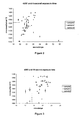
- Titania nanofibers have been discovered to be active in ultraviolet light. Upon the incidence of UV radiation, titania nanofibers make the transition from what is essentially a resistor to a wide band gap semiconductor. The electrical resistivity/conductivity of titania nanofiber varies when exposed to varying intensities of UV light. The variation of titania resistivity with respect to UV intensity, exposure time, and voltage are studied in detail in an experiment conducted varying these parameters. The hypothesis being that as light intensity and exposure time increase, resistivity will decrease. To complete this experiment, 3 anatase samples were tested at three voltages and three exposure times and data was taken three times at each point.
- Anatase at 400V reaches a minimum resistivity between 5 and 10 seconds of UV exposure. At 700V, the minimum resistivity lies on the threshold of 15 seconds of exposure, while samples at 1000V have a minimum resistivity at an exposure time greater than 15 seconds. Resistivity decreases with increasing intensities of ultraviolet light and at a fixed voltage and exposure time, current increases with increasing ultraviolet intensities.
- titania is photocatalytic and responds to UV light by making the transition from a resistive material to a semiconductive material.
- Specific work related to the variation of voltage, exposure time, and light intensity has yet to be completed in this field.
- a grasp of the magnitude of resistivity change with respect to these values adds to the pool of knowledge for the successful implementation of titania into far reaching industrial, medical, and chemical possibilities. This discussion approaches these issues through an experimental-empirical graphical technique to demonstrate how changes in these values affect titania response to UV radiation.
- Photocatalysis is defined as a catalytic reaction involving light absorption by a catalyst or by a substrate. Titania nanofibers exhibit this behavior by making the transition from a resistive material to a semiconductive material upon the incidence of UV radiation. This phenomenon has importance in several diverse areas.
- Titania nanofibers can be used to treat waste water because when a photon with the energy hv strikes the titania semiconducting material, an electron is promoted from the valence band of the material to the conductance band of the material, thus creating an electron hole in the valence band.
- This electron hole (h vb ) is a strong oxidant which then breaks down organic contaminants and microorganisms that are harmful to the human body.
- PVA Poly Vinyl Alcohol
- titania nanofibers Another application of titania nanofibers involves the sterilization of the surface of dental implants. Titania is used here as rough dental implants provide a better surface for installation into the oral cavity, yet a rougher surface is accompanied by a higher affinity for bacterial infection when exposed to the inside of the mouth. Using titania greatly decreases, if not completely abolishes, the risk of oral infection in dental implantations.
- titania nanofibers there are also several methods for the fabrication of titania nanofibers. These include electrospinning, vacuum arc plasma evaporation, and sol - gel. Electrospinning techniques involve the dispersion of TiO 2 microparticles in a polymer aqueous solution and then spinning the fibers in a high voltage environment onto a rotating wheel type apparatus. An automatically advancing syringe is also utilized in this technique for nanofiber fabrication. Vacuum arc plasma evaporation uses a vacuum chamber supplied with oxygen and a plasma beam focused from a LaB 6 cathode onto an anode magnet. The titania deposits onto a glass substrate holder at the end of the chamber opposite the sample source. The sol-gel method involves the preparation of a gel in a specific molar ratio followed by the extrusion of the fibers with a glass stick by hand. Although cumbersome and slow, this method allows for very few impurities.
- titania nanofibers There are a variety of types of titania nanofibers, and based on its superior qualities anatase was chosen as the experimental sample.
- the anatase samples used were fabricated through an electrospinning technique. Suitable electrospinning techniques are disclosed in various patents, including, but not limited to, United States Patent Number 6,753,454 , which is hereby incorporated by reference in its entirety for its teachings related to electrospinning.
- This experiment utilized three critical pieces of equipment; a UV light meter, a Keithley voltage source/ current measuring device, and a UV light source.
- the light source used is a BLAK RAY Longwave UV lamp B 100 AP, 115V 60Hz and 2.5 Amp manufactured May, 1991.
- the light used is an important factor in this experiment as it impacted the path of the experiment.
- the UV lightmeter measures light intensity in units of ⁇ W/cm 2 , with two available ranges of 0-2000 and 0-20000.
- the current measuring device measures current in ⁇ Amps, the appropriate range for this experiment.
- the original intent of experimental design involved calibrating ultraviolet light intensity to distance, and then varying the titania sample distance from the light source to effectively vary the light intensity. After several experimental trials, this calibration was discovered to be not valid. The intensity of the light varied with time, and a calibration did not accurately represent data. Hence, a reevaluation of experimental procedure was needed.
- a 'table - like' framework was created to support the experiment.
- a 37cm metal track equipped with a bearing-loaded car moved freely along the distance of the track.
- the anatase sample was placed on a glass slide which was then screwed onto a Teflon base via gold plated metal contacts.
- This sample setup was placed on a fiberglass base along with the UV lightmeter onto the bearing - loaded car.
- the setup as shown in Figure 1 utilizes the known fact that the UV-A radiation varies with the cosine of the angle between the lines to the meter and sample and the centerline of the UV source.
- the sample and the meter were placed at equal perpendicular distances from the centerline of the UV light source so as to simultaneously measure the light intensity and disperse incident radiation onto the sample.
- Thickness is determined from the density of anatase (4.26 g/cc). TABLE 1 Anatase Sample information Length, cm Width, cm Sample Exposed Weighed Exposed Weighed Weight,g Thickness, cm 1 1.7 2.1 2 2.2 0.0050 0.000254 2 1.7 2.25 2.25 2.25 0.0082 0.000380 3 1 1.55 2.25 2.25 0.0056 0.000377
- Figures 2 through 6 graphically represent the averages of light intensity and current flow for the voltages and exposure times indicated by each chart title. Error bars represent the standard deviation of the triplicate data points.
- R the resistance in Ohms
- ⁇ the resistivity in Ohm/cm
- i the current in Amps
- e voltage
- A the cross-sectional area of the sample
- L the length of the sample.
- Metal oxide nanofibers act as substrates upon which chemical warfare agents and other toxic chemicals can adsorb or absorb and decompose.
- the large surface area per unit mass of these nanofibers creates a high surface reactivity while the length of the nanofibers make them suitable for incorporation into protective clothing and devices for breathing.
- Metal oxide nanoparticles are known to decompose nerve agents but cannot be readily incorporated into clothing and breathing filters.
- Nanofibers can be incorporated into clothing and used in respiratory filters while still exhibiting the nano-scale surface reactivity necessary for nerve agent detoxification. Properties of the nanofiber materials such as strength, porosity, capacity to adsorb chemical species, etc. can be controlled by combining different fibers into a composite. For example, pressure drop across nerve agent filter media can be minimized by combining oxide nanofibers with larger fibers.
- the composites are ideal for protective breathing apparatus and clothing to permit moisture exchange and alleviate thermal stress on personnel.
- Laboratory scale sheets consisting of metal-oxide nanofibers have been generated by using a rotating drum apparatus for collecting non-woven electrospun nanofibers in the form of a long continuous sheet.
- the fibers in these sheets are randomly oriented, producing a nonwoven fabric-like material that is flexible and somewhat elastic. In one embodiment this is a macroscopically large piece of material, composed entirely of nanoscopically small (in diameter) polymer nanofibers.
- This approach is extended by using a segmented drum, which consists of sets of equally spaced wires grounded to create the large potential difference with respect to the spinnerette tip.
- the materials generated achieve partial orientational alignment of the nanofibers within the sheet over shorter periods of time. For longer periods of time, the fibers start spinning in random patterns and alignment is gradually lost. These aligned mats are thick enough to cut and handle.
- Structures (such as fabrics and filters) composed of aligned nanofibers will have properties (thermal, mechanical, mass transport, etc.) superior to those formed from non-woven materials.
- properties thermal, mechanical, mass transport, etc.
- the nanofibers may also require additional structural support. Titania nanofibers are formed by coating polymer nanofibers with sol-gel precursors followed by heat treatment, and then taking sheets of polymeric nanofibers and transforming them into metal oxides. The next step incorporates long polymer nanofibers into micron-sized glass-fiber filter media using a vacuum molding method.
- the mixed fibers are easily vacuum molded into porous disks 1 cm thick and 6 cm in diameter.
- an acrylic binder is used to hold the fibers together.
- the length and diameter of the generated nanofibers is dependent on the conditions under which the fibers are produced.
- the experimental parameters of polymer concentration, metal-oxide precursor concentration, mole ratios, polymer molecular weight, applied potential, distance between sample and collector plate, solution flow rate, humidity and temperature impact the final product. Each of these parameters has been investigated and is being optimized to produce the desired nanofiber characteristics.
- Electrospinning is an electrohydrodynamical process for making thin polymer fibers with diameters in the range from around one nanometer to several thousands of nanometers.
- the low capital cost and the simplicity of equipment needed to make polymer nanofibers has enabled scientists and engineers in fields such as filtration, biomaterials, biomedical devices, chemical analysis, catalysis, aerospace, fiber reinforced composites, energy conversion, protective clothing, agriculture, and others to produce experimental quantities of nanofibers from a wide variety of polymers. Nearly any material can be incorporated into the nanofibers.
- the current invention builds upon current work in state-of-the-art electrospinning processing and materials characterization relevant to phosphorus compounds adsorbed on metal oxides.
- the jet is illuminated with a cone of white light that converges on the sample as illustrated in Figure 10 .
- the viewing axis is a few degrees off the axis of the cone of illumination in a plane that is perpendicular to the direction of the straight segment of the jet. Colors are seen in a range of angles near 5 degrees, but the exact relationship between the color and the jet diameter depends on this angle.
- Figure 10 is a scaled diagram of the experimental arrangement detailing the light path.
- the distance from the light source to the camera is about 2 meters, so that the photographic apparatus does not affect the electric fields near the jet.
- the colors are not the spectral colors seen with a prism, but a complex mixture of interference colors similar to the pastel shades seen in a soap bubble.
- the camera is focused on the jet.
- Figure 11 shows a series of images from a video sequence of a jet that was "dying" after the voltage was suddenly reduced to a value at which the jet would no longer flow. Measurements of the diameter, of each segment having a recognizable color, by observing the diffraction pattern of laser light, established the diameter corresponding to the various colors. Calibration is only required once for a particular arrangement of the camera and the spectral distribution of the white light.
- the blue band, in the envelope cone details the location where the diameter of the jet becomes smaller than the wavelength of light, which is between 300 and 400 nanometers.
- This series of images demonstrates the diameter and taper rate of the jet measured rapidly, and an experienced observer can, for example, interpret changes in diameter "on the fly” as voltage or other experimental parameters are changed.
- the photographic record contains a wealth of detailed information about changes in jet diameter as a function of time.
- Video images of jets disturbed by rapidly passing a glass rod through the jet can be analyzed to show the changes in diameter of the entire jet. This new capability is providing information needed to compare the calculated and experimental behavior of the jet in response to changes in process variables, on a time scale of about 16 ms.
- Figure 13 shows that such methods can be used to produce materials in sufficient quantities for testing phosph(on)ate adsorption.
- the fibers in this sheet are randomly oriented, producing a nonwoven fabric-like material that is flexible and somewhat elastic. Note that this is a macroscopically large piece of material, composed entirely of nanoscopically small (in diameter) polymer nanofibers.
- This approach can be extended using a segmented drum, with the results indicating success in achieving partial orientational alignment of the nanofibers within the sheet.
- the segmented drum consists of sets of equally spaced wires grounded to create the large potential difference with respect to the spinnerette tip. As the polymer spins, it aligns across the copper wires.
- One hypotheses involves structures (such as fabrics and filters) composed of aligned nanofibers having properties (thermal, mechanical, mass transport, etc.) superior to those formed from non-woven materials. Using combinations of aligned and random regions, one can tailor nanofiber sheets for specific applications. The goal becomes materials that enable phosph(on)ate aerosol capture and decomposition while permitting water vapor exchange.
- nano-scale metal oxides offer advantages for the chemical detoxification of nerve agents.
- the recent synthesis of titania nanofibers and those modified with erbia are described. This work demonstrates the ability to form metal oxide nanofibers and modify them as required.
- the production of alumina and magnesia nanofibers for nerve agent detoxification follows the same processing steps and chemistry described below, applied to additional metal oxide precursors.
- the incorporation of metal oxide particles into a metal oxide nanofiber matrix is also demonstrated. This indicates that one can include metal oxide particles into nanofibers of other oxides or polymers. This leads to unique fabrics and filters for personal protection from nerve agents.
- TPT tetraisopropyl titanate
- PVP polyvinylpyrrolidone
- the mixture ratio of TPT to the PVP solution was varied from 0.008 to 1.38 by weight in order to optimize the electrospinning process for nanofiber production.
- Metal washers or aluminum foils were used as the collectors during spinning. The fibers were hydrolyzed in air for 12 hr and then heated in air to pyrolize the PVP.
- erbia-doped titania nanofibers For erbia-doped titania nanofibers, a 0.4 TPT:PVP weight ratio was used with erbium (III) oxide particles (Strem Chemical, Inc.) added to the solution before electrospinning. Fibers made using an erbia:TPT ratio of 1.0 by weight were produced and used in the following experiments.
- FIG. 16 An SEM image of titania fibers after pyrolysis is shown in Figure 16 for a TPT:PVP precursor weight ratio of 0.8. This ratio plays an important role in determining the diameters of the resulting fibers. At a very low (0.008) TPT:PVP ratio, continuous titania fibers cannot be produced by electrospinning. A TPT:PVP ratio of 0.02 is an optimal ratio for forming titania nanofibers that can survive pyrolysis under the conditions discussed here. Increasing the TPT:PVP weight ratio leads to an increase in the diameter and structural homogeneity of the titania nanofibers as seen in Figure 16 for a 0.8 weight ratio. Increasing the TPT content further leads to fibers with diameters in the micron range. Prior work demonstrates control of the electrospinning conditions to adjust properties of the resulting nanofibers, a skill used to reach the goal of nanofiber systems for nerve agent detoxification.
- Titania has brookite, anatase and rutile crystal structures.
- titania nanofibers were ground into powders and X-ray diffraction (XRD) measurements were performed. As shown in Figure 17 , the resulting Bragg peaks are intense.
- Annealing at 773 K in a sintering furnace pyrolyzes the PVP leaving anatase phase titania nanofibers as indicated by the lower diffraction pattern.
- Increasing the annealing temperature to 1173 K produced rutile-phase titania nanofibers as indicated by the upper diffraction pattern.
- the fibers both support larger erbia particles (left), and encapsulate smaller erbia particles (right). This provides significant flexibility in nanofiber development.
- the titania nanofibers have very large length to diameter ratios and form a random nonwoven mat with many pores for gas to flow through.
- the ability to incorporate metal oxide particles into other metal oxide nanofiber matrices is used in the effort to develop materials for garments and breathing apparatus that decompose phosphorus-based nerve agents.
- X-ray photoelectron spectroscopy (XPS) measurements characterize the chemical composition of the surfaces of our titania nanofibers.
- Survey scans of pyrolyzed titania nanofibers and of those incorporating erbia particles are presented in Figure 19 . These spectra have been vertically separated for clarity but no background fitting has been performed. As expected, all the fibers contain Ti, O, and C, and the upper spectrum shows the presence of erbium as well.
- metal oxide nanofibers Two main techniques to produce metal oxide nanofibers are widely used.
- One is the direct electrospinning of solutions that include both polymer and metal oxide precursors, followed by thermal treatment and the other involves the electrospinning of polymers only, followed by coating with metal oxides by physical or chemical vapor deposition or sol-gel techniques.
- the third method recently developed and described previous for nerve agent detoxification incorporates metal oxide nanoparticles and nanofibers into composites with absorbent polymer nanofibers.
- Figure 20 provides experimental results indicating that as gap distance (the distance between the high voltage spinnerette and the grounded collector plate) increases, the fiber diameter decreases. In addition, as the polymer concentration increases the fiber diameter increases. The gap distance affects the electric field and the time available for elongation of the jet and solvent evaporation. Solvent concentration affects the viscosity of the fluid jet, the evaporation rate, the elastic modulus of the jet, and possibly the amount of charge on the jet. Through the combined effect of all these parameters the solvent concentration influences the final fiber size and shape.
- nanofibers As described previous, changes in the electrospinning process effect the resulting nanofiber characteristics including the surface structure. This is important for the directly-spun metal oxide nanofibers as well as for those formed by coating polymer nanofibers.
- nanofibers of MPD-I, a high performance polyamide, with an average diameter of 100 nm are coated using chemical and physical vapor deposition techniques.
- fibers have been coated with metals, oxides, and nitrides.
- Figure 21 shows fibers coated with aluminum nitride (a wide band gap semiconductor) by a reactive sputtering physical vapor deposition technique.
- titania One embodiment of an adsorbent system that forms large nanofiber sheets or mats is titania.
- the direct method of electrospinning titania nanofibers and their characterization was discussed previous.
- the other method utilizes coatings of polymer nanofiber sheets followed by pyrolysis of the polymer substrate as described previous. Sheets of titania nanofibers approximately 15 cm by 50 cm are electrospun from multiple tips and collected on a rotating drum. This provides sufficient quantities of material for parallel studies of fiber structure, stoichiometry, and reactivity toward phosph(on)ates.
- Nano-scale particles of magnesia and alumina are incorporated into the titania nanofibers, and characterized for surface reactivity and morphological structure.
- metal oxide nanoparticles into nanofibers made from polymers swollen by phosph(on)ate exposure.
- the polymer absorbs the phosph(on)ate which is then detoxified by the nearby nanoscale metal oxide materials. It is possible that certain combinations of nanofibers with nanoparticles synergistically provide even higher surface reactivity toward phosph(on)ate decomposition than either material system can provide independently.
- Nerve agent simulants studied in this effort are diethyl 4-nitrophenylphosphate (paraoxon), diisopropyl fluorophosphate (DFP), dimethyl methylphosphonate (DMMP), and methyl dichlorophosphate (MDCP).
- nanoparticle metal oxides The high reactivity of nanoparticle metal oxides is proposed to arise from the large number of defects sites present on the surface. These defects sites can be made prevalent on nanofibers with high surface area and small diameter by control of the processing conditions. Characterization of the surface metal sites provides chemical details of the sites with which the simulants react.
- the following discussion of NMR characterization of metal oxide nanofibers focuses on alumina, but similar studies also occur for titania and magnesia fibers.
- the application of cross-polarization, magic-angle spinning, high field and multiple-quantum techniques yield high-resolution spectra.
- NMR (isotope 27 Al) studies of alumina nanopowders revealed the presence of both tetrahedral and octahedral alumina sites in the bulk material.
- the surface composition of the nanofibers are characterized by using 1 H - 27 Al cross-polarization to determine the structure and distribution of the surface alumina sites before adsorption of the simulants. This characterization is extended to monitor the alumina sites involved in direct interaction with the simulants. After exposure, the alumina sites that reacted with the simulant are characterized using 31 P - 2 7Al cross-polarization technique. This approach allows for the determination of the types of metal oxide sites that react directly with the simulant.
- the 27 Al NMR data is combined with the 31 P data to correlate the nanofiber surface structure and stimulant hydrolysis activity. This information is used to determine the optimal synthesis procedure in an iterative manner (synthesize, characterize, optimize).
- the surfaces of nanofibers are characterized by XPS, which is used to determine the oxidation state of metal atoms in the metal oxide nanofiber systems as well as the binding of phosph(on)ate species.
- Semi-qualitative analysis of survey scans and quantitative analysis of high-resolution spectra are performed in a manner complementary to the SSNMR efforts, as one uses Al, Mg and Ti anodes as X-ray sources to help distinguish unknown features if necessary. Results of these surface characterization efforts are used to improve the nanofiber synthesis procedures in an iterative fashion.
- Another important property of the metal-oxide nanofibers studied is their uptake capacity or maximum loading level of nerve agents and simulants. Loading levels are determined using UV/vis or IR, depending on the absorption values of the simulants. For simulants with a large absorbance in the UV/vis region ( i . e . paraoxon), nanofibers are added to a volume of pentane (or other suitable solvent) and the simulant. At periodic time intervals, a sample of the solution is removed and its UV/vis spectrum collected. The absorbance from the simulant remaining in solution is used to determine the concentration, which yields the amount of simulant adsorbed to the nanofibers. Simulants having small extinction coefficients will be characterized by vapor-phase IR.
- Nanofibers are placed into a vapor-phase IR cell and then the simulant is added to the cell. IR spectra are collected over a 24 hr period, and based on the intensities of the features related to the unbound simulant species, one determines the amount of bound simulant per gram of nanofiber. Similar uptake experiments using liquid cell IR combined with attenuated total reflectance and diffuse reflectance techniques are performed.
- the actual loading level of the fibers may be significantly larger than the initial loading level if the bound organophosph(on)ates result in dissolution of the metal oxide.
- NMR studies of mono-stearyl acid phosphonate adsorbed on alumina and VX, GB and GD adsorbed on alumina nanoparticles indicate that bulk alumino-organophosphates are formed. In these materials, after reacting with organophosphates, reactive surface sites are regenerated and the metal oxide is active towards organophosphate decomposition until consumed.
- the nanofibers are characterized spectroscopically to determine if dissolution is occurring and the rate at which it occurs. Solution studies are also performed to determine the total long-term loading levels of the nanofibers.
- phosph(on)ate decomposition involve several steps that are elucidated spectroscopically here. Specifically one looks for evidence of dehalogenation and ester cleavage from the phosphorus moieties due to adsorption, poisoning or fouling mechanisms that lead to decreased surface reactivity of the nanofibers, and the structure of the reactive metal oxide sites. Although the surface chemistry of the simulants used in this study do not exactly model that of actual nerve agents, these analog compounds permit us to determine whether or not the metal oxide nanofiber materials have the potential to dissociatively adsorb g-agents and VX.
- the 31 P chemical shifts easily discern phosphorus bound to 2, 3 or 4 oxygens and will be used to determine whether one, two or three hydrolysis steps have occurred and the extent of each reaction.
- the byproducts of the hydrolysis reactions will be monitored by 13 C and 19 F NMR.
- the rate of decomposition of nerve agent simulants on the nanofibers are determined by two different methods.
- the solution rate of reaction is determined from the UV/vis and IR data discussed above (uptake capacity).
- the reaction rate is calculated from the absorbance changes of the simulants in solution versus time.
- the second method is to determine the rate of decomposition when the simulant reacts directly with the nanofibers, in the absence of a solvent.
- the nerve agent stimulant is added directly to the nanofibers and solid-state 31 P and 13 C NMR is used to follow the reaction.
- the reaction rates determined by this method are complicated as they are a function of both the rate of the decomposition reaction occurring at the nanofiber surface and the diffusion rate for the simulant to reach the surface. However, comparisons of different materials provide insight needed in the nanofiber optimization.
- Prototype filter structures are made from the most-promising nanofibers and tested to determine flow resistance and water vapor exchange properties.
- the pilot scale coalescence filter test apparatus has a Laskin Nozzle for generating oil droplet aerosols with droplets primarily in the 100 to 300 nm range. The aerosol is used to challenge filter samples (6 cm diameter disks) held in a filter holder. Droplet concentrations upstream and downstream of the filter are measured with a TSI SMPS 3934, capable of measuring drops in the diameter range from 60 to 1000 nm. Pressure drop is measured across the filter sample, and the flow rate is controlled using a rotameter. This apparatus is modified and used to perform preliminary studies of mild or dilute phosph(on)ate aerosols in a proof-of-concept approach.
- a typical experiment exposes the filter media to a dilute aerosol and measures the pressure drop and droplet concentration across the filter media, then combines these measurements with characterization of the outlet stream to determine the species present.
- one makes modifications to the prototype device to improve performance For example, if the pressure drop is too high one increases the percentage of large glass fibers within the filter media used to support the metal oxide nanofibers. If the droplet concentration is too high on the downstream side of the test cell one changes the distribution of fiber sizes depending on the size of the droplets being observed. Typically, the required fiber size for capturing droplets correlates directly with the size of the droplets to be captured.
- Transition aluminas Aluminum oxides, hydroxides and oxyhydroxides, upon heating, pass through several metastable intermediate phases (transition aluminas) before transforming into the thermodynamically stable corundum phase ( ⁇ -Al 2 O 3 ). Because of their high surface area, mixture of acid-base properties, and surface hydration/hydroxylation mechanisms, these transition aluminas are industrially important as adsorbents and catalytic materials in hydrocarbon cracking, purification of gas oil fractions, control of combustion emissions, destruction of chemical weapons and other chemical processes.
- the dominant alumina phase used in these applications is ⁇ -alumina, due to its ease of formation by simply heating the boehmite phase to 400-450°C and because of its large surface area and reactivity.
- Alumina nanoparticles typically have diameters ⁇ 10 nm and lengths of a few hundred nm, as well as moderately high surface areas. In one case alumina nanorods with a length of -5 um and an aspect ratio of 25-250 were generated.
- Electrospinning techniques have been utilized in an effort to generate metal-oxide nanofibers with small diameters (i.e., high surface areas) and large aspect ratios (easily handled bulk materials).
- a polymer precursor solution in a pipette is held at a high (kV) potential relative to a nearby grounded plate.
- a charged jet of the precursor solution is ejected from the pipette as a result of the applied electric field. Rapid evaporation of the solvent results in the collection of polymer fibers with diameters less than 2 ⁇ m.
- Aluminum acetate stabilized with boric acid was purchased from STREM chemicals.
- Polyvinylpyrrolidone (PVP) was purchased from Sigma-Aldrich. 200 proof, absolute ethanol, purchased from pharmco products, inc. was used as the solvent in the nanofiber formation.
- Aluminum oxide powder ( ⁇ -Al 2 O 3 , ⁇ 10 ⁇ m) was also purchased from Sigma-Aldrich. All materials were used as received.
- Aluminum acetate stabilized with boric acid was mixed with 10% polyvinylpyrrolidone (PVP) in ethanol.
- the ratio of aluminum acetate to the polymer solution was varied at fixed spinning conditions.
- the mixtures were placed in a pipette and electrospun using an electric field of 1 kV/cm. Grounded aluminum foil was used as the collector during the spinning process.
- the fibers were then heated in air at various temperatures and characterized accordingly.
- the aluminum acetate mixture was made with a 5g:10ml:13 ml ratio of aluminum acetate, water and ethanol and kept overnight to let the mixture dissolve completely.
- the polymer solution was made with a 1g:10ml ratio of polyvinylpyrrolidone (PVP) to ethanol. Different ratios of aluminum acetate to polymer solution were mixed and it was found that a 1:1 solution provided optimal nanofiber formation.
- PVP polyvinylpyrrolidone
- the electrospinning apparatus includes a sheet of aluminum foil wrapped around a conducting material with a grounded wire attached to the foil in order to ground the collection area.
- the spinning solution was placed into a pipette and a copper wire (attached via a power supply cable) was placed into the wide end of the pipette.
- the power supply was turned to a voltage of 25 to 30 kV in order to charge the solution and produce fibers.
- the collected fibers were then heated to remove the guide polymer from the materials.
- the polymer begins to pyrolized at about 400°C, leaving behind aluminum oxide nanofibers.
- SEM was performed on a JOEL JEM-5310 instrument and operated at 25 kV and 60 mA.
- a sample of the fiber was placed on a doubled-sided conducting carbon tape, attached to the sample holder. It was then coated, via sputtering with a very thin layer of Pd alloy, making the surface electrically conductive, while keeping the features of the sample unaltered.
- the chamber was vented and the sample was placed in the chamber. Then the chamber was placed in low vacuum mode and voltage as high as 25kV was run through it for sputtering Pd alloy. Next, the SEM images were taken at varying magnification in order to show the surface characteristics of the fibers. All of the data was saved. To finish, the system was vented, the samples removed and the system left in high pressure mode.
- XPS and SIMS measurements were performed in a VG ESCALAB Mk II system under high vacuum conditions.
- the aluminum anode on a dual anode (Mg/Al) X-ray source was used for XPS with a power of 180 W.
- the analyzer had a fixed transmission energy of 50 eV for survey scans and 20 eV for most of the detailed scans.
- Positive and negative ion SIMS was performed with a 3keV Ar + ion beam and a MM12-12 quadrupole mass spectrometer.
- Nanofibers of polyvinylpyrrolidone (PVP), with average diameters of 500 nm, fabricated using the aforementioned electrospinning technique are shown in the scanning electron micrograph (SEM) image in Figure 22 .
- SEM scanning electron micrograph
- the high-field 27 Al NMR data shown in Figure 25 also indicates that the aluminum site does not undergo change during electrospinning.
- the spectrum Upon heating the fibers to 1200°C, the spectrum contains peaks at 15 ppm from the octahedral (O h ) sites and 70 ppm from the tetrahedral (T d ) sites ( Figure 25D ) and is nearly identical to that observed for ⁇ -alumina particles ( Figure 25A ).
- the change represented in the spectra, upon thermal treatment show that alumina nanofibers have been generated and their bulk structure is similar to that of the ⁇ -alumina powders.
- the diameter of the fibers generated by heating to 1200°C is little changed from the as-spun fibers, as determined from SEM micrographs. However, the very large aspect ratios are reduced, and the fibrous material is considerably more brittle than the as-spun aluminum acetate/PVP fibers.
- XRD measurements also confirm that the nanofiber samples, after annealing are predominantly alpha- phase alumina, however small traces of boron are detected, as seen in Figure 26 .
- the presence of boron is not surprising and arises from the 2.7 wt. % boric acid present in the aluminum acetate.
- these nanofibers contain sodium, which is due to the composition of the aluminum acetate used in the processing (contains about 2 wt. % Na).
- SIMS is a surface sensitive technique, and although the overall amount of sodium in the starting solution is small by weight, segregation phenomena during crystallization can enrich the nanofiber surfaces with impurities, as evidenced by Figure 27 .
- aluminum oxides, hydroxides and oxyhydroxides such as Gibbsite ( ⁇ -Al(OH) 3 ), Bayerite ( ⁇ -Al(OH) 3 ), Nordstandite (Al(OH) 3 ), Boehmite (y-AIOOH), Diaspore ( ⁇ -AlOOH), upon heating, pass through several metastable intermediate phases (transition aluminas) before transforming into the thermodynamically stable corundum phase ( ⁇ -Al 2 O 3 ).
- transition aluminas are industrially important as adsorbents and catalytic materials in hydrocarbon cracking, purification of gas oil fractions, control of combustion emissions, destruction of chemical weapons and related toxins, and other chemical processes.
- the dominant alumina phase used in these applications is ⁇ -alumina due to its high surface area and reactivity, and this phase is readily generated upon heating the Boehmite phase to 400-450°C.
- mesostructured and nanoscale aluminas have been synthesized by a variety of techniques.
- nanoparticles typically have diameters ⁇ 10 nm and lengths of a few hundred nm, however, in one case alumina nanorods with a length of -5 ⁇ m and an aspect ratio in the range 25-250 were generated. These materials have moderately high surface areas.
- nanoparticles of alumina do offer high surface areas, they suffer from difficulty in handling.
- the small particles size makes recovery of the nanoparticles through methods such as filtration very difficult.
- integration and retention of the particles into other materials, such as textiles is hindered by the difficulty of keeping the nanoparticles localized.
- the formation of nanometer diameter alumina fibers that can be readily handled and provide the desired catalytic and structural properties is ideal.
- nanofibers of polyvinyl pyrrolidone/alumina-borate have been reported previously. These fibers were subsequently heated (calcined) to temperatures of 1000-1400°C to produce alumina-borate oxide fibers. While the procedure of electrospinning, followed by heating, has been used previously to form alumina, we have developed heating methods to fabricate nanofibers with unique structures, compositions and mechanical properties.
- Fibers of polyvinyl pyrrolidone (PVP) containing aluminum acetate stabilized with boric acid (Al(ac)) with diameters of ⁇ 5 micrometer are produced by the method of electrospinning, see Figure 30 .
- an electrode at a negative potential is placed in a solution of PVP and Al(ac) that is contained in a pipette.
- a collector In the vicinity of the pipette tip is a collector that is either grounded or held at a positive potential.
- the potential difference between the solution and collector results in the formation of jets of the polymer and aluminum reagent that are collected on the collector.
- the fibers generated by this technique form a non-woven mat on the collector surface.
- the diameter of the fibers is a function of temperature, humidity and the distance between the pipette tip and the collector.
- the polymers used in the electrospinning process can be, but are not limited to, those polymers (and related solvents) chosen from the following list: Polymer Solvent 1 Cellulose acetate Acetone 2 Acrylic resin (96% acrylonitrile) DMF 3 a) Polyethylene oxide a) Water/chloroform b) Polyvinyl alcohol b) Water c) Cellulose acetate c) Acetone 4 a) Poly (2-hydroxy ethyl methacrylate) a) Formic acid b) Polystyrene c) Poly (ether amide) 5 Polyethylene oxide (PEO) 6 Polyethylene terephthalate 7 Polyaniline/PEO blends 8 Polyether urethane 9 Poly-L-lactide (PLLA), Polycarbonate (PC), Polyvinylcarbazole 10 Polystyrene 11 Polybenzimidazole (PBI) 12 Nylon 6 and Nylon 6 +montmorillonite (NLS) 13 a) Polyethylene oxide (PE) b) Polycarbon
- the aluminum reagent can be, but is not limited to, either charged or neutral aluminum compounds.
- aluminum reagents include aluminum acetate, aluminum acetate stabilized with boric acid, aluminum alkoxides (methoxide, ethoxide, butoxide, propoxide, etc.). Additional non-aluminum embodiments will yield various other metal oxides and include but are not limited to titanium, silica, nickel, magnesium, alkyl titanate, and finally tin/nickel combinations which yield PN junctions.
- the solvent may be, but is not limited to, water, ethanol and/or methanol.
- the solvent may also include the presence of an acid (carbonic, formic, acetic, soluble carboxylic acids).
- the optimal ambient humidity during electrospinning is less than 50% relative humidity.
- the fibers generated using electrospinning are subsequently thermally treated to remove all, or a portion of the polymer and to convert the aluminum reagent into alumina.
- the temperatures during the thermal treatment are 500°C to 1200°C for times from 10 minutes to 6 hours.
- alumina refers to material consisting primarily of aluminum, oxygen and hydrogen, with the aluminum primarily occupying 4, 5, or 6-coordinate sites within the material.
- the fibers may also contain other elements originating from the solution from which the fibers are electrospun or from the thermal treatment process.
- the fibers generated after sample heating are ⁇ 5 micrometer in diameter, see Figure 31 .
- the elemental distribution within the fibers may not be heterogeneous, as the boron present in some alumina fibers is present at higher levels at the fiber surface, see Figure 32 .
- the thermal treatment of the fibers is done in either an oven that is open to ambient atmosphere, i.e. the "wet-bake” method, or in an oven that is closed to the atmosphere, i.e. the "dry-bake” method.
- the oven contains an opening (chimney) that allows for the circulation of ambient atmosphere through the oven during the heating process, whereas in the dry-bake method the oven does not contain an opening.
- the humidity level during the thermal treatment process can be varied by adding additional water to the oven.
- the alumina fibers generated are similar to the ⁇ -alumina phase when the samples are heated to 525°C and in the ⁇ -alumina phase when heated to 1200°C.
- Samples heated at intermediate temperatures have structures similar to the ⁇ , ⁇ , and ⁇ phases.
- the fibers may consist of a mixture of alumina phases.
- the phases present in the alumina nanofibers are identified by Al solid-state NMR ( Figure 33 ) and X-ray diffraction techniques ( Figure 34 ). After heating to 1200°C, the fibers have low tensile strength and are brittle.
- the fraction of 4, 5 and 6-coordinate alumina sites in the nanofibers are different from those reported for bulk alumina heated to similar temperatures.
- the different coordination sites of aluminum are determined form Al SSNMR where the Al chemical shift for 6-coordinate sites is 0-20 ppm, 5-coordinate sites is 35-60 ppm and the 4-coordinate sites is 65-80 ppm.
- the material generated after heating electrospun nanofibers is very different from the material generated by simply heating Al(ac).
- Al(ac) When Al(ac) is heated, the Al solid-state NMR data shows that the resulting material is dominated by 4- and 5-coordinate aluminum sites, see Figure 38 .
- the material has a very different distribution of alumina sites. The formation of the fiber yields a different form of alumina.
- the distribution of the 4, 5 and 6-coordinate alumina sites in the nanofibers is different than that observed in the fibers fabricated using the wet-bake method.
- the alumina phases present in the fibers are identified by Al solid-state NMR ( Figure 34 ) and X-ray diffraction techniques ( Figure 35 ).
- the alumina nanofibers produced by the dry-bake method have a lower extent of crystallinity and are more flexible than those produced by the wet-bake method.
- the alumina fibers produced by the dry-bake method can be modified to be closer in structure to those of the wet-bake method by adding known quantities of water to the oven, along with the electrospun fibers, before beginning the thermal treatment process.
- the surface structure of the wet-bake and dry-bake alumina nanofibers are different from each other, as determined from Al SSNMR and Fourier transfer infrared (FTIR) spectroscopy, and different from alumina formed by traditional methods, see Figures 36 and 37 .
- the material curls at the edges of the samples.
- the decomposition products of the polymer and aluminum reagent need to escape and water needs to reach the nanofibers during heating.
- Access to the nanofibers is achieved either by channels along the length of the aluminum blocks or channels that pass entirely through the block normal to the surface containing the nanofibers. Schematics of the heating apparati are shown in Figure 38 .
- the structure and composition of alumina fibers is dependent on the annealing process used to form the fibers.
- the structure and composition of the surface of the fibers is dependent on the annealing/thermal treatment process used to make the fibers.
- composition and structure of the alumina fibers is different from the material generated by annealing the alumina reagent in the absence of the polymer nanofiber.
- Annealing/thermally treating as-spun fibers with limited exposure to ambient atmosphere produces alumina fibers with increased flexibility.
- Heating electrospun fibers in the presence of ambient atmosphere to 525°C produces nanofibers of alumina that are similar to, but different from gamma-alumina.
- Heating electrospun fibers in the presence of ambient atmosphere to 1200°C produces nanofibers of alumina that are similar to, but different from alpha-alumina.
- Heating electrospun fibers in the presence of ambient atmosphere between 525°C and 1200°C produces nanofibers of alumina that contain structures similar to one or more of the ⁇ , ⁇ , ⁇ , ⁇ and ⁇ -phases of alumina.
- Heating electrospun fibers in an oven with limited intake of ambient atmosphere produces alumina nanofibers with different distributions of 4, 5 and 6-coordinate alumina sites than observed for heating in ambient atmosphere.
- the surface structure of alumina nanofibers is different from bulk alumina and the structure can be controlled by annealing temperatures, time and atmosphere.
- the metal oxide nanofibers produced by the current invention are subject to various embodiments regarding choice and/or structure.
- two different metal oxide nanofibers are woven together in a helical fashion like yarn.
- 3 different, 4 different or even 5 different nanofibers are used to create a nanofiber with varying applicational uses.
- the properties of one metal oxide nanofiber may be best used to combat reagent A while another nanofiber may be best used to combat reagent Y.
- the combination of both in a yarn or spun together by another means offers the user the best properties of both nanofibers.
- the utilization of multiple nanofibers is not limited to spinning together or twisting together.
- the nanofibers may be attached end to end to for lengths with alternating properties. Again the alternating properties allowing for a wider range of applicability for the fibers.
- a lithium-ion batteries consist of three main parts: anode, electrolyteseparator and cathode, see Figure 40 .
- the reactions within the battery during discharge include:
- the separator/electrolyte serves two roles; (1) conduct Li ions between the two electrodes and, (2) prevent the electrodes from coming into contact.
- Typical electrolyte/separator materials for lithium-ion batteries possess the following properties: a high ionic conductivity, a high chemical stability, a stability to potentials in excess of four volts, the ability to retain high ionic conductivity over a wide temperature range, and are inexpensive to produce while being environmentally friendly.
- an organic solvent typically carbonates
- LiX the anion
- a polymer typically polyethylene oxide
- LiX salt the presence of some organic solvent, with a LiX salt
- Systems that contain organic solvents must be packaged so there is no leakage or evaporation of the solvent. In the case of the polymer systems, they suffer from low ionic conductivities.
- the presence of the organic solvent leads to potential fires with lithium-ion batteries.
- One method which overcomes these drawbacks is the use of solid, inorganic, glass and ceramic electrolytes. Examples include lithium oxides, lithium phosphates, lithium oxynitrides (LIPON), lithium sufides and oxysulfides as well as
- Alumina nanofibers produced using the electrospinning process and containing a lithium salt have optimum properties as separator/electrolytes. These materials benefit from having relatively high ionic conductivity (>0.17mS/cm), being chemically and electrochemically stable, lightweight, inexpensive to produce, and environmentally friendly. Nanofibers with diameters less than one micron have a high surface area, providing for a large contact area with the electrodes at a low mass of nanofibers. The alumina nanofibers are fabricated such that they are flexible, providing for a separator/electrolyte material used in flexible lithium-ion batteries.
- the nanofiber fabrication parameters are controlled to generate materials with varying percentage crystallinity, defect site density, composition and structure of the alumina allowing for optimization of the fiber morphology, composition and structure to achieve maximum ionic conductivity.
- the fibers are fabricated and then applied to the electrodes in battery production or the fibers can be electrospun directly onto the electrode surface.
- the nanofibers In order for the nanofibers to be effective as a lithium cation conducting material in, they must contain a lithium salt.
- the incorporation of the lithium salts on, or into, the alumina nanofibers can be accomplished using various embodiments, three of which are detailed below:
- the alumina nanofibers are produced by electrospinning a solution that contains a polymer, such as, but not limited to, polyvinylpyrrolidinone (PVP), and an alumina reagent, such as, but not limited to, aluminum acetate stabilized with boric acid. This is followed by annealing the nanofibers at temperatures between 200 and 1200°C to form nanofibers of alumina.
- a polymer such as, but not limited to, polyvinylpyrrolidinone (PVP)
- an alumina reagent such as, but not limited to, aluminum acetate stabilized with boric acid.
- a lithium salt optionally added to the solution is a lithium salt, followed by electrospinning the solution to generate polymer nanofibers containing the alumina and lithium reagents.
- the fibers are then annealed to generate alumina-lithium salt nanofibers, see Figure 41 .
- the electrospun nanofibers of PVP and an alumina reagent are immersed in a solution of a lithium salt. This coats and/or impregnates the fibers with the lithium salt and then the fibers can be used as is or annealed at elevated temperatures.
- the electrospun nanofibers of PVP and an alumina reagent are exposed to the vapors of a lithium salt by use of chemical vapor deposition, sputtering or laser ablation.
- the fibers are then used as is or annealed at elevated temperatures.
Landscapes
- Chemical & Material Sciences (AREA)
- Engineering & Computer Science (AREA)
- Manufacturing & Machinery (AREA)
- Ceramic Engineering (AREA)
- Inorganic Chemistry (AREA)
- Materials Engineering (AREA)
- Organic Chemistry (AREA)
- Structural Engineering (AREA)
- Chemical Kinetics & Catalysis (AREA)
- General Chemical & Material Sciences (AREA)
- Metallurgy (AREA)
- Electrochemistry (AREA)
- Textile Engineering (AREA)
- Crystallography & Structural Chemistry (AREA)
- Mechanical Engineering (AREA)
- Geology (AREA)
- Dispersion Chemistry (AREA)
- Life Sciences & Earth Sciences (AREA)
- Artificial Filaments (AREA)
- Spinning Methods And Devices For Manufacturing Artificial Fibers (AREA)
- Chemical Or Physical Treatment Of Fibers (AREA)
- Nonwoven Fabrics (AREA)
- Compounds Of Alkaline-Earth Elements, Aluminum Or Rare-Earth Metals (AREA)
- Catalysts (AREA)
Applications Claiming Priority (4)
| Application Number | Priority Date | Filing Date | Title |
|---|---|---|---|
| US84818906P | 2006-09-29 | 2006-09-29 | |
| US91945307P | 2007-03-22 | 2007-03-22 | |
| US93949807P | 2007-05-22 | 2007-05-22 | |
| EP07873978A EP2086877A4 (de) | 2006-09-29 | 2007-09-28 | Metalloxidfasern und nanofasern, herstellungsverfahren und verwendungen dafür |
Related Parent Applications (1)
| Application Number | Title | Priority Date | Filing Date |
|---|---|---|---|
| EP07873978.6 Division | 2007-09-28 |
Publications (2)
| Publication Number | Publication Date |
|---|---|
| EP2267199A2 true EP2267199A2 (de) | 2010-12-29 |
| EP2267199A3 EP2267199A3 (de) | 2012-09-12 |
Family
ID=39760247
Family Applications (2)
| Application Number | Title | Priority Date | Filing Date |
|---|---|---|---|
| EP20100185802 Withdrawn EP2267199A3 (de) | 2006-09-29 | 2007-09-28 | Metalloxidfasern und Nanofasern, Herstellungsverfahren und Verwendungen dafür |
| EP07873978A Withdrawn EP2086877A4 (de) | 2006-09-29 | 2007-09-28 | Metalloxidfasern und nanofasern, herstellungsverfahren und verwendungen dafür |
Family Applications After (1)
| Application Number | Title | Priority Date | Filing Date |
|---|---|---|---|
| EP07873978A Withdrawn EP2086877A4 (de) | 2006-09-29 | 2007-09-28 | Metalloxidfasern und nanofasern, herstellungsverfahren und verwendungen dafür |
Country Status (5)
| Country | Link |
|---|---|
| US (1) | US20100009267A1 (de) |
| EP (2) | EP2267199A3 (de) |
| CN (1) | CN101622195B (de) |
| CA (1) | CA2664837A1 (de) |
| WO (1) | WO2008111960A2 (de) |
Cited By (6)
| Publication number | Priority date | Publication date | Assignee | Title |
|---|---|---|---|---|
| CN103409848A (zh) * | 2013-08-11 | 2013-11-27 | 吉林大学 | 一种具有核/壳异质结构金属氧化物复合纳米纤维的制备方法 |
| CN103726131A (zh) * | 2013-12-12 | 2014-04-16 | 中国铝业股份有限公司 | 一种多晶氧化铝纤维的制备方法 |
| US9102570B2 (en) | 2011-04-22 | 2015-08-11 | Cornell University | Process of making metal and ceramic nanofibers |
| EP3718157A4 (de) * | 2017-11-28 | 2021-09-29 | Massachusetts Institute of Technology | Separatoren mit länglichen nanostrukturen und zugehörige vorrichtungen und verfahren zur energiespeicherung und/oder -verwendung |
| US20220186402A1 (en) * | 2020-12-16 | 2022-06-16 | Korea University Research And Business Foundation | Biomineralization-inspired synthesis of microscale-urchin with zinc-oxide nano-spicules for super-hydrophilic bactericidal surfaces |
| US12005040B2 (en) | 2011-08-30 | 2024-06-11 | Cornell University | Metal and ceramic nanofibers |
Families Citing this family (143)
| Publication number | Priority date | Publication date | Assignee | Title |
|---|---|---|---|---|
| ES2564694T3 (es) | 2003-09-12 | 2016-03-28 | Vessix Vascular, Inc. | Sistema de remodelación y / o ablación excéntrica seleccionable de material ateroesclerótico |
| US8920414B2 (en) | 2004-09-10 | 2014-12-30 | Vessix Vascular, Inc. | Tuned RF energy and electrical tissue characterization for selective treatment of target tissues |
| US9713730B2 (en) | 2004-09-10 | 2017-07-25 | Boston Scientific Scimed, Inc. | Apparatus and method for treatment of in-stent restenosis |
| US8396548B2 (en) | 2008-11-14 | 2013-03-12 | Vessix Vascular, Inc. | Selective drug delivery in a lumen |
| US8019435B2 (en) | 2006-05-02 | 2011-09-13 | Boston Scientific Scimed, Inc. | Control of arterial smooth muscle tone |
| EP2076198A4 (de) | 2006-10-18 | 2009-12-09 | Minnow Medical Inc | Herbeiführung gewünschter temperatureffekte auf körpergewebe |
| EP2076194B1 (de) | 2006-10-18 | 2013-04-24 | Vessix Vascular, Inc. | System zur herbeiführung gewünschter temperatureffekte in körpergewebe |
| JP5307900B2 (ja) | 2008-11-17 | 2013-10-02 | べシックス・バスキュラー・インコーポレイテッド | 組織トポグラフィの知識によらないエネルギーの選択的な蓄積 |
| WO2010120964A2 (en) * | 2009-04-16 | 2010-10-21 | University Of Delaware | Fibers, tubes and porous structures of metal and metal oxide |
| WO2010122049A1 (de) * | 2009-04-21 | 2010-10-28 | Basf Se | Wasserbasierte herstellung von metalloxid- und metall-nanofasern |
| WO2011002205A2 (ko) * | 2009-06-30 | 2011-01-06 | 주식회사 엘지화학 | 다공성 코팅층을 구비한 전극의 제조방법, 이로부터 형성된 전극 및 이를 구비한 전기화학소자 |
| US20110206928A1 (en) * | 2009-08-24 | 2011-08-25 | Maranchi Jeffrey P | Reinforced Fibers and Related Processes |
| KR20110024179A (ko) * | 2009-09-01 | 2011-03-09 | 현대자동차주식회사 | 차량 루프 헤드라이너 및 이의 제조방법 |
| CA2716144A1 (en) | 2009-10-02 | 2011-04-02 | University Of Windsor | Method of surface treatment of aluminum foil and its alloy and method of producing immobilized nanocatalyst of transition metal oxides and their alloys |
| US8409768B2 (en) * | 2009-10-12 | 2013-04-02 | Board Of Regents, The University Of Texas Systems | Tuning of Fe catalysts for growth of spin-capable carbon nanotubes |
| WO2011054701A1 (de) * | 2009-11-04 | 2011-05-12 | Basf Se | Verfahren zur herstellung von nanofasern |
| CN101899725B (zh) * | 2010-03-31 | 2014-06-11 | 清华大学 | 金属氧化物的纳米纤维及其制造方法 |
| CN103068330B (zh) | 2010-04-09 | 2016-06-29 | Vessix血管股份有限公司 | 用于治疗组织的功率发生和控制装置 |
| US9192790B2 (en) | 2010-04-14 | 2015-11-24 | Boston Scientific Scimed, Inc. | Focused ultrasonic renal denervation |
| KR101117126B1 (ko) * | 2010-04-19 | 2012-02-24 | 한국과학기술연구원 | 금속산화물 초극세 섬유-기반 내열성 복합 분리막 및 이를 이용한 이차전지 |
| US8473067B2 (en) | 2010-06-11 | 2013-06-25 | Boston Scientific Scimed, Inc. | Renal denervation and stimulation employing wireless vascular energy transfer arrangement |
| US9084609B2 (en) | 2010-07-30 | 2015-07-21 | Boston Scientific Scime, Inc. | Spiral balloon catheter for renal nerve ablation |
| US9463062B2 (en) | 2010-07-30 | 2016-10-11 | Boston Scientific Scimed, Inc. | Cooled conductive balloon RF catheter for renal nerve ablation |
| US9155589B2 (en) | 2010-07-30 | 2015-10-13 | Boston Scientific Scimed, Inc. | Sequential activation RF electrode set for renal nerve ablation |
| US9408661B2 (en) | 2010-07-30 | 2016-08-09 | Patrick A. Haverkost | RF electrodes on multiple flexible wires for renal nerve ablation |
| US9358365B2 (en) | 2010-07-30 | 2016-06-07 | Boston Scientific Scimed, Inc. | Precision electrode movement control for renal nerve ablation |
| EP2619365B1 (de) * | 2010-09-21 | 2018-12-19 | Hollingsworth & Vose Company | Zusammensetzungen und abgabesysteme mit laugbaren metallionen |
| US10535853B2 (en) | 2010-09-21 | 2020-01-14 | Hollingsworth & Vose Company | Glass compositions with leachable metal oxides and ions |
| EP2439253A1 (de) * | 2010-10-05 | 2012-04-11 | Research Institute of Petroleum Industry (RIPI) | Hydroentschwefelungs-Nanokatalysator enthaltend Nanoröhrchen-/Nanostäbchenaluminium als Träger sowie seine Herstellung und Verwendung |
| US8974451B2 (en) | 2010-10-25 | 2015-03-10 | Boston Scientific Scimed, Inc. | Renal nerve ablation using conductive fluid jet and RF energy |
| US9220558B2 (en) | 2010-10-27 | 2015-12-29 | Boston Scientific Scimed, Inc. | RF renal denervation catheter with multiple independent electrodes |
| US9028485B2 (en) | 2010-11-15 | 2015-05-12 | Boston Scientific Scimed, Inc. | Self-expanding cooling electrode for renal nerve ablation |
| US9668811B2 (en) | 2010-11-16 | 2017-06-06 | Boston Scientific Scimed, Inc. | Minimally invasive access for renal nerve ablation |
| US9089350B2 (en) | 2010-11-16 | 2015-07-28 | Boston Scientific Scimed, Inc. | Renal denervation catheter with RF electrode and integral contrast dye injection arrangement |
| US9326751B2 (en) | 2010-11-17 | 2016-05-03 | Boston Scientific Scimed, Inc. | Catheter guidance of external energy for renal denervation |
| CN101982581B (zh) * | 2010-11-18 | 2013-01-16 | 东华大学 | 一种静电纺丝制备氧化铝纳米纤维的方法 |
| US9060761B2 (en) | 2010-11-18 | 2015-06-23 | Boston Scientific Scime, Inc. | Catheter-focused magnetic field induced renal nerve ablation |
| US9023034B2 (en) | 2010-11-22 | 2015-05-05 | Boston Scientific Scimed, Inc. | Renal ablation electrode with force-activatable conduction apparatus |
| US9192435B2 (en) | 2010-11-22 | 2015-11-24 | Boston Scientific Scimed, Inc. | Renal denervation catheter with cooled RF electrode |
| US20120157993A1 (en) | 2010-12-15 | 2012-06-21 | Jenson Mark L | Bipolar Off-Wall Electrode Device for Renal Nerve Ablation |
| US9220561B2 (en) | 2011-01-19 | 2015-12-29 | Boston Scientific Scimed, Inc. | Guide-compatible large-electrode catheter for renal nerve ablation with reduced arterial injury |
| CN102633275A (zh) * | 2011-02-15 | 2012-08-15 | 长春理工大学 | 珠链状硼酸锰Mn2OBO3一维纳米纤维及其制备方法 |
| US8778447B2 (en) * | 2011-03-09 | 2014-07-15 | Electronics And Telecommunications Research Institute | Hybrid compositions containing organic material and inorganic material, and hybrid dielectric layers including the same |
| EP2723926A1 (de) * | 2011-06-27 | 2014-04-30 | The Research Foundation Of State University Of New York | Mit photokatalysatoren-nanogittern aus dem sichtbaren spektralbereich beschichtete fasermatten |
| AU2012283908B2 (en) | 2011-07-20 | 2017-02-16 | Boston Scientific Scimed, Inc. | Percutaneous devices and methods to visualize, target and ablate nerves |
| CN103813829B (zh) | 2011-07-22 | 2016-05-18 | 波士顿科学西美德公司 | 具有可定位于螺旋引导件中的神经调制元件的神经调制系统 |
| CN102340002B (zh) * | 2011-08-29 | 2014-03-12 | 长春理工大学 | 锂离子电池正极材料磷酸铁锂纳米纤维及其制备方法 |
| EP2765942B1 (de) | 2011-10-10 | 2016-02-24 | Boston Scientific Scimed, Inc. | Medizinische vorrichtungen mit ablationselektroden |
| WO2013055815A1 (en) | 2011-10-11 | 2013-04-18 | Boston Scientific Scimed, Inc. | Off -wall electrode device for nerve modulation |
| US9420955B2 (en) | 2011-10-11 | 2016-08-23 | Boston Scientific Scimed, Inc. | Intravascular temperature monitoring system and method |
| US9364284B2 (en) | 2011-10-12 | 2016-06-14 | Boston Scientific Scimed, Inc. | Method of making an off-wall spacer cage |
| JP2013082596A (ja) * | 2011-10-12 | 2013-05-09 | Kawaken Fine Chem Co Ltd | アルミナ多層多孔質体およびその製造方法 |
| US9162046B2 (en) | 2011-10-18 | 2015-10-20 | Boston Scientific Scimed, Inc. | Deflectable medical devices |
| US9079000B2 (en) | 2011-10-18 | 2015-07-14 | Boston Scientific Scimed, Inc. | Integrated crossing balloon catheter |
| DE102011085511A1 (de) * | 2011-10-31 | 2013-05-02 | Siemens Medical Instruments Pte. Ltd. | Membran zum Abdecken einer Öffnung in einem Hörgerät |
| CN108095821B (zh) | 2011-11-08 | 2021-05-25 | 波士顿科学西美德公司 | 孔部肾神经消融 |
| US9119600B2 (en) | 2011-11-15 | 2015-09-01 | Boston Scientific Scimed, Inc. | Device and methods for renal nerve modulation monitoring |
| US9119632B2 (en) | 2011-11-21 | 2015-09-01 | Boston Scientific Scimed, Inc. | Deflectable renal nerve ablation catheter |
| US9265969B2 (en) | 2011-12-21 | 2016-02-23 | Cardiac Pacemakers, Inc. | Methods for modulating cell function |
| JP6158830B2 (ja) | 2011-12-23 | 2017-07-05 | べシックス・バスキュラー・インコーポレイテッド | 身体通路の組織又は身体通路に隣接する組織をリモデリングするためのシステム、方法及び装置 |
| WO2013101452A1 (en) | 2011-12-28 | 2013-07-04 | Boston Scientific Scimed, Inc. | Device and methods for nerve modulation using a novel ablation catheter with polymeric ablative elements |
| US9050106B2 (en) | 2011-12-29 | 2015-06-09 | Boston Scientific Scimed, Inc. | Off-wall electrode device and methods for nerve modulation |
| SG11201406558RA (en) | 2012-04-17 | 2014-11-27 | Ngee Ann Polytechnic | Filtration medium with electrospun metal oxide nanofiber layer |
| US9136526B2 (en) * | 2012-04-20 | 2015-09-15 | Korea Institute Of Energy Research | Method of manufacturing anode active material, and anode and lithium battery using the anode active material |
| WO2013169927A1 (en) | 2012-05-08 | 2013-11-14 | Boston Scientific Scimed, Inc. | Renal nerve modulation devices |
| TWM439064U (en) * | 2012-06-29 | 2012-10-11 | Tex Ray Ind Co Ltd | Hollow heat- absorbing and heat-generating plied yarn structure |
| KR101880603B1 (ko) * | 2012-08-22 | 2018-07-23 | 동국대학교 산학협력단 | 리튬이차전지의 음극 활물질용 실리콘 산화물-탄소 복합체의 제조방법 |
| WO2014032016A1 (en) | 2012-08-24 | 2014-02-27 | Boston Scientific Scimed, Inc. | Intravascular catheter with a balloon comprising separate microporous regions |
| WO2014043687A2 (en) | 2012-09-17 | 2014-03-20 | Boston Scientific Scimed, Inc. | Self-positioning electrode system and method for renal nerve modulation |
| WO2014047411A1 (en) | 2012-09-21 | 2014-03-27 | Boston Scientific Scimed, Inc. | System for nerve modulation and innocuous thermal gradient nerve block |
| WO2014047454A2 (en) | 2012-09-21 | 2014-03-27 | Boston Scientific Scimed, Inc. | Self-cooling ultrasound ablation catheter |
| JP6074051B2 (ja) | 2012-10-10 | 2017-02-01 | ボストン サイエンティフィック サイムド,インコーポレイテッドBoston Scientific Scimed,Inc. | 血管内神経変調システム及び医療用デバイス |
| US20140205971A1 (en) * | 2013-01-18 | 2014-07-24 | The Trustees Of The Stevens Institute Of Technology | Modification of root form dental implants for accelerated tissue regeneration |
| KR102204513B1 (ko) * | 2013-02-05 | 2021-01-19 | 에이일이삼 시스템즈, 엘엘씨 | 합성 고체 전해질 계면을 갖는 전극 재료 |
| US20140234394A1 (en) * | 2013-02-19 | 2014-08-21 | William A. McDonough | Benefical contact surfaces for functional objects |
| US9693821B2 (en) | 2013-03-11 | 2017-07-04 | Boston Scientific Scimed, Inc. | Medical devices for modulating nerves |
| US9956033B2 (en) | 2013-03-11 | 2018-05-01 | Boston Scientific Scimed, Inc. | Medical devices for modulating nerves |
| US9808311B2 (en) | 2013-03-13 | 2017-11-07 | Boston Scientific Scimed, Inc. | Deflectable medical devices |
| US10265122B2 (en) | 2013-03-15 | 2019-04-23 | Boston Scientific Scimed, Inc. | Nerve ablation devices and related methods of use |
| EP2967725B1 (de) | 2013-03-15 | 2019-12-11 | Boston Scientific Scimed, Inc. | Steuervorrichtung zur leckstromdetektion zwischen elektrodenpads und anlage mit einer solchen steuervorrichtung |
| JP6220044B2 (ja) | 2013-03-15 | 2017-10-25 | ボストン サイエンティフィック サイムド,インコーポレイテッドBoston Scientific Scimed,Inc. | 腎神経アブレーションのための医療用デバイス |
| WO2014205399A1 (en) | 2013-06-21 | 2014-12-24 | Boston Scientific Scimed, Inc. | Medical devices for renal nerve ablation having rotatable shafts |
| EP3010437A1 (de) | 2013-06-21 | 2016-04-27 | Boston Scientific Scimed, Inc. | Nierendenervierungsballonkatheter mit lauf entlang eines elektrodenträgers |
| US9707036B2 (en) | 2013-06-25 | 2017-07-18 | Boston Scientific Scimed, Inc. | Devices and methods for nerve modulation using localized indifferent electrodes |
| JP6204579B2 (ja) | 2013-07-01 | 2017-09-27 | ボストン サイエンティフィック サイムド,インコーポレイテッドBoston Scientific Scimed,Inc. | 腎神経アブレーション用医療器具 |
| WO2015006480A1 (en) | 2013-07-11 | 2015-01-15 | Boston Scientific Scimed, Inc. | Devices and methods for nerve modulation |
| US10413357B2 (en) | 2013-07-11 | 2019-09-17 | Boston Scientific Scimed, Inc. | Medical device with stretchable electrode assemblies |
| JP2015017344A (ja) * | 2013-07-12 | 2015-01-29 | イビデン株式会社 | 無機繊維、無機繊維集合体の製造方法、保持シール材、及び、排ガス浄化装置 |
| US9925001B2 (en) | 2013-07-19 | 2018-03-27 | Boston Scientific Scimed, Inc. | Spiral bipolar electrode renal denervation balloon |
| US10342609B2 (en) | 2013-07-22 | 2019-07-09 | Boston Scientific Scimed, Inc. | Medical devices for renal nerve ablation |
| CN105392435B (zh) | 2013-07-22 | 2018-11-09 | 波士顿科学国际有限公司 | 具有扭绞球囊的肾神经消融导管 |
| CN103484974B (zh) * | 2013-08-22 | 2015-07-08 | 浙江理工大学 | 制备纳米纤维和纳米八面体双级结构的氧化铟锡的方法 |
| US10722300B2 (en) | 2013-08-22 | 2020-07-28 | Boston Scientific Scimed, Inc. | Flexible circuit having improved adhesion to a renal nerve modulation balloon |
| WO2015035047A1 (en) | 2013-09-04 | 2015-03-12 | Boston Scientific Scimed, Inc. | Radio frequency (rf) balloon catheter having flushing and cooling capability |
| WO2015038947A1 (en) | 2013-09-13 | 2015-03-19 | Boston Scientific Scimed, Inc. | Ablation balloon with vapor deposited cover layer |
| US11246654B2 (en) | 2013-10-14 | 2022-02-15 | Boston Scientific Scimed, Inc. | Flexible renal nerve ablation devices and related methods of use and manufacture |
| EP3057488B1 (de) | 2013-10-14 | 2018-05-16 | Boston Scientific Scimed, Inc. | Elektrodenarraykatheter für hochauflösende kardiale kartierung |
| US9770606B2 (en) | 2013-10-15 | 2017-09-26 | Boston Scientific Scimed, Inc. | Ultrasound ablation catheter with cooling infusion and centering basket |
| US9962223B2 (en) | 2013-10-15 | 2018-05-08 | Boston Scientific Scimed, Inc. | Medical device balloon |
| US10945786B2 (en) | 2013-10-18 | 2021-03-16 | Boston Scientific Scimed, Inc. | Balloon catheters with flexible conducting wires and related methods of use and manufacture |
| US10271898B2 (en) | 2013-10-25 | 2019-04-30 | Boston Scientific Scimed, Inc. | Embedded thermocouple in denervation flex circuit |
| CN103628181B (zh) * | 2013-11-06 | 2015-08-19 | 华东师范大学 | 一种氧化镁复合纤维的制备方法 |
| WO2015088579A1 (en) | 2013-12-09 | 2015-06-18 | General Electric Company | Polymeric-metal composite electrode-based electrochemical device for generating oxidants |
| US10137394B2 (en) * | 2013-12-09 | 2018-11-27 | Nano and Advanced Materials Institute Ltd. | Interlaced filtration barrier |
| EP3091922B1 (de) | 2014-01-06 | 2018-10-17 | Boston Scientific Scimed, Inc. | Reissfeste flexible schaltungsanordnung |
| EP3424453B1 (de) | 2014-02-04 | 2026-04-01 | Boston Scientific Scimed, Inc. | Alternative platzierung von thermischen sensoren auf bipolarer elektrode |
| US11000679B2 (en) | 2014-02-04 | 2021-05-11 | Boston Scientific Scimed, Inc. | Balloon protection and rewrapping devices and related methods of use |
| FR3019563B1 (fr) * | 2014-04-03 | 2016-04-29 | Centre Nat Rech Scient | Procede de preparation de fibres macroscopiques de dioxyde de titane par extrusion unidirectionnelle continue, fibres obtenues et applications |
| CZ308566B6 (cs) * | 2014-06-27 | 2020-12-09 | Ústav fyzikální chemie J. Heyrovského AV ČR, v. v. i. | Způsob přípravy anorganických nanovláken, zejména pro použití jako heterogenní katalyzátory, a anorganická nanovlákna |
| US11058521B2 (en) | 2014-08-18 | 2021-07-13 | University of Central Oklahoma | Method and apparatus for improving osseointegration, functional load, and overall strength of intraosseous implants |
| US10932910B2 (en) | 2014-08-18 | 2021-03-02 | University of Central Oklahoma | Nanofiber coating to improve biological and mechanical performance of joint prosthesis |
| US10661261B2 (en) * | 2015-03-13 | 2020-05-26 | The Research Foundation For The State University Of New York | Metal oxide nanofibrous materials for photodegradation of environmental toxins |
| CN105063804A (zh) * | 2015-07-21 | 2015-11-18 | 苏州明动新材料科技有限公司 | 一种金属纳米纤维的制备工艺 |
| JP6704229B2 (ja) | 2015-09-14 | 2020-06-03 | リンテック オブ アメリカ インコーポレーテッドLintec of America, Inc. | 柔軟性シート、熱伝導部材、導電性部材、帯電防止部材、発熱体、電磁波遮蔽体、及び柔軟性シートの製造方法 |
| CN114797283A (zh) * | 2016-01-14 | 2022-07-29 | 弗利亚水公司 | 具有金属纳米颗粒的衬底、相关制品以及其连续制造工艺 |
| US9994715B2 (en) | 2016-02-16 | 2018-06-12 | Sila Nanotechnologies Inc. | Formation and modifications of ceramic nanowires and their use in functional materials |
| WO2017165651A1 (en) * | 2016-03-23 | 2017-09-28 | University of Central Oklahoma | Method and apparatus to coat a metal implant with electrospun nanofiber matrix |
| WO2017205732A1 (en) * | 2016-05-26 | 2017-11-30 | The Regents Of The University Of California | Electrospun nanofiber composites for water treatment applications |
| US20170362740A1 (en) * | 2016-06-16 | 2017-12-21 | Eurekite Holding BV | Flexible ceramic fibers and polymer composite and method of making the same |
| KR101777975B1 (ko) * | 2016-08-30 | 2017-09-26 | 고려대학교 산학협력단 | 나노섬유-나노선 복합체 및 그 제조방법 |
| KR101736456B1 (ko) * | 2016-10-31 | 2017-05-16 | (주)오스테오닉 | 섬유상 세라믹 강화제를 포함하는 의료용 생분해성 복합재료 및 이의 제조방법 |
| IT201700064613A1 (it) * | 2017-06-12 | 2018-12-12 | Univ Bologna Alma Mater Studiorum | Scaffold multiscala elettrofilato per la rigenerazione e/o sostituzione del tessuto tendineo/legamentoso e metodo di produzione |
| CN107237009A (zh) * | 2017-06-30 | 2017-10-10 | 长兴华悦耐火材料厂 | 一种环保型耐火纤维及其制备方法 |
| US20190198837A1 (en) * | 2017-12-22 | 2019-06-27 | Sila Nanotechnologies, Inc. | Separator with a ceramic-comprising separator layer |
| WO2019133011A1 (en) * | 2017-12-30 | 2019-07-04 | University Of Cincinnati | Composite |
| CN108610535B (zh) * | 2018-03-30 | 2020-11-06 | 东南大学 | 一种耐超高压直流用交联聚乙烯复合材料及其制备方法 |
| CN108550770B (zh) * | 2018-05-24 | 2020-12-18 | 江西华昊新能源有限公司 | 一种锂离子电池用复合隔膜及其制备方法 |
| KR102043423B1 (ko) * | 2018-06-12 | 2019-11-11 | 경북대학교 산학협력단 | 복합 산화물을 코팅한 수처리용 전기전도성 분리막 및 이의 제조방법 |
| CN109755642B (zh) * | 2019-03-19 | 2020-12-11 | 北京化工大学 | 一种三维网状结构的无机固态电解质薄膜的制备方法 |
| CN110190335B (zh) * | 2019-06-03 | 2021-06-25 | 哈尔滨工业大学 | 一种固态电解质界面修饰方法及其应用 |
| CN110690445B (zh) * | 2019-10-12 | 2022-06-07 | 福建师范大学 | 包覆聚合铝的镍钴锰酸锂材料的制备方法 |
| KR102363555B1 (ko) * | 2020-04-07 | 2022-02-17 | 주식회사 김일두연구소 | 서브마이크론섬유 멤브레인 및 그 제조 방법 |
| CN112408949B (zh) * | 2020-10-28 | 2021-12-28 | 山东大学 | 利用微流体芯片的氧化铝微纤维制备装置和方法、应用 |
| CN113151933A (zh) * | 2021-05-21 | 2021-07-23 | 北京邮电大学 | 一种利用静电纺丝制备氧化铝纳米纤维的方法 |
| CN113502596B (zh) * | 2021-06-28 | 2022-09-02 | 南通大学 | 一种自支撑MgTiO3纳米纤维化学战剂降解材料及其制备方法 |
| CN113737393B (zh) * | 2021-09-15 | 2022-06-07 | 陕西环保产业研究院有限公司 | 一种静电纺丝纳米纤维膜及其制备方法 |
| CN114214832B (zh) * | 2021-11-19 | 2024-01-26 | 东华大学 | 一种化学武器防护用纳米纤维材料及其制备方法与应用 |
| CN116446107A (zh) * | 2022-01-10 | 2023-07-18 | 北京化工大学 | 一种多级中空钛酸盐基纺丝纤维薄膜材料及其制备方法和应用 |
| US12221721B2 (en) * | 2022-08-12 | 2025-02-11 | City University Of Hong Kong | Electrospun radiative cooling textile |
| CN116407960A (zh) * | 2023-03-22 | 2023-07-11 | 南京理工大学 | 以凯夫拉纤维为基底的二氧化钛柔性复合膜及其制备方法 |
| CN117535840B (zh) * | 2023-11-13 | 2025-12-12 | 中铝郑州有色金属研究院有限公司 | 一种氧化铝纳米纤维纱线及其制备方法 |
| CN117658185A (zh) * | 2023-11-28 | 2024-03-08 | 北京交通大学 | 一种氧化铝纳米纤维及其制备方法 |
| CN119465076B (zh) * | 2024-11-08 | 2025-09-26 | 上海交通大学 | 一种阳极钛基多孔传输层制备方法 |
Citations (1)
| Publication number | Priority date | Publication date | Assignee | Title |
|---|---|---|---|---|
| US6753454B1 (en) | 1999-10-08 | 2004-06-22 | The University Of Akron | Electrospun fibers and an apparatus therefor |
Family Cites Families (14)
| Publication number | Priority date | Publication date | Assignee | Title |
|---|---|---|---|---|
| US6106913A (en) * | 1997-10-10 | 2000-08-22 | Quantum Group, Inc | Fibrous structures containing nanofibrils and other textile fibers |
| US6110590A (en) * | 1998-04-15 | 2000-08-29 | The University Of Akron | Synthetically spun silk nanofibers and a process for making the same |
| US6382526B1 (en) * | 1998-10-01 | 2002-05-07 | The University Of Akron | Process and apparatus for the production of nanofibers |
| US6503432B1 (en) * | 2000-03-02 | 2003-01-07 | E. I. Du Pont De Nemours And Company | Process for forming multilayer articles by melt extrusion |
| US6520425B1 (en) * | 2001-08-21 | 2003-02-18 | The University Of Akron | Process and apparatus for the production of nanofibers |
| WO2003050331A1 (en) * | 2001-12-13 | 2003-06-19 | Hag-Yong Kim | A ultrafine inorganic fiber, and a process of preparing for the same |
| US7390452B2 (en) * | 2002-03-08 | 2008-06-24 | Board Of Regents, The University Of Texas System | Electrospinning of polymer and mesoporous composite fibers |
| WO2004019115A2 (en) * | 2002-08-22 | 2004-03-04 | The University Of Akron | Nanofibers with modified optical properties |
| LT1603414T (lt) * | 2003-03-07 | 2017-08-25 | Virginia Commonwealth University | Elektra apdorotos fenolinės medžiagos ir būdai |
| WO2005026398A2 (en) * | 2003-09-05 | 2005-03-24 | Board Of Supervisors Of Louisiana State University And Agricultural And Mechanical College | Nanofibers, and apparatus and methods for fabricating nanofibers by reactive electrospinning |
| US7482297B2 (en) * | 2004-09-29 | 2009-01-27 | The University Of Akron | Size controlled fibers, tubes and channels synthesized by heterogeneous deposition via sol-gel processing |
| US20060182670A1 (en) * | 2005-01-26 | 2006-08-17 | Allen Susan D | Light-mediated air purification system and method |
| US7466539B2 (en) * | 2005-09-30 | 2008-12-16 | Wisconsin Alumni Research Foundation | Electrochemical double-layer capacitor using organosilicon electrolytes |
| US9267220B2 (en) * | 2006-03-31 | 2016-02-23 | Cornell University | Nanofibers, nanotubes and nanofiber mats comprising crystaline metal oxides and methods of making the same |
-
2007
- 2007-09-28 WO PCT/US2007/020948 patent/WO2008111960A2/en not_active Ceased
- 2007-09-28 CA CA002664837A patent/CA2664837A1/en not_active Abandoned
- 2007-09-28 CN CN2007800442984A patent/CN101622195B/zh not_active Expired - Fee Related
- 2007-09-28 EP EP20100185802 patent/EP2267199A3/de not_active Withdrawn
- 2007-09-28 EP EP07873978A patent/EP2086877A4/de not_active Withdrawn
- 2007-09-28 US US12/443,059 patent/US20100009267A1/en not_active Abandoned
Patent Citations (1)
| Publication number | Priority date | Publication date | Assignee | Title |
|---|---|---|---|---|
| US6753454B1 (en) | 1999-10-08 | 2004-06-22 | The University Of Akron | Electrospun fibers and an apparatus therefor |
Cited By (9)
| Publication number | Priority date | Publication date | Assignee | Title |
|---|---|---|---|---|
| US9102570B2 (en) | 2011-04-22 | 2015-08-11 | Cornell University | Process of making metal and ceramic nanofibers |
| US12005040B2 (en) | 2011-08-30 | 2024-06-11 | Cornell University | Metal and ceramic nanofibers |
| CN103409848A (zh) * | 2013-08-11 | 2013-11-27 | 吉林大学 | 一种具有核/壳异质结构金属氧化物复合纳米纤维的制备方法 |
| CN103409848B (zh) * | 2013-08-11 | 2016-06-29 | 吉林大学 | 一种具有核/壳异质结构金属氧化物复合纳米纤维的制备方法 |
| CN103726131A (zh) * | 2013-12-12 | 2014-04-16 | 中国铝业股份有限公司 | 一种多晶氧化铝纤维的制备方法 |
| EP3718157A4 (de) * | 2017-11-28 | 2021-09-29 | Massachusetts Institute of Technology | Separatoren mit länglichen nanostrukturen und zugehörige vorrichtungen und verfahren zur energiespeicherung und/oder -verwendung |
| US12087506B2 (en) | 2017-11-28 | 2024-09-10 | Massachusetts Institute Of Technology | Separators comprising elongated nanostructures and associated devices and methods, including devices and methods for energy storage and/or use |
| US20220186402A1 (en) * | 2020-12-16 | 2022-06-16 | Korea University Research And Business Foundation | Biomineralization-inspired synthesis of microscale-urchin with zinc-oxide nano-spicules for super-hydrophilic bactericidal surfaces |
| US11993866B2 (en) * | 2020-12-16 | 2024-05-28 | Korea University Research And Business Foundation | Super-amphiphilic fiber-nanowire composite and application |
Also Published As
| Publication number | Publication date |
|---|---|
| EP2086877A4 (de) | 2011-01-05 |
| US20100009267A1 (en) | 2010-01-14 |
| CA2664837A1 (en) | 2008-09-18 |
| EP2086877A2 (de) | 2009-08-12 |
| EP2267199A3 (de) | 2012-09-12 |
| CN101622195A (zh) | 2010-01-06 |
| CN101622195B (zh) | 2013-08-07 |
| WO2008111960A2 (en) | 2008-09-18 |
| WO2008111960A3 (en) | 2008-12-31 |
Similar Documents
| Publication | Publication Date | Title |
|---|---|---|
| EP2267199A2 (de) | Metalloxidfasern und Nanofasern, Herstellungsverfahren und Verwendungen dafür | |
| Pokhrel et al. | Flame-made particles for sensors, catalysis, and energy storage applications | |
| Huang et al. | Hierarchical electrospun nanofibers treated by solvent vapor annealing as air filtration mat for high-efficiency PM2. 5 capture | |
| JP6266519B2 (ja) | 金属およびセラミックのナノファイバー | |
| EP3553868B1 (de) | Verfahren zur herstellung einer festelektrolytmembran für eine festkörperbatterie und durch dieses verfahren hergestellte festelektrolytmembran | |
| Ramaseshan et al. | Nanostructured ceramics by electrospinning | |
| Shao et al. | Highly crystalline and ordered nanoporous SnO 2 thin films with enhanced acetone sensing property at room temperature | |
| Enrico et al. | La0. 6Sr0. 4Co0. 2Fe0. 8O3-δ nanofiber cathode for intermediate-temperature solid oxide fuel cells by water-based sol-gel electrospinning: Synthesis and electrochemical behaviour | |
| KR101559465B1 (ko) | 입자 성장된 금속산화물 반도체 나노 구조체를 이용한 가스 센서용 부재,가스 센서 및 그 제조 방법 | |
| WO2013071065A1 (en) | Nanostructured polymer-inorganic fiber media | |
| Stanishevsky et al. | Structure and mechanical properties of nanofibrous ZrO2 derived from alternating field electrospun precursors | |
| US20090068466A1 (en) | Titania fiber and method for manufacturing titania fiber | |
| KR101684738B1 (ko) | 촉매가 결착된 희생층 템플레이트로부터 전사되어 얻어진 촉매를 포함하는 다공성 금속산화물 반도체 나노섬유 제조방법 및 이를 이용한 가스 센서 | |
| KR101714961B1 (ko) | 촉매가 결착된 희생층 템플레이트로부터 전사되어 얻어진 촉매를 포함하는 다공성 금속산화물 반도체 나노섬유 제조방법 및 이를 이용한 가스 센서 | |
| Aykut et al. | Synthesis and characterization of silver/lithium cobalt oxide (Ag/LiCoO2) nanofibers via sol–gel electrospinning | |
| Sorour et al. | Synthesis and characterization of electrospun aluminum doped Li1. 6Mn1. 6O4 spinel | |
| Xu et al. | One stone two birds: a sinter-resistant TiO 2 nanofiber-based unbroken mat enables PM capture and in situ elimination | |
| KR101539526B1 (ko) | 다중 기공 분포 구조를 갖는 금속산화물 나노섬유, 이의 제조 방법 및 이를 포함하는 가스 센서 | |
| Esposito et al. | Metal Oxide-Based Nanofibers and Their Applications | |
| Narakaew et al. | Silver-nanowire/bamboo-charcoal composite percolation network on nylon sheet for improved PM2. 5 capture efficiency | |
| KR101738774B1 (ko) | 다중 기공과 나노촉매를 포함하는 금속산화물 복합 나노튜브, 이의 제조 방법 및 이를 포함하는 가스 센서 | |
| EP3942098B1 (de) | Herstellungsverfahren für kohlenstofffasermaterial zur abtrennung von nh 3 aus gasgemischen und die verwendung eines solchen kohlenstofffasermaterials | |
| Shih et al. | Controlled morphological structure of ceria nanoparticles prepared by spray pyrolysis | |
| Sahar et al. | Electrospun materials | |
| Choi et al. | Growth kinetics of nanograins in Co3O4 fibers |
Legal Events
| Date | Code | Title | Description |
|---|---|---|---|
| PUAI | Public reference made under article 153(3) epc to a published international application that has entered the european phase |
Free format text: ORIGINAL CODE: 0009012 |
|
| AC | Divisional application: reference to earlier application |
Ref document number: 2086877 Country of ref document: EP Kind code of ref document: P |
|
| AK | Designated contracting states |
Kind code of ref document: A2 Designated state(s): AT BE BG CH CY CZ DE DK EE ES FI FR GB GR HU IE IS IT LI LT LU LV MC MT NL PL PT RO SE SI SK TR |
|
| RIN1 | Information on inventor provided before grant (corrected) |
Inventor name: TUTTLE, RICHARD W. Inventor name: EVANS, EDWARD A. Inventor name: RAMSIER, REX D. Inventor name: RENEKER, DARRELL H. Inventor name: CHASE, GEORGE C. Inventor name: ESPE, MATTHEW P. Inventor name: RAPP, JENNIFER |
|
| RIC1 | Information provided on ipc code assigned before grant |
Ipc: H01M 10/056 20100101ALI20120316BHEP Ipc: C04B 35/626 20060101ALI20120316BHEP Ipc: B01D 39/16 20060101ALI20120316BHEP Ipc: C30B 29/16 20060101ALI20120316BHEP Ipc: D01D 5/00 20060101ALI20120316BHEP Ipc: H01M 10/05 20100101ALI20120316BHEP Ipc: C04B 35/634 20060101ALI20120316BHEP Ipc: C04B 35/628 20060101ALI20120316BHEP Ipc: C30B 29/60 20060101ALI20120316BHEP Ipc: D01F 9/08 20060101AFI20120316BHEP Ipc: H01M 10/052 20100101ALI20120316BHEP Ipc: B01D 39/20 20060101ALI20120316BHEP Ipc: C04B 35/622 20060101ALI20120316BHEP |
|
| PUAL | Search report despatched |
Free format text: ORIGINAL CODE: 0009013 |
|
| AK | Designated contracting states |
Kind code of ref document: A3 Designated state(s): AT BE BG CH CY CZ DE DK EE ES FI FR GB GR HU IE IS IT LI LT LU LV MC MT NL PL PT RO SE SI SK TR |
|
| RIC1 | Information provided on ipc code assigned before grant |
Ipc: D01D 5/00 20060101ALI20120806BHEP Ipc: C04B 35/634 20060101ALI20120806BHEP Ipc: C04B 35/626 20060101ALI20120806BHEP Ipc: H01M 10/05 20100101ALI20120806BHEP Ipc: H01M 10/052 20100101ALI20120806BHEP Ipc: B01D 39/20 20060101ALI20120806BHEP Ipc: C30B 29/60 20060101ALI20120806BHEP Ipc: H01M 10/056 20100101ALI20120806BHEP Ipc: D01F 9/08 20060101AFI20120806BHEP Ipc: B01D 39/16 20060101ALI20120806BHEP Ipc: C04B 35/622 20060101ALI20120806BHEP Ipc: C30B 29/16 20060101ALI20120806BHEP Ipc: C04B 35/628 20060101ALI20120806BHEP |
|
| 17P | Request for examination filed |
Effective date: 20130312 |
|
| 17Q | First examination report despatched |
Effective date: 20130903 |
|
| STAA | Information on the status of an ep patent application or granted ep patent |
Free format text: STATUS: THE APPLICATION IS DEEMED TO BE WITHDRAWN |
|
| 18D | Application deemed to be withdrawn |
Effective date: 20140114 |