EP2240446B2 - Carbazole-containing materials in phosphorescent light emitting diodes - Google Patents
Carbazole-containing materials in phosphorescent light emitting diodes Download PDFInfo
- Publication number
- EP2240446B2 EP2240446B2 EP08866686.2A EP08866686A EP2240446B2 EP 2240446 B2 EP2240446 B2 EP 2240446B2 EP 08866686 A EP08866686 A EP 08866686A EP 2240446 B2 EP2240446 B2 EP 2240446B2
- Authority
- EP
- European Patent Office
- Prior art keywords
- group
- dibenzothiophene
- carbazole
- dibenzofuran
- compound
- Prior art date
- Legal status (The legal status is an assumption and is not a legal conclusion. Google has not performed a legal analysis and makes no representation as to the accuracy of the status listed.)
- Active
Links
- 0 *C(*)(*(ccc1ccccc11)c1-c1c2cccc1)I2=C Chemical compound *C(*)(*(ccc1ccccc11)c1-c1c2cccc1)I2=C 0.000 description 17
- LOFRYBFGKCQWBJ-SNAWJCMRSA-N C=CC/C=C/CC1=C[I]=CC=[I]1 Chemical compound C=CC/C=C/CC1=C[I]=CC=[I]1 LOFRYBFGKCQWBJ-SNAWJCMRSA-N 0.000 description 1
- GXBKSIGVRWLPIL-UHFFFAOYSA-N CCC(C)(c(cc1)cc2c1[nH]c1ccccc21)[n]1c(cccc2)c2c2ccccc12 Chemical compound CCC(C)(c(cc1)cc2c1[nH]c1ccccc21)[n]1c(cccc2)c2c2ccccc12 GXBKSIGVRWLPIL-UHFFFAOYSA-N 0.000 description 1
- FNJWECIFDPJPLT-UHFFFAOYSA-N CCC(C)(c1ccc2[n](C(C)(CC)c(cc3c4ccccc44)ccc3[n]4-c(cc3)cc4c3[o]c3c4nccc3)c(cccc3)c3c2c1)[n]1c2ccccc2c2c1cccc2 Chemical compound CCC(C)(c1ccc2[n](C(C)(CC)c(cc3c4ccccc44)ccc3[n]4-c(cc3)cc4c3[o]c3c4nccc3)c(cccc3)c3c2c1)[n]1c2ccccc2c2c1cccc2 FNJWECIFDPJPLT-UHFFFAOYSA-N 0.000 description 1
- PFHIVBOIQPDFTF-UHFFFAOYSA-N CCCC(C)(c(cc1)cc2c1[n](C(C)(CCC)c(cc1c3c4cccc3)ccc1[n]4-c(cc1)cc3c1c1ccccc1[s]3)c1c2cccc1)[n]1c2ccccc2c2c1cccc2 Chemical compound CCCC(C)(c(cc1)cc2c1[n](C(C)(CCC)c(cc1c3c4cccc3)ccc1[n]4-c(cc1)cc3c1c1ccccc1[s]3)c1c2cccc1)[n]1c2ccccc2c2c1cccc2 PFHIVBOIQPDFTF-UHFFFAOYSA-N 0.000 description 1
- DSHAWCSGURWEMG-UHFFFAOYSA-N CCCC(C)(c(cc1)cc2c1[n](C(CC)(C(C)C)c(cc1c3ccccc33)ccc1[n]3-c(cc1)cc3c1c(cccc1)c1[s]3)c1c2cccc1)[n]1c2ccccc2c2c1cccc2 Chemical compound CCCC(C)(c(cc1)cc2c1[n](C(CC)(C(C)C)c(cc1c3ccccc33)ccc1[n]3-c(cc1)cc3c1c(cccc1)c1[s]3)c1c2cccc1)[n]1c2ccccc2c2c1cccc2 DSHAWCSGURWEMG-UHFFFAOYSA-N 0.000 description 1
- HVUSEUMGCNMSLN-UHFFFAOYSA-N CCCC(C)(c(cc1)cc2c1[n](C(CC)(C=C)c(cc1c3c4cccc3)ccc1[n]4-c(cc1)cc3c1c(ccnc1)c1[s]3)c1c2cccc1)[n]1c2ccccc2c2c1cccc2 Chemical compound CCCC(C)(c(cc1)cc2c1[n](C(CC)(C=C)c(cc1c3c4cccc3)ccc1[n]4-c(cc1)cc3c1c(ccnc1)c1[s]3)c1c2cccc1)[n]1c2ccccc2c2c1cccc2 HVUSEUMGCNMSLN-UHFFFAOYSA-N 0.000 description 1
- WADNQAJZMIMVSV-UHFFFAOYSA-N CCCC(C)(c1ccc2[n](C(C)(CC)c(cc3c4c5cccc4)ccc3[n]5-c(cc3)cc4c3[o]c3cccnc43)c(cccc3)c3c2c1)[n]1c2ccccc2c2c1cccc2 Chemical compound CCCC(C)(c1ccc2[n](C(C)(CC)c(cc3c4c5cccc4)ccc3[n]5-c(cc3)cc4c3[o]c3cccnc43)c(cccc3)c3c2c1)[n]1c2ccccc2c2c1cccc2 WADNQAJZMIMVSV-UHFFFAOYSA-N 0.000 description 1
- MRYXMSCRBQBDKP-UHFFFAOYSA-N CCCC(C)(c1ccc2[n](C(C)(CC)c(cc3c4ccccc44)ccc3[n]4-c(cc3)cc4c3[o]c3c4cncc3)c(cccc3)c3c2c1)[n]1c2ccccc2c2c1cccc2 Chemical compound CCCC(C)(c1ccc2[n](C(C)(CC)c(cc3c4ccccc44)ccc3[n]4-c(cc3)cc4c3[o]c3c4cncc3)c(cccc3)c3c2c1)[n]1c2ccccc2c2c1cccc2 MRYXMSCRBQBDKP-UHFFFAOYSA-N 0.000 description 1
- DZDNQEQFBVESEB-UHFFFAOYSA-N CCCC(C)(c1ccc2[n](C(CC)(CC)c(cc3c4c5cccc4)ccc3[n]5-c3c4[o]c(cccc5)c5c4ncc3)c(cccc3)c3c2c1)[n]1c2ccccc2c2c1cccc2 Chemical compound CCCC(C)(c1ccc2[n](C(CC)(CC)c(cc3c4c5cccc4)ccc3[n]5-c3c4[o]c(cccc5)c5c4ncc3)c(cccc3)c3c2c1)[n]1c2ccccc2c2c1cccc2 DZDNQEQFBVESEB-UHFFFAOYSA-N 0.000 description 1
- GJUNPAHELPHTLM-UHFFFAOYSA-N CCCCC(C)(c1ccc2[n](C(CC)(C(C)C)c(cc3c4c5cccc4)ccc3[n]5-c3c4[o]c(nccc5)c5c4ccc3)c(cccc3)c3c2c1)[n]1c2ccccc2c2c1cccc2 Chemical compound CCCCC(C)(c1ccc2[n](C(CC)(C(C)C)c(cc3c4c5cccc4)ccc3[n]5-c3c4[o]c(nccc5)c5c4ccc3)c(cccc3)c3c2c1)[n]1c2ccccc2c2c1cccc2 GJUNPAHELPHTLM-UHFFFAOYSA-N 0.000 description 1
- HPDBLRHFUNIQEN-YWEYNIOJSA-N CC[n]1c2ccccc2c(C)c1/C=C\C Chemical compound CC[n]1c2ccccc2c(C)c1/C=C\C HPDBLRHFUNIQEN-YWEYNIOJSA-N 0.000 description 1
- ITQPLOJUCOFMBV-UHFFFAOYSA-N c(cc1)cc(c2c3cccc2)c1[n]3-c(cc1)cc(c2ccccc22)c1[n]2-c1cccc2c1[s]c1ccccc21 Chemical compound c(cc1)cc(c2c3cccc2)c1[n]3-c(cc1)cc(c2ccccc22)c1[n]2-c1cccc2c1[s]c1ccccc21 ITQPLOJUCOFMBV-UHFFFAOYSA-N 0.000 description 1
Images


Classifications
-
- H—ELECTRICITY
- H10—SEMICONDUCTOR DEVICES; ELECTRIC SOLID-STATE DEVICES NOT OTHERWISE PROVIDED FOR
- H10K—ORGANIC ELECTRIC SOLID-STATE DEVICES
- H10K85/00—Organic materials used in the body or electrodes of devices covered by this subclass
- H10K85/60—Organic compounds having low molecular weight
- H10K85/649—Aromatic compounds comprising a hetero atom
- H10K85/657—Polycyclic condensed heteroaromatic hydrocarbons
- H10K85/6572—Polycyclic condensed heteroaromatic hydrocarbons comprising only nitrogen in the heteroaromatic polycondensed ring system, e.g. phenanthroline or carbazole
-
- C—CHEMISTRY; METALLURGY
- C07—ORGANIC CHEMISTRY
- C07D—HETEROCYCLIC COMPOUNDS
- C07D209/00—Heterocyclic compounds containing five-membered rings, condensed with other rings, with one nitrogen atom as the only ring hetero atom
- C07D209/56—Ring systems containing three or more rings
- C07D209/80—[b, c]- or [b, d]-condensed
- C07D209/82—Carbazoles; Hydrogenated carbazoles
- C07D209/88—Carbazoles; Hydrogenated carbazoles with hetero atoms or with carbon atoms having three bonds to hetero atoms with at the most one bond to halogen, e.g. ester or nitrile radicals, directly attached to carbon atoms of the ring system
-
- C—CHEMISTRY; METALLURGY
- C07—ORGANIC CHEMISTRY
- C07D—HETEROCYCLIC COMPOUNDS
- C07D401/00—Heterocyclic compounds containing two or more hetero rings, having nitrogen atoms as the only ring hetero atoms, at least one ring being a six-membered ring with only one nitrogen atom
- C07D401/14—Heterocyclic compounds containing two or more hetero rings, having nitrogen atoms as the only ring hetero atoms, at least one ring being a six-membered ring with only one nitrogen atom containing three or more hetero rings
-
- C—CHEMISTRY; METALLURGY
- C07—ORGANIC CHEMISTRY
- C07D—HETEROCYCLIC COMPOUNDS
- C07D403/00—Heterocyclic compounds containing two or more hetero rings, having nitrogen atoms as the only ring hetero atoms, not provided for by group C07D401/00
- C07D403/14—Heterocyclic compounds containing two or more hetero rings, having nitrogen atoms as the only ring hetero atoms, not provided for by group C07D401/00 containing three or more hetero rings
-
- C—CHEMISTRY; METALLURGY
- C07—ORGANIC CHEMISTRY
- C07D—HETEROCYCLIC COMPOUNDS
- C07D405/00—Heterocyclic compounds containing both one or more hetero rings having oxygen atoms as the only ring hetero atoms, and one or more rings having nitrogen as the only ring hetero atom
- C07D405/14—Heterocyclic compounds containing both one or more hetero rings having oxygen atoms as the only ring hetero atoms, and one or more rings having nitrogen as the only ring hetero atom containing three or more hetero rings
-
- C—CHEMISTRY; METALLURGY
- C07—ORGANIC CHEMISTRY
- C07D—HETEROCYCLIC COMPOUNDS
- C07D409/00—Heterocyclic compounds containing two or more hetero rings, at least one ring having sulfur atoms as the only ring hetero atoms
- C07D409/14—Heterocyclic compounds containing two or more hetero rings, at least one ring having sulfur atoms as the only ring hetero atoms containing three or more hetero rings
-
- C—CHEMISTRY; METALLURGY
- C07—ORGANIC CHEMISTRY
- C07D—HETEROCYCLIC COMPOUNDS
- C07D491/00—Heterocyclic compounds containing in the condensed ring system both one or more rings having oxygen atoms as the only ring hetero atoms and one or more rings having nitrogen atoms as the only ring hetero atoms, not provided for by groups C07D451/00 - C07D459/00, C07D463/00, C07D477/00 or C07D489/00
- C07D491/02—Heterocyclic compounds containing in the condensed ring system both one or more rings having oxygen atoms as the only ring hetero atoms and one or more rings having nitrogen atoms as the only ring hetero atoms, not provided for by groups C07D451/00 - C07D459/00, C07D463/00, C07D477/00 or C07D489/00 in which the condensed system contains two hetero rings
- C07D491/04—Ortho-condensed systems
- C07D491/044—Ortho-condensed systems with only one oxygen atom as ring hetero atom in the oxygen-containing ring
- C07D491/048—Ortho-condensed systems with only one oxygen atom as ring hetero atom in the oxygen-containing ring the oxygen-containing ring being five-membered
-
- C—CHEMISTRY; METALLURGY
- C07—ORGANIC CHEMISTRY
- C07D—HETEROCYCLIC COMPOUNDS
- C07D491/00—Heterocyclic compounds containing in the condensed ring system both one or more rings having oxygen atoms as the only ring hetero atoms and one or more rings having nitrogen atoms as the only ring hetero atoms, not provided for by groups C07D451/00 - C07D459/00, C07D463/00, C07D477/00 or C07D489/00
- C07D491/12—Heterocyclic compounds containing in the condensed ring system both one or more rings having oxygen atoms as the only ring hetero atoms and one or more rings having nitrogen atoms as the only ring hetero atoms, not provided for by groups C07D451/00 - C07D459/00, C07D463/00, C07D477/00 or C07D489/00 in which the condensed system contains three hetero rings
- C07D491/14—Ortho-condensed systems
-
- C—CHEMISTRY; METALLURGY
- C07—ORGANIC CHEMISTRY
- C07D—HETEROCYCLIC COMPOUNDS
- C07D495/00—Heterocyclic compounds containing in the condensed system at least one hetero ring having sulfur atoms as the only ring hetero atoms
- C07D495/02—Heterocyclic compounds containing in the condensed system at least one hetero ring having sulfur atoms as the only ring hetero atoms in which the condensed system contains two hetero rings
- C07D495/04—Ortho-condensed systems
-
- C—CHEMISTRY; METALLURGY
- C07—ORGANIC CHEMISTRY
- C07D—HETEROCYCLIC COMPOUNDS
- C07D495/00—Heterocyclic compounds containing in the condensed system at least one hetero ring having sulfur atoms as the only ring hetero atoms
- C07D495/12—Heterocyclic compounds containing in the condensed system at least one hetero ring having sulfur atoms as the only ring hetero atoms in which the condensed system contains three hetero rings
- C07D495/14—Ortho-condensed systems
-
- C—CHEMISTRY; METALLURGY
- C07—ORGANIC CHEMISTRY
- C07D—HETEROCYCLIC COMPOUNDS
- C07D513/00—Heterocyclic compounds containing in the condensed system at least one hetero ring having nitrogen and sulfur atoms as the only ring hetero atoms, not provided for in groups C07D463/00, C07D477/00 or C07D499/00 - C07D507/00
- C07D513/02—Heterocyclic compounds containing in the condensed system at least one hetero ring having nitrogen and sulfur atoms as the only ring hetero atoms, not provided for in groups C07D463/00, C07D477/00 or C07D499/00 - C07D507/00 in which the condensed system contains two hetero rings
- C07D513/04—Ortho-condensed systems
-
- C—CHEMISTRY; METALLURGY
- C07—ORGANIC CHEMISTRY
- C07D—HETEROCYCLIC COMPOUNDS
- C07D513/00—Heterocyclic compounds containing in the condensed system at least one hetero ring having nitrogen and sulfur atoms as the only ring hetero atoms, not provided for in groups C07D463/00, C07D477/00 or C07D499/00 - C07D507/00
- C07D513/12—Heterocyclic compounds containing in the condensed system at least one hetero ring having nitrogen and sulfur atoms as the only ring hetero atoms, not provided for in groups C07D463/00, C07D477/00 or C07D499/00 - C07D507/00 in which the condensed system contains three hetero rings
- C07D513/14—Ortho-condensed systems
-
- C—CHEMISTRY; METALLURGY
- C09—DYES; PAINTS; POLISHES; NATURAL RESINS; ADHESIVES; COMPOSITIONS NOT OTHERWISE PROVIDED FOR; APPLICATIONS OF MATERIALS NOT OTHERWISE PROVIDED FOR
- C09B—ORGANIC DYES OR CLOSELY-RELATED COMPOUNDS FOR PRODUCING DYES, e.g. PIGMENTS; MORDANTS; LAKES
- C09B57/00—Other synthetic dyes of known constitution
-
- C—CHEMISTRY; METALLURGY
- C09—DYES; PAINTS; POLISHES; NATURAL RESINS; ADHESIVES; COMPOSITIONS NOT OTHERWISE PROVIDED FOR; APPLICATIONS OF MATERIALS NOT OTHERWISE PROVIDED FOR
- C09B—ORGANIC DYES OR CLOSELY-RELATED COMPOUNDS FOR PRODUCING DYES, e.g. PIGMENTS; MORDANTS; LAKES
- C09B67/00—Influencing the physical, e.g. the dyeing or printing properties of dyestuffs without chemical reactions, e.g. by treating with solvents grinding or grinding assistants, coating of pigments or dyes; Process features in the making of dyestuff preparations; Dyestuff preparations of a special physical nature, e.g. tablets, films
- C09B67/0033—Blends of pigments; Mixtured crystals; Solid solutions
-
- C—CHEMISTRY; METALLURGY
- C09—DYES; PAINTS; POLISHES; NATURAL RESINS; ADHESIVES; COMPOSITIONS NOT OTHERWISE PROVIDED FOR; APPLICATIONS OF MATERIALS NOT OTHERWISE PROVIDED FOR
- C09B—ORGANIC DYES OR CLOSELY-RELATED COMPOUNDS FOR PRODUCING DYES, e.g. PIGMENTS; MORDANTS; LAKES
- C09B69/00—Dyes not provided for by a single group of this subclass
- C09B69/10—Polymeric dyes; Reaction products of dyes with monomers or with macromolecular compounds
- C09B69/109—Polymeric dyes; Reaction products of dyes with monomers or with macromolecular compounds containing other specific dyes
-
- C—CHEMISTRY; METALLURGY
- C09—DYES; PAINTS; POLISHES; NATURAL RESINS; ADHESIVES; COMPOSITIONS NOT OTHERWISE PROVIDED FOR; APPLICATIONS OF MATERIALS NOT OTHERWISE PROVIDED FOR
- C09K—MATERIALS FOR MISCELLANEOUS APPLICATIONS, NOT PROVIDED FOR ELSEWHERE
- C09K11/00—Luminescent materials, e.g. electroluminescent or chemiluminescent
- C09K11/06—Luminescent materials, e.g. electroluminescent or chemiluminescent containing organic luminescent materials
-
- H—ELECTRICITY
- H05—ELECTRIC TECHNIQUES NOT OTHERWISE PROVIDED FOR
- H05B—ELECTRIC HEATING; ELECTRIC LIGHT SOURCES NOT OTHERWISE PROVIDED FOR; CIRCUIT ARRANGEMENTS FOR ELECTRIC LIGHT SOURCES, IN GENERAL
- H05B33/00—Electroluminescent light sources
- H05B33/12—Light sources with substantially two-dimensional [2D] radiating surfaces
- H05B33/20—Light sources with substantially two-dimensional [2D] radiating surfaces characterised by the chemical or physical composition or the arrangement of the material in which the electroluminescent material is embedded
-
- H—ELECTRICITY
- H10—SEMICONDUCTOR DEVICES; ELECTRIC SOLID-STATE DEVICES NOT OTHERWISE PROVIDED FOR
- H10K—ORGANIC ELECTRIC SOLID-STATE DEVICES
- H10K50/00—Organic light-emitting devices
- H10K50/10—OLEDs or polymer light-emitting diodes [PLED]
- H10K50/11—OLEDs or polymer light-emitting diodes [PLED] characterised by the electroluminescent [EL] layers
-
- H—ELECTRICITY
- H10—SEMICONDUCTOR DEVICES; ELECTRIC SOLID-STATE DEVICES NOT OTHERWISE PROVIDED FOR
- H10K—ORGANIC ELECTRIC SOLID-STATE DEVICES
- H10K85/00—Organic materials used in the body or electrodes of devices covered by this subclass
- H10K85/30—Coordination compounds
- H10K85/321—Metal complexes comprising a group IIIA element, e.g. Tris (8-hydroxyquinoline) gallium [Gaq3]
- H10K85/324—Metal complexes comprising a group IIIA element, e.g. Tris (8-hydroxyquinoline) gallium [Gaq3] comprising aluminium, e.g. Alq3
-
- H—ELECTRICITY
- H10—SEMICONDUCTOR DEVICES; ELECTRIC SOLID-STATE DEVICES NOT OTHERWISE PROVIDED FOR
- H10K—ORGANIC ELECTRIC SOLID-STATE DEVICES
- H10K85/00—Organic materials used in the body or electrodes of devices covered by this subclass
- H10K85/30—Coordination compounds
- H10K85/341—Transition metal complexes, e.g. Ru(II)polypyridine complexes
- H10K85/342—Transition metal complexes, e.g. Ru(II)polypyridine complexes comprising iridium
-
- C—CHEMISTRY; METALLURGY
- C09—DYES; PAINTS; POLISHES; NATURAL RESINS; ADHESIVES; COMPOSITIONS NOT OTHERWISE PROVIDED FOR; APPLICATIONS OF MATERIALS NOT OTHERWISE PROVIDED FOR
- C09K—MATERIALS FOR MISCELLANEOUS APPLICATIONS, NOT PROVIDED FOR ELSEWHERE
- C09K2211/00—Chemical nature of organic luminescent or tenebrescent compounds
- C09K2211/10—Non-macromolecular compounds
- C09K2211/1003—Carbocyclic compounds
- C09K2211/1007—Non-condensed systems
-
- C—CHEMISTRY; METALLURGY
- C09—DYES; PAINTS; POLISHES; NATURAL RESINS; ADHESIVES; COMPOSITIONS NOT OTHERWISE PROVIDED FOR; APPLICATIONS OF MATERIALS NOT OTHERWISE PROVIDED FOR
- C09K—MATERIALS FOR MISCELLANEOUS APPLICATIONS, NOT PROVIDED FOR ELSEWHERE
- C09K2211/00—Chemical nature of organic luminescent or tenebrescent compounds
- C09K2211/10—Non-macromolecular compounds
- C09K2211/1018—Heterocyclic compounds
- C09K2211/1025—Heterocyclic compounds characterised by ligands
- C09K2211/1029—Heterocyclic compounds characterised by ligands containing one nitrogen atom as the heteroatom
-
- C—CHEMISTRY; METALLURGY
- C09—DYES; PAINTS; POLISHES; NATURAL RESINS; ADHESIVES; COMPOSITIONS NOT OTHERWISE PROVIDED FOR; APPLICATIONS OF MATERIALS NOT OTHERWISE PROVIDED FOR
- C09K—MATERIALS FOR MISCELLANEOUS APPLICATIONS, NOT PROVIDED FOR ELSEWHERE
- C09K2211/00—Chemical nature of organic luminescent or tenebrescent compounds
- C09K2211/10—Non-macromolecular compounds
- C09K2211/1018—Heterocyclic compounds
- C09K2211/1025—Heterocyclic compounds characterised by ligands
- C09K2211/1044—Heterocyclic compounds characterised by ligands containing two nitrogen atoms as heteroatoms
-
- C—CHEMISTRY; METALLURGY
- C09—DYES; PAINTS; POLISHES; NATURAL RESINS; ADHESIVES; COMPOSITIONS NOT OTHERWISE PROVIDED FOR; APPLICATIONS OF MATERIALS NOT OTHERWISE PROVIDED FOR
- C09K—MATERIALS FOR MISCELLANEOUS APPLICATIONS, NOT PROVIDED FOR ELSEWHERE
- C09K2211/00—Chemical nature of organic luminescent or tenebrescent compounds
- C09K2211/14—Macromolecular compounds
- C09K2211/1408—Carbocyclic compounds
- C09K2211/1416—Condensed systems
-
- C—CHEMISTRY; METALLURGY
- C09—DYES; PAINTS; POLISHES; NATURAL RESINS; ADHESIVES; COMPOSITIONS NOT OTHERWISE PROVIDED FOR; APPLICATIONS OF MATERIALS NOT OTHERWISE PROVIDED FOR
- C09K—MATERIALS FOR MISCELLANEOUS APPLICATIONS, NOT PROVIDED FOR ELSEWHERE
- C09K2211/00—Chemical nature of organic luminescent or tenebrescent compounds
- C09K2211/14—Macromolecular compounds
- C09K2211/1441—Heterocyclic
- C09K2211/145—Heterocyclic containing oxygen as the only heteroatom
-
- C—CHEMISTRY; METALLURGY
- C09—DYES; PAINTS; POLISHES; NATURAL RESINS; ADHESIVES; COMPOSITIONS NOT OTHERWISE PROVIDED FOR; APPLICATIONS OF MATERIALS NOT OTHERWISE PROVIDED FOR
- C09K—MATERIALS FOR MISCELLANEOUS APPLICATIONS, NOT PROVIDED FOR ELSEWHERE
- C09K2211/00—Chemical nature of organic luminescent or tenebrescent compounds
- C09K2211/14—Macromolecular compounds
- C09K2211/1441—Heterocyclic
- C09K2211/1458—Heterocyclic containing sulfur as the only heteroatom
-
- C—CHEMISTRY; METALLURGY
- C09—DYES; PAINTS; POLISHES; NATURAL RESINS; ADHESIVES; COMPOSITIONS NOT OTHERWISE PROVIDED FOR; APPLICATIONS OF MATERIALS NOT OTHERWISE PROVIDED FOR
- C09K—MATERIALS FOR MISCELLANEOUS APPLICATIONS, NOT PROVIDED FOR ELSEWHERE
- C09K2211/00—Chemical nature of organic luminescent or tenebrescent compounds
- C09K2211/14—Macromolecular compounds
- C09K2211/1441—Heterocyclic
- C09K2211/1466—Heterocyclic containing nitrogen as the only heteroatom
-
- C—CHEMISTRY; METALLURGY
- C09—DYES; PAINTS; POLISHES; NATURAL RESINS; ADHESIVES; COMPOSITIONS NOT OTHERWISE PROVIDED FOR; APPLICATIONS OF MATERIALS NOT OTHERWISE PROVIDED FOR
- C09K—MATERIALS FOR MISCELLANEOUS APPLICATIONS, NOT PROVIDED FOR ELSEWHERE
- C09K2211/00—Chemical nature of organic luminescent or tenebrescent compounds
- C09K2211/18—Metal complexes
- C09K2211/185—Metal complexes of the platinum group, i.e. Os, Ir, Pt, Ru, Rh or Pd
-
- H—ELECTRICITY
- H10—SEMICONDUCTOR DEVICES; ELECTRIC SOLID-STATE DEVICES NOT OTHERWISE PROVIDED FOR
- H10K—ORGANIC ELECTRIC SOLID-STATE DEVICES
- H10K2101/00—Properties of the organic materials covered by group H10K85/00
- H10K2101/10—Triplet emission
-
- Y—GENERAL TAGGING OF NEW TECHNOLOGICAL DEVELOPMENTS; GENERAL TAGGING OF CROSS-SECTIONAL TECHNOLOGIES SPANNING OVER SEVERAL SECTIONS OF THE IPC; TECHNICAL SUBJECTS COVERED BY FORMER USPC CROSS-REFERENCE ART COLLECTIONS [XRACs] AND DIGESTS
- Y10—TECHNICAL SUBJECTS COVERED BY FORMER USPC
- Y10S—TECHNICAL SUBJECTS COVERED BY FORMER USPC CROSS-REFERENCE ART COLLECTIONS [XRACs] AND DIGESTS
- Y10S428/00—Stock material or miscellaneous articles
- Y10S428/917—Electroluminescent
Definitions
- the claimed invention was made by, on behalf of, and/or in connection with one or more of the following parties to a joint university corporation research agreement: Regents of the University of Michigan, Princeton University, The University of Southern California, and the Universal Display Corporation. The agreement was in effect on and before the date the claimed invention was made, and the claimed invention was made as a result of activities undertaken within the scope of the agreement.
- the present invention relates to novel organic materials containing carbazole.
- the materials contain an oligocarbazole.
- the materials may be useful in organic light emitting devices (OLEDs).
- Opto-electronic devices that make use of organic materials are becoming increasingly desirable for a number of reasons. Many of the materials used to make such devices are relatively inexpensive, so organic opto-electronic devices have the potential for cost advantages over inorganic devices. In addition, the inherent properties of organic materials, such as their flexibility, may make them well suited for particular applications such as fabrication on a flexible substrate. Examples of organic opto-electronic devices include organic light emitting devices (OLEDs), organic phototransistors, organic photovoltaic cells, and organic photodetectors. For OLEDs, the organic materials may have performance advantages over conventional materials. For example, the wavelength at which an organic emissive layer emits light may generally be readily tuned with appropriate dopants.
- OLEDs organic light emitting devices
- the wavelength at which an organic emissive layer emits light may generally be readily tuned with appropriate dopants.
- OLEDs make use of thin organic films that emit light when voltage is applied across the device. OLEDs are becoming an increasingly interesting technology for use in applications such as flat panel displays, illumination, and backlighting. Several OLED materials and configurations are described in U.S. Pat. Nos. 5,844,363 , 6,303,238 , and 5,707,745 , which are incorporated herein by reference in their entirety.
- phosphorescent emissive molecules is a full color display.
- Industry standards for such a display call for pixels adapted to emit particular colors, referred to as "saturated" colors.
- these standards call for saturated red, green, and blue pixels. Color may be measured using CIE coordinates, which are well known to the art.
- a green emissive molecule is tris(2-phenylpyridine) iridium, denoted Ir(ppy) 3 , which has the structure of Formula I:
- organic includes polymeric materials as well as small molecule organic materials that may be used to fabricate organic opto-electronic devices.
- Small molecule refers to any organic material that is not a polymer, and "small molecules” may actually be quite large. Small molecules may include repeat units in some circumstances. For example, using a long chain alkyl group as a substituent does not remove a molecule from the "small molecule” class. Small molecules may also be incorporated into polymers, for example as a pendent group on a polymer backbone or as a part of the backbone. Small molecules may also serve as the core moiety of a dendrimer, which consists of a series of chemical shells built on the core moiety.
- the core moiety of a dendrimer may be a fluorescent or phosphorescent small molecule emitter.
- a dendrimer may be a "small molecule,” and it is believed that all dendrimers currently used in the field of OLEDs are small molecules.
- top means furthest away from the substrate, while “bottom” means closest to the substrate.
- first layer is described as “disposed over” a second layer, the first layer is disposed further away from substrate. There may be other layers between the first and second layer, unless it is specified that the first layer is "in contact with” the second layer.
- a cathode may be described as “disposed over” an anode, even though there are various organic layers in between.
- solution processible means capable of being dissolved, dispersed, or transported in and/or deposited from a liquid medium, either in solution or suspension form.
- a ligand is referred to as "photoactive" when it is believed that the ligand contributes to the photoactive properties of an emissive material.
- triplet energy refers to an energy corresponding to the highest energy feature discernable in the phosphorescence spectrum of a given material.
- the highest energy feature is not necessarily the peak having the greatest intensity in the phosphorescence spectrum, and could, for example, be a local maximum of a clear shoulder on the high energy side of such a peak. Triplet energy is described in detail in US Patent No. 7,279,704 at col. 6, which is incorporated by reference.
- oligocarbazole compounds having a monodisperse linear 3,9-linked oligocarbazolyl
- the carbazole-containing compounds described herein have the formula: Where a is 1 to 20, b is 0 to 20, provided that b is not 0, m is 0 to 2, n is 0 to 2 and m+n is least 1.
- X is selected from biphenyl, terphenyl, naphthalene, triphenylene, phenanthrene, fluorene, chrysene, dibenzothiophene, dibenzofuran, benzofuran, benzothiophene, pyrazole, imidazole, triazole, oxazole, thiazole, oxadiazole, oxatriazole, dioxazole, thiadiazole, pyridine, pyridazine, pyrimidine, pyrazine, triazine, indole, benzimidazole, indazole, benzoxazole, benzisoxazole, benzothiazole, quinoline, iso
- X is substituted by R, where R is selected from hydrogen, alkyl, heteroalkyl, benzene, biphenyl, terphenyl, naphthalene, phenalene, phenanthrene, fluorene, chrysene, dibenzothiophene, dibenzofuran, benzofuran, benzothiophene, pyrazole, imidazole, triazole, oxazole, thiazole, oxadiazole, oxatriazole, dioxazole, thiadiazole, pyridine, pyridazine, pyrimidine, pyrazine, triazine, indole, benzimidazole, indazole, benzoxazole, benzisoxazole, benzothiazole, quinoline, isoquinoline, cinnoline, quinazoline, quinoxaline, naphthyridine, phthalazine, p
- Examples of particular carbazole-containing materials include Compounds 1G-79G, as disclosed herein.
- an organic light emitting device has an anode, a cathode, and a first organic layer disposed between the anode and the cathode.
- the first organic layer further comprises an carbazole-containing compound having FORMULA I.
- the first organic layer is an emissive layer having a host and a phosphorescent emitter, and the carbazole-containing compound is the host.
- the device may contain 10-100 wt% of the carbazole-containing compound in an organic layer.
- the carbazole-containing compound is present in an emissive layer at a concentration of 40 - 99.9 wt% and the emissive layer further comprises a phosphorescent emitter having a concentration of 0.1-30 wt%.
- the device may further comprise a non-emissive second organic layer and the carbazole-containing compound may also preferably be used as a material in the second layer of such a device.
- a consumer product contains a device that has an anode, a cathode, and an organic layer disposed between the anode and the cathode, where the organic layer further comprises a carbazole-containing compound having FORMULA I.
- a method of fabricating an organic light emitting device includes providing a first electrode, co-depositing a host and a phosphorescent emitter to form an emissive layer wherein the emissive layer comprises a carbazole-containing compound having FORMULA I, and depositing a second electrode.
- the first electrode may be an anode and the second electrode may be a cathode.
- An organic layer preferably a hole transport layer, may be deposited after the anode and before the emissive layer.
- an OLED comprises at least one organic layer disposed between and electrically connected to an anode and a cathode.
- the anode injects holes and the cathode injects electrons into the organic layer(s).
- the injected holes and electrons each migrate toward the oppositely charged electrode.
- an "exciton” which is a localized electron-hole pair having an excited energy state, is formed.
- Light is emitted when the exciton relaxes via a photoemissive mechanism.
- the exciton may be localized on an excimer or an exciplex. Non-radiative mechanisms, such as thermal relaxation, may also occur, but are generally considered undesirable.
- the initial OLEDs used emissive molecules that emitted light from their singlet states ("fluorescence") as disclosed, for example, in U.S. Pat. No. 4,769,292 , which is incorporated by reference in its entirety. Fluorescent emission generally occurs in a time frame of less than 10 nanoseconds.
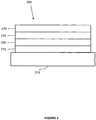
- FIG. 1 shows an organic light emitting device 100.
- Device 100 may include a substrate 110, an anode 115, a hole injection layer 120, a hole transport layer 125, an electron blocking layer 130, an emissive layer 135, a hole blocking layer 140, an electron transport layer 145, an electron injection layer 150, a protective layer 155, and a cathode 160.
- Cathode 160 is a compound cathode having a first conductive layer 162 and a second conductive layer 164.
- Device 100 may be fabricated by depositing the layers described, in order. The properties and functions of these various layers, as well as example materials, are described in more detail in US 7,279,704 at cols. 6-10, which are incorporated by reference.
- each of these layers are available.
- a flexible and transparent substrate-anode combination is disclosed in U.S. Pat. No. 5,844,363 , which is incorporated by reference in its entirety.
- An example of a p-doped hole transport layer is m-MTDATA doped with F.sub.4-TCNQ at a molar ratio of 50:1, as disclosed in U.S. Patent Application Publication No. 2003/0230980 , which is incorporated by reference in its entirety.
- Examples of emissive and host materials are disclosed in U.S. Pat. No. 6,303,238 to Thompson et al. , which is incorporated by reference in its entirety.
- An example of an n-doped electron transport layer is BPhen doped with Li at a molar ratio of 1:1, as disclosed in U.S. Patent Application Publication No. 2003/0230980 , which is incorporated by reference in its entirety.
- U.S. Pat. Nos. 5,703,436 and 5,707,745 which are incorporated by reference in their entireties, disclose examples of cathodes including compound cathodes having a thin layer of metal such as Mg:Ag with an overlying transparent, electrically-conductive, sputter-deposited ITO layer.
- the theory and use of blocking layers is described in more detail in U.S. Pat. No. 6,097,147 and U.S. Patent Application Publication No.
- FIG. 2 shows an inverted OLED 200.
- the device includes a substrate 210, a cathode 215, an emissive layer 220, a hole transport layer 225, and an anode 230.
- Device 200 may be fabricated by depositing the layers described, in order. Because the most common OLED configuration has a cathode disposed over the anode, and device 200 has cathode 215 disposed under anode 230, device 200 may be referred to as an "inverted" OLED. Materials similar to those described with respect to device 100 may be used in the corresponding layers of device 200.
- FIG. 2 provides one example of how some layers may be omitted from the structure of device 100.
- FIGS. 1 and 2 The simple layered structure illustrated in FIGS. 1 and 2 is provided by way of non-limiting example, and it is understood that embodiments of the invention may be used in connection with a wide variety of other structures.
- the specific materials and structures described are exemplary in nature, and other materials and structures may be used.
- Functional OLEDs may be achieved by combining the various layers described in different ways, or layers may be omitted entirely, based on design, performance, and cost factors. Other layers not specifically described may also be included. Materials other than those specifically described may be used. Although many of the examples provided herein describe various layers as comprising a single material, it is understood that combinations of materials, such as a mixture of host and dopant, or more generally a mixture, may be used. Also, the layers may have various sublayers.
- hole transport layer 225 transports holes and injects holes into emissive layer 220, and may be described as a hole transport layer or a hole injection layer.
- an OLED may be described as having an "organic layer" disposed between a cathode and an anode. This organic layer may comprise a single layer, or may further comprise multiple layers of different organic materials as described, for example, with respect to FIGS. 1 and 2 .
- OLEDs comprised of polymeric materials (PLEDs) such as disclosed in U.S. Pat. No. 5,247,190 to Friend et al. , which is incorporated by reference in its entirety.
- PLEDs polymeric materials
- OLEDs having a single organic layer may be used.
- OLEDs may be stacked, for example as described in U.S. Pat. No. 5,707,745 to Forrest et al , which is incorporated by reference in its entirety.
- the OLED structure may deviate from the simple layered structure illustrated in FIGS. 1 and 2 .
- the substrate may include an angled reflective surface to improve out-coupling, such as a mesa structure as described in U.S. Pat. No. 6,091,195 to Forrest et al. , and/or a pit structure as described in U.S. Pat. No. 5,834,893 to Bulovic et al. , which are incorporated by reference in their entireties.
- any of the layers of the various embodiments may be deposited by any suitable method.
- preferred methods include thermal evaporation, ink-jet, such as described in U.S. Pat. Nos. 6,013,982 and 6,087,196 , which are incorporated by reference in their entireties, organic vapor phase deposition (OVPD), such as described in U.S. Pat. No. 6,337,102 to Forrest et al. , which is incorporated by reference in its entirety, and deposition by organic vapor jet printing (OVJP), such as described in U.S. patent application Ser. No. 10/233,470 , which is incorporated by reference in its entirety.
- OVPD organic vapor phase deposition
- OJP organic vapor jet printing
- Other suitable deposition methods include spin coating and other solution based processes.
- Solution based processes are preferably carried out in nitrogen or an inert atmosphere.
- preferred methods include thermal evaporation.
- Preferred patterning methods include deposition through a mask, cold welding such as described in U.S. Pat. Nos. 6,294,398 and 6,468,819 , which are incorporated by reference in their entireties, and patterning associated with some of the deposition methods such as ink-jet and OVJD. Other methods may also be used.
- the materials to be deposited may be modified to make them compatible with a particular deposition method. For example, substituents such as alkyl and aryl groups, branched or unbranched, and preferably containing at least 3 carbons, may be used in small molecules to enhance their ability to undergo solution processing.
- Substituents having 20 carbons or more may be used, and 3-20 carbons is a preferred range. Materials with asymmetric structures may have better solution processibility than those having symmetric structures, because asymmetric materials may have a lower tendency to recrystallize. Dendrimer substituents may be used to enhance the ability of small molecules to undergo solution processing.
- Devices fabricated in accordance with embodiments of the invention may be incorporated into a wide variety of consumer products, including flat panel displays, computer monitors, televisions, billboards, lights for interior or exterior illumination and/or signaling, heads up displays, fully transparent displays, flexible displays, laser printers, telephones, cell phones, personal digital assistants (PDAs), laptop computers, digital cameras, camcorders, viewfinders, micro-displays, vehicles, a large area wall, theater or stadium screen, or a sign.
- PDAs personal digital assistants
- Various control mechanisms may be used to control devices fabricated in accordance with the present invention, including passive matrix and active matrix. Many of the devices are intended for use in a temperature range comfortable to humans, such as 18 degrees C. to 30 degrees C., and more preferably at room temperature (20-25 degrees C.).
- the materials and structures described herein may have applications in devices other than OLEDs.
- other optoelectronic devices such as organic solar cells and organic photodetectors may employ the materials and structures.
- organic devices such as organic transistors, may employ the materials and structures.
- halo, halogen, alkyl, cycloalkyl, alkenyl, alkynyl, arylkyl, heterocyclic group, aryl, aromatic group, and heteroaryl are known to the art, and are defined in US 7,279,704 at cols. 31-32, which are incorporated herein by reference.
- a new class of carbazole-containing compounds which may be advantageously used in an OLED, are provided (also illustrated in FIG. 3 ).
- 3,9-linked oligocarbazolyl compounds (“oligocarbazole-containing compounds”) are provided.
- Carbazole is a nitrogen containing heteroaromatic, having high triplet energy, and has hole transporting and electron transporting properties.
- One advantage to using carbazole-containing compounds as host materials is that they simultaneously possess sufficiently large triplet energies and carrier transport properties.
- the 3,9-linked oligocarbazole groups i.e., carbazole groups that are linked para to the nitrogen
- are monodisperse, well-defined ⁇ -conjugated oligomers that may be useful in OLEDs.
- oligomerization of the carbazole group allows for tuning of the HOMO level to improve hole stability.
- the oligocarbazole-containing compounds described herein have a relatively low electrochemical oxidation potential. As such, these compounds are easier to oxidize and to reverse the oxidation, which improves overall host stability.
- the materials disclosed herein may have less than about 0.9 V, less than about 0.85 V, less than about 0.8 V, and less than 0.75 V oxidation relative to ferrocene/ferrocenium (vs. Fc + /Fc). It is thought that the asymmetrical arrangement of the compound around the carbazole provides the lower oxidation potential and reversible nature of the oxidation potential.
- the term "asymmetrical” refers to the arrangement of chemical groups in the compound in such a way that is not symmetrical with respect to the carbazole portion of the compound.
- the materials provided herein may also provide better film formation.
- materials having an asymmetrical structure such as the 3, 9-linked oligocarbazole structure, may offer improved film formation.
- the improved film formation is believed to be a result of reduced crystallization due to the asymmetrical structure of the compound.
- X is selected from biphenyl, terphenyl, naphthalene, triphenylene, phenanthrene, fluorene, chrysene, dibenzothiophene, dibenzofuran, benzofuran, benzothiophene, pyrazole, imidazole, triazole, oxazole, thiazole, oxadiazole, oxatriazole, dioxazole, thiadiazole, pyridine, pyridazine, pyrimidine, pyrazine, triazine, indole, benzimidazole, indazole, benzoxazole, benzisoxazole, benzothiazole, quinoline, isoquinoline, cinnoline, quinazoline, quinox
- X is substituted by R, where R is selected from hydrogen, alkyl, heteroalkyl, benzene, biphenyl, terphenyl, naphthalene, phenalene, phenanthrene, fluorene, chrysene, dibenzothiophene, dibenzofuran, benzofuran, benzothiophene, pyrazole, imidazole, triazole, oxazole, thiazole, oxadiazole, oxatriazole, dioxazole, thiadiazole, pyridine, pyridazine, pyrimidine, pyrazine, triazine, indole, benzimidazole, indazole, benzoxazole, benzisoxazole, benzothiazole, quinoline, isoquinoline, cinnoline, quinazoline, quinoxaline, naphthyridine, phthalazine, p
- carbazole-containing compounds wherein a is 1 to 20 and n is 0. In one aspect, particular carbazole-containing compounds are provided, wherein a is 1 or 2 and n is 0.
- the X group of the compound is an electron transporting material selected from a group of aromatics having relatively high triplet energy.
- X has a low LUMO level (e.g., heteroaromatics) and provides delocalization via aromatic rings (e.g., up to four conjugated aromatic rings).
- groups having a relatively high triplet energy as X the overall high triplet energy of the compound due to the carbazole moiety can be maintained. Therefore, materials as described herein having both an oligocarbazole moiety and an X moiety in the same compound maintain a beneficial high triplet energy and also may improve charge balance and device stability.
- particular carbazole-containing compounds are provided wherein X is selected from biphenyl, terphenyl, triphenylene, phenanthrene, fluorene, dibenzothiophene, dibenzofuran, pyridine, pyridazine, pyrimidine, pyrazine, triazine, benzimidazole, benzothiazole, quinoline, isoquinoline, benzofuropyridine, furodipyridine, benzothienopyridine, and thienodipyridine.
- X is selected from dibenzothiophene, dibenzofuran, benzofuropyridine, furodipyridine, benzothienopyridine, and thienodipyridine.
- the X of the compound is further substituted with a substituent R.
- the substituent R has a sufficiently high triplet energy to maintain the benefit of having both oligocarbazole and X in the same compound.
- groups that can be used as R may include hydrogen, alkyl, heteroalkyl, benzene, biphenyl, terphenyl, naphthalene, phenalene, phenanthrene, fluorene, chrysene, dibenzothiophene, dibenzofuran, benzofuran, benzothiophene, pyrazole, imidazole, triazole, oxazole, thiazole, oxadiazole, oxatriazole, dioxazole, thiadiazole, pyridine, pyridazine, pyrimidine, pyrazine, triazine, indole, benzimidazole, indazole, benzoxazole, benz
- R is selected from hydrogen, alkyl, benzene, biphenyl, terphenyl, triphenylene, phenanthrene, fluorene, dibenzothiophene, dibenzofuran, pyridine, pyridazine, pyrimidine, pyrazine, triazine, benzimidazole, benzothiazole, quinoline, isoquinoline, benzofuropyridine, furodipyridine, benzothienopyridine, and thienodipyridine. Due to their high triplet energy, these R groups are well-suited for devices having green or red emitters. In particular, these R groups are especially well suited for devices having green emitters.
- R is selected from hydrogen, alkyl, benzene, biphenyl, terphenyl, dibenzothiophene, dibenzofuran. Due to their even higher triplet energy, these R groups are well-suited for use in devices having red, green or emitters. In particular, these R groups are especially well-suited for devices having blue emitters.
- carbazole-containing compounds include compounds selected from the group consisting of:
- an organic light emitting device comprising an anode, a cathode, and a first organic layer disposed between the anode and the cathode, wherein the first organic layer comprises a carbazole-containing compound having FORMULA I.
- carbazole-containing compounds for use in such a device include a compound selected from the group consisting of Compound 1G-Compound 79G.
- the first organic layer is an emissive layer and the carbazole-containing compound is a host in the first organic layer.
- the device may contain 10-100 wt% of the carbazole-containing compound in an organic layer.
- the carbazole-containing compound may be used in several organic layers of the device, including but not limited to an emissive layer, a blocking layer, and a transport layer.
- the carbazole-containing compound is present in an emissive layer at a concentration of 40 - 99.9 wt%.
- the carbazole-containing compound may be used as a host or a co-host in the emissive layer of a device.
- the emissive layer may further comprise a phosphorescent emitter having a concentration of 0.1 - 30wt%.
- the emissive layer further comprises a phosphorescent emitter.
- the phosphorescent emitter is a compound comprising a phosphorescent metal complex comprising a monoanionic, bidentate ligand having the formula: wherein E 1a-q are selected from the group consisting of C and N and collectively comprise an 18 pi-electron system; provided that E 1a and E 1p are different; wherein R 1a-i are each, independently, H, hydrocarbyl, heteroatom substituted hydrocarbyl, cyano, fluoro, OR 2a , SR 2a , NR 2a R 2b , BR 2a , R 2b , or SiR 2a R 2b R 2c , where R 2a-c are each, independently, hydrocarbyl or heteroatom substituted hydrocarbyl, and where any two of R 1a-i and R 2a-c may be linked to form a saturated or unsaturated, aromatic or non-aromatic ring; provided that R 1a-i is other than H when attached to N; wherein the metal is selected from the
- the device may further comprise a second layer that is a non-emissive layer. Any layer included in the device that does not emit light may herein be referred to as a "non-emissive layer.”
- the first organic layer is adjacent to the second organic layer.
- the carbazole-containing compounds described herein may be advantageously used as a host material in an emissive layer.
- the carbazole-containing compounds may also have blocking properties, impeding properties, and transport properties for both holes and electrons depending upon the relative energy and relative mobility. Therefore, these compounds may be useful as materials in different organic layers at different positions within the device.
- the carbazole-containing compounds disclosed herein may be used in red, green and blue devices of which first emission energy is around 570 nm to 670 nm, 495 nm to 570 nm, and 425 nm to 495 nm, respectively.
- first energy emission is around 610 nm to 630 nm, 510 nm to 530 nm, and 440 nm to 480 nm for red, green and blue devices, respectively.
- the triplet energy of the host is normally required to be 30 nm higher than that of the dopant in order not to cause any quench.
- X is selected from the group consisting of biphenyl, terphenyl, triphenylene, phenanthrene, fluorene, dibenzothiophene, dibenzofuran, pyridine, pyridazine, pyrimidine, pyrazine, triazine, benzimidazole, benzothiazole, quinoline, isoquinoline, benzofuropyridine, furodipyridine, benzothienopyridine, and thienodipyridine and R is selected from the group consisting of hydrogen, alkyl, benzene, biphenyl, terphenyl, triphenylene, phenanthrene, fluorene, dibenzothiophene, dibenzofuran, pyridine, pyridazine, pyrim
- compounds well-suited for use with devices having a phosphorescent emitter having a triplet energy of 425 nm to 495 nm are provided.
- X is selected from the group consisting of dibenzothiophene, dibenzofuran, benzofuropyridine, furodipyridine, benzothienopyridine, and thienodipyridine
- R is selected from the group consisting of hydrogen, alkyl, benzene, biphenyl, terphenyl, dibenzothiophene, and dibenzofuran.
- the emitter of such a device has a triplet energy of 440 nm to 480 nm.
- Carbazole-containing compounds having X and R selected from the above groups may readily be used with green and red devices as well.
- a consumer product comprising a device is also provided, wherein the device further comprises an anode, a cathode and an organic layer.
- the organic layer further comprises a carbazole-containing compound having FORMULA I.
- a method of fabricating an organic light emitting device comprises providing a first electrode, co-depositing a host and a phosphorescent emitter to form an emissive layer wherein the emissive layer comprises a carbazole-containing compound having FORMULA I, and depositing a second electrode.
- the first electrode is an anode and the second electrode is a cathode.
- An organic layer may be deposited after the first electrode and before the emissive layer, and the organic layer may be an hole transport layer.
- the materials described herein as useful for a particular layer in an organic light emitting device may be used in combination with a wide variety of other materials present in the device.
- emissive dopants disclosed herein may be used in conjunction with a wide variety of hosts, transport layers, blocking layers, injection layers, electrodes and other layers that may be present.
- the materials described or referred to below are non-limiting examples of materials that may be useful in combination with the compounds disclosed herein, and one of skill in the art can readily consult the literature to identify other materials that may be useful in combination.
- hole injection materials In addition to and / or in combination with the materials disclosed herein, many hole injection materials, hole transporting materials, host materials, dopant materials, exiton/hole blocking layer materials, electron transporting and electron injecting materials may be used in an OLED.
- Non-limiting examples of the materials that may be used in an OLED in combination with materials disclosed herein are listed in Table 1 below. Table 1 lists non-limiting classes of materials, non-limiting examples of compounds for each class, and references that disclose the materials. Table 1.
- MATERIAL EXAMPLES OF MATERIAL PUBLICATIONS Hole injection materials Phthalocyanine and porphryin compounds Appl. Phys. Lett. 69, 2160 (1996 ) Starburst triarylamines J. Lumin.
- Step 1 Solid Kl (22.1 g, 133 mmol) was add into carbazole (33.4 g, 200 mmol) in 550 mL of acetic acid. The mixture became clear after it was heated up to 120 °C for 30 min. After it was cooled back to 100 °C, KlO 3 (21.4 g, 100 mmol) was added portion-wise. The mixture was stirred at this temperature for another 2 hours. After the mixture cooled down, 500 mL of water was added to precipitate out all the product. The solid was filtered, and washed with hot water. The crude product was recrystallized from CH 2 Cl 2 once, and then from EtOAc/hexanes to give 24 g pure 3-iodocarbazole.
- Step 2 Tosyl chloride (8.4 g, 44 mmol) was added to a solution of 3-iodocarbazole (11.7 g, 40 mmol) and grounded KOH (2.7 g, 48 mmol) in 200 mL of acetone. The mixture was refluxed for 3 hours, and then cooled down. It was poured into 1 L of cold water while stirring. After sitting for 30 minutes, the liquid was decanted. The crude product was thus obtained as sticky solid on the beaker wall. About 11 g of pure 3-iodo-9-tosylcarbazole was obtained after recystallization from CH 2 Cl 2 /EtOH.
- Step 3 3-iodo-9-tosylcarbazole (10.6 g, 24 mmol), carbazole (4.8 g, 29 mmol), Cul (0.4 g, 2.0 mmol), trans- 1,2-Diaminocyclohexane (0.3 g, 2.4 mmol), potassium phosphate tribasic (10.6 g, 50 mmol), and 150 mL of toluene were added to a 500 mL round flask. The reaction was heated to reflux, and stirred under a nitrogen atmosphere for 24 hours. After cooling, the mixture was purified by a silica gel column. The yield of 3-(9-carbazolyl)-9-tosylcarbazole was 10 g.
- Step 4 3-(9-carbazolyl)-9-tosylcarbazole (10.0 g, 21 mmol), NaOH (8.0 g, 200 mmol), 80 mL of THF, 40 mL of MeOH and 40 mL of water were added to a 500 mL round flask. The reaction was heated to reflux for 12 hours. After cooling, the mixture was purified by a silica gel column. The yield of 3-(9-carbazolyl)carbazole was 8 g.
- Step 5 3-(9-carbazolyl)carbazole (3.0 g, 9 mmol), 2-bromopyridine (1.9 g, 12 mmol), Cul (0.2 g, 1.0 mmol), trans -1,2-Diaminocyclohexane (0.2 g, 1.5 mmol), potassium phosphate tribasic (5.3 g, 25 mmol), and 150 mL of toluene were added to a 500 mL round flask. The reaction was heated to reflux and stirred under a nitrogen atmosphere for 24 hours. After cooling, the mixture was purified by a silica gel column. The yield was 2.2 g. The product was further purified by vacuum sublimation. 1 H NMR results confirmed the desired compound.
- Step 1 3-(9-carbazolyl)carbazole (9.8 g, 30 mmol), 3-iodo-9-tosylcarbazole (16.1 g, 36 mmol), Cul (1.7 g, 9 mmol), trans -1,2-Diaminocyclohexane (2.1 g, 18 mmol), potassium phosphate tribasic (12.7 g, 60 mmol), and 250 mL of toluene were added to a 500 mL round flask. The reaction was heated to reflux, and stirred under a nitrogen atmosphere for 24 hours. After cooling, the mixture was purified by a silica gel column.
- Step 2 3-(9-(3-(9-carbazolyl)carbazolyl))carbazole (3.0 g, 6 mmol), 2-bromobenzothiophene (2.1 g,7.8 mmol), Cul (0.4 g, 1.8 mmol), trans -1,2-Diaminocyclohexane (0.4 g, 3.6 mmol), potassium phosphate tribasic (3.2 g, 15 mmol), and 150 mL of toluene were added to a 500 mL round flask. The reaction was heated to reflux, and stirred under a nitrogen atmosphere for 24 hours. After cooling, the mixture was purified by a silica gel column. The yield was 2.9 g.
- reaction was cooled down to room temperature, filtered through silica plug and evaporated.
- residue was subjected to column chromatography on silica gel, eluent hexane/ethyl acetate mixture 9:1, providing 410 mg of 9-(dibenzo[b,d]furan-2-yl)-9H-3,9'-bicarbazole as white solid.
- the structure was confirmed by NMR and MS spectroscopy.
- Step 1 The 300 mL round bottom flask, equipped with magnetic stirrer and refluxed condenser, was charged with 5-chloro-2-methoxyphenylboronic acid (5.00 g, 33 mmol), 2-amino-3-bromopyridine (5.70 g, 33 mmol), Pd 2 (dba) 3 (604 mg, 2 mol%), 2-dicylohexylphosphino-2',6'-dimethoxybiphenyl (542 mg, 4 mol%), potassium phosphate tribasic monohydrate (22.8 mg, 3 eq) and 100 mL of toluene. The flask was filled with nitrogen , and the reaction mixture was heated to reflux and stirred under nitrogen atmosphere for 24 hours.
- 5-chloro-2-methoxyphenylboronic acid 5.00 g, 33 mmol
- 2-amino-3-bromopyridine 5.70 g, 33 mmol
- Pd 2 (dba) 3 604 mg
- reaction was cooled down to room temperature, filtered through silica plug and evaporated. The residue was subjected to column chromatography on silica gel, eluent hexane/ethyl acetate mixture 1:1, providing 5.0 g of 3-(5-chloro-2-methoxyphenyl)pyridin-2-amine as yellow solid. The structure was confirmed by NMR and MS spectroscopy.
- Step 2 3-(5-Chloro-2-methoxyphenyl)pyridin-2-amine (5.00 g, 21 mmol) was dissolved in the mixture of THF (409 mL), HBF 4 (50% aqueous solution, 36 mL) and 15 mL of water. The solution was cooled to -5 °C, and sodium nitrite (1.70 g in 20 mL of water) was added dropwise. Reaction was kept 1 hour at -5 °C, then was allowed to warm up to room temperature and stirred overnight at room temperature. Then pH of the reaction mixture was adjusted to 10, and it was extracted with ethyl acetate (4x25 mL). Organic fractions were combined, dried over sodium sulfate and evaporated.
- Chromatography product contained 3-(5-chloro-2-methoxyphenyl)-2-fluoropyridine, pure 6-chlorobenzofuro[2,3-b]pyridine (1.52 g, colorless long needles) was obtained by crystallization from hexane/ethyl acetate.
- Step 3 The 300 mL round bottom flask, equipped with magnetic stirrer and refluxed condenser , was charged with 6-chlorobenzofuro[2,3-b]pyridine (2.04 g, 10 mmol), 3-(9-carbazolyl)carbazole (3.32 g, 10 mmol), Pd(OAc) 2 (450 mg, 20 mol%), P(t-Bu) 3 (10 mL of 1M solution in toluene, 10 mmol), potassium tert-buthoxide (1.92 g, 20 mmol) and 150 ml of xylene. The flask was filled with nitrogen, and the reaction mixture was heated to reflux and stirred under nitrogen atmosphere for 36 hours.
- Step 1 The 500 mL round-bottom flask, equipped with magnetic stirrer and reflux condenser was charged with 5-chloro-2-methoxyphenylboronic acid (9.78 g, 52 mmol), 3-amino-2-chloropyridine (7.00 g, 55 mmol), 2-dicyclohexyl-phosphino-2',6'-dimethoxybiphenyl (S-Phos, 0.43 g, 2 mol %), palladium (II) acetate (112 mg, 1 mol %), potassium carbonate (21.7 g, 157 mmol), 180 mL of acetonitrile and 20 ml of water.
- Step 2 The 500 mL round-bottom flask, equipped with magnetic stirrer and reflux condenser was charged with 2-(5-chloro-2-methoxyphenyl)pyridin-3-amine (9.00 g, 39 mmol), 70 mL THF, 70 mL HBF 4 (50% in water) and 40 mL H 2 O. Reaction mixture was cooled to -10° C, and solution of sodium nitrite (5.6 g in 20 mL water) was added dropwise. Reaction mixture was warmed gradually to room temperature and stirred overnight. The reaction mixture was diluted with 500 mL of water and extracted with ethyl acetate (4x50 mL).
- Step 3 The 100 mL round bottom flask, equipped with magnetic stirrer and refluxed condenser, was charged with 8-chlorobenzofuro[3,2-b]pyridine (2.04 g, 10 mmol), 3-(9-carbazolyl)carbazole (3.32 g, 10 mmol), Pd(OAc) 2 (450 mg, 20 mol%), P(t-Bu) 3 (10 mL of 1M solution in toluene, 10 mmol), potassium tert-buthoxide (1.92 g, 1.5 eq) and 150 ml of xylene. The flask was filled with nitrogen, and the reaction mixture was heated to reflux and stirred under nitrogen atmosphere for 24 hours.
- reaction was cooled down to room temperature, filtered through silica plug and evaporated.
- residue was subjected to column chromatography on silica gel, eluent hexane/ethyl acetate mixture 9:1, providing 2.5 g of 8-(9H-3,9'-bicarbazol-9-yl)benzofuro[3,2-b]pyridine as white solid.
- the structure was confirmed by NMR and MS spectroscopy.
- Step 1 The 500 mL round-bottom flask, equipped with magnetic stirrer and reflux condenser was charged with 2-(methylthio)phenylboronic acid (9.48 g, 56 mmol), 3-amino-2-bromopyridine (7.15 g, 57 mmol), 2-dicyclohexylphosphino-2',6'-dimethoxybiphenyl (S-Phos, 0.92 g, 4 mol %), Pd 2 (dba) 3 (1.02 g, 2 mol %), potassium phosphate hydrate (39 g, 3 equivalents), 100 mL of toluene. The flask was filled with nitrogen and heated to reflux under nitrogen atmosphere for 24 hours.
- Step 2 The 500 mL round-bottom flask, equipped with magnetic stirrer and reflux condenser was charged with 2-(2-(methylthio)phenyl)pyridin-3-amine (8.42 g, 39 mmol), 70 mL THF, 70 mL HBF 4 (50% in water) and 40 mL H 2 O. Reaction mixture was cooled to -10° C, and solution of sodium nitrite (5.6 g in 20 mL water) was added dropwise. Reaction mixture was warmed gradually to room temperature and stirred overnight. The reaction mixture was diluted with 500 mL of water and extracted with ethyl acetate (4x50 mL).
- Step 3 Aza-dibenzothiophene (1.78 g, 6.7 mmol) was dissolved in 75 mL of dry THF and solution was cooled in CO 2 /acetone bath. n-Buthyl lithium (7 mL of 1.6 M solution in hexane) was added dropwise, color of the reaction mixture turned orange, the solution of 2.6 g of iodine in 50 mL of dry THF was added immediately. Reaction mixture was warmed up to room temperature, treated with aqueous solution of NaHSO 3 and extracted with ethyl acetate (4x40 mL). Organic fractions were combined, dried over sodium sulfate, filtered and evaporated.
- Step 4 The 100 mL round bottom flask, equipped with magnetic stirrer and refluxed condenser, was charged with iodo-derivative (1.55 g, 5 mmol), 3-(9-carbazolyl)carbazole (1.66 g, 5 mmol), Pd(OAc) 2 (225 mg, 20 mol%), P(t-Bu) 3 (5 mL of 1M solution in toluene, 5 mmol), potassium tert-buthoxide (0.96 g, 1.5 eq) and 75 mL of xylene. The flask was filled with nitrogen, and the reaction mixture was heated to reflux and stirred under nitrogen atmosphere for 24 hours.
- reaction was cooled down to room temperature, filtered through silica plug and evaporated. The residue was subjected to column chromatography on silica gel, eluent hexane/ethyl acetate mixture 9:1, providing 2.0 g of coupling product as white solid. The structure was confirmed by NMR and MS spectroscopy.
- Step 5 The white product was dissolved in 100 mL of THF, cooled in the dry ice/acetone bath and n-BuLi solution in hexane (1 equivalent) was added as one portion. After 1 hour, 5 mL of water were added as one portion and the reaction mixture was warmed up to room temperature, diluted with water and extracted with ethyl acetate. Evaporation followed by column chromatography on silica gel (hexane/ethyl acetate 9/1 mixture as eluent) provided 1.5 g of target compound as white solid. Structure was confirmed by NMR and MS data.
- All example devices were fabricated by high vacuum ( ⁇ 10 -7 Torr) thermal evaporation.
- the anode electrode is 800 ⁇ of indium tin oxide (ITO).
- the cathode consisted of 10 ⁇ of LiF followed by 1000 ⁇ of Al. All devices are encapsulated with a glass lid sealed with an epoxy resin in a nitrogen glove box ( ⁇ 1 ppm of H 2 O and O 2 ) immediately after fabrication, and a moisture getter was incorporated inside the package.
- P1 is the emissive dopant and invention compound, Compound 8, Compound 15, Compound 17 or Compound 17', is the host.
- the organic stack of Device Examples 1-4 consisted of, sequentially from the ITO surface, 100 ⁇ of P2 as the hole injecting layer (HIL), 300 ⁇ of 4,4'-bis[N-(1-naphthyl)-N-phenylamino]biphenyl ( ⁇ -NPD) as the hole transport layer (HTL), 300 ⁇ of the invention compound doped with 9% of P1, an Ir phosphorescent compound, as the emissive layer (EML), 50 ⁇ of the invention compound as ETL2 and 400 ⁇ of Alq 3 (tris-8-hydroxyquinoline aluminum) as the ETL1.
- Comparative Example 1 was fabricated similarly to the Device Examples, except that mCBP was used as the host.
- Table 2 shows device structure, in particular the host materials for the emissive layer and the material for the ETL2.
- Table 3 shows the corresponding measured results for those devices.
- Cmpd is an abbreviation of Compound.
- the oxidation potentials (E ox ) are designated as irreversible (i) or quasi-irreversible (q).
- Table 2 Device Example Host Dopant (9 wt%) ETL2 (50 ⁇ ) ETL1 (400 ⁇ ) ITO thickness ( ⁇ ) Comparative Example 1 mCBP P1 mCBP Alq 3 800 1 8 P1 8 Alq 3 800 2 15 P1 15 Alq 3 800 3 17 P1 17 Alq 3 800 4 17' P1 17' Alq 3 800 Table 3.
- devices using the invention compounds as hosts give improved device stability while maintaining high triplet energy.
- Compounds 8, 15, 17 or 17' as hosts in blue or green OLEDs give devices with reduced oxidation potentials (E ox vs Fc + /Fc) and improved electrochemical reversibility indicating that the carbazole containing compounds, in particular the unsymmetrical monodisperse linear 3,9-linked oligocarbazole compounds, may provide better charge balance and charge stability in the device.
- carbazole containing compounds particularly 3,9-linked oligocarbazoles, are excellent hosts and enhancement layer materials for phosphorescent OLEDs, providing improved charge balance and charge stability compared to the commonly used mCBP host.
- the oligocarbazole containing compounds may also provide better film formation during device production due to the unsymmetrical nature of the molecules.
Landscapes
- Chemical & Material Sciences (AREA)
- Organic Chemistry (AREA)
- Engineering & Computer Science (AREA)
- Materials Engineering (AREA)
- Physics & Mathematics (AREA)
- Spectroscopy & Molecular Physics (AREA)
- Inorganic Chemistry (AREA)
- Chemical Kinetics & Catalysis (AREA)
- Crystallography & Structural Chemistry (AREA)
- Optics & Photonics (AREA)
- Electroluminescent Light Sources (AREA)
- Heterocyclic Carbon Compounds Containing A Hetero Ring Having Oxygen Or Sulfur (AREA)
- Indole Compounds (AREA)
- Nitrogen Condensed Heterocyclic Rings (AREA)
- Plural Heterocyclic Compounds (AREA)
Description
- This application is a continuation-in-part application and claims priority to and benefit under 35 U.S.C. § 120 to
U.S. Application Serial No. 12/209,928, filed September 12, 2008 U.S. Provisional Application Serial No. 61/017,480, filed December 28, 2007 U.S. Provisional Application Serial No. 61/017,391, filed December 28, 2007 - The claimed invention was made by, on behalf of, and/or in connection with one or more of the following parties to a joint university corporation research agreement: Regents of the University of Michigan, Princeton University, The University of Southern California, and the Universal Display Corporation. The agreement was in effect on and before the date the claimed invention was made, and the claimed invention was made as a result of activities undertaken within the scope of the agreement.
- The present invention relates to novel organic materials containing carbazole. In particular, the materials contain an oligocarbazole. The materials may be useful in organic light emitting devices (OLEDs).
- Opto-electronic devices that make use of organic materials are becoming increasingly desirable for a number of reasons. Many of the materials used to make such devices are relatively inexpensive, so organic opto-electronic devices have the potential for cost advantages over inorganic devices. In addition, the inherent properties of organic materials, such as their flexibility, may make them well suited for particular applications such as fabrication on a flexible substrate. Examples of organic opto-electronic devices include organic light emitting devices (OLEDs), organic phototransistors, organic photovoltaic cells, and organic photodetectors. For OLEDs, the organic materials may have performance advantages over conventional materials. For example, the wavelength at which an organic emissive layer emits light may generally be readily tuned with appropriate dopants.
- OLEDs make use of thin organic films that emit light when voltage is applied across the device. OLEDs are becoming an increasingly interesting technology for use in applications such as flat panel displays, illumination, and backlighting. Several OLED materials and configurations are described in
U.S. Pat. Nos. 5,844,363 ,6,303,238 , and5,707,745 , which are incorporated herein by reference in their entirety. - One application for phosphorescent emissive molecules is a full color display. Industry standards for such a display call for pixels adapted to emit particular colors, referred to as "saturated" colors. In particular, these standards call for saturated red, green, and blue pixels. Color may be measured using CIE coordinates, which are well known to the art.
- One example of a green emissive molecule is tris(2-phenylpyridine) iridium, denoted Ir(ppy)3, which has the structure of Formula I:

- In this, and later figures herein, we depict the dative bond from nitrogen to metal (here, Ir) as a straight line.
- As used herein, the term "organic" includes polymeric materials as well as small molecule organic materials that may be used to fabricate organic opto-electronic devices. "Small molecule" refers to any organic material that is not a polymer, and "small molecules" may actually be quite large. Small molecules may include repeat units in some circumstances. For example, using a long chain alkyl group as a substituent does not remove a molecule from the "small molecule" class. Small molecules may also be incorporated into polymers, for example as a pendent group on a polymer backbone or as a part of the backbone. Small molecules may also serve as the core moiety of a dendrimer, which consists of a series of chemical shells built on the core moiety. The core moiety of a dendrimer may be a fluorescent or phosphorescent small molecule emitter. A dendrimer may be a "small molecule," and it is believed that all dendrimers currently used in the field of OLEDs are small molecules.
- As used herein, "top" means furthest away from the substrate, while "bottom" means closest to the substrate. Where a first layer is described as "disposed over" a second layer, the first layer is disposed further away from substrate. There may be other layers between the first and second layer, unless it is specified that the first layer is "in contact with" the second layer. For example, a cathode may be described as "disposed over" an anode, even though there are various organic layers in between.
- As used herein, "solution processible" means capable of being dissolved, dispersed, or transported in and/or deposited from a liquid medium, either in solution or suspension form.
- A ligand is referred to as "photoactive" when it is believed that the ligand contributes to the photoactive properties of an emissive material.
- As used herein, the term "triplet energy" refers to an energy corresponding to the highest energy feature discernable in the phosphorescence spectrum of a given material. The highest energy feature is not necessarily the peak having the greatest intensity in the phosphorescence spectrum, and could, for example, be a local maximum of a clear shoulder on the high energy side of such a peak. Triplet energy is described in detail in
US Patent No. 7,279,704 at col. 6, which is incorporated by reference. - More details on OLEDs, and the definitions described above, can be found in
US Pat. No. 7,279,704 , which is incorporated herein by reference in its entirety. - A new class of carbazole-containing compounds are provided. In particular, compounds having a monodisperse linear 3,9-linked oligocarbazolyl (herein referred to as "oligocarbazole") are provided.
- The carbazole-containing compounds described herein have the formula:

- Examples of particular carbazole-containing materials include Compounds 1G-79G, as disclosed herein.
- Additionally, an organic light emitting device is provided. The device has an anode, a cathode, and a first organic layer disposed between the anode and the cathode. The first organic layer further comprises an carbazole-containing compound having FORMULA I. Preferably the first organic layer is an emissive layer having a host and a phosphorescent emitter, and the carbazole-containing compound is the host. The device may contain 10-100 wt% of the carbazole-containing compound in an organic layer. Preferably, the carbazole-containing compound is present in an emissive layer at a concentration of 40 - 99.9 wt% and the emissive layer further comprises a phosphorescent emitter having a concentration of 0.1-30 wt%.
- Moreover, the device may further comprise a non-emissive second organic layer and the carbazole-containing compound may also preferably be used as a material in the second layer of such a device.
- A consumer product is also provided. The product contains a device that has an anode, a cathode, and an organic layer disposed between the anode and the cathode, where the organic layer further comprises a carbazole-containing compound having FORMULA I.
- A method of fabricating an organic light emitting device is also provided. The method includes providing a first electrode, co-depositing a host and a phosphorescent emitter to form an emissive layer wherein the emissive layer comprises a carbazole-containing compound having FORMULA I, and depositing a second electrode. The first electrode may be an anode and the second electrode may be a cathode. An organic layer, preferably a hole transport layer, may be deposited after the anode and before the emissive layer.
-
-
FIG. 1 shows an organic light emitting device. -
FIG. 2 shows an inverted organic light emitting device that does not have a separate electron transport layer. -
FIG. 3 shows an oligocarbazole-containing compound. - Generally, an OLED comprises at least one organic layer disposed between and electrically connected to an anode and a cathode. When a current is applied, the anode injects holes and the cathode injects electrons into the organic layer(s). The injected holes and electrons each migrate toward the oppositely charged electrode. When an electron and hole localize on the same molecule, an "exciton," which is a localized electron-hole pair having an excited energy state, is formed. Light is emitted when the exciton relaxes via a photoemissive mechanism. In some cases, the exciton may be localized on an excimer or an exciplex. Non-radiative mechanisms, such as thermal relaxation, may also occur, but are generally considered undesirable.
- The initial OLEDs used emissive molecules that emitted light from their singlet states ("fluorescence") as disclosed, for example, in
U.S. Pat. No. 4,769,292 , which is incorporated by reference in its entirety. Fluorescent emission generally occurs in a time frame of less than 10 nanoseconds. - More recently, OLEDs having emissive materials that emit light from triplet states ("phosphorescence") have been demonstrated. Baldo et al., "Highly Efficient Phosphorescent Emission from Organic Electroluminescent Devices," Nature, vol. 395, 151-154, 1998; ("Baldo-I") and Baldo et al., "Very high-efficiency green organic light-emitting devices based on electrophosphorescence," Appl. Phys. Lett., vol. 75, No. 3, 4-6 (1999) ("Baldo-II"), which are incorporated by reference in their entireties. Phosphorescence is described in more detail in
US Pat. No. 7,279,704 at cols. 5-6, which are incorporated by reference. -
FIG. 1 shows an organiclight emitting device 100. The figures are not necessarily drawn to scale.Device 100 may include asubstrate 110, ananode 115, ahole injection layer 120, ahole transport layer 125, anelectron blocking layer 130, anemissive layer 135, ahole blocking layer 140, anelectron transport layer 145, anelectron injection layer 150, aprotective layer 155, and acathode 160.Cathode 160 is a compound cathode having a firstconductive layer 162 and a secondconductive layer 164.Device 100 may be fabricated by depositing the layers described, in order. The properties and functions of these various layers, as well as example materials, are described in more detail inUS 7,279,704 at cols. 6-10, which are incorporated by reference. - More examples for each of these layers are available. For example, a flexible and transparent substrate-anode combination is disclosed in
U.S. Pat. No. 5,844,363 , which is incorporated by reference in its entirety. An example of a p-doped hole transport layer is m-MTDATA doped with F.sub.4-TCNQ at a molar ratio of 50:1, as disclosed inU.S. Patent Application Publication No. 2003/0230980 , which is incorporated by reference in its entirety. Examples of emissive and host materials are disclosed inU.S. Pat. No. 6,303,238 to Thompson et al. , which is incorporated by reference in its entirety. An example of an n-doped electron transport layer is BPhen doped with Li at a molar ratio of 1:1, as disclosed inU.S. Patent Application Publication No. 2003/0230980 , which is incorporated by reference in its entirety.U.S. Pat. Nos. 5,703,436 and5,707,745 , which are incorporated by reference in their entireties, disclose examples of cathodes including compound cathodes having a thin layer of metal such as Mg:Ag with an overlying transparent, electrically-conductive, sputter-deposited ITO layer. The theory and use of blocking layers is described in more detail inU.S. Pat. No. 6,097,147 andU.S. Patent Application Publication No. 2003/0230980 , which are incorporated by reference in their entireties. Examples of injection layers are provided inU.S. Patent Application Publication No. 2004/0174116 , which is incorporated by reference in its entirety. A description of protective layers may be found inU.S. Patent Application Publication No. 2004/0174116 , which is incorporated by reference in its entirety. -
FIG. 2 shows aninverted OLED 200. The device includes asubstrate 210, acathode 215, anemissive layer 220, ahole transport layer 225, and ananode 230.Device 200 may be fabricated by depositing the layers described, in order. Because the most common OLED configuration has a cathode disposed over the anode, anddevice 200 hascathode 215 disposed underanode 230,device 200 may be referred to as an "inverted" OLED. Materials similar to those described with respect todevice 100 may be used in the corresponding layers ofdevice 200.FIG. 2 provides one example of how some layers may be omitted from the structure ofdevice 100. - The simple layered structure illustrated in
FIGS. 1 and2 is provided by way of non-limiting example, and it is understood that embodiments of the invention may be used in connection with a wide variety of other structures. The specific materials and structures described are exemplary in nature, and other materials and structures may be used. Functional OLEDs may be achieved by combining the various layers described in different ways, or layers may be omitted entirely, based on design, performance, and cost factors. Other layers not specifically described may also be included. Materials other than those specifically described may be used. Although many of the examples provided herein describe various layers as comprising a single material, it is understood that combinations of materials, such as a mixture of host and dopant, or more generally a mixture, may be used. Also, the layers may have various sublayers. The names given to the various layers herein are not intended to be strictly limiting. For example, indevice 200,hole transport layer 225 transports holes and injects holes intoemissive layer 220, and may be described as a hole transport layer or a hole injection layer. In one embodiment, an OLED may be described as having an "organic layer" disposed between a cathode and an anode. This organic layer may comprise a single layer, or may further comprise multiple layers of different organic materials as described, for example, with respect toFIGS. 1 and2 . - Structures and materials not specifically described may also be used, such as OLEDs comprised of polymeric materials (PLEDs) such as disclosed in
U.S. Pat. No. 5,247,190 to Friend et al. , which is incorporated by reference in its entirety. By way of further example, OLEDs having a single organic layer may be used. OLEDs may be stacked, for example as described inU.S. Pat. No. 5,707,745 to Forrest et al , which is incorporated by reference in its entirety. The OLED structure may deviate from the simple layered structure illustrated inFIGS. 1 and2 . For example, the substrate may include an angled reflective surface to improve out-coupling, such as a mesa structure as described inU.S. Pat. No. 6,091,195 to Forrest et al. , and/or a pit structure as described inU.S. Pat. No. 5,834,893 to Bulovic et al. , which are incorporated by reference in their entireties. - Unless otherwise specified, any of the layers of the various embodiments may be deposited by any suitable method. For the organic layers, preferred methods include thermal evaporation, ink-jet, such as described in
U.S. Pat. Nos. 6,013,982 and6,087,196 , which are incorporated by reference in their entireties, organic vapor phase deposition (OVPD), such as described inU.S. Pat. No. 6,337,102 to Forrest et al. , which is incorporated by reference in its entirety, and deposition by organic vapor jet printing (OVJP), such as described inU.S. patent application Ser. No. 10/233,470 , which is incorporated by reference in its entirety. Other suitable deposition methods include spin coating and other solution based processes. Solution based processes are preferably carried out in nitrogen or an inert atmosphere. For the other layers, preferred methods include thermal evaporation. Preferred patterning methods include deposition through a mask, cold welding such as described inU.S. Pat. Nos. 6,294,398 and6,468,819 , which are incorporated by reference in their entireties, and patterning associated with some of the deposition methods such as ink-jet and OVJD. Other methods may also be used. The materials to be deposited may be modified to make them compatible with a particular deposition method. For example, substituents such as alkyl and aryl groups, branched or unbranched, and preferably containing at least 3 carbons, may be used in small molecules to enhance their ability to undergo solution processing. Substituents having 20 carbons or more may be used, and 3-20 carbons is a preferred range. Materials with asymmetric structures may have better solution processibility than those having symmetric structures, because asymmetric materials may have a lower tendency to recrystallize. Dendrimer substituents may be used to enhance the ability of small molecules to undergo solution processing. - Devices fabricated in accordance with embodiments of the invention may be incorporated into a wide variety of consumer products, including flat panel displays, computer monitors, televisions, billboards, lights for interior or exterior illumination and/or signaling, heads up displays, fully transparent displays, flexible displays, laser printers, telephones, cell phones, personal digital assistants (PDAs), laptop computers, digital cameras, camcorders, viewfinders, micro-displays, vehicles, a large area wall, theater or stadium screen, or a sign. Various control mechanisms may be used to control devices fabricated in accordance with the present invention, including passive matrix and active matrix. Many of the devices are intended for use in a temperature range comfortable to humans, such as 18 degrees C. to 30 degrees C., and more preferably at room temperature (20-25 degrees C.).
- The materials and structures described herein may have applications in devices other than OLEDs. For example, other optoelectronic devices such as organic solar cells and organic photodetectors may employ the materials and structures. More generally, organic devices, such as organic transistors, may employ the materials and structures.
- The terms halo, halogen, alkyl, cycloalkyl, alkenyl, alkynyl, arylkyl, heterocyclic group, aryl, aromatic group, and heteroaryl are known to the art, and are defined in
US 7,279,704 at cols. 31-32, which are incorporated herein by reference. - A new class of carbazole-containing compounds, which may be advantageously used in an OLED, are provided (also illustrated in
FIG. 3 ). In particular, 3,9-linked oligocarbazolyl compounds ("oligocarbazole-containing compounds") are provided. Carbazole is a nitrogen containing heteroaromatic, having high triplet energy, and has hole transporting and electron transporting properties. One advantage to using carbazole-containing compounds as host materials is that they simultaneously possess sufficiently large triplet energies and carrier transport properties. The 3,9-linked oligocarbazole groups (i.e., carbazole groups that are linked para to the nitrogen) are monodisperse, well-defined π-conjugated oligomers that may be useful in OLEDs. There is a minimal reduction in the triplet energy in going from carbazole monomers to oligocarbazoles. In addition, oligomerization of the carbazole group allows for tuning of the HOMO level to improve hole stability. - The oligocarbazole-containing compounds described herein have a relatively low electrochemical oxidation potential. As such, these compounds are easier to oxidize and to reverse the oxidation, which improves overall host stability. In particular, the materials disclosed herein may have less than about 0.9 V, less than about 0.85 V, less than about 0.8 V, and less than 0.75 V oxidation relative to ferrocene/ferrocenium (vs. Fc+/Fc). It is thought that the asymmetrical arrangement of the compound around the carbazole provides the lower oxidation potential and reversible nature of the oxidation potential. As used herein, the term "asymmetrical" refers to the arrangement of chemical groups in the compound in such a way that is not symmetrical with respect to the carbazole portion of the compound.
- In addition to improved charge balance and charge stability, the materials provided herein may also provide better film formation. In particular, materials having an asymmetrical structure, such as the 3, 9-linked oligocarbazole structure, may offer improved film formation. The improved film formation is believed to be a result of reduced crystallization due to the asymmetrical structure of the compound.
- The carbazole-containing compounds described herein have the formula:

- Where a is 1 to 20, b is 0 to 20, provided that b is not 0, m is 0 to 2, n is 0 to 2 and m+n is least 1. X is selected from biphenyl, terphenyl, naphthalene, triphenylene, phenanthrene, fluorene, chrysene, dibenzothiophene, dibenzofuran, benzofuran, benzothiophene, pyrazole, imidazole, triazole, oxazole, thiazole, oxadiazole, oxatriazole, dioxazole, thiadiazole, pyridine, pyridazine, pyrimidine, pyrazine, triazine, indole, benzimidazole, indazole, benzoxazole, benzisoxazole, benzothiazole, quinoline, isoquinoline, cinnoline, quinazoline, quinoxaline, naphthyridine, phthalazine, pteridine, xanthene, phenothiazine, phenoxazine, benzofuropyridine, furodipyridine, benzothienopyridine, and thienodipyridine. X is substituted by R, where R is selected from hydrogen, alkyl, heteroalkyl, benzene, biphenyl, terphenyl, naphthalene, phenalene, phenanthrene, fluorene, chrysene, dibenzothiophene, dibenzofuran, benzofuran, benzothiophene, pyrazole, imidazole, triazole, oxazole, thiazole, oxadiazole, oxatriazole, dioxazole, thiadiazole, pyridine, pyridazine, pyrimidine, pyrazine, triazine, indole, benzimidazole, indazole, benzoxazole, benzisoxazole, benzothiazole, quinoline, isoquinoline, cinnoline, quinazoline, quinoxaline, naphthyridine, phthalazine, pteridine, xanthene, phenothiazine, phenoxazine, benzofuropyridine, furodipyridine, benzothienopyridine, and thienodipyridine.
- In one aspect, carbazole-containing compounds are provided wherein a is 1 to 20 and n is 0. In one aspect, particular carbazole-containing compounds are provided, wherein a is 1 or 2 and n is 0.
- In another aspect, particular carbazole-containing compounds are provided, wherein a is 1, b is 1 and n is 1.
- The X group of the compound is an electron transporting material selected from a group of aromatics having relatively high triplet energy. Preferably, X has a low LUMO level (e.g., heteroaromatics) and provides delocalization via aromatic rings (e.g., up to four conjugated aromatic rings). By using groups having a relatively high triplet energy as X, the overall high triplet energy of the compound due to the carbazole moiety can be maintained. Therefore, materials as described herein having both an oligocarbazole moiety and an X moiety in the same compound maintain a beneficial high triplet energy and also may improve charge balance and device stability.
- In one aspect, particular carbazole-containing compounds are provided wherein X is selected from biphenyl, terphenyl, triphenylene, phenanthrene, fluorene, dibenzothiophene, dibenzofuran, pyridine, pyridazine, pyrimidine, pyrazine, triazine, benzimidazole, benzothiazole, quinoline, isoquinoline, benzofuropyridine, furodipyridine, benzothienopyridine, and thienodipyridine. In another aspect, particular carbazole-containing compounds are provided wherein X is selected from dibenzothiophene, dibenzofuran, benzofuropyridine, furodipyridine, benzothienopyridine, and thienodipyridine.
- The X of the compound is further substituted with a substituent R. Preferably, the substituent R has a sufficiently high triplet energy to maintain the benefit of having both oligocarbazole and X in the same compound. Examples of such groups that can be used as R may include hydrogen, alkyl, heteroalkyl, benzene, biphenyl, terphenyl, naphthalene, phenalene, phenanthrene, fluorene, chrysene, dibenzothiophene, dibenzofuran, benzofuran, benzothiophene, pyrazole, imidazole, triazole, oxazole, thiazole, oxadiazole, oxatriazole, dioxazole, thiadiazole, pyridine, pyridazine, pyrimidine, pyrazine, triazine, indole, benzimidazole, indazole, benzoxazole, benzisoxazole, benzothiazole, quinoline, isoquinoline, cinnoline, quinazoline, quinoxaline, naphthyridine, phthalazine, pteridine, xanthene, phenothiazine, phenoxazine, benzofuropyridine, furodipyridine, benzothienopyridine, and thienodipyridine.
- In one aspect, certain compounds are provided wherein R is selected from hydrogen, alkyl, benzene, biphenyl, terphenyl, triphenylene, phenanthrene, fluorene, dibenzothiophene, dibenzofuran, pyridine, pyridazine, pyrimidine, pyrazine, triazine, benzimidazole, benzothiazole, quinoline, isoquinoline, benzofuropyridine, furodipyridine, benzothienopyridine, and thienodipyridine. Due to their high triplet energy, these R groups are well-suited for devices having green or red emitters. In particular, these R groups are especially well suited for devices having green emitters. In another aspect, certain compounds are provided wherein R is selected from hydrogen, alkyl, benzene, biphenyl, terphenyl, dibenzothiophene, dibenzofuran. Due to their even higher triplet energy, these R groups are well-suited for use in devices having red, green or emitters. In particular, these R groups are especially well-suited for devices having blue emitters.
- Specific examples of carbazole-containing compounds include compounds selected from the group consisting of:


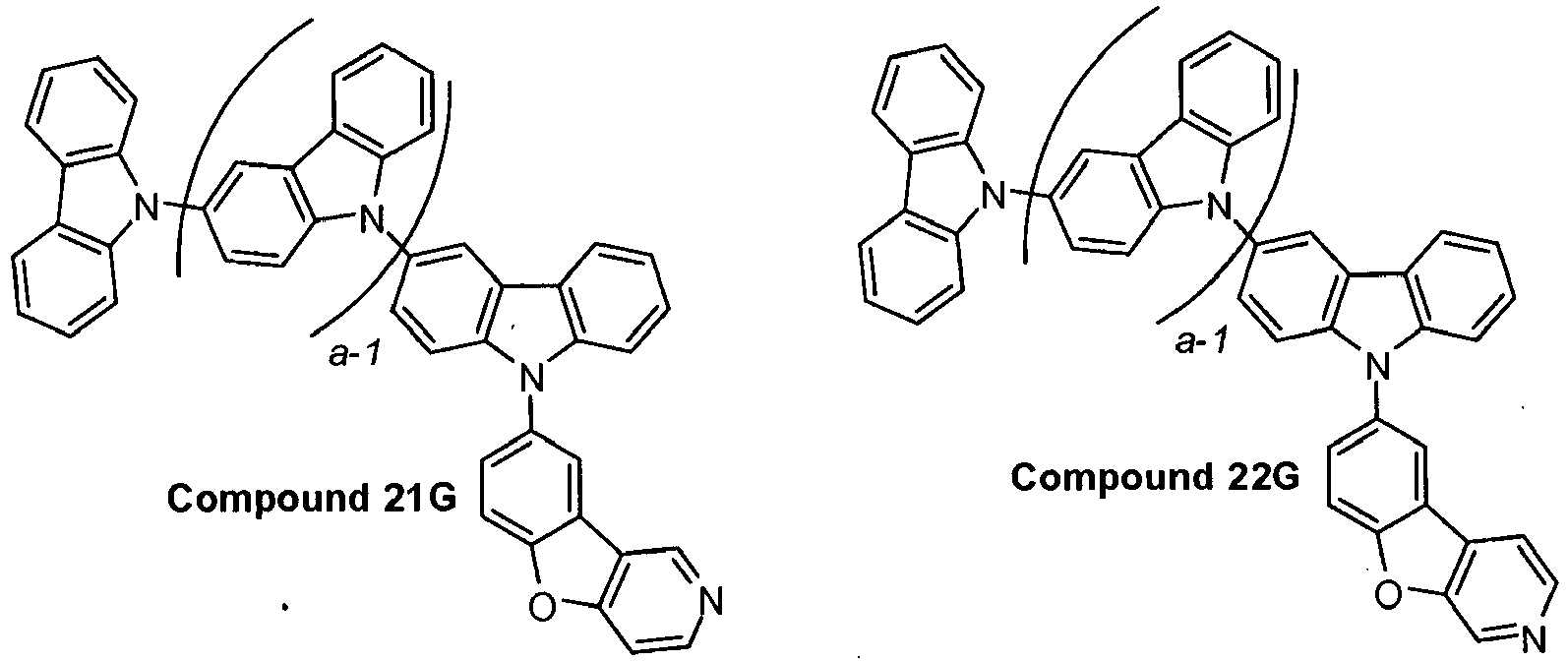


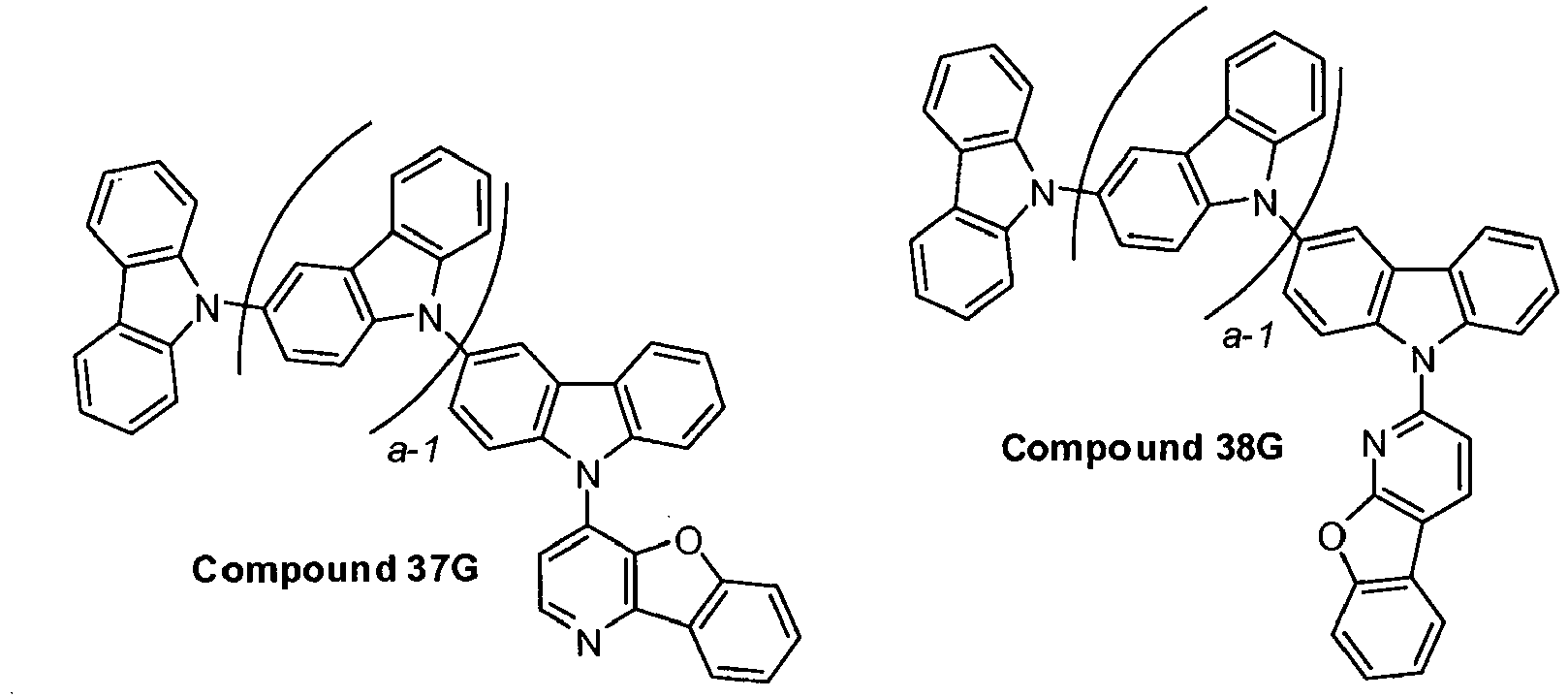


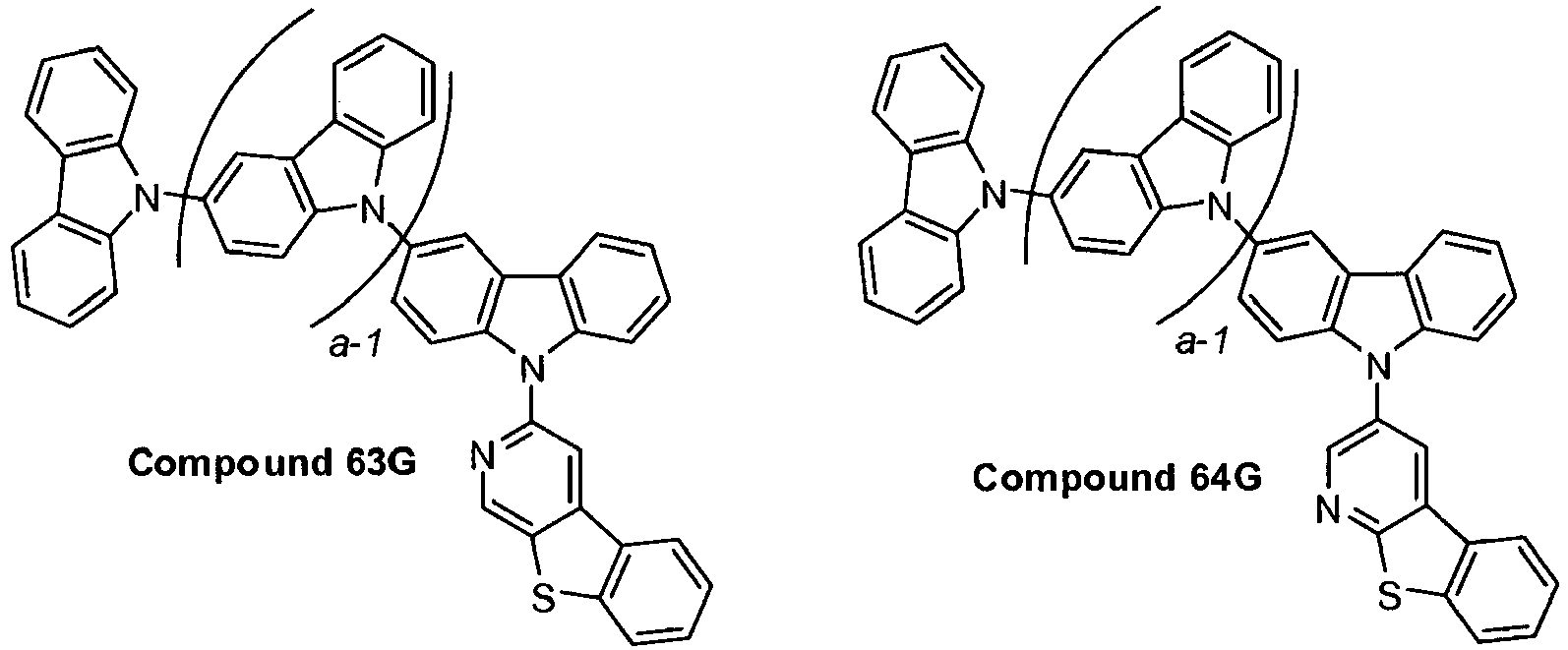


- Additionally, an organic light emitting device is provided. The device comprises an anode, a cathode, and a first organic layer disposed between the anode and the cathode, wherein the first organic layer comprises a carbazole-containing compound having FORMULA I. Specific examples of carbazole-containing compounds for use in such a device include a compound selected from the group consisting of Compound 1G-Compound 79G. In one aspect, the first organic layer is an emissive layer and the carbazole-containing compound is a host in the first organic layer.
- The device may contain 10-100 wt% of the carbazole-containing compound in an organic layer. As discussed above, the carbazole-containing compound may be used in several organic layers of the device, including but not limited to an emissive layer, a blocking layer, and a transport layer. Preferably, the carbazole-containing compound is present in an emissive layer at a concentration of 40 - 99.9 wt%. The carbazole-containing compound may be used as a host or a co-host in the emissive layer of a device. In addition to the carbazole-containing compound, the emissive layer may further comprise a phosphorescent emitter having a concentration of 0.1 - 30wt%.
- In one aspect, the emissive layer further comprises a phosphorescent emitter. In another aspect, the phosphorescent emitter is an iridium complex having the formula:

- In yet another aspect, the phosphorescent emitter is a compound comprising a phosphorescent metal complex comprising a monoanionic, bidentate ligand having the formula:

- Moreover, the device may further comprise a second layer that is a non-emissive layer. Any layer included in the device that does not emit light may herein be referred to as a "non-emissive layer." In one aspect, the first organic layer is adjacent to the second organic layer.
- As discussed above, the carbazole-containing compounds described herein may be advantageously used as a host material in an emissive layer. However, the carbazole-containing compounds may also have blocking properties, impeding properties, and transport properties for both holes and electrons depending upon the relative energy and relative mobility. Therefore, these compounds may be useful as materials in different organic layers at different positions within the device.
- The carbazole-containing compounds disclosed herein may be used in red, green and blue devices of which first emission energy is around 570 nm to 670 nm, 495 nm to 570 nm, and 425 nm to 495 nm, respectively. Preferably, first energy emission is around 610 nm to 630 nm, 510 nm to 530 nm, and 440 nm to 480 nm for red, green and blue devices, respectively. For a particular dopant, the triplet energy of the host is normally required to be 30 nm higher than that of the dopant in order not to cause any quench.
- In one aspect, compounds well-suited for use with devices having a phosphorescent emitter having a triplet energy of 495 nm to 570 nm are provided. For these compounds, X is selected from the group consisting of biphenyl, terphenyl, triphenylene, phenanthrene, fluorene, dibenzothiophene, dibenzofuran, pyridine, pyridazine, pyrimidine, pyrazine, triazine, benzimidazole, benzothiazole, quinoline, isoquinoline, benzofuropyridine, furodipyridine, benzothienopyridine, and thienodipyridine and R is selected from the group consisting of hydrogen, alkyl, benzene, biphenyl, terphenyl, triphenylene, phenanthrene, fluorene, dibenzothiophene, dibenzofuran, pyridine, pyridazine, pyrimidine, pyrazine, triazine, benzimidazole, benzothiazole, quinoline, isoquinoline, benzofuropyridine, furodipyridine, benzothienopyridine, and thienodipyridine. Preferably, the emitter of such a device has a triplet energy of 510 nm to 530 nm. Carbazole-containing compounds having X and R are selected from the above groups may readily be used with red devices as well.
- In another aspect, compounds well-suited for use with devices having a phosphorescent emitter having a triplet energy of 425 nm to 495 nm are provided. For these compounds, X is selected from the group consisting of dibenzothiophene, dibenzofuran, benzofuropyridine, furodipyridine, benzothienopyridine, and thienodipyridine and R is selected from the group consisting of hydrogen, alkyl, benzene, biphenyl, terphenyl, dibenzothiophene, and dibenzofuran. Preferably, the emitter of such a device has a triplet energy of 440 nm to 480 nm. Carbazole-containing compounds having X and R selected from the above groups may readily be used with green and red devices as well.
- A consumer product comprising a device is also provided, wherein the device further comprises an anode, a cathode and an organic layer. The organic layer further comprises a carbazole-containing compound having FORMULA I.
- A method of fabricating an organic light emitting device is also provided, wherein the method comprises providing a first electrode, co-depositing a host and a phosphorescent emitter to form an emissive layer wherein the emissive layer comprises a carbazole-containing compound having FORMULA I, and depositing a second electrode. In one aspect, the first electrode is an anode and the second electrode is a cathode. An organic layer may be deposited after the first electrode and before the emissive layer, and the organic layer may be an hole transport layer.
- The materials described herein as useful for a particular layer in an organic light emitting device may be used in combination with a wide variety of other materials present in the device. For example, emissive dopants disclosed herein may be used in conjunction with a wide variety of hosts, transport layers, blocking layers, injection layers, electrodes and other layers that may be present. The materials described or referred to below are non-limiting examples of materials that may be useful in combination with the compounds disclosed herein, and one of skill in the art can readily consult the literature to identify other materials that may be useful in combination.
- In addition to and / or in combination with the materials disclosed herein, many hole injection materials, hole transporting materials, host materials, dopant materials, exiton/hole blocking layer materials, electron transporting and electron injecting materials may be used in an OLED. Non-limiting examples of the materials that may be used in an OLED in combination with materials disclosed herein are listed in Table 1 below. Table 1 lists non-limiting classes of materials, non-limiting examples of compounds for each class, and references that disclose the materials.
Table 1. MATERIAL EXAMPLES OF MATERIAL PUBLICATIONS Hole injection materials Phthalocyanine and porphryin compounds 
Appl. Phys. Lett. 69, 2160 (1996) Starburst triarylamines 
J. Lumin. 72-74, 985 (1997) CFx Fluorohydrocarbon polymer 
Appl. Phys. Lett. 78, 673 (2001) Conducting polymers (e.g., PEDOT:PSS, polyaniline, polypthiophene) 
Synth. Met. 87, 171 (1997) Arylamines complexed with metal oxides such as molybdenum and tungsten oxides 
SID Symposium Digest, 37, 923 (2006) Hole transporting materials Triarylamines (e.g., TPD, α-NPD) 
Appl. Phys. Lett. 51, 913 (1987) 
US5061569 
EP650955 
J. Mater. Chem. 3, 319(1993) 
Appl. Phys. Lett. 90, 183503 (2007) 
Appl. Phys. Lett. 90, 183503 (2007) Triaylamine on spirofluorene core 
Synth. Met. 91, 209 (1997) Arylamine carbazole compounds 
Adv. Mater. 6, 677 (1994) Indolocarbazoles 
Synth. Met. 111, 421 (2000) Isoindole compounds 
Chem. Mater. 15, 3148(2003) Phosphorescent OLED host materials Red hosts Arylcarbazoles 
Appl. Phys. Lett. 78, 1622 (2001) Metal 8-hydroxyquinolates (e.g., Alq3, BAlq) 
Nature 395, 151 (1998) 
US20060202194 
WO2005014551 Metal phenoxybenzothiazole compounds 
Appl. Phys. Lett. 90, 123509 (2007) Conjugated oligomers and polymers (e.g., polyfluorene) 
Org. Electron. 1, 15 (2000) Green hosts Arylcarbazoles 
Appl. Phys. Lett. 78, 1622 (2001) 
US2003175553 
WO2001039234 Aryltriphenylene compounds 
US20060280965 
US20060280965 Polymers (e.g., PVK) 
Appl. Phys. Lett. 77, 2280 (2000) Spirofluorene compounds 
WO2004093207 Metal phenoxybenzooxazole compounds 
WO05089025 
WO06132173 
JP200511610 Spirofluorene-carbazole compounds 
JP2007254297 
JP2007254297 Indolocabazoles 
WO07063796 
WO07063754 5-member ring electron deficient heterocycles (e.g., triazole, oxadiazole) 
J. Appl. Phys. 90, 5048 (2001) 
WO04107822 Metal phenoxypyridine compounds 
WO05030900 Blue hosts Arylcarbazoles 
Appl. Phys. Lett, 82, 2422 (2003) 
US20070190359 Dibenzothiophene-carbazole compounds 
WO2006114966 Phosphorescent dopants Red dopants Heavy metal porphyrins (e.g., PtOEP) 
Nature 395, 151 (1998) Iridium(III) organometallic complexes 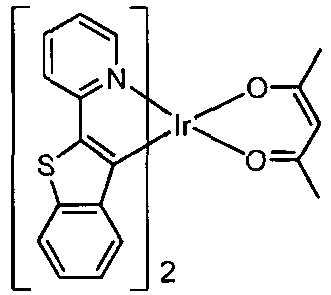
Appl. Phys. Lett. 78, 1622 (2001) 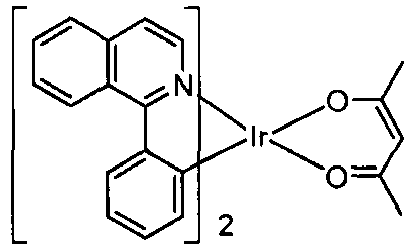
US06835469 
US06835469 
US20060202194 
US20060202194 
US07087321 
US07087321 
Adv. Mater. 19, 739 (2007) Platinum(II) organometallic complexes 
WO2003040257 Osminum(III) complexes 
Chem. Mater. 17, 3532(2005) Ruthenium(II) complexes 
Adv. Mater. 17, 1059(2005) Green dopants Iridium(III) organometallic complexes 
Inorg. Chem. 40, 1704 (2001) and its derivatives 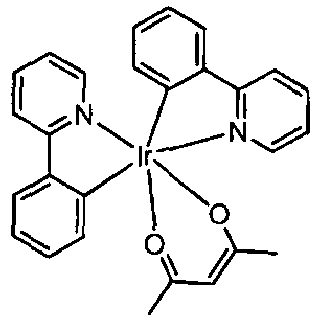
US2002034656 
US06687266 
Chem. Mater. 16, 2480 (2004) 
US2007190359 
US 2006008670 JP2007123392 
Adv. Mater. 16, 2003 (2004) 
Angew. Chem. Int. Ed. 2006, 45, 7800 Pt(II) organometallic complexes 
Appl. Phys. Lett. 86, 153505 (2005) 
Appl. Phys. Lett. 86, 153505 (2005) 
Chem. Lett. 34, 592 (2005) Gold complexes 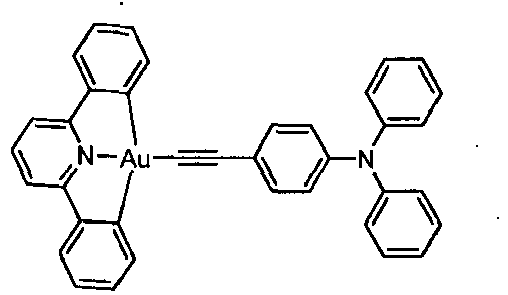
Chem. Commun. 2906(2005) Rhenium(III) complexes 
Inorg. Chem. 42, 1248(2003) Blue dopants Iridium(III) organometallic complexes 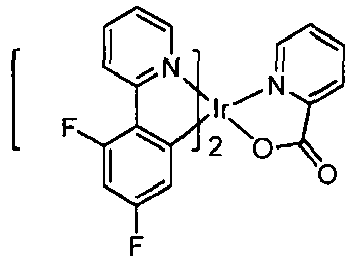
WO2002002714 
WO2006009024 
US2006251923 
WO2006056418 ,US2005260441 
US2007190359 
US2002134984 
Angew. Chem. Int. Ed. 47, 1 (2008) 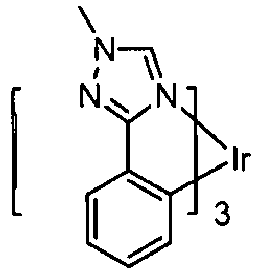
Chem. Mater. 18, 5119(2006) 
Inorg. Chem. 46, 4308 (2007) 
WO05123873 
WO05123873 
WO07004380 
WO06082742 Osmium(II) complexes 
US2005260449 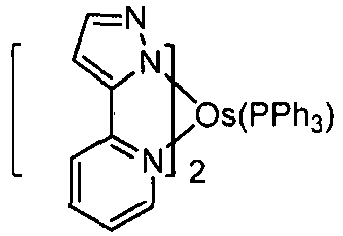
Organometallics 23, 3745 (2004) Gold complexes 
Appl. Phys. Lett.74,1361 (1999) Platinum(II) complexes 
WO06098120 WO06103874 Exciton/hole blocking layer materials Bathocuprine compounds (e.g., BCP, BPhen) 
Appl. Phys. Lett. 75, 4 (1999) 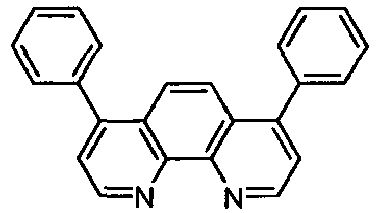
Appl. Phys. Lett. 79, 449 (2001) Metal 8-hydroxyquinolates (e.g., BAlq) 
Appl. Phys. Lett. 81, 162 (2002) 5-member ring electron deficient heterocycles such as triazole, oxadiazole, imidazole, benzoimidazole 
Appl. Phys. Lett. 81, 162 (2002) Triphenylene compounds 
US20050025993 Fluorinated aromatic compounds 
Appl. Phys. Lett. 79, 156 (2001) Electron transporting materials Anthracene-benzoimidazole compounds 
WO03060956 Anthracene-benzothiazole compounds 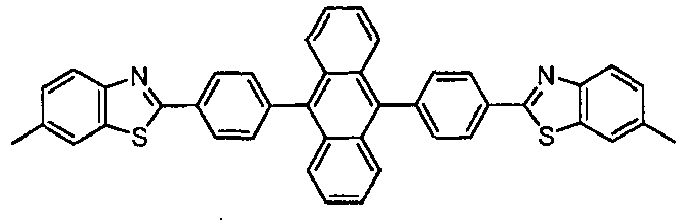
Appl. Phys. Lett. 89, 063504 (2006) Metal 8-hydroxyquinolates (e.g., Alq3) 
Appl. Phys. Lett. 51, 913 (1987) Bathocuprine compounds such as BCP, BPhen, etc 
Appl. Phys. Lett. 91, 263503 (2007) 
Appl. Phys. Lett. 79, 449 (2001) 5-member ring electron deficient heterocycles (e.g.,triazole, oxadiazole, imidazole, benzoimidazole) 
Appl. Phys. Lett. 74, 865 (1999) 
Appl. Phys. Lett. 55, 1489 (1989) 
Jpn. J. Apply. Phys. 32, L917 (1993) Silole compounds 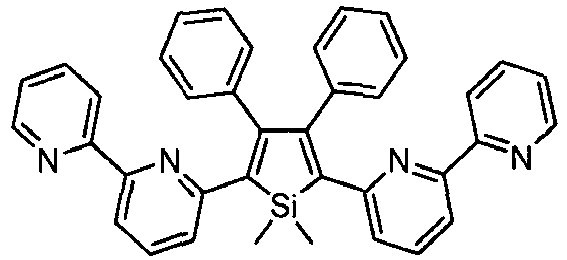
Org. Electron. 4, 113(2003) Arylborane compounds 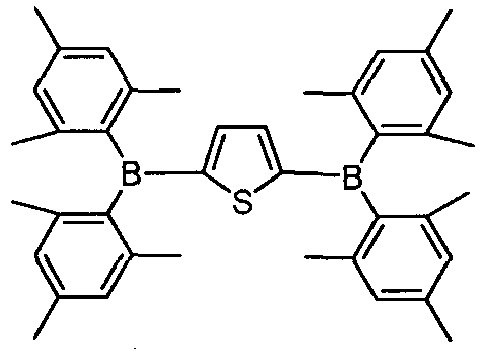
J. Am. Chem. Soc. 120, 9714 (1998) Fluorinated aromatic compounds 
J. Am. Chem. Soc. 122, 1832 (2000) - Some of the carbazole-containing compounds were synthesized as follows:
-

- Step 1. Solid Kl (22.1 g, 133 mmol) was add into carbazole (33.4 g, 200 mmol) in 550 mL of acetic acid. The mixture became clear after it was heated up to 120 °C for 30 min. After it was cooled back to 100 °C, KlO3 (21.4 g, 100 mmol) was added portion-wise. The mixture was stirred at this temperature for another 2 hours. After the mixture cooled down, 500 mL of water was added to precipitate out all the product. The solid was filtered, and washed with hot water. The crude product was recrystallized from CH2Cl2 once, and then from EtOAc/hexanes to give 24 g pure 3-iodocarbazole.
- Step 2. Tosyl chloride (8.4 g, 44 mmol) was added to a solution of 3-iodocarbazole (11.7 g, 40 mmol) and grounded KOH (2.7 g, 48 mmol) in 200 mL of acetone. The mixture was refluxed for 3 hours, and then cooled down. It was poured into 1 L of cold water while stirring. After sitting for 30 minutes, the liquid was decanted. The crude product was thus obtained as sticky solid on the beaker wall. About 11 g of pure 3-iodo-9-tosylcarbazole was obtained after recystallization from CH2Cl2/EtOH.
- Step 3. 3-iodo-9-tosylcarbazole (10.6 g, 24 mmol), carbazole (4.8 g, 29 mmol), Cul (0.4 g, 2.0 mmol), trans-1,2-Diaminocyclohexane (0.3 g, 2.4 mmol), potassium phosphate tribasic (10.6 g, 50 mmol), and 150 mL of toluene were added to a 500 mL round flask. The reaction was heated to reflux, and stirred under a nitrogen atmosphere for 24 hours. After cooling, the mixture was purified by a silica gel column. The yield of 3-(9-carbazolyl)-9-tosylcarbazole was 10 g.
- Step 4. 3-(9-carbazolyl)-9-tosylcarbazole (10.0 g, 21 mmol), NaOH (8.0 g, 200 mmol), 80 mL of THF, 40 mL of MeOH and 40 mL of water were added to a 500 mL round flask. The reaction was heated to reflux for 12 hours. After cooling, the mixture was purified by a silica gel column. The yield of 3-(9-carbazolyl)carbazole was 8 g.
- Step 5. 3-(9-carbazolyl)carbazole (3.0 g, 9 mmol), 2-bromopyridine (1.9 g, 12 mmol), Cul (0.2 g, 1.0 mmol), trans-1,2-Diaminocyclohexane (0.2 g, 1.5 mmol), potassium phosphate tribasic (5.3 g, 25 mmol), and 150 mL of toluene were added to a 500 mL round flask. The reaction was heated to reflux and stirred under a nitrogen atmosphere for 24 hours. After cooling, the mixture was purified by a silica gel column. The yield was 2.2 g. The product was further purified by vacuum sublimation. 1H NMR results confirmed the desired compound. Eox = 0.86 V (quasi-reversible), Ered = -2.91 V (reversible) (vs. Fc+/Fc, in 0.10M Bu n 4NPF6 solution (DMF) with Pt working and auxiliary electrodes and a non-aqueous Ag/Ag+ reference electrode, and scan rates varied from 50 to 5000 mVs-1).
-
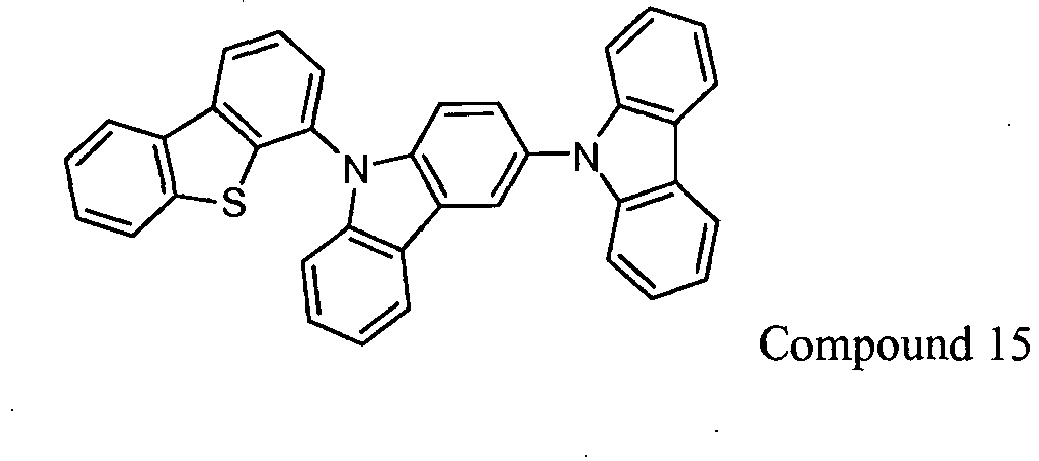
- 4-iododibenzothiophene (3.0 g, 10 mmol), 3-(9-carbazolyl)carbazole (2.3 g, 7 mmol), Pd2(dba)3 (0.5 g, 0.5 mmol), 2-dicyclohexylphosphino-2',6'-dimethoxybiphenyl (S-Phos, 0.8 g, 2.0 mmol), sodium t-butoxide (2.9 g, 30 mmol), and 200 mL of xylene were added to a 500 mL round flask. The reaction was heated to reflux and stirred under a nitrogen atmosphere for 24 hours. After cooling, the mixture was purified by a silica gel column. The yield was 3.0 g. The product was further purified by vacuum sublimation. 1H NMR results confirmed the desired compound. Eox = 0.77 V (quasi-reversible), Ered = -2.79 V (reversible) (vs. Fc+/Fc, in 0.10M Bu n 4NPF6 solution (DMF) with Pt working and auxiliary electrodes and a non-aqueous Ag/Ag+ reference electrode, and scan rates varied from 50 to 5000 mVs-1).
-

- 3-(9-carbazolyl)carbazole (2.3 g, 7 mmol), 2-bromobenzothiophene (2.8 g, 11 mmol), Cul (0.2 g, 1.0 mmol), trans-1,2-Diaminocyclohexane (0.2 g, 1.5 mmol), potassium phosphate tribasic (5.3 g, 25 mmol), and 150 mL of toluene were added to a 500 mL round flask. The reaction was heated to reflux, and stirred under a nitrogen atmosphere for 24 hours. After cooling, the mixture was purified by a silica gel column. The yield was 3.0 g. The product was further purified by vacuum sublimation. 1H NMR results confirmed the desired compound. Eox = 0.74 V (quasi-reversible), Ered = -2.78 V (reversible) (vs. Fc+/Fc, in 0.10M Bu n 4NPF6 solution (DMF) with Pt working and auxiliary electrodes and a non-aqueous Ag/Ag+ reference electrode, and scan rates varied from 50 to 5000 mVs-1).
-

- Step 1. 3-(9-carbazolyl)carbazole (9.8 g, 30 mmol), 3-iodo-9-tosylcarbazole (16.1 g, 36 mmol), Cul (1.7 g, 9 mmol), trans-1,2-Diaminocyclohexane (2.1 g, 18 mmol), potassium phosphate tribasic (12.7 g, 60 mmol), and 250 mL of toluene were added to a 500 mL round flask. The reaction was heated to reflux, and stirred under a nitrogen atmosphere for 24 hours. After cooling, the mixture was purified by a silica gel column. The yield of 3-(9-(3-(9-carbazolyl)carbazolyl))-9-tosylcarbazole was 20 g. It was detosylated as described above to afford 12 g of 3-(9-(3-(9-carbazolyl)carbazolyl))carbazole.
- Step 2. 3-(9-(3-(9-carbazolyl)carbazolyl))carbazole (3.0 g, 6 mmol), 2-bromobenzothiophene (2.1 g,7.8 mmol), Cul (0.4 g, 1.8 mmol), trans-1,2-Diaminocyclohexane (0.4 g, 3.6 mmol), potassium phosphate tribasic (3.2 g, 15 mmol), and 150 mL of toluene were added to a 500 mL round flask. The reaction was heated to reflux, and stirred under a nitrogen atmosphere for 24 hours. After cooling, the mixture was purified by a silica gel column. The yield was 2.9 g. The product was further purified by vacuum sublimation. 1H NMR results confirmed the desired compound. Eox = 0.81 V (quasi-reversible), Ered = -2.78 V (reversible) (vs. Fc+/Fc, in 0.10M Bu n 4NPF6 solution (DMF) with Pt working and auxiliary electrodes and a non-aqueous Ag/Ag+ reference electrode, and scan rates varied from 50 to 5000 mVs-1).
-

- The 100 mL round bottom flask, equipped with magnetic stirrer and refluxed condenser , was charged with 8-iodo-3,4-dihydrodibenzo[b,d]furan (332 mg, 1 mmol), 3-(9-carbazolyl)carbazole (294 mg, 1 mmol), Pd(OAc)2 (23 mg, 10 mol%), P(t-Bu)3 (1 mL of 1M solution in toluene, 1mmol), potassium tert-rbuthoxide (150 mg, 1.5 eq) and 100 ml of xylene. The flask was filled with nitrogen, and the reaction mixture was heated to reflux and stirred under nitrogen atmosphere for 24 hours. Then reaction was cooled down to room temperature, filtered through silica plug and evaporated. The residue was subjected to column chromatography on silica gel, eluent hexane/ethyl acetate mixture 9:1, providing 410 mg of 9-(dibenzo[b,d]furan-2-yl)-9H-3,9'-bicarbazole as white solid. The structure was confirmed by NMR and MS spectroscopy.
-

- Step 1. The 300 mL round bottom flask, equipped with magnetic stirrer and refluxed condenser, was charged with 5-chloro-2-methoxyphenylboronic acid (5.00 g, 33 mmol), 2-amino-3-bromopyridine (5.70 g, 33 mmol), Pd2(dba)3 (604 mg, 2 mol%), 2-dicylohexylphosphino-2',6'-dimethoxybiphenyl (542 mg, 4 mol%), potassium phosphate tribasic monohydrate (22.8 mg, 3 eq) and 100 mL of toluene. The flask was filled with nitrogen , and the reaction mixture was heated to reflux and stirred under nitrogen atmosphere for 24 hours. Then reaction was cooled down to room temperature, filtered through silica plug and evaporated. The residue was subjected to column chromatography on silica gel, eluent hexane/ethyl acetate mixture 1:1, providing 5.0 g of 3-(5-chloro-2-methoxyphenyl)pyridin-2-amine as yellow solid. The structure was confirmed by NMR and MS spectroscopy.
- Step 2. 3-(5-Chloro-2-methoxyphenyl)pyridin-2-amine (5.00 g, 21 mmol) was dissolved in the mixture of THF (409 mL), HBF4 (50% aqueous solution, 36 mL) and 15 mL of water. The solution was cooled to -5 °C, and sodium nitrite (1.70 g in 20 mL of water) was added dropwise. Reaction was kept 1 hour at -5 °C, then was allowed to warm up to room temperature and stirred overnight at room temperature. Then pH of the reaction mixture was adjusted to 10, and it was extracted with ethyl acetate (4x25 mL). Organic fractions were combined, dried over sodium sulfate and evaporated. The residue was subjected to column chromatography on silica gel, eluent hexane/ethyl acetate 9/1 mixture. Chromatography product contained 3-(5-chloro-2-methoxyphenyl)-2-fluoropyridine, pure 6-chlorobenzofuro[2,3-b]pyridine (1.52 g, colorless long needles) was obtained by crystallization from hexane/ethyl acetate.
- Step 3. The 300 mL round bottom flask, equipped with magnetic stirrer and refluxed condenser , was charged with 6-chlorobenzofuro[2,3-b]pyridine (2.04 g, 10 mmol), 3-(9-carbazolyl)carbazole (3.32 g, 10 mmol), Pd(OAc)2 (450 mg, 20 mol%), P(t-Bu)3 (10 mL of 1M solution in toluene, 10 mmol), potassium tert-buthoxide (1.92 g, 20 mmol) and 150 ml of xylene. The flask was filled with nitrogen, and the reaction mixture was heated to reflux and stirred under nitrogen atmosphere for 36 hours. Then the reaction was cooled down to room temperature, washed with water, filtered through silica plug and evaporated. The residue was subjected to column chromatography on silica gel, eluent hexane/ethyl acetate mixture 4:1, providing 3.01 g of 6-(9H-3,9'-bicarbazol-9-yl)benzofuro[2,3-b]pyridine as white solid, structure was confirmed by NMR and MS spectroscopy.
-

- Step 1. The 500 mL round-bottom flask, equipped with magnetic stirrer and reflux condenser was charged with 5-chloro-2-methoxyphenylboronic acid (9.78 g, 52 mmol), 3-amino-2-chloropyridine (7.00 g, 55 mmol), 2-dicyclohexyl-phosphino-2',6'-dimethoxybiphenyl (S-Phos, 0.43 g, 2 mol %), palladium (II) acetate (112 mg, 1 mol %), potassium carbonate (21.7 g, 157 mmol), 180 mL of acetonitrile and 20 ml of water. The flask was filled with nitrogen and heated to reflux under nitrogen atmosphere for 24 hours. Then the reaction was cooled down to room temperature, diluted with 500 mL of water and extracted with ethyl acetate (5x40 mL). Organic fractions were combined, dried over sodium sulfate, filtered and evaporated. The residue was subjected to column chromatography on silica gel with eluent hexane/ethyl acetate gradient mixture, providing 2-(5-chloro-2-methoxyphenyl)pyridin-3-amine as white crystals (9.5 g, NMR confirmed the structure).
- Step 2. The 500 mL round-bottom flask, equipped with magnetic stirrer and reflux condenser was charged with 2-(5-chloro-2-methoxyphenyl)pyridin-3-amine (9.00 g, 39 mmol), 70 mL THF, 70 mL HBF4 (50% in water) and 40 mL H2O. Reaction mixture was cooled to -10° C, and solution of sodium nitrite (5.6 g in 20 mL water) was added dropwise. Reaction mixture was warmed gradually to room temperature and stirred overnight. The reaction mixture was diluted with 500 mL of water and extracted with ethyl acetate (4x50 mL). Organic fractions were combined, dried over sodium sulfate and evaporated, the residue was subjected to column chromatography on silica gel with hexane/ethyl acetate 9/1 mixture, providing 8-chlorobenzofuro[3,2-b]pyridine (6.00 g, colorless needles from hexane/ethyl acetate).
- Step 3. The 100 mL round bottom flask, equipped with magnetic stirrer and refluxed condenser, was charged with 8-chlorobenzofuro[3,2-b]pyridine (2.04 g, 10 mmol), 3-(9-carbazolyl)carbazole (3.32 g, 10 mmol), Pd(OAc)2 (450 mg, 20 mol%), P(t-Bu)3 (10 mL of 1M solution in toluene, 10 mmol), potassium tert-buthoxide (1.92 g, 1.5 eq) and 150 ml of xylene. The flask was filled with nitrogen, and the reaction mixture was heated to reflux and stirred under nitrogen atmosphere for 24 hours. Then reaction was cooled down to room temperature, filtered through silica plug and evaporated. The residue was subjected to column chromatography on silica gel, eluent hexane/ethyl acetate mixture 9:1, providing 2.5 g of 8-(9H-3,9'-bicarbazol-9-yl)benzofuro[3,2-b]pyridine as white solid. The structure was confirmed by NMR and MS spectroscopy.
-

- Step 1. The 500 mL round-bottom flask, equipped with magnetic stirrer and reflux condenser was charged with 2-(methylthio)phenylboronic acid (9.48 g, 56 mmol), 3-amino-2-bromopyridine (7.15 g, 57 mmol), 2-dicyclohexylphosphino-2',6'-dimethoxybiphenyl (S-Phos, 0.92 g, 4 mol %), Pd2(dba)3 (1.02 g, 2 mol %), potassium phosphate hydrate (39 g, 3 equivalents), 100 mL of toluene. The flask was filled with nitrogen and heated to reflux under nitrogen atmosphere for 24 hours. Then the reaction was cooled down to room temperature, diluted with 500 ml of water and extracted with ethyl acetate (5x40 mL). Organic fractions were combined, dried over sodium sulfate, filtered and evaporated. The residue was subjected to column chromatography on silica gel with eluent hexane/ethyl acetate gradient mixture, providing 2-(2-(methylthio)phenyl)pyridin-3-amine as yellow crystals (9.5 g). NMR confirmed the structure.
- Step 2. The 500 mL round-bottom flask, equipped with magnetic stirrer and reflux condenser was charged with 2-(2-(methylthio)phenyl)pyridin-3-amine (8.42 g, 39 mmol), 70 mL THF, 70 mL HBF4 (50% in water) and 40 mL H2O. Reaction mixture was cooled to -10° C, and solution of sodium nitrite (5.6 g in 20 mL water) was added dropwise. Reaction mixture was warmed gradually to room temperature and stirred overnight. The reaction mixture was diluted with 500 mL of water and extracted with ethyl acetate (4x50 mL). Organic fractions were combined, dried over sodium sulfate and evaporated, the residue was subjected to column chromatography on silica gel with hexane/ethyl acetate 9/1 mixture, providing aza-dibenzothiophene (3.5 g, colorless needles from hexane/ethyl acetate).
- Step 3. Aza-dibenzothiophene (1.78 g, 6.7 mmol) was dissolved in 75 mL of dry THF and solution was cooled in CO2/acetone bath. n-Buthyl lithium (7 mL of 1.6 M solution in hexane) was added dropwise, color of the reaction mixture turned orange, the solution of 2.6 g of iodine in 50 mL of dry THF was added immediately. Reaction mixture was warmed up to room temperature, treated with aqueous solution of NaHSO3 and extracted with ethyl acetate (4x40 mL). Organic fractions were combined, dried over sodium sulfate, filtered and evaporated. The residue was subjected to column chromatography on silica gel (hexane/ethyl acetate 9/1 mixture as eluent). The purified material was then crystallized from same solvents, providing 1.55 g of the target iodo-derivative, structure was confirmed by NMR and GC/MS data.
- Step 4. The 100 mL round bottom flask, equipped with magnetic stirrer and refluxed condenser, was charged with iodo-derivative (1.55 g, 5 mmol), 3-(9-carbazolyl)carbazole (1.66 g, 5 mmol), Pd(OAc)2 (225 mg, 20 mol%), P(t-Bu)3 (5 mL of 1M solution in toluene, 5 mmol), potassium tert-buthoxide (0.96 g, 1.5 eq) and 75 mL of xylene. The flask was filled with nitrogen, and the reaction mixture was heated to reflux and stirred under nitrogen atmosphere for 24 hours. Then reaction was cooled down to room temperature, filtered through silica plug and evaporated. The residue was subjected to column chromatography on silica gel, eluent hexane/ethyl acetate mixture 9:1, providing 2.0 g of coupling product as white solid. The structure was confirmed by NMR and MS spectroscopy.
- Step 5. The white product was dissolved in 100 mL of THF, cooled in the dry ice/acetone bath and n-BuLi solution in hexane (1 equivalent) was added as one portion. After 1 hour, 5 mL of water were added as one portion and the reaction mixture was warmed up to room temperature, diluted with water and extracted with ethyl acetate. Evaporation followed by column chromatography on silica gel (hexane/ethyl acetate 9/1 mixture as eluent) provided 1.5 g of target compound as white solid. Structure was confirmed by NMR and MS data.
- All example devices were fabricated by high vacuum (<10-7 Torr) thermal evaporation. The anode electrode is 800Å of indium tin oxide (ITO). The cathode consisted of 10Å of LiF followed by 1000Å of Al. All devices are encapsulated with a glass lid sealed with an epoxy resin in a nitrogen glove box (<1 ppm of H2O and O2) immediately after fabrication, and a moisture getter was incorporated inside the package.
- Particular devices are provided wherein P1 is the emissive dopant and invention compound, Compound 8, Compound 15, Compound 17 or Compound 17', is the host. The organic stack of Device Examples 1-4 consisted of, sequentially from the ITO surface, 100Å of P2 as the hole injecting layer (HIL), 300 Å of 4,4'-bis[N-(1-naphthyl)-N-phenylamino]biphenyl (α-NPD) as the hole transport layer (HTL), 300Å of the invention compound doped with 9% of P1, an Ir phosphorescent compound, as the emissive layer (EML), 50Å of the invention compound as ETL2 and 400Å of Alq3 (tris-8-hydroxyquinoline aluminum) as the ETL1.
- Comparative Example 1 was fabricated similarly to the Device Examples, except that mCBP was used as the host.
- As used herein, the following compounds have the following structures:


- The device structures and data are summarized in Tables 2 and 3. Table 2 shows device structure, in particular the host materials for the emissive layer and the material for the ETL2. Table 3 shows the corresponding measured results for those devices. Cmpd is an abbreviation of Compound. The oxidation potentials (Eox) are designated as irreversible (i) or quasi-irreversible (q).
Table 2. Device Example Host Dopant (9 wt%) ETL2 (50 Å) ETL1 (400Å) ITO thickness (Å) Comparative Example 1 mCBP P1 mCBP Alq3 800 1 8 P1 8 Alq3 800 2 15 P1 15 Alq3 800 3 17 P1 17 Alq3 800 4 17' P1 17' Alq3 800 Table 3. Device Example CIE Emmax (nm) At L=1000cd/m2 Eox (V vs Fc+/Fc) X Y V(V) LE (cd/A) EQE (%) PE (1m/W) LT80% (hr) Comparative Example 1 0.15 0.24 462 9.4 15.6 9.2 5.2 120 0.9 (i) 1 0.17 0.31 466 10.8 9.0 4.4 2.6 40 0.86 (q) 2 0.16 0.30 466 9.6 11.2 5.8 3.7 125 0.77 (q) 3 0.16 0.29 464 8.3 13.6 7.2 5.2 160 0.74 (q) 4 0.16 0.31 466 9.7 11.4 5.7 3.7 90 0.81 (q) - From Device Examples 1-4, it can be seen that devices using the invention compounds as hosts give improved device stability while maintaining high triplet energy. In particular, Compounds 8, 15, 17 or 17' as hosts in blue or green OLEDs give devices with reduced oxidation potentials (Eox vs Fc+/Fc) and improved electrochemical reversibility indicating that the carbazole containing compounds, in particular the unsymmetrical monodisperse linear 3,9-linked oligocarbazole compounds, may provide better charge balance and charge stability in the device.
- The data suggest that carbazole containing compounds, particularly 3,9-linked oligocarbazoles, are excellent hosts and enhancement layer materials for phosphorescent OLEDs, providing improved charge balance and charge stability compared to the commonly used mCBP host. In addition, the oligocarbazole containing compounds may also provide better film formation during device production due to the unsymmetrical nature of the molecules.
- It is understood that the various embodiments described herein are by way of example only, and are not intended to limit the scope of the invention. For example, many of the materials and structures described herein may be substituted with other materials and structures without deviating from the spirit of the invention. The present invention as claimed may therefore includes variations from the particular examples and preferred embodiments described herein, as will be apparent to one of skill in the art. It is understood that various theories as to why the invention works are not intended to be limiting.
Claims (15)
- A carbazole-containing compound comprising:
 wherein a is 1 to 20;wherein b is 0 to 20, provided that b is not 0;wherein m is 0 to 2;wherein n is 0 to 2;wherein m+n is at least 1;wherein X is selected from the group consisting of biphenyl, terphenyl, naphthalene, triphenylene, phenanthrene, fluorene, chrysene, dibenzothiophene, dibenzofuran, benzofuran, benzothiophene, pyrazole, imidazole, triazole, oxazole, thiazole, oxadiazole, oxatriazole, dioxazole, thiadiazole, pyridine, pyridazine, pyrimidine, pyrazine, triazine, indole, benzimidazole, indazole, benzoxazole, benzisoxazole, benzothiazole, quinoline, isoquinoline, cinnoline, quinazoline, quinoxaline, naphthyridine, phthalazine, pteridine, xanthene, phenothiazine, phenoxazine, benzofuropyridine, furodipyridine, benzothienopyridine, and thienodipyridine; andwherein X is substituted by R, where R is selected from the group consisting of hydrogen, alkyl, heteroalkyl, benzene, biphenyl, terphenyl, naphthalene, phenalene, phenanthrene, fluorene, chrysene, dibenzothiophene, dibenzofuran, benzofuran, benzothiophene, pyrazole, imidazole, triazole, oxazole, thiazole, oxadiazole, oxatriazole, dioxazole, thiadiazole, pyridine, pyridazine, pyrimidine, pyrazine, triazine, indole, benzimidazole, indazole, benzoxazole, benzisoxazole, benzothiazole, quinoline, isoquinoline, cinnoline, quinazoline, quinoxaline, naphthyridine, phthalazine, pteridine, xanthene, phenothiazine, phenoxazine, benzofuropyridine, furodipyridine, benzothienopyridine, and thienodipyridine.
 - The compound of claim 1, wherein X is selected from biphenyl, terphenyl, triphenylene, phenanthrene, fluorene, dibenzothiophene, dibenzofuran, pyridine, pyridazine, pyrimidine, pyrazine, triazine, benzimidazole, benzothiazole, quinoline, isoquinoline, benzofuropyridine, furodipyridine, benzothienopyridine, and thienodipyridine.
- The compound of claim 1, wherein X is selected from the group consisting of dibenzothiophene, dibenzofuran, benzofuropyridine, furodipyridine, benzothienopyridine, thienodipyridine, and triphenylene.
- The compound of claim 1, wherein R is selected from the group consisting of hydrogen, alkyl, benzene, biphenyl, terphenyl, triphenylene, phenanthrene, fluorene, dibenzothiophene, dibenzofuran, pyridine, pyridazine, pyrimidine, pyrazine, triazine, benzimidazole, benzothiazole, quinoline, isoquinoline, benzofuropyridine, furodipyridine, benzothienopyridine, and thienodipyridine.
- The compound of claim 1 wherein R is selected from the group consisting of hydrogen, alkyl, benzene, biphenyl, terphenyl, dibenzothiophene, dibenzofuran.
- The compound of claim 1, wherein the compound is selected from the group consisting of:


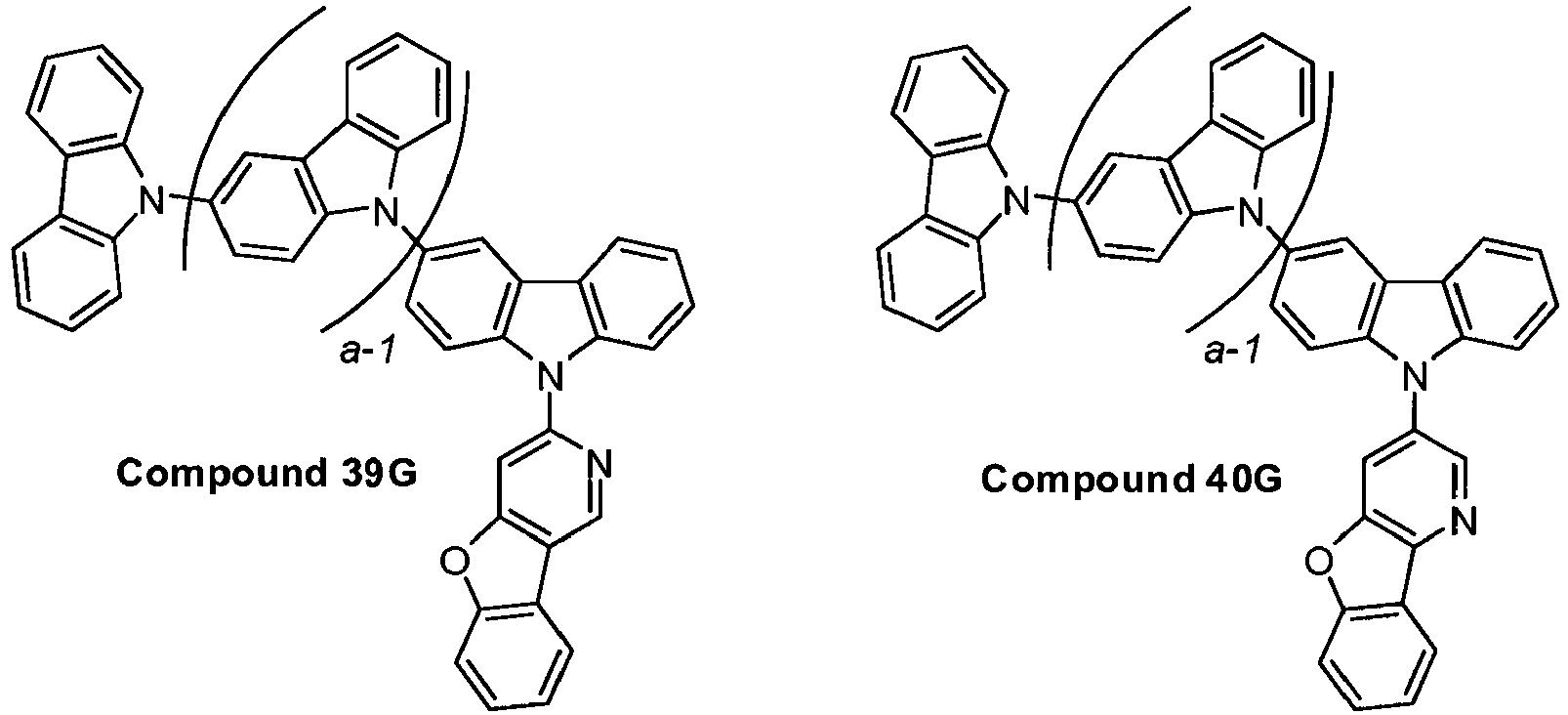
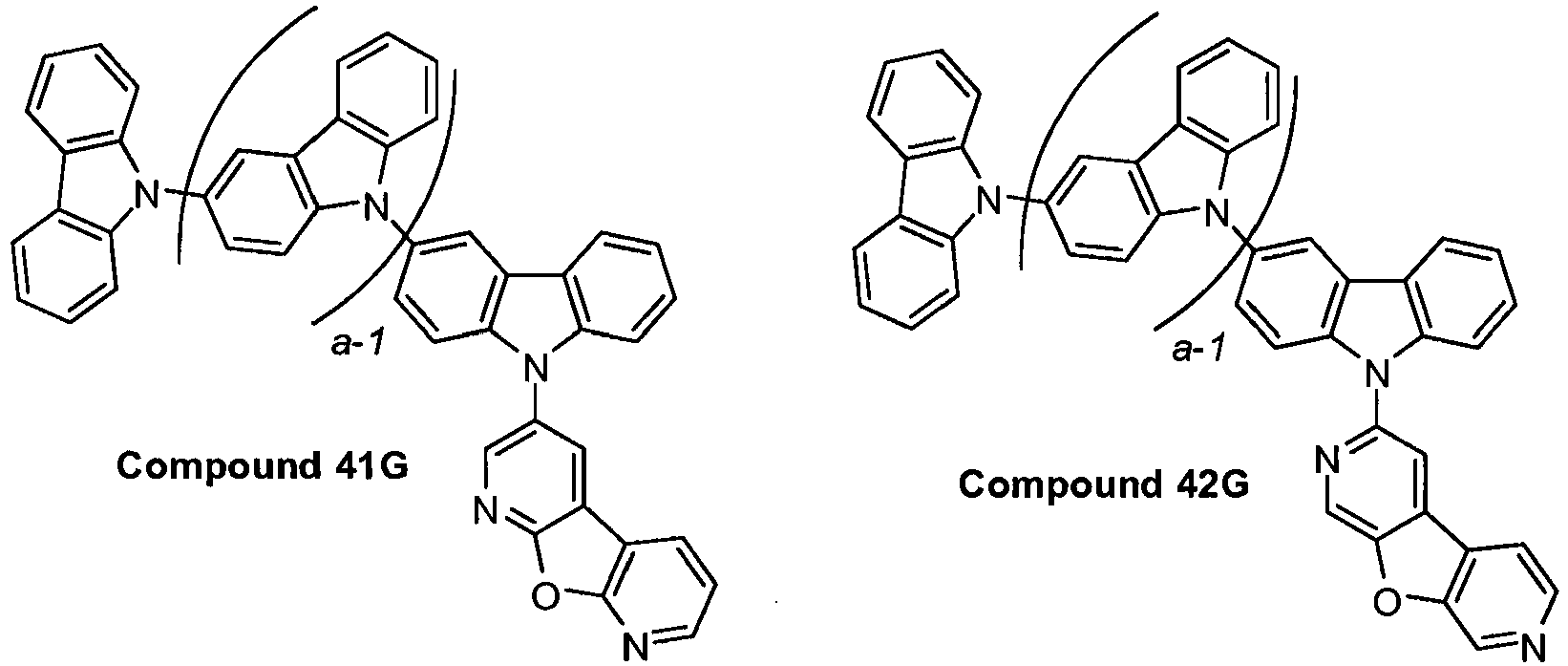


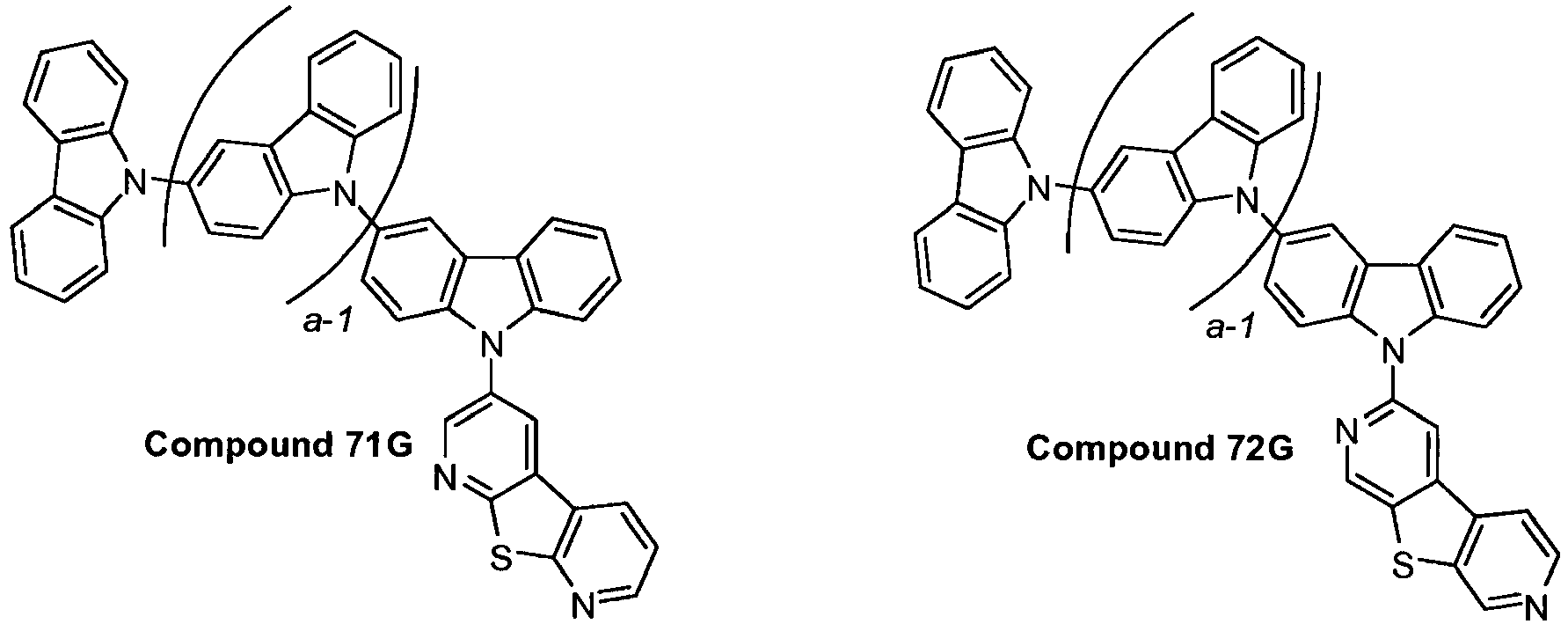


- An organic light emitting device, comprising:an anode;a cathode; anda first organic layer disposed between the anode and the cathode, wherein the organic layer comprises a carbazole-containing compound, comprising
 wherein a is 1 to 20;wherein b is 0 to 20, provided that b is not 0;wherein m is 0 to 2;wherein n is 0 to 2;wherein m+n is at least 1;wherein X is selected from the group consisting of biphenyl, terphenyl, naphthalene, triphenylene, phenanthrene, fluorene, chrysene, dibenzothiophene, dibenzofuran, benzofuran, benzothiophene, pyrazole, imidazole, triazole, oxazole, thiazole, oxadiazole, oxatriazole, dioxazole, thiadiazole, pyridine, pyridazine, pyrimidine, pyrazine, triazine, indole, benzimidazole, indazole, benzoxazole, benzisoxazole, benzothiazole, quinoline, isoquinoline, cinnoline, quinazoline, quinoxaline, naphthyridine, phthalazine, pteridine, xanthene, phenothiazine, phenoxazine, benzofuropyridine, furodipyridine, benzothienopyridine, and thienodipyridine; andwherein X is substituted by R, where R is selected from the group consisting of hydrogen, alkyl, heteroalkyl, benzene, biphenyl, terphenyl, naphthalene, phenalene, phenanthrene, fluorene, chrysene, dibenzothiophene, dibenzofuran, benzofuran, benzothiophene, pyrazole, imidazole, triazole, oxazole, thiazole, oxadiazole, oxatriazole, dioxazole, thiadiazole, pyridine, pyridazine, pyrimidine, pyrazine, triazine, indole, benzimidazole, indazole, benzoxazole, benzisoxazole, benzothiazole, quinoline, isoquinoline, cinnoline, quinazoline, quinoxaline, naphthyridine, phthalazine, pteridine, xanthene, phenothiazine, phenoxazine, benzofuropyridine, furodipyridine, benzothienopyridine, and thienodipyridine.
 - The device of claim 7, wherein the carbazole-containing compound is selected from the group consisting of:


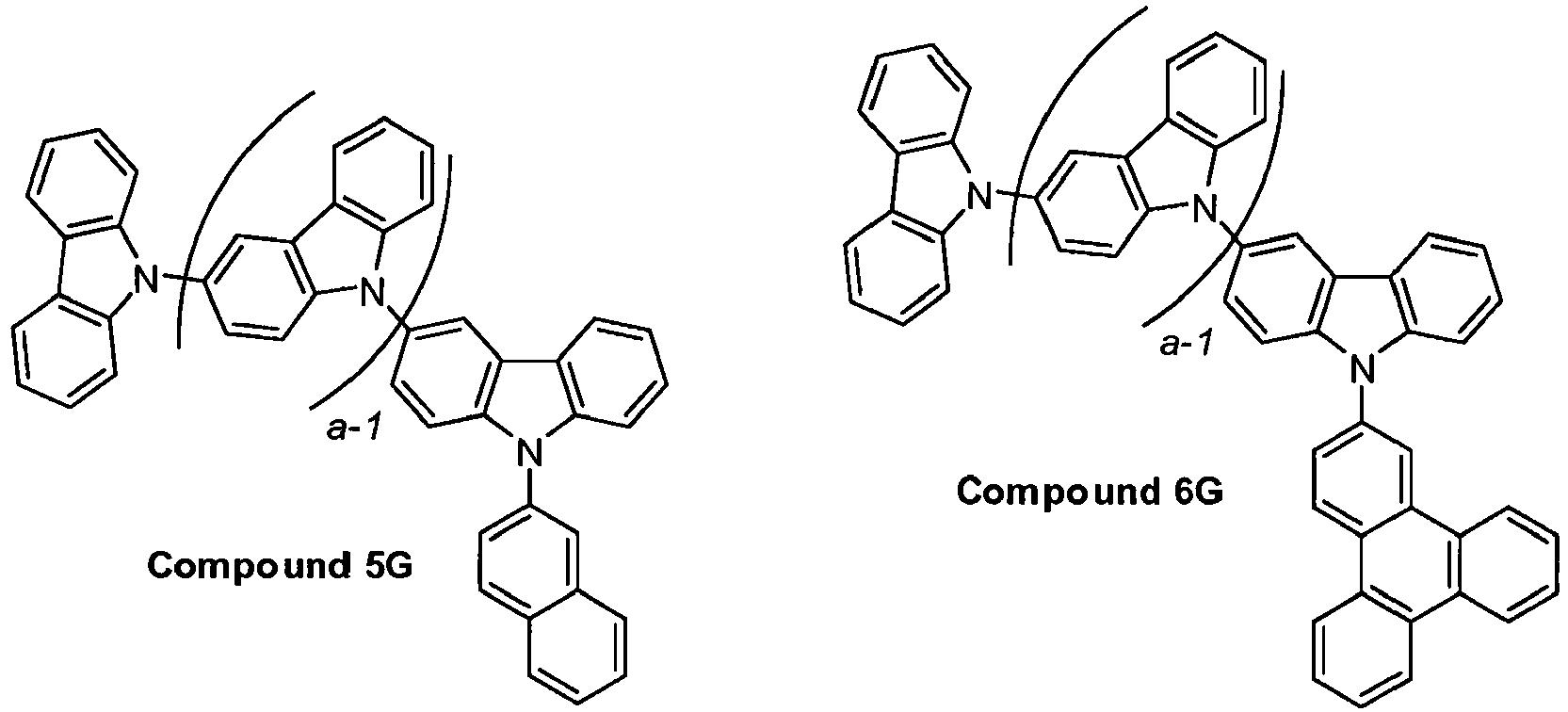


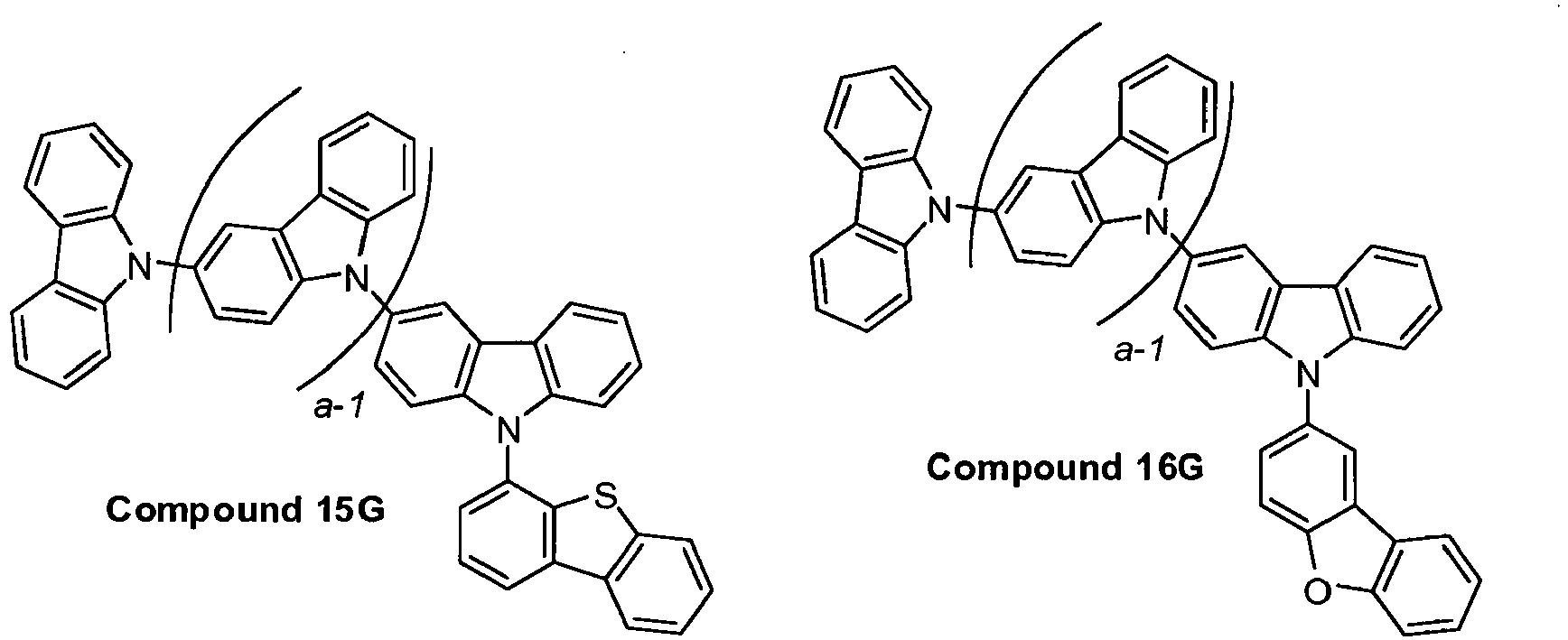


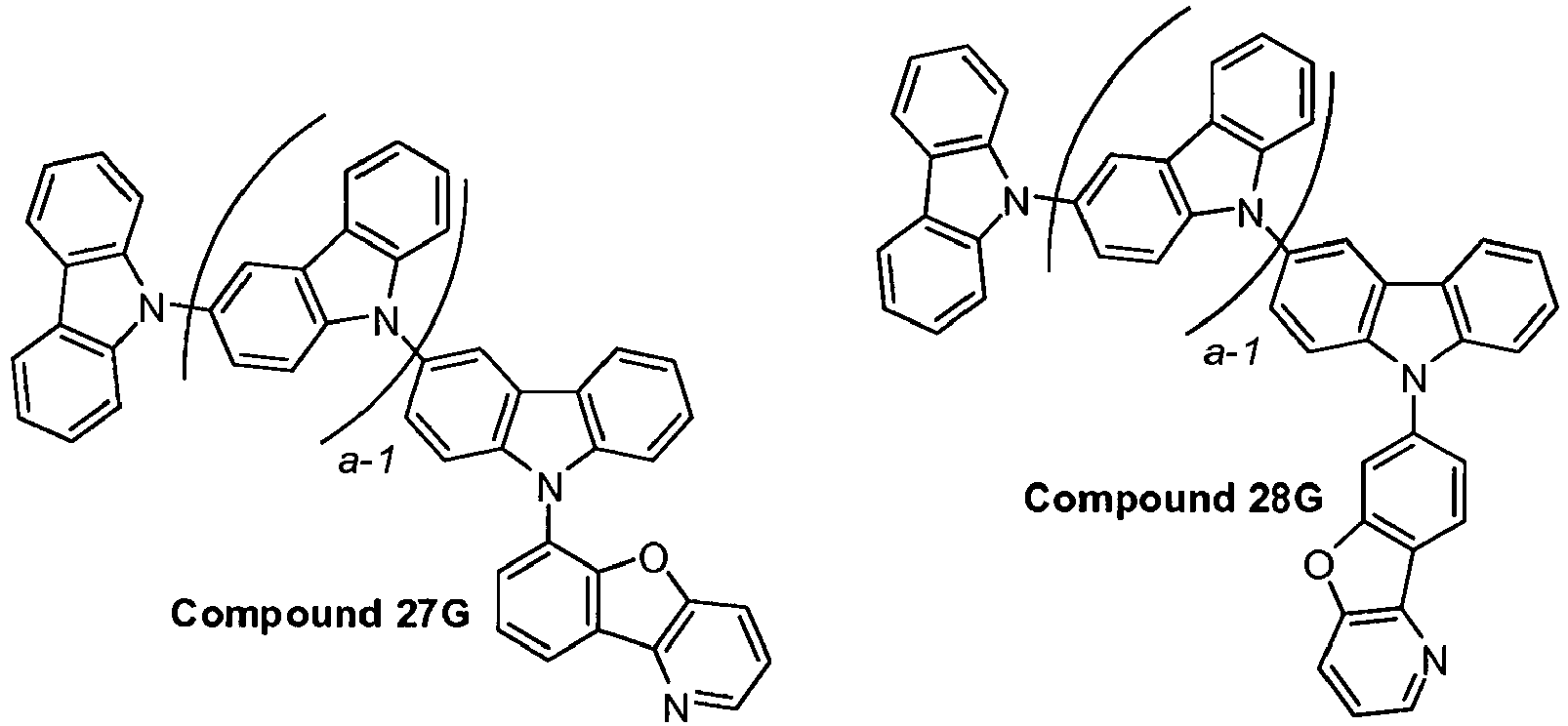


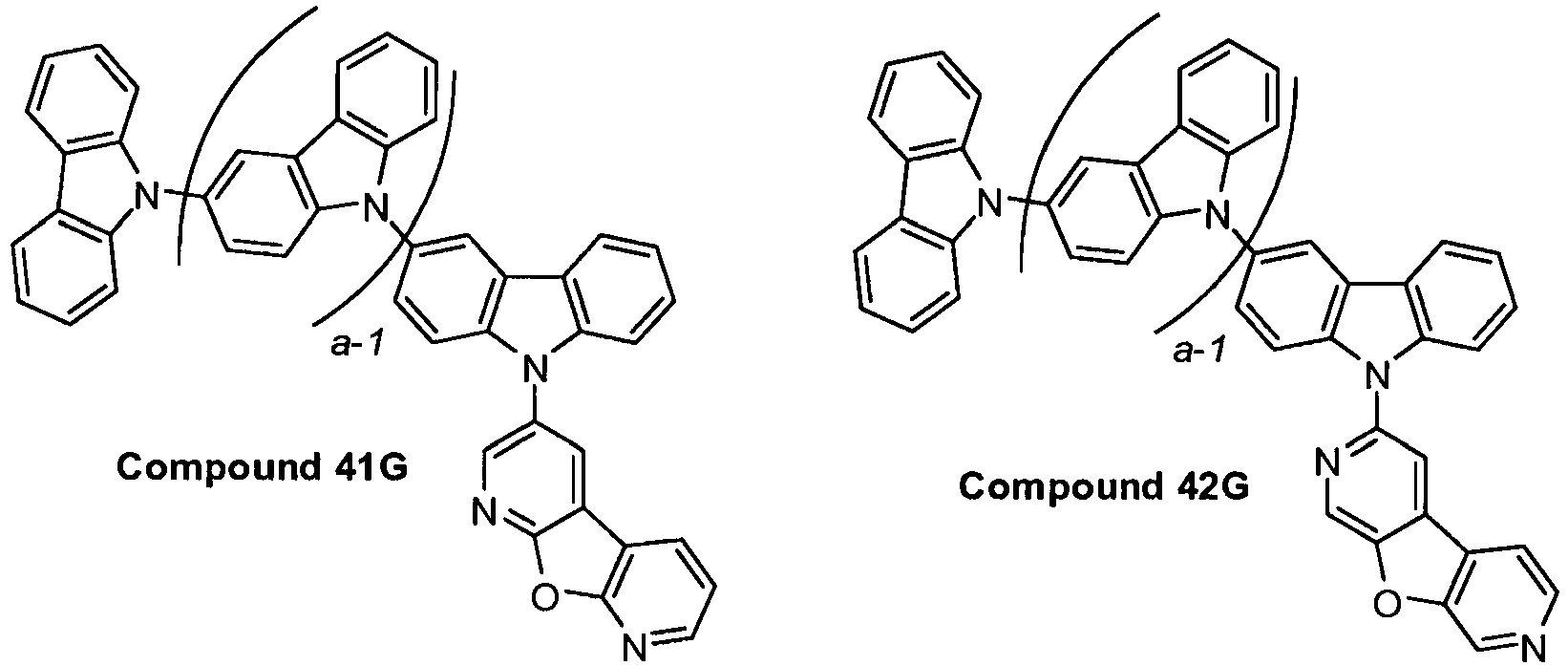


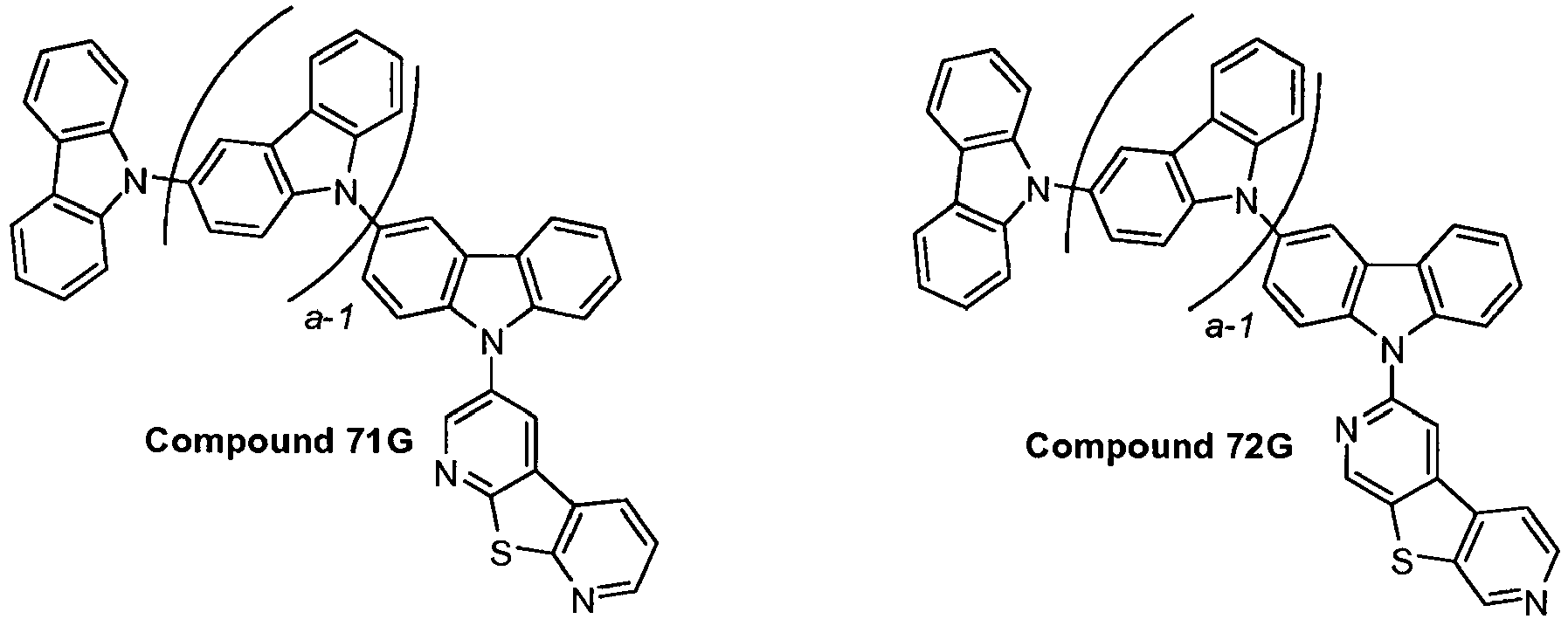

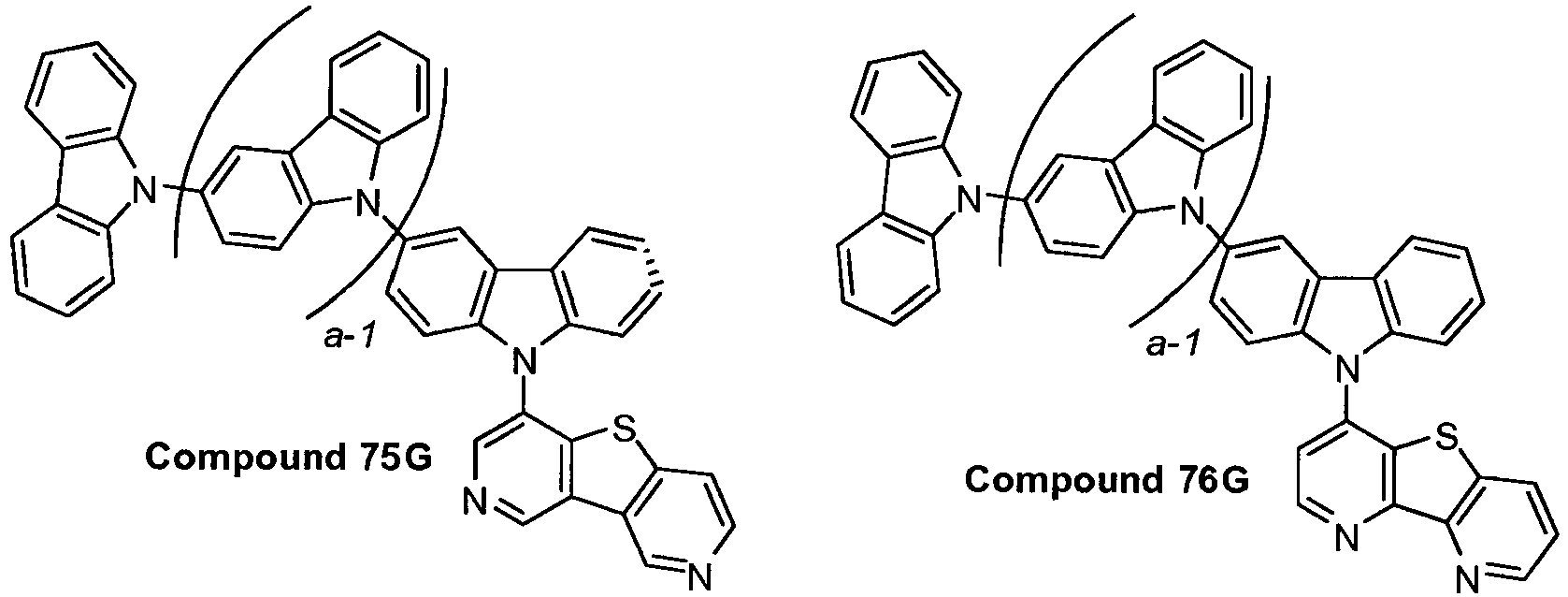


- The device of claim 7, wherein the first organic layer is an emissive layer and the carbazole-containing compound is a host in the first organic layer.
- The device of claim 7, wherein the device further comprises a second organic layer that is a non-emissive layer.
- The device of claim 10, wherein the first organic layer is adjacent to the second organic layer.
- The device of claim 7, wherein the device further comprises a phosphorescent emitter and the phosphorescent emitter the phosphorescent emitter is an iridium complex having the formula:

wherein R1a, R1b, R1c, R1d, R1e, R1f, R1g, R1h, and R1i are each, independently, H, hydrocarbyl, heteroatom substituted hydrocarbyl, cyano, fluoro, OR2a, SR2a, NR2aR2b, BR2aR2b, or SiR2aR2bR2c, wherein R2a-c are each, independently, hydrocarbyl or heteroatom substituted hydrocarbyl, and wherein any two of R1a-i and R2a-c may be linked to form a saturated or unsaturated, aromatic or non-aromatic ring; and wherein X-Y is an ancillary ligand. - The device of claim 7, wherein the device further comprises a phosphorescent emitter and the phosphorescent emitter is a compound comprising a phosphorescent metal complex comprising a monoanionic, bidentate ligand having the formula:
 wherein E1a-q are selected from the group consisting of C and N and collectively comprise an 18 pi-electron system; provided that E1a and E1p are different;wherein R1a-i are each, independently, H, hydrocarbyl, heteroatom substituted hydrocarbyl, cyano, fluoro, OR2a, SR2a, NR2aR2b, BR2a, R2b, or SiR2aR2bR2c, where R2a-c are each, independently, hydrocarbyl or heteroatom substituted hydrocarbyl, and where any two of R1a-i and R2a-c may be linked to form a saturated or unsaturated, aromatic or non-aromatic ring; provided that R1a-i is other than H when attached to N;wherein the metal is selected from the group consisting of the non-radioactive metals with atomic numbers greater than 40; andwherein the bidentate ligand may be linked with other ligands to comprise a tridentate, tetradentate, pentadentate or hexadentate ligand.
 - A consumer product comprising a device, the device further comprising:an anode;a cathode; andan organic layer, disposed between the anode and the cathode, the organic layer further comprising a carbazole-containing compound, comprising:
 wherein a is 1 to 20;wherein b is 0 to 20, provided that b is not 0;wherein m is 0 to 2;wherein n is 0 to 2;wherein m+n is at least 1;wherein X is selected from the group consisting of biphenyl, terphenyl, naphthalene, triphenylene, phenanthrene, fluorene, chrysene, dibenzothiophene, dibenzofuran, benzofuran, benzothiophene, pyrazole, imidazole, triazole, oxazole, thiazole, oxadiazole, oxatriazole, dioxazole, thiadiazole, pyridine, pyridazine, pyrimidine, pyrazine, triazine, indole, benzimidazole, indazole, benzoxazole, benzisoxazole, benzothiazole, quinoline, isoquinoline, cinnoline, quinazoline, quinoxaline, naphthyridine, phthalazine, pteridine, xanthene, phenothiazine, phenoxazine, benzofuropyridine, furodipyridine, benzothienopyridine, and thienodipyridine; andwherein X is substituted by R, where R is selected from the group consisting of hydrogen, alkyl, heteroalkyl, benzene, biphenyl, terphenyl, naphthalene, phenalene, phenanthrene, fluorene, chrysene, dibenzothiophene, dibenzofuran, benzofuran, benzothiophene, pyrazole, imidazole, triazole, oxazole, thiazole, oxadiazole, oxatriazole, dioxazole, thiadiazole, pyridine, pyridazine, pyrimidine, pyrazine, triazine, indole, benzimidazole, indazole, benzoxazole, benzisoxazole, benzothiazole, quinoline, isoquinoline, cinnoline, quinazoline, quinoxaline, naphthyridine, phthalazine, pteridine, xanthene, phenothiazine, phenoxazine, benzofuropyridine, furodipyridine, benzothienopyridine, and thienodipyridine.
 - A method of fabricating an organic light emitting device, comprising:providing a first electrode;co-depositing a host and a phosphorescent emitter to form an emissive layer;
wherein the emissive layer comprises an oligocarbazole-containing compound, comprising: wherein a is 1 to 20;wherein b is 0 to 20, provided that b is not 0;wherein m is 0 to 2;wherein n is 0 to 2;wherein m+n is at least 1;wherein X is selected from the group consisting of biphenyl, terphenyl, naphthalene, triphenylene, phenanthrene, fluorene, chrysene, dibenzothiophene, dibenzofuran, benzofuran, benzothiophene, pyrazole, imidazole, triazole, oxazole, thiazole, oxadiazole, oxatriazole, dioxazole, thiadiazole, pyridine, pyridazine, pyrimidine, pyrazine, triazine, indole, benzimidazole, indazole, benzoxazole, benzisoxazole, benzothiazole, quinoline, isoquinoline, cinnoline, quinazoline, quinoxaline, naphthyridine, phthalazine, pteridine, xanthene, phenothiazine, phenoxazine, benzofuropyridine, furodipyridine, benzothienopyridine, and thienodipyridine; andwherein X is substituted by R, where R is selected from the group consisting of hydrogen, alkyl, heteroalkyl, benzene, biphenyl, terphenyl, naphthalene, phenalene, phenanthrene, fluorene, chrysene, dibenzothiophene, dibenzofuran, benzofuran, benzothiophene, pyrazole, imidazole, triazole, oxazole, thiazole, oxadiazole, oxatriazole, dioxazole, thiadiazole, pyridine, pyridazine, pyrimidine, pyrazine, triazine, indole, benzimidazole, indazole, benzoxazole, benzisoxazole, benzothiazole, quinoline, isoquinoline, cinnoline, quinazoline, quinoxaline, naphthyridine, phthalazine, pteridine, xanthene, phenothiazine, phenoxazine, benzofuropyridine, furodipyridine, benzothienopyridine, and thienodipyridine; anddepositing a second electrode.
Applications Claiming Priority (5)
| Application Number | Priority Date | Filing Date | Title |
|---|---|---|---|
| US1739107P | 2007-12-28 | 2007-12-28 | |
| US1748007P | 2007-12-28 | 2007-12-28 | |
| US12/209,928 US20090153034A1 (en) | 2007-12-13 | 2008-09-12 | Carbazole-containing materials in phosphorescent light emittinig diodes |
| US12/275,894 US8221905B2 (en) | 2007-12-28 | 2008-11-21 | Carbazole-containing materials in phosphorescent light emitting diodes |
| PCT/US2008/087557 WO2009086028A2 (en) | 2007-12-28 | 2008-12-19 | Carbazole-containing materials in phosphorescent light emitting diodes |
Publications (3)
| Publication Number | Publication Date |
|---|---|
| EP2240446A2 EP2240446A2 (en) | 2010-10-20 |
| EP2240446B1 EP2240446B1 (en) | 2015-11-11 |
| EP2240446B2 true EP2240446B2 (en) | 2018-09-19 |
Family
ID=40750822
Family Applications (1)
| Application Number | Title | Priority Date | Filing Date |
|---|---|---|---|
| EP08866686.2A Active EP2240446B2 (en) | 2007-12-28 | 2008-12-19 | Carbazole-containing materials in phosphorescent light emitting diodes |
Country Status (7)
| Country | Link |
|---|---|
| US (1) | US8221905B2 (en) |
| EP (1) | EP2240446B2 (en) |
| JP (2) | JP5575661B2 (en) |
| KR (2) | KR101684205B1 (en) |
| CN (1) | CN101939296B (en) |
| TW (1) | TWI468392B (en) |
| WO (1) | WO2009086028A2 (en) |
Families Citing this family (881)
| Publication number | Priority date | Publication date | Assignee | Title |
|---|---|---|---|---|
| US9070884B2 (en) | 2005-04-13 | 2015-06-30 | Universal Display Corporation | Hybrid OLED having phosphorescent and fluorescent emitters |
| US8586204B2 (en) | 2007-12-28 | 2013-11-19 | Universal Display Corporation | Phosphorescent emitters and host materials with improved stability |
| US9051344B2 (en) | 2005-05-06 | 2015-06-09 | Universal Display Corporation | Stability OLED materials and devices |
| JP5324229B2 (en) | 2006-02-10 | 2013-10-23 | ユニバーサル ディスプレイ コーポレイション | Metal complexes of cyclometalated imidazo [1,2-f] phenanthridine and diimidazo [1,2-a: 1 ', 2'-c] quinazoline ligands and their isoelectronic and benzofused analogs |
| US9130177B2 (en) | 2011-01-13 | 2015-09-08 | Universal Display Corporation | 5-substituted 2 phenylquinoline complexes materials for light emitting diode |
| TWI573854B (en) | 2007-03-08 | 2017-03-11 | 環球展覽公司 | Phosphorescent materials |
| US20130032785A1 (en) | 2011-08-01 | 2013-02-07 | Universal Display Corporation | Materials for organic light emitting diode |
| CN101827834B (en) | 2007-08-08 | 2015-11-25 | 通用显示公司 | Benzo-fused thiophene or benzo-fused furan compounds containing benzo[9,10]phenanthrene |
| KR102342708B1 (en) | 2007-08-08 | 2021-12-22 | 유니버셜 디스플레이 코포레이션 | Single triphenylene chromophores in phosphorescent light emitting diodes |
| WO2009073245A1 (en) | 2007-12-06 | 2009-06-11 | Universal Display Corporation | Light-emitting organometallic complexes |
| US8221905B2 (en) * | 2007-12-28 | 2012-07-17 | Universal Display Corporation | Carbazole-containing materials in phosphorescent light emitting diodes |
| WO2009085344A2 (en) | 2007-12-28 | 2009-07-09 | Universal Display Corporation | Dibenzothiophene-containing materials in phosphorescent light emitting diodes |
| JP2010034528A (en) * | 2008-06-23 | 2010-02-12 | Sumitomo Chemical Co Ltd | Composition and light-emitting element using the same |
| WO2010027583A1 (en) | 2008-09-03 | 2010-03-11 | Universal Display Corporation | Phosphorescent materials |
| TWI555734B (en) | 2008-09-16 | 2016-11-01 | 環球展覽公司 | Phosphorescent substance |
| KR101678235B1 (en) | 2008-09-25 | 2016-11-21 | 유니버셜 디스플레이 코포레이션 | Organoselenium materials and their uses in organic light emitting devices |
| US8815415B2 (en) | 2008-12-12 | 2014-08-26 | Universal Display Corporation | Blue emitter with high efficiency based on imidazo[1,2-f] phenanthridine iridium complexes |
| US9067947B2 (en) * | 2009-01-16 | 2015-06-30 | Universal Display Corporation | Organic electroluminescent materials and devices |
| DE102009007038A1 (en) | 2009-02-02 | 2010-08-05 | Merck Patent Gmbh | metal complexes |
| US8722205B2 (en) | 2009-03-23 | 2014-05-13 | Universal Display Corporation | Heteroleptic iridium complex |
| US11910700B2 (en) | 2009-03-23 | 2024-02-20 | Universal Display Corporation | Heteroleptic iridium complexes as dopants |
| US8709615B2 (en) | 2011-07-28 | 2014-04-29 | Universal Display Corporation | Heteroleptic iridium complexes as dopants |
| TWI496772B (en) | 2009-04-28 | 2015-08-21 | Universal Display Corp | 铱-compound with methyl-D3 substitution |
| US8426850B2 (en) * | 2009-05-19 | 2013-04-23 | Heliatek Gmbh | Semiconducting component including 1-[3-aryl-isoindolyl-(1)-imino]-3-aryl-IH-isoindole |
| US8586203B2 (en) | 2009-05-20 | 2013-11-19 | Universal Display Corporation | Metal complexes with boron-nitrogen heterocycle containing ligands |
| CN105742515A (en) * | 2009-05-29 | 2016-07-06 | 株式会社半导体能源研究所 | Light-Emitting Element, Light-Emitting Device, Lighting Device, and Electronic Appliance |
| JP2011009205A (en) * | 2009-05-29 | 2011-01-13 | Semiconductor Energy Lab Co Ltd | Light emitting element, light emitting device, and method of manufacturing the same |
| DE102009041289A1 (en) | 2009-09-16 | 2011-03-17 | Merck Patent Gmbh | Organic electroluminescent device |
| JP5604848B2 (en) * | 2009-10-19 | 2014-10-15 | コニカミノルタ株式会社 | ORGANIC ELECTROLUMINESCENT ELEMENT MATERIAL, ORGANIC ELECTROLUMINESCENT ELEMENT, LIGHTING DEVICE AND DISPLAY DEVICE |
| KR101986469B1 (en) | 2009-10-28 | 2019-06-05 | 유디씨 아일랜드 리미티드 | Heteroleptic carbene complexes and the use thereof in organic electronics |
| CN102574883B (en) | 2009-11-02 | 2015-11-25 | 株式会社半导体能源研究所 | Organometallic complexes, light-emitting elements, display devices, electronic devices, and lighting devices |
| DE102009053382A1 (en) * | 2009-11-14 | 2011-05-19 | Merck Patent Gmbh | Materials for electronic devices |
| US8580394B2 (en) | 2009-11-19 | 2013-11-12 | Universal Display Corporation | 3-coordinate copper(I)-carbene complexes |
| EP2513125B1 (en) * | 2009-12-14 | 2014-10-29 | Basf Se | Metal complexes with diazabenzimidazolecarbene ligands and their use in oleds |
| JP5584702B2 (en) | 2009-12-28 | 2014-09-03 | 新日鉄住金化学株式会社 | Organic electroluminescence device |
| US8288187B2 (en) | 2010-01-20 | 2012-10-16 | Universal Display Corporation | Electroluminescent devices for lighting applications |
| US9156870B2 (en) | 2010-02-25 | 2015-10-13 | Universal Display Corporation | Phosphorescent emitters |
| US9175211B2 (en) | 2010-03-03 | 2015-11-03 | Universal Display Corporation | Phosphorescent materials |
| CN102823013B (en) | 2010-03-25 | 2016-08-03 | 通用显示公司 | The triarylamine hole injection material of the doping of solution-processible |
| US8691401B2 (en) | 2010-04-16 | 2014-04-08 | Basf Se | Bridged benzimidazole-carbene complexes and use thereof in OLEDS |
| US8968887B2 (en) | 2010-04-28 | 2015-03-03 | Universal Display Corporation | Triphenylene-benzofuran/benzothiophene/benzoselenophene compounds with substituents joining to form fused rings |
| JP5646733B2 (en) | 2010-04-28 | 2014-12-24 | ユニバーサル ディスプレイ コーポレイション | Premixed material deposition |
| KR20110122051A (en) | 2010-05-03 | 2011-11-09 | 제일모직주식회사 | Compound for organic photoelectric device and organic photoelectric device comprising same |
| US8993125B2 (en) | 2010-05-21 | 2015-03-31 | Semiconductor Energy Laboratory Co., Ltd. | Triazole derivative, and light-emitting element, light-emitting device, electronic device and lighting device using the triazole derivative |
| KR101244599B1 (en) | 2010-05-28 | 2013-03-25 | 주식회사 두산 | Bipolar triphenylene-based compound and organic electroluminescent device comprising the same |
| US8673458B2 (en) | 2010-06-11 | 2014-03-18 | Universal Display Corporation | Delayed fluorescence OLED |
| US8742657B2 (en) | 2010-06-11 | 2014-06-03 | Universal Display Corporation | Triplet-Triplet annihilation up conversion (TTA-UC) for display and lighting applications |
| US9273080B2 (en) | 2010-06-15 | 2016-03-01 | Merek Patent Gmbh | Metal complexes |
| US9142792B2 (en) | 2010-06-18 | 2015-09-22 | Basf Se | Organic electronic devices comprising a layer comprising at least one metal organic compound and at least one metal oxide |
| KR101957527B1 (en) * | 2010-06-24 | 2019-03-13 | 도레이 카부시키가이샤 | Light-emitting device material and light-emitting device |
| DE102010027316A1 (en) | 2010-07-16 | 2012-01-19 | Merck Patent Gmbh | metal complexes |
| DE102010027317A1 (en) | 2010-07-16 | 2012-01-19 | Merck Patent Gmbh | metal complexes |
| DE102010027319A1 (en) | 2010-07-16 | 2012-01-19 | Merck Patent Gmbh | metal complexes |
| WO2012016074A1 (en) | 2010-07-29 | 2012-02-02 | University Of Southern California | Co-deposition methods for the fabrication of organic optoelectronic devices |
| JP5770289B2 (en) | 2010-08-20 | 2015-08-26 | ユニバーサル ディスプレイ コーポレイション | Bicarbazole compounds for OLED |
| JP5815341B2 (en) | 2010-09-09 | 2015-11-17 | 株式会社半導体エネルギー研究所 | Heterocyclic compounds |
| KR101886613B1 (en) | 2010-09-10 | 2018-08-09 | 가부시키가이샤 한도오따이 에네루기 켄큐쇼 | Light-emitting element and electronic device |
| JP5623996B2 (en) | 2010-09-21 | 2014-11-12 | 株式会社半導体エネルギー研究所 | Carbazole derivatives |
| WO2012046560A1 (en) | 2010-10-04 | 2012-04-12 | Semiconductor Energy Laboratory Co., Ltd. | Composite material, light-emitting element, light-emitting device, electronic device, and lighting device |
| US8932734B2 (en) * | 2010-10-08 | 2015-01-13 | Universal Display Corporation | Organic electroluminescent materials and devices |
| KR101950363B1 (en) | 2010-10-29 | 2019-02-20 | 가부시키가이샤 한도오따이 에네루기 켄큐쇼 | Phenanthrene compound, light-emitting element, light-emitting device, electronic device, and lighting device |
| US20120138906A1 (en) | 2010-12-07 | 2012-06-07 | The University of Southern California USC Stevens Institute for Innovation | Capture agents for unsaturated metal complexes |
| CN103262283B (en) * | 2010-12-09 | 2016-01-20 | 新日铁住金化学株式会社 | Organic electroluminescent device |
| DE102011106849A1 (en) | 2010-12-15 | 2012-06-21 | Merck Patent Gmbh | Process for the synthesis of N-N linked and around the N-N bond of rotation-inhibited bis-N-heterocyclic carbenes and their use as ligands for metal complexes |
| US9705091B2 (en) | 2010-12-20 | 2017-07-11 | Idemitsu Kosan Co., Ltd. | Aromatic heterocycle derivative and organic electroluminescent element using same |
| WO2012090967A1 (en) | 2010-12-28 | 2012-07-05 | 出光興産株式会社 | Material for organic electroluminescent elements, and organic electroluminescent element using same |
| US10008677B2 (en) | 2011-01-13 | 2018-06-26 | Universal Display Corporation | Materials for organic light emitting diode |
| US8415031B2 (en) * | 2011-01-24 | 2013-04-09 | Universal Display Corporation | Electron transporting compounds |
| US9056856B2 (en) | 2011-02-01 | 2015-06-16 | Semiconductor Energy Laboratory Co., Ltd. | Heterocyclic compound |
| JP5652235B2 (en) * | 2011-02-10 | 2015-01-14 | コニカミノルタ株式会社 | Organic electroluminescence element, display device and lighting device |
| US9005772B2 (en) | 2011-02-23 | 2015-04-14 | Universal Display Corporation | Thioazole and oxazole carbene metal complexes as phosphorescent OLED materials |
| US8563737B2 (en) | 2011-02-23 | 2013-10-22 | Universal Display Corporation | Methods of making bis-tridentate carbene complexes of ruthenium and osmium |
| CN103476781B (en) | 2011-02-23 | 2017-02-15 | 通用显示公司 | Novel tetradentate platinum complexes |
| US8883322B2 (en) | 2011-03-08 | 2014-11-11 | Universal Display Corporation | Pyridyl carbene phosphorescent emitters |
| US9287512B2 (en) | 2011-03-08 | 2016-03-15 | Rohm And Haas Electronic Materials Korea Ltd. | Organic electroluminescent compounds, layers and organic electroluminescent device using the same |
| EP2503618B1 (en) | 2011-03-23 | 2014-01-01 | Semiconductor Energy Laboratory Co., Ltd. | Composite material, light-emitting element, light-emitting device, electronic device, and lighting device |
| CN103459403B (en) | 2011-04-04 | 2016-08-17 | 默克专利有限公司 | Metal complex |
| US8580399B2 (en) | 2011-04-08 | 2013-11-12 | Universal Display Corporation | Substituted oligoazacarbazoles for light emitting diodes |
| US9269908B2 (en) * | 2011-04-21 | 2016-02-23 | Nano And Advanced Materials Institute Limited | Bipolar compound as a host material for organic light emitting diodes |
| WO2012149992A1 (en) | 2011-05-04 | 2012-11-08 | Merck Patent Gmbh | Device for preserving fresh goods |
| US8927308B2 (en) | 2011-05-12 | 2015-01-06 | Universal Display Corporation | Method of forming bus line designs for large-area OLED lighting |
| US8432095B2 (en) | 2011-05-11 | 2013-04-30 | Universal Display Corporation | Process for fabricating metal bus lines for OLED lighting panels |
| DE102012007810A1 (en) | 2011-05-16 | 2012-11-22 | Merck Patent Gmbh | Electronic device, preferably organic electroluminescent device comprises a transition metal compound exhibiting a transition metal-tin bond |
| US8795850B2 (en) | 2011-05-19 | 2014-08-05 | Universal Display Corporation | Phosphorescent heteroleptic phenylbenzimidazole dopants and new synthetic methodology |
| US9212197B2 (en) | 2011-05-19 | 2015-12-15 | Universal Display Corporation | Phosphorescent heteroleptic phenylbenzimidazole dopants |
| US10079349B2 (en) | 2011-05-27 | 2018-09-18 | Universal Display Corporation | Organic electroluminescent materials and devices |
| US10158089B2 (en) | 2011-05-27 | 2018-12-18 | Universal Display Corporation | Organic electroluminescent materials and devices |
| KR20120132962A (en) * | 2011-05-30 | 2012-12-10 | 롬엔드하스전자재료코리아유한회사 | Novel compounds for organic electronic material and organic electroluminescence device using the same |
| EP2714704B1 (en) | 2011-06-03 | 2015-04-29 | Merck Patent GmbH | Metal complexes |
| WO2012170461A1 (en) | 2011-06-08 | 2012-12-13 | Universal Display Corporation | Heteroleptic iridium carbene complexes and light emitting device using them |
| KR20120136618A (en) * | 2011-06-09 | 2012-12-20 | 롬엔드하스전자재료코리아유한회사 | Novel compounds for organic electronic material and organic electroluminescence device using the same |
| KR101950460B1 (en) | 2011-06-14 | 2019-02-20 | 유디씨 아일랜드 리미티드 | Metal complexes comprising azabenzimidazole carbene ligands and the use thereof in oleds |
| US9315724B2 (en) | 2011-06-14 | 2016-04-19 | Basf Se | Metal complexes comprising azabenzimidazole carbene ligands and the use thereof in OLEDs |
| US8659036B2 (en) | 2011-06-17 | 2014-02-25 | Universal Display Corporation | Fine tuning of emission spectra by combination of multiple emitter spectra |
| US8884316B2 (en) | 2011-06-17 | 2014-11-11 | Universal Display Corporation | Non-common capping layer on an organic device |
| WO2013000531A1 (en) | 2011-06-28 | 2013-01-03 | Merck Patent Gmbh | Metal complexes |
| US9309223B2 (en) | 2011-07-08 | 2016-04-12 | Semiconductor Energy Laboratory Co., Ltd. | Heterocyclic compound, light-emitting element, light-emitting device, electronic device, and lighting device |
| WO2013009708A1 (en) | 2011-07-14 | 2013-01-17 | Universal Display Corporation | Inorganic hosts in oleds |
| US9397310B2 (en) | 2011-07-14 | 2016-07-19 | Universal Display Corporation | Organice electroluminescent materials and devices |
| US9023420B2 (en) | 2011-07-14 | 2015-05-05 | Universal Display Corporation | Composite organic/inorganic layer for organic light-emitting devices |
| US9783564B2 (en) | 2011-07-25 | 2017-10-10 | Universal Display Corporation | Organic electroluminescent materials and devices |
| US8926119B2 (en) | 2011-08-04 | 2015-01-06 | Universal Display Corporation | Extendable light source with variable light emitting area |
| EP2742054B1 (en) | 2011-08-10 | 2016-10-12 | Merck Patent GmbH | Metal complexes |
| JP6002503B2 (en) * | 2011-08-18 | 2016-10-05 | 株式会社半導体エネルギー研究所 | Carbazole compounds |
| DE102012016192A1 (en) | 2011-08-19 | 2013-02-21 | Merck Patent Gmbh | New compounds capable of forming hydrogen bonds are useful in electronic device, e.g. organic electroluminescent device, organic light-emitting transistor and organic light-emitting electrochemical cell |
| CN103765623B (en) | 2011-08-22 | 2016-06-01 | 默克专利有限公司 | Organic electroluminescence device |
| US9493698B2 (en) | 2011-08-31 | 2016-11-15 | Universal Display Corporation | Organic electroluminescent materials and devices |
| EP2757607B1 (en) | 2011-09-12 | 2016-02-10 | Nippon Steel & Sumikin Chemical Co., Ltd. | Organic electroluminescent element |
| CN103907217B (en) * | 2011-09-12 | 2016-10-12 | 新日铁住金化学株式会社 | Organic electroluminescent device |
| US10128456B2 (en) | 2011-10-26 | 2018-11-13 | Idemitsu Kosan Co., Ltd. | Organic electroluminescence element, and material for organic electroluminescence element |
| US8652656B2 (en) | 2011-11-14 | 2014-02-18 | Universal Display Corporation | Triphenylene silane hosts |
| US9193745B2 (en) | 2011-11-15 | 2015-11-24 | Universal Display Corporation | Heteroleptic iridium complex |
| US9217004B2 (en) | 2011-11-21 | 2015-12-22 | Universal Display Corporation | Organic light emitting materials |
| US9512355B2 (en) | 2011-12-09 | 2016-12-06 | Universal Display Corporation | Organic light emitting materials |
| US20130146875A1 (en) | 2011-12-13 | 2013-06-13 | Universal Display Corporation | Split electrode for organic devices |
| KR101507003B1 (en) * | 2011-12-29 | 2015-03-30 | 제일모직 주식회사 | Compound for organic optoelectronic device, organic light emitting diode including the same and display including the organic light emitting diode |
| US9461254B2 (en) | 2012-01-03 | 2016-10-04 | Universal Display Corporation | Organic electroluminescent materials and devices |
| US8987451B2 (en) | 2012-01-03 | 2015-03-24 | Universal Display Corporation | Synthesis of cyclometallated platinum(II) complexes |
| US9163174B2 (en) | 2012-01-04 | 2015-10-20 | Universal Display Corporation | Highly efficient phosphorescent materials |
| TWI475092B (en) * | 2012-01-05 | 2015-03-01 | E Ray Optoelectronics Tech Co | Carbazole derivative and organic electroluminescent device thereof and manufacturing method thereof |
| KR102012047B1 (en) | 2012-01-06 | 2019-08-19 | 유니버셜 디스플레이 코포레이션 | Highly efficient phosphorescent materials |
| US8969592B2 (en) | 2012-01-10 | 2015-03-03 | Universal Display Corporation | Heterocyclic host materials |
| US10211413B2 (en) | 2012-01-17 | 2019-02-19 | Universal Display Corporation | Organic electroluminescent materials and devices |
| JP6081210B2 (en) * | 2012-02-10 | 2017-02-15 | ケミプロ化成株式会社 | Compound exhibiting exciplex emission in a single molecule |
| US9118017B2 (en) | 2012-02-27 | 2015-08-25 | Universal Display Corporation | Host compounds for red phosphorescent OLEDs |
| US9386657B2 (en) | 2012-03-15 | 2016-07-05 | Universal Display Corporation | Organic Electroluminescent materials and devices |
| US9054323B2 (en) * | 2012-03-15 | 2015-06-09 | Universal Display Corporation | Secondary hole transporting layer with diarylamino-phenyl-carbazole compounds |
| TWI585091B (en) * | 2012-03-30 | 2017-06-01 | 新日鐵住金化學股份有限公司 | Organic electroluminescent elements |
| KR20140096182A (en) * | 2012-05-02 | 2014-08-04 | 롬엔드하스전자재료코리아유한회사 | Novel Organic Electroluminescence Compounds and Organic Electroluminescence Device Containing the Same |
| US9184399B2 (en) | 2012-05-04 | 2015-11-10 | Universal Display Corporation | Asymmetric hosts with triaryl silane side chains |
| US9773985B2 (en) | 2012-05-21 | 2017-09-26 | Universal Display Corporation | Organic electroluminescent materials and devices |
| JP5182441B1 (en) * | 2012-05-24 | 2013-04-17 | 三菱化学株式会社 | Organic electroluminescent device, organic electroluminescent lighting device and organic electroluminescent display device |
| US9670404B2 (en) | 2012-06-06 | 2017-06-06 | Universal Display Corporation | Organic electroluminescent materials and devices |
| US9502672B2 (en) | 2012-06-21 | 2016-11-22 | Universal Display Corporation | Organic electroluminescent materials and devices |
| US9725476B2 (en) | 2012-07-09 | 2017-08-08 | Universal Display Corporation | Silylated metal complexes |
| US9231218B2 (en) | 2012-07-10 | 2016-01-05 | Universal Display Corporation | Phosphorescent emitters containing dibenzo[1,4]azaborinine structure |
| CN104487432B (en) | 2012-07-13 | 2018-06-12 | 株式会社Lg化学 | Heterocyclic compounds and organic electronic devices containing them |
| CN104428392B (en) | 2012-07-13 | 2017-05-31 | 默克专利有限公司 | metal complex |
| US9059412B2 (en) | 2012-07-19 | 2015-06-16 | Universal Display Corporation | Transition metal complexes containing substituted imidazole carbene as ligands and their application in OLEDs |
| KR102034916B1 (en) | 2012-07-19 | 2019-10-21 | 유디씨 아일랜드 리미티드 | Dinuclear metal complexes comprising carbene ligands and the use thereof in oleds |
| US9540329B2 (en) | 2012-07-19 | 2017-01-10 | Universal Display Corporation | Organic electroluminescent materials and devices |
| US9663544B2 (en) | 2012-07-25 | 2017-05-30 | Universal Display Corporation | Organic electroluminescent materials and devices |
| US9318710B2 (en) | 2012-07-30 | 2016-04-19 | Universal Display Corporation | Organic electroluminescent materials and devices |
| WO2014023377A2 (en) | 2012-08-07 | 2014-02-13 | Merck Patent Gmbh | Metal complexes |
| WO2014025231A2 (en) * | 2012-08-10 | 2014-02-13 | 주식회사 엘엠에스 | Novel compound, light-emitting element comprising same and electronic device comprising the light-emitting element |
| US10522764B2 (en) | 2012-08-10 | 2019-12-31 | Lms Co., Ltd. | Compound, light-emitting element comprising same and electronic device comprising the light-emitting element |
| WO2014030666A1 (en) | 2012-08-24 | 2014-02-27 | コニカミノルタ株式会社 | Transparent electrode, electronic device, and method for manufacturing transparent electrode |
| US9978958B2 (en) | 2012-08-24 | 2018-05-22 | Universal Display Corporation | Phosphorescent emitters with phenylimidazole ligands |
| US8952362B2 (en) | 2012-08-31 | 2015-02-10 | The Regents Of The University Of Michigan | High efficiency and brightness fluorescent organic light emitting diode by triplet-triplet fusion |
| US10957870B2 (en) | 2012-09-07 | 2021-03-23 | Universal Display Corporation | Organic light emitting device |
| US20150214491A1 (en) * | 2012-09-07 | 2015-07-30 | Idemitsu Kosan Co., Ltd. | Novel aromatic heterocyclic derivative, organic electroluminescent element material, organic electroluminescent element material solution, and organic electroluminescent element |
| CN113943306A (en) | 2012-09-20 | 2022-01-18 | Udc 爱尔兰有限责任公司 | Azadibenzofurans for electronic applications and electronic devices comprising same |
| WO2014044347A1 (en) | 2012-09-20 | 2014-03-27 | Merck Patent Gmbh | Metal complexes |
| KR101390362B1 (en) * | 2012-09-21 | 2014-04-30 | 주식회사 엘엠에스 | Novel compound, light-emitting device including the compound and electronic device |
| US9287513B2 (en) | 2012-09-24 | 2016-03-15 | Universal Display Corporation | Organic electroluminescent materials and devices |
| US9312505B2 (en) | 2012-09-25 | 2016-04-12 | Universal Display Corporation | Organic electroluminescent materials and devices |
| JP6194645B2 (en) * | 2012-09-27 | 2017-09-13 | 東ソー株式会社 | Amine compounds and uses thereof |
| US9252363B2 (en) | 2012-10-04 | 2016-02-02 | Universal Display Corporation | Aryloxyalkylcarboxylate solvent compositions for inkjet printing of organic layers |
| DE102012020167A1 (en) | 2012-10-13 | 2014-04-17 | Eberhard Karls Universität Tübingen | metal complexes |
| DE102012021650A1 (en) | 2012-11-03 | 2014-05-08 | Eberhard Karls Universität Tübingen | metal complexes |
| US8692241B1 (en) | 2012-11-08 | 2014-04-08 | Universal Display Corporation | Transition metal complexes containing triazole and tetrazole carbene ligands |
| US9748500B2 (en) | 2015-01-15 | 2017-08-29 | Universal Display Corporation | Organic light emitting materials |
| US9685617B2 (en) | 2012-11-09 | 2017-06-20 | Universal Display Corporation | Organic electronuminescent materials and devices |
| US9634264B2 (en) | 2012-11-09 | 2017-04-25 | Universal Display Corporation | Organic electroluminescent materials and devices |
| US8946697B1 (en) | 2012-11-09 | 2015-02-03 | Universal Display Corporation | Iridium complexes with aza-benzo fused ligands |
| US20140131665A1 (en) * | 2012-11-12 | 2014-05-15 | Universal Display Corporation | Organic Electroluminescent Device With Delayed Fluorescence |
| CN104756273B (en) | 2012-11-20 | 2017-10-24 | 默克专利有限公司 | The preparation in high-purity solvent for manufacturing electronic device |
| US10069090B2 (en) | 2012-11-20 | 2018-09-04 | Universal Display Corporation | Organic electroluminescent materials and devices |
| US9190623B2 (en) | 2012-11-20 | 2015-11-17 | Universal Display Corporation | Organic electroluminescent materials and devices |
| US9512136B2 (en) | 2012-11-26 | 2016-12-06 | Universal Display Corporation | Organic electroluminescent materials and devices |
| US9166175B2 (en) | 2012-11-27 | 2015-10-20 | Universal Display Corporation | Organic electroluminescent materials and devices |
| US9196860B2 (en) | 2012-12-04 | 2015-11-24 | Universal Display Corporation | Compounds for triplet-triplet annihilation upconversion |
| US8716484B1 (en) | 2012-12-05 | 2014-05-06 | Universal Display Corporation | Hole transporting materials with twisted aryl groups |
| US9209411B2 (en) | 2012-12-07 | 2015-12-08 | Universal Display Corporation | Organic electroluminescent materials and devices |
| US9653691B2 (en) | 2012-12-12 | 2017-05-16 | Universal Display Corporation | Phosphorescence-sensitizing fluorescence material system |
| KR102160720B1 (en) | 2012-12-17 | 2020-09-28 | 닛테츠 케미컬 앤드 머티리얼 가부시키가이샤 | Organic electrical field light-emitting element |
| JP6275378B2 (en) * | 2012-12-26 | 2018-02-07 | エヌ・イーケムキャット株式会社 | Process for producing carbazoles and carbazoles produced by this process. |
| JP5911418B2 (en) | 2012-12-27 | 2016-04-27 | キヤノン株式会社 | Organic light emitting device |
| KR20140086880A (en) * | 2012-12-28 | 2014-07-08 | 주식회사 동진쎄미켐 | Novel organic compound and organic electroluminescent device comprising same |
| US10400163B2 (en) | 2013-02-08 | 2019-09-03 | Universal Display Corporation | Organic electroluminescent materials and devices |
| US10367154B2 (en) | 2013-02-21 | 2019-07-30 | Universal Display Corporation | Organic electroluminescent materials and devices |
| KR102050484B1 (en) | 2013-03-04 | 2019-12-02 | 삼성디스플레이 주식회사 | Anthracene derivatives and organic light emitting diodes comprising the derivatives |
| US8927749B2 (en) | 2013-03-07 | 2015-01-06 | Universal Display Corporation | Organic electroluminescent materials and devices |
| US9419225B2 (en) | 2013-03-14 | 2016-08-16 | Universal Display Corporation | Organic electroluminescent materials and devices |
| US10374172B2 (en) | 2013-03-20 | 2019-08-06 | Udc Ireland Limited | Azabenzimidazole carbene complexes as efficiency booster in OLEDs |
| CN109616572B (en) * | 2013-03-26 | 2023-01-17 | 株式会社半导体能源研究所 | light emitting device |
| US9997712B2 (en) | 2013-03-27 | 2018-06-12 | Universal Display Corporation | Organic electroluminescent materials and devices |
| JP2014196252A (en) * | 2013-03-29 | 2014-10-16 | 出光興産株式会社 | Hetero-arene derivative, organic electroluminescence element material, and organic electroluminescence element |
| JP6314599B2 (en) | 2013-03-29 | 2018-04-25 | コニカミノルタ株式会社 | COMPOUND FOR ORGANIC ELECTROLUMINESCENCE, ORGANIC ELECTROLUMINESCENCE ELEMENT, LIGHTING DEVICE AND DISPLAY DEVICE HAVING THE SAME |
| US20160043334A1 (en) | 2013-03-29 | 2016-02-11 | Konica Minolta, Inc. | Material for organic electroluminescent elements, organic electroluminescent element, display device and lighting device |
| KR101598661B1 (en) | 2013-04-24 | 2016-02-29 | 주식회사 엘지화학 | Novel compound, preparation method thereof and organic light-emitting diode using the same |
| US10128448B2 (en) | 2013-04-29 | 2018-11-13 | Udc Ireland Limited | Transition metal complexes with carbene ligands and the use thereof in OLEDs |
| US20140332777A1 (en) * | 2013-05-09 | 2014-11-13 | Electronics And Telecommunications Research Institute | Phosphorescent host material and organic light-emitting device including the same |
| KR102107106B1 (en) | 2013-05-09 | 2020-05-07 | 삼성디스플레이 주식회사 | Styryl-based compound and organic light emitting diode comprising the same |
| US9537106B2 (en) | 2013-05-09 | 2017-01-03 | Universal Display Corporation | Organic electroluminescent materials and devices |
| DE102013008189A1 (en) | 2013-05-14 | 2014-12-04 | Eberhard Karls Universität Tübingen | metal complexes |
| US10439156B2 (en) | 2013-05-17 | 2019-10-08 | Semiconductor Energy Laboratory Co., Ltd. | Light-emitting element, light-emitting device, display device, lighting device, and electronic device |
| US9735373B2 (en) | 2013-06-10 | 2017-08-15 | Universal Display Corporation | Organic electroluminescent materials and devices |
| US9673401B2 (en) | 2013-06-28 | 2017-06-06 | Universal Display Corporation | Organic electroluminescent materials and devices |
| US10199581B2 (en) | 2013-07-01 | 2019-02-05 | Universal Display Corporation | Organic electroluminescent materials and devices |
| KR102269131B1 (en) | 2013-07-01 | 2021-06-25 | 삼성디스플레이 주식회사 | Compound and organic light emitting device comprising same |
| KR102464739B1 (en) | 2013-07-02 | 2022-11-09 | 유디씨 아일랜드 리미티드 | Monosubstituted diazabenzimidazole carbene metal complexes for use in organic light emitting diodes |
| US10121975B2 (en) | 2013-07-03 | 2018-11-06 | Universal Display Corporation | Organic electroluminescent materials and devices |
| US9761807B2 (en) | 2013-07-15 | 2017-09-12 | Universal Display Corporation | Organic light emitting diode materials |
| US9553274B2 (en) | 2013-07-16 | 2017-01-24 | Universal Display Corporation | Organic electroluminescent materials and devices |
| US9324949B2 (en) | 2013-07-16 | 2016-04-26 | Universal Display Corporation | Organic electroluminescent materials and devices |
| US9224958B2 (en) | 2013-07-19 | 2015-12-29 | Universal Display Corporation | Organic electroluminescent materials and devices |
| KR101576562B1 (en) * | 2013-07-19 | 2015-12-10 | 주식회사 두산 | Organic light emitting compound and organic electroluminescent device using the same |
| US20150028290A1 (en) | 2013-07-25 | 2015-01-29 | Universal Display Corporation | Heteroleptic osmium complex and method of making the same |
| EP3239161A1 (en) | 2013-07-31 | 2017-11-01 | UDC Ireland Limited | Luminescent diazabenzimidazole carbene metal complexes |
| KR101686078B1 (en) * | 2013-08-12 | 2016-12-13 | 제일모직 주식회사 | Composition and organic optoelectric device and display device |
| US10074806B2 (en) | 2013-08-20 | 2018-09-11 | Universal Display Corporation | Organic electroluminescent materials and devices |
| US9831437B2 (en) | 2013-08-20 | 2017-11-28 | Universal Display Corporation | Organic electroluminescent materials and devices |
| US9932359B2 (en) | 2013-08-30 | 2018-04-03 | University Of Southern California | Organic electroluminescent materials and devices |
| US10199582B2 (en) | 2013-09-03 | 2019-02-05 | University Of Southern California | Organic electroluminescent materials and devices |
| US9735378B2 (en) | 2013-09-09 | 2017-08-15 | Universal Display Corporation | Organic electroluminescent materials and devices |
| US9748503B2 (en) | 2013-09-13 | 2017-08-29 | Universal Display Corporation | Organic electroluminescent materials and devices |
| US10003034B2 (en) | 2013-09-30 | 2018-06-19 | Universal Display Corporation | Organic electroluminescent materials and devices |
| KR102310370B1 (en) | 2013-10-02 | 2021-10-07 | 메르크 파텐트 게엠베하 | Boron-containing compounds for use in oleds |
| US9831447B2 (en) | 2013-10-08 | 2017-11-28 | Universal Display Corporation | Organic electroluminescent materials and devices |
| US9293712B2 (en) | 2013-10-11 | 2016-03-22 | Universal Display Corporation | Disubstituted pyrene compounds with amino group containing ortho aryl group and devices containing the same |
| US9853229B2 (en) | 2013-10-23 | 2017-12-26 | University Of Southern California | Organic electroluminescent materials and devices |
| US20150115250A1 (en) | 2013-10-29 | 2015-04-30 | Universal Display Corporation | Organic electroluminescent materials and devices |
| WO2015063046A1 (en) | 2013-10-31 | 2015-05-07 | Basf Se | Azadibenzothiophenes for electronic applications |
| KR20150052449A (en) | 2013-11-05 | 2015-05-14 | 삼성디스플레이 주식회사 | Organic light emitting device |
| US9306179B2 (en) | 2013-11-08 | 2016-04-05 | Universal Display Corporation | Organic electroluminescent materials and devices |
| US9647218B2 (en) | 2013-11-14 | 2017-05-09 | Universal Display Corporation | Organic electroluminescent materials and devices |
| US10033000B2 (en) | 2013-11-15 | 2018-07-24 | Universal Display Corporation | Organic electroluminescent materials and devices |
| US10056565B2 (en) | 2013-11-20 | 2018-08-21 | Universal Display Corporation | Organic electroluminescent materials and devices |
| US10644251B2 (en) | 2013-12-04 | 2020-05-05 | Universal Display Corporation | Organic electroluminescent materials and devices |
| US9876173B2 (en) * | 2013-12-09 | 2018-01-23 | Universal Display Corporation | Organic electroluminescent materials and devices |
| US10062850B2 (en) | 2013-12-12 | 2018-08-28 | Samsung Display Co., Ltd. | Amine-based compounds and organic light-emitting devices comprising the same |
| US10355227B2 (en) | 2013-12-16 | 2019-07-16 | Universal Display Corporation | Metal complex for phosphorescent OLED |
| KR20160092984A (en) * | 2013-12-18 | 2016-08-05 | 이데미쓰 고산 가부시키가이샤 | Compound, material for organic electroluminescent elements, ink composition, organic electroluminescent element and electronic device |
| KR20250006321A (en) | 2013-12-19 | 2025-01-10 | 메르크 파텐트 게엠베하 | Heterocyclic spiro compounds |
| KR20160100961A (en) | 2013-12-20 | 2016-08-24 | 바스프 에스이 | Highly efficient oled devices with very short decay times |
| US9847496B2 (en) | 2013-12-23 | 2017-12-19 | Universal Display Corporation | Organic electroluminescent materials and devices |
| US10135008B2 (en) | 2014-01-07 | 2018-11-20 | Universal Display Corporation | Organic electroluminescent materials and devices |
| US9978961B2 (en) | 2014-01-08 | 2018-05-22 | Universal Display Corporation | Organic electroluminescent materials and devices |
| US9755159B2 (en) | 2014-01-23 | 2017-09-05 | Universal Display Corporation | Organic materials for OLEDs |
| US9935277B2 (en) | 2014-01-30 | 2018-04-03 | Universal Display Corporation | Organic electroluminescent materials and devices |
| US9590194B2 (en) | 2014-02-14 | 2017-03-07 | Universal Display Corporation | Organic electroluminescent materials and devices |
| US10003033B2 (en) | 2014-02-18 | 2018-06-19 | Universal Display Corporation | Organic electroluminescent materials and devices |
| US9847497B2 (en) | 2014-02-18 | 2017-12-19 | Universal Display Corporation | Organic electroluminescent materials and devices |
| US10707423B2 (en) | 2014-02-21 | 2020-07-07 | Universal Display Corporation | Organic electroluminescent materials and devices |
| US9647217B2 (en) | 2014-02-24 | 2017-05-09 | Universal Display Corporation | Organic electroluminescent materials and devices |
| US9502656B2 (en) | 2014-02-24 | 2016-11-22 | Universal Display Corporation | Organic electroluminescent materials and devices |
| US10403825B2 (en) | 2014-02-27 | 2019-09-03 | Universal Display Corporation | Organic electroluminescent materials and devices |
| US9181270B2 (en) | 2014-02-28 | 2015-11-10 | Universal Display Corporation | Method of making sulfide compounds |
| US9590195B2 (en) | 2014-02-28 | 2017-03-07 | Universal Display Corporation | Organic electroluminescent materials and devices |
| US9673407B2 (en) | 2014-02-28 | 2017-06-06 | Universal Display Corporation | Organic electroluminescent materials and devices |
| US9190620B2 (en) | 2014-03-01 | 2015-11-17 | Universal Display Corporation | Organic electroluminescent materials and devices |
| US9397309B2 (en) | 2014-03-13 | 2016-07-19 | Universal Display Corporation | Organic electroluminescent devices |
| JP5776808B2 (en) * | 2014-03-13 | 2015-09-09 | コニカミノルタ株式会社 | ORGANIC ELECTROLUMINESCENT ELEMENT MATERIAL, ORGANIC ELECTROLUMINESCENT ELEMENT, LIGHTING DEVICE AND DISPLAY DEVICE |
| US10208026B2 (en) | 2014-03-18 | 2019-02-19 | Universal Display Corporation | Organic electroluminescent materials and devices |
| US9748504B2 (en) | 2014-03-25 | 2017-08-29 | Universal Display Corporation | Organic electroluminescent materials and devices |
| CN106661068A (en) | 2014-03-31 | 2017-05-10 | Udc 爱尔兰有限责任公司 | Metal complexes comprising carbene ligands with o-substituted acyclometallated aryl groups and their use in organic light-emitting diodes |
| US9929353B2 (en) | 2014-04-02 | 2018-03-27 | Universal Display Corporation | Organic electroluminescent materials and devices |
| US9691993B2 (en) | 2014-04-09 | 2017-06-27 | Universal Display Corporation | Organic electroluminescent materials and devices |
| US10008679B2 (en) | 2014-04-14 | 2018-06-26 | Universal Display Corporation | Organic electroluminescent materials and devices |
| US9905785B2 (en) | 2014-04-14 | 2018-02-27 | Universal Display Corporation | Organic electroluminescent materials and devices |
| US10256427B2 (en) | 2014-04-15 | 2019-04-09 | Universal Display Corporation | Efficient organic electroluminescent devices |
| US9450198B2 (en) | 2014-04-15 | 2016-09-20 | Universal Display Corporation | Organic electroluminescent materials and devices |
| US9741941B2 (en) | 2014-04-29 | 2017-08-22 | Universal Display Corporation | Organic electroluminescent materials and devices |
| US10457699B2 (en) | 2014-05-02 | 2019-10-29 | Universal Display Corporation | Organic electroluminescent materials and devices |
| US10403830B2 (en) | 2014-05-08 | 2019-09-03 | Universal Display Corporation | Organic electroluminescent materials and devices |
| US10636983B2 (en) | 2014-05-08 | 2020-04-28 | Universal Display Corporation | Organic electroluminescent materials and devices |
| CN111454297A (en) | 2014-05-08 | 2020-07-28 | 环球展览公司 | Stable imidazophenanthridine material |
| US10301338B2 (en) | 2014-05-08 | 2019-05-28 | Universal Display Corporation | Organic electroluminescent materials and devices |
| WO2015175678A1 (en) * | 2014-05-14 | 2015-11-19 | President And Fellows Of Harvard College | Organic light-emitting diode materials |
| KR20150132795A (en) | 2014-05-16 | 2015-11-26 | 삼성디스플레이 주식회사 | Organic light emitting device |
| US9997716B2 (en) | 2014-05-27 | 2018-06-12 | Universal Display Corporation | Organic electroluminescent materials and devices |
| KR101561566B1 (en) | 2014-05-28 | 2015-10-27 | 덕산네오룩스 주식회사 | Compound for organic electronic element, organic electronic element using the same, and an electronic device thereof |
| US10461260B2 (en) | 2014-06-03 | 2019-10-29 | Universal Display Corporation | Organic electroluminescent materials and devices |
| KR102327086B1 (en) | 2014-06-11 | 2021-11-17 | 삼성디스플레이 주식회사 | Organic light-emitting devices |
| DE102015006708A1 (en) | 2014-06-12 | 2015-12-17 | Merck Patent Gmbh | metal complexes |
| US9911931B2 (en) | 2014-06-26 | 2018-03-06 | Universal Display Corporation | Organic electroluminescent materials and devices |
| US10297762B2 (en) | 2014-07-09 | 2019-05-21 | Universal Display Corporation | Organic electroluminescent materials and devices |
| US10566546B2 (en) | 2014-07-14 | 2020-02-18 | Universal Display Corporation | Organic electroluminescent materials and devices |
| US9929357B2 (en) | 2014-07-22 | 2018-03-27 | Universal Display Corporation | Organic electroluminescent materials and devices |
| EP3174885B1 (en) | 2014-07-28 | 2019-10-02 | Idemitsu Kosan Co., Ltd. | 2,9-functionalized benzimidazolo[1,2-a]benzimidazoles as hosts for organic light emitting diodes (oleds) |
| EP2982676B1 (en) | 2014-08-07 | 2018-04-11 | Idemitsu Kosan Co., Ltd. | Benzimidazo[2,1-B]benzoxazoles for electronic applications |
| US11108000B2 (en) | 2014-08-07 | 2021-08-31 | Unniversal Display Corporation | Organic electroluminescent materials and devices |
| US10411200B2 (en) | 2014-08-07 | 2019-09-10 | Universal Display Corporation | Electroluminescent (2-phenylpyridine)iridium complexes and devices |
| DE102014012818A1 (en) | 2014-08-28 | 2016-03-03 | Eberhard Karls Universität Tübingen | metal complexes |
| EP2993215B1 (en) | 2014-09-04 | 2019-06-19 | Idemitsu Kosan Co., Ltd. | Azabenzimidazo[2,1-a]benzimidazoles for electronic applications |
| US10749113B2 (en) | 2014-09-29 | 2020-08-18 | Universal Display Corporation | Organic electroluminescent materials and devices |
| US10135007B2 (en) | 2014-09-29 | 2018-11-20 | Universal Display Corporation | Organic electroluminescent materials and devices |
| US10043987B2 (en) | 2014-09-29 | 2018-08-07 | Universal Display Corporation | Organic electroluminescent materials and devices |
| US10361375B2 (en) | 2014-10-06 | 2019-07-23 | Universal Display Corporation | Organic electroluminescent materials and devices |
| US9397302B2 (en) | 2014-10-08 | 2016-07-19 | Universal Display Corporation | Organic electroluminescent materials and devices |
| US10854826B2 (en) | 2014-10-08 | 2020-12-01 | Universal Display Corporation | Organic electroluminescent compounds, compositions and devices |
| US10950803B2 (en) | 2014-10-13 | 2021-03-16 | Universal Display Corporation | Compounds and uses in devices |
| US9484541B2 (en) | 2014-10-20 | 2016-11-01 | Universal Display Corporation | Organic electroluminescent materials and devices |
| KR102285381B1 (en) * | 2014-10-22 | 2021-08-04 | 삼성디스플레이 주식회사 | Compound and organic light emitting device comprising same |
| EP3015469B1 (en) | 2014-10-30 | 2018-12-19 | Idemitsu Kosan Co., Ltd. | 5-(benzimidazol-2-yl)benzimidazo[1,2-a]benzimidazoles for electronic applications |
| US10868261B2 (en) | 2014-11-10 | 2020-12-15 | Universal Display Corporation | Organic electroluminescent materials and devices |
| US10038151B2 (en) | 2014-11-12 | 2018-07-31 | Universal Display Corporation | Organic electroluminescent materials and devices |
| US10411201B2 (en) | 2014-11-12 | 2019-09-10 | Universal Display Corporation | Organic electroluminescent materials and devices |
| US9882151B2 (en) | 2014-11-14 | 2018-01-30 | Universal Display Corporation | Organic electroluminescent materials and devices |
| US9871212B2 (en) | 2014-11-14 | 2018-01-16 | Universal Display Corporation | Organic electroluminescent materials and devices |
| WO2016079667A1 (en) | 2014-11-17 | 2016-05-26 | Idemitsu Kosan Co., Ltd. | Indole derivatives for electronic applications |
| WO2016079169A1 (en) | 2014-11-18 | 2016-05-26 | Basf Se | Pt- or pd-carbene complexes for use in organic light emitting diodes |
| US9761814B2 (en) | 2014-11-18 | 2017-09-12 | Universal Display Corporation | Organic light-emitting materials and devices |
| US10381569B2 (en) | 2014-11-25 | 2019-08-13 | Universal Display Corporation | Organic electroluminescent materials and devices |
| US9444075B2 (en) | 2014-11-26 | 2016-09-13 | Universal Display Corporation | Emissive display with photo-switchable polarization |
| US10840450B2 (en) | 2014-12-04 | 2020-11-17 | Guangzhou Chinaray Optoelectronic Materials Ltd. | Polymer, and mixture or formulation, and organic electronic device containing same, and monomer thereof |
| US10323180B2 (en) | 2014-12-04 | 2019-06-18 | Guangzhou Chinaray Optoelectronic Materials Ltd. | Deuterated organic compound, mixture and composition containing said compound, and organic electronic device |
| KR101818579B1 (en) * | 2014-12-09 | 2018-01-15 | 삼성에스디아이 주식회사 | Organic optoelectric device and display device |
| WO2016091217A1 (en) | 2014-12-11 | 2016-06-16 | 广州华睿光电材料有限公司 | Organic metal complex, and polymer, mixture, composition and organic electronic device containing same and use thereof |
| WO2016091219A1 (en) | 2014-12-11 | 2016-06-16 | 广州华睿光电材料有限公司 | Organic compound, mixture comprising same, composite, and organic electronic component |
| CN115838341A (en) | 2014-12-12 | 2023-03-24 | 默克专利有限公司 | Organic compounds with soluble groups |
| EP3034506A1 (en) | 2014-12-15 | 2016-06-22 | Idemitsu Kosan Co., Ltd | 4-functionalized carbazole derivatives for electronic applications |
| EP3034507A1 (en) | 2014-12-15 | 2016-06-22 | Idemitsu Kosan Co., Ltd | 1-functionalized dibenzofurans and dibenzothiophenes for organic light emitting diodes (OLEDs) |
| US9450195B2 (en) | 2014-12-17 | 2016-09-20 | Universal Display Corporation | Organic electroluminescent materials and devices |
| US10253252B2 (en) | 2014-12-30 | 2019-04-09 | Universal Display Corporation | Organic electroluminescent materials and devices |
| US10636978B2 (en) | 2014-12-30 | 2020-04-28 | Universal Display Corporation | Organic electroluminescent materials and devices |
| US9312499B1 (en) | 2015-01-05 | 2016-04-12 | Universal Display Corporation | Organic electroluminescent materials and devices |
| US9406892B2 (en) | 2015-01-07 | 2016-08-02 | Universal Display Corporation | Organic electroluminescent materials and devices |
| KR102343145B1 (en) | 2015-01-12 | 2021-12-27 | 삼성디스플레이 주식회사 | Condensed compound and organic light-emitting device comprising the same |
| EP3246347B1 (en) | 2015-01-13 | 2025-04-23 | Guangzhou Chinaray Optoelectronic Materials Ltd. | Conjugated polymer containing ethynyl crosslinking group, mixture, composition, organic electronic device containing the same and application thereof |
| US9711730B2 (en) | 2015-01-25 | 2017-07-18 | Universal Display Corporation | Organic electroluminescent materials and devices |
| US10418569B2 (en) | 2015-01-25 | 2019-09-17 | Universal Display Corporation | Organic electroluminescent materials and devices |
| KR102554987B1 (en) | 2015-02-03 | 2023-07-12 | 메르크 파텐트 게엠베하 | Metal complexes |
| EP3054498B1 (en) | 2015-02-06 | 2017-09-20 | Idemitsu Kosan Co., Ltd. | Bisimidazodiazocines |
| US10418562B2 (en) | 2015-02-06 | 2019-09-17 | Universal Display Corporation | Organic electroluminescent materials and devices |
| US10644247B2 (en) | 2015-02-06 | 2020-05-05 | Universal Display Corporation | Organic electroluminescent materials and devices |
| EP3053918B1 (en) | 2015-02-06 | 2018-04-11 | Idemitsu Kosan Co., Ltd. | 2-carbazole substituted benzimidazoles for electronic applications |
| US10355222B2 (en) | 2015-02-06 | 2019-07-16 | Universal Display Corporation | Organic electroluminescent materials and devices |
| US10177316B2 (en) | 2015-02-09 | 2019-01-08 | Universal Display Corporation | Organic electroluminescent materials and devices |
| JP5831654B1 (en) | 2015-02-13 | 2015-12-09 | コニカミノルタ株式会社 | Aromatic heterocycle derivative, organic electroluminescence device using the same, illumination device and display device |
| US10144867B2 (en) | 2015-02-13 | 2018-12-04 | Universal Display Corporation | Organic electroluminescent materials and devices |
| US10680183B2 (en) | 2015-02-15 | 2020-06-09 | Universal Display Corporation | Organic electroluminescent materials and devices |
| US9929361B2 (en) | 2015-02-16 | 2018-03-27 | Universal Display Corporation | Organic electroluminescent materials and devices |
| EP3061759B1 (en) | 2015-02-24 | 2019-12-25 | Idemitsu Kosan Co., Ltd | Nitrile substituted dibenzofurans |
| US11056657B2 (en) | 2015-02-27 | 2021-07-06 | University Display Corporation | Organic electroluminescent materials and devices |
| US10600966B2 (en) | 2015-02-27 | 2020-03-24 | Universal Display Corporation | Organic electroluminescent materials and devices |
| US10686143B2 (en) | 2015-03-05 | 2020-06-16 | Universal Display Corporation | Organic electroluminescent materials and devices |
| US10270046B2 (en) | 2015-03-06 | 2019-04-23 | Universal Display Corporation | Organic electroluminescent materials and devices |
| US9780316B2 (en) | 2015-03-16 | 2017-10-03 | Universal Display Corporation | Organic electroluminescent materials and devices |
| EP3070144B1 (en) | 2015-03-17 | 2018-02-28 | Idemitsu Kosan Co., Ltd. | Seven-membered ring compounds |
| US9911928B2 (en) | 2015-03-19 | 2018-03-06 | Universal Display Corporation | Organic electroluminescent materials and devices |
| US9871214B2 (en) | 2015-03-23 | 2018-01-16 | Universal Display Corporation | Organic electroluminescent materials and devices |
| US10529931B2 (en) | 2015-03-24 | 2020-01-07 | Universal Display Corporation | Organic Electroluminescent materials and devices |
| EP3072943B1 (en) | 2015-03-26 | 2018-05-02 | Idemitsu Kosan Co., Ltd. | Dibenzofuran/carbazole-substituted benzonitriles |
| US10297770B2 (en) | 2015-03-27 | 2019-05-21 | Universal Display Corporation | Organic electroluminescent materials and devices |
| US11600786B2 (en) | 2015-03-30 | 2023-03-07 | Nippon Steel Chemical & Material Co., Ltd. | Organic electroluminescent element |
| EP3075737B1 (en) | 2015-03-31 | 2019-12-04 | Idemitsu Kosan Co., Ltd | Benzimidazolo[1,2-a]benzimidazole carrying aryl- or heteroarylnitril groups for organic light emitting diodes |
| US10593890B2 (en) | 2015-04-06 | 2020-03-17 | Universal Display Corporation | Organic electroluminescent materials and devices |
| US11495749B2 (en) | 2015-04-06 | 2022-11-08 | Universal Display Corporation | Organic electroluminescent materials and devices |
| US11818949B2 (en) | 2015-04-06 | 2023-11-14 | Universal Display Corporation | Organic electroluminescent materials and devices |
| US10777749B2 (en) | 2015-05-07 | 2020-09-15 | Universal Display Corporation | Organic electroluminescent materials and devices |
| US10403826B2 (en) | 2015-05-07 | 2019-09-03 | Universal Display Corporation | Organic electroluminescent materials and devices |
| US9478758B1 (en) | 2015-05-08 | 2016-10-25 | Universal Display Corporation | Organic electroluminescent materials and devices |
| US9859510B2 (en) | 2015-05-15 | 2018-01-02 | Universal Display Corporation | Organic electroluminescent materials and devices |
| US10256411B2 (en) | 2015-05-21 | 2019-04-09 | Universal Display Corporation | Organic electroluminescent materials and devices |
| US10109799B2 (en) | 2015-05-21 | 2018-10-23 | Universal Display Corporation | Organic electroluminescent materials and devices |
| US10418568B2 (en) | 2015-06-01 | 2019-09-17 | Universal Display Corporation | Organic electroluminescent materials and devices |
| US10033004B2 (en) | 2015-06-01 | 2018-07-24 | Universal Display Corporation | Organic electroluminescent materials and devices |
| KR102661925B1 (en) | 2015-06-03 | 2024-05-02 | 유디씨 아일랜드 리미티드 | Highly efficient oled devices with very short decay times |
| US11925102B2 (en) | 2015-06-04 | 2024-03-05 | Universal Display Corporation | Organic electroluminescent materials and devices |
| US10818853B2 (en) | 2015-06-04 | 2020-10-27 | University Of Southern California | Organic electroluminescent materials and devices |
| US12514110B2 (en) | 2021-08-06 | 2025-12-30 | Universal Display Corporation | Organic electroluminescent materials and devices |
| KR20180017077A (en) | 2015-06-17 | 2018-02-20 | 가부시키가이샤 한도오따이 에네루기 켄큐쇼 | Iridium complexes, light-emitting devices, display devices, electronic devices, and lighting devices |
| US10825997B2 (en) | 2015-06-25 | 2020-11-03 | Universal Display Corporation | Organic electroluminescent materials and devices |
| US10873036B2 (en) | 2015-07-07 | 2020-12-22 | Universal Display Corporation | Organic electroluminescent materials and devices |
| US9978956B2 (en) | 2015-07-15 | 2018-05-22 | Universal Display Corporation | Organic electroluminescent materials and devices |
| GB201513037D0 (en) | 2015-07-23 | 2015-09-09 | Merck Patent Gmbh | Phenyl-derived compound for use in organic electronic devices |
| US11127905B2 (en) | 2015-07-29 | 2021-09-21 | Universal Display Corporation | Organic electroluminescent materials and devices |
| US11018309B2 (en) | 2015-08-03 | 2021-05-25 | Universal Display Corporation | Organic electroluminescent materials and devices |
| CN105153811B (en) | 2015-08-14 | 2019-12-10 | 广州华睿光电材料有限公司 | Printing ink for printing electronics |
| US11522140B2 (en) | 2015-08-17 | 2022-12-06 | Universal Display Corporation | Organic electroluminescent materials and devices |
| US10522769B2 (en) | 2015-08-18 | 2019-12-31 | Universal Display Corporation | Organic electroluminescent materials and devices |
| US10181564B2 (en) | 2015-08-26 | 2019-01-15 | Universal Display Corporation | Organic electroluminescent materials and devices |
| US10361381B2 (en) | 2015-09-03 | 2019-07-23 | Universal Display Corporation | Organic electroluminescent materials and devices |
| US11706972B2 (en) | 2015-09-08 | 2023-07-18 | Universal Display Corporation | Organic electroluminescent materials and devices |
| US11302872B2 (en) | 2015-09-09 | 2022-04-12 | Universal Display Corporation | Organic electroluminescent materials and devices |
| US10770664B2 (en) | 2015-09-21 | 2020-09-08 | Universal Display Corporation | Organic electroluminescent materials and devices |
| US20170092880A1 (en) | 2015-09-25 | 2017-03-30 | Universal Display Corporation | Organic electroluminescent materials and devices |
| US10651392B2 (en) | 2015-09-30 | 2020-05-12 | Samsung Electronics Co., Ltd. | Organic light-emitting device |
| EP3150604B1 (en) | 2015-10-01 | 2021-07-14 | Idemitsu Kosan Co., Ltd. | Benzimidazolo[1,2-a]benzimidazole carrying benzimidazolo[1,2-a]benzimidazolylyl groups, carbazolyl groups, benzofurane groups or benzothiophene groups for organic light emitting diodes |
| US20180269407A1 (en) | 2015-10-01 | 2018-09-20 | Idemitsu Kosan Co., Ltd. | Benzimidazolo[1,2-a]benzimidazole carrying triazine groups for organic light emitting diodes |
| EP3150606B1 (en) | 2015-10-01 | 2019-08-14 | Idemitsu Kosan Co., Ltd. | Benzimidazolo[1,2-a]benzimidazoles carrying benzofurane or benzothiophene groups for organic light emitting diodes |
| US10847728B2 (en) | 2015-10-01 | 2020-11-24 | Universal Display Corporation | Organic electroluminescent materials and devices |
| WO2017056053A1 (en) | 2015-10-01 | 2017-04-06 | Idemitsu Kosan Co., Ltd. | Benzimidazolo[1,2-a]benzimidazole carrying benzimidazolo[1,2-a]benzimidazolyl groups, carbazolyl groups, benzofurane groups or benzothiophene groups for organic light emitting diodes |
| US10593892B2 (en) | 2015-10-01 | 2020-03-17 | Universal Display Corporation | Organic electroluminescent materials and devices |
| US10991895B2 (en) | 2015-10-06 | 2021-04-27 | Universal Display Corporation | Organic electroluminescent materials and devices |
| DE102015013381A1 (en) | 2015-10-14 | 2017-04-20 | Eberhard Karls Universität Tübingen | metal complexes |
| US10388893B2 (en) | 2015-10-29 | 2019-08-20 | Universal Display Corporation | Organic electroluminescent materials and devices |
| US10388892B2 (en) | 2015-10-29 | 2019-08-20 | Universal Display Corporation | Organic electroluminescent materials and devices |
| US10177318B2 (en) | 2015-10-29 | 2019-01-08 | Universal Display Corporation | Organic electroluminescent materials and devices |
| KR20180079328A (en) | 2015-11-04 | 2018-07-10 | 이데미쓰 고산 가부시키가이샤 | Benzimidazole condensed heteroaryl |
| CN108291103B (en) | 2015-11-12 | 2021-12-07 | 广州华睿光电材料有限公司 | Printing composition, electronic device comprising same and preparation method of functional material film |
| US10998507B2 (en) | 2015-11-23 | 2021-05-04 | Universal Display Corporation | Organic electroluminescent materials and devices |
| US10476010B2 (en) | 2015-11-30 | 2019-11-12 | Universal Display Corporation | Organic electroluminescent materials and devices |
| WO2017093958A1 (en) | 2015-12-04 | 2017-06-08 | Idemitsu Kosan Co., Ltd. | Benzimidazolo[1,2-a]benzimidazole derivatives for organic light emitting diodes |
| CN108137634B (en) | 2015-12-04 | 2020-11-20 | 广州华睿光电材料有限公司 | A metal-organic complex and its application in electronic devices |
| DE102015016016A1 (en) | 2015-12-10 | 2017-06-14 | Eberhard Karls Universität Tübingen | metal complexes |
| US20180370981A1 (en) | 2015-12-21 | 2018-12-27 | Idemitsu Kosan Co., Ltd. | Hetero-condensed phenylquinazolines and their use in electronic devices |
| KR20250065420A (en) | 2015-12-25 | 2025-05-12 | 가부시키가이샤 한도오따이 에네루기 켄큐쇼 | Compound, light-emitting element, display device, electronic device, and lighting device |
| US10957861B2 (en) | 2015-12-29 | 2021-03-23 | Universal Display Corporation | Organic electroluminescent materials and devices |
| US11024808B2 (en) | 2015-12-29 | 2021-06-01 | Universal Display Corporation | Organic electroluminescent materials and devices |
| US10135006B2 (en) | 2016-01-04 | 2018-11-20 | Universal Display Corporation | Organic electroluminescent materials and devices |
| JP6788314B2 (en) | 2016-01-06 | 2020-11-25 | コニカミノルタ株式会社 | Organic electroluminescence element, manufacturing method of organic electroluminescence element, display device and lighting device |
| KR102099524B1 (en) * | 2016-01-29 | 2020-04-09 | 스미또모 가가꾸 가부시키가이샤 | Composition, phosphorescent compound and light emitting device |
| US10457864B2 (en) | 2016-02-09 | 2019-10-29 | Universal Display Corporation | Organic electroluminescent materials and devices |
| US20170229663A1 (en) | 2016-02-09 | 2017-08-10 | Universal Display Corporation | Organic electroluminescent materials and devices |
| US10707427B2 (en) | 2016-02-09 | 2020-07-07 | Universal Display Corporation | Organic electroluminescent materials and devices |
| US10600967B2 (en) | 2016-02-18 | 2020-03-24 | Universal Display Corporation | Organic electroluminescent materials and devices |
| US11094891B2 (en) | 2016-03-16 | 2021-08-17 | Universal Display Corporation | Organic electroluminescent materials and devices |
| US10276809B2 (en) | 2016-04-05 | 2019-04-30 | Universal Display Corporation | Organic electroluminescent materials and devices |
| US10236456B2 (en) | 2016-04-11 | 2019-03-19 | Universal Display Corporation | Organic electroluminescent materials and devices |
| US10968229B2 (en) | 2016-04-12 | 2021-04-06 | Idemitsu Kosan Co., Ltd. | Seven-membered ring compounds |
| US10566552B2 (en) | 2016-04-13 | 2020-02-18 | Universal Display Corporation | Organic electroluminescent materials and devices |
| US11228002B2 (en) | 2016-04-22 | 2022-01-18 | Universal Display Corporation | Organic electroluminescent materials and devices |
| US11228003B2 (en) | 2016-04-22 | 2022-01-18 | Universal Display Corporation | Organic electroluminescent materials and devices |
| US11081647B2 (en) | 2016-04-22 | 2021-08-03 | Universal Display Corporation | Organic electroluminescent materials and devices |
| US20170324049A1 (en) | 2016-05-05 | 2017-11-09 | Universal Display Corporation | Organic Electroluminescent Materials and Devices |
| US10985328B2 (en) | 2016-05-25 | 2021-04-20 | Universal Display Corporation | Organic electroluminescent materials and devices |
| US10468609B2 (en) | 2016-06-02 | 2019-11-05 | Universal Display Corporation | Organic electroluminescent materials and devices |
| US10727423B2 (en) | 2016-06-20 | 2020-07-28 | Universal Display Corporation | Organic electroluminescent materials and devices |
| US10651403B2 (en) | 2016-06-20 | 2020-05-12 | Universal Display Corporation | Organic electroluminescent materials and devices |
| US10672997B2 (en) | 2016-06-20 | 2020-06-02 | Universal Display Corporation | Organic electroluminescent materials and devices |
| US10862054B2 (en) | 2016-06-20 | 2020-12-08 | Universal Display Corporation | Organic electroluminescent materials and devices |
| US11482683B2 (en) | 2016-06-20 | 2022-10-25 | Universal Display Corporation | Organic electroluminescent materials and devices |
| US10686140B2 (en) | 2016-06-20 | 2020-06-16 | Universal Display Corporation | Organic electroluminescent materials and devices |
| JP7039188B2 (en) | 2016-06-24 | 2022-03-22 | 株式会社半導体エネルギー研究所 | Host material for phosphorescent layer, organic compound, light emitting element, light emitting device, electronic device and lighting device |
| US10957866B2 (en) | 2016-06-30 | 2021-03-23 | Universal Display Corporation | Organic electroluminescent materials and devices |
| EP3478698B1 (en) | 2016-06-30 | 2021-01-13 | Merck Patent GmbH | Method for the separation of enantiomeric mixtures from metal complexes |
| US9929360B2 (en) | 2016-07-08 | 2018-03-27 | Universal Display Corporation | Organic electroluminescent materials and devices |
| US10566547B2 (en) | 2016-07-11 | 2020-02-18 | Universal Display Corporation | Organic electroluminescent materials and devices |
| US11713332B2 (en) | 2016-07-14 | 2023-08-01 | Merck Patent Gmbh | Metal complexes |
| US10720587B2 (en) | 2016-07-19 | 2020-07-21 | Universal Display Corporation | Organic electroluminescent materials and devices |
| US10153443B2 (en) | 2016-07-19 | 2018-12-11 | Universal Display Corporation | Organic electroluminescent materials and devices |
| KR102455107B1 (en) | 2016-07-25 | 2022-10-14 | 메르크 파텐트 게엠베하 | Binuclear and oligonuclear metal complexes containing tripodal bidentate moiety ligands and their use in electronic devices |
| US11932659B2 (en) | 2016-07-25 | 2024-03-19 | Udc Ireland Limited | Metal complexes for use as emitters in organic electroluminescence devices |
| US10205105B2 (en) | 2016-08-15 | 2019-02-12 | Universal Display Corporation | Organic electroluminescent materials and devices |
| WO2018041769A1 (en) | 2016-08-30 | 2018-03-08 | Merck Patent Gmbh | Binuclear and trinuclear metal complexes composed of two inter-linked tripodal hexadentate ligands for use in electroluminescent devices |
| US10608186B2 (en) | 2016-09-14 | 2020-03-31 | Universal Display Corporation | Organic electroluminescent materials and devices |
| US10505127B2 (en) | 2016-09-19 | 2019-12-10 | Universal Display Corporation | Organic electroluminescent materials and devices |
| EP3515925B1 (en) | 2016-09-21 | 2020-10-21 | Merck Patent GmbH | Binuclear metal complexes for use as emitters in organic electroluminescent devices |
| US10680187B2 (en) | 2016-09-23 | 2020-06-09 | Universal Display Corporation | Organic electroluminescent materials and devices |
| US11189804B2 (en) | 2016-10-03 | 2021-11-30 | Universal Display Corporation | Organic electroluminescent materials and devices |
| US11081658B2 (en) | 2016-10-03 | 2021-08-03 | Universal Display Corporation | Organic electroluminescent materials and devices |
| US11196010B2 (en) | 2016-10-03 | 2021-12-07 | Universal Display Corporation | Organic electroluminescent materials and devices |
| US11183642B2 (en) | 2016-10-03 | 2021-11-23 | Universal Display Corporation | Organic electroluminescent materials and devices |
| US11127906B2 (en) | 2016-10-03 | 2021-09-21 | Universal Display Corporation | Organic electroluminescent materials and devices |
| US11011709B2 (en) | 2016-10-07 | 2021-05-18 | Universal Display Corporation | Organic electroluminescent materials and devices |
| EP3526228B1 (en) | 2016-10-12 | 2020-11-25 | Merck Patent GmbH | Metal complexes |
| WO2018069196A1 (en) | 2016-10-12 | 2018-04-19 | Merck Patent Gmbh | Binuclear metal complexes and electronic devices, in particular organic electroluminescent devices containing said metal complexes |
| EP3526226B1 (en) | 2016-10-13 | 2020-07-22 | Merck Patent GmbH | Metal complexes |
| US11239432B2 (en) | 2016-10-14 | 2022-02-01 | Universal Display Corporation | Organic electroluminescent materials and devices |
| US10608185B2 (en) | 2016-10-17 | 2020-03-31 | Univeral Display Corporation | Organic electroluminescent materials and devices |
| US10236458B2 (en) | 2016-10-24 | 2019-03-19 | Universal Display Corporation | Organic electroluminescent materials and devices |
| US20190280220A1 (en) | 2016-10-25 | 2019-09-12 | Merck Patent Gmbh | Metal complexes |
| TWI745476B (en) | 2016-11-09 | 2021-11-11 | 德商麥克專利有限公司 | Materials for organic electroluminescent devices |
| US12317745B2 (en) | 2016-11-09 | 2025-05-27 | Universal Display Corporation | Organic electroluminescent materials and devices |
| US10340464B2 (en) | 2016-11-10 | 2019-07-02 | Universal Display Corporation | Organic electroluminescent materials and devices |
| US10680188B2 (en) | 2016-11-11 | 2020-06-09 | Universal Display Corporation | Organic electroluminescent materials and devices |
| US10897016B2 (en) | 2016-11-14 | 2021-01-19 | Universal Display Corporation | Organic electroluminescent materials and devices |
| US10964893B2 (en) | 2016-11-17 | 2021-03-30 | Universal Display Corporation | Organic electroluminescent materials and devices |
| US10662196B2 (en) | 2016-11-17 | 2020-05-26 | Universal Display Corporation | Organic electroluminescent materials and devices |
| US10153445B2 (en) | 2016-11-21 | 2018-12-11 | Universal Display Corporation | Organic electroluminescent materials and devices |
| US10833276B2 (en) | 2016-11-21 | 2020-11-10 | Universal Display Corporation | Organic electroluminescent materials and devices |
| US20190378991A1 (en) | 2016-11-23 | 2019-12-12 | Guangzhou Chinaray Optoelectronic Materials Ltd. | Organic mixture, composition, and organic electronic component |
| US10804470B2 (en) | 2016-11-23 | 2020-10-13 | Guangzhou Chinaray Optoelectronic Materials Ltd | Organic compound |
| WO2018095385A1 (en) | 2016-11-23 | 2018-05-31 | 广州华睿光电材料有限公司 | Fused ring compound, high polymer, mixture, composition, and organic electronic component |
| CN109790407B (en) | 2016-11-23 | 2021-12-07 | 广州华睿光电材料有限公司 | Printing ink composition, preparation method and application thereof |
| WO2018095379A1 (en) | 2016-11-23 | 2018-05-31 | 广州华睿光电材料有限公司 | Metal organic complex, high polymer, composition, and organic electronic component |
| US11447496B2 (en) | 2016-11-23 | 2022-09-20 | Guangzhou Chinaray Optoelectronic Materials Ltd. | Nitrogen-containing fused heterocyclic ring compound and application thereof |
| WO2018095382A1 (en) | 2016-11-23 | 2018-05-31 | 广州华睿光电材料有限公司 | Aromatic amine derivative, preparation method therefor, and uses thereof |
| EP3547384B1 (en) | 2016-11-23 | 2022-10-05 | Guangzhou Chinaray Optoelectronic Materials Ltd. | High polymer, mixture containing same, composition, organic electronic component, and monomer for polymerization |
| WO2018095397A1 (en) | 2016-11-23 | 2018-05-31 | 广州华睿光电材料有限公司 | Organic compound containing boron and uses thereof, organic mixture, and organic electronic device |
| US11555048B2 (en) | 2016-12-01 | 2023-01-17 | Universal Display Corporation | Organic electroluminescent materials and devices |
| CN109790461B (en) | 2016-12-08 | 2022-08-12 | 广州华睿光电材料有限公司 | Mixtures, compositions and organic electronic devices |
| US11672174B2 (en) | 2016-12-08 | 2023-06-06 | Guangzhou Chinaray Optoelectronic Materials Ltd. | Pyrene-triazine derivative and applications thereof in organic electronic component |
| US11161933B2 (en) | 2016-12-13 | 2021-11-02 | Guangzhou Chinaray Optoelectronic Materials Ltd. | Conjugated polymer and use thereof in organic electronic device |
| US10490753B2 (en) | 2016-12-15 | 2019-11-26 | Universal Display Corporation | Organic electroluminescent materials and devices |
| US11545636B2 (en) | 2016-12-15 | 2023-01-03 | Universal Display Corporation | Organic electroluminescent materials and devices |
| US11548905B2 (en) | 2016-12-15 | 2023-01-10 | Universal Display Corporation | Organic electroluminescent materials and devices |
| US10811618B2 (en) | 2016-12-19 | 2020-10-20 | Universal Display Corporation | Organic electroluminescent materials and devices |
| US11264576B2 (en) * | 2016-12-19 | 2022-03-01 | Idemitsu Kosan Co., Ltd. | Specifically substituted ladder type compounds for organic light emitting devices |
| CN109792000B (en) | 2016-12-22 | 2021-04-20 | 广州华睿光电材料有限公司 | Organic functional compounds, mixtures, compositions, organic functional thin films, methods for their preparation, and organic electronic devices |
| WO2018113786A1 (en) | 2016-12-22 | 2018-06-28 | 广州华睿光电材料有限公司 | Cross-linkable polymer based on diels-alder reaction and use thereof in organic electronic device |
| US11289654B2 (en) | 2016-12-22 | 2022-03-29 | Guangzhou Chinaray Optoelectronic Materials Ltd. | Polymers containing furanyl crosslinkable groups and uses thereof |
| US11152579B2 (en) | 2016-12-28 | 2021-10-19 | Universal Display Corporation | Organic electroluminescent materials and devices |
| CN115275032B (en) | 2016-12-28 | 2025-12-23 | 株式会社半导体能源研究所 | Light-emitting elements, organic compounds, light-emitting devices, electronic devices and lighting devices |
| US20180190915A1 (en) | 2017-01-03 | 2018-07-05 | Universal Display Corporation | Organic electroluminescent materials and devices |
| US11780865B2 (en) | 2017-01-09 | 2023-10-10 | Universal Display Corporation | Organic electroluminescent materials and devices |
| US11201298B2 (en) | 2017-01-09 | 2021-12-14 | Universal Display Corporation | Organic electroluminescent materials and devices |
| US10804475B2 (en) | 2017-01-11 | 2020-10-13 | Universal Display Corporation | Organic electroluminescent materials and devices |
| US11545637B2 (en) | 2017-01-13 | 2023-01-03 | Universal Display Corporation | Organic electroluminescent materials and devices |
| US10629820B2 (en) | 2017-01-18 | 2020-04-21 | Universal Display Corporation | Organic electroluminescent materials and devices |
| US10964904B2 (en) | 2017-01-20 | 2021-03-30 | Universal Display Corporation | Organic electroluminescent materials and devices |
| US11053268B2 (en) | 2017-01-20 | 2021-07-06 | Universal Display Corporation | Organic electroluminescent materials and devices |
| US11765968B2 (en) | 2017-01-23 | 2023-09-19 | Universal Display Corporation | Organic electroluminescent materials and devices |
| US11050028B2 (en) | 2017-01-24 | 2021-06-29 | Universal Display Corporation | Organic electroluminescent materials and devices |
| US12089486B2 (en) | 2017-02-08 | 2024-09-10 | Universal Display Corporation | Organic electroluminescent materials and devices |
| US10978647B2 (en) | 2017-02-15 | 2021-04-13 | Universal Display Corporation | Organic electroluminescent materials and devices |
| US10822361B2 (en) | 2017-02-22 | 2020-11-03 | Universal Display Corporation | Organic electroluminescent materials and devices |
| US10745431B2 (en) | 2017-03-08 | 2020-08-18 | Universal Display Corporation | Organic electroluminescent materials and devices |
| US10741780B2 (en) | 2017-03-10 | 2020-08-11 | Universal Display Corporation | Organic electroluminescent materials and devices |
| WO2018173600A1 (en) * | 2017-03-21 | 2018-09-27 | コニカミノルタ株式会社 | Organic electroluminescence element |
| JP7037543B2 (en) * | 2017-03-22 | 2022-03-16 | 日鉄ケミカル&マテリアル株式会社 | Organic electroluminescent device |
| KR102439400B1 (en) * | 2017-03-23 | 2022-09-02 | 닛테츠 케미컬 앤드 머티리얼 가부시키가이샤 | organic electroluminescent device |
| US10672998B2 (en) | 2017-03-23 | 2020-06-02 | Universal Display Corporation | Organic electroluminescent materials and devices |
| US10873037B2 (en) | 2017-03-28 | 2020-12-22 | Universal Display Corporation | Organic electroluminescent materials and devices |
| US10910577B2 (en) | 2017-03-28 | 2021-02-02 | Universal Display Corporation | Organic electroluminescent materials and devices |
| JP2020515602A (en) | 2017-03-29 | 2020-05-28 | メルク、パテント、ゲゼルシャフト、ミット、ベシュレンクテル、ハフツングMerck Patent GmbH | Aromatic compounds |
| US10844085B2 (en) | 2017-03-29 | 2020-11-24 | Universal Display Corporation | Organic electroluminescent materials and devices |
| US11056658B2 (en) | 2017-03-29 | 2021-07-06 | Universal Display Corporation | Organic electroluminescent materials and devices |
| US11158820B2 (en) | 2017-03-29 | 2021-10-26 | Universal Display Corporation | Organic electroluminescent materials and devices |
| US10862046B2 (en) | 2017-03-30 | 2020-12-08 | Universal Display Corporation | Organic electroluminescent materials and devices |
| US11276829B2 (en) | 2017-03-31 | 2022-03-15 | Universal Display Corporation | Organic electroluminescent materials and devices |
| US11139443B2 (en) | 2017-03-31 | 2021-10-05 | Universal Display Corporation | Organic electroluminescent materials and devices |
| US10777754B2 (en) | 2017-04-11 | 2020-09-15 | Universal Display Corporation | Organic electroluminescent materials and devices |
| US11038117B2 (en) | 2017-04-11 | 2021-06-15 | Universal Display Corporation | Organic electroluminescent materials and devices |
| US10975113B2 (en) | 2017-04-21 | 2021-04-13 | Universal Display Corporation | Organic electroluminescent materials and devices |
| US11084838B2 (en) | 2017-04-21 | 2021-08-10 | Universal Display Corporation | Organic electroluminescent materials and device |
| US11101434B2 (en) | 2017-04-21 | 2021-08-24 | Universal Display Corporation | Organic electroluminescent materials and devices |
| EP3618134A4 (en) | 2017-04-27 | 2021-01-06 | Sumitomo Chemical Company Limited | ELECTROLUMINESCENT ELEMENT |
| JP6562168B2 (en) | 2017-04-27 | 2019-08-21 | 住友化学株式会社 | Composition and light emitting device using the same |
| US10910570B2 (en) | 2017-04-28 | 2021-02-02 | Universal Display Corporation | Organic electroluminescent materials and devices |
| US11038137B2 (en) | 2017-04-28 | 2021-06-15 | Universal Display Corporation | Organic electroluminescent materials and devices |
| JP2018188513A (en) * | 2017-04-28 | 2018-11-29 | 住友化学株式会社 | Composition and light-emitting element using the same |
| US11117897B2 (en) | 2017-05-01 | 2021-09-14 | Universal Display Corporation | Organic electroluminescent materials and devices |
| US10941170B2 (en) | 2017-05-03 | 2021-03-09 | Universal Display Corporation | Organic electroluminescent materials and devices |
| US11201299B2 (en) | 2017-05-04 | 2021-12-14 | Universal Display Corporation | Organic electroluminescent materials and devices |
| US10862055B2 (en) | 2017-05-05 | 2020-12-08 | Universal Display Corporation | Organic electroluminescent materials and devices |
| US10870668B2 (en) | 2017-05-05 | 2020-12-22 | Universal Display Corporation | Organic electroluminescent materials and devices |
| US10930864B2 (en) | 2017-05-10 | 2021-02-23 | Universal Display Corporation | Organic electroluminescent materials and devices |
| US10822362B2 (en) | 2017-05-11 | 2020-11-03 | Universal Display Corporation | Organic electroluminescent materials and devices |
| US10944060B2 (en) | 2017-05-11 | 2021-03-09 | Universal Display Corporation | Organic electroluminescent materials and devices |
| US10790455B2 (en) | 2017-05-18 | 2020-09-29 | Universal Display Corporation | Organic electroluminescent materials and devices |
| US10840459B2 (en) | 2017-05-18 | 2020-11-17 | Universal Display Corporation | Organic electroluminescent materials and devices |
| US10934293B2 (en) | 2017-05-18 | 2021-03-02 | Universal Display Corporation | Organic electroluminescent materials and devices |
| US11038115B2 (en) | 2017-05-18 | 2021-06-15 | Universal Display Corporation | Organic electroluminescent materials and device |
| US10944062B2 (en) | 2017-05-18 | 2021-03-09 | Universal Display Corporation | Organic electroluminescent materials and devices |
| US10930862B2 (en) | 2017-06-01 | 2021-02-23 | Universal Display Corporation | Organic electroluminescent materials and devices |
| KR102536248B1 (en) | 2017-06-21 | 2023-05-25 | 삼성디스플레이 주식회사 | Heterocyclic compound and organic light emitting device comprising the same |
| JP2019006763A (en) | 2017-06-22 | 2019-01-17 | 株式会社半導体エネルギー研究所 | Organic compound, light emitting element, light emitting device, electronic device, and lighting device |
| US11832510B2 (en) | 2017-06-23 | 2023-11-28 | Universal Display Corporation | Organic electroluminescent materials and devices |
| US12098157B2 (en) | 2017-06-23 | 2024-09-24 | Universal Display Corporation | Organic electroluminescent materials and devices |
| US11552261B2 (en) | 2017-06-23 | 2023-01-10 | Universal Display Corporation | Organic electroluminescent materials and devices |
| US12598905B2 (en) | 2017-06-23 | 2026-04-07 | Universal Display Corporation | Organic electroluminescent materials and devices |
| US11802136B2 (en) | 2017-06-23 | 2023-10-31 | Universal Display Corporation | Organic electroluminescent materials and devices |
| US11758804B2 (en) | 2017-06-23 | 2023-09-12 | Universal Display Corporation | Organic electroluminescent materials and devices |
| US11814403B2 (en) | 2017-06-23 | 2023-11-14 | Universal Display Corporation | Organic electroluminescent materials and devices |
| US11174259B2 (en) | 2017-06-23 | 2021-11-16 | Universal Display Corporation | Organic electroluminescent materials and devices |
| US11608321B2 (en) | 2017-06-23 | 2023-03-21 | Universal Display Corporation | Organic electroluminescent materials and devices |
| US12577268B2 (en) | 2017-06-23 | 2026-03-17 | Universal Display Corporation | Organic electroluminescent materials and devices |
| US10968226B2 (en) | 2017-06-23 | 2021-04-06 | Universal Display Corporation | Organic electroluminescent materials and devices |
| US11725022B2 (en) | 2017-06-23 | 2023-08-15 | Universal Display Corporation | Organic electroluminescent materials and devices |
| US11495757B2 (en) | 2017-06-23 | 2022-11-08 | Universal Display Corporation | Organic electroluminescent materials and devices |
| US11678565B2 (en) | 2017-06-23 | 2023-06-13 | Universal Display Corporation | Organic electroluminescent materials and devices |
| US11469382B2 (en) | 2017-07-12 | 2022-10-11 | Universal Display Corporation | Organic electroluminescent materials and devices |
| TWI776926B (en) | 2017-07-25 | 2022-09-11 | 德商麥克專利有限公司 | Metal complexes |
| US11968883B2 (en) | 2017-07-26 | 2024-04-23 | Universal Display Corporation | Organic electroluminescent materials and devices |
| US11917843B2 (en) | 2017-07-26 | 2024-02-27 | Universal Display Corporation | Organic electroluminescent materials and devices |
| US11239433B2 (en) | 2017-07-26 | 2022-02-01 | Universal Display Corporation | Organic electroluminescent materials and devices |
| US11765970B2 (en) | 2017-07-26 | 2023-09-19 | Universal Display Corporation | Organic electroluminescent materials and devices |
| US11322691B2 (en) | 2017-07-26 | 2022-05-03 | Universal Display Corporation | Organic electroluminescent materials and devices |
| US11228010B2 (en) | 2017-07-26 | 2022-01-18 | Universal Display Corporation | Organic electroluminescent materials and devices |
| KR102415376B1 (en) | 2017-08-04 | 2022-07-01 | 삼성디스플레이 주식회사 | Condensed-cyclic compound and organic light emitting device comprising the same |
| US11744141B2 (en) | 2017-08-09 | 2023-08-29 | Universal Display Corporation | Organic electroluminescent materials and devices |
| US11744142B2 (en) | 2017-08-10 | 2023-08-29 | Universal Display Corporation | Organic electroluminescent materials and devices |
| US11910699B2 (en) | 2017-08-10 | 2024-02-20 | Universal Display Corporation | Organic electroluminescent materials and devices |
| US11349083B2 (en) | 2017-08-10 | 2022-05-31 | Universal Display Corporation | Organic electroluminescent materials and devices |
| US11508913B2 (en) | 2017-08-10 | 2022-11-22 | Universal Display Corporation | Organic electroluminescent materials and devices |
| US11462697B2 (en) | 2017-08-22 | 2022-10-04 | Universal Display Corporation | Organic electroluminescent materials and devices |
| US11723269B2 (en) | 2017-08-22 | 2023-08-08 | Universal Display Corporation | Organic electroluminescent materials and devices |
| US11437591B2 (en) | 2017-08-24 | 2022-09-06 | Universal Display Corporation | Organic electroluminescent materials and devices |
| US11605791B2 (en) | 2017-09-01 | 2023-03-14 | Universal Display Corporation | Organic electroluminescent materials and devices |
| US11444249B2 (en) | 2017-09-07 | 2022-09-13 | Universal Display Corporation | Organic electroluminescent materials and devices |
| US11696492B2 (en) | 2017-09-07 | 2023-07-04 | Universal Display Corporation | Organic electroluminescent materials and devices |
| US11424420B2 (en) | 2017-09-07 | 2022-08-23 | Universal Display Corporation | Organic electroluminescent materials and devices |
| US10608188B2 (en) | 2017-09-11 | 2020-03-31 | Universal Display Corporation | Organic electroluminescent materials and devices |
| US11778897B2 (en) | 2017-09-20 | 2023-10-03 | Universal Display Corporation | Organic electroluminescent materials and devices |
| US12389791B2 (en) | 2017-09-21 | 2025-08-12 | Universal Display Corporation | Organic electroluminescent materials and devices |
| US12459946B2 (en) | 2017-10-05 | 2025-11-04 | Universal Display Corporation | Organic host materials for electroluminescent devices |
| EP3698417B1 (en) * | 2017-10-19 | 2026-05-13 | Samsung Display Co., Ltd. | Lighting device for motor vehicles and increased operating temperatures |
| US11910702B2 (en) | 2017-11-07 | 2024-02-20 | Universal Display Corporation | Organic electroluminescent devices |
| US11214587B2 (en) | 2017-11-07 | 2022-01-04 | Universal Display Corporation | Organic electroluminescent materials and devices |
| US11183646B2 (en) | 2017-11-07 | 2021-11-23 | Universal Display Corporation | Organic electroluminescent materials and devices |
| US11168103B2 (en) | 2017-11-17 | 2021-11-09 | Universal Display Corporation | Organic electroluminescent materials and devices |
| US11825735B2 (en) | 2017-11-28 | 2023-11-21 | Universal Display Corporation | Organic electroluminescent materials and devices |
| US12180230B2 (en) | 2017-11-28 | 2024-12-31 | University Of Southern California | Carbene compounds and organic electroluminescent devices |
| EP3492480B1 (en) | 2017-11-29 | 2021-10-20 | Universal Display Corporation | Organic electroluminescent materials and devices |
| US11937503B2 (en) | 2017-11-30 | 2024-03-19 | Universal Display Corporation | Organic electroluminescent materials and devices |
| US11659763B2 (en) | 2017-12-13 | 2023-05-23 | Merck Patent Gmbh | Metal complexes |
| CN111278839B (en) | 2017-12-14 | 2023-10-17 | 广州华睿光电材料有限公司 | Organometallic complexes, polymers, mixtures, compositions and organic electronic devices |
| US11233205B2 (en) | 2017-12-14 | 2022-01-25 | Universal Display Corporation | Organic electroluminescent materials and devices |
| US11674080B2 (en) | 2017-12-14 | 2023-06-13 | Guangzhou Chinaray Optoelectronic Materials Ltd. | Transition metal complex, polymer, mixture, formulation and use thereof |
| US12075690B2 (en) | 2017-12-14 | 2024-08-27 | Universal Display Corporation | Organic electroluminescent materials and devices |
| US11233204B2 (en) | 2017-12-14 | 2022-01-25 | Universal Display Corporation | Organic electroluminescent materials and devices |
| US11404651B2 (en) | 2017-12-14 | 2022-08-02 | Guangzhou Chinaray Optoelectronic Materials Ltd. | Transition metal complex material and application thereof in electronic devices |
| US10971687B2 (en) | 2017-12-14 | 2021-04-06 | Universal Display Corporation | Organic electroluminescent materials and devices |
| CN111315721B (en) | 2017-12-21 | 2023-06-06 | 广州华睿光电材料有限公司 | Organic Compounds and Their Applications in Organic Electronic Devices |
| US11081659B2 (en) | 2018-01-10 | 2021-08-03 | Universal Display Corporation | Organic electroluminescent materials and devices |
| US11700765B2 (en) | 2018-01-10 | 2023-07-11 | Universal Display Corporation | Organic electroluminescent materials and devices |
| US11271177B2 (en) | 2018-01-11 | 2022-03-08 | Universal Display Corporation | Organic electroluminescent materials and devices |
| US11515493B2 (en) | 2018-01-11 | 2022-11-29 | Universal Display Corporation | Organic electroluminescent materials and devices |
| US11845764B2 (en) | 2018-01-26 | 2023-12-19 | Universal Display Corporation | Organic electroluminescent materials and devices |
| US11542289B2 (en) | 2018-01-26 | 2023-01-03 | Universal Display Corporation | Organic electroluminescent materials and devices |
| US11367840B2 (en) | 2018-01-26 | 2022-06-21 | Universal Display Corporation | Organic electroluminescent materials and devices |
| US12029055B2 (en) | 2018-01-30 | 2024-07-02 | The University Of Southern California | OLED with hybrid emissive layer |
| US11180519B2 (en) | 2018-02-09 | 2021-11-23 | Universal Display Corporation | Organic electroluminescent materials and devices |
| US11342509B2 (en) | 2018-02-09 | 2022-05-24 | Universal Display Corporation | Organic electroluminescent materials and devices |
| US11957050B2 (en) | 2018-02-09 | 2024-04-09 | Universal Display Corporation | Organic electroluminescent materials and devices |
| US11239434B2 (en) | 2018-02-09 | 2022-02-01 | Universal Display Corporation | Organic electroluminescent materials and devices |
| CN111699192B (en) | 2018-02-13 | 2024-03-08 | Udc爱尔兰有限公司 | metal complex |
| US11142538B2 (en) | 2018-03-12 | 2021-10-12 | Universal Display Corporation | Organic electroluminescent materials and devices |
| US11279722B2 (en) | 2018-03-12 | 2022-03-22 | Universal Display Corporation | Organic electroluminescent materials and devices |
| US11557733B2 (en) | 2018-03-12 | 2023-01-17 | Universal Display Corporation | Organic electroluminescent materials and devices |
| US11217757B2 (en) | 2018-03-12 | 2022-01-04 | Universal Display Corporation | Host materials for electroluminescent devices |
| US11165028B2 (en) | 2018-03-12 | 2021-11-02 | Universal Display Corporation | Organic electroluminescent materials and devices |
| TWI828664B (en) | 2018-03-19 | 2024-01-11 | 愛爾蘭商Udc愛爾蘭責任有限公司 | Metal complexes |
| KR102536246B1 (en) | 2018-03-23 | 2023-05-25 | 삼성디스플레이 주식회사 | Heterocyclic compound and organic light emitting device comprising the same |
| US11882759B2 (en) | 2018-04-13 | 2024-01-23 | Universal Display Corporation | Organic electroluminescent materials and devices |
| US12522608B2 (en) | 2018-04-13 | 2026-01-13 | Universal Display Corporation | Host materials for electroluminescent devices |
| US11390639B2 (en) | 2018-04-13 | 2022-07-19 | Universal Display Corporation | Organic electroluminescent materials and devices |
| US11616203B2 (en) | 2018-04-17 | 2023-03-28 | Universal Display Corporation | Organic electroluminescent materials and devices |
| US11515494B2 (en) | 2018-05-04 | 2022-11-29 | Universal Display Corporation | Organic electroluminescent materials and devices |
| US11753427B2 (en) | 2018-05-04 | 2023-09-12 | Universal Display Corporation | Organic electroluminescent materials and devices |
| US11342513B2 (en) | 2018-05-04 | 2022-05-24 | Universal Display Corporation | Organic electroluminescent materials and devices |
| US11793073B2 (en) | 2018-05-06 | 2023-10-17 | Universal Display Corporation | Host materials for electroluminescent devices |
| US11450822B2 (en) | 2018-05-25 | 2022-09-20 | Universal Display Corporation | Organic electroluminescent materials and devices |
| US11459349B2 (en) | 2018-05-25 | 2022-10-04 | Universal Display Corporation | Organic electroluminescent materials and devices |
| US11716900B2 (en) | 2018-05-30 | 2023-08-01 | Universal Display Corporation | Host materials for electroluminescent devices |
| US11296283B2 (en) | 2018-06-04 | 2022-04-05 | Universal Display Corporation | Organic electroluminescent materials and devices |
| US11925103B2 (en) | 2018-06-05 | 2024-03-05 | Universal Display Corporation | Organic electroluminescent materials and devices |
| US11339182B2 (en) | 2018-06-07 | 2022-05-24 | Universal Display Corporation | Organic electroluminescent materials and devices |
| US11228004B2 (en) | 2018-06-22 | 2022-01-18 | Universal Display Corporation | Organic electroluminescent materials and devices |
| US11261207B2 (en) | 2018-06-25 | 2022-03-01 | Universal Display Corporation | Organic electroluminescent materials and devices |
| US11753425B2 (en) | 2018-07-11 | 2023-09-12 | Universal Display Corporation | Organic electroluminescent materials and devices |
| US12378197B2 (en) | 2018-07-13 | 2025-08-05 | Universal Display Corporation | Organic electroluminescent materials and devices |
| US12453279B2 (en) | 2018-08-22 | 2025-10-21 | Universal Display Corporation | Organic electroluminescent materials and devices |
| US11233203B2 (en) | 2018-09-06 | 2022-01-25 | Universal Display Corporation | Organic electroluminescent materials and devices |
| US12171137B2 (en) | 2018-09-10 | 2024-12-17 | Universal Display Corporation | Organic electroluminescent materials and devices |
| US11485706B2 (en) | 2018-09-11 | 2022-11-01 | Universal Display Corporation | Organic electroluminescent materials and devices |
| US20220048836A1 (en) | 2018-09-12 | 2022-02-17 | Merck Patent Gmbh | Materials for organic electroluminescent devices |
| US11718634B2 (en) | 2018-09-14 | 2023-08-08 | Universal Display Corporation | Organic electroluminescent materials and devices |
| US11903305B2 (en) | 2018-09-24 | 2024-02-13 | Universal Display Corporation | Organic electroluminescent materials and devices |
| US11469383B2 (en) | 2018-10-08 | 2022-10-11 | Universal Display Corporation | Organic electroluminescent materials and devices |
| US11495752B2 (en) | 2018-10-08 | 2022-11-08 | Universal Display Corporation | Organic electroluminescent materials and devices |
| US11476430B2 (en) | 2018-10-15 | 2022-10-18 | Universal Display Corporation | Organic electroluminescent materials and devices |
| US11515482B2 (en) | 2018-10-23 | 2022-11-29 | Universal Display Corporation | Deep HOMO (highest occupied molecular orbital) emitter device structures |
| US11469384B2 (en) | 2018-11-02 | 2022-10-11 | Universal Display Corporation | Organic electroluminescent materials and devices |
| US11825736B2 (en) | 2018-11-19 | 2023-11-21 | Universal Display Corporation | Organic electroluminescent materials and devices |
| US11963441B2 (en) | 2018-11-26 | 2024-04-16 | Universal Display Corporation | Organic electroluminescent materials and devices |
| US11889708B2 (en) | 2019-11-14 | 2024-01-30 | Universal Display Corporation | Organic electroluminescent materials and devices |
| US11690285B2 (en) | 2018-11-28 | 2023-06-27 | Universal Display Corporation | Electroluminescent devices |
| US11672176B2 (en) | 2018-11-28 | 2023-06-06 | Universal Display Corporation | Host materials for electroluminescent devices |
| US11672165B2 (en) | 2018-11-28 | 2023-06-06 | Universal Display Corporation | Organic electroluminescent materials and devices |
| US11716899B2 (en) | 2018-11-28 | 2023-08-01 | Universal Display Corporation | Organic electroluminescent materials and devices |
| US11706980B2 (en) | 2018-11-28 | 2023-07-18 | Universal Display Corporation | Host materials for electroluminescent devices |
| US11623936B2 (en) | 2018-12-11 | 2023-04-11 | Universal Display Corporation | Organic electroluminescent materials and devices |
| US11834459B2 (en) | 2018-12-12 | 2023-12-05 | Universal Display Corporation | Host materials for electroluminescent devices |
| US12281129B2 (en) | 2018-12-12 | 2025-04-22 | Universal Display Corporation | Organic electroluminescent materials and devices |
| US11737349B2 (en) | 2018-12-12 | 2023-08-22 | Universal Display Corporation | Organic electroluminescent materials and devices |
| WO2020125589A1 (en) | 2018-12-17 | 2020-06-25 | 广州华睿光电材料有限公司 | Phosphine oxide group-contained transition metal complex, and polymer, mixture, composition, and organic electronic device thereof |
| US12167673B2 (en) | 2018-12-19 | 2024-12-10 | Universal Display Corporation | Organic electroluminescent materials and devices |
| US11542252B2 (en) | 2018-12-28 | 2023-01-03 | Samsung Electronics Co., Ltd. | Heterocyclic compound, composition including the same, and organic light-emitting device including the heterocyclic compound |
| US11812624B2 (en) | 2019-01-30 | 2023-11-07 | The University Of Southern California | Organic electroluminescent materials and devices |
| US11780829B2 (en) | 2019-01-30 | 2023-10-10 | The University Of Southern California | Organic electroluminescent materials and devices |
| US12477890B2 (en) | 2019-02-01 | 2025-11-18 | Universal Display Corporation | Organic electroluminescent materials and devices |
| US11325932B2 (en) | 2019-02-08 | 2022-05-10 | Universal Display Corporation | Organic electroluminescent materials and devices |
| US11370809B2 (en) | 2019-02-08 | 2022-06-28 | Universal Display Corporation | Organic electroluminescent materials and devices |
| US12137605B2 (en) | 2019-02-08 | 2024-11-05 | Universal Display Corporation | Organic electroluminescent materials and devices |
| TWI850329B (en) | 2019-02-11 | 2024-08-01 | 愛爾蘭商Udc愛爾蘭責任有限公司 | Metal complexes |
| US11773320B2 (en) | 2019-02-21 | 2023-10-03 | Universal Display Corporation | Organic electroluminescent materials and devices |
| US11557738B2 (en) | 2019-02-22 | 2023-01-17 | Universal Display Corporation | Organic electroluminescent materials and devices |
| US11871653B2 (en) | 2019-02-22 | 2024-01-09 | Universal Display Corporation | Organic electroluminescent materials and devices |
| US12250872B2 (en) | 2019-02-22 | 2025-03-11 | Universal Display Corporation | Organic electroluminescent materials and devices |
| US11512093B2 (en) | 2019-03-04 | 2022-11-29 | Universal Display Corporation | Compound used for organic light emitting device (OLED), consumer product and formulation |
| US11739081B2 (en) | 2019-03-11 | 2023-08-29 | Universal Display Corporation | Organic electroluminescent materials and devices |
| US11637261B2 (en) | 2019-03-12 | 2023-04-25 | Universal Display Corporation | Nanopatch antenna outcoupling structure for use in OLEDs |
| US11569480B2 (en) | 2019-03-12 | 2023-01-31 | Universal Display Corporation | Plasmonic OLEDs and vertical dipole emitters |
| US12082428B2 (en) | 2019-03-12 | 2024-09-03 | Universal Display Corporation | OLED with triplet emitter and excited state lifetime less than 200 ns |
| JP2020158491A (en) | 2019-03-26 | 2020-10-01 | ユニバーサル ディスプレイ コーポレイション | Organic electroluminescence materials and devices |
| US11963438B2 (en) | 2019-03-26 | 2024-04-16 | The University Of Southern California | Organic electroluminescent materials and devices |
| US12122793B2 (en) | 2019-03-27 | 2024-10-22 | Universal Display Corporation | Organic electroluminescent materials and devices |
| US12240865B2 (en) | 2019-03-27 | 2025-03-04 | Universal Display Corporation | Organic electroluminescent materials and devices |
| JP7598873B2 (en) | 2019-04-11 | 2024-12-12 | メルク パテント ゲゼルシャフト ミット ベシュレンクテル ハフツング | Materials for organic electroluminescent devices |
| US12250871B2 (en) | 2019-04-15 | 2025-03-11 | Udc Ireland Limited | Metal complexes |
| US12655166B2 (en) | 2019-04-15 | 2026-06-16 | Universal Display Corporation | Organic electroluminescent materials and devices |
| US11639363B2 (en) | 2019-04-22 | 2023-05-02 | Universal Display Corporation | Organic electroluminescent materials and devices |
| US11613550B2 (en) | 2019-04-30 | 2023-03-28 | Universal Display Corporation | Organic electroluminescent materials and devices comprising benzimidazole-containing metal complexes |
| US12075691B2 (en) | 2019-04-30 | 2024-08-27 | Universal Display Corporation | Organic electroluminescent materials and devices |
| US11495756B2 (en) | 2019-05-07 | 2022-11-08 | Universal Display Corporation | Organic electroluminescent materials and devices |
| US11827651B2 (en) * | 2019-05-13 | 2023-11-28 | Universal Display Corporation | Organic electroluminescent materials and devices |
| US12103942B2 (en) | 2019-05-13 | 2024-10-01 | Universal Display Corporation | Organic electroluminescent materials and devices |
| US12517088B2 (en) * | 2019-05-15 | 2026-01-06 | Lg Chem, Ltd. | Method for selecting material for organic light-emitting device |
| US11634445B2 (en) | 2019-05-21 | 2023-04-25 | Universal Display Corporation | Organic electroluminescent materials and devices |
| CN111987233B (en) | 2019-05-24 | 2024-04-02 | 环球展览公司 | Organic electroluminescent material and device |
| US12010859B2 (en) | 2019-05-24 | 2024-06-11 | Universal Display Corporation | Organic electroluminescent materials and devices |
| US11647667B2 (en) | 2019-06-14 | 2023-05-09 | Universal Display Corporation | Organic electroluminescent compounds and organic light emitting devices using the same |
| US12077550B2 (en) | 2019-07-02 | 2024-09-03 | Universal Display Corporation | Organic electroluminescent materials and devices |
| US11920070B2 (en) | 2019-07-12 | 2024-03-05 | The University Of Southern California | Luminescent janus-type, two-coordinated metal complexes |
| US11685754B2 (en) | 2019-07-22 | 2023-06-27 | Universal Display Corporation | Heteroleptic organic electroluminescent materials |
| US11926638B2 (en) * | 2019-07-22 | 2024-03-12 | Universal Display Corporation | Organic electroluminescent materials and devices |
| US12281128B2 (en) | 2019-07-30 | 2025-04-22 | Universal Display Corporation | Organic electroluminescent materials and devices |
| US11708355B2 (en) | 2019-08-01 | 2023-07-25 | Universal Display Corporation | Organic electroluminescent materials and devices |
| US12295251B2 (en) | 2019-08-01 | 2025-05-06 | Universal Display Corporation | Organic electroluminescent materials and devices |
| US11985888B2 (en) | 2019-08-12 | 2024-05-14 | The Regents Of The University Of Michigan | Organic electroluminescent device |
| US11374181B2 (en) | 2019-08-14 | 2022-06-28 | Universal Display Corporation | Organic electroluminescent materials and devices |
| US12227525B2 (en) | 2019-08-14 | 2025-02-18 | Universal Display Corporation | Organic electroluminescent materials and devices |
| US11930699B2 (en) | 2019-08-15 | 2024-03-12 | Universal Display Corporation | Organic electroluminescent materials and devices |
| US12139501B2 (en) | 2019-08-16 | 2024-11-12 | Universal Display Corporation | Organic electroluminescent materials and devices |
| US12234249B2 (en) | 2019-08-21 | 2025-02-25 | Universal Display Corporation | Organic electroluminescent materials and devices |
| US11925105B2 (en) | 2019-08-26 | 2024-03-05 | Universal Display Corporation | Organic electroluminescent materials and devices |
| US11937494B2 (en) | 2019-08-28 | 2024-03-19 | Universal Display Corporation | Organic electroluminescent materials and devices |
| US11600787B2 (en) | 2019-08-30 | 2023-03-07 | Universal Display Corporation | Organic electroluminescent materials and devices |
| US11820783B2 (en) | 2019-09-06 | 2023-11-21 | Universal Display Corporation | Organic electroluminescent materials and devices |
| CN112457349B (en) | 2019-09-06 | 2024-10-15 | 环球展览公司 | Organic electroluminescent material and device |
| US12144244B2 (en) * | 2019-09-10 | 2024-11-12 | Universal Display Corporation | Organic electroluminescent materials and devices |
| US12662500B2 (en) | 2019-09-26 | 2026-06-23 | Universal Display Corporation | Organic electroluminescent materials and devices |
| US12331237B2 (en) | 2019-09-26 | 2025-06-17 | Universal Display Corporation | Organic electroluminescent materials and devices |
| US12331065B2 (en) | 2019-09-26 | 2025-06-17 | Universal Display Corporation | Organic electroluminescent materials and devices |
| US12703714B2 (en) | 2019-09-26 | 2026-08-11 | Universal Display Corporation | Organic electroluminescent materials and devices |
| US12486296B2 (en) | 2019-10-02 | 2025-12-02 | Universal Display Corporation | Organic electroluminescent materials and devices |
| US11864458B2 (en) | 2019-10-08 | 2024-01-02 | Universal Display Corporation | Organic electroluminescent materials and devices |
| US11950493B2 (en) | 2019-10-15 | 2024-04-02 | Universal Display Corporation | Organic electroluminescent materials and devices |
| US11697653B2 (en) | 2019-10-21 | 2023-07-11 | Universal Display Corporation | Organic electroluminescent materials and devices |
| US12545690B2 (en) | 2019-10-25 | 2026-02-10 | Universal Display Corporation | Organic electroluminescent materials and devices |
| US12577202B2 (en) | 2021-02-26 | 2026-03-17 | Universal Display Corporation | Organic electroluminescent materials and devices |
| US11919914B2 (en) | 2019-10-25 | 2024-03-05 | Universal Display Corporation | Organic electroluminescent materials and devices |
| CN120463731A (en) | 2019-10-25 | 2025-08-12 | 环球展览公司 | Organic electroluminescent materials and devices |
| US12522565B2 (en) | 2019-10-25 | 2026-01-13 | Universal Display Corporation | Organic electroluminescent materials and devices |
| US11765965B2 (en) | 2019-10-30 | 2023-09-19 | Universal Display Corporation | Organic electroluminescent materials and devices |
| KR102937291B1 (en) | 2019-11-04 | 2026-03-11 | 유디씨 아일랜드 리미티드 | Materials for organic electroluminescent devices |
| US20210135130A1 (en) | 2019-11-04 | 2021-05-06 | Universal Display Corporation | Organic electroluminescent materials and devices |
| TW202134252A (en) | 2019-11-12 | 2021-09-16 | 德商麥克專利有限公司 | Materials for organic electroluminescent devices |
| JP7488091B2 (en) | 2019-11-14 | 2024-05-21 | ユニバーサル ディスプレイ コーポレイション | Organic electroluminescent materials and devices |
| JP7712927B2 (en) | 2019-12-04 | 2025-07-24 | ユー・ディー・シー アイルランド リミテッド | Metal complexes |
| TW202136181A (en) | 2019-12-04 | 2021-10-01 | 德商麥克專利有限公司 | Materials for organic electroluminescent devices |
| TW202136471A (en) | 2019-12-17 | 2021-10-01 | 德商麥克專利有限公司 | Materials for organic electroluminescent devices |
| WO2021135841A1 (en) | 2019-12-30 | 2021-07-08 | 广州华睿光电材料有限公司 | Organic electroluminescence device and aromatic compound containing fused-ring |
| US12538698B2 (en) | 2020-01-06 | 2026-01-27 | Universal Display Corporation | Organic electroluminescent materials and devices |
| US12201013B2 (en) | 2020-01-08 | 2025-01-14 | Universal Display Corporation | Organic electroluminescent materials and devices |
| US12187751B2 (en) | 2020-01-08 | 2025-01-07 | Universal Display Corporation | Organic electroluminescent materials and devices |
| US11778895B2 (en) | 2020-01-13 | 2023-10-03 | Universal Display Corporation | Organic electroluminescent materials and devices |
| US12426495B2 (en) | 2020-01-28 | 2025-09-23 | Universal Display Corporation | Organic electroluminescent materials and devices |
| US11917900B2 (en) | 2020-01-28 | 2024-02-27 | Universal Display Corporation | Organic electroluminescent materials and devices |
| US11932660B2 (en) | 2020-01-29 | 2024-03-19 | Universal Display Corporation | Organic electroluminescent materials and devices |
| US12245502B2 (en) | 2020-02-03 | 2025-03-04 | Universal Display Corporation | Organic electroluminescent materials and devices |
| US12623919B2 (en) | 2020-02-03 | 2026-05-12 | Universal Display Corporation | Organic electroluminescent materials and devices |
| US12156463B2 (en) | 2020-02-07 | 2024-11-26 | Universal Display Corporation | Organic electroluminescent materials and devices |
| US12701911B2 (en) | 2020-02-24 | 2026-08-04 | Universal Display Corporation | Organic electroluminescent materials and devices |
| US12084465B2 (en) | 2020-02-24 | 2024-09-10 | Universal Display Corporation | Organic electroluminescent materials and devices |
| US12324348B2 (en) | 2020-02-28 | 2025-06-03 | Universal Display Corporation | Organic electroluminescent materials and devices |
| US12234251B2 (en) | 2020-03-04 | 2025-02-25 | Universal Display Corporation | Organic electroluminescent materials and devices |
| US12018035B2 (en) | 2020-03-23 | 2024-06-25 | Universal Display Corporation | Organic electroluminescent materials and devices |
| US20230337537A1 (en) | 2020-03-23 | 2023-10-19 | Merck Patent Gmbh | Materials for organic electroluminescent devices |
| US12598906B2 (en) | 2020-03-31 | 2026-04-07 | Universal Display Corporation | Organic electroluminescent materials and devices |
| US12129269B2 (en) | 2020-04-13 | 2024-10-29 | Universal Display Corporation | Organic electroluminescent materials and devices |
| US11970508B2 (en) | 2020-04-22 | 2024-04-30 | Universal Display Corporation | Organic electroluminescent materials and devices |
| US12279520B2 (en) | 2020-04-22 | 2025-04-15 | Universal Display Corporation | Organic electroluminescent materials and devices |
| US12466844B2 (en) | 2020-05-13 | 2025-11-11 | Universal Display Corporation | Organic electroluminescent materials and devices |
| US12286410B2 (en) | 2020-05-18 | 2025-04-29 | Universal Display Corporation | Organic electroluminescent materials and devices |
| US12035613B2 (en) | 2020-05-26 | 2024-07-09 | Universal Display Corporation | Organic electroluminescent materials and devices |
| TW202208594A (en) | 2020-05-27 | 2022-03-01 | 德商麥克專利有限公司 | Materials for electronic devices |
| US12275747B2 (en) | 2020-06-02 | 2025-04-15 | Universal Display Corporation | Organic electroluminescent materials and devices |
| KR102953777B1 (en) | 2020-06-04 | 2026-04-16 | 삼성디스플레이 주식회사 | Heterocyclic compound, organic light emitting device including the same |
| US12247043B2 (en) | 2020-06-11 | 2025-03-11 | Universal Display Corporation | Organic electroluminescent material and formulations, and its various uses as hosts, fluorescent dopants, and acceptors in organic light emitting diodes |
| US12279516B2 (en) | 2020-06-17 | 2025-04-15 | Universal Display Corporation | Organic electroluminescent materials and devices |
| US12419188B2 (en) | 2020-06-30 | 2025-09-16 | Universal Display Corporation | Organic electroluminescent materials and devices |
| US12336427B2 (en) | 2020-07-09 | 2025-06-17 | Universal Display Corporation | Organic electroluminescent materials and devices |
| EP3937268B1 (en) | 2020-07-10 | 2025-05-07 | Universal Display Corporation | Plasmonic oleds and vertical dipole emitters |
| US12157748B2 (en) | 2020-07-30 | 2024-12-03 | Universal Display Corporation | Organic electroluminescent materials and devices |
| US12369487B2 (en) | 2020-08-05 | 2025-07-22 | Universal Display Corporation | Organic electroluminescent materials and devices |
| US12617806B2 (en) | 2020-08-05 | 2026-05-05 | The University Of Southern California | Organic electroluminescent materials and devices |
| KR102990451B1 (en) | 2020-08-13 | 2026-07-13 | 유디씨 아일랜드 리미티드 | metal complex |
| US12065451B2 (en) | 2020-08-19 | 2024-08-20 | Universal Display Corporation | Organic electroluminescent materials and devices |
| US12289986B2 (en) | 2020-08-25 | 2025-04-29 | Universal Display Corporation | Organic electroluminescent materials and devices |
| US12369488B2 (en) | 2020-09-09 | 2025-07-22 | Universal Display Corporation | Organic electroluminescent materials and devices |
| US12543492B2 (en) | 2020-09-09 | 2026-02-03 | Universal Display Corporation | Organic electroluminescent materials and devices |
| US12486295B2 (en) | 2020-09-14 | 2025-12-02 | Universal Display Corporation | Organic electroluminescent materials and devices |
| EP4683473A3 (en) | 2020-09-18 | 2026-02-25 | Samsung Display Co., Ltd. | Organic electroluminescent device |
| US12221455B2 (en) | 2020-09-24 | 2025-02-11 | Universal Display Corporation | Organic electroluminescent materials and devices |
| EP4222155B1 (en) | 2020-09-29 | 2025-06-11 | UDC Ireland Limited | Mononuclear tripodal hexadentate iridium complexes for use in oleds |
| US12252499B2 (en) | 2020-09-29 | 2025-03-18 | Universal Display Corporation | Organic electroluminescent materials and devices |
| US12598908B2 (en) | 2020-09-30 | 2026-04-07 | Universal Display Corporation | Organic electroluminescent materials and devices |
| US12460128B2 (en) | 2020-10-02 | 2025-11-04 | Universal Display Corporation | Organic electroluminescent materials and devices |
| US12703716B2 (en) | 2020-10-02 | 2026-08-11 | Universal Display Corporation | Organic electroluminescent materials and devices |
| US12497420B2 (en) | 2020-10-02 | 2025-12-16 | Universal Display Corporation | Organic electroluminescent materials and devices |
| US12435102B2 (en) | 2020-10-02 | 2025-10-07 | Universal Display Corporation | Organic electroluminescent materials and devices |
| US12610732B2 (en) | 2020-10-02 | 2026-04-21 | Universal Display Corporation | Organic electroluminescent materials and devices |
| US12486451B2 (en) | 2020-10-02 | 2025-12-02 | Universal Display Corporation | Organic electroluminescent materials and devices |
| US12286447B2 (en) | 2020-10-06 | 2025-04-29 | Universal Display Corporation | Organic electroluminescent materials and devices |
| US12520713B2 (en) | 2020-10-08 | 2026-01-06 | Universal Display Corporation | Organic electroluminescent materials and devices |
| US12312365B2 (en) | 2020-10-12 | 2025-05-27 | Universal Display Corporation | Organic electroluminescent materials and devices |
| US12486288B2 (en) | 2020-10-12 | 2025-12-02 | University Of Southern California | Fast phosphors utilizing HP2H ligands |
| WO2022078434A1 (en) | 2020-10-14 | 2022-04-21 | 浙江光昊光电科技有限公司 | Organic compound and application thereof in photoelectric field |
| EP4231064A4 (en) | 2020-10-14 | 2024-10-30 | Zhejiang Brilliant Optoelectronic Technology Co., Ltd. | COMPOSITIONS AND THEIR USE IN PHOTOELECTRIC FIELD |
| WO2022078429A1 (en) | 2020-10-14 | 2022-04-21 | 浙江光昊光电科技有限公司 | Light-emitting device and use thereof in display |
| US12137606B2 (en) | 2020-10-20 | 2024-11-05 | Universal Display Corporation | Organic electroluminescent materials and devices |
| US12391873B2 (en) | 2020-10-26 | 2025-08-19 | Universal Display Corporation | Organic electroluminescent materials and devices |
| US12247042B2 (en) | 2020-10-26 | 2025-03-11 | Universal Display Corporation | Organic electroluminescent materials and devices |
| US12187748B2 (en) | 2020-11-02 | 2025-01-07 | Universal Display Corporation | Organic electroluminescent materials and devices |
| US12707889B2 (en) | 2020-11-02 | 2026-08-11 | Universal Display Corporation | Organic electroluminescent materials and devices |
| US12262631B2 (en) | 2020-11-10 | 2025-03-25 | Universal Display Corporation | Organic electroluminescent materials and devices |
| US20220158096A1 (en) | 2020-11-16 | 2022-05-19 | Universal Display Corporation | Organic electroluminescent materials and devices |
| US12528833B2 (en) | 2020-11-18 | 2026-01-20 | Universal Display Corporation | Organic electroluminescent materials and devices |
| US12325717B2 (en) | 2020-11-24 | 2025-06-10 | Universal Display Corporation | Organic electroluminescent materials and devices |
| US20220165967A1 (en) | 2020-11-24 | 2022-05-26 | Universal Display Corporation | Organic electroluminescent materials and devices |
| US12534485B2 (en) | 2020-11-24 | 2026-01-27 | Universal Display Corporation | Organic electroluminescent materials and devices |
| US12516078B2 (en) | 2020-11-24 | 2026-01-06 | Universal Display Corporation | Organic electroluminescent materials and devices |
| US12342716B2 (en) | 2020-12-09 | 2025-06-24 | University Of Southern California | Tandem-carbene phosphors |
| US12331064B2 (en) | 2020-12-09 | 2025-06-17 | University Of Southern California | Tandem carbene phosphors |
| US12466848B2 (en) | 2020-12-10 | 2025-11-11 | Universal Display Corporation | Organic electroluminescent materials and devices |
| WO2022124367A1 (en) | 2020-12-11 | 2022-06-16 | 日鉄ケミカル&マテリアル株式会社 | Material for organic electroluminescent element and organic electroluminescent element |
| CN112713250B (en) * | 2020-12-27 | 2022-07-01 | 浙江华显光电科技有限公司 | Composition and organic electroluminescent element comprising same |
| US12600739B2 (en) | 2021-01-05 | 2026-04-14 | Universal Display Corporation | Organic electroluminescent materials and devices |
| WO2022152213A1 (en) | 2021-01-13 | 2022-07-21 | 浙江光昊光电科技有限公司 | Organic compound and application thereof in organic electronic device, and composition |
| US12398164B2 (en) | 2021-02-01 | 2025-08-26 | Universal Display Corporation | Organic electroluminescent materials and devices |
| US12459966B2 (en) | 2021-02-02 | 2025-11-04 | Universal Display Corporation | Organic electroluminescent materials and devices |
| US12575316B2 (en) | 2021-02-03 | 2026-03-10 | Universal Display Corporation | Organic electroluminescent materials and devices |
| US12701915B2 (en) | 2021-02-04 | 2026-08-04 | Universal Display Corporation | Organic electroluminescent materials and devices |
| US12497419B2 (en) | 2021-02-22 | 2025-12-16 | Universal Display Corporation | Organic electroluminescent materials and devices |
| EP4060758A3 (en) | 2021-02-26 | 2023-03-29 | Universal Display Corporation | Organic electroluminescent materials and devices |
| EP4723858A2 (en) | 2021-02-26 | 2026-04-08 | Universal Display Corporation | Organic electroluminescent materials and devices |
| US12484437B2 (en) | 2021-02-26 | 2025-11-25 | Universal Display Corporation | Organic electroluminescent materials and devices |
| US12673962B2 (en) | 2021-03-01 | 2026-07-07 | Universal Display Corporation | Organic electroluminescent materials and devices |
| US12624055B2 (en) | 2021-03-01 | 2026-05-12 | Universal Display Corporation | Organic electroluminescent materials and devices |
| US12606582B2 (en) | 2021-03-05 | 2026-04-21 | Universal Display Corporation | Organic electroluminescent materials and devices |
| US12428599B2 (en) | 2021-03-09 | 2025-09-30 | Universal Display Corporation | Organic electroluminescent materials and devices |
| US20220298190A1 (en) | 2021-03-12 | 2022-09-22 | Universal Display Corporation | Organic electroluminescent materials and devices |
| US12421262B2 (en) | 2021-03-15 | 2025-09-23 | Universal Display Corporation | Organic electroluminescent materials and devices |
| US20220340607A1 (en) | 2021-04-05 | 2022-10-27 | Universal Display Corporation | Organic electroluminescent materials and devices |
| US12660407B2 (en) | 2021-04-07 | 2026-06-16 | Zhejiang Brilliant Optoelectronics Technology Co., Ltd. | Polymers, formulations, organic optoelectronic devices, and applications thereof |
| US12480042B2 (en) | 2021-04-09 | 2025-11-25 | Universal Display Corporation | Organic electroluminescent materials and devices |
| EP4075531A1 (en) | 2021-04-13 | 2022-10-19 | Universal Display Corporation | Plasmonic oleds and vertical dipole emitters |
| US12673967B2 (en) | 2021-04-14 | 2026-07-07 | Universal Display Corporation | Organic electroluminescent materials and devices |
| EP4079742B1 (en) | 2021-04-14 | 2026-04-01 | UDC Ireland Limited | Metal complexes |
| US20220352478A1 (en) | 2021-04-14 | 2022-11-03 | Universal Display Corporation | Organic eletroluminescent materials and devices |
| US12600902B2 (en) | 2021-04-16 | 2026-04-14 | Univerals Display Corporation | Organic electroluminescent materials and devices |
| CN115215907B (en) * | 2021-04-16 | 2025-06-24 | 北京夏禾科技有限公司 | A luminescent material with multicyclic ligands |
| US12652948B2 (en) | 2021-04-23 | 2026-06-09 | Universal Display Corporation | Organic electroluminescent materials and devices |
| US20220407020A1 (en) | 2021-04-23 | 2022-12-22 | Universal Display Corporation | Organic electroluminescent materials and devices |
| US12628547B2 (en) | 2021-04-23 | 2026-05-12 | Universal Display Corporation | Organic electroluminescent materials and devices |
| US12643920B2 (en) | 2021-05-21 | 2026-06-02 | Universal Display Corporation | Organic electroluminescent materials and devices |
| US12473317B2 (en) | 2021-06-04 | 2025-11-18 | Universal Display Corporation | Organic electroluminescent materials and devices |
| US12686815B2 (en) | 2021-06-04 | 2026-07-21 | Universal Display Corporation | Organic electroluminescent materials and devices |
| US20230133787A1 (en) | 2021-06-08 | 2023-05-04 | University Of Southern California | Molecular Alignment of Homoleptic Iridium Phosphors |
| US12495715B2 (en) | 2021-06-29 | 2025-12-09 | Universal Display Corporation | Organic electroluminescent materials and devices |
| CN115611919A (en) | 2021-07-12 | 2023-01-17 | 广州华睿光电材料有限公司 | Organic compound containing heterocycle, mixture, composition and organic electronic device |
| US12520715B2 (en) | 2021-07-16 | 2026-01-06 | University Of Southern California | Organic electroluminescent materials and devices |
| EP4120381A1 (en) | 2021-07-16 | 2023-01-18 | Samsung Electronics Co., Ltd. | Organic light-emitting device |
| US12507586B2 (en) | 2021-07-21 | 2025-12-23 | Universal Display Corporation | Organic electroluminescent materials and devices |
| US12550611B2 (en) | 2021-08-03 | 2026-02-10 | Universal Display Corporation | Organic electroluminescent materials and devices |
| EP4151699A1 (en) | 2021-09-17 | 2023-03-22 | Universal Display Corporation | Organic electroluminescent materials and devices |
| US12473318B2 (en) | 2021-10-08 | 2025-11-18 | Universal Display Corporation | Organic electroluminescent materials and devices |
| US12686696B2 (en) | 2021-10-08 | 2026-07-21 | Universal Display Corporation | Organic electroluminescent materials and devices |
| US12581848B2 (en) | 2021-10-14 | 2026-03-17 | Universal Display Corporation | Organic electroluminescent materials and devices |
| CN115991726A (en) | 2021-10-18 | 2023-04-21 | 广州华睿光电材料有限公司 | Metal complexes, mixtures, compositions and organic electronic devices |
| CN116082248A (en) | 2021-11-01 | 2023-05-09 | 广州华睿光电材料有限公司 | Aromatic amine organic compound and application thereof |
| CN116082266B (en) | 2021-11-03 | 2025-02-28 | 广州华睿光电材料有限公司 | Organic compound, mixture, composition, light extraction layer material and organic electronic device |
| US12509628B2 (en) | 2021-12-16 | 2025-12-30 | Universal Display Corporation | Organic electroluminescent materials and devices |
| US12414433B2 (en) | 2022-02-11 | 2025-09-09 | Universal Display Corporation | Organic electroluminescent devices |
| US20230292592A1 (en) | 2022-03-09 | 2023-09-14 | Universal Display Corporation | Organic electroluminescent materials and devices |
| US20230337516A1 (en) | 2022-04-18 | 2023-10-19 | Universal Display Corporation | Organic electroluminescent materials and devices |
| US20230389421A1 (en) | 2022-05-24 | 2023-11-30 | Universal Display Corporation | Organic electroluminescent materials and devices |
| EP4293001A1 (en) | 2022-06-08 | 2023-12-20 | Universal Display Corporation | Organic electroluminescent materials and devices |
| US20240016051A1 (en) | 2022-06-28 | 2024-01-11 | Universal Display Corporation | Organic electroluminescent materials and devices |
| WO2024019072A1 (en) | 2022-07-22 | 2024-01-25 | 日鉄ケミカル&マテリアル株式会社 | Organic electroluminescent element |
| EP4311849B1 (en) | 2022-07-27 | 2025-01-29 | UDC Ireland Limited | Metal complexes |
| US20240107880A1 (en) | 2022-08-17 | 2024-03-28 | Universal Display Corporation | Organic electroluminescent materials and devices |
| CN117800995A (en) | 2022-09-30 | 2024-04-02 | 华为技术有限公司 | Organic compounds and their preparation methods, applications of organic compounds |
| US20240180025A1 (en) | 2022-10-27 | 2024-05-30 | Universal Display Corporation | Organic electroluminescent materials and devices |
| US20240188319A1 (en) | 2022-10-27 | 2024-06-06 | Universal Display Corporation | Organic electroluminescent materials and devices |
| US20240196730A1 (en) | 2022-10-27 | 2024-06-13 | Universal Display Corporation | Organic electroluminescent materials and devices |
| US20240188316A1 (en) | 2022-10-27 | 2024-06-06 | Universal Display Corporation | Organic electroluminescent materials and devices |
| US20240188419A1 (en) | 2022-10-27 | 2024-06-06 | Universal Display Corporation | Organic electroluminescent materials and devices |
| EP4619484A1 (en) | 2022-11-17 | 2025-09-24 | Merck Patent GmbH | Materials for organic electroluminescent devices |
| US20240247017A1 (en) | 2022-12-14 | 2024-07-25 | Universal Display Corporation | Organic electroluminescent materials and devices |
| CN117447495A (en) | 2023-03-23 | 2024-01-26 | 深圳市华星光电半导体显示技术有限公司 | Organic boron nitrogen compounds, organic electronic devices and electronic equipment |
| CN117447497A (en) | 2023-06-13 | 2024-01-26 | 深圳市华星光电半导体显示技术有限公司 | Organic compounds, mixtures, compositions, organic light-emitting devices and display panels |
| US20250204239A1 (en) | 2023-12-15 | 2025-06-19 | Universal Display Corporation | Organic electroluminescent materials and devices |
| US20250204238A1 (en) | 2023-12-15 | 2025-06-19 | Universal Display Corporation | Organic electroluminscent materials and devices |
| CN119552184A (en) | 2024-11-06 | 2025-03-04 | Tcl华星光电技术有限公司 | Organic compound, mixture, composition, organic light-emitting device and display panel |
Family Cites Families (79)
| Publication number | Priority date | Publication date | Assignee | Title |
|---|---|---|---|---|
| US45061A (en) * | 1864-11-15 | Improvement in harvesting-machines | ||
| DE1152107B (en) * | 1956-06-27 | 1963-08-01 | Chem Fab Promonta G M B H | Process for the preparation of basic substituted carbazole derivatives and their salts |
| JPS62283341A (en) | 1986-05-30 | 1987-12-09 | Canon Inc | Electrophotographic sensitive body |
| US4769292A (en) * | 1987-03-02 | 1988-09-06 | Eastman Kodak Company | Electroluminescent device with modified thin film luminescent zone |
| GB8909011D0 (en) * | 1989-04-20 | 1989-06-07 | Friend Richard H | Electroluminescent devices |
| US5061569A (en) * | 1990-07-26 | 1991-10-29 | Eastman Kodak Company | Electroluminescent device with organic electroluminescent medium |
| DE69412567T2 (en) | 1993-11-01 | 1999-02-04 | Hodogaya Chemical Co., Ltd., Tokio/Tokyo | Amine compound and electroluminescent device containing it |
| US5707745A (en) * | 1994-12-13 | 1998-01-13 | The Trustees Of Princeton University | Multicolor organic light emitting devices |
| US5703436A (en) * | 1994-12-13 | 1997-12-30 | The Trustees Of Princeton University | Transparent contacts for organic devices |
| AU681934B2 (en) * | 1995-03-14 | 1997-09-11 | Kalford Pty Ltd | A hinge |
| US6013982A (en) * | 1996-12-23 | 2000-01-11 | The Trustees Of Princeton University | Multicolor display devices |
| US6091195A (en) * | 1997-02-03 | 2000-07-18 | The Trustees Of Princeton University | Displays having mesa pixel configuration |
| US5834893A (en) * | 1996-12-23 | 1998-11-10 | The Trustees Of Princeton University | High efficiency organic light emitting devices with light directing structures |
| US6303238B1 (en) * | 1997-12-01 | 2001-10-16 | The Trustees Of Princeton University | OLEDs doped with phosphorescent compounds |
| US6337102B1 (en) * | 1997-11-17 | 2002-01-08 | The Trustees Of Princeton University | Low pressure vapor phase deposition of organic thin films |
| US6087196A (en) * | 1998-01-30 | 2000-07-11 | The Trustees Of Princeton University | Fabrication of organic semiconductor devices using ink jet printing |
| US6830828B2 (en) * | 1998-09-14 | 2004-12-14 | The Trustees Of Princeton University | Organometallic complexes as phosphorescent emitters in organic LEDs |
| US6097147A (en) * | 1998-09-14 | 2000-08-01 | The Trustees Of Princeton University | Structure for high efficiency electroluminescent device |
| US6294398B1 (en) * | 1999-11-23 | 2001-09-25 | The Trustees Of Princeton University | Method for patterning devices |
| US6458475B1 (en) | 1999-11-24 | 2002-10-01 | The Trustee Of Princeton University | Organic light emitting diode having a blue phosphorescent molecule as an emitter |
| KR100346984B1 (en) * | 2000-02-08 | 2002-07-31 | 삼성에스디아이 주식회사 | Hole Transporting Compound Having Good Thermal Stability for Organic Electroluminescent Devices and Method for the Same |
| US6660410B2 (en) * | 2000-03-27 | 2003-12-09 | Idemitsu Kosan Co., Ltd. | Organic electroluminescence element |
| US20020121638A1 (en) | 2000-06-30 | 2002-09-05 | Vladimir Grushin | Electroluminescent iridium compounds with fluorinated phenylpyridines, phenylpyrimidines, and phenylquinolines and devices made with such compounds |
| JP3812730B2 (en) * | 2001-02-01 | 2006-08-23 | 富士写真フイルム株式会社 | Transition metal complex and light emitting device |
| US7071615B2 (en) * | 2001-08-20 | 2006-07-04 | Universal Display Corporation | Transparent electrodes |
| US7431968B1 (en) * | 2001-09-04 | 2008-10-07 | The Trustees Of Princeton University | Process and apparatus for organic vapor jet deposition |
| US6835469B2 (en) * | 2001-10-17 | 2004-12-28 | The University Of Southern California | Phosphorescent compounds and devices comprising the same |
| US7166368B2 (en) | 2001-11-07 | 2007-01-23 | E. I. Du Pont De Nemours And Company | Electroluminescent platinum compounds and devices made with such compounds |
| US6863997B2 (en) * | 2001-12-28 | 2005-03-08 | The Trustees Of Princeton University | White light emitting OLEDs from combined monomer and aggregate emission |
| KR100691543B1 (en) | 2002-01-18 | 2007-03-09 | 주식회사 엘지화학 | New material for electron transport and organic light emitting device using the same |
| US20030230980A1 (en) * | 2002-06-18 | 2003-12-18 | Forrest Stephen R | Very low voltage, high efficiency phosphorescent oled in a p-i-n structure |
| JP4125076B2 (en) | 2002-08-30 | 2008-07-23 | キヤノン株式会社 | Monoaminofluorene compound and organic light-emitting device using the same |
| US6687266B1 (en) * | 2002-11-08 | 2004-02-03 | Universal Display Corporation | Organic light emitting materials and devices |
| JP4427947B2 (en) * | 2002-11-18 | 2010-03-10 | コニカミノルタホールディングス株式会社 | Organic electroluminescence element and display device |
| WO2004074399A1 (en) | 2003-02-20 | 2004-09-02 | Idemitsu Kosan Co., Ltd. | Material for organic electroluminescent device and organic electroluminescent device using same |
| EP1618170A2 (en) | 2003-04-15 | 2006-01-25 | Covion Organic Semiconductors GmbH | Mixtures of matrix materials and organic semiconductors capable of emission, use of the same and electronic components containing said mixtures |
| US7029765B2 (en) * | 2003-04-22 | 2006-04-18 | Universal Display Corporation | Organic light emitting devices having reduced pixel shrinkage |
| JP2005002101A (en) * | 2003-05-16 | 2005-01-06 | Semiconductor Energy Lab Co Ltd | Organometallic complex and light emitting device using the same |
| TWI354011B (en) * | 2003-05-16 | 2011-12-11 | Semiconductor Energy Lab | Carbazole derivative, organic semiconductor elemen |
| JP4673744B2 (en) | 2003-05-29 | 2011-04-20 | 新日鐵化学株式会社 | Organic electroluminescence device |
| JP2005011610A (en) | 2003-06-18 | 2005-01-13 | Nippon Steel Chem Co Ltd | Organic electroluminescence device |
| US20050025993A1 (en) * | 2003-07-25 | 2005-02-03 | Thompson Mark E. | Materials and structures for enhancing the performance of organic light emitting devices |
| TWI390006B (en) | 2003-08-07 | 2013-03-21 | Nippon Steel Chemical Co | Organic EL materials with aluminum clamps |
| JP4622218B2 (en) | 2003-09-12 | 2011-02-02 | コニカミノルタホールディングス株式会社 | Organic electroluminescence element, display device and lighting device |
| US20060269780A1 (en) | 2003-09-25 | 2006-11-30 | Takayuki Fukumatsu | Organic electroluminescent device |
| TW200531592A (en) | 2004-03-15 | 2005-09-16 | Nippon Steel Chemical Co | Organic electroluminescent device |
| US7279704B2 (en) * | 2004-05-18 | 2007-10-09 | The University Of Southern California | Complexes with tridentate ligands |
| US7491823B2 (en) * | 2004-05-18 | 2009-02-17 | The University Of Southern California | Luminescent compounds with carbene ligands |
| WO2005123873A1 (en) | 2004-06-17 | 2005-12-29 | Konica Minolta Holdings, Inc. | Organic electroluminescent device material, organic electroluminescent device, display and illuminating device |
| US20060008670A1 (en) * | 2004-07-06 | 2006-01-12 | Chun Lin | Organic light emitting materials and devices |
| EP2178348B1 (en) | 2004-07-23 | 2012-11-21 | Konica Minolta Holdings, Inc. | Organic electroluminescent element, display and illuminator |
| US7329722B2 (en) * | 2004-08-30 | 2008-02-12 | Samsung Electronics Co., Ltd | Polymeric charge transport materials having carbazolyl repeating units |
| DE102004057072A1 (en) | 2004-11-25 | 2006-06-01 | Basf Ag | Use of Transition Metal Carbene Complexes in Organic Light Emitting Diodes (OLEDs) |
| WO2006082742A1 (en) | 2005-02-04 | 2006-08-10 | Konica Minolta Holdings, Inc. | Organic electroluminescent device material, organic electroluminescent device, display and illuminating device |
| KR100803125B1 (en) * | 2005-03-08 | 2008-02-14 | 엘지전자 주식회사 | Red phosphorescent compound and organic light emitting device using the same |
| JP5125502B2 (en) | 2005-03-16 | 2013-01-23 | コニカミノルタホールディングス株式会社 | Organic electroluminescence element material, organic electroluminescence element |
| WO2006101016A1 (en) | 2005-03-23 | 2006-09-28 | Semiconductor Energy Laboratory Co., Ltd. | Composite material, light emitting element and light emitting device |
| WO2006103874A1 (en) | 2005-03-29 | 2006-10-05 | Konica Minolta Holdings, Inc. | Organic electroluminescent device material, organic electroluminescent device, display and illuminating device |
| US7560729B2 (en) * | 2005-03-30 | 2009-07-14 | Fujifilm Corporation | Organic electroluminescent device for improved luminous efficiency and chromaticity |
| WO2006114966A1 (en) | 2005-04-18 | 2006-11-02 | Konica Minolta Holdings, Inc. | Organic electroluminescent device, display and illuminating device |
| US9051344B2 (en) * | 2005-05-06 | 2015-06-09 | Universal Display Corporation | Stability OLED materials and devices |
| EP3064563B1 (en) * | 2005-05-31 | 2018-12-26 | Universal Display Corporation | Triphenylene hosts in phosphorescent light emitting diodes |
| JP4976288B2 (en) | 2005-06-07 | 2012-07-18 | 新日鐵化学株式会社 | Organometallic complex and organic electroluminescence device using the same |
| US7923128B2 (en) * | 2005-06-07 | 2011-04-12 | Fujifilm Corporation | Organic electroluminescent device |
| JP5076891B2 (en) | 2005-07-01 | 2012-11-21 | コニカミノルタホールディングス株式会社 | ORGANIC ELECTROLUMINESCENT ELEMENT MATERIAL, ORGANIC ELECTROLUMINESCENT ELEMENT, DISPLAY DEVICE AND LIGHTING DEVICE |
| JP5040216B2 (en) | 2005-08-30 | 2012-10-03 | 三菱化学株式会社 | Organic compound, charge transport material, material for organic electroluminescence device, charge transport material composition, and organic electroluminescence device |
| KR101404299B1 (en) | 2005-09-08 | 2014-06-05 | 도레이 카부시키가이샤 | Light emitting device material and light emitting device |
| EP1923929B1 (en) | 2005-09-08 | 2014-12-03 | Idemitsu Kosan Co., Ltd. | Organic electroluminescence device |
| JP4887731B2 (en) | 2005-10-26 | 2012-02-29 | コニカミノルタホールディングス株式会社 | Organic electroluminescence element, display device and lighting device |
| US20070252516A1 (en) * | 2006-04-27 | 2007-11-01 | Eastman Kodak Company | Electroluminescent devices including organic EIL layer |
| WO2007063796A1 (en) | 2005-12-01 | 2007-06-07 | Nippon Steel Chemical Co., Ltd. | Organic electroluminescent device |
| WO2007063754A1 (en) | 2005-12-01 | 2007-06-07 | Nippon Steel Chemical Co., Ltd. | Compound for organic electroluminescent element and organic electroluminescent element |
| JP5324229B2 (en) * | 2006-02-10 | 2013-10-23 | ユニバーサル ディスプレイ コーポレイション | Metal complexes of cyclometalated imidazo [1,2-f] phenanthridine and diimidazo [1,2-a: 1 ', 2'-c] quinazoline ligands and their isoelectronic and benzofused analogs |
| JP4823730B2 (en) | 2006-03-20 | 2011-11-24 | 新日鐵化学株式会社 | Luminescent layer compound and organic electroluminescent device |
| JP5055818B2 (en) * | 2006-04-19 | 2012-10-24 | コニカミノルタホールディングス株式会社 | ORGANIC ELECTROLUMINESCENT ELEMENT MATERIAL, ORGANIC ELECTROLUMINESCENT ELEMENT, DISPLAY DEVICE AND LIGHTING DEVICE |
| US8852757B2 (en) * | 2006-09-08 | 2014-10-07 | Konica Minolta Holdings, Inc. | Organic electroluminescence element, lighting device and display device |
| JP5589251B2 (en) | 2006-09-21 | 2014-09-17 | コニカミノルタ株式会社 | Organic electroluminescence element material |
| JP4830750B2 (en) | 2006-09-21 | 2011-12-07 | 東レ株式会社 | Light emitting device material and light emitting device |
| US8221905B2 (en) * | 2007-12-28 | 2012-07-17 | Universal Display Corporation | Carbazole-containing materials in phosphorescent light emitting diodes |
-
2008
- 2008-11-21 US US12/275,894 patent/US8221905B2/en active Active
- 2008-12-12 TW TW97148694A patent/TWI468392B/en active
- 2008-12-19 CN CN200880126458.4A patent/CN101939296B/en active Active
- 2008-12-19 WO PCT/US2008/087557 patent/WO2009086028A2/en not_active Ceased
- 2008-12-19 KR KR1020157017267A patent/KR101684205B1/en active Active
- 2008-12-19 KR KR1020107016784A patent/KR101645737B1/en active Active
- 2008-12-19 EP EP08866686.2A patent/EP2240446B2/en active Active
- 2008-12-19 JP JP2010540808A patent/JP5575661B2/en active Active
-
2014
- 2014-07-02 JP JP2014136574A patent/JP5944440B2/en active Active
Non-Patent Citations (1)
| Title |
|---|
| TSAI M-H. ET AL: "Advanced Materials", vol. 19, 2007, WILEY-VCH VERLAG GMBH & CO., MÜNCHEN, pages: 862 - 866 † |
Also Published As
| Publication number | Publication date |
|---|---|
| EP2240446B1 (en) | 2015-11-11 |
| US8221905B2 (en) | 2012-07-17 |
| US20090134784A1 (en) | 2009-05-28 |
| JP2014196342A (en) | 2014-10-16 |
| JP5944440B2 (en) | 2016-07-05 |
| JP5575661B2 (en) | 2014-08-20 |
| CN101939296B (en) | 2014-08-13 |
| KR101684205B1 (en) | 2016-12-07 |
| TW200940504A (en) | 2009-10-01 |
| WO2009086028A3 (en) | 2009-08-27 |
| EP2240446A2 (en) | 2010-10-20 |
| KR101645737B1 (en) | 2016-08-04 |
| KR20150087423A (en) | 2015-07-29 |
| KR20100099327A (en) | 2010-09-10 |
| WO2009086028A2 (en) | 2009-07-09 |
| JP2011509247A (en) | 2011-03-24 |
| CN101939296A (en) | 2011-01-05 |
| TWI468392B (en) | 2015-01-11 |
Similar Documents
| Publication | Publication Date | Title |
|---|---|---|
| EP2240446B1 (en) | Carbazole-containing materials in phosphorescent light emitting diodes | |
| US11600791B2 (en) | Organic electroluminescent materials and devices | |
| US20090153034A1 (en) | Carbazole-containing materials in phosphorescent light emittinig diodes | |
| EP2542644B1 (en) | Phosphorescent materials | |
| EP2411401B1 (en) | Heteroleptic iridium complex | |
| EP2565249B1 (en) | Cyclometallated tetradentate Pt (II) complexes | |
| EP3401974B1 (en) | Host materials for phosphorescent oleds | |
| EP2703405B1 (en) | New materials with aza-dibenzothiophene or aza-dibenzofuran core for pholed | |
| EP2857409B1 (en) | Novel Heteroleptic Iridium Complexes | |
| EP2957566A1 (en) | Organic light emitting device, heteroleptic iridium complexes and method of producing 2-phenyl benzimidazole derivatives | |
| KR20130109006A (en) | Azaborine compounds as host materials and dopants for pholeds |
Legal Events
| Date | Code | Title | Description |
|---|---|---|---|
| PUAI | Public reference made under article 153(3) epc to a published international application that has entered the european phase |
Free format text: ORIGINAL CODE: 0009012 |
|
| 17P | Request for examination filed |
Effective date: 20100726 |
|
| AK | Designated contracting states |
Kind code of ref document: A2 Designated state(s): AT BE BG CH CY CZ DE DK EE ES FI FR GB GR HR HU IE IS IT LI LT LU LV MC MT NL NO PL PT RO SE SI SK TR |
|
| AX | Request for extension of the european patent |
Extension state: AL BA MK RS |
|
| DAX | Request for extension of the european patent (deleted) | ||
| 17Q | First examination report despatched |
Effective date: 20130828 |
|
| GRAP | Despatch of communication of intention to grant a patent |
Free format text: ORIGINAL CODE: EPIDOSNIGR1 |
|
| INTG | Intention to grant announced |
Effective date: 20150401 |
|
| GRAS | Grant fee paid |
Free format text: ORIGINAL CODE: EPIDOSNIGR3 |
|
| GRAR | Information related to intention to grant a patent recorded |
Free format text: ORIGINAL CODE: EPIDOSNIGR71 |
|
| GRAA | (expected) grant |
Free format text: ORIGINAL CODE: 0009210 |
|
| AK | Designated contracting states |
Kind code of ref document: B1 Designated state(s): AT BE BG CH CY CZ DE DK EE ES FI FR GB GR HR HU IE IS IT LI LT LU LV MC MT NL NO PL PT RO SE SI SK TR |
|
| INTG | Intention to grant announced |
Effective date: 20151005 |
|
| REG | Reference to a national code |
Ref country code: GB Ref legal event code: FG4D |
|
| REG | Reference to a national code |
Ref country code: CH Ref legal event code: EP |
|
| REG | Reference to a national code |
Ref country code: IE Ref legal event code: FG4D |
|
| REG | Reference to a national code |
Ref country code: AT Ref legal event code: REF Ref document number: 760362 Country of ref document: AT Kind code of ref document: T Effective date: 20151215 |
|
| REG | Reference to a national code |
Ref country code: FR Ref legal event code: PLFP Year of fee payment: 8 |
|
| REG | Reference to a national code |
Ref country code: DE Ref legal event code: R096 Ref document number: 602008041199 Country of ref document: DE |
|
| REG | Reference to a national code |
Ref country code: LT Ref legal event code: MG4D |
|
| REG | Reference to a national code |
Ref country code: NL Ref legal event code: MP Effective date: 20160211 |
|
| REG | Reference to a national code |
Ref country code: AT Ref legal event code: MK05 Ref document number: 760362 Country of ref document: AT Kind code of ref document: T Effective date: 20151111 |
|
| PG25 | Lapsed in a contracting state [announced via postgrant information from national office to epo] |
Ref country code: HR Free format text: LAPSE BECAUSE OF FAILURE TO SUBMIT A TRANSLATION OF THE DESCRIPTION OR TO PAY THE FEE WITHIN THE PRESCRIBED TIME-LIMIT Effective date: 20151111 Ref country code: IS Free format text: LAPSE BECAUSE OF FAILURE TO SUBMIT A TRANSLATION OF THE DESCRIPTION OR TO PAY THE FEE WITHIN THE PRESCRIBED TIME-LIMIT Effective date: 20160311 Ref country code: NL Free format text: LAPSE BECAUSE OF FAILURE TO SUBMIT A TRANSLATION OF THE DESCRIPTION OR TO PAY THE FEE WITHIN THE PRESCRIBED TIME-LIMIT Effective date: 20151111 Ref country code: LT Free format text: LAPSE BECAUSE OF FAILURE TO SUBMIT A TRANSLATION OF THE DESCRIPTION OR TO PAY THE FEE WITHIN THE PRESCRIBED TIME-LIMIT Effective date: 20151111 Ref country code: ES Free format text: LAPSE BECAUSE OF FAILURE TO SUBMIT A TRANSLATION OF THE DESCRIPTION OR TO PAY THE FEE WITHIN THE PRESCRIBED TIME-LIMIT Effective date: 20151111 Ref country code: NO Free format text: LAPSE BECAUSE OF FAILURE TO SUBMIT A TRANSLATION OF THE DESCRIPTION OR TO PAY THE FEE WITHIN THE PRESCRIBED TIME-LIMIT Effective date: 20160211 Ref country code: IT Free format text: LAPSE BECAUSE OF FAILURE TO SUBMIT A TRANSLATION OF THE DESCRIPTION OR TO PAY THE FEE WITHIN THE PRESCRIBED TIME-LIMIT Effective date: 20151111 |
|
| PG25 | Lapsed in a contracting state [announced via postgrant information from national office to epo] |
Ref country code: SE Free format text: LAPSE BECAUSE OF FAILURE TO SUBMIT A TRANSLATION OF THE DESCRIPTION OR TO PAY THE FEE WITHIN THE PRESCRIBED TIME-LIMIT Effective date: 20151111 Ref country code: FI Free format text: LAPSE BECAUSE OF FAILURE TO SUBMIT A TRANSLATION OF THE DESCRIPTION OR TO PAY THE FEE WITHIN THE PRESCRIBED TIME-LIMIT Effective date: 20151111 Ref country code: PL Free format text: LAPSE BECAUSE OF FAILURE TO SUBMIT A TRANSLATION OF THE DESCRIPTION OR TO PAY THE FEE WITHIN THE PRESCRIBED TIME-LIMIT Effective date: 20151111 Ref country code: LV Free format text: LAPSE BECAUSE OF FAILURE TO SUBMIT A TRANSLATION OF THE DESCRIPTION OR TO PAY THE FEE WITHIN THE PRESCRIBED TIME-LIMIT Effective date: 20151111 Ref country code: BE Free format text: LAPSE BECAUSE OF NON-PAYMENT OF DUE FEES Effective date: 20151231 Ref country code: GR Free format text: LAPSE BECAUSE OF FAILURE TO SUBMIT A TRANSLATION OF THE DESCRIPTION OR TO PAY THE FEE WITHIN THE PRESCRIBED TIME-LIMIT Effective date: 20160212 Ref country code: PT Free format text: LAPSE BECAUSE OF FAILURE TO SUBMIT A TRANSLATION OF THE DESCRIPTION OR TO PAY THE FEE WITHIN THE PRESCRIBED TIME-LIMIT Effective date: 20160311 Ref country code: AT Free format text: LAPSE BECAUSE OF FAILURE TO SUBMIT A TRANSLATION OF THE DESCRIPTION OR TO PAY THE FEE WITHIN THE PRESCRIBED TIME-LIMIT Effective date: 20151111 |
|
| PG25 | Lapsed in a contracting state [announced via postgrant information from national office to epo] |
Ref country code: CZ Free format text: LAPSE BECAUSE OF FAILURE TO SUBMIT A TRANSLATION OF THE DESCRIPTION OR TO PAY THE FEE WITHIN THE PRESCRIBED TIME-LIMIT Effective date: 20151111 |
|
| REG | Reference to a national code |
Ref country code: CH Ref legal event code: PL Ref country code: DE Ref legal event code: R026 Ref document number: 602008041199 Country of ref document: DE |
|
| PLBI | Opposition filed |
Free format text: ORIGINAL CODE: 0009260 |
|
| PG25 | Lapsed in a contracting state [announced via postgrant information from national office to epo] |
Ref country code: EE Free format text: LAPSE BECAUSE OF FAILURE TO SUBMIT A TRANSLATION OF THE DESCRIPTION OR TO PAY THE FEE WITHIN THE PRESCRIBED TIME-LIMIT Effective date: 20151111 Ref country code: SK Free format text: LAPSE BECAUSE OF FAILURE TO SUBMIT A TRANSLATION OF THE DESCRIPTION OR TO PAY THE FEE WITHIN THE PRESCRIBED TIME-LIMIT Effective date: 20151111 Ref country code: DK Free format text: LAPSE BECAUSE OF FAILURE TO SUBMIT A TRANSLATION OF THE DESCRIPTION OR TO PAY THE FEE WITHIN THE PRESCRIBED TIME-LIMIT Effective date: 20151111 Ref country code: RO Free format text: LAPSE BECAUSE OF FAILURE TO SUBMIT A TRANSLATION OF THE DESCRIPTION OR TO PAY THE FEE WITHIN THE PRESCRIBED TIME-LIMIT Effective date: 20151111 |
|
| 26 | Opposition filed |
Opponent name: MERCK PATENT GMBH Effective date: 20160729 |
|
| PLAX | Notice of opposition and request to file observation + time limit sent |
Free format text: ORIGINAL CODE: EPIDOSNOBS2 |
|
| REG | Reference to a national code |
Ref country code: IE Ref legal event code: MM4A |
|
| PG25 | Lapsed in a contracting state [announced via postgrant information from national office to epo] |
Ref country code: MC Free format text: LAPSE BECAUSE OF FAILURE TO SUBMIT A TRANSLATION OF THE DESCRIPTION OR TO PAY THE FEE WITHIN THE PRESCRIBED TIME-LIMIT Effective date: 20151111 |
|
| GBPC | Gb: european patent ceased through non-payment of renewal fee |
Effective date: 20160211 |
|
| PG25 | Lapsed in a contracting state [announced via postgrant information from national office to epo] |
Ref country code: LI Free format text: LAPSE BECAUSE OF NON-PAYMENT OF DUE FEES Effective date: 20151231 Ref country code: IE Free format text: LAPSE BECAUSE OF NON-PAYMENT OF DUE FEES Effective date: 20151219 Ref country code: CH Free format text: LAPSE BECAUSE OF NON-PAYMENT OF DUE FEES Effective date: 20151231 |
|
| REG | Reference to a national code |
Ref country code: FR Ref legal event code: PLFP Year of fee payment: 9 |
|
| PG25 | Lapsed in a contracting state [announced via postgrant information from national office to epo] |
Ref country code: SI Free format text: LAPSE BECAUSE OF FAILURE TO SUBMIT A TRANSLATION OF THE DESCRIPTION OR TO PAY THE FEE WITHIN THE PRESCRIBED TIME-LIMIT Effective date: 20151111 |
|
| PG25 | Lapsed in a contracting state [announced via postgrant information from national office to epo] |
Ref country code: BE Free format text: LAPSE BECAUSE OF FAILURE TO SUBMIT A TRANSLATION OF THE DESCRIPTION OR TO PAY THE FEE WITHIN THE PRESCRIBED TIME-LIMIT Effective date: 20151111 |
|
| PG25 | Lapsed in a contracting state [announced via postgrant information from national office to epo] |
Ref country code: GB Free format text: LAPSE BECAUSE OF NON-PAYMENT OF DUE FEES Effective date: 20160211 |
|
| PLAF | Information modified related to communication of a notice of opposition and request to file observations + time limit |
Free format text: ORIGINAL CODE: EPIDOSCOBS2 |
|
| PLBB | Reply of patent proprietor to notice(s) of opposition received |
Free format text: ORIGINAL CODE: EPIDOSNOBS3 |
|
| PG25 | Lapsed in a contracting state [announced via postgrant information from national office to epo] |
Ref country code: HU Free format text: LAPSE BECAUSE OF FAILURE TO SUBMIT A TRANSLATION OF THE DESCRIPTION OR TO PAY THE FEE WITHIN THE PRESCRIBED TIME-LIMIT; INVALID AB INITIO Effective date: 20081219 Ref country code: BG Free format text: LAPSE BECAUSE OF FAILURE TO SUBMIT A TRANSLATION OF THE DESCRIPTION OR TO PAY THE FEE WITHIN THE PRESCRIBED TIME-LIMIT Effective date: 20151111 |
|
| PG25 | Lapsed in a contracting state [announced via postgrant information from national office to epo] |
Ref country code: CY Free format text: LAPSE BECAUSE OF FAILURE TO SUBMIT A TRANSLATION OF THE DESCRIPTION OR TO PAY THE FEE WITHIN THE PRESCRIBED TIME-LIMIT Effective date: 20151111 |
|
| PG25 | Lapsed in a contracting state [announced via postgrant information from national office to epo] |
Ref country code: MT Free format text: LAPSE BECAUSE OF FAILURE TO SUBMIT A TRANSLATION OF THE DESCRIPTION OR TO PAY THE FEE WITHIN THE PRESCRIBED TIME-LIMIT Effective date: 20151111 Ref country code: TR Free format text: LAPSE BECAUSE OF FAILURE TO SUBMIT A TRANSLATION OF THE DESCRIPTION OR TO PAY THE FEE WITHIN THE PRESCRIBED TIME-LIMIT Effective date: 20151111 |
|
| REG | Reference to a national code |
Ref country code: FR Ref legal event code: PLFP Year of fee payment: 10 |
|
| PG25 | Lapsed in a contracting state [announced via postgrant information from national office to epo] |
Ref country code: LU Free format text: LAPSE BECAUSE OF NON-PAYMENT OF DUE FEES Effective date: 20151219 |
|
| APBM | Appeal reference recorded |
Free format text: ORIGINAL CODE: EPIDOSNREFNO |
|
| APBP | Date of receipt of notice of appeal recorded |
Free format text: ORIGINAL CODE: EPIDOSNNOA2O |
|
| APAH | Appeal reference modified |
Free format text: ORIGINAL CODE: EPIDOSCREFNO |
|
| APBU | Appeal procedure closed |
Free format text: ORIGINAL CODE: EPIDOSNNOA9O |
|
| PUAH | Patent maintained in amended form |
Free format text: ORIGINAL CODE: 0009272 |
|
| STAA | Information on the status of an ep patent application or granted ep patent |
Free format text: STATUS: PATENT MAINTAINED AS AMENDED |
|
| 27A | Patent maintained in amended form |
Effective date: 20180919 |
|
| AK | Designated contracting states |
Kind code of ref document: B2 Designated state(s): AT BE BG CH CY CZ DE DK EE ES FI FR GB GR HR HU IE IS IT LI LT LU LV MC MT NL NO PL PT RO SE SI SK TR |
|
| REG | Reference to a national code |
Ref country code: DE Ref legal event code: R102 Ref document number: 602008041199 Country of ref document: DE |
|
| P01 | Opt-out of the competence of the unified patent court (upc) registered |
Effective date: 20230426 |
|
| PGFP | Annual fee paid to national office [announced via postgrant information from national office to epo] |
Ref country code: FR Payment date: 20251226 Year of fee payment: 18 |
|
| PGFP | Annual fee paid to national office [announced via postgrant information from national office to epo] |
Ref country code: DE Payment date: 20251229 Year of fee payment: 18 |