EP2235099B1 - Stabilisatorzusammensetzung für halogenhaltige polymere - Google Patents
Stabilisatorzusammensetzung für halogenhaltige polymere Download PDFInfo
- Publication number
- EP2235099B1 EP2235099B1 EP09704672.6A EP09704672A EP2235099B1 EP 2235099 B1 EP2235099 B1 EP 2235099B1 EP 09704672 A EP09704672 A EP 09704672A EP 2235099 B1 EP2235099 B1 EP 2235099B1
- Authority
- EP
- European Patent Office
- Prior art keywords
- stabilizer composition
- composition according
- photo
- stabilizer
- previous
- Prior art date
- Legal status (The legal status is an assumption and is not a legal conclusion. Google has not performed a legal analysis and makes no representation as to the accuracy of the status listed.)
- Active
Links
- 0 *C(C(N1*)=O)=C(*)N(*)C1=O Chemical compound *C(C(N1*)=O)=C(*)N(*)C1=O 0.000 description 1
Images



Classifications
-
- C—CHEMISTRY; METALLURGY
- C08—ORGANIC MACROMOLECULAR COMPOUNDS; THEIR PREPARATION OR CHEMICAL WORKING-UP; COMPOSITIONS BASED THEREON
- C08K—Use of inorganic or non-macromolecular organic substances as compounding ingredients
- C08K3/00—Use of inorganic substances as compounding ingredients
- C08K3/18—Oxygen-containing compounds, e.g. metal carbonyls
- C08K3/20—Oxides; Hydroxides
- C08K3/22—Oxides; Hydroxides of metals
-
- B—PERFORMING OPERATIONS; TRANSPORTING
- B29—WORKING OF PLASTICS; WORKING OF SUBSTANCES IN A PLASTIC STATE IN GENERAL
- B29B—PREPARATION OR PRETREATMENT OF THE MATERIAL TO BE SHAPED; MAKING GRANULES OR PREFORMS; RECOVERY OF PLASTICS OR OTHER CONSTITUENTS OF WASTE MATERIAL CONTAINING PLASTICS
- B29B7/00—Mixing; Kneading
- B29B7/002—Methods
- B29B7/007—Methods for continuous mixing
-
- B—PERFORMING OPERATIONS; TRANSPORTING
- B29—WORKING OF PLASTICS; WORKING OF SUBSTANCES IN A PLASTIC STATE IN GENERAL
- B29B—PREPARATION OR PRETREATMENT OF THE MATERIAL TO BE SHAPED; MAKING GRANULES OR PREFORMS; RECOVERY OF PLASTICS OR OTHER CONSTITUENTS OF WASTE MATERIAL CONTAINING PLASTICS
- B29B7/00—Mixing; Kneading
- B29B7/30—Mixing; Kneading continuous, with mechanical mixing or kneading devices
- B29B7/58—Component parts, details or accessories; Auxiliary operations
- B29B7/72—Measuring, controlling or regulating
- B29B7/726—Measuring properties of mixture, e.g. temperature or density
-
- C—CHEMISTRY; METALLURGY
- C08—ORGANIC MACROMOLECULAR COMPOUNDS; THEIR PREPARATION OR CHEMICAL WORKING-UP; COMPOSITIONS BASED THEREON
- C08K—Use of inorganic or non-macromolecular organic substances as compounding ingredients
- C08K5/00—Use of organic ingredients
- C08K5/0008—Organic ingredients according to more than one of the "one dot" groups of C08K5/01 - C08K5/59
- C08K5/005—Stabilisers against oxidation, heat, light, ozone
-
- C—CHEMISTRY; METALLURGY
- C08—ORGANIC MACROMOLECULAR COMPOUNDS; THEIR PREPARATION OR CHEMICAL WORKING-UP; COMPOSITIONS BASED THEREON
- C08K—Use of inorganic or non-macromolecular organic substances as compounding ingredients
- C08K5/00—Use of organic ingredients
- C08K5/16—Nitrogen-containing compounds
-
- B—PERFORMING OPERATIONS; TRANSPORTING
- B29—WORKING OF PLASTICS; WORKING OF SUBSTANCES IN A PLASTIC STATE IN GENERAL
- B29B—PREPARATION OR PRETREATMENT OF THE MATERIAL TO BE SHAPED; MAKING GRANULES OR PREFORMS; RECOVERY OF PLASTICS OR OTHER CONSTITUENTS OF WASTE MATERIAL CONTAINING PLASTICS
- B29B7/00—Mixing; Kneading
- B29B7/30—Mixing; Kneading continuous, with mechanical mixing or kneading devices
- B29B7/34—Mixing; Kneading continuous, with mechanical mixing or kneading devices with movable mixing or kneading devices
- B29B7/38—Mixing; Kneading continuous, with mechanical mixing or kneading devices with movable mixing or kneading devices rotary
- B29B7/40—Mixing; Kneading continuous, with mechanical mixing or kneading devices with movable mixing or kneading devices rotary with single shaft
- B29B7/42—Mixing; Kneading continuous, with mechanical mixing or kneading devices with movable mixing or kneading devices rotary with single shaft with screw or helix
-
- B—PERFORMING OPERATIONS; TRANSPORTING
- B29—WORKING OF PLASTICS; WORKING OF SUBSTANCES IN A PLASTIC STATE IN GENERAL
- B29B—PREPARATION OR PRETREATMENT OF THE MATERIAL TO BE SHAPED; MAKING GRANULES OR PREFORMS; RECOVERY OF PLASTICS OR OTHER CONSTITUENTS OF WASTE MATERIAL CONTAINING PLASTICS
- B29B7/00—Mixing; Kneading
- B29B7/30—Mixing; Kneading continuous, with mechanical mixing or kneading devices
- B29B7/34—Mixing; Kneading continuous, with mechanical mixing or kneading devices with movable mixing or kneading devices
- B29B7/38—Mixing; Kneading continuous, with mechanical mixing or kneading devices with movable mixing or kneading devices rotary
- B29B7/46—Mixing; Kneading continuous, with mechanical mixing or kneading devices with movable mixing or kneading devices rotary with more than one shaft
- B29B7/48—Mixing; Kneading continuous, with mechanical mixing or kneading devices with movable mixing or kneading devices rotary with more than one shaft with intermeshing devices, e.g. screws
-
- Y—GENERAL TAGGING OF NEW TECHNOLOGICAL DEVELOPMENTS; GENERAL TAGGING OF CROSS-SECTIONAL TECHNOLOGIES SPANNING OVER SEVERAL SECTIONS OF THE IPC; TECHNICAL SUBJECTS COVERED BY FORMER USPC CROSS-REFERENCE ART COLLECTIONS [XRACs] AND DIGESTS
- Y10—TECHNICAL SUBJECTS COVERED BY FORMER USPC
- Y10T—TECHNICAL SUBJECTS COVERED BY FORMER US CLASSIFICATION
- Y10T428/00—Stock material or miscellaneous articles
- Y10T428/13—Hollow or container type article [e.g., tube, vase, etc.]
- Y10T428/1352—Polymer or resin containing [i.e., natural or synthetic]
- Y10T428/139—Open-ended, self-supporting conduit, cylinder, or tube-type article
Definitions
- the present invention relates to a stabilizer composition for halogen-containing polymers, their use in the stabilization of halogen-containing polymers, in particular against undesirable pink coloration, as well as moldings containing this stabilizer composition.
- Halogen-containing polymers or plastics or molded articles produced therefrom tend to undergo substantial changes during their production process and due to the effect of environmental influences. For example, these types of plastics may decompose or discolor under the influence of heat and / or light. To stabilize halogen-containing polymers, therefore, a very wide variety of substances or mixtures have already been used.
- a halogen-containing polymer such as polyvinyl chloride (PVC)
- PVC polyvinyl chloride
- a halogen-containing polymer when melt-formed, transforms into a polyene structure, eliminating hydrochloric acid and discoloring the polymer.
- PVC polyvinyl chloride
- metal carboxylates as stabilizers in the resin.
- a variety of combinations of inorganic and organic compounds are known as stabilizers for halogen-containing polymers.
- increasingly nitrogen-containing compounds have come as stabilizers in the market.
- Nitrogen-containing stabilizer compounds have also been described in the patent literature.
- EP 768 336 describes a stabilizer combination which contains in addition to several constituents, especially a pyrimidinone.
- EP 736 569 describes the use of specific nitrogen compounds, which are characterized by a very good stabilizing effect in halogen-containing polymers against both oxidative, thermal and light-induced degradation. Particularly noteworthy is the color-stabilizing effect under thermal stress.
- DE 1954273 the combination of titanium dioxide with a melamine is described as a light-stabilizing pigment while DE 10 2004 037 369 describes a stabilizer system containing a linear or cyclic Azylureid and / or a Polyaminokrotonester and a Polyepoxypropylalkoholether and / or a cyanamide derivative as well as a small amount of TiO 2 as a pigment.
- the invention is also based on the object to provide a universal titanium dioxide, which in combination with nitrogen-containing stabilizer compounds does not lead to a pink color in the art and sunlight.
- This object is achieved by providing a stabilizer composition for halogen-containing polymers containing titanium dioxide and at least one nitrogen-containing compound, wherein the titanium dioxide has a photo-electromotive force in the ⁇ s range> -15mV and a photo-electromotive force in the ms range> + 5mV ,
- the stabilizer compositions according to the invention give halogenated polymers and the parts and products made therefrom increased stability against the action of solar and artificial light.
- a pink discoloration of the halogen-containing material can be prevented when it is used in applications that are used outdoors, for example in window profiles.
- the present invention likewise relates to the use of the stabilizer composition according to the invention for stabilizing halogen-containing polymers, and to molded articles made from these halogen-containing polymers which comprise a stabilizer composition according to the invention.
- the stabilizer composition of the present invention can be used for halogen-containing polymers.
- halogen-containing thermoplastic polymers are polyvinyl chloride (PVC), polyvinylidene chloride, chlorinated or chlorosulfonated polyethylene, chlorinated polypropylene or chlorinated ethylene / vinyl acetate copolymer or similar compounds.
- PVC polyvinyl chloride
- Particularly advantageous are polymers of the PVC type, i. Vinyl chloride homopolymers and copolymers of vinyl chloride with other monomers.
- Titanium dioxide occurs essentially in nature in three modifications: anatase, brookite, and rutile.
- Both as anatase and as rutile titanium dioxide has technical significance as a pigment.
- the high refractive indices of 2.55 (anatase) and 2.75 (rutile) are responsible for the whitening and hiding power and thus for use as a white pigment.
- rutile absorbs all light below 400 nm, ie the entire UV range. The absorption of anatase is shifted to shorter wavelengths. Brookite in turn shows no photocatalytic activity.
- the titanium dioxide used in the invention is titanium dioxide, which shows a very specific characteristic.
- the TiO 2 has a photo-electromotive force in the ⁇ s range> -15mV and a photoelectromotive force in the ms range> + 5mV.
- the titania has a photo. Electromotive force in the us range> -10mV and a photo-electromotive force in the ms range> + 10mV.
- photo-EMF photo-electromotive force
- a photo-electromotive force By a photo-electromotive force (photo-EMF) is meant the effect that occurs when electrons from the valence band of a compound by the action of light and / or heat in the next higher band, the so-called conduction band, go while a photo semiconductor arises. Through this transition, the electron leaves a "hole” into which an adjacent electron can jump. In addition, electrons can jump back out of the conduction band into the "hole” in the valence band.
- This charge transfer of the photo-semiconductor can be characterized in the form of photo-EMF.
- the photo-EMF also depends on the wavelength of the excitation flash. A photo-EMF is only observed when the sample absorbs the excitation light. For example, TiO 2 absorbs only in the UV range.
- the compounds to be investigated are introduced into a polymeric matrix, such as in M. Schiller et al., Journal of Photochemistry and Photobiology A: Chemistry 149 (2002) 227-236
- a predetermined amount of the test substance for example 100 mg
- a given amount for example, 3 g
- a 10% solution of polyvinyl butyral (PVB) in 1,2-dichloroethane for example with the aid of ultrasound.
- This mixture is poured on a glass plate with a well-defined surface.
- the area may be, for example, approximately ⁇ 27 cm 2 , for example approximately ⁇ 47 cm 2 .
- the applied layer should be as thin as possible.
- the optimum layer thickness results due to the mass of the PVB, the optimum layer thickness. If more substance is weighed in, the pouring surface must be selected correspondingly larger.
- the drying of the layers takes place in a solvent atmosphere.
- the dried dispersion layers are removed from the glass plate and the solvent residues are removed at room temperature in vacuo.
- the dispersion layers have a total absorption in the UV range and a layer thickness of, for example, about 60 to about 80 ⁇ m.
- the samples were tested at 100% rel. Humidity stored (in the desiccator over water).
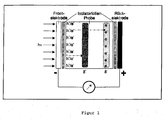
- the sample In measurements of the photo-EMF, the sample is electrically isolated between a transparent front and a back electrode ( FIG. 1 ). A high-impedance voltmeter is connected to both electrodes. If the sample is exposed through the front electrode with a short flash of light, a voltage and its decay process can be detected on the measuring device by tapping off the voltage at the electrodes which builds up in the sample and recording it, for example, on an oscilloscope.
- the isolation between the sample and the electrodes is essential, since decay processes in the sample are to be investigated and thus electron transitions between the sample and the electrode must be avoided.
- the transparent front electrode is made of quartz glass, which is vapor-deposited with ITO, since this material is translucent and has corresponding electrical properties.
- the return electrode may for example consist of brass, with more the One skilled in the art can be used with materials known to those skilled in the art.
- a light source may consist of a laser, for example, a 100 kW nitrogen laser can be used.
- the wavelength of the excitation flash depends on the laser used.
- the wavelength of the excitation flash may be 337 nm.
- the pulse duration is in the range of 0.2 to 0.5 ns, for example, the pulse duration is 0.3 ns. The advantage is that the maximum photo-EMF does not depend significantly on the intensity of the excitation flash.
- the signal of the first flash is registered. Afterwards an acquisition measurement can be carried out. In this case, the sample is exposed several times at certain time intervals, for example at a distance of 120 s, with the oscilloscope averaging the signals. Acquisition measurement is performed to investigate possible charging effects of the samples. This improves the signal-to-noise ratio, which increases the accuracy of a kinetic analysis of the signals. After the acquisition measurement, a new sample is inserted.
- the measurements are normally carried out under normal pressure and at a temperature of 25 ° C. However, other measurement conditions are possible.
- U max is a relative measure of the efficiency of charge separation on exposure.
- the decay process of the photo-EMF was evaluated according to a bi-exponential time law (Eq. (1)).
- U t U 1 0 ⁇ exp - k 1 ⁇ t + U 2 0 ⁇ exp - k 2 ⁇ t
- U 1 0 and U 2 0 represent amounts of charge carriers at the beginning of the decay process near the surface (U 1 0 ) or in the volume (U 2 0 ).
- the decay constants k 1 and k 2 are a relative measure of the rate of recombination near the surface (k 1 ) and in volume (k 2 ).
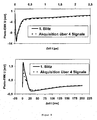
- the photo-EMF signals of a dispersion layer of some tested TiO 2 batches are in the FIGS. 3 to 8 to see. It used PVB as a binder and a laser with 2.7 * 10 13 quanta per flash. The flash interval was 120 s, the recorded time was between 0-2.5 ⁇ s and 0-200 ms. The exact experimental procedure is described in the experimental part.
- titanium dioxide affects charge-transfer complexes resulting from the use of stabilizer compositions.
- nitrogen compounds in stabilizer compositions function as electron donors.
- DMAU 1,3-dimethyl-4-aminouracil
- CCA charge transfer
- Titanium dioxide can be considered as an electron acceptor. When light falls on it, an electron is lifted from the valence band into the conduction band. In the valence band remains a positively charged hole that can act as electron acceptor. As a result, for example, a CT complex between titanium dioxides and DMAU can be formed. This is manifested by the fact that combinations of PVC with a stabilizer composition of titanium dioxide and, for example, DMAU, turn pink after a certain time in artificial or natural light. In order to prevent or reduce this pink discoloration, it is therefore necessary to try to avoid the formation of the CT complexes responsible for pink discoloration. This is the basis of the principle of the present invention, i. turned off by the use of certain titanium dioxides said pink discoloration is.
- the titanium dioxide used in the invention may be added individually to the polymer or to the polymer mixture. It but it is also possible to add the titanium dioxide together with the nitrogen compound or other (co) stabilizers or the auxiliaries listed below to the polymer or a polymer mixture. For example, metering in the extruder, eg in the vacuum zone, is also encompassed by the present invention.
- the titanium dioxide according to the invention advantageously has a rutile structure. For all other applications, it can have both anatase and rutile structure.
- the titanium dioxide used according to the invention can likewise be provided with a coating.
- the coating may consist of inorganic or organic materials.
- inorganic coatings can be based on aluminum, silicon and / or zirconium oxides.
- Organic coatings are, for example, polydi- / monoalkylsiloxanes or stearic acid and derivatives thereof.
- the thickness of the coating is not important for the inventive use of titanium dioxide.
- the titania may be used in an amount of about 0.05 to about 10.0 phr, or from about 0.1 to about 5 phr, for example, in an amount of about 2 phr.
- the titanium dioxide should be finely divided and readily dispersible.
- the particle size is ⁇ 5 ⁇ m, for example ⁇ 2 ⁇ m. In a further embodiment, the particle size is ⁇ 1 ⁇ m. It is crucial that the particle size be chosen so that the stabilizing effect of the composition of the present invention occurs.
- the nitrogen-containing compounds of the stabilizer composition of the present invention are those nitrogen compounds currently used as stabilizer compounds for halogen-containing polymers.
- they may be selected from the group consisting of a heterocyclic compound and an amine.
- heterocyclic nitrogen compounds include, but are not limited to, substituted or unsubstituted uracil, pyrimidone, indole, (thio) urea, aminocrotonic acid esters, or the like.
- the uracil can be the following formula I have, where R 1, R 2, R 3 and R 4 are independently H, C 1 -C 18 alkyl, C 2 -C 6 alkenyl, C 1 -C 4 alkoxy, C 5 -C 8 cycloalkyl, C 5- C 10 aryl, wherein R 3 and R 4 may independently be NHR 5 , wherein R 5 is independently of R 1 or R 2 H, C 1 -C 18 alkyl, C 2 -C 6 alkenyl, C 1 -C 4 alkoxy, C 5 -C 8 is cycloalkyl, C 5 -C 10 aryl.
- alkyl refers to fully saturated aliphatic, linear or branched hydrocarbons.
- an alkyl comprises 1 to 18 carbon atoms.
- a numerical range of, for example, 1 to 18, whenever it occurs, means that, for example, C 1 -C 18 alkyl refers to an alkyl group comprising 1 carbon atom, 2 carbon atoms, 3 carbon atoms, etc. up to and including 20 carbon atoms.
- the alkyl group may be optionally substituted.
- alkyl compounds include, but are not limited to, methyl, ethyl, n -propyl, isopropyl, n -butyl, isobutyl, sec -butyl, t -butyl, pentyl, hexyl, heptyl, octyl and the like.
- alkenyl refers to aliphatic hydrocarbons having one or more double bonds. In certain embodiments, an alkenyl comprises 2 to 6 carbon atoms. The alkenyl group may be optionally substituted. Examples of alkenyl compounds include, but are not limited to, ethenyl, propenyl, 1,4-butadienyl and the like.
- alkoxy refers to aliphatic hydrocarbons having an -O-alkyl moiety. In certain embodiments, an alkoxy comprises 1 to 4 carbon atoms. The alkoxy group may be optionally substituted. Examples of alkoxy compounds include, but are not limited to, methoxy, ethoxy, propoxy, t-butoxy, and the like.
- cycloalkyl refers to cyclic saturated hydrocarbons. In certain embodiments, a cycloalkyl comprises 5 to 8 carbon atoms.
- the Cycloalkyl group may be optionally substituted. Examples of cycloalkyl compounds include, but are not limited to, cyclopentane, cyclohexane, cycloheptane, cyclooctane, and the like.
- aryl refers to an aromatic ring in which each ring atom is carbon.
- Aryl rings can be composed of five, six, seven, eight, nine or more carbon atoms.
- aryl compounds can have up to 15 carbon atoms.
- the aryl group may be optionally substituted. Examples of aryl compounds include, but are not limited to, cyclopentadienyl, phenyl, and the like.
- the term "optionally substituted” refers to a group in which one or more hydrogen atoms have been replaced by a substituent.
- the substituent may be, but is not limited to, alkyl, alkoxy, cycloalkyl, aryl, heteroaryl, OH, CN, halogen, NO 2 or an amine.
- the uracil is 1,3-dimethyl-4-aminoouracil.
- nitrogen compounds are aminocrotonic acid esters of the general formula III wherein R 5 is H, C 1 -C 18 alkyl, C 2 -C 6 alkenyl, C 1 -C 4 alkoxy, C 5 -C 8 cycloalkyl, or C 5 to C 10 may be aryl, or wherein R 5 is selected so to form a symmetrical aminocrotonic acid ester.
- Symmetric in this context means that the molecule can be cleaved at one point to obtain two similar molecules.
- aminocrotonic acid esters are, for example
- Examples of compounds from the group of ureas are urea and tetramethylurea.
- the nitrogen compounds may be employed in an amount of about 0.01 phr to about 1 phr, or about 0.05 phr to about 0.8 phr. In one embodiment, the nitrogen compounds may be used in an amount of about 0.1 to about 0.5 phr.
- the titanium dioxides of the present invention may further be treated with one or more additives such as primary stabilizers, co-stabilizers, zeolites, antioxidants, fillers, plasticizers, dyes, pigments, antistatic agents, surfactants, foaming agents, impact modifiers, UV stabilizers, lubricants, processing agents, or the like , be combined.
- additives such as primary stabilizers, co-stabilizers, zeolites, antioxidants, fillers, plasticizers, dyes, pigments, antistatic agents, surfactants, foaming agents, impact modifiers, UV stabilizers, lubricants, processing agents, or the like , be combined.
- Co-stabilizers are compounds which provide a further stabilizing contribution to halogen-containing polymers when used in the stabilizer composition according to the present invention.
- Possible co-stabilizers may be selected from the group consisting of 1,3-diketone compounds, polyols, metal salts, natural or synthetic minerals such as hydrotalcites, hydrocalumites and zeolites, amino acid derivatives, organic phosphorous acid esters, epoxy compounds.
- 1,3-diketone compounds include, but are not limited to, dibenzoylmethane, stearoylbenzoylmethane, palmitoylbenzoylmethane, myristoylbenzoylmethane, lauroylbenzoylmethane, benzoylacetone, acetylacetone, tribenzoylmethane, diacetylacetobenzene, p-methoxystearoylacetophenone, acetoacetic acid esters and acetylacetone and their metal salts, especially those of lithium, sodium , Potassium, calcium, magnesium, zinc, tin, titanium, aluminum and / or iron.
- Co-stabilizers from the group of polyols include, but are not limited to, glycerol, pentaerythritol, di- and tripentaerythritol, trismethylolpropane (TMP), di-TMP, THEIC, sorbitol, mannitol, malititol, saccharides, disaccharides (especially sucrose, 4 -O- ⁇ -D-galactopyranosyl-D-glucose, 4-O-alpha-D-glucopyranosyl-D-glucose, 6-O- (6-deoxy-alpha-L-mannopyranosyl) -D-glucose, alpha-D Glucopyranosyl-alpha-D-glucopyranoside, 6-O-alpha-D-glucopyranosyl-D-glucose, 4-O-beta-D-glucopyranosyl-D-glucose, 2-O-be
- antioxidants include, but are not limited to, alkylphenols, hydroxyphenylpropionates, hydroxybenzyl compounds, alkylidenebisphenols, thiobisphenols and aminophenols, especially e.g. 2,6-di-tert-butyl-4-methyl-phenol, 2,6-di-benzyl-4-methyl-phenol, stearyl-3- (3'-5'-di-tert-butyl-4 '-hydroxyphenyl) propionate, 4,4'-thiobis (3-methyl-6-tert-butylphenol), 4-nonylphenol, 2,2'-methylenebis (4-methyl-6-tert-butylphenol), 2 , 5-di-tert-butyl-hydroquinone, 4,4 ', 4' '- (1-methyl-1-propanyl-3-ylidenes) tris (2- (1,1-dimethylethyl) -5-methyl- phenol, their neutral or basic lithium, magnesium, calcium, zinc and
- co-stabilizers from the group of metal salts include, but are not limited to, hydroxides, oxides, carbonates, basic carbonates, and carboxylic acid salts of lithium, sodium, potassium, magnesium, calcium, aluminum, titanium, and the like.
- the metal salts may include salts of higher carboxylic acids, for example C 6 -C 22 carboxylic acids, such as, for example, stearic, palmitic, myristic, lauric, oleic, oleic and ricinoleic acids.
- Examples of natural and synthetic minerals include, but are not limited to, A3, A4, A5 zeolites, mordenite, erionite, faujasite X or Y zeolites, and ZSM-5 zeolites, hydrotalcites (from Alcamizer 1 and 4-type) and / or mixtures thereof.
- Preferred exchangeable cations therein may be protons, ammonium, lithium, sodium, potassium, magnesium, calcium, zinc, and / or tin cations.
- co-stabilizers from the group of amino acid derivatives include, but are not limited to, glycine, alanine, lysine, tryptophan, acetylmethionine, pyrrolidonecarboxylic acid, ⁇ -aminocrotonic acid, ⁇ -aminoacrylic acid, ⁇ -aminoadipic acid, and the like, as well as the corresponding esters thereof.
- the alcohol components of these esters may include monohydric alcohols such as methyl alcohol, ethyl alcohol, propyl alcohol, i-propyl alcohol, butyl alcohol, ⁇ -ethylhexanol, octyl alcohol, i-octyl alcohol, lauryl alcohol, stearyl alcohol, and the like, as well as polyols such as ethylene glycol, propylene glycol, 1,3-butanediol, 1,4-butanediol, glycerol, diglycerol, trismethylolpropane, pentaerythritol, dipentaerythritol, erythritol, sorbitol, mannitol and the like.
- monohydric alcohols such as methyl alcohol, ethyl alcohol, propyl alcohol, i-propyl alcohol, butyl alcohol, ⁇ -ethylhexanol, octyl alcohol
- co-stabilizers from the group of phosphorous acid esters include, but are not limited to, triaryl phosphites, such as triphenyl phosphite, tris (p-nonylphenyl) phosphite; Alkylaryl phosphites, such as monoalkyl diphenyl phosphites, eg diphenyl isooctyl phosphite, diphenyl isodecyl phosphite; and dialkyl monophenyl phosphites such as phenyl diisooctyl phosphite, phenyl diisodecyl phosphite; and trialkyl phosphites such as triisooctyl phosphite, tristearyl phosphite and the like.
- triaryl phosphites such as triphenyl phosphite, tris (p-nonylpheny
- co-stabilizers from the group of epoxy compounds include, but are not limited to, various animal or vegetable oils, such as epoxysoar oil, epoxy rapeseed oil, epoxidized carboxylic acid esters, such as epoxidized epoxy methyl oleate, epoxybutyl oleate, epoxidized alicyclic compounds, glycidyl ethers, such as Example bisphenol A diglycidyl ether, bisphenol F diglycidyl ether; Glycidic esters, such as glycidyl acrylate, glycidyl methacrylate, their polymers, copolymers; and epoxidized polymers such as epoxidized polybutadiene, epoxidized ABS, and the like.
- various animal or vegetable oils such as epoxysoar oil, epoxy rapeseed oil, epoxidized carboxylic acid esters, such as epoxidized epoxy methyl oleate, epoxybutyl oleate,
- chalk or coated chalk may also be named as fillers, the fillers being not restricted thereto.
- Paraffin wax may be exemplified as a lubricant.
- Fillers may be used in an amount of about 0 to about 100 phr or from about 1 to about 50 phr. In one embodiment of the present invention, fillers may be used in an amount of about 2 to about 20 phr. Plasticizers may be present in an amount of from about 0 to about 100 phr, for example from about 0.05 to about 50 phr. lubricant can be used from about 0.05 to about 3 phr, for example from about 0.1 to about 2 phr.
- halogen-containing polymers with the stabilizer composition according to the invention In order to process halogen-containing polymers with the stabilizer composition according to the invention, the processes known in the prior art can be used. Examples of such methods include, but are not limited to, calendering, extruding, injection molding, blow molding, and the like.
- the stabilized halogen-containing polymers prepared according to the invention can be prepared for different applications.
- window profiles, pipes, floor coverings, roofing membranes, cables and films can be produced.
- the polymers can be used in materials, for example, for pleasure craft, rotor blades for wind turbines and wagon construction.
- the a value represents the color on the green-red axis.
- Negative a values show a green cast and positive a reddish. The higher the a value, the stronger the reddish. Therefore, the most neutral possible value for a in the present invention or the smallest possible change of this value is desirable.
- the present invention accordingly provides a remarkable and novel contribution to the development of the prior art, in particular for the processing and stabilization of PVC and other halogen-containing thermoplastic polymers.
- compositions of PVC moldings are described.
- the ingredients mentioned in the examples were weighed, cold homogenized in a laboratory mixer and homogenized on a laboratory mill for five minutes at 180 ° C and plasticized. From the approximately 1 mm thick rolled skin produced in this way, two test strips of 10 * 10 cm 2 were cut out, laid one over the other and placed at 170 ° C. at 100 bar for 5 minutes. pressed.
- the characterization of the titanium dioxides used in the above examples by means of photo-EMK can be taken from Table 1 (kinetic parameters of the photo-EMF measurement in PVB (measuring range 0 - 2.5 microseconds, signals after the 1st laser flash).
- the measurement of the photo-EMF is performed as indicated in the above description.
- 100 mg of the pigment are dissolved by means of ultrasound in 3 g of a 10% polyvinyl butyral solution in 1,2-dichloroethane.
- the mixture was applied to a glass plate (27 cm 2 ). After drying the pigment, the polymer layer was removed from the glass slide. The residual solvent is removed in vacuo.
- the voltage building up in the sample is tapped off at the electrodes (as indicated above), ie measured without galvanic contact, since insulating ones are used Foils are located between the sample and the electrodes. This prevents charge injection from the electrodes into the sample.
- the preamplifier has an impedance of about 1 T ⁇ and the photo-EMF measurement takes place without an external electric field. The maximum time resolution is about 40 ns. All experiments were carried out under normal pressure and at 25 ° C. In all cases, the signal of the first laser flash was recorded. In further experimental experiments the time difference between two flashes was 120s (acquisition measurement). A detailed description of the used photo-EMK apparatus is in G. Israel et al., J. Inform. Rec. 23 (1997), 559-584 ,
- the maximum value of the photo-EMF is determined directly from the experimental curves, whereby the curves are kinetically evaluated according to a bi-exponential time law, whereby the lifetime of the charge carriers near the surface and in the volume can be determined.
- Table 1 Photo-EMF values of the titanium dioxides from Examples 1-7 sample U max / mV U 1 / mV U 2 / mV 10 -6 k 1 * s 10 -5 k 2 * s Kronos 1001 ⁇ 48 (S) Kronos 1014 ⁇ 24 (S) Kronos 1071 ⁇ 16 (S) Kronos 1080 ⁇ 12 (S) TiO 2 (Example 7) -26.3 -5.6 -20.6 2.8 0.6 TiO 2 (Ex. 1) -20.5 -15.2 -5.3 12.9 4.7 S: only the rise of the signal, but no deactivation observed; the values for U 1 , U 2 , k 1 and k 2 are not calculable in the ⁇ s range.
- the further characterization of the titanium dioxides used in the above examples by means of photo-EMK can be taken from Table 2 (kinetic parameters of the photo-EMF measurement in PVB (measuring range 0 - 200 ms, signals after the 1st laser flash).
- Table 2 Photo-EMF values of the titanium dioxides from Examples 1-7 sample Umax / mV U 1 / mV U 2 / mV k 1 * s k 2 * s Kronos 1001 60.2 418 -412 51 45 Kronos 1014 19.2 255 -253 45 44 Kronos 1071 14.3 163 -162 47 46 Kronos 1080 12.2 1500 -1,487 48 47 TiO 2 (Example 7) 1.0 252 -250 43 42 TiO 2 (Ex. 1) -10.0 -247 237 60 43
- Table 3 shows the changes in a values of the example polymers prepared above when irradiated in the Bandol Wheel (50 ° C).
- Table 3 example a values after 0 hours a values after 168 hours 1 -0.1 -0.4 2 -0.7 1.4 3 -0.3 -0.8 4 -0.9 -0.3 5 -0.7 -0.6 6 -0.3 0.0 7 -0.7 1.6
- Example 2 and 7 which are not according to the invention and which contain formulations containing 1,3-dimethyl-4-aminouracil, the a values determined after a short but intensive irradiation time show a clearly positive, ie red, color change.
- Example 1 based on lead stabilizers and without 1,3-dimethyl-4-aminouracil the a-value remains negative, that is green.
- the inventive example 3, 4, 5 and 6, show a significant effect by the influence of the stabilizer compounds of the invention.
- the a values are only slightly negative, i. maximum is a slight green cast is observed.
- a pink discoloration of the polymers and the products made therefrom, for example window profiles can be prevented.
- Table 3 sets forth the photo-EMF and ability to stabilize halogen-containing polymers on a wide variety of titanium dioxides. It is apparent from Table 3 that the halogen-containing polymers stabilized with titanium dioxides (and a nitrogen compound) which do not exhibit the photo-EMK of the present invention exhibit marked pink discoloration after 120h and 180h, respectively, in the Bandon-Wheel experiment (see ⁇ a 120 and ⁇ a 180 values).
- FIG. 9 contains the graphical representation of the ⁇ a values (after 120 hours in the Bandol Wheel) against the U max values from table 3 after the initial color has been eliminated.
- Table 3 Test results Sample 1 , 2 L (0) b (0) a (0) Umax 3 Umax 4 Umax 5 Umax 6 ⁇ a 120 ⁇ a 180 Kronos 1001 1 95.28 5.81 -0.28 60.2 57.7 48.0 47.0 -0.60 -0.35 Kronos 1014 20 95.52 6:00 am -0.30 19.2 16.6 24.0 17.0 -0.02 12:55 Kronos 1071 2 93.49 5:58 -0.90 14.3 13.3 16.0 13.0 12:35 0.70 Kronos 1080 21 94.95 6.22 -0.68 12.2 10.6 12.0 9.0 -0.16 12:17 Kronos 2044 15 94.87 8.31 -0.80 -2.0 -2.0 -7.3 -7.2 0.75 1.25 Kronos 2056 11 95.03 8.10 -0.68 -4.3 -
Landscapes
- Chemical & Material Sciences (AREA)
- Health & Medical Sciences (AREA)
- Chemical Kinetics & Catalysis (AREA)
- Medicinal Chemistry (AREA)
- Polymers & Plastics (AREA)
- Organic Chemistry (AREA)
- Engineering & Computer Science (AREA)
- Mechanical Engineering (AREA)
- Compositions Of Macromolecular Compounds (AREA)
Description
- Die vorliegende Erfindung betrifft eine Stabilisatorzusammensetzung für halogenhaltige Polymere, deren Verwendung bei der Stabilisierung von halogenhaltigen Polymeren, insbesondere gegenüber unerwünschter Rosafärbung, sowie Formkörper, die diese Stabilisatorzusammensetzung enthalten.
- Halogenhaltige Polymere bzw. Kunststoffe oder daraus hergestellte Formkörper neigen zu substantiellen Veränderungen während ihres Herstellungsverfahrens und aufgrund der Einwirkung von Umwelteinflüssen. Zum Beispiel kann sich diese Art von Kunststoffen unter Einfluss von Wärme und/oder Licht zersetzen oder verfärben. Zur Stabilisierung von halogenhaltigen Polymeren sind daher bereits verschiedenste Stoffe oder Stoffgemische verwendet worden.
- Ein halogenhaltiges Polymer, wie z.B. Polyvinylchlorid (PVC), geht beim Schmelzverformen in eine Polyenstruktur über, wobei Salzsäure eliminiert und das Polymer verfärbt wird. Um die Thermostabilität des Polymers zu verbessern, ist es üblich, Metallcarboxylate als Stabilisatoren in das Harz einzuarbeiten. Da jedoch die Einarbeitung der Stabilisatoren allein bei einem längeren Schmelzformverfahren zu einer Schwärzung des Polymeren hervorruft, ist es allgemeine Praxis, einen Co-Stabilisator zuzusetzen. Es ist eine Vielzahl von Kombinationen aus anorganischen und organischen Verbindungen als Stabilisatoren für halogenhaltige Polymere bekannt. In den letzten Jahren sind jedoch verstärkt stickstoffhaltige Verbindungen als Stabilisatoren in den Markt gekommen.
- Stickstoffhaltige Stabilisatoren-Verbindungen sind ebenfalls in der Patentliteratur beschrieben worden.
- Zum Beispiel beschreibt
DE 1 694 873 die Verwendung von Uracilen, die sowohl gegen Wärme als auch gegen Licht stabilisieren können. -
EP 768 336 -
EP 736 569 - In
WO 02/072684 -
DE 1 030 1675 wiederum beschreibt, dass sich Mischungen, aus mindestens einem Alkanolamin und mindestens einem Uracil gut zur Stabilisierung von chlorhaltigen Polymeren, insbesondere PVC, eignen. - In
DE 1954273 wird die Kombination von Titandioxid mit einem Melamin als lichtstabilisierendes Pigment beschrieben, währendDE 10 2004 037 369 ein Stabilisatorsystem beschreibt, das ein lineares oder cyclisches Azylureid und/oder ein Polyaminokrotonester und einen Polyepoxypropylalkoholether und/oder ein Zyanamidderivat enthält sowie als Pigment ein geringe Menge TiO2. - Es hat sich jedoch gezeigt, das es bei solchen mit Stickstoffverbindungen stabilisierten Polymeren, die zum Teil nur geringe Mengen an Titaniumdioxid enthalten, im Sonnen- und auch bei künstlichem Licht zu einer Rosaverfärbung des Polymers kommt. Diese Rosaverfärbung hat bislang den Einsatz stickstoffhaltiger Verbindungen in Fensterprofilen verhindert. Die farbgebende Komponente dieser Rosaverfärbung lässt sich weder analysieren noch in geeigneter Menge simulativ herstellen, da die Veränderung der Farbe aus dem Abbau des halogenhaltigen Polymers nach komplexen und unbekannten Mechanismen resultiert, die nicht nur von der Art und Intensität der abbauenden Quellen abhängen, sondern auch von der Art und den Mengen jeder in der Polymerzusammensetzung enthaltenen Substanz, insbesondere zum Beispiel von den stickstoffhaltige Verbindungen oder TiO2.
- Der vorliegenden Erfindung liegt die Aufgabe zugrunde, neue Stabilisatorzusammensetzungen bereitzustellen, die sich insbesondere für halogenhaltige Polymere eignen, ohne die oben erwähnten Nachteile der bekannten Stabilisatoren aufzuweisen. In diesem Zusammenhang liegt der Erfindung auch die Aufgabe zugrunde, ein universelles Titandioxid bereitzustellen, welches in Kombination mit stickstoffhaltigen Stabilisatorverbindungen nicht zu einer Rosafärbung im Kunst- und Sonnenlicht führt.
- Diese Aufgabe wird erfindungsgemäß gelöst durch die Bereitstellung einer Stabilisatorzusammensetzung für halogenhaltige Polymere enthaltend Titandioxid und mindestens eine stickstoffhaltige Verbindung, wobei das Titandioxid eine Photo-Elektromotorische Kraft im µs-Bereich > -15mV und eine Photo-Elektromotorische Kraft im ms-Bereich > +5mV hat.
- Überraschenderweise hat sich gezeigt, dass die erfindungsgemäßen Stabilisatorzusammensetzungen halogenhaltige Polymeren und den daraus hergestellten Teilen und Produkten eine erhöhte Stabilität gegenüber der Einwirkung von Sonnen- und Kunstlicht verleihen. Insbesondere kann eine Rosaverfärbung des halogenhaltigen Materials verhindert werden, wenn es in Applikationen, die im freien verwendet werden, zum Beispiel in Fensterprofilen, eingesetzt wird.
- Gegenstand der vorliegenden Erfindung ist ebenfalls die Verwendung der erfindungsgemäßen Stabilisatorzusammensetzung zur Stabilisierung von halogenhaltigen Polymeren, sowie Formkörper aus diesen halogenhaltigen Polymeren, die eine Stabilisatorzusammensetzung gemäß der Erfindung enthalten.
- Kurze Beschreibung der Zeichnungen:
-
Fig. 1 veranschaulicht eine Anordnung zur Messung der Photo-EMK -
Fig. 2 veranschaulicht ein Diagramm zur Bestimmung und Archivierung einer Farbe -
Fig. 3 veranschaulicht ein Photo-EMK-Signal einer Dispersionsschicht der TiO2-Charge Kronos 1001 mit PVB als Bindemittel; ca. 2.7*1013 Quanten pro Blitz; Totalabsorption; Blitzabstand 120 s. -
Fig. 4 veranschaulicht ein Photo-EMK-Signal einer Dispersionsschicht der TiO2-Charge Kronos 1014 mit PVB als Bindemittel; ca. 2.7*1013 Quanten pro Blitz; Totalabsorption; Blitzabstand 120 s. -
Fig. 5 veranschaulicht ein Photo-EMK-Signal einer Dispersionsschicht der TiO2-Charge Kronos 1071 mit PVB als Bindemittel; ca. 2.7*1013 Quanten pro Blitz; Totalabsorption; Blitzabstand 120 s. -
Fig. 6 veranschaulicht ein Photo-EMK-Signal einer Dispersionsschicht der TiO2-Charge Kronos 1080 mit PVB als Bindemittel; ca. 2.7*1013 Quanten pro Blitz; Totalabsorption; Blitzabstand 120 s. -
Fig. 7 veranschaulicht ein Photo-EMK-Signal einer Dispersionsschicht der TiO2-Charge hergestellt nach dem Chloridverfahren 2 mit PVB als Bindemittel; ca. 2.7*1013 Quanten pro Blitz; Totalabsorption; Blitzabstand 120 s. -
Fig. 8 veranschaulicht ein Photo-EMK-Signal einer Dispersionsschicht der TiO2-Charge hergestellt nach dem Chloridverfahren 1 mit PVB als Bindemittel; ca. 2.7*1013 Quanten pro Blitz; Totalabsorption; Blitzabstand 120 s. -
Fig. 9 veranschaulicht die Δa-Werte aus Beispiel 9 (nach 120 h im Bandol Wheel berechnet aus den Predictions in echip bei L = 95.3, a 0 -0.3, b = 5.8) gegen die Umax-Werte ("Umax Tab. 9a" = Umax im ms-Bereich, 1 Blitz, "Umax Tab. 9b" = Umax im µs-Bereich, 1 Blitz) - Trendlinie linear - Die vorliegende Erfindung wird nachstehend näher beschrieben.
- Die Stabilisatorzusammensetzung der vorliegenden Erfindung kann für halogenhaltige Polymere verwendet werden. Beispiele für solche halogenhaltige thermoplastische Polymere sind Polyvinylchlorid (PVC), Polyvinylidenchlorid, chloriertes oder chlorsulfoniertes Polyethylen, chloriertes Polypropylen oder chloriertes Ethylen/Vinylacetat-Copolymer oder ähnliche Verbindungen. Besonders vorteilhaft sind Polymere vom PVC-Typ, d.h. Vinylchlorid-Homopolymere und Copolymere von Vinylchlorid mit anderen Monomeren.
- Eine der Komponenten der erfindungsgemäßen Stabilisatorzusammensetzung ist Titandioxid. Titandioxid tritt im Wesentlichen in der Natur in drei Modifikationen auf: Anatas, Brookit und Rutil.
- Sowohl als Anatas als auch als Rutil besitzt Titandioxid technische Bedeutung als Pigment. Die hohen Brechungsindices von 2.55 (Anatas) und 2.75 (Rutil) begründen das Aufhell- und Deckvermögen und somit den Einsatz als Weißpigment. Rutil absorbiert bei entsprechender Dosierung alles Licht unter 400 nm, also den gesamten UV-Bereich. Die Absorption des Anatas ist etwas zu kürzeren Wellenlängen verschoben. Brookit wiederum zeigt keinerlei photokatalytische Aktivität.
- Das in der Erfindung eingesetzte Titandioxid ist Titandioxid, das eine ganz bestimmte Charakteristik zeigt. So hat das TiO2 eine Photo-Elektromotorische Kraft im µs-Bereich > -15mV und eine Photo-Elektromotorische Kraft im ms-Bereich > +5mV. In einer Ausführungsform der vorliegenden Erfindung hat das Titandioxid eine Photo-. Elektromotorische Kraft im us-Bereich > -10mV und eine Photo-Elektromotorische Kraft im ms-Bereich > +10mV.
- Unter einer Photo-Elektromotorischen Kraft (Photo-EMK) versteht man den Effekt, der auftritt, wenn Elektronen aus dem Valenzband einer Verbindung durch Einwirkung von Licht und/oder Wärme in das nächst höhere Band, das sogenannte Leitungsband, übergehen, wobei dabei ein Photohalbleiter entsteht. Durch diesen Übergang hinterlässt das Elektron ein "Loch", in das ein benachbartes Elektron springen kann. Zudem können Elektronen wieder aus dem Leitungsband zurück in das "Loch" im Valenzband springen. Dieser Ladungsübergang des Photohalbleiters lässt sich in Form der Photo-EMK charakterisieren. Die Photo-EMK hängt auch von der Wellenlänge des Anregungsblitzes ab. Eine Photo-EMK wird nur beobachtet, wenn die Probe das Anregungslicht absorbiert. TiO2 absorbiert beispielsweise nur im UV-Bereich.
- Zur Messung dieser Photo-EMK werden die zu untersuchenden Verbindungen in eine polymere Matrix eingebracht wie zum Beispiel in M. Schiller et al., Journal of Photochemistry and Photobiology A: Chemistry 149 (2002) 227-236 beschrieben Beispielsweise wird eine bestimmte Menge der Testsubstanz, zum Beispiel 100 mg, in einer vorgegebenen Menge, zum Beispiel, 3 g einer 10%igen Lösung von Polyvinylbutyral (PVB) in 1,2-Dichlorethan dispergiert, beispielsweise unter Zuhilfenahme von Ultraschall. Diese Mischung wird auf einer Glasplatte mit einer genau definierten Fläche vergossen. Die Fläche kann zum Beispiel ca. ≥27 cm2, beispielsweise ca. ≥47 cm2 sein. Die aufgetragene Schicht sollte so dünn wie möglich sein. Unter den oben genannten Verhältnissen ergibt sich zum Beispiel auf Grund der Masse des PVBs die optimale Schichtdicke. Wird mehr Substanz eingewogen, muß die Ausgießfläche entsprechend größer gewählt werden. Die Trocknung der Schichten erfolgt in einer Lösungsmittelatmosphäre. Die getrockneten Dispersionsschichten werden von der Glasplatte entfernt und die Lösungsmittelreste werden bei Raumtemperatur im Vakuum entfernt. Die Dispersionsschichten haben eine Totalabsorption im UV-Bereich und eine Schichtdicke von zum Beispiel ungefähr 60 bis ungefähr 80 µm. Die Proben wurden bei 100% rel. Luftfeuchte (im Exsikkator über Wasser) gelagert.
- Bei Messungen der Photo-EMK befindet sich die Probe elektrisch isoliert zwischen einer transparenten Front- und einer Rückelektrode (
Figur 1 ). Ein hochohmiges Spannungsmessgerät ist mit beiden Elektroden verbunden. Belichtet man die Probe durch die Frontelektrode mit einem kurzen Lichtblitz, so lassen sich an dem Messgerät eine Spannung und deren Abklingprozess nachweisen, indem die sich in der Probe aufbauende Spannung an den Elektroden stromlos abgegriffen wird und zum Beispiel an einem Oszillographen aufgezeichnet wird. Die Isolation zwischen Probe und Elektroden ist wesentlich, da Abklingprozesse in der Probe untersucht werden sollen und somit Elektronenübergänge zwischen Probe und Elektrode vermieden werden müssen. - Beispielsweise besteht die transparente Frontelektrode aus Quarzglas, das mit ITO bedampft ist, da dieses Material lichtdurchlässig ist und entsprechende elektrische Eigenschaften aufweist. Die Rückelektrode kann beispielsweise aus Messing bestehen, wobei weitere dem Durchschnittsfachmann bekannte Materialien verwendet werden können.
- Als Lichtquelle kann aus einem Laser bestehen, beispielsweise kann ein 100 kW Stickstofflaser verwendet werden. Die Wellenlänge des Anregungsblitzes ist abhängig vom verwendeten Laser. Beispielsweise kann die Wellenlänge des Anregungsblitzes 337 nm betragen. Die Pulsdauer ist im Bereich von 0.2 bis 0.5 ns, beispielsweise ist die Pulsdauer 0.3 ns. Von Vorteil ist, dass die maximale Photo-EMK nicht nennenswert von der Intensität des Anregungsblitzes abhängt.
- Mittels der oben erläuterten Anordnung werden Photo-EMK-Signale in zwei unterschiedlichen Zeitskalen registriert:
- a) Kurzzeitbereich: Signal bis 2.5 µs nach dem Blitz zur Registrierung der schnell abklingenden Prozesse
- b) ms-Bereich: Signal bis 100 ms nach dem Blitz zur Registrierung der langsam abklingenden Prozesse
- In allen oben genannten Fällen wird zunächst das Signal des ersten Blitzes registriert. Danach kann eine Akquisitionsmessung durchgeführt werden. Hierbei wird die Probe mehrmals in bestimmten zeitabständen, beispielsweise in einem Abstand von 120 s, belichtet, wobei der Oszillograph die Signale mittelt. Die Akquisitionsmessung wird durchgeführt, um mögliche Aufladungseffekte der Proben zu untersuchen. Damit wird das Signal/Rausch-Verhältnis verbessert, was die Genauigkeit einer kinetischen Analyse der Signale erhöht. Nach der Akquisitionsmessung wird ein neues Probenstück eingelegt.
- Die Messungen werden normalerweise unter Normaldruck und bei einer Temperatur von 25°C durchgeführt. Es sind allerdings auch andere Messbedingungen möglich.
- Aus den experimentellen Kurven wurde der Maximalwert Umax der Photo-EMK bestimmt. Umax ist ein relatives Maß für die Effizienz der Ladungstrennung bei Belichtung. Der Abklingprozess der Photo-EMK wurde nach einem biexponentiellen Zeitgesetz (Gl. (1)) ausgewertet.

- Dabei repräsentieren U1 0 bzw. U2 0 Ladungsträgermengen zu Beginn des Abklingprozesses in Oberflächennähe (U1 0) bzw. im Volumen (U2 0). Die Abklingkonstanten k1 und k2 sind ein relatives Maß für die Geschwindigkeit der Rekombination in Oberflächennähe (k1) und im Volumen (k2).
- Die Photo-EMK-Signale einer Dispersionsschicht einiger getesteter TiO2-Chargen sind in den
Figuren 3 bis 8 zu sehen. Dabei wurde PVB als Bindemittel und ein Laser mit 2.7*1013 Quanten pro Blitz verwendet. Der Blitzabstand war 120 s, die aufgenommene Zeit lag zwischen 0-2.5 µs bzw. 0-200 ms. Die genaue Versuchsdurchführung ist im experimentellen Teil beschrieben. - Überraschenderweise hat sich nun gezeigt, dass durch den Zusatz von so definiertem Titandioxid zu halogenhaltigen Polymeren, die Stickstoffstabilisatoren enthalten, die Rosafärbung des polymeren Materials unter Einwirkung von Kunst- oder Sonnenlicht vermieden oder zumindest stark vermindert werden kann. Dieser stabilisierende Effekt tritt auch auf, wenn das halogenhaltige Polymer weitere Stabilisatoren, Co-Stabilisatoren oder Hilfsmittel enthält.
- Man nimmt an, ohne auf eine bestimmte Theorie beschränkt zu sein, dass das Titandioxid Einfluss auf bei der Verwendung von Stabilisatorzusammensetzungen entstehende Charge-Transfer-Komplexe nimmt. So ist bekannt, dass Stickstoffverbindungen in Stabilisatorzusammensetzungen als Elektronendonoren fungieren. Beispielhaft sei hier 1,3-Dimethyl-4-aminouracil (DMAU) genannt, das instabile Cl-Atome in einer PVC-Kette in einer nucleophilen Substitution ersetzen kann. Diese Stcikstoffverbindungen können auch als Elektronendonoren in Charge Transfer (CT)-Komplexen wirken.
- Titandioxid kann als Elektronenacceptor angesehen werden. Wenn Licht darauf fällt, wird ein Elektron aus dem Valenzband ins Leitungsband angehoben. Im Valenzband verbleibt ein positiv geladenes Loch, das als Elektronenacceptor wirken kann. Dadurch kann zum Beispiel ein CT-Komplex zwischen Titandioxiden und DMAU gebildet werden. Dies macht sich dadurch bemerkbar, dass sich Kombinationen aus PVC mit einer Stabilisatorzusammensetzung aus Titandioxid und zum Beispiel DMAU nach einer gewissen Zeit im Kunst- oder natürlichen Licht rosa verfärben. Um diese Rosaverfärbung zu verhindern oder abzuschwächen, muss daher versucht werden, die Bildung der für die Rosaverfärbung verantwortlichen CT-Komplexe zu vermeiden. Darauf beruht das Prinzip der vorliegenden Erfindung, d.h. das durch Verwendung bestimmter Titandioxide besagte Rosaverfärbung ausgeschaltet, wird.
- Das erfindungsgemäß verwendete Titandioxid kann einzeln zum Polymer oder zur Polymermischung hinzugegeben werden. Es ist aber auch möglich, das Titandioxid zusammen mit der Stickstoffverbindung oder anderen (Co)-Stabilisatoren oder den unten aufgeführten Hilfsstoffen zum dem Polymer oder einem Polymergemisch hinzuzugeben. Zum Beispiel ist eine Dosierung im Extruder, z.B. in der Vakuumzone, ebenfalls von der vorliegenden Erfindung umfasst.
- Für Außenanwendungen hat das erfindungsgemäße Titaniumdioxid vorteilhafterweise Rutil-Struktur. Für alle anderen Anwendungen kann es sowohl Anatas- als auch Rutilstruktur haben. Das erfindungsgemäß eingesetzte Titaniumdioxid kann ebenfalls mit einer Beschichtung versehen werden. Die Beschichtung kann aus anorganischen oder aus organischen Materialien bestehen. Beispielsweise können anorganische Beschichtungen auf Aluminium-, Silizium- und/oder Zirkoniumoxiden basieren. Organische Beschichtungen wiederum sind zum Beispiel Polydi-/Monoalkylsiloxane oder Stearinsäure und deren Derivate. Die Dicke der Beschichtung ist für die erfindungsgemäße Verwendung des Titandioxids nicht von Bedeutung.
- Das Titandioxid kann erfindungsgemäß in einer Menge von ungefähr 0.01 bis ungefähr 20 Teilen pro 100 Teile (phr = "per hundred resin") Harz (Polymer) in der Stabilisatorzusammensetzung verwendet werden. In einer anderen Ausführungsform kann das Titandioxid in einer Menge von ungefähr 0.05 bis ungefähr 10.0 phr oder von ungefähr 0.1 bis ungefähr 5 phr verwendet werden, zum Beispiel in einer Menge von ungefähr 2 phr. Das Titandioxid sollte in fein verteilt und gut dispergierbar vorliegen. In einer Ausführungsform der vorliegenden Erfindung ist die Teilchengröße < 5 µm, beispielsweise < 2 µm. In einer weiteren Ausführungsform ist die Teilchengröße < 1 µm. Entscheidend ist, dass die Teilchengrüße so gewählt wird, dass die stabilisierende Wirkung der Zusammensetzung der vorliegenden Erfindung eintritt.
- Die stickstoffhaltigen Verbindungen der Stabilisatorzusammensetzung der vorliegenden Erfindung sind solche Stickstoffverbindungen, die gegenwärtig als Stabilisatorverbindungen für halogenhaltige Polymere verwendet werden. Zum Beispiel können sie aus der Gruppe, die aus einer heterocyclischen Verbindung und einem Amin besteht, ausgewählt werden. Beispiele für heterocyclische Stickstoffverbindungen beinhalten, sind aber nicht darauf beschränkt, substituierte oder unsubstituiertes Uracil, Pyrimidon, Indol, (Thio)Harnstoff, Aminocrotonsäureester oder ähnliche.
- Das Uracil kann die folgende Formel I

R1, R2, R3 und R4 unabhängig voneinander H, C1-C18 Alkyl, C2-C6 Alkenyl, C1-C4 Alkoxy, C5-C8 Cycloalkyl, C5-C10 Aryl, wobei R3 und R4 unabhängig voneinander NHR5 sein können, wobei R5 unabhängig zu R1 oder R2 H, C1-C18 Alkyl, C2-C6 Alkenyl, C1-C4 Alkoxy, C5-C8 Cycloalkyl, C5-C10 Aryl ist. - Der Begriff "Alkyl" betrifft vollständig gesättigte aliphatische, lineare oder verzweigte Kohlenwasserstoffe. In bestimmten Ausführungsformen umfasst ein Alkyl 1 bis 18 Kohlenstoffatome. Ein numerischer Bereich von zum Beispiel 1 bis 18 bedeutet, wann immer er auftritt, dass, zum Beispiel, C1-C18 Alkyl eine Alkylgruppe betrifft, die 1 Kohlenstoffatom, 2 Kohlenstoffatome, 3 Kohlenstoffatome usw. bis zu einschließlich 20 Kohlenstoffatomen umfasst. Die Alkylgruppe kann optional substituiert sein. Beispiele von Alkyl-Verbindungen beinhalten, sind aber nicht darauf beschränkt, Methyl, Ethyl, n-Propyl, Isopropyl, n-Butyl, Isobutyl, sek.-Butyl, tert.-Butyl, Pentyl, Hexyl, Heptyl, Octyl und ähnliche.
- Der Begriff "Alkenyl" betrifft aliphatische Kohlenwasserstoffe mit einer oder mehreren Doppelbindungen. In bestimmten Ausführungsformen umfasst ein Alkenyl 2 bis 6 Kohlenstoffatome. Die Alkenylgruppe kann optional substituiert sein. Beispiele von Alkenyl-Verbindungen beinhalten, sind aber nicht darauf beschränkt, Ethenyl, Propenyl, 1,4-Butadienyl und ähnliche.
- Der Begriff "Alkoxy" betrifft aliphatische Kohlenwasserstoffe mit einer -O-Alkyl-Einheit. In bestimmten Ausführungsformen umfasst ein Alkoxy 1 bis 4 Kohlenstoffatome. Die Alkoxygruppe kann optional substituiert sein. Beispiele von Alkoxy-verbindungen beinhalten, sind aber nicht darauf beschränkt, Methoxy, Ethoxy, Propoxy, tert.-Butoxy und ähnliche.
- Der Begriff "Cycloalkyl" betrifft cyclische gesättigte Kohlenwasserstoffe. In bestimmten Ausführungsformen umfasst ein Cycloalkyl 5 bis 8 Kohlenstoffatome. Die Cycloalkylgruppe kann optional substituiert sein. Beispiele von Cycloalkyl-Verbindungen beinhalten, sind aber nicht darauf beschränkt, Cyclopentan, Cyclohexan, Cycloheptan, Cyclooktan und ähnliche.
- Der Begriff "Aryl" betrifft einen aromatischen Ring, bei dem jedes Ringatom Kohlenstoff ist. Arylringe können aus fünf, sechs, sieben, acht, neun oder mehr Kohlenstoffatomen aufgebaut sein. Zum Beispiel können Arylverbindungen bis zu 15 Kohlenstoffatome besitzen. Die Arylgruppe kann optional substituiert sein. Beispiele von Arylverbindungen beinhalten, sind aber nicht darauf beschränkt, Cyclopentadienyl, Phenyl, und ähnliche.
- Der Begriff "optional substituiert" betrifft eine Gruppe, bei der ein oder mehr Wasserstoffatome durch einen Substituenten ersetzt wurden. Der Substituent kann Alkyl, Alkoxy, Cycloalkyl, Aryl, Heteroaryl, OH, CN, Halogen, NO2 oder ein Amin sein, ist aber nicht darauf beschränkt.
- In einer Ausführungsform ist das Uracil 1,3-Dimethyl-4-aminouracil.
- Weitere Stickstoffverbindungen gemäß Formel II können verwendet werden,

- Weitere Beispiele für die oben genannten Stickstoffverbindungen sind Aminocrotonsäureester der allgemeinen Formel III

- Butylenglycolaminocrotonat (= BGAC)


- Beispiel für Verbindungen aus der Gruppe der Harnstoffe sind Harnstoff und Tetramethylharnstoff.
- Die Stickstoffverbindungen können in einer Menge von ungefähr 0.01 phr bis ungefähr 1 phr oder ungefähr 0.05 phr bis ungefähr 0.8 phr eingesetzt werden. In einer Ausführungsform können die Stickstoffverbindungen in einer Menge von ungefähr 0.1 bis ungefähr 0.5 phr verwendet werden.
- Die erfindungsgemäßen Titaniumdioxide können weiterhin mit einem oder mehreren Additiven, wie zum Beispiel Primärstabilisatoren, Co-Stabilisatoren, Zeolithe, Antioxidantien, Füllstoffe, Weichmacher, Farbstoffe, Pigmente, Antistatikmittel, oberflächenaktive Agenzien, Schaumbildner, Schlagzähmodifizierer, UV-Stabilisatoren, Gleitmittel, Verarbeitungsmittel oder dergleichen, kombiniert werden.
- Co-Stabilisatoren sind Verbindungen die einen weiteren stabilisierenden Beitrag für halogenhaltige Polymere liefern, wenn in der Stabilisatorzusammensetzung gemäß der vorliegenden Erfindung verwendet. Mögliche Co-Stabilisatoren können aus der Gruppe, die aus 1,3-Diketonverbindungen, Polyolen, Metallsalzen, natürlichen oder synthetischen Mineralien wie Hydrotalcite, Hydrocalumite und Zeolite, Aminosäurederivaten, organischen Estern der phosphorigen Säure, Epoxyverbindungen besteht, ausgewählt werden.
- Beispiele für 1,3-Diketonverbindungen beinhalten, sind aber nicht darauf beschränkt, Dibenzoylmethan, Stearoylbenzoylmethan, Palmitoylbenzoylmethan, Myristoylbenzoylmethan, Lauroylbenzoylmethan, Benzoylaceton, Acetylaceton, Tribenzoylmethan, Diacetylacetobenzol, p-Methoxystearoylacetophenon, Acetoessigsäureester und Acetylaceton sowie deren Metallsalze, insbesondere die des Lithiums, Natriums, Kaliums, Calciums, Magnesiums, Zinks, Zinns, Titans, Aluminiums und/oder Eisens.
- Co-Stabilisatoren aus der Gruppe der Polyole beinhalten, sind aber nicht darauf beschränkt, Glycerin, Pentaerythrit, Di- und Tripentaerythrit, Trismethylolpropan (TMP), Di-TMP, THEIC, Sorbitol, Mannitol, Malititol, Saccharide, Disacchariden (insbesondere Saccharose, 4-O-ß-D-Galactopyranosyl-D-glucose, 4-O-alpha-D-Glucopyranosyl-D-glucose, 6-O-(6-deoxy-alpha-L-Mannopyranosyl)-D-glucose, alpha-D-Glucopyranosyl-alpha-D-glucopyranosid, 6-O-alpha-D-Glucopyranosyl-D-glucose, 4-O-ß-D-Glucopyranosyl-D-glucose, 2-O-ß-D-Glucopyranosyl-D-glucose, 6-O-alpha-D-Glucopyranosyl-D-glucitol, 3-O-alpha-D-Glucopyranosyl-D-fructose, 6-O-ß-D-Glucopyranosyl-D-glucose, 4-O-ß-D-Galactopyranosyl-D-glucitol, 4-O-alpha-D-Glucopyranosyl-D-glucitol, 6-O-alpha-D-Galactopyranosyl-D-glucose, 3-O-alpha-D-Galactopyranosyl-D-myo-inositol, 4-O-ß-D-Galactopyranosyi-D-fructose, 4-O-ß-D-Galactopyranosyl-ß-D-glucopyranose, 6-O-alpha-D-Glucopyranosyl-D-fructose, 4-O-ß-D-Galactopyranosyl-alpha-D-glucopyranose, 2-O-(6-Deoxy-alpha-L-mannopyranosyl)-D-glucose, 4-0-alpha-D-Glucopyranosyl-D-fructose, 2-O-ß-D-Glucopyranosyl-alpha-D-glucopyranose, 1-O-alpha-D-Glucopyranosyl-D-mannitol, 6-O-(6-Deoxy-alpha-L-mannopyranosyl)-ß-D-glucopyranose, 2-0-β-D-Glucopyranosyl-ß-D-glucopyranose, 6-O-alpha-D-Glucopyranosyl-alpha-D-glucopyranose, 2-O-alpha-D-Glucopyranosyl-alpha-D-glucopyranose, 2-O-alpha-D-Glucopyranosyl-ß-D-glucopyranose, 1-O-alpha-D-Glucopyranosyl-D-fructose, 6-O-alpha-D-Glucopyranosyl-alpha-D-fructofuranose, 6-O-alpha-D-Glucopyranosyl-D-glucitol, 4-O-ß-D-Galactopyranosyl-D-glucitol, 4-O-alpha-D-Glucopyranosyl-D-glucitol, 1-O-alpha-D-Glucopyranosyl-D-mannitol), Trisaccharide, Polysaccharide, insbesondere Polyvinylalkohole, Stärke, Cellulose und deren Partialester.
- Beispiele für Antioxidantien beinhalten, sind aber nicht darauf beschränkt, Alkylphenole, Hydroxyphenylpropionate, Hydroxybenzylverbindungen, Alkylidenbisphenole, Thiobisphenole und Aminophenole, insbesondere z.B. 2,6-Di-tert.-butyl-4-methyl-phenol, 2,6-Di-benzyl-4-methyl-phenol, Stearyl-3-(3'-5'-di-tert.-butyl-4'-hydroxyphenyl)propionat, 4,4'-Thiobis-(3-methyl-6-tert.-butylphenol), 4-Nonylphenol, 2,2'-Methylenbis(4-methyl-6-tert.-butylphenol), 2,5-Di-tert.-butyl-hydrochinon, 4,4',4''-(1-methyl-1-propanyl-3-ylidene)tris(2-(1,1-dimethylethyl)-5-methyl-phenol, deren neutrale oder basischen Lithium-, Magnesium-, Calcium-, Zink- und Aluminiumsalze, sowie Thioether, sterisch gehinderte Amine und/oder Phosphonite sowie Mischungen davon.
- Beispiele für Co-Stabilisatoren aus der Gruppe der Metallsalze beinhalten, sind aber nicht darauf beschränkt, Hydroxide, Oxide, Carbonate, basische Carbonate und Carbonsäuresalze von Lithium, Natrium, Kalium, Magnesium, Calcium, Aluminium, Titanium und ähnliche. In einer Ausführungsform der vorliegenden Erfindung können die Metallsalze Salze von höheren Carbonsäuren, zum Beispiel C6-C22 Carbonsäuren, sein, wie zum Beispiel Stearin-, Palmitin-, Myristin-, Laurin-, Öl-, Olein- und Rizinolsäure.
- Beispiel für natürliche und synthetische Mineralien beinhalten, sind aber nicht darauf beschränkt, A3-, A4-, A5-Zeolithe, Zeolithe vom Mordenit, Erionit-, Faujasit X-oder Y-Typ sowie ZSM-5-Zeolithe, Hydrotalcite (vom Alcamizer 1- und 4-Typ) und/oder Gemische davon. Bevorzugte austauschbare Kationen darin können Protonen, Ammonium-, Lithium-, Natrium-, Kalium-, Magnesium-, Calcium-, Zink-, und/oder Zinn-Kationen sein.
- Beispiele für Co-Stabilisatoren aus der Gruppe der Aminosäurederivate beinhalten, sind aber nicht darauf beschränkt, Glycin, Alanin, Lysin, Tryptophan, Acetylmethionin, Pyrrolidoncarbonsäure, α-Aminocrotonsäure, α-Aminoacrylsäure, α-Aminoadipinsäure und ähnliche, sowie die entsprechenden Ester davon. Die Alkoholkomponenten dieser Ester können einwertige Alkohole, wie zum Beispiel Methylalkohol, Ethylalkohol, Propylalkohol, i-Propylalkohol, Butylalkohol, α-Ethylhexanol, Oktylalkohol, i-Oktylalkohol, Laurylalkohol, Stearylalkohol und ähnliche umfassen, sowie Polyole, wie zum Beispiel Ethylenglycol, Propylenglycol, 1,3-Butandiol, 1,4-Butandiol, Glycerol, Diglycerol, Trismethylolpropan, Pentaerythritol, Dipentaerythritol, Erythrithol, Sorbitol, Mannitol und ähnliche.
- Beispiele für Co-Stabilisatoren aus der Gruppe der Ester der phosphorigen Säure beinhalten, sind aber nicht darauf beschränkt, Triarylphosphite, wie zum Beispiel Triphenylphosphit, Tris(p-nonylphenyl)phosphit; Alkylarylphosphite, wie zum Beispiel Monoalkyldiphenylphosphite, z.B. Diphenylisooctylphosphit, Diphenylisodecylphosphit; und Dialkylmonophenylphosphite, wie zum Beispiel Phenyldiisooctylphosphit, Phenyldiisodecylphosphit; und Trialkylphosphite, wie Triisooctylphosphit, Tristearylphosphit und ähnliche.
- Beispiele für Co-Stabilisatoren aus der Gruppe der Epoxyverbindungen beinhalten, sind aber nicht darauf beschränkt, verschiedene tierische oder pflanzliche öle, wie zum Beispiel Epoxysojaöl, Epoxyrapsöl, epoxidierte Carbonsäureester, wie zum Beispiel epoxidiertes Epoxymethyloleat, Epoxybutyloleat, epoxidierte alicyclische Verbindungen, Glycidether, wie zum Beispiel Bisphenol-A-diglycidether, Bisphenol-F-diglycidether; Glycidester, wie Glycidylacrylat, Glycidylmethacrylat, deren Polymere, Copolymere; und epoxidierte Polymere, wie epoxidiertes Polybutadien, epoxidiertes ABS, und ähnliche.
- Beispielhaft sei zudem Kreide oder gecoatete Kreide als Füllstoffe benannt, wobei die Füllstoffe nicht darauf beschränkt sind.
- Paraffinwachs kann beispielhaft als ein Gleitmittel verwendet werden.
- Füllstoffe können in einer Menge von ungefähr 0 bis ungefähr 100 phr oder von ungefähr 1 bis ungefähr 50 phr verwendet werden. In einer Ausführungsform der vorliegenden Erfindung können Füllstoffe in einer Menge von ungefähr 2 bis ungefähr 20 phr verwendet werden. Weichmacher können in einer Menge von ungefähr 0 bis ungefähr 100 phr, zum Beispiel von ungefähr 0.05 bis ungefähr 50 phr. Gleitmittel können von ungefähr 0.05 bis ungefähr 3 phr, zum Beispiel von ungefähr 0.1 bis ungefähr 2 phr verwendet werden.
- Die weiteren oben angegeben Co-Stabilisatoren können in zu den Gleitmitteln identischen Mengen verwendet werden.
- Um halogenhaltige Polymere mit der erfindungsgemäßen Stabilisatorzusammensetzung zu verarbeiten, können die im Stand der Technik bekannten Verfahren verwendet werden. Beispiele für derartige Verfahren beinhalten, sind aber nicht darauf beschränkt, Kalandrieren, Extrudieren, Spritzgießen, Blasformen und ähnliche.
- Aus den gemäß der Erfindung hergestellten, stabilisierten halogenhaltigen Polymeren können verschiedenste Produkte für unterschiedliche Anwendungen hergestellt werden. Beispielsweise können mit den stabilisierten Polymeren gemäß der Erfindung Fensterprofile, Rohre, Fußbodenbeläge, Dachbahnen, Kabel und Folien hergestellt werden. Zudem können die Polymere in Werkstoffen beispielsweise auch für Sportboote, Rotorblätter für Windkraftanlagen und im Waggonbau verwendet werden.
- Um die Farbeigenschaften der so hergestellten halogenhaltigen Polymere und Produkte daraus, die die erfindungsgemäße Stabilisatorzusammensetzung enthalten, zu beurteilen, wird das CIE-Lab-System verwendet. Das CIE-Lab-System ist ein von der Internationalen Beleuchtungskomission (Commission Internationale de l'Eclairage, CIE) 1976 festgelegter Farbraum. In diesem dreidimensionalen Farbraum sind drei Achsen definiert (L = Helligkeit (0 = Schwarz, 100 = Weiß); a = Rot-Grün (-120 = Grün, +120 = Rot); b = Gelb-Blau (-120 = Blau, +120 = Gelb)). Durch die Angaben der L*a*b*-Werte sowie der Angaben über Farbmessgerät (Spektralphotometer), Lichtart, Beobachter, Farbsystem und Probenvorbereitung lässt sich eine Farbe genau bestimmen und archivieren (siehe Diagramm in
Figur 2 ). Somit repräsentiert der a-Wert die Farbe auf der grün-rot-Achse. Negative a-Werte zeigen einen Grünstich und positive einen Rotstich. Je höher der a-Wert ist umso stärker ist der Rotstich. Daher ist ein möglichst neutraler Wert für a in der vorliegenden Erfindung bzw. eine möglichst geringfügige Änderung dieses Wertes wünschenswert. - Die vorliegende Erfindung liefert demzufolge einen bemerkenswerten und neuen Beitrag zur Entwicklung des Standes der Technik, insbesondere für die Verarbeitung und Stabilisierung von PVC und anderen halogenhaltigen thermoplastischen Polymeren.
- Die Erfindung wird durch die nachfolgenden Beispiele näher veranschaulicht, ohne jedoch darauf beschränkt zu sein.
- In den nachfolgenden Beispielen werden verschiedene Zusammensetzungen von PVC-Formkörpern beschrieben. Zu deren Herstellung wurden die in den Beispielen genannten Bestandteile eingewogen, in einem Labormixer kalt homogenisiert und auf einem Laborwalzwerk fünf Minuten bei 180°C homogenisiert und plastifiziert. Aus dem so hergestellten etwa 1 mm dicken Walzfell wurden zwei Probestreifen von 10*10 cm2 herausgeschnitten, übereinandergelegt und bei 170°C bei 100 bar 5 min. verpresst.
- Aus diesen 2 mm dicken Pressplatten wurden 2 cm breite Streifen herausgeschnitten und 168 Stunden im Stand der Technik bekannten Bandol Wheel (siehe zum Beispiel www.metrastat.com/) unter folgenden Bedingungen bestrahlt:
- eine Umdrehung pro Stunde
- 120° der Umdrehung abgeschattet
- 120° der Umdrehung in einem Wasserbecken mit dest. Wasser
(- jeweils 60° der Abschattung sind in der Luft bzw. im dest. Wasser) - 50°C im Probenraum
- 400 W Quecksilbermitteldrucklampe
- Von der Nullprobe und von der bestrahlten Probe (Tab. 3) wurden die L*a*b-Farbwerte bestimmt
-
PVC (k=67) 100 gecoatete Kreide 2 Paraffinwachs (Fp ∼ 100°C) 0,1 dreibasisches Bleisulfat 0,5 neutrales Bleistearat 0,8 zweibasisches Bleistearat 0,3 Calciumstearat 0,3 TiO2 1) 2,0 1) Handelsübliches Rutilpigment hergestellt nach dem Chloridverfahren 1 mit Photo-EMK-Charakterisierung in den Tab. 1 und Tab. 2 -
L 94,3 b 7,8 a -0,1 -
PVC (k=67) 100 gecoatete Kreide 2 TiO2 1) 2,0 Paraffinwachs (Fp ∼ 100°C) 1,0 Esterwachs 0,2 Calciumstearat 0,3 Alcamizer 1 2) 0,7 1.3-Dimethyl-4-aminouracil 0,3 Natriumperchlorat 0,01 1) Handelsübliches Rutilpigment wie in Beispiel 1
2) Handelsüblicher Hydrotalcit der Fa. Kyowa -
L 95,8 b 7,1 a -0,7 -
PVC (k=67) 100 gecoatete Kreide 2 Kronos 1001 - TiO2 1) 2,0 Paraffinwachs (Fp ∼ 100°C) 1,0 Esterwachs 0,2 Calciumstearat 0,3 Alcamizer 1 2) 0,7 1.3-Dimethyl-4-aminouracil 0,3 Natriumperchlorat 0,01 1) Handelsübliches Titaniumdioxid mit Photo-EMK-Charakterisierung in den Tab. 1 und Tab. 2
2) Handelsüblicher Hydrotalcit der Fa. Kyowa -
L 95,5 b 5,8 a -0,3 -
PVC (k=67) 100 gecoatete Kreide 2 Kronos 1071 - TiO2 1) 2,0 Paraffinwachs (Fp ∼ 100°C) 1,0 Esterwachs 0,2 Calciumstearat 0,3 Alcamizer 1 2) 0,7 1.3-Dimethyl-4-aminouracil 0,3 Natriumperchlorat 0,01 1) Handelsübliches Titaniumdioxid mit Photo-EMK-Charakterisierung in den Tab. 1 und Tab. 2
2) Handelsüblicher Hydrotalcit der Fa. Kyowa -
L 93,5 b 5,6 a -0,9 -
PVC (k=67) 100 gecoatete Kreide 2 Kronos 1080 - TiO2 1) 2,0 Paraffinwachs (Fp ∼ 100°C) 1,0 Esterwachs 0,2 Calciumstearat 0,3 Alcamizer 1 2) 0,7 1.3-Dimethyl-4-aminouracil 0,3 Natriumperchlorat 0,01 1) Handelsübliches Titaniumdioxid mit Photo-EMK-Charakterisierung in den Tab. 1 und Tab. 2
2) Handelsüblicher Hydrotalcit der Fa. Kyowa -
L 95,0 b 6,2 a -0,7 -
PVC (k=67) 100 gecoatete Kreide 2 Kronos 1014 - TiO2 1) 2,0 Paraffinwachs (Fp ∼ 100°C) 1,0 Esterwachs 0,2 Calciumstearat 0,3 Alcamizer 1 2) 0,7 1.3-Dimethyl-4-aminouracil 0,3 Natriumperchlorat 0,01 1) Handelsübliches Titaniumdioxid mit Photo-EMK-Charakterisierung in den Tab. 1 und Tab. 2
2) Handelsüblicher Hydrotalcit der Fa. Kyowa -
L 95,2 b 6,0 a -0,3 -
PVC (k=67) 100 gecoatete Kreide 2 TiO2 1) 2,0 Paraffinwachs (Fp ∼ 100°C) 1,0 Esterwachs 0,2 Calciumstearat 0,3 Alcamizer 1 2) 0,7 1.3-Dimethyl-4-aminouracil 0,3 Natriumperchlorat 0,01 1) Handelsübliches Rutilpigment hergestellt nach dem Chloridverfahren 2 mit Photo-EMK-Charakterisierung in den Tab. 1 und Tab. 2
2) Handelsüblicher Hydrotalcit der Fa. Kyowa -
L 95,4 b 7,4 a -0,7 - Die Charakterisierung der in den oben angegebenen Beispielen benutzten Titandioxide mittels Photo-EMK kann aus Tabelle 1 entnommen werden (Kinetische Parameter der Photo-EMK-Messung in PVB (Messbereich 0 - 2.5 µs, Signale nach dem 1. Laserblitz).
- Die Messung der Photo-EMK wird wie in der vorstehenden Beschreibung angegeben durchgeführt. Im speziellen werden 100 mg des Pigments mittels Ultraschall in 3g einer 10%igen Polyvinylbutyral-Lösung in 1,2-Dichlorethan gelöst. Die Mischung wurde auf einer Glasplatte (27 cm2) aufgetragen. Nach dem Trocknen des Pigments wurde die Polymerschicht von dem Glasträger entfernt. Das restliche Lösungsmittel wird im Vakuum entfernt. Die Probe(n) werden in die Messzelle eingebaut und mit einem Blitz des Stickstofflasers ("PNL100"; LTB Lasertechnik Berlin, λflash = 337 nm, τ1/2 = 0.3 ns, 2.7 x 10¹³ Quanten pro Lichtblitz) bestrahlt. Die sich in der Probe aufbauende Spannung wird an den Elektroden (wie oben angegeben) stromlos abgegriffen, d.h. ohne galvanischen Kontakt gemessen, da sich isolierende Folien zwischen der Probe und den Elektroden befinden. Dies verhindert Ladungsinjektion von den Elektroden in die Probe. Der Preamplifier hat eine Impedanz von ungefähr 1 TΩ und die Photo-EMK Messung findet ohne ein externes elektrisches Feld statt. Die maximale Zeitauflösung ist ungefähr 40 ns. Alle Experimente wurden unter Normaldruck und bei 25°C durchgeführt. In allen Fällen wurde das Signal des ersten Laserblitzes aufgenommen. In weiteren Versuchsexperimenten war der Zeitunterschied zwischen zwei Blitzen 120s (Akquisitionsmessung). Eine detaillierte Beschreibung der verwendeten Photo-EMK Apparatur ist in G. Israel et al., J. Inform. Rec. 23 (1997), 559-584.
- Der Maximalwert der Photo-EMK wird unmittelbar aus den experimentellen Kurven ermittelt, wobei die Kurven nach einem biexponentiellen Zeitgesetz kinetisch ausgewertet, wodurch die Lebensdauer der Ladungsträger in Oberflächennähe und im Volumen bestimmt werden kann.
- Die Ergebnisse der einzelnen Messungen sind auch aus den Tabellen 1 und 2 sowie den
Figuren 3 bis 8 zu entnehmen.Tabelle 1: Photo-EMK-Werte der Titandioxide aus den Beispielen 1-7 Probe Umax/mV U1/mV U2/mV 10-6k1*s 10-5k2*s Kronos 1001 ∼ 48 (S) Kronos 1014 ∼ 24 (S) Kronos 1071 ∼ 16 (S) Kronos 1080 ∼ 12 (S) TiO2 (Bsp. 7) -26.3 -5.6 -20.6 2.8 0.6 TiO2 (Bsp. 1) -20.5 -15.2 -5.3 12.9 4.7 S: nur der Anstieg des Signals, aber keine Desaktivierung beobachtet; die Werte für U1, U2, k1 und k2 sind im µs-Bereich nicht berechenbar. - Die weitere Charakterisierung der in den oben angegebenen Beispielen benutzten Titandioxide mittels Photo-EMK kann aus Tabelle 2 entnommen werden (Kinetische Parameter der Photo-EMK-Messung in PVB (Messbereich 0 - 200 ms, Signale nach dem 1. Laserblitz).
Tabelle 2: Photo-EMK-Werte der Titandioxide aus den Beispielen 1-7 Probe Umax/mV U1/mV U2/mV k1*s k2*s Kronos 1001 60.2 418 -412 51 45 Kronos 1014 19.2 255 -253 45 44 Kronos 1071 14.3 163 -162 47 46 Kronos 1080 12.2 1500 -1487 48 47 TiO2 (Bsp. 7) 1.0 252 -250 43 42 TiO2 (Bsp. 1) -10.0 -247 237 60 43 - In Tabelle 3 sind die Änderungen der a-Werte der oben hergestellten Beispielpolymere bei Bestrahlung im Bandol Wheel (50°C) angegeben.
Tabelle 3: Beispiel a-Werte nach 0 Stunden a-Werte nach 168 Stunden 1 -0.1 -0.4 2 -0.7 1.4 3 -0.3 -0.8 4 -0.9 -0.3 5 -0.7 -0.6 6 -0.3 0.0 7 -0.7 1.6 - Bei den nicht erfindungsgemäßen Beispielen 2 und 7, die 1,3-Diemthyl-4-aminouracil-haltige Rezepturen enthalten, zeigen die ermittelten a-Werte schon nach kurzer, aber intensiver Bestrahlungszeit eine deutlich positive, sprich ins "rote" gehende Farbveränderung an. Bei dem nicht erfindungsgemäßen Beispiel 1 auf der Basis von Bleistabilisatoren und ohne 1,3-Dimethyl-4-aminouracil bleibt der a-Wert negativ, sprich grün.
- Die erfindungsgemäßen Beispiel 3, 4, 5 und 6 hingegen zeigen einen deutlichen Effekt durch den Einfluss der erfindungsgemäßen Stabilisatorverbindungen. Zum einen sind nur sehr geringfügige Änderungen zu erkennen und die a-Werte sind nur leicht negativ, d.h. maximal ist ein leichter Grünstich ist zu beobachten. Somit kann eine Rosverfärbung der Polymere und der daraus hergestellten Produkte, zum Beispiel Fensterprofile, verhindert werden.
- Aus der folgenden Tabelle 3 sind weitere nach dem oben angegeben Verfahren hergestellte Beispiele zu entnehmen. In Tabelle 3 wird die Photo-EMK und die Fähigkeit zur Stabilisierung von halogenhaltigen Polymeren an den unterschiedlichsten Titandioxiden dargelegt. Aus Tabelle 3 wird offensichtlich, das die halogenhaltigen Polymere, die mit Titandioxiden (und einer Stickstoffverbindung) stabilisiert sind, die nicht die erfindungsgemäße Photo-EMK zeigen, nach 120h bzw. 180h im Bandon-Wheel Experiment eine deutliche Rosaverfärbung zeigen (siehe Δa 120 und Δa 180-Werte).
-
Figur 9 enthält die grafische Darstellung der Δa-Werte (Nach 120h im Bandol Wheel) gegen die Umax-Werte aus tabelle 3 nach herausgerechneter Anfangsfarbe.Tabelle 3: Untersuchungsergebnisse Probe 1, 2 L(0) b(0) a (0) Umax3 Umax4 Umax5 Umax6 Δa 120 Δa 180 Kronos 1001 1 95.28 5.81 -0.28 60.2 57.7 48.0 47.0 -0.60 -0.35 Kronos 1014 20 95.52 6.00 -0.30 19.2 16.6 24.0 17.0 -0.02 0.55 Kronos 1071 2 93.49 5.58 -0.90 14.3 13.3 16.0 13.0 0.35 0.70 Kronos 1080 21 94.95 6.22 -0.68 12.2 10.6 12.0 9.0 -0.16 0.17 Kronos 2044 15 94.87 8.31 -0.80 -2.0 -2.0 -7.3 -7.2 0.75 1.25 Kronos 2056 11 95.03 8.10 -0.68 -4.3 -3.4 -18.8 -19.3 0.81 1.24 Kronos 2059 17 95.43 7.02 -0.52 7.6 7.5 -3.0 -2.8 0.79 1.17 Kronos 2073 27 96.02 6.43 -0.55 -2.9 -3.2 -18.4 -18.6 0.99 1.37 Kronos 2075 23 96.00 6.43 -0.61 -1.9 -2.4 -16.6 -17.4 0.64 1.02 Kronos 2081 9 95.21 7.64 -0.62 -7.1 -7.7 -25.9 -25.8 0.96 1.42 Kronos 2084 5 95.40 7.38 -0.65 -10.0 -10.5 -26.3 -25.8 0.93 1.29 Kronos 2087 8 94.38 7.79 -0.33 -22.7 -20.4 -37.6 -37.2 0.94 1.25 Kronos 2160 12 95.59 6.97 -0.63 -1.8 -1.81 -14.8 -14.5 0.86 1.29 Kronos 2190 16 95.14 7.40 -0.541 7.6 7.5 -4.4 -4.6 0.76 1.13 Kronos 2220 10 95.76 7.09 -0.70 1.0 1.0 -20.5 -19.7 1.10 1.47 Kronos 2222 22 95.95 5.96 -0.51 2.3 2.2 -8.6 -8.2 1.22 1.65 Kronos 2310 13 95.79 7.08 -0.69 1.7 1.6 -13.3 -13.3 1.12 1.57 Kronos 2400 14 95.97 5.96 -0.46 1.4 -1.8 -9.0 -11.1 0.61 0.96 Kronos 3025 6 89.74 11.28 -0.61 19.2 16.6 -35.4 -37.6 1.66 2.84 1 rote L a b-Werte wurden aus Zeile 9, 10 bzw. 12 übernommen, die Photo-EMK-Werte sind Doppelmessungen
2 blaue Werte entsprechen dem geschätzten Umax aus der Graphik
3 Umax im ms-Bereich, 1 Blitz
4 Umax im ms-Bereich, Aquisition
5 Umax im µs-Bereich, 1 Blitz
6 Umax im µs-Bereich, Aquistion
Claims (19)
- Stabilisatorzusammensetzung für halogenhaltige Polymere enthaltend Titandioxid und mindestens eine stickstoffhaltige Verbindung, wobei das Titandioxid eine Photo-Elektromotorische Kraft (Photo-EMK) im µs-Bereich > -15mV und eine Photo-Elektromotorische Kraft im ms-Bereich > +5mV hat, wobei die stickstoffhaltige Verbindung aus der Gruppe, die aus einer heterocyclischen Verbindung, einem Amin und einem Aminocrotonsäureester besteht, ausgewählt wird, wobei die heterocyclische Verbindung aus der Gruppe, die aus substituiertem oder unsubstituiertem Uracil, Pyrimidon und Indol besteht, ausgewählt wird und wobei der Aminocrotonsäureester die allgemeinen Formel III hat

- Stabilisatorzusammensetzung nach Anspruch 1, wobei das Titandioxid eine Photo-Elektromotorische Kraft im µs-Bereich > - 10mV und eine Photo-Elektromotorische Kraft im ms-Bereich > +10mV hat.
- Stabilisatorzusammensetzung nach Anspruch 1, wobei das Uracil die folgende Formel I

R1, R2, R3 und R4 unabhängig voneinander H, C1-C18 Alkyl, C2-C6 Alkenyl, C1-C4 Alkoxy, C5-C8 Cycloalkyl, C5-C10 Aryl. sind, wobei R3 und R4 unabhängig voneinander NHR5 sein können, wobei R5 unabhängig zu R1 oder R2 H, C1-C18 Alkyl, C2-C6 Alkenyl, C1-C4 Alkoxy, C5-C8 Cycloalkyl, C5-C10 Aryl ist. - Stabilisatorzusammensetzung nach Anspruch 1, wobei die Stickstoffverbindung die folgende Formel II hat,

- Stabilisatorzusammensetzung nach Anspruch 1, wobei der Aminocrotonsäureester Butylenglycolaminocrotonat oder Thioethylenglycolaminocrotonat ist.
- Stabilisatorzusammensetzung gemäß Anspruch 3, wobei das Uracil 1,3-Dimethyl-4-aminouracil ist.
- Stabilisatorzusammensetzung gemäß einem der vorangegangenen Ansprüche, wobei das Titandioxid in einer Menge von ungefähr 0.05 bis ungefähr 15.0 pro 100 Teile Harz (phr) vorhanden ist.
- Stabilisatorzusammensetzung gemäß Anspruch 7, wobei das Titandioxid in einer Menge von ungefähr 0.1 bis ungefähr 10.0 phr vorhanden ist.
- Stabilisatorzusammensetzung gemäß einem der vorangehenden Ansprüche, die zusätzlich mindestens einen Co-Stabilisator enthält.
- Stabilisatorzusammensetzung gemäß einem der vorangehenden Ansprüche, die zusätzlich Primärstabilisatoren, Zeolithe, Antioxidantien, Füllstoffe, Weichmacher, Farbstoffe, Pigmente, Antistatikamittel, oberflächenaktive Agenzien, Schaumbildner, Schlagzähmodifizicrer und/oder UV-Stabilisatoren enthält.
- Stabilisatorzusammensetzung gemäß einem der vorangehenden Ansprüche, wobei das Titandioxid Rutil-oder Anatasstruktur aufweist.
- Stabilisatorzusammensetzung gemäß einem der vorangehenden Ansprüche, wobei das halogenhaltige Polymer PVC ist.
- Stabilisatorzusammensetzung gemäß einem der vorangehenden Ansprüche, wobei die Photo-EMK durch ein Verfahren gemessen wird, das umfasst:- Einspannen der Probe zwischen einer Front- und einer Rückelektrode- Belichten der Probe mit einem kurzen Lichtblitz, wobei die Wellenlänge des Anregungsblitzes 337 nm und die Pulsdauer 0.3 ns beträgt,- Messen der Spannung mit einem hochohmigen Spannungsmeßgerät.
- Verwendung einer Stabilisatorzusammensetzung gemäß einem der Ansprüche 1 bis 13 zur Stabilisierung von halogenhaltigen Polymeren.
- Verwendung gemäß Anspruch 14, wobei die Stabilisierung gegenüber Lichteinwirkung ist.
- Verwendung gemäß Anspruch 14 oder 15, wobei das halogenhaltige Polymer PVC ist.
- Formkörper umfassend ein halogenhaltiges Polymer enthaltend eine Stabilisatorzusammensetzung gemäß den Ansprüchen 1 bis 13.
- Formkörper aus halogenhaltigem Polymer, enthaltend eine Stetbilisatorzusammensetzung gemäß den Ansprüchen 1 bis 13.
- Formkörper gemäß Anspruch 17 oder 18, wobei der Formkörper Fensterprofile, Rohre, Fußbodenbeläge, Dachbahnen, Kabel und Folien sein kann.
Applications Claiming Priority (2)
| Application Number | Priority Date | Filing Date | Title |
|---|---|---|---|
| DE102008005339A DE102008005339A1 (de) | 2008-01-21 | 2008-01-21 | Stabilisatorzusammensetzung für halogenhaltige Polymere |
| PCT/EP2009/050648 WO2009092728A1 (de) | 2008-01-21 | 2009-01-21 | Stabilisatorzusammensetzung für halogenhaltige polymere |
Publications (2)
| Publication Number | Publication Date |
|---|---|
| EP2235099A1 EP2235099A1 (de) | 2010-10-06 |
| EP2235099B1 true EP2235099B1 (de) | 2013-05-22 |
Family
ID=40548506
Family Applications (1)
| Application Number | Title | Priority Date | Filing Date |
|---|---|---|---|
| EP09704672.6A Active EP2235099B1 (de) | 2008-01-21 | 2009-01-21 | Stabilisatorzusammensetzung für halogenhaltige polymere |
Country Status (7)
| Country | Link |
|---|---|
| US (1) | US8329789B2 (de) |
| EP (1) | EP2235099B1 (de) |
| AU (1) | AU2009207657B2 (de) |
| BR (1) | BRPI0907212B1 (de) |
| DE (1) | DE102008005339A1 (de) |
| ES (1) | ES2424039T3 (de) |
| WO (1) | WO2009092728A1 (de) |
Families Citing this family (7)
| Publication number | Priority date | Publication date | Assignee | Title |
|---|---|---|---|---|
| CN102898741B (zh) * | 2012-10-08 | 2015-03-25 | 太原市塑料研究所 | 一种聚氯乙烯热稳定剂及其制备方法 |
| CN111072574B (zh) * | 2019-12-03 | 2023-03-14 | 广东工业大学 | 5,6-二氨基-1,3-二烃取代尿嘧啶及其制备方法 |
| CN112143040A (zh) * | 2020-10-15 | 2020-12-29 | 广东宝利兴科技有限公司 | 一种新的缓释型应用于pvc双层轴中空管环保稳定剂 |
| CN112250907A (zh) * | 2020-10-15 | 2021-01-22 | 广东宝利兴科技有限公司 | 一种新的缓释型pvc环保稳定剂 |
| CN112226017A (zh) * | 2020-10-15 | 2021-01-15 | 广东宝利兴科技有限公司 | 一种新的缓释型应用于pvc-uh管的环保稳定剂 |
| CN113444287B (zh) * | 2021-06-23 | 2022-04-08 | 浙江宏天新材料科技有限公司 | 一种改性水滑石及其制备方法、pvc热稳定剂及应用 |
| CN114369067A (zh) * | 2021-12-29 | 2022-04-19 | 广东科力新材料有限公司 | 一种酰胺基尿嘧啶及其制备方法与应用 |
Family Cites Families (12)
| Publication number | Priority date | Publication date | Assignee | Title |
|---|---|---|---|---|
| GB1077108A (en) | 1963-09-06 | 1967-07-26 | Tenneco Chem | Improvements in or relating to a heat and light stable resinous composition |
| DE1694873C3 (de) | 1966-02-12 | 1973-11-08 | Ciba-Geigy Marienberg Gmbh, 6140 Marienberg | Stabilisierung von Vinylchlorid polymerisaten |
| GB1244685A (en) | 1968-10-28 | 1971-09-02 | American Cyanamid Co | MELAMINES AS LIGHT STABILIZERS IN PIGMENTED (TiO2) POLYMERS |
| EP0736569A1 (de) | 1995-03-28 | 1996-10-09 | Ciba-Geigy Ag | Pyrrolodiazin-Derivate als Stabilisatoren für chlorhaltige Polymerisate |
| TW426681B (en) * | 1995-03-28 | 2001-03-21 | Witco Vinyl Additives Gmbh | Process for the preparation of pyrrolodiazine derivatives as stabilizers for chlorine containing polymers |
| EP1327661B1 (de) * | 1995-10-13 | 2005-08-24 | Crompton Vinyl Additives GmbH | Stabilisatorkombinationen für chlorhaltige Polymere |
| DE59808353D1 (de) * | 1998-01-16 | 2003-06-18 | Crompton Vinyl Additives Gmbh | Stabilisatorsystem für chlorhaltige Polymere |
| KR20030084932A (ko) | 2001-02-16 | 2003-11-01 | 크롬프톤 비닐 아디티베스 게엠베하 | 할로겐 함유 중합체를 안정화시키기 위한 질소 함유시너지스트를 가지는 염소산염 함유 안정화제 시스템 |
| DE10301675A1 (de) * | 2003-01-17 | 2004-07-29 | Crompton Vinyl Additives Gmbh | Stabilisatorsystem zur PVC-Stabilisierung |
| DE102004037369A1 (de) | 2004-07-30 | 2006-03-23 | Artemis Research Gmbh & Co. Kg | Stabilisatorsystem für halogenhaltige Polymere |
| CN1296417C (zh) * | 2004-09-01 | 2007-01-24 | 武汉大学 | 纤维素和纳米二氧化钛复合材料及其制备方法和用途 |
| CN1757665A (zh) * | 2004-10-07 | 2006-04-12 | 罗门哈斯公司 | 用于含卤素的乙烯基聚合物的热稳定剂组合物 |
-
2008
- 2008-01-21 DE DE102008005339A patent/DE102008005339A1/de not_active Ceased
-
2009
- 2009-01-21 US US12/863,710 patent/US8329789B2/en active Active
- 2009-01-21 EP EP09704672.6A patent/EP2235099B1/de active Active
- 2009-01-21 WO PCT/EP2009/050648 patent/WO2009092728A1/de not_active Ceased
- 2009-01-21 BR BRPI0907212-8A patent/BRPI0907212B1/pt active IP Right Grant
- 2009-01-21 ES ES09704672T patent/ES2424039T3/es active Active
- 2009-01-21 AU AU2009207657A patent/AU2009207657B2/en active Active
Also Published As
| Publication number | Publication date |
|---|---|
| BRPI0907212A2 (pt) | 2015-07-14 |
| BRPI0907212A8 (pt) | 2018-10-23 |
| WO2009092728A1 (de) | 2009-07-30 |
| DE102008005339A1 (de) | 2009-07-23 |
| AU2009207657A1 (en) | 2009-07-30 |
| ES2424039T3 (es) | 2013-09-26 |
| US8329789B2 (en) | 2012-12-11 |
| US20110143068A1 (en) | 2011-06-16 |
| EP2235099A1 (de) | 2010-10-06 |
| AU2009207657B2 (en) | 2013-10-03 |
| BRPI0907212B1 (pt) | 2019-03-19 |
Similar Documents
| Publication | Publication Date | Title |
|---|---|---|
| WO2009092728A1 (de) | Stabilisatorzusammensetzung für halogenhaltige polymere | |
| DE2233743A1 (de) | Stabilisiertes polyvinylchlorid und stabilisierungsmischungen hierfuer | |
| EP2569361B1 (de) | Pvb-folie mit phenolischen antioxidantien der teilstruktur 3-t-butyl-4-hydroxy-5-methylphenylproprionat | |
| DE1194142B (de) | Verfahren zum UV-Stabilisieren von Polycarbonaten | |
| EP2422614A1 (de) | Weichmacherhaltige Folien auf Basis von Polyvinylacetal mit selektiver Durchlässigkeit für UV-Strahlung | |
| DE2606026C2 (de) | 1-Oxa-3,8-diaza-spiro- [4,5] -decane, ihre Herstellung und ihre Verwendung als Lichtstabilisatoren | |
| EP0351875A2 (de) | Masse zur Herstellung eines im nahen IR absorbierenden Materials und die Masse oder das Material enthaltender Formkörper | |
| DE3347040C2 (de) | Verfahren zur Herstellung von lichtbeständigen Polyvinylbutyral-Folien sowie die Verwendung der Folien | |
| DE2505309B2 (de) | Mischung aus Triazol und phenolischen Antioxydationsmitteln zum Stabilisieren von Polyurethan gegen UV-Lichteinwirkung | |
| EP2361282B1 (de) | Schwermetallfreie stabilisatorzusammensetzung für halogenhaltige polymere | |
| DE102012004138B3 (de) | Verwendung einer zinkoxidhaltigen Fritte als UV-Schutzpigment | |
| DE2656999A1 (de) | Neue phosphite | |
| DE102010003316B4 (de) | Thermoplastische Mischung mit geringer Eigenfarbe und hoher photothermischer Stabilität und hiermit hergestellte PVB-Folie | |
| DE2017825A1 (de) | 2-Hydroxy-4-(2-hydroxyäthoxy)benzophenonester und ihre Verwendung zur Stabilisierung polymerer Verbindungen | |
| DE2346458C2 (de) | Thiaalkylphenole, deren Herstellung und das mit ihrer Hilfe stabilisierte organische Material | |
| DE69114882T2 (de) | Stabilisierte Harzzusammensetzung. | |
| DE2109304A1 (de) | Verfahren zum Stabilisieren von polyolefinischem Material | |
| EP1311605B1 (de) | Verwendung von amphiphilen polymeren oder copolymeren zur oberflächenmodifikation von reaktiven anorganischen füllstoffen | |
| DE2308225B2 (de) | Massen auf der Basis von Polyvinylchlorid und Zusätzen | |
| EP1171521B1 (de) | Stabilisatorkombination für halogenhaltige thermoplastische harzzusammensetzungen | |
| DE2310135B2 (de) | 4-Phenylbenzylidenmalonsäurederivate und ihre Verwendung zur Stabilisierung von Polymeren gegen UV-Strahlung | |
| EP0086990A1 (de) | Witterungsstabile Polyamide | |
| DE1544605A1 (de) | Stabilisierung von Polymeren | |
| DE1226784B (de) | Verfahren zum Stabilisieren von Polyolefinen | |
| DE1285172B (de) | Thermoplastische Massen zur Herstellung von gegen Lichteinfluss stabilisierten Formkoerpern aus Polyolefinen |
Legal Events
| Date | Code | Title | Description |
|---|---|---|---|
| PUAI | Public reference made under article 153(3) epc to a published international application that has entered the european phase |
Free format text: ORIGINAL CODE: 0009012 |
|
| 17P | Request for examination filed |
Effective date: 20100818 |
|
| AK | Designated contracting states |
Kind code of ref document: A1 Designated state(s): AT BE BG CH CY CZ DE DK EE ES FI FR GB GR HR HU IE IS IT LI LT LU LV MC MK MT NL NO PL PT RO SE SI SK TR |
|
| AX | Request for extension of the european patent |
Extension state: AL BA RS |
|
| DAX | Request for extension of the european patent (deleted) | ||
| GRAJ | Information related to disapproval of communication of intention to grant by the applicant or resumption of examination proceedings by the epo deleted |
Free format text: ORIGINAL CODE: EPIDOSDIGR1 |
|
| GRAP | Despatch of communication of intention to grant a patent |
Free format text: ORIGINAL CODE: EPIDOSNIGR1 |
|
| GRAS | Grant fee paid |
Free format text: ORIGINAL CODE: EPIDOSNIGR3 |
|
| GRAA | (expected) grant |
Free format text: ORIGINAL CODE: 0009210 |
|
| AK | Designated contracting states |
Kind code of ref document: B1 Designated state(s): AT BE BG CH CY CZ DE DK EE ES FI FR GB GR HR HU IE IS IT LI LT LU LV MC MK MT NL NO PL PT RO SE SI SK TR |
|
| REG | Reference to a national code |
Ref country code: GB Ref legal event code: FG4D Free format text: NOT ENGLISH |
|
| REG | Reference to a national code |
Ref country code: CH Ref legal event code: EP |
|
| REG | Reference to a national code |
Ref country code: AT Ref legal event code: REF Ref document number: 613222 Country of ref document: AT Kind code of ref document: T Effective date: 20130615 |
|
| REG | Reference to a national code |
Ref country code: IE Ref legal event code: FG4D Free format text: LANGUAGE OF EP DOCUMENT: GERMAN |
|
| REG | Reference to a national code |
Ref country code: DE Ref legal event code: R096 Ref document number: 502009007153 Country of ref document: DE Effective date: 20130718 |
|
| REG | Reference to a national code |
Ref country code: ES Ref legal event code: FG2A Ref document number: 2424039 Country of ref document: ES Kind code of ref document: T3 Effective date: 20130926 |
|
| REG | Reference to a national code |
Ref country code: LT Ref legal event code: MG4D |
|
| PG25 | Lapsed in a contracting state [announced via postgrant information from national office to epo] |
Ref country code: NO Free format text: LAPSE BECAUSE OF FAILURE TO SUBMIT A TRANSLATION OF THE DESCRIPTION OR TO PAY THE FEE WITHIN THE PRESCRIBED TIME-LIMIT Effective date: 20130822 Ref country code: PT Free format text: LAPSE BECAUSE OF FAILURE TO SUBMIT A TRANSLATION OF THE DESCRIPTION OR TO PAY THE FEE WITHIN THE PRESCRIBED TIME-LIMIT Effective date: 20130923 Ref country code: FI Free format text: LAPSE BECAUSE OF FAILURE TO SUBMIT A TRANSLATION OF THE DESCRIPTION OR TO PAY THE FEE WITHIN THE PRESCRIBED TIME-LIMIT Effective date: 20130522 Ref country code: GR Free format text: LAPSE BECAUSE OF FAILURE TO SUBMIT A TRANSLATION OF THE DESCRIPTION OR TO PAY THE FEE WITHIN THE PRESCRIBED TIME-LIMIT Effective date: 20130823 Ref country code: SI Free format text: LAPSE BECAUSE OF FAILURE TO SUBMIT A TRANSLATION OF THE DESCRIPTION OR TO PAY THE FEE WITHIN THE PRESCRIBED TIME-LIMIT Effective date: 20130522 Ref country code: IS Free format text: LAPSE BECAUSE OF FAILURE TO SUBMIT A TRANSLATION OF THE DESCRIPTION OR TO PAY THE FEE WITHIN THE PRESCRIBED TIME-LIMIT Effective date: 20130922 Ref country code: SE Free format text: LAPSE BECAUSE OF FAILURE TO SUBMIT A TRANSLATION OF THE DESCRIPTION OR TO PAY THE FEE WITHIN THE PRESCRIBED TIME-LIMIT Effective date: 20130522 Ref country code: LT Free format text: LAPSE BECAUSE OF FAILURE TO SUBMIT A TRANSLATION OF THE DESCRIPTION OR TO PAY THE FEE WITHIN THE PRESCRIBED TIME-LIMIT Effective date: 20130522 |
|
| REG | Reference to a national code |
Ref country code: NL Ref legal event code: VDEP Effective date: 20130522 |
|
| PG25 | Lapsed in a contracting state [announced via postgrant information from national office to epo] |
Ref country code: BG Free format text: LAPSE BECAUSE OF FAILURE TO SUBMIT A TRANSLATION OF THE DESCRIPTION OR TO PAY THE FEE WITHIN THE PRESCRIBED TIME-LIMIT Effective date: 20130822 Ref country code: PL Free format text: LAPSE BECAUSE OF FAILURE TO SUBMIT A TRANSLATION OF THE DESCRIPTION OR TO PAY THE FEE WITHIN THE PRESCRIBED TIME-LIMIT Effective date: 20130522 Ref country code: HR Free format text: LAPSE BECAUSE OF FAILURE TO SUBMIT A TRANSLATION OF THE DESCRIPTION OR TO PAY THE FEE WITHIN THE PRESCRIBED TIME-LIMIT Effective date: 20130522 |
|
| PG25 | Lapsed in a contracting state [announced via postgrant information from national office to epo] |
Ref country code: LV Free format text: LAPSE BECAUSE OF FAILURE TO SUBMIT A TRANSLATION OF THE DESCRIPTION OR TO PAY THE FEE WITHIN THE PRESCRIBED TIME-LIMIT Effective date: 20130522 |
|
| PG25 | Lapsed in a contracting state [announced via postgrant information from national office to epo] |
Ref country code: CZ Free format text: LAPSE BECAUSE OF FAILURE TO SUBMIT A TRANSLATION OF THE DESCRIPTION OR TO PAY THE FEE WITHIN THE PRESCRIBED TIME-LIMIT Effective date: 20130522 Ref country code: SK Free format text: LAPSE BECAUSE OF FAILURE TO SUBMIT A TRANSLATION OF THE DESCRIPTION OR TO PAY THE FEE WITHIN THE PRESCRIBED TIME-LIMIT Effective date: 20130522 Ref country code: EE Free format text: LAPSE BECAUSE OF FAILURE TO SUBMIT A TRANSLATION OF THE DESCRIPTION OR TO PAY THE FEE WITHIN THE PRESCRIBED TIME-LIMIT Effective date: 20130522 Ref country code: DK Free format text: LAPSE BECAUSE OF FAILURE TO SUBMIT A TRANSLATION OF THE DESCRIPTION OR TO PAY THE FEE WITHIN THE PRESCRIBED TIME-LIMIT Effective date: 20130522 |
|
| PG25 | Lapsed in a contracting state [announced via postgrant information from national office to epo] |
Ref country code: NL Free format text: LAPSE BECAUSE OF FAILURE TO SUBMIT A TRANSLATION OF THE DESCRIPTION OR TO PAY THE FEE WITHIN THE PRESCRIBED TIME-LIMIT Effective date: 20130522 Ref country code: RO Free format text: LAPSE BECAUSE OF FAILURE TO SUBMIT A TRANSLATION OF THE DESCRIPTION OR TO PAY THE FEE WITHIN THE PRESCRIBED TIME-LIMIT Effective date: 20130522 |
|
| PLBE | No opposition filed within time limit |
Free format text: ORIGINAL CODE: 0009261 |
|
| STAA | Information on the status of an ep patent application or granted ep patent |
Free format text: STATUS: NO OPPOSITION FILED WITHIN TIME LIMIT |
|
| 26N | No opposition filed |
Effective date: 20140225 |
|
| REG | Reference to a national code |
Ref country code: DE Ref legal event code: R097 Ref document number: 502009007153 Country of ref document: DE Effective date: 20140225 |
|
| BERE | Be: lapsed |
Owner name: CHEMSON POLYMER-ADDITIVE AG Effective date: 20140131 |
|
| PG25 | Lapsed in a contracting state [announced via postgrant information from national office to epo] |
Ref country code: LU Free format text: LAPSE BECAUSE OF FAILURE TO SUBMIT A TRANSLATION OF THE DESCRIPTION OR TO PAY THE FEE WITHIN THE PRESCRIBED TIME-LIMIT Effective date: 20140121 Ref country code: MC Free format text: LAPSE BECAUSE OF FAILURE TO SUBMIT A TRANSLATION OF THE DESCRIPTION OR TO PAY THE FEE WITHIN THE PRESCRIBED TIME-LIMIT Effective date: 20130522 |
|
| REG | Reference to a national code |
Ref country code: CH Ref legal event code: PL |
|
| GBPC | Gb: european patent ceased through non-payment of renewal fee |
Effective date: 20140121 |
|
| PG25 | Lapsed in a contracting state [announced via postgrant information from national office to epo] |
Ref country code: LI Free format text: LAPSE BECAUSE OF NON-PAYMENT OF DUE FEES Effective date: 20140131 Ref country code: CH Free format text: LAPSE BECAUSE OF NON-PAYMENT OF DUE FEES Effective date: 20140131 |
|
| REG | Reference to a national code |
Ref country code: IE Ref legal event code: MM4A |
|
| PG25 | Lapsed in a contracting state [announced via postgrant information from national office to epo] |
Ref country code: GB Free format text: LAPSE BECAUSE OF NON-PAYMENT OF DUE FEES Effective date: 20140121 |
|
| PG25 | Lapsed in a contracting state [announced via postgrant information from national office to epo] |
Ref country code: IE Free format text: LAPSE BECAUSE OF NON-PAYMENT OF DUE FEES Effective date: 20140121 Ref country code: BE Free format text: LAPSE BECAUSE OF NON-PAYMENT OF DUE FEES Effective date: 20140131 |
|
| REG | Reference to a national code |
Ref country code: AT Ref legal event code: MM01 Ref document number: 613222 Country of ref document: AT Kind code of ref document: T Effective date: 20140121 |
|
| PG25 | Lapsed in a contracting state [announced via postgrant information from national office to epo] |
Ref country code: AT Free format text: LAPSE BECAUSE OF NON-PAYMENT OF DUE FEES Effective date: 20140121 |
|
| REG | Reference to a national code |
Ref country code: FR Ref legal event code: PLFP Year of fee payment: 8 |
|
| PG25 | Lapsed in a contracting state [announced via postgrant information from national office to epo] |
Ref country code: MT Free format text: LAPSE BECAUSE OF FAILURE TO SUBMIT A TRANSLATION OF THE DESCRIPTION OR TO PAY THE FEE WITHIN THE PRESCRIBED TIME-LIMIT Effective date: 20130522 |
|
| PG25 | Lapsed in a contracting state [announced via postgrant information from national office to epo] |
Ref country code: CY Free format text: LAPSE BECAUSE OF FAILURE TO SUBMIT A TRANSLATION OF THE DESCRIPTION OR TO PAY THE FEE WITHIN THE PRESCRIBED TIME-LIMIT Effective date: 20130522 |
|
| PG25 | Lapsed in a contracting state [announced via postgrant information from national office to epo] |
Ref country code: HU Free format text: LAPSE BECAUSE OF FAILURE TO SUBMIT A TRANSLATION OF THE DESCRIPTION OR TO PAY THE FEE WITHIN THE PRESCRIBED TIME-LIMIT; INVALID AB INITIO Effective date: 20090121 |
|
| REG | Reference to a national code |
Ref country code: FR Ref legal event code: PLFP Year of fee payment: 9 |
|
| REG | Reference to a national code |
Ref country code: FR Ref legal event code: PLFP Year of fee payment: 10 |
|
| PG25 | Lapsed in a contracting state [announced via postgrant information from national office to epo] |
Ref country code: MK Free format text: LAPSE BECAUSE OF FAILURE TO SUBMIT A TRANSLATION OF THE DESCRIPTION OR TO PAY THE FEE WITHIN THE PRESCRIBED TIME-LIMIT Effective date: 20130522 |
|
| REG | Reference to a national code |
Ref country code: DE Ref legal event code: R082 Ref document number: 502009007153 Country of ref document: DE Representative=s name: VIERING, JENTSCHURA & PARTNER MBB PATENT- UND , DE Ref country code: DE Ref legal event code: R081 Ref document number: 502009007153 Country of ref document: DE Owner name: AKDENIZ CHEMSON ADDITIVES AG, AT Free format text: FORMER OWNER: CHEMSON POLYMER-ADDITIVE AG, ARNOLDSTEIN, AT |
|
| REG | Reference to a national code |
Ref country code: ES Ref legal event code: PC2A Owner name: AKDENIZ CHEMSON ADDITIVES AG Effective date: 20210303 |
|
| PGFP | Annual fee paid to national office [announced via postgrant information from national office to epo] |
Ref country code: ES Payment date: 20260227 Year of fee payment: 18 |
|
| PGFP | Annual fee paid to national office [announced via postgrant information from national office to epo] |
Ref country code: DE Payment date: 20260121 Year of fee payment: 18 |
|
| PGFP | Annual fee paid to national office [announced via postgrant information from national office to epo] |
Ref country code: IT Payment date: 20260126 Year of fee payment: 18 |
|
| PGFP | Annual fee paid to national office [announced via postgrant information from national office to epo] |
Ref country code: FR Payment date: 20260123 Year of fee payment: 18 |
|
| PGFP | Annual fee paid to national office [announced via postgrant information from national office to epo] |
Ref country code: TR Payment date: 20260121 Year of fee payment: 18 |