EP2222394B1 - Verfahren zur herstellung von wachs in wasser dispersionen aus selbstemulgierenden gelkonzentraten - Google Patents
Verfahren zur herstellung von wachs in wasser dispersionen aus selbstemulgierenden gelkonzentraten Download PDFInfo
- Publication number
- EP2222394B1 EP2222394B1 EP08863734.3A EP08863734A EP2222394B1 EP 2222394 B1 EP2222394 B1 EP 2222394B1 EP 08863734 A EP08863734 A EP 08863734A EP 2222394 B1 EP2222394 B1 EP 2222394B1
- Authority
- EP
- European Patent Office
- Prior art keywords
- weight
- oder
- bis
- oil
- alkyl
- Prior art date
- Legal status (The legal status is an assumption and is not a legal conclusion. Google has not performed a legal analysis and makes no representation as to the accuracy of the status listed.)
- Not-in-force
Links
- XLYOFNOQVPJJNP-UHFFFAOYSA-N water Substances O XLYOFNOQVPJJNP-UHFFFAOYSA-N 0.000 title claims description 48
- 239000012141 concentrate Substances 0.000 title claims description 43
- 239000006185 dispersion Substances 0.000 title claims description 31
- 238000000034 method Methods 0.000 title claims description 23
- -1 paraffins Substances 0.000 claims description 91
- 239000003921 oil Substances 0.000 claims description 71
- 125000004432 carbon atom Chemical group C* 0.000 claims description 60
- 239000001993 wax Substances 0.000 claims description 48
- 239000004094 surface-active agent Substances 0.000 claims description 44
- 239000000194 fatty acid Substances 0.000 claims description 30
- 235000014113 dietary fatty acids Nutrition 0.000 claims description 28
- 229930195729 fatty acid Natural products 0.000 claims description 28
- PEDCQBHIVMGVHV-UHFFFAOYSA-N glycerol group Chemical group OCC(O)CO PEDCQBHIVMGVHV-UHFFFAOYSA-N 0.000 claims description 26
- 239000003995 emulsifying agent Substances 0.000 claims description 25
- 150000002148 esters Chemical class 0.000 claims description 24
- 239000002253 acid Substances 0.000 claims description 21
- 229910052757 nitrogen Inorganic materials 0.000 claims description 21
- IAYPIBMASNFSPL-UHFFFAOYSA-N Ethylene oxide Chemical compound C1CO1 IAYPIBMASNFSPL-UHFFFAOYSA-N 0.000 claims description 20
- 150000004665 fatty acids Chemical class 0.000 claims description 19
- 150000001298 alcohols Chemical class 0.000 claims description 18
- 150000007513 acids Chemical class 0.000 claims description 17
- 239000002562 thickening agent Substances 0.000 claims description 15
- QGZKDVFQNNGYKY-UHFFFAOYSA-O Ammonium Chemical group [NH4+] QGZKDVFQNNGYKY-UHFFFAOYSA-O 0.000 claims description 13
- 125000003342 alkenyl group Chemical group 0.000 claims description 13
- 235000011187 glycerol Nutrition 0.000 claims description 12
- 238000004519 manufacturing process Methods 0.000 claims description 12
- 239000007908 nanoemulsion Substances 0.000 claims description 12
- 229920000435 poly(dimethylsiloxane) Polymers 0.000 claims description 11
- 235000013870 dimethyl polysiloxane Nutrition 0.000 claims description 10
- 229920005862 polyol Polymers 0.000 claims description 10
- 150000003077 polyols Chemical class 0.000 claims description 10
- JNYAEWCLZODPBN-JGWLITMVSA-N (2r,3r,4s)-2-[(1r)-1,2-dihydroxyethyl]oxolane-3,4-diol Chemical class OC[C@@H](O)[C@H]1OC[C@H](O)[C@H]1O JNYAEWCLZODPBN-JGWLITMVSA-N 0.000 claims description 9
- 125000000129 anionic group Chemical group 0.000 claims description 8
- KRKNYBCHXYNGOX-UHFFFAOYSA-N citric acid Natural products OC(=O)CC(O)(C(O)=O)CC(O)=O KRKNYBCHXYNGOX-UHFFFAOYSA-N 0.000 claims description 8
- RTZKZFJDLAIYFH-UHFFFAOYSA-N ether Substances CCOCC RTZKZFJDLAIYFH-UHFFFAOYSA-N 0.000 claims description 8
- 229910052739 hydrogen Inorganic materials 0.000 claims description 8
- 239000002563 ionic surfactant Substances 0.000 claims description 8
- 239000002736 nonionic surfactant Substances 0.000 claims description 8
- 239000007787 solid Substances 0.000 claims description 8
- 229910019142 PO4 Inorganic materials 0.000 claims description 7
- 239000004205 dimethyl polysiloxane Substances 0.000 claims description 7
- 150000002170 ethers Chemical class 0.000 claims description 7
- 239000001257 hydrogen Substances 0.000 claims description 7
- 229920002545 silicone oil Polymers 0.000 claims description 7
- 229910052783 alkali metal Inorganic materials 0.000 claims description 6
- 150000001340 alkali metals Chemical group 0.000 claims description 6
- 150000001412 amines Chemical class 0.000 claims description 6
- 150000002191 fatty alcohols Chemical class 0.000 claims description 6
- 150000003626 triacylglycerols Chemical class 0.000 claims description 6
- GOOHAUXETOMSMM-UHFFFAOYSA-N Propylene oxide Chemical compound CC1CO1 GOOHAUXETOMSMM-UHFFFAOYSA-N 0.000 claims description 5
- 229910052784 alkaline earth metal Inorganic materials 0.000 claims description 5
- 150000001342 alkaline earth metals Chemical group 0.000 claims description 5
- 239000007859 condensation product Substances 0.000 claims description 5
- 150000005690 diesters Chemical class 0.000 claims description 5
- 238000009826 distribution Methods 0.000 claims description 5
- JRZJOMJEPLMPRA-UHFFFAOYSA-N olefin Natural products CCCCCCCC=C JRZJOMJEPLMPRA-UHFFFAOYSA-N 0.000 claims description 5
- 239000000047 product Substances 0.000 claims description 5
- 229920002134 Carboxymethyl cellulose Polymers 0.000 claims description 4
- FEWJPZIEWOKRBE-JCYAYHJZSA-N Dextrotartaric acid Chemical compound OC(=O)[C@H](O)[C@@H](O)C(O)=O FEWJPZIEWOKRBE-JCYAYHJZSA-N 0.000 claims description 4
- FEWJPZIEWOKRBE-UHFFFAOYSA-N Tartaric acid Natural products [H+].[H+].[O-]C(=O)C(O)C(O)C([O-])=O FEWJPZIEWOKRBE-UHFFFAOYSA-N 0.000 claims description 4
- 239000000654 additive Substances 0.000 claims description 4
- 235000010948 carboxy methyl cellulose Nutrition 0.000 claims description 4
- 239000001768 carboxy methyl cellulose Substances 0.000 claims description 4
- 235000010980 cellulose Nutrition 0.000 claims description 4
- 229920002678 cellulose Polymers 0.000 claims description 4
- 239000001913 cellulose Substances 0.000 claims description 4
- 239000011975 tartaric acid Substances 0.000 claims description 4
- 235000002906 tartaric acid Nutrition 0.000 claims description 4
- FLLFKFMTRYRALL-ARQDHWQXSA-N (2r,3s,4r,5r)-2,3,4,5,6-pentahydroxy-n-methylhexanamide Chemical class CNC(=O)[C@H](O)[C@@H](O)[C@H](O)[C@H](O)CO FLLFKFMTRYRALL-ARQDHWQXSA-N 0.000 claims description 3
- FYYHWMGAXLPEAU-UHFFFAOYSA-N Magnesium Chemical compound [Mg] FYYHWMGAXLPEAU-UHFFFAOYSA-N 0.000 claims description 3
- VYPSYNLAJGMNEJ-UHFFFAOYSA-N Silicium dioxide Chemical class O=[Si]=O VYPSYNLAJGMNEJ-UHFFFAOYSA-N 0.000 claims description 3
- 229910000323 aluminium silicate Inorganic materials 0.000 claims description 3
- 238000006243 chemical reaction Methods 0.000 claims description 3
- 238000001816 cooling Methods 0.000 claims description 3
- 125000004435 hydrogen atom Chemical group [H]* 0.000 claims description 3
- 229910052749 magnesium Inorganic materials 0.000 claims description 3
- 239000011777 magnesium Substances 0.000 claims description 3
- 244000215068 Acacia senegal Species 0.000 claims description 2
- 229920000084 Gum arabic Polymers 0.000 claims description 2
- ULUAUXLGCMPNKK-UHFFFAOYSA-N Sulfobutanedioic acid Chemical class OC(=O)CC(C(O)=O)S(O)(=O)=O ULUAUXLGCMPNKK-UHFFFAOYSA-N 0.000 claims description 2
- 229920001615 Tragacanth Polymers 0.000 claims description 2
- 235000010489 acacia gum Nutrition 0.000 claims description 2
- 239000000205 acacia gum Substances 0.000 claims description 2
- 235000010443 alginic acid Nutrition 0.000 claims description 2
- 229920000615 alginic acid Polymers 0.000 claims description 2
- 239000000305 astragalus gummifer gum Substances 0.000 claims description 2
- 150000002171 ethylene diamines Chemical class 0.000 claims description 2
- 229920001285 xanthan gum Polymers 0.000 claims description 2
- 235000010493 xanthan gum Nutrition 0.000 claims description 2
- 239000000230 xanthan gum Substances 0.000 claims description 2
- 229940082509 xanthan gum Drugs 0.000 claims description 2
- 235000021317 phosphate Nutrition 0.000 claims 4
- 150000003013 phosphoric acid derivatives Chemical class 0.000 claims 4
- 150000004653 carbonic acids Chemical class 0.000 claims 2
- 239000000344 soap Substances 0.000 claims 2
- XFRVVPUIAFSTFO-UHFFFAOYSA-N 1-Tridecanol Chemical compound CCCCCCCCCCCCCO XFRVVPUIAFSTFO-UHFFFAOYSA-N 0.000 claims 1
- HIXDQWDOVZUNNA-UHFFFAOYSA-N 2-(3,4-dimethoxyphenyl)-5-hydroxy-7-methoxychromen-4-one Chemical compound C=1C(OC)=CC(O)=C(C(C=2)=O)C=1OC=2C1=CC=C(OC)C(OC)=C1 HIXDQWDOVZUNNA-UHFFFAOYSA-N 0.000 claims 1
- PXRKCOCTEMYUEG-UHFFFAOYSA-N 5-aminoisoindole-1,3-dione Chemical compound NC1=CC=C2C(=O)NC(=O)C2=C1 PXRKCOCTEMYUEG-UHFFFAOYSA-N 0.000 claims 1
- 239000004907 Macro-emulsion Substances 0.000 claims 1
- 235000012211 aluminium silicate Nutrition 0.000 claims 1
- MMCOUVMKNAHQOY-UHFFFAOYSA-N carbonoperoxoic acid Chemical class OOC(O)=O MMCOUVMKNAHQOY-UHFFFAOYSA-N 0.000 claims 1
- 239000004203 carnauba wax Substances 0.000 claims 1
- 235000013869 carnauba wax Nutrition 0.000 claims 1
- 150000002440 hydroxy compounds Chemical class 0.000 claims 1
- 235000012243 magnesium silicates Nutrition 0.000 claims 1
- 235000013873 oxidized polyethylene wax Nutrition 0.000 claims 1
- 229920002050 silicone resin Polymers 0.000 claims 1
- 229940087291 tridecyl alcohol Drugs 0.000 claims 1
- 235000019198 oils Nutrition 0.000 description 64
- 239000012071 phase Substances 0.000 description 64
- 125000000217 alkyl group Chemical group 0.000 description 50
- 239000000839 emulsion Substances 0.000 description 34
- 239000000203 mixture Substances 0.000 description 34
- 229920006395 saturated elastomer Polymers 0.000 description 32
- 239000002202 Polyethylene glycol Substances 0.000 description 30
- 229920001223 polyethylene glycol Polymers 0.000 description 30
- 238000003756 stirring Methods 0.000 description 23
- 239000000499 gel Substances 0.000 description 22
- DNIAPMSPPWPWGF-UHFFFAOYSA-N Propylene glycol Chemical compound CC(O)CO DNIAPMSPPWPWGF-UHFFFAOYSA-N 0.000 description 20
- 239000002245 particle Substances 0.000 description 17
- 125000002496 methyl group Chemical group [H]C([H])([H])* 0.000 description 16
- 125000001424 substituent group Chemical group 0.000 description 15
- 125000002887 hydroxy group Chemical group [H]O* 0.000 description 14
- OSCJHTSDLYVCQC-UHFFFAOYSA-N 2-ethylhexyl 4-[[4-[4-(tert-butylcarbamoyl)anilino]-6-[4-(2-ethylhexoxycarbonyl)anilino]-1,3,5-triazin-2-yl]amino]benzoate Chemical compound C1=CC(C(=O)OCC(CC)CCCC)=CC=C1NC1=NC(NC=2C=CC(=CC=2)C(=O)NC(C)(C)C)=NC(NC=2C=CC(=CC=2)C(=O)OCC(CC)CCCC)=N1 OSCJHTSDLYVCQC-UHFFFAOYSA-N 0.000 description 13
- KWIUHFFTVRNATP-UHFFFAOYSA-N Betaine Natural products C[N+](C)(C)CC([O-])=O KWIUHFFTVRNATP-UHFFFAOYSA-N 0.000 description 13
- 229960003237 betaine Drugs 0.000 description 13
- 125000003178 carboxy group Chemical group [H]OC(*)=O 0.000 description 13
- QAOWNCQODCNURD-UHFFFAOYSA-L Sulfate Chemical compound [O-]S([O-])(=O)=O QAOWNCQODCNURD-UHFFFAOYSA-L 0.000 description 11
- 239000003945 anionic surfactant Substances 0.000 description 11
- 239000000416 hydrocolloid Substances 0.000 description 11
- 238000002360 preparation method Methods 0.000 description 11
- AKEJUJNQAAGONA-UHFFFAOYSA-N sulfur trioxide Chemical compound O=S(=O)=O AKEJUJNQAAGONA-UHFFFAOYSA-N 0.000 description 11
- LYCAIKOWRPUZTN-UHFFFAOYSA-N Ethylene glycol Chemical compound OCCO LYCAIKOWRPUZTN-UHFFFAOYSA-N 0.000 description 10
- 125000003118 aryl group Chemical group 0.000 description 10
- 229920001296 polysiloxane Polymers 0.000 description 10
- 239000000126 substance Substances 0.000 description 10
- LFQSCWFLJHTTHZ-UHFFFAOYSA-N Ethanol Chemical compound CCO LFQSCWFLJHTTHZ-UHFFFAOYSA-N 0.000 description 9
- 239000004721 Polyphenylene oxide Substances 0.000 description 9
- 229920000570 polyether Polymers 0.000 description 9
- DGAQECJNVWCQMB-PUAWFVPOSA-M Ilexoside XXIX Chemical compound C[C@@H]1CC[C@@]2(CC[C@@]3(C(=CC[C@H]4[C@]3(CC[C@@H]5[C@@]4(CC[C@@H](C5(C)C)OS(=O)(=O)[O-])C)C)[C@@H]2[C@]1(C)O)C)C(=O)O[C@H]6[C@@H]([C@H]([C@@H]([C@H](O6)CO)O)O)O.[Na+] DGAQECJNVWCQMB-PUAWFVPOSA-M 0.000 description 8
- 239000002280 amphoteric surfactant Substances 0.000 description 8
- 150000001768 cations Chemical class 0.000 description 8
- 239000007788 liquid Substances 0.000 description 8
- 238000002156 mixing Methods 0.000 description 8
- 150000003839 salts Chemical class 0.000 description 8
- 239000011734 sodium Substances 0.000 description 8
- 229910052708 sodium Inorganic materials 0.000 description 8
- 239000004166 Lanolin Substances 0.000 description 7
- 125000002947 alkylene group Chemical group 0.000 description 7
- 125000002768 hydroxyalkyl group Chemical group 0.000 description 7
- 235000013871 bee wax Nutrition 0.000 description 6
- 239000012166 beeswax Substances 0.000 description 6
- 150000001875 compounds Chemical class 0.000 description 6
- 238000001035 drying Methods 0.000 description 6
- 125000003976 glyceryl group Chemical group [H]C([*])([H])C(O[H])([H])C(O[H])([H])[H] 0.000 description 6
- 229930195733 hydrocarbon Natural products 0.000 description 6
- 239000012188 paraffin wax Substances 0.000 description 6
- 235000019271 petrolatum Nutrition 0.000 description 6
- ARIWANIATODDMH-UHFFFAOYSA-N rac-1-monolauroylglycerol Chemical compound CCCCCCCCCCCC(=O)OCC(O)CO ARIWANIATODDMH-UHFFFAOYSA-N 0.000 description 6
- 150000003254 radicals Chemical class 0.000 description 6
- VBICKXHEKHSIBG-UHFFFAOYSA-N 1-monostearoylglycerol Chemical compound CCCCCCCCCCCCCCCCCC(=O)OCC(O)CO VBICKXHEKHSIBG-UHFFFAOYSA-N 0.000 description 5
- HBXWUCXDUUJDRB-UHFFFAOYSA-N 1-octadecoxyoctadecane Chemical class CCCCCCCCCCCCCCCCCCOCCCCCCCCCCCCCCCCCC HBXWUCXDUUJDRB-UHFFFAOYSA-N 0.000 description 5
- WQZGKKKJIJFFOK-GASJEMHNSA-N Glucose Natural products OC[C@H]1OC(O)[C@H](O)[C@@H](O)[C@@H]1O WQZGKKKJIJFFOK-GASJEMHNSA-N 0.000 description 5
- UFHFLCQGNIYNRP-UHFFFAOYSA-N Hydrogen Chemical compound [H][H] UFHFLCQGNIYNRP-UHFFFAOYSA-N 0.000 description 5
- KWIUHFFTVRNATP-UHFFFAOYSA-O N,N,N-trimethylglycinium Chemical compound C[N+](C)(C)CC(O)=O KWIUHFFTVRNATP-UHFFFAOYSA-O 0.000 description 5
- 229920002472 Starch Polymers 0.000 description 5
- QAOWNCQODCNURD-UHFFFAOYSA-N Sulfuric acid Chemical compound OS(O)(=O)=O QAOWNCQODCNURD-UHFFFAOYSA-N 0.000 description 5
- 125000001931 aliphatic group Chemical group 0.000 description 5
- 125000002877 alkyl aryl group Chemical group 0.000 description 5
- WQZGKKKJIJFFOK-VFUOTHLCSA-N beta-D-glucose Chemical compound OC[C@H]1O[C@@H](O)[C@H](O)[C@@H](O)[C@@H]1O WQZGKKKJIJFFOK-VFUOTHLCSA-N 0.000 description 5
- 239000003093 cationic surfactant Substances 0.000 description 5
- 239000003240 coconut oil Substances 0.000 description 5
- 235000019864 coconut oil Nutrition 0.000 description 5
- 229940008099 dimethicone Drugs 0.000 description 5
- 125000001495 ethyl group Chemical group [H]C([H])([H])C([H])([H])* 0.000 description 5
- 125000005456 glyceride group Chemical group 0.000 description 5
- 235000019388 lanolin Nutrition 0.000 description 5
- WWZKQHOCKIZLMA-UHFFFAOYSA-N octanoic acid Chemical compound CCCCCCCC(O)=O WWZKQHOCKIZLMA-UHFFFAOYSA-N 0.000 description 5
- 229920000642 polymer Polymers 0.000 description 5
- 239000008107 starch Substances 0.000 description 5
- 235000019698 starch Nutrition 0.000 description 5
- ASKIVFGGGGIGKH-UHFFFAOYSA-N 2,3-dihydroxypropyl 16-methylheptadecanoate Chemical compound CC(C)CCCCCCCCCCCCCCC(=O)OCC(O)CO ASKIVFGGGGIGKH-UHFFFAOYSA-N 0.000 description 4
- 125000000954 2-hydroxyethyl group Chemical group [H]C([*])([H])C([H])([H])O[H] 0.000 description 4
- ZFGOPJASRDDARH-UHFFFAOYSA-N 3-[[10,13-dimethyl-17-(6-methylheptan-2-yl)-2,3,4,7,8,9,11,12,14,15,16,17-dodecahydro-1h-cyclopenta[a]phenanthren-3-yl]oxy]-10,13-dimethyl-17-(6-methylheptan-2-yl)-2,3,4,7,8,9,11,12,14,15,16,17-dodecahydro-1h-cyclopenta[a]phenanthrene Chemical compound C12CCC3(C)C(C(C)CCCC(C)C)CCC3C2CC=C(C2)C1(C)CCC2OC1CC2=CCC3C4CCC(C(C)CCCC(C)C)C4(C)CCC3C2(C)CC1 ZFGOPJASRDDARH-UHFFFAOYSA-N 0.000 description 4
- IJGRMHOSHXDMSA-UHFFFAOYSA-N Atomic nitrogen Chemical compound N#N IJGRMHOSHXDMSA-UHFFFAOYSA-N 0.000 description 4
- 239000004215 Carbon black (E152) Substances 0.000 description 4
- SRBFZHDQGSBBOR-IOVATXLUSA-N D-xylopyranose Chemical compound O[C@@H]1COC(O)[C@H](O)[C@H]1O SRBFZHDQGSBBOR-IOVATXLUSA-N 0.000 description 4
- PYMYPHUHKUWMLA-UHFFFAOYSA-N arabinose Natural products OCC(O)C(O)C(O)C=O PYMYPHUHKUWMLA-UHFFFAOYSA-N 0.000 description 4
- WPYMKLBDIGXBTP-UHFFFAOYSA-N benzoic acid Chemical compound OC(=O)C1=CC=CC=C1 WPYMKLBDIGXBTP-UHFFFAOYSA-N 0.000 description 4
- SRBFZHDQGSBBOR-UHFFFAOYSA-N beta-D-Pyranose-Lyxose Natural products OC1COC(O)C(O)C1O SRBFZHDQGSBBOR-UHFFFAOYSA-N 0.000 description 4
- 150000001735 carboxylic acids Chemical class 0.000 description 4
- 239000003792 electrolyte Substances 0.000 description 4
- 239000008103 glucose Substances 0.000 description 4
- 229940074046 glyceryl laurate Drugs 0.000 description 4
- 230000002209 hydrophobic effect Effects 0.000 description 4
- BTFJIXJJCSYFAL-UHFFFAOYSA-N icosan-1-ol Chemical compound CCCCCCCCCCCCCCCCCCCCO BTFJIXJJCSYFAL-UHFFFAOYSA-N 0.000 description 4
- 229940039717 lanolin Drugs 0.000 description 4
- 235000019809 paraffin wax Nutrition 0.000 description 4
- 125000001436 propyl group Chemical group [H]C([*])([H])C([H])([H])C([H])([H])[H] 0.000 description 4
- 125000006850 spacer group Chemical group 0.000 description 4
- 125000004079 stearyl group Chemical group [H]C([*])([H])C([H])([H])C([H])([H])C([H])([H])C([H])([H])C([H])([H])C([H])([H])C([H])([H])C([H])([H])C([H])([H])C([H])([H])C([H])([H])C([H])([H])C([H])([H])C([H])([H])C([H])([H])C([H])([H])C([H])([H])[H] 0.000 description 4
- 238000003860 storage Methods 0.000 description 4
- OOWQBDFWEXAXPB-UHFFFAOYSA-N 1-O-palmitylglycerol Chemical compound CCCCCCCCCCCCCCCCOCC(O)CO OOWQBDFWEXAXPB-UHFFFAOYSA-N 0.000 description 3
- HXKKHQJGJAFBHI-UHFFFAOYSA-N 1-aminopropan-2-ol Chemical compound CC(O)CN HXKKHQJGJAFBHI-UHFFFAOYSA-N 0.000 description 3
- NIXOWILDQLNWCW-UHFFFAOYSA-N 2-Propenoic acid Natural products OC(=O)C=C NIXOWILDQLNWCW-UHFFFAOYSA-N 0.000 description 3
- 125000006539 C12 alkyl group Chemical group [H]C([H])([H])C([H])([H])C([H])([H])C([H])([H])C([H])([H])C([H])([H])C([H])([H])C([H])([H])C([H])([H])C([H])([H])C([H])([H])C([H])([H])* 0.000 description 3
- FBPFZTCFMRRESA-FSIIMWSLSA-N D-Glucitol Natural products OC[C@H](O)[C@H](O)[C@@H](O)[C@H](O)CO FBPFZTCFMRRESA-FSIIMWSLSA-N 0.000 description 3
- VGGSQFUCUMXWEO-UHFFFAOYSA-N Ethene Chemical compound C=C VGGSQFUCUMXWEO-UHFFFAOYSA-N 0.000 description 3
- ZLMJMSJWJFRBEC-UHFFFAOYSA-N Potassium Chemical compound [K] ZLMJMSJWJFRBEC-UHFFFAOYSA-N 0.000 description 3
- QQONPFPTGQHPMA-UHFFFAOYSA-N Propene Chemical compound CC=C QQONPFPTGQHPMA-UHFFFAOYSA-N 0.000 description 3
- 229910006069 SO3H Inorganic materials 0.000 description 3
- HEMHJVSKTPXQMS-UHFFFAOYSA-M Sodium hydroxide Chemical compound [OH-].[Na+] HEMHJVSKTPXQMS-UHFFFAOYSA-M 0.000 description 3
- 229930006000 Sucrose Natural products 0.000 description 3
- GSEJCLTVZPLZKY-UHFFFAOYSA-N Triethanolamine Chemical compound OCCN(CCO)CCO GSEJCLTVZPLZKY-UHFFFAOYSA-N 0.000 description 3
- 150000001336 alkenes Chemical class 0.000 description 3
- 150000008051 alkyl sulfates Chemical class 0.000 description 3
- 125000003368 amide group Chemical group 0.000 description 3
- 229910052799 carbon Inorganic materials 0.000 description 3
- 125000002091 cationic group Chemical group 0.000 description 3
- 239000007795 chemical reaction product Substances 0.000 description 3
- 238000000576 coating method Methods 0.000 description 3
- 229940071160 cocoate Drugs 0.000 description 3
- 229920001577 copolymer Polymers 0.000 description 3
- 239000002537 cosmetic Substances 0.000 description 3
- 125000004122 cyclic group Chemical group 0.000 description 3
- 238000010790 dilution Methods 0.000 description 3
- 239000012895 dilution Substances 0.000 description 3
- NOPFSRXAKWQILS-UHFFFAOYSA-N docosan-1-ol Chemical compound CCCCCCCCCCCCCCCCCCCCCCO NOPFSRXAKWQILS-UHFFFAOYSA-N 0.000 description 3
- 238000004945 emulsification Methods 0.000 description 3
- 125000003827 glycol group Chemical group 0.000 description 3
- BXWNKGSJHAJOGX-UHFFFAOYSA-N hexadecan-1-ol Chemical compound CCCCCCCCCCCCCCCCO BXWNKGSJHAJOGX-UHFFFAOYSA-N 0.000 description 3
- 150000002430 hydrocarbons Chemical class 0.000 description 3
- 125000001165 hydrophobic group Chemical group 0.000 description 3
- 239000004530 micro-emulsion Substances 0.000 description 3
- 238000006386 neutralization reaction Methods 0.000 description 3
- 239000007764 o/w emulsion Substances 0.000 description 3
- GLDOVTGHNKAZLK-UHFFFAOYSA-N octadecan-1-ol Chemical compound CCCCCCCCCCCCCCCCCCO GLDOVTGHNKAZLK-UHFFFAOYSA-N 0.000 description 3
- BARWIPMJPCRCTP-CLFAGFIQSA-N oleyl oleate Chemical compound CCCCCCCC\C=C/CCCCCCCCOC(=O)CCCCCCC\C=C/CCCCCCCC BARWIPMJPCRCTP-CLFAGFIQSA-N 0.000 description 3
- 239000003348 petrochemical agent Substances 0.000 description 3
- NBIIXXVUZAFLBC-UHFFFAOYSA-K phosphate Chemical compound [O-]P([O-])([O-])=O NBIIXXVUZAFLBC-UHFFFAOYSA-K 0.000 description 3
- 239000010452 phosphate Substances 0.000 description 3
- UEZVMMHDMIWARA-UHFFFAOYSA-M phosphonate Chemical compound [O-]P(=O)=O UEZVMMHDMIWARA-UHFFFAOYSA-M 0.000 description 3
- 229920000098 polyolefin Polymers 0.000 description 3
- 239000011591 potassium Substances 0.000 description 3
- 229910052700 potassium Inorganic materials 0.000 description 3
- RTVVXRKGQRRXFJ-UHFFFAOYSA-N sodium;2-sulfobutanedioic acid Chemical compound [Na].OC(=O)CC(C(O)=O)S(O)(=O)=O RTVVXRKGQRRXFJ-UHFFFAOYSA-N 0.000 description 3
- 239000000600 sorbitol Substances 0.000 description 3
- 230000002269 spontaneous effect Effects 0.000 description 3
- PRAKJMSDJKAYCZ-UHFFFAOYSA-N squalane Chemical compound CC(C)CCCC(C)CCCC(C)CCCCC(C)CCCC(C)CCCC(C)C PRAKJMSDJKAYCZ-UHFFFAOYSA-N 0.000 description 3
- 229960004793 sucrose Drugs 0.000 description 3
- 238000006277 sulfonation reaction Methods 0.000 description 3
- 239000003760 tallow Substances 0.000 description 3
- 239000004753 textile Substances 0.000 description 3
- UFTFJSFQGQCHQW-UHFFFAOYSA-N triformin Chemical compound O=COCC(OC=O)COC=O UFTFJSFQGQCHQW-UHFFFAOYSA-N 0.000 description 3
- 239000002888 zwitterionic surfactant Substances 0.000 description 3
- 125000006832 (C1-C10) alkylene group Chemical group 0.000 description 2
- BJEPYKJPYRNKOW-REOHCLBHSA-N (S)-malic acid Chemical compound OC(=O)[C@@H](O)CC(O)=O BJEPYKJPYRNKOW-REOHCLBHSA-N 0.000 description 2
- NKJOXAZJBOMXID-UHFFFAOYSA-N 1,1'-Oxybisoctane Chemical compound CCCCCCCCOCCCCCCCC NKJOXAZJBOMXID-UHFFFAOYSA-N 0.000 description 2
- QLAJNZSPVITUCQ-UHFFFAOYSA-N 1,3,2-dioxathietane 2,2-dioxide Chemical compound O=S1(=O)OCO1 QLAJNZSPVITUCQ-UHFFFAOYSA-N 0.000 description 2
- ILCOCZBHMDEIAI-UHFFFAOYSA-N 2-(2-octadecoxyethoxy)ethanol Chemical compound CCCCCCCCCCCCCCCCCCOCCOCCO ILCOCZBHMDEIAI-UHFFFAOYSA-N 0.000 description 2
- CZVOIAOPRGNENY-UHFFFAOYSA-N 2-butyloctyl 2-hydroxybenzoate Chemical compound CCCCCCC(CCCC)COC(=O)C1=CC=CC=C1O CZVOIAOPRGNENY-UHFFFAOYSA-N 0.000 description 2
- BJRXGOFKVBOFCO-UHFFFAOYSA-N 2-hydroxypropyl 16-methylheptadecanoate Chemical compound CC(C)CCCCCCCCCCCCCCC(=O)OCC(C)O BJRXGOFKVBOFCO-UHFFFAOYSA-N 0.000 description 2
- BANXPJUEBPWEOT-UHFFFAOYSA-N 2-methyl-Pentadecane Chemical compound CCCCCCCCCCCCCC(C)C BANXPJUEBPWEOT-UHFFFAOYSA-N 0.000 description 2
- LEEDMQGKBNGPDN-UHFFFAOYSA-N 2-methylnonadecane Chemical compound CCCCCCCCCCCCCCCCCC(C)C LEEDMQGKBNGPDN-UHFFFAOYSA-N 0.000 description 2
- SVTBMSDMJJWYQN-UHFFFAOYSA-N 2-methylpentane-2,4-diol Chemical compound CC(O)CC(C)(C)O SVTBMSDMJJWYQN-UHFFFAOYSA-N 0.000 description 2
- XZIIFPSPUDAGJM-UHFFFAOYSA-N 6-chloro-2-n,2-n-diethylpyrimidine-2,4-diamine Chemical compound CCN(CC)C1=NC(N)=CC(Cl)=N1 XZIIFPSPUDAGJM-UHFFFAOYSA-N 0.000 description 2
- 235000019489 Almond oil Nutrition 0.000 description 2
- 239000005711 Benzoic acid Substances 0.000 description 2
- KAKZBPTYRLMSJV-UHFFFAOYSA-N Butadiene Chemical compound C=CC=C KAKZBPTYRLMSJV-UHFFFAOYSA-N 0.000 description 2
- GAWIXWVDTYZWAW-UHFFFAOYSA-N C[CH]O Chemical group C[CH]O GAWIXWVDTYZWAW-UHFFFAOYSA-N 0.000 description 2
- OYPRJOBELJOOCE-UHFFFAOYSA-N Calcium Chemical compound [Ca] OYPRJOBELJOOCE-UHFFFAOYSA-N 0.000 description 2
- KXDHJXZQYSOELW-UHFFFAOYSA-N Carbamic acid Chemical compound NC(O)=O KXDHJXZQYSOELW-UHFFFAOYSA-N 0.000 description 2
- VEXZGXHMUGYJMC-UHFFFAOYSA-M Chloride anion Chemical compound [Cl-] VEXZGXHMUGYJMC-UHFFFAOYSA-M 0.000 description 2
- 244000060011 Cocos nucifera Species 0.000 description 2
- 235000013162 Cocos nucifera Nutrition 0.000 description 2
- 244000303965 Cyamopsis psoralioides Species 0.000 description 2
- YTBSYETUWUMLBZ-UHFFFAOYSA-N D-Erythrose Natural products OCC(O)C(O)C=O YTBSYETUWUMLBZ-UHFFFAOYSA-N 0.000 description 2
- WQZGKKKJIJFFOK-IVMDWMLBSA-N D-allopyranose Chemical compound OC[C@H]1OC(O)[C@H](O)[C@H](O)[C@@H]1O WQZGKKKJIJFFOK-IVMDWMLBSA-N 0.000 description 2
- YTBSYETUWUMLBZ-IUYQGCFVSA-N D-erythrose Chemical compound OC[C@@H](O)[C@@H](O)C=O YTBSYETUWUMLBZ-IUYQGCFVSA-N 0.000 description 2
- WQZGKKKJIJFFOK-QTVWNMPRSA-N D-mannopyranose Chemical compound OC[C@H]1OC(O)[C@@H](O)[C@@H](O)[C@@H]1O WQZGKKKJIJFFOK-QTVWNMPRSA-N 0.000 description 2
- HMFHBZSHGGEWLO-SOOFDHNKSA-N D-ribofuranose Chemical compound OC[C@H]1OC(O)[C@H](O)[C@@H]1O HMFHBZSHGGEWLO-SOOFDHNKSA-N 0.000 description 2
- YTBSYETUWUMLBZ-QWWZWVQMSA-N D-threose Chemical compound OC[C@@H](O)[C@H](O)C=O YTBSYETUWUMLBZ-QWWZWVQMSA-N 0.000 description 2
- RWSOTUBLDIXVET-UHFFFAOYSA-N Dihydrogen sulfide Chemical class S RWSOTUBLDIXVET-UHFFFAOYSA-N 0.000 description 2
- 206010056474 Erythrosis Diseases 0.000 description 2
- 229920000896 Ethulose Polymers 0.000 description 2
- 239000001859 Ethyl hydroxyethyl cellulose Substances 0.000 description 2
- 239000005977 Ethylene Substances 0.000 description 2
- 229930091371 Fructose Natural products 0.000 description 2
- 239000005715 Fructose Substances 0.000 description 2
- RFSUNEUAIZKAJO-ARQDHWQXSA-N Fructose Chemical compound OC[C@H]1O[C@](O)(CO)[C@@H](O)[C@@H]1O RFSUNEUAIZKAJO-ARQDHWQXSA-N 0.000 description 2
- VZCYOOQTPOCHFL-OWOJBTEDSA-N Fumaric acid Chemical compound OC(=O)\C=C\C(O)=O VZCYOOQTPOCHFL-OWOJBTEDSA-N 0.000 description 2
- AEMRFAOFKBGASW-UHFFFAOYSA-N Glycolic acid Chemical compound OCC(O)=O AEMRFAOFKBGASW-UHFFFAOYSA-N 0.000 description 2
- 239000004354 Hydroxyethyl cellulose Substances 0.000 description 2
- 229920000663 Hydroxyethyl cellulose Polymers 0.000 description 2
- WQZGKKKJIJFFOK-VSOAQEOCSA-N L-altropyranose Chemical compound OC[C@@H]1OC(O)[C@H](O)[C@@H](O)[C@H]1O WQZGKKKJIJFFOK-VSOAQEOCSA-N 0.000 description 2
- 229920000168 Microcrystalline cellulose Polymers 0.000 description 2
- 241000219925 Oenothera Species 0.000 description 2
- 235000004496 Oenothera biennis Nutrition 0.000 description 2
- 244000021150 Orbignya martiana Species 0.000 description 2
- 235000014643 Orbignya martiana Nutrition 0.000 description 2
- 239000004435 Oxo alcohol Substances 0.000 description 2
- 229920003171 Poly (ethylene oxide) Polymers 0.000 description 2
- OFOBLEOULBTSOW-UHFFFAOYSA-N Propanedioic acid Natural products OC(=O)CC(O)=O OFOBLEOULBTSOW-UHFFFAOYSA-N 0.000 description 2
- PYMYPHUHKUWMLA-LMVFSUKVSA-N Ribose Natural products OC[C@@H](O)[C@@H](O)[C@@H](O)C=O PYMYPHUHKUWMLA-LMVFSUKVSA-N 0.000 description 2
- FAPWRFPIFSIZLT-UHFFFAOYSA-M Sodium chloride Chemical compound [Na+].[Cl-] FAPWRFPIFSIZLT-UHFFFAOYSA-M 0.000 description 2
- HVUMOYIDDBPOLL-XWVZOOPGSA-N Sorbitan monostearate Chemical compound CCCCCCCCCCCCCCCCCC(=O)OC[C@@H](O)[C@H]1OC[C@H](O)[C@H]1O HVUMOYIDDBPOLL-XWVZOOPGSA-N 0.000 description 2
- CZMRCDWAGMRECN-UGDNZRGBSA-N Sucrose Chemical compound O[C@H]1[C@H](O)[C@@H](CO)O[C@@]1(CO)O[C@@H]1[C@H](O)[C@@H](O)[C@H](O)[C@@H](CO)O1 CZMRCDWAGMRECN-UGDNZRGBSA-N 0.000 description 2
- NCHJGQKLPRTMAO-XWVZOOPGSA-N [(2R)-2-[(2R,3R,4S)-3,4-dihydroxyoxolan-2-yl]-2-hydroxyethyl] 16-methylheptadecanoate Chemical compound CC(C)CCCCCCCCCCCCCCC(=O)OC[C@@H](O)[C@H]1OC[C@H](O)[C@H]1O NCHJGQKLPRTMAO-XWVZOOPGSA-N 0.000 description 2
- 230000006978 adaptation Effects 0.000 description 2
- WNLRTRBMVRJNCN-UHFFFAOYSA-N adipic acid Chemical compound OC(=O)CCCCC(O)=O WNLRTRBMVRJNCN-UHFFFAOYSA-N 0.000 description 2
- 150000001335 aliphatic alkanes Chemical class 0.000 description 2
- 239000003513 alkali Substances 0.000 description 2
- 239000008168 almond oil Substances 0.000 description 2
- HMFHBZSHGGEWLO-UHFFFAOYSA-N alpha-D-Furanose-Ribose Natural products OCC1OC(O)C(O)C1O HMFHBZSHGGEWLO-UHFFFAOYSA-N 0.000 description 2
- WQZGKKKJIJFFOK-PHYPRBDBSA-N alpha-D-galactose Chemical compound OC[C@H]1O[C@H](O)[C@H](O)[C@@H](O)[C@H]1O WQZGKKKJIJFFOK-PHYPRBDBSA-N 0.000 description 2
- SRBFZHDQGSBBOR-STGXQOJASA-N alpha-D-lyxopyranose Chemical compound O[C@@H]1CO[C@H](O)[C@@H](O)[C@H]1O SRBFZHDQGSBBOR-STGXQOJASA-N 0.000 description 2
- BJEPYKJPYRNKOW-UHFFFAOYSA-N alpha-hydroxysuccinic acid Natural products OC(=O)C(O)CC(O)=O BJEPYKJPYRNKOW-UHFFFAOYSA-N 0.000 description 2
- PYMYPHUHKUWMLA-WDCZJNDASA-N arabinose Chemical compound OC[C@@H](O)[C@@H](O)[C@H](O)C=O PYMYPHUHKUWMLA-WDCZJNDASA-N 0.000 description 2
- 125000000732 arylene group Chemical group 0.000 description 2
- 239000010426 asphalt Substances 0.000 description 2
- 239000010480 babassu oil Substances 0.000 description 2
- 235000012216 bentonite Nutrition 0.000 description 2
- 235000010233 benzoic acid Nutrition 0.000 description 2
- 230000015572 biosynthetic process Effects 0.000 description 2
- 229910052791 calcium Inorganic materials 0.000 description 2
- 239000011575 calcium Substances 0.000 description 2
- BVKZGUZCCUSVTD-UHFFFAOYSA-N carbonic acid Chemical class OC(O)=O BVKZGUZCCUSVTD-UHFFFAOYSA-N 0.000 description 2
- 239000004359 castor oil Substances 0.000 description 2
- 235000019438 castor oil Nutrition 0.000 description 2
- RLGQACBPNDBWTB-UHFFFAOYSA-N cetyltrimethylammonium ion Chemical compound CCCCCCCCCCCCCCCC[N+](C)(C)C RLGQACBPNDBWTB-UHFFFAOYSA-N 0.000 description 2
- NEHMKBQYUWJMIP-UHFFFAOYSA-N chloromethane Chemical compound ClC NEHMKBQYUWJMIP-UHFFFAOYSA-N 0.000 description 2
- HVYWMOMLDIMFJA-DPAQBDIFSA-N cholesterol Chemical compound C1C=C2C[C@@H](O)CC[C@]2(C)[C@@H]2[C@@H]1[C@@H]1CC[C@H]([C@H](C)CCCC(C)C)[C@@]1(C)CC2 HVYWMOMLDIMFJA-DPAQBDIFSA-N 0.000 description 2
- 235000015165 citric acid Nutrition 0.000 description 2
- MRUAUOIMASANKQ-UHFFFAOYSA-N cocamidopropyl betaine Chemical compound CCCCCCCCCCCC(=O)NCCC[N+](C)(C)CC([O-])=O MRUAUOIMASANKQ-UHFFFAOYSA-N 0.000 description 2
- 229940096386 coconut alcohol Drugs 0.000 description 2
- ZSWFCLXCOIISFI-UHFFFAOYSA-N cyclopentadiene Chemical compound C1C=CC=C1 ZSWFCLXCOIISFI-UHFFFAOYSA-N 0.000 description 2
- 150000001983 dialkylethers Chemical class 0.000 description 2
- GPLRAVKSCUXZTP-UHFFFAOYSA-N diglycerol Chemical class OCC(O)COCC(O)CO GPLRAVKSCUXZTP-UHFFFAOYSA-N 0.000 description 2
- 229940085632 distearyl ether Drugs 0.000 description 2
- 238000004821 distillation Methods 0.000 description 2
- 230000000694 effects Effects 0.000 description 2
- 235000019326 ethyl hydroxyethyl cellulose Nutrition 0.000 description 2
- 239000003925 fat Substances 0.000 description 2
- 235000019197 fats Nutrition 0.000 description 2
- 239000012634 fragment Substances 0.000 description 2
- 229930182830 galactose Natural products 0.000 description 2
- ZEMPKEQAKRGZGQ-XOQCFJPHSA-N glycerol triricinoleate Natural products CCCCCC[C@@H](O)CC=CCCCCCCCC(=O)OC[C@@H](COC(=O)CCCCCCCC=CC[C@@H](O)CCCCCC)OC(=O)CCCCCCCC=CC[C@H](O)CCCCCC ZEMPKEQAKRGZGQ-XOQCFJPHSA-N 0.000 description 2
- 229940075507 glyceryl monostearate Drugs 0.000 description 2
- 125000004051 hexyl group Chemical group [H]C([H])([H])C([H])([H])C([H])([H])C([H])([H])C([H])([H])C([H])([H])* 0.000 description 2
- 238000000265 homogenisation Methods 0.000 description 2
- 150000002431 hydrogen Chemical group 0.000 description 2
- 235000019447 hydroxyethyl cellulose Nutrition 0.000 description 2
- JVTAAEKCZFNVCJ-UHFFFAOYSA-N lactic acid Chemical compound CC(O)C(O)=O JVTAAEKCZFNVCJ-UHFFFAOYSA-N 0.000 description 2
- 239000001630 malic acid Substances 0.000 description 2
- 235000011090 malic acid Nutrition 0.000 description 2
- 239000000463 material Substances 0.000 description 2
- 238000002844 melting Methods 0.000 description 2
- 230000003446 memory effect Effects 0.000 description 2
- 229910052751 metal Inorganic materials 0.000 description 2
- 239000002184 metal Substances 0.000 description 2
- 125000005395 methacrylic acid group Chemical group 0.000 description 2
- 235000019813 microcrystalline cellulose Nutrition 0.000 description 2
- 239000008108 microcrystalline cellulose Substances 0.000 description 2
- 229940016286 microcrystalline cellulose Drugs 0.000 description 2
- 239000001788 mono and diglycerides of fatty acids Substances 0.000 description 2
- 229920001206 natural gum Polymers 0.000 description 2
- 239000004745 nonwoven fabric Substances 0.000 description 2
- CXQXSVUQTKDNFP-UHFFFAOYSA-N octamethyltrisiloxane Chemical class C[Si](C)(C)O[Si](C)(C)O[Si](C)(C)C CXQXSVUQTKDNFP-UHFFFAOYSA-N 0.000 description 2
- 229920002113 octoxynol Polymers 0.000 description 2
- OQILCOQZDHPEAZ-UHFFFAOYSA-N octyl palmitate Chemical compound CCCCCCCCCCCCCCCC(=O)OCCCCCCCC OQILCOQZDHPEAZ-UHFFFAOYSA-N 0.000 description 2
- 125000000962 organic group Chemical group 0.000 description 2
- 125000000913 palmityl group Chemical group [H]C([*])([H])C([H])([H])C([H])([H])C([H])([H])C([H])([H])C([H])([H])C([H])([H])C([H])([H])C([H])([H])C([H])([H])C([H])([H])C([H])([H])C([H])([H])C([H])([H])C([H])([H])C([H])([H])[H] 0.000 description 2
- 229910052698 phosphorus Inorganic materials 0.000 description 2
- 229910052615 phyllosilicate Inorganic materials 0.000 description 2
- 229920000151 polyglycol Polymers 0.000 description 2
- 239000010695 polyglycol Substances 0.000 description 2
- 229920001155 polypropylene Polymers 0.000 description 2
- 229920001451 polypropylene glycol Polymers 0.000 description 2
- 229920002451 polyvinyl alcohol Polymers 0.000 description 2
- 235000019422 polyvinyl alcohol Nutrition 0.000 description 2
- 125000004805 propylene group Chemical group [H]C([H])([H])C([H])([*:1])C([H])([H])[*:2] 0.000 description 2
- LKUNXBRZDFMZOK-UHFFFAOYSA-N rac-1-monodecanoylglycerol Chemical compound CCCCCCCCCC(=O)OCC(O)CO LKUNXBRZDFMZOK-UHFFFAOYSA-N 0.000 description 2
- GHBFNMLVSPCDGN-UHFFFAOYSA-N rac-1-monooctanoylglycerol Chemical compound CCCCCCCC(=O)OCC(O)CO GHBFNMLVSPCDGN-UHFFFAOYSA-N 0.000 description 2
- YGSDEFSMJLZEOE-UHFFFAOYSA-N salicylic acid Chemical compound OC(=O)C1=CC=CC=C1O YGSDEFSMJLZEOE-UHFFFAOYSA-N 0.000 description 2
- 229940057950 sodium laureth sulfate Drugs 0.000 description 2
- SXHLENDCVBIJFO-UHFFFAOYSA-M sodium;2-[2-(2-dodecoxyethoxy)ethoxy]ethyl sulfate Chemical compound [Na+].CCCCCCCCCCCCOCCOCCOCCOS([O-])(=O)=O SXHLENDCVBIJFO-UHFFFAOYSA-M 0.000 description 2
- 229940035044 sorbitan monolaurate Drugs 0.000 description 2
- 239000003549 soybean oil Substances 0.000 description 2
- 239000007921 spray Substances 0.000 description 2
- 229940098760 steareth-2 Drugs 0.000 description 2
- 239000000758 substrate Substances 0.000 description 2
- 239000005720 sucrose Substances 0.000 description 2
- 235000000346 sugar Nutrition 0.000 description 2
- DIORMHZUUKOISG-UHFFFAOYSA-N sulfoformic acid Chemical compound OC(=O)S(O)(=O)=O DIORMHZUUKOISG-UHFFFAOYSA-N 0.000 description 2
- BDHFUVZGWQCTTF-UHFFFAOYSA-M sulfonate Chemical compound [O-]S(=O)=O BDHFUVZGWQCTTF-UHFFFAOYSA-M 0.000 description 2
- 125000004434 sulfur atom Chemical group 0.000 description 2
- VZCYOOQTPOCHFL-UHFFFAOYSA-N trans-butenedioic acid Natural products OC(=O)C=CC(O)=O VZCYOOQTPOCHFL-UHFFFAOYSA-N 0.000 description 2
- LADGBHLMCUINGV-UHFFFAOYSA-N tricaprin Chemical compound CCCCCCCCCC(=O)OCC(OC(=O)CCCCCCCCC)COC(=O)CCCCCCCCC LADGBHLMCUINGV-UHFFFAOYSA-N 0.000 description 2
- 235000013311 vegetables Nutrition 0.000 description 2
- 239000004711 α-olefin Substances 0.000 description 2
- PUPZLCDOIYMWBV-UHFFFAOYSA-N (+/-)-1,3-Butanediol Chemical compound CC(O)CCO PUPZLCDOIYMWBV-UHFFFAOYSA-N 0.000 description 1
- HFVMEOPYDLEHBR-UHFFFAOYSA-N (2-fluorophenyl)-phenylmethanol Chemical compound C=1C=CC=C(F)C=1C(O)C1=CC=CC=C1 HFVMEOPYDLEHBR-UHFFFAOYSA-N 0.000 description 1
- OBETXYAYXDNJHR-SSDOTTSWSA-M (2r)-2-ethylhexanoate Chemical compound CCCC[C@@H](CC)C([O-])=O OBETXYAYXDNJHR-SSDOTTSWSA-M 0.000 description 1
- JCZPMGDSEAFWDY-SQOUGZDYSA-N (2r,3s,4r,5r)-2,3,4,5,6-pentahydroxyhexanamide Chemical compound NC(=O)[C@H](O)[C@@H](O)[C@H](O)[C@H](O)CO JCZPMGDSEAFWDY-SQOUGZDYSA-N 0.000 description 1
- DSEKYWAQQVUQTP-XEWMWGOFSA-N (2r,4r,4as,6as,6as,6br,8ar,12ar,14as,14bs)-2-hydroxy-4,4a,6a,6b,8a,11,11,14a-octamethyl-2,4,5,6,6a,7,8,9,10,12,12a,13,14,14b-tetradecahydro-1h-picen-3-one Chemical compound C([C@H]1[C@]2(C)CC[C@@]34C)C(C)(C)CC[C@]1(C)CC[C@]2(C)[C@H]4CC[C@@]1(C)[C@H]3C[C@@H](O)C(=O)[C@@H]1C DSEKYWAQQVUQTP-XEWMWGOFSA-N 0.000 description 1
- NRTKYSGFUISGRQ-UHFFFAOYSA-N (3-heptanoyloxy-2,2-dimethylpropyl) heptanoate Chemical compound CCCCCCC(=O)OCC(C)(C)COC(=O)CCCCCC NRTKYSGFUISGRQ-UHFFFAOYSA-N 0.000 description 1
- YYGNTYWPHWGJRM-UHFFFAOYSA-N (6E,10E,14E,18E)-2,6,10,15,19,23-hexamethyltetracosa-2,6,10,14,18,22-hexaene Chemical compound CC(C)=CCCC(C)=CCCC(C)=CCCC=C(C)CCC=C(C)CCC=C(C)C YYGNTYWPHWGJRM-UHFFFAOYSA-N 0.000 description 1
- 125000000008 (C1-C10) alkyl group Chemical group 0.000 description 1
- 229940043375 1,5-pentanediol Drugs 0.000 description 1
- VXNZUUAINFGPBY-UHFFFAOYSA-N 1-Butene Chemical compound CCC=C VXNZUUAINFGPBY-UHFFFAOYSA-N 0.000 description 1
- OOWQBDFWEXAXPB-IBGZPJMESA-N 1-O-hexadecyl-sn-glycerol Chemical compound CCCCCCCCCCCCCCCCOC[C@@H](O)CO OOWQBDFWEXAXPB-IBGZPJMESA-N 0.000 description 1
- LTSWUFKUZPPYEG-UHFFFAOYSA-N 1-decoxydecane Chemical compound CCCCCCCCCCOCCCCCCCCCC LTSWUFKUZPPYEG-UHFFFAOYSA-N 0.000 description 1
- CMCBDXRRFKYBDG-UHFFFAOYSA-N 1-dodecoxydodecane Chemical compound CCCCCCCCCCCCOCCCCCCCCCCCC CMCBDXRRFKYBDG-UHFFFAOYSA-N 0.000 description 1
- YAOJJEJGPZRYJF-UHFFFAOYSA-N 1-ethenoxyhexane Chemical group CCCCCCOC=C YAOJJEJGPZRYJF-UHFFFAOYSA-N 0.000 description 1
- OVYMWJFNQQOJBU-UHFFFAOYSA-N 1-octanoyloxypropan-2-yl octanoate Chemical compound CCCCCCCC(=O)OCC(C)OC(=O)CCCCCCC OVYMWJFNQQOJBU-UHFFFAOYSA-N 0.000 description 1
- RZRNAYUHWVFMIP-KTKRTIGZSA-N 1-oleoylglycerol Chemical compound CCCCCCCC\C=C/CCCCCCCC(=O)OCC(O)CO RZRNAYUHWVFMIP-KTKRTIGZSA-N 0.000 description 1
- IIZPXYDJLKNOIY-JXPKJXOSSA-N 1-palmitoyl-2-arachidonoyl-sn-glycero-3-phosphocholine Chemical compound CCCCCCCCCCCCCCCC(=O)OC[C@H](COP([O-])(=O)OCC[N+](C)(C)C)OC(=O)CCC\C=C/C\C=C/C\C=C/C\C=C/CCCCC IIZPXYDJLKNOIY-JXPKJXOSSA-N 0.000 description 1
- WAYINTBTZWQNSN-UHFFFAOYSA-N 11-methyldodecyl 3,5,5-trimethylhexanoate Chemical compound CC(C)CCCCCCCCCCOC(=O)CC(C)CC(C)(C)C WAYINTBTZWQNSN-UHFFFAOYSA-N 0.000 description 1
- LQXBZWFNAKZUNM-UHFFFAOYSA-N 16-methyl-1-(16-methylheptadecoxy)heptadecane Chemical class CC(C)CCCCCCCCCCCCCCCOCCCCCCCCCCCCCCCC(C)C LQXBZWFNAKZUNM-UHFFFAOYSA-N 0.000 description 1
- 229940043268 2,2,4,4,6,8,8-heptamethylnonane Drugs 0.000 description 1
- MTDCYTONBSPHKQ-UHFFFAOYSA-N 2,23,24-trihydroxytetracosane-1,2,3-tricarboxylic acid Chemical compound OCC(O)CCCCCCCCCCCCCCCCCCCC(C(O)=O)C(O)(C(O)=O)CC(O)=O MTDCYTONBSPHKQ-UHFFFAOYSA-N 0.000 description 1
- JNAYPSWVMNJOPQ-UHFFFAOYSA-N 2,3-bis(16-methylheptadecanoyloxy)propyl 16-methylheptadecanoate Chemical compound CC(C)CCCCCCCCCCCCCCC(=O)OCC(OC(=O)CCCCCCCCCCCCCCC(C)C)COC(=O)CCCCCCCCCCCCCCC(C)C JNAYPSWVMNJOPQ-UHFFFAOYSA-N 0.000 description 1
- 239000000263 2,3-dihydroxypropyl (Z)-octadec-9-enoate Substances 0.000 description 1
- LRZBIPQJHILPJI-UHFFFAOYSA-N 2,3-dihydroxypropyl 2-(2,3-dihydroxypropyl)octadecanoate Chemical compound CCCCCCCCCCCCCCCCC(CC(O)CO)C(=O)OCC(O)CO LRZBIPQJHILPJI-UHFFFAOYSA-N 0.000 description 1
- SMZOUWXMTYCWNB-UHFFFAOYSA-N 2-(2-methoxy-5-methylphenyl)ethanamine Chemical compound COC1=CC=C(C)C=C1CCN SMZOUWXMTYCWNB-UHFFFAOYSA-N 0.000 description 1
- FLPJVCMIKUWSDR-UHFFFAOYSA-N 2-(4-formylphenoxy)acetamide Chemical compound NC(=O)COC1=CC=C(C=O)C=C1 FLPJVCMIKUWSDR-UHFFFAOYSA-N 0.000 description 1
- FKOKUHFZNIUSLW-UHFFFAOYSA-N 2-Hydroxypropyl stearate Chemical compound CCCCCCCCCCCCCCCCCC(=O)OCC(C)O FKOKUHFZNIUSLW-UHFFFAOYSA-N 0.000 description 1
- QQWUXSRRYFNTTC-UHFFFAOYSA-N 2-[2-(2,3-dihydroxypropoxy)-2-oxoethyl]-2-hydroxy-4-octadecoxy-4-oxobutanoic acid Chemical class CCCCCCCCCCCCCCCCCCOC(=O)CC(O)(C(O)=O)CC(=O)OCC(O)CO QQWUXSRRYFNTTC-UHFFFAOYSA-N 0.000 description 1
- BMYCCWYAFNPAQC-UHFFFAOYSA-N 2-[dodecyl(methyl)azaniumyl]acetate Chemical compound CCCCCCCCCCCCN(C)CC(O)=O BMYCCWYAFNPAQC-UHFFFAOYSA-N 0.000 description 1
- HMSAJBIHPYCADG-UHFFFAOYSA-N 2-aminoethanol;potassium Chemical compound [K].NCCO HMSAJBIHPYCADG-UHFFFAOYSA-N 0.000 description 1
- ZGGHMDBVRJATBC-UHFFFAOYSA-N 2-butyloctyl benzoate Chemical compound CCCCCCC(CCCC)COC(=O)C1=CC=CC=C1 ZGGHMDBVRJATBC-UHFFFAOYSA-N 0.000 description 1
- NFIHXTUNNGIYRF-UHFFFAOYSA-N 2-decanoyloxypropyl decanoate Chemical compound CCCCCCCCCC(=O)OCC(C)OC(=O)CCCCCCCCC NFIHXTUNNGIYRF-UHFFFAOYSA-N 0.000 description 1
- LWLRMRFJCCMNML-UHFFFAOYSA-N 2-ethylhexyl dodecanoate Chemical compound CCCCCCCCCCCC(=O)OCC(CC)CCCC LWLRMRFJCCMNML-UHFFFAOYSA-N 0.000 description 1
- SFAAOBGYWOUHLU-UHFFFAOYSA-N 2-ethylhexyl hexadecanoate Chemical compound CCCCCCCCCCCCCCCC(=O)OCC(CC)CCCC SFAAOBGYWOUHLU-UHFFFAOYSA-N 0.000 description 1
- MWKPHOIHTLQZIY-UHFFFAOYSA-N 2-hexyldecyl octadecanoate Chemical compound CCCCCCCCCCCCCCCCCC(=O)OCC(CCCCCC)CCCCCCCC MWKPHOIHTLQZIY-UHFFFAOYSA-N 0.000 description 1
- BHIZVZJETFVJMJ-UHFFFAOYSA-N 2-hydroxypropyl dodecanoate Chemical compound CCCCCCCCCCCC(=O)OCC(C)O BHIZVZJETFVJMJ-UHFFFAOYSA-N 0.000 description 1
- GHHURQMJLARIDK-UHFFFAOYSA-N 2-hydroxypropyl octanoate Chemical compound CCCCCCCC(=O)OCC(C)O GHHURQMJLARIDK-UHFFFAOYSA-N 0.000 description 1
- LEACJMVNYZDSKR-UHFFFAOYSA-N 2-octyldodecan-1-ol Chemical compound CCCCCCCCCCC(CO)CCCCCCCC LEACJMVNYZDSKR-UHFFFAOYSA-N 0.000 description 1
- RUDXBXPTJPNTSO-UHFFFAOYSA-N 2-octyldodecyl hexadecanoate Chemical compound CCCCCCCCCCCCCCCC(=O)OCC(CCCCCCCC)CCCCCCCCCC RUDXBXPTJPNTSO-UHFFFAOYSA-N 0.000 description 1
- UIVPNOBLHXUKDX-UHFFFAOYSA-N 3,5,5-trimethylhexyl 3,5,5-trimethylhexanoate Chemical compound CC(C)(C)CC(C)CCOC(=O)CC(C)CC(C)(C)C UIVPNOBLHXUKDX-UHFFFAOYSA-N 0.000 description 1
- AEDQNOLIADXSBB-UHFFFAOYSA-N 3-(dodecylazaniumyl)propanoate Chemical compound CCCCCCCCCCCCNCCC(O)=O AEDQNOLIADXSBB-UHFFFAOYSA-N 0.000 description 1
- NRWMBHYHFFGEEC-MDZDMXLPSA-N 3-[(e)-octadec-9-enoxy]propane-1,2-diol Chemical compound CCCCCCCC\C=C\CCCCCCCCOCC(O)CO NRWMBHYHFFGEEC-MDZDMXLPSA-N 0.000 description 1
- IXOCGRPBILEGOX-UHFFFAOYSA-N 3-[3-(dodecanoylamino)propyl-dimethylazaniumyl]-2-hydroxypropane-1-sulfonate Chemical compound CCCCCCCCCCCC(=O)NCCC[N+](C)(C)CC(O)CS([O-])(=O)=O IXOCGRPBILEGOX-UHFFFAOYSA-N 0.000 description 1
- WOKDXPHSIQRTJF-UHFFFAOYSA-N 3-[3-[3-[3-[3-[3-[3-[3-[3-(2,3-dihydroxypropoxy)-2-hydroxypropoxy]-2-hydroxypropoxy]-2-hydroxypropoxy]-2-hydroxypropoxy]-2-hydroxypropoxy]-2-hydroxypropoxy]-2-hydroxypropoxy]-2-hydroxypropoxy]propane-1,2-diol Chemical class OCC(O)COCC(O)COCC(O)COCC(O)COCC(O)COCC(O)COCC(O)COCC(O)COCC(O)COCC(O)CO WOKDXPHSIQRTJF-UHFFFAOYSA-N 0.000 description 1
- UOQHWNPVNXSDDO-UHFFFAOYSA-N 3-bromoimidazo[1,2-a]pyridine-6-carbonitrile Chemical compound C1=CC(C#N)=CN2C(Br)=CN=C21 UOQHWNPVNXSDDO-UHFFFAOYSA-N 0.000 description 1
- PBFGMXZRJIUGKU-UHFFFAOYSA-N 3-decanoyloxybutyl decanoate Chemical compound CCCCCCCCCC(=O)OCCC(C)OC(=O)CCCCCCCCC PBFGMXZRJIUGKU-UHFFFAOYSA-N 0.000 description 1
- LFESLSYSZQYEIZ-UHFFFAOYSA-N 3-octanoyloxybutyl octanoate Chemical compound CCCCCCCC(=O)OCCC(C)OC(=O)CCCCCCC LFESLSYSZQYEIZ-UHFFFAOYSA-N 0.000 description 1
- RZRNAYUHWVFMIP-GDCKJWNLSA-N 3-oleoyl-sn-glycerol Chemical compound CCCCCCCC\C=C/CCCCCCCC(=O)OC[C@H](O)CO RZRNAYUHWVFMIP-GDCKJWNLSA-N 0.000 description 1
- HIQIXEFWDLTDED-UHFFFAOYSA-N 4-hydroxy-1-piperidin-4-ylpyrrolidin-2-one Chemical compound O=C1CC(O)CN1C1CCNCC1 HIQIXEFWDLTDED-UHFFFAOYSA-N 0.000 description 1
- JYJAMZPYEGWUDM-UHFFFAOYSA-N 4-octanoyloxybutyl octanoate Chemical compound CCCCCCCC(=O)OCCCCOC(=O)CCCCCCC JYJAMZPYEGWUDM-UHFFFAOYSA-N 0.000 description 1
- SJIDAAGFCNIAJP-UHFFFAOYSA-N 6-methylheptyl octadecanoate Chemical compound CCCCCCCCCCCCCCCCCC(=O)OCCCCCC(C)C SJIDAAGFCNIAJP-UHFFFAOYSA-N 0.000 description 1
- XUVVLJKRLAXOKZ-UHFFFAOYSA-N 7-methyloctyl octadecanoate Chemical compound CCCCCCCCCCCCCCCCCC(=O)OCCCCCCC(C)C XUVVLJKRLAXOKZ-UHFFFAOYSA-N 0.000 description 1
- QTBSBXVTEAMEQO-UHFFFAOYSA-M Acetate Chemical compound CC([O-])=O QTBSBXVTEAMEQO-UHFFFAOYSA-M 0.000 description 1
- 240000007185 Albizia julibrissin Species 0.000 description 1
- 235000011468 Albizia julibrissin Nutrition 0.000 description 1
- GUBGYTABKSRVRQ-XLOQQCSPSA-N Alpha-Lactose Chemical compound O[C@@H]1[C@@H](O)[C@@H](O)[C@@H](CO)O[C@H]1O[C@@H]1[C@@H](CO)O[C@H](O)[C@H](O)[C@H]1O GUBGYTABKSRVRQ-XLOQQCSPSA-N 0.000 description 1
- 244000144725 Amygdalus communis Species 0.000 description 1
- 235000011437 Amygdalus communis Nutrition 0.000 description 1
- 241000416162 Astragalus gummifer Species 0.000 description 1
- CPELXLSAUQHCOX-UHFFFAOYSA-M Bromide Chemical compound [Br-] CPELXLSAUQHCOX-UHFFFAOYSA-M 0.000 description 1
- ONAIRGOTKJCYEY-XXDXYRHBSA-N CCCCCCCCCCCCCCCCCC(O)=O.O[C@H]1[C@H](O)[C@@H](CO)O[C@@]1(CO)O[C@@H]1[C@H](O)[C@@H](O)[C@H](O)[C@@H](CO)O1 Chemical compound CCCCCCCCCCCCCCCCCC(O)=O.O[C@H]1[C@H](O)[C@@H](CO)O[C@@]1(CO)O[C@@H]1[C@H](O)[C@@H](O)[C@H](O)[C@@H](CO)O1 ONAIRGOTKJCYEY-XXDXYRHBSA-N 0.000 description 1
- OKTJSMMVPCPJKN-UHFFFAOYSA-N Carbon Chemical compound [C] OKTJSMMVPCPJKN-UHFFFAOYSA-N 0.000 description 1
- 241001340526 Chrysoclista linneella Species 0.000 description 1
- KRKNYBCHXYNGOX-UHFFFAOYSA-K Citrate Chemical compound [O-]C(=O)CC(O)(CC([O-])=O)C([O-])=O KRKNYBCHXYNGOX-UHFFFAOYSA-K 0.000 description 1
- 241000737241 Cocos Species 0.000 description 1
- 244000180278 Copernicia prunifera Species 0.000 description 1
- 235000010919 Copernicia prunifera Nutrition 0.000 description 1
- SNPLKNRPJHDVJA-ZETCQYMHSA-N D-panthenol Chemical compound OCC(C)(C)[C@@H](O)C(=O)NCCCO SNPLKNRPJHDVJA-ZETCQYMHSA-N 0.000 description 1
- 239000011703 D-panthenol Substances 0.000 description 1
- 235000004866 D-panthenol Nutrition 0.000 description 1
- XMSXQFUHVRWGNA-UHFFFAOYSA-N Decamethylcyclopentasiloxane Chemical compound C[Si]1(C)O[Si](C)(C)O[Si](C)(C)O[Si](C)(C)O[Si](C)(C)O1 XMSXQFUHVRWGNA-UHFFFAOYSA-N 0.000 description 1
- 229920001353 Dextrin Polymers 0.000 description 1
- 239000004375 Dextrin Substances 0.000 description 1
- QXNVGIXVLWOKEQ-UHFFFAOYSA-N Disodium Chemical compound [Na][Na] QXNVGIXVLWOKEQ-UHFFFAOYSA-N 0.000 description 1
- IUMSDRXLFWAGNT-UHFFFAOYSA-N Dodecamethylcyclohexasiloxane Chemical compound C[Si]1(C)O[Si](C)(C)O[Si](C)(C)O[Si](C)(C)O[Si](C)(C)O[Si](C)(C)O1 IUMSDRXLFWAGNT-UHFFFAOYSA-N 0.000 description 1
- 229920005682 EO-PO block copolymer Polymers 0.000 description 1
- 102000004190 Enzymes Human genes 0.000 description 1
- 108090000790 Enzymes Proteins 0.000 description 1
- IMROMDMJAWUWLK-UHFFFAOYSA-N Ethenol Chemical compound OC=C IMROMDMJAWUWLK-UHFFFAOYSA-N 0.000 description 1
- 244000068988 Glycine max Species 0.000 description 1
- 235000010469 Glycine max Nutrition 0.000 description 1
- AEMRFAOFKBGASW-UHFFFAOYSA-M Glycolate Chemical compound OCC([O-])=O AEMRFAOFKBGASW-UHFFFAOYSA-M 0.000 description 1
- 241000238631 Hexapoda Species 0.000 description 1
- CMBYOWLFQAFZCP-UHFFFAOYSA-N Hexyl dodecanoate Chemical compound CCCCCCCCCCCC(=O)OCCCCCC CMBYOWLFQAFZCP-UHFFFAOYSA-N 0.000 description 1
- OAKJQQAXSVQMHS-UHFFFAOYSA-N Hydrazine Chemical compound NN OAKJQQAXSVQMHS-UHFFFAOYSA-N 0.000 description 1
- 229920001479 Hydroxyethyl methyl cellulose Polymers 0.000 description 1
- AVXURJPOCDRRFD-UHFFFAOYSA-N Hydroxylamine Chemical compound ON AVXURJPOCDRRFD-UHFFFAOYSA-N 0.000 description 1
- JVTAAEKCZFNVCJ-UHFFFAOYSA-M Lactate Chemical compound CC(O)C([O-])=O JVTAAEKCZFNVCJ-UHFFFAOYSA-M 0.000 description 1
- GUBGYTABKSRVRQ-QKKXKWKRSA-N Lactose Natural products OC[C@H]1O[C@@H](O[C@H]2[C@H](O)[C@@H](O)C(O)O[C@@H]2CO)[C@H](O)[C@@H](O)[C@H]1O GUBGYTABKSRVRQ-QKKXKWKRSA-N 0.000 description 1
- 240000007472 Leucaena leucocephala Species 0.000 description 1
- WHXSMMKQMYFTQS-UHFFFAOYSA-N Lithium Chemical compound [Li] WHXSMMKQMYFTQS-UHFFFAOYSA-N 0.000 description 1
- 241000208467 Macadamia Species 0.000 description 1
- 235000018330 Macadamia integrifolia Nutrition 0.000 description 1
- 240000000912 Macadamia tetraphylla Species 0.000 description 1
- 235000003800 Macadamia tetraphylla Nutrition 0.000 description 1
- 241001465754 Metazoa Species 0.000 description 1
- CERQOIWHTDAKMF-UHFFFAOYSA-N Methacrylic acid Chemical compound CC(=C)C(O)=O CERQOIWHTDAKMF-UHFFFAOYSA-N 0.000 description 1
- 229920000881 Modified starch Polymers 0.000 description 1
- 150000001199 N-acyl amides Chemical class 0.000 description 1
- 229910002651 NO3 Inorganic materials 0.000 description 1
- NHNBFGGVMKEFGY-UHFFFAOYSA-N Nitrate Chemical compound [O-][N+]([O-])=O NHNBFGGVMKEFGY-UHFFFAOYSA-N 0.000 description 1
- 235000019482 Palm oil Nutrition 0.000 description 1
- 239000005662 Paraffin oil Substances 0.000 description 1
- 235000019483 Peanut oil Nutrition 0.000 description 1
- 229920001774 Perfluoroether Polymers 0.000 description 1
- 239000004264 Petrolatum Substances 0.000 description 1
- OAICVXFJPJFONN-UHFFFAOYSA-N Phosphorus Chemical compound [P] OAICVXFJPJFONN-UHFFFAOYSA-N 0.000 description 1
- RVGRUAULSDPKGF-UHFFFAOYSA-N Poloxamer Chemical compound C1CO1.CC1CO1 RVGRUAULSDPKGF-UHFFFAOYSA-N 0.000 description 1
- 239000004698 Polyethylene Substances 0.000 description 1
- 239000004743 Polypropylene Substances 0.000 description 1
- 229920001214 Polysorbate 60 Polymers 0.000 description 1
- 241000350481 Pterogyne nitens Species 0.000 description 1
- 235000019484 Rapeseed oil Nutrition 0.000 description 1
- 108010077895 Sarcosine Proteins 0.000 description 1
- XUIMIQQOPSSXEZ-UHFFFAOYSA-N Silicon Chemical group [Si] XUIMIQQOPSSXEZ-UHFFFAOYSA-N 0.000 description 1
- PMZURENOXWZQFD-UHFFFAOYSA-L Sodium Sulfate Chemical compound [Na+].[Na+].[O-]S([O-])(=O)=O PMZURENOXWZQFD-UHFFFAOYSA-L 0.000 description 1
- IYFATESGLOUGBX-YVNJGZBMSA-N Sorbitan monopalmitate Chemical compound CCCCCCCCCCCCCCCC(=O)OC[C@@H](O)[C@H]1OC[C@H](O)[C@H]1O IYFATESGLOUGBX-YVNJGZBMSA-N 0.000 description 1
- KDYFGRWQOYBRFD-UHFFFAOYSA-N Succinic acid Natural products OC(=O)CCC(O)=O KDYFGRWQOYBRFD-UHFFFAOYSA-N 0.000 description 1
- 235000019486 Sunflower oil Nutrition 0.000 description 1
- BHEOSNUKNHRBNM-UHFFFAOYSA-N Tetramethylsqualene Natural products CC(=C)C(C)CCC(=C)C(C)CCC(C)=CCCC=C(C)CCC(C)C(=C)CCC(C)C(C)=C BHEOSNUKNHRBNM-UHFFFAOYSA-N 0.000 description 1
- SLINHMUFWFWBMU-UHFFFAOYSA-N Triisopropanolamine Chemical compound CC(O)CN(CC(C)O)CC(C)O SLINHMUFWFWBMU-UHFFFAOYSA-N 0.000 description 1
- ZJCCRDAZUWHFQH-UHFFFAOYSA-N Trimethylolpropane Chemical compound CCC(CO)(CO)CO ZJCCRDAZUWHFQH-UHFFFAOYSA-N 0.000 description 1
- PHYFQTYBJUILEZ-UHFFFAOYSA-N Trioleoylglycerol Natural products CCCCCCCCC=CCCCCCCCC(=O)OCC(OC(=O)CCCCCCCC=CCCCCCCCC)COC(=O)CCCCCCCC=CCCCCCCCC PHYFQTYBJUILEZ-UHFFFAOYSA-N 0.000 description 1
- XTXRWKRVRITETP-UHFFFAOYSA-N Vinyl acetate Chemical compound CC(=O)OC=C XTXRWKRVRITETP-UHFFFAOYSA-N 0.000 description 1
- BZHJMEDXRYGGRV-UHFFFAOYSA-N Vinyl chloride Chemical compound ClC=C BZHJMEDXRYGGRV-UHFFFAOYSA-N 0.000 description 1
- 235000018936 Vitellaria paradoxa Nutrition 0.000 description 1
- 241001135917 Vitellaria paradoxa Species 0.000 description 1
- FOLJTMYCYXSPFQ-CJKAUBRRSA-N [(2r,3s,4s,5r,6r)-6-[(2s,3s,4s,5r)-3,4-dihydroxy-5-(hydroxymethyl)-2-(octadecanoyloxymethyl)oxolan-2-yl]oxy-3,4,5-trihydroxyoxan-2-yl]methyl octadecanoate Chemical compound O[C@@H]1[C@@H](O)[C@H](O)[C@@H](COC(=O)CCCCCCCCCCCCCCCCC)O[C@@H]1O[C@@]1(COC(=O)CCCCCCCCCCCCCCCCC)[C@@H](O)[C@H](O)[C@@H](CO)O1 FOLJTMYCYXSPFQ-CJKAUBRRSA-N 0.000 description 1
- BZUVPTAFNJMPEZ-CLFAGFIQSA-N [(z)-docos-13-enyl] (z)-docos-13-enoate Chemical compound CCCCCCCC\C=C/CCCCCCCCCCCCOC(=O)CCCCCCCCCCC\C=C/CCCCCCCC BZUVPTAFNJMPEZ-CLFAGFIQSA-N 0.000 description 1
- TXZRBCSUYLEATA-GALHSAGASA-N [(z)-docos-13-enyl] (z)-octadec-9-enoate Chemical compound CCCCCCCC\C=C/CCCCCCCCCCCCOC(=O)CCCCCCC\C=C/CCCCCCCC TXZRBCSUYLEATA-GALHSAGASA-N 0.000 description 1
- SZAMSYKZCSDVBH-CLFAGFIQSA-N [(z)-octadec-9-enyl] (z)-docos-13-enoate Chemical compound CCCCCCCC\C=C/CCCCCCCCCCCC(=O)OCCCCCCCC\C=C/CCCCCCCC SZAMSYKZCSDVBH-CLFAGFIQSA-N 0.000 description 1
- 230000002378 acidificating effect Effects 0.000 description 1
- 150000003926 acrylamides Chemical class 0.000 description 1
- 239000004480 active ingredient Substances 0.000 description 1
- 239000000853 adhesive Substances 0.000 description 1
- 230000001070 adhesive effect Effects 0.000 description 1
- 239000001361 adipic acid Substances 0.000 description 1
- 235000011037 adipic acid Nutrition 0.000 description 1
- 239000002671 adjuvant Substances 0.000 description 1
- 239000000443 aerosol Substances 0.000 description 1
- 150000001338 aliphatic hydrocarbons Chemical class 0.000 description 1
- 125000004450 alkenylene group Chemical group 0.000 description 1
- 125000003545 alkoxy group Chemical group 0.000 description 1
- 125000005907 alkyl ester group Chemical group 0.000 description 1
- 235000020224 almond Nutrition 0.000 description 1
- AEMOLEFTQBMNLQ-BKBMJHBISA-N alpha-D-galacturonic acid Chemical compound O[C@H]1O[C@H](C(O)=O)[C@H](O)[C@H](O)[C@H]1O AEMOLEFTQBMNLQ-BKBMJHBISA-N 0.000 description 1
- OBETXYAYXDNJHR-UHFFFAOYSA-N alpha-ethylcaproic acid Natural products CCCCC(CC)C(O)=O OBETXYAYXDNJHR-UHFFFAOYSA-N 0.000 description 1
- 125000003277 amino group Chemical group 0.000 description 1
- 150000003863 ammonium salts Chemical class 0.000 description 1
- 150000001450 anions Chemical class 0.000 description 1
- 230000000844 anti-bacterial effect Effects 0.000 description 1
- 239000003899 bactericide agent Substances 0.000 description 1
- 229910052788 barium Inorganic materials 0.000 description 1
- DSAJWYNOEDNPEQ-UHFFFAOYSA-N barium atom Chemical compound [Ba] DSAJWYNOEDNPEQ-UHFFFAOYSA-N 0.000 description 1
- 239000000440 bentonite Substances 0.000 description 1
- 229910000278 bentonite Inorganic materials 0.000 description 1
- SVPXDRXYRYOSEX-UHFFFAOYSA-N bentoquatam Chemical compound O.O=[Si]=O.O=[Al]O[Al]=O SVPXDRXYRYOSEX-UHFFFAOYSA-N 0.000 description 1
- 125000003236 benzoyl group Chemical group [H]C1=C([H])C([H])=C(C([H])=C1[H])C(*)=O 0.000 description 1
- 235000021028 berry Nutrition 0.000 description 1
- 229910052790 beryllium Inorganic materials 0.000 description 1
- ATBAMAFKBVZNFJ-UHFFFAOYSA-N beryllium atom Chemical compound [Be] ATBAMAFKBVZNFJ-UHFFFAOYSA-N 0.000 description 1
- DODLBEDXTHPKOW-UHFFFAOYSA-N bis(2,3-dihydroxypropyl) butanedioate Chemical compound OCC(O)COC(=O)CCC(=O)OCC(O)CO DODLBEDXTHPKOW-UHFFFAOYSA-N 0.000 description 1
- UFVWHIGSVGIZRQ-UHFFFAOYSA-N bis(2-ethylhexyl) naphthalene-2,6-dicarboxylate Chemical compound C1=C(C(=O)OCC(CC)CCCC)C=CC2=CC(C(=O)OCC(CC)CCCC)=CC=C21 UFVWHIGSVGIZRQ-UHFFFAOYSA-N 0.000 description 1
- 238000004061 bleaching Methods 0.000 description 1
- 229920001400 block copolymer Polymers 0.000 description 1
- 150000001649 bromium compounds Chemical class 0.000 description 1
- IAQRGUVFOMOMEM-UHFFFAOYSA-N butene Natural products CC=CC IAQRGUVFOMOMEM-UHFFFAOYSA-N 0.000 description 1
- ULBTUVJTXULMLP-UHFFFAOYSA-N butyl octadecanoate Chemical compound CCCCCCCCCCCCCCCCCC(=O)OCCCC ULBTUVJTXULMLP-UHFFFAOYSA-N 0.000 description 1
- 229940114374 butylene glycol dicaprylate Drugs 0.000 description 1
- 229940110975 butyloctyl benzoate Drugs 0.000 description 1
- 150000001720 carbohydrates Chemical class 0.000 description 1
- 150000004649 carbonic acid derivatives Chemical class 0.000 description 1
- 150000007942 carboxylates Chemical class 0.000 description 1
- 125000002843 carboxylic acid group Chemical group 0.000 description 1
- 125000002057 carboxymethyl group Chemical group [H]OC(=O)C([H])([H])[*] 0.000 description 1
- 239000008112 carboxymethyl-cellulose Substances 0.000 description 1
- 235000010418 carrageenan Nutrition 0.000 description 1
- 239000000679 carrageenan Substances 0.000 description 1
- 229920001525 carrageenan Polymers 0.000 description 1
- 229940113118 carrageenan Drugs 0.000 description 1
- 235000013709 carrot oil Nutrition 0.000 description 1
- 150000001767 cationic compounds Chemical class 0.000 description 1
- 229940106189 ceramide Drugs 0.000 description 1
- 150000001783 ceramides Chemical class 0.000 description 1
- 229960000541 cetyl alcohol Drugs 0.000 description 1
- 229940085262 cetyl dimethicone Drugs 0.000 description 1
- 229940074979 cetyl palmitate Drugs 0.000 description 1
- 125000003636 chemical group Chemical group 0.000 description 1
- 239000003795 chemical substances by application Substances 0.000 description 1
- 235000012000 cholesterol Nutrition 0.000 description 1
- 150000001841 cholesterols Chemical class 0.000 description 1
- 239000011248 coating agent Substances 0.000 description 1
- 229940096362 cocoamphoacetate Drugs 0.000 description 1
- 229940047648 cocoamphodiacetate Drugs 0.000 description 1
- 230000001427 coherent effect Effects 0.000 description 1
- 238000004040 coloring Methods 0.000 description 1
- 239000000470 constituent Substances 0.000 description 1
- 238000010276 construction Methods 0.000 description 1
- 238000010924 continuous production Methods 0.000 description 1
- 239000013256 coordination polymer Substances 0.000 description 1
- 239000008271 cosmetic emulsion Substances 0.000 description 1
- 239000006071 cream Substances 0.000 description 1
- 229920006037 cross link polymer Polymers 0.000 description 1
- 150000001924 cycloalkanes Chemical class 0.000 description 1
- 125000000753 cycloalkyl group Chemical group 0.000 description 1
- OJOSABWCUVCSTQ-UHFFFAOYSA-N cyclohepta-2,4,6-trienylium Chemical class C1=CC=C[CH+]=C[CH]1 OJOSABWCUVCSTQ-UHFFFAOYSA-N 0.000 description 1
- GHVNFZFCNZKVNT-UHFFFAOYSA-M decanoate Chemical compound CCCCCCCCCC([O-])=O GHVNFZFCNZKVNT-UHFFFAOYSA-M 0.000 description 1
- FBYYWBUKHICADY-UHFFFAOYSA-N decanoic acid;2-[[3-hydroxy-2,2-bis(hydroxymethyl)propoxy]methyl]-2-(hydroxymethyl)propane-1,3-diol;octanoic acid;pentanoic acid Chemical compound CCCCC(O)=O.CCCCCCCC(O)=O.CCCCCCCCCC(O)=O.OCC(CO)(CO)COCC(CO)(CO)CO FBYYWBUKHICADY-UHFFFAOYSA-N 0.000 description 1
- SASYSVUEVMOWPL-NXVVXOECSA-N decyl oleate Chemical compound CCCCCCCCCCOC(=O)CCCCCCC\C=C/CCCCCCCC SASYSVUEVMOWPL-NXVVXOECSA-N 0.000 description 1
- 230000006735 deficit Effects 0.000 description 1
- 230000001419 dependent effect Effects 0.000 description 1
- 229960003949 dexpanthenol Drugs 0.000 description 1
- 235000019425 dextrin Nutrition 0.000 description 1
- 239000008121 dextrose Substances 0.000 description 1
- GUJOJGAPFQRJSV-UHFFFAOYSA-N dialuminum;dioxosilane;oxygen(2-);hydrate Chemical compound O.[O-2].[O-2].[O-2].[Al+3].[Al+3].O=[Si]=O.O=[Si]=O.O=[Si]=O.O=[Si]=O GUJOJGAPFQRJSV-UHFFFAOYSA-N 0.000 description 1
- 150000001470 diamides Chemical class 0.000 description 1
- SHLKYEAQGUCTIO-UHFFFAOYSA-N diazanium;4-dodecoxy-4-oxo-3-sulfobutanoate Chemical compound [NH4+].[NH4+].CCCCCCCCCCCCOC(=O)C(S(O)(=O)=O)CC([O-])=O.CCCCCCCCCCCCOC(=O)C(S(O)(=O)=O)CC([O-])=O SHLKYEAQGUCTIO-UHFFFAOYSA-N 0.000 description 1
- 229940028820 didecyl ether Drugs 0.000 description 1
- 235000013681 dietary sucrose Nutrition 0.000 description 1
- MTHSVFCYNBDYFN-UHFFFAOYSA-N diethylene glycol Chemical compound OCCOCCO MTHSVFCYNBDYFN-UHFFFAOYSA-N 0.000 description 1
- 239000000539 dimer Substances 0.000 description 1
- VAYGXNSJCAHWJZ-UHFFFAOYSA-N dimethyl sulfate Chemical compound COS(=O)(=O)OC VAYGXNSJCAHWJZ-UHFFFAOYSA-N 0.000 description 1
- 229940079886 disodium lauryl sulfosuccinate Drugs 0.000 description 1
- KHIQYZGEUSTKSB-UHFFFAOYSA-L disodium;4-dodecoxy-4-oxo-3-sulfobutanoate Chemical compound [Na+].[Na+].CCCCCCCCCCCCOC(=O)C(S(O)(=O)=O)CC([O-])=O.CCCCCCCCCCCCOC(=O)C(S(O)(=O)=O)CC([O-])=O KHIQYZGEUSTKSB-UHFFFAOYSA-L 0.000 description 1
- 229960000735 docosanol Drugs 0.000 description 1
- UCYFZDNMZYZSPN-UHFFFAOYSA-N docosyl(trimethyl)azanium Chemical compound CCCCCCCCCCCCCCCCCCCCCC[N+](C)(C)C UCYFZDNMZYZSPN-UHFFFAOYSA-N 0.000 description 1
- LQZZUXJYWNFBMV-UHFFFAOYSA-N dodecan-1-ol Chemical compound CCCCCCCCCCCCO LQZZUXJYWNFBMV-UHFFFAOYSA-N 0.000 description 1
- SNRUBQQJIBEYMU-UHFFFAOYSA-N dodecane Chemical group CCCCCCCCCCCC SNRUBQQJIBEYMU-UHFFFAOYSA-N 0.000 description 1
- GVGUFUZHNYFZLC-UHFFFAOYSA-N dodecyl benzenesulfonate;sodium Chemical compound [Na].CCCCCCCCCCCCOS(=O)(=O)C1=CC=CC=C1 GVGUFUZHNYFZLC-UHFFFAOYSA-N 0.000 description 1
- DLAHAXOYRFRPFQ-UHFFFAOYSA-N dodecyl benzoate Chemical compound CCCCCCCCCCCCOC(=O)C1=CC=CC=C1 DLAHAXOYRFRPFQ-UHFFFAOYSA-N 0.000 description 1
- 125000003438 dodecyl group Chemical group [H]C([H])([H])C([H])([H])C([H])([H])C([H])([H])C([H])([H])C([H])([H])C([H])([H])C([H])([H])C([H])([H])C([H])([H])C([H])([H])C([H])([H])* 0.000 description 1
- QVBODZPPYSSMEL-UHFFFAOYSA-N dodecyl sulfate;2-hydroxyethylazanium Chemical compound NCCO.CCCCCCCCCCCCOS(O)(=O)=O QVBODZPPYSSMEL-UHFFFAOYSA-N 0.000 description 1
- 239000000975 dye Substances 0.000 description 1
- 235000013399 edible fruits Nutrition 0.000 description 1
- 230000001804 emulsifying effect Effects 0.000 description 1
- 230000002708 enhancing effect Effects 0.000 description 1
- 239000010696 ester oil Substances 0.000 description 1
- 238000007046 ethoxylation reaction Methods 0.000 description 1
- SFNALCNOMXIBKG-UHFFFAOYSA-N ethylene glycol monododecyl ether Chemical compound CCCCCCCCCCCCOCCO SFNALCNOMXIBKG-UHFFFAOYSA-N 0.000 description 1
- 235000008524 evening primrose extract Nutrition 0.000 description 1
- 239000010475 evening primrose oil Substances 0.000 description 1
- 229940089020 evening primrose oil Drugs 0.000 description 1
- 239000006260 foam Substances 0.000 description 1
- 238000005187 foaming Methods 0.000 description 1
- 235000013305 food Nutrition 0.000 description 1
- 238000009472 formulation Methods 0.000 description 1
- 239000001530 fumaric acid Substances 0.000 description 1
- 229910021485 fumed silica Inorganic materials 0.000 description 1
- 229940083124 ganglion-blocking antiadrenergic secondary and tertiary amines Drugs 0.000 description 1
- 229930182478 glucoside Natural products 0.000 description 1
- 150000008131 glucosides Chemical class 0.000 description 1
- 150000002314 glycerols Chemical class 0.000 description 1
- 229940080812 glyceryl caprate Drugs 0.000 description 1
- 229940087068 glyceryl caprylate Drugs 0.000 description 1
- 229940074052 glyceryl isostearate Drugs 0.000 description 1
- 229940068939 glyceryl monolaurate Drugs 0.000 description 1
- 150000002334 glycols Chemical class 0.000 description 1
- 239000008169 grapeseed oil Substances 0.000 description 1
- 229910052736 halogen Inorganic materials 0.000 description 1
- 150000002367 halogens Chemical class 0.000 description 1
- KWLMIXQRALPRBC-UHFFFAOYSA-L hectorite Chemical compound [Li+].[OH-].[OH-].[Na+].[Mg+2].O1[Si]2([O-])O[Si]1([O-])O[Si]([O-])(O1)O[Si]1([O-])O2 KWLMIXQRALPRBC-UHFFFAOYSA-L 0.000 description 1
- 229910000271 hectorite Inorganic materials 0.000 description 1
- 125000000623 heterocyclic group Chemical group 0.000 description 1
- 150000002398 hexadecan-1-ols Chemical class 0.000 description 1
- PXDJXZJSCPSGGI-UHFFFAOYSA-N hexadecanoic acid hexadecyl ester Natural products CCCCCCCCCCCCCCCCOC(=O)CCCCCCCCCCCCCCC PXDJXZJSCPSGGI-UHFFFAOYSA-N 0.000 description 1
- PMMXXYHTOMKOAZ-UHFFFAOYSA-N hexadecyl 7-methyloctanoate Chemical compound CCCCCCCCCCCCCCCCOC(=O)CCCCCC(C)C PMMXXYHTOMKOAZ-UHFFFAOYSA-N 0.000 description 1
- RAMRROOXFMYSNA-UHFFFAOYSA-N hexadecyl benzoate Chemical compound CCCCCCCCCCCCCCCCOC(=O)C1=CC=CC=C1 RAMRROOXFMYSNA-UHFFFAOYSA-N 0.000 description 1
- IIRDTKBZINWQAW-UHFFFAOYSA-N hexaethylene glycol Chemical compound OCCOCCOCCOCCOCCOCCO IIRDTKBZINWQAW-UHFFFAOYSA-N 0.000 description 1
- 229940051250 hexylene glycol Drugs 0.000 description 1
- 125000001183 hydrocarbyl group Chemical group 0.000 description 1
- 229920006007 hydrogenated polyisobutylene Polymers 0.000 description 1
- 230000007062 hydrolysis Effects 0.000 description 1
- 238000006460 hydrolysis reaction Methods 0.000 description 1
- WGCNASOHLSPBMP-UHFFFAOYSA-N hydroxyacetaldehyde Natural products OCC=O WGCNASOHLSPBMP-UHFFFAOYSA-N 0.000 description 1
- 125000004029 hydroxymethyl group Chemical group [H]OC([H])([H])* 0.000 description 1
- 150000002462 imidazolines Chemical class 0.000 description 1
- 239000012535 impurity Substances 0.000 description 1
- 239000003112 inhibitor Substances 0.000 description 1
- 229910052500 inorganic mineral Inorganic materials 0.000 description 1
- 229940078546 isoeicosane Drugs 0.000 description 1
- 229940100554 isononyl isononanoate Drugs 0.000 description 1
- KUVMKLCGXIYSNH-UHFFFAOYSA-N isopentadecane Natural products CCCCCCCCCCCCC(C)C KUVMKLCGXIYSNH-UHFFFAOYSA-N 0.000 description 1
- 125000001449 isopropyl group Chemical group [H]C([H])([H])C([H])(*)C([H])([H])[H] 0.000 description 1
- XUGNVMKQXJXZCD-UHFFFAOYSA-N isopropyl palmitate Chemical compound CCCCCCCCCCCCCCCC(=O)OC(C)C XUGNVMKQXJXZCD-UHFFFAOYSA-N 0.000 description 1
- 229940089456 isopropyl stearate Drugs 0.000 description 1
- 229940119170 jojoba wax Drugs 0.000 description 1
- 239000004922 lacquer Substances 0.000 description 1
- 150000003893 lactate salts Chemical class 0.000 description 1
- 239000004310 lactic acid Substances 0.000 description 1
- 235000014655 lactic acid Nutrition 0.000 description 1
- 229940099563 lactobionic acid Drugs 0.000 description 1
- 239000008101 lactose Substances 0.000 description 1
- 238000002356 laser light scattering Methods 0.000 description 1
- 239000010985 leather Substances 0.000 description 1
- 235000010445 lecithin Nutrition 0.000 description 1
- 239000000787 lecithin Substances 0.000 description 1
- 229940067606 lecithin Drugs 0.000 description 1
- 150000002632 lipids Chemical class 0.000 description 1
- 229910052744 lithium Inorganic materials 0.000 description 1
- VZCYOOQTPOCHFL-UPHRSURJSA-N maleic acid Chemical compound OC(=O)\C=C/C(O)=O VZCYOOQTPOCHFL-UPHRSURJSA-N 0.000 description 1
- 239000011976 maleic acid Substances 0.000 description 1
- 230000008018 melting Effects 0.000 description 1
- 238000005555 metalworking Methods 0.000 description 1
- 125000005528 methosulfate group Chemical group 0.000 description 1
- 229920000609 methyl cellulose Polymers 0.000 description 1
- 229940050176 methyl chloride Drugs 0.000 description 1
- CRVGTESFCCXCTH-UHFFFAOYSA-N methyl diethanolamine Chemical compound OCCN(C)CCO CRVGTESFCCXCTH-UHFFFAOYSA-N 0.000 description 1
- LOTBYPQQWICYBB-UHFFFAOYSA-N methyl n-hexyl-n-[2-(hexylamino)ethyl]carbamate Chemical compound CCCCCCNCCN(C(=O)OC)CCCCCC LOTBYPQQWICYBB-UHFFFAOYSA-N 0.000 description 1
- 235000010981 methylcellulose Nutrition 0.000 description 1
- 239000001923 methylcellulose Substances 0.000 description 1
- 239000000693 micelle Substances 0.000 description 1
- 239000004200 microcrystalline wax Substances 0.000 description 1
- 235000019808 microcrystalline wax Nutrition 0.000 description 1
- 239000011707 mineral Substances 0.000 description 1
- 239000002480 mineral oil Substances 0.000 description 1
- 235000010446 mineral oil Nutrition 0.000 description 1
- 235000019426 modified starch Nutrition 0.000 description 1
- 230000003020 moisturizing effect Effects 0.000 description 1
- 150000005673 monoalkenes Chemical class 0.000 description 1
- RZRNAYUHWVFMIP-UHFFFAOYSA-N monoelaidin Natural products CCCCCCCCC=CCCCCCCCC(=O)OCC(O)CO RZRNAYUHWVFMIP-UHFFFAOYSA-N 0.000 description 1
- 229940069822 monoethanolamine lauryl sulfate Drugs 0.000 description 1
- 239000000178 monomer Substances 0.000 description 1
- 239000012170 montan wax Substances 0.000 description 1
- 229910052901 montmorillonite Inorganic materials 0.000 description 1
- 229940105132 myristate Drugs 0.000 description 1
- JXTPJDDICSTXJX-UHFFFAOYSA-N n-Triacontane Natural products CCCCCCCCCCCCCCCCCCCCCCCCCCCCCC JXTPJDDICSTXJX-UHFFFAOYSA-N 0.000 description 1
- BOUCRWJEKAGKKG-UHFFFAOYSA-N n-[3-(diethylaminomethyl)-4-hydroxyphenyl]acetamide Chemical compound CCN(CC)CC1=CC(NC(C)=O)=CC=C1O BOUCRWJEKAGKKG-UHFFFAOYSA-N 0.000 description 1
- GOQYKNQRPGWPLP-UHFFFAOYSA-N n-heptadecyl alcohol Natural products CCCCCCCCCCCCCCCCCO GOQYKNQRPGWPLP-UHFFFAOYSA-N 0.000 description 1
- SLCVBVWXLSEKPL-UHFFFAOYSA-N neopentyl glycol Chemical compound OCC(C)(C)CO SLCVBVWXLSEKPL-UHFFFAOYSA-N 0.000 description 1
- 230000007935 neutral effect Effects 0.000 description 1
- 230000003472 neutralizing effect Effects 0.000 description 1
- FBUKVWPVBMHYJY-UHFFFAOYSA-N nonanoic acid Chemical compound CCCCCCCCC(O)=O FBUKVWPVBMHYJY-UHFFFAOYSA-N 0.000 description 1
- 239000010466 nut oil Substances 0.000 description 1
- 235000014571 nuts Nutrition 0.000 description 1
- WEHMRYDKHOLWCT-UHFFFAOYSA-N octacosan-11-ol Chemical compound CCCCCCCCCCCCCCCCCC(O)CCCCCCCCCC WEHMRYDKHOLWCT-UHFFFAOYSA-N 0.000 description 1
- QAOJADINKLMTRR-UHFFFAOYSA-N octan-3-yl 16-methylheptadecanoate Chemical compound CCCCCC(CC)OC(=O)CCCCCCCCCCCCCCC(C)C QAOJADINKLMTRR-UHFFFAOYSA-N 0.000 description 1
- 125000002347 octyl group Chemical group [H]C([*])([H])C([H])([H])C([H])([H])C([H])([H])C([H])([H])C([H])([H])C([H])([H])C([H])([H])[H] 0.000 description 1
- 239000002674 ointment Substances 0.000 description 1
- BARWIPMJPCRCTP-UHFFFAOYSA-N oleic acid oleyl ester Natural products CCCCCCCCC=CCCCCCCCCOC(=O)CCCCCCCC=CCCCCCCCC BARWIPMJPCRCTP-UHFFFAOYSA-N 0.000 description 1
- 229940120511 oleyl erucate Drugs 0.000 description 1
- 125000001117 oleyl group Chemical group [H]C([*])([H])C([H])([H])C([H])([H])C([H])([H])C([H])([H])C([H])([H])C([H])([H])C([H])([H])/C([H])=C([H])\C([H])([H])C([H])([H])C([H])([H])C([H])([H])C([H])([H])C([H])([H])C([H])([H])C([H])([H])[H] 0.000 description 1
- 239000004006 olive oil Substances 0.000 description 1
- 235000008390 olive oil Nutrition 0.000 description 1
- 239000003960 organic solvent Substances 0.000 description 1
- 125000002524 organometallic group Chemical group 0.000 description 1
- 230000003647 oxidation Effects 0.000 description 1
- 238000007254 oxidation reaction Methods 0.000 description 1
- MPQXHAGKBWFSNV-UHFFFAOYSA-N oxidophosphanium Chemical group [PH3]=O MPQXHAGKBWFSNV-UHFFFAOYSA-N 0.000 description 1
- 125000004430 oxygen atom Chemical group O* 0.000 description 1
- UJMWVICAENGCRF-UHFFFAOYSA-N oxygen difluoride Chemical class FOF UJMWVICAENGCRF-UHFFFAOYSA-N 0.000 description 1
- 239000003973 paint Substances 0.000 description 1
- 239000003346 palm kernel oil Substances 0.000 description 1
- 235000019865 palm kernel oil Nutrition 0.000 description 1
- 239000002540 palm oil Substances 0.000 description 1
- FJKROLUGYXJWQN-UHFFFAOYSA-N papa-hydroxy-benzoic acid Natural products OC(=O)C1=CC=C(O)C=C1 FJKROLUGYXJWQN-UHFFFAOYSA-N 0.000 description 1
- 239000000312 peanut oil Substances 0.000 description 1
- WXZMFSXDPGVJKK-UHFFFAOYSA-N pentaerythritol Chemical compound OCC(CO)(CO)CO WXZMFSXDPGVJKK-UHFFFAOYSA-N 0.000 description 1
- WCVRQHFDJLLWFE-UHFFFAOYSA-N pentane-1,2-diol Chemical compound CCCC(O)CO WCVRQHFDJLLWFE-UHFFFAOYSA-N 0.000 description 1
- 239000002304 perfume Substances 0.000 description 1
- 229940083254 peripheral vasodilators imidazoline derivative Drugs 0.000 description 1
- 229940066842 petrolatum Drugs 0.000 description 1
- 239000003208 petroleum Substances 0.000 description 1
- 238000005504 petroleum refining Methods 0.000 description 1
- 125000001997 phenyl group Chemical group [H]C1=C([H])C([H])=C(*)C([H])=C1[H] 0.000 description 1
- 229940057874 phenyl trimethicone Drugs 0.000 description 1
- 125000002467 phosphate group Chemical group [H]OP(=O)(O[H])O[*] 0.000 description 1
- 150000003004 phosphinoxides Chemical class 0.000 description 1
- XYFCBTPGUUZFHI-UHFFFAOYSA-O phosphonium Chemical compound [PH4+] XYFCBTPGUUZFHI-UHFFFAOYSA-O 0.000 description 1
- 125000004437 phosphorous atom Chemical group 0.000 description 1
- 239000011574 phosphorus Substances 0.000 description 1
- 239000000049 pigment Substances 0.000 description 1
- 239000000419 plant extract Substances 0.000 description 1
- 229920000233 poly(alkylene oxides) Polymers 0.000 description 1
- 229920001281 polyalkylene Polymers 0.000 description 1
- 229920002647 polyamide Polymers 0.000 description 1
- 229920006149 polyester-amide block copolymer Polymers 0.000 description 1
- 229920000573 polyethylene Polymers 0.000 description 1
- 229920000157 polyfructose Polymers 0.000 description 1
- 229920000223 polyglycerol Polymers 0.000 description 1
- 238000006116 polymerization reaction Methods 0.000 description 1
- 229920001282 polysaccharide Polymers 0.000 description 1
- 239000005017 polysaccharide Substances 0.000 description 1
- 229920002635 polyurethane Polymers 0.000 description 1
- 239000004814 polyurethane Substances 0.000 description 1
- ONQDVAFWWYYXHM-UHFFFAOYSA-M potassium lauryl sulfate Chemical compound [K+].CCCCCCCCCCCCOS([O-])(=O)=O ONQDVAFWWYYXHM-UHFFFAOYSA-M 0.000 description 1
- 229940116985 potassium lauryl sulfate Drugs 0.000 description 1
- 235000013966 potassium salts of fatty acid Nutrition 0.000 description 1
- 230000001376 precipitating effect Effects 0.000 description 1
- 239000003755 preservative agent Substances 0.000 description 1
- 238000007639 printing Methods 0.000 description 1
- PZQSQRCNMZGWFT-QXMHVHEDSA-N propan-2-yl (z)-octadec-9-enoate Chemical compound CCCCCCCC\C=C/CCCCCCCC(=O)OC(C)C PZQSQRCNMZGWFT-QXMHVHEDSA-N 0.000 description 1
- ZPWFUIUNWDIYCJ-UHFFFAOYSA-N propan-2-yl octadecanoate Chemical compound CCCCCCCCCCCCCCCCCC(=O)OC(C)C ZPWFUIUNWDIYCJ-UHFFFAOYSA-N 0.000 description 1
- 229940026235 propylene glycol monolaurate Drugs 0.000 description 1
- 229940093625 propylene glycol monostearate Drugs 0.000 description 1
- 238000003908 quality control method Methods 0.000 description 1
- 150000003856 quaternary ammonium compounds Chemical class 0.000 description 1
- DCBSHORRWZKAKO-UHFFFAOYSA-N rac-1-monomyristoylglycerol Chemical compound CCCCCCCCCCCCCC(=O)OCC(O)CO DCBSHORRWZKAKO-UHFFFAOYSA-N 0.000 description 1
- 239000000376 reactant Substances 0.000 description 1
- 239000011541 reaction mixture Substances 0.000 description 1
- 229960004889 salicylic acid Drugs 0.000 description 1
- FSYKKLYZXJSNPZ-UHFFFAOYSA-N sarcosine Chemical compound C[NH2+]CC([O-])=O FSYKKLYZXJSNPZ-UHFFFAOYSA-N 0.000 description 1
- 238000007789 sealing Methods 0.000 description 1
- NRWMBHYHFFGEEC-UHFFFAOYSA-N selachyl alcohol Natural products CCCCCCCCC=CCCCCCCCCOCC(O)CO NRWMBHYHFFGEEC-UHFFFAOYSA-N 0.000 description 1
- 238000000926 separation method Methods 0.000 description 1
- 229940057910 shea butter Drugs 0.000 description 1
- 238000007086 side reaction Methods 0.000 description 1
- 150000004756 silanes Chemical class 0.000 description 1
- 229940080236 sodium cetyl sulfate Drugs 0.000 description 1
- 239000011780 sodium chloride Substances 0.000 description 1
- APSBXTVYXVQYAB-UHFFFAOYSA-M sodium docusate Chemical group [Na+].CCCCC(CC)COC(=O)CC(S([O-])(=O)=O)C(=O)OCC(CC)CCCC APSBXTVYXVQYAB-UHFFFAOYSA-M 0.000 description 1
- 229940080264 sodium dodecylbenzenesulfonate Drugs 0.000 description 1
- KSAVQLQVUXSOCR-UHFFFAOYSA-M sodium lauroyl sarcosinate Chemical compound [Na+].CCCCCCCCCCCC(=O)N(C)CC([O-])=O KSAVQLQVUXSOCR-UHFFFAOYSA-M 0.000 description 1
- 229940045885 sodium lauroyl sarcosinate Drugs 0.000 description 1
- 229940079862 sodium lauryl sarcosinate Drugs 0.000 description 1
- 235000013875 sodium salts of fatty acid Nutrition 0.000 description 1
- ODFAPIRLUPAQCQ-UHFFFAOYSA-M sodium stearoyl lactylate Chemical compound [Na+].CCCCCCCCCCCCCCCCCC(=O)OC(C)C(=O)OC(C)C([O-])=O ODFAPIRLUPAQCQ-UHFFFAOYSA-M 0.000 description 1
- 229940080352 sodium stearoyl lactylate Drugs 0.000 description 1
- 229910052938 sodium sulfate Inorganic materials 0.000 description 1
- 229960003010 sodium sulfate Drugs 0.000 description 1
- 235000011152 sodium sulphate Nutrition 0.000 description 1
- NTYZDAJPNNBYED-UHFFFAOYSA-M sodium;2-(2-dodecanoyloxypropanoyloxy)propanoate Chemical compound [Na+].CCCCCCCCCCCC(=O)OC(C)C(=O)OC(C)C([O-])=O NTYZDAJPNNBYED-UHFFFAOYSA-M 0.000 description 1
- ADWNFGORSPBALY-UHFFFAOYSA-M sodium;2-[dodecyl(methyl)amino]acetate Chemical compound [Na+].CCCCCCCCCCCCN(C)CC([O-])=O ADWNFGORSPBALY-UHFFFAOYSA-M 0.000 description 1
- GGHPAKFFUZUEKL-UHFFFAOYSA-M sodium;hexadecyl sulfate Chemical compound [Na+].CCCCCCCCCCCCCCCCOS([O-])(=O)=O GGHPAKFFUZUEKL-UHFFFAOYSA-M 0.000 description 1
- 239000007790 solid phase Substances 0.000 description 1
- 235000011071 sorbitan monopalmitate Nutrition 0.000 description 1
- 239000001570 sorbitan monopalmitate Substances 0.000 description 1
- 229940031953 sorbitan monopalmitate Drugs 0.000 description 1
- 235000011076 sorbitan monostearate Nutrition 0.000 description 1
- 239000001587 sorbitan monostearate Substances 0.000 description 1
- 229940035048 sorbitan monostearate Drugs 0.000 description 1
- 229950011392 sorbitan stearate Drugs 0.000 description 1
- 235000012424 soybean oil Nutrition 0.000 description 1
- 241000894007 species Species 0.000 description 1
- 239000012798 spherical particle Substances 0.000 description 1
- 229940032094 squalane Drugs 0.000 description 1
- 229940031439 squalene Drugs 0.000 description 1
- TUHBEKDERLKLEC-UHFFFAOYSA-N squalene Natural products CC(=CCCC(=CCCC(=CCCC=C(/C)CCC=C(/C)CC=C(C)C)C)C)C TUHBEKDERLKLEC-UHFFFAOYSA-N 0.000 description 1
- 239000007858 starting material Substances 0.000 description 1
- 230000003068 static effect Effects 0.000 description 1
- ABTZKZVAJTXGNN-UHFFFAOYSA-N stearyl heptanoate Chemical compound CCCCCCCCCCCCCCCCCCOC(=O)CCCCCC ABTZKZVAJTXGNN-UHFFFAOYSA-N 0.000 description 1
- 229940098758 stearyl heptanoate Drugs 0.000 description 1
- 150000003431 steroids Chemical class 0.000 description 1
- 229910052712 strontium Inorganic materials 0.000 description 1
- CIOAGBVUUVVLOB-UHFFFAOYSA-N strontium atom Chemical compound [Sr] CIOAGBVUUVVLOB-UHFFFAOYSA-N 0.000 description 1
- 239000001384 succinic acid Substances 0.000 description 1
- 150000003900 succinic acid esters Chemical class 0.000 description 1
- 150000005846 sugar alcohols Polymers 0.000 description 1
- 150000008163 sugars Chemical class 0.000 description 1
- 150000003871 sulfonates Chemical class 0.000 description 1
- 150000003457 sulfones Chemical class 0.000 description 1
- 125000000542 sulfonic acid group Chemical group 0.000 description 1
- 150000003462 sulfoxides Chemical class 0.000 description 1
- 229910052717 sulfur Inorganic materials 0.000 description 1
- 150000003467 sulfuric acid derivatives Chemical class 0.000 description 1
- 229910021653 sulphate ion Inorganic materials 0.000 description 1
- 239000002600 sunflower oil Substances 0.000 description 1
- 230000000475 sunscreen effect Effects 0.000 description 1
- 239000000516 sunscreening agent Substances 0.000 description 1
- 239000011885 synergistic combination Substances 0.000 description 1
- 238000003786 synthesis reaction Methods 0.000 description 1
- 229920001059 synthetic polymer Polymers 0.000 description 1
- 229940095064 tartrate Drugs 0.000 description 1
- 150000003512 tertiary amines Chemical class 0.000 description 1
- TUNFSRHWOTWDNC-UHFFFAOYSA-N tetradecanoic acid Chemical compound CCCCCCCCCCCCCC(O)=O TUNFSRHWOTWDNC-UHFFFAOYSA-N 0.000 description 1
- 239000010496 thistle oil Substances 0.000 description 1
- 238000005809 transesterification reaction Methods 0.000 description 1
- 229940093609 tricaprylin Drugs 0.000 description 1
- GKAVWWCJCPVMNR-UHFFFAOYSA-N tridecyl octadecanoate Chemical compound CCCCCCCCCCCCCCCCCC(=O)OCCCCCCCCCCCCC GKAVWWCJCPVMNR-UHFFFAOYSA-N 0.000 description 1
- 229940098385 triisostearin Drugs 0.000 description 1
- 238000005829 trimerization reaction Methods 0.000 description 1
- LINXHFKHZLOLEI-UHFFFAOYSA-N trimethyl-[phenyl-bis(trimethylsilyloxy)silyl]oxysilane Chemical compound C[Si](C)(C)O[Si](O[Si](C)(C)C)(O[Si](C)(C)C)C1=CC=CC=C1 LINXHFKHZLOLEI-UHFFFAOYSA-N 0.000 description 1
- VLPFTAMPNXLGLX-UHFFFAOYSA-N trioctanoin Chemical compound CCCCCCCC(=O)OCC(OC(=O)CCCCCCC)COC(=O)CCCCCCC VLPFTAMPNXLGLX-UHFFFAOYSA-N 0.000 description 1
- 150000004072 triols Chemical class 0.000 description 1
- SMYKBXMWXCZOLU-UHFFFAOYSA-N tris-decyl benzene-1,2,4-tricarboxylate Chemical compound CCCCCCCCCCOC(=O)C1=CC=C(C(=O)OCCCCCCCCCC)C(C(=O)OCCCCCCCCCC)=C1 SMYKBXMWXCZOLU-UHFFFAOYSA-N 0.000 description 1
- 238000002604 ultrasonography Methods 0.000 description 1
- 239000012178 vegetable wax Substances 0.000 description 1
- 239000003981 vehicle Substances 0.000 description 1
- 239000011782 vitamin Substances 0.000 description 1
- 229940088594 vitamin Drugs 0.000 description 1
- 235000013343 vitamin Nutrition 0.000 description 1
- 229930003231 vitamin Natural products 0.000 description 1
- 238000009736 wetting Methods 0.000 description 1
- 239000010497 wheat germ oil Substances 0.000 description 1
- UHVMMEOXYDMDKI-JKYCWFKZSA-L zinc;1-(5-cyanopyridin-2-yl)-3-[(1s,2s)-2-(6-fluoro-2-hydroxy-3-propanoylphenyl)cyclopropyl]urea;diacetate Chemical compound [Zn+2].CC([O-])=O.CC([O-])=O.CCC(=O)C1=CC=C(F)C([C@H]2[C@H](C2)NC(=O)NC=2N=CC(=CC=2)C#N)=C1O UHVMMEOXYDMDKI-JKYCWFKZSA-L 0.000 description 1
Classifications
-
- C—CHEMISTRY; METALLURGY
- C09—DYES; PAINTS; POLISHES; NATURAL RESINS; ADHESIVES; COMPOSITIONS NOT OTHERWISE PROVIDED FOR; APPLICATIONS OF MATERIALS NOT OTHERWISE PROVIDED FOR
- C09K—MATERIALS FOR MISCELLANEOUS APPLICATIONS, NOT PROVIDED FOR ELSEWHERE
- C09K23/00—Use of substances as emulsifying, wetting, dispersing, or foam-producing agents
- C09K23/003—Organic compounds containing only carbon and hydrogen
-
- C—CHEMISTRY; METALLURGY
- C09—DYES; PAINTS; POLISHES; NATURAL RESINS; ADHESIVES; COMPOSITIONS NOT OTHERWISE PROVIDED FOR; APPLICATIONS OF MATERIALS NOT OTHERWISE PROVIDED FOR
- C09K—MATERIALS FOR MISCELLANEOUS APPLICATIONS, NOT PROVIDED FOR ELSEWHERE
- C09K23/00—Use of substances as emulsifying, wetting, dispersing, or foam-producing agents
- C09K23/02—Alkyl sulfonates or sulfuric acid ester salts derived from monohydric alcohols
-
- C—CHEMISTRY; METALLURGY
- C09—DYES; PAINTS; POLISHES; NATURAL RESINS; ADHESIVES; COMPOSITIONS NOT OTHERWISE PROVIDED FOR; APPLICATIONS OF MATERIALS NOT OTHERWISE PROVIDED FOR
- C09K—MATERIALS FOR MISCELLANEOUS APPLICATIONS, NOT PROVIDED FOR ELSEWHERE
- C09K23/00—Use of substances as emulsifying, wetting, dispersing, or foam-producing agents
- C09K23/18—Quaternary ammonium compounds
Definitions
- the present invention relates to a process for the preparation of wax / oil in water (O / W) dispersions of self-emulsifying O / W gel concentrates in the laminar flow field.
- Dispersions are disperse multiphase systems of at least two phases which are almost insoluble in one another. In the simplest case, it is a two-phase system of a hydrophilic or polar, e.g. aqueous, phase and a lipophilic or apolar oily solid phase.
- the inner or disperse phase is in the form of solid particles in the outer continuous phase.
- microemulsion / microdispersion is not uniformly used in the current literature. It describes single-phase systems, bicontinuous emulsions, swollen micelles, and other structures that may be clear or cloudy. The classification of an emulsion only over the average droplet size as a microemulsion is not possible. There is agreement, however, that microemulsions are thermodynamically stable systems, whereas other emulsions are kinetically stabilized and thermodynamically unstable. In the present case, therefore, recourse will be exclusively to the thermodynamic definition.
- Nanodispersions according to the invention are dispersions with average droplet sizes smaller than one micron. Dispersions with average droplet sizes equal to or greater than one micrometer are macrodispersions for the purposes of this invention.
- Emulsions with a sufficiently small droplet size are nowadays mostly produced in the turbulent flow field, usually via rotor-stator systems or with the aid of high-pressure homogenizers or - and this is still quite rare - by ultrasound, taking advantage of the cavitation forces generated thereby.
- Self-emulsifying O / W compositions are understood to mean those compositions which decompose spontaneously in water, ie without the introduction of mechanical energy, such as stirring or even homogenization, into an O / W dispersion with discrete solid particles which are mobile in the dispersion.
- liquid preconcentrates typically oils - usually anhydrous - which contain oil-soluble emulsifiers, and are often used in combination with hydrocolloids and electrolytes.
- O / W emulsions resulting from such preconcentrates are often of only average quality in terms of storage stability.
- the solubility of the emulsifier system in the oil phase is of crucial importance. Fine oil droplets are often only produced here when the oil phase and the water-soluble components are specifically selected and matched in their concentrations. As a result, however, the systems lose flexibility because the concentrates can no longer be used sufficiently versatile.
- a wide range of useful hydrocolloids would also be desirable in terms of the desired viscosity as well as the feel of the skin and the optionally desired water resistance of the dried emulsions.
- DE-A-2928041 relates to a process for the preparation of oils or fats, water, emulsifier and common additives which are easy to emulsify into oil-in-water emulsions.
- oils or fats, water, emulsifier and common additives which are easy to emulsify into oil-in-water emulsions.
- the DE-C-961649 describes a process for preparing aqueous paraffin emulsions by means of nonionic emulsifiers with mixing in the heat and subsequent cooling to room temperature.
- the EP-A-1524029 discloses slightly emulsifying preparations of water and surfactant, from which cosmetic emulsions are prepared with stirring.
- the smallest possible average particle size - minimum requirement average particle diameter less than 1 micrometer - should be achieved without having to do without the intermediate stage of a self-emulsifying concentrate.
- concentrates are to be made available, from which can be prepared by dilution of water and addition of further substances dispersions of consistent quality, the preparation can be carried out both continuously and batchwise.
- a fast, reliable quality control is to be made possible in order to guarantee a consistently high and well predictable emulsion quality.
- nanodispersions which have average particle sizes (determined by means of static laser light scattering in accordance with DIN / ISO 13320) of less than 1000 nm and preferably less than 500 nm.
- the emulsifier concentrate (A) is homogeneous at room temperature but not necessarily isotropic. It may show no separation phenomena over a period of 2 hours and contains 0.01 to 99% by weight, preferably 1 to 80% by weight, in particular 5 to 40% by weight and very particularly preferably 10 to 30% by weight or 20 to 30% by weight Water.
- the proportion of the emulsifier concentrate (A) on the self-emulsifying gel concentrate (G) is in particular from 1 to 40 and very particularly preferably from 2 to 20% by weight.
- the surfactant content of the emulsion resulting from the spontaneous emulsion of the self-emulsifying gel (G) in water is ⁇ 10%, preferably ⁇ 5%, more preferably ⁇ 3% and most preferably ⁇ 2%.
- the content of the oil component of the self-emulsifying gel concentrate (G) is 60 to 99% by weight, preferably 80 to 98% by weight, and more preferably 84 to 96% by weight.
- the self-emulsifying gel concentrates (G) can have an extraordinary storage stability and can be used analogously to the masterbatches. They are storage stable over a wide temperature range. They can be both clear and cloudy.
- the self-emulsifying gel concentrates (G) prepared according to the invention are characterized in that they can be prepared by combining oil components with the emulsifier concentrate (A).
- the content of oil components is preferably above the critical phase volume ratio at which an inversion of the emulsion would be expected, according to the definition of Ostwald ( Wa. Ostwald, contributions to the knowledge of the emulsions, Z. Kolloid, 6 (1910), 103-109 ).
- the gel concentrates can only be prepared by mixing the emulsifier concentrate (A) with the oil components while maintaining a laminar flow range. It can be mixed both batchwise and continuously, only the mixture in the laminar flow area must be ensured.
- the size of the mixing apparatus plays just as little a role, it can be used conventional mixing technique.
- the emulsions of the invention are also well suited for continuous production in micro process equipment.
- the self-emulsifying gel concentrates (G) show astonishingly high conductivity. According to H. Junginger et al., Typical O / W emulsions below a water content of 20% by weight show no conductivity in the micro Siemens range Development of ointments, creams and emulsions, Dermatikados II, Anlagen für Pharmazeuticianmaschinestechnik (APV) eV, H. Junginger, Mainz, 1983]. Unlike the self-emulsifying gel concentrates (G), which have a measurable conductivity in the micro Siemens range (> 1 micro Siemens at 25 ° C) of e.g. of the order of magnitude 3 micro Siemens.
- the preparation of self-emulsifying gels is temperature-dependent only in the sense that the oil components must mix homogeneously.
- the oil phase In the preparation of the gel concentrate (G), the oil phase must be liquid, which determines the production temperature. Depending on the oil components used, an elevated temperature is necessary.
- the achievable average particle size of the nanodispersions (C) by self-emulsification of the gel concentrate (G) in water is proportional to the temperature.
- the viscosity of the nanoemulsion (C) can be controlled both by the oil content, the degree of dilution, and by hydrocolloids or thickeners.
- Thin-liquid and sprayable dispersions (which can be used both as pump spray and as aerosol spray) can be mixed with an oil phase (O) up to max. 50% by weight, based on the nanoemulsion (C), preferably max. 40% by weight, based on the nanoemulsion (C) and particularly preferably max. 30 wt.% Based on the nanodispersion (C) produce.
- Q is between 1 and 100, preferably 5 to 50 and more preferably 7 to 35.
- a p (emul.) K * exp (k '+ E), with k' as the material constant , in m 2 surface area of the particles per gram dispersion.
- a p is between 5 and 2000, preferably 10 to 1000 and particularly preferably 20 to 800 m 2 / g.
- the dispersed oil phase i.d.R. the form of small fragments (compartments), with a median between about 10 nm and 10 microns, preferably between 200 nm and 5 microns, more preferably between 300 nm and 1.5 microns, and most preferably of less than one micron on.
- the particular structure of the dispersed oil phase particles of the nanoemulsions according to the invention results in a different drying process from conventional emulsions. Taking the conductivity during the drying, their course differs significantly from the conventional emulsions, and to the extent that an equilibrium value of the conductivity (which is not equal to zero) already sets at significantly shorter drying times.
- nanodispersion (C) Due to the particular structure of the dispersed oil particles i.d.R. to observe a surprisingly occurring memory effect during drying of the nanodispersion (C): If a nanodispersion (C) is allowed to dry at 25 ° C. and atmospheric pressure, the water evaporates until the state of the original gel concentrate (G) is reached. This remains stable under the conditions mentioned for at least 24 hours and is, like directly after the preparation, self-emulsifying. The original particle size distribution of the dispersed oil phase, which is characteristic of the corresponding gel concentrate, also sets in again. This process can be repeated as often as desired without changing the particle size distribution.
- the nanodispersion (C) according to the invention differ significantly in terms of this memory effect from conventional emulsions / dispersions which irreversibly separate in such a drying process.
- the internal structure of the dispersed oil phase particles of the nanoemulsions (C) according to the invention which differs from emulsions according to the prior art, is distinguished by the formation of a coherent film during drying.
- This property proves advantageous both for sunscreen formulations as well as for paints and coatings, because this can significantly increase gloss and scratch resistance.
- a particular advantage of the wax dispersions according to the invention is that they can be prepared with low energy processes and with the use of 25% and less surfactant than the wax emulsions which can be prepared according to the prior art. This is particularly advantageous for the hydrophobization of surfaces.
- the flexibility of the emulsifier concentrates (A) with respect to the oil or wax polarity allows an optimal adaptation of the wettability of surfaces which have been treated with a wax emulsion according to the invention.
- the wax nanoemulsions according to the invention also allow the targeted production of wax particles on the nanometer scale ( ⁇ 500 nm), with a specific control of the polarity of the wax particles, from extremely hydrophobic to hydrophilic if desired (by appropriate selection of the waxes and the with them mixed liquid oil components) is possible.
- An adaptation of the affinity to other surfaces is also possible by the wax nanoemulsions according to the invention, since the selection of quaternized components in the oil phase as well as the use of cationic surfactants create new possibilities.
- the ionic surfactant I can be both anionic, cationic and amphoteric surfactants, which can be used either individually or in combinations. Mutually neutralizing and then precipitating combinations of surfactants are not suitable.
- Anionic surfactants in (A) which tend spontaneously at room temperature to form lamellar phases in water at concentration levels ⁇ 20%, such as sodium lauroyl lactylate (INCI nomenclature), sodium cetyl sulfate, sodium stearoyl lactylate (INCI nomenclature), are particularly useful in combination with used other surfactants and are generally not suitable for use alone.
- the content of polyol in the emulsifier concentrate (A) is between 0 and 80% by weight, preferably between 0.1 and 75% by weight, more preferably 10 to 60% by weight and most preferably 20 to 50% by weight, where when using only one surfactant type (I or N), the suitable concentration is preferably greater than 30% by weight.
- the polyols preferably have 2 to 1000 carbon atoms in the (optionally branched) hydrocarbon radical and preferably 2 to 50, preferably 2 to 20, particularly preferably 2 to 10 and very particularly preferably 3 to 6, hydroxyl groups.
- Suitable polyols are e.g.
- Alkylene glycols such as ethylene, propylene, butylene, pentylene and hexylene glycol and their respective isomers (eg neopentyl glycol), as well as triols such as glycerol, and higher, such as trimethylolpropane, pentaerythritol, polyglycerols, glucosides and polyglucosides, saccharides and their respective alkyl derivatives and their mixtures. Also suitable are polyvinyl alcohols and polyfructose.
- Glycerine has been found to be the most versatile polyol, but quite a number of other higher hydroxyl compounds are also suitable, with glycerol-like compounds such as polar glycols being particularly suitable. Ethylene glycol, propylene glycol, butylene glycol or pentylene glycol or derivatives of glycerol but also PEG derivatives are particularly suitable.
- Lactose, dextrose, propylene oxide block copolymers as well as amino-functionalized propylene oxide derivatives are quite well suited, while sorbitol is useful only with some restriction of emulsifier efficiency, i. when using sorbitol, Q ⁇ 15 can be achieved.
- the preparation of the emulsifier concentrate A takes place by the mixing of the components, wherein there are no restrictions with regard to the mixing tools and temperature ranges.
- oil phase or oil phase-forming oil components are substances having an interfacial tension to demineralized water at 25 ° C. of greater than 3 mN * m -1 , preferably from 5 to 69 mN * m -1 . These have a total waxy solid consistency at 25 ° C and below.
- Particularly suitable oil components to which the abovementioned definition applies are paraffins, esters, silicones, and also mixed esters between silicones or functionalized silicones and organic components, but in particular glycerides and their derivatives. Also mentioned are distillation residues from petrochemicals, gassy and bitumen.
- self-emulsifying describes a spontaneous emulsion process that occurs on contact of the self-emulsifying O / W gel with water. That If the gel (G) is brought into contact with additional water, the oil phase emulsifies, sometimes after an initialization period of at most a few minutes in the form of small fragments, with a median between about 100 nm and 10 micrometers, preferably between 200 nm and 5 Microns, more preferably between 300 nm and 1.5 microns, and most preferably less than one micron without additional stirring or other mechanical support within a few minutes to several hours itself.
- the spontaneous emulsion results in stable O / W emulsions.
- the content of oil phase in the nanodispersion (C) is between 0.1 and 70% by weight, preferably 5 to 60% and particularly preferably 10 to 50% by weight.
- weight ratios of (I) to (N) between 0.01 to 3 to 3 to 0.01 are particularly suitable.
- only one surfactant (I) or (N) must be present, but it is preferable to use a combination of (I) and (N) in the emulsifier concentrate (A).
- different types of surfactants are used, more stable nanodispersion and also lower achievable particle sizes are obtained.
- Nonionic surfactants or surfactant combinations with an HLB (calculated according to Griffin, J. Soc. Cosmet. Chem. 1, (1949) 311-326 ) greater than or equal to 10 are particularly suitable, whether alone or more preferably in combination with an ionic surfactant.
- nonionic surfactants having particularly high polarity are also suitable for use alone in (A), for example diamide ethoxylates based on C12 / C14 or C8 / C10 diamides having at least 30 ethylene glycol units.
- Particularly suitable (INCI names) are sodium laureth sulphate, MIPA and TIPA laureth sulphates, each with 2 ethylene glycol units as well as those bearing 3 ethylene glycol units.
- alkanol lactates of preferably mono-branched oxo alcohols such as the C12 to C13 alkyl lactate (INCI name) Cosmacol ELI. Also suitable is the C12-C15 analog.
- Suitable amphoteric surfactants include alkylaminoalkanecarboxylic acids, betaines, sulfobetaines and imidazoline derivatives.
- Amphoteric surfactants further include the derivatives of aliphatic secondary and tertiary amines in which the aliphatic radical is linear or branched and in which one of the aliphatic substituents contains from 8 to 18 carbon atoms, and an anionic water-solubilizing group, e.g. As carboxy, sulfonate, sulfate, phosphate or phosphonate contains.
- Alkylamidoamphoacetates, alkylamidoamphodiacetates are also suitable.
- Zwitterionic surfactants including derivatives of aliphatic quaternary ammonium, phosphonium and sulfonium compounds in which the aliphatic radicals may be linear or branched and wherein one of the aliphatic substituents contains from 8 to 18 carbon atoms and one is an anionic group, e.g. As carboxy, sulfonate, sulfate, phosphate or phosphonate contains.
- R contains an alkyl, alkenyl or hydroxyalkyl radical of 8 to 18 carbon atoms, 0 to 10 ethylene oxide groups and 0 to 1 glyceryl moiety (s);
- Y is selected from the group consisting of nitrogen, phosphorus and sulfur atoms;
- R ' is an alkyl or monohydroxyalkyl group of 1 to 3 carbon atoms;
- X 1 is when Y is a sulfur atom and 2 when Y is a nitrogen or phosphorus atom;
- amphoteric and zwitterionic surfactants also include sultaines and amidosultaines.
- Sultaines and amidosultaines can be used as foam enhancing surfactants that are mild to the eye in partial replacement of the anionic surfactants.
- Sultaines, including amidosultaines include e.g. Cocodimethylpropylsultaine, stearyldimethylpropylsultaine, lauryl-bis (2-hydroxyethyl) propylsultaine and the amidosultaines, e.g.
- Amido hydroxysultaines such as the C 12 -C 18 hydrocarbylamidopropyl hydroxysultaines, are especially C 12 -C 14 hydrocarbyl amidopropyl hydroxysultaines, e.g. B. Laurylamidopropylhydroxysultaine and Cocamidopropylhydroxysultaine.
- amphoteric surfactants are the aminoalkanoates of the formula R-NH (CH 2 ) nCOOM, the iminodialkanoates of the formula RN [(CH 2 ) m COOM] 2 and mixtures thereof; wherein n and m are numbers from 1 to 4, RC 8 -C 22 alkyl or alkenyl and M is hydrogen, alkali metal, alkaline earth metal, ammonium or alkanolammonium.
- Suitable aminoalkanoates include n-alkylaminopropionates and n-alkyliminodipropionates, examples of which are N-lauryl-beta-aminopropionic acid or its salts and N-lauryl-beta-iminodipropionic acid or its salts.
- amphoteric surfactants are characterized by the formula: wherein R is C 8 to C 22 alkyl or alkenyl, preferably C 12 to C 16 , R 'is hydrogen or CH 2 CO 2 M, R "is CH 2 CH 2 OH or CH 2 CH 2 OCH 2 CH 2 COOM , R '"is hydrogen, CH 2 CH 2 OH or CH 2 CH 2 OCH 2 CH 2 COOM, Z is CO 2 M or CH 2 CO 2 M, n is 2 or 3, preferably 2, M is hydrogen or a cation such as alkali metal (eg lithium, sodium, potassium), alkaline earth metal (beryllium, magnesium, calcium, strontium, barium) or ammonium.
- alkali metal eg lithium, sodium, potassium
- alkaline earth metal beryllium, magnesium, calcium, strontium, barium
- surfactants of the above formula are monocarboxylates and dicarboxylates. Suitable examples include cocoamphocarboxypropionate, cocoamphocarboxypropionic acid, cocoamphocarboxyglycinate (alternatively referred to as cocoamphodiacetate) and cocoamphoacetate.
- amphoteric surfactants include those sold under the trade names MIRANOL C2M CONC. N.P., MIRANOL C2M CONC. O.P., MIRANOL C2M SF, MIRANOL CM SPECIAL (Miranol, Inc.); ALKATERIC 2CIB (Alkaril Chemicals); AMPHOTERGE W-2 (Lonza, Inc.); MONATERIC CDX-38, MONATERIC CSH-32 (Mona Industries); REWOTERIC AM-2C (Rewo Chemical Group) and SCHERCOTERIC MS-2 (Scher Chemicals).
- lower alkyl or “hydroxyalkyl” means linear or branched, saturated aliphatic hydrocarbon radicals and substituted hydrocarbon radicals having one to about three carbon atoms, such as methyl, ethyl, propyl, isopropyl, hydroxypropyl, hydroxyethyl, and the like.
- higher alkyl or alkenyl means linear or branched, saturated (i.e., “higher alkyl”) and unsaturated (i.e., "higher alkenyl”) aliphatic hydrocarbon radicals of eight to 20 carbon atoms, such as, for example, lauryl, cetyl, stearyl, oleyl.
- higher alkyl or alkenyl includes mixtures of radicals which may contain one or more intermediate linkages such as ether or polyether linkages, or non-functional substituents such as hydroxyl or halo radicals, the remainder remaining hydrophobic in character ,
- Example of betaine surfactants of the above formula wherein n is zero include the alkylbetaines such as coco dimethylcarboxymethyl betaine, lauryldimethylcarboxymethyl betaine, lauryldimethyl-alpha-carboxyethyl betaine, cetyldimethylcarboxymethyl betaine, lauryl bis (2-hydroxyethyl) carboxymethyl betaine, stearyl bis (2-hydroxypropyl) carboxymethylbetaine, oleyldimethyl-gamma-carboxypropylbetaine, lauryl-bis (2-hydroxypropyl) -alpha-carboxyethylbetaine.
- alkylbetaines such as coco dimethylcarboxymethyl betaine, lauryldimethylcarboxymethyl betaine, lauryldimethyl-alpha-carboxyethyl betaine, cetyldimethylcarboxymethyl betaine, lauryl bis (2-hydroxyethyl) carboxymethyl betaine, steary
- the sulfobetaines may be represented by coco dimethyl sulfopropyl betaine, stearyl dimethyl sulfopropyl betaine and lauryl bis (2-hydroxyethyl) sulfopropyl betaine.
- amidobetaines and amidosulfobetainics including the amidocarboxybetaines such as cocoamidodimethylcarboxymethylbetaine, laurylamidodimethylcarboxymethylbetaine, cetylamidodimethylcarboxymethylbetaine, laurylamido-bis (2-hydroxyethyl) carboxymethylbetaine and cocoamido-bis (2-hydroxyethyl) carboxymethylbetaine.
- amidosulfobetaines may be represented by cocoamidodimethylsulfopropyl betaine, stearylamidodimethylsulfopropyl betaine and laurylamido-bis (2-hydroxyethyl) sulfopropyl betaine.
- Quaternary ammonium compounds corresponding to the general formula are mentioned, for example: wherein R, R ', R “and R"' are independently an aliphatic group of 1 to 22 carbon atoms, or an aromatic, alkoxy, polyoxyalkylene, alkylamido, hydroxyalkyl, aryl or alkylaryl group of up to 32 carbon atoms and X is a salt-forming anion such as halogen (for example, chloride, bromide), acetate, citrate, lactate, glycolate, phosphate, nitrate, sulfate, methosulfate, and alkyl sulfate residues.
- halogen for example, chloride, bromide
- the aliphatic groups may contain, in addition to carbon and hydrogen atoms, ether and other groups such as amino groups.
- the longer-chain aliphatic groups, with z. B. 12 carbon atoms or more, may be saturated or unsaturated. It is preferred that R, R ', R "and R"' are independently C 1 to C 22 alkyl. Especially preferred are such compounds having two long alkyl chains and two short alkyl chains or one long alkyl chain and three short alkyl chains.
- the long alkyl chains have 12 to 22 carbon atoms, preferably 16 to 22 carbon atoms, and the short alkyl chains have 1 to 4 carbon atoms, preferably 1 to 3 carbon atoms.
- suitable are alkyl pyridinium salts, salts of amine oxides, sulfonium salts and tropylium salts.
- Particularly suitable are cetyl, cetearyl and behenyl trimethylammonium chorides, bromides and methosulfates (INCI).
- nonionic or anionic surfactants which may be mentioned are the following gemini surfactants, it being possible for the alkoxylate groups to be randomly distributed or arranged in block structure in the case of different alkoxylate groups. With block structure arrangement it is particularly advantageous if first the propoxylate block is linked.
- Particularly suitable are the structures AI, A.II and B.III.
- the oil phase contains or consists of waxes.
- Waxes are a class of substances that are defined by their mechanical-physical properties.
- a mixture of substances containing the above oil content is referred to in the context of this invention as a wax or as a soft wax, if it is soft at 25 ° C of malleable, about kneadable to brittle and a softening point above 25 ° C in particular above 30 ° C, (in each case at atmospheric pressure, 1013 mbar).
- the wax may be a petroleum-based paraffin wax, montan waxes, a Fischer-Tropsch wax, a polyolefin wax, or mixtures of these, and / or a shirring product thereof.
- the long-chain saturated aliphatic hydrocarbons are often referred to as paraffin waxes.
- the paraffin waxes commonly used in industry are products of petroleum refining and consist mainly of mixtures of fixed at more than 40 ° C n- and iso-alkanes of different proportions.
- the usable paraffin waxes can be divided into macro- and microcrystalline waxes.
- Macrocrystalline waxes consist predominantly of saturated, straight-chain, unbranched hydrocarbons (n-alkanes) and have a molecular weight which is approximately between 280 and 700 (g / mol) (number of carbon atoms in the chain between 20 and about 50).
- the microcrystalline paraffins predominantly consist of branched alkanes (isoalkanes) and saturated cyclic hydrocarbons (cycloalkanes).
- the melting range is between 60 ° C and 90 ° C.
- Microcrystalline paraffins are also accessible by hydroisomerization of Fischer-Tropsch waxes.
- Suitable natural waxes of animal and vegetable origin such as beeswax and other insect waxes and berry wax, shea butter and / or lanolin (wool wax).
- vegetable waxes such as carnauba, candellila and mimosa wax.
- Synthetic and purified petrochemical waxes such as polyethylene wax or so-called Ozokerite are also suitable.
- Fischer-Tropsch waxes high molecular weight alkanes, which are obtained in the Fischer-Tropsch synthesis and are also offered purified.
- modified by oxidation or transesterification waxes are suitable.
- a limitation here is that the softening point of the entire oil phase at greater than 25 ° C, preferably at 30 - 90 ° C and in cases where can be worked in pressure-resistant equipment, for example, even at 30 -150 ° C or 50 -150 ° C. can lie.
- suitable waxes are paraffins, esters, and also mixed esters between silicones or functionalized silicones and organic components, but in particular glycerides and their derivatives. Dimethicones with viscosities> 0.0001 mPas and also highly viscous silicone oils with viscosities> 60 Pas can be processed to self-emulsifying gels without special tools that enable high shear. Also mentioned are the distillation residues of petrochemicals, gasses and bituminous minerals.
- these may advantageously be selected from the group of polar oils, for example from the group of fatty acid triglycerides, namely glycerol triesters of saturated and / or unsaturated, branched and / or unbranched alkanecarboxylic acids having a chain length of 8 to 32, in particular 12 to 18 carbon atoms to be selected.
- the fatty acid triglycerides can be selected, for example, advantageously from the group of synthetic, semi-synthetic and natural oils, such as.
- Cocoglyceride olive oil, sunflower oil, soybean oil, peanut oil, rapeseed oil, almond oil, palm oil, coconut oil, castor oil, wheat germ oil, grapeseed oil, thistle oil, evening primrose oil, macadamia nut oil, babassu oil, carrot oil, palm kernel oil and the like.
- MCT oils mid-chain triglycerides
- Caprylic / Capric triglycerides or Butylenglycol -Dicaprylate / -Dicaprate and the corresponding propylene glycol but also corresponding esters of propylene and Butylenglykols.
- further advantageous polar oil components can furthermore be selected from the group of esters of saturated and / or unsaturated, branched and / or unbranched alkanecarboxylic acids having a chain length of from 3 to 40 carbon atoms and saturated and / or unsaturated, branched and / or or unbranched alcohols having a chain length of from 3 to 40 carbon atoms and from the group of esters of aromatic carboxylic acids and saturated and / or unsaturated, branched and / or unbranched alcohols having a chain length of from 3 to 40 carbon atoms.
- Ester oils can then be advantageously selected from the group octyl palmitate, octyl cocoate, octyl isostearate, octyldodeceyl myristate, cetearyl isononanoate, isopropyl myristate, isopropyl palmitate, isopropyl stearate, isopropyl oleate, n-butyl stearate, n-hexyl laurate, n-decyl oleate, isooctyl stearate, isononyl stearate, isononyl isononanoate, 2-ethylhexyl palmitate , 2-ethylhexyl laurate, 2-hexyldecyl stearate, 2-octyl dodecyl palmitate, stearyl heptanoate, oleyl oleate, oleyl
- oil phases can be advantageously selected from the group of dialkyl ethers and dialkyl carbonates, advantageous z.
- the oil component may further be a neopentyl glycol diheptanoate, a propylene glycol dicaprylate / dicaprate, a caprylic / capric / diglyceryl succinate, a butylene glycol dicaprylate / dicaprate, a C12 / 13 alkyl lactate, a di-C12 / 13 alkyl tartrate, a triisostearin, a dipentaerythrityl Hexacaprylate / hexacaprate, propylene glycol monoisostearate, and / or tricaprylin.
- oil components are, for example, butyloctyl salicylate (for example that available under the trade name Hallbrite BHB from the company CP Hall), hexadecyl benzoate and butyl octyl benzoate and mixtures thereof (Hallstar AB) and / or diethylhexylnaphthalate.
- Hallbrite BHB hexadecyl benzoate
- Hallstar AB butyl octyl benzoate and mixtures thereof
- diethylhexylnaphthalate diethylhexylnaphthalate
- oil phases may also advantageously contain nonpolar oils, for example branched and unbranched hydrocarbons and waxes, in particular mineral oil, petroleum jelly, petrolatum, paraffin oil, squalane and squalene, polyolefins, hydrogenated polyisobutenes and isohexadecane.
- nonpolar oils for example branched and unbranched hydrocarbons and waxes, in particular mineral oil, petroleum jelly, petrolatum, paraffin oil, squalane and squalene, polyolefins, hydrogenated polyisobutenes and isohexadecane.
- polyolefins polydecenes are the preferred substances.
- the oil phases may further comprise a content of cyclic or linear silicone oils or consist entirely of such oils, although it is preferred to use an additional content of other oil phase components in addition to the silicone oil or silicone oils.
- Silicone oils are synthetic polymeric compounds in which silicon atoms are linked via oxygen atoms.
- the methyl-substituted polyorganosiloxanes are also referred to as polydimethylsiloxane or dimethicone (INCI). Dimethicones are available in different chain lengths or with different molecular weights. Also useful (INCI) dimethiconols.
- Particularly advantageous polyorganosiloxanes in the context of the present invention are, for example, dimethylpolysiloxanes [poly (dimethylsiloxane)]. Also advantageous are phenylmethylpolysiloxanes (INCI: phenyl dimethicone, phenyl trimethicone), cyclic silicones (decamethylcyclopentasiloxane, dodecamethylcyclohexasiloxane), which are also referred to as cyclomethicones according to INCI, amino-modified silicones (INCI: aminodimethicones) and silicone waxes, eg.
- dimethylpolysiloxanes poly (dimethylsiloxane)
- phenylmethylpolysiloxanes phenyl dimethicone, phenyl trimethicone
- cyclic silicones decamethylcyclopentasiloxane, dodecamethylcyclohexasiloxane
- polysiloxane-polyalkylene copolymers (INCI: stearyl dimethicone and cetyl dimethicone) and dialkoxydimethylpolysiloxanes (stearoxy dimethicone and behenoxy stearyl dimethicone).
- Bitumen mixtures of various viscosities and provinces can likewise be used to advantage.
- asphaltenes can likewise be used to advantage.
- softening points are too high, it is necessary to work in printing systems and above 100 ° C., which does not limit the use according to the invention In the case of special heat-resistant surfactants must be used.
- the oil phase is advantageously selected from the group consisting of 2-ethylhexyl isostearate, octyldodecanol, isotridecyl isononanoate, isoeicosane, 2-ethylhexyl cocoate, C12-15-alkyl benzoate, caprylic capric acid triglyceride, dicaprylyl ether, didodecyl ether, didecyl ether.
- perfluoroethers perflouro alcohols and acids and their derivatives, as well as silicones derivatized with perfluoro groups and silanes can be used alone or as constituents of the oil phase.
- alkylcarboxylic and benzoyl and also salicylic esters with alcohols with C 2 to C 40, linear or branched, saturated or unsaturated and mixtures of the various alcohols .
- the alkyl esters of glycolic acid, lactic acid, citric acid, tartaric acid, benzoic acid, 2-ethylhexanoic acid, malic and malic acid, salicylic acid and benzoic acid are particularly suitable.
- the oil phase can also consist of monomers and their polymers and co-polymers, vinyl alcohol and its esters, preferably vinyl acetate, vinyl chloride, acrylic acid and its esters, methacrylic acid and its esters, ethylene, alpha and middle olefins with C2 to C22, particularly suitable Ethylene, propylene, butylene, styrene, cyclopentadiene and / or butadiene.
- the viscosity of the nanoemulsion (C) resulting from the dilution of the self-emulsifying gel (G) can be controlled with the aid of all customary hydrocolloids and thickeners.
- hydrocolloids and thickeners can be advantageously selected from the group of organic or inorganic thickeners and hydrocolloids.
- organic hydrocolloids both the neutral, anionic and cationic and amphoteric are suitable, both linear and cross polymers as hydrocolloids and thickeners have been found to be suitable for the emulsions of the invention.
- inorganic substances both the pure inorganic thickeners and the organically modified thickeners and hydrocolloids are suitable.
- synergistic combinations within both groups as well as from both groups can be used favorably.
- Examples are associative thickeners, such as hydrophobically modified acrylic, methacrylic, maleic homo- and / or copolymers, polyurethane derivatives, acrylamide derivatives, non-associative thickeners such as swellable thickeners based on acrylic, methacrylic, maleic homo- or copolymer and derivatives thereof, cellulose and cellulose derivatives (carboxymethyl cellulose, hydroxyethyl cellulose, methyl cellulose, Methylhydroxyethylcellulose, methylhydroxypropylcellulose, ethylhydroxyethylcellulose, hydrophobically modified ethylhydroxyethylcellulose, microcrystalline cellulose, cellulose gum and mixtures of these two with different ratios of microcrystalline cellulose to cellulose gum, hydrophobically modified hydroxyethylcellulose), clays (phyllosilicates, smectites, aluminosilicates or phyllosilicates such as montmorillonite, bentonite
- the natural and the modified polymers preferably of vegetable origin, such as gum arabic, which can be prepared from various acacia species.
- Natural gums can also be obtained from other trees, e.g. Tragacanth gum.
- alginates and carrageenan and their derivatives are also particularly suitable as hydrocolloid and thickener.
- Guar Caroube and Pectine also belong to the group of gums and are suitable.
- the natural, suitable as a thickener and hydrocolloid polymers also includes the starch and its derivatives (dextrin derivatives), such as carboxymethyl starch, hydroxymethyl starch but also phosphated starch.
- Electrolytes whether monovalent or polyvalent, are tolerated to a concentration of about 40%, preferably to 20%, and most preferably to 15%, without significant impairment of the self-emulsification mechanism and the resulting emulsions.
- Cosmetic and dermatological preparations according to the invention may contain cosmetic adjuvants such as are conventionally used in such preparations, eg. Preservatives, bactericides, perfumes, foaming inhibitors, dyes, pigments which have a coloring effect, thickeners, softening, wetting and / or moisturizing substances, organic solvents, active ingredients such as vitamins and their derivatives, plant extracts, Enzymes, steroids and their derivatives and / or ceramides and their derivatives.
- cosmetic adjuvants such as are conventionally used in such preparations, eg. Preservatives, bactericides, perfumes, foaming inhibitors, dyes, pigments which have a coloring effect, thickeners, softening, wetting and / or moisturizing substances, organic solvents, active ingredients such as vitamins and their derivatives, plant extracts, Enzymes, steroids and their derivatives and / or ceramides and their derivatives.
- Example 1 Beeswax emulsion
- A) MARLINAT 242 / 90M MIPA-Laureth Sulfate (and) Propylene Glycol) 1.7% EMULDAC AS 25 (Ceteareth-25) 0.7% glycerin 3.3% Water (Aqua), Deionized 0.2%
- Heat phase A mix homogeneously. Submit phase A, slowly meter in phase B with stirring in the laminar flow field (about 1500 rpm, paddle-shaped wire stirrer), stir for 1 minute and add phase C while stirring.
- the emulsion has a mean droplet size of 300 nm.
- Example 3 Beeswax emulsion in shower gel
- Example 4 Wax emulsion with cationic surfactant
- Heat phase A mix homogeneously. Submit phase A, slowly meter in phase B with stirring in the laminar flow field (about 1500 rpm, wire stirrer), stir for 1 minute and add phase C with stirring.
- the emulsion has a mean droplet size of 360 nm.
- Example 5 Wax emulsion with cationic surfactant
- Heat phase A mix homogeneously. Submit phase A, slowly meter in phase B with stirring in the laminar flow field (about 1500 rpm, wire stirrer), stir for 1 minute and add phase C with stirring.
- the emulsion has an average droplet size of 260 nm.
Landscapes
- Chemical & Material Sciences (AREA)
- Engineering & Computer Science (AREA)
- Materials Engineering (AREA)
- Organic Chemistry (AREA)
- Colloid Chemistry (AREA)
- Emulsifying, Dispersing, Foam-Producing Or Wetting Agents (AREA)
- Cosmetics (AREA)
Description
- Die vorliegende Erfindung betrifft ein Verfahren zur Herstellung von Wachs/Öl in Wasser (O/W) Dispersionen aus selbstemulgierenden O/W Gelkonzentraten im laminaren Strömungsfeld..
- Dispersionen sind disperse Mehrphasensysteme aus mindestens zwei ineinander nahezu unlöslichen Phasen. Im einfachsten Fall handelt es sich um ein Zweiphasensystem aus einer hydrophilen bzw. polaren, z.B. wässrigen, Phase und einer lipophilen bzw. apolaren öligen Feststoffphase. Die innere oder disperse Phase liegt in Form von Feststoffpartikeln in der äußeren kontinuierlichen Phase vor.
- Der Begriff der Mikroemulsion / Mikrodispersion ist in der gängigen Literatur nicht einheitlich gebraucht. Er beschreibt einphasige Systeme, bikontinuierliche Emulsionen, geschwollene Mizellen und andere Strukturen, die klar wie auch trübe sein können. Die Klassifikation einer Emulsion nur über die mittlere Tröpfchengröße als Mikroemulsion ist nicht möglich. Einigkeit herrscht aber, dass Mikroemulsionen thermodynamisch stabile Systeme sind, während andere Emulsionen im Unterschied hierzu kinetisch stabilisiert sind und im thermodynamischen Sinne als instabil bezeichnet werden müssen. Vorliegend wird daher ausschließlich auf die thermodynamische Definition zurückgegriffen.
- Nanodispersionen im Sinne der Erfindung sind Dispersionen mit mittleren Tröpfchengrößen kleiner ein Mikrometer. Dispersionen mit mittleren Tröpfchengrößen gleich oder größer ein Mikrometer sind im Sinne dieser Erfindung Makrodispersionen.
- Emulsionen mit ausreichend kleiner Tröpfchengröße werden heute zumeist im turbulenten Strömungsfeld, das zumeist über Rotor-Stator Systeme oder unter Zuhilfenahme von Hochdruckhomogenisatoren oder - und dies ist noch eher selten - durch Ultraschall hergestellt, unter Ausnutzung der dadurch erzeugten Kavitationskräfte.
- Unter "selbstemulgierenden" O/W Zusammensetzungen werden solche Zusammensetzungen verstanden, welche in Wasser spontan, d.h. ohne den Eintrag mechanischer Energie, wie Rühren oder gar Homogenisieren, zu einer O/W Dispersion mit diskreten Feststoffteilchen zerfallen, die in der Dispersion mobil sind.
- Wenn - auch ohne Durchmischen - eine sich nicht entmischende, ggf. milchige, O/W Dispersion resultiert, die für zumindest eine Stunde stabil ist, handelt es sich um eine selbstemulgierende Zusammensetzung im Sinne der vorliegenden Erfindung.
- Es sind bereits Systeme für die Herstellung von O/W-Dispersionen beschrieben, die als selbstemulgierend bezeichnet werden. Jedoch wird häufig eine sehr unterschiedliche Auffassung darüber vertreten, was selbstemulgierend ist. In vielen Fällen ist es auch bei vermeintlich selbstemulgierenden bzw. als selbstemulgierend bezeichneten Systemen noch notwendig, heftig zu rühren bzw. zumindest die Komponenten durch Schütteln durchzumischen.
- Es gibt z.B. flüssige Vorkonzentrate, typischerweise Öle - in der Regel wasserfrei -welche öllösliche Emulgatoren enthalten, und oft in Kombination mit Hydrokolloiden und Elektrolyten eingesetzt werden. Aus derartigen Vorkonzentraten resultierende O/W-Emulsionen sind häufig nur von durchschnittlicher Qualität hinsichtlich der Lagerstabilität. Für die Selbstemulgierbarkeit der Vorkonzentrate ist die Löslichkeit des Emulgatorsystems in der Ölphase von entscheidender Bedeutung. Feine Öltröpfchen sind hierbei häufig nur herstellbar, wenn die Ölphase und die wasserlöslichen Komponenten spezifisch ausgewählt und in ihren Konzentrationen aufeinander abgestimmt sind. Hierdurch verlieren die Systeme aber an Flexibilität, weil die Konzentrate nicht mehr ausreichend vielseitig eingesetzt werden können.
- Um volle Flexibilität sowohl hinsichtlich der Emulgatoren als auch hinsichtlich der Ölphase zu erhalten, ist es Aufgabe der vorliegenden Erfindung ein selbstemulgierendes Konzentrat zu schaffen, das es erlaubt, die Emulgatoren bzw. Tenside auszuwählen, wobei eine breite Auswahl der zu verwendenden Ölkomponenten und natürlich auch der Elektrolyte und ihrer Konzentrationen möglich wird. Eine breite Auswahl einsetzbarer Hydrokolloide wäre hinsichtlich der erwünschten Viskosität wie auch des Hautgefühls und der ggf. gewünschten Wasserfestigkeit der getrockneten Emulsionen ebenfalls wünschenswert.
- Gleichzeitig wäre es wünschenswert, ein Konzentrat zu erhalten, das es erlaubt, aufwendige Homogenisierungsvorrichtungen, wie z.B. Rotor-Stator- oder Hochdruckhomogenisatoren, zu vermeiden, und die Verarbeitung bei höheren Temperaturen erlaubt.
-
DE-A-2928041 betrifft ein Verfahren zur Herstellung von leicht zu Öl-in-Wasser-Emulsionen emulgierenden Massen aus Ölen oder Fetten, Wasser, Emulgator und üblichen Zusätzen. Dabei wird z.B. zu einer Mischung enthaltend Lecithin, Paraffin und Ethanol unter Rühren in Wasser gegeben, worauf sich eine O/W-Emulsion bildet. DieDE-C-961649 beschreibt ein Verfahren zur Herstellung wässeriger Paraffinemulsionen mit Hilfe nichtionogener Emulgatoren unter Vermischen in der Hitze und anschließendem Abkühlen auf Raumtemperatur. DieEP-A-1524029 offenbart leicht emulgierende Zubereitungen aus Wasser und Tensid, aus denen unter Rühren kosmetische Emulsionen hergestellt werden.WO-A1-02/43672 - Nach einer Ausgestaltung sollte eine möglichst geringe mittlere Teilchengröße - Mindestanforderung mittlere Teilchendurchmesser unter 1 Mikrometer - zu erzielen sein, ohne auf die Zwischenstufe eines selbstemulgierenden Konzentrats verzichten zu müssen.
- Weiterhin sollen Konzentrate zur Verfügung gestellt werden, aus denen sich durch Wasserverdünnung und Zugabe weiterer Stoffe Dispersionen gleich bleibender Qualität herstellen lassen, wobei die Herstellung sowohl kontinuierlich als auch chargenweise erfolgen kann. Für beide Herstellverfahren soll eine schnelle, sichere Qualitätskontrolle ermöglicht werden, um eine durchgehend hohe und gut vorhersagbare Emulsionsqualität zu gewährleisten.
- Überraschend löst die vorliegende Erfindung das oben geschilderte Problem durch ein Verfahren zur Bereitstellung von selbstemulgierenden Gelkonzentraten und daraus erhältlichen Makro- und insbesondere Nanodispersionen. Das Verfahren ist durch folgende Schritte gekennzeichnet:
- (a) Bereitstellen einer Emulgatorkonzentrates (A) enthaltend zumindest
- (A.1) zu 0 bis 80 Gew.%, vorzugsweise 0,1 bis 75 Gew.%, ein oder mehrere Polyole (P),
- (A.2) zu 0,01 bis 99 Gew.%, bevorzugt 50 bis 70 Gew.% Wasser (W) und
- (A.3) zu 1 bis 80 Gew.%, bevorzugt zwischen 5 und 40 Gew.% und insbesondere zwischen 10 bis 30 Gew.%. ein oder mehrere ionische Tenside (I) und / oder ein oder mehrere nicht-ionische Tenside (N), vorzugsweise beide
- (b) in Kontakt bringen einer Ölphase (O) mit dem Emulgatorkonzentrat (A) im laminaren Strömungsfeld, um ein selbstemulgierendes O/W Gelkonzentrat (G) mit einem Ölgehalt von größer 5 Gew.%, bevorzugt 60 bis 99 % und besonders bevorzugt 80 bis 98 Gew.% zu erhalten,
- (c) Zusammenbringen des O/W Gelkonzentrats (G) mit Wasser, das auch weitere Zuschlagsstoffe enthalten kann, um sowohl selbsttätig ohne Einwirken von Scherkräften oder auch beschleunigt unter Zuhilfenahme eines Rührers jeweils aber im laminaren Strömungsfeld eine O/W Makro- (M) oder -Nanoemulsion (C) zu erhalten,
- Bevorzugt sind Nanodispersionen, welche mittlere Teilchengrößen (bestimmt über statische Laserlichtstreuung gemäß DIN/ISO 13320) von unter 1.000 nm und bevorzugt kleiner 500 nm aufweisen.
- Das Emulgatorkonzentrat (A) ist bei Raumtemperatur homogen aber nicht zwingend isotrop. Es darf über einen Zeitraum von 2 Stunden keine Separationserscheinungen zeigen und enthält 0,01 bis 99 Gew%, bevorzugt 1 bis 80 Gew%, insbesondere 5 bis 40 Gew% und ganz besonders bevorzugt 10 bis 30 Gew% bzw. 20 bis 30 Gew% Wasser.
- Der Anteil des Emulgatorkonzentrats (A) am selbstemulgierenden Gelkonzentrat (G) beträgt insbesondere 1 bis 40 und ganz besonders bevorzugt 2 bis 20 Gew.%.
- Der Tensidanteil der aus der spontanen Emulsion des selbstemulgierenden Gels (G) in Wasser resultierenden Emulsion liegt bei < 10 %, bevorzugt bei < 5 %, besonders bevorzugt bei < 3 % und ganz besonders bevorzugt bei < 2 %. Der Gehalt der Ölkomponente des selbstemulgierenden Gelkonzentrats (G) liegt bei 60 bis 99 Gew%, bevorzugt bei 80 bis 98 Gew% und besonders bevorzugt bei 84 bis 96 Gew%.
- Die selbstemulgierenden Gelkonzentrate (G) können eine außerordentliche Lagerstabilität aufweisen und können analog der Masterbatches verwendet werden. Sie sind über einen breiten Temperaturbereich lagerstabil. Sie können sowohl klar als auch trüb sein.
- Die erfindungsgemäß hergestellten selbstemulgierenden Gelkonzentrate (G) zeichnen sich dadurch aus, dass sie durch Zusammenbringen von Ölkomponenten zum Emulgatorkonzentrat (A) herstellbar sind. Der Gehalt an Ölkomponenten liegt vorzugsweise über dem kritischen Phasenvolumenverhältnis, bei dem eine Inversion der Emulsion zu erwarten wäre, entsprechend der Definition von Ostwald (Wa. Ostwald, Beiträge zur Kenntnis der Emulsionen, Z. Kolloid, 6 (1910), 103-109).
- Die Gelkonzentrate können nur durch Vermischung des Emulgatorkonzentrats (A) mit den Ölkomponenten unter Einhalten eines laminaren Strömungsbereiches hergestellt werden. Dabei kann sowohl chargenweise wie auch kontinuierlich gemischt werden, lediglich die Mischung im laminaren Strömungsbereich muss sichergestellt sein. Die Größe der Mischapparatur spielt ebenso wenig eine Rolle, es kann konventionelle Mischtechnik eingesetzt werden. Die erfindungsgemäßen Emulsionen sind auch gut geeignet für die kontinuierliche Herstellung in Mikroprozeßapparaturen.
- Trotz der recht hohen Ölkonzentration weisen die selbstemulgierenden Gelkonzentrate (G) eine erstaunlich hohe Leitfähigkeit auf: Laut H. Junginger et al., zeigen typische O/W Emulsionen unterhalb eines Wassergehaltes von 20 Gew.% keine Leitfähigkeit im mikro Siemens Bereich mehr [Aufbau und Entwicklung von Salben, Cremes und Emulsionen, Dermatikkurs II, Arbeitsgemeinschaft für Pharmazeutische Verfahrenstechnik (APV) e.V., H. Junginger, Mainz, 1983]. Anders die selbstemulgierenden Gelkonzentrate (G), die eine im mikro Siemens Bereich messbare Leitfähigkeit (> 1 mikro Siemens bei 25 °C) aufweisen von z.B. der Größenordnung 3 mikro Siemens.
- Die Herstellung der selbstemulgierenden Gele ist nur in dem Sinne temperaturabhängig, dass sich die Ölkomponenten homogen mischen lassen müssen. Bei der Herstellung des Gelkonzentrates (G) muss die Ölphase flüssig sein, das bestimmt die Herstelltemperatur. Abhängig von den eingesetzten Ölkomponenten ist eine erhöhte Temperatur notwendig.
- Allgemein kann man feststellen, dass die erzielbare mittlere Teilchengröße der Nanodispersionen (C) durch Selbstemulgierung des Gelkonzentrates (G) in Wasser sich proportional zur Temperatur verhält. Die Viskosität der Nanoemulsion (C) lässt sich sowohl durch den Ölgehalt, Verdünnungsgrad, als auch durch Hydrokolloide bzw. Verdicker steuern. Dünnflüssige und sprühbare (sowohl als Pumpspray wie auch als Aerosolspray einsetzbar) Dispersionen lassen sich mit einer Ölphase (O) bis max. 50 Gew. % bezogen auf die Nanoemulsion (C), bevorzugt max. 40 Gew. % bezogen auf die Nanoemulsion (C) und besonders bevorzugt max. 30 Gew. % bezogen auf die Nanodispersion (C) herstellen.
- Als typische Kennwerte zur Charakterisierung der Nanodipserion (C) sind das Verhältnis Ölphase (O) zu Tensid bzw. Emulgator (I+N = E) als Kennzahl Q definiert: O/E = Q. Erfindungsgemäß liegt Q zwischen 1 und 100, bevorzugt 5 bis 50 und besonders bevorzugt 7 bis 35.
- Darüber hinaus ist die aus der Laserstreulicht basierten Bestimmung der Partikelgröße unter Annahme einer sphärischen Partikelstruktur ermittelte Oberfläche der Partikel (AP) wie folgt definiert: Ap (emul.) = k * exp (k' + E), mit k' als Stoffkonstante, in m2 Oberfläche der Partikel pro Gramm Dispersion. Für die erfindungsgemäßen Nanodispersionen liegt i.d.R. Ap zwischen 5 und 2000, bevorzugt 10 bis 1000 und besonders bevorzugt 20 bis 800 m2/g.
- In den erfindungsgemäßen Nanodispersion (C) weist die dispergierte Ölphase i.d.R. die Form kleiner Bruchstücke (Kompartimente), mit einem Median zwischen ca. 10 nm und 10 Mikrometern, bevorzugt zwischen 200 nm und 5 Mikrometer, besonders bevorzugt zwischen 300 nm und 1,5 Mikrometer und ganz besonders bevorzugt von unter einem Mikrometer auf.
- Sie sind stabil in Tau-Gefrier-Zyklen (5 mal -18 bis 40 °C mit mindestens 12 h bei jeder Temperatur) und lagerstabil bei Raumtemperatur sowie bei höheren Temperaturen wie 40 und 50 °C.
- Die besondere Struktur der dispergierten Ölphasenpartikel der erfindungsgemäßen Nanoemulsionen hat einen von konventionellen Emulsionen unterschiedlichen Verlauf der Trocknung zur Folge. Nimmt man die Leitfähigkeit während der Trocknung auf, so unterscheidet sich ihr Verlauf deutlich von dem konventioneller Emulsionen, und zwar insoweit, dass ein Gleichgewichtswert der Leitfähigkeit (der nicht gleich Null ist) sich schon bei deutlich kürzeren Trocknungsdauem einstellt.
- Bedingt durch die besondere Struktur der dispergierten Ölpartikel ist i.d.R. ein beim Eintrocknen der Nanodispersion (C) überraschend auftretender Memoryeffekt zu beobachten: Lässt man eine Nanodispersion (C) bei 25 °C und Atmosphärendruck eintrocknen, so verdunstet das Wasser so lange bis der Zustand des ursprünglichen Gelkonzentrates (G) erreicht ist. Dieses bleibt unter den genannten Bedingungen wenigstens 24 Stunden stabil und ist, wie direkt nach der Herstellung, selbstemulgierend. Dabei stellt sich auch wieder die ursprüngliche - für das entsprechende Gelkonzentrat charakteristische - Partikelgrößenverteilung der dispergierten Ölphase ein. Dieser Vorgang lässt sich beliebig oft ohne Änderung der Partikelgrößenverteilung wiederholen. Die erfindungsgemäßen Nanodispersion (C) unterscheiden sich hinsichtlich dieses Memoryeffektes signifikant von konventionellen Emulsionen/Dispersionen, die sich bei solch einem Eintrocknungsvorgang irreversibel trennen.
- Die von Emulsionen nach dem Stand der Technik abweichende innere Struktur der dispergierten Ölphasenpartikel der erfindungsgemäßen Nanoemulsionen (C) zeichnen sich durch den Aufbau eines zusammenhängenden Films bei der Trocknung aus.
- Diese Eigenschaft erweist sich sowohl für Sonnenschutzformulierungen wie auch für Lacke und Farben vorteilhaft, weil hierdurch Glanz und Kratzfestigkeit deutlich erhöht werden können.
- Ein besonderer Vorteil der erfindungsgemäßen Wachsdispersionen ist, dass sie mit Niedrigenergieprozessen und unter der Verwendung von 25 % und weniger Tensid als die nach dem Stand der Technik herstellbaren Wachsemulsionen hergestellt werden können. Das ist besonders für die Hydrophobierung von Oberflächen von großem Vorteil. Die Flexibilität der Emulgatorkonzentrate (A) hinsichtlich der Öl- bzw. Wachspolarität erlaubt eine optimale Anpassung der Benetzbarkeit von Oberflächen, die mit einer erfindungsgemäßen Wachsemulsion behandelt worden sind.
- Die erfindungsgemäßen Wachsnanoemulsionen erlauben darüber hinaus auch die zielgerichtete Herstellung von Wachspartikeln im Nanometermaßstab (< 500 nm), wobei eine gezielte Steuerung der Polarität der Wachspartikel, und zwar von äußerst hydrophob bis, wenn es gewünscht ist, hydrophil (durch geeignete Auswahl der Wachse und der mit ihnen gemischten flüssigen Ölkomponenten) möglich ist. Eine Anpassung der Affinität zu anderen Oberflächen ist durch die erfindungsgemäßen Wachs-Nanoemulsionen ebenfalls möglich, da die Auswahl von quaterniesierten Komponenten in der Ölphase ebenso wie die Verwendung von kationischen Tensiden neue Möglichkeiten dazu schaffen.
- Bei dem ionischen Tensid I, kann es sich sowohl um anionische, kationische als auch um amphotere Tenside handeln, die entweder einzeln oder in Kombinationen eingesetzt werden können. Sich gegenseitig neutralisierende und dann ausfallende Kombinationen von Tensiden sind nicht geeignet.
- Anionische Tenside in (A), die spontan bei Raumtemperatur dazu neigen, in Konzentrationsbereichen < 20 % lamellare Phasen in Wasser auszubilden, wie zum Beispiel Natrium Lauroyllactylat (INCI Nomenklatur), Natrium Cetylsulfat, Natrium Stearoyllactylat (INCI Nomenklatur), werden insbesondere in Kombination mit anderen Tensiden verwendet und sind für den alleinigen Einsatz i.d.R. nicht geeignet.
- Der Gehalt an Polyol im Emulgatorkonzentrat (A) liegt zwischen 0 und 80 Gew.%, bevorzugt zwischen 0,1 und 75 Gew.% besonders bevorzugt bei 10 bis 60 Gew.% und ganz besonders bevorzugt bei 20 bis 50 Gew.%, wobei bei Verwendung nur eines Tensidtyps (I oder N) die geeignete Konzentration vorzugsweise größer 30 Gew.% beträgt.
- Ohne Verwendung von Polyolen ist die Stabilität der Nanoemulsionen jedoch im Tau-Gefrier-Zyklus oft unbefriedigend. Auch der Einsatz höherer Elektrolytkonzentrationen bedingt die Anwesenheit von Polyolen. Die Polyole weisen vorzugsweise 2 bis 1000 Kohlenstoffatome im (ggf. verzweigten) Kohlenwasserstoffrest und vorzugsweise 2 bis 50, bevorzugt 2 bis 20, besonders bevorzugt 2 bis 10 und ganz besonders bevorzugt 3 bis 6, Hydroxylgruppen auf. Geeignete Polyole sind z.B. Alkylenglykole wie Ethylen-, Propylen-, Butylen-, Pentylen- sowie Hexylenglykol sowie ihre jeweiligen Isomeren (z.B. Neopentylglykol), wie auch Triole, wie Glycerin, und höhere, wie Trimethylolpropan, Pentaerythrit, Polyglycerine, Glucoside und Polyglucoside, Saccharide und ihre jeweiligen Alkylderivate und deren Mischungen. Geeignet sind auch Polyvinylalkohole und Polyfructose.
- Glycerin hat sich als das vielseitigste Polyol erwiesen, doch sind eine ganze Reihe anderer Verbindungen mit mehren Hydroxylgruppen auch geeignet, wobei dem Glycerin ähnliche Verbindungen wie polare Glykole besonders geeignet sind. Ethylenglykol, Propylenglykol, Butylenglykol oder Pentylenglykol oder Derivate des Glycerins aber auch PEG Derivate sind besonders geeignet.
- Lactose, Dextrose, Propylenoxid Block-Copolymere ebenso wie aminofunktionalisierte Propylenoxid Derivate sind recht gut geeignet, während Sorbitol nur mit einer gewissen Einschränkung der Emulgatoreffizienz verwendbar ist, d.h. bei der Verwendung von Sorbitol ist Q < 15 zu erreichen.
- Die Herstellung des Emulgatorkonzentrates A erfolgt durch die Mischung der Komponenten, wobei es keine Einschränkungen hinsichtlich der Mischwerkzeuge und Temperaturbereiche gibt.
- Als Ölphase bzw. die Ölphase bildende Ölkomponenten im Sinne der Erfindung werden Stoffe mit einer Grenzflächenspannung zu demineralisiertem Wasser bei 25 °C von größer als 3 mN*m-1, bevorzugt 5 bis 69 mN*m-1, verstanden. Diese haben in der Summe bei 25°C und darunter eine wachsartige feste Konsistenz.
- Besonders geeignete Ölkomponenten, auf die die obengenannte Definition zutrifft, sind Paraffine, Ester, Silicone, auch Mischester zwischen Siliconen bzw. funktionalisierten Siliconen und organischen Komponenten jedoch insbesondere Glyceride und ihre Derivate. Daneben genannt sind auch Destillierrückstände der Petrochemie, Gatschen und Bitumen.
- Der Begriff "selbstemulgierend" beschreibt einen spontanen Emulsionsprozess, der bei Kontakt des selbstemulgierenden O/W Gels mit Wasser abläuft. D.h. bringt man das Gel (G) mit zusätzlichem Wasser in Kontakt, emulgiert sich die Ölphase, bisweilen nach einer Initialisierungsperiode von maximal ein paar Minuten in Form kleiner Bruchstücke, mit einem Median zwischen ca. 100 nm und 10 Mikrometern, bevorzugt zwischen 200 nm und 5 Mikrometer, besonders bevorzugt zwischen 300 nm und 1,5 Mikrometer und ganz besonders bevorzugt von unter einem Mikrometer ohne zusätzliches Rühren oder andere mechanische Unterstützung innerhalb von wenigen Minuten bis mehreren Stunden selbst. Die spontane Emulsion führt zu stabilen O/W Emulsionen.
- Der Gehalt an Ölphase in der Nanodispersion (C) liegt zwischen 0.1 und 70 Gew% bevorzugt 5 bis 60 % und besonders bevorzugt 10 bis 50 Gew%.
- Bei Tensidmischungen (I) plus (N) sind Gewichts-Verhältnisse von (I) zu (N) zwischen 0,01 zu 3 bis 3 zu 0,01 besonders geeignet. Es muss jedoch nur jeweils ein Tensid (I) oder (N) vorhanden sein, bevorzugt ist es jedoch eine Kombination von (I) und (N) im Emulgatorkonzentrat (A) einzusetzen. Bei Verwendung unterschiedlicher Tensidtypen werden stabilere Nanodispersion und auch geringere erzielbare Teilchengrößen erhalten.
- Nichtionische Tenside oder Tensidkombinationen mit einen HLB (berechnet nach Griffin, J. Soc. Cosmet. Chem. 1, (1949) 311-326) größer gleich 10 sind insbesondere geeignet, sei es allein oder weiter bevorzugt in Kombination mit einem ionischen Tensid.
- Weiterhin sind nichtionische Tenside mit besonders hoher Polarität geeignet, auch für den alleinigen Einsatz in (A), beispielsweise Diamidethoxylate basierend auf C12/C14 oder C8/C10 Diamiden mit mindestens 30 Ethylenglykoleinheiten.
- Nachfolgend seien Beispiele für geeignete Tenside aufgeführt:
- Geeignete nichtionische Tenside umfassen:
- Tenside, die mit einem Alkoholrest terminieren, wie z. B.:
- (1.a) C1- bis C4- Alkoxylate, einschließlich deren Mischungen, von verzweigten oder linearen, gesättigten oder ein- bis dreifach ungesättigten C10- bis C22- Alkoholen, insbesondere C12-bis C18-Fettalkoholethoxylate, ethoxylierte Wollwachsalkohole, Polyethylenglycolether der allgemeinen Formel R-O-(-CH2-CH2-O-)n-R', z. B. Fettalkoholethoxylate aus der Gruppe polyethoxylierter bzw. polypropoxylierter bzw. polyethoxylierter und polypropoxylierter Produkte, umfassend, Monoalkohole wie ethoxylierte Stearylalkohole, Cetylalkohole, Cetylstearylalkohole und andere Polyglykole wie Ethylenoxid-Propylenoxid Block-Co-Polymere, und Polyvinylalkohole sowie ethoxylierte Sorbitanester, Cholesterinethoxylate oder Alkylpolyglycoside mit Polymerisationsgraden größer 1 und N-Alkylpyrrolidonderivate.
- (1.b) Fettalkoholpropoxylate der allgemeinen Formel R-O-(-CH2-CH(CH3)-O-)n-H, Polypropylenglycolether der allgemeinen Formel R-O-(-CH2-CH(CH3)-O-)n-R', propoxylierte Wollwachsalkohole, veretherte Fettsäurepropoxylate R-COO-(-CH2-CH(CH3)-O-)n-R', veresterte Fettsäurepropoxylate der allgemeinen Formel R-COO-(-CH2-CH(CH3)-O-)n-C(O)-R', Fettsäurepropoxylate der allgemeinen Formel R-COO-(-CH2-CH(CH3)-O-)n-H, Polypropylenglycolglycerinfettsäureester, propoxylierte Sorbitanester, Cholesterinpropoxylate, propoxylierte Triglyceride, Alkylethercarbonsäuren der allgemeinen Formel R-O-(-CH2-CH(CH3)O-)n-CH2-COOH, Fettalkoholethoxylate(X)/propoxylate(Y) der allgemeinen Formel R-O-Xn-Ym-H, Polypropylen(Y)/ethylen(X)glycolether der allgemeinen Formel R-O-XnYm-R', veretherte Fettsäurepropoxylate(Y)/ethoxylate(X) der allgemeinen Formel R-COO-XnYm-R' und/oder Fettsäureethoxylate(X)/propoxylate(Y) der allgemeinen Formel R-COO-XnYm-H (X,Y statistisch oder in Bockstruktur bei beliebige Reihenfolge der Blöcke).
- (1.c) Monoglycerinester gesättigter und/oder ungesättigter, verzweigter und/oder unverzweigter Alkancarbonsäuren einer Kettenlänge von 8 bis 32, insbesondere 12 bis 18 C-Atomen, Diglycerinester gesättigter und/oder ungesättigter, verzweigter und/oder unverzweigter Alkancarbonsäuren einer Kettenlänge von 8 bis 32, insbesondere 12 bis 18 C-Atomen, Tri- bis Decaglycerinester gesättigter und/oder ungesättigter, verzweigter und/oder unverzweigter Alkancarbonsäuren einer Kettenlänge von 8 bis 32, insbesondere 12 bis 18 C-Atomen, Monoglycerinether gesättigter und/oder ungesättigter, verzweigter und/oder unverzweigter Alkohole einer Kettenlänge von 8 bis 32, insbesondere 12 bis 18 C-Atomen, Di-, tri- bis deca-glycerinether gesättigter und/oder ungesättigter, verzweigter und/oder unverzweigter Alkohole einer Kettenlänge von 8 bis 32, insbesondere 12 bis 18 C-Atomen, Propylenglycolester gesättigter und/oder ungesättigter, verzweigter und/oder unverzweigter Alkancarbonsäuren einer Kettenlänge von 8 bis 32, insbesondere 12 bis 18 C-Atomen sowie Sorbitanester gesättigter und/oder ungesättigter, verzweigter und/oder unverzweigter Alkancarbonsäuren einer Kettenlänge von 8 bis 32, insbesondere 12 bis 18 C-Atomen. Konkrete Beispiele für diese Gruppe sind Glycerylmonostearat, Glycerylmonoisostearat, Glycerylmonomyristat, Glycerylmonooleat, Diglycerylmonostearat, Diglycerylmonoisostearat, Propylenglycolmonostearat, Propylenglycolmonoisostearat, Propylenglycolmonocaprylat, Propylenglycolmonolaurat, Sorbitanmonoisostearat, Sorbitanmonolaurat, Sorbitanmonocaprylat, Sorbitanmonoisooleat, Saccharosedistearat, Cetylalkohol, Stearylalkohol, Arachidylalkohol, Behenylalkohol, Isobehenylalkohol, Selachylalkohol, Chimylalkohol, Polyethylenglycol-2-stearylether (Steareth-2), Glycerylmonolaurat, Glycerylmonocaprinat, Glycerylmonocaprylat, Alkylphenolpolyglycolether (z. B. Triton X), Glycerylmono- und diester der Guerbetcarbonsäuren von C12 bis C 32, bevorzugt C12 bis C 24, Zuckerderivate (Ester und/oder Ether von Glucose, Saccharose und anderen Zuckern), Kondensationsprodukte von aliphatischen Alkoholen mit 8 bis 18 Kohlenstoffatomen, entweder in geradkettiger oder verzweigtkettiger Konfiguration, mit Ethylenoxid, z. B. ein Kokosnussalkohol-Ethylenoxid-Kondensat mit 10 bis 30 Mol Ethylenoxid pro Mol Kokosnussalkohol, wobei die Kokosnussalkoholfraktion 10 bis 14 Kohlenstoffatome aufweist.
- (1.d) Alkylpolysaccharid(APS)-Tenside (zum Beispiel Alkylpolyglycoside), gegebenenfalls kann eine Polyalkylenoxid-Gruppe, die die hydrophoben und hydrophilen Reste verknüpft, vorliegen; und die C8- bis C32-Alkylgruppe, bevorzugt C8 bis C18, (d. h. der hydrophobe Rest) kann gesättigt oder ungesättigt, verzweigt oder unverzweigt und unsubstituiert oder (beispielsweise mit Hydroxy oder cyclischen Ringen) substituiert sein,
- (1.e) Polyethylenglykol(PEG)-Glyceryl-Fettester, wie jene der Formel R(O)OCH2CH(OH)CH2(OCH2CH2)nOH, worin n im Durchschnitt 5 bis 200, vorzugsweise etwa 20 bis etwa 100 ist, und R ein aliphatisches Hydrocarbonyl mit etwa 8 bis etwa 20 Kohlenstoffatomen ist, wie z. B. Polyethylenglycol(20)glyceryllaurat, Polyethylenglycol(21)glyceryllaurat, Polyethylenglycol(22)glyceryllaurat, Polyethylenglycol(23)glyceryllaurat, Polyethylenglycol(6)glycerylcaprat/caprinat, Polyethylenglycol(20)glyceryloleat, Polyethylenglycol(20)glycerylisostearat und/ oder Polyethylenglycol(18)glyceryloleat/cocoat,
- (1.f) ethoxylierte Cholesterinderivate wie Polyethylenglycol(30)cholesterylether, oder auch Polyethylenglycol(25)sojasterol.
- (1.g) ethoxylierte Triglyceride wie Polyethylenglycol-Nachtkerzen-Glyceride und Polyethylenglycol-Kokos-, Soja-, Babassu- und Mandelölglyceride.
- (1.h) Sorbitanester aus der Gruppe Polyethylenglycol(20)sorbitanmonolaurat, Polyethylenglycol(20)sorbitanmonostearat, Polyethylenglycol(20)sorbitanmonoisostearat, Polyethylenglycol(20)sorbitanmonopalmitatund/oderPolyethylenglycol(20)sorbitanmonoo leat.
- (2) Tenside, die mit Carbonsäuren terminieren, wie z. B.:
- (2.a) C2- bis C4- Alkoxylate, einschließlich deren Mischungen, der Mono- und Difettsäureglyceride, der Fettsäureethoxylate der allgemeinen Formel R-COO-(-CH2-CH2-O-)n-H, veretherte Fettsäureethoxylate der allgemeinen Formel R-COO-(-CH2-CH2-O-)n-R', veresterte Fettsäureethoxylate der allgemeinen Formel R-COO-(-CH2-CH2-O-)n-C(O)-R', Partialfettsäureester und Fettsäureester mehrwertiger Alkohole und deren ethoxylierte Derivate wie Polyethylenglycolglycerinfettsäureester, Polyethylenglycolstearylether mit 12 bis 20 Polyethylenglycol-Einheiten, Polyethylenglycolisostearylether mit 12 bis 20 Polyethylenglycol-Einheiten, der Polyethylenglycololeate mit 12 bis 20 Polyethylenglycol-Einheiten, Glycerylmonostearate, Sorbitanstearate, Glycerylstearylcitrate, Sucrosestearate, ethoxylierte Triglyceride, Polyoxyethylensorbitolfettsäureester, Fettsäureamide, Fettsäurealkanolamide, veretherte Fettsäurepropoxylate der allgemeinen Formel R-COO-(-CH2-CH(CH3)-O-)n-R', veresterte Fettsäurepropoxylate der allgemeinen Formel R-COO-(-CH2-CH(CH3)-O-)n-C(O)-R' und
- (2.b) Alkylethercarbonsäuren der allgemeinen Formeln R-O-(-CH2-CH2-O-)n-CH2-COOH und R-O-(-CH2-CH2-(CH3)-O-)n-CH2-COOH, worin n bzw. der Alkoxylierungsgrad im Durchschnitt jeweils eine Zahl von 5 bis 30, insbesondere 8 bis 18, ist. Ebenso geeignet sind gemischt alkoxylierte Ethercarbonsäure der allgemeinen Formeln R-O-(-CH2-CH2-O-)n-(-CH2-CH2-(CH3)-O-)m-CH2-COOH, worin n und m bzw. der Alkoxylierungsgrad jeweils eine Zahl von 5 bis 30, insbesondere 8 bis 18, sind. R ist linear oder verzweigt, gesättigt bis dreifach ungesättigt mit C8 bis C 32, bevorzugt C 8 bis C18. Zur Neutralisation werden bevorzugt Alkali- und Erdalkali sowie Alkanolamine eingesetzt.
- (3) Tenside mit anderen Eigenschaften, wie z. B.:
- (3.a) Polyethylenoxid-Kondensate von Alkylphenolen, die z. B. Kondensationsprodukte sind von Alkylphenolen mit einer Alkylgruppe von 6 bis 20 Kohlenstoffatomen in entweder einer linearen oder verzweigten Konfiguration, mit Ethylenoxid, wobei das Ethylenoxid in Mengen von gleich etwa 10 bis etwa 60 Mol Ethylenoxid pro Mol Alkylphenol vorhanden ist,
- (3.b) Kondensationsprodukte (Blockstruktur oder statistisch verteilt) von Ethylenoxid mit dem Produkt aus der Reaktion von Propylenoxid und Ethylendiaminen; N,N'-Diacylalkylendiaminalkoxylate, ethoxylierte Fettamine und alkoxylierte N-Acylamide wie auch N-Acyl-N-Alkylamidalkoxylate sind ebenfalls geeignet,
- (3.c) langkettige tertiäre Aminoxide der Formel [RR'R"N-O], worin R einen Alkyl-, Alkenyl- oder Monohydroxyalkylrest von 8 bis 18 Kohlenstoffatomen, von 0 bis 10 Ethylenoxideinheiten und von 0 bis 1 Glyceryleinheit enthält, und R' und R" 1 bis 3 Kohlenstoffatome und 0 bis 1 Hydroxygruppen enthalten, z. B. Methyl-, Ethyl-, Propyl-, Hydroxyethyl- und/oder Hydroxypropylreste,
- (3.d) langkettige tertiäre Phosphinoxide der Formel [RR'R"P-O], worin R einen Alkyl-, Alkenyl-oder Monohydroxyalkylrest im Bereich von etwa 8 bis etwa 18 Kohlenstoffatomen Kettenlänge, 0 bis 10 Ethylenoxideinheiten und von 0 bis 1 Glyceryleinheit enthält, und R' und R" jeweils Alkyl- oder Monohydroxyalkylgruppen mit 1 bis 3. Kohlenstoff-atomen sind und
- (3.e) langkettige Dialkylsulfoxide, enthaltend einen kurzkettigen Alkyl- oder Hydroxyalkylrest von 1 bis 3 Kohlenstoffatomen (üblicherweise Methyl) und eine lange hydrophobe Kette, welche Alkyl-, Alkenyl-, Hydroxyalkyl- oder Ketoalkylreste mit 8 bis 20 Kohlenstoffatomen, 0 bis 10 Ethylenoxideinheiten und 0 bis 1 Glyceryleinheit enthält,
- (3.f) nichtionische Geminitenside, auch Dimer- oder Zwillingstenside genannt, die dadurch gekennzeichnet sind, dass zwei Tensideinheiten bestehend aus einer hydrophoben Gruppe und einer hydrophilen Gruppe durch einen Spacer nahe der hydrophilen Gruppe miteinander verbunden sind. Beispielsweise sind N,N'-Dialkyl-N,N'-dialkoxylate besonders geeignet,
- (3.g) Sorbitanfettsäureester, Polyoxyethylensorbitanfettsäureester, Lactobionsäureamide, Gluconamide, N-Methylgluconamide mit einem Alkylrest von C6 bis C32, bevorzugt C8 bis C 18, linear oder verzweigt, gesättigt oder ungesättigt,
- (3.h) in Kombination mit einem sehr polaren anionischen Tensid, wie Alkylethersulften oder Alkylsulfaten oder kurzkettigen Sulfosuccinaten, lassen sich auch kurzkettige, bevorzugt verzweigte Fettalkohole mit C6- bis C15-, besonders bevorzugt C8- bis C13- Resten einsetzen. Ganz besonders geeignet sind Alkohole, die unter dem Markennamen Safol 23, Marlipal 013, Isalchem 123 und Isalchem 125, sowie Marlipal 031 angeboten werden.
- Besonders geeignet sind (INCI Namen) Sodium Laureth-Sulfate, MIPA- und TIPA-Laureth Sulfate jeweils mit 2 Ethylenglycoleinheiten wie auch die mit 3 Ethylenglykoleinheiten versehenen Analoga.
- Eine weitere Besonderheit in Kombination mit sehr polaren anionischen Tensiden (wie oben beschrieben) bilden Alkanollactate von bevorzugt monoverzweigten Oxo-Alkoholen wie das C12 bis C13 Alkyllactat (INCI Name) Cosmacol ELI. Geeignet ist ebenfalls das C12-C15 Analogen.
-
- (1) Fettsäuren mit 8 bis 30 Kohlenstoffatomen, Glycerin- Mono- und Diester gesättigter und/oder ungesättigter, verzweigter und/oder unverzweigter Alkancarbonsäuren einer Kettenlänge von 8 bis 32, insbesondere 12 bis 18 C-Atomen, Diglycerinester gesättigter und/oder ungesättigter, verzweigter und/oder unverzweigter Alkancarbonsäuren einer Kettenlänge von 8 bis 32, insbesondere 12 bis 18 C-Atomen, Monoglycerinether gesättigter und/oder ungesättigter, verzweigter und/oder unverzweigter Alkohole einer Kettenlänge von 8 bis 32, insbesondere 12 bis 18 C-Atomen, Diglycerinether gesättigter und/oder ungesättigter, verzweigter und/oder unverzweigter Alkohole einer Kettenlänge von 8 bis 32, insbesondere 12 bis 18 C-Atomen, Propylenglycolester gesättigter und/oder ungesättigter, verzweigter und/oder unverzweigter Alkancarbonsäuren einer Kettenlänge von 8 bis 32, insbesondere 12 bis 18 C-Atomen sowie Sorbitanester gesättigter und/oder ungesättigter, verzweigter und/oder unverzweigter Alkancarbonsäuren einer Kettenlänge von 8 bis 32, insbesondere 12 bis 18 C-Atomen, die ganz oder teilweise mit Milch- und Zitronen- oder Weinsäure verestert worden sind und darüber hinaus noch teilweise neutralisiert sein können (Imwitor 380, 375, 377, 372 P). Ebenso zählen dazu unvollständig veresterte Oligo- oder Polycarbonsäuren, dazu gehören auch Fruchtsäuren (Zitronensäure, Weinsäure, Äp-fel- und Apfelsäure) mit ihren Mono- oder Diestern von linearen oder verzweigten, gesättigten oder einfach oder mehrfach ungesättigten C6 bis C40 Alkoholen deren verbleibende Carbonsäuregruppe anschließend neutralisiert worden sind. Zum Neutralisieren finden Natrium, Kalium, Monoethanolammonium und Monoisopropanolammonium Kationen bevorzugt Verwendung. Ebenso gehören Bernstein- und Adipinsäure, Maleinsäure, Fumarsäure dazu.
- (2) Alkylethersulfate bzw. die diesen Sulfaten zugrundeliegenden Säuren der allgemeinen Formel R-O-(C2H4O)x(-CH2-CH(CH3)-O-)n-SO3-H und Alkyl- und Alkylethersulfate mit den jeweiligen Formeln ROSO3M und RO(C2H4O)xSO3M, worin R Alkyl von etwa 8 bis etwa 32, vorzugsweise 12 bis 18 Kohlenstoffatomen ist, und linear oder einfach bis mehrfach verzweigt sein kann, x 1 bis 10 ist, und M ein Kation ist, wie Ammonium, Alkanolamine (z. B. Triethanolamin, Mono- und Triethanol und Mono- und Triisopropanolamin), einwertige Metallkationen (Natrium und Kalium) und mehrwertige Metallkationen, wie (Magnesium und Calcium). Die Alkylethersulfate werden typischerweise als Kondensationsprodukte von Ethylenoxid und einwertigen Alkoholen mit 8 bis 24 Kohlenstoffatomen hergestellt. Die Alkohole können aus Fetten, z. B. Kokosnussöl oder Talg, abgeleitet sein oder können synthetisch sein. Laurylalkohol und geradkettige Alkohole, welche aus Kokosnussöl abgeleitet sind, ebenso Oxoalkohole mit C12-C13, einfach verzweigt und C13 Alkylketten auf Basis von Buten-Trimerisation oder Propen-Tetramerisation, werden hierin bevorzugt.
Derartige Alkohole werden mit zwischen 0 und 10 und insbesondere 3 molaren Anteilen Ethylenoxid umgesetzt, und die resultierende Mischung von molekularen Spezies mit beispielsweise einem Durchschnitt von 3 Mol Ethylenoxid pro Mol Alkohol wird sulfatiert und neutralisiert. Konkrete Beispiele von Alkylethersulfaten sind die Natrium- und Ammoniumsalze von Kokossnussalkyltriethylenglykolethersulfat, Talgalkyltriethylenglykolethersulfat und Talgalkylhexaoxyethylensulfat oder von Succinaten, wie z. B. Dinatrium-N-octadecylsulfosuccinnat, Dinatriumlaurylsulfosuccinnat, Diammoniumlaurylsulfosuccinnat, Tetranatrium-N-(1,2-dicarboxyethyl)-N-octadecylsulfosuccinnat, oder die Diamylester der Natriumsulfobernsteinsäure, Dihexylester der Natriumsulfobernsteinsäure und Dioctylester der Natriumsulfobernsteinsäure.
Weiter bevorzugte Alkylethersulfate sind diejenigen, umfassend eine Mischung von individuellen Verbindungen, wobei die Mischung eine durchschnittliche Alkylkettenlänge von 10 bis 18, bevorzugt 12 bis 16 Kohlenstoffatomen und einen durchschnittlichen Ethoxylierungsgrad von 1 bis 10, bevorzugt 1 bis 4 Mol Ethylenoxid aufweist. Beispiele sind, Ammoniumlaurethsulfat, Triethylaminlaurethsulfat, Triethanolaminlaurethsulfat, Monoethanolaminlaurethsulfat, Diethanolaminlaurethsulfat, Laurinmonoglycerid-Natriumsulfat, Natriumlaurethsulfat, Kaliumlaurylsulfat, Kaliumlaurethsulfat, Natriumlaurylsarcosinat, Natriumlauroylsarcosinat, Laurylsarcosin, Cocoylsarcosin, Ammoniumcocoylsulfat, Ammoniumlauroylsulfat, Natriumcocoylsulfat, Natriumlauroylsulfat, Kaliumcocoylsulfat, Triethanolaminlaurylsulfat, Triisopropylaurylsulfat, Monoethanolamincocoylsulfat, Monoethanolaminlaurylsulfat, Natriumtridecylbenzolsulfonat und Natriumdodecylbenzolsulfonat und Natriumlaurethsulfat, sowie Natrium und Kalium Monoethanolamin, Monoisopropanolamin Salze der C12 bis C32 Guerbetsäuren (erzeugen keine flüssigkristallinen Phasen und können allein eingesetzt werden). Es ist bevorzugt Alkylsulfate nicht einzusetzen. - (3) Andere geeignete anionische Tenside sind die wasserlöslichen Salze von organischen Schwefelsäurereaktionsprodukten (Sulfonate) der allgemeinen Formel [R'-SO3-M], worin R' gewählt wird aus der Gruppe, bestehend aus linearen oder verzweigten, gesättigten aliphatischen Kohlenwasserstoffresten mit 8 bis 24, vorzugsweise 10 bis 18 Kohlenstoffatomen und wobei M ein Kation ist. Beispiele solcher Tenside sind die Salze eines organischen Schwefelsäurereaktionsproduktes eines Kohlenwasserstoffs der Methan-Reihe, einschließlich Iso-, Neo- und n-Paraffinen mit 8 bis 24 Kohlenstoffatomen, vorzugsweise 12 bis 18 Kohlenstoffatomen, und einem Sulfonierungsmittel, z. B. SO3, H2SO4, Oleum erhalten gemäß bekannten Sulfonierungsverfahren, einschließlich Bleichen und Hydrolyse. Bevorzugt werden sulfonierte Alkalimetall- und Ammonium-C10-18-n-Paraffine.
- (4) Weitere geeignete anionische Tenside sind die Reaktionsprodukte von Fettsäuren, verestert mit Isothionsäure und neutralisiert mit Natriumhydroxid, worin die Fettsäuren beispielsweise aus Cocosnußöl abgeleitet sind; Natrium oder Kaliumsalze von Fettsäureamiden von Methyltaurid, worin die Fettsäuren beispielsweise aus Kokosnussöl abgeleitet sind.
- (5) Mono-, Di- und Trialkylphosphosäureester und deren Alkoxylate (Ethoxylate, Propoxylate und Mischvarianten).
- (6) Olefinsulfonate mit etwa 10 bis etwa 24 Kohlenstoffatomen, die durch Sulfonierung von alpha-Olefinen mittels unkomplexiertem Schwefeltrioxid gebildet sind, wobei die Säure-Reaktionsmischung so neutralisiert wurde, dass jegliche gebildete Sulfone, unter Bildung der entsprechenden Hydroxyalkansulfonate hydolysiert werden. Die Alpha-Olefine, aus denen die Olefinsulfonate abgeleitet werden, sind vorzugsweise geradkettige Mono-Olefine mit 12 bis 24 Kohlenstoffatomen, vorzugsweise 14 bis 16 Kohlenstoffatomen. Zusätzlich zu den echten Alkensulfonaten und einem Anteil Hydroxyalkansulfonaten können die Olefinsulfonate kleinere Mengen anderer Materialien enthalten, wie Alkendisulfonate, was von den Reaktionsbedingungen, dem Verhältnis der Reaktanten, der Natur der Ausgangsolefine und Verunreinigungen im Olefinausgangsmaterial und Nebenreaktionen während des Sulfonierungsverfahren abhängig ist.
- (7) Eine weitere Klasse der anionischen Tensiden sind die beta-Alkyloxyalkansulfonate. Diese Tenside weisen die folgende Formel auf:

- (8) Eine weitere geeignete Klasse von anionischen Tensiden sind anionische Geminitenside, die dadurch gekennzeichnet sind, dass zwei Tensideinheiten bestehend aus einer hydrophoben Gruppe und einer hydrophilen Gruppe durch einen Spacer nahe der hydrophilen Gruppe miteinander verbunden sind. In der Patentschrift
DE 199 43 668 undDE 195 05 368 werden besonders geeignete Geminitenside ausführlich beschrieben. Ganz besonders geeignet sind die sulfatierten, carboxymethylierten und/oder phosphatierten und anschließend neutralisierten Derivate der Alkylen- N, N'-Diacyl-N, N'-dialkoxylate, sowie der Diacylen-N,N'-Dialkyl-N,N'-dialkoxylate. - Als geeignete amphotere Tenside seien genannt Alkylaminoalkancarbonsäuren, Betaine, Sulfobetaine und Imidazolinderivate. Amphotere Tenside schließen weiterhin die Derivate von aliphatischen sekundären und tertiären Aminen ein, in denen der aliphatische Rest linear oder verzweigt ist und worin einer der aliphatischen Substituenten 8 bis 18 Kohlenstoffatome enthält, und einer eine anionische Wasserlöslichkeit vermittelnde Gruppe, z. B. Carboxy, Sulfonat, Sulfat, Phosphat oder Phosphonat, enthält. Alkylamidoamphoacetate, Alkylamidoamphodiacetate sind ebenfalls geeignet. Zwitterionische Tenside, die Derivate von aliphatischen quaternären Ammonium-, Phosphonium- und Sulfoniumverbindungen einschließen, in denen die aliphatischen Reste linear oder verzweigt sein können und worin einer der aliphatischen Substituenten 8 bis 18 Kohlenstoffatome enthält, und einer eine anionische Gruppe, z. B. Carboxy, Sulfonat, Sulfat, Phosphat oder Phosphonat, enthält. Eine allgemeine Formel für diese Verbindungen ist

- Beispiele von amphoteren und zwitterionischen Tensiden schließen auch Sultaine und Amidosultaine ein. Sultaine und Amidosultaine können als schaumverstärkende Tenside, welche gegenüber dem Auge mild sind, in teilweisem Ersatz für die anionischen Tenside verwendet werden. Sultaine, einschließlich Amidosultainen, schließen z. B. Cocosdimethylpropylsultain, Stearyldimethylpropylsultain, Lauryl-bis-(2-hydroxyethyl)propylsultain und die Amidosultaine, z. B. Cocosamidodimethylpropylsultain, Stearylamidodimethylpropylsultain, Laurylamidobis-(2-hydroxyethyl)propylsultain ein. Bevorzugt werden Amidohydroxysultaine, wie die C12-C18-Hydrocarbylamidopropylhydroxysultaine speziell C12-C14-Hydrocarbyl-amidopropylhydroxysultaine, z. B. Laurylamidopropylhydroxysultaine und Cocamidopropylhydroxysultaine.
- Weitere geeignete amphotere Tenside sind die Aminoalkanoate der Formel R-NH(CH2)nCOOM, die Iminodialkanoate der Formel R-N[(CH2)mCOOM]2 und Mischungen hiervon; worin n und m Zahlen von 1 bis 4 sind, R C8-C22-Alkyl oder Alkenyl und M Wasserstoff, Alkalimetall, Erdalkalimetall, Ammonium oder Alkanolammonium ist.
- Beispiele von geeigneten Aminoalkanoaten schließen n-Alkylaminopropionate und n-Alkyliminodipropionate ein, wofür Beispiele N-Lauryl-beta-aminopropionsäure oder deren Salze und N-Lauryl-beta-imino-dipropionsäure oder deren Salze sind. Andere geeignete amphotere Tenside sind gekennzeichnet durch die Formel:

- Beispiele von Tensiden der obenstehenden Formel sind Monocarboxylate und Dicarboxylate. Geeignete Beispiele schließen Cocoamphocarboxypropionat, Cocoamphocarboxypropionsäure, Cocoamphocarboxyglycinat (alternativ als Cocoamphodiacetat bezeichnet) und Cocoamphoacetat ein.
- Handelsübliche amphotere Tenside schließen diejenigen ein, welche unter den Handelsnamen MIRANOL C2M CONC. N.P., MIRANOL C2M CONC. O.P., MIRANOL C2M SF, MIRANOL CM SPECIAL (Miranol, Inc.); ALKATERIC 2CIB (Alkaril Chemicals); AMPHOTERGE W-2 (Lonza, Inc.); MONATERIC CDX-38, MONATERIC CSH-32 (Mona Industries); REWOTERIC AM-2C (Rewo Chemical Group) und SCHERCOTERIC MS-2 (Scher Chemicals) vertrieben werden.
- Geeignete zwitterionische (Betain-)Tenside sind z.B. solche die durch nachstehende Formel repräsentiert sind:

- R
- COOM oder CH(OH)-CH2SO3M ist und
- R'
- ein Niederalkyl. oder Hydroxyalkyl ist,
- R"
- ein Niederalkyl oder Hydroxyalkyl ist,
- R"'
- ein Vertreter ist, gewählt aus der Gruppe, bestehend aus Wasserstoff und Niederalkyl,
- R""
- ein höheres Alkyl oder Alkenyl ist,
- Y
- ein Niederalkyl, vorzugsweise Methyl ist,
- m
- eine ganze Zahl von 2 bis 7, vorzugsweise von 2 bis 3 ist,
- n
- die ganze Zahl 1 oder 0 ist, und
- M
- Wasserstoff oder ein Kation, wie oben beschrieben, z. B. ein Alkalimetall, Erdalkalimetall oder Ammonium, ist.
- Der Begriff "Niederalkyl" oder "Hydroxyalkyl" bedeutet lineare oder verzweigte, gesättigte aliphatische Kohlenwasserstoffreste und substituierte Kohlenwasserstoffreste mit einem bis etwa drei Kohlenstoffatomen, wie beispielsweise Methyl, Ethyl, Propyl, Isopropyl, Hydroxypropyl, Hydroxyethyl und dergleichen. Der Begriff "höheres Alkyl oder Alkenyl" bedeutet lineare oder verzweigte, gesättigte (d. h. "Höheralkyl") und ungesättigte (d. h. "Höheralkenyl") aliphatische Kohlenwasserstoffreste mit acht bis 20 Kohlenstoffatomen, wie zum Beispiel Lauryl, Cetyl, Stearyl, Oleyl.
- Der Begriff "höheres Alkyl oder Alkenyl" schließt Mischungen von Resten ein, welche eine oder mehrere intermediäre Bindungen wie Ether- oder Polyether-Bindungen, oder nicht-funktionelle Substituenten, wie Hydroxyl- oder Halogenreste, enthalten können, wobei der Rest von hydrophobem Charakter bleibt.
- Beispiel von Betain-Tensiden der obenstehenden Formel, worin n Null ist, schließen die Alkylbetaine, wie Cocosdimethylcarboxymethylbetain, Lauryldimethylcarboxymethylbetain, Lauryldimethyl-alpha-carboxyethylbetain, Cetyldimethylcarboxymethylbetain, Lauryl-bis-(2-hydroxyethyl)carboxymethylbetain, Stearyl-bis(2-hydroxypropyl)carboxy-methylbetain, Oleyldimethyl-gamma-carboxypropylbetain, Lauryl-bis(2-hydroxypropyl)-alpha-carboxyethylbetain ein. Die Sulfobetaine können repräsentiert werden durch Cocosdimethylsulfopropylbetain, Stearyldimethylsulfopropylbetain und Lauryl-bis(2-hydroxyethyl)sulfopropylbetain.
- Spezifische Beispiele sind Amidobetaine und Amidosulfobetaine unfassend die Amidocarboxybetaine, wie Cocosamidodimethylcarboxymethylbetain, Laurylamidodimethylcarboxymethylbetain, Cetylamidodimethylcarboxymethylbetain, Laurylamido-bis-(2-hydroxyethyl)carboxymethylbetain und Cocosamido-bis-(2-hydroxyethyl)carboxy-methylbetain.
- Die Amidosulfobetaine können durch Cocosamidodimethylsulfopropylbetain, Stearylamidodimethylsulfopropylbetain und Laurylamido-bis(2-hydroxyethyl)sulfopropylbetain repräsentiert werden.
- Nachfolgend seien Beispiele für geeignete kationische Tenside aufgeführt:
- Genannt sind z.B. quaternäre Ammoniumverbindungen entsprechend der allgemeinen Formel:

- Die langen Alkylketten haben 12 bis 22 Kohlenstoffatome, vorzugsweise 16 bis 22 Kohlenstoffatome, und die kurzen Alkylketten weisen 1 bis 4 Kohlenstoffatome, vorzugsweise 1 bis 3 Kohlenstoffatome, auf. Darüber hinaus sind geeignet Alkyl-Pyridiniumsalze, Salze von Aminoxiden, Sulfoniumsalze und Tropyliumsalze. Besonders geeignet sind Cetyl-, Cetearyl- und Behenyl- Trimethylammonium- Choride, Bromide und Methosulfate (INCI).
- Als besonders geeignet einzusetzende nichtionische oder anionische Tenside seien folgende Geminitenside genannt, wobei bei unterschiedlichen Alkoxylat - Gruppen die Alkoxylat - Gruppen jeweils statistisch verteilt oder in Blockstruktur angeordnet sein können. Bei Blockstruktur-Anordnung ist es besonders vorteilhaft ist, wenn zuerst der Propoxylat - Block verknüpft wird. Besonders geeignet sind die Strukturen A.I, A.II und B.III.
- Auf amid- oder aminhaltigen Spacem beruhende Strukturen
- A.I Geminitenside der allgemeinen Formel (A.I) analog
WO 96/14926 
- R1, R3
- C5- bis C25-Alkyl, verzweigt oder unverzweigt, auch ungesättigt;
- R2
- C1- bis C12-Alkylen;
- X,Y
- (C2H4O-)x(C3H6O-)y-FR ; x+y ≥ 1, x: 0-15, y: 0-10 und
- FR
- -SO3M, -CH2-CO2M, -P(O)(OM)2, H, -C3H6SO3M; oder
-CH2(CHOH)4CH2OH, soweit x+y=0; wobei M = Alkali, (Alkyl)Ammonium, Alkanolammonium, H oder ½ Erdalkali ist.
- A.II Geminitenside mit Dicarbonsäure-stämmigen Spacem der allgemeinen Formel (A.II) analog
WO 96/25388 
- A.III Amphotere Geminitenside der allgemeinen Formel (A.III) analog
WO 97/31890 
- Auf amid- oder aminhaltigen Spacem beruhende Strukturen
- B.I Geminitenside der allgemeinen Formel (B.I) analog
DE 19622612 oderJP-A 10-175934 
- R1, R3
- C5- bis C25- Alkyl, verzweigt oder unverzweigt, auch ungesättigt;
- R2
- C1- bis C12-Alkylen;
- A
- CHR4, CH2, C2H4, C3H6, C4H8;
- R4
- Rest einer Aminocarbonsäure und
- M
- Alkali, (Alkyl)Ammonium, Alkanolammonium, H oder ½ Erdalkali.
- B.II Geminitenside der allgemeinen Formel (B.II) analog
EP 0 708 079 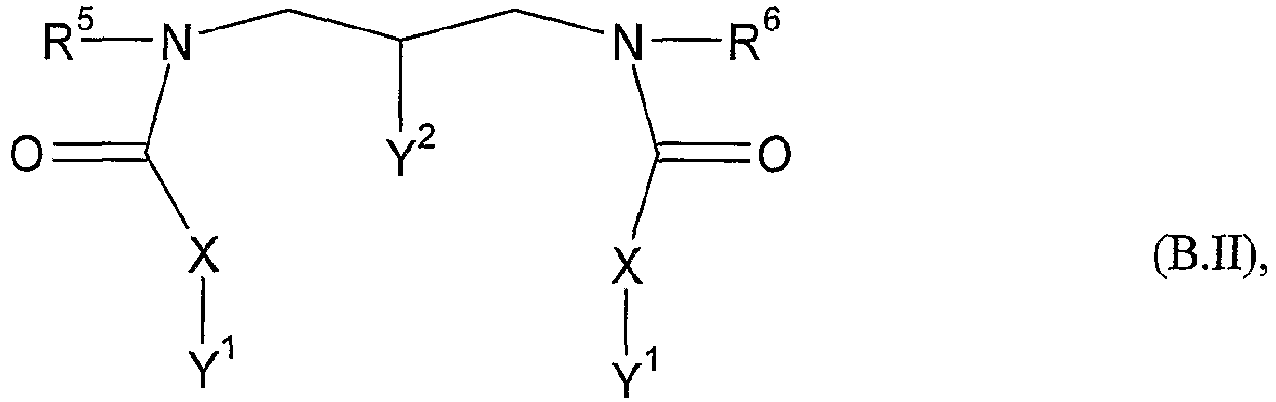
- R5, R6
- C6- bis C36-Alkyl, verzweigt oder unverzweigt, auch ungesättigt;
- X
- Alkylen- oder Alkenylengruppe mit 1 bis 6 Kohlenstoffatomen, die mit einer Hydroxylgruppe oder einer Sulfonsäuregruppe oder einer Carboxygruppe substituiert sein kann;
- Y1
- eine Sulfonat- oder Sulfatgruppe oder eine Carboxylgrupppe und
- Y2
- eine Hydroxylgruppe, ein Schwefelsäurerest oder -O-(CO)X-COOH bedeuten.
- B.III Geminitenside der allgemeinen Formel (B.III) analog
JP-A-8-311003 
FG -COOM oder -SO3M bedeutet. - B.IV Geminitenside der allgemeinen Formel (B.IV) analog
JP-A 11-60437 
- AO
- Alkylenoxideinheiten, d.h. Ethylenglykol-, Propylenglykol und Butylenglyko-lethereinheiten, allein oder statistisch oder blockweise verteilt, mit n = 1 bis 20 und
- Z
- -SO3M, -C2H4SO3M, -C3H6SO3M, -P(O)(OM)2 oder -CH2-COOM, -C2H4-COOM bedeuten.
- Auf amid- oder aminhaltigen Spacem beruhende Strukturen
- C.I Geminitenside der allgemeinen Formel (C.I) analog
EP 0 697 244 
- R1
- C5- bis C25-Alkyl, verzweigt oder unverzweigt, auch ungesättigt, hydroxysubstituiert oder perfluoriert;
- R2
- C1- bis C12-Alkylen oder hydroxysubstituierte Derivate davon;
- B
- eine Amidgruppe [-C(O)N(R2)- oder -N(R5)C(O)-], eine Carboxylgruppe [-C(O)O- oder -OC(O)-], eine Polyethergruppe [-(O(R6-O)x-];
- R5
- für C1- bis C4-Alkyl oder hydroxysubstituiertes Alkyl oder H steht;
- R6
- für C2- bis C4-Alkylen;
- x
- eine Zahl von 1 bis 20;
- R3
- für C1- bis C12- Alkyl oder hydroxysubstituierte Derivate davon, R7-D-R7 oder eine Polyethergruppe [-(O(R6-O)x-];
- R7
- für C1- bis C6- Alkylen oder hydroxysubstituierte Derivate davon;
- D
- -O-, -S-, -N(R8)- ;
- R4
- Alkylen oder Alkylaryl mit 1 bis 12 C-Atomen oder die hydroxysubstituierten Derivaten oder R9-D1-R9 ;
- R8
- C1- bis C12-Alkyl oder hydroxysubstituiertes Alkyl oder H oder R9-D1-R9;
- R9
- für C1- bis C6- Alkylen oder hydroxysubstituierte Derivate davon oder Aryl;
- D1
- -O-, -S-, -SO2-, -C(O)-, [-(O(R7-O)x-], (R10)t[N(R10)]z oder Aryl;
- R10
- C1- bis C12-Alkyl oder hydroxysubstituiertes Alkyl oder H oder Aryl;
- t,z
- unabhängig voneinander eine Zahl von 1 bis 4 bedeuten und
- Y
- unabhängig voneinander für -SO3H, O-SO3H, -OP(O)(OH)2, -P(O)(OH)2, -COOH, -CO2-C6H4-SO3H und deren Salze davon steht.
- C.II Geminitenside der allgemeinen Formel (C.II) analog
EP 0 697 245 
- R11
- C5- bis C23-Alkyl, verzweigt oder unverzweigt, auch ungesättigt, hydroxysubstituiert oder perfluoriert oder R14-B-R2;
- R14
- C1- bis C12-Alkyl, verzweigt oder unverzweigt, auch ungesättigt, oder die hydroxysubstituierten Derivate;
- R12
- C1- bis C12-Alkylen, verzweigt oder unverzweigt, gesättigt, gegebenenfalls bis zu 2-fach nicht-benachbart ungesättigt, oder die hydroxysubstituierten Derivate oder eine Amidgruppe [-C(O)N(R2)- oder N(R5)C(O)-], eine Carboxylgruppe [-C(O)O- oder -OC(O)-], eine Polyethergruppe [-(O(R6-O)x-] oder R9-D1-R9 und
- A
- -CR6= oder -N= unter der Voraussetzung, daß wenn A gleich -N= ist, R11 gleich R14-B-R2 bedeuten.
- C.III Geminitenside der allgemeinen Formel (C.III) analog
DE 4227391 undDE 19608117 
- R21
- C5- bis C23-Alkyl, verzweigt oder unverzweigt, auch ungesättigt;
- R22, R24
- C1- bis C6 Alkylen;
- R23
- Methyl, Ethyl, Propyl oder eine Polyethergruppe [-(O(R6-O)x]
- D. I Geminitenside der allgemeinen Formel (D.I) analog
US 5,863,886 
- R, R1
- C5- bis C30-Alkyl, verzweigt oder unverzweigt, auch ungesättigt, hydroxysubstituiert oder perfluoriert;
- R2
- C1-bis C10- Alkylen, Arylen und hydroxysubstituierte Derivate, ein Polyether [-O(R4O)x-], -S-, -SO2-, -O-, -S-S-, -O-R5-O- oder -S-R5-S-; Variable für eine direkte Bindung zwischen den beiden α-Kohlenstoffen;
- R4
- C2- bis C4-Alkylen;
- R5
- C1- bis C10-Alkylen, Arylen oder Alkylarylen, -N(R6)- oder -(NR6)-R7-(NR6)-;
- R6
- C1- bis C6-Alkyl;
- R7
- C1- bis C6-Alkyl, wobei R7 und R6 auch Teil eines heterocyclischen Ringes sein können;
- X
- Polyether [-O(R4O)x-], wobei x eine Zahl von 1 bis 30 ist, -O-, NZ;
- Z
- C1- bis C10- Alkyl, Aryl, Alkylaryl oder H und
- Y, Y1
- unabhängig voneinander H, -CH2-COOH und Salze, ein Kohlenwasserstoffrest mit mindestens 2 Hydroxylgruppen, wie Erythrose, Threose, Ribose, Arabinose, Xylose, Fructose, Lyxose, Allose, Altrose, Glucose, Mannose, Galactose und ihre Mischungen.
- D.II Geminitenside der allgemeinen Formel (D.II)

- AO
- -C(O)-, -C(O)- [-O(R4O)x-], -CH2- [-O(R4O)x-], -CH2-O-;
- T, T1
- unabhängig voneinander -OM, -H, -CH3, -C2H5, -SO3M, -CH2COOM, -C2H4-COOM, -C3H6-SO3M, -O-P(O)(OM)2 und
- M
- Alkali, ½ Erdalkali, Ammonium, Mono-, Di-, Trialkanolammonium oder H bedeuten.
- D.III Geminitenside der allgemeinen Formel (D.III) analog
WO 96/16930 
- R8
- NYY1, -O(R4O)xH oder -O(R4O)x-C(O)-CHR-CHR1-C(O)NYY1 bedeutet.
- D.IV Geminitenside der allgemeinen Formel (D.IV) analog
WO 96/25384 
- t
- eine ganze Zahl von 1 bis 100, bevorzugt 1 bis 20, besonders bevorzugt 1 bis 4 bedeutet.
- Die Ölphase enthält oder besteht aus Wachsen. Wachse sind eine Klasse von Stoffen, die durch ihre mechanisch-physikalischen Eigenschaften definiert sind. Ein Stoffgemisch enthaltend obigen Ölanteil wird im Sinne dieser Erfindung als Wachs bzw. als Weichwachs bezeichnet, wenn es bei 25°C von verformbar weich, über knetbar bis brüchig hart ist und einen Erweichungspunkt über 25°C insbesondere über 30°C, aufweist (jeweils bei Normaldruck, 1013 mbar).
- Das Wachs kann ein erdölbasiertes Paraffinwachs, Montanwachse, ein Fischer-Tropsch Wachs, ein Polyolefinwachs sein oder aus Mischungen dieser bestehen und/oder ein Raffmationsprodukte dieser sein. Die langkettigen gesättigten aliphatischen Kohlenwasserstoffe werden häufig als Paraffinwachse bezeichnet. Die in der Industrie üblicherweise verwendeten Paraffinwachse sind Produkte der Erdölraffination und bestehen hauptsächlich aus Mischungen von bei über 40°C festen n- und iso-Alkanen unterschiedlicher Mengenverhältnisse.
- Die einsetzbaren Paraffinwachse können in makro- und mikrokristalline Wachse eingeteilt werden. Makrokristalline Wachse bestehen vorwiegend aus gesättigten, geradkettigen, unverzweigten Kohlenwasserstoffen (n-Alkane) und besitzen ein Molekulargewicht, das etwa zwischen 280 und 700 (g/mol) liegt (Anzahl der Kohlenstoffatome in der Kette zwischen 20 und etwa 50). Im Unterschied zu den makrokristallinen Paraffinen bestehen die mikrokristallinen Paraffine vorwiegend aus verzweigen Alkanen (iso-Alkane) und gesättigten ringförmigen Kohlenwasserstoffen (Cycloalkane). Der Schmelzbereich liegt zwischen 60°C und 90 °C. Mikrokristalline Paraffine sind auch durch Hydroisomerisierung von Fischer-Tropsch-Wachsen zugänglich.
- Geeignet sind natürliche Wachse tierischen und pflanzlichen Ursprungs, wie beispielsweise Bienenwachs und andere Insektenwachse sowie Beerenwachs, Sheabutter und/oder Lanolin (Wollwachs). Darüber hinaus pflanzliche Wachse wie Camauba-, Candellila- und Mimosawachs. Synthetische und aufgereinigte petrochemische Wachse wie Polyethylenwachs oder auch sogenannte Ozokerite sind ebenfalls geeignet. Ebenfalls geeignet sind Fischer-Tropsch-Wachse, hochmolekulare Alkane, die bei der Fischer-Tropsch-Synthese anfallen und ebenfalls aufgereinigt angeboten werden. Darüber hinaus sind auch durch Oxidation oder Umesterung modifizierte Wachse geeignet.
- Einschränkend gilt hier, dass der Erweichungspunkt der gesamten Ölphase bei größer 25 °C, bevorzugt bei 30 - 90 °C und in Fällen, in denen z.B. in druckfesten Apparaturen gearbeitet werden kann auch bei 30 -150 °C bzw. 50 -150 °C liegen kann.
- Weiterhin geeignete Wachse, auf die die obengenannte Definition zutrifft, sind Paraffine, Ester, auch Mischester zwischen Siliconen bzw. funktionalisierten Siliconen und organischen Komponenten jedoch insbesondere Glyceride und ihre Derivate. Dimethicone mit Viskositäten > 0,0001 mPas und auch hochviskose Siliconöle, mit Viskositäten > 60 Pas können ohne besondere Werkzeuge, die hohe Scherung ermöglichen, zu selbstemulgierenden Gelen verarbeitet werden. Daneben genannt sind auch Destillierrückstände der Petrochemie, Gatschen und Bituminen.
- Besonders vorteilhaft sind Mischungen von natürlichen oder synthetischen Wachsen mit hochschmelzenden Estern, langkettigen kationischen Verbindungen wie Behentrimmonium Chlorid oder - Methosulfat (INCI) oder Esterquats (Ester des Triethanolamins oder N-Methyl-diethanolamins mit langkettigen (C18 - C32) Fettsäuren, die anschließen mit Ethylenoxid, Methylchlorid oder Dimethylsulfat quaterniert worden sind, Aminofunktionalisierten Siliconen, Guerbetalkoholen ab C28, Dialkylethern ab C 12, Alkoholpropoxylate ab C 18, da durch die Mischung die Oberflächencharakteristik (beispielsweise die Polarität und damit die Benetzbarkeit einer Wachsbeschichtung von Oberflächen) gezielt eingestellt werden kann.
- Soweit in der Wachsphase noch bei 25°C flüssige Komponenten enthalten sind können diese vorteilhaft gewählt aus der Gruppe der polaren Öle, beispielsweise aus der Gruppe der Fettsäuretriglyceride, namentlich Glycerintriester gesättigter und/oder ungesättigter, verzweigter und/oder unverzweigter Alkancarbonsäuren einer Kettenlänge von 8 bis 32, insbesondere 12 bis 18 C-Atomen augewählt sein. Die Fettsäuretriglyceride können beispielsweise vorteilhaft gewählt werden aus der Gruppe der synthetischen, halbsynthetischen und natürlichen Öle, wie z. B. Cocoglycerid, Olivenöl, Sonnenblumenöl, Sojaöl, Erdnussöl, Rapsöl, Mandelöl, Palmöl, Kokosöl, Rizinusöl, Weizenkeimöl, Traubenkernöl, Distelöl, Nachtkerzenöl, Macadamianussöl, Babassuöl, Karottenöl, Palmkernöl und dergleichen mehr.
- Darüber hinaus können erfindungsgemäß eingesetzt werden synthetisch hergestellte Ester von C6- bis C32- Carbonsäuren, oder Hydroxycarbonsäuren linear oder verzweigt, gesättigt oder ein bis dreifach ungesättigt, mit Di-, Tri- oder Polyhydroxyverbindungen, die alle mit Carbonsäuren abgesättigt sein können oder nur zu einem Teil, mindestens aber einfach umgesetzt sein müssen und keine signifikante Grenzflächenaktivität aufweisen dürfen. Besonders geeignet sind hier die MCT Öle (MCT = Mid-chain triglyceride) wie Caprylic/Capric Triglyceride oder auch Butylenglycol -Dicaprylate / -Dicaprate und die entsprechende Propylenglykolvarianten aber auch entsprechende Ester des Propylen- und Butylenglykols.
- Weiter eignen sich (INCI) Bis-Diglyceryl-Polyacyl-adipate-1 und -2 ebenso wie ihre Vorbilder aus der Natur, Lanolin und Lanolinöl sowie Lanolinalkohol.
- Weitere vorteilhafte polare Ölkomponenten können im Sinne der vorliegenden Erfindung ferner gewählt werden aus der Gruppe der Ester aus gesättigten und/oder ungesättigten, verzweigten und/oder unverzweigten Alkancarbonsäuren einer Kettenlänge von 3 bis 40 C-Atomen und gesättigten und/oder ungesättigten, verzweigten und/oder unverzweigten Alkoholen einer Kettenlänge von 3 bis 40 C-Atomen sowie aus der Gruppe der Ester aus aromatischen Carbonsäuren und gesättigten und/oder ungesättigten, verzweigten und/oder unverzweigten Alkoholen einer Kettenlänge von 3 bis 40 C-Atomen.
- Esteröle können dann vorteilhaft gewählt werden aus der Gruppe Octylpalmitat, Octylcocoat, Octylisostearat, Octyldodeceylmyristat, Cetearylisononanoat, Isopropylmyristat, Isopropylpalmitat, Isopropylstearat, Isopropyloleat, n-Butylstearat, n-Hexyllaurat, n-Decyloleat, Isooctylstearat, Isononylstearat, Isononylisononanoat, 2-Ethyl-hexylpalmitat, 2-Ethylhexyllaurat, 2-Hexyldecylstearat, 2-Octyldodecylpalmitat, Stearylheptanoat, Oleyloleat, Oleylerucat, Erucyloleat, Erucylerucat, Tridecylstearat, Tridecyltrimellitat, sowie synthetische, halbsynthetische und natürliche Gemische solcher Ester, wie z. B. Jojobaöl, Mandel-, Orangen-, Macadamia-, Babassu-, Evening Primrose und andere Öle. Guerbetalkohole von C10 bis C36 können ebenfalls als polare Ölkomponenten eingesetzt werden.
- Ferner können die Ölphasen vorteilhaft gewählt werden aus der Gruppe der Dialkylether und Dialkylcarbonate, vorteilhaft sind z. B. Dicaprylylether (Cetiol OE, Cosmacol OE) und/oder Dicaprylylcarbonat, beispielsweise das unter der Handelsbezeichnung Cetiol CC bei der Fa. Cognis erhältliche.
- Die Ölkomponente kann ferner sein ein Neopentylglykoldiheptanoat, ein Propylenglykol-dicaprylat/dicaprat, ein Caprylic/Capric/Diglycerylsuccinat, ein Butylenglykol-Dicaprylat/Dicaprat, ein C12/13-Alkyllactat, ein Di-C12/13-Alkyltartrat, ein Triisostearin, ein Dipentaerythrityl-Hexacaprylat/Hexacaprat, Propylenglykolmonoisostearat, und/oder Tricaprylin.
- Vorteilhafte Ölkomponenten sind ferner z.B. Butyloctylsalicylat (beispielsweise das unter der Handelsbezeichnung Hallbrite BHB bei der Fa. CP Hall erhältliche), Hexadecylbenzoat und Butyloctylbenzoat und Gemische davon (Hallstar AB) und/oder Diethylhexylnaphthalat.
- Auch beliebige Abmischungen solcher Ölkomponenten sind vorteilhaft im Sinne der vorliegenden Erfindung einzusetzen.
- Ferner können die Ölphasen ebenfalls vorteilhaft auch unpolare Öle enthalten, beispielsweise verzweigte und unverzweigte Kohlenwasserstoffe und -wachse, insbesondere Mineralöl, Vaseline (Petrolatum), Paraffinöl, Squalan und Squalen, Polyolefine, hydrogenierte Polyisobutene und Isohexadecan. Unter den Polyolefinen sind Polydecene die bevorzugten Substanzen.
- Vorteilhaft können die Ölphasen ferner einen Gehalt an cyclischen oder linearen Silikonölen aufweisen oder vollständig aus solchen Ölen bestehen, wobei allerdings bevorzugt wird, außer dem Silikonöl oder den Silikonölen einen zusätzlichen Gehalt an anderen Ölphasenkomponenten einzusetzen. Silikonöle sind synthetische polymere Verbindungen, in denen Silicium-Atome über Sauerstoff-Atome verknüpft sind. Die methylsubstituierten Polyorganosiloxane werden auch als Polydimethylsiloxan bzw. Dimethicon (INCI) bezeichnet. Dimethicone gibt es in verschiedenen Kettenlängen bzw. mit verschiedenen Molekulargewichten. Ebenso verwendbar sind (INCI) Dimethiconole.
- Besonders vorteilhafte Polyorganosiloxane im Sinne der vorliegenden Erfindung sind beispielsweise Dimethylpolysiloxane [Poly(dimethylsiloxan)]. Ferner vorteilhaft sind Phenylmethylpolysiloxane (INCI: Phenyl Dimethicone, Phenyl Trimethicone), cyclische Silikone (Decamethylcyclopentasiloxan, Dodecamethylcyclohexasiloxan), welche nach INCI auch als Cyclomethicone bezeichnet werden, aminomodifizierte Silikone (INCI: Aminodimethicone) und Silikonwachse, z. B. Polysiloxan-PolyalkylenCopolymere (INCI : Stearyl Dimethicone und Cetyl Dimethicone) und Dialkoxydimethylpolysiloxane (Stearoxy Dimethicone und Behenoxy Stearyl Dimethicone).
- Bitumenmischungen verschiedener Viskositäten und Provinienzen (aus Petrochemie oder aus natürlich vorkommenden Quellen (sog. Asphaltene) können ebenfalls vorteilhaft eingesetzt werden. Bei zu hohen Erweichungspunkten muss in Drucksystemen und oberhalb von 100 °C gearbeitet werden, was die erfindungsgemäße Verwendung aber nicht einschränkt. In diesem Fall müssen besonders hitzeresistente Tenside eingesetzt werden.
- Es kann auch gegebenenfalls vorteilhaft sein, Wachse, beispielsweise Cetylpalmitat, als alleinige Lipidkomponente der Ölphase einzusetzen. Vorteilhaft wird die Ölphase gewählt aus der Gruppe 2-Ethylhexylisostearat, Octyldodecanol, Isotridecylisononanoat, Isoeicosan, 2-Ethylhexylcocoat, C12-15-Alkylbenzoat, Capryl-Caprinsäure-triglycerid, Dicaprylylether, didodecylether, didecylether.
- Ferner können Perfluoroether, Perflouroalkohole und - säuren und deren Derivate, sowie mit perfluoro-Gruppen derivatisierte Silicone und - Silane alleinig oder als Bestandteile der Ölphase eingesetzt werden.
- Ferner können vorteilhaft in der Ölphase bzw. als alleinige Komponenten der Ölphase eingesetzt werden Ester von Hydroxycarbonsäuren, besonders bevorzugt sind Alkylcarbon- und Benzoyl- wie auch Salicylsäureester mit Alkoholen, mit C2 bis C40, linear oder verzweigt, gesättigt oder ungesättigt und Mischungen der verschiedenen Alkohole. Die Alkylester der Glykolsäure, Milchsäure, Zitronensäure, Weinsäure, Benzoesäure, 2-Ethylhexansäure, Apfel- und Äpfelsäure, Salicylsäure und Benzoesäure sind besonders geeignet.
- Ferner kann die Ölphase auch aus Monomeren und deren Polymeren und Co-Polymeren bestehen, Vinylakohol und seine Ester, bevorzugt Vinylacetat, Vinylchlorid, Acrylsäure und deren Ester, Methacrylsäure und deren Ester, Ethylen, alpha-und mittelständige Olefine mit C2 bis C22, besonders geeignet Ethylen, Propylen, Butylen, Styrol, Cyclopentadien und/oder Butadien.
- Die Viskosität der aus der Verdünnung des selbstemulgierenden Gels (G) entstehenden Nanoemulsion (C) kann mit Hilfe aller gängigen Hydrokolloide und Verdicker kontrolliert werden.
- Diese Hydrokolloide und Verdicker können vorteilhaft gewählt werden aus der Gruppe der organischen oder anorganischen Verdicker und Hydrokolloide. Unter den organischen Hydrokolloiden sind sowohl die neutralen, anionischen als auch kationischen und amphoteren geeignet, wobei sowohl lineare als auch Cross Polymere als Hydrokolloide und Verdicker sich als geeignet für die erfindungsgemäßen Emulsionen erwiesen haben. Unter den anorganischen sind sowohl die reinen anorganischen Verdicker wie auch die organisch modifizierten Verdicker und Hydrokolloide geeignet. Darüber hinaus können synergistisch wirkende Kombinationen innerhalb beider Gruppen wie auch aus beiden Gruppen stammend günstig eingesetzt werden.
- Als Beispiele sollen hier Assoziativverdicker, wie hydrophob modifizierte Acryl-, Metacryl, Maleinsäure- homo- und / oder Copolymerisate, Polyurethanderivate, Acrylamidderivate, Non-Assoziativverdicker wie quellbare Verdicker basierend auf Acryl-, Methacryl, Maleinsäure Homo- oder Copolymer und deren Derivaten, Cellulose und Cellulosederivate (Carboxymethylcellulose, Hydroxyethylcellulose, Methylcellulose, Methylhydroxyethylcellulose, Methylhydroxypropylcellulose, Ethylhydroxyethylcellulose, hydrophob modifizierte Ethylhydroxyethylcellulose, Mikrokristalline Cellulose, Cellulose Gum und Mischungen aus diesen beiden mit unterschiedlichen Verhältnissen von mikrokristalliner Cellulose zu Cellulose Gum, hydrophob modifizierte Hydroxyethylcellulose), Tone (Schichtsilicate, Smectite, Alumosilicate oder Schichtsilicate wie Montmorillonit, Bentonit Hectorit, Attapulgite) auch Magnesium Aluminium Silicate und Organotonderivate (organisch modifizierte Alumosilicate, Bentonite, Hectorite) aber auch Kieselsäurederivate (Fumed Silica), Organowachse (Rhizinusölderivate, Polyamidbasierte Organowachse, Polyesteramide und metallorganische Verdicker (Titanate und Zirconate) - besonders in Kombination mit Stärke- und Cellulosederivaten, natürliche Gum-Derivate wie Guar- oder Stärkederivate, genannt sein.
- In der Gruppe der Gumme sind besonders geeignet die natürlichen und die modifizierten Polymere, bevorzugt pflanzlichen Ursprungs wie Gummi Arabicum, das aus verschienen Akazienarten hergestellt werden kann. Auch von anderen Bäumen lassen sich natürliche Gummen gewinnen, z.B. Tragacanth Gum. Ebenfalls geeignet sind Alginate und Carrageenan und ihre Derivate. Xanthan Gum und seine Variationen und Derivate sind ebenfalls besonders als Hydrocolloid und Verdicker geeignet. Guar Caroube und Pectine gehören ebenfalls zur Gruppe der Gumme und sind geignet.
- Zu den natürlichen, als Verdicker und Hydrocolloid geeigneten Polymeren gehört ebenfalls die Stärke und ihre Derivate (Dextrinderivate), wie Carboxymethylstärke, Hydroxymethylstärke aber auch phosphatierte Stärke.
- Elektrolyte, seien es ein- oder mehrwertige, werden bis zu einer Konzentration von ca. 40 %, bevorzugt bis 20 % und besonders bevorzugt bis 15 %, ohne signifikante Beeinträchtigung des Selbstemulgiermechanismusses und der daraus entstehenden Emulsionen toleriert.
- Erfindungsgemässe kosmetische und dermatologische Zubereitungen können kosmetische Hilfsstoffe enthalten, wie sie üblicherweise in solchen Zubereitungen verwendet werden, z. B. Konservierungsmittel, Bakterizide, Parfüme, Substanzen zum Verhindern des Schäumens, Farbstoffe, Pigmente, die eine färbende Wirkung haben, Verdickungsmittel, weichmachende, anfeuchtende und/oder feuchhaltende Substanzen, organische Lösemittel, Aktivstoffe, wie zum Beispiel Vitamine und ihre Derivate, Pflanzenextrakte, Enzyme, Steroide und ihre Derivate und/oder Ceramide und ihre Derivate.
- Besonders bevorzugte Anwendungen sind folgende:
- Dispersionen für Personal Care und Kosmetik
- Lebensmittelanwendungen
- Textil- und Lederhilfsmittel
- Dispersionen für den Agro-Bereich
- Dispersionen für die Metallbearbeitung
- Siliconöl- Dispersionen in Wasser
- Dispersionen zur Hydrophobierung und/oder für die Bauchemie
- Dispersionen für die Haushalts- und Kfz-Pflege (Möbelpflege, Fahrzeuge aussen und innen)
- Dispersionen für die Schuh- und Textilpflege
- Dispersionen für die Herstellung von technischen Textilien
- Dispersionen von Fluorkohlenwasserstoffen und -derivaten
- Dispersionen von Polymeren für Versiegelungs-, Lack- und Klebstoffanwendungen
- Dispersionen von Polymeren für Non-Wovens, Wand- und sonstige Oberflächenbeschichtungen
- Die nachfolgenden Beispiele illustrieren die Erfindung (% jeweils = Gew.%):
-
A) MARLINAT 242/90M (MIPA-Laureth Sulfate (und) Propylene Glycol) 1,9% SAFOL 23 (Iso C12/13 Alkohol) 0,9% Glycerin 3,1% Wasser (Aqua), Deionized 0,9% B) Bienenwachs : MIGLYOL 812 (Caprylic/Capric Triglyceride (1:1) 38,4% C) Wasser (Aqua), Deionized 54,8% - Phase A homogen mischen. Phase A vorlegen bei 60°C , Phase B erwärmen bis flüssig, unter Rühren im laminaren Strömungsfeld (ca. 1500 U/min; Drahtrührer) langsam zudosieren, 1 min nachrühren. Phase C auf 60°C erwärmen unter Rühren zugeben. Unter Rühren abkühlen lassen. Die Emulsion weist eine mittlere Tröpfchengröße von 300 nm auf.
-
A) MARLINAT 242/90M (MIPA-Laureth Sulfate (and) Propylene Glycol) 1,7% EMULDAC AS 25 (Ceteareth-25) 0,7% Glycerin 3,3% Wasser (Aqua), Deionized 0,2% B) COSMACOL SE : COSMACOL OE (Distearylether: Dioctyether) (9:1) 35,3% C) Wasser (Aqua), Deionized 58,8% - Phase A erwärmen, homogen mischen. Phase A vorlegen, Phase B unter Rühren im laminaren Strömungsfeld (ca. 1500 U/ min; Drahtrührer in Paddelform) langsam zudosieren, 1 min nachrühren und Phase C unter Rühren zugeben. Die Emulsion weist eine mittlere Tröpfchengröße von 300 nm auf.
-
A) MARLINAT 242/90M (MIPA-Laureth Sulfate (und) Propylene Glycol) 0,15% SAFOL 23 (C12/13 Alkohol) 0,07% Glycerin 0,3% Wasser (Aqua), Deionized 0,01% B) Bienenwachs 1,0 % C) Wasser (Aqua), Deionized 4,0% D) MARLINAT 242/70 (Na-Laureth Sulfate) 7,5% Wasser (Aqua), Deionized zu 100,0% AMPHOLYT JB 130 K (Cocoamidopropyl Betaine) 7,50% COSMACOL ELI (C12-13 Alkyl Lactate) 0,3% SOFTIGEN 767 (PEG-6 Caprylic/Capric Glycerides) 0,3% D- Panthenol 1,0% Microcare BR 0,1 % NaCl 2,4% - Phase A homogen mischen. Phase A vorlegen bei 60°C , Phase B erwärmen bis flüssig, unter Rühren im laminaren Strömungsfeld (ca. 1500 U/ min; Drahtrührer) langsam zudosieren, 1 min nachrühren, Phase C auf 60°C erwärmen, unter Rühren zugeben und unter Rühren abkühlen lassen. Phase D homogen mischen, Phase ABC unter Rühren zugeben.
-
A) Cetyltrimethylammoniumchlorid 2,4 % Safol 23 (Iso-C12-13 Alkohol) 1,1 % Glycerin 4,0 % Wasser (Aqua), Deionized 5,0 % B) COSMACOL SE : ISOFOL 28 (Distearylether : Decyloctadekanol) (1: 1) 17,0 % C) Wasser (Aqua), Deionized 69,5 % Phenonip, Clariant 1,0 % - Phase A erwärmen, homogen mischen. Phase A vorlegen, Phase B unter Rühren im laminaren Strömungsfeld (ca. 1500 U/ min; Drahtrührer) langsam zudosieren, 1 min nachrühren und Phase C unter Rühren zugeben. Die Emulsion weist eine mittlere Tröpfchengröße von 360 nm auf.
-
A) Cetyltrimethylammoniumchlorid 2,0 % Safol 23 (Iso-C12-13 Alkohol) 1,1 % Glycerin 4,0 % Wasser (Aqua), Deionized 3,0 % B) Bienenwachs : MIGLYOL 812 (Caprylic/Capric Triglyceride (1:1) 35,3% C) Wasser (Aqua), Deionized 53,6 % Phenonip, Clariant 1,0 % - Phase A erwärmen, homogen mischen. Phase A vorlegen, Phase B unter Rühren im laminaren Strömungsfeld (ca. 1500 U/ min; Drahtrührer) langsam zudosieren, 1 min nachrühren und Phase C unter Rühren zugeben. Die Emulsion weist eine mittlere Tröpfchengröße von 260 nm auf.
Claims (14)
- Verfahren zur Herstellung von Öl in Wasser Dispersion aus selbstemulgierenden Gelkonzentraten umfassend die folgenden Schritte:(a) Bereitstellen einer Emulgatorkonzentrates (A) enthaltend zumindest(A.1) zu 0 bis 80 Gew.% ein oder mehrere Polyole (P),(A.2) zu 0,01 bis 99 Gew.% Wasser (W) und(A.3) zu 1 bis 80 Gew.% ein ionisches Tensid (I) und / oder ein nicht-ionisches Tensid (N)bezogen auf das Emulgatorkonzentrat (A),(b) in Kontakt bringen einer Ölphase (O) mit dem Emulgatorkonzentrat (A) in einem im Wesentlich ausschließlich laminaren Strömungsfeld, um ein selbstemulgierendes O/W Gelkonzentrat (G) mit einem Ölgehalt von größer 5 Gew.% zu erhalten, und(c) Zusammenbringen des O/W Gelkonzentrats (G) mit Wasser, das auch weitere Zuschlagsstoffe enthalten kann,wobei die Ölphase eine bei 25°C feste Wachsphase mit einem Erweichungspunkt größer 25°C ist und beim Inkontaktbringen die zusammengebrachten Komponenten von Schritt (a) und (b) bzw. von Schritt (a), (b) und (c) eine Temperatur über dem Erweichungspunkt der Wachsphase haben und die Öl in Wasser Dispersion nach dem Abkühlen suspendierte Wachsfeststoff als dispergierte Phase aufweist.
- Verfahren nach Anspruch 1, dadurch gekennzeichnet, dass Emulgatorkonzentrat (A) unabhängig von einander aufweist(A.1) zu 0,1 bis 75 Gew.% Polyol (P),(A.3) zu 5 und 40 Gew.%, insbesondere zu 10 bis 30 Gew.%, ein ionisches Tensid (I) und / oder ein nicht-ionisches Tensid (N) und/oder(A.2) zu 50 bis 70 Gew.% Wasser.
- Verfahren nach Anspruch 1, dadurch gekennzeichnet, dass das O/W Gelkonzentrat (G) einen Ölgehalt von 60 bis 99 % und besonders bevorzugt 80 bis 98 Gew.% aufweist.
- Verfahren nach Anspruch 1, dadurch gekennzeichnet, dass das O/W Gelkonzentrat sich in Wasser selbsttätig ohne Einwirken von Scherkräften zum Erhalt einer Makrodispersion/Makroemulsion (M) (im thermodynamischen Sinne) und insbesondere einer Nanodispersion/Nanoemulsion (C) einarbeitet.
- Verfahren nach Anspruch 1, dadurch gekennzeichnet, dass das Wasser in Schritt (c) weniger als 5 Gew.%, vorzugsweise weniger als 2,5 Gew.%, Zuschlagsstoffe enthält.
- Verfahren nach Anspruch 1, dadurch gekennzeichnet, dass das Wachs ein oder mehrere Komponenten sind ausgewählt aus der Gruppe bestehend aus: FT-Wachse, Paraffine, Carnaubau-Wachs, Dialkyl(>C14)ether, Guerbet-Alkohole mit mehr als 28 Kohlenstoffatomen, ggf. partiell oxidierte Polyethylenwachse und Silikonharze.
- Verfahren nach Anspruch 1, dadurch gekennzeichnet, dass das O/W Gelkonzentrat Verdicker enthält, insbesondere Cellulose, Cellulose Gum, Magnesium/ Aluminiumsilikate und Organotonderivate, Kieselsäurederivate, Gummi Arabicum, Tragacanth Gum, Alginate und/oder Xanthan Gum.
- Verfahren nach Anspruch 1, dadurch gekennzeichnet, dass das nichtionische Tensid ausgewählt ist aus einem oder mehreren Mitgliedern der Gruppe:• C2- bis C4- Alkoxylate von linearen oder verzweigten C10- bis C22- Alkoholen, in statistischer Verteilung der Alkoxylat-Gruppen oder in Blockstruktur, vorzugsweise mit zumindest 6 Alkoxylat-Gruppen,• Monoglycerinester von C8- bis C24- Carbonsäuren,• C8- bis C32-Alkylpolyglycoside,• Poly(C2- bis C4-)alkylenglykol-Glyceryl-Fettsäureester,• Ox(C2- bis C4-)alkylierte Sorbitan(C8- bis C32-)ester,• C2- bis C4- Alkoxylate von Mono- und Difett(>C8)säuren,• Kondensationsprodukte von Ethylenoxid mit dem Produkt aus der Reaktion von Propylenoxid und Ethylendiaminen;• N,N'-Diacylalkylendiamin(C2- bis C4-)alkoxylate,• ethoxylierte Fett(>C8)amine,• (C2- bis C4-)alkoxylierte N-Acylamide N-Acyl-N-Alkylamidalkoxylate,• nichtionische Geminitenside und• N-Methylgluconamide mit einem C6- bis C32- Kohlenwasserstoffrest.• C2- bis C4- Alkoxylate von Fettsäure(>C8)-Triglyceriden, und• mit C8- bis C22-Fettsäuren teilveresterte Polyglycerine mit 3 bis 20 Glycerin-Einheiten, vorzugsweise 3 bis 10.
- Verfahren nach Anspruch 1, dadurch gekennzeichnet, dass das ionische Tensid ausgewählt ist aus einem oder mehreren Mitgliedern der Gruppe:• C8- bis C18- Alkylethersulfate,• Sulfosuccinate in Kombination mit C6- bis C15-Fettalkoholen,• Fettsäuren mit 8 bis 30 Kohlenstoffatomen und deren Seifen,• Glycerin- Mono- und Diester von C8- bis C24-, insbesondere C12- bis C18-, Carbonsäuren,• Carbonsäuren, die mit Milch- und Zitronen- oder Weinsäure verestert worden sind und ggf. ganz oder teilweise neutralisiert sind,• Sorbitanester von C8- bis C24-, insbesondere C12- bis C18-, Mono-, Di- und Trialkylphosphorsäureester und deren C2- und/oder C3-Alkoxylate,• C 10- bis C24-Olefinsulfonate,• beta-C8- bis C 18- Alkyloxyalkansulfonate,• anionische Geminitenside,• Aminoalkanoate der Formel R-NH(CH2)nCOOM mit n, m = 1 bis 4, R = C8- bis C22-Alkyl oder Alkenyl und M = Wasserstoff, Alkalimetall, Erdalkalimetall, Ammonium oder Alkanolammonium,• zwitterionische (Betain-)Tenside,• Phosphate von C2- bis C4- alkoxylierten C8- bis C22- Alkoholen, insbesondere Tridecylalkohol,• Phosphate linearer oder verzweigter C8- bis C22- Alkohole, und• C2- bis C4- Alkoxylate von linearen oder verzweigten C8- bis C22- Alkoholen, in statistischer Verteilung der Alkoxylat-Gruppen oder in Block-Struktur, vorzugsweise mit zumindest 6 Alkoxylat-Gruppen, carboxymethyliert und verseift.
- Verfahren nach Anspruch 1, dadurch gekennzeichnet, dass zumindest ein ionisches Tensid gemäß Anspruch 9 eingesetzt wird zusammen mit einem verzweigten Fettalkohol mit zumindest 8 Kohlenstoffatomen, insbesondere zusammen mit zumindest einem der nachgenannten ionischen Tenside:• C8- bis C18- Alkylethersulfate,• C10- bis C24-Olefinsulfonate,• beta-C8- bis C18- Alkyloxyalkansulfonate,• Phosphate von C2- bis C4- alkoxylierten C8- bis C22- Alkoholen, insbesondere Tridecylalkohol,• Phosphate linearer oder verzweigter C8- bis C22- Alkohole und/oder• C12- bis C 15- lineare oder verzweigte Alkyllactate.
- Verfahren nach Anspruch 1, dadurch gekennzeichnet, dass die Öl in Wasser Dispersion mindestens 50 bis 98 Gew.% Wasser und 1 bis 50 Gew.% Wachs aufweist.
- Verfahren nach Anspruch 1, dadurch gekennzeichnet, dass das Polyol Glycerin ist.
- Verfahren nach Anspruch 1, dadurch gekennzeichnet, dass der Anteil des Wachses an der Ölphase wenigstens 20-100 Gew.% der Ölphase beträgt, vorzugsweise größer 80 Gew.%.
- Verfahren nach Anspruch 13, dadurch gekennzeichnet, dass die Ölphase enthält• Triglycerinester von C8- bis C24- Carbonsäuren, insbesondere C 12- bis C18- Carbonsäuren,• Di-, Tri- oder Polyhydroxyverbindungen partiell oder vollständig verestert mit C6-bis C32- Carbonsäuren oder C6- bis C32- Hydroxycarbonsäuren,• C12- bis C15-Alkyllbenzoate,• Di(C12-C32)ether,• Ester (>C32), und/oder• Silikonöle, insbesondere Polydimethylsiloxan.
Applications Claiming Priority (2)
| Application Number | Priority Date | Filing Date | Title |
|---|---|---|---|
| DE102007063133A DE102007063133A1 (de) | 2007-12-24 | 2007-12-24 | Verfahren zur Herstellung von Wachs in Wasser Dispersionen aus selbstemulgierenden Gelkonzentraten |
| PCT/DE2008/002097 WO2009079995A1 (de) | 2007-12-24 | 2008-12-19 | Verfahren zur herstellung von wachs in wasser dispersionen aus selbstemulgierenden gelkonzentraten |
Publications (2)
| Publication Number | Publication Date |
|---|---|
| EP2222394A1 EP2222394A1 (de) | 2010-09-01 |
| EP2222394B1 true EP2222394B1 (de) | 2013-11-13 |
Family
ID=40565311
Family Applications (1)
| Application Number | Title | Priority Date | Filing Date |
|---|---|---|---|
| EP08863734.3A Not-in-force EP2222394B1 (de) | 2007-12-24 | 2008-12-19 | Verfahren zur herstellung von wachs in wasser dispersionen aus selbstemulgierenden gelkonzentraten |
Country Status (8)
| Country | Link |
|---|---|
| US (1) | US20110033555A1 (de) |
| EP (1) | EP2222394B1 (de) |
| CN (1) | CN101945698B (de) |
| DE (1) | DE102007063133A1 (de) |
| DK (1) | DK2222394T3 (de) |
| ES (1) | ES2444709T3 (de) |
| PT (1) | PT2222394E (de) |
| WO (1) | WO2009079995A1 (de) |
Families Citing this family (18)
| Publication number | Priority date | Publication date | Assignee | Title |
|---|---|---|---|---|
| FR2976483B1 (fr) * | 2011-06-17 | 2013-07-26 | Oreal | Composition cosmetique comprenant un tensioactif anionique, un tensioactif non ionique ou amphotere et un alcool gras solide et procede de traitement cosmetique |
| FR2981567B1 (fr) * | 2011-10-21 | 2013-11-08 | Oreal | Composition cosmetique comprenant un tensioactif gemine et de forts taux de corps gras solide. |
| CN103146204B (zh) * | 2013-03-19 | 2015-05-20 | 广西壮族自治区化工研究院 | 防水纤维板生产使用的乳化石蜡及其制备方法 |
| CN103755978B (zh) * | 2014-01-13 | 2015-08-19 | 广东工业大学 | 一种氧化聚乙烯蜡乳液的制备方法 |
| EP3067463A1 (de) * | 2015-03-10 | 2016-09-14 | Sasol Wax GmbH | Wasserbasierte wachsdispersion mit einem kohlenwasserstoffwachs und einem dialkylether zur beschichtung von papierprodukten |
| DE202015002188U1 (de) * | 2015-03-19 | 2015-05-06 | Beiersdorf Ag | Haarshampoo mit verbesserter Pflegeleistung enthaltend Silikone |
| CN108368451B (zh) * | 2015-11-30 | 2023-04-14 | 丘比株式会社 | 油脂组合物和油脂的氧化抑制方法 |
| CN105771714A (zh) * | 2016-04-22 | 2016-07-20 | 东南大学 | 油包水型纳米乳液的制备方法 |
| CN105993955B (zh) * | 2016-05-31 | 2018-07-24 | 西南林业大学 | 一种黄花倒水莲离体快繁育苗方法 |
| JP2019520358A (ja) | 2016-07-14 | 2019-07-18 | ユニリーバー・ナームローゼ・ベンノートシヤープ | 局所適用用のフォーミングクレンジング組成物 |
| EP3521320B1 (de) | 2016-09-30 | 2024-12-18 | San-Ei Gen F.F.I., INC. | Niedermolekularer ghatti-gummi |
| WO2018181998A1 (ja) * | 2017-03-31 | 2018-10-04 | 三栄源エフ・エフ・アイ株式会社 | 乳化組成物 |
| CN107419044A (zh) * | 2017-08-31 | 2017-12-01 | 太仓雄鹰皮具有限公司 | 一种含有葡萄籽提取液的家具皮革保养湿巾 |
| CN108043324B (zh) * | 2017-12-29 | 2020-01-07 | 中国矿业大学 | 一种从褐煤蜡、泥炭蜡制备有机微粒的方法 |
| CN109985565B (zh) * | 2017-12-29 | 2021-07-02 | 中国石油化工股份有限公司 | 含脂肪酸型表面活性剂的混合体系及其制备方法 |
| NL2020571B1 (nl) * | 2018-03-12 | 2019-09-20 | Sellacq Holland B V | Werkwijze voor het maken van een vast betonelement, substantie en cilindrische behuizing welke een opening omvat, zoals een kitspuit, gevuld met de substantie |
| US12427444B2 (en) | 2018-06-15 | 2025-09-30 | W.R. Grace & Co.-Conn. | Defoamer active, manufacturing thereof, and deforming formulation |
| JP7638485B2 (ja) * | 2019-07-10 | 2025-03-04 | 株式会社日本触媒 | ゲルインウォーター型エマルション、その製造方法及び経皮吸収剤 |
Family Cites Families (40)
| Publication number | Priority date | Publication date | Assignee | Title |
|---|---|---|---|---|
| DE961649C (de) * | 1955-04-17 | 1957-04-11 | Hoechst Ag | Verfahren zur Herstellung von stabilen waessrigen Paraffin-Emulsionen |
| US4043829A (en) * | 1971-08-26 | 1977-08-23 | Sun Oil Company Of Pennsylvania | Stabilized wax emulsions |
| DE2928041A1 (de) * | 1979-07-11 | 1981-01-29 | Meyer Castens Chem Fab Co | Verfahren zur herstellung von emulsionen und deren verwendung |
| DE3024870C2 (de) * | 1980-07-01 | 1985-01-10 | Th. Goldschmidt Ag, 4300 Essen | Verfahren zur Herstellung einer stabilen Emulsion |
| FR2668080B1 (fr) * | 1990-10-17 | 1993-08-13 | Seppic Sa | Compositions auto-emulsionnables a base d'alcools gras, leur procede de preparation et leur utilisation pour la realisation d'emulsions. |
| DE4227391C1 (de) | 1992-08-19 | 1993-09-30 | Goldschmidt Ag Th | Wäßrige Zubereitungen, die Betaine auf Basis polymerer Fettsäuren enthalten |
| EP0708079B1 (de) | 1993-07-09 | 1999-04-14 | Kao Corporation | 2-hydroxypropandiaminderivate und diese enthaltende detergenzzubereitung |
| DE4337030A1 (de) * | 1993-10-29 | 1995-05-04 | Henkel Kgaa | Verfahren zur Herstellung von Wachsdispersionen |
| FR2712595B1 (fr) * | 1993-11-19 | 1995-12-22 | Seppic Sa | Un concentré comportant des alkylglycosides et ses utilisations. |
| US5643864A (en) | 1994-08-19 | 1997-07-01 | Rhone-Poulenc, Inc. | Anionic surfactants having multiple hydrophobic and hydrophilic groups |
| US5656586A (en) | 1994-08-19 | 1997-08-12 | Rhone-Poulenc Inc. | Amphoteric surfactants having multiple hydrophobic and hydrophilic groups |
| DE4440328A1 (de) | 1994-11-11 | 1996-05-15 | Huels Chemische Werke Ag | Amphiphile Verbindungen mit mindestens zwei hydrophilen und mindestens zwei hydrophoben Gruppen auf der Basis von Amiden |
| GB9424353D0 (en) | 1994-12-02 | 1995-01-18 | Ici Plc | Surfactants |
| DE19505100A1 (de) | 1995-02-15 | 1996-08-22 | Basf Ag | Alk(en)yldicarbonsäurebisester, deren Verwendung sowie Verfahren zu deren Herstellung |
| DE19505368A1 (de) | 1995-02-17 | 1996-08-22 | Huels Chemische Werke Ag | Amphiphile Verbindungen mit mindestens zwei hydrophilen und mindestens zwei hydrophoben Gruppen auf der Basis von Dicarbonsäurediamiden |
| JPH08311003A (ja) | 1995-05-17 | 1996-11-26 | Kao Corp | 新規アミド化合物及びその製造方法 |
| US5932535A (en) * | 1995-12-21 | 1999-08-03 | Henkel Kommanditgesellschaft Auf Aktien | Process for the production of light-colored, low-viscosity surfactant concentrates |
| DE19608117A1 (de) | 1996-03-02 | 1997-09-04 | Huels Chemische Werke Ag | Betain-Geminitenside auf der Basis von Aminen |
| DE19622612C1 (de) | 1996-06-05 | 1997-10-23 | Henkel Kgaa | Gemini-Tenside |
| US5744062A (en) * | 1996-08-29 | 1998-04-28 | R.I.T.A. Corporation | Balanced emulsifier blends for oil-in-water emulsions |
| JPH10175934A (ja) | 1996-12-12 | 1998-06-30 | Lion Corp | ビス−アミドカルボン酸又はその塩及びこれを含有する洗浄剤組成物 |
| JPH1160437A (ja) | 1997-08-21 | 1999-03-02 | Kanebo Ltd | 化粧料 |
| US5863886A (en) | 1997-09-03 | 1999-01-26 | Rhodia Inc. | Nonionic gemini surfactants having multiple hydrophobic and hydrophilic sugar groups |
| DE19837841A1 (de) * | 1998-08-20 | 2000-02-24 | Cognis Deutschland Gmbh | Verwendung von wäßrigen Wachsdispersionen als Konsistenzgeber |
| DE19921186C2 (de) * | 1999-05-07 | 2003-02-06 | Cognis Deutschland Gmbh | Hochkonzentriert fließfähige Perlglanzkonzentrate und Verfahren zu ihrer Herstellung |
| DE19943668A1 (de) * | 1999-09-13 | 2001-03-15 | Rwe Dea Ag | Tensidzusammensetzung enthaltend Geminitenside und Co-Amphiphile, ihre Herstellung und ihre Verwendung |
| DE10059430A1 (de) * | 2000-11-30 | 2002-06-06 | Cognis Deutschland Gmbh | Feinteilige Emulsionen |
| DE10156285A1 (de) * | 2001-11-19 | 2003-05-28 | Cognis Deutschland Gmbh | Emulgator-Gemisch |
| US6743434B1 (en) * | 2002-05-14 | 2004-06-01 | Larry D. Lundmark | Carbonic emulsion skin care compositions and method for removing chemically bound residues and mineral deposits from hair |
| DE10300506A1 (de) * | 2003-01-08 | 2004-07-22 | Cognis Deutschland Gmbh & Co. Kg | Wachsdispersionen |
| DE10312763A1 (de) * | 2003-03-21 | 2004-09-30 | IFAC Institut für angewandte Colloidtechnologie GmbH & Co. KG | Verfahren zur Herstellung einer SLN-Dispersion |
| US20060024248A1 (en) * | 2003-03-23 | 2006-02-02 | Combe Incorporated | Composition and method employing membrane structured solid nanoparticles for enhanced delivery of oral care actives |
| DE10347940A1 (de) * | 2003-10-15 | 2005-05-19 | Cognis Deutschland Gmbh & Co. Kg | Selbstemulgierende Zubereitungen |
| DE102004031550A1 (de) * | 2004-06-29 | 2006-02-02 | Cognis Ip Management Gmbh | Hochkonzentrierte, selbstemulgierende Emulsionsgrundlagen zur Herstellung von Öl in Wasser Emulsionen |
| DE102005011334A1 (de) * | 2005-03-11 | 2006-09-21 | Cognis Ip Management Gmbh | Emulgatorzusammensetzung auf Basis von Pentaerythritestern und alkoxylierten nichtionischen Emulgatoren |
| DE102005035515A1 (de) * | 2005-07-26 | 2007-02-01 | Sasol Wax Gmbh | O/W Wachsdispersionen und hieraus erhältliche Gipsprodukte |
| DE102006015517B4 (de) * | 2006-03-31 | 2012-04-19 | Sasol Wax Gmbh | Verwendung von nano-partikulären Wachsdispersionen, Verfahren zu deren Herstellung und Verfahren zur Hydrophobierung von Werkstoffen mit diesen |
| US20080266381A1 (en) * | 2007-04-30 | 2008-10-30 | Matthew David Smith | Selectively privatizing data transmissions in a video conference |
| DE102007063134A1 (de) * | 2007-12-24 | 2009-06-25 | Sasol Germany Gmbh | Verfahren zur Herstellung von Öl in Wasser Emulsionen aus selbstemulgierenden Gelkonzentraten |
| DE102010028774A1 (de) * | 2010-05-07 | 2011-11-10 | Otc Gmbh | Emulgiereinrichtung zur kontinuierlichen Herstellung von Emulsionen und/oder Dispersionen |
-
2007
- 2007-12-24 DE DE102007063133A patent/DE102007063133A1/de not_active Ceased
-
2008
- 2008-12-19 US US12/810,044 patent/US20110033555A1/en not_active Abandoned
- 2008-12-19 EP EP08863734.3A patent/EP2222394B1/de not_active Not-in-force
- 2008-12-19 ES ES08863734.3T patent/ES2444709T3/es active Active
- 2008-12-19 PT PT88637343T patent/PT2222394E/pt unknown
- 2008-12-19 DK DK08863734.3T patent/DK2222394T3/da active
- 2008-12-19 WO PCT/DE2008/002097 patent/WO2009079995A1/de not_active Ceased
- 2008-12-19 CN CN2008801272171A patent/CN101945698B/zh not_active Expired - Fee Related
Also Published As
| Publication number | Publication date |
|---|---|
| CN101945698B (zh) | 2013-07-17 |
| DK2222394T3 (da) | 2014-02-10 |
| PT2222394E (pt) | 2014-02-20 |
| WO2009079995A1 (de) | 2009-07-02 |
| US20110033555A1 (en) | 2011-02-10 |
| EP2222394A1 (de) | 2010-09-01 |
| CN101945698A (zh) | 2011-01-12 |
| ES2444709T3 (es) | 2014-02-26 |
| DE102007063133A1 (de) | 2009-06-25 |
Similar Documents
| Publication | Publication Date | Title |
|---|---|---|
| EP2222393B1 (de) | Verfahren zur herstellung von öl in wasser emulsionen aus selbstemulgierenden gelkonzentraten | |
| DE102007063133A1 (de) | Verfahren zur Herstellung von Wachs in Wasser Dispersionen aus selbstemulgierenden Gelkonzentraten | |
| EP1420749B1 (de) | Sprühbare o/w-emulsionen von niedriger viskosität | |
| EP2550347B1 (de) | Verwendung von reinigungsmitteln enthaltend wachshaltige mikroemulsionen | |
| EP1131393B1 (de) | Tensidzusammensetzung enthaltend geminitenside und deren verwendung zur haut- und haarreinigung | |
| EP1974715A1 (de) | Tränklösung für Feuchttücher | |
| DE102010028585A1 (de) | Mehrphasige kosmetische Zusammensetzung | |
| WO1999023866A2 (de) | Wässrige kosmetische zubereitungen in stiftform | |
| EP3038590A1 (de) | Kosmetische mittel | |
| WO2001074979A1 (de) | Perlglanzkonzentrate | |
| EP2253697B9 (de) | Verfahren zur Aufweitung des Temperaturfensters in Mikroemulsionen mittels Additiven | |
| WO2002043673A2 (de) | Verwendung von nanopartikulären wachsen in der hautkosmetik | |
| DE4303176A1 (de) | Feste Wasch-, Spül- und Reinigungsmittel | |
| DE102014224216A1 (de) | Kosmetische Stückseifen enthaltend Seife und Mikroemulsionen | |
| WO1998036048A1 (de) | Verfahren zur herstellung tensidischer perlglanzkonzentrate | |
| DE19545136C1 (de) | Syndetstückseifen | |
| EP3104834A1 (de) | Mikroemulsionen sowie kosmetische reinigungsmittel enthaltende mikroemulsionen | |
| WO2017207235A1 (de) | Wässrige tensid-zusammensetzungen | |
| WO2017198537A1 (de) | Wässrige tensid-zusammensetzungen | |
| WO2017207239A1 (de) | Wässrige tensid-zusammensetzungen | |
| DE19749550A1 (de) | Verwendung von Mischungen zur Herstellung von Abschminkmitteln |
Legal Events
| Date | Code | Title | Description |
|---|---|---|---|
| PUAI | Public reference made under article 153(3) epc to a published international application that has entered the european phase |
Free format text: ORIGINAL CODE: 0009012 |
|
| 17P | Request for examination filed |
Effective date: 20100610 |
|
| AK | Designated contracting states |
Kind code of ref document: A1 Designated state(s): AT BE BG CH CY CZ DE DK EE ES FI FR GB GR HR HU IE IS IT LI LT LU LV MC MT NL NO PL PT RO SE SI SK TR |
|
| AX | Request for extension of the european patent |
Extension state: AL BA MK RS |
|
| DAX | Request for extension of the european patent (deleted) | ||
| GRAP | Despatch of communication of intention to grant a patent |
Free format text: ORIGINAL CODE: EPIDOSNIGR1 |
|
| GRAS | Grant fee paid |
Free format text: ORIGINAL CODE: EPIDOSNIGR3 |
|
| GRAS | Grant fee paid |
Free format text: ORIGINAL CODE: EPIDOSNIGR3 |
|
| GRAP | Despatch of communication of intention to grant a patent |
Free format text: ORIGINAL CODE: EPIDOSNIGR1 |
|
| INTG | Intention to grant announced |
Effective date: 20130704 |
|
| INTG | Intention to grant announced |
Effective date: 20130710 |
|
| GRAA | (expected) grant |
Free format text: ORIGINAL CODE: 0009210 |
|
| AK | Designated contracting states |
Kind code of ref document: B1 Designated state(s): AT BE BG CH CY CZ DE DK EE ES FI FR GB GR HR HU IE IS IT LI LT LU LV MC MT NL NO PL PT RO SE SI SK TR |
|
| REG | Reference to a national code |
Ref country code: GB Ref legal event code: FG4D Free format text: NOT ENGLISH |
|
| REG | Reference to a national code |
Ref country code: CH Ref legal event code: EP |
|
| REG | Reference to a national code |
Ref country code: AT Ref legal event code: REF Ref document number: 640317 Country of ref document: AT Kind code of ref document: T Effective date: 20131215 |
|
| REG | Reference to a national code |
Ref country code: IE Ref legal event code: FG4D Free format text: LANGUAGE OF EP DOCUMENT: GERMAN |
|
| REG | Reference to a national code |
Ref country code: DE Ref legal event code: R096 Ref document number: 502008010958 Country of ref document: DE Effective date: 20140102 |
|
| REG | Reference to a national code |
Ref country code: DK Ref legal event code: T3 Effective date: 20140206 |
|
| REG | Reference to a national code |
Ref country code: NL Ref legal event code: T3 |
|
| REG | Reference to a national code |
Ref country code: PT Ref legal event code: SC4A Free format text: AVAILABILITY OF NATIONAL TRANSLATION Effective date: 20140212 |
|
| REG | Reference to a national code |
Ref country code: ES Ref legal event code: FG2A Ref document number: 2444709 Country of ref document: ES Kind code of ref document: T3 Effective date: 20140226 |
|
| REG | Reference to a national code |
Ref country code: SE Ref legal event code: TRGR |
|
| REG | Reference to a national code |
Ref country code: CH Ref legal event code: NV Representative=s name: TROESCH SCHEIDEGGER WERNER AG, CH |
|
| REG | Reference to a national code |
Ref country code: NO Ref legal event code: T2 Effective date: 20131113 |
|
| REG | Reference to a national code |
Ref country code: LT Ref legal event code: MG4D |
|
| PG25 | Lapsed in a contracting state [announced via postgrant information from national office to epo] |
Ref country code: IS Free format text: LAPSE BECAUSE OF FAILURE TO SUBMIT A TRANSLATION OF THE DESCRIPTION OR TO PAY THE FEE WITHIN THE PRESCRIBED TIME-LIMIT Effective date: 20140313 Ref country code: FI Free format text: LAPSE BECAUSE OF FAILURE TO SUBMIT A TRANSLATION OF THE DESCRIPTION OR TO PAY THE FEE WITHIN THE PRESCRIBED TIME-LIMIT Effective date: 20131113 Ref country code: HR Free format text: LAPSE BECAUSE OF FAILURE TO SUBMIT A TRANSLATION OF THE DESCRIPTION OR TO PAY THE FEE WITHIN THE PRESCRIBED TIME-LIMIT Effective date: 20131113 Ref country code: LT Free format text: LAPSE BECAUSE OF FAILURE TO SUBMIT A TRANSLATION OF THE DESCRIPTION OR TO PAY THE FEE WITHIN THE PRESCRIBED TIME-LIMIT Effective date: 20131113 |
|
| PG25 | Lapsed in a contracting state [announced via postgrant information from national office to epo] |
Ref country code: CY Free format text: LAPSE BECAUSE OF FAILURE TO SUBMIT A TRANSLATION OF THE DESCRIPTION OR TO PAY THE FEE WITHIN THE PRESCRIBED TIME-LIMIT Effective date: 20131113 Ref country code: LV Free format text: LAPSE BECAUSE OF FAILURE TO SUBMIT A TRANSLATION OF THE DESCRIPTION OR TO PAY THE FEE WITHIN THE PRESCRIBED TIME-LIMIT Effective date: 20131113 |
|
| PG25 | Lapsed in a contracting state [announced via postgrant information from national office to epo] |
Ref country code: EE Free format text: LAPSE BECAUSE OF FAILURE TO SUBMIT A TRANSLATION OF THE DESCRIPTION OR TO PAY THE FEE WITHIN THE PRESCRIBED TIME-LIMIT Effective date: 20131113 |
|
| REG | Reference to a national code |
Ref country code: DE Ref legal event code: R097 Ref document number: 502008010958 Country of ref document: DE |
|
| PG25 | Lapsed in a contracting state [announced via postgrant information from national office to epo] |
Ref country code: CZ Free format text: LAPSE BECAUSE OF FAILURE TO SUBMIT A TRANSLATION OF THE DESCRIPTION OR TO PAY THE FEE WITHIN THE PRESCRIBED TIME-LIMIT Effective date: 20131113 Ref country code: SK Free format text: LAPSE BECAUSE OF FAILURE TO SUBMIT A TRANSLATION OF THE DESCRIPTION OR TO PAY THE FEE WITHIN THE PRESCRIBED TIME-LIMIT Effective date: 20131113 Ref country code: PL Free format text: LAPSE BECAUSE OF FAILURE TO SUBMIT A TRANSLATION OF THE DESCRIPTION OR TO PAY THE FEE WITHIN THE PRESCRIBED TIME-LIMIT Effective date: 20131113 Ref country code: RO Free format text: LAPSE BECAUSE OF FAILURE TO SUBMIT A TRANSLATION OF THE DESCRIPTION OR TO PAY THE FEE WITHIN THE PRESCRIBED TIME-LIMIT Effective date: 20131113 Ref country code: MC Free format text: LAPSE BECAUSE OF FAILURE TO SUBMIT A TRANSLATION OF THE DESCRIPTION OR TO PAY THE FEE WITHIN THE PRESCRIBED TIME-LIMIT Effective date: 20131113 |
|
| PLBE | No opposition filed within time limit |
Free format text: ORIGINAL CODE: 0009261 |
|
| STAA | Information on the status of an ep patent application or granted ep patent |
Free format text: STATUS: NO OPPOSITION FILED WITHIN TIME LIMIT |
|
| 26N | No opposition filed |
Effective date: 20140814 |
|
| REG | Reference to a national code |
Ref country code: DE Ref legal event code: R097 Ref document number: 502008010958 Country of ref document: DE Effective date: 20140814 |
|
| PGFP | Annual fee paid to national office [announced via postgrant information from national office to epo] |
Ref country code: GB Payment date: 20141216 Year of fee payment: 7 Ref country code: CH Payment date: 20141216 Year of fee payment: 7 Ref country code: SE Payment date: 20141216 Year of fee payment: 7 Ref country code: NO Payment date: 20141216 Year of fee payment: 7 Ref country code: DK Payment date: 20141215 Year of fee payment: 7 Ref country code: IE Payment date: 20141212 Year of fee payment: 7 Ref country code: ES Payment date: 20141215 Year of fee payment: 7 |
|
| PG25 | Lapsed in a contracting state [announced via postgrant information from national office to epo] |
Ref country code: SI Free format text: LAPSE BECAUSE OF FAILURE TO SUBMIT A TRANSLATION OF THE DESCRIPTION OR TO PAY THE FEE WITHIN THE PRESCRIBED TIME-LIMIT Effective date: 20131113 |
|
| PGFP | Annual fee paid to national office [announced via postgrant information from national office to epo] |
Ref country code: NL Payment date: 20141215 Year of fee payment: 7 Ref country code: PT Payment date: 20141212 Year of fee payment: 7 Ref country code: FR Payment date: 20141212 Year of fee payment: 7 Ref country code: AT Payment date: 20141215 Year of fee payment: 7 |
|
| PGFP | Annual fee paid to national office [announced via postgrant information from national office to epo] |
Ref country code: IT Payment date: 20141219 Year of fee payment: 7 |
|
| PGFP | Annual fee paid to national office [announced via postgrant information from national office to epo] |
Ref country code: DE Payment date: 20150225 Year of fee payment: 7 Ref country code: BE Payment date: 20141211 Year of fee payment: 7 |
|
| PG25 | Lapsed in a contracting state [announced via postgrant information from national office to epo] |
Ref country code: TR Free format text: LAPSE BECAUSE OF FAILURE TO SUBMIT A TRANSLATION OF THE DESCRIPTION OR TO PAY THE FEE WITHIN THE PRESCRIBED TIME-LIMIT Effective date: 20131113 |
|
| PG25 | Lapsed in a contracting state [announced via postgrant information from national office to epo] |
Ref country code: HU Free format text: LAPSE BECAUSE OF FAILURE TO SUBMIT A TRANSLATION OF THE DESCRIPTION OR TO PAY THE FEE WITHIN THE PRESCRIBED TIME-LIMIT; INVALID AB INITIO Effective date: 20081219 Ref country code: LU Free format text: LAPSE BECAUSE OF NON-PAYMENT OF DUE FEES Effective date: 20131219 Ref country code: BG Free format text: LAPSE BECAUSE OF FAILURE TO SUBMIT A TRANSLATION OF THE DESCRIPTION OR TO PAY THE FEE WITHIN THE PRESCRIBED TIME-LIMIT Effective date: 20131113 |
|
| PG25 | Lapsed in a contracting state [announced via postgrant information from national office to epo] |
Ref country code: GR Free format text: LAPSE BECAUSE OF NON-PAYMENT OF DUE FEES Effective date: 20131113 Ref country code: MT Free format text: LAPSE BECAUSE OF FAILURE TO SUBMIT A TRANSLATION OF THE DESCRIPTION OR TO PAY THE FEE WITHIN THE PRESCRIBED TIME-LIMIT Effective date: 20131113 |
|
| PG25 | Lapsed in a contracting state [announced via postgrant information from national office to epo] |
Ref country code: BE Free format text: LAPSE BECAUSE OF NON-PAYMENT OF DUE FEES Effective date: 20151231 |
|
| REG | Reference to a national code |
Ref country code: PT Ref legal event code: MM4A Free format text: LAPSE DUE TO NON-PAYMENT OF FEES Effective date: 20160620 |
|
| PG25 | Lapsed in a contracting state [announced via postgrant information from national office to epo] |
Ref country code: GR Free format text: LAPSE BECAUSE OF FAILURE TO SUBMIT A TRANSLATION OF THE DESCRIPTION OR TO PAY THE FEE WITHIN THE PRESCRIBED TIME-LIMIT Effective date: 20140214 |
|
| REG | Reference to a national code |
Ref country code: DE Ref legal event code: R119 Ref document number: 502008010958 Country of ref document: DE |
|
| REG | Reference to a national code |
Ref country code: DK Ref legal event code: EBP Effective date: 20151231 |
|
| REG | Reference to a national code |
Ref country code: CH Ref legal event code: PL |
|
| REG | Reference to a national code |
Ref country code: SE Ref legal event code: EUG |
|
| REG | Reference to a national code |
Ref country code: NO Ref legal event code: MMEP Ref country code: AT Ref legal event code: MM01 Ref document number: 640317 Country of ref document: AT Kind code of ref document: T Effective date: 20151219 |
|
| GBPC | Gb: european patent ceased through non-payment of renewal fee |
Effective date: 20151219 |
|
| PG25 | Lapsed in a contracting state [announced via postgrant information from national office to epo] |
Ref country code: SE Free format text: LAPSE BECAUSE OF NON-PAYMENT OF DUE FEES Effective date: 20151220 Ref country code: PT Free format text: LAPSE BECAUSE OF NON-PAYMENT OF DUE FEES Effective date: 20160620 |
|
| REG | Reference to a national code |
Ref country code: NL Ref legal event code: MM Effective date: 20160101 |
|
| REG | Reference to a national code |
Ref country code: IE Ref legal event code: MM4A |
|
| REG | Reference to a national code |
Ref country code: FR Ref legal event code: ST Effective date: 20160831 |
|
| PG25 | Lapsed in a contracting state [announced via postgrant information from national office to epo] |
Ref country code: NO Free format text: LAPSE BECAUSE OF NON-PAYMENT OF DUE FEES Effective date: 20151231 Ref country code: IE Free format text: LAPSE BECAUSE OF NON-PAYMENT OF DUE FEES Effective date: 20151219 Ref country code: GB Free format text: LAPSE BECAUSE OF NON-PAYMENT OF DUE FEES Effective date: 20151219 Ref country code: NL Free format text: LAPSE BECAUSE OF NON-PAYMENT OF DUE FEES Effective date: 20160101 Ref country code: CH Free format text: LAPSE BECAUSE OF NON-PAYMENT OF DUE FEES Effective date: 20151231 Ref country code: DE Free format text: LAPSE BECAUSE OF NON-PAYMENT OF DUE FEES Effective date: 20160701 Ref country code: LI Free format text: LAPSE BECAUSE OF NON-PAYMENT OF DUE FEES Effective date: 20151231 |
|
| PG25 | Lapsed in a contracting state [announced via postgrant information from national office to epo] |
Ref country code: AT Free format text: LAPSE BECAUSE OF NON-PAYMENT OF DUE FEES Effective date: 20151219 Ref country code: FR Free format text: LAPSE BECAUSE OF NON-PAYMENT OF DUE FEES Effective date: 20151231 |
|
| PG25 | Lapsed in a contracting state [announced via postgrant information from national office to epo] |
Ref country code: IT Free format text: LAPSE BECAUSE OF NON-PAYMENT OF DUE FEES Effective date: 20151219 |
|
| REG | Reference to a national code |
Ref country code: ES Ref legal event code: FD2A Effective date: 20170126 |
|
| PG25 | Lapsed in a contracting state [announced via postgrant information from national office to epo] |
Ref country code: DK Free format text: LAPSE BECAUSE OF NON-PAYMENT OF DUE FEES Effective date: 20151231 |
|
| PG25 | Lapsed in a contracting state [announced via postgrant information from national office to epo] |
Ref country code: ES Free format text: LAPSE BECAUSE OF NON-PAYMENT OF DUE FEES Effective date: 20151220 |