EP2174995B1 - Ink jet ink, ink jet recording method, and ink cartridge - Google Patents
Ink jet ink, ink jet recording method, and ink cartridge Download PDFInfo
- Publication number
- EP2174995B1 EP2174995B1 EP20090172307 EP09172307A EP2174995B1 EP 2174995 B1 EP2174995 B1 EP 2174995B1 EP 20090172307 EP20090172307 EP 20090172307 EP 09172307 A EP09172307 A EP 09172307A EP 2174995 B1 EP2174995 B1 EP 2174995B1
- Authority
- EP
- European Patent Office
- Prior art keywords
- ink
- polymer
- molecular weight
- ink jet
- pigment
- Prior art date
- Legal status (The legal status is an assumption and is not a legal conclusion. Google has not performed a legal analysis and makes no representation as to the accuracy of the status listed.)
- Not-in-force
Links
- 238000000034 method Methods 0.000 title claims description 47
- 229920000642 polymer Polymers 0.000 claims description 350
- 239000000049 pigment Substances 0.000 claims description 127
- 239000000178 monomer Substances 0.000 claims description 123
- 239000002253 acid Substances 0.000 claims description 48
- 229920001577 copolymer Polymers 0.000 claims description 48
- 150000001875 compounds Chemical class 0.000 claims description 42
- 238000009826 distribution Methods 0.000 claims description 37
- NIXOWILDQLNWCW-UHFFFAOYSA-M Acrylate Chemical compound [O-]C(=O)C=C NIXOWILDQLNWCW-UHFFFAOYSA-M 0.000 claims description 30
- 150000003839 salts Chemical class 0.000 claims description 22
- 125000003118 aryl group Chemical group 0.000 claims description 20
- 238000003860 storage Methods 0.000 claims description 17
- 238000005227 gel permeation chromatography Methods 0.000 claims description 12
- 239000004793 Polystyrene Substances 0.000 claims description 10
- 229920002223 polystyrene Polymers 0.000 claims description 10
- 150000003926 acrylamides Chemical class 0.000 claims description 7
- 150000001252 acrylic acid derivatives Chemical class 0.000 claims description 7
- CERQOIWHTDAKMF-UHFFFAOYSA-N Methacrylic acid Chemical compound CC(=C)C(O)=O CERQOIWHTDAKMF-UHFFFAOYSA-N 0.000 claims description 6
- 229910052717 sulfur Inorganic materials 0.000 claims description 6
- NINIDFKCEFEMDL-UHFFFAOYSA-N Sulfur Chemical group [S] NINIDFKCEFEMDL-UHFFFAOYSA-N 0.000 claims description 4
- 125000001797 benzyl group Chemical group [H]C1=C([H])C([H])=C(C([H])=C1[H])C([H])([H])* 0.000 claims description 4
- 125000003178 carboxy group Chemical group [H]OC(*)=O 0.000 claims description 4
- 239000011593 sulfur Substances 0.000 claims description 4
- SMZOUWXMTYCWNB-UHFFFAOYSA-N 2-(2-methoxy-5-methylphenyl)ethanamine Chemical compound COC1=CC=C(C)C=C1CCN SMZOUWXMTYCWNB-UHFFFAOYSA-N 0.000 claims description 2
- NIXOWILDQLNWCW-UHFFFAOYSA-N 2-Propenoic acid Natural products OC(=O)C=C NIXOWILDQLNWCW-UHFFFAOYSA-N 0.000 claims description 2
- 239000000976 ink Substances 0.000 description 323
- 239000006185 dispersion Substances 0.000 description 53
- 239000012295 chemical reaction liquid Substances 0.000 description 39
- 239000000203 mixture Substances 0.000 description 35
- 239000007788 liquid Substances 0.000 description 34
- XLYOFNOQVPJJNP-UHFFFAOYSA-N water Substances O XLYOFNOQVPJJNP-UHFFFAOYSA-N 0.000 description 29
- 238000011156 evaluation Methods 0.000 description 28
- 230000000704 physical effect Effects 0.000 description 27
- 230000000740 bleeding effect Effects 0.000 description 22
- 239000002609 medium Substances 0.000 description 21
- 238000006116 polymerization reaction Methods 0.000 description 19
- -1 2-phenoxyethyl Chemical group 0.000 description 18
- 230000000052 comparative effect Effects 0.000 description 17
- SOGAXMICEFXMKE-UHFFFAOYSA-N Butylmethacrylate Chemical compound CCCCOC(=O)C(C)=C SOGAXMICEFXMKE-UHFFFAOYSA-N 0.000 description 16
- KWYUFKZDYYNOTN-UHFFFAOYSA-M Potassium hydroxide Chemical compound [OH-].[K+] KWYUFKZDYYNOTN-UHFFFAOYSA-M 0.000 description 15
- 239000002245 particle Substances 0.000 description 15
- 239000004815 dispersion polymer Substances 0.000 description 14
- 238000002360 preparation method Methods 0.000 description 14
- 238000006243 chemical reaction Methods 0.000 description 13
- 239000000975 dye Substances 0.000 description 13
- ZWEHNKRNPOVVGH-UHFFFAOYSA-N 2-Butanone Chemical compound CCC(C)=O ZWEHNKRNPOVVGH-UHFFFAOYSA-N 0.000 description 12
- HECGKCOICWUUJU-UHFFFAOYSA-N bis(diphenylphosphanylmethyl)-phenylphosphane Chemical compound C=1C=CC=CC=1P(C=1C=CC=CC=1)CP(C=1C=CC=CC=1)CP(C=1C=CC=CC=1)C1=CC=CC=C1 HECGKCOICWUUJU-UHFFFAOYSA-N 0.000 description 12
- 239000012736 aqueous medium Substances 0.000 description 11
- 239000000126 substance Substances 0.000 description 11
- 230000015572 biosynthetic process Effects 0.000 description 10
- 238000001179 sorption measurement Methods 0.000 description 10
- 238000003786 synthesis reaction Methods 0.000 description 10
- OKKJLVBELUTLKV-UHFFFAOYSA-N Methanol Chemical compound OC OKKJLVBELUTLKV-UHFFFAOYSA-N 0.000 description 9
- 230000000694 effects Effects 0.000 description 9
- WYURNTSHIVDZCO-UHFFFAOYSA-N Tetrahydrofuran Chemical compound C1CCOC1 WYURNTSHIVDZCO-UHFFFAOYSA-N 0.000 description 8
- 239000000243 solution Substances 0.000 description 8
- 239000002904 solvent Substances 0.000 description 8
- AVTLBBWTUPQRAY-UHFFFAOYSA-N 2-(2-cyanobutan-2-yldiazenyl)-2-methylbutanenitrile Chemical compound CCC(C)(C#N)N=NC(C)(CC)C#N AVTLBBWTUPQRAY-UHFFFAOYSA-N 0.000 description 7
- HRPVXLWXLXDGHG-UHFFFAOYSA-N Acrylamide Chemical compound NC(=O)C=C HRPVXLWXLXDGHG-UHFFFAOYSA-N 0.000 description 7
- 230000004931 aggregating effect Effects 0.000 description 7
- 238000013459 approach Methods 0.000 description 7
- UBJFKNSINUCEAL-UHFFFAOYSA-N lithium;2-methylpropane Chemical compound [Li+].C[C-](C)C UBJFKNSINUCEAL-UHFFFAOYSA-N 0.000 description 7
- 229910021645 metal ion Inorganic materials 0.000 description 7
- 238000002156 mixing Methods 0.000 description 7
- 239000003960 organic solvent Substances 0.000 description 7
- WMFOQBRAJBCJND-UHFFFAOYSA-M Lithium hydroxide Chemical compound [Li+].[OH-] WMFOQBRAJBCJND-UHFFFAOYSA-M 0.000 description 6
- HEMHJVSKTPXQMS-UHFFFAOYSA-M Sodium hydroxide Chemical compound [OH-].[Na+] HEMHJVSKTPXQMS-UHFFFAOYSA-M 0.000 description 6
- AVTLBBWTUPQRAY-BUHFOSPRSA-N V-59 Substances CCC(C)(C#N)\N=N\C(C)(CC)C#N AVTLBBWTUPQRAY-BUHFOSPRSA-N 0.000 description 6
- 239000011324 bead Substances 0.000 description 6
- 239000006229 carbon black Substances 0.000 description 6
- 239000003795 chemical substances by application Substances 0.000 description 6
- MTHSVFCYNBDYFN-UHFFFAOYSA-N diethylene glycol Chemical compound OCCOCCO MTHSVFCYNBDYFN-UHFFFAOYSA-N 0.000 description 6
- STVZJERGLQHEKB-UHFFFAOYSA-N ethylene glycol dimethacrylate Chemical compound CC(=C)C(=O)OCCOC(=O)C(C)=C STVZJERGLQHEKB-UHFFFAOYSA-N 0.000 description 6
- 239000007787 solid Substances 0.000 description 6
- 241000533901 Narcissus papyraceus Species 0.000 description 5
- 239000000654 additive Substances 0.000 description 5
- 230000000996 additive effect Effects 0.000 description 5
- 150000002366 halogen compounds Chemical class 0.000 description 5
- 229920001223 polyethylene glycol Polymers 0.000 description 5
- 230000009467 reduction Effects 0.000 description 5
- OKTJSMMVPCPJKN-UHFFFAOYSA-N Carbon Chemical compound [C] OKTJSMMVPCPJKN-UHFFFAOYSA-N 0.000 description 4
- PEDCQBHIVMGVHV-UHFFFAOYSA-N Glycerine Chemical compound OCC(O)CO PEDCQBHIVMGVHV-UHFFFAOYSA-N 0.000 description 4
- VEXZGXHMUGYJMC-UHFFFAOYSA-N Hydrochloric acid Chemical compound Cl VEXZGXHMUGYJMC-UHFFFAOYSA-N 0.000 description 4
- JOBBTVPTPXRUBP-UHFFFAOYSA-N [3-(3-sulfanylpropanoyloxy)-2,2-bis(3-sulfanylpropanoyloxymethyl)propyl] 3-sulfanylpropanoate Chemical compound SCCC(=O)OCC(COC(=O)CCS)(COC(=O)CCS)COC(=O)CCS JOBBTVPTPXRUBP-UHFFFAOYSA-N 0.000 description 4
- IHUNBGSDBOWDMA-AQFIFDHZSA-N all-trans-acitretin Chemical compound COC1=CC(C)=C(\C=C\C(\C)=C\C=C\C(\C)=C\C(O)=O)C(C)=C1C IHUNBGSDBOWDMA-AQFIFDHZSA-N 0.000 description 4
- 239000007864 aqueous solution Substances 0.000 description 4
- 238000004040 coloring Methods 0.000 description 4
- 238000007334 copolymerization reaction Methods 0.000 description 4
- 238000011835 investigation Methods 0.000 description 4
- 150000002500 ions Chemical class 0.000 description 4
- 239000000463 material Substances 0.000 description 4
- 239000012860 organic pigment Substances 0.000 description 4
- 150000003573 thiols Chemical class 0.000 description 4
- 239000001052 yellow pigment Substances 0.000 description 4
- 102100027123 55 kDa erythrocyte membrane protein Human genes 0.000 description 3
- LYCAIKOWRPUZTN-UHFFFAOYSA-N Ethylene glycol Chemical compound OCCO LYCAIKOWRPUZTN-UHFFFAOYSA-N 0.000 description 3
- 101001057956 Homo sapiens 55 kDa erythrocyte membrane protein Proteins 0.000 description 3
- 241001136629 Pixus Species 0.000 description 3
- YXFVVABEGXRONW-UHFFFAOYSA-N Toluene Chemical compound CC1=CC=CC=C1 YXFVVABEGXRONW-UHFFFAOYSA-N 0.000 description 3
- 230000009471 action Effects 0.000 description 3
- 150000001412 amines Chemical class 0.000 description 3
- 150000001450 anions Chemical class 0.000 description 3
- 229920006317 cationic polymer Polymers 0.000 description 3
- 239000012986 chain transfer agent Substances 0.000 description 3
- 230000008859 change Effects 0.000 description 3
- 238000002474 experimental method Methods 0.000 description 3
- 239000003999 initiator Substances 0.000 description 3
- 230000007246 mechanism Effects 0.000 description 3
- HEBKCHPVOIAQTA-UHFFFAOYSA-N meso ribitol Natural products OCC(O)C(O)C(O)CO HEBKCHPVOIAQTA-UHFFFAOYSA-N 0.000 description 3
- VLKZOEOYAKHREP-UHFFFAOYSA-N n-Hexane Chemical compound CCCCCC VLKZOEOYAKHREP-UHFFFAOYSA-N 0.000 description 3
- 239000012299 nitrogen atmosphere Substances 0.000 description 3
- 238000010298 pulverizing process Methods 0.000 description 3
- 239000011347 resin Substances 0.000 description 3
- 229920005989 resin Polymers 0.000 description 3
- 239000004094 surface-active agent Substances 0.000 description 3
- 230000002194 synthesizing effect Effects 0.000 description 3
- QGZKDVFQNNGYKY-UHFFFAOYSA-N Ammonia Chemical compound N QGZKDVFQNNGYKY-UHFFFAOYSA-N 0.000 description 2
- VEXZGXHMUGYJMC-UHFFFAOYSA-M Chloride anion Chemical compound [Cl-] VEXZGXHMUGYJMC-UHFFFAOYSA-M 0.000 description 2
- FBPFZTCFMRRESA-KVTDHHQDSA-N D-Mannitol Chemical compound OC[C@@H](O)[C@@H](O)[C@H](O)[C@H](O)CO FBPFZTCFMRRESA-KVTDHHQDSA-N 0.000 description 2
- ROSDSFDQCJNGOL-UHFFFAOYSA-N Dimethylamine Chemical compound CNC ROSDSFDQCJNGOL-UHFFFAOYSA-N 0.000 description 2
- VZCYOOQTPOCHFL-OWOJBTEDSA-N Fumaric acid Chemical compound OC(=O)\C=C\C(O)=O VZCYOOQTPOCHFL-OWOJBTEDSA-N 0.000 description 2
- YNAVUWVOSKDBBP-UHFFFAOYSA-N Morpholine Chemical compound C1COCCN1 YNAVUWVOSKDBBP-UHFFFAOYSA-N 0.000 description 2
- 239000002202 Polyethylene glycol Substances 0.000 description 2
- PPBRXRYQALVLMV-UHFFFAOYSA-N Styrene Chemical compound C=CC1=CC=CC=C1 PPBRXRYQALVLMV-UHFFFAOYSA-N 0.000 description 2
- GSEJCLTVZPLZKY-UHFFFAOYSA-N Triethanolamine Chemical compound OCCN(CCO)CCO GSEJCLTVZPLZKY-UHFFFAOYSA-N 0.000 description 2
- 239000007983 Tris buffer Substances 0.000 description 2
- MCMNRKCIXSYSNV-UHFFFAOYSA-N Zirconium dioxide Chemical compound O=[Zr]=O MCMNRKCIXSYSNV-UHFFFAOYSA-N 0.000 description 2
- 238000004220 aggregation Methods 0.000 description 2
- 230000002776 aggregation Effects 0.000 description 2
- 238000010539 anionic addition polymerization reaction Methods 0.000 description 2
- 230000002421 anti-septic effect Effects 0.000 description 2
- 238000010560 atom transfer radical polymerization reaction Methods 0.000 description 2
- 239000002585 base Substances 0.000 description 2
- BKRKYEFQSANYGA-UHFFFAOYSA-N bromo-methyl-triphenyl-$l^{5}-phosphane Chemical compound C=1C=CC=CC=1P(Br)(C=1C=CC=CC=1)(C)C1=CC=CC=C1 BKRKYEFQSANYGA-UHFFFAOYSA-N 0.000 description 2
- 125000000484 butyl group Chemical group [H]C([*])([H])C([H])([H])C([H])([H])C([H])([H])[H] 0.000 description 2
- 150000001732 carboxylic acid derivatives Chemical class 0.000 description 2
- 238000004140 cleaning Methods 0.000 description 2
- 239000008367 deionised water Substances 0.000 description 2
- 229910021641 deionized water Inorganic materials 0.000 description 2
- 230000000368 destabilizing effect Effects 0.000 description 2
- ZBCBWPMODOFKDW-UHFFFAOYSA-N diethanolamine Chemical compound OCCNCCO ZBCBWPMODOFKDW-UHFFFAOYSA-N 0.000 description 2
- 239000002270 dispersing agent Substances 0.000 description 2
- 238000011049 filling Methods 0.000 description 2
- 235000011187 glycerol Nutrition 0.000 description 2
- 125000005843 halogen group Chemical group 0.000 description 2
- 229920006158 high molecular weight polymer Polymers 0.000 description 2
- 125000004435 hydrogen atom Chemical group [H]* 0.000 description 2
- 125000002887 hydroxy group Chemical group [H]O* 0.000 description 2
- ZFSLODLOARCGLH-UHFFFAOYSA-N isocyanuric acid Chemical compound OC1=NC(O)=NC(O)=N1 ZFSLODLOARCGLH-UHFFFAOYSA-N 0.000 description 2
- WGOPGODQLGJZGL-UHFFFAOYSA-N lithium;butane Chemical compound [Li+].CC[CH-]C WGOPGODQLGJZGL-UHFFFAOYSA-N 0.000 description 2
- YIXJRHPUWRPCBB-UHFFFAOYSA-N magnesium nitrate Chemical compound [Mg+2].[O-][N+]([O-])=O.[O-][N+]([O-])=O YIXJRHPUWRPCBB-UHFFFAOYSA-N 0.000 description 2
- 239000003550 marker Substances 0.000 description 2
- 229910052751 metal Inorganic materials 0.000 description 2
- 239000002184 metal Substances 0.000 description 2
- LVHBHZANLOWSRM-UHFFFAOYSA-N methylenebutanedioic acid Natural products OC(=O)CC(=C)C(O)=O LVHBHZANLOWSRM-UHFFFAOYSA-N 0.000 description 2
- 230000003287 optical effect Effects 0.000 description 2
- 230000000149 penetrating effect Effects 0.000 description 2
- WXZMFSXDPGVJKK-UHFFFAOYSA-N pentaerythritol Chemical compound OCC(CO)(CO)CO WXZMFSXDPGVJKK-UHFFFAOYSA-N 0.000 description 2
- XNGIFLGASWRNHJ-UHFFFAOYSA-N phthalic acid Chemical compound OC(=O)C1=CC=CC=C1C(O)=O XNGIFLGASWRNHJ-UHFFFAOYSA-N 0.000 description 2
- 239000003505 polymerization initiator Substances 0.000 description 2
- 159000000001 potassium salts Chemical class 0.000 description 2
- KOODSCBKXPPKHE-UHFFFAOYSA-N propanethioic s-acid Chemical compound CCC(S)=O KOODSCBKXPPKHE-UHFFFAOYSA-N 0.000 description 2
- WQGWDDDVZFFDIG-UHFFFAOYSA-N pyrogallol Chemical compound OC1=CC=CC(O)=C1O WQGWDDDVZFFDIG-UHFFFAOYSA-N 0.000 description 2
- HNJBEVLQSNELDL-UHFFFAOYSA-N pyrrolidin-2-one Chemical compound O=C1CCCN1 HNJBEVLQSNELDL-UHFFFAOYSA-N 0.000 description 2
- 238000010992 reflux Methods 0.000 description 2
- 159000000000 sodium salts Chemical class 0.000 description 2
- 238000003756 stirring Methods 0.000 description 2
- 125000004434 sulfur atom Chemical group 0.000 description 2
- 238000001308 synthesis method Methods 0.000 description 2
- YLQBMQCUIZJEEH-UHFFFAOYSA-N tetrahydrofuran Natural products C=1C=COC=1 YLQBMQCUIZJEEH-UHFFFAOYSA-N 0.000 description 2
- CWERGRDVMFNCDR-UHFFFAOYSA-N thioglycolic acid Chemical compound OC(=O)CS CWERGRDVMFNCDR-UHFFFAOYSA-N 0.000 description 2
- VZCYOOQTPOCHFL-UHFFFAOYSA-N trans-butenedioic acid Natural products OC(=O)C=CC(O)=O VZCYOOQTPOCHFL-UHFFFAOYSA-N 0.000 description 2
- 125000000391 vinyl group Chemical group [H]C([*])=C([H])[H] 0.000 description 2
- DTGKSKDOIYIVQL-WEDXCCLWSA-N (+)-borneol Chemical group C1C[C@@]2(C)[C@@H](O)C[C@@H]1C2(C)C DTGKSKDOIYIVQL-WEDXCCLWSA-N 0.000 description 1
- UTXIKCCNBUIWPT-UHFFFAOYSA-N 1,2,4,5-tetrakis(bromomethyl)benzene Chemical compound BrCC1=CC(CBr)=C(CBr)C=C1CBr UTXIKCCNBUIWPT-UHFFFAOYSA-N 0.000 description 1
- USCLKZVNEWEGBG-UHFFFAOYSA-N 1-(bromomethyl)-3-[1,4,4-tris[3-(bromomethyl)phenyl]butyl]benzene Chemical compound BrCC1=CC=CC(C(CCC(C=2C=C(CBr)C=CC=2)C=2C=C(CBr)C=CC=2)C=2C=C(CBr)C=CC=2)=C1 USCLKZVNEWEGBG-UHFFFAOYSA-N 0.000 description 1
- OZFIGURLAJSLIR-UHFFFAOYSA-N 1-ethenyl-2h-pyridine Chemical compound C=CN1CC=CC=C1 OZFIGURLAJSLIR-UHFFFAOYSA-N 0.000 description 1
- 238000005160 1H NMR spectroscopy Methods 0.000 description 1
- IMQFZQVZKBIPCQ-UHFFFAOYSA-N 2,2-bis(3-sulfanylpropanoyloxymethyl)butyl 3-sulfanylpropanoate Chemical compound SCCC(=O)OCC(CC)(COC(=O)CCS)COC(=O)CCS IMQFZQVZKBIPCQ-UHFFFAOYSA-N 0.000 description 1
- KAJBSGLXSREIHP-UHFFFAOYSA-N 2,2-bis[(2-sulfanylacetyl)oxymethyl]butyl 2-sulfanylacetate Chemical compound SCC(=O)OCC(CC)(COC(=O)CS)COC(=O)CS KAJBSGLXSREIHP-UHFFFAOYSA-N 0.000 description 1
- VZSRBBMJRBPUNF-UHFFFAOYSA-N 2-(2,3-dihydro-1H-inden-2-ylamino)-N-[3-oxo-3-(2,4,6,7-tetrahydrotriazolo[4,5-c]pyridin-5-yl)propyl]pyrimidine-5-carboxamide Chemical compound C1C(CC2=CC=CC=C12)NC1=NC=C(C=N1)C(=O)NCCC(N1CC2=C(CC1)NN=N2)=O VZSRBBMJRBPUNF-UHFFFAOYSA-N 0.000 description 1
- YHYCMHWTYHPIQS-UHFFFAOYSA-N 2-(2-hydroxyethoxy)-1-methoxyethanol Chemical compound COC(O)COCCO YHYCMHWTYHPIQS-UHFFFAOYSA-N 0.000 description 1
- JAHNSTQSQJOJLO-UHFFFAOYSA-N 2-(3-fluorophenyl)-1h-imidazole Chemical compound FC1=CC=CC(C=2NC=CN=2)=C1 JAHNSTQSQJOJLO-UHFFFAOYSA-N 0.000 description 1
- HZAXFHJVJLSVMW-UHFFFAOYSA-N 2-Aminoethan-1-ol Chemical compound NCCO HZAXFHJVJLSVMW-UHFFFAOYSA-N 0.000 description 1
- GOXQRTZXKQZDDN-UHFFFAOYSA-N 2-Ethylhexyl acrylate Chemical compound CCCCC(CC)COC(=O)C=C GOXQRTZXKQZDDN-UHFFFAOYSA-N 0.000 description 1
- SHJIJMBTDZCOFE-UHFFFAOYSA-N 2-[2-[2-(2-hydroxyethoxy)ethoxy]ethoxy]-1-methoxyethanol Chemical compound COC(O)COCCOCCOCCO SHJIJMBTDZCOFE-UHFFFAOYSA-N 0.000 description 1
- VPSXHKGJZJCWLV-UHFFFAOYSA-N 2-[4-[2-(2,3-dihydro-1H-inden-2-ylamino)pyrimidin-5-yl]-3-(1-ethylpiperidin-4-yl)oxypyrazol-1-yl]-1-(2,4,6,7-tetrahydrotriazolo[4,5-c]pyridin-5-yl)ethanone Chemical compound C1C(CC2=CC=CC=C12)NC1=NC=C(C=N1)C=1C(=NN(C=1)CC(=O)N1CC2=C(CC1)NN=N2)OC1CCN(CC1)CC VPSXHKGJZJCWLV-UHFFFAOYSA-N 0.000 description 1
- DXCXWVLIDGPHEA-UHFFFAOYSA-N 2-[4-[2-(2,3-dihydro-1H-inden-2-ylamino)pyrimidin-5-yl]-3-[(4-ethylpiperazin-1-yl)methyl]pyrazol-1-yl]-1-(2,4,6,7-tetrahydrotriazolo[4,5-c]pyridin-5-yl)ethanone Chemical compound C1C(CC2=CC=CC=C12)NC1=NC=C(C=N1)C=1C(=NN(C=1)CC(=O)N1CC2=C(CC1)NN=N2)CN1CCN(CC1)CC DXCXWVLIDGPHEA-UHFFFAOYSA-N 0.000 description 1
- APLNAFMUEHKRLM-UHFFFAOYSA-N 2-[5-[2-(2,3-dihydro-1H-inden-2-ylamino)pyrimidin-5-yl]-1,3,4-oxadiazol-2-yl]-1-(3,4,6,7-tetrahydroimidazo[4,5-c]pyridin-5-yl)ethanone Chemical compound C1C(CC2=CC=CC=C12)NC1=NC=C(C=N1)C1=NN=C(O1)CC(=O)N1CC2=C(CC1)N=CN2 APLNAFMUEHKRLM-UHFFFAOYSA-N 0.000 description 1
- TXBCBTDQIULDIA-UHFFFAOYSA-N 2-[[3-hydroxy-2,2-bis(hydroxymethyl)propoxy]methyl]-2-(hydroxymethyl)propane-1,3-diol Chemical compound OCC(CO)(CO)COCC(CO)(CO)CO TXBCBTDQIULDIA-UHFFFAOYSA-N 0.000 description 1
- YIRABDCNWOSJBE-UHFFFAOYSA-N 2-[[3-hydroxy-2,2-bis(hydroxymethyl)propoxy]methyl]-2-(hydroxymethyl)propane-1,3-diol;2-sulfanylacetic acid Chemical compound OC(=O)CS.OC(=O)CS.OC(=O)CS.OC(=O)CS.OC(=O)CS.OC(=O)CS.OCC(CO)(CO)COCC(CO)(CO)CO YIRABDCNWOSJBE-UHFFFAOYSA-N 0.000 description 1
- PTJWCLYPVFJWMP-UHFFFAOYSA-N 2-[[3-hydroxy-2-[[3-hydroxy-2,2-bis(hydroxymethyl)propoxy]methyl]-2-(hydroxymethyl)propoxy]methyl]-2-(hydroxymethyl)propane-1,3-diol Chemical compound OCC(CO)(CO)COCC(CO)(CO)COCC(CO)(CO)CO PTJWCLYPVFJWMP-UHFFFAOYSA-N 0.000 description 1
- 229940095095 2-hydroxyethyl acrylate Drugs 0.000 description 1
- OMIGHNLMNHATMP-UHFFFAOYSA-N 2-hydroxyethyl prop-2-enoate Chemical compound OCCOC(=O)C=C OMIGHNLMNHATMP-UHFFFAOYSA-N 0.000 description 1
- SEILKFZTLVMHRR-UHFFFAOYSA-N 2-phosphonooxyethyl 2-methylprop-2-enoate Chemical compound CC(=C)C(=O)OCCOP(O)(O)=O SEILKFZTLVMHRR-UHFFFAOYSA-N 0.000 description 1
- YLZOPXRUQYQQID-UHFFFAOYSA-N 3-(2,4,6,7-tetrahydrotriazolo[4,5-c]pyridin-5-yl)-1-[4-[2-[[3-(trifluoromethoxy)phenyl]methylamino]pyrimidin-5-yl]piperazin-1-yl]propan-1-one Chemical compound N1N=NC=2CN(CCC=21)CCC(=O)N1CCN(CC1)C=1C=NC(=NC=1)NCC1=CC(=CC=C1)OC(F)(F)F YLZOPXRUQYQQID-UHFFFAOYSA-N 0.000 description 1
- DKIDEFUBRARXTE-UHFFFAOYSA-N 3-mercaptopropanoic acid Chemical compound OC(=O)CCS DKIDEFUBRARXTE-UHFFFAOYSA-N 0.000 description 1
- DKIDEFUBRARXTE-UHFFFAOYSA-M 3-mercaptopropionate Chemical compound [O-]C(=O)CCS DKIDEFUBRARXTE-UHFFFAOYSA-M 0.000 description 1
- DBCAQXHNJOFNGC-UHFFFAOYSA-N 4-bromo-1,1,1-trifluorobutane Chemical compound FC(F)(F)CCCBr DBCAQXHNJOFNGC-UHFFFAOYSA-N 0.000 description 1
- RSWGJHLUYNHPMX-UHFFFAOYSA-N Abietic-Saeure Natural products C12CCC(C(C)C)=CC2=CCC2C1(C)CCCC2(C)C(O)=O RSWGJHLUYNHPMX-UHFFFAOYSA-N 0.000 description 1
- 238000004438 BET method Methods 0.000 description 1
- WVDDGKGOMKODPV-UHFFFAOYSA-N Benzyl alcohol Chemical class OCC1=CC=CC=C1 WVDDGKGOMKODPV-UHFFFAOYSA-N 0.000 description 1
- NOEMSRWQFGPZQS-UHFFFAOYSA-N CCC(O)=S.CCC(O)=S.CCC(O)=S.CCC(CO)(CO)CO Chemical compound CCC(O)=S.CCC(O)=S.CCC(O)=S.CCC(CO)(CO)CO NOEMSRWQFGPZQS-UHFFFAOYSA-N 0.000 description 1
- GAWIXWVDTYZWAW-UHFFFAOYSA-N C[CH]O Chemical group C[CH]O GAWIXWVDTYZWAW-UHFFFAOYSA-N 0.000 description 1
- HEBKCHPVOIAQTA-NGQZWQHPSA-N D-Arabitol Natural products OC[C@H](O)C(O)[C@H](O)CO HEBKCHPVOIAQTA-NGQZWQHPSA-N 0.000 description 1
- FBPFZTCFMRRESA-FSIIMWSLSA-N D-Glucitol Natural products OC[C@H](O)[C@H](O)[C@@H](O)[C@H](O)CO FBPFZTCFMRRESA-FSIIMWSLSA-N 0.000 description 1
- HEBKCHPVOIAQTA-QWWZWVQMSA-N D-arabinitol Chemical compound OC[C@@H](O)C(O)[C@H](O)CO HEBKCHPVOIAQTA-QWWZWVQMSA-N 0.000 description 1
- FBPFZTCFMRRESA-JGWLITMVSA-N D-glucitol Chemical compound OC[C@H](O)[C@@H](O)[C@H](O)[C@H](O)CO FBPFZTCFMRRESA-JGWLITMVSA-N 0.000 description 1
- RTZKZFJDLAIYFH-UHFFFAOYSA-N Diethyl ether Chemical class CCOCC RTZKZFJDLAIYFH-UHFFFAOYSA-N 0.000 description 1
- BRLQWZUYTZBJKN-UHFFFAOYSA-N Epichlorohydrin Chemical compound ClCC1CO1 BRLQWZUYTZBJKN-UHFFFAOYSA-N 0.000 description 1
- OTMSDBZUPAUEDD-UHFFFAOYSA-N Ethane Chemical compound CC OTMSDBZUPAUEDD-UHFFFAOYSA-N 0.000 description 1
- IAYPIBMASNFSPL-UHFFFAOYSA-N Ethylene oxide Chemical compound C1CO1 IAYPIBMASNFSPL-UHFFFAOYSA-N 0.000 description 1
- SQUHHTBVTRBESD-UHFFFAOYSA-N Hexa-Ac-myo-Inositol Natural products CC(=O)OC1C(OC(C)=O)C(OC(C)=O)C(OC(C)=O)C(OC(C)=O)C1OC(C)=O SQUHHTBVTRBESD-UHFFFAOYSA-N 0.000 description 1
- FBPFZTCFMRRESA-UNTFVMJOSA-N L-iditol Chemical compound OC[C@H](O)[C@@H](O)[C@H](O)[C@@H](O)CO FBPFZTCFMRRESA-UNTFVMJOSA-N 0.000 description 1
- CERQOIWHTDAKMF-UHFFFAOYSA-M Methacrylate Chemical compound CC(=C)C([O-])=O CERQOIWHTDAKMF-UHFFFAOYSA-M 0.000 description 1
- WHNWPMSKXPGLAX-UHFFFAOYSA-N N-Vinyl-2-pyrrolidone Chemical compound C=CN1CCCC1=O WHNWPMSKXPGLAX-UHFFFAOYSA-N 0.000 description 1
- 238000005481 NMR spectroscopy Methods 0.000 description 1
- 229910002651 NO3 Inorganic materials 0.000 description 1
- LGRFSURHDFAFJT-UHFFFAOYSA-N Phthalic anhydride Natural products C1=CC=C2C(=O)OC(=O)C2=C1 LGRFSURHDFAFJT-UHFFFAOYSA-N 0.000 description 1
- 229920002873 Polyethylenimine Polymers 0.000 description 1
- OFOBLEOULBTSOW-UHFFFAOYSA-N Propanedioic acid Natural products OC(=O)CC(O)=O OFOBLEOULBTSOW-UHFFFAOYSA-N 0.000 description 1
- 238000001069 Raman spectroscopy Methods 0.000 description 1
- KHPCPRHQVVSZAH-HUOMCSJISA-N Rosin Natural products O(C/C=C/c1ccccc1)[C@H]1[C@H](O)[C@@H](O)[C@@H](O)[C@@H](CO)O1 KHPCPRHQVVSZAH-HUOMCSJISA-N 0.000 description 1
- 229920001800 Shellac Polymers 0.000 description 1
- 229920002472 Starch Polymers 0.000 description 1
- RTAQQCXQSZGOHL-UHFFFAOYSA-N Titanium Chemical compound [Ti] RTAQQCXQSZGOHL-UHFFFAOYSA-N 0.000 description 1
- TVXBFESIOXBWNM-UHFFFAOYSA-N Xylitol Natural products OCCC(O)C(O)C(O)CCO TVXBFESIOXBWNM-UHFFFAOYSA-N 0.000 description 1
- AQLVCIROYHBDGM-UHFFFAOYSA-N [2,4,5-tris[(2-chloro-2-phenylacetyl)oxymethyl]phenyl]methyl 2-chloro-2-phenylacetate Chemical compound ClC(C(=O)OCC1=C(C=C(C(=C1)COC(C(Cl)C1=CC=CC=C1)=O)COC(C(Cl)C1=CC=CC=C1)=O)COC(C(Cl)C1=CC=CC=C1)=O)C1=CC=CC=C1 AQLVCIROYHBDGM-UHFFFAOYSA-N 0.000 description 1
- FWBPWUYZZNXFGQ-UHFFFAOYSA-N [3-(2-hydroxy-2-sulfanylacetyl)oxy-2,2-bis[(2-hydroxy-2-sulfanylacetyl)oxymethyl]propyl] 2-hydroxy-2-sulfanylacetate Chemical compound OC(S)C(=O)OCC(COC(=O)C(O)S)(COC(=O)C(O)S)COC(=O)C(O)S FWBPWUYZZNXFGQ-UHFFFAOYSA-N 0.000 description 1
- RUDUCNPHDIMQCY-UHFFFAOYSA-N [3-(2-sulfanylacetyl)oxy-2,2-bis[(2-sulfanylacetyl)oxymethyl]propyl] 2-sulfanylacetate Chemical compound SCC(=O)OCC(COC(=O)CS)(COC(=O)CS)COC(=O)CS RUDUCNPHDIMQCY-UHFFFAOYSA-N 0.000 description 1
- YAAUVJUJVBJRSQ-UHFFFAOYSA-N [3-(3-sulfanylpropanoyloxy)-2-[[3-(3-sulfanylpropanoyloxy)-2,2-bis(3-sulfanylpropanoyloxymethyl)propoxy]methyl]-2-(3-sulfanylpropanoyloxymethyl)propyl] 3-sulfanylpropanoate Chemical compound SCCC(=O)OCC(COC(=O)CCS)(COC(=O)CCS)COCC(COC(=O)CCS)(COC(=O)CCS)COC(=O)CCS YAAUVJUJVBJRSQ-UHFFFAOYSA-N 0.000 description 1
- NGJFOHLNJVCTDT-UHFFFAOYSA-N [3-[1,4,4-tris[3-[(2-chloro-2-phenylacetyl)oxymethyl]phenyl]butyl]phenyl]methyl 2-chloro-2-phenylacetate Chemical compound ClC(C(=O)OCC=1C=C(C=CC1)C(CCC(C1=CC(=CC=C1)COC(C(Cl)C1=CC=CC=C1)=O)C1=CC(=CC=C1)COC(C(Cl)C1=CC=CC=C1)=O)C1=CC(=CC=C1)COC(C(Cl)C1=CC=CC=C1)=O)C1=CC=CC=C1 NGJFOHLNJVCTDT-UHFFFAOYSA-N 0.000 description 1
- 239000006096 absorbing agent Substances 0.000 description 1
- 238000010521 absorption reaction Methods 0.000 description 1
- 239000006230 acetylene black Substances 0.000 description 1
- 230000002378 acidificating effect Effects 0.000 description 1
- 150000007513 acids Chemical class 0.000 description 1
- 229910052783 alkali metal Inorganic materials 0.000 description 1
- 150000001340 alkali metals Chemical class 0.000 description 1
- 229910021529 ammonia Inorganic materials 0.000 description 1
- 150000003863 ammonium salts Chemical class 0.000 description 1
- 239000002518 antifoaming agent Substances 0.000 description 1
- 239000003963 antioxidant agent Substances 0.000 description 1
- 230000003078 antioxidant effect Effects 0.000 description 1
- 150000004982 aromatic amines Chemical class 0.000 description 1
- AOJOEFVRHOZDFN-UHFFFAOYSA-N benzyl 2-methylprop-2-enoate Chemical compound CC(=C)C(=O)OCC1=CC=CC=C1 AOJOEFVRHOZDFN-UHFFFAOYSA-N 0.000 description 1
- BTANRVKWQNVYAZ-UHFFFAOYSA-N butan-2-ol Chemical compound CCC(C)O BTANRVKWQNVYAZ-UHFFFAOYSA-N 0.000 description 1
- JHIWVOJDXOSYLW-UHFFFAOYSA-N butyl 2,2-difluorocyclopropane-1-carboxylate Chemical compound CCCCOC(=O)C1CC1(F)F JHIWVOJDXOSYLW-UHFFFAOYSA-N 0.000 description 1
- CQEYYJKEWSMYFG-UHFFFAOYSA-N butyl acrylate Chemical compound CCCCOC(=O)C=C CQEYYJKEWSMYFG-UHFFFAOYSA-N 0.000 description 1
- 150000001721 carbon Chemical group 0.000 description 1
- 229910052799 carbon Inorganic materials 0.000 description 1
- 150000007942 carboxylates Chemical class 0.000 description 1
- 238000005119 centrifugation Methods 0.000 description 1
- 239000006231 channel black Substances 0.000 description 1
- TVWHTOUAJSGEKT-UHFFFAOYSA-N chlorine trioxide Chemical compound [O]Cl(=O)=O TVWHTOUAJSGEKT-UHFFFAOYSA-N 0.000 description 1
- 239000003086 colorant Substances 0.000 description 1
- 238000012790 confirmation Methods 0.000 description 1
- VVOLVFOSOPJKED-UHFFFAOYSA-N copper phthalocyanine Chemical compound [Cu].N=1C2=NC(C3=CC=CC=C33)=NC3=NC(C3=CC=CC=C33)=NC3=NC(C3=CC=CC=C33)=NC3=NC=1C1=CC=CC=C12 VVOLVFOSOPJKED-UHFFFAOYSA-N 0.000 description 1
- 230000007797 corrosion Effects 0.000 description 1
- 238000005260 corrosion Methods 0.000 description 1
- 238000004132 cross linking Methods 0.000 description 1
- 150000003999 cyclitols Chemical class 0.000 description 1
- 125000000113 cyclohexyl group Chemical group [H]C1([H])C([H])([H])C([H])([H])C([H])(*)C([H])([H])C1([H])[H] 0.000 description 1
- 238000013461 design Methods 0.000 description 1
- QGBSISYHAICWAH-UHFFFAOYSA-N dicyandiamide Chemical compound NC(N)=NC#N QGBSISYHAICWAH-UHFFFAOYSA-N 0.000 description 1
- 230000008034 disappearance Effects 0.000 description 1
- 150000002148 esters Chemical class 0.000 description 1
- 125000005448 ethoxyethyl group Chemical group [H]C([H])([H])C([H])([H])OC([H])([H])C([H])([H])* 0.000 description 1
- 125000001495 ethyl group Chemical group [H]C([H])([H])C([H])([H])* 0.000 description 1
- 239000010419 fine particle Substances 0.000 description 1
- QYXHJMXBZWOTJN-UHFFFAOYSA-N formaldehyde;guanidine Chemical compound O=C.NC(N)=N QYXHJMXBZWOTJN-UHFFFAOYSA-N 0.000 description 1
- 239000001530 fumaric acid Substances 0.000 description 1
- 150000002237 fumaric acid derivatives Chemical class 0.000 description 1
- 125000000524 functional group Chemical group 0.000 description 1
- 239000006232 furnace black Substances 0.000 description 1
- FBPFZTCFMRRESA-GUCUJZIJSA-N galactitol Chemical compound OC[C@H](O)[C@@H](O)[C@@H](O)[C@H](O)CO FBPFZTCFMRRESA-GUCUJZIJSA-N 0.000 description 1
- 230000005484 gravity Effects 0.000 description 1
- 238000006460 hydrolysis reaction Methods 0.000 description 1
- 230000003301 hydrolyzing effect Effects 0.000 description 1
- 230000002209 hydrophobic effect Effects 0.000 description 1
- 150000004679 hydroxides Chemical class 0.000 description 1
- 230000001771 impaired effect Effects 0.000 description 1
- 230000006872 improvement Effects 0.000 description 1
- 230000002401 inhibitory effect Effects 0.000 description 1
- 150000007529 inorganic bases Chemical class 0.000 description 1
- 229910052500 inorganic mineral Inorganic materials 0.000 description 1
- CDAISMWEOUEBRE-GPIVLXJGSA-N inositol Chemical compound O[C@H]1[C@H](O)[C@@H](O)[C@H](O)[C@H](O)[C@@H]1O CDAISMWEOUEBRE-GPIVLXJGSA-N 0.000 description 1
- 229960000367 inositol Drugs 0.000 description 1
- SZVJSHCCFOBDDC-UHFFFAOYSA-N iron(II,III) oxide Inorganic materials O=[Fe]O[Fe]O[Fe]=O SZVJSHCCFOBDDC-UHFFFAOYSA-N 0.000 description 1
- 239000012948 isocyanate Substances 0.000 description 1
- 150000002513 isocyanates Chemical class 0.000 description 1
- 238000002955 isolation Methods 0.000 description 1
- 125000001449 isopropyl group Chemical group [H]C([H])([H])C([H])(*)C([H])([H])[H] 0.000 description 1
- 239000006233 lamp black Substances 0.000 description 1
- 229910003002 lithium salt Inorganic materials 0.000 description 1
- 159000000002 lithium salts Chemical class 0.000 description 1
- VZCYOOQTPOCHFL-UPHRSURJSA-N maleic acid Chemical compound OC(=O)\C=C/C(O)=O VZCYOOQTPOCHFL-UPHRSURJSA-N 0.000 description 1
- 239000011976 maleic acid Substances 0.000 description 1
- 150000002688 maleic acid derivatives Chemical class 0.000 description 1
- 235000010355 mannitol Nutrition 0.000 description 1
- 238000004519 manufacturing process Methods 0.000 description 1
- 238000005259 measurement Methods 0.000 description 1
- 125000002496 methyl group Chemical group [H]C([H])([H])* 0.000 description 1
- 239000011707 mineral Substances 0.000 description 1
- 238000012986 modification Methods 0.000 description 1
- 230000004048 modification Effects 0.000 description 1
- 229940088644 n,n-dimethylacrylamide Drugs 0.000 description 1
- YLGYACDQVQQZSW-UHFFFAOYSA-N n,n-dimethylprop-2-enamide Chemical compound CN(C)C(=O)C=C YLGYACDQVQQZSW-UHFFFAOYSA-N 0.000 description 1
- CEBFLGHPYLIZSC-UHFFFAOYSA-N n-benzyl-2-methylprop-2-enamide Chemical compound CC(=C)C(=O)NCC1=CC=CC=C1 CEBFLGHPYLIZSC-UHFFFAOYSA-N 0.000 description 1
- RQAKESSLMFZVMC-UHFFFAOYSA-N n-ethenylacetamide Chemical compound CC(=O)NC=C RQAKESSLMFZVMC-UHFFFAOYSA-N 0.000 description 1
- ZQXSMRAEXCEDJD-UHFFFAOYSA-N n-ethenylformamide Chemical compound C=CNC=O ZQXSMRAEXCEDJD-UHFFFAOYSA-N 0.000 description 1
- KKFHAJHLJHVUDM-UHFFFAOYSA-N n-vinylcarbazole Chemical compound C1=CC=C2N(C=C)C3=CC=CC=C3C2=C1 KKFHAJHLJHVUDM-UHFFFAOYSA-N 0.000 description 1
- 239000000025 natural resin Substances 0.000 description 1
- 230000007935 neutral effect Effects 0.000 description 1
- 230000003472 neutralizing effect Effects 0.000 description 1
- XVKLLVZBGMGICC-UHFFFAOYSA-N o-[3-propanethioyloxy-2,2-bis(propanethioyloxymethyl)propyl] propanethioate Chemical compound CCC(=S)OCC(COC(=S)CC)(COC(=S)CC)COC(=S)CC XVKLLVZBGMGICC-UHFFFAOYSA-N 0.000 description 1
- 150000007524 organic acids Chemical class 0.000 description 1
- 235000005985 organic acids Nutrition 0.000 description 1
- BHIIWXJHALLFBD-UHFFFAOYSA-N oxolane;propan-2-ol Chemical compound CC(C)O.C1CCOC1 BHIIWXJHALLFBD-UHFFFAOYSA-N 0.000 description 1
- 238000004806 packaging method and process Methods 0.000 description 1
- 230000035699 permeability Effects 0.000 description 1
- 229920000083 poly(allylamine) Polymers 0.000 description 1
- 239000011164 primary particle Substances 0.000 description 1
- 150000003242 quaternary ammonium salts Chemical class 0.000 description 1
- 238000010526 radical polymerization reaction Methods 0.000 description 1
- 239000002994 raw material Substances 0.000 description 1
- 230000035484 reaction time Effects 0.000 description 1
- HEBKCHPVOIAQTA-ZXFHETKHSA-N ribitol Chemical compound OC[C@H](O)[C@H](O)[C@H](O)CO HEBKCHPVOIAQTA-ZXFHETKHSA-N 0.000 description 1
- 239000004576 sand Substances 0.000 description 1
- CDAISMWEOUEBRE-UHFFFAOYSA-N scyllo-inosotol Natural products OC1C(O)C(O)C(O)C(O)C1O CDAISMWEOUEBRE-UHFFFAOYSA-N 0.000 description 1
- ZLGIYFNHBLSMPS-ATJNOEHPSA-N shellac Chemical compound OCCCCCC(O)C(O)CCCCCCCC(O)=O.C1C23[C@H](C(O)=O)CCC2[C@](C)(CO)[C@@H]1C(C(O)=O)=C[C@@H]3O ZLGIYFNHBLSMPS-ATJNOEHPSA-N 0.000 description 1
- 239000004208 shellac Substances 0.000 description 1
- 229940113147 shellac Drugs 0.000 description 1
- 235000013874 shellac Nutrition 0.000 description 1
- 229960002920 sorbitol Drugs 0.000 description 1
- 238000004611 spectroscopical analysis Methods 0.000 description 1
- 230000006641 stabilisation Effects 0.000 description 1
- 238000011105 stabilization Methods 0.000 description 1
- 239000008107 starch Substances 0.000 description 1
- 235000019698 starch Nutrition 0.000 description 1
- 150000005846 sugar alcohols Polymers 0.000 description 1
- 229920003002 synthetic resin Polymers 0.000 description 1
- 239000000057 synthetic resin Substances 0.000 description 1
- SJMYWORNLPSJQO-UHFFFAOYSA-N tert-butyl 2-methylprop-2-enoate Chemical compound CC(=C)C(=O)OC(C)(C)C SJMYWORNLPSJQO-UHFFFAOYSA-N 0.000 description 1
- 125000000999 tert-butyl group Chemical group [H]C([H])([H])C(*)(C([H])([H])[H])C([H])([H])[H] 0.000 description 1
- UWHCKJMYHZGTIT-UHFFFAOYSA-N tetraethylene glycol Chemical compound OCCOCCOCCOCCO UWHCKJMYHZGTIT-UHFFFAOYSA-N 0.000 description 1
- 125000003396 thiol group Chemical group [H]S* 0.000 description 1
- 239000010936 titanium Substances 0.000 description 1
- 229910052719 titanium Inorganic materials 0.000 description 1
- KHPCPRHQVVSZAH-UHFFFAOYSA-N trans-cinnamyl beta-D-glucopyranoside Natural products OC1C(O)C(O)C(CO)OC1OCC=CC1=CC=CC=C1 KHPCPRHQVVSZAH-UHFFFAOYSA-N 0.000 description 1
- SQBBHCOIQXKPHL-UHFFFAOYSA-N tributylalumane Chemical compound CCCC[Al](CCCC)CCCC SQBBHCOIQXKPHL-UHFFFAOYSA-N 0.000 description 1
- ZIBGPFATKBEMQZ-UHFFFAOYSA-N triethylene glycol Chemical compound OCCOCCOCCO ZIBGPFATKBEMQZ-UHFFFAOYSA-N 0.000 description 1
- JLGLQAWTXXGVEM-UHFFFAOYSA-N triethylene glycol monomethyl ether Chemical compound COCCOCCOCCO JLGLQAWTXXGVEM-UHFFFAOYSA-N 0.000 description 1
- ZTWTYVWXUKTLCP-UHFFFAOYSA-N vinylphosphonic acid Chemical compound OP(O)(=O)C=C ZTWTYVWXUKTLCP-UHFFFAOYSA-N 0.000 description 1
- NLVXSWCKKBEXTG-UHFFFAOYSA-N vinylsulfonic acid Chemical compound OS(=O)(=O)C=C NLVXSWCKKBEXTG-UHFFFAOYSA-N 0.000 description 1
- 239000004034 viscosity adjusting agent Substances 0.000 description 1
- 239000000811 xylitol Substances 0.000 description 1
- 235000010447 xylitol Nutrition 0.000 description 1
- HEBKCHPVOIAQTA-SCDXWVJYSA-N xylitol Chemical compound OC[C@H](O)[C@@H](O)[C@H](O)CO HEBKCHPVOIAQTA-SCDXWVJYSA-N 0.000 description 1
- 229960002675 xylitol Drugs 0.000 description 1
- 229910000859 α-Fe Inorganic materials 0.000 description 1
Images
Classifications
-
- C—CHEMISTRY; METALLURGY
- C09—DYES; PAINTS; POLISHES; NATURAL RESINS; ADHESIVES; COMPOSITIONS NOT OTHERWISE PROVIDED FOR; APPLICATIONS OF MATERIALS NOT OTHERWISE PROVIDED FOR
- C09D—COATING COMPOSITIONS, e.g. PAINTS, VARNISHES OR LACQUERS; FILLING PASTES; CHEMICAL PAINT OR INK REMOVERS; INKS; CORRECTING FLUIDS; WOODSTAINS; PASTES OR SOLIDS FOR COLOURING OR PRINTING; USE OF MATERIALS THEREFOR
- C09D11/00—Inks
- C09D11/30—Inkjet printing inks
- C09D11/32—Inkjet printing inks characterised by colouring agents
- C09D11/324—Inkjet printing inks characterised by colouring agents containing carbon black
- C09D11/326—Inkjet printing inks characterised by colouring agents containing carbon black characterised by the pigment dispersant
Definitions
- the present invention relates to an ink jet ink, an ink jet recording method, and an ink cartridge.
- a dye that can be dissolved in an aqueous medium in ink for use in ink jet recording has been mainly used as a coloring material in the ink; in recent years, investigations on the use of a pigment have been underway from the viewpoints of, for example, the light fastness and water resistance of an image. Further, investigations have been underway on the use of various polymers as a dispersant for dispersing a pigment and an additive for improving scratch resistance or marker resistance.
- the ink is an aqueous ink containing an aqueous medium, uses a star polymer as a dispersion polymer for a pigment, and can provide an image having high colorability and excellent bleeding resistance.
- the number of copolymer chains of which one molecule of the star polymer is formed cannot be controlled so that the star polymer has desired characteristics. Therefore, the molecular weight distribution of the polymer becomes broad.
- a polymer which has a low molecular weight and is hard to adsorb acts as a penetrating agent for ink on a recording medium.
- a high-molecular-weight polymer out of such polymers adsorbs to the pigment, but a steric hindrance repulsive force acts between the molecules of the polymer, and the repulsive force may lead to a reduction in aggregating performance of the pigment. Accordingly, there still exists a problem to be solved in order that the star polymer may be used as a dispersion polymer.
- an ink using a star polymer specifically described in Japanese Patent Application Laid-Open No. 2001-040256 has been unable to provide sufficient colorability and sufficient bleeding resistance.
- the star polymer is not used as a dispersion polymer, and the main purpose of the invention is to improve the fixing performance (scratch resistance or marker resistance) of the ink through the addition of the star polymer.
- the star polymer described in Japanese Patent Application Laid-Open No. 2001-040256 does not function as a dispersion polymer for a pigment either.
- the present invention provides an ink jet ink including at least: a pigment; and a star polymer in which at least three copolymer chains of ⁇ , ⁇ -ethylenically unsaturated monomers are bonded to a central skeleton, in which the copolymer chains of the ⁇ , ⁇ -ethylenically unsaturated monomers are copolymers of at least one first monomer selected from the group consisting of aromatic (meth)acrylates and aromatic (meth)acrylamides and at least one second monomer selected from the group consisting of acid monomers and salts of the acid monomers, whereby the central skeletron is capable of being isolated.
- the present invention provides an ink jet recording method including ejecting ink according to an ink jet system to perform recording on a recording medium, in which the ink used in the ink jet recording method is the ink jet ink according to the present invention.
- the present invention provides an ink cartridge including an ink storage portion for storing ink, in which the ink stored in the ink storage portion is the ink jet ink according to the present invention.
- an ink jet ink capable of achieving both high colorability and excellent bleeding resistance of an image.
- an ink jet recording method using the ink jet ink there can be provided an ink cartridge.
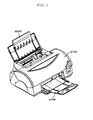
- FIG. 1 is a perspective view of an ink jet recording apparatus.
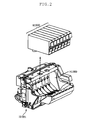
- FIG. 2 is a perspective view illustrating a state where an ink cartridge is mounted on a head cartridge.
- an ink jet ink may be simply referred to as "ink” in the following description.
- the compound when a compound is a salt, the compound may dissociate in an aqueous medium to exist in the form of an ion; this case is also included in the expression "contains a salt” for convenience in the present invention.
- a problem in a linear dispersion polymer is as follows: a trade-off develops between the stability of the adsorption of the dispersion polymer to a pigment and the aggregating performance of the pigment on a recording medium depending on the molecular weight of the dispersion polymer. That is, as the molecular weight reduces, the number of points at which the dispersion polymer adsorbs to the pigment reduces, so its ability to stabilize the adsorption of the dispersion polymer is impaired.
- a state where the polymer adsorbs to the interface such as a pigment surface means that the polymer contacts the interface to be bound by the interface. Therefore, in order that the stability of the adsorption of the polymer to a pigment is improved, the probability that the polymer contacts the pigment surface (interface) needs to be increased, and at the same time, an entropy change at a time point when the polymer adsorbs to (is bound by) the pigment surface needs to be reduced.
- the inventors of the present invention have thought as described below.
- the polymer is capable of moving around freely in an aqueous medium in order that the probability that the polymer contacts the pigment surface is increased. Accordingly, a reduction in molecular weight of the polymer or an increase in number of hydrophilic terminals of the polymer is advantageous for the increase.
- the following state is advantageous for the reduction in entropy change upon adsorption of the polymer to the pigment surface: the polymer is of such a structure that a large number of bonds are present in its chain.
- a state where the polymer has a large molecular weight is advantageous for preventing the polymer that has once adsorbed to the pigment surface from desorbing again because the stability of the adsorption improves as the number of adsorption points at which the chain of the polymer adsorbs increases.
- the inventors have thought that a trade-off relationship develops between the increase of the probability that the polymer adsorbs to the pigment and an improvement in stability of the adsorption depending on the molecular weight of the polymer.
- the inventors have thought that a polymer of such a structure as to have a large number of terminals, i.e., branch points, is advantageous for the stabilization of the adsorption.
- the molecular size of a star polymer can be reduced as compared to that of a linear polymer when number of copolymerized monomers is equal. Accordingly, the inventors of the present invention have thought that the steric hindrance repulsive force of the star polymer can be made relatively small, and hence, the extent to which the aggregation of the particles of the pigment on a recording medium is inhibited can be reduced.
- the distance to which the steric hindrance repulsive force extends from the surface of each particle of the polymer may substantially depend on the molecular weight (molecular size) of each arm (copolymer chain). Further, the reduction of an inhibiting action on the aggregation exerted by the steric hindrance repulsive force can be expected.
- the star polymer is of such a structure that multiple copolymer chains are bonded to the central skeleton, and the composition of each copolymer chain can be made to vary from copolymer chain to copolymer chain.
- copolymer chains showing a variation in composition are bundled so as to be of a star polymer shape, varying compositions in multiple star polymer molecules are averaged or uniformized. Therefore, generation of polymer molecules extremely different from each other in composition as observed in the low-molecular-weight region of a conventional random polymer hardly occurs.
- the copolymer chains in the star polymer used in the present invention are each a copolymer chain of an aromatic (meth) acrylate or an aromatic (meth) acrylamide and an acid monomer or a salt thereof.
- significant effects of the present invention i.e., extremely excellent colorability and extremely excellent bleeding resistance have been obtained.
- the constitution of each of the basic skeleton and central skeleton of the above star polymer, and the constitution of each copolymer chain are assumed to act synergistically.
- An ink of the present invention is an ink containing: a star polymer in which at least three specific copolymer chains are bonded to a central skeleton; and a pigment.
- the star polymer has such a star structure that a copolymer obtained by copolymerizing at least a first monomer selected from aromatic (meth) acrylates and aromatic (meth) acrylamides and a second monomer selected from acid monomers and salts thereof is bonded to the central skeleton.
- star structure refers to a structure having a center and three or more lines radially extending from the center toward the outside.
- star polymer polymer having a star structure
- star polymer refers to a polymer having a central skeleton and three or more copolymer chains radially extending from the central skeleton toward the outside.
- the star polymer needs to be obtained by bonding the three or more copolymer chains to the central skeleton.
- the "central skeleton" of the star polymer of the present invention means the structure of a part excluding the copolymer chains of which the star polymer is formed.
- the central skeleton itself of the star polymer of the present invention can be isolated.
- the compound obtained by the isolation has the central skeleton; in the present invention, the compound having the central skeleton is referred to as "central compound”.
- the star polymer described above when used as a dispersion polymer for a pigment, can best exert the effect of achieving both high colorability and bleeding resistance when the prepared ink is used to record an image.
- the first monomer for constituting the copolymer chain of ⁇ , ⁇ -ethylenically unsaturated monomers at least one monomer selected from aromatic (meth)acrylates and aromatic (meth)acrylamides is mentioned.
- aromatic (meth)acrylates and aromatic (meth)acrylamides include: benzyl (meth)acrylate; 2-phenoxyethyl (meth)acrylate; 2-hydroxy-3-phenoxy (meth)acrylate; and ester compounds of ⁇ , ⁇ -ethylenically unsaturated carboxylic acid with a substituted aromatic alcohol and amide compounds of ⁇ , ⁇ -ethylenically unsaturated carboxylic acid with a substituted aromatic amine such as 2-(meth)acryloyloxyethyl phthalic acid and benzyl (meth)acrylamide.
- benzyl (meth)acrylate is preferably used. It should be noted that, in the present invention, “(meth)acrylate” means both “acrylate” and “methacrylate”, and “(meth)acryloxy” means both “acryloxy” and “methacryloxy”.
- the second monomer for constituting the copolymer chain of ⁇ , ⁇ -ethylenically unsaturated monomers at least one monomer selected from an acid monomer and salts thereof are mentioned.
- Specific examples thereof include vinyl compounds and salts thereof having an acid group such as (meth)acrylic acid, maleic acid, maleic acid derivatives, itaconic acid, itaconic acid derivatives, fumaric acid, fumaric acid derivatives, vinyl sulfonic acid, and vinyl phosphonic acid.
- salts include potassium salts, sodium salts, lithium salts, ammonium salts, and various organic quaternary ammonium salts of the above monomers.
- (meth)acrylic acid and salts thereof are preferred, and as the salts, potassium salts and sodium salts are preferred.
- an ⁇ , ⁇ -ethylenically unsaturated carboxylate such as methyl-, ethyl-, or butyl (meth)acrylate is used for copolymerization, followed by hydrolyzing an ester bond, and the resultant may be used as a (meth)acrylic acid or a salt thereof.
- a monomer except those listed above can be used in combination with the monomers of which the copolymer chains of the star polymer used in the present invention are formed to such an extent that the achievement of the objects of the present invention is not inhibited.
- Specific examples of the monomers include: (meth)acrylates such as methyl (meth)acrylate, ethyl (meth)acrylate, butyl (meth)acrylate, methoxyethyl (meth)acrylate, ethoxyethyl (meth)acrylate, hydroxyethyl (meth)acrylate, diethyleneglycol (meth)acrylate; triethyleneglycol (meth)acrylate, tetraethyleneglycol (meth)acrylate, polyethyleneglycol (meth)acrylate, methoxydiethyleneglycol (meth)acrylate, methoxytriethyleneglycol (meth)acrylate; methoxytetraethyleneglycol (meth)acrylate, methoxypoly
- the star polymer is synthesized by bonding copolymer chains each obtained by copolymerizing two or more of such monomers as listed above to the central compound.
- a method of synthesizing the star polymer is, for example, a method involving the use of a polyvalent mercapto compound as a sulfur-containing compound as a chain transfer agent described in Japanese Patent Application Laid-Open No. H07-179538 .
- the star polymer is of the following structure: the polyvalent mercapto compound serving as the chain transfer agent is the central compound, a portion obtained by removing hydrogen atoms from the mercapto groups of the polyvalent mercapto compound serving as the chain transfer agent is the central skeleton, and a copolymer chain of ⁇ , ⁇ -ethylenically unsaturated monomers extends from each sulfur atom of the portion.
- an atom transfer radical polymerization method involving the use of a polyvalent halogen compound as a polymerization initiator or a living anion polymerization method involving the use of the polyvalent halogen compound as a polymerization terminator may also be employed.
- the star polymer is of the following structure: the polyvalent halogen compound is the central compound, a portion obtained by removing halogen atoms from the polyvalent halogen compound is the central skeleton, and a copolymer chain of ⁇ , ⁇ -ethylenically unsaturated monomers extends from a carbon atom of the compound to which a halogen atom was bonded.
- examples of the polyvalent halogen compound that can be used as the central compounds include 1,2,4,5-tetrakis(bromomethyl)benzene, 1,1,4,4-tetrakis(3-bromomethylphenyl)butane, 1,2,4,5-tetrakis( ⁇ -chlorophenylacetoxymethyl) benzene, 1,1,4,4-tetrakis[3- ( ⁇ -chlorophenylacetoxymethyl)phenyl]butane, and 1,1,4,4-tetrakis[3-( ⁇ -chlorophenylacetoxymethyl)]ethane.
- a sulfur-containing compound is preferably used, and further, a polyvalent mercapto compound containing a sulfur atom is particularly preferably used.
- the star polymer can be synthesized by free radical polymerization, so limitations on monomers that can be used in the copolymerization can be reduced; in addition, the star polymer can be synthesized in one stage because the polymerization mechanism is such that each copolymer chain as an arm extends from the central skeleton.
- the molecular weight of the star polymer used in the present invention is represented by a number-average molecular weight (Mn) in terms of polystyrene obtained by gel permeation chromatography (GPC).
- Mn number-average molecular weight
- the molecular weight is preferably 1,000 or more and 35,000 or less, more preferably 1,000 or more and 10,000 or less, or particularly preferably 2,000 or more and 10,000 or less.
- the number-average molecular weight is less than 1,000, the adsorbing performance of the star polymer to the pigment may reduce in some cases.
- the copolymer chains of the star polymer each preferably have a number-average molecular weight of 400 or more and 3,000 or less.
- the above molecular weight is less than 400, the adsorbing performance of the polymer to the pigment reduces, so the amount of the polymer that does not adsorb to the pigment may increase in the ink.
- an improving effect of the star polymer on the bleeding resistance of an image formed with the ink cannot be sufficiently obtained in some cases.
- the molecular weight distribution of the star polymer can be obtained from gel permeation chromatography (GPC) in terms of polystyrene of the star polymer.
- GPC gel permeation chromatography
- the molecular weight distribution of the star polymer obtained by GPC is a ratio of the weight-average molecular weight Mw of the polymer in terms of polystyrene to the number-average molecular weight Mn in terms of polystyrene.
- the ratio preferably satisfies the relationship of 1.0 ⁇ (Mw/Mn ⁇ 1.5. In principle, the molecular weight distribution Mw/Mn does not become lower than 1.0.
- the molecular weight distribution exceeds 1.5, the molecular weight distribution widens, so there is an increasing possibility that a low-molecular-weight polymer molecule having a weak adsorbing force to the pigment and a high-molecular-weight polymer molecule that increases the steric hindrance repulsive force of the pigment are simultaneously present. Accordingly, the polymer may be unable to obtain a sufficient improving effect on the colorability and bleeding resistance on plain paper.
- the star polymer used in the ink of the present invention is preferably as follows: the compositions of the monomers of which both a region from the start of the peak of the molecular weight distribution of the polymer obtained by GPC to 50% of the area of the peak and a region from 50% of the area to 100% of the area are uniform.
- existence ratios M 1 /M 2 of the first monomer M 1 to the second monomer M 2 determined in the above respective regions are compared. That is, proximity between the compositions of the monomers of which the respective regions are formed is determined by comparing ratios M 1 (50)/M 2( 50) and M 1 (100)/M 2 (100).
- the ratio M 1 (50)/M 2 (50) is the ratio between the monomers M 1 and M 2 in the region from the start of the peak to 50% of the area of the peak
- the ratio M 1 (100)/M 2 (100) is the ratio between the monomers M 1 and M 2 in the region from 50% of the area of the peak to 100% of the area.
- the ratio [M 1 (50)/M 2 (50)]/[M 1 (100)/M 2 (100)] is preferably 0.8 or more and 1.2 or less.
- the above value is less than 0.8, the amount of a hydrophobic low-molecular-weight component becomes relatively large, so the ejection failure of the ink resulting from the insoluble component occurs, and the ink cannot obtain high colorability in some cases.
- the above value exceeds 1.2, the amount of a hydrophilic low-molecular-weight component becomes relatively large, so the extent to which the component acts as a penetrating agent for the ink enlarges, and it becomes difficult to achieve both high colorability and bleeding resistance of the ink in some cases.
- the number of arms of the star polymer it is necessary that at least three copolymer chains are bonded.
- the number is preferably eight or less, and is more preferably three or more and eight or less.
- the steric hindrance repulsive force of the pigment increases, so the aggregating performance of the pigment on a recording medium reduces.
- an improving effect of the star polymer on the colorability of the ink on plain paper cannot be sufficiently obtained in some cases.
- the star polymer used in the present invention contains at least a unit derived from at least one monomer selected from aromatic (meth)acrylates and aromatic (meth)acrylamides as a first monomer.
- the mass fraction of the unit derived from the first monomer in the star polymer is preferably 30.0 mass% or more and 85.0 mass% or less with reference to the total mass of the star polymer.
- the mass fraction is less than 30.0 mass%, the adsorbing force of the star polymer to the surface of the pigment is insufficient, so the storage stability of the pigment ink cannot be sufficiently obtained in some cases.
- the mass fraction exceeds 85.0 mass%, the water solubility of the star polymer reduces, so the dispersion stability of the pigment cannot be sufficiently obtained in some cases.
- the star polymer used in the present invention contains at least a unit derived from an acid monomer or a salt thereof as a second monomer.
- the fraction of the unit derived from the second monomer in the star polymer can be represented in terms of the acid value of the star polymer.
- the star polymer has an acid value of preferably 30 mgKOH/g or more and 250 mgKOH/g or less, or more preferably 50 mgKOH/g or more and 150 mgKOH/g or less.
- the acid value exceeds this range, the adsorbing force of the star polymer to the surface of the pigment may reduce, and further, the ink cannot obtain sufficient colorability or sufficient bleeding resistance on plain paper owing to a reduction in aggregating performance of the pigment in some cases.
- the mass fraction of the total mass of the first monomer and the second monomer in the star polymer used in the present invention is preferably 40.0 mass% or more and 100.0 mass% or less with reference to the total mass of the arms in the star polymer.
- the mass fraction falls within the above range, the balance between the adsorbing force of the star polymer to the surface of the pigment and the dispersion stability of the pigment can be made particularly suitable.
- the pH of the ink of the present invention is preferably adjusted to fall within a neutral to alkaline range in order that the dispersion of the pigment is stabilized with an electrostatic repulsive force of an anion produced by neutralizing an acidic group in the star polymer as described above.
- the ink may cause the corrosion of various members used in an ink jet recording apparatus, so the pH is preferably adjusted to fall within the range of 7 to 10.
- a pH adjustor used in this case is, for example, any one of the following substances: various organic amines such as diethanolamine and triethanolamine; inorganic alkaline agents such as hydroxides of alkali metals including sodium hydroxide, lithium hydroxide, and potassium hydroxide; organic acids; and mineral acids.
- Such a star polymer as described above is dispersed or dissolved in an aqueous medium.
- the content (mass%) of the star polymer in the ink is preferably 0.1 mass% or more and 15.0 mass% or less with reference to the total mass of the ink.
- the content (mass%) of the star polymer in the ink is preferably 0.1 mass% or more and 5.0 mass% or less with reference to the total mass of the ink.
- a natural resin such as rosin, shellac, or starch, or a synthetic resin except the star polymer can be used as another dispersion polymer in combination with the above dispersion polymer to such an extent that the achievement of the objects of the present invention is not inhibited.
- the content of the resin except the star polymer in that case is preferably at most about the content of the star polymer.
- the coloring material used in the ink of the present invention is pigment, and the pigment is particularly preferably dispersed in an aqueous medium with the star polymer described above.
- the content (mass%) of the pigment in ink is preferably 1.0 mass% or more and 20.0 mass% or less, or more preferably 2.0 mass% or more and 12.0 mass% or less with reference to the total mass of the ink.
- Carbon black or an organic pigment is preferably used as the pigment.
- One pigment may be used alone, or two or more kinds of pigments may be used in combination.
- the black pigment it is preferred to use carbon black such as furnace black, lamp black, acetylene black, and channel black as the pigment.
- the carbon black preferably has characteristics including a primary particle diameter of 11 nm or more and 40 nm or less, a specific surface area by the BET method of 50 m 2 /g or more and 400 m 2 /g or less, a volatile content of 0.5 mass% or more and 10 mass% or less, and a pH value of 2 to 10.
- the black pigment commercially available products and the like can be used.
- carbon black newly prepared can also be used as the black pigment.
- a magnetic substance fine particle such as magnetite or ferrite, titanium black, or the like may also be used as the black pigment.
- organic pigment there is no particular limitation and a known organic pigment can be used. Specific examples thereof include organic pigments represented by color index (C.I.) numbers.
- the ink used in the present invention preferably contains an aqueous medium which is a mixed medium of water and a water-soluble organic solvent.
- Ion-exchanged water deionized water
- the water content (mass%) in the ink is preferably 10.0 mass% or more and 90.0 mass% or less, or more preferably 30.0 mass% or more and 80.0 mass% or less with reference to the total mass of the ink.
- the content (mass%) of the water-soluble organic solvent in the ink is preferably 3.0 mass% or more and 50.0 mass% or less, or more preferably 3.0 mass% or more and 40.0 mass% or less with reference to the total mass of the ink.
- water-soluble organic solvent there can be used a known water-soluble organic solvent that can be used for an ink jet ink.
- An additive such as a surfactant, a defoaming agent, or an antiseptic as well as the above components can be appropriately added as required to the ink of the present invention in order that the ink has desired physical property values.
- the content (mass%) of such additive in the ink is preferably 0.05 mass% or more and 10.0 mass% or less, or more preferably 0.2 mass% or more and 5.0 mass% or less with reference to the total mass of the ink.
- a method of preparing the ink of the present invention formed of such components as described above can be such a method as described below.
- the pigment is added to a mixture obtained by mixing at least a star polymer and water, and the contents are mixed and stirred.
- the mixture is subjected to a dispersion treatment with a dispersing unit, and is then subjected to a centrifugation treatment as required so that a pigment dispersion liquid can be obtained.
- an aqueous medium or any such appropriately selected additive as listed above is added as required to the pigment dispersion liquid, and the mixture is stirred.
- the ink of the present invention is obtained.
- the dispersion stability of the ink can be additionally improved by adding a base for dissolving the star polymer used in the present invention upon preparation of the pigment dispersion liquid.
- a base for dissolving the star polymer used in the present invention upon preparation of the pigment dispersion liquid.
- the base include: organic amines such as monoethanolamine, diethanolamine, triethanolamine, amine methyl propanol, and ammonia; and inorganic bases such as potassium hydroxide, sodium hydroxide, and lithium hydroxide.
- the ink of the present invention is prepared by using the pigment dispersion liquid obtained through the dispersion treatment.
- a premixing operation in which the pigment is added to the mixture obtained by mixing at least the star polymer and water is effective. That is, such premixing operation is preferable because the wettability of the surface of the pigment can be improved, and the adsorption of a dispersant to the surface of the pigment can be promoted.
- any dispersing machine as generally used can be used in the above-mentioned dispersing treatment of pigments.
- the dispersing machine include a ball mill, a roll mill, a sand mill, a beads mill, and an ultra-high pressure homogenizer.
- the beads mill and the ultra-high pressure homogenizer are preferably used.
- Specific examples of those dispersers include SUPER MILL, SUPER APEX MILL, NANOMISER, AGITATOR MILL, GLEN MILL, DYNO MILL, PEARL MILL, and COBOL MILL (all of which are trade names).
- a pigment having an optimum particle size distribution is preferably used from the viewpoint of, for example, the resistance of a recording head against clogging with the ink.
- a method of obtaining a pigment having a desired particle size distribution is, for example, any one of the following approaches: an approach involving reducing the size of the pulverization medium of any such dispersing machine as listed above; an approach involving increasing the filling rate of the pulverization medium; an approach involving lengthening the treatment time; an approach involving performing classification with a filter, a centrifugal separator, or the like after pulverization; an approach involving increasing the number of times of treatment with an ultra-high pressure homogenizer or increasing the pressure at which the treatment is performed; and a combination of two or more of those approaches.
- An ink set of the present invention is an ink set formed of multiple inks.
- the ink set is characterized in that the ink set is obtained by combining the ink (pigment ink) of the present invention containing at least the pigment and the star polymer described above, and an ink (dye ink) containing at least a dye.
- the ink set of such constitution can provide not only an effect obtained by the pigment ink but also an image excellent particularly in bleeding resistance between images formed with the multiple inks.
- the ink set of the present invention is particularly suitably an ink set for use in ink jet recording, in other words, an ink jet ink set.
- the ink set of the present invention may be further combined with an ink of any other constitution in addition to the pigment ink described above. Examples of such ink include a pigment ink free of any star polymer and an ink containing both a dye and a pigment as coloring materials.
- any one of the components that can be incorporated into the ink of the present invention described above can be used as a component of which the dye ink of which the ink set is formed is formed on condition that the dye is used as a coloring material.
- Any one of the conventionally known dyes can be used as the dye, and a pigment as well as the dye can also be used.
- each of the following cases where ink cartridges storing the respective inks are used in combination can also be given as an example of the ink set: the case where an ink cartridge integrally storing a cyan ink, a magenta ink, a yellow ink, and a black ink is used; and the case where an ink cartridge integrally storing a cyan ink, a magenta ink, and a yellow ink is used in combination with another ink cartridge storing a black ink.
- the case where multiple independent ink cartridges are used in combination in the ink set include: the case where independent ink cartridges each storing a cyan ink, a magenta ink, or a yellow ink are used in combination with another ink cartridge storing a black ink; the case where ink cartridges each storing a black ink, a pale cyan ink, or a pale magenta ink are used in combination; the case where a single ink cartridge storing a red ink is used in addition to the above ink cartridges; the case where a single ink cartridge storing a green ink is used in addition to the above ink cartridges; and the case where a single ink cartridge storing a blue ink is used in addition to the above ink cartridges.
- the present invention is not limited to those cases.
- the ink of the present invention is preferably used in combination with a reaction liquid having the following action to serve as a set of the ink and the reaction liquid: upon contact with the ink on a recording medium, the reaction liquid increases the average particle size of the pigment in the ink, that is, destabilizes the dispersed state of the pigment in the ink.
- a recorded article having an additionally high image density or additionally high color developing performance can be obtained by performing recording with the set of the ink and the reaction liquid.
- the reaction liquid used in the present invention is described.
- a compound (reaction agent) used in the reaction liquid having an action of increasing the average particle size of the pigment in the ink, that is, destabilizing the dispersed state of the pigment in the ink is, for example, a polyvalent metal ion or a cationic polymer. Any such reaction agent reacts with the pigment in the ink to exert an action of increasing the average particle size of the pigment, that is, destabilizing the dispersed state of the pigment.
- a polyvalent metal ion examples include: divalent metal ions such as Ca 2+ , Cu 2+ , Ni 2+ , Mg 2+ , Zn 2+ , Sr 2+ , and Ba 2+ ; and trivalent metal ions such as Fe 3+ , Al 3+ , Cr 3+ , and Y 3+ .
- a polyvalent metal salt is used.
- the polyvalent metal salt refers to a salt formed of each of the polyvalent metal ions listed above and an anion bonded to the ion, which needs to be soluble in water.
- Examples of a preferable anion for forming a salt include Cl - , NO 3 - , I - , Br - , ClO 3 - , SO 4 2- , CO 3 2- , CH 3 COO - , and HCOO - .
- the content (mass%) of the polyvalent metal ion in the reaction liquid is preferably 0.01 mass% or more and 10.0 mass% or less with reference to the total mass of the reaction liquid.
- cationic polymer examples include polyallylamine, polyethyleneimine, an epichlorohydrin/dimethylamine polymer, polydimethyldiallylammonium chloride, a dicyandiamide/diethylenetriamineammonium chloride condensate, and a guanidinium formaldehyde condensate.
- the content (mass%) of cationic polymers in a reaction solution is preferably 0.01 mass% or more and 10.0 mass% or less with reference to the total mass of the reaction solution.
- the reaction liquid used in the present invention preferably contains an aqueous medium which is a mixed medium of water and a water-soluble organic solvent.
- Ion-exchanged water deionized water
- the water content (mass%) in the reaction liquid is preferably 25.0 mass% or more and 95.0 mass% or less with reference to the total mass of the reaction liquid.
- the content (mass%) of the water-soluble organic solvent in the reaction liquid is preferably 5.0 mass% or more and 60.0 mass% or less, or more preferably 5.0 mass% or more and 40.0 mass% or less with reference to the total mass of the ink. Any one of the solvents that can be incorporated into the ink described above can be used as the water-soluble organic solvent used in the reaction liquid.
- An additive such as a surfactant, a viscosity modifier, a pH adjustor, an antiseptic, or an antioxidant may be further appropriately blended as required into the reaction liquid used in the present invention.
- Selection and the addition amount of a surfactant functioning as a permeation promoter are preferably determined in such a proper manner that the permeability of the reaction liquid for a recording medium is suppressed.
- the reaction liquid used in the present invention is more preferably colorless; the reaction liquid may be of such a pale color that the reaction liquid does not change the color tone of the ink upon contact and mixing with the ink on the recording medium.
- the viscosity at 25°C of the reaction liquid is preferably adjusted to fall within the range of 1 mPa ⁇ s or more to 30 mPa ⁇ s or less.
- a method of applying the reaction liquid used in the present invention to a recording medium is, for example, a method of using an ink jet recording system as in the case of the ink or a method of applying the reaction liquid to the recording medium with a roller or the like.
- the reaction liquid is particularly preferably applied so that at least a region where the ink is applied can be included on the recording medium.
- the order of application of the reaction liquid and the ink to the recording medium is arbitrary; the ink is particularly preferably applied after the reaction liquid has been applied in advance.
- An ink jet recording method of the present invention includes ejecting ink according to an ink jet system to perform recording on a recording medium, and is characterized in that the ink used in the ink jet recording method is the ink of the present invention.
- Examples of the ink jet system used in the ink jet recording method of the present invention include a recording method involving applying mechanical energy to ink to eject the ink and a recording method involving applying thermal energy to ink to eject the ink.
- An ink jet recording method involving the utilization of thermal energy can be particularly preferably used in the present invention.
- An ink jet recording apparatus of the present invention includes an ink storage portion for storing ink and a recording head for ejecting the ink, and is characterized in that the ink stored in the ink storage portion is the ink of the present invention.
- An additionally significant effect can be obtained particularly when the ink jet recording apparatus is such that the recording head ejects the ink by applying thermal energy to the ink.
- FIG. 1 is a perspective view of an ink jet recording apparatus.
- the ink jet recording apparatus is formed of a sheet feeding portion, a conveying portion, a carriage portion, a sheet discharge portion, a cleaning portion, and an external packaging portion M7030 for protecting them and providing them with designs to achieve a role of each mechanism.
- the ink jet recording apparatus includes a sheet feeding tray M2060 constituting the sheet feeding portion and a sheet discharge tray M3160 constituting the sheet discharge portion.
- the sheet feeding portion, the conveying portion, the carriage portion, the sheet discharge portion, and the cleaning portion are not particularly limited and any usable one can be used.
- the constitution of a head cartridge H1000 is described (see FIG. 2 ).
- the head cartridge H1000 has a recording head H1001, a unit for mounting ink cartridges H1900, and a unit for supplying ink from the ink cartridges H1900 to the recording head, and the head cartridge H1000 is attachably and detachably mounted on a carriage.
- FIG. 2 is a view illustrating the manner in which the ink cartridges H1900 are mounted on the head cartridge H1000.
- the ink jet recording apparatus forms an image with, for example, seven kinds of inks. Therefore, the ink cartridges H1900 are also independently prepared for seven colors.
- each ink cartridge is removable from the head cartridge H1000. It should be noted that the ink cartridges H1900 can be attached or detached in a state where the head cartridge H1000 is mounted on a carriage.
- the ink jet recording apparatus is not limited to an apparatus in which a recording head and an ink cartridge are separated, and an apparatus in which the recording head and the ink cartridge are integrated so as to be unseparable may be used as the apparatus.
- the ink cartridge may be separably or unseparably integrated with the recording head to be mounted on the carriage, or may be provided for a fixed site of the ink jet recording apparatus to supply ink to the recording head through an ink supply member such as a tube.
- the ink cartridge when the ink cartridge is provided with a constitution for applying a preferable negative pressure to the recording head, for example, the following constitution can be adopted: an absorber is placed in an ink storage portion of the ink cartridge, or the ink cartridge has a flexible ink storage bag and a spring portion that applies, to the bag, a bias in the direction in which the internal volume of the bag is expanded.
- the ink jet recording apparatus may adopt such a serial recording system as described above, or may be in the form of a line printer obtained by aligning recording elements over the range corresponding to the entire width of a recording medium.
- the polymer had a number-average molecular weight Mn of 4,000, a weight-average molecular weight Mw of 5,000, a molecular weight distribution (Mw/Mn) of 1.25, and an absolute molecular weight of 5,600.
- the number-average molecular weight of the respective arms can be determined to be 800 by the following procedure: the molecular weight of a portion obtained by removing six hydrogen atoms from the central skeleton DPMP, i.e., 777 is subtracted from the absolute molecular weight of the star polymer, and the resultant value is divided by the number of arms, i.e., six.
- the polymer was fractionated into a 0-to-50% portion and a 50%-to-100% portion on a mass basis in correspondence with the peak of the polymer observed with the above differential refractometer. Each portion was concentrated under reduced pressure and dried in a vacuum. After that, the ratio between BzMA as a first monomer (chemical shift value ⁇ of the aromatic ring: 7 to 8) and AA as a second monomer (chemical shift value ⁇ of the carboxyl group: 12 to 13) was determined by proton nuclear magnetic resonance ( 1 H-NMR) spectrometry. As a result, the ratio [M 1 (50)/M 2 (50)/[M 1 (100)/M 2 (100)] (hereinafter referred to as "R”) was 1.0.
- the resultant polymer 1 had an acid value of 97 mgKOH/g.
- An equivalent molar amount of KOH with respect to the acid value of the polymer 1 and an appropriate amount of water were added to a solution of the polymer in MEK, and the mixture was stirred. After that, MEK was removed under a reduced pressure condition, and water was added to the remainder. Thus, a 25% polymer aqueous solution 1 was obtained.
- Polymers 2 to 5 in each of which the number average molecular weight of the arms was changed were each synthesized in the same manner as in the polymer 1 except that the proportion of the central compound to the total amount of the monomers used in the polymer 1 was changed.
- Table 1 below shows the respective physical properties of the polymers 1 to 5 collectively.
- Polymers 6 to 8 in each of which the number of arms was changed were each synthesized in the same manner as in the polymer 1 except that the central compound used in the polymer 1 was changed.
- Table 2 below shows the respective physical properties of the polymers 6 to 8.
- the central compound of the polymer 8 was produced by employing the method described in Example 1 of Japanese Patent Application Laid-Open No. 2002-128898 .
- a nonafunctional thiol compound (9SH) obtained by causing 3-mercaptopropionic acid to react with each of the nine hydroxyl groups of a Polyglycerin #500 (product name: manufactured by SAKAMOTO YAKUHIN KOGYO CO., LTD.) was used.
- Table 2 shows the respective physical properties of the polymer 1 synthesized in the foregoing as well.
- Polymers 9 and 10 in each of which the molecular weight distribution was changed were each synthesized in the same manner as in the polymer 1 except that the polymerization temperature was changed, using the monomers and central compound of the polymer 1.
- Table 3 shows the respective physical properties of the polymers 9 and 10. It should be noted that Table 3 shows the respective physical properties of the polymer 1 synthesized in the foregoing as well.
- Polymers 11 to 13 of various monomer were each synthesized in the same manner as in the polymer 1 except that the monomers to be copolymerized were changed.
- Table 4 below shows the respective physical properties of the polymers 11 to 13. It should be noted that Table 4 shows the respective physical properties of the polymer 1 synthesized in the foregoing as well.
- Polymers 14 to 17 are each a star polymer the central skeleton of which is not a sulfur-containing compound. Those polymers were each synthesized by the polymerization method described in J. Polym. Sci., Part A: Polym. Chem., 2006, 44, 6659 .
- Monomers used were 63 parts of BzMAm, 20 parts of nBMA, and 17 parts of tBMA, and each substance in the following table was used as an initiator. After the polymerization, hydrochloric acid and methanol were added to terminate the polymerization reaction, and the t-butyl group of copolymerized tBMA was hydrolyzed so that tBMA was turned into methacrylic acid. Thus, a carboxyl group was obtained.
- Table 5 below is such that the central compound used upon synthesis of each polymer is indicated with the scheme number described in the above mentioned document.
- Table 6 below shows the respective physical properties of the polymers 14 to 17.
- the resultant polymer 18 had an acid value of 104 mgKOH/g.
- An equivalent molar amount of KOH with respect to the acid value of the polymer 18 and an appropriate amount of water were added to a solution of the polymer in MEK, and the mixture was stirred. After that, MEK was removed under a reduced pressure condition, and water was added to the remainder. Thus, a 25% polymer aqueous solution 18 was obtained.
- Polymers 19 and 20 in each of which the ratio [M 1 (50)/M 2 (50)]/[M 1 (100)/M 2 (100)] was changed were each synthesized in the same manner as in the polymer 18 except that at least one of the polymerization solvent and the polymerization temperature was changed while the same monomers and central compound as those of the polymer 18 were used.
- Table 7 below shows the respective physical properties of the polymers 18 to 20.
- Polymers 21 to 24 in each of which the number-average molecular weight (Mn) was changed were each synthesized in the same manner as in the polymer 18 except that the proportion of the central compound to the total amount of the monomers used in the polymer 18 was changed.
- Table 8 below shows the respective physical properties of the polymers 21 to 24.
- Polymers 25 and 26 different in Mn were each synthesized in the same manner as in the polymer 18 except that: the central compound used in the polymer 18 was changed to TMMP, and the proportion of the central compound to the total amount of the monomers used in the polymer 18 was changed. Table 9 below shows the respective physical properties of the polymers 25 and 26.
- Polymers 27 and 28 with different R were each synthesized in the same manner as in the polymerization method for the polymer 1 except the following points.
- 100 parts of IPA were put as a polymerization solvent at the time of the synthesis of the polymer 27, and 100 parts of THF were put as a polymerization solvent at the time of the synthesis of the polymer 28.
- a monomer mixed liquid obtained by mixing 65 parts of BzMA, 20 parts of nBA, and 15 parts of AA, and 12 parts of a tetrafunctional thiol PEMP as a central compound to serve as the central skeleton of a polymer were added to the flask.
- Polymers 29 to 34 with different acid values were each synthesized in the same manner as in the polymer 1 except that the composition fraction (mass fraction) of the monomers to be copolymerized for the polymer 1 was changed as shown in Table 11 below.
- Table 11 below shows the respective physical properties of the polymers 29 to 34. It should be noted that Table 11 shows the respective physical properties of the polymer 1 synthesized in the foregoing as well.
- Polymers 35 to 38 with various fractions of the first monomer were each synthesized in the same manner as in the polymer 1 except that composition fraction (mass fraction) among the monomers to be copolymerized for the polymer 1 and proportion of the central compound were changed as shown in Table 12 below.
- Table 12 below shows the respective physical properties of the polymers 35 to 38. It should be noted that Table 12 shows the respective physical properties of the polymer 1 synthesized in the foregoing as well.
- Polymers 39 and 40 with various mass fractions of the first monomer and the second monomer to the arm were each synthesized in the same manner as in the polymer 1 except that composition fraction (mass fraction) among the monomers to be copolymerized for the polymer 1 and proportion of the central compound were changed as shown in Table 13 below.
- Table 13 below shows the respective physical properties of the polymers 39 and 40. It should be noted that Table 13 shows the respective physical properties of the polymer 1 synthesized in the foregoing as well.
- a polymer 41 is a star polymer used in a comparative example of the present invention. This polymer does not contain the first monomer in any one of its copolymer chains.
- the polymer 41 was synthesized in the same manner as in the polymer 1 except that BzMA as the aromatic (meth)acrylate monomer of the polymer 1 was changed to St which was not an aromatic (meth)acrylate monomer. It should be noted that the R of the polymer 41 cannot be determined because the polymer does not contain the first monomer. Table 14 below shows the respective physical properties of the polymer 41.
- a polymer 42 is a star polymer used in a comparative example of the present invention.
- the monomer of which each arm is formed is not an ⁇ , ⁇ -ethylenically unsaturated monomer, and further, each copolymer chain of which the star polymer is formed is not a copolymer chain of the first and second monomers.
- the polymer was produced in accordance with the method described in Example 1 of Japanese Patent Application Laid-Open No. 2001-040256 .
- the central compound is trihydroxybenzene, the monomer of which each arm is formed is ethylene oxide, and the number of arms is three. It should be noted that the R of the polymer 42 cannot be determined and the polymer does not have any acid value because the polymer contains neither the first monomer nor the second monomer.
- Table 15 below shows the respective physical properties of the polymer 42.
- a polymer 43 is a star polymer used in a comparative example of the present invention.
- each copolymer chain of which the star polymer is formed is not a copolymer chain of the first and second monomers.
- the polymer was produced in accordance with the method described in Example 15 of Japanese Patent Application Laid-Open No. 2001-040256 .
- the central compound is TMMP
- the monomer of which each arm is formed is N,N-dimethylacrylamide
- the number of arms is three. It should be noted that the R of the polymer 43 cannot be determined because the polymer contains neither the first monomer nor the second monomer. Table 16 below shows the respective physical properties of the polymer 43.
- a polymer 44 is a star polymer used in a comparative example of the present invention.
- each copolymer chain of which the star polymer is formed is not a copolymer chain of the first and second monomers.
- the polymer was produced in accordance with the method described in Rererence Example 1 of Japanese Patent Application Laid-Open No. H09-249709 .
- the central compound is PEMG, the monomers of which each arm is formed are nBA, 2EHA, and HEA, and the number of arms is four. It should be noted that the R of the polymer 44 cannot be determined and the polymer does not have any acid value because the polymer contains neither the first monomer nor the second monomer. Table 17 below shows the respective physical properties of the polymer 44.
- a polymer 45 is a polymer used in a comparative example of the present invention, and the synthesized polymer 45 is not a star polymer, though the raw material of the polymer contains a star polymer.
- the copolymer chain of which such a star polymer as used in the present invention is formed is not a copolymer chain of the first and second monomers.
- the polymer was produced in accordance with the method described in Production Example 1 of Japanese Patent Application Laid-Open No. S59-124922 .
- a polymer synthesized by the following procedure is not a star polymer: the molecules of a pentaerythritol polymer which is a star polymer are crosslinked with an isophorone-type isocyanate, and phthalic anhydride is added to the hydroxyl group of the pentaerythritol polymer. It should be noted that the R of the polymer 45 cannot be determined because the polymer contains neither the first monomer nor the second monomer. Table 18 below shows the respective physical properties of the polymer 45.
- a polymer 46 is a star polymer used in a comparative example of the present invention.
- This star polymer does not have any central skeleton that can be isolated, and the copolymer chain of which the star polymer is formed does not contain the first monomer.
- the polymer was produced in accordance with the method of synthesizing a star polymer 1 described in Japanese Patent Application Laid-Open No. 2000-169771 .
- Monomers of which each arm is formed are nBMA and MAA none of which is the first monomer.
- the star polymer is obtained by crosslinking the molecules of EGDMA attached to one terminal of each arm. The number of arms cannot be uniquely determined because the number cannot be controlled and has a distribution.
- the R of the polymer 46 cannot be determined because the polymer does not contain the first monomer.
- Table 19 below shows the respective physical properties of the polymer 46.
- the star polymer 46 does not have any central skeleton, like the star polymer 47 described below, and of course does not have any central skeleton that can be isolated.
- a polymer 47 is a star polymer used in a comparative example of the present invention.
- the star polymer does not have any central skeleton, and of course, does not have any central skeleton that can be isolated.
- the method of synthesizing a star polymer 1 described in Japanese Patent Application Laid-Open No. 2000-169771 was employed for the synthesis of the polymer, and monomers of which each arm was formed were as shown in Table 20 below.
- the indication "BzMA/nBMA/MAA” in Table 20 below shows that the three kinds of monomers are randomly placed.
- the symbol “//EGDMA” in Table 20 below shows that EGDMA is copolymerized as a block to one terminal of the arm.
- a polymer 48 is a linear polymer used in a comparative example of the present invention.
- This polymer was synthesized by living anion polymerization in order that its molecular weight distribution was 1.5 or less. The synthesis was performed with reference to the method described in "New Polymer Experiment 2", Synthesis and Reaction of Polymer (1) Synthesis of Addition Polymer, edited by the Society of Polymer Science. The monomer composition of the linear polymer was as shown in Table 21 below.
- the experimental apparatus and the experimental procedure adopted were those of Experimental Example 2.4.1 described on page 212 of "New Polymer Experiment 2", Synthesis and Reaction of Polymer (1) Synthesis of Addition Polymer, edited by the Society of Polymer Science.
- the polymerization was performed by using 100 parts of toluene as a solvent and 2 parts of a mixture of tBuLi and tributylaluminum as an initiator at a temperature of -78°C for a reaction time of 24 hours. After the reaction, a mixture of hydrochloric acid and methanol was added to the resultant so that a termination reaction might be performed. Simultaneously with the termination reaction, tBMA was subjected to a hydrolysis reaction so as to become MAA. After that, excessive hexane was added to the resultant so that a polymer was precipitated. Then, the polymer was dried in a vacuum.
- Dispersing machine An ultra-high pressure homogenizer NM2-L200AR (manufactured by YOSHIDA KIKAI CO., LTD.) Treatment pressure: 150 MPa Treatment paths: 10 paths
- black pigment dispersion liquids 2 to 48 were each produced in the same manner as in the black pigment dispersion liquid 1 except that each of the polymers 2 to 48 was used instead of the polymer 1 of the black pigment dispersion liquid 1.
- Dispersing machine A bead mill UAM-015 (product name) (manufactured by KOTOBUKI INDUSTRIES CO., LTD.) Beads used: Zirconia beads having a diameter of 0.05 mm Filling rate of beads: 70% (in terms of bulk specific gravity) Number of revolutions of the rotor: 42.1 Hz
- a magenta pigment dispersion liquid was prepared in the same manner as in the above cyan pigment dispersion liquid except that the pigment in the cyan pigment dispersion liquid was changed from the cyan pigment to a magenta pigment (CROMOPHTAL Pink PT; manufactured by Ciba Specialty Chemicals Inc.).
- a yellow pigment dispersion liquid was prepared in the same manner as in the above cyan pigment dispersion liquid except that the pigment in the cyan pigment dispersion liquid was changed from the cyan pigment to a yellow pigment (IRGALITE Yellow GS; manufactured by Ciba Specialty Chemicals Inc.).
- a black ink 1 was obtained by mixing the following respective components including the black pigment dispersion liquid 1 described above.
- Black pigment dispersion liquid 1 (5 parts in terms of pigment concentration) 33 parts
- Glycerin 10 parts Ethylene glycol 5 parts
- PEG 1,000 5 parts AE 100 0.5 part Ion-exchanged water 46.5 parts
- black inks 2 to 48 were each prepared in the same manner as in the black ink 1 except that each of the black pigment dispersion liquids 2 to 48 was used instead of the black pigment dispersion liquid 1 of the black ink 1.
- a cyan ink was prepared in the same manner as in the black ink 1 except that the black pigment dispersion liquid 1 in the black ink 1 was changed to the cyan pigment dispersion liquid.
- a magenta ink was prepared in the same manner as in the black ink 1 except that the black pigment dispersion liquid 1 in the black ink 1 was changed to the magenta pigment dispersion liquid.
- a yellow ink was prepared in the same manner as in the black ink 1 except that the black pigment dispersion liquid 1 in the black ink 1 was changed to the yellow pigment dispersion liquid.
- Each of the black inks obtained in the foregoing was put into an ink cartridge, and the ink cartridge was mounted on an ink jet recording apparatus PIXUS iP4100 (manufactured by Canon Inc.). Then, a solid image having a recording duty of 100% was recorded on a Canon Plain Paper White SW-101 (manufactured by Canon Inc.) while the recording mode of the apparatus was set to a plain paper/standard mode. Thus, a recorded article was produced. The resultant recorded article was evaluated for its colorability by measuring the optical density OD 1 in a solid image portion. The optical density was measured with a reflection densitometer RD-19I (manufactured by Gretag Macbeth). Evaluation criteria for the colorability are as described below.
- Table 22 shows the results of the evaluation.
- Each of the black inks obtained in the foregoing was put into an ink cartridge, and the ink cartridge and a BCI-7 yellow ink as a dye ink were mounted on an ink jet recording apparatus PIXUS iP4100 (manufactured by Canon Inc.). Then, the following recorded article was produced on a Canon Plain Paper White SW-101 (manufactured by Canon Inc.) while the recording mode of the apparatus was set to a plain paper/standard mode: characters were recorded with the black ink on a solid image formed with the dye ink. The resultant recorded article was evaluated for its bleeding resistance by measuring the raggedness value Rag in a character portion. The raggedness value was measured with an image evaluating apparatus Personal IAS (manufactured by QEA).
- Each of the black inks obtained in the foregoing was evaluated for its dispersion stability by measuring the average particle size of the pigment in the ink.
- the average particle size (volume-average particle size) D 50 of each pigment was measured with a Nanotrac particle size distribution measuring apparatus UPA-EX150 (manufactured by NIKKISO CO., LTD.). Evaluation criteria for the dispersion stability are as described below. Table 22 shows the results of the evaluation.
- C 100 ⁇ D 50 ⁇ 120
- D 120 ⁇ D 50 ⁇ 150
- 150 ⁇ D 50 150 ⁇ D 50
- the average particle size of the pigment in each of the black inks measured in the above evaluation of the pigment for its dispersion stability was expressed as D 50-1 .
- each of the black inks obtained in the foregoing was stored in a thermostat having a temperature of 60°C for one week.
- the average particle size D 50-2 of the pigment in each of the black inks was measured with the same apparatus as that described above.
- evaluation criteria A to C were defined as acceptable levels, and evaluation criteria D and E were defined as unacceptable levels.
- the black ink 1, the cyan ink, the magenta ink, and the yellow ink obtained in the foregoing were combined. Thus, an ink set was obtained.
- Each ink of which the ink set was formed was applied to a Canon Plain Paper White SW-101 (manufactured by Canon Inc.) so that the inks contacted each other. Thus, a recorded article was produced.
- Evaluation for each of colorability and character quality was performed by the same method as that described above on the basis of the same criteria as those described above, and evaluation for bleeding resistance was performed in the same manner as that described above except that each of the color inks, i.e., cyan, magenta, and yellow inks, was used instead of the dye ink.
- each of the color inks was evaluated for each of the dispersion stability of its pigment and its storage stability by the same method as that described above on the basis of the same criteria as those described above. Table 23 shows the results of the evaluation.
- the reaction liquid obtained in the foregoing, and the black ink 1, the cyan ink, the magenta ink, and the yellow ink were combined.
- a set of the inks and the reaction liquid was obtained.
- the reaction liquid of which the set was formed was applied to a Canon Plain Paper White SW-101 (manufactured by Canon Inc.) in advance.
- the black ink 1, and each of the color inks, i.e., cyan, magenta, and yellow inks were applied so that the reaction liquid and the inks contacted each other.
- a recorded article was produced.
- Evaluation for each of colorability and character quality was performed by the same method as that described above on the basis of the same criteria as those described above except that the reaction liquid was used, and evaluation for bleeding resistance was performed in the same manner as that described above except that each of the color inks, i.e., cyan, magenta, and yellow inks, was used instead of the dye ink, and the reaction liquid was used.
- each of the color inks was evaluated for each of the dispersion stability of its pigment and its storage stability by the same method as that described above on the basis of the same criteria as those described above. Table 23 shows the results of the evaluation.
- the ink jet ink includes at least a pigment and a star polymer in which at least three copolymer chains of ⁇ , ⁇ -ethylenically unsaturated monomers are bonded to a central skeleton, in which the copolymer chains of the ⁇ , ⁇ -ethylenically unsaturated monomers are copolymers of at least one first monomer selected from the group consisting of aromatic (meth)acrylates and aromatic (meth)acrylamides and at least one second monomer selected from the group consisting of acid monomers and salts of the acid monomers.
Landscapes
- Chemical & Material Sciences (AREA)
- Life Sciences & Earth Sciences (AREA)
- Engineering & Computer Science (AREA)
- Materials Engineering (AREA)
- Wood Science & Technology (AREA)
- Organic Chemistry (AREA)
- Inks, Pencil-Leads, Or Crayons (AREA)
- Ink Jet Recording Methods And Recording Media Thereof (AREA)
- Ink Jet (AREA)
Applications Claiming Priority (1)
| Application Number | Priority Date | Filing Date | Title |
|---|---|---|---|
| JP2008260615 | 2008-10-07 |
Publications (2)
| Publication Number | Publication Date |
|---|---|
| EP2174995A1 EP2174995A1 (en) | 2010-04-14 |
| EP2174995B1 true EP2174995B1 (en) | 2012-12-26 |
Family
ID=41490297
Family Applications (1)
| Application Number | Title | Priority Date | Filing Date |
|---|---|---|---|
| EP20090172307 Not-in-force EP2174995B1 (en) | 2008-10-07 | 2009-10-06 | Ink jet ink, ink jet recording method, and ink cartridge |
Country Status (4)
| Country | Link |
|---|---|
| US (1) | US7977409B2 (enExample) |
| EP (1) | EP2174995B1 (enExample) |
| JP (1) | JP2010111855A (enExample) |
| CN (1) | CN101712828B (enExample) |
Families Citing this family (9)
| Publication number | Priority date | Publication date | Assignee | Title |
|---|---|---|---|---|
| JP5538799B2 (ja) * | 2008-10-07 | 2014-07-02 | キヤノン株式会社 | インクジェット用インク、インクジェット記録方法、及びインクカートリッジ |
| JP5253555B2 (ja) | 2010-12-08 | 2013-07-31 | キヤノン株式会社 | 自己分散顔料の合成方法、自己分散顔料、インクジェット用のインク、インクカートリッジ、及びインクジェット記録方法 |
| EP2760947B1 (en) * | 2011-09-29 | 2015-11-04 | FUJIFILM Corporation | Inkjet ink composition and inkjet recording method |
| JP2015131882A (ja) | 2014-01-09 | 2015-07-23 | キヤノン株式会社 | インクジェット用インク及びインクジェット記録方法 |
| JP6352213B2 (ja) * | 2015-03-30 | 2018-07-04 | 富士フイルム株式会社 | インク組成物及びその製造方法、並びに画像形成方法 |
| US10131806B2 (en) | 2016-05-20 | 2018-11-20 | Canon Kabushiki Kaisha | Aqueous ink, ink cartridge, and ink jet recording method |
| WO2019065604A1 (ja) * | 2017-09-29 | 2019-04-04 | 富士フイルム株式会社 | 水性組成物及び高分子化合物 |
| US12234363B2 (en) | 2020-03-19 | 2025-02-25 | Canon Kabushiki Kaisha | Aqueous ink, ink cartridge and ink jet recording method |
| EP4194520A1 (en) | 2021-12-07 | 2023-06-14 | Canon Kabushiki Kaisha | Aqueous ink, ink cartridge and ink jet recording method |
Family Cites Families (28)
| Publication number | Priority date | Publication date | Assignee | Title |
|---|---|---|---|---|
| JPS59124922A (ja) * | 1982-12-31 | 1984-07-19 | Nippon Paint Co Ltd | 顔料分散用樹脂 |
| JP2842782B2 (ja) | 1993-12-24 | 1999-01-06 | 株式会社日本触媒 | 星型ブロック重合体およびその製造方法 |
| JP3084227B2 (ja) | 1996-03-19 | 2000-09-04 | 株式会社日本触媒 | 硬化性樹脂組成物 |
| US6177540B1 (en) * | 1998-11-12 | 2001-01-23 | National Starch And Chemical Investment Holding Corporation | Use of star-branched polymers in pressure sensitive adhesives |
| DE69912078T2 (de) * | 1998-12-10 | 2004-08-26 | E.I. Du Pont De Nemours And Co., Wilmington | Tintenstrahldrucktinten, die sternförmige Polymerzusätze enthalten |
| JP2001040256A (ja) * | 1999-05-24 | 2001-02-13 | Minolta Co Ltd | 記録用インク |
| US6336966B1 (en) * | 1999-12-16 | 2002-01-08 | Ppg Industries Ohio, Inc. | Pigment dispersions containing dispersants having core and arm star architecture prepared by controlled radical polymerization |
| JP2002128898A (ja) | 2000-10-26 | 2002-05-09 | Fuji Kagaku Kk | 無機高分子化合物の製造方法、無機高分子化合物、および無機高分子化合物膜 |
| US20020115798A1 (en) * | 2000-12-20 | 2002-08-22 | Sridevi Narayan-Sarathy | Star-branched anionic polymers |
| US20040212667A1 (en) * | 2003-02-06 | 2004-10-28 | Canon Kabushiki Kaisha | Ink set, image recording method and image recording apparatus |
| US7378459B2 (en) * | 2003-10-07 | 2008-05-27 | Canon Kabushiki Kaisha | Pigment-dispersed ink-jet ink, ink set, ink tank, recording unit, ink-jet recording apparatus, ink-jet recording process and production process of pigment-dispersed ink-jet ink |
| JP2006008734A (ja) * | 2004-06-22 | 2006-01-12 | Canon Inc | 分散性色材とその製造方法及びそれを用いた水性インクジェット記録用インク |
| JP2006169345A (ja) * | 2004-12-15 | 2006-06-29 | Canon Inc | インクジェット用顔料インク、インクセット、画像形成方法及び画像記録装置 |
| US20060241209A1 (en) * | 2005-04-22 | 2006-10-26 | Madle Thomas G | Colorants, dispersants, dispersions, and inks |
| JP2007002122A (ja) * | 2005-06-24 | 2007-01-11 | Fuji Xerox Co Ltd | インクジェット用インク、インクジェット用処理液、インクジェット用インクセット、インクジェット用インクタンク、インクジェット記録方法、及びインクジェット記録装置 |
| US7655708B2 (en) * | 2005-08-18 | 2010-02-02 | Eastman Kodak Company | Polymeric black pigment dispersions and ink jet ink compositions |
| JP4846324B2 (ja) | 2005-09-30 | 2011-12-28 | 富士フイルム株式会社 | インクジェット用インク組成物、及びそれを用いた平版印刷版の作製方法 |
| US7629395B2 (en) * | 2006-06-12 | 2009-12-08 | Canon Kabushiki Kaisha | Inkjet pigment ink |
| JP5063037B2 (ja) * | 2006-06-12 | 2012-10-31 | キヤノン株式会社 | インクジェット用顔料インク |
| JP2008081601A (ja) * | 2006-09-27 | 2008-04-10 | Fujifilm Corp | 顔料ナノ粒子分散物の製造方法、顔料ナノ粒子を含む着色感光性樹脂組成物及び感光性転写材料、それらを用いたカラーフィルタ、液晶表示装置、及びccdデバイス、並びにカラーフィルタ用インクジェットインクの製造方法 |
| JP5247023B2 (ja) * | 2006-12-07 | 2013-07-24 | キヤノン株式会社 | インクジェット用顔料インク |
| JP2008150407A (ja) * | 2006-12-14 | 2008-07-03 | Seiko Epson Corp | インクジェット記録用インク |
| US8188179B2 (en) * | 2006-12-14 | 2012-05-29 | Canon Kabushiki Kaisha | Ink-jet recording pigment ink |
| ES2342189T3 (es) | 2006-12-21 | 2010-07-02 | Agfa Graphics N.V. | Metodo de impresion por chorro de tinta y cartuchos de tinta. |
| JP2008222843A (ja) * | 2007-03-12 | 2008-09-25 | Fujifilm Corp | 高分子化合物及びその製造方法、水系用顔料分散剤、水系顔料分散組成物、並びに水性インク |
| US7973097B2 (en) * | 2007-04-24 | 2011-07-05 | Canon Kabushiki Kaisha | Ink jet pigment ink and ink set |
| JP5441354B2 (ja) * | 2007-05-23 | 2014-03-12 | キヤノン株式会社 | インクセット、インクジェット記録方法、インクカートリッジ及びインクジェット記録装置 |
| JP2009001004A (ja) * | 2007-05-23 | 2009-01-08 | Canon Inc | インクジェット記録装置、及びインクジェット記録方法 |
-
2009
- 2009-09-30 JP JP2009226158A patent/JP2010111855A/ja active Pending
- 2009-09-30 CN CN2009101774865A patent/CN101712828B/zh not_active Expired - Fee Related
- 2009-10-02 US US12/572,581 patent/US7977409B2/en not_active Expired - Fee Related
- 2009-10-06 EP EP20090172307 patent/EP2174995B1/en not_active Not-in-force
Also Published As
| Publication number | Publication date |
|---|---|
| JP2010111855A (ja) | 2010-05-20 |
| US20100086688A1 (en) | 2010-04-08 |
| US7977409B2 (en) | 2011-07-12 |
| CN101712828A (zh) | 2010-05-26 |
| CN101712828B (zh) | 2012-08-22 |
| EP2174995A1 (en) | 2010-04-14 |
Similar Documents
| Publication | Publication Date | Title |
|---|---|---|
| EP2174996B1 (en) | Ink jet ink, ink jet recording method, and ink cartridge | |
| US7977409B2 (en) | Ink jet ink, ink jet recording method, and ink cartridge | |
| CN101104759B (zh) | 非水系颜料油墨 | |
| US6261353B1 (en) | Recording material and image forming method using the same | |
| EP1985673B1 (en) | Ink jet pigment ink and ink set | |
| EP2075138B1 (en) | Aqueous coating agent | |
| US20150009260A1 (en) | Liquid composition, ink jet recording method, ink jet recording apparatus and recorded image | |
| JP2015193729A (ja) | インクジェット用顔料インキ | |
| EP2174994B1 (en) | Ink jet ink, ink jet recording method, and ink cartridge | |
| EP2682437A1 (en) | Inkjet ink copolymer, inkjet ink pigment dispersing element using same, and inkjet ink | |
| JP5110764B2 (ja) | インクジェット用顔料分散インク、インクセット、インクタンク、記録ユニット、インクジェット記録装置、インクジェット記録方法及びインクジェット用顔料分散インクの製造方法 | |
| JP6682842B2 (ja) | インクジェット用インク、印刷物、およびインクジェット記録方法 | |
| US20070032590A1 (en) | Water base ink | |
| US20230287228A1 (en) | Aqueous ink, ink cartridge and ink jet recording method | |
| CN101463208B (zh) | 非水系颜料墨 | |
| CN101048471B (zh) | 用于喷墨打印的水基墨 | |
| EP2799501A1 (en) | Non-aqueous pigment ink | |
| CN1730576B (zh) | 喷墨记录用水分散体 | |
| JP7166532B2 (ja) | 着色材料分散液 | |
| JP2015183161A (ja) | インクジェットインク用水性顔料分散体 | |
| CN101463209B (zh) | 非水系颜料墨 | |
| JP2026046689A (ja) | インクジェットインク組成物、及び記録方法 | |
| JP5679647B2 (ja) | 液体組成物、インクジェット記録方法、及びインクジェット記録装置 | |
| KR20230078913A (ko) | 대량 인쇄의 토출 안정성 개선을 위한 변성실리콘 화합물을 함유하는 잉크젯 잉크조성물 | |
| JP5783464B2 (ja) | 水性印刷インキ用水性分散液および水性印刷インキ |
Legal Events
| Date | Code | Title | Description |
|---|---|---|---|
| PUAI | Public reference made under article 153(3) epc to a published international application that has entered the european phase |
Free format text: ORIGINAL CODE: 0009012 |
|
| AK | Designated contracting states |
Kind code of ref document: A1 Designated state(s): AT BE BG CH CY CZ DE DK EE ES FI FR GB GR HR HU IE IS IT LI LT LU LV MC MK MT NL NO PL PT RO SE SI SK SM TR |
|
| AX | Request for extension of the european patent |
Extension state: AL BA RS |
|
| 17P | Request for examination filed |
Effective date: 20101014 |
|
| GRAP | Despatch of communication of intention to grant a patent |
Free format text: ORIGINAL CODE: EPIDOSNIGR1 |
|
| GRAS | Grant fee paid |
Free format text: ORIGINAL CODE: EPIDOSNIGR3 |
|
| GRAA | (expected) grant |
Free format text: ORIGINAL CODE: 0009210 |
|
| AK | Designated contracting states |
Kind code of ref document: B1 Designated state(s): AT BE BG CH CY CZ DE DK EE ES FI FR GB GR HR HU IE IS IT LI LT LU LV MC MK MT NL NO PL PT RO SE SI SK SM TR |
|
| REG | Reference to a national code |
Ref country code: GB Ref legal event code: FG4D |
|
| REG | Reference to a national code |
Ref country code: CH Ref legal event code: EP |
|
| REG | Reference to a national code |
Ref country code: AT Ref legal event code: REF Ref document number: 590478 Country of ref document: AT Kind code of ref document: T Effective date: 20130115 |
|
| REG | Reference to a national code |
Ref country code: DE Ref legal event code: R096 Ref document number: 602009012185 Country of ref document: DE Effective date: 20130307 |
|
| PG25 | Lapsed in a contracting state [announced via postgrant information from national office to epo] |
Ref country code: SE Free format text: LAPSE BECAUSE OF FAILURE TO SUBMIT A TRANSLATION OF THE DESCRIPTION OR TO PAY THE FEE WITHIN THE PRESCRIBED TIME-LIMIT Effective date: 20121226 Ref country code: FI Free format text: LAPSE BECAUSE OF FAILURE TO SUBMIT A TRANSLATION OF THE DESCRIPTION OR TO PAY THE FEE WITHIN THE PRESCRIBED TIME-LIMIT Effective date: 20121226 Ref country code: HR Free format text: LAPSE BECAUSE OF FAILURE TO SUBMIT A TRANSLATION OF THE DESCRIPTION OR TO PAY THE FEE WITHIN THE PRESCRIBED TIME-LIMIT Effective date: 20121226 Ref country code: NO Free format text: LAPSE BECAUSE OF FAILURE TO SUBMIT A TRANSLATION OF THE DESCRIPTION OR TO PAY THE FEE WITHIN THE PRESCRIBED TIME-LIMIT Effective date: 20130326 Ref country code: LT Free format text: LAPSE BECAUSE OF FAILURE TO SUBMIT A TRANSLATION OF THE DESCRIPTION OR TO PAY THE FEE WITHIN THE PRESCRIBED TIME-LIMIT Effective date: 20121226 |
|
| REG | Reference to a national code |
Ref country code: AT Ref legal event code: MK05 Ref document number: 590478 Country of ref document: AT Kind code of ref document: T Effective date: 20121226 |
|
| REG | Reference to a national code |
Ref country code: LT Ref legal event code: MG4D |
|
| REG | Reference to a national code |
Ref country code: NL Ref legal event code: VDEP Effective date: 20121226 |
|
| PG25 | Lapsed in a contracting state [announced via postgrant information from national office to epo] |
Ref country code: GR Free format text: LAPSE BECAUSE OF FAILURE TO SUBMIT A TRANSLATION OF THE DESCRIPTION OR TO PAY THE FEE WITHIN THE PRESCRIBED TIME-LIMIT Effective date: 20130327 Ref country code: LV Free format text: LAPSE BECAUSE OF FAILURE TO SUBMIT A TRANSLATION OF THE DESCRIPTION OR TO PAY THE FEE WITHIN THE PRESCRIBED TIME-LIMIT Effective date: 20121226 Ref country code: SI Free format text: LAPSE BECAUSE OF FAILURE TO SUBMIT A TRANSLATION OF THE DESCRIPTION OR TO PAY THE FEE WITHIN THE PRESCRIBED TIME-LIMIT Effective date: 20121226 |
|
| PG25 | Lapsed in a contracting state [announced via postgrant information from national office to epo] |
Ref country code: BG Free format text: LAPSE BECAUSE OF FAILURE TO SUBMIT A TRANSLATION OF THE DESCRIPTION OR TO PAY THE FEE WITHIN THE PRESCRIBED TIME-LIMIT Effective date: 20130326 Ref country code: ES Free format text: LAPSE BECAUSE OF FAILURE TO SUBMIT A TRANSLATION OF THE DESCRIPTION OR TO PAY THE FEE WITHIN THE PRESCRIBED TIME-LIMIT Effective date: 20130406 Ref country code: AT Free format text: LAPSE BECAUSE OF FAILURE TO SUBMIT A TRANSLATION OF THE DESCRIPTION OR TO PAY THE FEE WITHIN THE PRESCRIBED TIME-LIMIT Effective date: 20121226 Ref country code: BE Free format text: LAPSE BECAUSE OF FAILURE TO SUBMIT A TRANSLATION OF THE DESCRIPTION OR TO PAY THE FEE WITHIN THE PRESCRIBED TIME-LIMIT Effective date: 20121226 Ref country code: EE Free format text: LAPSE BECAUSE OF FAILURE TO SUBMIT A TRANSLATION OF THE DESCRIPTION OR TO PAY THE FEE WITHIN THE PRESCRIBED TIME-LIMIT Effective date: 20121226 Ref country code: CZ Free format text: LAPSE BECAUSE OF FAILURE TO SUBMIT A TRANSLATION OF THE DESCRIPTION OR TO PAY THE FEE WITHIN THE PRESCRIBED TIME-LIMIT Effective date: 20121226 Ref country code: SK Free format text: LAPSE BECAUSE OF FAILURE TO SUBMIT A TRANSLATION OF THE DESCRIPTION OR TO PAY THE FEE WITHIN THE PRESCRIBED TIME-LIMIT Effective date: 20121226 Ref country code: IS Free format text: LAPSE BECAUSE OF FAILURE TO SUBMIT A TRANSLATION OF THE DESCRIPTION OR TO PAY THE FEE WITHIN THE PRESCRIBED TIME-LIMIT Effective date: 20130426 |
|
| PG25 | Lapsed in a contracting state [announced via postgrant information from national office to epo] |
Ref country code: RO Free format text: LAPSE BECAUSE OF FAILURE TO SUBMIT A TRANSLATION OF THE DESCRIPTION OR TO PAY THE FEE WITHIN THE PRESCRIBED TIME-LIMIT Effective date: 20121226 Ref country code: NL Free format text: LAPSE BECAUSE OF FAILURE TO SUBMIT A TRANSLATION OF THE DESCRIPTION OR TO PAY THE FEE WITHIN THE PRESCRIBED TIME-LIMIT Effective date: 20121226 Ref country code: PT Free format text: LAPSE BECAUSE OF FAILURE TO SUBMIT A TRANSLATION OF THE DESCRIPTION OR TO PAY THE FEE WITHIN THE PRESCRIBED TIME-LIMIT Effective date: 20130426 Ref country code: PL Free format text: LAPSE BECAUSE OF FAILURE TO SUBMIT A TRANSLATION OF THE DESCRIPTION OR TO PAY THE FEE WITHIN THE PRESCRIBED TIME-LIMIT Effective date: 20121226 |
|
| PG25 | Lapsed in a contracting state [announced via postgrant information from national office to epo] |
Ref country code: DK Free format text: LAPSE BECAUSE OF FAILURE TO SUBMIT A TRANSLATION OF THE DESCRIPTION OR TO PAY THE FEE WITHIN THE PRESCRIBED TIME-LIMIT Effective date: 20121226 |
|
| PLBE | No opposition filed within time limit |
Free format text: ORIGINAL CODE: 0009261 |
|
| STAA | Information on the status of an ep patent application or granted ep patent |
Free format text: STATUS: NO OPPOSITION FILED WITHIN TIME LIMIT |
|
| PG25 | Lapsed in a contracting state [announced via postgrant information from national office to epo] |
Ref country code: CY Free format text: LAPSE BECAUSE OF FAILURE TO SUBMIT A TRANSLATION OF THE DESCRIPTION OR TO PAY THE FEE WITHIN THE PRESCRIBED TIME-LIMIT Effective date: 20121226 |
|
| 26N | No opposition filed |
Effective date: 20130927 |
|
| PG25 | Lapsed in a contracting state [announced via postgrant information from national office to epo] |
Ref country code: IT Free format text: LAPSE BECAUSE OF FAILURE TO SUBMIT A TRANSLATION OF THE DESCRIPTION OR TO PAY THE FEE WITHIN THE PRESCRIBED TIME-LIMIT Effective date: 20121226 |
|
| REG | Reference to a national code |
Ref country code: DE Ref legal event code: R097 Ref document number: 602009012185 Country of ref document: DE Effective date: 20130927 |
|
| PG25 | Lapsed in a contracting state [announced via postgrant information from national office to epo] |
Ref country code: MC Free format text: LAPSE BECAUSE OF FAILURE TO SUBMIT A TRANSLATION OF THE DESCRIPTION OR TO PAY THE FEE WITHIN THE PRESCRIBED TIME-LIMIT Effective date: 20121226 |
|
| REG | Reference to a national code |
Ref country code: CH Ref legal event code: PL |
|
| REG | Reference to a national code |
Ref country code: IE Ref legal event code: MM4A |
|
| PG25 | Lapsed in a contracting state [announced via postgrant information from national office to epo] |
Ref country code: LI Free format text: LAPSE BECAUSE OF NON-PAYMENT OF DUE FEES Effective date: 20131031 Ref country code: CH Free format text: LAPSE BECAUSE OF NON-PAYMENT OF DUE FEES Effective date: 20131031 |
|
| REG | Reference to a national code |
Ref country code: FR Ref legal event code: ST Effective date: 20140630 |
|
| PG25 | Lapsed in a contracting state [announced via postgrant information from national office to epo] |
Ref country code: FR Free format text: LAPSE BECAUSE OF NON-PAYMENT OF DUE FEES Effective date: 20131031 |
|
| PG25 | Lapsed in a contracting state [announced via postgrant information from national office to epo] |
Ref country code: IE Free format text: LAPSE BECAUSE OF NON-PAYMENT OF DUE FEES Effective date: 20131006 |
|
| PG25 | Lapsed in a contracting state [announced via postgrant information from national office to epo] |
Ref country code: SM Free format text: LAPSE BECAUSE OF FAILURE TO SUBMIT A TRANSLATION OF THE DESCRIPTION OR TO PAY THE FEE WITHIN THE PRESCRIBED TIME-LIMIT Effective date: 20121226 |
|
| PG25 | Lapsed in a contracting state [announced via postgrant information from national office to epo] |
Ref country code: TR Free format text: LAPSE BECAUSE OF FAILURE TO SUBMIT A TRANSLATION OF THE DESCRIPTION OR TO PAY THE FEE WITHIN THE PRESCRIBED TIME-LIMIT Effective date: 20121226 |
|
| PG25 | Lapsed in a contracting state [announced via postgrant information from national office to epo] |
Ref country code: HU Free format text: LAPSE BECAUSE OF FAILURE TO SUBMIT A TRANSLATION OF THE DESCRIPTION OR TO PAY THE FEE WITHIN THE PRESCRIBED TIME-LIMIT; INVALID AB INITIO Effective date: 20091006 Ref country code: MK Free format text: LAPSE BECAUSE OF FAILURE TO SUBMIT A TRANSLATION OF THE DESCRIPTION OR TO PAY THE FEE WITHIN THE PRESCRIBED TIME-LIMIT Effective date: 20121226 Ref country code: LU Free format text: LAPSE BECAUSE OF NON-PAYMENT OF DUE FEES Effective date: 20131006 |
|
| PG25 | Lapsed in a contracting state [announced via postgrant information from national office to epo] |
Ref country code: MT Free format text: LAPSE BECAUSE OF FAILURE TO SUBMIT A TRANSLATION OF THE DESCRIPTION OR TO PAY THE FEE WITHIN THE PRESCRIBED TIME-LIMIT Effective date: 20121226 |
|
| PGFP | Annual fee paid to national office [announced via postgrant information from national office to epo] |
Ref country code: GB Payment date: 20181031 Year of fee payment: 10 |
|
| PGFP | Annual fee paid to national office [announced via postgrant information from national office to epo] |
Ref country code: DE Payment date: 20181228 Year of fee payment: 10 |
|
| REG | Reference to a national code |
Ref country code: DE Ref legal event code: R119 Ref document number: 602009012185 Country of ref document: DE |
|
| PG25 | Lapsed in a contracting state [announced via postgrant information from national office to epo] |
Ref country code: DE Free format text: LAPSE BECAUSE OF NON-PAYMENT OF DUE FEES Effective date: 20200501 |
|
| GBPC | Gb: european patent ceased through non-payment of renewal fee |
Effective date: 20191006 |
|
| PG25 | Lapsed in a contracting state [announced via postgrant information from national office to epo] |
Ref country code: GB Free format text: LAPSE BECAUSE OF NON-PAYMENT OF DUE FEES Effective date: 20191006 |